WO2005113555A1 - Triazolopyrimidin-verbindungen und ihre verwendung zur bekämpfung von schadpilzen - Google Patents
Triazolopyrimidin-verbindungen und ihre verwendung zur bekämpfung von schadpilzen Download PDFInfo
- Publication number
- WO2005113555A1 WO2005113555A1 PCT/EP2005/005270 EP2005005270W WO2005113555A1 WO 2005113555 A1 WO2005113555 A1 WO 2005113555A1 EP 2005005270 W EP2005005270 W EP 2005005270W WO 2005113555 A1 WO2005113555 A1 WO 2005113555A1
- Authority
- WO
- WIPO (PCT)
- Prior art keywords
- alkyl
- formula
- compounds
- hydrogen
- methyl
- Prior art date
- Legal status (The legal status is an assumption and is not a legal conclusion. Google has not performed a legal analysis and makes no representation as to the accuracy of the status listed.)
- Ceased
Links
Classifications
-
- A—HUMAN NECESSITIES
- A01—AGRICULTURE; FORESTRY; ANIMAL HUSBANDRY; HUNTING; TRAPPING; FISHING
- A01N—PRESERVATION OF BODIES OF HUMANS OR ANIMALS OR PLANTS OR PARTS THEREOF; BIOCIDES, e.g. AS DISINFECTANTS, AS PESTICIDES OR AS HERBICIDES; PEST REPELLANTS OR ATTRACTANTS; PLANT GROWTH REGULATORS
- A01N43/00—Biocides, pest repellants or attractants, or plant growth regulators containing heterocyclic compounds
- A01N43/90—Biocides, pest repellants or attractants, or plant growth regulators containing heterocyclic compounds having two or more relevant hetero rings, condensed among themselves or with a common carbocyclic ring system
-
- C—CHEMISTRY; METALLURGY
- C07—ORGANIC CHEMISTRY
- C07D—HETEROCYCLIC COMPOUNDS
- C07D487/00—Heterocyclic compounds containing nitrogen atoms as the only ring hetero atoms in the condensed system, not provided for by groups C07D451/00 - C07D477/00
- C07D487/02—Heterocyclic compounds containing nitrogen atoms as the only ring hetero atoms in the condensed system, not provided for by groups C07D451/00 - C07D477/00 in which the condensed system contains two hetero rings
- C07D487/04—Ortho-condensed systems
Definitions
- Triazolopyrimidine compounds and their use in combating harmful fungi Triazolopyrimidine compounds and their use in combating harmful fungi
- the present invention relates to new triazolopyrimidine compounds and their use for combating harmful fungi and crop protection agents which contain such compounds as an active ingredient.
- GB 2355261 discloses fungicidally active triazolo [1, 5a] pyrimidines of the type mentioned above, which carry an arylamino group in the 7-position.
- EP-A 550 113 describes fungicidally active triazolo [1,5a] pyrimidines which can have an alkylamino group in the 7-position, in which the alkyl group can have, inter alia, a phenyl ring.
- the present invention is therefore based on the object of providing new compounds with better fungicidal activity and / or better crop tolerance.
- Y represents halogen, dC 4 alkyl or dC 4 haloalkyl
- R independently of one another are Ci-C ⁇ -alkyl or dC 8 -alkylcarbonyl
- a 2 represents C 2 -C 8 alkenyl, dC 8 alkoxy, dC 6 haloalkoxy or one of the groups mentioned in A 1 ;
- n 0, 1, 2, 3 or 4;
- A represents a chemical bond or a group CR 4 R 5 ;
- R 2 is hydrogen, dC 4 -alkyl, which may have a radical R d , dC 4 -haloalkyl, or C 3 -C 6 -cycloalkyl, which may be partially or completely halogenated and optionally 1, 2, 3 or 4 dd- Can carry alkyl groups means;
- R 3 is hydrogen or dC 4 alkyl or together with R 2 is C 2 -C 6 alkylene, in which 1 C atom can be replaced by an oxygen atom or a sulfur atom and, if appropriate, 1, 2, 3 or 4 CC Can carry 4 alkyl groups and / or 1 or 2 radicals R c ;
- R 4 , R 5 independently of one another represent hydrogen or dC 8 -alkyl
- R 7 represents hydrogen or dC 8 alkyl
- R 13 represents hydrogen, CC 8 alkyl or CC 8 alkoxy
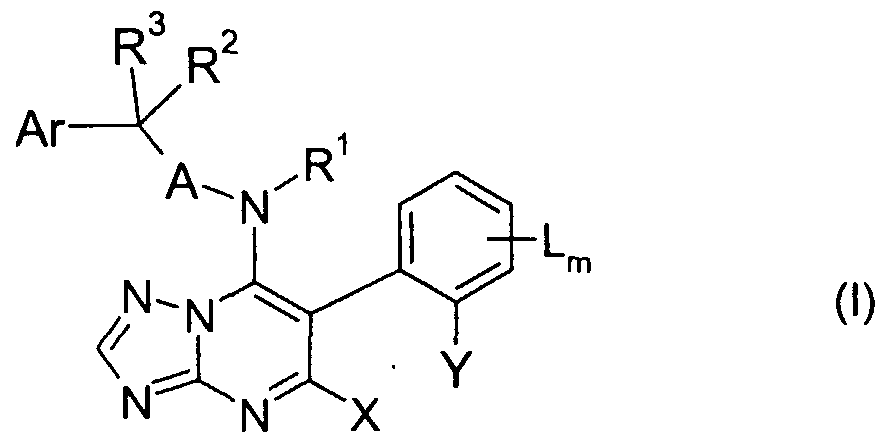
- the present invention thus relates to the triazolopyrimidine compounds of the general formula I and their agriculturally acceptable salts.
- the present invention furthermore relates to agents for combating harmful fungi, comprising at least one compound of the general formula I, a tautomer of I and / or an agriculturally acceptable salt thereof or of its tautomer and at least one liquid or solid carrier.
- the compounds of the formula I and their tautomers can have one or more centers of chirality and are then present as enantiomer or diastereomer mixtures.
- the invention relates both to the pure enantiomers or diastereomers and to their mixtures.
- Agriculturally useful salts include, in particular, the salts of those cations or the acid addition salts of those acids whose cations or anions do not adversely affect the fungicidal activity of the compounds I.
- Anions of useful acid addition salts are primarily chloride, bromide, fluoride, hydrogen sulfate, sulfate, dihydrogen phosphate, hydrogen phosphate, phosphate, nitrate, hydrogen carbonate, carbonate, hexafluorosilicate, hexafluorophosphate, benzoate, as well as the anions of dC 4 -alkanoic acids, preferably formate, preferably formate Propionate and butyrate. They can be formed by reacting I with an acid of the corresponding anion, preferably hydrochloric acid, hydrobromic acid, sulfuric acid, phosphoric acid or nitric acid.
- Halogen fluorine, chlorine, bromine and iodine
- Alkylene a linear divalent hydrocarbon radical with 1, 2, 3 or 4 CH 2 groups, in which 1, 2, 3 or 4 H atoms can be substituted by alkyl and / or 1 or 2 H atoms by a group R c such as can be replaced as defined above;
- Halo (gen) alkyl straight-chain or branched alkyl groups with 1 to 4 or to 6 carbon atoms (as mentioned above), in which case the hydrogen atoms in these groups can be partially or completely replaced by halogen atoms as mentioned above, for example dC 2 -haloalkyl such as chloromethyl, Bromomethyl, dichloromethyl, trichloromethyl, fluoromethyl, difluoromethyl, trifluoromethyl, chlorofluoromethyl, dichlorofluoromethyl, chlorodifluoromethyl, 1-chloroethyl, 1-bromoethyl, 1-fluoroethyl, 2-fluoroethyl, 2,2-difluoroe
- Alkenyl monounsaturated, straight-chain or branched hydrocarbon radicals having 2 to 4, to 6, to 8 or to 10 carbon atoms and a double bond in any position, for example C 2 -C 6 -alkenyl such as ethenyl, 1-propenyl, 2-propenyl, 1- methylethenyl, 1-butenyl, 2-butenyl, 3-butenyl, 1-methyl-1-propenyl, 2-methyl-1-propenyl, 1-methyl-2-propenyl, 2-methyl-2-propenyl, 1- Pentenyl, 2-pentenyl, 3-pentenyl, 4-pentenyl, 1-methyl-1-butenyl, 2-methyl-1-butenyl, 3-methyl-1-butenyl, 1-methyl-2-butenyl, 2-methyl- 2-butenyl, 3-methyl-2-butenyl, 1-methyl-2-butenyl, 2-methyl- 2-butenyl, 3-methyl-2-butenyl, 1-methyl-3-buten
- Alkynyl straight-chain or branched hydrocarbon groups with 2 to 4, 2 to 6, 2 to 8 or 2 to 10 carbon atoms and a triple bond in any position, for example C 2 -C 6 -alkynyl such as ethynyl, 1-propynyl, 2-propynyl, 1-butynyl, 2-butynyl, 3-butynyl, 1-methyl-2-propynyl, 1-pentynyl, 2-pentynyl, 3-pentynyl, 4-pentynyl, 1-methyl-2-butynyl, 1-methyl-3- butynyl, 2-methyl-3-butynyl, 3-methyl-1-butynyl, 1, 1-dimethyl-2-propynyl, 1-ethyl-2-propynyl, 1-hexynyl, 2-hexynyl, 3-hexynyl, 4- Hexynyl, 5-hexynyl, 1-methyl-2-
- Cycloalkyl monocyclic, saturated hydrocarbon groups with 3 to 6 carbon ring members, such as cyclopropyl, cyclobutyl, cyclopentyl and cyclohexyl;
- Alkylamino for an alkyl group bonded via an NH group, in which alkyl represents one of the abovementioned alkyl radicals generally having 1 to 6 and in particular 1 to 4 carbon atoms, such as methylamino, ethylamino, n-propylamino, isopropylamino, n-butylamino and the same;
- Dialkylamino for a radical of the formula N (alkyl) 2 , in which alkyl represents one of the abovementioned alkyl radicals generally having 1 to 6 and in particular 1 to 4 carbon atoms, for example dimethylamino, diethylamino, methylethylamino, N-methyl-N -propylamino and the like;
- Alkylaminocarbonyl for an alkyl group bonded via a C (O) NH group, in which alkyl represents one of the abovementioned alkyl radicals which generally have 1 to 6 and in particular 1 to 4 carbon atoms, such as methylaminocarbonyl, ethylaminocarbonyl, n-propylaminocarbonyl, isopropylaminocarbonyl , n-butylaminocarbonyl and the like;
- Dialkylaminocarbonyl for a radical of the formula N (alkyl) 2 , in which alkyl represents one of the abovementioned alkyl radicals which generally have 1 to 6 and in particular 1 to 4 carbon atoms, for example dimethylaminocarbonyl, diethylaminocarbonyl, methylethylaminocarbonyl, N-methyl -N-propylaminocarbonyl and the like;
- dC 4 alkoxy for an alkyl group bonded via an oxygen having 1 to 4 carbon atoms, e.g. B. methoxy, ethoxy, n-propoxy, 1-methylethoxy, butoxy, 1-methylpropoxy, 2-methylpropoxy or 1, 1-dimethylethoxy;
- dC 6 alkoxy for CC 4 alkoxy, as mentioned above, and z.
- Alkenyloxy alkenyl as mentioned above, which is bonded via an oxygen atom, for example C 2 -C 6 alkenyloxy such as vinyloxy, 1-propenyloxy, 2-propenyloxy, 1-methylethenyloxy, 1-butenyloxy, 2-butenyloxy, 3-butenyloxy, 1 -Methyl-1-propenyloxy, 2-methyl-1-propenyloxy, 1-methyl-2-propenyloxy, 2-methyl-2-propenyloxy, 1-pentenyloxy, 2-pentenyloxy, 3-pentenyloxy, 4-pentenyloxy, 1-methyl -1-butenyloxy, 2-methyl-1-butenyloxy, 3-methyl-1-butenyloxy, 1-methyl-2-butenyloxy, 2-methyl-2-butenyloxy, 3-methyl-2-butenyloxy, 1-methyl-3 -butenyloxy, 2-methyl-3-butenyloxy, 3-methyl-3-butenyl, 1, 1-dimethyl
- heterocyclyl containing, in addition to carbon ring members, one to three nitrogen atoms and / or one Oxygen or sulfur atom or one or two oxygen and / or sulfur atoms, for example 2-tetrahydrofuranyl, 3-tetrahydrofuranyl, 2-tetrahydrothienyl, 3-tetrahydrothienyl, 2-pyrrolidinyl, 3-pyrrolidinyl, 3-lsoxazolidinyl, 4-lsoxazolidinyl, Isoxazolidinyl, 3-isothiazolidinyl, 4-isothiazolidinyl, 5-isothiazolidinyl, 3-pyrazolidinyl, 4-pyrazolidinyl, 5-pyrazolidinyl, 2-
- five- to six-membered heteroaromatic radical an aromatic heterocycle containing one, two or three heteroatoms from the group consisting of oxygen, nitrogen or sulfur: for example C-bonded 5-membered heteroaryl containing one to three nitrogen atoms or one or two nitrogen atoms and a sulfur or oxygen atom as ring members such as 2-furyl, 3-furyl, 2-thienyl, 3-thienyl, 2-pyrrolyl, 3-pyrrolyl, 3-isoxazolyl, 4-isoxazolyl, 5-isoxazolyl, 3-isothiazolyl, 4-isothiazolyl, 5 - isothiazolyl, 3-pyrazolyl, 4-pyrazolyl, 5-pyrazolyl, 2-oxazolyl, 4-oxazolyl, 5-oxazolyl, 2-thiazolyl, 4-thiazolyl, 5-thiazolyl, 2-imidazolyl, 4-imidazolyl, 1, 2 , 4-oxadiazol-3-yl, 1, 2,4
- X halogen especially chlorine, or dC 4 -alkyl, especially methyl, particularly preferably halogen and very particularly preferably chlorine;
- A is a chemical bond or CH 2 , in particular a chemical bond
- Ar phenyl, naphthyl, furyl, isoxazolyl, pyridyl or thienyl, in particular phenyl, 2-furyl, 2-thienyl or isoxazol-5-yl, and especially phenyl, where the abovementioned radicals are unsubstituted or can be substituted in the manner described above and in particular have 0, 1, 2 or 3, in particular 0, 1 or 2 of the abovementioned radicals R a .
- a radical R a which is arranged in the ortho position to the group CR 2 R 3 , together with the group R 1 is C 2 -C 4 alkylene, in particular 1, 2-ethanediyl.
- Ar is then derived from phenyl, which may also have 1 or 2 further substituents R a ;
- R 1 is hydrogen, dC 4 -alkyl, CC 4 -alkoxy, formyl or dC 4 -alkylcarbonyl, in particular hydrogen or -CC 4 -alkyl and especially H, methyl or ethyl;
- R 3 is hydrogen or CC alkyl, especially methyl, and particularly preferably hydrogen
- Y halogen CH 3 or CF 3 , especially fluorine or chlorine; m 1, 2, 3 or 4, preferably 1, 2 or 3, in particular 1 or 2;
- L halogen, cyano, nitro, C 1 -C 6 -alkyl, dC 6 -haloalkyl, CC 4 -alkoxy and dC 4 - alkoxycarbonyl especially fluorine, chlorine, bromine, cyano, dC 4 -alkyl, CC 4 - haloalkyl, CC 4 -Alkoxy or dC 4 -alkoxycarbonyl, particularly preferably fluorine, chlorine, CC 2 -alkyl such as methyl or ethyl, -C-C 2 -Fluoroalkyl such as trifluoromethyl, CC 2 -alkoxy such as methoxy or dC 2 -alkoxycarbonyl such as methoxycarbonyl.
- # is the point of attachment to the triazolopyrimidine backbone
- Y is fluorine, chlorine, CH 3 or CF 3 ;
- L 1 , L 3 independently of one another are hydrogen or fluorine
- L 2 is hydrogen, fluorine, chlorine, cyano, CH 3 , OCH 3 or COOCH 3 ;
- L 4 is hydrogen, fluorine or CH 3 , where at least one of the radicals L 1 to L 4 and in particular 1 or 2 of the radicals L 1 to
- L 4 are different from hydrogen, preferred.
- R 6 is in particular H, CC 4 alkyl, C (O) H or dC 4 alkylcarbonyl;
- R 7 is in particular H or CC 4 alkyl
- R 11 stands in particular for H or CC alkyl.
- R 12 stands in particular for H or dC 4 alkyl.
- R 13 stands in particular for H or CC 4 alkyl.
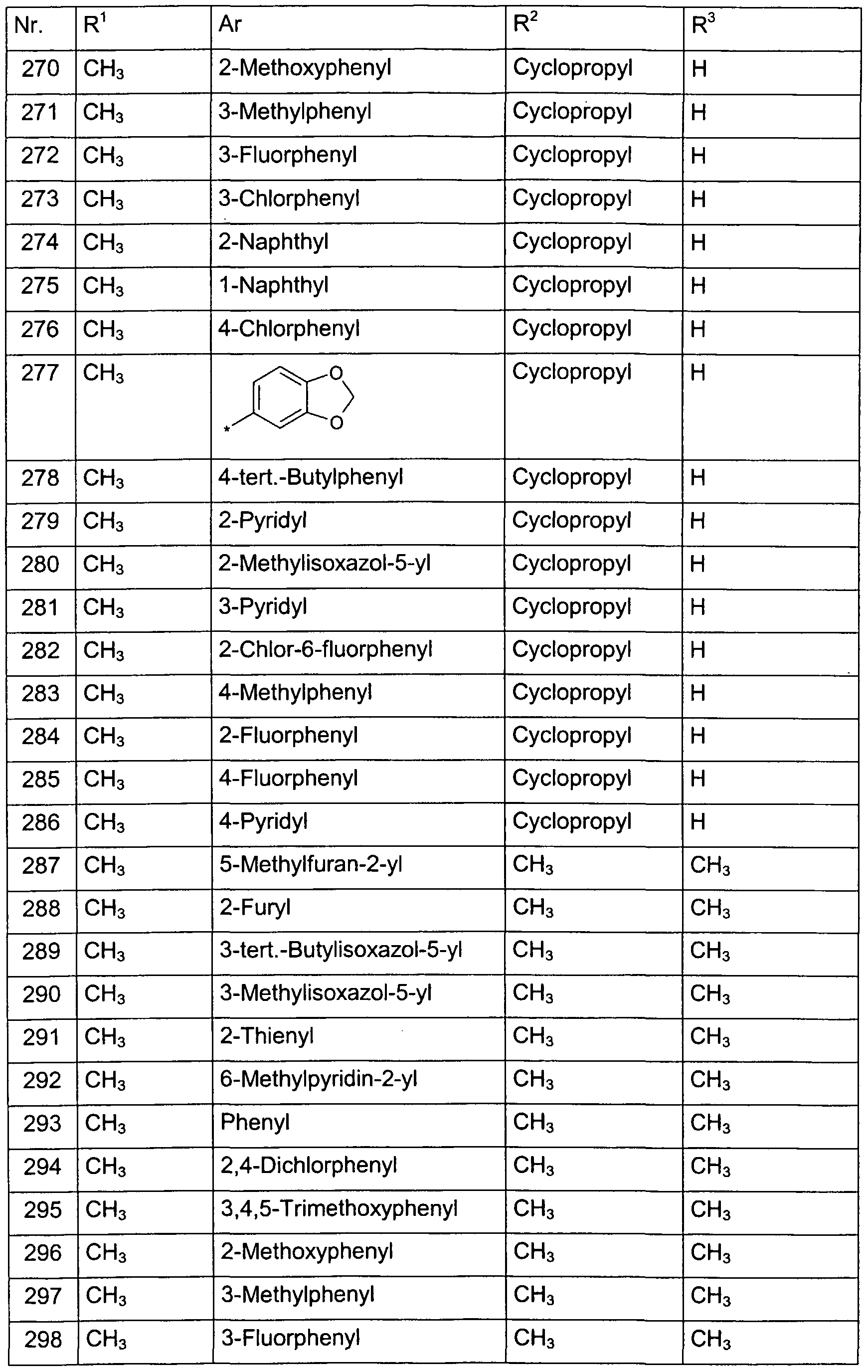
- Examples of preferred compounds of the formula I according to the invention are the compounds of the formula I '(formula I in which A is a chemical bond) and of the formula I "(formula I in which A is CH 2 ) given in Tables 1 to 72 below. , wherein the variables R 1 , R 2 , R 3 and Ar each together have the meaning given in one of rows 1 to 554 of Table A:
- Table 1 Compounds of the formula I "and I" in which X is chlorine, Y is fluorine, L 1 , L 2 and L 3 are each hydrogen and L 4 is fluorine and the combination of Ar, R 1 , R 2 and R 3 for one Connection corresponds in each case to one row of table A.
- R 1 - R 3 , Ar, A, L, m and Y have the meanings mentioned above.
- Shark stands for halogen, especially chlorine.
- the reaction of II with amines III is advantageously carried out at 0 ° C to 70 ° C, preferably 10 ° C to 35 ° C, preferably in the presence of an inert solvent such as ether, e.g. B. dioxane, diethyl ether or in particular tetrahydrofuran, halogenated hydrocarbons such as dichloromethane and aromatic hydrocarbons such as toluene [cf. WO 98/46608; WO 02/48151].
- ether e.g. B. dioxane, diethyl ether or in particular tetrahydrofuran
- halogenated hydrocarbons such as dichloromethane
- aromatic hydrocarbons such as toluene [cf. WO 98/46608; WO 02/48151].
- amines of the formula IM are known and for the most part are commercially available or can be prepared by known methods for the preparation and derivatization of amino acids.
- 5,7-dihalotriazolopyrimidines of the general formula II are known from the prior art cited at the beginning or can be prepared analogously to the methods described there.
- R 1 - R 3 , Ar, A, Hai, L, m and Y have the meanings mentioned above.
- X ' represents cyanide, dC 4 alkoxy or CC 4 haloalkoxy.
- the reaction is advantageously carried out in the presence of an inert solvent.
- the cation M in formula IV is of little importance; for practical reasons, ammonium, tetraalkylammonium or alkali or alkaline earth metal salts are usually preferred.
- the reaction temperature is usually from 0 to 120 ° C., preferably from 10 to 40 ° C. [cf. J. Heterocycl. Chem., Vol. 12, pp. 861-863 (1975)].
- Suitable solvents include ethers such as dioxane, diethyl ether and, preferably tetrahydrofuran, halogenated hydrocarbons such as dichloromethane and aromatic hydrocarbons such as toluene.
- R 1 - R 3 , L, m and Y have the meanings mentioned above.
- Shark stands in particular for chlorine or bromine
- X * for dC 4 alkyl or dC 4 haloalkyl
- R ' stands for C 1 -C 4 alkyl, in particular for methyl or ethyl.
- a 5-alkyl-7-hydroxy-6-phenyltriazolopyrimidine VIII is prepared by reaction of 5-aminotriazole VI with ketoester VII by reaction of 5-aminotriazole VI [cf. Chem. Pharm. Bull., 9, 801, (1961)].
- the 5-aminotriazole VI used is commercially available.
- the starting compounds VII are advantageously prepared under the conditions known from EP-A 10 02 788.
- halogenating agents are chlorinating or brominating agents such as phosphorus oxybromide, phosphorus oxychloride, thionyl chloride, thionyl bromide or sulfuryl chloride.
- the reaction can be carried out in bulk or in the presence of a solvent. Usual reaction temperatures are from 0 to 150 ° C or preferably from 80 to 125 ° C.
- the reaction of 7-halogenotriazolopyrimidine IX with the amine of the formula IM is advantageously carried out at 0 ° C. to 70 ° C., in particular 10 ° C. to 35 ° C.
- the reaction is preferably carried out in the presence of an inert solvent, such as an ether, e.g. B. dioxane, diethyl ether or in particular tetrahydrofuran, a halogenated hydrocarbon such as dichloromethane, an aromatic hydrocarbon such as toluene, xylenes, etc. by [cf. WO 98/46608].
- a base such as tertiary amines, for example triethylamine or inorganic bases, such as potassium carbonate, is preferred; Excess amine of the formula IM can also serve as the base.
- R 1 - R 3 , Ar, A, L, m and Y have the meanings mentioned above.
- X '" stands for hydrogen, dC 3 alkyl or dC 3 haloalkyl and R" dC 4 alkyl.
- the compound LA is reacted with a malonic acid dialkyl ester of the formula X, preferably in the presence of a base, or with the salt of X.
- the compound XL is obtained in this way.
- the reaction can be carried out analogously to the process described in US Pat. No. 5,994,360.
- the malonates XI are known in the literature [J. At the. Chem. Soc, Vol. 64, 2714 (1942); J. Org. Chem., Vol. 39, 2172 (1974); Helv. Chim. Acta, Vol. 61, 1565 (1978)] or can be prepared according to the literature cited.
- ester XII takes place under generally customary conditions [cf. US 5,994,360]. Depending on the different structural elements can the alkaline or acidic saponification of the compounds XI may be advantageous.
- the decarboxylation to IC can already take place in whole or in part.
- the decarboxylation is usually carried out at from 20 ° C. to 180 ° C., preferably from 50 ° C. to 120 ° C., in an inert solvent, optionally in the presence of an acid.
- Suitable acids are hydrochloric acid, sulfuric acid, phosphoric acid, formic acid, acetic acid, p-toluenesulfonic acid.
- Suitable solvents are water, aliphatic hydrocarbons such as pentane, hexane, cyclohexane and petroleum ether, aromatic hydrocarbons such as toluene, o-, m- and p-xylene, halogenated hydrocarbons such as methylene chloride, chloroform and chlorobenzene, ethers such as diethyl ether, diisopropyl ether, tert.
- aliphatic hydrocarbons such as pentane, hexane, cyclohexane and petroleum ether
- aromatic hydrocarbons such as toluene, o-, m- and p-xylene
- halogenated hydrocarbons such as methylene chloride, chloroform and chlorobenzene
- ethers such as diethyl ether, diisopropyl ether, tert.
- reaction mixtures obtained by the methods shown in Schemes 1 to 5 are worked up in a conventional manner, e.g. by mixing with water, separation of the phases and, if necessary, chromatographic purification of the crude products.
- the intermediate and end products fall in part. in the form of colorless or slightly brownish, viscous oils, which are freed from volatile components or purified under reduced pressure and at a moderately elevated temperature. If the intermediate and end products are obtained as solids, they can also be purified by recrystallization or digesting.
- isomer mixtures occur during the synthesis, however, a separation is generally not absolutely necessary, since the individual isomers can partially convert into one another during preparation for use or during use (e.g. under the action of light, acid or base). Corresponding conversions can also take place after use, for example in the treatment of plants in the treated plant or in the harmful fungus to be controlled.
- the compounds I are suitable as fungicides. They are characterized by excellent activity against a broad spectrum of phytopathogenic fungi, in particular from the class of the Ascomycetes, Deuteromycetes, Oomycetes and Ba- sidiomyceten. Some of them are systemically effective and can be used in plant protection as leaf and soil fungicides.
- the compounds I are also suitable for combating harmful fungi such as Pacilomyces variotii in the protection of materials (e.g. wood, paper, dispersions for painting, fibers or fabrics) and in the protection of stored products.
- harmful fungi such as Pacilomyces variotii in the protection of materials (e.g. wood, paper, dispersions for painting, fibers or fabrics) and in the protection of stored products.
- the compounds I are used by treating the fungi or the plants, seeds, materials or the soil to be protected against fungal attack with a fungicidally active amount of the active compounds.
- the application can take place both before and after the infection of the materials, plants or seeds by the fungi.
- the fungicidal compositions generally contain between 0.1 and 95, preferably between 0.5 and 90% by weight of active ingredient.
- the application rates in crop protection are between 0.01 and 2.0 kg of active ingredient per ha.
- active ingredient 0.001 to 0.1 g, preferably 0.01 to 0.05 g, per kg of seed are generally required.
- the amount of active ingredient applied depends on the type of application and the desired effect. Usual application rates in material protection are, for example, 0.001 g to 2 kg, preferably 0.005 g to 1 kg, of active ingredient per cubic meter of treated material.
- the compounds I can be converted into the usual formulations, e.g. Solutions, emulsions, suspensions, dusts, powders, pastes and granules.
- the form of application depends on the respective purpose; in any case, it should ensure a fine and uniform distribution of the compound according to the invention.
- solvent mixtures can also be used, - Carriers such as natural stone powder (e.g. kaolins, clays, talc, chalk) and synthetic stone powder (e.g. highly disperse silica, silicates); Emulsifiers such as nonionic and anionic emulsifiers (e.g. polyoxyethylene fatty alcohol ethers, alkyl sulfonates and aryl sulfonates) and dispersants such as lignin sulfite liquors and methyl cellulose.
- natural stone powder e.g. kaolins, clays, talc, chalk
- synthetic stone powder e.g. highly disperse silica, silicates
- Emulsifiers such as nonionic and anionic emulsifiers (e.g. polyoxyethylene fatty alcohol ethers, alkyl sulfonates and aryl sulfonates) and dispersants such as lignin sulfite liquors and methyl
- mineral oil fractions from medium to high boiling points such as kerosene or diesel oil, furthermore coal tar oils as well as oils of vegetable or animal origin, aliphatic, cyclic and aromatic hydrocarbons, e.g. Toluene, xylene, paraffin, tetrahydronaphthalene, alkylated naphthalenes or their derivatives, methanol, ethanol, propanol, butanol, cyclohexanol, cyclohexanone, isophorone, strongly polar solvents, e.g. Dimethyl sulfoxide, N-methylpyrrolidone or water into consideration.
- mineral oil fractions from medium to high boiling points such as kerosene or diesel oil
- coal tar oils as well as oils of vegetable or animal origin
- aliphatic, cyclic and aromatic hydrocarbons e.g. Toluene, xylene, paraffin, tetrahydronaphthalene, alkylated
- Powders, materials for broadcasting and dusts can be prepared by mixing or grinding the active substances together with a solid carrier.
- Granules e.g. Coating, impregnation and homogeneous granules can be produced by binding the active ingredients to solid carriers.
- Solid carriers are e.g. Mineral earths, such as silica gels, silicates, talc, kaolin, attack clay, limestone, lime, chalk, bolus, loess, clay, dolomite, diatomaceous earth, calcium and magnesium sulfate, magnesium oxide, ground plastics, fertilizers, e.g. Ammonium sulfate, ammonium phosphate, ammonium nitrate, ureas and vegetable products such as cereal flour, tree bark, wood and nutshell flour, cellulose powder and other solid carriers.
- Mineral earths such as silica gels, silicates, talc, kaolin, attack clay, limestone, lime, chalk, bolus, loess, clay, dolomite, diatomaceous earth, calcium and magnesium sulfate, magnesium oxide, ground plastics,
- formulations include products for dilution in water, e.g.
- Emulsifiable concentrates 15 parts by weight of a compound according to the invention are dissolved in xylene with the addition of calcium dodecylbenzenesulfonate and castor oil ethoxylate G ' (5% in each case). Dilution in water results in an emulsion;
- D Emulsions (EW, EO): 40 parts by weight of a compound according to the invention are dissolved in xylene with the addition of calcium dodecylbenzenesulfonate and castor oil ethoxylate (5% each). This mixture is introduced into water using an emulsifying machine (Ultraturax) and brought to a homogeneous emulsion. Dilution in water results in an emulsion,
- E suspensions 20 parts by weight of a compound according to the invention are comminuted in a stirred ball mill to form a fine active ingredient suspension with the addition of dispersing and wetting agents and water or an organic solvent. Dilution in water results in a stable suspension of the active ingredient;
- Water-dispersible and water-soluble granules 50 parts by weight of a compound according to the invention are finely ground with the addition of dispersing and wetting agents and are prepared as water-dispersible or water-soluble granules by means of technical equipment (e.g. extrusion, spray tower, fluidized bed). Dilution in water results in a stable dispersion or solution of the active ingredient;
- WP, SP Water-dispersible and water-soluble powders: 75 parts by weight of a compound according to the invention are ground in a rotor-strator mill with the addition of dispersing and wetting agents and silica gel. Dilution in water results in a stable dispersion or solution of the active ingredient;
- H dusts 5 parts by weight of a compound according to the invention are finely ground and intimately mixed with 95% finely divided kaolin. This gives a dusting agent;
- I Granules (GR, FG, GG, MG): 0.5 part by weight of a compound according to the invention is finely ground and combined with 95.5% carriers. Common processes are extrusion, spray drying or fluidized bed. This gives granules for direct application;
- the active ingredients as such in the form of their formulations or the use forms prepared therefrom, e.g. in the form of directly sprayable solutions, powders, suspensions or dispersions, emulsions, old dispersions, pastes, dusts, sprinkling agents, granules by spraying, atomizing, dusting, scattering or pouring.
- the application forms depend entirely on the purposes; in any case, they should ensure the finest possible distribution of the active compounds according to the invention.
- Aqueous application forms can be prepared from emulsion concentrates, pastes or wettable powders (wettable powders, old dispersions) by adding water.
- the substances as such or dissolved in an oil or solvent can be homogenized in water by means of wetting agents, adhesives, dispersants or emulsifiers.
- the active ingredient concentrations in the ready-to-use preparations can be varied over a wide range. In general, they are between 0.0001 and 10%, preferably between 0.01 and 1%.
- the active ingredients can also be used with great success in the ultra-low-volume process (ULV), it being possible to apply formulations with more than 95% by weight of active ingredient or even the active ingredient without additives.
- Oils of various types, wetting agents, adjuvants, herbicides, fungicides, other pesticides, bactericides can be added to the active compounds, if appropriate also only immediately before use (tank mix). These agents can be added to the agents according to the invention in a weight ratio of 1:10 to 10: 1.
- compositions according to the invention can also be present together with other active compounds which, e.g. with herbicides, insecticides, growth regulators, fungicides or even with fertilizers. Mixing the compounds I or the compositions containing them in the use form as fungicides with other fungicides results in an enlargement of the fungicidal spectrum of action in many cases.
- Acylalanines such as benalaxyl, metalaxyl, ofurace, oxadixyl,
- Amine derivatives such as aldimorph, dodine, dodemorph, fenpropimorph, fenpropidin, guazatine, iminoctadine, spiroxamine, tridemorph
- Anilinopyrimidines such as pyrimethanil, mepanipyrim or cyrodinyl,
- Antibiotics such as cycloheximide, griseofulvin, kasugamycin, natamycin, polyoxin or streptomycin,
- Azoles such as bitertanol, bromoconazole, cyproconazole, difenoconazole, dinitroconazole, epoxiconazole, fenbuconazole, fluquinconazole, flusilazole, hexaconazole, imazalil, metconazole, myclobutanil, penconazole, propiconazole, triadolazolone, triazolonolol, prochlorazolone, tolonazolone, triazolone diolone, triazolone diolazole, triazolone diolone, triazolone diolone, triazolone diolone, triazolone diolone, triazolone diolone, triazolone diolone, triazolone diolone, triazolone diolone, triazolone diolone, triazolone diolone, triazolone diolone
- Dicarboximides such as iprodione, myclozolin, procymidone, vinclozolin,
- Dithiocarbamates such as Ferbam, Nabam, Maneb, Mancozeb, Metam, Metiram, Propineb, Polycarbamat, Thiram, Ziram, Zineb,
- Heterocyclic compounds such as anilazine, benomyl, boscalid, carbendazim, carboxin, oxycarboxin, cyazofamid, dazomet, dithianon, famoxadone, fenamidon, fenarimol, fuberidazole, flutolanil, furametpyr, isoprothiolan, mepronazidolomolol, probolil, probolil, nuarol, probolil, probolil Quinoxyfen, silthiofam, thiabenzazole, thifluzamide, thiophanate methyl, tiadinil, tricyclazole, triforins,
- Copper fungicides such as Bordeaux broth, copper acetate, copper oxychloride, basic copper sulfate,
- Nitrophenyl derivatives such as binapacryl, dinocap, dinobuton, nitrophthal-isopropyl
- Phenylpyrroles such as fenpiclonil or fludioxonil, • sulfur
- fungicides such as acibenzolar-S-methyl, benthiavalicarb, carpropamide, chlorothalonil, cyflufenamid, cymoxanil, Dazomet, diclomezin, diclocymet, Diethofen-carb, edifenphos, ethaboxam, fenhexamide, fentin acetate, fennosetanyl, ferim Fosetyl aluminum, iprovalicarb, hexachlorobenzene, metrafenone, pencycuron, propamocarb, phthalide, toloclofos-methyl, quintozene, zoxamide
- Strobilurins such as azoxystrobin, dimoxystrobin, fluoxastrobin, kresoxim-methyl, metominostrobin, orysastrobin, picoxystrobin, pyraclostrobin or trifloxystrobin,
- Sulfenic acid derivatives such as Captafol, Captan, dichlofluanid, Folpet, Tolylfluanid
- Cinnamic acid amides and analogues such as dimethomorph, flumetover or flumorph.
- Example 2 According to the procedure given for Example 1, the title compound was prepared starting from 5,7-dichloro-6- (2-chloro-6-fluorophenyl) - [1, 2,4] triazolo [1, 5-a] pyrimidine and benzylamine ,
- the active ingredients were prepared separately or together as a stock solution with 25 mg of active ingredient containing a mixture of acetone and / or DMSO and the emulsifier Uniperol® EL (wetting agent with emulsifying and dispersing action based on ethoxylated alkylphenols) in a volume ratio of solvent. Emulsifier from 99 to 1 to 10 ml was filled. Then ad 100 ml was made up with water. This stock solution was diluted with the solvent-emulsifier / water mixture described having the active compound concentration given below.
- Uniperol® EL wetting agent with emulsifying and dispersing action based on ethoxylated alkylphenols
- Leaves of potted tomato plants were sprayed to runoff point with an aqueous suspension in the active compound concentration given below. The following day, the leaves were infected with an aqueous sporangia suspension of Phytophthora infestans. The plants were then placed in a steam-saturated chamber at temperatures between 18 and 20 ° C. After 6 days, the blight on the untreated but infected control plants had developed so strongly that the infestation could be determined visually in%.
Landscapes
- Life Sciences & Earth Sciences (AREA)
- Organic Chemistry (AREA)
- Chemical & Material Sciences (AREA)
- Dentistry (AREA)
- Health & Medical Sciences (AREA)
- Engineering & Computer Science (AREA)
- Plant Pathology (AREA)
- General Health & Medical Sciences (AREA)
- Wood Science & Technology (AREA)
- Zoology (AREA)
- Environmental Sciences (AREA)
- Pest Control & Pesticides (AREA)
- Agronomy & Crop Science (AREA)
- Agricultural Chemicals And Associated Chemicals (AREA)
- Nitrogen Condensed Heterocyclic Rings (AREA)
Abstract
Description






Claims


Priority Applications (4)
| Application Number | Priority Date | Filing Date | Title |
|---|---|---|---|
| JP2007517051A JP2007538028A (ja) | 2004-05-17 | 2005-05-13 | トリアゾロピリミジン化合物および病原菌を制御するためのそれらの使用 |
| BRPI0510804-7A BRPI0510804A (pt) | 2004-05-17 | 2005-05-13 | compostos, uso de um composto, agente adequado para combater fungos nocivos, e, processo para combater fungos fitopatogênicos |
| EP05744598A EP1751162A1 (de) | 2004-05-17 | 2005-05-13 | Triazolopyrimidin-verbindungen und ihre verwendung zur bekämpfung von schadpilzen |
| IL179256A IL179256A0 (en) | 2004-05-17 | 2006-11-14 | Triazolopyrimidine compounds and their use for controlling pathogenic fungi |
Applications Claiming Priority (4)
| Application Number | Priority Date | Filing Date | Title |
|---|---|---|---|
| DE102004024349.2 | 2004-05-17 | ||
| DE102004024349 | 2004-05-17 | ||
| DE102004029446.1 | 2004-06-18 | ||
| DE102004029446 | 2004-06-18 |
Publications (2)
| Publication Number | Publication Date |
|---|---|
| WO2005113555A1 true WO2005113555A1 (de) | 2005-12-01 |
| WO2005113555A8 WO2005113555A8 (de) | 2006-12-14 |
Family
ID=34968294
Family Applications (1)
| Application Number | Title | Priority Date | Filing Date |
|---|---|---|---|
| PCT/EP2005/005270 Ceased WO2005113555A1 (de) | 2004-05-17 | 2005-05-13 | Triazolopyrimidin-verbindungen und ihre verwendung zur bekämpfung von schadpilzen |
Country Status (5)
| Country | Link |
|---|---|
| EP (1) | EP1751162A1 (de) |
| JP (1) | JP2007538028A (de) |
| BR (1) | BRPI0510804A (de) |
| IL (1) | IL179256A0 (de) |
| WO (1) | WO2005113555A1 (de) |
Cited By (2)
| Publication number | Priority date | Publication date | Assignee | Title |
|---|---|---|---|---|
| WO2007113136A1 (de) * | 2006-03-30 | 2007-10-11 | Basf Aktiengesellschaft | Verwendung von substituierten riazolopyrimidinen zur bekämpfung von phyto pathogenen schadpilzen |
| EP3758696A4 (de) * | 2018-03-02 | 2021-12-08 | The Trustees of the University of Pennsylvania | [1,2,4]triazolo[1,5-a]pyrimidin-verbindungen und verwendung davon zur stabilisierung von mikrotubuli |
Citations (6)
| Publication number | Priority date | Publication date | Assignee | Title |
|---|---|---|---|---|
| EP0550113A2 (de) * | 1991-12-30 | 1993-07-07 | Shell Internationale Researchmaatschappij B.V. | Triazolopyrimidinderivate mit fungizider Aktivität |
| WO1998046608A1 (en) * | 1997-04-14 | 1998-10-22 | American Cyanamid Company | Fungicidal trifluoromethylalkylamino-triazolopyrimidines |
| WO1998046607A1 (en) * | 1997-04-14 | 1998-10-22 | American Cyanamid Company | Fungicidal trifluorophenyl-triazolopyrimidines |
| WO2002002563A2 (en) * | 2000-06-30 | 2002-01-10 | Wyeth | Substituted-triazolopyrimidines as anticancer agents |
| WO2002050077A2 (de) * | 2000-12-18 | 2002-06-27 | Bayer Cropscience Ag | Triazolopyrimidine |
| WO2003080615A1 (de) * | 2002-03-21 | 2003-10-02 | Basf Aktiengesellschaft | Fungizide triazolopyrimidine, verfahren zu ihrer herstellung und ihre verwendung zur bekämpfung von schadpilzen sowie sie enthaltende mittel |
-
2005
- 2005-05-13 EP EP05744598A patent/EP1751162A1/de not_active Withdrawn
- 2005-05-13 JP JP2007517051A patent/JP2007538028A/ja not_active Withdrawn
- 2005-05-13 BR BRPI0510804-7A patent/BRPI0510804A/pt not_active IP Right Cessation
- 2005-05-13 WO PCT/EP2005/005270 patent/WO2005113555A1/de not_active Ceased
-
2006
- 2006-11-14 IL IL179256A patent/IL179256A0/en unknown
Patent Citations (6)
| Publication number | Priority date | Publication date | Assignee | Title |
|---|---|---|---|---|
| EP0550113A2 (de) * | 1991-12-30 | 1993-07-07 | Shell Internationale Researchmaatschappij B.V. | Triazolopyrimidinderivate mit fungizider Aktivität |
| WO1998046608A1 (en) * | 1997-04-14 | 1998-10-22 | American Cyanamid Company | Fungicidal trifluoromethylalkylamino-triazolopyrimidines |
| WO1998046607A1 (en) * | 1997-04-14 | 1998-10-22 | American Cyanamid Company | Fungicidal trifluorophenyl-triazolopyrimidines |
| WO2002002563A2 (en) * | 2000-06-30 | 2002-01-10 | Wyeth | Substituted-triazolopyrimidines as anticancer agents |
| WO2002050077A2 (de) * | 2000-12-18 | 2002-06-27 | Bayer Cropscience Ag | Triazolopyrimidine |
| WO2003080615A1 (de) * | 2002-03-21 | 2003-10-02 | Basf Aktiengesellschaft | Fungizide triazolopyrimidine, verfahren zu ihrer herstellung und ihre verwendung zur bekämpfung von schadpilzen sowie sie enthaltende mittel |
Cited By (3)
| Publication number | Priority date | Publication date | Assignee | Title |
|---|---|---|---|---|
| WO2007113136A1 (de) * | 2006-03-30 | 2007-10-11 | Basf Aktiengesellschaft | Verwendung von substituierten riazolopyrimidinen zur bekämpfung von phyto pathogenen schadpilzen |
| EP3758696A4 (de) * | 2018-03-02 | 2021-12-08 | The Trustees of the University of Pennsylvania | [1,2,4]triazolo[1,5-a]pyrimidin-verbindungen und verwendung davon zur stabilisierung von mikrotubuli |
| US11623927B2 (en) | 2018-03-02 | 2023-04-11 | The Trustees Of The University Of Pennsylvania | Substituted [1,2,4]triazolo[1,5-a]pyrimidines for stabilizing microtubules |
Also Published As
| Publication number | Publication date |
|---|---|
| IL179256A0 (en) | 2007-03-08 |
| EP1751162A1 (de) | 2007-02-14 |
| JP2007538028A (ja) | 2007-12-27 |
| WO2005113555A8 (de) | 2006-12-14 |
| BRPI0510804A (pt) | 2007-11-06 |
Similar Documents
| Publication | Publication Date | Title |
|---|---|---|
| EP2049498A1 (de) | Pyrimidinverbundungen zur bekämpfung von schadpilzen und krebs | |
| EP1648890A2 (de) | Arylkondensierte 3-arylpyridinverbindungen und ihre verwendung zur bekämpfung von schadpilzen | |
| EP1651618A1 (de) | 2-substituierte pyrimidine | |
| EP1751132B1 (de) | 2-substituierte pyrimidine und ihre verwendung als pestizide | |
| EP1592695A1 (de) | Pyrimidine, verfahren zu deren herstellung sowie deren verwendung | |
| EP1633728A1 (de) | 2-substituierte pyrimidine | |
| EP1620436A1 (de) | Heterobicyclische verbindungen als fungizide | |
| EP1575958B1 (de) | Fungizide triazolopyrimidine, verfahren zu ihrer herstellung und ihre verwendung zur bekämpfung von schadpilzen sowie sie enthaltende mittel | |
| EP1751162A1 (de) | Triazolopyrimidin-verbindungen und ihre verwendung zur bekämpfung von schadpilzen | |
| EP1761544A1 (de) | Triazolopyrimidin-verbindungen und ihre verwendung zur bekämpfung von schadpilzen | |
| WO2007012642A1 (de) | 7-amino-6-thiadiazolyl- und -oxadiazolyl- 1 , 2 , 4-triazolo [1 , 5 -a] pyrimidin- verbindungen und ihre verwendung zur bekämpfung von schadpilzen | |
| EP1797097A1 (de) | 7-aminomethyl-1,2,4-triazolo[1,5-a]pyrimidin-verbindungen und ihre verwendung zur bekämpfung von schadpilzen | |
| EP1828191A2 (de) | 7-amino-6-hetaryl-1,2,4-triazolo[1,5-a]pyrimidin-verbindungen und ihre verwendung zur bek[mpfung von schadpilzen | |
| EP1651617A1 (de) | 2-substituierte pyrimidine | |
| EP1590350A1 (de) | Triazolopyrimidine,verfahren zu ihrer herstellung und ihre verwendung zur bek mpfung von schadpilzen sowie sie enthaltende mi ttel | |
| EP1758906A2 (de) | 1, 2, 4-triazolo[1,5a]pyrimidine und deren verwendung zur bekämpfung von pflanzen-pathogenen pilzen | |
| WO2007023018A1 (de) | 7-amino-6-triazolyl-1,2,4-triazolo[1,5-a]pyrimidin-verbindungen und ihre verwendung zur bekämpfung von schadpilzen | |
| WO2007023020A1 (de) | 7-amino-6-heteroaryl-1,2,4-triazolo[1,5-a]pyrimidin-verbindungen und ihre verwendung zur bekämpfung von schadpilzen | |
| CN1953980A (zh) | 三唑并嘧啶化合物及其防治致病性真菌的用途 | |
| EP1895844A1 (de) | Verwendung bicyclischer 5-hydroxypyrazoline, neue 5-hydroxypyrazoline, verfahren zu deren herstellung, sowie sie enthaltende mittel | |
| EP1893018A1 (de) | Fungizide n-benzyl-5-hydroxy-5-phenylpyrazoline, verfahren zu deren herstellung, sowie sie enthaltende mittel | |
| WO2007006722A1 (de) | 2 -substituierte 7-amino-6-heteroaryl-1 , 2 , 4-triazolo [1, 5-a] pyrimidin-verbindungen und ihre? verwendung zur bekämpfung von schadpilzen | |
| WO2007006723A1 (de) | 7-amino-6-tetrazolyl-1,2,4-triazolo[1,5-a]pyrimidin-verbindungen und ihre verwendung zur bekämpfung von schadpilzen |
Legal Events
| Date | Code | Title | Description |
|---|---|---|---|
| AK | Designated states |
Kind code of ref document: A1 Designated state(s): AE AG AL AM AT AU AZ BA BB BG BR BW BY BZ CA CH CN CO CR CU CZ DE DK DM DZ EC EE EG ES FI GB GD GE GH GM HR HU ID IL IN IS JP KE KG KM KP KR KZ LC LK LR LS LT LU LV MA MD MG MK MN MW MX MZ NA NG NI NO NZ OM PG PH PL PT RO RU SC SD SE SG SK SL SM SY TJ TM TN TR TT TZ UA UG US UZ VC VN YU ZA ZM ZW |
|
| AL | Designated countries for regional patents |
Kind code of ref document: A1 Designated state(s): BW GH GM KE LS MW MZ NA SD SL SZ TZ UG ZM ZW AM AZ BY KG KZ MD RU TJ TM AT BE BG CH CY CZ DE DK EE ES FI FR GB GR HU IE IS IT LT LU MC NL PL PT RO SE SI SK TR BF BJ CF CG CI CM GA GN GQ GW ML MR NE SN TD TG |
|
| 121 | Ep: the epo has been informed by wipo that ep was designated in this application | ||
| WWE | Wipo information: entry into national phase |
Ref document number: 179256 Country of ref document: IL |
|
| WWE | Wipo information: entry into national phase |
Ref document number: 2007517051 Country of ref document: JP |
|
| WWE | Wipo information: entry into national phase |
Ref document number: 2005744598 Country of ref document: EP |
|
| WWE | Wipo information: entry into national phase |
Ref document number: 200580015940.7 Country of ref document: CN |
|
| NENP | Non-entry into the national phase |
Ref country code: DE |
|
| WWW | Wipo information: withdrawn in national office |
Country of ref document: DE |
|
| WWP | Wipo information: published in national office |
Ref document number: 2005744598 Country of ref document: EP |
|
| ENP | Entry into the national phase |
Ref document number: PI0510804 Country of ref document: BR |