WO2005121158A1 - Transition metal carbene complexes containing a cationic substituent as catalysts of olefin metathesis reactions - Google Patents
Transition metal carbene complexes containing a cationic substituent as catalysts of olefin metathesis reactions Download PDFInfo
- Publication number
- WO2005121158A1 WO2005121158A1 PCT/CA2005/000909 CA2005000909W WO2005121158A1 WO 2005121158 A1 WO2005121158 A1 WO 2005121158A1 CA 2005000909 W CA2005000909 W CA 2005000909W WO 2005121158 A1 WO2005121158 A1 WO 2005121158A1
- Authority
- WO
- WIPO (PCT)
- Prior art keywords
- complex
- substituted
- hydrocarbyl
- heteroatom
- group
- Prior art date
- Legal status (The legal status is an assumption and is not a legal conclusion. Google has not performed a legal analysis and makes no representation as to the accuracy of the status listed.)
- Ceased
Links
- AFLFYIZUCNFYAN-UHFFFAOYSA-N CCCNC[N](C)(C)CC Chemical compound CCCNC[N](C)(C)CC AFLFYIZUCNFYAN-UHFFFAOYSA-N 0.000 description 1
Classifications
-
- B—PERFORMING OPERATIONS; TRANSPORTING
- B01—PHYSICAL OR CHEMICAL PROCESSES OR APPARATUS IN GENERAL
- B01J—CHEMICAL OR PHYSICAL PROCESSES, e.g. CATALYSIS OR COLLOID CHEMISTRY; THEIR RELEVANT APPARATUS
- B01J31/00—Catalysts comprising hydrides, coordination complexes or organic compounds
- B01J31/16—Catalysts comprising hydrides, coordination complexes or organic compounds containing coordination complexes
- B01J31/22—Organic complexes
- B01J31/2265—Carbenes or carbynes, i.e.(image)
-
- C—CHEMISTRY; METALLURGY
- C07—ORGANIC CHEMISTRY
- C07F—ACYCLIC, CARBOCYCLIC OR HETEROCYCLIC COMPOUNDS CONTAINING ELEMENTS OTHER THAN CARBON, HYDROGEN, HALOGEN, OXYGEN, NITROGEN, SULFUR, SELENIUM OR TELLURIUM
- C07F15/00—Compounds containing elements of Groups 8, 9, 10 or 18 of the Periodic Table
-
- B—PERFORMING OPERATIONS; TRANSPORTING
- B01—PHYSICAL OR CHEMICAL PROCESSES OR APPARATUS IN GENERAL
- B01J—CHEMICAL OR PHYSICAL PROCESSES, e.g. CATALYSIS OR COLLOID CHEMISTRY; THEIR RELEVANT APPARATUS
- B01J31/00—Catalysts comprising hydrides, coordination complexes or organic compounds
- B01J31/16—Catalysts comprising hydrides, coordination complexes or organic compounds containing coordination complexes
- B01J31/22—Organic complexes
- B01J31/2265—Carbenes or carbynes, i.e.(image)
- B01J31/2278—Complexes comprising two carbene ligands differing from each other, e.g. Grubbs second generation catalysts
-
- B—PERFORMING OPERATIONS; TRANSPORTING
- B01—PHYSICAL OR CHEMICAL PROCESSES OR APPARATUS IN GENERAL
- B01J—CHEMICAL OR PHYSICAL PROCESSES, e.g. CATALYSIS OR COLLOID CHEMISTRY; THEIR RELEVANT APPARATUS
- B01J31/00—Catalysts comprising hydrides, coordination complexes or organic compounds
- B01J31/26—Catalysts comprising hydrides, coordination complexes or organic compounds containing in addition, inorganic metal compounds not provided for in groups B01J31/02 - B01J31/24
- B01J31/28—Catalysts comprising hydrides, coordination complexes or organic compounds containing in addition, inorganic metal compounds not provided for in groups B01J31/02 - B01J31/24 of the platinum group metals, iron group metals or copper
-
- B—PERFORMING OPERATIONS; TRANSPORTING
- B01—PHYSICAL OR CHEMICAL PROCESSES OR APPARATUS IN GENERAL
- B01J—CHEMICAL OR PHYSICAL PROCESSES, e.g. CATALYSIS OR COLLOID CHEMISTRY; THEIR RELEVANT APPARATUS
- B01J37/00—Processes, in general, for preparing catalysts; Processes, in general, for activation of catalysts
-
- C—CHEMISTRY; METALLURGY
- C07—ORGANIC CHEMISTRY
- C07F—ACYCLIC, CARBOCYCLIC OR HETEROCYCLIC COMPOUNDS CONTAINING ELEMENTS OTHER THAN CARBON, HYDROGEN, HALOGEN, OXYGEN, NITROGEN, SULFUR, SELENIUM OR TELLURIUM
- C07F15/00—Compounds containing elements of Groups 8, 9, 10 or 18 of the Periodic Table
- C07F15/0006—Compounds containing elements of Groups 8, 9, 10 or 18 of the Periodic Table compounds of the platinum group
- C07F15/0046—Ruthenium compounds
-
- B—PERFORMING OPERATIONS; TRANSPORTING
- B01—PHYSICAL OR CHEMICAL PROCESSES OR APPARATUS IN GENERAL
- B01J—CHEMICAL OR PHYSICAL PROCESSES, e.g. CATALYSIS OR COLLOID CHEMISTRY; THEIR RELEVANT APPARATUS
- B01J2231/00—Catalytic reactions performed with catalysts classified in B01J31/00
- B01J2231/50—Redistribution or isomerisation reactions of C-C, C=C or C-C triple bonds
- B01J2231/54—Metathesis reactions, e.g. olefin metathesis
- B01J2231/543—Metathesis reactions, e.g. olefin metathesis alkene metathesis
-
- B—PERFORMING OPERATIONS; TRANSPORTING
- B01—PHYSICAL OR CHEMICAL PROCESSES OR APPARATUS IN GENERAL
- B01J—CHEMICAL OR PHYSICAL PROCESSES, e.g. CATALYSIS OR COLLOID CHEMISTRY; THEIR RELEVANT APPARATUS
- B01J2531/00—Additional information regarding catalytic systems classified in B01J31/00
- B01J2531/80—Complexes comprising metals of Group VIII as the central metal
- B01J2531/82—Metals of the platinum group
- B01J2531/821—Ruthenium
-
- B—PERFORMING OPERATIONS; TRANSPORTING
- B01—PHYSICAL OR CHEMICAL PROCESSES OR APPARATUS IN GENERAL
- B01J—CHEMICAL OR PHYSICAL PROCESSES, e.g. CATALYSIS OR COLLOID CHEMISTRY; THEIR RELEVANT APPARATUS
- B01J2531/00—Additional information regarding catalytic systems classified in B01J31/00
- B01J2531/80—Complexes comprising metals of Group VIII as the central metal
- B01J2531/82—Metals of the platinum group
- B01J2531/825—Osmium
Definitions
- This invention relates generally to olefin metathesis catalysts, and more particularly pertains to new Group 8 transition metal complexes that are useful as olefin metathesis catalysts.
- the invention has utility in the fields of catalysis, organic synthesis, and organometallic chemistry.
- Olefin metathesis catalysis is a powerful technology, which in recent years has received tremendous attention as a versatile method for the formation of carbon-carbon bonds and has numerous applications in organic synthesis and polymer chemistry (R.H. Grubbs, Handbook of Metathesis, Vol. 2 and 3; Wiley VCH, Weinheim, 2003).
- the family of olefin metathesis reactions includes ring-closing metathesis (RCM), cross metathesis (CM or XMET), ring-opening metathesis polymerization (ROMP), and acyclic diene metathesis polymerization (ADMET).
- olefin metathesis stems from the development of several well-defined transition metal complexes, such as the Schrock molybdenum catalysts and the Grubbs ruthenium and osmium catalysts (see, e.g., Schrock (1999) Tetrahedron 55, 8141-8153; Schrock (1990) Ace. Chem. Res. 23, 158-165; Grubbs et al. (1998) Tetrahedron 54, 4413-4450; Trnka et al. (2001) Ace. Chem. Res. 34, 18-29; Grubbs, Handbook of Metathesis, Vol. 1; Wiley VCH, Weinheim, 2003).
- transition metal complexes such as the Schrock molybdenum catalysts and the Grubbs ruthenium and osmium catalysts (see, e.g., Schrock (1999) Tetrahedron 55, 8141-8153; Schrock (1990) Ace. Chem. Res. 23, 158-165; Grubbs et al. (1998) Tetra
- L represents an NHC ligand such as l,3-dimesitylimidazole-2-ylidene (LMes) and l,3-dimesityl-4,5-dihydroimidazol-2-ylidene (sLMes)
- X represents a halogen (e.g., Cl, Br, or I)
- R represents an alkyl, cycloalkyl, or aryl group (e.g., butyl, cyclohexyl, or phenyl)
- R represents an alkyl, alkenyl, or aryl group (e.
- a different strategy to tune olefin metathesis catalysts involves linking two of the ligands that are attached to the metal center.
- chelating carbene species reported by Hoveyda and others (Gaber et al. (2000) J Am. Chem. Soc. 122, 8168-8179; Kingsbury et al. (1999) J Am. Chem. Soc. 121, 791-799; Harrity et al. (1997) J. Am. Chem. Soc. 119, 1488-1489; Harrity et al. (1998) J Am. Chem. Soc. 120, 2343- 2351). These catalysts are exceptionally stable and can be purified by column chromatography in air.
- 125:9248 makes use of olefin cross metathesis to link an imidazolium salt to the carbene moiety of a Grubbs or a Grubbs-Hoveyda catalyst precursor.
- the immediate coordination sphere of the resulting complexes remains intentionally unchanged, but the distal imidazolium salt confers solubility to the catalyst precursor in certain ionic liquids .
- the invention is addressed to the aforementioned need in the art, and provides new organometallic complexes useful as catalysts of olefin metathesis reactions.
- the novel catalysts dramatically shorten the latency period of the metathesis reaction, significantly increase the rate at which the reaction occurs, and substantially shorten the time to reaction completion.
- the complexes of the invention are highly active metathesis catalysts.
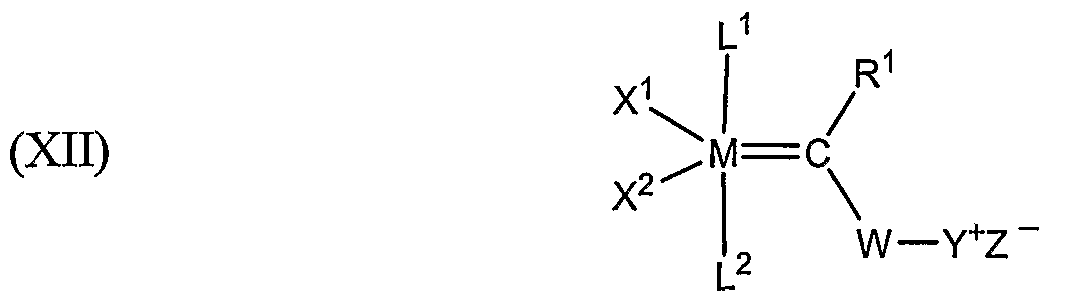
- an organometallic complex useful as an olefin metathesis catalyst is provided, the complex having the structure of formula (I)
- M is a Group 8 transition metal
- L and L are neutral electron donor ligands
- X 1 and X 2 are anionic ligands
- R 1 is hydrogen, -C 12 hydrocarbyl, or substituted C ⁇ -Cn hydrocarbyl
- W is an optionally substituted and/or heteroatom-containing -C 20 hydrocarbylene linkage
- Y is a positively charged Group 15 or Group 16 element substituted with hydrogen, -C 1 hydrocarbyl, substituted C1-C12 hydrocarbyl; heteroatom-containing Ci-
- 77 is a negatively charged counterion
- m is zero or 1
- n is zero or 1; [00023] wherein any two or more of L 1 , L 2 , X 1 , X 2 , R 1 , W, and Y can be taken together to form a cyclic group.
- Exemplary catalysts are those wherein m and n are both zero.
- organometallic complexes of the invention methods are provided for synthesizing the organometallic complexes of the invention.
- One such method involves synthesis of an organometallic complex having the structure of formula (XI)
- M is a Group 8 transition metal
- L 1 is a neutral electron donor ligand
- X 1 and X 2 are anionic ligands
- R 1 is hydrogen, C ⁇ -Cu hydrocarbyl, or substituted C ⁇ -C 12 hydrocarbyl
- Y is a positively charged Group 15 or Group 16 element substituted with hydrogen, C 1 -C 12 hydrocarbyl, substituted hydrocarbyl, heteroatom-containing -C 12 hydrocarbyl, or substituted heteroatom-containing hydrocarbyl
- 77 is a negatively charged ion
- the invention also provides a method for synthesizing an organometallic complex having the structure of formula (II)
- L 1 , X 1 , X 2 , R 1 , and Y are as defined previously, with Y preferably being a -C 12 hydrocarbyl-substituted, positively charged Group 15 or Group 16 element, and 77 is of the formula B(R 15 ) 4 ⁇ where R 15 is fluoro, aryl, or perfluorinated aryl, the method comprising: [00027] (a) contacting (i) a ruthenium complex having the structure (XIV)
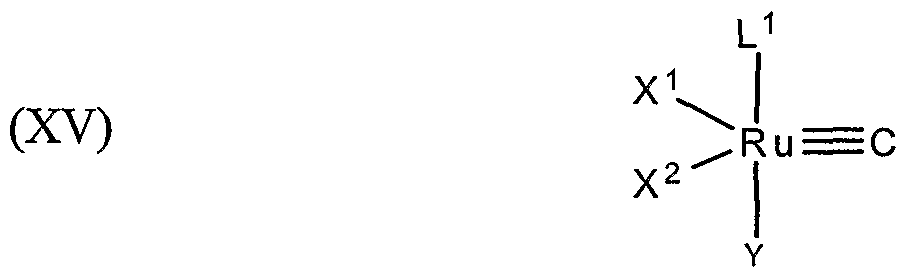
- R 16 is -C 20 hydrocarbyl, with (ii) a reagent effective to convert the ruthenium complex to the ruthenium carbide (XV)
- W is an optionally substituted and/or heteroatom-containing C1-C20 hydrocarbylene linkage
- Y is a positively charged Group 15 or Group 16 element substituted with hydrogen, - 2 hydrocarbyl, substituted hydrocarbyl, heteroatom-containing C C ⁇ hydrocarbyl, or substituted heteroatom- containing hydrocarbyl
- Z is a negatively charged ion
- L , L , X , X , R , W, Y are as defined previously, with W preferably being an optionally substituted -C 12 alkylene linkage and Y preferably being a positively charged Group 15 or Group 16 element substituted with and 77 is of the formula B(R 15 ) ⁇ where R 15 is fluoro, aryl, or perfluorinated aryl, the method comprising contacting a ruthenium complex having the structure (XVII)
- a method for catalyzing an olefin metathesis reaction comprising contacting at least one olefinic reactant with a catalytically effective amount of an organometallic complex of the invention under reaction conditions effective to enable olefin metathesis.
- the metathesis reaction may be ring-closing metathesis, cross metathesis, ring-opening metathesis polymerization, or acyclic diene metathesis polymerization.
- the invention represents a substantial improvement relative to prior Group 8 transition metal complexes used as olefin metathesis catalysts.
- Prior such catalysts including those described in Schrock et al. (1990) J Am. Chem. Soc. 112:3875, Schrock et al. (2003) Angew. Chem. 115:4740, Schrock et al. (2003) Angew. Chem. Int. Ed. 42:4592, and Trnka et al. (2001) Ace. Chem. Res. 34:18, were either highly active but moisture- sensitive and intolerant of polar functional groups (e.g., those described in the Schrock et al.
- the present complexes and methods provide all of the foregoing advantages, including high activity, moisture- insensitivity, and tolerance of polar functional groups.
- the initiation time and substrate (i.e., olefinic reactant) conversion rate can be tuned as desired by appropriately spacing the distance of the cationic species [Y] + from the metal center.
- FIG. 1 schematically illustrates a method for synthesizing catalysts of the invention having the structure of formula (II), as described in Examples 1 through 7.
- FIG. 2 schematically illustrates a method for synthesizing catalysts of the invention having the structure of formula (VII).
- FIG. 4. illustrates in graph form the relative rates of conversion for the ring- closing metathesis of diethyldiallylmalonate at 273 °K catalyzed by prior art catalysts and an organometallic complex of the invention.
- alkyl refers to a linear, branched, or cyclic saturated hydrocarbon group typically although not necessarily containing 1 to about 20 carbon atoms, preferably 1 to about 12 carbon atoms, such as methyl, ethyl, n-propyl, isopropyl, n- butyl, isobutyl, t-butyl, octyl, decyl, and the like, as well as cycloalkyl groups such as cyclopentyl, cyclohexyl and the like. Generally, although again not necessarily, alkyl groups herein contain 1 to about 12 carbon atoms.
- lower alkyl intends an alkyl group of 1 to 6 carbon atoms
- cycloalkyl intends a cyclic alkyl group, typically having 4 to 8, preferably 5 to 7, carbon atoms.
- substituted alkyl refers to alkyl substituted with one or more substituent groups
- heteroatom- containing alkyl and “heteroalkyl” refer to alkyl in which at least one carbon atom is replaced with a heteroatom. If not otherwise indicated, the terms “alkyl” and “lower alkyl” include linear, branched, cyclic, unsubstituted, substituted, and/or heteroatom-containing alkyl and lower alkyl, respectively.
- alkylene refers to a difunctional linear, branched, or cyclic alkyl group, where "alkyl” is as defined above.
- alkenyl refers to a linear, branched, or cyclic hydrocarbon group of 2 to about 20 carbon atoms containing at least one double bond, such as ethenyl, w-propenyl, isopropenyl, w-butenyl, isobutenyl, octenyl, decenyl, tetradecenyl, hexadecenyl, eicosenyl, tetracosenyl, and the like.
- alkenyl groups herein contain 2 to about 12 carbon atoms.
- the term “lower alkenyl” intends an alkenyl group of 2 to 6 carbon atoms
- the specific term “cycloalkenyl” intends a cyclic alkenyl group, preferably having 5 to 8 carbon atoms.
- substituted alkenyl refers to alkenyl substituted with one or more substituent groups
- heteroatom-containing alkenyl and “heteroalkenyl” refer to alkenyl in which at least one carbon atom is replaced with a heteroatom. If not otherwise indicated, the terms “alkenyl” and “lower alkenyl” include linear, branched, cyclic, unsubstituted, substituted, and/or heteroatom-containing alkenyl and lower alkenyl, respectively.
- alkenylene refers to a difunctional linear, branched, or cyclic alkenyl group, where "alkenyl” is as defined above.
- alkoxy intends an alkyl group bound through a single, terminal ether linkage; that is, an "alkoxy” group may be represented as -O-alkyl where alkyl is as defined above.
- a "lower alkoxy” group intends an alkoxy group containing 1 to 6 carbon atoms.
- alkenyloxy and lower alkenyloxy respectively refer to an alkenyl and lower alkenyl group bound through a single, terminal ether linkage
- alkynyloxy and “lower alkynyloxy” respectively refer to an alkynyl and lower alkynyl group bound through a single, terminal ether linkage.
- aryl refers to an aromatic substituent containing a single aromatic ring or multiple aromatic rings that are fused together, directly linked, or indirectly linked (such that the different aromatic rings are bound to a common group such as a methylene or ethylene moiety).
- Preferred aryl groups contain 5 to 20 carbon atoms, and particularly preferred aryl groups contain 5 to 14 carbon atoms.
- Exemplary aryl groups contain one aromatic ring or two fused or linked aromatic rings, e.g., phenyl, naphthyl, biphenyl, diphenylether, diphenylamine, benzophenone, and the like.
- Substituted aryl refers to an aryl moiety substituted with one or more substituent groups
- heteroatom-containing aryl and “heteroaryl” refer to aryl substituent, in which at least one carbon atom is replaced with a heteroatom, as will be described in further detail infra.
- aryloxy refers to an aryl group bound through a single, terminal ether linkage, wherein “aryl” is as defined above.
- An “aryloxy” group may be represented as -O-aryl where aryl is as defined above.
- Preferred aryloxy groups contain 5 to 20 carbon atoms, and particularly preferred aryloxy groups contain 5 to 14 carbon atoms.
- aryloxy groups include, without limitation, phenoxy, o-halo-phenoxy, m-halo- phenoxy, p-halo-phenoxy, o-methoxy-phenoxy, m-methoxy-phenoxy, p-methoxy-phenoxy, 2,4-dimethoxy-phenoxy, 3,4,5-trimethoxy-phenoxy, and the like.
- acyl refers to substituents having the formula -(CO)-alkyl, -(CO)- aryl, or -(CO)-aralkyl
- acyloxy refers to substituents having the formula - O(CO)-alkyl
- cyclic refers to alicyclic or aromatic substituents that may or may not be substituted and/or heteroatom containing, and that may be monocyclic, bicyclic, or polycyclic.
- alicyclic is used in the conventional sense to refer to an aliphatic cyclic moiety, as opposed to an aromatic cyclic moiety, and may be monocyclic, bicyclic, or polycyclic.
- halo and halogen are used in the conventional sense to refer to a chloro, bromo, and fluoro or iodo substituent.
- fluorinated is used in the conventional sense to refer to the replacement of a hydrogen atom in a molecule or molecular segment with a fluorine atom.
- perfluorinated is also used in the conventional sense to refer to a molecule or molecular segment wherein all hydrogen atoms are replaced with fluorine atoms.
- a "fluorinated" methyl group includes -CH 2 F and -CHF 2 as well as the "perfluorinated” methyl group trifluoromethyl, i.e., -CF 3 .
- Hydrocarbyl refers to univalent hydrocarbyl radicals containing 1 to about 30 carbon atoms, preferably 1 to about 20 carbon atoms, most preferably 1 to about 12 carbon atoms, including linear, branched, cyclic, saturated, and unsaturated species, such as alkyl groups, alkenyl groups, aryl groups, and the like.
- lower hydrocarbyl intends a hydrocarbyl group of 1 to 6 carbon atoms, preferably 1 to 4 carbon atoms
- hydrocarbylene intends a divalent hydrocarbyl moiety containing 1 to about 30 carbon atoms, preferably 1 to about 20 carbon atoms, most preferably 1 to about 12 carbon atoms, including linear, branched, cyclic, saturated and unsaturated species.
- lower hydrocarbylene intends a hydrocarbylene group of 1 to 6 carbon atoms.
- Substituted hydrocarbyl refers to hydrocarbyl substituted with one or more substituent groups
- heteroatom-containing hydrocarbyl and “heterohydrocarbyl” refer to hydrocarbyl in which at least one carbon atom is replaced with a heteroatom
- substituted hydrocarbylene refers to hydrocarbylene substituted with one or more substituent groups
- heteroatom-containing hydrocarbylene and heterohydrocarbylene refer to hydrocarbylene in which at least one carbon atom is replaced with a heteroatom.
- hydrocarbyl and hydrocarbylene are to be interpreted as including substituted and/or heteroatom-containing hydrocarbyl and hydrocarbylene moieties, respectively.
- heteroatom-containing refers to a hydrocarbon molecule or a hydrocarbyl molecular fragment in which one or more carbon atoms is replaced with an atom other than carbon, e.g., nitrogen, oxygen, sulfur, phosphorus or silicon, typically nitrogen, oxygen or sulfur.
- heteroalkyl refers to an alkyl substituent that is heteroatom-containing
- heterocyclic refers to a cyclic substituent that is heteroatom-containing
- heteroaryl and heteroaromatic respectively refer to "aryl” and “aromatic” substituents that are heteroatom-containing, and the like.
- a “heterocyclic” group or compound may or may not be aromatic, and further that “heterocycles” may be monocyclic, bicyclic, or polycyclic as described above with respect to the term “aryl.”
- substituted as in “substituted hydrocarbyl,” “substituted alkyl,” “substituted aryl,” and the like, as alluded to in some of the aforementioned definitions, is meant that in the hydrocarbyl, alkyl, aryl, or other moiety, at least one hydrogen atom bound to a carbon (or other) atom is replaced with one or more non-hydrogen substituents.
- substituents include, without limitation: functional groups such as halo, hydroxyl, sulfhydryl, C 1 -C2 0 alkoxy, C 2 -C 20 alkenyloxy, C 2 -C 2 o alkynyloxy, C 5 -C 20 aryloxy, C 6 -C 2 o aralkyloxy, C 6 -C 20 alkaryloxy, acyl (including C2-C2Q alkylcarbonyl (-CO-alkyl) and C 6 -C 20 arylcarbonyl
- acyloxy (-O-acyl, including C2-C20 alkylcarbonyloxy (-O-CO-alkyl) and C 6 -C 20 arylcarbonyloxy (-O-CO-aryl)), C 2 -C 2 o alkoxycarbonyl (-(CO)-O-alkyl), C 6 -C 20 aryloxycarbonyl (-(CO)-O-aryl), halocarbonyl (-CO)-X where X is halo), C 2 -C 2 o alkylcarbonato (-O-(CO)-O-alkyl), C 6 -C 20 arylcarbonato (-O-(CO)-O-aryl), carboxy (- COOH), carboxylato (-COO-), carbamoyl (-(CO)-NH 2 ), mono-(C 1 -C 20 alkyl)-substituted carbamoyl
- the aforementioned functional groups may, if a particular group permits, be further substituted with one or more additional functional groups or with one or more hydrocarbyl moieties such as those specifically enumerated above.
- the above-mentioned hydrocarbyl moieties may be further substituted with one or more functional groups or additional hydrocarbyl moieties such as those specifically enumerated.
- olefin metathesis is used in the now-conventional sense to refer to the metal-catalyzed redistribution of carbon-carbon bonds in a reaction involving an olefin.
- organometallic complexes of the invention have the structure of formula (I)
- M which serves as the transition metal center, is a Group 8 transition metal, particularly ruthenium or osmium. In a particularly preferred embodiment, M is ruthenium.
- X 1 and X 2 are anionic ligands, and may be the same or different, or may be linked together to form a cyclic group, typically although not necessarily a five- to eight- 1 9 membered ring.
- X and X are each independently hydrogen, halide, or one of the following groups: C 1 -C 20 alkyl, C 5 -C 20 aryl, C 1 -C 20 alkoxy, C 5 -C 20 aryloxy, C 2 -C 20 alkoxy-carbonyl, C 6 -C 20 aryloxycarbonyl, C 2 -C 20 acyl, C 2 -C 20 acyloxy, C ⁇ - C 20 alkylsulfonato, C 5 -C 20 arylsulfonato, Q-C20 alkylsulfanyl, C -C 2 o arylsulfanyl, C ⁇ -C 20 alkylsulfinyl, or C 5 -C20 arylsulfinyl.
- X 1 and X 2 may be substituted with one or more moieties selected from Q-C12 alkyl, alkoxy, C5-C 20 aryl, and halide, which may, in turn, with the exception of halide, be further substituted with one or more groups selected from halide, d-Ce alkyl, d-C ⁇ alkoxy, and phenyl.
- fluoride substituents are preferred, giving rise to fluorinated and perfluorinated anionic ligands.
- X 1 and X 2 are selected from halide, mesylate, tosylate, fluorinated C 2 -C 20 acyloxy (e.g., trifluoroacetate, CF 3 CO ), fluorinated C1-C 20 alkylsulfonate (e.g., trifluoromethanesulfonate, CF 3 SO 3 ; also referred to as "triflate"), fluorinated Q-C 20 alkoxy (e.g., hexafluoroisopropoxide, (CF 3 ) 2 CHO), and fluorinated C 5 -C 2 o aryloxy (e.g., perfluorophenoxy, C 6 F 5 O).
- X 1 and X 2 are each chloride.
- R 1 is selected from hydrogen, hydrocarbyl (e.g., C 1 -C 20 alkyl, C 2 -C 20 alkenyl, C2-C 2 Q alkynyl, C5-C20 aryl, C 6 -C 20 alkaryl, C 6 -C 20 aralkyl, etc.), substituted hydrocarbyl (e.g., substituted CrC 20 alkyl, C 2 -C 2 o alkenyl, C 2 -C 2 o alkynyl, C 5 -C 20 aryl, C 6 -C 20 alkaryl, C 6 -C 20 aralkyl, etc.), heteroatom-containing hydrocarbyl (e.g., heteroatom-containing Ci- C 20 alkyl, C 2 -C 2 o alkenyl, C 2 -C 2 o alkynyl, C 5 -C 2 o aryl, C 6 -C 20 alkaryl, C 6 -C 20 aralkyl, etc
- R 1 is hydrogen, C1-C12 hydrocarbyl, or substituted d-C hydrocarbyl, preferably hydrogen or d-C 12 alkyl, and optimally hydrogen.
- L 1 and L 2 are neutral electron donor ligands, and m is zero or 1, meaning that L 2 is optional.
- L 1 moieties include, without limitation, phosphine, sulfonated phosphine, phosphite, phosphinite, phosphonite, arsine, stilbine, ether (including cyclic ethers), amine, amide, imine, sulfoxide, carboxyl, nitrosyl, pyridine, substituted pyridine (e.g., halogenated pyridine), imidazole, substituted imidazole (e.g., halogenated imidazole), pyrazine (e.g., substituted pyrazine), thioether, and heteroatom-substituted carbene
- suitable L 2 moieties include, without limitation, phosphine, sulfonated phosphine, phosphite, phosphinite, phosphonite, arsine, stilbine, ether (including cyclic ethers), amine, amide, imine, sul
- Preferred L 1 ligands are N- heterocyclic carbenes and phosphines, and preferred L ligands are phosphines.
- Exemplary phosphines are of the formula PR R R , where R , R , and R are each independently aryl or d-C 10 alkyl, particularly primary alkyl, secondary alkyl, or cycloalkyl.
- Such phosphines include, for example, tricyclohexylphosphine, tricyclopentylphosphine, triisopropylphosphine, triphenylphosphine, diphenylmethylphosphine, or phenyldimethylphosphine, with tricyclohexylphosphine and tricyclopentylphosphine.
- the transition metal center may associate with the polar solvent molecules (e.g., water, ketones, aldehydes, organohalides, or the like) or with a substrate (e.g., acrylonitrile).
- polar solvent molecules e.g., water, ketones, aldehydes, organohalides, or the like
- substrate e.g., acrylonitrile
- W is an optionally substituted and/or heteroatom-containing d-C 2 o hydrocarbylene linkage, typically an optionally substituted d-C 12 alkylene linkage, e.g., - (CH 2 )i- where i is an integer in the range of 1 to 12 inclusive and any of the hydrogen atoms may be replaced with a non-hydrogen substituent as described earlier herein with regard to the definition of the term "substituted.”
- the subscript n is zero or 1, meaning that W may or may not be present, hi a preferred embodiment, n is zero.
- Y is a positively charged Group 15 or Group 16 element substituted with hydrogen, d-C 12 hydrocarbyl, substituted d-C 12 hydrocarbyl, heteroatom-containing d- C 1 hydrocarbyl, or substituted heteroatom-containing hydrocarbyl.
- Y is a d- C 12 hydrocarbyl-substituted, positively charged Group 15 or Group 16 element.
- Representative Y groups include P(R 2 ) 3 , P(R 2 )3, As(R 2 ) 3 , S(R 2 ) 2 , O(R 2 ) 2 , where the R 2 are independently selected from C 1 -C12 hydrocarbyl; within these, preferred Y groups are phosphines of the structure P(R 2 ) 3 wherein the R 2 are independently selected from d-C ⁇ alkyl and aryl, and thus include, for example, methyl, ethyl, n-propyl, isopropyl, n-butyl, isobutyl, t-butyl, cyclopentyl, cyclohexyl, and phenyl.
- Y can also be a heterocyclic group containing the positively charged Group 15 or Group 16 element.
- Y may be an optionally substituted pyridinyl, pyrazinyl, or imidazolyl group.
- 77 is a negatively charged counterion associated with the cationic complex, and may be virtually any anion, so long as the anion is inert with respect to the components of the complex and the reactants and reagents used in the metathesis reaction catalyzed.
- Preferred 77 moieties are weakly coordinating anions, such as, for instance, [B(C 6 F 5 ) 4 ] ⁇ , [BF,] " , [B(C 6 H 6 ) 4 ]-, [CF 3 S(O) 3 ]-, [PF 6 ]-, [SbF 6 ]-, [A1C ] " [FSO 3 ] " , [CBtracH 6 C1 6 ]- [CB n H 6 Br 6 ]-, and [SO 3 F:SbF 5 ] " .
- Preferred anions suitable as Z ⁇ are of the formula B(R 15 ) 4 ⁇ where R 15 is fluoro, aryl, or perfluorinated aryl, typically fluoro or perfluorinated aryl. Most preferred anions suitable as 77 are BF 4 " and B ⁇ Fs)-, optimally the latter. [00069] It should be emphasized that any two or more of X 1 , X 2 , L 1 , L 2 , R 1 , W, and Y can be taken together to form a cyclic group, as disclosed, for example, in U.S. Patent No. 5,312,940 to Grubbs et al.
- cyclic groups may be five- or six-membered rings, or may comprise two or three five- or six-membered rings, which may be either fused or linked.
- the cyclic groups may be aliphatic or aromatic, and may be heteroatom-containing and/or substituted, as explained in part (I) of this section.
- One group of exemplary catalysts encompassed by the structure of formula (I) are those wherein m and n are zero, such that the complex has the structure of formula (II)
- X 1 , X 2 , and L 1 ligands are as described earlier with respect to complexes of formula (I), as are possible and preferred Y and 77 moieties.
- M is Ru or Os, preferably Ru, and R 1 is hydrogen or -Ci 2 alkyl, preferably hydrogen.
- L 1 is preferably a heteroatom-containing carbene ligand having the structure of formula (III)
- Z 1 and Z 2 are heteroatoms typically selected from N, O, S, and P. Since O and
- Q 1 , Q 2 , Q 3 , and Q 4 are linkers, e.g., d-C 12 hydrocarbylene, substituted d-C 12 hydrocarbylene, heteroatom-containing d-C ⁇ hydrocarbylene, substituted heteroatom- containing d-C 12 hydrocarbylene, or -(CO)-, and w, x, y, and z are independently zero or 1, meaning that each linker is optional.
- w, x, y, and z are all zero.
- R 3 , R 3A , R 4 , and R 4A are independently selected from hydrogen, hydrogen, d- C 20 hydrocarbyl, substituted d-do hydrocarbyl, heteroatom-containing C 1 -C 20 hydrocarbyl, and substituted heteroatom-containing d-do hydrocarbyl.
- w, x, y, and z are zero, Z 1 and Z 1 are N, and R 3A and R 4A are linked to form -Q-, such that the complex has the structure of formula (V)
- R 3 and R 4 are defined above, with preferably at least one of R 3 and R 4 , and more preferably both R 3 and R 4 , being alicyclic or aromatic of one to about five rings, and optionally containing one or more heteroatoms and/or substituents.
- Q is a linker, typically a hydrocarbylene linker, including C -Cu hydrocarbylene, substituted d-d 2 hydrocarbylene, heteroatom-containing d-C ⁇ hydrocarbylene, or substituted heteroatom-containing C ⁇ -Cu hydrocarbylene linker, wherein two or more substituents on adjacent atoms within Q may be linked to form an additional cyclic structure, which may be similarly substituted to provide a fused polycyclic structure of two to about five cyclic groups.
- a linker typically a hydrocarbylene linker, including C -Cu hydrocarbylene, substituted d-d 2 hydrocarbylene, heteroatom-containing d-C ⁇ hydrocarbylene, or substituted heteroatom-containing C ⁇ -Cu hydrocarbylene linker, wherein two or more substituents on adjacent atoms within Q may be linked to form an additional cyclic structure, which may be similarly substituted to provide a fused polycyclic structure of two to about five cyclic groups.
- Examples of functional groups here include carboxyl, d- o alkoxy, C5-C20 aryloxy, C2-C20 alkoxycarbonyl, C 2 -C 2 o alkoxycarbonyl, - o acyloxy, d-do alkylthio, C5-C20 arylthio, C ! -C 2 o alkylsulfonyl, and C1-C20 alkylsulfinyl, optionally substituted with one or more moieties selected from d-do alkyl, d-C 10 alkoxy, C 5 -C 20 aryl, hydroxyl, sulfhydryl, formyl, and halide.
- any two of R 8 , R 9 , R 10 , and R 11 may be linked together to form a substituted or unsubstituted, saturated or unsaturated ring structure, e.g., a C 4 -C 12 alicyclic group or a C5 or C 6 aryl group, which may itself be substituted, e.g., with linked or fused alicyclic or aromatic groups, or with other substituents.
- R 3 and R 4 are aromatic, they are typically although not necessarily composed of one or two aromatic rings, which may or may not be substituted, e.g., R 3 and R 4 may be. phenyl, substituted phenyl, biphenyl, substituted biphenyl, or the like. In one preferred embodiment, R 3 and R 4 are the same and have the structure (VI)
- R 12 , R 13 , and R 14 are each independently hydrogen, d-C 2 o alkyl, substituted d-
- R 14 are each independently hydrogen, d-do alkyl, d-do alkoxy, C 5 -C 14 aryl, substituted d-C 14 aryl, or halide. More preferably, R 3 and R 4 are mesityl (2,4,6-trimethylphenyl).
- organometallic complexes having the general structure (II) are those wherein:
- L 1 is l,3-dimesitylimidazole-2-ylidene (Mes) or l,3-dimesityl-4,5- dihydroimidazol-2-ylidene (H 2 IMes) ;
- X 1 and X 2 are chloro
- Y is P(R 2 ) 3 , wherein the R 2 are independently selected from d-C 6 alkyl and phenyl;
- Z- is BF 4 - or B(C 6 F 5 )-.
- organometallic complexes having the structure of formula (I) wherein m is zero (such that no L 2 is present), including but not limited to complexes of formula (II) are highly active olefin metathesis catalysts. Without wishing to be bound by theory, it is presumed that the high activity is due to the absence of a second electron-donating ligand. That is, it has been shown experimentally (Dias et al. (1997) J Am. Chem. Soc. 119:3887 and Adhart et al. (2000) J Am. Chem. Soc. 122:8204) and computationally (Adhart et al.
- This reactive species is formed upon dissociation of the second electron donor ligand (tricyclohexylphosphine, in the aforementioned examples), a process that is reversible. It will thus be appreciated that with catalysts such as those of formula (II), the absence of a second electron donor ligand improves the kinetics of initiation by circumventing the initiation step completely.
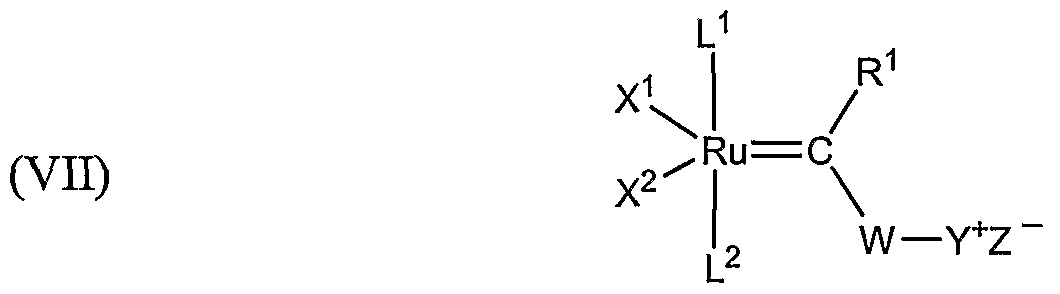
- Another group of catalysts encompassed by the structure of formula (I) are those wherein M is Ru or Os, preferably Ru, R 1 is hydrogen or C 1 -C12 alkyl, preferably hydrogen, and both m and n are 1, such that the complex has the structure of formula (VII)
- organometallic complexes having the general structure (VII) are those wherein:
- L 1 is l,3-dimesitylimidazole-2-ylidene (EVIes) or l,3-dimesityl-4,5- dihydroimidazol-2-ylidene (TH ⁇ EVIes);
- L 2 is selected from tricyclohexylphosphine, tricyclopentylphosphine, triisopropylphosphine, triphenylphosphine, diphenylmethylphosphine, and phenyldimethylphosphine;
- W is an optionally substituted C ⁇ -Cn alkylene linkage
- X 1 and X 2 are chloro
- Y is P(R 2 ) 3 , wherein the R 2 are independently selected from d-C 6 alkyl and phenyl; and
- 77 is BF 4 " or B(C 6 F 5 ) ⁇
- organometallic complexes of the invention thus include, without limitation, the following specific structures 1 through 12:
- organometallic complexes of the invention have been shown to be stable to oxygen and ambient moisture as well as thermally stable. It additionally appears that these catalysts may be stable indefinitely in the solid state when stored at room temperature. Metathesis reactions with functionalized olefins also proceed efficiently, providing the desired product at a high yield with relative small quantities of the catalytic complex.
- organometallic complexes of the invention are synthesized from Group 8 transition metal carbenes having the structure of formula (XVI)
- X are as defined previously, and R is d-C 2 o hydrocarbyl.
- R is d-C 2 o hydrocarbyl.
- M is a Group 8 transition metal
- L is a neutral electron donor ligand
- X and X are anionic ligands
- R 1 is hydrogen, d-C 12 hydrocarbyl, or substituted d-C 12 hydrocarbyl
- Y is a positively charged Group 15 or Group 16 element substituted with hydrogen, C C ⁇ hydrocarbyl, substituted d-C ⁇ hydrocarbyl, heteroatom-containing d-C 12 hydrocarbyl, or substituted heteroatom-containing hydrocarbyl
- 77 is a negatively charged ion
- the [R ] + moiety in the ionic reagent is typically hydrogen, and may be associated with a polar solvent (as in [H(Et 2 O) 2 ][B(C 6 F 5 ) 4 ] " see Jutzi et al. (2000), cited supra).
- Preferred 77 moieties are weakly coordinating anions, such as, for instance, [B(C 6 F 5 ) 4 ] “ , [BF 4 ] “ , [B(C 6 H 6 ) 4 ] ⁇ [CF 3 S(O) 3 ]-, [PF 6 ]-, [SbF 6 ]- [Aid,] " [FSO 3 ]-, [CB threadH 6 C1 6 ]-, [CB threadH 6 Br 6 ]-, and [SO 3 F:SbF 5 ] ⁇ , with [B(C 6 F 5 ) 4 ] ⁇ and [BF 4 ] ⁇ particularly preferred.
- weakly coordinating anions such as, for instance, [B(C 6 F 5 ) 4 ] “ , [BF 4 ] “ , [B(C 6 H 6 ) 4 ] ⁇ [CF 3 S(O) 3 ]-, [PF 6 ]-, [SbF 6 ]- [Aid,] " [F
- Suitable ionic reagents thus include, without limitation, [H(Et 2 O) 2 ][B(C 6 F 5 ) 4 ], [H(Et 2 O) 2 ][BF 4 ], BF 3 /HF, HB(C 6 H 6 ) 4 , CF 3 S(O) 3 H, HF-PF 5 , HF-SbF 5 , CHCC1 3 :A1C1 3 , HSO 3 F:SbF 5 , and FSO 3 H. [00097]
- the invention also provides a method for synthesizing an organometallic complex having the structure of formula (II)
- L 1 , X 1 , X 2 , R 1 , and Y are as defined previously, with Y preferably being a d-C 12 hydrocarbyl-substituted, positively charged Group 15 or Group 16 element, and 77 is of the formula B(R 15 ) 4 " where R 15 is fluoro, aryl, or perfluorinated aryl, the method comprising: [00098] (a) contacting (i) a ruthenium complex having the structure (XIV)
- R » 16 . is d-do hydrocarbyl, with (ii) a reagent effective to convert the ruthenium complex to the ruthenium carbide (XV)
- a reagent for this purpose is the methylene cyclopropane olefin known as Feist's ester, having the structure
- W is an optionally substituted and/or heteroatom-containing d-C 2 o hydrocarbylene linkage
- Y is a positively charged Group 15 or Group 16 element substituted with hydrogen, d-C 12 hydrocarbyl, substituted C 1 -C 12 hydrocarbyl, heteroatom-containing d-C 1 hydrocarbyl, or substituted heteroatom- containing hydrocarbyl
- 77 is a negatively charged ion
- the complex (XVI) is in equilibrium with a complex lacking the L2 moiety. Therefore, the aforementioned synthesis is also useful for preparing complexes of formula (I) where M is zero and N is 1.
- the invention provides a method for synthesizing an organometallic complex of the invention having the structure of formula (VII)
- L 1 , L 2 , X 1 , X 2 , R 1 , W, Y are as defined previously, with Y preferably being a Ci- C 12 hydrocarbyl-substituted, positively charged Group 15 or Group 16 element, and 77 is of the formula B(R 15 ) 4 ⁇ where R 15 is fluoro, aryl, or perfluorinated aryl, the method comprising contacting a ruthenium complex having the structure (XVII)
- the organometallic complexes of the invention are useful in the catalysis of olefin metathesis reactions, including ROMP, RCM, ADMET, and XMET reactions. Accordingly, the invention provides, in a further embodiment, a method for catalyzing an olefin metathesis reaction, the method comprising contacting an olefinic reactant with a catalytically effective amount of an organometallic complex of the invention under reaction conditions effective to enable olefin metathesis.
- ROMP is carried out, by definition, with a cyclic olefin substrate, RCM and ADMET with acyclic dienes, and XMET with two olefinic reactants.
- the reaction conditions are those normally used in olefin metathesis reactions catalyzed by the Grubbs family of metathesis catalysts, e.g., as described in U.S. Patent Nos. 5,312,940, 5,342,909, 5,831,108, 5,969,170, 6,111,121, and.6,211,391 to Grubbs et al.
- the complexes may be dissolved in the reaction medium or attached to a solid support; as understood in the field of catalysis, suitable solid supports maybe of synthetic, semi- synthetic, or naturally occurring materials, which may be organic or inorganic, e.g., polymeric, ceramic, or metallic.
- Attachment to the support may through ionic interaction or via a covalent linkage, and the covalent linkage may be direct or indirect; if indirect, the linkage will typically be between a functional group on a support surface and a ligand or substituent on the catalytic complex.
- the complexes are also useful in the synthesis of "Grubbs-Hoveyda" catalysts in which a single moiety is covalently bound to the carbene carbon atom and contains a functionality that coordinates to the transition metal center. See Kingsbury et al. (1999) J Am. Chem. Soc. 121:791; Hoveyda (1999) J. Am. Chem. Soc. 121:791; and Garber et al. (2000) J. Am. Chem. Soc. 122:8168. Such a reaction is illustrated in the following scheme:
- L 1 , X 1 , X 2 , R 1 , Y, and 77 are as defined earlier herein;
- R 1 is usually hydrogen;
- J is a heteroatom that is capable of coordinating to Ru, e.g., O, S, N, etc., preferably O;
- R 17 is d-d 2 hydrocarbyl, substituted d-d2 hydrocarbyl, heteroatom- containing C 1 -C 1 2 hydrocarbyl, or substituted heteroatom-containing hydrocarbyl, preferably d-C 6 alkyl; and
- v is 1 or 2, representing the number of R 17 substituents bound to J.
- a specific example of such a reaction is the following:
- CD 2 CI 2 was purchased from Cambridge Isotopes, dried over CaH 2 , and stored in appropriate glass bombs after vacuum distillation.
- Nuclear magnetic resonance (NMR) spectra were obtained on Bruker ACE-200 (1H, 200.134 MHz), AMX 300 (1H 300.138, 19 F 282.371 MHz) and BAM-400 (1H 400.134 MHz, 13 C 100.614 MHz, n B 128.377 MHz). All 1H and 13 C spectra were referenced externally to Me 4 Si at 0 ppm by referencing the residual solvent peak.
- Examples 1 through 7 describe the synthesis and characterization of the complexes prepared in Scheme 1, in FIG. 1.
- Pentane (20 ml) was vacuum transferred onto the residue and the system was sonicated for 5 minutes, leaving a green-purple residue. After allowing the solid to settle, the solvent was decanted via cannula, and the purple powder left was dried under full vacuum overnight. Yield: 250 mg, 87%.
- the product can be recrystallized by dissolving in CH C1 2 (10 ml) and layering with pentane (10 ml). Upon diffusion of the two phases for 3-4 days, dark purple crystals are obtained in virtually quantitative yield.
- a stock solution of catalyst was prepared in the drybox by weighing 0.0025 mmol in a 1.0 ml graduated flask and dissolving in CD2CI 2 . From this solution, 400 mL (0.001 mmol) were then transferred into an NMR tube, which was capped with a rubber septum and wrapped with parafilm.
- a separate CD 2 CI 2 diene stock solution was prepared by weighing 1.00 mmol into a 1 ml volumetric flask and refilling with CD 2 CI 2 to the marked level. 100 mL of this diene solution was taken up in a gastight syringe, and taken outside the drybox along with the NMR tube containing the dissolved catalyst.
- FIG. 4 shows the relative rates of conversion for the RCM of diethyldiallylmalonate.
- the pentane was removed via syringe and the pentane/sonication process repeated twice.
- the product was then dissolved in CH 2 C1 2 (5 ml) loaded onto a silica-plug (4 x 4 cm) and the plug flushed with a 1:1 mixture of hexane : ethyl acetate and the yellow fraction collected.
- the volatiles were removed under vacuum.
- the resulting sandy solid contains ethyl acetate of crystallization, however, repeating a process three times of dissolving the solid in CH 2 C1 2 (5 ml) and removing volatiles under reduced pressure removes all ethyl acetate.
Landscapes
- Chemical & Material Sciences (AREA)
- Organic Chemistry (AREA)
- Engineering & Computer Science (AREA)
- Materials Engineering (AREA)
- Chemical Kinetics & Catalysis (AREA)
- Inorganic Chemistry (AREA)
- Catalysts (AREA)
- Organic Low-Molecular-Weight Compounds And Preparation Thereof (AREA)
Abstract
Description








Claims


Priority Applications (6)
| Application Number | Priority Date | Filing Date | Title |
|---|---|---|---|
| AU2005252276A AU2005252276B2 (en) | 2004-06-09 | 2005-06-09 | Transition metal carbene complexes containing a cationic substituent as catalysts of olefin metathesis reactions |
| JP2007526145A JP5081620B2 (en) | 2004-06-09 | 2005-06-09 | Transition metal carbene complexes containing cationic substituents as catalysts for olefin metathesis reactions. |
| EP05755034.5A EP1765839B1 (en) | 2004-06-09 | 2005-06-09 | Transition metal carbene complexes containing a cationic substituent as catalysts of olefin metathesis reactions |
| CN200580024717.9A CN101243098B (en) | 2004-06-09 | 2005-06-09 | Transition metal carbene complexes containing a cationic substituent as catalysts of olefin metathesis reactions |
| CA2569525A CA2569525C (en) | 2004-06-09 | 2005-06-09 | Transition metal carbene complexes containing a cationic substituent as catalysts of olefin metathesis reactions |
| KR1020077000559A KR101291468B1 (en) | 2004-06-09 | 2005-06-09 | Transition metal carbene complexes containing a cationic substituent as catalysts of olefin metathesis reactions |
Applications Claiming Priority (2)
| Application Number | Priority Date | Filing Date | Title |
|---|---|---|---|
| US57820004P | 2004-06-09 | 2004-06-09 | |
| US60/578,200 | 2004-06-09 |
Publications (1)
| Publication Number | Publication Date |
|---|---|
| WO2005121158A1 true WO2005121158A1 (en) | 2005-12-22 |
Family
ID=35503007
Family Applications (1)
| Application Number | Title | Priority Date | Filing Date |
|---|---|---|---|
| PCT/CA2005/000909 Ceased WO2005121158A1 (en) | 2004-06-09 | 2005-06-09 | Transition metal carbene complexes containing a cationic substituent as catalysts of olefin metathesis reactions |
Country Status (9)
| Country | Link |
|---|---|
| US (1) | US7365140B2 (en) |
| EP (1) | EP1765839B1 (en) |
| JP (1) | JP5081620B2 (en) |
| KR (1) | KR101291468B1 (en) |
| CN (1) | CN101243098B (en) |
| AU (1) | AU2005252276B2 (en) |
| CA (1) | CA2569525C (en) |
| WO (1) | WO2005121158A1 (en) |
| ZA (1) | ZA200700170B (en) |
Cited By (4)
| Publication number | Priority date | Publication date | Assignee | Title |
|---|---|---|---|---|
| EP1760093A2 (en) | 2005-08-30 | 2007-03-07 | Lanxess Deutschland GmbH | Use of catalysts for the metathesis degradation of nitrile rubber |
| WO2019110658A1 (en) | 2017-12-08 | 2019-06-13 | Arlanxeo Deutschland Gmbh | Process for producing nitrile rubbers using ruthenium complex catalysts |
| WO2019229239A1 (en) * | 2018-06-01 | 2019-12-05 | Verbio Vereinigte Bioenergie Ag | Ionic metal alkylidene compounds and use thereof in olefinic metathesis reactions |
| US10774035B2 (en) | 2016-09-23 | 2020-09-15 | Umicore Ag & Co. Kg | Preparation of amino acids and amino acid derivatives |
Families Citing this family (34)
| Publication number | Priority date | Publication date | Assignee | Title |
|---|---|---|---|---|
| DE19815275B4 (en) | 1998-04-06 | 2009-06-25 | Evonik Degussa Gmbh | Alkylidene complexes of ruthenium with N-heterocyclic carbene ligands and their use as highly active, selective catalysts for olefin metathesis |
| CA2512815A1 (en) * | 2003-01-13 | 2004-07-29 | Cargill, Incorporated | Method for making industrial chemicals |
| EP1856208B1 (en) * | 2005-01-10 | 2016-12-28 | Elevance Renewable Sciences, Inc. | Wax composition containing metathesis products and method for making an article by extrusion thereof |
| WO2007081987A2 (en) | 2006-01-10 | 2007-07-19 | Elevance Renewable Sciences, Inc. | Method of making hydrogenated metathesis products |
| BRPI0708675B1 (en) | 2006-03-07 | 2017-04-04 | Elevance Renewable Sciences | compositions comprising metathesis unsaturated polyol esters and personal care articles comprising said compositions |
| US8888908B2 (en) * | 2006-03-07 | 2014-11-18 | Elevance Renewable Sciences, Inc. | Colorant compositions comprising metathesized unsaturated polyol esters |
| WO2008008420A1 (en) * | 2006-07-12 | 2008-01-17 | Elevance Renewable Sciences, Inc. | Hot melt adhesive compositions comprising metathesized unsaturated polyol ester wax |
| EP2046719B1 (en) * | 2006-07-12 | 2013-09-04 | Elevance Renewable Sciences, Inc. | Ring opening cross-metathesis reaction of cyclic olefins with seed oils and the like |
| WO2008010961A2 (en) | 2006-07-13 | 2008-01-24 | Elevance Renewable Sciences, Inc. | Synthesis of terminal alkenes from internal alkenes and ethylene via olefin metathesis |
| EP2074079B1 (en) * | 2006-10-13 | 2011-08-10 | Elevance Renewable Sciences, Inc. | Metathesis methods involving hydrogenation and compositions relating to same |
| CN101558027B (en) * | 2006-10-13 | 2013-10-16 | 埃莱文斯可更新科学公司 | Methods of making alpha, omega-dicarboxylic acid alkene derivatives by double decomposition |
| CN102123979A (en) | 2006-10-13 | 2011-07-13 | 埃莱文斯可更新科学公司 | Process for the synthesis of terminal olefins from internal olefins by olefin metathesis |
| WO2008048520A2 (en) | 2006-10-13 | 2008-04-24 | Elevance Renewable Sciences, Inc. | Methods of making organic compounds by metathesis and hydrocyanation |
| US9284515B2 (en) | 2007-08-09 | 2016-03-15 | Elevance Renewable Sciences, Inc. | Thermal methods for treating a metathesis feedstock |
| CN104262590B (en) * | 2008-09-27 | 2018-10-09 | 赞南科技(上海)有限公司 | A kind of metal complex ligand, metal complex and its preparation method and application, high molecular polymer and its preparation method and application |
| WO2010090976A1 (en) * | 2009-02-03 | 2010-08-12 | Idenix Pharmaceuticals, Inc. | Phosphinate ruthenium complexes |
| EA020900B1 (en) * | 2009-05-05 | 2015-02-27 | Стипэн Компани | Composition for recovering oil, process for recovering oil from oil bearing formation and sulfonated derivative of internal olefins |
| US9051519B2 (en) | 2009-10-12 | 2015-06-09 | Elevance Renewable Sciences, Inc. | Diene-selective hydrogenation of metathesis derived olefins and unsaturated esters |
| CA2800171C (en) | 2010-05-22 | 2018-02-20 | Stepan Company | Sulfonated internal olefin surfactant for enhanced oil recovery |
| PL2460587T3 (en) * | 2010-12-01 | 2018-03-30 | Rimtec Corporation | Ruthenium catalyst system for olefin metathesis |
| US9597674B2 (en) * | 2011-01-14 | 2017-03-21 | California Institute Of Technology | Z-selective olefin metathesis catalysts and their synthetic procedure |
| US8846587B2 (en) | 2011-03-24 | 2014-09-30 | Elevance Renewable Sciences, Inc. | Functionalized monomers and polymers |
| US9315748B2 (en) | 2011-04-07 | 2016-04-19 | Elevance Renewable Sciences, Inc. | Cold flow additives |
| CN104508101A (en) | 2011-12-28 | 2015-04-08 | 艾勒旺斯可再生科学公司 | Renewable fatty acid waxes and methods of making |
| US9012385B2 (en) | 2012-02-29 | 2015-04-21 | Elevance Renewable Sciences, Inc. | Terpene derived compounds |
| CN104583369A (en) | 2012-06-20 | 2015-04-29 | 埃莱万斯可再生能源科学股份有限公司 | Natural oil metathesis compositions |
| WO2014093687A1 (en) | 2012-12-12 | 2014-06-19 | California Institute Of Technology | Z-selective metathesis catalysts |
| JP6269670B2 (en) * | 2013-07-17 | 2018-01-31 | 日本ゼオン株式会社 | Transition metal carbene complex and method for producing the same |
| DE102014105885A1 (en) * | 2014-04-25 | 2015-10-29 | Universität Stuttgart | N-heterocyclic carbene complexes of metalimidoalkylidenes and metalloxoalkylidenes and their use |
| US10472379B2 (en) | 2016-05-20 | 2019-11-12 | Garnett Mckeen Lab, Inc. | Ruthenium-sphingomyelin complexes and methods for their use in the treatment of tumors |
| WO2018075479A1 (en) * | 2016-10-19 | 2018-04-26 | Materia, Inc. | Synthesis and characterization of ru alkylidene complexes |
| US11291983B2 (en) * | 2019-09-18 | 2022-04-05 | Apeiron Synthesis S.A. | Organoruthenium carbide complexes as precatalysts for olefin metathesis |
| WO2021074734A1 (en) | 2019-10-14 | 2021-04-22 | 3M Innovative Properties Company | Compositions comprising cyclic olefins and thermally conductive filler |
| KR102915528B1 (en) | 2019-12-20 | 2026-01-21 | 쓰리엠 이노베이티브 프로퍼티즈 캄파니 | Adhesive articles, adhesive compositions and methods comprising polymers and polymerizable cyclic olefins |
Citations (8)
| Publication number | Priority date | Publication date | Assignee | Title |
|---|---|---|---|---|
| US5312940A (en) | 1992-04-03 | 1994-05-17 | California Institute Of Technology | Ruthenium and osmium metal carbene complexes for olefin metathesis polymerization |
| CA2290953A1 (en) * | 1997-06-25 | 1999-01-07 | Ciba Specialty Chemicals Holding Inc. | Ruthenium and osmium carbene catalysts |
| WO1999051344A1 (en) | 1998-04-06 | 1999-10-14 | Aventis Research & Technologies Gmbh & Co. Kg | Alkylidene complexes of ruthenium with n-heterocyclic carbene ligands and their use as highly active, selective catalysts for olefin metathesis |
| US5969170A (en) | 1992-04-03 | 1999-10-19 | California Institute Of Technology | High activity ruthenium and osmium metal carbene complexes for olefin metathesis reactions |
| US6111121A (en) | 1995-08-03 | 2000-08-29 | California Institute Of Technology | High metathesis activity ruthenium and osmium metal carbene complexes |
| WO2000071554A2 (en) | 1999-05-24 | 2000-11-30 | California Institute Of Technology | Imidazolidine-based metal carbene metathesis catalysts |
| CA2442636A1 (en) * | 2001-03-30 | 2002-10-10 | California Institute Of Technology | Selective ring-opening cross-metathesis of cycloolefins |
| CA2461191A1 (en) * | 2001-09-28 | 2003-04-10 | Fumiyuki Ozawa | A method for synthesizing an organometallic compound |
Family Cites Families (5)
| Publication number | Priority date | Publication date | Assignee | Title |
|---|---|---|---|---|
| EP0921129A1 (en) | 1997-12-03 | 1999-06-09 | Studiengesellschaft Kohle mbH | Highly active cationic ruthenium and osmium complexes for olefin metathesis reactions |
| DE19820652A1 (en) | 1998-05-08 | 1999-11-11 | Basf Ag | Cationic ruthenium complexes used as catalyst for metathesis reactions |
| ATE398133T1 (en) | 1999-03-31 | 2008-07-15 | California Inst Of Techn | RUTHENIUM METAL-ALKYLIDE COMPLEXES COORDINATED WITH TRIAZOLYDINE LIGANDS THAT HAVE HIGH OLEFIN METATHESIS ACTIVITY |
| US6225488B1 (en) | 1999-04-02 | 2001-05-01 | Nippon Zeon Co., Ltd. | Ruthenium or osmium catalysts for olefin metathesis reactions |
| EP1756128A4 (en) * | 2004-04-09 | 2008-06-25 | Valorisation Rech Soc En Comma | PHOSPHONIUM SALT DERIVATIVES, THEIR USE AS SOLUBILITY REGULATING ADJUVANTS |
-
2005
- 2005-06-09 CA CA2569525A patent/CA2569525C/en not_active Expired - Fee Related
- 2005-06-09 AU AU2005252276A patent/AU2005252276B2/en not_active Ceased
- 2005-06-09 CN CN200580024717.9A patent/CN101243098B/en not_active Expired - Fee Related
- 2005-06-09 ZA ZA200700170A patent/ZA200700170B/en unknown
- 2005-06-09 KR KR1020077000559A patent/KR101291468B1/en not_active Expired - Fee Related
- 2005-06-09 US US11/149,722 patent/US7365140B2/en not_active Expired - Fee Related
- 2005-06-09 JP JP2007526145A patent/JP5081620B2/en not_active Expired - Fee Related
- 2005-06-09 EP EP05755034.5A patent/EP1765839B1/en not_active Expired - Lifetime
- 2005-06-09 WO PCT/CA2005/000909 patent/WO2005121158A1/en not_active Ceased
Patent Citations (8)
| Publication number | Priority date | Publication date | Assignee | Title |
|---|---|---|---|---|
| US5312940A (en) | 1992-04-03 | 1994-05-17 | California Institute Of Technology | Ruthenium and osmium metal carbene complexes for olefin metathesis polymerization |
| US5969170A (en) | 1992-04-03 | 1999-10-19 | California Institute Of Technology | High activity ruthenium and osmium metal carbene complexes for olefin metathesis reactions |
| US6111121A (en) | 1995-08-03 | 2000-08-29 | California Institute Of Technology | High metathesis activity ruthenium and osmium metal carbene complexes |
| CA2290953A1 (en) * | 1997-06-25 | 1999-01-07 | Ciba Specialty Chemicals Holding Inc. | Ruthenium and osmium carbene catalysts |
| WO1999051344A1 (en) | 1998-04-06 | 1999-10-14 | Aventis Research & Technologies Gmbh & Co. Kg | Alkylidene complexes of ruthenium with n-heterocyclic carbene ligands and their use as highly active, selective catalysts for olefin metathesis |
| WO2000071554A2 (en) | 1999-05-24 | 2000-11-30 | California Institute Of Technology | Imidazolidine-based metal carbene metathesis catalysts |
| CA2442636A1 (en) * | 2001-03-30 | 2002-10-10 | California Institute Of Technology | Selective ring-opening cross-metathesis of cycloolefins |
| CA2461191A1 (en) * | 2001-09-28 | 2003-04-10 | Fumiyuki Ozawa | A method for synthesizing an organometallic compound |
Non-Patent Citations (16)
| Title |
|---|
| BLACKWELL ET AL., J. AM. CHEM. SOC., vol. 122, 2000, pages 58 - 71 |
| CHATTE JEE ET AL., J. AM. CHEM. SAC, vol. 122, 2000, pages 3783 - 3784 |
| CHATTELJEE ET AL., J. AM. CHEM. SOC., vol. 125, 2003, pages 11360 - 11370 |
| CHATTERJEE ET AL., ANGEW. CHEM. INT. ED., vol. 41, 2000, pages 3171 - 3174 |
| FILRSTNER ET AL., CHERN. EUR. J., vol. 7, no. 15, 2001, pages 3236 - 3253 |
| FRENZEL U. ET AL.: "Ruthenium-based Metathesis Initiation: Development and Use in Ring-Opening Metathesis Polymerization.", J POLYMER SCI., vol. 40, no. 17, 2002, pages 2895 - 2916, XP008116156 * |
| GARBER ET AL., J. AM. CHEM. SOC., vol. 122, 2000, pages 8168 - 8179 |
| LOVE ET AL., ANGEW. CHEM., INT. ED., vol. 41, 2002, pages 4035 - 4037 |
| LYNN ET AL., J. AM. CHEM. SOC., vol. 122, 2000, pages 6601 - 6609 |
| ROMERO ET AL: "Direct Observation of a 14-Electron Ruthenacyclobutane Relevant to Olefin Metathesis.", J AMER CHEM SOC., vol. 127, 2005, pages 5032 - 5033, XP008115988 * |
| ROMERO ET AL: "Rapidly Initiating Ruthenium Olefin-Metathesis Catalysts", ANGEW CHEM INT ED., vol. 43, 2004, pages 6161 - 6165, XP008115987 * |
| SANFORD ET AL., ORGANOMETALLICS, vol. 20, 2001, pages 5314 - 5318 |
| SCHOLL ET AL., ORGANIC LETTERS, vol. 1, 1999, pages 953 - 956 |
| SCHWAB ET AL., ANGEW. CHEM., INT. ED, vol. 34, 1995, pages 2039 - 2041 |
| SCHWAB ET AL., J. AM. CHEM. SOC., vol. 118, 1996, pages 100 - 110 |
| See also references of EP1765839A4 |
Cited By (5)
| Publication number | Priority date | Publication date | Assignee | Title |
|---|---|---|---|---|
| EP1760093A2 (en) | 2005-08-30 | 2007-03-07 | Lanxess Deutschland GmbH | Use of catalysts for the metathesis degradation of nitrile rubber |
| US10774035B2 (en) | 2016-09-23 | 2020-09-15 | Umicore Ag & Co. Kg | Preparation of amino acids and amino acid derivatives |
| WO2019110658A1 (en) | 2017-12-08 | 2019-06-13 | Arlanxeo Deutschland Gmbh | Process for producing nitrile rubbers using ruthenium complex catalysts |
| US11407843B2 (en) | 2017-12-08 | 2022-08-09 | Arlanxeo Deutschland Gmbh | Process for producing nitrile rubbers using ruthenium complex catalysts |
| WO2019229239A1 (en) * | 2018-06-01 | 2019-12-05 | Verbio Vereinigte Bioenergie Ag | Ionic metal alkylidene compounds and use thereof in olefinic metathesis reactions |
Also Published As
| Publication number | Publication date |
|---|---|
| CN101243098B (en) | 2015-04-29 |
| KR20070070150A (en) | 2007-07-03 |
| EP1765839A1 (en) | 2007-03-28 |
| CN101243098A (en) | 2008-08-13 |
| JP2008501731A (en) | 2008-01-24 |
| ZA200700170B (en) | 2008-05-28 |
| US20060128912A1 (en) | 2006-06-15 |
| CA2569525A1 (en) | 2005-12-22 |
| CA2569525C (en) | 2015-03-31 |
| AU2005252276B2 (en) | 2010-10-14 |
| EP1765839A4 (en) | 2010-05-26 |
| EP1765839B1 (en) | 2017-01-25 |
| KR101291468B1 (en) | 2013-07-30 |
| US7365140B2 (en) | 2008-04-29 |
| AU2005252276A1 (en) | 2005-12-22 |
| JP5081620B2 (en) | 2012-11-28 |
Similar Documents
| Publication | Publication Date | Title |
|---|---|---|
| EP1765839B1 (en) | Transition metal carbene complexes containing a cationic substituent as catalysts of olefin metathesis reactions | |
| EP1735352B1 (en) | Latent, high-activity olefin metathesis catalysts containing an n-heterocyclic carbene ligand | |
| US6613910B2 (en) | One-pot synthesis of group 8 transition metal carbene complexes useful as olefin metathesis catalysts | |
| EP3164409B1 (en) | Group 8 transition metal catalysts and method for making same and process for use of same in metathesis reaction | |
| KR101835170B1 (en) | Z-selective olefin metathesis catalysts and their synthetic procedure | |
| CA2442368A1 (en) | Cross-metathesis reaction of functionalized and substituted olefins using group 8 transition metal carbene complexes as metathesis catalysts | |
| RU2644556C2 (en) | Catalytic complexes with carbene ligand, method of their production and application in metathesis reaction | |
| JP5522941B2 (en) | Process for the production of organometallic ruthenium complexes and related tetrasubstituted and other bulky olefins | |
| CN102083798A (en) | Ruthenium olefin metathesis catalysts bearing N-heterocyclic carbene ligands with substituted backbone | |
| AU2012206966A1 (en) | Z-selective olefin metathesis catalysts and their synthetic procedure | |
| US20170022232A1 (en) | Method for in-situ formation of metathesis catalysts | |
| Dragutan et al. | Practical New Strategies for Immobilising Ruthenium Alkylidene Complexes: Part I | |
| CN101090915A (en) | Latent, high-activity olefin metathesis catalysts containing an n-heterocyclic carbene ligand | |
| AU2011205218B2 (en) | Latent, high-activity olefin metathesis catalysts containing an N-heterocyclic carbene ligand |
Legal Events
| Date | Code | Title | Description |
|---|---|---|---|
| AK | Designated states |
Kind code of ref document: A1 Designated state(s): AE AG AL AM AT AU AZ BA BB BG BR BW BY BZ CA CH CN CO CR CU CZ DE DK DM DZ EC EE EG ES FI GB GD GE GH GM HR HU ID IL IN IS JP KE KG KM KP KR KZ LC LK LR LS LT LU LV MA MD MG MK MN MW MX MZ NA NG NI NO NZ OM PG PH PL PT RO RU SC SD SE SG SK SL SM SY TJ TM TN TR TT TZ UA UG US UZ VC VN YU ZA ZM ZW |
|
| AL | Designated countries for regional patents |
Kind code of ref document: A1 Designated state(s): GM KE LS MW MZ NA SD SL SZ TZ UG ZM ZW AM AZ BY KG KZ MD RU TJ TM AT BE BG CH CY CZ DE DK EE ES FI FR GB GR HU IE IS IT LT LU MC NL PL PT RO SE SI SK TR BF BJ CF CG CI CM GA GN GQ GW ML MR NE SN TD TG |
|
| 121 | Ep: the epo has been informed by wipo that ep was designated in this application | ||
| DPEN | Request for preliminary examination filed prior to expiration of 19th month from priority date (pct application filed from 20040101) | ||
| WWE | Wipo information: entry into national phase |
Ref document number: 2569525 Country of ref document: CA |
|
| WWE | Wipo information: entry into national phase |
Ref document number: 2007526145 Country of ref document: JP |
|
| WWE | Wipo information: entry into national phase |
Ref document number: 2005252276 Country of ref document: AU |
|
| NENP | Non-entry into the national phase |
Ref country code: DE |
|
| WWW | Wipo information: withdrawn in national office |
Ref document number: DE |
|
| REEP | Request for entry into the european phase |
Ref document number: 2005755034 Country of ref document: EP |
|
| WWE | Wipo information: entry into national phase |
Ref document number: 2005755034 Country of ref document: EP |
|
| WWE | Wipo information: entry into national phase |
Ref document number: 2007/00170 Country of ref document: ZA |
|
| WWE | Wipo information: entry into national phase |
Ref document number: 1020077000559 Country of ref document: KR |
|
| ENP | Entry into the national phase |
Ref document number: 2005252276 Country of ref document: AU Date of ref document: 20050609 Kind code of ref document: A |
|
| WWP | Wipo information: published in national office |
Ref document number: 2005252276 Country of ref document: AU |
|
| WWE | Wipo information: entry into national phase |
Ref document number: 200580024717.9 Country of ref document: CN |
|
| WWP | Wipo information: published in national office |
Ref document number: 2005755034 Country of ref document: EP |