WO2006000449A1 - Zeolite catalysts - Google Patents
Zeolite catalysts Download PDFInfo
- Publication number
- WO2006000449A1 WO2006000449A1 PCT/EP2005/006927 EP2005006927W WO2006000449A1 WO 2006000449 A1 WO2006000449 A1 WO 2006000449A1 EP 2005006927 W EP2005006927 W EP 2005006927W WO 2006000449 A1 WO2006000449 A1 WO 2006000449A1
- Authority
- WO
- WIPO (PCT)
- Prior art keywords
- hydrocarbons
- catalyst
- cracking
- propylene
- ethylene
- Prior art date
- Legal status (The legal status is an assumption and is not a legal conclusion. Google has not performed a legal analysis and makes no representation as to the accuracy of the status listed.)
- Ceased
Links
Classifications
-
- C—CHEMISTRY; METALLURGY
- C10—PETROLEUM, GAS OR COKE INDUSTRIES; TECHNICAL GASES CONTAINING CARBON MONOXIDE; FUELS; LUBRICANTS; PEAT
- C10G—CRACKING HYDROCARBON OILS; PRODUCTION OF LIQUID HYDROCARBON MIXTURES, e.g. BY DESTRUCTIVE HYDROGENATION, OLIGOMERISATION, POLYMERISATION; RECOVERY OF HYDROCARBON OILS FROM OIL-SHALE, OIL-SAND, OR GASES; REFINING MIXTURES MAINLY CONSISTING OF HYDROCARBONS; REFORMING OF NAPHTHA; MINERAL WAXES
- C10G11/00—Catalytic cracking, in the absence of hydrogen, of hydrocarbon oils
- C10G11/02—Catalytic cracking, in the absence of hydrogen, of hydrocarbon oils characterised by the catalyst used
-
- C—CHEMISTRY; METALLURGY
- C10—PETROLEUM, GAS OR COKE INDUSTRIES; TECHNICAL GASES CONTAINING CARBON MONOXIDE; FUELS; LUBRICANTS; PEAT
- C10G—CRACKING HYDROCARBON OILS; PRODUCTION OF LIQUID HYDROCARBON MIXTURES, e.g. BY DESTRUCTIVE HYDROGENATION, OLIGOMERISATION, POLYMERISATION; RECOVERY OF HYDROCARBON OILS FROM OIL-SHALE, OIL-SAND, OR GASES; REFINING MIXTURES MAINLY CONSISTING OF HYDROCARBONS; REFORMING OF NAPHTHA; MINERAL WAXES
- C10G69/00—Treatment of hydrocarbon oils by at least one hydrotreatment process and at least one other conversion process
- C10G69/02—Treatment of hydrocarbon oils by at least one hydrotreatment process and at least one other conversion process plural serial stages only
- C10G69/04—Treatment of hydrocarbon oils by at least one hydrotreatment process and at least one other conversion process plural serial stages only including at least one step of catalytic cracking in the absence of hydrogen
-
- B—PERFORMING OPERATIONS; TRANSPORTING
- B01—PHYSICAL OR CHEMICAL PROCESSES OR APPARATUS IN GENERAL
- B01J—CHEMICAL OR PHYSICAL PROCESSES, e.g. CATALYSIS OR COLLOID CHEMISTRY; THEIR RELEVANT APPARATUS
- B01J29/00—Catalysts comprising molecular sieves
- B01J29/04—Catalysts comprising molecular sieves having base-exchange properties, e.g. crystalline zeolites
- B01J29/06—Crystalline aluminosilicate zeolites; Isomorphous compounds thereof
- B01J29/40—Crystalline aluminosilicate zeolites; Isomorphous compounds thereof of the pentasil type, e.g. types ZSM-5, ZSM-8 or ZSM-11, as exemplified by patent documents US3702886, GB1334243 and US3709979, respectively
Definitions
- This invention relates to the cracking of higher hydrocarbons into alkenes using the hydrogen form of pentasil type zeolite catalysts (HZSM-5).
- HZSM-5 pentasil type zeolite catalysts
- the invention relates to the use of HZSM-5 catalysts having specific silicon to aluminium ratios in the cracking of hydrocarbons to give high yields of propylene.
- Zeolites are a well-known class of aluminosilicates containing an (Si, Al) n O 2n framework with negative charge balanced by cations present in the framework cavities. The nature of the cations used can vary greatly but typical examples include potassium, sodium, calcium, silver and hydrogen. The spaces created within a zeolite framework are relatively large and these so called “cages" can accommodate large molecules.
- ZSM-5 catalysts in which the proton is exchanged with silver or copper are suggested to ensure that the zeolite is substantially free of protons.
- the text suggests that HZSM catalysts show poor selectivity for lower olefins.
- GB 2345294 describes a process similar to that in US 5968342, i.e. one in which a proton free zeolite is employed in a cracking reaction.
- WO 00/18853 describes ZSM-5 catalysts doped with phosphorus and a further promoter such as tin or gallium for use in cracking naphtha to olefins.
- the invention provides a process for cracking C 4 + hydrocarbons comprising heating the hydrocarbons at a temperature of 400- 800 0 C in the presence of an H-ZSM-5 catalyst having a silicon to aluminium ratio of 61-1000.
- the invention provides the use of an HZSM-5 catalyst having a silicon to aluminium ratio of 61 - 1000 as a catalyst in the cracking of C 4 + hydrocarbons.
- the process of the invention may be used on its own or in combination with other processes such as alternative olefin producing processes, e.g. pyrolytic steam cracking.
- C 4 + hydrocarbons is meant that the hydrocarbons being cracked have at least four carbon atoms.
- the hydrocarbons being cracked will have between 4 and 20 carbon atoms, preferably between 5 and 12 carbon atoms, e.g. 6 to 10 carbon atoms.
- the hydrocarbon feedstock can be a single pure hydrocarbon but more usually it will be a mixture of various hydrocarbons, e.g. a light or heavy naphtha fraction, different condensate fractions or a hydrogenated pyrolysis gasoline.
- the hydrocarbons may be saturated or unsaturated, linear, branched or cyclic and preferably non-aromatic. Preferred hydrocarbons however will be saturated paraffins (alkanes such as pentane, hexane, octane, decane, dodecane), olefins of general formula C n H 2n where n is from 4 to 12 or most preferably saturated cyclic hydrocarbons, e.g. cyclopentane, cyclohexane, methylcyclohexane, dimethylcyclohexane, methylcyclopentane or decalin.
- the hydrocarbon feedstock may also be a mixture of any of the above.
- the feedstock comprises at least one C4+ olefin, e.g. a C5+ olefin or diene.
- the hydrocarbon feed may contain aromatic compounds such as benzene. Such aromatics do not, in general, crack in the presence of the HZSM-5 catalyst of the invention and are therefore left unchanged. Aromatic compounds may therefore be used as diluents in the process of the invention. Preferably however, it would be useful to convert aromatic compounds into useful olefins.
- Many of the potential feeds to the catalytic cracker contain high volumes of aromatic compounds, e.g. pyrolysis gasoline or condensate fractions direct from an oil refinery or an oil producer.
- the hydrocarbon feed may be hydrogenated prior to exposure to the zeolite catalyst.
- a hydrocarbon feedstock containing benzene can be hydrogenated to give cyclohexane prior to cracking.
- the majority of the hydrocarbons fed to the cracking reactor will be saturated, i.e. alkanes and cyclic saturated hydrocarbons.
- the invention provides a process comprising hydrogenating a C 4 + hydrocarbon feedstock; and heating the resulting hydrocarbons at a temperature of 400-800 0 C in the presence of an H-ZSM-5 catalyst having a silicon to aluminium ratio of 61 - 1000.
- a potential reactor set up could involve diluent free cracking, e.g. using a hydrogenated pyrolysis gas feed with recycling of C4+ fractions to the hydrogenator.
- a reactor set up could involve the use of an aromatic compound as a diluent for a hydrocarbon feedstock.
- Pyrolysis gasoline from a naphtha steam cracker which contains a large amount of aromatic compounds, would, for example, be suitable as such a diluent.
- the cracker may then have a recycling system which passes through a hydrogenator to convert the diluent into a crackable hydrocarbon.
- the temperature within the cracking reactor should range from 500-750 0 C, more preferably 550-700 0 C, especially 550 to 650°C, e.g. 570° to 650°C or 570 to 630 0 C such as about 600 0 C.
- the residence time of the feed over the catalyst should be long enough to give substantial conversion of the feed but not long enough to give rise to the production of large percentages of aromatic compounds.
- the yield (calculated as weight of carbon) of ethylene and propylene can exceed 40 wt % carbon.
- 40 % by weight of the carbon in the hydrocarbon feedstock is recovered as ethylene and propylene.
- Preferably at least 50 wt % carbon is recovered as ethylene and propylene.
- the ratio of produced propylene to ethylene can vary, e.g. more ethylene than propylene or a 1 : 1 ratio, preferably, the bulk of the produced product is propylene e.g. at least 25 wt% C, especially 30 wt % C. It is also preferred if the ratio of produced propylene to ethylene is greater than 1.2: 1 , e.g.
- An important factor in ensuring high percentage yields of ethylene and propylene is ensuring high conversion of initial feedstock. It is preferred if at least 50% of the initial feedstock is cracked, especially at least 60%, e.g. 70%, most especially at least 80% or at least 90%. At higher temperatures, conversion can near 100%. The higher the cracking temperature the higher the conversion. Also at higher temperatures, ethylene selectivity increases. There is, however, a trade off between temperature and hence high conversion/desired selectivity and potential for formation of aromatic compounds. The most preferred temperature to maximize conversion but minimise benzene formation is in the range 570 to 63O 0 C.
- the invention provides a process for cracking C 4 + hydrocarbons comprising heating the hydrocarbons at a temperature of 400- 800 0 C in the presence of an H-ZSM-5 catalyst having a silicon to aluminium ratio of 61-1000 and recovering the cracked hydrocarbons; wherein at least 40% wt carbon of the cracked C 4 + hydrocarbons is recovered as ethylene and propylene.
- Any non-converted feedstock can of course be recycled back into the cracker along with any unwanted side products.
- the cracking reaction obviously yields hydrocarbons other than ethylene and propylene.
- Other products may include ethane, propane, methane, butane, butene and amounts of C5 and C6+ fractions.
- Catalytic cracking reactors of use in the invention are known and can operate under the temperatures discussed above using pressure if necessary, e.g. from 0.1 to 10 atm, preferably 0.3 to 2 atm.
- the catalytic process can be carried out in, for example, a fixed bed, moving bed, or fluidised bed reactor and the hydrocarbon flow can be cocurrent or countercurrent to catalyst flow.
- the catalyst may be formed from fine solid particles having a size range of from about 0.01 to 10 mm, e.g. 0.2 to 5 mm.
- Diluent such as an inert gas (nitrogen), methane or aromatic compounds can be employed as is known in the art, e.g. to carry the hydrocarbon gas stream into the reactor.
- the ratio of inert gas (if used) to hydrocarbons may range from 0: 1 to 1000: 1. Careful selection of diluents may allow further control over the ratio of products formed.
- the catalyst employed in the invention i.e. a HZSM-5 catalyst having a particular Si/ Al molar ratio is obtainable from commercial sources such as Sud- Chemie. Silicon to aluminium ratios given in the text are molar ratios, i.e. by a Si/ Al ratio of 100 is meant that the molar amount of Si is 100 times the molar amount of Al.
- the manufacture of ZSM-5 catalysts is described in US 3702886.
- Preferred silicon to aluminium ratios are 80-400, especially 100-300, e.g. 85 to 200. It has been surprisingly found that at these high ratios, the amounts of formed lower olefins are high, in contrast to products obtained when using HZSM-5 catalysts having lower Si/ Al ratios.
- the catalyst is preferably medium pore (e.g. 10 rings).
- the catalyst of the invention only exhibits slow loss of activity during the cracking reaction and hence regeneration may be required only infrequently. It is common for the zeolites to be calcined prior to use, however it is preferred if the HZSM-5 catalyst used in the present invention is not calcined. Moreover, many zeolite catalysts are aged prior to use by exposing them to hydrothermal treatment, e.g. heating at a temperature of 500 to 800 0 C in the presence of steam . The zeolites used in the present invention should not be heated in this fashion prior to use since this may affect their light olefin selectivity, i.e.
- the catalyst of use in the invention is an HZSM-5 species as hereinbefore described.
- the cations within the zeolite should be protons.
- the zeolite may be contaminated with other cations, e.g. sodium or potassium ions.
- the zeolite of use in this invention comprises primarily protons with low amounts of other cations, e.g. exclusively protons and no other cations.
- the level of cations (other than protons) should be less than 0.05% wt, preferably less than 0.01%wt.
- An inert gas e.g. nitrogen
- gaseous hydrocarbons formed in the evaporator enter reactor (6) containing catalyst (10) in oven (5) via flow switch (4).
- the material from the reactor is transferred to condenser (7) where heavy ends (C9+) may be collected.
- C 1-8 components are fed back through flow switch (4) and into a mass spectrometer (8) and/or gas chromatograph (9) for analysis.
- a larger scale apparatus is shown in Figure 8. The feed is passed into catalytic naphtha cracker (11) and heated by burning fuel gas.
- the cracked feed is transferred to separator (12) where the components are separated.
- the separator may also take a feed from a naphtha steam cracker (13). Fractions can then be isolated or recycled by to the cracker (1 1) for further cracking to occur.
- a reactor set up for the cracking of pyrolysis gasoline is described.
- To cracker (14) is fed pyrolysis gasoline and a C4 feed along with hydrogen.
- the cracked product is transferred to separator (15) where heavy material and light hydrocarbons are separated.
- the bottoms stream containing the heavier components is passed through hydrogenator (16) to a further separator (17) where methane and hydrogen are separated and passed back to the cracker or isolated.
- the bottoms stream is also recycled back to the cracker.
- FIG. 1 shows a potential catalytic cracking reactor set up.
- Figure 2 shows the composition in the gas phase in the reactor effluent from catalyst A.
- Figure 3 shows the composition in the gas phase in the reactor effluent from catalyst B.
- Figure 4 shows the composition in the gas phase in the reactor effluent from catalyst C.
- Figure 5 shows the composition in the gas phase in the reactor effluent from catalyst D.
- Figure 8 shows a potential catalytic cracking reactor set up.
- Figure 9 shows a potential catalytic cracking reactor set up.
- the reactor set up depicted in Figure 1 was employed.
- the condenser was maintained at 75 0 C and all transfer lines and switches post evaporator were maintained at a temperature of at least 6O 0 C.
- the gas chromatography used was an Agilente micro GC with four columns. Total analyses of permanent gases and Ci-C ⁇ took 240 seconds.
- the gas chromatograph was calibrated with a Ci-C 4 gas mixture (Standard 1) and a mixture of N 2 , H 2 and Ci-6 (Standard 2). Cyclohexane (CH) was calibrated by bypass analysis. All Cs compounds were assumed to have the same calibration factor and all Ce compounds were assumed to have the same calibration factor.
- Reactions were conducted in the temperature region 400-600 0 C with Ig of catalyst, 50 ml/min N 2 flow through evaporator and 0.1 ml/min hydrocarbon flow corresponding to a WHSV [weight hourly space velocity] of 4.7 gCH/(g catalyst*h) with cyclohexane used as feed.
- the catalysts were pressed to tablets and then crushed into particles with particle size 0.2 to 0.5 mm before testing.
- the reactor was first heated to 400 0 C under nitrogen flow before switching to feed from the evaporator. Samples were taken from the reactor at 4-15 minute intervals. N 2 was then flushed through the reactor and the reactor heated to 45O 0 C before feed from the evaporator was again admitted and the process above repeated.
- Catalyst A Kristal 232 ST (Grace Davison) - a standard cracking catalyst based on rare earth exchanged Y zeolite which has wide pores (12 rings)
- Catalyst B Valfoor CP 811 BL-25 (PQ) a Beta zeolite with wide pores (12 rings)
- Catalysts A to C are comparative, catalyst D exemplifies the invention.
- catalyst D The results for catalyst D are presented in Figure 5 and Appendix table 4. At 600 0 C less than 2% ofthe cyclohexane is unconverted and there is observed a large selectivity for propene. The combined ethylene and propylene selectivity among the gas phase molecules is over 60% at 600 0 C. The carbon mass balance at the higher temperature is approximately 80% which means approximately 50% ofthe formed product is ethylene and propylene. The catalyst showed no deactivation on cooling.
- One gram of catalyst (Ig) particles was tested at 400-650 0 C in a quartz fixed bed reactor with on ⁇ line GC analysis.
- a cyclohexane:N 2 molar ratio of 1 : 2.2 and a GHSV of 4338 per h was used.
- Example 2 The catalyst as described in Example 2 was tested with cyclohexane using the same experimental procedure as described in Example 2. The catalyst was tested for 7105 minutes at 600 0 C. The conversion as a function of time on stream is shown in Figure 6. From the results it may easily be derived a half life time of the catalyst of 3.5 days.
- Example 3 The catalyst tested in Example 3 was regenerated in 5% oxygen in He. After regeneration the catalyst was tested with CH using the same experimental procedure as described in Example 2. The catalyst was tested for 1397 minutes at 600 0 C. The conversion as a function of time is shown in Figure 6 and selectivities to ethylene and propylene in figure 7.
- Example 5 The catalyst as described in Example 2 was tested with cyclopentane (CP) using the same experimental procedure as described in Example 2. A CP:N 2 molar ratio of 1 : 1.9 and a GHSV of 4542b: 1 was used. Liquid CP from Janssen Chimica 16.775.91 (98%) was evaporated at 45 0 C into the N 2 stream before entering the reactor. The conversion calculated on basis of unconverted feed (nitrogen is used as internal standard) and the carbon selectivity* in the effluent to propene and ethylene is shown in Table 2.
- Example 7 Cracking of hydrogenated pyrolysis gasoline (light fraction) Hydrogentated pyrolysis gasoline was obtained from Statoil. Some of the hydrogenated pyrolysis gas was distilled to boiling point 125°C. This corresponds to 69.8wt% of the feed. 98.7wt% mass balance was obtained during the distillation (this may indicate that 1.3wt% of the lightest components have been lost during the distillation). The total hydrogenated pyrolysis gasoline (Example 8) and the light fraction ⁇ 125 0 C (Example 7) were used as feeds. Piona analyses of the two feeds were performed and the results are given in Tables 5 and 7 below.
- the total feed contains 80.1wt% naphthenes and the light feed contains 83.2wt% naphthenes.
- the density of the two feeds was measured by weighing 25 ml of the samples.
- the light fraction ⁇ 125°C had a density of 0.744 g/ml and the total hydrogenated pyrolysis gasoline had a density of 0.776 g/ml.
- the analysis of the effluent was performed with an Agilente micro GC with 4 columns. All detectors were TC detectors Column A : 5 A mol sieve Run at 30.7 psi and 85°C with Ar as a carrier gas. Used for analysis of hydrogen and nitrogen Column B: Poraplot U . Run at 20.7 psi and 70°C with He carrier gas.
- Aroma tics 0.597 0.127 0.000 0.000 0.000 0.000 0.000 Benzenes 0.597 0.127 0.000 0.000 0.000 0.000 0.000 0.000 Naphthalene 0.000 NaptWOIef-benzenes 0.000 0.000 0.000 0.000 0.000 lndenes 0.000 0.000 0.000 0.000 0.000 0.000
- Example 2 The catalyst as described in Example 2 was tested with a hydrogenated pyrolysis gasoline using the experimental conditions as described in Example 1.
- a Piona analysis of this feed is given in Table 7 below.
- the yield to ethene and propene are given Table 8.
- Table 7 Piona analysis of the hght fraction from hydrogenated pyrolysis gasoline
- Example 9 Testing with aromatic diluent.
- Example 2 The catalyst described in Example 2 was tested at 400-650°C in a quartz fixed bed reactor with online GC analysis Nitrogen and benzene were used as diluent, along with a cyclohexane N 2 benzene molar ratio of 1 1 3 1, and at a GHSV 4356 per h Liquid 1 1 molar mixture of cyclohexane (CH) from Merck (99 6%) and benzene from Merck (p. a.) was evaporated at 80°C into the nitrogen stream before entering the reactor.
- CH cyclohexane
- Merck p. a.
- One gram of catalyst (Ig) particles was tested at 500-700 0 C in a quartz fixed bed reactor with on-line GC analysis.
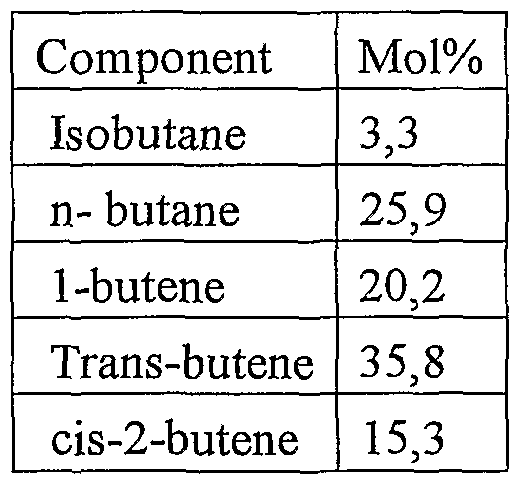
- C4 mix obtained from a commercial steam cracker 19ml/min and 25ml/min nitrogen was used as feed.
- the C4 mix was contained as a liquid in a container keeping a pressure of 1.5 bar. This was taken from a stream where the original C4 mix had been exposed to a partial hydrogenation of butadiene, and thereafter the isobutene removed by reacting to methyltertbutylether.
- the analysis of the C4 mix was performed on a separate GC and the analysis is given in Table 10.
- Example 11 Using light fraction of pyrolysis gasoline as feed
- the catalyst (Ig) as described in Example 2 was tested with the light fraction of pyrolysis gasoline as feed.
- the pyrolysis gasoline was distilled and the fraction boiling at ⁇ 125°C was used as feed. This corresponds to 82% of the pyrolysis gasoline sample.
- Analysis of the light fraction of the pyrolysis gasoline was performed on a separate GC and the analysis is given in Table 11. This light fraction had a density of 0.798g/ml.
- the liquid feed was fed with 0. lml/min and evaporated into a 50 ml/min nitrogen stream before entering the reactor.
- Table 1 The cracking catalyst A MoI %i gas phase Product carbon % in gasphase Temp sum C H 2 CH 4 C 2 H 4 C 2 H 6 C 3 H 6 C 3 H 8 sum sum sum unconv sum Metan C 2 H 4 C 2 E 6 C 3 H 6 C 3 H 8 sum sum sum sum mol% ia balance C 4 Cj Csprod C*n 1 , C 4 C 5 C 6 P io_ rt op_ 400 102,9 80,6 0,1 0,0 0,1 0,0 0,0 0,5 0,7 0,2 3,8 22,0 28,5 0,0 0,7 0,1 0,5 5,3 10,0 3,7 79,8 400 103,2 83,8 0,1 0,0 0,1 0,0 0,0 0,4 0,5 0,7 3,5 23,0 27,8 0,0 0,6 0,1
Landscapes
- Chemical & Material Sciences (AREA)
- Oil, Petroleum & Natural Gas (AREA)
- Engineering & Computer Science (AREA)
- Chemical Kinetics & Catalysis (AREA)
- General Chemical & Material Sciences (AREA)
- Organic Chemistry (AREA)
- Organic Low-Molecular-Weight Compounds And Preparation Thereof (AREA)
- Production Of Liquid Hydrocarbon Mixture For Refining Petroleum (AREA)
- Catalysts (AREA)
Abstract
Description




Claims
Priority Applications (2)
| Application Number | Priority Date | Filing Date | Title |
|---|---|---|---|
| EP05755476A EP1761333A1 (en) | 2004-06-28 | 2005-06-28 | Zeolite catalysts |
| US11/571,309 US20070246400A1 (en) | 2004-06-28 | 2006-01-05 | Zeolite Catalysts |
Applications Claiming Priority (2)
| Application Number | Priority Date | Filing Date | Title |
|---|---|---|---|
| GBGB0414442.4A GB0414442D0 (en) | 2004-06-28 | 2004-06-28 | Zeolite catalysts |
| GB0414442.4 | 2004-06-28 |
Publications (1)
| Publication Number | Publication Date |
|---|---|
| WO2006000449A1 true WO2006000449A1 (en) | 2006-01-05 |
Family
ID=32800318
Family Applications (1)
| Application Number | Title | Priority Date | Filing Date |
|---|---|---|---|
| PCT/EP2005/006927 Ceased WO2006000449A1 (en) | 2004-06-28 | 2005-06-28 | Zeolite catalysts |
Country Status (5)
| Country | Link |
|---|---|
| US (1) | US20070246400A1 (en) |
| EP (1) | EP1761333A1 (en) |
| CN (1) | CN1997451A (en) |
| GB (1) | GB0414442D0 (en) |
| WO (1) | WO2006000449A1 (en) |
Cited By (1)
| Publication number | Priority date | Publication date | Assignee | Title |
|---|---|---|---|---|
| US11197830B2 (en) | 2019-02-27 | 2021-12-14 | Aft Pharmaceuticals Limited | Pharmaceutical composition containing acetaminophen and ibuprofen |
Families Citing this family (7)
| Publication number | Priority date | Publication date | Assignee | Title |
|---|---|---|---|---|
| US7943038B2 (en) | 2008-01-29 | 2011-05-17 | Kellogg Brown & Root Llc | Method for producing olefins using a doped catalyst |
| US8137535B2 (en) * | 2008-01-29 | 2012-03-20 | Kellogg Brown & Root Llc | Method for adjusting catalyst activity |
| US8137631B2 (en) * | 2008-12-11 | 2012-03-20 | Uop Llc | Unit, system and process for catalytic cracking |
| US8246914B2 (en) * | 2008-12-22 | 2012-08-21 | Uop Llc | Fluid catalytic cracking system |
| US8889076B2 (en) * | 2008-12-29 | 2014-11-18 | Uop Llc | Fluid catalytic cracking system and process |
| CN102372571B (en) * | 2010-08-23 | 2014-07-02 | 中国石油化工股份有限公司 | Method for producing propylene by oxygen-containing compound conversion |
| CN102373071B (en) * | 2010-08-23 | 2014-08-13 | 中国石油化工股份有限公司 | Method for preparing olefins by catalytic pyrolysis |
Citations (4)
| Publication number | Priority date | Publication date | Assignee | Title |
|---|---|---|---|---|
| EP0109059A1 (en) * | 1982-11-10 | 1984-05-23 | MONTEDIPE S.p.A. | Process for converting olefins having 4 to 12 carbon atoms into propylene |
| US4502945A (en) * | 1982-06-09 | 1985-03-05 | Chevron Research Company | Process for preparing olefins at high pressure |
| EP0921176A1 (en) * | 1997-12-05 | 1999-06-09 | Fina Research S.A. | Production of olefins |
| US6222087B1 (en) * | 1999-07-12 | 2001-04-24 | Mobil Oil Corporation | Catalytic production of light olefins rich in propylene |
Family Cites Families (13)
| Publication number | Priority date | Publication date | Assignee | Title |
|---|---|---|---|---|
| US3140249A (en) * | 1960-07-12 | 1964-07-07 | Socony Mobil Oil Co Inc | Catalytic cracking of hydrocarbons with a crystalline zeolite catalyst composite |
| BE612554A (en) * | 1961-12-21 | |||
| US3702886A (en) * | 1969-10-10 | 1972-11-14 | Mobil Oil Corp | Crystalline zeolite zsm-5 and method of preparing the same |
| US4517402A (en) * | 1979-12-19 | 1985-05-14 | Mobil Oil Corporation | Selective sorption of linear aliphatic compounds by zeolites |
| US4837398A (en) * | 1987-08-05 | 1989-06-06 | Mobil Oil Corporation | Ammonium activation of zeolites in the presence of gaseous ammonia |
| US4855524A (en) * | 1987-11-10 | 1989-08-08 | Mobil Oil Corporation | Process for combining the operation of oligomerization reactors containing a zeolite oligomerization catalyst |
| US5384297A (en) * | 1991-05-08 | 1995-01-24 | Intevep, S.A. | Hydrocracking of feedstocks and catalyst therefor |
| US5292976A (en) * | 1993-04-27 | 1994-03-08 | Mobil Oil Corporation | Process for the selective conversion of naphtha to aromatics and olefins |
| JP3664502B2 (en) * | 1994-10-28 | 2005-06-29 | 旭化成ケミカルズ株式会社 | Process for producing lower olefins and monocyclic aromatic hydrocarbons |
| US5744680A (en) * | 1995-08-10 | 1998-04-28 | Uop | Process for producing light olefins |
| NO305308B1 (en) * | 1997-07-31 | 1999-05-10 | Sanyo Petrochemical Co Ltd | Zeolite-based catalyst having high silica content, and their use in the production or reaction of aromatic hydrocarbons |
| EP1061116A1 (en) * | 1999-06-16 | 2000-12-20 | Fina Research S.A. | Production of olefins |
| TW538028B (en) * | 1999-11-04 | 2003-06-21 | Everlight Chem Ind Corp | Alkylated diaminobenzene sulfonic acids |
-
2004
- 2004-06-28 GB GBGB0414442.4A patent/GB0414442D0/en not_active Ceased
-
2005
- 2005-06-28 EP EP05755476A patent/EP1761333A1/en not_active Withdrawn
- 2005-06-28 CN CNA2005800212517A patent/CN1997451A/en active Pending
- 2005-06-28 WO PCT/EP2005/006927 patent/WO2006000449A1/en not_active Ceased
-
2006
- 2006-01-05 US US11/571,309 patent/US20070246400A1/en not_active Abandoned
Patent Citations (4)
| Publication number | Priority date | Publication date | Assignee | Title |
|---|---|---|---|---|
| US4502945A (en) * | 1982-06-09 | 1985-03-05 | Chevron Research Company | Process for preparing olefins at high pressure |
| EP0109059A1 (en) * | 1982-11-10 | 1984-05-23 | MONTEDIPE S.p.A. | Process for converting olefins having 4 to 12 carbon atoms into propylene |
| EP0921176A1 (en) * | 1997-12-05 | 1999-06-09 | Fina Research S.A. | Production of olefins |
| US6222087B1 (en) * | 1999-07-12 | 2001-04-24 | Mobil Oil Corporation | Catalytic production of light olefins rich in propylene |
Cited By (4)
| Publication number | Priority date | Publication date | Assignee | Title |
|---|---|---|---|---|
| US11197830B2 (en) | 2019-02-27 | 2021-12-14 | Aft Pharmaceuticals Limited | Pharmaceutical composition containing acetaminophen and ibuprofen |
| US11534407B2 (en) | 2019-02-27 | 2022-12-27 | Aft Pharmaceuticals Limited | Pharmaceutical compostion containing acetominophen and ibuprofen |
| US11872317B2 (en) | 2019-02-27 | 2024-01-16 | Aft Pharmaceuticals Limited | Pharmaceutical composition containing acetominophen and ibuprofen |
| US12194151B2 (en) | 2019-02-27 | 2025-01-14 | Aft Pharmaceuticals Limited | Pharmaceutical compostion containing acetominophen and ibuprofen |
Also Published As
| Publication number | Publication date |
|---|---|
| GB0414442D0 (en) | 2004-07-28 |
| US20070246400A1 (en) | 2007-10-25 |
| CN1997451A (en) | 2007-07-11 |
| EP1761333A1 (en) | 2007-03-14 |
Similar Documents
| Publication | Publication Date | Title |
|---|---|---|
| KR0143411B1 (en) | Production of olefins | |
| JP4953817B2 (en) | Process for producing ethylene and propylene | |
| JP4048458B2 (en) | Olefin production | |
| AU743095B2 (en) | Alkylation process using zeolite beta | |
| KR101605927B1 (en) | Method of converting a heavy charge into petrol and propylene, having a variable-yield structure | |
| Anunziata et al. | Catalytic activation of methane using n-pentane as co-reactant over Zn/H-ZSM-11 zeolite | |
| CZ297855B6 (en) | Process of selective hydrogenation of highly saturated compounds | |
| MXPA02000372A (en) | Catalytic production of light olefins rich in propylene. | |
| JP2018504387A (en) | Process for producing C2 and C3 hydrocarbons | |
| CN103119131A (en) | Combination of cyclic dehydrogenation process and FCC for paraffin dehydrogenation in refinery | |
| RU2417249C1 (en) | Procedure for production of high-octane benzine or aromatic hydrocarbons | |
| EP4522581A1 (en) | Process for converting naphtha to light olefins with separation | |
| US4417087A (en) | Fluidized oligomerization | |
| Mostad et al. | Catalytic cracking of naphthenes and naphtheno-aromatics in fixed bed micro reactors | |
| EP3237581B1 (en) | Process for producing c2 and c3 hydrocarbons | |
| CA2650552A1 (en) | Process for the preparation of propylene and industrial plant thereof | |
| EP4522706A1 (en) | Process for catalytically converting naphtha to light olefins | |
| EP0093477B1 (en) | Conversion of certain hydrocarbons using divalent-copper-containing zsm-5 type catalyst | |
| RU2425091C1 (en) | Method for obtaining high-octane gasoline and/or aromatic hydrocarbons with low benzene content | |
| EP1761333A1 (en) | Zeolite catalysts | |
| EP3237583B1 (en) | Process for producing lpg and btx | |
| EP3426753A1 (en) | Method and catalyst for producing high octane components | |
| RU2433111C2 (en) | Method of producing ethylene and propylene | |
| EP4536783A1 (en) | Process for catalytically converting naphtha to light olefins with predominant modes | |
| EP0093475A1 (en) | Conversion of certain hydrocarbons using silicate catalyst |
Legal Events
| Date | Code | Title | Description |
|---|---|---|---|
| AK | Designated states |
Kind code of ref document: A1 Designated state(s): AE AG AL AM AT AU AZ BA BB BG BR BW BY BZ CA CH CN CO CR CU CZ DE DK DM DZ EC EE EG ES FI GB GD GE GH GM HR HU ID IL IN IS JP KE KG KM KP KR KZ LC LK LR LS LT LU LV MA MD MG MK MN MW MX MZ NA NG NI NO NZ OM PG PH PL PT RO RU SC SD SE SG SK SL SM SY TJ TM TN TR TT TZ UA UG US UZ VC VN YU ZA ZM ZW |
|
| AL | Designated countries for regional patents |
Kind code of ref document: A1 Designated state(s): BW GH GM KE LS MW MZ NA SD SL SZ TZ UG ZM ZW AM AZ BY KG KZ MD RU TJ TM AT BE BG CH CY CZ DE DK EE ES FI FR GB GR HU IE IS IT LT LU MC NL PL PT RO SE SI SK TR BF BJ CF CG CI CM GA GN GQ GW ML MR NE SN TD TG |
|
| 121 | Ep: the epo has been informed by wipo that ep was designated in this application | ||
| DPEN | Request for preliminary examination filed prior to expiration of 19th month from priority date (pct application filed from 20040101) | ||
| WWE | Wipo information: entry into national phase |
Ref document number: 2005755476 Country of ref document: EP |
|
| WWE | Wipo information: entry into national phase |
Ref document number: 7769/DELNP/2006 Country of ref document: IN |
|
| WWE | Wipo information: entry into national phase |
Ref document number: 200580021251.7 Country of ref document: CN |
|
| NENP | Non-entry into the national phase |
Ref country code: DE |
|
| WWW | Wipo information: withdrawn in national office |
Ref document number: DE |
|
| WWP | Wipo information: published in national office |
Ref document number: 2005755476 Country of ref document: EP |
|
| WWE | Wipo information: entry into national phase |
Ref document number: 11571309 Country of ref document: US |
|
| WWP | Wipo information: published in national office |
Ref document number: 11571309 Country of ref document: US |