WO2006015346A1 - STEREOSELECTIVE SYNTHESIS OF β-NUCLEOSIDES - Google Patents

STEREOSELECTIVE SYNTHESIS OF β-NUCLEOSIDES Download PDF

Info

Publication number
WO2006015346A1
WO2006015346A1 PCT/US2005/027339 US2005027339W WO2006015346A1 WO 2006015346 A1 WO2006015346 A1 WO 2006015346A1 US 2005027339 W US2005027339 W US 2005027339W WO 2006015346 A1 WO2006015346 A1 WO 2006015346A1
Authority
WO
WIPO (PCT)
Prior art keywords
following formula
alkyl
aryl
compound
lactone
Prior art date
Legal status (The legal status is an assumption and is not a legal conclusion. Google has not performed a legal analysis and makes no representation as to the accuracy of the status listed.)
Ceased
Application number
PCT/US2005/027339
Other languages
French (fr)
Inventor
Ko-Chung Lin
Wensen Li
Chunhui Lin
Yungshun Wein
Yuliang Lai
Kuo-His Kao
Mei-Ying Lu
Current Assignee (The listed assignees may be inaccurate. Google has not performed a legal analysis and makes no representation or warranty as to the accuracy of the list.)
PharmaEssentia Corp
Original Assignee
PharmaEssentia Corp
Priority date (The priority date is an assumption and is not a legal conclusion. Google has not performed a legal analysis and makes no representation as to the accuracy of the date listed.)
Filing date
Publication date
Application filed by PharmaEssentia Corp filed Critical PharmaEssentia Corp
Priority to EP05782754A priority Critical patent/EP1812457A1/en
Publication of WO2006015346A1 publication Critical patent/WO2006015346A1/en
Anticipated expiration legal-status Critical
Ceased legal-status Critical Current

Links

Classifications

    • C—CHEMISTRY; METALLURGY
    • C07—ORGANIC CHEMISTRY
    • C07H—SUGARS; DERIVATIVES THEREOF; NUCLEOSIDES; NUCLEOTIDES; NUCLEIC ACIDS
    • C07H21/00—Compounds containing two or more mononucleotide units having separate phosphate or polyphosphate groups linked by saccharide radicals of nucleoside groups, e.g. nucleic acids
    • C07H21/04—Compounds containing two or more mononucleotide units having separate phosphate or polyphosphate groups linked by saccharide radicals of nucleoside groups, e.g. nucleic acids with deoxyribosyl as saccharide radical
    • C—CHEMISTRY; METALLURGY
    • C07—ORGANIC CHEMISTRY
    • C07H—SUGARS; DERIVATIVES THEREOF; NUCLEOSIDES; NUCLEOTIDES; NUCLEIC ACIDS
    • C07H21/00—Compounds containing two or more mononucleotide units having separate phosphate or polyphosphate groups linked by saccharide radicals of nucleoside groups, e.g. nucleic acids
    • C—CHEMISTRY; METALLURGY
    • C07—ORGANIC CHEMISTRY
    • C07H—SUGARS; DERIVATIVES THEREOF; NUCLEOSIDES; NUCLEOTIDES; NUCLEIC ACIDS
    • C07H21/00—Compounds containing two or more mononucleotide units having separate phosphate or polyphosphate groups linked by saccharide radicals of nucleoside groups, e.g. nucleic acids
    • C07H21/02—Compounds containing two or more mononucleotide units having separate phosphate or polyphosphate groups linked by saccharide radicals of nucleoside groups, e.g. nucleic acids with ribosyl as saccharide radical

Definitions

  • 2'-Deoxynucleosides and their analogues are therapeutically important agents.
  • 2'-deoxy-2,2'-difluorocytidine hydrochloride can be used to treat viral infection and cancer (see, e.g., U.S. Patents. 4,526,988 and 4,808,614).
  • 2'-deoxynucleosides each have more than one chiral center and can occur as multiple stereoisomers. Not all stereoisomers are therapeutically active.
  • Several stereoselective synthetic routes for 2-deoxy- ⁇ -nucleosides have been developed. However, none of them are satisfactory. There is a need to develop a more effective route for stereoselectively synthesizing 2'-deoxynucleosides.
  • This invention is based on an unexpected finding that (R) 4-formyl-2,2- dimethyldioxolane reacts with ⁇ -bromoacetate in the presence of Zn and a Zn activating agent (e.g., I 2 ) to give a 3(R)-hydroxy compound with high enantiomeric purity, i.e., an enantiomeric excess of about 98%.
  • the 3(R)-hydroxy compound is an essential starting material for stereoselective synthesis of certain 2'-deoxynucleosides.
  • this invention relates to a process of reacting an aldehyde of the following formula:
  • each of Ri and R 2 independently is H, halo, or alkyl; or Rj and R 2 together with the carbon atom to which they are attached are a 5 or 6-membered ring; with an ester of the following formula: wherein each of R 3 and R 4 independently is H, halo (e.g., F), alkyl, or aryl; R 5 is alkyl or aryl, and W is Br or I; in the presence of Zn and a Zn activating agent (e.g., 1, 2- dibromoethane, 1 ,2-diiodoethane, or I 2 ) to form an alcohol of the following formula:
  • a Zn activating agent e.g., 1, 2- dibromoethane, 1 ,2-diiodoethane, or I 2
  • the above reaction can be carried out with microwave, UV, or ultrasound.
  • the process includes one or more of the following steps: (1) transforming the alcohol to a lactone of the following formula:
  • R 3 and R 4 are as defined above;
  • each of R 3 and R 4 are as defined above; and each of R 6 and R 7 , independently, is a hydroxy protecting group, or R 6 and R 7 , together, are Ci -3 alkylene;
  • R 3 , R 4 , R 6 , and R 7 are as defined above; (4) converting the furanose to a furan compound of the following formula: wherein R 3 , R 4 , R 6 , and R 7 are as defined above and L is a leaving group;
  • R 8 is H, alkyl, or aryl
  • R 9 is H, alkyl, alkenyl, halo, or aryl
  • X is N or C-R', R' being H, alkyl, alkenyl, halo, or aryl
  • Y is an amino protecting group
  • Z is a hydroxy protecting group
  • R 3 , R 4 , and B are defined as above.
  • alkyl refers to a straight or branched hydrocarbon, containing 1-6 carbon atoms.
  • alkyl groups include, but are not limited to, methyl, ethyl, n-propyl, /-propyl, n-butyl, /-butyl, and t-butyl.
  • alkoxy refers to an O-alkyl radical. Examples of alkoxy groups include, but are not limited to, methoxy, ethoxyl, and butoxy.
  • alkylene refers to a alkyl diradical group. Examples of “alkyl ene” include, but are not limited to, methylene and ethylene.
  • alkenyl refers to a straight or branched hydrocarbon having one or more carbon-carbon double bonds. Examples of alkenyl groups include, but are not limited to, ethenyl, 1-butenyl, and 2-butenyl.
  • aryl refers to a 6-carbon monocyclic, 10-carbon bicyclic, 14-carbon tricyclic aromatic ring system. Examples of aryl groups include, but are not limited to, phenyl, naphthyl, and anthracenyl.
  • alkoxycarbonyl refers to an alkyl-O-carbonyl radical.
  • alkoxycarbonyl groups include, but are not limited to, methoxycarbonyl, ethoxycarbonyl, and t-butoxylcarbonyl.
  • aroxycarbonyl refers to an aryl-O-carbonyl radical. Examples of aroxycarbonyl groups include, but are not limited to, phenoxycarbonyl and 1-naphthalenoxycarbonyl.
  • aminocarbonyl refers to a (R)(R')N-carbonyl radical in which each of R and R' independently is H, alkyl, or aryl. Examples of aminocarbonyl groups include, but are not limited to, dimethylaminocarbonyl, methylethylaminocarbonyl, and phenylaminocarbonyl.
  • Alkyl, aryl, alkenyl, and alkoxy mentioned herein include both substituted and unsubstituted moieties.
  • substituents include, but are not limited to, halo, hydroxyl, amino, cyano, nitro, mercapto, alkoxycarbonyl, amido, carboxy, alkanesulfonyl, alkylcarbonyl, carbamido, carbamyl, carboxyl, thioureido, thiocyanato, sulfonamido, alkyl, alkenyl, alkynyl, alkyloxy, aryl, heteroaryl, cyclyl, and heterocyclyl, in which the alkyl, alkenyl, alkynyl, alkyloxy, aryl, heteroaryl, cyclyl, and heterocyclyl may be further substituted.
  • furanose refers to a f ⁇ ve-membered cyclic acetal form of a sugar.
  • this invention also features a synthetic process for stereoselective ⁇ preparing (R) 3-hydroxy compound 3 and its analogues.
  • the synthetic process includes reacting (R) 4-formyl-2,2-dialkylldioxolane with an alkyl ⁇ -Br or ⁇ -I substituted acetate in the presence of Zn and a Zn activating agent.
  • the Zn activating agent is a substance that activates Zn metal by reducing any oxidized Zn to atomic Zn. Examples of Zn activating agents include, but are not limited to, I 2 , 1 ,2-dibromoethane, or 1,2- diiodoethane.
  • the reactants required in this process are commercially available or can be made by methods well known in the art.
  • a Zn activating agent in a solvent.
  • suitable solvents include, but are not limited to, dichloromethane, tetrahydrofuran (THF), benzene, chloroform, toluene, xylene, chlorobenzene, hexane, heptane, cyclohexane, hexane, heptane, cyclohexane with ethyl acetate, isopropyl acetate, rc-butyl acetate, acetonitrile, 1,2- dichloroethane, and a combination thereof.
  • the Zn activating agent may be employed in a catalytical amount, an equimolar amount, or an excess amount, relative to one of the reactants.
  • the reaction can be carried out at -10 to 30°C.
  • microwave, UV, or ultrasound can be used.
  • the reaction vessel can be placed in an ultrasound bath during the reaction.
  • the reaction time varies depending on the types and the amounts of the reactants, the reaction temperature, and the like.
  • 3(R)-hydorxy compound 3 is an important starting material to stereoselectively synthesize certain nucleoside compounds. See, e.g., Chou et al. U.S. Patents 4,965,374 and 5,434,254.
  • Scheme 2 below illustrates a synthetic route to 2'-deoxy-2,2'-difluorocytidine from 3(R)-hydorxy compound 3.
  • Enantiomerically pure 3(R)-hydorxy compound 3 is hydrolyzed to form a lactone 4, namely, 2-deoxy-2,2'-difluoro-l-oxoribose, which is also enantiomerically pure.
  • Lactone 4 has two active hydroxy groups. Before being further reacted, lactone 4 is protected by converting the two hydroxy groups into inactive groups. The protected lactone was then reduced to furanose 5 having a new hydroxy group. The reduction reaction introduces an additional chiral center at the anomeric carbon atom. As a result, furanose 5 is an anomeric mixture.
  • the new hydroxy group of furanose 5 is converted into a leaving group, e.g., methanesulfonate (see compound 6 below), and replaced with cystosine to afford protected 2'-deoxy-2,2'-difluorocytidine.
  • the product is deprotected and purified by column chromatograph to afford the desired ⁇ anomer 7.
  • P is a protecting group
  • a leaving group is a functional group that can depart, upon direct displacement or ionization, with the pair of electrons from one of its covalent bonds (see, e.g., F. A. Carey and R. J. Sundberg, Advanced Organic Chemistry, 3 rd Ed. Plenum Press, 1990).
  • Examples of leaving groups include, but are not limited to, methanesulfonate, triflate, /j-toluenesulfonate, iodide, bromide, chloride, and trifluoroacetate.
  • Protecting groups refer to those that prevent the protected active groups from interference and can be removed by conventional methods after the reaction.
  • Examples of hydroxy protecting groups include, but are not limited to, alkyl, benzyl, allyl, acyl (e.g., benzoyl, acetyl, or HOOC-X-CO-, X being alkylene, alkenylene, cycloalkylene, or arylene), silyl (e.g., trimethylsilyl, triethylsilyl, and f-butyldimethylsilyl), alkoxylcarbonyl, aminocarbonyl (e.g., dimethylaminocarbonyl, methylethylaminocarbonyl, and phenylaminocarbonyl), alkoxymethyl, benzyloxymethyl, and alkylmercaptomethyl.
  • amino protecting groups include, but are not limited to, alkyl, acyl, and silyl. Hydroxy and amino protecting groups have been discussed in T. W. Greene and P. GM. Wuts, Protective Groups in Organic Synthesis, 2d. Ed., John Wiley and Sons (1991).
  • completion of the reaction can be monitored by any conventional method, e.g., ultra-violent spectrum, infrared spectrum, nuclear magnetic resonance, thin layer chromatography, gas chromatography, and high performance liquid chromatography.
  • the product can be separated from the reaction mixture by one or more conventional separation methods, such as chromatography, recrystalation, extraction, and distillation. It may be further purified to give higher enantiomeric purity by methods well known in the art. See, e.g., U.S. Patent 5,223,608.
  • the reaction was quenched by a saturated aqueous NH 4 Cl solution.
  • the solution was filtered and concentrated in vacuo to ca. 5 mL, diluted with EtOAc (150 mL), washed with brine (15 mL), dried over Na 2 SO 4 , and concentrated in vacuo to give a crude product.
  • the crude product was purified by flash column chromatography with 10-20% EtOAc-hexane to give a single compound of 2,2-difluoro-3(R)-hydroxy-3-(2,2- dimethyldioxolan-4-yl)propionate (4.4 g, 75% yield) as a yellow liquid.

Landscapes

  • Chemical & Material Sciences (AREA)
  • Health & Medical Sciences (AREA)
  • Life Sciences & Earth Sciences (AREA)
  • Biochemistry (AREA)
  • Molecular Biology (AREA)
  • Organic Chemistry (AREA)
  • Engineering & Computer Science (AREA)
  • Biotechnology (AREA)
  • General Health & Medical Sciences (AREA)
  • Genetics & Genomics (AREA)
  • Saccharide Compounds (AREA)
  • Pharmaceuticals Containing Other Organic And Inorganic Compounds (AREA)

Abstract

This invention relates to a process of stereoselectively synthesizing an alcohol of the following formula: (I) wherein Rl, R2, R3, R4, and R5 are defined in the specification. The process includes reacting (R) 4-formyl-2,2-dimethyldioxolane with α-bromoacetate in the presence of Zn and a Zn activating agent.

Description

Stereoselective Synthesis of β-Nucleosides
RELATED APPLICATIONS
This application claims priority to U.S. provisional application number 60/592,412, filed July 30, 2004, the contents of which are incorporated herein by reference.
BACKGROUND
2'-Deoxynucleosides and their analogues are therapeutically important agents. For example, 2'-deoxy-2,2'-difluorocytidine hydrochloride can be used to treat viral infection and cancer (see, e.g., U.S. Patents. 4,526,988 and 4,808,614). In general, 2'-deoxynucleosides each have more than one chiral center and can occur as multiple stereoisomers. Not all stereoisomers are therapeutically active. Several stereoselective synthetic routes for 2-deoxy-β-nucleosides have been developed. However, none of them are satisfactory. There is a need to develop a more effective route for stereoselectively synthesizing 2'-deoxynucleosides.
SUMMARY
This invention is based on an unexpected finding that (R) 4-formyl-2,2- dimethyldioxolane reacts with α-bromoacetate in the presence of Zn and a Zn activating agent (e.g., I2) to give a 3(R)-hydroxy compound with high enantiomeric purity, i.e., an enantiomeric excess of about 98%. The 3(R)-hydroxy compound is an essential starting material for stereoselective synthesis of certain 2'-deoxynucleosides.
Thus, this invention relates to a process of reacting an aldehyde of the following formula:
Figure imgf000002_0001
wherein each of Ri and R2 independently is H, halo, or alkyl; or Rj and R2 together with the carbon atom to which they are attached are a 5 or 6-membered ring; with an ester of the following formula:
Figure imgf000003_0001
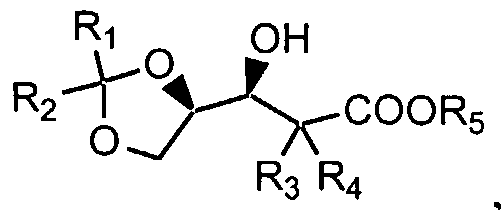
wherein each of R3 and R4 independently is H, halo (e.g., F), alkyl, or aryl; R5 is alkyl or aryl, and W is Br or I; in the presence of Zn and a Zn activating agent (e.g., 1, 2- dibromoethane, 1 ,2-diiodoethane, or I2) to form an alcohol of the following formula:
Figure imgf000003_0002
wherein Ri, R2, R3, R4, and R5 are defined above.
The above reaction can be carried out with microwave, UV, or ultrasound. To produce a nucleoside, the process includes one or more of the following steps: (1) transforming the alcohol to a lactone of the following formula:
Figure imgf000003_0003
wherein R3 and R4 are as defined above;
(2) protecting the hydroxy groups of the lactone to form a protected lactone of the following formula:
Figure imgf000003_0004
wherein each of R3 and R4 are as defined above; and each of R6 and R7, independently, is a hydroxy protecting group, or R6 and R7, together, are Ci-3 alkylene;
(3) reducing the protected lactone to a furanose of the following formula:
Figure imgf000003_0005
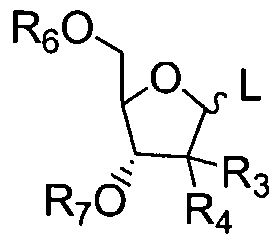
wherein R3, R4, R6, and R7 are as defined above; (4) converting the furanose to a furan compound of the following formula:
Figure imgf000004_0001
wherein R3, R4, R6, and R7 are as defined above and L is a leaving group;
(5) reacting the furan compound with a compound of the following formula:
Il
Figure imgf000004_0002
Figure imgf000004_0003
in which R8 is H, alkyl, or aryl; R9 is H, alkyl, alkenyl, halo, or aryl; X is N or C-R', R' being H, alkyl, alkenyl, halo, or aryl; Y is an amino protecting group, and Z is a hydroxy protecting group; to produce a β-nucleoside compound of the following formula:
Figure imgf000004_0004
in which R3, R4, R6, and R7 are as defined above; and B is
Figure imgf000005_0001
in which R8 and R9 are as defined above; and
(8) deprotecting the β-nucleoside to form a 3,5-dihydroxy β-nucleoside of the following formula:
Figure imgf000005_0002
in which R3, R4, and B are defined as above.
The term "alkyl" refers to a straight or branched hydrocarbon, containing 1-6 carbon atoms. Examples of alkyl groups include, but are not limited to, methyl, ethyl, n-propyl, /-propyl, n-butyl, /-butyl, and t-butyl. The term "alkoxy" refers to an O-alkyl radical. Examples of alkoxy groups include, but are not limited to, methoxy, ethoxyl, and butoxy. The term "alkylene" refers to a alkyl diradical group. Examples of "alkyl ene" include, but are not limited to, methylene and ethylene.
The term "alkenyl" refers to a straight or branched hydrocarbon having one or more carbon-carbon double bonds. Examples of alkenyl groups include, but are not limited to, ethenyl, 1-butenyl, and 2-butenyl. The term "aryl" refers to a 6-carbon monocyclic, 10-carbon bicyclic, 14-carbon tricyclic aromatic ring system. Examples of aryl groups include, but are not limited to, phenyl, naphthyl, and anthracenyl.
The term "alkoxycarbonyl" refers to an alkyl-O-carbonyl radical. Examples of alkoxycarbonyl groups include, but are not limited to, methoxycarbonyl, ethoxycarbonyl, and t-butoxylcarbonyl. The term "aroxycarbonyl" refers to an aryl-O-carbonyl radical. Examples of aroxycarbonyl groups include, but are not limited to, phenoxycarbonyl and 1-naphthalenoxycarbonyl. The term "aminocarbonyl" refers to a (R)(R')N-carbonyl radical in which each of R and R' independently is H, alkyl, or aryl. Examples of aminocarbonyl groups include, but are not limited to, dimethylaminocarbonyl, methylethylaminocarbonyl, and phenylaminocarbonyl.
Alkyl, aryl, alkenyl, and alkoxy mentioned herein include both substituted and unsubstituted moieties. Examples of substituents include, but are not limited to, halo, hydroxyl, amino, cyano, nitro, mercapto, alkoxycarbonyl, amido, carboxy, alkanesulfonyl, alkylcarbonyl, carbamido, carbamyl, carboxyl, thioureido, thiocyanato, sulfonamido, alkyl, alkenyl, alkynyl, alkyloxy, aryl, heteroaryl, cyclyl, and heterocyclyl, in which the alkyl, alkenyl, alkynyl, alkyloxy, aryl, heteroaryl, cyclyl, and heterocyclyl may be further substituted.
The term "furanose" refers to a fϊve-membered cyclic acetal form of a sugar. Other features, objects, and advantages of the invention will be apparent from the description and the claims.
DETAILED DESCRIPTION
Referring to Scheme 1, it was unexpectedly discovered that reacting (R) 4-formyl- 2,2-dimethyldioxolane 1 with an α-bromoacetate 2 in the presence of Zn and a Zn activating agent (e.g., I2) gives 3(R)-hydorxy compound 3 with high enantiomeric purity, i.e., enantiomeric excess about 98%.
Figure imgf000007_0001
1 2 3
Scheme 1
Thus, this invention also features a synthetic process for stereoselective^ preparing (R) 3-hydroxy compound 3 and its analogues. The synthetic process includes reacting (R) 4-formyl-2,2-dialkylldioxolane with an alkyl α-Br or α-I substituted acetate in the presence of Zn and a Zn activating agent. The Zn activating agent is a substance that activates Zn metal by reducing any oxidized Zn to atomic Zn. Examples of Zn activating agents include, but are not limited to, I2, 1 ,2-dibromoethane, or 1,2- diiodoethane.
The reactants required in this process are commercially available or can be made by methods well known in the art. To practice this process, one can mix the required reactants and a Zn activating agent in a solvent. Examples of suitable solvents include, but are not limited to, dichloromethane, tetrahydrofuran (THF), benzene, chloroform, toluene, xylene, chlorobenzene, hexane, heptane, cyclohexane, hexane, heptane, cyclohexane with ethyl acetate, isopropyl acetate, rc-butyl acetate, acetonitrile, 1,2- dichloroethane, and a combination thereof. The Zn activating agent may be employed in a catalytical amount, an equimolar amount, or an excess amount, relative to one of the reactants. The reaction can be carried out at -10 to 30°C. To facilitate this reaction, microwave, UV, or ultrasound can be used. As an example, the reaction vessel can be placed in an ultrasound bath during the reaction. As recognized by those skilled in the art, the reaction time varies depending on the types and the amounts of the reactants, the reaction temperature, and the like.
The product of the above reaction, i.e., 3(R)-hydorxy compound 3, is an important starting material to stereoselectively synthesize certain nucleoside compounds. See, e.g., Chou et al. U.S. Patents 4,965,374 and 5,434,254. Scheme 2 below illustrates a synthetic route to 2'-deoxy-2,2'-difluorocytidine from 3(R)-hydorxy compound 3.
Enantiomerically pure 3(R)-hydorxy compound 3 is hydrolyzed to form a lactone 4, namely, 2-deoxy-2,2'-difluoro-l-oxoribose, which is also enantiomerically pure. Lactone 4 has two active hydroxy groups. Before being further reacted, lactone 4 is protected by converting the two hydroxy groups into inactive groups. The protected lactone was then reduced to furanose 5 having a new hydroxy group. The reduction reaction introduces an additional chiral center at the anomeric carbon atom. As a result, furanose 5 is an anomeric mixture. The new hydroxy group of furanose 5 is converted into a leaving group, e.g., methanesulfonate (see compound 6 below), and replaced with cystosine to afford protected 2'-deoxy-2,2'-difluorocytidine. The product is deprotected and purified by column chromatograph to afford the desired β anomer 7.
Figure imgf000008_0001
P is a protecting group
Figure imgf000008_0002
In the above process, several conventional chemical techniques are applied. These techniques include, e.g., introduction of a leaving group, protection and deprotection. A leaving group is a functional group that can depart, upon direct displacement or ionization, with the pair of electrons from one of its covalent bonds (see, e.g., F. A. Carey and R. J. Sundberg, Advanced Organic Chemistry, 3rd Ed. Plenum Press, 1990). Examples of leaving groups include, but are not limited to, methanesulfonate, triflate, /j-toluenesulfonate, iodide, bromide, chloride, and trifluoroacetate. Protecting groups refer to those that prevent the protected active groups from interference and can be removed by conventional methods after the reaction. Examples of hydroxy protecting groups include, but are not limited to, alkyl, benzyl, allyl, acyl (e.g., benzoyl, acetyl, or HOOC-X-CO-, X being alkylene, alkenylene, cycloalkylene, or arylene), silyl (e.g., trimethylsilyl, triethylsilyl, and f-butyldimethylsilyl), alkoxylcarbonyl, aminocarbonyl (e.g., dimethylaminocarbonyl, methylethylaminocarbonyl, and phenylaminocarbonyl), alkoxymethyl, benzyloxymethyl, and alkylmercaptomethyl. Examples of amino protecting groups include, but are not limited to, alkyl, acyl, and silyl. Hydroxy and amino protecting groups have been discussed in T. W. Greene and P. GM. Wuts, Protective Groups in Organic Synthesis, 2d. Ed., John Wiley and Sons (1991).
For the synthetic process described above, completion of the reaction can be monitored by any conventional method, e.g., ultra-violent spectrum, infrared spectrum, nuclear magnetic resonance, thin layer chromatography, gas chromatography, and high performance liquid chromatography. After the reaction is complete, the product can be separated from the reaction mixture by one or more conventional separation methods, such as chromatography, recrystalation, extraction, and distillation. It may be further purified to give higher enantiomeric purity by methods well known in the art. See, e.g., U.S. Patent 5,223,608.
Without further elaboration, it is believed that the above description has adequately enabled the present invention. The following actual example is, therefore, to be construed as merely illustrative, and not limitative of the remainder of the disclosure in any way whatsoever. All of the publications cited herein, including patents, are hereby incorporated by reference in their entirety.
Preparation of a 2,2-difluoro-3(RVhvdroxy-3-(2,2-dimethyldioxolan-4-yl)propionate
Zn (3.6 g, 57.5 mmol) and I2 (144 mg, 0.6 mmol) was added to a solution of (R)4- formyl-2,2-dimethyldioxolane (3 g, 23 mmol) and ethyl bromodifluoroacetate (4.7 g, 23 mmol) in THF (50 mL) at 25°C. The reaction vessel was agitated in an ultrasonic bath at 5-10°C for 12 h. A solution of ethyl bromodifluoroacetate (4.7 g, 23 mmol) in THF (5 mL) was added and the resulting solution was irradiated for additional 12 h at 100C. The reaction was quenched by a saturated aqueous NH4Cl solution. The solution was filtered and concentrated in vacuo to ca. 5 mL, diluted with EtOAc (150 mL), washed with brine (15 mL), dried over Na2SO4, and concentrated in vacuo to give a crude product. The crude product was purified by flash column chromatography with 10-20% EtOAc-hexane to give a single compound of 2,2-difluoro-3(R)-hydroxy-3-(2,2- dimethyldioxolan-4-yl)propionate (4.4 g, 75% yield) as a yellow liquid.
Rf= 0.25 in 25% EtOAc-hexane;
1H NMR (500 MHz, CDCl3): δ 4.05-4.335 (m, 4 H), 4.01-4.04 (m, 2 H), 3.29 (br, 1 H), 1.32 (t, 3H, J = 8 Hz), 1.30 (s, 3 H), 1.29 (s, 3 H);
13C NMR(125 MHz, CDCl3): δ 163.122 (t, C, JC-F = 30.5 Hz), 113.99 (dd, C, JC-F = 252 Hz, 254 Hz), 109.70 (C), 73.37 (CH), 71.56(t, CH, Jc-F= 23 Hz), 65.60 (CH2), 63.06 (CH2), 26.09 (CH3), 24.94 (CH3), 13.74 (CH3).
OTHER EMBODIMENTS
All of the features disclosed in this specification may be combined in any combination. Each feature disclosed in this specification may be replaced by an alternative feature serving the same, equivalent, or similar purpose. Thus, unless expressly stated otherwise, each feature disclosed is only an example of a generic series of equivalent or similar features.
From the above description, one skilled in the art can easily ascertain the essential characteristics of the present invention, and without departing from the spirit and scope thereof, can make various changes and modifications of the invention to adapt it to various usages and conditions. For example, a 5-membered cyclic compound structurally analogous to the nucleoside compound mentioned above can also be made according to the process of the present invention. Thus, other embodiments are also within the claims.

Claims

WHAT IS CLAIMED IS:
1. A process comprising: reacting an aldehyde of the following formula:
Figure imgf000011_0001
wherein each of Ri and R2 independently is H, halo, or alkyl; or Ri and R2 together with the carbon atom to which they are attached are a 5 or 6-membered ring; with an ester of the following formula:
W-CCO2R5
R4 f wherein each of R3 and R4 independently is H, halo, alkyl, or aryl, R5 is alkyl or aryl, and W is Br or I; in the presence of Zn and a Zn activating agent to form an alcohol of the following formula:
Figure imgf000011_0002
wherein Ri, R2, R3, R4, and R5 are defined above.
2. The process of claim 1, further comprising: transforming the alcohol to a lactone of the following formula:
Figure imgf000011_0003
wherein R3 and R4 are as defined in claim 1.
3. The process of claim 2, further comprising: protecting the hydroxy groups of the lactone to form a protected lactone of the following formula:
Figure imgf000012_0001
wherein each of R3 and R4 are as defined in claim 1; and each of R6 and R7, independently, is a hydroxy protecting group, or R6 and R7, together, are Ci-3 alkylene.
4. The process of claim 3, further comprising reducing the protected lactone to a furanose of the following formula:
Figure imgf000012_0002
wherein R3 and R4 are as defined in claim 1 ; and R6 and R7 are as defined in claim 3.
5. The process of claim 4, further comprising: transforming the furanose to a furan compound of the following formula:
Figure imgf000012_0003
wherein R3 and R4 are as defined in claim 1 ; and R6 and R7 are as defined in claim 3; and L is a leaving group.
6. The process of claim 5, further comprising: reacting the furan compound with a compound of the following formula:
NR8Y OZ NR*Y °
I 8 I JL X
N^X N^X N^X HN
Figure imgf000013_0001
in which R8 is H, alkyl, or aryl; RQ is H, alkyl, alkenyl, halo, or aryl; X is N or C-R', R' being H, alkyl, alkenyl, halo, or aryl; Y is an amino protecting group; and Z is a hydroxy protecting group; to produce a β-nucleoside compound of the following formula:
Figure imgf000013_0002
in which R3 and R4 are as defined in claim 1 ; and R6 and R7 are as defined in claim 3; and B is
Figure imgf000014_0001
in which R8 and R9 are as defined above.
7. The process of claim 6, further comprising: deprotecting the β-nucleoside to form a 3,5-dihydroxy β-nucleoside of the following formula:
Figure imgf000014_0002
in which R3 and R4 are as defined in claim 1 ; and B is as defined in claim 6.
8. The process of claim 1, wherein the reaction is carried out with microwave, UV, or ultrasound.
9. The process of claim 8, wherein the reaction is carried out with ultrasound.
10. The process of claim 9, wherein the Zn activating agent is 1, 2-dibromoethane, 1,2-diiodoethane, or I2.
11. The process of claim 10, wherein each of R3 and R4 is F.
12. The process of claim 11, wherein the Zn activating agent is I2.
13. The process of claim 9, further comprising: transforming the alcohol to a lactone of the following formula:
Figure imgf000015_0001
wherein R3 and R4 are as defined in claim 1.
14. The process of claim 13, further comprising: protecting the hydroxy groups of the lactone to form a protected lactone of the following formula:
Figure imgf000015_0002
wherein each of R3 and R4 are as defined in claim 1; and each of R6 and R7, independently, is a hydroxy protecting group, or R6 and R7, together, are Ci-3 alkylene.
15. The process of claim 14, further comprising reducing the protected lactone to a furanose of the following formula:
Figure imgf000015_0003
wherein R3 and R4 are as defined in claim 1; and R6 and R7 are as defined in claim 14.
16. The process of claim 15, further comprising: transforming the furanose to a furan compound of the following formula:
Figure imgf000016_0001
wherein R3 and R4 are as defined in claim 1 ; and R6 and R7 are as defined in claim 14; and L is a leaving group.
17. The process of claim 16, further comprising: reacting the furan compound with a compound of the following formula:
Figure imgf000016_0002
Figure imgf000016_0003
in which R8 is H, alkyl, or aryl; Rg is H, alkyl, alkenyl, halo, or aryl; X is N or C-R', R' being H, alkyl, alkenyl, halo, or aryl; Y is an amino protecting group; and Z is a hydroxy protecting group; to produce a β-nucleoside compound of the following formula:
Figure imgf000016_0004
in which R3 and R4 are as defined in claim 1; and R6 and R7 are as defined in claim 14; and B is
Figure imgf000017_0001
in which R8 and R9 are as defined above.
18. The process of claim 17, further comprising: deprotecting the β-nucleoside to form a 3,5-dihydroxy β-nucleoside of the following formula:
Figure imgf000017_0002
in which R3 and R4 are as defined in claim 1; and B is as defined in claim 17.
19. The process of claim 12, further comprising: transforming the alcohol to a lactone of the following formula:
;
Figure imgf000017_0003
wherein R3 and R4 are as defined in claim 1.
20. The process of claim 19, further comprising: protecting the hydroxy groups of the lactone to form a protected lactone of the following formula:
Figure imgf000018_0001
, wherein each of R3 and R4 are as defined in claim 1 ; and each Of R6 and R7, independently, is a hydroxy protecting group, or R6 and R7, together, are Ci-3 alkylene.
21. The process of claim 20, further comprising reducing the protected lactone to a furanose of the following formula:
Figure imgf000018_0002
wherein R3 and R4 are as defined in claim 1; and R6 and R7 are as defined in claim 20.
22. The process of claim 21, further comprising: transforming the furanose to a furan compound of the following formula:
Figure imgf000018_0003
wherein R3 and R4 are as defined in claim 1 ; and R6 and R7 are as defined in claim 20; and L is a leaving group.
23. The process of claim 22, further comprising: reacting the furan compound with a compound of the following formula:
Figure imgf000019_0001
Figure imgf000019_0002
in which R8 is H, alkyl, or aryl; R9 is H, alkyl, alkenyl, halo, or aryl; X is N or C-R', R' being H, alkyl, alkenyl, halo, or aryl; Y is an amino protecting group; and Z is a hydroxy protecting group; to produce a β-nucleoside compound of the following formula:
Figure imgf000019_0003
in which R3 and R4 are as defined in claim 1 ; and R6 and R7 are as defined in claim 20; and B is
Figure imgf000020_0001
in which R8 and R9 are as defined above.
24. The process of claim 23, further comprising: deprotecting the β-nucleoside to form a 3,5-dihydroxy β-nucleoside of the following formula:
Figure imgf000020_0002
in which R3 and R4 are as defined in claim 1 ; and B is as defined in claim 23.
PCT/US2005/027339 2004-07-30 2005-07-29 STEREOSELECTIVE SYNTHESIS OF β-NUCLEOSIDES Ceased WO2006015346A1 (en)

Priority Applications (1)

Application Number Priority Date Filing Date Title
EP05782754A EP1812457A1 (en) 2004-07-30 2005-07-29 STEREOSELECTIVE SYNTHESIS OF ß-NUCLEOSIDES

Applications Claiming Priority (2)

Application Number Priority Date Filing Date Title
US59241204P 2004-07-30 2004-07-30
US60/592,412 2004-07-30

Publications (1)

Publication Number Publication Date
WO2006015346A1 true WO2006015346A1 (en) 2006-02-09

Family

ID=35787472

Family Applications (1)

Application Number Title Priority Date Filing Date
PCT/US2005/027339 Ceased WO2006015346A1 (en) 2004-07-30 2005-07-29 STEREOSELECTIVE SYNTHESIS OF β-NUCLEOSIDES

Country Status (5)

Country Link
US (1) US20070042987A1 (en)
EP (1) EP1812457A1 (en)
CN (1) CN101076536A (en)
TW (1) TW200606159A (en)
WO (1) WO2006015346A1 (en)

Cited By (5)

* Cited by examiner, † Cited by third party
Publication number Priority date Publication date Assignee Title
US8268800B2 (en) 2007-10-16 2012-09-18 Eisai Inc. Certain compounds, compositions and methods
US8324180B2 (en) 2009-04-06 2012-12-04 Eisai Inc. Compositions and methods for treating cancer
US8329665B2 (en) 2009-04-06 2012-12-11 Eisai Inc. Compositions and methods for treating cancer
US8329666B2 (en) 2009-04-06 2012-12-11 Eisai Inc. Compositions and methods for treating cancer
US8609631B2 (en) 2009-04-06 2013-12-17 Eisai Inc. Compositions and methods for treating cancer

Families Citing this family (1)

* Cited by examiner, † Cited by third party
Publication number Priority date Publication date Assignee Title
TWI462931B (en) * 2011-04-07 2014-12-01 Pharmaessentia Corp Synthesis of β-nucleosides

Citations (1)

* Cited by examiner, † Cited by third party
Publication number Priority date Publication date Assignee Title
US4526988A (en) * 1983-03-10 1985-07-02 Eli Lilly And Company Difluoro antivirals and intermediate therefor

Family Cites Families (13)

* Cited by examiner, † Cited by third party
Publication number Priority date Publication date Assignee Title
US2924613A (en) * 1956-06-14 1960-02-09 Basf Ag Production of compounds of the vitamin-a series
US4760137A (en) * 1984-08-06 1988-07-26 Brigham Young University Method for the production of 2'-deoxyadenosine compounds
US4751221A (en) * 1985-10-18 1988-06-14 Sloan-Kettering Institute For Cancer Research 2-fluoro-arabinofuranosyl purine nucleosides
US4965374A (en) * 1987-08-28 1990-10-23 Eli Lilly And Company Process for and intermediates of 2',2'-difluoronucleosides
US5223608A (en) * 1987-08-28 1993-06-29 Eli Lilly And Company Process for and intermediates of 2',2'-difluoronucleosides
US4954623A (en) * 1989-03-20 1990-09-04 Eli Lilly And Company Recovery of difluoro sugar
US5216145A (en) * 1991-05-10 1993-06-01 American Cyanamid Company Asymmetric synthesis of 3-substituted furanoside compounds
US5594124A (en) * 1992-06-22 1997-01-14 Eli Lilly And Company Stereoselective glycosylation process for preparing 2'-Deoxy-2',2'-difluoropyrimidine nucleosides and 2'-deoxy-2'-fluoropyrimidine nucleosides and intermediates thereof
US5401838A (en) * 1992-06-22 1995-03-28 Eli Lilly And Company Stereoselective fusion glycosylation process for preparing 2'-deoxy-2',2'-difluoronucleosides and 2'-deoxy-2'-fluoronucleosides
US5821357A (en) * 1992-06-22 1998-10-13 Eli Lilly And Company Stereoselective glycosylation process for preparing 2'-deoxy-2',2'-difluoropurine and triazole nucleosides
US5424416A (en) * 1993-08-25 1995-06-13 Eli Lilly And Company Process for preparation of 2-deoxy-2,2-difluoro-D-ribofuranosyl-3,5-hydroxy protected-1-alkyl and aryl sulfonates and their use in preparation of 2',2'-difluoro-2'-deoxy nucleosides
US5637688A (en) * 1994-12-13 1997-06-10 Eli Lilly And Company Process for preparing 1-(2'-deoxy-2'-difluoro-d-ribofuranosyl)-4-aminopyrimidin-2-one hydrochloride
US5521294A (en) * 1995-01-18 1996-05-28 Eli Lilly And Company 2,2-difluoro-3-carbamoyl ribose sulfonate compounds and process for the preparation of beta nucleosides

Patent Citations (2)

* Cited by examiner, † Cited by third party
Publication number Priority date Publication date Assignee Title
US4526988A (en) * 1983-03-10 1985-07-02 Eli Lilly And Company Difluoro antivirals and intermediate therefor
US4692434A (en) * 1983-03-10 1987-09-08 Eli Lilly And Company Difluoro antivirals and intermediate therefor

Non-Patent Citations (1)

* Cited by examiner, † Cited by third party
Title
HERTEL ET AL: "Synthesis of 2-deoxy-2,2-difluoro-D-ribose and 2-deoxy-2,2-difluoro-D-ribofuranosyl nucleosides.", J ORG CHEM., vol. 53, 1988, pages 2406 - 2409, XP000572745 *

Cited By (9)

* Cited by examiner, † Cited by third party
Publication number Priority date Publication date Assignee Title
US8268800B2 (en) 2007-10-16 2012-09-18 Eisai Inc. Certain compounds, compositions and methods
US8618075B2 (en) 2007-10-16 2013-12-31 Eisai Inc. Certain compounds, compositions and methods
US8951987B2 (en) 2007-10-16 2015-02-10 Otsuka Pharmaceuticals Co., Ltd. Certain compounds, compositions and methods
US9567363B2 (en) 2007-10-16 2017-02-14 Otsuka Pharmaceutical Co., Ltd. Certain compounds, compositions and methods
US8324180B2 (en) 2009-04-06 2012-12-04 Eisai Inc. Compositions and methods for treating cancer
US8329665B2 (en) 2009-04-06 2012-12-11 Eisai Inc. Compositions and methods for treating cancer
US8329666B2 (en) 2009-04-06 2012-12-11 Eisai Inc. Compositions and methods for treating cancer
US8609631B2 (en) 2009-04-06 2013-12-17 Eisai Inc. Compositions and methods for treating cancer
US9040501B2 (en) 2009-04-06 2015-05-26 Otsuka Pharmaceutical Co., Ltd. Compositions and methods for treating cancer

Also Published As

Publication number Publication date
EP1812457A1 (en) 2007-08-01
US20070042987A1 (en) 2007-02-22
TW200606159A (en) 2006-02-16
CN101076536A (en) 2007-11-21

Similar Documents

Publication Publication Date Title
KR860001283B1 (en) Method of preparing difluoro antivirals and intermediate therefor
Mansuri et al. Preparation of 1-(2, 3-dideoxy-. beta.-D-glycero-pent-2-enofuranosyl) thymine (d4T) and 2', 3'-dideoxyadenosine (ddA): general methods for the synthesis of 2', 3'-olefinic and 2', 3'-dideoxy nucleoside analogs active against HIV
US7858774B2 (en) Synthesis of 5-azacytidine
US20080139802A1 (en) Preparation of nucleosides ribofuranosyl pyrimidines
HU203559B (en) Process for producing 1-deoxy-nojirimicin derivatives and pharmaceutical compositions containing them as active components
HU214980B (en) A process for anomerizing nucleosides
WO1991019713A1 (en) Pyrimidine nucleoside derivative
US8193339B2 (en) Synthesis of β-nucleosides
EP1812457A1 (en) STEREOSELECTIVE SYNTHESIS OF ß-NUCLEOSIDES
EP3684780A1 (en) Floxuridine synthesis
US7485716B2 (en) Stereoselective synthesis of β-nucleosides
Inguaggiato et al. Novel triazole 2′-deoxy-4′-thionucleosides: Stereoselective synthesis and biological evaluation
JP2009526782A (en) Method for producing gemcitabine and related intermediates
JPH08269081A (en) Method for producing 3,3-difluorofuran in which the 2-position is substituted
JPH06135988A (en) Nucleotide derivative
US8765933B2 (en) Asynthesis of β-nucleosides
WO2022229980A1 (en) A process for preparation of anti viral drug molnupiravir (eidd 2801) from d-ribose
Kittaka et al. 1, 5-translocation strategy for nucleoside anomeric radicals
KR101259648B1 (en) A manufacturing process of 2′,2′-difluoronucloside and intermediate
KR101241321B1 (en) Improved preparation method of Decitabine
Efimov et al. N-azidomethylbenzoyl blocking group in the phosphotriester synthesis of oligoribonucleotides
KR20080094890A (en) Process for preparing gemcitabine and related intermediates
JP2784658B2 (en) Hygromycin synthetic intermediate
JPH06135989A (en) Nucleotide derivative
Pedersen et al. The first example of a new type of acyclic, achiral nucleoside analogue: 1-[3-hydroxy-2-(hydroxymethyl) prop-1-enyl] thymine

Legal Events

Date Code Title Description
AK Designated states

Kind code of ref document: A1

Designated state(s): AE AG AL AM AT AU AZ BA BB BG BR BW BY BZ CA CH CN CO CR CU CZ DE DK DM DZ EC EE EG ES FI GB GD GE GH GM HR HU ID IL IN IS JP KE KG KM KP KR KZ LC LK LR LS LT LU LV MA MD MG MK MN MW MX MZ NA NG NI NO NZ OM PG PH PL PT RO RU SC SD SE SG SK SL SM SY TJ TM TN TR TT TZ UA UG US UZ VC VN YU ZA ZM ZW

AL Designated countries for regional patents

Kind code of ref document: A1

Designated state(s): GM KE LS MW MZ NA SD SL SZ TZ UG ZM ZW AM AZ BY KG KZ MD RU TJ TM AT BE BG CH CY CZ DE DK EE ES FI FR GB GR HU IE IS IT LT LU LV MC NL PL PT RO SE SI SK TR BF BJ CF CG CI CM GA GN GQ GW ML MR NE SN TD TG

121 Ep: the epo has been informed by wipo that ep was designated in this application
WWE Wipo information: entry into national phase

Ref document number: 134/MUMNP/2007

Country of ref document: IN

WWE Wipo information: entry into national phase

Ref document number: 2005782754

Country of ref document: EP

NENP Non-entry into the national phase

Ref country code: DE

WWE Wipo information: entry into national phase

Ref document number: 200580029079.X

Country of ref document: CN

WWP Wipo information: published in national office

Ref document number: 2005782754

Country of ref document: EP