WO2006018315A1 - Diagnostic method for disorders using copeptin - Google Patents

Diagnostic method for disorders using copeptin Download PDF

Info

Publication number
WO2006018315A1
WO2006018315A1 PCT/EP2005/009001 EP2005009001W WO2006018315A1 WO 2006018315 A1 WO2006018315 A1 WO 2006018315A1 EP 2005009001 W EP2005009001 W EP 2005009001W WO 2006018315 A1 WO2006018315 A1 WO 2006018315A1
Authority
WO
WIPO (PCT)
Prior art keywords
copeptin
vasopressin
seq
diseases
amino acid
Prior art date
Legal status (The legal status is an assumption and is not a legal conclusion. Google has not performed a legal analysis and makes no representation as to the accuracy of the status listed.)
Ceased
Application number
PCT/EP2005/009001
Other languages
French (fr)
Inventor
Andreas Bergmann
Joachim Struck
Current Assignee (The listed assignees may be inaccurate. Google has not performed a legal analysis and makes no representation or warranty as to the accuracy of the list.)
BRAHMS GmbH
Original Assignee
BRAHMS GmbH
Priority date (The priority date is an assumption and is not a legal conclusion. Google has not performed a legal analysis and makes no representation as to the accuracy of the date listed.)
Filing date
Publication date
Priority to EP20050782853 priority Critical patent/EP1738178B1/en
Priority to HK08101167.7A priority patent/HK1114171B/en
Priority to JP2007526400A priority patent/JP4932714B2/en
Priority to CN2005800214349A priority patent/CN101010591B/en
Priority to DE200560002836 priority patent/DE602005002836T2/en
Priority to MXPA06014775A priority patent/MXPA06014775A/en
Application filed by BRAHMS GmbH filed Critical BRAHMS GmbH
Priority to US11/573,595 priority patent/US7807397B2/en
Publication of WO2006018315A1 publication Critical patent/WO2006018315A1/en
Anticipated expiration legal-status Critical
Priority to US12/860,311 priority patent/US20110008911A1/en
Priority to US15/443,717 priority patent/US20170242037A1/en
Ceased legal-status Critical Current

Links

Classifications

    • GPHYSICS
    • G01MEASURING; TESTING
    • G01NINVESTIGATING OR ANALYSING MATERIALS BY DETERMINING THEIR CHEMICAL OR PHYSICAL PROPERTIES
    • G01N33/00Investigating or analysing materials by specific methods not covered by groups G01N1/00 - G01N31/00
    • G01N33/48Biological material, e.g. blood, urine; Haemocytometers
    • G01N33/50Chemical analysis of biological material, e.g. blood, urine; Testing involving biospecific ligand binding methods; Immunological testing
    • G01N33/68Chemical analysis of biological material, e.g. blood, urine; Testing involving biospecific ligand binding methods; Immunological testing involving proteins, peptides or amino acids
    • G01N33/6893Chemical analysis of biological material, e.g. blood, urine; Testing involving biospecific ligand binding methods; Immunological testing involving proteins, peptides or amino acids related to diseases not provided for elsewhere
    • GPHYSICS
    • G01MEASURING; TESTING
    • G01NINVESTIGATING OR ANALYSING MATERIALS BY DETERMINING THEIR CHEMICAL OR PHYSICAL PROPERTIES
    • G01N33/00Investigating or analysing materials by specific methods not covered by groups G01N1/00 - G01N31/00
    • G01N33/48Biological material, e.g. blood, urine; Haemocytometers
    • G01N33/50Chemical analysis of biological material, e.g. blood, urine; Testing involving biospecific ligand binding methods; Immunological testing
    • G01N33/74Chemical analysis of biological material, e.g. blood, urine; Testing involving biospecific ligand binding methods; Immunological testing involving hormones or other non-cytokine intercellular protein regulatory factors such as growth factors, including receptors to hormones and growth factors
    • GPHYSICS
    • G01MEASURING; TESTING
    • G01NINVESTIGATING OR ANALYSING MATERIALS BY DETERMINING THEIR CHEMICAL OR PHYSICAL PROPERTIES
    • G01N2333/00Assays involving biological materials from specific organisms or of a specific nature
    • G01N2333/435Assays involving biological materials from specific organisms or of a specific nature from animals; from humans
    • G01N2333/575Hormones
    • GPHYSICS
    • G01MEASURING; TESTING
    • G01NINVESTIGATING OR ANALYSING MATERIALS BY DETERMINING THEIR CHEMICAL OR PHYSICAL PROPERTIES
    • G01N2333/00Assays involving biological materials from specific organisms or of a specific nature
    • G01N2333/435Assays involving biological materials from specific organisms or of a specific nature from animals; from humans
    • G01N2333/575Hormones
    • G01N2333/5757Vasoactive intestinal peptide [VIP] or related peptides
    • YGENERAL TAGGING OF NEW TECHNOLOGICAL DEVELOPMENTS; GENERAL TAGGING OF CROSS-SECTIONAL TECHNOLOGIES SPANNING OVER SEVERAL SECTIONS OF THE IPC; TECHNICAL SUBJECTS COVERED BY FORMER USPC CROSS-REFERENCE ART COLLECTIONS [XRACs] AND DIGESTS
    • Y10TECHNICAL SUBJECTS COVERED BY FORMER USPC
    • Y10STECHNICAL SUBJECTS COVERED BY FORMER USPC CROSS-REFERENCE ART COLLECTIONS [XRACs] AND DIGESTS
    • Y10S930/00Peptide or protein sequence
    • Y10S930/01Peptide or protein sequence
    • Y10S930/15Oxytocin or vasopressin; related peptides

Definitions

  • the present invention relates to the use of copeptin and/or its precursors or fragments and/or its splice variants, fragments comprising copeptin and/or combinations and/or derivatives thereof in medical diagnosis as humoral bio- marker for disorders associated with or caused by non-phy ⁇ siological alterations of vasopressin release from the neurohypophysis, as there are, for example, cardiac disea ⁇ ses, renal disaeases, inflammatory diseases and sepsis and diseases/disorders of the central nervous system and neuro ⁇ degenerative diseases and others as mentioned below.
  • Vasopressin has also been discussed as a marker for the prognosis of probability of survival of patients with car ⁇ diac arrest [11] and consequently it was used for the treat ⁇ ment of such patients [12] .
  • the object of the invention was to overcome the effects of the disadvantageous half-life of vasopressin and the varia ⁇ ble results in measurements and to develop a method, use and a kit for the detection and determination of the molecules associated with the release of vasopressin, more specially copeptin, for the diagnosis of cardiovascular diseases and sepsis .
  • Fig. 1 shows the standard curve for the sandwich-immuno ⁇ assay for copeptin immunoreactivity using the peptide PAY33 as a standard material.
  • Fig. 2 shows the concentration of copeptin immunoreacti ⁇ vity in samples of healthy individuals and diffe ⁇ rent groups of patients (sepsis, cardiac in ⁇ farction and increased arterial blood pressure) .
  • amino acid sequences of the peptides are the following (numbers refer to corresponding positions in the human pro- vasopressin-neurophysin 2-copeptin-precursors (positions 132-147 and 149-164) :
  • the polyclonal antibodies from sheep were purified using ligand specific affinity purification.
  • the peptides PATV 17 and PLAY 17 were linked to SuIfoLink-Gel supplied by Pierce (Boston, USA) .
  • the binding occurred according to the protocol of Pierce. 5 mg of peptide were added per 5 ml of gel .
  • the sample was added and chromatographed at a flow rate of lml/minute in solvent A.
  • the flow was continuously monitored in a UV-meter at wave length of 280 and 368 nm to determine the degree of tagging.
  • the absorp ⁇ tion ratio 368/280 nm of labelled antibody was 0,1.
  • the fractions containing monomeric antibodies were collected (retention time 8-10 minutes) and taken up in 3 ml 10OmM sodium phosphate, 150 mM NaCl, 5% bovine serum albumin, 0,1 % sodium azide, pH 7.4)
  • pep ⁇ tide PAY 33 As a standard material chemically synthesized peptide (pep ⁇ tide PAY 33) was used which corresponds to positions 132-164 of vasopressin-neurophysin 2-copeptin precursor.
  • the stan ⁇ dard was diluted in normal horse serum (Sigma) .
  • the chemiluminescence bound to the tube was determined in a luminometer (Berthold, LB952T, basic reagents Brahms AG) . Using the software MultiCalc (Spline Fit) the concentrations of the samples were determined.
  • copeptin a biomarker candidate for use in the diagnosis (positive or negative diagnosis) of CHF, the monitoring of the course and evolution of CHF and the monitoring and control of a CHF therapy. Further, in view of current attempts to evaluate the usefulness of vasoporessin receptor antagonists in the therapy of heart failure [27] , the determination of copeptin in serum or plasma samples of heart failure patients can allow the identification of such patients who would benefit more than others from a treatment with vasopressin receptor antagonists.
  • Hyde JF, North WG, Ben-Jonathan N The vasopressin- associated glycopeptide is not a prolactin-releasing factor: studies with lactating Brattleboro rats. Endo ⁇ crinology 124: 35-40, 1989;

Landscapes

  • Life Sciences & Earth Sciences (AREA)
  • Health & Medical Sciences (AREA)
  • Engineering & Computer Science (AREA)
  • Molecular Biology (AREA)
  • Immunology (AREA)
  • Chemical & Material Sciences (AREA)
  • Biomedical Technology (AREA)
  • Urology & Nephrology (AREA)
  • Hematology (AREA)
  • Biotechnology (AREA)
  • Analytical Chemistry (AREA)
  • Cell Biology (AREA)
  • Pathology (AREA)
  • Food Science & Technology (AREA)
  • Medicinal Chemistry (AREA)
  • Physics & Mathematics (AREA)
  • Microbiology (AREA)
  • Biochemistry (AREA)
  • General Health & Medical Sciences (AREA)
  • General Physics & Mathematics (AREA)
  • Endocrinology (AREA)
  • Proteomics, Peptides & Aminoacids (AREA)
  • Peptides Or Proteins (AREA)
  • Investigating Or Analysing Biological Materials (AREA)

Abstract

The use of copeptin as diagnostic marker for the determination of the release of vasopressin, especially in connection with disorders associated with non-physiological alterations of vasopressin release from the neurohypophysis, especially for detection and early detection, diagnosing and monitoring of the course of cardiovascular diseases, renal and pulmonary diseases as well as shock, including septic shock, sepsis and diseases/disorders of the central nervous system and neurodegenerative diseases.

Description

DIAGNOSTIC METHOD FOR DISORDERS USING COPEPTIN
The present invention relates to the use of copeptin and/or its precursors or fragments and/or its splice variants, fragments comprising copeptin and/or combinations and/or derivatives thereof in medical diagnosis as humoral bio- marker for disorders associated with or caused by non-phy¬ siological alterations of vasopressin release from the neurohypophysis, as there are, for example, cardiac disea¬ ses, renal disaeases, inflammatory diseases and sepsis and diseases/disorders of the central nervous system and neuro¬ degenerative diseases and others as mentioned below.
In the following text all biomolecules and fragments, va¬ riants and combinations thereof as mentioned above, which share the common feature that they display copeptin imm- unoreactivity, are referred to as "copeptin" in the present application. The term "copeptin", therefore, inter alia also comprises for example VP-prohormone, if present in a sample as such.
Copeptin according to the present invention is used as bio- marker, especially humoral biomarker, which can be used to diagnose disorders associated with or caused by non-physio- logical alterations, espcially increases, of vasopressin release from the neurohypophysis as there are cardiovascular diseases like chronic or congestive heart failure, cardiac arrest, cardiac shock, cardiac infarction, acute myocardial infarction, arterial hypertension, cardiac surgery, cirr¬ hosis, pulmonary disorders, kidney (renal) diseases as polycystic kidney disease, Diabetes insipidus, forms of hyponatremia, forms of syndrome of inappropriate antidiure¬ tic hormone secretion, hemorrhage, edema-forming states, inflammatory diseases, trauma, burns, infectious complica¬ tions thereof and sepsis, severe sepsis and septic shock, as well as diseases/disorders of the central nervous system (CNS) and neurodegenerative diseases.
If, in the present application, a use as biomarker is men¬ tioned, this means the determination of said biomarker in in vitro samples of biological fluids (i.e. ex vivo) as -blood, serum or plasma and liquor cerebrospinalis (cerebrospinal fluid; CSF) . For any skilled person this clearly implies that only such physiologically occurring "copeptin" molecu¬ les are to be determined which in fact can be present in such samples . There may be present in a sample of a body fluid several distinct species of essentially identical immunoreactivity, which differ e.g. in length and/or by the presence and/or type and/or degree of their posttranslatio- nal modification, e.g. glycosylation and/or phosphorylation. In view of the inherent possibility that any given assay may recognize more than just one sort of molecule, according to a preferred embodiment the determination of copeptin is to be understood as determination of copeptin immunoreactivity, especially preferred as immunoreactivity as measured with an assay as described below.
As far as the use of the present invention also extends to the preparation of assay components and reagents useful in connection with the determination of copeptin as biomarker, or as active ingredient in pharmaceuticals, any suitable copeptin peptides or derivatives, including fusion products and modifications having e.g. a reduced homology with the naturally occurring copeptin, or having a modified stabili¬ ty, can be used, without any restriction to naturally occur¬ ring copeptin products.
The term copeptin of the present invention consequently comprises also amino acid sequences showing e.g. only 75 % homology, preferred at least 80 % homology, more preferred at least 90 % homology to copeptin.
Terms as "diagnosis" or "diagnostic" are used in this speci¬ fication as general terms, which, if not defined otherwise, are intended to comprise not only diagnosis in the sense of identifying a specific disease, but also screening of asym¬ ptomatic or high risk populations at risk of certain disea¬ ses or suspected to have certain diseases, especially for early detection, monitoring of untreated or treated patients and monitoring the course of a therapy and for prognosis/- early prognosis and survival prognosis.
The invention further relates to antibodies raised against copeptin or against partial peptides of copeptin, especially for use in a method as mentioned above, as well as kits and assays involving such components.
Vasodilatory states of shock are life threatening situa¬ tions. The peripheral blood pressure decreases drastically and often does not normalise after administration of cate¬ cholamines. The most frequent form of shock is septic shock, which is also the most severe form of sepsis. Furthermore vasodilatory shock can manifest itself after severe heart surgery, hemorrhagic and cardiac shock or after poisoning by medicaments or toxins [1, 2] .
A series of peptides being predominantly effective via the autocrine/paracrine route are involved in the regulation of blood pressure. The following molecules are known to have vasodilatory function: e.g. adrenomedullin, calcitonin gene-related peptide (CGRP) and atrial natriuretic peptide (ANP) . Vasoconstrictive effects show for example the follo¬ wing molecules: endothelin, angiotensin II and vasopressin (also known as arginine-vasopressin, antidiuretic hormone (ADH) ) .
Vasopressin is a cleavage product of a larger precursor molecule ("VP pro-hormone" ; its polypeptide sequence is shown in Fig. 3; or as SEQ ID NO:4) that is mainly formed in the neurons of the hypothalamus [20] . After synthesis the VP pro-hormone is glycosylated in the Golgi apparatus, packed into secretory vesicles and split by pro-hormone convertase SP3 into the three peptides vasopressin, neurophysin and copeptin. After axonal migration to the nerve endings of the hypophysis the peptides are secreted from the vesicles upon certain stimuli (e.g. high osmolarity, decrease of blood volume or different hormones) .
The most prominent physiological effect of vasopressin is the retention of body water (antidiuresis) . The effect of vasopressin to physiologically increase blood pressure is in healthy individuals less prominent than in septic shock. Further physiological functions of vasopressin are the regulation of the pituitary adrenal axis (ACTH, Cortisol) , stimulation of the activity of the gastro-intestinal tract and the aggregation of blood platelets [1; numbers in brak- kets refer to the attached list of literature references] .
In the pathogenesis of shock vasopressin plays a central role: in experimental shock-models it was shown that plasma concentrations of vasopressin are increased by three orders of magnitude above the normal concentration within 15 minu¬ tes after stimulation [4] . After rapid release of vasopres¬ sin stored in the hypophysis the vasopressin concentrations are decreasing drastically during further course of shock syndrome as was observed in patients with septic shock [5- 7] . This observation was the base for the concept of a vaso¬ pressin substitution therapy for the treatment of septic shock that was successfully tested [8-10] . These results indicate that an endogenous decrease of vasopressin is contributing to the state of septic shock [5] .
Vasopressin has also been discussed as a marker for the prognosis of probability of survival of patients with car¬ diac arrest [11] and consequently it was used for the treat¬ ment of such patients [12] .
A pathophysiological overexpression of vasopressin or VP pro-hormone has been shown for several types of cancer like prostate, testicular cancer, ovarian and pancreatic cancer, pituitary adenomas and gangliomas, olfactory neuroblastomas, breast and colon tumours, nasopharyngeal carcinoma, head and neck cancer, phaeochromocytoma and tumours of gastrointesti¬ nal origin, squamous-cell carcinomas, adenocarcinomas and large cell carcinomas [13, 24, 25, 26] . Vasopressin produced or released in cancers is to be considered as pathophysiolo- gically formed, i.e. formed by unnormal physiological routes (altered pathological tissues) which are distinct from the normal physiological vasopressin production.
In diseases as mentioned above vasopressin is released from an organ (neurohypophysis) which is its normal origin, although in non-physiological levels.
Copeptin - also known as C-terminal glycoprotein - comprises 39 amino acids, its sugar moiety and has a molecular weight of about 2000 Da [15-17] . The glycosylation is at position 131 of the precursor VP-prohormone (cf. SEQ ID NO:4) . The biological function of copeptin remains unclear.
The direct determination of vasopressin as humoral diagno¬ stic marker in body fluids as e.g. serum or plasma itself is not suitable for routine diagnostics. More than 90 % of vasopressin are bound to blood platelets and are thus not available for the measurements [21] . Thus free vasopressin found in the plasma does not reflect the true amount of vasopressin released into the blood stream. The binding of vasopressin to the blood platelets leads to different re¬ sults, depending on the amount of platelets included in the measurement, which is variable depending on the centrifuga- tion used to obtain the plasma [22] . A further hindrance is the fact that a higher amount of vasopressin is observed, if the blood sample is left at room temperature before cen- trifugation. These effects and the short half-life of vaso¬ pressin in vivo (24 minutes, [14]) and in plasma samples ex vivo even when stored at -20 [23] so far has hindered the use of vasopressin in routine diagnostics. Due to the short half-life, it is not possible in routine diagnostics to take samples, obtain the plasma, transport the sample into the laboratory and do the diagnostics in the laboratory inclu¬ ding the required tests before vasopressin reaches a cri¬ tical level of detection.
Furthermore due to the low in vivo stability of vasopressin and the variable results due to the binding to and release from blood platelets, the use as a biomarker is extremely limited even under optimized samples logistics, as the influence of the degradation occurs rapidly.
The object of the invention was to overcome the effects of the disadvantageous half-life of vasopressin and the varia¬ ble results in measurements and to develop a method, use and a kit for the detection and determination of the molecules associated with the release of vasopressin, more specially copeptin, for the diagnosis of cardiovascular diseases and sepsis .
This object could be achieved on the basis of the surprising finding that certain fragments of VP prohormone - the pre- cursor of vasopressin - copeptin in particular, can be used as a tool for the determination of the physiological release of vasopressin, in particular in body fluids, in the diagno¬ sis and monitoring of cardiovascualr diseases and sepsis.
This generation of the fragments, copeptin in particular, correlates with the release of vasopressin, since all are derived from the same precursor.
Furthermore the stability of the precursor proteins, frag¬ ments and/or combinations thereof ex vivo were found to be surprisingly high and render the fragments, copeptin in particular, fully suitable for routine purposes.
This linkage between the fragments like copeptin and other fragments of the precursor peptides made them suitable as diagnostic tools for all diseases, where vasopressin plays a role. Copeptin in particular can therefore be used in media- cal diagnostics for diagnosing and monitoring a variety of diseases, especially cardiovascular diseases and systemic inflammations, especially sepsis.
Furthermore the present invention in one embodiment relates to the use of copeptin for diagnosis of the diseases, course control and prognosis for the above mentioned diseases where vasopressin plays a role.
Clinical data may additionally be taken into consideration to support the determination of the disease.
It is possible to use amino acid sequences showing at least 75 % homology, preferred 80 % homology more preferred at least 90 % homology to copeptin according to the present invention.
In a preferred embodiment of the present invention according to the following examples two regions (PATV17; PLAY17) of the human vasopressin-neurophysin 2-copeptin-precursor amino acid sequence were chosen as immunological binding sites to be recognized by specific antibodies:
positions 132-147: CATQLDGPAGALLLRLV (PATV17 - SEQ ID N0:l) positions 149-164: CLAGAPΞPFEPAQPDAY (PLAY17 - SEQ ID N0:2) ,
For calibration purposes and for the preparation of standard solutions, a peptid comprising both binding sites mentioned above was used (PAY33) :
positions 132-164: ATQLDGPAGALLLRLVQLAGAPEPFEPAQPDAY (PAY33 - SEQ ID NO:3) .
The immunological binding sites PATV17 and PLAY17 to be re¬ cognized by specific antibodies were selected such that they do not include the putative glycosylation site of copeptin at position 131. Therefore, the presence or absence of a posttranslational modification (glycosylation) of the deter¬ mined copeptin should not have any significant impact on the recognition of copeptin in an assay using such antibodies. The term "copeptin", therefore, includes the "naked" copep¬ tin peptide as well as posttranslationally modified forms of said peptide.
When each of the pepides mentioned above were synthesized as described below, an amino terminal cystein residue was added to each copeptin amino acid sequence, and the peptides were chemically synthesized as soluble proteins according to methods known by the person skilled in the art. They were purified and quality controlled by mass spectroscopy and reversed phase HPLC and lyophilised into aliquots (Jerini AG, Berlin, Germany) .
The synthesized peptides according to the present invention were used to produce antigens and injected into animals to raise antibodies against copeptin according to the present invention. Different methods can be used to achieve this object known by the person skilled in the art.
In a preferred embodiment the peptides PATV17 and PLAY17 were conjugated to a carrier protein keyhole limpet hemocya- nin (KLH) via MBS (m-maleimidobenzoyl-N-hydroxysuccinimide ester) according to the methods of Pierce, Rockford, IL, USA. Antibodies were produced to the above mentioned pepti¬ des in sheep. In a preferred embodiment of the present invention, polyclonal antibodies were raised against the above mentioned peptides. Antibodies were purified according to known methods. In a preferred embodiment of the inven¬ tion, this was achieved preferably by ligand specific affi¬ nity chromatography by coupling the peptides via the amino terminal cystein residue to SuIfoLink-Gel of Pierce (Boston, USA) according to the methods of Pierce. In a preferred embodiment the antibodies were tagged with a marker to enable detection. The marker used is preferably a lumines¬ cent marker and in a yet more preferred embodiment, the antibody was tagged with a chemiluminescent marker and in a yet further preferred embodiment the antibodies against PATV17 (0413-pAK) and PLAY17 (0417-pAK) were tagged with a chemiluminescent marker.
The invention in a further preferred embodiment involves the use of the generated antibodies for detection of copeptin in accordance with the present invention in samples of body fluids, as well as a kit comprising a certain quantity of such an antibody or more antibodies specific to detect molecules in accordance with the present invention. Diffe¬ rent assays can be used to detect the molecules as are known to the person skilled in the art comprising competitive or sandwich immunoassays in manual, automated or point of care test formats employing various kinds of labels.
Methods for the detection of binding of the antibody to the respective molecule are also known by the person skilled in the art. All such known assay formats can be used in the context of the determination of copeptin. It is, for ex¬ ample, within the scope of the present invention to deter¬ mine copeptin with the aid of a rapid test device, e.g. of the immunochromatographic type, as so-called POC (Point of Care) test. The determination of copeptin can also be con¬ ducted with a homogeneous assay of the so-called KRYPTOR® type, using the so-called TRACE® technology.
A preferred embodiment of the present invention discloses the use of antibodies generated against the above mentioned peptides, 0413-pAK and 0417-pAK, in particular for a two- site immunoassay of the sandwich type. Another preferred embodiment of the invention discloses the use of these antibodies for the detection and the determination of the concentration of the molecules of the present invention, copeptin in particular in various body fluids and other biomaterials. In a preferred embodiment copeptin can be detected at concentrations above 50 pg/ml of body fluid (Figure 1) .
In one embodiment the invention is based on and uses the discovered long term stability of copeptin ex vivo in plasma and serum (Table 2) . In plasma and serum copeptin levels were surprisingly stable even after two days storage at room temperature. Thus copeptin is by far more suitable for diagnostic purposes than vasopressin.
A preferred embodiment of the invention discloses the use of antibodies generated against PLAY17 and PATV17 for the detection of copeptin in healthy individuals, in patients with sepsis, cardiac infarction and increased arterial blood pressure (Figure 2) , and for determining the severity of chronic or congestive heart failure (CHF) (Figure 4) .
The invention further permits the determination of the presence and stability of the molecules of the present invention, copeptin in particular in body fluids, and the determination of the difference in peptide concentration in healthy controls and patients of various diseases comprising those mentioned above (Fig. 2; Fig. 4) . The median of healthy control individuals is at about 13 pg/ml .
The invention further discloses a significant change of the concentration of the humoral biomarker copeptin in body fluids in state of disease comprising those mentioned above.
A preferred embodiment of the invention is based on the surprising finding of a highly significant change i.e. an about 10 fold increase in copeptin concentration in plasma of sepsis patients (median 150,5 pg/ml) and in cardiac infarction (median 129,5 pg/ml) and an about 35 fold in¬ crease in patients with increased arterial blood pressure (median 459,5 pg/ml) .
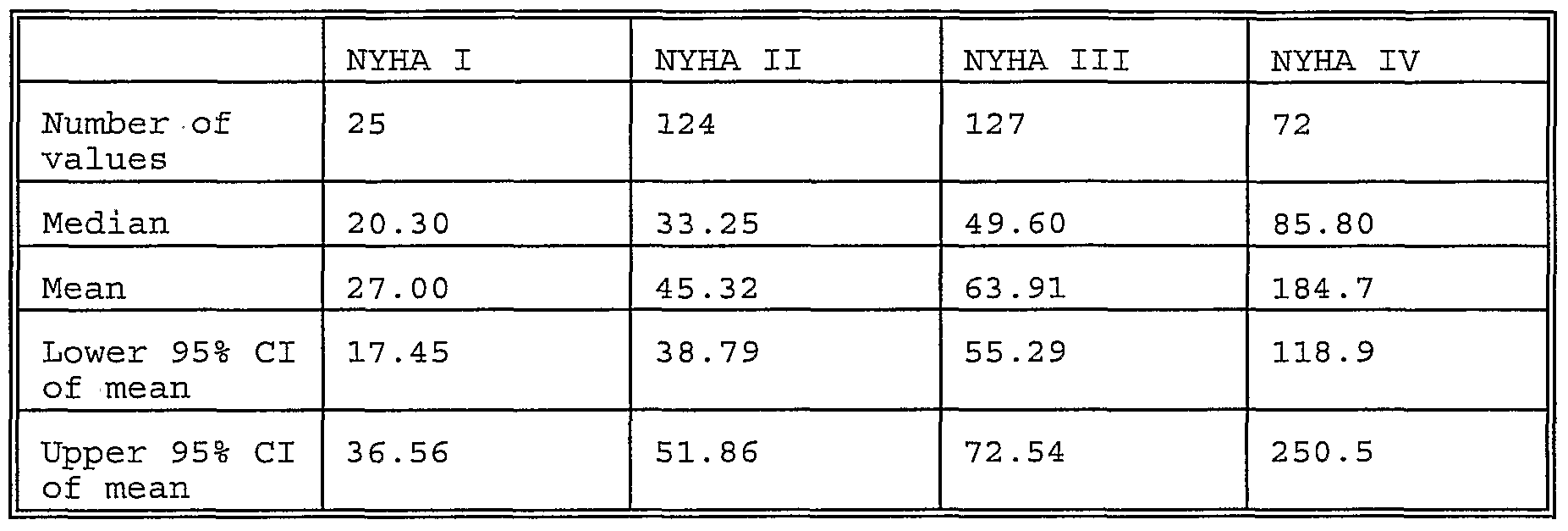
In patients with CHF the measured levels of copeptin corre¬ lates well with the severity of the illness which is gene¬ rally evaluated using the New York Heart Association (NYHA) functional classification system, wherein NYHA classes I to IV correspond to the following typical functional capaci¬ ties: NYHA class I - asymptomatic; NYHA class II - symptoms with moderate exertion; NYHA class III - symptoms with minimal exertion; NYHA class IV - symptoms (dyspnea) at rest. In a study in which copeptin levels in plasma samples of a total of 348 CHF patients (25 in NYHA class I; 124 in NYHA class II; 127 in NYHA class III; 72 in NYHA class IV; see Table 1) were determined, the medians for the different classes showed a clear tendency (see Table 1 below) .
The invention also provides a diagnostic method, kit and assay for the above mentioned diseases, using one or more antibodies of copeptin in particular. Description of the Figures
Fig. 1 shows the standard curve for the sandwich-immuno¬ assay for copeptin immunoreactivity using the peptide PAY33 as a standard material.
Fig. 2 shows the concentration of copeptin immunoreacti¬ vity in samples of healthy individuals and diffe¬ rent groups of patients (sepsis, cardiac in¬ farction and increased arterial blood pressure) .
Fig. 3 shows the vasopressin prohormone amino acid se¬ quence (one-letter code; cf. also SEQ ID NO:4) .
Fig. 4 shows the concentrations of copeptin immunoreacti¬ vity in samples of patients with CHF (chronic heart failure) classified according to the NYHA classification system.
Materials, methods and measurements
Example 1
Peptide Synthesis
Peptides were synthesized and their quality was controlled by mass spectrometry and reversed phase HPLC and lyophiliy- sed in aliquots (Jerini AG, Berlin, Germany) according to standard procedures known to the person skilled in the art . The amino acid sequences of the peptides are the following (numbers refer to corresponding positions in the human pro- vasopressin-neurophysin 2-copeptin-precursors (positions 132-147 and 149-164) :
PATV 17 (132-147 + N-terminal cystein residue) : CATQLDGPAGALLLRLV [Sequence ID 1] , PLAY 17 (149-164 + N-terminal cystein residue) : CLAGAPEPFEPAQPDAY [Sequence ID 2] ,
Standard peptide PAY 33 (132-164) ATQLDGPAGALLLRLVQLAGAPEPFEPAQPDAY [Sequence ID 3] .
Example 2
Conjugation and Immunization
Peptides of Sequence IDs 1-2 were conjugated to the carrier protein KLH (keyhole limpet hemocyanin) by MBS (-Maleimid- obenzoyl-N-hydroxysuccinimid ester) according to the proto¬ cols for "NHS-esters-maleimide crosslinkers" by PIERCE, Rockford, IL, USA. Sheep were immunized receiving 100 μg of conjugate (μg according to the peptide content of the conju¬ gate) and subsequently 50μg of conjugate every four weeks (quantitiy related to the peptide content of the conjugate) . Starting at month 4 after immunization every four weeks 700 ml of blood were withdrawn from every sheep and antiserum was gained by centrifugation. Conjugation, immunizations and production of antisera were done by MicroPharm, Carmerthens- hire, UK.
Example 3
Purification of Antibodies
The polyclonal antibodies from sheep were purified using ligand specific affinity purification. For that step the peptides PATV 17 and PLAY 17 were linked to SuIfoLink-Gel supplied by Pierce (Boston, USA) . The binding occurred according to the protocol of Pierce. 5 mg of peptide were added per 5 ml of gel .
In summary, columns were washed three times with 10 ml elution buffer (50 mM citric acid, pH 2.2) and binding buffer (100 mM sodium phosphate, 0.1% Tween, pH 6.8) . 100 ml of sheep antiserum were filtered using a filter diameter of 0.2 μm and added to the column material, which had been transferred from the column to a beaker with 10 ml binding buffer. The material was incubated over night at room tempe¬ rature by gentle rotation. The material was transferred to empty columns (NAP 25, Pharmacia, emptied) . The eluates were discarded. Subsequently the columns were washed with 250 ml protein-free binding buffer (protein content of washed eluate < 0.02 A 280 nm) '. Elution buffer was added to the washed columns and fractions of 1 ml were collected. The protein content of each fraction was determined by the BCA- method (according to the protocol of PIERCE, Rockford, IL, USA) . Fractions of a protein content > 0.8 mg/ml were poo¬ led. After determination of protein content 39 mg of anti- PATV 17 antibody 0413-pAk and 103 mg of anti-PLAY 17 antibo¬ dy 0417-pAk were gained.
Example 4
Tagging
The anti-PLAY 17 antibody 0417-pAk was treated as follows: 500 μl of affinity purified antibodies generated were rebuf- fered in 1 ml 100 mM potassium phosphate buffer (pH 8.0) via a NAP-5 gel filtration column (Pharmacia) according to the protocol of Pharmacia. The protein concentration of antibody solution was 1,5 mg/ml.
For the tagging with a chemiluminescent marker 10 μl of MA70-Akridinium-NHS-ester (lmg/ml; Hoechst Behring) were added to 67 μl of antibody solution and incubated for 15 minutes at room temperature. Then 423 μl of 1 M glycin was added and incubated for 10 minutes. The solution was rebuf- fered in 1 •ml solvent A (50 mM potassium phosphate, 100 mM NaCl, pH 7.4) using a NAP-5 gel filtration column according to the protocols of Pharmacia. For final elimination of unbound label a gel filtration HPLC was done (Column: Waters Protein Pak SW300) . The sample was added and chromatographed at a flow rate of lml/minute in solvent A. The flow was continuously monitored in a UV-meter at wave length of 280 and 368 nm to determine the degree of tagging. The absorp¬ tion ratio 368/280 nm of labelled antibody was 0,1. The fractions containing monomeric antibodies were collected (retention time 8-10 minutes) and taken up in 3 ml 10OmM sodium phosphate, 150 mM NaCl, 5% bovine serum albumin, 0,1 % sodium azide, pH 7.4)
Example 5
Coupling
The anti-PATV 17 antibody 0413-pAk was immobilized on irra¬ diated 5 ml polystyrol tubes (Greiner, Germany) . For that procedure the antibody solution was diluted to a protein concentration of 6.6 μg/ml with 50 mM Tris, 100 mM NaCl, pH 7.8. 300 μl of diluted protein solution per tube were pipet¬ ted. These were incubated for 20 hours at 220C, the solution was removed. Then 4.2 ml of a 10 mM sodium phosphate, 2 % Karion FP, 0.3 % bovine serum albumin, pH 6.5 solution were added to each tube. After 20 hours the solution was removed and the tubes were dried in a vacuum drier.
Example 6
Immunoassay
The following assay buffer was used: 100 mM sodium phospha¬ te, 150 mM NaCl, 5 % bovine serum albumin, 0.1 % unspecified sheep IgG, 0.1 % sodium azide, pH 7.4.
The copeptin concentration of EDTA-plasma of healthy indivi¬ duals and patients of various diseases/diseases mentioned above was determined, heart diseases and diseases of the circulation in particular.
As a standard material chemically synthesized peptide (pep¬ tide PAY 33) was used which corresponds to positions 132-164 of vasopressin-neurophysin 2-copeptin precursor. The stan¬ dard was diluted in normal horse serum (Sigma) .
In the test tubes 100 μl of standards or sample as well as 100 μl of assay buffer was pipetted. The tubes were incuba¬ ted for two hours at 220C using gentle rotation. After washing 4 times with 1 ml of washing buffer (0.1 % Tween 20) , the supernatant was discarded. Then 200 μl of assay buffer, containing 1 million RLU (relative light units) of MA70-tagged antibody was added and incubated for a further two hours under gentle rotation at 220C. After washing 4 times with 1 ml of washing buffer (0.1 % Tween 20) , the chemiluminescence bound to the tube was determined in a luminometer (Berthold, LB952T, basic reagents Brahms AG) . Using the software MultiCalc (Spline Fit) the concentrations of the samples were determined.
Example 7
Determination of copeptin concentration
The term copeptin immunoreactivity describes the amount of substrate detected by the developed sandwich immunoassay. The sandwich immunoassay uses antibodies raised against positions 132-147 and 149-164 of the vasopressin-neurophysin 2-copeptin-precursor for detection of the substrate. A typical standard curve for the developed assay is described in Fig. 1. Using the assay concentrations above 50 pg/ml copeptin immunoreactivity in plasma or serum can be deter¬ mined quantitatively. Example 8
Concentration of copeptin immunoreactivity in healthy indi¬ viduals and state of disease
Serum and plasma of healthy individuals and patients suffe¬ ring from various diseases comprising sepsis, cardiac in¬ farction and increased arterial blood pressure were analysed (Fig. 2) .' The copeptin immunoreactivity was determined. Compared to healthy individuals copeptin immunoreactivity was surprisingly increased in state of disease. Healthy individuals showed a median of about 13 pg/ml, sepsis patients a median of about 150 pg/ml, in cardiac infarction the median was about 129 pg/ml and in increased arterial blood pressure the median was about 459 pg/ml.
Example 9
Concentration of copeptin immunoreactivity in patients with chronic heart failure (CHF) of NYHA classes I to IV
In serum and plasma samples of a total of 348 CHF patients (25 in NYHA class I; 124 in NYHA class II; 127 in NYHA class III; 72 in NYHA class IV; see Table 1) copeptin levels were determined using the assay described above. The results are shown in diagrammatic form in Figure 4. As can be seen, the medians of the copeptin concentration in pg/ml for the different classes showed a clear tendency to increase in that the median for patients of NYHA class I was found to be 20.30 pg/ml, class II 33.25 pg/ml, class III 49,60 pg/ml, and class IV 85.80 pg/ml (see the statistical data in Table 1 below) . Table 1
Figure imgf000019_0001
CI = confidence interval
The finding that there is a close correlation of the severi¬ ty of CHF with the copeptin levels in plasma makes copeptin a biomarker candidate for use in the diagnosis (positive or negative diagnosis) of CHF, the monitoring of the course and evolution of CHF and the monitoring and control of a CHF therapy. Further, in view of current attempts to evaluate the usefulness of vasoporessin receptor antagonists in the therapy of heart failure [27] , the determination of copeptin in serum or plasma samples of heart failure patients can allow the identification of such patients who would benefit more than others from a treatment with vasopressin receptor antagonists.
Example 10
Stability of copeptin immunoreactivitv
Copeptin immunoreactivity was found to be surprisingly stable in plasma and serum (Table 2) . Table 2 shows the ex vivo stability of endogenous immunoreactive copeptin in serum and plasma of sepsis patients. TABLE 2
Figure imgf000020_0001
Even after two days storage at room temperature (RT) no decrease in immunoreactivity could be detected.
Thus the ex vivo stability of copeptin immunoreactivity is surprisingly remarkably increased as compared to vasopres¬ sin.
Literature:
1. Singh Ranger G: The physiology and emerging roles of antidiuretic hormone. Int. J. Clin. Pract. 56: 777-782, 2002;
2. Landry DW, Oliver JA: The pathogenesis of vasodilatory shock. N. Engl. J. Med. 345: 588-595;
3. Coates LC, Birch NP: Differential cleavage of provaso- pressin by the major molecular forms of SPC3. J. Neuro- chem. 70: 1670-1678, 1998;
4. Wilson MF, Brackett DJ, Tompkins P, Benjamin B, Archer LT, Hinshaw LB: Elevated plasma vasopressin concentra¬ tions during endotoxin and E.coli shock. Adv. Shock. Res. 6: 15-26, 1981;
5. Landry DW, Levin HR, Gallant EM, Ashton RC, Jr., Seo S, D'Alessandro D, Oz MC, Oliver JA: Vasopressin deficien¬ cy contributes to the vasodilation of septic shock. Crit. Care Med. 30: 497-500;
6. Sharshar T, Carlier R, Blanchard A, Paillard M, Raphael JC, Gajdos P, Annane D: Depletion of neurohypophyseal content of vasopressin in septic shock. Crit Care Med 30: 497-500, 2002;
7. Sharshar T, Blanchard A, Paillard M, Raphael JC, Gajdos P, Annane D: Circulating vasopressin levels in septic shock. Crit Care Med 31: 1752-1758, 2003;
8. Forrest P: Vasopressin and shock. Anaesth Intensive Care 29: 463-472, 2001;
9. Vincent JL: Endocrine support in the critically ill. Crit Care Med 30: 702-703, 2002;
10. Holmes CL, Landry DW, Granton JT: Science Review: Vaso¬ pressin and the cardiovascular system part 2- clinical physiology. Crit Care 8: 15-23, 2004;
11. Lindner KH, Strohmenger HU, Ensinger H, Hetzel WD, Ahnefeld FW, Georgieff M: Stress hormone response du¬ ring and after cardiopulmonary resuscitation. Anaest- hiology 77: 662-668, 1992; 12. Wenzel V, Krismer AC, Arntz HR, Sitter H, Stadlbauer KH, Lindner KH: A comparison of vasopressin and epi¬ nephrine for out-of-hospital cardiopulmonary resuscita¬ tion. N Engl J Med 350: 105-113, 2004;
13. North WG: Gene regulation of vasopressin and vasopres¬ sin receptors in cancer. Exp Physiol 85 Spec No: 27 S- 40 S, 2000;
14. Baumann G, Dingmann JF: Distribution, blood transport and degradation of antidiuretic hormone in man. J Clin Invest 57: 1109-1116, 1976;
15. Smyth DG, Massey DE: A new glycopeptide in pig, ox and sheep pituitary. Biochem Biophys Res Commun 87: 1006- 1010, 1979;
16. de Bree FM, Burbach JP: Structure-function relations¬ hips of the vasopressin prohormone domains. Cell MoI Neurobiol 18: 173-191, 1998;
17. Holwerda DA: A glycopeptide from the posterior lobe of pituitaries. I. Isolation and characterization. Eur J Biochem 28: 334-339, 1972;
18. Nagy G, Mulchahey JJ, Smyth DG, Neill JD: The glycopep¬ tide moiety of vasopressin-neurophysin precursor is neurohypophysial prolactin releasing factor. Biochem Biophys Pes Commun 151: 524-529, 1988;
19. Hyde JF, North WG, Ben-Jonathan N: The vasopressin- associated glycopeptide is not a prolactin-releasing factor: studies with lactating Brattleboro rats. Endo¬ crinology 124: 35-40, 1989;
20. North, W. G. "Biosynthesis of vasopressin and neurophy- sins" in: D. Gash and G. Boer (eds.) , Vasopressin: Principles and Properties, pp. 175-209. New York: Pie- num Press, 1987) ;
21. Chesney et al . , J. Lab. Clin. Med. 1985, S. 106, abruf- bar unter www.ncbi.nih..gov,•
22. Kluge et al . , Clinical Chemistry 1999, S. 98-100
23. Robertson et al. , Journal of Clinical Investigation, Vol. 52, 1973, S. 2340-2352;
24. North, W. G. et al, "Immunohistochemical Evaluation of Vasopressin Expression in Breast Fibrocystic Disease and Ductal Carcinoma In Situ (DCTS)", Endocrine Patho¬ logy, 2003, Vol. 14, No.3, 2003, pages 257-262;
25. North W. G. et al . , "Vasopressin gene related products .are markers of human breast cancer". Breast Cancer
Research and Treatment, Vol. 34, 1995, pages 229-235;
26. North W.G. : "Neuropeptide Production by Small Cell Carcinoma: Vasopressin and Oxytocin as Plasma Markers of Disease", J Clin Endocrinol Metab, Vol. 73, 1991, No. 6, pages 1316-1320;
27. Thibonnier M., Vasopressin receptor antagonists in heart failure, Current Opinion in Pharmacology 2003, 3:683-687.

Claims

- 25Claims
1. Diagnostic in vitro method for the diagnosis and moni¬ toring of disorders associated with or caused by non-physio¬ logical alterations of vasopressin release from the neurohy¬ pophysis by determining in a sample of a body fluid of the patient the amount of copeptin and/or a pathophysiological^ occurring precursor, splice variant, fragment or posttrans- lationally modified form of copeptin displaying copeptin immunoreactivity, and associating the determined amount of copeptin or copeptin immunoreactivity with the presence and/or course and/or severity and/or prognosis of such disorder.
2. Method according to claim 1, wherein said disorder associated with or caused by non-physiological alterations of vasopressin release from the neurohypophysis is selecetd from the group consisting of cardiovascular diseases, espe¬ cially chronic or congestive heart failure, cardiac arrest, cardiac shock, cardiac infarction, acute myocardial infarction, arterial hypertension, cardiac surgery; cirr¬ hosis; pulmonary disorders; kidney (renal), diseases as polycystic kidney disease; Diabetes insipidus; forms of hyponatremia, forms of syndrome of inappropriate antidiure¬ tic hormone secretion; hemorrhage, edema-forming states, inflammatory diseases, trauma, burns, infectious complica¬ tions thereof and sepsis, severe sepsis and septic shock; and diseases/disorders of the central nervous system (CNS) .
3. Method according to claim 1 or 2, wherein the copeptin immunoreactivity is an immunoreactivity which can be deter¬ mined by using a sandwich immunoassay using a first specific binder recognizing an amino acid sequence present in SEQ ID NO:1, and a second specific binder recognizing an amino acid sequence present in SEQ IN NO:2.
4. Method according to claim 3, wherein said specific - 26 - binders are polyclonal and/or monoclonal antibodies.
5. Method according to claim 3 or 4, wherein said immuno¬ assay is a heterogenous immunoassay using a first immobili¬ zed specific binder and a second solubilized specific binder which carries a detectable label or which can be selectively labeled by reaction with a labeled marker molecule.
6. Method according to claim 3 or 4, wherein said immuno¬ assay is a homogeneous immunoassay.
7. Method according to any of claims 1 to 6, wherein the biological fluid is selected from serum, plasma, blood or liquor cerebrospinalis (cerebrospinal fluid; CSF) .
8. Method according to claim 2, wherein said disease is selected from sepsis, cardiac infarction, chronic heart failure and increased arterial blood pressure.
9. Kit for conducting a method in accordance with any of claims 1 to 8, comprising reagents for an immunoassay com¬ prising at least one first antibody recognizing a first amino acid sequence present in SEQ ID NO:1 or SEQ ID NO:2, and at least one second antibody recognizing another, second amino acid sequence present' in SEQ ID NO:1 or SEQ ID NO:2, wherein at least one of said first or second antibodies carries a detectable label .
10. Kit according to claim 9, wherein one of said first or second antibodies is immobilized onto a surface.
11. Kit according to cairn 9 or 10, further comprising a peptide to be used as standard and for calibration purposes.
12. Kit according to claim 11, wherein said peptide has the - 27 - amino acid sequence according to SEQ ID NO:3.
PCT/EP2005/009001 2004-08-19 2005-08-19 Diagnostic method for disorders using copeptin Ceased WO2006018315A1 (en)

Priority Applications (9)

Application Number Priority Date Filing Date Title
HK08101167.7A HK1114171B (en) 2004-08-19 2005-08-19 Copeptin-based diagnostic kit for disorders
JP2007526400A JP4932714B2 (en) 2004-08-19 2005-08-19 Disease diagnosis method using copeptin
CN2005800214349A CN101010591B (en) 2004-08-19 2005-08-19 A kit for diagnosis of diseases based on copeptin
DE200560002836 DE602005002836T2 (en) 2004-08-19 2005-08-19 DIAGNOSTIC PROCEDURE FOR ILLNESSES USING COPEPTIN
MXPA06014775A MXPA06014775A (en) 2004-08-19 2005-08-19 Diagnostic method for disorders using copeptin.
EP20050782853 EP1738178B1 (en) 2004-08-19 2005-08-19 Diagnostic method for disorders using copeptin
US11/573,595 US7807397B2 (en) 2004-08-19 2005-08-19 Diagnostic method for disorders using copeptin
US12/860,311 US20110008911A1 (en) 2004-08-19 2010-08-20 Diagnostic method for disorders using copeptin
US15/443,717 US20170242037A1 (en) 2004-08-19 2017-02-27 Diagnostic method for disorders using copeptin

Applications Claiming Priority (2)

Application Number Priority Date Filing Date Title
EP20040019732 EP1628136A1 (en) 2004-08-19 2004-08-19 Method of diagnosis of disease using copeptin
EP04019732.9 2004-08-19

Related Child Applications (2)

Application Number Title Priority Date Filing Date
US11/573,595 A-371-Of-International US7807397B2 (en) 2004-08-19 2005-08-19 Diagnostic method for disorders using copeptin
US12/860,311 Division US20110008911A1 (en) 2004-08-19 2010-08-20 Diagnostic method for disorders using copeptin

Publications (1)

Publication Number Publication Date
WO2006018315A1 true WO2006018315A1 (en) 2006-02-23

Family

ID=34926232

Family Applications (1)

Application Number Title Priority Date Filing Date
PCT/EP2005/009001 Ceased WO2006018315A1 (en) 2004-08-19 2005-08-19 Diagnostic method for disorders using copeptin

Country Status (10)

Country Link
US (3) US7807397B2 (en)
EP (2) EP1628136A1 (en)
JP (2) JP4932714B2 (en)
CN (2) CN101010591B (en)
AR (1) AR050215A1 (en)
AT (1) ATE375518T1 (en)
DE (1) DE602005002836T2 (en)
ES (1) ES2296224T3 (en)
MX (1) MXPA06014775A (en)
WO (1) WO2006018315A1 (en)

Cited By (8)

* Cited by examiner, † Cited by third party
Publication number Priority date Publication date Assignee Title
WO2008012019A2 (en) 2006-07-24 2008-01-31 B.R.A.H.M.S. Aktiengesellschaft Method for controlling the therapy of patients suffering from cardiac insufficiency by means of in vitro determination of threshold values of vasoactive peptides
WO2008058517A3 (en) * 2006-11-12 2008-10-23 Brahms Ag Diagnosis and risk stratification of infections and chronic diseases of the respiratory tract and lungs by means of provasopressin, particularly copeptin or neurophysin ii
JP2010507076A (en) * 2006-10-18 2010-03-04 アクセラ インコーポレーテッド Measurement of multiple analytes over a wide concentration range by light diffraction.
JP2010507786A (en) * 2006-10-26 2010-03-11 ブラームズ アクチェンゲゼルシャフト Risk stratification for acute coronary syndrome using provasopressin or fragments thereof and partial peptides, particularly copeptin or neurophysin II
JP2010511877A (en) * 2006-12-08 2010-04-15 ブラームズ アクチェンゲゼルシャフト Diagnosis and risk stratification of cardiac dysfunction using neurophysin
US9018350B2 (en) 2011-05-26 2015-04-28 Phoenix Pharmaceuticals, Inc. Phoenixin peptides
CN109679924A (en) * 2018-12-25 2019-04-26 广州万孚生物技术股份有限公司 The anti-human monoclonal antibody and the preparation method and application thereof with peptide element of high-affinity
US10954298B2 (en) 2011-06-30 2021-03-23 B.R.A.H.M.S. Gmbh Method of obtaining a binder to prepro-vasopressin or fragments thereof

Families Citing this family (24)

* Cited by examiner, † Cited by third party
Publication number Priority date Publication date Assignee Title
US20140046407A1 (en) * 2001-08-31 2014-02-13 Bio Control Medical (B.C.M.) Ltd. Nerve stimulation techniques
DE102006046996A1 (en) * 2006-10-01 2008-04-03 Brahms Aktiengesellschaft Diagnosis process for respiratory infections involves using procalcitonin as marker for assessing patient risk level
DE102006050497A1 (en) * 2006-10-26 2008-04-30 Brahms Aktiengesellschaft Risk stratification process for acute coronary syndrome involves finding levels of provasoppressin or its fragments and part-peptides by in-vitro diagnosis
EP2180322A1 (en) * 2008-10-22 2010-04-28 BRAHMS Aktiengesellschaft Prognostic biomarkers for the progression of primary chronic kidney disease
ES2772930T3 (en) * 2008-10-31 2020-07-08 Brahms Gmbh Prohormone arginine vasopressin as a predictive biomarker for diabetes
US20100312581A1 (en) * 2009-06-08 2010-12-09 Peter James Wachtell Process and system for efficient allocation of medical resources
US20120129187A1 (en) 2009-06-16 2012-05-24 B.R.A.H.M.S. Gmbh Diagnostical use of peroxiredoxin 4
JP5827323B2 (en) * 2010-06-18 2015-12-02 ベー.エル.アー.ハー.エム.エス ゲゼルシャフト ミット ベシュレンクテル ハフツング Biomarkers for predicting cancer incidence
EP2776064A4 (en) * 2011-11-11 2015-08-05 Woomera Therapeutics ANTAGONISTS OF PRO-VASOPRESSIN AND USES THEREOF
GB201210686D0 (en) * 2012-06-15 2012-08-01 Holsboermaschmeyer Neurochemie Gmbh V1B receptor antagonist for use in the treatment of patients having an elevated AVP level and/or an elevated copeptin level
GB201310782D0 (en) 2013-06-17 2013-07-31 Max Planck Innovation Gmbh Method for predicting a treatment response to a CRHR1 antagonist and/or V1B antagonist in a patient with depressive and/or anxiety symptoms
US9687526B2 (en) 2015-01-30 2017-06-27 Par Pharmaceutical, Inc. Vasopressin formulations for use in treatment of hypotension
US9937223B2 (en) 2015-01-30 2018-04-10 Par Pharmaceutical, Inc. Vasopressin formulations for use in treatment of hypotension
US9744239B2 (en) 2015-01-30 2017-08-29 Par Pharmaceutical, Inc. Vasopressin formulations for use in treatment of hypotension
US9744209B2 (en) 2015-01-30 2017-08-29 Par Pharmaceutical, Inc. Vasopressin formulations for use in treatment of hypotension
US9750785B2 (en) 2015-01-30 2017-09-05 Par Pharmaceutical, Inc. Vasopressin formulations for use in treatment of hypotension
US9925233B2 (en) 2015-01-30 2018-03-27 Par Pharmaceutical, Inc. Vasopressin formulations for use in treatment of hypotension
WO2016128383A1 (en) 2015-02-10 2016-08-18 B.R.A.H.M.S Gmbh Free histone proteins as biomarkers
EP3279667A1 (en) 2016-08-02 2018-02-07 Abbott Laboratories Cardiac troponin i and copeptin as biomarkers for short-term mortality in acute exacerbation of chronic obstructive pulmonary disease (aecopd)
CN109061140A (en) * 2018-08-31 2018-12-21 广州华澳生物科技有限公司 A kind of and peptide element immunochromatographiassay assay reagent card and preparation method thereof
CN109596839A (en) * 2018-12-25 2019-04-09 广州万孚生物技术股份有限公司 People and peptide element fast quantitative measurement method for detecting and kit
JP7640168B2 (en) * 2019-01-28 2025-03-05 ベー.エル.アー.ハー.エム.エス ゲーエムベーハー Method for predicting treatment response in patients with nocturnal enuresis - Patent Application 20070123633
CN111007270A (en) * 2019-11-27 2020-04-14 迪瑞医疗科技股份有限公司 Peptide-neutralizing chemiluminescence immunoassay kit and preparation method thereof
CN113406339A (en) * 2021-08-19 2021-09-17 山东康华生物医疗科技股份有限公司 Dry-type immunofluorescence quantitative method human Copeptin (CPP) detection kit

Citations (1)

* Cited by examiner, † Cited by third party
Publication number Priority date Publication date Assignee Title
WO2004006860A2 (en) * 2002-07-16 2004-01-22 Woomera Therapeutics, Inc. Compositions and uses thereof for identifying and targeting provasopressin-expressing cancer cells

Family Cites Families (10)

* Cited by examiner, † Cited by third party
Publication number Priority date Publication date Assignee Title
US6413783B1 (en) * 1997-09-18 2002-07-02 Meso Scale Technologies, Llc Assay sonication apparatus and methodology
US6822082B2 (en) * 2000-06-30 2004-11-23 Zymogenetics, Inc. Polynucleotides for mammalian secreted protein, Z1055G2P
US20040253637A1 (en) * 2001-04-13 2004-12-16 Biosite Incorporated Markers for differential diagnosis and methods of use thereof
CN1166953C (en) * 2001-05-30 2004-09-15 上海晶泰生物技术有限公司 Fast gold mark test reagent kit for one-step multiple-index test of myocardial infarction
IL161446A0 (en) * 2001-11-26 2004-09-27 Daiichi Suntory Pharma Co Ltd Medicinal compositions for nasal absorption
EP1588159A4 (en) * 2002-12-24 2008-03-12 Biosite Inc Method and system for disease detection using marker combinations
PL2084543T3 (en) * 2006-10-26 2018-04-30 B.R.A.H.M.S Gmbh Risk stratification for acute coronary syndrome by means of fragments/partial peptides of provasopressin, especially copeptin or neurophysin ii
DE102006053442A1 (en) * 2006-11-12 2008-05-15 Brahms Aktiengesellschaft Diagnosis and risk stratification of infections and chronic diseases of the respiratory and lungs by means of proVasopressin, in particular copeptin or neurophysin II
DE102006060112A1 (en) * 2006-12-20 2008-06-26 Brahms Aktiengesellschaft Diagnosis and risk stratification using the new marker CT-proADM
DE102007010834A1 (en) * 2007-03-03 2008-09-04 Brahms Aktiengesellschaft Method for in-vitro diagnosis or risk classification or outcome prognosis of heart failure for New york heart association patient, involves utilizing determination of marker proatrial natriuretic peptide

Patent Citations (1)

* Cited by examiner, † Cited by third party
Publication number Priority date Publication date Assignee Title
WO2004006860A2 (en) * 2002-07-16 2004-01-22 Woomera Therapeutics, Inc. Compositions and uses thereof for identifying and targeting provasopressin-expressing cancer cells

Non-Patent Citations (6)

* Cited by examiner, † Cited by third party
Title
GABREELS B A T F ET AL: "The vasopressin precursor is not processed in the hypothalamus of Wolfram syndrome patients with diabetes insipidus: Evidence for the involvement of PC2 and 7B2", JOURNAL OF CLINICAL ENDOCRINOLOGY AND METABOLISM, vol. 83, no. 11, November 1998 (1998-11-01), pages 4026 - 4033, XP008055034, ISSN: 0021-972X *
NIJENHUIS MARGA ET AL: "Familial neurohypophysial diabetes insipidus in a large Dutch kindred: Effect of the onset of diabetes on growth in children and cell biological defects of the mutant vasopressin prohormone", JOURNAL OF CLINICAL ENDOCRINOLOGY AND METABOLISM, vol. 86, no. 7, July 2001 (2001-07-01), pages 3410 - 3420, XP008055032, ISSN: 0021-972X *
NIJENHUIS MARGA ET AL: "Mutations in the vasopressin prohormone involved in diabetes insipidus impair endoplasmic reticulum export but not sorting", JOURNAL OF BIOLOGICAL CHEMISTRY, vol. 274, no. 30, 23 July 1999 (1999-07-23), pages 21200 - 21208, XP008055030, ISSN: 0021-9258 *
NORTH W G ET AL: "IMMUNOHISTOCHEMICAL EVALUATION OF VASOPRESSIN EXPRESSION IN BREAST FIBROCYSTIC DISEASE AND DUCTAL CARCINOMA IN SITU (DCIS)", ENDOCRINE PATHOLOGY, HUMANA PRESS, TOTOWA, NJ, US, vol. 14, no. 3, 2003, pages 257 - 262, XP008043447, ISSN: 1046-3976 *
NORTH W G: "NEUROPEPTIDE PRODUCTION BY SMALL CELL CARCINOMA VASOPRESSIN AND OXYTOCIN AS PLASMA MARKERS OF DISEASE", JOURNAL OF CLINICAL ENDOCRINOLOGY AND METABOLISM, NEW YORK, NY, US, vol. 73, no. 6, 1991, pages 1316 - 1320, XP008043564, ISSN: 0021-972X *
YAMAJI T ET AL: "PROPRESSOPHYSIN IN HUMAN BLOOD A POSSIBLE MARKER OF ECTOPIC VASOPRESSIN PRODUCTION", JOURNAL OF CLINICAL ENDOCRINOLOGY AND METABOLISM, vol. 59, no. 3, 1984, pages 505 - 512, XP008055037, ISSN: 0021-972X *

Cited By (22)

* Cited by examiner, † Cited by third party
Publication number Priority date Publication date Assignee Title
WO2008012019A2 (en) 2006-07-24 2008-01-31 B.R.A.H.M.S. Aktiengesellschaft Method for controlling the therapy of patients suffering from cardiac insufficiency by means of in vitro determination of threshold values of vasoactive peptides
US7915002B2 (en) 2006-07-24 2011-03-29 B.R.A.H.M.S Gmbh Method for controlling the therapy of patients suffering from cardiac insufficiency by means of in vitro determination of threshold values of vasoactive peptides
JP2010507076A (en) * 2006-10-18 2010-03-04 アクセラ インコーポレーテッド Measurement of multiple analytes over a wide concentration range by light diffraction.
JP2010507786A (en) * 2006-10-26 2010-03-11 ブラームズ アクチェンゲゼルシャフト Risk stratification for acute coronary syndrome using provasopressin or fragments thereof and partial peptides, particularly copeptin or neurophysin II
US9261517B2 (en) 2006-10-26 2016-02-16 B.R.A.H.M.S Gmbh Diagnosis of acute coronary syndrome, myocardial infarction, or angina pectoris by means of neurophysin II
US8501485B2 (en) 2006-10-26 2013-08-06 B.R.A.H.M.S. Gmbh Risk stratification for acute coronary syndrome by determining copeptin
JP2013178249A (en) * 2006-10-26 2013-09-09 Brahms Gmbh Risk stratification for acute coronary syndrome by means of provasopressin or fragments and partial peptides thereof, in particular copeptin or neurophysin ii
JP2010509576A (en) * 2006-11-12 2010-03-25 ブラームズ アクチェンゲゼルシャフト Diagnosis and / or stratification of risk of respiratory and pulmonary infections and chronic diseases with provasopressin, especially copeptin or neurophysin II
WO2008058517A3 (en) * 2006-11-12 2008-10-23 Brahms Ag Diagnosis and risk stratification of infections and chronic diseases of the respiratory tract and lungs by means of provasopressin, particularly copeptin or neurophysin ii
EP2378290A1 (en) 2006-11-12 2011-10-19 B.R.A.H.M.S GmbH Diagnosis and risk stratification of infections and chronic illnesses of the airways and lungs by means of Pro-Vasopressin, in particular Copeptin or Neurophysin II
US8158368B2 (en) 2006-11-12 2012-04-17 B.R.A.H.M.S. Gmbh Diagnosis and risk stratification of infections and chronic diseases of the respiratory tract and lungs by means of provasopressin, particularly copeptin or neurophysin II
JP2013083664A (en) * 2006-11-12 2013-05-09 Brahms Gmbh Diagnosis and/or risk stratification of infections and chronic diseases of respiratory tract and lungs by means of provasopressin, particularly copeptin or neurophysin ii
US10718783B2 (en) 2006-11-12 2020-07-21 Brahms Gmbh Diagnosis and risk stratification of infections and chronic diseases of the respiratory tract and lungs by means of provasopressin, particularly copeptin or neurophysin II
US20170059583A1 (en) * 2006-11-12 2017-03-02 Brahms Gmbh Diagnosis and risk stratification of infections and chronic diseases of the respiratory tract and lungs by means of provasopressin, particularly copeptin or neurophysin ii
JP2010511877A (en) * 2006-12-08 2010-04-15 ブラームズ アクチェンゲゼルシャフト Diagnosis and risk stratification of cardiac dysfunction using neurophysin
JP2013210385A (en) * 2006-12-08 2013-10-10 Brahms Gmbh Diagnosis of heart malfunction and layering of risk using neurophysin
US9534045B2 (en) 2011-05-26 2017-01-03 Phoenix Pharmaceuticals, Inc. Phoenixin peptides
US9018350B2 (en) 2011-05-26 2015-04-28 Phoenix Pharmaceuticals, Inc. Phoenixin peptides
US10836812B2 (en) 2011-05-26 2020-11-17 Phoenix Pharmaceuticals, Inc. Phoenixin peptides
US12103965B2 (en) 2011-05-26 2024-10-01 Phoenix Pharmaceuticals, Inc. Diagnostic kit
US10954298B2 (en) 2011-06-30 2021-03-23 B.R.A.H.M.S. Gmbh Method of obtaining a binder to prepro-vasopressin or fragments thereof
CN109679924A (en) * 2018-12-25 2019-04-26 广州万孚生物技术股份有限公司 The anti-human monoclonal antibody and the preparation method and application thereof with peptide element of high-affinity

Also Published As

Publication number Publication date
EP1738178B1 (en) 2007-10-10
HK1172690A1 (en) 2013-04-26
ATE375518T1 (en) 2007-10-15
HK1114171A1 (en) 2008-10-24
DE602005002836T2 (en) 2008-07-31
JP4932714B2 (en) 2012-05-16
DE602005002836D1 (en) 2007-11-22
CN101010591A (en) 2007-08-01
AR050215A1 (en) 2006-10-04
US20170242037A1 (en) 2017-08-24
US20090221009A1 (en) 2009-09-03
CN102539789A (en) 2012-07-04
JP2011227095A (en) 2011-11-10
EP1628136A1 (en) 2006-02-22
JP2008510151A (en) 2008-04-03
US7807397B2 (en) 2010-10-05
EP1738178A1 (en) 2007-01-03
ES2296224T3 (en) 2008-04-16
CN101010591B (en) 2011-12-21
US20110008911A1 (en) 2011-01-13
MXPA06014775A (en) 2007-03-23
CN102539789B (en) 2015-04-08

Similar Documents

Publication Publication Date Title
EP1738178B1 (en) Diagnostic method for disorders using copeptin
US8501415B2 (en) Identification of TSH receptor autoantibodies using affinity-purified antibodies
CN1759319B (en) Usage of peptide of ADM Among the regional parts of Biological fluid in preparing immune diagnosticum
US6248546B1 (en) Assay of IGFBP complex
Birken et al. Metabolism of hCG and hLH to multiple urinary forms
JP4656493B2 (en) Sandwich immunoassay for identifying partial proANP peptides
CN114113637A (en) Thyroid stimulating hormone receptor antigen reagent and thyroid stimulating hormone receptor antibody quantitative determination kit
US6537760B1 (en) Receptor binding assay for detecting TSH-receptor auto-antibodies
Takada et al. Measurement of free insulin-like growth factor-I using immunoradiometric assay
EP0351804B1 (en) HCG peptides for use in antibody purification procedures
US7015003B1 (en) Receptor binding assays and reagent kit for detecting TSH receptor autoantibodies
EP0721105A1 (en) Sandwich immunoassay for N-peptide
HK1114171B (en) Copeptin-based diagnostic kit for disorders
HK1172690B (en) Copeptin-based kit
Voellmy et al. A novel two-site immunoradiometric assay for β-endorphin using nitrocellulose as solid phase

Legal Events

Date Code Title Description
AK Designated states

Kind code of ref document: A1

Designated state(s): AE AG AL AM AT AU AZ BA BB BG BR BW BY BZ CA CH CN CO CR CU CZ DE DK DM DZ EC EE EG ES FI GB GD GE GH GM HR HU ID IL IN IS JP KE KG KM KP KR KZ LC LK LR LS LT LU LV MA MD MG MK MN MW MX MZ NA NG NI NO NZ OM PG PH PL PT RO RU SC SD SE SG SK SL SM SY TJ TM TN TR TT TZ UA UG US UZ VC VN YU ZA ZM ZW

AL Designated countries for regional patents

Kind code of ref document: A1

Designated state(s): GM KE LS MW MZ NA SD SL SZ TZ UG ZM ZW AM AZ BY KG KZ MD RU TJ TM AT BE BG CH CY CZ DE DK EE ES FI FR GB GR HU IE IS IT LT LU LV MC NL PL PT RO SE SI SK TR BF BJ CF CG CI CM GA GN GQ GW ML MR NE SN TD TG

121 Ep: the epo has been informed by wipo that ep was designated in this application
DPE1 Request for preliminary examination filed after expiration of 19th month from priority date (pct application filed from 20040101)
WWE Wipo information: entry into national phase

Ref document number: 2005782853

Country of ref document: EP

WWE Wipo information: entry into national phase

Ref document number: 2007526400

Country of ref document: JP

WWE Wipo information: entry into national phase

Ref document number: 1499/MUMNP/2006

Country of ref document: IN

WWE Wipo information: entry into national phase

Ref document number: PA/a/2006/014775

Country of ref document: MX

WWE Wipo information: entry into national phase

Ref document number: 200580021434.9

Country of ref document: CN

WWP Wipo information: published in national office

Ref document number: 2005782853

Country of ref document: EP

WWE Wipo information: entry into national phase

Ref document number: 11573595

Country of ref document: US

NENP Non-entry into the national phase

Ref country code: DE

WWG Wipo information: grant in national office

Ref document number: 2005782853

Country of ref document: EP