WO2006022899A2 - Organometallic compositions and coating compositions - Google Patents

Organometallic compositions and coating compositions Download PDF

Info

Publication number
WO2006022899A2
WO2006022899A2 PCT/US2005/014064 US2005014064W WO2006022899A2 WO 2006022899 A2 WO2006022899 A2 WO 2006022899A2 US 2005014064 W US2005014064 W US 2005014064W WO 2006022899 A2 WO2006022899 A2 WO 2006022899A2
Authority
WO
WIPO (PCT)
Prior art keywords
alkyl
groups
composition
group
carbon atoms
Prior art date
Legal status (The legal status is an assumption and is not a legal conclusion. Google has not performed a legal analysis and makes no representation as to the accuracy of the status listed.)
Ceased
Application number
PCT/US2005/014064
Other languages
French (fr)
Other versions
WO2006022899A3 (en
Inventor
Bing T. Hsieh
Ramanathan Ravichandran
Farouk Abi-Karam
Current Assignee (The listed assignees may be inaccurate. Google has not performed a legal analysis and makes no representation or warranty as to the accuracy of the list.)
King Industries Inc
Original Assignee
King Industries Inc
Priority date (The priority date is an assumption and is not a legal conclusion. Google has not performed a legal analysis and makes no representation as to the accuracy of the date listed.)
Filing date
Publication date
Application filed by King Industries Inc filed Critical King Industries Inc
Priority to EP05739642A priority Critical patent/EP1778778A4/en
Publication of WO2006022899A2 publication Critical patent/WO2006022899A2/en
Anticipated expiration legal-status Critical
Publication of WO2006022899A3 publication Critical patent/WO2006022899A3/en
Ceased legal-status Critical Current

Links

Classifications

    • CCHEMISTRY; METALLURGY
    • C09DYES; PAINTS; POLISHES; NATURAL RESINS; ADHESIVES; COMPOSITIONS NOT OTHERWISE PROVIDED FOR; APPLICATIONS OF MATERIALS NOT OTHERWISE PROVIDED FOR
    • C09DCOATING COMPOSITIONS, e.g. PAINTS, VARNISHES OR LACQUERS; FILLING PASTES; CHEMICAL PAINT OR INK REMOVERS; INKS; CORRECTING FLUIDS; WOODSTAINS; PASTES OR SOLIDS FOR COLOURING OR PRINTING; USE OF MATERIALS THEREFOR
    • C09D175/00Coating compositions based on polyureas or polyurethanes; Coating compositions based on derivatives of such polymers
    • C09D175/04Polyurethanes
    • BPERFORMING OPERATIONS; TRANSPORTING
    • B01PHYSICAL OR CHEMICAL PROCESSES OR APPARATUS IN GENERAL
    • B01JCHEMICAL OR PHYSICAL PROCESSES, e.g. CATALYSIS OR COLLOID CHEMISTRY; THEIR RELEVANT APPARATUS
    • B01J31/00Catalysts comprising hydrides, coordination complexes or organic compounds
    • B01J31/16Catalysts comprising hydrides, coordination complexes or organic compounds containing coordination complexes
    • B01J31/18Catalysts comprising hydrides, coordination complexes or organic compounds containing coordination complexes containing nitrogen, phosphorus, arsenic or antimony as complexing atoms, e.g. in pyridine ligands, or in resonance therewith, e.g. in isocyanide ligands C=N-R or as complexed central atoms
    • B01J31/1805Catalysts comprising hydrides, coordination complexes or organic compounds containing coordination complexes containing nitrogen, phosphorus, arsenic or antimony as complexing atoms, e.g. in pyridine ligands, or in resonance therewith, e.g. in isocyanide ligands C=N-R or as complexed central atoms the ligands containing nitrogen
    • B01J31/181Cyclic ligands, including e.g. non-condensed polycyclic ligands, comprising at least one complexing nitrogen atom as ring member, e.g. pyridine
    • CCHEMISTRY; METALLURGY
    • C08ORGANIC MACROMOLECULAR COMPOUNDS; THEIR PREPARATION OR CHEMICAL WORKING-UP; COMPOSITIONS BASED THEREON
    • C08GMACROMOLECULAR COMPOUNDS OBTAINED OTHERWISE THAN BY REACTIONS ONLY INVOLVING UNSATURATED CARBON-TO-CARBON BONDS
    • C08G18/00Polymeric products of isocyanates or isothiocyanates
    • C08G18/06Polymeric products of isocyanates or isothiocyanates with compounds having active hydrogen
    • C08G18/08Processes
    • C08G18/16Catalysts
    • C08G18/161Catalysts containing two or more components to be covered by at least two of the groups C08G18/166, C08G18/18 or C08G18/22
    • C08G18/163Catalysts containing two or more components to be covered by at least two of the groups C08G18/166, C08G18/18 or C08G18/22 covered by C08G18/18 and C08G18/22
    • CCHEMISTRY; METALLURGY
    • C08ORGANIC MACROMOLECULAR COMPOUNDS; THEIR PREPARATION OR CHEMICAL WORKING-UP; COMPOSITIONS BASED THEREON
    • C08GMACROMOLECULAR COMPOUNDS OBTAINED OTHERWISE THAN BY REACTIONS ONLY INVOLVING UNSATURATED CARBON-TO-CARBON BONDS
    • C08G18/00Polymeric products of isocyanates or isothiocyanates
    • C08G18/06Polymeric products of isocyanates or isothiocyanates with compounds having active hydrogen
    • C08G18/08Processes
    • C08G18/16Catalysts
    • C08G18/22Catalysts containing metal compounds
    • C08G18/222Catalysts containing metal compounds metal compounds not provided for in groups C08G18/225 - C08G18/26
    • CCHEMISTRY; METALLURGY
    • C08ORGANIC MACROMOLECULAR COMPOUNDS; THEIR PREPARATION OR CHEMICAL WORKING-UP; COMPOSITIONS BASED THEREON
    • C08GMACROMOLECULAR COMPOUNDS OBTAINED OTHERWISE THAN BY REACTIONS ONLY INVOLVING UNSATURATED CARBON-TO-CARBON BONDS
    • C08G18/00Polymeric products of isocyanates or isothiocyanates
    • C08G18/06Polymeric products of isocyanates or isothiocyanates with compounds having active hydrogen
    • C08G18/08Processes
    • C08G18/16Catalysts
    • C08G18/22Catalysts containing metal compounds
    • C08G18/227Catalysts containing metal compounds of antimony, bismuth or arsenic
    • CCHEMISTRY; METALLURGY
    • C08ORGANIC MACROMOLECULAR COMPOUNDS; THEIR PREPARATION OR CHEMICAL WORKING-UP; COMPOSITIONS BASED THEREON
    • C08GMACROMOLECULAR COMPOUNDS OBTAINED OTHERWISE THAN BY REACTIONS ONLY INVOLVING UNSATURATED CARBON-TO-CARBON BONDS
    • C08G18/00Polymeric products of isocyanates or isothiocyanates
    • C08G18/06Polymeric products of isocyanates or isothiocyanates with compounds having active hydrogen
    • C08G18/08Processes
    • C08G18/16Catalysts
    • C08G18/22Catalysts containing metal compounds
    • C08G18/24Catalysts containing metal compounds of tin
    • C08G18/244Catalysts containing metal compounds of tin tin salts of carboxylic acids
    • CCHEMISTRY; METALLURGY
    • C08ORGANIC MACROMOLECULAR COMPOUNDS; THEIR PREPARATION OR CHEMICAL WORKING-UP; COMPOSITIONS BASED THEREON
    • C08GMACROMOLECULAR COMPOUNDS OBTAINED OTHERWISE THAN BY REACTIONS ONLY INVOLVING UNSATURATED CARBON-TO-CARBON BONDS
    • C08G18/00Polymeric products of isocyanates or isothiocyanates
    • C08G18/06Polymeric products of isocyanates or isothiocyanates with compounds having active hydrogen
    • C08G18/28Polymeric products of isocyanates or isothiocyanates with compounds having active hydrogen characterised by the compounds used containing active hydrogen
    • C08G18/40High-molecular-weight compounds
    • C08G18/62Polymers of compounds having carbon-to-carbon double bonds
    • C08G18/6216Polymers of alpha-beta ethylenically unsaturated carboxylic acids or of derivatives thereof
    • CCHEMISTRY; METALLURGY
    • C08ORGANIC MACROMOLECULAR COMPOUNDS; THEIR PREPARATION OR CHEMICAL WORKING-UP; COMPOSITIONS BASED THEREON
    • C08GMACROMOLECULAR COMPOUNDS OBTAINED OTHERWISE THAN BY REACTIONS ONLY INVOLVING UNSATURATED CARBON-TO-CARBON BONDS
    • C08G18/00Polymeric products of isocyanates or isothiocyanates
    • C08G18/06Polymeric products of isocyanates or isothiocyanates with compounds having active hydrogen
    • C08G18/70Polymeric products of isocyanates or isothiocyanates with compounds having active hydrogen characterised by the isocyanates or isothiocyanates used
    • C08G18/72Polyisocyanates or polyisothiocyanates
    • C08G18/77Polyisocyanates or polyisothiocyanates having heteroatoms in addition to the isocyanate or isothiocyanate nitrogen and oxygen or sulfur
    • C08G18/78Nitrogen
    • C08G18/79Nitrogen characterised by the polyisocyanates used, these having groups formed by oligomerisation of isocyanates or isothiocyanates
    • C08G18/798Nitrogen characterised by the polyisocyanates used, these having groups formed by oligomerisation of isocyanates or isothiocyanates containing urethdione groups
    • CCHEMISTRY; METALLURGY
    • C08ORGANIC MACROMOLECULAR COMPOUNDS; THEIR PREPARATION OR CHEMICAL WORKING-UP; COMPOSITIONS BASED THEREON
    • C08GMACROMOLECULAR COMPOUNDS OBTAINED OTHERWISE THAN BY REACTIONS ONLY INVOLVING UNSATURATED CARBON-TO-CARBON BONDS
    • C08G18/00Polymeric products of isocyanates or isothiocyanates
    • C08G18/06Polymeric products of isocyanates or isothiocyanates with compounds having active hydrogen
    • C08G18/70Polymeric products of isocyanates or isothiocyanates with compounds having active hydrogen characterised by the isocyanates or isothiocyanates used
    • C08G18/72Polyisocyanates or polyisothiocyanates
    • C08G18/80Masked polyisocyanates
    • C08G18/8061Masked polyisocyanates masked with compounds having only one group containing active hydrogen
    • C08G18/8064Masked polyisocyanates masked with compounds having only one group containing active hydrogen with monohydroxy compounds
    • CCHEMISTRY; METALLURGY
    • C08ORGANIC MACROMOLECULAR COMPOUNDS; THEIR PREPARATION OR CHEMICAL WORKING-UP; COMPOSITIONS BASED THEREON
    • C08GMACROMOLECULAR COMPOUNDS OBTAINED OTHERWISE THAN BY REACTIONS ONLY INVOLVING UNSATURATED CARBON-TO-CARBON BONDS
    • C08G18/00Polymeric products of isocyanates or isothiocyanates
    • C08G18/06Polymeric products of isocyanates or isothiocyanates with compounds having active hydrogen
    • C08G18/70Polymeric products of isocyanates or isothiocyanates with compounds having active hydrogen characterised by the isocyanates or isothiocyanates used
    • C08G18/72Polyisocyanates or polyisothiocyanates
    • C08G18/80Masked polyisocyanates
    • C08G18/8061Masked polyisocyanates masked with compounds having only one group containing active hydrogen
    • C08G18/807Masked polyisocyanates masked with compounds having only one group containing active hydrogen with nitrogen containing compounds
    • CCHEMISTRY; METALLURGY
    • C08ORGANIC MACROMOLECULAR COMPOUNDS; THEIR PREPARATION OR CHEMICAL WORKING-UP; COMPOSITIONS BASED THEREON
    • C08GMACROMOLECULAR COMPOUNDS OBTAINED OTHERWISE THAN BY REACTIONS ONLY INVOLVING UNSATURATED CARBON-TO-CARBON BONDS
    • C08G18/00Polymeric products of isocyanates or isothiocyanates
    • C08G18/06Polymeric products of isocyanates or isothiocyanates with compounds having active hydrogen
    • C08G18/70Polymeric products of isocyanates or isothiocyanates with compounds having active hydrogen characterised by the isocyanates or isothiocyanates used
    • C08G18/72Polyisocyanates or polyisothiocyanates
    • C08G18/80Masked polyisocyanates
    • C08G18/8061Masked polyisocyanates masked with compounds having only one group containing active hydrogen
    • C08G18/807Masked polyisocyanates masked with compounds having only one group containing active hydrogen with nitrogen containing compounds
    • C08G18/8074Lactams
    • CCHEMISTRY; METALLURGY
    • C08ORGANIC MACROMOLECULAR COMPOUNDS; THEIR PREPARATION OR CHEMICAL WORKING-UP; COMPOSITIONS BASED THEREON
    • C08KUse of inorganic or non-macromolecular organic substances as compounding ingredients
    • C08K5/00Use of organic ingredients
    • C08K5/0091Complexes with metal-heteroatom-bonds
    • CCHEMISTRY; METALLURGY
    • C09DYES; PAINTS; POLISHES; NATURAL RESINS; ADHESIVES; COMPOSITIONS NOT OTHERWISE PROVIDED FOR; APPLICATIONS OF MATERIALS NOT OTHERWISE PROVIDED FOR
    • C09DCOATING COMPOSITIONS, e.g. PAINTS, VARNISHES OR LACQUERS; FILLING PASTES; CHEMICAL PAINT OR INK REMOVERS; INKS; CORRECTING FLUIDS; WOODSTAINS; PASTES OR SOLIDS FOR COLOURING OR PRINTING; USE OF MATERIALS THEREFOR
    • C09D163/00Coating compositions based on epoxy resins; Coating compositions based on derivatives of epoxy resins
    • BPERFORMING OPERATIONS; TRANSPORTING
    • B01PHYSICAL OR CHEMICAL PROCESSES OR APPARATUS IN GENERAL
    • B01JCHEMICAL OR PHYSICAL PROCESSES, e.g. CATALYSIS OR COLLOID CHEMISTRY; THEIR RELEVANT APPARATUS
    • B01J2531/00Additional information regarding catalytic systems classified in B01J31/00
    • B01J2531/20Complexes comprising metals of Group II (IIA or IIB) as the central metal
    • B01J2531/26Zinc
    • CCHEMISTRY; METALLURGY
    • C08ORGANIC MACROMOLECULAR COMPOUNDS; THEIR PREPARATION OR CHEMICAL WORKING-UP; COMPOSITIONS BASED THEREON
    • C08GMACROMOLECULAR COMPOUNDS OBTAINED OTHERWISE THAN BY REACTIONS ONLY INVOLVING UNSATURATED CARBON-TO-CARBON BONDS
    • C08G2150/00Compositions for coatings
    • C08G2150/20Compositions for powder coatings

Definitions

  • the present invention is directed to novel organometallic complexes as catalysts for the reaction of compounds with isocyanate and hydroxy functional groups to form urethane and/or polyurethane and the process employing such catalysts. More particularly, the present invention is directed to novel complexes zinc(ll) with substituted amidines. These novel catalysts are useful for the production of urethanes and polyuretharies which are important in many industrial applications, such as: coatings, foams, adhesives, sealants, and reaction injection molding (RIM) plastics.
  • RIM reaction injection molding
  • the present invention is also directed to a method of catalyzing the process for de-blocking blocked isocyanates, like ketoxime, pyrazole or phenol blocked products to form crosslinked coatings. More particularly, the present invention relates to the use of certain novel complexes zinc(ll) with substituted amidines that are effective in catalyzing both a solvent borne and a waterbome process to form such crosslinked coatings.
  • the present invention also relates to polyurethane powder coating compositions which are curable at low stoving temperatures and to their use for coating heat-resistant substrates.
  • the present invention is also directed to a catalyst for the epoxy reaction with carboxyl and or anhydride functional compounds for use in coating, sealant, adhesive and casting applications.
  • the commercially available catalysts used in this reaction are organotin compounds (e.g., dibutyltin dilaurate and dibutyltin diacetate), zinc carboxylates, bismuth carboxylates, organomercury compounds and tertiary amines.
  • organotin compounds e.g., dibutyltin dilaurate and dibutyltin diacetate
  • zinc carboxylates e.g., dibutyltin dilaurate and dibutyltin diacetate
  • zinc carboxylates e.g., dibutyltin dilaurate and dibutyltin diacetate
  • zinc carboxylates e.g., dibutyltin dilaurate and dibutyltin diacetate
  • zinc carboxylates e.g., bismuth carboxylates
  • organomercury compounds e.g., bismuth carboxylates
  • zirconium acetylacetonate Further testing using zirconium acetylacetonate in our laboratory has shown that zirconium compounds disclosed in the prior art, will only catalyze the isocyanate-hydroxy reaction when carried out in a closed system, i.e., in a closed pot. This is impractical for many of the polyurethane applications.
  • zirconium acetylacetonate the presence of over 1000 to 1 mole ratio of 2,4-pentanedione to zirconium acetylacetonate is required.
  • 2,4- pentanedione and other similar diketones are volatile solvents which, when used in an open vessel, pollute the air, and pose both an environmental and a fire hazard.
  • the presence of the free diketone causes discoloration of the catalyst, resulting in an undesirable, discolored product.
  • Blocked isocyanates have been used in many coating applications, such as powder coatings, electrocoatings, coil coatings, wire coatings, automotive clear top coatings, stone chip resistant primers, and textile finishes.
  • these coating processes employ organic solvents, which may be toxic and/or obnoxious and cause air pollution.
  • organic solvents which may be toxic and/or obnoxious and cause air pollution.
  • the legal requirements for low or no pollution of the environment have led to an increase in the interest in waterborne and high solids coatings.
  • Bismuth organo-compounds have been used in a variety of processes wherein polyisocyanates or blocked isocyanates is an ingredient.
  • EP 95-109602 describes an epoxide amine adduct with a bismuth compound as being useful in a conventional cationic coating process.
  • U.S. Pat. No. 5,702,581 describes the use of organic bismuth complexes in phosphate dip coating compositions to provide corrosion resistance.
  • the bismuth organic complexes include bismuth carboxylates, such as bismuth lactate.
  • WO 95/29007 disclosed the use of bismuth compounds/mercapto complexes for curing polyisocyanate organic solvent compositions.
  • the bismuth compounds disclosed include bismuth carboxylates, nitrates and halides.
  • WO 96/20967 also described bismuth/zinc mixture with a mercapto complex as a catalyst for producing polyurethane. See also Frisch et al., "Novel Delayed-Action Catalyst/Co-catalyst system for C.A.S.E. Applications", 60 Years Polyurethanes, Kresta et al. ed., Technomic: Lancaster, Pa. 1998, pp. 287- 303. Further, WO 95/08579 described bismuth/mercapto complexes as latent catalysts in a polyol-polyisocyanate adhesive system.
  • the catalyst is described as useful in promoting the rapid cure of the system.
  • the bismuth carboxylates described in these references are those wherein the carboxylate has ten carbons or less in the hydrocarbon structure. These conventional bismuth carboxylates do not provide improved resin performance nor are they effective in water-borne formulations.
  • WO 95/07377 described the use of bismuth lactate in cationic lacquer compositions, which employ urethane reactions.
  • a mixture of bismuth and an amino acid or amino acid precursor was disclosed for catalyzing a cationic electrodeposition of a resin film on a metal substrate.
  • the bismuth may be present in the form of nitrates, oxides, trioxides, or hydroxide.
  • DE 19,532,294A1 also disclosed bismuth carboxylates as catalysts for single component polyurethane lacquer coatings in a solvent borne formulation.
  • Bismuth carboxylates have been used as catalysts in processes that do not involve de-blocking of blocked isocyanates.
  • Bismuth dimethylol propionate has been disclosed in DE 93-43,300,002 as being useful in an electrocoating process for coating phosphate dipped metals to provide anti-corrosion and weather resistance.
  • Bismuth carboxylates are also described in DE 96-19,618,825 for use in an adhesive gel formulation that is safe for contact with human skin.
  • the formulation contains polyether polyols with hydroxy groups, antioxidants, Bismuth(lll) C 2 -C is carboxylates soluble in the polyether polyols and OCN(CH 2 ) 6 NCO.
  • JP 95-351 ,412 describes the use of bismuth neodecanoate as a catalyst for two part adhesive formulations containing polyisocyanates, polyols with an ethylenediamine. These formulations do not involve the de-blocking of blocked isocyanates.
  • the catalysts known to be useful are organo-tin and lead compounds. See WO 95/04093, which describes the use of organo-tin alone or in a mixture with other compounds including bismuth oxide in a low temperature curing process employing blocked isocyanates. There is no disclosure of bismuth carboxylates alone as a catalyst for de-blocking isocyanates. Organo-tin compounds have also been used in coatings, e.g. in paints for anti-fouling applications. Organo-tin compounds in mixtures with bismuth hydroxy carboxylic acid salt was described in DE19,613,685.
  • bismuth lower carboxylates were described as being useful in a phosphate dip process to provide corrosion resistance to lacquer coatings.
  • the bismuth carboxylates described therein as being useful are lower carboxylate of bismuth wherein the carboxylic acid has up to ten carbons.
  • the substrate is then coated with an epoxy resin in the presence of a blocked isocyanate as the crosslinking agent using a zinc organo compound and/or lead compound as the catalyst.
  • EP0,509,437 disclosed a mixture of a dibutyltin aromatic carboxylate with a bismuth and a zirconium compound as the dissociation catalyst for electrocoating wherein a blocked isocyanate is used.
  • Polystannoxane catalysts are also described in EPO.810,245 A1 as an low temperature catalyst for curing compositions comprising a blocked isocyanate.
  • Bismuth compounds, including carboxylates were described as being useful as a co-catalyst. However, the process is one in which the reaction temperature was in the range of 100° C, quite a bit below the normal temperature of 120° C to 150° C for de-blocking blocked polyisocyanates.
  • JP 94-194950 described a formulation for coating materials which are rapidly curable in contact with an amine catalyst vapor or mist.
  • the coating formulation included polyols, polyisocyanates, antimony or bismuth catalysts with mercaptans in an organic solvent.
  • Powder coatings release no harmful solvents during application, may be applied highly efficiently with little waste and, thus, are considered particularly environmentally friendly and economic.
  • PUR powder coatings generally contain solid polyester polyols, which are cured with solid blocked aliphatic or, usually, cycloaliphatic polyisocyanates.
  • solid polyester polyols which are cured with solid blocked aliphatic or, usually, cycloaliphatic polyisocyanates.
  • these systems exhibit the disadvantage that the compounds used as blocking agents are released during thermal crosslinking.
  • particular precautions must be taken during application both for equipment-related reasons and for environmental and occupational hygiene reasons to purify the exhaust air and/or to recover the blocking agent.
  • PUR powder coating crosslinking agents containing uretdione groups as described, e.g., in DE-A 2,312,391 , DE-A 2,420,475, EP-A 45,994, EP-A 45,996, EP-A 45,998, EP-A 639,598 and EP-A 669,353.
  • PUR powder coating crosslinking agents containing uretdione groups as described, e.g., in DE-A 2,312,391 , DE-A 2,420,475, EP-A 45,994, EP-A 45,996, EP-A 45,998, EP-A 639,598 and EP-A 669,353.
  • uretdione powder coating crosslinking agents have only been used on an infrequent basis. The reason for this resides in the relatively low reactivity of the internally blocked isocyanate groups, which generally require stoving temperatures of at least 160° C.
  • organotin compounds are generally used. They allow the formulation of uretdione powder coatings, releasing no blocking agent, which reliably and reproducibly completely react to yield coatings having good solvent resistance and elasticity within 30 minutes at a temperature of 150° C or, if shorter cycle times are desired, within 15 minutes at 180° C.
  • EP-A 652,263 which describes the use of powder coating curing agents containing uretdione groups as an additive for powder coating compositions based on epoxy-functional copolymers and carboxyl derivatives as the crosslinking agent, do make a general reference to the two amidine bases DBN and 1 ,8- diazabicyclo(5.4.0) undec-7-ene (DBU) in a lengthy list of curing catalysts, the person skilled in the art could not gain any concrete indication from this disclosure that precisely these two compounds are highly effective catalysts for the dissociation of uretdione rings.
  • DBU diazabicyclo(5.4.0) undec-7-ene
  • Metal salts and amines have been used as catalysts for the epoxycarboxyl/anhydride reaction.
  • DBU 1 ,8-Diazabicyclo[5.4.0]undec-7-ene
  • Whittemore et. al. U.S. Pat. No. 3,639.345
  • the metal salts has found applications as catalysts for epoxycarboxyl/anhydride coatings.
  • the catalytic effect of metal salts was recognized by Connelly et. al. (ZA 6,907,152) who described the use of zinc acetate, chromium acetate, iron octoate, zinc naphthenate, cobalt naphthenate and manganese naphthenate as catalysts.
  • Metal salts of Mg, Ca, Sr, Ba, Zn, Al, Sn and Sb have been disclosed by Lauterbach (U.S. Pat. No. 4,614,674) as catalysts in combination with waxes as matting agents for powder coatings.
  • Wright et. al. disclose (U.S. Pat. No. 4,558,076) a fast curing coating formulation comprising a carboxyl functional polymer, a tertiary amine, a polyepoxide and an Al, Ti, or Zn alkoxide or complex as the catalyst.
  • a major problem with the known catalysts is the poor stability of the combination of the epoxy and carboxyl/anhydride reactants at ambient room temperature.
  • the increase in viscosity requires the epoxy and the carboxyl/anhydride compounds to be formulated into two separate packages.
  • a further problem is the yellowing tendency of amines during the bake or heating cycle.
  • it is known that the use of amines result in films that are sensitive to humidity leading to blistering of the film. It would be desirable to have a catalyst that does not require the separate packaging of epoxy and carboxyl/anhydride reactants and does not cause yellowing or sensitivity to humidity leading to blistering.
  • Metal salts such as zinc carboxylates have been shown to be effective catalysts in the above referenced patents.
  • the problem with di and polyvalent metal salts is salt formation with the carboxyl groups of the reactant through ionic crosslinking leading to an instant increase in viscosity or gelation. Although covalent bonds are not formed in this process, this reaction can lead to very highly viscous formulations with poor flow quality resulting in poor film properties.
  • a class of zinc(ll) amidine complexes and compositions which effectively catalyze the reaction of epoxy-carboxyl/anhydride have been developed.
  • the use of these catalysts in the coating process not only reduces yellowing, but also provided excellent room temperature stability and excellent humidity resistance.
  • the improved stability with the use of the catalysts of this invention provides for the formulation of a single packaged product.
  • the present invention is directed to novel organometallic complexes and compositions as catalysts for the reaction of compounds with isocyanate and hydroxy functional groups to form urethane and/or polyurethane and the process employing such catalysts. More particularly, the present invention is directed to novel complexes of zinc (II) with substituted amidines. These novel catalysts are useful for the production of urethanes and polyurethanes which are important in many industrial applications, such as: coatings, foams, adhesives, sealants, and reaction injection molding (RIM) plastics.
  • IIM reaction injection molding
  • An objective of the present invention is an organometallic composition comprising:
  • a metal selected from the group consisting of zinc, lithium, sodium, magnesium, barium, potassium, calcium, bismuth, cadmium, aluminum, zirconium, tin, or hafnium, titanium, lanthanum, vanadium, niobium, tantalum, tellurium, molybdenum, tungsten, cesium,
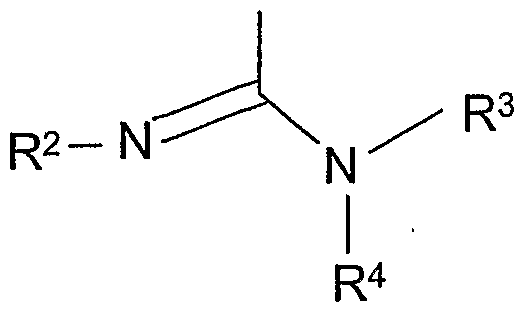
  • R 1 is hydrogen, an organic group attached through a carbon atom, an amine group which is optionally substituted, or a hydroxy group which is optionally etherified with a hydrocarbyl group having up to 8 carbon atoms;
  • R 4 is hydrogen, an organic group attached through a carbon atom or a hydroxy group which can be optionally etherified with a hydrocarbyl group having up to 8 carbon atoms;
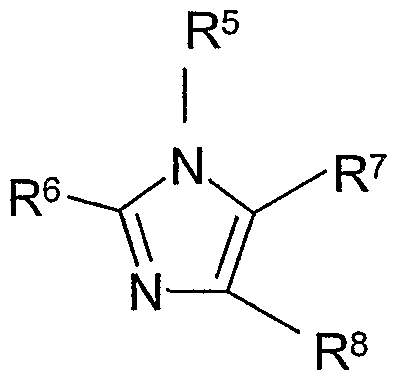
  • R 5 , R 6 , R 7 ,and R 8 are independently hydrogen, alkyl, substituted alkyl, hydroxyalkyl, aryl, aralkyl, cycloalkyl, heterocyclics, ether, thioether, halogen, -N(R) 2 , polyethylene polyamines, nitro groups, keto groups, ester groups, or carbonamide groups optionally alkyl substituted with alkyl, substituted alkyl, hydroxyalkyl, aryl, aralkyl, cycloalkyl, heterocycles, ether, thioether, halogen, -N(R) 2 , polyethylene polyamines, nitro groups, keto groups or ester groups;
  • R 9 , R 10 and R 11 are independently hydrogen, alkyl, alkenyl or alkoxy of
  • 1 to 36 carbons cycloalkyl of 6 to 32 carbons, alkylamino of 1 to 36 carbon atoms, cycloalkyl of 5 to 12 carbon atoms, phenyl, hydroxyalkyl, hydroxycycloalkyl of 1 to 20 carbon atoms, methoxyalkyl of 1 to 20 carbon atoms, aralkyl of 7 to 9 carbon atoms, the aralkyl wherein the aryl group is further substituted by alkyl of 1 to 36 carbon atoms, ether, thioether, halogen, -N(R) 2 , polyethylene polyamines, nitro groups, keto groups, ester groups, or carbonamide groups optionally alkyl substituted with alkyl, substituted alkyl, hydroxyalkyl, aryl, aralkyl, cycloalkyl, heterocyclics, ether, thioether, halogen, -N(R) 2 , polyethylene polyamines, nitro groups, keto groups
  • the present invention is also directed to a method of catalyzing the process for de-blocking blocked isocyanates to form crosslinked coatings. More particularly, the present invention relates to the use of certain novel complexes and compositions of zinc (II) with substituted amidines that are effective in catalyzing a solventless, a solvent borne and a waterbome process to form such cross linked coatings.
  • the present invention also relates to powder coatings, and liquid coatings such as coil coating, can coating, wire coating, plastic coatings. More specifically the present invention relates to a polyurethane powder coating composition containing A) a binder component which is solid below 40° C and liquid above 130° C and has an OH number of about 25 to about 200 and a number average molecular weight of about 400 to about 10,000, B) a polyaddition compound which is solid below 40° C and liquid above 125° C, contains uretdione groups and optionally free isocyanate groups and is prepared from aliphatic and/or cycloaliphatic diisocyanates, and aromatic isocyanates and C) one or more catalysts containing, an organo metallic complex of zinc(ll), and substituted amidines provided that components A) and B) are present in amounts such that component B) has about 0.6 to about 1.4 isocyanate groups for each hydroxy! group present in component A) and the amount of component C) is about 0.05 to about 10 wt
  • the present invention is also directed to a catalyst for the epoxy reaction with carboxyl and or anhydride functional compounds for use in coating, sealant, adhesive and casting applications. More particularly, the present invention is directed to the use of novel complexes and compositions of zinc(ll) with substituted amidines.
  • Zn catalyst in the epoxy-carboxyl anhydride reaction improves the stability of the reactants at room temperature and avoids yellowing or blistering in the coating produced. Furthermore, the improved stability of the reactants in the presence of the catalyst enables a single packaged product for the epoxy-carboxy/ahydride mixture.
  • the objective of this invention is to develop catalysts with high catalytic efficiency for the isocyanate-hydroxy reaction to form urethane and/or polyurethane.
  • a second objective of the present invention is to develop catalysts which provide improved cure at a lower temperature and is less sensitive to the presence of water.
  • Another objective of the present invention is to provide catalysts for the isocyanate-hydroxy reaction which would not catalyze the undesired side reaction of water with isocyanates or the undesired degradation of the polyurethane.
  • An object of the present invention is to provide novel PUR powder coating compositions which do not release reaction products, have increased reactivity and yield completely crosslinked coatings at distinctly lower stoving temperatures or at correspondingly shorter stoving times than previously known prior art powder coating compositions containing uretdione curing agents, without yellowing of the formulation.
  • the powder coatings according to the invention are based on the surprising observation that compounds containing certain novel complexes of zinc (II) with substituted amidines, such as heterocycles containing N,N-disubstituted, N,N'-disubstituted, or N,N,N'-trisubstituted amidine structural moieties, such as 1 ,5- diazabicyclo (4.3.0)non-5-ene (DBN), so strongly accelerate the dissociation of uretdione groups that PUR powder coating compositions may be formulated with them using known uretdione curing agents such that the powder coating compositions crosslink to yield high quality coatings at relatively low stoving temperatures and within a short time, with no yellowing.
  • substituted amidines such as heterocycles containing N,N-disubstituted, N,N'-disubstituted, or N,N,N'-trisubstituted amidine structural moieties, such as 1 ,
  • the zinc catalysts are zinc complexes containing amidine and carboxylate ligands [Zn(Amidine) 2 (Carboxylate) 2 ].
  • zinc complexes containing diketone or alkylacetoacetate ligands in place of carboxylates are also effective catalysts.
  • catalysts where zinc is substituted with lithium, sodium, magnesium, barium, potassium, calcium, bismuth, cadmium, aluminum, zirconium, tin, or hafnium, titanium, lanthanum, vanadium, niobium, tantalum, tellurium, molybdenum, tungsten, cesium are also envisioned.
  • the hardeners used in polyurethane and epoxy coatings include uretdione, free isocyanate, blocked isocyanate, or epoxy groups.
  • the catalysts are suitable for powder, solventborne, solventless and waterbome coatings.
  • the component or compound containing an amidine group can for example have the formula
  • R 1 or R 4 is an organic group it can for example contain 1 to 40 carbon atoms or can be a polymeric group, for example having a molecular weight of 500 to 50,000.
  • the groups R 1 , R 2 , R 3 , R 4 could contain as substituents a total of at least two or more alcoholic hydroxy groups.
  • amidines useful in this invention include N'- cyclohexyl-N.N- dimethylformamidine.N'-methyl-N.N-di-n-butylacetamidine, N'- octadecyll-N,N- dimethylformamidine, N'-cyclohexyl-N,N- dimethylvaleramidine, 1- methyl ⁇ -cyclohexyliminopyrrolidine.S-butyl-S ⁇ . ⁇ .e-tetrahydropyrimidine.N- (hexyliminomethyl)morpholine,N-( ⁇ -(decylimino ethyl)ethyl) pyrrolidine,N'-decyl-N,N- dimethylformamidine, N'-dodecyl-N,N-dimethylformamidine, N'-cyclohexyl-N,N- acetamidine.
  • a class of amidines for use in the current invention is that in which one of the pairs R 2 -R 3 or R 2 -R 4 forms a 5 to 7 membered ring consisting of the two amidine nitrogen atoms and one of the pairs R 1 -R 3 or R 1 -R 4 forms a 5 to 9 membered ring consisting of one amidine nitrogen atom and carbon atoms.
  • the compounds are 1 ,5-diazabicyclo(4.3.0) none-5-ene, 1 ,8- diazabicyclo(5.4.0) undec-7-ene, 1,4-diazabicyclo(3.3.0) oct-4-ene, 2-methyl-1 ,5- diazabicyclo(4.3.0) none-5-ene, 2,7,8-trimethyl-1 ,5-diazabicyclo(4.3.0) none-5-ene, 2-butyl-1 ,5-diazabicyclo(4.3.0) none-5-ene and 1 ,9-diazabicyclo(6.5.0) tridec-8-ene.
  • Acyclic amidines and guanidines can alternatively be used.
  • R 5 , R 6 , R 7 ,and R 8 are independently represent hydrogen, alkyl, or substituted alkyl, hydroxyalkyl, aryl, aralkyl, cycloalkyl, heterocyclics, ether, thioether, halogen, -N(R) 2 , polyethylene polyamines, nitro groups, keto groups, ester groups, or carbonamide groups, alkyl substituted with the various functional groups described above.
  • Imidazole structures useful in this invention include,N-(2-aminoethyl)-2-aminoethyl-N-(2-aminoethyl)-2-aminoethyl-N-(2-aminoethyl)-2-aminoethyl-N-(2-aminoethyl)-2-aminoe
  • R 9 , R 10 and R 11 are identical or different, and represent hydrogen, alkyl, or substituted alkyl, hydroxyalkyl, aryl, aralkyl, cycloalkyl, heterocyclics, ether, thioether, halogen, -N (R) 2 , polyethylene polyamines, nitro groups, keto groups, ester groups, or carbonamide groups.
  • Salts of the above structures include carboxylic (aliphatic.aromatic
  • R 9 , R 10 , R 11 are independently hydrogen, alkyl, alkenyl or alkoxy of 1 to
  • R is alkylene of 1 to 12 carbons or arylene of 6 to 10 carbons, or a plurality of radicals being able to be joined, containing hetero atoms also by hetero atoms such as O, N or S, if desired.
  • imidazoline structures useful in this invention include, 1 H- lmidazole-1-ethanol, 2-(8Z)-8-heptadecenyl-4,5-dihydro, 1 H-lmidazole-1-ethanol, 2- (8Z)-8-heptadecenyl-4,5-dihydro,monoacetate salt, 1 H-lmidazole-1-ethanol, -4,5- dihydro,-2-(9Z)-9-octadecenyl, 1 H-lmidazole, 4,5-dihydro,-2-(9Z)-9-octadecenyl,oleyl hydroxyethyl imidazoline, I H-lmidazole-1-ethanol, 4,5-dihydro-2-undecyl-,1 H- lmidazole-1-ethanol, 2(-8-heptadecenyl)-4,5-dihydro,1-(2-hydroxyethyl)-2-tall oil alkyl-2-
  • organometallic composition refers both to preformed organometallic complexes and to mixtures comprising metal carboxylates and amidines.
  • the complexes are prepared by heating 1 mole of metal carboxylate with 2 moles of amidine in methanol. The mixture is held at about 50° C for about 2 hours or until it becomes a clear solution. The clear solution is filtered and dried. In some embodiments the dried catalyst is then blended with a fumed silica.
  • a suitable fumed silica is Sipemat 5OS from Degussa Corporation.
  • Component A a binder component which is solid below 40° C and liquid above 130° C and has an OH number of 25 to 200 and a number average molecular weight of 400 to 10,000;
  • Component B a hardener which is solid below 40° C and liquid above
  • 125° C contains uretdione groups and optionally free isocyanate groups and is prepared from aliphatic and/or cycloaliphatic diisocyanates;
  • Component C) one or more zinc catalysts of the present invention provided that components A and B are present in amounts such that component B has about 0.6 to about 1.4 isocyanate groups for each hydroxyl group present in component A and the amount of component C is about 0.05 to about 10 wt. %, based on the total weight of the coating composition.
  • the present invention also relates to the use of this powder coating composition for coating heat resistant substrates.
  • Component A is selected from the compounds containing hydroxyl groups known from powder coating technology.
  • these binders include polyesters, polyacrylates or polyurethanes containing hydroxyl groups. Mixtures of such resins are also suitable.
  • Component B is a hardener containing uretdione groups and optionally free isocyanate groups.
  • isocyanates are suitable for preparing uretdione-functional polyisocyanates.
  • IPDI isophorone diisocyanate
  • HDI hexamethylene diisocyanate
  • MPDI 2-methylpentane diisocyanate
  • TMDI 2,2,4-trimethylhexamethylene diisocyanate/2,4,4- trimethylhexamethylene diisocyanate
  • TMDI norbomane diisocyanate
  • MDI methylenediphenyl diisocyanate
  • TMXDI tetramethylxylylene diisocyanate
  • TMXDI 4,4'-diisocyanatodicyclohexylmethane, 1 ,3-diisocyanato-2(4)- methylcyclohexane and mixtures of these diisocyanates.
  • HDI he
  • the powder coatings according to the invention contain catalysts C [Zn(Amidine)2(Carboxylate)2].
  • Suitable amidine ligands in catalyst C include any substituted amidine bases bearing alkyl, aralkyl or aryl residues, in which CN double bond of the amidine structure may be arranged both as part of an open-chain molecule (such as 1 ,1 ,3,3-tetramethylguanidine, N.N-dimethyl- N'-phenylformamidine or N,N,N'-trimethylformamidine) and as a constituent of a cyclic (such as 1-methylimidazole, 1,2-dimethylimidazole, 4,4-dimethyl-2-imidazoline, or 2-methyltetrahydropyrimidines) or bicyclic system (such as 1 ,5- diazabicyclo[4.3.0]non-5-ene (DBN), or 1 ,8-diazabicyclo[5.4.0
  • component C contains N,N-disubstituted, N 1 N'- disubstituted, or N,N,N'-trisubstituted amidine structures.
  • DBN 1,5-diazabicyclo[4.3.0]non-5-ene
  • DBU 1,8-diazabicyclo[5.4.0]undec-7-ene
  • 1-methylimidazole N,N,N'-trisubstituted
  • 1 ,2-dimethylimidazole N.N.N'-trisubstituted
  • 1 ,1 ,3,3-tetramethylguanidine N,N-disubstituted
  • 4,4- dimethyl-2-imidazoline (N,N'-disubstituted) in catalysts C can be used.
  • Carboxylate ligands in catalysts C may be aliphatic or aromatic with an equivalent weight in the range of about 45 to about 465. Also the carboxylate ligand could be polymeric such as an acrylic copolymer or an acid functional polyester. Catalysts C containing acetate or formate ligands are may be used for the powder coating compositions according to the invention.
  • Diketone or the alkylacetoacetate ligands having the following structures:
  • each of R 12 and R 13 is a branched or linear Ci - C 20 hydrocarbon.
  • the powder coating compositions according to the invention may optionally also contain additives D which are known from powder coating technology.
  • additives D include leveling agents, such as polyvinyl, polybutyl acrylate, or those based on polysilicones; light stabilizers such as sterically hindered amines; UV absorbers such as benzotriazoles or benzophenones; pigments such as titanium dioxide; and also color stabilizers to counter yellowing due to overbake, e.g., trialkyl and/or triaryl phosphites optionally containing inert substituents, such as triethyl phosphite, triphenyl phosphite and trisnonylphenyl phosphite.
  • the finished powder coating composition is produced by intimately mixing components A, B, C, and optionally D in an edge runner mill and the mixture was then homogenized in an extruder at temperatures up to a maximum of 130° C. After cooling, the extrudate was fractionated and ground with a pin mill to a particle size of ⁇ 100 ⁇ m.
  • the powder prepared in this way was applied with an electrostatic powder spraying unit at 60 kV to degreased iron panels which are then baked in a circulating air drying cabinet at temperatures between 150° and 200° C for 20 minutes. Good solvent and chemical resistance are obtained at considerably lower baking temperatures or shorter baking times than with comparable uretdione powder coating compositions formulated without the zinc catalysts of the present invention.
  • the cured films are non-yellowing.
  • the epoxy compounds useful in our invention are the polylglycidyl ether of bisphenol A or F or NOVOLAKTM, phenol formaldehyde resins with a molecular weight of between about 350 to 10000, preferably between 380 and 4000. These resins may be used as solids or viscous liquids.
  • the diglycidyl esters of di and polycarboxylic acids are also useful for the present invention.
  • Other glycidyl functional polymers that are useful include the polymers of the glycidyl ester of methacrylic acid, epoxidized oil, cycloaliphatic epoxies and triglycidyl isocyanurate.
  • Cycloaliphatic epoxy compounds useful for the invention include: 3,4- epoxycyclohexylmethyl 3,4-epoxycyclohexanecarboxylate, spiro[1 ,3-dioxane-5,3'- [7]oxabicyclo[4.1.0]heptane], 2-(7-oxabicyclo[4.1.0]hept-3-yl), 3,4-epoxycyclohexyl) methyl 3,4-epoxycyclohexylcarboxylate, 1 ,2-epoxy-4-(epoxyethyl)cyclohexane, 7- Oxabicyclo[4.1.0]heptane-3,4-dicarboxylic acid, bis(oxiranylmethyl) ester, 1 ,3,5- triglycidyl isocyanurate (TGIC), epoxidized soybean oil, epoxidized linseed oil.
  • TGIC triglycidyl isocyanurate
  • Compounds with carboxyl or anhydride functional groups suitable in the present invention are the mono- di- or poly-carboxyllic acids or anhydrides.
  • acids and anhydrides suitable for the present invention are: adipic acid; glutaric acid; glutaric anhydride; sebacic acid; 1 ,10 decanedioic acid; fumaric acid; maleic acid and maleic anhydride; succinic acid; phthalic acid and phthalic anhydride; 8,9,10-trinorborn-5-ene-2,3-dicarboxylic acid and 8,9,10-trinorborn-5-ene- 2,3-dicarboxylic anhydride; cyclohexene-1 ,2-dicarboxylic acid; diphenyl-2,2'- dicarboxylic acid; methylnorbomene-2,3-dicarboxylic anhydride; cyclohexene-1 ,2- dicarboxylic acid; tetrahydrophthalic
  • carboxyl containing acrylic resins obtained by polymerizing a carboxyl functional monomer such as acrylic, methacrylic, maleic, fumaric, itaconic or the half ester of maleic or fumaric with acrylic or styrene or acrylonitrile monomer.
  • carboxyl functional monomer such as acrylic, methacrylic, maleic, fumaric, itaconic or the half ester of maleic or fumaric with acrylic or styrene or acrylonitrile monomer.
  • acrylic polymers with anhydride groups such as the copolymers of acrylic monomers with maleic or itaconic anhydride.
  • Examples for tri carboxylic acids/anhydrides are'1-propene-1 ,2,3- tricarboxylic acid; 1 ,2,4-benzenetricarboxylic acid; an adduct of abietic acid with fumaric acid or maleic anhydride; trimellitic anhydride; and citric acid.
  • Examples for monoacids are the C 12 to C-is fatty acids saturated and unsaturated.
  • crosslinkers include mono, di or poly glycidyl esters, the reaction products of mono, di and polycarboxylic acids with epichlorohydrine; glycidyl ethers of aliphatic ethers of diols, triols and polyols, such as 1 ,2,3-propanetriol glycidyl ether; alkyl (C-m -Ci 6 ) glycidyl ether; lauryl glycidyl ether; glycerin 1 ,3-diglycidyl ether; ethylene diglycidyl ether; polyethylene glycol bis(glycidyl ether); 1 ,4-butanediol diglycidyl ether; 1 ,6- hexanediglycidyl ether; bis(2,3-epoxypropyl) ether; homo and copolymers of allyl glycidyl ether; e
  • phenyl glycidyl ether, p-t-butylphenol glycidyl ether, hydroquinone diglycidyl ether, glycidyl p-glycidyloxybenzoate, p-nonylphenol glycidyl ether, glycidyl ether reaction product of 2-methyl phenol and formaldehyde polymer are also useful in the present invention.
  • the ratio of the epoxy compound to the carboxyl or anhydride in the formulation can be 0.5 to 1 to 5 to 1 depending on the crosslinking density desired. Normally the optimum crosslinking density is achieved when the ratio of functional epoxy groups and carboxyl groups is one to one under ideal conditions. However, with most epoxy formulations some self-condensation of the epoxy groups takes place. For example, it is necessary to use an excess of epoxy groups to react all the carboxyl or anhydride groups so that a film with no free carboxyl groups are present, if excellent detergent or alkali resistance in a film is desired. However, if better adhesion and flexibility is desired, then the ratio can be adjusted so that some of the unreacted carboxyl groups remain.
  • the ratio of epoxy to carboxy functional groups is important for primer applications where corrosion resistance is an important requirement.
  • the level of epoxy resin can be reduced.
  • the ratio of epoxy to carboxyl groups is also dependent on the functional groups in the reactant system. For example, if one reacts a carboxyl functional acrylic resin with a difunctional epoxy resin, it might be desirable to use an access of carboxy groups. If an acrylic resin which has a high molecular weight is used, it usually contains many carboxyl groups, a typical acrylic resin might have an acid number of 56 and a molecular weight of 20,000. In such a resin the average chain contains 20 carboxyl groups. To achieve crosslinking in such a system, theoretically three carboxy groups have to be reacted to form an effective network.
  • the epoxy in such a formulation might be a diglycidyl ether of bisphenol A, a difunctional crosslinker.
  • a person with skill in the coating art would therefore use an excess of carboxyl groups and a deficiency of epoxy groups to achieve a good network.
  • Most crosslinking reactions do not go to completion. If the crosslinkers have reacted to an average to 75%, it indicates that some molecules of the crosslinking agents have completely reacted, with some molecules having reacted only at one end and some molecules having not reacted at all.
  • By having an excess of carboxy groups on the acrylic one could assure a higher conversion of all the epoxy groups. This problem is typical in can coatings, where it is important to eliminate any unreacted epoxy resin to prevent any leaching of epoxy resin into the food.
  • Typical cure temperatures for the formulations of the present invention are between about 100 to about 300° C for a time period from several seconds to hours. In some embodiments cure temperatures are from about 120 to about 250° C for 30 seconds to 30 minutes.
  • the formulation of the present invention is useful for producing coatings, adhesive films, or in casting or molding. Typical applications include use as corrosion resistant primers for automotive applications, or can or coil coatings, or automotive clear coats.
  • the coatings can be applied as a high solids or a powder coating.
  • Cationic water-borne resins or cationic electrocoating resins useful in this invention can be typically prepared by reacting a bisphenol A type epoxy resin with an epoxy equivalent weight of between about 200 to about 2000, preferably between about 400 to about 1000 with an amine.
  • the amine can be ammonia, a secondary, primary or a tertiary amine. If ammonia is used in the preparation of the cationic resin, the reaction of the epoxy resin with ammonia has to be conducted in the presence of large excess of free ammonia to suppress gelation of the resin. In this reaction a combination of primary, secondary and tertiary amine functional resin is formed.
  • cationic resins Another way to prepare cationic resins is by co-polymerization of cationic monomers such as dimethyl-amino-propyl-methacrylate, dimethyl-amino- ethyl-methacrylate, dimethyl-amino-propyl-acrylamide or t-butyl-amino-ethyl-acrylate with an acrylic or methacrylic ester monomer or optionally with styrene or acrylonitrile.
  • cationic monomers such as dimethyl-amino-propyl-methacrylate, dimethyl-amino- ethyl-methacrylate, dimethyl-amino-propyl-acrylamide or t-butyl-amino-ethyl-acrylate with an acrylic or methacrylic ester monomer or optionally with styrene or acrylonitrile.
  • Other methods are the reaction of anhydride functional polymers with amines with primary or secondary and t
  • an alcohol or a polyol can be solubilized or dispersed in water in the presence of nonionic groups or a nonionic surfactant.
  • the alcohol or polyol may be incorporated in the bisphenol epoxy resin itself.
  • a bisphenol epoxy resin can be reacted with a methoxy- polyethylene glycol or a methoxy-polyethylene-ether-amine with a MW of between about 500 to about 2000.
  • Waterborne resin formulations suitable for this invention may also include resins dispersed in water in the presence of a nonionic surfactant.
  • An epoxy or an acrylic or polyester resin may be dispersed in water.
  • the nonionic groups can be a part of the resin structure or a part of an external surfactant.
  • Commercial products, which are suitable, include a dispersion in water of solid bisphenol A glycidyl resins with a molecular weight of between about 900 to about 4000.
  • the blocked isocyanate crosslinker useful in this invention are aromatic or aliphatic isocyanates with a blocking group, which can be removed. Often the de ⁇ blocking to the isocyanate is a displacement reaction, wherein the blocking group is displaced with another group.
  • Typical blocking groups for the isocyanate are selected from the group consisting of malonates, triazoles, ⁇ -caprolactam, phenols, ketoxime, pyrazoles, alcohols, glycols, glycol ethers and uretdiones.
  • Some typical di or polyisocyanates suitable for the invention are: hexamethylene diisocyanate, isocyanurate trimer, biuret, isophorone diisocyanate, tetramethylxylidine diisocyanate and methylene bis(phenyl isocyanate).
  • Typical examples of blocking groups are methyl ethyl ketoxime, ⁇ -caprolactam, 1 ,2,4- triazole, 3,5-dimethylpyrazole, phenol, 1 ,2-ethylene glycol, 1 ,2-propylene glycol, 2- ethylhexanol, 2-butoxyethanol, 2-methoxy (2-ethoxy ethanol).
  • the cationic resins suitable for the invention may also be typically dispersed in water in the presence of a suitable water soluble organic acid such as formic, acetic, glycolic or lactic acid or an inorganic acid such as sulfamic acid.
  • a suitable water soluble organic acid such as formic, acetic, glycolic or lactic acid or an inorganic acid such as sulfamic acid.
  • a coating formulation is normally prepared by blending and dispersing the blocked isocyanate crosslinker, the cationic resin and the catalyst of this invention in water. If pigments are added they can be dispersed separately in the resin. If neutralization of the cationic resin with an organic acid is required, the acid can be added to the resin or to the water phase. Usually high shear dispersers are used to emulsify or disperse the resin.
  • the catalyst of this invention is also advantageous for use in solvent borne coating formulations. Most pigmented formulations have shown a decrease of catalytic activity on aging. This reduction in catalyst activity is attributable to the presence of water on the surface of the pigment. Based on experience, it is known that catalyst deactivation takes place if the coating formulations are cured at high humidity.
  • the present invention is further directed to a cationic electrocoating formulation comprising a water-dispersible cationic polyol, a blocked isocyanate and a catalyst of the present invention.
  • the water-dispersible cationic polyol is at least di-functional, preferably tri functional or higher.
  • the blocked isocyanate is present at a molar ratio sufficient to facilitate crosslinking.
  • the catalyst is used at a concentration of between about 0.01 to about 5 weight percent (wt %), preferably between about 0.1 to about 1.0 wt %, of metal based on the total resin solids in the formulation.
  • the isocyanates useful in this invention are aliphatic, aromatic isocyanates or polyisocyanates or resins with terminal isocyanate groups.
  • the resins may be monomeric or polymeric isocyanates.
  • Typical monomeric isocyanates include: toluene diisocyanate (TDI), diphenylmethane diisocyanate (MDI), 1 ,6- hexamethylene diisocyanate (HDI), phenyl isocyanate, 4,4'-dicyclohexylmethane diisocyanate, isophorone diisocyanate(IPDI), meta-tetramethylxylene diisocyanate (TMXDI), nonanetriisocyanate (TTI) or vinyl isocyanate, or the like.
  • TDI toluene diisocyanate
  • MDI diphenylmethane diisocyanate
  • HDI 1 ,6- hexamethylene diisocyanate
  • the above monomeric isocyanates are those which are more commonly used and are not meant to be exclusive.
  • the polymeric polyisocyanates useful in the invention are isocyanurate, allophanate, or biuret compounds and polyurethane products derived from the monomeric diisocyanates as listed hereinabove. Also useful are addition products of monomeric isocyanates with polyester and polyether polyols containing terminal isocyanate groups.
  • the polyols or resins with hydroxy functional groups useful in this invention comprise monomeric compounds or polymeric compositions containing at least two hydroxy groups per molecule.
  • the molecular weight of the hydroxy containing compounds useful in this invention ranges from about 62 to about 1 ,000,000; the in some embodiments the range for polyols being between about 300 to about 2000 when used in solvent borne high solids coatings.
  • the hydroxyl number of the hydroxy containing resin can be from about 10 to about 1000.
  • the polyol may contain other functional groups such as carboxyl, amino, urea, carbamate, amide and epoxy groups.
  • the polyol, a blend of polyols or a combination of polymeric polyols and monomeric diols may be employed in a solvent free system, or as a solution in an organic solvent, or as a dispersion/emulsion in water.
  • Typical examples include: polyether polyol, polyester polyol, acrylic polyol, alkyd resin, polyurethane polyol, and the like.
  • the polyether polyols are the reaction products of ethylene or propylene oxide or tetrahydrofuran with diols or polyols.
  • Polyethers derived from natural products such as cellulose and synthetic epoxy resins may also be used in this invention.
  • Typical polyester polyols are prepared by the reaction of diols, triols or other polyols with di- or polybasic acids. Alkyds with hydroxy functional groups are prepared in a similar process except that mono functional fatty acids may be included.
  • Acrylic polyols are the polymerization products of an ester of acrylic or methacrylic acid with hydroxy containing monomers such as hydroxyethyl, hydroxypropyl or hydroxybutyl ester of acrylic or methacrylic acid.
  • acrylic polymers can also contain other vinyl monomers such as styrene, acrylonitrile vinyl chloride and others.
  • polyurethane polyols are also useful in this invention. These are the reaction products of polyether or polyester polyols with diisocyanates. [0108] The polyols listed above are illustrative and are not meant to limit the scope of the invention.
  • the polyols are either synthesized in bulk in the absence of a solvent or are prepared in the presence of a diluent or by emulsion polymerization in water. Alternatively, they may be prepared in bulk or in a solvent and then dispersed in water.
  • a description of the methods of preparing polyols see Organic Coatings Science Technology, vol. 1 , Wiley-lnterscience Co., 1992.
  • the concentration of the catalysts used is generally from about 0.001 wt % to about 5 wt % on total resin solids. Typically, the concentration of catalysts used is between about 0.001 to about 1.0 wt % based on the total amount of polyol and polyisocyanate, also known as binders. The catalyst concentration used is generally a compromise between pot-life of the formulation and the required cure rate.
  • the catalyst of the present invention is particularly suitable for applications where exceptionally fast cure is required.
  • the catalysts of the present invention is particularly useful in plural component spray gun applications wherein the catalyst is added to one of the components and the polyol and the isocyanate is mixed in situ in the spray gun. These are important in applications for roof or floor coatings, where the person applying the coating would be able to walk on the freshly applied coating a few minutes after the coating has been applied. Good cure rate is also required for coatings applied at a low temperature or in the presence of moisture, conditions where the catalyst of this invention excels.
  • Reactive injection molding is another area where fast cure is essential.
  • the reactants and catalyst are injected concurrently into a mold, and mixing is achieved during injection.
  • fast reaction is essential to permit a short cycle time.
  • the ratio of NCO/OH in the formulation is in the range of about 0.1 to about 10.0 to 1 , in some embodiments about 0.5 to about 2.0 to 1 depending upon the end use.
  • the isocyanate to hydroxy ratio is usually about 1.0:1 to about 1.1 :1.
  • an excess of isocyanat ⁇ is required.
  • the ratio for such applications is about 1.5:1 to about 2.0:1.
  • the catalyst formulation can be solvent borne, high solids, 100% solids or dispersable in water. Other additives which may be utilized in the formulation to impart desired properties for specific end uses.
  • solvents which are free of hydroxy groups and water are used.
  • Typical solvents are esters, ketones, ethers and aliphatic or aromatic hydrocarbons.
  • the catalytic efficiency of the metal complexes of this invention is determined by measuring the drying time of the coated film or by a gel test.
  • drying time measurement the liquid formulation containing polyisocyanate, polyol and catalyst was cast on a metal panel and the surface dry time and the through dry time were recorded with a circular Gardner Drying Time Recorder.
  • gel test liquid polyisocyanate, liquid polyol solution and catalyst were mixed thoroughly at room temperature. The time needed from mixing the liquid components to forming a gel (the time interval when the liquid formulation becomes non-flowable) was recorded as gel time.
  • the catalysts of this invention exhibit excellent catalytic efficiency, measured as drying time of the coated film and/or gel time, for the isocyanate- hydroxy reaction compared to zirconium diketonates reported in prior art and commercially available organotin catalysts, especially at low temperatures.
  • the catalysts of this invention also preferentially catalyze the isocyanate-hydroxy reaction over the isocyanate-water reaction.
  • Organo tin does not exhibit this preferential catalysis, and also catalyze the isocyanate-water reaction, which leads to the formation of carbon dioxide and gassing.
  • a coating formulation containing HDI based aliphatic isocyanate and a polyurethane diol with beta- carbamate was formulated.
  • the metal complex of the present invention was used as the catalysts, a hard glossy film was obtained.
  • dibutyltin dilaurate as the catalyst, a hazy film was obtained.
  • organotin urethane catalysts will affect the durability of the final product. This is due to the catalytic effect of organotin catalysts on the degradation of the polymer product.
  • the metal complexes of the present invention show less of a catalytic effect on the degradation of the polymer than the tin urethane catalysts.
  • VESTAGON BF 1540 (Component B) Polyisocyanate Uretdione Coating, Hardener, % NCO: 15.2%, Degussa Corporation
  • VESTAGON B 1400 Caprolactam Blocked Polyisocyanate Hardener, Degussa Corporation, % NCO:12.5%
  • VESTAGON BF 1540 component B
  • [Zn(1-Methylimidazole) 2 Acetate 2
  • Sipernat 5OS component C
  • Disparlon PL-540 leveling agent were intimately mixed in an edge runner mill and the mixture was then homogenized in an extruder at temperatures up to a maximum of 130° C. After cooling, the extrudate was fractionated and ground with a pin mill to a particle size of ⁇ 100 ⁇ m.
  • the powder prepared in this way was applied with an electrostatic powder spraying unit at 60 kV to degreased iron panels to establish film thicknesses of approximately 60 ⁇ m, which were then baked in a circulating air drying cabinet at temperatures between 150° and 200° C.
  • Powder coating compositions for Examples 1-4 (amounts in % by weight): TABLE 3
  • Examples 1-4 demonstrate that even at distinctly lower baking temperatures, completely crosslinked, high gloss, and non-yellowing clear non- pigmented coatings were obtained with the powder coating composition according to the invention.
  • VESTAGON BF 1540 component B
  • [Zn(1-Methylimidazole) 2 (Acetate) 2 ] /Sipernat 5OS component C
  • Ti-Pure-TiO2 R-900 Ti-Pure-TiO2 R-900
  • Disparlon PL-540 leveling agent were intimately mixed in an edge runner mill and the mixture was then homogenized in an extruder at temperatures up to a maximum of 130° C. After cooling, the extrudate was fractionated and ground with a pin mill to a particle size of ⁇ 100 ⁇ m.
  • the powder prepared in this way was applied with an electrostatic powder spraying unit at 60 kV to degreased iron panels to establish film thicknesses of approximately 60 ⁇ m, which were then baked in a circulating air drying cabinet at temperatures between 150° and 200° C.
  • Powder coating compositions for Examples 5-8 (amounts in % by weight): TABLE 8
  • Examples 5-8 demonstrate that even at distinctly lower baking temperatures, completely crossiinked, high gloss, and non-yellowing white pigmented coatings were obtained with the powder coating composition according to the invention.
  • VESTAGON BF 1540 component B
  • Zinc Acetate/1 -Methylimidazole Mixture component C
  • Disparlon PL-540 leveling agent were intimately mixed in an edge runner mill and the mixture was then homogenized in an extruder at temperatures up to a maximum of 130° C. After cooling, the extrudate was fractionated and ground with a pin mill to a particle size of ⁇ 100 ⁇ m.
  • the powder prepared in this way was applied with an electrostatic powder spraying unit at 60 kV to degreased iron panels to establish film thicknesses of approximately 60 ⁇ m, which were then baked in a circulating air drying cabinet at temperatures between 150° and 200° C.
  • Powder coating compositions for Example 9 (amounts in % by weight): TABLE 12 O O C
  • Examples 1 and 9 demonstrate that even at distinctly lower baking temperatures, completely crosslinked, high gloss, and non-yellowing clear non- pigmented coatings were obtained with the powder coating composition using zinc acetate/1 -methylimidazole mixture as a catalyst according to the invention. [0138] Examples 10-12
  • VESTAGON B 1400 component B
  • [Zn(1-Methylimidazole) 2 Acetate 2
  • Sipemat 5OS or BUTAFLOW BT-71 70% DBTDL on powder carrier
  • Disparlon PL-540 leveling agent were intimately mixed in an edge runner mill and the mixture was then homogenized in an extruder at temperatures up to a maximum of 130° C. After cooling, the extrudate was fractionated and ground with a pin mill to a particle size of ⁇ 100 ⁇ m.
  • the powder prepared in this way was applied with an electrostatic powder spraying unit at 60 kV to degreased iron panels to establish film thicknesses of approximately 60 ⁇ m, which were then baked in a circulating air drying cabinet at 170° C.
  • Powder coating compositions for Examples 10-12 (amounts in % by weight): TABLE 15
  • Examples 10-12 demonstrate that Zn(1-Methylimidazole) 2 (Acetate) 2 is an effective catalyst for caprolactam blocked polyisocyanate powder coatings. Even at distinctly lower baking temperatures, completely crosslinked, and high gloss clear non-pigmented coatings were obtained with the powder coating composition according to the invention. [0142] Example 13
  • Alcure 4470 component B; triazole blocked polyisocyanate
  • [Zn(1- Methylimidazole) 2 (Acetate)2] /Sipernat 5OS, and Disparlon PL-540 leveling agent were intimately mixed in an edge runner mill and the mixture was then homogenized in an extruder at temperatures up to a maximum of 130° C. After cooling, the extrudate was fractionated and ground with a pin mill to a particle size of ⁇ 100 ⁇ m. The powder prepared in this way was applied with an electrostatic powder spraying unit at 60 kV to degreased iron panels to establish film thicknesses of approximately 60 ⁇ m, which were then baked in a circulating air drying cabinet at 160° C.
  • Powder coating compositions for Example 13 (amounts in % by weight): TABLE 17
  • Example 13 demonstrates that Zn(1-Methylimidazole) 2 (Acetate) 2 is an effective catalyst for triazole blocked polyisocyanate powder coatings. Even at distinctly lower baking temperatures, completely crosslinked clear non-pigmented coatings were obtained with the powder coating composition according to the invention.
  • Trixene BI 7984 MEKO blocked HDI polyisocyanate were homogeneously mixed.
  • the resin mixtures were catalyzed with metal catalysts listed in TABLE 19 at a concentration of 0.11 % of metal based on the total resin used.
  • Films were cast on pretreated steel panels at a dry film thickness of approximately 25 ⁇ m and baked for 20 minutes at temperatures between 130° and 150° C.
  • Liquid coating compositions for Examples 14-15 (amounts in % by weight): TABLE 19
  • Ethylhexanoate 2 is an effective catalyst for MEKO blocked HDI polyisocyanate liquid coatings. Even at distinctly lower baking temperatures, completely crosslinked coatings were obtained with the liquid coating composition according to the invention.
  • Trixene BI 7982 3,5-dimethylpyrazole blocked HDI polyisocyanate were homogeneously mixed.
  • the resin mixtures were catalyzed with metal catalysts listed in TABLE 21 at a concentration of 0.20% of metal based on the total resin used.
  • Films were cast on pretreated steel panels at a dry film thickness of approximately 25 ⁇ m and baked for 20 minutes at 130° C.
  • Liquid coating compositions for Examples 16-17 (amounts in % by weight): TABLE 21
  • Trixene BI 7982 (HDI Trimer Blocked with 3,5-dimethylpyrazole, 43 .65 43 .65
  • Tetramethylguanidine) 2 (2-Ethylhexanoate) 2 is an effective catalyst for 3,5- dimethylpyrazole blocked HDI polyisocyanate liquid coatings. Even at distinctly lower baking temperatures, completely crosslinked coatings were obtained with the liquid coating composition according to the invention.
  • the NCO equivalent of the Hardener is 240.8.
  • Liquid coating compositions for Examples 18-19 (amounts in % by weight): TABLE 23 Examples 18 19
  • Examples 18-19 demonstrate that Zn(1 -Methylimidazole) 2 (Acetate) 2 is an effective catalyst for alcohol blocked MDI polyisocyanate liquid coatings. Completely crosslinked coatings were obtained with the liquid coating composition according to the invention.
  • Bayhydrur VP LS 2319 polyisocyanate were homogeneously mixed.
  • the resin mixtures were catalyzed with Zn(1-Methylimidazole) 2 (Acetate) 2 listed in TABLE 25.
  • Films were cast on pretreated steel panels at a dry film thickness of approximately 60 ⁇ m and baked for 20 minutes at 60° C and stored at room temperature for 2 hours.
  • Liquid coating compositions for Example 20 (amounts in % by weight): TABLE 25
  • Example 20 demonstrates that Zn(1 -Methylimidazole) 2 (Acetate) 2 is an effective catalyst for aqueous two-component polyurethane coatings. Even at distinctly lower baking temperatures, completely crosslinked coatings were obtained with the liquid coating composition according to the invention.
  • Liquid coating compositions for Examples 21-22 (amounts in % by weight): TABLE 27
  • Ethylhexanoate 2 is an effective catalyst for two-component elastomers according to the invention.
  • Araldite PT-810 TGIC component B
  • [Zn(1-Methylimidazole) 2 (Acetate) 2 ] /Sipernat 5OS component C
  • Ti-Pure-TiO2 R-900 Disparlon PL-540 leveling agent
  • Benzoin leveling agent component C
  • Ti-Pure-TiO2 R-900 Ti-Pure-TiO2 R-900
  • Disparlon PL-540 leveling agent Benzoin leveling agent
  • Powder coating compositions for Examples 23-24 (amounts in % by weight): TABLE 29
  • Examples 23-24 demonstrate that Zn(1 -Methylimidazole) 2 (Acetate) 2 is an effective catalyst for epoxy/acid powder coatings. Even at distinctly lower baking temperatures, completely crosslinked white pigmented coatings were obtained with the powder coating composition according to the invention.
  • Disparlon PL-540 leveling agent (component A), AMICURE CG-1200 DICY (component B), [Zn(1- Methylimidazole) 2 (Acetate) 2 ] /Sipernat 5OS (component C), and Disparlon PL-540 leveling agent were intimately mixed in an edge runner mill and the mixture was then homogenized in an extruder at temperatures up to a maximum of 110° C. After cooling, the extrudate was fractionated and ground with a pin mill to a particle size of ⁇ 100 ⁇ m. The powder prepared in this way was applied with an electrostatic powder spraying unit at 60 kV to degreased iron panels to establish film thicknesses of approximately 60 ⁇ m, which were then baked in a circulating air drying cabinet at 16O 0 C.
  • Powder coating compositions for Example 25 (amounts in % by weight): TABLE 31
  • Example 25 demonstrates that Zn(1 -Methylimidazole) 2 (Acetate) 2 is an effective catalyst for epoxy/dicy powder coatings. Even at distinctly lower baking temperatures, completely crosslinked clear non-pigmented coatings were obtained with the powder coating composition according to the invention.

Landscapes

  • Chemical & Material Sciences (AREA)
  • Organic Chemistry (AREA)
  • Chemical Kinetics & Catalysis (AREA)
  • Polymers & Plastics (AREA)
  • Health & Medical Sciences (AREA)
  • Medicinal Chemistry (AREA)
  • Materials Engineering (AREA)
  • Engineering & Computer Science (AREA)
  • Wood Science & Technology (AREA)
  • Life Sciences & Earth Sciences (AREA)
  • Inorganic Chemistry (AREA)
  • Paints Or Removers (AREA)
  • Polyurethanes Or Polyureas (AREA)

Abstract

The present invention is directed to novel organometallic complexes as catalysts for the reaction of compounds with isocyanate and hydroxyl functional groups to form urethane and/or polyurethane and the process employing such catalysts. More particularly, the present invention is directed to novel complexes of zinc(II) with substituted amidines. These novel catalysts are useful for the production of urethanes and polyurethanes which are important in many industrial applications.

Description

ORGANOWIETALLIC COMPOSITIONS AND COATING COMPOSITIONS
FIELD OF THE INVENTION
[0001] The present invention is directed to novel organometallic complexes as catalysts for the reaction of compounds with isocyanate and hydroxy functional groups to form urethane and/or polyurethane and the process employing such catalysts. More particularly, the present invention is directed to novel complexes zinc(ll) with substituted amidines. These novel catalysts are useful for the production of urethanes and polyuretharies which are important in many industrial applications, such as: coatings, foams, adhesives, sealants, and reaction injection molding (RIM) plastics.
[0002] The present invention is also directed to a method of catalyzing the process for de-blocking blocked isocyanates, like ketoxime, pyrazole or phenol blocked products to form crosslinked coatings. More particularly, the present invention relates to the use of certain novel complexes zinc(ll) with substituted amidines that are effective in catalyzing both a solvent borne and a waterbome process to form such crosslinked coatings.
[0003] The present invention also relates to polyurethane powder coating compositions which are curable at low stoving temperatures and to their use for coating heat-resistant substrates.
[0004] The present invention is also directed to a catalyst for the epoxy reaction with carboxyl and or anhydride functional compounds for use in coating, sealant, adhesive and casting applications.
BACKGROUND OF THE INVENTION
[0005] The reaction of isocyanate and hydroxy compounds to form urethanes is the basis for the production of polyurethanes. Metal compounds (e.g., tin, zinc and bismuth compounds) and tertiary amines have been known to catalyze the reaction of isocyanate and hydroxyl groups to form urethane. See, Proceedings of Water Borne and High Solids Coatings Symposium, Feb. 25-27, 1987, New Orleans, at Page 460. Compounds useful for the isocyanate-hydroxy reaction are also referred to as urethane catalysts. At present, the commercially available catalysts used in this reaction are organotin compounds (e.g., dibutyltin dilaurate and dibutyltin diacetate), zinc carboxylates, bismuth carboxylates, organomercury compounds and tertiary amines.
[0006] There are several problems with these commercially available catalysts. When they are used in the process for polyurethane coatings, the cure of the coatings under high humidity or at low temperature conditions is not satisfactory. They catalyze the undesirable side reaction of isocyanate with water to form amines and carbon dioxide. The carbon dioxide may cause blisters in the coating and the amines react with isocyanates resulting in low gloss coatings. Moreover, the cure rate at low temperatures is too slow. The commercially available catalysts also catalyze the degradation of the resulting polymer product. Furthermore, several of the commercially available urethane catalysts, particularly those containing heavy metals and tertiary amines, are highly toxic and are environmentally objectionable.
[0007] The testing of zirconium acetylacetonate and zirconium tetra-3- cyanopentanedionate, as catalysts for the isocyanate-hydroxy reaction have been described in GB Patents 908949, 890280 and 869988. Subsequent testing by others, however, has shown that zirconium acetylacetonate is a poor catalyst for the urethane reaction. B. D. Nahlovsky and G. A. Zimmerman, Int. Jahrestag. Fraunhofer-lnst. Treib-Explosivst, 18th (Technol. Energ. Mater.), 39:1-12, reported that the catalytic efficiency of zirconium acetylacetonate for the isocyanate-hydroxyl reaction to form urethane is low. The solubility of zirconium acetylacetonate and zirconium tetra-3-cyanopentanedionate in solvents commonly used in the production of coatings is poor. Examples of such solvents include esters ketones, glycolesters and aromatic hydrocarbons, such as: butyl acetate, methyl iso-amyl ketone, 2- methoxy propylacetate, xylene and toluene. Because of the low catalytic efficiency and the poor solvent solubility, the use of these compounds as catalysts in processes involving urethane or polyurethanes have been limited.
[0008] Further testing using zirconium acetylacetonate in our laboratory has shown that zirconium compounds disclosed in the prior art, will only catalyze the isocyanate-hydroxy reaction when carried out in a closed system, i.e., in a closed pot. This is impractical for many of the polyurethane applications. The zirconium diketonates of the prior art failed as catalysts when the reaction is carried out in the open atmosphere, unless there is present a large excess of the corresponding diketone. For zirconium acetylacetonate, the presence of over 1000 to 1 mole ratio of 2,4-pentanedione to zirconium acetylacetonate is required. However, 2,4- pentanedione and other similar diketones are volatile solvents which, when used in an open vessel, pollute the air, and pose both an environmental and a fire hazard. In addition, the presence of the free diketone causes discoloration of the catalyst, resulting in an undesirable, discolored product.
[0009] Blocked isocyanates have been used in many coating applications, such as powder coatings, electrocoatings, coil coatings, wire coatings, automotive clear top coatings, stone chip resistant primers, and textile finishes. Traditionally, these coating processes employ organic solvents, which may be toxic and/or obnoxious and cause air pollution. In recent years, the legal requirements for low or no pollution of the environment have led to an increase in the interest in waterborne and high solids coatings.
[0010] In processes wherein blocked isocyanates are used, heating to an elevated temperature is necessary to remove the blocking group from the blocked isocyanate to form free isocyanates. The free isocyanates then react with polyols (polymers containing hydroxy functional groups) to form a crosslinked network as a thin film coating. An obstacle to the use of this process is the high temperature required to remove the blocking group. The process is extremely slow without a catalyst. It is known that metal compounds such dialkyltin and certain bismuth and zinc salts are excellent catalysts in these solvent borne coating processes. "Crosslinking with Polyurethanes." W. J. Blank, ACS Proceedings of Polymeric Materials Science and Engineering (1990) 63:931-935.
[0011] Bismuth organo-compounds have been used in a variety of processes wherein polyisocyanates or blocked isocyanates is an ingredient. For example, EP 95-109602 describes an epoxide amine adduct with a bismuth compound as being useful in a conventional cationic coating process. U.S. Pat. No. 5,702,581 describes the use of organic bismuth complexes in phosphate dip coating compositions to provide corrosion resistance. The bismuth organic complexes include bismuth carboxylates, such as bismuth lactate. WO 95/29007 disclosed the use of bismuth compounds/mercapto complexes for curing polyisocyanate organic solvent compositions. The bismuth compounds disclosed include bismuth carboxylates, nitrates and halides. WO 96/20967 also described bismuth/zinc mixture with a mercapto complex as a catalyst for producing polyurethane. See also Frisch et al., "Novel Delayed-Action Catalyst/Co-catalyst system for C.A.S.E. Applications", 60 Years Polyurethanes, Kresta et al. ed., Technomic: Lancaster, Pa. 1998, pp. 287- 303. Further, WO 95/08579 described bismuth/mercapto complexes as latent catalysts in a polyol-polyisocyanate adhesive system. The catalyst is described as useful in promoting the rapid cure of the system. The bismuth carboxylates described in these references are those wherein the carboxylate has ten carbons or less in the hydrocarbon structure. These conventional bismuth carboxylates do not provide improved resin performance nor are they effective in water-borne formulations.
[0012] WO 95/07377 described the use of bismuth lactate in cationic lacquer compositions, which employ urethane reactions. A mixture of bismuth and an amino acid or amino acid precursor was disclosed for catalyzing a cationic electrodeposition of a resin film on a metal substrate. The bismuth may be present in the form of nitrates, oxides, trioxides, or hydroxide. DE 19,532,294A1 also disclosed bismuth carboxylates as catalysts for single component polyurethane lacquer coatings in a solvent borne formulation.
[0013] Unfortunately, when the known bismuth catalysts are employed in waterborne coatings formulations, it was found that they were not effective. It is suspected that the loss of activity is related to the hydrolysis of the bismuth salt in water. Moreover, even if these compounds function as catalysts in waterborne processes, it has been our experience that a very high level is necessary, usually 10 to 100 times higher than in solvent borne processes. This is undesirable because it would cause environmental pollution if a large amount is released into the environment.
[0014] Bismuth carboxylates have been used as catalysts in processes that do not involve de-blocking of blocked isocyanates. Bismuth dimethylol propionate has been disclosed in DE 93-43,300,002 as being useful in an electrocoating process for coating phosphate dipped metals to provide anti-corrosion and weather resistance. Bismuth carboxylates are also described in DE 96-19,618,825 for use in an adhesive gel formulation that is safe for contact with human skin. The formulation contains polyether polyols with hydroxy groups, antioxidants, Bismuth(lll) C 2 -C is carboxylates soluble in the polyether polyols and OCN(CH2)6NCO. JP 95-351 ,412 describes the use of bismuth neodecanoate as a catalyst for two part adhesive formulations containing polyisocyanates, polyols with an ethylenediamine. These formulations do not involve the de-blocking of blocked isocyanates.
[0015] For waterbome processes, the catalysts known to be useful are organo-tin and lead compounds. See WO 95/04093, which describes the use of organo-tin alone or in a mixture with other compounds including bismuth oxide in a low temperature curing process employing blocked isocyanates. There is no disclosure of bismuth carboxylates alone as a catalyst for de-blocking isocyanates. Organo-tin compounds have also been used in coatings, e.g. in paints for anti-fouling applications. Organo-tin compounds in mixtures with bismuth hydroxy carboxylic acid salt was described in DE19,613,685. The use of bismuth lower carboxylates was described as being useful in a phosphate dip process to provide corrosion resistance to lacquer coatings. The bismuth carboxylates described therein as being useful are lower carboxylate of bismuth wherein the carboxylic acid has up to ten carbons. The substrate is then coated with an epoxy resin in the presence of a blocked isocyanate as the crosslinking agent using a zinc organo compound and/or lead compound as the catalyst. EP0,509,437 disclosed a mixture of a dibutyltin aromatic carboxylate with a bismuth and a zirconium compound as the dissociation catalyst for electrocoating wherein a blocked isocyanate is used. Polystannoxane catalysts are also described in EPO.810,245 A1 as an low temperature catalyst for curing compositions comprising a blocked isocyanate. Bismuth compounds, including carboxylates were described as being useful as a co-catalyst. However, the process is one in which the reaction temperature was in the range of 100° C, quite a bit below the normal temperature of 120° C to 150° C for de-blocking blocked polyisocyanates. JP 94-194950 described a formulation for coating materials which are rapidly curable in contact with an amine catalyst vapor or mist. The coating formulation included polyols, polyisocyanates, antimony or bismuth catalysts with mercaptans in an organic solvent. The toxicity of both lead and tin compounds presents serious environmental hazards. The use of solvents in solvent borne processes further result in the undesirable release of toxic and obnoxious chemicals into the environment. For these reasons, the use of organo tin and lead compounds and solvents has been banned in many applications and is highly restricted in electrocoating.
[0016] It is, therefore, important to develop other catalysts or catalysts systems for waterborne processes.
[0017] As environmental legislation has become ever stricter, the development of powder coatings, together with high solids lacquers and aqueous coating systems has become increasingly significant in recent years. Powder coatings release no harmful solvents during application, may be applied highly efficiently with little waste and, thus, are considered particularly environmentally friendly and economic.
[0018] Particularly high quality light and weather resistant coatings may be obtained using heat curable, polyurethane (PUR) powder coatings. The PUR powder coatings currently commercially available generally contain solid polyester polyols, which are cured with solid blocked aliphatic or, usually, cycloaliphatic polyisocyanates. However, these systems exhibit the disadvantage that the compounds used as blocking agents are released during thermal crosslinking. As a consequence, particular precautions must be taken during application both for equipment-related reasons and for environmental and occupational hygiene reasons to purify the exhaust air and/or to recover the blocking agent.
[0019] One approach to avoiding the emission of blocking agents is to use known PUR powder coating crosslinking agents containing uretdione groups as described, e.g., in DE-A 2,312,391 , DE-A 2,420,475, EP-A 45,994, EP-A 45,996, EP-A 45,998, EP-A 639,598 and EP-A 669,353. These products crosslink by the thermal dissociation of uretdione groups into free isocyanate groups and the subsequent reaction of these groups with the hydroxy-functional binder. In practice, however, uretdione powder coating crosslinking agents have only been used on an infrequent basis. The reason for this resides in the relatively low reactivity of the internally blocked isocyanate groups, which generally require stoving temperatures of at least 160° C.
[0020] Although it is known that the uretdione cleavage reaction is noticeable at temperatures as low as 100° C, especially in the presence of reactants containing hydroxyl groups, the reaction proceeds so slowly at this temperature that complete curing of coatings would take several hours, an unrealistically long period for practical use. DE-A 2,420,475, DE-A 2,502,934 or EP-A 639,598 mention temperatures as low as 110° C, or even as low as 90° C (DE 2,312,391), as possible stoving conditions for powder coating systems containing uretdione groups. However, the examples demonstrate that even with the powder coatings described in these publications, adequately crosslinked coatings are only obtainable at temperatures of 150° to 160° C within practical stoving times of at most 30 minutes.
[0021] There has been no lack of attempts to accelerate the curing of uretdione-crosslinking PUR powder coatings by using suitable catalysts. Various compounds have already been proposed for this purpose, for example, the organometallic compounds known from polyurethane chemistry, such as tin(ll) acetate, tin(ll) octoate, tin(ll) ethylcaproate, tin(ll) laurate, dibutyltin diacetate, dibutyltin dilaurate, dibutyltin maleate (for example EP-A 45,994, EP-A 45,998, EP-A 601 ,079, WO 91/07452 or DE-A 2,420,475), iron(lll) chloride, zinc chloride, zinc 2- ethylcaproate and molybdenum glycolate or tertiary amines such as triethylamine, pyridine, methylpyridine, benzyldimethylamine, N,N-endoethylenepiperazine, N- methylpiperidine, pentamethyldiethylenetriamine, N,N-dimethylaminocyclohexane and N.N'-dimethylpiperazine (for example EP-A 639 598), N1N1N'- trisubstituted amidines( US 5,847,044).
[0022] In practice, organotin compounds are generally used. They allow the formulation of uretdione powder coatings, releasing no blocking agent, which reliably and reproducibly completely react to yield coatings having good solvent resistance and elasticity within 30 minutes at a temperature of 150° C or, if shorter cycle times are desired, within 15 minutes at 180° C.
[0023] While EP-A 652,263, which describes the use of powder coating curing agents containing uretdione groups as an additive for powder coating compositions based on epoxy-functional copolymers and carboxyl derivatives as the crosslinking agent, do make a general reference to the two amidine bases DBN and 1 ,8- diazabicyclo(5.4.0) undec-7-ene (DBU) in a lengthy list of curing catalysts, the person skilled in the art could not gain any concrete indication from this disclosure that precisely these two compounds are highly effective catalysts for the dissociation of uretdione rings. This is because the working examples do not use these two catalysts, but instead an organometallic catalyst as is conventional in known PUR powder coating compositions containing uretdione groups. This reference does not recognize that the catalysts according to the present invention are particularly effective for uretdione dissociation. The low stoving temperatures for the powder systems described in EP-A 652,263 are not attributable to uretdione cleavage accelerated by catalysis with amidine bases, but are in fact within the usual range for epoxy/dicarboxylic acid systems.
[0024] While US 5,847,044 describes έrpolyurethane powder coating composition, containing uretdione groups ,and describes the use of N1N1N'- trisubstituted amidine catalysts, this reference does not recognize that the catalysts of the present invention are effective. It is also noteworthy that the compositions of the present invention lead to coatings with no yellowing unlike the compositions when amidine bases are used as the catalyst.
[0025] It has been long recognized that epoxy compounds react with carboxylic acids or with anhydrides. It is also known that this reaction can be catalyzed. Antoon and Koenig (J. Polym. ScL, Polym. Chem. Ed. (1981 ) 19(2):549- 70) studied the mechanism of catalysis by tertiary amines of the reaction of anhydrides with epoxy resins, typically a glycidyl ether of bisphenol. They pointed out that it is the quaternary ammonium salt zwitterion that initiated the polymerization reaction. Matejka and Dusek studied the reaction of phenylglycidyl ether model compounds with caproic acid in the presence of a tertiary amine as the catalyst (Polym. Bull. (1986) 15(3):215-21 ). Based on their experimental data, they suggested that this is an addition esterification process.
[0026] Metal salts and amines have been used as catalysts for the epoxycarboxyl/anhydride reaction. For example, 1 ,8-Diazabicyclo[5.4.0]undec-7-ene (DBU), a strong basic amine and its salts are being promoted as catalysts for epoxy- carboxyl/anhydride polymer systems. It is known that the salts of amines usually improved the pot life of such polymer systems. Whittemore et. al. (U.S. Pat. No. 3,639.345) disclosed thermosetting resins using an epoxy functional bisphenol A and a trimellitic anhydride ester with an amine, an imidazole or an aminoalkyl phenol, as the catalyst.
[0027] Metal salts or Lewis acid catalysts are also promoted for epoxy resins.
The metal salts has found applications as catalysts for epoxycarboxyl/anhydride coatings. The catalytic effect of metal salts was recognized by Connelly et. al. (ZA 6,907,152) who described the use of zinc acetate, chromium acetate, iron octoate, zinc naphthenate, cobalt naphthenate and manganese naphthenate as catalysts. Metal salts of Mg, Ca, Sr, Ba, Zn, Al, Sn and Sb have been disclosed by Lauterbach (U.S. Pat. No. 4,614,674) as catalysts in combination with waxes as matting agents for powder coatings. Wright et. al. disclose (U.S. Pat. No. 4,558,076) a fast curing coating formulation comprising a carboxyl functional polymer, a tertiary amine, a polyepoxide and an Al, Ti, or Zn alkoxide or complex as the catalyst.
[0028] A major problem with the known catalysts is the poor stability of the combination of the epoxy and carboxyl/anhydride reactants at ambient room temperature. The increase in viscosity requires the epoxy and the carboxyl/anhydride compounds to be formulated into two separate packages. A further problem is the yellowing tendency of amines during the bake or heating cycle. In addition, it is known that the use of amines result in films that are sensitive to humidity leading to blistering of the film. It would be desirable to have a catalyst that does not require the separate packaging of epoxy and carboxyl/anhydride reactants and does not cause yellowing or sensitivity to humidity leading to blistering.
[0029] Metal salts such as zinc carboxylates have been shown to be effective catalysts in the above referenced patents. However, the problem with di and polyvalent metal salts is salt formation with the carboxyl groups of the reactant through ionic crosslinking leading to an instant increase in viscosity or gelation. Although covalent bonds are not formed in this process, this reaction can lead to very highly viscous formulations with poor flow quality resulting in poor film properties.
[0030] Zinc and cadmium complexes with N-substituted imidazoles have been described by Pettinari et al. (Polyhedron, (1998), 17(10): 1677-91). The complexes described are in the hydrate form and there is no discussion or suggestion of their use as catalysts in the production of polyurethane or epoxy based polymer coatings.
SUMMARY OF THE INVENTION
[0031] A class of zinc(ll) amidine complexes and compositions which effectively catalyze the reaction of epoxy-carboxyl/anhydride have been developed. The use of these catalysts in the coating process not only reduces yellowing, but also provided excellent room temperature stability and excellent humidity resistance. The improved stability with the use of the catalysts of this invention provides for the formulation of a single packaged product.
[0032] The present invention is directed to novel organometallic complexes and compositions as catalysts for the reaction of compounds with isocyanate and hydroxy functional groups to form urethane and/or polyurethane and the process employing such catalysts. More particularly, the present invention is directed to novel complexes of zinc (II) with substituted amidines. These novel catalysts are useful for the production of urethanes and polyurethanes which are important in many industrial applications, such as: coatings, foams, adhesives, sealants, and reaction injection molding (RIM) plastics.
[0033] An objective of the present invention is an organometallic composition comprising:
[0034] (a) a metal selected from the group consisting of zinc, lithium, sodium, magnesium, barium, potassium, calcium, bismuth, cadmium, aluminum, zirconium, tin, or hafnium, titanium, lanthanum, vanadium, niobium, tantalum, tellurium, molybdenum, tungsten, cesium,
[0035] (b) an amidine compound of formula I, Il or III (I)
R1
Figure imgf000012_0001
(II)
R5
Figure imgf000012_0002
(Hi)
Figure imgf000012_0003
[0036] wherein R1 is hydrogen, an organic group attached through a carbon atom, an amine group which is optionally substituted, or a hydroxy group which is optionally etherified with a hydrocarbyl group having up to 8 carbon atoms;
[0037] R2 and R3 are each independently hydrogen or an organic group attached through a carbon atom or are joined to one another by an N=C-N linkage to form a heterocyclic ring with one or more hetero atoms or a fused bicyclic ring with one or more heteroatoms;
[0038] R4 is hydrogen, an organic group attached through a carbon atom or a hydroxy group which can be optionally etherified with a hydrocarbyl group having up to 8 carbon atoms; [0039] R5 , R6 , R7,and R8 are independently hydrogen, alkyl, substituted alkyl, hydroxyalkyl, aryl, aralkyl, cycloalkyl, heterocyclics, ether, thioether, halogen, -N(R)2, polyethylene polyamines, nitro groups, keto groups, ester groups, or carbonamide groups optionally alkyl substituted with alkyl, substituted alkyl, hydroxyalkyl, aryl, aralkyl, cycloalkyl, heterocycles, ether, thioether, halogen, -N(R)2, polyethylene polyamines, nitro groups, keto groups or ester groups;
[0040] R9 , R10 and R11 are independently hydrogen, alkyl, alkenyl or alkoxy of
1 to 36 carbons, cycloalkyl of 6 to 32 carbons, alkylamino of 1 to 36 carbon atoms, cycloalkyl of 5 to 12 carbon atoms, phenyl, hydroxyalkyl, hydroxycycloalkyl of 1 to 20 carbon atoms, methoxyalkyl of 1 to 20 carbon atoms, aralkyl of 7 to 9 carbon atoms, the aralkyl wherein the aryl group is further substituted by alkyl of 1 to 36 carbon atoms, ether, thioether, halogen, -N(R)2, polyethylene polyamines, nitro groups, keto groups, ester groups, or carbonamide groups optionally alkyl substituted with alkyl, substituted alkyl, hydroxyalkyl, aryl, aralkyl, cycloalkyl, heterocyclics, ether, thioether, halogen, -N(R)2, polyethylene polyamines, nitro groups, keto groups or ester groups; and R represents alkyl, alkylene, aryl, aralkyl, cycloalkyl or heterocyclic radical, optionally substituted with halogen, nitro, alkyl, alkoxy or amino, and, when m = 1 , R is hydrogen or a plurality of radicals optionally joined by hetero atoms O, N or S;
[0041] m = 1 or 2; n = 2 or 3;
[0042] (c) an aliphatic, aromatic or polymeric carboxylate with an equivalent weight of about 45 to about 465; and
[0043] (d) a fumed silica.
[0044] The present invention is also directed to a method of catalyzing the process for de-blocking blocked isocyanates to form crosslinked coatings. More particularly, the present invention relates to the use of certain novel complexes and compositions of zinc (II) with substituted amidines that are effective in catalyzing a solventless, a solvent borne and a waterbome process to form such cross linked coatings.
[0045] The present invention also relates to powder coatings, and liquid coatings such as coil coating, can coating, wire coating, plastic coatings. More specifically the present invention relates to a polyurethane powder coating composition containing A) a binder component which is solid below 40° C and liquid above 130° C and has an OH number of about 25 to about 200 and a number average molecular weight of about 400 to about 10,000, B) a polyaddition compound which is solid below 40° C and liquid above 125° C, contains uretdione groups and optionally free isocyanate groups and is prepared from aliphatic and/or cycloaliphatic diisocyanates, and aromatic isocyanates and C) one or more catalysts containing, an organo metallic complex of zinc(ll), and substituted amidines provided that components A) and B) are present in amounts such that component B) has about 0.6 to about 1.4 isocyanate groups for each hydroxy! group present in component A) and the amount of component C) is about 0.05 to about 10 wt.%, based on the total weight of the coating composition. The present invention also relates to the use of this powder coating composition for coating heat resistant substrates.
[0046] The present invention is also directed to a catalyst for the epoxy reaction with carboxyl and or anhydride functional compounds for use in coating, sealant, adhesive and casting applications. More particularly, the present invention is directed to the use of novel complexes and compositions of zinc(ll) with substituted amidines. The use of such a Zn catalyst in the epoxy-carboxyl anhydride reaction improves the stability of the reactants at room temperature and avoids yellowing or blistering in the coating produced. Furthermore, the improved stability of the reactants in the presence of the catalyst enables a single packaged product for the epoxy-carboxy/ahydride mixture.
[0047] The objective of this invention is to develop catalysts with high catalytic efficiency for the isocyanate-hydroxy reaction to form urethane and/or polyurethane.
[0048] A second objective of the present invention is to develop catalysts which provide improved cure at a lower temperature and is less sensitive to the presence of water.
[0049] Another objective of the present invention is to provide catalysts for the isocyanate-hydroxy reaction which would not catalyze the undesired side reaction of water with isocyanates or the undesired degradation of the polyurethane. [0050] An object of the present invention is to provide novel PUR powder coating compositions which do not release reaction products, have increased reactivity and yield completely crosslinked coatings at distinctly lower stoving temperatures or at correspondingly shorter stoving times than previously known prior art powder coating compositions containing uretdione curing agents, without yellowing of the formulation.
[0051] This object may be achieved with the polyurethane powder coating compositions according to the present invention which are described below in greater detail. The powder coatings according to the invention are based on the surprising observation that compounds containing certain novel complexes of zinc (II) with substituted amidines, such as heterocycles containing N,N-disubstituted, N,N'-disubstituted, or N,N,N'-trisubstituted amidine structural moieties, such as 1 ,5- diazabicyclo (4.3.0)non-5-ene (DBN), so strongly accelerate the dissociation of uretdione groups that PUR powder coating compositions may be formulated with them using known uretdione curing agents such that the powder coating compositions crosslink to yield high quality coatings at relatively low stoving temperatures and within a short time, with no yellowing.
DETAILED DESCRIPTION OF THE INVENTION
[0052] In accordance with the present invention, a series of zinc catalysts used in polyurethane and epoxy coatings have been developed. The zinc catalysts are zinc complexes containing amidine and carboxylate ligands [Zn(Amidine)2(Carboxylate)2]. Alternatively zinc complexes containing diketone or alkylacetoacetate ligands in place of carboxylates are also effective catalysts. Further, catalysts where zinc is substituted with lithium, sodium, magnesium, barium, potassium, calcium, bismuth, cadmium, aluminum, zirconium, tin, or hafnium, titanium, lanthanum, vanadium, niobium, tantalum, tellurium, molybdenum, tungsten, cesium are also envisioned. The hardeners used in polyurethane and epoxy coatings include uretdione, free isocyanate, blocked isocyanate, or epoxy groups. The catalysts are suitable for powder, solventborne, solventless and waterbome coatings. [0053] The component or compound containing an amidine group can for example have the formula
R1
Figure imgf000016_0001
R4 [0054] in which R1 represents hydrogen, an organic group attached through a carbon atom, an amine group which can be substituted, for example by an optionally substituted hydrocarbyl group, or a hydroxy group which can be etherified, for example with an optionally substituted hydrocarbyl group having up to 8 carbon atoms; R2 and R3 each independently represent hydrogen or an organic group attached through a carbon atom or are joined to one another to form (with the linking -N=C-N-) a heterocyclic ring, with one or more hetero atoms or a fused bicyclic ring with one or more heteroatoms, and R4 represents hydrogen, an organic group attached through a carbon atom or a hydroxy group which can be etherified, for example with an optionally substituted hydrocarbyl group having up to 8 carbon atoms. When R 1 or R 4 is an organic group it can for example contain 1 to 40 carbon atoms or can be a polymeric group, for example having a molecular weight of 500 to 50,000. The groups R1 , R2 , R3 , R4 could contain as substituents a total of at least two or more alcoholic hydroxy groups.
[0055] Other representative amidines useful in this invention include N'- cyclohexyl-N.N- dimethylformamidine.N'-methyl-N.N-di-n-butylacetamidine, N'- octadecyll-N,N- dimethylformamidine, N'-cyclohexyl-N,N- dimethylvaleramidine, 1- methyl^-cyclohexyliminopyrrolidine.S-butyl-S^.δ.e-tetrahydropyrimidine.N- (hexyliminomethyl)morpholine,N-(α-(decylimino ethyl)ethyl) pyrrolidine,N'-decyl-N,N- dimethylformamidine, N'-dodecyl-N,N-dimethylformamidine, N'-cyclohexyl-N,N- acetamidine.
[0056] A class of amidines for use in the current invention is that in which one of the pairs R2-R3 or R2-R4 forms a 5 to 7 membered ring consisting of the two amidine nitrogen atoms and one of the pairs R1-R3 or R1-R4 forms a 5 to 9 membered ring consisting of one amidine nitrogen atom and carbon atoms. Within this class the compounds are 1 ,5-diazabicyclo(4.3.0) none-5-ene, 1 ,8- diazabicyclo(5.4.0) undec-7-ene, 1,4-diazabicyclo(3.3.0) oct-4-ene, 2-methyl-1 ,5- diazabicyclo(4.3.0) none-5-ene, 2,7,8-trimethyl-1 ,5-diazabicyclo(4.3.0) none-5-ene, 2-butyl-1 ,5-diazabicyclo(4.3.0) none-5-ene and 1 ,9-diazabicyclo(6.5.0) tridec-8-ene.
[0057] Particular catalytic amidine groups are those in which the groups R2 and R3 are joined to form (with the linking -N =C~N~) a heterocyclic ring, for example an imidazoline, imidazole, tetrahydropyrimidine, dihydropyrimidine or pyrimidine ring. Acyclic amidines and guanidines can alternatively be used.
[0058] Imidazole derivatives of the general formula
R5
Figure imgf000017_0001
[0059] where R5 , R6 , R7,and R8 are independently represent hydrogen, alkyl, or substituted alkyl, hydroxyalkyl, aryl, aralkyl, cycloalkyl, heterocyclics, ether, thioether, halogen, -N(R)2, polyethylene polyamines, nitro groups, keto groups, ester groups, or carbonamide groups, alkyl substituted with the various functional groups described above.
[0060] Imidazole structures useful in this invention include,N-(2-
Hydroxyethyl)imidazole, N-(3-Aminopropyl)imidazole,4-(hydroxymethyl) lmidazole,1- (tert-butoxycarbonyl)imidazole,lmidazole-4-propionic acid,4-carboxyimidazole,1- butylimidazole^-methyM-imidazolecarboxylic acid^-formyl imidazole, 1- (ethoxycarbonyl)imidazole,reaction product of propylene oxide with imidazole and 2- methyl imidazole, 1-trimethylsilyl imidazole, 4-(hydroxymethyl) Imidazole hydrochloride.copolymer of 1-chloro-2,3-epoxypropane and imidazole, 1 (p- toluenesulfonyl)imidazole, 1 , 1 '-carbonylbisimidazole, 1 -(2-cyanoethyl)-2-ethyl-4- methylimidazole,2-phenyl-2-imidazoline pyromellitate, 4-(hydroxymethyl) Imidazole picrate, reaction product of 2-propenoic acid with 4,5-dihydro-2-nonyl-1 H-imidazole- 1-ethanol and 2-heptyl-4,5-dihydro-1 H-imidazole-1-ethanol, disodium salts, 1-( cyanoethyl)-2-undecylimidazole trimellitate,1 -(2-hydroxypropyl)imidazole formate, sodium imidazolate,silver imidazolate.
[0061] Cyclic amidines imidazoline or tetrahydropyrimidine derivatives of the general formula
Figure imgf000018_0001
[0062] in which n = 2 or 3, m = 1 or 2, R9 , R10 and R11 are identical or different, and represent hydrogen, alkyl, or substituted alkyl, hydroxyalkyl, aryl, aralkyl, cycloalkyl, heterocyclics, ether, thioether, halogen, -N (R)2, polyethylene polyamines, nitro groups, keto groups, ester groups, or carbonamide groups.alkyl substituted with the various functional groups described above, and R represents alkyl, alkylene, an aryl, aralkyl, cycloalkyl or heterocyclic radical, substituted if desired with halogen, nitro groups, alkyl groups, alkoxy groups or amino groups, and, when m = 1 , represents also hydrogen, a plurality of radicals being able to be joined, also by hetero atoms such as O, N or S, if desired. Salts of the above structures include carboxylic (aliphatic.aromatic and poly carboxylic),carbonic, sulfonic and phosphoric acid salts.
[0063] R9, R10, R11 are independently hydrogen, alkyl, alkenyl or alkoxy of 1 to
36 carbons.cycloalkyl of 6 to 32 carbons or alkylamino of 1 to 36 carbon atoms, cycloalkyl of 5 to 12 carbon atoms, phenyl, hydroxyalkyl or hydroxycycloalkyl of 1 to 20 carbon atoms, methoxyalkyl of 1 to 20 carbon atoms, aralkyl of 7 to 9 carbon atoms, said aralkyl wherein the aryl group is further substituted by alkyl of 1 to 36 carbon atoms.
[0064] When m=2 R is alkylene of 1 to 12 carbons or arylene of 6 to 10 carbons, or a plurality of radicals being able to be joined, containing hetero atoms also by hetero atoms such as O, N or S, if desired. [0065] In some embodiments imidazoline structures are where R is a long chain alkyl up to 18 carbon atoms, m=1 and R11 is one of 2-hydroxyethyl, or 2- aminoethyl or 2-amido ethyl substituents.
[0066] Other imidazoline structures useful in this invention include, 1 H- lmidazole-1-ethanol, 2-(8Z)-8-heptadecenyl-4,5-dihydro, 1 H-lmidazole-1-ethanol, 2- (8Z)-8-heptadecenyl-4,5-dihydro,monoacetate salt, 1 H-lmidazole-1-ethanol, -4,5- dihydro,-2-(9Z)-9-octadecenyl, 1 H-lmidazole, 4,5-dihydro,-2-(9Z)-9-octadecenyl,oleyl hydroxyethyl imidazoline, I H-lmidazole-1-ethanol, 4,5-dihydro-2-undecyl-,1 H- lmidazole-1-ethanol, 2(-8-heptadecenyl)-4,5-dihydro,1-(2-hydroxyethyl)-2-tall oil alkyl-2-imidazoline, azelaic acid salt, I H-lmidazole-1-ethanol, 2-heptadecyl-4,5- dihydro, I H-lmidazole-1-ethanol, 2-nonyl-4,5-dihydro, I H-lmidazole-1-ethanol, 4,5- dihydro-2-Ci5-i7- unsaturated alkyl derivatives, I H-lmidazole-1-ethanol, 4,5-dihydro- 2-norcoco alkyl derivatives, I H-lmidazole-1-ethanol, 4,5-dihydro-2-nortall-oil alkyl derivatives, reaction product of 4,5-dihydro -2-nonyl 1 H-lmidazole-1-ethanol,and 4,5-dihydro -2-heptyl I H-lmidazole-1-ethanol with 2-propenoic acid,1- propane sulfonic acid, 3-chloro-2-hydroxy- mono sodium salt reaction products with 2-(8Z)-8- heptadecenyl-4,5-dihydro I H-lmidazole-1-ethanol, chloroacetic acid sodium salt reaction products with I H-lmidazole-1-ethanol, 4,5-dihydro-2-norcoco alkyl derivatives, and sodium hydroxide, 2-(8-heptadecenyl)-4,5-dihydro 1 H-lmidazole-1- ethanamine, 9-octadecenoic acid compound with 2-(8-heptadecenyl)-4,5-dihydro 1 H- lmidazole-1-ethanamine.
[0067] As used in the present invention the term "organometallic composition" refers both to preformed organometallic complexes and to mixtures comprising metal carboxylates and amidines.
[0068] In embodiments of the present invention where the organometallic compositions are preformed metal complexes, the complexes are prepared by heating 1 mole of metal carboxylate with 2 moles of amidine in methanol. The mixture is held at about 50° C for about 2 hours or until it becomes a clear solution. The clear solution is filtered and dried. In some embodiments the dried catalyst is then blended with a fumed silica. A suitable fumed silica is Sipemat 5OS from Degussa Corporation. [0069] The present invention relates to a polyurethane powder coating composition containing:
[0070] Component A) a binder component which is solid below 40° C and liquid above 130° C and has an OH number of 25 to 200 and a number average molecular weight of 400 to 10,000;
[0071] Component B) a hardener which is solid below 40° C and liquid above
125° C, contains uretdione groups and optionally free isocyanate groups and is prepared from aliphatic and/or cycloaliphatic diisocyanates; and
[0072] Component C) one or more zinc catalysts of the present invention, provided that components A and B are present in amounts such that component B has about 0.6 to about 1.4 isocyanate groups for each hydroxyl group present in component A and the amount of component C is about 0.05 to about 10 wt. %, based on the total weight of the coating composition.
[0073] The present invention also relates to the use of this powder coating composition for coating heat resistant substrates.
[0074] Component A is selected from the compounds containing hydroxyl groups known from powder coating technology. Examples of these binders include polyesters, polyacrylates or polyurethanes containing hydroxyl groups. Mixtures of such resins are also suitable.
[0075] Component B is a hardener containing uretdione groups and optionally free isocyanate groups. In principle, a broad range of isocyanates are suitable for preparing uretdione-functional polyisocyanates. For example, isophorone diisocyanate (IPDI), hexamethylene diisocyanate (HDI), 2-methylpentane diisocyanate (MPDI), 2,2,4-trimethylhexamethylene diisocyanate/2,4,4- trimethylhexamethylene diisocyanate (TMDI), norbomane diisocyanate (NBDI), methylenediphenyl diisocyanate (MDI) and tetramethylxylylene diisocyanate (TMXDI), 4,4'-diisocyanatodicyclohexylmethane, 1 ,3-diisocyanato-2(4)- methylcyclohexane and mixtures of these diisocyanates. HDI and IPDI are preferred.
[0076] In order to accelerate curing, the powder coatings according to the invention contain catalysts C [Zn(Amidine)2(Carboxylate)2]. Suitable amidine ligands in catalyst C include any substituted amidine bases bearing alkyl, aralkyl or aryl residues, in which CN double bond of the amidine structure may be arranged both as part of an open-chain molecule (such as 1 ,1 ,3,3-tetramethylguanidine, N.N-dimethyl- N'-phenylformamidine or N,N,N'-trimethylformamidine) and as a constituent of a cyclic (such as 1-methylimidazole, 1,2-dimethylimidazole, 4,4-dimethyl-2-imidazoline, or 2-methyltetrahydropyrimidines) or bicyclic system (such as 1 ,5- diazabicyclo[4.3.0]non-5-ene (DBN), or 1 ,8-diazabicyclo[5.4.0]undec-7-ene (DBU)) or also exocyclically on a ring system (such as 2-methylimino-1-methylpyrrolidone). Mixtures of amidines may also be used.
[0077] In some embodiments component C contains N,N-disubstituted, N1N'- disubstituted, or N,N,N'-trisubstituted amidine structures. For the powder coating compositions according to the invention, 1 ,5-diazabicyclo[4.3.0]non-5-ene (DBN, N,N,N'-trisubstituted), 1 ,8-diazabicyclo[5.4.0]undec-7-ene (DBU, N1N1N1- trisubstituted), 1-methylimidazole (N,N,N'-trisubstituted), 1 ,2-dimethylimidazole (N.N.N'-trisubstituted), 1 ,1 ,3,3-tetramethylguanidine (N,N-disubstituted), 4,4- dimethyl-2-imidazoline (N,N'-disubstituted) in catalysts C can be used.
[0078] Carboxylate ligands in catalysts C may be aliphatic or aromatic with an equivalent weight in the range of about 45 to about 465. Also the carboxylate ligand could be polymeric such as an acrylic copolymer or an acid functional polyester. Catalysts C containing acetate or formate ligands are may be used for the powder coating compositions according to the invention.
[0079] Diketone or the alkylacetoacetate ligands having the following structures:
[0080] R12COCH2COR13 and R12 OCOCH2COR13
[0081] Wherein each of R12 and R13 is a branched or linear Ci - C20 hydrocarbon. Typical ligands or chelating agents include: 6-methyl-2,4-heptanedione (wherein R12 =C-i and R13=C4), 2,2,6,6-tetramethyl-3,5-heptanedione (wherein R12=C4 and R13 =C4), n-valerylacetone (wherein R12 =C<ι and R13 =C4), n- hexanoylacetone (wherein R12 =Ci and R13 =C5), n-octanoylacetone (wherein R12 =Ci and R13 =C-7), n-nonanoylacetone(R12=Ci, R13 =C-8), n-decanoylacetone (wherein R12=Ci and R13 =Cn) and the like. [0082] The powder coating compositions according to the invention may optionally also contain additives D which are known from powder coating technology. Examples include leveling agents, such as polyvinyl, polybutyl acrylate, or those based on polysilicones; light stabilizers such as sterically hindered amines; UV absorbers such as benzotriazoles or benzophenones; pigments such as titanium dioxide; and also color stabilizers to counter yellowing due to overbake, e.g., trialkyl and/or triaryl phosphites optionally containing inert substituents, such as triethyl phosphite, triphenyl phosphite and trisnonylphenyl phosphite.
[0083] The finished powder coating composition is produced by intimately mixing components A, B, C, and optionally D in an edge runner mill and the mixture was then homogenized in an extruder at temperatures up to a maximum of 130° C. After cooling, the extrudate was fractionated and ground with a pin mill to a particle size of <100 μm. The powder prepared in this way was applied with an electrostatic powder spraying unit at 60 kV to degreased iron panels which are then baked in a circulating air drying cabinet at temperatures between 150° and 200° C for 20 minutes. Good solvent and chemical resistance are obtained at considerably lower baking temperatures or shorter baking times than with comparable uretdione powder coating compositions formulated without the zinc catalysts of the present invention. In addition, the cured films are non-yellowing.
[0084] The epoxy compounds useful in our invention are the polylglycidyl ether of bisphenol A or F or NOVOLAK™, phenol formaldehyde resins with a molecular weight of between about 350 to 10000, preferably between 380 and 4000. These resins may be used as solids or viscous liquids. The diglycidyl esters of di and polycarboxylic acids are also useful for the present invention. Other glycidyl functional polymers that are useful include the polymers of the glycidyl ester of methacrylic acid, epoxidized oil, cycloaliphatic epoxies and triglycidyl isocyanurate. Cycloaliphatic epoxy compounds useful for the invention include: 3,4- epoxycyclohexylmethyl 3,4-epoxycyclohexanecarboxylate, spiro[1 ,3-dioxane-5,3'- [7]oxabicyclo[4.1.0]heptane], 2-(7-oxabicyclo[4.1.0]hept-3-yl), 3,4-epoxycyclohexyl) methyl 3,4-epoxycyclohexylcarboxylate, 1 ,2-epoxy-4-(epoxyethyl)cyclohexane, 7- Oxabicyclo[4.1.0]heptane-3,4-dicarboxylic acid, bis(oxiranylmethyl) ester, 1 ,3,5- triglycidyl isocyanurate (TGIC), epoxidized soybean oil, epoxidized linseed oil. [0085] Compounds with carboxyl or anhydride functional groups suitable in the present invention are the mono- di- or poly-carboxyllic acids or anhydrides. Examples of acids and anhydrides suitable for the present invention are: adipic acid; glutaric acid; glutaric anhydride; sebacic acid; 1 ,10 decanedioic acid; fumaric acid; maleic acid and maleic anhydride; succinic acid; phthalic acid and phthalic anhydride; 8,9,10-trinorborn-5-ene-2,3-dicarboxylic acid and 8,9,10-trinorborn-5-ene- 2,3-dicarboxylic anhydride; cyclohexene-1 ,2-dicarboxylic acid; diphenyl-2,2'- dicarboxylic acid; methylnorbomene-2,3-dicarboxylic anhydride; cyclohexene-1 ,2- dicarboxylic acid; tetrahydrophthalic anhydride; 5-methyltetrahydrophthalic anhydride; octahydro-^Z-methano-I H-indene-δ.-dicarboxylic acid; 1 ,2- cyclohexanedicarboxylic acid; dimeric fatty acids; alkenyl succinic acids and anhydrides; dicarboxylic acid anhydrides such as: succinic or glutaric anhydride, alkenylsuccinates with an alkenyl group from C6 to Ci8 ; aromatic anhydrides such as: o-phthalic anhydride, trimellitic acid anhydride or linear anhydrides of diacids.
[0086] Also suitable in this invention are carboxyl containing acrylic resins obtained by polymerizing a carboxyl functional monomer such as acrylic, methacrylic, maleic, fumaric, itaconic or the half ester of maleic or fumaric with acrylic or styrene or acrylonitrile monomer. Additionally acrylic polymers with anhydride groups such as the copolymers of acrylic monomers with maleic or itaconic anhydride. Examples for tri carboxylic acids/anhydrides are'1-propene-1 ,2,3- tricarboxylic acid; 1 ,2,4-benzenetricarboxylic acid; an adduct of abietic acid with fumaric acid or maleic anhydride; trimellitic anhydride; and citric acid. Examples for monoacids are the C12 to C-is fatty acids saturated and unsaturated.
[0087] Other compounds suitable for the invention as crosslinkers include mono, di or poly glycidyl esters, the reaction products of mono, di and polycarboxylic acids with epichlorohydrine; glycidyl ethers of aliphatic ethers of diols, triols and polyols, such as 1 ,2,3-propanetriol glycidyl ether; alkyl (C-m -Ci6) glycidyl ether; lauryl glycidyl ether; glycerin 1 ,3-diglycidyl ether; ethylene diglycidyl ether; polyethylene glycol bis(glycidyl ether); 1 ,4-butanediol diglycidyl ether; 1 ,6- hexanediglycidyl ether; bis(2,3-epoxypropyl) ether; homo and copolymers of allyl glycidyl ether; ethoxylated alcohol(Ci2 -Ci4) glycidyl ether. [0088] Other than the glycidyl ether of bisphenol A and F and of phenol formaldehyde polymers, phenyl glycidyl ether, p-t-butylphenol glycidyl ether, hydroquinone diglycidyl ether, glycidyl p-glycidyloxybenzoate, p-nonylphenol glycidyl ether, glycidyl ether reaction product of 2-methyl phenol and formaldehyde polymer are also useful in the present invention.
[0089] It has to be understood that the use of monofunctional compounds and diluents can reduce the crosslinking density and therefore adversely affect the film properties. Therefore the use of monofunctional compounds has to be balanced with the use of higher functional crosslinkers.
[0090] The ratio of the epoxy compound to the carboxyl or anhydride in the formulation can be 0.5 to 1 to 5 to 1 depending on the crosslinking density desired. Normally the optimum crosslinking density is achieved when the ratio of functional epoxy groups and carboxyl groups is one to one under ideal conditions. However, with most epoxy formulations some self-condensation of the epoxy groups takes place. For example, it is necessary to use an excess of epoxy groups to react all the carboxyl or anhydride groups so that a film with no free carboxyl groups are present, if excellent detergent or alkali resistance in a film is desired. However, if better adhesion and flexibility is desired, then the ratio can be adjusted so that some of the unreacted carboxyl groups remain.
[0091] The ratio of epoxy to carboxy functional groups is important for primer applications where corrosion resistance is an important requirement. In such a formulation the level of epoxy resin can be reduced. The ratio of epoxy to carboxyl groups is also dependent on the functional groups in the reactant system. For example, if one reacts a carboxyl functional acrylic resin with a difunctional epoxy resin, it might be desirable to use an access of carboxy groups. If an acrylic resin which has a high molecular weight is used, it usually contains many carboxyl groups, a typical acrylic resin might have an acid number of 56 and a molecular weight of 20,000. In such a resin the average chain contains 20 carboxyl groups. To achieve crosslinking in such a system, theoretically three carboxy groups have to be reacted to form an effective network. The epoxy in such a formulation might be a diglycidyl ether of bisphenol A, a difunctional crosslinker. A person with skill in the coating art would therefore use an excess of carboxyl groups and a deficiency of epoxy groups to achieve a good network. Most crosslinking reactions do not go to completion. If the crosslinkers have reacted to an average to 75%, it indicates that some molecules of the crosslinking agents have completely reacted, with some molecules having reacted only at one end and some molecules having not reacted at all. By having an excess of carboxy groups on the acrylic, one could assure a higher conversion of all the epoxy groups. This problem is typical in can coatings, where it is important to eliminate any unreacted epoxy resin to prevent any leaching of epoxy resin into the food.
[0092] Typical cure temperatures for the formulations of the present invention are between about 100 to about 300° C for a time period from several seconds to hours. In some embodiments cure temperatures are from about 120 to about 250° C for 30 seconds to 30 minutes.
[0093] The formulation of the present invention is useful for producing coatings, adhesive films, or in casting or molding. Typical applications include use as corrosion resistant primers for automotive applications, or can or coil coatings, or automotive clear coats. The coatings can be applied as a high solids or a powder coating.
[0094] Cationic water-borne resins or cationic electrocoating resins useful in this invention can be typically prepared by reacting a bisphenol A type epoxy resin with an epoxy equivalent weight of between about 200 to about 2000, preferably between about 400 to about 1000 with an amine. The amine can be ammonia, a secondary, primary or a tertiary amine. If ammonia is used in the preparation of the cationic resin, the reaction of the epoxy resin with ammonia has to be conducted in the presence of large excess of free ammonia to suppress gelation of the resin. In this reaction a combination of primary, secondary and tertiary amine functional resin is formed. With primary amines, depending on the ratio of amine to epoxy secondary, and tertiary amine functional resins are formed. With secondary amines tertiary amine functional resins are produced. If an excess of epoxy is used and if the reaction is conducted in the presence of some water and neutralizing acid, there is also the potential for the formation of quaternary ammonium group containing resins. [0095] Another way to prepare cationic resins is by co-polymerization of cationic monomers such as dimethyl-amino-propyl-methacrylate, dimethyl-amino- ethyl-methacrylate, dimethyl-amino-propyl-acrylamide or t-butyl-amino-ethyl-acrylate with an acrylic or methacrylic ester monomer or optionally with styrene or acrylonitrile. Other methods are the reaction of anhydride functional polymers with amines with primary or secondary and t-amine groups and a mono epoxide compound as shown in U.S. Pat. No. 3,984,382.
[0096] If a waterbome formulation is desired, an alcohol or a polyol can be solubilized or dispersed in water in the presence of nonionic groups or a nonionic surfactant. The alcohol or polyol may be incorporated in the bisphenol epoxy resin itself. For example, a bisphenol epoxy resin can be reacted with a methoxy- polyethylene glycol or a methoxy-polyethylene-ether-amine with a MW of between about 500 to about 2000.
[0097] Waterborne resin formulations suitable for this invention may also include resins dispersed in water in the presence of a nonionic surfactant. An epoxy or an acrylic or polyester resin may be dispersed in water. The nonionic groups can be a part of the resin structure or a part of an external surfactant. Commercial products, which are suitable, include a dispersion in water of solid bisphenol A glycidyl resins with a molecular weight of between about 900 to about 4000.
[0098] The blocked isocyanate crosslinker useful in this invention are aromatic or aliphatic isocyanates with a blocking group, which can be removed. Often the de¬ blocking to the isocyanate is a displacement reaction, wherein the blocking group is displaced with another group. Typical blocking groups for the isocyanate are selected from the group consisting of malonates, triazoles, ε-caprolactam, phenols, ketoxime, pyrazoles, alcohols, glycols, glycol ethers and uretdiones.
[0099] Some typical di or polyisocyanates suitable for the invention are: hexamethylene diisocyanate, isocyanurate trimer, biuret, isophorone diisocyanate, tetramethylxylidine diisocyanate and methylene bis(phenyl isocyanate). Typical examples of blocking groups are methyl ethyl ketoxime, ε-caprolactam, 1 ,2,4- triazole, 3,5-dimethylpyrazole, phenol, 1 ,2-ethylene glycol, 1 ,2-propylene glycol, 2- ethylhexanol, 2-butoxyethanol, 2-methoxy (2-ethoxy ethanol). [0100] The cationic resins suitable for the invention may also be typically dispersed in water in the presence of a suitable water soluble organic acid such as formic, acetic, glycolic or lactic acid or an inorganic acid such as sulfamic acid.
[0101] A coating formulation is normally prepared by blending and dispersing the blocked isocyanate crosslinker, the cationic resin and the catalyst of this invention in water. If pigments are added they can be dispersed separately in the resin. If neutralization of the cationic resin with an organic acid is required, the acid can be added to the resin or to the water phase. Usually high shear dispersers are used to emulsify or disperse the resin.
[0102] The catalyst of this invention is also advantageous for use in solvent borne coating formulations. Most pigmented formulations have shown a decrease of catalytic activity on aging. This reduction in catalyst activity is attributable to the presence of water on the surface of the pigment. Based on experience, it is known that catalyst deactivation takes place if the coating formulations are cured at high humidity.
[0103] The present invention is further directed to a cationic electrocoating formulation comprising a water-dispersible cationic polyol, a blocked isocyanate and a catalyst of the present invention.
[0104] The water-dispersible cationic polyol is at least di-functional, preferably tri functional or higher. The blocked isocyanate is present at a molar ratio sufficient to facilitate crosslinking. The catalyst is used at a concentration of between about 0.01 to about 5 weight percent (wt %), preferably between about 0.1 to about 1.0 wt %, of metal based on the total resin solids in the formulation.
[0105] The isocyanates useful in this invention are aliphatic, aromatic isocyanates or polyisocyanates or resins with terminal isocyanate groups. The resins may be monomeric or polymeric isocyanates. Typical monomeric isocyanates include: toluene diisocyanate (TDI), diphenylmethane diisocyanate (MDI), 1 ,6- hexamethylene diisocyanate (HDI), phenyl isocyanate, 4,4'-dicyclohexylmethane diisocyanate, isophorone diisocyanate(IPDI), meta-tetramethylxylene diisocyanate (TMXDI), nonanetriisocyanate (TTI) or vinyl isocyanate, or the like. The above monomeric isocyanates are those which are more commonly used and are not meant to be exclusive. The polymeric polyisocyanates useful in the invention are isocyanurate, allophanate, or biuret compounds and polyurethane products derived from the monomeric diisocyanates as listed hereinabove. Also useful are addition products of monomeric isocyanates with polyester and polyether polyols containing terminal isocyanate groups.
[0106] The polyols or resins with hydroxy functional groups useful in this invention comprise monomeric compounds or polymeric compositions containing at least two hydroxy groups per molecule. The molecular weight of the hydroxy containing compounds useful in this invention ranges from about 62 to about 1 ,000,000; the in some embodiments the range for polyols being between about 300 to about 2000 when used in solvent borne high solids coatings. Typically, the hydroxyl number of the hydroxy containing resin can be from about 10 to about 1000. Optionally, the polyol may contain other functional groups such as carboxyl, amino, urea, carbamate, amide and epoxy groups. The polyol, a blend of polyols or a combination of polymeric polyols and monomeric diols may be employed in a solvent free system, or as a solution in an organic solvent, or as a dispersion/emulsion in water. Typical examples include: polyether polyol, polyester polyol, acrylic polyol, alkyd resin, polyurethane polyol, and the like.
[0107] The polyether polyols are the reaction products of ethylene or propylene oxide or tetrahydrofuran with diols or polyols. Polyethers derived from natural products such as cellulose and synthetic epoxy resins may also be used in this invention. Typical polyester polyols are prepared by the reaction of diols, triols or other polyols with di- or polybasic acids. Alkyds with hydroxy functional groups are prepared in a similar process except that mono functional fatty acids may be included. Acrylic polyols are the polymerization products of an ester of acrylic or methacrylic acid with hydroxy containing monomers such as hydroxyethyl, hydroxypropyl or hydroxybutyl ester of acrylic or methacrylic acid. These acrylic polymers can also contain other vinyl monomers such as styrene, acrylonitrile vinyl chloride and others. In addition, polyurethane polyols are also useful in this invention. These are the reaction products of polyether or polyester polyols with diisocyanates. [0108] The polyols listed above are illustrative and are not meant to limit the scope of the invention.
[0109] Typically the polyols are either synthesized in bulk in the absence of a solvent or are prepared in the presence of a diluent or by emulsion polymerization in water. Alternatively, they may be prepared in bulk or in a solvent and then dispersed in water. For a description of the methods of preparing polyols see Organic Coatings Science Technology, vol. 1 , Wiley-lnterscience Co., 1992.
[0110] The concentration of the catalysts used is generally from about 0.001 wt % to about 5 wt % on total resin solids. Typically, the concentration of catalysts used is between about 0.001 to about 1.0 wt % based on the total amount of polyol and polyisocyanate, also known as binders. The catalyst concentration used is generally a compromise between pot-life of the formulation and the required cure rate.
[0111] The catalyst of the present invention is particularly suitable for applications where exceptionally fast cure is required. For example, the catalysts of the present invention is particularly useful in plural component spray gun applications wherein the catalyst is added to one of the components and the polyol and the isocyanate is mixed in situ in the spray gun. These are important in applications for roof or floor coatings, where the person applying the coating would be able to walk on the freshly applied coating a few minutes after the coating has been applied. Good cure rate is also required for coatings applied at a low temperature or in the presence of moisture, conditions where the catalyst of this invention excels.
[0112] Reactive injection molding (RIM) is another area where fast cure is essential. The reactants and catalyst are injected concurrently into a mold, and mixing is achieved during injection. In this application, fast reaction is essential to permit a short cycle time.
[0113] The ratio of NCO/OH in the formulation is in the range of about 0.1 to about 10.0 to 1 , in some embodiments about 0.5 to about 2.0 to 1 depending upon the end use. For a typical high solids application, the isocyanate to hydroxy ratio is usually about 1.0:1 to about 1.1 :1. For many water-borne applications, an excess of isocyanatθ is required. Typically the ratio for such applications is about 1.5:1 to about 2.0:1.
[0114] The catalyst formulation can be solvent borne, high solids, 100% solids or dispersable in water. Other additives which may be utilized in the formulation to impart desired properties for specific end uses.
[0115] For most isocyanate crosslinked coatings, solvents which are free of hydroxy groups and water are used. Typical solvents are esters, ketones, ethers and aliphatic or aromatic hydrocarbons.
[0116] The catalytic efficiency of the metal complexes of this invention is determined by measuring the drying time of the coated film or by a gel test. For drying time measurement, the liquid formulation containing polyisocyanate, polyol and catalyst was cast on a metal panel and the surface dry time and the through dry time were recorded with a circular Gardner Drying Time Recorder. For the gel test, liquid polyisocyanate, liquid polyol solution and catalyst were mixed thoroughly at room temperature. The time needed from mixing the liquid components to forming a gel (the time interval when the liquid formulation becomes non-flowable) was recorded as gel time.
[0117] The catalysts of this invention exhibit excellent catalytic efficiency, measured as drying time of the coated film and/or gel time, for the isocyanate- hydroxy reaction compared to zirconium diketonates reported in prior art and commercially available organotin catalysts, especially at low temperatures.
[0118] The catalysts of this invention also preferentially catalyze the isocyanate-hydroxy reaction over the isocyanate-water reaction. Organo tin does not exhibit this preferential catalysis, and also catalyze the isocyanate-water reaction, which leads to the formation of carbon dioxide and gassing. For example, to prepare a polyurethane coating with exclusive carbamate linkages, a coating formulation containing HDI based aliphatic isocyanate and a polyurethane diol with beta- carbamate was formulated. When the metal complex of the present invention was used as the catalysts, a hard glossy film was obtained. Whereas, with dibutyltin dilaurate as the catalyst, a hazy film was obtained. This is due to the competing reaction of isocyanate with moisture in the air. [0119] Furthermore, it is known that commercial organotin urethane catalysts will affect the durability of the final product. This is due to the catalytic effect of organotin catalysts on the degradation of the polymer product. The metal complexes of the present invention show less of a catalytic effect on the degradation of the polymer than the tin urethane catalysts.
[0120] To avoid pigment adsorption or interference from other components which may deactivate the catalyst, it would be an advantage if the catalysts can be pre-blended with the isocyanate component in a two component system. However, a number of urethane catalysts also catalyze the dimerization or trimerization reactions of isocyanate and cannot be pre-blended with the isocyanate component. A solution of a polyisocyanate with the catalysts of this invention showed good compatibility and stability.
[0121] The following examples illustrate the invention and are not to be used to limit the scope of the invention.
EXAMPLES
TABLE 1
Materials Used Product Description, Manufacturer
ALBESTER 3870 (Component A) OH Polyester, OH Number: 40, Resolution, Specialty Materials
VESTAGON BF 1540 (Component B) Polyisocyanate Uretdione Coating, Hardener, % NCO: 15.2%, Degussa Corporation
Sipemat 50s Fumed Silica, Degussa Corporation
Disparlon PL-540 Leveling Agent, King Industries, Inc.
Ti-Pure-TiO2 R-900 Titanium Dioxide, E.I. DuPont
VESTAGON B 1400 Caprolactam Blocked Polyisocyanate Hardener, Degussa Corporation, % NCO:12.5%
BUTAFLOW BT-71 70% DBTDL on Powder Carrier, Estron Chemical Inc.
Alcure 4470 Triazole Blocked Polyisocyanate, NCO E.W. : 212, Resolution Specialty Materials
Acrylamac HS 232-2980 Acrylic Polyol, 80% N.V., OH E.W.:793.8 based on solution, Eastman Chemical Company
Trixene BI 7984 HDI Trimer Blocked with MEKO, 75% N.V., NCO E.W.: 497.3 based on solution, Baxenden, UK
K-KAT XC-B221 Bismuth Carboxylate, 20% Bi, King Industries, Inc.
Trixene BI 7982 HDI Trimer Blocked with 3,5- Dimethylpyrazole, 70% N.V., NCO E.W.: 585.7 based on solution, Baxenden, UK
Mondur MR Polymeric MDI, NCO E.W.: 134.5, Bayer Corporation
Bayhydrol VP LS 2235 Waterbome Polyol, 45% N.V., % OH: 3.3, Bayer Corporation
Bayhydrur VP LS 2319 Polyisocyanate, % NCO: 18.0, Bayer Corporation
PoIy-G 76-120 Polyol, OH E.W.: 480, Arch
Desmodur E743 Polyisocyanate, NCO E.W.: 525, Bayer Corporation
Cocure 55 20% Hg, Caschem
ALBESTER 5040 Carboxyl Polyester, Acid Number: 32, Resolution Specialty Materials
Araldite PT-810 TGIC, Ciba Polymers
Benzoin Leveling Agent, Aldrich
EPON 2002 Epoxy Resin, Shell
AMICURE CG-1200 DICY, Air Products
[0122] Metal Amidine Complex Preparation.
[0123] [Metal(Amidine)2(Carboxylate)x] of this invention (Component C): To a mixture of amidine (2.0 moles) and metal carboxylate (1 mole) was added methanol to make a 50% solution. The mixture was held at 50° C for 2 hours or until it became a clear solution. The solution was filtered and dried. The example catalysts of Metal(Amidine)2(Carboxylate)χ are listed in TABLE 2. x is the oxidation state of the metal. TABLE 2
Figure imgf000033_0001
Figure imgf000034_0001
[0124] Examples 1-4
[0125] Clear Non-Pigmented Powder Coatings Preparation.
[0126] Clear Non-Pigmented Powder Coatings: ALBESTER 3870 (component
A), VESTAGON BF 1540 (component B), [Zn(1-Methylimidazole)2(Acetate)2] /Sipernat 5OS (component C), and Disparlon PL-540 leveling agent were intimately mixed in an edge runner mill and the mixture was then homogenized in an extruder at temperatures up to a maximum of 130° C. After cooling, the extrudate was fractionated and ground with a pin mill to a particle size of <100 μm. The powder prepared in this way was applied with an electrostatic powder spraying unit at 60 kV to degreased iron panels to establish film thicknesses of approximately 60 μm, which were then baked in a circulating air drying cabinet at temperatures between 150° and 200° C.
Powder coating compositions for Examples 1-4 (amounts in % by weight): TABLE 3
Examples | 1 I 2 3 I 4
ALBESTER 3870 80 .72 80.72 80.72 80.72
VESTAGON BF 1540 17 .28 17.28 17.28 17.28
Disparloh PL-540 2 .00 2.00 2.00 2.00
Zn(1-methylimidazole)2(acetate)2 0 1.00 3.00 4.00
Sipernat 5OS 0 0.25 0.75 1.00
TABLE 4
MEK Double Rubs
Examples 150°Cx20' 150°Cx30' 160°Cx20' 170°Cx20' 200°Cx20'
8 100+
38 100+
43 72 100+ 90 100+ 100+
TABLE 5
Examples | Bake Schedule | 20° Gloss [ 60° Gloss
1 200°Cx20' 68 90 2 170°Cx20' 97 100 3 160°Cx20' 63 96 4 150°Cx30' 80 100
TABLE6
Examples Bake Schedule b* White Index | Yellow Index
1 200°Cx20' -1.92 88 -4.88 2 170°Cx20' -2.61 94 -6.22
TABLE 7
Examples Bake Schedule Salt Spray (1700 Hr) I Humidity (1700 Hr)
1 200°Cx20' 4 mm Creepage No Blistering 2 150°Cx30' 5 mm Creepage No Blistering
[0127] Examples 1-4 demonstrate that even at distinctly lower baking temperatures, completely crosslinked, high gloss, and non-yellowing clear non- pigmented coatings were obtained with the powder coating composition according to the invention.
[0128] Examples 5-8
[0129] White Pigmented Powder Coatings Preparation.
[0130] White Pigmented Powder Coatings: ALBESTER 3870 (component A),
VESTAGON BF 1540 (component B), [Zn(1-Methylimidazole)2(Acetate)2] /Sipernat 5OS (component C), Ti-Pure-TiO2 R-900, and Disparlon PL-540 leveling agent were intimately mixed in an edge runner mill and the mixture was then homogenized in an extruder at temperatures up to a maximum of 130° C. After cooling, the extrudate was fractionated and ground with a pin mill to a particle size of <100 μm. The powder prepared in this way was applied with an electrostatic powder spraying unit at 60 kV to degreased iron panels to establish film thicknesses of approximately 60 μm, which were then baked in a circulating air drying cabinet at temperatures between 150° and 200° C.
Powder coating compositions for Examples 5-8 (amounts in % by weight): TABLE 8
Examples 5 6 7 8
ALBESTER 3870 54.19 54.19 54.19 54.19
VESTAGON BF 1540 11.60 11.60 11.60 11.60
Ti-Pure-TiO2 R-900 32.89 32.89 32.89 32.89
Disparlon PL-540 1.32 1.32 1.32 1.32
Zn(1-methylimidazole)2(acetate)2 0 0.67 2.02 2.69
Sipernat 5OS 0 0.17 0.50 0.67
TABLE 9
Examples Bake Schedule MEK Double Rubs 20° Gloss 60° Gloss
5 200°Cx20' 100+ 82 93
6 170°Cx20' 100+ 87 96
7 160°Cx20' 100+ 52 91
8 150°Cx30' 100+ 81 96 TABLE 10
Examples Bake Schedule b* White Index Yellow Index
5 200°Cx20' 0.12 89 -0.79
200°Cx20'(1st Overbake) 2.52 79 3.72
200°Cx20'(2nd Overbake) 3.33 74 5.20
6 170°Cx20' -0.20 91 -1.72
170°Cx20'(1st Overbake) -0.05 90 -1.12
200°Cx20'(2nd Overbake) 0.09 89 -0.89
7 160°Cx20' 0.24 91 -0.40
160°Cx20'(1st Overbake) 0.30 90 -0.32
200°Cx20'(2nd Overbake) 1.87 82 2.55
8 150°Cx30' 0.43 91 -0.03
150°Cx30'(1st Overbake) 0.52 90 0.16
200°Cx30'(2nd Overbake) 3.23 77 5.23
TABLE 11
Examples I Bake Schedule | Salt Spray (1700 Hr) [ Humidity (1700 Hr)
200°Cx20' 4 mm Creepage No Blistering 170°Cx20' 4 mm Creepage No Blistering 160°Cx20' 4 mm Creepage No Blistering 150°Cx30' 4 mm Creepage No Blistering
[0131] Examples 5-8 demonstrate that even at distinctly lower baking temperatures, completely crossiinked, high gloss, and non-yellowing white pigmented coatings were obtained with the powder coating composition according to the invention.
[0132] Example 9
[0133] Zinc Acetate/1 -Methylimidazole Mixture Preparation.
[0134] Zinc Acetate/1 -Methylimidazole Mixture of this invention (Component
C): To prepare a silica supported amidine, two moles of 1 -methylimidazole (164.22 grams) were added drop wise to 86.92 grams of Sipemat 5OS under high agitation, which produced a white powder material. The metal carboxylate zinc acetate (one Mole, 183.46 grams) was then homogeneously mixed into 1 -methylimidazole carried on fumed silica mentioned above. [0135] Clear Non-Pigmented Powder Coatings Preparation.
[0136] Clear Non-Pigmented Powder Coatings: ALBESTER 3870 (component
A), VESTAGON BF 1540 (component B), Zinc Acetate/1 -Methylimidazole Mixture (component C), and Disparlon PL-540 leveling agent were intimately mixed in an edge runner mill and the mixture was then homogenized in an extruder at temperatures up to a maximum of 130° C. After cooling, the extrudate was fractionated and ground with a pin mill to a particle size of <100 μm. The powder prepared in this way was applied with an electrostatic powder spraying unit at 60 kV to degreased iron panels to establish film thicknesses of approximately 60 μm, which were then baked in a circulating air drying cabinet at temperatures between 150° and 200° C.
Powder coating compositions for Example 9 (amounts in % by weight): TABLE 12 O O C
Examples 1 9 MO C O
ALBESTER 3870 80.72 80.72
VESTAGON BF 1540 17.28 17.28
Disparlon PL-540 2.00 2.00
Zinc Acetate/1 -Methylimidazole Mixture 0 1.25
TABLE 13
Examples Bake Schedule MEK I Double Rubs 20° Gloss 60 ° Gloss
1 200°Cx20' 100+ 68 90 170°Cx20' 8
9 170°Cx20' 100+ 91 100
TABLE 14
Examples Bake Schedule b* White Index Yellow Index
1 200°Cx20' -1.92 88 -4. 9 170°Cx20' -2.52 92 -6.
[0137] Examples 1 and 9 demonstrate that even at distinctly lower baking temperatures, completely crosslinked, high gloss, and non-yellowing clear non- pigmented coatings were obtained with the powder coating composition using zinc acetate/1 -methylimidazole mixture as a catalyst according to the invention. [0138] Examples 10-12
[0139] Clear Non-Pigmented Powder Coatings Preparation.
[0140] Clear Non-Pigmented Powder Coatings: ALBESTER 3870 (component
A), VESTAGON B 1400 (component B), [Zn(1-Methylimidazole)2(Acetate)2] /Sipemat 5OS or BUTAFLOW BT-71 (70% DBTDL on powder carrier) (component C), and Disparlon PL-540 leveling agent were intimately mixed in an edge runner mill and the mixture was then homogenized in an extruder at temperatures up to a maximum of 130° C. After cooling, the extrudate was fractionated and ground with a pin mill to a particle size of <100 μm. The powder prepared in this way was applied with an electrostatic powder spraying unit at 60 kV to degreased iron panels to establish film thicknesses of approximately 60 μm, which were then baked in a circulating air drying cabinet at 170° C.
Powder coating compositions for Examples 10-12 (amounts in % by weight): TABLE 15
Examples 10 I 11 12
ALBESTER 3870 78.43 78.43 78.43
VESTAGON B 1400 19.61 19.61 19.61
Disparlon PL-540 1.96 1.96 1.96
Zn(1-methylimidazole)2(acetate)2 0 1.00 0
Sipernat 5OS 0 0.25 0
DBTDL, 70% on Powder Carrier 0 0 1.43
TABLE 16
Examples I Bake Schedule [ MEK Double Runs | 20° Gloss | 60° Gloss
10 170°Cx15' 86 93 100
11 170°Cx15' 179 82 100
12 170°Cx15' 102 81 100
[0141] Examples 10-12 demonstrate that Zn(1-Methylimidazole)2(Acetate)2 is an effective catalyst for caprolactam blocked polyisocyanate powder coatings. Even at distinctly lower baking temperatures, completely crosslinked, and high gloss clear non-pigmented coatings were obtained with the powder coating composition according to the invention. [0142] Example 13
[0143] Clear Non-Pigmented Powder Coatings Preparation.
[0144] Clear Non-Pigmented Powder Coatings: ALBESTER 3870 (component
A), Alcure 4470 (component B; triazole blocked polyisocyanate), [Zn(1- Methylimidazole)2(Acetate)2] /Sipernat 5OS, and Disparlon PL-540 leveling agent were intimately mixed in an edge runner mill and the mixture was then homogenized in an extruder at temperatures up to a maximum of 130° C. After cooling, the extrudate was fractionated and ground with a pin mill to a particle size of <100 μm. The powder prepared in this way was applied with an electrostatic powder spraying unit at 60 kV to degreased iron panels to establish film thicknesses of approximately 60 μm, which were then baked in a circulating air drying cabinet at 160° C.
Powder coating compositions for Example 13 (amounts in % by weight): TABLE 17
Example 13
ALBESTER 3870 86.00
Alcure 4470 (Triazole Blocked) 14.00
Disparlon PL-540 2.00
Zn(1-methylimidazole)2(acetate)2 1.00
Sipernat 5OS 0.25
TABLE 18
Example | Bake Schedule | MEK Double Runs
13 160°Cx20' 100+
[0145] Example 13 demonstrates that Zn(1-Methylimidazole)2(Acetate)2 is an effective catalyst for triazole blocked polyisocyanate powder coatings. Even at distinctly lower baking temperatures, completely crosslinked clear non-pigmented coatings were obtained with the powder coating composition according to the invention.
[0146] Examples 14-15
[0147] Coating Preparation: Acrylamax HS 232-2980 acrylic polyol and
Trixene BI 7984 MEKO blocked HDI polyisocyanate were homogeneously mixed. The resin mixtures were catalyzed with metal catalysts listed in TABLE 19 at a concentration of 0.11 % of metal based on the total resin used. Films were cast on pretreated steel panels at a dry film thickness of approximately 25 μm and baked for 20 minutes at temperatures between 130° and 150° C.
Liquid coating compositions for Examples 14-15 (amounts in % by weight): TABLE 19
Examples 14 15
Acrylamax HS 232-2980 (Acrylic Polyol, OH E.W. = 793.8) 61.48 61.48
Trixene BI 7984 (HDI Trimer Blocked with MEKO, NCO E.W. = 38.52 38.52
497.3)
K-KAT XC B-221 (20% Bi) 0.55 0
Zn(1-Methy!imidazole)2(2-Ethylhexanoate)2 (12.2% Zn) 0 0.90
TABLE 20
Figure imgf000041_0001
[0148] Examples 14-15 demonstrate that Zn(1-Methylimidazole)2(2-
Ethylhexanoate)2 is an effective catalyst for MEKO blocked HDI polyisocyanate liquid coatings. Even at distinctly lower baking temperatures, completely crosslinked coatings were obtained with the liquid coating composition according to the invention.
[0149] Examples 16-17
[0150] Coating Preparation: Acrylamax HS 232-2980 acrylic polyol and
Trixene BI 7982 3,5-dimethylpyrazole blocked HDI polyisocyanate were homogeneously mixed. The resin mixtures were catalyzed with metal catalysts listed in TABLE 21 at a concentration of 0.20% of metal based on the total resin used. Films were cast on pretreated steel panels at a dry film thickness of approximately 25 μm and baked for 20 minutes at 130° C.
Liquid coating compositions for Examples 16-17 (amounts in % by weight): TABLE 21
Examples | 16 [ 17
Acrylamax HS 232-2980 (Acrylic Polyol, OH E.W. = 793.8) 56 .35 56 .35
Trixene BI 7982 (HDI Trimer Blocked with 3,5-dimethylpyrazole, 43 .65 43 .65
NCO E.W. = 585.7)
K-KAT XC B-221 (20% Bi) 1 .00 0
Zn(1 ,1 ,3,3-Tetramethylguanidine)2(2-Ethylhexanoate)2 (11.3% Zn) 0 1 .77
TABLE 22
Examples | Bake Schedule | MEK Double Runs
16 130°Cx20' 100+ 17 130°Cx20' 100+
[0151] Examples 16-17 demonstrate that Zn(1 ,1 ,3,3-
Tetramethylguanidine)2(2-Ethylhexanoate)2 is an effective catalyst for 3,5- dimethylpyrazole blocked HDI polyisocyanate liquid coatings. Even at distinctly lower baking temperatures, completely crosslinked coatings were obtained with the liquid coating composition according to the invention.
[0152] Examples 18-19
[0153] Alcohol Blocked lsocyanate Hardener Preparation: 55.9 parts by weight of a Mondur MR (polymeric MDI, NCO E.W. = 134.5) was reacted with 44.1 parts by weight of ethylene glycol monopropyl ether (104.2 g/mole) until FT-IR showed a complete disappearance of the NCO groups. The NCO equivalent of the Hardener is 240.8.
[0154] Coating Preparation: Acrylamax HS 232-2980 acrylic polyol and alcohol blocked isocyanate hardner mentioned above were homogeneously mixed. The resin mixtures were catalyzed with metal catalysts listed in TABLE 23 at a concentration of 0.20% of metal based on the total resin used. Films were cast on pretreated steel panels at a dry film thickness of approximately 25 μm and baked for 20 minutes at 175° C.
Liquid coating compositions for Examples 18-19 (amounts in % by weight): TABLE 23 Examples 18 19
Acrylamax HS 232-2980 (Acrylic Polyol, OH E.W. = 793.8) 76.73 76.73
Alcohol Blocked lsocyanate Hardner (Mondur MR Blocked with 23.27 23.27
Alcohol, NCO E.W. =240.8)
K-KAT XC B-221 (20% Bi) 1.00 0
Zn(1-Methylimidazole)2(Acetate)2 (18.8% Zn) 0 1.06
TABLE 24
Examples | Bake Schedule | MEK Double Runs
18 175°Cx20' 100+ 19 175°Cx20' 100+
[0155] Examples 18-19 demonstrate that Zn(1 -Methylimidazole)2(Acetate)2 is an effective catalyst for alcohol blocked MDI polyisocyanate liquid coatings. Completely crosslinked coatings were obtained with the liquid coating composition according to the invention.
[0156] Example 20
[0157] Coating Preparation: Bayhydrol VP LS 2235 waterbome polyol and
Bayhydrur VP LS 2319 polyisocyanate were homogeneously mixed. The resin mixtures were catalyzed with Zn(1-Methylimidazole)2(Acetate)2 listed in TABLE 25. Films were cast on pretreated steel panels at a dry film thickness of approximately 60 μm and baked for 20 minutes at 60° C and stored at room temperature for 2 hours.
Liquid coating compositions for Example 20 (amounts in % by weight): TABLE 25
Example 20
Bayhydrol VP LS 2235 76.59 (Waterbome Polyol, 45% N. V., % OH = 3.3)
Bayhydrur VP LS 2319 23.41 (Waterbome Polyisocyanate, % NCO = 18.0)
(NCO E.W. = 585.7) Zn(1-Methylimidazole)2(Acetate)2 1.00
TABLE 26
Example | Bake Schedule Mek Double Rubs
20 60°Cx30' + 2 hours @ RT 10O+
[0158] Example 20 demonstrates that Zn(1 -Methylimidazole)2(Acetate)2 is an effective catalyst for aqueous two-component polyurethane coatings. Even at distinctly lower baking temperatures, completely crosslinked coatings were obtained with the liquid coating composition according to the invention.
[0159] Examples 21-22
[0160] Coating Preparation: PoIy-G 76-120 polyol and Desmodur E743 polyisocyanate were homogeneously mixed. The resin mixtures were catalyzed with Zn(1-Methylimidazole)2(2-Ethylhexanoate)2 listed in TABLE 27. The gel time was measured by a Carri-Med rheometer.
Liquid coating compositions for Examples 21-22 (amounts in % by weight): TABLE 27
Figure imgf000045_0001
TABLE 28
Example | Gel Time (minutes)
21 35.4 22 29.2
[0161] Examples 21-22 demonstrate that Zn(1-Methylimidazole)2(2-
Ethylhexanoate)2 is an effective catalyst for two-component elastomers according to the invention.
[0162] Examples 23-24
[0163] White Pigmented Powder Coatings Preparation.
[0164] White Pigmented Powder Coatings: ALBESTER 5040 (component A),
Araldite PT-810 TGIC (component B), [Zn(1-Methylimidazole)2(Acetate)2] /Sipernat 5OS (component C), Ti-Pure-TiO2 R-900, Disparlon PL-540 leveling agent, and Benzoin leveling agent were intimately mixed in an edge runner mill and the mixture was then homogenized in an extruder at temperatures up to a maximum of 110° C. After cooling, the extrudate was fractionated and ground with a pin mill to a particle size of <100 μm. The powder prepared in this way was applied with an electrostatic powder spraying unit at 60 kV to degreased iron panels to establish film thicknesses of approximately 60 μm, which were then baked in a circulating air drying cabinet at 14O0 C.
Powder coating compositions for Examples 23-24 (amounts in % by weight): TABLE 29
Example 23 24
ALBESTER 5040 60.29 60.29
Araldite PT-81 O TGIC 4.54 4.54
Ti-Pure-TiO2 R-900 32.45 32.45
Disparlon PL-540 2.32 2.32
Benzoin 0.40 0.40
Zn(1-methylimidazole)2(acetate)2 0 1.00
Sipernat 5OS 0 0.25
TABLE 30
Example Bake Schedule MEK Double Rubs
23 140°Cx20' 12 24 140°Cx20' 10O+
[0165] Examples 23-24 demonstrate that Zn(1 -Methylimidazole)2(Acetate)2 is an effective catalyst for epoxy/acid powder coatings. Even at distinctly lower baking temperatures, completely crosslinked white pigmented coatings were obtained with the powder coating composition according to the invention.
[0166] Example 25
[0167] Clear Non-Pigmented Powder Coatings Preparation.
[0168] Clear Non-Pigmented Powder Coatings: EPON 2002 epoxy resin
(component A), AMICURE CG-1200 DICY (component B), [Zn(1- Methylimidazole)2(Acetate)2] /Sipernat 5OS (component C), and Disparlon PL-540 leveling agent were intimately mixed in an edge runner mill and the mixture was then homogenized in an extruder at temperatures up to a maximum of 110° C. After cooling, the extrudate was fractionated and ground with a pin mill to a particle size of <100 μm. The powder prepared in this way was applied with an electrostatic powder spraying unit at 60 kV to degreased iron panels to establish film thicknesses of approximately 60 μm, which were then baked in a circulating air drying cabinet at 16O0 C.
Powder coating compositions for Example 25 (amounts in % by weight): TABLE 31
Example 25
EPON 2002 Epoxy Resin 94.00
AMICURE CG-1200 DICY 4.00
Disparlon PL-540 2.00
Zn(1-methylimidazole)2(acetate)2 1.00
Sipernat 5OS 0.25
TABLE 32
Example | Bake Schedule I MEK Double Rubs
25 160°Cx30' 10O+
[0169] Example 25 demonstrates that Zn(1 -Methylimidazole)2(Acetate)2 is an effective catalyst for epoxy/dicy powder coatings. Even at distinctly lower baking temperatures, completely crosslinked clear non-pigmented coatings were obtained with the powder coating composition according to the invention.

Claims

What is Claimed is:
1. An organometallic composition comprising:
(a) a metal selected from the group consisting of zinc, lithium, sodium, magnesium, barium, potassium, calcium, bismuth, cadmium, aluminum, zirconium, tin, or hafnium, titanium, lanthanum, vanadium, niobium, tantalum, tellurium, molybdenum, tungsten and cesium,
(b) an amidine compound of formula I, Il or III
(I)
R1
Figure imgf000048_0001
(II)
Figure imgf000048_0002
(III)
Figure imgf000048_0003
wherein R1 is hydrogen, an organic group attached through a carbon atom, an amine group which is optionally substituted, or a hydroxy group which is optionally etherified with a hydrocarbyl group having up to 8 carbon atoms;
R2 and R3 are each independently hydrogen or an organic group attached through a carbon atom or are joined to one another by an N=C-N linkage to form a heterocyclic ring with one or more hetero atoms or a fused bicyclic ring with one or more heteroatoms;
R4 is hydrogen, an organic group attached through a carbon atom or a hydroxy group which can be optionally etherified with a hydrocarbyl group having up to 8 carbon atoms;
R5 , R6 , R7,and R8 are independently hydrogen, alky], substituted alkyl, hydroxyalkyl, aryl, aralkyl, cycloalkyl, heterocyclics, ether, thioether, halogen, -N(R)2, polyethylene polyamines, nitro groups, keto groups, ester groups, or carbonamide groups optionally alkyl substituted with alkyl, substituted alkyl, hydroxyalkyl, aryl, aralkyl, cycloalkyl, heterocycles, ether, thioether, halogen, -N(R)2, polyethylene polyamines, nitro groups, keto groups or ester groups;
R9 , R10 and R11 are independently hydrogen, alkyl, alkenyl or alkoxy of 1 to 36 carbons, cycloalkyl of 6 to 32 carbons, alkylamino of 1 to 36 carbon atoms, cycloalkyl of 5 to 12 carbon atoms, phenyl, hydroxyalkyl, hydroxycycloalkyl of 1 to 20 carbon atoms, methoxyalkyl of 1 to 20 carbon atoms, aralkyl of 7 to 9 carbon atoms, the aralkyl wherein the aryl group is further substituted by alkyl of 1 to 36 carbon atoms, ether, thioether, halogen, -N(R)2, polyethylene polyamines, nitro groups, keto groups, ester groups, or carbonamide groups optionally alkyl substituted with alkyl, substituted alkyl, hydroxyalkyl, aryl, aralkyl, cycloalkyl, heterocyclics, ether, thioether, halogen, -N(R)2, polyethylene polyamines, nitro groups, keto groups or ester groups; and R represents alkyl, alkylene, aryl, aralkyl, cycloalkyl or heterocyclic radical, optionally substituted with halogen, nitro, alkyl, alkoxy or amino, and, when m = 1 , R is hydrogen or a plurality of radicals optionally joined by hetero atoms O, N or S; m = 1 or 2; n = 2 or 3;
(c) an aliphatic, aromatic or polymeric carboxylate with an equivalent weight of about 45 to about 465; and
(d) a fumed silica.
2. The composition of claim 1 wherein the amidine is a compound of formula I.
3. The composition of claim 2 wherein the metal is zinc.
4. The composition of claim 3 wherein the carboxylate is an aromatic compound.
5. The composition of claim 3 wherein the carboxylate is an aliphatic compound.
6. The composition of claim 5 wherein R2 is hydrogen.
7. The composition of claim 6 wherein R1 is an amine and R3 and R4 are methyl.
8. The composition of claim 7 wherein the amidine is 1 ,1 ,3,3- tetramethylguanidine and the carboxylate is 2-ethylhexanoate.
9. The composition of claim 2 wherein one of R2-R3 or R2-R4 forms a 5 to 7 membered ring comprising the two amidine nitrogen atoms and one of the pairs R1-R3 or R1-R4 forms a 5 to 9 membered ring comprising one amidine nitrogen.
10. The composition of claim 9 wherein the amidine is selected from the group consisting of 1 ,5-diazabicyclo(4.3.0) none-5-ene, 1 ,8-diazabicyclo(5.4.0) undec-7-ene, 1 ,4-diazabicyclo(3.3.0) oct-4-ene, 2-methyl-1 ,5-diazabicyclo(4.3.0) none-5-ene, 2,7,8-trimethyl-1,5-diazabicyclo(4.3.0) none-5-ene, 2-butyl-1 ,5- diazabicyclo(4.3.0) none-5-ene and 1 ,9-diazabicyclo(6.5.0) tridec-8-ene.
11. The composition of claim 2 wherein R2 and R3 join to form a 5 to 7 membered heterocyclic ring.
12. The composition of claim 11 wherein the amidine is selected from the group consisting of imidazoline, imidazole, tetrahydropyrimidine, dihydropyrimidine and pyrimidine.
13. The composition of claim 1 wherein the amidine is a compound of formulla II.
14. The composition of claim 13 wherein the amidine is selected from the group consisting of N-(2-Hydroxyethyl)imidazole, N-(3-Aminopropyl)imidazole, A- (hydroxymethyl) Imidazole, 1-(tert-butoxycarbonyl)imidazole, lmidazole-4-propionic acid, 4-carboxyimidazole, 1-butylimidazole, 2-methyl-4-imidazolecarboxylic acid, A- formyl imidazole, 1-(ethoxycarbonyl)imidazole, 1 -trimethylsilyl imidazole, A- (hydroxymethyl) Imidazole hydrochloride, copolymer of 1-chloro-2,3-epoxypropane and imidazole, 1 (p-toluenesulfonyl)imidazole, 1 ,1'-carbonylbisimidazole,1-(2- cyanoethyl)-2-ethyl-4-methylimidazole, 2-phenyl-2-imidazoline pyromellitate, A-
(hydroxymethyl) Imidazole picrate, 1-( cyanoethyl^-undecylimidazole trimellitate, 1- (2-hydroxypropyl)imidazole formate, sodium imidazolate and silver imidazolate.
15. The composition of claim 13 wherein the metal is zinc.
16. The composition of claim 15 wherein the carboxylate is an aromatic compound.
17. The composition of claim 15 wherein the carboxylate is an aliphatic compound.
18. The composition of claim 17 wherein R5 is methyl.
19. The composition of claim 18 wherein the amidine is 1- methylimidazole and the carboxylate is acetate.
20. The composition of claim 1 wherein the amidine is a compound of formula III.
21. The composition of claim 20 wherein: R is CrC18 alkyl; m = 1 ; and
R11 is selected from the group consisting of 2-hydroxyethyl, 2-aminoethyl and 2-amidoethyl.
22. The composition of claim 20 wherein the amidine is selected from the group consisting of 1 H-lmidazole-1-ethanol, 2-(8Z)-8-heptadecenyl-4,5-dihydro- I H-lmidazole-1-ethanol, 2-(8Z)-8-heptadecenyl-4,5-dihydromonoacetate salt, 1H- lmidazole-1 -ethanol-4,5-dihydro-2-(9Z)-9-octadecenyl-1 H-lmidazole, 4,5-dihydro-2- (9Z)-9-octadecenyloleyl hydroxyethyl imidazoline, 1 H-lmidazole-1-ethanol-4,5-
dihydro-2-undecyl-1 H-lmidazole-1-ethanol-2(-8-heptadecenyl)-4,5-dihydro-1-(2- hydroxyethyl)-2-tall oil alkyl-2-imidazoline azelaic acid salt, 1 H-lmidazole-1-ethanol- 2-heptadecyl-4,5-dihydro-1 H-lmidazole-1-ethanol, 2-nonyl-4,5-dihydro-1 H-lmidazole- 1-ethanol-4,5-dihydro-2-Ci5-i7- unsaturated alkyl derivatives, 1 H-lmidazole-1- ethanol-4,5-dihydro-2-norcoco alkyl derivatives and 1 H~lmidazole-1-ethanol-4,5- dihydro-2-nortall-oil alkyl derivatives.
23. The composition of claim 1 wherein the carboxylate is replaced by alkylacetoacetonate or alkylacetoacetate ligand compounds of formula IV or V
(IV) R12COCH2COR13
(V)
R12OCOCH2COR13 wherein R12 and R13 are independently a branched or linear Ci-C2O hydrocarbon.
24. The composition of claim 1 wherein the amorphous silica comprises from about 0.1 % to about 2.0% by weight of the composition.
25. A coating composition comprising:
(a) a binder which is a solid below about 4O0C and a liquid above about 13O0C and has an OH number of 25 to 200 and a number average molecular weight from about 400 to about 10,000;
(b) a hardener which is solid below about 4O0C and liquid above about 1250C, contains uretdione groups and optionally isocyanate groups;
(c) an organometallic composition of claim 1 ; and
(d) optionally one or more additives; wherein the binder and the hardner are present in amounts such that the hardner has about 0.6 to about 1.4 isocyanate groups for each hydroxyl group present in the binder; and wherein the amount of the organometallic composition is from about 0.05% to about 10% by weight of the coating composition.
26. A coating composition comprising:
(a) a binder which is a solid below about 4O0C and a liquid above about 13O0C and has an OH number of 25 to 200 and a number average molecular weight from about 400 to about 10,000;
(b) a hardener which is solid below about 4O0C and liquid above about 1250C, contains uretdione groups and optionally isocyanate groups;
(c) a silica supported amidine wherein the amidine is a compound of formula I, Il or III
(I)
R1
Figure imgf000054_0001
R4
(II)
R5
I
Figure imgf000054_0002
(III)
Figure imgf000055_0001
wherein R1 is hydrogen, an organic group attached through a carbon atom, an amine group which is optionally substituted, or a hydroxy group which is optionally etherified with a hydrocarbyl group having up to 8 carbon atoms;
R2 and R3 are each independently hydrogen or an organic group attached through a carbon atom or are joined to one another by an N=C-N linkage to form a heterocyclic ring with one or more hetero atoms or a fused bicyclic ring with one or more heteroatoms;
R4 is hydrogen, an organic group attached through a carbon atom or a hydroxy group which can be optionally etherified with a hydrocarbyl group having up to 8 carbon atoms;
R5 , R6 , R7,and R8 are independently hydrogen, alkyl, substituted alkyl, hydroxyalkyl, aryl, aralkyl, cycloalkyl, heterocyclics, ether, thioether, halogen, -N(R)2, polyethylene polyamines, nitro groups, keto groups, ester groups, or carbonamide groups optionally alkyl substituted with alkyl, substituted alkyl, hydroxyalkyl, aryl, aralkyl, cycloalkyl, heterocycles, ether, thioether, halogen, -N(R)2, polyethylene polyamines, nitro groups, keto groups or ester groups; R9 , R10 and R11 are independently hydrogen, alkyl, alkenyl or alkoxy of 1 to 36 carbons, cycloalkyl of 6 to 32 carbons, alkylamino of 1 to 36 carbon atoms, cycloalkyl of 5 to 12 carbon atoms, phenyl, hydroxyalkyl, hydroxycycloalkyl of 1 to 20 carbon atoms, methoxyalkyl of 1 to 20 carbon atoms, aralkyl of 7 to 9 carbon atoms, the aralkyl wherein the aryl group is further substituted by alkyl of 1 to 36 carbon atoms, ether, thioether, halogen, -N(R)2, polyethylene polyamines, nitro groups, keto groups, ester groups, or carbonamide groups optionally alkyl substituted with alkyl, substituted alkyl, hydroxyalkyl, aryl, aralkyl, cycloalkyl, heterocyclics, ether, thioether, halogen, -N(R)2, polyethylene polyamines, nitro groups, keto groups or ester groups; and R represents alkyl, alkylene, aryl, aralkyl, cycloalkyl or heterocyclic radical, optionally substituted with halogen, nitro, alkyl, alkoxy or amino, and, when m = 1 , R is hydrogen or a plurality of radicals optionally joined by hetero atoms O, N or S; m = 1 or 2; n = 2 or 3; the silica is a fumed silica;
(d) a metal carboxylate wherein the metal is selected from the group consisting of zinc, lithium, sodium, magnesium, barium, potassium, calcium, bismuth, cadmium, aluminum, zirconium, tin, or hafnium, titanium, lanthanum, vanadium, niobium, tantalum, tellurium, molybdenum, tungsten and cesium and the carboxylate is an aliphatic, aromatic or polymeric carboxylate with an equivalent weight of about 45 to about 465; and
(e) optionally one or more additives; wherein the binder and the hardner are present in amounts such that the hardner has about 0.6 to about 1.4 isocyanate groups for each hydroxyl group present in the binder; and wherein the combined amount of the silica supported amidine and metal carboxylate is from about 0.05% to about 10% by weight of the coating composition.
27. The composition of claim 26 wherein: the amidine is 1-methylimidazole, the metal is zinc, and the carboxylate is selected from the group consisting of acetate, formate and 2-ethylhexanoate.
28. The composition of claim 25 wherein the binder is selected from the group consisting of polyesters, polyacrylates and polyurethanes containing hydroxyl groups or mixtures thereof.
29. The composition of claim 25 wherein the hardener is selected from the group consisting of isophorone diisocyanate, hexamethylene diisocyanate, 2- methylpentane diisocyanate, 2,2,4-trimethylhexamethylene diisocyanate/2,4,4- trimethylhexamethylene diisocyanate, norbomane diisocyanate, methylenediphenyl diisocyanate, tetramethylxylylene diisocyanate, 4,4'- diisocyanatodicyclohexylmethane and 1 ,3-diisocyanato-2(4)-methylcyclohexane.
30. The composition of claim 25 wherein the hardener is an aromatic or aliphatic isocyanate and wherein the isocyanate contains a removable blocking group.
31. The composition of claim 29 wherein the removable blocking group is selected from from the group consisting of malonates, triazoles, ε-caprolactam, phenols, ketoxime, pyrazoles, alcohols, glycols and glycol ethers.
32. The composition of claim 25 or 30 wherein the organometallic composition comprises Zn(1-methylimidazole)2(acetate)2.
33. The composition of claim 25 or 30 wherein the organometallic
composition comprises Zn(1 ,1 ,3,3-tetramethylguanidine)2(2-ethylhexanoate)2.
34. The composition of claim 25 or 30 wherein the composition is a two component coating composition further comprising an organic solvent.
35. The composition of claim 34 wherein the organic solvent is selected from the group consisting of esters, ketones, ethers, aliphatic hydrocarbons and aromatic hydrocarbons.
36. The composition of claim 25 or claim 30 wherein the composition is a two component coating composition further comprising water.
37. A method of coating a substrate comprising: mixing;
(a) a binder which is a solid below about 4O0C and a liquid above about 13O0C and has an OH number of 25 to 200 and a number average molecular weight from about 400 to about 10,000;
(b) a hardener which is solid below about 4O0C and liquid above about 1250C, contains uretdione groups and optionally isocyanate groups;
(c) an organometallic composition of claim 1 ; and
(d) optionally one or more additives; wherein the binder and the hardner are present in amounts such that the hardner has about 0.6 to about 1.4 isocyanate groups for each hydroxyl group present in the binder; and wherein the amount of the organometallic composition is from about 0.05% to about 10% by weight of the total crosslinkable polyurethane powder composition; homogenizing the mixture at a temperature of less then about 13O0C; cooling the mixture to ambient temperature; grinding the mixture to a particle size of less than about 100μm; applying the mixture to the substrate; and baking the substrate at a temperature of from about 150° C to about 200° C for less than about 20 minutes.
38. A method of coating a substrate comprising: mixing;
(a) a binder which is a solid below about 4O0C and a liquid above about 130° C and has an OH number of 25 to 200 and a number average molecular weight from about 400 to about 10,000;
(b) a hardener which is solid below about 4O0C and liquid above about 1250C, contains uretdione groups and optionally isocyanate groups;
(c) a silica supported amidine wherein the amidine is a compound of formula I, Il or III
(I)
R1
Figure imgf000059_0001
R4 (H)
Figure imgf000060_0001
(III)
Figure imgf000060_0002
wherein R1 is hydrogen, an organic group attached through a carbon atom, an amine group which is optionally substituted, or a hydroxy group which is optionally etherified with a hydrocarbyl group having up to 8 carbon atoms;
R2 and R3 are each independently hydrogen or an organic group attached through a carbon atom or are joined to one another by an N=C-N linkage to form a heterocyclic ring with one or more hetero atoms or a fused bicyclic ring with one or more heteroatoms;
R4 is hydrogen, an organic group attached through a carbon atom or a hydroxy group which can be optionally etherified with a hydrocarbyl group having up to 8 carbon atoms;
R5 , R6 , R7,and R8 are independently hydrogen, alkyl, substituted alkyl, hydroxyaikyl, aryl, aralkyl, cycloalkyl, heterocyclics, ether, thioether, halogen, -N(R)2, polyethylene polyamines, nitro groups, keto groups, ester groups, or carbonamide groups optionally alkyl substituted with alkyl, substituted alkyl, hydroxyalkyl, aryl, aralkyl, cycloalkyl, heterocycles, ether, thioether, halogen, -N(R)2, polyethylene polyamines, nitro groups, keto groups or ester groups;
R9 , R10 and R11 are independently hydrogen, alkyl, alkenyl or alkoxy of 1 to 36 carbons, cycloalkyl of 6 to 32 carbons, alkylamino of 1 to 36 carbon atoms, cycloalkyl of 5 to 12 carbon atoms, phenyl, hydroxyalkyl, hydroxycycloalkyl of 1 to 20 carbon atoms, methoxyalkyl of 1 to 20 carbon atoms, aralkyl of 7 to 9 carbon atoms, the aralkyl wherein the aryl group is further substituted by alkyl of 1 to 36 carbon atoms, ether, thioether, halogen, -N(R)2, polyethylene polyamines, nitro groups, keto groups, ester groups, or carbonamide groups optionally alkyl substituted with alkyl, substituted alkyl, hydroxyalkyl, aryl, aralkyl, cycloalkyl, heterocyclics, ether, thioether, halogen, -N(R)2, polyethylene polyamines, nitro groups, keto groups or ester groups; and R represents alkyl, alkylene, aryl, aralkyl, cycloalkyl or heterocyclic radical, optionally substituted with halogen, nitro, alkyl, alkoxy or amino, and, when m = 1 , R is hydrogen or a plurality of radicals optionally joined by hetero atoms O, N or S; m = 1 or 2; n = 2 or 3; the silica is a fumed silica;
(d) a metal carboxylate wherein the metal is selected from the group consisting of zinc, lithium, sodium, magnesium, barium, potassium, calcium, bismuth, cadmium, aluminum, zirconium, tin, or hafnium, titanium, lanthanum, vanadium, niobium, tantalum, tellurium, molybdenum, tungsten and cesium and the carboxylate is an aliphatic, aromatic or polymeric carboxylate with an equivalent weight of about 45 to about 465; and
(e) optionally one or more additives; wherein the binder and the hardner are present in amounts such that the hardner has about 0.6 to about 1.4 isocyanate groups for each hydroxyl group present in the binder; and wherein the combined amount of the silica supported amidine and metal carboxylate is from about 0.05% to about 10% by weight of the coating composition; homogenizing the mixture at a temperature of less then about 1300C; cooling the mixture to ambient temperature; grinding the mixture to a particle size of less than about 100μm; applying the mixture to the substrate; and baking the substrate at a temperature of from about 150° C to about 200° C for less than about 20 minutes.
39. The method of claim 37 wherein the binders are selected from the group consisting of polyesters, polyacrylates and polyurethanes containing hydroxyl groups.
40. The method of claim 37 wherein the hardners are selected from the group consisting of isophorone diisocyanate, hexamethylene diisocyanate, 2- methylpentane diisocyanate, 2,2,4-trimethylhexamethylene diisocyanate/2,4,4- trimethylhexamethylene diisocyanate, norbornane diisocyanate, methylenediphenyl diisocyanate, tetramethylxylylene diisocyanate, 4,4'-
diisocyanatodicyclohexylmethane and 1 ,3-diisocyanato-2(4)-methylcyclohexane.
41. The method of claim 37 wherein the organometallic composition further comprises an amidine selected from the group consisting of 1 ,5- diazabicyclo[4.3.0]non-5-ene, 1 ,8-diazabicyclo[5.4.0]undec-7-ene, 1- methylimidazole, 1 ,2-dimethylimidazole, 1 ,1 ,3,3-tetramethylguanidine and 4,4- dimethyl-2-imidazoline.
42. The method of claim 37 wherein the organometallic composition comprises Zn(1 -methylimidazole)2(acetate)2.
43. The method of claim 37 wherein the organometallic composition comprises Zn(1 ,1 ,3,3-tetramethylguanidine)2(2-ethylhexanoate)2.
44. A coating composition comprising:
(a) an epoxy compound;
(b) a carboxyl or anhydride compound; and
(c) an organometallic composition of claim 1 ; wherein the epoxy to carboxyl or anhydride ratio is from about 0.5 to 1 to about 5 to 1.
45. A coating composition comprising:
(a) an epoxy compound;
(b) a carboxyl or anhydride compound;
(c) a silica supported amidine wherein the amidine is a compound of formula I, Il or III
(I)
R1
Figure imgf000063_0001
R4
(H)
Figure imgf000064_0001
(III)
Figure imgf000064_0002
wherein R1 is hydrogen, an organic group attached through a carbon atom, an amine group which is optionally substituted, or a hydroxy group which is optionally etherified with a hydrocarbyl group having up to 8 carbon atoms;
R2 and R3 are each independently hydrogen or an organic group attached through a carbon atom or are joined to one another by an N=C-N linkage to form a heterocyclic ring with one or more hetero atoms or a fused bicyclic ring with one or more heteroatoms;
R4 is hydrogen, an organic group attached through a carbon atom or a hydroxy group which can be optionally etherified with a hydrocarbyl group having up to 8 carbon atoms;
R5 , R6 , R7,and R8 are independently hydrogen, alkyl, substituted alkyl, hydroxyalkyl, aryl, aralkyl, cycloalkyl, heterocyclics, ether, thioether, halogen, -N(R)2, polyethylene polyamines, nitro groups, keto groups, ester groups, or carbonamide groups optionally alkyl substituted with alkyl, substituted alkyl, hydroxyalkyl, aryl, aralkyl, cycloalkyl, heterocycles, ether, thioether, halogen, -N(R)2, polyethylene polyamines, nitro groups, keto groups or ester groups;
R9 , R10 and R11 are independently hydrogen, alkyl, alkenyl or alkoxy of 1 to 36 carbons, cycloalkyl of 6 to 32 carbons, alkylamino of 1 to 36 carbon atoms, cycloalkyl of 5 to 12 carbon atoms, phenyl, hydroxyalkyl, hydroxycycloalkyl of 1 to 20 carbon atoms, methoxyalkyl of 1 to 20 carbon atoms, aralkyl of 7 to 9 carbon atoms, the aralkyl wherein the aryl group is further substituted by alkyl of 1 to 36 carbon atoms, ether, thioether, halogen, -N(R)2, polyethylene polyamines, nitro groups, keto groups, ester groups, or carbonamide groups optionally alkyl substituted with alkyl, substituted alkyl, hydroxyalkyl, aryl, aralkyl, cycloalkyl, heterocyclics, ether, thioether, halogen, -N(R)2, polyethylene polyamines, nitro groups, keto groups or ester groups; and R represents alkyl, alkylene, aryl, aralkyl, cycloalkyl or heterocyclic radical, optionally substituted with halogen, nitro, alkyl, alkoxy or amino, and, when m = 1 , R is hydrogen or a plurality of radicals optionally joined by hetero atoms O, N or S; m = 1 or 2; n = 2 or 3; the silica is a fumed silica; and
(d) a metal carboxylate wherein the metal is selected from the group consisting of zinc, lithium, sodium, magnesium, barium, potassium, calcium, bismuth, cadmium, aluminum, zirconium, tin, or hafnium, titanium, lanthanum, vanadium, niobium, tantalum, tellurium, molybdenum, tungsten and cesium and the carboxylate is an aliphatic, aromatic or polymeric carboxylate with an equivalent weight of about 45 to about 465; wherein the epoxy to carboxyl or anhydride ratio is from about 0.5 to 1
to about 5 to 1.
46. The composition of claim 45 wherein: the silica supported amidine is 1-methylimidazole, the metal is zinc, and the carboxylate is selected from the group consisting of acetate, formate and 2-ethylhexanoate.
47. The composition of claim 44 wherein the epoxy compound is selected from the group consisting of a polyglycidyl ether of bisphenol A, a polyglycidyl ether of bisphenol F, a NOVOLAK™ resin, a phenol formaldehyde resin with a molecular weight from about 350 to about 10,000, diglycidyl esters of di and polycarboxylic acids, polymers of the glycidyl ester of methacrylic acid, epoxidized oil, cycloaliphatic epoxies, triglycidyl isocyanurate, 3,4-epoxycyclohexylmethyl 3,4- epoxycyclohexanecarboxylate, spiro[1 ,3-dioxane-5,3'-[7]oxabicyclo[4.1.0]heptane], 2-(7-oxabicyclo[4.1.0]hept-3-yl), 3,4-epoxycyclohexyl) methyl 3,4- epoxycyclohexylcarboxylate, 1 ,2-epoxy-4-(epoxyethyl)cyclohexane, 7- Oxabicyclo[4.1.0]heptane-3,4-dicarboxylic acid, bis(oxiranylmethyl) ester, 1 ,3,5- triglycidyl isocyanurate, epoxidized soybean oil and epoxidized linseed oil.
48. The composition of claim 47 wherein the phenol formaldehyde resin has a molecular weight of 380 to 4,000.
49. The composition of claim 44 wherein the carboxyl or anhydride compounds are selected from the group consisting of mono-carboxyllic acids, di- carboxyllic acids, poly-carboxyllic acids, carboxyllic anhydrides, adipic acid, glutaric acid, glutaric anhydride, sebacic acid, 1 ,10 decanedioic acid, fumaric acid, maleic acid and maleic anhydride, succinic acid, phthalic acid and phthalic anhydride, 8,9, 10-trinorborn-5-ene-2,3-dicarboxylic acid, 8,9,10-trinorbom-5-ene-2,3- dicarboxylic anhydride, cyclohexene-1 ,2-dicarboxylic acid, diphenyl-2,2'-dicarboxylic acid, methylnorbornene-2,3-dicarboxylic anhydride, cyclohexene-1,2-dicarboxylic acid, tetrahydrophthalic anhydride, 5-methyltetrahydrophthalic anhydride, octahydro- 4,7-methano-1 H-indene-5,-dicarboxylic acid, 1 ,2-cyclohexanedicarboxylic acid, dimeric fatty acids, alkenyl succinic acids and anhydrides, dicarboxylic acid anhydrides, alkenylsuccinates with an alkenyl group from Cβ to C18 and aromatic anhydrides.
50. The composition of claim 44 wherein the composition is a two component coating composition further comprising an organic solvent.
51. The composition of claim 50 wherein the organic solvent is selected from the group consisting of esters, ketones, ethers, aliphatic hydrocarbons and aromatic hydrocarbons.
52. The composition of claim 44 wherein the composition is a two coating composition further comprising water.
53. A method of coating a substrate comprising: mixing;
(a) an epoxy compound,
(b) a carboxyl or anhydride compound, and
(c) an organometallic composition of claim 1 , wherein the epoxy to carboxyl or anhydride ratio is from about 0.5 to 1 to about 5 to 1 ; homogenizing the mixture at a temperature of less then about 1100C; cooling the mixture to ambient temperature; grinding the mixture to a particle size of less than about 100μm; applying the mixture to the substrate; and
baking the substrate at a temperature of from about 1000C to about 15O0C for less than about 20 minutes.
54. A method of coating a substrate comprising: mixing;
(a) an epoxy compound,
(b) a carboxyl or anhydride compound,
(c) a silica supported amidine wherein the amidine is a compound of formula I,
Il or
(I)
R1
Figure imgf000068_0001
(H)
Figure imgf000068_0002
(III)
Figure imgf000068_0003
wherein R1 is hydrogen, an organic group attached through a carbon atom, an amine group which is optionally substituted, or a hydroxy group which is optionally etherified with a hydrocarbyl group having up to 8 carbon atoms;
R2 and R3 are each independently hydrogen or an organic group attached through a carbon atom or are joined to one another by an N=C-N linkage to form a heterocyclic ring with one or more hetero atoms or a fused bicyclic ring with one or more heteroatoms;
R4 is hydrogen, an organic group attached through a carbon atom or a hydroxy group which can be optionally etherified with a hydrocarbyl group having up to 8 carbon atoms;
R5 , R6 , R7,and R8 are independently hydrogen, alkyl, substituted alkyl, hydroxyalkyl, aryl, aralkyl, cycloalkyl, heterocyclics, ether, thioether, halogen, -N(R)2, polyethylene polyamines, nitro groups, keto groups, ester groups, or carbonamide groups optionally alkyl substituted with alkyl, substituted alkyl, hydroxyalkyl, aryl, aralkyl, cycloalkyl, heterocycles, ether, thioether, halogen, -N(R)2, polyethylene polyamines, nitro groups, keto groups or ester groups;
R9 , R10 and R11 are independently hydrogen, alkyl, alkenyl or alkoxy of 1 to 36 carbons, cycloalkyl of 6 to 32 carbons, alkylamino of 1 to 36 carbon atoms, cycloalkyl of 5 to 12 carbon atoms, phenyl, hydroxyalkyl, hydroxycycloalkyl of 1 to 20 carbon atoms, methoxyalkyl of 1 to 20 carbon atoms, aralkyl of 7 to 9 carbon atoms, the aralkyl wherein the aryl group is further substituted by alkyl of 1 to 36 carbon atoms, ether, thioether, halogen, -N(R)2, polyethylene polyamines, nitro groups, keto groups, ester groups, or carbonamide groups optionally alkyl substituted with alkyl, substituted alkyl, hydroxyalkyl, aryl, aralkyl, cycloalkyl, heterocyclics, ether, thioether, halogen, -N(R)2, polyethylene polyamines, nitro groups, keto groups or ester groups; and R represents alkyl, alkylene, aryl, aralkyl, cycloalkyl or heterocyclic radical, optionally substituted with halogen, nitro, alkyl, alkoxy or amino, and, when m = 1 , R is hydrogen or a plurality of radicals optionally joined by hetero atoms O, N or S; m = 1 or 2; n = 2 or 3; the silica is a fumed silica; and
(d) a metal carboxylate wherein the metal is selected from the group consisting of zinc, lithium, sodium, magnesium, barium, potassium, calcium, bismuth, cadmium, aluminum, zirconium, tin, or hafnium, titanium, lanthanum, vanadium, niobium, tantalum, tellurium, molybdenum, tungsten and cesium and the carboxylate is an aliphatic, aromatic or polymeric carboxylate with an equivalent weight of about 45 to about 465; wherein the epoxy to carboxyl or anhydride ratio is from about 0.5 to 1 to about 5 to 1 ; homogenizing the mixture at a temperature of less then about 1100C; cooling the mixture to ambient temperature; grinding the mixture to a particle size of less than about 100μm; applying the mixture to the substrate; and baking the substrate at a temperature of from about 1000C to about 1500C for less than about 20 minutes.
55. A coating composition comprising:
(a) a bisphenol A epoxy/amino resin with an equivalent weight of from about 200 to about 2000; (b) an aromatic or aliphatic isocyanate with a blocking group that can be removed; and
(c) an organometallic composition of claim 1.
56. A coating composition comprising:
(a) a bisphenol A epoxy/amino resin with an equivalent weight of from about 200 to about 2000;
(b) an aromatic or aliphatic isocyanate with a blocking group that can be removed;
(c) a silica supported amidine wherein the amidine is a compound of formula I, Il or III
0)
R1
Figure imgf000071_0001
R4
(H)
R5
Figure imgf000071_0002
(III)
Figure imgf000072_0001
wherein R1 is hydrogen, an organic group attached through a carbon atom, an amine group which is optionally substituted, or a hydroxy group which is optionally etherified with a hydrocarbyl group having up to 8 carbon atoms;
R2 and R3 are each independently hydrogen or an organic group attached through a carbon atom or are joined to one another by an N=C-N linkage to form a heterocyclic ring with one or more hetero atoms or a fused bicyclic ring with one or more heteroatoms;
R4 is hydrogen, an organic group attached through a carbon atom or a hydroxy group which can be optionally etherified with a hydrocarbyl group having up to 8 carbon atoms;
R5 , R6 , R7,and R8 are independently hydrogen, alkyl, substituted alkyl, hydroxyalkyl, aryl, aralkyl, cycloalkyl, heterocyclics, ether, thioether, halogen, -N(R)2, polyethylene polyamines, nitro groups, keto groups, ester groups, or carbonamide groups optionally alkyl substituted with alkyl, substituted alkyl, hydroxyalkyl, aryl, aralkyl, cycloalkyl, heterocycles, ether, thioether, halogen, -N(R)2, polyethylene polyamines, nitro groups, keto groups or ester groups; R9 , R10 and R11 are independently hydrogen, alkyl, alkenyl or alkoxy of 1 to 36 carbons, cycloalkyl of 6 to 32 carbons, alkylamino of 1 to 36 carbon atoms, cycloalkyl of 5 to 12 carbon atoms, phenyl, hydroxyalkyl, hydroxycycloalkyl of 1 to 20 carbon atoms, methoxyalkyl of 1 to 20 carbon atoms, aralkyl of 7 to 9 carbon atoms, the aralkyl wherein the aryl group is further substituted by alkyl of 1 to 36 carbon atoms, ether, thioether, halogen, -N(R)2, polyethylene polyamines, nitro groups, keto groups, ester groups, or carbonamide groups optionally alkyl substituted with alkyl, substituted alkyl, hydroxyalkyl, aryl, aralkyl, cycloalkyl, heterocyclics, ether, thioether, halogen, -N(R)2, polyethylene polyamines, nitro groups, keto groups or ester groups; and R represents alkyl, alkylene, aryl, aralkyl, cycloalkyl or heterocyclic radical, optionally substituted with halogen, nitro, alkyl, alkoxy or amino, and, when m = 1 , R is hydrogen or a plurality of radicals optionally joined by hetero atoms O, N or S; m = 1 or 2; n = 2 or 3; the silica is a fumed silica; and
(d) a metal carboxylate wherein the metal is selected from the group consisting of zinc, lithium, sodium, magnesium, barium, potassium, calcium, bismuth, cadmium, aluminum, zirconium, tin, or hafnium, titanium, lanthanum, vanadium, niobium, tantalum, tellurium, molybdenum, tungsten and cesium and the carboxylate is an aliphatic, aromatic or polymeric carboxylate with an equivalent weight of about 45 to about 465.
57. The composition of claim 56 wherein: the silica supported amidine is 1-methylimidazole, the metal is zinc, and the carboxylate is selected from the group consisting of acetate, formate and 2- ethylhexanoate.
58. The composition of claim 56 wherein the composition is a two component coating composition further comprising an organic solvent and one or more of an alcohol, polyol or water soluble organic acid.
59. The composition of claim 58 wherein the organic solvent is selected from the group consisting of esters, ketones, ethers, aliphatic hydrocarbons and aromatic hydrocarbons.
60. The composition of claim 56 wherein the composition is a two component coating composition further comprising water and one or more of an an alcohol, polyol or water soluble organic acid.
61. A method of coating a substrate comprising: mixing; a bisphenol A epoxy/amino resin, an aromatic or aliphatic isocyanate with a blocking group that can be removed, an organometallic composition of claim 1 ; applying the mixture to the substrate; heating the substrate at from about 100° C to about 300° C for from about 5 seconds to about 3 hours thereby coating the substrate.
62. The method of claim 61 wherein the heating of the substrate is from about 12O0C to about 2500C for from about 30 seconds to about 30 minutes.
63. A method of coating a substrate comprising: mixing; a bisphenol A epoxy/amino resin, an aromatic or aliphatic isocyanate with a blocking group that can be removed,
A silica supported amidine wherein the amidine is a compound of formula I, Il or
(I)
R1
Figure imgf000075_0001
R4
(II)
Figure imgf000075_0002
(III)
Figure imgf000075_0003
wherein R1 is hydrogen, an organic group attached through a carbon atom, an amine group which is optionally substituted, or a hydroxy group which is optionally etherified with a hydrocarbyl group having up to 8 carbon atoms; R2 and R3 are each independently hydrogen or an organic group attached through a carbon atom or are joined to one another by an N=C-N linkage to form a heterocyclic ring with one or more hetero atoms or a fused bicyclic ring with one or more heteroatoms;
R4 is hydrogen, an organic group attached through a carbon atom or a hydroxy group which can be optionally etherified with a hydrocarbyl group having up to 8 carbon atoms;
R5 , R6 , R7,and R8 are independently hydrogen, alkyl, substituted alkyl, hydroxyalkyl, aryl, aralkyl, cycloalkyl, heterocyclics, ether, thioether, halogen, -N(R)2, polyethylene polyamines, nitro groups, keto groups, ester groups, or carbonamide groups optionally alkyl substituted with alkyl, substituted alkyl, hydroxyalkyl, aryl, aralkyl, cycloalkyl, heterocycles, ether, thioether, halogen, -N(R)2, polyethylene polyamines, nitro groups, keto groups or ester groups;
R9 , R10 and R11 are independently hydrogen, alkyl, alkenyl or alkoxy of 1 to 36 carbons, cycloalkyl of 6 to 32 carbons, alkylamino of 1 to 36 carbon atoms, cycloalkyl of 5 to 12 carbon atoms, phenyl, hydroxyalkyl, hydroxycycloalkyl of 1 to 20 carbon atoms, methoxyalkyl of 1 to 20 carbon atoms, aralkyl of 7 to 9 carbon atoms, the aralkyl wherein the aryl group is further substituted by alkyl of 1 to 36 carbon atoms, ether, thioether, halogen, -N(R)2, polyethylene polyamines, nitro groups, keto groups, ester groups, or carbonamide groups optionally alkyl substituted with alkyl, substituted alkyl, hydroxyalkyl, aryl, aralkyl, cycloalkyl, heterocyclics, ether, thioether, halogen, -N(R)2, polyethylene polyamines, nitro groups, keto groups or ester groups; and R represents alkyl, alkylene, aryl, aralkyl, cycloalkyl or heterocyclic radical, optionally substituted with halogen, nitro, alkyl, alkoxy or amino, and, when m = 1 , R is hydrogen or a plurality of radicals optionally joined by hetero atoms O, N or S; m = 1 or 2; n = 2 or 3; the silica is a fumed silica; and a metal carboxylate wherein the metal is selected from the group consisting of zinc, lithium, sodium, magnesium, barium, potassium, calcium, bismuth, cadmium, aluminum, zirconium, tin, or hafnium, titanium, lanthanum, vanadium, niobium, tantalum, tellurium, molybdenum, tungsten and cesium and the carboxylate is an aliphatic, aromatic or polymeric carboxylate with an equivalent weight of about 45 to about 465; applying the mixture to the substrate; heating the substrate at from about 100° C to about 300° C for from about 5 seconds to about 3 hours thereby coating the substrate.
64. A method of preparing an organometallic composition comprising: mixing two molar equivalents of an amidine of formula I, Il or III
(I)
R1
Figure imgf000077_0001
(III)
Figure imgf000078_0001
wherein R1 is hydrogen, an organic group attached through a carbon atom, an amine group which is optionally substituted, or a hydroxy group which is optionally etherified with a hydrocarbyl group having up to 8 carbon atoms;
R2 and R3 are each independently hydrogen or an organic group attached through a carbon atom or are joined to one another by an N=C-N linkage to form a heterocyclic ring with one or more hetero atoms or a fused bicyclic ring with one or more heteroatoms;
R4 is hydrogen, an organic group attached through a carbon atom or a hydroxy group which can be optionally etherified with a hydrocarbyl group having up to 8 carbon atoms;
R5 , R6 , R7,and R8 are independently hydrogen, alkyl, substituted alkyl, hydroxyalkyl, aryl, aralkyi, cycloalkyl, heterocyclics, ether, thioether, halogen, -N(R)2, polyethylene polyamines, nitro groups, keto groups, ester groups, or carbonamide groups optionally alkyl substituted with alkyl, substituted alkyl, hydroxyalkyl, aryl, aralkyi, cycloalkyl, heterocycles, ether, thioether, halogen, -N(R)2, polyethylene polyamines, nitro groups, keto groups or ester groups;
R9 , R10 and R11 are independently hydrogen, alkyl, alkenyl or alkoxy of 1 to 36 carbons, cycloalkyl of 6 to 32 carbons, alkylamino of 1 to 36 carbon atoms, cycloalkyl of 5 to 12 carbon atoms, phenyl, hydroxyalkyl, hydroxycycloalkyl of 1 to 20 carbon atoms, methoxyalkyl of 1 to 20 carbon atoms, aralkyl of 7 to 9 carbon atoms, the aralkyl wherein the aryl group is further substituted by alkyl of 1 to 36 carbon atoms, ether, thioether, halogen, -N(R)2, polyethylene polyamines, nitro groups, keto groups, ester groups, or carbonamide groups optionally alkyl substituted with alkyl, substituted alkyl, hydroxyalkyl, aryl, aralkyl, cycloalkyl, heterocyclics, ether, thioether, halogen, -N(R)2, polyethylene polyamines, nitro groups, keto groups or ester groups; and R represents alkyl, alkylene, aryl, aralkyl, cycloalkyl or heterocyclic radical, optionally substituted with halogen, nitro, alkyl, alkoxy or amino, and, when m = 1 , R is hydrogen or a plurality of radicals optionally joined by hetero atoms O, N or S; m = 1 or 2; n = 2 or 3, with one molar equivalent of a metal aliphatic, aromatic or polymeric carboxylate wherein the metal is selected from the group consisting of zinc, lithium, sodium, magnesium, barium, potassium, calcium, bismuth, cadmium, aluminum, zirconium, tin, or hafnium, titanium, lanthanum, vanadium, niobium, tantalum, tellurium, molybdenum, tungsten and cesium; heating the mixture at about 500C for about 2 hours; drying the mixture; and blending the dried mixture with a fumed silica.
65. The method of claim 64 wherein the carboxylate is aliphatic.
66. The method of claim 65 wherein the metal is zinc.
67. The method of claim 66 wherein the amidine is 1-methylimidazole.
68. An anhydrous compound of formula Vl (Vl)
Zn(X)2(Y)2 wherein X is an amidine of formula VII or VIII:
(VII)
Figure imgf000080_0001
(VIII)
Figure imgf000080_0002
wherein Ri4 is hydrogen or Ci-C6 alkyl,
Ri5 is Ci-C6 alkyl or an amine optionally substituted with CrC6 alkyl or phenyl, Ri6 and Ri7 are hydrogen, Ci-C6 alkyl or phenyl, Ri8, Ri9, R20 and R21 are independently hydrogen or Ci-C6 alkyl; and Y is an aliphatic carboxylate with an equivalent weight of about 45 to about
465.
69. A compound according to claim 68 that is selected from the group
consisting of Zn(tetramethylguanidine)2(acetate)2,
Zn(tetramethylguanidine)2(formate)2, Zn(tetramethylguanidine)2(2-ethylhexanoate)2, Zn(1 ,3-diphenylguanidine)2(acetate)2, Zn(1 ,3-diphenylguanidine)2(formate)2 and Zn(1,3-diphenylguanidine)2(2-ethylhexanoate)2.
70. A compound according to claim 68 that is selected from the group
consisting of Zn(1-methylimidazole)2(acetate)2, Zn(1-methylimidazole)2(formate)2, Zn(1-methylimidazole)2(2-ethylhexanoate)2, Zn(1 ,2-dimethylimidazole)2(acetate)2, Zn(1 ,2-dimethylimidazole)2(formate)2, Zn(1 ,2-dimethylimidazole)2(2- ethylhexanoate)2, Zn(1 -butylimidazole)2(acetate)2, Zn(1 -butylimidazole)2(formate)2, Zn(1-butylimidazole)2(2-ethylhexanoate)2, Zn(imidazole)2(acetate)2 Zn(imidazole)2(formate)2, Zn(imidazole)2(2-ethylhexanoate)2, Zn(1 -(2- hydroxypropyl)imidazole)2(acetate)2 Zn(1-(2-hydroxypropyl)imidazole)2(formate)2, Zn(1-(2-hydroxypropyI)imidazole)2(2-ethylhexanoate)2, Zn(4,4-dimethyl-2- imidazoline)2(acetate)2, Zn(4,4-dimethyl-2-imidazoline)2(formate)2, Zn(4,4-dimethyl-2- imidazoline)2(2-ethylhexanoate)2, Zn(tall oil hydroxyethyl imidazoline)2(acetate)2, Zn(tall oil hydroxyethyl imidazoline)2(formate)2) and Zn(tall oil hydroxyethyl
imidazoline)2(2-ethylhexanoate)2.
71. A compound according to claim 68 that is selected from the group consisting of Zn(1 ,5-Diazabicyclo[4.3.0]non-5-ene)2(acetate)2, Zn(1 ,5- Diazabicyclo[4.3.0]non-5-ene)2(formate)2, Zn(1 ,5-Diazabicyclo[4.3.0]non-5-ene)2(2- ethylhexanoate)2, Zn(1 ,8-Diazabicyclo[5.4.0]undec-7-ene)2(acetate)2, Zn(1 ,8- Diazabicyclo[5.4.0]undec-7-ene)2(formate)2 and Zn(1 ,8-Diazabicyclo[5.4.0]undec-7- ene)2(2-ethylhexanoate)2.
PCT/US2005/014064 2004-08-12 2005-04-25 Organometallic compositions and coating compositions Ceased WO2006022899A2 (en)

Priority Applications (1)

Application Number Priority Date Filing Date Title
EP05739642A EP1778778A4 (en) 2004-08-12 2005-04-25 ORGANOMETALLIC COMPOSITIONS AND COATING COMPOSITIONS

Applications Claiming Priority (2)

Application Number Priority Date Filing Date Title
US60108504P 2004-08-12 2004-08-12
US60/601,085 2004-08-12

Publications (2)

Publication Number Publication Date
WO2006022899A2 true WO2006022899A2 (en) 2006-03-02
WO2006022899A3 WO2006022899A3 (en) 2009-01-08

Family

ID=35967982

Family Applications (1)

Application Number Title Priority Date Filing Date
PCT/US2005/014064 Ceased WO2006022899A2 (en) 2004-08-12 2005-04-25 Organometallic compositions and coating compositions

Country Status (3)

Country Link
US (1) US20060036007A1 (en)
EP (1) EP1778778A4 (en)
WO (1) WO2006022899A2 (en)

Cited By (20)

* Cited by examiner, † Cited by third party
Publication number Priority date Publication date Assignee Title
EP1849813A4 (en) * 2005-02-15 2008-05-07 Toyo Seikan Kaisha Ltd POLYESTER RESIN FOR COATING A METAL PLATE, METAL PLATE COATED WITH RESIN USING THE SAME, AND METAL CONTAINER AND COVER
EP2098561A2 (en) 2008-03-05 2009-09-09 Weatherford/Lamb, Inc. Composite material formulation
DE102008061329A1 (en) 2008-12-11 2010-06-17 Basf Coatings Ag Use of 1,3-substituted imidazolium to catalyze the unblocking of blocked isocyanates in coating composition, preferably electrodeposition coating, coil coating, wire coatings and automobile coating
EP2208760A4 (en) * 2007-11-01 2010-12-01 Kuraray Co POLYURETHANE COMPOSITION
JP2012513400A (en) * 2008-12-22 2012-06-14 シェーリング コーポレイション γ-secretase modulator
WO2012123161A1 (en) 2011-03-14 2012-09-20 Basf Coatings Gmbh Polyurethane coating material composition, multistage coating methods using these coating material compositions, and also the use of the coating material composition as clearcoat material and pigmented coating material, and application of the coating method for automotive refinish and/or for the coating of plastics substrates and/or of utility vehicles
WO2012123198A1 (en) 2011-03-14 2012-09-20 Basf Coatings Gmbh Polyurethane coating agent composition, multistage coating method using said coating agent compositions, and use of the coating agent compositions as clear coating or pigmented coating material and use of the coating method for automotive repair painting and/or for coating plastic substrates and/or commercial vehicles
WO2012130718A1 (en) * 2011-03-31 2012-10-04 Basf Se Two-component coating compositions
WO2014016019A1 (en) 2012-07-25 2014-01-30 Basf Coatings Gmbh Polyurethane coating agent compositions, multi-stage coating methods
US8835449B2 (en) 2011-11-11 2014-09-16 Pfizer Inc. 2-thiopyrimidinones
US8912113B2 (en) 2011-03-06 2014-12-16 King Industries, Inc. Compositions of a metal amidine complex and second compound, coating compositions comprising same
CN104496908A (en) * 2014-12-24 2015-04-08 江苏康乐新材料科技有限公司 Preparation method of carbonyl diimidazole
US9006316B2 (en) 2004-08-12 2015-04-14 King Industries, Inc. Organometallic compositions and coating compositions
US9013049B2 (en) 2011-06-23 2015-04-21 Mitsui Chemicals, Inc. Surface sealant for optical semiconductor, method for manufacturing organic EL device, organic EL device and organic EL display panel using the same
US9238764B2 (en) 2011-03-31 2016-01-19 Basf Se Two-component coating compositions
US9340638B2 (en) 2011-03-14 2016-05-17 Basf Coatings Gmbh Polyurethane coating material composition, multistage coating methods using these coating material compositions, and also the use of the coating material composition as clearcoat material and pigmented coating material, and application of the coating method for automotive refinish and/or for the coating of plastics substrates and/or of utility vehicles
US9593196B2 (en) 2011-12-12 2017-03-14 Sika Technology Ag Zinc(II) complex compounds as catalysts for polyurethane compositions
US9771332B2 (en) 2015-05-05 2017-09-26 Pfizer Inc. 2-thiopyrimidinones
CN110054629A (en) * 2019-03-27 2019-07-26 广东萱嘉医品健康科技有限公司 A kind of azalaic acid alkaloid ion salt and the preparation method and application thereof
EP4015547A1 (en) 2020-12-15 2022-06-22 Covestro Deutschland AG Nonionically hydrophilicized polyisocyanates, catalysis with zinc complexes

Families Citing this family (33)

* Cited by examiner, † Cited by third party
Publication number Priority date Publication date Assignee Title
US7897800B2 (en) * 2006-02-03 2011-03-01 Jr Chem, Llc Chemical compositions and methods of making them
KR101324578B1 (en) 2006-02-03 2013-11-01 제이알 켐, 엘엘씨 Anti-aging treatment using copper and zinc compositions
US7687650B2 (en) 2006-02-03 2010-03-30 Jr Chem, Llc Chemical compositions and methods of making them
US7867522B2 (en) 2006-09-28 2011-01-11 Jr Chem, Llc Method of wound/burn healing using copper-zinc compositions
AU2012227213B2 (en) * 2007-04-10 2014-07-31 Accenture Global Services Limited System and method of search validation
WO2009035915A1 (en) 2007-09-13 2009-03-19 E. I. Du Pont De Nemours And Company Water-based two-component coating composition
US8273791B2 (en) 2008-01-04 2012-09-25 Jr Chem, Llc Compositions, kits and regimens for the treatment of skin, especially décolletage
ES2388901T3 (en) * 2008-08-20 2012-10-19 Rhein Chemie Corporation Polyol compositions
US8076003B2 (en) * 2008-09-26 2011-12-13 Infineon Technologies Ag Coating composition and a method of coating
US20100261029A1 (en) * 2008-12-18 2010-10-14 Ppg Industries Ohio, Inc. Multi-phase particulates, method of making, and composition containing same
CA2750636C (en) 2009-01-23 2017-07-25 Jr Chem, Llc Rosacea treatments and kits for performing them
US20110008271A1 (en) * 2009-07-13 2011-01-13 Jr Chem, Llc Rosacea treatments using polymetal complexes
US8952057B2 (en) 2011-01-11 2015-02-10 Jr Chem, Llc Compositions for anorectal use and methods for treating anorectal disorders
EP2686362B1 (en) 2011-03-18 2015-01-14 BASF Coatings GmbH Zinc-imidazole-carboxylate-complex-catalysed coating agent composition
JP5549652B2 (en) 2011-08-18 2014-07-16 藤倉化成株式会社 Chromium thin film coating composition
WO2013047209A1 (en) * 2011-09-30 2013-04-04 関西ペイント株式会社 Method for forming coating film and coated article
MX2014009035A (en) * 2012-01-25 2014-10-24 Basf Coatings Gmbh Zinc (1-methylimidazole)bis(2-ethylhexanoate) complex catalyzed coating material composition.
EP2898960B1 (en) 2012-09-20 2019-06-12 Kansai Paint Co., Ltd. Method for forming multilayer coating film
EP2757123A3 (en) * 2013-01-18 2017-11-01 PPG Industries Ohio Inc. Clear electrodepositable primers for radiator coatings
CN103627355B (en) * 2013-12-04 2015-05-27 江苏锋芒复合材料科技集团有限公司 Efficient superstrong tackiness agent for emery cloth
US20170096554A1 (en) * 2014-06-26 2017-04-06 Dow Global Technologies Llc Fast curing resin compositions, manufacture and use thereof
US11479633B2 (en) * 2015-01-22 2022-10-25 Akzo Nobel Coatings International B.V. Coating material, system based on Li/Bi catalysts
WO2016130656A1 (en) 2015-02-10 2016-08-18 Valspar Sourcing, Inc. Novel electrodeposition system
EP3414289A4 (en) * 2016-02-10 2019-10-09 Swimc LLC Novel powder coating system
WO2018073299A1 (en) * 2016-10-18 2018-04-26 Covestro Deutschland Ag Production of plastics by catalytic crosslinking of blocked polvisocvanates
EP3462516A1 (en) * 2017-10-02 2019-04-03 Novaled GmbH Electronic device and method for preparing the same
WO2019183315A1 (en) * 2018-03-23 2019-09-26 Covestro Llc Polyol acid neutralization for low temperature uretdione curing
CN108384300B (en) * 2018-03-28 2021-04-02 江苏兴达文具集团有限公司 Art gouache pigment containing nano-components and manufacturing method thereof
CN111454417A (en) * 2020-05-11 2020-07-28 江苏绿源新材料有限公司 Full-water flame-retardant modified spraying polyurethane foam and preparation method thereof
CN112736259A (en) * 2020-12-28 2021-04-30 陕西师范大学 Method for preparing metal monoatomic electrocatalytic oxygen reduction catalyst through confined space
CN112844313B (en) * 2021-01-12 2021-11-12 益阳生力材料科技股份有限公司 Environment-friendly nanofiber material capable of rapidly adsorbing heavy metal ions and preparation method thereof
CN112940586A (en) * 2021-02-01 2021-06-11 宁波革创新材料科技有限公司 Polyurethane modified epoxy resin anticorrosive paint and preparation method thereof
CN115850643A (en) * 2022-12-16 2023-03-28 苏州湘园新材料股份有限公司 Method for preparing halogen-free antibacterial polyurethane by adopting long-chain antibacterial amine chain extender

Family Cites Families (18)

* Cited by examiner, † Cited by third party
Publication number Priority date Publication date Assignee Title
BE759569A (en) * 1969-11-28 1971-05-27 Minnesota Mining & Mfg STABLE EPOXY RESIN COMPOSITION
DE2312391A1 (en) * 1973-03-13 1974-09-19 Bayer Ag POWDER-SHAPED, NETWORKABLE COATING AGENTS
US3984382A (en) * 1973-08-08 1976-10-05 American Cyanamid Company Novel emulsifiable cationic vinyl resins and process for preparing the same
DE2420475A1 (en) * 1974-04-27 1975-11-06 Bayer Ag POLYADDITIONAL PRODUCTS CONTAINING URETDIONE GROUPS
DE2434185A1 (en) * 1974-07-16 1976-02-05 Bayer Ag PROCESS FOR THE PRODUCTION OF AMIDINE-METAL COMPLEX
DE2601082A1 (en) * 1976-01-14 1977-07-21 Bayer Ag CATALYSTS FOR ISOCYANATE POLYADDITIONAL REACTIONS
DE3030588A1 (en) * 1980-08-13 1982-03-18 Chemische Werke Hüls AG, 4370 Marl METHOD FOR PRODUCING BLOCKING AGENT-FREE POLYURETHANE POWDER VARNISHES WITH HIGH STORAGE STABILITY THAT ARE CURTAINABLE ABOVE 120 (DEGREE) C, AND THE POLYURETHANE POWDER VARNISHED THEREFORE
DE3030572A1 (en) * 1980-08-13 1982-03-18 Chemische Werke Hüls AG, 4370 Marl METHOD FOR THE PRODUCTION OF URETDION GROUP-CONTAINING POLYADDITION PRODUCTS AND THE PRODUCTS PRODUCED AFTER IT
DE3030539A1 (en) * 1980-08-13 1982-04-01 Chemische Werke Hüls AG, 4370 Marl METHOD FOR THE PRODUCTION OF NON-GAP-FREE POLYURETHANE POWDER VARNISHES, AND THE LACQUES THEREFORE PRODUCED
US4614674A (en) * 1984-05-11 1986-09-30 Ciba-Geigy Corporation Powder coating compositions for the preparation of matt coatings
GB2161164B (en) * 1984-07-03 1987-10-14 Coates Brothers Plc Coating compositions
US5140068A (en) * 1990-04-27 1992-08-18 The B. F. Goodrich Company Epoxy resin systems modified with low viscosity statistical monofunctional reactive polymers
DE4330002C1 (en) * 1993-09-04 1995-03-23 Herberts Gmbh Process for the coating of metallic substrates and application of the process
DE4337855A1 (en) * 1993-11-05 1995-05-11 Bayer Ag Powder paint and its use
DE4423139A1 (en) * 1994-07-01 1996-01-04 Hoechst Ag Hardening of cataphoretic dip lacquers with bismuth catalysts
DE19532294A1 (en) * 1995-09-01 1997-03-06 Huels Chemische Werke Ag Liquid one-component PUR stoving lacquers
DE19616496A1 (en) * 1996-04-25 1997-10-30 Bayer Ag Cleavage-free polyurethane powder coating with low stoving temperature
JP3952944B2 (en) * 2002-08-30 2007-08-01 Kddi株式会社 Ring resonant circuit

Non-Patent Citations (1)

* Cited by examiner, † Cited by third party
Title
See references of EP1778778A4 *

Cited By (30)

* Cited by examiner, † Cited by third party
Publication number Priority date Publication date Assignee Title
US9006316B2 (en) 2004-08-12 2015-04-14 King Industries, Inc. Organometallic compositions and coating compositions
EP1849813A4 (en) * 2005-02-15 2008-05-07 Toyo Seikan Kaisha Ltd POLYESTER RESIN FOR COATING A METAL PLATE, METAL PLATE COATED WITH RESIN USING THE SAME, AND METAL CONTAINER AND COVER
US9233522B2 (en) 2005-02-15 2016-01-12 Toyo Seikan Kaisha, Ltd. Polyester resin for coating metal plate, resin-coated metal plate being coated with the same, and metal can and lid
EP2208760A4 (en) * 2007-11-01 2010-12-01 Kuraray Co POLYURETHANE COMPOSITION
EP2098561A2 (en) 2008-03-05 2009-09-09 Weatherford/Lamb, Inc. Composite material formulation
DE102008061329A1 (en) 2008-12-11 2010-06-17 Basf Coatings Ag Use of 1,3-substituted imidazolium to catalyze the unblocking of blocked isocyanates in coating composition, preferably electrodeposition coating, coil coating, wire coatings and automobile coating
JP2012513400A (en) * 2008-12-22 2012-06-14 シェーリング コーポレイション γ-secretase modulator
US8912113B2 (en) 2011-03-06 2014-12-16 King Industries, Inc. Compositions of a metal amidine complex and second compound, coating compositions comprising same
WO2012123198A1 (en) 2011-03-14 2012-09-20 Basf Coatings Gmbh Polyurethane coating agent composition, multistage coating method using said coating agent compositions, and use of the coating agent compositions as clear coating or pigmented coating material and use of the coating method for automotive repair painting and/or for coating plastic substrates and/or commercial vehicles
US9340638B2 (en) 2011-03-14 2016-05-17 Basf Coatings Gmbh Polyurethane coating material composition, multistage coating methods using these coating material compositions, and also the use of the coating material composition as clearcoat material and pigmented coating material, and application of the coating method for automotive refinish and/or for the coating of plastics substrates and/or of utility vehicles
US9340703B2 (en) 2011-03-14 2016-05-17 Basf Coatings Gmbh Polyurethane coating agent composition, multistage coating method using said coating agent compositions, and use of the coating agent compositions as clear coating or pigmented coating material, and use of the coating method for automotive repair painting and/or for coating plastics substrates and/or of commercial vehicles
US9139751B2 (en) 2011-03-14 2015-09-22 Basf Coatings Gmbh Polyurethane coating material composition, multistage coating methods using these coating material compositions, and also the use of the coating material composition as clearcoat material and pigmented coating material, and application of the coating method for automotive refinish and/or for the coating of plastics substrates and/or of utility vehicles
WO2012123161A1 (en) 2011-03-14 2012-09-20 Basf Coatings Gmbh Polyurethane coating material composition, multistage coating methods using these coating material compositions, and also the use of the coating material composition as clearcoat material and pigmented coating material, and application of the coating method for automotive refinish and/or for the coating of plastics substrates and/or of utility vehicles
US9238764B2 (en) 2011-03-31 2016-01-19 Basf Se Two-component coating compositions
WO2012130718A1 (en) * 2011-03-31 2012-10-04 Basf Se Two-component coating compositions
US9013049B2 (en) 2011-06-23 2015-04-21 Mitsui Chemicals, Inc. Surface sealant for optical semiconductor, method for manufacturing organic EL device, organic EL device and organic EL display panel using the same
TWI621650B (en) * 2011-06-23 2018-04-21 三井化學股份有限公司 Surface sealant for optical semiconductor, method for producing organic EL device using the same, organic EL device, organic EL display panel, and thin-plate surface sealing molded product
US9873673B2 (en) 2011-11-11 2018-01-23 Pfizer Inc. 2-thiopyrimidinones
US8841314B2 (en) 2011-11-11 2014-09-23 Pfizer Inc. 2-Thiopyrimidinones
US8835449B2 (en) 2011-11-11 2014-09-16 Pfizer Inc. 2-thiopyrimidinones
US9399626B2 (en) 2011-11-11 2016-07-26 Pfizer Inc. 2-thiopyrimidinones
EP2791145B1 (en) * 2011-12-12 2017-05-03 Sika Technology AG Zinc(ii) -complex-compounds as catalysts for polyuretahne-compositions
US9593196B2 (en) 2011-12-12 2017-03-14 Sika Technology Ag Zinc(II) complex compounds as catalysts for polyurethane compositions
US9644111B2 (en) 2012-07-25 2017-05-09 Basf Coatings Gmbh Polyurethane coating material composition, multi-stage coating methods
WO2014016019A1 (en) 2012-07-25 2014-01-30 Basf Coatings Gmbh Polyurethane coating agent compositions, multi-stage coating methods
CN104496908A (en) * 2014-12-24 2015-04-08 江苏康乐新材料科技有限公司 Preparation method of carbonyl diimidazole
US9771332B2 (en) 2015-05-05 2017-09-26 Pfizer Inc. 2-thiopyrimidinones
CN110054629A (en) * 2019-03-27 2019-07-26 广东萱嘉医品健康科技有限公司 A kind of azalaic acid alkaloid ion salt and the preparation method and application thereof
EP4015547A1 (en) 2020-12-15 2022-06-22 Covestro Deutschland AG Nonionically hydrophilicized polyisocyanates, catalysis with zinc complexes
WO2022129138A1 (en) 2020-12-15 2022-06-23 Covestro Deutschland Ag Non-ionic hydrophilized polyisocyanates, catalysis with zinc complexes

Also Published As

Publication number Publication date
EP1778778A2 (en) 2007-05-02
US20060036007A1 (en) 2006-02-16
EP1778778A4 (en) 2011-04-27
WO2006022899A3 (en) 2009-01-08

Similar Documents

Publication Publication Date Title
US7485729B2 (en) Organometallic compositions and coating compositions
US20060036007A1 (en) Organometallic compositions and coating compositions
US8912113B2 (en) Compositions of a metal amidine complex and second compound, coating compositions comprising same
CN104812793B (en) Water dispersible polyisocyanates
EP1163956A1 (en) Urethane catalyst based on zirconium acetylacetonate
WO2017043646A1 (en) Block polyisocyanate composition, one-pack coating composition, coating film, and coated article
JP2016023313A (en) Highly reactive polyurethane composition containing uretdione group and containing carbonate
JP7734630B2 (en) Blocked polyisocyanate composition, one-component coating composition, coating film and coated article
EP2705067B1 (en) Two-component coating compositions
CN1878837A (en) Highly reactive uretdione group-containing polyurethane compositions based on 1,4-diisocyanato-dicyclohexyl methane
US9388253B2 (en) Catalyst compound for two-component coating compositions
JP6849353B2 (en) Block polyisocyanate compositions, one-component coating compositions, coatings, and coated articles
EP3362499B1 (en) Systems and methods for forming polyurethanes
EP2438103B1 (en) Two-component coating compositions
JP5776358B2 (en) Polyurethane resin production catalyst and polyurethane resin production method
JPH11246646A (en) Partial block type polyisocyanate
JP3920360B2 (en) Polyisocyanates and block polyisocyanates derived therefrom
KR20240152852A (en) Use of specific catalysts for the production of polyurethane coatings
US6762272B1 (en) Compositions useful for obtaining high gloss coatings, methods of using such compositions and coatings thus obtained
JPH0525433A (en) Extensible low-temperature-curable one-component polyurethane coating composition
JPH10237154A (en) Curing agent composition, and one pack type thermosetting composition
JPH11158247A (en) Curing agent and one-package coating composition
EP4001334A1 (en) Use of special catalysts for the preparation of polyurethane coatings
JP2022071387A (en) Block polyisocyanate compositions, one-component coating compositions, coatings and painted articles
EP2426156A1 (en) Catalyst for urethane bond formation

Legal Events

Date Code Title Description
AK Designated states

Kind code of ref document: A2

Designated state(s): AE AG AL AM AT AU AZ BA BB BG BR BW BY BZ CA CH CN CO CR CU CZ DE DK DM DZ EC EE EG ES FI GB GD GE GH GM HR HU ID IL IN IS JP KE KG KM KP KR KZ LC LK LR LS LT LU LV MA MD MG MK MN MW MX MZ NA NI NO NZ OM PG PH PL PT RO RU SC SD SE SG SK SL SM SY TJ TM TN TR TT TZ UA UG US UZ VC VN YU ZA ZM ZW

AL Designated countries for regional patents

Kind code of ref document: A2

Designated state(s): GM KE LS MW MZ NA SD SL SZ TZ UG ZM ZW AM AZ BY KG KZ MD RU TJ TM AT BE BG CH CY CZ DE DK EE ES FI FR GB GR HU IE IS IT LT LU MC NL PL PT RO SE SI SK TR BF BJ CF CG CI CM GA GN GQ GW ML MR NE SN TD TG

121 Ep: the epo has been informed by wipo that ep was designated in this application
NENP Non-entry into the national phase

Ref country code: DE

WWE Wipo information: entry into national phase

Ref document number: 2005739642

Country of ref document: EP

WWP Wipo information: published in national office

Ref document number: 2005739642

Country of ref document: EP