WO2006039372A2 - Shelf-stable foodstuffs and methods for their preparation - Google Patents
Shelf-stable foodstuffs and methods for their preparation Download PDFInfo
- Publication number
- WO2006039372A2 WO2006039372A2 PCT/US2005/034942 US2005034942W WO2006039372A2 WO 2006039372 A2 WO2006039372 A2 WO 2006039372A2 US 2005034942 W US2005034942 W US 2005034942W WO 2006039372 A2 WO2006039372 A2 WO 2006039372A2
- Authority
- WO
- WIPO (PCT)
- Prior art keywords
- foodstuff
- less
- whey protein
- acid
- composition
- Prior art date
- Legal status (The legal status is an assumption and is not a legal conclusion. Google has not performed a legal analysis and makes no representation as to the accuracy of the status listed.)
- Ceased
Links
Classifications
-
- A—HUMAN NECESSITIES
- A23—FOODS OR FOODSTUFFS; TREATMENT THEREOF, NOT COVERED BY OTHER CLASSES
- A23B—PRESERVATION OF FOODS, FOODSTUFFS OR NON-ALCOHOLIC BEVERAGES; CHEMICAL RIPENING OF FRUIT OR VEGETABLES
- A23B11/00—Preservation of milk or dairy products
- A23B11/10—Preservation of milk or milk preparations
- A23B11/18—Preservation of milk or milk preparations by addition of preservatives
- A23B11/182—Inorganic compounds, e.g. lactoperoxidase - H2O2 systems
-
- A—HUMAN NECESSITIES
- A23—FOODS OR FOODSTUFFS; TREATMENT THEREOF, NOT COVERED BY OTHER CLASSES
- A23B—PRESERVATION OF FOODS, FOODSTUFFS OR NON-ALCOHOLIC BEVERAGES; CHEMICAL RIPENING OF FRUIT OR VEGETABLES
- A23B11/00—Preservation of milk or dairy products
- A23B11/60—Preservation of cheese or cheese preparations
- A23B11/65—Preservation of cheese or cheese preparations by addition of preservatives
- A23B11/652—Inorganic compounds; Inert or noble gases; Carbon dioxide
-
- A—HUMAN NECESSITIES
- A23—FOODS OR FOODSTUFFS; TREATMENT THEREOF, NOT COVERED BY OTHER CLASSES
- A23B—PRESERVATION OF FOODS, FOODSTUFFS OR NON-ALCOHOLIC BEVERAGES; CHEMICAL RIPENING OF FRUIT OR VEGETABLES
- A23B2/00—Preservation of foods or foodstuffs, in general
- A23B2/60—Preservation of foods or foodstuffs, in general by treatment with electric currents without heating effect
- A23B2/605—Preservation of foods or foodstuffs, in general by treatment with electric currents without heating effect by electrolysis
-
- A—HUMAN NECESSITIES
- A23—FOODS OR FOODSTUFFS; TREATMENT THEREOF, NOT COVERED BY OTHER CLASSES
- A23B—PRESERVATION OF FOODS, FOODSTUFFS OR NON-ALCOHOLIC BEVERAGES; CHEMICAL RIPENING OF FRUIT OR VEGETABLES
- A23B2/00—Preservation of foods or foodstuffs, in general
- A23B2/70—Preservation of foods or foodstuffs, in general by treatment with chemicals
- A23B2/725—Preservation of foods or foodstuffs, in general by treatment with chemicals in the form of liquids or solids
- A23B2/788—Inorganic compounds
-
- A—HUMAN NECESSITIES
- A23—FOODS OR FOODSTUFFS; TREATMENT THEREOF, NOT COVERED BY OTHER CLASSES
- A23B—PRESERVATION OF FOODS, FOODSTUFFS OR NON-ALCOHOLIC BEVERAGES; CHEMICAL RIPENING OF FRUIT OR VEGETABLES
- A23B4/00—Preservation of meat, sausages, fish or fish products
- A23B4/12—Preserving with acids; Acid fermentation
-
- A—HUMAN NECESSITIES
- A23—FOODS OR FOODSTUFFS; TREATMENT THEREOF, NOT COVERED BY OTHER CLASSES
- A23B—PRESERVATION OF FOODS, FOODSTUFFS OR NON-ALCOHOLIC BEVERAGES; CHEMICAL RIPENING OF FRUIT OR VEGETABLES
- A23B4/00—Preservation of meat, sausages, fish or fish products
- A23B4/14—Preserving with chemicals not covered by groups A23B4/02 or A23B4/12
- A23B4/18—Preserving with chemicals not covered by groups A23B4/02 or A23B4/12 in the form of liquids or solids
- A23B4/24—Inorganic compounds
-
- A—HUMAN NECESSITIES
- A23—FOODS OR FOODSTUFFS; TREATMENT THEREOF, NOT COVERED BY OTHER CLASSES
- A23C—DAIRY PRODUCTS, e.g. MILK, BUTTER OR CHEESE; MILK OR CHEESE SUBSTITUTES; PREPARATION THEREOF
- A23C19/00—Cheese; Cheese preparations; Making thereof
- A23C19/06—Treating cheese curd after whey separation; Products obtained thereby
- A23C19/068—Particular types of cheese
- A23C19/076—Soft unripened cheese, e.g. cottage or cream cheese
-
- A—HUMAN NECESSITIES
- A23—FOODS OR FOODSTUFFS; TREATMENT THEREOF, NOT COVERED BY OTHER CLASSES
- A23C—DAIRY PRODUCTS, e.g. MILK, BUTTER OR CHEESE; MILK OR CHEESE SUBSTITUTES; PREPARATION THEREOF
- A23C19/00—Cheese; Cheese preparations; Making thereof
- A23C19/06—Treating cheese curd after whey separation; Products obtained thereby
- A23C19/068—Particular types of cheese
- A23C19/08—Process cheese preparations; Making thereof, e.g. melting, emulsifying, sterilizing
- A23C19/082—Adding substances to the curd before or during melting; Melting salts
-
- A—HUMAN NECESSITIES
- A23—FOODS OR FOODSTUFFS; TREATMENT THEREOF, NOT COVERED BY OTHER CLASSES
- A23C—DAIRY PRODUCTS, e.g. MILK, BUTTER OR CHEESE; MILK OR CHEESE SUBSTITUTES; PREPARATION THEREOF
- A23C19/00—Cheese; Cheese preparations; Making thereof
- A23C19/06—Treating cheese curd after whey separation; Products obtained thereby
- A23C19/09—Other cheese preparations; Mixtures of cheese with other foodstuffs
- A23C19/0904—Liquid cheese products, e.g. beverages, sauces
-
- A—HUMAN NECESSITIES
- A23—FOODS OR FOODSTUFFS; TREATMENT THEREOF, NOT COVERED BY OTHER CLASSES
- A23C—DAIRY PRODUCTS, e.g. MILK, BUTTER OR CHEESE; MILK OR CHEESE SUBSTITUTES; PREPARATION THEREOF
- A23C20/00—Cheese substitutes
-
- A—HUMAN NECESSITIES
- A23—FOODS OR FOODSTUFFS; TREATMENT THEREOF, NOT COVERED BY OTHER CLASSES
- A23C—DAIRY PRODUCTS, e.g. MILK, BUTTER OR CHEESE; MILK OR CHEESE SUBSTITUTES; PREPARATION THEREOF
- A23C21/00—Whey; Whey preparations
- A23C21/04—Whey; Whey preparations containing non-milk components as source of fats or proteins
-
- A—HUMAN NECESSITIES
- A23—FOODS OR FOODSTUFFS; TREATMENT THEREOF, NOT COVERED BY OTHER CLASSES
- A23C—DAIRY PRODUCTS, e.g. MILK, BUTTER OR CHEESE; MILK OR CHEESE SUBSTITUTES; PREPARATION THEREOF
- A23C21/00—Whey; Whey preparations
- A23C21/10—Whey; Whey preparations containing inorganic additives
-
- A—HUMAN NECESSITIES
- A23—FOODS OR FOODSTUFFS; TREATMENT THEREOF, NOT COVERED BY OTHER CLASSES
- A23C—DAIRY PRODUCTS, e.g. MILK, BUTTER OR CHEESE; MILK OR CHEESE SUBSTITUTES; PREPARATION THEREOF
- A23C9/00—Milk preparations; Milk powder or milk powder preparations
- A23C9/152—Milk preparations; Milk powder or milk powder preparations containing additives
- A23C9/154—Milk preparations; Milk powder or milk powder preparations containing additives containing thickening substances, eggs or cereal preparations; Milk gels
- A23C9/1544—Non-acidified gels, e.g. custards, creams, desserts, puddings, shakes or foams, containing eggs or thickening or gelling agents other than sugar; Milk products containing natural or microbial polysaccharides, e.g. cellulose or cellulose derivatives; Milk products containing nutrient fibres
-
- A—HUMAN NECESSITIES
- A23—FOODS OR FOODSTUFFS; TREATMENT THEREOF, NOT COVERED BY OTHER CLASSES
- A23D—EDIBLE OILS OR FATS, e.g. MARGARINES, SHORTENINGS OR COOKING OILS
- A23D7/00—Edible oil or fat compositions containing an aqueous phase, e.g. margarines
- A23D7/005—Edible oil or fat compositions containing an aqueous phase, e.g. margarines characterised by ingredients other than fatty acid triglycerides
- A23D7/0053—Compositions other than spreads
-
- A—HUMAN NECESSITIES
- A23—FOODS OR FOODSTUFFS; TREATMENT THEREOF, NOT COVERED BY OTHER CLASSES
- A23D—EDIBLE OILS OR FATS, e.g. MARGARINES, SHORTENINGS OR COOKING OILS
- A23D9/00—Other edible oils or fats, e.g. shortenings or cooking oils
-
- A—HUMAN NECESSITIES
- A23—FOODS OR FOODSTUFFS; TREATMENT THEREOF, NOT COVERED BY OTHER CLASSES
- A23G—COCOA; COCOA PRODUCTS, e.g. CHOCOLATE; SUBSTITUTES FOR COCOA OR COCOA PRODUCTS; CONFECTIONERY; CHEWING GUM; ICE-CREAM; PREPARATION THEREOF
- A23G1/00—Cocoa; Cocoa products, e.g. chocolate; Substitutes therefor
- A23G1/30—Cocoa products, e.g. chocolate; Substitutes therefor
- A23G1/56—Liquid products; Solid products in the form of powders, flakes or granules for making liquid products, e.g. for making chocolate milk, drinks and the products for their preparation, pastes for spreading or milk crumb
-
- A—HUMAN NECESSITIES
- A23—FOODS OR FOODSTUFFS; TREATMENT THEREOF, NOT COVERED BY OTHER CLASSES
- A23G—COCOA; COCOA PRODUCTS, e.g. CHOCOLATE; SUBSTITUTES FOR COCOA OR COCOA PRODUCTS; CONFECTIONERY; CHEWING GUM; ICE-CREAM; PREPARATION THEREOF
- A23G3/00—Sweetmeats; Confectionery; Marzipan; Coated or filled products
- A23G3/34—Sweetmeats, confectionery or marzipan; Processes for the preparation thereof
- A23G3/36—Sweetmeats, confectionery or marzipan; Processes for the preparation thereof characterised by the composition containing organic or inorganic compounds
-
- A—HUMAN NECESSITIES
- A23—FOODS OR FOODSTUFFS; TREATMENT THEREOF, NOT COVERED BY OTHER CLASSES
- A23J—PROTEIN COMPOSITIONS FOR FOODSTUFFS; WORKING-UP PROTEINS FOR FOODSTUFFS; PHOSPHATIDE COMPOSITIONS FOR FOODSTUFFS
- A23J3/00—Working-up of proteins for foodstuffs
- A23J3/04—Animal proteins
- A23J3/08—Dairy proteins
-
- A—HUMAN NECESSITIES
- A23—FOODS OR FOODSTUFFS; TREATMENT THEREOF, NOT COVERED BY OTHER CLASSES
- A23L—FOODS, FOODSTUFFS OR NON-ALCOHOLIC BEVERAGES, NOT OTHERWISE PROVIDED FOR; PREPARATION OR TREATMENT THEREOF
- A23L13/00—Meat products; Meat meal; Preparation or treatment thereof
- A23L13/40—Meat products; Meat meal; Preparation or treatment thereof containing additives
- A23L13/42—Additives other than enzymes or microorganisms in meat products or meat meals
-
- A—HUMAN NECESSITIES
- A23—FOODS OR FOODSTUFFS; TREATMENT THEREOF, NOT COVERED BY OTHER CLASSES
- A23L—FOODS, FOODSTUFFS OR NON-ALCOHOLIC BEVERAGES, NOT OTHERWISE PROVIDED FOR; PREPARATION OR TREATMENT THEREOF
- A23L17/00—Food-from-the-sea products; Fish products; Fish meal; Fish-egg substitutes; Preparation or treatment thereof
-
- A—HUMAN NECESSITIES
- A23—FOODS OR FOODSTUFFS; TREATMENT THEREOF, NOT COVERED BY OTHER CLASSES
- A23L—FOODS, FOODSTUFFS OR NON-ALCOHOLIC BEVERAGES, NOT OTHERWISE PROVIDED FOR; PREPARATION OR TREATMENT THEREOF
- A23L19/00—Products from fruits or vegetables; Preparation or treatment thereof
- A23L19/09—Mashed or comminuted products, e.g. pulp, purée, sauce, or products made therefrom, e.g. snacks
-
- A—HUMAN NECESSITIES
- A23—FOODS OR FOODSTUFFS; TREATMENT THEREOF, NOT COVERED BY OTHER CLASSES
- A23L—FOODS, FOODSTUFFS OR NON-ALCOHOLIC BEVERAGES, NOT OTHERWISE PROVIDED FOR; PREPARATION OR TREATMENT THEREOF
- A23L2/00—Non-alcoholic beverages; Dry compositions or concentrates therefor; Preparation or treatment thereof
- A23L2/02—Non-alcoholic beverages; Dry compositions or concentrates therefor; Preparation or treatment thereof containing fruit or vegetable juices
-
- A—HUMAN NECESSITIES
- A23—FOODS OR FOODSTUFFS; TREATMENT THEREOF, NOT COVERED BY OTHER CLASSES
- A23L—FOODS, FOODSTUFFS OR NON-ALCOHOLIC BEVERAGES, NOT OTHERWISE PROVIDED FOR; PREPARATION OR TREATMENT THEREOF
- A23L2/00—Non-alcoholic beverages; Dry compositions or concentrates therefor; Preparation or treatment thereof
- A23L2/52—Adding ingredients
- A23L2/68—Acidifying substances
-
- A—HUMAN NECESSITIES
- A23—FOODS OR FOODSTUFFS; TREATMENT THEREOF, NOT COVERED BY OTHER CLASSES
- A23L—FOODS, FOODSTUFFS OR NON-ALCOHOLIC BEVERAGES, NOT OTHERWISE PROVIDED FOR; PREPARATION OR TREATMENT THEREOF
- A23L2/00—Non-alcoholic beverages; Dry compositions or concentrates therefor; Preparation or treatment thereof
- A23L2/70—Clarifying or fining of non-alcoholic beverages; Removing unwanted matter
- A23L2/78—Clarifying or fining of non-alcoholic beverages; Removing unwanted matter by ion-exchange
-
- A—HUMAN NECESSITIES
- A23—FOODS OR FOODSTUFFS; TREATMENT THEREOF, NOT COVERED BY OTHER CLASSES
- A23L—FOODS, FOODSTUFFS OR NON-ALCOHOLIC BEVERAGES, NOT OTHERWISE PROVIDED FOR; PREPARATION OR TREATMENT THEREOF
- A23L21/00—Marmalades, jams, jellies or the like; Products from apiculture; Preparation or treatment thereof
- A23L21/10—Marmalades; Jams; Jellies; Other similar fruit or vegetable compositions; Simulated fruit products
- A23L21/12—Marmalades; Jams; Jellies; Other similar fruit or vegetable compositions; Simulated fruit products derived from fruit or vegetable solids
-
- A—HUMAN NECESSITIES
- A23—FOODS OR FOODSTUFFS; TREATMENT THEREOF, NOT COVERED BY OTHER CLASSES
- A23L—FOODS, FOODSTUFFS OR NON-ALCOHOLIC BEVERAGES, NOT OTHERWISE PROVIDED FOR; PREPARATION OR TREATMENT THEREOF
- A23L21/00—Marmalades, jams, jellies or the like; Products from apiculture; Preparation or treatment thereof
- A23L21/20—Products from apiculture, e.g. royal jelly or pollen; Substitutes therefor
- A23L21/25—Honey; Honey substitutes
-
- A—HUMAN NECESSITIES
- A23—FOODS OR FOODSTUFFS; TREATMENT THEREOF, NOT COVERED BY OTHER CLASSES
- A23L—FOODS, FOODSTUFFS OR NON-ALCOHOLIC BEVERAGES, NOT OTHERWISE PROVIDED FOR; PREPARATION OR TREATMENT THEREOF
- A23L23/00—Soups; Sauces; Preparation or treatment thereof
-
- A—HUMAN NECESSITIES
- A23—FOODS OR FOODSTUFFS; TREATMENT THEREOF, NOT COVERED BY OTHER CLASSES
- A23L—FOODS, FOODSTUFFS OR NON-ALCOHOLIC BEVERAGES, NOT OTHERWISE PROVIDED FOR; PREPARATION OR TREATMENT THEREOF
- A23L27/00—Spices; Flavouring agents or condiments; Artificial sweetening agents; Table salts; Dietetic salt substitutes; Preparation or treatment thereof
- A23L27/60—Salad dressings; Mayonnaise; Ketchup
-
- A—HUMAN NECESSITIES
- A23—FOODS OR FOODSTUFFS; TREATMENT THEREOF, NOT COVERED BY OTHER CLASSES
- A23L—FOODS, FOODSTUFFS OR NON-ALCOHOLIC BEVERAGES, NOT OTHERWISE PROVIDED FOR; PREPARATION OR TREATMENT THEREOF
- A23L29/00—Foods or foodstuffs containing additives; Preparation or treatment thereof
- A23L29/30—Foods or foodstuffs containing additives; Preparation or treatment thereof containing carbohydrate syrups; containing sugars; containing sugar alcohols, e.g. xylitol; containing starch hydrolysates, e.g. dextrin
-
- A—HUMAN NECESSITIES
- A23—FOODS OR FOODSTUFFS; TREATMENT THEREOF, NOT COVERED BY OTHER CLASSES
- A23L—FOODS, FOODSTUFFS OR NON-ALCOHOLIC BEVERAGES, NOT OTHERWISE PROVIDED FOR; PREPARATION OR TREATMENT THEREOF
- A23L5/00—Preparation or treatment of foods or foodstuffs, in general; Food or foodstuffs obtained thereby; Materials therefor
-
- A—HUMAN NECESSITIES
- A23—FOODS OR FOODSTUFFS; TREATMENT THEREOF, NOT COVERED BY OTHER CLASSES
- A23L—FOODS, FOODSTUFFS OR NON-ALCOHOLIC BEVERAGES, NOT OTHERWISE PROVIDED FOR; PREPARATION OR TREATMENT THEREOF
- A23L7/00—Cereal-derived products; Malt products; Preparation or treatment thereof
-
- A—HUMAN NECESSITIES
- A23—FOODS OR FOODSTUFFS; TREATMENT THEREOF, NOT COVERED BY OTHER CLASSES
- A23C—DAIRY PRODUCTS, e.g. MILK, BUTTER OR CHEESE; MILK OR CHEESE SUBSTITUTES; PREPARATION THEREOF
- A23C2210/00—Physical treatment of dairy products
- A23C2210/30—Whipping, foaming, frothing or aerating dairy products
-
- A—HUMAN NECESSITIES
- A23—FOODS OR FOODSTUFFS; TREATMENT THEREOF, NOT COVERED BY OTHER CLASSES
- A23G—COCOA; COCOA PRODUCTS, e.g. CHOCOLATE; SUBSTITUTES FOR COCOA OR COCOA PRODUCTS; CONFECTIONERY; CHEWING GUM; ICE-CREAM; PREPARATION THEREOF
- A23G2210/00—COCOA; COCOA PRODUCTS, e.g. CHOCOLATE; SUBSTITUTES FOR COCOA OR COCOA PRODUCTS; CONFECTIONERY; CHEWING GUM; ICE-CREAM; PREPARATION THEREOF containing inorganic compounds or water in high or low amount
-
- A—HUMAN NECESSITIES
- A23—FOODS OR FOODSTUFFS; TREATMENT THEREOF, NOT COVERED BY OTHER CLASSES
- A23V—INDEXING SCHEME RELATING TO FOODS, FOODSTUFFS OR NON-ALCOHOLIC BEVERAGES AND LACTIC OR PROPIONIC ACID BACTERIA USED IN FOODSTUFFS OR FOOD PREPARATION
- A23V2002/00—Food compositions, function of food ingredients or processes for food or foodstuffs
-
- C—CHEMISTRY; METALLURGY
- C02—TREATMENT OF WATER, WASTE WATER, SEWAGE, OR SLUDGE
- C02F—TREATMENT OF WATER, WASTE WATER, SEWAGE, OR SLUDGE
- C02F1/00—Treatment of water, waste water, or sewage
- C02F1/46—Treatment of water, waste water, or sewage by electrochemical methods
- C02F1/469—Treatment of water, waste water, or sewage by electrochemical methods by electrochemical separation, e.g. by electro-osmosis, electrodialysis, electrophoresis
- C02F1/4693—Treatment of water, waste water, or sewage by electrochemical methods by electrochemical separation, e.g. by electro-osmosis, electrodialysis, electrophoresis electrodialysis
-
- C—CHEMISTRY; METALLURGY
- C02—TREATMENT OF WATER, WASTE WATER, SEWAGE, OR SLUDGE
- C02F—TREATMENT OF WATER, WASTE WATER, SEWAGE, OR SLUDGE
- C02F2201/00—Apparatus for treatment of water, waste water or sewage
- C02F2201/46—Apparatus for electrochemical processes
- C02F2201/461—Electrolysis apparatus
- C02F2201/46105—Details relating to the electrolytic devices
- C02F2201/46115—Electrolytic cell with membranes or diaphragms
Definitions
- Patent Application Serial Numbers 10/784,404 and 10/784,699 both filed February 23, 2004 and of United States Patent Application Serial Number 10/941,578, filed September 15, 2004, all of which are hereby incorporated by reference.
- the present invention is directed to shelf-stable food compositions and methods for their preparation. More specifically, foodstuffs are prepared with electrodialyzed composition and/or inorganic acids in amounts effective for providing a low pH foodstuff with enhanced shelf-stability and acceptable taste and organoleptic properties. Preferably, the food compositions of this invention are substantially free of organic acids.
- Electrodialysis is used in connection with the separation of dissolved salts or other naturally occurring impurities from one aqueous solution to another aqueous solution.
- the separation of these dissolved salts or other impurities results from ion migration through semi-permeable, ion-selective membranes under the influence of an applied electric field that is established between a cathode (negative potential electrode) and an anode (positive potential electrode).
- the membranes may be selective for monovalent or multivalent ions depending on whether separation is desired between monovalent or multivalent cations and/or anions.
- the separation process results in a salt or impurity concentrated stream (known as a concentrate or brine) and in a salt or impurity depleted stream (known as a diluate).
- the concentrate and diluate streams flow in solution compartments in the electrodialysis apparatus that are disposed between the anode and cathode and that are separated by alternating cation and anion selective membranes.
- the outer most compartments adjacent the anode and cathode electrodes have a recirculating electrode-rinse solution flowing therethrough to maintain the cathode and anode electrodes clean.
- Expensive Processes such as retort treatment or aseptic packaging have been used to prepare shelf stable dairy products; these processes are, however, very expensive.
- Others use intermediate moisture preservation technology mainly depending on the use of humectants (e.g. glycerol) and preservatives (e.g. high salt, sorbic acid) which yield high solid, inferior products (e.g. rubbery or candy-like texture, unacceptable taste).
- humectants e.g. glycerol
- preservatives e.g. high salt, sorbic acid
- Use of acidification with organic acid to provide a shelf stable dairy product leads to problems which may include (1) isoelectric precipitation of casein leading to grainy texture, emulsion breakdown, etc. and (2) most importantly unacceptable sour taste.
- Fresh fish tend to not be very shelf stable and normally have to be used very quickly.
- protease enzymatic activity results in a softening and disintegrating of muscle structure. This and other adverse enzymatic activities often result in the removal of otherwise marketable fish from the market.
- Acidification to a lower pH range has been found to inactivate protease enzyme.
- acidification with food acidulants results in undesirable off-flavors and objectionable sourness.
- the present invention is broadly directed to methods for acidifying foodstuffs which are effective for enhancing their shelf-stability while not introducing a sour taste or adversely effecting organoleptic properties of the foodstuffs.
- Acidification of the foodstuffs is effected by membrane electrodialysis and/or addition of inorganic acids.
- membrane acidic electrodialyzed composition (ED) and/or inorganic acids is effective for lowering pH without addition of organic acids which may result in unacceptable sour taste in the foodstuff.
- Clean tasting, acidic ED compositions may be prepared and used for lowering the pH of foods. Use of non-toxic inorganic acids is another alternative to adding food acidulants to foods.
- Inorganic acids include hydrochloric acid, sulfuric acid, metal acid sulfates and the like.
- the use of these alternatives to food acidulants alone may not always eliminate or significantly reduce perceived sourness in the resulting low pH (4.2 or less) foods and provide an acceptable product. Maintaining a low level of total organic acid in a given product (as consumed) is important in providing an acceptable product. Effective ingredient selection and formulation to lower organic content in finished products is needed for some formulated food products to provide acceptable products.
- shelf-stable foodstuffs and methods for preparing a shelf-stable foodstuff are provided.
- the methods include preparing the foodstuff with ED compositions, an edible inorganic acid, or mixtures thereof in amount effective for providing the foodstuff with a final pH of 4.6 or less, in another aspect, a pH of 4.3 or less, and in another aspect a pH of 4.2 or less.
- the method is effective for providing a shelf-stable foodstuff which does not have a sour taste normally associated with low pH foods by maintaining a lower organic acid content (i.e. essentially free of organic acids).
- the foodstuff will have a total organic acid content of about 0.12 moles per 1000 grams of foodstuff or less, preferably a total organic acid content of about 0.06 moles per 1000 grams or less, and an A w of about 0.75 or greater, in another aspect about 0.85 or greater, and in another aspect about 0.90 or greater. For prepared foods this may be obtained by ingredient selection and/or modification. More preferably, no organic acids are added to the foodstuff.
- Foodstuffs which may be prepared with this method include sauces, gravies, spreads, dips, dressings, salads, vegetables, starches (rice, potato, pasta, noodle, etc.), meats, sea foods, cereals, baked goods, fillings, toppings, baked goods, confection, beverages, desserts, snacks, and mixtures thereof.
- acidified foodstuffs may also be pasteurized in combination with acidification by heating to a temperature of 165 0 F or greater.
- a shelf-stable dairy product and a method for preparing a shelf stable dairy product are provided. The method includes blending about 2 to about 12 weight percent whey protein concentrate powder with ED composition (i.e.
- a shelf stable , low pH texturized whey protein base may be prepared by mixing and heating the acidic whey protein base to about 180 0 F to about 205°F for about 5 to about 20 minutes to provide texture and convert low viscosity whey protein solution into a thick gel. Defoaming agent may be added prior to heating.
- This low pH (i.e. 4.0 or less), shelf stable, texturized whey protein base may be used to prepare non-sour dairy products.
- the dairy product has a total organic acid content of about 0.12 moles per 100 grams of finished dairy product or less.
- the texturized whey protein base may be further blended with additional whey protein concentrate and base (if needed) in amounts effective for providing a pH of 4.6 or less.
- additional whey protein concentrate and base if needed
- about 0 to about S weight percent of the additional whey protein concentrate is blended with the texturized whey protein base and the blend is heated at about 175°F to about 205°F for at least about 1 minute to pasteurize and help dissolve added WPC.
- This texturized and pH adjusted (i.e. 4.6 or less) base can be stored under refrigeration condition and further used to prepare non-sour dairy products.
- a method for increasing structural integrity and shelf- life of fish which does not introduce objectionable sourness Fish are contacted with ED composition, edible inorganic acid, or mixtures thereof in an amount effective for providing a pH of 4.5 or less, and in another aspect a pH of 4.0 or less.
- Inorganic acids that may be utilized include hydrochloric acid, sulfuric acid, sodium bisulfate, potassium bisulfate, and mixtures thereof.
- ED composition and/or inorganic acid may be injected into the fish and/or infused into the fish.
- the treated fish can be packaged and distributed either frozen or refrigerated. Alternatively, treated fish may be cooked (e.g. grilled) and then packaged for distribution.
- a method for preparing a shelf-stable cream cheese or cream cheese-like product includes first fermenting a dairy mixture to a pH of 4.4 or higher, preferably 4.8 or higher. The fermented mixture is then acidified to a pH of 4.3 or_less, preferably 4.2 or -less -with acidic ED composition, inorganic , acid, or mixtures thereof.
- the cream cheese or cream cheese-like product is heated to a temperature of 165°F or higher and the resulting product has a total organic acid content of about 0.22 moles or less per 1000 grams of product.
- the dairy mixture may be directly acidified without fermentation to a pH of 4.3 or less with ED composition, inorganic acid, and mixtures thereof.
- the dairy mixture may be acidified without fermentation to a pH of 4.3 or less with acidic ED composition, inorganic acid, or mixtures thereof and at least one organic acid.
- Organic acids which may be used include lactic acid, acetic acid, and mixtures thereof.
- the shelf stable cream cheese or cream cheese-like product may further include added colorants, flavors, nutrients, antioxidants, herbs, spices, fruits, vegetables, seafoods (salmon), nuts and/or other food additives.
- high moisture milk and dairy products and methods for their production include acidifying milk, milk derivatives, or mixtures thereof to a pH of 4.6 or less with acidic ED composition, inorganic acid, or mixtures thereof to provide an acidified mixture. At least one hydrocolloid stabilizer is added to the acidified mixture.
- the resulting milk or dairy product has a moisture content of 45% by weight or more, a water activity of 0.9 or greater, and a total organic acid content of about 0.2 moles per 1000 grams of said product or less.
- the milk or dairy product may further include colorants, flavors, nutrients, antioxidants, herbs, spices, fruits, vegetables, seafoods (salmon), nuts and/or other food additives.
- FIG. 1 is one example of a membrane electrodialysis system for decreasing pH.
- FIG. 2 is another example of a membrane electrodialysis system for decreasing pH. DETAILED DESCRIPTION
- shelf stable, non-sour tasting foodstuff may be prepared by acidification with acidic ED compositions, edible inorganic acid, or mixtures thereof and by minimizing total organic acid content.
- acidic ED compositions edible inorganic acid, or mixtures thereof and by minimizing total organic acid content.
- an aqueous solution is used as a feed stream and is processed using membrane electrodialysis to form the ED composition.
- the ED composition may be used in the formulation and/or preparation of the product.
- ED compositions and inorganic acids used herein are suitable for human consumption. As used herein "suitable for human consumption” means free from harmful or unapproved chemical(s) or contaminants and objectionable flavor or taste.
- ED compositions may be used in the preparation a wide variety of shelf-stable food products.
- shelf stable food products generally means the preserved food products stored under ambient conditions are safe for consumption.
- Shelf-life means shelf life under ambient storage conditions.
- Product shelf life is determined by organoleptic or eating quality of products.
- Product stability is determined by safety or microbiological stability. If a refrigerated distribution and storage system is used "shelf life” and “product stability” can be extended. In an important aspect, shelf lives of about one to six months are obtained for refrigerated products and shelf lives of about six to nine months are obtained for ambient stable products.
- Edible Inorganic Acids include hydrochloric acid, sulfuric acid, sodium bisulfate, potassium bisulfate, and mixtures thereof.
- Total Organic Acid Content Total organic acid content in a food product can influence the perceived sourness intensity.
- the "organic acids” in a preserved food mainly come from the added edible food acidulants including, but not limited to, acetic acid, adipic acid, citric acid, fumaric acid, gluconic acid, lactic acid, malic acid, phosphoric acid and tartaric acid. Natural occurring organic acids in food ingredients will also contribute to perceived sourness.
- total organic acid content is defined hereafter as the sum of all the above-mentioned food acidulants and all natural occurring organic acids (including those not mentioned above such as oxalic acid, succinic acid, ascorbic acid, chlorogenic acid and the like).
- An organic acid profile can be readily obtained using appropriate analytical method such as S. Rantakokko, S. Mustonen, M. Yritys, and T. Vartiainen. Ion Chromatographic Method for the Determination of Selected Inorganic Anions and Organic Acids from Raw and Drinking Waters Using Suppressor Current Switching to Reduce The Background Noise from Journal of Liquid Chromatography and Related Technology (2004); 27, 821-842.
- the quantity of individual organic acids can be measured and summed up to give "total organic acid content" which is conveniently expressed in "moles per 1000 grams of finished foodstuff.
- Aqueous feed solutions which may be treated with the ED method to produce acidic ED composition include any mineral or ion rich aqueous solution obtainable from natural water sources such as spring water, well water, municipal water, sea water and/or artificially ion enriched water free from contamination and excessive chlorination (for example greater than about 2 ppm of free chlorine).
- An aqueous feed solution for ED treatment should have a total cation or total anion concentration of about 0.0001N to about 1.8N which is effective for providing an initial conductivity of about 0.1 to about 200 mS/cm.
- total cation concentration or “individual cation concentration” means any cation (such as Na + , K + , Ca +"1" , Mg +4 ) concentration excluding hydrogen ion concentration.
- Total anion concentration or “individual anion concentration” means any anion (such as Cl “ , F “ , SO 4 "2 , PO 4 " 3 ) concentration excluding hydroxyl ion concentration. Ion concentrations may be determined using techniques known in the art, such as for example, inductive coupled plasma atomic emission spectroscopy for selected cations and ion chromatography for selected anions.
- the aqueous feed solution to be treated with ED may have a total cation or total anion concentration of about 0.002N to about 1.0N which is effective for providing an initial conductivity of about 1.0 to about 30 mS/cm.
- the aqueous solution to be treated with ED may include at least one of the following:
- AU ion concentrations can not be zero as the total ion concentration must be about
- membrane electrodialysis may be conducted using a bipolar membrane and anionic or cationic membranes.
- the membranes are disposed between a cathode and anode and subjected to an electrical field.
- the membranes form separate compartments and materials flowing through those compartments may be collected separately.
- An example of an electrodialysis apparatus containing ion-selective membranes is EUR6 (available from Eurodia Industrie, Wissous, France). Suitable membranes are available, for example, from Tokuyama (Japan).
- a bipolar membrane includes a cationic membrane and an anionic membrane joined together.
- an aqueous solution is contacted with the ion- selective membranes.
- Aqueous solutions may be processed in a batch mode, semi-continuous
- 'I mode or continuous mode by flowing an aqueous solution over the ion-selective membranes.
- An electrical potential is applied across the anode and cathode for a time effective for providing an electrodialyzed solution with the desired pH and ion concentrations. Processing times in batch mode and flow rates in semi-continuous mode or continuous mode are a function of the number of ion-selective membranes that are used and the amount of electrical potential applied. Hence, resulting ED solutions can be monitored and further processed until a desired pH and ion concentration is achieved.
- an electrical potential of about 0.1 to about 10 volts is provided across the anode and cathode electrode in each cell.
- the pH of the aqueous solution may be adjusted to a pH range of about 0 to about 7 by contacting the aqueous solution with at least one, preferably a plurality of bipolar membranes that includes cationic membranes on both sides of the bipolar membrane.
- Materials from the compartments to the left of the bipolar membranes are collected for- subsequent- use.
- Materials collected from the compartments to the right of the bipolar membranes may be recirculated back through the membranes or circulated to a second membrane electrodialysis as many times as needed to provide an aqueous solution having a pH of about 0 to about 7, preferably, about 1 to about 5.
- Materials from the compartments to the left of the bipolar membranes may also be recirculated back through the membranes.
- Materials from the compartments adjacent to the anode and cathode may be recirculated back through the membranes.
- Electrodialyzed Composition After treatment with membrane electrodialysis, the pH altered ED composition has a total cation or anion concentration of less than about 1.0N 5 a concentration of any individual ion of less than about 0.6N and a free chlorine content of less than 2 ppm. In a preferred embodiment, the ED composition has a total cation concentration or anion concentration of less than about 0.5N, individual cation or anion concentration of less than 0.3N, and a free chlorine content of less than 1 ppm.
- the electrodialyzed composition may contain at least one of the following:
- ED compositions After treatment with membrane electrodialysis, ED compositions will have a pH ranging from about 1 to about 5. Treated solutions have a free chlorine content of less than 1 ppm and do not have objectionable tastes and/or odors.
- the ED composition an edible inorganic acid or mixtures thereof is useful for the preservation of formulated foods. More specifically, the ED composition may be formulated into a food product by complete or partial substitution for the water normally present in the formula.
- Shelf stable formulated food products such as sauces, gravies, spreads, dips, dressings, salads, vegetables, starches (rice, potato, pasta, noodles, etc.), meats, seafoods, cereals, baked goods, bakery fillings, confectionary fillings, beverages, desserts, snacks and mixtures thereof in multicomponent products, are prepared by direct incorporating an amount of ED composition of predetermined pH, inorganic acid or mixtures thereof into a food formula effective for obtaining an acidified food product, wherein the amount is sufficient to achieve a final product pH of less than about 4.6 and preferably less than about 4.2.
- the acidified food product is then placed in a heat-stable, sealable container.
- the container is sealed followed by thermally treating the food product in the sealed container at a temperature and for a time effective to pasteurize the food product.
- the required pasteurization step may be achieved by a simple hot fill of the acidified food product into the container. Cooling of the thermally treated food product to reduce the temperature to below about 25 0 C is generally desirable.
- the preserved food products have no objectionable sour taste or off-flavors commonly associated with the use of food acidulants and are stable under ambient conditions for at least 6 months but generally in the order of 9 to 12 months (i.e., organic acids).
- shelf-stable foodstuffs are prepared using ED compositions having a pH of about 1.0 to about 3.0.
- the ED composition may be incorporated into the preparation of the food itself or the ED composition may be used in the cooking of the foodstuff.
- Small amount of conventional food acidulant(s) such as vinegar, may still be used mainly for flavor and/or taste purposes as long as the total organic acid content does not exceed 0.12 moles per 1000 grams of final food products and preferably below 0.04 moles per 1000-gram product.
- For foodstuffs normally expected to be sour e.g.
- the sourness of these foodstuffs after further acidified to a pH of 4.3 or less can be significantly reduced by completely or partially acidified the foodstuffs using ED composition, inorganic acid or mixture thereof as long as the total organic acid content in finished foodstuffs can be kept below 0.22 moles per 1000 grams of the finished foodstuffs.
- any level of sodium reduction is possible (e.g. salt-free, lightly salted).
- present invention can also be used to provide nutritionally improved products.
- shelf-stable dairy products may be prepared by blending about 2 to about 12 weight percent whey protein concentrate powder with an ED composition in an amount to provide a pH of 4.3 or less, preferably 3.5 or less.
- Any dry or liquid sweet whey protein concentrates derived from sweet whey may be used (for example FDA53 from First District, MN.). Whey protein concentrates or isolates with low organic acid content are most preferred. Dry whey protein concentrates are commercially available at a variety of protein contents. When dry whey protein powder is used, powder are first gently mixed with warm water (about 30 to 5O 0 C) with only gentle agitation (Groen Kettle) to avoid aeration. Additional mixing or shearing can be used as needed to fully solubilize whey protein to form a whey protein solution.
- a final product contains liquid oil
- portion of the oil from final product formula may be added to the whey protein slurry to minimize foaming.
- a selected defoaming agent for example, Trans-220K, Trans-Chemco, Inc. WI
- Whey protein solution is texturized by heating to a temperature at about 180 to 205°F and holding a time for about 5 to 20 minutes. Thick, gel-like, texturized whey protein slurry is formed during heating and can be used directly or as a dairy protein ingredient to be incorporated into food product.
- untexturized whey protein and/or other food ingredients generally of high pH.
- edible base e.g. sodium hydroxide
- Fresh fish may be contacted with ED compositions, inorganic acids, or mixtures thereof in an amount effective for providing a pH of 4.5 or less, preferably 4.0 or less.
- Examples of fish that may be processed include Arrowtooth flounder, Pacific whiting, Menhaden, Sardien, Threadfm, Tuna and the like.
- Fish may be contacted with ED compositions and/or inorganic acids by ⁇ fusion and/or injection. Infusion may be done by, for example, submerging fish fillets in an acidic solution and applying vacuum (5 minutes on followed by 30 seconds off) for a time of about 30 minutes to allow sufficient penetration of the solution into the fillets. Injection is carried out by using a multiple needles injector to inject about an amount of 10 to 20 weight percent acidic solution based on the weight of fish fillet directly into each fillet.
- present invention not only significantly mitigates the sourness problem by selective use of pH-lowering agent(s), particularly those with little or no sourness impact but also provides a high quality, real cream cheese/ dairy composition made truly (ambient) shelf-stable using normal cream cheese process. Furthermore, the present invention also represents an improved firmness and physical stability (against emulsion breakdown, syneresis, etc.) of cream cheese at ambient storage temperature by adjusting the stabilizer system without sacrificing creamy mouthfeel or developing objectionable pasty or gummy texture. Unlike prior art, the present invention may be made to comply with the US standard of identity for cream cheese.
- a high quality, high moisture (e.g. Aw>0.9), shelf stable cream cheese or dairy composition that includes, but not limited to, cream cheese, dairy spreads/ dips, dairy desserts and dairy beverages is provided.
- a shelf stable cream cheese or cream cheese product is made directly with a conventional cream cheese process having a final product pH of 4.3 or less, preferably about 4.2 or less without inducing the objectionable sour taste commonly associated with the low pH of such products.
- the inventive product is substantially free from syneresis (e.g.
- inventive product has a creamy texture with a yield stress of at least 500 pascals at room temperature, preferably 1,000 to 2,000 pascals and is microbiologically stable under ambient storage conditions without the need for chemical and/or biological preservatives and/or Aw-lowering humectants (e.g. polyols).
- inventive product various manufacturing processes known to the art may be used. These applicable processes included, but not limited to, conventional curd process and future- state wheyless process.
- the former involves first fermenting a dairy mixture to a pH of about 4.6 or higher, preferably 4.9 or higher to generate sufficient cream cheese or cultured dairy flavors and followed by additional and direct acidification using a food-grade acid(s), preferably low sourness acids (such as hydrochloric acid, sulfuric acid), their metal acid salts, low pH electrodialyzed (ED) aqueous composition, and their combination thereof to obtain a final product pH of less than 4.3.
- a food-grade acid(s) preferably low sourness acids (such as hydrochloric acid, sulfuric acid), their metal acid salts, low pH electrodialyzed (ED) aqueous composition, and their combination thereof to obtain a final product pH of less than 4.3.
- a food-grade acid(s) preferably low sourness acids (such as hydrochloric acid, sulfuric acid), their metal acid salts, low pH electrodialyzed (ED) aqueous composition, and their combination thereof to obtain a final product pH of less than
- Any edible acids or their edible acid salts and any combinations of the fore- mentioned pH-lowering agents may be used in the present invention as long as the target pH ( ⁇ 4.3) and a desirable level of sourness and flavor profile are achieved, preferably approved food-grade acid(s) such as hydrochloric acid and food grade acid salt(s) such as sodium bisulfate, as well as non-sour-tasting ED composition, are used as primary pH lowering agents in the present invention.
- Metal acid salts used in this invention include, but not limited to, sodium, potassium, calcium and magnesium salts of sulfate, phosphate, pyrophosphate, polyphosphate.
- the desirable sourness at a target product pH is carefully achieved by controlling the ratio of non-sour-tasting pH-lowering agents (e.g. hydrochloric acid) and sour-tasting food acids (e.g. lactic acids) in the final preserved product.
- non-sour-tasting pH-lowering agents e.g. hydrochloric acid
- sour-tasting food acids e.g. lactic acids
- Other edible sour tasting acids other than lactic acid can also be used in this invention as a flavor modifier include, but not limited to, adipic acid, citric acid, fumaric acid, gluconic acid, lactic acid, lactobionic acid, malic acid, phosphoric acid and tartaric acid.
- the approach and method of making the inventive products can also be used to extend the shelf life of refrigerated dairy compositions such as cream cheese (pH around 4.7 to 5.0) by further lowering the product pH (e.g. to below 4.6) using a non-sour-tasting, pH-lowering agent.
- the inventive product is further characterized by selective use of stabilizer system, taste modifiers and natural and/or artificial flavors for a balanced cream cheese flavor profile and an acceptable firmness/ physical stability.
- At least one (or a combination of more than one) anionic stabilizer gum is used at a total level of 0.1% or higher.
- anionic gums include, but not limited to xanthan, carrageenan, pectin and agar.
- natural and/or artificial flavors and a food-grade antioxidant such as Vitamin E/ EDTA can be added to improve overall flavor profile and stability.
- novel acidification and their combination provide product safety with the ability to control and deliver desirable sourness intensity in most food products; even at a pH below about 4.3.
- the present invention uses and expands the novel acidification and preservation technology to create shelf stable snacks, particularly, multi-phase snacks with the dominant phase being high moisture, creamy, milk/dairy based component with desirable organoleptic quality and necessary handling/ processing characteristics (e.g. for forming and shaping).
- Products provided desirable properties which include Very high moisture (Aw»0.9), high milk (or milk solid), high quality, good processability and shelf stability (even under ambient storage conditions).
- Creamy, shelf stable, high moisture, milk or dairy based food product or snacks are provided.
- the snack has a milk or dairy containing component alone or, in a multi-phase product, as a major portion thereof enclosed, sandwiched, etc. by a minor portion(s) made of cereal (e.g. cookies), confection (e.g. chocolate), etc..
- the milk/dairy component has a moisture content of at least about 45 percent by weight, a water activity of at least about 0.90, a pH of less than about 4.6, preferably about 4.2 or less and comprises mainly milk (fluid/dried, fresh/ concentrated, etc.) and milk derivatives (whey, whey protein concentrate, whey protein isolate, caseinate, cheese curd, butter, butter milk, cream, milk fat, etc.), thermally treated and acidified with ED composition, inorganic acid, or mixtures thereof.
- the said milk/ dairy component also contains at least one hydrocolloid stabilizer (e.g. gelatin, carrageenan) to provide desirable processability (e.g. shaping).
- the milk/dairy component is prepared by mixing, pasteurizing and homogenizing a dairy mixture with optional fermentation step thereafter, and acidifying, heating, homogenizing, aerating (optional) and filling/ forming it into a suitable mould/ shape upon cooling.
- Control atmosphere packaging or preservatives e.g. potassium sorbate
- the pH of the minor components should be about 5.0 or less, and more preferably match the pH of the major component (eg. milk or dairy filing).
- the snack has low sourness and is safe and stable for at least about 30 days or longer (for example, four months under refrigerated storage conditions).
- a low pH, shelf stable, protein-based, cheese flavored sauce was made with the following formula:
- Whey protein isolate was added to the ED composition and cooked to above 180°F for 5 to 15 minutes or until thick. Pre-blended dry ingredients and oil based ingredients were added separately. Small amounts of oil were added to reduce foam. All other ingredients were then mixed into the cooked acidified whey protein slurry, and heated to above 165 F for 2 minutes. Small amount of starch could be added to thicken up the sauce, if needed.
- the hot cheese sauce was then passed through a homogenizer at 1200 psi, filled into glass jars or plastic pouches, and then cooled to room temperature. This yielded a smooth cheese flavored sauce with pH around 4.0 with no objectionable sourness.
- a low pH, shelf stable, starch based cheese flavored sauce was prepared by pre-blending emulsifier (Emplex) with oil based ingredients including colorants & flavors. All the remaining dry ingredients were blended with water and sodium acid sulfate solution (1.38% in tap water) in a high shear mixer. Preblended oil based ingredients were added and mixed well. The mixture was transferred to a steam-jacketed kettle and cook with constant agitation to 185 0 F. The sauce was homogenized at 500 and 2000 psi and filled into jars.
- emulsifier Emplex
- oil based ingredients including colorants & flavors
- Preblended oil based ingredients were added and mixed well.
- the mixture was transferred to a steam-jacketed kettle and cook with constant agitation to 185 0 F.
- the sauce was homogenized at 500 and 2000 psi and filled into jars.
- the finished product was shelf stable under ambient storage conditions with excellent quality and 50% reduced sodium as compared to a typical shelf stable cheese sauce that is preserved mainly by high salt content.
- Emulsifier (Emplex) 0.5% Emulsifier (Emplex)
- EXAMPLE 4 Shelf Stable Alfredo Sauce Acidified With Hydrochloric Acid [0048] A low pH, shelf stable alfredo sauce was made with 15% ED composition
- EXAMPLE 5 Shelf Stable Textur ⁇ zed Dairy Base Acidified With ED Composition and Chocolate Flavored Drinks Prepared Therefrom
- a low pH, shelf stable, texturized whey protein concentrate (tWPC) slurry was prepared by heating a commercial WPC (FDA 53 from First District, MN) solution of ED composition at a pH of 3.35 to 3.5 to about 185°F and holding for about 5 minutes. The rest of ingredients were added and the mixture was heated (to about 185°F) and homogenized with a lab, high shear mixer (Tekmar) for about one minute. Taste results indicated expected creamy texture but unacceptable taste (exceeding sourness).
- the origin of the sour taste was further investigated by comparing the following 4 samples with 15% surcose and a pH of 4.19: (1) 2.85% cocoa powder (DIl-S); (2) 6.65% Krafen, (3) 2.85% DIl-S and 6.65% Krafen; and (4) 2.85% DIl-S, 6.65% Karfen and 0.16% vanilla extract.
- Taste results confirmed that the perceived sour taste comes from both dairy ingredients and cocoa powder (a fermented ingredient naturally rich in organic acids.
- the increased level of whey protein concentrate (FD A53) also significantly contributed to the perceived sour taste.
- a low pH, shelf stable, chocolate drink was prepared by replacing (as relating to
- Example 5 high-citrate and high-phosphate WP50 with WPC80 (from Leprino) and by replacing cocoa powder (Dl IS) with natural cocoa flavor, natural colors and a bitter compounds (naringen).
- a thick slurry of tWPC was prepared by heating a WPC80 solution of ED water at a pH of 3.35 to 3.5, except that WPC80 is used to replace FDA53.
- Preparation method used for chocolate flavored drink was the same as in EXAMPLE 5.
- a less sour drink (than Example 5) was obtained due to the lowered organic acid content in the finished drink.
- a slightly citrus-like flavor was detected from niringen, a bitter compound form citrus.
- a low pH, shelf stable, chocolate drink was prepared by replacing WPC80 (from
- Example 3 Two low pH, shelf stable, protein based cheese sauces were prepared according to the method of Example 2 to demonstrate the effect on the perceived sourness intensity due to acidification method by comparing lactic acid and ED compositions as sole acidifying agents, respectively.
- a third sample (Sample 3) was also made having identical gross composition and using the same formula as Sample 2 (with ED composition), except that FDA-53, a commercial whey protein concentrate from FDA was replaced with BiPro, a whey protein isolate from Danisco. BiPro has significant lower level of lactate, citrate and phosphate.
- sample.3 allows the quantification of the combined effect on sourness due to ingredient (FDA- 53 vs Bipro) and acidification technology (conventional lactic acid vs. ED composition).
- AU 3 samples were evaluated by a 7-member, trained sensory panel for relative sourness using a 15- point scale. The sensor data indicated significant difference among the 3 samples.
- Sample 1 was about 2.3X and 4.8X sourer than Sample 2 and Sample 3, respectively.
- Sample 1 is about 2.3X and 4.8X sourer than Sample 3.
- Additional low pH, shelf stable chocolate flavored dairy drinks were prepared to demonstrate superior quality (e.g. reduced sour taste) over a conventionally acidified (with lactic acid) cocoa drink (control).
- inventive samples were prepared according to the formulas and procedures outlined below.
- the inventive chocolate flavored drink was identical to that described in Example 8.
- the control sample was prepared by reconstituting (Baker's, Kraft Foods) hot cocoa drink powder according to the package instructions. Twenty eight (28) grams of mix was placed into a container. Hot water (870 g) was added and stirred well. The mixture was cooled to room temperature and then titrated with 88% lactic acid to a final pH of 4.1. The two samples had the same gross composition in fat, protein, sugar and moisture content.
- a formally trained 7-member sensory panel evaluated both samples and the inventive sample was judged to be significantly less sour (2.5X) than the control.
- the inventive product also exhibited a desirable, creamy, smooth, rich mouthfeel atypical to a dairy product at pH 4.1.
- jj This example further demonstrates that high organic acid containing ingredients in the control cocoa drink such as cocoa powder (a fermented ingredient) and whey powder (high in lactic, citric and phosphoric acid) contribute to perceived sourness. And, by eliminating these ingredients, an acceptable product with significantly lower sourness can be produced.
- the inventive example also demonstrates that (1) an acidic chocolate flavored product is possible and (2) by lowering the product pH below 4.2, a simple hot fill treatment can be used to replace expensive retort process required for shelf stable dairy product with potential quality/nutrition improvement due to reduced thermal degradation.
- EXAMPLE 10 Shelf Stable, Low DH Dairy Base
- a shelf stable, low pH ( ⁇ 4.2), bland dairy base was prepared.
- About 1 part of whey protein concentrate (FD A53) was combined with about 3 parts of EWA1.1 (ED composition at pH of about 1.1) in a jacket kettle; mixed to fold in FDA53 powder first, then sheared with Tekmar to fully disperse FDA53.
- Add a small amount (less than about 0.5 part) of melted palm kernel oil (PKO) to FDA53 slurry to prevent foaming. Heat with gentle mixing to about 200F and hold for additional 12 mins at 200 0 F to texturize.
- the final texturized WPC (tWPC) is semi-translucent and thick (or gel-like). Importantly, the said texture system has low sourness intensity and a smooth texture at pH ⁇ 4.2.
- Target Composition #1 60 % Moisture, 27% fat, 5.45% protein, 5.09% lactose.
- Acid Whey Composition 12.1% solids, 2.75% fat, 3.7% protein, 4.3% lactose.
- EXAMPLE 16 Shelf Stable Cream Cheese Made From Conventional 2-Dav Process
- a low pH, shelf stable, sourness reduced cream cheese was prepared using conventional 2-day processing method:
- Cooled mixture will be stored in milk cans and held in cream cheese pilot plant overnight. • ; Allow to ferment to a pH 4.9
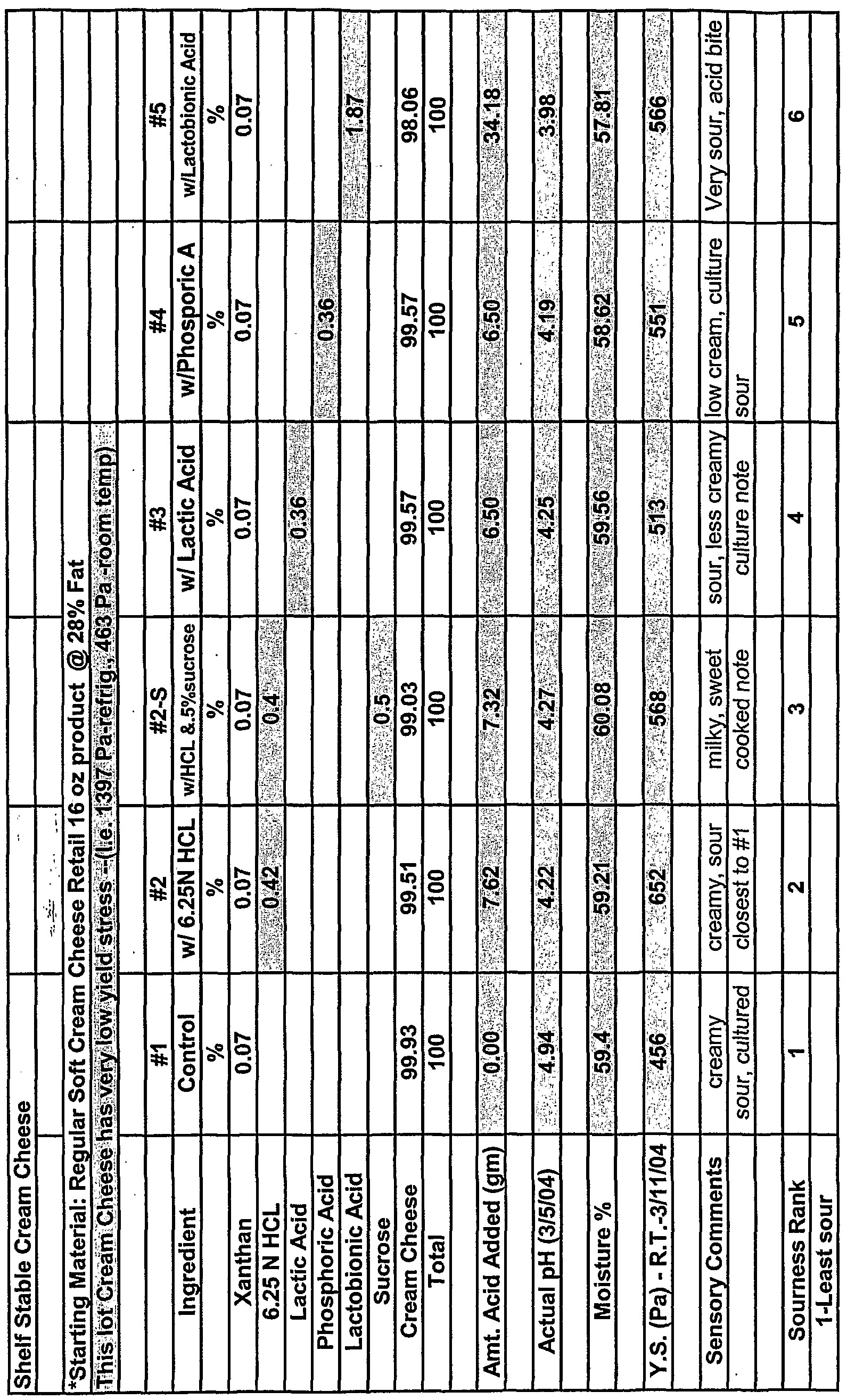
- the resulting sample had a pH 4.13 and a yield stress of 1,693 pascals at 73F.
- Sample was judged by sensory experts to be of excellent flavor and texture, and without objectionable sour taste. While evaluated by a 7-member, trained sensory panel against a control (lactic acid to replace 6.25N HCl on day-2), this sample has similar sourness of regular higher pH (e.g. 4.7) cream cheese and is about 30% less sour than the lactic acid control.
- a high moisture (>50%), low pH, shelf stable, milk filling was prepared according to the following procedure and formula.
- a high moisture milk was prepared according to the following formula and procedure given in Example 17.
- This product was judged to be superior in flavor, texture and without the objectionable sourness. Its overall quality approaches that of ice cream particularly in creaminess.
Landscapes
- Life Sciences & Earth Sciences (AREA)
- Chemical & Material Sciences (AREA)
- Engineering & Computer Science (AREA)
- Polymers & Plastics (AREA)
- Food Science & Technology (AREA)
- Health & Medical Sciences (AREA)
- Nutrition Science (AREA)
- Zoology (AREA)
- Wood Science & Technology (AREA)
- Inorganic Chemistry (AREA)
- Oil, Petroleum & Natural Gas (AREA)
- Molecular Biology (AREA)
- Marine Sciences & Fisheries (AREA)
- Dispersion Chemistry (AREA)
- Chemical Kinetics & Catalysis (AREA)
- General Chemical & Material Sciences (AREA)
- Biochemistry (AREA)
- Dairy Products (AREA)
- Seasonings (AREA)
- General Preparation And Processing Of Foods (AREA)
- Food Preservation Except Freezing, Refrigeration, And Drying (AREA)
Abstract
Description




Claims
Priority Applications (8)
| Application Number | Priority Date | Filing Date | Title |
|---|---|---|---|
| NZ554648A NZ554648A (en) | 2004-10-01 | 2005-09-29 | Shelf-stable foodstuffs and methods for their preparation |
| BRPI0516863-5A BRPI0516863A (en) | 2004-10-01 | 2005-09-29 | methods for preparing a foodstuff, a shelf stable dairy product, a cream cheese or shelf stable cream cheese-like product, and a shelf stable milk or dairy product or composition, and for enhancing structural integrity and life shelf shelf, foodstuff, and shelf stable dairy |
| JP2007534747A JP2008514232A (en) | 2004-10-01 | 2005-09-29 | Storage stable food product and method for preparing the same |
| CA002581895A CA2581895A1 (en) | 2004-10-01 | 2005-09-29 | Shelf-stable foodstuffs and methods for their preparation |
| EP05800982A EP1799043A2 (en) | 2004-10-01 | 2005-09-29 | Shelf-stable foodstuffs and methods for their preparation |
| MX2007003940A MX2007003940A (en) | 2004-10-01 | 2005-09-29 | STABLE FOOD PRODUCTS IN SHELF AND METHODS FOR PREPARATION. |
| AU2005292086A AU2005292086A1 (en) | 2004-10-01 | 2005-09-29 | Shelf-stable foodstuffs and methods for their preparation |
| EGNA2007000333 EG24655A (en) | 2004-10-01 | 2007-04-02 | Shelf stable foodstuffs and methods for their preparation |
Applications Claiming Priority (2)
| Application Number | Priority Date | Filing Date | Title |
|---|---|---|---|
| US10/956,907 | 2004-10-01 | ||
| US10/956,907 US20050186312A1 (en) | 2004-02-23 | 2004-10-01 | Shelf-stable foodstuffs and methods for their preparation |
Publications (2)
| Publication Number | Publication Date |
|---|---|
| WO2006039372A2 true WO2006039372A2 (en) | 2006-04-13 |
| WO2006039372A3 WO2006039372A3 (en) | 2006-09-14 |
Family
ID=35478300
Family Applications (1)
| Application Number | Title | Priority Date | Filing Date |
|---|---|---|---|
| PCT/US2005/034942 Ceased WO2006039372A2 (en) | 2004-10-01 | 2005-09-29 | Shelf-stable foodstuffs and methods for their preparation |
Country Status (13)
| Country | Link |
|---|---|
| US (1) | US20050186312A1 (en) |
| EP (1) | EP1799043A2 (en) |
| JP (1) | JP2008514232A (en) |
| CN (1) | CN101068471A (en) |
| AU (1) | AU2005292086A1 (en) |
| BR (1) | BRPI0516863A (en) |
| CA (1) | CA2581895A1 (en) |
| EG (1) | EG24655A (en) |
| MX (1) | MX2007003940A (en) |
| NZ (1) | NZ554648A (en) |
| RU (1) | RU2374852C2 (en) |
| WO (1) | WO2006039372A2 (en) |
| ZA (1) | ZA200702659B (en) |
Cited By (6)
| Publication number | Priority date | Publication date | Assignee | Title |
|---|---|---|---|---|
| EP1757189A3 (en) * | 2005-08-23 | 2007-03-28 | Kraft Foods Holdings, Inc. | Shelf-Stable acidified food compositions and methods for their preparation |
| EP1946643A1 (en) * | 2006-12-15 | 2008-07-23 | Kraft Foods Holdings, Inc. | Food ingredients with reduced sourness at low pH |
| EP2218339A1 (en) * | 2009-01-29 | 2010-08-18 | Brian M. Degner | Retortable dairy base |
| EP1932435A3 (en) * | 2006-12-12 | 2010-09-01 | Kraft Foods Global Brands LLC | Non-Sour, Unpastuerized, Microbiologically-Stable Food Compositions with Reduced Salt Content and Methods of Producing |
| US7887867B2 (en) | 2004-02-23 | 2011-02-15 | Kraft Foods Global Brands Llc | Stabilized non-sour dairy base materials and methods for preparation |
| US12063946B2 (en) | 2015-10-06 | 2024-08-20 | Wm. Wrigley Jr. Company | High moisture edible compositions and methods of preparation thereof |
Families Citing this family (21)
| Publication number | Priority date | Publication date | Assignee | Title |
|---|---|---|---|---|
| US20080050485A1 (en) * | 2006-08-28 | 2008-02-28 | Meyer Richard S | Acidified food methods and compositions |
| EP2224827A2 (en) * | 2007-12-19 | 2010-09-08 | Nestec S.A. | A shelf-stable food composition and a process for the preparation thereof |
| FR2928071B1 (en) * | 2008-02-28 | 2011-01-21 | Bel Fromageries | PROCESS FOR PRODUCING FRESH THERMAL CHEESE AND PROCESSED CHEESE |
| US20100112147A1 (en) * | 2008-10-30 | 2010-05-06 | Barnard David John | Hot Temperature Aerated Dairy Product Having Shelf Stable Properties |
| EP2204098A1 (en) * | 2008-12-19 | 2010-07-07 | Südzucker Aktiengesellschaft Mannheim/Ochsenfurt | Flavour enhancer |
| US20100239740A1 (en) * | 2009-03-17 | 2010-09-23 | Meyer Richard S | Low sodium salt substitute compositions |
| US20110142993A1 (en) * | 2009-12-10 | 2011-06-16 | Timothy Bowser | Method for Making Pet and Animal Comestibles |
| RU2436402C1 (en) * | 2010-04-28 | 2011-12-20 | Федеральное Государственное Образовательное Учреждение Высшего Профессионального Образования "Саратовский Государственный Аграрный Университет Имени Н.И. Вавилова" | Protective medium for peeled vegetables storage |
| US20140295041A1 (en) * | 2011-09-23 | 2014-10-02 | Natural Biotechnology Sprl | Composition |
| ES2720856T3 (en) * | 2011-10-20 | 2019-07-25 | Alessandro Cuomo | Device and method for the control, analysis and management of the phases of conservation and / or processing of food in a mobile or fixed enclosed space |
| US8999425B2 (en) | 2012-01-04 | 2015-04-07 | Jcr Technologies Llc | Low sodium salt substitute compositions |
| JP6174400B2 (en) * | 2013-07-12 | 2017-08-02 | キユーピー株式会社 | Cheese sauce |
| US11213048B2 (en) | 2014-07-25 | 2022-01-04 | Smallfood, Inc. | Protein rich food ingredient from biomass and methods of preparation |
| US11122817B2 (en) | 2014-07-25 | 2021-09-21 | Smallfood Inc. | Protein rich food ingredient from biomass and methods of production |
| MX2018000941A (en) * | 2015-07-24 | 2019-08-29 | Synthetic Genomics Inc | A protein rich food ingredient from biomass and methods of production. |
| US20180228189A1 (en) | 2017-02-14 | 2018-08-16 | Kraft Foods Group Brands Llc | Process for maintaining freshness of vegetable pieces |
| FR3076981B1 (en) * | 2018-01-19 | 2020-01-31 | Zhivko Radev | METHOD OF MANUFACTURING YOGURT-BASED FOOD PRODUCTS |
| US12357000B2 (en) * | 2018-06-15 | 2025-07-15 | Texas Tech University System | High-moisture, all-natural, shelf-stable food product |
| CN113907134A (en) * | 2020-07-09 | 2022-01-11 | 内蒙古伊利实业集团股份有限公司 | Dairy product comprising chlorophyll-containing component and acidified whey protein and method of making |
| CN116669834A (en) * | 2020-11-09 | 2023-08-29 | 加州理工学院 | Electrodialyzer and electrodialysis system for CO2 capture from seawater |
| CN115777794B (en) * | 2022-12-27 | 2024-02-13 | 光明乳业股份有限公司 | Cheese sauce and preparation method thereof |
Family Cites Families (101)
| Publication number | Priority date | Publication date | Assignee | Title |
|---|---|---|---|---|
| NL104346C (en) * | 1954-05-06 | |||
| US3165415A (en) * | 1960-10-04 | 1965-01-12 | American Mach & Foundry | Modifying taste of fruit juice by dialysis |
| NL296818A (en) * | 1962-08-21 | |||
| DE1692323A1 (en) * | 1966-03-16 | 1971-03-18 | Ch Gervais S A | Method and device for making cheese dough |
| DE1906055A1 (en) * | 1968-03-04 | 1970-09-17 | Gervais Danone Sa | Process for making cheese dough |
| JPS4837675B1 (en) * | 1968-12-16 | 1973-11-13 | ||
| US3616385A (en) * | 1969-07-23 | 1971-10-26 | Procter & Gamble | Chlorine- and chloride-free hyprochlorous acid by electrodialysis |
| US3615664A (en) * | 1969-12-05 | 1971-10-26 | Foremost Mckesson | Treatment of whey |
| US3882250A (en) * | 1972-06-28 | 1975-05-06 | Diamond Shamrock Corp | Preparation of cheese |
| US3876805A (en) * | 1972-11-01 | 1975-04-08 | Foremost Mckesson | Dough conditioner product and process |
| US3922353A (en) * | 1974-03-25 | 1975-11-25 | Quaker Oats Co | Shelf stable, high moisture, filled food product |
| US4111772A (en) * | 1975-05-22 | 1978-09-05 | Pitt Metals And Chemicals, Inc. | Process for electrodialytically controlling the alkali metal ions in a metal plating process |
| US3995071A (en) * | 1975-06-23 | 1976-11-30 | Mead Johnson & Company | Aqueous purified soy protein and beverage |
| US4043896A (en) * | 1976-03-25 | 1977-08-23 | Aqua-Chem, Inc. | Ultrafiltration and electrodialysis apparatus |
| US4053643A (en) * | 1976-08-04 | 1977-10-11 | Diamond Shamrock Corporation | Process for increasing cheese curd yield |
| US4072670A (en) * | 1976-10-26 | 1978-02-07 | Mead Johnson & Company | Low phytate isoelectric precipitated soy protein isolate |
| US4091120A (en) * | 1976-11-15 | 1978-05-23 | Mead Johnson & Company | Liquid dietary product containing soy protein membrane isolate |
| US4088795A (en) * | 1976-11-19 | 1978-05-09 | Mead Johnson & Company | Low carbohydrate oilseed lipid-protein comestible |
| FR2391653A1 (en) * | 1977-05-23 | 1978-12-22 | Nestle Sa Soc Ass Tech Prod | WHEY TREATMENT PROCESS |
| US4232050A (en) * | 1977-07-29 | 1980-11-04 | Scm Corporation | Imitation acid-set cheese |
| US4312891A (en) * | 1978-09-05 | 1982-01-26 | Kraft, Inc. | Shelf stable dessert product and method for manufacture thereof |
| US4238307A (en) * | 1979-02-14 | 1980-12-09 | Research Products Rehovot Ltd. | Electrodialysis process for the separation of essential amino acids from derivatives thereof |
| CH637809A5 (en) * | 1979-04-18 | 1983-08-31 | Nestle Sa | PROCESS FOR DEACIDIFYING COFFEE EXTRACT AND DEACIDIFIED EXTRACT OBTAINED. |
| US4374152A (en) * | 1979-07-02 | 1983-02-15 | Mallinckrodt International Corp. | Process for preparing acid cheese curd |
| US4322275A (en) * | 1980-01-10 | 1982-03-30 | Ionics Incorporated | Fractionation of protein mixtures |
| US4351710A (en) * | 1980-01-10 | 1982-09-28 | Ionics, Incorporated | Fractionation of protein mixtures |
| US4352826A (en) * | 1980-10-14 | 1982-10-05 | Mallinckrodt International Corp. | Process for preparing acid cheese curd |
| JPS58100044A (en) * | 1981-10-05 | 1983-06-14 | デ・ラ・ル−・システムズ・リミテイド | Sheet feeder |
| US4420425A (en) * | 1982-08-02 | 1983-12-13 | The Texas A&M University System | Method for processing protein from nonbinding oilseed by ultrafiltration and solubilization |
| US4549946A (en) * | 1984-05-09 | 1985-10-29 | Electrochem International, Inc. | Process and an electrodialytic cell for electrodialytically regenerating a spent electroless copper plating bath |
| US4612203A (en) * | 1984-10-31 | 1986-09-16 | The Procter & Gamble Company | Acidified meat analog products |
| US4693901A (en) * | 1985-12-10 | 1987-09-15 | Cardinal Biological, Ltd. | Shelf stable dairylike products |
| GB8604133D0 (en) * | 1986-02-19 | 1986-03-26 | Unilever Plc | Spreads |
| CH666991A5 (en) * | 1986-05-16 | 1988-09-15 | Jacobs Suchard Ag | AERATED FOOD PRODUCT BASED ON FRESH MILK AND PROCESS FOR ITS PREPARATION. |
| FI80574C (en) * | 1987-11-06 | 1990-07-10 | Valio Meijerien | Electrolytic process for desalination of whey or any liquid based whey and for the production of food acid and base |
| US5057330A (en) * | 1987-12-31 | 1991-10-15 | Borden, Inc. | Cooked and packaged starchy foodstuffs |
| US4828852A (en) * | 1988-03-25 | 1989-05-09 | Nestec S.A. | Preparation of pasta |
| FR2633615B1 (en) * | 1988-07-01 | 1991-04-12 | Hoechst France | PROCESS FOR THE INDUSTRIAL MANUFACTURE OF AQUEOUS GLYOXYLIC ACID SOLUTIONS |
| US4919964A (en) * | 1988-12-22 | 1990-04-24 | The Procter & Gamble Company | Shelf stable, highly aerated reduced calorie food products |
| US4936962A (en) * | 1989-03-01 | 1990-06-26 | Fmc Corporation | Process for adjusting the pH of an aqueous flowable fluid |
| US4938856A (en) * | 1989-03-01 | 1990-07-03 | Fmc Corporation | Process for mild heat treatment of a flowable fluid |
| US4927657A (en) * | 1989-04-13 | 1990-05-22 | The Clorox Company | Reduced tartness salad dressing |
| NZ235135A (en) * | 1989-09-01 | 1992-07-28 | Mars Inc | Shelf-stable rice: acid pasteurised using a polymeric acid |
| EP0713340B1 (en) * | 1989-10-14 | 2001-08-22 | Sony Corporation | Video signal coding/decoding method and apparatus |
| US5268079A (en) * | 1990-01-18 | 1993-12-07 | Monsanto Company | Process for the isolation and purification of free acids, starting from their salts, by electrodialysis |
| FR2657233B1 (en) * | 1990-01-19 | 1993-07-16 | Ingenierie Ste Vidaubanaise | PROCESS FOR TREATING SKIMMED MILK. |
| US5149643A (en) * | 1990-10-05 | 1992-09-22 | Haarmann & Beimer | Method for the production of granular citric acid and salts thereof |
| IE914558A1 (en) * | 1991-02-28 | 1992-09-09 | Abbott Lab | Isolation of proteins by ultrafiltration |
| EP0531999A1 (en) * | 1991-09-11 | 1993-03-17 | Asahi Glass Company Ltd. | Method for producing an acid and/or alkali metal hydroxide |
| US5221554A (en) * | 1991-12-24 | 1993-06-22 | Aly Gamay | Process for producing low-fat meat products |
| US5252352A (en) * | 1992-03-06 | 1993-10-12 | Van Den Bergh Foods Co., Division Of Conopco, Inc. | Process of preparing an extra lowfat spread |
| US5277926A (en) * | 1992-12-28 | 1994-01-11 | Kraft General Foods, Inc. | Method of making a low fat cheese product |
| US5426219A (en) * | 1993-07-26 | 1995-06-20 | A.E. Staley Manufacturing Co. | Process for recovering organic acids |
| JPH07274921A (en) * | 1994-04-07 | 1995-10-24 | Furetsushiyu Ishimori:Kk | Microbicidal process for food, etc., and apparatus for producing strongly acidic water for the process |
| KR0150676B1 (en) * | 1994-05-31 | 1998-10-01 | 김주용 | Shallow Junction Forming Method by Recessed Gate Structure |
| US5746920A (en) * | 1994-06-08 | 1998-05-05 | Fraunhofer-Gesellschaft Zur Foerder Der Angewandten Forschung E.V. | Process for purifying dairy wastewater |
| JP3612752B2 (en) * | 1994-11-08 | 2005-01-19 | 味の素株式会社 | Cooking method |
| US5599573A (en) * | 1995-05-31 | 1997-02-04 | Nestec S.A. | Preparation of acidified pastas |
| US5681728A (en) * | 1995-06-07 | 1997-10-28 | Chronopol, Inc. | Method and apparatus for the recovery and purification of organic acids |
| US5670197A (en) * | 1995-09-29 | 1997-09-23 | Nabisco, Inc. | Low-acid, high-moisture processed cheese spread and method of making |
| US5814498A (en) * | 1996-04-29 | 1998-09-29 | Archer Daniels Midland Company | Process for the recovery of organic acids and ammonia from their salts |
| US5817356A (en) * | 1996-05-13 | 1998-10-06 | Nestec S.A. | Preparation of pastas |
| US5702745A (en) * | 1996-06-24 | 1997-12-30 | Hunt-Wesson, Inc. | Process for making shelf-stable, ready-to-eat rice |
| NZ336852A (en) * | 1996-12-23 | 2000-06-23 | Lactascan Aps | Production of lactic acid from whey proteins where electrodialysis causes less biofouling of the electrodialysis membrane |
| US6294066B1 (en) * | 1997-01-23 | 2001-09-25 | Archer Daniels Midland Company | Apparatus and process for electrodialysis of salts |
| US5773063A (en) * | 1997-03-05 | 1998-06-30 | Jones-Hamilton Co. | Method for preserving animal feed with sodium bisulfate and composition thereof |
| WO1998056257A1 (en) * | 1997-06-10 | 1998-12-17 | Kraft Foods, Inc. | Shelf stable cream cheese product and process of making |
| DE19735385A1 (en) * | 1997-08-14 | 1999-02-18 | Wild Gmbh & Co Kg Rudolf | Refreshing acidic, optionally carbonated milky beverage with pleasant feel in mouth |
| IT1296382B1 (en) * | 1997-08-19 | 1999-06-25 | Waltzing Limited Liability Com | PROCESS AND EQUIPMENT FOR THE PRODUCTION OF PIZZAS. |
| US6001405A (en) * | 1997-08-25 | 1999-12-14 | Nestec S. A. | Preparation of shelf-stable filled pastas |
| JP3828665B2 (en) * | 1997-09-02 | 2006-10-04 | ホシザキ電機株式会社 | Preparation method of flour kneaded dough for food |
| US5922381A (en) * | 1997-09-02 | 1999-07-13 | Nestec S.A. | Preparation of filled pastas |
| US6402917B1 (en) * | 1998-02-09 | 2002-06-11 | Otv Societe Anonyme | Electrodialysis apparatus |
| EP0953293A1 (en) * | 1998-03-29 | 1999-11-03 | Societe Des Produits Nestle S.A. | Cooked, acidified pasta |
| US6482230B1 (en) * | 1998-04-15 | 2002-11-19 | Alcon Manufacturing, Ltd. | Lens epithelial cell growth assay for intraocular lens materials |
| US6579551B1 (en) * | 1998-05-21 | 2003-06-17 | Beech-Nut Nutrition Corporation | Baby-food compositions containing egg yolk and methods therefor |
| DE69822140T2 (en) * | 1998-06-30 | 2004-08-05 | Société des Produits Nestlé S.A. | Boiled, acidified pasta |
| US5958491A (en) * | 1998-08-10 | 1999-09-28 | Jones-Hamilton Co. | Sodium bisulfate as acidulant in foods |
| US6620445B1 (en) * | 1998-08-10 | 2003-09-16 | Jones-Hamilton Co. | Alkali metal bisulfates as acidulants in food |
| CA2281056A1 (en) * | 1998-08-31 | 2000-02-29 | Kraft Foods, Inc. | Stabilization of cream cheese compositions using nisin-producing cultures |
| JP4205227B2 (en) * | 1999-01-11 | 2009-01-07 | カルピス株式会社 | Method for purifying peptide-containing solution |
| DE19906379B4 (en) * | 1999-02-16 | 2006-05-18 | Huss, Manfred | Preparation of an aggregated whey protein product |
| CA2300224A1 (en) * | 1999-03-15 | 2000-09-15 | Kraft Foods, Inc. | Stabilized cheesecake product |
| FR2793653B1 (en) * | 1999-05-21 | 2003-05-16 | Lu | FOOD PRODUCT COMPRISING A SOLID CHOCOLATE-BASED MASS OR CHOCOLATE-LIKE WITH A LOW RECOVERY OF WATER IN CONTACT WITH AN AQUEOUS PHASE |
| US6261624B1 (en) * | 1999-07-14 | 2001-07-17 | North Carolina State University | Thermal and PH stable protein thickening agent and method of making the same |
| US6482305B1 (en) * | 1999-09-01 | 2002-11-19 | Archer-Daniels-Midland Company | Electrodialysis water splitting process |
| EP1129765A1 (en) * | 2000-03-02 | 2001-09-05 | Asahi Glass Company Ltd. | Method for producing deionized water |
| US6274020B1 (en) * | 2000-04-28 | 2001-08-14 | Ernst Schmidt | Electrodialysis membrane and gasket stack system |
| JP3985461B2 (en) * | 2000-05-02 | 2007-10-03 | 日本ビクター株式会社 | Authentication method, content sending device, content receiving device, authentication system |
| US6461491B1 (en) * | 2000-06-07 | 2002-10-08 | The University Of Chicago | Method and apparatus for electrodialysis processing |
| US6893675B1 (en) * | 2000-06-23 | 2005-05-17 | Afp Advanced Food Products Llc | Acidified imitation cheese sauce and pudding compositions and methods for producing such compositions |
| US6787173B2 (en) * | 2000-11-30 | 2004-09-07 | Kraft Foods Holdings, Inc. | Method of deflavoring soy-derived materials |
| US6667068B2 (en) * | 2001-01-29 | 2003-12-23 | Kraft Foods Holdings, Inc. | Method for preparing solid milk product |
| US6572902B2 (en) * | 2001-04-25 | 2003-06-03 | Advanced H2O, Inc. | Process for producing improved alkaline drinking water and the product produced thereby |
| DK1406504T3 (en) * | 2001-06-25 | 2017-01-30 | Afp Advanced Food Products Llc | Compositions of imitated cheese for use in making cheese in bread form, slices, and the like, and method for making such compositions |
| US20040101613A1 (en) * | 2002-11-27 | 2004-05-27 | Unilever Bestfoods North America | Reduced sourness emulsion |
| US20040142084A1 (en) * | 2003-01-21 | 2004-07-22 | Knueven Carl J. | Alkali metal bisulfates to mask aftertaste of artificial sweeteners |
| US7309510B2 (en) * | 2003-02-28 | 2007-12-18 | Unilever Bestfoods, North America Division Of Conopco, Inc. | Stable cheese condiment |
| US7150894B2 (en) * | 2003-05-01 | 2006-12-19 | Kraft Foods Holdings, Inc. | Acid whey texture system |
| US20050058761A1 (en) * | 2003-09-11 | 2005-03-17 | Schreiber Foods, Inc. | Acidified food sauces |
| US20050186311A1 (en) * | 2004-02-23 | 2005-08-25 | Loh Jimbay P. | Method for acidifying and preserving food compositions using electrodialyzed compositions |
-
2004
- 2004-10-01 US US10/956,907 patent/US20050186312A1/en not_active Abandoned
-
2005
- 2005-09-29 NZ NZ554648A patent/NZ554648A/en unknown
- 2005-09-29 CN CNA2005800410236A patent/CN101068471A/en active Pending
- 2005-09-29 EP EP05800982A patent/EP1799043A2/en not_active Withdrawn
- 2005-09-29 CA CA002581895A patent/CA2581895A1/en not_active Abandoned
- 2005-09-29 WO PCT/US2005/034942 patent/WO2006039372A2/en not_active Ceased
- 2005-09-29 JP JP2007534747A patent/JP2008514232A/en active Pending
- 2005-09-29 RU RU2007116126/13A patent/RU2374852C2/en not_active IP Right Cessation
- 2005-09-29 AU AU2005292086A patent/AU2005292086A1/en not_active Abandoned
- 2005-09-29 BR BRPI0516863-5A patent/BRPI0516863A/en not_active Application Discontinuation
- 2005-09-29 MX MX2007003940A patent/MX2007003940A/en not_active Application Discontinuation
-
2007
- 2007-03-29 ZA ZA200702659A patent/ZA200702659B/en unknown
- 2007-04-02 EG EGNA2007000333 patent/EG24655A/en active
Cited By (6)
| Publication number | Priority date | Publication date | Assignee | Title |
|---|---|---|---|---|
| US7887867B2 (en) | 2004-02-23 | 2011-02-15 | Kraft Foods Global Brands Llc | Stabilized non-sour dairy base materials and methods for preparation |
| EP1757189A3 (en) * | 2005-08-23 | 2007-03-28 | Kraft Foods Holdings, Inc. | Shelf-Stable acidified food compositions and methods for their preparation |
| EP1932435A3 (en) * | 2006-12-12 | 2010-09-01 | Kraft Foods Global Brands LLC | Non-Sour, Unpastuerized, Microbiologically-Stable Food Compositions with Reduced Salt Content and Methods of Producing |
| EP1946643A1 (en) * | 2006-12-15 | 2008-07-23 | Kraft Foods Holdings, Inc. | Food ingredients with reduced sourness at low pH |
| EP2218339A1 (en) * | 2009-01-29 | 2010-08-18 | Brian M. Degner | Retortable dairy base |
| US12063946B2 (en) | 2015-10-06 | 2024-08-20 | Wm. Wrigley Jr. Company | High moisture edible compositions and methods of preparation thereof |
Also Published As
| Publication number | Publication date |
|---|---|
| ZA200702659B (en) | 2008-08-27 |
| RU2374852C2 (en) | 2009-12-10 |
| EP1799043A2 (en) | 2007-06-27 |
| MX2007003940A (en) | 2007-05-21 |
| US20050186312A1 (en) | 2005-08-25 |
| CA2581895A1 (en) | 2006-04-13 |
| AU2005292086A1 (en) | 2006-04-13 |
| EG24655A (en) | 2010-04-07 |
| JP2008514232A (en) | 2008-05-08 |
| RU2007116126A (en) | 2008-11-10 |
| CN101068471A (en) | 2007-11-07 |
| BRPI0516863A (en) | 2008-09-23 |
| NZ554648A (en) | 2010-03-26 |
| WO2006039372A3 (en) | 2006-09-14 |
Similar Documents
| Publication | Publication Date | Title |
|---|---|---|
| US20050186312A1 (en) | Shelf-stable foodstuffs and methods for their preparation | |
| EP1757189A2 (en) | Shelf-Stable acidified food compositions and methods for their preparation | |
| JP2014050336A (en) | Milk flavor promoter | |
| US7887867B2 (en) | Stabilized non-sour dairy base materials and methods for preparation | |
| EP1932435A2 (en) | Non-Sour, Unpastuerized, Microbiologically-Stable Food Compositions with Reduced Salt Content and Methods of Producing | |
| EP1709874A1 (en) | Shelf-stable cold-processed food compositions and methods for their preparation | |
| EP3525594B1 (en) | Method for the manufacture of a cream cheese | |
| JP6752646B2 (en) | Container-packed texture-improving composition for processed egg foods and method for producing processed egg foods using the composition | |
| AU2013201695A1 (en) | Shelf-stable acidified food compositions and methods for their preparation | |
| US20250160352A1 (en) | Process for making a dairy beverage with improved nutrition | |
| JPS58187134A (en) | Production of acidic food for low-temperature use with improved taste | |
| JP6608154B2 (en) | milk beverage | |
| Skryplonek et al. | Processing technology and the industrial application of whey | |
| HK1113643A (en) | Shelf-stable foodstuffs and methods for their preparation | |
| JP2019201668A (en) | milk beverage | |
| US20120177793A1 (en) | Low-calorie milk product | |
| NZ753146B2 (en) | Method for the manufacture of a cream cheese |
Legal Events
| Date | Code | Title | Description |
|---|---|---|---|
| AK | Designated states |
Kind code of ref document: A2 Designated state(s): AE AG AL AM AT AU AZ BA BB BG BR BW BY BZ CA CH CN CO CR CU CZ DE DK DM DZ EC EE EG ES FI GB GD GE GH GM HR HU ID IL IN IS JP KE KG KM KP KR KZ LC LK LR LS LT LU LV LY MA MD MG MK MN MW MX MZ NA NG NI NO NZ OM PG PH PL PT RO RU SC SD SE SG SK SL SM SY TJ TM TN TR TT TZ UA UG US UZ VC VN YU ZA ZM ZW |
|
| AL | Designated countries for regional patents |
Kind code of ref document: A2 Designated state(s): BW GH GM KE LS MW MZ NA SD SL SZ TZ UG ZM ZW AM AZ BY KG KZ MD RU TJ TM AT BE BG CH CY CZ DE DK EE ES FI FR GB GR HU IE IS IT LT LU LV MC NL PL PT RO SE SI SK TR BF BJ CF CG CI CM GA GN GQ GW ML MR NE SN TD TG |
|
| 121 | Ep: the epo has been informed by wipo that ep was designated in this application | ||
| WWE | Wipo information: entry into national phase |
Ref document number: 2581895 Country of ref document: CA |
|
| WWE | Wipo information: entry into national phase |
Ref document number: 2005292086 Country of ref document: AU |
|
| WWE | Wipo information: entry into national phase |
Ref document number: MX/a/2007/003940 Country of ref document: MX Ref document number: 12007500707 Country of ref document: PH |
|
| WWE | Wipo information: entry into national phase |
Ref document number: 2007534747 Country of ref document: JP |
|
| NENP | Non-entry into the national phase |
Ref country code: DE |
|
| ENP | Entry into the national phase |
Ref document number: 2005292086 Country of ref document: AU Date of ref document: 20050929 Kind code of ref document: A |
|
| WWP | Wipo information: published in national office |
Ref document number: 2005292086 Country of ref document: AU |
|
| WWE | Wipo information: entry into national phase |
Ref document number: 554648 Country of ref document: NZ Ref document number: 2005800982 Country of ref document: EP |
|
| WWE | Wipo information: entry into national phase |
Ref document number: 2007116126 Country of ref document: RU |
|
| WWE | Wipo information: entry into national phase |
Ref document number: 200580041023.6 Country of ref document: CN |
|
| WWP | Wipo information: published in national office |
Ref document number: 2005800982 Country of ref document: EP |
|
| ENP | Entry into the national phase |
Ref document number: PI0516863 Country of ref document: BR |