WO2006044538A1 - Personal care compositions comprising visible beads, cationic polymer, and surfactant - Google Patents
Personal care compositions comprising visible beads, cationic polymer, and surfactant Download PDFInfo
- Publication number
- WO2006044538A1 WO2006044538A1 PCT/US2005/036820 US2005036820W WO2006044538A1 WO 2006044538 A1 WO2006044538 A1 WO 2006044538A1 US 2005036820 W US2005036820 W US 2005036820W WO 2006044538 A1 WO2006044538 A1 WO 2006044538A1
- Authority
- WO
- WIPO (PCT)
- Prior art keywords
- personal care
- care composition
- alkyl
- available
- surfactant
- Prior art date
- Legal status (The legal status is an assumption and is not a legal conclusion. Google has not performed a legal analysis and makes no representation as to the accuracy of the status listed.)
- Ceased
Links
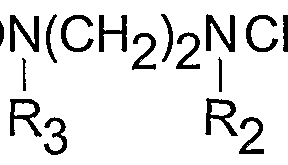
- 0 CC1C(C)(CC2*CC*2)C1 Chemical compound CC1C(C)(CC2*CC*2)C1 0.000 description 2
Classifications
-
- A—HUMAN NECESSITIES
- A61—MEDICAL OR VETERINARY SCIENCE; HYGIENE
- A61K—PREPARATIONS FOR MEDICAL, DENTAL OR TOILETRY PURPOSES
- A61K8/00—Cosmetics or similar toiletry preparations
- A61K8/18—Cosmetics or similar toiletry preparations characterised by the composition
- A61K8/30—Cosmetics or similar toiletry preparations characterised by the composition containing organic compounds
- A61K8/60—Sugars; Derivatives thereof
-
- A—HUMAN NECESSITIES
- A61—MEDICAL OR VETERINARY SCIENCE; HYGIENE
- A61K—PREPARATIONS FOR MEDICAL, DENTAL OR TOILETRY PURPOSES
- A61K8/00—Cosmetics or similar toiletry preparations
- A61K8/02—Cosmetics or similar toiletry preparations characterised by special physical form
- A61K8/0241—Containing particulates characterized by their shape and/or structure
- A61K8/025—Explicitly spheroidal or spherical shape
-
- A—HUMAN NECESSITIES
- A61—MEDICAL OR VETERINARY SCIENCE; HYGIENE
- A61K—PREPARATIONS FOR MEDICAL, DENTAL OR TOILETRY PURPOSES
- A61K8/00—Cosmetics or similar toiletry preparations
- A61K8/02—Cosmetics or similar toiletry preparations characterised by special physical form
- A61K8/11—Encapsulated compositions
-
- A—HUMAN NECESSITIES
- A61—MEDICAL OR VETERINARY SCIENCE; HYGIENE
- A61K—PREPARATIONS FOR MEDICAL, DENTAL OR TOILETRY PURPOSES
- A61K8/00—Cosmetics or similar toiletry preparations
- A61K8/18—Cosmetics or similar toiletry preparations characterised by the composition
- A61K8/30—Cosmetics or similar toiletry preparations characterised by the composition containing organic compounds
- A61K8/67—Vitamins
- A61K8/671—Vitamin A; Derivatives thereof, e.g. ester of vitamin A acid, ester of retinol, retinol, retinal
-
- A—HUMAN NECESSITIES
- A61—MEDICAL OR VETERINARY SCIENCE; HYGIENE
- A61K—PREPARATIONS FOR MEDICAL, DENTAL OR TOILETRY PURPOSES
- A61K8/00—Cosmetics or similar toiletry preparations
- A61K8/18—Cosmetics or similar toiletry preparations characterised by the composition
- A61K8/30—Cosmetics or similar toiletry preparations characterised by the composition containing organic compounds
- A61K8/67—Vitamins
- A61K8/673—Vitamin B group
- A61K8/675—Vitamin B3 or vitamin B3 active, e.g. nicotinamide, nicotinic acid, nicotinyl aldehyde
-
- A—HUMAN NECESSITIES
- A61—MEDICAL OR VETERINARY SCIENCE; HYGIENE
- A61K—PREPARATIONS FOR MEDICAL, DENTAL OR TOILETRY PURPOSES
- A61K8/00—Cosmetics or similar toiletry preparations
- A61K8/18—Cosmetics or similar toiletry preparations characterised by the composition
- A61K8/30—Cosmetics or similar toiletry preparations characterised by the composition containing organic compounds
- A61K8/67—Vitamins
- A61K8/678—Tocopherol, i.e. vitamin E
-
- A—HUMAN NECESSITIES
- A61—MEDICAL OR VETERINARY SCIENCE; HYGIENE
- A61K—PREPARATIONS FOR MEDICAL, DENTAL OR TOILETRY PURPOSES
- A61K8/00—Cosmetics or similar toiletry preparations
- A61K8/18—Cosmetics or similar toiletry preparations characterised by the composition
- A61K8/72—Cosmetics or similar toiletry preparations characterised by the composition containing organic macromolecular compounds
- A61K8/73—Polysaccharides
- A61K8/731—Cellulose; Quaternized cellulose derivatives
-
- A—HUMAN NECESSITIES
- A61—MEDICAL OR VETERINARY SCIENCE; HYGIENE
- A61K—PREPARATIONS FOR MEDICAL, DENTAL OR TOILETRY PURPOSES
- A61K8/00—Cosmetics or similar toiletry preparations
- A61K8/18—Cosmetics or similar toiletry preparations characterised by the composition
- A61K8/72—Cosmetics or similar toiletry preparations characterised by the composition containing organic macromolecular compounds
- A61K8/73—Polysaccharides
- A61K8/737—Galactomannans, e.g. guar; Derivatives thereof
-
- A—HUMAN NECESSITIES
- A61—MEDICAL OR VETERINARY SCIENCE; HYGIENE
- A61K—PREPARATIONS FOR MEDICAL, DENTAL OR TOILETRY PURPOSES
- A61K8/00—Cosmetics or similar toiletry preparations
- A61K8/18—Cosmetics or similar toiletry preparations characterised by the composition
- A61K8/72—Cosmetics or similar toiletry preparations characterised by the composition containing organic macromolecular compounds
- A61K8/81—Cosmetics or similar toiletry preparations characterised by the composition containing organic macromolecular compounds obtained by reactions involving only carbon-to-carbon unsaturated bonds
- A61K8/8105—Compositions of homopolymers or copolymers of unsaturated aliphatic hydrocarbons having only one carbon-to-carbon double bond; Compositions of derivatives of such polymers
- A61K8/8111—Homopolymers or copolymers of aliphatic olefines, e.g. polyethylene, polyisobutene; Compositions of derivatives of such polymers
-
- A—HUMAN NECESSITIES
- A61—MEDICAL OR VETERINARY SCIENCE; HYGIENE
- A61K—PREPARATIONS FOR MEDICAL, DENTAL OR TOILETRY PURPOSES
- A61K8/00—Cosmetics or similar toiletry preparations
- A61K8/18—Cosmetics or similar toiletry preparations characterised by the composition
- A61K8/92—Oils, fats or waxes; Derivatives thereof, e.g. hydrogenation products thereof
-
- A—HUMAN NECESSITIES
- A61—MEDICAL OR VETERINARY SCIENCE; HYGIENE
- A61Q—SPECIFIC USE OF COSMETICS OR SIMILAR TOILETRY PREPARATIONS
- A61Q19/00—Preparations for care of the skin
-
- A—HUMAN NECESSITIES
- A61—MEDICAL OR VETERINARY SCIENCE; HYGIENE
- A61Q—SPECIFIC USE OF COSMETICS OR SIMILAR TOILETRY PREPARATIONS
- A61Q19/00—Preparations for care of the skin
- A61Q19/10—Washing or bathing preparations
-
- A—HUMAN NECESSITIES
- A61—MEDICAL OR VETERINARY SCIENCE; HYGIENE
- A61Q—SPECIFIC USE OF COSMETICS OR SIMILAR TOILETRY PREPARATIONS
- A61Q5/00—Preparations for care of the hair
-
- A—HUMAN NECESSITIES
- A61—MEDICAL OR VETERINARY SCIENCE; HYGIENE
- A61K—PREPARATIONS FOR MEDICAL, DENTAL OR TOILETRY PURPOSES
- A61K2800/00—Properties of cosmetic compositions or active ingredients thereof or formulation aids used therein and process related aspects
- A61K2800/40—Chemical, physico-chemical or functional or structural properties of particular ingredients
- A61K2800/41—Particular ingredients further characterized by their size
- A61K2800/412—Microsized, i.e. having sizes between 0.1 and 100 microns
-
- A—HUMAN NECESSITIES
- A61—MEDICAL OR VETERINARY SCIENCE; HYGIENE
- A61K—PREPARATIONS FOR MEDICAL, DENTAL OR TOILETRY PURPOSES
- A61K2800/00—Properties of cosmetic compositions or active ingredients thereof or formulation aids used therein and process related aspects
- A61K2800/40—Chemical, physico-chemical or functional or structural properties of particular ingredients
- A61K2800/54—Polymers characterized by specific structures/properties
- A61K2800/542—Polymers characterized by specific structures/properties characterized by the charge
- A61K2800/5426—Polymers characterized by specific structures/properties characterized by the charge cationic
-
- A—HUMAN NECESSITIES
- A61—MEDICAL OR VETERINARY SCIENCE; HYGIENE
- A61K—PREPARATIONS FOR MEDICAL, DENTAL OR TOILETRY PURPOSES
- A61K2800/00—Properties of cosmetic compositions or active ingredients thereof or formulation aids used therein and process related aspects
- A61K2800/40—Chemical, physico-chemical or functional or structural properties of particular ingredients
- A61K2800/60—Particulates further characterized by their structure or composition
- A61K2800/61—Surface treated
- A61K2800/62—Coated
- A61K2800/624—Coated by macromolecular compounds
-
- A—HUMAN NECESSITIES
- A61—MEDICAL OR VETERINARY SCIENCE; HYGIENE
- A61K—PREPARATIONS FOR MEDICAL, DENTAL OR TOILETRY PURPOSES
- A61K2800/00—Properties of cosmetic compositions or active ingredients thereof or formulation aids used therein and process related aspects
- A61K2800/40—Chemical, physico-chemical or functional or structural properties of particular ingredients
- A61K2800/60—Particulates further characterized by their structure or composition
- A61K2800/61—Surface treated
- A61K2800/62—Coated
- A61K2800/63—More than one coating
-
- A—HUMAN NECESSITIES
- A61—MEDICAL OR VETERINARY SCIENCE; HYGIENE
- A61K—PREPARATIONS FOR MEDICAL, DENTAL OR TOILETRY PURPOSES
- A61K2800/00—Properties of cosmetic compositions or active ingredients thereof or formulation aids used therein and process related aspects
- A61K2800/40—Chemical, physico-chemical or functional or structural properties of particular ingredients
- A61K2800/60—Particulates further characterized by their structure or composition
- A61K2800/65—Characterized by the composition of the particulate/core
- A61K2800/651—The particulate/core comprising inorganic material
-
- A—HUMAN NECESSITIES
- A61—MEDICAL OR VETERINARY SCIENCE; HYGIENE
- A61Q—SPECIFIC USE OF COSMETICS OR SIMILAR TOILETRY PREPARATIONS
- A61Q5/00—Preparations for care of the hair
- A61Q5/02—Preparations for cleaning the hair
Definitions
- the present invention relates to personal care compositions comprising visible beads and cationic polymer.
- the compositions are suitable for cleansing and/or conditioning the skin and/or the hair and which may be used, for example, in the form of foam bath preparations, shower products, skin cleansers, skin moisturizers, hair shampoos, hair conditioners, and the like.
- Personal care compositions that are suitable for cleansing and/or conditioning the skin and/or hair come in many different product forms.
- One popular form of personal care compositions is a liquid body wash product. Consumer preferred liquid body wash products exhibit good cleaning performance and good lathering performance, yet are mild to the skin and deposit skin benefit agents to the skin to provide a variety of benefits to the consumer. Consumers also prefer a product that is aesthetically pleasing, as displayed in a store and as stored in a shower or bath. There has thus been a desire to develop a personal care composition that is mild to the skin and/or hair, has an aesthetically pleasing appearance, is able to deliver skin benefit agents to the skin and/or hair, and is stable.
- the personal care compositions of the present invention comprise visible beads, cationic polymer, and surfactant.
- the visible beads in the present compositions can be utilized to provide an aesthetically pleasing appearance to the product.
- the visible beads can also be utilized to encapsulate and deliver skin benefit agents to the skin or hair.
- the visible beads can also encapsulate materials that are otherwise incompatible with the personal care composition matrix to preserve product stability.
- the visible beads preferably comprise a structural material comprising lactose, cellulose and hydroxypropyl methylcellulose.
- the structural material of the visible beads can further comprise a pigment to impart a colored appearance to the visible beads.
- the visible beads can further comprise an encompassed material, such as a skin benefit agent.
- the personal care compositions preferably have a viscosity of from about 1,000 to less than about 40,000 centipoise.
- the cationic polymer utilized in the present compositions is preferably guar hydroxypropyl trimonium chloride.
- the compositions preferably further comprise a high molecular weight ester oil.
- Preferred high molecular weight ester oils include poly alpha-olefms, such as polydecene.
- the present invention further relates to methods of using the personal care compositions described herein to cleanse and/or moisturize skin and/or hair.
- compositions of the present invention comprise visible beads.
- a visible bead is a particle which can be distinctively detected as an individual particle by the naked eye when comprised in the present composition, and which is stable in the present composition.
- the visible bead can be of any size, shape, or color, according to the desired characteristic of the product, so long as it is distinctively detected as an individual particle by the naked eye.
- the visible beads will typically have the shape of a small round ball.
- a visible bead has an average diameter of from about 50 ⁇ m to about 5000 ⁇ m, preferably from about lOO ⁇ m to about 3000 ⁇ m, more preferably from about 300 ⁇ m to about lOOO ⁇ m.
- stable it is meant that the visible beads are not disintegrated, agglomerated, or separated under normal shelf conditions.
- the visible beads herein are typically incorporated in the present compositions at levels of from about 0.01% to about 25%, preferably from about 0.01% to about 5%, and more preferably from about 0.05% to about 3%, by weight of the composition.
- the visible bead herein will typically comprise a structural material and preferably an encompassed material.
- the structural material provides a certain strength to the visible beads so that they retain their distinctively detectable structure in the present composition under normal shelf conditions.
- the structural material further can be broken and disintegrated with very little shear on the hand with the fingers upon use.
- the visible beads can be solid or liquid, filled or un-filled, as long as they are stable in the present composition.
- the structural material used for making the visible beads varies depending on the compatibility with other components, as well as material, if any, to be encompassed in the visible beads.
- Exemplary materials for making the visible beads herein include: polysaccharide and saccharide derivatives such as crystalline cellulose, cellulose acetate, cellulose acetate butyrate, cellulose acetate phthalate, cellulose nitrate, ethylcellulose, hydroxypropylcellulose, hydroxypropylmethylcellulose, hydroxypropylmethylcellulose phthalate, methyl cellulose, sodium carboxymethylcellulose, gum acacia (gum arabic), agar, agarose, maltodextrin, sodium alginate, calcium alginate, dextran, starch, galactose, glucosamine, cyclodextrin, chitin, amylose, amylopectin, glycogen, laminaran, lichenan, curdlan, inulin, levan, pectin, mannan, xylan, alginic acid, arabic acid, glucommannan, agarose, agaropectin, prophyran, car
- Components herein may be described in other sections as useful components for the present composition.
- the components herein are substantially used to make the structure of the visible beads, and are not dissolved or dispersed in the bulk of the present composition under normal shelf conditions.
- Highly preferable structural material herein comprises components selected from the group consisting of polysaccharides and their derivatives, saccharides and their derivatives, oligosaccharides, monosaccharides, and mixtures thereof, still preferably, components from the above mentioned group wherein components having various water solubility are selected.
- the structural material comprises lactose, cellulose, and hydroxypropyl methylcellulose.
- Suitable visible beads also include organogel particles as described in detail in U.S. 6,797,683.
- Visible beads that are organogel particles typically comprise a structural material selected from poloxamer compounds (i.e. polyoxypropylene-polyoxyethylene block copolymer such as Pluronic F-127 available from BASF), waxes (e.g., beeswax, paraffin, water-insoluble wax, carbon-based wax, silicone wax, microcrystalline wax, etc.), triglycerides, acid triglycerides, polymers, fluoroalkyl (meth)acrylate polymers and copolymers, acrylate polymers, ethylene/acrylate copolymers, polyethylene, polypropylene polymers and copolymers, fatty acids, fatty alcohols, fatty acid esters, fatty acid ethers, fatty acid amides, alkylene polyhydric alcohols, fatty acid amide of an alkanolamine, glyceryl monostearate, (ary
- the visible beads herein may encompass, contain, or be filled with an encompassed material.
- encompassed material can be water soluble or water insoluble.
- Suitable encompassed materials include skin benefit agents as described herein such as: vitamins, amino acids, proteins and protein derivatives, herbal extracts, pigments, dyes, antimicrobial agents, chelating agents, UV absorbers, optical brighteners, silicone compounds, perfumes, humectants, and mixtures thereof.
- water soluble components are preferred encompassed material.
- the encompassed materials herein are substantially retained within the visible beads, and are substantially not dissolved in the bulk of the present composition under normal shelf conditions.
- Unisphere and Unicerin particles are made of microcrystallme cellulose, hydroxypropyl cellulose, lactose, vitamins, pigments, and proteins. Upon use, the Unisphere and Unicerin particles can be disintegrated with very little shear on the hand with the fingers with practically no resistance, and readily dissolve in the composition.
- Suitable visible beads for incorporation in the present compositions are described in detail in U.S. 6,797,683 (organogel particles); U.S. 6,045,813 (rupturable beads); U.S. 2004/0047822 Al (visible capsules); and WO 97/23194 (capsulated or particulated oily substances).
- the personal care compositions according to the present invention comprise a cationic polymer.
- Cationic polymers can be useful in the compositions of the present invention to provide desirable skin feel attributes, such as skin conditioning.
- the addition of a cationic polymer can be advantageous in combination with the visible beads or water-insoluble oils for providing enhanced deposition of the visible beads or water- insoluble oils.
- the cationic polymer is preferably present at a level from about 0.01% to about 5%, preferably from about 0.01% to about 3% and especially from about 0.01% to about 2% by weight.
- Suitable cationic polymers include high molecular weight materials (mass-average molecular weight determined, for instance, by light scattering, being generally from about 2,000 to about 5,000,000, preferably from about 5,000 to about 3,000,000 more preferably from 100,000 to about 1,000,000).
- cationic polymers suitable herein include cationic guar gums, cationic polysaccharides; cationic homopolymers and copolymers derived from acrylic and/or methacrylic acid; cationic cellulose resins, quaternized hydroxy ethyl cellulose ethers; cationic copolymers of dimethyldiallylammonium chloride and acrylamide and/or acrylic acid; cationic homopolymers of dimethyldiallylammonium chloride; copolymers of dimethyl aminoethylmethacrylate and acrylamide, acrylic acid/dimethyldiallylammonium chloride/acrylamide copolymers, quaternised vinyl pyrrolidone acrylate or methacrylate copolymers of amino alcohol, quaternized copolymers of vinyl pyrrolidone and dimethylaminoethylmethacrylamide, vinyl pyrollidone/vinyl imidazolium methochloride copolymers and polyalky
- cationic polymers suitable for use herein include cationic guar gums such as hydroxypropyl trimethyl ammonium guar gum (d.s. of from 0.11 to 0.22) available commercially under the trade names Jaguar C- 14-S(RTM) and Jaguar C- 17(RTM) and also Jaguar C- 16(RTM), which contains hydroxypropyl substituents (d.s. of from 0.8-1.1) in addition to the above-specified cationic groups, and quaternized hydroxy ethyl cellulose ethers available commercially under the trade names Ucare Polymer JR-30M, JR-400, LR400, Catanal (RTM) and Celquat.
- cationic guar gums such as hydroxypropyl trimethyl ammonium guar gum (d.s. of from 0.11 to 0.22) available commercially under the trade names Jaguar C- 14-S(RTM) and Jaguar C- 17(RTM) and also Jaguar C- 16(RTM), which contains hydroxypropy
- Suitable cationic polymers are homopolymers of dimethyldiallylammonium chloride available commercially under the trade name Merquat 100, copolymers of dimethyl aminoethylmethacrylate and acrylamide, copolymers of dimethyldiallylammonium chloride and acrylamide, available commercially under the trade names Merquat 550 and Merquat S, acrylic acid/dimethyldiallylammonium chloride/acrylamide copolymers available under the trade name Merquat 3330, terpolymers of acrylic acid, methacrylamidopropyl trimethyl ammonium chloride and methyl acrylate commercially available under the tradename Merquat 2001, quaternized vinyl pyrrolidone acrylate or methacrylate copolymers of amino alcohol available commercially under the trade name Gafquat, for example Polyquaternium 11, 23 and 28 (quaternized copolymers of vinyl pyrrolidone and dimethyl aminoethylmethacrylate - Gafquat 755N
- surfactants are preferably to provide a skin and/or hair cleansing benefit.
- the surfactants used herein are preferably water-soluble surfactants.
- Water-soluble as defined herein, means a surfactant having a molecular weight of less than about 20,000 wherein the surfactant is capable of forming a clear isotropic solution when dissolved in water at 0.2% w/w under ambient conditions.
- Surfactants suitable for inclusion in compositions according to the present invention generally have a lipophilic chain length of from about 6 to about 22 carbon atoms and can be selected from anionic, nonionic, zwitterionic and amphoteric surfactants and mixtures thereof.
- the total level of surfactant in the present compositions is preferably from about 2% to about 40%, more preferably from about 3% to about 25% by weight, and especially from about 5% to about 20%, by weight of the composition.
- the compositions preferably comprise a mixture of anionic with zwitterionic and/or amphoteric surfactants.
- the weight ratio of anionic surfactant: zwitterionic and/or amphoteric surfactant is in the range from about 1:10 to about 10:1, preferably from about 1:5 to about 5:1, more preferably from about 1:3 to about 3:1.
- Other suitable compositions within the scope of the invention comprise mixtures of anionic, zwitterionic and/or amphoteric surfactants with one or more nonionic surfactants.
- compositions of the invention can comprise a water-soluble anionic surfactant at levels from about 0.1% to about 25%, more preferably from about 1% to about 20%, and especially from about 5% to about 15% by weight.
- Water soluble anionic surfactants suitable for inclusion in the compositions of the invention include alkyl sulfates, ethoxylated alkyl sulfates, alkyl ethoxy carboxylates, alkyl glyceryl ether sulfonates, ethoxy ether sulfonates, methyl acyl taurates, fatty acyl glycinates, N-acyl glutamates, acyl isethionates, alkyl sulfosuccinates, alkyl ethoxysulphosuccinates, alpha-sulfonated fatty acids, their salts and/or their esters, alkyl phosphate esters, ethoxylated alkyl phosphate esters, acyl s
- Additional water-soluble anionic surfactants suitable for use in the compositions according to the present invention are the salts of sulfuric acid esters of the reaction product of 1 mole of a higher fatty alcohol and from about 1 to about 12 moles of ethylene oxide, with sodium, ammonium and magnesium being the preferred counterions.
- Particularly preferred are the alkyl ethoxy sulfates containing from about 2 to 6, preferably 2 to 4 moles of ethylene oxide, such as sodium laureth-2 sulfate, sodium laureth-3 sulfate, ammonium laureth-3 sulfate and magnesium sodium laureth-3.6 sulfate.
- the anionic surfactant contains at least about 50% especially at least about 75% by weight of ethoxylated alkyl sulfate.
- ethoxylated alkyl sulfates obtained from narrow range ethoxylates are also suitable water-soluble anionic surfactants for use in the present compositions.
- Narrow range ethoxylated alkyl sulfates suitable for use herein are selected from sulphated alkyl ethoxylates containing on average from about 1 to about 6, preferably from about 2 to about 4 and especially about 3 moles of ethylene oxide such as NRE sodium laureth-3 sulfate.
- NRE materials suitable for use herein contain distributions of the desired ethylene oxide (EO n ) in the ranges of from 15% to about 30% by weight Of EO n , from about 10% to about 20% by weight of EO n + 1 and from about 10% to about 20% by weight of EO n . ⁇ .
- Highly preferred NRE materials contain less than about 9% by weight of ethoxylated alkyl sulfate having 7 or more moles of ethylene oxide and less than about 13% by weight of non-ethoxylated alkyl sulfate.
- Suitable laureth 3 sulfate NRE materials are available from Hoechst under the trade names GENAPOL ZRO Narrow Range and GENAPOL Narrow Range.
- compositions of the present invention may contain, as a water-soluble anionic surfactant alkyl ethoxy carboxylate surfactant at a level of from about 0.5% to about 15%, preferably from about 1% to about 10%, more preferably from about 1% to about 6% and especially from about 1% to about 4% by weight.
- alkyl ethoxy carboxylate surfactant is particularly valuable in the compositions according to the present invention for the delivery of excellent skin mildness attributes in combination with excellent rinsing performance and desirable lather characteristics.
- Alkyl ethoxy carboxylates suitable for use herein have the general formula (I):
- R 3 O(CH 2 CH 2 O)] ⁇ CH 2 COO-M +
- R 3 is a CJQ to C ⁇ g alkyl or alkenyl group, preferably a C ⁇ 1X15, more preferably a C I 2 -C 14 alkyl or Cj 2 -C ⁇ alkyl group
- k is an average value of ethoxylation ranging from 2 to about 7, preferably from about 3 to about 6, more preferably from about 3.5 to about 5.5, especially from about 4 to about 5, most preferably from about 4 to about 4.5
- M is a water-solubilizing cation, preferably an alkali metal, alkaline earth metal, ammonium, lower alkanol ammonium, and mono-, di-, and tri-ethanol ammonium, more preferably sodium, potassium and ammonium, most preferably sodium and ammonium and mixtures thereof with magnesium and calcium ions.
- alkyl ethoxy carboxylate surfactants suitable for use herein are alkyl ethoxy carboxylate surfactants having a selected distribution of alkyl chain length and/or ethoxylate.
- the alkyl ethoxy carboxylate surfactants suitable for use in the compositions according to the present invention may comprise a distribution of alkyl ethoxy carboxylates having different average values of R 3 and/or k.
- the average value of k will generally fall in the range of from about 3 to about 6 when the average R 3 is C ⁇ ⁇ , Ci 2 , C13 or C 14.
- Preferred water-soluble anionic alkyl ethoxy carboxylate surfactants suitable for use herein are the Cj 2 to C 14 (average EO 3- 6) ethoxy carboxylates and the Cj 2 to C13 (average EO 3-6) ethoxy carboxylates.
- Suitable materials include salts of NEODOX 23-4 (RTM) available from Shell Inc. (Houston, Texas, USA) and EMPICOL (RTM) CBCS (Albright & Wilson).
- Highly preferred for use herein are alkyl ethoxy carboxylate surfactants wherein, when R ⁇ is a Cl2"Cl4 or C12-C13 alkyl group and the average value of k is in the range of from about
- compositions are substantially free of soap, i.e. they contain less than about 5%, preferably less than about 1%, preferably 0%, by weight, of soap.
- compositions according to the present invention may additionally comprise water-soluble nonionic surfactant at levels from about 0.1% to about 20%, more preferably from about 0.1% to about 10%, and especially from about 1% to about 8% by weight.
- surfactants of this class include sucrose polyester surfactants, CK)-CI 8 alkyl polyglycosides and polyhydroxy fatty acid amide surfactants having the general formula (III):
- N-alkyl, N-alkoxy or N-aryloxy, polyhydroxy fatty acid amide surfactants according to formula (III) are those in which Rg is C5-C31 hydrocarbyl, preferably C5-
- C ⁇ g hydrocarbyl including straight-chain and branched chain alkyl and alkenyl, or mixtures thereof and R9 is typically, hydrogen, C ⁇ -Cg alkyl or hydroxyalkyl, preferably methyl, or a group of formula -Rl-O-R ⁇ wherein Rl is C2-Cg hydrocarbyl including straight-chain, branched-chain and cyclic (including aryl), and is preferably C2-C4 alkylene, R ⁇ is Cj-Cg straight-chain, branched-chain and cyclic hydrocarbyl including aryl and oxyhydrocarbyl, and is preferably C1-C4 alkyl, especially methyl, or phenyl.
- Z2 is a polyhydroxyhydrocarbyl moiety having a linear hydrocarbyl chain with at least 2 (in the case of glyceraldehyde) or at least 3 hydroxyls (in the case of other reducing sugars) directly connected to the chain, or an alkoxylated derivative (preferably ethoxylated or propoxylated) thereof.
- Z2 preferably will be derived from a reducing sugar in a reductive ammination reaction, most preferably Z 2 is a glycityl moiety.
- Suitable reducing sugars include glucose, fructose, maltose, lactose, galactose, mannose, and xylose, as well as glyceraldehyde.
- Z 2 preferably will be selected from the group consisting of CH 2 -(CHOH) n -CH 2 OH, CH(CH 2 OH)- (CH0H) n _i-CH 2 0H, CH 2 (CHOH) 2 (CHOR')CHOH)CH 2 OH, where n is an integer from
- R' is H or a cyclic mono- or poly-saccharide, and alkoxylated derivatives thereof.
- R' is H or a cyclic mono- or poly-saccharide, and alkoxylated derivatives thereof.
- most preferred are glycityls wherein 11 is 4, particularly CH 2 -(CHOH) 4 -CH 2 OH.
- the most preferred polyhydroxy fatty acid amide has the formula Rg(CO)N(CH 3 )CH 2 (CHOH) 4 CH 2 OH wherein R 8 is a C6-C19 straight chain alkyl or alkenyl group.
- Rg-CO-N ⁇ can be, for example, cocoamide, stearamide, oleamide, lauramide, myristamide, capricamide, caprylicamide, palmitamide, tallowamide, etc.
- non-ionic surfactants suitable for use in the compositions according to the present invention include primary amines such as cocamine (available as Adagen 160D (TM) from Witco) and alkanolamides such as cocamide MEA (available as Empilan CME (TM) from Albright and Wilson), PEG-3 cocamide, cocamide DEA (available as Empilan CDE (TM) from Albright and Wilson), lauramide MEA (available as Empilan LME (TM) from Albright and Wilson), lauramide MIPA, lauramide DEA, and mixtures thereof.
- cocamine available as Adagen 160D (TM) from Witco
- alkanolamides such as cocamide MEA (available as Empilan CME (TM) from Albright and Wilson), PEG-3 cocamide, cocamide DEA (available as Empilan CDE (TM) from Albright and Wilson), lauramide MEA (available as Empilan LME (TM) from Albright and Wilson), lauramide MIPA, laur
- Suitable amphoteric surfactants for use herein include (a) ammonium derivatives of formula [V]:
- R 1 CO H 2 CO 2 M wherein Rj is 05-C 22 alkyl or alkenyl, R 2 is CH 2 CH 2 OH or CH 2 CO 2 M, M is H, alkali metal, alkaline earth metal, ammonium or alkanolammonium and R3 is CH2CH2OH or H;
- n, m, p, and q are numbers from 1 to 4, and Rj and M are independently selected from the groups specified above;
- Suitable amphoteric surfactants of type (a) include compounds of formula (V) in which Ri is CgH ⁇ (especially isocapryl), C9H19 and C 1 ⁇ H 2 3 alkyl.
- Suitable amphoteric surfactants of type (a) are marketed under the trade name Miranol and
- materials suitable for use in the present invention include cocoamphocarboxypropionate, cocoamphocarboxy propionic acid, cocoamphoacetate, cocoamphodiacetate (otherwise referred to as cocoamphocarboxyglycinate), sodium lauroamphoacetate (otherwise referred to as sodium lauroamphocarboxyglycinate).
- Miranol C2M SF Miranol CM Special, Miranol Ultra L32 and C32 (Rh ⁇ ne- Poulenc); Alkateric 2CIB (Alkaril Chemicals); Amphoterge W-2 (Lonza, Inc.); Monateric
- CDX-38 Monateric CSH-32 (Mona Industries); Rewoteric AM-2C (Rewo Chemical
- amphoteric surfactants of this type are manufactured and sold in the form of electroneutral complexes with, for example, hydroxide counterions or with anionic sulfate or sulfonate surfactants, especially those of the sulfated Cg-C ⁇ g alcohol, Cg-C ⁇ g ethoxylated alcohol or Cg-C ig acyl glyceride types.
- anionic sulfate or sulfonate surfactants especially those of the sulfated Cg-C ⁇ g alcohol, Cg-C ⁇ g ethoxylated alcohol or Cg-C ig acyl glyceride types.
- compositions which are essentially free of (non-ethoxylated) sulfated alcohol surfactants are based herein on the uncomplexed forms of the surfactants, any anionic surfactant counterions being considered as part of the overall anionic surfactant component content.
- amphoteric surfactants of type (b) include N-alkyl polytrimethylene poly-, carboxymethylamines sold under the trade names Ampholak X07 and Ampholak 7CX by Berol Nobel and also salts, especially the triethanolammonium salts and salts of N-lauryl-beta-amino propionic acid and N-lauryl-imino-dipropionic acid. Such materials are sold under the trade name Deriphat by Henkel and Mirataine by Rh ⁇ ne-Poulenc.
- the compositions herein can also contain from about 0.1% to about 20%, more preferably from about 0.1% to about 10%, and especially from about 1% to about 8% by weight of a zwitterionic surfactant.
- Water-soluble betaine surfactants suitable for inclusion in the compositions of the present invention include alkyl betaines of the formula R ⁇ RgR ⁇ N "1" (CHzJ) n CC ⁇ M and amido betaines of the formula (IX)
- R5 is C5-C22 alkyl or alkenyl
- Rg and R7 are independently C1-C3 alkyl
- M is H
- n, m are each numbers from 1 to 4.
- Preferred betaines include cocoamidopropyldimethylcarboxymethyl betaine, commercially available from TH Goldschmidt under the tradename Tego betaine, and laurylamidopropyldimethylcarboxymethyl betaine, commercially available from Albright and Wilson under the tradename Empigen BR and from TH Goldschmidt under the tradename Tegobetaine LlOS.
- Water-soluble sultaine surfactants suitable for inclusion in the compositions of the present invention include alkylamido sultaines of the formula;
- R ⁇ is C ⁇ to C22 alkyl or alkenyl
- R2 and R3 are independently C ⁇ to C3 alkyl
- M is H, alkali metal, alkaline earth metal, ammonium or alkanolammonium and m and n are numbers from 1 to 4.
- Suitable for use herein is coco amido propylhydroxy sultaine which is commercially available under the tradename Mirataine CBS from Rlione- Poulenc.
- Water-soluble amine oxide surfactants suitable for inclusion in the compositions of the present invention include alkyl amine oxide R5R6R7NO and amido amine oxides of the formula
- R5 is C ⁇ ⁇ to C22 alkyl or alkenyl
- Rg and R7 are independently C ⁇ to C3 alkyl
- M is H
- m is a number from 1 to 4.
- Preferred amine oxides include cocoamidopropylamine oxide, lauryl dimethyl amine oxide and myristyl dimethyl amine oxide.
- Suspending Agents optionally comprise a suspending agent.
- Suitable suspending agents for use herein include any of several long chain acyl derivative materials or mixtures of such materials. Included are ethylene glycol esters of fatty acids having from about 16 to about 22 carbon atoms.
- Other suspending agents found useful are alkanol amides of fatty acids, having from about 16 to 22 carbon atoms, preferably from about 16 to 18 carbon atoms.
- Preferred alkanol amides are stearic monoethanolamide, stearic diethanolamide, stearic monoisopropanolamide and stearic monoethanolamide stearate.
- suspending agents are alkyl (C16-C22) dimethyl amine oxides such as stearyl dimethyl amino oxide and trihydroxystearin commercially available under the tradename Thixcin (RTM) from Rheox.
- RTM Thixcin
- a preferred suspending agent for use herein is Thixcin (RTM) from Rheox.
- the suspending agent is preferably present at a level of from about 0.1% to about
- the suspending agent can be utilized to assist in suspending the visible beads and/or skin benefit agents and can give pearlescence to the product. Mixtures of suspending agents are also suitable for use in the compositions of this invention.
- compositions of the present invention optionally comprise an aqueous carrier.
- the level and species of the carrier are selected according to the compatibility with other components, and other desired characteristic of the product.
- Carriers useful in the present invention include water and water solutions of lower alkyl alcohols.
- Lower alkyl alcohols useful herein are monohydric alcohols having 1 to 6 carbons, more preferably ethanol and isopropanol.
- the aqueous carrier is substantially water.
- Deionized water is preferably used.
- Water from natural sources including mineral cations can also be used, depending on the desired characteristic of the product.
- the compositions of the present invention comprise from about 20% to about 99%, preferably from about 40% to about 98%, and more preferably from about 50% to about 98% water.
- the present compositions can optionally further comprise a skin benefit agent to provide additional benefits to the treated skin.
- the skin benefit agents can be contained within the visible beads of the present compositions, or can be present in the personal care compositions outside of the beads, or both. When present, skin benefit agents can be incorporated in the present compositions at levels of from about 0.0001% to about 40%, preferably from about 0.01% to about 20%, and more preferably from about 0.1% to about 10%, by weight of the composition.
- Suitable skin benefit agents herein include, but are not limited to, the following: silicone oils and modifications thereof such as linear and cyclic polydimethylsiloxanes; amino, alkyl, alkylaryl, and aryl silicone oils; fats and oils including natural fats and oils such as jojoba, soybean, sunflower, rice bran, avocado, almond, olive, sesame, persic, castor, coconut, mink oils; cacao fat; beef tallow, lard; hardened oils obtained by hydrogenating the aforementioned oils; and synthetic mono, di and triglycerides such as myristic acid glyceride and 2-ethylhexanoic acid glyceride; waxes such as ca ⁇ iauba, spermaceti, beeswax, lanolin, and derivatives thereof; hydrophobic and hydrophillic plant extracts; hydrocarbons such as liquid paraffins, petrolaum, vaseline, microcrystalline wax, ceresin, squalene, pristan, and mineral
- the skin benefit agent is selected from vegetable oils, esters, animal fats, mineral oil, petrolatum, silicone oil, or mixtures thereof, and the like. More preferably the skin benefit agent is selected from sunflower seed oil, soybean oil, castor oil, almond oil, safflower oil, sesame oil, canola oil, jojoba oil, or olive oil.
- a preferred skin benefit agent is sunflower seed oil. High Molecular Weight Ester Oils
- compositions optionally further comprise high molecular weight ester oils.
- the high molecular weight ester oils useful herein are typically those which are water insoluble, have a molecular weight of at least about 500, preferably at least about 800, and are in liquid form at 25°C.
- Useful high molecular weight ester oils herein include pentaethytritol ester oils, trimethylol ester oils, poly alpha-olefm oils, citrate ester oils, glyceryl ester oils, and mixtures thereof.
- the high molecular weight ester oils herein can provide conditioning benefits such as moisturized feel and smooth feel to the skin, yet not leave the skin feeling greasy.
- the high molecular weight ester oil is preferably present at a level from about 0.01% to about 5%, preferably from about 0.01% to about 3% and especially from about 0.01% to about 2%, by weight of the composition.
- Pentaerythritol ester oils useful herein are those having the following formula:
- R 1 , R 2 , R 3 , and R 4 independently, are branched, straight, saturated, or unsaturated alkyl, aryl, and alkylaryl groups having from 1 to about 30 carbons.
- R 1 , R 2 , R 3 , and R 4 independently, are branched, straight, saturated, or unsaturated alkyl groups having from about 8 to about 22 carbons. More preferably, R 1 , R 2 , R 3 and R 4 are defined so that the molecular weight of the compound is from about 800 to about 1200.
- Trimethylol ester oils useful herein are those having the following formula:
- R 11 is an alkyl group having from 1 to about 30 carbons
- R 12 , R 13 , and R 14 independently, are branched, straight, saturated, or unsaturated alkyl, aryl, and alkylaryl groups having from 1 to about 30 carbons.
- R 11 is ethyl and R 12 , R 13 , and R 14 , independently, are branched, straight, saturated, or unsaturated alkyl groups having from 8 to about 22 carbons. More preferably, R 11 , R 12 , R 13 and R 14 are defined so that the molecular weight of the compound is from about 800 to about 1200.
- Poly alpha-olefm oils useful herein are those having the following formula and having a viscosity of from about 1 to about 35,000 cst, a molecular weight of from about 200 to about 60,000, and a polydispersity of no more than about 3;
- R 31 is an alkyl having from about 4 to 14 carbons, preferably 4 to 10 carbons.
- Poly alpha-olefin oils having a molecular weight of at least about 800 are useful herein. Such high molecular weight poly alpha-olefin oils are believed to provide long lasting moisturized feel to the hair. Poly alpha-olefin oils having a molecular weight of less than about 800 are useful herein. Such low molecular weight poly alpha-olefin oils are believed to provide a smooth, light, clean feel to the hair.
- Citrate ester oils useful herein are those having a molecular weight of at least about 500 having the following formula:
- R 21 is OH or CH 3 COO
- R 22 , R 23 , and R 24 independently, are branched, straight, saturated, or unsaturated alkyl, aryl, and alkylaryl groups having from 1 to about 30 carbons.
- R 21 is OH
- R 22 , R 23 , and R 24 independently, are branched, straight, saturated, or unsaturated alkyl, aryl, and alkylaryl groups having from 8 to about 22 carbons. More preferably, R 21 , R 22 , R 23 and R 24 are defined so that the molecular weight of the compound is at least about 800.
- Glyceryl ester oils useful herein are those having a molecular weight of at least about 500 and having the following formula: wherein R 41 , R 42 , and R 43 , independently, are branched, straight, saturated, or unsaturated alkyl, aryl, and alkylaryl groups having from 1 to about 30 carbons.
- R 41 , R 42 , and R 43 independently, are branched, straight, saturated, or unsaturated alkyl, aryl, and alkylaryl groups having from 8 to about 22 carbons. More preferably, R 41 , R 42 , and R 43 are defined so that the molecular weight of the compound is at least about 800.
- pentaerythritol ester oils and trimethylol ester oils herein include pentaerythritol tetraisostearate, pentaerythritol tetraoleate, trimethylolpropane triisostearate, trimethylolpropane trioleate, and mixtures thereof.
- Such compounds are available from Kokyo Alcohol with tradenames KAKPTI, KAKTTI, and Shin-nihon Rika with tradenames PTO, ENUJERUBU TP3SO.
- Particularly useful poly alpha-olefin oils herein include polydecenes with tradenames PURESYN 6 having a number average molecular weight of about 500 and
- PURESYN 100 having a number average molecular weight of about 3000 and PURESYN 300 having a number average molecular weight of about 6000 available from
- citrate ester oils herein include triisocetyl citrate with tradename CITMOL 316 available from Bernel, triisostearyl citrate with tradename PELEMOL TISC available from Phoenix, and trioctyldodecyl citrate with tradename CITMOL 320 available from Bernel.
- Particularly useful glyceryl ester oils herein include triisostearin with tradename SUN ESPOL G-318 available from Taiyo Kagaku, triolein with tradename CITHROL GTO available from Croda Surfactants Ltd., trilinolein with tradename EFADERMA-F available from Vevy, or tradename EF A-GL YCERIDES from Brooks. Humectant
- compositions of the present invention can optionally further comprise a humectant.
- the humectants herein are selected from the group consisting of polyhydric alcohols, water soluble alkoxylated nonionic polymers, and mixtures thereof.
- the humectants herein are preferably used at levels by weight of the composition of from about 0.1% to about 20%, more preferably from about 0.5% to about 5%.
- Polyhydric alcohols useful herein include glycerin, sorbitol, propylene glycol, butylene glycol, hexylene glycol, ethoxylated glucose, 1, 2-hexane diol, hexanetriol, dipropylene glycol, erythritol, trehalose, diglycerin, xylitol, maltitol, maltose, glucose, fructose, sodium chondroitin sultate, sodium hyaluronate, sodium adenosin phosphate, sodium lactate, pyrrolidone carbonate, glucosamine, cyclodextrin, and mixtures thereof.
- Water soluble alkoxylated nonionic polymers useful herein include polyethylene glycols and polypropylene glycols having a molecular weight of up to about 1000 such as those with CTFA names PEG-200, PEG-400, PEG-600, PEG-1000, and mixtures thereof.
- humectants herein include: glycerin with tradenames
- GA7000 available from Croda Universal Ltd., PRECERIN series available from Unichema, and a same tradename as the chemical name available from NOF; propylene glycol with tradename LEXOL PG-865/855 available from Inolex, 1,2-PROPYLENE GLYCOL USP available from BASF; sorbitol with tradenames LIPONIC series available from Lipo, SORBO, ALEX, A-625, and A-641 available from ICI, and UNISWEET 70, UNISWEET CONC available from UPI; dipropylene glycol with the same tradename available from BASF; diglycerin with tradename DIGL YCEROL available from Solvay GmbH; xylitol with the same tradename available from Kyowa and Eizai; maltitol with tradename MALBIT available from Hayashibara, sodium chondroitin sulfate with the same tradename available from Freeman and Bioiberica, and with tradename ATOMERGIC SODIUM CHONDROITIN
- compositions can further comprise cosmetically-acceptable adjunct ingredients such as perfume, chelants (e.g. disodium EDTA), preservatives (e.g. Kathon CG, sodium benzoate), visual aids (e.g. oxidized polyethylene), pH control agents (e.g. citric acid), UV absorbers, optical brighteners, and the like.
- chelants e.g. disodium EDTA
- preservatives e.g. Kathon CG, sodium benzoate
- visual aids e.g. oxidized polyethylene
- pH control agents e.g. citric acid
- UV absorbers e.g., UV absorbers, optical brighteners, and the like.
- the pH of the present compositions is preferably from about 3 to about 10, more preferably from about 5 to about 9, especially from about 5 to about 8 and most preferably from about 5 to 7.
- compositions of the present invention can be used for a variety of skin and hair care applications such as shower gels, bar soaps, body washes, hair shampoos, and the like.
- the present composition is a liquid body wash composition.
- compositions of the present invention may be applied to skin and/or hair with the hand or preferably with a personal cleansing implement such as a puff.
- Suitable personal cleansing implements for use with the compositions of the present invention include those disclosed in the following patent documents: U.S. 5,144,744; U.S.
- compositions of the present invention can be transparent, translucent, or opaque personal care compositions.
- the present compositions will preferably have a viscosity of from about 1,000 to about 400,000 centipoise, more preferably from about 1,000 to about 100,000 centipoise, more preferably from about 1 ,000 to less than about 40,000 centipoise, more preferably from about 1,000 to about 35,000 centipoise, more preferably from about 1,000 to about 30,000 centipoise, and more preferably from about 1,000 to about 20,000 centipoise.
- the viscosity of the personal care composition is measured with a Brookfield RVT DV-II Viscometer (CP52 cone spindle, 1 RPM, at 25°C).
- Every maximum numerical limitation given throughout this specification includes every lower numerical limitation, as if such lower numerical limitations were expressly written herein. Every minimum numerical limitation given throughout this specification includes every higher numerical limitation, as if such higher numerical limitations were expressly written herein. Every numerical range given throughout this specification includes every narrower numerical range that falls within such broader numerical range, as if such narrower numerical ranges were all expressly written herein.
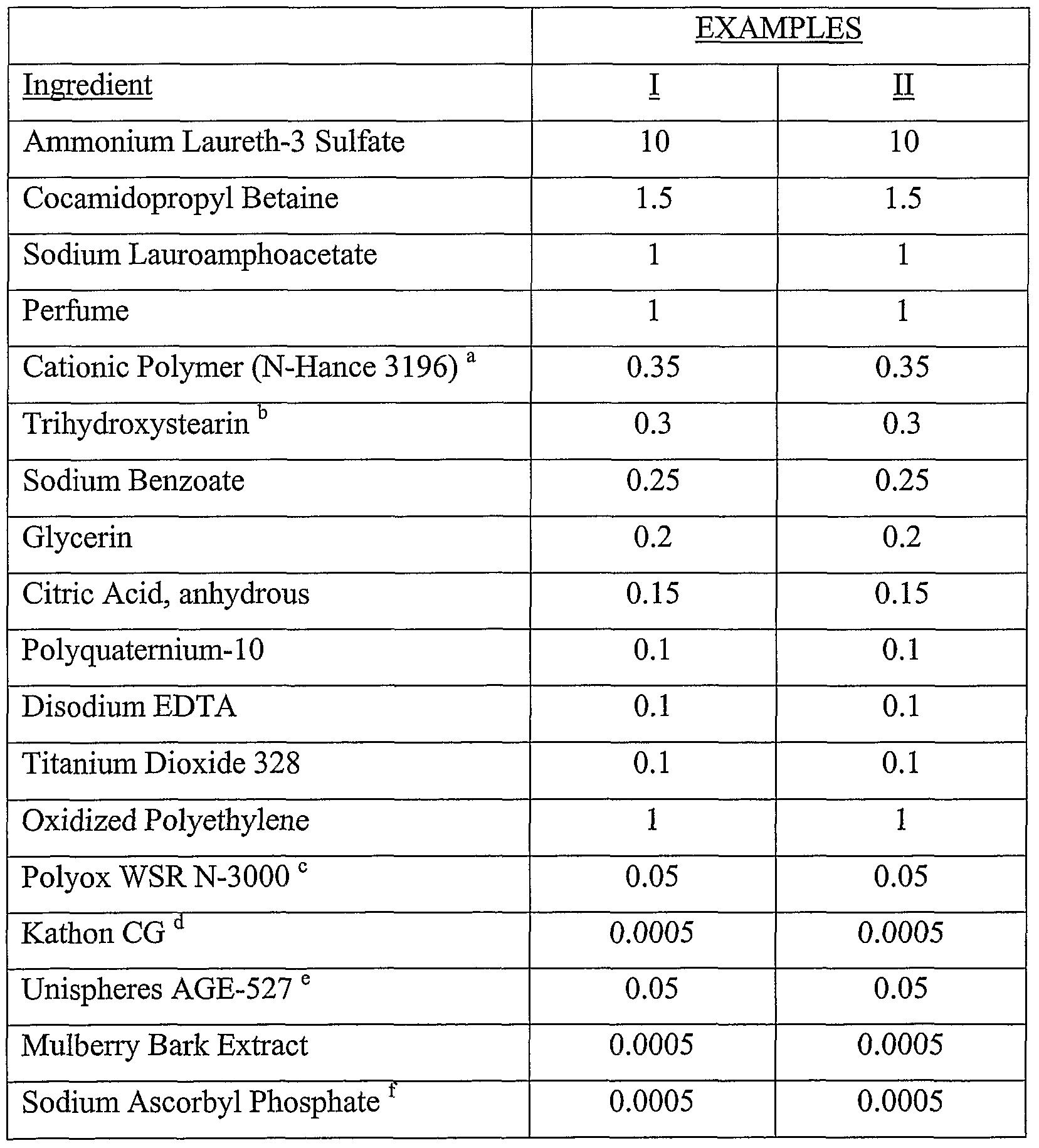
- liquid body wash compositions according to the present invention.
- the amounts below are provided as weight percent.
Landscapes
- Health & Medical Sciences (AREA)
- Life Sciences & Earth Sciences (AREA)
- Veterinary Medicine (AREA)
- Animal Behavior & Ethology (AREA)
- General Health & Medical Sciences (AREA)
- Public Health (AREA)
- Birds (AREA)
- Epidemiology (AREA)
- Dermatology (AREA)
- Chemical & Material Sciences (AREA)
- Oil, Petroleum & Natural Gas (AREA)
- Cosmetics (AREA)
- Detergent Compositions (AREA)
Abstract
Description




Claims
Priority Applications (8)
| Application Number | Priority Date | Filing Date | Title |
|---|---|---|---|
| JP2007536885A JP2008516966A (en) | 2004-10-15 | 2005-10-14 | Personal care composition comprising visible beads, a cationic polymer, and a surfactant |
| DE602005024843T DE602005024843D1 (en) | 2004-10-15 | 2005-10-14 | BODY CLEANING AGENT WITH VISIBLE BEADS, A CATIONIC POLYMER AND A TENSID |
| CN2005800350979A CN101039723B (en) | 2004-10-15 | 2005-10-14 | Personal care compositions comprising visible beads, cationic polymer, and surfactant |
| EP05809882A EP1799178B1 (en) | 2004-10-15 | 2005-10-14 | Liquid body wash compositions comprising visible beads, cationic polymer, and surfactant |
| AU2005295763A AU2005295763A1 (en) | 2004-10-15 | 2005-10-14 | Personal care compositions comprising visible beads, cationic polymer, and surfactant |
| CA002583160A CA2583160A1 (en) | 2004-10-15 | 2005-10-14 | Personal care compositions comprising visible beads, cationic polymer, and surfactant |
| MX2007004494A MX2007004494A (en) | 2004-10-15 | 2005-10-14 | Personal care compositions comprising visible beads, cationic polymer, and surfactant. |
| AT05809882T ATE488219T1 (en) | 2004-10-15 | 2005-10-14 | BODY CLEANSER WITH VISIBLE BEADS, A CATIONIC POLYMER AND A SURFACTANT |
Applications Claiming Priority (2)
| Application Number | Priority Date | Filing Date | Title |
|---|---|---|---|
| US61921404P | 2004-10-15 | 2004-10-15 | |
| US60/619,214 | 2004-10-15 |
Publications (1)
| Publication Number | Publication Date |
|---|---|
| WO2006044538A1 true WO2006044538A1 (en) | 2006-04-27 |
Family
ID=35744732
Family Applications (1)
| Application Number | Title | Priority Date | Filing Date |
|---|---|---|---|
| PCT/US2005/036820 Ceased WO2006044538A1 (en) | 2004-10-15 | 2005-10-14 | Personal care compositions comprising visible beads, cationic polymer, and surfactant |
Country Status (11)
| Country | Link |
|---|---|
| US (1) | US7410649B2 (en) |
| EP (1) | EP1799178B1 (en) |
| JP (1) | JP2008516966A (en) |
| KR (1) | KR20070085348A (en) |
| CN (1) | CN101039723B (en) |
| AT (1) | ATE488219T1 (en) |
| AU (1) | AU2005295763A1 (en) |
| CA (1) | CA2583160A1 (en) |
| DE (1) | DE602005024843D1 (en) |
| MX (1) | MX2007004494A (en) |
| WO (1) | WO2006044538A1 (en) |
Cited By (2)
| Publication number | Priority date | Publication date | Assignee | Title |
|---|---|---|---|---|
| FR2917965A1 (en) * | 2007-06-26 | 2009-01-02 | Oreal | Composition, useful to care and/or treat skin and to homogenize the skin complexion, comprises an emulsion, encapsulated pigments, at least an aqueous phase, and at least an oil phase |
| JP2015091950A (en) * | 2006-06-20 | 2015-05-14 | ザ プロクター アンド ギャンブルカンパニー | Detergent compositions for cleaning and fabric care |
Families Citing this family (55)
| Publication number | Priority date | Publication date | Assignee | Title |
|---|---|---|---|---|
| US7578812B2 (en) * | 2001-03-01 | 2009-08-25 | Kimberly-Clark Worldwide, Inc. | Pre-fastened absorbent article having simplified fastening features |
| US6669929B1 (en) | 2002-12-30 | 2003-12-30 | Colgate Palmolive Company | Dentifrice containing functional film flakes |
| US20060228308A1 (en) * | 2004-02-26 | 2006-10-12 | Cummins Barry W | Oral health care drink and method for reducing malodors |
| CA2574037A1 (en) * | 2004-07-21 | 2006-02-02 | Colgate-Palmolive Company | Structured body wash |
| WO2006116099A1 (en) * | 2005-04-21 | 2006-11-02 | Colgate-Palmolive Company | Liquid detergent composition |
| GB0514716D0 (en) * | 2005-07-19 | 2005-08-24 | Unilever Plc | Process to form fabric softening particle,particle obtained and its use |
| US20070044824A1 (en) * | 2005-09-01 | 2007-03-01 | Scott William Capeci | Processing system and method of processing |
| US20080070823A1 (en) * | 2006-09-15 | 2008-03-20 | Philip Gorlin | Liquid Detergent Composition |
| US8772359B2 (en) * | 2006-11-08 | 2014-07-08 | Cp Kelco U.S., Inc. | Surfactant thickened systems comprising microfibrous cellulose and methods of making same |
| US9045716B2 (en) * | 2006-11-08 | 2015-06-02 | Cp Kelco U.S., Inc. | Surfactant thickened systems comprising microfibrous cellulose and methods of making same |
| PT2308957E (en) | 2006-12-15 | 2013-05-21 | Colgate Palmolive Co | Liquid detergent composition |
| US7888308B2 (en) * | 2006-12-19 | 2011-02-15 | Cp Kelco U.S., Inc. | Cationic surfactant systems comprising microfibrous cellulose |
| US20080242581A1 (en) * | 2007-04-02 | 2008-10-02 | Colgate-Palmolive Company | Liquid Detergent With Refractive Particle |
| KR101438371B1 (en) * | 2007-11-30 | 2014-09-12 | (주)아모레퍼시픽 | Facial cleanser composition for removing make-up on the skin |
| US20090197974A1 (en) * | 2008-02-05 | 2009-08-06 | Khaleeq Ahmed | Natural dietary supplement tablet |
| CA2735252A1 (en) * | 2008-08-28 | 2010-03-04 | The Procter & Gamble Company | Fabric care compositions, process of making, and method of use |
| US7757657B2 (en) * | 2008-09-11 | 2010-07-20 | Gm Global Technology Operations, Inc. | Dual active fuel management sequencing |
| US8163298B2 (en) * | 2008-10-29 | 2012-04-24 | The Procter & Gamble Company | Aqueous gel having an alpha-hydroxy acid and suspended particulates |
| WO2010126742A1 (en) | 2009-05-01 | 2010-11-04 | Colgate-Palmolive Company | Liquid cleaning composition with films |
| USD612984S1 (en) | 2009-06-29 | 2010-03-30 | St. Ives Laboratories, Inc. | Cosmetic product |
| USD612097S1 (en) | 2009-06-29 | 2010-03-16 | St. Ives Laboratories, Inc. | Cosmetic product |
| USD612987S1 (en) | 2009-07-30 | 2010-03-30 | St. Ives Laboratories, Inc. | Cosmetic product |
| USD612098S1 (en) | 2009-06-29 | 2010-03-16 | St. Ives Laboratories, Inc. | Cosmetic product |
| USD612100S1 (en) | 2009-06-29 | 2010-03-16 | St. Ives Laboratories, Inc. | Cosmetic product |
| USD612989S1 (en) | 2009-07-30 | 2010-03-30 | St. Ives Laboratories, Inc. | Cosmetic product |
| USD612537S1 (en) | 2009-06-29 | 2010-03-23 | St. Ives Laboratories, Inc. | Cosmetic product |
| USD612099S1 (en) | 2009-06-29 | 2010-03-16 | St. Ives Laboratories, Inc. | Cosmetic product |
| USD612096S1 (en) | 2009-06-29 | 2010-03-16 | St. Ives Laboratories, Inc. | Cosmetic product |
| USD612101S1 (en) | 2009-06-29 | 2010-03-16 | St. Ives Laboratories, Inc. | Cosmetic product |
| USD612538S1 (en) | 2009-06-29 | 2010-03-23 | St. Ives Laboratories, Inc. | Cosmetic product |
| USD612986S1 (en) | 2009-07-30 | 2010-03-30 | St. Ives Laboratories, Inc. | Cosmetic product |
| USD612539S1 (en) | 2009-08-21 | 2010-03-23 | St. Ives Laboratories, Inc. | Cosmetic product |
| USD612988S1 (en) | 2009-07-30 | 2010-03-30 | St. Ives Laboratories, Inc. | Cosmetic product |
| USD612985S1 (en) | 2009-07-30 | 2010-03-30 | St. Ives Laboratories, Inc. | Cosmetic product |
| MX2012002682A (en) * | 2009-09-08 | 2012-05-29 | Cp Kelco Us Inc | Methods to improve the compatibility and efficiency of powdered versions of microfibrous cellulose. |
| US8017566B2 (en) * | 2009-11-13 | 2011-09-13 | Conopco, Inc. | Liquid personal cleansing composition |
| US20120276177A1 (en) | 2009-12-23 | 2012-11-01 | Colgate-Palmolive Company | Visually patterned and oriented compositions |
| CN102858153A (en) * | 2010-03-12 | 2013-01-02 | 加利福尼亚大学董事会 | Triggered cargo release from nanoparticle stabilized liposomes |
| WO2011162755A1 (en) * | 2010-06-23 | 2011-12-29 | Colgate-Palmolive Company | Encapsulation of ingredients in lactose matrix to form active encapsulates |
| WO2014070689A1 (en) | 2012-10-29 | 2014-05-08 | The Procter & Gamble Company | Personal care compositions having a tan delta of 0.30 or more at 10°c |
| US11096861B2 (en) | 2014-02-19 | 2021-08-24 | Keith G. Lurie | Systems and methods for gravity-assisted cardiopulmonary resuscitation and defibrillation |
| US9707152B2 (en) | 2014-02-19 | 2017-07-18 | Keith G. Lurie | Systems and methods for head up cardiopulmonary resuscitation |
| US11246794B2 (en) | 2014-02-19 | 2022-02-15 | Keith G. Lurie | Systems and methods for improved post-resuscitation recovery |
| US12144777B2 (en) | 2014-02-19 | 2024-11-19 | Resuscitation Innovations Llc | Methods and systems to reduce brain damage |
| US11844742B2 (en) | 2014-02-19 | 2023-12-19 | Keith G. Lurie | Methods and systems to reduce brain damage |
| US9801782B2 (en) | 2014-02-19 | 2017-10-31 | Keith G. Lurie | Support devices for head up cardiopulmonary resuscitation |
| US9750661B2 (en) | 2014-02-19 | 2017-09-05 | Keith G. Lurie | Systems and methods for head up cardiopulmonary resuscitation |
| CN104490682A (en) * | 2014-12-10 | 2015-04-08 | 唯美度科技(北京)有限公司 | Non-alcoholic astringent and antiseptic aftershave and preparation method thereof |
| TWI616524B (en) * | 2016-08-11 | 2018-03-01 | 星彥塑膠股份有限公司 | Pva particles contained cleaning cream, producing method and applications thereof |
| WO2018152167A1 (en) * | 2017-02-16 | 2018-08-23 | Rhodia Operations | Sulfate-free formulations |
| CN107625669A (en) * | 2017-10-13 | 2018-01-26 | 北京洛娃日化有限公司 | A kind of shower cream and preparation method |
| CN109464297A (en) * | 2018-11-20 | 2019-03-15 | 澳宝化妆品(惠州)有限公司 | A kind of composition of the solid-state structure containing liquid crystal and its application |
| WO2023196410A1 (en) | 2022-04-05 | 2023-10-12 | Momentive Performance Materials Inc. | Modified natural and green particles for cosmetic application |
| CN115634175B (en) * | 2022-10-31 | 2023-09-12 | 科乐美(广州)生物科技有限公司 | Composition for preparing microbead essence, microbead essence and preparation method of microbead essence |
| CN118948695A (en) * | 2024-07-30 | 2024-11-15 | 广州鸿博生物科技有限公司 | A kind of encapsulated controlled-release odor-removing factor and its application |
Citations (5)
| Publication number | Priority date | Publication date | Assignee | Title |
|---|---|---|---|---|
| US6106815A (en) * | 1995-12-26 | 2000-08-22 | Cheil Jedang Corporation | Shampoo composition containing methyl vinyl ether/maleic anhydride decadiene crosspolymer and capsules |
| US6534091B1 (en) * | 1999-07-02 | 2003-03-18 | Cognis Iberia S. L. | Microcapsules |
| US20030165454A1 (en) * | 2000-05-30 | 2003-09-04 | The Procter & Gamble Company | Hair conditioning composition comprising a frizz control agent |
| US20030171230A1 (en) * | 2002-03-04 | 2003-09-11 | Unilever Home And Personal Care Usa, Division Of Conopco, Inc. | Isotropic cleansing composition with benefit agent particles |
| US20040047822A1 (en) * | 2002-08-02 | 2004-03-11 | Zamudo-Tena Jose F. | Clear personal care compositions containing visible capsules |
Family Cites Families (7)
| Publication number | Priority date | Publication date | Assignee | Title |
|---|---|---|---|---|
| US6045813A (en) * | 1998-03-30 | 2000-04-04 | Bath & Body Works, Inc. | Lotions and gels with active ingredients in beads |
| EP1104278B1 (en) | 1998-07-30 | 2004-11-24 | The Procter & Gamble Company | Hair conditioning composition comprising carboxylic acid/carboxylate copolymer, and visible particle |
| CA2333762A1 (en) | 1998-07-30 | 2000-02-10 | The Procter & Gamble Company | Transparent hair conditioning composition comprising breakable visible particle |
| JP2002534364A (en) | 1999-01-04 | 2002-10-15 | ザ、プロクター、エンド、ギャンブル、カンパニー | Transparent hair conditioning composition containing breakable visible particles |
| WO2000040212A1 (en) | 1999-01-04 | 2000-07-13 | The Procter & Gamble Company | Transparent hair conditioning composition comprising hydrophobic emulsifier and breakable visible particle |
| WO2001074310A2 (en) * | 2000-03-31 | 2001-10-11 | The Procter & Gamble Company | Leave-in hair cosmetic compositions for enhancing volume containing microspheres |
| US6797683B2 (en) * | 2002-03-04 | 2004-09-28 | Unilever Home & Personal Care Usa, Division Of Conopco, Inc. | Ordered liquid crystalline cleansing composition with benefit agent particles |
-
2005
- 2005-10-12 US US11/248,069 patent/US7410649B2/en not_active Expired - Lifetime
- 2005-10-14 AU AU2005295763A patent/AU2005295763A1/en not_active Abandoned
- 2005-10-14 EP EP05809882A patent/EP1799178B1/en not_active Revoked
- 2005-10-14 KR KR1020077010864A patent/KR20070085348A/en not_active Ceased
- 2005-10-14 JP JP2007536885A patent/JP2008516966A/en active Pending
- 2005-10-14 DE DE602005024843T patent/DE602005024843D1/en not_active Expired - Lifetime
- 2005-10-14 CA CA002583160A patent/CA2583160A1/en not_active Abandoned
- 2005-10-14 MX MX2007004494A patent/MX2007004494A/en active IP Right Grant
- 2005-10-14 CN CN2005800350979A patent/CN101039723B/en not_active Expired - Fee Related
- 2005-10-14 AT AT05809882T patent/ATE488219T1/en not_active IP Right Cessation
- 2005-10-14 WO PCT/US2005/036820 patent/WO2006044538A1/en not_active Ceased
Patent Citations (5)
| Publication number | Priority date | Publication date | Assignee | Title |
|---|---|---|---|---|
| US6106815A (en) * | 1995-12-26 | 2000-08-22 | Cheil Jedang Corporation | Shampoo composition containing methyl vinyl ether/maleic anhydride decadiene crosspolymer and capsules |
| US6534091B1 (en) * | 1999-07-02 | 2003-03-18 | Cognis Iberia S. L. | Microcapsules |
| US20030165454A1 (en) * | 2000-05-30 | 2003-09-04 | The Procter & Gamble Company | Hair conditioning composition comprising a frizz control agent |
| US20030171230A1 (en) * | 2002-03-04 | 2003-09-11 | Unilever Home And Personal Care Usa, Division Of Conopco, Inc. | Isotropic cleansing composition with benefit agent particles |
| US20040047822A1 (en) * | 2002-08-02 | 2004-03-11 | Zamudo-Tena Jose F. | Clear personal care compositions containing visible capsules |
Cited By (2)
| Publication number | Priority date | Publication date | Assignee | Title |
|---|---|---|---|---|
| JP2015091950A (en) * | 2006-06-20 | 2015-05-14 | ザ プロクター アンド ギャンブルカンパニー | Detergent compositions for cleaning and fabric care |
| FR2917965A1 (en) * | 2007-06-26 | 2009-01-02 | Oreal | Composition, useful to care and/or treat skin and to homogenize the skin complexion, comprises an emulsion, encapsulated pigments, at least an aqueous phase, and at least an oil phase |
Also Published As
| Publication number | Publication date |
|---|---|
| DE602005024843D1 (en) | 2010-12-30 |
| CA2583160A1 (en) | 2006-04-27 |
| ATE488219T1 (en) | 2010-12-15 |
| EP1799178B1 (en) | 2010-11-17 |
| JP2008516966A (en) | 2008-05-22 |
| MX2007004494A (en) | 2007-05-08 |
| CN101039723A (en) | 2007-09-19 |
| AU2005295763A1 (en) | 2006-04-27 |
| EP1799178A1 (en) | 2007-06-27 |
| KR20070085348A (en) | 2007-08-27 |
| US7410649B2 (en) | 2008-08-12 |
| CN101039723B (en) | 2013-06-19 |
| US20060083761A1 (en) | 2006-04-20 |
Similar Documents
| Publication | Publication Date | Title |
|---|---|---|
| US7410649B2 (en) | Personal care compositions comprising visible beads, cationic polymer, and surfactant | |
| US6699824B1 (en) | Cleansing compositions comprising highly branched polyalphaolefins | |
| KR100501784B1 (en) | Cleansing compositions | |
| US6627586B1 (en) | Cleansing compositions | |
| AU744441B2 (en) | Cleansing compositions | |
| US6312678B1 (en) | Cleansing compositions comprising water-soluble surfactant and water-insoluble oil | |
| CA2300426A1 (en) | Cleansing compositions | |
| US6472355B2 (en) | Cleansing compositions | |
| EP1011625B1 (en) | Cleansing compositions | |
| JP2001520182A (en) | Cleaning composition | |
| EP1093353B1 (en) | Cleansing compositions | |
| JP2001513537A (en) | Cleansing composition based on hydrophobically modified silicone |
Legal Events
| Date | Code | Title | Description |
|---|---|---|---|
| AK | Designated states |
Kind code of ref document: A1 Designated state(s): AE AG AL AM AT AU AZ BA BB BG BR BW BY BZ CA CH CN CO CR CU CZ DE DK DM DZ EC EE EG ES FI GB GD GE GH GM HR HU ID IL IN IS JP KE KG KM KP KR KZ LC LK LR LS LT LU LV LY MA MD MG MK MN MW MX MZ NA NG NI NO NZ OM PG PH PL PT RO RU SC SD SE SG SK SL SM SY TJ TM TN TR TT TZ UA UG US UZ VC VN YU ZA ZM ZW |
|
| AL | Designated countries for regional patents |
Kind code of ref document: A1 Designated state(s): BW GH GM KE LS MW MZ NA SD SL SZ TZ UG ZM ZW AM AZ BY KG KZ MD RU TJ TM AT BE BG CH CY CZ DE DK EE ES FI FR GB GR HU IE IS IT LT LU LV MC NL PL PT RO SE SI SK TR BF BJ CF CG CI CM GA GN GQ GW ML MR NE SN TD TG |
|
| 121 | Ep: the epo has been informed by wipo that ep was designated in this application | ||
| WWE | Wipo information: entry into national phase |
Ref document number: 2005809882 Country of ref document: EP |
|
| WWE | Wipo information: entry into national phase |
Ref document number: 2583160 Country of ref document: CA |
|
| WWE | Wipo information: entry into national phase |
Ref document number: 12007500799 Country of ref document: PH |
|
| WWE | Wipo information: entry into national phase |
Ref document number: MX/a/2007/004494 Country of ref document: MX Ref document number: 2005295763 Country of ref document: AU Ref document number: 200580035097.9 Country of ref document: CN |
|
| WWE | Wipo information: entry into national phase |
Ref document number: 2007536885 Country of ref document: JP |
|
| NENP | Non-entry into the national phase |
Ref country code: DE |
|
| WWE | Wipo information: entry into national phase |
Ref document number: 1020077010864 Country of ref document: KR |
|
| WWP | Wipo information: published in national office |
Ref document number: 2005809882 Country of ref document: EP |