WO2006050140A2 - Dynamic adaptation for wireless communications with enhanced quality of service - Google Patents
Dynamic adaptation for wireless communications with enhanced quality of service Download PDFInfo
- Publication number
- WO2006050140A2 WO2006050140A2 PCT/US2005/039033 US2005039033W WO2006050140A2 WO 2006050140 A2 WO2006050140 A2 WO 2006050140A2 US 2005039033 W US2005039033 W US 2005039033W WO 2006050140 A2 WO2006050140 A2 WO 2006050140A2
- Authority
- WO
- WIPO (PCT)
- Prior art keywords
- access point
- nodes
- hcca
- period
- contention
- Prior art date
- Legal status (The legal status is an assumption and is not a legal conclusion. Google has not performed a legal analysis and makes no representation as to the accuracy of the status listed.)
- Ceased
Links
Classifications
-
- H—ELECTRICITY
- H04—ELECTRIC COMMUNICATION TECHNIQUE
- H04W—WIRELESS COMMUNICATION NETWORKS
- H04W74/00—Wireless channel access
- H04W74/02—Hybrid access
-
- H—ELECTRICITY
- H04—ELECTRIC COMMUNICATION TECHNIQUE
- H04L—TRANSMISSION OF DIGITAL INFORMATION, e.g. TELEGRAPHIC COMMUNICATION
- H04L47/00—Traffic control in data switching networks
- H04L47/10—Flow control; Congestion control
- H04L47/24—Traffic characterised by specific attributes, e.g. priority or QoS
- H04L47/2416—Real-time traffic
-
- H—ELECTRICITY
- H04—ELECTRIC COMMUNICATION TECHNIQUE
- H04W—WIRELESS COMMUNICATION NETWORKS
- H04W28/00—Network traffic management; Network resource management
- H04W28/02—Traffic management, e.g. flow control or congestion control
-
- H—ELECTRICITY
- H04—ELECTRIC COMMUNICATION TECHNIQUE
- H04W—WIRELESS COMMUNICATION NETWORKS
- H04W28/00—Network traffic management; Network resource management
- H04W28/16—Central resource management; Negotiation of resources or communication parameters, e.g. negotiating bandwidth or QoS [Quality of Service]
- H04W28/24—Negotiating SLA [Service Level Agreement]; Negotiating QoS [Quality of Service]
-
- H—ELECTRICITY
- H04—ELECTRIC COMMUNICATION TECHNIQUE
- H04W—WIRELESS COMMUNICATION NETWORKS
- H04W8/00—Network data management
- H04W8/02—Processing of mobility data, e.g. registration information at HLR [Home Location Register] or VLR [Visitor Location Register]; Transfer of mobility data, e.g. between HLR, VLR or external networks
- H04W8/04—Registration at HLR or HSS [Home Subscriber Server]
-
- H—ELECTRICITY
- H04—ELECTRIC COMMUNICATION TECHNIQUE
- H04W—WIRELESS COMMUNICATION NETWORKS
- H04W84/00—Network topologies
- H04W84/02—Hierarchically pre-organised networks, e.g. paging networks, cellular networks, WLAN [Wireless Local Area Network] or WLL [Wireless Local Loop]
- H04W84/10—Small scale networks; Flat hierarchical networks
- H04W84/12—WLAN [Wireless Local Area Networks]
Definitions
- Wireless communication systems use electromagnetic radio waves to provide wireless communication services to wireless communication devices which may also be referred to as wireless nodes or access terminals, such as mobile phones and portable computers equipped with wireless communication ports.
- wireless communication devices which may also be referred to as wireless nodes or access terminals, such as mobile phones and portable computers equipped with wireless communication ports.
- a wireless local area network may be designed to use one or more communication devices called access points (APs) as a portal to one or more packet data and other networks and to provide wireless services for mobile and other wireless communication devices (i.e., wireless nodes) in a small geographic area.
- Each access point has ' a radio transceiver that covers a limited area called a hot spot or zone within which a wireless device can access wireless services.
- IEEE 802.11 standards have been widely adopted as one of the communication protocols for WLANs and IEEE 802. lie has features that specifically address the quality of service in WLANs.
- WLANs can be used to provide wireless broadband services such as multimedia applications which may include streaming video, teleconferencing, voice over IP and other services.
- multimedia applications which may include streaming video, teleconferencing, voice over IP and other services.
- the affordability and improvements to support higher data rates in WLANs have led to a wide spread adoption of WLAN technologies. This can be seen in the proliferation of WLAN networks in homes, offices, and commercial settings, such as airports and restaurants.
- the time-varying nature of wireless access and the diverse requirements of multimedia applications make the task of supporting wireless multimedia services in WLANs challenging.
- Standardization efforts are being pursued to provide Quality of Service (QoS) mechanisms for medium access in WLANs.
- IEEE 802. lie is an example of such efforts.
- IEEE 802. lie differentiation mechanisms at the Medium Access Control (MAC) layer See, e.g., IEEE-802. HWG, "Draft supplement to standard for telecommunications and information exchange between systems - LAN/MAN specific requirements - part 11: MAC enhancements for quality of service (QoS)," IEEE 802. lie Standard Draft/D8.0 (Feb. 2004) .
- the IEEE 802. lie standard provides a framework called Hybrid Coordination Function (HCF) that multiplexes between two modes of medium access provided in- 802.
- HCF Hybrid Coordination Function
- EDCA Enhanced Distributed Channel Access
- HCCA Hybrid Coordination Function Controlled Channel Access
- the standard also presents a reference design of a scheduler to construct a polling schedule based on the flow requirements specified in the reservation request at initialization.
- the details of this reference design can be found in J. Prado, "Mandatory TSPEC parameters and reference design of a simple scheduler," IEEE 802. ll-O2/7O5arO, Nov. 2002. Summary
- This application describes, among others, techniques and systems designed to dynamically control communications between wireless devices and an access point in a wireless local area network (WLAN) to enhance the quality of service (QoS) .
- Described techniques and systems may be implemented to further enhance QoS in WLANs under IEEE 802. lie by providing dynamic and adaptive control of medium access via a polling- based centralized medium access mode and a distributed contention-based medium access mode.
- One example described in this application is a method for controlling communications in a wireless local area network (WLAN) having an access point as a communication portal and a plurality of wireless communication nodes each wirelessly communicating with the access point. In this method, the access point is operated to receive information about communication flows from the nodes.
- WLAN wireless local area network
- Selected nodes are assigned, based on nature of communication flows with the selected nodes, with contention-free time periods to allow each selected node to communicate with the access point without contention with other nodes in a corresponding contention-free time period.
- the remaining nodes are assigned to contend with each other in a time period outside the contention-free time periods and to communicate with the access point.
- the communication delay buildup in each of the nodes is monitored during communications in assigned time periods to determine whether additional time is needed. Additional contention-free time is allocated to a node needing the additional time when such additional contention-free time is available. When the additional contention-free time is not available, the selected node is then directed to contend with other nodes in communicating with the access point.
- this application describes a method for controlling communications in a wireless local area network (WLAN) in compliance with IEEE 802. lie to support polling-based contention-free communications with an access point of the WLAN according to Hybrid Coordination Function Controlled Channel Access (HCCA) and prioritized contention- based Enhanced Distributed Channel Access (EDCA) .
- HCCA Hybrid Coordination Function Controlled Channel Access
- EDCA Enhanced Distributed Channel Access
- Each service interval for communicating with the access point is divided into (1) an HCCA period during which a wireless communication node allocated to communicate with the access period is assigned with a contention-free time period to communicate with the access point without contention of other nodes and (2) a separate EDCA period during which a wireless communication node contends with other nodes to communicate with the access point based on assigned access categories.
- the communication delay at each node in communication with the access point is monitored and the traffic load at the access point for communications with nodes in the EDCA period is also monitored.
- the access of nodes to the access point is dynamically controlled according to the monitored communication delays of nodes and the monitored traffic load.
- This dynamic control includes at least one of the following: (1) allocating additional time to a selected node which has been previously assigned to communicate with the access point in the HCCA period, (2) assigning a selected node which has been previously assigned to communicate with the access point in the HCCA period and has completed assigned communication with the access point in HCCA, after the HCCA period terminates, to continue communicating with the access point in the EDCA period in contention with other nodes, and (3) allocating a contention-free time period in the HCCA period to a selected node, which has been previously assigned to communicate with the access point in the EDCA period, to communicate with the access point when there is unused time left in the HCCA period after nodes previously assigned to the HCCA period have been served.
- This application also describe an exemplary system for controlling communications between wireless communication nodes and an access point in a wireless local area network under IEEE 802. lie to support polling-based contention-free communications between nodes and the access point according to Hybrid Coordination Function Controlled Channel Access (HCCA) and prioritized contention-based Enhanced Distributed Channel Access (EDCA) .
- HCCA Hybrid Coordination Function Controlled Channel Access
- EDCA Enhanced Distributed Channel Access
- This system includes a monitoring module having an HCCA monitor which monitors HCCA communication flows to produce HCCA measurements and an EDCA monitor which monitors EDCA communication flows to produce ECCA measurements, and an adaptor module which, in response to the HCCA measurements and the EDCA measurements, operates to dynamically control communications of nodes with the access point in both HCCA and EDCA to reduce an aggregated communication delay caused by delays of individual nodes.
- the adaptor module operates to allocate additional time in HCCA to a selected node which has been previously assigned to communicate with the access point in HCCA.
- the adaptor module operates to assign a selected node, which has been previously assigned to communicate with the access point in HCCA and has completed assigned communication with the access point in HCCA, to continue communicating with the access point in EDCA in contention with other nodes.
- the adaptor module operates to allocate a contention-free time period in HCCA to a selected node, which has been previously assigned to communicate with the access point in EDCA, to communicate with the access point when there is unused time left in HCCA after nodes previously assigned to HCCA have been served.
- Figure 1 illustrates hybrid coordination function (HCF) channel access in a wireless local area network (WLAN) under IEEE 802. lie.
- HCF hybrid coordination function
- Figure 2 illustrates the enhanced distributed channel access (EDCA) in a wireless local area network under IEEE 802. lie.
- Figure 3 shows a comparison of throughputs for constant bit rate (CBR) and variable bit rate (VBR) flows in a WLAN under IEEE 802. lie.
- CBR constant bit rate
- VBR variable bit rate
- Figure 4 shows probability density functions (PDFs) of the residual queue length after (1, 25, 50, 100) service intervals for the two Gaussian input curves, respectively.
- Figure 5 shows the PDFs of residual queue lengths of the same Gaussian inputs with a modified p given by ⁇ + ⁇ .
- Figure 6 illustrates HCCA allocation and EDCA allocation in one implementation of the present dynamic adaptation.
- Figures 7A and 7B show pseudocodes for exemplary algorithms that implement the present dynamic adaptation.
- Figure 8 shows one exemplary flowchart for one implementation of a dynamic adaptation algorithm.
- Figure 9 shows a system that includes a monitor module and an adaptor module to implement the dynamic adaptation.
- Figure 10 shows residual queue sizes and delays for CBR and VBR flows in simulations. [0022] .
- Figure 11A illustrates one implementation of the dynamic adaptation where a flow initially assigned in EDCA is reassigned in an available time period in HCCA.
- Figures HB and HC show simulations results for the implementation in Figure HA.
- HCF only allocates a fixed polling schedule suitable for constant bit rate (CBR) traffic using the averaged values specified in the reservation request, such as mean packet size and required throughput.
- CBR constant bit rate
- multimedia traffic flows that do not have the CBR profile, such as quality-controlled MPEG4 or video-conferencing, and instead use Variable Bit Rate (VBR) encoding.
- VBR Variable Bit Rate
- Some of the advantages of VBR encoding include better video quality for the same average bit rate and shorter delay.
- service providers commonly use VBR encoding of multimedia content to increase the capacity of the network by multiplexing between different VBR flows. See, e.g., Lakshman et al., "VBR video: Tradeoffs and potentials" in Proceedings of IEEE, vol. 86, pp.
- an adaptation policy is provided to configure the polling-based scheduling policy and dynamically associate traffic flows to the appropriate medium access mode. This policy takes into account the possible inaccuracies in reservation information, the variance in flow generation and throughput requirements, and current system utilization. Additionally, the policy performs these adaptations with minimal effects on other flows in the network. To evaluate the effectiveness of this approach, a comparison is made between this adaptation policy with the reference design of a scheduler for 802.
- the present dynamic adaptation can be configured to provide, in part, an Access Point (AP) based QoS provisioning mechanism to coordinate the centralized (HCCA) and distributed (EDCA) schemes of IEEE 802. lie.
- AP Access Point
- HCCA centralized
- EDCA distributed
- the present dynamic adaptation can be used to determine at run time whether a flow should be serviced in HCCA, EDCA, or both.
- the proposed policy takes into account the possible inaccuracies in reservation information, the variance in flow generation and throughput requirements, and current system utilization. Additionally, the policy makes these adaptations with minimal effects on other flows in the network. We have demonstrated that with our adaptation, the QoS of multimedia applications, in terms of delay and throughput metrics, can be significantly improved.
- the dynamic adaptation can be used to improve the Quality of Service (QoS) experienced by end-users over WLAN networks by improving system utilization of the WLAN network via, e.g., using available time in the polling period to minimize the delay experienced by real-time multimedia flows. Additionally, the dynamic adaptation improves the throughput of flows, which may possibly be soft real-time flows, by allocating time in the centralized polling period if there is time available.
- the overall approach of the dynamic adaptation is to dynamically associate traffic flows to the two channel access modes and modify access privileges based on monitored traffic information. Specifically, with flows scheduled in the centralized polling period of 802.
- Hybrid Coordination Function Channel Control Access we consider tracking queue information to recognize when variations from the traffic reservation have led to a queue buildup. When this occurs, we allocate additional time to a traffic flow in order to reduce the flow's queue size and prevent a high experienced packet delay. If there is time available in HCCA, we allocate additional time by re-polling a flow after all previously scheduled flows have been polled. However, if no time remains in the HCCA period, we attempt to decrease the queue buildup through better utilization of the distributed contention period of 802. lie, called the Enhanced Distributed Channel Access (EDCA) period. The algorithm estimates the current load in EDCA and depending on the load, we send a signal encouraging the HCCA traffic flow to send in the EDCA period.
- EDCA Enhanced Distributed Channel Access
- our algorithm In addition to minimizing the delay of HCCA scheduled flows, our algorithm also attempts to improve QoS metrics for EDCA flows by allocating time in the HCCA period if there is time available. For this adaptation, we target high-priority flows that are suffering from throughput degradation due to congestion or channel variations.
- Potential applications of various implementations of the present dynamic adaptation include, among others, the ability to provide guaranteed Quality of Service to end-users and improve the system utilization of WLAN networks. The techniques can be commercially useful for WLAN installations that will experience a high volume of real-time multimedia applications, such as airports, offices (for teleconferencing), and households.
- IEEE 802. lie defines a new operation mode called the Hybrid Coordination Function (HCF) .
- Figure 1 illustrates the HCF channel access by showing two adjacent service intervals (Sis) where each service interval includes an HCCA period and an EDCA period.
- Both access functions enhance functionality of the original access methods specified in 802.11a/b/g: Distributed Coordination Function (DCF) and Point Coordination Function (PCF) .
- DCF Distributed Coordination Function
- PCF Point Coordination Function
- a basic concept common to the two access schemes proposed in 802. lie is the notion of a transmission opportunity (TXOP) .
- TXOP is a bounded time interval for which a node is allowed to transmit. While TXOPs in EDCA are decided based on traffic flows, in
- EDCA Distributed Coordination Function
- ACs access categories
- the modified channel access parameters are Arbitration Interframe Spacing (AIFS) which is the minimum time interval to wait before starting backoff; Transmission Opportunity (TXOP) which is the maximum duration for which the node can transmit; and Contention Window- parameters ⁇ CW m i n and CW max ) which decide the random number of slots to wait before starting transmission.
- AIFS Arbitration Interframe Spacing
- TXOP Transmission Opportunity
- Contention Window- parameters ⁇ CW m i n and CW max Contention Window- parameters which decide the random number of slots to wait before starting transmission.
- the access parameters are decided by the Access Point (AP) , and are beaconed to the nodes in the network.
- the 802. lie protocol In addition to prioritized channel access, the 802. lie protocol describes a centralized channel access scheme, called HCF Controlled Channel Access (HCCA) , to provide guaranteed QoS.
- HCCA HCF Controlled Channel Access
- Figure 1 illustrates the channel access scheme used by 802. lie HCCA. Similar to the legacy Point Coordination
- PCF Policy Control Function
- HCCA uses a polling-based mechanism, where the medium access is controlled by the AP.
- the main difference between the legacy PCF and HCCA is the flexibility of when the contention-free period can occur.
- the AP can begin a contention-free HCCA period if the medium has remained idle for a PCF interframe space period, which is shorter than the minimum AIFS.
- the AP polls nodes for a fixed time duration, called TXOP, which is computed based on reservation information periodically sent to the AP by each of the flows.
- TXOP time duration
- the TXOP for each node is initiated by a poll request from the AP and during this period, transmissions can occur in both the uplink and downlink directions.
- the periodicity, called service interval SI is decided based on the minimum delay requirements for all nodes present in the network. This period allows for multiple contention-free transmissions and ends if one of the following conditions occurs: neither the AP nor the node have any packets left to transmit, the channel idle time has exceeded the timeout period, or the time period expires.
- TXOP used in HCCA differs from that used in EDCA and is determined by the AP and calculated based on the flow requirements.
- the use of a fixed duration allows the AP to limit the time allocated to each node and is bounded by the default variable dotllDefaultCPTXOPlimit.
- Prado's reference scheduler for the IEEE 802. lie is now described.
- Nodes with strict QoS requirements send reservation requests containing flow information, such as mean application data rate (p) , mean packet size (L) , maximum MSDU size (M) , delay bound (D) , and minimum physical data rate (R) .
- the scheduling policy decides the periodicity and the duration of the polls.
- the AP determines the minimum service interval (SI) to be used for all of the nodes, where the SI is the time duration between successive polls for the node.
- the selected SI is the highest sub-multiple of the 802. lie beacon interval duration that satisfies the delay requirements of each flow; i.e. the selected SI should be less than the minimum of required service intervals of all flows.
- the AP also allocates a fixed TXOP to each of the flow depending on the mean application data rate as follows.
- TXOP 1 REQ 1 *( ⁇ + ⁇ )
- O is the overhead due to PHY and MAC headers, IFS, acknowledgment frames, and poll frames.
- the maximum time spent in HCCA for each SI is limited by the dotllCAPMax variable, and the total controlled access time in a beacon interval is limited by dotllCAPRate.
- the above two variables limit the duration of controlled access period and bound the effect of controlled access mode on traffic flows in contention access mode. If the introduction of a new flow violates any of the above two requirements, the AP does not admit additional requests.
- the above HCF scheduling policy has a number of technical limitations. Such limitations may significantly degrade the QoS for multimedia communications using VBR flows. Therefore, there is a need for new techniques to support real- time flow requirements. The following sections will illustrate the need for supporting multimedia streams with variable and unpredictable flow requirements.
- CBR Constant Bit Rate
- VBR Variable Bit Rate
- coding tries to maintain the bandwidth requirements of encoded streams through appropriate adjustment of compression parameters.
- CBR encoding results in variable quality over time in order to maintain the constant bit rate.
- Another type of coding tries to maintain the quality of the encoded multimedia through use of constant compression parameters, which leads to variable bit rate requirements over time.
- Examples of common VBR encoding applications include quality- controlled MPEG4, video conferencing, video multi-casting, etc.
- Service providers commonly use VBR encoding of multimedia content to increase the capacity of the network by multiplexing between different VBR flows [4] without impacting the multimedia quality.
- FIG. 3 (a) and 3 (b) show bit rate requirements over time of CBR and VBR encoding of a movie (Jurassic Parks with 25 frames/sec) .
- bit rate requirements can vary widely over time.
- application layer adaptation can lead to variations in bitrate requirements over time. For example, current streaming servers dynamically switch between different streams statically encoded at different target bitrates in order to cope with bandwidth fluctuations in the end-to-end network. This application layer adaptation results in dynamically changing flow requirements in a video stream. Having shown that the flow requirements can change over time, next, we analyze the effect of using the HCF reference scheduler with the variable traffic flows. Analysis of HCF Reference Scheduling Policy
- the reference scheduler by Prado allocates a fixed TXOP for each flow based on mean data rate, and each flow is serviced in fixed service intervals.
- this scheduling is well suited for CBR traffic, the queues of HCCA flows with VBR traffic can build up and eventually lead to large delays and dropped packets.
- VBR traffic data rate we model the VBR traffic data rate as a Gaussian curve probability density function with a mean and standard deviation of ⁇ and ⁇ respectively. The use of a Gaussian curve to represent VBR is motivated from previous studies [6] [7] .
- bitrate requirements can be modeled as a Gaussian distribution with mean 338 Kb/sec and standard deviation of 134 Kb/sec.
- x denote the queue length value in terms of number of packets and i be the current service interval.
- i the current service interval.
- the probability distribution function of packet arrival and residual queue length for service interval i by IN 1 (X) and RES- ⁇ (x) respectively.
- the residual queue length after service interval i is a function of the residual queue length in the last service interval, incoming packets and packets scheduled in the current service interval, as expressed below.
- RES l ( ⁇ ) f(RES,_ 1 (x) + IN l ( ⁇ ),SCH l (x)) (3)
- SCHi (x) represents the number of packets scheduled by the HCCA scheduler in service interval i.
- the probability density function of the residual queue length is a discontinuous function at zero. Also, the probability of having no packets at the end of a service interval is equal to the probability that the packets needing to be serviced, given by the incoming packets and the residual queue length of the previous service interval, is less than the number of packets serviced per service interval,
- Figures 4 (a) and 4 (b) illustrate the probability density functions of the residual queue length after (1, 25, 50, 100) SIs for the two Gaussian input curves respectively. Note that the curves indicate that the expected values of the queue length after 100 SI are not zero. In fact, the expected values of the queue length for the two Gaussian inputs are 41 packets and 17 packets respectively.
- Figure 5 (a) and 5(b) illustrate the PDF of residual queue lengths of the same Gaussian inputs with a modified p given by ⁇ + ⁇ .
- the expected value of the residual queue length decreases significantly.
- the above example illustrates that if it is possible to allocate more time for each flow, a queue buildup can be avoided.
- the AP maintains a clear separation between the centralized HCCA and distributed EDCA periods.
- the real-time flows are not allowed to transmit using the contention-based mechanism even when the load in EDCA period is low. This leads to a poor utilization of channel resources during the contention period, and reduces capacity and multimedia quality in HCCA flows because of the limitations imposed by the dotllCAPRate and dotllCAPMax.
- This application describes implementations of a dynamic adaptation framework which can be used to improve overall Quality of Service (QoS) .
- QoS Quality of Service
- dynamic adaptation may be used to overcome, at least in part, the limitations of the 802. lie scheduling algorithm by Prado and the associated negative effects.
- the dynamic adaptation may be configured and implemented to minimize the aggregated utility value of the experienced packet delay.
- the overall approach of our algorithm is to minimize the residual queue length by dynamically configuring the polling schedule in the HCCA period, called HCCA Allocation, and selectively allowing real-time flows to transmit in the EDCA period if needed, called EDCA Mapping.
- the HCCA allocation can be used to determine a polling schedule so as to meet the objective expressed by Equation 6.
- the polling schedule can be expressed as [[PU 1 , PTXOPi),... , (PU 1 , PTXOP 1 ), ... [PU T , PTXOP ⁇ ) ] represent the index of the node being polled and the TXOP allocated for the Ith poll respectively, and T is the maximum number of polls.
- the mean time requested for each flow j is denoted as TXREQ j
- TXOPj the time allocated for each flow in a service interval j
- T TXOP j ⁇ PTXOP 1 (7 )
- the polling schedule solution should meet the constraints inherent to the HCCA scheduler; (1) the total time allocated must be less than the total time available in each service interval, (2) each node must be polled at least once during the HCCA time period and polling times are non-overlapping, and (3) the time allocated to each node must be greater than or equal to the flow's requested mean requirements.
- the above constraints can be expressed by the following equations.
- MAX_POLL_PERIOD denotes the maximum polling duration available in each service interval determined by the dotllCAPMaxRate and dotllCAPRate settings.
- EDCA Mapping In addition to allocating available time in HCCA period, we consider the case when there is no time available for reallocation in the HCCA period. The current HCF framework assumes that the real-time flows will only send packets in their allocated time. However, by selectively allowing some flows into the EDCA period, we attempt to decrease the queue buildup when increasing TXOPj is not possible in the HCCA period.
- the objective of EDCA Mapping is to select the flows, expressed by S, that can benefit from additional time in EDCA with the constraint that the impact on the EDCA flows due to the additional real-time flow is minimal.
- This goal is to select the set can be expressed by the following expression:
- B n represents the total benefit in terms of the reduction in delay for node m, and represents the cost of mapping node m in EDCA.
- C n is the impact on EDCA flows that can be given in terms of throughput, congestion, and increased collision.
- the implementations of the present dynamic adaptation are based on the following assumptions.
- the AP uses the reference scheduler to determine the initial polling schedule.
- the AP receives reservation requests, schedules the appropriate transmission opportunities to each node in the network, and polls all nodes using a fixed service interval.
- the following parameters are determined: the original service time based on the reservation request, TXREQ j , and a polling slot PUi for the node j.
- FIG. 6 illustrates the overall policy of our adaptation. In order to modify channel access privileges and allocate additional time for flows, we answer the following questions: (1) How do we recognize which flows need to be adapted and select between flows in a fair manner?
- the FHCF algorithm attempts to take advantage of the "lag" of a flow by reducing the TXOPj of the node. Although this can provide for more allocation time, this reduction means that at some intervals, the allocated time is less than the reserved time, TXOP j ⁇ TXREQj. This may violate the assumption that the flow will have at least the mean requirement reserved for each service interval. Although the FHCF algorithm eventually adjusts for the additional time when needed, the change may lead to a constant oscillation in allocated time.
- the AP calculates the utilization by monitoring the time used in EDCA, summing the transmission durations of successfully received packets over the total time available.
- the utilization ratio is a good indicator of the network load under low load conditions, the value saturates as the load increases due to collisions. Under such conditions, we additionally use a collision metric that is determined by averaging the number of collisions that occur over the EDCA period. Experiments on the details of the utilization ratio and collision count can be found in the experimental section.
- the pseudocode provided in Figures 7A and 7B provide further details of the above algorithm.
- the first step of the algorithm is to monitor the current network conditions.
- the AP then proceeds with the original polling schedule and updates the queue statistics accordingly. Having completed polling the original schedule, the algorithm then allocates additional time in the HCCA scheduling period.
- the algorithm determines iteratively if there is available time to schedule in HCCA. The selection process of the flows is based on the weights described earlier in this section.
- Figure 8 further shows a flowchart illustrating one implementation of the adaptation algorithm.
- an adaptation framework may be implemented to include two main functional components: a monitor module and an adaptor module.
- Figure 9 shows a system with the monitor module and the adaptor module.
- the monitor includes an HCCA monitor and an EDCA monitor.
- the monitor tracks the current conditions in both the HCCA and EDCA periods and provides the adaptor with the flow weights and load information of the HCCA and EDCA periods, through a number of tracked statistics.
- the adaptor uses these values and information given by the monitor, the adaptor decides which nodes can benefit from the switch, when nodes can be switched, and how they should be switched. Simulation Analysis
- each node is associated with only one flow and remains at fixed location that is distributed uniformly in the area of 300m x 300m, i.e. the range of an access point.
- the Opnet application and profile configuration to set the packet size and inter-packet gap, guided by information from video traces.
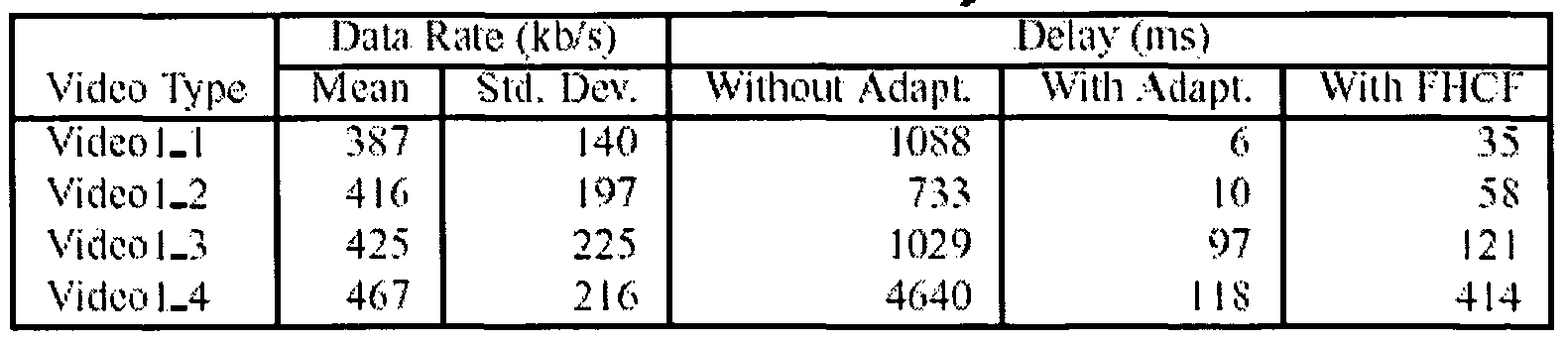
- For the VBR video source models we incorporated various packet traces of H.263 video streams collected from "Video traces for network performance evaluation" at http://trace.eas.asu.edu/. Table 2 summarizes the various application profiles used in our evaluation.
- Figures 10 (a) and 10 (d) show the residual queue buildup and delay experienced by a CBR (Videol_CBR) flow. Note that with the CBR flow that the delay experienced is low and well within the desired delay limit (120 ms) . However, with the VBR flow, the flow experiences a high queue buildup and delay, as shown in Figures 10 (b) and 10 (e) . [0083] Having showed the limitations of the reference scheduler, we evaluate the performance of the algorithm on HCCA flows in the above scenario. Figures 10 (c) and 10 (f) illustrate the experienced delay and the queue size respectively using the algorithm's time allocation in HCCA. As seen from the graph, the proposed algorithm can significantly reduce the delay experienced by the HCCA flow.
- CBR Videol_CBR
- the effect of the adaptation reduces from 64x to 29x. This is mainly due to the fact that the available time for reallocation in the HCCA period reduces as the number of nodes increase; hence, the adaptation algorithm is less effective.
- VBR VBR flow
- Video2_CBR CBR flows
- the 802. lie HCF scheduler by Prado in supporting real-time multimedia flows show several limitations. More specifically, the reference scheduler cannot adequately support multimedia flows with variable requirements or flows. Under variable flow requirements, the HCF scheduler can lead to high delay, severely impacting the real-time multimedia quality. Additionally, we observed that the HCF framework maps different flows to different modes of medium access with real-time flows being confined to polling-based mechanisms. The above separation can lead to poor channel utilization under heavy HCCA load.
- the present dynamic adaptation monitors the status of each flow for variations in the flow requirements, dynamically associates traffic flows appropriately, configures a polling schedule to allow additional polls to the lagging flows, and selectively mapping real-time multimedia flows to EDCA mode of access under low load in EDCA.
- Our comparative evaluation demonstrates that the adaptation reduces the delay observed in the real-time flows, and fairs better than other known techniques in terms of delay, multimedia quality and capacity of the network.
- the above described implementations of the dynamic adaptation allow for (1) allocating additional time to a selected flow which has been previously assigned in HCCA, and (2) assigning a selected node which has been previously assigned to communicate with the access point in the HCCA period and has completed assigned communication with the access point in HCCA, after the HCCA period terminates, to continue communicating with the access point in the EDCA period in contention with other nodes.
- the dynamic adaptation may also be implemented to assign a communication flow in EDCA a time period in HCCA under certain circumstances to reduce the over all delay when the EDCA load is too high.
- Figure HA illustrates one example of this feature where a communication flow initially assigned in EDCA is reassigned to an available time period in HCCA.
- a contention-free time period in the HCCA period is allocated to a selected node, which has been previously assigned to communicate with the access point in the EDCA period, to communicate with the access point when there is unused time left in the HCCA period after nodes previously assigned to the HCCA period have been served.
- the dynamic adaptation allows for full utilization of the communication capacities in both HCCA and EDCA to enhance the QoS.
- non-real ⁇ time traffic may be ordinarily assigned to the EDCA period, such traffic is not necessarily limited to EDCA and, when needed, can be reassigned to the HCCA.
- Figure 11B illustrates the throughput achieved by a prioritized EDCA flow with traffic characteristics of 400 kb/s. Note that despite its traffic class priority and available slack in HCCA, the EDCA flow experiences low throughput due to the high load in EDCA. However, by dynamically deciding to allow the EDCA flow to transmit during HCCA, based on the queue buildup and priority of the EDCA flow, we demonstrate that we can increase the EDCA flow throughput without affecting other flows in the network. [00101] In order to evaluate the algorithm performance for EDCA flows, we consider a scenario, SCENARIO4, where the number of CBR traffic flows scheduled in HCCA is fixed at four and the number of EDCA traffic flows is fixed at ten. For this scenario, there is time remaining within the HCCA flow to be allocated to EDCA traffic flows. Due to high network load, the EDCA traffic flows can suffer from a queue buildup leading to a large decrease in throughput and increase in delay. Hence,
- EDCA flow allocation in the HCCA period can be effective under high EDCA load.
- Figure HC shows the achieved throughput of a high-priority EDCA flow with and without adaptation. Note that our proposed EDCA adaptation is able to outperform the throughput achieved with the original HCF allocation.
- the EDCA load estimation can be generalized and enhanced to consider the impact of mapping a particular flow to the EDCA period. Rather than assume that each flow has a similar impact on the EDCA period, we plan to understand the impact of a flow based on its traffic profile.
- the above described techniques and their variations may be implemented as computer software instructions or firmware instructions. Such instructions may be stored in an article with one or more machine-readable storage media or stored in one or more machine-readable storage devices connected to one or more computers or digital processors such as digital signal processors and microprocessors. In operation, the instructions are executed by one or more processors to cause the machine to perform the described functions and operations.
Landscapes
- Engineering & Computer Science (AREA)
- Computer Networks & Wireless Communication (AREA)
- Signal Processing (AREA)
- Quality & Reliability (AREA)
- Databases & Information Systems (AREA)
- Mobile Radio Communication Systems (AREA)
- Small-Scale Networks (AREA)
Abstract
Description



Claims
Priority Applications (4)
| Application Number | Priority Date | Filing Date | Title |
|---|---|---|---|
| EP05846979A EP1805944A4 (en) | 2004-10-28 | 2005-10-28 | DYNAMIC ADAPTATION FOR WIRELESS COMMUNICATIONS WITH IMPROVED SERVICE QUALITY |
| JP2007532701A JP4540712B2 (en) | 2004-10-28 | 2005-10-28 | Dynamic adaptation for wireless communication with enhanced quality of service |
| US11/718,323 US7808941B2 (en) | 2004-10-28 | 2005-10-28 | Dynamic adaptation for wireless communications with enhanced quality of service |
| CN2005800372889A CN101048977B (en) | 2004-10-28 | 2005-10-28 | Dynamic Adaptive Method and System for Wireless Communications with Enhanced Quality of Service |
Applications Claiming Priority (2)
| Application Number | Priority Date | Filing Date | Title |
|---|---|---|---|
| US62372504P | 2004-10-28 | 2004-10-28 | |
| US60/623,725 | 2004-10-28 |
Publications (2)
| Publication Number | Publication Date |
|---|---|
| WO2006050140A2 true WO2006050140A2 (en) | 2006-05-11 |
| WO2006050140A3 WO2006050140A3 (en) | 2006-09-14 |
Family
ID=36319680
Family Applications (1)
| Application Number | Title | Priority Date | Filing Date |
|---|---|---|---|
| PCT/US2005/039033 Ceased WO2006050140A2 (en) | 2004-10-28 | 2005-10-28 | Dynamic adaptation for wireless communications with enhanced quality of service |
Country Status (6)
| Country | Link |
|---|---|
| US (1) | US7808941B2 (en) |
| EP (1) | EP1805944A4 (en) |
| JP (1) | JP4540712B2 (en) |
| KR (1) | KR100894198B1 (en) |
| CN (1) | CN101048977B (en) |
| WO (1) | WO2006050140A2 (en) |
Cited By (6)
| Publication number | Priority date | Publication date | Assignee | Title |
|---|---|---|---|---|
| GB2440194A (en) * | 2006-07-20 | 2008-01-23 | Toshiba Res Europ Ltd | Optimising superframe periods based upon network parameters |
| GB2440195A (en) * | 2006-07-20 | 2008-01-23 | Toshiba Res Europ Ltd | Optimising superframe periods to reduce delay to delay-sensitive traffic |
| GB2461724A (en) * | 2008-07-09 | 2010-01-13 | Toshiba Res Europ Ltd | Dynamic spectrum access or cognitive radio networks implementing a dynamic access protocol |
| US7808941B2 (en) | 2004-10-28 | 2010-10-05 | The Regents Of The University Of California | Dynamic adaptation for wireless communications with enhanced quality of service |
| CN103188813A (en) * | 2013-02-25 | 2013-07-03 | 南京邮电大学 | Distributed resource scheduling method combined with dynamic management of control information |
| US8509129B2 (en) | 2008-06-04 | 2013-08-13 | General Electric Company | System and method for adjusting media access control parameters in a wireless network |
Families Citing this family (57)
| Publication number | Priority date | Publication date | Assignee | Title |
|---|---|---|---|---|
| US20050152373A1 (en) * | 2004-01-08 | 2005-07-14 | Interdigital Technology Corporation | Packet scheduling in a wireless local area network |
| KR20060057459A (en) * | 2004-11-23 | 2006-05-26 | 삼성전자주식회사 | Packet Processing and Superframe Scheduling for Polling-based Wireless LAN Systems |
| KR100576834B1 (en) * | 2004-11-23 | 2006-05-10 | 삼성전자주식회사 | Packet Retransmission Method for Polling-based Wireless LAN System |
| US7787366B2 (en) * | 2005-02-02 | 2010-08-31 | Interdigital Technology Corporation | Method and apparatus for controlling wireless medium congestion by adjusting contention window size and disassociating selected mobile stations |
| US20060262737A1 (en) * | 2005-03-11 | 2006-11-23 | Interdigital Technology Corporation | QoS management in wireless mesh networks |
| US7554999B2 (en) * | 2005-06-28 | 2009-06-30 | Intel Corporation | Compact medium access control (MAC) layer |
| US20070058660A1 (en) * | 2005-07-22 | 2007-03-15 | Interdigital Technology Corporation | Wireless communication method and apparatus for controlling access to Aloha slots |
| US20070127410A1 (en) * | 2005-12-06 | 2007-06-07 | Jianlin Guo | QoS for AV transmission over wireless networks |
| US9100874B2 (en) * | 2006-03-05 | 2015-08-04 | Toshiba America Research, Inc. | Quality of service provisioning through adaptable and network regulated channel access parameters |
| US7519038B2 (en) * | 2006-03-06 | 2009-04-14 | Hitachi, Ltd. | Adaptive EDCA algorithm using traffic prediction in wireless local area networks |
| WO2007114633A2 (en) * | 2006-04-03 | 2007-10-11 | Lg Electronics Inc. | Method of performing scheduling in a wired or wireless communication system and network scheduler thereof |
| US20090225682A1 (en) * | 2006-04-04 | 2009-09-10 | Alex Peter Grote-Lopez | Optimization Procedure for Wireless Networks Operating in Infrastructure Mode with Standard Protocol IEEE 802.11 |
| US7975036B2 (en) * | 2006-05-11 | 2011-07-05 | The Mitre Corporation | Adaptive cross-layer cross-node optimization |
| JP4887522B2 (en) * | 2006-08-17 | 2012-02-29 | ドルビー ラボラトリーズ ライセンシング コーポレイション | Transient analysis of packet queue loss in broadcast networks. |
| KR101223235B1 (en) * | 2006-11-16 | 2013-01-17 | 삼성전자주식회사 | Wibro network interworking method and system for wireless terminal |
| US7664089B2 (en) * | 2007-01-12 | 2010-02-16 | Hitachi Ltd. | System and method for using an adaptive hybrid coordination function (HCF) in an 802.11E wireless LAN |
| KR100907507B1 (en) * | 2007-03-05 | 2009-07-14 | 삼성전자주식회사 | User Authentication Method and System for the WLAN Network Interworking of Wireless LAN Terminal |
| US7715316B2 (en) * | 2007-05-11 | 2010-05-11 | Verizon Services Organization Inc. | Method and apparatus for improving performance in a network using a virtual queue and a switched poisson process traffic model |
| KR100981127B1 (en) * | 2007-07-30 | 2010-09-10 | 영남대학교 산학협력단 | Direct data transmission between stations using polling in infrastructure WLAN environment |
| US7894467B2 (en) * | 2007-08-08 | 2011-02-22 | Denso Corporation | Adaptive medium access control for wireless communication system |
| US9113176B2 (en) * | 2007-08-29 | 2015-08-18 | The Regents Of The University Of California | Network and device aware video scaling system, method, software, and device |
| JP5060618B2 (en) * | 2008-07-29 | 2012-10-31 | パナソニック株式会社 | Wireless communication apparatus and wireless communication control method |
| US8134992B1 (en) | 2008-09-24 | 2012-03-13 | Qualcomm Atheros, Inc. | Message-based coexistence interface between wireless devices |
| US8125969B2 (en) * | 2008-12-16 | 2012-02-28 | At&T Intellectual Property I, L.P. | Method and apparatus for adjusting EDCA channel access parameters |
| WO2011014036A2 (en) | 2009-07-31 | 2011-02-03 | 삼성전자 주식회사 | Method and device for sending packets on a wireless local area network |
| US8923172B2 (en) * | 2009-08-24 | 2014-12-30 | Qualcomm Incorporated | Deterministic backoff channel access |
| US8249031B1 (en) * | 2009-11-17 | 2012-08-21 | Qualcomm Atheros, Inc. | Aggregation coexistence mechanism for wireless devices |
| US8606184B1 (en) | 2009-12-08 | 2013-12-10 | Qualcomm Incorporated | Coexistence message processing mechanism for wireless devices |
| US8462622B2 (en) | 2009-12-08 | 2013-06-11 | Qualcomm Incorporated | Detection of co-located interference in a multi-radio coexistence environment |
| US8520586B1 (en) | 2009-12-16 | 2013-08-27 | Qualcomm Incorporated | Discovery and connection coexistence mechanism for wireless devices |
| CN101784082A (en) * | 2009-12-22 | 2010-07-21 | 中兴通讯股份有限公司 | Method and device for enhancing service quality in wireless local area network |
| US9923995B1 (en) | 2010-02-27 | 2018-03-20 | Sitting Man, Llc | Methods, systems, and computer program products for sharing information for detecting an idle TCP connection |
| US9923996B1 (en) * | 2010-02-27 | 2018-03-20 | Sitting Man, Llc | Methods, systems, and computer program products for sharing information for detecting an idle TCP connection |
| US8730993B2 (en) * | 2010-07-12 | 2014-05-20 | Intel Corporation | Methods and apparatus for uplink MU MIMO scheduling |
| CN103155444B (en) * | 2010-08-26 | 2017-04-12 | 马维尔国际贸易有限公司 | Wireless communication with primary and secondary access categories |
| US8576809B2 (en) * | 2010-10-07 | 2013-11-05 | Qualcomm Incorporated | Facilitating distributed channel access for a plurality of access terminals transmitting in a wireless communication environment |
| US8422464B2 (en) | 2010-12-29 | 2013-04-16 | General Electric Company | System and method for dynamic data management in a wireless network |
| US8422463B2 (en) | 2010-12-29 | 2013-04-16 | General Electric Company | System and method for dynamic data management in a wireless network |
| US8358590B2 (en) | 2010-12-29 | 2013-01-22 | General Electric Company | System and method for dynamic data management in a wireless network |
| US9025455B2 (en) | 2011-04-26 | 2015-05-05 | Industrial Technology Research Institute | Prioritized random access method, resource allocation method and collision resolution method |
| US20150201193A1 (en) * | 2012-01-10 | 2015-07-16 | Google Inc. | Encoding and decoding techniques for remote screen sharing of media content using video source and display parameters |
| CN103379554B (en) * | 2012-04-28 | 2017-02-22 | 华为技术有限公司 | Dynamic regulating method and dynamic regulating device of frame priority |
| JP6022886B2 (en) * | 2012-10-16 | 2016-11-09 | 株式会社日立国際電気 | Wireless surveillance camera system and wireless surveillance camera device |
| CN104038961B (en) * | 2013-03-05 | 2018-11-06 | 华为终端(东莞)有限公司 | Localization message reception, sending method, device and system |
| US9392487B2 (en) * | 2013-05-06 | 2016-07-12 | Huawei Technologies Co., Ltd. | Systems and methods for traffic-aware medium access selection |
| US9894561B2 (en) * | 2014-05-23 | 2018-02-13 | Qualcomm, Incorporated | Signaling soft time division multiplexing in enhanced distributed channel access |
| US10009861B2 (en) * | 2014-10-14 | 2018-06-26 | Qualcomm Incorporated | Techniques for adaptively enabling synchronization of nodes using a listen before talk load-based equipment protocol |
| CN107113823B (en) * | 2015-07-10 | 2020-04-28 | 华为技术有限公司 | Channel access period allocation method, device and system |
| CN108924945B (en) | 2015-12-25 | 2019-08-06 | 华为技术有限公司 | A kind of cut-in method and device |
| US11057748B1 (en) * | 2018-09-17 | 2021-07-06 | Synapse Wireless, Inc. | Prioritized communication windows in a wireless mesh network |
| US11127214B2 (en) * | 2018-09-17 | 2021-09-21 | Qualcomm Incorporated | Cross layer traffic optimization for split XR |
| US11374867B2 (en) * | 2019-06-03 | 2022-06-28 | The Regents Of The University Of California | Dynamic tuning of contention windows in computer networks |
| US11558759B2 (en) * | 2020-10-28 | 2023-01-17 | Hewlett Packard Enterprise Development Lp | Systems and methods for minimizing latency and contention using QoS frame scheduling information |
| WO2022109986A1 (en) * | 2020-11-27 | 2022-06-02 | 新华三技术有限公司 | Message forwarding method and apparatus, and electronic device |
| US11889556B2 (en) | 2020-12-17 | 2024-01-30 | Sony Group Corporation | Prioritized channel access |
| CN116033577A (en) * | 2021-10-25 | 2023-04-28 | 中兴通讯股份有限公司 | Data transmission method, device, storage medium and electronic device |
| KR102934755B1 (en) | 2021-10-27 | 2026-03-05 | 이광휘 | Wireless data communication network service method that simplifies link setting |
Family Cites Families (24)
| Publication number | Priority date | Publication date | Assignee | Title |
|---|---|---|---|---|
| JPH0548610A (en) * | 1991-08-14 | 1993-02-26 | Tokyo Electric Co Ltd | Radio communication system |
| JP2547566Y2 (en) | 1991-12-04 | 1997-09-10 | 三菱農機株式会社 | Seedling delivery device in band-shaped seedling production machine |
| JP3489472B2 (en) * | 1999-03-02 | 2004-01-19 | 日本電信電話株式会社 | Radio packet control station |
| US6747968B1 (en) * | 2000-01-14 | 2004-06-08 | Nokia Ip Inc. | Methods and systems for weighted PCF polling lists for WLAN QoS support |
| US7058074B2 (en) * | 2000-11-01 | 2006-06-06 | Texas Instruments Incorporated | Unified channel access for supporting quality of service (QoS) in a local area network |
| US20020120740A1 (en) | 2001-02-28 | 2002-08-29 | Jin-Meng Ho | Shared communications channel access in an overlapping coverage environment |
| US7187668B2 (en) * | 2001-03-02 | 2007-03-06 | Sharp Laboratories Of America, Inc. | Devices, softwares and methods for advancing scheduling of next contention session upon premature termination of contention free exchange |
| US7289529B2 (en) * | 2001-10-31 | 2007-10-30 | At&T Corp. | Method and system for optimally serving stations on wireless LANs using a controlled contention/resource reservation protocol of the IEEE 802.11e standard |
| US7187691B2 (en) * | 2001-12-18 | 2007-03-06 | Sharp Laboratories Of America, Inc. | Securing the channel for a QoS manager in a CSMA/CA ad hoc network |
| JP3614133B2 (en) * | 2001-12-27 | 2005-01-26 | 日本電気株式会社 | Radio base station apparatus, radio communication system, and communication control method |
| JP3945325B2 (en) * | 2002-07-01 | 2007-07-18 | ソニー株式会社 | Wireless communication system, wireless communication apparatus, wireless communication method, and computer program |
| KR20040047376A (en) * | 2002-11-29 | 2004-06-05 | 삼성전자주식회사 | Communication control method for wireless LAN |
| JP2004248175A (en) | 2003-02-17 | 2004-09-02 | Canon Inc | Packet switching control method |
| JP2004297117A (en) | 2003-03-25 | 2004-10-21 | Kyocera Corp | Wireless communication system, wireless terminal in wireless communication system, moving image data distribution server, and wireless communication method |
| US6961311B2 (en) * | 2003-05-13 | 2005-11-01 | Motorola, Inc. | Adaptive scheduling window management for a quality of service enabled local area network |
| US8483105B2 (en) * | 2003-10-15 | 2013-07-09 | Qualcomm Incorporated | High speed media access control |
| JP2007511174A (en) * | 2003-11-05 | 2007-04-26 | インターディジタル テクノロジー コーポレイション | Quality of service management for wireless LAN |
| EP1530325B1 (en) * | 2003-11-06 | 2007-04-04 | Mitsubishi Denki Kabushiki Kaisha | Method and device for managing a shared transmission medium |
| US20060009229A1 (en) * | 2004-07-10 | 2006-01-12 | Yuan Yuan | Sequential coordinated channel access in wireless networks |
| US7684333B1 (en) * | 2004-07-30 | 2010-03-23 | Avaya, Inc. | Reliable quality of service (QoS) provisioning using adaptive class-based contention periods |
| US7328026B2 (en) * | 2004-08-11 | 2008-02-05 | Mitsubishi Electric Research Laboratories, Inc. | Signaling in a wireless network with sequential coordinated channel access |
| KR100678939B1 (en) * | 2004-08-27 | 2007-02-07 | 삼성전자주식회사 | In wireless network environment of infrastructure mode, wireless data transmission method |
| US20060062189A1 (en) * | 2004-09-21 | 2006-03-23 | Nokia Corporation | Wireless transceiver, circuit module, and method for setting channel access time |
| KR100894198B1 (en) | 2004-10-28 | 2009-04-22 | 더 리젠츠 오브 더 유니버시티 오브 캘리포니아 | Dynamic adaptation for wireless communications with enhanced quality of service |
-
2005
- 2005-10-28 KR KR1020077009748A patent/KR100894198B1/en not_active Expired - Lifetime
- 2005-10-28 EP EP05846979A patent/EP1805944A4/en not_active Withdrawn
- 2005-10-28 CN CN2005800372889A patent/CN101048977B/en not_active Expired - Lifetime
- 2005-10-28 JP JP2007532701A patent/JP4540712B2/en not_active Expired - Fee Related
- 2005-10-28 US US11/718,323 patent/US7808941B2/en active Active
- 2005-10-28 WO PCT/US2005/039033 patent/WO2006050140A2/en not_active Ceased
Non-Patent Citations (3)
| Title |
|---|
| D. SKYRIANOGLOU ET AL.: "Traffic Scheduling in IEEE 802.11 e Networks Based on Actual Requirements", PROC. MOBILE VENUE 2004, May 2004 (2004-05-01) |
| J. PRADO: "Mandatory TSPEC parameters and reference design of a simple scheduler", IEEE 802.11-02/705AR0, November 2002 (2002-11-01) |
| See also references of EP1805944A4 |
Cited By (9)
| Publication number | Priority date | Publication date | Assignee | Title |
|---|---|---|---|---|
| US7808941B2 (en) | 2004-10-28 | 2010-10-05 | The Regents Of The University Of California | Dynamic adaptation for wireless communications with enhanced quality of service |
| GB2440194A (en) * | 2006-07-20 | 2008-01-23 | Toshiba Res Europ Ltd | Optimising superframe periods based upon network parameters |
| GB2440195A (en) * | 2006-07-20 | 2008-01-23 | Toshiba Res Europ Ltd | Optimising superframe periods to reduce delay to delay-sensitive traffic |
| GB2440194B (en) * | 2006-07-20 | 2008-07-30 | Toshiba Res Europ Ltd | A Wireless Communication System |
| GB2440195B (en) * | 2006-07-20 | 2009-04-15 | Toshiba Res Europ Ltd | Method for reconfiguration of polling in a wireless LAN a wireless communication system |
| US8509129B2 (en) | 2008-06-04 | 2013-08-13 | General Electric Company | System and method for adjusting media access control parameters in a wireless network |
| GB2461724A (en) * | 2008-07-09 | 2010-01-13 | Toshiba Res Europ Ltd | Dynamic spectrum access or cognitive radio networks implementing a dynamic access protocol |
| GB2461724B (en) * | 2008-07-09 | 2011-02-23 | Toshiba Res Europ Ltd | Wireless network access |
| CN103188813A (en) * | 2013-02-25 | 2013-07-03 | 南京邮电大学 | Distributed resource scheduling method combined with dynamic management of control information |
Also Published As
| Publication number | Publication date |
|---|---|
| JP2008514145A (en) | 2008-05-01 |
| KR100894198B1 (en) | 2009-04-22 |
| EP1805944A2 (en) | 2007-07-11 |
| EP1805944A4 (en) | 2011-11-30 |
| US7808941B2 (en) | 2010-10-05 |
| CN101048977B (en) | 2011-06-01 |
| JP4540712B2 (en) | 2010-09-08 |
| WO2006050140A3 (en) | 2006-09-14 |
| CN101048977A (en) | 2007-10-03 |
| KR20070073835A (en) | 2007-07-10 |
| US20080095124A1 (en) | 2008-04-24 |
Similar Documents
| Publication | Publication Date | Title |
|---|---|---|
| US7808941B2 (en) | Dynamic adaptation for wireless communications with enhanced quality of service | |
| US7123627B2 (en) | Class of computationally parsimonious schedulers for enforcing quality of service over packet based AV-centric home networks | |
| Skyrianoglou et al. | ARROW: An efficient traffic scheduling algorithm for IEEE 802.11 e HCCA | |
| US20070189298A1 (en) | Distributed wireless network with dynamic bandwidth allocation | |
| Inan et al. | An adaptive multimedia QoS scheduler for 802.11 e wireless LANs | |
| US6963534B1 (en) | Methodology for improving the performance of asynchronous data traffic over TDD/TDMA wireless networks | |
| WO2007071198A1 (en) | A distributed wireless network with dynamic bandwidth allocation | |
| Ramos et al. | Dynamic adaptation policies to improve quality of service of real-time multimedia applications in IEEE 802.11 e WLAN networks | |
| Cicconetti et al. | An efficient cross layer scheduler for multimedia traffic in wireless local area networks with IEEE 802.11 e HCCA | |
| Nafaa | Provisioning of multimedia services in 802.11-based networks: facts and challenges | |
| Rao et al. | Performance evaluation of congestion aware transmission opportunity scheduling scheme for 802.11 wireless LANs | |
| Annese et al. | Providing delay guarantees in IEEE 802.11 e networks | |
| Luo et al. | An optimized scheduling scheme to provide quality of service in 802.11 e wireless lan | |
| Al-Maqri et al. | Feasible HCCA polling mechanism for video transmission in IEEE 802.11 e WLANs | |
| Skyrianoglou et al. | Traffic scheduling for multimedia QoS over wireless LANs | |
| Gallardo et al. | QoS mechanisms for the MAC protocol of IEEE 802.11 WLANs | |
| Yoon et al. | Dynamic admission control in IEEE 802.11 e EDCA-based wireless home network | |
| Al-Maqri et al. | Adaptive TXOP assignment for QoS support of video traffic in IEEE 802.11 e networks | |
| Larcheri et al. | Scheduling in 802.11 e: Open-loop or closed-loop | |
| Lee et al. | Efficient QoS scheduling algorithm for multimedia services in IEEE 802.11 e WLAN | |
| Cecchetti et al. | W-CBS: a scheduling algorithm for supporting QoS in IEEE 802.11 e | |
| Riza et al. | Improving QoS in WLAN using dynamic weighted fair scheduling | |
| Vergados et al. | DPS: An architecture for VBR scheduling in IEEE 802.11 e HCCA networks with multiple access points | |
| Fallah | Per-session weighted fair scheduling for real time multimedia in multi-rate Wireless Local Area Networks | |
| Kuo | Supporting multimedia streaming and best‐effort data transmission over IEEE 802.11 e EDCA |
Legal Events
| Date | Code | Title | Description |
|---|---|---|---|
| AK | Designated states |
Kind code of ref document: A2 Designated state(s): AE AG AL AM AT AU AZ BA BB BG BR BW BY BZ CA CH CN CO CR CU CZ DE DK DM DZ EC EE EG ES FI GB GD GE GH GM HR HU ID IL IN IS JP KE KG KM KN KP KR KZ LC LK LR LS LT LU LV LY MA MD MG MK MN MW MX MZ NA NG NI NO NZ OM PG PH PL PT RO RU SC SD SE SG SK SL SM SY TJ TM TN TR TT TZ UA UG US UZ VC VN YU ZA ZM ZW |
|
| AL | Designated countries for regional patents |
Kind code of ref document: A2 Designated state(s): GM KE LS MW MZ NA SD SL SZ TZ UG ZM ZW AM AZ BY KG KZ MD RU TJ TM AT BE BG CH CY CZ DE DK EE ES FI FR GB GR HU IE IS IT LT LU LV MC NL PL PT RO SE SI SK TR BF BJ CF CG CI CM GA GN GQ GW ML MR NE SN TD TG |
|
| REEP | Request for entry into the european phase |
Ref document number: 2005846979 Country of ref document: EP |
|
| WWE | Wipo information: entry into national phase |
Ref document number: 2005846979 Country of ref document: EP |
|
| WWE | Wipo information: entry into national phase |
Ref document number: 2007532701 Country of ref document: JP |
|
| WWE | Wipo information: entry into national phase |
Ref document number: 1020077009748 Country of ref document: KR |
|
| WWE | Wipo information: entry into national phase |
Ref document number: 200580037288.9 Country of ref document: CN |
|
| NENP | Non-entry into the national phase |
Ref country code: DE |
|
| WWP | Wipo information: published in national office |
Ref document number: 2005846979 Country of ref document: EP |
|
| WWE | Wipo information: entry into national phase |
Ref document number: 11718323 Country of ref document: US |