WO2006050308A2 - Multiphase cleaning compositions having ionic liquid phase - Google Patents

Multiphase cleaning compositions having ionic liquid phase Download PDF

Info

Publication number
WO2006050308A2
WO2006050308A2 PCT/US2005/039356 US2005039356W WO2006050308A2 WO 2006050308 A2 WO2006050308 A2 WO 2006050308A2 US 2005039356 W US2005039356 W US 2005039356W WO 2006050308 A2 WO2006050308 A2 WO 2006050308A2
Authority
WO
WIPO (PCT)
Prior art keywords
phase
composition
composition according
ionic liquid
alkyl
Prior art date
Legal status (The legal status is an assumption and is not a legal conclusion. Google has not performed a legal analysis and makes no representation as to the accuracy of the status listed.)
Ceased
Application number
PCT/US2005/039356
Other languages
French (fr)
Other versions
WO2006050308A3 (en
Inventor
Stacie Ellen Hecht
Kenneth Nathan Price
Patricia Sara Berger
Peter Robert Foley
Howard David Hutton, Iii
Michael Stanford Showell
Robb Richard Gardner
Raymond Louis Niehoff
Kenneth Richard Seddon
Harambage Quintas Nimal Gunaratne
Martyn Earle
Current Assignee (The listed assignees may be inaccurate. Google has not performed a legal analysis and makes no representation or warranty as to the accuracy of the list.)
Procter and Gamble Co
Original Assignee
Procter and Gamble Co
Priority date (The priority date is an assumption and is not a legal conclusion. Google has not performed a legal analysis and makes no representation as to the accuracy of the date listed.)
Filing date
Publication date
Application filed by Procter and Gamble Co filed Critical Procter and Gamble Co
Priority to EP05818380A priority Critical patent/EP1807497A2/en
Priority to JP2007537045A priority patent/JP2008516078A/en
Publication of WO2006050308A2 publication Critical patent/WO2006050308A2/en
Publication of WO2006050308A3 publication Critical patent/WO2006050308A3/en
Anticipated expiration legal-status Critical
Ceased legal-status Critical Current

Links

Classifications

    • CCHEMISTRY; METALLURGY
    • C11ANIMAL OR VEGETABLE OILS, FATS, FATTY SUBSTANCES OR WAXES; FATTY ACIDS THEREFROM; DETERGENTS; CANDLES
    • C11DDETERGENT COMPOSITIONS; USE OF SINGLE SUBSTANCES AS DETERGENTS; SOAP OR SOAP-MAKING; RESIN SOAPS; RECOVERY OF GLYCEROL
    • C11D17/00Detergent materials or soaps characterised by their shape or physical properties
    • C11D17/0008Detergent materials or soaps characterised by their shape or physical properties aqueous liquid non soap compositions
    • C11D17/0017Multi-phase liquid compositions
    • CCHEMISTRY; METALLURGY
    • C11ANIMAL OR VEGETABLE OILS, FATS, FATTY SUBSTANCES OR WAXES; FATTY ACIDS THEREFROM; DETERGENTS; CANDLES
    • C11DDETERGENT COMPOSITIONS; USE OF SINGLE SUBSTANCES AS DETERGENTS; SOAP OR SOAP-MAKING; RESIN SOAPS; RECOVERY OF GLYCEROL
    • C11D17/00Detergent materials or soaps characterised by their shape or physical properties
    • C11D17/0008Detergent materials or soaps characterised by their shape or physical properties aqueous liquid non soap compositions
    • C11D17/0013Liquid compositions with insoluble particles in suspension

Definitions

  • the present invention is directed to multiphase cleaning compositions comprising a first phase and a second ionic liquid phase, wherein the second phase is substantially immiscible with the first phase.
  • the invention is also directed to cleaning methods employing such compositions, particularly in a bulk cleaning environment.
  • Ionic liquids have been extensively evaluated as environmental- friendly or "green” alternatives to conventional organic solvents for a broad range of organic synthetic applications. Ionic liquids offer some unique characteristics that distinguish them from conventional organic solvents, such as no effective vapor pressure, a broad liquid range, high polarity and charge density, can be either hydrophobic or hydrophilic, and unique solvating properties.
  • One widely studied class of ionic liquids includes imidazolium salts, such as l-butyl-3-methylimidazolium hexafluorophosphate, also known as [bmim] [PF 6 ].
  • ionic liquids include l-ethyl-3- methylimidazolium chloride - aluminium (III) chloride, which is usually referred to as [emim]Cl-AlCl 3 ; and N-butyl pyridinium chloride aluminium (III) chloride, which is usually referred to as [Nbupy]Cl-AlCl 3 .
  • a broad range of ionic liquids have also been investigated in the following references: U. S. Patents: US 6,048,388; US 5,827,602; U. S.
  • Patent Publications US 2003/915735A1; US 2004/0007693 Al ; US 2004/0035293A1; and PCT publications: WO 02/26701; WO 03/074494; WO 03/022812; WO 04/016570.
  • compositions containing ionic liquids are advantageous in delivering superior cleaning performance.
  • the invention is directed to a multiphase cleaning composition which comprises a first phase and a second ionic liquid phase.
  • the second phase is substantially immiscible with the first phase.
  • the first phase may be an aqueous phase or a silicone solvent phase.
  • the invention is directed to methods of cleaning a soiled surface.
  • the methods comprise contacting a soiled surface with a multiphase wash liquor including a first liquid phase and a second ionic liquid phase, wherein the second phase is substantially immiscible with the first phase, and removing soils from the surface.
  • the cleaning compositions and methods according to the present invention may be used for cleaning hard surfaces, for example, including but not limited to, household hard surfaces (such as kitchen surfaces, bathroom surfaces, floors, windows, mirrors and countertops), car hard surfaces (such as automobile interiors, automobile exteriors, metal surfaces and windshields), and other personal or household articles (such as dishware, cookware, utensils, tableware and glassware), textile surfaces, for example, including, but not limited to, carpets, fabrics (such as woven textiles, nonwoven textiles, knitted textiles and the like, in the form of upholstery, drapes, garments, and/or linens), and/or other soiled surfaces.
  • household hard surfaces such as kitchen surfaces, bathroom surfaces, floors, windows, mirrors and countertops
  • car hard surfaces such as automobile interiors, automobile exteriors, metal surfaces and windshields
  • other personal or household articles such as dishware, cookware, utensils, tableware and glassware
  • textile surfaces for example, including, but not limited to, carpets, fabrics (such as woven textiles,
  • compositions and methods according to the present invention may be used for treating and/or cleaning air, typically in an enclosed area.
  • the multiphase cleaning compositions comprise a first liquid phase and a second ionic liquid phase.
  • the first phase may comprise a liquid carrier, for example water, an organic solvent, or combinations thereof.
  • the liquid carrier of the first phase is water.
  • the liquid carrier of the first phase is a silicone solvent system comprising at least about 50 wt% silicones and optionally, other lipophilic fluids such as hydrocarbons, halocarbons, glycol ethers, diols. Silicones include linear or cyclic silicones, including decamethyl cyclopentasiloxane (D5). Such lipophilic fluid earners are particularly suitable for dry-cleaning applications, both in commercial and in-home dry-cleaning methods.
  • the liquid carrier of the first phase will be present in amounts of from about 1 to about 99% by weight of the composition, preferably from about 5 to about 95% by weight of the composition, more preferable from about 20 to about 80% by weight of the composition.
  • compositions comprising an aqueous phase may optionally include a co- solvent.
  • co-solvents include, but are not limited to, linear or branched Cl-ClO alcohols, diols, and mixtures thereof.
  • co- solvents such as ethanol, isopropanol, and propylene glycol are used in some of the compositions of the present invention.
  • the ionic liquid phase is substantially free of free water and/or other organic solvents. These compositions can contain less than about 10 weight percent, more specifically less than about 5 weight percent, even more specifically less than about 1 weight percent, free water and/or other organic solvents.
  • the composition may also comprise, optionally, a phase stabilizing surfactant capable of stabilizing the phases.
  • exemplary surfactants suitable for this use include decaglycerol decaoleate, sorbitan esters (Span ® from Uniqema), polyoxyethylene derivatives of sorbitan esters (T ween ® from Uniqema), and block copolymer surfactants (Pluronic ® from BASF Corporation). These compositions can contain less than about 10 weight percent, more specifically less than about 5 weight percent, even more specifically less than about 1 weight percent, phase stabilizing surfactants.
  • Ionic liquid refers to a salt that is in a liquid form at room temperature, typically about 20-25°C.
  • an ionic liquid has a melting temperature of about 100°C or less, alternatively of about 60°C or less, or in a further alternative, of about 4O 0 C or less.
  • the ionic liquids exhibit no discernible melting point (based on DSC analysis) but are "flowable” at a temperature of about 100°C or below, or, in another embodiment, are “flowable” at a temperature of from about 20 to about 8O 0 C, i.e., the typical fabric or dish washing temperatures.
  • the term "flowable” means that the ionic liquid exhibits a viscosity of less than about 10,000 mPa-s at the temperatures as specified above.
  • ionic liquid refers to ionic liquids, ionic liquid composites, and mixtures (or cocktails) of ionic liquids.
  • the ionic liquid can comprise an anionic IL component and a cationic IL-, component. When the ionic liquid is in its liquid form, these components may freely associate with one another (i.e., in a scramble).
  • the term "cocktail of ionic liquids” refers to a mixture of two or more, preferably at least three, .different and charged IL components, wherein at least one IL component is cationic and at least one IJL component is anionic.
  • ionic liquid composite refers to a mixture of a salt (which, can be solid at room temperature) with a proton donor Z (which can be a liquid or a solid) as described in the references immediately above. Upon mixing, these components turn into a liquid at about 100°C or less, and the mixture behaves like an ionic liquid.
  • Anions and cations suitable for use in the ionic liquids for the present invention are discussed in further detail.
  • Anions suitable for use in the ionic liquids of the present invention include, but are not limited to, the following materials:
  • Alkyl sulfates (AS), alkoxy sulfates and alley 1 alkoxy sulfates, wherein the alkyl or alkoxy is linear, branched or mixtures thereof; furthermore, the attachment of the sulfate group to the alkyl chain can be terminal on the alkyl chain (AS), internal on the alkyl chain (SAS) or mixtures thereof: nonlimiting examples include linear Cio- C 20 alkyl sulfates having formula:
  • x + y is an integer of at least 7, preferably at least about 9; x or y can be 0, M + is a cation selected from the cations of the ionic liquids as described in detail herein; nonlimiting examples of alkoxy sulfate include sulfated derivatives of commercially available alkoxy copolymers, such as Pluronics® (from BASF);
  • Mono- and di- esters of sulfosuccinates include saturated and unsaturated Ci 2-I8 monoester sulfosuccinates, such as lauryl sulfosuccinate available as Mackanate LO- 100® (from The Mclntyre Group); saturated and unsaturated C 6 - Ci 2 diester sulfosuccinates, such as dioctyl ester sulfosuccinate available as Aerosol OT® (from Cytec Industries, Inc.);
  • Alkyl aryl sulfonates nonlimiting examples include tosylate, alkyl aryl sulfonates having linear or branched, saturated or unsaturated C 8 -Ci 4 alkyls; alkyl benzene sulfonates (LAS) such as Cn-Ci 8 alkyl benzene sulfonates; sulfonates of benzene, cumene, toluene, xylene, t-butylbenzene, di-isopropylbenzene, or isopropylbenzene; naphthalene sulfonates and C 6- I 4 alkyl naphthalene sulfonates, such as Petro® (from Akzo Nobel Surface Chemistry); sulfonates of petroleum, such as Monalube 605® (from Uniqema);
  • Alkyl glycerol ether sulfonates having 8 to 22 carbon atoms in the alkyl moiety (6) Diphenyl ether (bis-phenyl) derivatives: Nonlimiting examples include triclosan (2,4,4'-trichloro-2'-hydroxydiphenyl ether) and diclosan (4,4'-dichloro-2- hydroxydiphenyl ether), both are available as Irgasan® from Ciba Specialty Chemicals;
  • Linear or cyclic carboxylates include citrate, lactate, tartarate, succinate, alkylene succinate, maleate, gluconate, formate, cinnamate, benzoate, acetate, salicylate, phthalate, aspartate, adipate, acetyl salicylate, 3 -methyl salicylate, 4-hydroxy isophthalate, dihydroxyfumarate, 1,2,4- benzene tricarboxylate, pentanoate and mixtures thereof;
  • Mid-chain branched alkyl sulfates HSAS
  • mid-chain branched alkyl aryl sulfonates MLAS
  • mid-chain branched alkyl polyoxyalkylene sulfates nonlimiting examples of MLAS are disclosed in US 6,596,680; US 6,593,285; and US 6,202,303;
  • (9) Sarcosinates having the general formula RCON(CH 3 )CH 2 CO 2 " , wherein R is an alkyl from about C 8-20 ; nonlimiting examples include ammonium lauroyl sarcosinate, available as Hamposyl AL-30® from Dow Chemicals and sodium oleoyl sarcosinate, available as Hamposyl O® from Dow Chemical;
  • Sweetener derived anions saccharinate and acesulfamate
  • Ethoxylated amide sulfates sodium tripolyphosphate (STPP); dihydrogen phosphate; fluroalkyl sulfonate; bis-(alkylsulfonyl) amine; bis-(fluoroalkylsulfonyl)amide; (fluroalkylsulfonyl)(fluoroalkylcarbonyl)amide; bis(arylsulfonyl)amide; carbonate; tetrafiuorborate (BF 4 " ); hexaflurophosphate (PF 6 " );
  • R ⁇ - CO - O - C 6 H 4 -R 2 wherein R 1 is Cs-Ci 8 alkyl, Cg-Ci 8 amino alkyl, or mixtures thereof, and R 2 is sulfonate or carbonate; nonlimiting examples such as:
  • Cations suitable for use in the ionic liquids of the present invention include, but are not limited to, the following materials:
  • Cations i.e., in the protonated, cationic form
  • amine oxides i.e., in the protonated, cationic form
  • amine oxide cations containing one Cs-is alkyl moiety and 2 moieties selected from the group consisting of Ci -3 alkyl groups and Ci -3 hydroxy alkyl groups
  • sulfoxide cations containing one C io- is alkyl moiety and a moiety selected from the group consisting Of Ci -3 alkyl and Ci -3 hydroxyalkyl moieties
  • the amine oxide cations have the following formula:
  • R 3 is an Cg -22 alkyl, C 8-22 hydroxyalkyl, C 8-22 alkyl phenyl group, and mixture s thereof;
  • R 4 is an C 2-3 alkylene or C 2-3 hydroxyalkylene group or mixtures thereof; x i s from 0 to about 3; and each R 5 is independently an Ci -3 alkyl or Ci -3 hydroxyalkyl group or a polyethylene oxide group containing an average of from about 1 to about 3 ethylene oxide groups; the R 5 groups may be attached to each other, e.g., through an oxygen or nitrogen atom, to form a ring structure; other exemplary amine oxide cations include CiO-Ci 8 , Ci 0 , Ci 0 -Ci 2 , and Ci 2 -Ci 4 alkyl dimethyl amine oxide cations, and C 8 -C] 2 alkoxy ethyl dihydroxy ethyl amine oxide cations;
  • Betaines having the general formula:
  • R is selected from the group consisting of alkyl groups containing from about 10 to about 22 carbon atoms, preferably from about 12 to about 18 carbon atoms , alkyl aryl and aryl alkyl groups containing a similar number of carbon atoms with a benzene ring treated as equivalent to about 2 carbon atoms, and similar structures interrupted by amido or ether linkages; each R 1 is an alkyl group containing from 1 to about 3 carbon atoms; and R 2 is an alkylene group containing from 1 to about (5 carbon atoms; nonlimiting examples of betaines include dodecyl dimethyl betaine , acetyl dimethyl betaine, dodecyl amidopropyl dimethyl betaine, tetradecyl dimethyl betaine, tetradecyl amidopropyl dimethyl betaine, dodecyl dimethyl ammonium hexanoate; and amidoalkylbetaines which are disclosed in U.S.
  • the cation may be a sulfobetaine, which are disclosed in US Patent: 4,687,602; (c) Diester quaternary ammonium (DEQA) cations of the type:
  • each R substituent is selected from hydrogen; Ci-C 6 alkyl or hydroxy alky 1, preferably methyl, ethyl, propyl, or hydroxyethyl, and more preferably methyl; poly(Ci-C 3 alkoxy), preferably polyethoxy; benzyl; or a mixture thereof; m is 2 or 3; each n is from 1 to about 4; each Y is -0-(O)C-, -C(O)-O-, -NR-C(O)-, or -C(O)- NR-; with the proviso that when Y is -O-(0)C- or -NR-C(O) -, the sum of carbons in each R 1 plus one is Ci 2 -C 22 , preferably C14-C2 0 , with each R 1 being a hydrocarbyl, or substituted hydrocarbyl group;
  • each R is independently an alkyl or hydroxyalkyl Ci-C 6 moiety, preferably methyl, ethyl, propyl or hydroxyethyl, and more preferably methyl; each R 1 is independently a linear or branched, saturated or unsaturated C 6 -C 22 alkyl or alkoxy moiety, preferably Ci 4 -C 20 moiety, but no more than one R 1 being less than about Ci 2 and then the other R 1 is at least about Ci 6 ; or hydrocarbyl or substituted hydrocarbyl moiety, preferably C 10 -C 20 alkyl or alkenyl, most preferably Ci 2 -Ci 8 alkyl or alkenyl; in one embodiment, the cation is dialkylenedimethyl ammonium, such as dioleyldimethyl ammonium available from Witco Corporation under the tradename Adogen® 472; in another embodiment, the cation is dialkylenedimethyl ammonium, such as dioleyldimethyl ammonium available from Wi
  • R 1 C(O)- NR- R 2 — N(R) — R 3 ⁇ -NR-C(O)-R 1 ] + wherein R and R 1 are as defined in cation (e) above, R 2 and R 3 are C]-C 6 alkylene moieties; for example, difatty amido quats are commercially available from Witco under the Varisoft® tradename;
  • C 8-22 quaternary surfactants such as isostearyl ethyl imidonium available in its ethosulfate salt form as Schercoquat IIS® from Scher Chemicals, Inc., quaternium-52 obtainable as Dehyquart SP® from Cognis Corporation, and dicoco dimethyl ammonium available in its chloride salt form as Arquad 2C-75® from Alczo Nobel Surface Chemistry LLC;
  • each R and R 1 are as defined in cation (e) above; each R 2 is a Ci-C 6 alkylene group, preferably an ethylene group; and G is an oxygen atom or an -NR- group; for example, the cation 1 -methyl- l-oleylamidoethyl-2-oleylimidazolinium is available commercially from the Witco Corporation under the trade name Varisoft® 3690; in another embodiment, the cation is alkylpyridinium cation having the formula:
  • R 1 is an acyclic aliphatic C 8 -C 22 hydrocarbon group; in another embodiment, the cation is an alkanamide alkylene pyridinium cation having the formula:
  • R 1 is a linear or branched, saturated or unsaturated C 6 -C 22 alkyl or alkoxy moiety, or a hydrocarbyl or substituted hydrocarbyl moiety, and R is a C i-C 6 alkylene moiety;
  • Cationic anti-microbial agents such as cetyl pyridinium, chlorohexidine and domiphen.
  • R t and R 2 are CL to C 12 alkyl or alkylene groups.
  • water immiscible ionic liquids comprise cations having the formulae:
  • R'-R 4 are selected from among the group consisting of linear or branched, substituted or unsubstituted, alkyl, aryl, alkoxyalkyl, alkylenearyl hydroxy alkyl, or haloalkyl;
  • XI is an anion such as those described hereinabove;
  • m and n are chosen to provide electronic neutrality; further wherein the ionic liquids are water immiscible when at least one of R 1 -R 4 is C12 or higher; or at least two of R 1 -R 4 are ClO or higher; or at least three of R 1 -R 4 are C6 or higher.
  • the water immiscible ionic liquids comprise a cation selected from the group consisting of trimethyloctyl ammonium cation, triisooctylmethyl ammonium cation, tetrahexyl ammonium cation, tetraoctyl ammonium cation, and mixtures thereof, and an anion selected from those described hereinabove.
  • the water immiscible ionic liquids comprise amine oxide cations and an anion selected from those described hereinabove.
  • the water immiscible ionic liquids comprise betaine cations and an anion selected from those described hereinabove.
  • the ionic liquids suitable for use herein may have various anionic and cationic combinations.
  • the ionic species can be adjusted and mixed such that properties of the ionic liquids can be customized for specific applications, so as to provide the desired solvating properties, "viscosity, melting point, and other properties, as desired.
  • These customized ionic liquids have been referred to as "designer solvents”.
  • ionic liquids that are useful in the present invention are described in US 6,048,388; US 5,827,602 ; US 2003/915735A1; US 2004/0007693 Al; US 2004/003120; US 2004/0035293Al; WO 02/26701; WO 03/074494; WO 03/022812; WO 04/016570; and co-filed P&G Case 9817P and 9818P.
  • the ionic liquid can be present in the cleaning compositions disclosed herein in any desired effective amount.
  • the ionic liquid is present in an amount ranging from about 0.1% to about 99.9%, preferably from about 1% to about 75%, and more preferably from about 1% to about 60°/G, by weight of the composition.
  • the second ionic liquid phase comprises less than about 50% by weight of the composition. In yet additional embodiments, the second ionic liquid phase comprises less than about 10% by weight of the composition.
  • the ionic liquid phase is substantially immiscible with the first phase, as determined according to the following Ionic Liquid Water Miscibility Test:
  • a mixture of 0.5g ionic liquid and 4.5g de-ionized water are sonicated in a Bransonic Ultrasonic Bath, model no. 12 1 OR-MTH, 50/60 Hz, 1 17 volts, 1.3 AMPS, according to the manufacturer's specifications for 1.5 hours. Thereafter, if a homogenous transparent system results within 15 minutes of standing without agitation, then the ionic liquid is water miscible.
  • the immiscibility among phases would mean that one phase is substantially free of any carrier liquid of the other phase.
  • the second phase is substantially free of water and water-mis proficient organic solvents.
  • the first phase comprises a silicone solvent system
  • the second phase is substantially free of silicone carrier.
  • substantially free of indicates that the phase contains less than about 10 weight %, more preferably less than about 5 weight %, even more preferably less than about 1 weight %, of ttie recited component.
  • the respective phases may be in the form of discrete liquid layers or dispersed domains (e.g., droplets, particles, stripes, and other shapes) of one phase dispersed in another phase.
  • the second phase is dispersed in the first phase.
  • the second, phase comprises droplets dispersed in the first phase.
  • the droplets may be of any size, depending on various desired functional capabilities, as subsequently discussed in detail.
  • the dispersed second phase comprises droplets having an average droplet size of less than about 1,000 microns, or in other embodiments, less thian about 250 microns or less than about 100 microns.
  • the composition is a clear liquid because any dispersed phase therein has a dimension less than the wavelength of visible light.
  • the small phase dimension of the dispersed ionic liquid phase may enable better contact between soils and the ionic liquid phase.
  • the composition comprises a high internal phase emulsion wherein the dispersed phase (either the ionic liquid-containing phase or the carrier-containing phase) comprises greater than 50wt% of the composition.
  • the ionic liquid is available for providing unexpected improvements to the cleaning compositions.
  • the high charge, high polarity of the ionic liquids enable the ionic liquid to interact strongly with soils, thereby removing soils from surfaces being treated, and/or extracting soils from other phases of the conmposition.
  • the ionic liquid may function as a trap for removed soils, particularly greasy soils, and therefore act as a microsponge. The ability to trap soils is particularly advantageous in preventing redeposition of removed soils.
  • compositions ma.y be used to improve wash water appearance in hand dishwashing applications, thereb>y delivering cleaner- looking wash water.
  • the ionic liquid may provide improved direct-contact mediated stain removal, hydration, and/or softening, particularly on tough soils, for example tough food soils such as burnt-on and/or baked- on foods, polymerized grease and the like.
  • This advantage may be particularly apparent in compositions wherein the second phase is dispersed throughout the first phase, thereby increasing the surface contact during use of the composition in a cleaning operation.
  • the unique polarity charges of the ionic liquid provide improved so lvating properties for some soils.
  • the ionic liquid may provide improved solvating properties for soils that are difficult to remove using conventional cleaning composition, including, but not limited to, hydrophobic soils which are often difficult to clean using water-based cleaning compositions. While not intending to be bound by theory, such soils may preferentially interact with or migrate into the ionic liquid phase.
  • the ionic liquid phase may provide a sequestered location for additional components of the cleaning compositions.
  • the ionic liquid phase can provide a sequestered reaction location for components sucn as bleaches, bleach catalysts, enzymes or the like.
  • the ionic liquid may be seL ected to enhance such reactions.
  • the ionic liquid may also provide a stable environment which increases the stability of the component within the composition, for example during manufacture and/or storage and/or use. Additionally, the ionic liquid may serve merely as a carrier for delivery of such agents, and/or additional benefit agents.
  • Suitable benefit agents include, but are not limited to, one or more agents selected from the group consisting of bleaches, bleach catalysts, bleach boosters, bleach activators, suds suppressors, particulate builders (e.g., silica, zeolites, phosphates), polymeric builders (e.g., polyacrylates, poly(acrylic-maeic) copolymers), chelants, biocides, surfactants, enzymes, radical initiators, perfumes, dyes, skin conditioning actives, vitamins, softeners, and mixtures thereof.
  • the compositions further comprise a soil dispersing agent.
  • Such agents are well lcnown in the art to reduce redeposition of removed soils on articles which are subjected to a cleaning procedure.
  • Suitable soil dispersing agents are well known in the art and examples include, but are not limited to, clays, soil release polymers, detersive surfactants, mixtures thereof.
  • the benefit agents may be included in the cleaning composition in any desired amount.
  • Typical compositions may contain from about 0.001 to about 20 percent by weight of the composition, of the benefit agent. In more specific embodiments, such compositions may comprise from about 0.01 to about 10 percent by weight, and more specifically, from about 0.1 to about 5 percent by weight, of the benefit agent ⁇ s).
  • the benefit agents may be included in the ionic liquid-containing phase, however, it is equally within the scope of the present invention to include one or more, or all of any such benefit agents, in a phase other than the ionic liquid-containing phase. Thus, such benefit agents may be contained in the first phase and/or additional phases of the composition.
  • the composition includes an ionic liquid phase, wherein the benefit agent is in the form of an ionic liquid active.
  • An ionic liquid active is composed of an ion active and an ionic liquid- forming counter ion, wherein the ion active provides benefit to the surfaces treated by the cleaning composition.
  • the ionic active may be anionic or cationic, as necessary for the desired benefit, and is typically derived from a salt or acid of a known active agent. For example, if a conventional active agent in salt form is of the formula X + Y " and the anion Y " provides the desired benefit activity, then the anionic form of the active agent is employed in the ionic liquid active.
  • anionic actives include, but are not limited to, anionic phosphate builders, anionic linear alkyl sulfate and sulfonate detersive surfactants, anionic alkylated and alkoxylated sulfate and sulfonate detersive surfactants, anionic perborate, percarbonate and peracid bleaches, and the like.
  • anionic phosphate builders anionic linear alkyl sulfate and sulfonate detersive surfactants
  • anionic alkylated and alkoxylated sulfate and sulfonate detersive surfactants anionic perborate, percarbonate and peracid bleaches, and the like.
  • Suitable cationic actives include, but are not limited to, cationic quaternary ammonium antimicrobial agents, cationic quaternary ammonium fabric softeners, and the like.
  • a conventional nonionic or zwitterionic active agent can also be converted to an ionic liquid active by ionic functional ization.
  • the ionic active is formed from known active agents which are insoluble or exhibit low solubility when employed in conventional cleaning compositions.
  • Ionic liquids containing one or more ionic actives are disclosed in further detail in the co-filed P&G case 9815P.
  • ionic liquids (undiluted with adjuncts, co-solvents or free water) employed herein have viscosities of less than about 2000 mPa-s, preferably less than about 750 mPa-s, as measured at 20 0 C. In some embodiments, the viscosity of undiluted ionic liquids are in the range from about 0.L to about 500 mPa-s, preferably from about 0.5 to about 300 mPa-s, and more preferably from about 1 to about 250 mPa-s.
  • the cleaning compositions may be formulated in the form of liquid, gel, paste, foam, or solid. When the composition is in a solid form, it can be further processed into granules, powders, tablets, or bars.
  • the multiphasic composition is in the form of a liquid.
  • the multiplxasic composition of the present invention has a viscosity less than about 5000 mPa-s. In another embodiments, the viscosity of such composition is less than about 2000 mPa-s at room temperature (about 2O 0 C).
  • the viscosity of sucli composition lowers to less than about 2000 mPa-s, preferably less than about 500 mPa.-s, and more preferably less than about 250 mPa-s, when heated to a temperature in the range of about 40 0 C to 60°C.
  • the viscosities of the ionic liquids and compositions containing them can be measured on a Brookfield viscometer model number LVD VII+ at 20 0 C, with spindle no. S31, at the appropriate speed to measure materials of different viscosities. Typically, the measurement is done at a speed of 12 rpm to measure products of viscosity greater than about 1000 mPa-s; 30 rpm to measure products with viscosities between about 500 mPa-s to about 1000 mPa-s; and 60 rpm to measure products with viscosities less than about 500 mPa-s.
  • the undiluted state is prepared by storing the ionic liquids or cocktails in a desiccator containing a desiccant (e.g. calcium chloride) at room temperature for at least about 48 hours prior to the viscosity measurement. This equilibration period unifies the amount of innate water in the undiluted ionic liquid samples.
  • a desiccant e.g.
  • the cleaning compositions according to the present invention may comprise a third phase and optionally, further additional phases.
  • the cleaning composition comprises a third phase which separates from the first phase and the second phase upon standing of the composition, for example for a period of five minutes or more, and comprises an organic solvent, an ionic liquid, or mixtures thereof.
  • compositions according to the present invention are phase-stable over a range of operating conditions.
  • the compositions are phase stable at temperatures ranging from about room temperature up to about 100 0 C.
  • compositions of the present invention may be provided in various forms, including, but not limited to, hand dishwashing detergents, automatic dishwashing detergents, pretreating compositions, hand laundry detergents, automatic laundry detergents, and the like.
  • the compositions may be formulated in trie form of liquid, gel, paste, foam, or solid. When the composition is in the solid form, it can be further processed into granules, powders, tablets, or bars.
  • the composition may be employed as a component of another cleaning product, for example by application to an absorbent substrate to provide a wipe for use in various applications. Any suitable absorbent substrate may be employed, including woven or nonwoven fibrous webs and/or foam webs.
  • an absorbent substrate should have sufficient wet strength to hold an effective amount of the composition according to the present invention to facilitate cleaning.
  • the ionic liquid-containing composition can also be included in unit dose products, which typically employ a composition of the present invention in a unit dose package comprising a water soluble polymer film. Exemplary unit dose package are disclosed in US 4, 973,416; US 6,451,750; US 6,448,212; and US 2O03/0,054,966A1.
  • compositions are high-foaming. It should therefore be insured that the second ionic liquid phase does not inhibit foam formation or duration significantly.
  • compositions are low-foaming to avoid foam formation which is typically unmanageable in automatic washing machines.
  • Such compositions may advantageously further include a suds suppressant.
  • the compositions may be provided for use in any desirable form, including unit dose form.
  • the method of forming the multiphasic composition of the present invention comprises the steps of: providing a first liquid comprising an ionic liquid, a second liquid comprising a carrier, and a surfactant capable of stabilizing the phases; and combining the first and second liquids and the surfactant under a shear rate of at least about 10,000 s "1 for at least about 30 seconds, thereby forming a composition capable of forming into a multiphase composition.
  • the high shear mixing step may be conducted at a shear rate of from about 13,000 to about 30,000 s "! , and the duration may range from at least about 1 minute, or at least about 5 minutes, or at least about 30 minutes.
  • Adjunct ingredients may be combined into the multiphase composition concurrent or subsequent to the mixing operation.
  • the methods according to the invention provide cleaning of a surface by use of the compositions as described herein.
  • a soiled surface is contacted with a wash liquor comprising the cleaning composition of the invention.
  • the wash liquor may be a neat form of the cleaning composition, or may comprise a diluted solution of the cleaning composition (typical cleaning composition to water ration is 1 : 100 or higher).
  • the cleaning composition will be diluted with water.
  • Exemplary Aesthetic Agents include dyes, colorants, speckles, perfumes and mixtures thereof.
  • Exemplary Enzymes include proteases, amylases, lipases, and mixtures thereof, and the like.
  • Exemplary Adjuncts include surfactants, soil dispersing agents, bleaching agents, preservatives and mixtures thereof, and the like.
  • Exemplary Co-solvents include ethanol, isopropanol, propylene glycol, and mixtures thereof.
  • phase stabilizing surfactants include decaglycerol decaoleate, sorbitan esters (Span® from Uniqema), polyoxyethylene derivatives of sorbitan esters (Tween® from Uniqema), and block copolymer surfactants (Pluronic® from BASF Corporation).
  • ionic liquids employed in these examples can be prepared according to the methods disclosed in the co-filed US patent applications 60/624,056 and 60/624,125 (P&G case 9817P and 9818P).

Landscapes

  • Chemical & Material Sciences (AREA)
  • Life Sciences & Earth Sciences (AREA)
  • Engineering & Computer Science (AREA)
  • Chemical Kinetics & Catalysis (AREA)
  • Oil, Petroleum & Natural Gas (AREA)
  • Wood Science & Technology (AREA)
  • Organic Chemistry (AREA)
  • Detergent Compositions (AREA)
  • Cleaning By Liquid Or Steam (AREA)

Abstract

A multiphase cleaning composition comprises a first phase and a second ionic liquid phase, wherein the second phase is substantially immiscible with the first phase. The first phase may comprise, for example, an aqueous phase or a silicone solvent system. Methods of cleaning a soiled surface comprise contacting a soiled surface with a multiphase wash liquor including a first phase and a second ionic liquid phase, wherein the second phase is substantially immiscible with the first phase, and removing soils from the surface.

Description

MULTIPHASE CLEANING COMPOSITIONS HAVING IONIC LIQUID PHASE
FIELD OF THE INVENTION
The present invention is directed to multiphase cleaning compositions comprising a first phase and a second ionic liquid phase, wherein the second phase is substantially immiscible with the first phase. The invention is also directed to cleaning methods employing such compositions, particularly in a bulk cleaning environment.
BACKGROUND OF THE INVENTION
In recent years, ionic liquids have been extensively evaluated as environmental- friendly or "green" alternatives to conventional organic solvents for a broad range of organic synthetic applications. Ionic liquids offer some unique characteristics that distinguish them from conventional organic solvents, such as no effective vapor pressure, a broad liquid range, high polarity and charge density, can be either hydrophobic or hydrophilic, and unique solvating properties. One widely studied class of ionic liquids includes imidazolium salts, such as l-butyl-3-methylimidazolium hexafluorophosphate, also known as [bmim] [PF6]. Other well known ionic liquids include l-ethyl-3- methylimidazolium chloride - aluminium (III) chloride, which is usually referred to as [emim]Cl-AlCl3; and N-butyl pyridinium chloride aluminium (III) chloride, which is usually referred to as [Nbupy]Cl-AlCl3. A broad range of ionic liquids have also been investigated in the following references: U. S. Patents: US 6,048,388; US 5,827,602; U. S. Patent Publications: US 2003/915735A1; US 2004/0007693 Al ; US 2004/0035293A1; and PCT publications: WO 02/26701; WO 03/074494; WO 03/022812; WO 04/016570.
Published PCT Application WO 2004/003120 discloses ionic liquid based products suitable for use in surface or air treating compositions, and ionic liquid cocktails containing three or more different and charged ionic liquid components. The products are particularly useful in various consumer product applications, such as home care, air care, surface cleaning, laundry and fabric care applications.
It is desirable to take advantage of the various unique characteristics of the ionic liquid in cleaning products to improved cleaning performance. Specifically, compositions containing ionic liquids, more specifically, biphasic or multiphasic compositions containing ionic liquids are advantageous in delivering superior cleaning performance. Additionally, it is desirable to provide a cleaning method capable of delivering improved cleaning performance through the use of ionic liquid-containing compositions. These compositions and methods are advantageous in that they provide cleaning benefits while employing materials recognized as environmentally friendly. These and additional objects and advantages will be more fully apparent in view of the following detailed description.
SUMMARY OF THE INVENTION
In one embodiment, the invention is directed to a multiphase cleaning composition which comprises a first phase and a second ionic liquid phase. The second phase is substantially immiscible with the first phase. The first phase may be an aqueous phase or a silicone solvent phase.
In another embodiment, the invention is directed to methods of cleaning a soiled surface. The methods comprise contacting a soiled surface with a multiphase wash liquor including a first liquid phase and a second ionic liquid phase, wherein the second phase is substantially immiscible with the first phase, and removing soils from the surface.
Additional embodiments of the compositions and methods of the invention are described in further detail in the following detailed description.
DETAILED DESCRIPTION OF THE INVENTION
The cleaning compositions and methods according to the present invention may be used for cleaning hard surfaces, for example, including but not limited to, household hard surfaces (such as kitchen surfaces, bathroom surfaces, floors, windows, mirrors and countertops), car hard surfaces (such as automobile interiors, automobile exteriors, metal surfaces and windshields), and other personal or household articles (such as dishware, cookware, utensils, tableware and glassware), textile surfaces, for example, including, but not limited to, carpets, fabrics (such as woven textiles, nonwoven textiles, knitted textiles and the like, in the form of upholstery, drapes, garments, and/or linens), and/or other soiled surfaces.
The compositions and methods according to the present invention may be used for treating and/or cleaning air, typically in an enclosed area.
The multiphase cleaning compositions comprise a first liquid phase and a second ionic liquid phase. The first phase may comprise a liquid carrier, for example water, an organic solvent, or combinations thereof. In some embodiments, the liquid carrier of the first phase is water. In alternate embodiments, the liquid carrier of the first phase is a silicone solvent system comprising at least about 50 wt% silicones and optionally, other lipophilic fluids such as hydrocarbons, halocarbons, glycol ethers, diols. Silicones include linear or cyclic silicones, including decamethyl cyclopentasiloxane (D5). Such lipophilic fluid earners are particularly suitable for dry-cleaning applications, both in commercial and in-home dry-cleaning methods. Typically, the liquid carrier of the first phase will be present in amounts of from about 1 to about 99% by weight of the composition, preferably from about 5 to about 95% by weight of the composition, more preferable from about 20 to about 80% by weight of the composition.
The compositions comprising an aqueous phase may optionally include a co- solvent. Typical examples of co-solvents include, but are not limited to, linear or branched Cl-ClO alcohols, diols, and mixtures thereof. In specific embodiments, co- solvents such as ethanol, isopropanol, and propylene glycol are used in some of the compositions of the present invention. In additional specific embodiments, the ionic liquid phase is substantially free of free water and/or other organic solvents. These compositions can contain less than about 10 weight percent, more specifically less than about 5 weight percent, even more specifically less than about 1 weight percent, free water and/or other organic solvents.
The composition may also comprise, optionally, a phase stabilizing surfactant capable of stabilizing the phases. Exemplary surfactants suitable for this use include decaglycerol decaoleate, sorbitan esters (Span® from Uniqema), polyoxyethylene derivatives of sorbitan esters (T ween® from Uniqema), and block copolymer surfactants (Pluronic® from BASF Corporation). These compositions can contain less than about 10 weight percent, more specifically less than about 5 weight percent, even more specifically less than about 1 weight percent, phase stabilizing surfactants.
Ionic liquid as used herein refers to a salt that is in a liquid form at room temperature, typically about 20-25°C. Typically, an ionic liquid has a melting temperature of about 100°C or less, alternatively of about 60°C or less, or in a further alternative, of about 4O0C or less. In other embodiments, the ionic liquids exhibit no discernible melting point (based on DSC analysis) but are "flowable" at a temperature of about 100°C or below, or, in another embodiment, are "flowable" at a temperature of from about 20 to about 8O0C, i.e., the typical fabric or dish washing temperatures. As used herein, the term "flowable" means that the ionic liquid exhibits a viscosity of less than about 10,000 mPa-s at the temperatures as specified above.
It should be understood that the terms "ionic liquid", "ionic compound", and "IL" refer to ionic liquids, ionic liquid composites, and mixtures (or cocktails) of ionic liquids. The ionic liquid can comprise an anionic IL component and a cationic IL-, component. When the ionic liquid is in its liquid form, these components may freely associate with one another (i.e., in a scramble). As used herein, the term "cocktail of ionic liquids" refers to a mixture of two or more, preferably at least three, .different and charged IL components, wherein at least one IL component is cationic and at least one IJL component is anionic. Thus, the pairing of three cationic and anionic IL components in a cocktail would result in at least two different ionic liquids. The cocktails of ionic liquids may be prepared either by mixing individual ionic liquids having different IL components, or by preparing them via combinatorial chemistry. Such combinations and their preparation are discussed in further detail in US 2004/0077519Al and US 2004/0097755 Al . As used herein, the term "ionic liquid composite" refers to a mixture of a salt (which, can be solid at room temperature) with a proton donor Z (which can be a liquid or a solid) as described in the references immediately above. Upon mixing, these components turn into a liquid at about 100°C or less, and the mixture behaves like an ionic liquid.
Nonlimiting examples of anions and cations suitable for use in the ionic liquids for the present invention are discussed in further detail. Anions
Anions suitable for use in the ionic liquids of the present invention include, but are not limited to, the following materials:
(1) Alkyl sulfates (AS), alkoxy sulfates and alley 1 alkoxy sulfates, wherein the alkyl or alkoxy is linear, branched or mixtures thereof; furthermore, the attachment of the sulfate group to the alkyl chain can be terminal on the alkyl chain (AS), internal on the alkyl chain (SAS) or mixtures thereof: nonlimiting examples include linear Cio- C20 alkyl sulfates having formula:
CH3(CH2UyCH2OSO3-M+ wherein x+y is an integer of at least 8, preferably at least about 10; M+ is a cation selected from the cations of the ionic liquids as described in detail herein; or linear CiO-C20 secondary alkyl sulfates having formula:
OSO3-M+
CH3(CH2)x(CH)(CH2)yCH3 wherein x + y is an integer of at least 7, preferably at least about 9; x or y can be 0, M+ is a cation selected from the cations of the ionic liquids as described in detail herein; or C10-C20 secondary alkyl ethoxy sulfates having formula:
0(CH2CH2O)2SO3-IvI+
CH3(CH2)x(CH)(CH2)yCH3 wherein x + y is an integer of at least 7, preferably at least about 9; x or y can be 0, M+ is a cation selected from the cations of the ionic liquids as described in detail herein; nonlimiting examples of alkoxy sulfate include sulfated derivatives of commercially available alkoxy copolymers, such as Pluronics® (from BASF);
(2) Mono- and di- esters of sulfosuccinates: nonlimiting examples include saturated and unsaturated Ci2-I8 monoester sulfosuccinates, such as lauryl sulfosuccinate available as Mackanate LO- 100® (from The Mclntyre Group); saturated and unsaturated C6 - Ci2 diester sulfosuccinates, such as dioctyl ester sulfosuccinate available as Aerosol OT® (from Cytec Industries, Inc.);
(3) Methyl ester sulfonates (MES);
(4) Alkyl aryl sulfonates, nonlimiting examples include tosylate, alkyl aryl sulfonates having linear or branched, saturated or unsaturated C8-Ci4 alkyls; alkyl benzene sulfonates (LAS) such as Cn-Ci8 alkyl benzene sulfonates; sulfonates of benzene, cumene, toluene, xylene, t-butylbenzene, di-isopropylbenzene, or isopropylbenzene; naphthalene sulfonates and C6-I4 alkyl naphthalene sulfonates, such as Petro® (from Akzo Nobel Surface Chemistry); sulfonates of petroleum, such as Monalube 605® (from Uniqema);
(5) Alkyl glycerol ether sulfonates having 8 to 22 carbon atoms in the alkyl moiety; (6) Diphenyl ether (bis-phenyl) derivatives: Nonlimiting examples include triclosan (2,4,4'-trichloro-2'-hydroxydiphenyl ether) and diclosan (4,4'-dichloro-2- hydroxydiphenyl ether), both are available as Irgasan® from Ciba Specialty Chemicals;
(7) Linear or cyclic carboxylates: nonlimiting examples include citrate, lactate, tartarate, succinate, alkylene succinate, maleate, gluconate, formate, cinnamate, benzoate, acetate, salicylate, phthalate, aspartate, adipate, acetyl salicylate, 3 -methyl salicylate, 4-hydroxy isophthalate, dihydroxyfumarate, 1,2,4- benzene tricarboxylate, pentanoate and mixtures thereof;
(8) Mid-chain branched alkyl sulfates (HSAS), mid-chain branched alkyl aryl sulfonates (MLAS) and mid-chain branched alkyl polyoxyalkylene sulfates ; nonlimiting examples of MLAS are disclosed in US 6,596,680; US 6,593,285; and US 6,202,303;
(9) Sarcosinates having the general formula RCON(CH3)CH2CO2 " , wherein R is an alkyl from about C8-20; nonlimiting examples include ammonium lauroyl sarcosinate, available as Hamposyl AL-30® from Dow Chemicals and sodium oleoyl sarcosinate, available as Hamposyl O® from Dow Chemical;
(10) Sulfated and sulfonated oils and fatty acids, linear or branched, such as those sulfates or sulfonates derived from potassium coconut oil soap available as Norfox 1101® from Norman, Fox & Co. and Potassium oleate from Chemron Corp.;
(11) Fatty acid ester sulfonates having the formula:
R^CH(SO3OCO2R2 wherein R1 is linear or branched C8 to Q8 alkyl, and R2 is linear or branched Ci to C6 alkyl;
(12) Sweetener derived anions: saccharinate and acesulfamate;
Figure imgf000007_0001
saccharinate acesiilfamate wherein M+ is a cation selected from the cations of the ionic liquids as described herein;
(13) Ethoxylated amide sulfates; sodium tripolyphosphate (STPP); dihydrogen phosphate; fluroalkyl sulfonate; bis-(alkylsulfonyl) amine; bis-(fluoroalkylsulfonyl)amide; (fluroalkylsulfonyl)(fluoroalkylcarbonyl)amide; bis(arylsulfonyl)amide; carbonate; tetrafiuorborate (BF4 "); hexaflurophosphate (PF6 ");
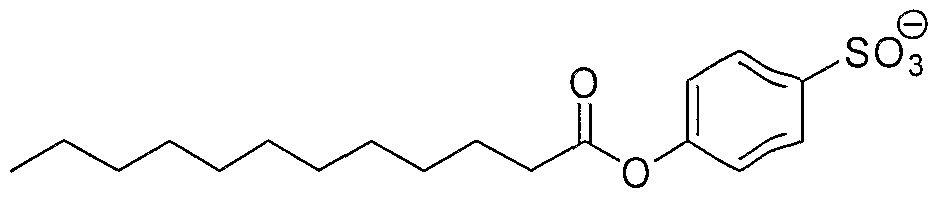
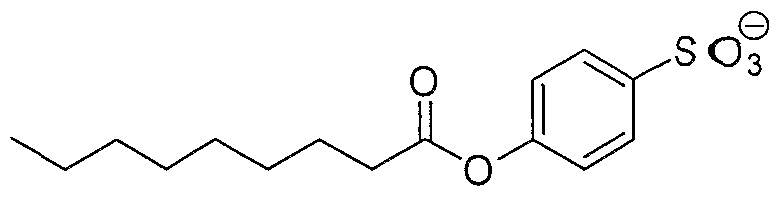
(14) Anionic bleach activators having the general formula:
R^ - CO - O - C6H4 -R2 wherein R1 is Cs-Ci8 alkyl, Cg-Ci8 amino alkyl, or mixtures thereof, and R2 is sulfonate or carbonate; nonlimiting examples such as:
Figure imgf000008_0001
4-nonanoyloxybenzene sulfonate
Figure imgf000008_0002
4-dodecanoyloxybenzene sulfonate
Figure imgf000008_0003
4-decanoyloxybenzoate are disclosed in US 5,891,838; US 6,448,430; US 5,891,838; US 6,159,919; US 6,448,430; US 5,843,879; US 6,548,467.
Cations
Cations suitable for use in the ionic liquids of the present invention include, but are not limited to, the following materials:
(a) Cations (i.e., in the protonated, cationic form) of amine oxides, phosphine oxides, or sulfoxides: nonlimiting examples include amine oxide cations containing one Cs-is alkyl moiety and 2 moieties selected from the group consisting of Ci-3 alkyl groups and Ci-3 hydroxy alkyl groups; phosphine oxide cations containing one C i o- 1 s alkyl moiety and 2 moieties selected from the group consisting of Ci-3 alkyl groups and Ci-3 hydroxyalkyl groups; and sulfoxide cations containing one C io- is alkyl moiety and a moiety selected from the group consisting Of Ci-3 alkyl and Ci-3 hydroxyalkyl moieties; in some embodiments, the amine oxide cations have the following formula:
Figure imgf000009_0001
wherein R3 is an Cg-22 alkyl, C8-22 hydroxyalkyl, C8-22 alkyl phenyl group, and mixture s thereof; R4 is an C2-3 alkylene or C2-3 hydroxyalkylene group or mixtures thereof; x i s from 0 to about 3; and each R5 is independently an Ci-3 alkyl or Ci-3 hydroxyalkyl group or a polyethylene oxide group containing an average of from about 1 to about 3 ethylene oxide groups; the R5 groups may be attached to each other, e.g., through an oxygen or nitrogen atom, to form a ring structure; other exemplary amine oxide cations include CiO-Ci8, Ci0, Ci0-Ci2, and Ci2-Ci4 alkyl dimethyl amine oxide cations, and C8-C]2 alkoxy ethyl dihydroxy ethyl amine oxide cations; (b) Betaines having the general formula:
R-N(+)(R')2-R2COOH
wherein R is selected from the group consisting of alkyl groups containing from about 10 to about 22 carbon atoms, preferably from about 12 to about 18 carbon atoms , alkyl aryl and aryl alkyl groups containing a similar number of carbon atoms with a benzene ring treated as equivalent to about 2 carbon atoms, and similar structures interrupted by amido or ether linkages; each R1 is an alkyl group containing from 1 to about 3 carbon atoms; and R2 is an alkylene group containing from 1 to about (5 carbon atoms; nonlimiting examples of betaines include dodecyl dimethyl betaine , acetyl dimethyl betaine, dodecyl amidopropyl dimethyl betaine, tetradecyl dimethyl betaine, tetradecyl amidopropyl dimethyl betaine, dodecyl dimethyl ammonium hexanoate; and amidoalkylbetaines which are disclosed in U.S. Pat. Nos. 3,950,417 ; 4,137,191; and 4,375,421; and British Patent GB No. 2,103,236; in another- embodiment, the cation may be a sulfobetaine, which are disclosed in US Patent: 4,687,602; (c) Diester quaternary ammonium (DEQA) cations of the type:
Vm) - N+ - [(CH2)n - Y - R ]111 wherein each R substituent is selected from hydrogen; Ci-C6 alkyl or hydroxy alky 1, preferably methyl, ethyl, propyl, or hydroxyethyl, and more preferably methyl; poly(Ci-C3 alkoxy), preferably polyethoxy; benzyl; or a mixture thereof; m is 2 or 3; each n is from 1 to about 4; each Y is -0-(O)C-, -C(O)-O-, -NR-C(O)-, or -C(O)- NR-; with the proviso that when Y is -O-(0)C- or -NR-C(O) -, the sum of carbons in each R1 plus one is Ci2-C22, preferably C14-C20, with each R1 being a hydrocarbyl, or substituted hydrocarbyl group; in one embodiment, the DEQA cation is an alkyl dimethyl hydroxyethyl quaternary ammonium as discussed in US 6,004,922; in another embodiment, the DEQA cation has the general formula:
R3N+CH2CH(YR1XCH2YR1) wherein each Y, R, R1 have the same meanings as before; in yet another embodiment, the DEQA cation is [CH3J3 N(+)[CH2CH(CH2O(O)CR')O(O)CR1] wherein each R1 is in the range of Ci5 to C19;
(d) Alkylene quaternary ammonium cations having the formula:
R, (4.-m) , - N+ - R1 m wherein each m is 2 or 3; each R is independently an alkyl or hydroxyalkyl Ci-C6 moiety, preferably methyl, ethyl, propyl or hydroxyethyl, and more preferably methyl; each R1 is independently a linear or branched, saturated or unsaturated C6-C22 alkyl or alkoxy moiety, preferably Ci4-C20 moiety, but no more than one R1 being less than about Ci2 and then the other R1 is at least about Ci6; or hydrocarbyl or substituted hydrocarbyl moiety, preferably C10-C20 alkyl or alkenyl, most preferably Ci2-Ci8 alkyl or alkenyl; in one embodiment, the cation is dialkylenedimethyl ammonium, such as dioleyldimethyl ammonium available from Witco Corporation under the tradename Adogen® 472; in another embodiment, the cation monoalkenyltrimethyl ammonium, such as monooleyltrimethyl ammonium, monocanolatrimethyl ammonium, and soyatrimethyl ammonium;
(e) Difatty amido quaternary ammonium cations such as:
[R1— C(O)- NR- R2— N(R) — R3^-NR-C(O)-R1 ]+ wherein R and R1 are as defined in cation (e) above, R2 and R3 are C]-C6 alkylene moieties; for example, difatty amido quats are commercially available from Witco under the Varisoft® tradename;
(f) C8-22 quaternary surfactants such as isostearyl ethyl imidonium available in its ethosulfate salt form as Schercoquat IIS® from Scher Chemicals, Inc., quaternium-52 obtainable as Dehyquart SP® from Cognis Corporation, and dicoco dimethyl ammonium available in its chloride salt form as Arquad 2C-75® from Alczo Nobel Surface Chemistry LLC;
(g) Cationic esters such as discussed in US 4,228,042, US 4,239,660, US 4,260,529 and US 6,022,844;
(h) 4,5-dichloro-2-n-octyl-3-isothiazolone, which is obtainable as Kathon® from Rohm and Haas;
(i) Quaternary amino polyoxyalkylene derivatives (choline and choline derivatives);
(j) Alkyl oxyalkylene cations;
(k) Alkoxylate quaternary ammoniums (AQA) as discussed in US 6,136,769;
(1) Substituted and unsubstituted pyrrolidinium, imidazolium, benzimidazolium, pyrazolium, benzpyrazolium, thiazolium, benzthiazolium, oxazolium, benzoxazolium, isoxazolium, isothiazolium, imdazolidenium, Guanidinium, indazolium, quinuclidinium, triazolium, isoquinuclidinium, piperidinium, morpholinium, pyridazinium, pyrazinium, triazinium, azepinium, diazepinium, pyridinium, piperidonium, pyrimidinium, thiophenium; phosphonium; in one embodiment, the cation is an substituted imidazol a:
Figure imgf000011_0001
wherein each R and R1 are as defined in cation (e) above; each R2 is a Ci-C6 alkylene group, preferably an ethylene group; and G is an oxygen atom or an -NR- group; for example, the cation 1 -methyl- l-oleylamidoethyl-2-oleylimidazolinium is available commercially from the Witco Corporation under the trade name Varisoft® 3690; in another embodiment, the cation is alkylpyridinium cation having the formula:
Figure imgf000011_0002
wherein R1 is an acyclic aliphatic C8-C22 hydrocarbon group; in another embodiment, the cation is an alkanamide alkylene pyridinium cation having the formula:
Figure imgf000012_0001
wherein R1 is a linear or branched, saturated or unsaturated C6-C22 alkyl or alkoxy moiety, or a hydrocarbyl or substituted hydrocarbyl moiety, and R is a C i-C6 alkylene moiety;
(m) Cationic bleach activators having a quaternary ammonium moiety including but not limited to
Figure imgf000012_0002
N,N-dimethyl-2-[(phenoxycarbonyl)oxy]-N-[2- [(phenoxycarbonyl)oxy]ethyl]ethanaminium
Figure imgf000012_0003
4-(cyanomethyl)-4-methylmoφholinium ; 1 -cyano-N,N,N-trimethylmethanaminium
O
1 -methyl-3 -( 1 -oxoheptyl)- 1 H-Imidazolium these and other cationic bleach activators suitable for use herein as cation, s of the ionic liquids are disclosed in US 5,599,781, US 5,686,015, US 5,686,015, WO 95/29160, US 5,599,781, US 5,534,179, EP 1 253 190 Al, US 6,183,665, US 5,106,528, US5,281,361, and Bulletin de Ia Societe Chimique de France (1973),(3)<Pt. 2), 1021- 7;
(n) Cationic anti-microbial agents, such as cetyl pyridinium, chlorohexidine and domiphen.
(o) Alkylated caffeine cations, such as
Figure imgf000012_0004
wherein Rt and R2 are CL to C 12 alkyl or alkylene groups.
In some specific embodiments, water immiscible ionic liquids comprise cations having the formulae:
Figure imgf000013_0001
wherein R'-R4 are selected from among the group consisting of linear or branched, substituted or unsubstituted, alkyl, aryl, alkoxyalkyl, alkylenearyl hydroxy alkyl, or haloalkyl; XI is an anion such as those described hereinabove; m and n are chosen to provide electronic neutrality; further wherein the ionic liquids are water immiscible when at least one of R1 -R4 is C12 or higher; or at least two of R1 -R4 are ClO or higher; or at least three of R1 -R4 are C6 or higher. In further embodiments, the water immiscible ionic liquids comprise a cation selected from the group consisting of trimethyloctyl ammonium cation, triisooctylmethyl ammonium cation, tetrahexyl ammonium cation, tetraoctyl ammonium cation, and mixtures thereof, and an anion selected from those described hereinabove. In yet further embodiments, the water immiscible ionic liquids comprise amine oxide cations and an anion selected from those described hereinabove. In additional embodiments, the water immiscible ionic liquids comprise betaine cations and an anion selected from those described hereinabove.
Thus, the ionic liquids suitable for use herein may have various anionic and cationic combinations. The ionic species can be adjusted and mixed such that properties of the ionic liquids can be customized for specific applications, so as to provide the desired solvating properties, "viscosity, melting point, and other properties, as desired. These customized ionic liquids have been referred to as "designer solvents".
Examples of ionic liquids that are useful in the present invention are described in US 6,048,388; US 5,827,602 ; US 2003/915735A1; US 2004/0007693 Al; US 2004/003120; US 2004/0035293Al; WO 02/26701; WO 03/074494; WO 03/022812; WO 04/016570; and co-filed P&G Case 9817P and 9818P. The ionic liquid can be present in the cleaning compositions disclosed herein in any desired effective amount. Typically, the ionic liquid is present in an amount ranging from about 0.1% to about 99.9%, preferably from about 1% to about 75%, and more preferably from about 1% to about 60°/G, by weight of the composition. In some embodiments, the second ionic liquid phase comprises less than about 50% by weight of the composition. In yet additional embodiments, the second ionic liquid phase comprises less than about 10% by weight of the composition.
As previously indicated, the ionic liquid phase is substantially immiscible with the first phase, as determined according to the following Ionic Liquid Water Miscibility Test:
A mixture of 0.5g ionic liquid and 4.5g de-ionized water are sonicated in a Bransonic Ultrasonic Bath, model no. 12 1 OR-MTH, 50/60 Hz, 1 17 volts, 1.3 AMPS, according to the manufacturer's specifications for 1.5 hours. Thereafter, if a homogenous transparent system results within 15 minutes of standing without agitation, then the ionic liquid is water miscible.
In specific embodiments of the multiphase compositions, the immiscibility among phases would mean that one phase is substantially free of any carrier liquid of the other phase. For example, if the first phase is an aqueous phase, the second phase is substantially free of water and water-mis cible organic solvents. Similarly, if the first phase comprises a silicone solvent system, the second phase is substantially free of silicone carrier. As used herein, "substantially free of indicates that the phase contains less than about 10 weight %, more preferably less than about 5 weight %, even more preferably less than about 1 weight %, of ttie recited component.
The respective phases may be in the form of discrete liquid layers or dispersed domains (e.g., droplets, particles, stripes, and other shapes) of one phase dispersed in another phase. In a specific embodiment, the second phase is dispersed in the first phase. In a more specific embodiment, the second, phase comprises droplets dispersed in the first phase. The droplets may be of any size, depending on various desired functional capabilities, as subsequently discussed in detail. In a specific embodiment, the dispersed second phase comprises droplets having an average droplet size of less than about 1,000 microns, or in other embodiments, less thian about 250 microns or less than about 100 microns. In further embodiments, the composition is a clear liquid because any dispersed phase therein has a dimension less than the wavelength of visible light. In the embodiment where ionic liquid is the dispersed phase, the small phase dimension of the dispersed ionic liquid phase may enable better contact between soils and the ionic liquid phase. In still other embodiments, the composition comprises a high internal phase emulsion wherein the dispersed phase (either the ionic liquid-containing phase or the carrier-containing phase) comprises greater than 50wt% of the composition.
By providing a multiphase composition, the ionic liquid is available for providing unexpected improvements to the cleaning compositions. Not intending to be bound by theory, it is believed that the high charge, high polarity of the ionic liquids enable the ionic liquid to interact strongly with soils, thereby removing soils from surfaces being treated, and/or extracting soils from other phases of the conmposition. It is also believed that due to the strong interactions between them, the ionic liquid may function as a trap for removed soils, particularly greasy soils, and therefore act as a microsponge. The ability to trap soils is particularly advantageous in preventing redeposition of removed soils. As will be appreciated, by entrapping greasy soils in the ionic liquid-containing phase, a bulk aqueous phase such as sink water in a hand dishwashing operation will remain acceptable to a consumer for continued washing for a longex period of time as the grease is captured in the ionic liquid. Thus, the compositions ma.y be used to improve wash water appearance in hand dishwashing applications, thereb>y delivering cleaner- looking wash water.
The present compositions are also advantageous in that the ionic liquid may provide improved direct-contact mediated stain removal, hydration, and/or softening, particularly on tough soils, for example tough food soils such as burnt-on and/or baked- on foods, polymerized grease and the like. This advantage may be particularly apparent in compositions wherein the second phase is dispersed throughout the first phase, thereby increasing the surface contact during use of the composition in a cleaning operation. The unique polarity charges of the ionic liquid provide improved so lvating properties for some soils. In specific embodiments, the ionic liquid may provide improved solvating properties for soils that are difficult to remove using conventional cleaning composition, including, but not limited to, hydrophobic soils which are often difficult to clean using water-based cleaning compositions. While not intending to be bound by theory, such soils may preferentially interact with or migrate into the ionic liquid phase.
In another aspect, the ionic liquid phase may provide a sequestered location for additional components of the cleaning compositions. For example, the ionic liquid phase can provide a sequestered reaction location for components sucn as bleaches, bleach catalysts, enzymes or the like. Further, the ionic liquid may be seL ected to enhance such reactions. The ionic liquid may also provide a stable environment which increases the stability of the component within the composition, for example during manufacture and/or storage and/or use. Additionally, the ionic liquid may serve merely as a carrier for delivery of such agents, and/or additional benefit agents.
Suitable benefit agents include, but are not limited to, one or more agents selected from the group consisting of bleaches, bleach catalysts, bleach boosters, bleach activators, suds suppressors, particulate builders (e.g., silica, zeolites, phosphates), polymeric builders (e.g., polyacrylates, poly(acrylic-maeic) copolymers), chelants, biocides, surfactants, enzymes, radical initiators, perfumes, dyes, skin conditioning actives, vitamins, softeners, and mixtures thereof. In a specific embodiment, the compositions further comprise a soil dispersing agent. Such agents are well lcnown in the art to reduce redeposition of removed soils on articles which are subjected to a cleaning procedure. Suitable soil dispersing agents are well known in the art and examples include, but are not limited to, clays, soil release polymers, detersive surfactants, mixtures thereof.
Additional examples of suitable benefit agents are disclosed in US 6,488,943, Beerse et al; US 6,5 14,932, Hubesch et al.; US 6,548,470, Buzzaccarini et al.; US 6,482,793, Gordon et al.; US 5,545,350, Baker et al.; US 6,083,899, Baker et al.; US 6,156,722, Panandiker et al.; US 6,573,234, Sivik et al.; US 6,525,012, Price et al.; US 6,551,986, Littig et al. ; US 6,566,323, Littig et al.; US 6,090,767, Jackson et al.; and/or US 6,420,326, Maile et al.
The benefit agents may be included in the cleaning composition in any desired amount. Typical compositions may contain from about 0.001 to about 20 percent by weight of the composition, of the benefit agent. In more specific embodiments, such compositions may comprise from about 0.01 to about 10 percent by weight, and more specifically, from about 0.1 to about 5 percent by weight, of the benefit agent^s).
The benefit agents may be included in the ionic liquid-containing phase, however, it is equally within the scope of the present invention to include one or more, or all of any such benefit agents, in a phase other than the ionic liquid-containing phase. Thus, such benefit agents may be contained in the first phase and/or additional phases of the composition.
In one embodiment, the composition includes an ionic liquid phase, wherein the benefit agent is in the form of an ionic liquid active. An ionic liquid active is composed of an ion active and an ionic liquid- forming counter ion, wherein the ion active provides benefit to the surfaces treated by the cleaning composition. The ionic active may be anionic or cationic, as necessary for the desired benefit, and is typically derived from a salt or acid of a known active agent. For example, if a conventional active agent in salt form is of the formula X+Y" and the anion Y" provides the desired benefit activity, then the anionic form of the active agent is employed in the ionic liquid active. Examples of suitable anionic actives include, but are not limited to, anionic phosphate builders, anionic linear alkyl sulfate and sulfonate detersive surfactants, anionic alkylated and alkoxylated sulfate and sulfonate detersive surfactants, anionic perborate, percarbonate and peracid bleaches, and the like. Alternatively, if trxe cation X+ of the conventional active agent in the salt form of the formula X+Y" provides the desired benefit activity, then the cationic form of the active agent is employed in the ionic liquid active. Examples of suitable cationic actives include, but are not limited to, cationic quaternary ammonium antimicrobial agents, cationic quaternary ammonium fabric softeners, and the like. As one of ordinary skill in the art will appreciate, a conventional nonionic or zwitterionic active agent can also be converted to an ionic liquid active by ionic functional ization.
In some embodiments, the ionic active is formed from known active agents which are insoluble or exhibit low solubility when employed in conventional cleaning compositions. Ionic liquids containing one or more ionic actives are disclosed in further detail in the co-filed P&G case 9815P.
In some embodiments, ionic liquids (undiluted with adjuncts, co-solvents or free water) employed herein have viscosities of less than about 2000 mPa-s, preferably less than about 750 mPa-s, as measured at 200C. In some embodiments, the viscosity of undiluted ionic liquids are in the range from about 0.L to about 500 mPa-s, preferably from about 0.5 to about 300 mPa-s, and more preferably from about 1 to about 250 mPa-s.
The cleaning compositions may be formulated in the form of liquid, gel, paste, foam, or solid. When the composition is in a solid form, it can be further processed into granules, powders, tablets, or bars. In a specific embodiment, the multiphasic composition is in the form of a liquid. The multiplxasic composition of the present invention has a viscosity less than about 5000 mPa-s. In another embodiments, the viscosity of such composition is less than about 2000 mPa-s at room temperature (about 2O0C). In still another embodiment, the viscosity of sucli composition lowers to less than about 2000 mPa-s, preferably less than about 500 mPa.-s, and more preferably less than about 250 mPa-s, when heated to a temperature in the range of about 400C to 60°C.
The viscosities of the ionic liquids and compositions containing them can be measured on a Brookfield viscometer model number LVD VII+ at 200C, with spindle no. S31, at the appropriate speed to measure materials of different viscosities. Typically, the measurement is done at a speed of 12 rpm to measure products of viscosity greater than about 1000 mPa-s; 30 rpm to measure products with viscosities between about 500 mPa-s to about 1000 mPa-s; and 60 rpm to measure products with viscosities less than about 500 mPa-s. The undiluted state is prepared by storing the ionic liquids or cocktails in a desiccator containing a desiccant (e.g. calcium chloride) at room temperature for at least about 48 hours prior to the viscosity measurement. This equilibration period unifies the amount of innate water in the undiluted ionic liquid samples.
In a further embodiment, the cleaning compositions according to the present invention may comprise a third phase and optionally, further additional phases. In a specific embodiment, the cleaning composition comprises a third phase which separates from the first phase and the second phase upon standing of the composition, for example for a period of five minutes or more, and comprises an organic solvent, an ionic liquid, or mixtures thereof.
In preferred embodiments, the compositions according to the present invention are phase-stable over a range of operating conditions. For example, in one embodiment, the compositions are phase stable at temperatures ranging from about room temperature up to about 1000C.
The compositions of the present invention may be provided in various forms, including, but not limited to, hand dishwashing detergents, automatic dishwashing detergents, pretreating compositions, hand laundry detergents, automatic laundry detergents, and the like. The compositions may be formulated in trie form of liquid, gel, paste, foam, or solid. When the composition is in the solid form, it can be further processed into granules, powders, tablets, or bars. The composition may be employed as a component of another cleaning product, for example by application to an absorbent substrate to provide a wipe for use in various applications. Any suitable absorbent substrate may be employed, including woven or nonwoven fibrous webs and/or foam webs. It is preferred that such an absorbent substrate should have sufficient wet strength to hold an effective amount of the composition according to the present invention to facilitate cleaning. The ionic liquid-containing composition can also be included in unit dose products, which typically employ a composition of the present invention in a unit dose package comprising a water soluble polymer film. Exemplary unit dose package are disclosed in US 4, 973,416; US 6,451,750; US 6,448,212; and US 2O03/0,054,966A1.
To facilitate provision of a hand-washing composition, in one embodiment it is preferred that the composition is high-foaming. It should therefore be insured that the second ionic liquid phase does not inhibit foam formation or duration significantly. On the other hand, to facilitate provision of automatic washing detergents in another embodiment, it is preferred that such compositions are low-foaming to avoid foam formation which is typically unmanageable in automatic washing machines. Thus, such compositions may advantageously further include a suds suppressant. The compositions may be provided for use in any desirable form, including unit dose form.
The method of forming the multiphasic composition of the present invention comprises the steps of: providing a first liquid comprising an ionic liquid, a second liquid comprising a carrier, and a surfactant capable of stabilizing the phases; and combining the first and second liquids and the surfactant under a shear rate of at least about 10,000 s"1 for at least about 30 seconds, thereby forming a composition capable of forming into a multiphase composition. Alternatively, the high shear mixing step may be conducted at a shear rate of from about 13,000 to about 30,000 s"!, and the duration may range from at least about 1 minute, or at least about 5 minutes, or at least about 30 minutes. Adjunct ingredients may be combined into the multiphase composition concurrent or subsequent to the mixing operation.
The methods according to the invention provide cleaning of a surface by use of the compositions as described herein. Typically, a soiled surface is contacted with a wash liquor comprising the cleaning composition of the invention. The wash liquor may be a neat form of the cleaning composition, or may comprise a diluted solution of the cleaning composition (typical cleaning composition to water ration is 1 : 100 or higher). As will be recognized, in hand and automatic dish and laundry washing applications, the cleaning composition will be diluted with water.
Examples
The following are nonlimiting examples of multiphase aqueous consumer product compositions containing ionic liquids (amounts are in weight percentages).
Figure imgf000019_0001
Figure imgf000020_0001
1. Exemplary Aesthetic Agents include dyes, colorants, speckles, perfumes and mixtures thereof.
2. Exemplary Enzymes include proteases, amylases, lipases, and mixtures thereof, and the like.
3. Exemplary Adjuncts include surfactants, soil dispersing agents, bleaching agents, preservatives and mixtures thereof, and the like.
4. Exemplary Co-solvents include ethanol, isopropanol, propylene glycol, and mixtures thereof.
5. Exemplary phase stabilizing surfactants include decaglycerol decaoleate, sorbitan esters (Span® from Uniqema), polyoxyethylene derivatives of sorbitan esters (Tween® from Uniqema), and block copolymer surfactants (Pluronic® from BASF Corporation).
The ionic liquids employed in these examples can be prepared according to the methods disclosed in the co-filed US patent applications 60/624,056 and 60/624,125 (P&G case 9817P and 9818P).
All documents cited in the Detailed Description of the Invention are, in relevant part, incorporated herein by reference; the citation of any document is not to be construed as an admission that it is prior art with respect to the present invention.
While particular embodiments of the present invention have been illustrated and described, it would be obvious to those skilled in the art that various other changes and modifications can be made without departing from the spirit and scope of the invention. It is therefore intended to cover in the appended claims all such changes and modifications that are within the scope of this invention.

Claims

What is claimed is:
1. A multiphase cleaning composition, comprising a first phase comprising a carrier and a second phase comprising an ionic liquid, wherein the second phase is substantially immiscible with the first phase.
2. The composition according to claim 1, wherein the first phase is an aqueous phase and the second phase is substantially free of water and water-miscible organic solvents.
3. The composition according to any of the preceding claims, wherein the first phase comprises a silicone solvent system and the second phase is substantially free of silicone solvent.
4. The composition according to any of the preceding claims, wherein the composition further comprising a third phase which separates from the first phase and the second phase upon standing, and comprises an organic solvent, an ionic liquid, or mixtures thereof.
5. The composition according to any of the preceding claims, wherein the ionic liquid includes an anionic component comprising one or more anions selected from the group consisting of alkyl sulfates, alkoxy sulfates, alkyl alkoxy sulfates, monoesters of sulfosuccinates, diesters of sulfosuccinates, methyl ester sulfonates (MES), alkylaryl sulfonates, alkyl glycerol ether sulfonates, diphenyl ethers, linear carboxylates, cyclic carboxylates, mid-chain branched alkyl sulfates (HSAS), mid-chain branched alkylaryl sulfonates (MLAS) and mid-chain branched alkyl polyoxyalkylene sulfates, sarcosinates, sulfated oils and fatty acids, sulfonated oils and fatty acids, fatty acid ester sulfonates, sweetener- derived anions, ethoxylated amide sulfates, sodium tripolyphosphate; dihydrogen phosphate; fluroalkyl sulfonate; bis-(alkylsulfonyl) amine; bis- (fluoroalkylsulfonyl)amide; (fluroalkylsulfonyl) (fiuoroalkylcarbonyl)amide; bis(arylsulfonyl)amide; carbonate; tetrafluorborate (BF4 "); hexaflurophosphate (PF6 "); and anionic bleach activators having the general formula: Ri - CO - O - C6H4 -R2, wherein Ri is C8-C18 alkyl, C8-C18 amino alkyl, or mixtures thereof, and R2 is sulfonate or carbonate, and mixtures thereof.
6. The composition according to any of the preceding claims, wherein the ionic liquid includes a cationic component comprising one or more cations selected from the group consisting of amine oxide cations, phosphine oxide cations, sulfoxide cations, betaines, diester quaternary ammonium (DEQA) cations, alkylene quaternary ammonium cations, difatty amido quaternary ammonium cations, C8-22 quaternary surfactants, cationic esters, 4,5-dichloro-2-n-octyl-3- isothiazolone, quaternary amino polyoxyalkylenes, alkyl oxyalkylene cations, alkoxylate quaternary ammoniums, substituted and unsubstituted pyrrolidiniurn, imidazolium, benzimidazolium, pyrazolium, benzpyrazolium, thiazolium, benzthiazolium, oxazolium, benzoxazolium, isoxazolium, isothiazolium, imdazolidenium, guanidinium, indazolium, quinuclidinium, triazolium, isoquinuclidinium, piperidinium, morpholinium, pyridazinium, pyrazinium, triazinium, azepinium, diazepinium, pyridinium, piperidonium, pyrimidinium., thiophenium; and phosphonium, cationic bleach activators having a quaternary ammonium moiety, cationic anti-microbial agents, alkylated caffeine cations, and mixtures thereof.
7. The composition according to any of the preceding claims, wherein the second phase comprises from 0.01 to 90 weight % of the composition.
8. The composition according to any of the preceding claims, wherein the second phase comprises less than 50 weight % of the composition.
9. The composition according to any of the preceding claims, wherein the first phase is the continuous phase and the second phase is the dispersed phase.
10. The composition according to any of the preceding claims, wherein the dispersed second phase comprises droplets having an average droplet size of less than 1 ,000 microns.
11. The composition according to any of the preceding claims, wherein the composition is phase stable at a temperature of less than 700C, and/or a pH of from 3 to 12.
12. The composition according to any of the preceding claims, further comprising a phase stabilizing surfactant.
13. The composition according to any of the preceding claims, further comprising a soil dispersing agent selected from the group consisting of clays, polymers, surfactants, and mixtures thereof.
14. The composition according to any of the preceding claims, further comprising a benefit agent selected from the group consisting of bleaches, bleach catalysts, bleach boosters, bleach activators, suds suppressors, builders, chelants, biocides, surfactants, enzymes, radical initiators, perfumes, dyes, skin conditioning actives, vitamins, softeners, and mixtures thereof.
15. The composition according to any of the preceding claims, wherein the benefit agent is associated with the second phase.
16. The composition according to any of the preceding claims, wherein the composition is a hand dishwashing detergent, an automatic dishwashing detergent, a pretreating composition, or a laundry detergent.
17. A method of cleaning a surface, comprising (a) contacting a soiled surface with a wash liquor comprising a cleaning composition according to any of the preceding claims; and (b) removing soils from the surface.
18. The method according to any of the preceding claims, further comprising, prior to the contacting step, forming the wash liquor by diluting the cleaning composition with water.
19. A method of forming a multiphasic composition according to any of the preceding claims, the method comprising the steps of:
(a) providing a first liquid comprising an ionic liquid, a second liquid comprising a carrier, and optionally a surfactant and/or other adjuncts; and (b) combining the first and second liquids and the surfactant under a shear rate of at least 10,000 s"1 for at least 30 seconds, thereby forming a composition capable of phase separation into a multiphasic composition.
PCT/US2005/039356 2004-11-01 2005-11-01 Multiphase cleaning compositions having ionic liquid phase Ceased WO2006050308A2 (en)

Priority Applications (2)

Application Number Priority Date Filing Date Title
EP05818380A EP1807497A2 (en) 2004-11-01 2005-11-01 Multiphase cleaning compositions having ionic liquid phase
JP2007537045A JP2008516078A (en) 2004-11-01 2005-11-01 Multiphase cleaning composition having an ionic liquid phase

Applications Claiming Priority (2)

Application Number Priority Date Filing Date Title
US62412704P 2004-11-01 2004-11-01
US60/624,127 2004-11-01

Publications (2)

Publication Number Publication Date
WO2006050308A2 true WO2006050308A2 (en) 2006-05-11
WO2006050308A3 WO2006050308A3 (en) 2007-04-19

Family

ID=36051550

Family Applications (1)

Application Number Title Priority Date Filing Date
PCT/US2005/039356 Ceased WO2006050308A2 (en) 2004-11-01 2005-11-01 Multiphase cleaning compositions having ionic liquid phase

Country Status (4)

Country Link
US (2) US20060090777A1 (en)
EP (1) EP1807497A2 (en)
JP (1) JP2008516078A (en)
WO (1) WO2006050308A2 (en)

Cited By (3)

* Cited by examiner, † Cited by third party
Publication number Priority date Publication date Assignee Title
FR2917094A1 (en) * 2007-06-08 2008-12-12 Dalta Sa COMPOSITION FOR IMPREGNATION IN WIPES FOR CLEANING AND / OR CONTAMINATED SURFACE LUSTERING
EP2343310A1 (en) 2010-01-08 2011-07-13 Novozymes A/S Serine hydrolase formulation
US9278134B2 (en) 2008-12-29 2016-03-08 The Board Of Trustees Of The University Of Alabama Dual functioning ionic liquids and salts thereof

Families Citing this family (75)

* Cited by examiner, † Cited by third party
Publication number Priority date Publication date Assignee Title
US20040077519A1 (en) * 2002-06-28 2004-04-22 The Procter & Gamble Co. Ionic liquid based products and method of using the same
US8075803B2 (en) * 2003-08-27 2011-12-13 Roland Kalb Method for producing ionic liquids, ionic solids or mixtures thereof
US20060094616A1 (en) * 2004-11-01 2006-05-04 Hecht Stacie E Ionic liquids derived from surfactants
US7939485B2 (en) * 2004-11-01 2011-05-10 The Procter & Gamble Company Benefit agent delivery system comprising ionic liquid
US7776810B2 (en) * 2004-11-01 2010-08-17 The Procter & Gamble Company Compositions containing ionic liquid actives
US20060090777A1 (en) * 2004-11-01 2006-05-04 Hecht Stacie E Multiphase cleaning compositions having ionic liquid phase
US20060094621A1 (en) * 2004-11-01 2006-05-04 Jordan Glenn T Iv Process for improving processability of a concentrate and compositions made by the same
US20060090271A1 (en) * 2004-11-01 2006-05-04 Price Kenneth N Processes for modifying textiles using ionic liquids
US7737102B2 (en) 2004-11-01 2010-06-15 The Procter & Gamble Company Ionic liquids derived from functionalized anionic surfactants
GB2423087A (en) * 2005-02-07 2006-08-16 Reckitt Benckiser A method of forming a surface treatment liquid,of treating a surface, of cleaning a surface and a packaged composition therefor
US20060183654A1 (en) * 2005-02-14 2006-08-17 Small Robert J Semiconductor cleaning using ionic liquids
US7923424B2 (en) * 2005-02-14 2011-04-12 Advanced Process Technologies, Llc Semiconductor cleaning using superacids
US7786065B2 (en) * 2005-02-18 2010-08-31 The Procter & Gamble Company Ionic liquids derived from peracid anions
US7737106B2 (en) * 2005-11-29 2010-06-15 The Procter & Gamble Company Process for making an ionic liquid comprising ion actives
DE102006034902A1 (en) * 2006-07-25 2008-01-31 Henkel Kgaa Detergents or cleaning agents with improved dispersibility
US8455421B2 (en) * 2008-09-01 2013-06-04 Expelliere Int Ltd Compositions and methods for the removal of chewing gum residues from substrates
WO2010052123A1 (en) * 2008-11-05 2010-05-14 Henkel Ag & Co. Kgaa Ionic liquid composition for the removal of oxide scale
GB201002456D0 (en) * 2010-02-12 2010-03-31 Invista Tech Sarl Low viscosity ionic liquids
JP2012208994A (en) * 2011-03-30 2012-10-25 Konica Minolta Advanced Layers Inc Manufacturing method of glass substrate for magnetic disks
JP5751890B2 (en) * 2011-03-31 2015-07-22 花王株式会社 Detergent composition for automatic dishwasher
MX357477B (en) 2011-06-22 2018-07-11 Colgate Palmolive Co Choline salt cleaning compositions.
US8673838B2 (en) 2011-06-22 2014-03-18 Ecolab Usa Inc. Solid concentrated fabric softener composition
MX342215B (en) * 2011-06-22 2016-09-21 Colgate Palmolive Co Liquid salt cleaning compositions.
CA2843252A1 (en) * 2011-07-27 2013-01-31 The Procter & Gamble Company Multiphase liquid detergent composition
US8481474B1 (en) 2012-05-15 2013-07-09 Ecolab Usa Inc. Quaternized alkyl imidazoline ionic liquids used for enhanced food soil removal
US8716207B2 (en) 2012-06-05 2014-05-06 Ecolab Usa Inc. Solidification mechanism incorporating ionic liquids
US20130338227A1 (en) 2012-06-13 2013-12-19 Marie-Esther Saint Victor Green Glycine Betaine Derivative Compounds And Compositions Containing Same
CN103540429B (en) * 2012-07-11 2018-01-23 上海和黄白猫有限公司 A kind of handguard armor liquid detergent
WO2014098869A1 (en) 2012-12-20 2014-06-26 Colgate-Palmolive Company Oral care composition containing ionic liquids
AU2012397210B2 (en) 2012-12-20 2016-03-10 Colgate-Palmolive Company Oral care composition containing ionic liquids
BR112015014993A2 (en) 2012-12-20 2017-07-11 Colgate Palmolive Co oral hygiene composition
BR112015015000A2 (en) 2012-12-20 2017-07-11 Colgate Palmolive Co oral care composition containing ionic liquids
WO2014098868A1 (en) 2012-12-20 2014-06-26 Colgate-Palmolive Company Oral care composition containing ionic liquids
JP6126956B2 (en) * 2013-09-17 2017-05-10 花王株式会社 Cleaning composition for clothing
US10240090B2 (en) 2014-08-29 2019-03-26 The Board Of Regents Of The Nevada System Of Higher Education On Behalf Of The University Of Nevada, Las Vegas Fire retardant materials and devices including same
US9334373B2 (en) * 2014-08-29 2016-05-10 The Board Of Regents Of The Nevada System Of Higher Education On Behalf Of The University Of Nevada, Las Vegas Fire retardant materials and devices including same
KR20170054453A (en) * 2014-09-10 2017-05-17 바스프 에스이 Encapsulated cleaning composition
US9941559B2 (en) * 2014-11-11 2018-04-10 Toyota Motor Engineering & Manufacturing North America, Inc. Water enhanced ionic liquid electrolytes for metal-air batteries
US9920284B2 (en) 2015-04-22 2018-03-20 S. C. Johnson & Son, Inc. Cleaning composition with a polypropdxylated 2-(trialkylammonio)ethanol ionic liquid
CN107530257B (en) 2015-04-23 2022-03-29 宝洁公司 Delivery of surfactant soluble antidandruff agents
ES2893974T3 (en) 2016-03-03 2022-02-10 Procter & Gamble Aerosol anti-dandruff composition
MX2018010882A (en) * 2016-03-09 2019-01-10 Basf Se Encapsulated laundry cleaning composition.
WO2017165191A2 (en) 2016-03-23 2017-09-28 The Procter & Gamble Company Imaging method for determining stray fibers
MX386123B (en) 2016-10-21 2025-03-18 Procter & Gamble COMPACT AND STABLE SHAMPOO PRODUCTS WITH LOW VISCOSITY AND VISCOSITY REDUCING AGENT.
WO2018075841A1 (en) 2016-10-21 2018-04-26 The Procter & Gamble Company Concentrated shampoo dosage of foam for providing hair care benefits
CN109715131B (en) * 2016-10-21 2022-04-26 宝洁公司 Low viscosity hair care compositions
WO2018075836A1 (en) 2016-10-21 2018-04-26 The Procter & Gamble Company Concentrated shampoo dosage of foam for providing hair care benefits
US11154467B2 (en) 2016-10-21 2021-10-26 The Procter And Gamble Plaza Concentrated shampoo dosage of foam designating hair conditioning benefits
EP3528897A1 (en) 2016-10-21 2019-08-28 The Procter & Gamble Company Dosage of foam for delivering consumer desired dosage volume, surfactant amount, and scalp health agent amount in an optimal formulation space
CN109862944A (en) 2016-10-21 2019-06-07 宝洁公司 Foam dosage forms for delivering the dosage form volume and surfactant dosage required by the consumer in an optimal formulation space
US11141361B2 (en) 2016-10-21 2021-10-12 The Procter And Gamble Plaza Concentrated shampoo dosage of foam designating hair volume benefits
WO2018080835A1 (en) 2016-10-26 2018-05-03 S. C. Johnson & Son, Inc. Disinfectant cleaning composition with quaternary amine ionic liquid
US10815453B2 (en) 2016-10-26 2020-10-27 S. C. Johnson & Son, Inc. Disinfectant cleaning composition with quaternary ammonium hydroxycarboxylate salt and quaternary ammonium antimicrobial
EP3532586B1 (en) 2016-10-26 2022-05-18 S.C. Johnson & Son, Inc. Disinfectant cleaning composition with quaternary ammonium hydroxycarboxylate salt
US11224567B2 (en) 2017-06-06 2022-01-18 The Procter And Gamble Company Hair compositions comprising a cationic polymer/silicone mixture providing improved in-use wet feel
US11679073B2 (en) 2017-06-06 2023-06-20 The Procter & Gamble Company Hair compositions providing improved in-use wet feel
US11141370B2 (en) 2017-06-06 2021-10-12 The Procter And Gamble Company Hair compositions comprising a cationic polymer mixture and providing improved in-use wet feel
WO2019074988A1 (en) 2017-10-10 2019-04-18 The Procter & Gamble Company A method of treating hair or skin with a personal care composition in a foam form
US11607373B2 (en) 2017-10-10 2023-03-21 The Procter & Gamble Company Sulfate free clear personal cleansing composition comprising low inorganic salt
MX388495B (en) 2017-10-10 2025-03-20 Procter & Gamble COMPACT SHAMPOO COMPOSITION CONTAINING SULFATE-FREE SURFACTANTS.
JP2020536876A (en) 2017-10-10 2020-12-17 ザ プロクター アンド ギャンブル カンパニーThe Procter & Gamble Company Compact shampoo composition containing amino acid-based anionic surfactant and cationic polymer
CN111328341B (en) 2017-11-30 2021-12-17 高露洁-棕榄公司 Cleaning composition and use thereof
JP7280265B2 (en) 2017-12-20 2023-05-23 ザ プロクター アンド ギャンブル カンパニー Transparent shampoo composition containing silicone polymer
MX2020014144A (en) 2018-06-29 2021-03-25 Procter & Gamble ANTI-DANDRUFF COMPOSITION IN AEROSOL WITH LOW SURFACTANT CONTENT.
US12226505B2 (en) 2018-10-25 2025-02-18 The Procter & Gamble Company Compositions having enhanced deposition of surfactant-soluble anti-dandruff agents
DE102019217849A1 (en) * 2019-11-20 2021-05-20 Henkel Ag & Co. Kgaa Bleach activator with a cationic group and detergent or cleaning agent I containing it
JP7410298B2 (en) 2019-12-06 2024-01-09 ザ プロクター アンド ギャンブル カンパニー Sulfate-free composition that strengthens the adhesion of scalp active substances
MX2022009191A (en) 2020-02-27 2022-08-18 Procter & Gamble ANTI-DANDRUFF COMPOSITIONS WITH SULFUR THAT HAVE IMPROVED EFFICACY AND AESTHETICS.
EP4171761A4 (en) * 2020-06-26 2024-07-24 Cage Bio Inc. Sanitizing compositions containing ionic liquid
CN111961540B (en) * 2020-07-14 2021-08-31 广州浪奇日用品有限公司 Preparation process of decontamination type washing powder
JP7678101B2 (en) 2020-11-23 2025-05-15 ザ プロクター アンド ギャンブル カンパニー Personal care compositions free of sulfated surfactants
US11819474B2 (en) 2020-12-04 2023-11-21 The Procter & Gamble Company Hair care compositions comprising malodor reduction materials
US12409125B2 (en) 2021-05-14 2025-09-09 The Procter & Gamble Company Shampoo compositions containing a sulfate-free surfactant system and sclerotium gum thickener
US11986543B2 (en) 2021-06-01 2024-05-21 The Procter & Gamble Company Rinse-off compositions with a surfactant system that is substantially free of sulfate-based surfactants
JP2024544222A (en) 2021-12-09 2024-11-28 ザ プロクター アンド ギャンブル カンパニー Sulfate-free personal cleansing composition with effective preservative properties - Patents.com

Citations (4)

* Cited by examiner, † Cited by third party
Publication number Priority date Publication date Assignee Title
US4973416A (en) 1988-10-14 1990-11-27 The Procter & Gamble Company Liquid laundry detergent in water-soluble package
US6448212B1 (en) 1999-07-09 2002-09-10 Henkel Kommanditgesellschaft Auf Aktien Laundry/dishwasher detergent portion
US6451750B2 (en) 2000-04-14 2002-09-17 Unilever Home & Personal Care Usa Division Of Conopco, Inc. Water soluble package and liquid contents thereof
US20030054966A1 (en) 2001-06-18 2003-03-20 Unilever Home & Personal Care Usa, Division Of Conopco, Inc. Water soluble package and liquid contents thereof

Family Cites Families (104)

* Cited by examiner, † Cited by third party
Publication number Priority date Publication date Assignee Title
BE587389A (en) 1959-02-11
FR1296756A (en) * 1961-05-09 1962-06-22 Aquitaine Petrole Antistatic composition
GB1014539A (en) 1963-08-09 1965-12-31 Berk F W & Co Ltd Polymer compositions
GB1269677A (en) 1969-12-11 1972-04-06 Procter & Gamble Ltd Bleaching composition
FR2101710A5 (en) * 1970-07-17 1972-03-31 Colgate Palmolive Co Heavy duty dishwashing detergent - contg an oil and polar substances
US3896033A (en) 1972-07-03 1975-07-22 Colgate Palmolive Co Encapsulated fabric softener
US4126573A (en) * 1976-08-27 1978-11-21 The Procter & Gamble Company Peroxyacid bleach compositions having increased solubility
US4170453A (en) 1977-06-03 1979-10-09 The Procter & Gamble Company Peroxyacid bleach composition
DE2829137C2 (en) * 1978-07-03 1982-09-16 Th. Goldschmidt Ag, 4300 Essen Use of 1,3-di-n-decyl-2-methyl-imidazolium chloride or bromide as microbicides
US4348292A (en) * 1980-10-17 1982-09-07 Walton-March, Inc. Multi-layered liquid detergent-builder concentrate compositions which on addition to water produce stable cleaning solutions
US4689168A (en) * 1984-06-08 1987-08-25 The Drackett Company Hard surface cleaning composition
GB8415909D0 (en) 1984-06-21 1984-07-25 Procter & Gamble Ltd Peracid compounds
US4634551A (en) 1985-06-03 1987-01-06 Procter & Gamble Company Bleaching compounds and compositions comprising fatty peroxyacids salts thereof and precursors therefor having amide moieties in the fatty chain
US4606838A (en) 1985-03-14 1986-08-19 The Procter & Gamble Company Bleaching compositions comprising alkoxy substituted aromatic peroxyacids
DE3668330D1 (en) * 1985-05-04 1990-02-22 Henkel Kgaa NO-SALT-FREE LIQUID DETERGENT WITH TEXTILE SOFTENING PROPERTIES.
GB8603961D0 (en) 1986-02-18 1986-03-26 Interox Chemicals Ltd Concentrated liquid composition
EP0267175B1 (en) 1986-11-03 1993-10-13 Monsanto Company Sulfone peroxycarboxylic acids
US4756850A (en) * 1987-06-10 1988-07-12 The Procter & Gamble Company Articles and methods for treating fabrics
DE3740899A1 (en) 1987-12-03 1989-06-15 Degussa Peroxycarboxylic acid-phosphane oxide complexes, their preparation and use
EP0334427B1 (en) 1988-03-21 1992-06-10 Akzo N.V. Alkyl sulphonyl peroxycarboxylic acids and bleaching and detergent compositions containing the same
JP2681517B2 (en) 1989-08-01 1997-11-26 三洋化成工業株式会社 Antistatic agent and resin composition
US5290475A (en) 1990-05-08 1994-03-01 Colgate Palmolive Liquid softening and anti-static nonionic detergent composition with soil release promoting PET-POET copolymer
JP3064368B2 (en) 1990-09-25 2000-07-12 松下電器産業株式会社 Electronic component suction nozzle
US5250121A (en) * 1991-09-26 1993-10-05 Canon Kabushiki Kaisha Ink-jet textile printing ink and ink-jet textile printing process
JPH05178798A (en) 1991-12-27 1993-07-20 Kao Corp Method for producing quaternary ammonium organic acid salt
JP3442387B2 (en) 1992-05-12 2003-09-02 ザ、プロクター、エンド、ギャンブル、カンパニー Concentrated fabric softener composition containing biodegradable fabric softener
JP2915208B2 (en) 1992-06-26 1999-07-05 帝人株式会社 Polyester production method
CN1081629A (en) 1992-07-25 1994-02-09 河南省华豫科技实业公司 Paint-sprinkling and drying method for renewing old bicycle
US5705466A (en) * 1993-08-17 1998-01-06 The Procter & Gamble Company High bulk density granular detergents containing a percarbonate bleach and a powdered silicate
US5476660A (en) 1994-08-03 1995-12-19 Lever Brothers Company, Division Of Conopco, Inc. Deposition of materials to surfaces using zwitterionic carrier particles
EP0723006A3 (en) 1995-01-23 1998-07-01 The Procter & Gamble Company Cleaning methods and products providing compatibilized staged release of bleach followed by enzymes
US5827602A (en) * 1995-06-30 1998-10-27 Covalent Associates Incorporated Hydrophobic ionic liquids
BR9611158A (en) 1995-10-30 1999-03-30 Unilever Nv Organic cationic peroxyacid bleach detergent composition and bleach additive composition
EP0862611B1 (en) * 1995-11-06 2001-09-12 Kao Corporation Method for producing crystalline alkali metal silicate granules and granular high density detergent
US6277808B1 (en) * 1995-11-27 2001-08-21 The Procter & Gamble Company Composition for treating stains on laundry items and method of treatment
DE19547055A1 (en) * 1995-12-18 1997-06-19 Solvay Interox Gmbh Solid peroxo and peroxy compounds stabilized by coating
ID18376A (en) 1996-01-29 1998-04-02 Johnson & Johnson Consumer DETERGENT COMPOSITIONS
GB2309706B (en) 1996-01-31 2000-02-09 Reckitt & Colman Inc Liquid detergent composition comprising quaternary ammonium surfactant having germicidal properties
US5731101A (en) * 1996-07-22 1998-03-24 Akzo Nobel Nv Low temperature ionic liquids
US6420325B2 (en) * 1996-12-12 2002-07-16 Colgate-Palmolive Company Chemical linker compositions
JPH10265674A (en) 1997-03-25 1998-10-06 Mitsubishi Chem Corp Polymer compound composite and method for producing the same
JP2002507239A (en) 1997-06-30 2002-03-05 ザ、プロクター、エンド、ギャンブル、カンパニー Liquid or gel light dishwashing detergent composition with a controlled pH having desirable food stain removal, rheological and foaming properties
EP1002029B1 (en) 1997-07-21 2003-05-14 The Procter & Gamble Company Improved alkylbenzenesulfonate surfactants
IT1293820B1 (en) 1997-08-05 1999-03-10 Ausimont Spa PEROXIDE-BASED COMPOSITIONS
JPH1184603A (en) 1997-09-12 1999-03-26 Fuji Photo Film Co Ltd Silver halide color photographic sensitive material and image forming method using the same
US6479446B1 (en) * 1997-11-26 2002-11-12 The Procter & Gamble Company Aqueous cleaning compositions in dispersed lamellar phase
KR100559110B1 (en) 1997-12-10 2006-03-13 미네소타 마이닝 앤드 매뉴팩춰링 캄파니 Bis (perfluoroalkylsulfonyl) imide surfactant salts in electrochemical systems
DE19811387A1 (en) * 1998-03-16 1999-09-23 Henkel Kgaa Liquid, multiphase, chlorofluorocarbon-free detergent forming temporary emulsion on shaking and used especially on glass
WO1999047635A2 (en) * 1998-03-16 1999-09-23 Henkel Kommanditgesellschaft Auf Aktien Aqueous multiphase detergents
US6569344B1 (en) 1998-04-27 2003-05-27 The Procter & Gamble Company Wrinkle reducing composition
US6048388A (en) * 1998-06-29 2000-04-11 Schwarz; William M. Ink compositions containing ionic liquid solvents
JP2000096454A (en) 1998-09-25 2000-04-04 Dow Corning Toray Silicone Co Ltd Aqueous fiber-treating agent
ID28828A (en) 1998-09-25 2001-07-05 Unilever Nv COMPOSITION OF MOUTH CARE BY IMPROVING WHITE DENTAL EFFECTS
US6472360B1 (en) 1999-04-12 2002-10-29 Unilever Home & Personal Care Usa Division Of Conopco, Inc. Multiple component hard surface cleaning compositions
US6767882B1 (en) * 1999-06-21 2004-07-27 The Procter & Gamble Company Process for producing coated detergent particles
DE19936727A1 (en) * 1999-08-06 2001-02-08 Henkel Kgaa Nonionic surfactant based aqueous multiphase detergent
US6537600B1 (en) 1999-09-14 2003-03-25 Charles R. Meldrum Multiple-stage energy-efficient produce processing system
US6180587B1 (en) * 1999-09-28 2001-01-30 Colgate Palmolive Company Multiple phase compositions
US6372829B1 (en) * 1999-10-06 2002-04-16 3M Innovative Properties Company Antistatic composition
JP4963338B2 (en) 1999-10-20 2012-06-27 株式会社ダイセル Cigarette smoke element and method for manufacturing the same
US6592988B1 (en) 1999-12-29 2003-07-15 3M Innovative Properties Company Water-and oil-repellent, antistatic composition
DE10003708A1 (en) 2000-01-28 2001-08-02 Solvent Innovation Gmbh Novel chiral ionic liquids and methods for their preparation in enantiomerically pure or enantiomerically enriched form
US20020004953A1 (en) * 2000-03-03 2002-01-17 Perry Robert J. Siloxane dry cleaning composition and process
WO2001077486A1 (en) 2000-04-07 2001-10-18 Sofitech N.V. Scale removal
WO2001085892A1 (en) 2000-05-11 2001-11-15 The Procter & Gamble Company Highly concentrated fabric softener compositions and articles containing such compositions
US6691536B2 (en) 2000-06-05 2004-02-17 The Procter & Gamble Company Washing apparatus
US6339182B1 (en) * 2000-06-20 2002-01-15 Chevron U.S.A. Inc. Separation of olefins from paraffins using ionic liquid solutions
US20020016269A1 (en) 2000-07-06 2002-02-07 The Procter & Gamble Co. Particle perfume delivery system
WO2002011600A1 (en) * 2000-08-04 2002-02-14 Kao Corporation Cleaning wet sheet
GB0023708D0 (en) * 2000-09-27 2000-11-08 Scionix Ltd Hydrated salt mixtures
GB0023706D0 (en) * 2000-09-27 2000-11-08 Scionix Ltd Ionic liquids
ATE266008T1 (en) 2000-10-27 2004-05-15 Centre Nat Rech Scient IMIDAZOLIUM SALTS AND THE USE OF THESE IONIC LIQUIDS AS SOLVENTS AND AS CATALYST
AU2002246574A1 (en) 2000-10-31 2002-08-06 The Procter And Gamble Company Detergent compositions
EP1205555A1 (en) * 2000-11-08 2002-05-15 Solvent Innovation GmbH Enzymatic catalysis in the presence of ionic liquids
US6288281B1 (en) * 2000-11-16 2001-09-11 Uop Llc Direct carbonylation of paraffins using an ionic liquid catalyst
GB0031827D0 (en) 2000-12-29 2001-02-14 Unilever Plc Detergent compositions
AU2002304855A1 (en) * 2001-03-20 2002-10-03 Basf Aktiengesellschaft Ionic liquids as selective additives for the separation of close-boiling or azeotropic mixtures
DE10137047A1 (en) * 2001-07-31 2003-02-27 Henkel Kgaa Sprayable cleaner containing a droplet-shaped apolar component
WO2003014284A1 (en) 2001-08-07 2003-02-20 Fmc Corporation High retention sanitizer systems
US6927201B2 (en) 2001-08-28 2005-08-09 Unilever Home & Personal Care Usa Division Of Conopco, Inc. Capsules for incorporation into detergent or personal care compositions
DE10142124A1 (en) 2001-08-30 2003-03-27 Henkel Kgaa Coated active ingredient preparation for use in particulate detergents and cleaning agents
US6808557B2 (en) * 2001-10-03 2004-10-26 The University Of Alabama Cellulose matrix encapsulation and method
US6824599B2 (en) * 2001-10-03 2004-11-30 The University Of Alabama Dissolution and processing of cellulose using ionic liquids
US6734153B2 (en) 2001-12-20 2004-05-11 Procter & Gamble Company Treatment of fabric articles with specific fabric care actives
KR100485090B1 (en) 2002-01-14 2005-04-22 주식회사 포스코 Enzymes coated with ionic liquid
DE10208822A1 (en) 2002-03-01 2003-09-11 Solvent Innovation Gmbh Halogen-free ionic liquids
EP1556390A4 (en) * 2002-04-05 2007-12-26 Univ South Alabama FUNCTIONALIZED IONIC LIQUIDS AND METHODS OF USE
FR2839644B1 (en) * 2002-05-14 2005-09-09 Oreal USE OF A PARTICULAR ORGANIC SALT AND COMPOSITION COMPRISING THE SAME FOR THE WASHING AND / OR CONDITIONING OF KERATINIC MATERIALS.
US20040077519A1 (en) 2002-06-28 2004-04-22 The Procter & Gamble Co. Ionic liquid based products and method of using the same
US20040007693A1 (en) * 2002-07-03 2004-01-15 Roger Moulton Ionic liquids containing borate or phosphate anions
GB2395487B (en) 2002-09-09 2007-03-14 Polydisplay Asa Liquid crystal dopants
KR20050051692A (en) 2002-10-11 2005-06-01 데구사 악티엔게젤샤프트 Fragrance composition comprising at least one ionic fluid, method for production and use thereof
EP1431383B1 (en) 2002-12-19 2006-03-22 The Procter & Gamble Company Single compartment unit dose fabric treatment product comprising pouched compositions with cationic fabric softener actives
CN1742084B (en) 2003-01-27 2010-09-08 诺维信公司 particle stabilization
TW200426212A (en) * 2003-03-03 2004-12-01 Kao Corp Emulsion composition
US20050143269A1 (en) * 2003-12-24 2005-06-30 Wei Karl S. Multi-phase personal cleansing compositions comprising a lathering cleansing phase and a non-lathering structured aqueous phase
US20060079418A1 (en) * 2004-10-08 2006-04-13 Wagner Julie A Stable multi-phased personal care composition
US20060079421A1 (en) * 2004-10-08 2006-04-13 Wagner Julie A Stable multi-phased personal care composition
US20060090777A1 (en) 2004-11-01 2006-05-04 Hecht Stacie E Multiphase cleaning compositions having ionic liquid phase
US20060094616A1 (en) * 2004-11-01 2006-05-04 Hecht Stacie E Ionic liquids derived from surfactants
US7776810B2 (en) * 2004-11-01 2010-08-17 The Procter & Gamble Company Compositions containing ionic liquid actives
US7737102B2 (en) * 2004-11-01 2010-06-15 The Procter & Gamble Company Ionic liquids derived from functionalized anionic surfactants
US20060094621A1 (en) * 2004-11-01 2006-05-04 Jordan Glenn T Iv Process for improving processability of a concentrate and compositions made by the same
US7939485B2 (en) * 2004-11-01 2011-05-10 The Procter & Gamble Company Benefit agent delivery system comprising ionic liquid

Patent Citations (4)

* Cited by examiner, † Cited by third party
Publication number Priority date Publication date Assignee Title
US4973416A (en) 1988-10-14 1990-11-27 The Procter & Gamble Company Liquid laundry detergent in water-soluble package
US6448212B1 (en) 1999-07-09 2002-09-10 Henkel Kommanditgesellschaft Auf Aktien Laundry/dishwasher detergent portion
US6451750B2 (en) 2000-04-14 2002-09-17 Unilever Home & Personal Care Usa Division Of Conopco, Inc. Water soluble package and liquid contents thereof
US20030054966A1 (en) 2001-06-18 2003-03-20 Unilever Home & Personal Care Usa, Division Of Conopco, Inc. Water soluble package and liquid contents thereof

Cited By (5)

* Cited by examiner, † Cited by third party
Publication number Priority date Publication date Assignee Title
FR2917094A1 (en) * 2007-06-08 2008-12-12 Dalta Sa COMPOSITION FOR IMPREGNATION IN WIPES FOR CLEANING AND / OR CONTAMINATED SURFACE LUSTERING
WO2009007527A3 (en) * 2007-06-08 2009-05-22 Dalta Composition to be impregnated in wipes for cleaning and/or polishing contaminated surfaces
US9278134B2 (en) 2008-12-29 2016-03-08 The Board Of Trustees Of The University Of Alabama Dual functioning ionic liquids and salts thereof
EP2343310A1 (en) 2010-01-08 2011-07-13 Novozymes A/S Serine hydrolase formulation
WO2011083114A2 (en) 2010-01-08 2011-07-14 Novozymes A/S Serine hydrolase formulation

Also Published As

Publication number Publication date
US20060090777A1 (en) 2006-05-04
EP1807497A2 (en) 2007-07-18
US7928053B2 (en) 2011-04-19
WO2006050308A3 (en) 2007-04-19
JP2008516078A (en) 2008-05-15
US20090233829A1 (en) 2009-09-17

Similar Documents

Publication Publication Date Title
US7928053B2 (en) Multiphase cleaning compositions having ionic liquid phase
US7939485B2 (en) Benefit agent delivery system comprising ionic liquid
US7786064B1 (en) Ionic liquids derived from functionalized anionic surfactants
US7776810B2 (en) Compositions containing ionic liquid actives
CA2488217C (en) Ionic liquid based products and method of using the same
US20100099314A1 (en) Ionic liquids derived from surfactants
CA2595298C (en) Ionic liquids derived from peracid anions
EP1807495A1 (en) Process for improving processability of a concentrate and compositions made by the same
CN104487560A (en) Liquid detergent composition
EP3458565A1 (en) Pre-treatment composition for fabric stains
JP6453244B2 (en) Fabric softener
AU2007200654A1 (en) Ionic liquid based products and method of using the same

Legal Events

Date Code Title Description
AK Designated states

Kind code of ref document: A2

Designated state(s): AE AG AL AM AT AU AZ BA BB BG BR BW BY BZ CA CH CN CO CR CU CZ DE DK DM DZ EC EE EG ES FI GB GD GE GH GM HR HU ID IL IN IS JP KE KG KM KN KP KR KZ LC LK LR LS LT LU LV LY MA MD MG MK MN MW MX MZ NA NG NI NO NZ OM PG PH PL PT RO RU SC SD SE SG SK SL SM SY TJ TM TN TR TT TZ UA UG US UZ VC VN YU ZA ZM ZW

AL Designated countries for regional patents

Kind code of ref document: A2

Designated state(s): GM KE LS MW MZ NA SD SL SZ TZ UG ZM ZW AM AZ BY KG KZ MD RU TJ TM AT BE BG CH CY CZ DE DK EE ES FI FR GB GR HU IE IS IT LT LU LV MC NL PL PT RO SE SI SK TR BF BJ CF CG CI CM GA GN GQ GW ML MR NE SN TD TG

121 Ep: the epo has been informed by wipo that ep was designated in this application
WWE Wipo information: entry into national phase

Ref document number: 2007537045

Country of ref document: JP

WWE Wipo information: entry into national phase

Ref document number: 2005818380

Country of ref document: EP

NENP Non-entry into the national phase

Ref country code: DE

WWP Wipo information: published in national office

Ref document number: 2005818380

Country of ref document: EP