WO2006050501A2 - Novobiocin analogues as anticancer agents - Google Patents

Novobiocin analogues as anticancer agents Download PDF

Info

Publication number
WO2006050501A2
WO2006050501A2 PCT/US2005/039990 US2005039990W WO2006050501A2 WO 2006050501 A2 WO2006050501 A2 WO 2006050501A2 US 2005039990 W US2005039990 W US 2005039990W WO 2006050501 A2 WO2006050501 A2 WO 2006050501A2
Authority
WO
WIPO (PCT)
Prior art keywords
compounds
methoxy
alkyl
hydrogen
chromen
Prior art date
Legal status (The legal status is an assumption and is not a legal conclusion. Google has not performed a legal analysis and makes no representation as to the accuracy of the status listed.)
Ceased
Application number
PCT/US2005/039990
Other languages
French (fr)
Other versions
WO2006050501A3 (en
Inventor
Brian S. Blagg
Len Neckers
Xiao Ming Yu
Current Assignee (The listed assignees may be inaccurate. Google has not performed a legal analysis and makes no representation or warranty as to the accuracy of the list.)
University of Kansas
US Department of Health and Human Services
Original Assignee
University of Kansas
US Department of Health and Human Services
Priority date (The priority date is an assumption and is not a legal conclusion. Google has not performed a legal analysis and makes no representation as to the accuracy of the date listed.)
Filing date
Publication date
Application filed by University of Kansas, US Department of Health and Human Services filed Critical University of Kansas
Priority to EP05824355.1A priority Critical patent/EP1807440B1/en
Priority to CA2585091A priority patent/CA2585091C/en
Priority to AU2005301957A priority patent/AU2005301957B2/en
Publication of WO2006050501A2 publication Critical patent/WO2006050501A2/en
Anticipated expiration legal-status Critical
Publication of WO2006050501A3 publication Critical patent/WO2006050501A3/en
Ceased legal-status Critical Current

Links

Classifications

    • CCHEMISTRY; METALLURGY
    • C07ORGANIC CHEMISTRY
    • C07HSUGARS; DERIVATIVES THEREOF; NUCLEOSIDES; NUCLEOTIDES; NUCLEIC ACIDS
    • C07H17/00Compounds containing heterocyclic radicals directly attached to hetero atoms of saccharide radicals
    • C07H17/04Heterocyclic radicals containing only oxygen as ring hetero atoms
    • C07H17/06Benzopyran radicals
    • C07H17/065Benzo[b]pyrans
    • C07H17/075Benzo[b]pyran-2-ones
    • AHUMAN NECESSITIES
    • A61MEDICAL OR VETERINARY SCIENCE; HYGIENE
    • A61PSPECIFIC THERAPEUTIC ACTIVITY OF CHEMICAL COMPOUNDS OR MEDICINAL PREPARATIONS
    • A61P25/00Drugs for disorders of the nervous system
    • AHUMAN NECESSITIES
    • A61MEDICAL OR VETERINARY SCIENCE; HYGIENE
    • A61PSPECIFIC THERAPEUTIC ACTIVITY OF CHEMICAL COMPOUNDS OR MEDICINAL PREPARATIONS
    • A61P35/00Antineoplastic agents

Definitions

  • the present invention is directed to the synthesis and identification of novobiocin analogues useful as a class of anticancer agents and/or neuroprotective agents.
  • the compounds of the present invention act by inhibition of the Hsp90 protein-folding machinery.
  • Hsp90 The 90 kDa heat shock proteins
  • the Hsp90 family of chaperones is comprised of four different isoforms.
  • Hsp90 ⁇ inducible/major form
  • Hsp90 ⁇ constitutive/minor form
  • GFP94 94-kDa glucose-regulated protein
  • TRAP-I Hsp75/tumour necrosis factor receptor associated protein 1
  • Hsp90 is an ATP-dependent protein with an ATP binding site in the N-terminal region of the active homodimer. Disruption of the ATPase activity of Hsp90 results in the destabilization of multiprotein complexes and subsequent ubiquitination of the client protein, which undergoes proteasome-mediated hydrolysis. More specifically, in an ATP-dependent fashion, Hsp70 binds to newly synthesized proteins cotranslationally and/or posttranslationally to stabilize the nascent peptide by preventing aggregation.
  • Hsp70-Hsp90 organizing protein contains highly conserved tetratricopeptide repeats ("TPRs") that are recognized by both Hsp70 and Hsp90, promoting the union of Hsp70/HEP and Hsp90, which results in a heteroprotein complex.
  • TPRs tetratricopeptide repeats
  • the client protein is transferred from the Hsp70 system to the Hsp90 homodimer with concomitant release of Hsp70, HIP, and HOP.
  • the ensemble Upon binding of ATP and an immunophilin with cisltrans peptidyl prolyl-isomerase activity (FKBP51, FKBP52, or CyPA), the ensemble folds the client protein into its three-dimensional structure, hi a subsequent event, p23 binds Hsp90 near the TV-terminal region promoting the hydrolysis of ATP and release of the folded protein, Hsp90 partner proteins, and ADP.
  • FKBP51, FKBP52, or CyPA an immunophilin with cisltrans peptidyl prolyl-isomerase activity
  • proteins dependent upon Hsp90 for conformational maturation include oncogenic and cellular Src kinases (v-Src, Hck, Lck), Raf, pi 85, mutant p53 (not normal p53), telomerase, steroid hormone receptors, polo-like kinase (“PLK”), protein kinase B (“AKT”), death domain kinase (“RIP”), MET kinase, focal adhesion kinase (“FAK”), aryl hydrocarbon receptor, RNA-dependent protein kinase (“PKR”), nitric oxide synthase (“NOS”), centrosomal proteins, PI3 kinases, androgen receptor (“AR”), matrix metalloproteinase-2 (“MMP2”) and others, hi addition, other proteins, such as cyclin dependent kinase 4 (“CDK4"), cyclin dependent kinase 6 (“CDK6”), estrogen receptor, human epidermal growth factor receptor
  • Hsp90 client proteins Raf, PLK, RIP, AKT, FAK, telomerase, HER-2, and MET kinase are directly associated with the six hallmarks of cancer: (1) self-sufficiency in growth signals; (2) insensitivity to antigrowth signals; (3) evasion of apoptosis; (4) unlimited replication potential; (5) sustained angiogenesis; and (6) tissue invasion/metastasis. Consequently, Hsp90 is a target for the development of cancer therapeutics because multiple signaling pathways can be simultaneously inhibited by disruption of the Hsp90 protein folding machinery.
  • Hsp90 contains two nucleotide-binding sites: the N-terminal ATP binding site is the region to which geldanamycin ("GDA”), 17-(allylamino)-17-demethoxygeldanamycin (“17-AAG”), herbimycin A (“HB”), and radicicol bind (see Roe et al., Structural Basis for Inhibition of the Hsp90 Molecular Chaperone by the Antitumor Antibiotics Radicicol and Geldanamycin, J. Med. Chem.
  • Hsp90 The C-terminal portion of Hsp90 is required for dimerization and represents a promising target for inhibitors.
  • the ability of novobiocin to cause degradation of Hsp90 clients is relatively weak (about 700 ⁇ M in SKBr3 breast cancer cells).
  • these new Hsp90 inhibitors have decreased toxicity, increased solubility, and/or increased selectivity for Hsp90.
  • Hsp90 inhibitors of the present invention will be useful as neuroprotective agents.
  • the accumulation of protein aggregates within or outside neurons is a common characteristic of the two most common age-related neurodegenerative diseases, Alzheimer's disease, with plaques enriched in ⁇ -amyloid peptides ("A ⁇ ”) and neurofibrillary tangles ("NFTs”) containing hyperphsophorylated Tau protein, and Parkinson's disease (“PD”) with Lewy bodies composed primarily of fibrillar ⁇ -synuclein.
  • a ⁇ ⁇ -amyloid peptides
  • NFTs neurofibrillary tangles
  • PD Parkinson's disease
  • Hsp90 and the cochaperones Hsp70 and CHIP carboxy-terminus of the Hsp70-interacting protein
  • Hsp70 and CHIP carboxy-terminus of the Hsp70-interacting protein
  • the present invention is directed to novel compounds useful as Hsp90 inhibitors, and in particular as anti-cancer an neuroprotective agents.
  • the invention encompasses compounds according to Formula I
  • R 1 is hydrogen, alkyl, alkenyl, alkynyl, carbocyclic, heterocyclic, aryl, aralkyl, carboxyl, amido, amino, sulfanyl, sulfenyl, sulfonyl, or ether; or R 1 together with X 2 and the atom to which R 1 is attached form a heterocyclic ring having 4 to 8 ring members with at least one heteroatom selected from oxygen or nitrogen; or R 1 together with X 4 and the atom to which R 1 is attached form a heterocyclic ring having 4 to 8 ring members with at least one heteroatom selected from oxygen or nitrogen; wherein R 2 is hydrogen, hydroxy, or -R 8 -OR 9 , wherein R 8 is a covalent bond or alkyl, and R 9 is C-amido or acyl; or R 2 together with R 3 and the atoms to which they are attached form a heterocyclic ring having 4 to 8 ring members with at least one heteroatom
  • the present invention is directed to compounds of Formula I that are isocoumarin compounds wherein X 1 is -CO- and X 2 is -O- .
  • the present invention is directed to des(dimethyl) derivatives and analogues of novobiocin in which R 4 and R 5 are both hydrogen.
  • the present invention is directed to desmethoxy derivatives and analogues of novobiocin in which R 6 is hydrogen.
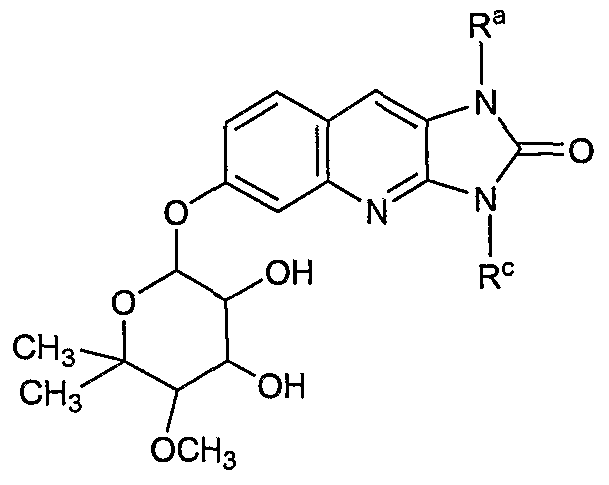
  • the present invention is directed to compounds according to the Formula I(F):
  • R a , R b and R c are independently hydrogen, alkyl, alken_yl, alkynyl, carbocyclic, heterocyclic, aryl, or aralkyl; and wherein R b may also be oxidized to form a carbonyl.
  • the invention encompasses compounds according to the Formula I(F)(i):
  • R a and R c are independently hydrogen, alkyl, alkenyl, alkynyl, carbocyclic, heterocyclic, aryl, or aralkyl.
  • the present invention is directed to compounds according to the Formula I(F)(ii): wherein X 4 , X 5 , X 6 , and X 8 are defined as set forth above, and wherein R a , R 1* and R c are independently hydrogen, alkyl, alkenyl, alkynyl, carbocyclic, heterocyclic, aryl, o ⁇ aralkyl; and wherein R may also be oxidized to form a carbonyl.
  • the present invention is directed to compounds encompassed by the Formula I(F)(iii):
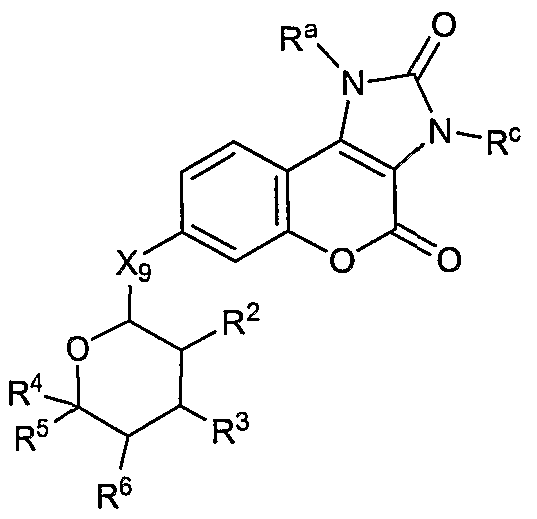
  • the present invention is directed to compounds according to the Formula I(G):
  • X 5 , X 6 , n are defined as set forth above, and wherein R a , R b and R Q are independently hydrogen, alkyl, alkenyl, alkynyl, carbocyclic, heterocyclic, aryl, or aralkyl; and wherein R b may also be oxidized to form a carbonyl.
  • the present invention is directed to compounds according to the Formula I(G)(i): wherein X 9 , R 2 , R 3 , R 4 , R 5 , R 6 are defined as set forth above, and wherein R a and R c are independently hydrogen, alkyl, alkenyl, alkynyl, carbocyclic, heterocyclic, aryl, or aralkyl.
  • the present invention is directed to compounds according to Formula I(G)(ii):
  • X 5 , X 6 , and X 8 are defined as set forth above, and wherein ,R >a , ⁇ R > b and R c are independently hydrogen, alkyl, alkenyl, alkynyl, carbocyclic, heterocyclic, aryl, or aralkyl; and wherein R b may also be oxidized to form a carbonyl.
  • the present invention is directed to compounds according to Formula I(G)(iii):
  • the present invention is directed to compounds according to Formula I(H): wherein X 4 , X 6 , X 8 , X 9 , R 1 , R 2 , R 3 , R 4 , R 5 , R 6 , and n are defined as set forth above.
  • the invention comprises compounds according to the Formula I(H)(i):
  • the present invention is directed to compounds according to Formula I in which R 2 and R 3 form a cyclic carbonate. In still another aspect, the present invention is directed to compounds according to Formula I in which the sugar ring is modified to include a diol at R 2 and R 3 .
  • the present invention is directed to compounds according to Formula I in which sugar is modified to include a 2'-carbamate at R 2 .
  • the present invention is directed to the compounds of Formula I in which the coumarin ring is modified to include a lower alkoxy or nitro substitution at the 6-position of the coumarin ring.
  • the present invention encompasses compounds according to Formula I(J):
  • X 1 , X 2 , X 4 , X 5 , X 8 , R 1 , R 2 , R 3 , R 4 , R 5 , R 6 , and n are defined as set forth above; and wherein R a and R b are independently hydrogen, alkyl, alkenyl, alkynyl, carbocyclic, heterocyclic, aryl, or aralkyl; and wherein R b may also be oxidized to form a carbonyl.
  • the present invention is directed to compounds according Formula I(J)(i):
  • X 1 , X 2 , X 4 , X 5 , X 8 , R 1 , R 2 , R 3 , R 4 , R 5 , R 6 , n, and R a are defined as set forth above.
  • the present invention is directed to compounds according to the Formula I( J)(U):
  • X 1 , X 2 , X 4 , X 5 , X 8 , R 1 , R 2 , R 3 , R 4 , R 5 , R 6 , n, and R a are defined as set forth above.
  • the present invention is directed to compounds encompassed by Formula I(K) :
  • R 18 is hydrogen, alkyl, alkenyl, or alkynyl.
  • the present invention is directed to 4-deshydroxy derivatives and analogues of novobiocin in which X 4 is -CR 20 - and R 20 is hydrogen.
  • the present invention is directed to 8-desmethyl derivatives and analogues of novobiocin in which X 8 is -CR 22 - and R 22 is hydrogen.
  • the present invention encompasses compounds according to the Formula I(L):
  • X 9 , R 1 , R 2 , R 3 , R 4 , R 5 , R 6 , and n are defined as set forth, above.
  • the novobiocin derivatives and analogues of the present invention are modified so that the sugar is modified as set forth below:
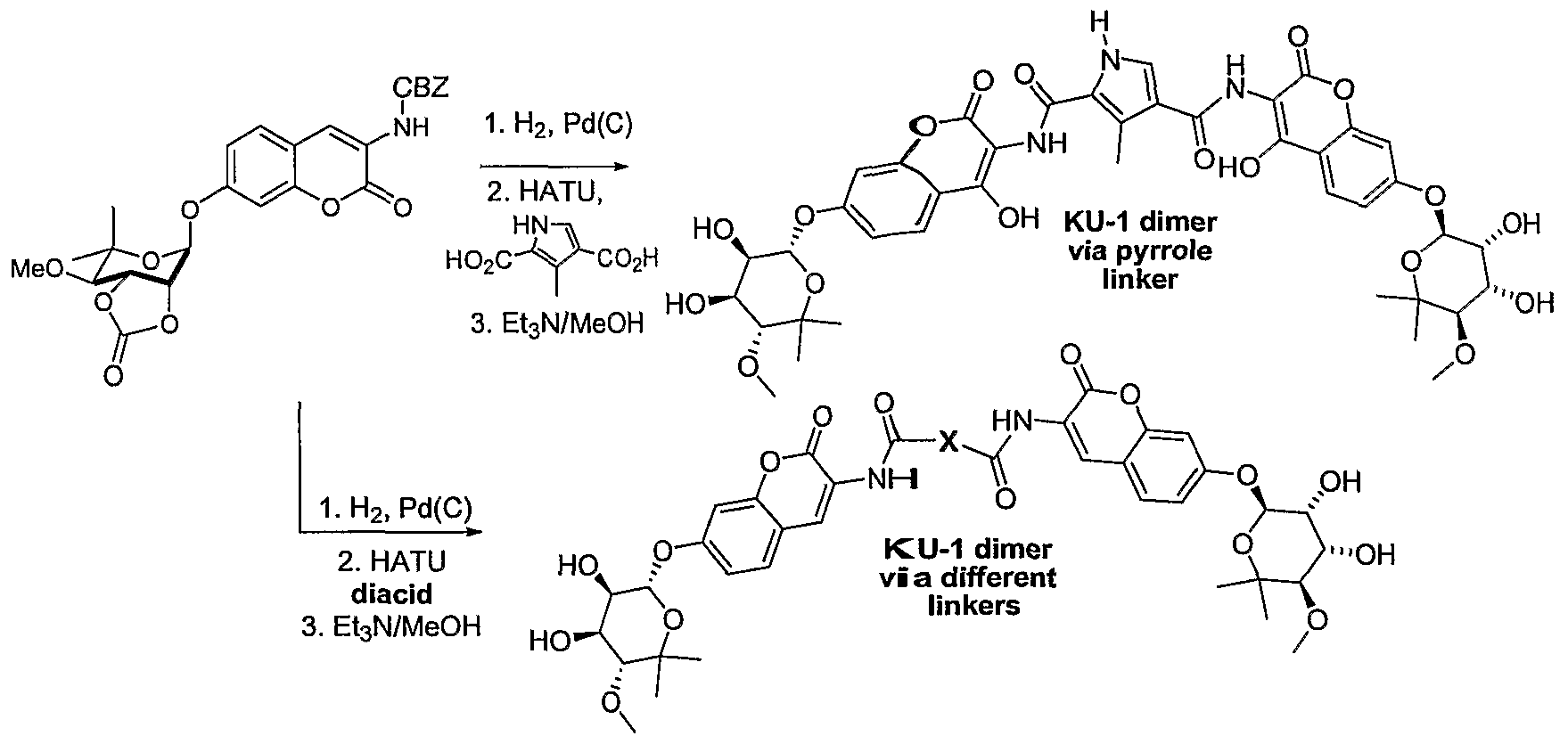
  • the present invention is directed to dimers of the foregoing compounds.
  • exemplary dimers are provided by the formula:
  • X is alkyl, alkenyl, alkynyl, aryl, alkylaryl, carbocyclic or heterocyclic; and wherein R 2 , R 3 , R 4 , R 5 , and R 6 are set forth above.
  • the present invention comprises the in wt ⁇ ich the linker is a heterocylic pyrole as shown below:
  • the present invention provides a pharmaceutical composition, which comprises a therapeutically-effective amount of one or more compounds of the present invention or a pharmaceutically-acceptable salt, ester or prodrug thereof, together with a pharmaceutically-acceptable diluent or carrier.
  • FIG. 1 shows the relative ratios of phospho-AKT by Western, blot analyses when the compounds of Example 1 were tested for their ability to inhibit Hsp90 in Skbr3 breast cancer cells. Total protein concentration of each lysate was determined and equal amounts of protein were run in each lane of the gels. For the graphs shown in FIG. 1 , the O.D.'s (optical density) of the Western bands for phospho-AKT were measured, as were the O.D.'s for actin probed as controls on the same blots. To obtain the graphed values, all specific O.D.'s (for Hsp90 clients) were normalized to the respective actin O.D.
  • O.D.'s optical density
  • FIG. 2 is a western blot analysis of Skbr3 cells treated with novobiocin analogue denominated herein as KU-3/A2 (2'-carbamate) and KU-1/A4 (diol) for 24 hours. After incubation, the cells were harvested, lysed, and equal amounts of the protein lysates loaded into SDS wells. After electrophoresis, the gel was probed with Her-2 and actin (control) antibodies. The specific decrease in Her-2 levels is a result of Hs ⁇ 90 inhibition that leads to Her-2 degradation.
  • FIG. 3 (top panel) is a western blot analysis of prostate cancer LNCaP cells treated with KU-1/A4.
  • the bottom panel is a western blot analysis of prostate cancer LAPC-4 cells incubated with KU-1/A4. Actin was used as a control in both assays.
  • FIG. 4 shows the dose dependent effects of KU-I /A4 on A ⁇ -indx ⁇ ced cell death in primary neurons.
  • the compound was added two hours before the ⁇ A and th.e viability was determined at 4-8 hours.
  • the data represents standard error of the means ("S.E.M.") from about 1500 cells from 3 preparations. #, pO.OOOl for control vs. A ⁇ only. **, p ⁇ 0. 001. A ⁇ only vs. A ⁇ + KU-l/A4.
  • S.E.M. standard error of the means
  • acyl refers to -COR wherein R used in this definition is hydrogen, alkyl, alkenyl, alkynyl, carbocyclic, heterocylic, aryl, or aralkyl. Most preferably, R is hydrogen, alkyl, aryl, or aralkyl.
  • amido indicates either a C-amido group such as -CONR'R" or an N- amido group such as -NR'COR" wherein R 1 and R" as used in this definition are independently
  • a "sulfoamido" group includes the -NR'-SO 2 -R". Most preferably, R' and R" are hydrogen, alkyl, aryl, or aralkyl.
  • amino signifies a primary, secondary or tertiary amino group of the formula -NR 1 R" wherein R' and R" as used in this definition are independently hydrogen,
  • amino includes unsubstituted, monosubstituted (e.g., monoalkylamino or monoarylamino), and disubstituted (e.g., dialkylamino or aralkylamino) amino groups.
  • Amino groups include — NH 2 , methylamino,
  • exemplary "amino" groups forming a ring include pyrrolyl, imidazolyl, pyrazolyl, isothiazolyl, isoxazolyl, pyridyl, pyrazinyl, pyrimidinyl, pyridazinyl, indolizinyl, isoindolyl, indolyl, indazolyl, purinyl, quinolizinyl.
  • the ring containing the amino group may be optionally substituted with another amino, alkyl, alkenyl, alkynyl, halo, or
  • alkyl refers to a branched or unbranched saturated hydrocarbon group of 1 to 24 carbon atoms, such as methyl, ethyl, n-propyl, isopropyl, n-butyl, isobutyl, t- butyl, octyl, decyl, tetradecyl, hexadecyl, eicosyl, tetracosyl and the like.
  • Preferred “alkyl” groups herein contain 1 to 12 carbon atoms. Most preferred are "lower alkyl” which refer to an alkyl group of one to six, more preferably one to four, carbon atoms.
  • the alkyl group may be optionally substituted with an amino, alkyl, halo, or hydroxiyl group.
  • alkoxy denotes oxy-containing .groups substituted with an alkyl, or 5 cycloalkyl group. Examples include, without limitation, methoxy, ethoxy, tert-butoxy, and cyclohexyloxy. Most preferred are "lower alkoxy” groups having one to six carbon atoms. Examples of such groups include methoxy, ethoxy, propoxy, butoxy, isopropoxy, and tert- butoxy groups.
  • alkenyl and alkynyl refe ⁇ - to unsaturated aliphatic groups 0 analogous in length and possible substitution to the alkyls described above, but that contain at least one double bond or triple bond respectively.
  • aryl means a carbocyclic aroimatic system containing one, two or three rings wherein such rings may be attached together in_ a pendant manner or may be fused.
  • fused means that a second ring is present (i.e., attached or formed) by having two 5 adjacent atoms in common (Le,, shared) with the first ring.
  • fused is equivalent to the term “condensed.”
  • aryl embraces aromatic groups such as phenyl, naphthyl, tetrahydronaphthyl, indane, and biphenyl. The aryl group may optionally be substituted with an amino, alkyl, halo, hydroxyl, carbocyclic, heterocyclic, or another aryl group.
  • aralkyl embraces aryl-substitutcd alkyl moieties.
  • Preferable aralkyl ⁇ 0 groups are "lower aralkyl” groups having aryl groups attached to alkyl groups having one to six carbon atoms. Examples of such groups include benzoyl, diphenylmethyl, triphenylmethyl, phenylethyl, and diphenylethyl.
  • benzyl and phexiylmethyl are interchangeable.
  • aryloxy embraces aryl groups, as defined above, attached to an oxygen atom.
  • the aryloxy groups may optionally be substituted with a halo, hydroxyl, or alkyl
  • Examples of such groups include phenoxy, 4-chloro-3-ethylphenoxy, 4-chloro-3- methylphenoxy, 3-chloro-4-ethylphenoxy, 3,4-dichlorophenoxy, 4-methylphenoxy, 3- trifluorornefhoxyphenoxy, 3-trifluoromethylphenoxy, 4-fhuorophenoxy, 3,4-dimethylphenoxy,
  • aralkoxy embraces oxy-containing aralkyl groups attached through an oxygen atom to other groups.
  • “Lower aralkoxy” groups are those phenyl groups attached to lower alkoxy group as described above. Examples of such groups include benzyloxy, 1- phenylethoxy, 3-trifluoromethoxybenzyloxy, 3-trifluoromethylbenzyloxy, 3,5- difluorobenyloxy, 3-bromobenzyloxy, 4-propylbenzyloxy, 2-fluoro-3- trifluoromethylbenzyloxy, and 2-phenylethoxy.
  • Carboxyl includes both carboxylic acids, and carboxylic acid esters.
  • carboxylic acid refers to a carboxyl group in which R" is hydrogen. Such acids include formic, acetic, propionic, butryic, valeric acid, 2-methyl propionic acid, oxirane-carboxylic acid, and cyclopropane carboxylic acid.
  • carboxylic acid ester or “ester” refers to a carboxyl group in which R" is alkyl, alkenyl, alkynyl, carbocyclic, heterocylic, aryl, or aralkyl.
  • carbocylic refers to a group that contains one or more covalently closed ring structures, and that the atoms forming the backbone of the ring are all carbon atoms.
  • the ring structure may be saturated or unsaturated. The term thus distinguishes carbocyclic from heterocyclic rings in which the ring backbone contains at least one non- carbon atom.
  • carbocylic encompasses cycloalkyl ring systems.
  • cycloalkane or “cyclic alkane” or “cycloalkyl” refer to a carbocyclic group in which the ring is a cyclic aliphatic hydrocarbon, for example, a cyclic alkyl group preferably with 3 to 12 ring carbons.
  • Cycloalkyl inrissas, by way of example, cyclopropyl, cyclobutyl, cyclopentyl, cyclohexyl, cycloheptyl, or cyclooctyl, and the like.
  • the cycloalkyl group may be optionally substituted with an amino, alkyl, halo, or hydr ⁇ xyl group.
  • ether refers to the group -R'-O-R" wherein R' and R" as used in this definition are independently hydrogen, alkyl, alkenyl, alkynyl, carbocyclic, heterocylic, aryl, or aralkyl, and R' can additionally be a covalent bond attached to a carbon.
  • R' and R as used in this definition are independently hydrogen, alkyl, alkenyl, alkynyl, carbocyclic, heterocylic, aryl, or aralkyl, and R' can additionally be a covalent bond attached to a carbon.
  • halo or halogen refer to fluoro, chloro, bromo or iodo, usually regarding halo substitution for a hydrogen atom in an organic compound.
  • heterocyclic or heterocycle means an optionally subsituted, saturated or unsaturated, aromatic or non-aromatic cyclic hydrocarbon group with 4 to about 12 carbon atoms, preferably about 5 to about 6, wherein 1 to about 4 carbon atoms are replaced by nitrogen, oxygen or sulfur.
  • heterocyclic which are aromatic include groups pyridinyl, furanyl, benzofuranyl, isobenzofuranyl, pyrrolyl, thienyl, 1,2,3-triazolyl, 1,2,4- triazolyl, indolyl, imidazolyl, thiazolyl, thiadiazolyl, pyrimidinyl, oxazolyl, triazinyl, and tetrazolyl.
  • heterocycles include benzimidazole, dihydrothiophene, dioxin, dioxane, dioxolane, dithiane, dithiazine, dithiazole, dithiolane, foran, indole, 3-H indazole, 3-H-indole, imidazole, indolizine, isoindole, isothiazole, isoxazole, morpholine, oxazole, oxadiazole, oxathiazole, oxathiazolidine, oxazine, oxadiazine, piperazine, piperidine, purine, pyran, pyrazine, pyrazole, pyridine, pyrimidine, pyrimidine, pyridazine, pyrrole, pyrrolidine, tetrahydrofuran, tetrazine, thiadiazine, thiadiazole, thiatriazole, thi
  • the heterocycle may be optionally substituted with an amino, alkyl, alkenyl, alkynyl, halo, hydroxyl, carbocyclic, thio, other heterocyclic, or aryl group.
  • exemplary heterocyclic groups include 1-pyrrolyl, 2- pyrrolyl, 3-pyrrolyl, 1-indolyl, 2-indolyl, 3-indolyl, 1-pyridyl, 2-pyridyl, 3-pyridyl, 4-pyridyl, 1-imidazolyl, 2-imidazolyl, 3-imidazolyl, 4-imidazolyl, 1-pyrazolyl, 2 pyrazolyl, 3-pyrazolyl, 4-pyrazolyl, 5-pyrazolyl, 1-pyrazinyl, 2-pyrazinyl, 1-pyrimidinyl, 2-pyrimidinyl, 4- pyrimidinyl, 5-pyrimidinyl, 1 -pyridazinyl, 2-pyridazinyl
  • nitro means -NO 2 .
  • sulfanyl refers to -SR' where R 1 as used in this definition is hydrogen, alkyl, alkenyl, alkynyl, carbocyclic, heterocylic, aryl, or aralkyl.
  • sulfenyl refers to -SOR' where R' as used is this definition is hydrogen, alkyl, alkenyl, alkynyl, carbocyclic, heterocylic, aryl, or aralkyl.
  • sulfonyl refers to -SOR' where R' as used in this definition is hydrogen, alkyl, alkenyl, alkynyl, carbocyclic, heterocylic, aryl, or aralkyl.
  • the present invention contemplates all such compounds, including cis- and trans-geometric isomers, E- and Z-geometric isomers, R — and S — enantiomers, diastereomers, d-isomers, 1 -isomers, the racemic mixtures thereof and other mixtures thereof, as falling within the scope of the invention.
  • pharmaceutically acceptable salts are also included in the family of compounds of the present invention.
  • pharmaceutically- acceptable salts embraces salts commonly used to form alkali metal salts and to form addition salts of free acids or free bases. The nature of the salt is not critical, provided that it is pharmaceutically acceptable.
  • Suitable pharmaceutically acceptable acid addition salts of compounds of the present invention be prepared from inorganic acid or from an organic acid. Examples of such inorganic acids are hydrochloric, hydrobromic, hydroiodic, nitric, carbonic, sulfuric, and phosphoric acid.
  • Appropriate organic acids may be selected from aliphatic, cycloaliphatic, aromatic, araliphatic, heterocyclic, carboxylic and sulfonic classes of organic acids, examples of which are formic, acetic, propionic, succinic, glycolic, gluconic, lactic, malic, tartaric, citric, ascorbic, glucuronic, maleic, fumaric, pyruvic, aspartic, glutamic, benzoic, anthranilic, mesylic, salicylic, p-hydroxybenzoic, phenylacetic, mandelic, embonic (pamoic), methanesulfonic, ethylsulfonic, benzenesulfonic, sulfanilic, stearic, cyclohexylaminosulfonic, algenic, galacturonic acid.
  • Suitable pharmaceutically-acceptable base addition salts of compounds of the present invention include metallic salts made from aluminum, calcium, lithium, magnesium, potassium, sodium and zinc or organic salts made from N,N'-dibenzylethyleneldiamine, choline, chloroprocaine, diethanolamine, ethylenediamine, meglumine (N-methylglucamine) and procain. All of these salts may be prepared by conventional means from the corresponding compounds of by reacting, for example, the appropriate acid or base with the compounds of the present invention.
  • ester refers to esters which hydrolyze in vivo and include, but are not limited to, those that break down readily in the human body to leave the parent compound or a salt thereof.
  • Suitable ester groups include, for example, those derived from pharmaceutically acceptable aliphatic carboxylic acids, particularly alkanoic, alkenoic, cycloalkanoic and alkanedioic acids, in which each alkyl or alkenyl moiety advantageously has not more than 6 carbon atoms.
  • esters include formates, acetates, propionates, butyrates, acrylates and ethylsuccinates.
  • prodrugs refers to those prodrugs of the compounds of the present invention, which are, within the scope of sound medical judgment, suitable for use in contact with the tissues of humans and lower animals without undue toxicity, irritation, allergic response and the like, commensurate with a reasonable risk/benefit ratio, and effective for their intended use, where possible, of the compounds of the invention.
  • prodrug refers to compounds that are rapidly transformed in vivo to yield the parent compound of the above formulae, for example, by hydrolysis in blood.
  • the present invention provides a pharmaceutical composition, which comprises a therapeutically-effective amount of one or more compounds of the present invention or a pharmaceutically-acceptable salt, ester or prodrug thereof, together with a pharmaceutically-acceptable diluent or carrier.
  • compositions may be formulated for any route of administration, in particular for oral, rectal, transdermal, subcutaneous, intravenous, intramuscular or intranasal administration.
  • the compositions may be formulated in any conventional form, for example, as tablets, capsules, caplets, solutions, suspensions, dispersions, syrups, sprays, gels, suppositories, patches and emulsions.
  • phrases "pharmaceutically acceptable” is employed herein to refer to those compounds, materials, compositions, and/or dosage forms which are, within the scope of sound medical judgment, suitable for use in contact with trie tissues of human beings and animals without excessive toxicity, irritation, allergic response, or other problem or complication, commensurate with a reasonable benefit/risk ratio.
  • pharmaceutically-acceptable carrier means a pharmaceutically-acceptable material, composition or vehicle, such as a liquid or solid filler, diluent, excipient, solvent or encapsulating material, involved in carrying or transporting the subject lonidamine analogue or derivative from one organ, or portion of the body, to another organ, or portion of the body.
  • a pharmaceutically-acceptable material such as a liquid or solid filler, diluent, excipient, solvent or encapsulating material, involved in carrying or transporting the subject lonidamine analogue or derivative from one organ, or portion of the body, to another organ, or portion of the body.
  • Each carrier must be “acceptable” in the sense of being compatible with the other ingredients of the formulation and not injurious to the patient.
  • materials which may serve as pharmaceutically-acceptable carriers include: (1) sugars, such as lactose, glucose and sucrose; (2) starches, such as corn starch and potato starch; (3) cellulose, and its derivatives, such as sodium carboxymethyl cellulose, ethyl cellulose and cellulose acetate; (4) powdered tragacanth; (5) malt; (6) gelatin; (7) talc; (8) excipients, such as cocoa butter and suppository waxes; (9) oils, such as peanut oil, cottonseed oil, safflower oil, sesame oil, olive oil, corn oil and soybean oil; (10) glycols, such as propylene glycol; (11) polyols, such as glycerin, sorbitol, mannitol and polyethylene glycol; (12) esters, such as ethyl oleate and ethyl laurate; (13) agar; (14) buffering agents, such as magnesium hydroxide and aluminum hydrox
  • inhibitor refers to a statistically significant and measurable reduction in activity, preferably a reduction of at least about 10% versus control, more preferably a reduction of about 50% or more, still more preferably a reduction of about 80% or more.
  • a “therapeutically effective amount” is an amount of a compound of the present invention or a combination of two or more such compounds, which inhibits, totally or partially, the progression of the condition or alleviates, at least partially, one or more symptoms of the condition.
  • a therapeutically effective amount can also be an amount that is prophylactically effective. The amount that is therapeutically effective will depend upon the patient's size and gender, the condition to be treated, the severity of the condition and the result sought. For a given patient and condition, a therapeutically effective amount can be determined by methods known to those of skill in the art.
  • a therapeutically effective amount refers to that amount which has the effect of (1) reducing the size of the tumor, (2) inhibiting (that is, slowing to some extent, preferably stopping) tumor metastasis, (3) inhibiting to some extent (that is, slowing to some extent, preferably stopping) tumor growth, and/or, (4) relieving to some extent (or, preferably, eliminating) one or more symptoms associated with the cancer.
  • Several of the compounds of the present invention have been shown to inhibit
  • Hsp90 in vitro.
  • therapeutically effective amounts of the compounds of the present invention will be useful as anti-cancer agents and/or neuroprotective agents.
  • some of the compounds of the present invention may be used with other Hsp90 inhibitors, chemotherapeutic agents, and/or neuroprotective agents.
  • novobiocin analogue compounds that contained both modified coumarin and sugar derivatives was prepared.
  • the compounds were prepared as set forth in the scheme below along with a procedure recently developed for the synthesis of noviose. See Yu et al., Synthesis of (-)-Noviose from 2,3-0-Isopropylidene-D-erythronolactol, J. Org. Chem, 2004, 69, 7375-7378, which is incorporated by reference.
  • the novobiocin analogues prepared according to the scheme included modification of the coumarin ring by shortening of the amide side chain and removal of the 4- hydroxy substituent (A) (see Madhavan et al., Novel Coumarin Derivatives of Heterocyclic Compounds as Lipid Lowering Agents, Bioorg. Med. Chem. Lett. 2003, 13, 2547, which is incorporated by reference), removal of both the 4-hydroxy and amide linker (B), steric replacements of both the 4-hydroxy and benzamide ring (C), and 1,2-positional isomers of the noviosyl linkage (D and E).
  • A The novobiocin analogues prepared according to the scheme included modification of the coumarin ring by shortening of the amide side chain and removal of the 4- hydroxy substituent (A) (see Madhavan et al., Novel Coumarin Derivatives of Heterocyclic Compounds as Lipid Lowering Agents, Bioorg. Med. Chem. Let
  • Noviosylated coumarin Al (20 mg, 0.047 mmol) was dissolved in methanolic ammonia (7.0 M, 2 mL) at 25 0 C and stirred for 24 h. The solvent was evaporated and the residue purified by preparative HPLC (SiO 2, 20% 2-propanol in hexanes) to afford A2 (4.2 mg, 22%), A3 (8.6 mg, 42%) and A4 (3.5 mg, 20%) as colorless solids.
  • Ci 8 H 22 NO 8 requires m/z 380.1345).
  • EXAMPLE 2 DEGREDATION OF PHOSPgQ-AKT Inhibition of Hsp90 results in the degradation of Hsp90-dependent clients via ubiquitination of the unfolded client followed by proteasome-mediated hydrolysis. To test whether Hsp90 client proteins were degraded in the presence of these novobiocin analogues,
  • A4/KU-1 (diol) and A3/KU-2 (3 '-carbamate) were the most potent novobiocin analogues identified, based on their ability to inhibit Hsp90 and cause the degradation of phosphorylated AKT. As shown in FIG. 1., the most active compound
  • the IC 50 for Hsp90 inhibitors is sometimes determined as the concentration of inhibitor required to produce 50% degradation of Her-2, another therapeutically important Hsp90 client protein involved in breast cancer.
  • KU-1/A.4 was incubated with Skbr3 breast cancer cells at concentrations of 100 nJVl, l ⁇ M and 10 ⁇ M, a rapid decrease in Her-2 was observed between 100 nM and l ⁇ M, as shown in the Western blot of FIG. 2.
  • These data are normalized against actin, a non-Hsp90 client protein, used as a control for non-specific degradation.
  • These data suggest the IC 50 of KU-I /A4 is in the Io ⁇ V micromolar range, whereas novobiocin in the same assay produces an IC 50 of 700 ⁇ M.
  • EXAMPLE 4 PROSTATE CANCER The steroid hormone receptors are also dependent upon the Hsp90 protein folding machinery for activation and hormone binding.
  • LNCaP mutated androgen receptor-dependent prostate cancer cell line
  • LAPC-4 ⁇ vild type androgen receptor prostate cancer cell line
  • the prostate cancer cells were grown in RPMI with 10% fetal calf serum in a standard fashion. Once the cells had reached near confluence, they were treated with vehicle (DMSO) or varying concentrations of KU-1/A4 ranging from IOnm to lOO ⁇ M for 24 hours.
  • DMSO vehicle
  • the membranes were blocked for two hours at room temperature in Tris-buffered saline (pH 7.5) containing 0.2% I- block (Tropix, Bedford, MA), 1% milk, and 0.1% Tween-20 (TBS-T). The membranes were subsequently be incubated with a primary antibody to the abo ⁇ ve mentioned proteins (all of which have commercially available antibodies) overnight at 4° C. The next day the membrane was washed three times in TBS-T followed by one hour incubation with an appropriate horseradish peroxidase labeled secondary antibody in blocking buffer (TBS-T).
  • TBS-T horseradish peroxidase labeled secondary antibody
  • the membranes were again washed in TBS-T and Tris-buffered saline and developed in SuperSignal West Pico Chemiluminescent Substrate (Pierce, Rockford, IL) according to manufacturer's instructions.
  • the blots were visualized by exposing the enhanced chemiluminescence-reacted blot to X-ray film.
  • KU-1/A4 had a dramatic effect on the concentrations of the mutant androgen receptor, AKT, and HIF- l ⁇ at about 1 ⁇ M in the LNCaP cell line.
  • KU-1/A4 drastically reduced levels of the androgen receptor at lower concentrations in the wild type androgen receptor prostate cancer cell line (LAPC-4).
  • LAPC-4 wild type androgen receptor prostate cancer cell line
  • Hsp90 levels were determined. Under normal conditions, Hsp90 binds heat shock factor 1 (HSFl), but in the presence of Hsp90 inhibitors this interaction is lost and HSFl is able to induce the expression of Hsp90.
  • HSFl heat shock factor 1
  • Hsp90 levels are significantly increased in a manner dependent on the concentration of KU- 1 /A4 consistent with similar results previously obtained by incubation with geldanamycin and radicicol. Both of these data are in contrast to actin, which is not an Hsp90 client protein and thus remains unaffected by Hsp90 inhibitors.
  • PROPHETIC EXAMPLE 4 AMIDE SIDE CHAIN MODIFICATIONS Since KU-1/A4 was shown to be the most potent C- terminal inhibitor of Hsp90 identified in Example 1, additional derivatives of the KU-1/A4 scaffold will be prepared. Modifications of the amide side chain will allow for an in depth study of the hydrophobic cavity that binds to this portion of KU-I /A4 and the analogous benzamide of novobiocin. As such, analogues of KU-1/A4 that have increasingly larger hydrophobic groups by the use of different commercially available or readily synthesized anhydrides, such as those anhydrides shown in the scheme below.
  • R is hydrogen, alkyl, alkenyl, alkynyl, aryl, carbocylic, heterocyclic, aryl, or aralkyl, (and most preferably R is hydrogen, alkyl, aryl, and aralkyl); and wherein R 1 is hydrogen or CONH 2 .
  • the amide linkage will also be reversed to determine the optimal profile of this functionality.
  • the 7-hydroxy-3 -ethyl ester coumarin will be hydrolyzed to afford the corresponding acid, which will be coupled with amines that mimic the same side chains used in the KU-1/A4 amide studies for direct comparison of biological activity.
  • the free phenols will be noviosylated as described earlier to afford the cyclic carbonate products.
  • Treatment of the carbonate with methanolic ammonia will give the diol, 2- and 3-carbamoyl products as shown in the scheme below. See Shen et al., Synthesis of Photolabile Novobiocin Analogues, Bioorg. Med. Chem. Lett. 2004, 14, 5903-5906, which is incorporated by reference.
  • R is hydrogen, alkyl, alkenyl, alkynyl, aryl, carbocylic, heterocyclic, aryl, or aralkyl; and wherein R' is hydrogen or CONH 2 .
  • the R in the amide side chain is hydrogen alkyl, aryl, and alkaryl, and the amines used in the above scheme are NH 3 , methylamine, ethylamine, propylamine, n-butylamine, and phenylamine.
  • the amide side chain, coumarin ring, and sugar may be modified in accordance with the other examples shown herein.
  • PROPHETIC EXAMPLE 5 ISOCOUMARIN DERIVATIVES
  • the isocoumarin derivative of the compounds of the present invention will be prepared.
  • the isocoumarin will be prepared from the 4- benzyloxylactone shown in the scheme below.
  • Treatment of the lactone with sodium cyanide, followed by HCl/pyridine is known to produce similar isocoumarins. See Wells et al., Facile synthesis of 3-acylaminoisocoumarins, J. Org. Chem. 1971, 36, 1503-1506, which is incorporated by reference.
  • isocoumarin derivatives can be prepared in accordance with the above scheme, in addition to the KU-1/A4 analogue shown. That is, the amide side chain, coumarin ring, and sugar may be modified in accordance with the other examples shown herein.
  • PROPHETIC EXAMPLE 6 DESfl>IMETHYL) AND DESMETHOXY SUGAR ANALOGUES
  • R is lower alkyl; and wherein R' is preferably hydrogen or -CONH 2 .
  • demethylated an/or dealkoxylated derivatives can be prepared in accordance with the above scheme, in addition to the modified KU-1/A4 derivative shown above. That is, the amide side chain, coumarin ring, and sugar may be modified in accordance with the other examples shown herein.
  • PROPHETIC EXAMPLE 7 MODIFIED NOVOBIOCIN DERIVATIVES
  • This example involves the modification to of the compounds of the present invention to complement the hydrogen bonding capabilities of the nucleotide bases (adenine and guanine) with those of the coumarin ring system as shown below.
  • these analogues contain conformationally restricted hydrogen bond donors/acceptors of KU-I /A4 (F and G) and strategically placed hydrogen bond acceptors/donors to complement those found in guanine (H-L).
  • H-L hydrogen bond acceptors/donors to complement those found in guanine
  • the hydrophobic pocket that accommodates the m-substituted benzamide ring of novobiocin will be probed by alteration of the side chain constituents.
  • Example 7F Heterocyclic Modifications to Quinolone hi this example, the coumarin ring will be modified to create F analogues that resemble guanine and contain a conformationally biased tiydrogen-bond donor/acceptor.
  • the synthesis begins with commercially available 4-hydroxy-2-nitrobenzaldehyde following the procedure of Meanwell, et al., Inhibitors of Blood Platelet cAMP Phosphodiesterase. 2. Structure- Activity Relationships Associated with l,3-DiJhydro-2//-imidazo[4,5-b]quinolin-2- ones Substituted with Functionalized Side Chains, J. Med. Chem. 1992, 35, 2672-2687.
  • the phenol will be protected as the benzylether, followed by treatment with hydantoin phosphonate to give the corresponding olefin.
  • hydantoin phosphonate See Meanwell et al., Diethyl 2,4-dioxoimidazolidine-5- phosphonate: A Wadsworth-Emmons Reagent for the Mild and Efficient Preparation of C-5 Unsaturated Hydantoins, J. Org. Chem. 1991, 56, 6897-6904.
  • Reduction of the benzylether, nitro, and olefin functionalities will provide the appropriate amine for subsequent addition to the carbonyl upon treatment with iodine.
  • X 4 , X 5 X 6 X 8 are preferably each -CH-; and wherein R a , R b , and R c are independently hydrogen, alkyl, alkenyl, alkynyl, carbocyclic, h leetteerrooccyylliicc,, aryl, or aralkyl; or wherein R b is oxided to form the carbonyl according to the formula:
  • coumarin G will be prepared from 7-benzyloxy-4-hydroxy-3- nitrocoumarin, according to the scheme below.
  • Buckle et al. Aryloxyalkyloxy- and aralkyloxy-4-hydroxy-3-nitro coumarins which inhibit histamine release in the rat and also antagonize the effects of a slow reacting substance of anaphylaxis, J. Med. Chem. 1979, 22, 158-168.
  • Treatment of the 4-hydroxyl group with phosphorous oxychloride (POCl 3 ) will afford the corresponding 4-amino derivative upon subsequent exposure to ammonia.
  • Rassochandran et al. Mild method for the preparation of 4-chloro-3-nitro coumarins, Indian. J.
  • X 5 X 6 X 8 are preferably each -CH-; and wherein R a , R b , and R c are independently hydrogen, alkyl, alkenyl, alkynyl, carbocyclic, heterocylic, aryl, or aralkyl; or wherein R b is oxided to form the carbonyl according to the formula:
  • the nitrogen-containing H variants of the coumarin ring will be prepared from 2-methyl-3,5-pyridinediol, by bromination of the benzylic methyl group, followed by hydrolysis and oxidation to the corresponding aldehyde as set forth in the scheme below. See Morisawa et al., Anticoccidal agents. IV. Modification at the 5-position of 4-deoxypyridoxol and ⁇ 4-norpyridoxol, Agric. Biol. Chem. 1975, 39, 1275-1281. Using conditions previously employed for the syntheses of other coumarin derivatives by us, the aldehyde will be treated with glycine under basic conditions to yield the azacoumarin ring system.
  • the I analogues are directed to other side-chains extending from the coumarin ring.
  • the KU-1/A4 coumarin ring will be prepared from 2,4-dihydroxy-5- nitrobenzaldehyde (see Chandrashekhar et al., g-substitution in the resorcinol nucleus, VI. Formylation of 4-nitro and 2-nitro resorcinols, Proc. Ind. Acad. Sd.
  • the ⁇ -hydroxybenzaldehyde will be treated with ethyl glycine under acidic conditions to afford the corresponding free amine upon basic workup. Both the amino and hydroxyl functionalities will be acylated with the same anhydrides as shown above. Subsequent hydrolysis of the phenolic ester will provide the coumarin amide, which can be coupled directly with noviose carbonate as described previously.
  • R is hydrogen, alkyl, alkenyl, alkynyl, aryl, carbocylic, heterocyclic, aryl, or aralkyl; wherein X is alkyl, alkenyl, alkynyl, aryl, aralkyl, alkoxy, halogen or nitro.
  • the J analogues will be prepared from 4-chloro-2-hydroxy-5-nitrobenzaldehyde (see Pal et al., New arylsulfonylhydrazones of substituted benzaldehyde as anticancer agents, Neoplasms 1983, 30, 551-556) by treatment with glycine, acetic anhydride, and sodium acetate as mentioned previously for the preparation of other coumarin derivatives as set forth in the following scheme. See Khoo et al., Synthesis of substituted 3-aminocoumarins from ethyl N- 2-Hydroxyarylideneglycinates, Syn. Commun. 1999, 29, 2533-2538.
  • the chloro substituent will undergo nucleophilic aromatic displacement with ammonia as a consequence of the electron- withdrawing j?-lactone and o-nitro group.
  • the nitro group Upon formation of the 7-amino-6- nitrocoumarin, the nitro group will be reduced and immediately treated with triethyl orthoformate to produce the imidazole ring that resembles guanine. See Buckle et al., Aryloxyalkyloxy- and aralkyloxy-4-hydroxy-3 -nitro coumarins which inhibit hisamine release in the rat and also antagonize the effects of a slow reacting substance of anaphylaxis, J. Med. Chem. 1979, 22, 158-168.
  • R is hydrogen, alkyl, alkenyl, alkynyl, aryl, carbocylic, heterocyclic, aryl, or aralkyl.
  • the K analogues of the KU-1/A4 coumarin moiety will be prepared from 5- methoxy-2-methylbenzonitrile as set forth in the scheme below. See Tomita et al., Schmidt reaction with benzocycloalkenones, J. Chem. Soc. C: Organic 1969, 2, 183-188. Bromination of the benzylic methyl group, followed by displacement with potassium cyanide will furnish the dinitrile product, which is a substrate for acid catalyzed cyclization to form the corresponding 2-bromoisoquinoline. See Johnson et al., The cyclization of dinitriles by anhydrous halogen acids. A new synthesis of isoquinolines, J. Org. Chem. 27, 3953-3958.
  • R is hydrogen, alkyl, alkenyl, alkynyl, aryl, carbocylic, heterocyclic, aryl, or aralkyl.
  • Quinoline derivatives of, L will be prepared from 7-hydroxyquinoline, by first bromination of the quinoline ring, see Zymalkowski et al., Chemistry of 3- quinolinecarboxaldehyde, Ann. Chem., Justis Liebigs 1966, 699, 98-106, followed by a copper-catalyzed animation of the halogenated heterocycle as set forth in the scheme below. See Lang et al., Amination of aryl halides using copper catalysis, Tetrahedron Lett. 2001, 42, 4251-3254. Subsequent treatment with various anhydrides (shown previously), followed by hydrolysis of the phenolic ester and coupling with noviose carbonate will ultimately afford these L analogues.
  • R is hydrogen, alkyl, alkenyl, alkynyl, aryl, carbocylic, heterocyclic, aryl, or aralkyl.
  • This example involves the modification of the carbohydrate reside. More specifically, analogues similar to that of novobiocin's chlorinated pyrollic ester, chlorobiocin, will be prepared.
  • compound KU-1/A4 will be prepared, and then coupled with a variety of acids to selectively afford the equatorial acylated alcohols.
  • Selective acylation is based upon previous studies aimed at the preparation of photolabile derivatives of novobiocin. See Shen et al, Synthesis of Photolabile Novobiocin Analogues, JSioorg. Med. Chem. Lett. 2004, 14, 5903-5906, which is incorporated by reference.
  • These acids will include the pyrrolic acid found in chlorobiocin as well as several other that are shown in the scheme below.
  • Exemplary acids include pyrrolic acids, indolic acids, pyridinic acids, benzoic acids, salicylic acid, para-hydrobenzoic acid, thiobenzoic acid, and pyrazolic acid.
  • the sugar will be modified to include a functional group according to the formmla -R-OR", wherein R' is a covalent bond or alkyl, and R" is an acyl group.
  • the acyl derivative comprises the group -COR wherein R is alkyl, aryl, aralkyl, or an aromatic heterocyclic group. Alkylated, aralkylated, thiolated, halogenated, and hydroxylated pyroles, indoles, pyridines, and pyrazoles are attached to the sugar ring as shown in the scheme below.
  • various substirutents will be added to the amine of the carbamate side chain.
  • carbonate KU-9/A1 will be prepared and amines added to provide the 3 '-carbamoyl products as generally set forth in the scheme below.
  • the sugar will be modified to include a functional group according to the formula — ROR", wherein R' is a covalent bond or alkyl, and R" is C-amido> .
  • the C- amido group is -CONR'R" wherein R 1 is H, and R" is alkyl, ary ⁇ l, aralkyl, or an aromatic heterocyclic group.
  • X is alkyl, alkenyl, alkynyl, hydroxyl, halo, and n is an integer, preferably 0, 1, 2, 3, or 4.
  • PROPHETIC EXAMPLES 9-11 FURANOSE AND PYRANOSE NOVOBIOCIN DERIVATIVES
  • new pyranose and furanose derivatives will be prepared that have affinity with the sugar of GTP and phosphate binding region of Hsp90.
  • These selected compounds are shown in below and include ester, amide, sulfonic ester, phosphonic ester, carbamoyl, sulfonamide, and hydroxyl derivatives.
  • Initial compounds will be coupled with the coumarin ring present in KU-1/A4, but when a more potent analogue is obtained, the best sugar derivative from these studies will be placed onto the optimized ring system.
  • the o-acetyl derivative will be prepared from ribose (9.1, Scheme 9). Treatment of the ribose hemiacetal with benzyl alcohol and hydrochloric gas will provide the benzyloxyacetal, 9.2. See Pigro et al., Readily available carbohydrate-derived imines and amides as chiral ligands for asymmetric catalysis, Tetrahedron 2002, 58, 5459-5466.
  • furanose derivatives will be prepared from benzyl-protected ribose carbonate (9.3, Scheme 10). Both the sulfonamide and JV-acetyl analogues will be furnished by conversion of primary alcohol (9.3) to the corresponding azide by a Mitsunobu reaction with bis(azido)zinc pyridine complex. Viaud et al., Zinc azide mediated Mitsunobu substitution. An expedient method for the one-pot azidation of alcohols, Synthesis 1990, 130- 132. The resulting azide (10.1) will be reduced, and the primary amine converted to the sulfonamide and N-acetyl functionalities, 10.2 and 10.3, respectively.
  • Both the sulfonic ester and the phosphonic ester will be prepared by conversion of 9.3 to iodide 10.6, followed by generation of the requisite enolate to displace the halide.
  • Gallant et al. An efficient preparation and the intramolecular cyclopropanation of Beta-diazo-Beta-ketophosphonates and Beta-diazophosphonoacetates, Syn. Commun. 1984, 14, 155-161.
  • Subsequent treatment with palladium (0) and an amine will lead to allyl removal followed by decarboxylation to form 10.10 and 10.8. See Guibe, Allyl esters and their use in complex natural product syntheses, Tetrahedron 1998, 54, 2967-3041.
  • the pyranose derivatives which resemble noviose and a ring-expanded ribose ring, will be prepared by our recently reported synthesis of 11.1. See Yu et al., Synthesis of Mono- and dihydroxylated furanoses, pyranoses, and an oxepanose for the Preparation of Natural Product Analogue Libraries, J. Org. Chem. 2005, 70, 5599-56O5, which is incorporated by reference in its entirety.
  • the pyranose derivatives will be prepared in a similar manner from the known dihydropyrone ⁇ See Ahmed et al., Total synthesis of the microtubule stabilizing antitumor agent laulimalide and some nonnatural analogues: Tlie power of Sharpless' Asymmetric Epoxidation, J. Org. Chem. 2003, 68, 3026-3042), which is available in four steps from commercially available triacetyl D-glucal (Roth et al.,. Synthesis of a chiral synhton for the lactone portion of compactin and mevinolin, Tetrahedron Lett. 1988, 29, 1255- 12158).
  • the pyranose will be furnished by Sharpless asymmetric dihydroxylation (SAD) of the olefin to give the product in high diastereomeric excess (KoIb et al., Catalytic Asymmetric Dihydroxylation, Chem. Rev. 1994, 94, 2483-2547), which can be converted to the cyclic carbonate at a later time.
  • SAD Sharpless asymmetric dihydroxylation
  • PROPHETIC EXAMPLE 12 PREPARATION QF 3-D YHYDROXY AND 5-DESMETHYOYL ANALOGUES
  • the 4-deshydroxy and 8-desmethyl variants of novobiocin will be prepared along with the 8-methyl and 4-hydroxy analogues of KU-2/A3 (3 'carbamate) as shown below. Not only will the 3 '-carbamoyl derivatives of these compounds be prepared, but also the corresponding diols for direct comparison to KU-1/A4 (diol).
  • 4-deshydroxynovobiocin will be prepared from 3-N-acetyl-7- hydroxy-8-methyl coumarin and the known carboxylic acid as set forth in the scheme below.
  • the C-terminal nucleotide binding sites are in close proximity to the one another along the Hsp90 dimer interface, and therefore dimeric inhibitors of the compounds of the present invention should provide compounds with enhanced inhibitory activity. This is based on the fact that the dimeric compound, coumermycin Al, was shown to be approximately 10 times more active than the monomelic compound, novobiocin.
  • the present invention thus includes dimers of the compounds disclosed herein.
  • a dimeric inhibitor of KU-1/A4 will be prepared.
  • the Cbz group will be removed to furnish the aniline for subsequent coupling with bifunctional linkers to prepare dimeric inhibitors.
  • the dimer containing pyrazole linker found in Coumermycin Al will be prepared following the procedure developed by Olson et al., Tetrahedron Letters (2002), Volume Date 2003, 44(1), 61-63.
  • the diacid will be coupled with two equivalents of the coumarin amine using C>-(7-azabenzotriazol-l-yl)-N,N,N',iV'- tetramethyluronium hexafluorophosphate (HATU) to furnish the cyclic carbonate precursor to the KU-1/A4 dimer.
  • the carbonate will be removed upon treatment with methanolic triethylamine to provide the tetraol product. See Yu et al. Hsp90 Inhibitors Identified from a Library of Novobiocin Analogues. J. Am. Chem. Soc. Ill: 12778-12779 (2005).
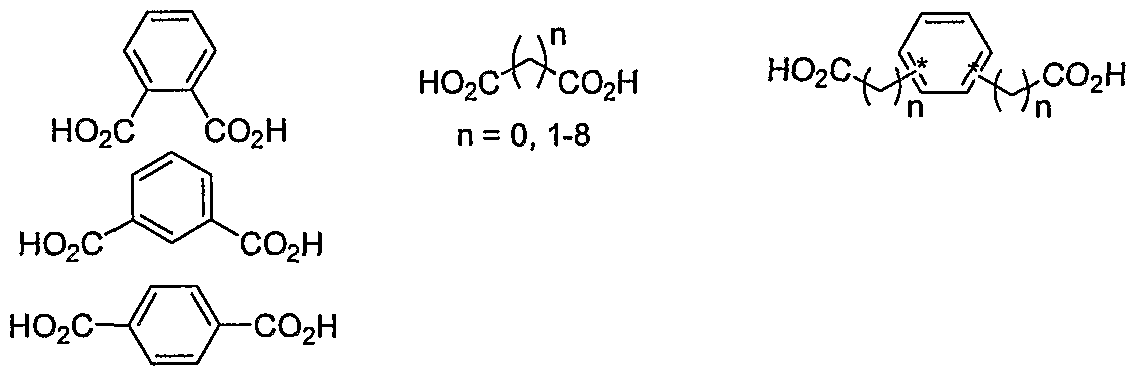
  • a number of dimeric linkers will be used to perturb the dimeric angle and to extend the dimeric tether in an effort to elucidate structure-activity relationships.
  • ortho, meta, and para dibenzoic acids will be used in lieu of the pyrole biscarboxylic acid to determine optimal angles.
  • Linker length will be probed by the use of about 3-10 carbon dicarboxylic acids. If the studies support that both angle and linker length are important, then combinations of these linkers will be prepared and coupled to furnisli the conformationally biased, extended compounds such as that shown below.
  • PROPHETIC EXAMPLE 14 0 PROSTATE CANCER XENOGRAFT TUMOR MODEL
  • This example involves the in vivo effect of the compounds of the present invention using a prostate cancer mouse model. More specifically, four to six week old BALB/c nu/nu nude mice will be obtained commercially and maintained in ventilated cages under Institutional Animal Care and Use Committee approval. Separate male mice will be [5 inoculated subcutaneously with 10 6 LNCaP cells suspended in 0.25 mL of Matrigel (BD, Bioscience, Bedford MA). Stable serum testosterone levels will be maintained in the mice by the implantation of 12.5mg 90-day sustained release testosterone pellets (Innovative Research, Sarasota FL) subcutaneously prior to inoculation with tumor.
  • Tumor volume will be measured twice a week with vernier calipers with tumor volumes calculated using the formula [length x width x height x 0.52]. Mice with established tumor volumes of 5 mm will be selected for KU- 1/A4 administration. Utilizing the paradigm for administration of 17- AAG (another Hsp90 inhibitor), animals will be treated with both continuous and intermittent dosing schedules. A control animal will be treated with vehicle alone (DMSO). For the continuous dosing schedule, mice will receive intraperitoneal injections of vehicle or the test compounds (e.g., KU-1/A4) for 5 days per week for 3 weeks. The intermittent group will receive one 5 day cycle and then monitored for progression.
  • DMSO vehicle alone
  • test compound e.g., KU-1/A4
  • KU-1/A4 Differing doses of the test compound (e.g., KU-1/A4) will be utilized based on pharmacokinetic information obtained from toxicity studies. When progression occurs, as defined by an increase in tumor size, the mice will receive a second 5 day cycle of the test compound (e.g., KU-1/A4). Response to the test compound will be assessed by measuring tumor volume and serum PSA levels using the PSA Assay Kit (American Qualex Antibodies, San Clemente, CA).
  • PSA Assay Kit American Qualex Antibodies, San Clemente, CA.
  • Hsp90's client proteins known to be involved in cancer cell survival mechanisms such as signal transduction (e.g., AKT, Her2, PI3 kinase), angiogenesis (e.g., HIF- l ⁇ ), and metastasis (AR, MMP2).
  • signal transduction e.g., AKT, Her2, PI3 kinase
  • angiogenesis e.g., HIF- l ⁇
  • metastasis e.g., MMP2
  • test compound e.g., KU-1/A4
  • HPLC high performance liquid chromatography
  • EXAMPLE 15 NEUROPROTECTIVE EFFECTS Recently, low concentrations of the Hsp90 inhibitor GDA were reported to induce expression of both Hsp70 and Hsp90, with a concomitant reduction in phosphorylated Tau (Dou et al., 2003).
  • KU-1/A4 a novel C-terminal Hsp90 inhibitor, was tested for protective effects against A ⁇ toxicity in primary neurons. See protocols in Michaelis ML, Ansar S, Chen Y, Reiff ER, Seyb KI, Himes RH, Audus KL, Georg GI (2005) B-Amyloidinduced neurodegeneration and protection by structurally diverse microtubule- stabilizing agents. J Pharmacol Exp Ther 312:659-668, which is incorporated by reference.

Landscapes

  • Chemical & Material Sciences (AREA)
  • Health & Medical Sciences (AREA)
  • Organic Chemistry (AREA)
  • General Health & Medical Sciences (AREA)
  • Life Sciences & Earth Sciences (AREA)
  • Engineering & Computer Science (AREA)
  • Nuclear Medicine, Radiotherapy & Molecular Imaging (AREA)
  • Biotechnology (AREA)
  • Medicinal Chemistry (AREA)
  • Animal Behavior & Ethology (AREA)
  • General Chemical & Material Sciences (AREA)
  • Public Health (AREA)
  • Veterinary Medicine (AREA)
  • Chemical Kinetics & Catalysis (AREA)
  • Molecular Biology (AREA)
  • Genetics & Genomics (AREA)
  • Pharmacology & Pharmacy (AREA)
  • Biochemistry (AREA)
  • Neurosurgery (AREA)
  • Neurology (AREA)
  • Biomedical Technology (AREA)
  • Bioinformatics & Cheminformatics (AREA)
  • Pharmaceuticals Containing Other Organic And Inorganic Compounds (AREA)

Abstract

Novel analogues and derivatives of novobiocin are provided, including compounds having modifications to the amide side chain, coumarin ring, and sugar moieties. The compounds of the present invention are useful as heat shock protein 90 inhibitors, and may be used as anticancer and neuroprotective agents.

Description

NOVOBIOCIN ANALOGUES AS ANTICANCER AGENTS Statement Regarding Federally Sponsored Research or Development
The present invention was sponsored by the National Institutes of Health COBRE in Protein Structure and Function Grant No. NIH 31207, and the government may have certain rights in the invention. Background of the Invention
1. Field of the Invention
The present invention is directed to the synthesis and identification of novobiocin analogues useful as a class of anticancer agents and/or neuroprotective agents. The compounds of the present invention act by inhibition of the Hsp90 protein-folding machinery.
2. Description of Related Art
The 90 kDa heat shock proteins ("Hsp90") belong to a family of chaperones that regulate intracellular functions and are required for the refolding of denatured proteins following heat shock, as well as the conformational maturation of a large number of key proteins involved in cellular processes. The Hsp90 family of chaperones is comprised of four different isoforms. Hsp90α (inducible/major form) and Hsp90β (constitutive/minor form) are found predominately in the cytosol, the 94-kDa glucose-regulated protein ("GRP94") is localized to the endoplasmic reticulum, and Hsp75/tumour necrosis factor receptor associated protein 1 ("TRAP-I") resides mainly in the mitochondrial matrix. These Hsp90s bind to client proteins in the presence of cochaperones, immunophilins, and partner proteins to make the multiprotein complex responsible for conformational maturation of newly formed nascent peptides into biologically active three-dimensional structures.
As discussed more fully below, Hsp90 is an ATP-dependent protein with an ATP binding site in the N-terminal region of the active homodimer. Disruption of the ATPase activity of Hsp90 results in the destabilization of multiprotein complexes and subsequent ubiquitination of the client protein, which undergoes proteasome-mediated hydrolysis. More specifically, in an ATP-dependent fashion, Hsp70 binds to newly synthesized proteins cotranslationally and/or posttranslationally to stabilize the nascent peptide by preventing aggregation. Stabilization of the Hsp70/polypeptide binary complex is dependent upon the binding of Hsp70 interacting protein ("HIP"), which occurs after Hsp70 binds to the newly formed peptide. Hsp70-Hsp90 organizing protein ("HOP") contains highly conserved tetratricopeptide repeats ("TPRs") that are recognized by both Hsp70 and Hsp90, promoting the union of Hsp70/HEP and Hsp90, which results in a heteroprotein complex. In the case of telomerase and steroid hormone receptors, the client protein is transferred from the Hsp70 system to the Hsp90 homodimer with concomitant release of Hsp70, HIP, and HOP. Upon binding of ATP and an immunophilin with cisltrans peptidyl prolyl-isomerase activity (FKBP51, FKBP52, or CyPA), the ensemble folds the client protein into its three-dimensional structure, hi a subsequent event, p23 binds Hsp90 near the TV-terminal region promoting the hydrolysis of ATP and release of the folded protein, Hsp90 partner proteins, and ADP.
Examples of proteins dependent upon Hsp90 for conformational maturation include oncogenic and cellular Src kinases (v-Src, Hck, Lck), Raf, pi 85, mutant p53 (not normal p53), telomerase, steroid hormone receptors, polo-like kinase ("PLK"), protein kinase B ("AKT"), death domain kinase ("RIP"), MET kinase, focal adhesion kinase ("FAK"), aryl hydrocarbon receptor, RNA-dependent protein kinase ("PKR"), nitric oxide synthase ("NOS"), centrosomal proteins, PI3 kinases, androgen receptor ("AR"), matrix metalloproteinase-2 ("MMP2") and others, hi addition, other proteins, such as cyclin dependent kinase 4 ("CDK4"), cyclin dependent kinase 6 ("CDK6"), estrogen receptor, human epidermal growth factor receptor 2 ("Her-2" or "erbB2") are thought to be client proteins of Hsp90. Of these Hsp90 client proteins, Raf, PLK, RIP, AKT, FAK, telomerase, HER-2, and MET kinase are directly associated with the six hallmarks of cancer: (1) self-sufficiency in growth signals; (2) insensitivity to antigrowth signals; (3) evasion of apoptosis; (4) unlimited replication potential; (5) sustained angiogenesis; and (6) tissue invasion/metastasis. Consequently, Hsp90 is a target for the development of cancer therapeutics because multiple signaling pathways can be simultaneously inhibited by disruption of the Hsp90 protein folding machinery.
Hsp90 contains two nucleotide-binding sites: the N-terminal ATP binding site is the region to which geldanamycin ("GDA"), 17-(allylamino)-17-demethoxygeldanamycin ("17-AAG"), herbimycin A ("HB"), and radicicol bind (see Roe et al., Structural Basis for Inhibition of the Hsp90 Molecular Chaperone by the Antitumor Antibiotics Radicicol and Geldanamycin, J. Med. Chem. 1999, 42, 260-266) and the C-terminus, which was recently shown to bind novobiocin (see Marcu et al., The Heat Shock Protein 90 Antagonist Novobiocin Interacts with a Previously Unrecognized ATP -binding Domain in the Carboxy Terminis of the Chaperone, J. Biol. Chem. 2000, 276, 37181).
Figure imgf000004_0001
Novobiocin
The C-terminal portion of Hsp90 is required for dimerization and represents a promising target for inhibitors. Unfortunately, the ability of novobiocin to cause degradation of Hsp90 clients is relatively weak (about 700 μM in SKBr3 breast cancer cells). Thus, there remains a need to develop other Hsp90 inhibitors as useful anti-cancer agents. Most preferably, these new Hsp90 inhibitors have decreased toxicity, increased solubility, and/or increased selectivity for Hsp90.
It is also contemplated that the Hsp90 inhibitors of the present invention will be useful as neuroprotective agents. The accumulation of protein aggregates within or outside neurons is a common characteristic of the two most common age-related neurodegenerative diseases, Alzheimer's disease, with plaques enriched in β-amyloid peptides ("Aβ") and neurofibrillary tangles ("NFTs") containing hyperphsophorylated Tau protein, and Parkinson's disease ("PD") with Lewy bodies composed primarily of fibrillar α-synuclein. However, even less frequent but equally debilitating nervous system diseases such as Huntington's disease, amyotrophic lateral sclerosis ("ALS"), prion diseases, and the tauopathies also share the characteristic of aggregated protein deposits. A growing body of evidence now indicates that strategies that promote either refolding or degradation of hyperphosphorylated Tau enhance cell survival in the presence of over-expressed Tau or mutant human Tau. See, e.g., Shimura et al., Binding of Tau to heat shock protein 27 leads to decreased concentration of hyperphosphorylated tau and enhanced cell survival, J. Biol. Chem., 2004, 279:17957-17962; Dou et al., Chaperones increase association of Tau protein with microtubules, Proc. Natl. Acad. ScL U S A, 2003, 100:721-726; Kosik & Shimura, Phosphorylated tau and the neurodegenerative foldopathies, Biochim. Biophys. Acta., 2005, 1739:298-310; Shimura et al., CHIP-Hsc70 complex ubiquitinates phosphorylated tau and enhances cell survival, J. Biol. Chem., 2005 279:4869-4876. Such observations suggest that the cellular machinery needed for removal of misfolded proteins maybe compromised in neurodegenerative diseases.
More specifically, the interaction of Hsp90 with cochaperones that regulate cell- specific responses to stress has led to the identification of Hsp90 and the cochaperones Hsp70 and CHIP (carboxy-terminus of the Hsp70-interacting protein) as strong candidates in determining the fate of neuronal protein aggregates. This has been most clearly demonstrated in the case of the hyperphosphorylated Tau protein in NFTs in Alzheimer's disease and the "tauopathies" due to mutations in the tau gene. Low concentrations of Hsp90 inhibitors appear to up-regulate expression of Hsp90 and co-chaperones that decrease aggregated Tau and increase neuronal survival. However, most of the known Hsp90 inhibitors are toxic to many cell types, limiting their potential for chronic use to delay the progression of neurodegenerative diseases. Thus, there remains a need to develop other Hsp90 inhibitors as useful neuroprotective agents.
Additional aspects of the invention, together with the advantages and novel features appurtenant thereto, will be set forth in part in the description which follows, and in part will become apparent to those skilled in the art upon examination of the following, or may be learned from the practice of the invention. The objects and advantages of the invention may be realized and attained by means of the instrumentalities and combinations particularly pointed out in the appended claims. Brief Summary of the Invention
The present invention is directed to novel compounds useful as Hsp90 inhibitors, and in particular as anti-cancer an neuroprotective agents.
In one aspect, the invention encompasses compounds according to Formula I
Figure imgf000005_0001
wherein R1 is hydrogen, alkyl, alkenyl, alkynyl, carbocyclic, heterocyclic, aryl, aralkyl, carboxyl, amido, amino, sulfanyl, sulfenyl, sulfonyl, or ether; or R1 together with X2 and the atom to which R1 is attached form a heterocyclic ring having 4 to 8 ring members with at least one heteroatom selected from oxygen or nitrogen; or R1 together with X4 and the atom to which R1 is attached form a heterocyclic ring having 4 to 8 ring members with at least one heteroatom selected from oxygen or nitrogen; wherein R2 is hydrogen, hydroxy, or -R8-OR9, wherein R8 is a covalent bond or alkyl, and R9 is C-amido or acyl; or R2 together with R3 and the atoms to which they are attached form a heterocyclic ring having 4 to 8 ring members with at least one heteroatom selected from oxygen or nitrogen; wherein R3 is hydrogen, hydroxy, or-R10-O-Rπ, wherein R10 is a covalent bond or alkyl, and R11 is C-amido or acyl; or R3 together with R2 and the atoms to which they are attached form a heterocyclic ring having 4 to 8 ring members with at least one heteroatom selected from oxygen or nitrogen; wherein R4 is hydrogen, hydroxy, carboxyl, -R12-O-R13, or -R12-R14; and wherein R12 is a covalent bond or alkyl, and R13 is C-amido or acyl, and R14 is N-amido POR15R16 -SO2R17, or sulfonamido, and wherein R15, R16, R17are independently alkoxy; wherein R5 is hydrogen, alkyl, alkenyl, allcynyl, aryl, or aralkyl; wherein R6 is hydrogen, alkyl, alkenyl, allcynyl, aryl, aralkyl, alkoxy, aryloxy or aralkoxy; wherein X1 is -O-, -CO-, or -N-; wherein X2 is -O-, -N-, -NR18- -CR19- , or -CO- ; and wherein R18 and R19 are hydrogen, alkyl, alkenyl, or alkynyl; or X2 together with R1 and the atom to which R1 is attached form a heterocyclic ring having 4 to 8 ring members with at least one heteroatom selected from oxygen or nitrogen; wherein X4 is -O- -CR20-, -CO-, or -N-, wherein R20 is hydrogen, alkyl, alkenyl, alkynyl, or hydroxy; or wherein X4 together with R1 and the atoms to which they are attached form a heterocyclic ring having 4 to 8 ring members with at least one heteroatom selected from oxygen or nitrogen; wherein X5, is -CR21- or -N-, wherein R21 is hydrogen, alkyl, alkenyl, alkynyl; wherein X6, is -CR22- or -N-, wherein R22 is hydrogen, alkyl, alkenyl, alkynyl, alkoxy, aryl, aralkyl, halogen, or nitro; or X6 together with Xg and the carbon at position 7 form a heterocylic ring having 4 to 8 ring members with, at least one heteroatom selected from oxygen or nitrogen; wherein X8, is -CR23- or -N-, wherein R23 is hydrogen, alkyl, alkenyl, or alkynyl; wherein X9 is alkyl, alkenyl, alkynyl, ether, secondary or tertiary amino, or sulfanyl; or X9 together with X6 and the carbon at position 7 form a heterocylic ring having 4 to 8 ring members with at least one heteroatom selected from oxygen or nitrogen; wherein at least one of X1, X2, X4, X5, X6, Xs is not -CR-; and wherein n is 0, 1, 2, or 3. In still another aspect, the present invention is directed to compounds of Formula I that are coumarin compounds wherein Xj is -O- and X2 is -CO- .
In still another aspect, the present invention is directed to compounds of Formula I that are isocoumarin compounds wherein X1 is -CO- and X2 is -O- . In still a further aspect, the present invention is directed to des(dimethyl) derivatives and analogues of novobiocin in which R4 and R5 are both hydrogen.
In still another aspect, the present invention is directed to desmethoxy derivatives and analogues of novobiocin in which R6 is hydrogen.
In yet another aspect, the present invention is directed to compounds according to the Formula I(F):
Figure imgf000007_0001
wherein X4, X5, X6, X8, X9, R2, R3, R4, R5, R6, and n are defined as set forth above, and wherein Ra, Rb and Rc are independently hydrogen, alkyl, alken_yl, alkynyl, carbocyclic, heterocyclic, aryl, or aralkyl; and wherein Rb may also be oxidized to form a carbonyl.
In still another aspect, the invention encompasses compounds according to the Formula I(F)(i):
wherein X9,
Figure imgf000007_0002
as set forth above, and wherein Ra and Rc are independently hydrogen, alkyl, alkenyl, alkynyl, carbocyclic, heterocyclic, aryl, or aralkyl.
In still another aspect, the present invention is directed to compounds according to the Formula I(F)(ii):
Figure imgf000008_0001
wherein X4, X5, X6, and X8 are defined as set forth above, and wherein Ra, R1* and Rc are independently hydrogen, alkyl, alkenyl, alkynyl, carbocyclic, heterocyclic, aryl, oτ aralkyl; and wherein R may also be oxidized to form a carbonyl.
In still another aspect, the present invention is directed to compounds encompassed by the Formula I(F)(iii):
Figure imgf000008_0002
In yet another aspect, the present invention is directed to compounds according to the Formula I(G):
wherein X5, X6,
Figure imgf000008_0003
n are defined as set forth above, and wherein Ra, Rb and RQ are independently hydrogen, alkyl, alkenyl, alkynyl, carbocyclic, heterocyclic, aryl, or aralkyl; and wherein Rbmay also be oxidized to form a carbonyl.
In a further aspect, the present invention is directed to compounds according to the Formula I(G)(i):
Figure imgf000009_0001
wherein X9, R2, R3, R4, R5, R6 are defined as set forth above, and wherein Ra and Rc are independently hydrogen, alkyl, alkenyl, alkynyl, carbocyclic, heterocyclic, aryl, or aralkyl.
In yet another aspect, the present invention is directed to compounds according to Formula I(G)(ii):
Figure imgf000009_0002
wherein X5, X6, and X8 are defined as set forth above, and wherein ,R >a , τ R>b and Rc are independently hydrogen, alkyl, alkenyl, alkynyl, carbocyclic, heterocyclic, aryl, or aralkyl; and wherein Rb may also be oxidized to form a carbonyl.
In still a further aspect, the present invention is directed to compounds according to Formula I(G)(iii):
Figure imgf000009_0003
In a further aspect, the present invention is directed to compounds according to Formula I(H):
Figure imgf000010_0001
wherein X4, X6, X8, X9, R1, R2, R3, R4, R5, R6, and n are defined as set forth above.
In still a further aspect, the invention comprises compounds according to the Formula I(H)(i):
Figure imgf000010_0002
wherein X9, R1, R2, R3, R4, R5, and R6 are defined as set forth above.
In still another aspect, the present invention is directed to compounds according to Formula I in which R2 and R3 form a cyclic carbonate. In still another aspect, the present invention is directed to compounds according to Formula I in which the sugar ring is modified to include a diol at R2 and R3.
In still another aspect, the present invention is directed to compounds according to Formula I in which sugar is modified to include a 2'-carbamate at R2.
In still another aspect, the present invention is directed to the compounds of Formula I in which the coumarin ring is modified to include a lower alkoxy or nitro substitution at the 6-position of the coumarin ring.
In a further aspect, the present invention encompasses compounds according to Formula I(J):
Figure imgf000010_0003
wherein X1, X2, X4, X5, X8, R1, R2, R3, R4, R5, R6, and n are defined as set forth above; and wherein Ra and Rb are independently hydrogen, alkyl, alkenyl, alkynyl, carbocyclic, heterocyclic, aryl, or aralkyl; and wherein Rbmay also be oxidized to form a carbonyl. hi still a further aspect, the present invention is directed to compounds according Formula I(J)(i):
Figure imgf000011_0001
wherein X1, X2, X4, X5, X8, R1, R2, R3, R4, R5, R6, n, and Ra are defined as set forth above.
In still a further aspect, the present invention is directed to compounds according to the Formula I( J)(U):
Figure imgf000011_0002
wherein X1, X2, X4, X5, X8, R1, R2, R3, R4, R5, R6, n, and Ra are defined as set forth above.
In still another aspect, the present invention is directed to compounds encompassed by Formula I(K) :
wherein X4, X5, X6, X8, X9, R1, R2, R3, R4, R5, R6, and n are defined as set forth above; and wherein R , 18 is hydrogen, alkyl, alkenyl, or alkynyl. In yet another aspect, the present invention is directed to compounds encompassed by Formula I(K)(i):
Figure imgf000012_0001
wherein X9, R 5 R 5 R 5 R 5 R , and R are defined as set forth above; and wherein R18 is hydrogen, alkyl, alkenyl, or alkynyl.
In still a further aspect, the present invention is directed to 4-deshydroxy derivatives and analogues of novobiocin in which X4 is -CR20- and R20 is hydrogen.
In yet a further aspect, the present invention is directed to 8-desmethyl derivatives and analogues of novobiocin in which X8 is -CR22- and R22 is hydrogen. In still another aspect, the present invention encompasses compounds according to the Formula I(L):
Figure imgf000012_0002
wherein X4, X5, X6, X8, X9, R1, R2, R3, R4, R5, R6, and n are defined as set forth above. In yet another aspect, the present invention is directed to compounds according
Formula I(L)(i):
Figure imgf000012_0003
wherein X9, R1, R2, R3, R4, R5, R6, and n are defined as set forth, above. In still another aspect of the present invention, the novobiocin derivatives and analogues of the present invention are modified so that the sugar is modified as set forth below:
Figure imgf000013_0001
In still another aspect, the present invention is directed to dimers of the foregoing compounds. In particular, exemplary dimers are provided by the formula:
Figure imgf000013_0002
wherein X is alkyl, alkenyl, alkynyl, aryl, alkylaryl, carbocyclic or heterocyclic; and wherein R2, R3, R4, R5, and R6 are set forth above.
L O In another aspect, the present invention comprises the in wtαich the linker is a heterocylic pyrole as shown below:
Figure imgf000013_0003
It is contemplated that one or more compounds of the present invention will be useful for inhibiting heat-shock protein 90 activity by administering one of more of the compounds of the present invention to a cell or subject and observing a decrease in the expression of a heat-shock protein 90 client protein. According to another aspect, the present invention provides a pharmaceutical composition, which comprises a therapeutically-effective amount of one or more compounds of the present invention or a pharmaceutically-acceptable salt, ester or prodrug thereof, together with a pharmaceutically-acceptable diluent or carrier.
Additional aspects of the invention, together with the advantages and novel features appurtenant thereto, will be set forth in part in the description which follows, and in part will become apparent to those skilled in the art upon examination of the following, or may be learned from the practice of the invention. The objects and advantages of the invention may be realized and attained by means of the instrumentalities and combinations particularly pointed out in the appended claims. Brief Description of The Drawings
FIG. 1 shows the relative ratios of phospho-AKT by Western, blot analyses when the compounds of Example 1 were tested for their ability to inhibit Hsp90 in Skbr3 breast cancer cells. Total protein concentration of each lysate was determined and equal amounts of protein were run in each lane of the gels. For the graphs shown in FIG. 1 , the O.D.'s (optical density) of the Western bands for phospho-AKT were measured, as were the O.D.'s for actin probed as controls on the same blots. To obtain the graphed values, all specific O.D.'s (for Hsp90 clients) were normalized to the respective actin O.D.
FIG. 2 is a western blot analysis of Skbr3 cells treated with novobiocin analogue denominated herein as KU-3/A2 (2'-carbamate) and KU-1/A4 (diol) for 24 hours. After incubation, the cells were harvested, lysed, and equal amounts of the protein lysates loaded into SDS wells. After electrophoresis, the gel was probed with Her-2 and actin (control) antibodies. The specific decrease in Her-2 levels is a result of Hsρ90 inhibition that leads to Her-2 degradation.
FIG. 3 (top panel) is a western blot analysis of prostate cancer LNCaP cells treated with KU-1/A4. The bottom panel is a western blot analysis of prostate cancer LAPC-4 cells incubated with KU-1/A4. Actin was used as a control in both assays.
FIG. 4 shows the dose dependent effects of KU-I /A4 on Aβ-indxιced cell death in primary neurons. The compound was added two hours before the βA and th.e viability was determined at 4-8 hours. The data represents standard error of the means ("S.E.M.") from about 1500 cells from 3 preparations. #, pO.OOOl for control vs. Aβ only. **, p<0. 001. Aβ only vs. Aβ + KU-l/A4. Detailed Description of Preferred Embodiment
5 Molecular terms, when used in this application, have their common meaning unless otherwise specified. It should be noted that the alphabetical letters used in the formulas of the present invention should be interpreted as the functional groups, moieties, or substitutents as defined herein. Unless otherwise defined, the symbols will have their ordinary and customary meaning to those skilled in the art.
0 The term "acyl" refers to -COR wherein R used in this definition is hydrogen, alkyl, alkenyl, alkynyl, carbocyclic, heterocylic, aryl, or aralkyl. Most preferably, R is hydrogen, alkyl, aryl, or aralkyl.
The term "amido" indicates either a C-amido group such as -CONR'R" or an N- amido group such as -NR'COR" wherein R1 and R" as used in this definition are independently
5 hydrogen, alkyl, alkenyl, alkynyl, alkoxy, carbocyclic, heterocylic, aryl, or aralkyl. A "sulfoamido" group includes the -NR'-SO2-R". Most preferably, R' and R" are hydrogen, alkyl, aryl, or aralkyl.
The term "amino" signifies a primary, secondary or tertiary amino group of the formula -NR1R" wherein R' and R" as used in this definition are independently hydrogen,
:0 alkyl, alkyenyl, alkynyl, aralkyl, carbocyclic, heterocyclic, aralkyl, or other amino (in the case of hydrazide) or R' and R" together with the nitrogen atom to which they are attached, form a ring having 4-8 atoms. Thus, the term "amino", as used herein, includes unsubstituted, monosubstituted (e.g., monoalkylamino or monoarylamino), and disubstituted (e.g., dialkylamino or aralkylamino) amino groups. Amino groups include — NH2, methylamino,
',5 ethylamino, diinethylamino, diethylamino, methyl-ethylamino, pyrrolidin-1-yl or piperidino, morpholino, etc. Other exemplary "amino" groups forming a ring include pyrrolyl, imidazolyl, pyrazolyl, isothiazolyl, isoxazolyl, pyridyl, pyrazinyl, pyrimidinyl, pyridazinyl, indolizinyl, isoindolyl, indolyl, indazolyl, purinyl, quinolizinyl. The ring containing the amino group may be optionally substituted with another amino, alkyl, alkenyl, alkynyl, halo, or
SO hydroxyl group.
The term "alkyl" refers to a branched or unbranched saturated hydrocarbon group of 1 to 24 carbon atoms, such as methyl, ethyl, n-propyl, isopropyl, n-butyl, isobutyl, t- butyl, octyl, decyl, tetradecyl, hexadecyl, eicosyl, tetracosyl and the like. Preferred "alkyl" groups herein contain 1 to 12 carbon atoms. Most preferred are "lower alkyl" which refer to an alkyl group of one to six, more preferably one to four, carbon atoms. The alkyl group may be optionally substituted with an amino, alkyl, halo, or hydroxiyl group.
The term "alkoxy" denotes oxy-containing .groups substituted with an alkyl, or 5 cycloalkyl group. Examples include, without limitation, methoxy, ethoxy, tert-butoxy, and cyclohexyloxy. Most preferred are "lower alkoxy" groups having one to six carbon atoms. Examples of such groups include methoxy, ethoxy, propoxy, butoxy, isopropoxy, and tert- butoxy groups.
The terms "alkenyl" and "alkynyl" refeα- to unsaturated aliphatic groups 0 analogous in length and possible substitution to the alkyls described above, but that contain at least one double bond or triple bond respectively.
The term "aryl" means a carbocyclic aroimatic system containing one, two or three rings wherein such rings may be attached together in_ a pendant manner or may be fused. The term "fused" means that a second ring is present (i.e., attached or formed) by having two 5 adjacent atoms in common (Le,, shared) with the first ring. The term "fused" is equivalent to the term "condensed." The term "aryl" embraces aromatic groups such as phenyl, naphthyl, tetrahydronaphthyl, indane, and biphenyl. The aryl group may optionally be substituted with an amino, alkyl, halo, hydroxyl, carbocyclic, heterocyclic, or another aryl group.
The term "aralkyl" embraces aryl-substitutcd alkyl moieties. Preferable aralkyl Ϊ0 groups are "lower aralkyl" groups having aryl groups attached to alkyl groups having one to six carbon atoms. Examples of such groups include benzoyl, diphenylmethyl, triphenylmethyl, phenylethyl, and diphenylethyl. The terms benzyl and phexiylmethyl are interchangeable.
The term "aryloxy" embraces aryl groups, as defined above, attached to an oxygen atom. The aryloxy groups may optionally be substituted with a halo, hydroxyl, or alkyl
>5 group. Examples of such groups include phenoxy, 4-chloro-3-ethylphenoxy, 4-chloro-3- methylphenoxy, 3-chloro-4-ethylphenoxy, 3,4-dichlorophenoxy, 4-methylphenoxy, 3- trifluorornefhoxyphenoxy, 3-trifluoromethylphenoxy, 4-fhuorophenoxy, 3,4-dimethylphenoxy,
5-bromo-2-fluorophenoxy, 4-bromo-3-fluorophenoxy, 4-fluoro-3-methylphenoxy, 5,6,7,8- tetrahydronaphthyloxy, 3-isopropylphenoxy, 3-cyclopropylphenoxy, 3-ethylphenoxy, 4-tert-
50 butylphenoxy, 3-pentafiuoroethylphenoxy, and 3-(l,l,2,2-tetrafluoroethoxy)phenoxy.
The term "aralkoxy" embraces oxy-containing aralkyl groups attached through an oxygen atom to other groups. "Lower aralkoxy" groups are those phenyl groups attached to lower alkoxy group as described above. Examples of such groups include benzyloxy, 1- phenylethoxy, 3-trifluoromethoxybenzyloxy, 3-trifluoromethylbenzyloxy, 3,5- difluorobenyloxy, 3-bromobenzyloxy, 4-propylbenzyloxy, 2-fluoro-3- trifluoromethylbenzyloxy, and 2-phenylethoxy.
The term "carboxyl" refers to -R'C(=O)OR", wherein R' and R" as used in this definition are independently hydrogen, alkyl, alkenyl, alkynyl, carbocyclic, heterocylic, aryl, or aralkyl or R' can additionally be a covalent bond. "Carboxyl" includes both carboxylic acids, and carboxylic acid esters. The term "carboxylic acid" refers to a carboxyl group in which R" is hydrogen. Such acids include formic, acetic, propionic, butryic, valeric acid, 2-methyl propionic acid, oxirane-carboxylic acid, and cyclopropane carboxylic acid. The term "carboxylic acid ester" or "ester" refers to a carboxyl group in which R" is alkyl, alkenyl, alkynyl, carbocyclic, heterocylic, aryl, or aralkyl.
The term "carbocyclic" refers to a group that contains one or more covalently closed ring structures, and that the atoms forming the backbone of the ring are all carbon atoms. The ring structure may be saturated or unsaturated. The term thus distinguishes carbocyclic from heterocyclic rings in which the ring backbone contains at least one non- carbon atom. The term carbocylic encompasses cycloalkyl ring systems.
The terms "cycloalkane" or "cyclic alkane" or "cycloalkyl" refer to a carbocyclic group in which the ring is a cyclic aliphatic hydrocarbon, for example, a cyclic alkyl group preferably with 3 to 12 ring carbons. "Cycloalkyl" inchides, by way of example, cyclopropyl, cyclobutyl, cyclopentyl, cyclohexyl, cycloheptyl, or cyclooctyl, and the like. The cycloalkyl group may be optionally substituted with an amino, alkyl, halo, or hydrόxyl group.
The term "ether" refers to the group -R'-O-R" wherein R' and R" as used in this definition are independently hydrogen, alkyl, alkenyl, alkynyl, carbocyclic, heterocylic, aryl, or aralkyl, and R' can additionally be a covalent bond attached to a carbon. The terms "halo" or "halogen" refer to fluoro, chloro, bromo or iodo, usually regarding halo substitution for a hydrogen atom in an organic compound.
The term "heterocyclic or heterocycle" means an optionally subsituted, saturated or unsaturated, aromatic or non-aromatic cyclic hydrocarbon group with 4 to about 12 carbon atoms, preferably about 5 to about 6, wherein 1 to about 4 carbon atoms are replaced by nitrogen, oxygen or sulfur. Exemplary heterocyclic which are aromatic include groups pyridinyl, furanyl, benzofuranyl, isobenzofuranyl, pyrrolyl, thienyl, 1,2,3-triazolyl, 1,2,4- triazolyl, indolyl, imidazolyl, thiazolyl, thiadiazolyl, pyrimidinyl, oxazolyl, triazinyl, and tetrazolyl. Exemplary heterocycles include benzimidazole, dihydrothiophene, dioxin, dioxane, dioxolane, dithiane, dithiazine, dithiazole, dithiolane, foran, indole, 3-H indazole, 3-H-indole, imidazole, indolizine, isoindole, isothiazole, isoxazole, morpholine, oxazole, oxadiazole, oxathiazole, oxathiazolidine, oxazine, oxadiazine, piperazine, piperidine, purine, pyran, pyrazine, pyrazole, pyridine, pyrimidine, pyrimidine, pyridazine, pyrrole, pyrrolidine, tetrahydrofuran, tetrazine, thiadiazine, thiadiazole, thiatriazole, thiazine, thiazole, thiomorpholine, thiophene, thiopyran, triazine, and triazole. The heterocycle may be optionally substituted with an amino, alkyl, alkenyl, alkynyl, halo, hydroxyl, carbocyclic, thio, other heterocyclic, or aryl group. Exemplary heterocyclic groups include 1-pyrrolyl, 2- pyrrolyl, 3-pyrrolyl, 1-indolyl, 2-indolyl, 3-indolyl, 1-pyridyl, 2-pyridyl, 3-pyridyl, 4-pyridyl, 1-imidazolyl, 2-imidazolyl, 3-imidazolyl, 4-imidazolyl, 1-pyrazolyl, 2 pyrazolyl, 3-pyrazolyl, 4-pyrazolyl, 5-pyrazolyl, 1-pyrazinyl, 2-pyrazinyl, 1-pyrimidinyl, 2-pyrimidinyl, 4- pyrimidinyl, 5-pyrimidinyl, 1 -pyridazinyl, 2-pyridazinyl, 3-pyridazinyl, 4-pyridizinyl, 1- indolizinyl, 2-indolizinyl, 3-indolizinyl, 4-indolizinyl, 5-indolizinyl, 6-indolizinyl, 7- indolizinyl, 8-indolizinyl, 1-isoindolyl, 2-isoindolyl, 3-isoindolyl, 4-isoindolyl, 5-isoindolyl. The term "hydroxy" or "hydroxyl" refers to the substituent — OH.
The term "oxo" shall refer to the substituent =0. The term "nitro" means -NO2.
The term "sulfanyl" refers to -SR' where R1 as used in this definition is hydrogen, alkyl, alkenyl, alkynyl, carbocyclic, heterocylic, aryl, or aralkyl. The term "sulfenyl" refers to -SOR' where R' as used is this definition is hydrogen, alkyl, alkenyl, alkynyl, carbocyclic, heterocylic, aryl, or aralkyl.
The term "sulfonyl" refers to -SOR' where R' as used in this definition is hydrogen, alkyl, alkenyl, alkynyl, carbocyclic, heterocylic, aryl, or aralkyl.
"Optional" or "optionally" means that the subsequently described event or circumstance may or may not occur, and that the description includes instances where said event or circumstance occurs and instances in which it does not. "Optionally" is inclusive of embodiments in which the described conditions is present and embodiments in which the described condition is not present. For example, "optionally substituted phenyl" means that the phenyl may or may not be substituted, and that the description includes both unsubstituted phenyl and phenyl wherein there is substitution. "Optionally" is inclusive of embodiments in which the described conditions is present and embodiments in which the described condition is not present. The compounds of the present invention can exist in tautomeric, geometric or stereoisomeric forms. The present invention contemplates all such compounds, including cis- and trans-geometric isomers, E- and Z-geometric isomers, R — and S — enantiomers, diastereomers, d-isomers, 1 -isomers, the racemic mixtures thereof and other mixtures thereof, as falling within the scope of the invention.
Also included in the family of compounds of the present invention are the pharmaceutically acceptable salts, esters, and prodrugs thereof. The term "pharmaceutically- acceptable salts" embraces salts commonly used to form alkali metal salts and to form addition salts of free acids or free bases. The nature of the salt is not critical, provided that it is pharmaceutically acceptable. Suitable pharmaceutically acceptable acid addition salts of compounds of the present invention be prepared from inorganic acid or from an organic acid. Examples of such inorganic acids are hydrochloric, hydrobromic, hydroiodic, nitric, carbonic, sulfuric, and phosphoric acid. Appropriate organic acids may be selected from aliphatic, cycloaliphatic, aromatic, araliphatic, heterocyclic, carboxylic and sulfonic classes of organic acids, examples of which are formic, acetic, propionic, succinic, glycolic, gluconic, lactic, malic, tartaric, citric, ascorbic, glucuronic, maleic, fumaric, pyruvic, aspartic, glutamic, benzoic, anthranilic, mesylic, salicylic, p-hydroxybenzoic, phenylacetic, mandelic, embonic (pamoic), methanesulfonic, ethylsulfonic, benzenesulfonic, sulfanilic, stearic, cyclohexylaminosulfonic, algenic, galacturonic acid. Suitable pharmaceutically-acceptable base addition salts of compounds of the present invention include metallic salts made from aluminum, calcium, lithium, magnesium, potassium, sodium and zinc or organic salts made from N,N'-dibenzylethyleneldiamine, choline, chloroprocaine, diethanolamine, ethylenediamine, meglumine (N-methylglucamine) and procain. All of these salts may be prepared by conventional means from the corresponding compounds of by reacting, for example, the appropriate acid or base with the compounds of the present invention.
As used herein, the term "pharmaceutically acceptable ester" refers to esters which hydrolyze in vivo and include, but are not limited to, those that break down readily in the human body to leave the parent compound or a salt thereof. Suitable ester groups include, for example, those derived from pharmaceutically acceptable aliphatic carboxylic acids, particularly alkanoic, alkenoic, cycloalkanoic and alkanedioic acids, in which each alkyl or alkenyl moiety advantageously has not more than 6 carbon atoms. Examples of particular esters include formates, acetates, propionates, butyrates, acrylates and ethylsuccinates. The term "pharmaceutically acceptable prodrugs" as used herein refers to those prodrugs of the compounds of the present invention, which are, within the scope of sound medical judgment, suitable for use in contact with the tissues of humans and lower animals without undue toxicity, irritation, allergic response and the like, commensurate with a reasonable risk/benefit ratio, and effective for their intended use, where possible, of the compounds of the invention. The term "prodrug" refers to compounds that are rapidly transformed in vivo to yield the parent compound of the above formulae, for example, by hydrolysis in blood. A thorough discussion is provided in T. Higuchi and V. Stella, Prodrugs as Novel delivery Systems, Vol. 14 of the A.C.S. Syrrvposium Series and in Edward B. Roche, ed., Bioreversible Carriers in Drug Design, American Pharmaceutical Association and Pergamon Press, 1987, both of which are incorporated by reference herein.
According to another aspect, the present invention provides a pharmaceutical composition, which comprises a therapeutically-effective amount of one or more compounds of the present invention or a pharmaceutically-acceptable salt, ester or prodrug thereof, together with a pharmaceutically-acceptable diluent or carrier.
The compositions may be formulated for any route of administration, in particular for oral, rectal, transdermal, subcutaneous, intravenous, intramuscular or intranasal administration. The compositions may be formulated in any conventional form, for example, as tablets, capsules, caplets, solutions, suspensions, dispersions, syrups, sprays, gels, suppositories, patches and emulsions.
The phrase "pharmaceutically acceptable" is employed herein to refer to those compounds, materials, compositions, and/or dosage forms which are, within the scope of sound medical judgment, suitable for use in contact with trie tissues of human beings and animals without excessive toxicity, irritation, allergic response, or other problem or complication, commensurate with a reasonable benefit/risk ratio.
The phrase "pharmaceutically-acceptable carrier" as used herein means a pharmaceutically-acceptable material, composition or vehicle, such as a liquid or solid filler, diluent, excipient, solvent or encapsulating material, involved in carrying or transporting the subject lonidamine analogue or derivative from one organ, or portion of the body, to another organ, or portion of the body. Each carrier must be "acceptable" in the sense of being compatible with the other ingredients of the formulation and not injurious to the patient. Some examples of materials which may serve as pharmaceutically-acceptable carriers include: (1) sugars, such as lactose, glucose and sucrose; (2) starches, such as corn starch and potato starch; (3) cellulose, and its derivatives, such as sodium carboxymethyl cellulose, ethyl cellulose and cellulose acetate; (4) powdered tragacanth; (5) malt; (6) gelatin; (7) talc; (8) excipients, such as cocoa butter and suppository waxes; (9) oils, such as peanut oil, cottonseed oil, safflower oil, sesame oil, olive oil, corn oil and soybean oil; (10) glycols, such as propylene glycol; (11) polyols, such as glycerin, sorbitol, mannitol and polyethylene glycol; (12) esters, such as ethyl oleate and ethyl laurate; (13) agar; (14) buffering agents, such as magnesium hydroxide and aluminum hydroxide; (15) alginic acid; (16) pyrogen-free water; (17) isotonic saline; (18) Ringer's solution; (19) ethyl alcohol; (20) phosphate buffer solutions; and (21) other non-toxic compatible substances employed in pharmaceutical formulations. The "patient" or "subject" to be treated with the compounds of the present invention can be any animal, and is preferably a mammal, such as a domesticated animal or a livestock animal. More preferably, the patient is a human.
The term "inhibit" or "inhibiting" refers to a statistically significant and measurable reduction in activity, preferably a reduction of at least about 10% versus control, more preferably a reduction of about 50% or more, still more preferably a reduction of about 80% or more.
A "therapeutically effective amount" is an amount of a compound of the present invention or a combination of two or more such compounds, which inhibits, totally or partially, the progression of the condition or alleviates, at least partially, one or more symptoms of the condition. A therapeutically effective amount can also be an amount that is prophylactically effective. The amount that is therapeutically effective will depend upon the patient's size and gender, the condition to be treated, the severity of the condition and the result sought. For a given patient and condition, a therapeutically effective amount can be determined by methods known to those of skill in the art. For example, in reference to the treatment of cancer using the compounds of the present invention, a therapeutically effective amount refers to that amount which has the effect of (1) reducing the size of the tumor, (2) inhibiting (that is, slowing to some extent, preferably stopping) tumor metastasis, (3) inhibiting to some extent (that is, slowing to some extent, preferably stopping) tumor growth, and/or, (4) relieving to some extent (or, preferably, eliminating) one or more symptoms associated with the cancer. Several of the compounds of the present invention have been shown to inhibit
Hsp90 in vitro. As such, it is contemplated that therapeutically effective amounts of the compounds of the present invention will be useful as anti-cancer agents and/or neuroprotective agents. In the context of cancer and neuroprotection, it is contemplated that some of the compounds of the present invention may be used with other Hsp90 inhibitors, chemotherapeutic agents, and/or neuroprotective agents.
The following examples are provided to illustrate the present invention and are not intended to limit the scope thereof. Those skilled in the art will readily understand that known variations of the conditions and processes of the following preparative procedures can be used to prepare these compounds.
EXAMPLE 1: SYNTHESIS OF NOVOBIOCIN ANALOGUES
In an effort to increase the affinity of novobiocin for the C-terminal ATP binding site, a library of novobiocin analogue compounds that contained both modified coumarin and sugar derivatives was prepared. The compounds were prepared as set forth in the scheme below along with a procedure recently developed for the synthesis of noviose. See Yu et al., Synthesis of (-)-Noviose from 2,3-0-Isopropylidene-D-erythronolactol, J. Org. Chem, 2004, 69, 7375-7378, which is incorporated by reference.
Figure imgf000022_0001
(-)-D-Noviose (+)-L-Noviose
The novobiocin analogues prepared according to the scheme included modification of the coumarin ring by shortening of the amide side chain and removal of the 4- hydroxy substituent (A) (see Madhavan et al., Novel Coumarin Derivatives of Heterocyclic Compounds as Lipid Lowering Agents, Bioorg. Med. Chem. Lett. 2003, 13, 2547, which is incorporated by reference), removal of both the 4-hydroxy and amide linker (B), steric replacements of both the 4-hydroxy and benzamide ring (C), and 1,2-positional isomers of the noviosyl linkage (D and E).
These selected coumarin rings were coupled with trichloroacetimidate of noviose carbonate in the presence of boron trifluoride etherate as shown in scheme below. See Shen et al., Syntheses of Photolabile Novobiocin Analogues, Bioorg. Med. Chem. Lett. 2004, 14, 5903. The resulting cyclic carbonates (Al-El) were treated with methanolic ammonia to provide 2'-carbamoyl (A2-E2), 3 '-carbamoyl (A3-E3), and descarbamoyl products (A4-E4) in good yields. See also Yu et al., Hsp90 Inhibitors Identified from a Library of Novoboicin Analogues, J. Am. Chem. Soc. 2005, 127, 12778-12779, which is incorporated by reference.
Figure imgf000023_0001
wherein R1 in the above scheme is hydrogen, amido, amino, or aryl; and wherein R2 in the above scheme is hydrogen, alkyl, or hydroxyl. Overall, the following twenty-three (23) analogues of novobiocin were prepared, which are set forth below:
Figure imgf000024_0001
N-(7-(("3aR,4RJR.7aRV7-methoxy-6,6-dimethyl-2-oxo-tetrahvdro-3aH- [l,3]dioxolo[4,5-clpyran-4-yloxyV2-oxo-2H-chromen-3-yπacetamide (Al). Noviose carbonate trichloroacetimidate (180 mg, 0.50 mmol) and 7-hydroxy-3-acetamino-coumarin A (133 rng, 0.60 mmol) were dissolved in CH2Cl2 (7 mL) before boron trifluoride etherate (30 μL, 0.03 mmol) was added to the suspension at 25 0C. The mixture was stirred at 25 °C for 8 h and quenched with Et3N (0.4 mL, 2.8 mmol). The solvent was removed and the residue purified by chromatography (SiO2, 5% acetone in CH2Cl2) to afford Al (134 mg, 64%) as a colorless solid: [α]25 D = - 71.0° (c, 0.1, CH2Cl2 ); 1H NMR (CD3Cl 400 MHz) δ 8.67 (s, IH), 8.00 (br s, IK), 7.46 (d, J= 8.6 Hz, IH), 7.05 (d, J = 2.3 Hz, IH), 7.00 (dd, J= 2.3, 8.6 Hz, IH), 5.82 (d, J = 1.5 Hz, IH), 5.02 (dd, J= 1.5, 7.8 Hz, IH)5 4.94 (t, J= 7.8 Hz, IH), 3.62 (s, 3H), 3.30 (d, J = 7.8Hz, IH), 2.26 (s, 3H), 1.37 (s, 3H), 1.21 (s, 3H); 13C NMR (CD3Cl 100 MHz) δ 169.7, 159.2, 157.4, 153.5, 151.4, 129.2, 123.9, 122.8, 115.1, 114.6, 104.1, 94.7, 83.4, 78.3, 77.6, 77.5, 61.1, 27.9, 25.2, 22.4; IR (film) vmax 1819, 1764, 1615, 1560, 1507, 1375, 1300, 1212, 1168, 1107, 1072, 1034, 1002, 969 cm"1, HRMS (FAB+) m/z 420.1285 (M + H+, C20H22NTO9 requires 420.1294).
(2R,3R,4R.5R)-2-r3-acetamido-2-oxo-2H-chromen-7-yloxyV4-hvdroxy-5- methoxy-6,6-dimethyl-tetrahvdro-2H-pyran-3-yl carbamate CA2\ (3R.4S.5R,6RV6-<"3- acetamido-2-oxo-2H-chromen-7-yloxy)-5-hydroxy-3-methoxy-2,2-dimethyl tetrahydro-ZH- ρyran-4-yl carbamate (A3) and N-(7-((2R3R.4S.5R)-3,4-dihydroxy-5-methoxy-6,6-dimethyl- tetrahvdro-2H-pyran-2-yloxy)-2-oxo-2H-chromen-3-yl)acetamide (A4). Noviosylated coumarin Al (20 mg, 0.047 mmol) was dissolved in methanolic ammonia (7.0 M, 2 mL) at 25 0C and stirred for 24 h. The solvent was evaporated and the residue purified by preparative HPLC (SiO2, 20% 2-propanol in hexanes) to afford A2 (4.2 mg, 22%), A3 (8.6 mg, 42%) and A4 (3.5 mg, 20%) as colorless solids.
A2: [Ci]25D = - 143.2° (c, 0.11, 50% MeOH in CH2Cl2); 1HNMR (50 % CD3OD in CD2Cl2 400 MHz) δ 8.58 (s, IH), 7.44 (d, J= 8.4 Hz, IH), 7.01 (s, IH), 6.97 (d, J- 8.4 Hz, IH), 5.59 (d, J = 2.0 Hz, IH), 5.03 (dd, J = 2.0, 3.6 Hz, IH), 4.25 (dd, J = 3.6, 9.7 Hz, IH), 3.57 (s, 3H), 3.30 (d, J= 9.7 Hz, IH), 2.19 (s, 3H), 1.31 (s, 3H), 1.13 (s, 3H); 13CNMR (50 % CD3OD in CD2Cl2 100 MHZ) δ 168.8, 157.2, 156.4, 155.5, 149.5, 126.9, 122.9, 120.4, 112.6, 112.3, 101.6, 94.8, 82.5, 77.0, 71.9, 64.7, 59.9, 27.0, 22.1, 20.6; IR (film) vmax 3473, 1716, 1689, 1610, 1540, 1528, 1505, 1375, 1240, cm"1; HRMS (FAB+) m/z 437.1565 (M + H+, C20H25N2O9 requires 437.1560). A3: [α]25D = - 116.2° (c, 0.24, 50% MeOH in CH2Cl2); 1HNMR (CD3OD 400
MHz) δ 8.59 (s, IH), 7.52 (d, J= 10.8 Hz, IH), 7.04 (s, IH), 7.03 (d, J= 10.8 Hz, IH), 5.56 (d, J = 2.4 Hz, IH), 5.25 (dd, J = 3.2, 9.8 Hz, IH), 4.20 (dd, J = 2.4, 3.2 Hz, IH), 3.58 (s, 3H), 3.35 (d, J= 9.8 Hz, IH), 2.22 (s, 3H), 1.27 (s, 3H), 1.18 (s, 3H); 13CNMR (CD3OD 100 MHZ) δ 171.6, 158.8, 158.7, 158.1, 151.8, 128.9, 125.6, 122.5, 114.4, 114.2, 103.1, 99.1, 81.6, 79.0, 71.8, 69.7, 60.1, 27.9, 22.9, 22.4; IR (film) vmax 3470, 1716, 1686, 1615, 1538, 1523, 1505, 1372, 1242, 1120 cm"1; HRMS (FAB+) m/z 437.1576 (M + H+, C20H25N2O9 requires 437.1560).
A4: [(X]25 D = - 351.6° (c, 0.06, 50% MeOH in CH2Cl2); 1HNMR (CD3OD 400 MHz) δ 8.58 (s, IH), 7.51 (d, J= 8.3 Hz, IH), 7.03 (s, IH), 7.02 (d, J= 8.3 Hz, IH), 5.55 (d, J = 2.3 Hz, IH), 4.10 (dd, J= 3.3, 9.6 Hz, IH), 4.03 (dd, J= 2.4, 3.3 Hz, IH), 3.60 (s, 3H), 3.38 (d, J = 9.6 Hz, IH), 2.21 (s, 3H), 1.30 (s, 3H), 1.13 (s, 3H); 13CNMR (CD3OD 100 MHZ) δ 171.6, 158.9, 158.8, 151.8, 128.9, 125.7, 122.5, 114.3, 114.1, 103.1, 99.2, 84.2, 78.8, 71.5, 68.4, 61.1, 28.2, 22.9, 22.4; IR (film) vmax 3326, 1714, 1674, 1613, 1558, 1553, 1108 cm"1; HRMS (FAB+) m/z 394.1492 (M + H+, Ci9H24O8 requires 394.1502). 7-f f 3 aR.4R.7R.7aRV7-methoxy-6,6-dimethyl-2-oxo-tetrahvdro-3 aH-
[1.31dioxolo[4,5-clpyran-4-yloxy)-2H-chromen-2-one (Bl). Noviose carbonate trichloroacetimidate (90 mg, 0.25 mmol) and 7-hydroxy-coumarin B (48 mg, 0.30 mmol) were dissolved in CH2Cl2 (2 mL) before boron trifluoride etherate (10 μL, 0.01 mmol) was added to the suspension at 25 0C. The mixture was stirred at 25 °C for 8 h and quenched with Et3N (0.1 mL, 0.7mmol). The solvent was removed and the residue purified by chromatography (SiO2, 2% acetone in CH2Cl2) to afford Bl (66 mg, 73%) as a colorless solid: [α]25 D = - 85.6° (c, 1.15, CH2Cl2 ); 1HNMR (CDCl3 400 MHz) δ 7.69 (d, J= 9.5 Hz, IH), 7.43 (d, J- 8.6 Hz, IH), 7.05 (d, J= 2.3 Hz, IH), 6.95 (dd, J= 2.3, 8.6 Hz, IH), 6.34 (d, J= 9.5 Hz, IH), 5.84 (d, J= 1.3 Hz, IH), 5.03 (dd, J= 1.3, 7.7 Hz, IH), 4.94 (t, J= 7.7 Hz, IH), 3.62 (s, 3H), 3.30 (d, J = 7.7Hz, 1H),1.37 (s, 3H), 1.20 (s, 3H); 13CNMR (CDCl3 100 MHZ) δ 161.2, 158.9, 155.9, 153.5, 143.5, 129.4, H4.7, 114.4, 113.7, 104.4, 94.6, 83.4, 78.3, 77.8, 77.5, 61.0, 27.9, 22.4; IR (film) Vmax 1809, 1730, 1612, 1171, 1157, 1109 cm"1; HRMS (FAB+) m/z 363.1083 (M + H+, C18H19O8 requires 363.1080).
(3R,4S,5R,6RV5-hvdroxy-3-methoxy-2,2-dimethyl-6-(2-oxo-2H-chromen-7- yloxyVtetrahvdro-2H-pyran-4-yl carbamate (B2\ (2R,3R,4R,5RV4-hvdroxy-5-methoxy-6,6- dimethyl-2-(2-oxo-2H-chromen-7-yloxy)-tetrahydro-2H-pyran-3-yl carbamate (B3) and 7- ((2R,3R,4S,5RV3.4-dihvdroxy-5-methoxy-6,6-dimethyl-tetrahvdro-2H-pyran-2-yloxyV2H- chromen-2-one (B4). Noviosylated coumarin Bl (25 mg, 0.07 mmol) was dissolved in methanolic ammonia (7.0 M, 2 mL) at 25 °C and stirred for 24 h. The solvent was evaporated and the residue purified by preparative TLC (SiO2, 25% acetone in methylene chloride) to afford B2 (4.3 mg, 16%), B3 (14.5 mg, 52%) and B4 (4.0 mg, 17%) as colorless solids.
B2: [α]25D = - 85.1° (c, 0.71, 50% MeOH in CH2Cl2); 1HNMR (CD3OD 400 MHz) δ 7.91 (d, J= 9.5 Hz, IH), 7.58 (dd, J= 1.3, 9.0 Hz, IH), 7.04 (s, IH), 7.03 (d, J= 9.0 Hz, IH), 6.30 (d, J= 9.5 Hz, IH), 5.65 (d, J= 2.1 Hz, IH), 5.04 (dd, J= 2.6, 3.4 Hz, IH), 4.28 (dd, J = 3.4, 9.9 Hz, IH), 3.62 (s, 3H), 3.39 (d, J = 9.5 Hz, IH), 1.35 (s, 3H), 1.15 (s, 3H); 13CNMR (CD3OD 100 MHZ) δ 161.7, 159.7, 157.5, 155.3, 144.1, 129.1, 113.6, 113.4, 112.8, 103.0, 96.4, 83.9, 78.5, 73.4, 66.2, 60.8, 28.0, 21.8; IR (film) vmax 3438, 2982, 2932, 1731, 1616, 1403, 1338, 1280, 1117, 1002, 963 cm'1; HRMS (FAB+) m/z 380.1333 (M + H+, C17H21O7 requires 380.1345).
B3: [α]25 D = - 111.8° (c, 0.18, 50% MeOH in CH2Cl2); 1HNMR (CD3OD 400 MHz) δ 7.91 (d, J = 9.5 Hz, IH), 7.58 (d, J = 8.3 Hz, IH), 7.05 (s, IH), 7.04 (d, J = 8.3 Hz, IH), 6.30 (d, J= 9.9 Hz, IH), 5.59 (d, J= 2.4 Hz, IH), 5.25 (dd, J= 3.2, 9.8 Hz, IH), 4.20 (dd, J = 2.4, 3.2 Hz, IH), 3.59 (d, J = 9.5 Hz, IH), 3.57 (s, 3H), 1.36 (s, 3H), 1.17 (s, 3H); 13CNMR (CD3OD 100 MHZ) δ 161.7, 159.9, 157.7, 155.3, 144.2, 129.1, 113.6, 113.5, 112.7, 102.9, 98.6, 81.1, 78.6, 71.4, 69.3, 60.6, 27.5, 22.0; ; IR (film) vmax 3359, 2979, 2937, 1710, 1615, 1317, 1120, 1092, 995 cm"1; HRMS (FAB+) m/z 380.1327 (M + H+, C17H2iO7 requires 380.1345).
B4: [α]25 D = - 129.4° (c, 0.18, 50% MeOH in CH2Cl2); 1HNMR (CD3OD 400 MHz) δ 7.91 (d, J= 9.5 Hz, IH), 7.57 (dd, J = 2.4, 10.4 Hz, IH), 7.02 (m, 2H), 6.27 (dd, J =
5 4.5, 9.5 Hz, IH), 5.57 (d, J= 2.4 Hz, IH), 4.11 (dd, J= 3.3, 9.5 Hz, IH), 4.03 (dd, J= 2.4, 3.3 Hz, IH), 3.60 (s, 3H), 3.39 (d, J = 9.5 Hz, IH), 1.35 (s, 3H), 1.12 (s, 3H); 13CNMR (CD3OD 100 MHZ) δ 161.7, 160.9, 155.4, 144.2, 129.0, 113.5, 113.4, 1 12.6, 102.9, 98.8, 83.7, 78.4, 71.1, 67.9, 60.7, 27.7, 22.0; IR (film) vmax 3415, 2984, 2934, 1730, 1718, 1707, 1615, 1118, 999, 957 cm"1; HRMS (FAB+) m/z 337.11279 (M + H+, C17H2i07 requires 337.1287).
0 7-(T3aR,4R,7R,7aRV7-metlioxy-6,6-dimethyl-2-oxo-tetrahvdro-3aH-
[l,31dioxolo[4,5-c1pyran-4-yloxyV4-methyl-3-phenyl-2H-chromen-2-one (Cl). Noviose carbonate trichloroacetimidate (90 mg, 0.25 mmol) and 7-h.ydroxy-4-methyl-3-phenyl- coumarin C (76 mg, 0.30 mmol) were dissolved in CH2Cl2 (2 iaL) before boron trifluoride etherate (10 μL, 0.01 mmol) was added to the suspension at 25 0C . The mixture was stirred at
5 25 °C for 8 h and quenched with Et3N (0.1 mL, 0.7mmol). The solvent was removed and the residue purified by chromatography (SiO2, 1% acetone in CH2Cl2) to afford Cl (92 mg, 73%) as a colorless solid: [α]25 D = - 75.8° (c, 1.41, CH2Cl2); 1HNMR (CDCl3 400 MHz) δ 7.80 (d, J = 9.6 Hz, IH), 7.44 (m, 3H), 7.33 (m, 2H), 7.09 (d, J = 2.4 Hz, IH), 7.01 (dd, J = 2.4, 5.2 Hz, IH), 5.84 (d, J= 1.3 Hz, IH), 5.03 (dd, J= 1.3, 7.7 Hz, IH), 4.94 (t, J= 7.7 Hz, IH), 3.62 (s,
O 3H), 3.30 (d, J = 7JHz, IH), 2.31 (s, 3H), 1.37 (s, 3H), 1.20 (s, 3H); 13CNMR (CDCl3 100 MHZ) δ 161.0, 158.0, 153.9, 153.0, 147.4, 134.3, 130.0 (2C), 128.3 (2C), 128.0, 126.2, 125.2, 115.6, 113.0, 103.7, 94.1, 82.9, 77.8, 76.7, 76.5, 60.5, 27.4, 22.0, 16.5; IR (film) vmax 1874, 1715, 1612, 1564, 1507, 1383, 1262, 1167, 1130, 1113, 1070, 1033, 1006, 968, 936 cm"1; HRMS(FAB+) m/z 453.1554 (M + H+, C25H25O8 requires 453.1549).
15 (3R.4S.5R,6RV5-hvdroxy-3-methoxy-2.2-dimethyl-6-(4-methyl-2-oxo-3- phenyl-2H-chromen-7-yloxy)-tetrahvdro-2H-pyran-4-yl carbamate (C2\ (2R.3R.4R,5R)-4- hydroxy-5-methoxy-6,6-dimethyl-2-(4-methyl-2-oxo-3-phenyl-2H-chromen-7-yloxy)- tetrahvdro-2H-pyran-3-yl carbamate (03) and 7-((2R.3R,4S.5R")-3,4-dihvdroxy-5-methoxy- 6,6-dimethyl-tetrahydro-2H-pyran-2-yloxyV4-methyl-3-phenyl-2H-chromen-2-one (C4).
SO Noviosylated coumarin Cl (25 mg, 0.055 mmol) was dissolved in methanolic ammonia (7.0 M, 2 mL) at 25 °C and stirred for 24 h. The solvent was evaporated and the residue purified by preparative TLC (SiO2, 25% acetone in methylene chloride) to afford C2 (6.3 mg, 25%), C3 (13.7 mg, 53%) and C4 (3.0 mg, 13%) as colorless solids. C2: [α]25D = - 72.9° (c, 0.19, 50% MeOH in CH2Cl2); 1HNMR CCD3OD 400 MHz) δ 7.80 (d, J = 9.0 Hz, IH), 7.43 (m, 3H), 7.32 (m, 2H), 7.10 (m, 2H), 5.69 (d, J= 1.8 Hz, IH), 5.06 (dd, J= 2.1, 3.2 Hz, IH), 4.30 (dd, J = 3.2, 9.7 Hz, IH), 3.63 (s, 3H), 3.40 (d, J= 9.7 Hz, IH), 2.31 (s, 3H), 1.36 (s, 3H), 1.18 (s, 3H); 13CNMR (CD3OD 100 MHZ) δ 162.2, 159.7, 158.0, 154.2, 149.2, 135.1, 130.3 (2C), 128.4 (2C), 128.1, 127.0, 124.7, 115.3, 113.7, 103.2, 96.8, 84.4, 78.9, 73.8, 66.7, 61.3, 28.4, 22.3, 15.8; IR (film) vmax 3474, 2986, 2924, 1713, 1605, 1382, 1355, 1263, 1124, 1001, 967 cnT1; HRMS (FAB+) m/z 470.1821 (M + H+", C25H28NO8 requires 470.1815).
C3: [α]25D = - 92.3° (c, 0.28, 50% MeOH in CH2Cl2); 1HNMR CCD3OD 400 MHz) δ 7.75 (d, J = 9.5 Hz, IH), 7.45 (m, 3H), 7.34 (m, 2H), 7.06 (m, 2H), 5.63 (d, J= 2.4 Hz, IH), 5.18 (dd, J= 3.2, 9.6 Hz, IH), 4.18 (dd, J= 2.4, 3.2 Hz, IH), 3.54 (s, 3H), 3.40 (d, J= 9.5 Hz, IH), 2.27 (s, 3H), 1.35 (s, 3H), 1.16 (s, 3H); 13CNMR (CD3CN 125 MHZ) δ 160.7, 159.0, 156.0, 153.8, 148.0, 135.2, 130.1 (2C), 128.1 (2C), 127.7, 126.7, 124.4, 114.9, 113.1, 103.1, 98.2, 81.0, 78.4, 71.3, 69.0, 60.7, 27.7, 22.4, 15.8; IR (film) vmax 3459, 3331, 2981 , 2925, 1714, 1606, 1379, 1335, 1263, 1124, 1072 cm"1; HRMS (FAB+) m/z 470.1811 (M + H+, C25H28NO8 requires 470.1815).
C4: [α]25D = - 86.0° (c, 0.12, 50% MeOH in CH2Cl2); 1HNMR (CD3OD 400 MHz) δ 7.80 (d, J = 9.6 Hz, IH), 7.44 (m, 3H), 7.33 (m, 2H), 7.09 (m, 2H), 5.60 (d, J= 1.9 Hz, IH), 4.12 (dd, J= 3.3, 9.5 Hz, IH), 4.05 (dd, J= 2.4, 3.1 Hz, IH), 3.61 (s, 3H), 3.40 (d, J= 9.5 Hz, IH), 2.32 (s, 3H), 1.37 (s, 3H), 1.15 (s, 3H); 13CNMR (CD3OD 100 MHZ) δ 161.9, 159.6, 153.8, 149.1, 134.7, 129.9 (2C), 127.9 (2C), 127.7, 126.5, 124.1, 114.7, 113.4, 102.7, 98.8, 83.8, 78.4, 71.1, 68.0, 60.7, 27.8, 22.0, 15.4; IR (film) vmax 3403, 2977, 2924, 1717, 1607, 1558, 1505, 1381, 1260, 1124, 992 cm"1; HRMS (FAB+) m/z 427.1750 (M + H+, C24H27O7 requires 427.1757). 8-(7-Methoxy-6,6-dimethyl-2-oxo-tetrahydro-[l,3]dioxolof4,5-c1pyran-4- yloxyVchromen-2-one (Dl) Noviose carbonate trichloroacetimidate (176 mg, 0.4-9 mmol) and 8-hydroxy-coumarin D (95 mg, 0.59 mmol) were dissolved in CH2Cl2 (5 mL). Boron trifluoride etherate (20 μL, 0.08mmol) was added to the suspension at 25 0C. The resulting slurry was stirred at 25 °C for 1O h before the solvent was removed and the residue purified by chromatography (SiO2, 1% MeOH in CHCl3) to afford Dl (85 mg, 40%) as a colorless solid: [α]D 31 = - 57° (c = 0.1, 50% MeOH in CH2Cl2); 1H NMR (CDCl3, 500 MHz) δ 7.69 (d, J = 9.6 Hz, IH), 7.31 (t, J = 9.1 Hz, IH), 7.23 (dd, J = 2.8 Hz, 9.0 Hz, IH), 7.16 (d, J = 2.8 Hz, IH), 6.47 (d, J= 9.6 Hz, IH), 5.77 (d, J= 1.0 Hz, IH), 5.03 (dd, J= 1.2 Hz, 7.8 Hz, IH), 4.95 (t, J= 7.7 Hz, IH), 3.62 (s, 3H), 3.30 (d, J= 7.7 Hz, IH), 1.37 (s, 3H), 1.20 (s, 3H); 13C NK4R (CDCl3, 125 MHz) δ 160.6, 153.1, 152.1, 149.4, 142.9, 120.8, 119.3, 118.0, 117.4, 113.3, 94-.5, 82.9, 77.9, 77.2, 76.5, 60.5, 27.5, 22.0; IR (film) umax 3054, 2987, 1817, 1730, 1572, 1422, 1166, 1112, 1040, 896, 739 cm"1; HRMS (FAB+) m/z 363.1088 (M + H+, Ci8H19O8 requires m/z 363.1080).
Carbamic acid 4-hydroxy-5-memoxy-6,6-dimethyl-2-(2-oxo-2H-criromen— 8- yloxyVtetrahydro-pyran-3-yl ester (D2), carbamic acid 5-hvdroxy-3-methoxy-2,2-dimethyl-6- (2-oxo-2H-chromen-8-yloxyVtetrahvdro-pyran-4-yl ester (D3), 8-(3,4-Dihydroxy-5-metho?cv- 6,6-dimethyl-tetrahvdro-pyran-2-yloxyVchromen-2-one (D4) Dl (17 mg, 0.047 mmol) was dissolved in methanolic ammonia (2.0 M, 5 mL, 10 mmol) at 25 °C and stirred for 5 h before the solvent was removed. The residue was purified by preparative TLC (SiO2, 25% acetone? in CH2Cl2) to afford D2 (3.8 mg, 21%), D3 (5.5 mg, 31%), and D4 (7.2 mg, 46%) as colorless solids.
D2: [α]D 31 = - 19° (c = 0.1, 50% MeOH in CH2Cl2); 1H NMR (CD3OD in CD2Cl2, 500 MHz) δ 7.79 (d, J= 9.6 Hz, IH), 7.26 (m, 3H), 6.43 (d, J= 9.6 Hz, IH), 5.59 (<3, J = 2.0 Hz, IH), 5.05 (dd, J= 2.1 Hz, 3.4 Hz, IH), 4.28 (m, 2H), 3.61 (s, 3H), 3.32 (m, IH), 1 .34 (s, 3H), 1.18 (s, 3H); 13C NMR (CD3OD in CDCl3, 100 MHz) δ 162.1, 158.0, 153.6, 149.3, 144.6, 121.1, 119.9, 117.7, 116.6, 113.6, 97.1, 84.5, 78.8, 74.1, 66.7, 61.4, 28.6, 22.4; IR (film) ϋmax 3054, 2987, 1729, 1422, 896, 739, 705 cm'1; HRMS (ESI+) m/z 380.1356 (M + H+, C18H22NO8 requires m/z 380.1345).
D3: [α]D 31 = - 69° (c = 0.1, 50% MeOH in CH2Cl2); 1H NMR (CD3OD* in CD2Cl2, 500 MHz) δ 7.84 (d, J= 9.6 Hz, IH), 7.30 (m, 3H), 6.44 (d, J= 9.5 Hz, IH), 5.51 (d, J = 2.3 Hz, IH), 5.28 (dd, J= 3.2 Hz, 9.8 Hz, IH), 4.21 (m, IH), 3.56 (s, IH), 3.55 (s, 3H), 1 .35 (s, 3H), 1.20 (s, 3H); 13C NMR (CD3OD in CDCl3, 125 MHz) δ 161.8, 157.4, 153.3, 148.7, 144.2, 120.8, 119.3, 117.4, 116.2, 113.2, 98.9, 81.3, 78.6, 71.5, 69.5, 60.8, 27.9, 22.3; IR (film) ϋmax 3054, 2987, 1732, 1422, 896, 742 cm"1; HRMS (ESI+) m/z 380.1348 (M + H+, C18H22NJO8 requires m/z 380.1345).
D4: [α]D 31 = - 91° (c = 0.1, 50% MeOH in CH2Cl2); 1H NMR (CD3OD> in CD2Cl2, 500 MHz) δ 7.82 (d, J= 9.5 Hz, IH), 7.26 (m, 3H), 6.43 (d, J= 9.5 Hz, IH), 5.50 (d, J = 2.3 Hz, IH), 4.12 (dd, J= 3.4 Hz, 9.3 Hz, IH), 4.05 (d, J = 2.4 Hz, IH), 3.59 (s, 3H), 3 .33 (m, IH), 1.35 (s, 3H), 1.15 (s, 3H); 13C NMR (CD3OD in CDCl3, 125 MHz) δ 161.7, 153.4, 148.6, 144.2, 120.7, 119.3, 117.3, 116.1, 113.1, 98.9, 83.8, 78.3, 71.1, 68.0, 60.9, 28.0, 22.2; IR (film) iw 3455, 3053, 2988, 1704, 1568, 1112, 738 cm'1; HRJVIS (FAB+) m/z 337.1267 (M + H+, CnH21O7 requires m/z 337.1287).
6-(7-Methoxy-6,6-dimethyl-2-oxo-tetrahydro-[ 1 ,3 ~ldioxok>r4,5-c]pyran-4- yloxyVchromen-2-one (El) Noviose carbonate trichloroacetimiciate (150 mg, 0.42 mmol) and
5 6-hydroxycoumarin E (67 mg, 0.42 mmol) were dissolved in CHEsCl2 (4 mL). Boron trifluoride etherate (20 μL, 0.06mmol) was added to the suspension at 25 °C. The resulting slurry was stirred at 25 °C for 1O h before the solvent was removed and the residue purified by chromatography (SiO2, 1% MeOH in CHCl3) to afford El (63 mg, 42%) as a colorless solid:
[α]D 31 = - 59° (c = 0.1, 50% MeOH in CH2Cl2); 1H NMR (CDCl3, 500 MHz) δ 7.69 (d, J =
0 9.6 Hz, IH), 7.30 (d, J = 9.0 Hz, IH), 7.23 (dd, J = 2.7 Hz, 9.0 Hz, IH), 7.16 (d, J = 2.7 Hz,
IH), 6.47 (d, J= 9.6 Hz, IH), 5.77 (m, IH), 5.02 (dd, J= 1.0 Hz, 7.8 Hz, IH), 4.95 (d, J = 7.7
Hz, IH), 3.61 (s, 3H), 3.30 (d, J= 7.7 Hz, IH), 1.37 (s, 3H), 1.23 (s, 3H); 13C NMR (CDCl3,
125 MHz) δ 160.6, 153.1, 152.1, 149.4, 142.9, 120.8, 119.3, 118.0, 117.4, 113.3, 94.5, 82.9,
77.9, 77.2, 76.5, 60.5, 27.5, 22.0; IR (film) umax 3054, 2987, 1818, 1730, 1422, 896, 739, 705
5 cm"1; HRMS (FAB+) m/z 363.1109 (M + H+, C18H19O8 requires m/z 363.1080).
Carbamic acid 5-hydroxy-3 -methoxy-2,2-dimethyl-6-(2-oxo-2//-chromen-6- yloxy)-tetrahvdro-pyran-4-yl ester(E2*K Carbamic acid 4-hvdro:xy-5-methoxy-6,6-dimethyl-2- (2-oxo-2JJ-chromen-6-yloxy)-tetrahydro-pyran-3-yl ester (E3), 6-(3,4-Dihydroxy-5-methoxy- 6,6-dimethyl-tetrahydro-pyran-2-yloxy)-chromen-2-one (E4) El (17 mg, 0.047 mmol) was O dissolved in methanolic ammonia (7.0 M, 5 mL, 35 mmol) at 25 °C and stirred for 5 h before the solvent was removed. The residue was purified by preparatrve TLC (SiO2, 25% acetone in CH2Cl2) to afford compound E2 (7.8 mg, 34%), E3 (9.9 mg, 43%), and E4 (4.7 mg, 23%) as colorless solids.
E2: [α]D 31 = - 45° (c = 0.1, 50% MeOH in CH2CIa)-1H NMR (CD3OD in
»5 CD2Cl2, 500 MHz) δ 7.82 (d, J= 9.6 Hz, IH), 7.27 (m, 3H), 6.44- (d, J= 9.5 Hz, IH), 5.60 (d, J
= 2.0Hz, IH), 5.05 (dd, J= 2.0 Hz, 3.4 Hz, IH), 4.28 (m, IH), 3 .61 (s, 3H), 3.32 (m, IH), 1.34
(s, 3H), 1.18 (s, 3H); 13C NMR (CD3OD in CD2Cl2, 125 MHz> δ 161.6, 157.2, 153.1, 148.8,
143.9, 120.8, 119.3, 117.4, 116.4, 113.2, 96.7, 84.1, 78.4, 73.7, 56.3, 61.3, 28.4, 22.2; IR (film) ϋmax 3054, 2987, 1729, 1422, 896, 738, 705 cm"1; HRMS (ESf) m/z 380.1327 (M + H+,
!0 Ci8H22NO8 requires m/z 380.1345).
E3: [α]D 31 = - 80° (c = 0.1, 50% MeOH in CH2Cl2); 1H NMR (CD3OD in CD2Cl2, 500 MHz) δ 7.79 (d, J= 9.5 Hz, IH), 7.28 (d, J= 2.3 Hz, 2H), 7.25 (s, IH), 6.43 (d, J = 9.5 Hz, IH), 5.50 (d, J= 2.3 Hz, IH), 5.26 (dd, J= 3.2 Hz, 9.8Hz, IH), 4.21 (t, J= 2.7 Hz, IH), 3.56 (m, IH), 3.55 (s, 3H), 1.35 (s, 3H), 1.19 (s, 3H); 13C NMR (CD3OD in CD2Cl2, 125 MHz) δ 159.5, 155.0, 151.1, 146.8, 141.8, 118.7, 117.3, 115.4, 114.4, 111.2, 96.7, 79.3, 76.6, 69.6, 67.4, 59.0, 26.0, 20.4; IR (film) omax 3054, 2987, 1731, 14-22, 1265, 896, 742 cm"1; HRMS (ESI+) m/z 380.1324 (M + H+, C18H22NO8 requires m/z 380.1 345).
5 E4: [α]D 31 = - 89° (c = 0.05, 50% MeOH in CH2Cl2); 1H NMR (CD3OD in
CD2Cl2, 400 MHz) δ 7.83 (d, J= 9.6 Hz, IH), 7.26 (m, 3H), 6.44 (d, J= 9.5 Hz, IH), 5.50 (d, J = 2.3 Hz, IH), 4.12 (dd, J= 3.4 Hz, 9.3 Hz, IH), 4.05 (d, J= 2.4 Hz, IH), 3.59 (s, 3H), 3.33 (m, IH), 1.34 (s, 3H), 1.14 (s, 3H); 13C NMR (CD3OD in CD2Cl2, 125 MHz) δ 162.1, 153.8, 149.2, 144.5, 121.3, 119.8, 117.8, 116.8, 113.5, 99.3, 84.4, 78.8, 71.6, 68.5, 61.6, 28.6, 22.8;
0 IR (film) iw 3454, 3054, 2987, 1705, 1568, 1422, 1111, 896, 738 cm"1; HRMS (FAB+) m/z 337.1275 (M + H+, C17H21O7 requires m/z 337.1287).
As discussed more folly below, these compounds were then tested for biological activity with respect to Hsp90 inhibition. Based on the results, various additional modifications to the side chains at R1 and R2 in the above scheme are proposed, as well as
5 modifications to the coumarin ring and sugar moiety.
EXAMPLE 2: DEGREDATION OF PHOSPgQ-AKT Inhibition of Hsp90 results in the degradation of Hsp90-dependent clients via ubiquitination of the unfolded client followed by proteasome-mediated hydrolysis. To test whether Hsp90 client proteins were degraded in the presence of these novobiocin analogues,
O each member of the library from Example 1 was incubated with SKJ3r3 breast cancer cells at a concentration of 100 μM. Western blot analysis of the protein lysates demonstrated that several of the compounds were capable of causing the degradation of the Hsp90-dependent oncogenic client protein, phospho-AKT as represented in FIG. 1. Phospho-AKT was chosen as a client protein for this assay because of previous reports indicating that phospho-AKT is a more
'5 sensitive indicator of Hsp90 inhibition than AKT. Geldanamycin (GDA, 0.5 μM) was used as a positive control for Hsp90 inhibition.
As can be seen from FIG. 1, A4/KU-1 (diol) and A3/KU-2 (3 '-carbamate) were the most potent novobiocin analogues identified, based on their ability to inhibit Hsp90 and cause the degradation of phosphorylated AKT. As shown in FIG. 1., the most active compound
SO identified in this assay was A4/KU-1 from the scheme above, whicli contains an N-acetyl side chain in lieu of the benzamide, lacks the 4-hydroxyl of the covnnarin moiety, and has an unmodified diol. Structure-activity relationships for these compounds suggests that attachment of the noviose moiety to the 7-position of the coumarin ring is preferred for biological activity (B vs. D and E). Further, incorporation of the amide linker (A) resulted in greater inhibitory activity than the unsubstituted derivative, B. It is likely that the diol (4) mimics the ribose ring in the normal substrate (ATP) and may explain why replacement with a cyclic carbonate (1) or 2'-carbamate (2) resulted in decrease of activity. EXAMPLE 3: DEGREDATION OF HER-2
The IC50 for Hsp90 inhibitors is sometimes determined as the concentration of inhibitor required to produce 50% degradation of Her-2, another therapeutically important Hsp90 client protein involved in breast cancer. When KU-1/A.4 was incubated with Skbr3 breast cancer cells at concentrations of 100 nJVl, lμM and 10 μM, a rapid decrease in Her-2 was observed between 100 nM and lμM, as shown in the Western blot of FIG. 2. These data are normalized against actin, a non-Hsp90 client protein, used as a control for non-specific degradation. These data suggest the IC50 of KU-I /A4 is in the Io ΛV micromolar range, whereas novobiocin in the same assay produces an IC50 of 700 μM.
EXAMPLE 4: PROSTATE CANCER The steroid hormone receptors are also dependent upon the Hsp90 protein folding machinery for activation and hormone binding. To determine whether KU-1/A4 had similar effects on the androgen receptor, KU-1/A4 was tested in both a mutated androgen receptor-dependent prostate cancer cell line (LNCaP) and a Λvild type androgen receptor prostate cancer cell line (LAPC-4). More specifically, the prostate cancer cells were grown in RPMI with 10% fetal calf serum in a standard fashion. Once the cells had reached near confluence, they were treated with vehicle (DMSO) or varying concentrations of KU-1/A4 ranging from IOnm to lOOμM for 24 hours. Cells were harvested and cell lysates prepared. Western blot analysis was then performed on the cell lysate utilizing commercially available antibodies against the androgen receptor, AKT, HIF-I α, Her2, and Hsp90. Actin was used as the control. More specifically, Western Blot analysis -protein concentrations in serum samples were determined by the Pierce BCA protein assay kit according to the manufacturer's protocol. Western blot analysis (100 mg total protein/lane to start) was electrophoresed under reducing conditions on a SDS-PAGE gel. The separated proteins were transferred to a polyvinylidene difluoride membrane (Millipore, Bedford,MA) for 40 minutes at 80 V. The membranes were blocked for two hours at room temperature in Tris-buffered saline (pH 7.5) containing 0.2% I- block (Tropix, Bedford, MA), 1% milk, and 0.1% Tween-20 (TBS-T). The membranes were subsequently be incubated with a primary antibody to the abo^ve mentioned proteins (all of which have commercially available antibodies) overnight at 4° C. The next day the membrane was washed three times in TBS-T followed by one hour incubation with an appropriate horseradish peroxidase labeled secondary antibody in blocking buffer (TBS-T). The membranes were again washed in TBS-T and Tris-buffered saline and developed in SuperSignal West Pico Chemiluminescent Substrate (Pierce, Rockford, IL) according to manufacturer's instructions. The blots were visualized by exposing the enhanced chemiluminescence-reacted blot to X-ray film.
As can be seen in FIG. 3, KU-1/A4 had a dramatic effect on the concentrations of the mutant androgen receptor, AKT, and HIF- lα at about 1 μM in the LNCaP cell line. In addition, KU-1/A4 drastically reduced levels of the androgen receptor at lower concentrations in the wild type androgen receptor prostate cancer cell line (LAPC-4). To verify that KU-1/A4 was not affecting other transcriptional or translational processes that could account for decreased protein, Hsp90 levels were determined. Under normal conditions, Hsp90 binds heat shock factor 1 (HSFl), but in the presence of Hsp90 inhibitors this interaction is lost and HSFl is able to induce the expression of Hsp90. As can be seen in FIG. 3, Hsp90 levels are significantly increased in a manner dependent on the concentration of KU- 1 /A4 consistent with similar results previously obtained by incubation with geldanamycin and radicicol. Both of these data are in contrast to actin, which is not an Hsp90 client protein and thus remains unaffected by Hsp90 inhibitors.
PROPHETIC EXAMPLE 4: AMIDE SIDE CHAIN MODIFICATIONS Since KU-1/A4 was shown to be the most potent C- terminal inhibitor of Hsp90 identified in Example 1, additional derivatives of the KU-1/A4 scaffold will be prepared. Modifications of the amide side chain will allow for an in depth study of the hydrophobic cavity that binds to this portion of KU-I /A4 and the analogous benzamide of novobiocin. As such, analogues of KU-1/A4 that have increasingly larger hydrophobic groups by the use of different commercially available or readily synthesized anhydrides, such as those anhydrides shown in the scheme below. See Khoo, L.E., Synthesis of Substituted 3-Aminocoumarins from Ethyl N-2-Hydroxyarylideneglycinates, Syn. Comm. 1999, 29, 2533-2538, which is incorporated by reference.
Figure imgf000034_0001
wherein in the scheme R is hydrogen, alkyl, alkenyl, alkynyl, aryl, carbocylic, heterocyclic, aryl, or aralkyl, (and most preferably R is hydrogen, alkyl, aryl, and aralkyl); and wherein R1 is hydrogen or CONH2.
As part of this example, the amide linkage will also be reversed to determine the optimal profile of this functionality. As set forth in the scheme below, the 7-hydroxy-3 -ethyl ester coumarin will be hydrolyzed to afford the corresponding acid, which will be coupled with amines that mimic the same side chains used in the KU-1/A4 amide studies for direct comparison of biological activity. Once coupled, the free phenols will be noviosylated as described earlier to afford the cyclic carbonate products. Treatment of the carbonate with methanolic ammonia will give the diol, 2- and 3-carbamoyl products as shown in the scheme below. See Shen et al., Synthesis of Photolabile Novobiocin Analogues, Bioorg. Med. Chem. Lett. 2004, 14, 5903-5906, which is incorporated by reference.
Figure imgf000034_0002
wherein in the scheme R is hydrogen, alkyl, alkenyl, alkynyl, aryl, carbocylic, heterocyclic, aryl, or aralkyl; and wherein R' is hydrogen or CONH2.
Most preferably, the R in the amide side chain is hydrogen alkyl, aryl, and alkaryl, and the amines used in the above scheme are NH3, methylamine, ethylamine, propylamine, n-butylamine, and phenylamine. However, it will be appreciated to those skilled in the art that other derivatives can be prepared in accordance with the above scheme, in addition to the KU-1/A4 analogues shown. That is, the amide side chain, coumarin ring, and sugar may be modified in accordance with the other examples shown herein.
PROPHETIC EXAMPLE 5: ISOCOUMARIN DERIVATIVES
To determine the most favorable interaction of the coumarin lactone with Hsp90, the isocoumarin derivative of the compounds of the present invention will be prepared. For example, with respect to KU-1/A4, the isocoumarin will be prepared from the 4- benzyloxylactone shown in the scheme below. Treatment of the lactone with sodium cyanide, followed by HCl/pyridine is known to produce similar isocoumarins. See Wells et al., Facile synthesis of 3-acylaminoisocoumarins, J. Org. Chem. 1971, 36, 1503-1506, which is incorporated by reference. Acylation of the amine followed by removal of the benzyl- protecting group will provide the phenol, which will be coupled with noviose trichloroacetimidate to afford the cyclic carbonate precursor. Ammoniaolysis of the cyclic carbonate will afford both the diol and 3'-carbamoyl products.
Figure imgf000035_0001
It will be appreciated to those skilled in the art that other isocoumarin derivatives can be prepared in accordance with the above scheme, in addition to the KU-1/A4 analogue shown. That is, the amide side chain, coumarin ring, and sugar may be modified in accordance with the other examples shown herein.
PROPHETIC EXAMPLE 6: DESfl>IMETHYL) AND DESMETHOXY SUGAR ANALOGUES
Modifications to the gem-dimethyl groups and the methyl ether on the noviose moiety will be prepared. In this example, the des(dimethyl) and desmethoxy sugar analogues will be prepared. Using KU-/1/A4 as an example in the scheme below, 2,3-0-isopropylidene- L-erythronolactol will be converted to the corresponding alkene by Wittig olefmation. Dihydroxylation will afford the syn diol as noted in the earlier synthesis of noviose. See Yu et al., Synthesis of (-)-Noviose from 2,3-0-Isopropylidene-D-erythronolactol, J. Org. Chem. 2004, 69, 7375-7378. Protection of the primary alcohol, followed by alkylation of the secondary alcohol will afford the orthogonally protected molecule. Selective removal of the benzyl group and oxidation of the resultant alcohol will give the aldehyde. Treatment of this aldehyde with aqueous sulfuric acid will remove the acid-labile protecting groups while simultaneously promoting cyclization. Id. Similarly, the desmethoxy compound will be prepared from the appropriately functionalized lactone (Stewart et al., 2-Deoxy-L-Ribose from an L-Arabino-1, 5-lactone,
Tetrahedron Assym. 2002, 13, 2667-2672) by the addition of excess methyl Grignard to provide the primary and tertiary alcohol product. Oxidation of the primary alcohol will give the lactone, which will be reduced to the lactol before deprotection with aqueous sulfuric acid to yield the desmethoxy product. Once obtained, these sugars will be treated with carbonyl diimidazole to furnish the cyclic carbonates before coupling with the coumarin phenol. This set of conditions is based on previous work towards the preparation of novobiocin photoaffϊnity probes. See Shen et al., Synthesis of Photolabile Novobiocin Analogues, Bioorg. Med. Chem. Lett. 2004, 14, 5903-5906.
Figure imgf000036_0001
wherein preferably R is lower alkyl; and wherein R' is preferably hydrogen or -CONH2.
It will be appreciated that other demethylated an/or dealkoxylated derivatives can be prepared in accordance with the above scheme, in addition to the modified KU-1/A4 derivative shown above. That is, the amide side chain, coumarin ring, and sugar may be modified in accordance with the other examples shown herein.
PROPHETIC EXAMPLE 7; MODIFIED NOVOBIOCIN DERIVATIVES
This example involves the modification to of the compounds of the present invention to complement the hydrogen bonding capabilities of the nucleotide bases (adenine and guanine) with those of the coumarin ring system as shown below. As an example, these analogues contain conformationally restricted hydrogen bond donors/acceptors of KU-I /A4 (F and G) and strategically placed hydrogen bond acceptors/donors to complement those found in guanine (H-L). In all cases, the hydrophobic pocket that accommodates the m-substituted benzamide ring of novobiocin will be probed by alteration of the side chain constituents. Although the schemes below are directed to preparing modifications of KU-1/A4, it will be appreciated to those skilled in the art, that the same modifications could be made in conjunction with other analogues described herein, such as the A-E compounds of Example 1.
Figure imgf000037_0001
Example 7F: Heterocyclic Modifications to Quinolone hi this example, the coumarin ring will be modified to create F analogues that resemble guanine and contain a conformationally biased tiydrogen-bond donor/acceptor. The synthesis begins with commercially available 4-hydroxy-2-nitrobenzaldehyde following the procedure of Meanwell, et al., Inhibitors of Blood Platelet cAMP Phosphodiesterase. 2. Structure- Activity Relationships Associated with l,3-DiJhydro-2//-imidazo[4,5-b]quinolin-2- ones Substituted with Functionalized Side Chains, J. Med. Chem. 1992, 35, 2672-2687. The phenol will be protected as the benzylether, followed by treatment with hydantoin phosphonate to give the corresponding olefin. See Meanwell et al., Diethyl 2,4-dioxoimidazolidine-5- phosphonate: A Wadsworth-Emmons Reagent for the Mild and Efficient Preparation of C-5 Unsaturated Hydantoins, J. Org. Chem. 1991, 56, 6897-6904. Reduction of the benzylether, nitro, and olefin functionalities will provide the appropriate amine for subsequent addition to the carbonyl upon treatment with iodine. Meanwell et al., Inhibitors of Blood Platelet cAMP Phosphodiesterase, Structure-Activity Relationships Associated with l,3-Dihydro-2//- imidazo[4,5-b]quinolin-2-ones Substituted with Functionalized Side Chains, J. Med. Chem. 1992, 35, 2672-2687. As depicted earlier, the unmasked phenol will be coupled with the trichloroacetimidate of noviose carbonate, followed by removal of the carbonate moiety to furnish analogue F.
Figure imgf000038_0001
It will be readily appreciated to those skilled in the art tliat the foregoing scheme for the F analogues can be readily modified to prepare the following compounds, in addition to the oxidized imidazole attached to the quinolone shown above, by using commercially available or readily synthesized bases. Thus, the present invention encompasses novobiocin derivatives according to the formula:
Figure imgf000038_0002
wherein X4, X5 X6 X8 are preferably each -CH-; and wherein Ra, Rb, and Rc are independently hydrogen, alkyl, alkenyl, alkynyl, carbocyclic, h leetteerrooccyylliicc,, aryl, or aralkyl; or wherein Rb is oxided to form the carbonyl according to the formula:
Figure imgf000039_0001
Example 7G: Heterocyclic Modifications
In this example, coumarin G will be prepared from 7-benzyloxy-4-hydroxy-3- nitrocoumarin, according to the scheme below. See Buckle et al., Aryloxyalkyloxy- and aralkyloxy-4-hydroxy-3-nitro coumarins which inhibit histamine release in the rat and also antagonize the effects of a slow reacting substance of anaphylaxis, J. Med. Chem. 1979, 22, 158-168. Treatment of the 4-hydroxyl group with phosphorous oxychloride (POCl3) will afford the corresponding 4-amino derivative upon subsequent exposure to ammonia. See Rassochandran et al., Mild method for the preparation of 4-chloro-3-nitro coumarins, Indian. J. Chem. 1986, 25B, 328-329. Reduction of the nitro group, followed by reaction with triethyl orthoformate in the presence of acid will afford the desired compound. See Trkovnik et al., Synthesis of new heterocyclocoumarins from 3,4-diamino- and 4-chloro-3-nitrocoumarins, Prep. Proced. Int. 1987, 19, 450-455. Treatment of this 3,4-diamine with other commercially or readily available orthoesters (see McElvain et al., Ketene acetals. XVI. Phenylketene diethyl- and dimethylacetals from the pyrolysis of the corresponding orthoesters. J. Am. Chem. Soc. 1946, 68, 1917-1921) will provide a direct method for exploration of the hydrophobic pocket surrounding this moiety. The orthoesters readily condense with 1,2-diamines to produce the corresponding heterocylic compounds. Once prepared, these compounds will be coupled with noviose carbonate in analogous fashion to that shown in above to afford the corresponding G analogues of KU-I /A4. Bn
Figure imgf000040_0001
It will be readily appreciated to those skilled in the art that the foregoing scheme can be readily modified to prepare the following compounds, in addition to the imidazole shown above by using different orthoesters.
Figure imgf000040_0002
wherein X5 X6 X8 are preferably each -CH-; and wherein Ra, Rb, and Rc are independently hydrogen, alkyl, alkenyl, alkynyl, carbocyclic, heterocylic, aryl, or aralkyl; or wherein Rb is oxided to form the carbonyl according to the formula:
Figure imgf000040_0003
Example 7H
The nitrogen-containing H variants of the coumarin ring will be prepared from 2-methyl-3,5-pyridinediol, by bromination of the benzylic methyl group, followed by hydrolysis and oxidation to the corresponding aldehyde as set forth in the scheme below. See Morisawa et al., Anticoccidal agents. IV. Modification at the 5-position of 4-deoxypyridoxol and α4-norpyridoxol, Agric. Biol. Chem. 1975, 39, 1275-1281. Using conditions previously employed for the syntheses of other coumarin derivatives by us, the aldehyde will be treated with glycine under basic conditions to yield the azacoumarin ring system. See Billeret et al., Convenient synthesis of 5-azacoumarins, J. Hetero. Chem. 1993, 30, 671-674. Acylation of the amine with various anhydrides will furnish the acylated 7-hydroxyl and 4-amino derivatives, of which the 7-phenolic ester can be readily cleaved by subsequent treatment with potassium carbonate in methanol. The resulting phenol will be coupled with noviose carbonate as described earlier.
Figure imgf000041_0001
While the scheme above illustrates the modified coumarin of KU-I /A4 with a limited number of amide side chain substitutions, it will be appreciated to those skilled in the art that other derivatives can be prepared in accordance with the above scheme, in addition to the KU-1/A4 analogues shown. That is, the amide side chain, coumarin ring, and sugar may be modified in accordance with the other examples shown herein.
Example 71: Coumarin Side Chains
The I analogues are directed to other side-chains extending from the coumarin ring. As an example, the KU-1/A4 coumarin ring will be prepared from 2,4-dihydroxy-5- nitrobenzaldehyde (see Chandrashekhar et al., g-substitution in the resorcinol nucleus, VI. Formylation of 4-nitro and 2-nitro resorcinols, Proc. Ind. Acad. Sd. 1949, 29 A, 227-230) and 2,4-dihydroxy-5-rnethoxybenzaldehyde (Demyttenaere et al., Synthesis of 6-methoxy-4H-l- benzopyran-7-ol, a character donating component of the fragrance of Wisteria sinensis, Tetrahedron 2002, 58, 2163-2166) according to the procedure of Khoo et al., Synthesis of substituted 3-aminocoumarins from ethyl N-2-Hydroxyarylideneglycinates, Syn. Commun. 1999, 29, 2533-2538, as generally set forth in the scheme below. The ø-hydroxybenzaldehyde will be treated with ethyl glycine under acidic conditions to afford the corresponding free amine upon basic workup. Both the amino and hydroxyl functionalities will be acylated with the same anhydrides as shown above. Subsequent hydrolysis of the phenolic ester will provide the coumarin amide, which can be coupled directly with noviose carbonate as described previously.
Figure imgf000042_0001
wherein in the scheme R is hydrogen, alkyl, alkenyl, alkynyl, aryl, carbocylic, heterocyclic, aryl, or aralkyl; wherein X is alkyl, alkenyl, alkynyl, aryl, aralkyl, alkoxy, halogen or nitro. Again, while the scheme above illustrates the modified coumarin ring of KU- 1/A4 with a limited number of amide side chain substitutions, it will be appreciated to those skilled in the art that other derivatives can be prepared in accordance with the above sclieme, in addition to the KU-1/A4 analogues shown. That is, the amide side chain, coumarin ring, and sugar may be modified in accordance with the other examples shown herein.
Example 7J: Heterocvcles
The J analogues will be prepared from 4-chloro-2-hydroxy-5-nitrobenzaldehyde (see Pal et al., New arylsulfonylhydrazones of substituted benzaldehyde as anticancer agents, Neoplasms 1983, 30, 551-556) by treatment with glycine, acetic anhydride, and sodium acetate as mentioned previously for the preparation of other coumarin derivatives as set forth in the following scheme. See Khoo et al., Synthesis of substituted 3-aminocoumarins from ethyl N- 2-Hydroxyarylideneglycinates, Syn. Commun. 1999, 29, 2533-2538. The chloro substituent will undergo nucleophilic aromatic displacement with ammonia as a consequence of the electron- withdrawing j?-lactone and o-nitro group. Upon formation of the 7-amino-6- nitrocoumarin, the nitro group will be reduced and immediately treated with triethyl orthoformate to produce the imidazole ring that resembles guanine. See Buckle et al., Aryloxyalkyloxy- and aralkyloxy-4-hydroxy-3 -nitro coumarins which inhibit hisamine release in the rat and also antagonize the effects of a slow reacting substance of anaphylaxis, J. Med. Chem. 1979, 22, 158-168. Subsequent treatment with lithium diisopropylsilylarnide and trimethylsilyl trifluorosulfonic acid will provide the TMS-protected diaza compound. See Vorbruggen et al., Organic Reactions, Volume 55, 2000, John Wiley and Sons, NY. pp 12-14 and references therein. The trichloroacetimidate of noviose carbonate will be added to a solution of this TMS-protected coumarin followed by addition of trifluoro acetic acid to afford the coupled product. Upon exposure of the cyclic carbonate to triethylamine in methanol, the resulting diol will be produced in a similar fashion as was used to make KU-1/A4 directly from the corresponding cyclic carbonate.
Figure imgf000043_0001
wherein R is hydrogen, alkyl, alkenyl, alkynyl, aryl, carbocylic, heterocyclic, aryl, or aralkyl.
Example 7K
The K analogues of the KU-1/A4 coumarin moiety will be prepared from 5- methoxy-2-methylbenzonitrile as set forth in the scheme below. See Tomita et al., Schmidt reaction with benzocycloalkenones, J. Chem. Soc. C: Organic 1969, 2, 183-188. Bromination of the benzylic methyl group, followed by displacement with potassium cyanide will furnish the dinitrile product, which is a substrate for acid catalyzed cyclization to form the corresponding 2-bromoisoquinoline. See Johnson et al., The cyclization of dinitriles by anhydrous halogen acids. A new synthesis of isoquinolines, J. Org. Chem. 27, 3953-3958. Acylation of the free amine with the anhydrides shown in Scheme 4 will furnish the amide products, which will be treated with dilute hydrochloric acid to produce the isoquinolone. As before, the free phenol will be coupled with noviose carbonate trichloroacetimidate, followed by removal of the cyclic carbonate to furnish K and its acylated (R) derivatives.
Figure imgf000043_0002
wherein R is hydrogen, alkyl, alkenyl, alkynyl, aryl, carbocylic, heterocyclic, aryl, or aralkyl. Again, while the scheme above illustrates the modified coumarin ring of KU- 1/A4 with a limited number of amide side chain substitutions, it will be appreciated to those skilled in the art that other derivatives can be prepared in accordance with the above scheme, in addition to the KU-1/A4 analogues shown. That is, the amide side chain, coumarin ring, and sugar may be modified in accordance with the other examples shown herein.
Example 7L: Quinolines
Quinoline derivatives of, L, will be prepared from 7-hydroxyquinoline, by first bromination of the quinoline ring, see Zymalkowski et al., Chemistry of 3- quinolinecarboxaldehyde, Ann. Chem., Justis Liebigs 1966, 699, 98-106, followed by a copper-catalyzed animation of the halogenated heterocycle as set forth in the scheme below. See Lang et al., Amination of aryl halides using copper catalysis, Tetrahedron Lett. 2001, 42, 4251-3254. Subsequent treatment with various anhydrides (shown previously), followed by hydrolysis of the phenolic ester and coupling with noviose carbonate will ultimately afford these L analogues.
Figure imgf000044_0001
wherein R is hydrogen, alkyl, alkenyl, alkynyl, aryl, carbocylic, heterocyclic, aryl, or aralkyl.
Again, while the scheme above illustrates the modified coumarin ring of KU-
1/A4 with a limited number of amide side chain substitutions, it will be appreciated to those skilled in the art that other derivatives can be prepared in accordance with the above scheme, in addition to the KU-1/A4 analogues shown. That is, the amide side chain, coumarin ring, and sugar may be modified in accordance with the other examples shown herein.
PROPHETIC EXAMPLE 8; CHLOROBIOCDN ANALOGUES
This example involves the modification of the carbohydrate reside. More specifically, analogues similar to that of novobiocin's chlorinated pyrollic ester, chlorobiocin, will be prepared.
Figure imgf000045_0001
Chlorobiocin
As an example, compound KU-1/A4 will be prepared, and then coupled with a variety of acids to selectively afford the equatorial acylated alcohols. Selective acylation is based upon previous studies aimed at the preparation of photolabile derivatives of novobiocin. See Shen et al, Synthesis of Photolabile Novobiocin Analogues, JSioorg. Med. Chem. Lett. 2004, 14, 5903-5906, which is incorporated by reference. These acids will include the pyrrolic acid found in chlorobiocin as well as several other that are shown in the scheme below. Exemplary acids include pyrrolic acids, indolic acids, pyridinic acids, benzoic acids, salicylic acid, para-hydrobenzoic acid, thiobenzoic acid, and pyrazolic acid. In one aspect, the sugar will be modified to include a functional group according to the formmla -R-OR", wherein R' is a covalent bond or alkyl, and R" is an acyl group. Most prefexably, the acyl derivative comprises the group -COR wherein R is alkyl, aryl, aralkyl, or an aromatic heterocyclic group. Alkylated, aralkylated, thiolated, halogenated, and hydroxylated pyroles, indoles, pyridines, and pyrazoles are attached to the sugar ring as shown in the scheme below.
In another aspect, various substirutents will be added to the amine of the carbamate side chain. As an example, carbonate KU-9/A1 will be prepared and amines added to provide the 3 '-carbamoyl products as generally set forth in the scheme below. Thus, in one aspect the sugar will be modified to include a functional group according to the formula — ROR", wherein R' is a covalent bond or alkyl, and R" is C-amido> . Most preferably, the C- amido group is -CONR'R" wherein R1 is H, and R" is alkyl, ary^l, aralkyl, or an aromatic heterocyclic group. Pyroles, halogenated benzyls, and pyridines, and alkyl groups are shown as the modified side chain of the sugar in the scheme below.
Figure imgf000046_0001
wherein X is alkyl, alkenyl, alkynyl, hydroxyl, halo, and n is an integer, preferably 0, 1, 2, 3, or 4.
PROPHETIC EXAMPLES 9-11: FURANOSE AND PYRANOSE NOVOBIOCIN DERIVATIVES
In this example, new pyranose and furanose derivatives will be prepared that have affinity with the sugar of GTP and phosphate binding region of Hsp90. These selected compounds are shown in below and include ester, amide, sulfonic ester, phosphonic ester, carbamoyl, sulfonamide, and hydroxyl derivatives. Initial compounds will be coupled with the coumarin ring present in KU-1/A4, but when a more potent analogue is obtained, the best sugar derivative from these studies will be placed onto the optimized ring system. Analogue
Figure imgf000046_0002
Examples 9 and 10: Synthesis of Furanose Derivatives
The o-acetyl derivative will be prepared from ribose (9.1, Scheme 9). Treatment of the ribose hemiacetal with benzyl alcohol and hydrochloric gas will provide the benzyloxyacetal, 9.2. See Pigro et al., Readily available carbohydrate-derived imines and amides as chiral ligands for asymmetric catalysis, Tetrahedron 2002, 58, 5459-5466.
Subsequent reaction with carbonyl diimidazole will furnish the 2,3 -cyclic carbonate (9.3), {See Peixoto et al., Synthesis of Isothiochroman 2,2-dioxide and 1,2- benzoxathiin 2,2-dioxide Gyrase B Inhibitors, Tetrahedron Lett. 2000, 41, 1741-1745) allowing the primary alcohol to react with acetyl chloride in the following step. Debenzylation, followed by conversion to the trichloroacetimidate 9.5 {See Peixoto et al., Synthesis of Isothiochroman 2,2-dioxide and 1 ,2-benzoxathiin 2,2-dioxide Gyrase B Inhibitors, Tetrahedron Lett. 2O00, 41, 1741-1745) will furnish a suitable substrate for coupling with the KU-1/A4 coumarin ring system. As noted in previous work, coupling of trichloroacetimidates with phenols in the presence of catalytic boron trifluoride affords one stereoisomer (9.6), which results from, attack of the intermediate oxonium species away from the sterically crowded cyclic carbonate. See Shen et al., Synthesis of Photolabile Novobiocin Analogues, Bioorg. Med. Chem. Lett. 2004, 14, 5903-5906. It has been previously observed that treatment of similar cyclic carbonates with methanolic triethylamine readily provides the corresponding diol products (9.7) in high yields (>80%).
Figure imgf000047_0001
The remaining furanose derivatives will be prepared from benzyl-protected ribose carbonate (9.3, Scheme 10). Both the sulfonamide and JV-acetyl analogues will be furnished by conversion of primary alcohol (9.3) to the corresponding azide by a Mitsunobu reaction with bis(azido)zinc pyridine complex. Viaud et al., Zinc azide mediated Mitsunobu substitution. An expedient method for the one-pot azidation of alcohols, Synthesis 1990, 130- 132. The resulting azide (10.1) will be reduced, and the primary amine converted to the sulfonamide and N-acetyl functionalities, 10.2 and 10.3, respectively. Hansson et al., Synthesis of Beta-benzyl iV-(tert-butoxycarbonyl)-L-erythro-Beta-(benjzyloxy)aspartate from (i?,i?)-(+)-tartaric acid, J. Org. Chem. 1986, 51, 4490-4492. To prepare methyl ester 10.4, the free alcohol will be oxidized directly to the acid, followed by methylation. Carbamate 10.5 will also be prepared from the same alcohol, simply by treatmeirt with trichloroacetyl isocyanate according to the procedure of Kocovsky, Carbamates: a method of synthesis and some synthetic applications, Tetrahedron Lett. 1986, 27, 5521-5524. Both the sulfonic ester and the phosphonic ester will be prepared by conversion of 9.3 to iodide 10.6, followed by generation of the requisite enolate to displace the halide. Gallant et al., An efficient preparation and the intramolecular cyclopropanation of Beta-diazo-Beta-ketophosphonates and Beta-diazophosphonoacetates, Syn. Commun. 1984, 14, 155-161. Subsequent treatment with palladium (0) and an amine will lead to allyl removal followed by decarboxylation to form 10.10 and 10.8. See Guibe, Allyl esters and their use in complex natural product syntheses, Tetrahedron 1998, 54, 2967-3041.
Figure imgf000048_0001
DMAP
Figure imgf000048_0002
Example 11: Synthesis of Pyranose Derivatives.
The pyranose derivatives, which resemble noviose and a ring-expanded ribose ring, will be prepared by our recently reported synthesis of 11.1. See Yu et al., Synthesis of Mono- and dihydroxylated furanoses, pyranoses, and an oxepanose for the Preparation of Natural Product Analogue Libraries, J. Org. Chem. 2005, 70, 5599-56O5, which is incorporated by reference in its entirety. The pyranose derivatives will be prepared in a similar manner from the known dihydropyrone {See Ahmed et al., Total synthesis of the microtubule stabilizing antitumor agent laulimalide and some nonnatural analogues: Tlie power of Sharpless' Asymmetric Epoxidation, J. Org. Chem. 2003, 68, 3026-3042), which is available in four steps from commercially available triacetyl D-glucal (Roth et al.,. Synthesis of a chiral synhton for the lactone portion of compactin and mevinolin, Tetrahedron Lett. 1988, 29, 1255- 12158). The pyranose will be furnished by Sharpless asymmetric dihydroxylation (SAD) of the olefin to give the product in high diastereomeric excess (KoIb et al., Catalytic Asymmetric Dihydroxylation, Chem. Rev. 1994, 94, 2483-2547), which can be converted to the cyclic carbonate at a later time.
Reduction of the lactone with diisobutylaluminum hydride will gwe lactol 11.2, which upon treatment with benzyl alcohol and hydrochloric gas will give the benzyloxyacetal 11.3. Similar studies have been used to prepare noviose from arabinose using an identical sequence of steps. See Peixoto et al., Synthesis of Isothiochroman 2,2-dioxide and 1,2- benzoxathiin 2,2-dioxide Gyrase B Inhibitors, Tetrahedron Lett. 2000, 41, 174-1-1745. The corresponding diol will be treated with carbonyl diimidazole to yield cyclic carbonate 11.4. The primary alcohol will be converted to the same functionalities as shown in the scheme above, using the chemistry depicted for the furanose derivatives.
Figure imgf000049_0001
Once the benzyl protected pyranose derivatives are prepared, they will undergo hydrogenolysis to afford the hemiacetal. Treatment of the lactol with trichloroacetonitrile will furnish the corresponding trichloroacetimidate for subsequent coupling with the requisite coumarin/coumarin analogue. The procedure outlined herein illustrates the success of coupling such compounds with the coumarin phenol and this procedure will be used to prepare the corresponding analogues as described herein.
Using the foregoing schemes, the syntheses of eight protected pyranose analogues that include mono- and dihydroxylated variants of both ring-expaoded and ring contracted analogues. All eight of these compounds were orthogonally protected, such that the hemi-acetal could be coupled directly to the coumarin phenol as used similarly for the construction of A4. Subsequent removal of the protecting groταp(s) or treatment of the cyclic carbonate with ammonia, will afford the corresponding diol or carbamate products as demonstrated earlier.
Figure imgf000050_0001
PROPHETIC EXAMPLE 12: PREPARATION QF 3-D YHYDROXY AND 5-DESMETHYOYL ANALOGUES
In this example, the 4-deshydroxy and 8-desmethyl variants of novobiocin will be prepared along with the 8-methyl and 4-hydroxy analogues of KU-2/A3 (3 'carbamate) as shown below. Not only will the 3 '-carbamoyl derivatives of these compounds be prepared, but also the corresponding diols for direct comparison to KU-1/A4 (diol).
A3
Figure imgf000051_0001
More specifically, 4-deshydroxynovobiocin will be prepared from 3-N-acetyl-7- hydroxy-8-methyl coumarin and the known carboxylic acid as set forth in the scheme below. Spencer et al., Novobiocin. IV. Synthesis of Dihydronovobiocic Acid and Cyclonovobiocic Acid, J. Am. Chem. Soc. 1956, 78, 2655-2656. Coupling of these two substrates will provide the amide, which will be treated with noviose carbonate in analogous fashion to other reported syntheses of novobiocin. See Vaterlaus et al., Die Synthese des Novobiocins, Experientia 1963, 19, 383-391; Vaterlaus et al., Novobiocin III Die Glykosidsynthese des Novobiocins, HeIv. Chim. Acta 1964, 47, 390-398. Likewise, 8-desmethyl-novobiocin will be prepared from 4,7-dihydroxycoumarin and the diazonium salt to afford the masked amino group similar to our syntheses of photolabile derivatives. See Shen et al., Synthesis of Photolabile Novobiocin Analogues, Bioorg. Med. Chem. Lett. 2004, 14, 5903-5906.
The 7-hydroxyl will undergo selective noviosylation and the diazine will be reduced. The corresponding amine will be coupled with the known carboxylic acid and the carbonate opened with methanolic ammonia to give both 3-carbamoyl and diol derivatives. 4- Deshydroxy-8-desmethylnovobiocin will be constructed from 3-amino-7-hydroxycoumarin in analogous fashion as depicted in the scheme below. The KO-1/A4 and KU-2/A3 analogues incorporating the same coumarin functionalities will be prepared by an identical method {see Khoo, Synthesis of Substituted 3-Aminocoumaiins from Ethyl N-2- Hydroxyarylideneglycinates, Syn. Comm. 1999, 29, 2533-2538) using acetic anhydride in lieu of the prenylated 4-hydroxybenzoic acid. Des(carbamoyl) derivatives of these compounds will also be prepared by removal of the cyclic carbonate with triethylamine in methanol, which affords similar products in stoichiometric yields.
N|,/t;0 descarbamoyl derivative
Figure imgf000052_0001
PROPHETIC EXAMPLE 13; PREPARATION OF DIMERS
It is contemplated that the C-terminal nucleotide binding sites are in close proximity to the one another along the Hsp90 dimer interface, and therefore dimeric inhibitors of the compounds of the present invention should provide compounds with enhanced inhibitory activity. This is based on the fact that the dimeric compound, coumermycin Al, was shown to be approximately 10 times more active than the monomelic compound, novobiocin.
The present invention thus includes dimers of the compounds disclosed herein. In one aspect, a dimeric inhibitor of KU-1/A4 will be prepared. As set forth in the scheme below, the Cbz group will be removed to furnish the aniline for subsequent coupling with bifunctional linkers to prepare dimeric inhibitors. The dimer containing pyrazole linker found in Coumermycin Al will be prepared following the procedure developed by Olson et al., Tetrahedron Letters (2002), Volume Date 2003, 44(1), 61-63. The diacid will be coupled with two equivalents of the coumarin amine using C>-(7-azabenzotriazol-l-yl)-N,N,N',iV'- tetramethyluronium hexafluorophosphate (HATU) to furnish the cyclic carbonate precursor to the KU-1/A4 dimer. The carbonate will be removed upon treatment with methanolic triethylamine to provide the tetraol product. See Yu et al. Hsp90 Inhibitors Identified from a Library of Novobiocin Analogues. J. Am. Chem. Soc. Ill: 12778-12779 (2005). Similar to this method, a number of dimeric linkers will be used to perturb the dimeric angle and to extend the dimeric tether in an effort to elucidate structure-activity relationships. As such, ortho, meta, and para dibenzoic acids will be used in lieu of the pyrole biscarboxylic acid to determine optimal angles. Linker length will be probed by the use of about 3-10 carbon dicarboxylic acids. If the studies support that both angle and linker length are important, then combinations of these linkers will be prepared and coupled to furnisli the conformationally biased, extended compounds such as that shown below.
Figure imgf000053_0001
Diacids with varying Diacids with varying Potential diacids to be angles of projection chain lengths prepared if SAR support
Figure imgf000053_0002
PROPHETIC EXAMPLE 14; 0 PROSTATE CANCER XENOGRAFT TUMOR MODEL
This example involves the in vivo effect of the compounds of the present invention using a prostate cancer mouse model. More specifically, four to six week old BALB/c nu/nu nude mice will be obtained commercially and maintained in ventilated cages under Institutional Animal Care and Use Committee approval. Separate male mice will be [5 inoculated subcutaneously with 106 LNCaP cells suspended in 0.25 mL of Matrigel (BD, Bioscience, Bedford MA). Stable serum testosterone levels will be maintained in the mice by the implantation of 12.5mg 90-day sustained release testosterone pellets (Innovative Research, Sarasota FL) subcutaneously prior to inoculation with tumor. Tumor volume will be measured twice a week with vernier calipers with tumor volumes calculated using the formula [length x width x height x 0.52]. Mice with established tumor volumes of 5 mm will be selected for KU- 1/A4 administration. Utilizing the paradigm for administration of 17- AAG (another Hsp90 inhibitor), animals will be treated with both continuous and intermittent dosing schedules. A control animal will be treated with vehicle alone (DMSO). For the continuous dosing schedule, mice will receive intraperitoneal injections of vehicle or the test compounds (e.g., KU-1/A4) for 5 days per week for 3 weeks. The intermittent group will receive one 5 day cycle and then monitored for progression.
Differing doses of the test compound (e.g., KU-1/A4) will be utilized based on pharmacokinetic information obtained from toxicity studies. When progression occurs, as defined by an increase in tumor size, the mice will receive a second 5 day cycle of the test compound (e.g., KU-1/A4). Response to the test compound will be assessed by measuring tumor volume and serum PSA levels using the PSA Assay Kit (American Qualex Antibodies, San Clemente, CA). Further response will be assessed by harvesting the tumor at euthanasia and performing immunohistochemistry and western blot analysis of the Hsp90's client proteins known to be involved in cancer cell survival mechanisms such as signal transduction (e.g., AKT, Her2, PI3 kinase), angiogenesis (e.g., HIF- lα), and metastasis (AR, MMP2). Each dose and control will be repeated three times to confirm results.
Statistical analysis will be performed to compare the average tumor volume over time between the different doses of the test compound and the control animals. The null hypothesis which is that KU-1/A4 will cause no change in tumor volume over time will be tested by the squared difference between mean tumor volume summed over all time points. We will use a Wilcoxon sum-rank test to compare PSA levels in the treatment and control group. Immunohistochemistry results will be assessed qualitatively based on staining intensity graded on a scale of 1 to 5.
To investigate toxicity, four to six week old BALB/c nu/nu nude mice will be obtained commercially and maintained in ventilated cages under Institutional Animal Care and Use Committee approval. Intraperitoneal injections of the test compound (e.g., KU-1/A4) will be given to non-tumor bearing mice at ranges of 25mg/kg to 200mg/kg 5 days a week for 3 weeks based on similar concentrations used for 17AAG.12 Serum samples will be obtained on days 5, 10, and 15. Serum chemistry and liver function analysis will be performed. Serum concentrations of test compound (e.g., KU-1/A4) will be determined by high performance liquid chromatography (HPLC). At sacrifice by CO2 euthanasia, a complete blood count, gross necropsy and liver and kidney histopathology will be performed on the animals to determine toxicity. The maximal tolerated dose will be calculated using up/down toxicity studies that will be used as the upper limit of dose for treatment.
EXAMPLE 15: NEUROPROTECTIVE EFFECTS Recently, low concentrations of the Hsp90 inhibitor GDA were reported to induce expression of both Hsp70 and Hsp90, with a concomitant reduction in phosphorylated Tau (Dou et al., 2003). In this example, KU-1/A4, a novel C-terminal Hsp90 inhibitor, was tested for protective effects against Aβ toxicity in primary neurons. See protocols in Michaelis ML, Ansar S, Chen Y, Reiff ER, Seyb KI, Himes RH, Audus KL, Georg GI (2005) B-Amyloidinduced neurodegeneration and protection by structurally diverse microtubule- stabilizing agents. J Pharmacol Exp Ther 312:659-668, which is incorporated by reference.
As is shown in FIG. 4, concentrations of KU-I /A4 as low as 5 nM protected the neurons against Aβ, and the drug alone produced no toxicity. GDA partially protect the neurons against Aβ, but the drug alone was toxic to the neurons at concentrations above 20 nM. Thus, although GDA can increase Hsp90 levels, the result may be the degradation of client proteins essential for neuronal survival. This lack of KUl toxicity in both proliferating and post-mitotic cells suggested that further exploration of its mechanism(s) of action is warranted.
From the foregoing it will be seen that this invention is one well adapted to attain all ends and objectives herein-above set forth, together with the other advantages which are obvious and which are inherent to the invention. Since many possible embodiments may be made of the invention without departing from the scope thereof, it is to be understood that all matters herein set forth are to be interpreted as illustrative, and not in a limiting sense. Further, it will be understood that certain features and subcombinations are of utility and may be employed without reference to other features and subcombinations. This is contemplated by and is within the scope of the claims.

Claims

What is claimed and desired to be secured by Letters Patent is as follows: 1. The compounds according to Formula I
Figure imgf000056_0001
wherein R1 is hydrogen, alkyl, alkenyl, alkynyl, carbocylic, heterocyclic, aryl, aralkyl, carboxyl, amido, amino, sulfanyl, sulfenyl, sulfonyl, or ether; or R1 together with X2 and the atom to which R1 is attached form a heterocyclic ring having 4 to 8 ring members with at least one heteroatom selected from oxygen or nitrogen; or R1 together with X4 and the atom to which R1 is attached form a heterocyclic ring having 4 to 8 ring members with at least one heteroatom selected from oxygen or nitrogen; wherein R2 is hydrogen, hydroxy, or -R8-OR9, wherein R8 is a covalent bond or alkyl, and R9 is C-amido or acyl; or R2 together with R3 and the atoms to which they are attached form a heterocyclic ring having 4 to 8 ring members with at least one heteroatom selected from oxygen or nitrogen; wherein R3 is hydrogen, hydroxy, or -R10-O-Rπ, wherein R10 is a covalent bond or alkyl, and R11 is C-amido or acyl; or R3 together with R2 and the atoms to which they are attached form a heterocyclic ring having 4 to 8 ring members with at least one heteroatom selected from oxygen or nitrogen; wherein R4 is hydrogen, hydroxy, carboxyl, -R12-O-R13, or -R12-R14, wherein R12 is a covalent bond or alkyl, and R13 is C-amido or acyl, and R14 is
N-amido, -POR15R16, -SO2R17, or sulfonamido and wherein R15, R16, R17are independently alkoxy; wherein R5 is hydrogen, alkyl, alkenyl, alkynyl, aryl, or aralkyl; wherein R6 is hydrogen, alkyl, alkenyl, alkynyl, aryl, aralkyl, alkoxy, aryloxy, or aralkoxy; wherein X1 is -O-, -CO-, or -N-; wherein X2 is -O- -N-, -NR18- -CR19-, or -CO- , wherein R18 and R19 is hydrogen, alkyl, alkenyl, alkynyl; or X2 together with R1 and the atom to which R1 is attached form a heterocyclic ring having 4 to 8 ring members with at least one heteroatom selected from oxygen or nitrogen; wherein X4 is -O-, -CR20-, -CO-, or -N-, wherein R20 is hydrogen, alkyl, alkenyl, alkynyl, or hydroxy; or wherein XL4 together with R1 and the atoms to which they are attached form a heterocyclic ring having 4 to 8 ring members with at least one heteroatom selected from oxygen or nitrogen; wherein X5, is -CR21- or -N-, wherein R21 is hydrogen, alkyl, alkenyl, alkynyl;
00 00 wherein X6, is -CR - or -N-, wherein R is hydrogen, alkyl, alkenyl, alkynyl, alkcoxy, aryl, aralkyl, halogen, or nitro; or X6 together with X9 and the carbon at position 7 form a heterocylic ring having 4 to 8 ring members with at least one heteroatom selected from oxygen or nitrogen; wherein X8, is -CR23- or -TNf-, wherein R23 is hydrogen, alkyl, alkenyl, alkynyl; wherein X9 is alkyl, alkenyl, alkynyl, ether, secondary or tertiary amino, or sulfanyl; or X9 together with X6 and the carbon at position 7 form a heterocylic ring having 4 to 8 ring members with at least one heteroatom selected from oxygen or nitrogen; and wherein at least one of X1, X2, X41X5, X6, X8 is not -CR-. wherein n is 0, 1, 2, or 3.
2. The coumarin compounds of claim 1 wherein X1 is -O- and X2 is -CO- .
3. The isocoumarin compounds of claim 1 wherein X1 is -CO- and X2 is -O- .
4. The compounds of claim 1 wherein R4 and R5 are both hydrogen.
5. The compounds of claim 1 wherein R4 and R5 are independently hydrogen or methyl, and R6 is hydrogen.
6. The compounds of claim 1 such X1 is nitrogen, R1 together with X2 and the atom to which R1 is attached form a heterocyclic ring according to the following Formula I(F):
b
Figure imgf000057_0001
wherein Ra, Rb and Rc are independently hydrogen, alkyl, alkenyl, alkynyl, carbocyclic, heterocyclic, aryl, or aralkyl; and wherein Rbmay also be oxidized to form a carbonyl.
7. The compounds according to claim 6 wherein X4, X5, X6, and X8 are all -CH — , Rb is oxidized to form a carbonyl, and n is 1 according to the Formula I(F)(i):
Figure imgf000058_0001
8. The compounds according to claim 6 wherein X9 is — O — , and R2 and R3 are hydroxyl, R4 and R5 are methyl, R6 is methoxy, and n is 1 according to the Formula 1(F)(U):
Figure imgf000058_0002
9. The compounds of claim 1 such that X1 is nitrogen, X2 is -CO — , and R1 together with X4 and the atom to which R1 is attached form a heterocyclic ring according to the following Formula I(G):
Figure imgf000058_0003
wherein Ra, Rb and Rc are independently hydrogen, alkyl, alkenyl, alkynyl, carbocyclic, heterocyclic, aryl, or aralkyl; and wherein Rbmay also be oxidized to form a carbonyl.
10. The compounds according to claim 9 wherein X4, X5, X6, X8 are all -CH-, and n is 1 according to the Formula I(G)(i):
Figure imgf000059_0001
11. The compounds according to claim 10, wherein X9, is -O — and R2 and R3 are hydroxyl, R4 and R5 are methyl, R6 is methoxy, and n is 1 according to the Formula I(G)(iii):
Figure imgf000059_0002
12. The compounds of claim 1 wherein that X5 is nitrogen, X1 is oxygen, and X is — CO— according to the Formula I(H):
Figure imgf000059_0003
13. The compounds according to claim 12 wherein X4, X6, X8 are all -CH-, and n is 1 according to the Formula I(H)(i):
Figure imgf000059_0004
14. The compounds according to claim 1 wherein R5 is hydrogen, and R2 and R3 are independently -OH, or -OCONH2.
15. The compounds according to claim 1 wherein X6, is -CR21-, and R21 is methoxy, ethoxy, or nitro, and R2 and R3 are independently -OH, or -OCONH2.
16. The compounds of claim 1 such that X6 is carbon and X9 is nitrogen, and IX6 together with X9 and the carbon at position 7 form a heterocyclic ring according to the following Formula I(J):
Figure imgf000060_0001
wherein Ra and Rb are independently hydrogen, alkyl, alkenyl, alkynyl, &arbocyclic, heterocyclic, aryl, or aralkyl; and wherein Rb may also be oxidized to form a carbon>d.
17. The compounds according to claim 16 wherein Rb is oxidized to form a carbonyl according to the Formula I(J)(i):
Figure imgf000060_0002
18. The compounds according to claim 17 wherein X1 is — O — and X2 is — CO .
19. The compounds of claim 1 wherein X1 is — CO — and X2 is -NR18 — according to the Formula I(K):
Figure imgf000060_0003
20. The compounds according to claim 19 wherein X4, X5, X6, X8 are all -CH-, and n is 1 according to the Formula I(K)(i):
Figure imgf000061_0001
21. The compounds of claim 1 wherein X4, is -CR20- and R20 is hydrogen and wherein X8 is -CR23- and R23 is hydrogen.
22. The compounds of claim 1 wherein that X1 is — N — and X2 is -CH — according to the Formula I(L):
Figure imgf000061_0002
23. The compounds according to claim 22 wherein X4, X5, X6, X8 are all -CH — and n is 1 according to the Formula I(L)(i):
Figure imgf000061_0003
24. The compounds of claim 1 wherein X4, X5 , X6, X8 are all -CH- , wherein X1 is -O-, wherein X2 is -CO — , wherein X9 is the ether -O-, and R2 and R3 are hydroxyl, according to the formula:
Figure imgf000062_0001
25. Dimers of the compounds of claim 1, which are shown below:
Figure imgf000062_0002
wherein X is alkyl, alkenyl, alkynyl, aryl, alkylaryl, carbocyclic, or heterocyclic.
26. Dimers of the compounds of claim 25 wherein R2 and R3 are both hydroxyl, and R4 and R5 are both methyl, and R6 is methoxy according to the formula shown below:
Figure imgf000062_0003
27. A dimer of claim 26, which is X comprises a heterocylic pyrole as shown below:
Figure imgf000063_0001
28. A method of inhibiting heat-shock protein 90 activity by administering one of more of the compounds of claim 1 to a cell, and observing a decrease in the expression of a heat-shock protein 90 client protein.
29. The method of claim 28 wherein said client protein comprises Her-2, phospho-AKLT, or HIF-I alpha.
30. The compounds selected from the group consisting of: N-(7-((3aR,4R,7R,7aR)-7-methoxy-6,6-dimethyl-2-oxo-tetrahydro-3aH-[l,3]dioxolo[4,5- c]pyran-4-yloxy)-2-oxo-2H-chromen-3-yl)acetamide (Al);
(2R,3R,4R,5R)-2-(3-acetamido-2-oxo-2H-chromen-7-yloxy)-4-hydroxy-5-methoxy-6,6- dimethyl-tetrahydro-2H-pyran-3-yl carbamate (A2);
(3R,4S,5R,6R)-6-(3-acetamido-2-oxo-2H-chromen-7-yloxy)-5-hydroxy-3-methoxy-2,2- dimethyl tetrahydro-2H-pyran-4-yl carbamate (A3); N-(7-((2R,3R,4S,5R)-3,4-dihydroxy-5-methoxy-6,6-dimethyl-tetrahydro-2H-ρyran-2-yloxy> -
2-oxo-2H-chromen-3-yl)acetamide (A4);
7-((3aR,4R,7R,7aR)-7-methoxy-6,6-dimethyl-2-oxo-tetrahydro-3aH-[l,3]dioxolo[4,5-c]pyran-
4-yloxy)-2H-chromen-2-one (Bl);
(3R,4S,5R,6R)-5-hydroxy-3-methoxy-2,2-dimethyl-6-(2-oxo-2H-chromen-7-yloxy)- tetrahydro-2H-pyran-4-yl carbamate (B2);
(2R,3R,4R,5R)-4-hydroxy-5-methoxy-6,6-dimethyl-2-(2-oxo-2H-chromen-7-yloxy)- tetrahydro-2H-pyran-3-yl carbamate (B3);
7-((2R,3R,4S,5R)-3,4-dihydroxy-5-methoxy-6,6-dimethyl-tetrahydro-2H-pyran-2-yloxy)-2H- chromen-2-one (B4); 7-((3aR,4R,7R,7aR)-7-methoxy-6,6-dimethyl-2-oxo-tetrahydro-3aH-[l,3]dioxolo[4,5-c]pyran-
4-yloxy)-4-methyl-3 -phenyl-2H-chromen-2-one (Cl);
(3R,4S,5R,6R)-5-hydroxy-3-methoxy-2,2-dimethyl-6-(4-methyl-2-oxo-3-phenyl-2H-chromen-
7-yloxy)-tetrahydro-2H-pyran-4-yl carbamate (C2); (2R,3R,4R,5R)-4-hydroxy-5-methoxy-6,6-dimethyl-2-(-4-methyl-2-oxo-3-phenyl-2H-chromen-
7-yloxy)-tetrahydro-2H-pyran-3-yl carbamate (C3);
7-((2R,3R,4S,5R)-3,4-dihydroxy-5-methoxy-6,6-dimettιyl-tetrahydro-2H-pyran-2-yloxy)-4- methyl-3 -phenyl-2H-chromen-2-one (C4) ; .
8-(7-Methoxy-6,6-dimethyl-2-oxo-tetrahydro-[l,3]dioxolo[4,5-c]pyran-4-yloxy)-chromen-2- one (Dl);
Carbamic acid 4-hydroxy-5-methoxy-6,6-dimethyl-2-(2-oxo-2//-chromen-8-yloxy)-tetrahydro- pyran-3-yl ester (D2); carbamic acid 5-hydroxy-3 -methoxy-2,2-dimetb.yl-6-(2-oxo-2H-chromen-8-yloxy)-tetrahydro- pyran-4-yl ester (D3); 8-(3 ,4-Dihydroxy-5-methoxy-6,6-dimethyl-tetrahydro-pyran-2-yloxy)-chromen-2-one (D4);
6-(7-Methoxy-6,6-dimethyl-2-oxo-tetrahydro-[l,3]diox:olo[4,5-c]pyran-4-yloxy)-chromen-2- one (El);
Carbamic acid 5-hydroxy-3 -methoxy-2,2-dimethyl-6-(2-oxo-2H-chromen-6-yloxy)-tetrahydro- pyran-4-yl ester (E2); Carbamic acid 4-hydroxy-5-methoxy-6,6-dimethyl-2-(2-oxo-2H-chromen-6-yloxy)-tetrahydro- pyran-3-yl ester (E3); and
6-(3,4-Dihydroxy-5-methoxy-6,6-dimethyl-tetrahydro-pyran-2-yloxy)-chromen-2-one (E4).
PCT/US2005/039990 2004-11-03 2005-11-03 Novobiocin analogues as anticancer agents Ceased WO2006050501A2 (en)

Priority Applications (3)

Application Number Priority Date Filing Date Title
EP05824355.1A EP1807440B1 (en) 2004-11-03 2005-11-03 Novobiocin analogues as anticancer agents
CA2585091A CA2585091C (en) 2004-11-03 2005-11-03 Novobiocin analogues as anticancer agents
AU2005301957A AU2005301957B2 (en) 2004-11-03 2005-11-03 Novobiocin analogues as anticancer agents

Applications Claiming Priority (2)

Application Number Priority Date Filing Date Title
US62456604P 2004-11-03 2004-11-03
US60/624,566 2004-11-03

Publications (2)

Publication Number Publication Date
WO2006050501A2 true WO2006050501A2 (en) 2006-05-11
WO2006050501A3 WO2006050501A3 (en) 2007-05-31

Family

ID=36319818

Family Applications (1)

Application Number Title Priority Date Filing Date
PCT/US2005/039990 Ceased WO2006050501A2 (en) 2004-11-03 2005-11-03 Novobiocin analogues as anticancer agents

Country Status (5)

Country Link
US (2) US7608594B2 (en)
EP (1) EP1807440B1 (en)
AU (1) AU2005301957B2 (en)
CA (1) CA2585091C (en)
WO (1) WO2006050501A2 (en)

Cited By (69)

* Cited by examiner, † Cited by third party
Publication number Priority date Publication date Assignee Title
WO2008049994A1 (en) 2006-10-24 2008-05-02 Sanofi-Aventis New fluorene derivatives, compositions containing the same and use thereof as inhibitors of the protein chaperone hsp 90
WO2009059214A1 (en) * 2007-11-02 2009-05-07 The Regents Of The University Of California Abeta-binding small molecules
US7781577B2 (en) 2006-09-29 2010-08-24 Lexicon Pharmaceuticals, Inc. Inhibitors of sodium glucose co-transporter 2 and methods of their use
US7811998B2 (en) 2004-11-03 2010-10-12 University Of Kansas Novobiocin analogues as anticancer agents
US7846945B2 (en) 2007-03-08 2010-12-07 Lexicon Pharmaceuticals, Inc. Piperdine-based inhibitors of sodium glucose co-transporter 2 and methods of their use
WO2011004132A1 (en) 2009-07-10 2011-01-13 Sanofi-Aventis Novel hsp90-inhibiting indole derivatives, compositions containing said derivatives, and use thereof
WO2011027081A2 (en) 2009-09-03 2011-03-10 Sanofi-Aventis Novel derivatives of 5,6,7,8-tetrahydroindolizine inhibiting hsp90, compositions containing same, and use thereof
US7960353B2 (en) 2007-05-10 2011-06-14 University Of Kansas Novobiocin analogues as neuroprotective agents and in the treatment of autoimmune disorders
US8193182B2 (en) 2008-01-04 2012-06-05 Intellikine, Inc. Substituted isoquinolin-1(2H)-ones, and methods of use thereof
US8212011B2 (en) 2004-11-03 2012-07-03 University Of Kansas Novobiocin analogues
US8212012B2 (en) 2004-11-03 2012-07-03 University Of Kansas Novobiocin analogues having modified sugar moieties
JP2012518645A (en) * 2009-02-20 2012-08-16 ユニバーシティ・オブ・カンザス Novobiocin analogs having modified sugar moieties
US8247408B2 (en) 2005-10-07 2012-08-21 Exelixis, Inc. Pyridopyrimidinone inhibitors of PI3Kα for the treatment of cancer
US8273755B2 (en) 2006-09-15 2012-09-25 Pfizer Inc 4-methylpyridopyrimidinone compounds
US8476282B2 (en) 2008-11-03 2013-07-02 Intellikine Llc Benzoxazole kinase inhibitors and methods of use
CN103429254A (en) * 2010-10-11 2013-12-04 南加利福尼亚大学 Secreted Heat Shock Protein-90α (Hsp90α) Fragments as Vaccines or Epitopes or Small Molecule Drug Targets for Monoclonal Antibody Drugs Against a Range of Human Solid Tumors
US8604032B2 (en) 2010-05-21 2013-12-10 Infinity Pharmaceuticals, Inc. Chemical compounds, compositions and methods for kinase modulation
CN103450133A (en) * 2013-09-16 2013-12-18 中国药科大学 Scopoletin derivatives with anti-tumor activity, and preparation method and application thereof
US8637542B2 (en) 2008-03-14 2014-01-28 Intellikine, Inc. Kinase inhibitors and methods of use
US8642604B2 (en) 2006-04-04 2014-02-04 The Regents Of The University Of California Substituted pyrazolo[3,2-d]pyrimidines as anti-cancer agents
US8697709B2 (en) 2008-10-16 2014-04-15 The Regents Of The University Of California Fused ring heteroaryl kinase inhibitors
US8703778B2 (en) 2008-09-26 2014-04-22 Intellikine Llc Heterocyclic kinase inhibitors
US8703777B2 (en) 2008-01-04 2014-04-22 Intellikine Llc Certain chemical entities, compositions and methods
WO2014106623A1 (en) * 2013-01-04 2014-07-10 Max-Planck-Gesellschaft zur Förderung der Wissenschaft e.V. C-terminal hsp90 inhibitors to treat pituitary adenomas
US8785454B2 (en) 2009-05-07 2014-07-22 Intellikine Llc Heterocyclic compounds and uses thereof
US8785470B2 (en) 2011-08-29 2014-07-22 Infinity Pharmaceuticals, Inc. Heterocyclic compounds and uses thereof
US8809349B2 (en) 2011-01-10 2014-08-19 Infinity Pharmaceuticals, Inc. Processes for preparing isoquinolinones and solid forms of isoquinolinones
US8828998B2 (en) 2012-06-25 2014-09-09 Infinity Pharmaceuticals, Inc. Treatment of lupus, fibrotic conditions, and inflammatory myopathies and other disorders using PI3 kinase inhibitors
US8901133B2 (en) 2010-11-10 2014-12-02 Infinity Pharmaceuticals, Inc. Heterocyclic compounds and uses thereof
CN104271587A (en) * 2012-02-09 2015-01-07 堪萨斯大学 Hsp90C terminal inhibitors
US8940742B2 (en) 2012-04-10 2015-01-27 Infinity Pharmaceuticals, Inc. Heterocyclic compounds and uses thereof
US8969363B2 (en) 2011-07-19 2015-03-03 Infinity Pharmaceuticals, Inc. Heterocyclic compounds and uses thereof
US8980899B2 (en) 2009-10-16 2015-03-17 The Regents Of The University Of California Methods of inhibiting Ire1
US8993580B2 (en) 2008-03-14 2015-03-31 Intellikine Llc Benzothiazole kinase inhibitors and methods of use
US9056877B2 (en) 2011-07-19 2015-06-16 Infinity Pharmaceuticals, Inc. Heterocyclic compounds and uses thereof
US9073960B2 (en) 2011-12-22 2015-07-07 Alios Biopharma, Inc. Substituted nucleosides, nucleotides and analogs thereof
US9096611B2 (en) 2008-07-08 2015-08-04 Intellikine Llc Kinase inhibitors and methods of use
US9120774B2 (en) 2004-11-03 2015-09-01 University Of Kansas Novobiocin analogues having modified sugar moieties
US9295673B2 (en) 2011-02-23 2016-03-29 Intellikine Llc Combination of mTOR inhibitors and P13-kinase inhibitors, and uses thereof
US9321772B2 (en) 2011-09-02 2016-04-26 The Regents Of The University Of California Substituted pyrazolo[3,4-D]pyrimidines and uses thereof
US9359365B2 (en) 2013-10-04 2016-06-07 Infinity Pharmaceuticals, Inc. Heterocyclic compounds and uses thereof
US9359349B2 (en) 2007-10-04 2016-06-07 Intellikine Llc Substituted quinazolines as kinase inhibitors
US9481667B2 (en) 2013-03-15 2016-11-01 Infinity Pharmaceuticals, Inc. Salts and solid forms of isoquinolinones and composition comprising and methods of using the same
US9512125B2 (en) 2004-11-19 2016-12-06 The Regents Of The University Of California Substituted pyrazolo[3.4-D] pyrimidines as anti-inflammatory agents
US9629843B2 (en) 2008-07-08 2017-04-25 The Regents Of The University Of California MTOR modulators and uses thereof
US9708348B2 (en) 2014-10-03 2017-07-18 Infinity Pharmaceuticals, Inc. Trisubstituted bicyclic heterocyclic compounds with kinase activities and uses thereof
US9751888B2 (en) 2013-10-04 2017-09-05 Infinity Pharmaceuticals, Inc. Heterocyclic compounds and uses thereof
US9775844B2 (en) 2014-03-19 2017-10-03 Infinity Pharmaceuticals, Inc. Heterocyclic compounds and uses thereof
US9994556B2 (en) 2014-06-13 2018-06-12 University Of Kansas Triazole modified coumarin and biphenyl amide-based HSP90 inhibitors
CN108484495A (en) * 2018-04-12 2018-09-04 苏州康润医药有限公司 A kind of synthetic method of the bromo- 7- oxyquinolines of 3-
US10131668B2 (en) 2012-09-26 2018-11-20 The Regents Of The University Of California Substituted imidazo[1,5-a]pYRAZINES for modulation of IRE1
US10160969B2 (en) 2014-01-16 2018-12-25 Wave Life Sciences Ltd. Chiral design
US10160761B2 (en) 2015-09-14 2018-12-25 Infinity Pharmaceuticals, Inc. Solid forms of isoquinolinones, and process of making, composition comprising, and methods of using the same
US10167309B2 (en) 2012-07-13 2019-01-01 Wave Life Sciences Ltd. Asymmetric auxiliary group
US10280192B2 (en) 2011-07-19 2019-05-07 Wave Life Sciences Ltd. Methods for the synthesis of functionalized nucleic acids
US10307434B2 (en) 2009-07-06 2019-06-04 Wave Life Sciences Ltd. Nucleic acid prodrugs and methods of use thereof
US10329318B2 (en) 2008-12-02 2019-06-25 Wave Life Sciences Ltd. Method for the synthesis of phosphorus atom modified nucleic acids
US10428019B2 (en) 2010-09-24 2019-10-01 Wave Life Sciences Ltd. Chiral auxiliaries
US10485815B2 (en) 2012-03-21 2019-11-26 Alios Biopharma, Inc. Substituted nucleosides, nucleotides and analogs thereof
US10590065B2 (en) 2014-06-24 2020-03-17 University Of Kansas Biphenyl amides with modified ether groups as HSP90 inhibitors and HSP70 inducers
USRE48171E1 (en) 2012-03-21 2020-08-25 Janssen Biopharma, Inc. Substituted nucleosides, nucleotides and analogs thereof
US10759806B2 (en) 2016-03-17 2020-09-01 Infinity Pharmaceuticals, Inc. Isotopologues of isoquinolinone and quinazolinone compounds and uses thereof as PI3K kinase inhibitors
US10919914B2 (en) 2016-06-08 2021-02-16 Infinity Pharmaceuticals, Inc. Heterocyclic compounds and uses thereof
US11110096B2 (en) 2014-04-16 2021-09-07 Infinity Pharmaceuticals, Inc. Combination therapies
US11147818B2 (en) 2016-06-24 2021-10-19 Infinity Pharmaceuticals, Inc. Combination therapies
US11224608B2 (en) 2017-10-16 2022-01-18 Dana-Farber Cancer Institute, Inc. Compounds and methods for treating cancer
US11827664B2 (en) 2018-05-14 2023-11-28 Reata Pharmaceuticals, Inc Biaryl amides with modified sugar groups for treatment of diseases associated with heat shock protein pathway
US12187721B2 (en) 2018-10-17 2025-01-07 Array Biopharma Inc. Protein tyrosine phosphatase inhibitors
US12213983B2 (en) 2012-11-01 2025-02-04 Infinity Pharmaceuticals, Inc. Treatment of cancers using PI3 kinase isoform modulators

Families Citing this family (18)

* Cited by examiner, † Cited by third party
Publication number Priority date Publication date Assignee Title
EP0957389A1 (en) 1998-05-13 1999-11-17 Eastman Kodak Company Precision assembly technique
US20070004689A1 (en) * 2004-03-12 2007-01-04 Agoston Gregory E Antiangiogenic agents
CA2558014A1 (en) * 2004-03-12 2005-09-29 Entremed, Inc. Antiangiogenic agents
US7622451B2 (en) 2004-11-03 2009-11-24 University Of Kansas Novobiocin analogues as neuroprotective agents and in the treatment of autoimmune disorders
WO2007059111A2 (en) * 2005-11-14 2007-05-24 Entremed, Inc. Anti-angiogenic activity of 2-methoxyestradiol in combination with anti-cancer agents
KR100802531B1 (en) 2006-08-28 2008-02-13 한국화학연구원 Synthesis of D-erythrose Compound Protected by 4-hydroxy Group
WO2008094665A1 (en) * 2007-01-31 2008-08-07 Entremed, Inc. Method of treating amyloidosis mediated diseases
WO2009036407A2 (en) * 2007-09-14 2009-03-19 California Institute Of Technology Compositions and methods for regulating cellular protection
WO2010014617A1 (en) * 2008-07-28 2010-02-04 University Of Kansas Heat shock protein 90 inhibitor dosing methods
MX2011003624A (en) 2008-10-22 2012-01-27 Graco Minnesota Inc Portable airless sprayer.
WO2011041593A1 (en) * 2009-09-30 2011-04-07 University Of Kansas Novobiocin analogues and treatment of polycystic kidney disease
WO2012070024A1 (en) * 2010-11-28 2012-05-31 Metasignal Therapeutics Inc. Carbonic anhydrase inhibitors with antimetastatic activity
MX370138B (en) * 2014-02-26 2019-12-03 Univ Texas Nitrobenzaldehyde proton release for manipulation of cellular acidosis.
EP3169815B1 (en) 2014-07-15 2020-12-23 Ontario Institute For Cancer Research Methods and devices for predicting anthracycline treatment efficacy
US12030867B2 (en) 2018-05-30 2024-07-09 University Of Notre Dame Du Lac Hsp90β selective inhibitors
WO2020132618A1 (en) * 2018-12-21 2020-06-25 The University Of Kansas Photocleavable linker for catching and/or releasing of circulating tumor cells or extracellular vesicles
CN115739435A (en) 2019-05-31 2023-03-07 固瑞克明尼苏达有限公司 Hand-held fluid sprayer
KR20230039665A (en) * 2020-07-02 2023-03-21 바이엘 악티엔게젤샤프트 Heterocycle derivatives as pest control agents

Family Cites Families (16)

* Cited by examiner, † Cited by third party
Publication number Priority date Publication date Assignee Title
US3105088A (en) * 1960-04-07 1963-09-24 Upjohn Co 3-(2-isopentyl) and 3-isoamyl 4-acetoxybenzoyl chloride
GB1114470A (en) * 1965-06-10 1968-05-22 Hoffmann La Roche Novel coumarin dervatives
US3494914A (en) * 1968-04-29 1970-02-10 Bristol Myers Co Antibacterial agents
US3890297A (en) * 1973-03-29 1975-06-17 Upjohn Co Process for n-acylating novenamine
CA1294285C (en) * 1983-03-13 1992-01-14 Robert T. Buckler Optical indicator chalcogen compounds and methods for their preparation and use
JPH06501465A (en) * 1990-09-07 1994-02-17 シェリング・コーポレーション antiviral compounds
AU1739097A (en) * 1996-02-23 1997-09-10 Albert Einstein College Of Medicine Of Yeshiva University Enzyme detection/assay method and substrates
EP1161231A2 (en) * 1999-03-12 2001-12-12 THE UNITED STATES OF AMERICA, represented by THE SECRETARY, DEPT. OF HEALTH AND HUMAN SERVICES NATIONAL INSTITUTES OF HEALTH Method of inhibiting a chaperone protein
FR2792320B1 (en) * 1999-04-19 2003-05-09 Hoechst Marion Roussel Inc NOVEL AROMATIC AMIDES SUBSTITUTED BY RIBOSIS, THEIR PREPARATION PROCESS AND THEIR APPLICATION AS MEDICAMENTS
EP1287021A2 (en) * 2000-05-18 2003-03-05 Bayer Aktiengesellschaft Human galanin receptor-like g protein coupled receptor
WO2002094259A1 (en) * 2001-05-03 2002-11-28 MAX-PLANCK-Gesellschaft zur Förderung der Wissenschaften e.V. Compounds that inhibit hsp90 and stimulate hsp70 and hsp40, useful in the prevention or treatment of diseases associated with protein aggregation and amyloid formation
EP1457499A1 (en) * 2003-03-12 2004-09-15 Tufts University School Of Medicine Inhibitors of extracellular Hsp90
US8212011B2 (en) * 2004-11-03 2012-07-03 University Of Kansas Novobiocin analogues
WO2006050501A2 (en) 2004-11-03 2006-05-11 University Of Kansas Novobiocin analogues as anticancer agents
US7622451B2 (en) * 2004-11-03 2009-11-24 University Of Kansas Novobiocin analogues as neuroprotective agents and in the treatment of autoimmune disorders
US8212012B2 (en) * 2004-11-03 2012-07-03 University Of Kansas Novobiocin analogues having modified sugar moieties

Non-Patent Citations (6)

* Cited by examiner, † Cited by third party
Title
MADHAVAN ET AL.: "Novel Coumarin Derivatives of Heterocyclic Compounds as Lipid Lowering Agents", BIOORG. MED. CHERN. LETT., vol. 13, 2003, pages 2547, XP055082572, DOI: doi:10.1016/S0960-894X(03)00490-6
See also references of EP1807440A4
SHEN ET AL.: "Syntheses of Photolabile Novobiocin Analogues", BIOORG. MED. CHEM. LETT., vol. 14, 2004, pages 5903, XP004611145, DOI: doi:10.1016/j.bmcl.2004.09.017
SHEN ET AL.: "Synthesis of Photolabile Novobiocin Analogues", BIOORG. MED. CHERN. LETT., vol. 14, 2004, pages 5903 - 5906, XP004611145, DOI: doi:10.1016/j.bmcl.2004.09.017
YU ET AL.: "Hsp90 Inhibitors Identified from a Library of Novoboicin Analogues", J. AM. CHEM. SOC., vol. 127, 2005, pages 12778 - 12779
YU ET AL.: "Synthesis of (-)-Noviose from 2,3-0-Isopropylidene-D-erythronolactol", J. ORG. CHERN., vol. 69, 2004, pages 7375 - 7378, XP002489260, DOI: doi:10.1021/jo048953t

Cited By (135)

* Cited by examiner, † Cited by third party
Publication number Priority date Publication date Assignee Title
US9120774B2 (en) 2004-11-03 2015-09-01 University Of Kansas Novobiocin analogues having modified sugar moieties
US8212012B2 (en) 2004-11-03 2012-07-03 University Of Kansas Novobiocin analogues having modified sugar moieties
US8212011B2 (en) 2004-11-03 2012-07-03 University Of Kansas Novobiocin analogues
US7811998B2 (en) 2004-11-03 2010-10-12 University Of Kansas Novobiocin analogues as anticancer agents
US9512125B2 (en) 2004-11-19 2016-12-06 The Regents Of The University Of California Substituted pyrazolo[3.4-D] pyrimidines as anti-inflammatory agents
US8247408B2 (en) 2005-10-07 2012-08-21 Exelixis, Inc. Pyridopyrimidinone inhibitors of PI3Kα for the treatment of cancer
US9493467B2 (en) 2006-04-04 2016-11-15 The Regents Of The University Of California PI3 kinase antagonists
US8642604B2 (en) 2006-04-04 2014-02-04 The Regents Of The University Of California Substituted pyrazolo[3,2-d]pyrimidines as anti-cancer agents
US8633204B2 (en) 2006-09-15 2014-01-21 Pfizer Inc. 4-methylpyridopyrimidinone compounds
US8273755B2 (en) 2006-09-15 2012-09-25 Pfizer Inc 4-methylpyridopyrimidinone compounds
US9365602B2 (en) 2006-09-29 2016-06-14 Lexicon Pharmaceuticals, Inc. Sodium glucose co-transporter inhibitors and methods of their use
US8476413B2 (en) 2006-09-29 2013-07-02 Lexicon Pharmaceuticals, Inc. Sulfanyl-tetrahydropyran-based compounds and methods of their use
US7781577B2 (en) 2006-09-29 2010-08-24 Lexicon Pharmaceuticals, Inc. Inhibitors of sodium glucose co-transporter 2 and methods of their use
WO2008049994A1 (en) 2006-10-24 2008-05-02 Sanofi-Aventis New fluorene derivatives, compositions containing the same and use thereof as inhibitors of the protein chaperone hsp 90
US8163750B2 (en) 2006-10-24 2012-04-24 Sanofi-Aventis Fluorene derivatives, compositions containing the same and use thereof as inhibitors of the protein chaperone HSP 90
US7846945B2 (en) 2007-03-08 2010-12-07 Lexicon Pharmaceuticals, Inc. Piperdine-based inhibitors of sodium glucose co-transporter 2 and methods of their use
US7960353B2 (en) 2007-05-10 2011-06-14 University Of Kansas Novobiocin analogues as neuroprotective agents and in the treatment of autoimmune disorders
US9359349B2 (en) 2007-10-04 2016-06-07 Intellikine Llc Substituted quinazolines as kinase inhibitors
WO2009059214A1 (en) * 2007-11-02 2009-05-07 The Regents Of The University Of California Abeta-binding small molecules
US8168800B2 (en) 2007-11-02 2012-05-01 The Regents Of The University Of California Aβ-binding small molecules
US8703777B2 (en) 2008-01-04 2014-04-22 Intellikine Llc Certain chemical entities, compositions and methods
US9655892B2 (en) 2008-01-04 2017-05-23 Intellikine Llc Certain chemical entities, compositions and methods
US8785456B2 (en) 2008-01-04 2014-07-22 Intellikine Llc Substituted isoquinolin-1(2H)-ones, and methods of use thereof
US11433065B2 (en) 2008-01-04 2022-09-06 Intellikine Llc Certain chemical entities, compositions and methods
US9216982B2 (en) 2008-01-04 2015-12-22 Intellikine Llc Certain chemical entities, compositions and methods
US9822131B2 (en) 2008-01-04 2017-11-21 Intellikine Llc Certain chemical entities, compositions and methods
US8193182B2 (en) 2008-01-04 2012-06-05 Intellikine, Inc. Substituted isoquinolin-1(2H)-ones, and methods of use thereof
US9637492B2 (en) 2008-03-14 2017-05-02 Intellikine Llc Benzothiazole kinase inhibitors and methods of use
US8637542B2 (en) 2008-03-14 2014-01-28 Intellikine, Inc. Kinase inhibitors and methods of use
US8993580B2 (en) 2008-03-14 2015-03-31 Intellikine Llc Benzothiazole kinase inhibitors and methods of use
US9828378B2 (en) 2008-07-08 2017-11-28 Intellikine Llc Kinase inhibitors and methods of use
US9629843B2 (en) 2008-07-08 2017-04-25 The Regents Of The University Of California MTOR modulators and uses thereof
US9096611B2 (en) 2008-07-08 2015-08-04 Intellikine Llc Kinase inhibitors and methods of use
US8703778B2 (en) 2008-09-26 2014-04-22 Intellikine Llc Heterocyclic kinase inhibitors
US9790228B2 (en) 2008-09-26 2017-10-17 Intellikine Llc Heterocyclic kinase inhibitors
US8697709B2 (en) 2008-10-16 2014-04-15 The Regents Of The University Of California Fused ring heteroaryl kinase inhibitors
US8476282B2 (en) 2008-11-03 2013-07-02 Intellikine Llc Benzoxazole kinase inhibitors and methods of use
US8476431B2 (en) 2008-11-03 2013-07-02 Itellikine LLC Benzoxazole kinase inhibitors and methods of use
US10329318B2 (en) 2008-12-02 2019-06-25 Wave Life Sciences Ltd. Method for the synthesis of phosphorus atom modified nucleic acids
EP2438078A4 (en) * 2009-02-20 2012-12-19 Univ Kansas NOVOBIOCIN ANALOGUES HAVING MODIFIED GLUCIDIC FUNCTIONAL GROUPS
JP2012518645A (en) * 2009-02-20 2012-08-16 ユニバーシティ・オブ・カンザス Novobiocin analogs having modified sugar moieties
US9315505B2 (en) 2009-05-07 2016-04-19 Intellikine Llc Heterocyclic compounds and uses thereof
US8785454B2 (en) 2009-05-07 2014-07-22 Intellikine Llc Heterocyclic compounds and uses thereof
US10307434B2 (en) 2009-07-06 2019-06-04 Wave Life Sciences Ltd. Nucleic acid prodrugs and methods of use thereof
WO2011004132A1 (en) 2009-07-10 2011-01-13 Sanofi-Aventis Novel hsp90-inhibiting indole derivatives, compositions containing said derivatives, and use thereof
US9206182B2 (en) 2009-07-15 2015-12-08 Intellikine Llc Substituted isoquinolin-1(2H)-one compounds, compositions, and methods thereof
US9522146B2 (en) 2009-07-15 2016-12-20 Intellikine Llc Substituted Isoquinolin-1(2H)-one compounds, compositions, and methods thereof
US8569323B2 (en) 2009-07-15 2013-10-29 Intellikine, Llc Substituted isoquinolin-1(2H)-one compounds, compositions, and methods thereof
WO2011027081A2 (en) 2009-09-03 2011-03-10 Sanofi-Aventis Novel derivatives of 5,6,7,8-tetrahydroindolizine inhibiting hsp90, compositions containing same, and use thereof
US8980899B2 (en) 2009-10-16 2015-03-17 The Regents Of The University Of California Methods of inhibiting Ire1
US8604032B2 (en) 2010-05-21 2013-12-10 Infinity Pharmaceuticals, Inc. Chemical compounds, compositions and methods for kinase modulation
US9181221B2 (en) 2010-05-21 2015-11-10 Infinity Pharmaceuticals, Inc. Chemical compounds, compositions and methods for kinase modulation
US9738644B2 (en) 2010-05-21 2017-08-22 Infinity Pharmaceuticals, Inc. Chemical compounds, compositions and methods for kinase modulation
US10428019B2 (en) 2010-09-24 2019-10-01 Wave Life Sciences Ltd. Chiral auxiliaries
CN103429254A (en) * 2010-10-11 2013-12-04 南加利福尼亚大学 Secreted Heat Shock Protein-90α (Hsp90α) Fragments as Vaccines or Epitopes or Small Molecule Drug Targets for Monoclonal Antibody Drugs Against a Range of Human Solid Tumors
US8901133B2 (en) 2010-11-10 2014-12-02 Infinity Pharmaceuticals, Inc. Heterocyclic compounds and uses thereof
US9388183B2 (en) 2010-11-10 2016-07-12 Infinity Pharmaceuticals, Inc. Heterocyclic compounds and uses thereof
US11312718B2 (en) 2011-01-10 2022-04-26 Infinity Pharmaceuticals, Inc. Formulations of (S)-3-(1-(9H-purin-6-ylamino)ethyl)-8-chloro-2-phenylisoquinolin-1(2H)-one
USRE46621E1 (en) 2011-01-10 2017-12-05 Infinity Pharmaceuticals, Inc. Processes for preparing isoquinolinones and solid forms of isoquinolinones
US9290497B2 (en) 2011-01-10 2016-03-22 Infinity Pharmaceuticals, Inc. Processes for preparing isoquinolinones and solid forms of isoquinolinones
US9840505B2 (en) 2011-01-10 2017-12-12 Infinity Pharmaceuticals, Inc. Solid forms of (S)-3-(1-(9H-purin-6-ylamino)ethyl)-8-chloro-2-phenylisoquinolin-1 (2H)-one and methods of use thereof
US10550122B2 (en) 2011-01-10 2020-02-04 Infinity Pharmaceuticals, Inc. Solid forms of (S)-3-(1-(9H-purin-6-ylamino)ethyl)-8-chloro-2-phenylisoquinolin-1(2H)-one and methods of use thereof
US8809349B2 (en) 2011-01-10 2014-08-19 Infinity Pharmaceuticals, Inc. Processes for preparing isoquinolinones and solid forms of isoquinolinones
US9295673B2 (en) 2011-02-23 2016-03-29 Intellikine Llc Combination of mTOR inhibitors and P13-kinase inhibitors, and uses thereof
US9718815B2 (en) 2011-07-19 2017-08-01 Infinity Pharmaceuticals, Inc. Heterocyclic compounds and uses thereof
US10280192B2 (en) 2011-07-19 2019-05-07 Wave Life Sciences Ltd. Methods for the synthesis of functionalized nucleic acids
US9056877B2 (en) 2011-07-19 2015-06-16 Infinity Pharmaceuticals, Inc. Heterocyclic compounds and uses thereof
US9605003B2 (en) 2011-07-19 2017-03-28 Infinity Pharmaceuticals, Inc. Heterocyclic compounds and uses thereof
US8969363B2 (en) 2011-07-19 2015-03-03 Infinity Pharmaceuticals, Inc. Heterocyclic compounds and uses thereof
US9546180B2 (en) 2011-08-29 2017-01-17 Infinity Pharmaceuticals, Inc. Heterocyclic compounds and uses thereof
US8785470B2 (en) 2011-08-29 2014-07-22 Infinity Pharmaceuticals, Inc. Heterocyclic compounds and uses thereof
US9115141B2 (en) 2011-08-29 2015-08-25 Infinity Pharmaceuticals, Inc. Substituted isoquinolinones and methods of treatment thereof
US9321772B2 (en) 2011-09-02 2016-04-26 The Regents Of The University Of California Substituted pyrazolo[3,4-D]pyrimidines and uses thereof
US9895373B2 (en) 2011-09-02 2018-02-20 The Regents Of The University Of California Substituted pyrazolo[3,4-D]pyrimidines and uses thereof
US11021509B2 (en) 2011-12-22 2021-06-01 Janssen Biopharma, Inc. Substituted nucleosides, nucleotides and analogs thereof
US10464965B2 (en) 2011-12-22 2019-11-05 Alios Biopharma, Inc. Substituted nucleosides, nucleotides and analogs thereof
US9073960B2 (en) 2011-12-22 2015-07-07 Alios Biopharma, Inc. Substituted nucleosides, nucleotides and analogs thereof
US10590157B2 (en) 2012-02-09 2020-03-17 University Of Kansas C-terminal HSP90 inhibitors
CN104271587A (en) * 2012-02-09 2015-01-07 堪萨斯大学 Hsp90C terminal inhibitors
US9422320B2 (en) 2012-02-09 2016-08-23 University Of Kansas C-terminal HSP90 inhibitors
US10882881B2 (en) 2012-02-09 2021-01-05 University Of Kansas C-terminal Hsp90 inhibitors
US12024536B2 (en) 2012-02-09 2024-07-02 University Of Kansas C-terminal HSP90 inhibitors
CN107474085B (en) * 2012-02-09 2021-05-11 堪萨斯大学 Hsp90 C-terminal inhibitor and pharmaceutical composition and use thereof
CN107474085A (en) * 2012-02-09 2017-12-15 堪萨斯大学 Hsp90 C-terminals inhibitor and its medical composition and purposes
US11390640B2 (en) 2012-02-09 2022-07-19 University Of Kansas C-terminal Hsp90 inhibitors
CN104271587B (en) * 2012-02-09 2017-09-12 堪萨斯大学 Hsp90 C-terminal inhibitor
US10030041B2 (en) 2012-02-09 2018-07-24 University Of Kansas C-terminal Hsp90 inhibitors
USRE48171E1 (en) 2012-03-21 2020-08-25 Janssen Biopharma, Inc. Substituted nucleosides, nucleotides and analogs thereof
US10485815B2 (en) 2012-03-21 2019-11-26 Alios Biopharma, Inc. Substituted nucleosides, nucleotides and analogs thereof
US8940742B2 (en) 2012-04-10 2015-01-27 Infinity Pharmaceuticals, Inc. Heterocyclic compounds and uses thereof
US9255108B2 (en) 2012-04-10 2016-02-09 Infinity Pharmaceuticals, Inc. Heterocyclic compounds and uses thereof
US8828998B2 (en) 2012-06-25 2014-09-09 Infinity Pharmaceuticals, Inc. Treatment of lupus, fibrotic conditions, and inflammatory myopathies and other disorders using PI3 kinase inhibitors
US9527847B2 (en) 2012-06-25 2016-12-27 Infinity Pharmaceuticals, Inc. Treatment of lupus, fibrotic conditions, and inflammatory myopathies and other disorders using PI3 kinase inhibitors
US10167309B2 (en) 2012-07-13 2019-01-01 Wave Life Sciences Ltd. Asymmetric auxiliary group
US10131668B2 (en) 2012-09-26 2018-11-20 The Regents Of The University Of California Substituted imidazo[1,5-a]pYRAZINES for modulation of IRE1
US11613544B2 (en) 2012-09-26 2023-03-28 The Regents Of The University Of California Substituted imidazo[1,5-a]pyrazines for modulation of IRE1
US10822340B2 (en) 2012-09-26 2020-11-03 The Regents Of The University Of California Substituted imidazolopyrazine compounds and methods of using same
US12213983B2 (en) 2012-11-01 2025-02-04 Infinity Pharmaceuticals, Inc. Treatment of cancers using PI3 kinase isoform modulators
WO2014106623A1 (en) * 2013-01-04 2014-07-10 Max-Planck-Gesellschaft zur Förderung der Wissenschaft e.V. C-terminal hsp90 inhibitors to treat pituitary adenomas
US9877947B2 (en) 2013-01-04 2018-01-30 Max-Planck-Gesellschaft zur Föderung der Wissenschaften E.V. C-terminal HSP90 inhibitors to treat pituitary adenomas
US9481667B2 (en) 2013-03-15 2016-11-01 Infinity Pharmaceuticals, Inc. Salts and solid forms of isoquinolinones and composition comprising and methods of using the same
CN103450133B (en) * 2013-09-16 2015-07-08 中国药科大学 Scopoletin derivatives with anti-tumor activity, and preparation method and application thereof
CN103450133A (en) * 2013-09-16 2013-12-18 中国药科大学 Scopoletin derivatives with anti-tumor activity, and preparation method and application thereof
US9359365B2 (en) 2013-10-04 2016-06-07 Infinity Pharmaceuticals, Inc. Heterocyclic compounds and uses thereof
US9828377B2 (en) 2013-10-04 2017-11-28 Infinity Pharmaceuticals, Inc. Heterocyclic compounds and uses thereof
US12152032B2 (en) 2013-10-04 2024-11-26 Infinity Pharmaceuticals, Inc. Heterocyclic compounds and uses thereof
US9751888B2 (en) 2013-10-04 2017-09-05 Infinity Pharmaceuticals, Inc. Heterocyclic compounds and uses thereof
US10329299B2 (en) 2013-10-04 2019-06-25 Infinity Pharmaceuticals, Inc. Heterocyclic compounds and uses thereof
US10160969B2 (en) 2014-01-16 2018-12-25 Wave Life Sciences Ltd. Chiral design
US10675286B2 (en) 2014-03-19 2020-06-09 Infinity Pharmaceuticals, Inc. Heterocyclic compounds and uses thereof
US9775844B2 (en) 2014-03-19 2017-10-03 Infinity Pharmaceuticals, Inc. Heterocyclic compounds and uses thereof
US11541059B2 (en) 2014-03-19 2023-01-03 Infinity Pharmaceuticals, Inc. Heterocyclic compounds and uses thereof
US11110096B2 (en) 2014-04-16 2021-09-07 Infinity Pharmaceuticals, Inc. Combination therapies
US11944631B2 (en) 2014-04-16 2024-04-02 Infinity Pharmaceuticals, Inc. Combination therapies
US9994556B2 (en) 2014-06-13 2018-06-12 University Of Kansas Triazole modified coumarin and biphenyl amide-based HSP90 inhibitors
US10590065B2 (en) 2014-06-24 2020-03-17 University Of Kansas Biphenyl amides with modified ether groups as HSP90 inhibitors and HSP70 inducers
US11098008B2 (en) 2014-06-24 2021-08-24 University Of Kansas Biphenyl amides with modified ether groups as Hsp90 inhibitors and Hsp70 inducers
US11708319B2 (en) 2014-06-24 2023-07-25 University Of Kansas Biphenyl amides with modified ether groups as HSP90 inhibitors and HSP70 inducers
US10941162B2 (en) 2014-10-03 2021-03-09 Infinity Pharmaceuticals, Inc. Heterocyclic compounds and uses thereof
US9708348B2 (en) 2014-10-03 2017-07-18 Infinity Pharmaceuticals, Inc. Trisubstituted bicyclic heterocyclic compounds with kinase activities and uses thereof
US10253047B2 (en) 2014-10-03 2019-04-09 Infinity Pharmaceuticals, Inc. Heterocyclic compounds and uses thereof
US10160761B2 (en) 2015-09-14 2018-12-25 Infinity Pharmaceuticals, Inc. Solid forms of isoquinolinones, and process of making, composition comprising, and methods of using the same
US11247995B2 (en) 2015-09-14 2022-02-15 Infinity Pharmaceuticals, Inc. Solid forms of isoquinolinones, and process of making, composition comprising, and methods of using the same
US12384792B2 (en) 2015-09-14 2025-08-12 Twelve Therapeutics, Inc. Solid forms of isoquinolinones, and process of making, composition comprising, and methods of using the same
US11939333B2 (en) 2015-09-14 2024-03-26 Infinity Pharmaceuticals, Inc. Solid forms of isoquinolinones, and process of making, composition comprising, and methods of using the same
US10759806B2 (en) 2016-03-17 2020-09-01 Infinity Pharmaceuticals, Inc. Isotopologues of isoquinolinone and quinazolinone compounds and uses thereof as PI3K kinase inhibitors
US10919914B2 (en) 2016-06-08 2021-02-16 Infinity Pharmaceuticals, Inc. Heterocyclic compounds and uses thereof
US11147818B2 (en) 2016-06-24 2021-10-19 Infinity Pharmaceuticals, Inc. Combination therapies
US11224608B2 (en) 2017-10-16 2022-01-18 Dana-Farber Cancer Institute, Inc. Compounds and methods for treating cancer
USRE50319E1 (en) 2017-10-16 2025-03-04 Dana-Farber Cancer Institute, Inc. Compounds and methods for treating cancer
CN108484495B (en) * 2018-04-12 2021-05-04 苏州康润医药有限公司 Synthetic method of 3-bromo-7-hydroxyquinoline
CN108484495A (en) * 2018-04-12 2018-09-04 苏州康润医药有限公司 A kind of synthetic method of the bromo- 7- oxyquinolines of 3-
US11827664B2 (en) 2018-05-14 2023-11-28 Reata Pharmaceuticals, Inc Biaryl amides with modified sugar groups for treatment of diseases associated with heat shock protein pathway
US12595278B2 (en) 2018-05-14 2026-04-07 Reata Pharmaceuticals, Inc Biaryl amides with modified sugar groups for treatment of diseases associated with heat shock protein pathway
US12187721B2 (en) 2018-10-17 2025-01-07 Array Biopharma Inc. Protein tyrosine phosphatase inhibitors

Also Published As

Publication number Publication date
WO2006050501A3 (en) 2007-05-31
EP1807440A2 (en) 2007-07-18
US7608594B2 (en) 2009-10-27
EP1807440B1 (en) 2020-02-19
US7811998B2 (en) 2010-10-12
AU2005301957B2 (en) 2012-02-23
AU2005301957A1 (en) 2006-05-11
US20060199776A1 (en) 2006-09-07
US20100048882A1 (en) 2010-02-25
CA2585091A1 (en) 2006-05-11
EP1807440A4 (en) 2013-12-11
CA2585091C (en) 2016-07-19

Similar Documents

Publication Publication Date Title
EP1807440B1 (en) Novobiocin analogues as anticancer agents
US7622451B2 (en) Novobiocin analogues as neuroprotective agents and in the treatment of autoimmune disorders
US7960353B2 (en) Novobiocin analogues as neuroprotective agents and in the treatment of autoimmune disorders
US8212011B2 (en) Novobiocin analogues
EP2438078B1 (en) Novobiocin analogues having modified sugar moieties
US8212012B2 (en) Novobiocin analogues having modified sugar moieties
US9120774B2 (en) Novobiocin analogues having modified sugar moieties
Kassem et al. Synthesis and anticancer activity of new ((Furan-2-yl)-1, 3, 4-thiadiazolyl)-1, 3, 4-oxadiazole acyclic sugar derivatives
US20110082098A1 (en) Novobiocin analogues and treatment of polycystic kidney disease
US7368434B2 (en) Compounds useful for the inhibition of ALDH
AU2003234733B2 (en) Compounds, compositions, and methods
RO120951B1 (en) COMPOUND FOR TREATMENT OF TUMOR AND INFLAMMATORY DISEASES
JPS5973598A (en) 20-aminomacrolide derivative
US8916526B2 (en) Flavanone derivative
EP1846428A1 (en) Anti-inflammatory conjugates of macrolides and coumarins
CA2135850C (en) Esculetin derivatives, and method for manufacture thereof, use thereof, and pharmaceutical composition
WO2003069350A2 (en) Small molecule modulators of apoptosis
JPH0564631B2 (en)

Legal Events

Date Code Title Description
AK Designated states

Kind code of ref document: A2

Designated state(s): AE AG AL AM AT AU AZ BA BB BG BR BW BY BZ CA CH CN CO CR CU CZ DE DK DM DZ EC EE EG ES FI GB GD GE GH GM HR HU ID IL IN IS JP KE KG KM KN KP KR KZ LC LK LR LS LT LU LV LY MA MD MG MK MN MW MX MZ NA NG NI NO NZ OM PG PH PL PT RO RU SC SD SE SG SK SL SM SY TJ TM TN TR TT TZ UA UG US UZ VC VN YU ZA ZM ZW

AL Designated countries for regional patents

Kind code of ref document: A2

Designated state(s): GM KE LS MW MZ NA SD SL SZ TZ UG ZM ZW AM AZ BY KG KZ MD RU TJ TM AT BE BG CH CY CZ DE DK EE ES FI FR GB GR HU IE IS IT LT LU LV MC NL PL PT RO SE SI SK TR BF BJ CF CG CI CM GA GN GQ GW ML MR NE SN TD TG

121 Ep: the epo has been informed by wipo that ep was designated in this application
WWE Wipo information: entry into national phase

Ref document number: 2005301957

Country of ref document: AU

WWE Wipo information: entry into national phase

Ref document number: 2005824355

Country of ref document: EP

WWE Wipo information: entry into national phase

Ref document number: 2585091

Country of ref document: CA

NENP Non-entry into the national phase

Ref country code: DE

ENP Entry into the national phase

Ref document number: 2005301957

Country of ref document: AU

Date of ref document: 20051103

Kind code of ref document: A

WWP Wipo information: published in national office

Ref document number: 2005824355

Country of ref document: EP