WO2006050629A1 - Gas odorant - Google Patents
Gas odorant Download PDFInfo
- Publication number
- WO2006050629A1 WO2006050629A1 PCT/CH2005/000654 CH2005000654W WO2006050629A1 WO 2006050629 A1 WO2006050629 A1 WO 2006050629A1 CH 2005000654 W CH2005000654 W CH 2005000654W WO 2006050629 A1 WO2006050629 A1 WO 2006050629A1
- Authority
- WO
- WIPO (PCT)
- Prior art keywords
- gas
- odorant
- fuel gas
- pyrazine
- methoxy
- Prior art date
- Legal status (The legal status is an assumption and is not a legal conclusion. Google has not performed a legal analysis and makes no representation as to the accuracy of the status listed.)
- Ceased
Links
Classifications
-
- C—CHEMISTRY; METALLURGY
- C10—PETROLEUM, GAS OR COKE INDUSTRIES; TECHNICAL GASES CONTAINING CARBON MONOXIDE; FUELS; LUBRICANTS; PEAT
- C10L—FUELS NOT OTHERWISE PROVIDED FOR; NATURAL GAS; SYNTHETIC NATURAL GAS OBTAINED BY PROCESSES NOT COVERED BY SUBCLASSES C10G OR C10K; LIQUIFIED PETROLEUM GAS; USE OF ADDITIVES TO FUELS OR FIRES; FIRE-LIGHTERS
- C10L3/00—Gaseous fuels; Natural gas; Synthetic natural gas obtained by processes not covered by subclass C10G, C10K; Liquefied petroleum gas
- C10L3/003—Additives for gaseous fuels
- C10L3/006—Additives for gaseous fuels detectable by the senses
-
- C—CHEMISTRY; METALLURGY
- C07—ORGANIC CHEMISTRY
- C07C—ACYCLIC OR CARBOCYCLIC COMPOUNDS
- C07C11/00—Aliphatic unsaturated hydrocarbons
- C07C11/28—Aliphatic unsaturated hydrocarbons containing carbon-to-carbon double bonds and carbon-to-carbon triple bonds
- C07C11/30—Butenyne
-
- C—CHEMISTRY; METALLURGY
- C10—PETROLEUM, GAS OR COKE INDUSTRIES; TECHNICAL GASES CONTAINING CARBON MONOXIDE; FUELS; LUBRICANTS; PEAT
- C10L—FUELS NOT OTHERWISE PROVIDED FOR; NATURAL GAS; SYNTHETIC NATURAL GAS OBTAINED BY PROCESSES NOT COVERED BY SUBCLASSES C10G OR C10K; LIQUIFIED PETROLEUM GAS; USE OF ADDITIVES TO FUELS OR FIRES; FIRE-LIGHTERS
- C10L2290/00—Fuel preparation or upgrading, processes or apparatus therefore, comprising specific process steps or apparatus units
- C10L2290/24—Mixing, stirring of fuel components
Definitions
- the present invention relates to the use of alkoxy alkynes as gas odorants, to a process of odorising gas and to fuel gas comprising them.
- tetrahydrothiophene THT
- tertiary butyl mercaptan is widely used as the principal odorant, often in association with other alkyl mercaptans and various sulphides and disulphides.
- ethyl mercaptan is used as an odorant.
- a compound or a mixture of compounds i.e. a composition
- a compound or a mixture of compounds has to fulfill a number of requirements.
- the odour of the gas odorant needs to:
- the gas od ⁇ rant has to be stable under the storage and transport conditions of the fuel gas.
- a fuel gas odorant comprising an alkyne such as but-1-yne, vinylacetylene and hexyne, and at least two compounds selected from methyl acrylate, ethyl acrylate, methyl methacrylate, allyl methacrylate, ethyl propionate, methyl n-butyrate, and methyl isobutyrate is disclosed in JP-A-55- 104393 (abstract).
- the problem with acrylic alkyl esters is that their odor notes are very similar to, for example, certain acrylic plastics and paints.
- the present invention refers in one of its aspects to the use as fuel gas odorant of alkoxy alkynes of formula (I)
- R 1 is methoxy or ethoxy; and R 2 is hydrogen or methyl.
- Particularly preferred as a fuel gas odorant is 1-methoxy-buten-3-yne.
- gas odorant as used within the meaning of this invention may refer to both a single odorous compound and a mixture of such odorous compounds.
- Fuel gases are in general used for generating electrical power by combustion in power stations, or used in buildings for heating, illuminating and cooking processes. They can also be used to generate hydrogen gas for use in hydrogen fuel cells by a process commonly known as "reforming".
- fuel gas as used within the meaning of this application stands for any combustible hydrogen or hydrocarbon gas used as a primary or secondary energy source. They are in gaseous form at normal atmospheric temperature and pressure (25°C; 1000 mbar) but may also be processed in their liquid form for convenience of transport and storage.
- Fuel gases encompass, but are not limited to, the terms: city or town gas, natural gas including its liquefied form, liquid petroleum gas (LPG, which is a mixture of alkanes separated from petrol and consisting essentially of butane and propane), and hydrogen gas.
- LPG liquid petroleum gas
- Alkynes such as acetylene
- the compounds of the present invention may be used alone or in combination with known gas odorants, i.e. with sulfur compounds and sulfur-free compounds. Particularly preferred is the combination with sulfur-free gas odorants, for example pyrazines, preferably in an amount of up to 10 parts per weight, more preferably up to 5.5 parts by weight, e.g. 0.1 to 5.5 parts by weight per 100 parts by weight of an alkoxy alkyne of formula (I) or a mixture thereof. If combined with sulfur compounds the fuel gas odorant preferably comprises up to 60 weight %, more preferably 1 to 30 weight %, for example 1 to 10 weight %, of a sulfur compound or a mixture thereof, based on the total amount of gas odorant.
- known gas odorants i.e. with sulfur compounds and sulfur-free compounds.
- sulfur-free gas odorants for example pyrazines
- the fuel gas odorant preferably comprises up to 60 weight %, more preferably 1 to 30 weight %, for example 1 to 10 weight
- Suitable pyrazines include but are not limited to methyl ethyl pyrazine, methoxy isobutyl pyrazine, and methoxy methyl pyrazine. Further suitable pyrazines are disclosed in JP- A-08-60167, which is incorporated by reference. By admixing the compounds of the present invention together with a smaller amount of pyrazine even better results can be achieved.
- Suitable sulfur compounds include but are not limited to compounds selected from the group consisting of Ci-C 4 alkyl mercaptane, e.g. , tert.-butyl mercaptan and ethyl mercaptan, aryl mercaptanes, e.g. benzyl mercaptan, organic sulfides and disulfides, e.g. dimethyl sulfide and ethyl methyl sulfide, and tetrahydrothiophene and their derivatives.
- Ci-C 4 alkyl mercaptane e.g. , tert.-butyl mercaptan and ethyl mercaptan
- aryl mercaptanes e.g. benzyl mercaptan
- organic sulfides and disulfides e.g. dimethyl sulfide and ethyl methyl sulfide, and
- gas odorants comprising: a) at least one alkoxy alkyne of formula (I); and b) at least one pyrazine compound, wherein the pyrazine is preferably selected from the group consisting of methyl ethyl pyrazine, methoxy isobutyl pyrazine and methoxy methyl pyrazine; and/or c) at least one sulfur compound.
- gas odorants comprising at least one alkoxy alkyne of formula (I) and at least one sulfur compound.
- antioxidants may also be added, either to the odorant or directly to the odorized fuel gas.
- Suitable antioxidants include but are not limited to tert. butylhdroxyanisole, 2,5-di-tert-butyl-phenol (Ionol), hydroquinone monomethyl ether and ⁇ -tocopherol, 2,6-di-tert-butyl para cresol and tert-butyl hydroxy toluene.
- a further aspect of the present invention is a fuel gas comprising a gas odorant comprising a) at least one alkoxy alkyne of formula (I); b) and optionally at least one pyrazine compound, wherein the pyrazine is preferably selected from the group consisting of methyl ethyl pyrazine, methoxy isobutyl pyrazine and methoxy methyl pyrazine; c) and optionally at least one sulfur compound.
- fuel gas comprising a gas odorant comprising at least one alkoxy alkyne of formula (I) and at least one sulfur compound.
- the dosage of the gas odorant of the present invention in the fuel gas mainly depends on the composition of the odorant and may vary from 1 to about 100 ppm, preferably between 5 and 50 ppm, more preferably between 20 and 40 ppm.
- the present invention refers to a method of odorizing fuel gas comprising the incorporation as odorant of an effective amount of at least one alkoxy alkyne as hereinabove described.
- the fuel gas odorants of the present invention are liquids at room temperature and thus, both the preparation of an odorant composition if required and the admixing of the odorant / odorant composition to the fuel gas is not critical.
- the methods and equipments known to the person skilled in the art may be used.
- Examplei Gas odorant compositions
- Table 1 shows preferred gas odorants of the present invention and known gas odorants (1 to 5), which were prepared as a reference.
- TBM tert.-butyl mercaptan
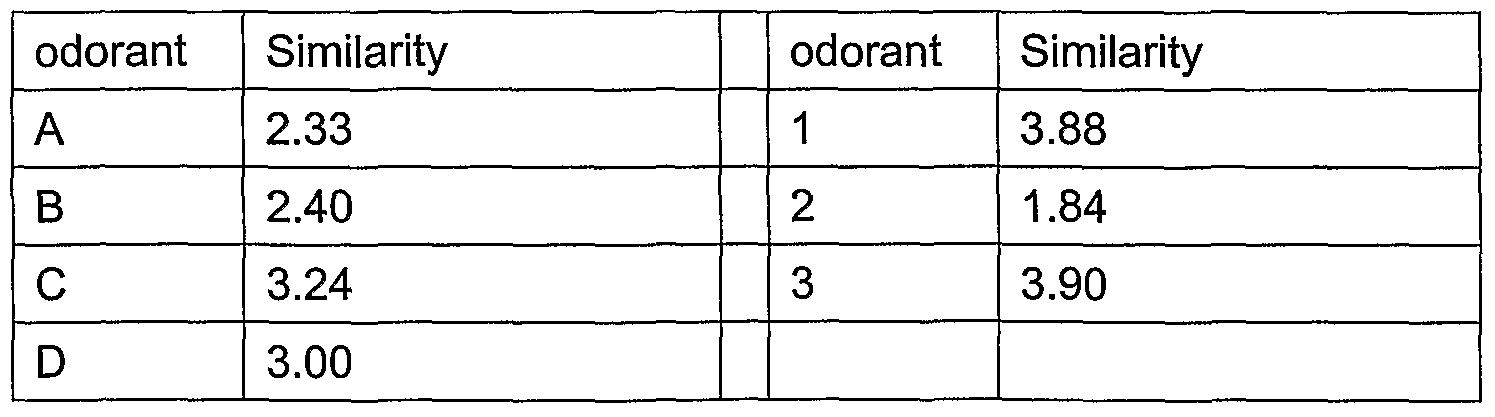
- lsobutane gas aerosols comprising the odorants A, B, 1 , 2 or 3 (Example 1 , Table 1 ) at a dosage of 40 ppm were prepared.
- the odorants were tested blind and the panellists were not aware of the composition. The average- results are listed in Table 2.
Landscapes
- Chemical & Material Sciences (AREA)
- Oil, Petroleum & Natural Gas (AREA)
- Organic Chemistry (AREA)
- Engineering & Computer Science (AREA)
- Chemical Kinetics & Catalysis (AREA)
- General Chemical & Material Sciences (AREA)
- Organic Low-Molecular-Weight Compounds And Preparation Thereof (AREA)
- Liquid Carbonaceous Fuels (AREA)
Abstract
Description


Claims


Priority Applications (5)
| Application Number | Priority Date | Filing Date | Title |
|---|---|---|---|
| EP05798734A EP1809724A1 (en) | 2004-11-09 | 2005-11-08 | Gas odorant |
| BRPI0517683-2A BRPI0517683A (en) | 2004-11-09 | 2005-11-08 | gas odorant |
| MX2007005315A MX2007005315A (en) | 2004-11-09 | 2005-11-08 | Gas odorant. |
| JP2007539441A JP2008519111A (en) | 2004-11-09 | 2005-11-08 | Gas odorant |
| US11/718,694 US7682410B2 (en) | 2004-11-09 | 2005-11-08 | Gas odorant |
Applications Claiming Priority (4)
| Application Number | Priority Date | Filing Date | Title |
|---|---|---|---|
| EP04300770 | 2004-11-09 | ||
| EP04300770.7 | 2004-11-09 | ||
| EP05290463 | 2005-03-02 | ||
| EP05290463.8 | 2005-03-02 |
Publications (1)
| Publication Number | Publication Date |
|---|---|
| WO2006050629A1 true WO2006050629A1 (en) | 2006-05-18 |
Family
ID=35677583
Family Applications (1)
| Application Number | Title | Priority Date | Filing Date |
|---|---|---|---|
| PCT/CH2005/000654 Ceased WO2006050629A1 (en) | 2004-11-09 | 2005-11-08 | Gas odorant |
Country Status (8)
| Country | Link |
|---|---|
| US (1) | US7682410B2 (en) |
| EP (1) | EP1809724A1 (en) |
| JP (1) | JP2008519111A (en) |
| KR (1) | KR20070084074A (en) |
| BR (1) | BRPI0517683A (en) |
| MX (1) | MX2007005315A (en) |
| RU (1) | RU2377279C2 (en) |
| WO (1) | WO2006050629A1 (en) |
Cited By (1)
| Publication number | Priority date | Publication date | Assignee | Title |
|---|---|---|---|---|
| US7682410B2 (en) | 2004-11-09 | 2010-03-23 | Givaudan Sa | Gas odorant |
Families Citing this family (3)
| Publication number | Priority date | Publication date | Assignee | Title |
|---|---|---|---|---|
| WO2025217089A1 (en) * | 2024-04-09 | 2025-10-16 | Chevron Phillips Chemical Company Lp | Odorized fluids and methods |
| WO2025217091A1 (en) * | 2024-04-09 | 2025-10-16 | Chevron Phillips Chemical Company Lp | Odorants for fluids, odorized fluids, methods, and systems |
| WO2025217099A1 (en) * | 2024-04-09 | 2025-10-16 | Chevron Phillips Chemical Company Lp | Inhibitors for hydrogen embrittlement and methods |
Citations (3)
| Publication number | Priority date | Publication date | Assignee | Title |
|---|---|---|---|---|
| US3627540A (en) | 1969-10-14 | 1971-12-14 | Int Flavors & Fragrances Inc | Flavoring processes and products |
| JPS55104393A (en) | 1979-02-02 | 1980-08-09 | Nippon Zeon Co Ltd | Fuel gas odorant |
| DE19837066A1 (en) | 1998-08-17 | 2000-02-24 | Haarmann & Reimer Gmbh | Odorizing a gas, e.g. city gas comprises adding an acrylic acid, nitrogen compound and antioxidant to the gas |
Family Cites Families (6)
| Publication number | Priority date | Publication date | Assignee | Title |
|---|---|---|---|---|
| JPS54127404A (en) * | 1978-03-25 | 1979-10-03 | Nippon Zeon Co Ltd | Scenting fuel gas |
| JPS54155203A (en) * | 1978-05-30 | 1979-12-07 | Nippon Zeon Co Ltd | Odorization of fuel gas |
| JPS5556190A (en) * | 1978-10-23 | 1980-04-24 | Soda Koryo Kk | Odorant for fuel gas |
| JP3378673B2 (en) * | 1994-08-24 | 2003-02-17 | 東京瓦斯株式会社 | Odorant for fuel gas |
| JP3836357B2 (en) * | 2001-11-21 | 2006-10-25 | 東京瓦斯株式会社 | Odorant for fuel cell fuel hydrogen |
| JP2008519111A (en) | 2004-11-09 | 2008-06-05 | ジボダン エス エー | Gas odorant |
-
2005
- 2005-11-08 JP JP2007539441A patent/JP2008519111A/en not_active Ceased
- 2005-11-08 EP EP05798734A patent/EP1809724A1/en not_active Withdrawn
- 2005-11-08 RU RU2007115598/04A patent/RU2377279C2/en not_active IP Right Cessation
- 2005-11-08 KR KR1020077010461A patent/KR20070084074A/en not_active Ceased
- 2005-11-08 US US11/718,694 patent/US7682410B2/en not_active Expired - Fee Related
- 2005-11-08 MX MX2007005315A patent/MX2007005315A/en not_active Application Discontinuation
- 2005-11-08 BR BRPI0517683-2A patent/BRPI0517683A/en not_active IP Right Cessation
- 2005-11-08 WO PCT/CH2005/000654 patent/WO2006050629A1/en not_active Ceased
Patent Citations (3)
| Publication number | Priority date | Publication date | Assignee | Title |
|---|---|---|---|---|
| US3627540A (en) | 1969-10-14 | 1971-12-14 | Int Flavors & Fragrances Inc | Flavoring processes and products |
| JPS55104393A (en) | 1979-02-02 | 1980-08-09 | Nippon Zeon Co Ltd | Fuel gas odorant |
| DE19837066A1 (en) | 1998-08-17 | 2000-02-24 | Haarmann & Reimer Gmbh | Odorizing a gas, e.g. city gas comprises adding an acrylic acid, nitrogen compound and antioxidant to the gas |
Non-Patent Citations (2)
| Title |
|---|
| COMETTO-MUNIZ J E ET AL, AMERICAN INDUSTRIAL HYGIENE ASSOCIATION JOURNAL V55 N.9 811-17. ISSN: 0002-8894., September 1994 (1994-09-01), XP002370695 * |
| PATENT ABSTRACTS OF JAPAN vol. 004, no. 159 (C - 030) 6 November 1980 (1980-11-06) * |
Cited By (1)
| Publication number | Priority date | Publication date | Assignee | Title |
|---|---|---|---|---|
| US7682410B2 (en) | 2004-11-09 | 2010-03-23 | Givaudan Sa | Gas odorant |
Also Published As
| Publication number | Publication date |
|---|---|
| RU2007115598A (en) | 2008-12-20 |
| EP1809724A1 (en) | 2007-07-25 |
| KR20070084074A (en) | 2007-08-24 |
| BRPI0517683A (en) | 2008-10-14 |
| MX2007005315A (en) | 2007-06-11 |
| US7682410B2 (en) | 2010-03-23 |
| US20080256847A1 (en) | 2008-10-23 |
| JP2008519111A (en) | 2008-06-05 |
| RU2377279C2 (en) | 2009-12-27 |
Similar Documents
| Publication | Publication Date | Title |
|---|---|---|
| US7108803B1 (en) | Gas odorization method | |
| MXPA06006895A (en) | Odorisation of fuel gas with low-sulphur content odorisers. | |
| JPH0860167A (en) | Odorant for fuel gas | |
| US7682410B2 (en) | Gas odorant | |
| DK2066766T3 (en) | SULFUR LOW SCIENCE WITH IMPROVED STABILITY | |
| US20080127555A1 (en) | Gas Odorant | |
| AU2007264760B2 (en) | Mixture to add odour to an odourless combustible gas | |
| US2823104A (en) | Warning agent and process for the odorization of a hydrocarbon fuel gas therewith | |
| US20080188398A1 (en) | Gas Odorant Comprising a Cycloalkadiene | |
| CN1965065B (en) | Odorified mixtures for odorless gaseous fuels | |
| CN101056964A (en) | Gas odorant | |
| GB2089834A (en) | Odorant for odorization of odourless gaseous fuels | |
| CN101056965A (en) | Gas odorant | |
| JP3847659B2 (en) | Fuel odorant | |
| CN101305081B (en) | Odorant mixture for odorless gas fuel | |
| JP2003221585A (en) | Odorant for dimethyl ether fuel and dimethyl ether fuel composition | |
| JP2007119679A (en) | Odorant for fuel gas |
Legal Events
| Date | Code | Title | Description |
|---|---|---|---|
| AK | Designated states |
Kind code of ref document: A1 Designated state(s): AE AG AL AM AT AU AZ BA BB BG BR BW BY BZ CA CH CN CO CR CU CZ DE DK DM DZ EC EE EG ES FI GB GD GE GH GM HR HU ID IL IN IS JP KE KG KM KN KP KR KZ LC LK LR LS LT LU LV LY MA MD MG MK MN MW MX MZ NA NG NI NO NZ OM PG PH PL PT RO RU SC SD SE SG SK SL SM SY TJ TM TN TR TT TZ UA UG US UZ VC VN YU ZA ZM ZW |
|
| AL | Designated countries for regional patents |
Kind code of ref document: A1 Designated state(s): GM KE LS MW MZ NA SD SL SZ TZ UG ZM ZW AM AZ BY KG KZ MD RU TJ TM AT BE BG CH CY CZ DE DK EE ES FI FR GB GR HU IE IS IT LT LU LV MC NL PL PT RO SE SI SK TR BF BJ CF CG CI CM GA GN GQ GW ML MR NE SN TD TG |
|
| 121 | Ep: the epo has been informed by wipo that ep was designated in this application | ||
| WWE | Wipo information: entry into national phase |
Ref document number: 2005798734 Country of ref document: EP |
|
| WWE | Wipo information: entry into national phase |
Ref document number: MX/a/2007/005315 Country of ref document: MX |
|
| WWE | Wipo information: entry into national phase |
Ref document number: 2007539441 Country of ref document: JP Ref document number: 1020077010461 Country of ref document: KR |
|
| WWE | Wipo information: entry into national phase |
Ref document number: 200580038263.0 Country of ref document: CN |
|
| WWE | Wipo information: entry into national phase |
Ref document number: 2007115598 Country of ref document: RU |
|
| WWP | Wipo information: published in national office |
Ref document number: 2005798734 Country of ref document: EP |
|
| WWE | Wipo information: entry into national phase |
Ref document number: 11718694 Country of ref document: US |
|
| ENP | Entry into the national phase |
Ref document number: PI0517683 Country of ref document: BR |