WO2006062978A1 - Method for preparing n-phenylpyrazole-1-carboxamides - Google Patents
Method for preparing n-phenylpyrazole-1-carboxamides Download PDFInfo
- Publication number
- WO2006062978A1 WO2006062978A1 PCT/US2005/044131 US2005044131W WO2006062978A1 WO 2006062978 A1 WO2006062978 A1 WO 2006062978A1 US 2005044131 W US2005044131 W US 2005044131W WO 2006062978 A1 WO2006062978 A1 WO 2006062978A1
- Authority
- WO
- WIPO (PCT)
- Prior art keywords
- formula
- mixture
- ochf
- mmol
- compound
- Prior art date
- Legal status (The legal status is an assumption and is not a legal conclusion. Google has not performed a legal analysis and makes no representation as to the accuracy of the status listed.)
- Ceased
Links
- 0 CC(C)=CC(*)=*N Chemical compound CC(C)=CC(*)=*N 0.000 description 3
Classifications
-
- C—CHEMISTRY; METALLURGY
- C07—ORGANIC CHEMISTRY
- C07C—ACYCLIC OR CARBOCYCLIC COMPOUNDS
- C07C255/00—Carboxylic acid nitriles
- C07C255/49—Carboxylic acid nitriles having cyano groups bound to carbon atoms of six-membered aromatic rings of a carbon skeleton
- C07C255/58—Carboxylic acid nitriles having cyano groups bound to carbon atoms of six-membered aromatic rings of a carbon skeleton containing cyano groups and singly-bound nitrogen atoms, not being further bound to other hetero atoms, bound to the carbon skeleton
-
- C—CHEMISTRY; METALLURGY
- C07—ORGANIC CHEMISTRY
- C07C—ACYCLIC OR CARBOCYCLIC COMPOUNDS
- C07C237/00—Carboxylic acid amides, the carbon skeleton of the acid part being further substituted by amino groups
- C07C237/28—Carboxylic acid amides, the carbon skeleton of the acid part being further substituted by amino groups having the carbon atom of at least one of the carboxamide groups bound to a carbon atom of a non-condensed six-membered aromatic ring of the carbon skeleton
- C07C237/30—Carboxylic acid amides, the carbon skeleton of the acid part being further substituted by amino groups having the carbon atom of at least one of the carboxamide groups bound to a carbon atom of a non-condensed six-membered aromatic ring of the carbon skeleton having the nitrogen atom of the carboxamide group bound to hydrogen atoms or to acyclic carbon atoms
-
- C—CHEMISTRY; METALLURGY
- C07—ORGANIC CHEMISTRY
- C07D—HETEROCYCLIC COMPOUNDS
- C07D231/00—Heterocyclic compounds containing 1,2-diazole or hydrogenated 1,2-diazole rings
- C07D231/02—Heterocyclic compounds containing 1,2-diazole or hydrogenated 1,2-diazole rings not condensed with other rings
- C07D231/10—Heterocyclic compounds containing 1,2-diazole or hydrogenated 1,2-diazole rings not condensed with other rings having two or three double bonds between ring members or between ring members and non-ring members
- C07D231/14—Heterocyclic compounds containing 1,2-diazole or hydrogenated 1,2-diazole rings not condensed with other rings having two or three double bonds between ring members or between ring members and non-ring members with hetero atoms or with carbon atoms having three bonds to hetero atoms with at the most one bond to halogen, e.g. ester or nitrile radicals, directly attached to ring carbon atoms
-
- C—CHEMISTRY; METALLURGY
- C07—ORGANIC CHEMISTRY
- C07D—HETEROCYCLIC COMPOUNDS
- C07D231/00—Heterocyclic compounds containing 1,2-diazole or hydrogenated 1,2-diazole rings
- C07D231/02—Heterocyclic compounds containing 1,2-diazole or hydrogenated 1,2-diazole rings not condensed with other rings
- C07D231/10—Heterocyclic compounds containing 1,2-diazole or hydrogenated 1,2-diazole rings not condensed with other rings having two or three double bonds between ring members or between ring members and non-ring members
- C07D231/14—Heterocyclic compounds containing 1,2-diazole or hydrogenated 1,2-diazole rings not condensed with other rings having two or three double bonds between ring members or between ring members and non-ring members with hetero atoms or with carbon atoms having three bonds to hetero atoms with at the most one bond to halogen, e.g. ester or nitrile radicals, directly attached to ring carbon atoms
- C07D231/16—Halogen atoms or nitro radicals
-
- C—CHEMISTRY; METALLURGY
- C07—ORGANIC CHEMISTRY
- C07D—HETEROCYCLIC COMPOUNDS
- C07D231/00—Heterocyclic compounds containing 1,2-diazole or hydrogenated 1,2-diazole rings
- C07D231/02—Heterocyclic compounds containing 1,2-diazole or hydrogenated 1,2-diazole rings not condensed with other rings
- C07D231/10—Heterocyclic compounds containing 1,2-diazole or hydrogenated 1,2-diazole rings not condensed with other rings having two or three double bonds between ring members or between ring members and non-ring members
- C07D231/14—Heterocyclic compounds containing 1,2-diazole or hydrogenated 1,2-diazole rings not condensed with other rings having two or three double bonds between ring members or between ring members and non-ring members with hetero atoms or with carbon atoms having three bonds to hetero atoms with at the most one bond to halogen, e.g. ester or nitrile radicals, directly attached to ring carbon atoms
- C07D231/18—One oxygen or sulfur atom
- C07D231/20—One oxygen atom attached in position 3 or 5
-
- C—CHEMISTRY; METALLURGY
- C07—ORGANIC CHEMISTRY
- C07D—HETEROCYCLIC COMPOUNDS
- C07D401/00—Heterocyclic compounds containing two or more hetero rings, having nitrogen atoms as the only ring hetero atoms, at least one ring being a six-membered ring with only one nitrogen atom
- C07D401/02—Heterocyclic compounds containing two or more hetero rings, having nitrogen atoms as the only ring hetero atoms, at least one ring being a six-membered ring with only one nitrogen atom containing two hetero rings
- C07D401/04—Heterocyclic compounds containing two or more hetero rings, having nitrogen atoms as the only ring hetero atoms, at least one ring being a six-membered ring with only one nitrogen atom containing two hetero rings directly linked by a ring-member-to-ring-member bond
Definitions
- This invention relates to a method for preparing iV-phenylpyrazole-1-carboxamides by coupling carboxylic acids with anthranilamides and to anthranilamide compounds suitable for the method.
- PCT Patent Publication WO 03/015518 discloses the utility of N-acyl anthranilic acid derivatives of Formula i as arthropodicides
- a and B are independently O or S;
- R 1 is H;
- R 2 is H, C 1 -C 6 alkyl, C2-C6 alkoxycarbonyl or C2 ⁇ C 6 alkylcarbonyl;
- R 3 is, inter alia, H or C 1 -C 6 alkyl;
- R 4 is, inter alia, H or C 1 -C 6 alkyl;
- R 5 is H, C 1 -C 6 alkyl or halogen;
- R 6 is H, C 1 -C 6 alkyl, C 1 -C 6 haloalkyl, halogen, CN, C1-C4 alkoxy or C1-C4 haloalkoxy;
- R 7 is, inter alia, a phenyl ring, a benzyl ring, a 5- or 6-membered heteroaromatic ring, a napththyl ring system, each ring or ring system optionally substituted with 1-3 substituents; and
- This invention is directed to a method for preparing a compound of Formula 1,
- R 1 is CH 3 or Cl
- R 2 is Br, Cl, I or CN
- R 3 is H or C 1 -C 4 alkyl
- R 4 is Cl, Br, CF 3 , OCF 2 H or OCH 2 CF 3 ;
- R 5 is F, Cl or Br
- R 6 is H, F or Cl
- Z is CR 7 or N
- R 7 is H, F, Cl or Br.
- the method comprises combining (1) a carboxylic acid compound of Formula 2,
- R 1 is CH 3 or Cl
- R 2 is Br, Cl, I or CN
- R 3 is H or C 1 -C 4 alkyl; provided that (a) when R 1 and R 2 are Cl, then R 3 is other than H, CH 2 CH 3 , or CH(CH 3 )CH 2 CH 3 ;
- R 1 is CH 3 and R 2 is Cl, Br or CN, then R 3 is other than CH 3 or CH(CH 3 ) 2 ;
- compositions, process, method, article, or apparatus that comprises a list of elements is not necessarily limited to only those elements but may include other elements not expressly listed or inherent to such composition, process, method, article, or apparatus.
- Combining chemicals refers to contacting the chemicals with each other.
- the indefinite articles "a” and “an” preceding an element or component of the invention are intended to be nonrestrictive regarding the number of instances (i.e. occurrences) of the element or component. Therefore “a” or “an” should be read to include one or at least one, and the singular word form of the element or component also includes the plural unless the number is obviously meant to be singular.
- Carbon-based radical refers to a monovalent molecular component comprising a carbon atom that connects the radical to the remainder of the chemical structure through a single bond.
- Carbon-based radicals can optionally comprise saturated, unsaturated and aromatic groups, chains, rings and ring systems, and heteroatoms.
- carbon-based radicals are not subject to any particular limit in size, in the context of the present invention they typically comprise 1 to 16 carbon atoms and 0 to 3 heteroatoms.
- carbon-based radicals selected from Ci-Cg alkyl, C1-C4 haloalkyl and phenyl optionally substituted with 1-3 substituents selected from Cj-C 3 alkyl, halogen and nitro.
- Ph phenyl.
- Alkyl can be straight chain or branched.
- halogen either alone or in compound words such as “haloalkyl”, includes fluorine, chlorine, bromine or iodine. Further, when used in compound words such as “haloalkyl”, said alkyl may be partially or fully substituted with halogen atoms which may be the same or different. Examples of “haloalkyl” include F3C, ClCH 2 , CF 3 CH 2 and CF 3 CCl 2 .
- Embodiments of the present invention include: Embodiment Ml.
- the method wherein the molar ratio of the compound of Formula 2 to the compound of Formula 3 is from about 1.2:1 to about 1:1.2.
- Embodiment M2 The method of Embodiment Ml wherein the molar ratio of the compound of Formula 2 to the compound of Formula 3 is from about 1 : 1 to about 1:1.2.
- Embodiment M3. The method of Embodiment M2 wherein the molar ratio of the compound of Formula 2 to the compound of Formula 3 is about 1:1.1.
- the method wherein the molar ratio of the sulfonyl chloride to the compound of Formula 2 is at least about 1:1.
- Embodiment M4 wherein the molar ratio of the sulfonyl chloride to the compound of Formula 2 is from about 1 : 1 to about 2.5: 1.
- Embodiment M6 The method of Embodiment M5 wherein the molar ratio of the sulfonyl chloride to the compound of Formula 2 is from about 1.1:1 to about
- Embodiment M7 The method of Embodiment M6 wherein when R 2 is Br, Cl or I, then the molar ratio of the sulfonyl chloride to the compound of Formula 2 is about
- Embodiment M8 The method of Embodiment M6 wherein when R 2 is CN, then the molar ratio of the sulfonyl chloride to the compound of Formula 2 is about 1.4: 1.
- Embodiment M9. The method wherein the sulfonyl chloride is of Formula 4
- Embodiment MlO The method of Embodiment M9 wherein R 8 is C1-C4 alkyl, C1-C2 haloalkyl, or phenyl optionally substituted with 1-3 substituents selected from the group consisting of halogen, C1-C3 alkyl and nitro.
- Embodiment Mi l The method of Embodiment MlO wherein R 8 is C1-C2 alkyl, CF3, phenyl or 4-methylphenyl.
- Embodiment M12 The method of Embodiment Ml 1 wherein R 8 is C1-C2 alkyl, phenyl or 4-methylphenyl.
- Embodiment Ml 3. The method of Embodiment Ml 2 wherein R 8 is CH3.
- Embodiment M 14 The method wherein the carboxylic acid of Formula 2, aniline of Formula 3 and sulfonyl chloride are combined at a temperature is between about -70 and 100 0 C.
- Embodiment M 15 The method of Embodiment M14 wherein the temperature is between about -20 and 40 0 C.
- Embodiment M 16 The method of Embodiment Ml 5 wherein the temperature is between about -10 and 20 °C.
- Embodiment Ml 7. The method wherein the carboxylic acid of Formula 2 is combined with the aniline of Formula 3 to form a mixture, and then the mixture is combined with the sulfonyl chloride.
- Embodiment Ml 8. The method of Embodiment M17 wherein a base is combined with the mixture either before or after combining with the sulfonyl chloride.
- Embodiment M 19 The method of Embodiment Ml 7 wherein a base is combined with the compounds of Formulae 2 and 3 to form the mixture before combining with the sulfonyl chloride.
- Embodiment M20 The method wherein a base is combined with the compounds of
- Embodiment M21 The method of any one of Embodiments Ml 8 to M20 wherein the amount of the base is at least about 2 equivalents relative to the sulfonyl chloride.
- Embodiment M22 The method of Embodiment M21 wherein the amount of base is at least about 2.1 equivalents relative to the sulfonyl chloride.
- Embodiment M23 The method of Embodiment M22 wherein the amount of the base is from about 2.1 to 2.2 equivalents relative to the sulfonyl chloride.
- Embodiment M24 The method of any one of Embodiments Ml 8 to M20 wherein the base is selected from tertiary amines (including optionally substituted pyridines).
- Embodiment M25 The method of Embodiment M24 wherein the base is selected from optionally substituted pyridines and mixtures thereof.
- Embodiment M26 The method of Embodiment M25 wherein the base is selected from 2-picoline, 3-picoline, 2,6-lutidine, pyridine and mixtures of the foregoing.
- Embodiment M27 The method of Embodiment M26 wherein the base is 3-picoline.
- Embodiment M28 The method wherein a solvent is combined with the compounds of
- Embodiment M29 The method of Embodiment Ml 7 wherein a solvent is combined with the compounds of Formulae 2 and 3 to form the mixture before combining with the sulfonyl chloride.
- Embodiment M30 The method of Embodiments M28 or M29 wherein the solvent is selected from nitriles (e.g., acetonitrile, propionitrile), esters (e.g., methyl acetate, ethyl acetate, butyl acetate), ketones (e.g., acetone, methyl ethyl ketone, methyl butyl ketone, haloalkanes (e.g., dichloromethane, trichloromethane), ethers (e.g., ethyl ether, methyl tert-buty ⁇ ether, tetrahydrofuran, /?-dioxane), aromatic hydrocarbons (e.g., benzene,
- Embodiment M31 The method of Embodiment M30 wherein the solvent is selected from tertiary amines (e.g., trialkylamines, dialkylanilines, optionally substituted pyridines) and mixtures of the foregoing.
- Embodiment M32 The method of Embodiment M30 wherein the solvent is selected from tertiary amines (e.g., trialkylamines, dialkylanilines, optionally substituted pyridines) and mixtures of the foregoing.
- tertiary amines e.g., trialkylamines, dialkylanilines, optionally substituted pyridines
- Embodiment M30 wherein the solvent is selected from nitriles (e.g., acetonitrile, propionitrile), esters (e.g., methyl acetate, ethyl acetate, butyl acetate), ketones (e.g., acetone, methyl ethyl ketone, methyl butyl ketone, haloalkanes (e.g., dichloromethane, trichloromethane), ethers (e.g., ethyl ether, methyl tert-butyl ether, tetrahydrofuran,/?-dioxane), aromatic hydrocarbons (e.g., benzene, toluene, chlorobenzene, dichlorobenzene), and mixtures of the foregoing.
- nitriles e.g., acetonitrile, propionitrile
- esters e.g., methyl a
- Embodiment M33 The method of Embodiment M32 wherein the solvent is acetonitrile.
- Embodiment Cl. A compound of Formula 3 wherein Rl is CH3.
- Embodiment C2. A compound of Formula 3 wherein R 2 is Br or Cl.
- Embodiment C3 A compound of Formula 3 wherein R 2 is I.
- Embodiment C4. A compound of Formula 3 wherein R 2 is CN.
- Embodiment C5. A compound of Formula 3 wherein R 3 is H or CH 3 .
- Embodiment C6. A compound of Formula 3 wherein R 3 is CH3.
- R 1 is CH3, R 2 is Cl and R 3 is H,
- R 1 is CH 3
- R 2 is I and R 3 is H, CH 3 , CH 2 CH 3 , CH 2 CH 2 CH 3 , CH(CH 3 ) 2 , CH 2 CH 2 CH 2 CH 3 , CH 2 CH(CH 3 ) 2 , CH(CH 3 )CH 2 CH 3 or C(CH 3 ) 3 .
- R 1 is CH 3
- R 2 is CN and R 3 is CH 2 CH 3 , CH 2 CH 2 CH 3 , CH 2 CH 2 CH 2 CH 3 , CH 2 CH(CH 3 ) 2 , CH(CH 3 )CH 2 CH 3 or C(CH 3 ) 3 .
- R 1 is Cl
- R 2 is Cl and R 3 is CH 2 CH 2 CH 3 , CH 2 CH 2 CH 2 CH 3 , CH 2 CH(CH 3 ) 2 or C(CH 3 ) 3 .
- R 1 is Cl
- R 2 is Br and R 3 is H, CH 2 CH 3 , CH 2 CH 2 CH 3 ,
- R 1 is Cl
- R 2 is CN
- R 3 is H, CH 3 , CH 2 CH 3 , CH 2 CH 2 CH 3 , CH(CH 3 ) 2 , CH 2 CH 2 CH 2 CH 3 , CH 2 CH(CH 3 ) 2 , CH(CH 3 )CH 2 CH 3 or C(CH 3 ) 3 .
- a pyrazolecarboxylic acid of Formula 2 an aniline of Formula 3 and a sulfonyl chloride are combined (i.e. contacted) to provide the corresponding iV-phenyl- pyrazole- 1 -carboxamide of Formula 1.
- the nominal mole ratio of the Formula 3 compound to the Formula 2 compound is typically from about 0.9 to 1.1, and is preferably about 1.0 so that both compounds can be fully consumed.
- the present method can be conducted over a wide range of temperatures, but commonly it is conducted at temperatures ranging from -70 °C to +100 °C. Of note are temperatures are from -20 °C to +40 0 C. Of particular note for reasons of convenient operation, favorable reaction rate and selectivity, and high process yield are temperatures from -10 °C to +20 0 C.
- the sulfonyl chloride compound is used as a reactant to facilitate coupling of the carboxylic acid with the anthranilamide to form the N-phenylpyrazole-1 -carboxamide.
- the nominal mole ratio of the sulfonyl chloride to the Formula 2 compound is typically from about 1.0 to 2.5, and preferably is from about 1.1 to 1.4 when the cyclization side reaction described below occurs to no more than a small extent (i.e. 0-10%).
- Sulfonyl chlorides are generally of the formula R 8 S(O ⁇ Cl (Formula 4) wherein R 8 is a carbon-based radical.
- R 8 is C1-C4 alkyl, C1-C2 haloalkyl, or phenyl optionally substituted with 1-3 substituents selected from the group consisting of halogen, C ] -C 3 alkyl and nitro.
- Sulfonyl chloride compounds preferred for the present method because of their commercial availability include methanesulfonyl chloride (R 8 is CH3), propanesulfonyl chloride (R 8 is (CH2) 2 CH3), benzenesulfonyl chloride (R 8 is Ph), and /7-toluenesulfonyl chloride (R 8 is 4-CH3-PI1). Methanesulfonyl chloride is more preferred for reasons of lower cost, ease of addition and/or less waste.
- the sulfonyl chloride is combined with the pyrazolecarboxylic acid of Formula 2 and the aniline of Formula 3.
- the reactants can be combined in a variety of orders, such as combining the sulfonyl chloride with the carboxylic acid of Formula 2 to form a mixture and then combining the mixture with the aniline of Formula 3.
- the most preferable order of combination has been found to comprise combining the carboxylic acid of Formula 2 with the aniline of Formula 3 to form a mixture and then combining the sulfonyl chloride with the mixture (e.g., adding the sulfonyl chloride to the mixture of the compounds of Formulae 2 and 3), because this order of the addition allows convenient control of the coupling process.
- the rate of reaction is readily controlled by simply controlling the rate of addition of the sulfonyl chloride compound.
- an embodiment of note of the present method comprises the sequential steps of (1) combining a carboxylic acid of Formula 2 and an aniline of Formula 3 to form a mixture, and (2) then combining the mixture with a sulfonyl chloride.
- addition of the sulfonyl chloride to the mixture containing the aniline of Formula 2 potentially could result in undesirable side reactions, it has been discovered that the particular stereoelectronic profiles of the compounds of Formulae 2 and 3 facilitate obtaining remarkably high yields of compounds of Formula 1 using the present method.
- the compound of Formula 1 is formed when the starting compounds of Formulae 2 and 3 and the sulfonyl chloride are contacted with each other in a combined liquid phase, in which each is at least partially soluble.
- the method is most satisfactorily conducted using a solvent in which the starting compounds have significant solubility.
- the method is conducted in a liquid phase comprising a solvent.
- the carboxylic acid of Formula 2 may have only slight solubility but its salt with added base may have more solubility in the solvent.
- Suitable solvents for this method include nitriles such as acetonitrile and propionitrile; esters such as methyl acetate, ethyl acetate, and butyl acetate; ketones such as acetone, methyl ethyl ketone (MEK), and methyl butyl ketone; haloalkanes such as dichloromethane and trichloromethane; ethers such as ethyl ether, methyl tert-butyl ether, tetrahydrofuran (THF), and /»-dioxane; aromatic hydrocarbons such as benzene, toluene, chlorobenzene, and dichlorobenzene; tertiary amines such as trialkylamines, dialkylanilines, and optionally substituted pyridines; and mixtures of the foregoing.
- nitriles such as acetonitrile and propionitrile
- esters
- Solvents of note include acetonitrile, propionitrile, ethyl acetate, acetone, MEK, dichloromethane, methyl tert-butyl ether, THF, p-dioxane, toluene, and chlorobenzene.
- solvent is acetonitrile, as it often provides products in superior yield and/or purity.
- the reaction of the present method generates hydrogen chloride as a byproduct, which would otherwise bind to basic centers on the compounds of Formulae 1, 2 and 3, the method is most satisfactorily conducted in the presence of at least one added base.
- the base can also facilitate constructive interaction of the carboxylic acid with the sulfonyl chloride compound and the anthranilamide. Reaction of an added base with the carboxylic acid of Formula 2 forms a salt, which may have greater solubility than the carboxylic acid in the reaction medium.
- the base may be added at the same time, in alternation, or even after the addition of the sulfonyl chloride, the base is typically added before the addition of the sulfonyl chloride.
- Some solvents such as tertiary amines also serve as bases, and when these are used as solvents they will be in large stoichiometric excess as bases.
- the nominal mole ratio of the base charged to the sulfonyl chloride charged is typically from about 2.0 to 2.2, and is preferably from about 2.1 to 2.2.
- Preferred bases are tertiary amines, including substituted pyridines. More preferred bases include 2-picoline, 3-picoline, 2,6-lutidine, and pyridine. Of particular note as base is 3- picoline, as its salts with carboxylic acids of Formula 2 are often highly soluble in solvents such as acetonitrile.
- the features of the present method provide efficient production of the iV-phenylpyrazole-l «carboxamide of Formula 1 while limiting the amounts of the carboxylic acid, the sulfonyl chloride and the anthranilamide that are consumed during the formation of the N-phenylpyrazole-1-carboxamide and reducing waste.
- the present method allows convenient control of the coupling process and provides a method involving fewer and simpler operations as compared to previously known processes for the production of iV-phenylpyrazole-1-carboxamides such as Formula 1.
- a preferred embodiment of the present method combines the pyrazolecarboxylic acid of Formula 2, the anthranilic acid of Formula 3, and a suitable base in a suitable solvent, followed by the addition of the sulfonyl chloride compound (either alone or mixed with a suitable solvent).
- the product JV-phenylpyrazole-l-carboxamides of Formula 1 can be isolated from the reaction mixtures by methods known to those skilled in the art, including crystallization, filtration, and extraction. As shown in Scheme 2, in some cases, partial cyclization of amides 1 to iminobenzoxazines of Formula cyclo-1 occurs under the conditions of the coupling reaction.
- the cyclization side reaction converting the desired product of Formula 1 to the Formula cyclo-1 compound usually occurs to only a minor extent, if at all, in which cases the preferred ratios of sulfonyl chloride and base are sufficient to complete the coupling reaction.
- anthranilic acids of Formula 3 such as when R 2 is CN
- conditions of the reaction e.g., using sterically hindered substituted pyridines such as 2,6-lutidine as bases
- the conversion of the desired product of Formula 1 to the Formula cyclo-1 compound can occur to a more significant extent or can be the predominant reaction, hi these cases, the use of larger ratios of sulfonyl chloride and base can facilitate completion of the coupling reaction.
- the cyclization side reaction stoichiometrically consumes an equivalent of sulfonyl chloride in addition to the equivalent of sulfonyl chloride consumed in the coupling reaction.
- a 2:1 mole ratio of sulfonyl chloride to Formula 2 compound would stoichiometrically be needed to achieve complete consumption of starting materials, and typically up to about a 2.5:1 mole ratio of sulfonyl chloride to Formula 2 compound would be used, in contrast to an about 1.4:1 mole ratio of sulfonyl chloride to Formula 2 compound when the cyclization occurs only to the extent of 5-10% (as is typical with most bases when R 2 is CN)and an about 1.2:1 mole ratio of sulfonyl chloride to Formula 2 compound when the cyclization side reaction is negligible (as is typical with most bases when R 2 is Br, Cl or I).
- the additional quantities of sulfonyl chloride and base can be added while the reaction is in progress if the cyclization reaction is observed to be occurring.
- the above illustrates a valuable feature of this process, which is that additional quantities of any of the components of the process can be added at any time as required to complete the conversion.
- Another illustration of the value of this feature concerns the situation where either the component of Formula 2 or the component of Formula 3 is inadvertently undercharged to a reaction mixture.
- This undercharge can be detected by analysis of the reaction mixture using any of a variety of methods that are generally known and available, including HPLC and NMR. Once detected, the undercharge can be corrected by adding more of the appropriate component to the reaction mixture.
- Pyrazolecarboxylic acids of Formula 2 can be prepared using methods of heterocyclic synthesis known in the literature, including references found in the following compendia: Road's Chemistry of Chemistry of Carbon Compounds, Vol. IVa to IVl, S. Coffey editor, Elsevier Scientific Publishing, New York, 1973; Comprehensive Heterocyclic Chemistry, Vol. 1-7, A. R. Katritzky and C. W. Rees editors, Pergamon Press, New York, 1984; Comprehensive Heterocyclic Chemistry II, Vol. 1-9, A. R. Katritzky, C. W. Rees, and E. F.
- Reaction of a pyrazole of Formula 6 with a 2-halopyridine of Formula 7 affords good yields of the 1-pyridinylpyrazole of Formula 8 with good specificity for the desired regiochemistry.
- Metallation of the compound of Formula 8 with lithium diisopropylamide (LDA) followed by quenching of the lithium salt with carbon dioxide affords the l-(2-pyridinyl)pyrazolecarboxylic acid of Formula 2a.
- LDA lithium diisopropylamide
- pyrazolecarboxylic acids of Formula 2b can be prepared via 3+2 cycloaddition of an appropriately substituted iminohalide of Formula 9 with either substituted propiolates of Formula 10 or acrylates of Formula 11.
- Pyrazoles of Formula 13 can be condensed with aryl iodides using methods such as those reported by A. Klapars, J. C. Antilla, X. Huang and S. L. Buchwald, J. Am. Chem. Soc. 2001, 123, 7727-7729, or with aryl boronic acids using methods such as those reported by P. Y. S. Lam, C. G. Clark, S. Saubern, J. Adams, M. P. Winters, D. M. T. Chan and A. Combs, Tetrahedron Lett. 1998, 39, 2941-2944.
- the resulting adducts of Formula 15 can be oxidized with oxidizing agents such as potassium permanganate to afford the pyrazolecarboxylic acids of Formula 2b.
- the starting pyrazoles of Formulae 6 and 13 are known compounds or can be prepared according to known methods.
- the pyrazole of Formula 6a (the compound of Formula 6 wherein R 4 is CF3) can be prepared by literature procedures (J. Fluorine Chem. 1991, 55(1), 61-70).
- the pyrazoles of Formula 6b (compounds of Formula 6 wherein R 4 is Cl or Br) can be prepared by the procedure described in Chem. Ber. 1966, 9P(IO), 3350-7.
- Pyrazolecarboxylic acids 2 can also be prepared by oxidation of the pyrazoline of Formula 18 to give the pyrazole of Formula 19 followed by hydrolysis to the carboxylic acid as shown in Scheme 7.
- the oxidizing agent can be hydrogen peroxide, organic peroxides, potassium persulfate, sodium persulfate, ammonium persulfate, potassium monopersulfate (e.g., Oxone®) or potassium permanganate.
- This oxidation can be carried out in the presence of a solvent, preferably an ether, such as tetrahydrofuran, />-dioxane and the like, an organic ester, such as ethyl acetate, dimethyl carbonate and the like, or a polar aprotic organic such as N > N- dimethylformamide, acetonitrile and the like.
- Halopyrazolines 18 wherein R 4 is Cl or Br can be prepared from pyrazolones of Formula 20 by treatment with an appropriate halogenating agent as shown in Scheme 8.
- Halogenating reagents that can be used include phosphorus oxyhalides, phosphorus trihalides, phosphorus pentahalides, thionyl chloride, dihalotrialkylphophoranes, dihalotriphenylphosphoranes, oxalyl chloride and phosgene. Preferred are phosphorus oxyhalides and phosphorus pentahalides.
- Typical solvents for this halogenation include halogenated alkanes, such as dichloromethane, chloroform, chlorobutane and the like, aromatic solvents, such as benzene, xylene, chlorobenzene and the like, ethers, such as tetrahydrofuran, />-dioxane, diethyl ether, and the like, and polar aprotic solvents such as acetonitrile, iV ⁇ /V-dimethylformamide, and the like.
- an organic base such as triethylamine, pyridine, iV ⁇ V-dimethylaniline or the like, can be added. Addition of a catalyst, such as TS ⁇ .TV-dimethylformamide, is also an option.
- compounds of Formula 18 wherein R 4 is halogen can be prepared by treating the corresponding compounds of Formula 18 wherein R 4 is a different halogen (e.g., Cl for making Formula 18 wherein R 4 is Br) or a sulfonate group such as methanesulfonate, benzenesulfonate or /?-toluenesulfonate, with hydrogen bromide or hydrogen chloride, respectively.
- the R 4 halogen or sulfonate substituent on the Formula 18 starting compound is replaced with Br or Cl from hydrogen bromide or hydrogen chloride, respectively.
- Starting compounds of Formula 18 wherein R 4 is Cl or Br can be prepared from corresponding compounds of Formula 20 as already described.
- Starting compounds of Formula 18 wherein R 4 is a sulfonate group can likewise be prepared from corresponding compounds of Formula 20 by standard methods such as treatment with a sulfonyl chloride (e.g., methanesulfonyl chloride, benzenesulfonyl chloride, or p-toluenesulfonyl chloride) and a base such as a tertiary amine (e.g., triethylamine) in a suitable solvent such as dichloromethane.
- a sulfonyl chloride e.g., methanesulfonyl chloride, benzenesulfonyl chloride, or p-toluenesulfonyl chloride
- a base such as a tertiary amine (e.g., triethylamine) in a suitable solvent such as dichloromethane.
- the compound of Formula 20 is oxidized to the compound of Formula 21.
- the reaction conditions for this oxidation are as already described for the conversion of the compound of Formula 18 to the compound of Formula 19 in Scheme 7.
- the compound of Formula 21 can then be alkylated to form the compound of Formula 22 by contact with difluorocarbene, prepared in situ from CHCIF2 in the presence of a base.
- the compound of Formula 21 can also be alkylated to form the compound of Formula 24 by contact with an alkylating agent CF 3 CH 2 Lg in the presence of a base.
- the alkylation reaction is generally conducted in a solvent, which can comprise ethers, such as tetrahydrofuran or dioxane, and polar aprotic solvents, such as acetonitrile, ⁇ V-dimethylformamide, and the like.
- the base can be selected from inorganic bases such as potassium carbonate, sodium hydroxide or sodium hydride.
- the reaction is conducted using potassium carbonate with ⁇ yV-dimethylformamide or acetonitrile as the solvent.
- Lg is a nucleofuge (i.e.
- the product of Formula 22 can be isolated by conventional techniques such as extraction.
- the esters can then be converted to the carboxylic acids of Formula 2c by the methods already described for the conversion of Formula 12 to Formula 2b in Scheme 4.
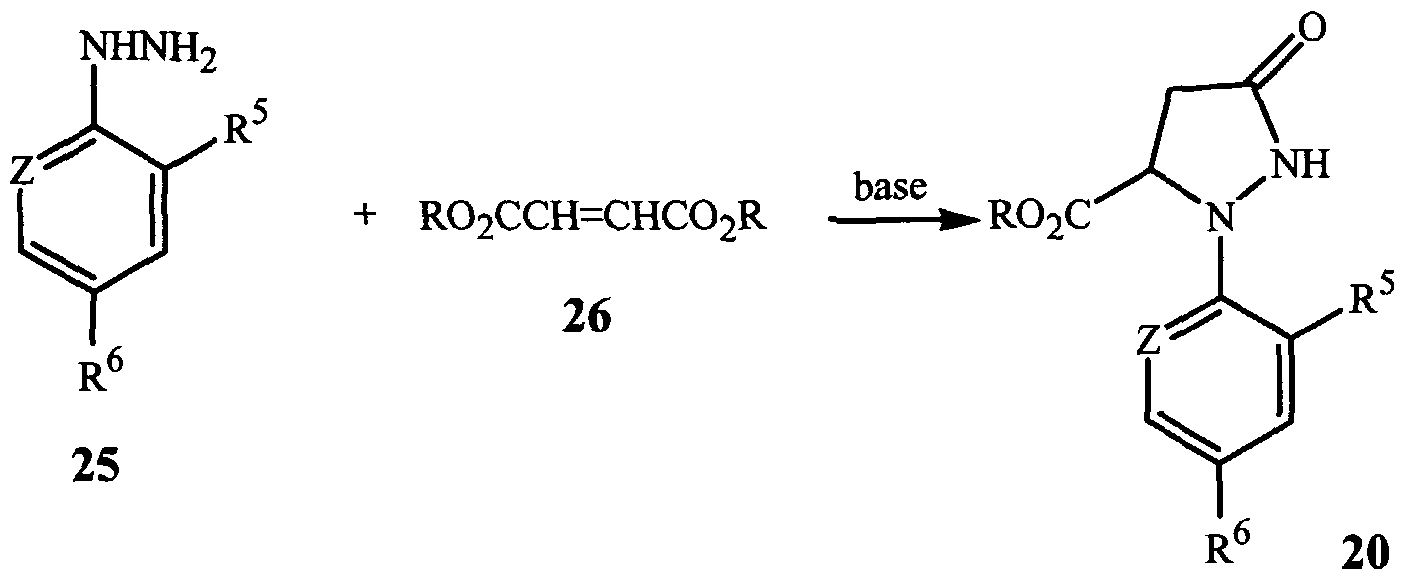
- a hydrazine compound of Formula 25 is contacted with a compound of Formula 26 (a fiimarate ester or maleate ester or a mixture thereof may be used) in the presence of a base and a solvent.
- the base is typically a metal alkoxide salt, such as sodium methoxide, potassium methoxide, sodium ethoxide, potassium ethoxide, potassium tert-butoxidc, lithium t ⁇ rf-butoxide, and the like.
- Polar protic and polar aprotic organic solvents can be used, such as alcohols, acetonitrile, tetrahydrofuran, NJV-dimethyl- formamide, dimethyl sulfoxide and the like.
- Preferred solvents are alcohols such as methanol and ethanol. It is especially preferred that the alcohol correspond to (i.e. be the same as that making up) the fumarate or maleate ester and the alkoxide base.
- the -CO2R function on the compound of Formula 20 may be hydrolyzed to -CO 2 H; for example, the presence of water in the reaction mixture can promote such hydrolysis. If the carboxylic acid (-CO2H) is formed, it can be converted back to -CO2R wherein R is C1-C4 alkyl using esterification methods well known in the art.
- the desired product, a compound of Formula 20 can be isolated by methods known to those skilled in the art, such as crystallization, extraction or distillation.
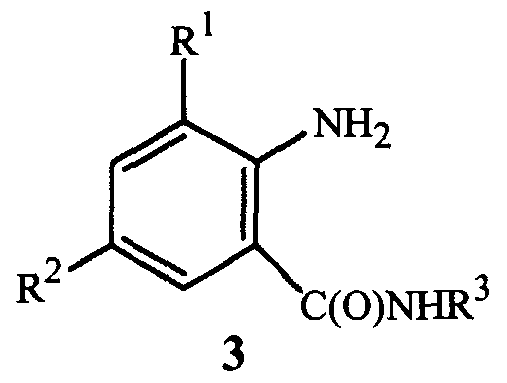
- Another aspect of this invention is directed to anthranilamides of Formula 3, which are important intermediates in the process of this invention.
- Samples of anthranilamides of Formula 3 are also useful as analytical standards for determining the presence of the anthranilamides.
- Anthranilamides of Formula 3 can be prepared from the reaction of isatoic anhydrides for Formula 27 with ammonia or alkylamines, as shown in Scheme 1 1 , by using procedures such as that described by L. H. Sternbach et al., J. Org. Chem. 1971, 36, 777-781.
- Scheme 11
- Isatoic anhydrides of Formula 27 can be made by a variety of known methods that are well documented in the chemical literature. For example, isatoic anhydrides are available from the corresponding anthranilic acids via cyclization involving reaction of the anthranilic acid with phosgene or a phosgene equivalent. For leading references to the methods, see Coppola, Synthesis 1980, 505 and Fabis et al., Tetrahedron, 1998, 10789.
- Isatins of Formula 30 are available from aniline derivatives of Formula 29 following literature procedures such as F. D. Popp, Adv. Heterocycl. Chern. 1975, 18, 1-58 and J. F. M. Da Silva et al., Journal of the Brazilian Chemical Society 2001, 12(3), 273-324. Oxidation of isatin 30 with hydrogen peroxide generally affords good yields of the corresponding isatoic anhydride 28 (G. Reissenweber and D. Mangold, Angew. Chem. Int. Ed. Engl. 1980, 19, 222-223).
- isatins of Formula 30 wherein R 2 is Cl, Br or I are also available from the 5-unsubstituted isatins of Formula 31 by halogenation. Cyanide displacement can then provide isatins of Formula 30a (Formula 30 where R 2 is CN).
- Suitable reagents include the elemental halogens (chlorine, bromine, or iodine), "positive-halogen" reagents such as trichloroisocyanuric acid, ⁇ T-chlorosuccinimide (NCS), iV-bromosuccinimide (NBS) or iV-iodosuccinimide (NIS), and halogenating reagents such as the mixtures comprising hydrogen peroxide and a hydrogen halide.
- elemental halogens chlorine, bromine, or iodine
- positive-halogen reagents
- trichloroisocyanuric acid ⁇ T-chlorosuccinimide (NCS), iV-bromosuccinimide (NBS) or iV-iodosuccinimide (NIS)
- halogenating reagents such as the mixtures comprising hydrogen peroxide and a hydrogen halide.
- the halogen at the 5-position of isatins of Formula 30 wherein R 2 is Cl, Br or I can be displaced by cyanide using methods known in the literature. These methods include the use of a cyanide salt, usually employing a metal compound, and often in the presence of a ligand such as a substituted phosphine or a substituted bisphosphinoalkane. Suitable methods include those employing compounds of palladium such as those described by P. E. Maligres et al., Tetrahedron Letters 1999, 40, 8193-8195, and by M. Beller et al., Chem. Eur. J. 2003, 9(8), 1828-1836; those employing compounds of copper such as those described by S. L.
- R 1 is Cl
- R 2 of Formula 27 is preferably Br or I to obtain selectivity in the cyanation (i.e. displacement of halogen by cyanide).
- anthranilamides of Formula 3 are typically available from the corresponding 2-nitrobenzoic acids (or esters) of Formula 32 via catalytic hydrogenation of the nitro group followed by reaction of the anthranilic ester of Formula 33 with ammonia or an alkylamine.
- Typical reduction procedures involve reduction with hydrogen in the presence of a metal catalyst such as palladium on carbon or platinum oxide in hydroxylic solvents such as ethanol and isopropanol.
- the reduction can also be conducted in the presence of zinc in acetic acid.
- anthranilamides of Formula 3 are also available from the 5-unsubstituted anthranilamides of Formula 34 by halogenation to provide anthranilamides of Formula 3 wherein R 2 is Br, Cl or I, optionally followed by cyanide displacement to provide anthranilamides of Formula 3a (Formula 3 where R 2 is CN).
- R 2 is Cl, Br or I 3a
- Step B Preparation of methyl 2-amino-5-chloro-3-methylbenzoate To a suspension of 2-amino-5-chloro-3-methylbenzoic acid (i.e. the product of Step A)
- Methyl 3-methyl-2-nitrobenzoate (98.5 g, 505 mmol), 5% Pd/C (Degussa CE 105 XRCAV, 1.0 g), and acetonitrile (300 mL) were combined in a 600-mL pressure vessel.
- the mixture was heated to 70 °C and hydrogenated at 65 psi (450 kPa) for 8 h. More 5% Pd/C (1.0 g) was added and hydrogenation was continued at 100 psi (690 kPa) for 8.5 h. Then the reaction mixture was cooled, purged with nitrogen, and filtered through Celite® diatomaceous filter aid, rinsing with acetonitrile (3 x 25 mL).
- Step B Preparation of methyl 2-amino-5-chloro-3-methylbenzoate
- the solution prepared in Step B (96.2 g, 200 mmol) was diluted with acetonitrile (60.0 g) and ethylene glycol (180 g) and dried azeotropically by distilling at atmospheric pressure under a Claisen distillation head to take off -72 mL of volatiles. Then the distillation head was replaced with a dry-ice-cooled condenser, the remaining solution was cooled to 0-5 °C, and methylamine gas (31.1 g, 1000 mmol) was added below the surface of the reaction mixture. The mixture was heated at 70 °C for 17.5 h, and then water (400 mL) was added slowly to precipitate the product.
- WO 00/27831 (18 g, 0.1 mol) and acetic acid (1.2 g, 0.02 mol) in ethyl acetate (200 mL) was warmed to 35 °C, and aqueous methylamine (40%, 9.0 g, 0.12 mol) was added dropwise over 50 minutes at 35-37 0 C. Then more aqueous methylamine (40%, 0.9 g, 12 mmol) was added, and the mixture was stirred an additional 2.5 h at 36 °C. Then water (20 mL) was added, the layers were separated, and the organic layer was washed with water, dried
- PCT Patent Publication WO 03/015519 for preparation (97.6% purity, 15.50 g, 50.0 mmol) and 2-amino-5-cyano-JV,3-dimethylbenzamide (i.e. the product of Example 6) (9.93 g, 52.5 mmol) in acetonitrile (120 mL) was added 2,6-lutidine (21.0 mL, 19.3 g, 180 mmol). The mixture was cooled to -10 0 C, and then a solution of methanesulfonyl chloride (5.4 mL, 8.0 g, 70 mmol) was added dropwise at -10 to -5 °C.
- methanesulfonyl chloride 5.4 mL, 8.0 g, 70 mmol
- PCT Patent Publication WO 03/015519 for preparation (97.6% purity, 15.50 g, 50.0 mmol) and 2-amino-5-cyano-iV,3-dimethylbenzamide (product of Example 6) (9.93 g, 52.5 mmol) in propionitrile (120 mL) was added 3-picoline (17.5 mL, 16.7 g, 180 mmol). The mixture was cooled to -10 0 C, and then a solution of methanesulfonyl chloride (5.4 mL, 8.0 g, 70 mmol) was added dropwise at -10 to -5 °C. The mixture was stirred for 5 minutes at this temperature, then for 4 h at 0 to 5 °C.
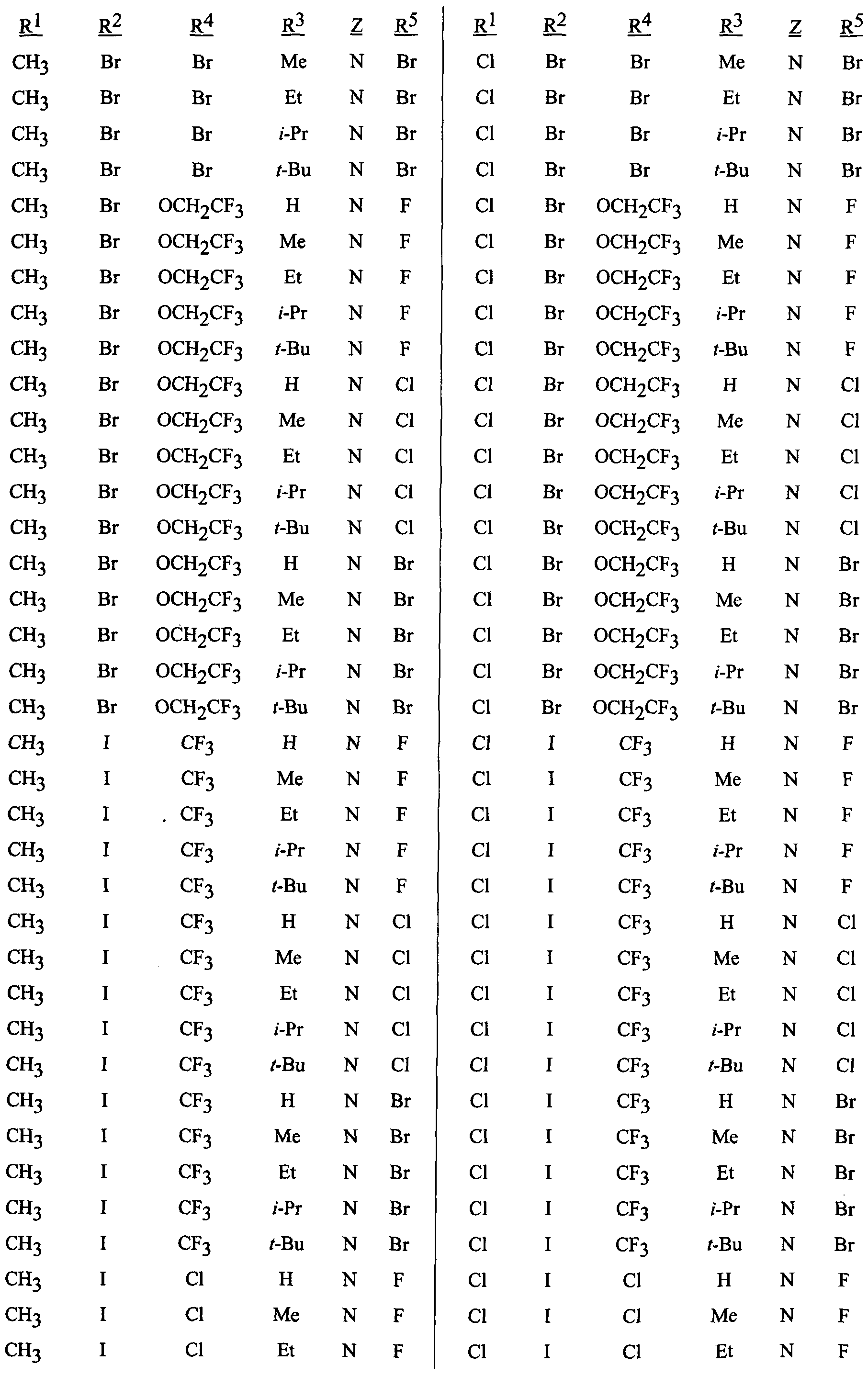
- Table 2 illustrates particular transformations to prepare compounds of Formula 1 according to a method of the present invention.
Landscapes
- Chemical & Material Sciences (AREA)
- Organic Chemistry (AREA)
- Plural Heterocyclic Compounds (AREA)
- Organic Low-Molecular-Weight Compounds And Preparation Thereof (AREA)
- Pharmaceuticals Containing Other Organic And Inorganic Compounds (AREA)
- Low-Molecular Organic Synthesis Reactions Using Catalysts (AREA)
Abstract
Description









Claims


Priority Applications (14)
| Application Number | Priority Date | Filing Date | Title |
|---|---|---|---|
| EP05853140A EP1828164B1 (en) | 2004-12-07 | 2005-12-06 | Method for preparing n-phenylpyrazole-1-carboxamides |
| JP2007545568A JP4996477B2 (en) | 2004-12-07 | 2005-12-06 | Process for producing N-phenylpyrazole-1-carboxamide |
| DK05853140T DK1828164T3 (en) | 2004-12-07 | 2005-12-06 | Process for the preparation of N-phenylpyrazole-1-carboxamides |
| AU2005314155A AU2005314155C1 (en) | 2004-12-07 | 2005-12-06 | Method for preparing N-phenylpyrazole-1-carboxamides |
| RSP-2008/0538A RS50672B (en) | 2004-12-07 | 2005-12-06 | PROCEDURE FOR PREPARATION OF N-PHENYLPYRAZOL-1-CARBOXAMIDE |
| BRPI0516911A BRPI0516911B1 (en) | 2004-12-07 | 2005-12-06 | Method for the preparation of an n-phenylpyrazol-1-carboxamide compound |
| UAA200705393A UA93861C2 (en) | 2004-12-07 | 2005-12-06 | Method for preparing n-phenylpyrazole-1-carboxamides and aniline compound |
| CA2587528A CA2587528C (en) | 2004-12-07 | 2005-12-06 | Method for preparing n-phenylpyrazole-1-carboxamides |
| PL05853140T PL1828164T3 (en) | 2004-12-07 | 2005-12-06 | Method for preparing n-phenylpyrazole-1-carboxamides |
| US11/666,920 US7528260B2 (en) | 2004-12-07 | 2005-12-06 | Method for preparing N-phenylpyrazole-1-carboxamides |
| CN2005800419739A CN101072767B (en) | 2004-12-07 | 2005-12-06 | Process for preparing N-phenylpyrazole-1-carboxamide |
| MX2007006630A MX265618B (en) | 2004-12-07 | 2005-12-06 | Method for preparing n-phenylpyrazole-1-carboxamides. |
| DE602005009866T DE602005009866D1 (en) | 2004-12-07 | 2005-12-06 | PROCESS FOR THE PREPARATION OF N-PHENYLPYRAZOLE-1-CARBOXAMIDES |
| IL183091A IL183091A (en) | 2004-12-07 | 2007-05-09 | Method for preparing n-phenylpyrazole-1-carboxamides |
Applications Claiming Priority (2)
| Application Number | Priority Date | Filing Date | Title |
|---|---|---|---|
| US63389904P | 2004-12-07 | 2004-12-07 | |
| US60/633,899 | 2004-12-07 |
Publications (1)
| Publication Number | Publication Date |
|---|---|
| WO2006062978A1 true WO2006062978A1 (en) | 2006-06-15 |
Family
ID=36353328
Family Applications (1)
| Application Number | Title | Priority Date | Filing Date |
|---|---|---|---|
| PCT/US2005/044131 Ceased WO2006062978A1 (en) | 2004-12-07 | 2005-12-06 | Method for preparing n-phenylpyrazole-1-carboxamides |
Country Status (23)
| Country | Link |
|---|---|
| US (1) | US7528260B2 (en) |
| EP (1) | EP1828164B1 (en) |
| JP (1) | JP4996477B2 (en) |
| KR (1) | KR101280086B1 (en) |
| CN (2) | CN102285899B (en) |
| AR (1) | AR051839A1 (en) |
| AT (1) | ATE408609T1 (en) |
| AU (1) | AU2005314155C1 (en) |
| BR (1) | BRPI0516911B1 (en) |
| CA (1) | CA2587528C (en) |
| DE (1) | DE602005009866D1 (en) |
| DK (1) | DK1828164T3 (en) |
| ES (1) | ES2314753T3 (en) |
| GT (1) | GT200500354A (en) |
| IL (1) | IL183091A (en) |
| MX (1) | MX265618B (en) |
| PL (1) | PL1828164T3 (en) |
| RS (1) | RS50672B (en) |
| RU (1) | RU2397165C2 (en) |
| TW (1) | TWI363756B (en) |
| UA (1) | UA93861C2 (en) |
| WO (1) | WO2006062978A1 (en) |
| ZA (1) | ZA200704202B (en) |
Cited By (64)
| Publication number | Priority date | Publication date | Assignee | Title |
|---|---|---|---|---|
| WO2008010897A2 (en) | 2006-07-19 | 2008-01-24 | E. I. Du Pont De Nemours And Company | Process for making 3-substituted 2-amino-5-halobenzamides |
| WO2008070158A1 (en) | 2006-12-06 | 2008-06-12 | E. I. Du Pont De Nemours And Company | Process for preparing 2-amino-5-cyanobenzoic acid derivatives |
| WO2008082502A3 (en) * | 2006-12-21 | 2008-10-16 | Du Pont | Process for preparing 2-amino-5-cyanobenzoic acid derivatives |
| WO2009006061A3 (en) * | 2007-06-29 | 2009-04-23 | Du Pont | Process for preparing 2-amino-5-cyanobenzoic acid derivatives |
| WO2009061991A1 (en) | 2007-11-08 | 2009-05-14 | E. I. Du Pont De Nemours And Company | Process for preparing 2-amino-5-cyanobenzoic acid derivatives |
| WO2009085816A1 (en) | 2007-12-19 | 2009-07-09 | E. I. Du Pont De Nemours And Company | Process for preparing 2-amino-5-cyanobenzoic acid derivatives |
| WO2010056720A1 (en) * | 2008-11-14 | 2010-05-20 | E. I. Du Pont De Nemours And Company | Method for preparing a non-hydratable crystal form |
| CN101967139A (en) * | 2010-09-14 | 2011-02-09 | 中化蓝天集团有限公司 | Fluoro methoxylpyrazole-containing o-formylaminobenzamide compound, synthesis method and application thereof |
| WO2011028996A2 (en) | 2009-09-04 | 2011-03-10 | E. I. Du Pont De Nemours And Company | Anthranilic diamide compositions for propagule coating |
| WO2011028993A1 (en) | 2009-09-04 | 2011-03-10 | E. I. Du Pont De Nemours And Company | N-(cyanophenyl)pyrazolecarboxamide aqueous formulation |
| JP2011513422A (en) * | 2008-03-05 | 2011-04-28 | イー・アイ・デュポン・ドウ・ヌムール・アンド・カンパニー | Process for producing 2-amino-5-cyanobenzoic acid derivatives |
| CN102060770A (en) * | 2010-12-27 | 2011-05-18 | 浙江工业大学 | Preparation and application of o-formamido-benzamide compound and intermediate thereof |
| EP2295425A4 (en) * | 2008-07-07 | 2011-09-14 | Sinochem Corp | 1-SUBSTITUTED PYRIDYL-PYRAZOLYLAMIDE COMPOUNDS AND USES THEREOF |
| WO2011128329A1 (en) | 2010-04-16 | 2011-10-20 | Bayer Cropscience Ag | Triazole-substituted anthranilic acid amides as pesticides |
| WO2011157663A1 (en) | 2010-06-15 | 2011-12-22 | Bayer Cropscience Ag | Novel ortho-substituted aryl amide derivatives |
| WO2012103436A1 (en) | 2011-01-28 | 2012-08-02 | E. I. Du Pont De Nemours And Company | Method for preparing 2-aminobenzamide derivatives |
| EP2484676A2 (en) | 2008-12-18 | 2012-08-08 | Bayer CropScience AG | Tetrazol-substituted anthranilic acid amides as pesticides |
| WO2013007603A1 (en) | 2011-07-08 | 2013-01-17 | Bayer Intellectual Property Gmbh | Method for the production of 2-amino-5-cyano-n,3-dimethylbenzamide |
| WO2013024170A1 (en) | 2011-08-18 | 2013-02-21 | Basf Se | Carbamoylmethoxy- and carbamoylmethylthio- and carbamoylmethylamino benzamides for combating invertebrate pests |
| WO2013024007A1 (en) | 2011-08-12 | 2013-02-21 | Basf Se | Process for preparing n-substituted 1h-pyrazole-5-carbonylchloride compounds |
| WO2013024008A1 (en) | 2011-08-12 | 2013-02-21 | Basf Se | Aniline type compounds |
| AU2012203792B2 (en) * | 2006-07-19 | 2013-02-21 | Fmc Corporation | Process for making substituted 2H-3,1-benzoxazine-2,4(1H)-diones |
| WO2013076092A1 (en) | 2011-11-21 | 2013-05-30 | Basf Se | Process for preparing n-substituted 1h-pyrazole-5-carboxylate compounds and derivatives thereof |
| WO2013096497A1 (en) | 2011-12-19 | 2013-06-27 | E. I. Du Pont De Nemours And Company | Nanoparticles compositions containing polymers and anthranilic acid diamide insecticides for propagule coating |
| WO2013117601A1 (en) | 2012-02-07 | 2013-08-15 | Bayer Intellectual Property Gmbh | Method for producing substituted anthranilic acid derivatives |
| US8563469B2 (en) | 2010-12-13 | 2013-10-22 | E I Du Pont De Nemours And Company | Acrylate/methacrylate-based random copolymer/anthranilic diamide compositions for propagule coating |
| US8563470B2 (en) | 2010-12-13 | 2013-10-22 | E I Du Pont De Nemours And Company | Anthranilic diamide and cyclodextrin compositions for propagule coating |
| US8569268B2 (en) | 2010-12-13 | 2013-10-29 | E I Du Pont De Nemours And Company | Acrylate/methacrylate-based diblock copolymer/anthranilic diamide compositions for propagule coating |
| US8575065B2 (en) | 2010-12-13 | 2013-11-05 | E I Du Pont De Nemours And Company | Acrylate/methacrylate-based star copolymer/anthranilic diamide compositions for propagle coating |
| US8652998B2 (en) | 2010-12-13 | 2014-02-18 | E I Du Pont De Nemours And Company | Branched copolymer/anthranilic diamide compositions for propagule coating |
| US8709976B2 (en) | 2010-12-13 | 2014-04-29 | E I Du Pont De Nemours And Company | Anthranilic diamide compositions for propagle coating |
| WO2014154807A1 (en) | 2013-03-28 | 2014-10-02 | Basf Se | Process for preparing sulfimines and their in-situ conversion into n-(2-amino-benzoyl)-sulfimines |
| WO2014168601A1 (en) | 2011-12-19 | 2014-10-16 | E. I. Du Pont De Nemours And Company | Acrylate/methacrylate-based triblock copolymer / anthranilic diamide compositions for propagule coating |
| TWI471318B (en) * | 2010-05-13 | 2015-02-01 | Du Pont | Method for preparing a non-hydratable crystal form |
| WO2015076779A1 (en) | 2013-11-19 | 2015-05-28 | Halliburton Energy Services, Inc | Measuring critical shear stress for mud filtercake removal |
| US9149039B2 (en) | 2011-12-19 | 2015-10-06 | E I Du Pont De Nemours And Company | Anthranilic diamide/polymer propagule-coating compositions |
| WO2015162260A1 (en) * | 2014-04-25 | 2015-10-29 | Basf Se | Process for preparing anthranilamide esters and derivatives |
| WO2015184229A1 (en) | 2014-05-29 | 2015-12-03 | E. I. Du Pont De Nemours And Company | Process to prepare 3-methyl-2-nitrobenzoic acid by air oxidation |
| AU2012261757B2 (en) * | 2011-12-20 | 2016-07-07 | Sumitomo Chemical Company, Limited | Method of controlling pest |
| EP3141545A4 (en) * | 2014-05-07 | 2017-11-29 | Zhaoqing Zhenge Biological Technology Co., Ltd. | Polysubstituted pyridylpyrazole amide and preparation method and use thereof |
| WO2019123195A1 (en) | 2017-12-20 | 2019-06-27 | Pi Industries Ltd. | Pyrazolopyridine-diamides, their use as insecticide and processes for preparing the same. |
| WO2019123194A1 (en) | 2017-12-20 | 2019-06-27 | Pi Industries Ltd. | Anthranilamides, their use as insecticide and processes for preparing the same. |
| WO2019150220A1 (en) | 2018-01-30 | 2019-08-08 | Pi Industries Ltd. | Novel anthranilamides, their use as insecticide and processes for preparing the same. |
| WO2020117493A1 (en) | 2018-12-03 | 2020-06-11 | Fmc Corporation | Method for preparing n-phenylpyrazole-1-carboxamides |
| WO2020170178A1 (en) | 2019-02-22 | 2020-08-27 | Pi Industries Ltd. | A process for the synthesis anthranilic diamide compounds and intermediates thereof |
| WO2020170092A1 (en) | 2019-02-18 | 2020-08-27 | Pi Industries Ltd. | A process for preparing anthranilic diamides and intermediates thereof |
| WO2020212991A1 (en) | 2019-04-19 | 2020-10-22 | Adama Makhteshim Ltd. | Preparation of substituted pyrazoles and their use as anthranilamides precursors |
| WO2021062338A1 (en) | 2019-09-27 | 2021-04-01 | Fmc Corporation | Anthranilamide composition |
| WO2021086957A1 (en) * | 2019-11-01 | 2021-05-06 | Fmc Corporation | An efficient new process for synthesis of 2-amino-5-chloro-n-,3-dimethylbenzamide |
| WO2022058916A1 (en) | 2020-09-17 | 2022-03-24 | Pi Industries Limited | A process for the synthesis of anthranilic acid/amide compounds and intermediates thereof |
| WO2022064454A1 (en) | 2020-09-26 | 2022-03-31 | Pi Industries Ltd. | A process for the synthesis of anthranilic acid/amide compounds and intermediates thereof |
| WO2022136931A1 (en) * | 2020-12-24 | 2022-06-30 | Gsp Crop Science Private Limited | Improved process for preparation of anthranilamides |
| WO2022162447A1 (en) * | 2021-01-27 | 2022-08-04 | Laurus Labs Limited | Processes for preparation of chlorantraniliprole or a salt or its intermediates thereof |
| KR20220157967A (en) | 2020-03-25 | 2022-11-29 | 이시하라 산교 가부시끼가이샤 | Method for producing intermediates for the production of cyclaniliprole |
| CN116249449A (en) * | 2020-07-23 | 2023-06-09 | Fmc公司 | Compositions and methods for the preparation of N-phenylpyrazole-1-carboxamide |
| WO2023110710A1 (en) | 2021-12-13 | 2023-06-22 | Syngenta Crop Protection Ag | Method for controlling diamide resistant pests & compounds therefor |
| WO2024038436A1 (en) | 2022-08-16 | 2024-02-22 | Adama Makhteshim Ltd. | Process for preparing cyantraniliprole via amino-cyano-benzene derivative |
| WO2024049748A1 (en) | 2022-08-29 | 2024-03-07 | Fmc Corporation | A new and efficient process for preparing 3 -halo-4, 5-dihydro-1h-pyrazoles |
| WO2024116197A1 (en) * | 2022-11-30 | 2024-06-06 | Natco Pharma Limited | An improved process for the preparation of intermediate of cyantraniliprole |
| EP4204402A4 (en) * | 2020-08-24 | 2024-08-07 | Adama Makhteshim Ltd. | PROCESS FOR THE PREPARATION OF SUBSTITUTED PYRAZOLES |
| WO2025041011A1 (en) | 2023-08-18 | 2025-02-27 | Adama Makhteshim Ltd. | Water-based compositions containing pyrethroids |
| WO2025104727A1 (en) | 2023-11-16 | 2025-05-22 | Adama Makhteshim Ltd. | Solid state forms of cyantraniliprole and uses thereof |
| WO2025188963A1 (en) | 2024-03-06 | 2025-09-12 | Fmc Corporation | Metal catalyzed synthesis of 2-aminobenzamide derivatives |
| WO2026047667A1 (en) | 2024-08-26 | 2026-03-05 | Adama Makhteshim Ltd. | Process for preparing amino-cyano-benzene derivatives |
Families Citing this family (20)
| Publication number | Priority date | Publication date | Assignee | Title |
|---|---|---|---|---|
| CN101243067A (en) * | 2005-08-24 | 2008-08-13 | 杜邦公司 | New anthranilamides for the control of invertebrate pests |
| CN101550130B (en) * | 2008-04-01 | 2012-11-07 | 中国中化股份有限公司 | Method for preparing 3-halo-1-(3-chloro -2-pyridyl)-1H-pyrazole-5-formyl halide |
| CN101747318A (en) * | 2008-12-11 | 2010-06-23 | 中国中化集团公司 | 1-(3,5-dichloro-pyridyl)-1H-5-pyrazole carboxylic acid ester compound |
| CN101492387B (en) * | 2009-03-09 | 2012-07-25 | 浙江大学 | Preparation for 2-amino-5-chlorine-N,3-dimethyl benzamide |
| CN102047914B (en) * | 2009-10-29 | 2014-02-26 | 中国中化股份有限公司 | Pesticide composition |
| CN102428926A (en) * | 2011-11-28 | 2012-05-02 | 北京燕化永乐农药有限公司 | Mixed insecticide |
| CN104557860B (en) * | 2015-02-05 | 2017-03-15 | 浙江新安化工集团股份有限公司 | A kind of adjacent formamido heterocyclic carbamate derivatives, its preparation method and a kind of insecticide |
| CN104844569A (en) * | 2015-05-18 | 2015-08-19 | 常州大学 | Chlorantraniliprole synthesis method |
| CN107522689B (en) * | 2016-06-21 | 2021-11-23 | 华东理工大学 | Polymorphic form of chlorantraniliprole and preparation method thereof |
| CN107021889B (en) * | 2017-06-08 | 2019-09-27 | 联化科技(台州)有限公司 | A kind of preparation method and device of aromatic chloride |
| CN109970582A (en) * | 2019-05-06 | 2019-07-05 | 苏州山青竹生物医药有限公司 | A method of preparing the chloro- 3- methyl benzoic acid of 2- amino -5- |
| BR112022025066A2 (en) * | 2020-06-08 | 2023-03-07 | Adama Makhteshim Ltd | ANTHRANILAMIDE PREPARATION PROCESS |
| TW202219046A (en) * | 2020-07-23 | 2022-05-16 | 美商富曼西公司 | Improved chlorantraniliprole process through use of a crystal intermediate |
| CN112552284B (en) * | 2020-12-18 | 2022-08-12 | 重庆华歌生物化学有限公司 | Preparation method of chlorantraniliprole |
| CN112574190B (en) * | 2020-12-21 | 2022-11-11 | 江苏快达农化股份有限公司 | Method for synthesizing chlorantraniliprole |
| CN115181031B (en) * | 2021-04-02 | 2024-03-15 | 江苏扬农化工股份有限公司 | Preparation method of 2-amino-5-chlorobenzoic acid derivative |
| CN117186059B (en) * | 2022-05-31 | 2026-04-03 | 山东友道化学有限公司 | A method for producing diamide compounds |
| CN117466762A (en) * | 2022-07-20 | 2024-01-30 | 沈阳中化农药化工研发有限公司 | Preparation method of 2-amino-3, 5-dichloro-N-methylbenzamide |
| CN115772090B (en) * | 2022-12-19 | 2024-06-07 | 九江善水科技股份有限公司 | Synthesis method of chlorantraniliprole key intermediate |
| CN117105908B (en) * | 2023-10-23 | 2023-12-22 | 帕潘纳(北京)科技有限公司 | Bisamide pesticide and application thereof |
Citations (3)
| Publication number | Priority date | Publication date | Assignee | Title |
|---|---|---|---|---|
| GB1410178A (en) * | 1972-03-13 | 1975-10-15 | Pfizer | Substituted quinazolinones as herbicides |
| WO2003015518A1 (en) * | 2001-08-13 | 2003-02-27 | E.I. Du Pont De Nemours And Company | Method for controlling particular insect pests by applying anthranilamide compounds |
| WO2003062226A1 (en) * | 2002-01-22 | 2003-07-31 | E. I. Du Pont De Nemours And Company | Quinazoline(di) ones for invertebrate pest control |
Family Cites Families (25)
| Publication number | Priority date | Publication date | Assignee | Title |
|---|---|---|---|---|
| NL6603319A (en) * | 1966-03-15 | 1967-09-18 | ||
| NL6815727A (en) * | 1967-11-09 | 1969-05-13 | ||
| BE758911A (en) * | 1969-11-15 | 1971-05-13 | Basf Ag | PREPARATION OF AROMATIC ALPHA-AMINONITRILS |
| US3840540A (en) * | 1970-07-13 | 1974-10-08 | Pfizer | 2-substituted-3,4-dihydro-4-oxoquin-azolines as herbicides |
| DE2115625B2 (en) | 1971-03-31 | 1978-07-06 | Basf Ag, 6700 Ludwigshafen | Process for the preparation of N-o-cyanophenyl-N ', N'-disubstituted formamidines and their salts |
| US3843791A (en) * | 1973-01-11 | 1974-10-22 | Pfizer | Method of killing insects with quinazolinones and quinazoline-thiones |
| US4137325A (en) * | 1977-03-17 | 1979-01-30 | American Home Products Corporation | Antisecretory oxamic acid esters |
| DE3103563A1 (en) * | 1981-02-03 | 1982-08-26 | Basf Ag, 6700 Ludwigshafen | "METHOD FOR PRODUCING ANTHRANILE ACID AMIDES" |
| JPS57167464A (en) | 1981-04-10 | 1982-10-15 | Sumitomo Chemical Co | Dyeing of hydrophobic fiber |
| JP3594962B2 (en) | 1992-04-03 | 2004-12-02 | コスモフェルム ベースローテン フェンノートシャップ | Selective N-acylation of amino alcohols |
| JP2003516395A (en) * | 1999-12-09 | 2003-05-13 | シンジェンタ パーティシペーションズ アクチェンゲゼルシャフト | Pyrazolecarboxamides and pyrazolethioamides as fungicides |
| MY138097A (en) | 2000-03-22 | 2009-04-30 | Du Pont | Insecticidal anthranilamides |
| DE10038327A1 (en) * | 2000-08-05 | 2002-02-14 | Philips Corp Intellectual Pty | Integrated circuit with self-test circuit |
| JP2004515543A (en) * | 2000-12-11 | 2004-05-27 | イー・アイ・デュポン・ドウ・ヌムール・アンド・カンパニー | Quinazolinones and pyridinyl pyrimidinones for controlling pest invertebrates |
| AR036872A1 (en) * | 2001-08-13 | 2004-10-13 | Du Pont | ANTRANILAMIDE COMPOSITE, COMPOSITION THAT INCLUDES IT AND METHOD FOR CONTROLLING AN INVERTEBRATE PEST |
| DE60226875D1 (en) | 2001-08-15 | 2008-07-10 | Du Pont | ORTHOSUBSTITUTED ARYLAMIDES FOR COMBATING WIRELESS PESTS |
| ES2319743T3 (en) * | 2001-08-16 | 2009-05-12 | E.I. Du Pont De Nemours And Company | ANTRANILAMIDS REPLACED TO CONTROL INVERTEBRATE PESTS. |
| MXPA04002647A (en) * | 2001-09-21 | 2004-06-07 | Du Pont | Arthropodicidal anthranilamides. |
| GB2380323B (en) * | 2001-09-29 | 2003-11-05 | Motorola Inc | Antenna for use in radio communications |
| BR0213646A (en) * | 2001-10-15 | 2004-08-24 | Du Pont | Method, compounds and composition for invertebrate pest control |
| TWI326283B (en) | 2002-07-31 | 2010-06-21 | Du Pont | Method for preparing fused oxazinones |
| US7211270B2 (en) * | 2002-10-04 | 2007-05-01 | E. I. Du Pont De Nemours And Company | Anthranilamide insecticides |
| KR20050075001A (en) * | 2002-11-15 | 2005-07-19 | 이 아이 듀폰 디 네모아 앤드 캄파니 | Novel anthranilamide insecticides |
| VN23181A1 (en) | 2003-01-28 | 2010-07-26 | Du Pont | Cyano anthranilamide insecticides |
| US7276601B2 (en) | 2003-06-12 | 2007-10-02 | E.I. Du Pont De Nemours And Company | Method and preparing fused oxazinones |
-
2005
- 2005-11-16 TW TW094140203A patent/TWI363756B/en not_active IP Right Cessation
- 2005-12-02 AR ARP050105055A patent/AR051839A1/en active IP Right Grant
- 2005-12-05 GT GT200500354A patent/GT200500354A/en unknown
- 2005-12-06 EP EP05853140A patent/EP1828164B1/en not_active Expired - Lifetime
- 2005-12-06 DK DK05853140T patent/DK1828164T3/en active
- 2005-12-06 US US11/666,920 patent/US7528260B2/en not_active Expired - Lifetime
- 2005-12-06 WO PCT/US2005/044131 patent/WO2006062978A1/en not_active Ceased
- 2005-12-06 PL PL05853140T patent/PL1828164T3/en unknown
- 2005-12-06 JP JP2007545568A patent/JP4996477B2/en not_active Expired - Lifetime
- 2005-12-06 RS RSP-2008/0538A patent/RS50672B/en unknown
- 2005-12-06 MX MX2007006630A patent/MX265618B/en active IP Right Grant
- 2005-12-06 BR BRPI0516911A patent/BRPI0516911B1/en active IP Right Grant
- 2005-12-06 CA CA2587528A patent/CA2587528C/en not_active Expired - Fee Related
- 2005-12-06 ZA ZA200704202A patent/ZA200704202B/en unknown
- 2005-12-06 DE DE602005009866T patent/DE602005009866D1/en not_active Expired - Lifetime
- 2005-12-06 CN CN201110166224.6A patent/CN102285899B/en not_active Ceased
- 2005-12-06 AU AU2005314155A patent/AU2005314155C1/en not_active Expired
- 2005-12-06 AT AT05853140T patent/ATE408609T1/en active
- 2005-12-06 CN CN2005800419739A patent/CN101072767B/en not_active Ceased
- 2005-12-06 ES ES05853140T patent/ES2314753T3/en not_active Expired - Lifetime
- 2005-12-06 UA UAA200705393A patent/UA93861C2/en unknown
- 2005-12-06 RU RU2007125710/04A patent/RU2397165C2/en active
-
2007
- 2007-05-09 IL IL183091A patent/IL183091A/en active IP Right Grant
- 2007-07-06 KR KR20077015525A patent/KR101280086B1/en not_active Expired - Lifetime
Patent Citations (3)
| Publication number | Priority date | Publication date | Assignee | Title |
|---|---|---|---|---|
| GB1410178A (en) * | 1972-03-13 | 1975-10-15 | Pfizer | Substituted quinazolinones as herbicides |
| WO2003015518A1 (en) * | 2001-08-13 | 2003-02-27 | E.I. Du Pont De Nemours And Company | Method for controlling particular insect pests by applying anthranilamide compounds |
| WO2003062226A1 (en) * | 2002-01-22 | 2003-07-31 | E. I. Du Pont De Nemours And Company | Quinazoline(di) ones for invertebrate pest control |
Cited By (125)
| Publication number | Priority date | Publication date | Assignee | Title |
|---|---|---|---|---|
| WO2008010897A2 (en) | 2006-07-19 | 2008-01-24 | E. I. Du Pont De Nemours And Company | Process for making 3-substituted 2-amino-5-halobenzamides |
| TWI403494B (en) * | 2006-07-19 | 2013-08-01 | Du Pont | Process for making 3-substituted 2-amino-5-halobenzamides |
| AU2007275836B2 (en) * | 2006-07-19 | 2012-07-12 | Fmc Corporation | Process for making 3-substituted 2-amino-5-halobenzamides |
| WO2008010897A3 (en) * | 2006-07-19 | 2009-05-07 | Du Pont | Process for making 3-substituted 2-amino-5-halobenzamides |
| AU2012203792B2 (en) * | 2006-07-19 | 2013-02-21 | Fmc Corporation | Process for making substituted 2H-3,1-benzoxazine-2,4(1H)-diones |
| US8153844B2 (en) | 2006-07-19 | 2012-04-10 | E. I. Du Pont De Nemours And Company | Process for making 3-substituted 2-amino-5-halobenzamides |
| JP2009543861A (en) * | 2006-07-19 | 2009-12-10 | イー・アイ・デュポン・ドウ・ヌムール・アンド・カンパニー | Method for producing 3-substituted 2-amino-5-halobenzamide |
| RU2443679C2 (en) * | 2006-07-19 | 2012-02-27 | Е.И.Дюпон Де Немур Энд Компани | Method of producing 3-substituted 2-amino-5-halobenzamides |
| EP2394983A1 (en) | 2006-07-19 | 2011-12-14 | E.I. Du Pont De Nemours And Company | Process for making 3-substituted 2-amino-5-halobenzamides |
| KR101433395B1 (en) * | 2006-07-19 | 2014-08-26 | 이 아이 듀폰 디 네모아 앤드 캄파니 | Preparation of 3-substituted 2-amino-5-halobenzamide |
| WO2008070158A1 (en) | 2006-12-06 | 2008-06-12 | E. I. Du Pont De Nemours And Company | Process for preparing 2-amino-5-cyanobenzoic acid derivatives |
| US8748630B2 (en) | 2006-12-06 | 2014-06-10 | E I Du Pont De Nemours And Company | Process for preparing 2-amino-5-cyanobenzoic acid derivatives |
| AU2007339307B2 (en) * | 2006-12-21 | 2012-06-14 | Fmc Corporation | Process for preparing 2-amino-5-cyanobenzoic acid derivatives |
| WO2008082502A3 (en) * | 2006-12-21 | 2008-10-16 | Du Pont | Process for preparing 2-amino-5-cyanobenzoic acid derivatives |
| KR101562070B1 (en) | 2006-12-21 | 2015-10-21 | 이 아이 듀폰 디 네모아 앤드 캄파니 | 2--5- process for preparing 2-amino-5-cyanobenzoic acid derivatives |
| TWI415827B (en) * | 2006-12-21 | 2013-11-21 | Du Pont | Process for preparing 2-amino-5-cyanobenzoic acid derivatives |
| JP2010513498A (en) * | 2006-12-21 | 2010-04-30 | イー・アイ・デュポン・ドウ・ヌムール・アンド・カンパニー | Method for producing 2-amino-5-cyanobenzoic acid derivative |
| EP2213654A1 (en) | 2006-12-21 | 2010-08-04 | E. I. Du Pont de Nemours and Company | Process for preparing 2-amino-5-bromobenzamide derivatives |
| US8049029B2 (en) | 2006-12-21 | 2011-11-01 | E. I. Du Pont De Nemours And Company | Process for preparing 2-amino-5-cyanobenzoic acid derivatives |
| US8034968B2 (en) | 2007-06-29 | 2011-10-11 | E. I. Du Pont De Nemours And Company | Process for preparing 2-amino-5-cyanobenzoic acid derivatives |
| WO2009006061A3 (en) * | 2007-06-29 | 2009-04-23 | Du Pont | Process for preparing 2-amino-5-cyanobenzoic acid derivatives |
| CN101679283B (en) * | 2007-06-29 | 2013-09-25 | 杜邦公司 | Process for preparing 2-amino-5-cyanobenzoic acid derivatives |
| JP2010532365A (en) * | 2007-06-29 | 2010-10-07 | イー・アイ・デュポン・ドウ・ヌムール・アンド・カンパニー | Method for producing 2-amino-5-cyanobenzoic acid derivative |
| JP2011503096A (en) * | 2007-11-08 | 2011-01-27 | イー・アイ・デュポン・ドウ・ヌムール・アンド・カンパニー | Process for preparing 2-amino-5-cyanobenzoic acid derivatives |
| CN101855202A (en) * | 2007-11-08 | 2010-10-06 | 纳幕尔杜邦公司 | Process for preparing 2-amino-5-cyanobenzoic acid derivatives |
| AU2008323843B2 (en) * | 2007-11-08 | 2013-05-16 | E. I. Du Pont De Nemours And Company | Process for preparing 2-amino-5-cyanobenzoic acid derivatives |
| CN101855202B (en) * | 2007-11-08 | 2014-06-25 | 纳幕尔杜邦公司 | Process for preparing 2-amino-5-cyanobenzoic acid derivatives |
| US8212075B2 (en) | 2007-11-08 | 2012-07-03 | E.I. Du Pont De Nemours And Company | Process for preparing 2-amino-5-cyanobenzoic acid derivatives |
| WO2009061991A1 (en) | 2007-11-08 | 2009-05-14 | E. I. Du Pont De Nemours And Company | Process for preparing 2-amino-5-cyanobenzoic acid derivatives |
| WO2009085816A1 (en) | 2007-12-19 | 2009-07-09 | E. I. Du Pont De Nemours And Company | Process for preparing 2-amino-5-cyanobenzoic acid derivatives |
| JP2011507872A (en) * | 2007-12-19 | 2011-03-10 | イー・アイ・デュポン・ドウ・ヌムール・アンド・カンパニー | Process for preparing 2-amino-5-cyanobenzoic acid derivatives |
| US8247570B2 (en) | 2007-12-19 | 2012-08-21 | E. I. Du Pont De Nemours And Company | Process for preparing 2-amino-5-cyanobenzoic acid derivatives |
| JP2011513422A (en) * | 2008-03-05 | 2011-04-28 | イー・アイ・デュポン・ドウ・ヌムール・アンド・カンパニー | Process for producing 2-amino-5-cyanobenzoic acid derivatives |
| US8242279B2 (en) | 2008-03-05 | 2012-08-14 | E. I. Du Pont De Nemours And Company | Process for preparing 2-amino-5-cyanobenzoic acid derivatives |
| EP2295425A4 (en) * | 2008-07-07 | 2011-09-14 | Sinochem Corp | 1-SUBSTITUTED PYRIDYL-PYRAZOLYLAMIDE COMPOUNDS AND USES THEREOF |
| KR20110082632A (en) * | 2008-11-14 | 2011-07-19 | 이 아이 듀폰 디 네모아 앤드 캄파니 | Method for preparing a non-hydratable crystal form |
| CN102216284B (en) * | 2008-11-14 | 2014-02-19 | 杜邦公司 | Method for preparing a non-hydratable crystal form |
| WO2010056720A1 (en) * | 2008-11-14 | 2010-05-20 | E. I. Du Pont De Nemours And Company | Method for preparing a non-hydratable crystal form |
| KR101693901B1 (en) | 2008-11-14 | 2017-01-06 | 이 아이 듀폰 디 네모아 앤드 캄파니 | Method for preparing a non-hydratable crystal form |
| EP2350046A1 (en) | 2008-11-14 | 2011-08-03 | E. I. du Pont de Nemours and Company | Method for preparing a non-hydratable crystal form |
| AU2009314203B2 (en) * | 2008-11-14 | 2015-01-22 | Fmc Corporation | Method for preparing a non-hydratable crystal form |
| EP2484676A2 (en) | 2008-12-18 | 2012-08-08 | Bayer CropScience AG | Tetrazol-substituted anthranilic acid amides as pesticides |
| US8324390B2 (en) | 2008-12-18 | 2012-12-04 | Bayer Cropscience Ag | Tetrazole-substituted anthranilamides as pesticides |
| WO2011028996A2 (en) | 2009-09-04 | 2011-03-10 | E. I. Du Pont De Nemours And Company | Anthranilic diamide compositions for propagule coating |
| WO2011028993A1 (en) | 2009-09-04 | 2011-03-10 | E. I. Du Pont De Nemours And Company | N-(cyanophenyl)pyrazolecarboxamide aqueous formulation |
| WO2011128329A1 (en) | 2010-04-16 | 2011-10-20 | Bayer Cropscience Ag | Triazole-substituted anthranilic acid amides as pesticides |
| US8536202B2 (en) | 2010-04-16 | 2013-09-17 | Bayer Cropscience Ag | Triazole-substituted anthranilamides as pesticides |
| TWI471318B (en) * | 2010-05-13 | 2015-02-01 | Du Pont | Method for preparing a non-hydratable crystal form |
| US8658800B2 (en) | 2010-06-15 | 2014-02-25 | Bayer Cropscience Ag | Ortho-substituted arylamide derivatives |
| WO2011157663A1 (en) | 2010-06-15 | 2011-12-22 | Bayer Cropscience Ag | Novel ortho-substituted aryl amide derivatives |
| CN101967139A (en) * | 2010-09-14 | 2011-02-09 | 中化蓝天集团有限公司 | Fluoro methoxylpyrazole-containing o-formylaminobenzamide compound, synthesis method and application thereof |
| US8563469B2 (en) | 2010-12-13 | 2013-10-22 | E I Du Pont De Nemours And Company | Acrylate/methacrylate-based random copolymer/anthranilic diamide compositions for propagule coating |
| US8563470B2 (en) | 2010-12-13 | 2013-10-22 | E I Du Pont De Nemours And Company | Anthranilic diamide and cyclodextrin compositions for propagule coating |
| US8569268B2 (en) | 2010-12-13 | 2013-10-29 | E I Du Pont De Nemours And Company | Acrylate/methacrylate-based diblock copolymer/anthranilic diamide compositions for propagule coating |
| US8575065B2 (en) | 2010-12-13 | 2013-11-05 | E I Du Pont De Nemours And Company | Acrylate/methacrylate-based star copolymer/anthranilic diamide compositions for propagle coating |
| US8652998B2 (en) | 2010-12-13 | 2014-02-18 | E I Du Pont De Nemours And Company | Branched copolymer/anthranilic diamide compositions for propagule coating |
| US8709976B2 (en) | 2010-12-13 | 2014-04-29 | E I Du Pont De Nemours And Company | Anthranilic diamide compositions for propagle coating |
| CN102060770A (en) * | 2010-12-27 | 2011-05-18 | 浙江工业大学 | Preparation and application of o-formamido-benzamide compound and intermediate thereof |
| WO2012103436A1 (en) | 2011-01-28 | 2012-08-02 | E. I. Du Pont De Nemours And Company | Method for preparing 2-aminobenzamide derivatives |
| US9162973B2 (en) | 2011-01-28 | 2015-10-20 | E I Du Pont De Nemours And Company | Method for preparing 2-aminobenzamide derivatives |
| US8871939B2 (en) | 2011-01-28 | 2014-10-28 | E I Du Pont De Nemours And Company | Method for preparing 2-aminobenzamide derivatives |
| US9169198B2 (en) | 2011-07-08 | 2015-10-27 | Bayer Intellectual Property Gmbh | Method for the production of 2-amino-5-cyano-N,3-dimethylbenzamide |
| CN107365263A (en) * | 2011-07-08 | 2017-11-21 | 拜耳知识产权有限责任公司 | Process for preparing 2-amino-5-cyano-N, 3-dimethylbenzamide |
| WO2013007603A1 (en) | 2011-07-08 | 2013-01-17 | Bayer Intellectual Property Gmbh | Method for the production of 2-amino-5-cyano-n,3-dimethylbenzamide |
| WO2013024008A1 (en) | 2011-08-12 | 2013-02-21 | Basf Se | Aniline type compounds |
| WO2013024007A1 (en) | 2011-08-12 | 2013-02-21 | Basf Se | Process for preparing n-substituted 1h-pyrazole-5-carbonylchloride compounds |
| WO2013024170A1 (en) | 2011-08-18 | 2013-02-21 | Basf Se | Carbamoylmethoxy- and carbamoylmethylthio- and carbamoylmethylamino benzamides for combating invertebrate pests |
| WO2013076092A1 (en) | 2011-11-21 | 2013-05-30 | Basf Se | Process for preparing n-substituted 1h-pyrazole-5-carboxylate compounds and derivatives thereof |
| WO2014168601A1 (en) | 2011-12-19 | 2014-10-16 | E. I. Du Pont De Nemours And Company | Acrylate/methacrylate-based triblock copolymer / anthranilic diamide compositions for propagule coating |
| US9149039B2 (en) | 2011-12-19 | 2015-10-06 | E I Du Pont De Nemours And Company | Anthranilic diamide/polymer propagule-coating compositions |
| US9204644B2 (en) | 2011-12-19 | 2015-12-08 | E I Du Pont De Nemours And Company | Nanoparticles compositions containing polymers and anthranilic acid diamide insecticides for propagule coating |
| WO2013096497A1 (en) | 2011-12-19 | 2013-06-27 | E. I. Du Pont De Nemours And Company | Nanoparticles compositions containing polymers and anthranilic acid diamide insecticides for propagule coating |
| AU2012261757B2 (en) * | 2011-12-20 | 2016-07-07 | Sumitomo Chemical Company, Limited | Method of controlling pest |
| US9969717B2 (en) | 2012-02-07 | 2018-05-15 | Bayer Intellectual Property Gmbh | Method for producing substituted anthranilic acid derivatives |
| WO2013117601A1 (en) | 2012-02-07 | 2013-08-15 | Bayer Intellectual Property Gmbh | Method for producing substituted anthranilic acid derivatives |
| US9670182B2 (en) | 2012-02-07 | 2017-06-06 | Bayer Intellectual Property Gmbh | Method for producing substituted anthranilic acid derivatives |
| WO2014154807A1 (en) | 2013-03-28 | 2014-10-02 | Basf Se | Process for preparing sulfimines and their in-situ conversion into n-(2-amino-benzoyl)-sulfimines |
| WO2015076779A1 (en) | 2013-11-19 | 2015-05-28 | Halliburton Energy Services, Inc | Measuring critical shear stress for mud filtercake removal |
| WO2015162260A1 (en) * | 2014-04-25 | 2015-10-29 | Basf Se | Process for preparing anthranilamide esters and derivatives |
| EP3141545A4 (en) * | 2014-05-07 | 2017-11-29 | Zhaoqing Zhenge Biological Technology Co., Ltd. | Polysubstituted pyridylpyrazole amide and preparation method and use thereof |
| WO2015184229A1 (en) | 2014-05-29 | 2015-12-03 | E. I. Du Pont De Nemours And Company | Process to prepare 3-methyl-2-nitrobenzoic acid by air oxidation |
| WO2019123195A1 (en) | 2017-12-20 | 2019-06-27 | Pi Industries Ltd. | Pyrazolopyridine-diamides, their use as insecticide and processes for preparing the same. |
| WO2019123194A1 (en) | 2017-12-20 | 2019-06-27 | Pi Industries Ltd. | Anthranilamides, their use as insecticide and processes for preparing the same. |
| US12024510B2 (en) | 2017-12-20 | 2024-07-02 | Pi Industries Ltd. | Pyrazolopyridine-diamides, their use as insecticide and processes for preparing the same |
| WO2019150220A1 (en) | 2018-01-30 | 2019-08-08 | Pi Industries Ltd. | Novel anthranilamides, their use as insecticide and processes for preparing the same. |
| US12234217B2 (en) | 2018-12-03 | 2025-02-25 | Fmc Corporation | Method for preparing N-phenylpyrazole-1-carboxamides |
| AU2019392221B2 (en) * | 2018-12-03 | 2025-06-26 | Fmc Corporation | Method for preparing N-phenylpyrazole-1-carboxamides |
| WO2020117493A1 (en) | 2018-12-03 | 2020-06-11 | Fmc Corporation | Method for preparing n-phenylpyrazole-1-carboxamides |
| IL283331B1 (en) * | 2018-12-03 | 2025-02-01 | Fmc Corp | Method for preparing n-phenylpyrazole-1-carboxamides |
| IL283331B2 (en) * | 2018-12-03 | 2025-06-01 | Fmc Corp | Method for preparing N–phenylpyrazole–1–carboxamides |
| CN113382984A (en) * | 2018-12-03 | 2021-09-10 | Fmc公司 | Process for preparing N-phenylpyrazole-1-carboxamides |
| CN113382984B (en) * | 2018-12-03 | 2025-03-14 | Fmc公司 | Preparation method of N-phenylpyrazole-1-carboxamide |
| WO2020170092A1 (en) | 2019-02-18 | 2020-08-27 | Pi Industries Ltd. | A process for preparing anthranilic diamides and intermediates thereof |
| KR20210130164A (en) * | 2019-02-18 | 2021-10-29 | 피아이 인더스트리스 엘티디. | Method for preparing anthranilic acid diamide and intermediates thereof |
| KR102924197B1 (en) * | 2019-02-18 | 2026-02-05 | 피아이 인더스트리스 엘티디. | Method for preparing anthranilic acid diamide and its intermediates |
| EP3927701A4 (en) * | 2019-02-18 | 2022-11-16 | PI Industries Ltd. | METHOD FOR THE PREPARATION OF ANTHRANILIC DIAMIDES AND CORRESPONDING INTERMEDIATES |
| US12410158B2 (en) | 2019-02-18 | 2025-09-09 | Pi Industries Ltd. | Process for preparing anthranilic diamides and intermediates thereof |
| IL285377B1 (en) * | 2019-02-22 | 2024-09-01 | Pi Industries Ltd | A process for the synthesis of entrilic diamide compounds and their intermediates |
| EP3927685A4 (en) * | 2019-02-22 | 2022-11-23 | PI Industries Ltd. | PROCESS FOR THE SYNTHESIS OF ANTHRANILIC DIAMIDE COMPOUNDS AND ASSOCIATED INTERMEDIATES |
| IL285377B2 (en) * | 2019-02-22 | 2025-01-01 | Pi Industries Ltd | A process for the synthesis anthranilic diamide compounds and intermediates thereof |
| WO2020170178A1 (en) | 2019-02-22 | 2020-08-27 | Pi Industries Ltd. | A process for the synthesis anthranilic diamide compounds and intermediates thereof |
| US12459913B2 (en) | 2019-04-19 | 2025-11-04 | Adama Makhteshim Ltd. | Preparation of substituted pyrazoles and their use as anthranilamides precursors |
| IL287357B2 (en) * | 2019-04-19 | 2026-03-01 | Adama Makhteshim Ltd | Preparation of substituted pyrazoles and their use as anthranilamides precursors |
| IL287357B1 (en) * | 2019-04-19 | 2025-11-01 | Adama Makhteshim Ltd | Process for preparing converted pyrazoles and their use as starting materials for preparing anthranilamides |
| WO2020212991A1 (en) | 2019-04-19 | 2020-10-22 | Adama Makhteshim Ltd. | Preparation of substituted pyrazoles and their use as anthranilamides precursors |
| WO2021062338A1 (en) | 2019-09-27 | 2021-04-01 | Fmc Corporation | Anthranilamide composition |
| EP4119542A1 (en) * | 2019-11-01 | 2023-01-18 | FMC Corporation | An efficient process for the synthesis of 2-amino-5-chloro-n,3-dimethylbenzamide |
| US11542241B2 (en) | 2019-11-01 | 2023-01-03 | Fmc Corporation | Efficient new process for synthesis of 2-amino-5-chloro-N,3-dimethylbenzamide |
| US12304893B2 (en) | 2019-11-01 | 2025-05-20 | Fmc Corporation | Process for synthesis of 2-amino-5-chloro-N-,3-dimethylbenzamide |
| WO2021086957A1 (en) * | 2019-11-01 | 2021-05-06 | Fmc Corporation | An efficient new process for synthesis of 2-amino-5-chloro-n-,3-dimethylbenzamide |
| KR20220157967A (en) | 2020-03-25 | 2022-11-29 | 이시하라 산교 가부시끼가이샤 | Method for producing intermediates for the production of cyclaniliprole |
| CN116249449A (en) * | 2020-07-23 | 2023-06-09 | Fmc公司 | Compositions and methods for the preparation of N-phenylpyrazole-1-carboxamide |
| EP4204402A4 (en) * | 2020-08-24 | 2024-08-07 | Adama Makhteshim Ltd. | PROCESS FOR THE PREPARATION OF SUBSTITUTED PYRAZOLES |
| WO2022058916A1 (en) | 2020-09-17 | 2022-03-24 | Pi Industries Limited | A process for the synthesis of anthranilic acid/amide compounds and intermediates thereof |
| WO2022064454A1 (en) | 2020-09-26 | 2022-03-31 | Pi Industries Ltd. | A process for the synthesis of anthranilic acid/amide compounds and intermediates thereof |
| WO2022136931A1 (en) * | 2020-12-24 | 2022-06-30 | Gsp Crop Science Private Limited | Improved process for preparation of anthranilamides |
| WO2022162447A1 (en) * | 2021-01-27 | 2022-08-04 | Laurus Labs Limited | Processes for preparation of chlorantraniliprole or a salt or its intermediates thereof |
| WO2023110710A1 (en) | 2021-12-13 | 2023-06-22 | Syngenta Crop Protection Ag | Method for controlling diamide resistant pests & compounds therefor |
| WO2024038436A1 (en) | 2022-08-16 | 2024-02-22 | Adama Makhteshim Ltd. | Process for preparing cyantraniliprole via amino-cyano-benzene derivative |
| WO2024049748A1 (en) | 2022-08-29 | 2024-03-07 | Fmc Corporation | A new and efficient process for preparing 3 -halo-4, 5-dihydro-1h-pyrazoles |
| WO2024116197A1 (en) * | 2022-11-30 | 2024-06-06 | Natco Pharma Limited | An improved process for the preparation of intermediate of cyantraniliprole |
| WO2025041011A1 (en) | 2023-08-18 | 2025-02-27 | Adama Makhteshim Ltd. | Water-based compositions containing pyrethroids |
| WO2025104727A1 (en) | 2023-11-16 | 2025-05-22 | Adama Makhteshim Ltd. | Solid state forms of cyantraniliprole and uses thereof |
| WO2025188963A1 (en) | 2024-03-06 | 2025-09-12 | Fmc Corporation | Metal catalyzed synthesis of 2-aminobenzamide derivatives |
| WO2026047667A1 (en) | 2024-08-26 | 2026-03-05 | Adama Makhteshim Ltd. | Process for preparing amino-cyano-benzene derivatives |
Also Published As
Similar Documents
| Publication | Publication Date | Title |
|---|---|---|
| EP1828164B1 (en) | Method for preparing n-phenylpyrazole-1-carboxamides | |
| AU2002355952B2 (en) | Substituted dihydro 3-halo-1H-pyrazole-5-carboxylates their preparation and use | |
| CN113382984B (en) | Preparation method of N-phenylpyrazole-1-carboxamide | |
| CN106488908A (en) | The method for preparing 3 (3 chlorine 1H pyrazoles, 1 base) pyridine | |
| KR100536795B1 (en) | Process for preparing pyrazole derivatives | |
| CN100376565C (en) | Method for preparing fused oxazinones | |
| EP2981519A1 (en) | Process for the preparation of amides from hindered anilines containing a perhaloalkyl group | |
| JP6372560B2 (en) | Method for producing pyrazole compound | |
| KR950002157B1 (en) | Process for preparation of 1-aryl-5-amino-pyrazoles |
Legal Events
| Date | Code | Title | Description |
|---|---|---|---|
| AK | Designated states |
Kind code of ref document: A1 Designated state(s): AE AG AL AM AT AU AZ BA BB BG BR BW BY BZ CA CH CN CO CR CU CZ DE DK DM DZ EC EE EG ES FI GB GD GE GH GM HR HU ID IL IN IS JP KE KG KM KN KP KR KZ LC LK LR LS LT LU LV LY MA MD MG MK MN MW MX MZ NA NG NI NO NZ OM PG PH PL PT RO RU SC SD SE SG SK SL SM SY TJ TM TN TR TT TZ UA UG US UZ VC VN YU ZA ZM ZW |
|
| AL | Designated countries for regional patents |
Kind code of ref document: A1 Designated state(s): BW GH GM KE LS MW MZ NA SD SL SZ TZ UG ZM ZW AM AZ BY KG KZ MD RU TJ TM AT BE BG CH CY CZ DE DK EE ES FI FR GB GR HU IE IS IT LT LU LV MC NL PL PT RO SE SI SK TR BF BJ CF CG CI CM GA GN GQ GW ML MR NE SN TD TG |
|
| 121 | Ep: the epo has been informed by wipo that ep was designated in this application | ||
| WWE | Wipo information: entry into national phase |
Ref document number: 2005314155 Country of ref document: AU |
|
| WWE | Wipo information: entry into national phase |
Ref document number: 11666920 Country of ref document: US |
|
| WWE | Wipo information: entry into national phase |
Ref document number: 2587528 Country of ref document: CA |
|
| WWE | Wipo information: entry into national phase |
Ref document number: 183091 Country of ref document: IL |
|
| ENP | Entry into the national phase |
Ref document number: 2005314155 Country of ref document: AU Date of ref document: 20051206 Kind code of ref document: A |
|
| WWE | Wipo information: entry into national phase |
Ref document number: MX/a/2007/006630 Country of ref document: MX |
|
| WWE | Wipo information: entry into national phase |
Ref document number: 2007545568 Country of ref document: JP Ref document number: 200580041973.9 Country of ref document: CN |
|
| NENP | Non-entry into the national phase |
Ref country code: DE |
|
| WWE | Wipo information: entry into national phase |
Ref document number: 2005853140 Country of ref document: EP Ref document number: 07060424 Country of ref document: CO |
|
| WWE | Wipo information: entry into national phase |
Ref document number: 1020077015525 Country of ref document: KR |
|
| WWE | Wipo information: entry into national phase |
Ref document number: 2007125710 Country of ref document: RU |
|
| WWP | Wipo information: published in national office |
Ref document number: 2005853140 Country of ref document: EP |
|
| WWP | Wipo information: published in national office |
Ref document number: 11666920 Country of ref document: US |
|
| ENP | Entry into the national phase |
Ref document number: PI0516911 Country of ref document: BR |
|
| WWE | Wipo information: entry into national phase |
Ref document number: P-2008/0538 Country of ref document: RS |