WO2006078046A2 - Water absorbent and method for production thereof - Google Patents
Water absorbent and method for production thereof Download PDFInfo
- Publication number
- WO2006078046A2 WO2006078046A2 PCT/JP2006/301078 JP2006301078W WO2006078046A2 WO 2006078046 A2 WO2006078046 A2 WO 2006078046A2 JP 2006301078 W JP2006301078 W JP 2006301078W WO 2006078046 A2 WO2006078046 A2 WO 2006078046A2
- Authority
- WO
- WIPO (PCT)
- Prior art keywords
- water
- particles
- weight
- absorbing resin
- particle diameter
- Prior art date
- Legal status (The legal status is an assumption and is not a legal conclusion. Google has not performed a legal analysis and makes no representation as to the accuracy of the status listed.)
- Ceased
Links
Classifications
-
- C—CHEMISTRY; METALLURGY
- C08—ORGANIC MACROMOLECULAR COMPOUNDS; THEIR PREPARATION OR CHEMICAL WORKING-UP; COMPOSITIONS BASED THEREON
- C08J—WORKING-UP; GENERAL PROCESSES OF COMPOUNDING; AFTER-TREATMENT NOT COVERED BY SUBCLASSES C08B, C08C, C08F, C08G or C08H
- C08J3/00—Processes of treating or compounding macromolecular substances
- C08J3/12—Powdering or granulating
-
- C—CHEMISTRY; METALLURGY
- C08—ORGANIC MACROMOLECULAR COMPOUNDS; THEIR PREPARATION OR CHEMICAL WORKING-UP; COMPOSITIONS BASED THEREON
- C08J—WORKING-UP; GENERAL PROCESSES OF COMPOUNDING; AFTER-TREATMENT NOT COVERED BY SUBCLASSES C08B, C08C, C08F, C08G or C08H
- C08J3/00—Processes of treating or compounding macromolecular substances
- C08J3/24—Crosslinking, e.g. vulcanising, of macromolecules
- C08J3/245—Differential crosslinking of one polymer with one crosslinking type, e.g. surface crosslinking
-
- C—CHEMISTRY; METALLURGY
- C08—ORGANIC MACROMOLECULAR COMPOUNDS; THEIR PREPARATION OR CHEMICAL WORKING-UP; COMPOSITIONS BASED THEREON
- C08J—WORKING-UP; GENERAL PROCESSES OF COMPOUNDING; AFTER-TREATMENT NOT COVERED BY SUBCLASSES C08B, C08C, C08F, C08G or C08H
- C08J2300/00—Characterised by the use of unspecified polymers
- C08J2300/14—Water soluble or water swellable polymers, e.g. aqueous gels
Definitions
- the present invention relates to a water absorbent comprising water-absorbing resin particles and a method for producing of the agglomerated particles of a water-absorbing resin used therein .
- the present invention relates to a water absorbent comprising water-absorbing resin particles which have a relatively large particle diameter and can exhibit high water-absorption rate , and a method for producing of the agglomerated particles of a water-absorbing resin used therein .
- the water absorbent of the present invention can show high water apsorption speed and excels in liquid permeability, liquid diffusion and liquid retention, and thus can be advantageously applied to a hygienic articles field such as for sanitary articles or disposable diapers .
- a water-absorbing resin can absorb water of from several tens times to several hundreds times own weight and therefore has been used in wide fields requiring water absorption or water retention, including a medical field such as for medical articles , an agro-horticulture field such as for a soil-water preservation agent , in a foods field to retain freshness and an industrial field such as for a dew condensation preventing material or a cold insulator, as well as a hygienic articles field such as for sanitary articles or disposable diapers .
- a lot of literatures and measurement methods have been proposed to define the various properties of the water-absorbing resin .
- Various measures have been proposed to increase a water-absorption rate or an absorption amount of a water-absorbing resin .
- a method for increasing the used amount of a water-absorbing resin a method for increasing a contact area between a water-absorbing resin and urine by decreasing particle diameter of the resin and thus increasing surface area, and a method for increasing a cross-linking density on a surface of a water-absorbing resin (for example, JP-A-9-241322 ) .
- the method for increasing the used amount of a water-absorbing resin provides a problem of increase in thickness of a diaper, stiff feeling in use or uncomfortable wearing due to the increase in the used amount .
- a method for decreasing particle diameter of a water-absorbing resin has such problems as generally, when a water-absorbing resin forms into small particle diameter, water-absorbing resin particles forms , by contact with an aqueous liquid such as urine, what is called, "lump" or generates gel blocking and thus, on the contrary, decreases water-absorption rate .
- a water-absorbing resin with small particle diameter contains many fine powders, large amount of fine powders scatter during the production process of a water-absorbing resin or the fabrication process to desirable applications, which are inhaled by workers and impair worker' s health and work environment .
- a method of increasing surface cross-linking density by cross-linking molecular chains at the vicinity of the surface of a water-absorbing resin, for preventing the generation of "lump" to enhance an absorption rate large proportion of fine particles with small particle diameter are inevitably present therein, because the surface area must be increased to raise a water-absorption rate .
- "lump" is generated, which can not only provide sufficient water-absorption rate, but also decreases liquidpermeability with gel blocking .
- these water-absorbing resins also have problems of forming "lump" on contact with an aqueous liquid such as urine or generatiing gel blocking to cause the decrease in water-absorption rate or liquid permeability, because of the presence of many particles with small particle diameter, in particular, below 150 ⁇ m, to increase water-absorption rate, just like in the above .
- an aqueous liquid such as urine or generatiing gel blocking
- the presence of fine particles may have risk of deterioratiing working environment .
- the present invention has proposed in view of the above circumstances, and aims at providing a water absorbent, particularly a water absorbent usable in hygienic articles such as for sanitary articles or disposable diapers, which comprises water-absorbing resin particles which can exhibit high water-absorption rate even though having a relatively large particle diameter .
- the present invention also aims at providing a water absorbent, particularly a water absorbent usable in hygienic articles such as for sanitary articles or disposable diapers , comprises water-absorbing resin particles with a high water-absorption rate, reduced fine particles and a small reversion ratio to fine particles byprocess damage even though having a relatively large particle diameter .
- the present invention further aims at providing a water absorbent comprising water-absorbing resin particles , particularly a water absorbent usable in hygienic articles such as for sanitary articles or disposable diapers, which can exhibit a high water-absorption rate and, when used as an absorbent core, superior liquid permeability, liquid diffusion and liquid retention.
- Another obj ect of the present invention is to provide a method for producing agglomerated particles of a water-absorbing resin used in the water absorbent of this invention, which can efficiently produce such agglomerated particles as described above .
- Another obj ect of the present invention is also to provide a method for producing # agglomerated particles of a water-absorbing resin used in the water absorbent of this invention, which can enhance strength of the agglomerates and can effectively suppress the formation of "lump" during the agglomeration process .
- the present inventors have extensively studied a way to attain the above obj ects, to findthat, by suitably adjusting particle size distribution even in particles having particle size distribution of a relatively large particle diameter, particles superior in water absorption capacity, expressing high water-absorption rate, can be obtained.
- agglomerating agent a mixture with small amount of water when mixing a polyvalent alcohol such as glycerin, polycarboxylic acid such as polyacrylic acid with water, by extruding under pressure a mixture obtained by mixing a water-absorbing resin and this agglomerating agent to produce agglomerates and subj ecting the resultant agglomerates to heat treatment and then sizing, it was found that the agglomerated particles expressing high water-absorption rate, although having high content of particles with relatively large particle diameter, can be efficiently produced.
- the properties of a water-absorbing resin has been conventionally defined by water-absorption capacity without load, water-absorption capacity under load, particle size distribution, absorption rate, liquid permeability, and the like .
- the absorption rate is particularly has been defined by a Vortex method, a FSR ( Free Swell Rate) method, SR ( Swell Rate) method, etc .
- water-absorbing resin particles showing excellent absorption rate defined by these conventionalmethods is to be actuallyused in hygienic articles such as for sanitary articles or disposable diapers, urine is leaked therefrom to impart uncomfortable feeling to a wearer and to increase care-giver burden, even if the particles show sufficient absorption rate .
- a water-absorption rate which is different from a conventionally used water-absorption rate, i . e . , a water-absorption rate index per surface area (a) is usable for selecting a water absorbent having urine leaked with difficulties even in actual use, and that a water absorbent having liquid permeability, liquid diffusion, liquid retention and water-absorption rate suffient to prevent the leakage even in the actual use by setting particle size distribution and water-absorption rate index per surface area (a) of water-absorbing resin particles which forms the water absorbent in a specific relation .
- a water absorbent comprising water-absorbing resin particles , preferably agglomerated particles of a water-absorbing resin which comprises : ( 1 ) particles having a particle diameter of 150 to 850 ⁇ m in a ratio of 90 to 100% by weight based on the total weight of the water absorbent, and particles having a particle diameter below 150 ⁇ m in a ratio of not more than 5% by weight based on the total weight of the water absorbent ; and (2 ) particles having a particle diameter of not less than 300 ⁇ m in a ratio of not less than 50% by weight and below 95% by weight based on the total weight of the water absorbent ; and wherein ( 3) said water absorbent has a water-absorption rate index per surface area (a) of not more than 700 sec/mm 2 .
- a water absorbent comprising water-absorbing resin particles, preferably agglomerated particles of a water-absorbing resin which comprises : ( 1) particles having a particle diameter of 150 to 850 ⁇ m in a ratio of 90 to 100% by weight based on the total weight of the water absorbent, and- of particles having a particle diameter below 150 ⁇ m in a ratio of not more than 5% by weight based on the total weight of the water absorbent ; and (2 ) particles having a particle diameter of not less than 250 ⁇ m in a ratio of not less than 30% by weight and below 100% by weight based on the total weight of the water absorbent ; and wherein ( 3 ) said water absorbent has a water-absorption rate index per surface area (a) of not more than 400 sec/mm 2 .
- a water absorbent comprising water-absorbing resin particles, preferably agglomerated particles of a water-absorbing resin which comprises : ( 1 ) particles having a particle diameter of 150 to 850 ⁇ m in a ratio of 90 to 100% by weight based on the total weight of the water absorbent, and of particles having a particle diameter below 150 ⁇ m in a ratio of not more than 5% by weight based on the total weight of the water absorbent; and (2 ) particles having a particle diameter of not less than 300 ⁇ m in a ratio of not less than 50% by weight and below 95% by weight based on the total weight of the water absorbent , and/or particles having a particle diameter of not less than 250 ⁇ m in a ratio of not less than 50% by weight and below 100% by weight based on the total weight of the water absorbent, provided that when the particles having a particle diameter of not less than 300 ⁇ m are present in a ratio of not less than 50% by weight
- a method for producing a water absorbent containig agglomerated particles of a water-absorbing resin used in the water absorbent set forth in any one of claims 1 to 4 which comprises steps of : (a) mixing with 100 parts by weight of water-absorbing resin particles (A) a agglomerating agent (E) containing 0.1 to 50 parts by weight of a compound (B) having not less than 2 functional groups reactable with a carboxyl group, 0.01 to 10 parts by weight of a polymer compound (C) having not less than 2 functional groups reactable with a carboxyl group and/or the functional group of the compound
- the water absorbent of the present invention comprises water-absorbing resin particles which can exhibit high water-absorption rate, even though they have particle size distribution containing many particles with relatively large particle diameter .
- the water absorbent of the present invention do not scatter a large amount of fine powders during the production process thereof or the fabrication process thereof into desirable applications , which thus are not inhaled by workers and not impair work environment .
- agglomerated particles which contain particles having a particle diameter of 150 to 850 ⁇ m as main components ( 90 to 100% by weight of total particles ) and can exhibit high water-absorption rate can efficiently be produced .
- Fig . 1 is an over view of a test cover for an absorption tester equipped with an acquisition used in the evaluation of an absorption substance .
- Fig . 2 is a side view of a test cover for an absorption tester equipped with an acquisition used in the evaluation of an absorption substance .
- the present invention is now explained in more detail below .
- the first aspect of the present invention relates to a water absorbent comprising water-absorbing resin particles which satisfy the following characteristics :
- the second aspect of the present invention relates to a water absorbent comprising water-absorbing resin particles which satisfy the following characteristics :
- water-absorbing resin particles are referred to as particles of water-swellable and water-insoluble cross-linked polymer which can form a hydrogel .
- the term "water-swellable” is referred to as the absorption of a physiological saline solution in such a large amount as that the water-absorption capacity without load (as defined in Examples ) is not less than 5 g/g, preferably in the range of 8 to 100 g/g .
- water-insoluble is referred to as that the water-soluble content (as defined for an equilibrium extractable polymer to be disclosed in U . S . Re-issued Patent No . Re 32649 ) is in the range of 0 to 50% by weight, preferably 0 to 25% by weight, more preferably 0 to 15% by weight .
- other trace components are referred to be used herein.
- the surfactants, water, water-insoluble inorganic fine particles, water-soluble polymers and the like as decribed below are defined as water-absorbing resin particles or agglomerated particles of a water-absorbing resin, so long as that they are integrated in or on the surface of the water-absorbing resin particles .
- the content of the water-absorbing resin particles other than the other trace components in the water-absorbing resin particles is in the range of 70 to 100% by weight, preferably 80 to 99% by weight , more preferably 90 to 98% by weight .
- the additives as described below may be optionally included as the other components in the water-absorbing resin particles (preferably agglomerated particles of a water-absorbing resin) and be integrated therewith in a particulate form.
- the terms "part by weight” and “% by weight” are synonymous with the terms “part by mass” and "% by mass” , respectively.
- the term "particulate water absorbent” is referred to as an absorbing and solidifying agent of an aqueous liquid which contains water-absorbing resin particles, preferably agglomerated particles of a water-absorbing resin in a specific ratio as described below . Particles which are not integrated therewith may be optionally contained in an amont of not more than 20% by weight .
- inorganic powder and organic powder may be cited as the particles which are not integrated with the water-absorbing resin particles. More typically, a reducible inorganic powder such as sulfite and bisulfite, powder of deodrant and antibacterial agent, powder of chelating agent such as EDTA and diethylenetriamine pentaacetic acid may be included.
- the aqueous liquid to be solidified with the water absorbent is not particularly limited so long as it contain water .
- urine, blood, feces, waste liquid, moisture, vapor, ice and a mixture of water with an organic or inorganic solvent, rain water, and subterranean water may be cited, as well as water .
- the water absorbent of this invention is preferably an absorbing and solidifying agent of urine, particularly human urine .
- the water-absorbing resin particles which constitute the water absorbent preferably contain agglomerated particles of a water-absorbing resin .
- the ratio of the agglomerated particles of a water-absorbing resin present in the water-absorbing resin particles is not particularly limited so long as that the water absorbent satisfies the particle size distribution and water-absorption rate index per surface area (a) according to this invention .
- the lower limit of the ratio of the agglomerated particles of a water-absorbing resin present in the water-absorbing resin particles is preferably 30% by weight , more preferably 50% by weight, further preferably 70% by weight , most preferably 90% by weight .
- the upper limit thereof is preferably 100% by weight, more preferably 99.5% by weight .
- the present invention will be described with referring to a water absorbent comprising agglomerated particles of a water-absorbing resin as a preferable embodiment .
- water-absorption rate index per surface area (a) is defined as a rate specified by the following equation ( 1 ) . That is , in the present invention, the small value of the “water-absorption rate index per surface area (a) " means that the agglomerated particles have a high absorption rate (water absorption rate ) .
- the theoretical particle surface area (mm 2 ) is a value calculated by the following equation (2 ) using a weight-average particle diameter ( D50 : mm) , provided that the particle be spherical .
- the "weight-average particle diameter ( D50 : mm) " is determined by a method described in the Example below .
- Theoretical particle surface area 4 ⁇ ( [D50 ] /2 ) 2 (2 )
- the vertical swelling time in the equation ( 1 ) is a time (sec) required for 2.0 g of a water absorbent to absorb 100 ml of a physiological saline solution in a 100 ml measuring cylinder, and measured by the following method . ⁇ Method for measuring vertical swelling time>
- a physiological saline solution (an aqueous solution of 0.9% by weight of sodium chloride : 20 ⁇ 2 °C) is charged up to a 100 ml mark.
- a polypropylene funnel ( inner diameter of straight tube portion of 12 mm) is set horizontally and vertically over the measuring cylinder so that the lower end of the straight tube portion is positioned at a distance of 40 ⁇ 3 mm above the liquid surface in the measuring cylinder and the center of straight tube portion is positioned at nearly the center of the measuring cylinder .
- O g (2.000+0.005 g) of a water absorbent is charged all at once through the funnel, and a time ( second) from this point till the physiological saline solution in the measuring cylinder is apparently filled in a swelled gel and water leakage (effluence ) is not observed even by inclination, is measured to provide the vertical swelling time .
- the water-absorbing resin particles of the present invention can exhibit a high water-absorption rate, even if the particles have a relatively large particle size distribution . Further, the water-absorbing resin particles of the present invention can exhibit a high water-absorption rate, even if they have a particle size distribution equivalent to conventional one . This can be attained by suitably adj usting the content of particles with specified particle diameter as of not less than 300 ⁇ m or not less than 250 ⁇ m.
- the water absorbent of the present invention do not form a "lump" or not generate gel blocking in contact with an aqueous liquid such as urine . Accordingly, the water absorbent of the present invention do not deteriorate water-absorption rate or liquid permeability . Therefore, the water absorbent of the present invention, even when used in a hygienic articles field such as for sanitary articles or disposable diapers , can secure sufficient water-absorption rate or liquid permeability . Furthermore, even when the water absorbent of the present invention are fabricated to hygienic articles , a large amount of fine powders are not scattered or not inhaled by workers and thus the operability is not impaired and the safety in work environment can be obtained.
- the water absorbent of the present invention has also relatively high strength, which provides small reversion ratio to fine powders after the classification or transportation during the manufacturing step .
- the phrase, "a reversion ratio to fine powders after the classification or transportation operation is small” is also referred to as "a reversion ratio to fine powders after damage is low” .
- the reversion ratio to fine powders after damage is preferably in the range of 0 to 40% , more preferably 0 to 35% and most preferably 0 to 30% .
- the reversion ratio to fine powders after damage is over 40% , fine powders would generate in unduly large amount , which, in a production process of particles or fabrication process to desired articles , may excessively be inhaled by workers and deteriorate work environment .
- the reversion ratio to fine powders after damage is preferably not more than 30% and more preferably not more than 28% .
- the "reversion ratio to fine powders after damage” is an index expressed as a ratio of the amount of fine powders having a particle diameter below 150 ⁇ m and to be generated after particles are subj ected to specified damage, relative to the amount of fine powders having a particle diameter below 150 ⁇ m and being present in water-absorbing resin particles (A) as a raw material before the granulation . Specifically, it is measured by the following method .
- This Mayonnaise bottle is set to a paint shaker (No . 488 testing dispersion apparatus, produced by Toyo Seiki Seisaku-syo Co . , Ltd. ; VOLT : 100V, 60 Hz; PHASE : 1 AMP 10A) and the paint shaker is started operation and stopped after 10 minutes .
- a paint shaker No . 488 testing dispersion apparatus, produced by Toyo Seiki Seisaku-syo Co . , Ltd. ; VOLT : 100V, 60 Hz; PHASE : 1 AMP 10A
- Mayonnaise bottles can be set to the paint shaker per one time .
- the Mayonnaise bottle is taken off from the paint shaker and the content of the Mayonnaise bottle is taken out , beads are removed to obtain only water-absorbing resin particles .
- the water-absorbing resin particles are classified with a sieve in accordance with a method described in the item of (2 ) particle size distribution of the following Example, to weigh all particles passing a sieve with mesh size of 150 ⁇ m and record the ratio in % by weight . Using this value, the "reversion ratio to fine particles after damage" is calculated by the following equation ( 3 ) .
- M represents a content ( % by weight ) of particles with particle diameter below 150 ⁇ m in a sample after damage is given for 10 minutes by a paint shaker
- M 0 represents a content ( % by weight) of particles with particle diameter below 150 ⁇ m in a sample before damage is given by a paint shaker
- M A represents a content ( % by weight ) of particles with particle diameter below 150 ⁇ m in water-absorbing resin particles (A) before being granulated .
- particles having a particle diameter of 150 to 850 ⁇ m are present in a ratio of 90 to , 100% by weight based on the total weight of the water absorbent, and particles having a particle diameter below 150 ⁇ m are present in a ratio of not more than 5% by weight based on the total weight of the water absorbent .
- the total ratio of particles having a particle diameter of 150 to 850 ⁇ m and particles having a particle diameter below 150 ⁇ m is in the range of 90 to 100% by weight .
- particles having a particle diameter exceeding 850 ⁇ m may be present in the water absorbent and particles having a particle diameter exceeding 850 ⁇ m are preferably present in a ratio of 0 to 10% by weight, more preferably 0 to 6% by weight, based on the total weight of the water absorbent .
- the particles having a particle diameter of 150 to 850 ⁇ m are preferably present in a ratio of 91 to 100% by weight, more preferably 92 to 100% by weight , based on the total weight of the water absorbent .
- the particles having a particle diameter below 150 ⁇ m are preferably present in a ratio of 0 to 4% by weight, more preferably 0 to 3% by weight, based on the total weight of the water absorbent .
- the ratio of particles having a particle diameter of 150 to 850 ⁇ m is more than 90% by weight or the ratio of particles having a particle diameter below 150 ⁇ m is below 5% by weight , there is no formation of "lump" or no generation of gel blocking and thus leading no decrease in water-absorption rate, even when used in a disposable diaper and contacted with body fluid such as urine, because particles with small particle diameter are not present in too excess amount .
- the present invention by setting particle size distribution and water-absorption rate index per surface area (a) of the water absorbent in a specific relation, it has been found that the generation of fine powders can effectively be prevented , while keeping superior liquid permeability and water-absorption rate .
- the water-absorption rate index per surface area (a) is not higher than 700 sec/mm 2 .
- the water-absorption rate index per surface area (a) is not higher than 400 sec/mm 2 .
- the water absorbent satisfying these characteristics can exhibit sufficient water-absorption rate, and at the same time, can effectively prevent the deterioration of work environment caused by the generation of fine particles , even when they are used in such fields as a medical field such as for medical articles, an agro-horticulture field such as for a soil-water preservation agent , in a foods field to retain freshness and an industrial field such as for a dew condensation preventing material or a cold insulator, as well as a hygienic articles field such as for sanitary articles or disposable diapers , for example .
- the ratio of particles having a particle diameter of not less than 300 ⁇ m in the water absorbent is preferably in the order of 55 to 95% by weight, 60 to 95% by weight, 65 to 95% by weight and 70 to 95% by weight .
- the water-absorption rate index per surface area (a) is preferably in the order of over 0 and not higher than 650 sec/mm 2 , over 0 and not higher than 600 sec/mm 2 , over 0 and not higher than 500 sec/mm 2 , and over 0 and not higher than 400 sec/mm 2 .
- the lower limit of the water-absorption rate index per surface area (a) always exceeds 0 , because the water-absorption rate index per surface area (a) is preferably as small as possible . More preferably, the lower limit is 1 sec/mm 2 . Also, the preferable combinations of the ratio of the particles with the particle diameter of not less than 300 ⁇ m and the water-absorption rate index per surface area (a) can be suitably selected from the- above preferable ranges .
- the water absorbent according to the first aspect of the present invention even though containing particles with relatively large particle diameter, can show a high absorption (water absorption) rate and thus can be advantageously used, in particular, in the field in hygienic articles such as disposable diapers .
- the ratio of particles having a particle diameter of not less than 250 ⁇ m in the water absorbent is preferably in the order of 40 to 99% by weight, 50 to 99% by weight , 55 to 99% by weight, 60 to 99% by weight, 65 to 99% by weight and 70 to 98% by weight .
- the water-absorption rate index per surface area (a ) is preferably in the order of over 0 and not higher than 380 sec/mm 2 , over 0 and not higher than 350 sec/mm 2 and over 0 and not higher than 300 sec/mm 2 .
- the lower limit of the water-absorption rate index per surface area (a) always exceeds 0 , because the water-absorption rate index per surface area (a) is preferably as small as possible . More preferably, the lower limit is 1 sec/mm 2 , more preferably 5 sec/mm 2 . Also, the preferable combinations of the ratio of the particles with the particle diameter of not less than 250 ⁇ m and the water-absorption rate index per surface area (a ) can be suitably selected fromthe above preferable ranges .
- the water absorbent according to the second aspect of the present invention because of having many particles with relatively small particle diameter , and further expressing high absorption (water absorption) rate, can be advantageously used, in particular, in the field of hygienic articles field such as sanitary articles .
- the water absorbent having particle size distribution and water-absorption rate index per surface area (a ) which satisfy both the first and second aspects of the present invention may also form a preferable embodiment of the present invention .
- the third aspect of the present invention relates to a water absorbent comprising water-absorbing resin particles, preferably agglomerated particles of a water-absorbing resin which comprises : ( 1 ) particles having a particle diameter of 150 to 850 ⁇ m in a ratio of 90 to 100% by weight based on the total weight of the water absorbent, and of particles having a particle diameter below 150 ⁇ m in a ratio of not more than 5% by weight based on the total weight of the water absorbent ; and ( 2 ) particles having a particle diameter of not less than 300 ⁇ m in a ratio of not less than 50% by weight and below 95% by weight based on the total weight of the water absorbent, and/or particles having a particle diameter of not less than 250 ⁇ m in a ratio of not less than 50% by weight and below 100% by weight based
- the water absorbent according to this preferable embodiment satisfy both the first and second aspects, they can be advantageously used in any field, in particular, such as in disposable diapers or sanitary articles in the field of hygienic articles .
- the particle size distribution and the water-absorption rate index per surface area (a) of water absorbent in the above ( 1 ) and ( 3 ) are similar to the definition in the first and second aspects of the present invention .
- the particle size distribution of water absorbent of the present invention should be such that the ratio of particles having a particle diameter of not less than 250 ⁇ mbe equivalent to or exceed the ratio of particles having a particle diameter of not less than 300 ⁇ m.
- Preferable particle size distribution of the water absorbent in this case is in the order that the ratio of particles having a particle diameter of not less than 300 ⁇ m is in the range of 55 to 95% by weight based on the total weight of the water absorbent, and the ratio of particles having a particle diameter of not less than 250 ⁇ m i-s in the range of 60 to 99% by weight ; the ratio of particles having a particle diameter of not less than 300 ⁇ m is in the range of 60 to 95% by weight based on the total weight of the water absorbent, and the ratio of particles having a particle diameter of not less than 250 ⁇ m is in the range of 65 to 99% by weight; and the ratio of particles having a particle diameter of not less than 300 ⁇ m is in the range of 65 to 95% by weight based on the total weight of the water absorbent, and the ratio of particles having a particle diameter of not less than 250 ⁇ m is in the range of 70 to 99% by weight .
- the water-absorption rate index per surface area (a) of water absorbent in the present invention is a value, as described above, obtained by deviding a vertical swelling time ( sec) by a theoretical particle surface area (mm 2 ) determined by assuming that the water-absorbing resin particles of the present invention are in the spherical form.
- the theoretical particle surface area can be calculated from a weight-average particle diameter ( D50 ; mm) .
- the weight-average particle diameter (D50 ) is varied depending on a method for production of agglomerated particles (a agglomeration method) and not especially limited. It is preferably in the range of 200 to 700 ⁇ m and more preferably 250 to 680 ⁇ m. By adjusting the weight-average particle diameter ( D50 ) within the above range, the agglomerated particles having particle size distribution in accordance with the present invention can be easily obtained.
- a water-absorption rate determined by a Vortex method As an index representing a water-absorption rate, a water-absorption rate determined by a Vortex method, a FSR ( Free Swell Rate) method and a SR (Swell Rate) method has generally been used heretofore .
- the water-absorption rate by the Vortex method is expressed as a gelling time of whole liquid by introducing a water-absorbing resin to an absorption liquid (a physiological saline solution) with stirred .
- This method can be used to estimate water absorbing properties of a water-absorbing resin in a flowing liquid, because it is a measurement method under diffusion conditions of a water-absorbing resin in a liquid .
- the FSR method comprises placing 1.0 g of a water-absorbing resin into a 30 ml beaker (diameter : 32 - 34 mm, height : 50 mm) , adding 20 g of a physiological saline solution thereto and detemining a time till the resin finishes absorbing the solution, and the SRmethod (for example, see EP-A-450922 ) comprises placing 0.45 g of a water-absorbing resin into a test tube of 0.5 inch in diameter, adding 12.6 g of an artificial urine thereto and detemining a time till a swelled gel reaches the meniscus bottom of the liquid .
- the water-absorption rate index per surface area shown by the present invention can be an index representing performance for an absorbent core, because it is determinedby a measurement method in consideration of not only diffusion of a water-absorbing resin in a liquid but also liquid permeability or liquid diffusion and liquid retention of a water-absorbing resin of itself, unlike with a water-absorption rate determined by a conventional method . That is, by setting the water-absorption rate index per surface area within the range by the present invention, sufficient liquid permeability can be attained and further, by using a water-absorbing resin having such a water-absorption rate index, an absorbent core with superior performance can be obtained .
- Properties of the agglomerated particles in the present invention is not especially limited, and can be selected, as appropriate, in accordance with desired applications , inc-luding such applications in a medical field such as for medical articles , an agro-horticulture field such as for a soil-water preservation agent, in a foods field to retain freshness and an industrial field such as for a dew condensation preventing material or a cold insulator, as well as a hygienic articles field such as for sanitary articles , disposable diapers , and incontinence pad.
- the logarithmic standard deviation ( ⁇ ) of particle size distribution of agglomerated particles is preferably in the range of 0.05 to 0.60 , more preferably 0.05 to 0.50, further more preferably 0.06 to 0.40 and most preferably 0.07 to 0.25.
- the water-absorption capacity without load (a centrifugal method) of a physiological saline solution is preferably in the range of 20 to 35 g/g and more preferably 22 to 34 g/g .
- the water-absorption capacity under load of 2.07 kPa of a physiological saline solution is preferably in the range of 10 to 40 g/g and more preferably 12 to 35 g/g .
- the bulk density is preferably in the range of 0.20 to 0.75 g/ml, and more preferably 0.30 to 0.73 g/ml .
- the logarithmic standard deviation ( ⁇ ) of particle size distribution exceeding 0.60 provides too broad particle size distribution and may possibly be out of the particle diameter range in accordance with the present invention .
- the water-absorption capacity without load (a centrifugal method) below 20 g/g or the water-absorption capacityunder loadbelow 10 g/g mayprovide, in the application to diapers , and the like, no sufficient absorption of body fluid such as urine and also risk of leakage .
- the bulk density below 0.20 g/ml increases transportation cost or, in the application to water absorbent cores such as diapers , may provide no sufficient absorption of body fluid such as urine, due to the unduly small amount of a water-absorbing resin .
- the bulk density exceeding 0.75 g/ml may accompany uncomfortable feeling such as stiff feeling in wearing of water absorbent cores such as diapers , due to the unduly large amount of a water-absorbing resin .
- the water-absorption rate index per surface area (b) is preferably not higher than 400 sec/mm 2 , more preferably over zero and not higher than 200 sec/mm 2 , further preferably over zero and not higher than 100 sec/mm 2 and most preferably 1 to 100 sec/mm 2 .
- both water-absorption rate index per surface area (a) and water-absorption rate index per surface area (b) are the same in view of representing a water absorbing rate induced by absorption (water absorption) property (capacity) of the agglomerated particles of a water-absorbing resin .
- the water-absorption rate index per surface area (a) is more likely an index more significantly representing liquid permeability or diffusion of particle of itself and/or between particles
- the water-absorption rate index per surface area (b) is more likely an index more significantly representing particle diffusion in a liquid .
- the logarithmic standard deviation ( ⁇ ) of particle size distribution, the water-absorption capacitywithout load (a centrifugal method) of a physiological saline , solution, the water-absorption capacity under load of a physiological saline solution, the bulk density and water-absorption rate index per surface area (b) are values measured by methods described in the following Examples .
- the agglomerated particles of the present invention have preferably an apparent volume expansion ratio of not lower than 10% .
- the "apparent volume expansion ratio" is referred to a value to evaluate an apparent volume of swelled gel after being left for 10 minutes , when 10 times weight of deionized water is given to a specified amount of agglomerated particles , and a value which is considered to be proportional to the amount of voids in the swelled gel .
- This apparent volume expansion ratio of less than 10% would provide poor liquid permeability or absorption rate, and the like .
- the agglomerated particles of the present invention have preferably an aspect ratio ( ratio of long diameter/short diameter) of 1.05 to 200.
- Such agglomerated particles of the present invention have typically columnar shape (for example, when die hole is in a circular shape, it provides a cylinder shape, while a die hole in a square shape provides quadratic prism and a die hole in a triangular shape provides triangular prism) . By taking such shape, the good connection with other materials to be formulated and the easy fixation can be attained.
- such a relativelyuniform shape and size can also attain homogeneous surface treatment, which provides water-absorbing resin particles having good absorption rate and liquid permeability, permits a columnar shape to be retained even after liquid absorption, and have little fine powder to be regenerated . Accordingly, such agglomerated particles can be advantageously applied to hygienic articles such as disposable diapers .
- the water-absorbing resin particles of the present invention may be obtained in a columnar, rod-like or yarn-like shape having aspect ratio of 1.05 to 200 , and a columnar shape is preferable for hygienic articles .
- the aspect ratio is more preferably in the range of 1.2 to 100 and most preferably 1.5 to 50.
- the agglomerated particle with aspect ratio exceeding 200 would be difficult to be obtained practically, while agglomerated particle with aspect ratio below 1.05 would be difficult to be fixed .
- the water absorbent comprising water-absorbing resin particles of the present invention are useful in absorbent articles in various field including a medical field such as for medical articles , an agro-horticulture field such as for a soil-water preservation agent , in a foods field to retain freshness and an industrial field such as for a dew condensation preventing material or a cold insulator, as well as a hygienic articles field such as for sanitary articles , disposable diapers, and incontinence pad .
- the water absorbent comprising water-absorbing resin particles of the present invention may consist of only water-absorbing resin particles as described above, or may contain another component .
- the agglomerated particles of a water-absorbing resin can be used singly or in a mixed form of two or more members as described above .
- silica, zeolite, antioxidant, surfactant, silicone oil , chelating agent, deodorant, perfume, medicine, plant growth agent, pesticide, fungicide, foaming agent, pigment, dye, fibrous material (hydrophilic staple fiber, pulp, synthetic fiber, and the like) , fertilizer and the like may be cited .
- new function can be imparted to absorbent cores .
- These components can be used singly or in the mixed form of two or more members .
- the amount of the another component added is not particularly limited and can be selected suitably depending on the desired properties . It is preferably in the range of 0.001 to 10% by weight, based on the - weight of the water absorbent .
- the water absorbent of the present invention can be combined with cellulose fiber or web thereof and synthetic fiber or web thereof, to be applied to, for example, absorbent cores suitable as an absorbing layer of hygienic articles .
- various known methods to obtain absorbent cores can be selected, as appropriate, such as a method for sandwiching the water absorbent between papers, nonwoven fabrics or mats made of cellulose fiber or synthetic fiber, a method for blending cellulose fiber and the water absorbent .
- the absorbent article comprises an absorbent core obtained by forming the water absorbent in combination with a fibric material and the like .
- the water absorbent comprising water-absorbing resin particles of the present invention may be contained in absorbent cores in any quantity as long as desired effect can be attained, the water absorbent may be preferably contained in a ratio of 10 to 100% by weight, more preferably 20 to 80% by weight, further more preferably 30 to 80% by weight, further preferably 40 to 80% by weight , and most preferably 50 to 80% by weight, based on total weight of absorbent core in the absorbent article .
- the water absorbent of the present invention are superior in absorption rate, absorption capacity and liquid permeability and prevent gel blocking . Accordingly, the water absorbent is not necessary to be incorporated in relatively low concentration in fibrous matrix as in a conventional water absorbent, and can be incorporated in relatively high concentration in absorbent cores . Even though using water absorbent in a high concentration, significantly thinner absorbent cores than conventional ones can be obtained .
- a method for producing agglomerated particles used in the water absorbent of the present invention is not especially limited as long as agglomerated particles having the specified particle size distribution and water-absorption rate index per surface area (a ) can be produced, and various known methods for producing agglomerated particles can similarly be applied, such as a method which comprises adding a agglomerating agent to crushed resin aggregate obtained by such as an aqueous solution polymerization method, or a fine particulate resin obtained by such as a reversed phase suspension polymerization method, and then agglomerating the resin, or a method for one step agglomeration in the presence of a flocculating agent in a reaction system in a reversed phase suspension polymerization method .
- a method having the steps of : (a) mixing with water-absorbing resin particles (A) a agglomerating agent (E) containing a compound (B) having not less than 2 functional groups reactable with a carboxyl group, a polymer compound (C) having not less than 2 functional groups reactable with a carboxyl group and/or the functional group of the compound (B) and water ( D) , to prepare a mixture of water-absorbing resin particles (A) and the agglomerating agent (E) ; (b) agglomerating the mixture to form granules ; and (c) heating and sizing the granules , to produce agglomeratedparticles containingparticles having a particle diameter of 150 to 850 ⁇ m as a main component can be preferably used.
- the fourth aspect of the present invention relates to a method for producing agglomerated particles of a water-absorbing resin used in the water absorbent set forth in any one of claims 1 to 4 which comprises steps of : (a) mixing with 100 parts by weight of water-absorbing resin particles (A) a agglomerating agent (E) containing 0.1 to 50 parts by weight of a compound (B) having not less than 2 functional groups reactable with a carboxyl group ( in the present specification, referred to simply as "compound (B) ”) , 0.01 to 10 parts by weight of a polymer compound (C) having not less than 2 functional groups reactable with a carboxyl group and/or the functional group of the compound (B) ( in the present specification, referred to simply as "polymer compound (C) ”) , and water ( D) in an amount below 5 parts by weight ( including 0% by weight as the lower limit , which means not less than 0% by weight and less than 5% by weight ; same as below) , to prepare a mixture
- the cross-linking process at the surface and/or the vicinity of a water-absorbing resin particles (A) and the agglomeration process can be carried out simultaneously.
- the cross-linking reaction occurs selectively at the surface and/or the vicinity of the particles (A) , to increase crosslink density at the surface and/or the vicinity and to form a three dimension structure .
- voids acted as capillaries can be suitably formed inside the agglomerated particles , so that body fluid such as urine can quickly be absorbed and the superior absorption rate can be attained and at the same time the surface hardness can be improved.
- agglomerated particles having a particle diameter of 150 to 850 ⁇ m is contained as a main component, that is, particles having a particle diameter of 150 to 850 ⁇ m are present in a ratio of 90 to 100% by weight based on the total weight of the particles, can efficiently be produced .
- the water-absorbing resin particles (A) which can be used in the present invention may form a water-containing gel state (hydrogel ) by absorbing a large quantity of water in water and swelling, including conventionally known ones .
- a water-containing gel state hydrogel
- hydrolyzed graft-copolymers of starch-acrylonitrile, partially neutralized graft-copolymers of starch-acrylonitrile, saponified copolymers of vinyl acetate-acrylate ester, hydrolyzed copolymers of acrylonitrile copolymers or acrylamide copolymers, cross-linked copolymers thereof, partially neutralized polyacrylic acid and partially neutralized and cross-linked polyacrylic acid may be included, for example .
- a water-absorbing resin used is not especially limited and it may have any shape such as a gel-like substance after polymerization and before drying, a powder-like substance after drying, or a substance having the surface and the vicinity thereof to be cross-linked .
- the water-absorbing resin particles (A) have in noncross-linked state at the surface and the vicinity thereof .
- a method for producing water-absorbing resin particles (A) is not especially limited . They can usually be obtained by polymerization of a water-soluble unsaturated monomer .
- a water-soluble unsaturated monomer typically include anionic monomers such as (meth) acrylic acid, maleic acid (anhydride) , fumaric acid, crotonic acid, itaconic acid, 2- (meth) acryloylethane sulfonic acid, 2- (meth) acryloylpropane sulfonic acid,
- N, N-dimethylaminopropyl (meth) acrylamide or quaternary salts thereof are also included.
- acr-ylate esters such as methyl (meth) acrylate, ethyl
- (meth) acrylate and butyl (meth) acrylate hydrophobic monomers such as vinyl acetate and vinyl propionate may be used . These monomer components may be used singly or in the mixed form of two or more members .
- the water absorbing resin essentially containing (meth) acrylic acid (salt ) as a repeating unit may be used, and one containing 50 to 100% by mole, further 70 to 100% by mole and particularly 90 to 100% by mole of (meth) acrylic acid (salt ) as a repeating unit as an essential component may be used further preferably.
- the water absorbing resin having 30 to 90% by mole of (meth) acrylic acid neutralized by a basic substance is most preferable .
- the graft bonding or complex may be formed simultaneously with polymerization by polymerizing the monomer component in the presence of 0 to 30 parts by weight of a hydrophilic polymer such as starch, cellulose, # polyvinyl alcohol, based on 100 parts by weight of the monomer component .
- a hydrophilic polymer such as starch, cellulose, # polyvinyl alcohol
- the polymerization of the monomer component may be preferably carried out in the presence of a polymerization initiator, more preferably in the presence of a water-soluble radical polymerization initiator such as ammoniumpersulfate, potassium persulfate, potassium sulfite, sodium persulfate, sodium sulfite, hydrogen peroxide, t-butyl hydroperoxide and 2 , 2 ' -azobis-amidinopropane dihydrochloric acid .
- a polymerization initiator such as ammoniumpersulfate, potassium persulfate, potassium sulfite, sodium persulfate, sodium sulfite, hydrogen peroxide, t-butyl hydroperoxide and 2 , 2 ' -azobis-amidinopropane dihydrochloric acid .
- a polymerization initiator such as ammoniumpersulfate, potassium persulfate, potassium sulfite, sodium persulfate, sodium
- the water-absorbing resin particles (A) are preferably having the surface and the vicinity thereof uncross-linked, but the internal cross-linking may be carried out .
- the resin can become water-insoluble and the water absorption capacity can be improved .
- a carboxylic acid type monomer for example, (meth) acrylic acid ( salt )
- the homopolymerization in the absence of an internal cross-linking agent would provide a water soluble polymer, even if molecular weight is increased in considerable degree, and make the production of a water-swellable polymer difficult .
- the polymerization of a carboxylic acid type monomer in the presence of an internal cross-linking agent can provide the cross-linking between polymers , which makes the resin insoluble in water and can impart water-absoption properties to the water-absorbing resin .
- the internal cross-linking agent used is not especially limited as.long as it has the above properties and known internal cross-linking agents can be used.
- N, N' -methylenebis (meth) acrylamide is typically,
- the amount of the internal cross-linking agent used is not especially limited and it may be such amount as can attain a desired interal crosslink degree .
- the amount of the internal cross-linking agent is in the range of 0.0001 to 1 mole, more preferably 0.001 to 0.5 mole andmost preferably 0.01 to 0.3 mole, based on 1 mole of the monomer component .
- the unduly low amount of the internal cross-linking agent would not provide sufficient cross-linking between the polymers, particularly, in case of a polycarboxylic acid type polymer, the amount of a water-soluble component may be increased too high .
- the unduly large amount of the internal cross-linking agent would heighten an interal cross-linking degree to an excess level as to suppress the spread of a polymer in water absorption and lower water absorption capacity .
- the water-absorbing resin thus obtained can be used as the water-absorbing resin particles (A) .
- the shape of water-absorbing resin particles (A) used in the present invention is not especially limited. It may be flake-like obtained by drum drying, or in an irregular shape obtained by crushing a bulk resin . It may be also in a spherical shape obtained by reversed phase suspension polymerization .
- the particle size distribution of water-absorbing resin particles (A) used in the step (a) according to the present invention is not especially limited as long as agglomerated particles of the present invention can efficiently be produced .
- particles having a particle diameter below 300 ⁇ m are included in a ratio of 95 to 100% by weight .
- fine powders generating during the production process of a water-absorbing resin can effectively be utilized .
- the agglomeratedparticles containing particles having a particle diameter of 150 to 850 ⁇ m in a ratio of 90 to 100% by weight based on the total weight of the water absorbent can efficiently be produced.
- water-absorbing resin particles (A) containing particles having a particle diameter below 150 ⁇ m in a ratio of 10 to 100% by weight .
- the water absorbent comprising water-absorbing resin particles may not exhibit sufficient water absorption (absorption) rate or, in application as a water absorbent such as hygienic articles, may provide physically foreign feeling ( stiff feeling) to users .
- Such water-absorbing resin particles (A) according to the present invention can easily be obtained by polymerization, drying, crushing as described above and, if necessary, by sieve classification of a water-absorbing resin polymerized.
- the compound (B) having not less than 2 functional groups reactable with a carboxyl group may react with a carboxyl group of water-absorbing resin particles (A) to act as a cross-linking agent for cross-linking the surface and/or the vicinity of the particles (A) .
- the cross-linking reaction occurs selectively at the surface and/or the vicinity of particles (A) in the present invention, to increase a crosslink density at the surface and/or the vicinity and to form a three dimension structure .
- voids are formed suitably inside the agglomerated particles , and because the voids can act as capillaries, body fluid such as urine can quickly be absorbed and a superior absorption rate can be attained and at the same time surface hardness can be improved . Alsoby forming such suitable voids , even in the use in hygienic articles field such as sanitary articles or diapers, soft feeling can be attained and there is no uncomfortable wear feeling accompanied .
- the functional group reactable with a carboxylic group includes specifically hydroxyl group, sulfone group, amino group, epoxy group (glycidyl group) , oxazolidinone group, and oxetane group .
- the compound (B) having 2 or more such functional groups is not particularly limited so long as it have the above groups
- the compound (B) preferably includes polyvalent alcohols , polyvalent amines , polyvalent epoxy compounds, (polyvalent or mono) alkylene carbonate compounds, (polyvalent or mono) oxazolidinone compounds, oxetane compounds , cyclic urea compounds , and polyvalent metal salt compounds, in terms of attaining the above obj ects of this invention .
- polyvalent alcohols may be more preferably used .
- the compound (B) having 2 or more such functional groups may be either a polymer compound or a non-polymer compound ( single molecule) , a non-polymer compound may be preferable .
- the compound (B) having 2 or more such functional groups is preferably water-soluble, and more typically, a compound which can be dissolved in 100 g of water ( 23 °C) at normal pressure in an amount of not less than 1 g, more preferably not less than 10 g, may be preferably used .
- the compound (B) having 2 or more such functional groups and among others as examples of a compound (B) having 2 or more hydroxyl groups , such as polyvalent alcohol, for example, ethylene glycol , diethylene glycol, triethylene glycol , polyethylene glycol, glycerin, diglycerin, polyglycerin, propylene glycol, diethanol amine, triethanol amine, polyoxypropylene, block copolymer of oxyethylene-oxypropylene, sorbitan fatty acid ester, polyoxyethylene sorbitan fatty acid ester, trimethylolpropane, pentaerythritol , 1 , 3-propanediol and sorbitol can be cited.
- polyvalent alcohol for example, ethylene glycol , diethylene glycol, triethylene glycol , polyethylene glycol, glycerin, diglycerin, polyglycerin, propylene glycol, diethanol amine, triethanol amine, polyoxypropylene, block cop
- ethylene glycol, diethylene glycol, triethylene glycol, polyethylene glycol , glycerin, diglycerin and polyglycerin are preferable and glycerin is most preferable .
- a compound (B) having 2 or more amino groups polyethylenimine, modified polyethylenimine cross-linked by epihalohydrin within the range to b.
- polyamine polyamideamine modified by graft with ethylenimine, protonated polyamideamine, polyether amine, polyvinyl amine; modified polyvinyl amine, polyalkyl amine, polyvinylimidazole, polyvinylpyridine, polyvinylimidazoline, polyvinyltetrahydropyridine, polydialkylaminoalkyl vinyl ether, polydialkylaminoalkyl (meth) acrylate, polyally amine, polyamide polyamine epihalohydrin and salts thereof can be cited.
- polyethylenimine polyamide amine, polyether amine, polyvinyl amine, polyallyl amine and polyamide polyamine epihalohydrin are preferable .
- the molecular weight is preferable in view of liquid permeability and absorption capacity under load of agglomerated particles of a water-absorbing resin.
- (weight-average molecular weight) of these compounds is preferably in the order of not lower than 500 , not lower than 1 , 000 , not lower than 2 , 000 , not lower than 5 , 000 , and most preferably in the range of 10 , 000 to 1, 000 , 000.
- the compound (B) having 2 or more epoxy groups (glycidyl groups ) (poly) ethylene glycol diglycidyl ether, (poly) propylene glycol diglycidyl ether and (poly) glycerin diglycidyl ether may be cited, and ethylene glycol diglycidyl ether is particularly preferable .
- polyvalent metal salts such as magnesium, calcium, barium and zinc, or trivalent metals such as aluminium and iron may be used as specific examples of the polyvalent metal salt .
- the polyvalent metal salt for example, halides , sulfates and nitrates of bivalent metals such as magnesium, calcium, barium and zinc, or trivalent metals such as aluminium and iron may be cited, and in more specifically, magnesium sulfate, magnesium nitrate, ferric chloride, calcium chloride, magnesium chloride, aluminium chloride, polyaluminium chloride, ferric nitrate, calcium sulfate, calcium nitrate, aluminium sulfate and aluminium nitrate may be used.
- haloepoxy type compound for example, epichlorohydrin, epibromohydrin and ⁇ -methyl epichlorohydrin may be cited, and specific examples of aldehyde compounds may include glutaraldehyde and glyoxal .
- isocyanate type compound 2 , 4-tolylene diisocyanate and hexamethylene diisocyanate may be cited .
- the compound (B) may be used singly or in the mixed form of two or more members .
- the water absorbing performance such as water absorption capacity and water absorbing rate or handling performance such as dust generation and sticky feeling in product using the agglomerated particles of a water-absorbing resin can be improved.
- the used amount of the compound (B) is not especially limited as long as the effects can be attained . It is in the range of 0.1 to 50 parts by weight based on 100 parts by weight of water-absorbing resin particles (A) .
- the amount of the compound (B) below 0.1 parts by weight is too low and may lead to insufficient cross-linking at the surface and/or the vicinity of particles
- the amount of the compound (B) is preferably in the range of 0.1 to 50 parts by weight and more preferably 0.5 to 30 parts byweight , based on 100 parts byweight of water-absorbing resin particles (A) .
- the polymer compound (C) having not less than 2 functional groups reactable with a carboxyl group and/or the functional group of the compound (B) is not especially limited as long as it has not less than 2 functional groups reactable with either the carboxyl group or the functional group of the compound (B) .
- the functional group in the pol-ymer compound (C) though being varied depending on the kind of the compound (B) , includes specifically hydroxyl group, amino group, epoxy group (glycidyl group) , oxazolidinone group, oxetane group .
- the polymer compound (C) serves to act as an agent of imparting hydrophilicity, to enhance hydrophilicity of the surface and/or the vicinity thereby increasing water suction power and at the same time, it serves to act as a bonding agent thereby enhancing strength of agglomerated particles .
- the polymer compound (C) having not less than 2 functional groups reactable with a carboxyl group and/or the functional group of the compound (B) is not particularly limited so long as it have the above group
- the compound (C) preferably includes hydrophilic polymers , for example, water-absorbable polymers and water-soluble polymers , more preferably water-soluble polymers, further more preferably polycationic polymers and polyanionic polymers, particularly preferably polycarboxylic acid based polymers, in terms of attaining the above obj ects of this invention .
- polycation or “polyanion” used herein means that preferably 10 to 100 mol% , more preferably 30 to 100 mol% , further more preferably 70 to 100 mol% , most preferably 90 to 100 mol% , of the repeating units of the polymers have the cationic or anionic functional group ( s ) , respectively. Further, although the molecular weight
- water-soluble polymer is referred to a polymer which can be dissolved in 100 g of water (23 0 C) at normal pressure in an amount of not less than 1 g, more preferably not less than 10 g .
- the polymer compound (C) is not especially limited as long as it can exhibit the effects
- the preferable examples thereof include polycarboxylic acids such as polyacrylic acid, polymethacrylic acid, or copolymers of monomer components comprising two or more polymerizable carboxyl group-containing monomers such as acrylic acid, methacrylic acid, maleic acid, maleic anhydride, itaconic acid and crotonic acid, or salts thereof; polyethylenimine, modified polyethylenimine cross-linked by epihalohydrin within the range to be water soluble, polyamine, polyamideamine modified by graft with ethylenimine, protonated polyamideamine, polyether amine, polyvinyl amine; modified polyvinyl amine, polyalkyl amine, polyvinylimidazole, polyvinylpyridine, polyvinylimidazoline, polyvinyltetrahydropyridine, polydialkylaminoalkyl vinyl ether, polydialkylamin
- (meth) acrylate polyally amine, polyamide polyamine epihalohydrin and salts thereof .
- polymer compound (C) copolymers of a carboxyl group-containing polymerizable monomer and other copolymerizable monomer therewith .
- the other monomer usable in such a case is not especially limited as long as they are copolymerizable with a carboxyl group-containing polymerizablemonomer, and includes , for example, unsaturated sulfonic acids such as vinyl sulfonic acid, (meth) allyl sulfonic acid, 2-sulfoethyl (meth) acrylate, 3-sulfopropyl (meth) acrylate, 4-sulfobutyl (meth) acrylate, 2-acrylamide-2-methylpropanesulfonic acid and styrene sulfonic acid, and monovalent metal salts , bivalent metal salts, ammonium salts, and organic amine salts thereof; polymerizable monomers having a group of acid phosphate ester such as 2- (meth) acryloyloxyethyl acid phosphate, 2- (meth) acryloyloxypropyl acid phosphate, 2- (meth) acryloy
- 2-chloro-l, 3-butadiene mono esters of (meth) acrylic acid and polypropylene glycol ; basic polymerizable monomers such as methylaminoethyl (meth) acrylate, dimethylaminoethyl (meth) acrylate, dimethylaminopropyl (meth) acrylate, dibutylaminoethyl (meth) acrylate, vinylpyridine and vinylimidazole; phenolic polymerizable monomers such as vinylphenol; aziridine group-containing polymerizable monomers such as 2-aziridinylethyl (meth) acrylate and
- (meth) acryloylaziridine epoxy group-ontaining polymerizable monomers such as glycidyl (meth) acrylate and (meth) allyl glycidyl ether; polymerizable monomers having hydrolyzable silyl group directly bonded to silicon atom such as vinyltrimethoxysilane, vinyltriethoxysilane, ⁇ (meth) acryloylpropyltrimethoxysilane, vinyltris (2-methoxyethoxy) silane and allyltriethoxysilane ; halogen-containing polymerizable monomers such as vinyl fluoride, vinylidene fluoride, vinyl chloride and vinylidene chloride; polyfunctional (meth) acrylate esters having two or more polymerizable unsaturated groups in its molecule, such as esters of (meth) acrylic acid and polyvalent alcohols including ethylene glycol, polyethylene glycol, 1 , 3-butylene glycol, diethylene glycol
- the form of the polymer compound (C) is not especially limited and any formmay be used. Specifically, a powder form, a liquid form, an aqueous solution form, a solution form in a water-soluble organic solvent, emulsion form, and the like can be used.
- a salt of polycarboxylic acid an alkali metal salt such as sodium and potassium, an ammonium salt and an organic amine salt may be included.
- polycarboxylic acids in particular, polyacrylic faced, polymethacrylic acid, copolymers of acrylic acid andmethacrylic acid and copolymers of (meth) acrylic acid and maleic acid (anhydride) and salts thereof are preferable .
- the molecular weight of the polycarboxylic acid ( salt ) preferably used in the present invention is not especially limited as long as the above effects can be attained . It is preferably in the range of 1 , 000 to 5 , 000, 000 and more preferably 5, 000 to 1 , 000 , 000. In this connection, the molecular weight is measured by a GPC (gel permeation chromatography) method and the following two kinds of measuring conditions are used depending on the molecular weight .
- GPC gel permeation chromatography
- Elution solution An aqueous solution obtained by adding pure water to 34.5 parts by weight of disodium hydrogen phosphate 12 hydrates and 46.2 parts by weight of sodium dihydrogen phosphate dihydrates (both are special grade reagents : hereinafter, all reagents used for the measurement are special grade reagents ) to give 5000.0 parts by weight in total and then filtering through a 0.45 ⁇ m membrane filter .
- Flow rate 0.5 ml/min
- Standard substance Standard sample of sodium polyacrylate (produced from Souwa Science Co . , Ltd . )
- Guard Column TSK guard column ⁇ ( connected in the sequence of Guard Column ⁇ 6000 ⁇ 3000 )
- Elution solution Water/methanol ( 70/30 [wt/wt] ) + CH 3 COONa ( 0.5% by weight/elution solution : added externally)
- Flow rate 1.0 (ml/min)
- Standard substance Polyoxyethylene glycol [produced from Tosoh Corp . ; TSK standard POLY (ETHYLENE OXIDE) ]
- the polymer compound (C) may be used singly or in the mixed form of two or more members .
- the amount of the polymer compound (C) used is not especially limited as long as the effects can be attained . It is in the range of 0.01 to 10 parts by weight , based on 100 parts by weight of the water-absorbing resin particles (A) .
- the amount of the polymer compound (C) below 0.01 part by weight is too low and cannot act sufficiently as a hydrophilicity enhancing agent and/or a bonding agent and may be insufficient in water suction power or strength, while the amount even over 10 parts by weight would not provide effects comparable to the addition amount and also would promote the agglomeration too much which may give agglomerated particles with an excessively large particle diameter .
- the amount of the polymer compound (C) used is in the range of 0.03 to 8 parts by weight and more preferably 0.05 to 5 parts by weight, based on 100 parts by weight of water-absorbing resin particles (A) .
- the mixing ratio by weight of the polymer compound (C) to the compound (B) is in the range of 0.001 to 0.99 and most preferably 0.005 to 0.95.
- the polymer compound (C) when the compound (B) is a polymer compound, the polymer compound (C) may be the same as the compound (B) or may be a different one . Preferably, the compound (C) is different from the compound (B) . In the case that the polymer compound (C) is the same as the compound (B) , the amount of the polymer compound (C) added may be such amount as that the total amount of the compounds (B) and (C) is fallen within the range of 0.1 to 50 parts by weight based on 100 parts by weight of water-absorbing resin particles (A) .
- a agglomerating agent (E) containing the compound (B) , the polymer compound (C) and water (D) in an amount below 5 parts by weight is mixed with the water-absorbing resin particles (A) , to prepare a mixture of the water-absorbing resin particles (A) and the agglomerating agent (E) .
- the compound (B) can selectively react with a carboxyl group at the surface of the .water-absorbing resin particles and can selectively crosslink only the particle surface .
- the amount of water (D) is over 5 parts by weight, due to penetration of water not only at the surface but also inside the water-absorbing resin particles , the compound (B) would penetrate not only at the surface but also inside water-absorbing resin particles together with this water penetration, and cross-linking would promoted inside the particles , and then water absorption property is lowered.
- the amount of water is preferably in the range of 0 to 4 parts by weight and more preferably 0.01 to 3 parts by weight, based on 100 parts by weight of water-absorbing resin particles (A) .
- the mixing order of the water-absorbing resin particles (A) , the compound (B) , the polymer compound (C) and water ( D) is not especially limited as long as the compound (B) can form a crosslink structure at the surface and/or the vicinity of the water-absorbing resin particles (A) , or the polymer compound (C) can act as a hydrophilicity enhancing agent and a bonding agent .
- the method may include a method wherein the water-absorbing resin particles (A) , the compound (B) , the polymer compound (C) and water ( D) are simultaneously added each separately in specified amount; a method wherein at least one kind of the water-absorbing resin particles (A) , the compound (B) , the polymer compound (C) and water ( D) is added in advance and subsequently the rest components are added each or in a preliminary mixed solution state .
- a method for adding the water-absorbing resin particles (A) first, then the compound (B) , the polymer compound (C) and water (D) are added in a preliminary mixed solution form is particularly preferable .
- the water-absorbing resin particles (A) used in the present invention may contain, within the amount range not to impair granulation, auxiliary agent components such as water-insoluble inorganic fine particles, surfactants and short fibers, more preferably water-insoluble inorganic fine particles and surfactants .
- auxiliary agent components such as water-insoluble inorganic fine particles, surfactants and short fibers, more preferably water-insoluble inorganic fine particles and surfactants .
- surfactants such as anionic surfactant, nonionic surfactant, cationic surfactant, amphoteric surfactant, polymeric surfactant and reactive surfactants thereof may be cited.
- polyoxyethylene alkyl ether polyoxyethylene alkylphenol ether, sorbitan fatty acid esters such as sorbitan monolaurate, sorbitan monostearate and sorbitan tristearate; polyoxyethylene sorbitan fatty acid esters such as polyoxyethylene sorbitan tristrarate ; glycerin fatty acid esters such as glycerol monostearate; cationic surfactants such as distearyldimethylammonium chloride; polyoxyethyleneacyl esters , block copolymer of oxyethylene-oxypropylene and sucrose fatty acid esters may be cited. Also as the surfactant, commercial products may be used.
- DK-ester F-20W sucrose-fatty acid ester, HLB 2 , manufactured by DAI-ICHI KOGYOU SEIYAKU CO . , LTD .
- DK-ester F-IO sucrose-fatty acid ester, HLB 2 , manufactured by DAI-ICHI KOGYOU SEIYAKU CO . , LTD .
- Rheodol SP-S30 sorbitane tristearate, HLB 2.1 , manufactured by Kao Corporation
- Rheodol MS-165 self-emulsifying type sorbitane monostearate, HLB 11 , manufactured by Kao Corporation
- Rheodol TW-S320 sorbitane tristearate, HLB 2.1 , manufactured by Kao Corporation
- D86P disearyldimethylammonium chloride (cation type) , manufacturedby Kao Corporation
- higher fatty acid esters such as sorbitan fatty acid esters , glycerin fatty acid esters and polyoxyethylene sorbitan fatty acid esters are preferable .
- HLB of surfactants is not especially limited as long as it can enhance the absorption rate of agglomerated particles of a water-absorbing resin . It is preferably in the range of about 1 to 18 , more preferably about 1 to 15 and most preferably about 1 to 12.
- water-insoluble inorganic fine particles mica, pyrophyllite, kaolinite, hulsite and other similar clay mineral, and fine silica particles such as Aerosil (produced from Nippon Aerosil Co . , Ltd . ) and CARPREX (produced from Shionogi Co . , Ltd . ) consisting of silicon dioxide particles having a particle diameter mainly not more than 50 ⁇ m can be included .
- the total amount of these auxiliary agents used is not especially limited as long as absorption (water absorption) rate of agglomerated particles can be enhanced .
- the auxiliary agent below 0.001 parts by weight is too low and the sufficient effects may not be attained, while even the amount over 10 parts by weight may not provide the effects comparable to the addition amount and also may lower absorption (water .absorption) capacity and may sometimes provide difficulty in forming agglomerated particles .
- the addition of the auxiliary agent, in particular, water-insoluble inorganic fine particles and/or surfactants may be executed at any step, for example, water-absorbing resin particles (A) , the compound (B) , the polymer compound (C) , water ( D) , and water-insoluble inorganic fine particles and/or surfactant may be simultaneously added each separately in specified amount ; or at least one of the water-absorbing resin particles (A) , the compound (B) , the polymer compound
- water (C) , water ( D) , and water-insoluble inorganic fine particles and/or surfactant may be added in advance and subsequently the rest components may be added each or in a preliminary mixed solution state .
- a method which comprises mixing water-insoluble inorganic fine particles and/or surfactant in the water-absorbing resin particles (A) , prior to the addition of the compound (B) , the polymer compound (C) and water ( D) thereto may be preferably used.
- conditions of mixing the water-absorbing resin particles (A) , the compound (B) , the polymer compound (C) , water ( D) and, if necessary, auxiliary agent such as water-insoluble inorganic fine particles and surfactant is not especially- limited as long as surface crosslink and agglomeration of the water-absorbing resin particles (A) can sufficiently be carried out .
- the compound (B) , thepolymer compound (C) , water ( D) and, if necessary, auxiliary agent such as water-insoluble inorganic fine particles and/or surfactant may be preferably mixed into the water-absorbing resin particles (A) while stirring so as to obtain a homogeneous mixture .
- a mixer which can be used at the step (a), is also not especially limited, and known mixers, for example, a cylinder type mixer, a double wall circular corn type mixer, a twin-cylinder mixer, a ribbon type mixer, a screw type mixer, a fluidized bed type mixer, a rotary disk type mixer, an air-current type mixer, a double-blade kneader, an internal mixer, a crushing type kneader, a rotary mixer and a screw type extruder can be used.
- Mixing temperature and time are also not especially limited as long as the effects can be attained.
- the mixing is executed at 0 to 90 0 C, more preferably 5 to 80 0 C for 0.1 to 60 minutes and more preferably 0.5 to 30 minutes .
- agglomerates are formed by agglomerating the mixture prepared in the step (a) .
- a method for forming agglomerates is not especially limited and known methods for forming agglomerates can be used and a method described in a pamphlet of WO 96/13542 is preferably used.
- a device equipped with an extruding part and a die or a screen, wherein the die and the screen have spherical surface and, permit the formation of a material with constant size by extruding can preferably be used .
- Such a device include, for example, a screw type forward extrusion granulator, a screw type sideward extrusion granulator, a screw type vacuum extrusion granulator, a screw type pretreatment and extrusion granulator, a role type ring die extrusion granulator, a blade type basket extrusion granulator, a blade type oscillating extrusion granulator, an automatic formation type gear extrusion granulator and an automatic formation type cylinder extrusion granulator .
- a screw type forward extrusion granulator and a screw type sideward extrusion granulator and more preferably a screw type forward extrusion granulator may be preferably used.
- the mixing process at the step (a) and the granule formation process at the step (b) may be carried out using the same device .
- a device with a spherical surfaced porous plate a mixture can be formed into particulate shape .
- the term "a spherical surfaced porous plate” is referred to as a part having many pores to make agglomerated particles formed into constant size, and is generally opposed to a term used for a plane die or a screen .
- a screw type forward extrusion granulator for example, it means a semi-spherical die located at the screw tip, while in the case of a screw type sideward extrusion granulator, it means a curved surface screen located at the exterior peripheral of the screw .
- An extrusion blade also has preferably spherical shape, so as to have the edge contour form a part of the spherical surface .
- the term "spherical surface" widely includes surface other than plane surface such as traj ectory surface obtained by rotation of a ci-rcle, such as true circle or ellipse, further traj ectory surface obtained by rotation of multiple circles in combination, semi-sphere, curved surface, hyperbolic surface and paraboloidal surface .
- the pore shape of a die or a screen is not especially limited and shape suitable to use can arbitrarily be selected, such as true circle, ellipse, polygon such as hexagon and triangle .
- the pore diameter ( in case of true circle) is also not especially limited and, for example, in use for hygienic articles , preferably in the range of 0.3 to 1.5 mm and more preferably 0.3 to 0.8 mm.
- the pore diameter below 0.3 mm may make efficient extrusion difficult and, because of being too small , may provide poor liquid permeability in hygienic articles application, and the like .
- the pore diameter larger than 1.5 mm would provide agglomerated particles with too large size and require an additional step for crushing .
- a method for producing agglomerated particles of the present invention by suitably selecting a pore diameter of a die or a screen as above, a water-absorbing resin of columnar agglomerated particles suitable for hygienic articles, with narrow particle size distribution, for example, of 0.4 to 0.5 mm or 0.6 to 0.7 mm and with very small diameter can be obtained.
- the thickness of a die or a screen is not especially limited . However, in view of characteristics of an extruder, a small pore diameter may require thin thickness to extrude for the formation of granules .
- the thickness of a die or a screen is preferably in the range of about 0.1 to 5 times the pore diameter, more preferably 0.2 to 3 times the pore diameter and further preferably 0.5 to 2 times the pore diameter .
- the thickness of a die or a screen over 5 times the pore diameter would increase resistance at pore area which may inhibit extrusion granulation .
- the thickness less than 0.1 times the pore diameter may decrease granule strength .
- a screen is present around a straight screw and area between the screen and the straight screw corresponds to the "clearance between a die or a screen and extrusion part" called in the present invention .
- the clearance is not especially limited, however, too wide clearance may inhibit extrusion agglomeration and it is preferably not more than 20 times the pore diameter, more preferably not more than 10 times the pore diameter and further preferably not more than 5 times the pore diameter . Practically it is preferable that, within the range not to shorten service time of a die or a screen, the clearance between a die or a screen and extrusion part is as close as possible .
- an extruder for example, a ring die type, a disk die type, an oscillating type or a basket type is strong and even if there is substantially no clearance (that is , contacted) between a die or a screen and extrusion part, a die or a screen seldom fractures, and there is no problem even if the clearance is omitted and connected.
- a heating method at the step (c) according to the present invention is not especially limited.
- a usual dryer or a heating furnace for example, a groove type stirring dryer, a rotation dryer, a fluidized bed dryer, an air flow dryer, an infrared ray dryer and dielectric heating can be used.
- agglomerated particles with high granule strength, good shape retention even after liquid absorption and little fine powder regeneration can be attained and further, various water absorbing properties such as water-absorption rate and liquid permeability can be improved .
- Shear force or crushing force during the heat treatment is preferable as small as possible to obtain arbitrary particle diameter and among the above drying methods, a fluidized bed dryer and an air flow dryer are preferably used .
- the heating temperature is preferably in the range of 90 to 250 0 C and more preferably in the range of 120 to 220°C . In this case, the heating temperature below 90 0 C may lower granule strength, while the heating temperature above 250 0 C may, depending on kind of water-absorbing resin particles (A) , cause thermal degradation .
- agglomerates obtained at the step (b) may be treated by ionizing radiation such as electronic beams or ⁇ -ray.
- the amount of ray absorbed is preferably in the range of 1 to 1000 kGy ( 0.1 to 100 Mrad) and more preferably 10 to 500 kGy ( 1 to 50 Mrad) .
- the -absorption ray amount less than 1 kGy may lower granule strength, while the amount over 1000 kGy, depending on kinds of water-absorbing resin particles, may lower absorption (water absorption) capacity.
- a sizing method is not especially limited and a usual sizing process can be used.
- a method can preferably be used as crushing and pulverizing granulates after heat treatment, classifying the crushed and pulverized granulates through a sieve and collecting particles passing through a sieve with mesh opening of 850 ⁇ m but leaving on a sieve with mesh opening of 150 ⁇ m.
- a method for crushing and pulverizing is not especially limited and known crushing and pulverizing methods can be used such as a method for pulverizing by mashing up on a screen with specified mesh opening ( 850 ⁇ m) , or a method for pulverizing using a usual crushing apparatus .
- agglomerated particles may be subj ected to continuous sizing just after output from an extrusion granulator, that is, in such a state as that the agglomerated particles are still in highly plastic state .
- a sizing apparatus used in this case is not especially limited and, for example, such sizing apparatus can preferably be used as having a construction wherein a rotatable sizing plate (disk) is coaxially aligned in a cylinder housing, multiple nozzles are communicated with exterior air feed mechanism and have opening at curved surface zone of the cylinder housing and, and j et air swirling flow is formed in the housing by air inj ection into the housing through these multiple nozzles .
- agglomerated particles fed inside the housing from a hopper mounted at the upper part of the cylinder housing are uni-formly diffused in the housing by a rotating distribution plate aligned upward of the sizing plate, and sized by rolling action of the rotating sizing plate and crushing and sizing action of j et air inj ected from the nozzles .
- a surplus agglomerating agent at the surface of agglomerates is removed by j et air, such effects as prevention of adhesion between agglomerated particles j ust after agglomeration can also be obtained.
- a wet type continuous sizing apparatus (Turbocommutor, produced from Fuj i Paudal Co. , Ltd. ) , and the like can be used.
- a method which comprises (a' ) a step for dispersing water-absorbing resin particles (A) into a non-aqueous organic solvent , adding thereto a agglomerating agent containing a compound having not less than 2 functional groups reactable with a carboxyl group, a polymer compound having not less than 2 functional groups reactable with a carboxyl group and/or the functional group of the above compound, and water to prepare a mixture dispersion; (b' ) a step for fractioning a mixture of the water-absorbing resin particles (A) and agglomerating agent from the dispersion by solid-liquid separation to obtain agglomerated substances ; , (c' ) a step for forming under pressure, if necessary, to obtain granules , and (d' ) a step for subj ecting the ag
- a non-aqueous organic solvent used in the step (a' ) is not especially limited as long as it is little absorbed by water-absorbing resin particles (A) and can disperse water-absorbing resin particles (A) and can efficiently produce agglomerated particles of the present invention .
- a solvent which shows a liquid form at 20°C may be preferably used .
- aliphatic hydrocarbon based solvents such as normal pentane, normal hexane, isohexane, normal heptane, normal octane, isooctane, cyclopentane, methylcyclopentane, cyclohexane and methylcyclohexane; aromatic hydrocarbon based solvents such as benzene, toluene and xylene; ester based solvents such as ethyl acetate and propyl acetate; halogen substituted hydrocarbon based solvents such as chlorobenzene and ethylene dichloride ; ketone based solvents such as acetone, methyl ethyl ketone and methyl isobutyl ketone ; alcohol based solvents such as methanol , ethanol, 1-propanol , isopropanol , normal butanol, ethylene glycol , diethylene glycol, triethylene glycol
- normal hexane, cyclohexane, ethylene dichloride, acetone, ethanol, isopropanol, ethylene glycol, glycerin and propylene glycol can be preferably used and normal hexane, cyclohexane, acetone and ethanol may be particularly preferably used.
- the polymer compound having not less than 2 functional groups reactable with a carboxyl group and/or the functional group of the above compound and water used as a agglomerating agent kinds and amount thereof are not especially limited and can be selected, as appropriate, according to amethodof the present invention .
- other additives can also be used as auxiliary agents .
- a method for adding these compounds as a agglomerating agent into a dispersion is also not especially limited and they may be added separately by each kind, or a mixture of 2 or more kinds mixed in advance may be added .
- the temperature of the dispersion during the addition of the agglomerating agent can be varied as appropriate, depending on the kind of a solvent used and not especially limited . It is usually carried out at not lower than 0 °C, preferably at not lower than 10°C and particularly preferably at not lower than 15°C .
- the upper limit of the dispersion temperature depends on boiling point of a solvent used and is not unambiguously determined . It is usually not higher than boiling point of a solvent used (azeotropic point in case of using a mixed solvent) .
- the dispersion temperature below 0°C increases viscosity and may not efficiently disperse agglomerating agent components added.
- a method for solid-li.quid separation in the step (b' ) is not especially limited, and known methods can be used, for example, a method for removing a solvent by heating a dispersion in a container equipped with distillation apparatus, and amethod for removing a solvent froma dispersion by pressure filtration apparatus such as filter press may be used .
- a mixture of water-absorbing resin particles (A) and a agglomerating agent is obtained as a granule, which may be subj ected to heating or sizing at the later step (d' ) and, if necessary, to forming under pressure at the step (c' ) and subsequent treatment at the step (d' ) .
- a method for forming under pressure at the step (c' ) , added if necessary, is not especially limited, and known methods can be used, for example, a method for granule formation by similar method as in the step (b) of the present invention and a method for forming cylinder pellets (granules ) , tablets , briquettes , and the like by compression force of an inter-role compression machine or a tablet forming device may be cited .
- the step (c' ) may be executed after the step (b' ) or may not be executed .
- damage-resistance of agglomerated particles finally obtained can be enhanced and thus preferable .
- suitable range thereof changes depending on a method for pressure forming selected is not especially limited, and selected, as appropriate, similarly as in granule formation in the step (b) of the present invention, within the range not impair damage resistance of agglomerated particles finally obtained and not to lower water absorption property of agglomerated particles .
- a method for heat treatment and sizing process in the step (d' ) is not especially limited, and a similar method as in the step (c) of the present invention can be used.
- agglomerated particles of the present invention can efficientlybe produced in desired particle size distribution . Also according to the above method, because the estrength of agglomerated particles can be enhanced and the generation of "lump" can be suppressed during the agglomeration process, agglomeratedparticles with high water-absorption rate can be produced.
- WO 96/13542 and WO 2005/012406 as cited above disclose the use of a compound (B) , a polymer compound (C) and/or water shown by the present invention . Further, WO 96/13542 discloses the agglomeration by a granule formation method according to the present invention to obtain agglomerated particles of a water-absorbing resin .
- Example 15 of WO 96/13542 a mixture of 5 parts by weight of polyacrylic acid (molecular weight of 800 , 000 ) , 5 parts by weight of glycerin and 5 parts by weight of water were mixed with 100 parts by weight of a water-absorbing resin, and then the resultant mixture was agglomerated by extrusion to obtain agglomerated particles . Also in an Example 18 of WO 96/13542 , a mixture of 10 parts by weight of glycerin with 100 parts by weight of a water-absorbing resin was agglomerated by extrusion to obtain agglomerated particles .
- a 20% aqueous solution of 50% neutralized polyacrylic acid containing 1.8 to 8.5% by weight of a polyvalent alcohol is used as a agglomerating agent to obtain agglomerated particles .
- Example 15 of WO 96/13542 because the amount ratio of polyacrylic acid to glycerin is high and the heat treatment is not executed, and the -interaction between particles and a binder is weak and generally a binder part shows hard and brittle nature, it is considered to have a problem in damage resistance . Also in Example 18 of WO 96/13542 , because a polymer compound (C) andwater in the present invention are not used, binder strength is weak and similarly it is considered to have low damage resistance .
- the agglomerated particles obtained by the methods described in WO 96/13542 and WO 2005/012406 cannot provide best embodiments as is described in the present invention and these methods cannot be means to solve the problems of the present invention .
- the water-absorbing resin or a water absorbent taken from an absorbent article like disposable diapers is frequently wetted by containing water in an amount of not less than 10% by weight
- the water-absorbing resin or water absorbent has preferably its water content adj usted to a level of not more than about 5% by weight as by being dried under reduced pressure (preferably of not more than -0.1 MPa) at
- a physiological saline solution an aqueous solution, of 0.9% by weight of sodium chloride; 20 ⁇ 2°C
- a polypropylene funnel inner diameter of straight tube portion of 12 mm
- Awater absorbent was weighedby 2.00 g (2.000 ⁇ 0.005 g) and charged all at once "into the measuring cylinder stood still on a horizontal stand, through the funnel, and started a stopwatch .
- centrifugal separator produced from Kokusan Co . , Ltd. : centrifugal apparatus : Model H-122 ) under centrifugal power (250 G) described in "edana,
- ABSORBENCY II 441.1-99" , and measured the weight thereof
- weight Wo (g) was measured by operating in the same procedure without using a water absorbent and using only an empty bag made of nonwoven fabric, to calculate water absorption capacity without load (a centrifugal method) according to the following equation :
- a 400 mesh wire net made of stainless steel (mesh opening size o,f 38 ⁇ m) was adhered by melting, and 0.900 g of a water absorbent was scattered uniformly on the wire net at room temperature (25 ⁇ 2 °C) and under humidity of 50 RH% , subsequently on which a piston, so adjusted to be able to uniformly add a load of 2.07 kPa against the water absorbent, having an outer diameter of a little smaller than 60 mm and without making a gap at the inner surface of the supporting cylinder, and not inhibiting up and down movement , and the load were put in this order .
- a weight W a (g) of a set of measurement apparatus was measured.
- a glass filter with diameter of 90 mm (produced from Sogorikagaku Glass Works Co . , Ltd. : fine pore diameter : 100 to 120 ⁇ m) , and an aqueous solution of 0.9% by weight of sodium chloride (a physiological saline solution) (20 to 25°C) was added up to the same level of the upper surface of the filter .
- a filter paper produced from ADVANTEC TOYO Co . , Ltd. , Product name : (JIS P 3801 , No .2 ) , thickness of 0.26 mm, retention particle diameter of 5 ⁇ m) with diameter of 90 mm so that the whole surface was wetted and the excess solution was removed.
- S (W 2 -W 1 ) /V wherein S represents a bulk density (g/ml ) ; Vl 2 represents a weight (g) of the cup containing the sample; Wi represents a weight (g) of the empty cup; and V represents a content (ml ) of the cup ( 100 ml) .
- a physiological saline solution an aqueous solution of 0.9% by weight of sodium chloride; 20 ⁇ 2°C
- Apolypropylene funnel inner diameter of straight tube portion of 12 mm
- a water-absorption rate index per surface area (a) was calculated according to the following equation .
- the water-absorption rate index per surface area (a ) shown in Tables 3 and 4 below is represented as an average value of 5 results obtained for the same sample by the above measurement method.
- Water-absorption rate index per surface area (a) (sec/mm 2 ) [Vertical swelling time ( second) ] / Theoretical particle surface area (mm 2 ) ] ( 9 ) Water-absorption rate index per surface area (b)
- a physiological saline solution (an aqueous solution of 0.9% by weight of sodium chloride ; 20 ⁇ 2°C) of 100 ml was measured with a measuring cylinder and charged into a 100 ml beaker (made of glass and inner diameter of about 50 mm, in accordance with JIS R3505, produced from Sogorikagaku Glass
- a starting point and an end point were used in accordance with the standard described in JIS K 7224 ( 1996 version) , "A test method for water-absorption rate of a superabsorbent resin-Explanation" and a time required from the charging point of a water absorbent till the physiological saline solution was absorbed by the water absorbent to cover the stirring bar with the test solution was measured to evaluate as water-absorption rate ( second) .
- the water-absorption rate by the Vortex method shown in Table 6 below is represented as an average value of 5 results obtained for the same sample by the above measurement method .
- an absorbent core was prepared by the following method and used in "acquisition-absorption test" evaluation method, to evaluate performance as an absorbent core .
- NP408 NP408 .
- a spray nozzle was held above the food processor by about 50 to 100 mm and slowly rotated in horizontal direction so that uniform spraying as a whole was secured .
- the food processor was operated intermittently to mix for about 10 seconds in total .
- 1.32 g of a water absorbent was uniformly scattered and mixed for about 10 seconds similarly.
- similar procedure of spraying of deionized water for 5 seconds and subsequent mixing for about 10 seconds was repeated twice .
- an acrylic resin cylinder with outer diameter of 90 mm, inner diameter of 80 mm and height of 50 mm was placed.
- a water absorbing paper with diameter of 80 mm, thickness of about 0.1 mm was laid, subsequently whole amount of a mixture of the pulp and the water absorbent was uniformly charged, on which a water absorbing paper with diameter of 80 mm, thickness of about 0.1 mm was additionally placed.
- an acrylic resin column (about 583 g) with diameter of 79 mm and length of 100 mm was inserted and then pressed by using a press machine for 1 minute under pressure of 0.2 kg/cm 2 to prepare an absorbent core .
- an evaluation method for the absorbent core is shown below.
- MTS TEFO TESTING apparatus produced from MARKETING TECHNOLOGY SERVICE INC .
- an absorption tester equipped with acquisition was used as measurement apparatus .
- a polyethylene sheet with thickness of about 0.04 mm and diameter of 80 mm was laid, on which the absorbent core prepared by the above method was placed .
- a test cover made of an acrylic resin : about 100 g shown in Figs . 1 and 2 was put so that the center of the tube insertion port 1 is positioned at the center of the absorbent core, and a tube for charging a physiological saline solution was inserted from the tube insertion port 1.
- the tube tip was adj usted to be placed at contacting position with the center of the absorbent core .
- the physiological saline solution of 50 ml was charged at flow rate of 7 m/1.
- an overflowing amount of the physiological saline solution and a leaked out amount of the physiological saline solution were weighed.
- the second physiological saline solution was charged by the same process as mentioned above and similarly the overflowing amount of the physiological saline solution and the leaked out amount of the physiological saline solution were weighed.
- physiological saline solution 0.01 part by weight of food blue No . l (CAS No . : 3844-45-9 ) as food additive was added and dissolved into 2 , 000 parts by weight of preliminary adj usted physiological saline solution (an aqueous solution of 0.9% sodium chloride) .
- This dried substance was pulverized with a hammer mill and passed through a 100 mesh (mesh opening of 150 ⁇ m) wire net, to obtain a referential water-absorbing resin ( 1 ) .
- the particle size distribution of the referential water-absorbing resin ( 1 ) was shown in Table 1. Table 1
- a referential water-absorbing resin ( 1) obtained by Reference Example 1 a mixture solution of 6 parts by weight of glycerin and 1.2 parts by weight of an aqueous solution of 10% polyacrylic acid (weight average molecular weight of about 800 , 000 , Product name Aqualic AS58 , produced from Nippon Shokubai Co . , Ltd . ) was mixed for about 5 minutes while stirring in a 600 ml polypropylene cylinder container ( Product name : PACK-ACE, produced from TERAOKA CORP . ) .
- the mixture obtained was strained by using a JIS standard sieve (diameter of 200 mm) with mesh opening of 850 ⁇ m and granulated.
- agglomerates were heat-treated in a dryer at 180 0 C for about 1.5 hours and then pulverized with a spatula on disposed JIS standard sieves (diameter of 200 mm) with each mesh opening of 850 ⁇ m and 150 ⁇ m and receiving dishes as classification dishes , and classified and sampled a portion passing through the sieve with 850 ⁇ m mesh and left on the sieve with 150 ⁇ m mesh, to obtain a water absorbent ( 1 ) .
- the water absorbent ( 1 ) obtained had average particle diameter of 639 ⁇ m.
- Various properties of the water absorbent ( 1 ) are shown in Table 3.
- Example 2 By the same method as in Example 1, except that instead of 60 parts by weight of a referential water-absorbing resin ( 1 ) in Example 1 , a mixture powder obtained by preliminary- mixing 60 parts by weight of a referential water-absorbing resin ( 1 ) and 0.3 parts by weight of sorbitan monostearate ( Product name : Rheodol Super SP-SlO , HLB 4.7 , produced from KAO CORP . ) was used, a water absorbent (2 ) was obtained . Average particle diameter of the water absorbent (2 ) was 659 ⁇ m. Various properties of the water absorbent (2 ) are shown in Table 3.
- a mixture solution of 20 parts by weight of glycerin and 4 parts by weight of an aqueous solution of 10% polyacrylic acid (weight average molecular weight of about 800 , 000 , Product name Aqualie AS58 , produced from Nippon Shokubai Co . , Ltd. ) was mixed for about 5 minutes while stirring in a 1 L PACK-ACE .
- the resultant agglomerates were heat-treated in a dryer at 180°C for about 1.5 hours and then pulverized with a spatula on disposed JIS standard sieves (diameter of 200 mm) with each mesh opening of 850 ⁇ m and 150 ⁇ m and receiving dishes as classification dishes , and classified and sampled a portion passing through the sieve with 850 ⁇ m mesh and left on the sieve with 150 ⁇ m mesh, to obtain a water absorbent ( 3 ) .
- the water absorbent 3
- Example 4 By the same method as in Example 3 , except that instead of a mixture solution of glycerin and an aqueous solution of polyacrylic acid in Example 3, only 20 parts by weight of glycerin was used, comparative a water absorbent (comparison 1) was obtained . Average particle diameter of the comparative water absorbent (comparison 1 ) thus obtained was 519 ⁇ m. Various properties of the comparative water absorbent (comparison 1 ) are shown in Table 4.
- Example 3 By the same method as in Example 3 , except that before the agglomeration by extrusion in Example 3, amixture obtained bymixing amixture solution of glycerin and an aqueous solution of polyacrylic acid was put in a sealing type polyethylene bag ( Product name Unipack, grade No . G-4 , produced from Seisan Nippon Co . , Ltd . ) , sealed and aged in a dryer at 60 °C for about 3 hours, to obtain a water absorbent (4 ) . Average particle diameter of the water absorbent ( 4 ) obtained was 617 ⁇ m. Various properties of the water absorbent ( 4 ) are shown in Table 3.
- Average particle diameter of the water absorbent ( 5 ) obtained was 391 ⁇ m.
- Various properties of the water absorbent ( 5 ) are shown in Table 3.
- Reference Example 2 A dried substance prepared similarly as in Reference Example 1 was crushed with a hammer mill and subsequently, the dried and crushed substance was put on the top of classification sieves composed of disposed JIS standard sieves (diameter of 300 mm) with each mesh opening of 425 ⁇ m, 300 ⁇ m and 150 ⁇ m and receiving dishes as classification dishes, and by shaking for 20 minutes using a classifying apparatus , samples collected on each sieve and a classification dish were classified . By mixing the classified samples thus collected in each fraction so as to have particle size distribution ( % by weight ) shown in the following Table 2 , a referential water-absorbing resin (2 ) was obtained.
- Example 3 By the same method as in Example 3, except that instead of a referential water-absorbing resin ( 1) in Example 3, a referential water-absorbing resin (2 ) was used, a water absorbent ( 6) was obtained. Average particle diameter of the water absorbent ( 6) obtained was 653 ⁇ m. Various properties of the water absorbent ( 6) are shown in Table 3.
- Example 6 By the same method as in Example 6, except that instead of a mixture solution of glycerin and an aqueous solution of polyacrylic acid in Example 6, only 20 parts by weight of glycerin was used, a comparative water absorbent (comparison 2 ) was obtained . Average particle diameter of the comparative water absorbent (comparison 2 ) thus obtained was 398 ⁇ m. Various properties of the comparative water absorbent (comparison 2 ) are shown in Table 4.
- This dried substance was crushed with a hammermill andby classifying similarlyby amethoddescribed in Reference Example 2 , and by mixing the classified samples thus collected in each fraction so as to have particle size distribution ( % by weight) shown in the above Table 2 , a referential water-absorbing resin (3) was obtained.
- a comparative water absorbent (comparison 3 ) was obtained as follows and various properties were confirmed .
- a referential water-absorbing resin ( 3) obtained by Reference Example 3 20 parts by weight of glycerin was mixed for about 5 minutes while stirring in a 1 L PACK-ACE .
- agglomerated substance was heat treated in a dryer at 200 °C for about 1 hou-r and then crushed with a spatula on disposed JIS standard sieves (diameter of 200 mm) with each mesh opening of 850 ⁇ m and 150 ⁇ m and receiving dishes as classification dishes , and by classifying and sampling a portion passing through the sieve with 850 ⁇ m mesh and left on the sieve with 150 ⁇ m mesh, a comparative water absorbent (comparison 3 ) was obtained . Average particle diameter of the comparative water absorbent (comparison 3 ) thus obtained was 443 ⁇ m.
- Table 4 Various properties of the comparative water absorbent (comparison 3 ) are shown in Table 4.
- Comparative Example 4 A water-absorbing resin was taken out of a commercial available disposable diaper (produced from Daio Paper).
- A represents a referential water-absorbing resin ( 1 )
- B represents a referential water-absorbing resin ( 1 ) + surfactant
- C represents glycerin/polyacrylic acid/water
- * represents without load
- ** represents under load.
- A represents a referential water-absorbing resin
- water absorbent of the present invention although having low content of small particles with average particle diameter below 150 ⁇ m and high content of large particles with average particle diameter not less than 300 ⁇ m, exhibit superior water-absorption rate such that water-absorption rate index per surface area (a) is not higher than 700 sec/mm 2 .
- water absorbent of the present invention show significantly lower reversion ratio to fine particles after damage as compared with conventional agglomerated particles having high content of small particles with average particle diameter below 150 ⁇ m, because the content of small particles with average particle diameter below 150 ⁇ m thereof is low . Accordingly, it is observed that even when the water absorbent of the present invention is used in an absorbent core, there is no scattering of many fine particles and no much quantity inhalation of these fine particles by operators , and thus safety work environment is secured.
- the liquid permeability or liquid diffusion and liquid retention characteristics , whcih can not be expressed by water-absorption rate according to a conventional measurement method, can be indicated and by the criteria that water-absorption rate index per surface area is within the range of the present invention, sufficient liquid permeability can be secured and further, by using a water absorbent of the present invention, an absorbent core having superior property can be obtained.
- the water absorbent comprising water-absorbing resin particles of the present invention can exhibit rapid water-absorption rate . Therefore, due to its securing sufficient liquid permeability, the water absorbent comprising water-absorbing resin particles, even when used in hygienic articles field such as sanitary articles and disposable diapers , can be applied in wide fields, for example, a medical field such as for medical articles , an agro-horticulture field such as for a soil-water preservation agent, in a foods field to retain freshness and an industrial field such as for a dew condensation preventing material or a cold insulator, as well as a hygienic articles field such as for sanitary articles or disposable diapers .
Landscapes
- Chemical & Material Sciences (AREA)
- Health & Medical Sciences (AREA)
- Chemical Kinetics & Catalysis (AREA)
- Medicinal Chemistry (AREA)
- Polymers & Plastics (AREA)
- Organic Chemistry (AREA)
- Solid-Sorbent Or Filter-Aiding Compositions (AREA)
- Processes Of Treating Macromolecular Substances (AREA)
- Absorbent Articles And Supports Therefor (AREA)
- Compositions Of Macromolecular Compounds (AREA)
Abstract
The present invention provides a water absorbent comprising water-absorbing resin particles, which can exhibit significantly high water-absorption rate, although having relatively large average particle diameter. The present invention relates to a water absorbent comprising water-absorbing resin particles which comprises: (1) particles having a particle diameter of 150 to 850 µm in a ratio of 90 to 100% by weight based on the total weight of the water absorbent, and particles having a particle diameter below 150 µm in a ratio of 0 to 5% by weight based on the total weight of the water absorbent; and (2) particles having a particle diameter of not less than 300 µm in a ratio of not less than 50% by weight and below 95% by weight based on the total weight of the water absorbent; and wherein (3) said agglomerated particles have a water-absorption rate index per surface area (a) of not more than 700 sec/mm2.
Description
DESCRPTION
WATER ABSORBENT AND METHOD FOR PRODUCTION THEREOF
Technical Field:
The present invention relates to a water absorbent comprising water-absorbing resin particles and a method for producing of the agglomerated particles of a water-absorbing resin used therein . In more detail , the present invention relates to a water absorbent comprising water-absorbing resin particles which have a relatively large particle diameter and can exhibit high water-absorption rate , and a method for producing of the agglomerated particles of a water-absorbing resin used therein . The water absorbent of the present invention can show high water apsorption speed and excels in liquid permeability, liquid diffusion and liquid retention, and thus can be advantageously applied to a hygienic articles field such as for sanitary articles or disposable diapers .
Background Art :
- A water-absorbing resin can absorb water of from several tens times to several hundreds times own weight and therefore has been used in wide fields requiring water absorption or water retention, including a medical field such as for medical articles , an agro-horticulture field such as for a soil-water preservation agent , in a foods field to retain freshness and an industrial field such as for a dew condensation preventing material or a cold insulator, as well as a hygienic articles field such as for sanitary articles or disposable diapers . In particular, in the application for disposable diaper, although a diaper which can absorb a relatively small amount of urine has been conventionally sufficient because infants
have been a maj or target, with recent progress of the aged society, demand of disposable diapers in care of the aged has significantly grown . The disposable diaper for the aged requires absorption of farmore amount of urine than for infants , in particular, for more amount of urine in night time or in long term wearing, and has such problems as lateral leakage, backside leakage, uncomfortable feeling to a wearer and increase in care-giver burden . For the purpose of overcoming these problesm, the development of a water-absorbing resin satisfying vaious properties has been demanded. As the properties desired with the water-absorbing resin in such a field, high absorption capacity in contact with an aqueous liquid like body fluid, excellent absorption rate, liquid permeability, gel strength of swelled gel, suction power of suctioning an aqueous liquid from a substrate containing the liquid have been proposed. A particulate water absorbent having specific properties adjusted suitably depending the desired field has been provided. In recent years , absorption under pressure and liquid permeability under pressure have been demanded in addition to the above properties . In order to attain such an obj ect , a powdery water-absorbing resin having a very narrow particle size distribution or a a powdery water-absorbing resin having high absorption capacity and small water-soluble content have been developped . In view of the above circumstance, a lot of literatures and measurement methods have been proposed to define the various properties of the water-absorbing resin . Various measures have been proposed to increase a water-absorption rate or an absorption amount of a water-absorbing resin . For example, a method for increasing the used amount of a water-absorbing resin, a method for increasing a contact area between a water-absorbing resin and urine by decreasing
particle diameter of the resin and thus increasing surface area, and a method for increasing a cross-linking density on a surface of a water-absorbing resin (for example, JP-A-9-241322 ) . Among these methods, the method for increasing the used amount of a water-absorbing resin provides a problem of increase in thickness of a diaper, stiff feeling in use or uncomfortable wearing due to the increase in the used amount . Also a method for decreasing particle diameter of a water-absorbing resin has such problems as generally, when a water-absorbing resin forms into small particle diameter, water-absorbing resin particles forms , by contact with an aqueous liquid such as urine, what is called, "lump" or generates gel blocking and thus, on the contrary, decreases water-absorption rate . Furthermore, because a water-absorbing resin with small particle diameter contains many fine powders, large amount of fine powders scatter during the production process of a water-absorbing resin or the fabrication process to desirable applications, which are inhaled by workers and impair worker' s health and work environment . Also in a method of increasing surface cross-linking density by cross-linking molecular chains at the vicinity of the surface of a water-absorbing resin, for preventing the generation of "lump" to enhance an absorption rate, large proportion of fine particles with small particle diameter are inevitably present therein, because the surface area must be increased to raise a water-absorption rate . When such a water-absorbing resin is used, just like in the above, "lump" is generated, which can not only provide sufficient water-absorption rate, but also decreases liquidpermeability with gel blocking .
To solve these problems , methods for cross-linking molecular chains at the vicinity of the surface of a
water-absorbing resin to produce agglomerated particles have been proposed ( JP-A-6-313042 , JP-A-6-313043, JP-A-6-313044 ) , Further, a particle size distribution of a water-absorbing resin has been forcussed and a water-absorbing resin having an excellent water absoption speed has been proposed by using resin particles having a suitalbe particle diameter (WO 96/13542 and WO 2005/012406) . However, these water-absorbing resins also have problems of forming "lump" on contact with an aqueous liquid such as urine or generatiing gel blocking to cause the decrease in water-absorption rate or liquid permeability, because of the presence of many particles with small particle diameter, in particular, below 150 μm, to increase water-absorption rate, just like in the above . In addition to the_ above problems , the presence of fine particles may have risk of deterioratiing working environment .
Disclosure of Invention :
The present invention has proposed in view of the above circumstances, and aims at providing a water absorbent, particularly a water absorbent usable in hygienic articles such as for sanitary articles or disposable diapers, which comprises water-absorbing resin particles which can exhibit high water-absorption rate even though having a relatively large particle diameter .
The present invention also aims at providing a water absorbent, particularly a water absorbent usable in hygienic articles such as for sanitary articles or disposable diapers , comprises water-absorbing resin particles with a high water-absorption rate, reduced fine particles and a small reversion ratio to fine particles byprocess damage even though having a relatively large particle diameter .
The present invention further aims at providing a water absorbent comprising water-absorbing resin particles , particularly a water absorbent usable in hygienic articles such as for sanitary articles or disposable diapers, which can exhibit a high water-absorption rate and, when used as an absorbent core, superior liquid permeability, liquid diffusion and liquid retention.
Another obj ect of the present invention is to provide a method for producing agglomerated particles of a water-absorbing resin used in the water absorbent of this invention, which can efficiently produce such agglomerated particles as described above .
Another obj ect of the present invention is also to provide a method for producing # agglomerated particles of a water-absorbing resin used in the water absorbent of this invention, which can enhance strength of the agglomerates and can effectively suppress the formation of "lump" during the agglomeration process .
The present inventors have extensively studied a way to attain the above obj ects, to findthat, by suitably adjusting particle size distribution even in particles having particle size distribution of a relatively large particle diameter, particles superior in water absorption capacity, expressing high water-absorption rate, can be obtained. Furthermore, after extensively study on a method for efficiently producing such particles, by using as a agglomerating agent a mixture with small amount of water when mixing a polyvalent alcohol such as glycerin, polycarboxylic acid such as polyacrylic acid with water, by extruding under pressure a mixture obtained by mixing a water-absorbing resin and this agglomerating agent to produce agglomerates and subj ecting the resultant
agglomerates to heat treatment and then sizing, it was found that the agglomerated particles expressing high water-absorption rate, although having high content of particles with relatively large particle diameter, can be efficiently produced.
The properties of a water-absorbing resin has been conventionally defined by water-absorption capacity without load, water-absorption capacity under load, particle size distribution, absorption rate, liquid permeability, and the like . Among these, the absorption rate is particularly has been defined by a Vortex method, a FSR ( Free Swell Rate) method, SR ( Swell Rate) method, etc . However, when water-absorbing resin particles showing excellent absorption rate defined by these conventionalmethods is to be actuallyused in hygienic articles such as for sanitary articles or disposable diapers, urine is leaked therefrom to impart uncomfortable feeling to a wearer and to increase care-giver burden, even if the particles show sufficient absorption rate . The present inventors have further extensively studied about the above point, to find that a water-absorption rate which is different from a conventionally used water-absorption rate, i . e . , a water-absorption rate index per surface area (a) is usable for selecting a water absorbent having urine leaked with difficulties even in actual use, and that a water absorbent having liquid permeability, liquid diffusion, liquid retention and water-absorption rate suffient to prevent the leakage even in the actual use by setting particle size distribution and water-absorption rate index per surface area (a) of water-absorbing resin particles which forms the water absorbent in a specific relation .
The present invention has been completed based on the above knowledge .
To be specific, the above obj ects of the present invention can be attained by a water absorbent comprising water-absorbing resin particles , preferably agglomerated particles of a water-absorbing resin which comprises : ( 1 ) particles having a particle diameter of 150 to 850 μm in a ratio of 90 to 100% by weight based on the total weight of the water absorbent, and particles having a particle diameter below 150 μm in a ratio of not more than 5% by weight based on the total weight of the water absorbent ; and (2 ) particles having a particle diameter of not less than 300 μm in a ratio of not less than 50% by weight and below 95% by weight based on the total weight of the water absorbent ; and wherein ( 3) said water absorbent has a water-absorption rate index per surface area (a) of not more than 700 sec/mm2. The above obj ects of the present invention can be also attained by a water absorbent comprising water-absorbing resin particles, preferably agglomerated particles of a water-absorbing resin which comprises : ( 1) particles having a particle diameter of 150 to 850 μm in a ratio of 90 to 100% by weight based on the total weight of the water absorbent, and- of particles having a particle diameter below 150 μm in a ratio of not more than 5% by weight based on the total weight of the water absorbent ; and (2 ) particles having a particle diameter of not less than 250 μm in a ratio of not less than 30% by weight and below 100% by weight based on the total weight of the water absorbent ; and wherein ( 3 ) said water absorbent has a water-absorption rate index per surface area (a) of not more than 400 sec/mm2.
Further, the above obj ects of the present invention can be attained by a water absorbent comprising water-absorbing resin particles, preferably agglomerated particles of a water-absorbing resin which comprises : ( 1 ) particles having
a particle diameter of 150 to 850 μm in a ratio of 90 to 100% by weight based on the total weight of the water absorbent, and of particles having a particle diameter below 150 μm in a ratio of not more than 5% by weight based on the total weight of the water absorbent; and (2 ) particles having a particle diameter of not less than 300 μm in a ratio of not less than 50% by weight and below 95% by weight based on the total weight of the water absorbent , and/or particles having a particle diameter of not less than 250 μm in a ratio of not less than 50% by weight and below 100% by weight based on the total weight of the water absorbent, provided that when the particles having a particle diameter of not less than 300 μm are present in a ratio of not less than 50% by weight and below 95% by weight based on the total weight of the water absorbent and the particles having a particle diameter of not less than 250 μm are present in a ratio of not less than 50% by weight and below 100% by weight based on the total weight of the water absorbent, the ratio of particles having a particle diameter of not less than 250 μm is equivalent to or more than that of particles having a particle diameter of not less than 300 μm; and wherein ( 3 ) said water absorbent has a water-absorption rate index per surface area (a) of not more than 400 sec/mm2.
The above obj ects of the present invention can be attained by a method for producing a water absorbent containig agglomerated particles of a water-absorbing resin used in the water absorbent set forth in any one of claims 1 to 4 which comprises steps of : (a) mixing with 100 parts by weight of water-absorbing resin particles (A) a agglomerating agent (E) containing 0.1 to 50 parts by weight of a compound (B) having not less than 2 functional groups reactable with a carboxyl group, 0.01 to 10 parts by weight of a polymer compound
(C) having not less than 2 functional groups reactable with a carboxyl group and/or the functional group of the compound
(B) and water ( D) in an amount below 5 parts by weight, to prepare a mixture of water-absorbing resin particles (A) and the agglomerating agent (E) ; (b) agglomerating the mixture to form granules ; and (c) heating and sizing the granules , to produce agglomeratedparticles containing particles having a particle diameter of 150 to 850 μm in a ratio of 90 to 100% by weight based on the total weight of the particles .
The water absorbent of the present invention comprises water-absorbing resin particles which can exhibit high water-absorption rate, even though they have particle size distribution containing many particles with relatively large particle diameter . The water absorbent of the present invention do not scatter a large amount of fine powders during the production process thereof or the fabrication process thereof into desirable applications , which thus are not inhaled by workers and not impair work environment . According to the method of the present invention, agglomerated particles which contain particles having a particle diameter of 150 to 850 μm as main components ( 90 to 100% by weight of total particles ) and can exhibit high water-absorption rate can efficiently be produced .
The above and other obj ects, features and advantages of the present invention will become clear from the following description of the preferred embodiments and illustrated in the attached drawings .
Brief Description of Drawings :
Fig . 1 is an over view of a test cover for an absorption
tester equipped with an acquisition used in the evaluation of an absorption substance .
Fig . 2 is a side view of a test cover for an absorption tester equipped with an acquisition used in the evaluation of an absorption substance .
Best Mode for Carrying Out the Invention :
The present invention is now explained in more detail below . The first aspect of the present invention relates to a water absorbent comprising water-absorbing resin particles which satisfy the following characteristics :
( 1 ) particles having a particle diameter of 150 to 850 μm in a ratio of 90 to 100% by weight based on the total weight of the water absorbent, and particles having a particle diameter below 150 μm in a ratio of not more than 5% by weight ( including 0% by weight as the lower limit, which means 0 to 5% by weight; same as below) based on the total weight of the water absorbent ; and ( 2 ) particles having a particle diameter of not less than 300 μm in a ratio of not less than 50% by weight and below 95% by weight based on the total weight of the water absorbent; and wherein ( 3 ) said water absorbent has a water-absorption rate index per surface area (a) of not more than 700 sec/mm2. The second aspect of the present invention relates to a water absorbent comprising water-absorbing resin particles which satisfy the following characteristics :
( 1 ) particles having a particle diameter of 150 to 850 μm in a ratio of 90 to 100% by weight based on the total weight of the water absorbent , and of particles having a particle diameter below 150 μm in a ratio of not more than 5% by weight ( including 0% by weight as the lower limit , which means 0
to 5% by weight; same as below) based on the total weight of the water absorbent; and ( 2 ) particles having a particle diameter of not less than 250 μm in a ratio of not less than 30% by weight and below 100% by weight based on the total weight of the water absorbent; and wherein ( 3 ) said water absorbent has a water-absorption rate index per surface area (a) of not more than 400 sec/mm2.
As used herein, the term "water-absorbing resin particles" are referred to as particles of water-swellable and water-insoluble cross-linked polymer which can form a hydrogel . The term "water-swellable" is referred to as the absorption of a physiological saline solution in such a large amount as that the water-absorption capacity without load (as defined in Examples ) is not less than 5 g/g, preferably in the range of 8 to 100 g/g . The term "water-insoluble" is referred to as that the water-soluble content (as defined for an equilibrium extractable polymer to be disclosed in U . S . Re-issued Patent No . Re 32649 ) is in the range of 0 to 50% by weight, preferably 0 to 25% by weight, more preferably 0 to 15% by weight . In this invention, other trace components
( for example, the surfactants, water, water-insoluble inorganic fine particles, water-soluble polymers and the like as decribed below) are defined as water-absorbing resin particles or agglomerated particles of a water-absorbing resin, so long as that they are integrated in or on the surface of the water-absorbing resin particles . Generally, the content of the water-absorbing resin particles other than the other trace components in the water-absorbing resin particles is in the range of 70 to 100% by weight, preferably 80 to 99% by weight , more preferably 90 to 98% by weight . The additives as described below may be optionally included as the other components in the water-absorbing resin particles
(preferably agglomerated particles of a water-absorbing resin) and be integrated therewith in a particulate form. In the present specification, the terms "part by weight" and "% by weight" are synonymous with the terms "part by mass" and "% by mass" , respectively.
As used herein, the term "particulate water absorbent" is referred to as an absorbing and solidifying agent of an aqueous liquid which contains water-absorbing resin particles, preferably agglomerated particles of a water-absorbing resin in a specific ratio as described below . Particles which are not integrated therewith may be optionally contained in an amont of not more than 20% by weight . In this case, as the particles which are not integrated with the water-absorbing resin particles , inorganic powder and organic powder may be cited. More typically, a reducible inorganic powder such as sulfite and bisulfite, powder of deodrant and antibacterial agent, powder of chelating agent such as EDTA and diethylenetriamine pentaacetic acid may be included. The aqueous liquid to be solidified with the water absorbent is not particularly limited so long as it contain water . Typically, urine, blood, feces, waste liquid, moisture, vapor, ice and a mixture of water with an organic or inorganic solvent, rain water, and subterranean water may be cited, as well as water . The water absorbent of this invention is preferably an absorbing and solidifying agent of urine, particularly human urine .
In this invention, the water-absorbing resin particles which constitute the water absorbent preferably contain agglomerated particles of a water-absorbing resin . In this case, the ratio of the agglomerated particles of a water-absorbing resin present in the water-absorbing resin particles is not particularly limited so long as that the
water absorbent satisfies the particle size distribution and water-absorption rate index per surface area (a) according to this invention . The lower limit of the ratio of the agglomerated particles of a water-absorbing resin present in the water-absorbing resin particles is preferably 30% by weight , more preferably 50% by weight, further preferably 70% by weight , most preferably 90% by weight . The upper limit thereof is preferably 100% by weight, more preferably 99.5% by weight . Hereinafter, the present invention will be described with referring to a water absorbent comprising agglomerated particles of a water-absorbing resin as a preferable embodiment .
As used herein, the term, "water-absorption rate index per surface area (a) ", is defined as a rate specified by the following equation ( 1 ) . That is , in the present invention, the small value of the "water-absorption rate index per surface area (a) " means that the agglomerated particles have a high absorption rate (water absorption rate ) .
Water-absorption rate index per surface area (a) ( sec/mm2) = [Vertical swelling time ( sec) ] / [Theoretical particle sur-face area (mm2) ] ( 1 )
In the above equation ( 1 ) , the theoretical particle surface area (mm2) is a value calculated by the following equation (2 ) using a weight-average particle diameter ( D50 : mm) , provided that the particle be spherical . In the following equation (2 ) , the "weight-average particle diameter ( D50 : mm) " is determined by a method described in the Example below . Theoretical particle surface area=4π ( [D50 ] /2 ) 2 (2 )
The vertical swelling time in the equation ( 1 ) is a time (sec) required for 2.0 g of a water absorbent to absorb 100 ml of a physiological saline solution in a 100 ml measuring cylinder, and measured by the following method .
<Method for measuring vertical swelling time>
In a measuring cylinder (made of glass ; content of 100 ml ; with a mark; and inner diameter of 28 mm) , a physiological saline solution (an aqueous solution of 0.9% by weight of sodium chloride : 20±2 °C) is charged up to a 100 ml mark. A polypropylene funnel ( inner diameter of straight tube portion of 12 mm) is set horizontally and vertically over the measuring cylinder so that the lower end of the straight tube portion is positioned at a distance of 40±3 mm above the liquid surface in the measuring cylinder and the center of straight tube portion is positioned at nearly the center of the measuring cylinder . Into the cylinder, 2. O g (2.000+0.005 g) of a water absorbent is charged all at once through the funnel, and a time ( second) from this point till the physiological saline solution in the measuring cylinder is apparently filled in a swelled gel and water leakage (effluence ) is not observed even by inclination, is measured to provide the vertical swelling time .
As described above, conventionally, to obtain a water-absorbing resin having a high water-absorption rate, a method for decreasing particle diameter has been adopted . On the other hand, the water-absorbing resin particles of the present invention can exhibit a high water-absorption rate, even if the particles have a relatively large particle size distribution . Further, the water-absorbing resin particles of the present invention can exhibit a high water-absorption rate, even if they have a particle size distribution equivalent to conventional one . This can be attained by suitably adj usting the content of particles with specified particle diameter as of not less than 300 μm or not less than 250 μm. By setting such particle size distribution, the water absorbent of the present invention
do not form a "lump" or not generate gel blocking in contact with an aqueous liquid such as urine . Accordingly, the water absorbent of the present invention do not deteriorate water-absorption rate or liquid permeability . Therefore, the water absorbent of the present invention, even when used in a hygienic articles field such as for sanitary articles or disposable diapers , can secure sufficient water-absorption rate or liquid permeability . Furthermore, even when the water absorbent of the present invention are fabricated to hygienic articles , a large amount of fine powders are not scattered or not inhaled by workers and thus the operability is not impaired and the safety in work environment can be obtained. The water absorbent of the present invention has also relatively high strength, which provides small reversion ratio to fine powders after the classification or transportation during the manufacturing step . In the present specification, the phrase, "a reversion ratio to fine powders after the classification or transportation operation is small" is also referred to as "a reversion ratio to fine powders after damage is low" . In the present specification, the reversion ratio to fine powders after damage is preferably in the range of 0 to 40% , more preferably 0 to 35% and most preferably 0 to 30% . If the reversion ratio to fine powders after damage is over 40% , fine powders would generate in unduly large amount , which, in a production process of particles or fabrication process to desired articles , may excessively be inhaled by workers and deteriorate work environment . In particular, when all of water-absorbing resin particles (A) are composed of particles having a particle diameter below 150 μm, the reversion ratio to fine powders after damage is preferably not more than 30% and more preferably not more than 28% . As used herein, the "reversion ratio to fine powders
after damage" is an index expressed as a ratio of the amount of fine powders having a particle diameter below 150 μm and to be generated after particles are subj ected to specified damage, relative to the amount of fine powders having a particle diameter below 150 μm and being present in water-absorbing resin particles (A) as a raw material before the granulation . Specifically, it is measured by the following method . <Method for measuring reversion ratio to fine particles after damage> In a Mayonnaise bottle of glass (about 55 mmø x 110 mm; Product name : Mayonnaise 225 g, product number : A-29, produced by Nippon Yamamura Glass Co . , Ltd. ) , are charged about 10.0 g of glass beads ( sphere diameter : about 6 to 7 mmø; soda ash glass beads for packing of precision fractional distillation, produced by Sogorikagaku Glass Works Co . , Ltd . , Code No . 2020 ) and 30.0+0.2 g of water-absorbing resin particles, and secured to be sealed with both an inner cap and an outer cap . This Mayonnaise bottle is set to a paint shaker (No . 488 testing dispersion apparatus, produced by Toyo Seiki Seisaku-syo Co . , Ltd. ; VOLT : 100V, 60 Hz; PHASE : 1 AMP 10A) and the paint shaker is started operation and stopped after 10 minutes . Up to 4 Mayonnaise bottles can be set to the paint shaker per one time . The Mayonnaise bottle is taken off from the paint shaker and the content of the Mayonnaise bottle is taken out , beads are removed to obtain only water-absorbing resin particles . The water-absorbing resin particles are classified with a sieve in accordance with a method described in the item of (2 ) particle size distribution of the following Example, to weigh all particles passing a sieve with mesh size of 150 μm and record the ratio in % by weight . Using this value, the "reversion ratio to fine particles after damage" is calculated by the following
equation ( 3 ) .
Reversion ratio to fine particles after damage = [ (M-M0) /MA] x l00 ( 3 )
In the equation ( 3 ) , M represents a content ( % by weight ) of particles with particle diameter below 150 μm in a sample after damage is given for 10 minutes by a paint shaker; M0 represents a content ( % by weight) of particles with particle diameter below 150 μm in a sample before damage is given by a paint shaker; and MA represents a content ( % by weight ) of particles with particle diameter below 150 μm in water-absorbing resin particles (A) before being granulated .
In agglomerated particles in the present invention, particles having a particle diameter of 150 to 850 μm are present in a ratio of 90 to ,100% by weight based on the total weight of the water absorbent, and particles having a particle diameter below 150 μm are present in a ratio of not more than 5% by weight based on the total weight of the water absorbent . In this case, the total ratio of particles having a particle diameter of 150 to 850 μm and particles having a particle diameter below 150 μm is in the range of 90 to 100% by weight . This is because, in the present invention, particles having a particle diameter exceeding 850 μm may be present in the water absorbent and particles having a particle diameter exceeding 850 μm are preferably present in a ratio of 0 to 10% by weight, more preferably 0 to 6% by weight, based on the total weight of the water absorbent . The particles having a particle diameter of 150 to 850 μm are preferably present in a ratio of 91 to 100% by weight, more preferably 92 to 100% by weight , based on the total weight of the water absorbent . Furthermore, the particles having a particle diameter below 150 μm are preferably present in a ratio of 0 to 4% by weight, more preferably 0 to 3% by weight, based on the total weight
of the water absorbent . In this case, when the ratio of particles having a particle diameter of 150 to 850 μm is more than 90% by weight or the ratio of particles having a particle diameter below 150 μm is below 5% by weight , there is no formation of "lump" or no generation of gel blocking and thus leading no decrease in water-absorption rate, even when used in a disposable diaper and contacted with body fluid such as urine, because particles with small particle diameter are not present in too excess amount . According to the present invention, by setting particle size distribution and water-absorption rate index per surface area (a) of the water absorbent in a specific relation, it has been found that the generation of fine powders can effectively be prevented , while keeping superior liquid permeability and water-absorption rate . That is , in accordance with the first aspect of the present invention, when the ratio of particles having a particle diameter of not less than 300 μm in water absorbent is not lower than 50% by weight and below 95% by weight, the water-absorption rate index per surface area (a) is not higher than 700 sec/mm2. Also in accordance with the second aspect of the present invention, when the ratio of particles having a particle diameter of not less than 250 μm in water absorbent is not lower than 30% by weight and below 100% by weight, the water-absorption rate index per surface area (a) is not higher than 400 sec/mm2. The water absorbent satisfying these characteristics can exhibit sufficient water-absorption rate, and at the same time, can effectively prevent the deterioration of work environment caused by the generation of fine particles , even when they are used in such fields as a medical field such as for medical articles, an agro-horticulture field such as for a soil-water preservation agent , in a foods field to
retain freshness and an industrial field such as for a dew condensation preventing material or a cold insulator, as well as a hygienic articles field such as for sanitary articles or disposable diapers , for example . In the first aspect of the present invention, the ratio of particles having a particle diameter of not less than 300 μm in the water absorbent is preferably in the order of 55 to 95% by weight, 60 to 95% by weight, 65 to 95% by weight and 70 to 95% by weight . The water-absorption rate index per surface area (a) is preferably in the order of over 0 and not higher than 650 sec/mm2, over 0 and not higher than 600 sec/mm2, over 0 and not higher than 500 sec/mm2, and over 0 and not higher than 400 sec/mm2. Here, the lower limit of the water-absorption rate index per surface area (a) always exceeds 0 , because the water-absorption rate index per surface area (a) is preferably as small as possible . More preferably, the lower limit is 1 sec/mm2. Also, the preferable combinations of the ratio of the particles with the particle diameter of not less than 300 μm and the water-absorption rate index per surface area (a) can be suitably selected from the- above preferable ranges . The water absorbent according to the first aspect of the present invention, even though containing particles with relatively large particle diameter, can show a high absorption (water absorption) rate and thus can be advantageously used, in particular, in the field in hygienic articles such as disposable diapers .
Also in the second aspect of the present invention, the ratio of particles having a particle diameter of not less than 250 μm in the water absorbent is preferably in the order of 40 to 99% by weight, 50 to 99% by weight , 55 to 99% by weight, 60 to 99% by weight, 65 to 99% by weight and 70 to 98% by weight . The water-absorption rate index per surface
area (a ) is preferably in the order of over 0 and not higher than 380 sec/mm2, over 0 and not higher than 350 sec/mm2 and over 0 and not higher than 300 sec/mm2. Here, the lower limit of the water-absorption rate index per surface area (a) always exceeds 0 , because the water-absorption rate index per surface area (a) is preferably as small as possible . More preferably, the lower limit is 1 sec/mm2, more preferably 5 sec/mm2. Also, the preferable combinations of the ratio of the particles with the particle diameter of not less than 250 μm and the water-absorption rate index per surface area (a ) can be suitably selected fromthe above preferable ranges . The water absorbent according to the second aspect of the present invention, because of having many particles with relatively small particle diameter , and further expressing high absorption (water absorption) rate, can be advantageously used, in particular, in the field of hygienic articles field such as sanitary articles .
The water absorbent having particle size distribution and water-absorption rate index per surface area (a ) which satisfy both the first and second aspects of the present invention may also form a preferable embodiment of the present invention . Specifically, the third aspect of the present invention relates to a water absorbent comprising water-absorbing resin particles, preferably agglomerated particles of a water-absorbing resin which comprises : ( 1 ) particles having a particle diameter of 150 to 850 μm in a ratio of 90 to 100% by weight based on the total weight of the water absorbent, and of particles having a particle diameter below 150 μm in a ratio of not more than 5% by weight based on the total weight of the water absorbent ; and ( 2 ) particles having a particle diameter of not less than 300 μm in a ratio of not less than 50% by weight and below 95%
by weight based on the total weight of the water absorbent, and/or particles having a particle diameter of not less than 250 μm in a ratio of not less than 50% by weight and below 100% by weight based on the total weight of the water absorbent, provided that when the particles having a particle diameter of not less than 300 μm are present in a ratio of not less than 50% by weight and below 95% by weight based on the total weight of the water absorbent and the particles having a particle diameter of not less than 250 μm are present in a ratio of not less than 50% by weight and below 100% by weight based on the total weight of the water absorbent, the ratio of particles having a particle diameter of not less than 250 μm is equivalent to or more than that of particles having a particle diameter of not .less than 300 μm; and wherein ( 3) said water absorbent has a water-absorption rate index per surface area (a) of not more than 400 sec/mm2. Since the water absorbent according to this preferable embodiment satisfy both the first and second aspects, they can be advantageously used in any field, in particular, such as in disposable diapers or sanitary articles in the field of hygienic articles . In the- third aspect of the present invention, the particle size distribution and the water-absorption rate index per surface area (a) of water absorbent in the above ( 1 ) and ( 3 ) are similar to the definition in the first and second aspects of the present invention . Also in the above (2 ) , when the case wherein particles having a particle diameter of not less than 300 μm are present in a ratio of not lower than 50% by weight and below 95% by weight based on the total weight of the water absorbent, and the case wherein particles having a particle diameter of not less than 250 μm are present in a ratio of not lower than 50% by weight and below 100% by weight based on the total weight of the water absorbent are connected in
the relation of "or" , the particle size distribution of water absorbent is the same as in the first and second aspects of the present invention . When the case wherein particles having a particle diameter of not less than 300 μm are present in a ratio of not lower than 50% by weight and below 95% by weight based on the total weight of the water absorbent, and the case wherein particles having a particle diameter of not less than 250 μm are present in a ratio of not lower than 50% by weight and below 100% by weight based on the total weight of the water absorbent are connected in the relation of "and", the particle size distribution of water absorbent of the present invention should be such that the ratio of particles having a particle diameter of not less than 250 μmbe equivalent to or exceed the ratio of particles having a particle diameter of not less than 300 μm. Preferable particle size distribution of the water absorbent in this case is in the order that the ratio of particles having a particle diameter of not less than 300 μm is in the range of 55 to 95% by weight based on the total weight of the water absorbent, and the ratio of particles having a particle diameter of not less than 250 μm i-s in the range of 60 to 99% by weight ; the ratio of particles having a particle diameter of not less than 300 μm is in the range of 60 to 95% by weight based on the total weight of the water absorbent, and the ratio of particles having a particle diameter of not less than 250 μm is in the range of 65 to 99% by weight; and the ratio of particles having a particle diameter of not less than 300 μm is in the range of 65 to 95% by weight based on the total weight of the water absorbent, and the ratio of particles having a particle diameter of not less than 250 μm is in the range of 70 to 99% by weight .
Further, the water-absorption rate index per surface
area (a) of water absorbent in the present invention is a value, as described above, obtained by deviding a vertical swelling time ( sec) by a theoretical particle surface area (mm2) determined by assuming that the water-absorbing resin particles of the present invention are in the spherical form. The theoretical particle surface area can be calculated from a weight-average particle diameter ( D50 ; mm) . As used herein, the "weight-average particle diameter" means a particle diameter equivalent to R=50% in a logarithmic plot of residual percent (R) , based on the particle size distribution of water-absorbing resin particles . Specifically, it is a value determined by a method described in the following Example . In the present invention, the weight-average particle diameter (D50 ) is varied depending on a method for production of agglomerated particles (a agglomeration method) and not especially limited. It is preferably in the range of 200 to 700 μm and more preferably 250 to 680 μm. By adjusting the weight-average particle diameter ( D50 ) within the above range, the agglomerated particles having particle size distribution in accordance with the present invention can be easily obtained.
As an index representing a water-absorption rate, a water-absorption rate determined by a Vortex method, a FSR ( Free Swell Rate) method and a SR (Swell Rate) method has generally been used heretofore . The water-absorption rate by the Vortex method, as shown by the Examples later, is expressed as a gelling time of whole liquid by introducing a water-absorbing resin to an absorption liquid (a physiological saline solution) with stirred . This method can be used to estimate water absorbing properties of a water-absorbing resin in a flowing liquid, because it is a measurement method under diffusion conditions of a
water-absorbing resin in a liquid . However, this method, due to the heavy diffusion of a water-absorbing resin in a liquid, cannot provide an index of water-absorption rate taking consideration of liquid permeation of a water-absorbing resin . In the case of an absorbent core using a water-absorbing resin therein, it is difficult to use the water-absorption rate based on the Vortex method as an index representing performance for an absorbent core, because there is no possiblity of using a water-absorbing resin in an absorbent core in a flowing liquid. The FSR method ( for example, see US 2005/0239942A1 ) comprises placing 1.0 g of a water-absorbing resin into a 30 ml beaker (diameter : 32 - 34 mm, height : 50 mm) , adding 20 g of a physiological saline solution thereto and detemining a time till the resin finishes absorbing the solution, and the SRmethod ( for example, see EP-A-450922 ) comprises placing 0.45 g of a water-absorbing resin into a test tube of 0.5 inch in diameter, adding 12.6 g of an artificial urine thereto and detemining a time till a swelled gel reaches the meniscus bottom of the liquid . According to these FSR method and SR method, since an amount of a liquid relative to that of a water-absorbing resin is small, a difference of water absorption rate between each water-absorbing resins is difficult to be distinguished. In addition, according to these methods , since a water-absorbing resin vigorously flows and disperse in a liquid when the liquid is added thereto, they cannot provide an index of water-absorption rate taking consideration of liquid permeation of a water-absorbing resin in the actual use, similar to the Vortex method. In the case of an absorbent core using a water-absorbing resin therein, it is difficult to use the water-absorption rate based on the conventional Vortex, FSR or SR methods as an index representing performance for an absorbent core, because there
is no possiblity of using a water-absorbing resin in an absorbent core in a flowing liquid or using a water-absorbing resin in an absorbent core with the particles vigorously flows when the liquid is added thereto . On the other hand, the water-absorption rate index per surface area shown by the present invention can be an index representing performance for an absorbent core, because it is determinedby a measurement method in consideration of not only diffusion of a water-absorbing resin in a liquid but also liquid permeability or liquid diffusion and liquid retention of a water-absorbing resin of itself, unlike with a water-absorption rate determined by a conventional method . That is, by setting the water-absorption rate index per surface area within the range by the present invention, sufficient liquid permeability can be attained and further, by using a water-absorbing resin having such a water-absorption rate index, an absorbent core with superior performance can be obtained .
Properties of the agglomerated particles in the present invention is not especially limited, and can be selected, as appropriate, in accordance with desired applications , inc-luding such applications in a medical field such as for medical articles , an agro-horticulture field such as for a soil-water preservation agent, in a foods field to retain freshness and an industrial field such as for a dew condensation preventing material or a cold insulator, as well as a hygienic articles field such as for sanitary articles , disposable diapers , and incontinence pad. For example, for the use in hygienic articles field, the logarithmic standard deviation (σζ ) of particle size distribution of agglomerated particles is preferably in the range of 0.05 to 0.60 , more preferably 0.05 to 0.50, further more preferably 0.06 to 0.40 and most preferably 0.07 to 0.25. The water-absorption capacity
without load (a centrifugal method) of a physiological saline solution is preferably in the range of 20 to 35 g/g and more preferably 22 to 34 g/g . The water-absorption capacity under load of 2.07 kPa of a physiological saline solution is preferably in the range of 10 to 40 g/g and more preferably 12 to 35 g/g . The bulk density is preferably in the range of 0.20 to 0.75 g/ml, and more preferably 0.30 to 0.73 g/ml . In this case, the logarithmic standard deviation (σζ ) of particle size distribution exceeding 0.60 provides too broad particle size distribution and may possibly be out of the particle diameter range in accordance with the present invention . The water-absorption capacity without load (a centrifugal method) below 20 g/g or the water-absorption capacityunder loadbelow 10 g/gmayprovide, in the application to diapers , and the like, no sufficient absorption of body fluid such as urine and also risk of leakage . The bulk density below 0.20 g/ml increases transportation cost or, in the application to water absorbent cores such as diapers , may provide no sufficient absorption of body fluid such as urine, due to the unduly small amount of a water-absorbing resin . On the contrary, the bulk density exceeding 0.75 g/ml may accompany uncomfortable feeling such as stiff feeling in wearing of water absorbent cores such as diapers , due to the unduly large amount of a water-absorbing resin . Furthermore, the water-absorption rate index per surface area (b) is preferably not higher than 400 sec/mm2, more preferably over zero and not higher than 200 sec/mm2, further preferably over zero and not higher than 100 sec/mm2 and most preferably 1 to 100 sec/mm2. In the present specification, both water-absorption rate index per surface area (a) and water-absorption rate index per surface area (b) are the same in view of representing a water absorbing rate induced by
absorption (water absorption) property (capacity) of the agglomerated particles of a water-absorbing resin . However, because a measurement for water-absorption rate index per surface area (a ) uses a laterally longer measuring cylinder with smaller caliber, the water-absorption rate index per surface area (a) is more likely an index more significantly representing liquid permeability or diffusion of particle of itself and/or between particles , while the water-absorption rate index per surface area (b) is more likely an index more significantly representing particle diffusion in a liquid . In the present specification, the logarithmic standard deviation (σζ ) of particle size distribution, the water-absorption capacitywithout load (a centrifugal method) of a physiological saline, solution, the water-absorption capacity under load of a physiological saline solution, the bulk density and water-absorption rate index per surface area (b) are values measured by methods described in the following Examples .
The agglomerated particles of the present invention have preferably an apparent volume expansion ratio of not lower than 10% . As used herein, the "apparent volume expansion ratio" is referred to a value to evaluate an apparent volume of swelled gel after being left for 10 minutes , when 10 times weight of deionized water is given to a specified amount of agglomerated particles , and a value which is considered to be proportional to the amount of voids in the swelled gel . Thus the agglomerated particles which swell without forming lump and have more voids for liquid permeation show higher value . This apparent volume expansion ratio of less than 10% would provide poor liquid permeability or absorption rate, and the like .
Further, the agglomerated particles of the present
invention have preferably an aspect ratio ( ratio of long diameter/short diameter) of 1.05 to 200. Such agglomerated particles of the present invention have typically columnar shape ( for example, when die hole is in a circular shape, it provides a cylinder shape, while a die hole in a square shape provides quadratic prism and a die hole in a triangular shape provides triangular prism) . By taking such shape, the good connection with other materials to be formulated and the easy fixation can be attained. At the same time, such a relativelyuniform shape and size can also attain homogeneous surface treatment, which provides water-absorbing resin particles having good absorption rate and liquid permeability, permits a columnar shape to be retained even after liquid absorption, and have little fine powder to be regenerated . Accordingly, such agglomerated particles can be advantageously applied to hygienic articles such as disposable diapers . The water-absorbing resin particles of the present invention may be obtained in a columnar, rod-like or yarn-like shape having aspect ratio of 1.05 to 200 , and a columnar shape is preferable for hygienic articles . The aspect ratio is more preferably in the range of 1.2 to 100 and most preferably 1.5 to 50. The agglomerated particle with aspect ratio exceeding 200 would be difficult to be obtained practically, while agglomerated particle with aspect ratio below 1.05 would be difficult to be fixed .
The water absorbent comprising water-absorbing resin particles of the present invention are useful in absorbent articles in various field including a medical field such as for medical articles , an agro-horticulture field such as for a soil-water preservation agent , in a foods field to retain freshness and an industrial field such as for a dew condensation preventing material or a cold insulator, as well as a hygienic
articles field such as for sanitary articles , disposable diapers, and incontinence pad . The water absorbent comprising water-absorbing resin particles of the present invention may consist of only water-absorbing resin particles as described above, or may contain another component . In the former and latter cases , the agglomerated particles of a water-absorbing resin can be used singly or in a mixed form of two or more members as described above . In the latter case, as typical exemples of such another component, silica, zeolite, antioxidant, surfactant, silicone oil , chelating agent, deodorant, perfume, medicine, plant growth agent, pesticide, fungicide, foaming agent, pigment, dye, fibrous material (hydrophilic staple fiber, pulp, synthetic fiber, and the like) , fertilizer and the like may be cited . By such addition, new function can be imparted to absorbent cores . These components can be used singly or in the mixed form of two or more members . In this case, the amount of the another component added is not particularly limited and can be selected suitably depending on the desired properties . It is preferably in the range of 0.001 to 10% by weight, based on the - weight of the water absorbent . Further, the water absorbent of the present invention can be combined with cellulose fiber or web thereof and synthetic fiber or web thereof, to be applied to, for example, absorbent cores suitable as an absorbing layer of hygienic articles . For example, various known methods to obtain absorbent cores can be selected, as appropriate, such as a method for sandwiching the water absorbent between papers, nonwoven fabrics or mats made of cellulose fiber or synthetic fiber, a method for blending cellulose fiber and the water absorbent . Absorbent cores thus obtained can exhibit higher absorption capacity as compared with conventional absorbent cores . The absorbent
article comprises an absorbent core obtained by forming the water absorbent in combination with a fibric material and the like . Although the water absorbent comprising water-absorbing resin particles of the present invention may be contained in absorbent cores in any quantity as long as desired effect can be attained, the water absorbent may be preferably contained in a ratio of 10 to 100% by weight, more preferably 20 to 80% by weight, further more preferably 30 to 80% by weight, further preferably 40 to 80% by weight , and most preferably 50 to 80% by weight, based on total weight of absorbent core in the absorbent article . The water absorbent of the present invention are superior in absorption rate, absorption capacity and liquid permeability and prevent gel blocking . Accordingly, the water absorbent is not necessary to be incorporated in relatively low concentration in fibrous matrix as in a conventional water absorbent, and can be incorporated in relatively high concentration in absorbent cores . Even though using water absorbent in a high concentration, significantly thinner absorbent cores than conventional ones can be obtained .
- A method for producing agglomerated particles used in the water absorbent of the present invention is not especially limited as long as agglomerated particles having the specified particle size distribution and water-absorption rate index per surface area (a ) can be produced, and various known methods for producing agglomerated particles can similarly be applied, such as a method which comprises adding a agglomerating agent to crushed resin aggregate obtained by such as an aqueous solution polymerization method, or a fine particulate resin obtained by such as a reversed phase suspension polymerization method, and then agglomerating the resin, or a method for one step agglomeration in the presence of a flocculating agent
in a reaction system in a reversed phase suspension polymerization method . As a preferable method which can efficiently produce agglomerated particles having the specified particle size distribution and water-absorption rate index per surface area (a) , a method having the steps of : (a) mixing with water-absorbing resin particles (A) a agglomerating agent (E) containing a compound (B) having not less than 2 functional groups reactable with a carboxyl group, a polymer compound (C) having not less than 2 functional groups reactable with a carboxyl group and/or the functional group of the compound (B) and water ( D) , to prepare a mixture of water-absorbing resin particles (A) and the agglomerating agent (E) ; (b) agglomerating the mixture to form granules ; and (c) heating and sizing the granules , to produce agglomeratedparticles containingparticles having a particle diameter of 150 to 850 μm as a main component can be preferably used. Therefore, the fourth aspect of the present invention relates to a method for producing agglomerated particles of a water-absorbing resin used in the water absorbent set forth in any one of claims 1 to 4 which comprises steps of : (a) mixing with 100 parts by weight of water-absorbing resin particles (A) a agglomerating agent (E) containing 0.1 to 50 parts by weight of a compound (B) having not less than 2 functional groups reactable with a carboxyl group ( in the present specification, referred to simply as "compound (B) ") , 0.01 to 10 parts by weight of a polymer compound (C) having not less than 2 functional groups reactable with a carboxyl group and/or the functional group of the compound (B) ( in the present specification, referred to simply as "polymer compound (C) ") , and water ( D) in an amount below 5 parts by weight ( including 0% by weight as the lower limit , which means not less than 0% by weight and less than 5% by weight ; same
as below) , to prepare a mixture of water-absorbing resin particles (A) and the agglomerating agent (E) ; (b) agglomerating the mixture to form granules ; and (c) heating and sizing the granules, to produce agglomerated particles containing particles having a particle diameter of 150 to 850 μm in a ratio of 90 to 100% by weight based on the total weight of the particles . According to the above step (a) , the cross-linking process at the surface and/or the vicinity of a water-absorbing resin particles (A) and the agglomeration process can be carried out simultaneously. In more detail, by the presence of the compound (B) , the cross-linking reaction occurs selectively at the surface and/or the vicinity of the particles (A) , to increase crosslink density at the surface and/or the vicinity and to form a three dimension structure . By this reaction, voids acted as capillaries can be suitably formed inside the agglomerated particles , so that body fluid such as urine can quickly be absorbed and the superior absorption rate can be attained and at the same time the surface hardness can be improved. Also by forming such suitable voids, even in the use in hygienic articles field such as sanitary articles or diapers, soft feeling can be attained and comfortable wear/use can be provided. Furthermore, by cross-linking at the surface of particles (A) , the particle surface becomes to be covered by a thin film, to repress the generation of "lump" while water absorption, or to give dry feeling after water absorption . In addition, by using the polymer compound (C) , hydrophilicity at the cross-linked surface and/or the vicinity is enhanced to improve the water suction power, and at the same time, due to the action as a bonding agent , the strength of agglomerated particles can be also increased . Furthermore, by suppressing used amount of water ( D) to below 5 parts by weight , the permeation of
water deep inside water-absorbing resin particles can be prevented/suppressed and the selective cross-linking by using the compound (B) at the surface/vicinity of particles (A) can be promoted . Also by the step (C) , agglomerated particles having a particle diameter of 150 to 850 μm is contained as a main component, that is, particles having a particle diameter of 150 to 850 μm are present in a ratio of 90 to 100% by weight based on the total weight of the particles, can efficiently be produced . The water-absorbing resin particles (A) which can be used in the present invention may form a water-containing gel state (hydrogel ) by absorbing a large quantity of water in water and swelling, including conventionally known ones . As the material used for the water-absorbing resin particles (A) , hydrolyzed graft-copolymers of starch-acrylonitrile, partially neutralized graft-copolymers of starch-acrylonitrile, saponified copolymers of vinyl acetate-acrylate ester, hydrolyzed copolymers of acrylonitrile copolymers or acrylamide copolymers, cross-linked copolymers thereof, partially neutralized polyacrylic acid and partially neutralized and cross-linked polyacrylic acid may be included, for example . In consideration of effects by the present invention and easiness in availability, partially neutralized and cross-linked polyacrylic acid is preferable . The formof a water-absorbing resin used is not especially limited and it may have any shape such as a gel-like substance after polymerization and before drying, a powder-like substance after drying, or a substance having the surface and the vicinity thereof to be cross-linked . Preferably, the water-absorbing resin particles (A) have in noncross-linked state at the surface and the vicinity thereof .
In the step (a) according to the present invention, a
method for producing water-absorbing resin particles (A) is not especially limited . They can usually be obtained by polymerization of a water-soluble unsaturated monomer . Examples of such a water-soluble unsaturated monomer typically include anionic monomers such as (meth) acrylic acid, maleic acid (anhydride) , fumaric acid, crotonic acid, itaconic acid, 2- (meth) acryloylethane sulfonic acid, 2- (meth) acryloylpropane sulfonic acid,
2- (meth) acryloylamide-2-methylpropane sulfonic acid, vinyl sulfonic acid and styrene sulfonic acid or salts thereof; monomers having a nonionic hydrophilic group such as
(meth) acrylamide, N-substituted (meth) acrylamide,
2-hydroxyethyl (meth) acrylate, 2-hydroxypropyl
(meth) acrylate, methoxypo.lyethyleneglycol (meth) acrylate and polyethyleneglycol (meth) acrylate ; and unsaturated monomers having an amino group such as N, N-dimethylaminoethyl
(meth) acrylate, N, N-dimethylaminopropyl (meth) acrylate and
N, N-dimethylaminopropyl (meth) acrylamide or quaternary salts thereof . Also, within the amount not to significantly inhibit hydrophilicity of the polymer obtained, for example, acr-ylate esters such as methyl (meth) acrylate, ethyl
(meth) acrylate and butyl (meth) acrylate, hydrophobic monomers such as vinyl acetate and vinyl propionate may be used . These monomer components may be used singly or in the mixed form of two or more members . In consideration of various water absorbing properties of water absorbing material finally obtained, it is preferably to use at least one member selected from the group consisting of (meth) acrylic acid ( salt ) , 2- (meth) acryloylethanesulfonic acid ( salt ) , 2- (meth) acryloylamide-2-methylpropane sulfonic acid ( salt ) , (meth) acrylamide, methoxypolyethyleneglycol (meth) acrylate and N, N-dimethylaminoethyl (meth) acrylate, or quarternary
salts thereof . More preferably, the water absorbing resin essentially containing (meth) acrylic acid (salt ) as a repeating unit may be used, and one containing 50 to 100% by mole, further 70 to 100% by mole and particularly 90 to 100% by mole of (meth) acrylic acid (salt ) as a repeating unit as an essential component may be used further preferably. In this case, the water absorbing resin having 30 to 90% by mole of (meth) acrylic acid neutralized by a basic substance is most preferable . In the production of a water-absorbing resin, the graft bonding or complex may be formed simultaneously with polymerization by polymerizing the monomer component in the presence of 0 to 30 parts by weight of a hydrophilic polymer such as starch, cellulose,# polyvinyl alcohol, based on 100 parts by weight of the monomer component .
The polymerization of the monomer component may be preferably carried out in the presence of a polymerization initiator, more preferably in the presence of a water-soluble radical polymerization initiator such as ammoniumpersulfate, potassium persulfate, potassium sulfite, sodium persulfate, sodium sulfite, hydrogen peroxide, t-butyl hydroperoxide and 2 , 2 ' -azobis-amidinopropane dihydrochloric acid . These polymerization initiators may be used singly or in the mixed form of two or more members . In this case, the polymerization method is not especially limited and known methods can be used, for example, bulk polymerization, aqueous solution polymerization and reversed phase suspension polymerization can preferably be used.
As described above, the water-absorbing resin particles (A) are preferably having the surface and the vicinity thereof uncross-linked, but the internal cross-linking may be carried out . By such internal cross-linking, the resin can become
water-insoluble and the water absorption capacity can be improved . In particular, it is because when a carboxylic acid type monomer ( for example, (meth) acrylic acid ( salt ) ) is used as a monomer, the homopolymerization in the absence of an internal cross-linking agent would provide a water soluble polymer, even if molecular weight is increased in considerable degree, and make the production of a water-swellable polymer difficult . On the contrary, the polymerization of a carboxylic acid type monomer in the presence of an internal cross-linking agent can provide the cross-linking between polymers , which makes the resin insoluble in water and can impart water-absoption properties to the water-absorbing resin . In this case, the internal cross-linking agent used is not especially limited as.long as it has the above properties and known internal cross-linking agents can be used. Typically, N, N' -methylenebis (meth) acrylamide,
(poly) ethyleneglycol (meth) acrylate, (poly) ethyleneglycol di (meth) acrylate, glycerin di (meth) acrylate, glycerin tri (meth) acrylate, trimethylolpropane di (meth) acrylate, trimethylolpropane tri (meth) acrylate, triallylamine, trially cyanurate, triallyl isocyanurate, glicidyl (meth) acrylate, (poly) ethylene glycol , diethylene glycol, (poly) glycerin, propylene glycol, diethanol amine, trimethylolpropane, pentaerythritol, (poly) ethylene glycol diglycidyl ether, (poly) glycerol polyglycidyl ether, epichlorohydrin, ethylenediamine, polyethylenimine, (poly) aluminum chloride, aluminum sulfate, calcium chloride and magnesium sulfate can preferably be used. These internal cross-linking agents , in consideration of reactivity, can be used singly or in the mixed form of two or more members . In case of producing particles (A) by polymerization of a monomer in the presence of an internal cross-linking agent ,
the amount of the internal cross-linking agent used is not especially limited and it may be such amount as can attain a desired interal crosslink degree . Preferably, the amount of the internal cross-linking agent is in the range of 0.0001 to 1 mole, more preferably 0.001 to 0.5 mole andmost preferably 0.01 to 0.3 mole, based on 1 mole of the monomer component . In this case, the unduly low amount of the internal cross-linking agent would not provide sufficient cross-linking between the polymers, particularly, in case of a polycarboxylic acid type polymer, the amount of a water-soluble component may be increased too high . On the contrary, the unduly large amount of the internal cross-linking agent would heighten an interal cross-linking degree to an excess level as to suppress the spread of a polymer in water absorption and lower water absorption capacity .
The water-absorbing resin thus obtained, whether used singly or in mixed form of two or more members, can be used as the water-absorbing resin particles (A) . The shape of water-absorbing resin particles (A) used in the present invention is not especially limited. It may be flake-like obtained by drum drying, or in an irregular shape obtained by crushing a bulk resin . It may be also in a spherical shape obtained by reversed phase suspension polymerization .
The particle size distribution of water-absorbing resin particles (A) used in the step (a) according to the present invention is not especially limited as long as agglomerated particles of the present invention can efficiently be produced . Preferably, particles having a particle diameter below 300 μm are included in a ratio of 95 to 100% by weight . By this ratio, fine powders generating during the production process of a water-absorbing resin can effectively be utilized . In this case, when the ratio of particles having a particle
diameter below 300 μm is fallen within the above range, the agglomeratedparticles containing particles having a particle diameter of 150 to 850 μm in a ratio of 90 to 100% by weight based on the total weight of the water absorbent can efficiently be produced. In particular, it is preferable to use water-absorbing resin particles (A) containing particles having a particle diameter below 150 μm in a ratio of 10 to 100% by weight . When the ratio of particles having a particle diameter below 300 μm is less than 95% by weight, that is , the ratio of particles having a particle diameter not less than 300 μm is not lower than 5% by weight, the water absorbent comprising water-absorbing resin particles may not exhibit sufficient water absorption (absorption) rate or, in application as a water absorbent such as hygienic articles, may provide physically foreign feeling ( stiff feeling) to users . Such water-absorbing resin particles (A) according to the present invention can easily be obtained by polymerization, drying, crushing as described above and, if necessary, by sieve classification of a water-absorbing resin polymerized.
- In the step (a) according to the present invention, the compound (B) having not less than 2 functional groups reactable with a carboxyl group may react with a carboxyl group of water-absorbing resin particles (A) to act as a cross-linking agent for cross-linking the surface and/or the vicinity of the particles (A) . By the presence of the compound (B) , the cross-linking reaction occurs selectively at the surface and/or the vicinity of particles (A) in the present invention, to increase a crosslink density at the surface and/or the vicinity and to form a three dimension structure . By this structure, voids are formed suitably inside the agglomerated particles , and because the voids can act as capillaries, body
fluid such as urine can quickly be absorbed and a superior absorption rate can be attained and at the same time surface hardness can be improved . Alsoby forming such suitable voids , even in the use in hygienic articles field such as sanitary articles or diapers, soft feeling can be attained and there is no uncomfortable wear feeling accompanied . In this case, the functional group reactable with a carboxylic group includes specifically hydroxyl group, sulfone group, amino group, epoxy group (glycidyl group) , oxazolidinone group, and oxetane group . Although the compound (B) having 2 or more such functional groups is not particularly limited so long as it have the above groups , the compound (B) preferably includes polyvalent alcohols , polyvalent amines , polyvalent epoxy compounds, (polyvalent or mono) alkylene carbonate compounds, (polyvalent or mono) oxazolidinone compounds, oxetane compounds , cyclic urea compounds , and polyvalent metal salt compounds, in terms of attaining the above obj ects of this invention . Among these compounds, polyvalent alcohols may be more preferably used . Although the compound (B) having 2 or more such functional groups may be either a polymer compound or a non-polymer compound ( single molecule) , a non-polymer compound may be preferable . In this case, the compound (B) having 2 or more such functional groups is preferably water-soluble, and more typically, a compound which can be dissolved in 100 g of water ( 23 °C) at normal pressure in an amount of not less than 1 g, more preferably not less than 10 g, may be preferably used . More typically, as the compound (B) having 2 or more such functional groups, and among others as examples of a compound (B) having 2 or more hydroxyl groups , such as polyvalent alcohol, for example, ethylene glycol , diethylene glycol, triethylene glycol , polyethylene glycol, glycerin, diglycerin, polyglycerin,
propylene glycol, diethanol amine, triethanol amine, polyoxypropylene, block copolymer of oxyethylene-oxypropylene, sorbitan fatty acid ester, polyoxyethylene sorbitan fatty acid ester, trimethylolpropane, pentaerythritol , 1 , 3-propanediol and sorbitol can be cited. Among others, in view of liquid permeability and absorption capacity under load of agglomerated particles of a water-absorbing resin, ethylene glycol, diethylene glycol, triethylene glycol, polyethylene glycol , glycerin, diglycerin and polyglycerin are preferable and glycerin is most preferable . Also as the examples of a compound (B) having 2 or more amino groups, polyethylenimine, modified polyethylenimine cross-linked by epihalohydrin within the range to b. e water soluble, polyamine, polyamideamine modified by graft with ethylenimine, protonated polyamideamine, polyether amine, polyvinyl amine; modified polyvinyl amine, polyalkyl amine, polyvinylimidazole, polyvinylpyridine, polyvinylimidazoline, polyvinyltetrahydropyridine, polydialkylaminoalkyl vinyl ether, polydialkylaminoalkyl (meth) acrylate, polyally amine, polyamide polyamine epihalohydrin and salts thereof can be cited. Among others , in view of liquid permeability and absorption capacity under load of agglomerated particles of a water-absorbing resin, polyethylenimine, polyamide amine, polyether amine, polyvinyl amine, polyallyl amine and polyamide polyamine epihalohydrin are preferable . The molecular weight
(weight-average molecular weight) of these compounds is preferably in the order of not lower than 500 , not lower than 1 , 000 , not lower than 2 , 000 , not lower than 5 , 000 , and most preferably in the range of 10 , 000 to 1, 000 , 000. Furthermore, as the examples of the compound (B) having 2 or more epoxy
groups (glycidyl groups ) , (poly) ethylene glycol diglycidyl ether, (poly) propylene glycol diglycidyl ether and (poly) glycerin diglycidyl ether may be cited, and ethylene glycol diglycidyl ether is particularly preferable . In addition to the above examples or in place of the above examples, polyvalent metal salts, haloepoxy type compounds, aldehyde type compounds or polyisocyanate type compounds may be used as the compound (B) . Among these, as specific examples of the polyvalent metal salt , for example, halides , sulfates and nitrates of bivalent metals such as magnesium, calcium, barium and zinc, or trivalent metals such as aluminium and iron may be cited, and in more specifically, magnesium sulfate, magnesium nitrate, ferric chloride, calcium chloride, magnesium chloride, aluminium chloride, polyaluminium chloride, ferric nitrate, calcium sulfate, calcium nitrate, aluminium sulfate and aluminium nitrate may be used. As specific examples of the haloepoxy type compound, for example, epichlorohydrin, epibromohydrin and α-methyl epichlorohydrin may be cited, and specific examples of aldehyde compounds may include glutaraldehyde and glyoxal . As specific examples of the isocyanate type compound, 2 , 4-tolylene diisocyanate and hexamethylene diisocyanate may be cited .
The compound (B) may be used singly or in the mixed form of two or more members . In the present invention, by using the compound (B) as a cross-linking agent to form cross-linked structure at the surface and/or the vicinity of water-absorbing resin particles (A) , the water absorbing performance such as water absorption capacity and water absorbing rate or handling performance such as dust generation and sticky feeling in product using the agglomerated particles of a water-absorbing resin can be improved. The used amount
of the compound (B) is not especially limited as long as the effects can be attained . It is in the range of 0.1 to 50 parts by weight based on 100 parts by weight of water-absorbing resin particles (A) . The amount of the compound (B) below 0.1 parts by weight is too low and may lead to insufficient cross-linking at the surface and/or the vicinity of particles
(A) , while even the amount over 50 parts by weight may not provide effects comparable to the addition amount and also may promote the cross-linking reaction inside the particles (A) . The amount of the compound (B) is preferably in the range of 0.1 to 50 parts by weight and more preferably 0.5 to 30 parts byweight , based on 100 parts byweight of water-absorbing resin particles (A) .
Also in the step ( a ) according to the present invention, the polymer compound (C) having not less than 2 functional groups reactable with a carboxyl group and/or the functional group of the compound (B) is not especially limited as long as it has not less than 2 functional groups reactable with either the carboxyl group or the functional group of the compound (B) . In this case, the functional group in the pol-ymer compound (C) , though being varied depending on the kind of the compound (B) , includes specifically hydroxyl group, amino group, epoxy group (glycidyl group) , oxazolidinone group, oxetane group . In the present invention, the polymer compound (C) serves to act as an agent of imparting hydrophilicity, to enhance hydrophilicity of the surface and/or the vicinity thereby increasing water suction power and at the same time, it serves to act as a bonding agent thereby enhancing strength of agglomerated particles . In this case, although the polymer compound (C) having not less than 2 functional groups reactable with a carboxyl group and/or the functional group of the compound (B) is not
particularly limited so long as it have the above group, the compound (C) preferably includes hydrophilic polymers , for example, water-absorbable polymers and water-soluble polymers , more preferably water-soluble polymers, further more preferably polycationic polymers and polyanionic polymers, particularly preferably polycarboxylic acid based polymers, in terms of attaining the above obj ects of this invention . In this case, "polycation" or "polyanion" used herein means that preferably 10 to 100 mol% , more preferably 30 to 100 mol% , further more preferably 70 to 100 mol% , most preferably 90 to 100 mol% , of the repeating units of the polymers have the cationic or anionic functional group ( s ) , respectively. Further, although the molecular weight
(weight-average molecular weight ) of the compound (C) is not particluarly limited so long as the effects as described above can be attained, it is preferably in the range of 1, 000 to 5, 000 , 000 , more preferably 5, 000 to 1 , 000 , 000. As used herein, "water-soluble polymer" is referred to a polymer which can be dissolved in 100 g of water (23 0C) at normal pressure in an amount of not less than 1 g, more preferably not less than 10 g .
More typically, although the polymer compound (C) is not especially limited as long as it can exhibit the effects , the preferable examples thereof include polycarboxylic acids such as polyacrylic acid, polymethacrylic acid, or copolymers of monomer components comprising two or more polymerizable carboxyl group-containing monomers such as acrylic acid, methacrylic acid, maleic acid, maleic anhydride, itaconic acid and crotonic acid, or salts thereof; polyethylenimine, modified polyethylenimine cross-linked by epihalohydrin within the range to be water soluble, polyamine, polyamideamine modified by graft with ethylenimine,
protonated polyamideamine, polyether amine, polyvinyl amine; modified polyvinyl amine, polyalkyl amine, polyvinylimidazole, polyvinylpyridine, polyvinylimidazoline, polyvinyltetrahydropyridine, polydialkylaminoalkyl vinyl ether, polydialkylaminoalkyl
(meth) acrylate, polyally amine, polyamide polyamine epihalohydrin and salts thereof . As other examples of the polymer compound (C) , copolymers of a carboxyl group-containing polymerizable monomer and other copolymerizable monomer therewith . The other monomer usable in such a case is not especially limited as long as they are copolymerizable with a carboxyl group-containing polymerizablemonomer, and includes , for example, unsaturated sulfonic acids such as vinyl sulfonic acid, (meth) allyl sulfonic acid, 2-sulfoethyl (meth) acrylate, 3-sulfopropyl (meth) acrylate, 4-sulfobutyl (meth) acrylate, 2-acrylamide-2-methylpropanesulfonic acid and styrene sulfonic acid, and monovalent metal salts , bivalent metal salts, ammonium salts, and organic amine salts thereof; polymerizable monomers having a group of acid phosphate ester such as 2- (meth) acryloyloxyethyl acid phosphate, 2- (meth) acryloyloxypropyl acid phosphate, 2- (meth) acryloyloxy-3-chloropropyl acid phosphate and 2- (meth) acryloyloxyethyl phenyl phosphate; polymerizable monomers of (meth) acrylate esters , that are esters of (meth) acrylic acid and an alcohol having 1-18 carbon atoms (except cyclic alcohols ) , such as methyl (meth) acrylate, ethyl (meth) acrylate, propyl (meth) acrylate, butyl (meth) acrylate and 2-ethylhexyl (meth) acrylate; hydroxyethyl (meth) acrylate, hydroxypropyl (meth) acrylate, methyl α- (hydroxymethyl ) acrylate, ethyl α- (hydroxymethyl ) acrylate, polyethyleneglycol (meth) acrylate,
polyethyleneglycol polypropyleneglycol (meth) acrylate, isopropenyloxazoline, polyethyleneglycol
(2- ( 1-propenyl) -4-nonyl ) phenyl ether, polyethyleneglycol (2- ( 1-propenyl ) ) phenyl ether, polyethyleneglycol 2-propenyl ether, polyethyleneglycol 3-methyl-3-butenyl ether, allyl alcohol, polyoxyethylene allyl ether, N-vinyl-2- pyrrolidone, (meth) acrylonitrile, (meth) aerylamide, and diacetone acrylamide; styrenic polymerizable monomers such as styrene, α-methylstyrene, vinyltoluene, p-methylstyrene, chloromethylstyrene and ethyl vinyl benzene; cyclohexyl group-containing polymerizable monomers such as cyclohexyl (meth) acrylate and cyclohexylmethyl (meth) acrylate ; unsaturated esters such as methyl crotonate, vinyl acetate and vinyl propionate; diene monomers such as butadiene, isoprene, 2-methyl-l , 3-butadiene and
2-chloro-l, 3-butadiene; mono esters of (meth) acrylic acid and polypropylene glycol ; basic polymerizable monomers such as methylaminoethyl (meth) acrylate, dimethylaminoethyl (meth) acrylate, dimethylaminopropyl (meth) acrylate, dibutylaminoethyl (meth) acrylate, vinylpyridine and vinylimidazole; phenolic polymerizable monomers such as vinylphenol; aziridine group-containing polymerizable monomers such as 2-aziridinylethyl (meth) acrylate and
(meth) acryloylaziridine; epoxy group-ontaining polymerizable monomers such as glycidyl (meth) acrylate and (meth) allyl glycidyl ether; polymerizable monomers having hydrolyzable silyl group directly bonded to silicon atom such as vinyltrimethoxysilane, vinyltriethoxysilane, γ~ (meth) acryloylpropyltrimethoxysilane, vinyltris (2-methoxyethoxy) silane and allyltriethoxysilane ; halogen-containing polymerizable monomers such as vinyl fluoride, vinylidene fluoride, vinyl chloride and vinylidene
chloride; polyfunctional (meth) acrylate esters having two or more polymerizable unsaturated groups in its molecule, such as esters of (meth) acrylic acid and polyvalent alcohols including ethylene glycol, polyethylene glycol, 1 , 3-butylene glycol, diethylene glycol, 1, 6-hexanediol, neopentyl glycol , propylene glycol, polypropylene glycol, trimethylolpropane, and dipentaerythritol; polyfunctional allyl compounds having two or more polymerizable unsaturated groups in its molecule such as diallyl phthalate, diallyl maleate and diallyl fumarate; polyfunctional polymerizable monomers such as allyl
(meth) acrylate, methallyl (meth) acrylate and divinyl benzene; and cyanurates such as triallyl cyanurate . These other monomers may be used singly or in the mixed form of two or more members . The form of the polymer compound (C) is not especially limited and any formmay be used. Specifically, a powder form, a liquid form, an aqueous solution form, a solution form in a water-soluble organic solvent, emulsion form, and the like can be used. As a salt of polycarboxylic acid, an alkali metal salt such as sodium and potassium, an ammonium salt and an organic amine salt may be included. They may not necessarily have a completely neutralized salt form but may be a partially neutralized salt form. Among these, polycarboxylic acids , in particular, polyacrylic aicid, polymethacrylic acid, copolymers of acrylic acid andmethacrylic acid and copolymers of (meth) acrylic acid and maleic acid (anhydride) and salts thereof are preferable .
The molecular weight of the polycarboxylic acid ( salt ) preferably used in the present invention is not especially limited as long as the above effects can be attained . It is preferably in the range of 1 , 000 to 5 , 000, 000 and more
preferably 5, 000 to 1 , 000 , 000. In this connection, the molecular weight is measured by a GPC (gel permeation chromatography) method and the following two kinds of measuring conditions are used depending on the molecular weight .
<In the case of polycarboxylic acid with relatively low molecular weight of not higher than about 300 , 000> Pump : L-7110 (produced from Hitachi, Ltd . ) Detector : UV detector (produced from Waters Co . , Model 481 type) , wavelength 214 nm
Column : G-3000 PWXL (produced from Tosoh Corp . )
Column temperature : 35°C (constant )
Elution solution : An aqueous solution obtained by adding pure water to 34.5 parts by weight of disodium hydrogen phosphate 12 hydrates and 46.2 parts by weight of sodium dihydrogen phosphate dihydrates (both are special grade reagents : hereinafter, all reagents used for the measurement are special grade reagents ) to give 5000.0 parts by weight in total and then filtering through a 0.45 μm membrane filter . Flow rate : 0.5 ml/min
Standard substance : Standard sample of sodium polyacrylate (produced from Souwa Science Co . , Ltd . )
<In the case of polycarboxylic acid with relatively high molecular weight of about several tens thousands to 5, 000 , 000> Pump : Waters 600 Controller
Detector : Waters 2414 Refractive Index Detector (RI ) Waters 2996 Photodiode Array Detector (UV) Column : TSK gel α-3000 TSK gel α-6000
Guard Column : TSK guard column α ( connected in the sequence of Guard Column→6000→3000 )
Elution solution : Water/methanol ( 70/30 [wt/wt] ) + CH3COONa ( 0.5% by weight/elution solution : added externally) Flow rate : 1.0 (ml/min)
Standard substance : Polyoxyethylene glycol [produced from Tosoh Corp . ; TSK standard POLY (ETHYLENE OXIDE) ]
Product number : SE-8 (Mw 1.07 χ lθ5)
SE-30 (Mw 2.7 χ lθ5) SE-70 (Mw 5.7 χ lθ5) SE-150 (Mw 8.6 χ lθ5) Other conditions :
Column temperature : 40°C Calibration curve : first order (linear) Solutions of each standard substance of 0.1% by weight ( /elution solution) Analysis program: Waters Millennium 32 (Version 3.21 ) Sample concentration : 0.25% by weight as a solid content/ elution solution (added internally) Sample pH : 8.0±0.5 (25°C) (adj usted by an aqueous NaOH solution, if necessary) Filter for sample pretreating filtration : • produced from G. L . Science Co . , Ltd.
GL Chromatodisk 25A water system, unsterilized, 0.45 μm Autosampler : Waters 717 Autosampler Inj ected sample volume : 100 μl
The polymer compound (C) may be used singly or in the mixed form of two or more members . The amount of the polymer compound (C) used is not especially limited as long as the effects can be attained . It is in the range of 0.01 to 10 parts by weight , based on 100 parts by weight of the water-absorbing resin particles (A) . The amount of the polymer compound (C) below 0.01 part by weight is too low
and cannot act sufficiently as a hydrophilicity enhancing agent and/or a bonding agent and may be insufficient in water suction power or strength, while the amount even over 10 parts by weight would not provide effects comparable to the addition amount and also would promote the agglomeration too much which may give agglomerated particles with an excessively large particle diameter . Preferably, the amount of the polymer compound (C) used is in the range of 0.03 to 8 parts by weight and more preferably 0.05 to 5 parts by weight, based on 100 parts by weight of water-absorbing resin particles (A) . In this case, the amount of the polymer compound (C) added is fewer than that of the compound (B) , that is , a mixing ratio by weight of the polymer compound (C) to the compound (B) (x= (C) / (B) ) is preferably 0<x<l . By setting the mixing ratio within this range, advantages can be attained in that such viscosity can be maintained as provides easy handling of a agglomerating agent (E) , surface cross-linking and agglomeration of water-absorbing resin particles (A) can be simultaneously and efficiently carried out , and agglomerated particles exhibiting relatively high strength and high water-absorption rate specific to the present invention can be produced. More preferably, the mixing ratio by weight of the polymer compound (C) to the compound (B) (x= (C) / (B) ) is in the range of 0.001 to 0.99 and most preferably 0.005 to 0.95.
In addition, in the present invention, when the compound (B) is a polymer compound, the polymer compound (C) may be the same as the compound (B) or may be a different one . Preferably, the compound (C) is different from the compound (B) . In the case that the polymer compound (C) is the same as the compound (B) , the amount of the polymer compound (C) added may be such amount as that the total amount of the
compounds (B) and (C) is fallen within the range of 0.1 to 50 parts by weight based on 100 parts by weight of water-absorbing resin particles (A) .
According to the method of the present invention, in the step (a) , a agglomerating agent (E) containing the compound (B) , the polymer compound (C) and water (D) in an amount below 5 parts by weight is mixed with the water-absorbing resin particles (A) , to prepare a mixture of the water-absorbing resin particles (A) and the agglomerating agent (E) . This is because, in this case, when the amount of water (D) is below 5 parts by weight, due to no penetration of water inside the water-absorbing resin particles and remaining at the surface, the compound (B) can selectively react with a carboxyl group at the surface of the .water-absorbing resin particles and can selectively crosslink only the particle surface . On the contrary, when the amount of water (D) is over 5 parts by weight, due to penetration of water not only at the surface but also inside the water-absorbing resin particles , the compound (B) would penetrate not only at the surface but also inside water-absorbing resin particles together with this water penetration, and cross-linking would promoted inside the particles , and then water absorption property is lowered. In this case, the amount of water is preferably in the range of 0 to 4 parts by weight and more preferably 0.01 to 3 parts by weight, based on 100 parts by weight of water-absorbing resin particles (A) .
In the step (a) of the present invention, the mixing order of the water-absorbing resin particles (A) , the compound (B) , the polymer compound (C) and water ( D) is not especially limited as long as the compound (B) can form a crosslink structure at the surface and/or the vicinity of the water-absorbing resin particles (A) , or the polymer compound
(C) can act as a hydrophilicity enhancing agent and a bonding agent . Specifically, the method may include a method wherein the water-absorbing resin particles (A) , the compound (B) , the polymer compound (C) and water ( D) are simultaneously added each separately in specified amount; a method wherein at least one kind of the water-absorbing resin particles (A) , the compound (B) , the polymer compound (C) and water ( D) is added in advance and subsequently the rest components are added each or in a preliminary mixed solution state . Among these, a method for adding the water-absorbing resin particles (A) first, then the compound (B) , the polymer compound (C) and water (D) are added in a preliminary mixed solution form is particularly preferable .
The water-absorbing resin particles (A) used in the present invention may contain, within the amount range not to impair granulation, auxiliary agent components such as water-insoluble inorganic fine particles, surfactants and short fibers, more preferably water-insoluble inorganic fine particles and surfactants . By the incorporation of such a auxiliary agent, the absorption rate attained by the water absorbent comprising water-absorbing resin particles of the present invention can be enhanced. For example, as surfactants, such as anionic surfactant, nonionic surfactant, cationic surfactant, amphoteric surfactant, polymeric surfactant and reactive surfactants thereof may be cited. More specifically, polyoxyethylene alkyl ether, polyoxyethylene alkylphenol ether, sorbitan fatty acid esters such as sorbitan monolaurate, sorbitan monostearate and sorbitan tristearate; polyoxyethylene sorbitan fatty acid esters such as polyoxyethylene sorbitan tristrarate ; glycerin fatty acid esters such as glycerol monostearate; cationic surfactants such as distearyldimethylammonium chloride;
polyoxyethyleneacyl esters , block copolymer of oxyethylene-oxypropylene and sucrose fatty acid esters may be cited. Also as the surfactant, commercial products may be used. As the commercial products which can be used, DK-ester F-20W (sucrose-fatty acid ester, HLB 2 , manufactured by DAI-ICHI KOGYOU SEIYAKU CO . , LTD . ) , DK-ester F-IO
( sucrose-fatty acid ester, HLB 1, manufactured by DAI-ICHI
KOGYOU SEIYAKU CO . , LTD . ) , DK-ester F-50 (sucrose-fatty acid ester, HLB 6, manufactured by DAI-ICHI KOGYOU SEIYAKU CO . , LTD. ) , Rheodol Super SP-LlO ( sorbitane monolaurate, HLB 8.6, manufactured by Kao Corporation) , Rheodol Super SP-SlO
( sorbitane monostearate, HLB 4.7 , manufactured by Kao
Corporation) , Rheodol SP-S30 (sorbitane tristearate, HLB 2.1 , manufactured by Kao Corporation) , Rheodol MS-165 ( self-emulsifying type sorbitane monostearate, HLB 11 , manufactured by Kao Corporation) , Rheodol TW-S320
(polyoxyethylene sorbitane tristearate, HLB 10.5 , manufactured by Kao Corporation) and Quartamin
D86P (distearyldimethylammonium chloride (cation type) , manufacturedby Kao Corporation) may be included . Among them, higher fatty acid esters such as sorbitan fatty acid esters , glycerin fatty acid esters and polyoxyethylene sorbitan fatty acid esters are preferable . In the present invention, HLB of surfactants is not especially limited as long as it can enhance the absorption rate of agglomerated particles of a water-absorbing resin . It is preferably in the range of about 1 to 18 , more preferably about 1 to 15 and most preferably about 1 to 12.
Further as the water-insoluble inorganic fine particles , mica, pyrophyllite, kaolinite, hulsite and other similar clay mineral, and fine silica particles such as Aerosil (produced from Nippon Aerosil Co . , Ltd . ) and CARPREX (produced from
Shionogi Co . , Ltd . ) consisting of silicon dioxide particles having a particle diameter mainly not more than 50 μm can be included . The total amount of these auxiliary agents used is not especially limited as long as absorption (water absorption) rate of agglomerated particles can be enhanced . Preferably, it is in the range of 0.001 to 10 parts by weight , more preferably 0.01 to 5 parts by weight and most preferably 0.03 to 2 parts by weight, based on 100 parts by weight of water-absorbing resin particles (A) . In this case, the total amount of the auxiliary agent below 0.001 parts by weight is too low and the sufficient effects may not be attained, while even the amount over 10 parts by weight may not provide the effects comparable to the addition amount and also may lower absorption (water .absorption) capacity and may sometimes provide difficulty in forming agglomerated particles .
In the step (a) according to the present invention, the addition of the auxiliary agent, in particular, water-insoluble inorganic fine particles and/or surfactants , may be executed at any step, for example, water-absorbing resin particles (A) , the compound (B) , the polymer compound (C) , water ( D) , and water-insoluble inorganic fine particles and/or surfactant may be simultaneously added each separately in specified amount ; or at least one of the water-absorbing resin particles (A) , the compound (B) , the polymer compound
(C) , water ( D) , and water-insoluble inorganic fine particles and/or surfactant may be added in advance and subsequently the rest components may be added each or in a preliminary mixed solution state . Among these, a method which comprises mixing water-insoluble inorganic fine particles and/or surfactant in the water-absorbing resin particles (A) , prior to the addition of the compound (B) , the polymer compound
(C) and water ( D) thereto may be preferably used.
In the step (a) according to the present invention, conditions of mixing the water-absorbing resin particles (A) , the compound (B) , the polymer compound (C) , water ( D) and, if necessary, auxiliary agent such as water-insoluble inorganic fine particles and surfactant is not especially- limited as long as surface crosslink and agglomeration of the water-absorbing resin particles (A) can sufficiently be carried out . The compound (B) , thepolymer compound (C) , water ( D) and, if necessary, auxiliary agent such as water-insoluble inorganic fine particles and/or surfactant may be preferably mixed into the water-absorbing resin particles (A) while stirring so as to obtain a homogeneous mixture . A mixer which can be used at the step (a), is also not especially limited, and known mixers, for example, a cylinder type mixer, a double wall circular corn type mixer, a twin-cylinder mixer, a ribbon type mixer, a screw type mixer, a fluidized bed type mixer, a rotary disk type mixer, an air-current type mixer, a double-blade kneader, an internal mixer, a crushing type kneader, a rotary mixer and a screw type extruder can be used. Mixing temperature and time are also not especially limited as long as the effects can be attained. The mixing is executed at 0 to 900C, more preferably 5 to 800C for 0.1 to 60 minutes and more preferably 0.5 to 30 minutes . Then in the step (b) of the present invention, agglomerates are formed by agglomerating the mixture prepared in the step (a) . A method for forming agglomerates is not especially limited and known methods for forming agglomerates can be used and a method described in a pamphlet of WO 96/13542 is preferably used. Specifically, a device equipped with an extruding part and a die or a screen, wherein the die and the screen have spherical surface and, permit the formation
of a material with constant size by extruding, can preferably be used . Such a device include, for example, a screw type forward extrusion granulator, a screw type sideward extrusion granulator, a screw type vacuum extrusion granulator, a screw type pretreatment and extrusion granulator, a role type ring die extrusion granulator, a blade type basket extrusion granulator, a blade type oscillating extrusion granulator, an automatic formation type gear extrusion granulator and an automatic formation type cylinder extrusion granulator . Preferably, a screw type forward extrusion granulator and a screw type sideward extrusion granulator, and more preferably a screw type forward extrusion granulator may be preferably used. The mixing process at the step (a) and the granule formation process at the step (b) may be carried out using the same device . By using such device, preferably a device with a spherical surfaced porous plate, a mixture can be formed into particulate shape . In the present specification, the term "a spherical surfaced porous plate" is referred to as a part having many pores to make agglomerated particles formed into constant size, and is generally opposed to a term used for a plane die or a screen . In the case of a screw type forward extrusion granulator, for example, it means a semi-spherical die located at the screw tip, while in the case of a screw type sideward extrusion granulator, it means a curved surface screen located at the exterior peripheral of the screw . An extrusion blade also has preferably spherical shape, so as to have the edge contour form a part of the spherical surface .
In a conventional plane die or screen, because a plate thickness is set to be not thinner than 5 to 8 mm, the extrusion by means of a die or a screen with small pore diameter is difficult . When a pore diameter of a die or a screen decreased
too small, the agglomeration ability is significantly- decreased or in the most serious cases , pores of a die or a screen are clogged with raw material, leading to stop of the granulation . On the other hand, by making a plate thickness of a die or a screen thinner to enhance agglomeration ability, it decreases strength of a die or a screen against extrusion pressure, and leads to fracture of a die or a screen . At the area where pores of a die or a screen have a large pore diameter, only agglomerated particles with weak granule strength can be obtained and these particles with large particle diameter are not suitable for hygienic articles .
As described above, by making a die or a screen in a spherical shape and making also extrusion blade tip in a spherical shape, the agglomeration by extrusion can easily be performed even using a die with a small pore diameter, productivity can be improved and further agglomerated particles with high granule strength can be obtained in arbitrary particle diameter . In this connection, the term "spherical surface" widely includes surface other than plane surface such as traj ectory surface obtained by rotation of a ci-rcle, such as true circle or ellipse, further traj ectory surface obtained by rotation of multiple circles in combination, semi-sphere, curved surface, hyperbolic surface and paraboloidal surface . Furthermore, the pore shape of a die or a screen is not especially limited and shape suitable to use can arbitrarily be selected, such as true circle, ellipse, polygon such as hexagon and triangle . The pore diameter ( in case of true circle) is also not especially limited and, for example, in use for hygienic articles , preferably in the range of 0.3 to 1.5 mm and more preferably 0.3 to 0.8 mm. The pore diameter below 0.3 mm may make efficient extrusion difficult and,
because of being too small , may provide poor liquid permeability in hygienic articles application, and the like . On the contrary, the pore diameter larger than 1.5 mm would provide agglomerated particles with too large size and require an additional step for crushing .
In a method for producing agglomerated particles of the present invention, by suitably selecting a pore diameter of a die or a screen as above, a water-absorbing resin of columnar agglomerated particles suitable for hygienic articles, with narrow particle size distribution, for example, of 0.4 to 0.5 mm or 0.6 to 0.7 mm and with very small diameter can be obtained. The thickness of a die or a screen is not especially limited . However, in view of characteristics of an extruder, a small pore diameter may require thin thickness to extrude for the formation of granules . Thus the thickness of a die or a screen is preferably in the range of about 0.1 to 5 times the pore diameter, more preferably 0.2 to 3 times the pore diameter and further preferably 0.5 to 2 times the pore diameter . The thickness of a die or a screen over 5 times the pore diameter would increase resistance at pore area which may inhibit extrusion granulation . On the contrary, the thickness less than 0.1 times the pore diametermay decrease granule strength . Further, for the clearance between a die or a screen and extrusion part in an extrusion granulator, for example, when explained using a screw type forward extrusion granulator and a screw type sideward extrusion granulator, in a screw type forward extrusion granulator, there is a straight screw as extrusion part and area between the straight screw and the die is called uniform pressure zone and the thickness of this uniform pressure zone corresponds to the "clearance between a die or a screen and extrusion part" called in the present invention . Likewise, in the case of a screw type
sideward extrusion granulator, a screen is present around a straight screw and area between the screen and the straight screw corresponds to the "clearance between a die or a screen and extrusion part" called in the present invention . The clearance is not especially limited, however, too wide clearance may inhibit extrusion agglomeration and it is preferably not more than 20 times the pore diameter, more preferably not more than 10 times the pore diameter and further preferably not more than 5 times the pore diameter . Practically it is preferable that, within the range not to shorten service time of a die or a screen, the clearance between a die or a screen and extrusion part is as close as possible . However, the complete contact causes friction, due to movement of extrusion part, leading, to short lifetime of a die or a screen . In this connection, an extruder, for example, a ring die type, a disk die type, an oscillating type or a basket type is strong and even if there is substantially no clearance (that is , contacted) between a die or a screen and extrusion part, a die or a screen seldom fractures, and there is no problem even if the clearance is omitted and connected.
- The particulate agglomerates to be formed at the step
(b) is subj ected to the step (c) for the heat treatment and sizing . A heating method at the step (c) according to the present invention is not especially limited. A usual dryer or a heating furnace, for example, a groove type stirring dryer, a rotation dryer, a fluidized bed dryer, an air flow dryer, an infrared ray dryer and dielectric heating can be used. By such heat treatment, agglomerated particles with high granule strength, good shape retention even after liquid absorption and little fine powder regeneration can be attained and further, various water absorbing properties such as water-absorption rate and liquid permeability can be improved .
Shear force or crushing force during the heat treatment is preferable as small as possible to obtain arbitrary particle diameter and among the above drying methods, a fluidized bed dryer and an air flow dryer are preferably used . The heating temperature is preferably in the range of 90 to 2500C and more preferably in the range of 120 to 220°C . In this case, the heating temperature below 900C may lower granule strength, while the heating temperature above 2500C may, depending on kind of water-absorbing resin particles (A) , cause thermal degradation . Also in the step (c) according to the present invention, agglomerates obtained at the step (b) may be treated by ionizing radiation such as electronic beams or γ-ray. Also by such treatment using ionizing radiation, agglomerated particles with high granul.e strength, good shape retention even after liquid absorption and little fine powder regeneration can be obtained and further, various water absorbing properties such as water-absorption rate and liquid permeability can be improved. In this case, the amount of ray absorbed is preferably in the range of 1 to 1000 kGy ( 0.1 to 100 Mrad) and more preferably 10 to 500 kGy ( 1 to 50 Mrad) . The -absorption ray amount less than 1 kGy may lower granule strength, while the amount over 1000 kGy, depending on kinds of water-absorbing resin particles, may lower absorption (water absorption) capacity. In the step (c) , a sizing method is not especially limited and a usual sizing process can be used. For example, such a method can preferably be used as crushing and pulverizing granulates after heat treatment, classifying the crushed and pulverized granulates through a sieve and collecting particles passing through a sieve with mesh opening of 850 μm but leaving on a sieve with mesh opening of 150 μm. In this connection, in the above step, a method for crushing
and pulverizing is not especially limited and known crushing and pulverizing methods can be used such as a method for pulverizing by mashing up on a screen with specified mesh opening ( 850 μm) , or a method for pulverizing using a usual crushing apparatus . Alternatively, so as tominimize the fine powder generation from agglomerated particles, agglomerated particles may be subj ected to continuous sizing just after output from an extrusion granulator, that is, in such a state as that the agglomerated particles are still in highly plastic state . A sizing apparatus used in this case is not especially limited and, for example, such sizing apparatus can preferably be used as having a construction wherein a rotatable sizing plate (disk) is coaxially aligned in a cylinder housing, multiple nozzles are communicated with exterior air feed mechanism and have opening at curved surface zone of the cylinder housing and, and j et air swirling flow is formed in the housing by air inj ection into the housing through these multiple nozzles . In this sizing apparatus, agglomerated particles fed inside the housing from a hopper mounted at the upper part of the cylinder housing, for example, are uni-formly diffused in the housing by a rotating distribution plate aligned upward of the sizing plate, and sized by rolling action of the rotating sizing plate and crushing and sizing action of j et air inj ected from the nozzles . Furthermore, in sizing apparatus having the above construction, because a surplus agglomerating agent at the surface of agglomerates is removed by j et air, such effects as prevention of adhesion between agglomerated particles j ust after agglomeration can also be obtained. In more specifically, a wet type continuous sizing apparatus (Turbocommutor, produced from Fuj i Paudal Co. , Ltd. ) , and the like can be used.
In addition to the above, other preferable method for
efficiently producing agglomerated particles having the specified particle size distribution and water-absorption rate index per surface area (a ) , a method which comprises (a' ) a step for dispersing water-absorbing resin particles (A) into a non-aqueous organic solvent , adding thereto a agglomerating agent containing a compound having not less than 2 functional groups reactable with a carboxyl group, a polymer compound having not less than 2 functional groups reactable with a carboxyl group and/or the functional group of the above compound, and water to prepare a mixture dispersion; (b' ) a step for fractioning a mixture of the water-absorbing resin particles (A) and agglomerating agent from the dispersion by solid-liquid separation to obtain agglomerated substances ; , (c' ) a step for forming under pressure, if necessary, to obtain granules , and (d' ) a step for subj ecting the agglomerates to heat treatment, subsequently sizing the produce agglomerated particles containing particles having a particle diameter of 150 to 850 μm as a main component, can also preferably be used . In the above method, a non-aqueous organic solvent used in the step (a' ) is not especially limited as long as it is little absorbed by water-absorbing resin particles (A) and can disperse water-absorbing resin particles (A) and can efficiently produce agglomerated particles of the present invention . A solvent which shows a liquid form at 20°C may be preferably used . Specifically, for example, aliphatic hydrocarbon based solvents such as normal pentane, normal hexane, isohexane, normal heptane, normal octane, isooctane, cyclopentane, methylcyclopentane, cyclohexane and methylcyclohexane; aromatic hydrocarbon based solvents such as benzene, toluene and xylene; ester based solvents such as ethyl acetate and propyl acetate; halogen substituted
hydrocarbon based solvents such as chlorobenzene and ethylene dichloride ; ketone based solvents such as acetone, methyl ethyl ketone and methyl isobutyl ketone ; alcohol based solvents such as methanol , ethanol, 1-propanol , isopropanol , normal butanol, ethylene glycol , diethylene glycol, triethylene glycol , polyethylene glycol, glycerin, diglycerin, polyglycerin, propylene glycol, 1 , 3-propanediol , monoethanol amine, diethanol amine and triethanol amine may be included . They may be used singly or in the mixed form of two or more members . Among these, in view of quality stability, easiness of availability and easy solid-liquid separation at the later step (b' ) , normal hexane, cyclohexane, ethylene dichloride, acetone, ethanol, isopropanol, ethylene glycol, glycerin and propylene glycol can be preferably used and normal hexane, cyclohexane, acetone and ethanol may be particularly preferably used.
For the compound having not less than 2 functional groups reactable with a carboxyl group, the polymer compound having not less than 2 functional groups reactable with a carboxyl group and/or the functional group of the above compound and water used as a agglomerating agent, kinds and amount thereof are not especially limited and can be selected, as appropriate, according to amethodof the present invention . Also similarly as a method of the present invention, other additives can also be used as auxiliary agents . A method for adding these compounds as a agglomerating agent into a dispersion is also not especially limited and they may be added separately by each kind, or a mixture of 2 or more kinds mixed in advance may be added . It is preferable that these agglomerating agent components are rapidly and uniformly present at the vicinity of the surface of water-absorbing resin particles (A) in the dispersion and for this reason, the addition while stirring
of the dispersion is preferable . The temperature of the dispersion during the addition of the agglomerating agent can be varied as appropriate, depending on the kind of a solvent used and not especially limited . It is usually carried out at not lower than 0 °C, preferably at not lower than 10°C and particularly preferably at not lower than 15°C . The upper limit of the dispersion temperature depends on boiling point of a solvent used and is not unambiguously determined . It is usually not higher than boiling point of a solvent used (azeotropic point in case of using a mixed solvent) . The dispersion temperature below 0°C increases viscosity and may not efficiently disperse agglomerating agent components added.
A method for solid-li.quid separation in the step (b' ) is not especially limited, and known methods can be used, for example, a method for removing a solvent by heating a dispersion in a container equipped with distillation apparatus, and amethod for removing a solvent froma dispersion by pressure filtration apparatus such as filter press may be used . By solid-liquid separation, a mixture of water-absorbing resin particles (A) and a agglomerating agent is obtained as a granule, which may be subj ected to heating or sizing at the later step (d' ) and, if necessary, to forming under pressure at the step (c' ) and subsequent treatment at the step (d' ) .
A method for forming under pressure at the step (c' ) , added if necessary, is not especially limited, and known methods can be used, for example, a method for granule formation by similar method as in the step (b) of the present invention and a method for forming cylinder pellets (granules ) , tablets , briquettes , and the like by compression force of an inter-role compression machine or a tablet forming device may be cited .
As described above, the step (c' ) may be executed after the step (b' ) or may not be executed . By executing the step (c' ) after the step (b' ) , damage-resistance of agglomerated particles finally obtained can be enhanced and thus preferable . For the pressure in the forming process under pressure in the step (c' ) , because suitable range thereof changes depending on a method for pressure forming selected, is not especially limited, and selected, as appropriate, similarly as in granule formation in the step (b) of the present invention, within the range not impair damage resistance of agglomerated particles finally obtained and not to lower water absorption property of agglomerated particles .
A method for heat treatment and sizing process in the step (d' ) is not especially limited, and a similar method as in the step (c) of the present invention can be used.
According to the above method, agglomerated particles of the present invention can efficientlybe produced in desired particle size distribution . Also according to the above method, because the estrength of agglomerated particles can be enhanced and the generation of "lump" can be suppressed during the agglomeration process, agglomeratedparticles with high water-absorption rate can be produced.
WO 96/13542 and WO 2005/012406 as cited above disclose the use of a compound (B) , a polymer compound (C) and/or water shown by the present invention . Further, WO 96/13542 discloses the agglomeration by a granule formation method according to the present invention to obtain agglomerated particles of a water-absorbing resin .
For example, in Example 15 of WO 96/13542 , a mixture of 5 parts by weight of polyacrylic acid (molecular weight of 800 , 000 ) , 5 parts by weight of glycerin and 5 parts by weight of water were mixed with 100 parts by weight of a
water-absorbing resin, and then the resultant mixture was agglomerated by extrusion to obtain agglomerated particles . Also in an Example 18 of WO 96/13542 , a mixture of 10 parts by weight of glycerin with 100 parts by weight of a water-absorbing resin was agglomerated by extrusion to obtain agglomerated particles . Further, for example, in Examples of WO 2005/012406, a 20% aqueous solution of 50% neutralized polyacrylic acid containing 1.8 to 8.5% by weight of a polyvalent alcohol is used as a agglomerating agent to obtain agglomerated particles .
However, in these Examples , because the amount of an internal cross-linking agent in producing an original water-absorbing resin to be fed to agglomeration is relatively large and the water-absorbing resin has low water absorption capacity, in particular, water absorption capacity without load or under pressure, agglomerated particles obtained also have water absorption capacity equivalent or lower .
Reviewing each Example further, in Example 15 of WO 96/13542 , because the amount ratio of polyacrylic acid to glycerin is high and the heat treatment is not executed, and the -interaction between particles and a binder is weak and generally a binder part shows hard and brittle nature, it is considered to have a problem in damage resistance . Also in Example 18 of WO 96/13542 , because a polymer compound (C) andwater in the present invention are not used, binder strength is weak and similarly it is considered to have low damage resistance . Further, in Examples of WO 2005/012406, because the ratio of polyacrylic acid to a polyvalent alcohol is high, similarly it is considered that binder part shows hard and brittle nature, which lowers damage resistance, and also because the addition amount of water is high, it is considered that agglomerated particles obtained have low water
absorption capacity, in particular, water absorption capacity under load.
Based on the above reasons , generally, the agglomerated particles obtained by the methods described in WO 96/13542 and WO 2005/012406 cannot provide best embodiments as is described in the present invention and these methods cannot be means to solve the problems of the present invention .
In this connection, as will be shown in Comparative Example in Examples as below, the results by using agglomerated particles obtained according to the method in Example 18 of WO 96/13542 , as a representative example, do not satisfy water-absorption rate index per surface area according to the present invention, have high reversion ratio to fine powders after damage and .further significantly inferior performance ( liquid permeability, liquid diffusion, liquid retention, and the like) as an absorbent core, as compared with the water absorbent of the present invention .
Examples The present invention is more specifically explained below using Examples, however, the present invention is by no means limited to these Examples . Vertical swelling time, particle size distribution, weight-average particle diameter
(D50 ) , water-absorption capacity without load (a centrifugal method) , water-absorption capacity under load, bulk density, water-absorption rate index per surface area (a ) , water-absorption rate index per surface area (b) , water absorption rate by Vortex method, and performance as an absorption core of water absorbent described in the present specification were measured by the following methods . Unless otherwise specified, the measurement was executed under the environmental conditions at temperature of 25±2°C and
relative humidity of 50+2% RH .
Since a water-absorbing resin or a water absorbent taken from an absorbent article like disposable diapers is frequently wetted by containing water in an amount of not less than 10% by weight, the water-absorbing resin or water absorbent has preferably its water content adj usted to a level of not more than about 5% by weight as by being dried under reduced pressure (preferably of not more than -0.1 MPa) at
60 °C for 16 hours , prior to each the measurements as described in the present specification .
( 1 ) Vertical swelling time
In a 100 ml measuring cylinder (made of glass ; with a mark; and inner diameter of 28 mm) , a physiological saline solution (an aqueous solution, of 0.9% by weight of sodium chloride; 20±2°C) was filled up to the 100 ml mark, and a polypropylene funnel ( inner diameter of straight tube portion of 12 mm) is set horizontally and vertically over the measuring cylinder so that the lower end of the straight tube portion was positioned at a distance of 40±3 mm above the liquid surface in the measuring cylinder, and the center of straight tube portion is positioned at nearly the center of the measuring cylinder . Awater absorbent was weighedby 2.00 g (2.000±0.005 g) and charged all at once "into the measuring cylinder stood still on a horizontal stand, through the funnel, and started a stopwatch . A time ( second) from this point till the physiological saline solution in the measuring cylinder is apparently filled in a swelled gel and water leakage (effluence) is not observed even by inclination, was measured.
(2 ) Particle size distribution JIS standard sieves (diameter of 75 mm) with each mesh opening of 850 μm, 600 μm, 500 μm, 300 μm, 250 μm, 150 μm, 106 μm, 75 μm and 45 μm, and receiving dishes as classification
dishes were disposed . In the top sieve, about 10 g of a water absorbent was put . The sieves were shaked by a sieve shaker ( IIDA SIEVE SHAKER; ES-65 model ) and a classifying apparatus for 5 minutes and then samples collected on sieves and classification dishes were weighed and recorded in % byweight .
( 3 ) Weight-average particle diameter ( D50 )
Based on the particle size distribution obtained the above (2 ) , residual percentage R was plotted on a logarithmic probability paper to determine a particle diameter corresponding to R=50% , as weight-average particle diameter
( D50 ) .
( 4 ) Logarithmic standard deviation (σζ ) of particle size distribution
Based on the particle, size distribution obtained the above (2 ) , residual percentage R was plotted on a logarithmic probabilitypaper to calculate logarithmic standard deviation
(σζ ) of particle size distribution by the following equation :
 wherein Xi represents a particle diameter for R=84.1% , and X2 represents a particle diameter for R=15.9% .
( 5 ) Water-absorption capacity without load (a centrifugal method)
About 0.20 g of a water absorbent was uniformly put in a bag ( 85 mm* 60 mm) made of non-woven fabric (produced from Nangoku Pulp Ind. Co . , Ltd . , Product name : Heatron Paper,
Model : GSP-22 ) and heat-sealed. This bag containing the water absorbent was immersed at room temperature in a large excess
(usually about 500 ml ) of a physiological saline solution
(an aqueous solution of 0.9% by weight of sodium chloride) and swelled. After 30 minutes, the bag was pulled up and drained for 3 minutes using a centrifugal separator (produced from Kokusan Co . , Ltd. : centrifugal apparatus : Model H-122 )
under centrifugal power (250 G) described in "edana,
ABSORBENCY II , 441.1-99" , and measured the weight thereof
Wi (g) . Also, weight Wo (g) , as a blank, was measured by operating in the same procedure without using a water absorbent and using only an empty bag made of nonwoven fabric, to calculate water absorption capacity without load (a centrifugal method) according to the following equation :
Water absorption capacitywithout load (a centrifugal method)
(g/g) ={ (Wi (g) -Wo (g) ) / (Weight of water absorbent (g) ) } -l ( 6) Water absorption capacity under load
At the bottom of a plastics supporting cylinder with inner diameter of 60 mm, a 400 mesh wire net made of stainless steel (mesh opening size o,f 38 μm) was adhered by melting, and 0.900 g of a water absorbent was scattered uniformly on the wire net at room temperature (25±2 °C) and under humidity of 50 RH% , subsequently on which a piston, so adjusted to be able to uniformly add a load of 2.07 kPa against the water absorbent, having an outer diameter of a little smaller than 60 mm and without making a gap at the inner surface of the supporting cylinder, and not inhibiting up and down movement , and the load were put in this order . A weight Wa (g) of a set of measurement apparatus was measured.
At the inner side of a Petri dish with diameter of 150 mm was placed a glass filter with diameter of 90 mm (produced from Sogorikagaku Glass Works Co . , Ltd. : fine pore diameter : 100 to 120 μm) , and an aqueous solution of 0.9% by weight of sodium chloride (a physiological saline solution) (20 to 25°C) was added up to the same level of the upper surface of the filter . On the glass filter was placed a filter paper (produced from ADVANTEC TOYO Co . , Ltd. , Product name : (JIS P 3801 , No .2 ) , thickness of 0.26 mm, retention particle
diameter of 5 μm) with diameter of 90 mm so that the whole surface was wetted and the excess solution was removed.
A whole set of the measurement apparatus was placed on the filter paper to absorb the solution for specified time under load . This absorption time was set to be after 1 hour calculated from measurement start . Specifically, after 1 hour, a whole set of the measurement apparatus was lifted up and a weight Wb (g) was measured . This weight measurement should be executed as rapidly as possible and without giving vibration . Water absorption capacity under load (g/g) was calculated from Wa and Wb, according to the following equation :
Water absorption capacity under load (g/g) = [Wb (g) - Wa (g) ] / [Weight of water absorbent (g) ] ( 7 ) Bulk density Bulk density (apparent density) was measured in accordance to a method described in JIS K 3362 (A test method for a synthetic detergent ) , "8.2 Apparent density" . In more detail, into a funnel of a JIS standard (K 3362 ) bulk density measurement apparatus (produced from Kuramoti Scientific Apparatus Mfg . Co . , Ltd . ) , about 100 g of a water absorbent was ■ charged. Just under the funnel was placed a cylinder-shaped cup ( inner diameter of 40 mrnø * 79.6 mm (=100 ml content) ) made of an acrylic resin . Then, by full opening a damper under the funnel, a sample in the funnel was naturally dropped into the cup.. A sample portion raised from the cup was flattened out with a glass rod (diameter of about 8 mm, length of about 150 mm) to measure a weight of the cup containing the sample . The same procedure was repeated three times for the same sample to calculate bulk density (average value) according to the following equation :
S= (W2-W1) /V wherein S represents a bulk density (g/ml ) ; Vl2 represents a
weight (g) of the cup containing the sample; Wi represents a weight (g) of the empty cup; and V represents a content (ml ) of the cup ( 100 ml) .
(8 ) Water-absorption rate index per surface area (a) First, from the weight-average particle diameter ( D50 ; mm) determinedby the above ( 3 ) , a theoretical particle surface area (mm2) was calculated by the following equation . In this case, it was assumed that the particles be spherical . Theoretical particle surface area = 4π ( [D50 ] /2 ) 2 Then, a vertical swelling time was measured by the following method: In a 100 ml measuring cylinder (made of glass ; with a mark; and inner diameter of about 28 mm, JIS R3505 class A, produced from Sogorikagaku Glass Works Co . , Ltd. , Code No . 1689) , a physiological saline solution (an aqueous solution of 0.9% by weight of sodium chloride; 20±2°C) was filled up to the 100 ml mark. Apolypropylene funnel ( inner diameter of straight tube portion of 12 mm) was set horizontally and vertically over the measuring cylinder so that the lower end of the straight tube portion is at a distance of 40+3 mm above the liquid surface in the measuring cylinder and the- center of straight tube portion was positioned at nearly the center of the measuring cylinder . 2. O g (2.000±0.005 g) of a water absorbent was charged all at once through the funnel, and a time ( second) required from this point to till the physiological saline solution in the measuring cylinder was apparently filled in swelled gel and water leaking (effluence) was not observed even by inclination, was measured as a vertical swelling time .
From the vertical swelling time (second) thus determined and the theoretical particle surface area (mm2) , a water-absorption rate index per surface area (a) was calculated according to the following equation . In this case,
the water-absorption rate index per surface area (a ) shown in Tables 3 and 4 below is represented as an average value of 5 results obtained for the same sample by the above measurement method. Water-absorption rate index per surface area (a) (sec/mm2) = [Vertical swelling time ( second) ] / Theoretical particle surface area (mm2) ] ( 9 ) Water-absorption rate index per surface area (b)
A physiological saline solution (an aqueous solution of 0.9% by weight of sodium chloride ; 20±2°C) of 100 ml was measured with a measuring cylinder and charged into a 100 ml beaker (made of glass and inner diameter of about 50 mm, in accordance with JIS R3505, produced from Sogorikagaku Glass
Works Co . , Ltd . , Code No .501.) . A water absorbent were weighed by 2.00 g (2.000±0.005 g) and charged instantaneously into a beaker stood still on a horizontal stand and started a stop watch at this point . A time required from this point to time
( second) till the physiological saline solution in the beaker was apparently filled in swelled gel and water leaking (effluence) was not observed even by inclination, was measured as an absorption time .
From the absorption time ( second) thus determined and the theoretical particle surface area (mm2) determined in the above ( 8 ) , a water-absorption rate index per surface area (b) was calculated according to the following equation . In this case, the water-absorption rate index per surface area
(b) shown in Tables 3 and 4 below is represented as an average value of 5 results obtained for the same sample by the above measurement method . Water-absorption rate index per surface area (b) ( sec/mm2) = Absorption time ( sec) / theoretical particle surface area (mm2)
( 10 ) Water-absorption rate by the Vortex method
Into 1 , 000 parts by weight of a preliminary adjusted physiological saline solution (an aqueous solution of 0.9% by weight of sodium chloride) , 0.02 parts by weight of a food additive, food blue No . l (CAS No . : 3844-45-9) was added and dissolved and the solution temperature was adj usted at 30°C±0.1°C . This physiological saline solution of 50 ml was measured into a 100 ml glass beaker (shell diameter of 55 mm, height of 70 mm; for example, a beaker according to JIS R-3503 produced from Sogorikagaku Glass Works Co . , Ltd. ) . 2.0O g (2. OOO±O .005 g) of a water absorbent was charged, while stirring at 600 rpm with a magnet type stirring bar made of Teflon (RT) with length of 40 mm, center part diameter of 8 mm and end part diameter of 7 mm ( for example, S type produced from Sogorikagaku Glass Works Co . , Ltd . ) , and then water-absorption rate ( second) was measured. In this case, a starting point and an end point were used in accordance with the standard described in JIS K 7224 ( 1996 version) , "A test method for water-absorption rate of a superabsorbent resin-Explanation" and a time required from the charging point of a water absorbent till the physiological saline solution was absorbed by the water absorbent to cover the stirring bar with the test solution was measured to evaluate as water-absorption rate ( second) . In this case, the water-absorption rate by the Vortex method shown in Table 6 below is represented as an average value of 5 results obtained for the same sample by the above measurement method .
( 11 ) Evaluation of performance as an absorbent core
For each the water absorbent obtained by Examples 3 and 6 and Comparative Examples 1 to 4 , an absorbent core (core) was prepared by the following method and used in "acquisition-absorption test" evaluation method, to evaluate
performance as an absorbent core .
First, a method for preparation of the absorbent core (core) for evaluation is shown below .
Into a food processor (MK-K48 produced from Matsushita Electric Ind . Co . , Ltd . , a cutter used : a stainless knife cutter) , 1.32 g of crushed wood pulp was charged and deionized water was sprayed for 5 seconds by using a humidistat
(ultrasonic humidistat apparatus from Nippo Co . , Ltd . , Model
NP408 ) . In this case, a spray nozzle was held above the food processor by about 50 to 100 mm and slowly rotated in horizontal direction so that uniform spraying as a whole was secured . The food processor was operated intermittently to mix for about 10 seconds in total . Here, 1.32 g of a water absorbent was uniformly scattered and mixed for about 10 seconds similarly. Further, similar procedure of spraying of deionized water for 5 seconds and subsequent mixing for about 10 seconds was repeated twice .
On an acrylic resin plate ( 160 mm><420 mm) with thickness of 10 mm, an acrylic resin cylinder with outer diameter of 90 mm, inner diameter of 80 mm and height of 50 mm was placed. In this cylinder, first, a water absorbing paper with diameter of 80 mm, thickness of about 0.1 mm was laid, subsequently whole amount of a mixture of the pulp and the water absorbent was uniformly charged, on which a water absorbing paper with diameter of 80 mm, thickness of about 0.1 mm was additionally placed. Furthermore, on the water absorbingpaper, an acrylic resin column (about 583 g) with diameter of 79 mm and length of 100 mm was inserted and then pressed by using a press machine for 1 minute under pressure of 0.2 kg/cm2 to prepare an absorbent core .
Now, an evaluation method for the absorbent core is shown below.
Among MTS TEFO TESTING apparatus produced from MARKETING TECHNOLOGY SERVICE INC . , an absorption tester equipped with acquisition was used as measurement apparatus . First, on the test apparatus, a polyethylene sheet with thickness of about 0.04 mm and diameter of 80 mm was laid, on which the absorbent core prepared by the above method was placed . On the absorbent core, a test cover (made of an acrylic resin : about 100 g) shown in Figs . 1 and 2 was put so that the center of the tube insertion port 1 is positioned at the center of the absorbent core, and a tube for charging a physiological saline solution was inserted from the tube insertion port 1. In this case, the tube tip was adj usted to be placed at contacting position with the center of the absorbent core . The physiological saline solution of 50 ml was charged at flow rate of 7 m/1. For 10 minutes after the physiological saline solution started to be charged, an overflowing amount of the physiological saline solution and a leaked out amount of the physiological saline solution were weighed. Ten minutes after the first charging, the second physiological saline solution was charged by the same process as mentioned above and similarly the overflowing amount of the physiological saline solution and the leaked out amount of the physiological saline solution were weighed.
As the physiological saline solution, 0.01 part by weight of food blue No . l (CAS No . : 3844-45-9 ) as food additive was added and dissolved into 2 , 000 parts by weight of preliminary adj usted physiological saline solution (an aqueous solution of 0.9% sodium chloride) .
Reference Example 1
Into a 10 L of stainless twin arm type kneader equipped with a j acket and two sigma type blades , 5500 g of an aqueous
solution of 75% neutralized sodium acrylate (monomer component concentration of 37% by weight ) and 2.4O g ( 0.02% by mole based on a monomer component) of polyethylene glycol diacrylate (average ethylene oxide addition moles of 9 ) as an internal cross-linking agent were charged, and then blown with a nitrogen gas for 30 minutes to replace inside the reaction system with nitrogen . Subsequently, the reaction system was heated by passing hot water at 30 °C in the j acket while being stirred by rotating two sigma type blades . 2.76 g of sodium persulfate and 0.011 g of L-ascorbic acid as polymerization initiators were added thereto, and then the polymerization was carried out at inner temperature of 25 to 950C . The aqueous monomer solution generated soft hydrogel with progress of polymerization, which by rotation of the blades, gradually turned to be finely segmented substances . After 40 minutes from start of polymerization, the reaction was completed and the hydrogel polymer was taken out . The hydrogel polymer obtained was in segmented state into about 5 mm size . The resultant hydrogel polymer was spread on a 50 mesh wire net (mesh opening of 300 μm) and subj ected to hot air drying at 1700C temperature for 70 minutes . This dried substance was pulverized with a hammer mill and passed through a 100 mesh (mesh opening of 150 μm) wire net, to obtain a referential water-absorbing resin ( 1 ) . The particle size distribution of the referential water-absorbing resin ( 1 ) was shown in Table 1.
Table 1

Example 1
Into 60 parts by weight of a referential water-absorbing resin ( 1) obtained by Reference Example 1, a mixture solution of 6 parts by weight of glycerin and 1.2 parts by weight of an aqueous solution of 10% polyacrylic acid (weight average molecular weight of about 800 , 000 , Product name Aqualic AS58 , produced from Nippon Shokubai Co . , Ltd . ) was mixed for about 5 minutes while stirring in a 600 ml polypropylene cylinder container ( Product name : PACK-ACE, produced from TERAOKA CORP . ) . The mixture obtained was strained by using a JIS standard sieve (diameter of 200 mm) with mesh opening of 850 μm and granulated. Thus obtained agglomerates were heat-treated in a dryer at 1800C for about 1.5 hours and then pulverized with a spatula on disposed JIS standard sieves (diameter of 200 mm) with each mesh opening of 850 μm and 150 μm and receiving dishes as classification dishes , and classified and sampled a portion passing through the sieve with 850 μm mesh and left on the sieve with 150 μm mesh, to obtain a water absorbent ( 1 ) . The water absorbent ( 1 ) obtained had average particle diameter of 639 μm. Various properties of the water absorbent ( 1 ) are shown in Table 3.
Example 2
By the same method as in Example 1, except that instead of 60 parts by weight of a referential water-absorbing resin ( 1 ) in Example 1 , a mixture powder obtained by preliminary- mixing 60 parts by weight of a referential water-absorbing resin ( 1 ) and 0.3 parts by weight of sorbitan monostearate ( Product name : Rheodol Super SP-SlO , HLB 4.7 , produced from KAO CORP . ) was used, a water absorbent (2 ) was obtained . Average particle diameter of the water absorbent (2 ) was 659 μm. Various properties of the water absorbent (2 ) are shown in Table 3.
Example 3
Into 200 parts byweight of a referential water-absorbing resin ( 1 ) obtained by Reference Example 1 , a mixture solution of 20 parts by weight of glycerin and 4 parts by weight of an aqueous solution of 10% polyacrylic acid (weight average molecular weight of about 800 , 000 , Product name Aqualie AS58 , produced from Nippon Shokubai Co . , Ltd. ) was mixed for about 5 minutes while stirring in a 1 L PACK-ACE . The mixture obtained was agglomerated by extrusion using a screw type forward extruder granulator ( Domegran DG-I , die hole diameter=0.7 mmø, die thickness=0.7 mm, produced from Fuj i Paudal Co . , Ltd . ) at screw rotation of 30 rpm. The resultant agglomerates were heat-treated in a dryer at 180°C for about 1.5 hours and then pulverized with a spatula on disposed JIS standard sieves (diameter of 200 mm) with each mesh opening of 850 μm and 150 μm and receiving dishes as classification dishes , and classified and sampled a portion passing through the sieve with 850 μm mesh and left on the sieve with 150 μm mesh, to obtain a water absorbent ( 3 ) . The water absorbent
( 3 ) obtained had average particle diameter of 664 μm. Various properties of the water absorbent ( 3 ) are shown in Table 3.
Comparative Example 1
By the same method as in Example 3 , except that instead of a mixture solution of glycerin and an aqueous solution of polyacrylic acid in Example 3, only 20 parts by weight of glycerin was used, comparative a water absorbent (comparison 1) was obtained . Average particle diameter of the comparative water absorbent (comparison 1 ) thus obtained was 519 μm. Various properties of the comparative water absorbent (comparison 1 ) are shown in Table 4.
Example 4
By the same method as in Example 3 , except that before the agglomeration by extrusion in Example 3, amixture obtained bymixing amixture solution of glycerin and an aqueous solution of polyacrylic acid was put in a sealing type polyethylene bag ( Product name Unipack, grade No . G-4 , produced from Seisan Nippon Co . , Ltd . ) , sealed and aged in a dryer at 60 °C for about 3 hours, to obtain a water absorbent (4 ) . Average particle diameter of the water absorbent ( 4 ) obtained was 617 μm. Various properties of the water absorbent ( 4 ) are shown in Table 3.
Example 5
By the same method as in Example 3, except that a spherical die in agglomeration by extrusion in Example 3 was changed to another die with die hole diameter=0.3 mmø and die thickness=0.4 mm, to obtain a water absorbent (5 ) . Average particle diameter of the water absorbent ( 5 ) obtained was 391 μm. Various properties of the water absorbent ( 5 ) are shown in Table 3.
Reference Example 2
A dried substance prepared similarly as in Reference Example 1 was crushed with a hammer mill and subsequently, the dried and crushed substance was put on the top of classification sieves composed of disposed JIS standard sieves (diameter of 300 mm) with each mesh opening of 425 μm, 300 μm and 150 μm and receiving dishes as classification dishes, and by shaking for 20 minutes using a classifying apparatus , samples collected on each sieve and a classification dish were classified . By mixing the classified samples thus collected in each fraction so as to have particle size distribution ( % by weight ) shown in the following Table 2 , a referential water-absorbing resin (2 ) was obtained.
Table 2

Example 6
By the same method as in Example 3, except that instead of a referential water-absorbing resin ( 1) in Example 3, a referential water-absorbing resin (2 ) was used, a water absorbent ( 6) was obtained. Average particle diameter of the water absorbent ( 6) obtained was 653 μm. Various properties of the water absorbent ( 6) are shown in Table 3.
Comparative Example 2
By the same method as in Example 6, except that instead of a mixture solution of glycerin and an aqueous solution
of polyacrylic acid in Example 6, only 20 parts by weight of glycerin was used, a comparative water absorbent (comparison 2 ) was obtained . Average particle diameter of the comparative water absorbent (comparison 2 ) thus obtained was 398 μm. Various properties of the comparative water absorbent (comparison 2 ) are shown in Table 4.
Reference Example 3
In accordance with a method described in Reference Example 1 of a pamphlet of WO 96/13542 , a referential water-absorbing resin ( 3) was obtained as follows :
Into a 10 L stainless twin arm type kneader with a j acket and two sigma type blades, 4400 g of an aqueous solution of amonomer component consisting of 75% bymole of sodiumacrylate and 25% by mole of acrylic acid (monomer component concentration of 37% by weight ) and 2.72 g of trimethylolpropane triacrylate ( 0.05% by mole based on a monomer component ) as a cross-linking agent were charged, and then by blowing nitrogen gas, inside a reaction system was purged with nitrogen . Subsequently, while stirring by rotating two sigma type blades and heating inside the reaction system by passing hot water at 30°C in the jacket , 1.10 g of sodium persulfate and 1.10 g of sodium sulfite as polymerization initiators were added . An aqueous monomer solution generated soft hydrogel with progress of polymerization, which by rotation of the blades gradually turned to be finely segmented substances . After 40 minutes from start of polymerization, the hydrogel polymer was made to segmented state into average particle diameter of about 1.9 mm. Thus obtained hydrogel polymer was spread on a wire net and subjected to hot air drying at 150°C temperature condition for 2 hours . This dried substance was crushed with
a hammermill andby classifying similarlyby amethoddescribed in Reference Example 2 , and by mixing the classified samples thus collected in each fraction so as to have particle size distribution ( % by weight) shown in the above Table 2 , a referential water-absorbing resin (3) was obtained.
Comparative Example 3
In accordance with a method described in Example 18 of a pamphlet of WO 96/13542 , a comparative water absorbent (comparison 3 ) was obtained as follows and various properties were confirmed .
Into 200 parts by weight of a referential water-absorbing resin ( 3) obtained by Reference Example 3, 20 parts by weight of glycerin was mixed for about 5 minutes while stirring in a 1 L PACK-ACE . The mixture obtained was extrusion agglomerated using a screw type forward extruder granulator ( Domegran DG-Ll , die hole diameter=0.5 mmø and die thickness=O .6 mm, produced from Fuj i Paudal Co . , Ltd. ) at screw rotation of 30 rpm. Thus obtained agglomerated substance was heat treated in a dryer at 200 °C for about 1 hou-r and then crushed with a spatula on disposed JIS standard sieves (diameter of 200 mm) with each mesh opening of 850 μm and 150 μm and receiving dishes as classification dishes , and by classifying and sampling a portion passing through the sieve with 850 μm mesh and left on the sieve with 150 μm mesh, a comparative water absorbent (comparison 3 ) was obtained . Average particle diameter of the comparative water absorbent (comparison 3 ) thus obtained was 443 μm. Various properties of the comparative water absorbent (comparison 3 ) are shown in Table 4.
Comparative Example 4
A water-absorbing resin was taken out of a commercial available disposable diaper (produced from Daio Paper
Corporation, Product name : GOO. N Smart Pants Animal Series ) to obtain a comparative water absorbent (comparison 4 ) . Various properties of the comparative water absorbent
(comparison 4 ) are shown in Table 4. Further, the comparative water absorbent (comparison 4 ) was observed with an electron microscope, to find that it is in a form of agglomerating some spherical particles .
Table 3
CO
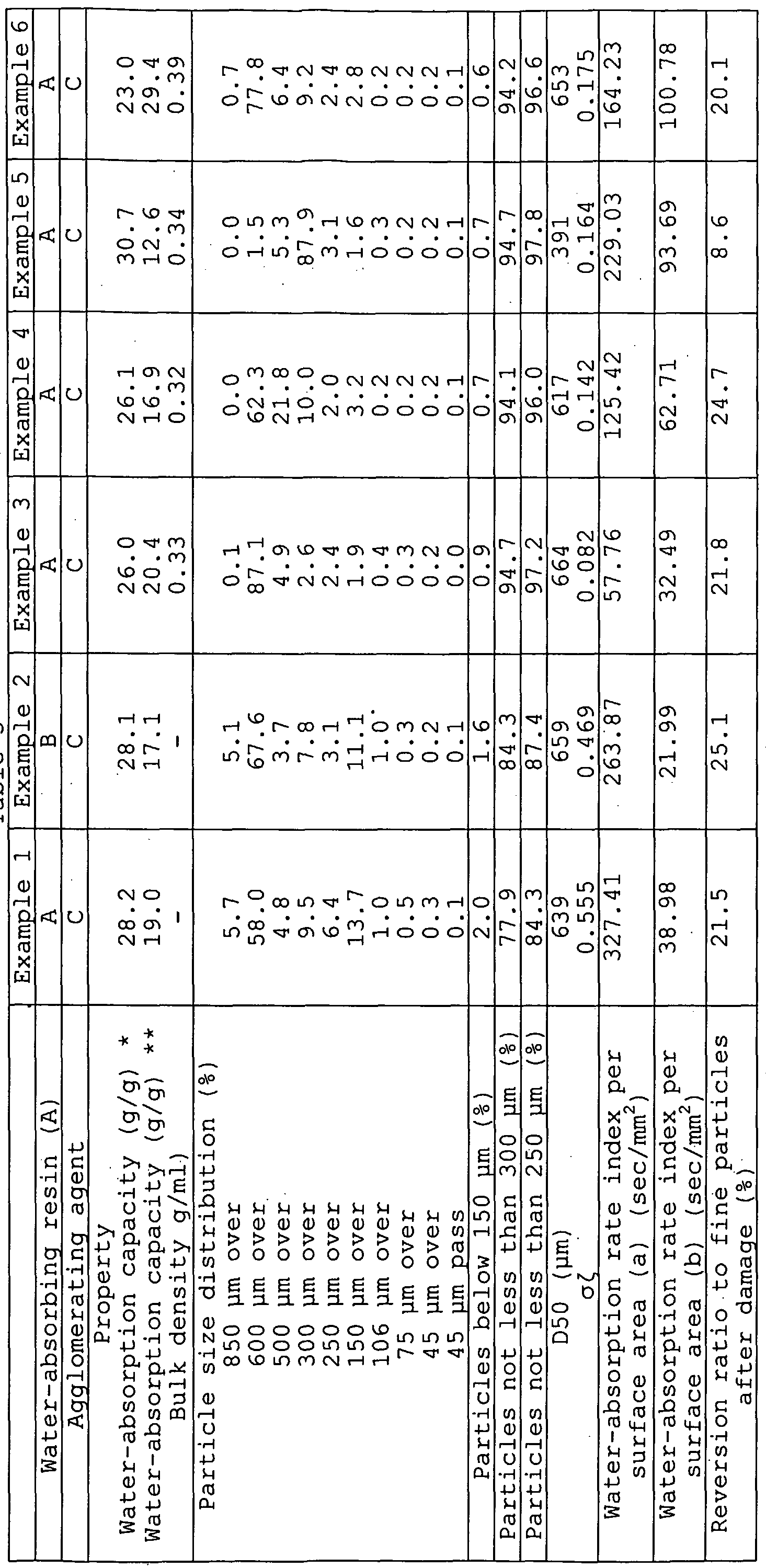
Note : A represents a referential water-absorbing resin ( 1 ) ; B represents a referential water-absorbing resin ( 1 ) + surfactant; and C represents glycerin/polyacrylic acid/water; * represents without load; and ** represents under load.
Table 4
OO

Note : A represents a referential water-absorbing resin;
* represents without load; and ** represents under load.
Fromthe above Tables 3 and 4 , it is found that water absorbent of the present invention, although having low content of small particles with average particle diameter below 150 μm and high content of large particles with average particle diameter not less than 300 μm, exhibit superior water-absorption rate such that water-absorption rate index per surface area (a) is not higher than 700 sec/mm2. Also, water absorbent of the present invention show significantly lower reversion ratio to fine particles after damage as compared with conventional agglomerated particles having high content of small particles with average particle diameter below 150 μm, because the content of small particles with average particle diameter below 150 μm thereof is low . Accordingly, it is observed that even when the water absorbent of the present invention is used in an absorbent core, there is no scattering of many fine particles and no much quantity inhalation of these fine particles by operators , and thus safety work environment is secured.
Also by comparison of the results of Examples 1 and 2 in Table 3, by mixing water-absorbing resin particles (A) with compounds (B) and (C) , in the presence of sorbitan monostearate ( surfactant ) , water-absorption rate index per surface area (a) and water-absorption rate index per surface area (b) both become low and thus it is considered that the surfactant has effects on significantly improving water-absorption rate . In addition to the above, by comparison of the results of Example 3 in Table 3 and Comparative Example 1 in Table 4 , according to the method of the present invention, it is found that by using polyacrylic acid as the polymer compound (C) during the steps of cross-linking and granulation, reversion ratio to fine particles after damage becomes significantly low . It is considered to be brought about because polyacrylic acid as the polymer compound (C) also acts as a binding agent and enhance
strength of agglomerated particles . In Comparative Example 5, agglomeration was executed after surface cross-linking, and by this method, although particle size distribution of agglomerated particles produced is within the range of the present invention, due to high reversion ratio to fine particles after damage, water absorption capacity without load is lowered, which in turn deteriorates water-absorption rate index per surface area (a) to over 700 sec/mm2. Therefore, when such agglomerated particles are used in hygienic articles such as disposable diapers , due to no expectation of rapid absorption of body fluid such as urine, it is considered to bring about a case of body fluid leakage in wearing or accompanying sticky and uncomfortable feeling around a hip on incontinence .
Example 7
To 10 parts by weight of a referential water-absorbing resin
( 1 ) obtained by Reference Example 1 , a mixture solution of 0.5 parts by weight of glycerin and water in the amount shown in the following Table 5 was added as a agglomerating agent and mixed for about 3 minutes while stirring . The mixture obtained was spread by putting in a glass Petri dish and heat treated in a dryer at 180 °C for 1 hour and then crushed with a spatula on disposed JIS standard sieves (diameter of 200 mm) with each mesh opening of 850 μm and 150 μm and receiving dishes as classification dishes, and by classifying and sampling a portion passing through the sieve with 850 μm mesh and left on the sieve with 150 μm mesh, agglomerated particles of a water-absorbing resin were obtained . In accordance with the same method as described in ( 9) water-absorption rate index per surface area (b) , the agglomerated particles thus obtained were charged in a beaker containing a physiological saline solution and observed the behavior after the charging, and at the same time measured
time (Ti second) till the agglomerated particles became nearly swelled gel state by the physiological saline solution and the results are shown in Table 5 below .
Table 5

From the results in Table 5, it is found that the addition amount of water as a agglomerating agent below 0.5 parts by weight based on 10 parts by weight of a water-absorbing resin ( 1 ) , can significantly shorten a time till agglomerated particles produced became nearly swelled-gel state by the physiological saline solution, in particular, below 0.3 parts by weight was very preferable .
Example 8
On each of the water absorbent obtained in Examples 1 to 6 and Comparative Examples 1 to 4 , water-absorption rate by the Vortex method was measured . The results are shown in Table 6.
Table 6

(Note) Cl to C4 represent Comparison 1 to Comparison 4 , respectively.
Example 9
On each of the water absorbent obtained in Examples 3 and 6 and Comparative Examples 1 to 4 , an absorbent core (core ) was prepared by a method described above and performance evaluation (an acquisition-absorption test ) as an absorbent core was executed . The results are shown in Table 7. In Table 7 , smaller overflow amount and leakage amount show more solution amount absorbed and retained in an absorbent core . 0
Table 7
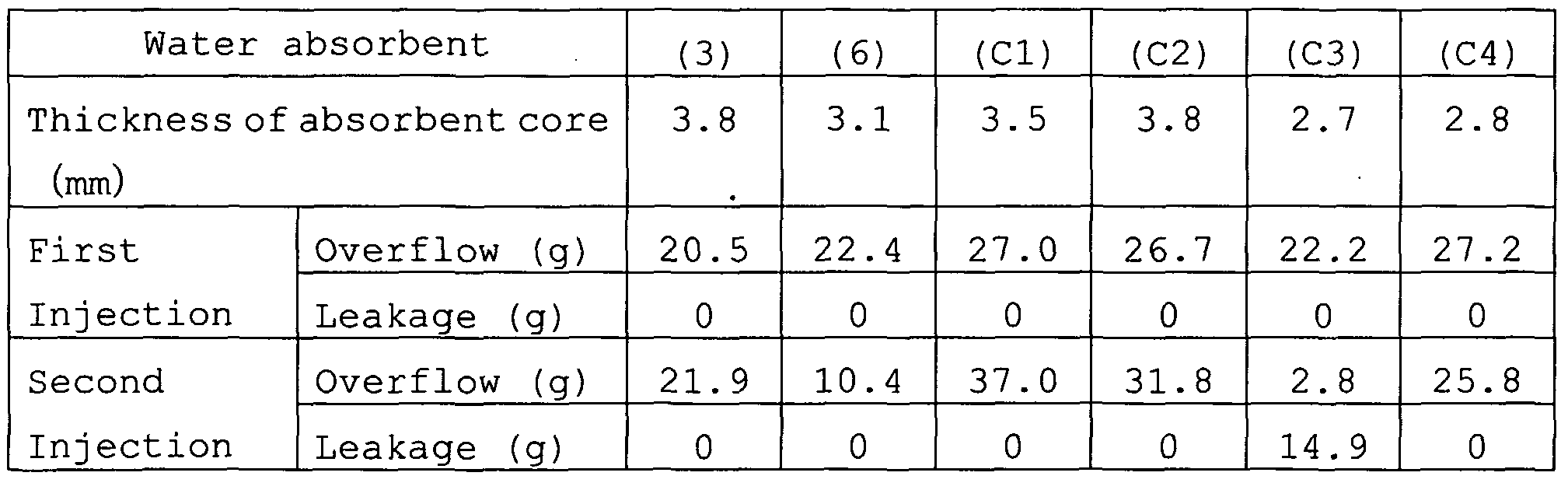
(Note) Cl to C4 represent Comparison 1 to Comparison 4 , respectively .
5 From the above Tables 6 and 7 , it is found that the water absorbent of the present invention (Examples ) , as compared with comparative water absorbent , ( comparison 1 ) and ( comparison 2 ) , although water-absorption rate by the Vortex method, a conventional measurement method, is equivalent, in property as 0 an absorbent core , show clearly more solution amount absorbed by the absorbent core, which means superior liquid permeability or liquid diffusion and liquid retention characteristics in the absorbent core . That is , by water-absorption rate index per surface area as shown by the present invention, the liquid
permeability or liquid diffusion and liquid retention characteristics , whcih can not be expressed by water-absorption rate according to a conventional measurement method, can be indicated and by the criteria that water-absorption rate index per surface area is within the range of the present invention, sufficient liquid permeability can be secured and further, by using a water absorbent of the present invention, an absorbent core having superior property can be obtained.
Industrial Applicability
The water absorbent comprising water-absorbing resin particles of the present invention can exhibit rapid water-absorption rate . Therefore, due to its securing sufficient liquid permeability, the water absorbent comprising water-absorbing resin particles, even when used in hygienic articles field such as sanitary articles and disposable diapers , can be applied in wide fields, for example, a medical field such as for medical articles , an agro-horticulture field such as for a soil-water preservation agent, in a foods field to retain freshness and an industrial field such as for a dew condensation preventing material or a cold insulator, as well as a hygienic articles field such as for sanitary articles or disposable diapers .
The entire disclosure of Japanese Patent Application No . 2005-10951 filed on January 18 , 2005 including specification, claims , drawings and summary are incorporated herein by reference in its entirety .
Claims
1. A water absorbent comprising water-absorbing resin particles which comprises : ( 1 ) particles having a particle diameter of 150 to 850 μm in a ratio of 90 to 100% by weight based on the total weight of the water absorbent , and particles having a particle diameter below 150 μm in a ratio of not more than 5% by weight based on the total weight of the water absorbent ; and (2 ) particles having a particle diameter of not less than 300 μm in a ratio of not less than 50% by weight and below 95% by weight based on the total weight of the water absorbent ; and wherein ( 3 ) said particles have a water-absorption rate index per surface area (a) of not more than 700 sec/mm2.
2. A water absorbent comprising water-absorbing resin particles which comprises :
(1) particles having a particle diameter of 150 to 850 μm in a ratio of 90 to 100% by weight based on the total weight of the water absorbent , and of particles having a particle diameter below 150 μm in a ratio of not more than 5% by weight based on the total weight of the water absorbent ; and
(2 ) particles having a particle diameter of not less than 250 μm in a ratio of not less than 30% by weight and below 100% by weight based on the total weight of the water absorbent ; and wherein ( 3 ) said particles have a water-absorption rate index per surface area (a ) of not more than 400 sec/mm2.
3. A water absorbent comprising water-absorbing resin particles which comprises : ( 1 ) particles having a particle diameter of 150 to 850 μm in a ratio of 90 to 100% by weight based on the total weight of the water absorbent, and of particles having a particle diameter below 150 μm in a ratio of not more than 5% by weight based on the total weight of the water absorbent ; and (2 ) particles having a particle diameter of not less than 300 μm in a ratio of not less than 50% by weight and below 95% by weight based on the total weight of the water absorbent, and/or particles having a particle diameter of not less than 250 μm in a ratio of not less than 50% by weight and below 100% by weight based on the total weight of the water absorbent, provided that when the particles having a particle diameter of not less than 300 μm are present in a ratio of not less than 50% by weight and below 95% by weight based on the total weight of the water absorbent and the particles having a particle diameter of not less than 250 μm are present in a ratio of not less than 50% by weight and below 100% by weight based on the total weight of the water absorbent, the ratio of particles having a particle diameter of not less than 250 μm is equivalent to or more than that of particles having a particle diameter of not less than 300 μm; and wherein ( 3) said particles have a water-absorption rate index per surface area (a) of not more than 400 sec/mm2.
4. The water absorbent of any one of claims 1 to 3, wherein said water-absorbing resin particles comprise agglomerated particles of water-absorbing resin .
5. The water absorbent of any one of claims 1 to 4 , which has a water absorption capacity without load (centrifugal method) to a physiological saline solution is in the range of 20 to 35 g/g .
6. A method for producing a water absorbent containig agglomerated particles of a water-absorbing resin used in the water absorbent set forth in any one of claims 1 to 5 which comprises steps of : (a) mixing with 100 parts by weight of water-absorbing resin particles (A) a agglomerating agent (E) containing 0.1 to 50 parts byweight of a compound (B) having not less than 2 functional groups reactable with a carboxyl group, 0.01 to 10 parts by weight of a polymer compound (C) having not less than 2 functional groups reactable with a carboxyl group and/or the functional group of the compound (B) and water ( D) in an amount below 5 parts by weight, to prepare a mixture of the water-absorbing resin particles (A) and the agglomerating agent (E) ; (b) agglomerating the mixture to form granules; and (c) heating and sizing the granules, to produce agglomerated particles containing particles having a particle diameter of 150 to 850 μm in a ratio of 90 to 100% by weight based on the total weight of the particles .
7. A method of claim 6, wherein said water-absorbing resin particles (A) containparticles having a particle diameterbelow 300 μm in a ratio of 95 to 100% by weight based on the total weight of the particles -
8. A method of claim 6 or 7 , wherein in the step (a) , the water-absorbing resin particles (A) contain water-insoluble inorganic fine particles and/or a surfactant (s) .
9. A method of any one of claims 6 to 8 , wherein the mixing ratio by weight of the polymer compound (C) to the compound (B) (X= (C) / (B) ) is 0<x<l .
Priority Applications (1)
| Application Number | Priority Date | Filing Date | Title |
|---|---|---|---|
| JP2007550985A JP2008526502A (en) | 2005-01-18 | 2006-01-18 | Water absorbing agent and method for producing the same |
Applications Claiming Priority (2)
| Application Number | Priority Date | Filing Date | Title |
|---|---|---|---|
| JP2005-010951 | 2005-01-18 | ||
| JP2005010951 | 2005-01-18 |
Publications (2)
| Publication Number | Publication Date |
|---|---|
| WO2006078046A2 true WO2006078046A2 (en) | 2006-07-27 |
| WO2006078046A3 WO2006078046A3 (en) | 2006-10-26 |
Family
ID=36659961
Family Applications (1)
| Application Number | Title | Priority Date | Filing Date |
|---|---|---|---|
| PCT/JP2006/301078 Ceased WO2006078046A2 (en) | 2005-01-18 | 2006-01-18 | Water absorbent and method for production thereof |
Country Status (2)
| Country | Link |
|---|---|
| JP (1) | JP2008526502A (en) |
| WO (1) | WO2006078046A2 (en) |
Cited By (13)
| Publication number | Priority date | Publication date | Assignee | Title |
|---|---|---|---|---|
| JP2008074924A (en) * | 2006-09-20 | 2008-04-03 | Kawamura Inst Of Chem Res | Amino group-containing organic/inorganic composite hydrogel and method for producing the same |
| JP2008111099A (en) * | 2006-10-02 | 2008-05-15 | Katogumi:Kk | Water retention-improving agent, method for producing water retention-improving agent, water-retentive structure, method for manufacturing water-retentive structure, and water-retaining agent |
| EP2524679B1 (en) | 2010-01-13 | 2015-04-08 | Sumitomo Seika Chemicals CO. LTD. | Water-absorbable sheet structure |
| JP2015145507A (en) * | 2006-09-25 | 2015-08-13 | ビーエーエスエフ ソシエタス・ヨーロピアBasf Se | Classification method of water-absorbing polymer particles |
| KR20160127742A (en) | 2014-02-28 | 2016-11-04 | 가부시키가이샤 닛폰 쇼쿠바이 | Poly(meth)acrylic acid (salt)-based particulate absorbent, and production method |
| KR20180099727A (en) * | 2015-12-28 | 2018-09-05 | 가부시키가이샤 닛폰 쇼쿠바이 | Method for producing absorbent resin |
| CN111433260A (en) * | 2017-12-11 | 2020-07-17 | 株式会社Lg化学 | Superabsorbent polymer composition and method of making the same |
| CN111433261A (en) * | 2017-12-11 | 2020-07-17 | 株式会社Lg化学 | Superabsorbent polymer composition and method of making the same |
| CN111448241A (en) * | 2017-12-11 | 2020-07-24 | 株式会社Lg化学 | Superabsorbent polymer composition and method of making the same |
| US11028237B2 (en) | 2017-06-30 | 2021-06-08 | Lg Chem, Ltd. | Method for preparing superabsorbent polymer and superabsorbent polymer prepared thereby |
| US11466131B2 (en) | 2018-11-13 | 2022-10-11 | Lg Chem, Ltd. | Superabsorbent polymer and preparation method thereof |
| US11712678B2 (en) | 2017-01-24 | 2023-08-01 | Lg Chem, Ltd. | Preparation method of super absorbent polymer |
| US12528072B2 (en) | 2020-12-24 | 2026-01-20 | Lg Chem, Ltd. | Method for preparing super absorbent polymer |
Families Citing this family (2)
| Publication number | Priority date | Publication date | Assignee | Title |
|---|---|---|---|---|
| JP6749116B2 (en) * | 2016-03-24 | 2020-09-02 | 花王株式会社 | Composite water-absorbing polymer and sanitary article containing the same |
| CN116887905B (en) * | 2021-02-19 | 2024-08-30 | 三菱电机株式会社 | Method for manufacturing dehumidifier and dehumidifier |
Family Cites Families (5)
| Publication number | Priority date | Publication date | Assignee | Title |
|---|---|---|---|---|
| KR930007272B1 (en) * | 1988-06-28 | 1993-08-04 | 닙본 쇼쿠바이 가브시기 가이샤 | Water-absorbent resin and production process |
| CA2038779A1 (en) * | 1990-04-02 | 1991-10-03 | Takumi Hatsuda | Method for production of fluid stable aggregate |
| EP0480031B1 (en) * | 1990-04-27 | 1995-09-20 | Nippon Shokubai Co., Ltd. | Method and apparatus for continuous granulation of high water absorbing resin powder |
| JPH06313044A (en) * | 1993-04-30 | 1994-11-08 | Kao Corp | Production of resin having high water absorption property |
| DE69534703T2 (en) * | 1994-10-26 | 2006-08-24 | Nippon Shokubai Co. Ltd. | WATER ABSORBENT RESIN COMPOSITION AND METHOD FOR THE PRODUCTION THEREOF |
-
2006
- 2006-01-18 WO PCT/JP2006/301078 patent/WO2006078046A2/en not_active Ceased
- 2006-01-18 JP JP2007550985A patent/JP2008526502A/en active Pending
Cited By (24)
| Publication number | Priority date | Publication date | Assignee | Title |
|---|---|---|---|---|
| JP2008074924A (en) * | 2006-09-20 | 2008-04-03 | Kawamura Inst Of Chem Res | Amino group-containing organic/inorganic composite hydrogel and method for producing the same |
| JP2015145507A (en) * | 2006-09-25 | 2015-08-13 | ビーエーエスエフ ソシエタス・ヨーロピアBasf Se | Classification method of water-absorbing polymer particles |
| JP2008111099A (en) * | 2006-10-02 | 2008-05-15 | Katogumi:Kk | Water retention-improving agent, method for producing water retention-improving agent, water-retentive structure, method for manufacturing water-retentive structure, and water-retaining agent |
| EP2524679B1 (en) | 2010-01-13 | 2015-04-08 | Sumitomo Seika Chemicals CO. LTD. | Water-absorbable sheet structure |
| KR20160127742A (en) | 2014-02-28 | 2016-11-04 | 가부시키가이샤 닛폰 쇼쿠바이 | Poly(meth)acrylic acid (salt)-based particulate absorbent, and production method |
| US10207250B2 (en) | 2014-02-28 | 2019-02-19 | Nippon Shokubai Co., Ltd. | Poly(meth)acrylic acid (salt)-based particulate absorbent |
| KR20180099727A (en) * | 2015-12-28 | 2018-09-05 | 가부시키가이샤 닛폰 쇼쿠바이 | Method for producing absorbent resin |
| KR102761195B1 (en) | 2015-12-28 | 2025-02-03 | 가부시키가이샤 닛폰 쇼쿠바이 | Method for producing absorbent resin |
| US11712678B2 (en) | 2017-01-24 | 2023-08-01 | Lg Chem, Ltd. | Preparation method of super absorbent polymer |
| US11028237B2 (en) | 2017-06-30 | 2021-06-08 | Lg Chem, Ltd. | Method for preparing superabsorbent polymer and superabsorbent polymer prepared thereby |
| EP3708606A4 (en) * | 2017-12-11 | 2021-01-13 | Lg Chem, Ltd. | Superabsorbent polymer and preparation method therefor |
| CN111448241B (en) * | 2017-12-11 | 2024-03-01 | 株式会社Lg化学 | Superabsorbent polymer composition and preparation method thereof |
| US20200308352A1 (en) * | 2017-12-11 | 2020-10-01 | Lg Chem, Ltd. | Superabsorbent Polymer Composition and Method for Preparing the Same |
| CN111448241A (en) * | 2017-12-11 | 2020-07-24 | 株式会社Lg化学 | Superabsorbent polymer composition and method of making the same |
| CN111433260A (en) * | 2017-12-11 | 2020-07-17 | 株式会社Lg化学 | Superabsorbent polymer composition and method of making the same |
| US11613613B2 (en) | 2017-12-11 | 2023-03-28 | Lg Chem, Ltd. | Superabsorbent polymer composition and method for preparing the same |
| US11633719B2 (en) | 2017-12-11 | 2023-04-25 | Lg Chem, Ltd. | Superabsorbent polymer composition and method for preparing the same |
| CN111433261B (en) * | 2017-12-11 | 2023-06-23 | 株式会社Lg化学 | Superabsorbent polymer composition and method for its preparation |
| CN111433260B (en) * | 2017-12-11 | 2023-07-07 | 株式会社Lg化学 | Superabsorbent polymer composition and method of making the same |
| CN111433261A (en) * | 2017-12-11 | 2020-07-17 | 株式会社Lg化学 | Superabsorbent polymer composition and method of making the same |
| EP3705510A4 (en) * | 2017-12-11 | 2020-12-30 | Lg Chem, Ltd. | Superabsorbent polymer and preparation method therefor |
| US11931720B2 (en) | 2017-12-11 | 2024-03-19 | Lg Chem, Ltd. | Superabsorbent polymer composition and method for preparing the same |
| US11466131B2 (en) | 2018-11-13 | 2022-10-11 | Lg Chem, Ltd. | Superabsorbent polymer and preparation method thereof |
| US12528072B2 (en) | 2020-12-24 | 2026-01-20 | Lg Chem, Ltd. | Method for preparing super absorbent polymer |
Also Published As
| Publication number | Publication date |
|---|---|
| JP2008526502A (en) | 2008-07-24 |
| WO2006078046A3 (en) | 2006-10-26 |
Similar Documents
| Publication | Publication Date | Title |
|---|---|---|
| US11020726B2 (en) | Super absorbent polyacrylic acid (salt)-based resin powder, method for manufacturing same, and method for evaluating same | |
| KR100847553B1 (en) | Particulate water absorbing agent with irregularly pulverized shape | |
| US7981833B2 (en) | Aqueous-liquid-absorbing agent and its production process | |
| US7157141B2 (en) | Pulverulent polymers crosslinked on the surface | |
| JP4683405B2 (en) | Water-absorbing resin composition and method for producing the same | |
| EP1934267B1 (en) | Aqueous-liquid-absorbing agent and its production process | |
| KR100823418B1 (en) | Particulate water-absorbent resin composition and method for producing same | |
| CN101808727B (en) | Water-absorbing agent and its manufacturing method | |
| CN101939383B (en) | A kind of water absorbing agent and its manufacturing method | |
| RU2326892C2 (en) | Process of obtaining water-absorbing gum powder | |
| US6333109B1 (en) | Water-swellable crosslinked polymer composition and production | |
| US7507475B2 (en) | Pulverulent polymers crosslinked on the surface | |
| JP4261853B2 (en) | Water absorbent resin, water absorbent resin particles, and production method thereof | |
| PL215419B1 (en) | Particulate water-absorbing agent | |
| CN101291995B (en) | Water-absorbing agent having water-absorbing resin as main component and method for producing the water-absorbing agent | |
| DE69730084T2 (en) | PROCESS FOR PREPARING A POLYMERIC HYDROPHILIC RESIN | |
| JP2004261797A (en) | Water absorbent | |
| JPWO2000009612A1 (en) | Water-swellable crosslinked polymer composition and method for producing same | |
| KR20190069300A (en) | Super absorbent polymer and preparation method for the same | |
| JPH11240959A (en) | Water absorptive polymer composition and its production | |
| JP2008526502A (en) | Water absorbing agent and method for producing the same | |
| JP2007099845A (en) | Aqueous liquid absorbent and process for producing the same | |
| JPH10101735A (en) | Water absorbent and its production |
Legal Events
| Date | Code | Title | Description |
|---|---|---|---|
| WWE | Wipo information: entry into national phase |
Ref document number: 2007550985 Country of ref document: JP |
|
| NENP | Non-entry into the national phase |
Ref country code: DE |
|
| 122 | Ep: pct application non-entry in european phase |
Ref document number: 06701406 Country of ref document: EP Kind code of ref document: A2 |
|
| WWW | Wipo information: withdrawn in national office |
Ref document number: 6701406 Country of ref document: EP |