WO2006087140A1 - Novell processes for the preparation of a benzofuran - Google Patents

Novell processes for the preparation of a benzofuran Download PDF

Info

Publication number
WO2006087140A1
WO2006087140A1 PCT/EP2006/001179 EP2006001179W WO2006087140A1 WO 2006087140 A1 WO2006087140 A1 WO 2006087140A1 EP 2006001179 W EP2006001179 W EP 2006001179W WO 2006087140 A1 WO2006087140 A1 WO 2006087140A1
Authority
WO
WIPO (PCT)
Prior art keywords
formula
compound
pyrimidin
dimethyl
chloro
Prior art date
Legal status (The legal status is an assumption and is not a legal conclusion. Google has not performed a legal analysis and makes no representation as to the accuracy of the status listed.)
Ceased
Application number
PCT/EP2006/001179
Other languages
French (fr)
Inventor
Peter Schneider
Chouaib Tahtaoui
Martin Braun
Sorana Greiveldinger-Poenaru
Jürgen JAEGER
Laurent Schmitt
Current Assignee (The listed assignees may be inaccurate. Google has not performed a legal analysis and makes no representation or warranty as to the accuracy of the list.)
Arpida AG
Original Assignee
Arpida AG
Priority date (The priority date is an assumption and is not a legal conclusion. Google has not performed a legal analysis and makes no representation as to the accuracy of the date listed.)
Filing date
Publication date
Priority to EP06706809A priority Critical patent/EP1856109A1/en
Priority to BRPI0607758-7A priority patent/BRPI0607758A2/en
Priority to US11/816,157 priority patent/US20080161561A1/en
Priority to MX2007009283A priority patent/MX2007009283A/en
Priority to EEP200700050A priority patent/EE200700050A/en
Priority to AU2006215785A priority patent/AU2006215785A1/en
Priority to CA002596668A priority patent/CA2596668A1/en
Priority to CNA2006800039630A priority patent/CN101115746A/en
Priority to ROA200700590A priority patent/RO122853B1/en
Priority to JP2007555504A priority patent/JP2008530156A/en
Application filed by Arpida AG filed Critical Arpida AG
Priority to HU0700605A priority patent/HUP0700605A3/en
Publication of WO2006087140A1 publication Critical patent/WO2006087140A1/en
Priority to IL184405A priority patent/IL184405A0/en
Priority to NO20073678A priority patent/NO20073678L/en
Anticipated expiration legal-status Critical
Ceased legal-status Critical Current

Links

Classifications

    • CCHEMISTRY; METALLURGY
    • C07ORGANIC CHEMISTRY
    • C07DHETEROCYCLIC COMPOUNDS
    • C07D405/00Heterocyclic compounds containing both one or more hetero rings having oxygen atoms as the only ring hetero atoms, and one or more rings having nitrogen as the only ring hetero atom
    • C07D405/14Heterocyclic compounds containing both one or more hetero rings having oxygen atoms as the only ring hetero atoms, and one or more rings having nitrogen as the only ring hetero atom containing three or more hetero rings
    • CCHEMISTRY; METALLURGY
    • C07ORGANIC CHEMISTRY
    • C07DHETEROCYCLIC COMPOUNDS
    • C07D405/00Heterocyclic compounds containing both one or more hetero rings having oxygen atoms as the only ring hetero atoms, and one or more rings having nitrogen as the only ring hetero atom
    • C07D405/02Heterocyclic compounds containing both one or more hetero rings having oxygen atoms as the only ring hetero atoms, and one or more rings having nitrogen as the only ring hetero atom containing two hetero rings
    • C07D405/06Heterocyclic compounds containing both one or more hetero rings having oxygen atoms as the only ring hetero atoms, and one or more rings having nitrogen as the only ring hetero atom containing two hetero rings linked by a carbon chain containing only aliphatic carbon atoms
    • AHUMAN NECESSITIES
    • A61MEDICAL OR VETERINARY SCIENCE; HYGIENE
    • A61PSPECIFIC THERAPEUTIC ACTIVITY OF CHEMICAL COMPOUNDS OR MEDICINAL PREPARATIONS
    • A61P31/00Antiinfectives, i.e. antibiotics, antiseptics, chemotherapeutics
    • A61P31/04Antibacterial agents
    • AHUMAN NECESSITIES
    • A61MEDICAL OR VETERINARY SCIENCE; HYGIENE
    • A61PSPECIFIC THERAPEUTIC ACTIVITY OF CHEMICAL COMPOUNDS OR MEDICINAL PREPARATIONS
    • A61P43/00Drugs for specific purposes, not provided for in groups A61P1/00-A61P41/00

Definitions

  • the present invention relates to novel processes for the preparation of a compound of formula I 1 which compound is related to dihydrofolate reductase inhibitors
  • the compound of formula I has valuable antibiotic properties.
  • the compound can be used in the control or prevention of infectious diseases in mammals, both humans and non-humans. In particular, it exhibits pronounced antibacterial activity, even against multiresistant Gram-positive strains and against opportunistic pathogens such as e.g. Pneumocystis carinii.
  • the compound can also be administered in combination with known substances of antibacterial activity and exhibits synergistic effects with some of them.
  • Typical combination partners are e.g. sulfonamides or other inhibitors of enzymes, which are involved in folic acid biosynthesis such as, for example, pteridine derivatives.
  • the present invention provides a process for preparing the compound of the formula I from the intermediate of formula 6.
  • the intermediate of formula 3 is synthesized in 3 steps from a readily available starting material 1 (Scheme 1).
  • the diamino pyrimidine substituent of 1 is selectively protected according to R.J. Griffin et al., J.Chem.Soc. Perkin Trans I, 1811 (1992) leading to compound of formula 2, which in turn is formylated to a compound of formula 3 (Scheme 1).
  • Scheme 1 :
  • the compound of formula I is basic in nature and can be, if desired, transformed with an acid into pharmaceutically acceptable salts.
  • Suitable acids are, e.g. hydrochloric acid, maleic acid, succinic acid, L(+)-lactic acid, DL-lactic acid, glycolic acid, i-hydroxy-naphthalene-2-carboxylic acid, tartaric acid, citric acid, methane sulfonic acid. Most preferred are carboxylic acids.
  • the central intermediate of formula 6 to prepare the compound of formula I may be prepared following the reaction sequences depicted in Schemes 1 to 3.
  • the protection A1 of trimethoprim 1 can be done by heating compound of formula 1 with acid anhydrides, e.g. acetic anhydride, isobutyric acid anhydride or pivaloyl acid anhydride in an inert, high boiling solvent like toluene, p-xylene or in plain acid anhydride up to about 120 0 C to 160 0 C.
  • the formulation B1 of the protected trimethoprim 2 can be achieved in an inert solvent, e.g.
  • dichloromethane dichloroethane, preferably dichloromethane with dichloromethyl-methyl ether and a Lewis acid, e.g. tin tetrachloride at 0 0 C to -30 0 C, preferably at -10 0 C.
  • compound of formula 3 can also be synthesized via protection A2 of compound 4 with acid anhydrides, e.g. acetic anhydride, methyl-propionic acid anhydride or pivaloyl acid anhydride in an inert, high boiling solvent like toluene, p- xylene or in plain acid anhydride, preferably methyl-propionic acid anhydride up to about 120 0 C to 160 0 C.
  • acid anhydrides e.g. acetic anhydride, methyl-propionic acid anhydride or pivaloyl acid anhydride in an inert, high boiling solvent like toluene, p- xylene or in plain acid anhydride,
  • Carbonylation B2 of compound of formula 5 can be effected in an inert atmosphere and solvent, e.g. tetrahydrofuran, with palladium tetrakis as catalyst, carbon monoxide and tri-butyl tin-hydride at 60 0 C to 80 0 C.
  • the selective demethylation A3 can be done in an inert solvent, e.g. dichloromethane, acetonitrile, in combination with a Lewis acid like aluminium trichloride, boron trichloride, boron tribromide, manganese dichloride, manganese diiodide, preferably aluminium trichloride and a nucleophile, e.g. sodium iodide, dimethyl sulfide, diethyl sulfide, tetrahydrothiophene, preferably sodium iodide at room temperature up to 40 0 C.
  • solvent e.g. tetrahydro
  • the convergent synthesis strategy of compound of formula I deserves an additional intermediate of formulae 10 or 12.
  • the starting material of formula 7 is acetylated (A4) with acetyl chloride and a Lewis acid like aluminium trichloride or tin tetra-chloride at ambient temperature to the intermediate of formula 8.
  • Compound of formula 8 can be converted by protecting first (B4) the nitrogen with a sulfonyl chloride, e.g. benzyl- or p-toluene-sulfonyl chloride with a base like triethylamine, pyridine in an inert solvent at room temperature to the compound of formula 9 followed by bromination (C4) with e.g.
  • bromine, N-bromosuccinimid, copper (II) bromide preferably bromine of the acetyl group in dioxane to compound of formula 10, or bromination first with e.g. bromine, N- bromosuccinimid, preferably bromine of 8 (B5) in an inert solvent like dioxane at room temperature to compound of formula 11 and subsequent protection (C5) with di-te/f-butyl dicarbonate and a pyridine base, e.g. 2,6-dimethyl-pyridine with 4- dimethylamino-pyridine as catalyst to compound of formula 12 at ambient temperature.
  • a pyridine base e.g. 2,6-dimethyl-pyridine with 4- dimethylamino-pyridine as catalyst to compound of formula 12 at ambient temperature.
  • tetrahydrofuran methyl alcohol, preferably tetrahydrofuran and water with a strong base like sodium or potassium hydroxide, preferably sodium hydroxide at 40 0 C to 80 0 C preferably at 50 0 C to the compound of formula 14.
  • Reduction A10 of the keto function of compound of formula 14 can be done with a reducing agent, e.g. sodium borohydride, sodium cyanoborohydride, zinc borohydride, sodium acetoxyborohydride, preferably sodium cyanoborohydride, sodium borohydride or zinc borohydride in an organic solvent like methanol, isopropanol, tetrahydrofuran, dimethoxyethane or a mixture thereof, preferably isopropanol or tetrahydrofuran at temperature in the range of -20 0 C up to 70 0 C depending on the reducing agent leading to the target compound I.
  • a reducing agent e.g. sodium borohydride, sodium cyanoborohydride, zinc borohydride, sodium acetoxyborohydride, preferably sodium cyanoborohydride, sodium borohydride or zinc borohydride in an organic solvent like methanol, isopropanol, tetrahydrofuran, dimethoxy
  • the compounds of formulae 2, 3, 5, 6, 8 to 17 are novel and are also objects of the invention. They can be prepared according to the reaction sequences elucidated in Schemes 1 to 8. The preparation of compounds outlined in Schemes 1 to 8 are, moreover, described in more detail in the examples.
  • the compound of formula I or their pharmaceutically acceptable salts have valuable antibacterial properties. These compounds are active against a large number of pathogenic microorganisms such as e.g. S. aureus, P. carinii etc. by virtue of their activity in inhibiting bacterial dihydrofolate reductase (DHFR).
  • DHFR bacterial dihydrofolate reductase
  • Examples 1 to 11 describe the preparation of compound 6, while examples 12 to 16 describe the preparation of the compound of formulae 10 and 12, and examples 17 to 32 describe the condensation of the compound of formula 6 with those of formulae 10 or 12 to the end product of formula I.
  • Compound of formula 4 can be prepared e.g. according to M. Calas et al., Eur.J.Med.Chem.Chim.Ther., 17 (6), 497 (1982).
  • Compound 7 can be prepared in analogy to e.g. W.B. Wright et al., J. Med.Chem., 11(6), 1164 (1968). All other reagents and solvents are readily commercially available, for example from Fluka or equivalent commercial suppliers. The temperatures are given in degrees Celsius.
  • Solvent A 10 mM Formic acid (Formic acid 377 ⁇ l) was added to HPLC grade water (1 L, Millipore filtered)
  • Solvent B Acetonitrile HPLC grade (Biosolve Ltd)
  • Wavelength 210 nm to 400 nm.
  • HPLC Apparatus Type Finnigan StartSystem SCN 1000, Finnigan Photodiode array detector(PDA) UV6000LP
  • a solution of trimethoprim (5 g, 17.24 mmol) in pivalic anhydride (8.74 ml_, 43.10 mmol, 2.5 eq.) was heated during 2 h at 150 0 C under argon. Hot AcOEt was added, and the organic layers were washed with aqueous NaHCO 3 10%, water and brine. The org. layers were then dried over MgSO 4 , filtered and evaporated.
  • trimethoprim 50 g, 172.4 mmol
  • isobutyric anhydride 100 g, 105 ml_, 632 mmol, 3.6 eq.
  • the warm solution was poured into 1 L of cyclohexane from where it slowly crystallized.
  • a solution of trimethoprim (50 g, 172.4 mmol) in isobutyric anhydride (62 g, 65.5 ml_, 392 mmol, 2.3 eq.) was heated during 2 h at 150 0 C under Ar and stirred with a mechanical stirrer.
  • the reaction mixture is poured into a solution of 300 mL 1 N K 3 PO 4 and 200 mL 1M Na/K-tartrate while cooling with an ice bath.
  • the mixture pH was adjusted with 4N NaOH solution to 7-8) was then stirred for 15 minutes until complete hydrolysis, and then extracted with DCM (300 mL) together with AcOEt (500 mL).
  • the organic layer was washed with 0.1 N HCI solution (2x200 mL) and brine (2x300 mL), dried over MgSO 4 , filtered and evaporated.
  • the slurry was stirred at -15 0 C for two hours, at -10 0 C for one hour and 30 minutes at -5 0 C. Then 40 mL DCM was added at -5 0 C and the separated crystals at the top of the solvent layer were removed with vigorous stirring for 15 minutes. The thin slurry was transferred into a well-stirred mixture of 35 g Na 2 CO 3 (with one crystal water) dissolved in 100 mL water and 35 mL DCM at 10 0 C. The mixture was stirred for 15 minutes at RT and then transferred back to the reaction vessel to finish the workup continuing the stirring at RT.
  • Sodium iodide (616 mg, 4.11 mmol) was added, and after 30 minutes, 0.5 mL of acetonitrile was added. The reaction was checked by LCMS 1 and 0.5 mL acetonitrile was added to complete the reaction. The reaction mixture was then poured into 1 N K 3 PO 4 /DCM biphasic solution. The two phases were separated. The aqueous layers were extracted twice with AcOEt and the organic layers were washed with water and brine, then dried on MgSO 4 , filtered and evaporated.
  • the mixture was cooled to RT, diluted with 75 mL DCM and quenched by adding the reaction mixture to 30 mL ice-water, then 2.5 mL of concentrated HCI was slowly added, which helped to dissolve the yellow precipitate.
  • the organic layer was separated and the aqueous layer extracted once more with DCM (75 mL).
  • the combined organic layers were washed with brine (50 mL), twice with sodium bicarbonate solution made from 50 mL saturated sodium bi-carbonate (NaHCO 3 ) + 150 mL water (2x100 mL), 0.1 N HCI solution (50 mL) and again brine (1x50 mL).
  • the resulting yellowish solution was dried over MgSO 4 and concentrated.
  • step A4 This example illustrates the preparation of 3-Acetyl-5-chloro-1H-indole-2- carboxylic acid dimethylamide 8 (step A4).
  • Aluminium trichloride 36 g, 270 mmol was added slowly to a suspension of 7 (30 g, 135mmol) in DCM (675 mL) at 0 0 C under Ar.
  • the reaction mixture was stirred for 30 minutes and acetyl chloride (9.6 mL, 135 mmol) was added dropwise at 0 0 C.
  • the gold yellow reaction mixture was stirred for an additional 1 hour, until the reaction was completed (verification by LC-MS).
  • the reaction mixture is then poured on ice (250 mL).
  • the pH was adjusted to pH 4.5 by addition of 4 N NaOH solution (80 mL).
  • the phases were separated and the aqueous layer was extracted with DCM (2 x 200 mL). All collected organic layers were then washed with water and brine, then dried over MgSO 4 , filtered and evaporated.
  • the compound 8 was obtained as a beige solid and used for the next reaction step without further purification.
  • This example illustrates the preparation of 3-(2-Bromo-acetyl)-5-chloro-1-(toluene- 4-sulfonyl)-1H-indole-2-carboxylicacid-dimethyl-amide 10 (step C4).
  • Example 15 This example illustrates the preparation of 3-(2-Bromo-acetyl)-5-chloro-1H-indole- 2-carboxylic acid dimethylamide 11 (step B5).
  • This example illustrates the preparation of 3-(2-Bromo-acetyl)-5-chloro-2- dimethylcarbamoyl-indole-1-carboxylic acid te/f-butyl ester 12 (step C5).
  • This example illustrates the preparation of 5-Chloro-3-[4-(2,4-diamino-pyrimidin-5- yl-methyl)-6,7-dimethoxy-benzofuran-2-carbonyl]-1/-/-indole-2-carboxylic acid dimethyl-amide, mesylate salt 14 (step B6).
  • the mixture was cooled to RT and the pH was lowered to approximately 6.5 by adding aqueous HCI solution (75 mL, 300 mmol, 4 M). NaHCO3 saturated solution (700 mL) was added carefully, a minor formation of CO 2 was observed.
  • the mixture was extracted with ethyl acetate/isopropanol 85/15 (2x1600 mL). The organic layers were washed with water/brine 90/10 (2x200 mL) and brine (1x200 mL), filtered through a plug of Celite, combined and evaporated to dryness. The resulting yellow foam was kept at high vacuum and RT for 16 hours.
  • Example 26 This example illustrates the preparation of 5-Chloro-3- [4-(2,4-diamino-pyrimidin-5- yl-methyl)-6,7-dimethoxy-benzofuran-2-ylmethyl]-1/-/-indole-2-carboxylic acid dimethyl-amide I (step A10).
  • the mesylate salt 14 (4.88 g, 6.932 mmol) was dissolved in water (50 ml_). AcOEt (50 ml_) was added, and then the mixture was quenched with NaHCO 3 10 % (50 ml_) and stirred vigorously. The organic layers were separated and the aqueous layers were extracted with AcOEt (50 mL). The combined organic layers were washed with water (100 mL), brine (50 mL) and dried over MgSO 4 , filtered and evaporated to dryness. iPrOH (30 mL) was added to the yellowish compound, then NaBH 4 (352 mg, 9.317 mmol) was added and the mixture heated at 50 0 C during 3 h.
  • Example 27 This example illustrates the preparation of 5-Chloro-3- [4-(2,4-diamino-pyrimidin-5- yl-methyl)-6,7-dimethoxy-benzofuran-2-yImethyl] ⁇ 1/-/-indole-2-carboxylic acid dimethyl-amide I (step A10).
  • This example illustrates the preparation of 5-Chloro-3- [4-(2,4-diamino-pyrimidin-5- yl-methyO- ⁇ J-dimethoxy-benzofuran ⁇ -ylmethyll-IH-indole ⁇ -carboxylic acid dimethyl-amide I (step A10).
  • the mesylate salt 14 (6% isopropanol) (20.0 g, 29.8 mmol) was suspended in tetrahydrofuran (THF) (200 mL) at RT.
  • This slurry was cooled with an ethanol bath equipped with a Cryocool (-25 ° C, 1 h), then Zn(BH 4 ) 2 (1 ,5 mol eq, 1.5 M solution in THF, 30 mL) was slowly added dropwise (some H 2 evolution) in 3 portions (3 x 10 mL every 15 minutes). After additional 15 minutes of stirring the slurry was warmed to 0 0 C. HCI solution was added continuously (1 eq, 4 M solution in dioxane, 7.45 mL, 124 ⁇ L/min) over a 1 h period. The solution was stirred for additional 15 minutes at 0 0 C and then allowed to warm up to 20 0 C during a period of 2 h.
  • This example illustrates the preparation of 5-Chloro-3- ⁇ [4-(2,4-diamino-pyrimidin-5- ylmethyO-ej-dimethoxy-benzofuran ⁇ -yll-hydroxy-methylJ-IH-indole ⁇ -carboxylic acid dimethylamide 14A (step B10).
  • the mesylate salt of the compound 14 (100 mg, 0.155 mmol) was dissolved in a mixture of iPrOH/MeOH (2/0.5 mL). The reaction mixture was cooled to -20 °C, before addition of sodium borohydride (17.6 mg, 0.466 mmol).
  • This example illustrates the preparation of 5-Chloro ⁇ 3-[4-(2,4-diamino-pyrimidin-5- yl-methyl)-6,7-dimethoxy-benzofuran-2-ylmethyl]-1 H-indole-2-carboxylic acid dimethyl-amide I (step C10).
  • the secondary alcohol 14A (50 mg, 90.9 ⁇ mol) was dissolved in THF (2 mL). The reaction mixture was cooled to -20 0 C, before addition of sodium borohydride (10.3 mg, 0.273 mmol). After 5 minutes stirring at -20 0 C, BF 3 -OEt 2 (34 ⁇ L, 50 %) was added slowly. After each drop of BF 3 OEt 2 , the color of the mixture was turning to violet, then the violet color disappeared again. After complete addition of BF 3 OEt 2 , the violet color was persistent during 3 minutes before returning to a pale yellow solution. The reaction was complete after 5 minutes and then NaOH 0.1 N (10 mL) was added. The mixture was extracted 2 times with EtOAc (15 mL each). The organic layers were washed with brine (50 mL), dried over MgSO 4 , filtered and evaporated to dryness to give the final compound I having the same LCMS signals given in Example 26.
  • Example 20 This example illustrates the preparation of 5-Chloro-3-[4-(2,4-diamino-pyrimidin-5- yl-methyO- ⁇ J-dimethoxy-benzofuran ⁇ -ylmethyll-IH-indole ⁇ -carboxylic acid dimethyl-amide 1 (step A11).
  • Example 21 illustrates the preparation of 5-Chloro-3-[4-(2,4-diamino-pyrimidin-5- yl-methyl)-6,7-dimethoxy-benzofuran-2-ylmethyl]-1H-indole-2-carboxylic acid dimethyl-amide I (step A12).

Landscapes

  • Chemical & Material Sciences (AREA)
  • Organic Chemistry (AREA)
  • Health & Medical Sciences (AREA)
  • Life Sciences & Earth Sciences (AREA)
  • Public Health (AREA)
  • General Chemical & Material Sciences (AREA)
  • Medicinal Chemistry (AREA)
  • Nuclear Medicine, Radiotherapy & Molecular Imaging (AREA)
  • Chemical Kinetics & Catalysis (AREA)
  • Pharmacology & Pharmacy (AREA)
  • Veterinary Medicine (AREA)
  • Animal Behavior & Ethology (AREA)
  • General Health & Medical Sciences (AREA)
  • Oncology (AREA)
  • Communicable Diseases (AREA)
  • Engineering & Computer Science (AREA)
  • Bioinformatics & Cheminformatics (AREA)
  • Pharmaceuticals Containing Other Organic And Inorganic Compounds (AREA)
  • Plural Heterocyclic Compounds (AREA)
  • Organic Low-Molecular-Weight Compounds And Preparation Thereof (AREA)
  • Indole Compounds (AREA)

Abstract

The present invention relates to a novel process for the preparation of the compound of formula (I), a dihydrofolate reductase inhibitor and to valuable intermediates in this process.

Description

Novel processes for the preparation of a benzofuran
Field of the invention
The present invention relates to novel processes for the preparation of a compound of formula I1 which compound is related to dihydrofolate reductase inhibitors
Figure imgf000002_0001
and to valuable intermediates in this process.
Background of the invention The compound of formula I has valuable antibiotic properties. The compound can be used in the control or prevention of infectious diseases in mammals, both humans and non-humans. In particular, it exhibits pronounced antibacterial activity, even against multiresistant Gram-positive strains and against opportunistic pathogens such as e.g. Pneumocystis carinii. The compound can also be administered in combination with known substances of antibacterial activity and exhibits synergistic effects with some of them.
Typical combination partners are e.g. sulfonamides or other inhibitors of enzymes, which are involved in folic acid biosynthesis such as, for example, pteridine derivatives.
Current method of preparing the compound of formula I is described in the patent application PCT/EP 2004/007482. The main drawback of this method is the lengthy synthesis and consequently the low overall yield. Most of the intermediates are not crystalline, which renders this synthesis economically less attractive for preparing commercial quantities. In addition, some expensive reagents cannot be recovered.
Therefore, there is a need for a process for preparing the compound of formula I with a higher overall yield and reduced number of intermediates, which can be isolated and purified. The aim is a process where all isolated intermediates are crystalline and do not require chromatography. In addition this process allows to synthesize compounds related to the compound of structure I from a common intermediate and a cheap starting material.
Summary of the invention The present invention provides a process for preparing the compound of the formula I from the intermediate of formula 6.
Figure imgf000003_0001
I
The intermediate of formula 3 is synthesized in 3 steps from a readily available starting material 1 (Scheme 1). The diamino pyrimidine substituent of 1 is selectively protected according to R.J. Griffin et al., J.Chem.Soc. Perkin Trans I, 1811 (1992) leading to compound of formula 2, which in turn is formylated to a compound of formula 3 (Scheme 1). Scheme 1:
Figure imgf000004_0001
Another route of obtaining the compound of formula 3 is depicted in Scheme 2. Compound of formula 4 is protected at the diamino pyrimidine group to a compound of formula 5 followed by carbonylation of 5 to the intermediate of structure 3 (Scheme 2).
Figure imgf000004_0002
The compound of formula 3 is transformed by selective demethylation to the key intermediate of formula 6 (Scheme 3).
Scheme 3:
Figure imgf000004_0003
The synthesis of compound I deserves an additional intermediate of formula 10 or 12. Compounds of formulae 10/12 are synthesized from the commercially available compound of formula 7 (e.g. available from Fluka AG or Biosynth AG), which is acetylated to compound of formula 8. Compound of formula 8 was N- protected with tosyl-chloride to obtain the compound of formula 9 with subsequent bromination to compound of formula 10 or the compound of formula 8 is first brominated to compound of formula 11 followed by N-protection with di-terf-butyl dicarbonate to compound 12 (Scheme 4). -A-
Scheme 4:
Figure imgf000005_0002
Figure imgf000005_0001
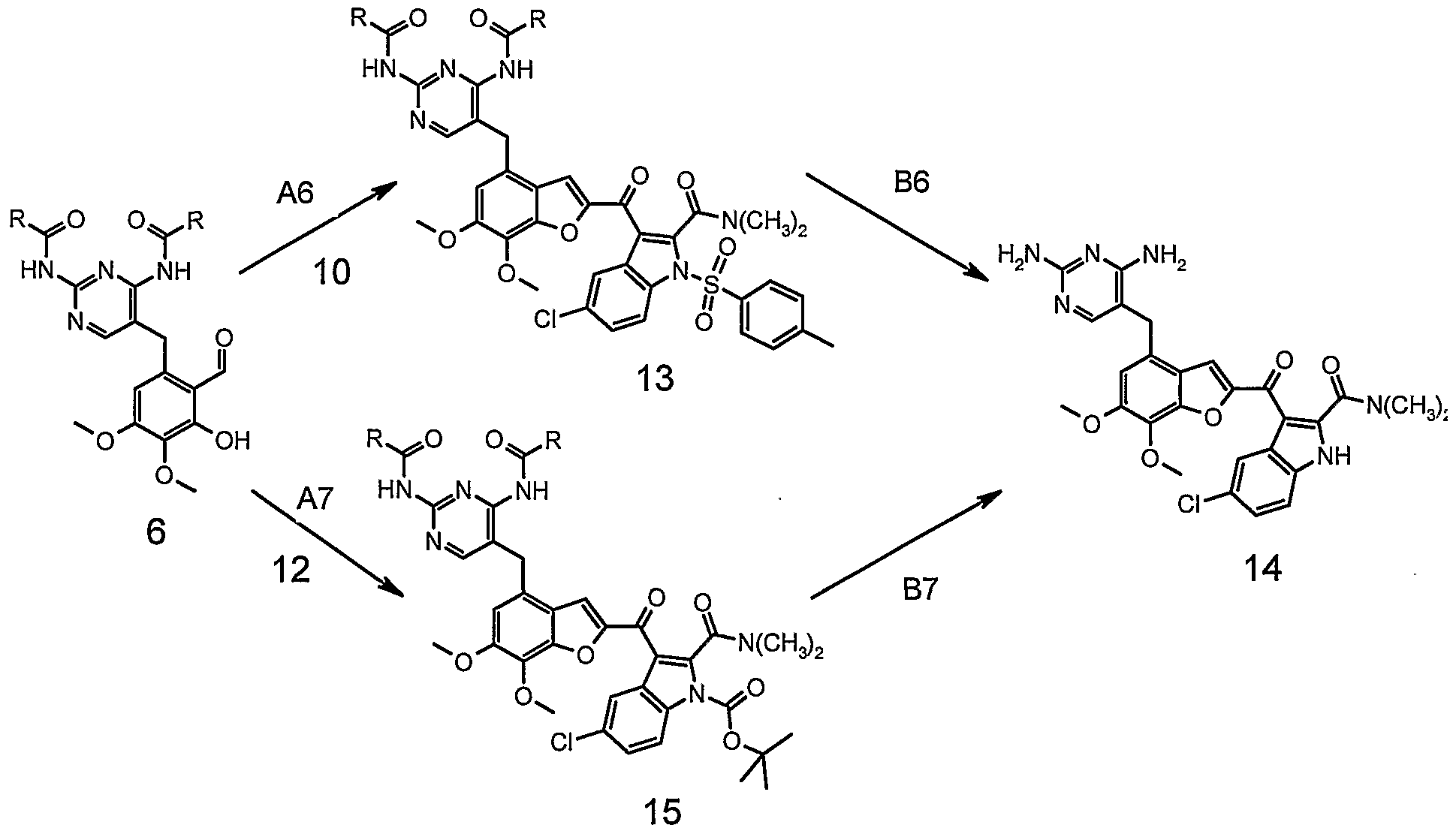
Alkylation of compound of formula 6 at the phenolic group with either bromo- ketone of formulae 10 or 12 and subsequent cyclisation leads to the furan derivatives of formulae 13 or 15 respectively. Compounds of formulae 13 and 15 are deprotected to the compound of formula 14 (Scheme 5).
Scheme 5:
Figure imgf000005_0003
The keto carbonyl group of compounds of formulae 13 or 15 are transformed into a methylene group and compounds of formulae 16 or 17 respectively (Scheme 6) are obtained. Scheme 6:
Figure imgf000006_0001
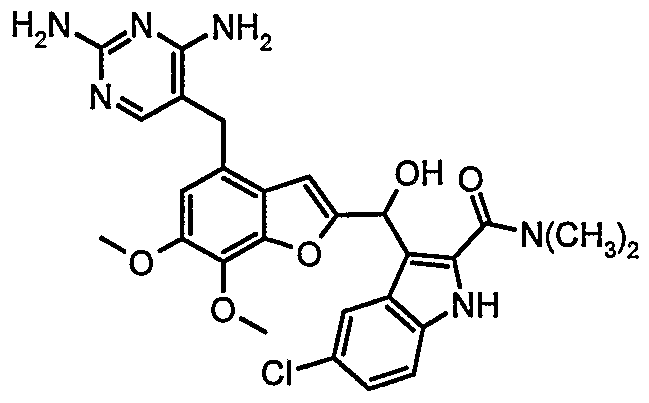
Transformation of the keto carbonyl group of compound 14 leads directly to the target compound of formula I. The reduction can also be done in two steps via the alcohol 14A (Scheme 7).
Scheme 7:
Figure imgf000006_0002
14A
Deprotection of compounds of formulae 16 and 17 lead also directly to the compound of formula I (Scheme 8). Scheme 8:
Figure imgf000007_0001
The compound of formula I is basic in nature and can be, if desired, transformed with an acid into pharmaceutically acceptable salts. Suitable acids are, e.g. hydrochloric acid, maleic acid, succinic acid, L(+)-lactic acid, DL-lactic acid, glycolic acid, i-hydroxy-naphthalene-2-carboxylic acid, tartaric acid, citric acid, methane sulfonic acid. Most preferred are carboxylic acids.
Detailed description of the invention
The process of the present invention provides many advantages and improvements over the current process of synthesizing compound of formula I as described in the patent application PCT/EP 2004/007482. The corresponding starting materials of formulae 1 and 7 are commercially available in bulk quantities.
The central intermediate of formula 6 to prepare the compound of formula I may be prepared following the reaction sequences depicted in Schemes 1 to 3. The protection A1 of trimethoprim 1 can be done by heating compound of formula 1 with acid anhydrides, e.g. acetic anhydride, isobutyric acid anhydride or pivaloyl acid anhydride in an inert, high boiling solvent like toluene, p-xylene or in plain acid anhydride up to about 120 0C to 160 0C. The formulation B1 of the protected trimethoprim 2 can be achieved in an inert solvent, e.g. dichloromethane, dichloroethane, preferably dichloromethane with dichloromethyl-methyl ether and a Lewis acid, e.g. tin tetrachloride at 0 0C to -30 0C, preferably at -10 0C. Alternatively, compound of formula 3 can also be synthesized via protection A2 of compound 4 with acid anhydrides, e.g. acetic anhydride, methyl-propionic acid anhydride or pivaloyl acid anhydride in an inert, high boiling solvent like toluene, p- xylene or in plain acid anhydride, preferably methyl-propionic acid anhydride up to about 120 0C to 160 0C. Carbonylation B2 of compound of formula 5 can be effected in an inert atmosphere and solvent, e.g. tetrahydrofuran, with palladium tetrakis as catalyst, carbon monoxide and tri-butyl tin-hydride at 60 0C to 80 0C. The selective demethylation A3 can be done in an inert solvent, e.g. dichloromethane, acetonitrile, in combination with a Lewis acid like aluminium trichloride, boron trichloride, boron tribromide, manganese dichloride, manganese diiodide, preferably aluminium trichloride and a nucleophile, e.g. sodium iodide, dimethyl sulfide, diethyl sulfide, tetrahydrothiophene, preferably sodium iodide at room temperature up to 40 0C.
The convergent synthesis strategy of compound of formula I deserves an additional intermediate of formulae 10 or 12. The starting material of formula 7 is acetylated (A4) with acetyl chloride and a Lewis acid like aluminium trichloride or tin tetra-chloride at ambient temperature to the intermediate of formula 8. Compound of formula 8 can be converted by protecting first (B4) the nitrogen with a sulfonyl chloride, e.g. benzyl- or p-toluene-sulfonyl chloride with a base like triethylamine, pyridine in an inert solvent at room temperature to the compound of formula 9 followed by bromination (C4) with e.g. bromine, N-bromosuccinimid, copper (II) bromide, preferably bromine of the acetyl group in dioxane to compound of formula 10, or bromination first with e.g. bromine, N- bromosuccinimid, preferably bromine of 8 (B5) in an inert solvent like dioxane at room temperature to compound of formula 11 and subsequent protection (C5) with di-te/f-butyl dicarbonate and a pyridine base, e.g. 2,6-dimethyl-pyridine with 4- dimethylamino-pyridine as catalyst to compound of formula 12 at ambient temperature.
Alkylation of compound of formula 6 with either compound of formulae 10 (A6) or 12 (A7) and subsequent cyclisation in an inert solvent, e.g. dimethyl formamide, tetrahydrofuran, preferably tetrahydrofuran with a base like sodium carbonate, potassium tertiary butoxide, preferably potassium tertiary butoxide at ambient temperature up to 40 °C, preferably at room temperature leads to compound of formulae 13 respectively 15. Both compounds of formulae 13 and 15 are deprotected (B6, B7) in a mixture of solvents, e.g. tetrahydrofuran, methyl alcohol, preferably tetrahydrofuran and water with a strong base like sodium or potassium hydroxide, preferably sodium hydroxide at 40 0C to 80 0C preferably at 50 0C to the compound of formula 14.
The reduction A8 respectively A9 of the ketone functional group of compound of formulae 13 and 15 respectively can be achieved with trimethyl-silane in trifluoro acetic acid at ambient temperature and leads to the compounds of structures 16 and 17 as shown in Scheme 6.
Reduction A10 of the keto function of compound of formula 14 can be done with a reducing agent, e.g. sodium borohydride, sodium cyanoborohydride, zinc borohydride, sodium acetoxyborohydride, preferably sodium cyanoborohydride, sodium borohydride or zinc borohydride in an organic solvent like methanol, isopropanol, tetrahydrofuran, dimethoxyethane or a mixture thereof, preferably isopropanol or tetrahydrofuran at temperature in the range of -20 0C up to 70 0C depending on the reducing agent leading to the target compound I. Or, via a two step reduction B10 and C10 of compound of formula 14 to the intermediate alcohol 14A with sodium borohydride at -20 0C or with a ruthenium catalysts at room temperature and subsequent reduction to the final compound I with sodium borohydride at 0 0C with boron trifluoride or trifluoroacetic acid as a catalyst. Deprotection A11 and A12 of compounds of formula 16 and 17 can be achieved in a mixture of organic solvents, e.g. tetrahydrofuran, methyl alcohol, preferably tetrahydrofuran and water with a strong base like sodium or potassium hydroxide, preferably sodium hydroxide at 40 0C to 80 0C preferably at 50 0C leading to the target compound I. The compounds of formulae 2, 3, 5, 6, 8 to 17 are novel and are also objects of the invention. They can be prepared according to the reaction sequences elucidated in Schemes 1 to 8. The preparation of compounds outlined in Schemes 1 to 8 are, moreover, described in more detail in the examples. As already mentioned, the compound of formula I or their pharmaceutically acceptable salts have valuable antibacterial properties. These compounds are active against a large number of pathogenic microorganisms such as e.g. S. aureus, P. carinii etc. by virtue of their activity in inhibiting bacterial dihydrofolate reductase (DHFR). The activity of compound I is described in patent application PCT/EP 2004/007482. Additional objects, advantages, and novel features of this invention will become apparent to those skilled in the art upon examination of the following examples, which are not intended to be limiting the scope of the invention. The following examples illustrate the invention in more detail. Examples 1 to 11 describe the preparation of compound 6, while examples 12 to 16 describe the preparation of the compound of formulae 10 and 12, and examples 17 to 32 describe the condensation of the compound of formula 6 with those of formulae 10 or 12 to the end product of formula I.
Examples
Compound of formula 4 can be prepared e.g. according to M. Calas et al., Eur.J.Med.Chem.Chim.Ther., 17 (6), 497 (1982). Compound 7 can be prepared in analogy to e.g. W.B. Wright et al., J. Med.Chem., 11(6), 1164 (1968). All other reagents and solvents are readily commercially available, for example from Fluka or equivalent commercial suppliers. The temperatures are given in degrees Celsius.
LCMS System
HPLC Column 01: Reverse Phase, Waters Ciβ 3.5 μm 4.6x75 mm column Gradient 01 :
Figure imgf000010_0001
HPLC Column 02: Reverse Phase, Waters Cis 3.5 μm 3x20 mm column Gradient 02:
Figure imgf000010_0002
Figure imgf000011_0001
Solvent A: 10 mM Formic acid (Formic acid 377 μl) was added to HPLC grade water (1 L, Millipore filtered)
Solvent B: Acetonitrile HPLC grade (Biosolve Ltd)
Wavelength: 210 nm to 400 nm.
HPLC Apparatus Type: Finnigan StartSystem SCN 1000, Finnigan Photodiode array detector(PDA) UV6000LP
MS Apparatus Type: Finnigan LCQ (ION TRAP), lonisation mode ESI
Abbreviations
Figure imgf000011_0002
Figure imgf000012_0001
Example 1
This example illustrates the preparation of N-[4-(2,2-Dimethyl-propionylamino)-5- (3,4,5-trimethoxy-benzyl)-pyrimidin-2-yl]-2,2-dimethyl-propionamide 2 (R = C(CH3)3) (step A1). A solution of trimethoprim (5 g, 17.24 mmol) in pivalic anhydride (8.74 ml_, 43.10 mmol, 2.5 eq.) was heated during 2 h at 150 0C under argon. Hot AcOEt was added, and the organic layers were washed with aqueous NaHCO3 10%, water and brine. The org. layers were then dried over MgSO4, filtered and evaporated. It was then recrystallized from TBME to give 3.02 g of compound 2 (R = C(CH3)3). 1H-NMR (CDCI3, 400 MHz) δ: 8.35 (s, 1 H), 8.21 (br s, 1 H), 7.65 (br s, 1 H), 6.30 (s, 2 H)1 3.86 (s, 2 H), 3.79 (s, 3 H), 3.77 (s, 6 H)1 1.31 (s, 9 H), 1.12 (s, 9 H). mp: 130-1330C.
Example 2
This example illustrates the preparation of N-[4-lsobutyrylamino-5-(3,4,5- trimethoxy-benzyl)-pyrimidin-2-yl]-isobutyramide 2 (R = CH(CH3)2) (step A1).
A solution of trimethoprim (50 g, 172.4 mmol) in isobutyric anhydride (100 g, 105 ml_, 632 mmol, 3.6 eq.) was heated during 2 h at 150 0C under argon. The warm solution was poured into 1 L of cyclohexane from where it slowly crystallized. The product was filtered off and was washed thoroughly with cyclohexane (2x200 ml_) to give 70 g of compound 2 (R = CH(CH3)2).
1H-NMR (D6-DMSO, 400 MHz) δ: 10.42 (s, 1 H, NH); 10.15 (s, 1 H, NH); 8.41 (s, 1H, pyrimidine); 6.41 (s, 2H1 PhH); 3.81 (s, 2H, CH2); 3.70 (s, 6H, 2xOCH3); 3.59 (S1 3H, OCH3); 2.72-2.85 (m, 2H, CH); 1.06 (d, 6H1 J=6.6Hz, 2xCH3), 1.01 (d, 6H, J=6.6Hz, 2xCH3. mp: 153-154°C. Rt (02) = 1.65 minutes.
Example 3
This example illustrates the preparation of N-[4-lsobutyrylamino-5-(3,4,5- trimethoxy-benzyl)-pyrimidin-2-yl]-isobutyramide 2 (R = CH(CH3)2) (step A1). A solution of trimethoprim (50 g, 172.4 mmol) in isobutyric anhydride (62 g, 65.5 ml_, 392 mmol, 2.3 eq.) was heated during 2 h at 150 0C under Ar and stirred with a mechanical stirrer. The solution was cooled to 130 0C and 200 ml toluene was added (clear solution), then 1000 ml TBME was slowly added (after 500 ml crystallization started) under vigorous stirring. The thick crystal cake was stirred for 1 hour at 100 0C external temperature. Then the slurry was cooled to RT and stirred for 2 hours. Finally the slurry was cooled to 10 0C and stirred for 2 hours. The crystals were filtered and washed with 3 times 90 ml TBME to remove residual isobutyric acid and anhydride. The crystals were dried at HV/70 0C for 8 hours to give 70 g of compound 2 (R = CH(CH3)2).
1H-NMR (D6-DMSO1 400 MHz) δ: 10.42 (s, 1H, NH); 10.15 (s, 1 H, NH); 8.41 (s, 1H, pyrimidine); 6.41 (s, 2H, PhH); 3.81 (s, 2H, CH2); 3.70 (s, 6H, 2xOCH3); 3.59 (s, 3H, OCH3); 2.72-2.85 (m, 2H, CH); 1.06 (d, 6H, J=6.6Hz, 2xCH3), 1.01 (d, 6H, J=6.6Hz, 2xCH3. mp: 153-1540C. Rt (02) = 1.65 minutes.
Example 4
This example illustrates the preparation of N-[4-(2,2-Dimethyl-propionylamino)-5- (2-formyl-3,4,5-trimethoxy-benzyi)-pyrimidin-2-yl]-2,2-dimethyl-propionamid 3 (R = C(CHs)3) (step B1). To a solution of 2 (1 g, 2.18 mmol, R = C(CH3)3) in DCM (5 ml_), dichloromethyl methyl ether (0.58 ml_, 6.54 mmol) was added. The solution was cooled to -30 0C before slowly adding stannic chloride (0.285 ml_, 2.18 mmol). The mixture was stirred at a temperature between -10 0C and -5 0C. At 0 0C, the reaction mixture was poured into a solution of 1-N K3PO4. The mixture (pH 7-8) was then vigorously stirred during 15 minutes, extracted twice with AcOEt. The organic layers were washed with water and brine, dried over MgSO4, filtered and evaporated. The crude product was purified by flash chromatography on silica gel (AcOEt/Cyclohexane 7/3) to give 709 mg of compound 3 (R = C(CH3)3). 1H-NMR (CDCI3, 400 MHz) δ: 10.23 (s, 1 H), 8.44 (s, 1 H), 8.12 (s, 1 H), 8.09 (s, 1 H), 6.59 (s, 1 H), 4.10 (s, 2 H), 3.96 (s, 3 H), 3.89 (s, 3 H), 3.85 (s, 3 H), 1.29 (s, 9 H), 1.27 (s, 9 H). mp: 124-126 0C. Example 5
This example illustrates the preparation of N-[5-(2-Formyl-3,4,5-trimethoxy- benzyl)-4-isobutyrylamino-pyrimidin-2-yl]-isobutyramide 3 (R = CH(CH3)2) (step B1). To a solution of 2 (70 g, 162 mmol, R = CH(CHs)2) in DCM (500 ml_), dichloromethyl methyl ether (30 mL, 325 mmol) was added. The solution was cooled to -10 0C before slowly adding stannic chloride (35 mL, 300 mmol). The mixture was stirred at a temperature between -10 0C and -5 0C. At first a gummy precipitate was formed (mechanical stirrer required). After 1 h stirring at -5 0C this was transformed into a "homogeneous" suspension.
At 00C, the reaction mixture is poured into a solution of 300 mL 1 N K3PO4 and 200 mL 1M Na/K-tartrate while cooling with an ice bath. The mixture (pH was adjusted with 4N NaOH solution to 7-8) was then stirred for 15 minutes until complete hydrolysis, and then extracted with DCM (300 mL) together with AcOEt (500 mL). The organic layer was washed with 0.1 N HCI solution (2x200 mL) and brine (2x300 mL), dried over MgSO4, filtered and evaporated. The product precipitated while concentration to about half of the initial volume, cyclohexane (200 mL) was added to further precipitate the product which was then filtered off to give 50 g of compound 3 (R = CH(CH3)2). 1H-NMR (D6-DMSO, 400 MHz) δ: (s, 1 H, NH); 10.27 (s, 1 H, NH); 10.17 (s, 1H, CHO); 8.00 (s, 1H, pyrimidine); 6.72 (s, 1H, PhH); 4.05 (s, 2H, CH2); 3.90 (s, 3H, OCH3); 3.85 (s, 3H, OCH3); 3.77 (s, 3H, OCH3); 2.75-2.85 (m, 2H, CH); 1.05 (d, 6H, J=6.6Hz, 2xCH3), 1.01 (d, 6H, J=6.6Hz, 2xCH3). mp: 162-1630C. Rt (02) = 1.85 minutes.
Example 6
This example illustrates the preparation of N-[5-(2-Formyl-3,4,5-trimethoxy- benzyl)-4-isobutyrylamino-pyrimidin-2-yl]-isobutyramide 3 (R = CH(CH3)2) (step B1).
Dichloromethyl-methyl ether (4.3 mL, 46.4 mmol, 2 eq.) was dissolved in DCM (30 mL) and cooled to -15 0C to -20 0C in a reaction vessel with mechanical stirrer. To this solution stannic chloride (5 mL, 42.8 mmol, 1.8 eq.) was added within 15 minutes. The clear solution was stirred at -18 0C for 30 minutes. Then a solution of 2 (10 g, 23.2 mmol, crystallized from toluene and TBME) in DCM (40 mL) was continuously added during 60 minutes, a yellow solid separated from the beginning and resulted in a thick slurry (green/yellow). Then the slurry was stirred at -15 0C for two hours, at -10 0C for one hour and 30 minutes at -5 0C. Then 40 mL DCM was added at -5 0C and the separated crystals at the top of the solvent layer were removed with vigorous stirring for 15 minutes. The thin slurry was transferred into a well-stirred mixture of 35 g Na2CO3 (with one crystal water) dissolved in 100 mL water and 35 mL DCM at 10 0C. The mixture was stirred for 15 minutes at RT and then transferred back to the reaction vessel to finish the workup continuing the stirring at RT. After vigorous stirring for 30 minutes at RT the layers were separated and the organic phase washed twice with a mixture of 30 mL saturated NaCI, 5 ml saturated Na2COs and 40 mL water (several shakings are necessary, the water phases should show a pH of 7 to 8). The milky water phases were washed with 50 mL DCM and 30 mL DCM separately. The organic layers were dried over MgSO4, filtered and evaporated. The crude white crystalline product was crystallized from DCM and TBME.
With 10.67 g crude material a slurry was made in 25 mL DCM at 44 0C under stirring for 30 minutes and 100 mL TBME were slowly added and the slurry stirred for 30 minutes at 44 0C and then cooled to RT for 6 hours under stirring. The crystals were filtered and washed with 40 mL TBME, dried at high vacuum/RT for 6 hours to give 9.6 g of compound 3 (R = CH(CH3)2).
1H-NMR (D6-DMSO, 400 MHz) δ: (s, 1 H, NH); 10.27 (s, 1H, NH); 10.17 (s, 1 H, CHO); 8.00 (s, 1 H, pyrimidine); 6.72 (s, 1 H, PhH); 4.05 (s, 2H, CH2); 3.90 (s, 3H, OCH3); 3.85 (s, 3H, OCH3); 3.77 (s, 3H, OCH3); 2.75-2.85 (m, 2H, CH); 1.05 (d, 6H, J=6.6Hz, 2xCH3), 1.01 (d, 6H, J=6.6Hz, 2xCH3). mp: 162-1630C. Rt (02) = 1.85 minutes.
Example 7
This example illustrates the preparation of N-[4-(2,2-Dimethyl-propionylamino)-5- (2-iodo-3,4,5-trimethoxy-benzyl)-pyrimidin-2-yl]-2,2-dimethyl-propionamide 5 (R = C(CHs)3) (step A2). To a solution 4 (5 g, 9.2 mmol, R = C(CH3)3) in pivalic anhydride (4.1 mL, 20.24 mmol) was added pyridine (1.65 mL, 20.24 mmol). The mixture was heated at 120 0C during 12 h. HCI 0.25 N (25 mL) was added and the mixture was extracted twice with AcOEt. The organic layers were washed subsequently with water, NaHCθ3 10 %, then water and brine, dried over MgSO4, filtered and evaporated to dryness. The final compound was obtained by flash chromatography on silica gel (AcOEt/Cyclohexane 1/1) to give 2.5 g of compound 5 (R = C(CH3)3). UV: 238 (282) nm.
Example 8
This example illustrates the preparation of N-[4-(2,2-Dimethyl-propionylamino)-5- (2-formyl-3,4,5-trimethoxy-benzyl)-pyrimidin-2-yl]-2,2-dimethyl-propionamid 3 (R = C(CHs)3) (step B2). 5 (1 g, 1.71 mmol, R = C(CH3)3) was dissolved in THF (10 ml_) and the mixture was degassed with argon. Palladium tetrakis was then added (49.4 mg, 4 mol %). The mixture was heated to 70 0C and a slow stream of carbon monoxide gas was started. Bu3SnH (476 μl_, 1.05 eq.) in 5 ml_ THF was slowly added over a period of 2.5 h. After 12 h at 70 0C, compound 3 (R = C(CH3)3) was isolated by flash chromatography. The analytical data were comparable to the compound of Example 4.
Example 9
This example illustrates the preparation of N-[4-(2,2-Dimethyl-propionylamino)-5- (2-formyl-3-hydroxy~4,5-dimethoxy-benzyl)-pyrimidin-2-yl]-2,2-dimethyl- propionamide 6 (R = C(CH3)3) (step A3). Under argon, 3 (2 g, 4.11 mmol, R = C(CH3)3) was dissolved in DCM (10 mL). AICI3 (823 mg, 6.17 mmol) was added to the mixture at 0 0C. Stirring was continued at RT during 10 minutes until complete dissolution Of AICI3. Sodium iodide (616 mg, 4.11 mmol) was added, and after 30 minutes, 0.5 mL of acetonitrile was added. The reaction was checked by LCMS1 and 0.5 mL acetonitrile was added to complete the reaction. The reaction mixture was then poured into 1 N K3PO4/DCM biphasic solution. The two phases were separated. The aqueous layers were extracted twice with AcOEt and the organic layers were washed with water and brine, then dried on MgSO4, filtered and evaporated. Compound 6 (R = C(CH3)3) was obtained after purification on a column chromatography on silica gel eluting with AcOEt/cyclohexane 6/4 (1.2 g). 1H-NMR (CDCI3, 400 MHz) δ: 12.07 (s, 1 H), 9.81 (s, 1 H), 8.94 (s, 1 H), 8.26 (s, 1 H), 7.95 (s, 1 H), 6.33 (s, 1 H), 4.07 (s, 2 H), 3.84 (s, 3 H), 3.80 (s, 3 H), 1.22 (s, 9 H), 1.20 (s, 9 H). mp: 110-1120C.
Example 10 This example illustrates the preparation of N-[5-(2-Formyl-3-hydroxy-4,5- dimethoxy-benzyl)-4-isobutyrylamino-pyrimidin-2-yl]-isobutyramide 6 (R = CH(CHs)2) (step A3).
Under argon, 3 (4 g, 8.7 mmol, 1 eq., R = CH(CH3)2) were dissolved in DCM (36 imL). Aluminium trichloride (3.48g, 26.1 mmol, 3 eq.) and sodium iodide (2 g, 13.3 mmol, 1.5 eq.) were added to the mixture at RT. The mixture was stirred for 20 minutes before acetonitrile (2.4 ml_) was added and then warmed up to 40 0C. Stirring at 40 0C was continued for 3.5 h. The mixture was cooled to RT, diluted with 75 mL DCM and quenched by adding the reaction mixture to 30 mL ice-water, then 2.5 mL of concentrated HCI was slowly added, which helped to dissolve the yellow precipitate. The organic layer was separated and the aqueous layer extracted once more with DCM (75 mL). The combined organic layers were washed with brine (50 mL), twice with sodium bicarbonate solution made from 50 mL saturated sodium bi-carbonate (NaHCO3) + 150 mL water (2x100 mL), 0.1 N HCI solution (50 mL) and again brine (1x50 mL). The resulting yellowish solution was dried over MgSO4 and concentrated. The oily residue was crystallized from ethyl acetate (6 mL) and dichloroethane (2.4 mL) by first warming to 50 0C, then cooling to 4 0C. After filtration the mother liquor was concentrated to halve and stored at 4 0C to give a second crop of crystals. In total 2.48 g of compound 6 (R = CH(CH3)2) were isolated. 1H-NMR (CDCI3, 400 MHz) δ: 11.95 φr s, 1H, PhOH); 9.9 (s, CHO, 1 H), 8.04 (s, pyrimidine, 1 H); 6.44 (s, ArH, 1 H), 4.15 (s, CH2, 2H), 3.93 (s, OCH3, 3H); 3.90 (s, OCH3, 3H); 2.7-2.8 (m, CH, 2H); 1.2-1.25 (m, CH3, 12H).
Example 11
This example illustrates the preparation of N-[5-(2-Formyl-3-hydroxy-4,5- dimethoxy-benzyl)-4-isobutyrylamino-pyrimidin-2-yl]-isobutyramide 6 (R = CH(CH3)2) (step A3). Under argon, 3 (3 g, 6.54 mmol) was dissolved in DCM (28 mL) at RT (15 minutes). The solution was cooled to 0 0C during 30 minutes. AICI3 (2.07 g, 15.52 mmol, 2.3 eq.) was added to the cooled solution at once. The colour of the solution changed from yellow to dark yellow within 30 minutes and the AICI3 dissolved while stirring for 30 minutes at 0 0C. Then NaI (1.5 g, 10 mmol, 1.5 eq.) was added and the mixture warmed up to 30 0C. After 10 minutes stirring acetonitrile (1.6 mL) was slowly added. After 2 hours stirring at 30 0C additional 0.2 mL acetonitrile was added. After 4 hours stirring at 30 0C the reaction temperature was raised to 35 0C for 1 h, during this time crystals separated. The slurry was cooled to RT and then poured into a well stirred mixture of 20 mL DCM and 30 mL water containing 2 mL concentrated HCI (cooled to 10 °C). After stirring for 10 minutes the clear yellow mixture was poured back to the reaction vessel and the stirring was continued until all the residues were dissolved (about 30 minutes). The organic phase was separated and washed with 25 mL of a mixture of 10 mL 1-N HCI and 15 mL water and 25 mL of a mixture of 10 ml saturated NaCI and 15 ml water, the water layers were extracted with 2 times 20 mL DCM. The combined organic solution was dried with MgSO4, filtered and evaporated. The yellow crystalline residue (2.62 g) was crystallized from DCM/TBME to give 2.48 g of compound 6 (R = CH(CH3)2). 1H-NMR (CDCI3, 400 MHz) δ: 11.95 (br s, 1 H, PhOH); 9.9 (s, CHO, 1 H), 8.04 (s, pyrimidine, 1 H); 6.44 (s, ArH, 1H), 4.15 (s, CH2, 2H), 3.93 (s, OCH3, 3H); 3.90 (s, OCH3, 3H); 2.7-2.8 (m, CH, 2H); 1.2-1.25 (m, CH3, 12H).
Example 12
This example illustrates the preparation of 3-Acetyl-5-chloro-1H-indole-2- carboxylic acid dimethylamide 8 (step A4). Aluminium trichloride (36 g, 270 mmol) was added slowly to a suspension of 7 (30 g, 135mmol) in DCM (675 mL) at 0 0C under Ar. The reaction mixture was stirred for 30 minutes and acetyl chloride (9.6 mL, 135 mmol) was added dropwise at 00C. The gold yellow reaction mixture was stirred for an additional 1 hour, until the reaction was completed (verification by LC-MS). The reaction mixture is then poured on ice (250 mL). The pH was adjusted to pH 4.5 by addition of 4 N NaOH solution (80 mL). The phases were separated and the aqueous layer was extracted with DCM (2 x 200 mL). All collected organic layers were then washed with water and brine, then dried over MgSO4, filtered and evaporated. The compound 8 was obtained as a beige solid and used for the next reaction step without further purification.
1H-NMR (CDCI3, 400 MHz) δ: 12.6 (hrs, 1 H), 8.15 (d, J= 2 Hz, 1 H), 7.47 (d, J= 8 Hz, 1 H), 7.27 (dd, J1= 8.6 Hz, J2= 2.6 Hz, 1 H), 3.08 (s, 3 H), 2.84 (s, 3 H), 2.37 (S, 3 H). mp: 150-155°.
Example 13
This example illustrates the preparation of 3-Acetyl-5-chloro-1-(toluene-4-sulfonyl)-
1H-indole-2-carboxylic acid dimethylamide 9 (step B4).
40 g (151.1 mmol) of 8 were dissolved in DCM (250 mL), at RT under Ar. Then, triethylamine (36.4 mL) and tosylchloride (31.7 g, 166.2 mmol) were added and the reaction mixture was stirred overnight. The excess of tosylchloride was quenched by adding 15 mL of a solution of ammonia in water (24 %) to the reaction mixture. After stirring for 10 minutes, the mixture was washed with 0.1 N NaOH solution (50 mL) and brine (50 mL). The organic phases were dried over MgSO4. After evaporating the combined organic phase by half, 500 mL of cyclohexane were added until the product started to precipitate. The reaction mixture was again evaporated to ca. 200 mL. Then the precipitate was filtered off and washed with cyclohexane. Drying under high vacuum gave 51.7 g of a white powder. 1H-NMR (CDCI3, 400 MHz) δ: 8.29 (d, J= 2.8 Hz, 1 H), 8.03 (d, J= 8.4 Hz, 2 H), 7.95 (d, J= 9.2 Hz, 1 H), 7.33 (dd, J1= 10 Hz, J2= 2 Hz, 2 H), 7.28 (d, J= 8.8 Hz, 1 H), 3.24 (s, 3 H), 3.03 (s, 3 H), 2.50 (s, 3 H), 2.36 (s, 3 H). mp: 96-100°C.
Example 14
This example illustrates the preparation of 3-(2-Bromo-acetyl)-5-chloro-1-(toluene- 4-sulfonyl)-1H-indole-2-carboxylicacid-dimethyl-amide 10 (step C4).
A solution of 9 (25 g, 59.7 mmol) in dioxane (250 mL) was cooled with a water bath, and then a 2 M solution of bromine (9.55g, 1 eq.) in DCM was added dropwise. The cooling of the reaction mixture was continued and the reaction monitored by HPLC. After complete addition of the bromine, the reaction mixture was evaporated to dryness. 1 L of AcOEt was added, and the organic layer was washed with saturated NaHCO3, brine and was dried over MgSO4. The expected compound 10 was then recrystallized from hot AcOEt (100 mL) to give 18.2 g. 1H-NMR (CDCI3, 400 MHz) δ: 8.28 (d, J= 2 Hz, 1 H), 7.97-8.01 (m, 3 H), 7.37 (dd, J1= 9.2 Hz, J2= 2 Hz, 1 H), 7.28 (d, J= 8 Hz, 2 H), 4.23-4.48 (AB system, J= 12.2 Hz, 2 H), 3.26 (s, 3 H), 3.04 (s, 3 H), 2.36 (s, 3 H). mp: 142-146 0C.
Example 15 This example illustrates the preparation of 3-(2-Bromo-acetyl)-5-chloro-1H-indole- 2-carboxylic acid dimethylamide 11 (step B5).
A 2 M solution of bromine (3g, 0.5 eq.) in DCM (10 mL) was added dropwise to a solution of 8 (10 g, 37.88 mmol) in dioxane (120 mL) at RT. The mixture was stirred 30 minutes then another solution of 2 M bromine (0.25 eq.) in DCM was added. The reaction was monitored by HPLC and more bromine solution in DCM (0.1 eq.) was added to complete the reaction.
After complete addition of the bromine, the hydro bromide salt of the indole started to precipitate. The mixture was evaporated to dryness, and then AcOEt (100 mL) was added. The organic layer was washed with NaHCO3 2 % (50 mL), water (50 mL) and brine (30 mL), dried over MgSO4, filtered and evaporated to dryness. The expected compound was then recrystallized from hot AcOEt (150 mL) to give 9.1 g of compound 11.
1H-NMR (CDCI3, 400 MHz) δ: 12.68 (br s, 1 H), 8.09 (d, J= 2 Hz, 1 H), 7.48 (d, J= 8.4 Hz, 1 H), 7.29 (dd, J1= 8.4 Hz, J2= 2 Hz, 1 H), 4.46 (s, 2 H), 3.07 (s, 3 H), 2.82 (s, 3 H). mp: 165-170 0C (with decomposition).
Example 16
This example illustrates the preparation of 3-(2-Bromo-acetyl)-5-chloro-2- dimethylcarbamoyl-indole-1-carboxylic acid te/f-butyl ester 12 (step C5).
To a solution of 11 (11 g, 32 mmol) in a mixture of THF/CH3CN (50 mL, 1/1), 2,6- lutidine (4.47 mL, 38.4 mmol) was added, followed by (Boc)2O (9.07 g, 41.6 mmol). The starting material was not fully dissolved. When DMAP (391 mg, 3.2 mmol) was added, the insoluble compound solubilizes quickly and the reaction turns slowly to yellow/orange. After 15 minutes, the reaction was already finished. The mixture was evaporated to dryness, then AcOEt (300 mL) was added and the organic layers were washed three times with HCI 0.1 N (50 mL), water (100 mL) and brine (50 mL). The org. layers were dried over MgSO4, filtered and evaporated. The expected compound was recrystallized from AcOEt (or cyclohexane/AcOEt 8/2: 100 ml_) to give 9.9 g of compound 12. 1H-NMR (CDCI3, 400 MHz) δ: 8.16 (d, J= 9.2 Hz, 2 H), 7.51-7.48 (dd, J1= 9.2 Hz1 J2= 2.8 Hz, 1 H)1 AB system [4.53 (d, J= 17.6 Hz, 1 H), 4.44 (d, J= 17.6 Hz1 1 H)], 3.04 (S1 3 H), 2.85 (s, 3 H), 1.56 (s, 9 H). mp: 110-1150C.
Example 17
This example illustrates the preparation of 3-[4-(2,4-Bis-isobutyrylamino-pyrimidin- δ-ylmethyO-δJ-dimethoxy-benzofuran^-carbonylJ-δ-chloro-i-^oluene^-sulfonyl)- 1H-indole-2-carboxylic acid dimethylamide 13 (R = CH(CH3)2) (step A6). A filtered solution of tBuOK (1.14 g, 0.95 eq.) in THF (10 mL) was added to a solution of 6 (5 g, 11.26 mmol, R = CH(CH3)2) in THF (40 mL). The mixture was stirred 30 minutes at RT before adding slowly 10 (5.35 g, 10.725 mmol). After 1 h, more tBuOK (184 mg, 0.15 eq.) was added. One hour later, the reaction was finished. The mixture was poured into a solution of HCI 0.05 N, extracted three times with AcOEt. The organic layers were washed with water and brine, then dried over MgSO4, filtered and evaporated to dryness. Compound 13 (R = CH(CH3)2) was used for the next reaction without any further purification (step B6). Rt (02) = 2.75 minutes.
Example 18 This example illustrates the preparation of 3-{4-[2,4-Bis-(2,2-dimethyl-propionyl- amino)-pyrimidin-5-ylmethyl]-6,7-dimethoxy-benzofuran-2-ylmethyl}-5-chloro-1- (toluene-4-sulfonyl)-1H-indole-2-carboxylic acid dimethylamide 13 (R = C(CH3)3) (step A6). A solution of 10 (1.03 g, 2.08 mmol) in 8 mL DMF was cooled to 0 0C and a solution of 6 (0.98 g, 1 eq., R = C(CH3)3) was added. Then potassium carbonate (0.86 g, 3 eq.) was added and the solution warmed to RT. After 16 h stirring at RT EtOAc (150 mL) was added and washed with 0.1 N HCI (100 mL), twice with water (200 mL) and with brine. The aqueous layers were washed with additional EtOAc (100 mL). The organic layers were dried over MgSO4, filtered and evaporated to dryness. The crude material was purified by flash chromatography on silica gel (AcOEt/cyclohexane 6/4) to give 0.93 g of compound 13 (R = C(CH3)3). Example 19
This example illustrates the preparation of 5-Chloro-3-[4-(2,4-diamino-pyrimidin-5- yl-methyl)-6,7-dimethoxy-benzofuran-2-carbonyl]-1/-/-indole-2-carboxylic acid dimethyl-amide, mesylate salt 14 (step B6). The crude materiel 13 (R = CH(CH3)2) was dissolved in THF/H2O (30 ml_, 3/1), NaOH (2.145 g, 53.625 mmol) was added and the mixture was heated during 4 h at 50 0C. The mixture was then poured into brine and extracted 3 times with AcOEt. The organic layers were washed with brine, dried over MgSO4, filtered and evaporated to dryness to give 6.2 g of crude material 14. The crude material was dissolved in MeOH (18 g), 35 ml_ of iPrOH were added and 20 g of solvent were removed under vacuum (41 0C, 110 mbar). 15 ml_ of iPrOH were added to the suspension. After 1 h 5 g of solvent were removed under vacuum (41 0C, 110 mbar), then 15 ml_ of iPrOH were added and the mixture was left 1 h at rt and 2 h at 4 0C. 11 g of solvent were removed and finally 15 ml_ of iPrOH were added and the suspension was kept 18 h at 4 °C. The crystals were filtered off, washed with 20 ml_ of iPrOH and dried under high vacuum to give 5.0 g of compound 14 as the mesylate salt with 1 equivalent of iPrOH.
1H-NMR (CDCI3, 400 MHz) δ: 12.8 (s, 1 H), 11.58 (brs, 1 H), 8.36 (brs, 1 H), 7.96 (s + brs, 2 H), 7.66 (s, 1 H), 7.55 (d + brs, J= 8.4 Hz, 3 H), 7.34 (d, J= 2 Hz, 1 H), 7.13 (s, 1 H), 4.36 (brs, 1 H), 3.93 (s, 3 H), 3.90 (s, 2 H), 3.88 (s, 3 H), 2.99 (s, 3 H), 2.76 (s, 3 H), 2.34 (s, 3 H, MeSO3H). R4 (02) = 1.33 minutes.
Example 20
This example illustrates the preparation of 5-Chloro-3-[4-(2,4-diamino-pyrimidin-5- yl-methyO-δJ-dimethoxy-benzofuran^-carbony^-IH-indole^-carboxylic acid dimethyl-amide, mesylate salt 14 (one pot reaction of steps A6 and B6).
A slightly turbid solution of tBuOK (8.62 g, 97% content, 74.54 mmol, 1.05 eq.) in THF (170 ml_, freshly distilled over sodium) was added dropwise over a period of 25 minutes to a vigorously stirred pale yellow solution of 6 (38.2 g, 95% content, 81.64 mmol, 1.15 eq.) in THF (330 ml_, freshly distilled over sodium) 20 0C. During the addition of the tBuOK solution an exothermic effect was observed (inside temperature rose slowly from 20 0C to 24 0C) and an intensive yellow suspension was formed. The mixture was stirred 90 minutes at 20 0C. Compound 10 (37.2 g, 95% content, 70.99 mmol, 1 eq.) was added in one portion as a powder. The suspension was stirred for 90 minutes at 25 0C and a colour change from yellow to orange was observed. Then solid tBuOK (0.493 g, 97% content, 4.26 mmol, 0.06 eq.) was added as a powder. The mixture was stirred for further 90 minutes at 300C. Sodium hydroxide solution (110 ml_, 440 mmol, 4 M, 6.2 eq.) was added and the colour of the solution changed to dark yellow. The mixture was stirred for 135 minutes at 58°C (inside temperature). The mixture was cooled to RT and the pH was lowered to approximately 6.5 by adding aqueous HCI solution (75 mL, 300 mmol, 4 M). NaHCO3 saturated solution (700 mL) was added carefully, a minor formation of CO2 was observed. The mixture was extracted with ethyl acetate/isopropanol 85/15 (2x1600 mL). The organic layers were washed with water/brine 90/10 (2x200 mL) and brine (1x200 mL), filtered through a plug of Celite, combined and evaporated to dryness. The resulting yellow foam was kept at high vacuum and RT for 16 hours. The crude material (45 g, corresponds to 70.2 mmol) was dissolved in methanol (140 mL) to give a dark yellow solution. After addition of methanesulfonic acid (5.28 ml, 81.4 mmol, 1.146 eq.) at RT, isopropanol (224 mL) was added and the clear solution seeded. The mixture was stirred for 1h at RT to form pale yellow crystals. Then a part of the solvents (about 150 mL) were slowly distilled off at 40 0C and 180 mbar. The precipitation became more intensive and slowly transformed into yellow crystals. The Suspension was stirred for 2 hours at 45 0C and then the slurry was slowly cooled to RT within 90 minutes. After stirring the suspension for 6 hours at RT the crystals were filtered and washed with isopropanol/methanol 95/5 (200 mL) to give 42.5 g yellow crystals of compound 14 as the mesylate salt with 1 equivalent of iPrOH. 1H-NMR (CDCI3, 400 MHz) δ: 12.8 (s, 1 H), 11.58 (brs, 1 H), 8.36 (brs, 1 H), 7.96 (s + brs, 2 H), 7.66 (s, 1 H)1 7.55 (d + brs, J= 8.4 Hz, 3 H), 7.34 (d, J= 2 Hz, 1 H), 7.13 (s, 1 H)1 4.36 (brs, 1 H), 3.93 (s, 3 H), 3.90 (s, 2 H), 3.88 (s, 3 H)1 2.99 (s, 3 H), 2.76 (s, 3 H)1 2.34 (s, 3 H, MeSO3H). Rt (02) = 1.33 minutes.
Example 21 This example illustrates the preparation of 3-[4-(2,4-Bis-isobutyrylamino-pyrimidin- δ-ylmethyO-δJ-dimethoxy-benzofuran^-carbonyll-δ-chloro^-dimethylcarbamoyl- indole-1-carboxylic acid terf-butyl ester 15 (R = CH(CH3)2) (step A7). A filtered solution of tBuOK (1.14 g, 0.95 eq.) in THF (10 mL) was added to a solution of 6 (5 g, 11.26 mmol, R = CH(CH3)2) in THF (40 mL). The mixture was stirred 30 minutes at RT before adding slowly 12 (4.75 g, 10.725 mmol). After 1 h, more tBuOK (184 mg, 0.15 eq.) was added. One hour later, the reaction was finished. The mixture was poured into a solution of HCI 0.05 N1 extracted three times with AcOEt. The organic layers were washed with water and brine, then dried over MgSO4, filtered and evaporated to dryness. Compound 15 (R = CH(CH3)2) was used for the next reaction without any further purification. Rt (01) = 7.77 minutes.
Example 22
This example illustrates the preparation of 3-{4-[2,4-Bis-(2,2-dimethyl- propionylamino)-pyrimidin-5-ylmethyl]-6,7-dimethoxy-benzofuran-2-carbonyl}-5- chloro-2-dimethylcarbamoyl-indole-1-carboxylic acid terf-butyl ester 15 (R = C(CH3)3) (step A7). A filtered solution of tBuOK (452 mg, 0.95 eq.) in THF (3 mL) was added to a solution of 6 (2 g, 4.24 mmol, R = C(CH3)3) in THF (20 mL). The mixture is stirred 5 minutes at RT before adding dropwise a solution of 12 (1.88 g, 4.24 mmol) in THF (10 mL). After 1 h, more tBuOK (119 mg, 0.25 eq.) was added. After pne hour, the mixture was poured into a solution of HCI 0.1 N, extracted three times with AcOEt. The organic layers were washed with water and brine, then dried over MgSO4, filtered and evaporated to give crude 15 (R = C(CH3)3). 1H-NMR (CDCI3, 400 MHz) δ: 8.33 (s, 1 H), 8.20 (s, 1 H), 8.07 (s, 1 H), 8.01 (d, J= 9.2 Hz, 1 H), 7.85 (brs, 2 H), 7.50 (d, J= 2 Hz, 1 H), 7.19 (d, J= 9.8 Hz1 1 H), 6.64 (s, 1 H), 3.92 (S, 3 H), 3.90 (s, 2 H), 3.75 (s, 3 H), 2.78 (s, 3 H), 2.71 (s, 3 H), 1.47 (s, 9 H), 1.12 (s, 9 H), 0.99 (s, 9 H). Rt (01) = 8.15 minutes.
Example 23
This example illustrates the preparation of 5-Chloro-3-[4-(2,4-diamino-pyrimidin-5- yl-methyO-δJ-dimethoxy-benzofuran^-carbonylj-IH-indole^-carboxylic acid dimethyl-amide, mesylate salt 14 (step B7).
The crude materiel 15 (R = CH(CH3)2) was dissolved in THF/H2O (30 mL, 3/1), NaOH (2.15 g, 53.63 mmol) was added and the mixture was heated during 4 h at 50 0C. The mixture was then poured into brine and extracted 3 times with AcOEt. The organic layers were washed with brine, dried over MgSO4, filtered and evaporated to dryness to give 6.2 g of crude material 14. The crude material was dissolved in MeOH (18 g), 35 ml_ of iPrOH were added and 20 g of solvent were removed under vacuum (41 0C, 110 mbar). 15 ml_ of iPrOH were added to the suspension. After 1 h 5 g of solvent were removed under vacuum (41 0C, 110 mbar), then 15 ml_ of iPrOH were added and the mixture was left 1 h at rt and 2 h at 4 °C. 11 g of solvent were removed and finally 15 mL of iPrOH were added and the suspension was kept 18 h at 4 0C. The crystals were filtered off, washed with 20 mL of iPrOH and dried under high vacuum to give 5.3 g of compound 14 as the mesylate salt with 1 equivalent of iPrOH having the same NMR given in Example 19.
Example 24
This example illustrates the preparation of 3-{4-[2,4-Bis-(2,2-dimethyl-propionyl- amino)-pyrimidin-5-ylmethyl]-6,7-dimethoxy-benzofuran-2-ylmethyl}-5-chloro-1- (toluene-4-sulfonyl)-1/-/-indole-2-carboxylic acid dimethylamide 16 (R = C(CH3)3) (step A8).
Compound 13 (0.065 g, 0.075 mmol, R = C(CH3)3) was dissolved in DCE (1 mL) and BF3OEt2 (28 μL, 3 eq.) was added. After addition of triethyl-silane (36 μL, 3 eq.) the mixture was stirred at 85 0C for 1 h. After cooling to RT the reaction mixture was diluted with DCM (15 mL), washed with water (3 times 15 mL) and brine, dried over MgSO4 and the solvent was distilled off. The crude mixture of compound 16 (R = C(CH3)3) was used in the next experiment without further purification.
Example 25 This example illustrates the preparation of 3-{4-[2,4-Bis-(2,2-dimethyl-propionyl- amino)-pyrimidin-5-ylmethyl]-6,7-dimethoxy-benzofuran-2-ylmethyl}-5-chloro-2- dimethylcarbamoyl-indole-1-carboxylic acid fe/f-butyl ester 17 (R = C(CH3)3) (step A9). Compound 15 (0.12 g, 0.147 mmol, R = C(CH3)3) was dissolved in DCE (2 mL) and BF3OEt2 (55 μL, 3 eq.) was added. After addition of triethyl-silane (70 μL, 3 eq.) the mixture was stirred at 85 0C for 1 h. After cooling to RT the reaction mixture was diluted with DCM (15 mL), washed with water (3 times 15 mL) and brine, dried over MgSO4 and evaporated to dryness. The crude mixture of compound 17 (R = C(CH3)3) was used in the next experiment without further purification.
Example 26 This example illustrates the preparation of 5-Chloro-3- [4-(2,4-diamino-pyrimidin-5- yl-methyl)-6,7-dimethoxy-benzofuran-2-ylmethyl]-1/-/-indole-2-carboxylic acid dimethyl-amide I (step A10).
The mesylate salt 14 (4.88 g, 6.932 mmol) was dissolved in water (50 ml_). AcOEt (50 ml_) was added, and then the mixture was quenched with NaHCO3 10 % (50 ml_) and stirred vigorously. The organic layers were separated and the aqueous layers were extracted with AcOEt (50 mL). The combined organic layers were washed with water (100 mL), brine (50 mL) and dried over MgSO4, filtered and evaporated to dryness. iPrOH (30 mL) was added to the yellowish compound, then NaBH4 (352 mg, 9.317 mmol) was added and the mixture heated at 50 0C during 3 h. Water (50 mL) was added and the mixture was extracted 3 times with AcOEt (50 mL each). Organic layers were washed with NaOH 0.2 N (50 mL), then with brine (50 mL), dried over MgSO4, filtered and evaporated to dryness. It was then recrystallized from iPrOH to give 2.75 g of compound I. 1H-NMR (CDCI3, 400 MHz) δ: 11.64 (s, 1 H), 7.69 (s, 1 H), 7.37 (of, J= 8.8 Hz, 1 H), 7.33 (s, 1 H), 7.15 (dd, J1= 8.4 Hz, J2= 2 Hz, 1 H), 6.80 (s, 2 H), 6.47 (s, 2 H), 6.09 (br s, 1 H), 5.67 (brs, 1 H), 4.20 (s, 2 H), 3.86 (s, 3 H), 3.74 (s, 3 H), 3.66 (s, 2 H), 2.94 (S, 6 H). Rt (01) = 4.51 minutes. Rt (02) = 1.45 minutes.
Example 27 This example illustrates the preparation of 5-Chloro-3- [4-(2,4-diamino-pyrimidin-5- yl-methyl)-6,7-dimethoxy-benzofuran-2-yImethyl]~1/-/-indole-2-carboxylic acid dimethyl-amide I (step A10).
The mesylate salt of compound 14 (+1 iPrOH) (1.7 g, 2.41 mmol) was suspended in iPrOH (6 mL) and dimethoxyethane (4 mL). This slurry was cooled with an lce- bath (0 0C, 30 minutes), then NaBH4 (364 mg, 9.64 mmol, 4 eq.) was slowly added (strong H2 evolution). After 5 minutes a clear yellow solution appeared. After 2 hr 14 was fully reduced to the alcohol 14A. The solution was warmed to 35 0C and kept at this temperature for 5 hrs. The reaction mixture was cooled with an ice- bath and 1 N HCI (15 ml_) was slowly added. The solution was stirred at RT for 1 h. Half of the organic solvents were removed and ethylacetate (20 ml_) was added. After addition of 5% NaOH (6 ml_) and saturated NaCI (10 mL) the layers were separated and the aqueous layer extracted with additional ethylacetate (20 mL). The organic layers were washed with saturated NaCI (20 mL). The organic layers were filtered through Celite and evaporated to dryness (1.41 g). The yellow foam was dissolved in methanol (2 mL), seeded and crystallized for 24 h. The crystals were filtered and washed with 10 mL iPrOH/MeOH (1 :1). The crystals were dried at the HV/RT to yield 1.2 g of compound I having the same NMR given in Example 26.
Example 28
This example illustrates the preparation of 5-Chloro-3- [4-(2,4-diamino-pyrimidin-5- yl-methyO-βJ-dimethoxy-benzofuran^-ylmethyll-IH-indole^-carboxylic acid dimethyl-amide I (step A10). The mesylate salt 14 (6% isopropanol) (20.0 g, 29.8 mmol) was suspended in tetrahydrofuran (THF) (200 mL) at RT. This slurry was cooled with an ethanol bath equipped with a Cryocool (-25° C, 1 h), then Zn(BH4)2 (1 ,5 mol eq, 1.5 M solution in THF, 30 mL) was slowly added dropwise (some H2 evolution) in 3 portions (3 x 10 mL every 15 minutes). After additional 15 minutes of stirring the slurry was warmed to 0 0C. HCI solution was added continuously (1 eq, 4 M solution in dioxane, 7.45 mL, 124 μL/min) over a 1 h period. The solution was stirred for additional 15 minutes at 0 0C and then allowed to warm up to 20 0C during a period of 2 h. The clear yellow solution was cooled to 0 0C with an ice-bath and water (80 mL) was slowly added dropwise over a 25 minutes period. One hour later, HCI 37% in water (100 mL) was added dropwise at 0 0C over 10 minutes and the solution was stirred for 14 hours at RT. The reaction mixture was cooled to 0 0C with an ice-bath and 10 N NaOH (140 mL) was slowly added. The solution showed a pH value of approximately 9. The pale yellow solution was 3 times extracted with a mixture of ethylacetate/isopropanol (85:15, 3x400 mL). The organic layers were continued washed with water/10 N NaOH (80:20, 100 mL), water/sat. NaCI (10:40, 50 mL) and 2 times water/sat. NaCI (5:45, 50 mL). The organic layers were dried with sodium sulfate and evaporated to dryness. The yellow solid was stirred in methanol (30 ml_) at 45°C for 3 hours where the foam was converted into a crystalline precipitate. Then the slurry was stirred for 24 h at RT. The crystals were filtered and washed with 20 mL methanol and dried at HV/RT for 14 h to give 13.56 g of compound I having the same NMR given in Example 26.
Example 29
This example illustrates the preparation of 5-Chloro-3-{[4-(2,4-diamino-pyrimidin-5- ylmethyO-ej-dimethoxy-benzofuran^-yll-hydroxy-methylJ-IH-indole^-carboxylic acid dimethylamide 14A (step B10). The mesylate salt of the compound 14 (100 mg, 0.155 mmol) was dissolved in a mixture of iPrOH/MeOH (2/0.5 mL). The reaction mixture was cooled to -20 °C, before addition of sodium borohydride (17.6 mg, 0.466 mmol). The mixture was stirred during 1 h at -20 0C, then NaOH 0.1 N (5 mL) was added. The mixture was extracted 3 times with AcOEt (15 mL each). The organic layers were washed with brine (50 mL), dried over MgSO4, filtered and evaporated to dryness. The crude mixture containing compound 14A was directly used in the next step. Rt (02) = 1.32 minutes.
Example 30
This example illustrates the preparation of 5-Chloro~3-[4-(2,4-diamino-pyrimidin-5- yl-methyl)-6,7-dimethoxy-benzofuran-2-ylmethyl]-1 H-indole-2-carboxylic acid dimethyl-amide I (step C10).
The secondary alcohol 14A (50 mg, 90.9 μmol) was dissolved in THF (2 mL). The reaction mixture was cooled to -20 0C, before addition of sodium borohydride (10.3 mg, 0.273 mmol). After 5 minutes stirring at -20 0C, BF3-OEt2 (34 μL, 50 %) was added slowly. After each drop of BF3OEt2, the color of the mixture was turning to violet, then the violet color disappeared again. After complete addition of BF3OEt2, the violet color was persistent during 3 minutes before returning to a pale yellow solution. The reaction was complete after 5 minutes and then NaOH 0.1 N (10 mL) was added. The mixture was extracted 2 times with EtOAc (15 mL each). The organic layers were washed with brine (50 mL), dried over MgSO4, filtered and evaporated to dryness to give the final compound I having the same LCMS signals given in Example 26. Example 31
This example illustrates the preparation of 5-Chloro-3-[4-(2,4-diamino-pyrimidin-5- yl-methyO-βJ-dimethoxy-benzofuran^-ylmethyll-IH-indole^-carboxylic acid dimethyl-amide 1 (step A11). The crude material of Example 20 (compound 16, R = C(CH3)3) was dissolved in methanol (2 ml_) and after addition of 4 N NaOH (10 eq.) the solution was stirred for 3 h at 50 0C. After cooling to RT the mixture was extracted 2 times with EtOAc (20 mL each). The organic layers were washed with brine (50 ml_), dried over MgSO4, filtered and evaporated to dryness to give the final compound I having the same LCMS signals given in Example 26.
theExample 32
This example illustrates the preparation of 5-Chloro-3-[4-(2,4-diamino-pyrimidin-5- yl-methyl)-6,7-dimethoxy-benzofuran-2-ylmethyl]-1H-indole-2-carboxylic acid dimethyl-amide I (step A12). The crude material of Example 21 (compound 17, R = C(CH3)3) was dissolved in methanol (4 mL) and after addition of 4 N NaOH (10 eq.) the solution was stirred for 3 h at 50 C. After cooling to RT the mixture was extracted 2 times with EtOAc (30 mL each). The organic layers were washed with brine (50 mL), dried over MgSO4, filtered and evaporated to dryness to give the final compound I having the same LCMS signals given in Example 26.

Claims

Claims
1. Process for manufacturing the compound of formula I
Figure imgf000030_0001
Formula I starting with a novel intermediate of formula 6
Figure imgf000030_0002
Formula 6 wherein
R represents -C(CH3)3 or -CH(CH3)2 , reacting the compound of formula 6 with either a compound of formula 10 or 12
Figure imgf000030_0003
Formula 10 Formula 12 wherein R has the meaning given in formula 6 above,
to obtain the compound of formulae 13 or 15 respectively
Figure imgf000031_0001
Formula 13 Formula 15 wherein R has the meaning given in formula 6 above,
deprotecting the novel compound of formula 13 or 15 to obtain the novel intermediate 14
Figure imgf000031_0002
and transforming the keto carbonyl group of the compound of formula 14 by a one or two step reduction in a manner known per se to obtain the target compound of formula I,
2. Reduction of the compound of formula 14
Figure imgf000031_0003
14
Formula 14 with either a borohydride in a temperature range of -200C up to 700C, depending on the borohydride applied, or in a two step reduction of the compound of formula 14 via the novel intermediate of formula 14A
Figure imgf000032_0001
14A
Formula 14A by using in a first step sodium borohydride at -200C or a ruthenium catalyst at room temperature and in a second step sodium borohydride at about 00C with boron trifluoride or trifluoroacetic acid as a catalyst, to obtain the target compound of formula I.
3. Novel intermediates selected from the group consisting of
N-[4-(2,2-Dimethyl-propionylamino)-5-(3,4,5-trimethoxy-benzyl)-pyrimidin-2-yl]-2,2- dimethyl-propionamide formula 2 (R = C(CH3)3)
N-[4-lsobutyrylamino-5-(3,4,5-trimethoxy-benzyl)-pyrimidin-2-yl]-isobutyramide; (formula 2 (R = CH(CH3)2)),
N-[4-(2,2-Dimethyl-propionylamino)-5-(2-formyl-3,4,5-trimethoxy-benzyl)-pyrimidin- 2-yl]-2,2-dimethyl-propionamid; ( formula 3 (R = C(CHs)3)),
N-[5-(2-Formyl-3,4,5-trimethoxy-benzyl)-4-isobutyrylamino-pyrimidin-2-yl]- isobutyramide; ( formula 3 (R = CH(CHs)2)),
N-[4-(2,2-Dimethyl-propionylamino)-5-(2-iodo-3,4,5-trimethoxy-benzyl)-pyrimidin-2- yl]-2,2-dimethyl-propionamide; ( formula 5 (R = C(CHs)3)),
N-[5-(2-lodo-3,4,5-trimethoxy-benzyl)-4-isobutyrylamino-pyrimidin-2-yl]-isobutyr- amide; ( formula 5 (R = CH(CHs)2)), N-[4-(2,2-Dimethyl-propionylamino)-5-(2-formyl-3-hydroxy-4,5-dimethoxy-benzyl)- pyrimidin-2-yl]-2,2-dimethyl-propionamide;( formula 6 (R = C(CH3)3)),
N-[5-(2-Formyl-3-hydroxy-4,5-dimethoxy-benzyl)-4-isobutyrylamino-pyrimidin-2-yl]- isobutyramide;( formula 6 (R = CH(CH3)2))
3-Acetyl-5-chloro-1 H-indole-2-carboxylic acid dimethylamide;( formula 8)
3-Acetyl-5-chloro-1-(toluene-4-sulfonyl)-1H-indole-2-carboxylicacid dimethylamide; (formula 9),
3-(2-Bromo-acetyl)-5-chloro-1-(toluene-4-sulfonyl)-1H-indole-2-carboxylicacid- dimethylamide;( formula 10)
3-(2-Bromo-acetyl)-5-chloro-1 H-indole^-carboxylicacid-dimethylamide; (formula 11),
3-(2-Bromo-acetyl)-5-chloro-2-dimethylcarbamoyl-indole-1 -carboxylic acid tert- butyl ester;( formula 12),
3-[4-(2,4-Bis-isobutyrylamino-pyrimidin-5-ylmethyl)-6,7-dimethoxy-benzofuran-2- carbonyl]-5-chloro-1-(toluene-4-sulfonyl)-1H-indole-2-carboxylicacid- dimethylamide;( formula 13 (R = CH(CH3)2)),
3-{4-[2,4-Bis-(2,2-dimethyl-propionyl-amino)-pyrimidin-5-ylmethyl]-6,7-dimethoxy- benzofuran-2-ylmethyl}-5-chloro-1 -(toluene-4-sulfonyl)-1 H-indole-2-carboxylic acid dimethylamide;( formula 13 (R = C(CH3)3)),
5-Chloro-3-[4-(2,4-diamino-pyrimidin-5-yl-methyl)-6,7-dimethoxy-benzofuran-2- carbonyl]-1 H-indole-2-carboxylic acid dimethyl-amide, mesylate salt ( formula 14),
3-[4-(2,4-Bis-isobutyrylamino-pyrimidin-5-ylmethyl)-6,7-dimethoxy-benzofuran-2- carbonyll-δ-chloro^-dimethylcarbamoyl-indole-i -carboxylic acid terf-butyl ester; (formula 15 (R = CH(CHs)2)), - -
3-{4-[2,4-Bis-(2,2-dimethyl-propionylamino)-pyrimidin-5-yinnethyl]-6,7-dimethoxy- benzofuran-2-carbonyl}-5-chloro-2-dimethylcarbannoyl-indole-1-carboxylic acid terf-butyl ester; (formula 15 (R = C(CHs)3)),
3-{4-[2,4-Bis-(2,2-dimethyl-propionyl-amino)-pyrimidin-5-yImethyl]-6,7-dimethoxy- benzofuran-2-ylmethyl}-5-chloro-1-(toluene-4-sulfonyl)-1/-/-indole-2-carboxylic acid dimethylamide;( formula 16 (R = C(CHs)3)),
3-[4-(2,4-Bis-isobutyrylamino-pyrimidin-5-ylmethyl)-6,7-dimethoxy-benzofuran-2- ylmethyl]-5-chloro-1 -(toiuene-4-sulfonyl)-1 H-indoIe-2-carboxylic acid dimethyl- amide^ formula 16 (R = CH(CHs)2)),
3-{4-[2,4-Bis-(2,2-dimethyl-propionyl-amino)-pyrimidin-5-ylmethyl]-6,7-dimethoxy- benzofuran-2-ylmethyl}-5-chloro-2-dimethylcarbamoyl-indole-1-carboxylic acid tert- butyl ester;( formula 17 (R = C(CH3)3)),
3-[4-(2,4-Bis-isobutyrylamino-pyrimidin-5-ylmethyl)-6,7-dimethoxy-benzofuran-2- ylmethyl]-5-chloro-2-dimethylcarbamoyl-indole-1-carboxylic acid teAf-butyl ester; (formula 17 (R = CH(CHs)2)).
PCT/EP2006/001179 2005-02-18 2006-02-10 Novell processes for the preparation of a benzofuran Ceased WO2006087140A1 (en)

Priority Applications (13)

Application Number Priority Date Filing Date Title
ROA200700590A RO122853B1 (en) 2005-02-18 2006-02-10 Process for preparing a benzofurane derivative
US11/816,157 US20080161561A1 (en) 2005-02-18 2006-02-10 Novel Processing for the Preparation of a Benzofuran
MX2007009283A MX2007009283A (en) 2005-02-18 2006-02-10 Novell processes for the preparation of a benzofuran.
EEP200700050A EE200700050A (en) 2005-02-18 2006-02-10 Method for the preparation of benzofuran and intermediates
AU2006215785A AU2006215785A1 (en) 2005-02-18 2006-02-10 Novel processes for the preparation of a benzofuran
CA002596668A CA2596668A1 (en) 2005-02-18 2006-02-10 Novel processes for the preparation of a benzofuran
CNA2006800039630A CN101115746A (en) 2005-02-18 2006-02-10 A new method for the preparation of benzofurans
EP06706809A EP1856109A1 (en) 2005-02-18 2006-02-10 Novell processes for the preparation of a benzofuran
BRPI0607758-7A BRPI0607758A2 (en) 2005-02-18 2006-02-10 processes for compound manufacturing and compound reduction, and,
JP2007555504A JP2008530156A (en) 2005-02-18 2006-02-10 A new method for the production of benzofuran
HU0700605A HUP0700605A3 (en) 2005-02-18 2006-02-10 Novel processes for the preparation of a benzofuran
IL184405A IL184405A0 (en) 2005-02-18 2007-07-04 Novel processes for the preparation of a benzofuran
NO20073678A NO20073678L (en) 2005-02-18 2007-07-17 New processes for the preparation of benzofuran

Applications Claiming Priority (2)

Application Number Priority Date Filing Date Title
EPEP/2005/001695 2005-02-18
EP2005001695 2005-02-18

Publications (1)

Publication Number Publication Date
WO2006087140A1 true WO2006087140A1 (en) 2006-08-24

Family

ID=36283919

Family Applications (2)

Application Number Title Priority Date Filing Date
PCT/EP2006/001185 Ceased WO2006087143A1 (en) 2005-02-18 2006-02-10 Novel processes for the preparation of a 2h-chromene
PCT/EP2006/001179 Ceased WO2006087140A1 (en) 2005-02-18 2006-02-10 Novell processes for the preparation of a benzofuran

Family Applications Before (1)

Application Number Title Priority Date Filing Date
PCT/EP2006/001185 Ceased WO2006087143A1 (en) 2005-02-18 2006-02-10 Novel processes for the preparation of a 2h-chromene

Country Status (22)

Country Link
US (2) US20080221324A1 (en)
EP (3) EP1856109A1 (en)
JP (2) JP2008530156A (en)
KR (2) KR20070106635A (en)
CN (4) CN101115746A (en)
AU (2) AU2006215788B2 (en)
BG (2) BG109938A (en)
BR (2) BRPI0607797A2 (en)
CA (2) CA2596668A1 (en)
CZ (2) CZ2007536A3 (en)
EE (2) EE200700050A (en)
HU (2) HUP0700604A3 (en)
IL (2) IL184405A0 (en)
MX (2) MX2007009283A (en)
NO (2) NO20073678L (en)
NZ (1) NZ556800A (en)
RO (2) RO122912B8 (en)
RU (2) RU2397980C2 (en)
TR (1) TR200705187T1 (en)
TW (2) TW200640914A (en)
WO (2) WO2006087143A1 (en)
ZA (2) ZA200706422B (en)

Families Citing this family (17)

* Cited by examiner, † Cited by third party
Publication number Priority date Publication date Assignee Title
KR20070106635A (en) * 2005-02-18 2007-11-02 아르피다 아게 Novel methods for the preparation of 2H-chromen
CN102112108A (en) * 2008-04-08 2011-06-29 阿西诺药品有限公司 Aqueous pharmaceutical formulation
US7947293B2 (en) 2008-04-08 2011-05-24 Arpida Ag Aqueous pharmaceutical formulation
FR2949465B1 (en) * 2009-09-01 2011-08-12 Pf Medicament CHROMIUM DERIVATIVES, PROCESS FOR PREPARING THEM AND THERAPEUTIC APPLICATIONS THEREOF
CN110606831A (en) * 2018-06-14 2019-12-24 上海度德医药科技有限公司 Novel intermediate of Icalaprim and preparation method and application thereof
CN110818693B (en) * 2018-08-07 2023-06-02 上海度德医药科技有限公司 Crystal form B of ilaypu Lin Jia sulfonate and preparation method thereof
CN109988156B (en) * 2019-03-12 2021-12-28 广东中科药物研究有限公司 Aminopyrimidine compound
CN110372746A (en) * 2019-07-11 2019-10-25 辽宁石油化工大学 A method for synthesizing β-aminophosphine oxides
CN110642792B (en) * 2019-11-18 2023-04-21 上海医药工业研究院有限公司 Preparation method of ilaprine intermediate
CN110724135B (en) * 2019-11-18 2023-04-28 上海医药工业研究院有限公司 Esalapril Lin Zhongjian body and preparation method thereof
CN110724108B (en) * 2019-11-18 2023-04-28 上海医药工业研究院有限公司 Esalapril Lin Zhongjian body and preparation method thereof
CN110746361B (en) * 2019-11-18 2023-04-21 上海医药工业研究院有限公司 Esalapril Lin Zhongjian body and preparation method thereof
CN110713483B (en) * 2019-11-18 2023-04-07 上海医药工业研究院 Elaprepilin intermediate and preparation method of elaprilin
CN110790753B (en) * 2019-11-18 2023-04-07 上海医药工业研究院 Ealaprilin p-toluenesulfonate, and preparation method and application thereof
CN110818694B (en) * 2019-11-18 2023-04-21 上海医药工业研究院有限公司 Esalapu Lin Zhongjian body and application thereof
CN113493461A (en) * 2020-04-01 2021-10-12 上海医药工业研究院 Seven-membered heterocyclic compound or salt thereof, and preparation method and application thereof
CN117700410B (en) * 2023-05-20 2025-07-04 山东康诺生物工程有限公司 Preparation method of 3- (2-chloroethyl) -2-methyl-9-hydroxy-4H-pyrido [1,2-a ] pyrimidine-4-ketone

Citations (2)

* Cited by examiner, † Cited by third party
Publication number Priority date Publication date Assignee Title
WO2002010157A1 (en) * 2000-07-29 2002-02-07 Arpida Ag Benzofuran derivatives and their use as antibacterial agents
WO2005005418A1 (en) * 2003-07-11 2005-01-20 Arpida Ag Benzofuran derivatives and their use in the treatment of microbial infections

Family Cites Families (6)

* Cited by examiner, † Cited by third party
Publication number Priority date Publication date Assignee Title
DE2709634A1 (en) * 1977-03-05 1978-09-07 Basf Ag BENZYLPYRIMIDINE, METHOD FOR THE PRODUCTION THEREOF, AND MEDICINAL PRODUCTS CONTAINING THE SAME
US4438267A (en) * 1980-11-11 1984-03-20 Daluge Susan M Monoheteroring compounds and their use
DE69618986T2 (en) * 1995-12-04 2002-06-20 Arpida Ag, Muenchenstein DIAMINOPYRIMIDINE, PHARMACEUTICAL COMPOSITIONS CONTAINING THE SAME AND THEIR USE AS AN ANTIBACTERIAL AGENT
US7365205B2 (en) * 2001-06-20 2008-04-29 Daiichi Sankyo Company, Limited Diamine derivatives
WO2005014586A1 (en) * 2003-08-08 2005-02-17 Arpida Ag Novel process for the preparation of 2h-chromenes
KR20070106635A (en) * 2005-02-18 2007-11-02 아르피다 아게 Novel methods for the preparation of 2H-chromen

Patent Citations (2)

* Cited by examiner, † Cited by third party
Publication number Priority date Publication date Assignee Title
WO2002010157A1 (en) * 2000-07-29 2002-02-07 Arpida Ag Benzofuran derivatives and their use as antibacterial agents
WO2005005418A1 (en) * 2003-07-11 2005-01-20 Arpida Ag Benzofuran derivatives and their use in the treatment of microbial infections

Non-Patent Citations (2)

* Cited by examiner, † Cited by third party
Title
ROTH B ET AL: "2,4-DIAMINO-5-BENZYLPYRIMIDINES AS ANTIBACTERIAL AGENTS. 13 SOME ALKENYL DERIVATIVES WITH HIGH IN VITRO ACTIVITY AGAINST ANAEROBIC ORGANISMS", JOURNAL OF MEDICINAL CHEMISTRY, AMERICAN CHEMICAL SOCIETY. WASHINGTON, US, vol. 32, no. 8, 1 August 1989 (1989-08-01), pages 1949 - 1958, XP000567729, ISSN: 0022-2623 *
TANI M ET AL: "Synthetic studies on indoles and related compounds. XXV. The Friedel-Crafts acylation of ethyl 1H-indole-2-carboxylate. (2)", CHEMICAL AND PHARMACEUTICAL BULLETIN, PHARMACEUTICAL SOCIETY OF JAPAN, TOKYO, JP, vol. 38, no. 12, December 1990 (1990-12-01), pages 3261 - 3267, XP002079475, ISSN: 0009-2363 *

Also Published As

Publication number Publication date
JP2009505943A (en) 2009-02-12
EP2270003A1 (en) 2011-01-05
IL184404A0 (en) 2007-10-31
EE200700050A (en) 2007-12-17
ZA200706422B (en) 2008-09-25
JP2008530156A (en) 2008-08-07
BG109938A (en) 2008-05-30
MX2007009282A (en) 2008-02-19
CN101115746A (en) 2008-01-30
EE200700051A (en) 2007-12-17
TW200640914A (en) 2006-12-01
CN101115743A (en) 2008-01-30
RO122853B1 (en) 2010-03-30
KR20070106636A (en) 2007-11-02
BG109937A (en) 2008-05-30
HUP0700605A3 (en) 2008-02-28
RO122912B8 (en) 2010-09-30
NZ556800A (en) 2011-01-28
CA2596669A1 (en) 2006-08-24
US20080161561A1 (en) 2008-07-03
HUP0700604A2 (en) 2008-01-28
US20080221324A1 (en) 2008-09-11
EP1856109A1 (en) 2007-11-21
MX2007009283A (en) 2008-02-19
CN101115743B (en) 2011-04-13
EP1856106A1 (en) 2007-11-21
NO20073678L (en) 2007-09-03
RO122912B1 (en) 2010-04-30
CN102140094B (en) 2012-06-06
TR200705187T1 (en) 2007-11-21
HUP0700605A2 (en) 2008-01-28
HUP0700604A3 (en) 2008-02-28
RU2397980C2 (en) 2010-08-27
CZ2007537A3 (en) 2008-02-20
RU2007134583A (en) 2009-03-27
RU2007134584A (en) 2009-03-27
CN102140094A (en) 2011-08-03
KR20070106635A (en) 2007-11-02
AU2006215788B2 (en) 2011-10-20
AU2006215788A1 (en) 2006-08-24
ZA200706421B (en) 2008-11-26
CN102079727A (en) 2011-06-01
CA2596668A1 (en) 2006-08-24
CZ2007536A3 (en) 2008-02-20
WO2006087143A8 (en) 2008-11-27
NO20073701L (en) 2007-09-03
IL184405A0 (en) 2007-10-31
TW200640912A (en) 2006-12-01
WO2006087143A1 (en) 2006-08-24
AU2006215785A1 (en) 2006-08-24
BRPI0607797A2 (en) 2010-10-19
BRPI0607758A2 (en) 2010-03-23

Similar Documents

Publication Publication Date Title
EP1856109A1 (en) Novell processes for the preparation of a benzofuran
AU2003209130B2 (en) Synthesis of indole thiazole compounds as ligands for the AH receptor
HUT68895A (en) Process for producing physostigmine carbamate derivatives
Caballero et al. Stereochemical issues related to the synthesis and reactivity of pyrazino [2′, 1′-5, 1] pyrrolo [2, 3-b] indole-1, 4-diones
ES2204303B2 (en) PROCEDURE FOR OBTAINING A PHARMACEUTICALLY ACTIVE COMPOUND.
KR100753353B1 (en) Process for preparing zolmitriptan compounds
KR19980702346A (en) Amino Tetraron Derivatives and Preparation Methods Thereof
KR100755625B1 (en) Acyl derivatives of 5-2-4-1,2 benzisothiazole-3-yl-1-piperazinylethyl-6-chloro-1,3-dihydro-2h-indol-2-one having neuroleptic activity
HK1111996A (en) Novell processes for the preparation of a benzofuran
Bakavoli et al. Convenient synthesis of some optically active 1, 4-benzodiazepin-2, 5-diones
AU2021371592A1 (en) Method of producing 3-methyl-4-halo-indole derivative
EP2379549A1 (en) 7-azaindirubins, 7'azaindirubins, 7,7'-diazaindirubins and the corresponding 3'-oxime ether derivatives thereof, their production and use as a medicament
Tatsugi et al. Halogenation of 1-alkyl-7-azaisatins using N-halosuccinimides: regioselective synthesis of 1-alkyl-5-halo-7-azaisatins
HK1111997A (en) Novel processes for the preparation of a 2h-chromene

Legal Events

Date Code Title Description
121 Ep: the epo has been informed by wipo that ep was designated in this application
WWE Wipo information: entry into national phase

Ref document number: 2006706809

Country of ref document: EP

WWE Wipo information: entry into national phase

Ref document number: 184405

Country of ref document: IL

WWE Wipo information: entry into national phase

Ref document number: 556799

Country of ref document: NZ

Ref document number: 2006215785

Country of ref document: AU

WWE Wipo information: entry into national phase

Ref document number: MX/a/2007/009283

Country of ref document: MX

Ref document number: 2596668

Country of ref document: CA

WWE Wipo information: entry into national phase

Ref document number: 200680003963.0

Country of ref document: CN

WWE Wipo information: entry into national phase

Ref document number: PV2007-537

Country of ref document: CZ

Ref document number: 10993806

Country of ref document: BG

WWE Wipo information: entry into national phase

Ref document number: 2007555504

Country of ref document: JP

WWE Wipo information: entry into national phase

Ref document number: 2007200700590

Country of ref document: RO

ENP Entry into the national phase

Ref document number: 2006215785

Country of ref document: AU

Date of ref document: 20060210

Kind code of ref document: A

WWP Wipo information: published in national office

Ref document number: 2006215785

Country of ref document: AU

WWE Wipo information: entry into national phase

Ref document number: 3618/CHENP/2007

Country of ref document: IN

NENP Non-entry into the national phase

Ref country code: DE

WWE Wipo information: entry into national phase

Ref document number: P0700605

Country of ref document: HU

WWE Wipo information: entry into national phase

Ref document number: 2007134583

Country of ref document: RU

Ref document number: 1020077021395

Country of ref document: KR

WWP Wipo information: published in national office

Ref document number: 2006706809

Country of ref document: EP

WWE Wipo information: entry into national phase

Ref document number: 11816157

Country of ref document: US

WWP Wipo information: published in national office

Ref document number: PV2007-537

Country of ref document: CZ

ENP Entry into the national phase

Ref document number: PI0607758

Country of ref document: BR

Kind code of ref document: A2