WO2006097272A2 - Lithoidal granular materials - Google Patents
Lithoidal granular materials Download PDFInfo
- Publication number
- WO2006097272A2 WO2006097272A2 PCT/EP2006/002318 EP2006002318W WO2006097272A2 WO 2006097272 A2 WO2006097272 A2 WO 2006097272A2 EP 2006002318 W EP2006002318 W EP 2006002318W WO 2006097272 A2 WO2006097272 A2 WO 2006097272A2
- Authority
- WO
- WIPO (PCT)
- Prior art keywords
- weight
- per cent
- minerals
- particle size
- lithoidal
- Prior art date
- Legal status (The legal status is an assumption and is not a legal conclusion. Google has not performed a legal analysis and makes no representation as to the accuracy of the status listed.)
- Ceased
Links
Classifications
-
- C—CHEMISTRY; METALLURGY
- C04—CEMENTS; CONCRETE; ARTIFICIAL STONE; CERAMICS; REFRACTORIES
- C04B—LIME, MAGNESIA; SLAG; CEMENTS; COMPOSITIONS THEREOF, e.g. MORTARS, CONCRETE OR LIKE BUILDING MATERIALS; ARTIFICIAL STONE; CERAMICS; REFRACTORIES; TREATMENT OF NATURAL STONE
- C04B18/00—Use of agglomerated or waste materials or refuse as fillers for mortars, concrete or artificial stone; Treatment of agglomerated or waste materials or refuse, specially adapted to enhance their filling properties in mortars, concrete or artificial stone
- C04B18/02—Agglomerated materials, e.g. artificial aggregates
- C04B18/021—Agglomerated materials, e.g. artificial aggregates agglomerated by a mineral binder, e.g. cement
-
- C—CHEMISTRY; METALLURGY
- C04—CEMENTS; CONCRETE; ARTIFICIAL STONE; CERAMICS; REFRACTORIES
- C04B—LIME, MAGNESIA; SLAG; CEMENTS; COMPOSITIONS THEREOF, e.g. MORTARS, CONCRETE OR LIKE BUILDING MATERIALS; ARTIFICIAL STONE; CERAMICS; REFRACTORIES; TREATMENT OF NATURAL STONE
- C04B28/00—Compositions of mortars, concrete or artificial stone, containing inorganic binders or the reaction product of an inorganic and an organic binder, e.g. polycarboxylate cements
- C04B28/02—Compositions of mortars, concrete or artificial stone, containing inorganic binders or the reaction product of an inorganic and an organic binder, e.g. polycarboxylate cements containing hydraulic cements other than calcium sulfates
-
- C—CHEMISTRY; METALLURGY
- C04—CEMENTS; CONCRETE; ARTIFICIAL STONE; CERAMICS; REFRACTORIES
- C04B—LIME, MAGNESIA; SLAG; CEMENTS; COMPOSITIONS THEREOF, e.g. MORTARS, CONCRETE OR LIKE BUILDING MATERIALS; ARTIFICIAL STONE; CERAMICS; REFRACTORIES; TREATMENT OF NATURAL STONE
- C04B2111/00—Mortars, concrete or artificial stone or mixtures to prepare them, characterised by specific function, property or use
- C04B2111/00474—Uses not provided for elsewhere in C04B2111/00
- C04B2111/00732—Uses not provided for elsewhere in C04B2111/00 for soil stabilisation
-
- C—CHEMISTRY; METALLURGY
- C04—CEMENTS; CONCRETE; ARTIFICIAL STONE; CERAMICS; REFRACTORIES
- C04B—LIME, MAGNESIA; SLAG; CEMENTS; COMPOSITIONS THEREOF, e.g. MORTARS, CONCRETE OR LIKE BUILDING MATERIALS; ARTIFICIAL STONE; CERAMICS; REFRACTORIES; TREATMENT OF NATURAL STONE
- C04B2111/00—Mortars, concrete or artificial stone or mixtures to prepare them, characterised by specific function, property or use
- C04B2111/00474—Uses not provided for elsewhere in C04B2111/00
- C04B2111/00767—Uses not provided for elsewhere in C04B2111/00 for waste stabilisation purposes
-
- C—CHEMISTRY; METALLURGY
- C04—CEMENTS; CONCRETE; ARTIFICIAL STONE; CERAMICS; REFRACTORIES
- C04B—LIME, MAGNESIA; SLAG; CEMENTS; COMPOSITIONS THEREOF, e.g. MORTARS, CONCRETE OR LIKE BUILDING MATERIALS; ARTIFICIAL STONE; CERAMICS; REFRACTORIES; TREATMENT OF NATURAL STONE
- C04B2111/00—Mortars, concrete or artificial stone or mixtures to prepare them, characterised by specific function, property or use
- C04B2111/54—Substitutes for natural stone, artistic materials or the like
- C04B2111/542—Artificial natural stone
-
- Y—GENERAL TAGGING OF NEW TECHNOLOGICAL DEVELOPMENTS; GENERAL TAGGING OF CROSS-SECTIONAL TECHNOLOGIES SPANNING OVER SEVERAL SECTIONS OF THE IPC; TECHNICAL SUBJECTS COVERED BY FORMER USPC CROSS-REFERENCE ART COLLECTIONS [XRACs] AND DIGESTS
- Y02—TECHNOLOGIES OR APPLICATIONS FOR MITIGATION OR ADAPTATION AGAINST CLIMATE CHANGE
- Y02W—CLIMATE CHANGE MITIGATION TECHNOLOGIES RELATED TO WASTEWATER TREATMENT OR WASTE MANAGEMENT
- Y02W30/00—Technologies for solid waste management
- Y02W30/50—Reuse, recycling or recovery technologies
- Y02W30/91—Use of waste materials as fillers for mortars or concrete
Definitions
- the present invention is related to a lithoidal granular superplasticized aggregate obtained by the combination of an inorganic binder consisting of an hydraulic cement or a mixture of hydraulic cements; a fine material consisting of carbonaceous minerals, siliceous minerals, silico-aluminous minerals or their combinations; a superplasticizer; and water.
- Natural stones have always represented an important factor in construction and architectural design. Since the Hellenistic age river stones were bound with lime and clay to create decorative floorings. In the Roman age small stones of different colours and shapes were incorporated in a mixture of lime and "pozzolana" to cast mosaic floors ⁇ opus tassellatum and alphabet signinum).
- selected coloured stones can be combined with different types of binders, based on both cement and organic resins, in precast elements of various shapes which are used for the creation of decorative objects, such as linings, tiles, shelves and other bases for furniture.
- binders based on both cement and organic resins
- natural stones even not bound with a binder, can represent themselves an important element for interior and exterior decorations when used to arrange gardens and flower-beds.
- the desired size of the stones is obtained by crushing blocks of marble of selected colour and quality and by sieving the resulting ground material in order to obtain fragments characterised by- average dimensions in the range from 4 to 40 mm.
- red and pink marbles such as "Arabescato rosa”, “Rosso broccato di Verona” and “Rosso Levanto”
- green marbles such as “Verde Alpi” and “Verde Piave”
- yellow marbles such as "Giallo di Siena”, “Giallo Mori” and “Giallo di Verona”
- grey and blue/grey marbles such as "Bardiglio” and "Grigio Venato”
- black marbles such as "Nero d'Iseo” and “Nero Portoro”
- white marbles such as "Bianco di Carrara”.
- the resulting marble powder is a waste material and must be disposed in controlled sites with increase of the costs and further environmental problems. Due to the aforementioned problems, the increasing limitations in the availability of good quality stones often comples technical operators to import marbles from long distances, with consequent increase in transport costs. Therefore, not always it is possible, or economically convenient, to use stones of the desired colour, with detrimental effects from an aesthetic point of view; furthermore, the use of stones of lower quality, more porous and less mechanically resistant, badly affects the durability of the final work.
- Another application of the new granular material of the present invention is the solidification and stabilisation of contaminated soils and sediments. It is well known that the addition of hydraulic binders to contaminated soils or sediments substantially reduces the leaching of contaminants.
- the hydraulic binder normally Portland cement
- the hydraulic binder is added and mixed with the soil or the sediment by means of "in- situ" intensive mixers and subsequently compacted by means of track rollers.
- the final result is a stabilised soil which is characterised by a reduced leaching of contaminants, but with the same characteristics of specific surface and water permeability as the original soil. This aspect represents the weak point of this technology, most in the cases when the stabilised material comes in contact with water.
- the present invention is related to a lithoidal granular superplasticized aggregate obtained by the combination of the following essential components: a) 5 to 50 per cent by weight, preferably 10 to 35 per centby weight, of an inorganic binder consisting of an hydraulic cement or a mixture of hydraulic cements; b) 40 to 90 per cent by weight, preferably 60 to 80 per cent by weight, of a fine material of granulometry lower than 4 mm, essentially consisting of carbonaceous minerals, siliceous minerals, silico- aluminous minerals or their combinations; c) 0.01 to 10 per cent by weight, preferably 0.05 to 5 per cent by weight, of a superplasticizer; d) 1 to 20 per cent by weight, preferably 3 to 15 per cent by weight, of water.
- the hydraulic binders of the present invention preferably consists of Portland cement and alumina cement.
- Other binders can be conveniently used, such as slag cement.
- the different binders can be used alone or in combinations thereof.
- Of particular interest are the combinations of Portland cement and alumina cement, eventually stabilised with the addition of hemihydrate calcium sulphate. These mixtures allow to obtain the rapid hardening of the granular material of the present invention, even though it is cured at ambient temperature.
- the materials of granulometry less than 4 mm essentially consisting of carbonaceous, siliceous, silico-alluminous minerals or their mixtures, include silica, carbonaceous sands and their mixtures, the fine materials and powders resulting from the crushing and the processing of marble or bricks, debris from construction, from the quarrying and washing of aggregates and gravels, the contaminated soils and sediments and the clays.
- Such materials can be used alone or combinations thereof, according to the necessity.
- Non-limiting examples of the superplasticizers useful for the invention are synthetic polymers based on naphthalene sulfonate condensated with formaldehyde, melamine sulfonate condensated with formaldehyde, lignosulfonate, polycarboxylate superplasticizers based on copolymers of (meth) acrylic acid with oxyalkylene derived monomers, like methoxypolyoxyethyleneglycols (meth)acrylates or vinyl polyoxyethyleneglycols, optionally combined with other monomers such as styrene, sulfonated monomers, vinyl monomers, maleic anhydride derivatives or other (meth)acrylates.
- the different polymers can be used alone or in combinations thereof, both in the form of aqueous solution or in powder form.
- Water can be added separately from the other components or can be already present in one or more of the ingredients of the invention, such as in the carbonaceous, siliceous and silico-aluminous minerals, soils and contaminated sediments, which can be characterised by different contents in water. Furthermore, water can be introduced together with the superplasticizers, when they are used in solution.
- Pigments and other colouring substances can be addedto impart specific colour to the synthetic superplasticized aggregates of the invention.
- pigments based on iron, manganese, zinc, and chromium oxides can be used, in order to obtain black, brown, red, yellow and green colours.
- organic pigments including fluorescent dyes.
- Both organic and inorganic pigments and dyes can be used in powder, paste, solution or dispersion form.
- the characteristics of the granular materials of the invention can be improved by addition of substances with high content in amorphous silica, such as silica- fume and other natural or synthetic pozzolanic materials.
- amorphous silica such as silica- fume and other natural or synthetic pozzolanic materials.
- the addition of these materials promotes the reaction of calcium hydroxide, which is characterised by a relatively high solubility in water, in calcium silicate hydrates, which are almost insoluble. This reaction substantially improves the durability of the material, reducing the appearance of the efflorescences caused by calcium hydroxide.
- Metallic powders can be added to impart particular aesthetic characteristics, not obtainable with the natural stones. Furthermore, the presence of metallic powder can improve mechanical characteristics such as resistance to abrasion.
- plastic materials When granular materials characterised by low density are required, small fragments of plastic materials can be added.
- plastic materials can be also in the form of polymers in dispersion or in emulsion.
- the aesthetic effect of the granular materials of the invention can be further improved by addition of small fragments of coloured glass , which improve the brightness of the polished surfaces.
- many other substances can be used to give specific properties e.g. to improve aesthetic and/or mechanical characteristics.
- Essences or perfumes can be added to give further properties when the granular materials of the invention are used as decorative elements for interiors.
- the addition of fertilizers to the main ingredients can represent an useful complementary element when the granular materials are used to decorate potters and flower-beds. By this way, besides the decorative effect due to the coloured granular material, the controlled release of the fertilizer ensures a prolonged and controlled dosage of nutrients to the soil.
- the addition of herbicides and/or pesticides to the main ingredients can ensure the controlled release of substances able to preserve the plants from pests and dangerous insects.
- the process for the production of the granular materials of the invention preferably includes the following steps: 1. mixing of the main and eventual accessory ingredients;
- This step can be can be accomplished with various types of mixing systems. In general, in the first step the solid ingredients are mixed to obtain an homogeneous mixture. In a second step, water and optional additional liquid components are added, avoiding the formation of wet agglomerates of big dimensions. This is possible by intensive mixing and/or by spraying water and the other liquid ingredients during the addition. After the addition of water and the other liquid ingredients, the material, which is in the form of a wet finely divided powder, can be left for some minutes in the mixing system. Then, the superplasticizer is added under mixing, optionally mixed and sprayed with a part of the mixing water. In this step also is essential to avoid the formation of wet macro-agglomerates.
- This step is carried out in a rotating mixer where the mixture of the main and secondary ingredients, thanks to the rotary motion, begins to nucleate and granular materials of increasing dimensions are produced. Besides the growing effect, the rolling of the grains in the mixer imparts to the granular material of the present invention a spherical shape.
- the cup of the rotating mixer can be of different shape and dimension. Particularly suitable are the mixers with the shape of rotating plate, with variable inclination and speed of rotation.
- Optional surface treatments of the grains - During the growing step 2) additional ingredients can be added to impart specific characteristics.
- One of the most common treatments consists in the addition of a supplementary amount of binder in order to dry the surface of the grains and to prevent their sticking when they are still in the fresh state.
- Other treatments consists in the addition of water repelling agents, water proofing agents, impregnating agents and other additives to impart to the granular materials of the present invention specific superficial characteristics.
- Curing and hardening of the grains - This tsep is carried out by normal or thermal curing. During the first period of hydration, before the setting of the binder, it is advisable to move periodically the granular materials with some mechanical device in order to keep the grains separated and to prevent their coalescence. 5.
- Optional post-treatments The characteristics of the granular materials can be further improved by performing additional treatments during or after the hardening process.
- specific treatments to improve the mechanical characteristics or the dimensional stability of the grains can be accomplished, such as the thermal treatments described in the US 5,522,962, or the treatments with supercritical CO 2 or other substances as those described in WO 97/44294.
- the granular materials of the invention are composed by rounded grains with a statistically distributed particle size.
- the most probable particle size is in the range between 2 mm and 20 mm. Particle sizes external to this interval are less frequent and, in general, they are not required. In particular, the fraction with dimensions lower than 1 mm is negligible.
- the resulting granular material is treated in the same rotating mixer with a mixture of 148 g of white cement CEM I 52.5R and 10 g of red pigment Bayferrox HOC in powder form.
- the resulting material consists of 3099 g of a red coloured granular material, of spherical shape and clean surface, which is cured for 28 days in controlled conditions of temperature (20 0 C) and humidity (r.h. > 95%).
- the granular material is periodically mixed to avoid the agglomeration of the grains.
- the particle size distribution of the resulting material, as determined by sieving, is reported in the following Table 1 : Table 1
- W /C Water to cement ratio
- S sum of cement, calcium carbonate and pigment
- the resulting material consists of 3270 g of a red coloured granular material, of roundish but irregular shape and rough surface, which is cured for 28 days in controlled conditions of temperature (20 0 C) and humidity (r.h. > 95%). During the first 12 hours of curing, the granular material is periodically mixed in order to avoid the agglomeration of the grains.
- the particle size distribution of the resulting material, as determined by sieving, is reported in the following Table 2: Table 2
- W/C Water to cement ratio
- S sum of cement, calcium carbonate and pigment
- Example 2 where the material has been obtained without the use of superplasticizers, emphasize the difference in terms of water to cement ratio
- ACV % M 2 M 1 x 100
- the resulting granular material is treated in the same rotating mixer with a mixture of 148 g of white cement CEM I 52.5R.
- the resulting material consists of 3039 g of a granular material, of spherical shape and clean surface, which is cured for 28 days in controlled conditions of temperature (2O 0 C) and humidity (r.h. > 95%).
- the granular material is periodically mixed to avoid the agglomeration of the grains.
- the fraction passing the sieve of mesh 4 mm has been used for the measurement of the leaching of heavy metals according the Italian leaching test of the Environment Ministry Decree 5 February 1998 for reusable wastes.
Landscapes
- Chemical & Material Sciences (AREA)
- Engineering & Computer Science (AREA)
- Ceramic Engineering (AREA)
- Civil Engineering (AREA)
- Materials Engineering (AREA)
- Structural Engineering (AREA)
- Organic Chemistry (AREA)
- Chemical Kinetics & Catalysis (AREA)
- Inorganic Chemistry (AREA)
- Processing Of Solid Wastes (AREA)
- Curing Cements, Concrete, And Artificial Stone (AREA)
Abstract
A lithoidal granular superplasticized aggregate obtained by combination of an inorganic binder consisting of an hydraulic cement or a mixture of hydraulic cements; a fine material consisting of carbonaceous minerals, siliceous minerals, silico-aluminous minerals or their combinations; a superplasticizer; and water. Due to the presence of a superplasticiser and the use of a rotating mixer, granules of spherical shape, smooth surface, statistical particle size distribution mainly between 2-20 mm. are obtained which have low porosity and high mechanical strength.
Description
LITHQIDAL GRANULAR MATERIALS
FIELD OF THE INVENTION
The present invention is related to a lithoidal granular superplasticized aggregate obtained by the combination of an inorganic binder consisting of an hydraulic cement or a mixture of hydraulic cements; a fine material consisting of carbonaceous minerals, siliceous minerals, silico-aluminous minerals or their combinations; a superplasticizer; and water. BACKGROUND OF THE INVENTION Natural stones have always represented an important factor in construction and architectural design. Since the Hellenistic age river stones were bound with lime and clay to create decorative floorings. In the Roman age small stones of different colours and shapes were incorporated in a mixture of lime and "pozzolana" to cast mosaic floors {opus tassellatum and opus signinum). It is during the Venetian Republic that the use of coloured stones for floorings achieved the highest aesthetic development and the "Terrazzo alia Veneziana" became famous all over the world. According to this technique, stones of selected colour and size are incorporated in the fresh binder matrix according to a predetermined design. After the hardening of the binder, smoothing and polishing operations emphasize the design and the colour effect of the stones. The traditional and most ancient technique for the casting of the "Terrazzo" employs calcium hydroxide as a binder but, more recently, portland cement and epoxy resins have also been used. In other applications, selected coloured stones can be combined with different types of binders, based on both cement and organic resins, in precast elements of various shapes which are used for the creation of decorative objects, such as linings, tiles, shelves and other bases for furniture. Furthermore, natural stones, even not bound with a binder, can represent themselves an important
element for interior and exterior decorations when used to arrange gardens and flower-beds.
Considerable amount of selected stones are used all over the world for the aforementioned applications. The desired size of the stones is obtained by crushing blocks of marble of selected colour and quality and by sieving the resulting ground material in order to obtain fragments characterised by- average dimensions in the range from 4 to 40 mm. The following type of marbles are the most used for the production of coloured stones in Italy: red and pink marbles, such as "Arabescato rosa", "Rosso broccato di Verona" and "Rosso Levanto"; green marbles, such as "Verde Alpi" and "Verde Piave"; yellow marbles, such as "Giallo di Siena", "Giallo Mori" and "Giallo di Verona"; grey and blue/grey marbles, such as "Bardiglio" and "Grigio Venato"; black marbles, such as "Nero d'Iseo" and "Nero Portoro"; white marbles, such as "Bianco di Carrara". The increasing demand of valuable marbles has given significant boost to the extractive activity. However, the uncontrolled quarries exploitation has created, in many cases, environmental problems such as the deforestation of large areas, with the consequent landscape defacement and the increase of hydrogeological risks. Furthermore, the storm water washout of the quarries can dissolve trace metals from the rocks (Pb, Cd, Hg, Ni, Cu, Zn) which can be dispersed in the surrounding areas, increasing the pollution of surface waters and groundwater. Another environmental aspect is related to the crushing process of the marble blocks for the production of the small fragments useful for the decorative applications. In fact, a considerable amount of the blocks is pulverised during the crushing process and cannot be conveniently used. The resulting marble powder is a waste material and must be disposed in controlled sites with increase of the costs and further environmental problems.
Due to the aforementioned problems, the increasing limitations in the availability of good quality stones often comples technical operators to import marbles from long distances, with consequent increase in transport costs. Therefore, not always it is possible, or economically convenient, to use stones of the desired colour, with detrimental effects from an aesthetic point of view; furthermore, the use of stones of lower quality, more porous and less mechanically resistant, badly affects the durability of the final work.
Similar considerations can be made for the aggregates used in traditional cement mixtures, like in concrete. In this case, beside the aforementioned reasons related to the limited availability of good quality crushed aggregates, there is a further increasing limitation in the recruitment of fluvial aggregates, particularly suited, due to their rounded shape and the absence of sharp edges, for the production of highly flowable, easy to place, concrete mixtures. In fact, the environmental measures for the protection of the waters impose increasing limitations to the extractive activity of aggregates from rivers.
Therefore, important environmental, technical and economical reasons impose increasing limitations to the availability of natural stones both for architectural design and as aggregate for construction. In order to overcome these disadvantages, the authors of the present invention, after intense research efforts, have developed a new lithoidal granular material, based on superplasticized synthetic aggregates, which can be used in substitution to natural stones, for both decorative purposes in architectural design and as aggregates for cement mixtures. This new material, not only does not suffer from the aforementioned critical factors, but represents an important contribution to the attenuation and the reduction of such drawbacks.
Another application of the new granular material of the present invention is the solidification and stabilisation of contaminated soils and
sediments. It is well known that the addition of hydraulic binders to contaminated soils or sediments substantially reduces the leaching of contaminants. In these applications, the hydraulic binder, normally Portland cement, is added and mixed with the soil or the sediment by means of "in- situ" intensive mixers and subsequently compacted by means of track rollers. The final result is a stabilised soil which is characterised by a reduced leaching of contaminants, but with the same characteristics of specific surface and water permeability as the original soil. This aspect represents the weak point of this technology, most in the cases when the stabilised material comes in contact with water. In fact, the higher the specific surface exposed to water washing, the higher the leaching of contaminants and the degradation of the materials. These drawbacks are further worsened when the stabilised material is exposed to seawater, which contains aggressive agents, like chlorides and sulphates, which are detrimental to the durability of cement mixtures. In order to overcome these disadvantages, the authors of the present invention, after intensive efforts, have developed a new process for the production of granular, superplasticized synthetic aggregate based on inorganic binders, characterised by high mechanical strength, low porosity, low water permeability and high durability. A further object of the present invention is related to the improvement of the leaching of contaminants by this new process.
The detailed features of the invention are hereinafter described. DETAILED DESCRIPTION OF THE INVENTION The present invention is related to a lithoidal granular superplasticized aggregate obtained by the combination of the following essential components: a) 5 to 50 per cent by weight, preferably 10 to 35 per centby weight, of an inorganic binder consisting of an hydraulic cement or a mixture of hydraulic cements;
b) 40 to 90 per cent by weight, preferably 60 to 80 per cent by weight, of a fine material of granulometry lower than 4 mm, essentially consisting of carbonaceous minerals, siliceous minerals, silico- aluminous minerals or their combinations; c) 0.01 to 10 per cent by weight, preferably 0.05 to 5 per cent by weight, of a superplasticizer; d) 1 to 20 per cent by weight, preferably 3 to 15 per cent by weight, of water.
Specific aesthetic effects and other desired characteristics for the final applications of the superplasticizer synthetic aggregates of the invention can be obtained by addition of the following components, optionally in combinations thereof: e) 0 to 10 per cent by weight of inorganic and/or organic pigments; f) 0 to 20 per cent by weight of amorphous silica-fume or other synthetic or natural pozzolanic material; g) 0 to 10 per cent by weight of hemihydrate calcium sulphate or lime; h) 0 to 40 per cent by weight of metallic material with granulometry lower than 2 mm; i) 0 to 40 per cent by weight of coloured glass of granulometry lower than 2 mm; j) 0 to 40 per cent by weight of plastic materials of granulometry lower than 2 mm; k) 0 to 10 per cent by weight of other additives, such as setting and hardening accelerators, retarders, dispersants, viscosifying agents, wetting agents, surfactants, impregnating agents, air entraining agents, hydrophobic agents, water repelling agents, chelating agents, precipitating agents, UV filters, waxes, essences and perfumes, fertilizers, herbicides and pesticides.
The hydraulic binders of the present invention preferably consists of Portland cement and alumina cement. Other binders can be conveniently used, such as slag cement. The different binders can be used alone or in combinations thereof. Of particular interest are the combinations of Portland cement and alumina cement, eventually stabilised with the addition of hemihydrate calcium sulphate. These mixtures allow to obtain the rapid hardening of the granular material of the present invention, even though it is cured at ambient temperature.
The materials of granulometry less than 4 mm, essentially consisting of carbonaceous, siliceous, silico-alluminous minerals or their mixtures, include silica, carbonaceous sands and their mixtures, the fine materials and powders resulting from the crushing and the processing of marble or bricks, debris from construction, from the quarrying and washing of aggregates and gravels, the contaminated soils and sediments and the clays. Such materials can be used alone or combinations thereof, according to the necessity.
Non-limiting examples of the superplasticizers useful for the invention are synthetic polymers based on naphthalene sulfonate condensated with formaldehyde, melamine sulfonate condensated with formaldehyde, lignosulfonate, polycarboxylate superplasticizers based on copolymers of (meth) acrylic acid with oxyalkylene derived monomers, like methoxypolyoxyethyleneglycols (meth)acrylates or vinyl polyoxyethyleneglycols, optionally combined with other monomers such as styrene, sulfonated monomers, vinyl monomers, maleic anhydride derivatives or other (meth)acrylates. The different polymers can be used alone or in combinations thereof, both in the form of aqueous solution or in powder form.
Water can be added separately from the other components or can be already present in one or more of the ingredients of the invention, such as in the carbonaceous, siliceous and silico-aluminous minerals, soils and
contaminated sediments, which can be characterised by different contents in water. Furthermore, water can be introduced together with the superplasticizers, when they are used in solution.
Pigments and other colouring substances can be addedto impart specific colour to the synthetic superplasticized aggregates of the invention. As an example, pigments based on iron, manganese, zinc, and chromium oxides can be used, in order to obtain black, brown, red, yellow and green colours.
Different colours and effects can be obtained with organic pigments, including fluorescent dyes. Both organic and inorganic pigments and dyes can be used in powder, paste, solution or dispersion form.
The characteristics of the granular materials of the invention can be improved by addition of substances with high content in amorphous silica, such as silica- fume and other natural or synthetic pozzolanic materials. The addition of these materials promotes the reaction of calcium hydroxide, which is characterised by a relatively high solubility in water, in calcium silicate hydrates, which are almost insoluble. This reaction substantially improves the durability of the material, reducing the appearance of the efflorescences caused by calcium hydroxide.
Metallic powders can be added to impart particular aesthetic characteristics, not obtainable with the natural stones. Furthermore, the presence of metallic powder can improve mechanical characteristics such as resistance to abrasion.
When granular materials characterised by low density are required, small fragments of plastic materials can be added. Such plastic materials can be also in the form of polymers in dispersion or in emulsion.
The aesthetic effect of the granular materials of the invention can be further improved by addition of small fragments of coloured glass , which improve the brightness of the polished surfaces.
In addition to the afore mentioned secondary components, many other substances can be used to give specific properties e.g. to improve aesthetic and/or mechanical characteristics. Essences or perfumes can be added to give further properties when the granular materials of the invention are used as decorative elements for interiors. Furthermore, the addition of fertilizers to the main ingredients can represent an useful complementary element when the granular materials are used to decorate potters and flower-beds. By this way, besides the decorative effect due to the coloured granular material, the controlled release of the fertilizer ensures a prolonged and controlled dosage of nutrients to the soil. In other applications, the addition of herbicides and/or pesticides to the main ingredients can ensure the controlled release of substances able to preserve the plants from pests and dangerous insects.
The process for the production of the granular materials of the invention preferably includes the following steps: 1. mixing of the main and eventual accessory ingredients;
2. nucleation and growing of the grains;
3. surface treatments of the grains;
4. curing and hardening of the grains;
5. optional post-treatments. 1. Mixing of the main and optional accessory ingredients - This step can be can be accomplished with various types of mixing systems. In general, in the first step the solid ingredients are mixed to obtain an homogeneous mixture. In a second step, water and optional additional liquid components are added, avoiding the formation of wet agglomerates of big dimensions. This is possible by intensive mixing and/or by spraying water and the other liquid ingredients during the addition. After the addition of water and the other liquid ingredients, the material, which is in the form of a wet finely divided powder, can be left for some minutes in the mixing system. Then, the
superplasticizer is added under mixing, optionally mixed and sprayed with a part of the mixing water. In this step also is essential to avoid the formation of wet macro-agglomerates.
2. Nucleation and growing of the grains — This step is carried out in a rotating mixer where the mixture of the main and secondary ingredients, thanks to the rotary motion, begins to nucleate and granular materials of increasing dimensions are produced. Besides the growing effect, the rolling of the grains in the mixer imparts to the granular material of the present invention a spherical shape. The cup of the rotating mixer can be of different shape and dimension. Particularly suitable are the mixers with the shape of rotating plate, with variable inclination and speed of rotation.
3. Optional surface treatments of the grains - During the growing step 2) additional ingredients can be added to impart specific characteristics. One of the most common treatments consists in the addition of a supplementary amount of binder in order to dry the surface of the grains and to prevent their sticking when they are still in the fresh state. Other treatments consists in the addition of water repelling agents, water proofing agents, impregnating agents and other additives to impart to the granular materials of the present invention specific superficial characteristics. 4. Curing and hardening of the grains - This tsep is carried out by normal or thermal curing. During the first period of hydration, before the setting of the binder, it is advisable to move periodically the granular materials with some mechanical device in order to keep the grains separated and to prevent their coalescence. 5. Optional post-treatments - The characteristics of the granular materials can be further improved by performing additional treatments during or after the hardening process. In particular, specific treatments to improve the mechanical characteristics or the dimensional stability of the grains can be
accomplished, such as the thermal treatments described in the US 5,522,962, or the treatments with supercritical CO2 or other substances as those described in WO 97/44294.
The granular materials of the invention are composed by rounded grains with a statistically distributed particle size. The most probable particle size is in the range between 2 mm and 20 mm. Particle sizes external to this interval are less frequent and, in general, they are not required. In particular, the fraction with dimensions lower than 1 mm is negligible.
In the following examples, the process of the present invention is described with the indication of the characteristics of the resulting products. EXAMPLE 1
2000 g of finely divided calcium carbonate (water content < 0.5%) with mean particle size of 325 μm and maximum particle size of 2 mm are mixed with 667 g of white cement CEM I 52,5R and with 50 g of red pigment Bayferrox HOC in powder form. Then, 100 g of water are slowly added under stirring, followed by the sprayed addition of 45 g of polycarboxylate superplasticizer (Dynamon SPl in the form of 30 per cent solution) previously diluted with 79 g of water. The resulting mixture is progressively transferred to a mixer with a 400 mm diameter cup rotating plate at a speed of 150 rpm. The resulting granular material is treated in the same rotating mixer with a mixture of 148 g of white cement CEM I 52.5R and 10 g of red pigment Bayferrox HOC in powder form. The resulting material consists of 3099 g of a red coloured granular material, of spherical shape and clean surface, which is cured for 28 days in controlled conditions of temperature (200C) and humidity (r.h. > 95%). During the first 12 hours of curing, the granular material is periodically mixed to avoid the agglomeration of the grains. The particle size distribution of the resulting material, as determined by sieving, is reported in the following Table 1 :
Table 1
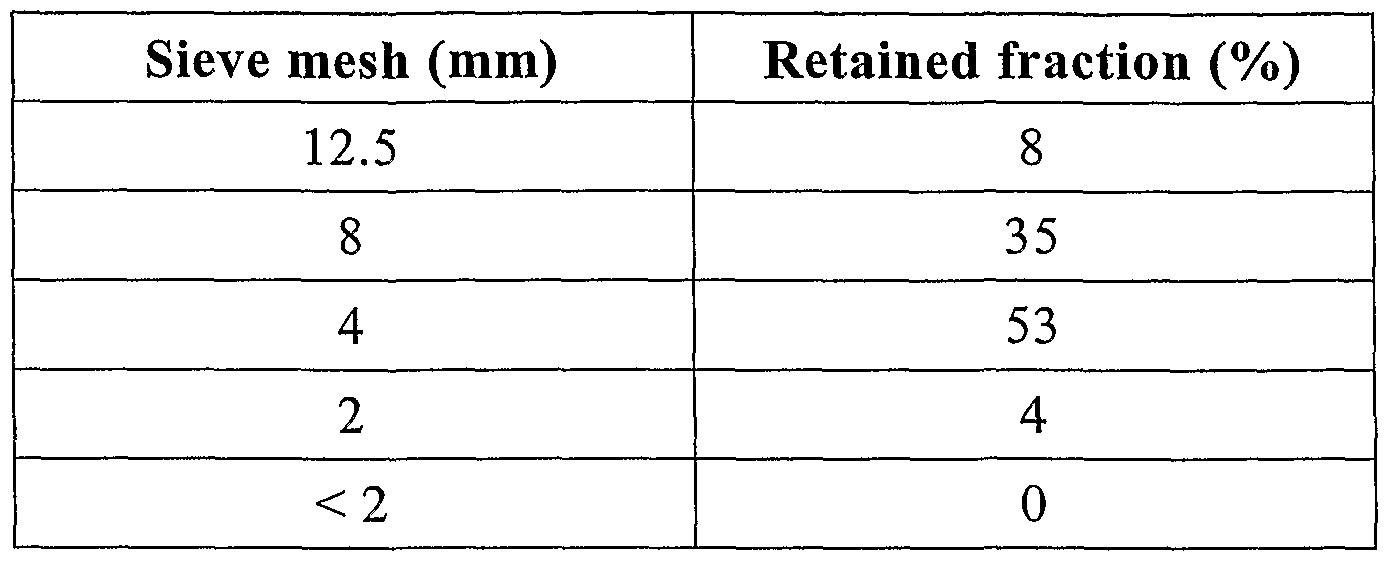
Water to cement ratio (W /C) is W/C = 0.26 and the ratio of water to all the solid materials (S = sum of cement, calcium carbonate and pigment) (W/S) is W/S = 0.07.
EXAMPLE 2
In this example, the preparation of a granular material obtained without the addition of superplasticizers is described. 2000 g of finely divided calcium carbonate (water content < 0.5%) with mean particle size of 325 μm and maximum particle size of 2 mm are mixed with 667 g of white cement CEM I 52,5R and with 50 g of red pigment Bayferrox HOC in powder form. 353 g of water are slowly added under stirring. The resulting mixture is progressively transferred in a mixer with a 400 mm diameter cup rotating plate at a speed of 150 rpm. In order to promote the growing of the grains, it is necessary to add to further 42 g of water to the mixture. The resulting granular material is treated in the same rotating mixer with a mixture of 148 g of white cement CEM I 52.5R and 1O g of red pigment Bayferrox 11OC in powder form.
The resulting material consists of 3270 g of a red coloured granular material, of roundish but irregular shape and rough surface, which is cured for 28 days in controlled conditions of temperature (200C) and humidity (r.h. > 95%). During the first 12 hours of curing, the granular material is periodically mixed in order to avoid the agglomeration of the grains. The particle size distribution of the resulting material, as determined by sieving, is reported in
the following Table 2: Table 2

Water to cement ratio (W/C) is W/C = 0.49 and the ratio of water to all the solid materials (S = sum of cement, calcium carbonate and pigment) (W/S) is W/S = 0.14.
The comparison between the granular material of Example 1 , obtained according the process of the present invention and the granular material of
Example 2, where the material has been obtained without the use of superplasticizers, emphasize the difference in terms of water to cement ratio
(W/C). Such differences reflect on all the physical and mechanical properties of the hardened material, such as mechanical strength, shrinkage, porosity, freeze and thaw resistance. Furthermore, the addition of superplasticizer favours the process of nucleation and growing of the grains and the formation of granular material characterised by more regular shape and more smooth surface.
EXAMPLE 3
In this example, the mechanical characteristics of the granular materials obtained in the previous examples are compared. Mechanical strength has been measured according Method BS 812-110:1990 - Appendix A for the measurement of ACV (Aggregate Crushing Value) index, which measures the resistance of aggregates to crushing. According to this method, a weighted amount of aggregate, of suitable particle size, is inserted in a metallic cylinder
and subjected to a progressively increasing load from 0 to 100 kN in 10 minutes. This load produces the crushing of the material in the cylinder at an extent which depends on the mechanical strength of the material. The resistance to crushing is expressed by the ratio between the crushed amount of the material in the cylinder (M2), as measured by sieving over a sieve of definite mesh, and the amount of starting the material in the cylinder (M1), according the following formula:
ACV % = M2M1 x 100
The results of the measurements of ACV of the products of the previous examples are reported in the following table 3 and compared with the ACV of a typical natural aggregate used for the production of concrete: Table 3

The results of the tests clearly confirm the improvement of the mechanical characteristics of the granular materials of the present invention in comparison with those not containing the superplasticizer. Furthermore, the granular materials produced according to the present invention have even better performance, in terms of resistance to crushing, in comparison with natural aggregates commonly used for concrete production. EXAMPLE 4
2000 g of soil contaminated by heavy metals from an abandoned industrial area, largely consisting of siliceous and carbonaceous minerals with the presence of feldspathic and clayey fractions (water content in about 10 per cent and maximum particle size of 2 mm) are mixed with 667 g o cement CEM I 52.5R. Then, 100 g of water are slowly added under stirring, followed
by the sprayed addition of 45 g of polycarboxylate superplasticizer (Dynamon SPl in the form of 30 per cent solution) previously diluted with 79 g of water. The resulting mixture is progressively transferred in a mixer with a 400 mm diameter cup rotating plate at a speed of 150 rpm. The resulting granular material is treated in the same rotating mixer with a mixture of 148 g of white cement CEM I 52.5R. The resulting material consists of 3039 g of a granular material, of spherical shape and clean surface, which is cured for 28 days in controlled conditions of temperature (2O0C) and humidity (r.h. > 95%). During the first 12 hours of curing, the granular material is periodically mixed to avoid the agglomeration of the grains. After 28 days of curing, the fraction passing the sieve of mesh 4 mm has been used for the measurement of the leaching of heavy metals according the Italian leaching test of the Environment Ministry Decree 5 February 1998 for reusable wastes. According to this test, a weighted amount of the sample is placed in a fivefold volume of deionised water, which is renewed at fixed times (after 2, 8, 24, 48, 72, 102, 168, 384 hours). On each fraction of the eluates, the concentration of contaminants is measured and the sum of these concentrations (ΣCi) is compared with the fixed limit (CL). The test is passed if ΣCi < CL for each contaminant. The results of the leaching test are reported in the following Table 4:
Table 4
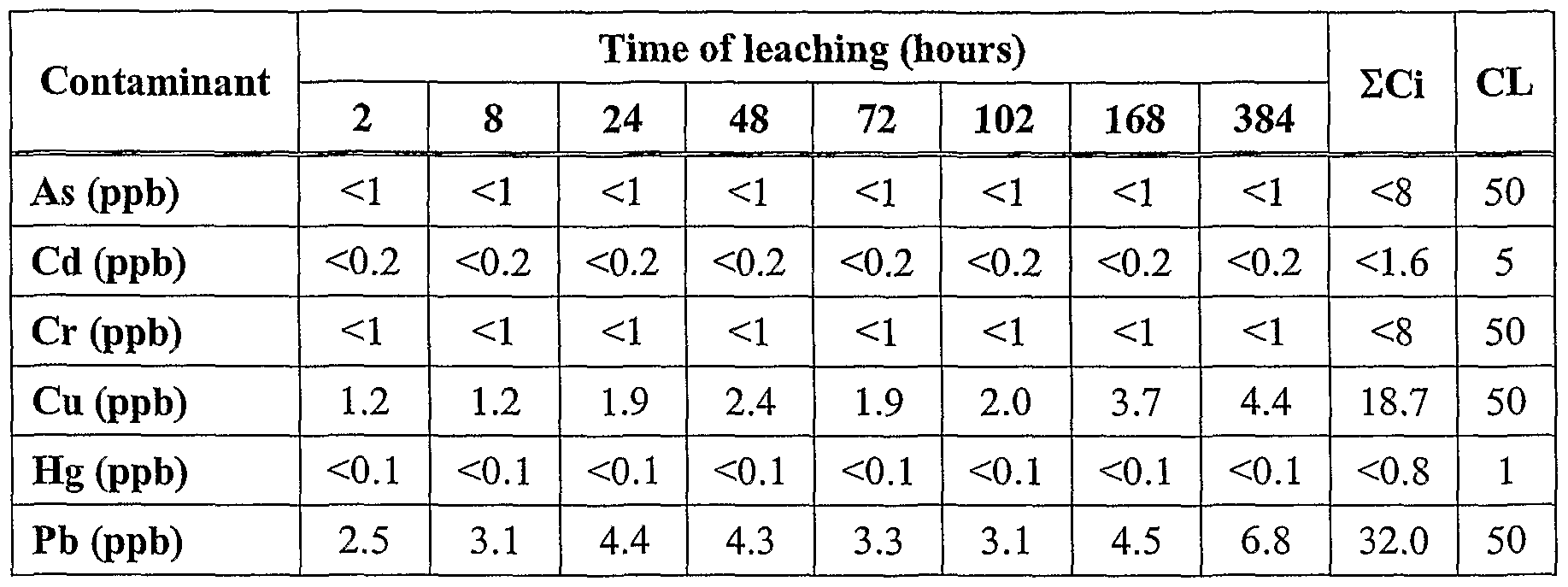
From this Table 4, it is possible to observe that the cumulative results (ΣCi), expressed in ppb (parts per billions) of the different contaminants are by far lower than the cumulative limits (CL) stated by the Environment Ministry Decree 5 February 1998.
As a comparison, in the following Table 5 are reported the results of the test conducted on the contaminated soil without the treatment of the present invention.
Table 5

By comparing the results of the leaching tests of the previous tables, it is quite evident that, most for arsenic, lead, chromium, copper and cadmium, the leaching values of the materials treated according the method of the present invention are quite low, in many cases they are lower than the
Λ r
Io
detection limits of the analytical method and, in any case, they are much more lower than the leaching values of the untreated soil. These results confirm the excellent performances of the granular materials of the present invention, which are characterised by low porosity and high mechanical characteristics, for the solidification/stabilisation of contaminated soils.
Claims
1. Lithoidal granular materials, obtained from the combination of the following essential ingredients: • 5 to 50 per cent by weight, preferably 10 to 35 per cent by weight of a binding system composed by an hydraulic cement or a mixture of hydraulic cements;
• 40 to 90 per cent by weight, preferably 60 to 80 per cent by weight, of a fine material with maximum particle size of 4mm diameter, essentially consisting of carbonaceous minerals, siliceous minerals, siliceous-aluminous minerals or their mixtures;
• 0.01 to 10 per cent by weight, preferably 0.05 to 5 per cent by weight, of a superplasticizer;
• 1 to 20 per cent by weight, preferably 3 to 15 per cent by weight, of water.
2. Materials according to claim 1, where the fine material with maximum particle size of 4mm diameter, essentially consisting of carbonaceous minerals, siliceous minerals, siliceous-aluminous minerals or their mixtures is a contaminated soil.
3. Materials according to claim 1 and claim 2, where the following additional ingredients may be present, optionally in combinations thereof:
• 0 to 10 per cent by weight of pigments or inorganic or organic colouring substances;
• 0 to 20 per cent by weight of silica-fume or other pozzolanic material, both natural and synthetic;
• 0 to 10 per cent by weight of calcium sulphate hemihydrate or lime in powder form;
• 0 to 40 per cent by weight of fine metallic powder of particle size lower than 2 mm diameter;
• 0 to 40 per cent by weight of fine coloured glass of particle size lower than 2 mm diameter;
• 0 to 40 per cent by weight of plastic materials with particle size lower than 2 mm diameter;
• 0 to 10 per cent by weight of other additives, selected from setting and hardening accelerating additives, setting and hardening retarding additives, viscosifiers, wetting agents, surfactants, impregnating agents, air- entraining agents, hydrophobic agents, water repellents, UV filters, waxes, essences and perfumes, fertilizers and nutrients, herbicides, pesticides.
4. Process for the production of the materials according to any one of the claims from 1 to 3, including the following steps:
• mixing of the essential and optional additional components; • nucleation and growing of the granular material;
• optional surface treatments of the grains;
• curing and hardening of the grains;
• optional post- treatments.
5. Use of the lithoidal granular materials according any one of the claims from 1 to 3 as decorative element in substitution of natural stones.
6. Use of the lithoidal granular materials according any one of the claims from 1 to 3 as aggregate for the production of cement mixtures.
7. Use of the lithoidal granular materials according any one of the claims from 1 to 3 for the solidification/stabilisation and the remediation of contaminated soils.
Priority Applications (3)
| Application Number | Priority Date | Filing Date | Title |
|---|---|---|---|
| DK06707554.9T DK1858821T3 (en) | 2005-03-17 | 2006-03-14 | Lithoid granular materials |
| EP06707554.9A EP1858821B1 (en) | 2005-03-17 | 2006-03-14 | Lithoidal granular materials |
| ES06707554.9T ES2536359T3 (en) | 2005-03-17 | 2006-03-14 | Granular lithoidal materials |
Applications Claiming Priority (2)
| Application Number | Priority Date | Filing Date | Title |
|---|---|---|---|
| ITMI2005A000443 | 2005-03-17 | ||
| ITMI20050443 ITMI20050443A1 (en) | 2005-03-17 | 2005-03-17 | GRANULAR LOXIDE MATERIALS AND PROCEDURE FOR THEIR PREPARATION |
Publications (2)
| Publication Number | Publication Date |
|---|---|
| WO2006097272A2 true WO2006097272A2 (en) | 2006-09-21 |
| WO2006097272A3 WO2006097272A3 (en) | 2007-04-19 |
Family
ID=36587071
Family Applications (1)
| Application Number | Title | Priority Date | Filing Date |
|---|---|---|---|
| PCT/EP2006/002318 Ceased WO2006097272A2 (en) | 2005-03-17 | 2006-03-14 | Lithoidal granular materials |
Country Status (5)
| Country | Link |
|---|---|
| EP (1) | EP1858821B1 (en) |
| DK (1) | DK1858821T3 (en) |
| ES (1) | ES2536359T3 (en) |
| IT (1) | ITMI20050443A1 (en) |
| WO (1) | WO2006097272A2 (en) |
Cited By (3)
| Publication number | Priority date | Publication date | Assignee | Title |
|---|---|---|---|---|
| EP2489647A1 (en) | 2011-02-21 | 2012-08-22 | Betonrossi S.p.A. | Road pavements based on Portland cement |
| US20140216533A1 (en) * | 2011-09-12 | 2014-08-07 | Italcementi S.P.A. (Italian Joint Stock Company) | Low thickness cementitious product with elevated surface qualities for non-structural applications, and method for its manufacture |
| JP2022098461A (en) * | 2020-12-21 | 2022-07-01 | 日特建設株式会社 | Ground improvement method |
Families Citing this family (1)
| Publication number | Priority date | Publication date | Assignee | Title |
|---|---|---|---|---|
| EP4574792A1 (en) | 2023-12-22 | 2025-06-25 | A2A Ambiente SpA | Method for simultaneous production of artificial aggregates and salt from solid waste incinerator plants |
Citations (1)
| Publication number | Priority date | Publication date | Assignee | Title |
|---|---|---|---|---|
| US4432666A (en) | 1979-12-14 | 1984-02-21 | Vfi, Verwertungsgesellschaft Fur Industrieruckstande Mbh | Process for the storage and dumping of waste materials |
Family Cites Families (10)
| Publication number | Priority date | Publication date | Assignee | Title |
|---|---|---|---|---|
| JPS56140057A (en) * | 1980-03-31 | 1981-11-02 | Kao Corp | Cement admixing agent |
| DE3420171A1 (en) * | 1984-05-30 | 1986-02-13 | Gattys Technique S.A., Freiburg/Fribourg | Process for reprocessing pulverulent, slurried or dissolved materials, in particular wastes containing environmental poisons or otherwise environmentally hazardous substances |
| NL8903092A (en) * | 1989-12-18 | 1991-07-16 | Aardelite Holding Bv | METHOD FOR REDUCING THE LEAKAGE OF GRANULAR MATERIAL AND GRANULAR MATERIAL THEREFOR. |
| DE4338690A1 (en) * | 1992-11-13 | 1994-06-23 | Ubib Unternehmens Und Innovati | Disposal of waste material contaminated with heavy metals |
| DE4336613C1 (en) * | 1993-10-27 | 1995-02-09 | Bayer Ag | Process for colouring building materials |
| DE19632928A1 (en) * | 1996-08-16 | 1998-02-19 | Bayer Ag | Process for the preparation of inorganic granules and their use |
| DE19704943A1 (en) * | 1997-02-10 | 1998-08-13 | Bayer Ag | Inorganic pigment granules for coloring plastics, paints and building materials and a process for their production |
| DE10002559B4 (en) * | 2000-01-21 | 2004-07-15 | Brockhues Gmbh & Co. Kg | Pigment granules for coloring building materials and processes for their production |
| JP2001261392A (en) * | 2000-03-24 | 2001-09-26 | Taiheiyo Cement Corp | Artificial aggregate |
| JP2002294232A (en) * | 2001-03-29 | 2002-10-09 | Taiheiyo Cement Corp | Cement-lime solidification material |
-
2005
- 2005-03-17 IT ITMI20050443 patent/ITMI20050443A1/en unknown
-
2006
- 2006-03-14 EP EP06707554.9A patent/EP1858821B1/en not_active Expired - Lifetime
- 2006-03-14 WO PCT/EP2006/002318 patent/WO2006097272A2/en not_active Ceased
- 2006-03-14 DK DK06707554.9T patent/DK1858821T3/en active
- 2006-03-14 ES ES06707554.9T patent/ES2536359T3/en not_active Expired - Lifetime
Patent Citations (1)
| Publication number | Priority date | Publication date | Assignee | Title |
|---|---|---|---|---|
| US4432666A (en) | 1979-12-14 | 1984-02-21 | Vfi, Verwertungsgesellschaft Fur Industrieruckstande Mbh | Process for the storage and dumping of waste materials |
Cited By (5)
| Publication number | Priority date | Publication date | Assignee | Title |
|---|---|---|---|---|
| EP2489647A1 (en) | 2011-02-21 | 2012-08-22 | Betonrossi S.p.A. | Road pavements based on Portland cement |
| ITMI20110258A1 (en) * | 2011-02-21 | 2012-08-22 | Betonrossi Spa | DRAINING CEMENTITIOUS CONGLOMERATE MIXTURE |
| US20140216533A1 (en) * | 2011-09-12 | 2014-08-07 | Italcementi S.P.A. (Italian Joint Stock Company) | Low thickness cementitious product with elevated surface qualities for non-structural applications, and method for its manufacture |
| US10011051B2 (en) * | 2011-09-12 | 2018-07-03 | Italcementi S.P.A. | Low thickness cementitious product with elevated surface qualities for non-structural applications, and method for its manufacture |
| JP2022098461A (en) * | 2020-12-21 | 2022-07-01 | 日特建設株式会社 | Ground improvement method |
Also Published As
| Publication number | Publication date |
|---|---|
| EP1858821A2 (en) | 2007-11-28 |
| ITMI20050443A1 (en) | 2006-09-18 |
| EP1858821B1 (en) | 2015-02-25 |
| ES2536359T3 (en) | 2015-05-22 |
| DK1858821T3 (en) | 2015-05-04 |
| WO2006097272A3 (en) | 2007-04-19 |
Similar Documents
| Publication | Publication Date | Title |
|---|---|---|
| López-Carrasquillo et al. | Comparative assessment of pervious concrete mixtures containing fly ash and nanomaterials for compressive strength, physical durability, permeability, water quality performance and production cost | |
| Cheerarot et al. | A study of disposed fly ash from landfill to replace Portland cement | |
| Binici et al. | Influence of marble and limestone dusts as additives on some mechanical properties of concrete | |
| Park et al. | Strength deterioration of high strength concrete in sulfate environment | |
| EP3551406B1 (en) | Landscaping product and method of production thereof | |
| Kim et al. | Internal-curing efficiency of cold-bonded coal bottom ash aggregate for high-strength mortar | |
| KR0182591B1 (en) | Highly durable cement products containing siliceous ash | |
| Binici et al. | Durability properties of concretes made with sand and cement size basalt | |
| US20220371956A1 (en) | Production process of artificial aggregate from tailings from mining, artificial aggregate, concrete composition and use | |
| EP1358299B2 (en) | Method for the production floors or parting layers | |
| WO2001058823A1 (en) | Method for producing a blended cementitious composition | |
| US10640423B2 (en) | Method to artificially agglomerate finely divided materials | |
| Koťátková et al. | Coloured concrete with focus on the properties of pigments | |
| Otunyo et al. | Exploratory study of crushed periwinkle shell as partial replacement for fine aggregates in concrete | |
| EP1858821B1 (en) | Lithoidal granular materials | |
| Suleymanova et al. | Architectural and decorative concrete with photoluminescent pigment | |
| Frar et al. | Valorization of port dredged sediments in cement mortars | |
| Garg et al. | Characterization of automobile effluent treatment plant sludge: its utilization in construction materials | |
| Millrath | Modifying concrete matrices with beneficiated dredged material or other clayey constituents | |
| Diawara | Parametric study of self-consolidating concrete | |
| JP3193974B2 (en) | Cement-based permeable pavement composition | |
| Razali et al. | Properties of pervious concrete with recycled oyster shells as partial aggregates component | |
| KR100472941B1 (en) | A porous concrete composition having permeability, high strength and durability | |
| KR100804204B1 (en) | Ocher aggregate and its manufacturing method | |
| Kacha | Utilization of waste materials in the production of pervious concrete–A‖ |
Legal Events
| Date | Code | Title | Description |
|---|---|---|---|
| 121 | Ep: the epo has been informed by wipo that ep was designated in this application | ||
| NENP | Non-entry into the national phase |
Ref country code: DE |
|
| WWE | Wipo information: entry into national phase |
Ref document number: 2006707554 Country of ref document: EP |
|
| NENP | Non-entry into the national phase |
Ref country code: RU |
|
| WWW | Wipo information: withdrawn in national office |
Country of ref document: RU |
|
| WWP | Wipo information: published in national office |
Ref document number: 2006707554 Country of ref document: EP |