WO2006098398A1 - 化合物の合成方法 - Google Patents
化合物の合成方法 Download PDFInfo
- Publication number
- WO2006098398A1 WO2006098398A1 PCT/JP2006/305206 JP2006305206W WO2006098398A1 WO 2006098398 A1 WO2006098398 A1 WO 2006098398A1 JP 2006305206 W JP2006305206 W JP 2006305206W WO 2006098398 A1 WO2006098398 A1 WO 2006098398A1
- Authority
- WO
- WIPO (PCT)
- Prior art keywords
- group
- general formula
- substituent
- reaction
- palladium
- Prior art date
- Legal status (The legal status is an assumption and is not a legal conclusion. Google has not performed a legal analysis and makes no representation as to the accuracy of the status listed.)
- Ceased
Links
Classifications
-
- C—CHEMISTRY; METALLURGY
- C07—ORGANIC CHEMISTRY
- C07B—GENERAL METHODS OF ORGANIC CHEMISTRY; APPARATUS THEREFOR
- C07B37/00—Reactions without formation or introduction of functional groups containing hetero atoms, involving either the formation of a carbon-to-carbon bond between two carbon atoms not directly linked already or the disconnection of two directly linked carbon atoms
- C07B37/04—Substitution
-
- B—PERFORMING OPERATIONS; TRANSPORTING
- B01—PHYSICAL OR CHEMICAL PROCESSES OR APPARATUS IN GENERAL
- B01J—CHEMICAL OR PHYSICAL PROCESSES, e.g. CATALYSIS OR COLLOID CHEMISTRY; THEIR RELEVANT APPARATUS
- B01J23/00—Catalysts comprising metals or metal oxides or hydroxides, not provided for in group B01J21/00
- B01J23/002—Mixed oxides other than spinels, e.g. perovskite
-
- B—PERFORMING OPERATIONS; TRANSPORTING
- B01—PHYSICAL OR CHEMICAL PROCESSES OR APPARATUS IN GENERAL
- B01J—CHEMICAL OR PHYSICAL PROCESSES, e.g. CATALYSIS OR COLLOID CHEMISTRY; THEIR RELEVANT APPARATUS
- B01J23/00—Catalysts comprising metals or metal oxides or hydroxides, not provided for in group B01J21/00
- B01J23/70—Catalysts comprising metals or metal oxides or hydroxides, not provided for in group B01J21/00 of the iron group metals or copper
- B01J23/89—Catalysts comprising metals or metal oxides or hydroxides, not provided for in group B01J21/00 of the iron group metals or copper combined with noble metals
- B01J23/8933—Catalysts comprising metals or metal oxides or hydroxides, not provided for in group B01J21/00 of the iron group metals or copper combined with noble metals also combined with metals, or metal oxides or hydroxides provided for in groups B01J23/02 - B01J23/36
- B01J23/8946—Catalysts comprising metals or metal oxides or hydroxides, not provided for in group B01J21/00 of the iron group metals or copper combined with noble metals also combined with metals, or metal oxides or hydroxides provided for in groups B01J23/02 - B01J23/36 with alkali or alkaline earth metals
-
- B—PERFORMING OPERATIONS; TRANSPORTING
- B01—PHYSICAL OR CHEMICAL PROCESSES OR APPARATUS IN GENERAL
- B01J—CHEMICAL OR PHYSICAL PROCESSES, e.g. CATALYSIS OR COLLOID CHEMISTRY; THEIR RELEVANT APPARATUS
- B01J37/00—Processes, in general, for preparing catalysts; Processes, in general, for activation of catalysts
- B01J37/02—Impregnation, coating or precipitation
- B01J37/03—Precipitation; Co-precipitation
- B01J37/031—Precipitation
- B01J37/033—Using Hydrolysis
-
- C—CHEMISTRY; METALLURGY
- C07—ORGANIC CHEMISTRY
- C07C—ACYCLIC OR CARBOCYCLIC COMPOUNDS
- C07C1/00—Preparation of hydrocarbons from one or more compounds, none of them being a hydrocarbon
- C07C1/32—Preparation of hydrocarbons from one or more compounds, none of them being a hydrocarbon starting from compounds containing hetero-atoms other than or in addition to oxygen or halogen
- C07C1/321—Preparation of hydrocarbons from one or more compounds, none of them being a hydrocarbon starting from compounds containing hetero-atoms other than or in addition to oxygen or halogen the hetero-atom being a non-metal atom
-
- C—CHEMISTRY; METALLURGY
- C07—ORGANIC CHEMISTRY
- C07C—ACYCLIC OR CARBOCYCLIC COMPOUNDS
- C07C201/00—Preparation of esters of nitric or nitrous acid or of compounds containing nitro or nitroso groups bound to a carbon skeleton
- C07C201/06—Preparation of nitro compounds
- C07C201/12—Preparation of nitro compounds by reactions not involving the formation of nitro groups
-
- C—CHEMISTRY; METALLURGY
- C07—ORGANIC CHEMISTRY
- C07C—ACYCLIC OR CARBOCYCLIC COMPOUNDS
- C07C41/00—Preparation of ethers; Preparation of compounds having groups, groups or groups
- C07C41/01—Preparation of ethers
- C07C41/18—Preparation of ethers by reactions not forming ether-oxygen bonds
- C07C41/30—Preparation of ethers by reactions not forming ether-oxygen bonds by increasing the number of carbon atoms, e.g. by oligomerisation
-
- C—CHEMISTRY; METALLURGY
- C07—ORGANIC CHEMISTRY
- C07C—ACYCLIC OR CARBOCYCLIC COMPOUNDS
- C07C43/00—Ethers; Compounds having groups, groups or groups
- C07C43/02—Ethers
- C07C43/20—Ethers having an ether-oxygen atom bound to a carbon atom of a six-membered aromatic ring
- C07C43/205—Ethers having an ether-oxygen atom bound to a carbon atom of a six-membered aromatic ring the aromatic ring being a non-condensed ring
-
- C—CHEMISTRY; METALLURGY
- C07—ORGANIC CHEMISTRY
- C07C—ACYCLIC OR CARBOCYCLIC COMPOUNDS
- C07C45/00—Preparation of compounds having >C = O groups bound only to carbon or hydrogen atoms; Preparation of chelates of such compounds
- C07C45/61—Preparation of compounds having >C = O groups bound only to carbon or hydrogen atoms; Preparation of chelates of such compounds by reactions not involving the formation of >C = O groups
- C07C45/67—Preparation of compounds having >C = O groups bound only to carbon or hydrogen atoms; Preparation of chelates of such compounds by reactions not involving the formation of >C = O groups by isomerisation; by change of size of the carbon skeleton
- C07C45/68—Preparation of compounds having >C = O groups bound only to carbon or hydrogen atoms; Preparation of chelates of such compounds by reactions not involving the formation of >C = O groups by isomerisation; by change of size of the carbon skeleton by increase in the number of carbon atoms
-
- B—PERFORMING OPERATIONS; TRANSPORTING
- B01—PHYSICAL OR CHEMICAL PROCESSES OR APPARATUS IN GENERAL
- B01J—CHEMICAL OR PHYSICAL PROCESSES, e.g. CATALYSIS OR COLLOID CHEMISTRY; THEIR RELEVANT APPARATUS
- B01J2523/00—Constitutive chemical elements of heterogeneous catalysts
-
- C—CHEMISTRY; METALLURGY
- C07—ORGANIC CHEMISTRY
- C07C—ACYCLIC OR CARBOCYCLIC COMPOUNDS
- C07C2523/00—Catalysts comprising metals or metal oxides or hydroxides, not provided for in group C07C2521/00
- C07C2523/70—Catalysts comprising metals or metal oxides or hydroxides, not provided for in group C07C2521/00 of the iron group metals or copper
- C07C2523/89—Catalysts comprising metals or metal oxides or hydroxides, not provided for in group C07C2521/00 of the iron group metals or copper combined with noble metals
Definitions
- the present invention relates to a method for synthesizing a compound, and more particularly, to a method for synthesizing a compound by a coupling reaction.
- Non-Patent Document 1 Martin D. Smith et al., Chemical Communications, pp. 2652-2653, 7 November 2003 (Martin D. Smith et al., “Chemical Communities Cases”, 2652–2653, November 2003 7 Day;)
- Palladium-containing belovskite-type complex oxides used as catalysts in the Suzuki coupling reaction are expensive, and thus are collected after the completion of the reaction as described above in order to reduce production costs.
- it is indispensable that the activity of the catalyst is sustained even after repeated use over a long period of time.
- the object of the present invention is to recover the catalyst after completion of the reaction in the coupling reaction using palladium-containing portumbskite complex oxide as a catalyst and maintain the activity of the catalyst even if it is used repeatedly.
- the object is to provide a method for synthesizing a compound that can be reacted.
- the method of synthesizing the compound of the present invention comprises a compound represented by the following general formula (1) and the following general formula in the presence of a palladium-containing belovskite complex oxide. (2 ) Or a compound represented by the following general formula (3) is reacted using a reaction solvent containing an alkoxy alcohol.
- R represents an optionally substituted aryl group, an optionally substituted heterocyclic group or an optionally substituted alkenyl group
- X represents , Halogen atom, trifluoromethanesulfoxy group, p-toluenesulfoxy group, or methanesulfoxy group.
- R is an aryl group which may have a substituent, or a heterocyclic group which may have a substituent.
- a cycloalkyl group which may have a ring group or a substituent, and M represents a B (ORa) group.
- Ra represents a hydrogen atom or an alkyl group which may have a substituent
- Rb represents an alkyl group. Further, instead of Ra, it may have a substituent, a V arylene group or a substituent! /, May! /, An alkylene group as a bond of OBO, and a ring containing OBO. May be formed.
- R, R, and R are each independently a hydrogen atom or a substituent.
- the method for synthesizing the compound of the present invention comprises reacting the compound represented by the general formula (1) with the compound represented by the general formula (2) in the presence of the palladium-containing mouthbskite complex oxide.
- the formula of the general formula (1) an aryl group that may have an R force substituent
- X is a halogen atom
- it has an R force substituent.
- M is preferably a B (ORa) group.
- the palladium-containing perovskite The type complex oxide is preferably represented by the following general formula (4).
- ⁇ represents at least one element selected from rare earth elements and alkaline earth metal forces
- B represents a transition element other than rare earth elements and Pd
- A1 force selected from at least one element selected from X Is the atomic ratio in the numerical range of 1. 0 ⁇ 1.3
- y is the atomic ratio in the numerical range of 0 ⁇ y ⁇ 0.5
- ⁇ is the oxygen excess.
- the reaction in the presence of the palladium-containing perovskite complex oxide, the reaction is performed after the reaction by using a reaction solvent containing an alkoxy alcohol in the coupling reaction and repeatedly used. Even so, the activity of the catalyst can be maintained and the reaction can be carried out in a high yield.
- the method for synthesizing the compound of the present invention is carried out in the presence of a palladium (Pd) -containing perovskite complex oxide! / And implemented.
- the palladium-containing bottom bskite-type complex oxide is typically a complex oxide having a perovskite-type structure represented by the general formula ABO,
- kite-type composite oxide contains noradium, it can be used without any particular restrictions.
- Such a perovskite-type composite oxide containing palladium includes, for example, a perovskite-type composite oxide containing palladium as a composition so that palladium becomes a constituent element of the perovskite-type composite oxide.
- examples thereof include oxides and, for example, nobledium, which is later supported on perovskite-type complex oxides, and palladium-supported bottom bumskite-type complex oxides.
- a perovskite type complex oxide containing noradium as a composition is represented, for example, by the following general formula (4).
- ⁇ ⁇ represents at least one element selected from rare earth elements and alkaline earth metal forces
- B represents a transition element other than rare earth elements
- Pd and A1 force selected from at least X represents an atomic ratio in the numerical range of 1. 0 ⁇ 1.3
- y represents an atomic ratio in the numerical range of 0 ⁇ y ⁇ 0.5
- ⁇ is Indicates oxygen excess.
- examples of the rare earth element represented by ⁇ include Sc (scandium), Y (yttrium), La (lanthanum), Ce (cerium), Pr (praseodymium), Nd (neodymium), Pm ( Promethium), Sm (Samarium), Eu (Europium), Gd (Gadolinium), Tb (Terbium), Dy (Dysprosium), Ho (Holmium), Er (Erbium), Tm (Thulium), Yb (Ytterbium), Lu (Lutetium).
- Y, La, Ce, Pr, and Nd are mentioned. More preferably, La is mentioned.
- These rare earth elements may be used alone or in combination of two or more.
- examples of the alkaline earth metal represented by A include Be (beryllium), Mg (magnesium), Ca (calcium), Sr (strontium), Ba (barium), and Ra (radium). ) And the like.
- alkaline earth metals may be used alone or in combination of two or more.
- A is preferably selected from rare earth elements.
- the atomic ratio X of A is 1. 0 ⁇ 1.3.
- the X force is less than 1.0, it may be difficult to stably dissolve Pd at a high solid solution rate.
- X exceeds 1.3, by-products other than perovskite-type complex oxides may be formed.
- transition element excluding the rare earth element and Pd represented by B for example, in the periodic table (IUPAC, 1990), atomic number 22 (Ti) ⁇ Element number 30 (Zn), Atomic number 40 (Zr) ⁇ Atomic number 48 (Cd), and Atomic number 72 (Hf) ⁇ Atomic number 80 (Hg) elements (excluding Pd) .
- transition element excluding rare earth elements and Pd represented by B and A1
- Cr chromium
- Mn manganese
- Fe iron
- Co cobalt
- Ni nickel
- Cu copper
- Zn ziinc
- A1 aluminum
- the atomic ratio y of Pd is 0 ⁇ y ⁇ 0.5, that is, an atomic ratio of 0.5 or less. If the atomic ratio of Pd exceeds 0.5, it may be difficult to dissolve Pd, and the cost will be unavoidable. Therefore, B is an element other than Pd (transition elements (excluding rare earth elements and Pd), elements selected from Al), the atomic ratio in the numerical range of l ⁇ y, ie, the remainder of Pd (l ⁇ y ) Atomic ratio.
- Such a perovskite type complex oxide containing palladium as a composition is an appropriate method for preparing a complex oxide that is not particularly limited, such as a coprecipitation method, a citrate complex method, and the like. It can be produced by an alkoxide method or the like.
- a mixed salt solution containing the salt of each element described above at a predetermined stoichiometric ratio is prepared, a neutralizing agent is added to the mixed salt aqueous solution, and Z or a neutralizing agent is added.
- This mixed salt aqueous solution is added to cause coprecipitation, and the obtained coprecipitate is dried and then heat-treated.
- the salt of each element include inorganic salts such as sulfate, nitrate, chloride, and phosphate, and organic acid salts such as acetate and oxalate.
- the mixed salt aqueous solution can be prepared, for example, by adding the salt of each element to water at a ratio that gives a predetermined stoichiometric ratio and stirring and mixing.
- a neutralizing agent is added to the aqueous mixed salt solution and coprecipitated.
- the coprecipitate can be obtained in the same manner by gradually dropping the mixed salt solution into an aqueous solution containing excess neutralizing agent.
- the neutralizing agent include organic bases such as ammonia and amines such as triethylamine and pyridine, and inorganic bases such as caustic soda, caustic potash, potassium carbonate, and ammonium carbonate.
- the neutralizing agent is added so that the pH of the solution after adding the neutralizing agent is 6 to 14, more preferably about 8 to 12.
- the obtained coprecipitate is washed with water as necessary, and dried by, for example, vacuum drying or ventilation drying, and then, for example, about 400 to 1000.
- C preferably about 600-950.
- a perovskite-type complex oxide can be obtained by performing a primary heat treatment at C and, if necessary, a secondary heat treatment at about 900 to: L 100 ° C., for example.
- taenoic acid complex method for example, an aqueous solution of citrate mixed salt containing citrate and a salt of each of the above elements so that the salt of each of the above elements has a predetermined stoichiometric ratio is prepared. Then, after the citrate mixed salt aqueous solution is dried to form a taenoic acid complex of each element described above, the obtained taenoic acid complex is pre-baked and then heat-treated.
- Examples of the salt of each element include the same salts as those described above, and the citrate mixed salt aqueous solution is prepared by, for example, preparing a mixed salt aqueous solution in the same manner as described above. Can be prepared by caloring an aqueous solution of
- the aqueous citrate mixed salt solution is dried to form a taenoic acid complex of each element described above. Drying quickly removes moisture at a temperature at which the formed taenoic acid complex does not decompose, for example, from room temperature to 150 ° C. This makes it possible to form a citrate complex of each element described above.
- the formed taenoic acid complex is pre-baked and then heat-treated.
- Pre-baking may be performed, for example, by heating at 250 ° C. or higher in a vacuum or an inert atmosphere.
- a primary heat treatment is performed at about 300 to 1000 ° C, preferably about 600 to 950 ° C, and further, for example, a secondary heat treatment is performed at about 900 to L 100 ° C as necessary.
- a perovskite type complex oxide can be obtained.
- a mixed alkoxide solution containing the above-described alkoxide of each element excluding noble metals including Pd in the above-described stoichiometric ratio is prepared, and the mixed alkoxide solution includes An aqueous solution containing a noble metal salt containing Pd is added to cause precipitation by hydrolysis, and the resulting precipitate is dried and then heat-treated.
- the alkoxide of each element includes, for example, an alcoholate that forms a force with each element and alkoxy such as methoxy, ethoxy, propoxy, isopropoxy, butoxy, and an alkoxy alcoholate of each element represented by the following general formula (5). It is done.
- E represents each element, R represents a hydrogen atom or an alkyl group having 1 to 4 carbon atoms.
- R represents an alkyl group having 1 to 4 carbon atoms, i represents an integer of 1 to 3, and j represents an integer of 2 to 3.
- the alkoxy alcoholate includes, for example, methoxyethylate, methoxypropylate, methoxybutyrate, ethoxychelate, ethoxypropylate, propoxyethylate, butoxychelate and the like.
- the mixed alkoxide solution can be prepared, for example, by adding the alkoxide of each element to the organic solvent so as to have the above stoichiometric ratio and stirring and mixing.
- the element is not particularly limited as long as the alkoxide of the element can be dissolved.
- aromatic hydrocarbons, aliphatic hydrocarbons, alcohols, ketones, esters and the like are used.
- aromatic hydrocarbons such as benzene, toluene and xylene are used.
- an aqueous solution containing a noble metal salt containing Pd at a predetermined stoichiometric ratio is added to the mixed alkoxide solution to cause precipitation.
- the aqueous solution containing a noble metal salt containing Pd include a nitrate aqueous solution, a chloride aqueous solution, a hexaammine salt aqueous solution, a dinitrodiammine nitric acid aqueous solution, hexacrolate acid hydrate, and cyanogen potassium salt.
- a nitrate aqueous solution a chloride aqueous solution
- a hexaammine salt aqueous solution a dinitrodiammine nitric acid aqueous solution
- hexacrolate acid hydrate hexacrolate acid hydrate
- the obtained precipitate is dried by, for example, vacuum drying or ventilation drying, and then subjected to a primary heat treatment at, for example, about 400 to 1000 ° C, preferably about 500 to 850 ° C, and further required.
- a primary heat treatment at, for example, about 400 to 1000 ° C, preferably about 500 to 850 ° C, and further required.
- a secondary heat treatment at about 900 to: L 100 ° C.
- a mixed solution containing a noble metal organometallic salt containing Pd is mixed with the above mixed alkoxide solution to prepare a uniform mixed solution. It can be prepared by adding water to the precipitate and then drying and heat-treating the resulting precipitate.
- organometallic salts of noble metals containing Pd include noble metal carboxylates containing Pd formed from acetates, propionates, etc., for example, the following general formula (6) or the following general formula (7): And metal chelate complexes of noble metals containing Pd, such as diketone complexes of noble metals containing Pd formed from the diketone compounds shown.
- R is an alkyl group having 1 to 4 carbon atoms, a fluoroalkyl group having 1 to 4 carbon atoms, or
- R is an alkyl group having 1 to 4 carbon atoms, a fluoroalkyl group having 1 to 4 carbon atoms,
- Aryl group or alkyloxy group having 1 to 4 carbon atoms, R is a hydrogen atom or carbon number 1
- R represents a hydrogen atom or an alkyl group having 1 to 4 carbon atoms.
- alkyl group examples include methyl, ethyl, propyl, isopropyl, n-butyl, s-butyl, t-butyl and the like.
- R and R fluoro having 1 to 4 carbon atoms examples include methyl, ethyl, propyl, isopropyl, n-butyl, s-butyl, t-butyl and the like.
- R and R fluoro having 1 to 4 carbon atoms
- alkyl group examples include trifluoromethyl.
- Examples of the aryl group of 8 9 include a file.
- R has 1 to 4 carbon atoms.
- alkyloxy group examples include methoxy, ethoxy, propoxy, isopropoxy, n-butoxy, s-butoxy, t-butoxy and the like.
- the diketone compound includes, for example, 2,4 pentanedione, 2,4 monohexanedione, 2,2 dimethyl-3,5 hexanedione, 1 phenyl 1,3 butanedione, 1 Trifluoromethyl- 1,3 butanedione, hexafluoroacetylacetone, 1,3 diphenyl-1,3 propanedione, dipivaloylmethane, methylacetate, ethinoreacetoacetate, t- Examples include butinoreacetoacetate.
- the solution containing the organometallic salt of the noble metal containing Pd is, for example, added to the organic solvent so that the stoichiometric ratio of the organometallic salt of the noble metal containing Pd is mixed and stirred.
- the organic solvent include the organic solvents described above.
- the solution containing the organometallic salt of the noble metal containing Pd prepared in this manner is mixed with the above mixed alkoxide solution to prepare a uniform mixed solution, and then water is added to the solution to precipitate.
- the obtained precipitate is dried by, for example, vacuum drying or ventilation drying, and then first heat-treated at, for example, about 400 to 1000 ° C, preferably about 500 to 850 ° C.
- a perovskite type complex oxide can be obtained by performing a secondary heat treatment at, for example, about 900 to L 100 ° C.
- examples of the perovskite-type complex oxide supporting palladium include those in which Pd is supported on the perovskite-type complex oxide of the following general formula (8).
- A represents at least one element selected from rare earth elements and alkaline earth metal forces
- B represents a transition element excluding rare earth elements and Pd and A1 force selected from at least Indicates one element.
- the rare earth element and alkaline earth metal represented by A the rare earth element represented by B and the transition element excluding Pd, and A1 may be the same as described above.
- such a perovskite type complex oxide is prepared by an appropriate method for preparing a complex oxide according to the above method, for example, a coprecipitation method, a taenoic acid complex method, an alkoxide method. It can be manufactured by some means. In the case of the alkoxide method, water can be added to the mixed alkoxide solution for hydrolysis.
- a solution of a salt containing palladium may be prepared, and the salt-containing solution may be impregnated in a perovskite-type composite acid oxide, followed by firing.
- the amount of palladium supported on the perovskite complex oxide is, for example, 20 parts by weight or less, preferably 0.5 to 5 parts by weight with respect to 100 parts by weight of the perovskite complex oxide.
- the palladium-containing perovskite complex oxide used in the method for synthesizing the compound of the present invention is a perovskite complex oxide containing noradium as a composition among the perovskite complex oxides described above. Things are preferably used.
- palladium may be further supported on the mouth-bumskite-type complex oxide containing palladium as a composition.
- it can be carried out in the same manner as in the case of supporting palladium on the perovskite type composite oxide.
- the amount of palladium supported on the perovskite-type composite oxide containing noradium as a composition is, for example, 10 parts by weight or less, preferably 100 parts by weight or less, preferably 100 parts by weight of perovskite-type composite oxide containing palladium as a composition. 0.1 to 5 parts by weight.
- A represents at least one element selected from rare earth element forces
- a ′ represents at least one element selected from alkaline earth metals
- B represents a transition excluding rare earth elements and Pd.
- Element and A1 force Indicates at least one element selected
- y indicates an atomic ratio of 0 ⁇ y ⁇ 0.5
- w indicates an atomic ratio of 0 ⁇ w ⁇ 0.5
- V indicates 1 0 ⁇ v + w ⁇ l.
- 3 indicates atomic ratio
- ⁇ indicates oxygen excess.
- ⁇ ⁇ ⁇ ⁇ ⁇ represents at least one element selected from Y, La, Ce, Pr, Nd
- B represents at least one element selected from M n, Fe, Co, A1
- x Is the atomic ratio in the numerical range of 1. 0 ⁇ 1.3
- y is the atomic ratio in the numerical range of 0 ⁇ y ⁇ 0.5
- ⁇ is the oxygen excess.
- perovskite complex oxide containing palladium as a composition more specifically, for example, La Fe Co Pd O, La Ce Fe Co Pd
- La Fe Pd 2 O 3 may be mentioned.
- the compound of the present invention comprises a compound represented by the following general formula (1), a compound represented by the following general formula (2) or the following general formula (3), and a reaction solvent containing an alkoxy alcohol. And reacted in the presence of the palladium-containing perovskite complex oxide described above.
- R represents an optionally substituted aryl group, an optionally substituted heterocyclic group or an optionally substituted alkenyl group
- X represents , Halogen atom, trifluoromethanesulfoxy group, ⁇ toluenesulfooxy group or methanesulfonyloxy group.
- R is an aryl group which may have a substituent, or a heterocyclic group which may have a substituent.
- Ra represents a hydrogen atom or an alkyl which may have a substituent.
- Rb represents an alkyl group. Further, instead of Ra, it may have a substituent, a V arylene group or a substituent! /, May! /, An alkylene group as a bond of OBO, and a ring containing OBO. May be formed. )
- R, R and R may each independently have a hydrogen atom or a substituent.
- alkyl group an aryl group which may have a substituent, a carboxylic acid derivative, an acid amide derivative or a cyano group.
- aryl group that may have a substituent such as phenol, tolyl, xylyl, biphenyl, naphthyl, anthryl, phenanthryl, and azurel.
- the substituent of the aryl group is not particularly limited, and substituents corresponding to the purpose and use thereof such as a hydrocarbon group and a hetero atom-containing hydrocarbon group can be appropriately mentioned.
- alkyl groups having 1 to 4 carbon atoms such as methyl, ethyl, propyl, isopropyl, butyl, isobutyl, sec butyl, t tert butyl, such as bur, 1-methyl butyl, 1 probe, allyl, etc.
- Alkenyl groups having 2 to 4 carbon atoms for example, etulyl, 1 propiel, 1 propargyl group, etc., 2 to 4 alkyl groups, for example, cyclopropyl, cyclobutyl, cyclopentyl, cyclohexyl groups, etc.
- Shikuroa alkyl group for example, cyclopent - Le, xenon cyclohexane - consequent Roaruke having 5 to 7 carbon atoms, such as Le group - group, for example, benzyl, a-methylbenzyl, 7 carbon atoms such as phenethyl :
- Ararukiru group L 1 Hue - group, for example, methoxy, ethoxy, propoxy, iso- propoxy, n - butoxy, iso-butoxy, sec-butoxy, tert Bed C1-C6 alkoxy group such as xy group, phenoxy group, e.g.
- 1-acetylidylcarbol, 1-azetidyl-carbol, 1-pyrrolidyl-carbonyl, 1-piperidinylcarbonyl, N-methylpiperazinylcarbonyl, and monoamino carbonoyl group such as Halogen atoms such as fluorine, chlorine, bromine and iodine, for example, mono-, di-, or trihalogeno C alkyl groups such as chloromethyl, dichloromethyl, trifluoromethyl, trifluoroethyl, oxo groups,
- amidino group, an imino group, an amino group for example, a mono-C alkylamino group such as a methylamino-containing ethylamino-propylamino-isopropylamino-containing butylamino, such as dimethyl
- Di-C alkylamino groups such as amino-containing diethylamino-containing dipropylamino-containing diisopropylamino-containing dibutylamino, such as acetylidinyl, azetidinyl, pyrrolidyl, pyro
- oxygen and sulfur atoms such as linyl, pyrrolyl, imidazolyl, pyrazolyl, imidazolidyl, piperidyl-containing morpholino, dihydropyridyl, pyridyl, N-methylbiperazyl, N-ethylbiperazyl , Nitrogen atom, etc.
- 3 to 6-membered cyclic amino group which may contain 1 to 3 selected heteroatoms, such as formamide, acetamide, trifluoroacetamide, propioluamide, butyrylamide, isobutyryl C1-C6 alkanoylamide groups such as amides, benzamide groups, strong ruberamoyl amino groups, for example, N-methylcarbamoylamino N-ethylcarbamoylamino N propyl strong rumoamoyl N isopropyl power ruberamoyl N N—C1-4 alkyl strength rubamo such as butylcarbamoylamino Lumino group, for example, N, N-dimethylcarbamoylamino N, N Jetylcarbamoylamino N, N Dipropylcarbamoylamino N, N-dibutylcarbamoylamino N, N di-C1-4 alkyl strength ruberamoyla
- Alkylthio group having 1 to 6 carbon atoms such as methylthio, ethylthio, propylthio, isopropylthio, n-butylthio, sec-butylthio, tert butylthio group, and phenyl group such as methylsulfuryl, ethylsulfyl, propylsulfur C 1-6 alkylsulfuric groups, such as phenyl and phenylsulfur groups, and phenylsulfur groups, such as methylsulfol, ethylsulfol, propylsulfol, and butylsulfol groups.
- Examples thereof include alkylsulfol groups of 1 to 6 and phenylsulfol groups.
- the above-mentioned groups may have 1 to 5 of these substituents optionally substituted with R represented by general formula (1) and R represented by general formula (2).
- heterocyclic group of the unicyclic group examples include 2 or 3 chanel, 2 or 3 furyl, 2 or 3 pyronyl, 2—, 3 or 4 pyridyl, 2—, 4 or 5 oxazolyl, 2—, 4 Or 5 thiazolyl, 3—, 4 mono or 5 pyrazolyl, 2—, 4 or 5—imidazolyl, 3—, 4— or 5—isoxazolyl, 3—, 4— or 5—isothiazolinole, 3 or 5— (1, 2, 4 oxadiazolyl), 1, 3, 4 oxadiazolyl, 3 or 5— (1, 2, 4 thiadiazolyl), 1, 3, 4 thiadiazolyl, 4 or 5— (1, 2, 3 thiadiazolinole), In addition to carbon atoms such as 1, 2, 5 thiadiazolinole, 1, 2, 3 HJ azodinole, 1, 2, 4 triazolyl, 1H— or 2H—tetrazolyl,
- 1 to 4 5-membered cyclic groups such as N—Oxido 2—, 3 or 4 Pyridyl, 2—, 4 or 5 Pyrimidinyl, N—Oxide 1 2—, 4 or 5 Pyrimidinyl, thiomorpholinyl, morpholinyl, oxoimidazole, dioxotriazyl, pyrrolidyl, piveridyl- , Viral, Thiobile, 1, 4-Oxadiyl, 1, 4 Thiazyl, 1, 3 Thiazyl, Piperazur, Toe In addition to carbon atoms such as riazyl, oxotriazole, 3— or 4 pyridazil, pyrajur, N-oxide 3— or 4-pyridazil, forces such as oxygen, sulfur, and nitrogen atoms.
- 6-membered cyclic groups containing 1 to 4 atoms for example, benzofuryl, benzothiazolyl, benzoxazolyl, tetrazolo [1,5-b] pyridazil, triazolo [4,5-b] pyridazil, benzimidazolyl Quinolyl, isoquinolyl, cinnolyl, phthaladil, quinazolinyl, quinoxalinyl, indolizinyl, quinolidinyl, 1,8 naphthyridinyl, purinyl, pteridinyl, dibenzofuranyl, carbazolyl, atalidinyl, phenanthridinyl, chromanyl, benzoxazinyl , Phenothiazinyl, phenoxazinyl, and other carbon atoms Forces such as elementary atoms, sulfur atoms, nitrogen atoms Other than carbon atoms such as bi
- the substituent of the heterocyclic group is not particularly limited, and examples thereof include substituents corresponding to the purpose and application, such as a hydrocarbon group and a heteroatom-containing hydrocarbon group.
- substituents corresponding to the purpose and application such as a hydrocarbon group and a heteroatom-containing hydrocarbon group.
- substituents corresponding to the purpose and application such as a hydrocarbon group and a heteroatom-containing hydrocarbon group.
- the above groups may be substituted with 1 to 5 heterocyclic groups with these substituents.
- alkenyl group of the benzene group examples include butyl, allyl, methallyl, isopropanol, 1-propenole, 2-propenole, 2-methyl-1-propenole, butene.
- the substituent of the alkenyl group is not particularly limited, and examples thereof include substituents corresponding to the purpose and application, such as a hydrocarbon group and a heteroatom-containing hydrocarbon group.
- substituents corresponding to the purpose and application such as a hydrocarbon group and a heteroatom-containing hydrocarbon group.
- substituents corresponding to the purpose and application such as a hydrocarbon group and a heteroatom-containing hydrocarbon group.
- the same substituents as described above can be mentioned. 1 to 5 of these substituents may be substituted on the heterocyclic group.
- alkyl group of an alkyl group, an alkyl group represented by R b, R, R and R in the general formula (3) It has a substituent represented by Examples of the alkyl group that may be used include methyl, ethyl, propyl, iso-propinole, n-butinole, iso-butinole, sec-butinole, tert-butinole, pentinore, iso-pentinole, sec-pentyl, and so on.
- alkyl groups having 1 to 18 carbon atoms such as xylyl, heptyl, n-octyl, isooctyl, 2-ethylhexyl, nor, decyl, isodecyl, dodecyl, tetradecyl, hexadecyl and octadecyl.
- the substituent of the alkyl group is not particularly limited, and substituents corresponding to the purpose and use thereof such as a hydrocarbon group and a heteroatom-containing hydrocarbon group can be appropriately mentioned.
- substituents corresponding to the purpose and use thereof such as a hydrocarbon group and a heteroatom-containing hydrocarbon group can be appropriately mentioned.
- substituents as mentioned above can be mentioned.
- These substituents may be substituted with 1 to 5 heterocyclic groups.
- arylene groups which may have a substituent for forming a ring including —OBO—, instead of Ra, a bond of —OBO—
- arylene groups having 6 to 10 carbon atoms such as phenylene, tolylene, xylylene and naphthylene.
- the substituent of the arylene group is not particularly limited, and substituents corresponding to the purpose and use thereof such as a hydrocarbon group and a hetero atom-containing hydrocarbon group can be appropriately mentioned.
- substituents corresponding to the purpose and use thereof such as a hydrocarbon group and a hetero atom-containing hydrocarbon group can be appropriately mentioned.
- substituents as mentioned above can be mentioned.
- These substituents may be substituted with 1 to 5 heterocyclic groups.
- Ra in place of Ra, it may have a substituent for forming a ring containing —OBO— which is a bond of —OBO—.
- groups include methylene, ethylene, propylene, iso-propylene, n-butylene, is o-butylene, sec-butylene, tert-butylene, pentylene, iso-pentylene, sec-pentylene, hexylene, heptylene, and talented cutylene.
- alkylene groups having 1 to 18 carbon atoms such as 2-ethylhexylene, norene, decylene, isodecylene, dodecylene, tetradecylene, hexadecylene, and octadecylene.
- the substituent of the alkylene group is not particularly limited, and substituents corresponding to the purpose and use thereof such as a hydrocarbon group and a heteroatom-containing hydrocarbon group can be mentioned as appropriate.
- substituents corresponding to the purpose and use thereof such as a hydrocarbon group and a heteroatom-containing hydrocarbon group can be mentioned as appropriate.
- the same substituents as described above can be mentioned. 1 to 5 of these substituents may be substituted on the heterocyclic group.
- the above general formula (2) is represented by the following general formula: Equation (11) is obtained.
- R 2 -B ⁇ : Ra (1 1)
- R represents an aryl group that may have a substituent, or a heterocyclic group that may have a substituent.
- Ra represents an alkylene group which may have a substituent or a arylene group or a substituent.
- arylene group power that may have a substituent For example, in the case of phenylene, the following general formula (12) is obtained, and an alkylene group that may have a substituent is For example, in the case of 1, 1, 2, 2, -tetramethylethylene, the following general formula (13) is obtained.
- Examples of the halogen atom represented by X in the general formula (1) include chlorine, bromine, iodine and the like.
- Examples of the carboxylic acid derivative represented by R 1, R 2 and R 3 in the general formula (3) include methoxy
- Cicarbol (—COOMe), ethoxycarbole (—COOEt), t-butoxycarbol
- alkoxycarbonyl groups such as (one COOtBu).
- Examples thereof include those shown in Table 1.
- Examples of the acid amide derivatives represented by R, R and R in the general formula (3) include,
- N-mono or N, N dialkyl such as dimethylcarbamoyl (one CON (Me)) group
- a rucarbamoyl group may be mentioned.
- R and R each may have a substituent, an aryl group, or a substituent.
- 1 represents a heterocyclic group or a substituent, 1, or 1, an alkenyl group.
- R and R may have a substituent.
- M in the general formula (2) is a -Sn (Rb) group.
- R represents an optionally substituted aryl group, an optionally substituted heterocyclic group or an optionally substituted alkenyl group, RR and R it
- the alkenyl group and the alkyl group optionally represented by RR and R may have a hydrogen atom or a substituent.
- the aryl group, optionally substituted aryl group, carboxylic acid derivative, acid amide derivative or cyano group has the same meaning as described above.
- reaction of the compound represented by the general formula (1) with the compound represented by the general formula (3) is carried out by a Heck coupling reaction (Heck Cross-Coupli ngs) is given by the following reaction formula (18).
- examples of the base include hydroxides such as sodium hydroxide and potassium hydroxide, such as sodium carbonate (Na 2 CO 3), potassium carbonate (K 2 CO 3), and cesium carbonate.
- Carbonates such as (Cs CO), e.g. acetates such as sodium acetate, potassium acetate, e.g.
- Inorganic salts such as phosphates such as sodium phosphate (Na PO) and potassium phosphate (K PO)
- Organics such as, for example, triethinoreamines, pyridine, monoreforin, quinoline, piperidine, DBU (diazabicycloundecene), arrines, ammonia salts such as tetra-n-butylammonium acetate Examples include salt.
- bases may be used alone or in combination of two or more.
- examples of the reaction solvent containing an alkoxy alcohol include alkoxy alcohol or a mixed solvent of an alkoxy alcohol and another solvent.
- alkoxy alcohol examples include 2-methoxy-1-propanol, 2-ethoxy 1-prononorole, ethyleneglycololemonomethinoreethenole, ethyleneglycololemonoethyl ether, and ethylene glycol isopropyl ether. These alkoxy alcohols may be used alone or in combination of two or more.
- other solvents include water and aqueous solvents such as alcohols such as methanol, ethanol, and isopropanol (IPA). These other solvents may be used alone or in combination of two or more.
- the compound represented by the general formula (1) and the general formula (2) The blending ratio of the compound or the compound represented by the general formula (3) is not particularly limited.
- the compound represented by the general formula (2) or the compound represented by the general formula (3) 0.1 to 10 equivalents, preferably 0.5 to 2 equivalents, is added to the compound represented by formula (1).
- perovskite type composite Sani ⁇ containing the Norajiumu is not particularly restricted, as palladium content, for example, 0.001 to 10 mol 0/0, preferably, 0.0 01-5 mol 0/0 is added.
- the base is not particularly limited, but for example, 1 to 30 equivalents, and preferably 1 to 10 equivalents are added.
- the reaction solvent containing the alkoxy alcohol is not particularly limited.
- the compound represented by the general formula (1) and the compound represented by the general formula (2) or 100 to 3000 parts by weight, preferably 500 to 1000 parts by weight, based on 100 parts by weight of the compound with the compound represented by the general formula (3).
- the volume ratio of alkoxy alcohol to other solvent is as follows: ⁇ 5Z1, preferably lZi.
- the reaction is performed, for example, by a reaction pressure of 0 to 5000 KPa, preferably 0 to 3000 KPa, a reaction temperature of 0 to 250 ° C, preferably 0 to 150 ° C, a reaction time of 0.1 to 72 hours, Preferably, the reaction is performed for 0.5 to 24 hours.
- an additive for promoting the reaction can be added.
- examples of such an additive include organic ammonium halides such as tetra-n-butylammodium bromide (TBAB).
- TBAB tetra-n-butylammodium bromide
- additives are, for example, 1 to 200 mol 0/0 added pressure.
- This reaction is more specifically represented by, for example, the compound represented by the general formula (1) and the compound represented by the general formula (2) or the general formula (3).
- the compound is added to the reaction solvent containing the alkoxy alcohol in the above ratio together with the noble-containing perovskite complex oxide and the base, and reacted under the above reaction conditions, the above general formula ( 14) or a compound represented by the general formula (17) can be obtained.
- a Suzuki coupling reaction (Suzuki Cross-Couplings) is used as a reaction solvent containing an alkoxy alcohol as described above in the presence of a palladium-containing perovskite complex oxide.
- Step Cross-Couplings or the Heck coupling reaction (Heck Cross-Couplings)
- the yield of the compound represented by the general formula (14) or the compound represented by the general formula (17) is obtained.
- the palladium-containing perovskite complex oxide in such a reaction, is a solid after completion of the reaction, and is filtered or decanted from the reaction mixture. Can be easily recovered.
- the recovered palladium-containing perovskite complex oxide can be used repeatedly in this reaction without significantly reducing the activity of the catalyst. As a result, the cost associated with the disposal of the catalyst can be reduced, and as a result, the manufacturing cost can be reduced. Further, even after repeated use, the activity of the catalyst can be maintained, and a high yield reaction can be achieved.
- the method for synthesizing the compound of the present invention can be effectively used for, for example, uses in which the Suzuki coupling reaction is industrially used, for example, synthesis of a pharmaceutical having a biphenyl skeleton as described below. it can.
- the specific surface area was 2.2 m 2 Zg.
- a black-brown powder was obtained by the same operation as in Production Example 1.
- the specific surface area was 2. lm 2 / g.
- the reaction mixture is cooled and 20 mL of toluene is added to dissolve the product. Then, the insoluble matter is removed by suction filtration, and the toluene and the reaction solvent are distilled off under reduced pressure. Precipitated. To this white solid, 20 mL of toluene and 20 mL of deionized water are added to dissolve the white solid, and then transferred to a separatory funnel, and the lower aqueous layer is separated. Was washed with water and separated. Next, 5 g of sodium sulfate is added, shaken well, dehydrated and dried, and then the insoluble matter is removed by filtration.
- the solvent is distilled off from the filtrate, and the desired 4-methoxybiphenyl is obtained as white crystals. As obtained.
- the weight of the obtained white crystals was measured to calculate the crude yield, which was 102 to 112% (2.25 to 2.48 g). A part of this crude crystal was dissolved in methanol and recrystallized, and the resulting white crystal was analyzed. As a result, GC purity 99.5%, melting point 88.0 to 89.5.
- Aryl bromide (4-bromo-anol) represented by the general formula (19) and boronic acid (phenylboronic acid) are reacted under the same reaction conditions as in the synthesis example, and gas chromatography is performed as described above.
- the turnover number (TON) was determined from the following formula as the number of moles of 4-methoxybiphenyl obtained per mole of palladium.
- EGEE Ethylene glycol monoethyl ether
- reaction mixture is cooled, and 50 mL of toluene is added to dissolve the product. Then, the insoluble matter is removed by suction filtration, and the toluene and the reaction solvent are distilled off under reduced pressure. Precipitated. To this white solid, add 50 mL of toluene and 20 mL of deionized water to dissolve the white solid, then transfer to a separatory funnel, separate the lower aqueous layer, and further wash 20 mL of deionized water. Was washed with water and separated.
- the solvent is distilled off from the filtrate, and the desired 4-methoxy-1 4′-methylbiphenyl is obtained. Obtained as white crystals.
- the weight of the obtained white crystals was measured, and the crude yield was calculated to be 106 to 115%. Thereafter, 20 mL of toluene was added, white crystals were stirred and dissolved, and the conversion rate was determined by the following formula using gas chromatography.
- the weight of the obtained yellow crystals was measured, and the crude yield was calculated to be 107 to 113%. Thereafter, 20 mL of toluene was added, yellow crystals were dissolved by stirring, and the conversion rate was determined by the following formula using gas chromatography.
- reaction mixture was cooled and 20 mL of toluene was added to dissolve the product. Then, the insoluble matter was removed by suction filtration, and the toluene and the reaction solvent were distilled off under reduced pressure. Precipitated. To this white solid, 20 mL of toluene and 20 mL of deionized water are added to dissolve the white solid, and then transferred to a separatory funnel, and the lower aqueous layer is separated. Was washed with water and separated. Next, 5 g of sodium sulfate is added, shaken well, dehydrated and dried, and then the insoluble matter is removed by filtration.
- the solvent is distilled off from the filtrate, and the desired 4-methoxybiphenyl is obtained as white crystals. As obtained. When the weight of the obtained white crystals was measured and the crude yield was calculated, it was 102 to 111%. Thereafter, 20 mL of toluene was added, white crystals were stirred and dissolved, and the conversion was determined by the following formula using gas chromatography.
- reaction mixture was cooled and 20 mL of toluene was added to dissolve the product. Then, the insoluble matter was removed by suction filtration, and the toluene and the reaction solvent were distilled off under reduced pressure. Precipitated. To this yellow solid, 40 mL of toluene and 20 mL of deionized water are added to dissolve the yellow solid, and then transferred to a separatory funnel, and the lower aqueous layer is separated, and then dried with 20 mL of deionized water. Was washed with water and separated. Next, 5 g of sodium sulfate is added, shaken well, dehydrated and dried.
- the method for synthesizing the compound of the present invention catalyzes a palladium-containing portbskite-type composite oxide in a coupling reaction such as a Suzuki coupling reaction, a still force coupling reaction, or a Heck coupling reaction. It can be effectively applied when used.
Landscapes
- Chemical & Material Sciences (AREA)
- Organic Chemistry (AREA)
- Chemical Kinetics & Catalysis (AREA)
- Engineering & Computer Science (AREA)
- Materials Engineering (AREA)
- Organic Low-Molecular-Weight Compounds And Preparation Thereof (AREA)
- Catalysts (AREA)
- Low-Molecular Organic Synthesis Reactions Using Catalysts (AREA)
Abstract
パラジウム含有ペロブスカイト型複合酸化物を触媒として用いたカップリング反応において、反応終了後に触媒を回収して、繰り返し使用しても触媒の活性が持続され、高収率で反応させることのできる化合物の合成方法を提供するために、下記一般式(15)により与えられるスズキカップリング反応において、合成反応触媒として、パラジウム含有ペロブスカイト型複合酸化物を用い、反応溶媒として、アルコキシアルコールを含有する反応溶媒を用いる。
Description
明 細 書
化合物の合成方法
技術分野
[0001] 本発明は、化合物の合成方法、詳しくは、カップリング反応による化合物の合成方 法に関する。
背景技術
[0002] 現在まで、活性種としてパラジウムを含む触媒の反応は、膨大な報告例があるが、 ノ ラジウム含有べ口ブスカイト型複合酸ィ匕物力もなる触媒が、スズキカップリング反応 の触媒として高活性であり、さらに、この触媒を反応終了後に回収して、再度使用で きることが報告されている。このようなスズキカップリング反応においては、反応溶媒と して、イソプロピルアルコール Z水が用いられて 、る(下記非特許文献 1参照)。 非特許文献 1: Martin D. Smith et al. , Chemical Communications , pp . 2652- 2653, 7 November 2003 (マーティン D. スミス他、「ケミカル コミュ -ケーシヨンズ」誌、 2652— 2653頁、 2003年 11月 7日;)
発明の開示
発明が解決しょうとする課題
[0003] スズキカップリング反応において、触媒として用いられているパラジウム含有べロブ スカイト型複合酸ィ匕物は、高価であるため、製造コストを低減するために、上記したよ うに反応終了後に回収して、再度使用することが望まれる力 再度使用するためには 、長期にわたって、繰り返し使用しても、触媒の活性が持続することが不可欠である。 本発明の目的は、パラジウム含有べ口ブスカイト型複合酸化物を触媒として用いた カップリング反応において、反応終了後に触媒を回収して、繰り返し使用しても触媒 の活性が持続され、高収率で反応させることのできる化合物の合成方法を提供する ことにある。
課題を解決するための手段
[0004] 上記目的を達成するため、本発明の化合物の合成方法は、パラジウム含有べロブ スカイト型複合酸化物の存在下に、下記一般式(1)に示すィ匕合物と、下記一般式 (2
)に示すィ匕合物または下記一般式(3)に示す化合物とを、アルコキシアルコールを含 有する反応溶媒を用いて反応させることを特徴として ヽる。
R -X (1)
(式中、 Rは、置換基を有していてもよいァリール基、置換基を有していてもよい複素 環基または置換基を有していてもよいァルケ-ル基を示し、 Xは、ハロゲン原子、トリ フルォロメタンスルホ-ルォキシ基、 p トルエンスルホ-ルォキシ基、またはメタンス ルホ-ルォキシ基を示す。 )
R M (2)
2
(式中、 Rは、置換基を有していてもよいァリール基、置換基を有していてもよい複素
2
環基または置換基を有していてもよいァルケ-ル基を示し、 Mは、 B (ORa) 基ま
2 たは— Sn (Rb) 3基を示し、 Raは、水素原子または置換基を有していてもよいアルキ ル基を示し、 Rbは、アルキル基を示す。また、 Raに代えて、置換基を有していてもよ Vヽァリーレン基または置換基を有して!/、てもよ!/、アルキレン基を、 OBO の結合 手として、 OBO を含む環が形成されていてもよい。 )
R HC = CR R (3)
3 4 5
(式中、 R、 R、および Rは、それぞれ独立して、水素原子、置換基を有していても
3 4 5
よいアルキル基、置換基を有していてもよいァリール基、カルボン酸誘導体、酸アミド 誘導体、またはシァノ基を示す。 )
また、本発明の化合物の合成方法は、パラジウム含有べ口ブスカイト型複合酸化物 の存在下に、上記一般式 (1)に示す化合物と、上記一般式 (2)に示す化合物とを反 応させ、一般式(1)の式中、 R力 置換基を有していてもよいァリール基で、 Xが、ハ ロゲン原子であり、一般式(2)の式中、 R力 置換基を有していてもよいァリール基で
2
、 Mが、 B (ORa) 基であることが好適である。
2
また、本発明の化合物の合成方法においては、前記アルコキシアルコール力 2- メトキシー 1 プロパノール、 2—エトキシー 1 プロパノール、エチレングリコーノレモノ メチノレエーテノレ、エチレングリコーノレモノェチノレエーテノレ、エチレングリコーノレイソプ 口ピルエーテル力もなる群力も選ばれる少なくとも 1種であることが好適である。
また、本発明の化合物の合成方法においては、前記パラジウム含有ぺロブスカイト
型複合酸化物が、下記一般式 (4)で表されることが好適である。
[0006] A B Pd O (4)
χ (l-y) y 3+ σ
(式中、 Αは、希土類元素およびアルカリ土類金属力も選ばれる少なくとも 1種の元素 を示し、 Bは、希土類元素および Pdを除く遷移元素および A1力 選ばれる少なくとも 1種の元素を示し、 Xは、 1. 0≤χ≤1. 3の数値範囲の原子割合を示し、 yは、 0<y ≤0. 5の数値範囲の原子割合を示し、 σは、酸素過剰分を示す。)
発明の効果
[0007] 本発明の化合物の合成方法では、パラジウム含有ぺロブスカイト型複合酸化物の 存在下、カップリング反応において、アルコキシアルコールを含有する反応溶媒を用 いることで、反応後に回収して、繰り返し使用しても、触媒の活性を持続させることが でき、高収率で反応させることができる。
発明の実施形態
[0008] 本発明の化合物の合成方法は、パラジウム(Pd)含有ぺロブスカイト型複合酸化物 の存在下にお!/、て実施される。
本発明において、パラジウム含有べ口ブスカイト型複合酸化物は、代表的には、一 般式 ABOで表されるぺロブスカイト型構造を有する複合酸ィ匕物であって、ぺロブス
3
カイト型複合酸化物に、ノラジウムが含まれていれば、特に制限されることなぐ用い ることがでさる。
[0009] このようなパラジウムを含むぺロブスカイト型複合酸ィ匕物は、例えば、パラジウムが ぺロブスカイト型複合酸ィ匕物の構成元素となるように、パラジウムを組成として含有す るぺロブスカイト型複合酸化物や、例えば、ノラジウムがぺロブスカイト型複合酸ィ匕物 に後から担持される、パラジウムを担持するべ口ブスカイト型複合酸ィ匕物などが挙げ られる。
ノラジウムを組成として含有するぺロブスカイト型複合酸ィ匕物は、例えば、下記一 般式 (4)で示される。
[0010] A B Pd O (4)
χ (l-y) y 3+ σ
(式中、 Αは、希土類元素およびアルカリ土類金属力も選ばれる少なくとも 1種の元素 を示し、 Bは、希土類元素および Pdを除く遷移元素および A1力 選ばれる少なくとも
1種の元素を示し、 Xは、 1. 0≤χ≤1. 3の数値範囲の原子割合を示し、 yは、 0<y ≤0. 5の数値範囲の原子割合を示し、 σは、酸素過剰分を示す。)
一般式 (4)において、 Αで示される希土類元素としては、例えば、 Sc (スカンジウム) 、 Y (イットリウム)、 La (ランタン)、 Ce (セリウム)、 Pr (プラセオジム)、 Nd (ネオジム)、 Pm (プロメチウム)、 Sm (サマリウム)、 Eu (ユーロピウム)、 Gd (ガドリニウム)、 Tb (テ ルビゥム)、 Dy (ジスプロシウム)、 Ho (ホルミウム)、 Er (エルビウム)、 Tm (ツリウム)、 Yb (イッテルビウム)、 Lu (ルテチウム)が挙げられる。好ましくは、 Y、 La、 Ce、 Pr、 N dが挙げられる。さらに好ましくは、 Laが挙げられる。
[0011] これら希土類元素は、単独で用いてもよぐまた、 2種以上併用してもよい。
また、一般式 (4)において、 Aで示されるアルカリ土類金属としては、例えば、 Be ( ベリリウム)、 Mg (マグネシウム)、 Ca (カルシウム)、 Sr (ストロンチウム)、 Ba (バリウム) 、 Ra (ラジウム)などが挙げられる。
これらアルカリ土類金属は、単独で用いてもよぐまた、 2種以上併用してもよい。
[0012] また、本発明のパラジウム含有ぺロブスカイト型複合酸ィ匕物において、 Aは、好まし くは、希土類元素から選択される。また、 Aの原子割合 Xは、 1. 0≤χ≤1. 3である。 X 力 1. 0未満である場合には、 Pdを、高い固溶率で安定して固溶させることが困難と なる場合がある。 Xが、 1. 3を超える場合には、ぺロブスカイト型複合酸ィ匕物以外の副 生成物を生じる場合がある。
[0013] また、一般式 (4)にお 、て、 Bで示される希土類元素および Pdを除く遷移元素とし ては、例えば、周期律表 (IUPAC、 1990年)において、原子番号 22 (Ti)〜原子番 号 30 (Zn)、原子番号 40 (Zr)〜原子番号 48 (Cd)、および、原子番号 72 (Hf)〜原 子番号 80 (Hg)の各元素 (Pdを除く)が挙げられる。
Bで示される希土類元素および Pdを除く遷移元素および A1として、好ましくは、 Cr ( クロム)、 Mn (マンガン)、 Fe (鉄)、 Co (コバルト)、 Ni (ニッケル)、 Cu (銅)、 Zn (亜鉛 )および A1 (アルミニウム)が挙げられ、さらに好ましくは、 Fe、 Coが挙げられる。
[0014] また、 Pdの原子割合 yは、 0<y≤0. 5、すなわち、 0. 5以下の原子割合である。 P dの原子割合が 0. 5を超えると、 Pdが固溶しにくくなる場合があり、また、コストの上昇 が不可避となる。
そのため、 Bは、 Pd以外の元素 (遷移元素(希土類元素および Pdを除く。)、 Alから 選択される元素)は、 l—yの数値範囲の原子割合、すなわち、 Pdの残余(l—y)の 原子割合である。
[0015] なお、 σは、酸素過剰分を示し、より具体的には、ぺロブスカイト型複合酸化物の理 論構成比、 Α: Β : 0= 1 : 1 : 3に対して、 Αサイトの構成元素を過剰にしたことにより生 じる、酸素原子の過剰原子割合を示している。
このような、パラジウムを組成として含有するぺロブスカイト型複合酸ィ匕物は、特に 制限されることなぐ複合酸化物を調製するための適宜の方法、例えば、共沈法、ク ェン酸錯体法、アルコキシド法などによって、製造することができる。
[0016] 共沈法では、例えば、上記した各元素の塩を所定の化学量論比で含む混合塩水 溶液を調製し、この混合塩水溶液に中和剤を加え、および Zまたは、中和剤にこの 混合塩水溶液を加えて共沈させた後、得られた共沈物を乾燥後、熱処理する。 各元素の塩としては、例えば、硫酸塩、硝酸塩、塩化物、りん酸塩などの無機塩、 例えば、酢酸塩、しゅう酸塩などの有機酸塩などが挙げられる。また、混合塩水溶液 は、例えば、各元素の塩を、所定の化学量論比となるような割合で水に加えて、攪拌 混合すること〖こより調製することができる。
[0017] その後、この混合塩水溶液に、中和剤をカ卩えて共沈させる。あるいは余剰の中和剤 を含む水溶液に混合塩水溶液を徐々に滴下することにより、同様に共沈物を得ること 力 Sできる。中和剤としては、例えば、アンモニア、例えば、トリェチルァミン、ピリジンな どのアミン類などの有機塩基、例えば、カセイソーダ、カセイカリ、炭酸カリ、炭酸アン モンなどの無機塩基が挙げられる。なお、中和剤は、その中和剤をカ卩えた後の溶液 の pHが、 6〜14、より好ましくは、 8〜12程度となるように加える。
[0018] そして、得られた共沈物を、必要により水洗し、例えば、真空乾燥や通風乾燥など により乾燥させた後、例えば、約 400〜1000。C、好ましくは、約 600〜950。Cで第 1 次熱処理し、さらに必要に応じて、例えば、約 900〜: L 100°Cで第 2次熱処理すること により、ぺロブスカイト型複合酸ィ匕物を得ることができる。
また、タエン酸錯体法では、例えば、クェン酸と上記した各元素の塩とを、上記した 各元素の塩が所定の化学量論比となるように含まれるクェン酸混合塩水溶液を調製
し、このクェン酸混合塩水溶液を乾固させて、上記した各元素のタエン酸錯体を形成 させた後、得られたタエン酸錯体を仮焼成後、熱処理する。
[0019] 各元素の塩としては、上記と同様の塩が挙げられ、また、クェン酸混合塩水溶液は 、例えば、上記と同様に混合塩水溶液を調製して、その混合塩水溶液に、クェン酸 の水溶液をカロえることにより、調製することができる。
その後、このクェン酸混合塩水溶液を乾固させて、上記した各元素のタエン酸錯体 を形成させる。乾固は、形成されるタエン酸錯体が分解しない温度、例えば、室温〜 150°C程度で、速やかに水分を除去する。これによつて、上記した各元素のクェン酸 錯体を形成させることができる。
[0020] そして、形成されたタエン酸錯体を仮焼成後、熱処理する。仮焼成は、例えば、真 空または不活性雰囲気下において 250°C以上で加熱すればよい。その後、例えば、 約 300〜1000°C、好ましくは、約 600〜950°Cで第 1次熱処理し、さらに必要に応じ て、例えば、約 900〜: L 100°Cで第 2次熱処理することにより、ぺロブスカイト型複合 酸ィ匕物を得ることができる。
[0021] また、アルコキシド法では、例えば、 Pdを含む貴金属を除く上記した各元素のアル コキシドを、上記したィ匕学量論比で含む混合アルコキシド溶液を調製し、この混合ァ ルコキシド溶液に、 Pdを含む貴金属の塩を含む水溶液を加えて加水分解により沈殿 させた後、得られた沈殿物を乾燥後、熱処理する。
各元素のアルコキシドとしては、例えば、各元素と、メトキシ、エトキシ、プロボキシ、 イソプロボキシ、ブトキシなどのアルコキシと力も形成されるアルコラートや、下記一般 式(5)で示される各元素のアルコキシアルコラートなどが挙げられる。
[0022] E[OCH (R ) - (CH ) i— OR ]j (5)
6 2 7
(式中、 Eは、各元素を示し、 Rは、水素原子または炭素数 1〜4のアルキル基を示し
6
、 Rは、炭素数 1〜4のアルキル基を示し、 iは、 1〜3の整数、 jは、 2〜3の整数を示 す。)
アルコキシアルコラートは、より具体的には、例えば、メトキシェチレート、メトキシプ ロピレート、メトキシブチレート、ェトキシェチレート、エトキシプロピレート、プロポキシ ェチレート、ブトキシェチレートなどが挙げられる。
[0023] そして、混合アルコキシド溶液は、例えば、各元素のアルコキシドを、上記した化学 量論比となるように有機溶媒に加えて、攪拌混合することにより調製することができる 有機溶媒としては、各元素のアルコキシドを溶解できれば、特に制限されないが、 例えば、芳香族炭化水素類、脂肪族炭化水素類、アルコール類、ケトン類、エステル 類などが用いられる。好ましくは、ベンゼン、トルエン、キシレンなどの芳香族炭化水 素類が挙げられる。
[0024] その後、この混合アルコキシド溶液に、所定の化学量論比で Pdを含む貴金属の塩 を含む水溶液を加えて沈殿させる。 Pdを含む貴金属の塩を含む水溶液としては、例 えば、硝酸塩水溶液、塩化物水溶液、へキサアンミン塩ィ匕物水溶液、ジニトロジアン ミン硝酸水溶液、へキサクロ口酸水和物、シアンィ匕カリウム塩などが挙げられる。 そして、得られた沈殿物を、例えば、真空乾燥や通風乾燥などにより乾燥させた後 、例えば、約 400〜1000°C、好ましくは、約 500〜850°Cで第 1次熱処理し、さらに 必要に応じて、例えば、約 900〜: L 100°Cで第 2次熱処理することにより、ぺロブス力 イト型複合酸ィ匕物を得ることができる。
[0025] また、このようなアルコキシド法にぉ 、ては、例えば、上記した混合アルコキシド溶 液に、 Pdを含む貴金属の有機金属塩を含む溶液を混合して、均一混合溶液を調製 し、これに水を加えて沈殿させた後、得られた沈殿物を乾燥後、熱処理することにより 調製することちできる。
Pdを含む貴金属の有機金属塩としては、例えば、酢酸塩、プロピオン酸塩などから 形成される Pdを含む貴金属のカルボン酸塩、例えば、下記一般式 (6)または下記一 般式 (7)に示されるジケトン化合物から形成される Pdを含む貴金属のジケトン錯体な どの、 Pdを含む貴金属の金属キレート錯体などが挙げられる。
[0026] R COCHR COR (6)
8 10 9
(式中、 Rは、炭素数 1〜4のアルキル基、炭素数 1〜4のフルォロアルキル基または
8
ァリール基、 Rは、炭素数 1〜4のアルキル基、炭素数 1〜4のフルォロアルキル基、
9
ァリール基または炭素数 1〜4のアルキルォキシ基、 R は、水素原子または炭素数 1
10
〜4のァノレキノレ基を示す。 )
CH CH (COR ) (7)
3 11 2
(式中、 R は、水素原子または炭素数 1〜4のアルキル基を示す。 )
11
上記一般式(6)および上記一般式(7)中、 R 、 R 、 R および R の炭素数 1〜4の
8 9 10 11
アルキル基としては、例えば、メチル、ェチル、プロピル、イソプロピル、 n—ブチル、 s ーブチル、 t—ブチルなどが挙げられる。また、 Rおよび Rの炭素数 1〜4のフルォロ
8 9
アルキル基としては、例えば、トリフルォロメチルなどが挙げられる。また、 Rおよび R
8 9 のァリール基としては、例えば、フエ-ルが挙げられる。また、 Rの炭素数 1〜4のァ
9
ルキルォキシ基としては、例えば、メトキシ、エトキシ、プロポキシ、イソプロポキシ、 n ブトキシ、 s—ブトキシ、 t—ブトキシなどが挙げられる。
[0027] ジケトン化合物は、より具体的には、例えば、 2, 4 ペンタンジオン、 2, 4一へキサ ンジオン、 2, 2 ジメチルー 3, 5 へキサンジオン、 1 フエ二ルー 1, 3 ブタンジ オン、 1 トリフルォロメチルー 1, 3 ブタンジオン、へキサフルォロアセチルアセトン 、 1, 3 ジフエ二ルー 1, 3 プロパンジオン、ジピバロィルメタン、メチルァセトァセテ ート、ェチノレアセトアセテート、 tーブチノレアセトアセテートなどが挙げられる。
[0028] また、 Pdを含む貴金属の有機金属塩を含む溶液は、例えば、 Pdを含む貴金属の 有機金属塩を、上記した化学量論比となるように有機溶媒に加えて、攪拌混合するこ とにより調製することができる。有機溶媒としては、上記した有機溶媒が挙げられる。 その後、このようにして調製された Pdを含む貴金属の有機金属塩を含む溶液を、 上記した混合アルコキシド溶液に混合して、均一混合溶液を調製した後、これに水を 加えて沈殿させる。そして、得られた沈殿物を、例えば、真空乾燥や通風乾燥などに より乾燥させた後、例えば、約 400〜1000°C、好ましくは、約 500〜850°Cで第 1次 熱処理し、さらに必要に応じて、例えば、約 900〜: L 100°Cで第 2次熱処理することに より、ぺロブスカイト型複合酸ィ匕物を得ることができる。
[0029] また、パラジウムを担持するぺロブスカイト型複合酸ィ匕物は、例えば、下記一般式( 8)のぺロブスカイト型複合酸化物に、 Pdが担持されているものが挙げられる。
ABO (8)
3
(式中、 Aは、希土類元素およびアルカリ土類金属力も選ばれる少なくとも 1種の元素 を示し、 Bは、希土類元素および Pdを除く遷移元素および A1力 選ばれる少なくとも
1種の元素を示す。 )
一般式(8)において、 Aで示される希土類元素およびアルカリ土類金属、 Bで示さ れる希土類元素および Pdを除く遷移元素および A1は、上記と同様のものが挙げられ る。
[0030] また、このようなぺロブスカイト型複合酸ィ匕物は、上記の方法に準じて、複合酸化物 を調製するための適宜の方法、例えば、共沈法、タエン酸錯体法、アルコキシド法な どによって、製造することができる。なお、アルコキシド法による場合には、混合アルコ キシド溶液に水を加えて加水分解すればょ 、。
また、得られたベロブスカイト型複合酸ィ匕物にパラジウムを担持するには、特に制限 されず、公知の方法を用いることができる。例えば、パラジウムを含む塩の溶液を調 製し、この含塩溶液をぺロブスカイト型複合酸ィ匕物に含浸させた後、焼成すればよい 。ぺロブスカイト型複合酸ィ匕物に対するパラジウムの担持量は、例えば、ぺロブスカイ ト型複合酸化物 100重量部に対して、 20重量部以下、好ましくは、 0. 5〜5重量部 である。
[0031] なお、本発明の化合物の合成方法に用いるパラジウム含有ぺロブスカイト型複合酸 化物としては、上記したぺロブスカイト型複合酸ィ匕物のうち、ノ ラジウムを組成として 含有するぺロブスカイト型複合酸化物が、好ましく用いられる。
また、パラジウムを組成として含有するべ口ブスカイト型複合酸ィ匕物に、さらにパラジ ゥムが担持されて 、てもよ 、。パラジウムを組成として含有するぺロブスカイト型複合 酸化物に、さらにパラジウムを担持させるには、上記のぺロブスカイト型複合酸ィ匕物 にパラジウムを担持する場合と同様の方法で実施することができる。ノ ラジウムを組 成として含有するぺロブスカイト型複合酸化物に対するパラジウムの担持量は、例え ば、パラジウムを組成として含有するぺロブスカイト型複合酸化物 100重量部に対し て、 10重量部以下、好ましくは、 0. 1〜5重量部である。
[0032] また、パラジウムを組成として含有するぺロブスカイト型複合酸ィ匕物においては、さ らに、下記一般式(9)で示されるもの、とりわけ、下記一般式(10)で示されるものが、 好ましく用いられる。
A A' B Pd O (9)
(式中、 Aは、希土類元素力も選ばれる少なくとも 1種の元素を示し、 A'は、アルカリ 土類金属から選ばれる少なくとも 1種の元素を示し、 Bは、希土類元素および Pdを除 く遷移元素および A1力 選ばれる少なくとも 1種の元素を示し、 yは、 0<y≤0. 5の 原子割合を示し、 wは、 0≤w≤0. 5の原子割合を示し、 Vは、 1. 0≤v+w≤l . 3の 原子割合を示し、 σは、酸素過剰分を示す。 )
A B Pd O (10)
χ (l-y) y 3+ σ
(式中、 Αは、 Y、 La、 Ce、 Pr、 Ndから選ばれる少なくとも 1種の元素を示し、 Bは、 M n、 Fe、 Co、 A1から選ばれる少なくとも 1種の元素を示し、 xは、 1. 0≤χ≤1. 3の数 値範囲の原子割合を示し、 yは、 0<y≤0. 5の数値範囲の原子割合を示し、 σは、 酸素過剰分を示す。 )
このような、パラジウムを組成として含有するぺロブスカイト型複合酸化物としては、 より具体的には、例えば、 La Fe Co Pd O、 La Ce Fe Co Pd
1. 00 0. 57 0. 38 0. 05 3 0. 9 0. 1 0. 57 0. 38
O、 La Fe Pd O、 La Co Pd O、 La Ce Al Pd O
0. 05 3 1. 00 0. 95 0. 05 3 1. 00 0. 95 0. 05 3 0. 9 0. 1 0. 95 0. 05 3
、 La Fe Mn Pd O、 La Mn Pd O、 La Fe Co Pd
1. 00 0. 57 0. 38 0. 05 3 1. 00 0. 95 0. 05 3 1. 05 0. 57 0. 38 0. 0
O , La Fe Pd O が挙げられる。
5 3+ σ 1. 02 0. 95 0. 05 3+ σ
そして、本発明の化合物の合成方法は、下記一般式(1)に示す化合物と、下記一 般式(2)または下記一般式(3)に示す化合物とを、アルコキシアルコールを含有する 反応溶媒を用いて、上記したパラジウム含有ぺロブスカイト型複合酸化物の存在下、 反応させる。
R -X (1)
(式中、 Rは、置換基を有していてもよいァリール基、置換基を有していてもよい複素 環基または置換基を有していてもよいァルケ-ル基を示し、 Xは、ハロゲン原子、トリ フルォロメタンスルホ-ルォキシ基、 ρ トルエンスルホ -ルォキシ基またはメタンスル ホニルォキシ基を示す。 )
R Μ (2)
2
(式中、 Rは、置換基を有していてもよいァリール基、置換基を有していてもよい複素
2
環基または置換基を有していてもよいァルケ-ル基を示し、 Μは、 B (ORa)基ま
2 たは— Sn(Rb)基を示し、 Raは、水素原子または置換基を有していてもよいアルキ
3
ル基を示し、 Rbは、アルキル基を示す。また、 Raに代えて、置換基を有していてもよ Vヽァリーレン基または置換基を有して!/、てもよ!/、アルキレン基を、 OBO の結合 手として、 OBO を含む環が形成されていてもよい。 )
R HC = CR R (3)
3 4 5
(式中、 R、 Rおよび Rは、それぞれ独立して、水素原子、置換基を有していてもよ
3 4 5
いアルキル基、置換基を有していてもよいァリール基、カルボン酸誘導体、酸アミド誘 導体またはシァノ基を示す。 )
一般式(1)の R、一般式(2)の R、および、一般式(3)の R、 Rおよび Rで示され
1 2 3 4 5 る置換基を有していてもよいァリール基のァリール基としては、例えば、フエ-ル、トリ ル、キシリル、ビフエ-ル、ナフチル、アントリル、フエナントリル、ァズレ-ルなどの炭 素数 6〜 14のァリール基が挙げられる。
また、ァリール基の置換基としては、特に制限されず、炭化水素基、ヘテロ原子含 有炭化水素基など、その目的および用途に対応する置換基が、適宜挙げられる。例 えば、メチル、ェチル、プロピル、イソプロピル、ブチル、イソブチル、 sec ブチル、 t ert ブチルなどの炭素数 1〜4のアルキル基、例えば、ビュル、 1ーメチルビ-ル、 1 プロべ-ル、ァリルなどの炭素数 2〜4のァレニル基、例えば、ェチュル、 1 プロ ピエル、 1 プロパルギル基などの炭素数 2〜4のアルキ-ル基、例えば、シクロプロ ピル、シクロブチル、シクロペンチル、シクロへキシル基などの炭素数 3〜6のシクロア ルキル基、例えば、シクロペンテ-ル、シクロへキセ-ル基などの炭素数 5〜7のシク ロアルケ-ル基、例えば、ベンジル、 a メチルベンジル、フエネチル基などの炭素 数 7〜: L 1のァラルキル基、フエ-ル基、例えば、メトキシ、エトキシ、プロポキシ、 iso— プロポキシ、 n—ブトキシ、 iso ブトキシ、 sec ブトキシ、 tert ブトキシ基などの炭 素数 1〜6のアルコキシ基、フエノキシ基、例えば、ホルミル、ァセチル、プロピオ-ル 、 n—ブチリル、 iso ブチリル基などの炭素数 1〜6のアルカノィル基、ベンゾィル基 、例えば、ホルミルォキシ、ァセチルォキシ、プロピオニルォキシ、 n—ブチリルォキシ 、 iso ブチリルォキシ基などの炭素数 1〜6のアルカノィルォキシ基、ベンゾィルォ キシ基、カルボキシル基、例えば、メトキシカルボ-ル、エトキシカルボ-ル、 n プロ ポキシカルボニル、 iso プロポキシカルボニル、 n ブトキシカルボニル、イソブトキ
シカルボ-ル、 tert ブトキシカルボ-ル基などの炭素数 2〜7のアルコキシカルボ ニル基、力ルバモイル基、例えば、 N—メチルカルバモイル、 N ェチルカルバモイ ル、 N プロピル力ルバモイル、 N イソプロピル力ルバモイル、 N ブチルカルバモ ィルなどの N—モノー C1-4アルキル力ルバモイル基など、例えば、 N, N ジメチル 力ルバモイル、 N, N ジェチルカルバモイル、 N, N ジプロピル力ルバモイル、 N , N ジブチルカルバモイルなどの N, N ジー C アルキル力ルバモイル基、例え
1-4
ば、 1ーァチリジ-ルカルボ-ル、 1 ァゼチジ-ルカルボ-ル、 1 ピロリジ-ルカル ボニル、 1ーピペリジニルカルボニル、 N—メチルピペラジニルカルボニル、モノレホリ ノカルボ-ル基などの環状アミノカルボ-ル、例えば、フッ素、塩素、臭素、ヨウ素な どのハロゲン原子、例えば、クロロメチル、ジクロロメチル、トリフルォロメチル、トリフル ォロェチルなどのモノー、ジー、またはトリーハロゲノー C アルキル基、ォキソ基、
1-4
アミジノ基、イミノ基、アミノ基、例えば、メチルアミ入ェチルアミ入プロピルアミ入ィ ソプロピルアミ入ブチルァミノなどのモノ一 C アルキルアミノ基、例えば、ジメチル
1-4
アミ入ジェチルアミ入ジプロピルアミ入ジイソプロピルアミ入ジブチルァミノなどの ジ—C アルキルアミノ基、例えば、ァチリジニル、ァゼチジニル、ピロリジ -ル、ピロ
1-4
リニル、ピロリル、イミダゾリル、ピラゾリル、イミダゾリジ -ル、ピペリジ入モルホリノ、ジ ヒドロピリジル、ピリジル、 N—メチルビペラジ-ル、 N ェチルビペラジ-ル基などの 炭素原子と 1個の窒素原子以外に酸素原子、硫黄原子、窒素原子など力 選ばれた ヘテロ原子を 1〜3個含んでいてもよい、 3〜6員の環状アミノ基、例えば、ホルムアミ ド、ァセタミド、トリフルォロアセタミド、プロピオ-ルアミド、ブチリルアミド、イソブチリル アミドなどの炭素数 1〜6のアルカノィルアミド基など、ベンズアミド基、力ルバモイル アミノ基、例えば、 N—メチルカルバモイルアミ入 N—ェチルカルバモイルアミ入 N プロピル力ルバモイルアミ入 N イソプロピル力ルバモイルアミ入 N ブチルカル バモイルァミノなどの N— C1- 4アルキル力ルバモイルァミノ基など、例えば、 N, N— ジメチルカルバモイルアミ入 N, N ジェチルカルバモイルアミ入 N, N ジプロピ ルカルバモイルアミ入 N, N—ジブチルカルバモイルァミノなどの N, N ジ— C1-4 アルキル力ルバモイルァミノ基、例えば、メチレンジォキシ、エチレンジォキシ基など の炭素数 1〜3のアルキレンジォキシ基、ヒドロキシ基、エポキシ基(一 0 )、 -トロ基
、シァノ基、メルカプト基、スルホ基、スルフィノ基、ホスホノ基、スルファモイル基、例 えば、 N—メチルスルファモイル、 N ェチルスルファモイル、 N—プロピルスルファ モイル、 N—イソプロピルスルファモイル、 N ブチルスルファモイルなどの炭素数 1 〜6のモノアルキルスルファモイル基など、例えば、 N, N ジメチルスルファモイル、 N, N ジェチルスルファモイル、 N, N ジプロピルスルファモイル、 N, N—ジブチ ルスルファモイルなどのジ—C1-4アルキルスルファモイル基、例えば
、メチルチオ、ェチルチオ、プロピルチオ、イソプロピルチオ、 n—ブチルチオ、 sec— ブチルチオ、 tert ブチルチオ基などの炭素数 1〜6のアルキルチオ基、フエ-ルチ ォ基、例えば、メチルスルフィエル、ェチルスルフィ -ル、プロピルスルフィエル、プチ ルスルフィ-ル基などの炭素数 1〜6のアルキルスルフィエル基、フエ-ルスルフィ- ル基、例えば、メチルスルホ -ル、ェチルスルホ -ル、プロピルスルホ -ル、ブチルス ルホ-ル基などの炭素数 1〜6のアルキルスルホ-ル基、およびフエ-ルスルホ-ル 基などが挙げられる。上記の基は、これらの置換基で、 1〜5個置換されていてもよい 一般式(1)の R、および、一般式(2)の Rで示される置換基を有していてもよい複
1 2
素環基の複素環基としては、例えば、 2 または 3 チェ-ル、 2 または 3 フリル、 2 または 3 ピロニル、 2—、 3 または 4 ピリジル、 2—、 4 または 5 ォキサゾリ ル、 2—、 4 または 5 チアゾリル、 3—、 4一、または 5 ピラゾリル、 2—、 4 また は、 5—イミダゾリル、 3—、 4—または 5—イソォキサゾリル、 3—、 4—または 5—イソ チアゾリノレ、 3 または 5—(1, 2, 4 ォキサジァゾリル)、 1, 3, 4ーォキサジァゾリ ル、 3 または 5—(1, 2, 4ーチアジアゾリル)、 1, 3, 4ーチアジアゾリル、 4 または 5—(1, 2, 3 チアジアゾリノレ)、 1, 2, 5 チアジアゾリノレ、 1, 2, 3 HJァゾジノレ、 1 , 2, 4 トリァゾリル、 1H—または 2H—テトラゾリルなどの炭素原子以外に酸素原子 、硫黄原子、窒素原子など力 選ばれたヘテロ原子を 1〜4個含む 5員環基、例えば 、 N—ォキシドー 2—、 3 または 4 ピリジル、 2—、 4 または 5 ピリミジニル、 N— ォキシド一 2—、 4 または 5 ピリミジニル、チオモルホリニル、モルホリニル、ォキソ イミダジ -ル、ジォキソトリアジ-ル、ピロリジ -ル、ピベリジ-ル、ビラ-ル、チォビラ -ル、 1, 4—ォキサジ -ル、 1, 4 チアジ-ル、 1, 3 チアジ-ル、ピぺラジュル、ト
リアジ-ル、ォキソトリアジ-ル、 3—または 4 ピリダジ -ル、ピラジュル、 N—ォキシ ドー 3—または 4ーピリダジ-ルなどの炭素原子以外に酸素原子、硫黄原子、窒素原 子など力 選ばれたヘテロ原子を 1〜4個含む 6員環基、例えば、ベンゾフリル、ベン ゾチアゾリル、ベンゾォキサゾリル、テトラゾロ [1, 5— b]ピリダジ -ル、トリァゾロ [4, 5 —b]ピリダジ -ル、ベンゾイミダゾリル、キノリル、イソキノリル、シンノリ-ル、フタラジュ ル、キナゾリニル、キノキサリニル、インドリジニル、キノリジニル、 1, 8 ナフチリジニ ル、プリニル、プテリジニル、ジベンゾフラニル、カルバゾリル、アタリジニル、フエナン トリジニル、クロマニル、ベンゾォキサジニル、フエナジニル、フエノチアジニル、フエノ キサジニルなどの炭素原子以外に酸素原子、硫黄原子、窒素原子など力 選ばれた ヘテロ原子を 1〜4個含む 2環性または 3環性縮合環基などの炭素原子以外に、例え ば、酸素原子、硫黄原子、窒素原子などのへテロ原子を 1〜4個含む 5〜8員環また はその縮合環などが挙げられる。
[0036] また、複素環基の置換基としては、特に制限されず、炭化水素基、ヘテロ原子含有 炭化水素基など、その目的および用途に対応する置換基が、適宜挙げられる。例え ば、上記と同様の置換基が挙げられる。上記の基は、これら置換基で、複素環基に 1 〜5個置換されて 、てもよ 、。
一般式(1)の Rおよび一般式(2)の Rで示される置換基を有していてもよいアルケ
1 2
-ル基のァルケ-ル基としては、例えば、ビュル、ァリル、メタリル、イソプロべ-ル、 1 —プロぺ-ノレ、 2—プロぺ-ノレ、 2—メチル 1—プロぺ-ノレ、ブテ-ノレ、ペンテ-ノレ 、へキセ -ル、ヘプチュル、オタテュル、ノネ-ル、デセ -ル、ゥンデセ -ル、ドデセ -ル、テトラデセ-ル、へキサデセ -ル、ォクタデセ-ルなどの炭素数 2〜 18のアル ケニル基が挙げられる。
[0037] また、ァルケ-ル基の置換基としては、特に制限されず、炭化水素基、ヘテロ原子 含有炭化水素基など、その目的および用途に対応する置換基が、適宜挙げられる。 例えば、上記と同様の置換基が挙げられる。これら置換基は、複素環基に 1〜5個置 換されていてもよい。
一般式(2)の Raで示される置換基を有して!/、てもよ!/、アルキル基のアルキル基、 R bで示されるアルキル基、一般式(3)の R、 Rおよび Rで示される置換基を有してい
てもよいアルキル基のアルキル基としては、例えば、メチル、ェチル、プロピル、 iso— プロピノレ、 n—ブチノレ、 iso—ブチノレ、 sec—ブチノレ、 tert—ブチノレ、ペンチノレ、 iso— ペンチノレ、 sec—ペンチル、へキシル、ヘプチル、 n—ォクチル、イソオタチル、 2—ェ チルへキシル、ノ -ル、デシル、イソデシル、ドデシル、テトラデシル、へキサデシル、 ォクタデシルなどの炭素数 1〜18のアルキル基が挙げられる。
[0038] また、アルキル基の置換基としては、特に制限されず、炭化水素基、ヘテロ原子含 有炭化水素基など、その目的および用途に対応する置換基が、適宜挙げられる。例 えば、上記と同様の置換基が挙げられる。これら置換基は、複素環基に 1〜5個置換 されていてもよい。
また、一般式(2)において、 Raに代替して、—OBO—の結合手となり、 -OBO- を含む環を形成するための、置換基を有していてもよいァリーレン基としては、例え ば、フエ-レン、トリレン、キシリレン、ナフチレンなどの炭素数 6〜10のァリーレン基 が挙げられる。
[0039] また、ァリーレン基の置換基としては、特に制限されず、炭化水素基、ヘテロ原子含 有炭化水素基など、その目的および用途に対応する置換基が、適宜挙げられる。例 えば、上記と同様の置換基が挙げられる。これら置換基は、複素環基に 1〜5個置換 されていてもよい。
また、一般式(2)において、 Raに代替して、—OBO—の結合手となり、 -OBO- を含む環を形成するための、置換基を有して ヽてもよ ヽアルキレン基のアルキレン基 としては、例えば、メチレン、エチレン、プロピレン、 iso—プロピレン、 n—ブチレン、 is o—ブチレン、 sec—ブチレン、 tert—ブチレン、ペンチレン、 iso—ペンチレン、 sec —ペンチレン、へキシレン、ヘプチレン、才クチレン、 2—ェチルへキシレン、ノ-レン 、デシレン、イソデシレン、ドデシレン、テトラデシレン、へキサデシレン、ォクタデシレ ンなどの炭素数 1〜18のアルキレン基が挙げられる。
[0040] また、アルキレン基の置換基としては、特に制限されず、炭化水素基、ヘテロ原子 含有炭化水素基など、その目的および用途に対応する置換基が、適宜挙げられる。 例えば、上記と同様の置換基が挙げられる。これら置換基は、複素環基に 1〜5個置 換されていてもよい。
また、 Raに代えて、上記したァリーレン基または上記したアルキレン基を、 -OBO —の結合手として、—OBO—を含む環を形成する場合には、上記した一般式(2)は 、下記一般式(11)となる。
[0041] [化 1]
R2- B:^:Ra ( 1 1 )
[0042] (式中、 Rは、置換基を有していてもよいァリール基、置換基を有していてもよい複素
2
環基または置換基を有していてもよいァルケ-ル基を示し、 Raは、置換基を有してい てもよ ヽァリーレン基または置換基を有して 、てもよ 、アルキレン基を示す。 ) より具体的には、置換基を有していてもよいァリーレン基力 例えば、フエ二レンで ある場合には、下記一般式(12)となり、置換基を有していてもよいアルキレン基が、 例えば、 1, 1, 2, 2、ーテトラメチルエチレンである場合には、下記一般式(13)とな る。
[0043] [化 2]

[0044] [化 3]
( 1 3 )

[0045] 一般式(1)の Xで示されるハロゲン原子としては、例えば、塩素、臭素、ヨウ素など が挙げられる。
一般式(3)の R 、 Rおよび Rで示されるカルボン酸誘導体としては、例えば、メトキ
3 4 5
シカルボ-ル(— COOMe)、エトキシカルボ-ル(— COOEt)、 tブトキシカルボ-ル
(一 COOtBu)などのアルコキシカルボ-ル基が挙げられる。
[0046] 一般式(3)において、このようなカルボン酸誘導体の、より具体的な化合物としては
、例えば、表 1に示すものが挙げられる。
[0047] [表 1]
R3 R4 R5 化合物名 構: sェ £
H H C02tBu アクリル酸一 tert—ブチル H2C =CHCOOtBu
H H C02Me アクリル酸メチル H2C =CHCOOMe
H H C02Et アクリル酸ェチル H2C = CHCOOEt
Me H C02Et クロトン酸ェチル MeCH =C HCOOEt
Me Me C02Et チグリン酸ェチル MeCH =C ( Me)COOEt
H Me C02Et メタクリル酸ェチル H2C = C ( Me)COOEt
[0048] 一般式(3)の R、 Rおよび Rで示される酸アミド誘導体としては、例えば、力ルバ
3 4 5
モイル(一 CONH )基、例えば、 N—メチルカルバモイル(一 CONHMe)基、 N, N
2
ジメチルカルバモイル(一 CON (Me) )基などの N—モノまたは N, N ジアルキ
2
ルカルバモイル基が挙げられる。
一般式(3)において、このような酸アミド誘導体の、より具体的な化合物としては、例 えば、表 2に示すものが挙げられる。
[0049] [表 2]

[0050] また、一般式(3)において、 R、 Rおよび Rがシァノ基である、より具体的な化合物
3 4 5
としては、例えば、表 3に示すものが挙げられる。
[0051] [表 3]

[0052] そして、上記一般式(1)に示す化合物と、上記一般式 (2)に示す化合物との反応 では、下記一般式(14)に示す化合物が生成する。
R R (14)
1 2
(式中、 Rおよび Rは、置換基を有していてもよいァリール基、置換基を有していても
1 2
ょ ヽ複素環基または置換基を有して 1、てもよ 1、アルケニル基を示す。 )
なお、一般式(14)において、 Rおよび Rで示される、置換基を有していてもよいァ
1 2
リール基、置換基を有して 、てもよ 、複素環基または置換基を有して!/、てもよ 、アル
ケニル基は、上記と同意義を示す。
[0053] 上記一般式(1)に示す化合物と、上記一般式(2)に示す化合物との反応において 、上記一般式(2)の Mが、 -B (ORa) 基である場合には、本発明の化合物の合成
2
方法は、スズキカップリング反応(Suzuki Cross— Couplings)として、下記反応式 (15)により与えられる。
[0054] [化 4]
、 合成反応触媒 — ― , c、
R -X + R2-B(ORa)2 ^ RfR2 ( 1 5 )
[0055] また、上記一般式(1)に示す化合物と、上記一般式 (2)に示す化合物との反応に おいて、上記一般式(2)の Mが、 -Sn (Rb) 基である場合には、本発明の化合物の
3
合成方法は、スティルカップリング反応(Stille Cross -Couplings)として、下記反 応式(16)により与えられる。
[0056] [化 5]
R厂 X + R2-Sn(Rb)3 " ^ΐ" , R 1-R2 ( 1 6 )
[0057] また、上記一般式(1)に示す化合物と、上記一般式 (3)に示す化合物との反応で は、下記一般式(17)に示す化合物が生成する。
R R C = CR R (17)
1 3 5 4
(式中、 Rは、置換基を有していてもよいァリール基、置換基を有していてもよい複素 環基または置換基を有していてもよいァルケ-ル基を示し、 R Rおよび Rは、それ
3 4 5 ぞれ独立して、水素原子、置換基を有していてもよいアルキル基、置換基を有してい てもよぃァリール基、カルボン酸誘導体、酸アミド誘導体またはシァノ基を示す。 ) なお、一般式(17)において、 Rで示される、置換基を有していてもよいァリール基 、置換基を有して 、てもよ 、複素環基または置換基を有して 、てもよ 、アルケニル基 、および、 R Rおよび Rで示される、水素原子、置換基を有していてもよいアルキ
3 4 5
ル基、置換基を有していてもよいァリール基、カルボン酸誘導体、酸アミド誘導体また はシァノ基は、上記と同意義を示す。
[0058] 本発明の化合物の合成方法において、上記一般式(1)に示す化合物と、上記一 般式(3)に示す化合物との反応は、ヘックカップリング反応(Heck Cross -Coupli
ngs)として、下記反応式(18)により与えられる。
[0059] [化 6]
H
R -X + : C=C ( 1 8 )

[0060] そして、本発明の化合物の合成方法では、上記反応式(15)、上記反応式(16)お よび上記反応式(18)において、上記一般式(1)に示す化合物と、上記一般式(2) に示すィ匕合物または上記一般式 (3)に示す化合物とを、上記したパラジウム含有べ 口ブスカイト型複合酸化物、および、塩基の存在下、アルコキシアルコールを含有す る反応溶媒を用いて反応させる。
[0061] この反応において、塩基としては、例えば、水酸化ナトリウム、水酸ィ匕カリウムなどの 水酸化物、例えば、炭酸ナトリウム (Na CO )、炭酸カリウム (K CO )、炭酸セシウム
2 3 2 3
(Cs CO )などの炭酸塩、例えば、酢酸ナトリウム、酢酸カリウムなどの酢酸塩、例え
2 3
ば、リン酸ナトリウム(Na PO )、リン酸カリウム (K PO )などのリン酸塩などの無機塩
3 4 3 4
、例えば、トリエチノレアミン類、ピリジン、モノレホリン、キノリン、ピぺリジン、 DBU (ジァ ザビシクロウンデセン)、ァ-リン類、テトラ nブチルアンモ -ゥムアセテートなどのアン モ -ゥム塩などの有機塩などが挙げられる。このような塩基は、単独で用いてもよぐ また、 2種類以上併用して用いることもできる。
[0062] また、この反応にお 、て、アルコキシアルコールを含有する反応溶媒としては、アル コキシアルコール、または、アルコキシアルコールとその他の溶媒との混合溶媒が挙 げられる。
アルコキシアルコールとして、例えば、 2—メトキシ一 1—プロパノール、 2—エトキシ 1ープロノ ノーノレ、エチレングリコーノレモノメチノレエーテノレ、エチレングリコーノレモノ ェチルエーテル、エチレングリコールイソプロピルエーテルなどが挙げられる。これら アルコキシアルコールは、単独で用いてもよぐまた、 2種以上併用してもよい。その 他の溶媒としては、例えば、水、例えば、メタノール、エタノール、イソプロパノール (I PA)などのアルコール類などの水性溶媒が挙げられる。これらその他の溶媒は、単 独で用いてもよぐまた、 2種以上併用してもよい。
[0063] また、この反応において、上記一般式(1)に示す化合物と、上記一般式(2)に示す
化合物または上記一般式 (3)に示すィ匕合物との配合割合は、特に制限されないが、 例えば、上記一般式(2)に示す化合物または上記一般式(3)に示す化合物を、上記 一般式(1)に示すィ匕合物に対して、 0. 1〜10当量、好ましくは、 0. 5〜2当量配合 する。
[0064] また、この反応において、ノラジウムを含むぺロブスカイト型複合酸ィ匕物は、特に制 限されないが、パラジウム含量として、例えば、 0. 001〜10モル0 /0、好ましくは、 0. 0 01〜5モル0 /0添加する。
また、この反応において、塩基は、特に制限されないが、例えば、 1〜30当量、好ま しくは、 1〜10当量添加する。
[0065] また、この反応にお 、て、アルコキシアルコールを含有する反応溶媒は、特に制限 されないが、例えば、上記一般式(1)に示す化合物と、上記一般式 (2)に示す化合 物または上記一般式(3)に示すィ匕合物との配合量 100重量部に対して、 100〜300 0重量部、好ましくは、 500〜1000重量部配合する。
また、アルコキシアルコールを含有する反応溶媒として、アルコキシアルコールとそ の他の溶媒との混合溶媒を用いる場合には、アルコキシアルコールとその他の溶媒 との体積比は、アルコキシアルコール Zその他の溶媒として、 1Z5〜5Z1、好ましく は、 lZiである。
[0066] そして、この反応は、例えば、反応圧力 0〜5000KPa、好ましくは、 0〜3000KPa 、反応温度 0〜250°C、好ましくは、 0〜150°C、反応時間 0. 1〜72時間、好ましくは 、 0. 5〜24時間の条件で、反応させる。
また、この反応では、反応を促進するための添加剤を添加することができる。そのよ うな添加剤として、例えば、テトラ— n—ブチルアンモ -ゥムブロマイド (TBAB)などの 有機アンモ-ゥムハライドが挙げられる。なお、添加剤は、例えば、 1〜200モル0 /0添 加する。
[0067] そして、この反応は、より具体的には、例えば、上記一般式(1)に示す化合物と、上 記一般式 (2)に示すィ匕合物または上記一般式 (3)に示す化合物とを、ノ ジウム含 有ぺロブスカイト型複合酸化物および塩基とともに、上記割合にて、アルコキシアル コールを含有する反応溶媒に加え、上記反応条件にて反応させれば、上記一般式(
14)または上記一般式( 17)に示すィ匕合物を得ることができる。
[0068] 本発明の化合物の合成方法では、パラジウム含有ぺロブスカイト型複合酸化物の 存在下において、上記したような、アルコキシアルコールを含有する反応溶媒として、 スズキカップリング反応(Suzuki Cross -Couplings)、スティルカップリング反応( Stille Cross— Couplings)またはヘックカップリング反応(Heck Cross— Coupli ngs)により、上記一般式(14)に示すィ匕合物または上記一般式(17)に示す化合物 を、収率よく合成することができる。
[0069] また、本発明の化合物の合成方法では、このような反応において、パラジウム含有 ぺロブスカイト型複合酸化物は、反応終了後において、固体であり、反応混合液から 、ろ過あるいはデカンテーシヨンにより、容易に回収することができる。し力も、回収し たパラジウム含有ぺロブスカイト型複合酸ィ匕物を、この反応において、触媒の活性の 顕著な低下を伴うことなぐ繰り返し使用することができる。そのため、触媒の廃棄に 伴うコストを低減することができ、その結果、製造コストを低減することができる。そして 、繰り返し使用した後も、触媒の活性を持続することができ、高収率の反応を達成す ることがでさる。
[0070] そのため、本発明の化合物の合成方法は、例えば、スズキカップリング反応を工業 的に用いる用途、例えば、下記のようなビフエ-ル骨格を有する医薬品の合成に、有 効に用いることができる。
[0071] [化 7]

[0072] [化 8]

[ィ匕 9]

実施例
以下に、製造例および合成例を挙げて本発明をさらに具体的に説明するが、本発 明は、これら製造例および合成例に何ら限定されるものではない。
1)合成反応触媒 (ベロブスカイト型複合酸化物)の製造例
製造例 1 (La Fe Co Pd Oの製造)
ランタンメ卜キシプロビレー卜 40. 6g (0. 100モル)
鉄メトキシプロピレート 18. 4g (0. 057モル)
コバルトェトキシェチレート 9. 0g (0. 038モル)
を、 500mL容量の丸底フラスコに加え、トルエン 200mLをカ卩えて攪拌溶解させるこ とにより、混合アルコキシド溶液を調製した。そして、パラジウムァセチルァセトナート
1. 52g (0. 005モル)をトルエン lOOmLに溶解して、この溶液を、さらに丸底フラス コの混合アルコキシド溶液にカロえて、 LaFeCoPdを含む均一混合溶液を調製した。
[0077] 次いで、この丸底フラスコ中に、脱イオン水 200mLを約 15分かけて滴下した。そう すると、加水分解により褐色の粘稠沈殿が生成した。
その後、室温下で 2時間攪拌した後、減圧下でトルエンおよび水分を留去して、 La FeCoPd複合酸ィ匕物の前駆体を得た。次いで、この前駆体を、シャーレに移し、 60 °Cにて 24時間通風乾燥後、大気中、電気炉を用いて 600°Cで 2時間、第 1次熱処理 し、さらに、 1000°Cで 1時間、第 2次熱処理することによって、黒褐色の粉体を得た。
[0078] なお、この粉体の粉末 X線回折を測定した。その結果、 La Fe Co Pd
1. 00 0. 57 0. 38 0. 05
Oのぺロブスカイト型構造の複合酸ィ匕物力 なる単一結晶相であると同定された。
3
また、その比表面積は、 2. 2m2Zgであった。
製造例 2 (La Fe Pd Oの製造)
1. 00 0. 95 0. 05 3
ランタンメ卜キシプロビレー卜 40. 6g (0. 100モル)
鉄メトキシプロピレート 30. 7g (0. 095モル)
を、 500mL容量の丸底フラスコに加え、トルエン 200mLをカ卩えて攪拌溶解させるこ とにより、混合アルコキシド溶液を調製した。そして、パラジウムァセチルァセトナート 1. 52g (0. 005モル)をトルエン lOOmLに溶解して、この溶液を、さらに丸底フラス コの混合アルコキシド溶液にカ卩えて、 LaFePdを含む均一混合溶液を調製した。
[0079] 以下、製造例 1と同様の操作により、黒褐色の粉体を得た。
なお、この粉体の粉末 X線回折を測定した。その結果、 La Fe Pd Oのぺ
1. 00 0. 95 0. 05 3 口ブスカイト型構造の複合酸ィ匕物力もなる単一結晶相であると同定された。また、そ の比表面積は、 5. 0m2Zgであった。
製造例 3 (La Fe Co Pd O の製造)
ランタンメトキシプロピレート 42. 6g (0. 105モル)
鉄メトキシプロピレート 18. 4g (0. 057モル)
コバルトェトキシェチレート 9. Og (0. 038モル)
を、 500mL容量の丸底フラスコに加え、トルエン 200mLをカ卩えて攪拌溶解させるこ とにより、混合アルコキシド溶液を調製した。そして、パラジウムァセチルァセトナート 1. 52g (0. 005モル)をトルエン lOOmLに溶解して、この溶液を、さらに丸底フラス コの混合アルコキシド溶液にカロえて、 LaFeCoPdを含む均一混合溶液を調製した。
[0080] 以下、製造例 1と同様の操作により、黒褐色の粉体を得た。
なお、この粉体の粉末 X線回折を測定した。その結果、 La Fe Co Pd
1. 05 0. 57 0. 38 0. 05
O のぺロブスカイト型構造の複合酸ィ匕物からなる単一結晶相であると同定された
3+ σ
。また、その比表面積は、 2. lm2/gであった。
製造例 4 (La Fe Pd O の製造)
1. 02 0. 95 0. 05 3+ σ
ランタンメトキシプロピレート 41. 4g (0. 102モノレ)
鉄メトキシプロピレート 30. 7g (0. 095モル)
を、 500mL容量の丸底フラスコに加え、トルエン 200mLをカ卩えて攪拌溶解させるこ とにより、混合アルコキシド溶液を調製した。そして、パラジウムァセチルァセトナート 1. 52g (0. 005モル)をトルエン lOOmLに溶解して、この溶液を、さらに丸底フラス コの混合アルコキシド溶液にカ卩えて、 LaFePdを含む均一混合溶液を調製した。
[0081] 以下、製造例 1と同様の操作により、黒褐色の粉体を得た。
なお、この粉体の粉末 X線回折を測定した。その結果、 La Fe Pd O の
1. 02 0. 95 0. 05 3+ σ ベロブスカイト型構造の複合酸ィ匕物力 なる単一結晶相であると同定された。また、 その比表面積は、 4. 9m2Zgであった。
2)スズキカップリング反応による 4ーメトキシビフエ-ルの合成例
製造例 1〜4で製造した Pd含有べ口ブスカイト型複合酸化物の存在下、下記一般 式(19)に示されるように、 4—ブロモア-ノールとフエ-ルボロン酸とを反応させた。
[0082] [化 12]

K9C03(3eq) Pd-触媒

[0083] 4—ブロモア-ソーノレ 2. 24g (0. 012モル)
フエニルボロン酸 2. 19g (0. 018モル)
炭酸カリウム 4. 98g (0. 036モル)
を、 lOOmL容量の丸底フラスコにカ卩え、反応溶媒として、表 4に示すように、実施例 にお 、てはアルコキシアルコールおよび脱イオン水(アルコキシアルコール/脱ィォ ン水 = 1Z1、 volZvol)の混合溶媒、比較例においてはイソプロピルアルコールお よび脱イオン水(イソプロピルアルコール Z脱イオン水 = lZl、 vol/vol)の混合溶 媒を各 18mLずつ、合計 36mLずつ加えて、撹拌溶解した。この溶液に、製造例 1〜 4のパラジウム含有ぺロブスカイト型複合酸ィ匕物を、表 4に示す添加量で添加して、 マントルヒーターで加温し、表 4に示す還流温度において、 10時間加熱還流した。
[0084] 反応終了後、冷却して、トルエン 20mLを加えて、生成物を溶解した後、吸引ろ過 により不溶解物を除去して、減圧下、トルエンおよび反応溶媒を留去すると白色固形 物が析出した。この白色固形物に、トルエン 20mLおよび脱イオン水 20mLを加えて 、白色固形物を溶解した後、分液ロートに移し、下層の水層を分液し、さら〖こ、脱ィォ ン水 20mLをカ卩えて水洗し、分液した。次いで、硫酸ナトリウム 5gをカ卩えて、よく振り 混ぜて、脱水乾燥した後、不溶解物をろ過して除去し、ろ液より溶剤を留去すると、 目的の 4ーメトキシビフヱニルが白色結晶として得られた。得られた白色結晶の重量 を測定して、粗収率を算出すると 102〜112% (2. 25〜2. 48g)であった。この粗結 晶の一部をメタノールに溶解し、再結晶して、得られた白色結晶を分析した。その結 果、 GC純度 99. 5%、融点 88. 0〜89. 5。C、元素分析値 C13、 H12として、 C = 85 . 30%、 H = 6. 01 %であった。その後、トルエン 20mLをカ卩えて、白色結晶を撹拌 溶解し、ガスクロマトグラフィーを用いて、下記式により変換率を求めた。
変換率 (0/0) = 4—メトキシビフエ-ル Z (4 -ブロモア-ノール + 4—メトキシビフエ- ; ) X 100
(予め 4ーメトキシビフエ-ルと 4 ブロモア-ソールのトルエン溶液を個別に測定して 相対感度を求め補正した。 )
その結果を表 4に示す。
3)ターンオーバー数の測定
上記一般式(19)に示すァリールブロマイド(4ーブロモア-ノール)とボロン酸(フエ ニルボロン酸)とを、合成例と同様の反応条件により、反応させ、上記のように、ガスク 口マトグラフィーを用いて、パラジウム 1モル当りの得られた 4ーメトキシビフエ-ルのモ ル数として、下記式により、ターンオーバー数(turnover number (TON) )を求め た。
ターンオーバー数 =4-メトキシビフエ-ル(モル) パラジウム(モル) X変換率 その結果を表 4に示す。
[表 4]

* MP: 2—メトキシ一 1一プロパノール
EGEE:エチレングリコ一ルモノエチルェ一テル
IPA:イソプロピルアルコール
EGME:エチレングリコールモノメチルェ一亍ル(メチルセ口ソルブ)
4)スズキカップリング反応による 4 ァセチルビフエニルの合成例
製造例 1および 2で製造した Pd含有ぺロブスカイト型複合酸化物の存在下、下記 一般式(20)に示されるように、 4ーブロモアセトフエノンとフエニルボロン酸とを反応さ
[0087] [化 13]

K9C03(3eq) Pd-触媒

[0088] 4ーブロモアセトフエノン 2. 38g (0. 012モル)
フエニルボロン酸 2. 19g (0. 018モル)
炭酸カリウム 4. 98g (0. 036モル)
を、 lOOmL容量の丸底フラスコにカ卩え、反応溶媒として、表 5に示すように、実施例 においては 2—メトキシー 1 プロパノールおよび脱イオン水(2—メトキシー 1 プロ ノ V—ル/脱イオン水 = 1/1、 volZvol)の混合溶媒、比較例においてはイソプロピ ルアルコールおよび脱イオン水(イソプロピルアルコール Z脱イオン水 = lZl、 vol Zvol)の混合溶媒を各 18mLずつ、合計 36mLずつ加えて、撹拌溶解した。この溶 液に、製造例 1および 2のパラジウム含有ぺロブスカイト型複合酸化物を、表 5に示す 添加量で添加して、マントルヒーターで加温し、表 5に示す還流温度において、 4時 間加熱還流した。
[0089] 反応終了後、冷却して、トルエン 50mLをカ卩えて、生成物を溶解した後、吸引ろ過 により不溶解物を除去して、減圧下、トルエンおよび反応溶媒を留去すると白色固形 物が析出した。この白色固形物に、トルエン 50mLおよび脱イオン水 20mLを加えて 、白色固形物を溶解した後、分液ロートに移し、下層の水層を分液し、さら〖こ、脱ィォ ン水 20mLをカ卩えて水洗し、分液した。次いで、硫酸ナトリウム 5gをカ卩えて、よく振り 混ぜて、脱水乾燥した後、不溶解物をろ過して除去し、ろ液より溶剤を留去すると、 目的の 4 ァセチルビフエ-ルが白色結晶として得られた。得られた白色結晶の重 量を測定して、粗収率を算出すると 103〜110%であった。その後、テトラヒドロフラン 20mLをカ卩えて、白色結晶を撹拌溶解し、ガスクロマトグラフィーを用いて、下記式に より変換率を求めた。
変換率(%) = 4—ァセチルビフエ-ル Z (4—ブロモアセトフエノン + 4—ァセチルビフ
ェ-ノレ) x 100
(予め 4—ァセチルビフエエルと 4 -ブロモアセトフエ 溶液を個別に測 定して相対感度を求め補正した。 )
その結果を表 5に示す。
[表 5]

* ΜΡ:2—メトキシー 1—プロバノール
ΙΡΑ:イソプロピルアルコール
[0091] 5)スズキカップリング反応による 4ーメチルビフエニルの合成例
製造例 1および 2で製造した Pd含有べ口ブスカイト型複合酸ィ匕物の存在下、下記 一般式(21)に示されるように、 4—ブロモトルエンとトリフエ-ルポロキシンとを反応さ せた。
[0092] [化 14]

[0093] 4ーブロモトノレェン 2. 06g (0. 012モル)
トリフエニルボロキシン 1. 86g (0. 018モル)
炭酸カリウム 4. 98g (0. 036モル)
を、 lOOmL容量の丸底フラスコにカ卩え、反応溶媒として、表 6に示すように、実施例 にお!/、てはエチレングリコールモノメチルエーテル (メチルセ口ソルブ)および脱ィォ ン水(エチレングリコールモノメチルエーテル Z脱イオン水 = lZl、 vol/ vol)の混 合溶媒、比較例においてはイソプロピルアルコールおよび脱イオン水 (イソプロピル アルコール Z脱イオン水 = 1Z1、 volZvol)の混合溶媒を各 18mLずつ、合計 36m Lずつ加えて、撹拌溶解した。この溶液に、製造例 1および 2のパラジウム含有べロブ
スカイト型複合酸化物を、表 6に示す添加量で添加して、マントルヒーターで加温し、 表 6に示す還流温度において、 4時間加熱還流した。
[0094] 反応終了後、冷却して、トルエン 20mLをカ卩えて、生成物を溶解した後、吸引ろ過 により不溶解物を除去して、減圧下、トルエンおよび反応溶媒を留去すると白色固形 物が析出した。この白色固形物に、トルエン 20mLおよび脱イオン水 20mLを加えて 、白色固形物を溶解した後、分液ロートに移し、下層の水層を分液し、さら〖こ、脱ィォ ン水 20mLをカ卩えて水洗し、分液した。次いで、硫酸ナトリウム 5gをカ卩えて、よく振り 混ぜて、脱水乾燥した後、不溶解物をろ過して除去し、ろ液より溶剤を留去すると、 目的の 4ーメチルビフ ニルが白色結晶として得られた。得られた白色結晶の重量を 測定して、粗収率を算出すると 104〜115%であった。その後、トルエン 20mLをカロ えて、白色結晶を撹拌溶解し、ガスクロマトグラフィーを用いて、下記式により変換率 を求めた。
変換率(%)=4—メチルビフエ-ル Z (4—ブロモトルエン +4—メチルビフエ-ル) X 100
(予め 4ーメチルビフエ-ルと 4 ブロモトルエンのトルエン溶液を個別に測定して相 対感度を求め補正した。 )
その結果を表 6に示す。
[0095] [表 6]

* EGME:エチレングリコールモノメチルェ" ^ル(メチルセ口ソルブ)
IPA:イソプロピルアルコ一ル
[0096] 6)スズキカップリング反応による 4ーメトキシー 4,ーメチルビフエ-ルの合成例
製造例 1および 2で製造した Pd含有べ口ブスカイト型複合酸化物の存在下、下記 一般式(22)に示されるように、 4ーブロモア-ノールと 4 メチルフエ-ルボロン酸と を反応させた。
[0097] [化 15]

[0098] 4 ブロモア-ソーノレ 2. 26g (0. 012モル)
4 メチルフエ-ルボロン酸 2. 44g (0. 018モル)
炭酸カリウム 4. 98g (0. 036モル)
を、 lOOmL容量の丸底フラスコにカ卩え、反応溶媒として、表 7に示すように、実施例 においては 2—メトキシー 1 プロパノールおよび脱イオン水(2—メトキシー 1 プロ ノ V—ル/脱イオン水 = 1/1、 volZvol)の混合溶媒、比較例においてはイソプロピ ルアルコールおよび脱イオン水(イソプロピルアルコール Z脱イオン水 = lZl、 vol Zvol)の混合溶媒を各 18mLずつ、合計 36mLずつ加えて、撹拌溶解した。この溶 液に、製造例 1および 2のパラジウム含有ぺロブスカイト型複合酸化物を、表 7に示す 添加量で添加して、マントルヒーターで加温し、表 7に示す還流温度において、 4時 間加熱還流した。
[0099] 反応終了後、冷却して、トルエン 20mLをカ卩えて、生成物を溶解した後、吸引ろ過 により不溶解物を除去して、減圧下、トルエンおよび反応溶媒を留去すると白色固形 物が析出した。この白色固形物に、トルエン 20mLおよび脱イオン水 20mLを加えて 、白色固形物を溶解した後、分液ロートに移し、下層の水層を分液し、さら〖こ、脱ィォ ン水 20mLをカ卩えて水洗し、分液した。次いで、硫酸ナトリウム 5gをカ卩えて、よく振り 混ぜて、脱水乾燥した後、不溶解物をろ過して除去し、ろ液より溶剤を留去すると、 目的の 4—メトキシ一 4'—メチルビフエニルが白色結晶として得られた。得られた白 色結晶の重量を測定して、粗収率を算出すると 106〜115%であった。その後、トル ェン 20mLをカ卩えて、白色結晶を撹拌溶解し、ガスクロマトグラフィーを用いて、下記 式により変換率を求めた。
変換率 (0/0) =4—メトキシ 4,一メチルビフエ-ル Z (4 ブロモア-ノール + 4—メト キシ— 4'—メチルビフエ-ル) X 100
(予め 4ーメトキシ 4,ーメチルビフエ-ルと 4 ブロモア-ノールのトルエン溶液を個
別に測定して相対感度を求め補正した。 )
その結果を表 7に示す。
[表 7]

* MP: 2—メトキシ一 1—プロパノール
IPA:イソプロピルアルコール
[0101] 7)スズキカップリング反応による 4 -トロビフエ-ルの合成例
製造例 2で製造した Pd含有べ口ブスカイト型複合酸化物の存在下、下記一般式 (2 3)に示されるように、 4 ブロモニトロベンゼンとフエ-ルボロン酸とを反応させた。
[0102] [化 16]
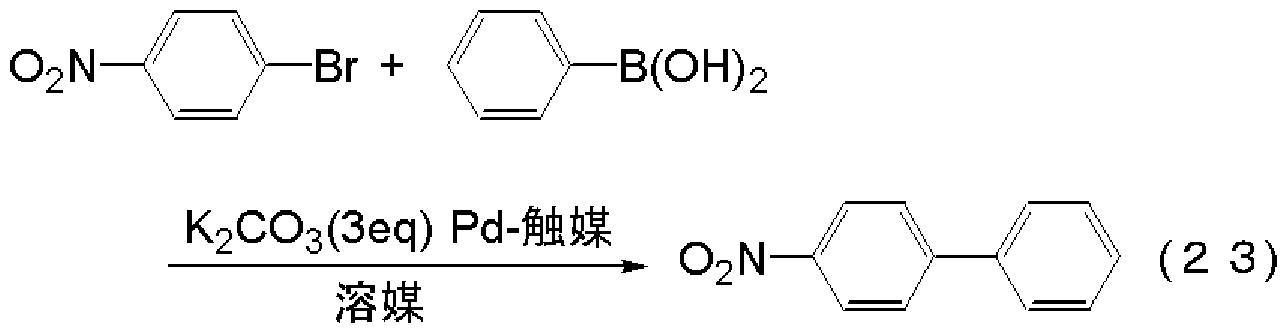
[0103] 4 ブロモニトロベンゼン 2. 428 (0. 012モノレ)
フエ-ルポロン酸 2. 19g (0. 018モル)
炭酸カリウム 4. 98g (0. 036モル)
を、 lOOmL容量の丸底フラスコにカ卩え、反応溶媒として、表 8に示すように、実施例 にお 、てはエチレングリコールモノメチルエーテル (メチルセ口ソルブ)および脱ィォ ン水(エチレングリコールモノメチルエーテル Z脱イオン水 = lZl、 vol/vol)の混 合溶媒、比較例においてはイソプロピルアルコールおよび脱イオン水 (イソプロピル アルコール Z脱イオン水 = lZl、 volZvol)の混合溶媒を各 18mLずつ、合計 36m Lずつ加えて、撹拌溶解した。この溶液に、製造例 2のパラジウム含有ぺロブスカイト 型複合酸化物を、表 8に示す添加量で添加して、マントルヒーターで加温し、表 8〖こ 示す還流温度において、 4時間加熱還流した。
[0104] 反応終了後、冷却して、トルエン 20mLを加えて、生成物を溶解した後、吸引ろ過 により不溶解物を除去して、減圧下、トルエンおよび反応溶媒を留去すると白色固形
物が析出した。この白色固形物に、トルエン 20mLおよび脱イオン水 20mLを加えて 、白色固形物を溶解した後、分液ロートに移し、下層の水層を分液し、さら〖こ、脱ィォ ン水 20mLをカ卩えて水洗し、分液した。次いで、硫酸ナトリウム 5gをカ卩えて、よく振り 混ぜて、脱水乾燥した後、不溶解物をろ過して除去し、ろ液より溶剤を留去すると、 目的の 4 -トロビフヱ-ルが黄色結晶として得られた。得られた黄色結晶の重量を 測定して、粗収率を算出すると 107〜113%であった。その後、トルエン 20mLをカロ えて、黄色結晶を撹拌溶解し、ガスクロマトグラフィーを用いて、下記式により変換率 を求めた。
変換率(%)=4— -トロビフエ-ル Z (4—ブロモニトロベンゼン +4— -トロビフエ-ル ) X 100
(予め 4 -トロビフエ-ルと 4 ブロモニトロベンゼンのトルエン溶液を個別に測定し て相対感度を求め補正した。 )
その結果を表 8に示す。
[0105] [表 8]


[0106] 8)スティル反応による 4ーメトキシビフヱ-ルの合成例
製造例 2で製造した Pd含有べ口ブスカイト型複合酸化物の存在下、下記一般式 (2 4)に示されるように、 4—ブロモア-ノールとフエ-ルトリメチルスズとを反応させた。
[0107] [化 17]

K2C03(3eq) Pd-触 ΜθΩ ^ " ( 2 4)
溶媒 、'」 、J
[0108] 4 ブロモア-ソーノレ 2. 26g (0. 012モノレ)
フエ-ルトリメチルスズ 4. 34g (0. 018モル)
炭酸カリウム 4. 98g (0. 036モル)
を、 lOOmL容量の丸底フラスコにカ卩え、反応溶媒として、表 9に示すように、実施例 にお 、てはエチレングリコールモノメチルエーテル (メチルセ口ソルブ)および脱ィォ ン水(エチレングリコールモノメチルエーテル Z脱イオン水 = lZl、 vol/vol)の混 合溶媒、比較例においてはイソプロピルアルコールおよび脱イオン水 (イソプロピル アルコール Z脱イオン水 = lZl、 volZvol)の混合溶媒を各 18mLずつ、合計 36m Lずつ加えて、撹拌溶解した。この溶液に、製造例 2のパラジウム含有ぺロブスカイト 型複合酸化物を、表 9に示す添加量で添加して、マントルヒーターで加温し、表 9に 示す還流温度において、 8時間加熱還流した。
[0109] 反応終了後、冷却して、トルエン 20mLを加えて、生成物を溶解した後、吸引ろ過 により不溶解物を除去して、減圧下、トルエンおよび反応溶媒を留去すると白色固形 物が析出した。この白色固形物に、トルエン 20mLおよび脱イオン水 20mLを加えて 、白色固形物を溶解した後、分液ロートに移し、下層の水層を分液し、さら〖こ、脱ィォ ン水 20mLをカ卩えて水洗し、分液した。次いで、硫酸ナトリウム 5gをカ卩えて、よく振り 混ぜて、脱水乾燥した後、不溶解物をろ過して除去し、ろ液より溶剤を留去すると、 目的の 4ーメトキシビフヱニルが白色結晶として得られた。得られた白色結晶の重量 を測定して、粗収率を算出すると 102〜111 %であった。その後、トルエン 20mLを カロえて、白色結晶を撹拌溶解し、ガスクロマトグラフィーを用いて、下記式により変換 率を求めた。
変換率 (0/0) = 4—メトキシビフエ-ル Z (4 -ブロモア-ノール + 4—メトキシビフエ- ; ) X 100
(予め 4ーメトキシビフエ-ルと 4 ブロモア-ノールのトルエン溶液を個別に測定して 相対感度を求め補正した。 )
その結果を表 9に示す。
[0110] [表 9]

* EGME:エチレングリコールモノメチルェ一亍ル(メチルセ口ソルブ)
IPA:イソブロピルアルコール
[0111] 9)ヘック反応による 4一二トロフエニルアクリル酸 tert ブチルの合成例
製造例 2で製造した Pd含有べ口ブスカイト型複合酸化物の存在下、下記一般式 (2 5)に示されるように、 4 ブロモニトロベンゼンとアクリル酸 tert ブチルとを反応さ せた。
[0112] [化 18]
02N— (' — Br + H2C=CHC02tBu
AcONa(3eq) Pd-触媒, Q2N_ A H=CH ( 2 5 )
溶媒
[0113] 4 ブロモニトロベンゼン 2. 428 (0. 012モノレ)
アクリル酸— tert—ブチル 2. 30g (0. 018モル)
酢酸ナ卜ジゥム 2. 88g (0. 036モル)
を、 lOOmL容量の丸底フラスコにカ卩え、反応溶媒として、表 10に示すように、実施例 においては 2—メトキシ 1 プロパノール、比較例においてはイソプロピルアルコー ルをそれぞれ単独で 60mLカ卩えて、撹拌溶解した。この溶液に、製造例 2のパラジゥ ム含有ベロブスカイト型複合酸化物を、表 10に示す添加量で添加して、マントルヒー ターで加温し、表 10に示す還流温度において、 6時間加熱還流した。
[0114] 反応終了後、冷却して、トルエン 20mLを加えて、生成物を溶解した後、吸引ろ過 により不溶解物を除去して、減圧下、トルエンおよび反応溶媒を留去すると黄色固形 物が析出した。この黄色固形物に、トルエン 40mLおよび脱イオン水 20mLを加えて 、黄色固形物を溶解した後、分液ロートに移し、下層の水層を分液し、さら〖こ、脱ィォ ン水 20mLをカ卩えて水洗し、分液した。次いで、硫酸ナトリウム 5gをカ卩えて、よく振り 混ぜて、脱水乾燥した後、不溶解物をろ過して除去し、ろ液より溶剤を留去すると、 目的の 4 -トロフエニルアクリル酸 tert ブチルが黄色結晶として得られた。生成 物は、 GC— MSにより構造を確認した。得られた黄色結晶の重量を測定して、粗収 率を算出すると 104〜115%であった。その後、テトラヒドロフラン (THF) 20mLをカロ えて、黄色結晶を撹拌溶解し、ガスクロマトグラフィーを用いて、下記式により変換率 を求めた。
変換率 (%) = 4 -トロフエ-ルアクリル酸 tert ブチル Z (4 ブロモニトロべンゼ ン +4 -トロフエ-ルアクリル酸— tert—ブチル) X 100
(予め 4— -トロフエ-ルアクリル酸 tert -ブチルと 4 -ブロモニトロベンゼンのトル ェン溶液を個別に測定して相対感度を求め補正した。)
その結果を表 10に示す。
[表 10]


[0116] なお、上記発明は、本発明の例示の実施形態として提供したが、これは単なる例示 にすぎず、限定的に解釈してはならない。当該技術分野の当業者によって明らかな 本発明の変形例は、後記特許請求の範囲に含まれるものである。
産業上の利用可能性
[0117] 以上のように、本発明の化合物の合成方法は、スズキカップリング反応、スティル力 ップリング反応、ヘックカップリング反応などのカップリング反応において、パラジウム 含有べ口ブスカイト型複合酸化物を触媒して用いる場合に有効に適用することができ る。
Claims
[1] パラジウム含有べ口ブスカイト型複合酸化物の存在下に、下記一般式(1)に示す化 合物と、下記一般式 (2)に示すィ匕合物または下記一般式 (3)に示す化合物とを、ァ ルコキシアルコールを含有する反応溶媒を用いて反応させることを特徴とする、化合 物の合成方法。
R -X (1)
(式中、 Rは、置換基を有していてもよいァリール基、置換基を有していてもよい複素 環基または置換基を有していてもよいァルケ-ル基を示し、 Xは、ハロゲン原子、トリ フルォロメタンスルホ-ルォキシ基、 p トルエンスルホ-ルォキシ基、またはメタンス ルホ-ルォキシ基を示す。 )
R M (2)
2
(式中、 Rは、置換基を有していてもよいァリール基、置換基を有していてもよい複素
2
環基または置換基を有していてもよいァルケ-ル基を示し、 Mは、 B (ORa) 基ま
2 たは— Sn(Rb) 基を示し、 Raは、水素原子または置換基を有していてもよいアルキ
3
ル基を示し、 Rbは、アルキル基を示す。また、 Raに代えて、置換基を有していてもよ Vヽァリーレン基または置換基を有して!/、てもよ!/、アルキレン基を、 OBO の結合 手として、 OBO を含む環が形成されていてもよい。 )
R HC = CR R (3)
3 4 5
(式中、 R、 R、および Rは、それぞれ独立して、水素原子、置換基を有していても
3 4 5
よいアルキル基、置換基を有していてもよいァリール基、カルボン酸誘導体、酸アミド 誘導体、またはシァノ基を示す。 )
[2] パラジウム含有べ口ブスカイト型複合酸化物の存在下に、上記一般式(1)に示す化 合物と、上記一般式 (2)に示す化合物とを反応させ、一般式(1)の式中、 R力 置換 基を有していてもよいァリール基で、 X力 ハロゲン原子であり、一般式(2)の式中、 R 力 置換基を有していてもよいァリール基で、 M力 -B (ORa) 基であることを特徴
2 2
とする、請求項 1に記載の化合物の合成方法。
[3] 前記アルコキシアルコール力 2—メトキシ 1 プロパノール、 2 エトキシ 1 プロノ ノーノレ、エチレングリコーノレモノメチノレエーテノレ.エチレングリコーノレモノェチ
ルエーテル、エチレングリコールイソプロピルエーテル力 なる群力 選ばれる少なく とも 1種であることを特徴とする、請求項 1に記載の化合物の合成方法。
前記パラジウム含有べ口ブスカイト型複合酸ィ匕物が、下記一般式 (4)で表されること を特徴とする、請求項 1に記載の化合物の合成方法。
A B Pd O (4)
χ (l-y) y 3+ σ
(式中、 Αは、希土類元素およびアルカリ土類金属力も選ばれる少なくとも 1種の元素 を示し、 Bは、希土類元素および Pdを除く遷移元素および A1力 選ばれる少なくとも 1種の元素を示し、 Xは、 1. 0≤χ≤1. 3の数値範囲の原子割合を示し、 yは、 0<y ≤0. 5の数値範囲の原子割合を示し、 σは、酸素過剰分を示す。)
Priority Applications (3)
| Application Number | Priority Date | Filing Date | Title |
|---|---|---|---|
| US11/886,531 US7592473B2 (en) | 2005-03-17 | 2006-03-16 | Method of synthesizing compound |
| JP2007508206A JP4963107B2 (ja) | 2005-03-17 | 2006-03-16 | 化合物の合成方法 |
| EP06729203A EP1860085B1 (en) | 2005-03-17 | 2006-03-16 | Method of synthesizing compound |
Applications Claiming Priority (2)
| Application Number | Priority Date | Filing Date | Title |
|---|---|---|---|
| JP2005-077801 | 2005-03-17 | ||
| JP2005077801 | 2005-03-17 |
Publications (1)
| Publication Number | Publication Date |
|---|---|
| WO2006098398A1 true WO2006098398A1 (ja) | 2006-09-21 |
Family
ID=36991739
Family Applications (1)
| Application Number | Title | Priority Date | Filing Date |
|---|---|---|---|
| PCT/JP2006/305206 Ceased WO2006098398A1 (ja) | 2005-03-17 | 2006-03-16 | 化合物の合成方法 |
Country Status (4)
| Country | Link |
|---|---|
| US (1) | US7592473B2 (ja) |
| EP (1) | EP1860085B1 (ja) |
| JP (1) | JP4963107B2 (ja) |
| WO (1) | WO2006098398A1 (ja) |
Cited By (1)
| Publication number | Priority date | Publication date | Assignee | Title |
|---|---|---|---|---|
| WO2011001884A1 (ja) * | 2009-06-30 | 2011-01-06 | 北興化学工業株式会社 | 化合物の合成方法および合成反応触媒 |
Families Citing this family (7)
| Publication number | Priority date | Publication date | Assignee | Title |
|---|---|---|---|---|
| US7601325B2 (en) | 2004-03-22 | 2009-10-13 | Daihatsu Motor Co., Ltd. | Perovskite-type composite oxide, catalyst composition and method for producing perovskite-type composite oxide |
| TWI438034B (zh) | 2010-11-24 | 2014-05-21 | Ind Tech Res Inst | 一種觸媒載體、承載於該觸媒載體之觸媒及使用該觸媒之碳-碳偶合反應方法 |
| CN102241554A (zh) * | 2011-04-22 | 2011-11-16 | 中国科学院上海有机化学研究所 | 一种合成三氟苯乙烯类含氟单体的方法 |
| EP2859002B1 (en) | 2012-06-08 | 2020-12-30 | The Trustees Of The University Of Pennsylvania | Silicon-based cross coupling agents and methods of their use |
| US9850261B2 (en) | 2012-06-08 | 2017-12-26 | The Trustees Of The University Of Pennsylvania | Silicon-based cross coupling agents and methods of their use |
| WO2016011231A1 (en) * | 2014-07-16 | 2016-01-21 | The Trustees Of The University Of Pennsylvania | Silicon-based cross coupling agents and methods of their use |
| CN108539023B (zh) * | 2018-04-11 | 2020-02-11 | 北京大学 | 基于联硼化合物修饰的钙钛矿型太阳能电池及其制备方法 |
Citations (3)
| Publication number | Priority date | Publication date | Assignee | Title |
|---|---|---|---|---|
| EP0672920A1 (en) | 1992-10-23 | 1995-09-20 | Nippon Carbide Kogyo Kabushiki Kaisha | Retroreflective sheet manufacturing method |
| JP2004298802A (ja) * | 2003-03-31 | 2004-10-28 | Council Scient Ind Res | ハロアレーン類のヘック−、スズキ、ソノガシラ及びスチル型カップリング反応のための積層二重水酸化物に支持されたナノパラジウム触媒 |
| JP2005314355A (ja) * | 2004-03-29 | 2005-11-10 | Cambridge Univ Technical Services Ltd | 化合物の合成方法および合成反応触媒 |
Family Cites Families (3)
| Publication number | Priority date | Publication date | Assignee | Title |
|---|---|---|---|---|
| US20020128478A1 (en) * | 2001-03-02 | 2002-09-12 | Krska Shane W. | Process for a carbon-carbon coupling reaction of aryl halides with olefins by heterogeneous catalysts |
| US7601325B2 (en) * | 2004-03-22 | 2009-10-13 | Daihatsu Motor Co., Ltd. | Perovskite-type composite oxide, catalyst composition and method for producing perovskite-type composite oxide |
| US7411082B2 (en) * | 2004-03-29 | 2008-08-12 | Cambridge University Technical Services Ltd. | Synthesizing method for compound, and catalyst for synthesis reaction |
-
2006
- 2006-03-16 WO PCT/JP2006/305206 patent/WO2006098398A1/ja not_active Ceased
- 2006-03-16 US US11/886,531 patent/US7592473B2/en not_active Expired - Fee Related
- 2006-03-16 JP JP2007508206A patent/JP4963107B2/ja not_active Expired - Fee Related
- 2006-03-16 EP EP06729203A patent/EP1860085B1/en not_active Expired - Lifetime
Patent Citations (3)
| Publication number | Priority date | Publication date | Assignee | Title |
|---|---|---|---|---|
| EP0672920A1 (en) | 1992-10-23 | 1995-09-20 | Nippon Carbide Kogyo Kabushiki Kaisha | Retroreflective sheet manufacturing method |
| JP2004298802A (ja) * | 2003-03-31 | 2004-10-28 | Council Scient Ind Res | ハロアレーン類のヘック−、スズキ、ソノガシラ及びスチル型カップリング反応のための積層二重水酸化物に支持されたナノパラジウム触媒 |
| JP2005314355A (ja) * | 2004-03-29 | 2005-11-10 | Cambridge Univ Technical Services Ltd | 化合物の合成方法および合成反応触媒 |
Non-Patent Citations (3)
| Title |
|---|
| ANDREWS S.P. ET AL: "Heterogeneous or Homogeneous? A case study involving Palladium-containing perovskites in the Suzuki Reaction", ADV. SYNTH. CATAL., vol. 347, 8 July 2005 (2005-07-08), pages 647 - 654, XP003001250 * |
| See also references of EP1860085A4 * |
| SMITH M.D. ET AL.: "Palladium-containing perovskites: recoverable and reuseable catalysts for Suzuki couplings", CHEM. COMM., 2003, pages 2652 - 2653, XP003001249 * |
Cited By (2)
| Publication number | Priority date | Publication date | Assignee | Title |
|---|---|---|---|---|
| WO2011001884A1 (ja) * | 2009-06-30 | 2011-01-06 | 北興化学工業株式会社 | 化合物の合成方法および合成反応触媒 |
| JP2011011999A (ja) * | 2009-06-30 | 2011-01-20 | Hokko Chem Ind Co Ltd | 化合物の合成方法および合成反応触媒 |
Also Published As
| Publication number | Publication date |
|---|---|
| EP1860085A4 (en) | 2009-04-22 |
| US20080177112A1 (en) | 2008-07-24 |
| JPWO2006098398A1 (ja) | 2008-08-28 |
| US7592473B2 (en) | 2009-09-22 |
| EP1860085B1 (en) | 2011-07-20 |
| EP1860085A1 (en) | 2007-11-28 |
| JP4963107B2 (ja) | 2012-06-27 |
Similar Documents
| Publication | Publication Date | Title |
|---|---|---|
| Martínez et al. | Rh I/Rh III catalyst-controlled divergent aryl/heteroaryl C–H bond functionalization of picolinamides with alkynes | |
| Ohe et al. | Palladium (II)-Catalyzed Aryl Coupling of Triarylbismuthines under Air. | |
| JP4963107B2 (ja) | 化合物の合成方法 | |
| Liu et al. | A simple and novel amide ligand based on quinoline derivative used for palladium-catalyzed Suzuki coupling reaction | |
| JP4832743B2 (ja) | 化合物の合成方法および合成反応触媒 | |
| JP5503909B2 (ja) | 化合物の合成方法および合成反応触媒 | |
| US11827653B2 (en) | Tridentate macrocyclic compounds | |
| WO2006098396A1 (ja) | 合成反応触媒およびそれを用いた化合物の合成方法 | |
| Reyes-Mata et al. | Calix [8] arene-based Ni (II) complexes for electrocatalytic CO2 reduction | |
| JP6219585B2 (ja) | パラジウムナノ粒子の調製方法およびパラジウムナノ粒子を触媒とする鈴木−宮浦反応 | |
| Kuimov et al. | Reaction of 1-bromonaphthalene with PH3 in the t-BuOK/DMSO system: PCl3-free synthesis of di (1-naphthyl) phosphine and its oxide | |
| Yang et al. | Ionic palladium complex as an efficient and recyclable catalyst for the carbonylative Sonogashira reaction | |
| US7411082B2 (en) | Synthesizing method for compound, and catalyst for synthesis reaction | |
| CN105198927A (zh) | 一种苯甲酰基二苯基氧化膦类衍生物的制备方法 | |
| EP4596527A1 (en) | Method for preparing diester by oxidative carbonylation of olefin and carbon monoxide | |
| JP6084874B2 (ja) | パラジウムナノ粒子を触媒とする薗頭−萩原反応による化合物の合成方法 | |
| US7476750B2 (en) | Method for synthesizing compound and catalyst for synthesis reaction | |
| JP5437742B2 (ja) | 化合物の合成方法および合成反応触媒 | |
| JP2008162976A (ja) | スペーサー導入型ビス(ターピリジン)化合物の合成方法 | |
| Basato et al. | Metal-catalysed synthesis of nitroenaminones from α-nitroketones or-esters and nitriles | |
| JP2020070234A (ja) | 遷移金属含有化合物及びその製造方法 | |
| JPH10114717A (ja) | ジアリールカーボネートの製造法 | |
| JP2005075770A (ja) | ビナフトール誘導体ならびに該誘導体を用いた光学活性ビナフトール金属錯体触媒 | |
| Ibrahim et al. | Palladium (II) complex of phosphinic amide,[Pd (Ph2P (O) CH2NPh) 2], and its catalytic investigation towards Suzuki-Miyaura cross-coupling reactions | |
| CN103508959A (zh) | 合成1-甲基-3-乙基-5-吡唑羧酸乙酯的方法 |
Legal Events
| Date | Code | Title | Description |
|---|---|---|---|
| 121 | Ep: the epo has been informed by wipo that ep was designated in this application | ||
| WWE | Wipo information: entry into national phase |
Ref document number: 2007508206 Country of ref document: JP |
|
| WWE | Wipo information: entry into national phase |
Ref document number: 2006729203 Country of ref document: EP |
|
| WWE | Wipo information: entry into national phase |
Ref document number: 11886531 Country of ref document: US |
|
| NENP | Non-entry into the national phase |
Ref country code: DE |
|
| NENP | Non-entry into the national phase |
Ref country code: RU |
|
| WWP | Wipo information: published in national office |
Ref document number: 2006729203 Country of ref document: EP |