WO2006115895A2 - Phenyl ethyne compounds - Google Patents
Phenyl ethyne compounds Download PDFInfo
- Publication number
- WO2006115895A2 WO2006115895A2 PCT/US2006/014517 US2006014517W WO2006115895A2 WO 2006115895 A2 WO2006115895 A2 WO 2006115895A2 US 2006014517 W US2006014517 W US 2006014517W WO 2006115895 A2 WO2006115895 A2 WO 2006115895A2
- Authority
- WO
- WIPO (PCT)
- Prior art keywords
- substituted
- compounds
- unsubstituted
- moieties
- ring
- Prior art date
- Legal status (The legal status is an assumption and is not a legal conclusion. Google has not performed a legal analysis and makes no representation as to the accuracy of the status listed.)
- Ceased
Links
- HWUSEVMBPZJZEO-UHFFFAOYSA-N COc1cccc(C#Cc2cnc(N3CCCCC3)nc2)c1 Chemical compound COc1cccc(C#Cc2cnc(N3CCCCC3)nc2)c1 HWUSEVMBPZJZEO-UHFFFAOYSA-N 0.000 description 1
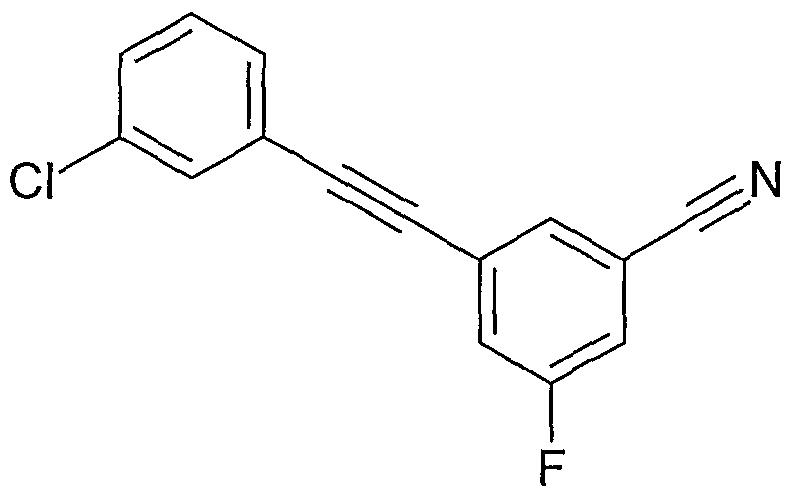
- RWOPEFIXDURPDZ-UHFFFAOYSA-N Fc1cc(C#Cc2cc(Cl)ccc2)cc(Oc2cccnc2)c1 Chemical compound Fc1cc(C#Cc2cc(Cl)ccc2)cc(Oc2cccnc2)c1 RWOPEFIXDURPDZ-UHFFFAOYSA-N 0.000 description 1
- UAFRGNDYRCVLMB-UHFFFAOYSA-N N#CCc1cccc(C#Cc2cc(C#N)cc(F)c2)c1 Chemical compound N#CCc1cccc(C#Cc2cc(C#N)cc(F)c2)c1 UAFRGNDYRCVLMB-UHFFFAOYSA-N 0.000 description 1
Classifications
-
- C—CHEMISTRY; METALLURGY
- C07—ORGANIC CHEMISTRY
- C07C—ACYCLIC OR CARBOCYCLIC COMPOUNDS
- C07C255/00—Carboxylic acid nitriles
- C07C255/49—Carboxylic acid nitriles having cyano groups bound to carbon atoms of six-membered aromatic rings of a carbon skeleton
- C07C255/50—Carboxylic acid nitriles having cyano groups bound to carbon atoms of six-membered aromatic rings of a carbon skeleton to carbon atoms of non-condensed six-membered aromatic rings
-
- A—HUMAN NECESSITIES
- A01—AGRICULTURE; FORESTRY; ANIMAL HUSBANDRY; HUNTING; TRAPPING; FISHING
- A01N—PRESERVATION OF BODIES OF HUMANS OR ANIMALS OR PLANTS OR PARTS THEREOF; BIOCIDES, e.g. AS DISINFECTANTS, AS PESTICIDES OR AS HERBICIDES; PEST REPELLANTS OR ATTRACTANTS; PLANT GROWTH REGULATORS
- A01N37/00—Biocides, pest repellants or attractants, or plant growth regulators containing organic compounds containing a carbon atom having three bonds to hetero atoms with at the most two bonds to halogen, e.g. carboxylic acids
- A01N37/34—Nitriles
-
- A—HUMAN NECESSITIES
- A01—AGRICULTURE; FORESTRY; ANIMAL HUSBANDRY; HUNTING; TRAPPING; FISHING
- A01N—PRESERVATION OF BODIES OF HUMANS OR ANIMALS OR PLANTS OR PARTS THEREOF; BIOCIDES, e.g. AS DISINFECTANTS, AS PESTICIDES OR AS HERBICIDES; PEST REPELLANTS OR ATTRACTANTS; PLANT GROWTH REGULATORS
- A01N43/00—Biocides, pest repellants or attractants, or plant growth regulators containing heterocyclic compounds
- A01N43/34—Biocides, pest repellants or attractants, or plant growth regulators containing heterocyclic compounds having rings with one nitrogen atom as the only ring hetero atom
- A01N43/40—Biocides, pest repellants or attractants, or plant growth regulators containing heterocyclic compounds having rings with one nitrogen atom as the only ring hetero atom six-membered rings
-
- A—HUMAN NECESSITIES
- A01—AGRICULTURE; FORESTRY; ANIMAL HUSBANDRY; HUNTING; TRAPPING; FISHING
- A01N—PRESERVATION OF BODIES OF HUMANS OR ANIMALS OR PLANTS OR PARTS THEREOF; BIOCIDES, e.g. AS DISINFECTANTS, AS PESTICIDES OR AS HERBICIDES; PEST REPELLANTS OR ATTRACTANTS; PLANT GROWTH REGULATORS
- A01N43/00—Biocides, pest repellants or attractants, or plant growth regulators containing heterocyclic compounds
- A01N43/48—Biocides, pest repellants or attractants, or plant growth regulators containing heterocyclic compounds having rings with two nitrogen atoms as the only ring hetero atoms
- A01N43/54—1,3-Diazines; Hydrogenated 1,3-diazines
-
- A—HUMAN NECESSITIES
- A61—MEDICAL OR VETERINARY SCIENCE; HYGIENE
- A61P—SPECIFIC THERAPEUTIC ACTIVITY OF CHEMICAL COMPOUNDS OR MEDICINAL PREPARATIONS
- A61P25/00—Drugs for disorders of the nervous system
-
- C—CHEMISTRY; METALLURGY
- C07—ORGANIC CHEMISTRY
- C07C—ACYCLIC OR CARBOCYCLIC COMPOUNDS
- C07C255/00—Carboxylic acid nitriles
- C07C255/49—Carboxylic acid nitriles having cyano groups bound to carbon atoms of six-membered aromatic rings of a carbon skeleton
- C07C255/50—Carboxylic acid nitriles having cyano groups bound to carbon atoms of six-membered aromatic rings of a carbon skeleton to carbon atoms of non-condensed six-membered aromatic rings
- C07C255/51—Carboxylic acid nitriles having cyano groups bound to carbon atoms of six-membered aromatic rings of a carbon skeleton to carbon atoms of non-condensed six-membered aromatic rings containing at least two cyano groups bound to the carbon skeleton
-
- C—CHEMISTRY; METALLURGY
- C07—ORGANIC CHEMISTRY
- C07C—ACYCLIC OR CARBOCYCLIC COMPOUNDS
- C07C255/00—Carboxylic acid nitriles
- C07C255/49—Carboxylic acid nitriles having cyano groups bound to carbon atoms of six-membered aromatic rings of a carbon skeleton
- C07C255/53—Carboxylic acid nitriles having cyano groups bound to carbon atoms of six-membered aromatic rings of a carbon skeleton containing cyano groups and hydroxy groups bound to the carbon skeleton
-
- C—CHEMISTRY; METALLURGY
- C07—ORGANIC CHEMISTRY
- C07C—ACYCLIC OR CARBOCYCLIC COMPOUNDS
- C07C255/00—Carboxylic acid nitriles
- C07C255/49—Carboxylic acid nitriles having cyano groups bound to carbon atoms of six-membered aromatic rings of a carbon skeleton
- C07C255/58—Carboxylic acid nitriles having cyano groups bound to carbon atoms of six-membered aromatic rings of a carbon skeleton containing cyano groups and singly-bound nitrogen atoms, not being further bound to other hetero atoms, bound to the carbon skeleton
-
- C—CHEMISTRY; METALLURGY
- C07—ORGANIC CHEMISTRY
- C07D—HETEROCYCLIC COMPOUNDS
- C07D213/00—Heterocyclic compounds containing six-membered rings, not condensed with other rings, with one nitrogen atom as the only ring hetero atom and three or more double bonds between ring members or between ring members and non-ring members
- C07D213/02—Heterocyclic compounds containing six-membered rings, not condensed with other rings, with one nitrogen atom as the only ring hetero atom and three or more double bonds between ring members or between ring members and non-ring members having three double bonds between ring members or between ring members and non-ring members
- C07D213/04—Heterocyclic compounds containing six-membered rings, not condensed with other rings, with one nitrogen atom as the only ring hetero atom and three or more double bonds between ring members or between ring members and non-ring members having three double bonds between ring members or between ring members and non-ring members having no bond between the ring nitrogen atom and a non-ring member or having only hydrogen or carbon atoms directly attached to the ring nitrogen atom
- C07D213/60—Heterocyclic compounds containing six-membered rings, not condensed with other rings, with one nitrogen atom as the only ring hetero atom and three or more double bonds between ring members or between ring members and non-ring members having three double bonds between ring members or between ring members and non-ring members having no bond between the ring nitrogen atom and a non-ring member or having only hydrogen or carbon atoms directly attached to the ring nitrogen atom with hetero atoms or with carbon atoms having three bonds to hetero atoms with at the most one bond to halogen, e.g. ester or nitrile radicals, directly attached to ring carbon atoms
- C07D213/62—Oxygen or sulfur atoms
- C07D213/63—One oxygen atom
- C07D213/65—One oxygen atom attached in position 3 or 5
-
- C—CHEMISTRY; METALLURGY
- C07—ORGANIC CHEMISTRY
- C07D—HETEROCYCLIC COMPOUNDS
- C07D239/00—Heterocyclic compounds containing 1,3-diazine or hydrogenated 1,3-diazine rings
- C07D239/02—Heterocyclic compounds containing 1,3-diazine or hydrogenated 1,3-diazine rings not condensed with other rings
- C07D239/24—Heterocyclic compounds containing 1,3-diazine or hydrogenated 1,3-diazine rings not condensed with other rings having three or more double bonds between ring members or between ring members and non-ring members
- C07D239/28—Heterocyclic compounds containing 1,3-diazine or hydrogenated 1,3-diazine rings not condensed with other rings having three or more double bonds between ring members or between ring members and non-ring members with hetero atoms or with carbon atoms having three bonds to hetero atoms with at the most one bond to halogen, directly attached to ring carbon atoms
- C07D239/32—One oxygen, sulfur or nitrogen atom
- C07D239/42—One nitrogen atom
Definitions
- a novel class of compounds containing a substituted or unsubstituted phenyl ring "A” having at least one substituent which is a phenyl or heterocyclic moiety "B” linked to the phenyl A ring via an akynyl moiety.
- inventive compounds are useful for a wide variety of applications.
- the compounds can act to modulate physiological processes by functioning as agonists and antagonists of receptors in the nervous system.
- Inventive compounds may also act as insecticides, and as fungicides.
- Pharmaceutical compositions containing invention compounds also have wide utility.
- A is phenyl, unsubstituted or substituted with one or more substituent independently selected from:
- B is aryl or heterocycle unsubstituted or substituted with one or more substituent independently selected from:
- Aryl refers to mononuclear and polynuclear aromatic radicals having in the range of 6 up to 14 carbon atoms, and "substituted aryl” refers to aryl radicals further bearing one or more substituents as set forth above, for example, alkylaryl moieties.
- Heterocycle refers to ring-containing radicals having one or more heteroatoms (e.g., N, O, S) as part of the ring structure, and having in the range of 3 up to 20 atoms in the ring. Heterocyclic moieties may be saturated or unsaturated when optionally containing one or more double bonds, and may contain more than one ring.
- heteroatoms e.g., N, O, S
- Heterocyclic moieties include, for example, monocyclic moieties such as imidazolyl moieties, pyridinyl moieties, pyrimidinyl moieties, isothiazolyl moieties, isoxazolyl moieties, moieties, and the like, bicyclic heterocyclic moieties such as azabicycloalkanyl moieties, and oxabicycloalkyl moieties, and other non-aromatic and aromatic mon- and bi-cyclic heterocycles.
- substituted heterocycle refers to heterocycles further bearing one or more substituents as set forth above.
- Hydrocarbyl refers to straight or branched chain univalent and bivalent radicals derived from saturated or unsaturated moieties containing only carbon and hydrogen atoms, and having in the range of about 1 up to 12 carbon atoms.
- exemplary hydrocarbyl moieties include alkyl moieties, alkenyl moieties, dialkenyl moieties, trialkenyl moieties, alkynyl moieties, alkadiynal moieties, alkatriynal moieties, alkenyne moieties, alkadienyne moieties, alkenediyne moieties, and the like.
- substituted hydrocarbyl refers to hydrocarbyl moieties further bearing substituents as set forth below.
- Alkyl refers to straight or branched chain alkyl radicals having in the range of about 1 up to 12 carbon atoms; "substituted alkyl” refers to alkyl radicals further bearing one or more substituents such as hydroxy, alkoxy, mercapto, aryl, heterocycle, halogen, trifluoromethyl, pentafluoroethyl, cyano, cyanomethyl, nitro, amino, amide, amidine, amido, carboxyl, carboxamide, carbamate, ester, sulfonyl, sulfonamide, and the like.
- alkenyl refers to straight or branched chain hydrocarbyl radicals having at least one carbon- carbon double bond, and having in the range of about 2 up to 12 carbon atoms (with radicals having in the range of about 2 up to 6 carbon atoms presently preferred), and "substituted alkenyl” refers to alkenyl radicals further bearing one or more substituents as set forth above.
- Alkenylene refers to straight or branched chain divalent alkenyl moieties having at least one carbon-carbon double bond, and having in the range of about 2 up to 12 carbon atoms (with divalent alkenyl moieties having in the range of about 2 up to 6 carbon atoms presently preferred), and "substituted lower alkenylene” refers to divalent alkenyl radicals further bearing one or more substituents as set forth above;
- Alkynyl refers to straight or branched chain hydrocarbyl radicals having at least one carbon- carbon triple bond, and having in the range of about 2 up to 12 carbon atoms (with radicals having in the range of about 2 up to 6 carbon atoms presently being preferred), and "substituted alkynyl” refers to alkynyl radicals further bearing one or more substituents as set forth above.
- Alkynylene refers to straight or branched chain divalent alkynyl moieties having at least one carbon-carbon triple bond, and having in the range of about 2 up to 12 carbon atoms (with divalent alkynyl moieties having two carbon atoms presently being preferred), and "substituted alkynylene” refers to divalent alkynyl radicals further bearing one or more substituents as set forth above.
- Cyclohydrocarbyl refers to cyclic (i.e., ring-containing) univalent radicals derived from saturated or unsaturated moieties containing only carbon and hydrogen atoms, and having in the range of about 3 up to 20 carbon atoms.
- cyclohydrocarbyl moieties include cycloalkyl moieties, cycloalkenyl moieties, cycloalkadienyl moieties, cycloalkatrienyl moieties, cycloalkynyl moieties, cycloalkadiynyl moieties, spiro hydrocarbon moieties wherein two rings are joined by a single atom which is the only common member of the two rings (e.g., spiro[3.4]octanyl, and the like), bicyclic hydrocarbon moieties wherein two rings are joined and have two atoms in common (e.g., bicyclo [3.2.1]octane, bicyclo [2.2.1]hept-2-ene, and the like), and the like.
- substituted cyclohydrocarbyl refers to cyclohydrocarbyl moieties further bearing one or more substituents as set forth above;
- Cycloalkyl refers to ring-containing radicals containing in the range of about 3 up to 20 carbon atoms, and "substituted cycloalkyl” refers to cycloalkyl radicals further bearing one or more substituents as set forth above;
- Cycloalkenyl refers to ring-containing alkenyl radicals having at least one carbon-carbon double bond in the ring, and having in the range of about 3 up to 20 carbon atoms
- substituted cycloalkenyl refers to cyclic alkenyl radicals further bearing one or more substituents as set forth above.
- Halogen refers to fluoride, chloride, bromide or iodide radicals.
- Substituted refers to the substituents recited above in connection with A and B.
- a substituent on A or B may itself be substituted with additional substituents selected from the A and B substituents.
- the substituent "substituted hydrocarbyl” may refer to a hydrocarbyl, such as methyl, that is further substituted with one or more of substituents (a) through (t), such as cyano.
- the resulting substituent would be -CH 2 -CN.
- the linker "L” may be further substituted with one or more of substituents (a) through (t).
- L is a linking moiety which links moieties A and B.
- L is selected from substituted or unsubstituted alkynylene moieties.
- Presently preferred compounds of the invention are those wherein L is an unsubstituted alkynylene moiety containing two carbon atoms, i.e., ethynyl.
- A is a moiety linked through bridging moiety L to moiety B.
- Radicals contemplated for use in the invention are those wherein A is substituted or unsubstituted phenyl.
- Preferred compounds of the invention are those wherein A is phenyl unsubstituted or substituted with one or more substituent independently selected from amino, alkyl, cyano, halogen, alkyl-cyano, alkyl-hydroxy, hydroxyl, alkoxy, and mercapto.
- B is a moiety linked through bridging moiety L to moiety A.
- Radicals contemplated for use in the invention are those wherein B is substituted or unsubstituted aryl or heterocycle.
- preferred compounds of the invention are those wherein B is a substituted or unsubstituted aryl or heterocycle.
- Exemplary moieties include phenyl and pyrimidinyl.
- Especially preferred compounds are those wherein B is phenyl substituted with cyano and fluoro, for instance wherein B is substituted at the 3 position with cyano and the 5 position with fluoro, or where B is substituted at the 3 position with -O-pyridyl and the 5 position with fluoro.
- Additional especially preferred compounds are those wherein B is pyrimidinyl substituted with a heterocycle, in particular piperidinyl.
- R is a substituent independently selected from amino, alkyl, cyano, halogen, alkyl-cyano, alkyl- hydroxy, hydroxyl, alkoxy, and mercapto.
- R is a substituent independently selected from amino, alkyl, cyano, halogen, alkyl-cyano, alkyl- hydroxy, hydroxyl, alkoxy, and mercapto.
- Still further preferred compound are those of the formula:
- R is a substituent independently selected from amino, alkyl, cyano, halogen, alkyl-cyano, alkyl- hydroxy, hydroxyl, alkoxy, and mercapto.
- invention compounds may contain one or more chiral centers, and thus can exist as racemic mixtures.
- Suitable stereoselective synthetic procedures for producing optically pure materials are well known in the art, as are procedures for purifying racemic mixtures into optically pure fractions.
- invention compounds may exist in polymorphic forms wherein a compound is capable of crystallizing in different forms. Suitable methods for identifying and separating polymorphisms are known in the art.
- compositions comprising heterocyclic compounds as described above, in combination with pharmaceutically acceptable carriers.
- invention compounds can be converted into nontoxic acid addition salts, depending on the substituents thereon.
- the above-described compounds (optionally in combination with pharmaceutically acceptable carriers) can be used in the manufacture of medicaments useful for the treatment of a variety of indications.
- Pharmaceutically acceptable carriers contemplated for use in the practice of the present invention include carriers suitable for intravenous, subcutaneous, transcutaneous, intramuscular, intracutaneous, intrathecal, inhalation, intracranial, epidural, vaginal, oral, sublingual, rectal, and the like administration. Administration in the form of creams, lotions, tablets, dispersible powders, granules, syrups, elixirs, sterile aqueous or non-aqueous solutions, suspensions or emulsions, patches, and the like, is contemplated.
- suitable carriers include emulsions, solutions, suspensions, syrups, and the like, optionally containing additives such as wetting agents, emulsifying and suspending agents, sweetening, flavoring and perfuming agents, and the like.
- suitable carriers include sterile aqueous or non-aqueous solutions, suspensions, or emulsions.
- suitable carriers include sterile aqueous or non-aqueous solutions, suspensions, or emulsions.
- non-aqueous solvents or vehicles are propylene glycol, polyethylene glycol, vegetable oils, such as olive oil and corn oil, gelatin, and injectable organic esters such as ethyl oleate.
- Such dosage forms may also contain adjuvants such as preserving, wetting, emulsifying, and dispersing agents. They may be sterilized, for example, by filtration through a bacteria-retaining filter, by incorporating sterilizing agents into the compositions, by irradiating the compositions, or by heating the compositions. They can also be manufactured in the form of sterile water, or some other sterile injectable medium immediately before use.
- Invention compounds can optionally be converted into non-toxic acid addition salts.
- Such salts are generally prepared by reacting the compounds of this invention with a suitable organic or inorganic acid.
- Representative salts include hydrochloride, hydrobromide, sulfate, bisulfate, methanesulfonate, acetate, oxalate, adipate, alginate, aspartate, valerate, oleate, laurate, borate, benzoate, lactate, phosphate, toluenesulfonate (tosylate), citrate, malate, maleate, fumarate, succinate, tartrate, napsylate, methanesulfonate, 2-naphthalenesulfonate, nicotinate, benzenesulfonate, butyrate, camphorate, camphorsulfonate, cyclopentanepropionate, digluconate, dodecylsulfate, glucoheptan
- Salts can also be formed with inorganic acids such as sulfate, bisulfate, hemisulfate, hydrochloride, chlorate, perchlorate, hydrobromide, hydroiodide, and the like.
- a base salt include ammonium salts; alkali metal salts such as sodium salts, potassium salts, and the like; alkaline earth metal salts such as calcium salts, magnesium salts, and the like; salts with organic bases such as dicyclohexylamine salts, N-methyl-D-glucamine, phenylethylamine, and the like; and salts with amino acids such as arginine, lysine, and the like.
- Such salts can readily be prepared employing methods well known in the art.
- heterocyclic compounds as described above.
- many of the heterocyclic compounds described above can be prepared using synthetic chemistry techniques well known in the art (see Comprehensive Heterocyclic Chemistry, Katritzky, A. R. and Rees, C. W. eds., Pergamon Press, Oxford, 1984, and WO01/16121).
- 3-alkynyl-5-bromofluorobenzene (0.1 g, 0.7 mmol), 3-iodobenzonitrile (0.2 g, 1 mmol), Palladium tetrakis(triphenylphosphine) (0.02, 0.02mol), copper (I) iodide (0.004, 0.02mol), and triethylamine (1 mL), and DMF (2.5 mL) were combined and heated to 70 0 C for 4 hours. The crude solution was filtered and purified directly on RPHPLC to yield an off white solid.
- 3-(3-ethynyl-5-fluoro ⁇ henoxy)pyridine (0.1 g, 0.7 mmol), 3-iodobenzonitrile (0.2 g, 1 mmol), Palladium tetrakis(triphenylphosphine) (0.02, 0.02mol), copper (I) iodide (0.004, 0.02mol), and triethylamine (1 mL), and DMF (2.5 mL) were combined and heated to 70 0 C for 4 hours. The crude solution was filtered and purified directly on RPHPLC to yield an off white solid.
- 2-piperidyl-5-bromopyrimidine (3.5 g, 15 mmol), TMS acetylene (2.1 g, 29 mmol), Palladium tetrakis(triphenylphosphine) (0.3 g, 0.3 mmol), copper (I) iodide (0.05 g, 0.3 mmol), triethylamine (10 mL), and toluene (50 mL) were combined and heated to 100 0 C for 12 hours. The solution was filtered, solvent evaporated and the crude material purified on silica (25% EtOAc/hexanes) to yield a white solid.
Landscapes
- Organic Chemistry (AREA)
- Chemical & Material Sciences (AREA)
- Life Sciences & Earth Sciences (AREA)
- Health & Medical Sciences (AREA)
- General Health & Medical Sciences (AREA)
- Engineering & Computer Science (AREA)
- Plant Pathology (AREA)
- Pest Control & Pesticides (AREA)
- Dentistry (AREA)
- Agronomy & Crop Science (AREA)
- Wood Science & Technology (AREA)
- Zoology (AREA)
- Environmental Sciences (AREA)
- Biomedical Technology (AREA)
- Nuclear Medicine, Radiotherapy & Molecular Imaging (AREA)
- Neurology (AREA)
- Neurosurgery (AREA)
- Chemical Kinetics & Catalysis (AREA)
- General Chemical & Material Sciences (AREA)
- Medicinal Chemistry (AREA)
- Bioinformatics & Cheminformatics (AREA)
- Pharmacology & Pharmacy (AREA)
- Animal Behavior & Ethology (AREA)
- Public Health (AREA)
- Veterinary Medicine (AREA)
- Pharmaceuticals Containing Other Organic And Inorganic Compounds (AREA)
- Plural Heterocyclic Compounds (AREA)
- Pyridine Compounds (AREA)
- Organic Low-Molecular-Weight Compounds And Preparation Thereof (AREA)
Abstract
Description




Claims


Priority Applications (5)
| Application Number | Priority Date | Filing Date | Title |
|---|---|---|---|
| US11/918,993 US20090306115A1 (en) | 2005-04-22 | 2006-04-18 | Phenyl ethyne compounds |
| AU2006240217A AU2006240217A1 (en) | 2005-04-22 | 2006-04-18 | Phenyl ethyne compounds |
| JP2008507795A JP2008538562A (en) | 2005-04-22 | 2006-04-18 | Phenylethyne compound |
| EP06740961A EP1874724A2 (en) | 2005-04-22 | 2006-04-18 | Phenyl ethyne compounds |
| CA002604518A CA2604518A1 (en) | 2005-04-22 | 2006-04-18 | Phenyl ethyne compounds |
Applications Claiming Priority (2)
| Application Number | Priority Date | Filing Date | Title |
|---|---|---|---|
| US67423405P | 2005-04-22 | 2005-04-22 | |
| US60/674,234 | 2005-04-22 |
Publications (2)
| Publication Number | Publication Date |
|---|---|
| WO2006115895A2 true WO2006115895A2 (en) | 2006-11-02 |
| WO2006115895A3 WO2006115895A3 (en) | 2007-01-18 |
Family
ID=37215236
Family Applications (1)
| Application Number | Title | Priority Date | Filing Date |
|---|---|---|---|
| PCT/US2006/014517 Ceased WO2006115895A2 (en) | 2005-04-22 | 2006-04-18 | Phenyl ethyne compounds |
Country Status (7)
| Country | Link |
|---|---|
| US (1) | US20090306115A1 (en) |
| EP (1) | EP1874724A2 (en) |
| JP (1) | JP2008538562A (en) |
| CN (1) | CN101163667A (en) |
| AU (1) | AU2006240217A1 (en) |
| CA (1) | CA2604518A1 (en) |
| WO (1) | WO2006115895A2 (en) |
Cited By (7)
| Publication number | Priority date | Publication date | Assignee | Title |
|---|---|---|---|---|
| WO2008073350A2 (en) | 2006-12-07 | 2008-06-19 | The Trustees Of The University Of Pennsylvania | Acetylene derivatives and their use for binding and imaging amyloid plaques |
| CN101668560A (en) * | 2006-12-07 | 2010-03-10 | 宾夕法尼亚大学理事会 | Acetylene derivatives and their use for binding and imaging amyloid plaques |
| JP2010532355A (en) * | 2007-06-29 | 2010-10-07 | アキュセラ インコーポレイテッド | Alkynylphenyl derivative compounds for treating eye diseases and disorders |
| WO2011035186A1 (en) | 2009-09-17 | 2011-03-24 | Vanderbilt University | Substituted heteroarylamide analogs as mglur5 negative allosteric modulators and methods of making and using the same |
| US9533982B2 (en) | 2014-03-20 | 2017-01-03 | Vanderbilt University | Substituted bicyclic heteroaryl carboxamide analogs as mGluR5 negative allosteric modulators |
| US9550778B2 (en) | 2014-10-03 | 2017-01-24 | Vanderbilt University | Substituted 6-aryl-imidazopyridine and 6-aryl-triazolopyridine carboxamide analogs as negative allosteric modulators of mGluR5 |
| US9844542B2 (en) | 2013-11-19 | 2017-12-19 | Vanderbilt University | Substituted imidazopyridine and triazolopyridine compounds as negative allosteric modulators of mGluR5 |
Family Cites Families (3)
| Publication number | Priority date | Publication date | Assignee | Title |
|---|---|---|---|---|
| US5618787A (en) * | 1995-05-26 | 1997-04-08 | Eli Lilly And Company | Cyclic peptide antifungal agents |
| DE10009000A1 (en) * | 2000-02-25 | 2001-08-30 | Basf Ag | Process for the preparation of substituted indoles |
| RU2330020C2 (en) * | 2003-03-04 | 2008-07-27 | Аддекс Фарма Са | NEW DERIVATIVES OF AMINOPYRIDINE AS ANTAGONISTS mGIuR5 |
-
2006
- 2006-04-18 EP EP06740961A patent/EP1874724A2/en not_active Withdrawn
- 2006-04-18 WO PCT/US2006/014517 patent/WO2006115895A2/en not_active Ceased
- 2006-04-18 JP JP2008507795A patent/JP2008538562A/en not_active Withdrawn
- 2006-04-18 CA CA002604518A patent/CA2604518A1/en not_active Abandoned
- 2006-04-18 US US11/918,993 patent/US20090306115A1/en not_active Abandoned
- 2006-04-18 AU AU2006240217A patent/AU2006240217A1/en not_active Abandoned
- 2006-04-18 CN CNA2006800134349A patent/CN101163667A/en active Pending
Cited By (20)
| Publication number | Priority date | Publication date | Assignee | Title |
|---|---|---|---|---|
| WO2008073350A2 (en) | 2006-12-07 | 2008-06-19 | The Trustees Of The University Of Pennsylvania | Acetylene derivatives and their use for binding and imaging amyloid plaques |
| WO2008073350A3 (en) * | 2006-12-07 | 2008-08-14 | Univ Pennsylvania | Acetylene derivatives and their use for binding and imaging amyloid plaques |
| CN101668560A (en) * | 2006-12-07 | 2010-03-10 | 宾夕法尼亚大学理事会 | Acetylene derivatives and their use for binding and imaging amyloid plaques |
| US7678819B2 (en) | 2006-12-07 | 2010-03-16 | The Trustees Of The University Of Pennsylvania | Acetylene derivatives and their use for binding and imaging amyloid plaques |
| JP2010512325A (en) * | 2006-12-07 | 2010-04-22 | ザ・トラスティーズ・オブ・ザ・ユニバーシティ・オブ・ペンシルバニア | Acetylene derivatives and their use to bind and image amyloid plaques |
| US9115056B2 (en) | 2007-06-29 | 2015-08-25 | Acucela Inc. | Alkynyl phenyl derivative compounds for treating ophthalmic diseases and disorders |
| JP2010532355A (en) * | 2007-06-29 | 2010-10-07 | アキュセラ インコーポレイテッド | Alkynylphenyl derivative compounds for treating eye diseases and disorders |
| EP2076122A4 (en) * | 2007-06-29 | 2011-06-22 | Acucela Inc | ALKYNYLPHENYL DERIVATIVES FOR TREATING OPHTHALMIC DISEASES AND DISORDERS |
| US8299307B2 (en) | 2007-06-29 | 2012-10-30 | Acucela Inc. | Alkynyl phenyl derivative compounds for treating ophthalmic diseases and disorders |
| US8389771B2 (en) | 2007-06-29 | 2013-03-05 | Acucela, Inc. | Alkynyl phenyl derivative compounds for treating ophthalmic diseases and disorders |
| US9464033B2 (en) | 2007-06-29 | 2016-10-11 | Acucela Inc. | Alkynyl phenyl derivative compounds for treating ophthalmic diseases and disorders |
| US8492589B2 (en) | 2007-06-29 | 2013-07-23 | Acucela Inc. | Alkynyl phenyl derivative compounds for treating ophthalmic diseases and disorders |
| US8895782B2 (en) | 2007-06-29 | 2014-11-25 | Acucela Inc. | Alkynyl phenyl derivative compounds for treating ophthalmic diseases and disorders |
| US8766007B2 (en) | 2007-06-29 | 2014-07-01 | Acucela Inc | Alkynyl phenyl derivative compounds for treating ophthalmic diseases and disorders |
| US8598345B2 (en) | 2009-09-17 | 2013-12-03 | Vanderbilt University | Substituted heteroarylamide analogs as mGluR5 negative allosteric modulators and methods of making and using the same |
| WO2011035186A1 (en) | 2009-09-17 | 2011-03-24 | Vanderbilt University | Substituted heteroarylamide analogs as mglur5 negative allosteric modulators and methods of making and using the same |
| EP2477629A4 (en) * | 2009-09-17 | 2013-05-01 | Univ Vanderbilt | SUBSTITUTED HETEROARYLAMIDE ANALOGUES AS NEGATIVE ALLOSTERIC MODULATORS OF MGLUR5, AND METHODS OF PREPARING AND USING SAME |
| US9844542B2 (en) | 2013-11-19 | 2017-12-19 | Vanderbilt University | Substituted imidazopyridine and triazolopyridine compounds as negative allosteric modulators of mGluR5 |
| US9533982B2 (en) | 2014-03-20 | 2017-01-03 | Vanderbilt University | Substituted bicyclic heteroaryl carboxamide analogs as mGluR5 negative allosteric modulators |
| US9550778B2 (en) | 2014-10-03 | 2017-01-24 | Vanderbilt University | Substituted 6-aryl-imidazopyridine and 6-aryl-triazolopyridine carboxamide analogs as negative allosteric modulators of mGluR5 |
Also Published As
| Publication number | Publication date |
|---|---|
| WO2006115895A3 (en) | 2007-01-18 |
| CA2604518A1 (en) | 2006-11-02 |
| CN101163667A (en) | 2008-04-16 |
| JP2008538562A (en) | 2008-10-30 |
| AU2006240217A1 (en) | 2006-11-02 |
| US20090306115A1 (en) | 2009-12-10 |
| EP1874724A2 (en) | 2008-01-09 |
Similar Documents
| Publication | Publication Date | Title |
|---|---|---|
| DE60108236T2 (en) | 1,2,3,4-tetrahydroisoquinoline DERIVATIVES | |
| RU2378257C2 (en) | Substituted derivatives of 1, 2, 3, 4-tetrahydroisoquinoline | |
| EP3634958B1 (en) | Cyclopropyl urea formyl peptide 2 receptor and formyl peptide 1 receptor agonists | |
| WO2003068747A1 (en) | Nicotinamide derivates useful as p38 inhibitors | |
| JP2002542229A (en) | Carbamate derivatives and their use as metabotropic glutamate receptor ligands | |
| DE69232883T2 (en) | SUBSTITUTED HETEROCYCLIC DERIVATIVES, USED AS PLATE AGENT REGULATORS | |
| US4590270A (en) | 2,4-diamino-[4-piperidinyl]pyrimidines useful as antibacterial agents, antimalarial agents, antitumors agents | |
| EP1874724A2 (en) | Phenyl ethyne compounds | |
| KR100683614B1 (en) | Process for preparing arylethanolamine derivatives having anti-obesity and anti-diabetic properties | |
| WO2022129281A1 (en) | Nitrogen containing 2,3-dihydroquinazolinone compounds as nav1.8 inhibitors | |
| CA2462645A1 (en) | Substituted 5-membered polycyclic compounds useful for selective inhibition of the coagulation cascade | |
| CA2689985A1 (en) | Di(hetero)arylcyclohexane derivatives, their preparation, their use and pharmaceutical compositions comprising them | |
| US4758577A (en) | 4-(5H-dibenzo[a,d]cyclohepten-5-yl)piperidine compounds for treating cardiovascular disorders | |
| JP2022542103A (en) | Picolinamide derivatives useful as agricultural fungicides | |
| JP2010502728A (en) | Heteroaromatic compounds having sphingosine-1-phosphate (S1P) receptor agonist biological activity | |
| CS274445B2 (en) | Method of new trisubstituted amines production | |
| IE74210B1 (en) | Substituted 2-imidazolines and preparation and use thereof | |
| US5440036A (en) | 1,4-benzoxazine derivatives | |
| JP2002332278A (en) | Heterocyclic derivatives having Edg receptor antagonistic activity | |
| JP3041957B2 (en) | N-phenyltetrahydrophthalamic acid derivative, method for producing the same, and herbicide containing the same as active ingredient | |
| JPS6335554A (en) | N-(2-cyano-2-oxyminoacetyl)-aminonitrile | |
| CA2462305A1 (en) | 6-membered heterocyclic compounds useful for selective inhibition of the coagulation cascade | |
| PT1603877E (en) | Novel aminopyridine derivatives as mgiur5 antagonists | |
| CN103664917B (en) | A kind of 2-substituted isoxazoline or 2-replace the synthetic method of piperazine | |
| JP3864216B2 (en) | Alkylenebis [1- (substituted or unsubstituted pyridylmethyl)]-2-nitroiminoimidazolidyl, process for producing the same, and insecticide |
Legal Events
| Date | Code | Title | Description |
|---|---|---|---|
| WWE | Wipo information: entry into national phase |
Ref document number: 200680013434.9 Country of ref document: CN |
|
| 121 | Ep: the epo has been informed by wipo that ep was designated in this application | ||
| WWE | Wipo information: entry into national phase |
Ref document number: 2006240217 Country of ref document: AU |
|
| ENP | Entry into the national phase |
Ref document number: 2604518 Country of ref document: CA |
|
| WWE | Wipo information: entry into national phase |
Ref document number: 4506/CHENP/2007 Country of ref document: IN |
|
| WWE | Wipo information: entry into national phase |
Ref document number: 2006740961 Country of ref document: EP |
|
| WWE | Wipo information: entry into national phase |
Ref document number: 11918993 Country of ref document: US |
|
| ENP | Entry into the national phase |
Ref document number: 2008507795 Country of ref document: JP Kind code of ref document: A |
|
| NENP | Non-entry into the national phase |
Ref country code: DE |
|
| ENP | Entry into the national phase |
Ref document number: 2006240217 Country of ref document: AU Date of ref document: 20060418 Kind code of ref document: A |
|
| NENP | Non-entry into the national phase |
Ref country code: RU |