WO2006122669A1 - Kosmetische zubereitungen mit einem gehalt an glucosylglyceriden und einem oder mehreren acrylamidomethylpropylsulfonsäure-polymeren - Google Patents
Kosmetische zubereitungen mit einem gehalt an glucosylglyceriden und einem oder mehreren acrylamidomethylpropylsulfonsäure-polymeren Download PDFInfo
- Publication number
- WO2006122669A1 WO2006122669A1 PCT/EP2006/004294 EP2006004294W WO2006122669A1 WO 2006122669 A1 WO2006122669 A1 WO 2006122669A1 EP 2006004294 W EP2006004294 W EP 2006004294W WO 2006122669 A1 WO2006122669 A1 WO 2006122669A1
- Authority
- WO
- WIPO (PCT)
- Prior art keywords
- cosmetic preparations
- acid polymers
- preparations containing
- cosmetic
- particularly preferably
- Prior art date
- Legal status (The legal status is an assumption and is not a legal conclusion. Google has not performed a legal analysis and makes no representation as to the accuracy of the status listed.)
- Ceased
Links
- AQTKXCPRNZDOJU-LXMFVISSSA-N OCC(CO)O[C@@H](C(C1O)O)OC(CO)[C@H]1O Chemical compound OCC(CO)O[C@@H](C(C1O)O)OC(CO)[C@H]1O AQTKXCPRNZDOJU-LXMFVISSSA-N 0.000 description 1
Classifications
-
- A—HUMAN NECESSITIES
- A61—MEDICAL OR VETERINARY SCIENCE; HYGIENE
- A61Q—SPECIFIC USE OF COSMETICS OR SIMILAR TOILETRY PREPARATIONS
- A61Q19/00—Preparations for care of the skin
- A61Q19/08—Anti-ageing preparations
-
- A—HUMAN NECESSITIES
- A61—MEDICAL OR VETERINARY SCIENCE; HYGIENE
- A61K—PREPARATIONS FOR MEDICAL, DENTAL OR TOILETRY PURPOSES
- A61K8/00—Cosmetics or similar toiletry preparations
- A61K8/18—Cosmetics or similar toiletry preparations characterised by the composition
- A61K8/30—Cosmetics or similar toiletry preparations characterised by the composition containing organic compounds
- A61K8/60—Sugars; Derivatives thereof
- A61K8/602—Glycosides, e.g. rutin
-
- A—HUMAN NECESSITIES
- A61—MEDICAL OR VETERINARY SCIENCE; HYGIENE
- A61K—PREPARATIONS FOR MEDICAL, DENTAL OR TOILETRY PURPOSES
- A61K8/00—Cosmetics or similar toiletry preparations
- A61K8/18—Cosmetics or similar toiletry preparations characterised by the composition
- A61K8/72—Cosmetics or similar toiletry preparations characterised by the composition containing organic macromolecular compounds
- A61K8/81—Cosmetics or similar toiletry preparations characterised by the composition containing organic macromolecular compounds obtained by reactions involving only carbon-to-carbon unsaturated bonds
- A61K8/817—Compositions of homopolymers or copolymers of compounds having one or more unsaturated aliphatic radicals, each having only one carbon-to-carbon double bond, and at least one being terminated by a single or double bond to nitrogen or by a heterocyclic ring containing nitrogen; Compositions or derivatives of such polymers, e.g. vinylimidazol, vinylcaprolactame, allylamines (Polyquaternium 6)
- A61K8/8182—Copolymers of vinyl-pyrrolidones. Compositions of derivatives of such polymers
-
- A—HUMAN NECESSITIES
- A61—MEDICAL OR VETERINARY SCIENCE; HYGIENE
- A61Q—SPECIFIC USE OF COSMETICS OR SIMILAR TOILETRY PREPARATIONS
- A61Q19/00—Preparations for care of the skin
Definitions
- Cosmetic preparations containing glucosylglycerides and one or more
- the present invention relates to cosmetic preparations containing glucosylglycerides and one or more acrylamidomethylpropylsulfonic acid polymers and their use in the field of cosmetic and pharmaceutical dermatology.
- the outermost layer of the epidermis, the stratum corneum (horny layer), is of particular importance as an important barrier layer, inter alia. for protection against environmental influences and dehydration.
- the horny layer is constantly worn in contact with the environment and must therefore be renewed continuously.
- a skin model widely used today in the art understands the stratum corneum as a two-component system, similar to a brick wall (brick-mortar model).
- the komeocytes correspond to the bricks
- the complex composite lipid membrane in the intercellular spaces corresponds to the mortar.
- the epidermal lipids In addition to their barrier effect against external chemical and physical influences, the epidermal lipids also contribute to the cohesion of the horny layer and have an influence on the skin smoothness. In contrast to the sebaceous gland lipids, which do not form a closed film on the skin, the epidermal lipids are distributed over the entire horny layer.
- cosmetics usually contain, in addition to balanced lipid mixtures and water, water-binding substances.
- these include u.a. Polyols such as glycerol, sorbitol and xylitol, ethoxylated polyols and hydrolyzed proteins. Further application find in the natural
- Moisturizing factor such as urea, carbohydrates (eg glucose) and amino acids (eg serine). These substances are therefore of particular importance for the care performance of a cosmetic product, in particular because of their relatively good skin and mucous membrane compatibility.
- Glucosylglycerides are in themselves excellent moisturizers for cosmetic purposes. However, it has been found that cosmetic preparations containing glucosylglycerides, especially if they have a content of conventional thickeners, are characterized only by unsatisfactory stability.
- the active ingredient combinations according to the invention or cosmetic or dermatological preparations containing them better as a moisturizing agent will better protect against dehydration by emulsifiers and coemulsifiers and will better increase the barrier performance of the skin better protects the skin from exogenous pollutants better protects against the symptoms of sensitive skin better protects the skin roughness better against aging of the skin act as the active ingredients, drug combinations and preparations of the prior art.
- glucosylglycerides of the general formula are advantageous
- Particularly preferred glucosylglyceride is (2-O- ⁇ -D-glucopyranosyl) -sn-glycerol.
- the polymer thickeners according to the invention are water-soluble or water-swellable and preparable
- the macromonomers A) are preferably those of the formula
- R 1 -Y- (R 2 -O) X -R 3 wherein R 1 is a vinyl, allyl, acrylic or methacrylic radical; R 2 is (C 2 -C 4 ) alkylene; x is an integer between 1 and 500; Y is oxygen, sulfur, PH or NH and R 3 is hydrogen or a saturated or unsaturated, linear or branched, aliphatic, cycloaliphatic or aromatic (C 1 to C 30 ) hydrocarbon radical.
- R1 is particularly preferably an acrylic or methacrylic radical.
- R 2 particularly preferably represents an ethylene or propylene radical.
- x is particularly preferably a number between 3 and
- R3 is an aliphatic or cycloaliphatic hydrocarbon which may be saturated or unsaturated.
- R 3 particularly preferably represents a (C 6 to C 22 ) hydrocarbon radical, particularly preferably a (C 12 to C 18 ) hydrocarbon radical.
- the monomer distribution of the macromonomers A) and / or comonomers B), and 2-acrylamido-2-methylpropanesulfonic acid in the polymers can be, for example, alternating, blocky (also multiblock) or random (also gradient).
- the polymers generally have a number average molecular weight of from 1000 to 20,000,000 g / mol, preferably from 20,000 to 5,000,000, particularly preferably from 100,000 to 1,500,000 g / mol.
- the polymers of the invention are crosslinked, d. H. they contain at least one crosslinker having at least two double bonds, which is polymerized into the polymer.
- Suitable crosslinkers are in particular Methylenbisacryl- and - methacrylamide, esters of unsaturated mono- or polycarboxylic acids with polyols, eg. As diacrylates or triacrylates, such as. For example, butanediol and ethylene glycol diacrylate or methacrylate and trimethylolpropane triacrylate, allyl compounds such.
- allyl (meth) acrylate triallyl cyanurate, Maleinkladiallylester, polyallyl esters, tetraallyloxyethane, triallylamine, tetraallylethylenediamine, allyl esters of phosphoric acid and / or vinylphosphonic.
- the AMPS polymers may be commercially available as a 100% active substance or as an inverse thickener.
- Aristoflex AVC ammonium acryloyldimethyltaurate / VP Copolymer, Clariant
- Aristoflex HMB ammonium acryloyldimethyltaurate / beheneth-25 methacrylate copolymer, Clariant
- Simulgel NS Hydroxyethyl acrylate / sodium acryloyl dimethyl taurate
- Acrylamidomethylpropylsulfonic acid polymer preferred according to the invention is the ammonium acryloyl dimethyl taurate / VP copolymer.
- Cosmetic or dermatological preparations for the purposes of the present invention advantageously contain 0.05 to 5% by weight, in particular 0.1 to 3% by weight, based on the total weight of the preparations, of one or more acrylamidomethylpropylsulfonic acid polymers.
- the molar ratio of one or more Glucosylglyceriden to one or more acrylamidomethylpropylsulfonic acid polymers from the range of 100: 1 to 1: 100, preferably 50: 1 to 1: 50, particularly preferably 20: 1 to 1: 20 to choose.
- the preparations are particularly advantageously characterized in that the glucosylglycerol or in concentrations of 0.01 to 10.00 wt .-%, preferably 0.05 to 5.00 wt .-%, particularly preferably 0.1 - 3.00 wt .-%, each based on the total weight of the composition, are present.
- antioxidants which are suitable or customary for cosmetic and / or dermatological applications can be used as favorable antioxidants.
- the amount of antioxidants (one or more compounds) in the preparations is preferably from 0.001 to 30% by weight, particularly preferably from 0.05 to 20% by weight, in particular from 1 to 10% by weight, based on the total weight of the preparation ,
- the cosmetic preparations according to the invention may comprise cosmetic adjuvants conventionally used in such preparations, for example preservatives, bactericides, antioxidants, perfumes, foaming inhibitors, dyes, pigments having a coloring effect, thickeners, surface-active substances, emulsifiers, softening substances, moisturizing and / or moisturizing substances, fats, oils, waxes or other common ingredients of a cosmetic formulation such as Alcohols, polyols, polymers, foam stabilizers, electrolytes, organic solvents or silicone derivatives.
- cosmetic adjuvants conventionally used in such preparations, for example preservatives, bactericides, antioxidants, perfumes, foaming inhibitors, dyes, pigments having a coloring effect, thickeners, surface-active substances, emulsifiers, softening substances, moisturizing and / or moisturizing substances, fats, oils, waxes or other common ingredients of a cosmetic formulation such as Alcohols, polyols, polymers, foam stabilizers,
- the solvents used may be: water or aqueous solutions;
- Oils such as triglycerides of capric or caprylic acid, fatty acid ethers such as dicaprylyl ether, carbonic acid esters such as dicaprylyl carbonate, and vegetable triglycerides such as sunflower oil;
- Fats, waxes and other natural and synthetic fats preferably esters of fatty acids with lower C-number alcohols, e.g. with isopropanol, propylene glycol or glycerol, or esters of fatty alcohols with alkanoic acids of low C number or with fatty acids;
- Alcohols, diols or polyols of low C number, and their ethers preferably ethanol, isopropanol, propylene glycol, glycerol, ethylene glycol, ethylene glycol monoethyl or monobutyl ether, propylene glycol monomethyl, monoethyl or monobutyl ether, diethylene glycol monomethyl or monoethyl ether, ethylhexyl glycerol, Methylpropanediol and analog products.
- mixtures of the abovementioned solvents are used.
- alcoholic solvents water can be another ingredient.
- Cosmetic preparations in the sense of the present invention can also be present as gels which, in addition to an effective content of the active ingredient according to the invention and solvents used for this purpose, preferably water, also contain organic and / or inorganic thickeners. Furthermore, these thickeners are part of cosmetic emulsions.
- Advantageous thickening agents for such preparations for example, copolymers of CIO 3 o acrylates and one or more monomers of acrylic acid, methacrylic acid or esters thereof.
- the INCI name for such compounds is "Acrylates / C 10-30 Alkyl Acrylate Crosspolymer.”
- Particularly advantageous are the Pemulen® types TR 1, TR 2 and TRZ from Goodrich (Noveon).
- Carbopols are also advantageous gelling agents for such preparations.
- Carbopols are polymers of acrylic acid, especially acrylate-alkyl acrylate copolymers. Examples of advantageous carbopols are types 980, 981, 984 1342, 1382, 2984 and 5984.
- Further advantageous gelling agents for such preparations are xanthan gum, polyvinylpyrrolidone, cellulose derivatives, in particular cellulose ethers such as, for example, hydroxypropylmethylcellulose, starch and starch derivatives, hyaluronic acid locust bean gum, silicon dioxide and aluminum silicates.
- the thickening agent is present in the gel, dispersion or emulsion e.g. in an amount of between 0.01 and 5% by weight, preferably between 0.1 and 2% by weight.
- Example 7 Hydrodispersion / Gel Cream
- Example 10 Hydrodispersion / Gel Cream
- Example 11 Hydrodispersion / Gel Cream
Landscapes
- Health & Medical Sciences (AREA)
- Life Sciences & Earth Sciences (AREA)
- Animal Behavior & Ethology (AREA)
- General Health & Medical Sciences (AREA)
- Public Health (AREA)
- Veterinary Medicine (AREA)
- Dermatology (AREA)
- Birds (AREA)
- Epidemiology (AREA)
- Gerontology & Geriatric Medicine (AREA)
- Cosmetics (AREA)
Abstract
Kosmetische Zubereitungen, enthaltend (i) ein oder mehrere Glucosylglyceride und (ii) mindestens ein polymeres Verdickungsmittel gewählt aus der Gruppe der Acrylamidomethylpropylsulfonsäure-Polymere.
Description
Beiersdorf Aktiengesellschaft
Beschreibung
Kosmetische Zubereitungen mit einem Gehalt an Glucosylglyceriden und einem oder mehreren
Acrylamidomethylpropylsulfonsäure-Polymeren
Die vorliegende Erfindung betrifft kosmetische Zubereitungen mit einem Gehalt an Glucosylglyceriden und einem oder mehreren Acrylamidomethylpropylsulfonsäure-Polymeren sowie deren Verwendung auf dem Gebiete der kosmetischen sowie der pharmazeutischen Dermatologie.
Die äußerste Schicht der Epidermis, das Stratum corneum (Hornschicht), ist als wichtige Barriereschicht von besonderer Bedeutung u.a. für den Schutz vor Umwelteinflüssen und Austrocknung. Die Hornschicht wird im Kontakt mit der Umwelt ständig abgenutzt und muß deshalb ununterbrochen erneuert werden.
Ein heute in der Fachwelt weitverbreitetes Hautmodell faßt das Stratum corneum als Zwei- Komponenten-System, ähnlich einer Ziegelsteinmauer (Ziegelstein-Mörtel-Modell), auf. In diesem Modell entsprechen die Komeozyten (Homzellen) den Ziegelsteinen, die kompliziert zusammengesetzte Lipidmembran in den Interzellularräumen entspricht dem Mörtel.
Außer ihrer Barrierewirkung gegen externe chemische und physikalische Einflüsse tragen die epidermalen Lipide auch zum Zusammenhalt der Hornschicht bei und haben Einfluß auf die Hautglätte. Im Gegensatz zu den Talgdrüsenlipiden, die keinen geschlossenen Film auf der Haut ausbilden, sind die epidermalen Lipide über die gesamte Hornschicht verteilt.
Das äußerst komplexe Zusammenwirken der feuchtigkeitsbindenden Substanzen und der Lipide der oberen Hautschichten ist für die Regulation der Hautfeuchte sehr wichtig. Daher enthalten Kosmetika in der Regel, neben ausgewogenen Lipidabmischungen und Wasser, wasserbindende Substanzen. Hierzu zählen u.a. Polyole wie Glycerin, Sorbit und Xylit, ethoxylierte Polyole sowie hydrolysierte Proteine. Weitere Anwendung finden die im natürlichen
Wι-hf-02204
Feuchthaltefaktor (sogenannter Natural Moisturizing Factor = NMF) enthaltenen Substanzen, wie z.B. Harnstoff, Kohlenhydrate (z. B. Glucose) und Aminosäuren (z. B. Serin). Diese Substanzen sind daher für die Pflegeleistung eines kosmetischen Produktes von besonderer Bedeutung, insbesondere auch aufgrund ihrer relativ guten Haut- und Schleimhautverträglichkeit.
Ungelöst ist jedoch das Problem, daß auch die grundsätzlich völlig unbedenklichen Substanzen Glucose und Glycerin in sehr hoher Dosierung bei besonders empfindlichen Personen bestimmte Haut- und Schleimhautreizungserscheinungen hervorrufen können. Ziel war es daher, feuchtigkeitsspendende Substanzen (sogenannte "Moisturizer") zu finden, die über eine noch bessere Verträglichkeit als beispielsweise Glucose und Glycerin verfügen.
Glucosylglyceride sind an sich vorzügliche Feuchtigkeitsspender für kosmetische Zwecke. Es hat sich aber herausgestellt, daß kosmetische Zubereitungen mit einem Gehalt an Glucosylglyceriden, zumal wenn sie einen Gehalt an herkömmlichen Verdickern aufweisen, sich nur durch unbefriedigende Stabilität auszeichnen.
Es war nach all diesem überraschend und nicht vorhersehbar, daß kosmetische Zubereitungen, enthaltend
(i) ein oder mehrere Glucosylglyceride und
(ii) mindestens ein polymeres Verdickungsmittel gewählt aus der Gruppe der
Acrylamidomethylpropylsulfonsäure-Polymere ie Nachteile des Standes der Technik beseitigen.
Ferner war überraschend, daß die Verwendung von Acrylamidomethylpropylsulfonsäure- Polymeren zur erhöhung der Stabilität kosmetischer Zubereitungen den Nachteilen des Standes der Technik abhelfen würde.
Es war für den Fachmann ferner nicht vorauszusehen gewesen, daß die erfindungsgemäßen Wirkstoffkombinationen bzw. kosmetische oder dermatologische Zubereitungen, diese enthaltend besser als feuchtigkeitsspendendes Agens wirken besser gegen Austrocknung durch Emulgatoren und Coemulgatoren schützt besser die Barriereleistung der Haut steigern
besser die Haut vor exogenen Noxen schützt besser gegen die Symptome der sensiblen Haut schützt besser die Hautrauhigkeit reduziert besser gegen die Hautalterung wirken als die Wirkstoffe, Wirkstoffkombinationen und Zubereitungen des Standes der Technik.
Vorteilhaft im Sinne der vorliegenden Erfindung sind Glucosylglyceride der allgemeinen Formel

und/oder der allgemeinen Formel


Besonders bevorzugtes Glucosylglycerid ist das (2-O-ß-D-Glucopyranosyl)-sn-glycerin.
Die erfindungsgemäßen Polymerverdicker sind wasserlöslich oder wasser quellbar und herstellbar
- durch radikalische Polymerisation von 2-acrylamido-2-methylpropansulfonsäure
- durch radikalische Copolymerisation von 2-Acrylamido-2-methylpropansulfonsäure und. einem oder mehreren Makromonomeren, enthaltend eine zur Polymerisation befähigte Endgruppe, einen hydrophilen Teil, der auf Polyalkylenoxiden basiert, und einen hydrophoben Teil, der Wasserstoff oder einen gesättigten oder ungesättigten, linearen oder verzweigten, aliphatischen, cycloaliphatischen oder aromatischen (C1-C30)- Kohlenwasserstoffrest umfasst, und/oder
- einem oder mehreren olefinisch ungesättigten Comonomeren, die Sauerstoff, Stickstoff, Schwefel, Phosphor, Chlor und/oder Fluor enthalten, herstellbar.
Bevorzugt handelt es sich bei den Makromonomeren A) um solche der Formel
R1-Y-(R2-O)X-R3, worin R1 einen Vinyl-, AIIyI-, Acryl- oder Methacrylrest; R2 (C2-C4)-Alkylen; x eine ganze Zahl zwischen 1 und 500; Y Sauerstoff, Schefel, PH oder NH und R3 Wasserstoff oder einen gesättigten oder ungesättigten, linearen oder verzweigten, aliphatischen, cycloaliphatischen oder aromatischen (Ci bis C30)-Kohlenwasserstoffrest bedeuten.
R1 steht besonders bevorzugt für einen Acryl- oder Methacrylrest. R2 steht besonders bevorzugt für einen Ethylen- oder Propylenrest. x steht besonders bevorzugt für eine Zahl zwischen 3 und
50, insbesondere bevorzugt für eine Zahl zwischen 7 und 30. Bei R3 handelt es sich bevorzugt um aliphatische oder cycloaliphatische Kohlenwasserstoffe, die gesättigt oder ungesättigt sein können. R3 steht besonders bevorzugt für einen (C6 bis C22)-Kohlenwasserstoffrest, insbesondere bevorzugt für einen (C12 bis C18)-Kohlenwasserstoffrest.
Die Monomerenverteilung der Makromonomeren A) und/oder Comonomeren B), und 2- Acrylamido-2-methylpropansulfonsäure in den Polymeren kann beispielsweise alternierend, blockartig (auch Multiblock) oder auch statistisch (auch Gradient) sein. Die Polymere weisen im allgemeinen ein zahlenmittleres Molekulargewicht von 1000 bis 20.000.000 g/mol, bevorzugt 20.000 bis 5.000.000, insbesondere bevorzugt 100.000 bis 1.500.000 g/mol, auf.
In einer bevorzugten Ausführungsform sind die erfindungsgemässen Polymere vernetzt, d. h. sie enthalten mindestens einen Vernetzer mit mindestens zwei Doppelbindungen, der in das Polymer einpolymerisiert ist. Geeignete Vernetzer sind insbesondere Methylenbisacryl- und - methacrylamid, Ester ungesättigter Mono- oder Polycarbonsäuren mit Polyolen, z. B. Diacrylate oder Triacrylate, wie z. B. Butandiol- und Ethylenglykoldiacrylat bzw. -methacrylat und Trimethylolpropantriacrylat, Allylverbindungen, wie z. B. Allyl(meth)acrylat, Triallylcyanurat, Maleinsäurediallylester, Polyallylester, Tetraallyloxyethan, Triallylamin, Tetraallylethylendiamin, Allylester der Phosphorsäure und/oder Vinylphosphonsäurederivate.
Die AMPS-Polymere können als 100 % aktiv Substanz oder als Inversverdicker kommerziell verfügbar sein. Beispiele : vernetzte AMPS-Copolymere , Puderform:
Aristoflex AVC (Ammonium Acryloyldimethyltaurate/VP Copolymer, Clariant)
Aristoflex HMB (Ammonium Acryloyldimethyltaurate/Beheneth-25 methacrylate copolymer, Clariant)
Vernetzte AMPS-Copolymere, Inversverdicker :
Simulgel NS (Seppic) : Hydroxyethyl Acrylate /sodium Acryloyldimethyl Taurate
Copolymer/squalane /Polysorbate
Erfindungsgemäß vorteilhafte Polymere werden beispielsweise in der DE 100 29 462 A1 beschrieben.
Erfindungsgemäß bevorzugtes Acrylamidomethylpropylsulfonsäure-Polymer ist das Ammoniumacryloyldimethyltaurat / VP Copolymer.
Kosmetische oder dermatologische Zubereitungen im Sinne der vorliegenden Erfindung enthalten - bezogen auf das Gesamtgewicht der Zubereitungen - vorteilhaft 0,05 bis 5 Gew.-%, insbesondere 0,1 bis 3 Gew.-% an einem oder mehreren Acrylamidomethylpropylsulfonsäure- Polymeren.
Es ist erfindungsgemäß vorteilhaft, das molare Verhältnis von einem oder mehreren Glucosylglyceriden zu einem oder mehreren Acrylamidomethylpropylsulfonsäure-Polymeren aus dem Bereich von 100 : 1 bis 1 : 100 , bevorzugt 50 : 1 bis 1 : 50, insbesondere bevorzugt 20 : 1 bis 1 : 20 zu wählen.
Entsprechend der erfindungsgemäßen Verwendung sind die Zubereitungen besonders vorteilhaft dadurch gekennzeichnet, daß das oder die Glucosylglyceride in Konzentrationen von 0,01 - 10,00 Gew.-%, bevorzugt 0,05 - 5,00 Gew.-%, besonders bevorzugt 0,1 - 3,00 Gew.-%, jeweils bezogen auf das Gesamtgewicht der Zusammensetzung, vorliegen.
Es ist ebenfalls vorteilhaft, den Zubereitungen im Sinne der vorliegenden Erfindung übliche Antioxidantien zuzufügen. Erfindungsgemäß können als günstige Antioxidantien alle für kosmetische und/oder dermatologische Anwendungen geeigneten oder gebräuchlichen Antioxidantien verwendet werden.
Die Menge der Antioxidantien (eine oder mehrere Verbindungen) in den Zubereitungen beträgt vorzugsweise 0,001 bis 30 Gew.-%, besonders bevorzugt 0,05 - 20 Gew.-%, insbesondere 1 - 10 Gew.-%, bezogen auf das Gesamtgewicht der Zubereitung.
Die erfindungsgemäßen kosmetischen Zubereitungen können kosmetische Hilfsstoffe enthalten, wie sie üblicherweise in solchen Zubereitungen verwendet werden, z.B. Konservierungsmittel, Bakterizide, Antioxidantien, Parfüme, Mittel zum Verhindern des Schäumens, Farbstoffe, Pigmente, die eine färbende Wirkung haben, Verdickungsmittel, oberflächenaktive Substanzen, Emulgatoren, weichmachende Substanzen, anfeuchtende und/oder feuchhaltende Substanzen, Fette, Öle, Wachse oder andere übliche Bestandteile einer kosmetischen Formulierung wie
Alkohole, Polyole, Polymere, Schaumstabilisatoren, Elektrolyte, organische Lösungsmittel oder Silikonderivate.
Sofern die kosmetische oder dermatologische Zubereitung eine Lösung oder Lotion darstellt, können als Lösungsmittel verwendet werden: Wasser oder wässrige Lösungen;
Öle, wie Triglyceride der Caprin- oder der Caprylsäure, Fettsäureether wie Dicaprylylether, Kohlensäureester wie Dicaprylylcarbonat, sowie pflanzliche Triglyceride wie Sonnenblumenöl;
Fette, Wachse und andere natürliche und synthetische Fettkörper, vorzugsweise Ester von Fettsäuren mit Alkoholen niedriger C-Zahl, z.B. mit Isopropanol, Propylenglykol oder Glycerin, oder Ester von Fettalkoholen mit Alkansäuren niedriger C-Zahl oder mit Fettsäuren;
Alkohole, Diole oder Polyole niedriger C-Zahl, sowie deren Ether, vorzugsweise Ethanol, Isopropanol, Propylenglykol, Glycerin, Ethylenglykol, Ethylenglykolmonoethyl- oder - monobutylether, Propylenglykolmonomethyl, -monoethyl- oder -monobutylether, Diethylen- glykolmonomethyl- oder -monoethylether, Ethylhexylglycerin, Methylpropandiol und analoge Produkte.
Insbesondere werden Gemische der vorstehend genannten Lösungsmittel verwendet. Bei alkoholischen Lösungsmitteln kann Wasser ein weiterer Bestandteil sein.
Kosmetische Zubereitungen im Sinne der vorliegenden Erfindung können auch als Gele vorliegen, die neben einem wirksamen Gehalt am erfindungsgemäßen Wirkstoff und dafür üblicherweise verwendeten Lösungsmitteln, bevorzugt Wasser, noch organische und / oder anorganische Verdickungsmittel enthalten. Weiterhin sind diese Verdickungsmittel Bestandteil kosmetischer Emulsionen.
Vorteilhafte Verdickungsmittel für derartige Zubereitungen sind beispielsweise Copolymere aus Cio-3o-Alkylacrylaten und einem oder mehreren Monomeren der Acrylsäure, der Methacrylsäure oder deren Ester. Die INCI-Bezeichnung für solche Verbindungen ist „Acrylates/C 10-30 Alkyl Acrylate Crosspolymer". Insbesondere vorteilhaft sind die Pemulen® Typen TR 1 , TR 2 und TRZ von der Fa. Goodrich (Noveon).
Auch Carbopole sind vorteilhafte Gelbildner für derartige Zubereitungen. Carbopole sind Polymere der Acrylsäure, insbesondere auch Acrylat-Alkylacrylat-Copolymere. Vorteilhafte Carbopole sind beispielsweise die Typen 980, 981 , 984 1342, 1382, 2984 und 5984. ebenso die ETD-Typen 2001 , 2020, 2050 und Carbopol Ultrez 10, PVM/MA Decadien Crosspolymer (Handelsname Stabileze 06), Polyglycerylmethacrylat sowie Polyacrylamid. Weitere vorteilhafte Gelbildner für derartige Zubereitungen sind Xanthan Gummi, Polyvinylpyrrolidon, Cellulose Derivate, insbesondere Celluloseether wie zum Beispiel Hydroxypropylmethylcellulose, Stärke und Stärkederivate, Hyaluronsäure Johannisbrotkernmehl, Siliciumdioxid und Aluminiumsilikate.
Das Verdickungsmittel ist in dem Gel, der Dispersion bzw. der Emulsion z.B. in einer Menge zwischen 0,01 und 5 Gew.-%, bevorzugt zwischen 0,1 und 2 Gew.-%, enthalten.
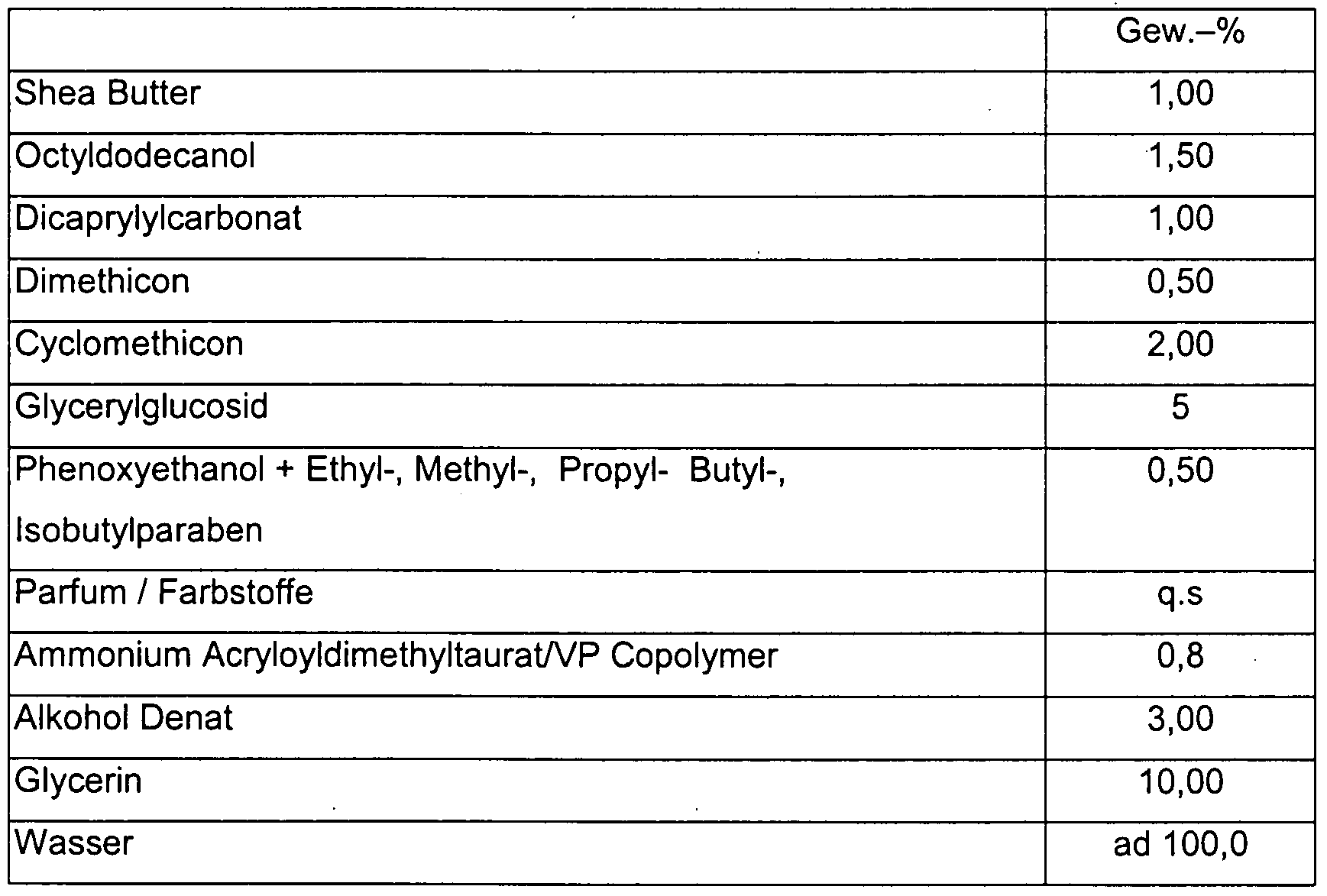
Es folgen vorteilhafte Ausführungsbeispiele der vorliegenden Erfindung.
Beispiel 1 : O/W-Emulsionen:

Beispiel 2: O/W-Emulsionen:


Beispiel 9: Hydrodispersion / Gelcreme

Beispiel 10: Hydrodispersion / Gelcreme

Claims
1. Kosmetische Zubereitungen, enthaltend
(i) ein oder mehrere Glucosylglyceride und
(ii) mindestens ein polymeres Verdickungsmittel gewählt aus der Gruppe der Acrylamidomethylpropylsulfonsäure-Polymere.
2. Wirkstoffkombinationen nach Anspruch 1 , in denen das molare Verhältnis von einem oder mehreren Glucosylglyceriden zu einem oder mehreren der Acrylamidomethylpropylsulfonsäure- Polymere aus dem Bereich von 100 : 1 bis 1 : 100 , bevorzugt 50 : 1 bis 1 : 50, insbesondere bevorzugt 20 : 1 bis 1 : 20 gewählt wird.
3. Wirkstoffkombinationen nach Anspruch 1 , dadurch gekennzeichnet, daß als Acrylamidomethylpropylsulfonsäure-Polymer das Arnmoniumacryloyldimethyltaurat / VP Copolymer gewählt wird.
4. Kosmetische Zubereitungen, Wirkstoffkombinationen gemäß einem der Ansprüche 1 - 3 enthaltend.
5. Kosmetische Zubereitungen gemäß Anspruch 3, in denen Glucosylglycerid in Konzentrationen von 0,01 - 10,00 Gew.-%, bevorzugt 0,05 - 5,00 Gew.-%, besonders bevorzugt 0,1 - 3,00 Gew.-%, jeweils bezogen auf das Gesamtgewicht der Zusammensetzung, vorliegt.
6. Kosmetische Zubereitungen gemäß Anspruch 3, in denen das oder die hydrophobisierten Acrylamidomethylpropylsulfonsäure-Polymere in Konzentrationen von 0,01 - 10,00 Gew.-%, bevorzugt 0,05 - 5,00 Gew.-%, besonders bevorzugt 0,1 - 3,00 Gew.-%, jeweils bezogen auf das Gesamtgewicht der Zusammensetzung, vorliegt oder vorliegen
Priority Applications (1)
| Application Number | Priority Date | Filing Date | Title |
|---|---|---|---|
| EP06724756A EP1885329B1 (de) | 2005-05-19 | 2006-05-09 | Kosmetische zubereitungen mit einem gehalt an glucosylglyceriden und einem acrylamidomethylpropylsulfonsäure-vp-copolymer |
Applications Claiming Priority (2)
| Application Number | Priority Date | Filing Date | Title |
|---|---|---|---|
| DE102005023638.3 | 2005-05-19 | ||
| DE200510023638 DE102005023638A1 (de) | 2005-05-19 | 2005-05-19 | Kosmetische Zubereitungen mit einem Gehalt an Glucosylglyceriden und einem oder mehreren Acrylamidomethylpropylsulfonsäure-Polymeren |
Publications (1)
| Publication Number | Publication Date |
|---|---|
| WO2006122669A1 true WO2006122669A1 (de) | 2006-11-23 |
Family
ID=36822352
Family Applications (1)
| Application Number | Title | Priority Date | Filing Date |
|---|---|---|---|
| PCT/EP2006/004294 Ceased WO2006122669A1 (de) | 2005-05-19 | 2006-05-09 | Kosmetische zubereitungen mit einem gehalt an glucosylglyceriden und einem oder mehreren acrylamidomethylpropylsulfonsäure-polymeren |
Country Status (3)
| Country | Link |
|---|---|
| EP (1) | EP1885329B1 (de) |
| DE (1) | DE102005023638A1 (de) |
| WO (1) | WO2006122669A1 (de) |
Cited By (3)
| Publication number | Priority date | Publication date | Assignee | Title |
|---|---|---|---|---|
| WO2007124991A1 (de) * | 2006-04-27 | 2007-11-08 | Beiersdorf Ag | Kosmetische zubereitung mit aquaporin-stimulatoren und deren verwendung |
| EP1923045A1 (de) | 2006-11-17 | 2008-05-21 | Beiersdorf Aktiengesellschaft | Kosmetische Formulierung mit Glucosylglyceriden und Puderrohstoffen |
| DE102006019794B4 (de) | 2005-05-19 | 2025-10-09 | Basf Beauty Care Solutions France S.A.S. | Kosmetische Zubereitung mit Aquaporin-Stimulatoren und deren Verwendung |
Families Citing this family (3)
| Publication number | Priority date | Publication date | Assignee | Title |
|---|---|---|---|---|
| DE102006055043A1 (de) * | 2006-11-17 | 2008-05-21 | Beiersdorf Ag | Kosmetische Formulierung mit Glucosylglyceriden und Hautaufhellern |
| DE102006055044A1 (de) * | 2006-11-17 | 2008-05-21 | Beiersdorf Ag | Kosmetische Formulierung mit Glucosylglyceriden und Harnstoff |
| DE102010055770A1 (de) * | 2010-12-23 | 2012-06-28 | Beiersdorf Ag | Verfahren zur Herstellung kosmetischer und/oder dermatologischer Emulsionen mit einem oder mehreren Glucosylglyceriden |
Citations (5)
| Publication number | Priority date | Publication date | Assignee | Title |
|---|---|---|---|---|
| EP0770378A1 (de) * | 1995-11-02 | 1997-05-02 | Beiersdorf Aktiengesellschaft | Kosmetische Zubereitungen mit einem wirksamen Gehalt an Glycosylglyceriden |
| EP0815844A1 (de) * | 1996-06-28 | 1998-01-07 | L'oreal | Topische tensidfreie Öl-in-Wasser Emulsion die eine vernetzte neutralisierte Poly-(2-acrylamide-2-methylpropane Sulfonsäure) enthält |
| EP0824915A2 (de) * | 1996-08-23 | 1998-02-25 | Beiersdorf Aktiengesellschaft | Herstellung von Glycoglycerolipiden, deren Verwendung als Tenside sowie kosmetische oder dermatologische Zubereitungen, solche Glycoglycerolipide enthaltend |
| DE10065047A1 (de) * | 2000-12-23 | 2002-07-04 | Beiersdorf Ag | Gelcèmes in Form von O/W-Emulsionen mit einem Gehalt an einem oder mehreren Ammoniumaryloyldimethyltaurat/vinylpyrrolidoncopolymeren |
| JP2004229668A (ja) * | 2004-03-30 | 2004-08-19 | Tatsuuma-Honke Brewing Co Ltd | α−D−グルコピラノシルグリセロール類及びその製造方法及びその用途 |
Family Cites Families (8)
| Publication number | Priority date | Publication date | Assignee | Title |
|---|---|---|---|---|
| CA2182577C (en) * | 1994-02-04 | 2002-08-20 | Anders Carlsson | Lipophilic carrier preparations |
| WO1995020943A1 (en) * | 1994-02-04 | 1995-08-10 | Scotia Lipidteknik Ab | Oil-in-water emulsions |
| SE515982C2 (sv) * | 1998-03-06 | 2001-11-05 | Lipocore Holding Ab | Användning av en olja-i-vatten emulsion som bärare för framställning av en topikal kräm eller lotion |
| DE10155962A1 (de) * | 2001-11-09 | 2003-05-22 | Beiersdorf Ag | Kosmetische und dermatologische Lichtschutzformulierungen mit einem Gehalt an Hydroxybenzophenonen und Acrylamid-Polymeren |
| DE10247695A1 (de) * | 2002-10-01 | 2004-04-15 | Beiersdorf Ag | Emulsion mit substituierten Sacchariden |
| DE102004003435A1 (de) * | 2004-01-21 | 2005-08-11 | Beiersdorf Ag | Dünnflüssige O/W-Emulsion |
| DE102004014616A1 (de) * | 2004-03-23 | 2005-10-13 | Beiersdorf Ag | Kosmetische und dermatologische Zubereitungen mit konserviertem Taurin |
| DE102004014612A1 (de) * | 2004-03-23 | 2005-10-13 | Beiersdorf Ag | Taurin enthaltende Zubereitungen mit verbessertem Wasserbindungvermögen |
-
2005
- 2005-05-19 DE DE200510023638 patent/DE102005023638A1/de not_active Withdrawn
-
2006
- 2006-05-09 EP EP06724756A patent/EP1885329B1/de not_active Expired - Lifetime
- 2006-05-09 WO PCT/EP2006/004294 patent/WO2006122669A1/de not_active Ceased
Patent Citations (5)
| Publication number | Priority date | Publication date | Assignee | Title |
|---|---|---|---|---|
| EP0770378A1 (de) * | 1995-11-02 | 1997-05-02 | Beiersdorf Aktiengesellschaft | Kosmetische Zubereitungen mit einem wirksamen Gehalt an Glycosylglyceriden |
| EP0815844A1 (de) * | 1996-06-28 | 1998-01-07 | L'oreal | Topische tensidfreie Öl-in-Wasser Emulsion die eine vernetzte neutralisierte Poly-(2-acrylamide-2-methylpropane Sulfonsäure) enthält |
| EP0824915A2 (de) * | 1996-08-23 | 1998-02-25 | Beiersdorf Aktiengesellschaft | Herstellung von Glycoglycerolipiden, deren Verwendung als Tenside sowie kosmetische oder dermatologische Zubereitungen, solche Glycoglycerolipide enthaltend |
| DE10065047A1 (de) * | 2000-12-23 | 2002-07-04 | Beiersdorf Ag | Gelcèmes in Form von O/W-Emulsionen mit einem Gehalt an einem oder mehreren Ammoniumaryloyldimethyltaurat/vinylpyrrolidoncopolymeren |
| JP2004229668A (ja) * | 2004-03-30 | 2004-08-19 | Tatsuuma-Honke Brewing Co Ltd | α−D−グルコピラノシルグリセロール類及びその製造方法及びその用途 |
Non-Patent Citations (1)
| Title |
|---|
| DATABASE WPI Section Ch Week 200458, Derwent World Patents Index; Class B04, AN 2004-597337, XP002395733 * |
Cited By (5)
| Publication number | Priority date | Publication date | Assignee | Title |
|---|---|---|---|---|
| DE102006019794B4 (de) | 2005-05-19 | 2025-10-09 | Basf Beauty Care Solutions France S.A.S. | Kosmetische Zubereitung mit Aquaporin-Stimulatoren und deren Verwendung |
| WO2007124991A1 (de) * | 2006-04-27 | 2007-11-08 | Beiersdorf Ag | Kosmetische zubereitung mit aquaporin-stimulatoren und deren verwendung |
| EP1923045A1 (de) | 2006-11-17 | 2008-05-21 | Beiersdorf Aktiengesellschaft | Kosmetische Formulierung mit Glucosylglyceriden und Puderrohstoffen |
| EP2228051A3 (de) * | 2006-11-17 | 2010-11-10 | Beiersdorf AG | Kosmetische Formulierung mit Glucosylglyceriden und Puderrohstoffen |
| EP2255781A1 (de) * | 2006-11-17 | 2010-12-01 | Beiersdorf AG | Kosmetische Formulierung mit Glucosylglyceriden und Puderrohstoffen |
Also Published As
| Publication number | Publication date |
|---|---|
| DE102005023638A1 (de) | 2006-11-23 |
| EP1885329A1 (de) | 2008-02-13 |
| EP1885329B1 (de) | 2012-11-21 |
Similar Documents
| Publication | Publication Date | Title |
|---|---|---|
| RU2233150C2 (ru) | Жидкие дисперсионные полимерные композиции, их получение и использование | |
| EP1339789B1 (de) | Elektrolythaltige kosmetische, pharmazeutische und dermatologische mittel | |
| EP2186835B1 (de) | Tensidfreie kosmetische, dermatologische und pharmazeutische Mittel | |
| US7025973B2 (en) | Acid cosmetic, dermatological and pharmaceutical agents | |
| EP1339792B1 (de) | Tensidhaltige kosmetische, dermatologische und pharmazeutische mittel | |
| EP1339382B1 (de) | Dekorative kosmetische und dermatologische mittel | |
| DE60127022T2 (de) | Inverslatex basierend auf Squalan oder hydriertem Polyisobuten und diese enthaltende kosmetische Zusammensetzungen, Hautkosmetika, sowie pharmazeutische Zusammensetzungen | |
| DE10110336A1 (de) | Tensidfreie kosmetische, dermatologische und pharmazeutische Mittel | |
| EP2944658A1 (de) | Kosmetische, pharmazeutische und dermatologische Mittel | |
| EP1847253A1 (de) | Wasserlösliche Polymere und ihre Verwendung in kosmetischen und pharmazeutischen Zubereitungen | |
| US20060147396A1 (en) | Composition containing ascorbic acid | |
| JP4209887B2 (ja) | アスコルビン酸を含む化粧用組成物 | |
| EP1885329A1 (de) | Kosmetische zubereitungen mit einem gehalt an glucosylglyceriden und einem oder mehreren acrylamidomethylpropylsulfonsäure-polymeren | |
| DE60216869T2 (de) | Kosmetische Zusammensetzung für das Abschminken oder die Hautreinigung | |
| DE102005023640A1 (de) | Wirkstoffkombinationen aus Glucosylglyceriden und einem oder mehreren partiell neutralisierten Ester von Monoglyceriden und / oder Diglyceriden gesättigter Fettsäuren mit Zitronensäure | |
| KR102719171B1 (ko) | 증점제 및 안정화제의 기능을 하는 분말 형태의 새로운 반 상호 침투성 격자형 중합체 | |
| WO2006128584A1 (de) | Kosmetische zubereitungen mit einem gehalt an einem wässrigen anisfruchtextrakt und einem oder mehreren polymeren verdickungsmitteln, gewählt aus der gruppe der cellulosederivate | |
| EP1348725B1 (de) | Stabile Dispersionskonzentrate | |
| DE10010851A1 (de) | Mittel zum Entfernen von keratotischen Pfropfen | |
| KR102103037B1 (ko) | 글리세린계 미용용 제형의 점착성을 감소시키는 신규한 증점 중합체 | |
| EP1464659B1 (de) | Verfahren zur Herstellung von stabilen Polymer-Konzentraten | |
| WO2006128583A1 (de) | Kosmetische zubereitungen mit einem gehalt an wässrigen anisfruchtextrakt und einem oder mehreren acrylamidomethylpropylsulfonsäure-polymeren | |
| KR20120084503A (ko) | 포스포릴콜린 유사기 함유 단량체 기반의 가교 결합 공중합체, 역상 에멀젼 및 화장료 조성물 |
Legal Events
| Date | Code | Title | Description |
|---|---|---|---|
| 121 | Ep: the epo has been informed by wipo that ep was designated in this application | ||
| WWE | Wipo information: entry into national phase |
Ref document number: 2006724756 Country of ref document: EP |
|
| NENP | Non-entry into the national phase |
Ref country code: DE |
|
| WWW | Wipo information: withdrawn in national office |
Country of ref document: DE |
|
| NENP | Non-entry into the national phase |
Ref country code: RU |
|
| WWW | Wipo information: withdrawn in national office |
Country of ref document: RU |
|
| WWP | Wipo information: published in national office |
Ref document number: 2006724756 Country of ref document: EP |