WO2006128635A2 - Verfahren zur herstellung von n,n-bis(pyridin-2-yl-methyl)-1 ,1-bis(pyridin-2-yl)-1-aminoalkan-verbindungen und diese verbindungen enthaltende metallkomplex-salze - Google Patents
Verfahren zur herstellung von n,n-bis(pyridin-2-yl-methyl)-1 ,1-bis(pyridin-2-yl)-1-aminoalkan-verbindungen und diese verbindungen enthaltende metallkomplex-salze Download PDFInfo
- Publication number
- WO2006128635A2 WO2006128635A2 PCT/EP2006/005023 EP2006005023W WO2006128635A2 WO 2006128635 A2 WO2006128635 A2 WO 2006128635A2 EP 2006005023 W EP2006005023 W EP 2006005023W WO 2006128635 A2 WO2006128635 A2 WO 2006128635A2
- Authority
- WO
- WIPO (PCT)
- Prior art keywords
- formula
- amine
- compounds
- pyridin
- bis
- Prior art date
- Legal status (The legal status is an assumption and is not a legal conclusion. Google has not performed a legal analysis and makes no representation as to the accuracy of the status listed.)
- Ceased
Links
Classifications
-
- C—CHEMISTRY; METALLURGY
- C07—ORGANIC CHEMISTRY
- C07D—HETEROCYCLIC COMPOUNDS
- C07D213/00—Heterocyclic compounds containing six-membered rings, not condensed with other rings, with one nitrogen atom as the only ring hetero atom and three or more double bonds between ring members or between ring members and non-ring members
- C07D213/02—Heterocyclic compounds containing six-membered rings, not condensed with other rings, with one nitrogen atom as the only ring hetero atom and three or more double bonds between ring members or between ring members and non-ring members having three double bonds between ring members or between ring members and non-ring members
- C07D213/04—Heterocyclic compounds containing six-membered rings, not condensed with other rings, with one nitrogen atom as the only ring hetero atom and three or more double bonds between ring members or between ring members and non-ring members having three double bonds between ring members or between ring members and non-ring members having no bond between the ring nitrogen atom and a non-ring member or having only hydrogen or carbon atoms directly attached to the ring nitrogen atom
- C07D213/24—Heterocyclic compounds containing six-membered rings, not condensed with other rings, with one nitrogen atom as the only ring hetero atom and three or more double bonds between ring members or between ring members and non-ring members having three double bonds between ring members or between ring members and non-ring members having no bond between the ring nitrogen atom and a non-ring member or having only hydrogen or carbon atoms directly attached to the ring nitrogen atom with substituted hydrocarbon radicals attached to ring carbon atoms
- C07D213/36—Radicals substituted by singly-bound nitrogen atoms
- C07D213/38—Radicals substituted by singly-bound nitrogen atoms having only hydrogen or hydrocarbon radicals attached to the substituent nitrogen atom
Definitions
- EP 909 809 N, N-bis (pyridin-2-ylmethyl) -1, 1-bis (pyridin-2-yl) -1-aminoalkane compounds and a process for their preparation are known from EP 909 809.
- These compounds, as well as metal complexes containing these compounds as ligands, are used as so-called bleach catalysts together with a peroxygen compound in detergents to reduce the temperature at which the peroxygen compounds release the active oxygen.
- the synthesis of these compounds proceeds according to EP 909 809 according to the following reaction scheme:
- the oxime is formed by reaction with hydroxylamine, which is then reduced to the amine.
- the synthesis in the first reaction step is carried out either with hydroxylamine in pyridine or with hydroxylamine hydrochloride in ethanol / water with the addition of sodium hydroxide solution.
- the isolation is carried out by neutralization and precipitation.
- the product of the first reaction step is reduced with zinc and ammonia in ethanol to the amine.
- the yields are very variable.
- the primary amine is alkylated with picolyl chloride hydrochloride in 5N sodium hydroxide solution; the reaction time is 40 h, the product is isolated by precipitation with perchloric acid as perchlorate, which is washed and optionally recrystallized; from the purified salt, the amine is liberated by reaction with sodium hydroxide solution, the isolation is carried out by extraction with dichloromethane, drying of the organic phase and concentration to dryness.
- the fourth reaction step freshly liberated amine is deprotonated in dry tetrahydrofuran with n-butyllithium and alkylated with methyl iodide; The mixture is warmed to -30 - 0 0 C overnight and then mixed with Glauber's salt. Isolation is by concentration, taking up in dichloromethane, washing, drying and concentration again; the crude product is reprecipitated from ethyl acetate / hexane.
- the ligand obtained from the reaction steps 1 to 4 and recrystallized is dissolved in methanol and reacted with a transition metal compound, for example, iron (II) chloride tetrahydrate dissolved in methanol.
- a transition metal compound for example, iron (II) chloride tetrahydrate dissolved in methanol.
- the solvent is completely removed in vacuo and the hard, firmly adhering residue recrystallized or stirred.
- the yields achieved for the ligands are in the range of 4.9% to 5.1%.
- the yields for the complexes are in the range of 3.5%.
- the object was to develop a process for the preparation of said class of compounds, which is free of the disadvantages described above.
- the invention relates to a process for the preparation of N, N-bis (pyridin-2-yl-methyl) -1, 1-bis (pyridin-2-yl) -1-aminoalkane compounds of the formula 1
- R 1 is C 1 -C 6 -alkyl, phenyl or benzyl, preferably methyl.
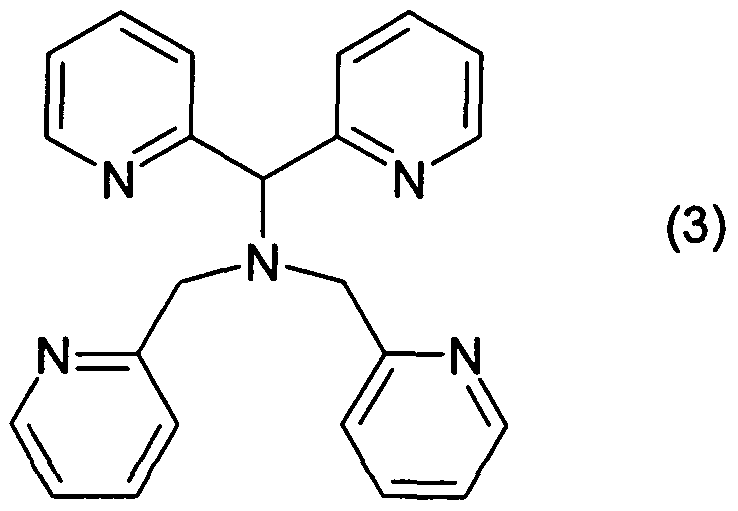
- Fluoroborate salt is converted and then the amine of formula 3 from 4) liberates the amine of formula 3 with an alkyl halide of the formula R 1 -hal alkylation of this fluoroborate salt by addition of a base.
- Dipyridyl ketone is initially charged in methanol. While stirring, aqueous hydroxylamine solution is added so that the mixture heats but does not boil. The amount of hydroxylamine is about 1, 0-1, 2 preferably 1, 05-1, 15 molar equivalents. The mixture is heated to boiling and at this
- reaction time is 5 to 15 hours, preferably 5 to 8 hours. Then allowed to cool to room temperature. Once this is achieved, palladium on carbon is added as a catalyst. The amount of catalyst is about 1 to 5 wt .-% based on the ketone. Hydrogen is then introduced under vigorous stirring at 15 to 50 ° C., preferably at 40 to 50 ° C., until the reduction is complete. After completion of the reaction, the reddish, clear solution is filtered off from the catalyst. To isolate the product, the solvent is completely distilled off in vacuo.
- the process according to the invention gives the intermediate of formula 2 in yields> 85%, preferably in yields of 88 to 91% and high purity (> 90% by NMR).
- 2nd reaction step The product of the first stage is mixed at room temperature with 5N sodium hydroxide solution. With cooling, a previously prepared solution of picolyl chloride hydrochloride in water is added so that the internal temperature rises only slightly.
- the amount of sodium hydroxide solution is 1, 5-2.5, preferably 2.0-2.2 molar equivalents
- the amount of picolyl chloride is 1, 0-1, 5, preferably 1, 1-1.2 molar equivalents. It is stirred at room temperature.
- the reaction time is about 1 to 8 hours, preferably 2-5 hours. Then in the same way one after the other again sodium hydroxide solution and picolyl chloride hydrochloride solution.
- the amount of sodium hydroxide solution is 1, 5-2.5, preferably 2.0-2.2 molar equivalents
- the amount of picolyl chloride is 1, 0-1, 5 preferably 1, 1-1, 2 molar equivalents.
- the reaction time is about 2-4, preferably 3 days.
- the crude product is obtained as a viscous oil. Purification is by precipitation with HBF4 solution (50% in water) and simultaneous addition of saturated saline solution with cooling. The precipitate is filtered off, washed and dried.
- the salt is finely suspended in dichloromethane at room temperature. Then 5N sodium hydroxide solution is added, and the mixture is stirred vigorously. The amount of sodium hydroxide solution is 5-10, preferably 6-7 molar equivalents based on the primary amine used.
- the reaction time is 0.5 to 2 hours, preferably 0.5 to 1 h. For workup, the phases are separated, the aqueous phase with
- the product of formula 3 is obtained according to this inventive method in yields> 50%, preferably in yields of 55 to 65% and high purity (> 90% by HPLC).
- Freshly released amine of formula 3 is dissolved in THF and the solution is brought under argon to -60 to -80 ° C, preferably -75 to -65 ° C. At this temperature, cooled n-BuLi is added dropwise so that the temperature does not rise too much.
- the amount of n-BuLi is 1.0 to 1.2, preferably 1.05 to 1.5 mol equivalents.
- the internal temperature should be -50 0 C preferably not exceed -65 ° C.
- stirring is continued for some time.
- the reaction time is 30-90, preferably, 30-60 minutes. After this time, TMEDA (N 1 N 1 N 1 N-
- Tetramethylethylenediamine is metered in so that the internal temperature does not rise more than 5 to 10 0 C /, and it is stirred for a few minutes.
- the amount of TMEDA is 1, 0-1, 2 preferably 1, 05-1, 15 molar equivalents.
- the alkyl iodide is then added by an analogous method.
- the amount of alkyl iodide is 1, 0-1, 5 is preferred 1, 1-1, 2 molar equivalents.
- the mixture is then heated with stirring first to -40 to -20, preferably, -30 0 C, then to -5 to + 5 ° C heated.
- the reaction time is 5-10, preferably 7 to 9 h.
- Glauber's salt is then added at 0 ° C. and stirred for 15-60, preferably for 30-45 minutes.
- the amount of Glauber's salt is 0.1-0.2, preferably 0.15-0.17 molar equivalents.
- the precipitate formed is filtered off and washed with cold THF. If necessary, it can be dried in a vacuum.
- the moist crude product is stirred vigorously in the 2-phase mixture of dichloromethane and 5N sodium hydroxide solution.
- the reaction time is 5 to 15, preferably 8 to 10 hours.
- the phases are then separated, the aqueous phase is extracted with dichloromethane, the combined organic phases are dried well with sodium sulfate and concentrated completely.
- the preparation according to the process of the invention requires a separate reaction step less, requires only four different organic solvents instead of seven.
- the mass of organic solvent used was reduced to about 10%.
- the amount of expensive catalyst was also reduced to 10%. The method is technically feasible compared to the prior art.
- the compounds of formula 1 thus prepared can be used directly as bleach activators.
- these compounds of the formula can be converted by reaction with metal salts in metal complex salts, the contain the compounds of formula 1 as ligands.
- metal salts in metal complex salts
- a compound of formula 1 is presented suspended in methanol. At room temperature, solid metal salt is added and stirred. Suitable metal salts here are Fe, Mn, Cr, Co salts, preferably Fe salts.
- the resulting metal complex salts are also suitable as bleach catalysts.
- the reaction time is 2 to 5, preferably 3 to 4 hours. Subsequently, a part of the
- Product suspension is mixed with ethyl acetate and stirred vigorously.
- the duration of the stirring is 1 to 5, preferably 2 to 3 h. Then the
- the product is obtained by this novel process in yields> 90%, preferably in yields of 92 to 94% and high purity (about 94% by HPLC).
- Picolyl chloride hydrochloride added in 700ml of water. The mixture was then stirred vigorously at room temperature for 3 days. For isolation, the reaction mixture was extracted three times with 1 L dichloromethane. The organic extract was completely concentrated on a rotary evaporator to give 780 g of viscous crude product. For purification, 1406 g of HBF4 solution (50% in water) and 1018 ml of saturated saline solution were added with cooling. At room temperature, stirring was continued for 1 h, the precipitated crystals were then filtered off, washed and dried. 987 g of fluoroborate salt were obtained. The salt was finely suspended in dichloromethane at room temperature. Then 7.9 l of 5N sodium hydroxide solution were added, and the mixture was stirred vigorously for 30 minutes.
- the resulting crude product was suspended in 2.9 kg of dichloromethane. 8.5 L of 5N sodium hydroxide solution were added to this suspension, and the mixture was stirred vigorously. The phases were separated, the organic phase washed with saturated NaCl solution, dried over Na 2 SO 4 and completely concentrated.
- Step 4 Preparation of an Iron (II) Chloride Complex Having Ligand According to (I): 140 g (0.366 mol) of 1 ⁇ 1 "-di (2-pyridyl) -1,1-di (2-pyridyl) dimethylamine were dissolved in 3L At room temperature, 61.1 g (0.366 mol) of FeCl 2 ⁇ 4H 2 O were added and stirring was continued for 3 h After the reaction time had ended, 2.7 l of solvent (90%) were distilled off under reduced pressure about 2 stirred Essigklathylacetat h, the precipitate was filtered and washed with another 200 ml Essigklathylacetat. the wet product was dried at 40 0 C in vacuo. There were obtained 171 g of product (92%) as a bright red solid.
Landscapes
- Chemical & Material Sciences (AREA)
- Organic Chemistry (AREA)
- Pyridine Compounds (AREA)
Abstract
Description


Claims


Priority Applications (6)
| Application Number | Priority Date | Filing Date | Title |
|---|---|---|---|
| DE502006002829T DE502006002829D1 (de) | 2005-06-01 | 2006-05-26 | -methyl)-1,1-bis(pyridin-2-yl)-1-aminoalkan-verbindungen und diese verbindungen enthaltende metallkomplex-salze |
| EP06761943A EP1893604B1 (de) | 2005-06-01 | 2006-05-26 | Verfahren zur herstellung von n,n-bis(pyridin-2-yl-methyl)-1,1-bis(pyridin-2-yl)-1-aminoalkan-verbindungen und diese verbindungen enthaltende metallkomplex-salze |
| JP2008513986A JP5129741B2 (ja) | 2005-06-01 | 2006-05-26 | N,n−ビス(ピリジン−2−イル−メチル)−1,1−ビス(ピリジン−2−イル)−1−アミノアルカン化合物の製造法、及びこれらの化合物を含む金属錯体塩 |
| US11/921,551 US7977487B2 (en) | 2005-06-01 | 2006-05-26 | Method for producing N,N-bis(pyridin-2ylmethyl)-1,1-bis(pyridin-2-yl)-1-aminoalkane compounds and metal complex salts containing these compounds |
| BRPI0611006-1A BRPI0611006A2 (pt) | 2005-06-01 | 2006-05-26 | método para produção de compostos n,n-bis (piridin-2ilmetil)-1,1-bis (piridin-2-il)1-aminoalcano e sais de complexos de metais contendo esses compostos |
| MX2007015152A MX2007015152A (es) | 2005-06-01 | 2006-05-26 | Metodo para producir compuestos de n,n-bis(piridin-2-ilmetil)-1,1- bis(piridin-2-il)-1-aminoalcano y sales de complejos metalicos que contienen estos compuestos. |
Applications Claiming Priority (2)
| Application Number | Priority Date | Filing Date | Title |
|---|---|---|---|
| DE102005024997 | 2005-06-01 | ||
| DE102005024997.3 | 2005-06-01 |
Publications (2)
| Publication Number | Publication Date |
|---|---|
| WO2006128635A2 true WO2006128635A2 (de) | 2006-12-07 |
| WO2006128635A3 WO2006128635A3 (de) | 2007-03-08 |
Family
ID=37199253
Family Applications (1)
| Application Number | Title | Priority Date | Filing Date |
|---|---|---|---|
| PCT/EP2006/005023 Ceased WO2006128635A2 (de) | 2005-06-01 | 2006-05-26 | Verfahren zur herstellung von n,n-bis(pyridin-2-yl-methyl)-1 ,1-bis(pyridin-2-yl)-1-aminoalkan-verbindungen und diese verbindungen enthaltende metallkomplex-salze |
Country Status (8)
| Country | Link |
|---|---|
| US (1) | US7977487B2 (de) |
| EP (1) | EP1893604B1 (de) |
| JP (1) | JP5129741B2 (de) |
| BR (1) | BRPI0611006A2 (de) |
| DE (1) | DE502006002829D1 (de) |
| ES (1) | ES2319573T3 (de) |
| MX (1) | MX2007015152A (de) |
| WO (1) | WO2006128635A2 (de) |
Families Citing this family (1)
| Publication number | Priority date | Publication date | Assignee | Title |
|---|---|---|---|---|
| CN111889141A (zh) * | 2020-07-09 | 2020-11-06 | 中山大学 | 一种催化二氧化碳与环氧化物环加成反应的离子液体功能化联吡啶类多孔聚合物催化剂 |
Family Cites Families (5)
| Publication number | Priority date | Publication date | Assignee | Title |
|---|---|---|---|---|
| CA2248476A1 (en) * | 1997-10-01 | 1999-04-01 | Unilever Plc | Bleach activation |
| PH11999002188B1 (en) * | 1998-09-01 | 2007-08-06 | Unilever Nv | Method of treating a textile |
| PH11999002190B1 (en) * | 1998-09-01 | 2007-08-06 | Unilever Nv | Composition and method for bleaching a substrate |
| EP1208188A1 (de) * | 1999-09-01 | 2002-05-29 | Unilever Plc | Zusammensetzung und verfahren zum bleichen eines substrats |
| EP1663982B1 (de) * | 2003-07-31 | 2007-11-21 | Sanofi-Aventis | Aminochinolinderivate und deren verwendung als adenosin-a3-liganden |
-
2006
- 2006-05-26 BR BRPI0611006-1A patent/BRPI0611006A2/pt not_active Application Discontinuation
- 2006-05-26 US US11/921,551 patent/US7977487B2/en not_active Expired - Fee Related
- 2006-05-26 ES ES06761943T patent/ES2319573T3/es active Active
- 2006-05-26 JP JP2008513986A patent/JP5129741B2/ja not_active Expired - Fee Related
- 2006-05-26 EP EP06761943A patent/EP1893604B1/de not_active Not-in-force
- 2006-05-26 MX MX2007015152A patent/MX2007015152A/es active IP Right Grant
- 2006-05-26 DE DE502006002829T patent/DE502006002829D1/de active Active
- 2006-05-26 WO PCT/EP2006/005023 patent/WO2006128635A2/de not_active Ceased
Also Published As
| Publication number | Publication date |
|---|---|
| US7977487B2 (en) | 2011-07-12 |
| JP5129741B2 (ja) | 2013-01-30 |
| ES2319573T3 (es) | 2009-05-08 |
| WO2006128635A3 (de) | 2007-03-08 |
| DE502006002829D1 (de) | 2009-03-26 |
| MX2007015152A (es) | 2008-02-15 |
| BRPI0611006A2 (pt) | 2010-08-10 |
| EP1893604B1 (de) | 2009-02-11 |
| EP1893604A2 (de) | 2008-03-05 |
| US20090221831A1 (en) | 2009-09-03 |
| JP2008545723A (ja) | 2008-12-18 |
Similar Documents
| Publication | Publication Date | Title |
|---|---|---|
| DE60023859T2 (de) | Verfahren zur herstellung von amin-platin-komplexen | |
| DE19724186A1 (de) | Verfahren zur Mono- und 1,7-Bis-N- Hydroxyalkylierung von Cyclen und die entsprechenden N-ß-Hydroxyalkyl-1,4,7,10-tetraazacyclododecan-Li-Salz-Komplexe | |
| DE19833118C2 (de) | Verfahren zur Herstellung von orthoalkylierten Benzoesäurederivaten | |
| WO2004024738A1 (de) | Verfahren zur metallorganischen herstellung organischer zwischenprodukte über aryllithium-basen | |
| DE10150615A1 (de) | Verfahren zur metallorganischen Herstellung organischer Zwischenprodukte | |
| EP1893604B1 (de) | Verfahren zur herstellung von n,n-bis(pyridin-2-yl-methyl)-1,1-bis(pyridin-2-yl)-1-aminoalkan-verbindungen und diese verbindungen enthaltende metallkomplex-salze | |
| EP1339705A2 (de) | Verfahren zur herstellung von liponsäure und dihydroliponsaüre | |
| EP0190676B1 (de) | All-cis-1,3,5-Triamino2,4,6-cyclohexantriol-Derivate, ihre Verwendung, Verfahren zu ihrer Herstellung und sie enthaltende pharmazeutische Präparate | |
| DE102007033020A1 (de) | Bispidonliganden und deren Metallkomplexe | |
| WO2006133869A1 (de) | Verfahren zur herstellung von 3,7-diaza-bicyclo[3.3.1]nonan-verbindungen | |
| EP2627658B1 (de) | Verfahren zur herstellung von 3,7-diaza-bicyclo[3.3.1]nonan-metallkomplexen | |
| EP0792274A1 (de) | Verfahren zur herstellung von alkaliaminoborhydriden und alkaliaminoborhydrid-komplexen | |
| EP2220100B1 (de) | Chirale cycloplatinierte komplexe, herstellungsverfahren sowie deren verwendung in medizin und katalyse | |
| DE2303176A1 (de) | Substituierte 5-chromanole, verfahren zu ihrer herstellung und diese verbindungen enthaltende arzneipraeparate | |
| DE2015574A1 (de) | ||
| DE1470317A1 (de) | Verfahren zur Herstellung von Benzoyl-Pyridinociminoaethern und -estern | |
| EP2531504B1 (de) | Verfahren zur herstellung von 3,7-diaza-bicyclo[3.3.1]nonan-metallkomplex-lösungen | |
| DE69908922T2 (de) | Methylbiphenyl-derivate, verfahren zu ihrer herstellung und ihre verwendung | |
| DE895903C (de) | Verfahren zur Herstellung neuer basisch substituierter Halogenaryl-pyridyl-alkanone | |
| DE825840C (de) | Verfahren zur Herstellung substituierter Piperazine | |
| DE850297C (de) | Verfahren zur Herstellung von Amidinsalzen | |
| EP3081529A1 (de) | Verfahren zur freisetzung von wasserstoff aus dem addukt von ammoniak und boran sowie verwendung von übergangsmetallfreien katalysatoren zur freisetzung von wasserstoff aus dem addukt von ammoniak und boran | |
| AT222660B (de) | Verfahren zur Herstellung von neuen Azepin-Derivaten | |
| AT204564B (de) | Verfahren zur Herstellung von neuen stickstoffhaltigen organischen Phosphorverbindungen | |
| AT233013B (de) | Verfahren zur Herstellung von neuen Iminodibenzylderivaten |
Legal Events
| Date | Code | Title | Description |
|---|---|---|---|
| 121 | Ep: the epo has been informed by wipo that ep was designated in this application | ||
| WWE | Wipo information: entry into national phase |
Ref document number: 2006761943 Country of ref document: EP |
|
| WWE | Wipo information: entry into national phase |
Ref document number: MX/a/2007/015152 Country of ref document: MX Ref document number: 2008513986 Country of ref document: JP |
|
| WWP | Wipo information: published in national office |
Ref document number: 2006761943 Country of ref document: EP |
|
| WWE | Wipo information: entry into national phase |
Ref document number: 11921551 Country of ref document: US |
|
| ENP | Entry into the national phase |
Ref document number: PI0611006 Country of ref document: BR Kind code of ref document: A2 |