WO2006128817A1 - Fungizide 5-hydroxypyrazoline, verfahren zu deren herstellung, sowie sie enthaltende mittel - Google Patents
Fungizide 5-hydroxypyrazoline, verfahren zu deren herstellung, sowie sie enthaltende mittel Download PDFInfo
- Publication number
- WO2006128817A1 WO2006128817A1 PCT/EP2006/062565 EP2006062565W WO2006128817A1 WO 2006128817 A1 WO2006128817 A1 WO 2006128817A1 EP 2006062565 W EP2006062565 W EP 2006062565W WO 2006128817 A1 WO2006128817 A1 WO 2006128817A1
- Authority
- WO
- WIPO (PCT)
- Prior art keywords
- alkyl
- methyl
- cio
- phenyl
- formula
- Prior art date
- Legal status (The legal status is an assumption and is not a legal conclusion. Google has not performed a legal analysis and makes no representation as to the accuracy of the status listed.)
- Ceased
Links
- 0 CC(*)CS(*C(*)=*1)(*1C(*)=O)=CC Chemical compound CC(*)CS(*C(*)=*1)(*1C(*)=O)=CC 0.000 description 1
Classifications
-
- C—CHEMISTRY; METALLURGY
- C07—ORGANIC CHEMISTRY
- C07D—HETEROCYCLIC COMPOUNDS
- C07D231/00—Heterocyclic compounds containing 1,2-diazole or hydrogenated 1,2-diazole rings
- C07D231/02—Heterocyclic compounds containing 1,2-diazole or hydrogenated 1,2-diazole rings not condensed with other rings
- C07D231/06—Heterocyclic compounds containing 1,2-diazole or hydrogenated 1,2-diazole rings not condensed with other rings having one double bond between ring members or between a ring member and a non-ring member
- C07D231/08—Heterocyclic compounds containing 1,2-diazole or hydrogenated 1,2-diazole rings not condensed with other rings having one double bond between ring members or between a ring member and a non-ring member with oxygen or sulfur atoms directly attached to ring carbon atoms
-
- A—HUMAN NECESSITIES
- A01—AGRICULTURE; FORESTRY; ANIMAL HUSBANDRY; HUNTING; TRAPPING; FISHING
- A01N—PRESERVATION OF BODIES OF HUMANS OR ANIMALS OR PLANTS OR PARTS THEREOF; BIOCIDES, e.g. AS DISINFECTANTS, AS PESTICIDES OR AS HERBICIDES; PEST REPELLANTS OR ATTRACTANTS; PLANT GROWTH REGULATORS
- A01N43/00—Biocides, pest repellants or attractants, or plant growth regulators containing heterocyclic compounds
- A01N43/48—Biocides, pest repellants or attractants, or plant growth regulators containing heterocyclic compounds having rings with two nitrogen atoms as the only ring hetero atoms
- A01N43/56—1,2-Diazoles; Hydrogenated 1,2-diazoles
-
- A—HUMAN NECESSITIES
- A61—MEDICAL OR VETERINARY SCIENCE; HYGIENE
- A61P—SPECIFIC THERAPEUTIC ACTIVITY OF CHEMICAL COMPOUNDS OR MEDICINAL PREPARATIONS
- A61P3/00—Drugs for disorders of the metabolism
Definitions
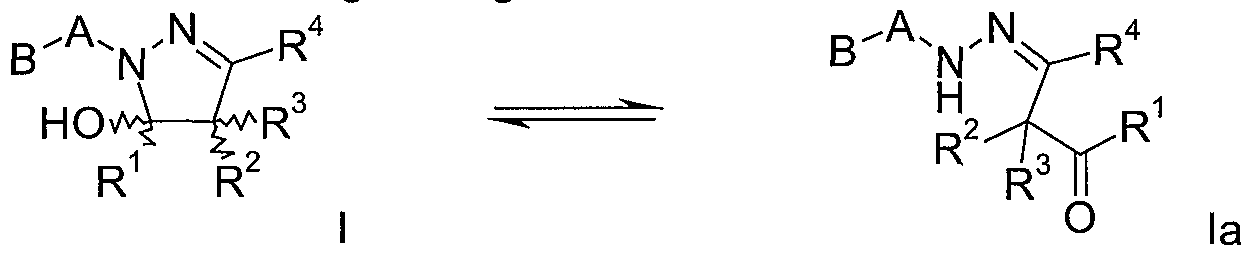
- the present invention relates to novel 5-hydroxypyrazolines of the formula I.
- B is phenyl, naphthyl or 5- or 6-membered hetaryl containing one to four heteroatoms from the group O, N or S;
- R 1 is C 2 -Cio-alkyl, Ci-Cio-haloalkyl, C 3 -Cio-alkenyl, C 3 -Cio-haloalkenyl, C 3 -C 0 - alkynyl, or C 3 -C 0 haloalkynyl,
- R 2 Ci-Ci alkyl ⁇ , ⁇ CRCI haloalkyl, C 2 -C o alkenyl, C2 -Cio-haloalkyl, C 3 -C 0 - alkynyl, C 3 -C 0 haloalkynyl, C 3 -C 0 cycloalkyl, C 3 -C 0 cycloalkenyl, C 3 -C 0 - cycloalkynyl, phenyl, 5- or 6-membered hetaryl or heterocyclyl containing one to four heteroatoms from the group O, N or S;
- R 3 is hydrogen, nitro, cyano, Ci-C 4 alkyl, Ci-C4-haloalkyl, Ci-C4 alkoxy, -C 4 - haloalkoxy, C 2 -C 4 alkenyl, C 2 -C 4 haloalkenyl, C 2 -C 4 -alkynyl, C 2 -C 4 -halo-genalkinyl or NR ' 2 , wherein
- R ' is independently hydrogen or Ci-C4-alkyl
- R 4 is hydrogen, halogen, nitro, cyano, NR '2, Ci-C 4 alkyl, dC 4 haloalkyl,
- R a is halogen, cyano, nitro, hydroxy, Ci-C 6 alkyl, Ci-C 6 haloalkyl, Ci-C 6 alkyl carbonyl, C 3 -C 6 cycloalkyl, Ci-C ⁇ -alkoxy, Ci-C 6 Haloalkoxy, C 1 -C 6 -alkoxycarbonyl, formyl, C 1 -C 6 -alkylthio, C 1 -C 6 -alkylamino, C 1 -C 6 -alkylamino, C 2 -C 6 -alkylthio, Alkenyl, C 2 -C 8 -haloalkenyl, C 1 -C 6 -cycloalkenyl, C 2 -C 6 -alkenyloxy, C 3 -C 6 -haloalkenyloxy, C 2 -C 6 -alkynyl, C 2 -C 6 -haloalkynyl, C 3 -
- R '" is hydrogen, alkyl, cycloalkyl and aryl and R ⁇ v alkyl, alkenyl, haloalkenyl , alkynyl and arylalkyl, or NR V -CO-DR VI , wherein
- R v is hydrogen, hydroxy, Ci-C 6 alkyl, C 2 -C 6 alkenyl, C 2 -C 6 alkynyl, C 6 - alkoxy, C 2 -C 6 alkenyloxy, C 2 -C 6 Alkynyloxy, C 1 -C 6 -alkoxy-dC 6 -alkyl, C 1 -C 6 -alkoxy-C 1 -C 6 -alkoxy and C 1 -C 6 -alkoxycarbonyl,
- R v ⁇ is hydrogen, C 1 -C 6 -alkyl, C 2 -C 6 -alkynyl, C 2 -C 6 -alkynyl, C 3 -C 6 -cycloalkyl, C 3 -C 6 -cycloalkenyl, phenyl, phenyl C 1 -C 6 -alkyl, hetaryl and hetaryl-C 1 -C 6 -alkyl and D denotes a direct bond, oxygen or nitrogen, it being possible for the nitrogen to carry one of the groups mentioned for R v ⁇ ,
- R b is halogen, cyano, nitro, hydroxy, mercapto, amino, carboxyl, aminocarbonyl, aminothiocarbonyl, alkyl, haloalkyl, alkenyl, alkenyloxy, alkynyloxy, alkoxy, haloalkoxy, alkylthio, alkylamino, dialkylamino, formyl, alkylcarbonyl, Alkylsulfonyl, alkylsulfoxyl, alkoxycarbonyl, alkylcarbonyloxy, alkylaminocarbonyl, dialkylaminocarbonyl, alkylaminothiocarbonyl, dialkylaminothiocarbonyl, where the alkyl groups in these radicals contain 1 to 6 carbon atoms and said alkenyl or alkynyl groups in these radicals contain 2 to 8 carbon atoms;
- the invention relates to processes for their preparation, their use for controlling harmful fungi, and agents containing them.
- Substituted pyrazolin-5-ones with herbicidal and fungicidal activity are known from DE-A 37 28 278, fungicidally active 3-aryl-pyrazoles are disclosed in WO-A 94/29276 and WO 00/20399.
- the invention thus relates to both forms, even if only the ring shape I is always called for reasons of clarity.
- This reaction is usually carried out at temperatures of 0 0 C to 200 0 C, preferably upstream 20 ° C to 100 ° C, in an inert organic solvent
- an inert organic solvent J. Org. Chem. USSR (Engl. TransL), Vol. 16, p. 371 (1980); ibid., Vol. 21, p. 2279 (1985); Ibid., Vol. 22, p. 250 (1986); Ibid., Vol. 23, p. 1291 (1987); Indian J. Chem. Sect. B, vol. 29, p. 887 (1990); Soc. Soc. Chem. Jp., Vol. 62, p. 3409 (1989)].
- Suitable solvents are aliphatic hydrocarbons, aromatic hydrocarbons such as toluene, o-, m- and p-xylene, halogenated hydrocarbons such as methylene chloride, chloroform and chlorobenzene, ethers such as diethyl ether, diisopropyl ether, tert-butyl methyl ether, dioxane and tetrahydrofuran, nitriles such as acetonitrile and propio - Nitrile, alcohols such as methanol, ethanol, n-propanol, isopropanol, n-butanol and tert-butanol, and Dimethyisulfoxid, dimethylformamide and dimethylacetamide, more preferably methanol, ethanol and tetrahydrofuran. It is also possible to use mixtures of the be called solvent used.
- the starting materials are generally reacted with one another in equimolar amounts. It may be advantageous for the yield to use III in an excess based on II.
- hydrazides of the formula II required for the preparation of the compounds I are known in the literature [cf. J. Heterocycl. Chem. Vol. 16, p. 561 (1976); Helv. Chim. Acta, Vol. 27, p. 883 (1944); J. Chem. Soc. (1943) p. 413] or can be prepared according to the cited literature.
- Hydrazides of the formula II are usually prepared from the corresponding carboxylic acid esters of the formula V by reaction with hydrazine hydrate.
- R ' is C 1 -C 4 -alkyl.
- This reaction is usually carried out at temperatures of 0 0 C to 15O 0 C, preferably 2O 0 C to 100 0 C, in an inert organic solvent [see. J. Heterocycl. Chem. Vol. 16, p. 561 (1976); Helv. Chim. Acta, Vol. 27, p. 883 (1944); J. Chem. Soc. (1943) p. 413].
- the diketones of the formula III required for the preparation of the compounds I are likewise known in the literature [Organikum, VEB Verlag dermaschineen, 15th ed. P. 584ff., Berlin 1976] or can be prepared according to the cited literature.
- This reaction is advantageously carried out under the conditions specified for the preparation of the compounds IA.
- the starting materials are generally reacted with one another in equimolar amounts. It may be advantageous for the yield to use III in an excess based on IV.
- the sulfurization of LA is carried out under known conditions, it is usually carried out at temperatures of 0 0 C to 180 ° C, preferably 20 ° C to 14O 0 C, in an inert organic solvent [see. Liebigs Ann Chem., P. 177 (1989)].
- Suitable solvents are aliphatic hydrocarbons such as pentane, hexane, cyclohexane and petroleum ether, aromatic hydrocarbons such as toluene, o-, m- and p-xylene, halogenated hydrocarbons such as methylene chloride, chloroform and chlorobenzene, ethers such as diethyl ether, diisopropyl ether, tert-butyl methyl ether , Dioxane, anisole and tetrahydrofuran, nitriles such as acetonitrile and propionitrile, and dimethyl sulfoxide, particularly preferably toluene and tetrahydrofuran. It is also possible to use mixtures of the solvents mentioned.
- Suitable sulfurizing agents are, for example, phosphorus pentasulfide or Lawes- son's reagent.
- the reaction mixtures are worked up in the usual way, e.g. by mixing with water, separation of the phases and optionally chromatographic purification of the crude products.
- the intermediate and end products are z.T. in the form of colorless or pale brownish, viscous oils, which are freed or purified under reduced pressure and at moderately elevated temperature from volatile constituents. If the intermediate and end products are obtained as solids, the purification can also be carried out by recrystallization or trituration.
- Halogen fluorine, chlorine, bromine and iodine
- Alkyl saturated, straight-chain or branched hydrocarbon radicals having 1 to 4, 6, 8 or 10 carbon atoms, for example d-Ce-alkyl such as methyl, ethyl, propyl, 1-methylethyl, butyl, 1-methyl-propyl, 2-methylpropyl, 1 , 1-dimethylethyl, pentyl, 1-methylbutyl, 2-methyl butyl butyl, 3-methylbutyl, 2,2-dimethylpropyl, 1-ethylpropyl, hexyl, 1, 1-dimethylpropyl, 1, 2-dimethylpropyl, 1-methylpentyl, 2-methylpentyl, 3-methylpentyl, 4-methylpentyl, 1, 1-dimethylbutyl, 1, 2-dimethylbutyl, 1, 3-dimethylbutyl, 2,2-dimethylbutyl, 2,3-dimethylbutyl, 3,3-dimethylbutyl, 1-ethylbutyl, 2-e
- Haloalkyl straight-chain or branched alkyl groups having 1 to 10 carbon atoms (as mentioned above), wherein in these groups partially or completely the hydrogen atoms may be replaced by halogen atoms as mentioned above, for example Ci-C 2 -haloalkyl such as chloromethyl, bromomethyl, dichloromethyl, trichloromethyl , Fluoromethyl, difluoromethyl, trifluoromethyl, chlorofluoromethyl, dichlorofluoromethyl, chlorodifluoromethyl, 1-chloroethyl, 1-bromoethyl, 1-fluoroethyl, 2-fluoroethyl, 2,2-difluoroethyl, 2,2,2-trifluoroethyl, 2-chloro-2 fluoroethyl, 2-chloro-2,2-difluoroethyl, 2,2-dichloro-2-fluoroethyl, 2,2,2-trichloroethyl and pen
- Alkenyl unsaturated, straight-chain or branched hydrocarbon radicals having 2 to 4, 6, 8 or 10 carbon atoms and a double bond in any position, for example C 2 -C 6 alkenyl, such as ethenyl, 1-propenyl, 2-propenyl, 1-methylethenyl, 1 -Butenyl, 2-butenyl, 3-butenyl, 1-methyl-1-propenyl, 2-methyl-1-propenyl, 1-methyl-2-propenyl, 2-methyl-2-propenyl, 1-pentenyl, 2-pentenyl , 3-pentenyl, 4-pentenyl, 1-methyl-1-butenyl, 2-methyl-1-butenyl, 3-methyl-1-butenyl, i-methyl-2-butenyl, 2-methyl-2-butenyl, 3 Methyl 2-butenyl, 1-methyl-3-butenyl, 2-methyl-3-butenyl, 3-methyl-3-butenyl, 1, 1-dimethyl-2
- Haloalkenyl unsaturated, straight-chain or branched hydrocarbon radicals having 2 to 10 carbon atoms and a double bond in any position (as mentioned above), wherein in these groups the hydrogen atoms are partially or completely replaced by halogen atoms as mentioned above, in particular fluorine, chlorine and bromine can;
- Alkynyl straight-chain or branched hydrocarbon groups having 2 to 4, 6, 8 or 10 carbon atoms and a triple bond in any position, for example C 2 -Ce-alkynyl, such as ethynyl, 1-propynyl, 2-propynyl, 1-butynyl, 2-butynyl , 3-butynyl, 1-methyl-2-propynyl, 1-pentynyl, 2-pentynyl, 3-pentynyl, 4-pentynyl, 1-methyl-2-butynyl, 1-methyl-3-butynyl, 2-methyl-3 -butynyl, 3-
- Haloalkynyl unsaturated, straight-chain or branched hydrocarbon radicals having 2 to 10 carbon atoms and a triple bond in any position (as mentioned above), wherein in these groups the hydrogen atoms are partially or completely replaced by halogen atoms as mentioned above, in particular fluorine, chlorine and bromine can;
- Cycloalkyl monocyclic saturated hydrocarbon groups having 3 to 6, 8, 10 or 12 carbon ring members, e.g. Ca-Cs-cycloalkyl such as cyclopropyl, cyclobutyl, cyclopentyl, cyclohexyl, cycloheptyl and cyclooctyl;
- Heterocyclyl 5- or 6-membered heterocycles containing in addition to carbon ring members one to three nitrogen atoms and / or one oxygen or sulfur atom or one or two oxygen and / or sulfur atoms, eg 2-tetrahydrofuranyl, 3-tetrahydrofuranyl, 2-tetrahydrothienyl, 3-tetrahydrothienyl, 2-pyrrolidinyl, 3-pyrrolidinyl, 3-isoxazolidinyl, 4-isoxazolidinyl, 5-isoxazolidinyl, 3-isothiazolidinyl, 4-isothiazolidinyl, 5-isothiazolidinyl, 3-pyrazolidinyl, 4-pyrazolidinyl, 5-pyrazolidinyl, 2- Oxazolidinyl, 4-oxazolidinyl, 5-oxazolidinyl, 2-thiazolidinyl, 4-thiazolidinyl, 5-thiazolidinyl, 2-imidazo
- Heteroaryl 5-membered heteroaryl containing one to four nitrogen atoms or one to three nitrogen atoms and one sulfur or oxygen atom: 5-membered heteroaryl groups which contain, besides carbon atoms, one to four nitrogen atoms or one to three nitrogen atoms and one sulfur or oxygen atom as ring members may contain, for example 2-furyl, 3-furyl, 2-thienyl, 3-thienyl, 2-pyrrolyl, 3-pyrrolyl, 3-isoxazolyl, 4-isoxazolyl, 5-isoxazolyl, 3-isothiazolyl, 4-isothiazolyl, 5-isothiazolyl, 3-pyrazolyl, 4-pyrazolyl, 5-pyrazolyl, 2-oxazolyl, 4-oxazolyl, 5-oxazolyl, 2-thiazolyl, 4-thiazolyl, 5-thiazolyl, 2-imidazolyl, 4-imidazolyl, 1, 2,4- Oxadiazol-3-yl, 1, 2,4
- 6-membered heteroaryl containing one to three or one to four nitrogen atoms 6-membered ring heteroaryl groups which may contain, in addition to carbon atoms, one to three or one to four nitrogen atoms as ring members, for example 2-pyridinyl, 3-pyridinyl, Pyridinyl, 3-pyridazinyl, 4-pyridazinyl, 2-pyrimidinyl, 4-pyrimidinyl, 5-pyrimidinyl, 2-pyrazinyl, 1, 3,5-triazin-2-yl and 1, 2,4-triazin-3-yl.
- alkyl groups in the various substituents preferably have 1 to 6 carbon atoms, more preferably 1 to 4 carbon atoms, and said
- A is SO 2 .
- R 1 is C 1 -C 4 -haloalkyl.
- R 1 is C3F 7 or C 2 F 5 .
- R 1 is optionally para-substituted phenyl.
- compounds I 1 are particularly preferred in which B is phenyl which carries substituents in the 3,4-position.
- compounds I are particularly preferred in which B is heteroaryl.
- R 4 is cyano, C 2 -C 4 -alkyl or C 2 -C 4 -haloalkyl.
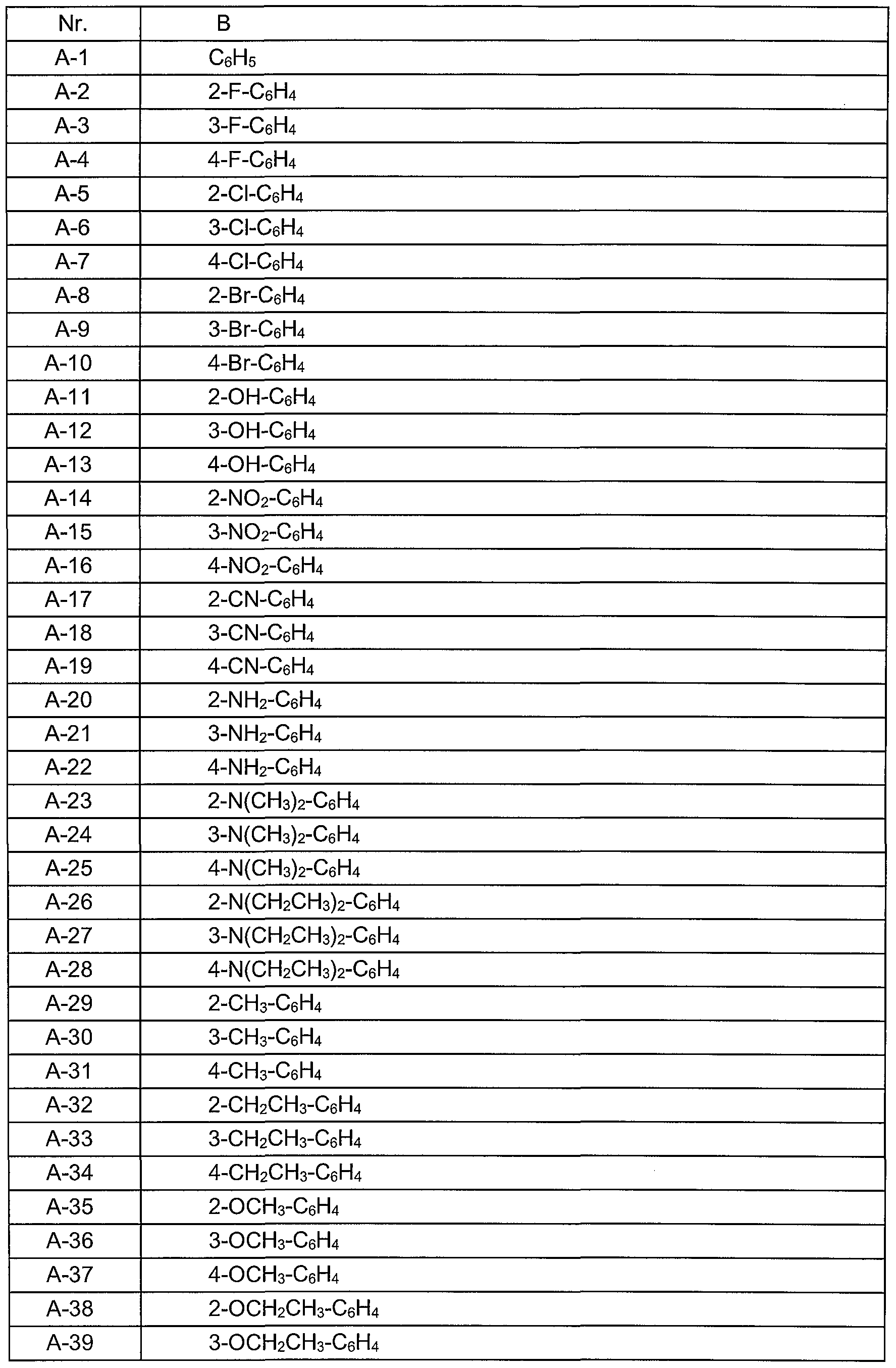
- R 4 is methyl and B for a compound corresponds in each case to one row of Table A.
- R 4 is trifluoromethyl and B is a compound of one row of each
- Table A corresponds Table A
- the compounds I are suitable as fungicides. They are distinguished by an outstanding activity against a broad spectrum of phytopathogenic fungi from the classes of the Ascomycetes, Deuteromycetes, Oomycetes and Basidiomycetes. They are partially systemically effective and can be used in crop protection as foliar, pickling and soil fungicides.
- Botrytis cinerea (gray mold) on strawberries, vegetables, flowers and vines
- Cochliobolus species on corn, cereals, rice e.g. Cochliobolus sativus on cereals, Cochliobolus miyabeanus on rice,
- Drechslera species Pyrenophora species on maize, cereals, rice and turf, e.g. D.teres to barley or D. tritici-repentis to wheat,
- Gaeumanomyces graminis on cereals Gibberella species on cereals and rice (eg Gibberella fujikuroi on rice),
- Michrodochium nivale on cereals Mycosphaerella species on cereals, bananas and peanuts, e.g.
- Peronospora species on cabbage and bulbous plants such as P. brassicae on cabbage or P. destructor on onion,
- Phytophthora species on various plants e.g. P.capsici on paprika
- Pseudoperonospora on various plants e.g. P. cubensis on cucumber or P. humili on hops,
- Puccinia species on various plants e.g. P. triticina, P. striformins, P. hordei or P. graminis on cereals, or P. asparagi on asparagus, • Pyricularia oryzae, Corticium sasakii, Sarocladium oryzae, S. lateuatum,
- Rhizoctonia species on cotton, rice, potatoes, turf, corn, oilseed rape, potatoes, sugar beet, vegetables and various plants such as e.g. R.solani on turnips and various plants,
- Rhynchosporium secalis on barley, rye and triticale • Rhynchosporium secalis on barley, rye and triticale, • Sclerotinia species on oilseed rape and sunflowers,
- Venturia species scab
- apples and pears like. e.g. V. inaequalis to apple.
- Peronosporomycetes are suitable for controlling harmful fungi from the class of Peronosporomycetes (syn.Oomyceten), such as Peronospora species, Phytophthora species, Plasmopara viticola, Pseudoperonospora species and Pythium species.
- the compounds I are also suitable for controlling harmful fungi in the protection of materials (eg wood, paper, paint dispersions, fibers or fabrics) and in the protection of stored products.
- ascomycetes such as Ophiostoma spp., Ceratocystis spp., Aureobasidium pullulans, Sciophoma spp., Chaetomium spp., Humicola spp., Petriella spp., Trichurus spp .; Basidiomycetes such as Coniophora spp., Coriolus spp., Gloeophyllum spp., Lentinus spp., Pleu- rotus spp., Poria spp., Serpula spp.
- Tyromyces spp. Deuteromycetes such as Aspergillus spp., Cladosporium spp., Penicillium spp., Trichoderma spp., Alternaria spp., Paecilomyces spp. and zygomycetes such as Mucor spp., moreover, in the protective material, the following yeasts: Candida spp. and Saccharomyces cerevisae.
- the compounds I are used by treating the fungi or the plants, seeds, materials or the soil to be protected against fungal attack with a fungicidally effective amount of the active ingredients.
- the application can be done both before and after the infection of the materials, plants or seeds by the fungi.
- the fungicidal compositions generally contain between 0.1 and 95, preferably between 0.5 and 90 wt .-% of active ingredient.
- the application rates in the application in crop protection depending on the nature of the desired effect between 0.01 and 2.0 kg of active ingredient per ha.
- active ingredient in general, amounts of active ingredient of 1 to 1000 g / 100 kg, preferably 5 to 100 g / 100 kg of seed are needed.
- the application rate of active ingredient depends on the type of application and the desired effect. Usual application rates are, for example, 0.001 g to 2 kg, preferably 0.005 g to 1 kg of active ingredient per cubic meter of material treated in the material protection.
- the compounds of the formula I can be present in various crystal modifications, which may differ in their biological activity. They are also the subject of the present invention.
- the compounds I can be converted into the usual formulations, e.g. Solutions, emulsions, suspensions, dusts, powders, pastes and granules.
- the application form depends on the respective purpose; It should in any case ensure a fine and uniform distribution of the compound according to the invention.
- the formulations are prepared in a known manner, for example by stretching the active ingredient with solvents and / or excipients, if desired using fertilizer of emulsifiers and dispersants.
- Suitable solvents / auxiliaries are essentially:
- solvents eg Solvesso products, xylene
- paraffins eg petroleum fractions
- alcohols eg methanol, butanol, pentanol, benzyl alcohol
- ketones eg cyclohexanone, gamma-butyrolactone
- pyrrolidones NMP, NOP
- acetates Glycol diacetate
- glycols dimethyl fatty acid amides, fatty acids and fatty acid esters.
- solvent mixtures can also be used
- Carriers such as ground natural minerals (e.g., kaolins, clays, talc, chalk) and ground synthetic minerals (e.g., fumed silica, silicates); Emulsifiers such as non-ionic and anionic emulsifiers (e.g., polyoxyethylene
- the surface-active substances used are alkali metal, alkaline earth metal, ammonium salts of lignin sulfonic acid, naphthalenesulfonic acid, phenolsulfonic acid, dibutylnaphthalenesulfonic acid, alkylarylsulfonates, alkyl sulfates, alkyl sulfonates, fatty alcohol sulfates, fatty acids and sulfated fatty alcohol glycol ethers, and condensation products of sulfonated naphthalene and naphthalene derivatives with formaldehyde , Condensation products of naphthalene or naphthalenesulfonic acid with phenol and formaldehyde, polyoxyethylene octylphenol ether, ethoxylated isooctylphenol, octylphenol, nonylphenol, alkylphenol polyglycol ethers, tributylphenyl
- mineral oil fractions of medium to high boiling point such as kerosine or diesel oil, coal tar oils and oils of vegetable or animal origin, aliphatic, cyclic and aromatic hydrocarbons, e.g. Toluene, xylene, paraffin, tetrahydronaphthalene, alkylated naphthalenes or their derivatives, methanol, ethanol, propanol, butanol, cyclohexanol, cyclohexanone, isophorone, strong polar solvents, e.g. Dimethylsulfoxide, N-methylpyrrolidone or water into consideration.
- mineral oil fractions of medium to high boiling point such as kerosine or diesel oil, coal tar oils and oils of vegetable or animal origin, aliphatic, cyclic and aromatic hydrocarbons, e.g. Toluene, xylene, paraffin, tetrahydronaphthalene, alkylated naphthalenes or their derivative
- Powders, dispersants and dusts may be prepared by mixing or co-grinding the active substances with a solid carrier.
- Granules for example coated, impregnated and homogeneous granules, can be prepared by binding the active compounds to solid carriers.
- Solid carriers are, for example, mineral earths, such as silica gels, silicates, talc, kaolin, Attaclay, limestone, lime, chalk, bolus, loess, clay, dolomite, diatomaceous earth, calcium and magnesium sulfate, magnesium oxide, ground plastics, fertilizers, such as ammonium sulfate, ammonium phosphate , Ammonium nitrate, ureas and vegetable products, such as tree meal, tree bark, wood and nutshell flour, cellulose powder and other solid carriers.
- mineral earths such as silica gels, silicates, talc, kaolin, Attaclay, limestone, lime, chalk, bolus, loess, clay, dolomite, diatomaceous earth, calcium and magnesium sulfate, magnesium oxide, ground plastics,
- the formulations generally contain between 0.01 and 95% by weight, preferably between 0.1 and 90% by weight of the active ingredient.
- the active ingredients are used in a purity of 90% to 100%, preferably 95% to 100% (according to NMR spectrum).
- formulations are: 1. Products for dilution in water
- a Water-soluble concentrates (SL, LS)
- the active compounds 20 parts by weight are dissolved in 70 parts by weight of cyclohexanone with the addition of 10 parts by weight of a dispersant, e.g. Polyvinylpyrrolidone dissolved. Dilution in water results in a dispersion.
- the active ingredient content is 20% by weight
- the active compounds 25 parts by weight of the active compounds are dissolved in 35 parts by weight of xylene with addition of calcium dodecylbenzenesulfonate and castor oil ethoxylate (in each case 5 parts by weight).
- This mixture is added to water by means of an emulsifying machine (e.g., Ultraturax) in 30 parts by weight and made into a homogeneous emulsion. Dilution in water results in an emulsion.
- the formulation has an active ingredient content of 25% by weight.
- the active ingredients 20 parts by weight of the active ingredients are comminuted with the addition of 10 parts by weight of dispersants and wetting agents and 70 parts by weight of water or an organic solvent in a stirred ball mill to a fine active substance suspension. Dilution in water results in a stable suspension of the active ingredient.
- the active ingredient content in the formulation is 20% by weight.
- F Water-dispersible and water-soluble granules (WG, SG) 50 parts by weight of the active ingredients are finely ground with the addition of 50 parts by weight of dispersants and wetting agents and prepared by means of technical equipment (eg extrusion, spray tower, fluidized bed) as water-dispersible or water-soluble granules. Dilution in water results in a stable dispersion or solution of the active ingredient.
- the formulation has an active ingredient content of 50% by weight.
- Water-dispersible and water-soluble powders 75 parts by weight of the active compounds are ground in a rotor-stator mill with the addition of 25 parts by weight of dispersing and wetting agents and silica gel. Dilution in water results in a stable dispersion or solution of the active ingredient.
- the active ingredient content of the formulation is 75% by weight.
- Dispersing agent 1 part by weight of swelling agent ("gelling agent") and 70 parts by weight of water or of an organic solvent to a fine suspension when diluted with water to give a stable suspension with 20 wt .-% active ingredient content Products for direct application
- 0.5 parts by weight of the active ingredients are finely ground and combined with 99.5 parts by weight of carriers. Common processes are extrusion, spray drying or fluidized bed. This gives a granulate for direct application with 0.5 wt .-% active ingredient content.
- LS water-soluble concentrates
- FS suspensions
- DS water-dispersible and water-soluble powders
- WS water-dispersible and water-soluble powders
- ES emulsifiable concentrates
- GF gel formulations
- the active compounds can be used as such, in the form of their formulations or the use forms prepared therefrom, for example in the form of directly sprayable solutions, powders, suspensions or dispersions, emulsions, oil dispersions, pastes, dusts, scattering agents, granules by spraying, atomizing, dusting, scattering or Pouring be applied.
- the forms of application depend entirely on the intended use; In any case, they should ensure the finest possible distribution of the active compounds according to the invention.
- Aqueous application forms can be prepared from emulsion concentrates, pastes or wettable powders (wettable powders, oil dispersions) by adding water.
- the substances as such or dissolved in an oil or solvent, can be homogenized in water by means of wetter, tackifier, dispersant or emulsifier. But it can also be made of effective substance wetting, adhesion, dispersing or emulsifying and possibly solvent or oil concentrates, which are suitable for dilution with water.
- the active compound concentrations in the ready-to-use preparations can be varied within wide ranges. In general, they are between 0.0001 and 10%, preferably between 0.01 and 1%.
- the active ingredients can also be used with great success in the ultra-low-volume (ULV) process, it being possible to apply formulations containing more than 95% by weight of active ingredient or even the active ingredient without additives.
- UUV ultra-low-volume
- wetting agents To the active ingredients oils of various types, wetting agents, adjuvants, herbicides, fungicides, other pesticides, bactericides, possibly also just immediately before use (tank mix), are added. These agents can be added to the compositions according to the invention in a weight ratio of 1: 100 to 100: 1, preferably 1:10 to 10: 1.
- organically modified polysiloxanes eg Break Thru S 240 ®
- Alcohol alkoxylates eg. As Atplus 245 ®, Atplus MBA 1303 ®, Plurafac LF 300 ® and Lutensol ON 30 ®
- EO-PO block polymers eg. B. Pluro- nic RPE 2035 ® and Genapol B ®
- Alcohol ethoxylates eg. As Lutensol XP 80 ®
- sodium dioctylsulfosuccinate e. B. Leophen RA ®.
- agents according to the invention may also be present in the form of use as fungicides together with other active substances, e.g. with herbicides, insecticides,
- Growth regulators fungicides or with fertilizers.
- Active ingredients in particular fungicides, for example, in many cases, the spectrum of action can be broadened or resistance developments are prevented. In many cases, synergistic effects are obtained.
- Carboxylic acid anilides Benalaxyl, Benodanil, Boscalid, Carboxin, Mepronil, Fenfuram, Fenhexamid, Flutolanil, Furametpyr, Metalaxyl, Ofurace, Oxadixyl, Oxycarboxin, Penthiopyrad, Thifluzamide, Tiadinil, 4-Difluoromethyl-2-methyl-thiazole-5-carboxylic acid - (4'-bromo-biphenyl-2-yl) -amide, 4-difluoromethyl-2-methyl-thiazole-5-carboxylic acid
- Benzoic acid amides flumetover, fluopicolide (picobenzamide), zoxamide;
- bitertanol bromuconazoles, cyproconazole, difenoconazole, diniconazole, enilconazole, epoxiconazole, fenbuconazole, flusilazole, fluquinconazole, flutriafol, hexaconazole, imibenconazole, ipconazole, metconazole, myclobutanil,
- - imidazoles cyazofamide, imazalil, pefurazoate, prochloraz, triflumizole;
- Benzimidazoles benomyl, carbendazim, fuberidazole, thiabendazole; - Other: Ethaboxam, Etridiazole, Hymexazole; Nitrogen-containing heterocyclyl compounds
- Pyridines fluazinam, pyrifenox, 3- [5- (4-chlorophenyl) -2,3-dimethylisoxazolidin-3-yl] pyridine;
- Pyrimidines bupirimate, cyprodinil, ferimzone, fenarimol, mepanipyrim, nuarimol, pyrimethanil;
- Dicarboximides iprodione, procymidone, vinclozolin; - Other: acibenzolar-S-methyl, anilazine, captan, captafol, dazomet, diclomethine, fenoxanil, folpet, fenpropidin, famoxadone, fenamidone, octhilinone, probenazole, proquinazide, pyroquilone, quinoxyfen, tricyclazole, 5-chloro-7- (4- Methyl-piperidin-1-yl) -6- (2,4,6-trifluorophenyl) - [1, 2,4] triazolo [1,5-a] pyrimidine, 2-butoxy-6-iodo-3-yl propyl-chromen-4-one, 3- (3-bromo-6-fluoro-2-methyl-indole-1-sulfonyl) - [1, 2,4] tri
- Dithiocarbamates Ferbam, Mancozeb, Maneb, Metiram, Metam, Propineb, Thiram, Zineb, Ziram; Carbamates: diethofencarb, flubenthiavalicarb, iprovalicarb, propamocarb,
- guanidines dodine, iminoctadine, guazatine
- Organometallic compounds fentin salts
- Sulfur-containing heterocyclyl compounds isoprothiolanes, dithianone;
- Organophosphorus compounds edifenphos, fosetyl, fosetyl-aluminum, Iprobenfos, pyrazophos, tolclofos-methyl, phosphorous acid and their salts;
- Organochlorine compounds thiophanates methyl, chlorothalonil, dichlofluanid, toluylfluanid, flusulfamides, phthalides, hexachlorobenzene, pencycuron, quintozene;
- Nitrophenyl derivatives binapacryl, dinocap, dinobuton;
- - Inorganic active substances Bordeaux broth, copper acetate, copper hydroxide, copper oxychloride, basic copper sulphate, sulfur;
- the active compounds were prepared as a stock solution with 25 mg of active ingredient, which with a mixture of acetone and / or DMSO and the emulsifier Uniperol® EL (wetting agent with emulsifying and dispersing on the basis of ethoxylated alkylphenol Ie) in the volume ratio solvent-emulsifier from 99 to 1 ad 10 ml. It was then made up to 100 ml with water. This stock solution was diluted with the described solvent-emulsifier-water mixture to the drug concentration given below.
- Uniperol® EL wetting agent with emulsifying and dispersing on the basis of ethoxylated alkylphenol Ie
- Leaves of potted tomato plants were sprayed to drip point with an aqueous suspension in the drug concentration below. The following day, the leaves were infected with an aqueous spore suspension of Alternaria solani in 2% biomalt solution with a density of 0.17 x 10 6 spores / ml. Subsequently, the plants were placed in a water vapor-saturated chamber at temperatures between 20 and 22 ° C. After 5 days, the disease on the untreated, but infected control plants had developed so strongly that the infestation could be determined visually in%.
Landscapes
- Life Sciences & Earth Sciences (AREA)
- Health & Medical Sciences (AREA)
- Chemical & Material Sciences (AREA)
- Engineering & Computer Science (AREA)
- General Health & Medical Sciences (AREA)
- Organic Chemistry (AREA)
- Agronomy & Crop Science (AREA)
- Pest Control & Pesticides (AREA)
- Environmental Sciences (AREA)
- Zoology (AREA)
- Wood Science & Technology (AREA)
- Dentistry (AREA)
- Plant Pathology (AREA)
- Pharmacology & Pharmacy (AREA)
- Chemical Kinetics & Catalysis (AREA)
- Diabetes (AREA)
- Public Health (AREA)
- Veterinary Medicine (AREA)
- Bioinformatics & Cheminformatics (AREA)
- Hematology (AREA)
- Animal Behavior & Ethology (AREA)
- Obesity (AREA)
- Nuclear Medicine, Radiotherapy & Molecular Imaging (AREA)
- Medicinal Chemistry (AREA)
- General Chemical & Material Sciences (AREA)
- Agricultural Chemicals And Associated Chemicals (AREA)
- Plural Heterocyclic Compounds (AREA)
Abstract
Description





Claims


Priority Applications (4)
| Application Number | Priority Date | Filing Date | Title |
|---|---|---|---|
| BRPI0610964A BRPI0610964A2 (pt) | 2005-05-31 | 2006-05-24 | uso de compostos, compostos, processo para preprarar os mesmos, agente fungicida, semente, processo para combater fungos nocivos fitopatogênicos, e, uso de compostos |
| EP06763256A EP1895845A1 (de) | 2005-05-31 | 2006-05-24 | Fungizide 5-hydroxypyrazoline, verfahren zu deren herstellung, sowie sie enthaltende mittel |
| US11/915,989 US20080194405A1 (en) | 2005-05-31 | 2006-05-24 | Fungicidal 5-Hydroxypyrazolines, Method for Producing the Same and Agents Comprising the Same |
| JP2008514067A JP2008542330A (ja) | 2005-05-31 | 2006-05-24 | 殺菌性5−ヒドロキシピラゾリン類、その調製法およびこれらの化合物を含む組成物 |
Applications Claiming Priority (2)
| Application Number | Priority Date | Filing Date | Title |
|---|---|---|---|
| DE102005025397.0 | 2005-05-31 | ||
| DE102005025397 | 2005-05-31 |
Publications (1)
| Publication Number | Publication Date |
|---|---|
| WO2006128817A1 true WO2006128817A1 (de) | 2006-12-07 |
Family
ID=36791809
Family Applications (1)
| Application Number | Title | Priority Date | Filing Date |
|---|---|---|---|
| PCT/EP2006/062565 Ceased WO2006128817A1 (de) | 2005-05-31 | 2006-05-24 | Fungizide 5-hydroxypyrazoline, verfahren zu deren herstellung, sowie sie enthaltende mittel |
Country Status (7)
| Country | Link |
|---|---|
| US (1) | US20080194405A1 (de) |
| EP (1) | EP1895845A1 (de) |
| JP (1) | JP2008542330A (de) |
| KR (1) | KR20080016693A (de) |
| CN (1) | CN101184394A (de) |
| BR (1) | BRPI0610964A2 (de) |
| WO (1) | WO2006128817A1 (de) |
Families Citing this family (1)
| Publication number | Priority date | Publication date | Assignee | Title |
|---|---|---|---|---|
| WO2006128824A1 (de) * | 2005-05-31 | 2006-12-07 | Basf Aktiengesellschaft | Fungizide 5-hydroxypyrazoline, verfahren zu deren herstellung, sowie sie enthaltende mittel |
Citations (1)
| Publication number | Priority date | Publication date | Assignee | Title |
|---|---|---|---|---|
| WO2000020399A2 (de) * | 1998-10-02 | 2000-04-13 | Basf Aktiengesellschaft | Verwendung von substituierten 5-hydroxypyrazolen, neue 5-hydroxypyrazole, verfahren zu deren herstellung, sowie sie enthaltende mittel |
Family Cites Families (3)
| Publication number | Priority date | Publication date | Assignee | Title |
|---|---|---|---|---|
| DE3728278A1 (de) * | 1986-12-17 | 1988-06-23 | Bayer Ag | Herbizide und fungizide mittel auf basis von substituierten pyrazolin-5-on derivaten |
| FR2705962B1 (fr) * | 1993-06-03 | 1995-07-13 | Rhone Poulenc Agrochimie | Arylpyrazoles fongicides. |
| WO2006128824A1 (de) * | 2005-05-31 | 2006-12-07 | Basf Aktiengesellschaft | Fungizide 5-hydroxypyrazoline, verfahren zu deren herstellung, sowie sie enthaltende mittel |
-
2006
- 2006-05-24 CN CNA2006800191680A patent/CN101184394A/zh active Pending
- 2006-05-24 KR KR1020077030691A patent/KR20080016693A/ko not_active Withdrawn
- 2006-05-24 EP EP06763256A patent/EP1895845A1/de not_active Withdrawn
- 2006-05-24 JP JP2008514067A patent/JP2008542330A/ja not_active Withdrawn
- 2006-05-24 WO PCT/EP2006/062565 patent/WO2006128817A1/de not_active Ceased
- 2006-05-24 US US11/915,989 patent/US20080194405A1/en not_active Abandoned
- 2006-05-24 BR BRPI0610964A patent/BRPI0610964A2/pt not_active IP Right Cessation
Patent Citations (1)
| Publication number | Priority date | Publication date | Assignee | Title |
|---|---|---|---|---|
| WO2000020399A2 (de) * | 1998-10-02 | 2000-04-13 | Basf Aktiengesellschaft | Verwendung von substituierten 5-hydroxypyrazolen, neue 5-hydroxypyrazole, verfahren zu deren herstellung, sowie sie enthaltende mittel |
Non-Patent Citations (1)
| Title |
|---|
| H.G.BONACORSO ET AL: "Regiospecific one-pot synthesis of new trifluoromethyl substituted heteroaryl pyrazolyl ketones", JOURNAL OF HETEROCYCLIC CHEMISTRY, vol. 42, 2005, pages 631 - 637, XP002396295 * |
Also Published As
| Publication number | Publication date |
|---|---|
| JP2008542330A (ja) | 2008-11-27 |
| US20080194405A1 (en) | 2008-08-14 |
| CN101184394A (zh) | 2008-05-21 |
| BRPI0610964A2 (pt) | 2016-08-30 |
| EP1895845A1 (de) | 2008-03-12 |
| KR20080016693A (ko) | 2008-02-21 |
Similar Documents
| Publication | Publication Date | Title |
|---|---|---|
| WO2008037607A1 (de) | Carbonylgruppen-enthaltende heterocyclische verbindungen und deren verwendung zur bekämpfung von phytopathogenen pilzen | |
| WO2004103978A1 (de) | 2-substituierte pyrimidine | |
| EP1987011A1 (de) | 2-substituierte pyrimidine und ihre verwendung als pestizide | |
| WO2004069846A1 (de) | Pyrimidine, verfahren zu deren herstellung sowie deren verwendung | |
| WO2007012642A1 (de) | 7-amino-6-thiadiazolyl- und -oxadiazolyl- 1 , 2 , 4-triazolo [1 , 5 -a] pyrimidin- verbindungen und ihre verwendung zur bekämpfung von schadpilzen | |
| EP1891015A1 (de) | Fungizide 5-hydroxypyrazoline, verfahren zu deren herstellung, sowie sie enthaltende mittel | |
| EP1575958B1 (de) | Fungizide triazolopyrimidine, verfahren zu ihrer herstellung und ihre verwendung zur bekämpfung von schadpilzen sowie sie enthaltende mittel | |
| EP1895845A1 (de) | Fungizide 5-hydroxypyrazoline, verfahren zu deren herstellung, sowie sie enthaltende mittel | |
| EP1931643A1 (de) | 2-substituierte hydroxylaminopyrimidine, verfahren zu ihrer herstellung und ihre verwendung als pestizid | |
| EP1895844A1 (de) | Verwendung bicyclischer 5-hydroxypyrazoline, neue 5-hydroxypyrazoline, verfahren zu deren herstellung, sowie sie enthaltende mittel | |
| EP1893018A1 (de) | Fungizide n-benzyl-5-hydroxy-5-phenylpyrazoline, verfahren zu deren herstellung, sowie sie enthaltende mittel | |
| WO2007023020A1 (de) | 7-amino-6-heteroaryl-1,2,4-triazolo[1,5-a]pyrimidin-verbindungen und ihre verwendung zur bekämpfung von schadpilzen | |
| WO2007023018A1 (de) | 7-amino-6-triazolyl-1,2,4-triazolo[1,5-a]pyrimidin-verbindungen und ihre verwendung zur bekämpfung von schadpilzen | |
| EP2117312A1 (de) | Verwendung von azolopyrimidinen zur bekämpfung von pflanzenpathogenen schadpilzen | |
| WO2007118844A1 (de) | Substituierte pyrazolopyrimidine, verfahren zu ihrer herstellung und ihre verwendung zur bekämpfung von schadpilzen sowie sie enthaltende mittel | |
| WO2005113555A1 (de) | Triazolopyrimidin-verbindungen und ihre verwendung zur bekämpfung von schadpilzen | |
| DE102007008940A1 (de) | Substituierte Imidazolopyrimidine, Verfahren zu ihrer Herstellung und ihre Verwendung zur Bekämpfung von Schadpilzen sowie sie enthaltende Mittel | |
| DE102007012627A1 (de) | Substituierte Imidazolopyrimidine, Verfahren zu ihrer Herstellung und ihre Verwendung zur Bekämpfung von Schadpilzen sowie sie enthaltende Mittel | |
| WO2007006724A1 (de) | 5-alkyl-7-amino-6-heteroaryl-1 , 2 , 4-triazolo (1 , 5-a) pyrimidin-vξrbindungen und ihre? verwendung zur bekämpfung von schadpilzen | |
| WO2007054472A1 (de) | Verhenkelte pyridin- und pyrimidinderivate, verfahren zu ihrer herstellung und ihre verwendung als pestizid | |
| WO2007101870A1 (de) | Substituierte triazolopyrimidine, verfahren zu ihrer herstellung und ihre verwendung zur bekämpfung von schadpilzen sowie sie enthaltende mittel | |
| WO2007006722A1 (de) | 2 -substituierte 7-amino-6-heteroaryl-1 , 2 , 4-triazolo [1, 5-a] pyrimidin-verbindungen und ihre? verwendung zur bekämpfung von schadpilzen | |
| WO2007006723A1 (de) | 7-amino-6-tetrazolyl-1,2,4-triazolo[1,5-a]pyrimidin-verbindungen und ihre verwendung zur bekämpfung von schadpilzen | |
| WO2006122740A2 (de) | 7-AMINO-6-HETARYLIMIDAZOLO[1,2-a]PYRIMIDIN-VERBINDUNGEN UND IHRE VERWENDUNG ZU BEKÄMPFUNG VON SCHADPILZEN |
Legal Events
| Date | Code | Title | Description |
|---|---|---|---|
| 121 | Ep: the epo has been informed by wipo that ep was designated in this application | ||
| DPE1 | Request for preliminary examination filed after expiration of 19th month from priority date (pct application filed from 20040101) | ||
| WWE | Wipo information: entry into national phase |
Ref document number: 2006763256 Country of ref document: EP |
|
| WWE | Wipo information: entry into national phase |
Ref document number: 2008514067 Country of ref document: JP |
|
| WWE | Wipo information: entry into national phase |
Ref document number: 11915989 Country of ref document: US Ref document number: 4615/KOLNP/2007 Country of ref document: IN |
|
| WWE | Wipo information: entry into national phase |
Ref document number: 200680019168.0 Country of ref document: CN |
|
| NENP | Non-entry into the national phase |
Ref country code: DE |
|
| WWW | Wipo information: withdrawn in national office |
Ref document number: DE |
|
| WWE | Wipo information: entry into national phase |
Ref document number: 1020077030691 Country of ref document: KR |
|
| NENP | Non-entry into the national phase |
Ref country code: RU |
|
| WWW | Wipo information: withdrawn in national office |
Ref document number: RU |
|
| WWP | Wipo information: published in national office |
Ref document number: 2006763256 Country of ref document: EP |
|
| ENP | Entry into the national phase |
Ref document number: PI0610964 Country of ref document: BR Kind code of ref document: A2 Effective date: 20071130 |