WO2006129580A1 - 2-シアノアクリレート系組成物 - Google Patents
2-シアノアクリレート系組成物 Download PDFInfo
- Publication number
- WO2006129580A1 WO2006129580A1 PCT/JP2006/310622 JP2006310622W WO2006129580A1 WO 2006129580 A1 WO2006129580 A1 WO 2006129580A1 JP 2006310622 W JP2006310622 W JP 2006310622W WO 2006129580 A1 WO2006129580 A1 WO 2006129580A1
- Authority
- WO
- WIPO (PCT)
- Prior art keywords
- cyanoacrylate
- carbon atoms
- cyanacrylate
- crown
- compound
- Prior art date
- Legal status (The legal status is an assumption and is not a legal conclusion. Google has not performed a legal analysis and makes no representation as to the accuracy of the status listed.)
- Ceased
Links
Classifications
-
- C—CHEMISTRY; METALLURGY
- C08—ORGANIC MACROMOLECULAR COMPOUNDS; THEIR PREPARATION OR CHEMICAL WORKING-UP; COMPOSITIONS BASED THEREON
- C08K—Use of inorganic or non-macromolecular organic substances as compounding ingredients
- C08K5/00—Use of organic ingredients
- C08K5/04—Oxygen-containing compounds
- C08K5/10—Esters; Ether-esters
-
- C—CHEMISTRY; METALLURGY
- C08—ORGANIC MACROMOLECULAR COMPOUNDS; THEIR PREPARATION OR CHEMICAL WORKING-UP; COMPOSITIONS BASED THEREON
- C08K—Use of inorganic or non-macromolecular organic substances as compounding ingredients
- C08K5/00—Use of organic ingredients
- C08K5/04—Oxygen-containing compounds
- C08K5/05—Alcohols; Metal alcoholates
-
- C—CHEMISTRY; METALLURGY
- C08—ORGANIC MACROMOLECULAR COMPOUNDS; THEIR PREPARATION OR CHEMICAL WORKING-UP; COMPOSITIONS BASED THEREON
- C08K—Use of inorganic or non-macromolecular organic substances as compounding ingredients
- C08K5/00—Use of organic ingredients
- C08K5/16—Nitrogen-containing compounds
- C08K5/315—Compounds containing carbon-to-nitrogen triple bonds
-
- C—CHEMISTRY; METALLURGY
- C09—DYES; PAINTS; POLISHES; NATURAL RESINS; ADHESIVES; COMPOSITIONS NOT OTHERWISE PROVIDED FOR; APPLICATIONS OF MATERIALS NOT OTHERWISE PROVIDED FOR
- C09J—ADHESIVES; NON-MECHANICAL ASPECTS OF ADHESIVE PROCESSES IN GENERAL; ADHESIVE PROCESSES NOT PROVIDED FOR ELSEWHERE; USE OF MATERIALS AS ADHESIVES
- C09J4/00—Adhesives based on organic non-macromolecular compounds having at least one polymerisable carbon-to-carbon unsaturated bond ; adhesives, based on monomers of macromolecular compounds of groups C09J183/00 - C09J183/16
Definitions
- the present invention relates to a 2-cyanacrylate composition, particularly a 2-cyanacrylate composition that is excellent in adhesion to difficult-to-adhere materials and porous materials and has good light stability. And the composition is particularly useful as an instant adhesive.
- Cyanacrylate-based adhesives based on 2-cyanacrylate due to their high ion polymerizability, can be polymerized in a short time depending on the surface of the adherend and the anion species such as moisture in the air.
- it is widely used as an instant adhesive in various industrial industries such as electronic 'electric' cars, leisure fields and general households.
- sufficient adhesion speed could not be obtained for polyacetal, FRP, chrome plating, EPDM rubber, etc., which are difficult adhesion materials, and leather, wood, paper, etc., which are porous materials.
- 2-cyanoacrylate contains a crown ether as in Patent Document 1 or a polyethylene glycol derivative as in Patent Document 2 as a curing accelerator.
- a crown ether as in Patent Document 1
- a polyethylene glycol derivative as in Patent Document 2
- adhesive compositions containing these curing accelerators tend to thicken and gel easily when left for long periods under sunlight or under fluorescent light. There are other disadvantages.
- Hydroquinone is generally used as a radical stabilizer in cyanoacrylate adhesives.
- radicals When radicals are generated in the system by the action of light, hydroquinone force radicals are captured and become phenoxy radicals. Since the stability of the phenoxy radical is poor, hydrogen in the crown ether or polyethylene glycol is extracted, and this reacts with oxygen in the system to generate peroxide. It was thought that radical chaining occurred when this peroxide was cleaved, resulting in radical polymerization of 2-cyanacrylate.
- Patent Document 3 As an example of using another radical stabilizer instead of hydroquinone, Patent Document 3 And the use of phenolic antioxidants as described in (1). This is to prevent the generation of benzoquinone, which is toxic and undesirable for medical use, when ⁇ -rays are sterilized by irradiating a 2-cyano acrylate composition for medical use. It is not disclosed to improve the light stability in use, nor is it disclosed that a curing accelerator is used in combination.
- Patent Document 1 JP-A-53-129231
- Patent Document 2 JP 54-28342 A
- Patent Document 3 Japanese Patent Laid-Open No. 7-252455
- An object of the present invention is to solve the above-mentioned problem, that is, a cyanoacrylate system which has improved light stability while maintaining a high adhesion speed to difficult-to-adhere materials and porous materials. It is to provide a 2-cyanacrylate composition useful for an adhesive.
- the present inventors diligently studied a method for improving the light stability of a 2-cyanacrylate composition, and as a radical stabilizer, a hindered phenol compound having a specific structure (hereinafter, “ It has been found that it can be resolved by adding a “specific hindered phenol compound”. That is, the present invention has the following configuration.
- a hindered phenol compound represented by the following general formula (1) A hindered phenol compound represented by the following general formula (1), and
- R is a linear or branched alkylene group having 1 to 4 carbon atoms:
- R are each independently a linear, branched or cyclic alkyl having 1 to 10 carbon atoms.
- R and R are each independently a straight or branched chain having 1 to 4 carbon atoms.
- R is hydrogen, an alkyl group having 1-20 carbon atoms, 2-20
- the 2-cyanacrylate-based yarn composition according to 1) above which is a crown ether, polyalkylene glycol, or a derivative thereof.
- the two-cyanacrylate composition of the present invention has the advantage that it has good light stability while maintaining a high adhesion speed to difficult-to-adhere materials and porous materials. This is because the radicals of specific hindered phenolic compounds are more stable than the phenoxy radicals generated from hydroquinone, and the hydrogen abstraction reaction of crown ether and polyethylene glycol due to these is less likely to occur. Presumed. BEST MODE FOR CARRYING OUT THE INVENTION
- Examples of 2-cyanoacrylate used in the present invention include methyl-2-cyanoacrylate, ethyl 2-cyanoacrylate, propyl 2-cyanoacrylate, isopropyl 2-cyanoacrylate, butyl-2-cyanoacrylate.
- methyl-2-cyanacrylate, ethyl-2-cyanacrylate, and isopropyl-2-cyanacrylate are preferable types for use in cyanoacrylate adhesives.
- the specific hindered phenol compound used in the present invention is represented by the general formula (1).
- Examples of the group include methylene, ethylene, ethylidene, pyropyrene, butylidene, butylene and the like.
- R is preferably methylene.
- R and R of general formula (1) 1 linear, branched or having 10 carbon atoms, or
- cyclic alkyl group examples include methyl, ethyl, n-propyl, t-butyl, t-pentyl, cyclohexyl, methylcyclohexyl and the like.
- T and butyl for R and R
- Examples of the kill group include methyl, ethyl, n-propyl, t-butyl and the like.
- 4 5 is preferably a methyl group.
- Examples of the alkyl group having 20 carbon atoms in R of the general formula (1) include
- alkenyl group having 2 to 20 carbon atoms include vinyl, aryl, acrylic and the like, and examples of the acyl group having 2 to 20 carbon atoms are , Acetyl, benzoyl and the like.
- R is preferably a hydrogen atom
- Specific examples of the specific hindered phenolic compound used in the present invention include, for example, 2,2, -methylene bis (4-methyl-6 t-butylphenol), 2,2, -methylene bis (4 ethyl 6).
- T-Butylphenol 2, 2, 1-methylene mono-bis (4 —methyl-6 cyclohexylphenol), 2, 2, 1-methylene mono-bis (6-1—methyl cyclohexyl) p Cresol, 2 , 2'-ethylidene-bis (2,4-methyl-6-t-butylphenol), 2,2-butylidene-bis- (2-tert-butyl-4-methylphenol), 2-t-butyl-1- ( 3, 1 t-butyl-1, 5, 1-methyl-2, 1-hydroxybenzyl) -4 methylphenol acrylate.
- These specific hindered phenolic compounds are not limited to one type, and two or more types can be used in combination.
- 2′-methylene bis (4-methyl-6 t-butylphenol) is more preferable because of its high light stability when it is used as an acrylate composition.
- hydroquinone, hydroquinone monomethyl ether, catechol, pyrogallol and the like conventionally used as radical polymerization inhibitors can be used in combination.
- the amount of the specific hindered phenolic compound used in the present invention is preferably 100 to 10000 mass ppm force S, more preferably 500 to 5000 mass ppm force S per 2 cyanoacrylate. If it is less than 100 mass ppm, sufficient light stability cannot be exhibited, and if it exceeds 10000 mass ppm, the curing rate may be slow.
- Examples of the compound having an inclusion ability include polyalkylene oxides, crown ethers, silacrown ethers, calixarenes, cyclodextrins, and pyrogallol-based cyclic compounds. Alkylene glycol Or these derivatives are preferred because they are excellent in curing acceleration effect.
- polyalkylene glycol polyethylene glycol is preferable.
- crown ethers for example, 18 crown 1-6, 15 crown 1-5, 12-crown 1-4, benzo-1 18 crown-6, dibenzo 18 crown-6, dicyclohexano 24 crown-8, 2 And droxymethyl-18 crown-6, benzo-15 crown-5 and the like.
- polyethylene glycol or derivatives thereof examples include polyethylene glycol, polyethylene glycol monotalate, polyethylene glycol ditalate, polyethylene glycol monometatalate, polyethylene glycol dimetatalate, monomethoxypolyethylene glycol monometatalate, dimethoxypolyethylene. Glycol and the like.
- polyethylene glycol or derivatives thereof include polyethylene glycol, polyethylene glycol monotalate, polyethylene glycol ditalate, polyethylene glycol monometatalate, polyethylene glycol dimetatalate, monomethoxypolyethylene glycol monometatalate, dimethoxypolyethylene. Glycol and the like.
- 12 crown-5, 15 crown-5, and 18 crown-6 are more preferable because 15 crown-5 is preferable because it has a large effect of promoting curing.
- These compounds with inclusion ability are not limited to one type, but can be a mixture of two or more types.
- the amount of the compound having an inclusion ability is preferably 50 mass ppm to 5.0 mass%, more preferably 100 mass ppm to 2.0 mass%, based on 2 cyanoacrylate. If it is less than 50 mass ppm, it will be difficult to obtain a sufficient adhesion rate for difficult-to-adhere materials and porous materials.
- the 2-cyanacrylate composition of the present invention for the purpose of improving storage stability, sulfur dioxide, p-toluenesulfonic acid, methanesulfonic acid, propane sultone, trifluoro boron complex, etc.
- An arbitrary amount of the on-polymerization inhibitor can be added.
- the light stability was evaluated by filling a 2 g polyethylene container with the adhesive composition obtained in each of the examples and comparative examples, and using a solar lamp (Sunlight Lite TDL-150 manufactured by Daiwa Lighting Co., Ltd.). Temperature 23 at an illuminance of 2 mW / cm 2 (405 nm). C. Irradiation was performed under 50% humidity, and the number of days until gelling was observed. Also, acid paper adhesion Speed Measured according to ⁇ O IS-K-6861. However, as a test piece, it takes 3 drops of an adhesive sample on 0.3 mm thick acid paper surface to attach the second test piece vertically and adhere until the second test piece does not fall down. Time was measured with a stopwatch.
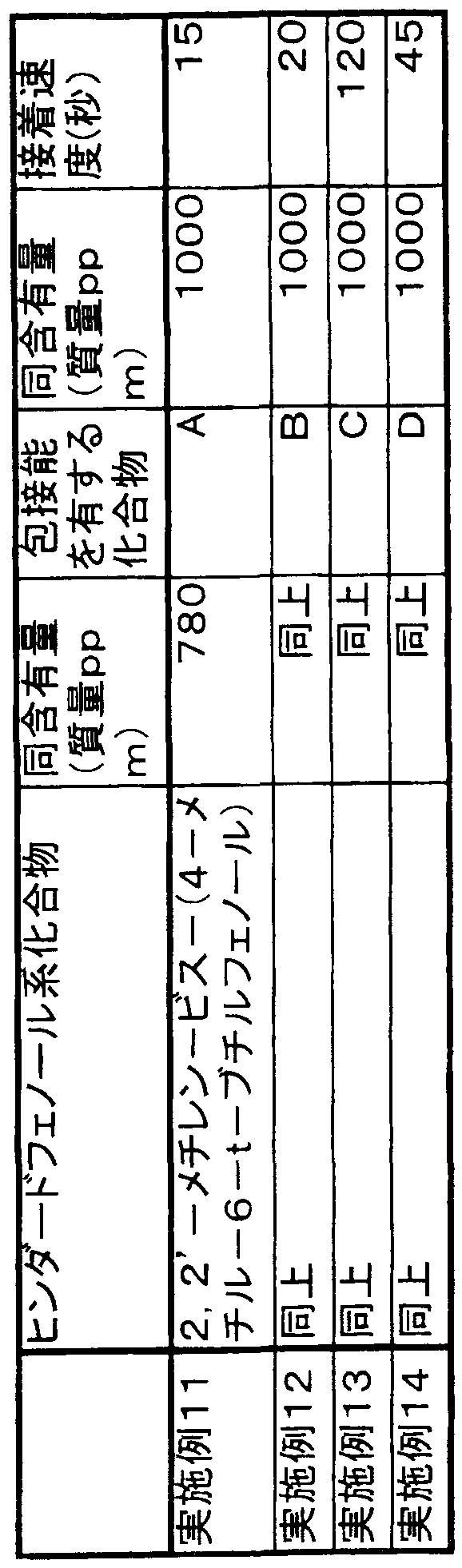
- Table 3 shows the results of preparing the adhesive composition under the same conditions as in Example 1 and conducting the above-described adhesion test, except that the compounding amounts of the compounds A to D having inclusion ability were unified to lOOOppm. It was.
- the aromatic ring is a hindered phenol compound having one hindered phenol compound.
- the hindered phenolic compound in which two aromatic rings are bonded at the para position of the phenolic hydroxyl group (Comparative Example 7) 8), or when a hydroxyl group-containing aromatic ring that is not a hindered phenol is bonded at the ortho position of the hydroxyl group (Comparative Example 9), the light stability is not improved.
- the 2-cyanacrylate composition obtained by the present invention is excellent in adhesion to difficult-to-adhere materials and porous materials, and also has good light stability. It can be used as an instantaneous adhesive or filler having storage stability.
Landscapes
- Chemical & Material Sciences (AREA)
- Organic Chemistry (AREA)
- Health & Medical Sciences (AREA)
- Chemical Kinetics & Catalysis (AREA)
- Medicinal Chemistry (AREA)
- Polymers & Plastics (AREA)
- Adhesives Or Adhesive Processes (AREA)
- Polymerisation Methods In General (AREA)
- Addition Polymer Or Copolymer, Post-Treatments, Or Chemical Modifications (AREA)
- Compositions Of Macromolecular Compounds (AREA)
Abstract
Description


Claims

Priority Applications (5)
| Application Number | Priority Date | Filing Date | Title |
|---|---|---|---|
| JP2007518954A JP4748156B2 (ja) | 2005-05-30 | 2006-05-29 | 2−シアノアクリレート系組成物 |
| DE602006016951T DE602006016951D1 (en) | 2005-05-30 | 2006-05-29 | 2-cyanoacrylatzusammensetzung |
| CN2006800128244A CN101160330B (zh) | 2005-05-30 | 2006-05-29 | 2-氰基丙烯酸酯类组合物 |
| EP06756667A EP1908786B1 (en) | 2005-05-30 | 2006-05-29 | 2-cyanoacrylate composition |
| US11/918,167 US7863358B2 (en) | 2005-05-30 | 2006-05-29 | 2-cyanoacrylate composition |
Applications Claiming Priority (2)
| Application Number | Priority Date | Filing Date | Title |
|---|---|---|---|
| JP2005-156636 | 2005-05-30 | ||
| JP2005156636 | 2005-05-30 |
Publications (1)
| Publication Number | Publication Date |
|---|---|
| WO2006129580A1 true WO2006129580A1 (ja) | 2006-12-07 |
Family
ID=37481509
Family Applications (1)
| Application Number | Title | Priority Date | Filing Date |
|---|---|---|---|
| PCT/JP2006/310622 Ceased WO2006129580A1 (ja) | 2005-05-30 | 2006-05-29 | 2-シアノアクリレート系組成物 |
Country Status (8)
| Country | Link |
|---|---|
| US (1) | US7863358B2 (ja) |
| EP (1) | EP1908786B1 (ja) |
| JP (1) | JP4748156B2 (ja) |
| KR (1) | KR101262771B1 (ja) |
| CN (1) | CN101160330B (ja) |
| DE (1) | DE602006016951D1 (ja) |
| TW (1) | TW200702381A (ja) |
| WO (1) | WO2006129580A1 (ja) |
Cited By (5)
| Publication number | Priority date | Publication date | Assignee | Title |
|---|---|---|---|---|
| JP2010509643A (ja) * | 2006-12-14 | 2010-03-25 | ディーエスエム アイピー アセッツ ビー.ブイ. | D1365bj光ファイバのための放射線硬化性一次被覆 |
| US8426021B2 (en) | 2006-12-14 | 2013-04-23 | Dsm Ip Assets B.V. | D 1364 BT secondary coatings on optical fiber |
| US8426020B2 (en) | 2006-12-14 | 2013-04-23 | Dsm Ip Assets B.V. | D1381 supercoatings for optical fiber |
| JP2017160298A (ja) * | 2016-03-08 | 2017-09-14 | 株式会社スリーボンド | シアノアクリレート組成物及びシアノアクリレート組成物によるコーティング方法 |
| WO2020085334A1 (ja) * | 2018-10-23 | 2020-04-30 | 東亞合成株式会社 | 光硬化性接着剤組成物 |
Families Citing this family (8)
| Publication number | Priority date | Publication date | Assignee | Title |
|---|---|---|---|---|
| CN103031012B (zh) * | 2012-12-14 | 2016-06-15 | 长沙岱勒新材料科技股份有限公司 | 一种组合物及其用于制备金刚石线锯的方法 |
| US9783714B2 (en) * | 2013-03-15 | 2017-10-10 | Henkel IP & Holding GmbH | Cyanoacrylate compositions |
| CN106108914B (zh) * | 2016-06-22 | 2018-11-27 | 中国科学院上海有机化学研究所 | 一种基于氰基丙烯酸酯的改性指纹熏显剂和制备方法 |
| TWI752043B (zh) * | 2016-06-28 | 2022-01-11 | 日商東亞合成股份有限公司 | 2-氰基丙烯酸酯系接著劑組成物 |
| CN113631676A (zh) * | 2019-03-22 | 2021-11-09 | 汉高股份有限及两合公司 | 氰基丙烯酸酯粘合剂组合物 |
| CN112322196A (zh) * | 2020-11-24 | 2021-02-05 | 山东禹王和天下新材料有限公司 | 一种用于聚苯乙烯发泡材料快速粘接的胶黏剂及其制备方法 |
| CN112442320B (zh) * | 2020-11-26 | 2022-06-21 | 山东禹王和天下新材料有限公司 | 一种机器用橡皮筋胶及其制备方法 |
| CN116350834A (zh) * | 2023-03-29 | 2023-06-30 | 上海玄宇医疗器械有限公司 | 一种亲水改性医用粘合剂及其制备方法 |
Citations (1)
| Publication number | Priority date | Publication date | Assignee | Title |
|---|---|---|---|---|
| JP2001523749A (ja) * | 1997-11-17 | 2001-11-27 | ヘンケル・コマンディットゲゼルシャフト・アウフ・アクチエン | 安定化したシアノアクリレート接着剤 |
Family Cites Families (9)
| Publication number | Priority date | Publication date | Assignee | Title |
|---|---|---|---|---|
| JPS53129231A (en) * | 1977-04-19 | 1978-11-11 | Toagosei Chem Ind Co Ltd | Adhesion composition |
| GB8729140D0 (en) | 1987-12-14 | 1988-01-27 | Lingner & Fischer Gmbh | Adhesive |
| JP3613321B2 (ja) | 1999-04-07 | 2005-01-26 | 東亞合成株式会社 | 2−シアノアクリレート系組成物 |
| KR100712873B1 (ko) * | 1999-09-01 | 2007-05-02 | 다우 글로벌 테크놀로지스 인크. | 시안아크릴산 에스테르 안정제 화합물을 포함하는 폴리카보네이트 수지 조성물 및 이로부터 제조된 제품 |
| JP4626022B2 (ja) * | 2000-07-10 | 2011-02-02 | 東亞合成株式会社 | 2−シアノアクリレート系接着剤用プライマー |
| JP4650979B2 (ja) * | 2001-01-09 | 2011-03-16 | 田岡化学工業株式会社 | α−シアノアクリレート系接着剤組成物 |
| JP3775224B2 (ja) * | 2001-01-30 | 2006-05-17 | 東亞合成株式会社 | 2−シアノアクリレート系接着剤用プライマー |
| US6867241B2 (en) | 2002-01-31 | 2005-03-15 | Henkel Corporation | Radiation-curable, cyanoacrylate-containing compositions |
| US8110144B2 (en) * | 2004-09-17 | 2012-02-07 | Chemence Medical, Inc. | Process for sterilization of and cyanoacrylate adhesives compositions and devices |
-
2006
- 2006-05-29 CN CN2006800128244A patent/CN101160330B/zh active Active
- 2006-05-29 JP JP2007518954A patent/JP4748156B2/ja active Active
- 2006-05-29 EP EP06756667A patent/EP1908786B1/en active Active
- 2006-05-29 WO PCT/JP2006/310622 patent/WO2006129580A1/ja not_active Ceased
- 2006-05-29 US US11/918,167 patent/US7863358B2/en active Active
- 2006-05-29 DE DE602006016951T patent/DE602006016951D1/de active Active
- 2006-05-29 KR KR1020077023875A patent/KR101262771B1/ko active Active
- 2006-05-30 TW TW095119140A patent/TW200702381A/zh unknown
Patent Citations (1)
| Publication number | Priority date | Publication date | Assignee | Title |
|---|---|---|---|---|
| JP2001523749A (ja) * | 1997-11-17 | 2001-11-27 | ヘンケル・コマンディットゲゼルシャフト・アウフ・アクチエン | 安定化したシアノアクリレート接着剤 |
Non-Patent Citations (2)
| Title |
|---|
| HIGAKI T.: "Kobunshi Tenkazai Kaishitsuzai no Hyoka to Shijo", KABUSHIKI KAISHA CMC, 27 June 1984 (1984-06-27), pages 14 * |
| See also references of EP1908786A4 * |
Cited By (6)
| Publication number | Priority date | Publication date | Assignee | Title |
|---|---|---|---|---|
| JP2010509643A (ja) * | 2006-12-14 | 2010-03-25 | ディーエスエム アイピー アセッツ ビー.ブイ. | D1365bj光ファイバのための放射線硬化性一次被覆 |
| US8426021B2 (en) | 2006-12-14 | 2013-04-23 | Dsm Ip Assets B.V. | D 1364 BT secondary coatings on optical fiber |
| US8426020B2 (en) | 2006-12-14 | 2013-04-23 | Dsm Ip Assets B.V. | D1381 supercoatings for optical fiber |
| US8734945B2 (en) | 2006-12-14 | 2014-05-27 | Dsm Ip Assets B.V. | D1364 BT secondary coatings on optical fiber |
| JP2017160298A (ja) * | 2016-03-08 | 2017-09-14 | 株式会社スリーボンド | シアノアクリレート組成物及びシアノアクリレート組成物によるコーティング方法 |
| WO2020085334A1 (ja) * | 2018-10-23 | 2020-04-30 | 東亞合成株式会社 | 光硬化性接着剤組成物 |
Also Published As
| Publication number | Publication date |
|---|---|
| US7863358B2 (en) | 2011-01-04 |
| US20090050019A1 (en) | 2009-02-26 |
| CN101160330B (zh) | 2011-07-27 |
| TWI354000B (ja) | 2011-12-11 |
| TW200702381A (en) | 2007-01-16 |
| KR101262771B1 (ko) | 2013-05-09 |
| EP1908786A4 (en) | 2009-07-15 |
| KR20080012264A (ko) | 2008-02-11 |
| JPWO2006129580A1 (ja) | 2009-01-08 |
| DE602006016951D1 (en) | 2010-10-28 |
| CN101160330A (zh) | 2008-04-09 |
| JP4748156B2 (ja) | 2011-08-17 |
| EP1908786A1 (en) | 2008-04-09 |
| EP1908786B1 (en) | 2010-09-15 |
Similar Documents
| Publication | Publication Date | Title |
|---|---|---|
| JP4748156B2 (ja) | 2−シアノアクリレート系組成物 | |
| JP6964075B2 (ja) | シアノアクリレート組成物 | |
| ES2360486T3 (es) | Composiciones de cianoacrilato que incorporan plaquitas de grafito. | |
| JP6794460B2 (ja) | シアノアクリレート組成物 | |
| BRPI0517952B1 (pt) | Método de aperfeiçoar resistência a choque de um conjunto compreendendo pelo menos dois substratos ligados juntos com uma composição de cianoacrilato, sem comprometer a velocidade de fixação em comparação com uma composição de cianoacrilato sem um ácido carboxílico | |
| ES2063234T3 (es) | Composicion adhesiva de acrilato sensible a la presion y serigrafiable. | |
| US20240287357A1 (en) | Pressure-sensitive adhesive composition and pressure-sensitive adhesive tape | |
| WO2010029134A1 (en) | Toughened cyanoacrylate compositions | |
| JPS63128088A (ja) | α−シアノアクリレ−ト接着剤組成物 | |
| EP0142327B1 (en) | Instant adhesive composition | |
| US6822052B2 (en) | Toughened cyanoacrylate adhesives containing alkene-acrylate copolymers and method for production | |
| JP5772229B2 (ja) | 硬化性樹脂組成物 | |
| JPS63128089A (ja) | α−シアノアクリレ−ト接着剤組成物 | |
| CN112175528A (zh) | 一种高稳定性瞬干胶及其制备方法 | |
| JPH04146982A (ja) | 接着剤組成物 | |
| JPS6221838B2 (ja) | ||
| MX2020005491A (es) | Metodos para preparar composiciones de gel suaves con baja pegajosidad y dichas composiciones de gel preparadas a partir de las mismas. | |
| WO2002000801A1 (en) | Toughened cyanoacrylate adhesives containing alkene-acrylate copolymers and method for production | |
| IL33800A (en) | Highly stable polymerizable anaerobic compositions and process for preparing them | |
| JPH0813954B2 (ja) | α―シアノアクリレート系接着剤組成物 |
Legal Events
| Date | Code | Title | Description |
|---|---|---|---|
| WWE | Wipo information: entry into national phase |
Ref document number: 200680012824.4 Country of ref document: CN |
|
| 121 | Ep: the epo has been informed by wipo that ep was designated in this application | ||
| WWE | Wipo information: entry into national phase |
Ref document number: 2007518954 Country of ref document: JP |
|
| WWE | Wipo information: entry into national phase |
Ref document number: 2006756667 Country of ref document: EP |
|
| WWE | Wipo information: entry into national phase |
Ref document number: 11918167 Country of ref document: US |
|
| WWE | Wipo information: entry into national phase |
Ref document number: 1020077023875 Country of ref document: KR |
|
| NENP | Non-entry into the national phase |
Ref country code: DE |
|
| NENP | Non-entry into the national phase |
Ref country code: RU |