WO2006132469A2 - A method of performing actions related to handover by a mobile station that is in power saving mode in a wireless mobile communication system - Google Patents

A method of performing actions related to handover by a mobile station that is in power saving mode in a wireless mobile communication system Download PDF

Info

Publication number
WO2006132469A2
WO2006132469A2 PCT/KR2006/000858 KR2006000858W WO2006132469A2 WO 2006132469 A2 WO2006132469 A2 WO 2006132469A2 KR 2006000858 W KR2006000858 W KR 2006000858W WO 2006132469 A2 WO2006132469 A2 WO 2006132469A2
Authority
WO
WIPO (PCT)
Prior art keywords
message
power saving
action
saving mode
request
Prior art date
Legal status (The legal status is an assumption and is not a legal conclusion. Google has not performed a legal analysis and makes no representation as to the accuracy of the status listed.)
Ceased
Application number
PCT/KR2006/000858
Other languages
French (fr)
Other versions
WO2006132469A3 (en
Inventor
Ki Seon Ryu
Beom Joon Kim
Current Assignee (The listed assignees may be inaccurate. Google has not performed a legal analysis and makes no representation or warranty as to the accuracy of the list.)
LG Electronics Inc
Original Assignee
LG Electronics Inc
Priority date (The priority date is an assumption and is not a legal conclusion. Google has not performed a legal analysis and makes no representation as to the accuracy of the date listed.)
Filing date
Publication date
Priority to JP2008515617A priority Critical patent/JP4897800B2/en
Priority to AU2006255897A priority patent/AU2006255897B2/en
Priority to CN2006800206667A priority patent/CN101253792B/en
Priority to CA2610154A priority patent/CA2610154C/en
Priority to MX2007015349A priority patent/MX2007015349A/en
Priority to AT06716308T priority patent/ATE522115T1/en
Application filed by LG Electronics Inc filed Critical LG Electronics Inc
Priority to EP06716308A priority patent/EP1889502B1/en
Publication of WO2006132469A2 publication Critical patent/WO2006132469A2/en
Priority to IL187801A priority patent/IL187801A/en
Anticipated expiration legal-status Critical
Publication of WO2006132469A3 publication Critical patent/WO2006132469A3/en
Ceased legal-status Critical Current

Links

Classifications

    • H—ELECTRICITY
    • H04—ELECTRIC COMMUNICATION TECHNIQUE
    • H04W—WIRELESS COMMUNICATION NETWORKS
    • H04W36/00—Hand-off or reselection arrangements
    • H04W36/0005—Control or signalling for completing the hand-off
    • H04W36/0083—Determination of parameters used for hand-off, e.g. generation or modification of neighbour cell lists
    • H04W36/00837—Determination of triggering parameters for hand-off
    • H—ELECTRICITY
    • H04—ELECTRIC COMMUNICATION TECHNIQUE
    • H04B—TRANSMISSION
    • H04B17/00—Monitoring; Testing
    • H04B17/30—Monitoring; Testing of propagation channels
    • H04B17/309—Measuring or estimating channel quality parameters
    • H—ELECTRICITY
    • H04—ELECTRIC COMMUNICATION TECHNIQUE
    • H04W—WIRELESS COMMUNICATION NETWORKS
    • H04W36/00—Hand-off or reselection arrangements
    • H04W36/24—Reselection being triggered by specific parameters
    • H—ELECTRICITY
    • H04—ELECTRIC COMMUNICATION TECHNIQUE
    • H04W—WIRELESS COMMUNICATION NETWORKS
    • H04W48/00—Access restriction; Network selection; Access point selection
    • H04W48/16—Discovering, processing access restriction or access information
    • H—ELECTRICITY
    • H04—ELECTRIC COMMUNICATION TECHNIQUE
    • H04W—WIRELESS COMMUNICATION NETWORKS
    • H04W52/00—Power management, e.g. Transmission Power Control [TPC] or power classes
    • H04W52/02—Power saving arrangements
    • H04W52/0209—Power saving arrangements in terminal devices
    • H04W52/0212—Power saving arrangements in terminal devices managed by the network, e.g. network or access point is leader and terminal is follower
    • H04W52/0216—Power saving arrangements in terminal devices managed by the network, e.g. network or access point is leader and terminal is follower using a pre-established activity schedule, e.g. traffic indication frame
    • Y—GENERAL TAGGING OF NEW TECHNOLOGICAL DEVELOPMENTS; GENERAL TAGGING OF CROSS-SECTIONAL TECHNOLOGIES SPANNING OVER SEVERAL SECTIONS OF THE IPC; TECHNICAL SUBJECTS COVERED BY FORMER USPC CROSS-REFERENCE ART COLLECTIONS [XRACs] AND DIGESTS
    • Y02—TECHNOLOGIES OR APPLICATIONS FOR MITIGATION OR ADAPTATION AGAINST CLIMATE CHANGE
    • Y02D—CLIMATE CHANGE MITIGATION TECHNOLOGIES IN INFORMATION AND COMMUNICATION TECHNOLOGIES [ICT], I.E. INFORMATION AND COMMUNICATION TECHNOLOGIES AIMING AT THE REDUCTION OF THEIR OWN ENERGY USE
    • Y02D30/00—Reducing energy consumption in communication networks
    • Y02D30/70—Reducing energy consumption in communication networks in wireless communication networks

Definitions

  • the present invention relates to a performing action related to handover, and more
  • MS mobile station
  • a power saving mode or a sleep mode can be
  • the power saving mode is used to minimize power consumption of a mobile station (MS).
  • MS mobile station
  • a length (or duration) of the sleep interval is determined by a value of a sleep
  • a length (or duration) of the listening interval is determined by a value
  • the MS can be represented by
  • the three power saving class types are classified as a power
  • Class 1 a power saving mode class type 2
  • Class 1 can be defined by an initial sleep window, a final window base, a final
  • window exponent a listening window, and a start frame number of sleep window.
  • Class 1 focuses on features such as Best Effort (BE) which characterizes the BE
  • Class 2 can be defined by an initial sleep window, a listening window, and a start
  • Class 2 focuses on features such as Voice
  • VoIP Internet Protocol
  • nrt-VR nrt-VR
  • Class 3 can be defined by a final window base, a final window exponent, and a start
  • Class 3 is for periodically transmitting a
  • DCD/UCD DCD/UCD
  • MOB_NBR_ADV a neighbor advertisement
  • the above power saving class types describe different types of power saving modes.
  • the MS receives signal quality information of
  • the signal qualities of neighbor bases stations can be measured by
  • a serving BS Before handover operation is performed, a serving BS transmits
  • handover trigger information which is used in performing handover, to the MS.
  • the MS handover trigger information
  • serving BS refers to the BS which granted the MS to enter the power saving mode.
  • the MS performs handover when the condition
  • results of the scan operation e.g., signal qualities of the neighbor base stations, the received
  • the present invention is directed to a method of performing actions
  • MS mobile station
  • An object of the present invention is to provide a method of performing actions
  • MS mobile station
  • Another object of the present invention is to provide a method of providing actions
  • BS base station
  • MS mobile station
  • MS mobile station
  • BS base station
  • the MS transmits a request message to perform the at least one action based on
  • the received information from the BS and receives a response message in response to the
  • the MS performs the at least one action according to the received
  • BS base station
  • MS mobile station
  • the MS includes the MS which transmits information to the MS, wherein the information includes at
  • the MS receives a request message from the MS asking to perform at least one action based on the received information and transmits response
  • FIG. 1 is an exemplary diagram illustrating processes of a Power Saving Class 1
  • FIG. 2 is an exemplary diagram illustrating processes of a Power Saving Class 2
  • FIG. 3 is an exemplary diagram illustrating processes of a Power Saving Class 3
  • FIG. 4 is another exemplary diagram illustrating processes of a Power Saving Class
  • FIG. 5 shows an example of power saving modes of the MS illustrating various aspects
  • FIG. 6 is an exemplary diagram illustrating handover processes by the MS
  • FIG. 7 illustrates an example of an operation of a power saving mode when the
  • FIG. 8 illustrates an example of an operation of a power saving mode when the
  • FIG. 9 illustrates an example of an operation of a power saving mode when the
  • FIG. 10 illustrates an example of an operation of a power saving mode when the
  • parameters such as parameters and a ranging response (RNG-RSP) message.
  • RNG-RSP ranging response
  • MOB SLP-REQ sleep request
  • MOB SLP-RSP sleep response
  • Table 1 illustrates an example of the sleep request (MOB_SLP-REQ) message.
  • MOB_SLP-REQ sleep request
  • the sleep request message information pertaining to sleep interval(s) and listening interval(s) can be included.
  • a term 'sleep interval' can be used interchangeably with terms 'sleep window'
  • Table 2 illustrates an example of the sleep response (MOB_S LP-RSP) message.
  • MOB_SLP-RSP sleep response
  • Table 3 is an example of the traffic indication (MOB_TRF-IND) message
  • the MS that is in sleep mode receives the broadcasted traffic
  • Table 4 illustrates an example of power saving class parameters included in the
  • the power saving class parameters can have variable lengths. That is, the power saving class parameters can be defined as a specific type
  • parameter e.g., type 21
  • the MS prior to handover is as follows. First, the MS can perform
  • the scan operation allows the MS to acquire signals of the neighbor base
  • the MS can use a scan
  • MOB_SCN-REQ request (MOB_SCN-REQ) message to request a serving BS for permission to perform scan
  • the serving BS can send a scan response (MOB_SCN-
  • Table 5 illustrates an example of a scan report (MOB_SCAN-REPORT) message.
  • the MS can use the scan report message, such as the one of Table 5, to
  • transmit information e.g., signal quality, strength of received signal, transmission delay
  • serving BS determines whether to allow MS to perform handover based on information of
  • a time it takes to perform handover can be shortened by performing association.
  • Association relates to a process or a procedure before performing actual handover.
  • the MS can first measure signal quality of neighbor base stations via scan operation and
  • the MS can be re-used during actual handover. More specifically, the MS can
  • the serving BS in response can provide parameters (e.g.,
  • connection execution time resource information used at connection
  • the MS can measure signal qualities of the neighbor base
  • the MS compares, using an
  • the MS and/or the serving BS can determine whether to
  • the parameters can be transmitted with specified parameters, as illustrated in Table 6.
  • the parameters can be any suitable parameters, as illustrated in Table 6.
  • the parameters can be any suitable parameters, as illustrated in Table 6.
  • the parameters can be any suitable parameters, as illustrated in Table 6.
  • the parameters can be any suitable parameters, as illustrated in Table 6.
  • DCD Channel Descriptor
  • ADV ADV
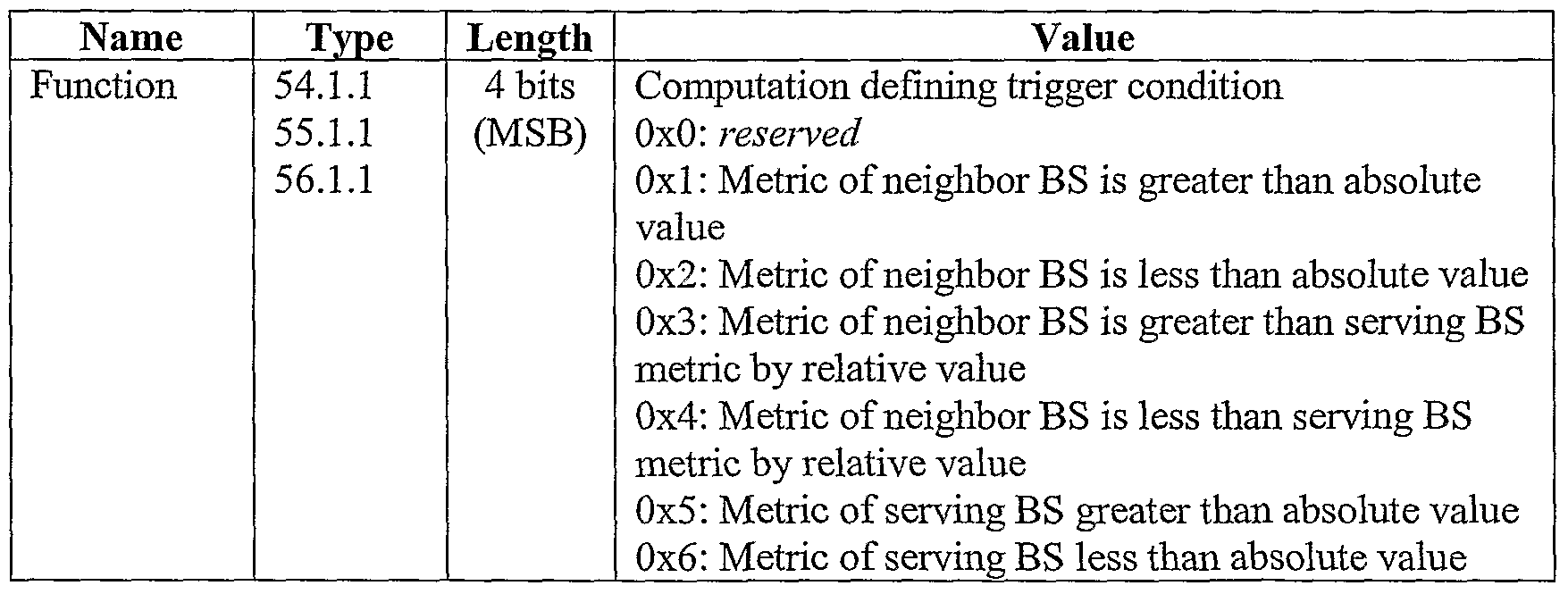
  • Table 6 illustrates an example of values of a parameter used to trigger different
  • Table 7 illustrates an example of conditions of a parameter used to trigger different
  • Figure 1 is an exemplary diagram illustrating processes of a Power Saving Class 1.
  • the MS sends a message to the BS to request for
  • the MS sets the values of initial sleep window, final sleep window, and
  • the BS grants entry into the power saving mode, the BS includes, inter alia, an initial sleep
  • the MS When the MS enters the power saving mode, the MS remains in the power saving
  • the MS receives traffic indication (MOB-TRF-IND) message(s) from
  • the MS during the listening interval. If there is no downlink traffic or data directed to the corresponding MS, referred to as negative indication, for example, then the MS re-enters
  • the duration of the power saving mode is twice
  • a final sleep window can be determined using a final sleep window base and a final
  • Figure 2 is an exemplary diagram illustrating processes of a Power Saving Class 2.
  • the MS transmits a sleep request message, similar to the message
  • the BS grants entry to Power Saving Class 2 by sending a response message to the MS.
  • the response message can include a sleep interval, a listening interval,
  • the MS stays in the power saving mode for the duration of the sleep interval.
  • the MS After the sleep interval expires, the MS synchronizes with the BS to maintain
  • the MS can then receive downlink data from the BS and
  • the MS maintains the power saving mode for a period equaling that
  • the MS can send a sleep
  • request message including a request to terminate Power Saving Class 2, to the BS during
  • the MS can transmit a user data to the BS during the listening interval.
  • the MS can transmit a user data to the BS during the
  • Figure 3 is an exemplary diagram illustrating processes of a Power Saving Class 3.
  • Figure 3 shows the processes of Power Saving Class 3 by illustrating the
  • the MS performs ranging operations periodically to maintain uplink/downlink
  • the MS acquires appropriate uplink transmission parameters. Furthermore, when it is time for the MS to
  • the MS transmits a ranging request (RNG-REQ)
  • the BS After receiving the ranging request message (RNG-REQ) from the MS, the BS
  • RNG-RSP ranging response
  • response message can include sleep window and start frame, for example, so that Power
  • the MS encounters the start frame
  • the MS receives from the BS the
  • RNG-RSP ranging response
  • the MS When it is time to enter power saving mode, the MS
  • Figure 4 is another exemplary diagram illustrating processes of a Power Saving
  • FIG. 3 depicts the processes of Power Saving Class 3 employed by the MS
  • the BS transmits a sleep response (MOB_SLP-RSP)message to the MS to have the
  • the MS resumes a mode in which the MS is available to
  • the MS communicate with the BS, and the MS receives data from the BS via multicast connection.
  • the BS After the BS finishes transmitting data during multicast connection, the BS activates
  • the MS responds to the sleep response (MOB_SLP-
  • RSP RSP
  • each connection may be associated with an individual context or power saving class
  • Figure 5 shows an example of power saving modes of the MS illustrating various aspects
  • the MS that has at least one power saving class has at least one power saving class
  • the MS does not perform
  • the MS and the serving BS activates the power saving mode
  • the MS can minimize power consumption.
  • the MS even during power saving mode, can perform
  • pre-handover operations before handover such as scan operation which detects signal
  • the serving BS transmits handover trigger information, which includes operations
  • the MS performs
  • Figure 6 is an exemplary diagram illustrating handover processes by the MS.
  • the serving BS transmits handover trigger information by using the DCD, which is
  • the MS After the MS receives the handover trigger information from the serving BS, the MS
  • the serving BS After receiving the scan request message, the serving BS allocates the scan period
  • the MS synchronizes downlink signal with the neighbor BS and measures signal
  • the MS uses the scan report (MOB_SCAN-REPORT) message.
  • the scan report includes information such as a Carrier-to-interference and
  • CINR CINR
  • RSSI Received Signal Strength Indicator
  • Round Trip Delay CINR
  • the MS can transmit a
  • the serving BS transmits via a scan response (MOB-SCN-RSP)
  • the MS performs association with the neighbor BS.
  • the MS can use a handover request (MOB_MSHO-REQ) message to request for handover
  • the serving BS Upon receipt, the serving BS transmits a handover response
  • the MS performs operations for re-entry to target BS
  • Table 8 is an example of a sleep request (MOB_SLP-REQ) message.
  • the MS can make a
  • the sleep request (MOB_SLP-REQ) message can include information
  • TLV Type Length Value
  • MOB_SLP-REQ sleep request
  • RNG-REQ (RNG-REQ) message. More specifically, the parameters of Table 9 can be used to negotiate whether each event is enabled or disabled when the MS enters the power saving mode.
  • MOB-SLP-RSP sleep response
  • RNG-REQ ranging request
  • the Enabled-Trigger parameter can be in a bitmap format.
  • parameter in the bitmap format can be used to notify the serving BS that the corresponding
  • the MS can configure each bit as '1' (e.g.,
  • the serving BS can be notified that the MS is to trigger the
  • the serving BS can configure the Enabled-Trigger parameter
  • MOB_SLP-RSP sleep response
  • MOB_SLP-RSP sleep response
  • Table 10 is an example of a sleep response (MOB_SLP-RSP) message.
  • the Enabled-Trigger parameter included in the sleep response (MOB SLP-RSP)
  • the serving BS notifies the MS to instruct the MS to trigger the corresponding event.
  • Figure 7 illustrates an example of an operation of a power saving mode when the
  • the MS receives the handover trigger information via the DCD message
  • the MS sets or configures a first bit (i.e., bit #0) of the Enabled-Trigger parameter to '1,' as
  • the serving BS sets (or configures) the first bit (i.e., bit#O) of the Enabled-
  • the MS enters the sleep response (MOB_SLP-RSP) message from the serving BS.
  • the MS which is in power saving mode can perform scan operations on neighbor
  • the MS After reporting the scan results to the serving BS, the MS can then report the scan results to the serving BS.
  • Figure 8 illustrates an example of an operation of a power saving mode when the
  • the MS sets or configures a second bit (i.e., bit #1) of the Enabled-
  • Trigger parameter to ' 1 , ' as illustrated in Tables 9 and 10.
  • Enabled-Trigger parameter means that the action for transmitting MOB_MSHO-REQ is
  • the configured information is transmitted to the serving BS via the
  • MOB SLP -REQ sleep request
  • the serving BS sets (or configures) the second bit (i.e., bit#l) of the Enabled-
  • the MS enters the power saving mode.
  • the MS which is in power saving mode can perform neighbor BS scan operations
  • the MS is required to report the scan result
  • the MS terminates the power saving mode and transmits the
  • the serving BS transmits a handover response
  • MS performs necessary operations for entry to the target BS (i.e., BS2) and to the network.
  • Figure 9 illustrates an example of an operation of a power saving mode when the
  • the MS When the MS makes a request to enter power saving mode, the MS sets or configures a
  • setting the third bit of the Enabled-Trigger parameter means that the action for
  • the serving BS sets (or configures) the third bit (i.e., bit#2) of the Enabled-
  • the MS enters power saving mode.
  • the MS When the MS satisfies a condition after entering the power saving mode, the MS is
  • the MS transmits a scan
  • the serving BS In response to the scan request (MOB S CN-REQ) message, the serving BS
  • the MS synchronizes downlink signal with the neighbor
  • the MS After performing the scan operation, the MS maintains
  • Figure 10 illustrates an example of an operation of a power saving mode when the
  • the MS sets or configures a fourth bit (i.e.,
  • setting the fourth bit of the Enabled-Trigger parameter means that the action for performing
  • the serving BS sets (or configures) the fourth bit (i.e., bit#3) of the Enabled-
  • the MS enters power saving mode.
  • the MS that is in the power saving mode can perform neighbor BS scan operation during
  • the MS When the MS satisfies a condition after entering the power saving mode, the MS is
  • the MS transmits
  • the serving BS transmits necessary parameters for performing association
  • the MS synchronizes in uplink/downlink directions with the neighbor BS (i.e.,
  • the MS transmits a ranging request (RNG-REQ) message to the neighbor
  • the neighbor BS i.e., BS2
  • RNG-RSP ranging response
  • the MS keeps the association parameters received from the neighbor BS (i.e.,
  • the MS After receiving the ranging response (RNG-RSP) message, the MS

Landscapes

  • Engineering & Computer Science (AREA)
  • Computer Networks & Wireless Communication (AREA)
  • Signal Processing (AREA)
  • Quality & Reliability (AREA)
  • Physics & Mathematics (AREA)
  • Electromagnetism (AREA)
  • Computer Security & Cryptography (AREA)
  • Mobile Radio Communication Systems (AREA)

Abstract

A method of performing actions related to handover by a mobile station (MS) in a wireless mobile communication system is disclosed. More specifically, the MS receives information from a base station (BS), wherein the information includes at least one action for performing handover and at least one condition corresponding to the at least one action. Furthermore, the MS transmits a request message to perform the at least one action based on the received information from the BS and receives a response message in response to the request message. Lastly, the MS performs the at least one action according to the received response message.

Description

A METHOD OF PERFORMING ACTIONS RELATED TO HANDOVER BY A
MOBILE STATION THAT IS IN POWER SAVING MODE IN A WIRELESS
MOBILE COMMUNICATION SYSTEM
Technical Field
The present invention relates to a performing action related to handover, and more
particularly, to a method of performing actions related to handover by a mobile station (MS)
that is in power saving mode in a wireless mobile communication system.
Background Art
In a broadband wireless access system, a power saving mode or a sleep mode can be
used to minimize power consumption of a mobile station (MS). The power saving mode
comprises a sleep interval and a listening interval, which are repeated during the operation
by the MS. A length (or duration) of the sleep interval is determined by a value of a sleep
window. Similarly, a length (or duration) of the listening interval is determined by a value
of a listening window. These values are respectively determined based on a characteristic of
a determined traffic of a corresponding MS. Furthermore, the MS can be represented by
three (3) types of power saving class according to the characteristics of traffic associated
with the power saving class.
More specifically, the three power saving class types are classified as a power
saving mode class type 1 (hereinafter "Class 1"), a power saving mode class type 2
(hereinafter "Class 2"), and a power saving mode class type 3 (hereinafter "Class 3"). Class 1 can be defined by an initial sleep window, a final window base, a final
window exponent, a listening window, and a start frame number of sleep window.
Furthermore, Class 1 focuses on features such as Best Effort (BE) which characterizes the
existing internet traffic or non-real-time variable rate (nrt-VR).
Class 2 can be defined by an initial sleep window, a listening window, and a start
frame number of sleep window. Furthermore, Class 2 focuses on features such as Voice
over Internet Protocol (VoIP ) and the nrt-VR.
Class 3 can be defined by a final window base, a final window exponent, and a start
frame number of sleep window. Furthermore, Class 3 is for periodically transmitting a
management message, such as a Downlink Channel Descriptor/Uplink Channel Descriptor
(DCD/UCD) and a neighbor advertisement (MOB_NBR_ADV), to the MS that is in power
saving mode or alternatively, for data transmitted via multicast transmission.
The above power saving class types describe different types of power saving modes.
The operations of these different class types are the basis for handover for the MS to a base
station (BS). While in power saving mode, the MS receives signal quality information of
neighbor base stations. The signal qualities of neighbor bases stations can be measured by
performing scan operation. Before handover operation is performed, a serving BS transmits
handover trigger information, which is used in performing handover, to the MS. Here, the
serving BS refers to the BS which granted the MS to enter the power saving mode. Using
the received handover trigger information, the MS performs handover when the condition
specified in the handover trigger information is satisfied. Even if the MS that is in power saving mode does not transmit and receive a scan
request message and a scan response message, respectively, the MS performs scan operation
on neighboring base stations and measures signal qualities of neighbor base stations. If the
results of the scan operation (e.g., signal qualities of the neighbor base stations, the received
signal strength, and/or transmission delay) are transmitted via scan report message to the
serving BS every time the scan operation is performed, the power consumption for uplink
transmission by the MS increases. At the same time, if the serving BS fails to receive the
scan results from the MS operating in power saving mode, then the handover operation of
the MS cannot be controlled properly.
Disclosure of the Invention
Accordingly, the present invention is directed to a method of performing actions
related to handover by a mobile station (MS) that is in power saving mode in a wireless
mobile communication system that substantially obviates one or more problems due to
limitations and disadvantages of the related art.
An object of the present invention is to provide a method of performing actions
related to handover by a mobile station (MS) that is in power saving mode in a wireless
mobile communication system.
Another object of the present invention is to provide a method of providing actions
related to handover by a base station (BS) for a mobile station (MS) that is in power saving
mode in a wireless mobile communication system. Additional advantages, objects, and features of the invention will be set forth in part
in the description which follows and in part will become apparent to those having ordinary
skill in the art upon examination of the following or may be learned from practice of the
invention. The objectives and other advantages of the invention may be realized and
attained by the structure particularly pointed out in the written description and claims hereof
as well as the appended drawings.
To achieve these objects and other advantages and in accordance with the purpose of
the invention, as embodied and broadly described herein, a method of performing actions
related to handover by a mobile station (MS) includes the MS which receives information
from a base station (BS), wherein the information includes at least one action for
performing handover and at least one condition corresponding to the at least one action.
Furthermore, the MS transmits a request message to perform the at least one action based on
the received information from the BS and receives a response message in response to the
request message. Lastly, the MS performs the at least one action according to the received
response message.
In another aspect of the present invention, a method of providing actions related to
handover by a base station (BS) for a mobile station (MS) that is in power saving mode
includes the MS which transmits information to the MS, wherein the information includes at
least one action for performing handover and at least one condition corresponding to the at
least one action. Thereafter, the MS receives a request message from the MS asking to perform at least one action based on the received information and transmits response
message in response to the request message.
It is to be understood that both the foregoing general description and the following
detailed description of the present invention are exemplary and explanatory and are
intended to provide further explanation of the invention as claimed.
Brief Description of the Drawings
The accompanying drawings, which are included to provide a further understanding
of the invention and are incorporated in and constitute a part of this application, illustrate
embodiment(s) of the invention and together with? the description serve to explain the
principle of the invention. In the drawings;
FIG. 1 is an exemplary diagram illustrating processes of a Power Saving Class 1;
FIG. 2 is an exemplary diagram illustrating processes of a Power Saving Class 2;
FIG. 3 is an exemplary diagram illustrating processes of a Power Saving Class 3;
FIG. 4 is another exemplary diagram illustrating processes of a Power Saving Class
3;
FIG. 5 shows an example of power saving modes of the MS illustrating various
service types;
FIG. 6 is an exemplary diagram illustrating handover processes by the MS;
FIG. 7 illustrates an example of an operation of a power saving mode when the
action for transmitting MOB_S CAN-REPORT is enabled; FIG. 8 illustrates an example of an operation of a power saving mode when the
action for transmitting handover request message (MOB_MSHO-REQ) is enabled;
FIG. 9 illustrates an example of an operation of a power saving mode when the
action for performing scan operation is enabled; and
FIG. 10 illustrates an example of an operation of a power saving mode when the
action for performing association is enabled.
Best Mode for Carrying Out the Invention
Reference will now be made in detail to the preferred embodiments of the present
invention, examples of which are illustrated in the accompanying drawings. Wherever
possible, the same reference numbers will be used throughout the drawings to refer to the
same or like parts.
As discussed above, there are three (3) types of power saving modes. For proper
execution of each power saving mode, the BS and the MS exchanges necessary information
such as parameters and a ranging response (RNG-RSP) message. The parameters are
included in the exchanged messages between the BS and the MS. These messages can be
defined by a sleep request (MOB SLP-REQ) message, a sleep response (MOB SLP-RSP)
message, and a traffic indication (MOB_TRF-IND) message, for example.
Table 1 illustrates an example of the sleep request (MOB_SLP-REQ) message. The
sleep request (MOB_SLP-REQ) message includes a request for entry into sleep mode and is
one of the messages transmitted by the MS to the serving BS. In the sleep request message, information pertaining to sleep interval(s) and listening interval(s) can be included.
Hereinafter, a term 'sleep interval' can be used interchangeably with terms 'sleep window'
or 'duration of sleep window/
[Table 1]
Figure imgf000008_0001
Table 2 illustrates an example of the sleep response (MOB_S LP-RSP) message. The
sleep response (MOB_SLP-RSP) message includes sleep mode related information and is
one of the messages transmitted from the BS to the MS. The sleep response message
includes grant of sleep mode along with sleep interval(s), listening interval(s), and sleep
identification, for example.
[Table 2]
Figure imgf000008_0002
Figure imgf000009_0001
Table 3 is an example of the traffic indication (MOB_TRF-IND) message
broadcasted periodically. The MS that is in sleep mode receives the broadcasted traffic
indication (MOB_TRF-IND) message during the listening interval and determines whether
to maintain the sleep mode, exit the sleep mode to receive downlink data, or perform
ranging operation during the sleep mode. [Table 3]
Figure imgf000010_0001
Table 4 illustrates an example of power saving class parameters included in the
ranging response (KNG-RSP) message. The power saving class parameters can have variable lengths. That is, the power saving class parameters can be defined as a specific type
parameter (e.g., type 21) and can be classified as a compound parameter which can
selectively include parameters having varying lengths.
[Table 4]
Figure imgf000011_0001
Figure imgf000012_0001
The operation of the MS prior to handover is as follows. First, the MS can perform
scan operation. The scan operation allows the MS to acquire signals of the neighbor base
stations and measure the signal qualities of the acquired signals to determine the BS having
optimum signal quality among the measured signals. To this end, the MS can use a scan
request (MOB_SCN-REQ) message to request a serving BS for permission to perform scan
operation. In response to the request, the serving BS can send a scan response (MOB_SCN-
RSP) message to allow the MS commence scan operation of neighbor base stations to
measure signal qualities. In the scan response message, parameters needed for performing
scan operation, such as for scan period, can be included.
Table 5 illustrates an example of a scan report (MOB_SCAN-REPORT) message.
[Table 5]
Figure imgf000012_0002
Figure imgf000013_0001
In operation, the MS can use the scan report message, such as the one of Table 5, to
transmit information (e.g., signal quality, strength of received signal, transmission delay)
acquired from the scan operation of the neighbor base stations to the serving BS. The
serving BS determines whether to allow MS to perform handover based on information of
neighbor BS scanned results.
A time it takes to perform handover can be shortened by performing association.
Association relates to a process or a procedure before performing actual handover. In detail,
the MS can first measure signal quality of neighbor base stations via scan operation and
execute initial ranging operation. Here, the ranging parameters used during the initial
ranging operation can be re-used during actual handover. More specifically, the MS can
send the scan request (MOB_SCN-REQ) message to the serving BS to request for
connection with the neighbor BS. The serving BS in response can provide parameters (e.g.,
connection execution time, resource information used at connection) necessary for
connecting with the neighbor BS via the scan response (MOB S CN-RSP) message.
As discussed above, the MS can measure signal qualities of the neighbor base
stations by using the scan operation and reports the results of the scan operation, including
the measured signal qualities, to the serving BS. Thereafter, the MS compares, using an
absolute or relative standard, levels of signal qualities that can be provided by the neighbor
base stations to level of the actual signal qualities received from the neighbor base stations.
After completing the comparison, the MS and/or the serving BS can determine whether to
perform handover. Conditions or values necessary for the MS to perform various operations can be
transmitted with specified parameters, as illustrated in Table 6. Here, the parameters can
include information related to operations such as scanning the neighbor base stations,
reporting the results of the scan operation, connecting with the neighbor BS, and performing
handover with the BS. These specified parameters can then be included in a Downlink
Channel Descriptor (DCD) of the serving BS or a neighbor BS advertisement (MOB-NBR-
ADV) message, and thereafter, transmitted to the MS from the serving BS.
Table 6 illustrates an example of values of a parameter used to trigger different
events.
[Table 6]
Figure imgf000015_0001
Table 7 illustrates an example of conditions of a parameter used to trigger different
events.
[Table 7]
Figure imgf000015_0002
Figure imgf000016_0001
Figure 1 is an exemplary diagram illustrating processes of a Power Saving Class 1.
In the Power Saving Class 1 of Figure 1, the MS sends a message to the BS to request for
entry into power saving mode, and the power saving mode is maintained until there is
downlink traffic to deliver to the corresponding MS, at which point, the power saving mode
is terminated. A more detailed description of the operation is provided below.
In detail, the MS sets the values of initial sleep window, final sleep window, and
listening window. These values are then included in the sleep request (MOB-SLP-REQ)
message transmitted to the BS to request for entry into power saving mode. When or if the
BS grants entry into the power saving mode, the BS includes, inter alia, an initial sleep
window, a final sleep window, a listening window, and a start frame of the initial sleep
window in the response message (i.e., MOB-SLP-RSP) to the corresponding MS.
When the MS enters the power saving mode, the MS remains in the power saving
mode for duration equaling duration of the initial sleep window. After the expiration of the
power saving mode, the MS receives traffic indication (MOB-TRF-IND) message(s) from
the BS during the listening interval. If there is no downlink traffic or data directed to the corresponding MS, referred to as negative indication, for example, then the MS re-enters
power saving mode. However, this time, the duration of the power saving mode is twice
longer than the previous duration.
If there continues to be no downlink traffic for the corresponding MS during the
listening interval(s), then the duration of the subsequent power saving mode increases by a
specified rate (i.e., two folds) each time the MS re-enters the power saving mode after
failing to receive downlink traffic after the listening interval. The following equation is an
example illustrating increase in duration of the power saving mode. Here, a size or duration
of a final sleep window can be determined using a final sleep window base and a final
window exponent included in the sleep response message.
[Equation 1]
Final Sleep Window = Final Sleep Window Base * 2 Final Window Exponent
On the contrary, if there is downlink traffic addressed to the MS during the listening
interval, indicated as positive indication, then the MS terminates the power saving mode.
Figure 2 is an exemplary diagram illustrating processes of a Power Saving Class 2.
In Figure 2, the diagram shows the MS using any one of an Unsolicited Grant Service
(UGS), which provides a fixed data rate, and a Real Time Variable Service (RT-VR), and
the operation processes of the MS in a Power Saving Class 2.
More specifically, the MS transmits a sleep request message, similar to the message
of Table 1, to the BS to request for entry to Power Saving Class 2. Upon receipt of the
request message, the BS grants entry to Power Saving Class 2 by sending a response message to the MS. The response message can include a sleep interval, a listening interval,
and a start frame of the power saving mode to be configured by the MS. Once the MS enters
the start frame, the MS stays in the power saving mode for the duration of the sleep interval.
After the sleep interval expires, the MS synchronizes with the BS to maintain
uplink/downlink communication. The MS can then receive downlink data from the BS and
at the same time, transmit uplink data to the BS during the listening interval. Once the
listening interval ends, the MS maintains the power saving mode for a period equaling that
of the sleep interval in order to minimize power consumption. Thereafter, the listening and
sleep intervals are repeated by the MS in Power Saving Class 2.
If the MS wishes to terminate Power Saving Class 2, the MS can send a sleep
request message, including a request to terminate Power Saving Class 2, to the BS during
the listening interval. Alternatively, the MS can transmit a user data to the BS during the
sleep interval. After Power Saving Class 2 is terminated, the MS is in normal operating
mode.
Figure 3 is an exemplary diagram illustrating processes of a Power Saving Class 3.
More specifically, Figure 3 shows the processes of Power Saving Class 3 by illustrating the
MS maintaining uplink/downlink communication with the BS and performing ranging
operations with the BS to reduce power consumption. In Figure 3, the MS enters normal
operation mode by powering on and executing network entry procedure. During normal
mode, the MS performs ranging operations periodically to maintain uplink/downlink
communication with the BS. In the process of periodic ranging operations, the MS acquires appropriate uplink transmission parameters. Furthermore, when it is time for the MS to
perform periodic ranging operations, the MS transmits a ranging request (RNG-REQ)
message to the BS.
After receiving the ranging request message (RNG-REQ) from the MS, the BS
responds by transmitting a ranging response (RNG-RSP) message, which includes adjusted
values of the uplink transmission parameters, to the corresponding MS. Here, the ranging
response message can include sleep window and start frame, for example, so that Power
Saving Class 3 can be activated.
After the MS receives the ranging response (RNG-RSP) message, which includes
information necessary to activate powering saving mode, the MS encounters the start frame
to indicate start of the power saving mode. Thereafter, the MS stays in the power saving
mode for the duration of the sleep window. When the sleep window period expires, the MS
is in a mode which allows the MS to communicate with the BS. The MS then performs
periodic ranging operation. During the ranging operation, the MS receives from the BS the
ranging response (RNG-RSP) message including the parameters related to uplink
transmission and power saving mode. When it is time to enter power saving mode, the MS
enters (or activates) the power saving mode and remains in the power saving mode for the
duration of the sleep window.
Figure 4 is another exemplary diagram illustrating processes of a Power Saving
Class 3. Figure 4 depicts the processes of Power Saving Class 3 employed by the MS,
which receives data from the BS via multicast connection, to conserve power. The BS transmits a sleep response (MOB_SLP-RSP)message to the MS to have the
MS activate Power Saving Class 3. When the MS receives the sleep response (MOB-SLP-
RSP) message, starting with the start frame, the MS enters or activates the sleep window
and remains in the power saving mode for the duration of the sleep window. At the
termination of the sleep window, the MS resumes a mode in which the MS is available to
communicate with the BS, and the MS receives data from the BS via multicast connection.
After the BS finishes transmitting data during multicast connection, the BS activates
Power Saving Class 3 by transmitting a sleep response (MOB_SLP-RSP) message to the
MS so that the power consumption can be reduced until the next data transmission via
multicast connection. As for the MS, the MS responds to the sleep response (MOB_SLP-
RSP) message by entering the power saving mode for the duration of the sleep window. In
order to reduce power consumption of the MS in the broadband wireless access system,
each connection may be associated with an individual context or power saving class
according to service type of the connection.
Figure 5 shows an example of power saving modes of the MS illustrating various
service types. As illustrated in Figure 5, the MS that has at least one power saving class
activated remains in the power saving mode during sleep windows where the sleep windows
overlap between each power saving class. As described above, the MS does not perform
uplink transmission with the BS during power saving mode.
As described above, the MS and the serving BS activates the power saving mode
based on each connection represented by a service type. As such, the MS can minimize power consumption. Alternatively, the MS, even during power saving mode, can perform
pre-handover operations before handover, such as scan operation which detects signal
quality levels received from neighbor base stations, and association procedures which
executes ranging operations with the BS prior to performing actual handover, during the
sleep window.
The serving BS transmits handover trigger information, which includes operations
such as scan, association, and handover, to the MS. As for the MS, the MS performs
necessary and appropriate operations when the situation satisfies the condition based on the
received handover trigger information.
Figure 6 is an exemplary diagram illustrating handover processes by the MS. In
Figure 6, the serving BS transmits handover trigger information by using the DCD, which is
a message used to transmit channel information parameters, or a neighbor advertisement
(MOB_NBR-ADV) message. As described above, the handover trigger information
includes information necessary for the MS to carry out handover operation.
After the MS receives the handover trigger information from the serving BS, the MS
can send a scan request (MOB_SCN-REQ) message to request assignment of scan period
(or duration) from the serving BS when the condition is met to perform scan on neighbor
base stations.
After receiving the scan request message, the serving BS allocates the scan period
(or duration) included in the scan response (MOB_SCN-RSP) message. During the scan period, the MS synchronizes downlink signal with the neighbor BS and measures signal
quality, signal strength, and transmission synchronization, among others.
After the MS completes scan, if the MS has to send the scan result of neighbor base
stations to the serving BS, the MS uses the scan report (MOB_SCAN-REPORT) message.
More specifically, the scan report includes information such as a Carrier-to-interference and
Noise Ratio (CINR), a Received Signal Strength Indicator (RSSI), and a Round Trip Delay.
If the MS has to perform association with the neighbor BS, the MS can transmit a
scan request (MOB-SCN-REQ) message to request association with the neighbor BS to the
serving BS. In response, the serving BS transmits via a scan response (MOB-SCN-RSP)
message parameters necessary for performing association with the neighbor BS. After
receiving the necessary parameters, the MS performs association with the neighbor BS.
After the MS performs scan or association operations, if the MS has to perform
handover operation with a particular BS after referring to a handover trigger information,
the MS can use a handover request (MOB_MSHO-REQ) message to request for handover
to the serving BS. Upon receipt, the serving BS transmits a handover response
(MOB_MSHO-RSP) message to the MS. Thereafter, the MS transmits a handover
indication (MOB HO-IND) message to the serving BS to request to cease or sever
connection with the serving BS. Then, the MS performs operations for re-entry to target BS
and the network.
Table 8 is an example of a sleep request (MOB_SLP-REQ) message.
[Table 8]
Figure imgf000023_0001
\L
If the MS wishes to convert to or enter power saving mode, the MS can make a
request for entry to power saving mode by transmitting the sleep request (MOB-SLP-REQ)
message. Here, the sleep request (MOB_SLP-REQ) message can include information
related to whether the MS that is in the power saving mode should perform each handover-
related operations for handover trigger information.
The information related to whether the MS that is in the power saving mode should
perform each handover-related operations for handover trigger information can be
transmitted via a specified field of the sleep request (MOB_SLP-REQ) message. Table 9 is
an example of the specified field, labeled as Εnabled-Trigger' field, of the sleep request
(MOB_SLP-REQ) message. In detail, Table 9 describes an example of a parameter for
enabling the event trigger operation. [Table 9]
Figure imgf000024_0001
The parameter of Table 9 is a Type Length Value (TLV) parameter, which can be
transmitted to the BS via a sleep request (MOB_SLP-REQ) message or a ranging request
(RNG-REQ) message. More specifically, the parameters of Table 9 can be used to negotiate whether each event is enabled or disabled when the MS enters the power saving mode.
Furthermore, the parameters of Table 9 can be included in sleep request (MOB_SLP-REQ),
sleep response (MOB-SLP-RSP), ranging request (RNG-REQ), and ranging response
(RNG-RSP) messages.
The Enabled-Trigger parameter can be in a bitmap format. The Enabled-Trigger
parameter in the bitmap format can be used to notify the serving BS that the corresponding
event is to be triggered by the MS. In operation, the MS can configure each bit as '1' (e.g.,
bit = 1), and transmit the configure bit(s) to the serving BS via the sleep request
(MOB_SLP-REQ) message. Based on the handover trigger information, if the event trigger
condition is satisfied with respect to the event configured to '1' during the power saving
mode of the MS, then the serving BS can be notified that the MS is to trigger the
corresponding event.
If the serving BS receives the sleep request (MOB_SLP-REQ) message including
the enabled-trigger parameter, the serving BS can configure the Enabled-Trigger parameter,
as illustrated in Table 9, and can transmit the configured information to the MS via the sleep
response (MOB_SLP-RSP) message. Alternatively, the sleep response (MOB_SLP-RSP)
message can include the Enabled-Trigger parameter configured according to Table 10.
Table 10 is an example of a sleep response (MOB_SLP-RSP) message.
[Table 10]
Figure imgf000025_0001
Figure imgf000026_0001
Figure imgf000027_0001
The Enabled-Trigger parameter included in the sleep response (MOB SLP-RSP)
message is in a bitmap format, as in the case with the sleep request (MOB_SLP-REQ)
message. Similarly, if each bitmap is set to '1,' and if the trigger condition is satisfied based
on the handover trigger information similar to that of Table 7 during power saving mode of
the MS, the serving BS notifies the MS to instruct the MS to trigger the corresponding event.
Figure 7 illustrates an example of an operation of a power saving mode when the
action for transmitting MOB_S CAN-REP ORT is enabled. More specifically, Figure 7
describes operations related to handover of the MS based on handover trigger information
during the operation of MS power saving mode initiated according to the Enabled-Trigger
parameter. In Figure 7, the MS receives the handover trigger information via the DCD message
or the MOB_NBR-ADV message. When making a request for entry to power saving mode,
the MS sets or configures a first bit (i.e., bit #0) of the Enabled-Trigger parameter to '1,' as
illustrated in Tables 8 and 9. Here, setting the first bit of the Enabled-Trigger parameter
means that the action for transmitting MOB_SCAN-REPORT is enabled. Thereafter, the
configured information is transmitted to the serving BS via the sleep request (MOB_SLP-
REQ) message.
The serving BS then sets (or configures) the first bit (i.e., bit#O) of the Enabled-
Trigger parameter to '1,' as illustrated in Tables 9 and 10, and transmits the configured
information to the MS via the sleep response (MOB_SLP-RSP) message. After receiving
the sleep response (MOB_SLP-RSP) message from the serving BS, the MS enters the
power saving mode.
The MS which is in power saving mode can perform scan operations on neighbor
base stations during the sleep interval or for the duration of the sleep window. When the MS
satisfies a condition after entering the power saving mode, then the MS is required to report
the scan result. Thereafter, the MS transmits the scan report (MOB_SCAN-REPORT)
message to the serving BS to provide the serving BS with the scan result relating to the
neighbor base stations. After reporting the scan results to the serving BS, the MS can then
maintain the power saving mode.
Figure 8 illustrates an example of an operation of a power saving mode when the
action for transmitting handover request message (MOB_MSHO-REQ) is enabled. As illustrate in Figure 8, the MS receives the handover trigger information via the DCD
message or the MOB_NBR-ADV message. When the MS makes a request for entry to
power saving mode, the MS sets or configures a second bit (i.e., bit #1) of the Enabled-
Trigger parameter to ' 1 , ' as illustrated in Tables 9 and 10. Here, setting the second bit of the
Enabled-Trigger parameter means that the action for transmitting MOB_MSHO-REQ is
enabled. Thereafter, the configured information is transmitted to the serving BS via the
sleep request (MOB SLP -REQ) message.
The serving BS then sets (or configures) the second bit (i.e., bit#l) of the Enabled-
Trigger parameter to '1,' as illustrated in Tables 9 and 10, and transmits the configured
information to the MS via the sleep response (MOB SLP -RSP) message. After receiving
the sleep response message from the serving BS, the MS enters the power saving mode.
The MS which is in power saving mode can perform neighbor BS scan operations
during the sleep interval or for the duration of the sleep window. When the MS satisfies a
condition after entering the power saving mode, the MS is required to report the scan result
to the serving BS. Thereafter, the MS terminates the power saving mode and transmits the
handover request (MOB_MSHO-REQ) message to the serving BS, thereby making a
request for handover with a different BS (e.g., BS2). In response to the handover request
(MOB_MSHO-REQ) message, the serving BS transmits a handover response
(MOB_MSHO-RSP) message to the MS. Thereafter, the MS requests for disconnect with the serving BS by transmitting a
handover indication (MOB_HO-IND) message to the serving BS. After the disconnect, the
MS performs necessary operations for entry to the target BS (i.e., BS2) and to the network.
Figure 9 illustrates an example of an operation of a power saving mode when the
action for requesting a scanning interval is enabled. In Figure 9, the MS receives the
handover trigger information via the DCD message or the MOB_NBR-ADV message.
When the MS makes a request to enter power saving mode, the MS sets or configures a
third bit (i.e., bit #2) of the Enabled-Trigger parameter to '1,' as illustrated in Tables 8 and 9.
Here, setting the third bit of the Enabled-Trigger parameter means that the action for
requesting MOB_SCN-REQ is enabled. Thereafter, the configured information is
transmitted to the serving BS via the sleep request (MOB_SLP-REQ) message.
The serving BS then sets (or configures) the third bit (i.e., bit#2) of the Enabled-
Trigger parameter to '1,' as illustrated in Tables 9 and 10, and transmits the configured
information to the MS via the sleep response (MOB_SLP-RSP) message. After receiving
the sleep response message from the serving BS, the MS enters power saving mode.
When the MS satisfies a condition after entering the power saving mode, the MS is
required to perform neighbor BS scan operation after. Thereafter, the MS transmits a scan
request (MOB_SCN-REQ) message to the serving BS to request for allocation of scan
period. In response to the scan request (MOB S CN-REQ) message, the serving BS
transmits a scan response (MOBJSCN-RSP) message including allocation of the scan
period. During the scan period, the MS synchronizes downlink signal with the neighbor
base stations and measures, inter alia, signal quality from neighbor base stations, signal
strengths, and transmission delay. After performing the scan operation, the MS maintains
the power saving mode.
Figure 10 illustrates an example of an operation of a power saving mode when the
event for performing association is enabled. In Figure 10, the MS receives the handover
trigger information via the DCD message or the MOB NBR-AD V message. When the MS
makes a request for entry to power saving mode, the MS sets or configures a fourth bit (i.e.,
bit #3) of the Enabled-Trigger parameter to '1,' as illustrated in Tables 8 and 9. Here,
setting the fourth bit of the Enabled-Trigger parameter means that the action for performing
association is enabled. Thereafter, the configured information is transmitted to the serving
BS via the sleep request (MOB_SLP-REQ) message.
The serving BS then sets (or configures) the fourth bit (i.e., bit#3) of the Enabled-
Trigger parameter to '1,' as illustrated in Tables 9 and 10, and transmits the configured
information to the MS via the sleep response (MOB SLP -RSP) message. After receiving
the sleep response message from the serving BS, the MS enters power saving mode. Here,
the MS that is in the power saving mode can perform neighbor BS scan operation during
sleep mode.
When the MS satisfies a condition after entering the power saving mode, the MS is
required to perform association with a neighbor BS (i.e., BS2). Thereafter, the MS transmits
the scan request (MOB_SCN-REQ) message to the serving BS to request to perform association with the neighbor BS (i.e., BS2). In response to the scan request (MOB_SCN-
REQ) message, the serving BS transmits necessary parameters for performing association
with the neighbor BS (i.e., BS2) via the scan response (MOB-SCN-RSP) message.
Thereafter, the MS synchronizes in uplink/downlink directions with the neighbor BS (i.e.,
BS2) in order to perform association.
Further, the MS transmits a ranging request (RNG-REQ) message to the neighbor
BS (i.e., BS2). In response, the neighbor BS (i.e., BS2) transmits ranging control parameters
along with association parameters to the MS via a ranging response (RNG-RSP) message.
As a feature, the MS keeps the association parameters received from the neighbor BS (i.e.,
BS2) and in turn, can re-use the association parameters when performing handover with the
corresponding BS. After receiving the ranging response (RNG-RSP) message, the MS
maintains power saving mode.
As discussed above, the handover operation and related events performed by the MS
that is in power saving mode can be enabled or disabled by using the parameters disclosed
in the present invention. More specifically, whether to enable/disable can be represented in
a bitmap form at the time when the MS enters power saving mode. Here, a plurality of
events can be enabled or disabled as a group. In the embodiments of the present invention
represent examples where the plurality of events is enabled.
It will be apparent to those skilled in the art that various modifications and variations
can be made in the present invention without departing from the spirit or scope of the
inventions. Thus, it is intended that the present invention covers the modifications and variations of this invention provided they come within the scope of the appended claims and
their equivalents.

Claims

Claims
1. A method of performing an action related to handover by a mobile station
(MS) that is in power saving mode in a wireless mobile communication system, the method
comprising:
receiving information from a base station (BS), wherein the information
includes at least one action for performing handover and at least one condition
corresponding to the at least one action;
transmitting a request message to perform the at least one action based on the
received information from the BS;
receiving a response message in response to the request message; and
performing the at least one action according to the received response
message.
2. The method of claim 1, wherein the information defines a trigger type which
includes at least one of Carrier-to-interference and Noise Ratio (CINR), a Received Signal
Strength Indicator (RSSI), and a Round Trip Delay.
3. The method of claim 1, wherein the information defines a trigger function
which is a computation method for triggering action.
4. The method of claim 1, wherein the at least one action includes a scanning
request, a scanning report, and a handover request.
5. The method of claim 1, wherein the information defines a trigger value
which represents a value used for comparing to a measured value of at least one trigger type.
6. The method of claim 1, wherein the information defines a trigger average
duration which represents a time duration in which at least one trigger type is measured and
averaged for determining a condition for triggering at least one action.
7. The method of claim 6, wherein the trigger type which includes at least one
of Carrier-to-interference and Noise Ratio (CINR), a Received Signal Strength Indicator
(RSSI), and a Round Trip Delay.
8. The method of claim 1, wherein the request message is used for entering the
power saving mode.
9. The method of claim 8, wherein the request message includes a bitmap for
indicating the at least one action to be performed during the power saving mode.
10. The method of claim 9, wherein the bitmap represented by a plurality of bits,
the bit having a value of Λ 0' represents the action that is disabled.
11. The method of claim 10, wherein if each bit of the bitmap has a value of
λ 0, ' which indicates that all the actions are disabled.
12. The method of claim 9, wherein the bitmap represented by a plurality of bits,
the bit having a value of λ 1 ' represents the action that is enabled.
13. The method of claim 1, wherein the response message includes a bitmap for
indicating the at least one action to be performed during the power saving mode.
14. The method of claim 13, wherein the bitmap represented by a plurality of
bits, the bit having a value of Λ 0 ' represents the action that is disabled.
15. The method of claim 13, wherein the bitmap represented by a plurality of
bits, the bit having a value of Λ 1 ' represents the action that is enabled.
16. The method of claim 13, wherein the bitmap included in the response
message is same as the bitmap included in the request message.
17. The method of claim 13, wherein the bitmap included in the response
message is different from the bitmap included in the request message.
18. The method of claim 1, wherein the information is included in a Downlink
Channel Descriptor (DCD) message or a Neighbor Advertisement (MOB_NBR-ADV)
message.
19. The method of claim 1, wherein the request message is a sleep request
(MOB_SLP-REQ) message or a ranging request (RNG-REQ) message.
20. The method of claim 1, wherein the response message is a sleep response
(MOB_SLP-REQ) message or a ranging request (RNG-RSP) message.
21. The method of claim 1 , wherein the power saving mode is a sleep mode.
22. A method of providing actions related to handover by a base station (BS) for
a mobile station (MS) that is in power saving mode in a wireless mobile communication
system, the method comprising:
transmitting information to the MS, wherein the information includes at least
one action for performing handover and at least one condition corresponding to the at least
one action; receiving a request message from the MS asking to perform at least one
action based on the received information; and
transmitting a response message in response to the request message.
PCT/KR2006/000858 2005-06-09 2006-03-10 A method of performing actions related to handover by a mobile station that is in power saving mode in a wireless mobile communication system Ceased WO2006132469A2 (en)

Priority Applications (8)

Application Number Priority Date Filing Date Title
AU2006255897A AU2006255897B2 (en) 2005-06-09 2006-03-10 A method of performing actions related to handover by a mobile station that is in power saving mode in a wireless mobile communication system
CN2006800206667A CN101253792B (en) 2005-06-09 2006-03-10 Method for performing handover-related operations by a mobile station in power saving mode in a wireless mobile communication system
CA2610154A CA2610154C (en) 2005-06-09 2006-03-10 A method of performing actions related to handover by a mobile station that is in power saving mode in a wireless mobile communication system
MX2007015349A MX2007015349A (en) 2005-06-09 2006-03-10 A METHOD FOR PERFORMING ACTIONS RELATED TO TRANSFER BY A MOBILE STATION THAT IS IN THE MODE OF ENERGY SAVING IN A WIRELESS MOBILE COMMUNICATION SYSTEM.
AT06716308T ATE522115T1 (en) 2005-06-09 2006-03-10 PERFORMING ACTIONS RELATED TO HANDOVER BY A MOBILE STATION THAT IS IN POWER SAVE MODE
JP2008515617A JP4897800B2 (en) 2005-06-09 2006-03-10 Method for performing operation related to handover by mobile station in power consumption prevention mode in wireless mobile communication system
EP06716308A EP1889502B1 (en) 2005-06-09 2006-03-10 Performing actions related to handover by a mobile station that is in power saving mode
IL187801A IL187801A (en) 2005-06-09 2007-12-02 Method of performing actions related to handover by a mobile station that is in power saving mode in a wireless mobile communication system

Applications Claiming Priority (2)

Application Number Priority Date Filing Date Title
KR20050049097A KR100913087B1 (en) 2005-06-09 2005-06-09 How to control handover in power saving mode
KR10-2005-0049097 2005-06-09

Publications (2)

Publication Number Publication Date
WO2006132469A2 true WO2006132469A2 (en) 2006-12-14
WO2006132469A3 WO2006132469A3 (en) 2008-01-31

Family

ID=37498850

Family Applications (1)

Application Number Title Priority Date Filing Date
PCT/KR2006/000858 Ceased WO2006132469A2 (en) 2005-06-09 2006-03-10 A method of performing actions related to handover by a mobile station that is in power saving mode in a wireless mobile communication system

Country Status (12)

Country Link
US (5) US7672660B2 (en)
EP (3) EP2291030B1 (en)
JP (2) JP4897800B2 (en)
KR (1) KR100913087B1 (en)
CN (2) CN101253792B (en)
AT (2) ATE548872T1 (en)
AU (1) AU2006255897B2 (en)
CA (1) CA2610154C (en)
IL (1) IL187801A (en)
MX (1) MX2007015349A (en)
TW (1) TWI388232B (en)
WO (1) WO2006132469A2 (en)

Cited By (8)

* Cited by examiner, † Cited by third party
Publication number Priority date Publication date Assignee Title
GB2445398A (en) * 2006-08-22 2008-07-09 Siemens Ag A method of handover in a communication system comprising a base station and a user device
WO2008048071A3 (en) * 2006-10-19 2009-09-03 Lg Electronics Inc. Methods of executing handover in a mobile communication system
JP2010509846A (en) * 2006-11-07 2010-03-25 クゥアルコム・インコーポレイテッド Hybrid power saving mechanism for VoIP service
WO2010091270A1 (en) * 2009-02-06 2010-08-12 Qualcomm Incorporated Transmission scheduling during sleep mode in wimax networks
JP2010529707A (en) * 2007-05-08 2010-08-26 エルジー エレクトロニクス インコーポレイティド Method and apparatus for transmitting and receiving data in a mobile communication system
US8538432B2 (en) 2006-05-13 2013-09-17 Lg Electronics Inc. Method of executing handover in a mobile communication system
EP2250743A4 (en) * 2008-02-28 2016-11-30 Korea Electronics Telecomm ENERGY SAVING OPERATION MANAGEMENT METHOD AND WIRELESS COMMUNICATION SYSTEM
US12587966B2 (en) 2017-10-04 2026-03-24 Qualcomm Incorporated Enhanced power savings through mobile initiated dormancy

Families Citing this family (62)

* Cited by examiner, † Cited by third party
Publication number Priority date Publication date Assignee Title
KR100606129B1 (en) * 2003-04-30 2006-07-28 삼성전자주식회사 Channel Quality Measurement and Reporting Method in Broadband Wireless Access Communication Systems
WO2006101367A1 (en) * 2005-03-24 2006-09-28 Lg Electronics Inc. Method of executing scanning in broadband wireless access system
KR100913087B1 (en) * 2005-06-09 2009-08-21 엘지전자 주식회사 How to control handover in power saving mode
US7746810B2 (en) * 2006-03-31 2010-06-29 Intel Corporation Wake on wireless network techniques
KR101221908B1 (en) * 2006-09-04 2013-01-15 엘지전자 주식회사 Method of executing hand-over and Mobile Station implementing the same
US7426404B2 (en) * 2006-09-18 2008-09-16 Motorola, Inc. Method and system for consolidating power saving classes
KR100957348B1 (en) * 2006-10-16 2010-05-12 삼성전자주식회사 Method and apparatus for performing handover by terminal operating in discontinuous reception mode in mobile communication system
US8380203B1 (en) * 2006-11-10 2013-02-19 Marvell International Ltd. Enhanced WLAN association for roaming
CN101237640B (en) * 2007-01-30 2014-06-04 世意法(北京)半导体研发有限责任公司 Dormancy mode control for real time service in broadband wireless access communication system
KR20080074696A (en) * 2007-02-09 2008-08-13 엘지전자 주식회사 Control Method of Power Consumption Prevention Mode in Mobile Communication System
US8204036B2 (en) * 2007-02-28 2012-06-19 Motorola Mobility, Inc. Method and apparatus for coexistence
JP2008252324A (en) * 2007-03-29 2008-10-16 Kyocera Corp Mobile device control method, mobile device, base station control method, and base station
EP2156582A4 (en) * 2007-04-09 2011-09-21 Lg Electronics Inc Providing and using of information on video related to traffic situation
KR100867998B1 (en) * 2007-05-09 2008-11-10 한국전자통신연구원 Handover method and device between heterogeneous networks based on power consumption
US8554271B2 (en) * 2007-06-30 2013-10-08 Motorola Mobility Llc Method and apparatus for performing neighbor scans on a wide area network in a mobile communication device operating a personal area network
US8831675B2 (en) * 2007-06-30 2014-09-09 Motorola Mobility Llc Method for operating a wide area network modem and a personal area network modem in a mobile communication device
US7801066B2 (en) * 2007-07-31 2010-09-21 Motorola Mobility, Inc. Method for transitioning a wide area network modem of a mobile communication device between a power saving mode and a scan mode
IL185088A (en) * 2007-08-07 2012-02-29 Alvarion Ltd Method and apparatus for synchronizing changes in power saving procedures
WO2009079653A2 (en) * 2007-12-18 2009-06-25 Zte U.S.A., Inc. Wimax multicast broadcast services (mbs) efficient handover and power saving support for intra and inter-mbs zones
US8095106B2 (en) * 2008-02-14 2012-01-10 Industrial Technology Research Institute System and method for power savings in a wireless communication network
ATE493003T1 (en) * 2008-02-15 2011-01-15 Mitsubishi Electric Corp METHOD AND DEVICE FOR DECISING WHETHER A HANDOVER NEEDS TO BE PERFORMED FOR A TERMINAL
ATE528939T1 (en) * 2008-02-15 2011-10-15 Mitsubishi Electric Corp METHOD AND DEVICE FOR DECISING WHETHER A HANDOVER NEEDS TO BE PERFORMED FOR A TERMINAL
KR101682034B1 (en) * 2008-08-18 2016-12-05 삼성전자주식회사 Apparatus and method for using secondary frequency assignment optionnally in a wireless communication system using multiple band
US8068838B1 (en) * 2008-08-19 2011-11-29 Clear Wireless Llc Mobile communication device initiated hand-off based on air interface metrics
CN102144417A (en) * 2008-09-03 2011-08-03 诺基亚西门子通信公司 Reduction of interruption time in a handover
US20100105389A1 (en) * 2008-10-29 2010-04-29 Qualcomm Incorporated Methods and systems for proactive idle mode handoff
KR101718496B1 (en) * 2008-10-30 2017-03-21 한국전자통신연구원 Apparatus and method for managing multi-carriers and method for operating of sleep mode of terminal
US20100110950A1 (en) * 2008-11-05 2010-05-06 Industrial Technology Research Institute. Method and apparatus for aligning power savings classes
US8725143B2 (en) * 2008-12-14 2014-05-13 Qualcomm Incorporated Methods and systems for handover in WiMAX networks
EP2360968B1 (en) * 2008-12-16 2016-09-28 ZTE Corporation Terminal and the scan method thereof
CN101820667B (en) * 2009-02-27 2015-01-28 中兴通讯股份有限公司 Power-saving control method
US8599730B2 (en) * 2009-03-13 2013-12-03 Qualcomm Incorporated Methods and systems for split timer L3 P2P communications
US8351892B2 (en) * 2009-05-26 2013-01-08 Qualcomm Incorporated Network detection device power conservation
KR20110000479A (en) * 2009-06-26 2011-01-03 엘지전자 주식회사 Sleep mode operation method and device
CN102668626A (en) 2010-01-07 2012-09-12 日本电气株式会社 Wireless communication system, wireless terminal, wireless network, wireless communication method and program
CN102281550B (en) * 2010-06-13 2016-09-21 株式会社Ntt都科摩 The collocation method of wireless communication system, base station and wireless communication system
JP2012034320A (en) * 2010-07-07 2012-02-16 Ntt Docomo Inc Mobile communication method and wireless base station
US9491690B2 (en) 2010-07-15 2016-11-08 CSC Holdings, LLC Efficient searching for communications networks
US8780859B2 (en) 2010-07-15 2014-07-15 CSC Holdings, LLC Efficient use of a communications network
US8260374B2 (en) * 2010-08-31 2012-09-04 Telefonaktiebolaget L M Ericsson (Publ) Power saving operation of user equipment in a cellular communication system
US9107134B1 (en) 2011-01-12 2015-08-11 Sprint Communications Company L.P. Edge sector handoff determination
US8849215B2 (en) * 2011-03-30 2014-09-30 Amazon Technologies, Inc. Reducing rate of detection cycles and measurement cycles in a discontinuous reception (DRX) mode
WO2013077202A1 (en) * 2011-11-22 2013-05-30 住友電気工業株式会社 Wireless terminal, communication system, communication control method and communication control program
US10039116B1 (en) 2012-04-02 2018-07-31 Sprint Communications Company L.P. Long term evolution scheduler to mitigate interference
US9553680B1 (en) 2012-04-02 2017-01-24 Sprint Communications Company L.P. Uplink interference mitigation
EP2873270B1 (en) * 2012-07-13 2019-12-04 Telefonaktiebolaget LM Ericsson (publ) Network-controlled ue switching between different types of radio networks
GB2506150A (en) * 2012-09-21 2014-03-26 Nec Corp Scheduling of Machine Type Communications (MTC) in a wireless communications system
KR20140045808A (en) * 2012-10-09 2014-04-17 삼성에스디아이 주식회사 Catalyst for fuel cell, electrode for fuel cell including same, membrane-electrode assembly and fuel cell system including same and fuel cell system including same
US10051521B2 (en) * 2012-11-27 2018-08-14 Qualcomm Incorporated Fast association and address continuity for handoff between unmanaged access points
US20140275990A1 (en) * 2013-03-15 2014-09-18 Soma Access Systems, Llc Ultrasound Guidance System Including Tagged Probe Assembly
GB2514117A (en) 2013-05-13 2014-11-19 Nec Corp Communication system
US9198121B2 (en) * 2013-05-17 2015-11-24 Intel Corporation Systems and methods for selective scanning based on range and movement
GB2516259A (en) * 2013-07-16 2015-01-21 Nokia Corp An apparatus, method and computer program for detecting physiological parameters
TWI624186B (en) * 2014-04-03 2018-05-11 高通公司 Fast association and address continuity for handoff between unmanaged access points
CN104822136B (en) * 2014-12-25 2018-02-13 平安科技(深圳)有限公司 Broadcasting frequency control method and device
JP6566796B2 (en) * 2015-09-04 2019-08-28 キヤノン株式会社 COMMUNICATION DEVICE, COMMUNICATION METHOD, AND PROGRAM
US10321397B2 (en) * 2016-11-09 2019-06-11 Cisco Technology, Inc. System and method to facilitate power management in a long range radio network environment
US10225802B2 (en) 2016-11-29 2019-03-05 At&T Mobility Ii Llc Managing negotiation of power saving mode parameters between a user equipment and a core network device
US10231281B2 (en) 2016-11-29 2019-03-12 At&T Mobility Ii Llc Managing negotiation of extended idle mode discontinuous reception parameters between a user equipment and a core network device
US10285646B1 (en) * 2018-02-27 2019-05-14 CeriBell, Inc. Connection quality assessment for EEG electrode arrays
CN110557811B (en) * 2018-06-04 2021-10-26 大唐移动通信设备有限公司 Energy-saving signal sending method, energy-saving signal receiving method, base station and terminal
CN112040393B (en) * 2020-08-03 2023-03-31 成都四相致新科技有限公司 TOF ranging scheduling method

Family Cites Families (7)

* Cited by examiner, † Cited by third party
Publication number Priority date Publication date Assignee Title
JP4039851B2 (en) * 2001-12-07 2008-01-30 株式会社エヌ・ティ・ティ・ドコモ Mobile communication terminal, application program execution state control method, application program, and record recording application program
US7110377B2 (en) 2002-10-10 2006-09-19 Qualcomm Incorporated Dormant handoff in a packet data network
US7130668B2 (en) * 2003-09-01 2006-10-31 Samsung Electronics Co., Ltd. Method and system for controlling sleep mode in broadband wireless access communication system
KR100830164B1 (en) * 2003-09-04 2008-05-20 삼성전자주식회사 How to Transition Between Sleep Mode and Awake Mode in a Communication System
KR100594009B1 (en) * 2003-09-26 2006-06-30 삼성전자주식회사 How to set sleep interval in broadband wireless access communication system
US7215956B2 (en) 2003-11-04 2007-05-08 Qualcomm, Incorporated Method and apparatus for scanning frequency channels for handoff candidates while minimizing battery consumption
KR100913087B1 (en) * 2005-06-09 2009-08-21 엘지전자 주식회사 How to control handover in power saving mode

Non-Patent Citations (1)

* Cited by examiner, † Cited by third party
Title
See references of EP1889502A4 *

Cited By (12)

* Cited by examiner, † Cited by third party
Publication number Priority date Publication date Assignee Title
US8538432B2 (en) 2006-05-13 2013-09-17 Lg Electronics Inc. Method of executing handover in a mobile communication system
GB2445398A (en) * 2006-08-22 2008-07-09 Siemens Ag A method of handover in a communication system comprising a base station and a user device
WO2008048071A3 (en) * 2006-10-19 2009-09-03 Lg Electronics Inc. Methods of executing handover in a mobile communication system
JP2010509846A (en) * 2006-11-07 2010-03-25 クゥアルコム・インコーポレイテッド Hybrid power saving mechanism for VoIP service
US8284707B2 (en) 2006-11-07 2012-10-09 Qualcomm Incorporated Hybrid power-saving mechanism for VoIP services
JP2013062804A (en) * 2006-11-07 2013-04-04 Qualcomm Inc HYBRID POWER-SAVING MECHANISM FOR VoIP SERVICE
JP2010529707A (en) * 2007-05-08 2010-08-26 エルジー エレクトロニクス インコーポレイティド Method and apparatus for transmitting and receiving data in a mobile communication system
US8331299B2 (en) 2007-05-08 2012-12-11 Lg Electronics Inc. Methods of transmitting and receiving data in mobile communication system and device supporting the same
EP2250743A4 (en) * 2008-02-28 2016-11-30 Korea Electronics Telecomm ENERGY SAVING OPERATION MANAGEMENT METHOD AND WIRELESS COMMUNICATION SYSTEM
WO2010091270A1 (en) * 2009-02-06 2010-08-12 Qualcomm Incorporated Transmission scheduling during sleep mode in wimax networks
US8238280B2 (en) 2009-02-06 2012-08-07 Qualcomm Incorporated Methods and systems for transmission scheduling during sleep mode in WIMAX networks
US12587966B2 (en) 2017-10-04 2026-03-24 Qualcomm Incorporated Enhanced power savings through mobile initiated dormancy

Also Published As

Publication number Publication date
IL187801A0 (en) 2008-08-07
CA2610154A1 (en) 2006-12-14
EP1889502A4 (en) 2010-07-14
CN102595579B (en) 2014-11-26
US8224403B2 (en) 2012-07-17
EP2291030B1 (en) 2012-03-07
US20120014302A1 (en) 2012-01-19
US7672660B2 (en) 2010-03-02
JP2012075142A (en) 2012-04-12
JP2008546346A (en) 2008-12-18
US8351998B2 (en) 2013-01-08
US8478362B2 (en) 2013-07-02
ATE548872T1 (en) 2012-03-15
MX2007015349A (en) 2008-02-15
IL187801A (en) 2012-04-30
ATE522115T1 (en) 2011-09-15
WO2006132469A3 (en) 2008-01-31
AU2006255897B2 (en) 2010-08-19
AU2006255897A1 (en) 2006-12-14
KR100913087B1 (en) 2009-08-21
EP1889502A2 (en) 2008-02-20
US20100150044A1 (en) 2010-06-17
CN101253792B (en) 2012-05-30
KR20060130853A (en) 2006-12-20
EP1889502B1 (en) 2011-08-24
EP2291030A1 (en) 2011-03-02
JP5134134B2 (en) 2013-01-30
CN101253792A (en) 2008-08-27
CA2610154C (en) 2013-07-30
JP4897800B2 (en) 2012-03-14
EP2437548A1 (en) 2012-04-04
US20060281436A1 (en) 2006-12-14
US8208974B2 (en) 2012-06-26
TW200704223A (en) 2007-01-16
US20120015658A1 (en) 2012-01-19
EP2437548B1 (en) 2013-11-13
TWI388232B (en) 2013-03-01
CN102595579A (en) 2012-07-18
US20120014303A1 (en) 2012-01-19

Similar Documents

Publication Publication Date Title
EP1889502A2 (en) A method of performing actions related to handover by a mobile station that is in power saving mode in a wireless mobile communication system
AU2005239953B2 (en) Method for performing handover in broadband wireless access system
KR100893861B1 (en) Peripheral base station scanning method applied to broadband wireless access system
JP2008514108A (en) Mobile station base station scan method
KR100893866B1 (en) A Method for Scanning Neighborhood Base Station in Broadband Wireless Access System
WO2008048071A2 (en) Methods of executing handover in a mobile communication system

Legal Events

Date Code Title Description
WWE Wipo information: entry into national phase

Ref document number: 200680020666.7

Country of ref document: CN

121 Ep: the epo has been informed by wipo that ep was designated in this application
ENP Entry into the national phase

Ref document number: 2610154

Country of ref document: CA

WWE Wipo information: entry into national phase

Ref document number: 2006255897

Country of ref document: AU

WWE Wipo information: entry into national phase

Ref document number: 187801

Country of ref document: IL

WWE Wipo information: entry into national phase

Ref document number: 2006716308

Country of ref document: EP

WWE Wipo information: entry into national phase

Ref document number: MX/a/2007/015349

Country of ref document: MX

WWE Wipo information: entry into national phase

Ref document number: 4749/KOLNP/2007

Country of ref document: IN

ENP Entry into the national phase

Ref document number: 2008515617

Country of ref document: JP

Kind code of ref document: A

NENP Non-entry into the national phase

Ref country code: DE

ENP Entry into the national phase

Ref document number: 2006255897

Country of ref document: AU

Date of ref document: 20060310

Kind code of ref document: A

WWP Wipo information: published in national office

Ref document number: 2006255897

Country of ref document: AU

WWP Wipo information: published in national office

Ref document number: 2006716308

Country of ref document: EP