WO2006133928A2 - Use of phenylsemicarbazones for seed treatment - Google Patents
Use of phenylsemicarbazones for seed treatment Download PDFInfo
- Publication number
- WO2006133928A2 WO2006133928A2 PCT/EP2006/005734 EP2006005734W WO2006133928A2 WO 2006133928 A2 WO2006133928 A2 WO 2006133928A2 EP 2006005734 W EP2006005734 W EP 2006005734W WO 2006133928 A2 WO2006133928 A2 WO 2006133928A2
- Authority
- WO
- WIPO (PCT)
- Prior art keywords
- seed
- formulation
- weight
- phenylsemicarbazone
- spp
- Prior art date
- Legal status (The legal status is an assumption and is not a legal conclusion. Google has not performed a legal analysis and makes no representation as to the accuracy of the status listed.)
- Ceased
Links
Classifications
-
- A—HUMAN NECESSITIES
- A01—AGRICULTURE; FORESTRY; ANIMAL HUSBANDRY; HUNTING; TRAPPING; FISHING
- A01N—PRESERVATION OF BODIES OF HUMANS OR ANIMALS OR PLANTS OR PARTS THEREOF; BIOCIDES, e.g. AS DISINFECTANTS, AS PESTICIDES OR AS HERBICIDES; PEST REPELLANTS OR ATTRACTANTS; PLANT GROWTH REGULATORS
- A01N47/00—Biocides, pest repellants or attractants, or plant growth regulators containing organic compounds containing a carbon atom not being member of a ring and having no bond to a carbon or hydrogen atom, e.g. derivatives of carbonic acid
- A01N47/08—Biocides, pest repellants or attractants, or plant growth regulators containing organic compounds containing a carbon atom not being member of a ring and having no bond to a carbon or hydrogen atom, e.g. derivatives of carbonic acid the carbon atom having one or more single bonds to nitrogen atoms
- A01N47/28—Ureas or thioureas containing the groups >N—CO—N< or >N—CS—N<
- A01N47/34—Ureas or thioureas containing the groups >N—CO—N< or >N—CS—N< containing the groups, e.g. biuret; Thio analogues thereof; Urea-aldehyde condensation products
Definitions
- the invention relates to the use of phenylsemicarbazones such as metaflumizone (common name of 2'-[2-(4-cyanophenyl)-1-( ⁇ , ⁇ , ⁇ -trifluoro-m-tolyl)ethylidene]-4- (trifluoromethoxy)carbanilohydrazide) or an agriculturally acceptable salt thereof for controlling plant pests.
- phenylsemicarbazones such as metaflumizone (common name of 2'-[2-(4-cyanophenyl)-1-( ⁇ , ⁇ , ⁇ -trifluoro-m-tolyl)ethylidene]-4- (trifluoromethoxy)carbanilohydrazide) or an agriculturally acceptable salt thereof for controlling plant pests.
- the invention also relates to methods for seed treatment, to seed treatment compositions, and to seeds.
- arthropod pests most notably insects
- insects have been a major source of trouble, and are still among the main reasons for famine. It has been estimated that about one sixth of the overall agricultural production in the industrialized world and an even higher percentage in the developing countries are currently lost to insects.
- injury renders the plants more susceptible to secondary infections by bacteria, fungi, and other microorganisms.
- plant products which are technically still edible may be aesthetically impaired to such a degree that they are actually not marketable any more.
- Synthetic organic pesticides are widely used for pest control and plant protection. To be effective during the emergence of crops, they may be dispersed over the agricultural area, or, more rationally, directly applied to the soil. The chemical aspects of protecting seedlings against insect feeding damage are well understood by now, making use of a large variety of ingestible toxins, contact toxins, repellents and other substances.
- the pesticide should therefore be effective in comparatively low dosages, not liable to large-scale diffusion into the environment and away from the crops to be protected (thereby leading to undesired "bystander effects"), and suitable for such procedures as minimize both exposure of humans and hands-on time. Furthermore, it should be active against a broad spectrum of pests and preferably combine immediate effects (“knock-down” or "burn-down”) with prolonged control.
- An object of the present invention was to provide a method for the protection of crops from feeding damage by dipteran larvae and other plant pests. Preferably, it should also solve the problem of reducing the dosage rate, combine knock-down activity with prolonged control and/or be suitable for resistance management.
- phenyl- semicarbazones such as metaflumizone or an agriculturally acceptable salt thereof not only protects the seeds themselves, but also provides post-emergence control of plant pests that feed on or otherwise damage the plants that grow from the seeds.
- the invention therefore relates to the use of a phenylsemicarbazone of the formula (I)
- R 1 and R 2 are each independently hydrogen, halogen, CN, Ci-C 4 alkyl, C 1 -C 4 alkoxy, C 1 -C 4 haloalkyl or C r C 4 haloalkoxy and R 3 is C 1 -C 4 alkoxy, C 1 -C 4 haloalkyl or
- the invention offers several advantages: It focuses pesticide effects on crops and their pests, thereby minimizing human exposure and environmental side-effects as well as the total dosage required, is effective against underground plant pests, less dependent on abiotic factors and conveniently applied.
- halogen denotes in each case fluorine, bromine, chlorine or iodine.
- C 1 -C 4 alkyl refers to a branched or unbranched saturated hydrocarbon group having 1 to 4 carbon atoms, for example methyl, ethyl, propyl, 1- methylethyl, butyl, 1-methylpropyl, 2-methylpropyl or 1 ,1-dimethylethyl.
- C 1 -C 4 alkoxy refers to straight-chain or branched alkyl groups having 1 to 4 carbon atoms (as mentioned above) bonded through oxygen linkages at any bond in the alkyl group. Examples include methoxy, ethoxy, propoxy, isopropoxy, butoxy, sec- butoxy, isobutoxy and tert-butoxy.
- C 1 -C 4 haloalkyl refers to a straight-chain or branched alkyl group having 1 to 4 carbon atoms (as mentioned above), where some or all of the hydrogen atoms in these groups may be replaced by halogen atoms as mentioned above, for example C 1 -C 2 haloalkyl, such as chloromethyl, bromomethyl, dichloromethyl, tri- chloromethyl, fluoromethyl, difluoromethyl, trifluoromethyl, chlorofluoromethyl, dichloro- fluoromethyl, chlorodifluoromethyl, 1-chloroethyl, 1-bromoethyl, 1-fluoroethyl, 2- fluoroethyl, 2,2-difluoroethyl, 2,2,2-trifluoroethyl, 2-chloro-2-fluoroethyl, 2-chloro-2,2- difluoroethyl, 2,2-dichloro-2-flu
- C 1 -C 4 haloalkoxy refers to straight-chain or branched alkyl groups having 1 to 4 carbon atoms (as mentioned above) bonded through oxygen linkages at any bond in the alkyl group, where some or all of the hydrogen atoms in these groups may be replaced by halogen atoms as mentioned above, for example C 1 -C 2 haloalkoxy, such as chloromethoxy, bromomethoxy, dichloromethoxy, trichloromethoxy, fluoromethoxy, difluoromethoxy, trifluoromethoxy, chlorofluoromethoxy, dichlorofluoromethoxy, chloro- difluoromethoxy, 1-chloroethoxy, 1-bromoethoxy, 1 -fluoroethoxy, 2-fluoroethoxy, 2,2- difluoroethoxy, 2,2,2-trifluoroethoxy, 2-chloro-2-fluoroethoxy, 2-chloro-2,2- difluoro
- R 1 is C 1 -C 4 haloalkyl, in particular trifluoromethyl;
- R 2 is cyano (CN);
- R 3 is CrC 4 haloalkoxy, in particular trifluoromethoxy.
- R 1 is 3-CF 3 (meta position)
- R 2 is 4-CN (para position)
- R 3 is 4-OCF 3 (meta position), i.e. metaflumizone.
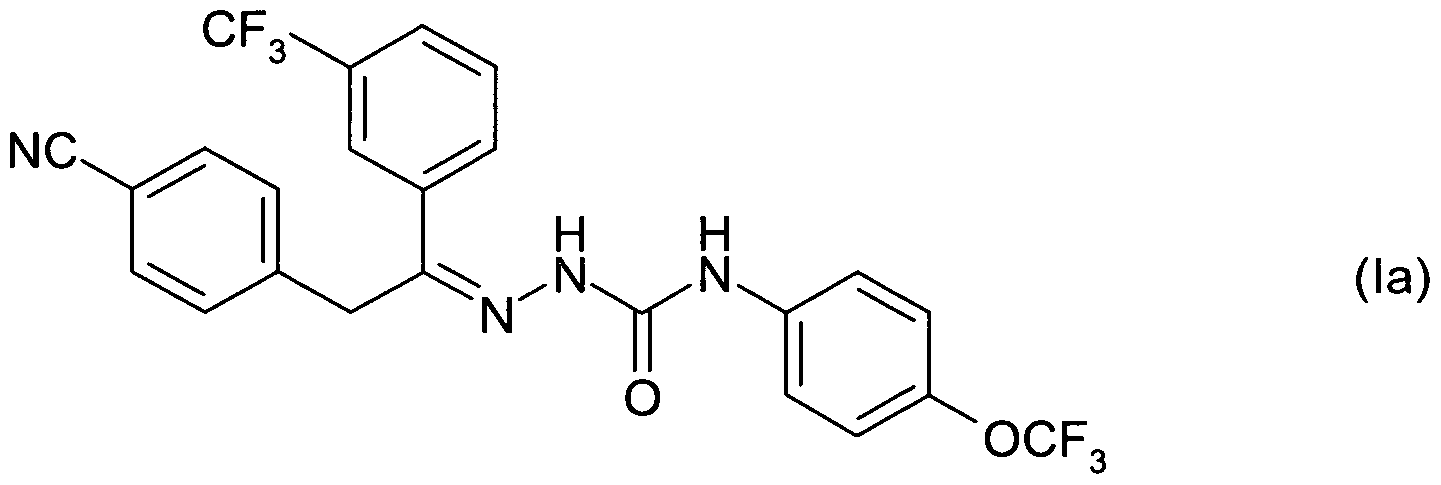
- Metaflumizone is the common name of 2-[2-(4-cyanophenyl)-1-[3-(trifluoromethyl)- phenyl]ethylidene]-N-[4-(trifluoromethoxy)phenyl]hydrazinecarboxamide (IUPAC nomenclature: (EZ)-2'-[2-(4-cyanophenyl)-1-( ⁇ , ⁇ , ⁇ -trifluoro-m-tolyl)ethylidene]-4- (trifluoromethoxy)carbanilohydrazide), having the following structure (Ia):
- the compound exists in two geometric isomers with regard to the C-N double bond, i.e. 4- ⁇ (2E)-2-( ⁇ [4-(trifluoromethoxy)anilino]carbonyl ⁇ hydrazono)-2-[3-( trifluoromethyl )- phenyl]ethyl ⁇ benzonitrile and 4- ⁇ (2Z)-2-( ⁇ [4-(trifluoromethoxy)anilino]carbonyl ⁇ - hydrazono)-2-[3-(trifluoromethyl)phenyl]ethyl ⁇ benzonitrile.
- metalaflumizone includes both the E- and Z-isomer of the compound as defined above, as well as any mixture thereof in any ratio.
- Metaflumizone is a member of the hydrazinecarboxamide group with a wide insecticidal spectrum. Metaflumizone and its application to the area under crops have been described in EP-A 0 462 456. E- and Z-isomers of hydrazinecarboxamides and other semicarbazones and their conversion have been described in general in WO05/047235, incorporated herein by reference.
- Suitable agriculturally acceptable salts of the phenylsemicarbazones of formula (I) are acid addition salts, in particular salts with such anions as do not reduce the pesticidal effects of the phenylsemicarbazones, e.g. chloride, bromide, fluoride, sulfate, hydrogen sulfate, phosphate, hydrogen phosphate, dihydrogen phosphate, nitrate, carbonate, hydrogen carbonate, hexafluorosilicate, hexafluorophosphate benzoate and the anions of Ci_ 4 alkyl acids, in particular formiate, acetate, propionate and butyrate.
- acid addition salts in particular salts with such anions as do not reduce the pesticidal effects of the phenylsemicarbazones, e.g. chloride, bromide, fluoride, sulfate, hydrogen sulfate, phosphate, hydrogen phosphate, dihydrogen phosphate,
- Suitable agriculturally acceptable salts of the phenylsemicarbazones of formula (I) are in particular salts with such cations as do not reduce the pesticidal effects of the phenylsemicarbazone.
- Suitable cations are in particular alkali metal ions, preferably lithium, sodium and potassium; alkaline earth metal ions, preferably calcium, magnesium and barium; transition metals, preferably manganese, copper, zinc and iron; ammonium ions; positively ionized amines, preferably ammonium carrying one to four Ci -4 alkyl substituents or one phenyl or benzyl substituent in addition to zero to three C 1-4 alkyl substituents, more preferably diisopropylammonium, tetramethylammonium, trimethylbenzylammonium and tetrabutylammonium; phosphonium ions; sulfonium ions, preferably tri(C 1-4 -alkyl)sulfonium; and
- C 1-4 alkyl is used to refer to a saturated linear or branched hydrocarbon radical having 1 to 4 carbon atoms, e.g. methyl, ethyl, propyl, methylethyl, butyl, 1-methylpropyl, 2-methylpropyl or dimethylethyl.
- seed denotes any resting stage of a plant that is physically detached from the vegetative stage of a plant and/or may be stored for prolonged periods of time and/or can be used to re-grow another plant individual of the same species.
- resting refers to a state wherein the plant retains viability, within rea- sonable limits, in spite of the absence of light, water and/or nutrients essential for the vegetative (i.e. non-seed) state.
- the term refers to true seeds but does not embraces plant propagules such as suckers, corms, bulbs, fruit, tubers, grains, cuttings and cut shoots.
- plant means an entire plant or parts thereof.
- the term “entire plant” refers to a complete plant individual in its vegetative, i.e. non-seed stage, characterized by the presence of an arrangement of roots, shoots and foliage, depending on the developmental stage of the plant also flowers and/or fruits, all of which are physically connected to form an individual which is, under reasonable conditions, viable without the need for artificial measures.
- the term may also refer to an entire plant har- vested as such.
- plant parts refers to roots, shoots, foliage, flowers or other parts of the vegetative stage of the plant, which, when dislodged and disconnected from the rest, are incapable of survival, unless supported by artificial measures or able to re-grow the missing parts to form an entire plant.
- fruits are also considered as plant parts.
- root refers to parts of a plant which are normally, in order to fulfill their physiological functions, located beneath the soil surface.
- the term denotes the parts of a plant which are below the seed and have directly emerged from the latter, or from other roots, but not from shoots or foliage.
- the "shoots and foliage" of a plant are to be understood to be the shoots, stems, branches, leaves and other appendages of the stems and branches of the plant after the seed has sprouted, but not including the roots of the plant. It is preferable that the shoots and foliage of a plant be understood to be those non-root parts of the plant that have grown from the seed and are located a distance of at least one inch away from the seed from which they emerged (outside the region of the seed), and more preferably, to be the non-root parts of the plant that are at or above the sur- face of the soil.
- fruits are considered to be the parts of a plant which contain seeds and/or serve to spread seeds, and/or which may be removed from a plant without impairing its viability.
- the seed treatment comprises applying a phenyl- semicarbazone of formula (I) or an agriculturally acceptable salt thereof to a seed.
- the seed is a seed that has been harvested from the field; removed from the plant; and/or separated from the fruit and any cob, pod, stalk, outer husk, and surrounding pulp or other non-seed plant material.
- the seed is preferably also biologically stable to the extent that the treatment would cause no biological damage to the seed.
- the treatment can be applied to seed that has been harvested, cleaned and dried to a moisture content below about 15% by weight.
- the seed can be one that has been dried and then primed with water and/or another material and then re-dried before or during the treatment with the phenylsemicarbazone of formula (I) or the agriculturally acceptable salt thereof.
- seed treatment comprises all suitable seed treatment and especially seed dressing techniques known in the art, such as seed coating (e.g. seed pelleting), seed dusting and seed imbibition (e.g. seed soaking).
- seed treatment refers to all methods that bring seeds and the phenylsemicarbazone of formula (I) or the agriculturally acceptable salt thereof into contact with each other, and “seed dressing” to meth- ods of seed treatment which provide the seeds with an amount of the phenylsemicarbazone of formula (I) or the agriculturally acceptable salt thereof, i.e. which generate a seed comprising the phenylsemicarbazone of formula (I) or an agriculturally acceptable salt thereof.
- the treatment can be applied to the seed at any time from the harvest of the seed to the sowing of the seed.
- the seed can be treated immediately before, or during, the planting of the seed, for example using the "planter's box" method.
- the treatment may also be carried out several weeks or months, for example up to 12 months, before planting the seed, for example in the form of a seed dressing treatment, without a substantially reduced efficacy being observed.
- the treatment is applied to unsown seed.
- the term "unsown seed” is meant to include seed at any period from the harvest of the seed to the sowing of the seed in the ground for the purpose of germination and growth of the plant.
- seeds can be treated, for example, at a central location and then dispersed for planting. This permits the person who plants the seeds to avoid the handling and use of the phenylsemicarbazone of formula (I) or the agriculturally acceptable salt thereof and to merely handle and plant the treated seeds in a manner that is conventional for regular untreated seeds, which reduces human exposure to the compound.
- the phenylsemicarbazone of formula (I) or the agriculturally acceptable salt thereof is applied to a seed in an effective amount, that is, an amount sufficient to provide protection against arthropod pests to the seed and/or the plant that grows from the seed.
- an effective amount that is, an amount sufficient to provide protection against arthropod pests to the seed and/or the plant that grows from the seed.
- "protection” is achieved if the percentage of feeding damage to the seed and/or the plant at 10 days after infestation (DAI) with the pest is significantly reduced for treated seeds or plants grown from treated seeds as compared to untreated seeds or plants grown from untreated seeds.
- the phenylsemicarbazone of formula (I) or the agriculturally acceptable salt thereof is generally employed in an amount of from 1 to 500 g, preferably 10 to 200 g, per 100 kilograms of seed.
- one purpose of said seed treatment is to control an arthropod pest, especially an insect pest.
- a seed treatment thus involves an in- secticidal effect or an insecticidal activity providing protection against damage done by the insect pest to a seed and/or a plant grown from the seed.
- the terms "insecticidal effect” and “insecticidal activity” mean any direct or indirect action on the target pest (which may be any pest, but includes according to the invention an arthropod pest and preferably an insect pest) that results in reduction of feeding damage on the treated seeds as well as on the fruits, roots, shoots and/or foliage of plants grown from treated seeds as compared untreated seeds or to plants grown from untreated seeds, respectively.
- the terms "active against a (first or second) pest” also have the same meaning.
- Such direct or indirect actions include killing the pest, repelling the pest from the plant seeds, fruits, roots, shoots and/or foliage, inhibit- ing the feeding of the pest on, or the laying of its eggs on, the plant seeds, fruits, roots, shoots and/or foliage, and inhibiting or preventing reproduction of the pest.
- the target pest for the present invention is any developmental stage, preferably an adult or larva/nymph, of any insect or other arthropod pest that feeds on the seed, fruits, roots and/or shoots and foliage of the plant that is to be protected an/or lays its eggs on the plant to be protected and/or otherwise causes economically significant damage to plants or plant parts (e.g. by "herding" other pests and/or by using plants or plant parts for nesting, as known for, e.g., certain ant species).
- Such pests include but are not limited to stinging, chewing, biting or sucking insects, in particular those belong- ing to the following taxa:
- insects from the order Coleoptera for example, Agriotes spp., Anthonomus spp., Atomaria linearis, Chaetocnema tibialis, Cosmopolites spp., Curculio spp., Dermestes spp., Diabrotica spp., the Elateridae family ("click beetles"), Epilachna spp., Eremnus spp., Leptinotarsa decemlineata, Lissorhoptrus spp., Melolontha spp., Orycaephilus spp., Otiorhynchus spp., Phlyctinus spp., Popillia spp., Psylliodes spp., Rhizopertha spp., Sitophilus spp., Sitotroga spp., Tanymecus spp., Tenebrio spp.
- pests from the order Isoptera for example, Reticulitermes ssp;
- Thysanoptera pests from the order Thysanoptera, for example, Franklinella spp., Hercinothrips spp., Taeniothrips spp., Thrips palmi, Thrips tabaci and Scirtothrips aurantii;
- insects from the order Heteroptera for example, Cimex spp., Distantiella theo- broma, Dysdercus spp., Euchistus spp., Eurygaster spp., Leptocorisa spp., Nezara spp., Piesma spp., Rhodnius spp., Sahlbergella singularis, Scotinophara spp. and Tria- toma spp.;
- pests from the order Homoptera for example, Aleurothrixus floccosus, Aleyrodes brassicae, Aonidiella spp., Aphididae, Aphis spp., Aspidiotus spp., Bemisia tabaci, Ceroplaster spp., Chrysomphalus aonidium, Chrysomphalus dictyospermi, Coccus hesperidum, Empoasca spp., Eriosoma larigerum, Erythroneura spp., Gascardia spp., Laodelphax spp., Lacanium corni, Lepidosaphes spp., Macrosiphus spp., Myzus spp., Nehotettix spp., Nilaparvata spp., Paratoria spp., Planococcus spp., Pseudaulacaspis spp
- Hymenoptera pests from the order Hymenoptera, for example, Acromyrmex, Atta spp., Cephus spp., Diprion spp., Gilpinia polytoma, Hoplocampa spp., Lasius sppp., Monomorium pharaonis, Myrmex spp., Neodiprion spp, Solenopsis spp.
- Vespa ssp. pests from the order Diptera, for example, Aedes spp., Antherigona soccata, Bibio hortulanus, Calliphora erythrocephala, Ceratitis spp., Chrysomyia spp., Culex spp., Cuterebra spp., Dacus spp., Delia antiqua, Delia floralis, Drosophila melano- gaster, Fannia spp., Gastrophilus spp., Glossina spp., Hylemia spp., Hypoderma spp., Hyppobosca spp., Liriomysa spp., Lucilia spp., Melanagromyza spp., Musca ssp., Oestrus spp., Orseolia spp., Oscinella spp., Pegomya hyoscyami,
- pests from the order Collembola for example, Onychiurus.
- the target pest for the seed treatment of the present invention is an insect pest, preferably a dipteran pest, more preferably a root fly or a root maggot.
- Those belonging to the family Anthomyiidae, and more preferably those belonging to any of the genera Psila, Delia, Phorbia, Hylemia and Pegomya represent particular target pests of the present invention.
- the present seed treatment can be used to control said target pests and/or to protect the seeds, roots and/or the above-ground parts of field, forage, plantation, glasshouse, orchard or vineyard crops, ornamentals, plantation or forest trees and/or any other plant(s) of interest.
- the seeds that are useful in the present invention can be the seeds of any plant species.
- the seeds can be of tuberous and corm vegetables, such as arracacha, arrowroot, artichoke, canna, cassava, carrot, chayote root, chufa, dasheen, ginger, leren, onion, potato, radish, tanier, turmeric, yam bean, true yam; leafy vegetables, such as amaranth, arugula, cardoon, celery, celtuce, chervil, chrysanthemum, cress, dandelion, dock, endive, fennel, kale, leek, lettuce, orach, parsley, purslane, radicchio, rhubarb, spinach, swiss chard, tampala, head and stem brassica, such as broccoli, brussels sprout, cabbage, cauliflower, cavalo broccolo, curly cale, kohlrabi; leafy brassica greens, such as broccoli brussels sprout, cabbage, cauliflower, cavalo bro
- the pest belongs to the Anthomyiidae, in particular to any of the genera Psila, Delia, Phorbia, Hylemia and Pegomya, and the seed is a broccoli seed, a cabbage seed or a carrot seed.
- the invention therefore also relates to a method for protecting tuberous or corm vegetables, leafy vegetables, leafy brassica greens, fruiting vegetables, especially broccoli, carrots and cabbage.
- ingredients comprise active ingredients and auxiliary agents.
- an "active ingredient” is a compound or a combination of compounds which directly exerts a biologically relevant effect, preferably an insecticidal effect as described above.
- the active ingredient i.e. the phenylsemicarbazone of formula (I) or an agriculturally acceptable salt thereof
- the active ingredient can also be employed together with other active ingredients which are useful in seed treatment, for example together with fungicides, insecticides, molluscicides, nematicides, herbicides, algicides, bacteri- cides, rodenticides, bird/mammal repellents, growth regulators, or else fertilizers.
- organo(thio)phosphates such as acephate, diazinon, malathion, methyl- parathion, profenofos, sulprofos, terbufos;
- carbamates such as methomyl, thiodicarb, fenothiocarb
- pyrethroids such as cyfluthrin, cyhalothrin, cypermethrin, ethofenprox, perme- thrin, silafluofen;
- nicotinic receptor agonists/antagonists such as imidacloprid, thiamethoxam, nitenpyram, acetamiprid;
- GABA antagonists such as endosulfan, fipronil
- macrocyclic lactone insecticides such as abamectin, emamectin, milbemectin, nemamectin, moxidectin, spinosad;
- formamides such as amitraz, chlordimeform, hydramethylnon, chlorfena- midine
- Molluscicides nematicides, herbicides, algicides, bactericides, rodenticides, bird / mammal repellents, growth regulators and fertilizers are well known to a person skilled in the art.
- the phenylsemicarbazone of formula (I) in particular metaflumizone, or an agriculturally acceptable salt thereof is used in combination with fipronil.
- the ratio by weight of the phenylsemicarbazone of formula (I) or the agriculturally acceptable salt thereof to the amount of the further active ingredient(s) is usually in the range of 1 :100 to 100:1 , preferably in the range of 1 :50 to 50:1 , and in particular in the range of 1 :10 to 10:1.
- the phenylsemicarbazone of formula (I) or the agriculturally acceptable salt thereof can be applied simultaneously with the phenylsemicarbazone of formula (I) or the agriculturally acceptable salt thereof or after a short time interval, for example within a few days before or after the treatment with the phenylsemicarbazone of formula (I) or its salt.
- the treatment of the seed can be effected in one pass where a composition comprising the phenylsemicarbazone of formula (I) or the agriculturally acceptable salt thereof and the further active ingredient is applied, or else in separate passes where different formulations of the individual active ingredients are applied.
- the active ingredient concentrations in ready-to-use preparation can be varied within substantial ranges. In general, they are in the range from 0.01 and 80% by weight, frequently in the range from 0.1 to 50 % by weight, preferably in the range from 0.5 and 20% by weight, based on the total weight of the preparation.
- the active ingredients can also successfully be used in concentrated form, it being possible to apply to the seed preparations with more than 80% by weight of active ingredient, or even the active ingredient without additions.
- the amount of additives will generally not exceed 30% by weight, preferably 20% by weight, and is, in particular, in the range of from 0.1 to 20% by weight, in each case based on the total weight of the preparation.
- all customary methods of treating and in particular dressing such as coating (e.g.
- the seed treatment follows a procedure in which the seed is exposed to the specifically desired amount of a preparation comprising the phenylsemicarbazone of formula (I) or the agriculturally acceptable salt thereof.
- the preparation may be a formulation that is applied as such or after previously diluting it, e.g. with water; for instance, it may be expedient to dilute seed treatment formulations 2-10 fold leading to concentrations in the ready-to-use compositions of 0.01 to 60% by weight active compound by weight, preferably 0.1 to 40% by weight.
- a device which is suitable for this purpose for example a mixer for solid or solid/liquid components, is employed until the preparation is distributed uniformly on the seed.
- the preparation can be applied to seeds by any standard seed treatment methodology, including but not limited to mixing in a container (e.g., a bottle, bag or tumbler), mechanical application, tumbling, spraying, and immersion. If appropriate, this is followed by drying.
- Particular embodiments of the present invention comprise seed coating and imbibition (e.g. soaking).
- Coating denotes any process that endows the outer surfaces of the seeds partially or completely with a layer or layers of non-plant material
- imbibition any process that results in penetration of the active ingredient(s) into the ger- minable parts of the seed and/or its natural sheath, (inner) husk, hull, shell, pod and/or integument.
- the invention therefore also relates to a treatment of seeds which comprises providing seeds with a coating that comprises the phenylsemicarbazone of formula (I) or the agriculturally acceptable salt thereof, and to a treatment of seeds which comprises imbibition of seeds with the phenylsemicarbazone of formula (I) or the agri- culturally acceptable salt thereof.
- Coating is particularly effective in accommodating high loads of the phenylsemicarbazone of formula (I) or the agriculturally acceptable salt thereof, as may be required to treat typically refractory arthropod pests, while at the same time preventing unaccept- able phytotoxicity due to the increased load of the phenylsemicarbazone of formula (I) or the agriculturally acceptable salt thereof.
- Coating may be applied to the seeds using conventional coating techniques and machines, such as fluidized bed techniques, the roller mill method, rotostatic seed treat- ers, and drum coaters. Other methods such as the spouted beds technique may also be useful.
- the seeds may be pre-sized before coating. After coating, the seeds are typically dried and then transferred to a sizing machine for sizing. Such procedures are known in the art. Seed coating methods and apparatus for their application are disclosed in, for example, U.S. Pat. Nos. 5,918,413, 5,891 ,246, 5,554,445, 5,389,399, 5,107,787, 5,080,925, 4,759,945 and 4,465,017.
- the solid phenylsemicarbazone of formula (I) or an agriculturally acceptable salt thereof can be mixed directly with seeds.
- a sticking agent can be used to effect adherence of the solid, e.g. the powder, to the seed surface.
- a quantity of seed can be mixed with a sticking agent (which increases adhe- sion of the particles on the surface of the seed) and optionally agitated to encourage uniform coating of the seed with the sticking agent.
- the seed can be mixed with a sufficient amount of sticking agent, which leads to a partial or complete coating of the seed with sticking agent.
- the seed pretreated in this way is then mixed with a solid formulation containing the phenylsemicarbazone of formula (I) or the agri- culturally acceptable salt thereof to achieve adhesion of the solid formulation on the surface of the seed material.
- the mixture can be agitated, for example by tumbling, to encourage contact of the sticking agent with the solid metaflumizone or its salt, thereby causing the solid phenylsemicarbazone of formula (I) or its salt to stick to the seed.
- seed can be combined for a period of time with an aqueous solution comprising from about 1% by weight to about 75% by weight of the phenylsemicarbazone of formula (I) or the agriculturally acceptable salt thereof in a solvent such as water.
- aqueous solution comprising from about 1% by weight to about 75% by weight of the phenylsemicarbazone of formula (I) or the agriculturally acceptable salt thereof in a solvent such as water.
- the concentra- tion of the solution is from about 5% by weight to about 50% by weight, more preferably from about 10% by weight to about 25% by weight.
- the seed takes up (imbibes) at least a portion of the the phenylsemicarbazone of formula (I) or the agriculturally acceptable salt thereof.
- the mixture of seed and solution can be agitated, for example by shaking, roll- ing, tumbling, or other means.
- the seed can be separated from the solution and optionally dried in a suitable manner, for example by patting or air-drying.
- the phenylsemicarba- zone of formula (I) or the agriculturally acceptable salt thereof can be introduced onto or into a seed by use of solid matrix priming.
- a quantity of the phenylsemicarbazone of formula (I) or the agriculturally acceptable salt thereof can be mixed with a solid matrix material, and then the seed can be placed into contact with the solid matrix material for a period to allow the phenylsemicarbazone of formula (I) or its salt to be introduced to the seed.
- the seed can then optionally be separated from the solid matrix material and stored or used, or, preferably, the mixture of solid matrix material plus seed can be stored or planted/sown directly.
- the phenylsemicarbazone of formula (I) or the agriculturally ac- ceptable salt thereof and optionally the further active ingredient(s) can be used as such, that is, without any auxiliary agents present.
- the phenylsemicarbazone of formula (I) or its salt and the further active ingredient(s) are typically applied to the seeds in the form of a composition.
- composition comprises at least one active ingredient and at least one auxiliary agent.
- auxiliary agent refers to a compound or combination of compounds which do not exert a biologically relevant effect of their own, but support the effects of the active ingredient(s). When auxiliary agents are used, their choice will depend on the active ingredients and on the procedures selected for seed treatment.
- compositions thus comprise an active ingredient component ("A") and an auxiliary agent component (“B”).
- the active ingredient component ("A") of the composi- tion comprises the phenylsemicarbazone of formula (I) or the agriculturally acceptable salt thereof ("A1") and optionally one or more further active ingredient(s) ("A2").
- the auxiliary agent component (“B") comprises one or more auxiliary agent(s).
- the compositions comprise from 0.005% by weight to 95% by weight, pref- erably from 0.1% by weight to 90% by weight, in particular from 5% by weight to 50% by weight, of the active ingredient component "A", the balance being formed by component "B".
- the active ingredients are employed in a purity of 90% to 100%, preferably 95% to 100% (according to NMR spectrum).
- component "A” essentially consists of the phenylsemicarbazone of for- mula (I) or the agriculturally acceptable salt thereof, i.e. the active ingredient of the composition is the phenylsemicarbazone of formula (I) or the agriculturally acceptable salt thereof.
- the composition may additionally comprise one or more repellents for warm-blooded animals, e.g. birds, dogs and hedgehogs, for example nonanoic acid vanillyl amide.
- the amount of repellent will preferably range from 0.1 to 5 % by weight, based on the total weight of the composition.
- the composition is a seed treatment formulation.
- a seed treatment formulation according to the present invention comprises at least one auxiliary agent that is specifically suited for seed treatment, i.e. an auxiliary agent which in particular promotes adhesion of the phenylsemicarbazone of formula (I) or the agriculturally acceptable salt thereof to and/or penetration into the seeds and/or otherwise improves stability and/or manageability of the composition or the seeds treated therewith.
- the present invention also relates to a seed treatment formulation, which comprises the phenylsemicarbazone of formula (I) or the agriculturally acceptable salt thereof, at least one seed treatment auxiliary agent(s), and optionally one or more further auxiliary agents.
- seed treatment auxiliary agents are selected from the group consisting of agents suitable for seed coating coating materials, agents suitable for solid matrix priming materials, penetration enhancers suitable for promoting seed imbibition, colorants, antifreezes, and gelling agents.
- the seed coating material comprises a binder (or sticker).
- the coating material also comprises one or more additional seed treatment auxiliary agents selected from the group consisting of fillers and plasticizers.
- Binders (or stickers) are all customary binders (or stickers) which can be employed in seed treatment formulations. Binders (or stickers) that are useful in the present invention preferably comprise an adhesive polymer that may be natural or partly or wholly synthetic and is without phytotoxic effect on the seed to be coated. Preferably, the binder (or sticker) is biodegradable. Preferably the binder or sticker is chosen to act as a matrix for the phenylsemicarbazone of formula (I) or the agriculturally acceptable salt thereof.
- the binder may be selected from polyesters, polyether esters, polyanhy- drides, polyester urethanes, polyester amides; polyvinyl acetates; polyvinyl acetate copolymers; polyvinyl alcohols and tylose; polyvinyl alcohol copolymers; polyvinylpy- rolidones; polysaccharides, including starches, modified starches and starch derivatives, dextrins, maltodextrins, alginates, chitosanes and celluloses, cellulose esters, cellulose ethers and cellulose ether esters including ethylcelluloses, methylcelluloses, hydroxymethylcelluloses, hydroxypropylcelluloses and carboxymethylcellulose; fats; oils; proteins, including casein, gelatin and zeins; gum arabics; shellacs; vinylidene chloride and vinylidene chloride copolymers; lignosulfonates, in particular calcium
- the binder is a thermoplastic polymer.
- the seed treatment formulation contains at least one polyester, which, in particular, is selected from polylactides, partially aromatic polyesters (copolymers of terephthalic acid, adipic acid and aliphatic diols), polygly- colides, polyhydroxyalkanoates and polytartrates.
- the amount of binder (or sticker) in the formulation can vary, but will be in the range of about 0.01 to about 25% of the total weight, more preferably from about 1 to about 15%, and even more preferably from about 5 % to about 10%.
- the coating material can optionally also comprise a filler.
- the filler can be an absorbent or an inert filler, such as are known in the art, and may include wood flours, cereal flours, tree bark mill, wood meal and nut shell meal, sugars, in particular polysaccharides, activated carbon, fine-grain inorganic solids, silica gels, sili- cates, clays, chalk, diatomaceous earth, calcium carbonate, magnesium carbonate, dolomite, magnesium oxide, calcium sulfate and the like.
- Clays and inorganic solids which may be used include calcium bentonite, kaolin, china clay, talc, perlite, mica, vermiculite, silicates, quartz powder, montmorillonite, attapulgite, bole, loess, limestone, lime and mixtures thereof.
- Sugars which may be useful include dextrin and mal- todextrin.
- Cereal flours include wheat flour, oat flour and barley flour.
- the filler may also comprise fertilizer substances such as, for example, ammonium sulfate, ammonium phosphate, ammonium nitrate, ureas and mixtures thereof.
- the filler is selected so that it will provide a proper microclimate for the seed, for exam- pie the filler is used to increase the loading rate of the active ingredients and to adjust the control-release of the active ingredients.
- the filler can aid in the production or process of coating the seed.
- the amount of filler can vary, but generally the weight of the filler components will be in the range of about 0.05 to about 75% of the total weight, more preferably about 0.1 to about 50%, and even more preferably about 0.5% to 15%.
- the binder or sticker
- the binders disclosed above may all be useful as a matrix, it is preferred that a continuous solid phase of one or more binder compounds is formed throughout which is distributed as a discontinuous phase the phenylsemicarbazone of formula (I) or the salt thereof.
- a filler and/or other components can also be present in the matrix.
- matrix is to be understood to include what may be viewed as a matrix system, a reservoir system or a microencapsulated system.
- a matrix system consists of the phenylsemicarbazone of formula (I) or the agriculturally acceptable salt thereof and a filler uniformly dispersed within a polymer, while a reservoir system consists of a separate phase comprising the phenylsemicarbazone of formula (I) or its salt that is physically dispersed within a surrounding, rate-limiting, polymeric phase.
- Microencapsulation includes the coating of small particles or droplets of liquid, but also to dispersions in a solid matrix.
- the phenylsemicarbazone of formula (I) or the agriculturally acceptable salt thereof used in the coating is an oily type composition and little or no inert filler is present, it may be useful to hasten the drying process by drying the composition.
- This op- tional step may be accomplished by means well known in the art and can include the addition of calcium carbonate, kaolin or bentonite clay, perlite, diatomaceous earth, or any absorbent material that is added preferably concurrently with the phenylsemicarbazone of formula (I) or its salt coating layer to absorb the oil or excess moisture.
- the amount of absorbent necessary to effectively provide a dry coating will be in the range of about 0.5 to about 10% of the weight of the seed.
- the coating material comprises a plasticizer.
- Plasticizers are typically used to make the film that is formed by the coating layer more flexible, to improve adhesion and spreadability, and to improve the speed of processing. Improved film flexibility is important to minimize chipping, breakage or flaking during storage, handling or sowing processes.
- Various plasticizers may be used; however, useful plasticizers include polyethylene glycol, oligomeric polyalkylene glycols, glycerol, alkylbenzylphthalates, in particular butylbenzylphthalate, glycol benzoates and related compounds.
- the range of plasticizer in the coating layer will be in the range of from about 0.1 % by weight to about 20% by weight.
- Agents suitable for solid matrix priming materials which are useful in the present invention include polyacrylamide, starch, clay, silica, alumina, soil, sand, polyurea, polyacry- late, or any other material capable of absorbing or adsorbing the phenylsemicarbazone of formula (I) for a time and releasing that phenylsemicarbazone of formula (I) into or onto the seed. It is useful to make sure that the phenylsemicarbazone of formula (I) or salt thereof and the solid matrix material are compatible with each other.
- the solid matrix material should be chosen so that it can release the phenylsemicarbazone of formula (I) or its salt at a reasonable rate, for example over a period of minutes, hours, or days.
- Penetration enhancers suitable for promoting seed imbibition include agriculturally acceptable surface active compounds.
- the amount of penetration enhancers will usually not exceed 20% by weight, based on the total weight of the formulation.
- the amount of penetration enhancers will be in the range from 2% to 20% by weight.
- Colorants according to the invention are all dyes and pigments which are customary for such purposes. In this context, both pigments, which are sparingly soluble in water, and dyes, which are soluble in water, may be used. Examples which may be mentioned are the colorants, dyes and pigments known under the names Rhodamin B, C. I. Pigment Red 112 and C. I.
- Solvent Red 1 Pigment Blue 15:4, Pigment Blue 15:3, Pigment Blue 15:2, Pigment Blue 15:1 , Pigment Blue 80, Pigment Yellow 1 , Pigment Yellow 13, Pigment Red 48:2, Pigment Red 48:1 , Pigment Red 57:1 , Pigment Red 53:1 , Pigment Orange 43, Pigment Orange 34, Pigment Orange 5, Pigment Green 36, Pigment Green 7, Pigment White 6, Pigment Brown 25, Basic Violet 10, Basic Violet 49, Acid Red 51 , Acid Red 52, Acid Red 14, Acid Blue 9, Acid Yellow 23, Basic Red 10, Basic Red 108.
- the amount of colorants will usually not exceed 20 % by weight of the formulation and preferably ranges from 1 to 15 % by weight, based on the total weight of the formulation.
- the colorants are also active as repellents for warm- blooded animals, e. g. iron oxide, TiO 2 , Prussian blue, anthraquinone dyes, azo dyes and metal phtalocyanine dyes.
- Antifreezes which can be employed especially for aqueous formulations are in principle all those substances which lead to a depression of the melting point of water. Suitable antifreezes comprise alcohols such as methanol, ethanol, isopropanol, butanols, glycol, glycerine, diethylenglycol and the like. Typically, the amount of antifreeze will not exceed 20 % by weight and frequently ranges from 1 to 15 % by weight, based on the total weight of the formulation.
- Gelling agents which are suitable are all substances which can be employed for such purposes in agrochemical compositions, for example cellulose derivatives, polyacrylic acid derivatives, xanthan, modified clays, in particular organically modified phyllosili- cates and highly-dispersed silicates.
- a particularly suitable gelling agent is carrageen (Satiagel ® ).
- the amount of gelling agent will not exceed 5 % by weight of the formulation and preferably ranges from 0.5 to 5 % by weight, based on the total weight of the formulation.
- auxiliary agents that may be present in the seed treatment formulation include solvents, wetters, dispersants, emulsifiers, surfactants, stabilizers, protective colloids, antifoams, and preservatives.
- solvents examples include water or organic solvents such as aromatic solvents (for example Solvesso products, xylene), paraffins (for example mineral oil fractions), alcohols (for example methanol, butanol, pentanol, benzyl alcohol), ketones (for exam- pie cyclohexanone, gamma-butyrolactone), pyrrolidones (NMP, NOP), acetates (glycol diacetate), glycols, fatty acid dimethylamides, fatty acids and fatty acid esters.
- aromatic solvents for example Solvesso products, xylene
- paraffins for example mineral oil fractions
- alcohols for example methanol, butanol, pentanol, benzyl alcohol
- ketones for exam- pie cyclohexanone, gamma-butyrolactone
- NMP, NOP pyrrolidones
- acetates glycols
- fatty acid dimethylamides fatty acids
- Surface active compounds are all those surfactants which are suitable for formulating agrochemical actives, in particular for the phenylsemicarbazone of formula (I) or the agriculturally acceptable salt thereof, and which may be nonionic, cationic, anionic or amphoteric.
- surfactants - sometimes referred to as "additives” - may be divided into wetters, dispersants, emulsifiers or protective colloids; however, these particular groups may overlap and cannot be divided strictly.
- the amount of surfactants will not exceed 20 % by weight and frequently ranges from 1 to 15 % by weight, based on the total weight of the formulation.
- Suitable wetters are all those substances which promote wetting and which are conventionally used for formulating agrochemical active ingredients.
- Alkylnaphthalenesul- fonates such as diisopropyl- or diisobutylnaphthalenesulfonat.es can be used preferably.
- Dispersants and/or emulsifiers which are suitable are all nonionic, anionic and cationic dispersants or emulsifiers conventionally used for formulating agrochemical active ingredients.
- the following can preferably be used: nonionic or anionic dispersants and/or emulsifiers or mixtures of nonionic or anionic dispersants and/or emulsifiers.
- Suitable nonionic dispersants and/or emulsifiers which may be employed are, in particular, ethylene oxide/alkylene oxide block copolymers, alkylphenol polyglycol ethers and tristryrylphenol polyglycol ethers, for example polyoxyethylene octylphenol ether, ethoxylated isooctylphenol, octylphenol, nonylphenol, alkylphenol polyglycol ether, tributylphenyl polyglycol ether, tristearylphenyl polyglycol ether, alkylarylpolyether alcohols, alcohol and fatty alcohol ethylene oxide condensates, ethoxylated castor oil, polyoxyethylene alkyl ether, ethoxylated polyoxypropylene, lauryl alcohol polyglycol ether acetal, sorbitol esters and methyl cellulose.
- ethylene oxide/alkylene oxide block copolymers for example polyoxyethylene octyl
- the formulations of the present invention contain less than 10 % by weight and preferably less than 6 % by weight of ethylene oxide/alkylene oxide block copolymer, and, more particularly, less than 10 % by weight and preferably less than 6 % by weight of said nonionic dispersants and/or emulsifiers.
- Suitable anionic dispersants which and/or emulsifiers which may be employed are, in particular, alkali metal, alkaline earth metal and ammonium salts of ligninsulfonic acid, naphthalenesulfonic acid, phenolsulfonic acid, dibutylnaphthalenesulfonic acid, alky- larylsulfonates, alkyl sulfates, alkylsulfonates, fatty alcohol sulfates, fatty acids and sul- fated fatty alcohol glycol ethers, furthermore arylsulfonate/formaldehyde condensates, for example condensates of sulfonated naphthalene and naphthalene derivatives with formaldehyde, condensates of naphthalene or of naphthalenesulfonic acid with phenol and formaldehyde, ligninsulfonates, lignin-sulfite waste liquors
- Protective colloids are typically water soluble, amphiphilic polymers.
- proteins and denatured proteins such as casein, polysaccharides such as water soluble starch derivatives and cellulose derivatives, in particular hydrophobic modified starch and celluloses, furthermore polycarboxylates such as polyacrylic acid and acrylic acid copolymers, polyvinylalcohol, polyvinylpyrrolidone, vinylpyrrolidone copolymers, polyvinyl amines, polyethylene imines and polyalkylene ethers.
- Antifoams which can be employed are all those substances which inhibit the development of foam and which are conventionally used for formulating agrochemical active ingredients. Silicone antifoams, i.e. aqueous silicon emulsions (e.g. Silikon® SRE by Wacker or Rhodorsil® by Rhodia), long chain alcohols, fatty acids and salts thereof, e.g. magnesium stearate are particularly suitable. Usually, the amount of antifoam will not exceed 3 % by weight of the formulation and preferably ranges from 0.1 to 2 % by weight, based on the total weight of the formulation.
- Silicone antifoams i.e. aqueous silicon emulsions (e.g. Silikon® SRE by Wacker or Rhodorsil® by Rhodia), long chain alcohols, fatty acids and salts thereof, e.g. magnesium stearate are particularly suitable.
- the amount of antifoam will not exceed 3 % by weight of the formulation and preferably range
- Preservatives which can be employed are all preservatives used for such purposes in agrochemical compositions. Examples which may be mentioned are dichlorophene, isothiazolenes and isothiazolones such as 1 ,2-benzisothiazol-3(2H)-one, 2-methyl-2H- isothiazol-3-one-hydrochloride, 5-chloro-2-(4-chlorobenzyl)-3(2H)-isothiazolone, 5- chloro-2-methyl-2H-isothiazol-3-one, 5-chloro-2-methyl-2H-isothiazol-3-one, 5-chloro-2- methyl-2H-isothiazol-3-one-hydrochloride, 4,5-dichloro-2-cyclohexyl-4-isothiazolin-3- one, 4,5-dichloro-2-octyl-2H-isothiazol-3-one, 2-methyl-2H-isothiazol-3-one, 2-methyl- 2H
- SL water-soluble concentrates
- DC dispersible concentrates
- EC emulsifiable concentrates
- EW emulsions
- SC suspensions
- SC OD, FS
- WP water-dispersible granules
- WP water-dispersible or water-soluble powders
- DP dusts or dustable powders
- GR granules
- GG GG
- MG ULV solutions
- GF gel formualtions
- compositions may be applied as such or after addi- tion of a suitable liquid, in particular water, in order to dissolve, emulsify, disperse, su- pend or dilute the composition.
- a suitable liquid in particular water
- the type of the ready-to-use preparation applied to the seeds thus depends on the type of composition used and the method used for treating the seeds.
- compositions can be prepared in the known manner (see e.g. for review US
- phenylsemicarbazone of formula (I) or the agriculturally acceptable salt thereof 10 parts by weight of the phenylsemicarbazone of formula (I) or the agriculturally acceptable salt thereof are dissolved in 90 parts by weight of water or a water-soluble solvent.
- wetters or other auxiliaries are added to the phenylsemicarbazone of formula (I) or the agriculturally acceptable salt thereof.
- the phenylsemicar- apel- apelone of formula (I) or the agriculturally acceptable salt thereof dissolves upon dilution with water, whereby a formulation with 10 % (w/w) of metaflumizone or the agriculturally acceptable salt thereof is obtained.
- DC Dispersible concentrates
- D Emulsions (EW, EO, ES) 25 parts by weight of the phenylsemicarbazone of formula (I) or the agriculturally acceptable salt thereof are dissolved in 35 parts by weight of xylene with addition of calcium dodecylbenzenesulfonate and castor oil ethoxylate (in each case 5 parts by weight).
- This mixture is introduced into 30 parts by weight of water by means of an emulsifier machine (e.g. Ultraturrax) and made into a homogeneous emulsion. Dilution with water gives an emulsion, whereby a formulation with 25% (w/w) of metaflumizone or the agriculturally acceptable salt thereof is obtained.
- an emulsifier machine e.g. Ultraturrax
- 50 parts by weight of the phenylsemicarbazone of formula (I) or the agriculturally acceptable salt thereof are ground finely with addition of 50 parts by weight of dispersants and wetters and made as water-dispersible or water-soluble granules by means of technical appliances (for example extrusion, spray tower, fluidized bed). Dilution with water gives a stable dispersion or solution of the active compound(s), whereby a formulation with 50% (w/w) of the phenylsemicarbazone of formula (I) or the agriculturally acceptable salt thereof is obtained.
- Water-dispersible and water-soluble powders (WP, SP, SS 1 WS) 75 parts by weight of the phenylsemicarbazone of formula (I) or the agriculturally acceptable salt thereof are ground in a rotor-stator mill with addition of 25 parts by weight of dispersants, wetters and silica gel. Dilution with water gives a stable dispersion or solution of the active compound(s), whereby a formulation with 75% (w/w) of the phenylsemicarbazone of formula (I) or the agriculturally acceptable salt thereof is obtained.
- I Granules (GR, FG, GG, MG), 0.5 part by weight of the phenylsemicarbazone of formula (I) or the agriculturally acceptable salt thereof is ground finely and associated with 95.5 parts by weightof carriers, whereby a formulation with 0.5% (w/w) of the phenylsemicarbazone of formula (I) or the agriculturally acceptable salt thereof is obtained.
- Current methods are extrusion, spray-drying or the fluidized bed. This gives granules to be applied undiluted for foliar use.
- K Gel formulations (GF) In an agitated ball mill, 20 parts by weight of the phenylsemicarbazone of formula (I) or the agriculturally acceptable salt thereof are comminuted with addition of 10 parts by weight of dispersants, 1 part by weight of a gelling agent wetters and 70 parts by weight of water or of an organic solvent to give a fine active compound(s) suspension. Dilution with water gives a stable suspension of the metaflumizone or an agriculturally acceptable salt thereof, whereby a formulation with 20% (w/w) of the phenylsemicarbazone of formula (I) or the agriculturally acceptable salt thereof is obtained.
- powders such as water- dispersible, water-soluble and dustable powders, dusts and suspensions are preferred.
- gel formulations are preferred.
- water-soluble concentrates and emulsions may be expediently used.
- the following formulations are particularly preferred: flowable concentrates (especially FS); solutions (especially LS); powders for dry treatment (especially DS); water dispersible powders for slurry treatment (especially WS); water-soluble powders (especially SS) and emulsions (especially ES).
- gel formulations especially GF.
- a FS formulation is used for seed treatment.
- a FS formulation may comprise 1 to 800 g/l of the phenylsemicarbazone of formula (I) or the agriculturally acceptable salt thereof, 1 to 200 g/l surfactant, 0 to 200 g/l antifreezing agent, 0 to 400 g/l of binder, 0 to 200 g/l of a colorant and up to 1 liter of a solvent, preferably water.
- the seed treatment formulation of the present invention is a seed coating formulation.
- Such seed coating formulations comprise the phenylsemicarbazone of formula (I) or the agriculturally acceptable salt thereof, at least one binder (or sticker) and optionally at least one further auxiliary agent that is selected from the group consisting of fillers and plasticizers.
- Seed coating formulations comprising binders, fillers and/or plasticizers are well-known in the art. Seed coating formulations are disclosed, for example, in U.S. Pat. Nos. 5,939,356, 5,882,713, 5,876,739, 5,849,320, 5,834,447, 5,791 ,084, 5,661 ,103, 5,622,003, 5,580,544, 5,328,942, 5,300,127, 4,735,015, 4,634,587, 4,383,391 , 4,372,080, 4,339,456, 4,272,417 and 4,245,432, among others.
- the amount of the phenylsemicarbazone of formula (I) or the salt thereof that is in- eluded in the coating formulation will vary depending upon the type of seed, but the coating formulation will contain an amount of the phenylsemicarbazone of formula (I) or the salt thereof that is insecticidally effective. In general, the amount of the phenylsemicarbazone of formula (I) or the salt thereof in the coating formulation will range from about 0.005 to about 75% of the total weight. A more preferred range for the phenyl- semicarbazone of formula (I) or the salt thereof is from about 0.01 to about 40%; more preferred is from about 0.05 to about 20%.
- the exact amount of the phenylsemicarbazone of formula (I) or the salt thereof that is included in the coating formulation is easily determined by one skilled in the art and will vary depending upon the size and other characteristics (surface structure etc.) of the seed to be coated.
- the phenylsemicarbazone of formula (I) or the salt thereof of the coating formulation must not inhibit germination of the seed and should be efficacious in protecting the seed and/or the plant during that time in the target insect's life cycle in which it causes injury to the seed or plant.
- the coating will be efficacious for approximately 0 to 120 days, preferably for approximately 0 to 60 days, after sowing.
- the coating formulations formed with the phenylsemicarbazone of formula (I) or the salt thereof are capable of effecting a slow rate of release of the phenylsemicarbazone of formula (I) or the salt thereof by diffusion or movement through the matrix into the seed or to the surrounding medium.
- the present invention also provides a seed that has been treated by the method described above. It also provides a seed obtainable by the method described above.
- the present invention also provides a seed that has been treated with the seed treatment formulation described above, and in particular a seed that is coated with the formulation or contains it. It also provides a seed obtainable by using the formulation described above.
- the term "coated with and/or contains” here signifies that the phenylsemicarbazone of formula (I) or the salt thereof is for the most part on the surface of the seed at the time of application, although a greater or lesser part of the the phenylsemicarbazone of formula (I) or the salt thereof may penetrate into the seed, depending on the method of application.
- the said seed When the said seed is (re)planted, it may absorb the phenylsemicarbazone of formula (I) or the salt thereof.
- the present invention relates to a seed, especially an unsown seed, which comprises the phenylsemicarbazone of formula (I) or the agriculturally acceptable salt thereof.
- such a seed comprising the phenylsemicarbazone of formula (I) or an agriculturally acceptable salt thereof has a coating, wherein the coating comprises the phenylsemicarbazone of formula (I) or the agriculturally acceptable salt thereof.
- such a seed comprising the phenylsemicarbazone of formula (I) or the agriculturally acceptable salt thereof is a seed whose germinable part and/or natural sheath, shell, pod and/or integument comprise(s) the phenylsemicarbazone of formula (I) or the agriculturally acceptable salt thereof.
- the phenylsemicarbazone of formula (I) or the agriculturally acceptable salt thereof can be present in both the coating and the germinable part and/or natural sheath, shell, pod and/or integument of the seed.
- such seeds comprise an effective amount of the phenylsemicarbazone of formula (I) or an agriculturally acceptable salt thereof. Accordingly, the seeds are coated, impregnated or coated and impregnated in such a manner that pest damage during germination and emergence is reduced.
- the seeds treated with the phenylsemicarbazone of formula (I) or the salt thereof may also be enveloped with a film overcoating to protect the phenylsemicarbazone coating.
- a film overcoating are known in the art and may be applied using conventional fluid- ized bed and drum film coating techniques.
- the seeds of the present invention can be used for the propagation of plants.
- the seeds can be stored, handled, planted/sowed and tilled.
- carrot seeds were either treated with metaflumizone, coated with the insecticide chlor- fenvinphos (commercially available under, and herein referred to by, the name Bir- laneTM) or left untreated, then sowed and raised under controlled environmental conditions. At day 20 and day 43, respectively, the percentage of seeds which had sprouted was assessed. Results are shown in Table 1.
- carrot seeds were coated with two different concentrations of metaflumizone, BirlaneTM or left untreated, then sowed and raised as described in Example 1.
- BirlaneTM metaflumizone
- the plants were exposed to infestation by Psila rosae, which was monitored by adult trap catches. 300 to 400 insects per trap indicated fair infestation pressure.
- days 35 and 91 were examined for maggot infestation. Results are shown in table 2.
- Example 3 Absence of long-term effects of seed coating The objective of this trial was the direct comparison of metaflumizone with the market Standard BirlaneTM at 100 ml product per unit of seed. Activity evaluation considered the residual activity of the products up to 124 days after application.
- Carrot seeds were coated or left uncoated, sowed and raised as described in Example 2 and subjected to Psila rosae infestation at an approximate density of 300 to 400 insects per trap at days 46 to 53 after sowing. At days 82, 96, 110 and 124, respectively, 100 plants per field were examined for maggot infestation. Results are shown in table 3.
- carrot fly infestation started slowly with the first assessment (day 82) but increased slowly during the course of the trial and reached up to 26% infestation in the untreated control at the last assessment date.
- carrot seeds were coated with different concentrations of metaflumizone, with BirlaneTM or left uncoated, then sowed and raised as described in the above Examples.
- Metaflumizone reduced root damage in maize caused by Diabrotica v. virgifera (1.25 mg metaflumizone per kernel; root damage (scale from 1 to 6): 3.0 to 3.1 (treatment) / 4.2 to 4.4 (control).
- the present invention relates to a method of controlling molluscs, in particular terrestrial and amphibious snails and slugs, in which molluscs, the plants to be protected from molluscs, or the environment inhabited by molluscs, are or is treated with a phenylsemicarbazone compound of the formula I
- R 1 and R 2 are independently of one another hydrogen, cyano, halogen, C 1 -C 4 - alkyl, and R 3 is Ci-C 4 -alkoxy, C 1 -C 4 - haloalkyl or d-C 4 -haloalkoxy, or an agriculturally acceptable salt thereof.
- the invention also relates to molluscicidal compositions comprising the compounds I.
- Snails and slugs are significant pests in temperate, subtropical and tropical crops. New cultivation techniques, in particular no tillage and minimum tillage, lead to increased damage by snails and slugs. Since, because of their ecology, many species of snails and slugs are ubiquitous, such species have spread into regions in which they were not originally present. For various reasons, for example because of quarantine regulations (Parella, M. P., Robb, K. and Morishita, P.: Calif. Agriculture 1985, Jan./Feb., 6-8), snail and slug control is becoming increasingly important. Current commercial molluscicides are either effective but suffer from a risk to non- target organism such as earthworms and hedgehogs, or exhibit a lower toxicity level to non-target organisms but are not truly lethal to molluscs.
- the compounds of formula I and their agriculturally acceptable salts are very suitable for controlling snails and slugs in agriculture and horticulture.
- the compounds of formula I may have one or more centers of chirality, in which case they are present as mixtures of enantiomers or diastereomers.
- the present invention relates to the pure enantiomes or diastereomers as well as to the mixtures thereof.
- Suitable agriculturally acceptable salts are especially the salts of those cations, which do not have any adverse effect on the molluscicidal action of the compounds I.
- suitable cations are in particular the ions of the alkali metals, preferably lithium, sodium and potassium, of the alkaline earth metals, preferably calcium, magnesium and barium, and of the transition metals, preferably manganese, copper, zinc and iron, and also the ammonium ion which may, if desired, carry one to four C 1 -C 4 -SlKyI substituents and/or one phenyl or benzyl substituent, preferably diisopropylammonium, tetramethyl- ammonium, tetrabutylammonium, trimethylbenzylammonium, furthermore phospho- nium ions, sulfonium ions, preferably tri(CrC 4 -alkyl)sulfonium, and sulfoxonium ions, preferably
- the organic moieties mentioned in the above definitions of the variables are - like the term halogen - collective terms for individual listings of the individual group members.
- the prefix C n -C m indicates in each case the possible number of carbon atoms in the group.
- halogen denotes in each case fluorine, bromine, chlorine or iodine.
- C r C 4 -alkyl as used herein and the alkyl moieties of alkylamino and dial- kylamino refer to a saturated straight-chain or branched hydrocarbon radical having 1 to 4 carbon atoms, i.e., for example methyl, ethyl, propyl, 1-methylethyl, butyl, 1- methylpropyl, 2-methylpropyl or 1 ,1-dimethylethyl.
- C r C 4 -haloalkyl refers to a straight-chain or branched satu- rated alkyl radical having 1 to 4 carbon atoms (as mentioned above), where some or all of the hydrogen atoms in these radicals may be replaced by fluorine, chlorine, bromine and/or iodine, i.e., for example chloromethyl, dichloromethyl, trichloromethyl, fluoro- methyl, difluoromethyl, trifluoromethyl, chlorofluoromethyl, dichlorofluoromethyl, chloro- difluoromethyl, 2-fluoroethyl, 2-chloroethyl, 2-bromoethyl, 2-iodoethyl, 2,2-difluoroethyl, 2,2,2-trifluoroethyl, 2-chloro-2-fluoroethyl, 2-chloro-2,2-difluoroethyl, 2,2-dich
- C 1 -C 4 -BIkOXy refers to a straight-chain or branched saturated alkyl radical having 1 to 4 carbon atoms (as mentioned above) which is attached via an oxygen atom, i.e., for example methoxy, ethoxy, n-propoxy, 1-methylethoxy, n-butoxy, 1-methylpropoxy, 2-methylpropoxy or 1 ,1-dimethylethoxy.
- C 1 -C 4 -IIaIOaIkOXy refers to a C 1 -C ⁇ aIkOXy radical as mentioned above which is partially or fully substituted by fluorine, chlorine, bromine and/or iodine, i.e., for example, chloromethoxy, dichloromethoxy, trichloromethoxy, fluoro- methoxy, difluoromethoxy, trifluoromethoxy, chlorofluoromethoxy, dichlorofluorometh- oxy, chlorodifluoromethoxy, 2-fluoroethoxy, 2-chloroethoxy, 2-bromoethoxy, 2- iodoethoxy, 2,2-difluoroethoxy, 2,2,2-trifluoroethoxy, 2-chloro-2-fluoroethoxy, 2-chloro- 2,2-difluoroethoxy, 2,2-dichloro-2-fluoroethoxy, 2,2,2-t
- R 1 is CrC 4 -haloalkyl, in particular trifluoromethyl;
- R 2 is cyano;
- R 3 is Ci-C 4 -haloalkoxy, in particular trifluoromethoxy.
- R 1 is trifluoromethyl in meta position
- R 2 is cyano in para position
- R 3 is trifluoromethoxy in para position.
- the phenylsemicarbazone compounds I are disclosed in EP-A 462 456, as insecti- cidally active ingredients, and can be prepared as described there.
- the molluscicidal action of the phenylsemicarbazone compounds I extends to terrestrial and amphibious snails and slugs, for example those of the genera Deroceras (Agriolimax), Arianta, Limax, Helix, Helicogona, Cepaea, Milax, Lymnaea (Galba), Achatina, Theba, Cochlicella, Helicarion and Vaginulus.
- the snail and slug pests include, for example, the slugs Arion ater, A. lusitanicus, A. hortensis, Agriolimax reticu- latus, Limax flavus, L.
- the molluscs may be controlled by contacting them, their food supply, habitat, breeding ground or locus, with a molluscicidally effective amount of a phenylsemicarbazone I.
- the compounds of formula I are effective through both contact and ingestion (bait, or plant part).
- the bait can be a liquid, a solid or a semisolid preparation (e.g. a gel).
- Solid baits can be formed into various shapes and forms suitable to the respective application e.g. granules, blocks, sticks, disks.
- Liquid baits can be filled into various devices to ensure proper application, e.g. open containers, spray devices, droplet sources, or evaporation sources.
- Gels can be based on aqueous or oily matrices and can be formulated to particular necessities in terms of stickyness, moisture retention or aging characteristics.
- Suitable formulations for molluscicides are described in, for example, GB-A 2 087 723, EP-A 190 595, DE-A 35 03 608, DE-A 37 06 358 and DE-A 35 00 468.
- ком ⁇ онентs such as preservatives, colorants, repellents, water, organic solvents and/or surfactants.
- suitable (solid) carriers are powdered natural minerals, such as kaolins, clays, talc, chalk, quartz, attapulgite, montmorrilonite or diatomaceous earth, and pow- dered synthetic minerals, such as finely divided silica, alumina and silicates;
- suitable solid carriers for pellets are crushed and fractionated natural minerals, such as calcite, marble, pumice, sepiolite, dolomite, synthetic pellets of inorganic and organic meals and pellets of organic material, such as sawdust, coconut shells, corn cobs and tobacco stalks.
- the edible substance(s) present may be any conventional feed substance which can be used in baits of this type, for example ground cereal products (eg. wheat, oats, barley, rye, corn or rice in the form of grains, flour, coarse meal, bran, germs or bread), oil cake (for example from cottonseed, peanuts, sunflower or poppy seed), malt, yeasts, rice starch, fisch meal, meat meal, sugar beet molasses or residues from fruit pressing, or with species-specific or snail- and slug-specific baits is particularly advantageous, suitable binders, adhesives, stabilizers and microbial inhibitors being used in each case; it is advantageous to add substances with repel birds and mammals, and organic or inorganic dyes or pigments. The purpose of such additives is to repel non-target organisms and to ensure that the action lasts for as long a period as possible.
- ground cereal products eg. wheat, oats, barley, rye, corn or rice in the form of grains, flour, coarse meal
- a fungistat may be present.
- binders All conventional adhesives which can be used for such purposes may be present as binders. Methylcellulose, sugar, dextrin, starch, alginates, glycols, polyvinylpyrrolidone, ligninsulfonate, gum arabic, polyvinyl alcohol and polyvinyl acetate are preferred. One or more binders may be present.
- colorants which are suitable additives for repelling birds and mammals are inorganic pigments, such as iron oxide, titanium dioxide and Prussian blue, and organic dyes, such as anthraquinone, azo and metal phthalocyanine dyes.
- the colorant may be present in the formulation in an amount of 0.1 to 5 wt.%.
- Repellents used for repelling warm-blooded animals may be any conventional components suitable for this purpose. Examples are non- anoic acid vanillylamide.
- the repellent may be present in the formulation in an amount of 0.1 to 5 wt.%.
- Substances used for attracting soil pests may be any conventional components suit- able for this purpose.
- Aniseed and aniseed oil are examples.
- Suitable organic solvents are all organic solvents which can be conventionally used for the preparation of baits. Low boiling organic solvents, such as methanol, ethanol, bu- tanol and methylene chloride, are preferred.
- Suitable surfactants are nonionic substances, such as condensates of polyalkylene oxides and alkylphenols and fatty acid polyoxyalkylene esters, for example octyl- phenoxypolyoxyethanol, cationic substances, such as quaternary ammonium salts, e.g. cetyltrimethylammonium chloride or cetylpyridinium chloride, and anionic substances, such as the sodium salts of the long-chain alkylsulfates, e.g. sodium laurylsulfate, salts of alkylarylsulfates, the sodium salt of desoxycholic acid, the sodium salt of taurocholic acid and the sodium salt of tauroglycocholic acid.
- nonionic substances such as condensates of polyalkylene oxides and alkylphenols and fatty acid polyoxyalkylene esters, for example octyl- phenoxypolyoxyethanol
- cationic substances such as quaternary ammonium salts,
- the formulations may also contain other active ingredients, for example plant protection agents such as other pesticides, insecticides, herbicides, fungicides, or bactericides, fertilizers such as ammonium nitrate, urea, potash, and superphosphate, phytotoxicants and plant growth regulators, safeners and nematicides.
- plant protection agents such as other pesticides, insecticides, herbicides, fungicides, or bactericides
- fertilizers such as ammonium nitrate, urea, potash, and superphosphate
- phytotoxicants and plant growth regulators such as a phytotoxicants and plant growth regulators, safeners and nematicides.
- Another preferred form of application is seed dressing with a formulation conventionally used for dressings.
- Conventional seed treatments include for example flowable concentrates, solutions, powders for dry treatment, water dispersible powders for slurry treatment, water soluble powders and emulsion.
- Application to the seeds is carried out before sowing, either directly on the seeds or after having pregerminated the latter.
- Suitable adhesives are block copolymers EO/PO surfactants but also polyvinylaicoholsl, polyvinylpyrrolidones, polyacrylates, polymethacrylates, polybutenes, polyisobutylenes, polystyrene, polyethyleneamines, polyethyleneamides, polyethyleneimines (Lupasol ® , Polymin ® ), polyethers and copolymers derived from these polymers.
- the content of active ingredient in the individual application forms can vary within wide limits.
- "pesticidally effective amount” means the amount of active ingredient needed to achieve an observable effect on the molluscs.
- the pesticidally effective amount can vary for the various compounds/compositions used in the invention.
- a pesticidally effective amount of the compositions will also vary according to the prevailing conditions such as application period, weather, locus, mode of application and the like.
- from 0.001 to 90 preferably from 0.5 to 50, in particular from 1 to 10, % by weight of active ingredient in the case of granular formulations and from 10 to 90 % by weight of active ingredient in the case of seed dressings, is sufficient to achieve a detectable effect on the molluscs.
- the application may be carried out before or after the infection of the locus, growing crops, or harvested crops by the molluscs.
- “Locus” means a habitat, breeding ground, plant, seed, soil, area, material or environ- ment in which a pest or parasite is growing or may grow.
- Effective amounts suitable for use in the method of invention may vary depending upon the particular formula I compound, target mollusc species, method of application, application timing, weather conditions, mollusc habitat, and the like.
- the application rate of active ingredient I is about 0.3 to 30, preferably 1 to 10, kg/ha.
- the trial was carried out in the greenhouse under practical conditions in sandy soil.
- the lettuce was sprayed with a solution of the above mentioned compound at a rate of 240 gram active ingredient per hectare with 500 I/ha water.
- For spraying was a single Tee- jet ® nozzle, model 8002 (from Spraying System Mobile Systems Division, Wheaton, IL, USA), at 3 atmosphere pressure used.
- the plots were covered by net cages (diameter 40 cm) and 20 snails (sexually mature individuals of Helix hortensis) were added to every plot.
- the assessment method was counting the numbers of dead, alive active and alive inactive snails. The differentiation between active and inactive was by touching them with a needle. Also an estimation of eating damages was recorded.
Landscapes
- Life Sciences & Earth Sciences (AREA)
- Agronomy & Crop Science (AREA)
- Pest Control & Pesticides (AREA)
- Plant Pathology (AREA)
- Health & Medical Sciences (AREA)
- Engineering & Computer Science (AREA)
- Dentistry (AREA)
- General Health & Medical Sciences (AREA)
- Wood Science & Technology (AREA)
- Zoology (AREA)
- Environmental Sciences (AREA)
- Agricultural Chemicals And Associated Chemicals (AREA)
- Pretreatment Of Seeds And Plants (AREA)
Abstract
Description



Claims


Priority Applications (13)
| Application Number | Priority Date | Filing Date | Title |
|---|---|---|---|
| MX2007015831A MX2007015831A (en) | 2005-06-16 | 2006-06-14 | Use of phenylsemicarbazones for seed treatment. |
| NZ564147A NZ564147A (en) | 2005-06-16 | 2006-06-14 | Use of phenylsemicarbazones for seed treatment for protecting a plant that grows from the seed against a pest |
| DE602006009513T DE602006009513D1 (en) | 2005-06-16 | 2006-06-14 | USE OF PHENYLSEMICARBAZONES FOR SEED-TREATMENT |
| AU2006257340A AU2006257340A1 (en) | 2005-06-16 | 2006-06-14 | Use of phenylsemicarbazones for seed treatment |
| AT06754369T ATE443991T1 (en) | 2005-06-16 | 2006-06-14 | USE OF PHENYLSEMICARBAZONES FOR SEED TREATMENT |
| EA200702583A EA013410B1 (en) | 2005-06-16 | 2006-06-14 | Use of phenylsemicarbazones for seed treatment |
| PL06754369T PL1895847T3 (en) | 2005-06-16 | 2006-06-14 | Use of phenylsemicarbazones for seed treatment |
| US11/917,280 US20080207446A1 (en) | 2005-06-16 | 2006-06-14 | Use of Phenylsemicarbazones for Seed Treatment |
| BRPI0612232-9A BRPI0612232A2 (en) | 2005-06-16 | 2006-06-14 | METHOD FOR PROTECTING A PLANT DEVELOPING A SEED AGAINST A PEST, FORMULATION OF SEED TREATMENT, AND USES OF A SEED AND COMPOUND |
| CA002611853A CA2611853A1 (en) | 2005-06-16 | 2006-06-14 | Use of phenylsemicarbazones for seed treatment |
| JP2008516230A JP2008543799A (en) | 2005-06-16 | 2006-06-14 | Use of phenylsemicarbazone to treat seeds |
| EP06754369A EP1895847B1 (en) | 2005-06-16 | 2006-06-14 | Use of phenylsemicarbazones for seed treatment |
| IL187715A IL187715A0 (en) | 2005-06-16 | 2007-11-28 | Use of phenylsemicarbazones for seed treatment |
Applications Claiming Priority (6)
| Application Number | Priority Date | Filing Date | Title |
|---|---|---|---|
| US69107705P | 2005-06-16 | 2005-06-16 | |
| US60/691,077 | 2005-06-16 | ||
| US70731205P | 2005-08-11 | 2005-08-11 | |
| US60/707,312 | 2005-08-11 | ||
| US75426705P | 2005-12-28 | 2005-12-28 | |
| US60/754,267 | 2005-12-28 |
Publications (2)
| Publication Number | Publication Date |
|---|---|
| WO2006133928A2 true WO2006133928A2 (en) | 2006-12-21 |
| WO2006133928A3 WO2006133928A3 (en) | 2007-11-15 |
Family
ID=37434004
Family Applications (1)
| Application Number | Title | Priority Date | Filing Date |
|---|---|---|---|
| PCT/EP2006/005734 Ceased WO2006133928A2 (en) | 2005-06-16 | 2006-06-14 | Use of phenylsemicarbazones for seed treatment |
Country Status (18)
| Country | Link |
|---|---|
| US (1) | US20080207446A1 (en) |
| EP (2) | EP2138040A1 (en) |
| JP (1) | JP2008543799A (en) |
| KR (1) | KR20080019003A (en) |
| AR (1) | AR055583A1 (en) |
| AT (1) | ATE443991T1 (en) |
| AU (1) | AU2006257340A1 (en) |
| BR (1) | BRPI0612232A2 (en) |
| CA (1) | CA2611853A1 (en) |
| DE (1) | DE602006009513D1 (en) |
| EA (1) | EA013410B1 (en) |
| ES (1) | ES2332820T3 (en) |
| IL (1) | IL187715A0 (en) |
| MX (1) | MX2007015831A (en) |
| NZ (2) | NZ564147A (en) |
| PL (1) | PL1895847T3 (en) |
| TW (1) | TW200715973A (en) |
| WO (1) | WO2006133928A2 (en) |
Cited By (5)
| Publication number | Priority date | Publication date | Assignee | Title |
|---|---|---|---|---|
| WO2008095794A3 (en) * | 2007-02-09 | 2009-01-29 | Basf Se | Liquid pesticide concentrate formulation comprising phenylsemicarbazone compounds |
| WO2008095870A3 (en) * | 2007-02-05 | 2009-06-04 | Basf Se | Pesticidal mixtures comprising phenylsemicarbazone and clothianidin |
| US20120020928A1 (en) * | 2009-02-19 | 2012-01-26 | Urea Casale S.A. | Granules containing filamentary fungi and method of preparation thereof |
| WO2018067764A1 (en) * | 2016-10-07 | 2018-04-12 | Dow Agrosciences Llc | Pesticidal compositions and methods |
| WO2023147434A1 (en) * | 2022-01-28 | 2023-08-03 | Michelman, Inc. | Aqueous emulsions containing shellac particles and coatings formed therewith |
Families Citing this family (5)
| Publication number | Priority date | Publication date | Assignee | Title |
|---|---|---|---|---|
| US9131678B1 (en) * | 2009-01-08 | 2015-09-15 | The United States Of America, As Represented By The Secretary Of Agriculture | Ultraviolet strategy for avian repellency |
| CN102174029A (en) * | 2011-03-24 | 2011-09-07 | 南开大学 | Di(5-methyl-1,2,3-thiadiazole-4-formoxyl urea) compounds, and preparation method and application thereof |
| MD830Z (en) * | 2014-04-18 | 2015-06-30 | Институт Генетики, Физиологии И Защиты Растений Академии Наук Молдовы | Process for pre-sowing treatment of carrot seeds |
| MD922Z (en) * | 2015-01-28 | 2016-02-29 | Институт Генетики, Физиологии И Защиты Растений Академии Наук Молдовы | Process for pre-sowing treatment of carrot seeds |
| CN112655875A (en) * | 2019-10-16 | 2021-04-16 | 刘东华 | Radish cellulose |
Family Cites Families (57)
| Publication number | Priority date | Publication date | Assignee | Title |
|---|---|---|---|---|
| US3060084A (en) | 1961-06-09 | 1962-10-23 | Du Pont | Improved homogeneous, readily dispersed, pesticidal concentrate |
| US3299566A (en) | 1964-06-01 | 1967-01-24 | Olin Mathieson | Water soluble film containing agricultural chemicals |
| US4144050A (en) | 1969-02-05 | 1979-03-13 | Hoechst Aktiengesellschaft | Micro granules for pesticides and process for their manufacture |
| US3920442A (en) | 1972-09-18 | 1975-11-18 | Du Pont | Water-dispersible pesticide aggregates |
| US4172714A (en) | 1976-12-20 | 1979-10-30 | E. I. Du Pont De Nemours And Company | Dry compactible, swellable herbicidal compositions and pellets produced therefrom |
| US4272417A (en) | 1979-05-22 | 1981-06-09 | Cargill, Incorporated | Stable protective seed coating |
| US4245432A (en) | 1979-07-25 | 1981-01-20 | Eastman Kodak Company | Seed coatings |
| US4339456A (en) | 1980-01-14 | 1982-07-13 | Gustafson, Inc. | Peanut seed treating |
| GB2087723A (en) | 1980-07-10 | 1982-06-03 | Staunchcourt Ltd | Improvements in pesticidal compositions |
| GB2095558B (en) | 1981-03-30 | 1984-10-24 | Avon Packers Ltd | Formulation of agricultural chemicals |
| US4383391A (en) | 1981-09-21 | 1983-05-17 | Celanese Corporation | Seed coating composition based on carbamate pesticide and non-alkaline amorphous carbon |
| JPS58109401A (en) * | 1981-12-23 | 1983-06-29 | Yonezawa Kagaku Kogyo Kk | Bird repellent |
| US4634587A (en) | 1982-07-09 | 1987-01-06 | Key Pharmaceuticals, Inc. | Sustained release quinidine dosage form |
| US4465017A (en) | 1983-03-09 | 1984-08-14 | Simmons John J | Seed coating machine |
| US4735015A (en) | 1983-11-25 | 1988-04-05 | Basf Corporation | Seed protective coating |
| DE3500468A1 (en) | 1984-01-21 | 1985-08-01 | Bayer Ag, 5090 Leverkusen | Molluscicide |
| DE3503608A1 (en) | 1985-02-02 | 1986-08-07 | Bayer Ag, 5090 Leverkusen | LIGHT GRAIN LURE |
| DE3616010A1 (en) | 1986-05-13 | 1987-11-19 | Bayer Ag | METHOD FOR SEEDING AND / OR INCRUSTING SEEDS |
| DE3706358A1 (en) | 1987-02-27 | 1988-09-08 | Basf Ag | SCREW MEANS |
| FR2618041B1 (en) | 1987-07-16 | 1991-06-21 | Ceres Ets | DEVICE FOR TREATING SEEDS |
| US5180587A (en) | 1988-06-28 | 1993-01-19 | E. I. Du Pont De Nemours And Company | Tablet formulations of pesticides |
| JPH0646887B2 (en) | 1988-11-08 | 1994-06-22 | 矢崎総業株式会社 | Seed gel coating equipment |
| US5300127A (en) | 1989-01-06 | 1994-04-05 | Agricultural Genetics Company Limited | Seed coatings |
| JPH0372802A (en) * | 1989-08-11 | 1991-03-28 | Takeda Engei Kk | Bird-repellent seed |
| DK0415688T3 (en) | 1989-08-30 | 1999-08-23 | Aeci Ltd | Method of producing a dosing system and method of treating an object or locus |
| CA2083185A1 (en) | 1990-03-12 | 1991-09-13 | William Lawrence Geigle | Water-dispersible or water-soluble pesticide granules from heat-activated binders |
| JP2805255B2 (en) * | 1990-06-16 | 1998-09-30 | 日本農薬株式会社 | Hydrazinecarboxamide derivatives, their production, their uses and their use |
| DE69119301T2 (en) * | 1990-06-16 | 1996-10-17 | Nihon Nohyaku Co Ltd | Hydrazine carboxamide derivatives, process for their preparation and their use |
| JP2805256B2 (en) * | 1990-06-23 | 1998-09-30 | 日本農薬株式会社 | Hydrazinecarboxamide derivatives, their production, their use and their use |
| DE69122201T2 (en) | 1990-10-11 | 1997-02-06 | Sumitomo Chemical Co | Pesticides composition |
| ES2081121T3 (en) | 1991-07-19 | 1996-02-16 | Uniroyal Chem Co Inc | FILM COMPOSITIONS FOR SEEDS. |
| PL170837B1 (en) | 1991-10-18 | 1997-01-31 | Monsanto Co | Fungicide |
| JP3157289B2 (en) * | 1992-06-26 | 2001-04-16 | 生物系特定産業技術研究推進機構 | Precision seeding equipment for paddy rice mat seedlings |
| FI93687C (en) | 1992-07-29 | 1995-05-26 | Novasso Oy | Method for coating seeds |
| US5661103A (en) | 1992-11-05 | 1997-08-26 | Donlar Corporation | Seed treatment composition and method |
| DE4322211A1 (en) | 1993-07-03 | 1995-01-12 | Basf Ag | Aqueous, multi-phase, stable ready-to-use formulation for crop protection agents and processes for their preparation |
| US5882713A (en) | 1994-04-26 | 1999-03-16 | The United States Of America As Represented By The Secretary Of Agriculture | Non-separable compositions of starch and water-immiscible organic materials |
| US5580544A (en) | 1995-03-29 | 1996-12-03 | Uniroyal Chemical Company, Inc. | Paste formulation useful for seed treatment and foliar treatment of plants |
| JP3125847B2 (en) | 1995-06-15 | 2001-01-22 | 矢崎総業株式会社 | Method for easily disintegrating gel layer of gel-coated seed |
| US5622003A (en) | 1995-07-11 | 1997-04-22 | Isp Investments Inc. | Seed coating containing Mn (NO3)2 ·6H2 O |
| US5849320A (en) | 1996-06-13 | 1998-12-15 | Novartis Corporation | Insecticidal seed coating |
| US5876739A (en) | 1996-06-13 | 1999-03-02 | Novartis Ag | Insecticidal seed coating |
| US5939356A (en) | 1996-06-21 | 1999-08-17 | Southwest Research Institute | Controlled release coated agricultural products |
| US6199318B1 (en) * | 1996-12-12 | 2001-03-13 | Landec Corporation | Aqueous emulsions of crystalline polymers for coating seeds |
| JP3185133B2 (en) | 1997-02-13 | 2001-07-09 | タキイ種苗株式会社 | Granulated coated seed and method for producing the same |
| US5891246A (en) | 1997-08-15 | 1999-04-06 | Gustafson, Inc. | Seed coating apparatus |
| DE19823397B4 (en) * | 1998-05-26 | 2011-07-28 | Bayer CropScience AG, 40789 | Use of spinosyns for use as soil insecticides |
| US6329319B1 (en) * | 1999-08-25 | 2001-12-11 | National Starch And Chemical Investment Holding Corporation | Seed coating compositions for low temperature applications |
| JP4724309B2 (en) * | 2000-04-18 | 2011-07-13 | インコテックジャパン株式会社 | Pesticide-coated rice seed |
| US6838473B2 (en) * | 2000-10-06 | 2005-01-04 | Monsanto Technology Llc | Seed treatment with combinations of pyrethrins/pyrethroids and clothiandin |
| US6660690B2 (en) * | 2000-10-06 | 2003-12-09 | Monsanto Technology, L.L.C. | Seed treatment with combinations of insecticides |
| US20050054537A1 (en) * | 2002-01-10 | 2005-03-10 | Hanns-Peter Muller | Powder formulations |
| JP2003339259A (en) * | 2002-05-29 | 2003-12-02 | Pioneer Ecoscience Kk | Method for producing rice straw |
| US7488493B2 (en) * | 2003-07-15 | 2009-02-10 | Arkion Life Sciences, Llc | Performance aid for pesticide or repellent compositions |
| CN100417642C (en) | 2003-11-14 | 2008-09-10 | 巴斯福股份公司 | Cis-Trans Isomerization of Semicarbazone Compounds |
| JP2006131515A (en) * | 2004-11-04 | 2006-05-25 | Nippon Nohyaku Co Ltd | Agro-horticultural pest control composition and method of use |
| JPWO2006106798A1 (en) * | 2005-03-30 | 2008-09-11 | 日本農薬株式会社 | Pest control agents and methods of use |
-
2006
- 2006-06-14 ES ES06754369T patent/ES2332820T3/en active Active
- 2006-06-14 NZ NZ564147A patent/NZ564147A/en unknown
- 2006-06-14 NZ NZ586507A patent/NZ586507A/en unknown
- 2006-06-14 EP EP09171530A patent/EP2138040A1/en not_active Withdrawn
- 2006-06-14 DE DE602006009513T patent/DE602006009513D1/en active Active
- 2006-06-14 BR BRPI0612232-9A patent/BRPI0612232A2/en not_active IP Right Cessation
- 2006-06-14 CA CA002611853A patent/CA2611853A1/en not_active Abandoned
- 2006-06-14 KR KR1020077029288A patent/KR20080019003A/en not_active Withdrawn
- 2006-06-14 JP JP2008516230A patent/JP2008543799A/en active Pending
- 2006-06-14 EP EP06754369A patent/EP1895847B1/en active Active
- 2006-06-14 EA EA200702583A patent/EA013410B1/en not_active IP Right Cessation
- 2006-06-14 AU AU2006257340A patent/AU2006257340A1/en not_active Abandoned
- 2006-06-14 AT AT06754369T patent/ATE443991T1/en active
- 2006-06-14 PL PL06754369T patent/PL1895847T3/en unknown
- 2006-06-14 WO PCT/EP2006/005734 patent/WO2006133928A2/en not_active Ceased
- 2006-06-14 US US11/917,280 patent/US20080207446A1/en not_active Abandoned
- 2006-06-14 MX MX2007015831A patent/MX2007015831A/en active IP Right Grant
- 2006-06-15 AR ARP060102557A patent/AR055583A1/en not_active Application Discontinuation
- 2006-06-15 TW TW095121464A patent/TW200715973A/en unknown
-
2007
- 2007-11-28 IL IL187715A patent/IL187715A0/en unknown
Cited By (5)
| Publication number | Priority date | Publication date | Assignee | Title |
|---|---|---|---|---|
| WO2008095870A3 (en) * | 2007-02-05 | 2009-06-04 | Basf Se | Pesticidal mixtures comprising phenylsemicarbazone and clothianidin |
| WO2008095794A3 (en) * | 2007-02-09 | 2009-01-29 | Basf Se | Liquid pesticide concentrate formulation comprising phenylsemicarbazone compounds |
| US20120020928A1 (en) * | 2009-02-19 | 2012-01-26 | Urea Casale S.A. | Granules containing filamentary fungi and method of preparation thereof |
| WO2018067764A1 (en) * | 2016-10-07 | 2018-04-12 | Dow Agrosciences Llc | Pesticidal compositions and methods |
| WO2023147434A1 (en) * | 2022-01-28 | 2023-08-03 | Michelman, Inc. | Aqueous emulsions containing shellac particles and coatings formed therewith |
Also Published As
| Publication number | Publication date |
|---|---|
| EP2138040A1 (en) | 2009-12-30 |
| CA2611853A1 (en) | 2006-12-21 |
| AR055583A1 (en) | 2007-08-29 |
| WO2006133928A3 (en) | 2007-11-15 |
| JP2008543799A (en) | 2008-12-04 |
| BRPI0612232A2 (en) | 2011-01-04 |
| TW200715973A (en) | 2007-05-01 |
| NZ564147A (en) | 2010-07-30 |
| NZ586507A (en) | 2010-09-30 |
| AU2006257340A1 (en) | 2006-12-21 |
| EP1895847B1 (en) | 2009-09-30 |
| EA013410B1 (en) | 2010-04-30 |
| US20080207446A1 (en) | 2008-08-28 |
| MX2007015831A (en) | 2008-02-22 |
| EA200702583A1 (en) | 2008-06-30 |
| EP1895847A2 (en) | 2008-03-12 |
| KR20080019003A (en) | 2008-02-29 |
| ATE443991T1 (en) | 2009-10-15 |
| DE602006009513D1 (en) | 2009-11-12 |
| IL187715A0 (en) | 2008-08-07 |
| ES2332820T3 (en) | 2010-02-12 |
| PL1895847T3 (en) | 2010-03-31 |
Similar Documents
| Publication | Publication Date | Title |
|---|---|---|
| CN100527958C (en) | Use of macrolides for pest control | |
| US6503904B2 (en) | Pesticidal composition for seed treatment | |
| RU2447660C2 (en) | Pesticide combinations and pest control method | |
| AU766142B2 (en) | Pesticidal composition for seed treatment | |
| CN101478879B (en) | Pesticidal combinations comprising tebuconazole, azoxystrobin, insecticides | |
| RU2369096C2 (en) | Method of reproduction material protection against pest invasion | |
| CN101267738B (en) | Improved methods for control of soil-dwelling pests and/or soil-borne diseases | |
| CN102231954A (en) | Methods and compositions for growth engineering and disease control | |
| PT1322165E (en) | Seed treatment with combinations of pyrethrins/pyrethroids and thiamethoxam | |
| PT2100509E (en) | Method of controlling pathogenic and/or pest damage in plants using a thiabendazole/abamectin containing composition | |
| JP2010520865A5 (en) | ||
| AU2007306642B2 (en) | Pesticidal combinations | |
| EP1895847B1 (en) | Use of phenylsemicarbazones for seed treatment | |
| BRPI0916990B1 (en) | method of controlling or preventing injury to a plant, method of enhancing plant growth, method of protecting a plant propagating material and a plant, part of a plant and / or plant organ and composition | |
| CN101242740A (en) | Use of phenylcarbazone in seed treatment | |
| CN101209044A (en) | Application of Macrolides in Pest Control | |
| CN101243795A (en) | Application of neonicotinoids to transgenic plants |
Legal Events
| Date | Code | Title | Description |
|---|---|---|---|
| 121 | Ep: the epo has been informed by wipo that ep was designated in this application | ||
| WWE | Wipo information: entry into national phase |
Ref document number: 187715 Country of ref document: IL |
|
| WWE | Wipo information: entry into national phase |
Ref document number: 564147 Country of ref document: NZ |
|
| WWE | Wipo information: entry into national phase |
Ref document number: 2611853 Country of ref document: CA |
|
| WWE | Wipo information: entry into national phase |
Ref document number: 11917280 Country of ref document: US Ref document number: 2006754369 Country of ref document: EP |
|
| WWE | Wipo information: entry into national phase |
Ref document number: 2008516230 Country of ref document: JP Ref document number: MX/a/2007/015831 Country of ref document: MX Ref document number: 2006257340 Country of ref document: AU |
|
| WWE | Wipo information: entry into national phase |
Ref document number: 12007502859 Country of ref document: PH Ref document number: 1020077029288 Country of ref document: KR |
|
| WWE | Wipo information: entry into national phase |
Ref document number: 5806/CHENP/2007 Country of ref document: IN |
|
| NENP | Non-entry into the national phase |
Ref country code: DE |
|
| WWW | Wipo information: withdrawn in national office |
Ref document number: DE |
|
| WWE | Wipo information: entry into national phase |
Ref document number: 200702583 Country of ref document: EA |
|
| DPE1 | Request for preliminary examination filed after expiration of 19th month from priority date (pct application filed from 20040101) | ||
| ENP | Entry into the national phase |
Ref document number: 2006257340 Country of ref document: AU Date of ref document: 20060614 Kind code of ref document: A |
|
| WWP | Wipo information: published in national office |
Ref document number: 2006257340 Country of ref document: AU |
|
| WWE | Wipo information: entry into national phase |
Ref document number: 200680029786.3 Country of ref document: CN |
|
| WWP | Wipo information: published in national office |
Ref document number: 2006754369 Country of ref document: EP |
|
| ENP | Entry into the national phase |
Ref document number: PI0612232 Country of ref document: BR Kind code of ref document: A2 Effective date: 20071214 |