WO2006137210A1 - ベンゾチオフェン誘導体及びそれを利用した有機エレクトロルミネッセンス素子 - Google Patents
ベンゾチオフェン誘導体及びそれを利用した有機エレクトロルミネッセンス素子 Download PDFInfo
- Publication number
- WO2006137210A1 WO2006137210A1 PCT/JP2006/307937 JP2006307937W WO2006137210A1 WO 2006137210 A1 WO2006137210 A1 WO 2006137210A1 JP 2006307937 W JP2006307937 W JP 2006307937W WO 2006137210 A1 WO2006137210 A1 WO 2006137210A1
- Authority
- WO
- WIPO (PCT)
- Prior art keywords
- group
- substituted
- carbon atoms
- unsubstituted
- organic
- Prior art date
- Legal status (The legal status is an assumption and is not a legal conclusion. Google has not performed a legal analysis and makes no representation as to the accuracy of the status listed.)
- Ceased
Links
Classifications
-
- C—CHEMISTRY; METALLURGY
- C07—ORGANIC CHEMISTRY
- C07D—HETEROCYCLIC COMPOUNDS
- C07D333/00—Heterocyclic compounds containing five-membered rings having one sulfur atom as the only ring hetero atom
- C07D333/50—Heterocyclic compounds containing five-membered rings having one sulfur atom as the only ring hetero atom condensed with carbocyclic rings or ring systems
- C07D333/52—Benzo[b]thiophenes; Hydrogenated benzo[b]thiophenes
- C07D333/54—Benzo[b]thiophenes; Hydrogenated benzo[b]thiophenes with only hydrogen atoms, hydrocarbon or substituted hydrocarbon radicals, directly attached to carbon atoms of the hetero ring
-
- C—CHEMISTRY; METALLURGY
- C07—ORGANIC CHEMISTRY
- C07D—HETEROCYCLIC COMPOUNDS
- C07D333/00—Heterocyclic compounds containing five-membered rings having one sulfur atom as the only ring hetero atom
- C07D333/50—Heterocyclic compounds containing five-membered rings having one sulfur atom as the only ring hetero atom condensed with carbocyclic rings or ring systems
- C07D333/76—Dibenzothiophenes
-
- C—CHEMISTRY; METALLURGY
- C07—ORGANIC CHEMISTRY
- C07D—HETEROCYCLIC COMPOUNDS
- C07D409/00—Heterocyclic compounds containing two or more hetero rings, at least one ring having sulfur atoms as the only ring hetero atoms
- C07D409/02—Heterocyclic compounds containing two or more hetero rings, at least one ring having sulfur atoms as the only ring hetero atoms containing two hetero rings
- C07D409/04—Heterocyclic compounds containing two or more hetero rings, at least one ring having sulfur atoms as the only ring hetero atoms containing two hetero rings directly linked by a ring-member-to-ring-member bond
-
- C—CHEMISTRY; METALLURGY
- C07—ORGANIC CHEMISTRY
- C07D—HETEROCYCLIC COMPOUNDS
- C07D409/00—Heterocyclic compounds containing two or more hetero rings, at least one ring having sulfur atoms as the only ring hetero atoms
- C07D409/02—Heterocyclic compounds containing two or more hetero rings, at least one ring having sulfur atoms as the only ring hetero atoms containing two hetero rings
- C07D409/10—Heterocyclic compounds containing two or more hetero rings, at least one ring having sulfur atoms as the only ring hetero atoms containing two hetero rings linked by a carbon chain containing aromatic rings
-
- C—CHEMISTRY; METALLURGY
- C07—ORGANIC CHEMISTRY
- C07D—HETEROCYCLIC COMPOUNDS
- C07D409/00—Heterocyclic compounds containing two or more hetero rings, at least one ring having sulfur atoms as the only ring hetero atoms
- C07D409/14—Heterocyclic compounds containing two or more hetero rings, at least one ring having sulfur atoms as the only ring hetero atoms containing three or more hetero rings
-
- C—CHEMISTRY; METALLURGY
- C07—ORGANIC CHEMISTRY
- C07D—HETEROCYCLIC COMPOUNDS
- C07D471/00—Heterocyclic compounds containing nitrogen atoms as the only ring hetero atoms in the condensed system, at least one ring being a six-membered ring with one nitrogen atom, not provided for by groups C07D451/00 - C07D463/00
- C07D471/02—Heterocyclic compounds containing nitrogen atoms as the only ring hetero atoms in the condensed system, at least one ring being a six-membered ring with one nitrogen atom, not provided for by groups C07D451/00 - C07D463/00 in which the condensed system contains two hetero rings
- C07D471/04—Ortho-condensed systems
-
- C—CHEMISTRY; METALLURGY
- C07—ORGANIC CHEMISTRY
- C07D—HETEROCYCLIC COMPOUNDS
- C07D495/00—Heterocyclic compounds containing in the condensed system at least one hetero ring having sulfur atoms as the only ring hetero atoms
- C07D495/02—Heterocyclic compounds containing in the condensed system at least one hetero ring having sulfur atoms as the only ring hetero atoms in which the condensed system contains two hetero rings
- C07D495/04—Ortho-condensed systems
-
- C—CHEMISTRY; METALLURGY
- C09—DYES; PAINTS; POLISHES; NATURAL RESINS; ADHESIVES; COMPOSITIONS NOT OTHERWISE PROVIDED FOR; APPLICATIONS OF MATERIALS NOT OTHERWISE PROVIDED FOR
- C09K—MATERIALS FOR MISCELLANEOUS APPLICATIONS, NOT PROVIDED FOR ELSEWHERE
- C09K11/00—Luminescent materials, e.g. electroluminescent or chemiluminescent
- C09K11/06—Luminescent materials, e.g. electroluminescent or chemiluminescent containing organic luminescent materials
-
- H—ELECTRICITY
- H05—ELECTRIC TECHNIQUES NOT OTHERWISE PROVIDED FOR
- H05B—ELECTRIC HEATING; ELECTRIC LIGHT SOURCES NOT OTHERWISE PROVIDED FOR; CIRCUIT ARRANGEMENTS FOR ELECTRIC LIGHT SOURCES, IN GENERAL
- H05B33/00—Electroluminescent light sources
- H05B33/12—Light sources with substantially two-dimensional [2D] radiating surfaces
- H05B33/14—Light sources with substantially two-dimensional [2D] radiating surfaces characterised by the chemical or physical composition or the arrangement of the electroluminescent material, or by the simultaneous addition of the electroluminescent material in or onto the light source
-
- H—ELECTRICITY
- H10—SEMICONDUCTOR DEVICES; ELECTRIC SOLID-STATE DEVICES NOT OTHERWISE PROVIDED FOR
- H10K—ORGANIC ELECTRIC SOLID-STATE DEVICES
- H10K85/00—Organic materials used in the body or electrodes of devices covered by this subclass
- H10K85/60—Organic compounds having low molecular weight
- H10K85/649—Aromatic compounds comprising a hetero atom
- H10K85/657—Polycyclic condensed heteroaromatic hydrocarbons
- H10K85/6576—Polycyclic condensed heteroaromatic hydrocarbons comprising only sulfur in the heteroaromatic polycondensed ring system, e.g. benzothiophene
-
- C—CHEMISTRY; METALLURGY
- C09—DYES; PAINTS; POLISHES; NATURAL RESINS; ADHESIVES; COMPOSITIONS NOT OTHERWISE PROVIDED FOR; APPLICATIONS OF MATERIALS NOT OTHERWISE PROVIDED FOR
- C09K—MATERIALS FOR MISCELLANEOUS APPLICATIONS, NOT PROVIDED FOR ELSEWHERE
- C09K2211/00—Chemical nature of organic luminescent or tenebrescent compounds
- C09K2211/10—Non-macromolecular compounds
- C09K2211/1018—Heterocyclic compounds
- C09K2211/1025—Heterocyclic compounds characterised by ligands
- C09K2211/1092—Heterocyclic compounds characterised by ligands containing sulfur as the only heteroatom
-
- H—ELECTRICITY
- H10—SEMICONDUCTOR DEVICES; ELECTRIC SOLID-STATE DEVICES NOT OTHERWISE PROVIDED FOR
- H10K—ORGANIC ELECTRIC SOLID-STATE DEVICES
- H10K50/00—Organic light-emitting devices
- H10K50/10—OLEDs or polymer light-emitting diodes [PLED]
- H10K50/11—OLEDs or polymer light-emitting diodes [PLED] characterised by the electroluminescent [EL] layers
-
- H—ELECTRICITY
- H10—SEMICONDUCTOR DEVICES; ELECTRIC SOLID-STATE DEVICES NOT OTHERWISE PROVIDED FOR
- H10K—ORGANIC ELECTRIC SOLID-STATE DEVICES
- H10K85/00—Organic materials used in the body or electrodes of devices covered by this subclass
- H10K85/60—Organic compounds having low molecular weight
- H10K85/615—Polycyclic condensed aromatic hydrocarbons, e.g. anthracene
- H10K85/622—Polycyclic condensed aromatic hydrocarbons, e.g. anthracene containing four rings, e.g. pyrene
-
- H—ELECTRICITY
- H10—SEMICONDUCTOR DEVICES; ELECTRIC SOLID-STATE DEVICES NOT OTHERWISE PROVIDED FOR
- H10K—ORGANIC ELECTRIC SOLID-STATE DEVICES
- H10K85/00—Organic materials used in the body or electrodes of devices covered by this subclass
- H10K85/60—Organic compounds having low molecular weight
- H10K85/615—Polycyclic condensed aromatic hydrocarbons, e.g. anthracene
- H10K85/626—Polycyclic condensed aromatic hydrocarbons, e.g. anthracene containing more than one polycyclic condensed aromatic rings, e.g. bis-anthracene
Definitions
- the present invention relates to a benzothiophene derivative and an organic electoluminescence (EL) element using the same, and in particular, an organic EL element having high emission efficiency and a long-lived blue emission, and a benzothiophene derivative realizing the same It is about.
- EL organic electroluminescence
- An organic EL element is a self-luminous element utilizing the principle that a fluorescent substance emits light by recombination energy of holes injected from an anode and electrons injected from a cathode when an electric field is applied. .
- the advantages of the stacked structure are that it increases the efficiency of hole injection into the light-emitting layer, blocks the electrons injected from the cathode and generates recombination, and increases the generation efficiency of excitons generated in the light-emitting layer. For example, confining excitons.
- the device structure of the organic EL device includes a hole transport (injection) layer, a two-layer type of electron transporting light emitting layer, or a hole transport (injection) layer, light emitting layer, and electron transport (injection) layer.
- the three-layer type is well known. In such a multilayer structure element, the element structure and the formation method have been devised in order to increase the recombination efficiency of injected holes and electrons.
- light-emitting materials such as chelate complexes such as tris (8-quinolinolato) aluminum complex, coumarin derivatives, tetraphenylbutadiene derivatives, bisstyrylarylene derivatives, oxadiazole derivatives, etc. are known.
- chelate complexes such as tris (8-quinolinolato) aluminum complex, coumarin derivatives, tetraphenylbutadiene derivatives, bisstyrylarylene derivatives, oxadiazole derivatives, etc.
- Non-patent Document 1 For example, a group at Princeton University has reported that an organic EL device using an iridium complex as a luminescent material exhibits high luminous efficiency (Non-patent Document 1). In addition to organic EL devices using such low-molecular materials, organic EL devices using conjugated polymers have been reported by the Cambridge University group (Non-Patent Document 2). In this report, the emission of light was confirmed in a single layer by forming a film of polyphenylene bilene (PPV) in a coating system.
- PPV polyphenylene bilene
- Patent Document 4 and Patent Document 5 disclose pyrene compounds having fluorene as a linking group.
- Patent Document 6 discloses a pyrene compound having a phenylene-bi-phenylene as a linking group, and has problems such as insufficient half-life and poor color purity.
- a light emitting material that can provide high luminance and high luminous efficiency.
- light emission showing high color purity, blue, green, and red considering durability over time, long-term deterioration, deterioration due to atmospheric gas or moisture containing oxygen, and application to full-color displays, etc. The material was desired.
- Patent Document 1 Japanese Patent Application Laid-Open No. 8-239655
- Patent Document 2 JP-A-7-183561
- Patent Document 3 Japanese Patent Laid-Open No. 3-200289
- Patent Document 4 Japanese Unexamined Patent Application Publication No. 2004-83481
- Patent Document 5 Japanese Unexamined Patent Application Publication No. 2004-43349
- Patent Document 6 Japanese Unexamined Patent Application Publication No. 2004-139957
- Non-Patent Document 1 Nature, 395, 151 (1998)
- Non-Patent Document 2 Nature, 347, 539 (1990)
- the present invention has been made to solve the above-described problems, and provides an organic EL device capable of obtaining long-lived blue light emission with high luminous efficiency and a novel benzothiophene derivative that realizes the organic EL device. For the purpose.
- the present invention has been completed by finding that the above object can be achieved by using a benzothiophene derivative having a specific structure represented by 1) as a material for an organic EL device.
- the present invention provides a benzothiophene derivative represented by the following general formula (1).
- a and D are each independently a hydrogen atom, a substituted or unsubstituted aromatic hydrocarbon group having 3 to 50 nuclear carbon atoms, a substituted or unsubstituted aromatic heterocyclic group having 1 to 50 nuclear carbon atoms, or a substituted group. Or an unsubstituted alkyl group or alkylene group having 1 to 50 carbon atoms, or a substituted or unsubstituted alkyl group or alkylene group having 1 to 50 carbon atoms.
- B and C are each independently a single bond, a substituted or unsubstituted aromatic hydrocarbon group having 3 to 50 nuclear carbon atoms, a substituted or unsubstituted aromatic heterocyclic group having 1 to 50 nuclear carbon atoms, substituted Or an unsubstituted alkyl group or alkylene group having 1 to 50 carbon atoms, or a substituted or unsubstituted alkyl group or alkylene group having 1 to 50 carbon atoms.
- Y is a substituted or unsubstituted condensed ring group having 5 to 50 nuclear carbon atoms and Z or a condensed heterocyclic group.
- L is a substituted or unsubstituted benzothiophenene group.
- k is an integer of 1 to 3.
- h and q are integers from 0 to 4, respectively.
- n are each an integer of 0 to 5.
- p is an integer of 0-3.
- the present invention provides an organic EL device in which an organic thin film layer comprising at least one light emitting layer or a plurality of light emitting layers is sandwiched between a cathode and an anode, and at least one of the organic thin film layers.
- Layer Strength An organic EL device containing the benzothiophene derivative alone or as a component of a mixture is provided.
- the organic EL device using the benzothiophene derivative of the present invention provides a long-lived blue light emission with high luminous efficiency.
- the benzothiophene derivative of the present invention is represented by the following general formula (1).
- k is an integer from 1 to 3
- h and q are each an integer from 0 to 4
- m and n are each an integer from 0 to 5
- p is an integer from 0 to 3. is there.
- X is a substituted or unsubstituted pyrene residue, and examples thereof include a residue obtained by removing a hydrogen atom in a structure as shown below.
- a and D each independently represent a hydrogen atom, a substituted or unsubstituted aromatic hydrocarbon group having 3 to 50 nuclear carbon atoms, a substituted or unsubstituted nuclear carbon group having 1 to 50 carbon atoms.
- An aromatic heterocyclic group a substituted or unsubstituted alkyl group or alkylene group having 1 to 50 carbon atoms, or a substituted or unsubstituted alkyl group or alkyl diene group having 1 to 50 carbon atoms;
- B and C are each independently a single bond, a substituted or unsubstituted aromatic hydrocarbon group having 3 to 50 nuclear carbon atoms, a substituted or unsubstituted aromatic heterocyclic group having 1 to 50 nuclear carbon atoms, substituted Alternatively, an unsubstituted alkyl group or alkylene group having 1 to 50 carbon atoms, or a substituted or unsubstituted alkyl group or alkylene group having 1 to 50 carbon atoms.
- Examples of the aromatic hydrocarbon group include a phenyl group, a 1 naphthyl group, a 2 naphthyl group, a 1 anthryl group, a 2 anthryl group, a 9 anthryl group, a 1-phenanthryl group, a 2-phenanthryl group, and a 3 phenanthryl.
- Examples of the aromatic heterocyclic group include 1 pyrrolyl group, 2 pyrrolyl group, 3 pyrrolyl group, pyradyl group, 2 pyridyl group, 3 pyridyl group, 4 pyridyl group, 1 in Drill group, 2—Indolyl group, 3—Indolyl group, 4—Indolyl group, 5—Indolyl group, 6—Indolyl group, 7—Indolyl group, 1—Isoindolyl group, 2—Isoindolyl group, 3—Indolyl group, 4 Isoindolyl group, 5-Isoindolyl group, 6-Isoindolyl group, 7-Isoindolyl group, 2 Furyl group, 3 Furyl group, 2 Benzofural group, 3 Benzofural group, 4 Benzofural group, 5 —Benzofuller group, 6-Benzofuller
- alkyl group or alkylene group examples include methyl group, ethyl group, propyl group, isopropyl group, n-butyl group, s-butyl group, isobutyl group, t-butyl group, n-pentyl group, n-hexyl group, and n- Ptyl group, n-octyl group, hydroxymethyl group, 1 hydroxyethyl group, 2-hydroxyethyl group, 2-hydroxyisobutyl group, 1,2-dihydroxychetyl group, 1,3 dihydroxyisopropyl group, 2,3 dihydroxy tert-butyl group, 1, 2, 3 trihydroxypropyl group, chloromethyl group, 1-chloroethyl group, 2 chloroethyl group, 2-chloroisobutyl group, 1,2 dichloroethyl group, 1,3 dichloroisopropyl group, 2, 3 Dichloro-t-butyl group, 1, 2, 3
- alkenyl group or alkenylene group examples include, for example, a vinyl group, a allyl group, a 1-butur group, a 2 butur group, a 3 butur group, a 1,3 butane angel group, and a 1-methyl bilyl group.
- B and C include the following structures, but are not limited thereto.
- Y is a substituted or unsubstituted condensed ring group having 5 to 50 nuclear carbon atoms and Z or a condensed heterocyclic group.
- L is a substituted or unsubstituted benzothiophene group, and examples thereof include groups represented by the general formulas (4) to (7)! A benzothiophenyl group and a dibenzothiophenyl group are preferred.
- a to d and f to h are each an integer of 0 to 3
- e is an integer of 0 to 2.
- R to R are each independently a substituted or unsubstituted nucleus.
- C3-C50 aromatic hydrocarbon group substituted or unsubstituted aromatic heterocyclic group having 1 to 50 carbon atoms, substituted or unsubstituted alkyl group having 1 to 50 carbon atoms, substituted or unsubstituted An alkoxy group having 1 to 50 carbon atoms, a substituted or unsubstituted aralkyl group having 1 to 50 carbon atoms, a substituted or unsubstituted aryloxy group having 1 to 50 carbon atoms, a substituted or unsubstituted aryloxy group having 1 to 50 carbon atoms; Group, substituted or unsubstituted alkoxycarbonyl group having 1 to 50 carbon atoms, carboxyl group, halogen atom, cyano group, nitro group, hydroxyl group, and R to R are adjacent to each other and bonded to each other.
- aromatic hydrocarbon group aromatic heterocyclic group, and alkyl group
- aromatic hydrocarbon group aromatic heterocyclic group, and alkyl group
- the alkoxy group is represented by OY, and examples of Y are the same examples as the alkyl group. Is mentioned.
- aralkyl group examples include a benzyl group, a 1-phenylethyl group, a 2-phenylethyl group, a 1-phenylisopropyl group, a 2-phenylisopropyl group, a phenyl-butinole group, and a naphthyl group.
- Noremetinole group 1-a Naphthinoreethinole group, 2-a Naphthinoreethyl group, 1 ⁇ Naphtylisopropyl group, 2-a Naphthylisopropyl group, 13 Naphthylmethyl group, 1- ⁇ Naphthinoreethinore group, 2- ⁇ -naphthinoreethinole group, 1- ⁇ -naphthylisopropyl group, 2- ⁇ -naphthylisopropyl group, 1-pyrrolylmethyl group, 2- (1-pyrrolyl) ethyl group, ⁇ -methylbenzyl group, m-methylbenzyl group, o-methylolene Benzynole group, p-Chloro-Bendinore group, m-Chloro-Bendinore group, o Chloro-Bendinore group, p-Bromobenzyl group,
- the aryloxy group is represented as OZ, and examples of Z include the same examples as the aromatic hydrocarbon group and aromatic heterocyclic group.
- the aryloxy group is represented as SZ, and examples of Z include the same examples as the aromatic hydrocarbon group and aromatic heterocyclic group.
- the alkoxycarbo group is represented by —COOY, and examples of Y include the same examples as the alkyl group.
- halogen atom examples include fluorine, chlorine, bromine, iodine and the like.
- cyclic structure examples include cycloalkanes having 4 to 12 carbon atoms such as cyclobutane, cyclopentane, cyclohexane, adamantane, norbornane, cyclobutene, cyclopentene, cyclohexene, cycloheptene, and cyclootaten.
- cycloalkene having 4 to 12 carbon atoms such as cycloalkene, cyclohexagen, cyclohexabutadiene, cyclooctagen, etc., cycloalkadiene having 6 to 12 carbon atoms, benzene, naphthalene, phenanthrene, Examples thereof include aromatic rings having 6 to 50 carbon atoms such as nthracene, pyrene, thalicene, and isanaphthylene, and heterocyclic rings having 5 to 50 carbon atoms such as imidazole, pyrrole, furan, thiophene, and pyridine.
- L is preferably a structure represented by the following.
- the benzothiophene derivative of the general formula (1) is represented by the following general formula (2) or (3). Preferred to be a structure.
- Examples of the substituent of each group in the general formulas (1) to (7) include an alkyl group (methyl group, ethyl group, propyl group, isopropyl group, n-butyl group, s-butyl group, isobutyl group, t-butyl group, n Pentyl group, n-hexyl group, n-heptyl group, n-octyl group, hydroxymethyl group, 1-hydroxyethyl group, 2-hydroxyethyl group, 2-hydroxyisobutyl group, 1,2 dihydroxy Ethyl group, 1,3 dihydroxyisopropyl group, 2,3-dihydroxy-tert-butyl group, 1,2,3 trihydroxypropyl group, chloromethyl group, 1-chlorooctyl group, 2-chlorooctyl group, 2 —Chlorobutyl isobutyl group, 1,2-dichloroethyl group, 1,3 dichloroisopropino
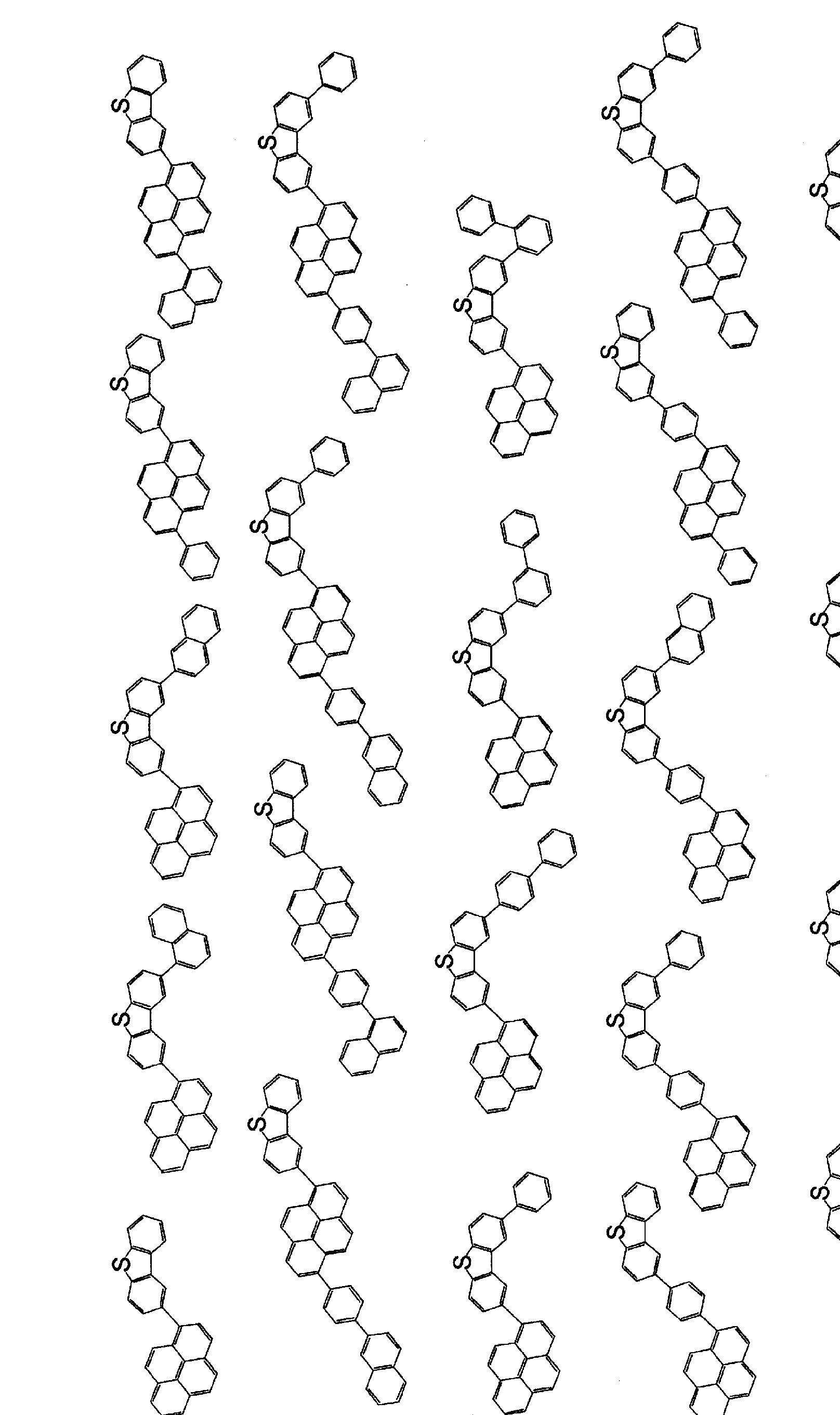
- benzothiophene derivative represented by the general formula (1) in the present invention are shown below.
- the power is not limited to these exemplified compounds.
- the bisanthracene derivative of the present invention is particularly preferably a host material for an organic EL device, preferably a light emitting material for an organic EL device.
- the organic EL device of the present invention is an organic electoluminescence device in which one or more organic thin film layers including at least a light emitting layer are sandwiched between an anode and a cathode, wherein at least one layer of the organic thin film layer has the general formula It contains the benzothiophene derivative (1) alone or as a component of a mixture.
- the light-emitting layer contains 50 to 99%, preferably 10 to 100% of the benzothiophene derivative which preferably contains the benzothiophene derivative of the general formula (1) as the light-emitting material. And preferred.
- the light-emitting layer has sublimable halogen-containing impurities controlled to a certain ratio or less, for example, ⁇ pm or less.
- the light emitting layer preferably further contains an arylamine compound and Z or a styrylamine compound.
- Ar 3 is a group selected from a phenyl group, a biphenyl group, a terfel group, a stilbene group, a distyryl group, and Ar 4 and Ar 5 are each a hydrogen atom or a carbon atom.
- An aromatic hydrocarbon group having a numerical force of S6 to 20, Ar 3 , Ar 4 and Ar 5 may be substituted p ′ is an integer of 1 to 4. More preferably, Ar 4 or Ar 5 At least one is substituted with a styryl group.
- examples of the aromatic hydrocarbon group having 6 to 20 carbon atoms include a phenyl group, a naphthyl group, an anthranyl group, a phenanthryl group, and a terphenyl group.
- arylamine compound a compound represented by the following general formula (B) is preferable. [Chemical 22]
- Ar 6 to Ar 8 are each a substituted or unsubstituted aryl group having 5 to 40 nuclear carbon atoms.
- Q is an integer of 1 to 4.
- aryl group having 5 to 40 nuclear carbon atoms for example, a phenol group, a naphthyl group, an anthryl group, a phenanthryl group, a pyryl group, a diol group, a biphenyl group, Group, phthalyl group, pyrrolyl group, fulleryl group, thiofol group, benzothiol group, oxadiazolyl group, difuranthranyl group, indolyl group, carbazolyl group, pyridyl group, benzoquinolyl group, Fluoranthuric group, acenaphthofluoranthuric group, stilbene group, perylyl group, chrysyl group, picerl group, triphenylenyl group, rubisyl group, benzoanthracel group, phenolanthra -Aryl group, bisanthracyl group, or aryl group represented by the following general formulas (
- r is an integer of 1 to 3.
- preferable substituents of the aryl group include alkyl groups having 1 to 6 carbon atoms (ethyl group, methyl group, i-propyl group, n-propyl group, sbutyl group, t-butyl group).
- Pentyl group, hexyl group, cyclopentyl group, cyclohexyl group, etc. C1-C6 alkoxy group (ethoxy group, methoxy group, i-propoxy group, n-propoxy group, s-butoxy group, t-butoxy group) Group, pentoxy group, hexyloxy group, cyclopentoxy group, cyclohexyloxy group, etc.), aryl group having 5 to 40 nuclear carbon atoms, amino group substituted with aryl group having 5 to 40 nuclear carbon atoms And an ester group having an aryl group having 5 to 40 nuclear carbon atoms, an ester group having an alkyl group having 1 to 6 carbon atoms, a cyano group, a nitro group, a halogen atom, and the like.
- the light emitting layer may contain a compound represented by the general formula (1) and a fluorescent or phosphorescent dopant.
- fluorescent dopant examples include amine compounds, chelate complexes such as tris (8-quinolinolato) aluminum complexes, coumarin derivatives, tetraphenylbutadiene derivatives, bisstyrylarylene derivatives, oxadiazole derivatives, and the like. It is preferable to use a compound selected according to the luminescent color.
- the phosphorescent dopant is preferably a metal complex compound containing at least one metal selected from the group force consisting of Ir, Ru, Pd, Pt, Os, and Re. It is preferable to have at least one skeleton selected from the group consisting of a ferroviridine skeleton, a bibilidyl skeleton, and a phenantorin skeleton.
- Such a metal complex compound include tris (2-phenol-lysine) iridium, tris (2-phenol-pyridine) ruthenium, tris (2-phenol-pyridine) palladium, bis (2- (Phanerubiridine) Platinum, Tris (2-Fuerubiridine) Osmium, Tris (2-Fuerubiridine) Rhenium, Otaethylplatinum porphyrin, Octaphenol platinum porphyrin, Otaethyl paradigm porphyrin, Octafe rurubadium porphyrin, etc. It is preferable to use an appropriate complex in view of the required emission color, device performance, and host material.
- the organic EL device of the present invention is a device in which an organic thin film layer composed of one layer or multiple layers is formed between an anode and a cathode.
- a light emitting layer is provided between the anode and the cathode.
- Luminescent layer Contains a light emitting material, and in addition, may contain a hole injecting material or an electron injecting material in order to transport holes injected from the anode or electrons injected from the cathode to the light emitting material. It is preferable that the light-emitting material has a very high fluorescence quantum efficiency, a high hole transport capability, and an electron transport capability, and forms a uniform thin film.
- the element configuration of the multilayer organic EL element is (anode Z hole injection layer Z light emitting layer Z cathode)
- light-emitting materials doping materials, hole-injecting materials, and electron-injecting materials can also be used for the light-emitting layer, if necessary.
- any of heavy metal complexes represented by phosphorescent iridium can be used.
- Organic EL devices can be prevented from decreasing brightness and life due to quenching by using a multilayer structure.
- light emitting materials, other doping materials, hole injection materials, and electron injection materials can be used in combination. Further, by using other doping materials, it is possible to improve light emission luminance and light emission efficiency and to obtain red or white light emission.
- the hole injection layer, the light emitting layer, and the electron injection layer may each be formed of two or more layers.
- the layer that injects holes from the electrode is a hole injection layer
- the layer that receives holes from the hole injection layer and transports holes to the light emitting layer is a hole transport layer.
- a layer that injects electrons from the electrode carrier is referred to as an electron injection layer
- a layer that receives electrons from the electron injection layer and transports electrons to the light emitting layer is referred to as an electron transport layer.
- Each of these layers is selected and used depending on factors such as the energy level of the material, heat resistance, adhesion with the organic thin film layer or the metal electrode.
- Examples of the light emitting material or host material that can be used in the organic thin film layer together with the compound of the general formula (1) of the present invention include anthracene, naphthalene, phenanthrene, pyrene, tetracene, coronene, taricene, fluorescein, perylene, lid-open perylene, Naphtal Open Perylene, Perinone, Lid Open Perinone, Naphth Open Perinone, Diphenyl Butadiene, Tetraphenyl Butadiene, Coumarin , Oxadiazole, Ardazine, Bisbenzoxazoline, Bisstyryl, Pyrazine, Cyclopentagen, Quinoline metal complex, Aminoquinoline metal complex, Benzoquinoline metal complex, Imine, Diphenylethylene, Vinylanthracene, Diaminocarbazole, Pyran, Thiopyran, Polymethine , Merocyanine, imidazole chelate oxinoid
- the hole injection 'transport material it has the ability to transport holes, has a positive hole injection effect of the anode cover, etc., and an excellent positive hole injection effect for the light emitting layer or the light emitting material, A compound that prevents excitons generated in the light emitting layer from moving to the electron injecting layer and has an excellent thin film forming ability is preferable.
- phthalocyanine derivatives naphthalocyanine derivatives, porphyrin derivatives, oxazole, oxadiazole, triazole, imidazole, imidazolone, imidazolethione, pyrazoline, pyrazolone, tetrahydroimidazole, oxazole, oxadiazole, hydrazone, acylhydrazone, polyaryl Examples include alkane, stilbene, butadiene, benzidine type triphenylamine, styrylamine type triphenylamine, diamine type triphenylamine, and their derivatives, and polymer materials such as polybutcarbazole, polysilane, and conductive polymers. However, it is not limited to these.
- aromatic tertiary amine derivatives include triphenylamine, tritolylamine, tolyldiamine, N, N, -diphenyl-N, N,-(3-methylphenol) — 1, 1, — biphenyl.
- phthalocyanine (p c ) derivatives are H Pc, CuPc, CoPc, NiPc, ZnPc, Pd
- GaPc ⁇ VOPc ⁇ Power that is a phthalocyanine derivative such as TiOPc, MoOPc, GaPc—O—GaPc and naphthalocyanine derivatives, but is not limited to these.
- the electron injection 'transport material has the ability to transport electrons, has an electron injection effect from the cathode, has an excellent electron injection effect on the light emitting layer or the light emitting material, and is generated in the light emitting layer.
- a compound that prevents the child from moving to the hole injection layer and has an excellent thin film forming ability is preferable.
- Specific examples include fluorenone, anthraquinodimethane, diphenoquinone, thiopyran dioxide, oxazole, oxadiazole, triazole, imidazole, perylenetetracarboxylic acid, fluorenylidenemethane, anthraquinodimethane, anthrone, and their derivatives. S, not limited to these.
- the charge injection property can be improved by adding an electron accepting material to the hole injection / transport material and an electron donating material to the electron injection / transport material.
- a more effective electron injection / transport material is a metal complex compound or a nitrogen-containing five-membered ring derivative.
- metal complex compounds include 8-hydroxyquinolinate tritium, bis (8-hydroxyquinolinato) zinc, bis (8-hydroxyquinolinato) copper, bis (8-hydroxyquinolinato) manganese, tris ( 8-hydroxyquinolinate) aluminum, tris (2-methyl 8-hydroxyquinolinate) aluminum, tris ( 8 -hydroxyquinolinato) gallium, bis
- the nitrogen-containing five-membered derivative is preferably an oxazole, thiazole, oxadiazole, thiadiazole or triazole derivative.
- a light emitting material in the organic thin film layer, in addition to the benzothiophene derivative of the general formula (1), a light emitting material, a doping material, a hole injection 'transport material and an electron injection' transport material At least one kind may be contained in the same layer.
- a protective layer is provided on the surface of the device, or the entire device is protected by silicon oil, grease, etc. It is also possible to do this.
- a material having a work function larger than 4 eV is suitable, and carbon, aluminum, vanadium, iron, cobalt, nickel, tungsten, Silver, gold, platinum, palladium and the like and alloys thereof, metal oxides such as tin oxide and indium oxide used for ITO substrates and NES A substrates, and organic conductive resins such as polythiophene and polypyrrole are used.
- the conductive material used for the cathode of the organic EL device of the present invention those having a work function smaller than 4 eV are suitable, and magnesium, calcium, tin, lead, titanium, yttrium, lithium, ruthenium, manganese are suitable.
- the force at which aluminum and the like and alloys thereof are used are not limited to these.
- the alloy include, but are not limited to, magnesium Z silver, magnesium Z indium, lithium Z aluminum, and the like.
- the ratio of the alloy is controlled by the temperature of the vapor deposition source, the atmosphere, the degree of vacuum, etc., and is selected to an appropriate ratio.
- the anode and the cathode may be formed with a layer structure of two or more layers. In order to emit light efficiently, it is desirable that at least one surface of the organic EL device be sufficiently transparent in the light emission wavelength region of the device.
- the substrate used in the organic EL device of the present invention is also preferably transparent.
- the transparent electrode is set so that a predetermined translucency is ensured by a method such as vapor deposition or sputtering using the above conductive material. It is desirable that the light transmission surface electrode has a light transmittance of 10% or more.
- the substrate is not limited as long as it has mechanical and thermal strength and has transparency, and includes a glass substrate and a transparent resin film. Examples of the transparent resin film include polyethylene, ethylene acetate butyl copolymer, ethylene butyl alcohol copolymer, polypropylene, polystyrene, polymethyl metatalylate, poly salt vinyl, poly butyl alcohol, and poly butyl alcohol.
- each layer of the organic EL device according to the present invention may be performed by any of dry deposition methods such as vacuum deposition, sputtering, plasma, and ion plating, and wet deposition methods such as spin coating, dating, and flow coating.
- the method can be applied.
- the film thickness is not particularly limited, but should be set to an appropriate film thickness. If the film thickness is too thick, a large applied voltage is required to obtain a constant light output, resulting in poor efficiency. If the film thickness is too thin, pinholes and the like are generated, and sufficient light emission luminance cannot be obtained even when an electric field is applied.
- the usual film thickness is in the range of 5 nm to 10 m.
- the force lOnm force and the range of 0.2 / zm are more preferable.
- the material for forming each layer is dissolved or dispersed in an appropriate solvent such as ethanol, chloroform, tetrahydrofuran, dioxane or the like to form a thin film, and any solvent may be used.
- an appropriate resin additive may be used for improving the film formability and preventing pinholes in the film.
- Usable resins include insulating resins such as polystyrene, polycarbonate, polyarylate, polyester, polyamide, polyurethane, polysulfone, polymethylmethacrylate, polymethylacrylate, cellulose, copolymers thereof, poly Examples thereof include photoconductive resins such as N bullcarbazole and polysilane, and conductive resins such as polythiophene and polypyrrole. Examples of additives include antioxidants, ultraviolet absorbers, and plasticizers.
- the benzothiophene derivative represented by the general formula (1) of the present invention as an organic EL element material in the organic thin film layer of the organic EL element, the luminous efficiency is high and the heat resistance is excellent. Thus, an organic EL device having a long life and good color purity can be obtained.
- the organic EL device of the present invention can be used as a flat light emitter such as a flat panel display of a wall-mounted television, a copying machine, a printer, a light source such as a backlight of a liquid crystal display or instruments, a display board, a marker lamp, and the like.
- a glass substrate with a transparent electrode having a thickness of 25 mm X 75 mm X 1.1 mm was ultrasonically cleaned in isopropyl alcohol for 5 minutes, followed by UV ozone cleaning for 30 minutes.
- the glass substrate with the transparent electrode line after cleaning is mounted on the substrate holder of the vacuum deposition apparatus, and first, the transparent electrode is covered on the surface where the transparent electrode line is formed so that the film thickness becomes 60 nm.
- N, N, one bis (N, N, one diphenyl and four aminoamino) — N, N—diphenyl— 4, 4, — diamino-1, 1, and — biphenyl membrane ( TP Abbreviated as “D232 membrane”. ) was formed.
- This TPD232 film functions as a hole injection layer.
- an N, N, ⁇ ′, ⁇ , and one tetra (4-biphenyl) -diaminobiphenylene layer (hereinafter abbreviated as “TBDB layer”) were formed to a thickness of 20 nm. .
- This membrane functions as a hole transport layer.
- a compound (H-1) was deposited as a light emitting material (host material) so as to have a film thickness of 40 nm.
- This film functions as a light emitting layer.
- An Alq film having a thickness of lOnm was formed on this film. This functions as an electron injection layer.
- Li Li source: manufactured by Saesgetta Co., Ltd.
- Alq Alq were vapor-deposited to form an eight-film thickness ⁇ ) !) as an electron injection layer (cathode).
- metal A1 is deposited to form a metal cathode to form an organic EL device.
- Table 1 shows the results of the following evaluations (1) and (2) for the obtained organic EL devices.
- Example 1 an organic EL device was produced in the same manner except that the material shown in Table 1 was used as the light emitting material (host material) instead of the compound (H-1). Is shown in Table 1.
- Comparative Compound 4 In Example 1, the organic EL was similarly prepared except that Comparative Compound 1 to 4 shown in Table 1 was used instead of Compound (H-1) as the luminescent material (host material). Table 1 shows the results of manufacturing and evaluating the devices in the same way.
- the organic EL element of the example in which the light-emitting layer contains a benzothiophene derivative has a pure blue color, a longer life, and a higher life than the comparative example using a conventional fluorene linker compound. Efficiency has been achieved. In addition, the color purity of the biphenylene and thiophene linker compounds disclosed heretofore is remarkably deteriorated.
- the organic EL device using the benzothiophene derivative of the present invention provides a long-lived blue light emission with high luminous efficiency. Therefore, it is extremely useful as an organic EL element with high practicality.
Landscapes
- Chemical & Material Sciences (AREA)
- Organic Chemistry (AREA)
- Engineering & Computer Science (AREA)
- Materials Engineering (AREA)
- Physics & Mathematics (AREA)
- Spectroscopy & Molecular Physics (AREA)
- Electroluminescent Light Sources (AREA)
Description




Claims


Priority Applications (2)
| Application Number | Priority Date | Filing Date | Title |
|---|---|---|---|
| EP06731873A EP1894923A1 (en) | 2005-06-24 | 2006-04-14 | Benzothiophene derivative and organic electroluminescence device making use of the same |
| JP2007522205A JPWO2006137210A1 (ja) | 2005-06-24 | 2006-04-14 | ベンゾチオフェン誘導体及びそれを利用した有機エレクトロルミネッセンス素子 |
Applications Claiming Priority (2)
| Application Number | Priority Date | Filing Date | Title |
|---|---|---|---|
| JP2005184506 | 2005-06-24 | ||
| JP2005-184506 | 2005-06-24 |
Publications (1)
| Publication Number | Publication Date |
|---|---|
| WO2006137210A1 true WO2006137210A1 (ja) | 2006-12-28 |
Family
ID=37570246
Family Applications (1)
| Application Number | Title | Priority Date | Filing Date |
|---|---|---|---|
| PCT/JP2006/307937 Ceased WO2006137210A1 (ja) | 2005-06-24 | 2006-04-14 | ベンゾチオフェン誘導体及びそれを利用した有機エレクトロルミネッセンス素子 |
Country Status (6)
| Country | Link |
|---|---|
| EP (1) | EP1894923A1 (ja) |
| JP (1) | JPWO2006137210A1 (ja) |
| KR (1) | KR20080031872A (ja) |
| CN (1) | CN101223156A (ja) |
| TW (1) | TW200700405A (ja) |
| WO (1) | WO2006137210A1 (ja) |
Cited By (18)
| Publication number | Priority date | Publication date | Assignee | Title |
|---|---|---|---|---|
| JP2007126403A (ja) * | 2005-11-04 | 2007-05-24 | Sanyo Electric Co Ltd | ジベンゾチオフェン誘導体及びそれらを用いた有機エレクトロルミネッセンス素子 |
| WO2008072596A1 (ja) * | 2006-12-13 | 2008-06-19 | Konica Minolta Holdings, Inc. | 有機エレクトロルミネッセンス素子、表示装置及び照明装置 |
| WO2009008099A1 (ja) * | 2007-07-10 | 2009-01-15 | Idemitsu Kosan Co., Ltd. | 有機エレクトロルミネッセンス素子用材料及びそれを用いた有機エレクトロルミネッセンス素子 |
| WO2009021126A3 (en) * | 2007-08-08 | 2009-06-18 | Universal Display Corp | Benzo-fused thiophene or benzo-fused furan compounds comprising a triphenylene group |
| JP2009191050A (ja) * | 2008-02-18 | 2009-08-27 | Chemiprokasei Kaisha Ltd | チオフェン誘導体、それよりなる蛍光材料、有機エレクトロルミネッセンス用発光材料およびそれを用いた有機エレクトロルミネッセンス素子 |
| WO2010122810A1 (ja) * | 2009-04-24 | 2010-10-28 | 出光興産株式会社 | 芳香族アミン誘導体及びそれを用いた有機エレクトロルミネッセンス素子 |
| JP2011517665A (ja) * | 2008-03-11 | 2011-06-16 | メルク パテント ゲーエムベーハー | エレクトロルミネセント特性または電子輸送特性を有する化合物 |
| JP2011162584A (ja) * | 2010-02-04 | 2011-08-25 | Kanagawa Univ | ジベンゾチオフェン骨格を有する化合物における屈折率付与効果を増大又は調整する方法 |
| US8080658B2 (en) | 2007-07-10 | 2011-12-20 | Idemitsu Kosan Co., Ltd. | Material for organic electroluminescent element and organic electroluminescent element employing the same |
| JP2012072098A (ja) * | 2010-09-29 | 2012-04-12 | Canon Inc | ジベンゾチオフェン化合物およびそれを有する有機発光素子 |
| US8192848B2 (en) | 2008-01-11 | 2012-06-05 | E I Du Pont De Nemours And Company | Substituted pyrenes and associated production methods for luminescent applications |
| US8257836B2 (en) | 2006-12-29 | 2012-09-04 | E I Du Pont De Nemours And Company | Di-substituted pyrenes for luminescent applications |
| US8431245B2 (en) | 2009-09-29 | 2013-04-30 | E. I. Du Pont De Nemours And Company | Deuterated compounds for luminescent applications |
| US8497495B2 (en) | 2009-04-03 | 2013-07-30 | E I Du Pont De Nemours And Company | Electroactive materials |
| JP2013173771A (ja) * | 2006-12-07 | 2013-09-05 | Mitsubishi Chemicals Corp | ピレン誘導体及び有機蛍光体 |
| JP2014500240A (ja) * | 2010-10-11 | 2014-01-09 | ソルヴェイ(ソシエテ アノニム) | 発光デバイス用のスピロビフルオレン化合物 |
| KR101405736B1 (ko) * | 2008-10-30 | 2014-06-10 | 주식회사 엘지화학 | 신규한 안트라센 유도체 및 이를 이용한 유기전자소자 |
| US8759818B2 (en) | 2009-02-27 | 2014-06-24 | E I Du Pont De Nemours And Company | Deuterated compounds for electronic applications |
Families Citing this family (13)
| Publication number | Priority date | Publication date | Assignee | Title |
|---|---|---|---|---|
| CN103193697B (zh) * | 2005-09-08 | 2015-11-18 | 东丽株式会社 | 发光元件材料和发光元件 |
| KR20080080306A (ko) * | 2005-12-15 | 2008-09-03 | 이데미쓰 고산 가부시키가이샤 | 유기 전기발광 소자용 재료 및 그것을 이용한 유기전기발광 소자 |
| US7651791B2 (en) | 2005-12-15 | 2010-01-26 | Idemitsu Kosan Co., Ltd. | Material for organic electroluminescence device and electroluminescence device employing the same |
| JP5484472B2 (ja) * | 2008-09-23 | 2014-05-07 | エルジー・ケム・リミテッド | 新規な化合物、その製造方法、およびそれを用いた有機電子素子 |
| KR101678235B1 (ko) | 2008-09-25 | 2016-11-21 | 유니버셜 디스플레이 코포레이션 | 유기 셀레늄 재료들 및 유기 발광 소자들에서 이들의 사용 |
| KR20120099576A (ko) * | 2009-12-21 | 2012-09-11 | 이데미쓰 고산 가부시키가이샤 | 피렌 유도체 및 그것을 이용한 유기 전계 발광 소자 |
| WO2012049712A1 (ja) * | 2010-10-15 | 2012-04-19 | パナソニック株式会社 | 有機発光パネルとその製造方法、および有機表示装置 |
| KR20130049075A (ko) | 2011-11-03 | 2013-05-13 | 삼성디스플레이 주식회사 | 신규한 헤테로고리 화합물 및 이를 포함한 유기발광 소자 |
| CN103094485A (zh) * | 2012-11-30 | 2013-05-08 | 江苏威纳德照明科技有限公司 | 一种高分子发光二极管 |
| CN103094493A (zh) * | 2012-11-30 | 2013-05-08 | 江苏威纳德照明科技有限公司 | 一种高分子发光二极管的制造方法 |
| CN103000825A (zh) * | 2012-11-30 | 2013-03-27 | 江苏威纳德照明科技有限公司 | 一种具有空穴传输层的高分子发光二极管的制造方法 |
| CN103035854A (zh) * | 2012-11-30 | 2013-04-10 | 江苏威纳德照明科技有限公司 | 一种包括电子传输层的高分子发光二极管的制造方法 |
| CN103094489A (zh) * | 2012-11-30 | 2013-05-08 | 江苏威纳德照明科技有限公司 | 一种包括电子传输层的高分子发光二极管 |
Citations (4)
| Publication number | Priority date | Publication date | Assignee | Title |
|---|---|---|---|---|
| JPH06240246A (ja) * | 1993-02-17 | 1994-08-30 | Ricoh Co Ltd | 電界発光素子 |
| JPH10340786A (ja) * | 1997-06-09 | 1998-12-22 | Toyo Ink Mfg Co Ltd | 有機エレクトロルミネッセンス素子材料およびそれを使用した有機エレクトロルミネッセンス素子 |
| WO2004096945A1 (ja) * | 2003-05-01 | 2004-11-11 | Fujitsu Limited | 1,3,6,8−四置換ピレン化合物、有機el素子及び有機elディスプレイ |
| WO2004096783A1 (en) * | 2003-04-15 | 2004-11-11 | 3M Innovative Properties Company | Ethynyl containing electron transport agents and their use in organic luminescent devices |
-
2006
- 2006-04-14 KR KR1020077029977A patent/KR20080031872A/ko not_active Withdrawn
- 2006-04-14 CN CNA2006800225282A patent/CN101223156A/zh active Pending
- 2006-04-14 JP JP2007522205A patent/JPWO2006137210A1/ja not_active Withdrawn
- 2006-04-14 EP EP06731873A patent/EP1894923A1/en not_active Withdrawn
- 2006-04-14 WO PCT/JP2006/307937 patent/WO2006137210A1/ja not_active Ceased
- 2006-04-21 TW TW095114328A patent/TW200700405A/zh unknown
Patent Citations (4)
| Publication number | Priority date | Publication date | Assignee | Title |
|---|---|---|---|---|
| JPH06240246A (ja) * | 1993-02-17 | 1994-08-30 | Ricoh Co Ltd | 電界発光素子 |
| JPH10340786A (ja) * | 1997-06-09 | 1998-12-22 | Toyo Ink Mfg Co Ltd | 有機エレクトロルミネッセンス素子材料およびそれを使用した有機エレクトロルミネッセンス素子 |
| WO2004096783A1 (en) * | 2003-04-15 | 2004-11-11 | 3M Innovative Properties Company | Ethynyl containing electron transport agents and their use in organic luminescent devices |
| WO2004096945A1 (ja) * | 2003-05-01 | 2004-11-11 | Fujitsu Limited | 1,3,6,8−四置換ピレン化合物、有機el素子及び有機elディスプレイ |
Non-Patent Citations (1)
| Title |
|---|
| BUU-HOI N.P. ET AL: "Thiophene derivatives of potential biological interest. II. Thianaphthene analogs of stilbene and related compounds", JOURNAL OF THE CHEMICAL SOCIETY, 1951, pages 251 - 255, XP003001224 * |
Cited By (49)
| Publication number | Priority date | Publication date | Assignee | Title |
|---|---|---|---|---|
| JP2007126403A (ja) * | 2005-11-04 | 2007-05-24 | Sanyo Electric Co Ltd | ジベンゾチオフェン誘導体及びそれらを用いた有機エレクトロルミネッセンス素子 |
| JP2013173771A (ja) * | 2006-12-07 | 2013-09-05 | Mitsubishi Chemicals Corp | ピレン誘導体及び有機蛍光体 |
| US10109800B2 (en) | 2006-12-13 | 2018-10-23 | Konica Minolta, Inc. | Organic electroluminescent element, display device and lighting device |
| WO2008072596A1 (ja) * | 2006-12-13 | 2008-06-19 | Konica Minolta Holdings, Inc. | 有機エレクトロルミネッセンス素子、表示装置及び照明装置 |
| US9048434B2 (en) | 2006-12-13 | 2015-06-02 | Konica Minolta, Inc. | Organic electroluminescent element, display device and lighting device |
| US8541112B2 (en) | 2006-12-13 | 2013-09-24 | Konica Minolta Holdings, Inc. | Organic electroluminescent element, display device and lighting device |
| EP2437326A3 (en) * | 2006-12-13 | 2013-11-13 | Konica Minolta Holdings, Inc. | Organic electroluminescent element, display device and lighting device |
| JP5493357B2 (ja) * | 2006-12-13 | 2014-05-14 | コニカミノルタ株式会社 | 有機エレクトロルミネッセンス素子、表示装置及び照明装置 |
| US9627630B2 (en) | 2006-12-13 | 2017-04-18 | Konica Minolta, Inc. | Organic electroluminescent element, display device and lighting device |
| US8257836B2 (en) | 2006-12-29 | 2012-09-04 | E I Du Pont De Nemours And Company | Di-substituted pyrenes for luminescent applications |
| US8080658B2 (en) | 2007-07-10 | 2011-12-20 | Idemitsu Kosan Co., Ltd. | Material for organic electroluminescent element and organic electroluminescent element employing the same |
| WO2009008099A1 (ja) * | 2007-07-10 | 2009-01-15 | Idemitsu Kosan Co., Ltd. | 有機エレクトロルミネッセンス素子用材料及びそれを用いた有機エレクトロルミネッセンス素子 |
| JPWO2009008099A1 (ja) * | 2007-07-10 | 2010-09-02 | 出光興産株式会社 | 有機エレクトロルミネッセンス素子用材料及びそれを用いた有機エレクトロルミネッセンス素子 |
| EP2166583A4 (en) * | 2007-07-10 | 2011-10-19 | Idemitsu Kosan Co | MATERIAL FOR AN ORGANIC ELECTROLUMINESCENT ELEMENT AND ORGANIC ELECTROLUMINESCENE ELEMENT PRODUCED BY USE OF THE MATERIAL |
| EP2166584A4 (en) * | 2007-07-10 | 2011-10-26 | Idemitsu Kosan Co | MATERIAL FOR AN ORGANIC ELECTROLUMINESCENT ELEMENT AND ORGANIC ELECTROLUMINESCENE ELEMENT PRODUCED BY USE OF THE MATERIAL |
| US8471008B2 (en) | 2007-07-10 | 2013-06-25 | Idemitsu Kosan Co., Ltd. | Material for organic electroluminescent element and organic electroluminescent element employing the same |
| US9209410B2 (en) | 2007-07-10 | 2015-12-08 | Idemitsu Kosan Co., Ltd. | Material for organic electroluminescence device and organic electroluminescence device utilizing the same |
| US8114530B2 (en) | 2007-07-10 | 2012-02-14 | Idemitsu Kosan Co., Ltd. | Material for organic electroluminescence device and organic electroluminescence device utilizing the same |
| JP2010535809A (ja) * | 2007-08-08 | 2010-11-25 | ユニバーサル ディスプレイ コーポレイション | トリフェニレン基を含むベンゾ縮合チオフェンまたはベンゾ縮合フラン化合物 |
| US8367850B2 (en) | 2007-08-08 | 2013-02-05 | Universal Display Corporation | Benzo-fused thiophene or benzo-fused furan compounds comprising a triphenylene group |
| JP2016121181A (ja) * | 2007-08-08 | 2016-07-07 | ユニバーサル ディスプレイ コーポレイション | トリフェニレン基を含むベンゾ縮合チオフェンまたはベンゾ縮合フラン化合物 |
| US9153786B2 (en) | 2007-08-08 | 2015-10-06 | Universal Display Corporation | Organic electroluminescent materials and devices |
| US9577200B2 (en) | 2007-08-08 | 2017-02-21 | Universal Display Corporation | Organic electroluminescent materials and devices |
| WO2009021126A3 (en) * | 2007-08-08 | 2009-06-18 | Universal Display Corp | Benzo-fused thiophene or benzo-fused furan compounds comprising a triphenylene group |
| US8192848B2 (en) | 2008-01-11 | 2012-06-05 | E I Du Pont De Nemours And Company | Substituted pyrenes and associated production methods for luminescent applications |
| US8383251B2 (en) | 2008-01-11 | 2013-02-26 | E I Du Pont De Nemours And Company | Substituted pyrenes and associated production methods for luminescent applications |
| JP2009191050A (ja) * | 2008-02-18 | 2009-08-27 | Chemiprokasei Kaisha Ltd | チオフェン誘導体、それよりなる蛍光材料、有機エレクトロルミネッセンス用発光材料およびそれを用いた有機エレクトロルミネッセンス素子 |
| JP2011517665A (ja) * | 2008-03-11 | 2011-06-16 | メルク パテント ゲーエムベーハー | エレクトロルミネセント特性または電子輸送特性を有する化合物 |
| KR101405736B1 (ko) * | 2008-10-30 | 2014-06-10 | 주식회사 엘지화학 | 신규한 안트라센 유도체 및 이를 이용한 유기전자소자 |
| US8890131B2 (en) | 2009-02-27 | 2014-11-18 | E I Du Pont De Nemours And Company | Deuterated compounds for electronic applications |
| US8759818B2 (en) | 2009-02-27 | 2014-06-24 | E I Du Pont De Nemours And Company | Deuterated compounds for electronic applications |
| US8497495B2 (en) | 2009-04-03 | 2013-07-30 | E I Du Pont De Nemours And Company | Electroactive materials |
| CN102232068A (zh) * | 2009-04-24 | 2011-11-02 | 出光兴产株式会社 | 芳香族胺衍生物和使用其的有机电致发光元件 |
| WO2010122810A1 (ja) * | 2009-04-24 | 2010-10-28 | 出光興産株式会社 | 芳香族アミン誘導体及びそれを用いた有機エレクトロルミネッセンス素子 |
| US11024806B2 (en) | 2009-04-24 | 2021-06-01 | Idemitsu Kosan Co., Ltd. | Aromatic amine derivative, and organic electroluminescent element comprising the same |
| US10686137B2 (en) | 2009-04-24 | 2020-06-16 | Idemitsu Kosan Co., Ltd. | Aromatic amine derivative, and organic electroluminescent element comprising the same |
| US9166179B2 (en) | 2009-04-24 | 2015-10-20 | Idemitsu Kosan Co., Ltd. | Aromatic amine derivative, and organic electroluminescent element comprising the same |
| US8431250B2 (en) | 2009-04-24 | 2013-04-30 | Idemitsu Kosan Co., Ltd. | Aromatic amine derivative, and organic electroluminescent element comprising the same |
| US10263191B2 (en) | 2009-04-24 | 2019-04-16 | Idemitsu Kosan Co., Ltd. | Aromatic amine derivative, and organic electroluminescent element comprising the same |
| US9466800B2 (en) | 2009-04-24 | 2016-10-11 | Idemitsu Kosan Co., Ltd. | Aromatic amine derivative, and organic electroluminescent element comprising the same |
| CN102232068B (zh) * | 2009-04-24 | 2015-02-25 | 出光兴产株式会社 | 芳香族胺衍生物和使用其的有机电致发光元件 |
| US9741938B2 (en) | 2009-04-24 | 2017-08-22 | Idemitsu Kosan Co., Ltd. | Aromatic amine derivative, and organic electroluminescent element comprising the same |
| US8431245B2 (en) | 2009-09-29 | 2013-04-30 | E. I. Du Pont De Nemours And Company | Deuterated compounds for luminescent applications |
| JP2011162584A (ja) * | 2010-02-04 | 2011-08-25 | Kanagawa Univ | ジベンゾチオフェン骨格を有する化合物における屈折率付与効果を増大又は調整する方法 |
| JP2012072098A (ja) * | 2010-09-29 | 2012-04-12 | Canon Inc | ジベンゾチオフェン化合物およびそれを有する有機発光素子 |
| US8743031B2 (en) | 2010-09-29 | 2014-06-03 | Canon Kabushiki Kaisha | Dibenzothiophene compound and organic light-emitting element based on the same |
| JP2017081900A (ja) * | 2010-10-11 | 2017-05-18 | 住友化学株式会社 | 発光デバイス用のスピロビフルオレン化合物 |
| US9978946B2 (en) | 2010-10-11 | 2018-05-22 | Sumitomo Chemical Co., Ltd. | Spirobifluorene compound for light emitting devices |
| JP2014500240A (ja) * | 2010-10-11 | 2014-01-09 | ソルヴェイ(ソシエテ アノニム) | 発光デバイス用のスピロビフルオレン化合物 |
Also Published As
| Publication number | Publication date |
|---|---|
| TW200700405A (en) | 2007-01-01 |
| EP1894923A1 (en) | 2008-03-05 |
| KR20080031872A (ko) | 2008-04-11 |
| JPWO2006137210A1 (ja) | 2009-01-08 |
| CN101223156A (zh) | 2008-07-16 |
Similar Documents
| Publication | Publication Date | Title |
|---|---|---|
| WO2006137210A1 (ja) | ベンゾチオフェン誘導体及びそれを利用した有機エレクトロルミネッセンス素子 | |
| KR101213383B1 (ko) | 플루오렌계 유도체 및 이를 이용한 유기 전기발광 소자 | |
| JP4464070B2 (ja) | アリールアミン化合物及びそれを用いた有機エレクトロルミネッセンス素子 | |
| KR101293320B1 (ko) | 방향족 아민 유도체 및 그것을 이용한 유기 일렉트로루미네센스 소자 | |
| KR100923309B1 (ko) | 스파이로형 유기 재료 및 이를 이용한 유기 전기발광 소자 | |
| JP3829982B2 (ja) | 新規な縮合芳香族化合物及びそれを利用した有機エレクトロルミネッセンス素子 | |
| JP4838969B2 (ja) | 新規スチリル化合物及び有機エレクトロルミネッセンス素子 | |
| WO2007004364A1 (ja) | ピレン誘導体及びそれらを用いた有機エレクトロルミネッセンス素子 | |
| JP4002040B2 (ja) | 有機エレクトロルミネッセンス素子 | |
| WO2006114949A1 (ja) | 芳香族アミン誘導体及びそれを用いた有機エレクトロルミネッセンス素子 | |
| WO2007129702A1 (ja) | ケイ素含有化合物及びそれを利用した有機エレクトロルミネッセンス素子 | |
| WO2008072538A1 (ja) | 有機エレクトロルミネッセンス素子 | |
| JP2003313156A (ja) | 新規アントラセン化合物及びそれを利用した有機エレクトロルミネッセンス素子 | |
| JP2014522380A (ja) | ナフタレン誘導体、それを用いた有機材料、及びそれを用いた有機el素子 | |
| WO2006117974A1 (ja) | 芳香族アミン誘導体及びそれを用いた有機エレクトロルミネッセンス素子 | |
| JP4211191B2 (ja) | 有機エレクトロルミネッセンス素子用材料およびそれを使用した有機エレクトロルミネッセンス素子 | |
| KR100915102B1 (ko) | 스파이로형 유기 재료 및 이를 이용한 유기 전기발광 소자 | |
| JP2009046482A (ja) | アリールアミン化合物及びそれを用いた有機エレクトロルミネッセンス素子 | |
| KR20080099705A (ko) | 스파이로형 유기 재료 및 이를 이용한 유기 전기 발광소자 | |
| KR101357191B1 (ko) | 나프탈렌 유도체, 이를 이용한 유기 재료, 및 이를 이용한 유기 전기발광 소자 | |
| JP2007306020A (ja) | 有機エレクトロルミネッセンス素子 | |
| JP2007266620A (ja) | 有機エレクトロルミネッセンス素子用材料及び有機エレクトロルミネッセンス素子 | |
| JP2007284684A (ja) | 有機エレクトロルミネッセンス素子用材料及びそれを用いた有機エレクトロルミネッセンス素子 | |
| JP2006206596A (ja) | 有機el素子用化合物 | |
| JP2007306019A (ja) | 有機エレクトロルミネッセンス素子 |
Legal Events
| Date | Code | Title | Description |
|---|---|---|---|
| WWE | Wipo information: entry into national phase |
Ref document number: 200680022528.2 Country of ref document: CN |
|
| 121 | Ep: the epo has been informed by wipo that ep was designated in this application | ||
| WWE | Wipo information: entry into national phase |
Ref document number: 2007522205 Country of ref document: JP |
|
| WWE | Wipo information: entry into national phase |
Ref document number: 2006731873 Country of ref document: EP |
|
| WWE | Wipo information: entry into national phase |
Ref document number: 1020077029977 Country of ref document: KR |
|
| WWE | Wipo information: entry into national phase |
Ref document number: 5945/CHENP/2007 Country of ref document: IN |
|
| NENP | Non-entry into the national phase |
Ref country code: DE |