WO2007004321A1 - 環状オレフィン系樹脂組成物の製造方法および環状オレフィン系樹脂組成物 - Google Patents
環状オレフィン系樹脂組成物の製造方法および環状オレフィン系樹脂組成物 Download PDFInfo
- Publication number
- WO2007004321A1 WO2007004321A1 PCT/JP2005/023541 JP2005023541W WO2007004321A1 WO 2007004321 A1 WO2007004321 A1 WO 2007004321A1 JP 2005023541 W JP2005023541 W JP 2005023541W WO 2007004321 A1 WO2007004321 A1 WO 2007004321A1
- Authority
- WO
- WIPO (PCT)
- Prior art keywords
- cyclic olefin
- resin composition
- group
- based resin
- hydrocarbon compound
- Prior art date
- Legal status (The legal status is an assumption and is not a legal conclusion. Google has not performed a legal analysis and makes no representation as to the accuracy of the status listed.)
- Ceased
Links
Classifications
-
- C—CHEMISTRY; METALLURGY
- C08—ORGANIC MACROMOLECULAR COMPOUNDS; THEIR PREPARATION OR CHEMICAL WORKING-UP; COMPOSITIONS BASED THEREON
- C08F—MACROMOLECULAR COMPOUNDS OBTAINED BY REACTIONS ONLY INVOLVING CARBON-TO-CARBON UNSATURATED BONDS
- C08F6/00—Post-polymerisation treatments
- C08F6/001—Removal of residual monomers by physical means
- C08F6/003—Removal of residual monomers by physical means from polymer solutions, suspensions, dispersions or emulsions without recovery of the polymer therefrom
-
- C—CHEMISTRY; METALLURGY
- C08—ORGANIC MACROMOLECULAR COMPOUNDS; THEIR PREPARATION OR CHEMICAL WORKING-UP; COMPOSITIONS BASED THEREON
- C08L—COMPOSITIONS OF MACROMOLECULAR COMPOUNDS
- C08L23/00—Compositions of homopolymers or copolymers of unsaturated aliphatic hydrocarbons having only one carbon-to-carbon double bond; Compositions of derivatives of such polymers
-
- C—CHEMISTRY; METALLURGY
- C08—ORGANIC MACROMOLECULAR COMPOUNDS; THEIR PREPARATION OR CHEMICAL WORKING-UP; COMPOSITIONS BASED THEREON
- C08F—MACROMOLECULAR COMPOUNDS OBTAINED BY REACTIONS ONLY INVOLVING CARBON-TO-CARBON UNSATURATED BONDS
- C08F210/00—Copolymers of unsaturated aliphatic hydrocarbons having only one carbon-to-carbon double bond
-
- C—CHEMISTRY; METALLURGY
- C08—ORGANIC MACROMOLECULAR COMPOUNDS; THEIR PREPARATION OR CHEMICAL WORKING-UP; COMPOSITIONS BASED THEREON
- C08F—MACROMOLECULAR COMPOUNDS OBTAINED BY REACTIONS ONLY INVOLVING CARBON-TO-CARBON UNSATURATED BONDS
- C08F210/00—Copolymers of unsaturated aliphatic hydrocarbons having only one carbon-to-carbon double bond
- C08F210/02—Ethene
-
- C—CHEMISTRY; METALLURGY
- C08—ORGANIC MACROMOLECULAR COMPOUNDS; THEIR PREPARATION OR CHEMICAL WORKING-UP; COMPOSITIONS BASED THEREON
- C08F—MACROMOLECULAR COMPOUNDS OBTAINED BY REACTIONS ONLY INVOLVING CARBON-TO-CARBON UNSATURATED BONDS
- C08F6/00—Post-polymerisation treatments
- C08F6/02—Neutralisation of the polymerisation mass, e.g. killing the catalyst also removal of catalyst residues
-
- C—CHEMISTRY; METALLURGY
- C08—ORGANIC MACROMOLECULAR COMPOUNDS; THEIR PREPARATION OR CHEMICAL WORKING-UP; COMPOSITIONS BASED THEREON
- C08F—MACROMOLECULAR COMPOUNDS OBTAINED BY REACTIONS ONLY INVOLVING CARBON-TO-CARBON UNSATURATED BONDS
- C08F8/00—Chemical modification by after-treatment
- C08F8/04—Reduction, e.g. hydrogenation
-
- C—CHEMISTRY; METALLURGY
- C08—ORGANIC MACROMOLECULAR COMPOUNDS; THEIR PREPARATION OR CHEMICAL WORKING-UP; COMPOSITIONS BASED THEREON
- C08K—Use of inorganic or non-macromolecular organic substances as compounding ingredients
- C08K5/00—Use of organic ingredients
- C08K5/01—Hydrocarbons
-
- C—CHEMISTRY; METALLURGY
- C08—ORGANIC MACROMOLECULAR COMPOUNDS; THEIR PREPARATION OR CHEMICAL WORKING-UP; COMPOSITIONS BASED THEREON
- C08L—COMPOSITIONS OF MACROMOLECULAR COMPOUNDS
- C08L23/00—Compositions of homopolymers or copolymers of unsaturated aliphatic hydrocarbons having only one carbon-to-carbon double bond; Compositions of derivatives of such polymers
- C08L23/26—Compositions of homopolymers or copolymers of unsaturated aliphatic hydrocarbons having only one carbon-to-carbon double bond; Compositions of derivatives of such polymers modified by chemical after-treatment
-
- C—CHEMISTRY; METALLURGY
- C08—ORGANIC MACROMOLECULAR COMPOUNDS; THEIR PREPARATION OR CHEMICAL WORKING-UP; COMPOSITIONS BASED THEREON
- C08F—MACROMOLECULAR COMPOUNDS OBTAINED BY REACTIONS ONLY INVOLVING CARBON-TO-CARBON UNSATURATED BONDS
- C08F2800/00—Copolymer characterised by the proportions of the comonomers expressed
- C08F2800/10—Copolymer characterised by the proportions of the comonomers expressed as molar percentages
Definitions
- the present invention relates to a method for producing a cyclic olefin-based resin composition and a cyclic olefin-based resin composition.
- optical lenses such as pickup lenses for optical disk optical systems, collimator lenses, or various lenses for small imaging have been replaced by conventional glass grinding lenses from the viewpoint of improving productivity and light weight.
- transparent plastic injection molded lenses continues.
- plastics generally have poorer transferability at the time of molding as high-performance amorphous resin, and the difficulty of molding, such as coloring during residence at high temperatures, is a problem. It is.
- JP 2003-311773 A discloses an improvement in terms of molding conditions.
- Japanese Patent Laid-Open No. 2003-311737 and Japanese Patent Laid-Open No. 2002-1 05131 although the material handling device and the material itself have been devised, sufficient improvements have not been made. There is a need for materials that can be easily molded in all situations.
- Patent Document 1 JP 2003-311773
- Patent Document 2 JP 2003-311737 A
- Patent Document 3 Japanese Patent Laid-Open No. 2002-105131
- An object of the present invention is to improve transferability at the time of molding, so-called poor appearance due to insufficient flowability at the time of molding, to suppress coloring due to thermal history such as retention at high temperature, and to facilitate molding. It is to provide a method for producing a cyclic olefin-based resin composition and a cyclic olefin-based resin composition. [0006] As a result of intensive studies to solve the above-mentioned problems, the present inventors have performed a hydrogenation treatment on a cyclic olefin-based resin composition containing a specific amount of an unsaturated hydrocarbon compound in the presence of a hydrogenation catalyst.
- the present invention relates to a method for producing a cyclic olefin-based resin composition as described in the following [1] to [10], a cyclic olefin-based resin composition as described in the following [11] to [13], Furthermore, the molded article described in [14] below is provided.
- X and y represent copolymerization ratios and are real numbers satisfying OZlOO ⁇ yZx ⁇ 95Z5.
- X and y are on a molar basis.
- n represents the number of substitutions of the substituent Q, and is an integer of 0 ⁇ n ⁇ 2.
- R 1 is a 2 + n-valent group in which a group force consisting of a hydrocarbon group having 2 to 20 carbon atoms is also selected, and a plurality of R 1 may be the same or different.
- R 2 is a monovalent group selected from a hydrogen atom or a hydrocarbon group having 1 to 10 carbon atoms composed of carbon and hydrogen, and a plurality of R 2 may be the same or different. Good
- R 3 is a tetravalent group in which a group force consisting of a hydrocarbon group having 2 to 10 carbon atoms is also selected, and a plurality of R 3 may be the same or different.
- Q is represented by COOR 4 (R 4 is a monovalent group selected from the group consisting of a hydrogen atom or a hydrocarbon group having 1 to 10 carbon atoms consisting of carbon and hydrogen).
- R 4 is a monovalent group selected from the group consisting of a hydrogen atom or a hydrocarbon group having 1 to 10 carbon atoms consisting of carbon and hydrogen).
- Existing Q is the same It may be one or different.
- the cyclic olefin-based polymer has the general formula (2)
- R 1 is a 2 + n-valent group selected from the group consisting of hydrocarbon groups having 2 to 20 carbon atoms, and a plurality of R 1 may be the same or different.
- N is It is an integer with 0 ⁇ n ⁇ 2.
- R 2 is a monovalent group selected from hydrogen or a group force consisting of a hydrocarbon group having 1 to 5 carbon atoms, and a plurality of R 2 may be the same or different.
- X and y are copolymerization ratios and are real numbers satisfying 5 / 95 ⁇ yZx ⁇ 95 / 5. x and y are on a molar basis.
- the step of hydrogenating the unsaturated hydrocarbon compound includes:
- the cyclic polyolefin resin composition (B) obtained by the production method according to any one of [1] to [7] is dried to obtain a cyclic olefin polymer and a boiling point of 50 °.
- Production of a cyclic olefin-based resin composition (C) comprising a step of removing at least the solvent from the cyclic olefin-based resin composition (B) comprising a saturated hydrocarbon compound of C or higher and a solvent.
- the step of removing the solvent comprises
- the content of the saturated hydrocarbon compound relative to 100 parts by weight of the cyclic olefin-based polymer is reduced to 0.01.
- the step of removing the solvent comprises:
- the cyclic olefin-based resin composition (B) is a step of flash-drying at a temperature at which the cyclic olefin-based polymer is not solidified using a double tube flash drying method, A method for producing the cyclic olefin-based rosin composition (C) according to any one of the above.
- X and y represent copolymerization ratios and are real numbers satisfying OZlOO ⁇ yZx ⁇ 95Z5.
- X and y are on a molar basis.
- n represents the number of substitutions of the substituent Q, and is an integer of 0 ⁇ n ⁇ 2.
- R 4 is a 2 + n-valent group in which a group force consisting of a hydrocarbon group having 2 to 20 carbon atoms is also selected, and a plurality of R 4 may be the same or different.
- R 5 is a monovalent group selected from a hydrogen atom or a hydrocarbon group having 1 to 10 carbon atoms composed of carbon and hydrogen, and a plurality of R 5 may be the same or different. Good
- R 6 is a tetravalent group in which a group force consisting of a hydrocarbon group having 2 to 10 carbon atoms is also selected, and a plurality of R 6 may be the same or different.
- Q is represented by COOR 7 (R 7 is a monovalent group selected from the group consisting of a hydrogen atom or a hydrocarbon group having 1 to 10 carbon atoms consisting of carbon and hydrogen).
- R 7 is a monovalent group selected from the group consisting of a hydrogen atom or a hydrocarbon group having 1 to 10 carbon atoms consisting of carbon and hydrogen).
- the existing Qs may be the same or different.
- a cyclic olefin-based polymer comprising 0.01 to 10 parts by weight of a saturated hydrocarbon compound having a boiling point of 50 ° C. or higher with respect to 100 parts by weight of a cyclic olefin-based polymer having one or more structures represented by Coffin composition (C).
- the cyclic olefin-based polymer has the general formula (5)
- R 4 is a 2 + n-valent group selected from the group consisting of hydrocarbon groups having 2 to 20 carbon atoms, and a plurality of R 4 may be the same or different.
- N is It is an integer with 0 ⁇ n ⁇ 2.
- R 5 is a monovalent group in which a group force consisting of hydrogen or a hydrocarbon group having 1 to 5 carbon atoms is also selected, and a plurality of R 5 may be the same or different.
- X and y are copolymerization ratios and are real numbers satisfying 5 / 95 ⁇ yZx ⁇ 95 / 5. x and y are on a molar basis.
- the method for producing a cyclic olefin-based resin composition of the present invention According to the method for producing a cyclic olefin-based resin composition of the present invention, transferability at the time of molding, so-called poor appearance due to insufficient flowability at the time of molding, is improved, and heat history due to residence at high temperature and the like is improved. It is possible to easily and efficiently obtain a cyclic olefin-based rosin composition that is inhibited from being colored and can be easily molded. Thus, the present invention is extremely valuable industrially.
- the method for producing the cyclic olefin-based resin composition (B) of the present invention comprises a cyclic olefin-based polymer having one or more structures represented by the following general formula (1) and a boiling point of 50.
- a step of hydrogenating at least the unsaturated hydrocarbon compound In the hydrogenation treatment step, the cyclic olefin-based resin composition (A) includes 0.01 to 20 parts by weight of an unsaturated hydrocarbon compound with respect to 100 parts by weight of the resin composition (A).
- X and y represent copolymerization ratios and are real numbers satisfying 0Zl00 ⁇ yZx ⁇ 95Z5.
- X and y are on a molar basis.
- n represents the number of substitutions of the substituent Q, and is an integer of 0 ⁇ n ⁇ 2.
- R 1 is a 2 + n-valent group in which a group force consisting of a hydrocarbon group having 2 to 20 carbon atoms is also selected, and a plurality of R 1 may be the same or different.
- R 2 is a monovalent group selected from a hydrogen atom or a hydrocarbon group having 1 to 10 carbon atoms composed of carbon and hydrogen, and a plurality of R 2 may be the same or different. Good
- R 3 is a tetravalent group in which a group force consisting of a hydrocarbon group having 2 to 10 carbon atoms is also selected, and a plurality of R 3 may be the same or different.
- Q is represented by COOR 4 (R 4 is a monovalent group selected from the group consisting of a hydrogen atom or a hydrocarbon group having 1 to 10 carbon atoms consisting of carbon and hydrogen).
- R 4 is a monovalent group selected from the group consisting of a hydrogen atom or a hydrocarbon group having 1 to 10 carbon atoms consisting of carbon and hydrogen).
- the existing Qs may be the same or different.
- cyclic olefin-based resin composition (A) Saturated hydrocarbon
- cyclic olefin-based resin composition (B) Saturated hydrocarbon
- cyclic olefin-based resin composition (C) The cyclic olefin-based resin composition obtained by removing the saturated hydrocarbon obtained by hydrogenation of the unsaturated hydrocarbon as necessary will be described as “cyclic olefin-based resin composition (C)”.
- the cyclic olefin-based rosin composition (A) is preferably 0.01 to 20 parts by weight of an unsaturated hydrocarbon compound having a boiling point of 50 ° C. or higher with respect to 100 parts by weight of the olefin composition (A). Comprises 3 to 15 parts by weight.
- the cyclic olefin-based resin composition (A) comprises a cyclic olefin-based polymer, an unsaturated hydrocarbon compound, and a solvent.
- the cyclic olefin-based resin composition (A) contains 0.01 to 200 parts by weight, preferably 3 to 150 parts by weight of an unsaturated hydrocarbon compound with respect to 100 parts by weight of the cyclic olefin-based polymer. I hope it will be.
- the cyclic olefin-based resin composition (A) contains the unsaturated hydrocarbon compound within the above range, the unsaturated hydrocarbon compound can be easily hydrogenated. Therefore, the desired cyclic olefin-based rosin composition (C) can be obtained efficiently.
- the unreacted monomer (unsaturated hydrocarbon compound) contained in the cyclic olefin-based resin composition (A) A part may be removed by a known method.
- the removed unreacted monomer can be used again for the polymerization reaction, and the amount of unreacted monomer in the cyclic olefin-based coconut resin composition (A) is reduced, so that the hydrogenation treatment is also performed. It can be done in a short time, which is preferable in terms of economy.
- the cyclic olefin-based olefin resin and composition (A) has a force depending on the amount of monomer removed.
- the amount of the unsaturated hydrocarbon compound having a boiling point of 50 ° C. or more with respect to 100 parts by weight of the polymer is 0.01 to 50 parts by weight, preferably 0.01 to 20 parts by weight.
- the concentration of the cyclic olefin-based polymer in the resin composition (A) is usually 2 to 40% by weight. Preferably, it is 5 to 30% by weight.
- the viscosity of the resin composition (A) in the solution in the present invention is preferably l, OOcp or less, more preferably lOOcp or less.
- the unsaturated hydrocarbon compound is a raw material monomer used in the production of the above-mentioned cyclic olefin-based polymer and a compound produced therefrom.
- unsaturated hydrocarbon compounds include norbornene and its derivatives, tetracyclododecene and its derivatives, and compounds produced by their reverse Diels 'Alder reaction and subsequent Diels' Alder reaction. The details will be described later as a monomer used in the production of a cyclic olefin-based polymer.
- the cyclic olefin-based polymer has one or more structures represented by the general formula (1).
- [R 1 group is a group having at least one ring structure in the structure.
- R 1 is a 2 + n-valent group selected from the group consisting of hydrocarbon groups having 2 to 20 carbon atoms).
- y / x is a real number satisfying 20 / 80 ⁇ yZx ⁇ 65 / 35 on a molar basis.
- R 2 is a hydrogen atom or —CH, and a plurality of R 2 are the same or different.
- Q is -COOH or -COOCH group.
- the cyclic olefin-based polymer is preferably composed of one or two or more structures represented by the following general formula (2), and the above-mentioned conditions are preferably used in combination as necessary.
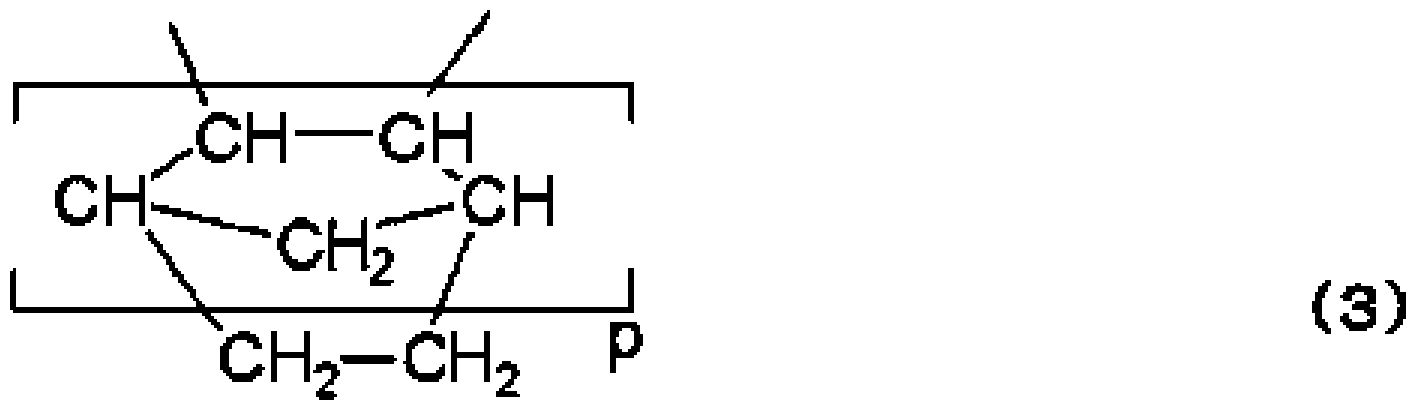
- the group is represented by the general formula (3);
- R 2 is a hydrogen atom.
- cyclic Orefin-based polymer and E styrene, tetracyclo [4. 4. 0. I 2 '5 . 1 "°] -3- dodecene (hereinafter, TD Most preferred among all is a polymer obtained by random addition polymerization.
- the copolymerization type is completely controlled in the present invention.
- Various known copolymerization types such as random copolymer, block copolymer, alternating copolymerization, and the like can be applied.
- a random copolymer is preferable.
- the cyclic olefin-based polymer used in the present invention does not impair the good physical properties of the cyclic olefin-based resin composition (C) of the present invention! Have repeating structural units derived from monomers!
- the copolymerization ratio is not limited, but is preferably 20 mol% or less, more preferably 10 mol% or less.
- the cyclic olefin-based resin composition (C) of the present invention is used as, for example, an optical component, a highly accurate optical component that does not impair the optical physical properties can be obtained when the value is not more than the above numerical value.
- the type of copolymerization is not limited, but a random copolymer is preferred.
- the molecular weight of the cyclic olefin-based polymer is not limited. However, when the intrinsic viscosity [r?] Is used as an alternative index of molecular weight, the intrinsic viscosity measured in decalin at 135 ° C [7?
- the force is preferably 0.03 to: LOdlZg, more preferably 0.05 to 5 dlZg, and most preferably 0.12 to 2 dlZg.
- the molecular weight is not more than the upper limit of the above range, the moldability is not impaired, and if it is not less than the lower limit, the toughness of the molded article is not impaired.
- the glass transition temperature is not particularly limited, but is preferably 50 to 240 ° C. More preferably, it is 50 to 160 ° C. Of these, the temperature is most preferably 100 to 150 ° C. If the glass transition temperature is not more than the upper limit of the above range, good melt moldability can be obtained, and if the glass transition temperature is not less than the lower limit, use at a high temperature is possible. Thus, the balance of these physical properties is excellent within the above numerical range.
- the measuring device is not limited, but for example, it can be obtained by measuring with a differential scanning calorimeter (DSC), DSC-20 manufactured by SEIKO ELECTRONIC INDUSTRIAL CO., LTD. In wear.
- DSC differential scanning calorimeter
- the cyclic olefin-based polymer can be produced by the following method.
- JP-A-7-145213 uses ethylene and cyclic olefin represented by the formula [I] or [II] described later. It can be manufactured by the disclosed manufacturing method. Among these, this copolymerization is carried out in a hydrocarbon solvent, and a catalyst formed by using a vanadium compound soluble in the hydrocarbon solvent and an organoaluminum compound as a catalyst. It is preferred to produce random copolymers.
- a solid Group 4 meta-locene catalyst can also be used.
- the solid Group 4 metallocene catalyst is composed of a transition metal compound containing a ligand having a cyclopentadienyl skeleton, an organoaluminum compound, and an organic aluminum compound blended as necessary. It is a catalyst.
- the transition metal of Group 4 is zirconium, titanium, or hafnium, and these transition metals have a ligand containing at least one cyclopentagenyl skeleton.
- examples of the ligand containing a cyclopentagel skeleton include a cyclopentagel group or an indul group, a tetrahydroindul group, and a fluorenyl group, which may be substituted with an alkyl group. . These groups may be bonded via other groups such as an alkylene group.
- the ligand other than the ligand containing a cyclopentagel skeleton is an alkyl group, a cycloalkyl group, an aryl group, an aralkyl group, or the like.
- organoaluminum compound and the organoaluminum compound those usually used in the production of polyolefin resins can be used.
- examples of such a solid Group 4 metallocene catalyst are described in, for example, JP-A-61-221206, JP-A-64-106 and JP-A-2-173112.
- cyclic olefin-based polymer is a ring-opening polymer or a ring-opening copolymer
- a cyclic olefin monomer represented by the formula [I] described below is used.
- Polymerization or copolymerization can be used to produce the product.
- Examples of such ring-opening polymerization catalysts include ruthenium, rhodium, palladium, osmium, A catalyst consisting of a selected metal halide, nitrate or acetylacetone compound and a reducing agent, or a selected metal halide or acetylacetone compound such as titanium, noradium, zirconium or molybdenum.
- a catalyst comprising an organic aluminum compound can be used.
- the cyclic olefin-based resin composition (A) it is preferable to use a reaction solution after the production of the cyclic olefin-based polymer as described above.
- the cyclic olefin-based resin composition (A) comprises a cyclic olefin-based polymer, an unreacted unsaturated hydrocarbon compound, a solvent, and the like.
- n is 0 or 1
- m is 0 or a positive integer
- q is 0 or 1.
- R a and R b are each independently the following atoms or hydrocarbon groups.
- each bond is bonded to form a 5-membered ring.
- R a and R b are each independently a hydrogen atom, a halogen atom or a hydrocarbon group.
- the halogen atom is a fluorine atom, a chlorine atom, a bromine atom or an iodine atom.
- Examples of the hydrocarbon group include, independently of each other, usually an alkyl group having 1 to 20 carbon atoms, a cycloalkyl group having 3 to 15 carbon atoms, and an aromatic hydrocarbon group. More specifically, examples of the alkyl group include a methyl group, an ethyl group, a propyl group, an isopropyl group, an amyl group, a hexyl group, an octyl group, a decyl group, a dodecyl group, and an octadecyl group.
- Examples of the aromatic hydrocarbon group include a cyclohexyl group, and examples of the aromatic hydrocarbon group include a fullyl group and a naphthyl group. These hydrocarbon groups may be substituted with halogen atoms.
- the carbon atom numbered 1 or 2 represents a carbon atom to which R 15 (R 16 ) or R 17 (R 18 ) is bonded in the formula [I], respectively. ing. R 15 and R 16 , or R 17 and R 18 may form an alkylidene group.
- alkylidene groups are usually alkylidene groups having 2 to 20 carbon atoms, and specific examples of such alkylidene groups include ethylidene group, propylidene group and isopropylidene group.
- R 1 to R 19 are each independently a hydrogen atom, a halogen atom, a hydrocarbon group or a alkoxy group.
- the halogen atom has the same meaning as the halogen atom in the above formula [I].
- the hydrocarbon group is independently an alkyl group having 1 to 20 carbon atoms, a halogenated alkyl group having 1 to 20 carbon atoms, a cycloalkyl group having 3 to 15 carbon atoms, or an aromatic hydrocarbon group. Is mentioned. More specifically, examples of the alkyl group include a methyl group, an ethyl group, a propyl group, an isopropyl group, an amyl group, a hexyl group, an octyl group, a decyl group, a dodecyl group, and an octadecyl group.
- a cyclohexyl group includes an aryl group and an aralkyl group, specifically, a phenyl group, a tolyl group, a naphthyl group, a benzyl group, and a phenyl group.
- the alkoxy group include a methoxy group, an ethoxy group, and a propoxy group. These hydrocarbon groups and alkoxy groups may be substituted with a fluorine atom, a chlorine atom, an aromatic atom or an iodine atom.
- the carbon atom to which R 9 and R 1Q are bonded and the carbon atom to which R 13 is bonded and the carbon atom or R 11 is bonded are directly or the number of carbon atoms. It may be bonded through 1 to 3 alkylene groups. That is, when the above two carbon atoms are bonded via an alkylene group, the group represented by R 9 and R 13 or the group represented by R 1Q and R 11 cooperate with each other to form a methylene group. (-CH-), ethylene group (-CH CH-) or pro
- An alkylene group of any one of the pyrene groups (—CH 2 CH 2 CH 2 —) is formed. More
- R 15 and R 12 or R 15 and R 19 may be bonded to each other to form a monocyclic or polycyclic aromatic ring.
- hydrocarbon group examples include 5-methyl, 5,6 dimethyl, 1-methyl, 5-ethyl, 5-n-butyl, 5-isobutyl, 7-methyl, 5-phenyl, 5- Methyl-5-phenol, 5-benzyl, 5-trilyl, 5- (ethylphenol), 5— (isopropylphenol), 5— (biphenyl), 5 (j8-naphthyl), 5— ( ⁇ -naphthyl), 5- (anthracyl), 5,6-diphenyl and the like can be exemplified.
- Examples include bicyclo [2.2.1] -2-heptene derivatives such as 1,4-methanone 1,4,4a, 5,10,10a-hexahydroanthracene.
- hydrocarbon group examples include 8-methyl, 8 ethyl, 8 propyl, 8 butyl, 8-isobutyl, 8 hexyl, 8 cyclohexyl, 8-stearyl, 5, 10-dimethylol, 2, 10 Dimethinole, 8, 9 Dimethinore, 8 Ethinole 9-Methylenore, 11,12 Dimethyl, 2, 7, 9 Trimethyl, 2,7 Dimethyl-9 Ethyl, 9-Isobutyl-2,7 Dimethyl, 9, 11, 12 Trimethyl, 9-ethyl-11,12-dimethyl, 9-isobutyl-11,12-dimethyl, 5, 8, 9, 10-tetramethyl, 8-ethylidene, 8-ethylidene-9-methyl, 8-ethylidene-9-ethyl, 8 —Ethylidene—9-isopropyl, 8-ethylidene—9—butyl, 8—n—propylidene,
- Still other derivatives include adducts of caseenylene and cyclopentagen.
- cyclic olefin monomer represented by the general formula [I] or [II] are shown above, but more specific structural examples of these compounds are disclosed in JP-A-7-145213. Examples of the structure of the cyclic olefin monomer shown in paragraph numbers [0032] to [0054] of the specification can be given.
- the cyclic olefin-based resin used in the present invention is the above-mentioned cyclic olefin Physical strength Contains two or more derived units.
- the cyclic olefin monomer represented by the general formula [I] or [II] as described above is produced by subjecting cyclopentagen and an olefin having a corresponding structure to a Diels-Alder reaction. Can do.
- the purity of the cyclic olefin monomer used for the polymerization is preferably higher. Usually, it is 99% or more, preferably 99.6% or more, more preferably 99.9% or more.
- the method for producing the cyclic olefin-based resin composition (B) of the present invention is a method for hydrogenating at least an unsaturated hydrocarbon compound in the cyclic olefin-based resin composition (A).
- the polymerization catalyst and oxide used in the production of the cyclic olefin-based polymer before supplying the cyclic polyolefin-based resin composition (A) into the reactor. It is preferable to pass through an adsorption device for removing by-products such as.
- the adsorber is filled with adsorbents such as activated clay, activated carbon, diatomaceous earth, pearlite, alumina, nickel, silica and silica alumina.
- adsorbents such as activated clay, activated carbon, diatomaceous earth, pearlite, alumina, nickel, silica and silica alumina.
- a treatment with an adsorbent and a filtration treatment can be used in combination. The treatment conditions using the adsorbent will be described later.
- the hydrogenation treatment of the unsaturated hydrocarbon compound can be performed by hydrogenating the unsaturated hydrocarbon compound in the presence of the hydrogenation catalyst in the cyclic olefin-based resin composition (A). it can.
- the ring-opening polymer or the ring-opening copolymer is generally used after hydrogenation.
- an unsaturated hydrocarbon compound such as an unreacted cyclic olefin monomer and a ring-opening polymer or a ring-opening copolymer are simultaneously obtained. It is preferable because hydrogen can be added and the reaction is simple.
- the method for hydrogenating an unsaturated hydrocarbon compound is not particularly limited, and a known method can be applied.
- the hydrogenation reaction can be carried out by bringing the resin composition (A) in a solution state into contact with hydrogen in the presence of a hydrogenation catalyst according to a conventional method.
- hydrogenation catalysts include homogeneous catalysts and Heterogeneous catalysts can be used. Heterogeneous catalysts are highly active at high temperatures and pressures, can be hydrogenated in a short time, and have excellent production efficiency such as being easy to remove.
- heterogeneous catalyst examples include a catalyst in which a metal selected from the group consisting of nickel, ruthenium, rhenium, platinum, palladium and rhodium force is supported on a carrier.
- the carrier is not particularly limited.
- an adsorbent such as alumina or diatomaceous earth can be used for supporting a hydrogenation catalyst metal.
- the supported amount of nickel is 20 to 80% by weight, preferably 30 to 60% by weight.
- the supported amount of palladium and platinum is 0.1 to: L0% by weight, preferably 2 to 7% by weight.
- the shape may be used according to the device to be used, such as powder or solid.
- any reaction vessel can be used for the hydrogenation reaction, but it is preferable to use a fixed bed reactor in terms of continuous operation.
- the fixed bed reactor include (a) a packed tower or plate tower reactor, (b) a fixed catalyst reactor, and (c) a wire mesh or thin layer catalyst reactor.
- the cyclic olefin-based resin composition (A) in a solution state and hydrogen gas are in cross-flow contact and countercurrent. Contact or co-current contact.
- the fixed catalyst reactor (b) can be classified into an isothermal layer type, a heat insulation layer type, a multi-stage heat insulation layer type, a self-heat exchange type, an external heat exchange type, and the like. Can also be used.
- Representative examples of fixed catalyst reactors (b) include those of the type described in JH Gary and GE Salesforce: Petroleum 'Refying' Technology One 'and' Economics (1975) p74, ie bottom Ceramic balls are filled in the reactor, and catalyst particles are filled in the center of the reactor, and a mixture of the cyclic olefin-based resin composition (A) and gas in a solution state is supplied from the top of the reactor to react. And a reactor configured to discharge reaction products from the lower end of the reactor.
- the metal mesh or thin layer catalyst reactor (c) is a reactor equipped with several to several tens of metal mesh or granular catalyst as a catalyst. Force divided into radial flow type and parallel flow type depending on how the cyclic olefin-based resin composition (A) in the solution state flows. It may be a method.
- the cyclic olefin-based resin composition (A) flows in the form of a film on the surface of the catalyst particles.
- the flow direction of the cyclic olefin-based resin composition (A) in the solution state and the hydrogen gas may be either cocurrent or countercurrent, but the cocurrent flow method is preferred because the operating conditions can be easily changed.
- the reactor to be used is a reactor equipped with a fixed bed filled with a hydrogenation catalyst.
- This reactor is filled with a solution of a cyclic olefin-based resin composition (A) in the reactor, and hydrogen is blown into the resin composition (A) with the catalyst-packed fixed layer immersed therein.
- It is configured as follows. Usually, the reaction is carried out batchwise. An example of a typical reactor was mounted on a reactor, ie a rotating shaft, as described in the journal 'Ob'Chemical'Engineering'Ob'Japan, 27, 3 (1994) p310.
- a stainless steel cylindrical net basket filled with catalyst particles in a frame is attached as a fixed layer, and further includes a stirrer.
- the reactor is filled with a solution of the cyclic olefin-based resin composition (A), and the catalyst-filled basket is immersed in the resin composition (A) with the catalyst-filled basket around the rotation axis. While rotating and stirring the resin composition (A), hydrogen gas is injected into the lower part of the reactor.
- a cage filled with a catalyst in a double cylinder of a double cylindrical net basket as a fixed layer is arranged with a slight gap from the inner wall of the reactor, and at the center of the double cylinder.
- a reactor with a stirring blade attached to the rotating shaft is also used.
- the cyclic olefin-based resin composition (A) used in the hydrogenation method is a solution in which a cyclic olefin-based polymer, an unsaturated hydrocarbon compound, and the like are dissolved in an organic solvent. is there.
- This resin composition (A) is supplied to the reactor in a solution state and subjected to hydrogenation treatment.
- the cyclic olefin-based resin composition (A) is obtained as a reaction solution after the production of the cyclic olefin-based polymer, and an organic solvent having a strength not more than that required to add an organic solvent can also be added.
- Such an organic solvent is not particularly limited as long as it is inert to the catalyst, but a hydrocarbon solvent is usually used because it is excellent in solubility of the resulting hydrogenated product.
- hydrocarbon solvents include For example, aromatic hydrocarbons such as benzene and toluene; aliphatic hydrocarbons such as n-pentane and hexane; alicyclic hydrocarbons such as cyclohexane, methylcyclohexane, decalin, and bicyclononane; Among these, cyclic alicyclic hydrocarbons are preferable.
- These organic solvents can be used alone or in combination of two or more. Usually, it may be the same as the polymerization reaction solvent.
- the hydrogenation reaction can be performed according to a conventional method.
- the hydrogenation rate varies depending on the type of hydrogenation catalyst and the reaction temperature, and the residual rate of the aromatic ring can also be varied.
- the reaction temperature may be lowered, the hydrogen pressure may be lowered, or the reaction time may be shortened.
- the operation temperature of the hydrogenation which is preferably below the decomposition temperature of the monomer is 0 to 150 °. C. Preferably, it is 60 to 130 ° C, more preferably 80 to 120 ° C.
- the pressure is 1 to 50 kgZcm 2 , preferably 1 to 30 kgZcm 2 , more preferably 1 to 20 kg / cm 2 .
- the reaction time depends on the hydrogenation catalyst used, but it is 1 hour or less, preferably 30 minutes or less.
- LHSV in the hydrogenation reaction is usually 1 to 10, preferably 3 to 5.
- LHSV is the reciprocal of residence time, and is obtained by polymerizing a cyclic olefin monomer in a hydrocarbon solvent, and a cyclic olefin-based resin composition containing an unreacted cyclic olefin-based monomer. It can be calculated by dividing the feed flow rate of (A) by the catalyst filling volume.
- the cyclic olefin-based resin composition in a solution state discharged from the fixed bed reactor is introduced into a separator such as a flash separator, and a cyclic olefin-based system in which a saturated hydrocarbon compound is hydrogenated. Separating the resin composition (B) and unreacted hydrogen. The separated hydrogen can be recycled to the hydrogenation reactor.
- a separator such as a flash separator
- the cyclic olefin-based resin composition (B) contains a saturated hydrocarbon compound having a boiling point of 50 ° C. or higher, obtained by hydrogenating the unsaturated hydrocarbon compound described above.
- the saturated hydrocarbon compound is used in an amount of 0.01 to 100 parts by weight of the cyclic olefin-based resin composition (A).
- unsaturated hydrocarbon compounds comprising up to 20 parts by weight, 80% by weight or more, preferably 90% by weight or more, more preferably 98% by weight or more, particularly preferably 98-: LOO% by weight is added with hydrogen. Obtained.
- the cyclic olefin-based resin contained in the cyclic olefin-based resin composition (A) is also appropriately hydrogenated.
- the cyclic olefin-based resin composition (B) includes one or two or more types of cyclic olefin-based resin represented by the following general formula (4).
- X and y represent copolymerization ratios and are real numbers satisfying 0Zl00 ⁇ yZx ⁇ 95Z5.
- X and y are on a molar basis.
- n represents the number of substitutions of the substituent Q, and is an integer of 0 ⁇ n ⁇ 2.
- R 4 is a 2 + n-valent group in which a group force consisting of a hydrocarbon group having 2 to 20 carbon atoms is also selected, and a plurality of R 4 may be the same or different.
- R 5 is a monovalent group selected from a hydrogen atom or a hydrocarbon group having 1 to 10 carbon atoms composed of carbon and hydrogen, and a plurality of R 5 may be the same or different. Good
- R 6 is a tetravalent group in which a group force consisting of a hydrocarbon group having 2 to 10 carbon atoms is also selected, and a plurality of R 6 may be the same or different.
- Q is represented by COOR 7 (R 7 is a monovalent group selected from the group consisting of a hydrogen atom or a hydrocarbon group having 1 to 10 carbon atoms consisting of carbon and hydrogen).
- R 7 is a monovalent group selected from the group consisting of a hydrogen atom or a hydrocarbon group having 1 to 10 carbon atoms consisting of carbon and hydrogen).
- the existing Qs may be the same or different.
- R 4 group is a group having at least one ring structure in the structure.
- R 6 is an exemplary structure (a), (b): (c):
- R 4 is a 2 + n-valent group selected from the group consisting of hydrocarbon groups having 2 to 20 carbon atoms).
- yZx is a real number satisfying 20Z80 ⁇ yZx ⁇ 65Z35 on a molar basis.
- R 5 is a hydrogen atom or —CH, and a plurality of R 5 are the same or different.
- Q is -COOH or -COOCH group.
- the cyclic olefin polymer preferably has one or two or more structures represented by the following general formula (5), and the above preferable conditions are used in combination as necessary.
- R 4 group is represented by the general formula (6);
- R 5 is a hydrogen atom.
- cyclic Orefin-based polymer and E styrene, tetracyclo [4. 4. 0. I 2 '5 . 1 "°] -3- dodecene (hereinafter, TD Most preferred among all is a polymer obtained by random addition polymerization.
- cyclic olefin-based polymer various known copolymerization types such as random copolymer, block copolymer, and alternating copolymerization, which are not limited in the present invention, can be applied.
- a random copolymer is preferable.
- the cyclic olefin-based polymer used in the present invention does not impair the good physical properties of the cyclic olefin-based resin composition (C) of the present invention! Have repeating structural units derived from monomers!
- the copolymerization ratio is not limited, but is preferably 20 mol% or less, more preferably 10 mol% or less.
- the cyclic olefin-based resin composition (C) of the present invention is used as, for example, an optical component, a highly accurate optical component that does not impair the optical physical properties can be obtained when the value is not more than the above numerical value.
- the type of copolymerization is not limited, but a random copolymer is preferred.
- the molecular weight of the cyclic olefin-based polymer is not limited, but is an alternative to molecular weight.
- limiting viscosity [r?] Is used as a standard, limiting viscosity measured in decalin at 135 ° C [7?
- the force is preferably 0.03 to: LOdlZg, more preferably 0.05 to 5 dlZg, and most preferably 0.12 to 2 dlZg.
- the molecular weight is not more than the upper limit of the above range, the moldability is not impaired, and if it is not less than the lower limit, the toughness of the molded article is not impaired.
- the glass transition temperature is not particularly limited, but is preferably 50 to 240 ° C. More preferably, it is 50 to 160 ° C. Of these, the temperature is most preferably 100 to 150 ° C. If the glass transition temperature is not more than the upper limit of the above range, good melt moldability can be obtained, and if the glass transition temperature is not less than the lower limit, use at a high temperature is possible. Thus, the balance of these physical properties is excellent within the above numerical range.
- the measuring device is not limited, but for example, it can be obtained by measuring with a differential scanning calorimeter (DSC), DSC-20 manufactured by SEIKO ELECTRONIC INDUSTRIAL CO., LTD. I can do it.
- DSC differential scanning calorimeter
- the catalyst it is not necessary to remove the catalyst from the cyclic olefin-based resin composition (B), but it may be harmful if residual transition metals such as medical equipment are eluted. For applications, it is preferred that substantially no transition metal remains. Therefore, it is preferable to perform centrifugation, filtration, etc. after the hydrogenation treatment. If necessary, a catalyst deactivator such as water or alcohol may be used, or an adsorbent such as activated clay or alumina may be added. Further, in order to obtain such a polymer hydrogenated product, it is disclosed in JP-A-5-317411 and the like, such as adsorption of alumina having a specific pore volume and specific surface area. It is preferable to use an agent or to wash the cyclic olefin-based resin composition (B) in a solution state with acidic water and pure water.
- the centrifugation method and the filtration method are not particularly limited as long as the used catalyst can be removed. Removal by filtration is preferred because it is simple and efficient. When filtering, it may be filtered under pressure or suction, and from the viewpoint of efficiency, it is preferable to use a filter aid such as diatomaceous earth or pearlite. [0086] (Method for treating adsorbent of cyclic olefin-based resin composition (B))
- the resin composition (B) is adsorbed by an adsorption device. It is preferable to pass through.
- the adsorption device is filled with an adsorbent such as activated clay, activated carbon, diatomaceous earth, pearlite, alumina, nickel, silica, silica alumina, molecular sieve. Adsorption treatment and filtration treatment can be used in combination.
- the treatment with the adsorbent may be performed before the hydrogenation treatment of the cyclic olefin-based resin composition (A) or may be performed on the cyclic polyolefin-based resin composition (B) after the hydrogenation treatment. It can also be done by coexisting a hydrogenated calo catalyst and an adsorbent in the hydrogenation reactor.
- the temperature of the cyclic olefin-based resin composition (B) during the adsorption treatment is 0 to 200 ° C, preferably 20 to 150 ° C. If it exceeds 200 ° C, the cyclic olefin-based polymer is deteriorated, which is not preferable.
- the residence time is 10 to 60 minutes, preferably 20 to 40 minutes.
- the cyclic olefin-based resin composition (C) is obtained by removing a part of the solvent and the saturated hydrocarbon compound contained in the cyclic olefin-based resin composition (B). For the purpose of reusing the unreacted monomer in the polymerization reaction, a part of the unsaturated hydrocarbon compound contained in the cyclic olefin-based resin composition (A) is removed, and the cyclic olefin-based resin is removed. When the content of the saturated hydrocarbon compound contained in the composition (B) is reduced, the solvent is mainly removed from the cyclic olefin-based resin composition (B).
- the cyclic olefin-based resin composition (C) can be obtained by recovering the polymer from the cyclic olefin-based resin composition (B) by precipitation.
- a deposition method a method using a thin film evaporator or a double tube flash method can be arbitrarily selected, and a plurality of deposition methods may be used in combination.
- molecular chains are likely to be broken due to shear stress from the molecular structure! /
- the cyclic olefin-based resin composition (B) in a solution state is usually first heated using a double tube heater. Then, using this heater, The polyolefin resin composition (B) is heated, and it is preferable that the concentration of the cyclic olefin polymer is usually adjusted to 1 to 30% by weight.
- the heating temperature needs to be a temperature sufficient for sufficiently evaporating the solvent in the cyclic olefin-based resin composition (B) in the solution state during the next flash drying step.
- the heating temperature needs to be a temperature sufficient for sufficiently evaporating the solvent in the cyclic olefin-based resin composition (B) in the solution state during the next flash drying step.
- In the 40-400. Preferably 100-300. . It is.
- the cyclic olefin-based resin composition preferably subjected to the heating step as described above.
- the saturated hydrocarbon compound hydrogenated together with the polymerization solvent and the unhydrogenated unsaturated hydrocarbon compound are separated and removed.
- the saturated hydrocarbon compound is not completely removed from the resin composition (B) after the unsaturated hydrocarbon is hydrogenated, but a part of it remains. .
- the saturated hydrocarbon compound is contained in an amount of 0.01 to 10 parts by weight with respect to 100 parts by weight of the cyclic olefin-based polymer.
- this unsaturated hydrocarbon is obtained by subjecting the cyclic olefin-based resin composition containing an unsaturated hydrocarbon compound such as a monomer to a drying treatment. The compound was removed as much as possible.
- the present applicants examined and found that a saturated hydrocarbon compound obtained by hydrogenating the unsaturated hydrocarbon compound in the cyclic olefin-based resin composition containing the unsaturated hydrocarbon compound was obtained.
- a cyclic olefin-based resin composition having excellent moldability and the like can be obtained by adding the cyclic olefin-based polymer in a predetermined amount, and further, it has excellent fluidity.
- the present inventors have found that a molded article having extremely excellent optical properties such as light transmittance can be obtained by suppressing deterioration of the resin caused by shearing between the two and the present invention. Therefore, in the production process of the present invention, it is important to produce the cyclic olefin-based polymer so as to contain a predetermined amount of a saturated hydrocarbon compound.
- the solution-form cyclic olefin-based resin composition (B) that has been subjected to the heating step under the above conditions is flash-dried to 100 parts by weight of the cyclic olefin-based polymer.
- a cyclic olefin polymer (C) containing 0.01 to 10 parts by weight of a saturated hydrocarbon compound is produced.
- the temperature at which the cyclic olefin-based polymer in the cyclic olefin-based resin composition (B) does not solidify specifically 120 to 300 ° C., preferably 130 to 240 ° C.
- the fat composition (B) it is preferable to add to the fat composition (B).
- the cyclic olefin-based resin composition (B) is flash-dried as described above, at least about 0.3 m / second is used in order to prevent the heat transfer surface of the double tube heater from becoming dirty. It is preferable to supply the cyclic olefin-based resin composition (B) in a solution state at a rate into the double tube heater.
- the cyclic olefin-based resin composition (C) containing a specific unsaturated hydrocarbon compound having a boiling point of 50 ° C. or higher according to the present invention can be produced, for example, by a double-tube type flat resin by such a production method. It can be efficiently obtained by the above-described manufacturing conditions using the Shu drying method.
- the cyclic olefin-based resin composition (C) of the present invention can be obtained by the production method of the present invention described above, and is a saturated hydrocarbon having a boiling point of 50 ° C. or more with respect to 100 parts by weight of the cyclic olefin-based polymer. Compound 0.01-: LO parts by weight. In the present invention, it is not excluded at all that the cyclic olefin-based resin composition (C) contains a slight amount of a solvent and an unsaturated hydrocarbon compound as long as the effects of the present invention are not impaired. Absent.
- the saturated hydrocarbon compound When the saturated hydrocarbon compound is within the above range, transferability during molding, that is, so-called poor appearance of the molded body due to insufficient flowability during molding, and coloring due to thermal history such as residence at high temperatures may occur.
- a cyclic olefin-based resin composition that can be easily controlled and molded can be obtained.
- the cyclic olefin-based resin composition (C) has one or more structural forces represented by the following general formula (4).
- the following cyclic olefin-based rosin is included.
- X and y represent copolymerization ratios and are real numbers satisfying OZlOO ⁇ yZx ⁇ 95Z5.
- X and y are on a molar basis.
- n represents the number of substitutions of the substituent Q, and is an integer of 0 ⁇ n ⁇ 2.
- R 4 is a 2 + n-valent group in which a group force consisting of a hydrocarbon group having 2 to 20 carbon atoms is also selected, and a plurality of R 4 may be the same or different.
- R 5 is a monovalent group selected from a hydrogen atom or a hydrocarbon group having 1 to 10 carbon atoms composed of carbon and hydrogen, and a plurality of R 5 may be the same or different. Good
- R 6 is a tetravalent group in which a group force consisting of a hydrocarbon group having 2 to 10 carbon atoms is also selected, and a plurality of R 6 may be the same or different.
- Q is represented by COOR 7 (R 7 is a monovalent group selected from the group consisting of a hydrogen atom or a hydrocarbon group having 1 to 10 carbon atoms consisting of carbon and hydrogen).
- R 7 is a monovalent group selected from the group consisting of a hydrogen atom or a hydrocarbon group having 1 to 10 carbon atoms consisting of carbon and hydrogen).
- the existing Qs may be the same or different.
- IT is a 2 + n-valent group in which a group force consisting of a hydrocarbon group having 2 to 20 carbon atoms is also selected). [3] n is 0.
- yZx is a real number satisfying 20Z80 ⁇ yZx ⁇ 65Z35 on a molar basis.
- R 5 is a hydrogen atom or —CH, and a plurality of R 5 are the same or different.
- Q is -COOH or -COOCH group.
- the cyclic olefin polymer preferably has one or more structures represented by the following general formula (5), and the above-mentioned preferable conditions are used in combination as necessary.
- R 4 group is represented by the general formula (6);
- ⁇ is an integer of 0 to 2). Furthermore, it is preferably a divalent group in which ⁇ is 1 in the general formula (6).
- R 5 is a hydrogen atom.
- a cyclic olefin-based polymer is And styrene, tetracyclo [4. 4. 0. I 2 '5 . 1 "°] -3- dodecene (hereinafter abbreviated as TD) in it all is a polymer obtained by random addition polymerization of Most preferred.
- cyclic olefin-based polymer various known copolymerization types such as random copolymer, block copolymer, and alternating copolymerization, which are not limited in the present invention, can be applied.
- a random copolymer is preferable.
- the cyclic olefin-based polymer used in the present invention does not impair the good physical properties of the cyclic olefin-based resin composition (C) of the present invention! Have repeating structural units derived from monomers!
- the copolymerization ratio is not limited, but is preferably 20 mol% or less, more preferably 10 mol% or less.
- the cyclic olefin-based resin composition (C) of the present invention is used as, for example, an optical component, a highly accurate optical component that does not impair the optical physical properties can be obtained when the value is not more than the above numerical value.
- the type of copolymerization is not limited, but a random copolymer is preferred.
- the molecular weight of the cyclic olefin-based polymer is not limited. However, when the intrinsic viscosity [r?] Is used as an alternative index of molecular weight, the intrinsic viscosity measured in decalin at 135 ° C [7?
- the force is preferably 0.03 to: LOdlZg, more preferably 0.05 to 5 dlZg, and most preferably 0.12 to 2 dlZg.
- the molecular weight is not more than the upper limit of the above range, the moldability is not impaired, and if the molecular weight is not less than the lower limit, the toughness of the molded article is not impaired.
- the glass transition temperature is not particularly limited, but is preferably 50 to 240 ° C. More preferably, it is 50 to 160 ° C. Of these, the temperature is most preferably 100 to 150 ° C. If the glass transition temperature is not more than the upper limit of the above range, good melt moldability can be obtained, and if the glass transition temperature is not less than the lower limit, use at a high temperature is possible. Thus, within the above numerical range The balance of these physical properties is excellent.
- the measuring device is not limited, but for example, it can be obtained by measuring with a differential scanning calorimeter (DSC), DSC-20 manufactured by SEIKO ELECTRONIC INDUSTRIAL CO., LTD. I can do it.
- DSC differential scanning calorimeter
- the cyclic olefin-based polymer contained in the cyclic olefin-based resin composition (C) is appropriately hydrogenated and calcined by the above-described cyclic olefin-based polymer through the above-described hydrogenation treatment step. Obtained.
- the saturated hydrocarbon compound is obtained, for example, by hydrogenating an unsaturated hydrocarbon compound by the above hydrogenation treatment, and has a boiling point of 50 ° C or higher, preferably a boiling point of 100 ° C or higher. Is preferably 200 ° C or higher, and most preferably 210 ° C or higher. It is preferable that the boiling point is in the above-mentioned range without volatilizing during molding and deteriorating the appearance of the molded product. The boiling point can be measured by a known method.
- the cyclic olefin-based resin composition (C) of the present invention includes, in addition to the above-described components, a known weather stabilizer, heat resistance, and the like as long as the good characteristics of the optical component of the present invention are not impaired.
- a stabilizer, an antistatic agent, a flame retardant, a slip agent, an antiblocking agent, an antifogging agent, a lubricant, a natural oil, a synthetic oil, a wax, an organic or inorganic filler, and the like may be blended.
- the weathering stabilizer blended as an optional component is, for example, a known hindered amine additive, a benzophenone compound, a benzotriazole compound, a nickel compound, a hindered amine compound, etc.
- a known hindered amine additive for example, a known hindered amine additive, a benzophenone compound, a benzotriazole compound, a nickel compound, a hindered amine compound, etc.
- examples include UV absorbers
- the hindered amine light stabilizer is usually composed of 3,5 di-tert-butyl-4-hydroxyphenenole group, and 2, 2, 6, 6-teramethino lebi pedizinore group or 1, 2, 2, 6, 6 Pentamethyl-4 A compound having a piperidyl group.
- benzotriazole ultraviolet absorber examples include 2- (5-methyl-2-hydroxyphenyl) benzotriazole, 2,2-hydroxy-1,3,5-bis ( ⁇ , ⁇ -dimethylbenzyl) phenol.
- 2-L 2- (2,1-hydroxy-1,5-methyl-phenyl) benzotriazole, 2- (2, -hydroxy-3,5, -di-tert-butyl-phenol) benzotriazole, 2 -(2, 1-hydroxy-1, 3-t-butyl-5, 1-methyl-phenol) 5 Chrono 'benzotriazole, 2- (2, 1-hydroxy-1, 3, 5, 1-di-tert-butyl- 1-phenyl) ) 5 Kuroguchi Benzotriazole, 2- (2,1hydroxy-1,4,1n-Otoxy 'phenol) benzotriazole, and other commercially available Tinuvin 328 and Tinuvin PS ), Or SEESORB709 (2— (2,1hydroxy-1,5t) Hue - Le) Ben Zotoriazo
- benzophenone UV absorbers include 2,4-dihydroxy 'benzophenone, 2 hydroxy-4-methoxy' benzophenone, 2, 2'-dihydroxy-4-methoxy 'benzophenone, 2, 2, -dihydroxy 4 , 4'-dimethoxy 'benzophenone, 2, 2, 1-dihydroxy-1, 4, 4, 1-dimethoxy-1-5-sulfobenzophenone, 2-hydroxy-1-4-methoxy-2'-power noroxy 'benzophenone, 2-hydroxy-4-methoxy-5-snurefo Benzophenone 'Trihydrate, 2 Hydroxy 4 n Otoxy Benzophenone, 2 Hydroxy 4-octadecyloxy' Benzophenone, 2 Hydroxy 4- n-Dodecoxy , 4, 4, -tetrahydroxy 'benzopheno , 2-hydroxy-4-dodecyloxybenzobenzoone, 2-hydroxy-1-4- (2-hydroxy-1-3-methacryloxy) prop
- tetrakis [methylene-3- (3,5-di-tert-butyl 4-hydroxyphenol) propionate] methane, j8 (3,5- The Phenolic antioxidants such as —tert-butyl-4-hydroxyphenol) propionic acid alkyl ester, 2, 2, -oxamide bis [ethyl 3- (3,5-ditert-butyl-4-hydroxyphenol) propionate;
- Fatty acid metal salts such as zinc stearate, calcium stearate, calcium 1,2-hydroxystearate;
- polyhydric alcohol fatty acid esters such as glycerin monostearate, glycerin distearate, pentaerythritol monostearate, pentaerythritol distearate, and pentaerythritol tristearate.
- distearyl pentaerythritol diphosphite distearyl pentaerythritol diphosphite, phenol 1,4,4,1 isopropylidenediphenol 1 pentaerythritol diphosphite, bis (2,6 di 1 t-butyl 1 4-methylphenol ) Phosphorus stabilizers such as pentaerythritol diphosphite and tris (2,4 di-t-butylphenol) phosphite may be used. These may be blended singly or in combination.
- tetrakis [methylene-3- (3.5-di-tert-butyl-4-hydroxyphenol) propionate] methane, zinc stearate and glycerin monostearate can be exemplified.
- These stabilizers can be used alone or in combination of two or more.
- the method for mixing the cyclic olefin-based resin composition (C) of the present invention with the additive is not limited, and any known method can be applied. For example, the method of mixing each component simultaneously can be mentioned.
- a molded body can be produced by subjecting the cyclic olefin-based rosin composition (C) of the present invention to a conventional method, pelletizing with an extruder, and injection-molding the pellets.
- the molded body can be used for an optical lens such as a pickup lens for an optical disk optical system, a collimator lens, or various lenses for small imaging.
- the molded body When the molded body is used for an optical application such as an optical lens, it is essential that light is transmitted, and that the light transmittance is good to some extent.
- the light transmittance is defined by the spectral light transmittance or the total light transmittance depending on the application.
- the total light transmittance is good when it is assumed to be used in all light or in multiple wavelength regions. is required.
- the total light transmittance is preferably 85% or more, more preferably 88% or more. Within the above range, the necessary amount of light can be secured even when used in all light rays or in a plurality of wavelength regions.
- a known method can be applied as a measuring method, and the measuring apparatus is not limited.
- ASTM D1003 the total light transmittance of a sheet having a thickness of 3 mm is measured using a haze meter. It can be obtained by measuring.
- the spectral light transmittance in the specific wavelength region is good even though the total light transmittance is not high. Can do.
- the spectral light transmittance at the wavelength used is preferably 85% or more, more preferably 88% or more. If it is within the above range, the necessary light intensity can be ensured.
- the measuring method can be applied as the measuring method, and the measuring apparatus and the like are not limited.
- the spectral light transmittance at a specific wavelength can be measured using an ultraviolet-visible spectrophotometer. it can.
- VOC1 vanadium catalyst
- TD dodecene
- the cyclic olefin-based resin composition (A) After the completion of the polymerization, the cyclic olefin-based resin composition (A) also removed residual catalyst. As a result, in 100 parts by weight of the cyclic olefin-based resin composition (A), 86.3 parts by weight of cyclohexane, 7.7 parts by weight of the cyclic olefin-based polymer, and 6 parts by weight of the monomer composition are contained. It had been.
- the obtained hydrogenated cyclic olefin-based resin composition (B) was subjected to an adsorption treatment using an active alumina (FD-24 manufactured by Sumitomo Chemical Co., Ltd.). Furthermore, after pressure filtration using a commercially available filter, a part of the solvent and monomeric hydrogenated product was removed by heating and drying to obtain a cyclic olefin-based resin composition (C).
- the amount of TD in the cyclic olefin-based resin composition (C) is 4800 ppm, that is, the cyclic olefin-based resin composition (C) is a saturated hydrocarbon compound based on 100 parts by weight of the cyclic olefin-based polymer. Of 0.5 part by weight.
- Solvent and monomer are removed from the cyclic olefin-based resin composition (A) by heating and drying the cyclic olefin-based resin composition (A) obtained in Synthesis Example 1 without performing a hydrogenation treatment. After that, the pellets were passed through an extruder and pelletized, and the pellets were injection molded to produce a 3mm thick square plate. When the spectral light transmittance of this 3 mm square plate at a wavelength of 405 nm was measured, it was 87.1%.
- VOC1 vanadium catalyst
- the cyclic olefin-based resin composition (A) was added to a mixed solvent (50 mlZL) of aceton Zmethanol (volume ratio 1Z1) to which concentrated hydrochloric acid had been added, and the polymer was precipitated, followed by stirring. Filtration through a glass filter and drying under reduced pressure gave a cyclic olefin-based rosin composition.
- the cyclic olefin-based resin composition (A) is used with a palladium Z-alumina catalyst.
- the cyclic olefin-based resin composition (C) of Synthesis Examples b-4 to b-6 was obtained in the same manner as Synthesis Examples b-1 to b-3 except that the hydrogenation treatment was performed.
- the glass transition temperature (Tg), number average molecular weight (Mn), and TD determined by gas chromatography and the content of TD hydrogenated product of the resin composition obtained in each synthesis example are as shown in the following table. It was.
- the cyclic olefin-based resin composition (A) was hydrogenated by passing through a fixed bed reactor containing a hydrogenation catalyst, Similar results were obtained.
- the drying step in this example after the hydrogenation treatment of the cyclic olefin-based rosin composition (A), the rosin composition (B) was converted into the above-described manner using a double tube flash drying method. When the cyclic olefin-based polymer was not solidified and was flash-dried at a temperature, the same result as above was obtained.
Landscapes
- Chemical & Material Sciences (AREA)
- Health & Medical Sciences (AREA)
- Chemical Kinetics & Catalysis (AREA)
- Medicinal Chemistry (AREA)
- Polymers & Plastics (AREA)
- Organic Chemistry (AREA)
- General Chemical & Material Sciences (AREA)
- Dispersion Chemistry (AREA)
- Compositions Of Macromolecular Compounds (AREA)
- Addition Polymer Or Copolymer, Post-Treatments, Or Chemical Modifications (AREA)
Abstract
Description




Claims


Priority Applications (4)
| Application Number | Priority Date | Filing Date | Title |
|---|---|---|---|
| JP2007523333A JP5103177B2 (ja) | 2005-06-30 | 2005-12-21 | 環状オレフィン系樹脂組成物の製造方法および環状オレフィン系樹脂組成物 |
| CN2005800502789A CN101208362B (zh) | 2005-06-30 | 2005-12-21 | 环状烯烃系树脂组合物的制造方法及环状烯烃系树脂组合物 |
| EP05819647.8A EP1908784B1 (en) | 2005-06-30 | 2005-12-21 | Process for producing cycloolefinic resin composition, and cycloolefinic resin composition |
| US11/988,004 US8114942B2 (en) | 2005-06-30 | 2005-12-21 | Process for producing cycloolefin resin composition, and cycloolefin resin composition |
Applications Claiming Priority (2)
| Application Number | Priority Date | Filing Date | Title |
|---|---|---|---|
| JP2005191283 | 2005-06-30 | ||
| JP2005-191283 | 2005-06-30 |
Publications (1)
| Publication Number | Publication Date |
|---|---|
| WO2007004321A1 true WO2007004321A1 (ja) | 2007-01-11 |
Family
ID=37604198
Family Applications (1)
| Application Number | Title | Priority Date | Filing Date |
|---|---|---|---|
| PCT/JP2005/023541 Ceased WO2007004321A1 (ja) | 2005-06-30 | 2005-12-21 | 環状オレフィン系樹脂組成物の製造方法および環状オレフィン系樹脂組成物 |
Country Status (6)
| Country | Link |
|---|---|
| US (1) | US8114942B2 (ja) |
| EP (1) | EP1908784B1 (ja) |
| JP (1) | JP5103177B2 (ja) |
| KR (1) | KR100920557B1 (ja) |
| CN (1) | CN101208362B (ja) |
| WO (1) | WO2007004321A1 (ja) |
Cited By (2)
| Publication number | Priority date | Publication date | Assignee | Title |
|---|---|---|---|---|
| JP2008248171A (ja) * | 2007-03-30 | 2008-10-16 | Mitsui Chemicals Inc | 環状オレフィン系重合体の製造方法 |
| WO2009091224A3 (en) * | 2008-01-18 | 2009-10-22 | Lg Chem, Ltd. | Optical film, preparation method of the same, and liquid crystal display comprising the same |
Families Citing this family (4)
| Publication number | Priority date | Publication date | Assignee | Title |
|---|---|---|---|---|
| JP5335436B2 (ja) * | 2005-12-30 | 2013-11-06 | カウンシル オブ サイエンティフィック アンド インダストリアル リサーチ | テレケリックウレタンアクリレートuv硬化型プレポリマー材料の合成方法 |
| CN107955089B (zh) * | 2016-10-14 | 2020-09-11 | 中国石化扬子石油化工有限公司 | 一种溶液聚合的后处理工艺 |
| CN113227197A (zh) * | 2018-12-27 | 2021-08-06 | 三井化学株式会社 | 光学构件用环状烯烃共聚物、光学构件用环状烯烃共聚物组合物及成型体 |
| CN116217772B (zh) * | 2023-01-10 | 2024-05-28 | 中国科学院长春应用化学研究所 | 一种环烯烃共聚物及其制备方法 |
Citations (5)
| Publication number | Priority date | Publication date | Assignee | Title |
|---|---|---|---|---|
| JPH04170456A (ja) * | 1990-11-01 | 1992-06-18 | Mitsui Petrochem Ind Ltd | 環状オレフィン系樹脂組成物 |
| JP2000038414A (ja) * | 1998-07-23 | 2000-02-08 | Teijin Ltd | 水添α−オレフィン−ジシクロペンタジエン系共重合体からなる成形材料 |
| JP2000063425A (ja) * | 1998-06-10 | 2000-02-29 | Teijin Ltd | 水添α―オレフィン―ジシクロペンタジエン共重合体の製造方法 |
| JP2002069122A (ja) * | 2000-08-31 | 2002-03-08 | Nippon Zeon Co Ltd | 脂環構造含有重合体の製造方法 |
| JP2006022266A (ja) * | 2004-07-09 | 2006-01-26 | Mitsui Chemicals Inc | 環状オレフィン系樹脂組成物とその製造方法 |
Family Cites Families (16)
| Publication number | Priority date | Publication date | Assignee | Title |
|---|---|---|---|---|
| JPH0713084B2 (ja) | 1985-03-26 | 1995-02-15 | 三井石油化学工業株式会社 | 環状オレフイン系共重合体の製法 |
| JP2504959B2 (ja) | 1986-07-09 | 1996-06-05 | 三井石油化学工業株式会社 | 光学用透明基板 |
| JP2504495B2 (ja) | 1987-03-02 | 1996-06-05 | 三井石油化学工業株式会社 | 環状オレフイン系ランダム共重合体の製法 |
| US5128446A (en) * | 1988-09-07 | 1992-07-07 | Mitsui Petrochemical Industries, Ltd. | Process for producing cycloolefin random copolymer |
| JP2730940B2 (ja) | 1988-12-27 | 1998-03-25 | 三井化学株式会社 | 環状オレフィン系共重合体の製造方法 |
| US6174974B1 (en) * | 1996-07-05 | 2001-01-16 | Bayer Aktiengesellschaft | Method for producing thermoplastic elastomers |
| EP0891382B1 (en) * | 1997-01-31 | 2003-05-28 | Teijin Limited | Alpha-olefin-cycloolefin copolymers and process for their production |
| JPH11130842A (ja) | 1997-10-28 | 1999-05-18 | Nippon Zeon Co Ltd | 多環式重合体およびその製造方法 |
| US6232407B1 (en) * | 1998-06-10 | 2001-05-15 | Teijin Limited | Process for producing hydrogenated α-olefin-dicyclopentadiene copolymer, method for molding the same and optical material |
| DE19959374A1 (de) * | 1998-12-11 | 2000-06-15 | Sumitomo Chemical Co | Copolymer, Verfahren zu seiner Herstellung und Formkörper daraus |
| WO2000073366A1 (en) * | 1999-05-31 | 2000-12-07 | Nippon Zeon Co., Ltd. | Process for producing hydrogenated ring-opening polymerization polymer of cycloolefin |
| JP2001106730A (ja) | 1999-10-05 | 2001-04-17 | Mitsui Chemicals Inc | 環状オレフィン系共重合体の製造方法 |
| JP2001316455A (ja) | 2000-04-28 | 2001-11-13 | Nippon Zeon Co Ltd | 脂環構造含有重合体の製造方法および成形体 |
| JP2002105131A (ja) | 2000-09-28 | 2002-04-10 | Mitsui Chemicals Inc | 環状オレフィン系重合体 |
| JP2003311737A (ja) | 2002-04-26 | 2003-11-05 | Mitsui Chemicals Inc | 環状オレフィン系重合体の成形方法 |
| JP2003311773A (ja) | 2002-04-26 | 2003-11-05 | Mitsui Chemicals Inc | 光学部品及びその成形方法 |
-
2005
- 2005-12-21 JP JP2007523333A patent/JP5103177B2/ja not_active Expired - Lifetime
- 2005-12-21 KR KR1020087002395A patent/KR100920557B1/ko not_active Expired - Lifetime
- 2005-12-21 WO PCT/JP2005/023541 patent/WO2007004321A1/ja not_active Ceased
- 2005-12-21 EP EP05819647.8A patent/EP1908784B1/en not_active Expired - Lifetime
- 2005-12-21 CN CN2005800502789A patent/CN101208362B/zh not_active Expired - Lifetime
- 2005-12-21 US US11/988,004 patent/US8114942B2/en not_active Expired - Lifetime
Patent Citations (5)
| Publication number | Priority date | Publication date | Assignee | Title |
|---|---|---|---|---|
| JPH04170456A (ja) * | 1990-11-01 | 1992-06-18 | Mitsui Petrochem Ind Ltd | 環状オレフィン系樹脂組成物 |
| JP2000063425A (ja) * | 1998-06-10 | 2000-02-29 | Teijin Ltd | 水添α―オレフィン―ジシクロペンタジエン共重合体の製造方法 |
| JP2000038414A (ja) * | 1998-07-23 | 2000-02-08 | Teijin Ltd | 水添α−オレフィン−ジシクロペンタジエン系共重合体からなる成形材料 |
| JP2002069122A (ja) * | 2000-08-31 | 2002-03-08 | Nippon Zeon Co Ltd | 脂環構造含有重合体の製造方法 |
| JP2006022266A (ja) * | 2004-07-09 | 2006-01-26 | Mitsui Chemicals Inc | 環状オレフィン系樹脂組成物とその製造方法 |
Cited By (3)
| Publication number | Priority date | Publication date | Assignee | Title |
|---|---|---|---|---|
| JP2008248171A (ja) * | 2007-03-30 | 2008-10-16 | Mitsui Chemicals Inc | 環状オレフィン系重合体の製造方法 |
| WO2009091224A3 (en) * | 2008-01-18 | 2009-10-22 | Lg Chem, Ltd. | Optical film, preparation method of the same, and liquid crystal display comprising the same |
| CN101918886B (zh) * | 2008-01-18 | 2013-01-23 | Lg化学株式会社 | 光学膜、该光学膜的制备方法以及包括该光学膜的液晶显示器 |
Also Published As
| Publication number | Publication date |
|---|---|
| US8114942B2 (en) | 2012-02-14 |
| KR100920557B1 (ko) | 2009-10-08 |
| KR20080031918A (ko) | 2008-04-11 |
| US20090176940A1 (en) | 2009-07-09 |
| EP1908784A1 (en) | 2008-04-09 |
| JP5103177B2 (ja) | 2012-12-19 |
| EP1908784B1 (en) | 2018-10-10 |
| JPWO2007004321A1 (ja) | 2009-01-22 |
| EP1908784A4 (en) | 2011-02-09 |
| CN101208362A (zh) | 2008-06-25 |
| CN101208362B (zh) | 2012-12-12 |
Similar Documents
| Publication | Publication Date | Title |
|---|---|---|
| TWI507431B (zh) | A cyclic olefin ring-opening polymer, a hydride thereof and the hydride composition, and tricyclopentadiene | |
| JPH04202404A (ja) | 開環重合体水素化物の製造方法 | |
| WO2021014962A1 (ja) | 熱可塑性樹脂及びそれを含む光学部材 | |
| WO2016163371A1 (ja) | 共重合体、重合体、成形材料及び樹脂成形体 | |
| JP7269332B2 (ja) | 環状オレフィン系樹脂組成物、成形体および光学部品 | |
| JP5103177B2 (ja) | 環状オレフィン系樹脂組成物の製造方法および環状オレフィン系樹脂組成物 | |
| WO2004033525A1 (ja) | 環状オレフィン系開環共重合体およびその製造方法並びに光学材料 | |
| US5180867A (en) | Copolymerization of dicyclopentadiene with norbornene derivatives | |
| KR101401880B1 (ko) | 위상차 필름 | |
| CN116783243A (zh) | 树脂成型体的再利用方法 | |
| JP2024117739A (ja) | 環状オレフィン系樹脂組成物、成形体および光学部品 | |
| US7202312B2 (en) | Method for preparing cyclic olefin polymer having high bulk density and cyclic olefin polymer prepared thereby | |
| JP2009120755A (ja) | 環状オレフィン重合体の成形体およびその製造方法 | |
| JP5791418B2 (ja) | 新規化合物、重合体、その架橋体、及びそれを有する光学素子 | |
| US20090143523A1 (en) | Cycloolefin additon polymer, composite material and molded article thereof, and optical material | |
| JP2006052326A (ja) | 脂環式構造重合体および該重合体を含む樹脂組成物並びにこれを用いた光学材料 | |
| JP3975770B2 (ja) | ノルボルネン誘導体 | |
| JP2795506B2 (ja) | ポリオレフィン樹脂組成物 | |
| JP2008248171A (ja) | 環状オレフィン系重合体の製造方法 | |
| JPH02269760A (ja) | 耐熱性樹脂組成物 | |
| JPH03220230A (ja) | 開環重合体水素添加物およびその製造方法 | |
| CN120535693A (zh) | 一种环烯烃聚合物及其制备方法和应用 | |
| JP2006022266A (ja) | 環状オレフィン系樹脂組成物とその製造方法 | |
| JP2002003506A (ja) | 芳香族ビニル重合体水素添加物またはシクロアルケンビニル重合体水素添加物の製造方法およびその原料単量体 | |
| CN1186084A (zh) | 由带极性取代基开环置换聚合物氢化产物组成的透明材料 |
Legal Events
| Date | Code | Title | Description |
|---|---|---|---|
| 121 | Ep: the epo has been informed by wipo that ep was designated in this application | ||
| WWE | Wipo information: entry into national phase |
Ref document number: 2007523333 Country of ref document: JP |
|
| WWE | Wipo information: entry into national phase |
Ref document number: 200580050278.9 Country of ref document: CN |
|
| WWE | Wipo information: entry into national phase |
Ref document number: 11988004 Country of ref document: US |
|
| NENP | Non-entry into the national phase |
Ref country code: DE |
|
| WWW | Wipo information: withdrawn in national office |
Country of ref document: DE |
|
| WWE | Wipo information: entry into national phase |
Ref document number: 2005819647 Country of ref document: EP |
|
| WWP | Wipo information: published in national office |
Ref document number: 2005819647 Country of ref document: EP |