WO2007005088A2 - Vaporizable metalorganic compounds for deposition of metals and metal-containing thin films - Google Patents
Vaporizable metalorganic compounds for deposition of metals and metal-containing thin films Download PDFInfo
- Publication number
- WO2007005088A2 WO2007005088A2 PCT/US2006/014752 US2006014752W WO2007005088A2 WO 2007005088 A2 WO2007005088 A2 WO 2007005088A2 US 2006014752 W US2006014752 W US 2006014752W WO 2007005088 A2 WO2007005088 A2 WO 2007005088A2
- Authority
- WO
- WIPO (PCT)
- Prior art keywords
- metal
- compound
- vaporizable
- metalorganic
- deposition
- Prior art date
- Legal status (The legal status is an assumption and is not a legal conclusion. Google has not performed a legal analysis and makes no representation as to the accuracy of the status listed.)
- Ceased
Links
Classifications
-
- C—CHEMISTRY; METALLURGY
- C23—COATING METALLIC MATERIAL; COATING MATERIAL WITH METALLIC MATERIAL; CHEMICAL SURFACE TREATMENT; DIFFUSION TREATMENT OF METALLIC MATERIAL; COATING BY VACUUM EVAPORATION, BY SPUTTERING, BY ION IMPLANTATION OR BY CHEMICAL VAPOUR DEPOSITION, IN GENERAL; INHIBITING CORROSION OF METALLIC MATERIAL OR INCRUSTATION IN GENERAL
- C23C—COATING METALLIC MATERIAL; COATING MATERIAL WITH METALLIC MATERIAL; SURFACE TREATMENT OF METALLIC MATERIAL BY DIFFUSION INTO THE SURFACE, BY CHEMICAL CONVERSION OR SUBSTITUTION; COATING BY VACUUM EVAPORATION, BY SPUTTERING, BY ION IMPLANTATION OR BY CHEMICAL VAPOUR DEPOSITION, IN GENERAL
- C23C16/00—Chemical coating by decomposition of gaseous compounds, without leaving reaction products of surface material in the coating, i.e. chemical vapour deposition [CVD] processes
- C23C16/44—Chemical coating by decomposition of gaseous compounds, without leaving reaction products of surface material in the coating, i.e. chemical vapour deposition [CVD] processes characterised by the method of coating
- C23C16/455—Chemical coating by decomposition of gaseous compounds, without leaving reaction products of surface material in the coating, i.e. chemical vapour deposition [CVD] processes characterised by the method of coating characterised by the method used for introducing gases into reaction chamber or for modifying gas flows in reaction chamber
- C23C16/45523—Pulsed gas flow or change of composition over time
- C23C16/45525—Atomic layer deposition [ALD]
- C23C16/45553—Atomic layer deposition [ALD] characterized by the use of precursors specially adapted for ALD
-
- C—CHEMISTRY; METALLURGY
- C07—ORGANIC CHEMISTRY
- C07F—ACYCLIC, CARBOCYCLIC OR HETEROCYCLIC COMPOUNDS CONTAINING ELEMENTS OTHER THAN CARBON, HYDROGEN, HALOGEN, OXYGEN, NITROGEN, SULFUR, SELENIUM OR TELLURIUM
- C07F7/00—Compounds containing elements of Groups 4 or 14 of the Periodic Table
- C07F7/003—Compounds containing elements of Groups 4 or 14 of the Periodic Table without C-Metal linkages
-
- C—CHEMISTRY; METALLURGY
- C07—ORGANIC CHEMISTRY
- C07F—ACYCLIC, CARBOCYCLIC OR HETEROCYCLIC COMPOUNDS CONTAINING ELEMENTS OTHER THAN CARBON, HYDROGEN, HALOGEN, OXYGEN, NITROGEN, SULFUR, SELENIUM OR TELLURIUM
- C07F9/00—Compounds containing elements of Groups 5 or 15 of the Periodic Table
- C07F9/005—Compounds of elements of Group 5 of the Periodic Table without metal-carbon linkages
-
- C—CHEMISTRY; METALLURGY
- C23—COATING METALLIC MATERIAL; COATING MATERIAL WITH METALLIC MATERIAL; CHEMICAL SURFACE TREATMENT; DIFFUSION TREATMENT OF METALLIC MATERIAL; COATING BY VACUUM EVAPORATION, BY SPUTTERING, BY ION IMPLANTATION OR BY CHEMICAL VAPOUR DEPOSITION, IN GENERAL; INHIBITING CORROSION OF METALLIC MATERIAL OR INCRUSTATION IN GENERAL
- C23C—COATING METALLIC MATERIAL; COATING MATERIAL WITH METALLIC MATERIAL; SURFACE TREATMENT OF METALLIC MATERIAL BY DIFFUSION INTO THE SURFACE, BY CHEMICAL CONVERSION OR SUBSTITUTION; COATING BY VACUUM EVAPORATION, BY SPUTTERING, BY ION IMPLANTATION OR BY CHEMICAL VAPOUR DEPOSITION, IN GENERAL
- C23C16/00—Chemical coating by decomposition of gaseous compounds, without leaving reaction products of surface material in the coating, i.e. chemical vapour deposition [CVD] processes
- C23C16/22—Chemical coating by decomposition of gaseous compounds, without leaving reaction products of surface material in the coating, i.e. chemical vapour deposition [CVD] processes characterised by the deposition of inorganic material, other than metallic material
- C23C16/30—Deposition of compounds, mixtures or solid solutions, e.g. borides, carbides, nitrides
- C23C16/40—Oxides
- C23C16/405—Oxides of refractory metals or yttrium
Definitions
- Metalorganic vaporizable compounds with mixed ligands for deposition of metals, metal oxides and other metal-containing materials are disclosed herein, along with their deposition by ALD, MOCVD, and other methods, their resulting thin film coatings and other materials, and the applications of the resulting materials.
- MOSFET metal oxide semiconductor field-effect transistors
- Recent research effort focuses on replacing conventional SiO 2 dielectric with alternate high-K dielectric oxides, silicates, suicides, nitrides and oxynitrides.
- Alternate high- ⁇ dielectric materials include Al 2 O 3 , ZrO 2 , HfO 2 , Hf silicate, Zr silicate, Pr 2 O 3 , Y 2 O 3 , Gd 2 O 3 , and (HfO 2 ) X -(Al 2 Os) 1 - X , La 2 O 3 .
- HfO 2 and ZrO 2 are recognized as leading candidates to replace SiO 2 .
- In addition research is also focusing on to replace conventional gate electrode materials with new, next-generation electrode materials that possess low electrical resistivity, high thermal and oxidative stability and higher work function.
- PVD physical vapor deposition
- MBE molecular beam epitaxy
- solution deposition e.g., sol-gel
- MOCVD metalorganic chemical vapor deposition
- ALD atomic layer deposition
- ALD is a thin film deposition process in which a chemical reaction occurs on the surface of a substrate.
- the vapors of the source compounds or materials are introduced into the reactor alternately, one at a time and separated by purging with an inert gas or by evacuation.
- Each exposure of compounds, intermediates or materials, such as a vaporizable compounds saturates the surface with a monomolecular layer of that compound, intermediate or material. This results in a self-limiting growth mechanism that facilitates growth of uniform, conformal thin films with accurate film thickness over large areas.
- the compound should have sufficient volatility for efficient transport in the vapor phase and should be able to deposit high purity films.
- An adequate temperature window should exist between compound evaporation and decomposition.
- the maximum temperature for oxide deposition is restricted to temperatures in the region of 500°C and below to prevent degradation of the device structure. Therefore, the thermal properties, which form the key figure of merit for metalorganic complexes to be used in MOCVD and ALD are sufficient volatility, adequate temperature difference between vaporization and decomposition and thermal stability at the growth temperatures.
- halides and simple metal organic complexes such as metal alkoxides, metal amides and metal ⁇ -diketonates are generally used as vaporizable metalorganic compounds for metal oxide thin film depositions (R.N. Tauber, A. C. Dumbri, R. E. Caffrey, J. Electrochem. Soc. 118, 747, 1971; D. C. Bradley, Chem. Rev. 89, 1317, 1989; A. Bastiannini, G. A. Battitson, R. Gerbasi, M. Porchia, S. Daolio, J. Phys. IV5,
- HfCl 4 and ZrCl 4 are low volatile solids that need high substrate temperatures to deposit thin oxide films.
- Metal ⁇ -diketonates such as Hf(thd) 4 and
- Zr(thd) 4 also require high substrate temperatures for metal oxide film growth, and under those conditions, the films are contaminated with carbon.
- the fluorinated complex, Hf(tfac) 4 is a volatile compound but its use often leads to fluorine contamination that is undesirable in microelectronics applications.
- Hf(NO 3 ) 4 precludes their use on a larger scale.
- Metal alkoxides are the most widely used compounds for oxide thin film deposition. The advantages of their use are lower decomposition temperature, which implies lower growth temperature. But there are some limitations with this class of compounds.
- the alkoxy moieties (monodentate ligands) cannot completely satisfy coordination numbers of many metal centers.
- metal alkoxides of Hf and Zr are either dimeric or oligomeric with limited volatility owing to the propensity of Zr(IV) and Hf(IV) atoms to expand their coordination sphere to six, seven or eight. Thus, the metal alkoxides are extremely sensitive to air and moisture with a limited shelf life and can be difficult to handle.
- Alkoxides such as dimethylaminoethoxide [OCHaCH 2 NMe 2 ] (also known as “dmae"), or methoxyethoxide [OCH 2 CH 2 OMe] contain a [NR 2 ] or [OMe] donor group that can satisfy the coordination sphere of the complex and inhibit oligomerization.
- ⁇ -diketonates are the most widely used class. In combination with alkoxides, these ligands form stable complexes that are widely used for MOCVD purposes. High chemical stability of these compounds makes them easier to handle, but thermal properties have to be compromised. In order to tune the thermal properties, different derivatives of ⁇ -keto compounds such as halogens, alkoxy moieties have been synthesized.
- Metal alkylamides are another class of compounds that have been extensively used for deposition of high- ⁇ metal oxides and nitrides.
- Amide compounds are volatile, thermally stable and reactive. Their high reactivity towards air and moisture leads to difficulties in handling.
- varying amounts of residual nitrogen and carbon are incorporated into the oxide film depending on the substrate temperature and oxidant flow rate. Furthermore, they are unstable in solution and upon storage, which is a significant drawback especially in solution based LI-MOCVD and ALD processes. Therefore, a need exists for advanced compound design.
- a new class of metalorganic vaporizable compounds with mixed ligands is described herein, along with their use for the deposition of thin films of metals and metal-containing materials such as oxides, nitrides, oxynitrides, silicates, suicides, and combinations thereof.
- the metalorganic vaporizable compounds comprise amides in combination with malonates and guanidinates as donor-functionalized bidentate chelating ligands.
- metalorganic vaporizable compounds with mixed ligands to deposit thin films of at least one member comprising metals and metal-containing oxides, silicates, suicides, nitrides, oxynitrides, and combinations thereof on a substrate.
- Metals comprise Hf, Zr, Ti, Al, Sn, Zn, Ca, Mg, Ga, In, Tl, Sc, Y, Bi, Rh, Ir, Ba, Sr, Ru, Cu, Co, Ag, Au, Pd, Pt, Ni, Fe, Mn, Cr, V, Nb, Ta, Ti, Pb, W, Si, Ge, Mo, La, Pr, Eu, Gd or other lanthanide metals.
- a process for the preparation of metalorganic vaporizable compounds comprising amides in combination with donor-functionalized bidentate chelating ligands as a mixed ligand system is described herein.
- metalorganic vaporizable compounds in various vapor phase deposition processes such as metal organic chemical vapor deposition (MOCVD) and atomic layer deposition (ALD) of metals and metal-containing oxide thin films is described herein.
- MOCVD metal organic chemical vapor deposition
- ALD atomic layer deposition
- Fig. 1 shows a molecular structure of [Hf(NEt 2 ) 2 (dbml) 2 ] such as that structure shown by Compound 1;
- Fig. 3 shows a molecular structure of [Zr(NEt 2 ) 2 (dbml) 2 ] such as those structures shown by Compound 3;
- Fig. 4 shows a molecular structure of [ ⁇ (N ! Pr) 2 C( ⁇ t 2 ) J 2 Hf(NFJa) 2 ] such as those structures shown by Compound 5;
- Fig. 5 shows a AFM images of HfO 2 film from [Hf(NEt 2 ) 2 (dbml) 2 ];
- Fig. 6 shows film growth rate per cycle as function of the [ ⁇ (N' ' Pr) 2 C(NEt 2 ) ⁇ 2 Hf(NEt 2 )2] pulse length as measured by ellipsometry;
- Fig. 7 shows film growth rate per cycle as function of the pulse length of [ ⁇ (CH 3 ) 3 CNC(NEt 2 )NCH(CH 3 )(C 2 H 5 ) ⁇ Hf(NEt 2 ) 3 ] as measured by ellipsometry;
- Fig. 8 shows film growth rate per cycle as function of the pulse length of Ta(NEt 2 ) 2 (N- t Bu)[(N- t Bu)(N '- 8 Bu)C(NEt 2 )] as measured by ellipsometry;
- Fig. 9 shows a TGA of [ ⁇ (N ⁇ Pr) 2 C(NEt 2 ) ⁇ 2 Hf(NEt 2 ) 2 ];
- Fig. 10 shows a isothermal curve data of [ ⁇ (N 1 Pr) 2 C(NEt 2 ) ⁇ 2 Hf(NEt 2 ) 2 ] at 120 °C, wherein listed compounds are non-exclusive examples.
- RI - refractive index preferably measured by ellipsometry at 580 nm
- RT - Room temperature seem - standard cubic centimeter per minute sec or s - secondary (e.g., s Bu is secondary butyl) tert or '- tertiary (e.g. 1 Bu is tertiary butyl)
- DTA means differential thermal analysis thd - 2,2,6,6-tetramethyl-3,5-heptanedion tfac - trifluoroacetylacetonate
- Metalorganic vaporizable compounds contemplated herein comprise the following formula:
- M is a metal
- R 1 and R 2 are the same or different alkyl groups
- CL is a chelating bidentate ligand
- x and y independently are integers of at least 1 where x + y is equal to maximum coordination number of the metal.
- the metalorganic vaporizable compounds comprise amides in combination with malonates and guanidinates as donor-functionalized bidentate chelating ligands.
- a "vaporizable compound” is a chemical compound, metalorganic complex, that is capable of being vaporized for use in depositing films.
- a metalorganic vaporizable compounds with mixed ligands to deposit thin films of Hf, Zr, Ti, Ta, Al, Sn, Zn, Ca, Mg, Ga, In, Tl, Sc, Bi, Rh, Ir, La, Pr, Eu, Gd, Ba, Sr, and other lanthanide metal oxides, nitrides, oxynitrides, silicates and suicides and further use of metalorganic vaporizable compounds with mixed ligands to deposit thin films of Ru, Cu, Co, Ag,
- the nitrogen atom has its lone pair of electrons in a sp 2 - hybridized orbital precluding its interaction with other available orbitals of the carbon atoms and thereby potentially destabilizing the nitrogen linkage, which results in high reactivity of Hf amides.
- Malonates are esters of malonic acid.
- Malonic acid is a dicarboxylic acid with a formula CH 2 (COOH) 2 and esters of CH 2 (COOH) 2 are usually denoted as CH 2 (COOR) 2 where R is an alkyl group such as methyl, ethyl, propyl, iso propyl, secondary butyl, tertiary butyl group, etc.
- di-tertiary butyl malonate denoted as Hdbml
- Hdbml is a di-tertiary butyl ester of malonic acid and its formula is CH 2 [COOC(CH 3 ) 3 ] 2 .
- malonate ligands were used instead of ⁇ -ketoester or ⁇ -diketonate because of better electron donor properties of these ligands. It was anticipated that the use of homoleptic malonate ligands would provide better stability compared to heteroleptic ⁇ - ketoesterate ligands. In addition, the use of malonate ligands with a pKa of -15 is expected to enhance the Lewis acidity of the metal center thus stabilizing the complex. In order to optimize the high reactivity of the Hf or Zr amides, the alkyl groups on the side chain of the malonates were substituted with bulky tert-butyl groups.
- tert-butyl groups Sterically demanding tert-butyl groups would provide necessary shielding of the metal center, which was thought to be an added advantage, as coordination around the metal is contemplated to be six. Furthermore, the tertiary butoxy groups in the malonate ligands act as cleavage points of the molecule facilitating the decomposition during a MOCVD and ALD processes and enabling low temperature deposition of metal oxide thin films.
- Contemplated alkyl groups on the side chain of malonates can be unbranched (primary), or branched (secondary or tertiary). Some contemplated embodiments have branched alkyl groups and some other embodiments have tertiary alkyl groups.
- M is Hf.
- M is Zr.
- M is Ti.
- One embodiment comprises a mixture of compounds or subsequent application of different compounds of which at least one is defined herein.
- the corresponding zirconium complexes namely, [Zr(NEt 2 ) 2 (dbml) 2 ] (compound 3) and [Zr(NEtMe) 2 (dbml) 2 ] (compound 4) were also prepared in 89 and 84% yields, respectively from their amides and di-tert- butyl malonates.
- reaction of one equivalent of dialkylmalonate with an equivalent of hafnium or zirconium dialkylamide is expected to give corresponding hafnium or zirconium tris(dialkylamido)-(dialkylmalonate).
- Hf(IV) atom Hf(IV) atom.
- the malonate groups are arranged in cis positions; and so are the amido groups. Bond distances in nm and bond angles in degrees are reported in Tables 1-3. The Hf-N bond lengths of 0.2057 and 0.2043 nm are very similar to those reported for [Hf(NMe 2 ) 4 ] complex in the literature.
- Figure 3 shows the crystal structure of [Zr(NEt 2 ) 2 (dbml) 2 ].
- Figures 1-4 show crystal structures where legends starting with C connote carbon, where legends starting with O connote oxygen, and where legends starting with N connote nitrogen. Hydrogen atoms are omitted for clarity.
- the metalorganic vaporizable compound with mixed amide malonate ligand system has the following structure and its contemplated preparation is illustrated in Reaction 1.
- M comprises a metal, such as Hf, Zr, Ti, Ta, Al, Sn, Zn, Ca, Mg, Ga, In, Tl, Sc, Bi, Rh, Ir, La, Pr, Eu, Gd, Ba, Sr, Ru, Cu, Co, Ag, Au, Pd, Pt, Ni, Fe, Mn, Cr, V, Nb, Pb, W, Si, Ge, Mo and transition metals or combinations thereof;
- a metal such as Hf, Zr, Ti, Ta, Al, Sn, Zn, Ca, Mg, Ga, In, Tl, Sc, Bi, Rh, Ir, La, Pr, Eu, Gd, Ba, Sr, Ru, Cu, Co, Ag, Au, Pd, Pt, Ni, Fe, Mn, Cr, V, Nb, Pb, W, Si, Ge, Mo and transition metals or combinations thereof;
- R 1 and R 2 independently are Me, Et, or 1 Pr;
- R 3 and R 4 independently are Me, Et, 1 Pr, s Bu, tert-butyl, tert-butoxy, isopropoxy, ethoxy, or methoxy.
- M comprises a metal, such as Hf, Zr, Ti, Ta, Al, Sn, Zn, Ca, Mg, Ga, In, Tl, Sc,
- R 1 and R 2 independently are Me, Et, or 1 Pr;
- R 3 and R 4 independently are Me, Et, 1 Pr, s Bu, tert-butyl, tert-butoxy, isopropoxy, ethoxy, or methoxy.
- Suitable dialkylamides are represented by the formula M(NR 1 R 2 ⁇ where M is Hf and Zr; R 1 and R 2 are the same or different alkyl groups. R 1 and R 2 independently are methyl, ethyl, or isopropyl. Suitable dialkylamides comprise dimethyl, diethyl and ethylmethyl hafnium and zirconium compounds. Suitable dialkylmalonates that can be used as a chelating ligand in the present invention are represented by the formula R 3 C(O)(CH 2 ) H C(O)R 4 where R 3 and R 4 are the same or different alkyl and alkoxy groups.
- R 3 comprise Me, Et, 1 Pr, s Bu, tert-butyl, tert-butoxy, isopropoxy, ethoxy or methoxy
- R 4 comprises Me, Et, 1 Pr, s Bu, tert-butyl, tert-butoxy, isopropoxy, ethoxy or methoxy, and n is 1-5.
- R 3 and R 4 are tert-butoxy and n is equal to 1.
- Atomic layer depositions of [Hf(NEt 2 ) 2 (dbml) 2 ] and water resulted in homogeneous films over 4" silicon wafers with reproducible film properties.
- FIG. 5 shows AFM surface morphology of HfO 2 film from [Hf(NEt 2 ) 2 (dbml) 2 ].
- the R a of the film is about 0.5 nm.
- the film particle size is quite uniform, with a diameter of about 28 nm in average.
- the guanidinate ligand contains the Y-conjugated CN 3 unit and is electronically and sterically flexible. These ligands are capable of exhibiting a variety of coordination modes and donor properties leading to compatibility with a remarkably wide range of metal ions in the periodic table from metal carbonyls to early transition and lanthanide metals. This compatibility is attributed to electronic flexibility of the CN 3 system because of two possible resonance forms of the coordinated ligand determined by the electronic requirement of the metal (Reaction 2).
- amide-based guanidinate complexes of Hf and Zr have been developed.
- the insertion of two equivalents of carbodiimide moiety into metal nitrogen bond of a metal amide compound resulted in mixed bis(amide)-bis(guanidinate) complexes in high yields.
- insertion of one equivalent of carbodiimide into a metal nitrogen bond yielded mixed tris(amide)- (guanidinate) complexes in high yields.
- These complexes are mononuclear, stable and the coordination number around the metal center is six.
- these complexes possess unique blend of reactivity associated with amide ligands, the stability induced by bidentate nature of carbodiimide ligand and facile decomposition pattern induced by the guanidinate nitrogen that act as cleavage points in the molecule.
- the guanidinate ligand-like malonate can also be tuned by substitution of the alkyl groups on the nitrogen and carbon atoms. Substituting with bulky alkyl groups limit oligomerization and hence increase the volatility of guanidinate compounds of metals in low oxidation states.
- the bidentate chelating effect should increase the thermal/chemical stability of resulting metal complexes. Also the three nitrogen- centered complexes can undergo facile decomposition during deposition processes. These factors make these ligand systems highly versatile to be used in vaporizable compounds.
- the two nitrogen substituents of the carbodiimide can have the same (symmetrical) or different (unsymmetrical) alkyl groups.
- the mixed amide guanidinate based vaporizable compounds are expected to be effectively used for the deposition of Hf, Zr, Ti, Ta, Al, Sn, Fe, Zn, Ca, Mg, Ga, In, Tl, Sc, Bi, Rh, Ir, La, Pr,
- Eu, Gd, Ba, Sr, and other lanthanide metal oxides, nitrides, oxynitrides, silicates and suicides by MOCVD, ALD and related vapor phase deposition processes can also be used for the deposition of films of Ru, Cu, Co, Ag, Au, Pd, Pt, Ni, Mn, Cr, V, Nb, Ta, Ti, Pb, W, Si, Ge, Mo and La metals.
- M comprises a metal, such as Hf, Zr, Ti, Ta, Al, Sn, Zn, Ca, Mg, Ga, In, Tl, Sc, Bi, Rh, Ir, La, Pr, Eu, Gd, Ba, Sr, Ru, Cu, Co, Ag, Au, Pd, Pt, Ni, Fe, Mn, Cr, V, Nb, Pb, W, Si, Ge, Mo and transition metals.
- a metal such as Hf, Zr, Ti, Ta, Al, Sn, Zn, Ca, Mg, Ga, In, Tl, Sc, Bi, Rh, Ir, La, Pr, Eu, Gd, Ba, Sr, Ru, Cu, Co, Ag, Au, Pd, Pt, Ni, Fe, Mn, Cr, V, Nb, Pb, W, Si, Ge, Mo and transition metals.
- R 1 is a primary, secondary or tertiary alkyl group with a generic formula C n H 2n+1 , where n is 1-10.
- R 1 includes CH 3 , C 2 H 5 , C 3 H 7 , (CH 3 ) 2 CH, (CH 3 ) 2 CHCH 2 ,(CH 3 ) 3 C and CH(CH 3 )CH 2 CH 3 .
- R 2 is a primary, secondary or tertiary alkyl group with a generic formula C n H2 n+1 where n is 1-10.
- Some contemplated examples of R 2 include CH 3 , C 2 H 5 , C 3 H 7 , (CH 3 ) 2 CH, (CHs) 2 CHCH 2 , (CH 3 ) 3 C and CH(CH 3 )CH 2 CH 3 .
- R 1 and R 2 can be the same or different.
- R 3 is CH 3 , C 2 H 5 , n-C 3 H 7 , n-C 4 H 9 , (CH 3 ) 2 CH, (CH 3 ) 2 CHCH 2 , (CH 3 ) 3 C and CH(CH 3 )CH 2 CH 3 , amyl, cyclohexyl, and phenyl.
- R 4 is CH 3 , C 2 H 5 , n-C 3 H 7 , Ti-C 4 R 9 , (CH 3 ) 2 CH, (CH 3 ) 2 CHCH 2 , (CH 3 ) 3 C and CH(CH 3 )CH 2 CH 3 , amyl, cyclohexyl, and phenyl.
- R 3 and R 4 are same (symmetrical) or different (unsymmetrical)
- Contemplated vaporizable compounds comprising the amide-guanidinate mixed ligand system can be prepared as described in Reaction 3:
- M comprises a metal, such as Hf, Zr, Ti, Ta, Al, Sn, Zn, Ca, Mg, Ga, In, Tl, Sc, Bi, Rh, Ir, La, Pr, Eu, Gd, Ba, Sr, Ru, Cu, Co, Ag, Au, Pd, Pt, Ni, Fe, Mn, Cr, V, Nb, Pb, W, Si, Ge, Mo and other transition metals.
- a metal such as Hf, Zr, Ti, Ta, Al, Sn, Zn, Ca, Mg, Ga, In, Tl, Sc, Bi, Rh, Ir, La, Pr, Eu, Gd, Ba, Sr, Ru, Cu, Co, Ag, Au, Pd, Pt, Ni, Fe, Mn, Cr, V, Nb, Pb, W, Si, Ge, Mo and other transition metals.
- R 1 is a primary, secondary or tertiary alkyl group with a generic formula C n H 2n+1 , where n is 1-10. Some examples of R 1 include CH 3 , C 2 H 5 , C 3 H 7 , (CH 3 ) 2 CH,
- R 2 is a primary, secondary or tertiary alkyl group with a generic formula C n H 2n+1 where n is 1-10 and some examples of R 2 include CH 3 , C 2 H 5 , C 3 H 7 , (CH 3 ) 2 CH, (CH 3 ) 2 CHCH 2 ,(CH 3 ) 3 C and CH(CH 3 )CH 2 CH 3 .
- R 1 and R 2 can be the same or different.
- R 3 is CH 3 , C 2 H 5 , n-C 3 H 7 , n-C 4 H 9 , (CH 3 ) 2 CH, (CH 3 ) 2 CHCH 2 , (CH 3 ) 3 C and CH(CH 3 )CH 2 CH 3 , amyl, cyclohexyl, and phenyl.
- R 4 is CH 3 , C 2 H 5 , n-C 3 H 7 , n-C 4 H 9 , (CH 3 ) 2 CH, (CH 3 ) 2 CHCH 2 , (CH 3 ) 3 C and CH(CH 3 )CH 2 CH 3 , amyl, cyclohexyl, and phenyl.
- R 3 and R 4 can be the same (symmetrical) or different (unsymmetrical).
- Suitable dialkylamides that can be utilized are represented by the formula M(NR 1 Ra) 4 where M is a metal comprising Hf, Zr or Ti.
- R 1 is a primary, secondary or tertiary alkyl group with a generic formula C n H 2n+1 , where n is 1-10.
- Specific examples of Ri include CH 3 , C 2 H 5 , n-C 3 H 7 , n-C 4 H 9 , (CH 3 ) 2 CH, (CH 3 ) 2 CHCH 2 ,
- R 2 is a primary, secondary or tertiary alkyl group with a generic formula CnH2n+l where n is 1-10. Some examples of R 2 include CH 3 , C 2 H 5 , n-C 3 H 7 , n-C 4 H 9 , (CH 3 ) 2 CH, (CH 3 ) 2 CHCH 2 , (CH 3 ) 3 C and CH(CH 3 )CH 2 CH 3 . R 1 and R 2 can be the same or different.
- Contemplated dialkylamides comprise dimethyl, diethyl and ethylmethyl amides, and contemplated guanidinates are where R 3 and R 4 are n-C 4 H 9 , (CHs) 2 CH, (CH 3 ) 2 CHCH 2 , (CHs) 3 C and CH(CH 3 )CH 2 CH 3 .
- Figures 9-10 shows TGA curves and isothermal studies of [((N 1 Pr) 2 C(NEt 2 )J 2 Hf (NEt 2 ) 2 ] at 120 0 C.
- Atomic layer deposition is considered as a modification of chemical vapor deposition (CVD) techniques. It is also referred to as atomic layer epitaxy (ALE) or atomic layer CVD (ALCVD).
- ALE atomic layer epitaxy
- ACVD atomic layer CVD
- a 4" silicon wafer on which a thin film will be deposited is transferred into the reaction chamber, and heated to and stabilized within the predetermined temperature range. The temperature is in a range of about 100-500 0 C, and in some embodiments between about 200- 400 0 C.
- 4" silicon wafers are used in some embodiments, any substrates can be used without limitation as long as the substrates can withstand the predetermined temperature.
- suitable substrates are spin-on thin films, quartz, glass, nitride-coated Si substrates, metal coated Si wafers, strained silicon, silicon oxide, sapphire, and gallium arsenide.
- the substrate may have different dimensions, such 100 mm, 200 mm, or 300 mm round wafers, rectangular, or square plates.
- the substrate surface can be flat, round or trenched.
- the operating pressure of the reaction chamber is controlled in the range of 0.001-100 torr, preferably, 0.001-10 torr.
- Metal-containing vaporizable compounds are evaporated in the source and injected into the reaction chamber directly based on predetermined pulse length.
- the vaporizable compounds can also be diluted with or dissolved in a predetermined organic solvent to obtain a solution.
- a contemplated source temperature is in the range of room temperature to about 300 0 C, and in other embodiments the range is room temperature to about 175 0 C, depending on the compounds' vapor pressure and thermal stability.
- the compounds injection can take place with or without carrier gas such as argon and nitrogen gas.
- the pulse length is 0.1-10 seconds, and in other embodiments, 0.1-3 seconds.
- the vaporizable compounds can be supplied into the chamber without limitations, for example, by using an open boat in the source line, by using a bubbler or by a direct solution spraying method.
- An inert gas is introduced into the reaction chamber to purge the byproducts and excess vaporizable compounds.
- Argon, nitrogen, helium, hydrogen, forming gases, and combinations thereof can be used as the inert gases.
- the rate of the flowing inert gas can be varied according to the deposition equipment used.
- the reaction chamber can also be evacuated without the introduction of any inert gases.
- primary gas flows through the reaction chamber and a secondary inert gas is also introduced into the chamber to maintain the pocket pressure.
- the primary inert gas flow rate is contemplated to be in the range of about 30-1000 seem, and in other embodiments - about 200-800 seem.
- the primary inert gas flow rate is in the range of about 30-1000 seem, and in other embodiments - about 100-800 seem.
- the purge pulse length is set to a predetermined length.
- the purge pulse length is set in the range of 0.1-20 seconds, and in some embodiments - 0.5-4 seconds.
- the purge N 2 gas flows continuously throughout the deposition processes, so that only the purge gas flows during the purge step.
- a complementary reactant is then pulsed into the reaction chamber with or without carrier gases to react with the vaporizable compounds adsorbed on the substrate surface to form an atomic thin film layer.
- This complementary reactant is not limited to non-metal containing reactants. Examples of non-metal reactants include water vapor, oxygen gas, ozone gas, hydrogen peroxide, N 2 O, N 2 , H 2 , NH 3 ,
- the pulse length of complementary reactant is about 0.1-10 seconds, and in some embodiments, about 0.1-3 seconds.
- a purging step described above is repeated to purge the byproducts and excessive non-metal reactants.
- This purging step will be followed by the vaporizable compounds step.
- the repeat of the above described steps, including adsorbing vaporizable compounds on the substrate, purging excess vaporizable compounds, pulsing of complementary reactant to form the atomic layer thin film and another purging step can be repeatedly carried out until desired thin film thickness is obtained.
- the thin film thickness is in the range of about lnm-lOOOnm, and in other embodiments, the thin film thickness is in the range of about lnm- lOOnm.
- the vaporizable compounds pulse step one or several different metal-based vaporizable compounds can be used depending on the structural and composition requirement on the thin films. Such introduction of different metal-based vaporizable compounds will result into the formation of doped, alloyed or nanolaminate thin films. Different metal-based vaporizable compounds can also be co-pulsed into and adsorbed on substrate surface for doped or alloyed thin film formation.
- the alloyed thin films include, but not limited to hafnium silicate, hafnium aluminate, zirconium silicate, zirconium aluminate, lanthanum aluminate, barium strontium titanate, and tantalum aluminum nitride.
- the nanolaminated thin films include, but not limited to
- Deposition was carried out at a source temperature of 120-14O 0 C and a substrate temperature of 300-425°C.
- the quality of HfO 2 films obtained was similar to the films grown from ALD of
- the rate of deposition was 0.05-0.10 nm/cycle and the average index of refraction was 1.90-2.15 at 580 nm wavelength.
- XPS characterization found that the film main composition is Hf and oxygen.
- RBS characterization found that the Hf:O ratio is about 1:2.0-2.1, typical of ALD HfO 2 films.
- Some examples of deposition techniques are CVD, ALD, MOCVD, LI- MOCVD and LI-ALD, and plasma enhanced ALD.
- CVD are used herein refers to a vapor deposition process wherein the desired film layer is deposited on the substrate surface from vaporized or sprayed metal-based vaporizable compounds within a deposition chamber with no effort made to separate the reaction components.
- Vaporizable compounds with sufficiently low boiling points can be introduced as a vapor; otherwise, the vaporizable compounds have to be introduced as a liquid in neat or dissolved form.
- Typical methods include, without limitation, LI-ALD and LI- MOCVD.
- Typical suitable solvents are inert volatile organic solvents that can dissolve the vaporizable compounds yet not degrade under deposition conditions.
- Some non-limiting examples include esters, hydrocarbons, hexane, and toluene.
- a contemplated process for depositing thin films by vapor deposition comprises: a) providing the vaporizable metalorganic compound comprising at least one metal and at least one chelating bidentate ligand, b) vaporizing the compound to form vapors of that compound, c) providing a metal or non-metal containing complementary reactant(s), d) vaporizing the complementary reactant(s) and e) reacting the complementary reactant(s) with the vaporized metalorganic compound to form a thin film on the substrate surfaces.
- the vaporizable compound comprises the following formula:
- R 1 comprises CH 3 , C 2 H 5 , C 3 H 7 , (CH 3 ) 2 CH, (CH 3 ) 2 CHCH 2 , (CH 3 ) 3 C or
- R 2 comprises CH 3 , C 2 H 5 , C 3 H 7 , (CHg) 2 CH, (CH 3 ) 2 CHCH 2 , (CH 3 ) 3 C or CH(CH 3 )CH 2 CH 3 ;
- R 3 comprises CH 3 , C 2 H 5 , n-C 3 H 7 , n-C 4 H 9 , (CH 3 ) 2 CH, (CHs) 2 CHCH 2 , (CHa) 3 C or CH(CH 3 )CH 2 CH 3 , amyl, cyclohexyl, and phenyl; and R 4 comprises CH 3 , C 2 H 5 , n-C 3 H 7 , n-C 4 H 9 , (CH 3 ) 2 CH, (CH 3 ) 2 CHCH 2 , (CH 3 ) 3 C or CH(CH 3 )CH 2 CH 3 , amyl, cyclohexyl, and phenyl.
- the organic chelating groups are mixed and comprise guanidinate to improve thermal stability and two particular alkyl amides to improve reactivity.
- the surface to be coated is heated to a much higher temperature than the vaporizable compounds, which chemisorbs or otherwise resides on the surface to be coated.
- Co-reactants such as but not limited to water, oxygen, ozone, aqueous H 2 O 2 , hydrogen, nitrogen plasma, ammonia, or mixtures thereof are optionally added.
- the organic ligands volatilize to leave the base metal or metal compound.
- Deposition of thin films can include, without limitation, chemical and other mechanisms. Typical chemical mechanisms include oxidation (e.g., for oxide deposits) and reduction (e.g., for metal deposits). Plasma-assisted techniques can optionally impart at least some of the deposition energy. Other known techniques using lasers, microwaves, and other energy sources are envisioned in one embodiment. In one embodiment, the reaction chamber is flushed (e.g., with nitrogen) between cycles.
- the resulting product is a dense uniform conformal coating on a surface.
- at least one vaporizable compound is patterned on a surface through selective area ALD.
- the deposited film is subject to further processing such as but not limited to annealing, multilayer deposition of different materials, or selective etching.
- deposited film thickness is a uniform thickness within about lnm to about l ⁇ m.
- a mixture of vaporizable compounds is used.
- different vaporizable compounds are used in adjacent cycles to make interlayers.
- the resulting deposit is a continuously uniform amorphous oxide film on a surface with a low level of impurities that are predominantly H, N, O, C, or mixtures thereof.
- Some other embodiments include multilayer films and coated powders made in a fluidized bed.
- Metal-containing oxides such as TiO 2 films have numerous applications such as dielectric layers, antireflection coatings, optical devices, gas sensors, photocatalysts etc.
- HfO 2 is a candidate for other applications such as thin film capacitors, gas-sensing devices, tunnel junctions and laser damage-resistant optical coatings.
- Group (IV) metalamide complexes with Lewis base ligands have been proposed as catalysts in combination with activation co-catalysts such as alumoxanes or cation forming agents in the polymerization of olefins to give high molecular weight polyolefins.
- activation co-catalysts such as alumoxanes or cation forming agents in the polymerization of olefins to give high molecular weight polyolefins.
- Pure HfO 2 and mixtures of HfO 2 with silicon, nitrogen or aluminum are recognized as one of the most promising dielectric materials for next-generation complementary metal-oxide semiconductor devices.
- Some electronic applications can include, without limitation, TaN thin films as diffusion barriers for copper in copper-silicon metallization, TaN as gate-electrode films to replace silicon, non-conducting Ta 3 N 5 as a photoelectrode, amorphous oxides for high- ⁇ -dielectric materials, supercapacitor layers, Zr or Hf oxide, suicide, silicate, nitride insulators and gate electrodes in memory and logic, HfO 2 /Al 2 O 3 double layers, Hf nitride conductors, and SiO 2 layer replacements in TFT displays.
- Some other applications can include, without limitation, high refractive index optical layers, heat barriers, catalytic surfaces, Al 2 O 3 and other coatings to protect surfaces (e.g., on MEMS), ZrO 2 oxygen sensor coatings, ZrO 2 solid oxide fuel cell components, and coatings for enhanced mechanical properties.
- Metal alkyl amides have resulted in monomeric and stable metalorganic complexes.
- These metalorganic complexes are stable compared to the parent alkyl amides. They are volatile and possess appropriate thermal properties for MOCVD, ALD and related vapor phase processes. In addition they are highly reactive at lower temperatures enabling low temperature film deposition of their respective oxides, nitrides, silicates, suicides silicon nitride, boron nitride, phosphorous nitride and oxynitrides.
- the novel metalorganic complexes are also soluble in common organic solvents, which make them attractive for liquid injection MOCVD and ALD processes as well.
- Hf(NEt 2 ) 4 and Hf(NEtMe) 4 were synthesized according the literature procedure and distilled at a temperature of 130 0 C for diethylamide and 115 0 C for ethylmethylamide respectively under a pressure of 0.05 mbar.
- Example 1 Hafnium bis(diethylamido)bis(Ditert- butylmalonate), [Hf(NEt 2 ) 2 (dbml) 2 ]
- Hdbml (1.29g, 6 mmol) dissolved in 20 ml hexane was added drop wise to a stirred solution of Hf(NEt 2 ) 4 (Compound A) (1.401g, 3 mmol) in 30 ml hexane. After 4h of stirring at room temperature the reaction mixture was refluxed for further 2h at 69 °C.
- Mass spectrometry (DIP-MS @ 70 eV, solid probe): 720.5 (M + ), 648.4[M- N(C 2 H 5 ) 2 ] + and 522.3 [M-guanidinateJ + .
- Example 7 Hafnium tris(diethylamido)(N t butyl-N' s butyl-N"-diethylguanidinato), [(NEt 2 )S Hf ⁇ N t butylC(NEt 2 )N' s butyl ⁇ ] (Compound 7)
- Mass spectrometry (DIP-MS @ 70 eV, solid probe): 622.4 (M + ), 550.3 [M- N(C 2 H 5 ) 2 ] + and 478.3 [M-2N(C 2 H 5 ) 2 ] +
- Example 8 Zirconium bis(ethylmethylamido)-bis(diisopropyl-N'- ethylmethylguanidinato), [((N 1 Pr) 2 C(NEtMe)J 2 Zr(NEtMe) 2 ] (compound 8):
- the ALD experiments were performed in a hot-wall horizontal flow type F- 120 traveling wave flow-type tube ALD reactor (ASM-Microchemistry Ltd., Espoo,
- Figure 5 illustrates AFM surface morphology of HfO 2 film from [Hf(NEt 2 ) 2 (dbml) 2 ].
- the R a of the film was about 0.5 nm.
- the film particle size was quite uniform, with a diameter of about 28 nm in average.
- Example 10 Deposition of hafnium oxide thin films by ALD using [ ⁇ (N i Pr) 2 C(NEt 2 ) ⁇ 2 Hf(NEt 2 ) 2 ]. Water is used as a co-reactant.
- the ALD experiments were performed in a hot-wall horizontal flow type F-120 traveling wave flow-type tube ALD reactor (ASM-Microchemistry Ltd., Espoo,
- Example 11 Deposition of hafnium oxide thin films by ALD using [ ⁇ (N i Pr) 2 C(NEt 2 ) ⁇ 2 Hf(NEt 2 ) 2 ]. Air is used as a co-reactant.
- the ALD experiments were performed in a hot-wall horizontal flow type F- 120 traveling wave flow-type tube ALD reactor (ASM-Microchemistry Ltd., Espoo,
- Ambient air was pulsed into the reactor at a flow rate of 8 seem for 1 second to oxidize the Hf-based vaporizable compounds adsorbed on the substrate surface to form a HfO 2 thin film. Then the reactor was purged again with flowing nitrogen for 2 seconds. The above process was repeated for 750 cycles to deposit the HfO 2 film.
- the film has a growth rate of 0.023 nm/cycle and average refractive index of 2.05.
- Example 12 Deposition of hafnium oxide thin films by ALD using [ ⁇ (CH 3 )SCNC(NEt 2 )NCH(CH 3 )(C 2 H 5 ) ⁇ Hf (NEt 2 ) 3 ]
- HfO 2 thin films were formed at the same manner as Example 10 except [ ⁇ (CHs) 3 CNC(NEt 2 )NCH(CH 3 )(C 2 H 5 ) ⁇ Hf(NEt 2 ) 3 ] was used as metal-based vaporizable compounds, with source temperature kept at 95 0 C.
- the Hf-based vaporizable compounds pulse length was set at 0.75 second and 1.5 seconds in two experiments, respectively.
- the film refractive index is between about 2.0 to 2.03.
- Figure 7 shows the film growth rate at two different Hf-based vaporizable compounds pulse length.
- the slight increase of film growth rate as the Hf-based vaporizable compounds pulse length increased from 0.75 second to 1.5 seconds shows the characteristics of ALD process.
- Example 13 Deposition of tantalum oxide thin films by ALD using Ta(NEt 2 ) 2 (N- 1 BuX(N- 1 Bu)(N ⁇ Bu)C(NEt 2 )]
- Ta 2 O 5 thin films were formed at the same manner as Example 10 except Ta(NEt 2 ) 2 (N- 1 BuX(N- 1 Bu)(N ⁇ 8 Bu)C(NEt 2 )] was used as metal-based vaporizable compounds, with source temperature kept at 76 0 C, substrate temperature at 300 0 C, primary gas flow rate at 300 seem and secondary gas flow rate at 400 seem.
- the tantalum-based vaporizable compounds pulse length was set at 0.25 second, 0.5 second, and 1.0 second in three experiments, respectively.
- the film refractive index is between about 2.1 to 2.2.
- Figure 8 shows the film growth rate at three different tantalum-based vaporizable compounds pulse length. The slight increase of film growth rate as the tantalum-based vaporizable compounds pulse length increased from 0.5 second to 1.0 seconds shows the characteristics of ALD process.
- Example 14 Deposition of zirconium oxide thin films by ALD using [ ⁇ (N 1 Pr) 2 C(NEtMe) ⁇ 2 Zr(NEtMe) 2 ]
- ZrO 2 thin film was deposited at the same manner as Example 10 except [((N 1 Pr) 2 C(NEtMe) J 2 Zr(NEtMe) 2 ] was used as metal-based vaporizable compounds, with Zr-based vaporizable compounds source temperature kept at 132 0 C, substrate temperature at 300 0 C, primary gas flow rate at 300 seem and secondary gas flow rate at 400 seem.
- the Zr-based vaporizable compounds pulse length was 1.0 second.
- the total number of deposition cycles was 500.
- the resulting film has a deposition rate of 1.25 A/cycle and average refractive index of 2.014.
Landscapes
- Chemical & Material Sciences (AREA)
- Organic Chemistry (AREA)
- General Chemical & Material Sciences (AREA)
- Chemical Kinetics & Catalysis (AREA)
- Engineering & Computer Science (AREA)
- Materials Engineering (AREA)
- Mechanical Engineering (AREA)
- Metallurgy (AREA)
- Inorganic Chemistry (AREA)
- Chemical Vapour Deposition (AREA)
Abstract
A new class of metalorganic vaporizable compounds with mixed ligands is described herein, along with their use for the deposition of thin films of metals and metal- containing oxides, nitrides, oxynitrides, silicates, suicides, metal containing materials, and combinations thereof. . The metalorganic vaporizable compounds comprise amides in combination with malonates and guanidinates as donor-functionalized bidentate chelating ligands. The use of a metalorganic vaporizable compounds with mixed ligands to deposit and modify thin films of Hf, Zr, Ti, Ta, Al, Sn, Zn, Ca, Mg, Ga, In, Tl, Sc, Bi, Rh, Ir, La, Pr, Eu, Gd, Ba, Sr, and other lanthanide metal oxides, nitrides, oxynitrides, silicates, suicides, and composites, and further use of metalorganic vaporizable compounds with mixed ligands to deposit thin films of Ru, Cu, Co, Ag, Au, Pd, Pt, Ni, Fe, Mn, Cr, V, Nb, Pb, W, Si, Ge and Mo metals, metal oxides, nitrides, oxynitrides, silicates, suicides and combinations thereof are also described herein. A process for the preparation of metalorganic vaporizable compounds comprising amides in combination with donor-functionalized bidentate chelating ligands as a mixed ligand system is described herein. In addition, the use of metalorganic vaporizable compounds in various vapor phase deposition processes such as metal organic chemical vapor deposition (MOCVD) and atomic layer deposition (ALD) of metals and metal-containing oxide thin films is described herein.
Description
VAPORIZABLE METALORGANIC COMPOUNDS FOR DEPOSITION OF METALS AND METAL-CONTAINING THIN FILMS
This application claims priority to US Provisional Applications 60/696072 filed on
July 1, 2005 and 60/730906 filed on October 27, 2005, both of which are assigned to Honeywell International Inc. and are incorporated herein in its entirety.
FIELD OF THE INVENTION
Metalorganic vaporizable compounds with mixed ligands for deposition of metals, metal oxides and other metal-containing materials are disclosed herein, along with their deposition by ALD, MOCVD, and other methods, their resulting thin film coatings and other materials, and the applications of the resulting materials.
BACKGROUND
Continuous reduction in size of metal oxide semiconductor field-effect transistors (MOSFET) requires new high-κ dielectric and gate electrode materials. Recent research effort focuses on replacing conventional SiO2 dielectric with alternate high-K dielectric oxides, silicates, suicides, nitrides and oxynitrides. Alternate high-κ dielectric materials include Al2O3, ZrO2, HfO2, Hf silicate, Zr silicate, Pr2O3, Y2O3, Gd2O3, and (HfO2)X-(Al2Os)1-X, La2O3. Among those, HfO2 and ZrO2 are recognized as leading candidates to replace SiO2. In addition research is also focusing on to replace conventional gate electrode materials with new, next-generation electrode materials that possess low electrical resistivity, high thermal and oxidative stability and higher work function.
A variety of processes have been used to deposit dielectric and gate electrode films on solid substrates including: physical vapor deposition (PVD), electron-beam evaporation, molecular beam epitaxy (MBE), solution deposition (e.g., sol-gel), metalorganic chemical vapor deposition (MOCVD) and atomic layer deposition
(ALD). Of these processes, MOCVD and ALD are well suited to microelectronics industry applications.
ALD is a thin film deposition process in which a chemical reaction occurs on the surface of a substrate. In ALD, the vapors of the source compounds or materials are introduced into the reactor alternately, one at a time and separated by purging with an inert gas or by evacuation. Each exposure of compounds, intermediates or materials, such as a vaporizable compounds, saturates the surface with a monomolecular layer of that compound, intermediate or material. This results in a self-limiting growth mechanism that facilitates growth of uniform, conformal thin films with accurate film thickness over large areas.
Compounds with suitable physical properties and decomposition characteristics are essential for MOCVD and ALD processes, [see A.C. Jones, P.R.
Chalker, J. Phys. D. Appl. Phys., 36, R80, 2003 and references therein] The metalorganic compounds used in the ALD process play a pivotal role in the resulting properties of the films obtained.
For example, the compound should have sufficient volatility for efficient transport in the vapor phase and should be able to deposit high purity films. An adequate temperature window should exist between compound evaporation and decomposition. For many applications in the microelectronics industry, the maximum temperature for oxide deposition is restricted to temperatures in the region of 500°C and below to prevent degradation of the device structure. Therefore, the thermal properties, which form the key figure of merit for metalorganic complexes to be used in MOCVD and ALD are sufficient volatility, adequate temperature difference between vaporization and decomposition and thermal stability at the growth temperatures.
The halides and simple metal organic complexes such as metal alkoxides, metal amides and metal β-diketonates are generally used as vaporizable metalorganic compounds for metal oxide thin film depositions (R.N. Tauber, A. C. Dumbri, R. E. Caffrey, J. Electrochem. Soc. 118, 747, 1971; D. C. Bradley, Chem. Rev. 89, 1317, 1989; A. Bastiannini, G. A. Battitson, R. Gerbasi, M. Porchia, S. Daolio, J. Phys. IV5,
C5-525, 1995; Y. Ohsita, A. Ogura, A. Hoshino, S- Hiro, H. Mchida, J. Cryst.
Growth, 233, 292, 2001; and A. C. Jones, J. Mater. Chem., 4, 169, 1998). Most of the existing vaporizable compounds that are used frequently for metal oxide thin film deposition have a number of drawbacks.
For example, HfCl4 and ZrCl4 are low volatile solids that need high substrate temperatures to deposit thin oxide films. Metal β-diketonates such as Hf(thd)4 and
Zr(thd)4 also require high substrate temperatures for metal oxide film growth, and under those conditions, the films are contaminated with carbon. The fluorinated complex, Hf(tfac)4 is a volatile compound but its use often leads to fluorine contamination that is undesirable in microelectronics applications. Safety concerns about the thermal stability of anhydrous nitrate complexes such as Zr(NOs)4 and
Hf(NO3)4 precludes their use on a larger scale.
Metal alkoxides are the most widely used compounds for oxide thin film deposition. The advantages of their use are lower decomposition temperature, which implies lower growth temperature. But there are some limitations with this class of compounds. The alkoxy moieties (monodentate ligands) cannot completely satisfy coordination numbers of many metal centers. For example, metal alkoxides of Hf and Zr are either dimeric or oligomeric with limited volatility owing to the propensity of Zr(IV) and Hf(IV) atoms to expand their coordination sphere to six, seven or eight. Thus, the metal alkoxides are extremely sensitive to air and moisture with a limited shelf life and can be difficult to handle.
The above-mentioned problems were addressed in the synthesis of metal alkoxide complexes with bidentate donor-functionalized ligands. Alkoxides such as dimethylaminoethoxide [OCHaCH2NMe2] (also known as "dmae"), or methoxyethoxide [OCH2CH2OMe] contain a [NR2] or [OMe] donor group that can satisfy the coordination sphere of the complex and inhibit oligomerization. For example, insertion of dmae into [Ta(OEt)5] and [Nb(OEt)5] 2 gives the monomeric complexes [Ta(OEt)4(dmae)] and [Nb(OEt)4(dmae)]2 that are more volatile than their parent alkoxides complexes (A.C. Jones, TJ. Leedham, PJ. Wright, MJ. Crosbie, DJ. Williams, P.A. Lane and P.O'Brien, Mater. Res. Soc. Symp. Proc, 1998, 495, 11). Another strategy is to use a sterically hindered ligand to shield highly positively- charged metal centers. (W.A. Hermann, N.W. Huber, O. Runte, Angew. Chem Int.
Ed. Engl. 34, 2187, 1995; A.C. Jones, H.C. Aspinall, P.R. Chalker, RJ. Potter, K. KuM, A. Rihatu, M. Ritala, M. Leskela, J. Mater. Chem., 14, 3101, 2004, and references therein). Recent results indicate complexes mixed with metal alkoxides and donor-functionalized chelating ligands are stable. (U. Patil, M. Winter, H.W. Becker, Devi, A. J. Mater. Chem. 13, 2177, 2003; and R. Bhakta, S. Regnery, F. Hipler, M.
Winter, P. Ehrhart, R. Waser, A. Devi, Chem. Vap. Deposition, 9, 295, 2003 (c) A. Baunemann, R. Becker, M. Winter, R.A. Fischer, R. Thomas, P. Ehrhart, R. Waser, and A. Devi, Chem. Commun. 14, 1610, 2004). Use of chelating ligands provides chemical stability by satisfying the coordination sphere of the highly reactive metal centers. In addition, the thermal properties can be tuned by varying substituents on the side chain of the chelating ligands.
Among the chelating ligands, β-diketonates are the most widely used class. In combination with alkoxides, these ligands form stable complexes that are widely used for MOCVD purposes. High chemical stability of these compounds makes them easier to handle, but thermal properties have to be compromised. In order to tune the thermal properties, different derivatives of β-keto compounds such as halogens, alkoxy moieties have been synthesized.
Metal alkylamides are another class of compounds that have been extensively used for deposition of high-κ metal oxides and nitrides. Amide compounds are volatile, thermally stable and reactive. Their high reactivity towards air and moisture leads to difficulties in handling. In addition varying amounts of residual nitrogen and carbon are incorporated into the oxide film depending on the substrate temperature and oxidant flow rate. Furthermore, they are unstable in solution and upon storage, which is a significant drawback especially in solution based LI-MOCVD and ALD processes. Therefore, a need exists for advanced compound design.
SUMMARY OF THE INVENTION
A new class of metalorganic vaporizable compounds with mixed ligands is described herein, along with their use for the deposition of thin films of metals and metal-containing materials such as oxides, nitrides, oxynitrides, silicates, suicides, and combinations thereof. The metalorganic vaporizable compounds comprise amides in combination with malonates and guanidinates as donor-functionalized bidentate chelating ligands.
The use of a metalorganic vaporizable compounds with mixed ligands to deposit thin films of at least one member comprising metals and metal-containing oxides, silicates, suicides, nitrides, oxynitrides, and combinations thereof on a substrate. Metals comprise Hf, Zr, Ti, Al, Sn, Zn, Ca, Mg, Ga, In, Tl, Sc, Y, Bi, Rh, Ir, Ba, Sr, Ru, Cu, Co, Ag, Au, Pd, Pt, Ni, Fe, Mn, Cr, V, Nb, Ta, Ti, Pb, W, Si, Ge, Mo, La, Pr, Eu, Gd or other lanthanide metals. A process for the preparation of metalorganic vaporizable compounds comprising amides in combination with donor-functionalized bidentate chelating ligands as a mixed ligand system is described herein. In addition, the use of metalorganic vaporizable compounds in various vapor phase deposition processes such as metal organic chemical vapor deposition (MOCVD) and atomic layer deposition (ALD) of metals and metal-containing oxide thin films is described herein.
Brief Description of the Drawings
Fig. 1 shows a molecular structure of [Hf(NEt2)2(dbml)2] such as that structure shown by Compound 1; Fig. 2 shows a molecular structure of [M(NEtMe)2(dbml)2] where M = Zr or Hf such as those structures shown by Compounds 2 and 4;
Fig. 3 shows a molecular structure of [Zr(NEt2)2(dbml)2] such as those structures shown by Compound 3;
Fig. 4 shows a molecular structure of [{(N!Pr)2C(τ^t2) J2Hf(NFJa)2] such as those structures shown by Compound 5;
Fig. 5 shows a AFM images of HfO2 film from [Hf(NEt2)2(dbml)2];
Fig. 6 shows film growth rate per cycle as function of the [{(N''Pr)2C(NEt2)}2Hf(NEt2)2] pulse length as measured by ellipsometry;
Fig. 7 shows film growth rate per cycle as function of the pulse length of [{(CH3)3CNC(NEt2)NCH(CH3)(C2H5)}Hf(NEt2)3] as measured by ellipsometry;
Fig. 8 shows film growth rate per cycle as function of the pulse length of Ta(NEt2)2(N-tBu)[(N-tBu)(N '-8Bu)C(NEt2)] as measured by ellipsometry;
Fig. 9 shows a TGA of [{ (N^Pr)2C(NEt2) }2Hf(NEt2)2]; and
Fig. 10 shows a isothermal curve data of [{ (N1Pr)2C(NEt2) }2Hf(NEt2)2] at 120 °C, wherein listed compounds are non-exclusive examples.
Definitions
AFM - atomic force microscopy
ALCVD - atomic layer chemical vapor deposition
ALD - atomic layer deposition bp - boiling point (°C)
CL - chelating ligand
CVD - chemical vapor deposition dbml — anionic di-tertiary butylmalonate deg - degrees dmae - dimethylaminoethoxide
EI - electron ionization
Et - ethyl
Hdbml - neutral di-tert-butylmalonate
1Pr - isopropyl IR - infrared spectroscopy
LI - ALD - liquid injection atomic layer deposition
LI-MOCVD - liquid injection metal organic chemical vapor deposition
MBE - molecular beam epitaxy
Me - methyl MOCVD - metalorganic chemical vapor deposition
MOSFET - metal oxide semiconductor field effect transistor mp - melting point
MS - mass spectrometry
NEt2 - diethylamino NMR - nuclear magnetic resonance spectroscopy
N1Pr - N-CH(CHg)3
PVD - physical vapor deposition
RI - refractive index, preferably measured by ellipsometry at 580 nm
RT - Room temperature seem - standard cubic centimeter per minute sec or s - secondary (e.g., sBu is secondary butyl) tert or '- tertiary (e.g. 1Bu is tertiary butyl)
TG - thermo-gravimetric analysis
DTA means differential thermal analysis thd - 2,2,6,6-tetramethyl-3,5-heptanedion tfac - trifluoroacetylacetonate
RBS- Rutherford backscattering spectroscopy
XPS- X-ray photoelectron spectroscopy
Ra - RMS average roughness
Detailed Description of the Invention
A new class of metalorganic vaporizable compounds with mixed ligands has been developed, and their synthesis, along with their use for the deposition of thin films of metals and metal-containing oxides, nitrides, oxynitrides, silicates, suicides, metal containing materials and combinations thereof are described herein. Metalorganic vaporizable compounds contemplated herein comprise the following formula:

M is a metal;
R1 and R2 are the same or different alkyl groups;
CL is a chelating bidentate ligand, and x and y independently are integers of at least 1 where x + y is equal to maximum coordination number of the metal.
The metalorganic vaporizable compounds comprise amides in combination with malonates and guanidinates as donor-functionalized bidentate chelating ligands. As used herein, a "vaporizable compound" is a chemical compound, metalorganic complex, that is capable of being vaporized for use in depositing films.
Specifically with respect to use, the use of a metalorganic vaporizable compounds with mixed ligands to deposit thin films of Hf, Zr, Ti, Ta, Al, Sn, Zn, Ca, Mg, Ga, In, Tl, Sc, Bi, Rh, Ir, La, Pr, Eu, Gd, Ba, Sr, and other lanthanide metal oxides, nitrides, oxynitrides, silicates and suicides and further use of metalorganic vaporizable compounds with mixed ligands to deposit thin films of Ru, Cu, Co, Ag,
Au, Pd, Pt, Ni, Fe, Mn, Cr, V, Nb, Pb, W, Si, Ge and Mo metals, metal oxides, nitrides, oxynitrides, silicates, suicides and combinations thereof are also described herein.
It has been discovered that the introduction of malonates and guanidinates as donor-functionalized, bidentate chelating ligands into the metal amides complex yielded novel, stable, monomeric compounds, which have substantial potential for MOCVD, ALD and related vapor phase deposition processes. Mixed amides of Hf and Zr with malonates and guanidinates as chelating ligands have not been used as vaporizable compounds for vapor phase deposition of thin films of metal oxides. Characterization of these vaporizable compounds has been performed utilizing NMR, IR, mass spectrometry, single crystal X-ray diffraction and thermal analysis, and the results of these characterization experiments are shown in the Examples Section. Amide-based compounds in combination with stabilizing chelating ligands were synthesized so that reactivity of amides can be tuned in order to make them easier to handle. Use of amide compounds as vaporizable compounds has the advantages of being volatile, thermally stable and reactive. In case of hafnium amides, the nitrogen atom has its lone pair of electrons in a sp2 - hybridized orbital precluding its interaction with other available orbitals of the carbon atoms and thereby potentially destabilizing the nitrogen linkage, which results in high reactivity of Hf amides.
Malonates are esters of malonic acid. Malonic acid is a dicarboxylic acid with a formula CH2(COOH)2 and esters of CH2(COOH)2 are usually denoted as CH2(COOR)2 where R is an alkyl group such as methyl, ethyl, propyl, iso propyl, secondary butyl, tertiary butyl group, etc. Specifically, di-tertiary butyl malonate, denoted as Hdbml, is a di-tertiary butyl ester of malonic acid and its formula is CH2[COOC(CH3)3]2.
In order to stabilize the highly positive charged metal, M(IV) center, malonate ligands were used instead of β-ketoester or β-diketonate because of better electron donor properties of these ligands. It was anticipated that the use of homoleptic malonate ligands would provide better stability compared to heteroleptic β- ketoesterate ligands. In addition, the use of malonate ligands with a pKa of -15 is expected to enhance the Lewis acidity of the metal center thus stabilizing the complex. In order to optimize the high reactivity of the Hf or Zr amides, the alkyl groups on the side chain of the malonates were substituted with bulky tert-butyl groups. Sterically demanding tert-butyl groups would provide necessary shielding of
the metal center, which was thought to be an added advantage, as coordination around the metal is contemplated to be six. Furthermore, the tertiary butoxy groups in the malonate ligands act as cleavage points of the molecule facilitating the decomposition during a MOCVD and ALD processes and enabling low temperature deposition of metal oxide thin films. Contemplated alkyl groups on the side chain of malonates can be unbranched (primary), or branched (secondary or tertiary). Some contemplated embodiments have branched alkyl groups and some other embodiments have tertiary alkyl groups. In one embodiment M is Hf. In another embodiment, M is Zr. In yet another embodiment, M is Ti. One embodiment comprises a mixture of compounds or subsequent application of different compounds of which at least one is defined herein.
Synthesis and structural characterization of novel hafnium and zirconium vaporizable compounds with amides in combination with malonate and guanidinate ligands are described herein. In one embodiment, the reaction of two equivalents of di-tert-butylmalonate with an equivalent of hafnium diethylamide resulted in a stable, mononuclear, six coordinated hafnium bis(diethylamido)-bis(di-tert-butylmalonate),
[Hf(NEt2)2(dbml)2] (compound 1) in 88 % isolated yield. Similarly, reaction of two equivalents of di-tert-butylmalonate with an equivalent of hafnium ethylmethylamide gave the corresponding hafnium complex, [Hf(NEtMe)2(dbml)2] (compound 2) in 81% yield. Using the same methodology, the corresponding zirconium complexes namely, [Zr(NEt2)2(dbml)2] (compound 3) and [Zr(NEtMe)2(dbml)2] (compound 4) were also prepared in 89 and 84% yields, respectively from their amides and di-tert- butyl malonates. Likewise, reaction of one equivalent of dialkylmalonate with an equivalent of hafnium or zirconium dialkylamide is expected to give corresponding hafnium or zirconium tris(dialkylamido)-(dialkylmalonate). These compounds were characterized by 1H, 13C NMR, mass spectroscopy, and elemental analysis and the results are shown in the Examples section. The molecular structures of [Hf(NEt2)2(dbml)2] and [Hf(NEtMe)2(dbml)2] were determined by single crystal X-Ray diffraction and are shown in Figures 1 and 2. These complexes are mononuclear containing two dialkylamido groups and two chelating malonate groups, which form a distorted octahedron around the central
Hf(IV) atom. The malonate groups are arranged in cis positions; and so are the amido groups. Bond distances in nm and bond angles in degrees are reported in Tables 1-3.
The Hf-N bond lengths of 0.2057 and 0.2043 nm are very similar to those reported for [Hf(NMe2)4] complex in the literature. Figure 3 shows the crystal structure of [Zr(NEt2)2(dbml)2]. Figures 1-4 show crystal structures where legends starting with C connote carbon, where legends starting with O connote oxygen, and where legends starting with N connote nitrogen. Hydrogen atoms are omitted for clarity.
The thermal properties determined by differential thermal analysis (DTA) revealed that [Hf(NEt2)2(dbml)2] sublimes at about 13O0C and decompose in the temperature range of 210-230°C. There is a sufficient temperature window between sublimation and decomposition, which is essential for vapor phase depositions. This new complex was found to be significantly much less moisture sensitive than the parent hafnium dialkylamido compound and was highly soluble and stable in organic solvents, which renders it suitable for liquid injection MOCVD and LI-ALD processes as well. In A. Milanov, R. Bhakta, R. Thomas, P. Ehrhart, M. Winter, R. Waser, and A. Devi, J. Mater. Chem., 2006, which is incorporated herein in its entirety, the film growth of hafnium oxide using liquid injection MOCVD has been shown as successful.
The metalorganic vaporizable compound with mixed amide malonate ligand system has the following structure and its contemplated preparation is illustrated in Reaction 1.
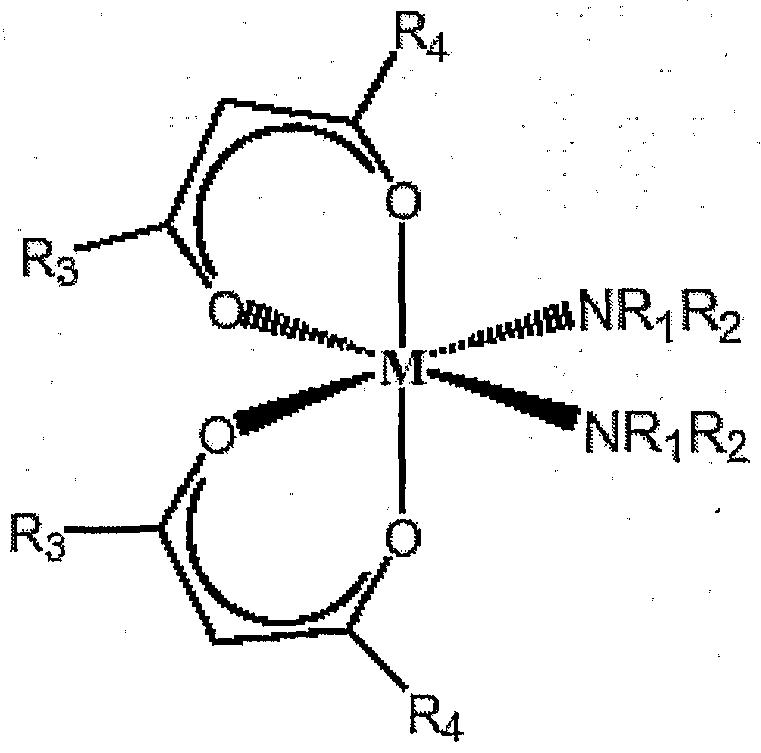
R1 and R2 independently are Me, Et, or 1Pr; and
R3 and R4 independently are Me, Et, 1Pr, sBu, tert-butyl, tert-butoxy, isopropoxy, ethoxy, or methoxy.

REACTION 1
where M comprises a metal, such as Hf, Zr, Ti, Ta, Al, Sn, Zn, Ca, Mg, Ga, In, Tl, Sc,
Bi, Rh, Ir, La, Pr, Eu, Gd, Ba, Sr, Ru, Cu, Co, Ag, Au, Pd, Pt, Ni, Fe, Mn, Cr, V, Nb, Pb, W, Si, Ge, Mo and transition metals;
R1 and R2 independently are Me, Et, or 1Pr; and
R3 and R4 independently are Me, Et, 1Pr, sBu, tert-butyl, tert-butoxy, isopropoxy, ethoxy, or methoxy.
Suitable dialkylamides are represented by the formula M(NR1R2^ where M is Hf and Zr; R1 and R2 are the same or different alkyl groups. R1 and R2 independently are methyl, ethyl, or isopropyl. Suitable dialkylamides comprise dimethyl, diethyl and ethylmethyl hafnium and zirconium compounds. Suitable dialkylmalonates that can be used as a chelating ligand in the present invention are represented by the formula R3C(O)(CH2)HC(O)R4 where R3 and R4 are
the same or different alkyl and alkoxy groups. Specific examples of R3 comprise Me, Et, 1Pr, sBu, tert-butyl, tert-butoxy, isopropoxy, ethoxy or methoxy; R4 comprises Me, Et, 1Pr, sBu, tert-butyl, tert-butoxy, isopropoxy, ethoxy or methoxy, and n is 1-5. In some contemplated malonates, R3 and R4 are tert-butoxy and n is equal to 1. Atomic layer depositions of [Hf(NEt2)2(dbml)2] and water resulted in homogeneous films over 4" silicon wafers with reproducible film properties. Deposition was carried out at a source temperature range of 120-1400C and a deposition temperature range of 300-4000C. Figure 5 shows AFM surface morphology of HfO2 film from [Hf(NEt2)2(dbml)2]. The Ra of the film is about 0.5 nm. The film particle size is quite uniform, with a diameter of about 28 nm in average.
Recently, metal complexes with amidinate ligands have been reported for metal oxide thin film deposition (Lim, B.S.; Rahtu, A.; Gordon, R.G. Nature Materials, Volume 2, November 2003; Lim, B.S.; Rahtu, A.; Park, J.S.; Gordon, R.G. Inorganic Chemistry, 2003, 42, 7951-7958 and Li, Z.; Barry, S.; Gordon, R.G.
Inorganic Chemistry, 2005, 44, 1728-1735). One advantage of such complexes is that the bidentate chelating effect of the amidinate ligand is expected to increase the thermal/chemical stability of resulting metal complexes. In addition varying the substituents on either or both carbon and nitrogen atoms can modify steric and electronic properties of amidinate ligands. A strategy has been devised wherein inclusion of designated donor substituents on the carbon atom resulted in a new set of complexes called as guanidinates.
The guanidinate ligand contains the Y-conjugated CN3 unit and is electronically and sterically flexible. These ligands are capable of exhibiting a variety of coordination modes and donor properties leading to compatibility with a remarkably wide range of metal ions in the periodic table from metal carbonyls to early transition and lanthanide metals. This compatibility is attributed to electronic flexibility of the CN3 system because of two possible resonance forms of the coordinated ligand determined by the electronic requirement of the metal (Reaction 2).

REACTION 2
In tailoring the amide-based complexes, amide-based guanidinate complexes of Hf and Zr have been developed. The insertion of two equivalents of carbodiimide moiety into metal nitrogen bond of a metal amide compound resulted in mixed bis(amide)-bis(guanidinate) complexes in high yields. Similarly, insertion of one equivalent of carbodiimide into a metal nitrogen bond yielded mixed tris(amide)- (guanidinate) complexes in high yields. These complexes are mononuclear, stable and the coordination number around the metal center is six. In addition these complexes possess unique blend of reactivity associated with amide ligands, the stability induced by bidentate nature of carbodiimide ligand and facile decomposition pattern induced by the guanidinate nitrogen that act as cleavage points in the molecule. The guanidinate ligand-like malonate can also be tuned by substitution of the alkyl groups on the nitrogen and carbon atoms. Substituting with bulky alkyl groups limit oligomerization and hence increase the volatility of guanidinate compounds of metals in low oxidation states. The bidentate chelating effect should increase the thermal/chemical stability of resulting metal complexes. Also the three nitrogen- centered complexes can undergo facile decomposition during deposition processes. These factors make these ligand systems highly versatile to be used in vaporizable compounds.
The two nitrogen substituents of the carbodiimide can have the same (symmetrical) or different (unsymmetrical) alkyl groups. The mixed amide guanidinate based vaporizable compounds are expected to be effectively used for the deposition of Hf, Zr, Ti, Ta, Al, Sn, Fe, Zn, Ca, Mg, Ga, In, Tl, Sc, Bi, Rh, Ir, La, Pr,
Eu, Gd, Ba, Sr, and other lanthanide metal oxides, nitrides, oxynitrides, silicates and suicides by MOCVD, ALD and related vapor phase deposition processes. They can
also be used for the deposition of films of Ru, Cu, Co, Ag, Au, Pd, Pt, Ni, Mn, Cr, V, Nb, Ta, Ti, Pb, W, Si, Ge, Mo and La metals.
The reaction of two equivalents of symmetrical diisopropylcarbodiimide with an equivalent of hafnium diethylamide in n-hexane resulted in a stable, mononuclear hafnium bis(diethylamide)-bis(diisoρropylguanidinate), [ { (N1Pr)2C(NEt2) } 2Hf (NEt2)2]
(Compound 5) in 95% yield. Similarly, reaction of two equivalents of diisopropylcarbodiimide with an equivalent of zirconium ethylmethylamide resulted in zirconium bis(ethylmethylamide)-bis(diisopropyl-N' -ethylmethylguanidinate), [((N1Pr)2C(NEtMe)J2Zr(NEtMe)2] (Compound 8) in 88% yield. With proper stoichiometry, the above methodology can be extended to prepare the corresponding mono guanidinates as well. For example, treatment of one equivalent of unsymmetrical N-tert-butyl-N'-sec-butylcarbodiimide with an equivalent of hafnium diethylamide in n-hexane gave hafnium tris(diethylamino)(Ntbutyl-N'sbutyl-N"- diethylguanidinate), [(NEt2)3 Hf {NtbutylC(NEt2)N'sbutyl}] (Compound 7) in 81% yield. Formation of tantalum bis(diethylamino)-(tbutylimino)-(Ntbutyl-N'sbutyl-N"- diethylguanidinate), [{ NWyIC(NEt2)N' sbutyl JTa(NEt2MNCWyIJ] (Compound 6) from tris(diethylamino)(t-butylimino)tantalum(V) and N-tert-butyl-N'-sec- butylcarbodiimide in 98% yield indicates that the insertion reaction is not limited to group TV metals alone and can be extended to other metals as well. Contemplated metalorganic vaporizable compounds with mixed amide guanidinate ligand system have the following structure and its preparation is illustrated in Reaction 3.

R1 is a primary, secondary or tertiary alkyl group with a generic formula CnH2n+1, where n is 1-10.
Some suitable examples of R1 include CH3, C2H5, C3H7, (CH3)2CH, (CH3)2CHCH2,(CH3)3C and CH(CH3)CH2CH3.
R2 is a primary, secondary or tertiary alkyl group with a generic formula CnH2n+1 where n is 1-10. Some contemplated examples of R2 include CH3, C2H5, C3H7, (CH3)2CH, (CHs)2CHCH2, (CH3)3C and CH(CH3)CH2CH3.
R1 and R2 can be the same or different.
R3 is CH3, C2H5, n-C3H7, n-C4H9, (CH3)2CH, (CH3)2CHCH2, (CH3)3C and CH(CH3)CH2CH3, amyl, cyclohexyl, and phenyl.
R4 is CH3, C2H5, n-C3H7, Ti-C4R9, (CH3)2CH, (CH3)2CHCH2, (CH3)3C and CH(CH3)CH2CH3, amyl, cyclohexyl, and phenyl.
R3 and R4 are same (symmetrical) or different (unsymmetrical)
Contemplated vaporizable compounds comprising the amide-guanidinate mixed ligand system can be prepared as described in Reaction 3:

R1 is a primary, secondary or tertiary alkyl group with a generic formula CnH2n+1, where n is 1-10. Some examples of R1 include CH3, C2H5, C3H7, (CH3)2CH,
(CH3)2CHCH2, (CH3)3C and CH(CH3)CH2CH3;
R2 is a primary, secondary or tertiary alkyl group with a generic formula CnH2n+1 where n is 1-10 and some examples of R2 include CH3, C2H5, C3H7, (CH3)2CH, (CH3)2CHCH2,(CH3)3C and CH(CH3)CH2CH3. R1 and R2 can be the same or different.
R3 is CH3, C2H5, n-C3H7, n-C4H9, (CH3)2CH, (CH3)2CHCH2, (CH3)3C and CH(CH3)CH2CH3, amyl, cyclohexyl, and phenyl.
R4 is CH3, C2H5, n-C3H7, n-C4H9, (CH3)2CH, (CH3)2CHCH2, (CH3)3C and CH(CH3)CH2CH3, amyl, cyclohexyl, and phenyl. R3 and R4 can be the same (symmetrical) or different (unsymmetrical).
Compounds were characterized by NMR, MS, and elemental analysis. The molecular structure of [{ (N1Pr)2C(NEt2) }2Hf(NEt2)2], (Compound 5) was determined by single crystal X-Ray diffraction and is shown in Figure 4. These complexes are mononuclear containing two dialkylamido groups and two chelating guanidinate groups. Some selected bond distances (nm) and bond angles (deg) for
[{(NiPr)2C(NEt2)}2Hf(NEt2)2] are reported in Table 4.
Suitable dialkylamides that can be utilized are represented by the formula M(NR1Ra)4 where M is a metal comprising Hf, Zr or Ti. R1 is a primary, secondary or tertiary alkyl group with a generic formula CnH2n+1, where n is 1-10. Specific examples of Ri include CH3, C2H5, n-C3H7, n-C4H9, (CH3)2CH, (CH3)2CHCH2,
(CH3)3C and CH(CH3)CH2CH3. R2 is a primary, secondary or tertiary alkyl group with a generic formula CnH2n+l where n is 1-10. Some examples of R2 include CH3, C2H5, n-C3H7, n-C4H9, (CH3)2CH, (CH3)2CHCH2, (CH3)3C and CH(CH3)CH2CH3. R1 and R2 can be the same or different.
Suitable dialkylcarbodiimides that can be used as a chelating ligand are represented by the formula R3N=C=NR4 where R3 is CH3, C2H5, n-C3H7, n-C4H9, (CHa)2CH, (CH3)2CHCH2, (CH3)3C and CH(CH3)CH2CH3, amyl, cyclohexyl, and phenyl; R4 is include CH3, C2H5, n-C3H7, n-C4H9, (CH3)2CH, (CH3)2CHCH2, (CH3)3C and CH(CH3)CH2CH3, amyl, cyclohexyl, and phenyl; where R3 and R4 can be the same or different.
Unsymmetrical carbodiimides (R3 ≠ R4), as well as symmetrical carbodiimides (R3 = R4) were synthesized via in situ tin(II) mediated heterocumulene metathesis reaction reported in the literature (Babcock, J.R.; Sita, L.R. J. Am. Chem. Soc. 1998, 120, 5585-5586). Treatment of lithium monosilylamides, (Me3Si)R3NLi with alkyl isocyanates, R4NCO in the presence of SnCl2 gave the desired dialkylcarbodiimides in high yields.
Contemplated dialkylamides comprise dimethyl, diethyl and ethylmethyl amides, and contemplated guanidinates are where R3 and R4 are n-C4H9, (CHs)2CH, (CH3)2CHCH2, (CHs)3C and CH(CH3)CH2CH3. Figures 9-10 shows TGA curves and isothermal studies of [((N1Pr)2C(NEt2)J2Hf (NEt2)2] at 1200C.
Atomic layer deposition (ALD) is considered as a modification of chemical vapor deposition (CVD) techniques. It is also referred to as atomic layer epitaxy (ALE) or atomic layer CVD (ALCVD). In one embodiment, a 4" silicon wafer on which a thin film will be deposited is transferred into the reaction chamber, and heated to and stabilized within the predetermined temperature range. The temperature is in a range of about 100-5000C, and in some embodiments between about 200- 4000C. Although 4" silicon wafers are used in some embodiments, any substrates can be used without limitation as long as the substrates can withstand the predetermined temperature. Other examples of suitable substrates are spin-on thin films, quartz, glass, nitride-coated Si substrates, metal coated Si wafers, strained silicon, silicon oxide, sapphire, and gallium arsenide. The substrate may have different dimensions, such 100 mm, 200 mm, or 300 mm round wafers, rectangular, or square plates. The substrate surface can be flat, round or trenched. The operating pressure of the reaction chamber is controlled in the range of 0.001-100 torr, preferably, 0.001-10 torr.
Metal-containing vaporizable compounds are evaporated in the source and injected into the reaction chamber directly based on predetermined pulse length. The vaporizable compounds can also be diluted with or dissolved in a predetermined organic solvent to obtain a solution. A contemplated source temperature is in the range of room temperature to about 3000C, and in other embodiments the range is room temperature to about 1750C, depending on the compounds' vapor pressure and thermal stability. The compounds injection can take place with or without carrier gas such as argon and nitrogen gas. In some embodiments, the pulse length is 0.1-10 seconds, and in other embodiments, 0.1-3 seconds. The vaporizable compounds can be supplied into the chamber without limitations, for example, by using an open boat in the source line, by using a bubbler or by a direct solution spraying method.
An inert gas is introduced into the reaction chamber to purge the byproducts and excess vaporizable compounds. Argon, nitrogen, helium, hydrogen, forming gases, and combinations thereof can be used as the inert gases. The rate of the flowing inert gas can be varied according to the deposition equipment used. The reaction chamber can also be evacuated without the introduction of any inert gases. In some embodiments, primary gas flows through the reaction chamber and a secondary inert gas is also introduced into the chamber to maintain the pocket pressure. The primary inert gas flow rate is contemplated to be in the range of about 30-1000 seem, and in other embodiments - about 200-800 seem. The primary inert gas flow rate is in the range of about 30-1000 seem, and in other embodiments - about 100-800 seem. The purge pulse length is set to a predetermined length. The purge pulse length is set in the range of 0.1-20 seconds, and in some embodiments - 0.5-4 seconds. In some embodiments, the purge N2 gas flows continuously throughout the deposition processes, so that only the purge gas flows during the purge step.
A complementary reactant is then pulsed into the reaction chamber with or without carrier gases to react with the vaporizable compounds adsorbed on the substrate surface to form an atomic thin film layer. This complementary reactant is not limited to non-metal containing reactants. Examples of non-metal reactants include water vapor, oxygen gas, ozone gas, hydrogen peroxide, N2O, N2, H2, NH3,
Ar or plasma enhanced N2, H2, NH3, Ar, H2O, O2 or O3 gases, and examples of metal reactants include silanols. In contemplated embodiments, the pulse length of
complementary reactant is about 0.1-10 seconds, and in some embodiments, about 0.1-3 seconds.
Then, a purging step described above is repeated to purge the byproducts and excessive non-metal reactants. This purging step will be followed by the vaporizable compounds step. The repeat of the above described steps, including adsorbing vaporizable compounds on the substrate, purging excess vaporizable compounds, pulsing of complementary reactant to form the atomic layer thin film and another purging step can be repeatedly carried out until desired thin film thickness is obtained.
In some embodiments, the thin film thickness is in the range of about lnm-lOOOnm, and in other embodiments, the thin film thickness is in the range of about lnm- lOOnm.
In the vaporizable compounds pulse step, one or several different metal-based vaporizable compounds can be used depending on the structural and composition requirement on the thin films. Such introduction of different metal-based vaporizable compounds will result into the formation of doped, alloyed or nanolaminate thin films. Different metal-based vaporizable compounds can also be co-pulsed into and adsorbed on substrate surface for doped or alloyed thin film formation. The alloyed thin films include, but not limited to hafnium silicate, hafnium aluminate, zirconium silicate, zirconium aluminate, lanthanum aluminate, barium strontium titanate, and tantalum aluminum nitride. The nanolaminated thin films include, but not limited to
ZnCVAl2O3 and Hf(VAl2O3.
ALD of [{ (N1Pr)2C(NEt2) }2Hf(NEt2)2] and water resulted in homogeneous films over 4" silicon wafers with reproducible film properties. Deposition was carried out at a source temperature of 120-14O0C and a substrate temperature of 300-425°C. The quality of HfO2 films obtained was similar to the films grown from ALD of
[Hf(NMe2)4] compound and water. The rate of deposition was 0.05-0.10 nm/cycle and the average index of refraction was 1.90-2.15 at 580 nm wavelength. XPS characterization found that the film main composition is Hf and oxygen. RBS characterization found that the Hf:O ratio is about 1:2.0-2.1, typical of ALD HfO2 films.
Some examples of deposition techniques are CVD, ALD, MOCVD, LI- MOCVD and LI-ALD, and plasma enhanced ALD. CVD are used herein refers to a vapor deposition process wherein the desired film layer is deposited on the substrate surface from vaporized or sprayed metal-based vaporizable compounds within a deposition chamber with no effort made to separate the reaction components.
Vaporizable compounds with sufficiently low boiling points can be introduced as a vapor; otherwise, the vaporizable compounds have to be introduced as a liquid in neat or dissolved form. Typical methods include, without limitation, LI-ALD and LI- MOCVD. Typical suitable solvents are inert volatile organic solvents that can dissolve the vaporizable compounds yet not degrade under deposition conditions.
Some non-limiting examples include esters, hydrocarbons, hexane, and toluene.
A contemplated process for depositing thin films by vapor deposition, comprises: a) providing the vaporizable metalorganic compound comprising at least one metal and at least one chelating bidentate ligand, b) vaporizing the compound to form vapors of that compound, c) providing a metal or non-metal containing complementary reactant(s), d) vaporizing the complementary reactant(s) and e) reacting the complementary reactant(s) with the vaporized metalorganic compound to form a thin film on the substrate surfaces. In some embodiments, the vaporizable compound comprises the following formula:
[{(N'R3)(N"R4)C(NR1R2)}nM(NRiR2)4.n] wherein
M comprises a metal, n = 1 or 2; R1 comprises CH3, C2H5, C3H7, (CH3)2CH, (CH3)2CHCH2, (CH3)3C or
CH(CH3)CH2CH3,
R2 comprises CH3, C2H5, C3H7, (CHg)2CH, (CH3)2CHCH2, (CH3)3C or CH(CH3)CH2CH3; and
R3 comprises CH3, C2H5, n-C3H7, n-C4H9, (CH3)2CH, (CHs)2CHCH2, (CHa)3C or CH(CH3)CH2CH3, amyl, cyclohexyl, and phenyl; and
R4 comprises CH3, C2H5, n-C3H7, n-C4H9, (CH3)2CH, (CH3)2CHCH2, (CH3)3C or CH(CH3)CH2CH3, amyl, cyclohexyl, and phenyl.
In one embodiment, the organic chelating groups are mixed and comprise guanidinate to improve thermal stability and two particular alkyl amides to improve reactivity. In a contemplated ALD embodiment, the surface to be coated is heated to a much higher temperature than the vaporizable compounds, which chemisorbs or otherwise resides on the surface to be coated. Co-reactants, such as but not limited to water, oxygen, ozone, aqueous H2O2, hydrogen, nitrogen plasma, ammonia, or mixtures thereof are optionally added. The organic ligands volatilize to leave the base metal or metal compound.
Deposition of thin films can include, without limitation, chemical and other mechanisms. Typical chemical mechanisms include oxidation (e.g., for oxide deposits) and reduction (e.g., for metal deposits). Plasma-assisted techniques can optionally impart at least some of the deposition energy. Other known techniques using lasers, microwaves, and other energy sources are envisioned in one embodiment. In one embodiment, the reaction chamber is flushed (e.g., with nitrogen) between cycles.
In one embodiment, the resulting product is a dense uniform conformal coating on a surface. In another embodiment, at least one vaporizable compound is patterned on a surface through selective area ALD. In another embodiment, the deposited film is subject to further processing such as but not limited to annealing, multilayer deposition of different materials, or selective etching. In yet another embodiment, deposited film thickness is a uniform thickness within about lnm to about lμm.
In a contemplated embodiment a mixture of vaporizable compounds is used. In another embodiment, different vaporizable compounds are used in adjacent cycles to make interlayers.
In some embodiments, the resulting deposit is a continuously uniform amorphous oxide film on a surface with a low level of impurities that are
predominantly H, N, O, C, or mixtures thereof. Some other embodiments include multilayer films and coated powders made in a fluidized bed.
Metal-containing oxides such as TiO2 films have numerous applications such as dielectric layers, antireflection coatings, optical devices, gas sensors, photocatalysts etc. Similarly, HfO2 is a candidate for other applications such as thin film capacitors, gas-sensing devices, tunnel junctions and laser damage-resistant optical coatings.
Group (IV) metalamide complexes with Lewis base ligands have been proposed as catalysts in combination with activation co-catalysts such as alumoxanes or cation forming agents in the polymerization of olefins to give high molecular weight polyolefins. Pure HfO2 and mixtures of HfO2 with silicon, nitrogen or aluminum are recognized as one of the most promising dielectric materials for next-generation complementary metal-oxide semiconductor devices.
Some electronic applications can include, without limitation, TaN thin films as diffusion barriers for copper in copper-silicon metallization, TaN as gate-electrode films to replace silicon, non-conducting Ta3N5 as a photoelectrode, amorphous oxides for high-κ-dielectric materials, supercapacitor layers, Zr or Hf oxide, suicide, silicate, nitride insulators and gate electrodes in memory and logic, HfO2/Al2O3 double layers, Hf nitride conductors, and SiO2 layer replacements in TFT displays.
Some other applications can include, without limitation, high refractive index optical layers, heat barriers, catalytic surfaces, Al2O3 and other coatings to protect surfaces (e.g., on MEMS), ZrO2 oxygen sensor coatings, ZrO2 solid oxide fuel cell components, and coatings for enhanced mechanical properties.
Chelating ligands such as malonates and guanidinates are incorporated into metal alkyl amides has resulted in monomeric and stable metalorganic complexes. These metalorganic complexes are stable compared to the parent alkyl amides. They are volatile and possess appropriate thermal properties for MOCVD, ALD and related vapor phase processes. In addition they are highly reactive at lower temperatures enabling low temperature film deposition of their respective oxides, nitrides, silicates, suicides silicon nitride, boron nitride, phosphorous nitride and oxynitrides. The novel metalorganic complexes are also soluble in common organic solvents, which make them attractive for liquid injection MOCVD and ALD processes as well.
EXAMPLES
The following examples further describe the synthesis, characterization and deposition of metal organic vaporizable compounds and methods disclosed herein and should not be construed as a limitation in the scope thereof. All chemical synthesis reactions were carried out under inert atmosphere of argon.
In the chemical synthesis, all solvents were dried using MBraun SPS solvent purifier and stored over 0.4 nm molecular sieves. KBr used for IR spectroscopy was dried at 1400C overnight. Benzene-d6 was stored under argon in the glove box, where the NMR tubes were prepared. N9N'- diisopropylcarbodiimide, ZrCl4, HfCU, HNEt2, HNEtMe and Di-tert-butyl malonate were used as received from Aldrich, Merck and
Fluka. AU reagents were used without further purification. Hf(NEt2)4 and Hf(NEtMe)4 were synthesized according the literature procedure and distilled at a temperature of 1300C for diethylamide and 1150C for ethylmethylamide respectively under a pressure of 0.05 mbar.
Example 1 - Hafnium bis(diethylamido)bis(Ditert- butylmalonate), [Hf(NEt2)2(dbml)2]
(Compound 1)
Hdbml (1.29g, 6 mmol) dissolved in 20 ml hexane was added drop wise to a stirred solution of Hf(NEt2)4 (Compound A) (1.401g, 3 mmol) in 30 ml hexane. After 4h of stirring at room temperature the reaction mixture was refluxed for further 2h at 69 °C.
After cooling the reaction mixture to room temperature all the volatiles were removed under reduced pressure. The resulting yellow solid was extracted into hexane, concentrated and kept at -30°C for 24h to afford colorless crystals suitable for X-ray single crystal analysis.
Yield: 1.975g (88% based on Hf[NEt2]4).
Mp: 167 °C (uncorrected).
1H NMR (room temp., 250 MHz, C6D6): δ[ppm] 1.24 [12H, t, CH3-CH2N-Hf]; a 1.39 [18H, s, C CH3a dbml]; 1.58 [18H, s, CCH3b dbml]; 3.38 [8H, two overlapping d of q, CH3-CH2-NHf]; 4.91 [2H, s, COCHCO dbml]. 13C(1H) NMR (room temp., 250
MHz, C6D6): δ[ppm] 175.735, 175.706 [-CO(CH3)3 dbml]; 80.2, 80.0 [OC(CH3)3)]; 72.5 [-CH-dbml]; 41.8 [NCH2CH3]; 29.1, 28.9 [-C(CH3)S dbml]; 15.6 [-NCH2CH3].
Mass spectrometry: (EI+) m/z = 754, [Hf(NEt2)2(dbml)2]+; 682, [Hf(NEt2)(dbml)2]+ ;
626, [Hf(NEt2)(dbml)2]+ - [CH3-C(CH3)=CH2]; 570, [Hf(NEt2)(dbml)2]+- 2[CH3- C(CHs)=CH2]; 514, [Hf(NEt2)(dbml)2]+ - 3[CH3-C(CH3)=CH2];
458, [Hf(NEt2)(dbml)2]+- 4[CH3-C(CH3)=CH2]; 385, [Hf (NEt2)(dbml)2]+- 4[CH3-C(CHs)=CH2] - [OtBu]; 72, [NEt2J+ and 57, [C(CH3)3]+.
Elemental analysis: calc. for C30H58O8N2Hf: C 47.79%, H 7.7%, N 3.71%; found: C 47.49%, H 8.07%, N 3.45%.
Example 2 - Hafnium bis(ethylmethylamido) bis(Di-tertbutylmalonato), Hf(NEtMe)2(dbml)2] (Compound 2)
The synthesis of Compound 2 was carried out similar to that of Compound 1 mentioned above. A diluted solution of Hdbml (1.45 ml, 6.44 mmol) in 20 ml hexane was added drop wise to a stirred solution of Hf(NEtMe)4 (1 ml, 3.22 mmol) in 30 ml hexane. After stirring for 4h at room temperature and further 2h at 690C, the reaction mixture was allowed to cool down to ambient temperature. The volatilities were removed under reduced pressure resulting in a pale yellow solid. After extracting the pale-yellow solid in an appropriate amount of hexane, the solution was kept at ~ - 20°C over night to afford colorless crystals suitable for X-Ray single crystal analysis.
Yield: 1.9g (81% based on Hf[NEtMe]4).
Mp: 131 0C (uncorrected).
1H NMR (room temp., 250 MHz, C6D6): δ[ppm], 1.25 [6H, t, CH3-CH2N], 1.38 [18H, s, (CH3)3C dbml], 1.52 [18H, s, (CH3)3Cdbml], 3.41 [4H, q, CH3-CH2-N], 3.53-3.62 [4H, two overlapping d of q, CH3-CH2-N] , 4.92 [2H, s. COCHCOdbml].
13C(1H) NMR (room temp., 250 MHz, C6D6): δ[ppm] 176.25,
176.21 [-O-C-CH]; 80.81, 80.48 [C(CH3)3]; 72.83 [-CH-dbml]; 49.01 [-NCH2CH3]; 39.21 [-NCH3] 29.48, 29.31 [-C(CΗ3)3]; 16.29 [-N(CH2CH3)].
Mass spectrometry: Et (70 eV); m/z = 726 [Hf(NEtMe)2(dbml)2]+; 668 [Hf(NEtMe)(dbml)2]+; 612 [Hf(NEtMe)(dbml)2]+ - [CH3-C(CH3)=CH2];
556[Hf(NEtMe)(dbml)2]+ - 2[CH3-C(CH3)=CH2]; 500 [Hf(NEtMe)(dbml)2]+ - 3 [CH3- C(CHs)=CH2]; 444 [Hf(NEtMe)(dbml)2]+ - 4[CH3-C(CH3)=CH2]; 58 [NEtMe]+ and 57 [C(CH3)3]+.
Elemental analysis: calc. for C28H54O8N2Hf: C 46.34%, H 7.45%, N 3.86%; found: C 46.13%, H 7.45%, N 3.51%.
Example 3 - Zirconium bis(diethylamido)bis(Ditert-butylmalonato), [Zr(NEt2)2(dbmal)2] (Compound 3)
To a diluted solution of 1.85 ml (5 mmol) Zr(NEt2)4 in 20 ml of hexane, ligand Hdbml di-tert-butylmalonate 2.24 ml (10 mmol) was added dropwise. The resulting pale yellow solution was refluxed for 2 hours with vigorous stirring. After completion of the reaction, the solvent was removed and pale yellow crystalline product was isolated. The product was recrystallized from saturated solution in pentane and storing the Schlenk flask at ~ 300C for about 24 hours.. Yield: 2.97 g (89 % based on [Zr(NEt2)J).
1H NMR (room temp., 250 MHz, C6D6): δ[ppm] 1.37 [18H, s, CCH3a dbml], 1.50 [18H, s, CCH3b dbml], 1.18 [12H, t, NCH2ClZ3], 3.68 [8H, q, NCH2CH3,], 4.89 [2H, s, COCHCO dbml].
13C(1H) NMR (room temp., 250 MHz, C6D6): δ[ppm] 15.34 [NCH2CH3], 42.29 [NCH2CH3], 175.735, 175.44 [-O-C-CH dbml], 28.97 [OC(CH3)3 dbml], 81.23
[OC(CH3)3 dbml], 72.83 [-CH-dbml].
Mass spectrum (positive-ion EI): m/z = 664 [Zr(NEt)2(dbmal)]+,
592 [Zr(NEt2)2(dbmal)2- [N(Et)2J]+, 536 [{Zr(NEt2)2(dbmal)2-[N(Et)2]}-isobutene]+,
480 [{Zr(NEt2)2(dbmal)2-[N(Et)2]}-2-isobutene]+, 424 [ {Zr(NEt2)2(dbmal)2- [N(Et)2]J- 3-isobutene]+, 368 [ {Zr(NEt2)2(dbmal)2- [N(Et)2] }-4isobutene]+.
Elemental analysis calcd. for C30H58O8N2Zr (%): C, 54.07; H, 8.71; N, 4.20 Found: C, 53.69; H, 8.50; N, 3.98.
Example 4 - Zirconium bisCethylmethylamido^isCDi-tert-butylmalonato), Zr(NMeEt)2(dbmal)2] (Compound 4)
To a diluted solution of 1.54 ml (5 mmol) Zr(NEtMe)4 in 20 ml of hexane, ligand Hdbml di-tert-butylmalonate 2.24 ml (10 mmol) was added dropwise. The resulting pale yellow solution was refluxed for 2 hours with vigorous stirring. The solvent was removed under vacuum to get a pale yellow crystalline product. The product was recrystallised from saturated solution in hexane and storing at 30 0C for about 24 hours.
Yield: 2.7 g (~ 84 % based on [Zr(NMeEt)4]). M.P.: 139 °C (uncorrected).
1H NMR (room temp., 400 MHz, C6D6): δ[ppm], 1.3 [6H, t, CH3-CH2N], 1.6 [36 H, s, (CHs)3C dbml], 3.4 [6H, q, CH3-N], 3.7 [4H, CH3-CH2-N] , 5.0 [2H, s. -CH- d Irml].
13Q1H) NMR (room temp., 400 MHz, C6D6): δ[ppm] 176.2, 175.6 [-O-C-CH]; 79.93, [C(CHs)3]; 72.41 [-CH- dbml]; 48.83 [-NCH2CH3]; 39.21 [-NCH3] ; 29.03 [-
C(CH3)3]; 15.84 [-N(CH2CH3)].
Mass spectrometry: EI (70 eV); m/z = 636 [Zr(NEtMe)2(dbml)2]+;
578 [Zr(NEtMe)(dbml)2]+; 522 [Zr(dbml)2]+ ; 466 [Zr(dbml)2-isobutene]+;
410 [Zr(dbml)2-2isobutene]+; 354 [Zr(dbml)2-3 isobutene]+; 298 [Zr(dbml)2-4 isobutene]+ and 57 [C(CH3)3]+.
Elemental analysis: calc. for C28H54O8N2Zr: C 52.72 %, H 8.52 %, N 4.39 %; found: C 52.26 %, H 8.29%, N 4.37%.
Example 5 - Hafnium bis(diethylamido)bis(diisopropyl-N'-diethylguanidinato), [((N1Pr)2C(NEt2)J2Hf(NEt2);,] (Compound 5)
To a solution of Hf[NEt2J4 (1.122 ml, 3 mmol) in 20 ml of hexane, two equivalents of N, N'-diisopropylcarbodiimide (0.94 ml, 6 mmol) was added. During the addition a slight increase in the temperature was observed. After stirring for 24h at ambient conditions, the solvent was removed under reduced pressure affording a white crystalline solid. The resulting solid was extracted into toluene, concentrated and kept at -30 0C for 24h to afford colorless crystals suitable for X-ray single crystal analysis.
Yield: 2.05 g (95% based on Hf[NEt2J4). M.P. = 205-206 0C (uncorrected).
1H NMR (room temp., 400 MHz, C6D6): 6H 0.94 (12H, t, HfJ(N1Pr)2C(N(CH2CHj)2)J), 1.21, 1.22 (18H, t overlapping with a d,
Hf{N(CH2CH3)2}, Hf{(N(CH(CH3)2))2C(NEt2)}), 1.32, 1.45, 1.48 (18Η, 3 x d, Hf { (N(CH(CHj)2))2C(NEt2) }), 2.85-3.05 (8H, m, Hf { (N-TY^C(N(CH2CHs)2) }), 3.75 (2H, h,

13C NMR (room temp., 400 MHz, C6D6) δc 14.35 (HfI(N1Pr)2C(N(CH2CHj)2)J, Hf(N(CH2CHj)2J), 24.45, 25.69, 25.94, 26.43 (Hf{(N(CH(CΗj)2))2C(NEt2)J), 42.55
(Hf{(N-iPr)2C(N(CH2CH3)2)}, Hf(N(CH2CHj)2J), 47.27, 47.72
(Hf((N(CH(CHj)2))2C(NEt2)J), 171.46 (HfKN1Pr)

Mass spectrometry (DIP-MS @ 70 eV, solid probe): 720.5 (M+), 648.4[M- N(C2H5)2]+ and 522.3 [M-guanidinateJ+ .
Elemental analysis: calc. for C30H68N8Hf: C 50.09%, H 9.53%, N 15.58%; found: C 50.15%, H 9,74%, N 15.35%.
Scale up of the above reaction with 30 g of Hf[NEt2)4 gave 37 g of [{(NiPr)2C(NEt2)}2Hf(NEt2)2] for 86% yield.
Example 6 - Tantalum bis(diethylamido)-(tbutylimido)-(Ntbutyl-N'sbutyl-N"- diethylguanidinato), [{NtbutylC(NEt2)N'sbutyl}Ta(NEt2)2{NCtbutyl}] (Compound 6)
To a solution of 10.12 g of tris(diethylamino)(t-butylimino)tantaluni(V) (21.6 mmol) in 75 ml hexane, 4.2 ml of N^utyl-N^butylcarbodiimide (21.7 mmol) was added.
After stirring for 16h at ambient conditions, the solvent was removed under reduced pressure to leave a viscous, amber liquid which was held under dynamic vacuum for several hours.
Yield was 98%.
IH NMR: 3.67(m, 4H), TaN(CH2CH3)2; 3.43 (m, 5H), Ta{[NCiy(CH3)CH2CH3](N-t-Bu)C[N(GH2CH3)2]} and TaN(C#2CH3)2; 2.88 (q, 4H), TaN(CH2CH3)2; 1.52 (s, 9H), Ta{(N-s~Bu)[NC(C#3)3]C(NEt2)}; 1.47 (s, 9H), Ta[NC(C#3)3]; 1.35 and 1.33 (2 x t, 12H), TaN(CH2Cfl3)2; 1.17 (d, 3H), Ta{[NCH(C#3)CH2CH3](N-t-Bu)C(NEt2)}; 1.02 and 0.98 (t x 2, 9H),
Ta{[NCH(CH3)CH2CJHr3](N-t-Bu)C[N(CH2CH3)2]}; note: the resonance for Ta{[NCH(CH3)C#2CH3](N-t-Bu)C(NEt2)} is broad and probably obscured by the resonance at 1.52 ppm.
Example 7 - Hafnium tris(diethylamido)(Ntbutyl-N'sbutyl-N"-diethylguanidinato), [(NEt2)S Hf {NtbutylC(NEt2)N'sbutyl}] (Compound 7)
To a solution of Hf[NEt2J4 (4.67 g, 10 mmol) in 65 ml of hexane, one equivalent of N- tertiary butyl-N' -secondary butylcarbodiimide (1.54 g, 10 mmol) was added. During the addition a slight increase in the temperature was observed. After stirring for 24h at ambient conditions, the solvent was removed under reduced pressure affording a yellowish brown viscous liquid.
Yield: 5.0 g (81% based on Hf[NEt2J4).
Mass spectrometry (DIP-MS @ 70 eV, solid probe): 622.4 (M+), 550.3 [M- N(C2H5)2]+ and 478.3 [M-2N(C2H5)2]+
1H NMR (C6D6): δH 1.37 (9H, s, Hf [(NC(CH5)5JC(N(CH2CH5)2)J), 0.9 {3H, t,
CH(CH3)CH2OJ3J, 1-16 {3H, d, CH(CH5)CH2CH3)), 1.57 {2H, m,
CH(CH3) CW2CR3, 3.3 { 1H, m, CH(CH3)CH2CH3J, 0.96 (6H, t, Hf
((Nt4H9JC(NCH2CHO2(N5C4H9)), 2.85-2.95 (4H, m, Hf ((Nt4H9 JC(NCH2CHs)2(N5C4H9)), 1.20 (18H, t, Hf
[((N1C4H9JC(NCH2CHs)2(N8C4H9)Hf (N(CH2CH5Ms), 3.55(10H, q, Hf [((Nt4H9JC(NCH2CHs)2(N5C4H9)Hf (N(CH2CHs)2Js).
Example 8 - Zirconium bis(ethylmethylamido)-bis(diisopropyl-N'- ethylmethylguanidinato), [((N1Pr)2C(NEtMe)J2Zr(NEtMe)2] (compound 8):
To a solution of [Zr(NEtMe)4] (1.54 ml, 5 mmol) in 20 ml of hexane, two equivalents of N,N'-diisopropylcarbodiimide (1.54 ml, 10 mmol) was added. During the addition a slight increase in the temperature was observed. After stirring for 24 h at ambient conditions, the solvent was removed under reduced pressure yielding a white crystalline solid. The resulting solid was extracted into toluene, concentrated and kept at -30 °C for 24 h to afford colorless crystals suitable for single crystal X-ray analysis.
Yield: 2.54 g {88 % based on [Zr(NEtMe)4]). M.P.: 128-130 0C measured with capillary.
Elemental analysis: calc. for C26H56N8Zr: C 54.60 %, H 9.87 %, N 19.59 %; found: C 54.15 %, H 9.84 %, N 19.35 %; 1H- NMR (room temp., 400 MHz, toluene-d8): δH 0.9 (6H, t, CN(CH2CH5), 1.2 (6Η, t, ZrN(CH2CH5), 1.3 (24Η, d, NCH(CH5)2), 2.5
(6Η, s, CNCH5), 2.9 (4Η, q, CNCH2CH3), 3.2 (6H, s, ZrNCH5), 3.6 (overlapping, 4Η+ 4H, sept + q, NCH(CH3)2 + ZrN(CH2CH3)). 13C-NMR (room temp., 400 MHz, toluene-d8): δC 13.73 (CN(CH2CH5), 14.80 (ZrN(CH2CH5)), 25.53 (NCΗ(CH5)2), 36.91 (CNCH5), 41.58 (CNCH5), 46.09 (CN(CH2CH3), 47.32(ZrN(CH2CH3), 50.43 (NCH(CRs)2), 172.38 (N3C).
Crystal data for (1): C26 H56 N8Zr, M = 572.01, Orthorhombic, space group Pbca, a = 10.8201(18), b = 17.638(2), c = 33.626(5) A, V = 6417.3(16) A3, Z = 8, p = 1.184 Mg/m3, μ = 0.369 mm"1, Refl. collected = 45330, Refl. unique = 5629, i?1[/> 2σ (I)] = 0.0662, wR2 = 0.1032.
Example 9 - Deposition of hafnium oxide thin films by ALD using bis(diethylamido)-bis(ditert-butylmalonato)hafnium
The ALD experiments were performed in a hot-wall horizontal flow type F- 120 traveling wave flow-type tube ALD reactor (ASM-Microchemistry Ltd., Espoo,
Finland). Bis(diethylamido)-bis(ditert-butylmalonato)hafnium sublimes at 120~160°C and was loaded into the reactor for in situ heating. A 4" Si wafer was loaded into the reaction zone as substrate for thin film deposition. The substrate was heated and kept at 350°C and the source was heated and kept at 130 °C during the deposition process. The reactor pressure was maintained at about 1 torr. The primary N2 gas flow rate was set at 300 seem! and the secondary N2 gas flow rate was set at 400sccm. The Hf-based vaporizable compounds was pulsed into the reactor and adsorbed on substrate surface for 1 second by N2 carrier gas, then the excess vaporizable compounds were removed by flowing N2 gas for 2 seconds. Water vapor generated at 18 0C in a bubbler was pulsed into the reactor for 1 second to oxidize the Hf-based vaporizable compounds adsorbed on the substrate surface to form a HfO2 thin film. Then the reactor was purged again with flowing nitrogen for 2 seconds. Next the above process was repeated for 750 cycles to deposit the HfO2 film. The film thickness varies from about 62.8nm-72.7nm with average refractive index at 1.785 as measured by ellipsometry at 580 nm wavelength. The film deposition rate was 0.09 nm/cycle.
Figure 5 illustrates AFM surface morphology of HfO2 film from [Hf(NEt2)2(dbml)2]. The Ra of the film was about 0.5 nm. The film particle size was quite uniform, with a diameter of about 28 nm in average.
Example 10 - Deposition of hafnium oxide thin films by ALD using [{(NiPr)2C(NEt2)}2Hf(NEt2)2]. Water is used as a co-reactant.
The ALD experiments were performed in a hot-wall horizontal flow type F-120 traveling wave flow-type tube ALD reactor (ASM-Microchemistry Ltd., Espoo,
Finland). [{ (N1Pr)2C(JNEt2) }2Hf(NEt2)2] was loaded into the reactor for in situ heating. A four inch Si wafer was loaded into the reaction zone as substrate for thin film deposition. The substrate was heated and kept at 350°C and the source was heated and kept at 130 0C during the deposition process. The reactor pressure was maintained at about 1 torr. The primary N2 gas flow rate was set at 400 seem and the secondary N2 gas flow rate was set at 600 seem. The Hf vaporizable compounds was pulsed into the reactor and adsorbed on substrate surface by N2 carrier gas, then the excess vaporizable compounds was removed by flowing N2 gas for 2 seconds. Water vapor generated at 18 0C in a bubbler was pulsed into the reactor for 1 second to oxidize the Hf-based vaporizable compounds adsorbed on the substrate surface to form a HfO2 thin film. Then the reactor was purged again with flowing nitrogen for 2 seconds. Next the above process was repeated for 750 cycles to deposit the HfO2 film. The Hf- based vaporizable compounds pulse time was varied at 0.5 second, 1 second and 3 seconds at three experiments, respectively. Film thickness, growth rate and refractive index was measured by ellipsometry at 580 nm wavelength. The average film refractive index was 2.028, 2.009 and 2.017 respectively. The average film growth rate per cycle is shown in Figure 6. It is apparent that the film growth rate saturates at 1 second Hf-based vaporizable compounds pulse length. The film deposition rate only increased slightly as the Hf-based vaporizable compounds pulse length increased from 1 second to 3 seconds, showing the characteristics of ALD process.
Example 11 - Deposition of hafnium oxide thin films by ALD using [{(NiPr)2C(NEt2)}2Hf(NEt2)2]. Air is used as a co-reactant.
The ALD experiments were performed in a hot-wall horizontal flow type F- 120 traveling wave flow-type tube ALD reactor (ASM-Microchemistry Ltd., Espoo,
Finland). [((N1Pr)2C(NEt2)J2Hf (NEt2)2] was loaded into the reactor for in situ heating. A 4" Si wafer was loaded into the reaction zone as substrate for thin film deposition. The substrate was heated and kept at 3500C and the source was heated and kept at 134°C during the deposition process. The reactor pressure was maintained at about 1 torr. The primary N2 gas flow rate was set at 400 seem and the secondary N2 gas flow rate was set at 600 seem. The Hf-based vaporizable compounds was pulsed into the reactor and adsorbed on substrate surface for 1.5 seconds by N2 carrier gas. After that, the excess vaporizable compounds were removed by flowing N2 gas for 2 seconds. Ambient air was pulsed into the reactor at a flow rate of 8 seem for 1 second to oxidize the Hf-based vaporizable compounds adsorbed on the substrate surface to form a HfO2 thin film. Then the reactor was purged again with flowing nitrogen for 2 seconds. The above process was repeated for 750 cycles to deposit the HfO2 film. The film has a growth rate of 0.023 nm/cycle and average refractive index of 2.05.
Example 12 - Deposition of hafnium oxide thin films by ALD using [{ (CH3)SCNC(NEt2)NCH(CH3)(C2H5) }Hf (NEt2)3]
HfO2 thin films were formed at the same manner as Example 10 except [{ (CHs)3CNC(NEt2)NCH(CH3)(C2H5) }Hf(NEt2)3] was used as metal-based vaporizable compounds, with source temperature kept at 950C. The Hf-based vaporizable compounds pulse length was set at 0.75 second and 1.5 seconds in two experiments, respectively. The film refractive index is between about 2.0 to 2.03.
Figure 7 shows the film growth rate at two different Hf-based vaporizable compounds pulse length. The slight increase of film growth rate as the Hf-based vaporizable compounds pulse length increased from 0.75 second to 1.5 seconds shows the characteristics of ALD process.
Example 13 - Deposition of tantalum oxide thin films by ALD using Ta(NEt2)2(N- 1BuX(N-1Bu)(N^Bu)C(NEt2)]
Ta2O5 thin films were formed at the same manner as Example 10 except Ta(NEt2)2(N- 1BuX(N-1Bu)(N^8Bu)C(NEt2)] was used as metal-based vaporizable compounds, with source temperature kept at 76 0C, substrate temperature at 300 0C, primary gas flow rate at 300 seem and secondary gas flow rate at 400 seem. The tantalum-based vaporizable compounds pulse length was set at 0.25 second, 0.5 second, and 1.0 second in three experiments, respectively. The film refractive index is between about 2.1 to 2.2. Figure 8 shows the film growth rate at three different tantalum-based vaporizable compounds pulse length. The slight increase of film growth rate as the tantalum-based vaporizable compounds pulse length increased from 0.5 second to 1.0 seconds shows the characteristics of ALD process.
Example 14 - Deposition of zirconium oxide thin films by ALD using [ { (N1Pr)2C(NEtMe) } 2Zr(NEtMe)2]
ZrO2 thin film was deposited at the same manner as Example 10 except [((N1Pr)2C(NEtMe) J2Zr(NEtMe)2] was used as metal-based vaporizable compounds, with Zr-based vaporizable compounds source temperature kept at 1320C, substrate temperature at 300 0C, primary gas flow rate at 300 seem and secondary gas flow rate at 400 seem. The Zr-based vaporizable compounds pulse length was 1.0 second. The total number of deposition cycles was 500. The resulting film has a deposition rate of 1.25 A/cycle and average refractive index of 2.014.
Tables Included in Application:
Table 1: Some selected bond distances (nm) and bond angles (deg) for [Hf(NEt2)2(dbmal)2] (Compound 1)
Hf(I)-N(116) 0.2042(6)
Hf(I)-N(Hl) 0.2057(6)
Hf(l)-0(15) 0.2191(5)
Hf(I)-O(Il) 0.2105(5)
C(14)-O(141) 0.1340(9)
C(12)-O(121) 0.1346(8)
N(116)-Hf(l)-N(lll) 9.85(2)
N(116)-Hf(l)-O(ll) 9.56(2)
0(11)-Hf(I)-O(16) 8.428(19)
O(110)~Hf(l)-O(16) 7.963(19)
N(lll)-Hf(l)-O(15) 17.15(2)
N(lll)-Hf(l)-O(16) 9.07(2)
Table 2: Some selected bond distances (nm) and bond angles (deg) for [Hf(NEtMe)2(dbmal)2] (Compound 2)
Hf(l)-N(3) 0.2107(11)
Hf(l)-N(4) 0.2109(12)
Hf(l)-O(5) 0.2128(12)
Hf(l)-O(6) 0.2018(14)
O(51)-C(400) 0.140(2)
O(61)-C(600) 0.1428(18)
N(3)-Hf(l)-N(4) 9.65(5)
O(6)-Hf(l)-N(3) 9.95(5)
O(6)-Hf(l)-O(5) 7.83(5)
O(6)-Hf(l)-O(7) 16.16(5)
N(4)-Hf(l)-O(5) 17.17(5)
N(4)-Hf(l)-O(8) 9.12(5)
Table 3: Some selected bond distances (nm) and bond angles (deg) for [Zr(NEt2)2(dbmal)2] (Compound 3)
Zr(I)-N(IlO) 0.2047 (3)
Zr(I)-N(Hl) 0.2061 (3)
Zr(l)-O(15) 0.2214 (2)
Zr(I)-O(Il) 0.2122 (2)
C(12)-O(121) 0.1330(3)
C(14)-O(141) 0.1349 (3)
N(116)-Zr(l)-N(lll) 10.011(11)
N(116)-Zr(l)-O(15) 9.063 (10)
O(ll)-Zr(l)-O(15) 7.892 (8)
O(110)-Zr(l)-O(15) 8.746 (8)
N(116)-Zr(l)-O(ll) 9.669 (9)
N(116)-Zr(l)-O(16) 16.865 (10)
Table 4: Some selected bond distances (nm) and bond angles (deg) for {(N/Pr)2C(NEt2)}2Hf(NEt2)2] (Compound 5)

Claims
1. A vaporizable metalorganic compound with ligands having a formula comprising:

R1 and R2 are the same or different alkyl groups; CL is a chelating bidentate ligand, and x and y independently are integers of at least 1 where x + y is equal to maximum coordination number of the metal.
2. The vaporizable compound of claim 1, wherein the compound is utilized for the deposition of thin films of at least one member comprising metals and metal-containing oxides, silicates, suicides, nitrides, oxynitrides, and combinations thereof, on a substrate.
3. The vaporizable compound of claim 1, wherein M comprises Hf, Zr, Ti, Al, Sn, Zn, Ca, Mg, Ga, In, Tl, Sc, Y, Bi, Rh, Ir, Ba, Sr, Ru, Cu, Co, Ag, Au, Pd, Pt, Ni, Fe, Mn, Cr, V, Nb, Ta, Ti, Pb, W, Si, Ge, Mo, La, Pr, Eu, Gd or other lanthanide metals.
4. The vaporizable compound of claim 1, wherein the alkyl groups each comprise 1-5 carbon atoms and M comprises Hf, Zr, or Ta.
5. The vaporizable compound of claim 1, wherein the ligands comprise an amide-based ligand and a chelating bidentate ligand.
6. The vaporizable compound of claim 5, wherein the chelating bidentate ligand comprises dicarboxylate or guanidinate.
7. The vaporizable compound of claim 6, wherein the dicarboxylate has a formula (CH2)n (COOR)2> where n is at least 1 and R is tert-butoxy, isopropoxy, ethoxy, or methoxy.
8. The vaporizable compound of claim 7, wherein the dicarboxylate is a malonate.
9. The vaporizable compound of claim 7, comprising the following formula:

where M comprises a metal, R1 is Me, Et, or 1Pr R2 = Me, Et, or 1Pr,
R3 = tert-butoxy, isopropoxy, ethoxy, or methoxy R4 = tert-butoxy, isopropoxy, ethoxy, or methoxy.
10. The vaporizable compound of claim 9, wherein M comprises Hf, Zr, Ti, Al, Sn, Zn, Ca, Mg, Ga, In, Tl, Sc, Y, Bi, Rh, Ir, Ba, Sr, Ru, Cu, Co, Ag, Au, Pd, Pt, Ni, Fe, Mn, Cr, V, Nb, Ta, Ti, Pb, W, Si, Ge, Mo, La, Pr, Eu, Gd or other lanthanide metals.
11. The vaporizable compound of claim 10, wherein M comprises Hf, Zr or Ta.
12. The vaporizable compound of claim 5, wherein the chelating bidentate ligand is a guanidinate.
13. The vaporizable compound of claim 12, comprising the following formula:

where M is a metal; R1 is a primary, secondary or tertiary alkyl group with a generic formula; and
CnH2n+1, where n = 1-10,
R2 is a primary, secondary or tertiary alkyl group with a generic formula CnH2n+1, wherein n = 1-10,
R3 is CH3, C2H5, n-C3H7, n-C4H9, (CH3)2CH, (CH3)2CHCH2, (CH3)3C and CH(CH3)CH2CH3, amyl, cyclohexyl, or phenyl; and
R4 is CH3, C2H5, n-C3H7, n-C4H9, (CH3)2CH, (CH3)2CHCH2, (CH3)3C and CH(CH3)CH2CH3, amyl, cyclohexyl, or phenyl.
14. The vaporizable compound of claim 13, wherein M comprises Hf, Zr, Ti, Al, Sn, Zn, Ca, Mg, Ga, In, Tl, Sc, Y, Bi, Rh, Ir, Ba, Sr, Ru, Cu, Co, Ag, Au, Pd, Pt, Ni, Fe, Mn, Cr, V, Nb, Ta, Ti, Pb, W, Si, Ge, Mo, La, Pr, Eu, Gd or other lanthanide metals.
15. A process for preparing a vaporizing metalorganic compound with dicarboxylate, as a chelating bidentate ligand comprising reacting metal(dialkylamides) with dialkyldicarboxylates as represented by the reaction: 
wherein M is a metal; R1 comprises Me, Et, or 1Pr; R2 comprises Me, Et, or 1Pr;
R3 comprises tert-butoxy, isopropoxy, ethoxy,or methoxy; and R4 comprises tert-butoxy, isopropoxy, ethoxy, or methoxy.
16. The process of claim 15, wherein M comprises Hf, Zr, Ti, Al, Sn, Zn, Ca, Mg, Ga, In, Tl, Sc, Y, Bi, Rh, Ir, Ba, Sr, Ru; Cu, Co, Ag, Au, Pd, Pt, Ni, Fe, Mn, Cr, V, Nb, Ta, Ti, Pb, W, Si, Ge, Mo, La, Pr, Eu, Gd or other lanthanide metals.
17. The process of claim 15, wherein R1 and R2 independently comprise methyl or ethyl, and R3 and R4 are tert-butoxy.
18. A process for preparing a vaporizing metalorganic compound with guanidinate as a chelaing bidentate ligand is represented in the following reaction:
M(NR1Ra)4 + n (R3N^C=N53R4) ---> [{(N'R3)(N"R4)C(NR1R2)}nM(NR1R2)4-n] where M is a metal; n = 1 or 2,
R1 is a primary, secondary or tertiary alkyl group with a generic formula CnH2n+1, wherein n = 1-10; R2 is a primary, secondary or tertiary alkyl group with a generic formula CnH2n+1 where n = 1-10;
R3 is CH3, C2H5, n-C3H7, n-C4H9, (CH3)2CH, (CH3)2CHCH2, (CH3)3C and CH(CH3)CH2CH3 , amyl, cyclohexyl, or phenyl; R4 is selected from the group consisting of CH3, C2H5, H-C3H7, U-C4H9,
(CHa)2CH, (CHs)2CHCH2, (CH3)3C or CH(CH3)CH2CH3, amyl, cyclohexyl, or phenyl.
19. The process of claim 18, wherein R1 comprises CH3, C2H5, C3H7, (CH3)2CH, (CH3)2CHCH2, (CH3)3C or CH(CH3)CH2CH3.
20. The process of claim 18, wherein R2 comprises CH3, C2H5, C3H7, (CH3)2CH,
(CHs)2CHCH2, (CHs)3C or CH(CH3)CH2CH3.
21. The process of claim 18, wherein M comprises Hf, Zr, Ti, Al, Sn, Zn, Ca, Mg, Ga, In, Tl, Sc, Y, Bi, Rh, Ir, Ba, Sr, Ru, Cu, Co, Ag, Au, Pd, Pt, Ni, Fe, Mn, Cr, V, Nb, Ta, Ti, Pb, W, Si, Ge, Mo, La, Pr, Eu, Gd or other lanthanide metals.
22. A process for depositing thin films by vapor deposition of a vaporizable metalorganic compound according to claim 1, comprising: a) providing the vaporizable metalorganic compound comprising at least one metal and at least one chelating bidentate ligand, b) vaporizing the compound to form vapors of the metalorganic compound that can deposit on a substrate, c) providing a metal or non-metal containing complementary reactant that can deposit on the substrate, d) vaporizing the complementary reactant and e) reacting the complementary reactant with the deposited metalorganic compound to form a thin film on substrate surfaces.
23. The process of claim 22, wherein the vaporizable compound comprises the following formula:
[{(N'R3)(N"R4)C(NR1R2)}nM(NR1R2)4.n] wherein M comprises a metal, n = 1 or 2;
R1 comprises CH3, C2H5; R2 comprises CH3, C2H5.
R3 comprises CH3, C2H5, n-C3H7, n-C4H9, (CH3)2CH, (CH3)2CHCH2, (CH3)3C or CH(CH3)CH2CH3, amyl, cyclohexyl, and phenyl; and
R4 comprises CH3, C2H5, n-C3H7, n-C4H9, (CH3)2CH, (CH3)2CHCH2, (CH3)3C or CH(CH3)CH2CH3, amyl, cyclohexyl, and phenyl.
24. A film made by the process according to claim 22, wherein the film comprises metal oxide and the metal comprises of Hf, Zr or Ta.
Priority Applications (1)
| Application Number | Priority Date | Filing Date | Title |
|---|---|---|---|
| TW095114581A TW200716780A (en) | 2005-07-01 | 2006-04-24 | Vaporizable metalorganic compounds for deposition of metals and metal-containing thin films |
Applications Claiming Priority (4)
| Application Number | Priority Date | Filing Date | Title |
|---|---|---|---|
| US69607205P | 2005-07-01 | 2005-07-01 | |
| US60/696,072 | 2005-07-01 | ||
| US73090605P | 2005-10-27 | 2005-10-27 | |
| US60/730,906 | 2005-10-27 |
Publications (2)
| Publication Number | Publication Date |
|---|---|
| WO2007005088A2 true WO2007005088A2 (en) | 2007-01-11 |
| WO2007005088A3 WO2007005088A3 (en) | 2007-05-18 |
Family
ID=36954281
Family Applications (1)
| Application Number | Title | Priority Date | Filing Date |
|---|---|---|---|
| PCT/US2006/014752 Ceased WO2007005088A2 (en) | 2005-07-01 | 2006-04-17 | Vaporizable metalorganic compounds for deposition of metals and metal-containing thin films |
Country Status (2)
| Country | Link |
|---|---|
| TW (1) | TW200716780A (en) |
| WO (1) | WO2007005088A2 (en) |
Cited By (22)
| Publication number | Priority date | Publication date | Assignee | Title |
|---|---|---|---|---|
| JP2009079290A (en) * | 2007-07-13 | 2009-04-16 | Rohm & Haas Electronic Materials Llc | Precursor compositions and methods |
| EP2065390A1 (en) * | 2007-11-30 | 2009-06-03 | L'AIR LIQUIDE, Société Anonyme pour l'Etude et l'Exploitation des Procédés Georges Claude | Metal organic compounds containing an amidinate ligand and their use for vapour phase deposition of metal containing thin films |
| FR2928663A1 (en) * | 2008-03-17 | 2009-09-18 | Centre Nat Rech Scient | PROCESS FOR PRODUCING A THIN FILM OF OXIDE OR HAFNIUM SILICATE NITRIDE, COORDINATION COMPOUND USED IN THIS METHOD AND METHOD FOR PRODUCING AN INTEGRATED ELECTRONIC CIRCUIT |
| US8399056B2 (en) | 2006-06-02 | 2013-03-19 | L'Air Liquide, Société Anonyme pour l'Etude et l'Exploitation des Procédés Georges Claude | Method of forming high-k dielectric films based on novel titanium, zirconium, and hafnium precursors and their use for semiconductor manufacturing |
| US8853075B2 (en) | 2008-02-27 | 2014-10-07 | L'Air Liquide Société Anonyme pour l'Etude et l'Exploitation des Procédés Georges Claude | Method for forming a titanium-containing layer on a substrate using an atomic layer deposition (ALD) process |
| KR101572086B1 (en) | 2014-03-07 | 2015-11-26 | 한국화학연구원 | Group iv transition metal precursors, preparation method thereof and process for the formation of thin films using the same |
| US9499571B2 (en) | 2014-12-23 | 2016-11-22 | L'Air Liquide, Société Anonyme pour l'Etude et l'Exploitation des Procédés Georges Claude | Germanium- and zirconium-containing compositions for vapor deposition of zirconium-containing films |
| US9663547B2 (en) | 2014-12-23 | 2017-05-30 | L'Air Liquide, Société Anonyme pour l'Etude et l'Exploitation des Procédés Georges Claude | Silicon- and Zirconium-containing compositions for vapor deposition of Zirconium-containing films |
| JP2018500296A (en) * | 2014-11-28 | 2018-01-11 | ユミコア・アクチエンゲゼルシャフト・ウント・コムパニー・コマンディットゲゼルシャフトUmicore AG & Co.KG | Novel metal N-aminoguanidinate complexes for use in thin film preparation and catalysts |
| US10106568B2 (en) | 2016-10-28 | 2018-10-23 | L'Air Liquide, Société Anonyme pour l'Etude et l'Exploitation des Procédés Georges Claude | Hafnium-containing film forming compositions for vapor deposition of hafnium-containing films |
| US10669297B2 (en) | 2015-12-02 | 2020-06-02 | Basf Se | Process for the generation of thin inorganic films |
| JP2022524041A (en) * | 2019-03-11 | 2022-04-27 | ラム リサーチ コーポレーション | Precursor for deposition of molybdenum-containing coatings |
| US12148623B2 (en) | 2018-11-19 | 2024-11-19 | Lam Research Corporation | Deposition of tungsten on molybdenum templates |
| WO2025019308A1 (en) * | 2023-07-14 | 2025-01-23 | L'air Liquide, Societe Anonyme Pour L'etude Et L'exploitation Des Procedes Georges Claude | Group 5 transition metal-containing precursors and their use in the semiconductor manufacturing |
| WO2025019304A1 (en) * | 2023-07-14 | 2025-01-23 | L'air Liquide, Societe Anonyme Pour L'etude Et L'exploitation Des Procedes Georges Claude | Niobium, vanadium, tantalum film-forming compositions and deposition of group 5 metal-containing films using the same |
| US12327762B2 (en) | 2019-10-15 | 2025-06-10 | Lam Research Corporation | Molybdenum fill |
| US12334351B2 (en) | 2019-09-03 | 2025-06-17 | Lam Research Corporation | Molybdenum deposition |
| US12351914B2 (en) | 2019-01-28 | 2025-07-08 | Lam Research Corporation | Deposition of films using molybdenum precursors |
| US12362188B2 (en) | 2016-08-16 | 2025-07-15 | Lam Research Corporation | Method for preventing line bending during metal fill process |
| US12553131B2 (en) | 2021-04-14 | 2026-02-17 | Lam Research Corporation | Deposition of molybdenum |
| US12588475B2 (en) | 2021-05-14 | 2026-03-24 | Lam Research Corporation | High selectivity doped hardmask films |
| US12598925B2 (en) | 2021-02-23 | 2026-04-07 | Lam Research Corporation | Non-metal incorporation in molybdenum on dielectric surfaces |
Families Citing this family (1)
| Publication number | Priority date | Publication date | Assignee | Title |
|---|---|---|---|---|
| CN117186126A (en) * | 2022-05-31 | 2023-12-08 | 华为技术有限公司 | Metal compounds and their preparation methods and applications |
Family Cites Families (7)
| Publication number | Priority date | Publication date | Assignee | Title |
|---|---|---|---|---|
| US5225561A (en) * | 1990-07-06 | 1993-07-06 | Advanced Technology Materials, Inc. | Source reagent compounds for MOCVD of refractory films containing group IIA elements |
| JP3547471B2 (en) * | 1994-03-09 | 2004-07-28 | 富士通株式会社 | Vapor phase growth method of dielectric film |
| US5916359A (en) * | 1995-03-31 | 1999-06-29 | Advanced Technology Materials, Inc. | Alkane and polyamine solvent compositions for liquid delivery chemical vapor deposition |
| US6015917A (en) * | 1998-01-23 | 2000-01-18 | Advanced Technology Materials, Inc. | Tantalum amide precursors for deposition of tantalum nitride on a substrate |
| WO2001046201A1 (en) * | 1999-12-21 | 2001-06-28 | The Dow Chemical Company | Gallium or indium-bridged group 4 metal complexes |
| US6960675B2 (en) * | 2003-10-14 | 2005-11-01 | Advanced Technology Materials, Inc. | Tantalum amide complexes for depositing tantalum-containing films, and method of making same |
| US7300873B2 (en) * | 2004-08-13 | 2007-11-27 | Micron Technology, Inc. | Systems and methods for forming metal-containing layers using vapor deposition processes |
-
2006
- 2006-04-17 WO PCT/US2006/014752 patent/WO2007005088A2/en not_active Ceased
- 2006-04-24 TW TW095114581A patent/TW200716780A/en unknown
Cited By (32)
| Publication number | Priority date | Publication date | Assignee | Title |
|---|---|---|---|---|
| US10217629B2 (en) | 2006-06-02 | 2019-02-26 | L'Air Liquide, Société Anonyme pour l'Etude et l'Exploitation des Procédés Georges Claude | Method of forming dielectric films, new precursors and their use in semiconductor manufacturing |
| US9911590B2 (en) | 2006-06-02 | 2018-03-06 | L'Air Liquide Société Anonyme pour l'Etude et l'Exploitation des Procédés Georges Claude | Methods of forming dielectric films, new precursors and their use in semiconductor manufacturing |
| US9583335B2 (en) | 2006-06-02 | 2017-02-28 | L'Air Liquide, Société Anonyme pour l'Etude et l'Exploitation des Procédés Georges Claude | Method of forming dielectric films, new precursors and their use in semiconductor manufacturing |
| US8668957B2 (en) | 2006-06-02 | 2014-03-11 | L'Air Liquide, Société Anonyme pour l'Etude et l'Exploitation des Procédés Georges Claude | Method of forming dielectric films, new precursors and their use in semiconductor manufacturing |
| US8470402B2 (en) | 2006-06-02 | 2013-06-25 | L'Air Liquide, Société Anonyme pour l'Etude et l'Exploitation des Procédés Georges Claude | Method of depositing a metal-containing dielectric film |
| US8399056B2 (en) | 2006-06-02 | 2013-03-19 | L'Air Liquide, Société Anonyme pour l'Etude et l'Exploitation des Procédés Georges Claude | Method of forming high-k dielectric films based on novel titanium, zirconium, and hafnium precursors and their use for semiconductor manufacturing |
| JP2009079290A (en) * | 2007-07-13 | 2009-04-16 | Rohm & Haas Electronic Materials Llc | Precursor compositions and methods |
| EP2017368A3 (en) * | 2007-07-13 | 2011-01-19 | Rohm and Haas Electronic Materials LLC | Precursor Compositions And Methods |
| US8142847B2 (en) | 2007-07-13 | 2012-03-27 | Rohm And Haas Electronic Materials Llc | Precursor compositions and methods |
| WO2009068454A1 (en) * | 2007-11-30 | 2009-06-04 | L'air Liquide Societe Anonyme Pour L'etude Et L'exploitation Des Procedes Georges Claude | Metal-organic compounds containing an amidinate ligand and their use of vapour phase deposition of metal containing thin films |
| EP2065390A1 (en) * | 2007-11-30 | 2009-06-03 | L'AIR LIQUIDE, Société Anonyme pour l'Etude et l'Exploitation des Procédés Georges Claude | Metal organic compounds containing an amidinate ligand and their use for vapour phase deposition of metal containing thin films |
| US8853075B2 (en) | 2008-02-27 | 2014-10-07 | L'Air Liquide Société Anonyme pour l'Etude et l'Exploitation des Procédés Georges Claude | Method for forming a titanium-containing layer on a substrate using an atomic layer deposition (ALD) process |
| WO2009122036A1 (en) * | 2008-03-17 | 2009-10-08 | Centre National De La Recherche Scientifique | Method for developing thin film from oxide or silicate of hafnium nitride, coordination compound used in said method, and method for producing integrated electronic circuit |
| FR2928663A1 (en) * | 2008-03-17 | 2009-09-18 | Centre Nat Rech Scient | PROCESS FOR PRODUCING A THIN FILM OF OXIDE OR HAFNIUM SILICATE NITRIDE, COORDINATION COMPOUND USED IN THIS METHOD AND METHOD FOR PRODUCING AN INTEGRATED ELECTRONIC CIRCUIT |
| KR101572086B1 (en) | 2014-03-07 | 2015-11-26 | 한국화학연구원 | Group iv transition metal precursors, preparation method thereof and process for the formation of thin films using the same |
| JP2018500296A (en) * | 2014-11-28 | 2018-01-11 | ユミコア・アクチエンゲゼルシャフト・ウント・コムパニー・コマンディットゲゼルシャフトUmicore AG & Co.KG | Novel metal N-aminoguanidinate complexes for use in thin film preparation and catalysts |
| US9868753B2 (en) | 2014-12-23 | 2018-01-16 | L'Air Liquide, Société Anonyme our l'Etude et l'Exploitation des Procédés Georges Claude | Germanium- and zirconium-containing composition for vapor deposition of zirconium-containing films |
| US9663547B2 (en) | 2014-12-23 | 2017-05-30 | L'Air Liquide, Société Anonyme pour l'Etude et l'Exploitation des Procédés Georges Claude | Silicon- and Zirconium-containing compositions for vapor deposition of Zirconium-containing films |
| US9499571B2 (en) | 2014-12-23 | 2016-11-22 | L'Air Liquide, Société Anonyme pour l'Etude et l'Exploitation des Procédés Georges Claude | Germanium- and zirconium-containing compositions for vapor deposition of zirconium-containing films |
| US10669297B2 (en) | 2015-12-02 | 2020-06-02 | Basf Se | Process for the generation of thin inorganic films |
| US12362188B2 (en) | 2016-08-16 | 2025-07-15 | Lam Research Corporation | Method for preventing line bending during metal fill process |
| US10106568B2 (en) | 2016-10-28 | 2018-10-23 | L'Air Liquide, Société Anonyme pour l'Etude et l'Exploitation des Procédés Georges Claude | Hafnium-containing film forming compositions for vapor deposition of hafnium-containing films |
| US12148623B2 (en) | 2018-11-19 | 2024-11-19 | Lam Research Corporation | Deposition of tungsten on molybdenum templates |
| US12351914B2 (en) | 2019-01-28 | 2025-07-08 | Lam Research Corporation | Deposition of films using molybdenum precursors |
| JP2022524041A (en) * | 2019-03-11 | 2022-04-27 | ラム リサーチ コーポレーション | Precursor for deposition of molybdenum-containing coatings |
| US12334351B2 (en) | 2019-09-03 | 2025-06-17 | Lam Research Corporation | Molybdenum deposition |
| US12327762B2 (en) | 2019-10-15 | 2025-06-10 | Lam Research Corporation | Molybdenum fill |
| US12598925B2 (en) | 2021-02-23 | 2026-04-07 | Lam Research Corporation | Non-metal incorporation in molybdenum on dielectric surfaces |
| US12553131B2 (en) | 2021-04-14 | 2026-02-17 | Lam Research Corporation | Deposition of molybdenum |
| US12588475B2 (en) | 2021-05-14 | 2026-03-24 | Lam Research Corporation | High selectivity doped hardmask films |
| WO2025019304A1 (en) * | 2023-07-14 | 2025-01-23 | L'air Liquide, Societe Anonyme Pour L'etude Et L'exploitation Des Procedes Georges Claude | Niobium, vanadium, tantalum film-forming compositions and deposition of group 5 metal-containing films using the same |
| WO2025019308A1 (en) * | 2023-07-14 | 2025-01-23 | L'air Liquide, Societe Anonyme Pour L'etude Et L'exploitation Des Procedes Georges Claude | Group 5 transition metal-containing precursors and their use in the semiconductor manufacturing |
Also Published As
| Publication number | Publication date |
|---|---|
| WO2007005088A3 (en) | 2007-05-18 |
| TW200716780A (en) | 2007-05-01 |
Similar Documents
| Publication | Publication Date | Title |
|---|---|---|
| US10217629B2 (en) | Method of forming dielectric films, new precursors and their use in semiconductor manufacturing | |
| EP2201149B1 (en) | Methods of preparing titanium containing thin films by atomic layer deposition using monocyclopentadienyl titanium-based precursors | |
| CN102558221B (en) | For depositing the metal-enolate precursor of metal-containing thin film | |
| US9045509B2 (en) | Hafnium- and zirconium-containing precursors and methods of using the same | |
| KR101244960B1 (en) | Beta-diketiminate ligand sources and metal-containing compounds thereof; and systems and methods including same | |
| KR101273024B1 (en) | Unsymmetrical ligand sources, reduced symmetry metal-containing compounds, and systems and methods including same | |
| KR20150139628A (en) | Methods of preparing thin films by atomic layer deposition using hafnium and zirconium-based precursors | |
| EP2069369A1 (en) | Heteroleptic organometallic compounds | |
| EP2257561A1 (en) | Method for forming a titanium-containing layer on a substrate using an atomic layer deposition (ald) process | |
| US6669990B2 (en) | Atomic layer deposition method using a novel group IV metal precursor | |
| KR20150143371A (en) | Precusor compounds and Method for forming a thin film using thereof | |
| KR101721294B1 (en) | Hafnium-containing or zirconium-containing precursors for vapor deposition | |
| EP1273683A2 (en) | Atomic layer deposition method using a group IV metal precursor | |
| KR102417216B1 (en) | Group 4 organometallic precursor compound into which η6 borata benzene ligand is introduced, a method for manufacturing the same, and a method for forming a thin film using the same | |
| EP4589048A1 (en) | Precursor for forming lanthanide metal-containing thin film, method for forming lanthanide metal-containing thin film using same, and semiconductor element including lanthanide metal-containing thin film | |
| TW202530237A (en) | Intramolecular stabilized mono alkyl metal compounds with improved thermal and light stability and their use thereof |
Legal Events
| Date | Code | Title | Description |
|---|---|---|---|
| 121 | Ep: the epo has been informed by wipo that ep was designated in this application | ||
| NENP | Non-entry into the national phase |
Ref country code: DE |
|
| 122 | Ep: pct application non-entry in european phase |
Ref document number: 06750725 Country of ref document: EP Kind code of ref document: A2 |