WO2007007075A2 - Improvements in catalysts - Google Patents
Improvements in catalysts Download PDFInfo
- Publication number
- WO2007007075A2 WO2007007075A2 PCT/GB2006/002546 GB2006002546W WO2007007075A2 WO 2007007075 A2 WO2007007075 A2 WO 2007007075A2 GB 2006002546 W GB2006002546 W GB 2006002546W WO 2007007075 A2 WO2007007075 A2 WO 2007007075A2
- Authority
- WO
- WIPO (PCT)
- Prior art keywords
- catalyst
- gold
- palladium
- support
- acid
- Prior art date
- Legal status (The legal status is an assumption and is not a legal conclusion. Google has not performed a legal analysis and makes no representation as to the accuracy of the status listed.)
- Ceased
Links
Classifications
-
- B—PERFORMING OPERATIONS; TRANSPORTING
- B01—PHYSICAL OR CHEMICAL PROCESSES OR APPARATUS IN GENERAL
- B01J—CHEMICAL OR PHYSICAL PROCESSES, e.g. CATALYSIS OR COLLOID CHEMISTRY; THEIR RELEVANT APPARATUS
- B01J23/00—Catalysts comprising metals or metal oxides or hydroxides, not provided for in group B01J21/00
- B01J23/38—Catalysts comprising metals or metal oxides or hydroxides, not provided for in group B01J21/00 of noble metals
-
- C—CHEMISTRY; METALLURGY
- C01—INORGANIC CHEMISTRY
- C01B—NON-METALLIC ELEMENTS; COMPOUNDS THEREOF; METALLOIDS OR COMPOUNDS THEREOF NOT COVERED BY SUBCLASS C01C
- C01B15/00—Peroxides; Peroxyhydrates; Peroxyacids or salts thereof; Superoxides; Ozonides
- C01B15/01—Hydrogen peroxide
- C01B15/029—Preparation from hydrogen and oxygen
-
- B—PERFORMING OPERATIONS; TRANSPORTING
- B01—PHYSICAL OR CHEMICAL PROCESSES OR APPARATUS IN GENERAL
- B01J—CHEMICAL OR PHYSICAL PROCESSES, e.g. CATALYSIS OR COLLOID CHEMISTRY; THEIR RELEVANT APPARATUS
- B01J23/00—Catalysts comprising metals or metal oxides or hydroxides, not provided for in group B01J21/00
- B01J23/38—Catalysts comprising metals or metal oxides or hydroxides, not provided for in group B01J21/00 of noble metals
- B01J23/40—Catalysts comprising metals or metal oxides or hydroxides, not provided for in group B01J21/00 of noble metals of the platinum group metals
- B01J23/44—Palladium
-
- B—PERFORMING OPERATIONS; TRANSPORTING
- B01—PHYSICAL OR CHEMICAL PROCESSES OR APPARATUS IN GENERAL
- B01J—CHEMICAL OR PHYSICAL PROCESSES, e.g. CATALYSIS OR COLLOID CHEMISTRY; THEIR RELEVANT APPARATUS
- B01J23/00—Catalysts comprising metals or metal oxides or hydroxides, not provided for in group B01J21/00
- B01J23/38—Catalysts comprising metals or metal oxides or hydroxides, not provided for in group B01J21/00 of noble metals
- B01J23/48—Silver or gold
- B01J23/52—Gold
-
- B—PERFORMING OPERATIONS; TRANSPORTING
- B01—PHYSICAL OR CHEMICAL PROCESSES OR APPARATUS IN GENERAL
- B01J—CHEMICAL OR PHYSICAL PROCESSES, e.g. CATALYSIS OR COLLOID CHEMISTRY; THEIR RELEVANT APPARATUS
- B01J29/00—Catalysts comprising molecular sieves
- B01J29/04—Catalysts comprising molecular sieves having base-exchange properties, e.g. crystalline zeolites
- B01J29/06—Crystalline aluminosilicate zeolites; Isomorphous compounds thereof
- B01J29/40—Crystalline aluminosilicate zeolites; Isomorphous compounds thereof of the pentasil type, e.g. types ZSM-5, ZSM-8 or ZSM-11, as exemplified by patent documents US3702886, GB1334243 and US3709979, respectively
- B01J29/42—Crystalline aluminosilicate zeolites; Isomorphous compounds thereof of the pentasil type, e.g. types ZSM-5, ZSM-8 or ZSM-11, as exemplified by patent documents US3702886, GB1334243 and US3709979, respectively containing iron group metals, noble metals or copper
- B01J29/44—Noble metals
-
- B—PERFORMING OPERATIONS; TRANSPORTING
- B01—PHYSICAL OR CHEMICAL PROCESSES OR APPARATUS IN GENERAL
- B01J—CHEMICAL OR PHYSICAL PROCESSES, e.g. CATALYSIS OR COLLOID CHEMISTRY; THEIR RELEVANT APPARATUS
- B01J37/00—Processes, in general, for preparing catalysts; Processes, in general, for activation of catalysts
- B01J37/06—Washing
-
- B—PERFORMING OPERATIONS; TRANSPORTING
- B01—PHYSICAL OR CHEMICAL PROCESSES OR APPARATUS IN GENERAL
- B01J—CHEMICAL OR PHYSICAL PROCESSES, e.g. CATALYSIS OR COLLOID CHEMISTRY; THEIR RELEVANT APPARATUS
- B01J2229/00—Aspects of molecular sieve catalysts not covered by B01J29/00
- B01J2229/30—After treatment, characterised by the means used
- B01J2229/37—Acid treatment
Definitions
- the present invention concerns improvements in catalysts especially for hydrogen peroxide production; more especially it concerns the catalytic production of hydrogen peroxide by direct reaction of hydrogen and oxygen.
- USP 5,135,731 in which gases containing hydrogen and oxygen are reacted in the presence of an aqueous reaction medium, an acid, a promoter, a multifunctional phosphonate and a catalyst, for example Pd and/or Pt which may be on a support such as carbon, alumina, silica, ion exchange resins and other conventional supports.
- USP 4,832,938 is another concept which involves reacting hydrogen with oxygen in an aqueous reaction medium having no, or less than 2%, organic content, a source of protons and chlorine or bromine ions and a combined Pt/Pd catalyst.
- the catalyst may be supported on carbon, silica or alumina.
- USP 4,009,252 also describes an aqueous medium system using a platinum group metal catalyst.
- USP 5,449,655 discloses that activated carbon catalyst supports may be acid- washed to reduce the ash content, and that a further treatment is desirable to improve the catalytic performance for hydrogenation of organic molecules after deposition of a platinum group metal on the supports.
- the further treatment suitably involves treatment with an oxidising agent such as hydrogen peroxide.
- This document does not have any relevance to the formation of catalysts for hydrogen peroxide formation by direct reaction of hydrogen and oxygen.
- EP 0 049 810 is concerned with an improvement in hydrogen peroxide production, using a palladium or palladium-gold catalyst supported catalyst, by selecting catalysts that show decreased hydrogen peroxide decomposition.
- the improved catalyst is prepared by pre-treatment of the catalyst with an aldehyde or a ketone and/or hydrochloric acid.
- the present invention relates not to the pre- treatment of the catalyst before use in the hydrogen peroxide process, but in the pre- treatment of the support, before formation of the catalyst.
- the present invention provides an H 2 O 2 formation catalyst comprising particles of gold, palladium or, preferably, gold and palladium, deposited on a support which has been acid washed prior to metal deposition.
- the particles are of gold and palladium, which may, on certain supports, have a gold-rich core and a palladium-rich shell.
- the support is preferably an inorganic support material, preferably SiO 2 , TiO 2 , Al 2 O 3 or Fe 2 O 3 , or may be an activated carbon.
- Acid washing is suitably carried using a mineral acid such as hydrochloric acid or nitric acid.
- a mineral acid such as hydrochloric acid or nitric acid.
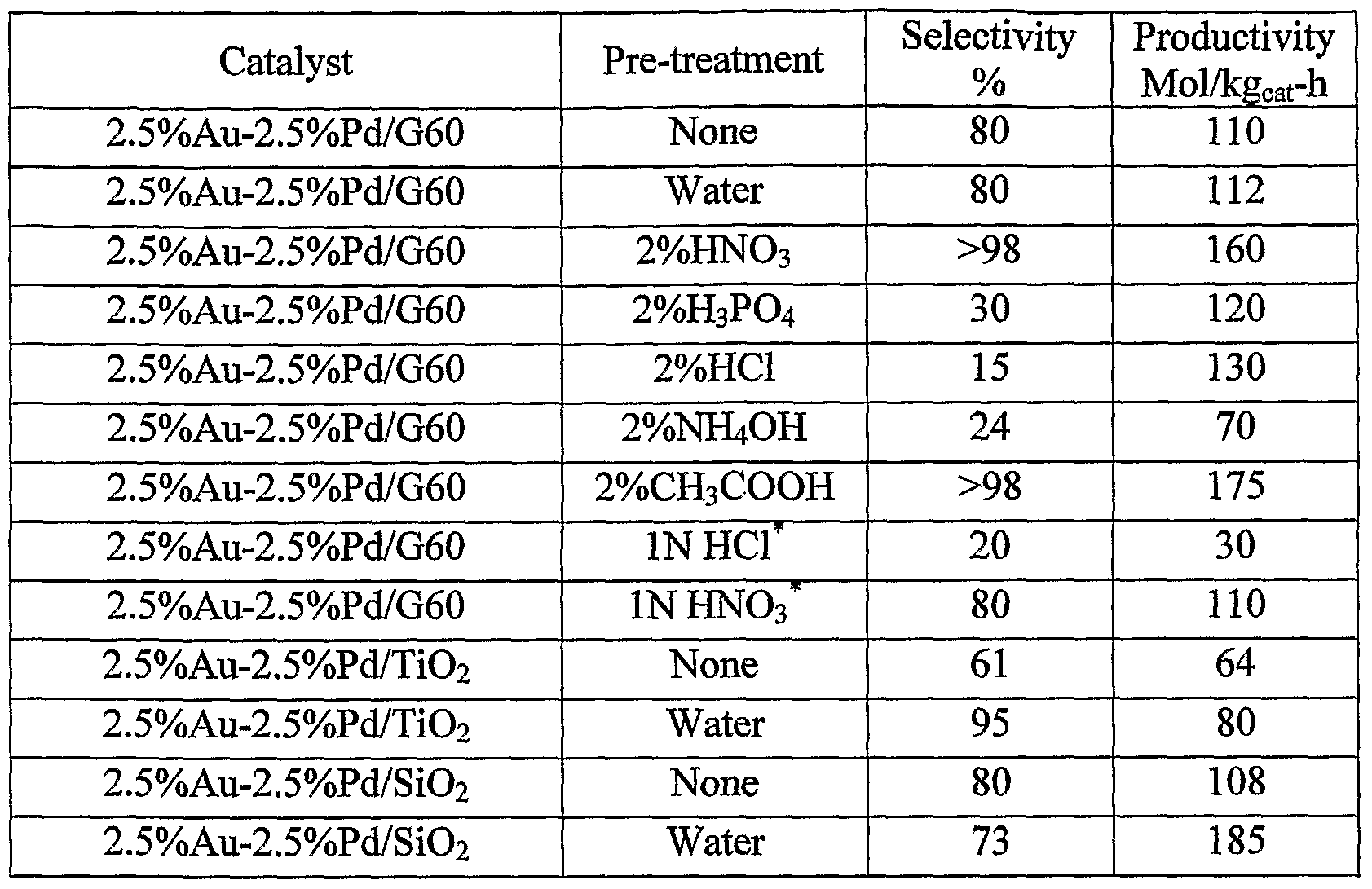
- the acid is dilute nitric acid, and supports are treated for example for 3 hours at ambient temperature. Experimental procedures involved washing supports in various concentrations of acid (see Figl below). It may be desirable to use a zeolite support, and synthetic zeolites such as beta zeolite or ZSM-5 are indicated, while tests indicate that zeolite Y tends to collapse.
- a palladium-rich shell surrounds a gold-rich core.
- the core contains 50 at% or more of gold
- the shell contains 50 at% or more of palladium.
- the alloyed catalysts had a 2.5Au-2.5Pd wt% loading, with comparative Au and Pd monometallic catalysts having 2.5wt% and 5wt% loadings.
- Other metal loadings may be considered, especially during catalyst development directed to precious metal "thrifting".
- the present invention further provides a method of manufacture of such a catalyst according to the invention, comprising acid washing a catalyst support, depositing gold and/or palladium, conveniently gold and palladium simultaneously, onto the washed support to form a catalyst precursor, and subsequently heat-treating, preferably at a temperature of 400 °C or above, the catalyst precursor to form a catalyst comprising the gold, palladium or gold and palladium particles.
- the present invention also provides a process for the production OfH 2 O 2 , comprising reacting hydrogen with oxygen in the presence of a reaction medium, preferably an aqueous reaction medium, and in the presence of a catalyst according to the invention.
- the reaction medium is conveniently a water/organic solvent mix, where the organic solvent is water miscible.
- Solvents such as methanol, ethanol, isopropyl alcohol and acetone are suitable. In certain tests an acetone/water mix has been found to increase the activity of the bi-metallic catalyst (see Table 1 below). However, studies into different solvents (isopropyl alcohol, ethanol) showed no promotion of the catalyst activity. Studies into solvent effects have to be carried out with due care due to the possible formation of organic peroxy species, but studies by 1 H NMR and 13 C NMR with acetone and methanol have shown conclusively that under the conditions as stated in Table 1 there is no formation of such species. Table 1
- TiO 2 catalyst results in activity in temperatures 2 0 C - 4O 0 C (table 1) without suffering a major loss in activity, in comparison to the non acid washed catalyst.
- H 2 O 2 yield was determined by titration of aliquots of the final filtered solution with acidified Ce(SO ⁇ 2 (7 x 10 "3 mol/1). Ce(SO ⁇ 2 solutions were standardised against (NHO 2 Fe(SO 4 ) ⁇ oH 2 O using ferroin as indicator. The following results were obtained:
- the supports were acid-treated (3h, 100 ml) prior to impregnation of Au and Pd (as described in Example 1) and hydrogen peroxide synthesis measured as described in Example 1.
- a reference sample washed for 3 h in pure water was also tested. The following results were obtained:
- Catalyst was prepared on untreated carbon with IN HCl or HNO 3 present during impregnation.
- Example 1 The catalyst supports detailed in Example 1 were treated with nitrate salts (sodium, potassium and ammonium) before impregnation with Au and Pd and tested for hydrogen peroxide synthesis (as described in Example 1). All catalysts were calcined in static air 400 0 C 3hr. The following results were obtained:
- Catalyst testing was performed using a Parr Instruments stainless steel autoclave with a nominal volume of 50 ml and a maximum working pressure of 14 MPa.
- the autoclave was equipped with an overhead stirrer (0 - 2000 rpm) and provision for measurement of temperature and pressure.
- the autoclave was charged with catalyst (0.01 g unless otherwise stated), solvent (5.6 g MeOH/Acetone and 2.9 g H 2 O) purged three times with CO 2 (3 MPa) and then filled with 5% H 2 /CO 2 and 25% O 2 /CO 2 to give a hydrogen to oxygen ratio of 1 : 2, at a total pressure of 3.7 MPa at 2 0 C.
- the reaction medium may comprise other components which contribute to a desired result or avoid an undesired result.
- hydrogen bromide may be added to reduce the tendency for H 2 O formation at higher temperatures, causing an increase in yield due to decreased decomposition (thus stabilisation) of the H 2 O 2 .
- Addition of HCl and HNO 3 will induce the same stabilisation.
- the presence of halides, and the effect of acid on stainless steel reaction vessels are not desirable in industry. Accordingly, it is assessed by the present inventors that a method of pre-treating a catalyst to induce the same stabilising effect without addition of these corrosive/toxic compounds would be highly desirable.
- the catalysts according to the invention exhibit surprisingly long life and recyclability.
- the acid washed bi-metallic TiO 2 catalyst has been reused three times and has shown no decrease in activity (See Table 2 below, using 2.5-2.5%Au-Pd catalyst based on acid-washed TiO 2 support) Table 2
- Figure 3 is a comparative test showing that the optimum wt% Au/Pd for non-acid- washed alumina supported catalysts is 4.2%Au: 0.8%Pd, or approximately 5.25:1. It is expected that the same proportion will apply in the case of acid-washed supports.
- the process according to the invention has, in preliminary trials, demonstrated high yields and/or high selectivity to H 2 O 2 .
- Preliminary results for operating the process at or around room temperature indicate that selectivities of greater than 90% can be achieved, and production rates of around 500 mol/kg cat /hr can be achieved when operating under preferred conditions.
Landscapes
- Chemical & Material Sciences (AREA)
- Organic Chemistry (AREA)
- Engineering & Computer Science (AREA)
- Materials Engineering (AREA)
- Chemical Kinetics & Catalysis (AREA)
- Inorganic Chemistry (AREA)
- Crystallography & Structural Chemistry (AREA)
- Catalysts (AREA)
- Organic Low-Molecular-Weight Compounds And Preparation Thereof (AREA)
Abstract
Description




Claims
Priority Applications (7)
| Application Number | Priority Date | Filing Date | Title |
|---|---|---|---|
| JP2008520943A JP5588107B2 (en) | 2005-07-11 | 2006-07-10 | Improvement of catalyst |
| CA2615076A CA2615076C (en) | 2005-07-11 | 2006-07-10 | Improvements in catalysts |
| MX2008000594A MX2008000594A (en) | 2005-07-11 | 2006-07-10 | Improvements in catalysts. |
| BRPI0612811-4A BRPI0612811A2 (en) | 2005-07-11 | 2006-07-10 | h2o2 formation catalyst, method for making a catalyst, and process for h2o2 formation |
| EP06764915A EP1901993A2 (en) | 2005-07-11 | 2006-07-10 | Improvements in catalysts |
| US11/995,457 US9340423B2 (en) | 2005-07-11 | 2006-07-10 | Catalysts |
| NO20076579A NO20076579L (en) | 2005-07-11 | 2007-12-20 | Improvements in catalysts |
Applications Claiming Priority (2)
| Application Number | Priority Date | Filing Date | Title |
|---|---|---|---|
| GBGB0514075.1A GB0514075D0 (en) | 2005-07-11 | 2005-07-11 | Improvements in catalysts |
| GB0514075.1 | 2005-07-11 |
Publications (3)
| Publication Number | Publication Date |
|---|---|
| WO2007007075A2 true WO2007007075A2 (en) | 2007-01-18 |
| WO2007007075A8 WO2007007075A8 (en) | 2007-04-26 |
| WO2007007075A3 WO2007007075A3 (en) | 2007-07-12 |
Family
ID=34896958
Family Applications (1)
| Application Number | Title | Priority Date | Filing Date |
|---|---|---|---|
| PCT/GB2006/002546 Ceased WO2007007075A2 (en) | 2005-07-11 | 2006-07-10 | Improvements in catalysts |
Country Status (11)
| Country | Link |
|---|---|
| US (1) | US9340423B2 (en) |
| EP (1) | EP1901993A2 (en) |
| JP (1) | JP5588107B2 (en) |
| KR (1) | KR20080035568A (en) |
| CN (1) | CN101238063A (en) |
| BR (1) | BRPI0612811A2 (en) |
| CA (1) | CA2615076C (en) |
| GB (1) | GB0514075D0 (en) |
| MX (1) | MX2008000594A (en) |
| NO (1) | NO20076579L (en) |
| WO (1) | WO2007007075A2 (en) |
Cited By (4)
| Publication number | Priority date | Publication date | Assignee | Title |
|---|---|---|---|---|
| WO2009091389A1 (en) * | 2008-01-14 | 2009-07-23 | 3M Innovative Properties Company | Multifunctional oxidation catalysts and methods of making |
| WO2011114105A1 (en) | 2010-03-17 | 2011-09-22 | University College Cardiff Consultants Limited | Catalyst compositions, method of making the same and methods of making hydrogen peroxide |
| US8258070B2 (en) | 2006-11-27 | 2012-09-04 | WGCH Technology Limited | Engine exhaust catalysts containing palladium-gold |
| WO2012171892A1 (en) | 2011-06-17 | 2012-12-20 | Solvay Sa | Process for the manufacture of hydrogen peroxide |
Families Citing this family (13)
| Publication number | Priority date | Publication date | Assignee | Title |
|---|---|---|---|---|
| WO2012085174A1 (en) | 2010-12-22 | 2012-06-28 | Solvay Sa | Process for the electrochemical synthesis of hydrogen peroxide and use of a catalyst therefore |
| EP2468398A1 (en) | 2010-12-22 | 2012-06-27 | Solvay SA | Process for the electrochemical synthesis of hydrogen peroxide and use of a catalyst therefore |
| JP2014114167A (en) * | 2011-03-30 | 2014-06-26 | Kyushu Univ | Method for direct production of hydrogen peroxide using brookite type titanium oxide |
| CN102962043A (en) * | 2012-10-11 | 2013-03-13 | 浙江大学 | Preparation method of TiO2 loaded on viscose-based activated carbon fiber cloth photocatalytic material modified by nitric acid |
| KR20180072100A (en) * | 2016-12-21 | 2018-06-29 | 고려대학교 산학협력단 | Pd octahedron nano catalysts with noble metal doping by galvanic replacement method and method for direct synthesis of hydrogen peroxide using the catalysts |
| KR101990025B1 (en) * | 2017-09-07 | 2019-06-17 | 고려대학교 산학협력단 | Method of preparing Pd catalyst for synthesis of hydrogen peroxide using alkali metal, and Method of preaparing heydrogen oxide using the Pd catalyst |
| KR102134767B1 (en) * | 2018-06-01 | 2020-08-26 | 한국과학기술연구원 | Catalyst comprising au-pt alloy, method for preparing thereof and methods for synthesizing of hydrogen peroxide using the same |
| KR102220225B1 (en) * | 2019-06-21 | 2021-02-24 | 희성촉매 주식회사 | A catalyst for preparing H2O2 and regenerating working solution and a method therefor |
| CN113976112B (en) * | 2021-11-04 | 2022-04-29 | 南京工业大学 | Preparation method of gold-based catalyst for acetylene hydrochlorination |
| CN114515571A (en) * | 2022-02-15 | 2022-05-20 | 北京化工大学 | Supported Pd catalyst for directly synthesizing hydrogen peroxide and preparation method thereof |
| WO2024137909A1 (en) * | 2022-12-23 | 2024-06-27 | Shell Usa, Inc. | Gold-containing catalyst for removal of hydrogen in oxygen-rich streams |
| CN116532128A (en) * | 2023-06-08 | 2023-08-04 | 四川大学 | Core-shell catalyst with high-dispersion palladium sites and preparation method and application thereof |
| CN119425689A (en) * | 2023-07-28 | 2025-02-14 | 中国石油化工股份有限公司 | Catalyst for synthesizing hydrogen peroxide, preparation method and application thereof |
Citations (3)
| Publication number | Priority date | Publication date | Assignee | Title |
|---|---|---|---|---|
| EP0049810A1 (en) | 1980-10-10 | 1982-04-21 | Air Products And Chemicals, Inc. | Hydrogen peroxide synthesis |
| US5449655A (en) | 1993-03-15 | 1995-09-12 | Degussa Aktiengesellschaft | Process for preparing hydrogenation catalysts which contain noble metals on activated carbon |
| EP0978316A1 (en) | 1998-08-05 | 2000-02-09 | Enichem S.p.A. | New catalyst, process for the production of hydrogen peroxide and its use in oxidation processes |
Family Cites Families (24)
| Publication number | Priority date | Publication date | Assignee | Title |
|---|---|---|---|---|
| NL294400A (en) * | 1962-06-21 | |||
| US3736265A (en) * | 1970-11-06 | 1973-05-29 | Texaco Inc | Stabilized palladium-carbon catalysts |
| JPS514097A (en) | 1974-07-02 | 1976-01-13 | Tokuyama Soda Kk | Kasankasuisono seizohoho |
| EP0009802B1 (en) | 1978-10-02 | 1982-04-21 | E.I. Du Pont De Nemours And Company | Pd/sio2 hydrogenation catalyst, the process of preparing the catalyst and its use for producing hydrogen peroxide |
| JPS5549145A (en) * | 1978-10-02 | 1980-04-09 | Du Pont | Pd*sio2 hydrogenated catalyst suitable for h2o2 manufacture |
| US4302359A (en) * | 1980-05-23 | 1981-11-24 | Exxon Research & Engineering Co. | Process for preparing multimetallic reforming catalysts |
| FR2523149A1 (en) * | 1982-03-15 | 1983-09-16 | Catalyse Soc Prod Francais | NEW CATALYST SUPPORTING PALLADIUM-OR, ITS PREPARATION AND USE IN SELECTIVE HYDROGENATION REACTIONS OF DIOLEFINIC AND / OR ACETYLENE HYDROCARBONS |
| US4832938A (en) | 1988-05-13 | 1989-05-23 | E. I. Du Pont De Nemours And Company | Hydrogen peroxide production method using platinum/palladium catalysts |
| DE4127918A1 (en) | 1991-03-05 | 1992-09-10 | Interox Int Sa | METHOD FOR PRODUCING HYDROGEN PEROXIDE |
| US5135731A (en) * | 1991-05-15 | 1992-08-04 | E. I. Du Pont De Nemours And Company | Method for catalytic production of hydrogen peroxide |
| US5447896A (en) * | 1992-06-23 | 1995-09-05 | E. I. Du Pont De Nemours And Company | Hydrodehalogenation catalysts and their preparation and use |
| JPH06305715A (en) * | 1993-04-19 | 1994-11-01 | Mitsubishi Gas Chem Co Inc | Production of hydrogen peroxide |
| JPH0921009A (en) | 1995-07-04 | 1997-01-21 | Yasuyo Fukui | Thumb glove |
| JPH09241009A (en) * | 1996-03-07 | 1997-09-16 | Sumitomo Chem Co Ltd | Method for producing hydrogen peroxide |
| US5853693A (en) | 1996-04-03 | 1998-12-29 | Mitsubishi Gas Chemical Company, Inc. | Hydrogenation catalyst for production of hydrogen peroxide, and method for preparation of same |
| JPH09271670A (en) * | 1996-04-03 | 1997-10-21 | Mitsubishi Gas Chem Co Inc | Production of hydrogenating catalyst used in production of hydrogen peroxide |
| US6207128B1 (en) | 1997-05-05 | 2001-03-27 | Akzo Nobel N.V. | Method of producing a catalyst |
| US6168775B1 (en) * | 1998-08-26 | 2001-01-02 | Hydrocarbon Technologies, Inc. | Catalyst and process for direct catalystic production of hydrogen peroxide, (H2O2) |
| FR2796312B1 (en) * | 1999-07-16 | 2001-09-07 | Atofina | SUPPORTED METAL CATALYST, ITS PREPARATION AND ITS APPLICATIONS IN THE DIRECT MANUFACTURE OF HYDROGEN PEROXIDE |
| DE10009817A1 (en) * | 2000-03-01 | 2001-09-06 | Basf Ag | Catalyst used in hydrogenation of carbonyl compounds to alcohols, useful e.g. as solvent or intermediate, contains rhenium, platinum and other metal(s) on activated charcoal subjected to non-oxidative pretreatment |
| IT1318550B1 (en) * | 2000-06-01 | 2003-08-27 | Eni Spa | CATALYST AND PROCESS FOR DIRECT SYNTHESIS OF OXYGEN WATER. |
| US6534440B2 (en) * | 2000-11-29 | 2003-03-18 | Council Of Scientific And Industrial Research | Process for the activation of a metallic palladium based catalyst useful for the direct oxidation of hydrogen to hydrogen peroxide |
| ITMI20011688A1 (en) | 2001-08-02 | 2003-02-02 | Enichem Spa | CATALYST AND ITS USE IN THE SYNTHESIS OF OXYGEN WATER |
| US7045481B1 (en) * | 2005-04-12 | 2006-05-16 | Headwaters Nanokinetix, Inc. | Nanocatalyst anchored onto acid functionalized solid support and methods of making and using same |
-
2005
- 2005-07-11 GB GBGB0514075.1A patent/GB0514075D0/en not_active Ceased
-
2006
- 2006-07-10 US US11/995,457 patent/US9340423B2/en not_active Expired - Fee Related
- 2006-07-10 MX MX2008000594A patent/MX2008000594A/en active IP Right Grant
- 2006-07-10 CA CA2615076A patent/CA2615076C/en not_active Expired - Fee Related
- 2006-07-10 CN CNA2006800252260A patent/CN101238063A/en active Pending
- 2006-07-10 BR BRPI0612811-4A patent/BRPI0612811A2/en not_active IP Right Cessation
- 2006-07-10 JP JP2008520943A patent/JP5588107B2/en not_active Expired - Fee Related
- 2006-07-10 EP EP06764915A patent/EP1901993A2/en not_active Withdrawn
- 2006-07-10 KR KR1020087000721A patent/KR20080035568A/en not_active Abandoned
- 2006-07-10 WO PCT/GB2006/002546 patent/WO2007007075A2/en not_active Ceased
-
2007
- 2007-12-20 NO NO20076579A patent/NO20076579L/en not_active Application Discontinuation
Patent Citations (3)
| Publication number | Priority date | Publication date | Assignee | Title |
|---|---|---|---|---|
| EP0049810A1 (en) | 1980-10-10 | 1982-04-21 | Air Products And Chemicals, Inc. | Hydrogen peroxide synthesis |
| US5449655A (en) | 1993-03-15 | 1995-09-12 | Degussa Aktiengesellschaft | Process for preparing hydrogenation catalysts which contain noble metals on activated carbon |
| EP0978316A1 (en) | 1998-08-05 | 2000-02-09 | Enichem S.p.A. | New catalyst, process for the production of hydrogen peroxide and its use in oxidation processes |
Non-Patent Citations (1)
| Title |
|---|
| See also references of EP1901993A2 |
Cited By (8)
| Publication number | Priority date | Publication date | Assignee | Title |
|---|---|---|---|---|
| US8258070B2 (en) | 2006-11-27 | 2012-09-04 | WGCH Technology Limited | Engine exhaust catalysts containing palladium-gold |
| WO2009091389A1 (en) * | 2008-01-14 | 2009-07-23 | 3M Innovative Properties Company | Multifunctional oxidation catalysts and methods of making |
| EP2253377A3 (en) * | 2008-01-14 | 2010-12-29 | 3M Innovative Properties Co. | Multifunctional oxidation catalysts |
| AU2008348197B2 (en) * | 2008-01-14 | 2011-09-01 | 3M Innovative Properties Company | Multifunctional oxidation catalysts and methods of making |
| US8236725B2 (en) | 2008-01-14 | 2012-08-07 | 3M Innovative Properties Company | Gold carbon monoxide oxidation catalysts with etched substrate |
| CN101952035B (en) * | 2008-01-14 | 2013-11-06 | 3M创新有限公司 | Multifunctional oxidation catalysts and methods of making |
| WO2011114105A1 (en) | 2010-03-17 | 2011-09-22 | University College Cardiff Consultants Limited | Catalyst compositions, method of making the same and methods of making hydrogen peroxide |
| WO2012171892A1 (en) | 2011-06-17 | 2012-12-20 | Solvay Sa | Process for the manufacture of hydrogen peroxide |
Also Published As
| Publication number | Publication date |
|---|---|
| GB0514075D0 (en) | 2005-08-17 |
| WO2007007075A3 (en) | 2007-07-12 |
| KR20080035568A (en) | 2008-04-23 |
| JP5588107B2 (en) | 2014-09-10 |
| US9340423B2 (en) | 2016-05-17 |
| NO20076579L (en) | 2008-04-02 |
| MX2008000594A (en) | 2008-03-14 |
| JP2009500171A (en) | 2009-01-08 |
| CA2615076A1 (en) | 2007-01-18 |
| EP1901993A2 (en) | 2008-03-26 |
| CA2615076C (en) | 2013-11-26 |
| BRPI0612811A2 (en) | 2012-10-02 |
| CN101238063A (en) | 2008-08-06 |
| US20080305033A1 (en) | 2008-12-11 |
| WO2007007075A8 (en) | 2007-04-26 |
Similar Documents
| Publication | Publication Date | Title |
|---|---|---|
| CA2615076C (en) | Improvements in catalysts | |
| KR100445847B1 (en) | Catalyst and process for the direct synthesis of hydrogen peroxide | |
| TWI229052B (en) | Process for the continuous production of hydrogen peroxide | |
| JP4401485B2 (en) | Novel catalyst, method for producing hydrogen peroxide, and use of hydrogen peroxide in the oxidation process | |
| CN107754794A (en) | Catalyst for producing hydrogen peroxide by direct synthesis | |
| TWI238857B (en) | Direct synthesis of hydrogen peroxide in a multicomponent solvent system | |
| CN105579131A (en) | Catalyst for direct synthesis of hydrogen peroxide | |
| JP4328535B2 (en) | Direct synthesis of hydrogen peroxide in a multi-component solvent system | |
| JP2010168358A (en) | Method for producing propylene oxide | |
| KR20120037204A (en) | Palladium catalyst supported on heteropolyacid incorporated into mesoporous silica, preparation method thereof, and preparation method of hydrogen peroxide using said catalyst | |
| JP3620193B2 (en) | Method for producing hydrogen peroxide | |
| WO2018016359A1 (en) | Noble metal catalyst for manufacturing hydrogen peroxide, and method for manufacturing hydrogen peroxide | |
| JP4655755B2 (en) | Method for producing hydrogen peroxide | |
| JP2008013476A (en) | Method for producing phenols |
Legal Events
| Date | Code | Title | Description |
|---|---|---|---|
| WWE | Wipo information: entry into national phase |
Ref document number: 2006764915 Country of ref document: EP |
|
| WWE | Wipo information: entry into national phase |
Ref document number: 200680025226.0 Country of ref document: CN Ref document number: 1020087000721 Country of ref document: KR |
|
| WWE | Wipo information: entry into national phase |
Ref document number: MX/a/2008/000594 Country of ref document: MX Ref document number: 2008520943 Country of ref document: JP Ref document number: 2615076 Country of ref document: CA |
|
| NENP | Non-entry into the national phase |
Ref country code: DE |
|
| WWW | Wipo information: withdrawn in national office |
Ref document number: DE |
|
| WWP | Wipo information: published in national office |
Ref document number: 2006764915 Country of ref document: EP |
|
| WWE | Wipo information: entry into national phase |
Ref document number: 11995457 Country of ref document: US |
|
| ENP | Entry into the national phase |
Ref document number: PI0612811 Country of ref document: BR Kind code of ref document: A2 Effective date: 20080110 |