WO2007014838A1 - Dihydropteridinones in the treatment of respiratory diseases - Google Patents
Dihydropteridinones in the treatment of respiratory diseases Download PDFInfo
- Publication number
- WO2007014838A1 WO2007014838A1 PCT/EP2006/064305 EP2006064305W WO2007014838A1 WO 2007014838 A1 WO2007014838 A1 WO 2007014838A1 EP 2006064305 W EP2006064305 W EP 2006064305W WO 2007014838 A1 WO2007014838 A1 WO 2007014838A1
- Authority
- WO
- WIPO (PCT)
- Prior art keywords
- amino
- phenyl
- quinazoline
- methoxy
- chloro
- Prior art date
- Legal status (The legal status is an assumption and is not a legal conclusion. Google has not performed a legal analysis and makes no representation as to the accuracy of the status listed.)
- Ceased
Links
- 0 *C1(*)N(*)c(nc(N(*)*)nc2*)c2N(*)C1=C Chemical compound *C1(*)N(*)c(nc(N(*)*)nc2*)c2N(*)C1=C 0.000 description 1
Classifications
-
- A—HUMAN NECESSITIES
- A61—MEDICAL OR VETERINARY SCIENCE; HYGIENE
- A61K—PREPARATIONS FOR MEDICAL, DENTAL OR TOILETRY PURPOSES
- A61K45/00—Medicinal preparations containing active ingredients not provided for in groups A61K31/00 - A61K41/00
- A61K45/06—Mixtures of active ingredients without chemical characterisation, e.g. antiphlogistics and cardiaca
-
- A—HUMAN NECESSITIES
- A61—MEDICAL OR VETERINARY SCIENCE; HYGIENE
- A61K—PREPARATIONS FOR MEDICAL, DENTAL OR TOILETRY PURPOSES
- A61K31/00—Medicinal preparations containing organic active ingredients
- A61K31/33—Heterocyclic compounds
- A61K31/395—Heterocyclic compounds having nitrogen as a ring hetero atom, e.g. guanethidine or rifamycins
- A61K31/495—Heterocyclic compounds having nitrogen as a ring hetero atom, e.g. guanethidine or rifamycins having six-membered rings with two or more nitrogen atoms as the only ring heteroatoms, e.g. piperazine or tetrazines
- A61K31/505—Pyrimidines; Hydrogenated pyrimidines, e.g. trimethoprim
- A61K31/519—Pyrimidines; Hydrogenated pyrimidines, e.g. trimethoprim ortho- or peri-condensed with heterocyclic rings
-
- A—HUMAN NECESSITIES
- A61—MEDICAL OR VETERINARY SCIENCE; HYGIENE
- A61P—SPECIFIC THERAPEUTIC ACTIVITY OF CHEMICAL COMPOUNDS OR MEDICINAL PREPARATIONS
- A61P11/00—Drugs for disorders of the respiratory system
-
- A—HUMAN NECESSITIES
- A61—MEDICAL OR VETERINARY SCIENCE; HYGIENE
- A61P—SPECIFIC THERAPEUTIC ACTIVITY OF CHEMICAL COMPOUNDS OR MEDICINAL PREPARATIONS
- A61P11/00—Drugs for disorders of the respiratory system
- A61P11/06—Antiasthmatics
-
- A—HUMAN NECESSITIES
- A61—MEDICAL OR VETERINARY SCIENCE; HYGIENE
- A61P—SPECIFIC THERAPEUTIC ACTIVITY OF CHEMICAL COMPOUNDS OR MEDICINAL PREPARATIONS
- A61P11/00—Drugs for disorders of the respiratory system
- A61P11/08—Bronchodilators
-
- A—HUMAN NECESSITIES
- A61—MEDICAL OR VETERINARY SCIENCE; HYGIENE
- A61P—SPECIFIC THERAPEUTIC ACTIVITY OF CHEMICAL COMPOUNDS OR MEDICINAL PREPARATIONS
- A61P11/00—Drugs for disorders of the respiratory system
- A61P11/16—Central respiratory analeptics
-
- A—HUMAN NECESSITIES
- A61—MEDICAL OR VETERINARY SCIENCE; HYGIENE
- A61P—SPECIFIC THERAPEUTIC ACTIVITY OF CHEMICAL COMPOUNDS OR MEDICINAL PREPARATIONS
- A61P29/00—Non-central analgesic, antipyretic or antiinflammatory agents, e.g. antirheumatic agents; Non-steroidal antiinflammatory drugs [NSAID]
-
- A—HUMAN NECESSITIES
- A61—MEDICAL OR VETERINARY SCIENCE; HYGIENE
- A61P—SPECIFIC THERAPEUTIC ACTIVITY OF CHEMICAL COMPOUNDS OR MEDICINAL PREPARATIONS
- A61P31/00—Antiinfectives, i.e. antibiotics, antiseptics, chemotherapeutics
- A61P31/04—Antibacterial agents
-
- A—HUMAN NECESSITIES
- A61—MEDICAL OR VETERINARY SCIENCE; HYGIENE
- A61P—SPECIFIC THERAPEUTIC ACTIVITY OF CHEMICAL COMPOUNDS OR MEDICINAL PREPARATIONS
- A61P35/00—Antineoplastic agents
-
- A—HUMAN NECESSITIES
- A61—MEDICAL OR VETERINARY SCIENCE; HYGIENE
- A61P—SPECIFIC THERAPEUTIC ACTIVITY OF CHEMICAL COMPOUNDS OR MEDICINAL PREPARATIONS
- A61P37/00—Drugs for immunological or allergic disorders
- A61P37/08—Antiallergic agents
-
- A—HUMAN NECESSITIES
- A61—MEDICAL OR VETERINARY SCIENCE; HYGIENE
- A61P—SPECIFIC THERAPEUTIC ACTIVITY OF CHEMICAL COMPOUNDS OR MEDICINAL PREPARATIONS
- A61P43/00—Drugs for specific purposes, not provided for in groups A61P1/00-A61P41/00
Definitions
- the present invention relates to the use of dihydropteridinones of formula ⁇ _
- Pteridinone derivatives are known from the prior art as active substances with an antiproliferative activity.
- WO 01/019825 describes the use of pteridinone derivatives for the treatment of neoplastic and viral diseases.
- WO 03/020722 discloses new pteridinone derivatives for the treatment of cancer, infections, inflammatory and autoimmune diseases.
- the aim of the present invention is the provision of compounds that are suitable in the treatment of respiratory complaints.
- Another object of the invention is the provision of pharmaceutical compositions for the treatment of respiratory complaints by way of inhalation.
- the present invention relates to the use of therapeutically effective amounts of a compound of general formula 1
- R 1 denotes a group selected from among hydrogen, NH2, XH, halogen and a Ci-C3-alkyl group optionally substituted by one or more halogen atoms,
- R 2 denotes a group selected from among hydrogen, CHO, XH, -X-Ci-C 2 -alkyl and an optionally substituted Ci-C3-alkyl group,
- R 3 , R 4 which may be identical or different denote a group selected from among optionally substituted d-C-io-alkyl, C 2 -Cio-alkenyl, C 2 -Cio-alkynyl, aryl, heteroaryl, Cs-Cs-cycloalkyl, Cs-Cs-heterocycloalkyl, -X-aryl, -X-heteroaryl, -X- cycloalkyl, -X-heterocycloalkyl, -NR 8 -aryl, -NR 8 -heteroaryl, -NR 8 -cycloalkyl and -NR 8 -heterocycloalkyl, or a group selected from among hydrogen, halogen, COXR 8 , CON(R 8 ) 2 , COR 8 and XR 8 , or
- R 3 and R 4 together denote a 2- to 5-membered alkyl bridge which may contain 1 to 2 heteroatoms
- R 5 denotes hydrogen or a group selected from among optionally substituted Ci-Cio-alkyl, C2-Cio-alkenyl, C2-Cio-alkynyl, aryl, heteroaryl and -C3-C6- cycloalkyl , or R 3 and R 5 or R 4 and R 5 together denote a saturated or unsaturated C3-C 4 -alkyl bridge which may contain 1 to 2 heteroatoms,
- R 6 denotes optionally substituted aryl or heteroaryl
- R 7 denotes hydrogen or -CO-X-d-C-j-alkyl
- X in each case independently of one another denotes O or S
- R 8 in each case independently of one another denotes hydrogen or a group selected from among optionally substituted Ci-C 4 -alkyl, C 2 -C 4 -alkenyl,
- respiratory complaints is to be understood as synonymous with the optionally also applied term respiratory diseases.
- the present invention relates to the use of therapeutically effective amounts of the active substance 1 for preparing a pharmaceutical composition for the treatment of respiratory complaints selected from the group comprising obstructive pulmonary diseases of various origins, pulmonary emphysema of various origins, restrictive pulmonary diseases, interstitial pulmonary diseases, cystic fibrosis, bronchitis of various origins, bronchiectasis, ARDS (adult respiratory distress syndrome) and all forms of pulmonary oedema.
- respiratory complaints selected from the group comprising obstructive pulmonary diseases of various origins, pulmonary emphysema of various origins, restrictive pulmonary diseases, interstitial pulmonary diseases, cystic fibrosis, bronchitis of various origins, bronchiectasis, ARDS (adult respiratory distress syndrome) and all forms of pulmonary oedema.
- therapeutically effective amounts of a compound of formula 1. are used as specified above for preparing a pharmaceutical composition for the treatment of obstructive pulmonary diseases selected from among bronchial asthma, paediatric asthma, severe asthma, acute asthma attacks, chronic bronchitis and COPD (chronic obstructive pulmonary disease), while it is particularly preferable according to the invention to use a compound of formula 1. for preparing a pharmaceutical composition for the treatment of bronchial asthma and COPD.
- a compound of formula 1 for preparing a pharmaceutical composition for the treatment of pulmonary emphysema which has its origins in COPD (chronic obstructive pulmonary disease) or ⁇ 1 -proteinase inhibitor deficiency.
- a compound of formula ⁇ _ for preparing a pharmaceutical composition for the treatment of restrictive pulmonary diseases selected from among allergic alveolitis, restrictive pulmonary diseases triggered by work-related noxious substances, such as asbestosis or silicosis, and restriction caused by lung tumours, such as for example lymphangiosis carcinomatosa, bronchoalveolar carcinoma and lymphomas.
- a compound of formula 1 for preparing a pharmaceutical composition for the treatment of interstitial pulmonary diseases selected from among pneumonia caused by infections, such as for example infection by viruses, bacteria, fungi, protozoa, helminths or other pathogens, pneumonitis caused by various factors, such as for example aspiration and left heart insufficiency, radiation-induced pneumonitis or fibrosis, collagenoses, such as for example lupus erythematodes, systemic sclerodermy or sarcoidosis, granulomatoses, such as for example Boeck's disease, idiopathic interstitial pneumonia or idiopathic pulmonary fibrosis (IPF).
- infections such as for example infection by viruses, bacteria, fungi, protozoa, helminths or other pathogens
- pneumonitis caused by various factors, such as for example aspiration and left heart insufficiency, radiation-induced pneumonitis or fibrosis, collagenoses, such as for
- a compound of formula 1 for preparing a pharmaceutical composition for the treatment of cystic fibrosis or mucoviscidosis.
- bronchitis such as for example bronchitis caused by bacterial or viral infection, allergic bronchitis and toxic bronchitis.
- a compound of formula 1 for preparing a pharmaceutical composition for the treatment of bronchiectasis.
- ARDS adult respiratory distress syndrome
- a compound of formula 1 for preparing a pharmaceutical composition for the treatment of pulmonary oedema, for example toxic pulmonary oedema after aspiration or inhalation of toxic substances and foreign substances.
- the present invention also relates to a process for treating one of the above- mentioned diseases, which is characterised in that therapeutically effective amounts of active substance of formula ⁇ _ are administered.
- terapéuticaally effective amount shall mean that amount of a drug or pharmaceutical agent that will elicit the biological or medical response of a tissue, system, animal or human that is being sought by a researcher or clinician.
- the invention relates to the aforementioned use of therapeutically effective amounts of a compound of formula 1., wherein X and R 6 have the meaning indicated above, and wherein
- R 1 denotes hydrogen
- R 2 denotes a group selected from among a CHO, OH, and CH3 group
- R 3 , R 4 which may be identical or different denote a group selected from among optionally substituted Ci-C6-alkyl, C 2 -C6-alkenyl, C 2 -C6-alkynyl, C3-C7- cycloalkyl, or R 3 and R 4 together denote a C 2 -Cs-alkyl bridge ,
- R 5 denotes a group selected from among optionally substituted Ci-Cio-alkyl, C 2 -Cio-alkenyl, C 2 -Cio-alkynyl, Cs-C ⁇ -cycloalkyl and C3-C6-cycloalkenyl, or
- R 3 and R 5 or R 4 and R 5 together denote a saturated or unsaturated C3-C 4 -alkyl bridge which may contain 1 to 2 heteroatoms, and
- R 7 denotes hydrogen, optionally in the form of the tautomers, the racemates, the enantiomers, the diastereomers and the mixtures thereof, and optionally the pharmacologically acceptable acid addition salts thereof.
- the invention relates to the aforementioned use of therapeutically effective amounts of a compound of formula 1., wherein R 1 -R 5 , R 7 , R 8 and X have the meaning indicated above, and wherein R 6 denotes a group of general formula
- n denotes 1 , 2, 3 or 4,
- R 9 denotes a group selected from among optionally substituted Ci-C6-alkyl
- Q 1 denotes hydrogen, -NHCOR 8 , or a group selected from among an optionally substituted -NH-aryl, -NH-heteroaryl, aryl, heteroaryl, Cs-Cs-cycloalkyl- and heterocycloalkyl group,
- Q 2 denotes hydrogen or a group selected from among an optionally substituted aryl, heteroaryl and Cs-Cs-cycloalkyl group,
- R 10 which may be identical or different denotes a group selected from among optionally substituted Ci-C6-alkyl , C 2 -C6-alkenyl and C 2 -C3-alkynyl, -O-d-Ce-alkyl, -O-C 2 -C 6 -alkenyl, -O-GrCe-alkynyl, C 3 -C6-heterocycloalkyl and C3-C6-cycloalkyl, or a group selected from among hydrogen, -CONH 2 , - COOR 8 ,-OCON(R 8 ) 2 , -N(R 8 ) 2 , -NHCOR 8 , -NHCON(R 8 ) 2 , -NO 2 and halogen, or adjacent groups R 9 and R 10 together denote a bridge of general formula
- Y denotes O
- m denotes O, 1 or 2
- R 11 denotes hydrogen or Ci-C 2 -alkyl
- R 12 denotes hydrogen or a group selected from among optionally substituted phenyl, pyridyl, pyrazinyl, pyrimidinyl, pyridazinyl, -Ci-C 3 -alkyl-phenyl, -C 1 -C 3 - alkyl-pyridyl, -Ci-C 3 -alkyl-pyrazinyl, -C-i-C 3 -alkyl-pyrimidinyl and -CrC 3 -alkyl- pyridazinyl,
- R ⁇ d denotes Ci-C 6 -alkyl, optionally in the form of the tautomers, the racemates, the enantiomers, the diastereomers and the mixtures thereof, and optionally the pharmacologically acceptable acid addition salts thereof.
- the invention relates to the aforementioned use of therapeutically effective amounts of a compound of formula 1., wherein R 3 -R 6 , R 8 and X have the meaning indicated above, and wherein R 1 denotes hydrogen, R 2 denotes CH3 , and R 7 denotes hydrogen, optionally in the form of the tautomers, the racemates, the enantiomers, the diastereomers and the mixtures thereof, and optionally the pharmacologically acceptable acid addition salts thereof.
- alkyl groups including alkyl groups which are a part of other groups, denotes branched and unbranched alkyl groups with 1 to 10 carbon atoms, preferably 1 - 6, most preferably 1-4 carbon atoms, such as, for example: methyl, ethyl, propyl, butyl, pentyl, hexyl, heptyl, octyl, nonyl and decyl.
- propyl, butyl, pentyl, hexyl, heptyl, octyl, nonyl and decyl include all the possible isomeric forms.
- propyl includes the two isomeric groups n-propyl and iso-propyl
- butyl includes n-butyl, iso- butyl, sec. butyl and tert.-butyl
- pentyl includes iso-pentyl, neopentyl, etc.
- one or more hydrogen atoms may optionally be replaced by other groups.
- these alkyl groups may be substituted by the halogen atoms fluorine, chlorine, bromine or iodine.
- the substituents fluorine and chlorine are preferred.
- the substituent chlorine is particularly preferred. All the hydrogen atoms of the alkyl group may optionally also be replaced.
- one or more hydrogen atoms may optionally be replaced for example by an optionally substituted group selected from among CN, OCOCH3, aryl, preferably phenyl, heteroaryl, preferably thienyl, thiazolyl, imidazolyl, pyridyl, pyrimidyl or pyrazinyl, saturated or unsaturated heterocycloalkyl, preferably pyrazolyl, pyrrolidinyl, piperidinyl, piperazinyl or tetrahydro-oxazinyl, an amine group, preferably methylamine, benzylamine, phenylamine or heteroarylamine, saturated or unsaturated bicyclic ring systems, preferably benzimidazolyl and cycloalkyl, preferably cyclohexyl or cyclopropyl.
- an optionally substituted group selected from among CN, OCOCH3, aryl, preferably phenyl, heteroaryl, preferably thieny
- alkyl bridge denotes branched and unbranched alkyl groups with 2 to 5 carbon atoms, for example propylene, isopropylene, n- butylene, iso-butyl, sec. butyl and tert.-butyl etc. bridges. Propylene and butylene bridges are particularly preferred.
- 1 to 2 C-atoms may optionally be replaced by one or more heteroatoms selected from among oxygen, nitrogen or sulphur.
- alkenyl groups denotes branched and unbranched alkylene groups with 2 to 10 carbon atoms, preferably 2 - 6 carbon atoms, most preferably 2 - 3 carbon atoms, provided that they have at least one double bond. Examples include: ethenyl, propenyl, butenyl, pentenyl etc. Unless otherwise stated, the abovementioned terms propenyl, butenyl, etc also include all the possible isomeric forms.
- butylene includes n-butenyl, 1- methylpropenyl, 2-methylpropenyl, 1.1-dimethylethenyl, 1.2-dimethylethenyl etc.
- one or more hydrogen atoms may optionally be replaced by other groups.
- these alkyl groups may be substituted by the halogen atoms fluorine, chlorine, bromine or iodine.
- the substituents fluorine and chlorine are preferred.
- the substituent chlorine is particularly preferred. All the hydrogen atoms of the alkenyl group may optionally also be replaced.
- alkynyl groups denotes branched and unbranched alkynyl groups with 2 to 10 carbon atoms, provided that they have at least one triple bond, for example ethynyl, propargyl, butynyl, pentynyl, hexynyl etc., preferably ethynyl or propynyl.
- one or more hydrogen atoms may optionally be replaced by other groups.
- these alkyl groups may be substituted by the halogen atoms fluorine, chlorine, bromine or iodine.
- the substituents fluorine and chlorine are preferred.
- the substituent chlorine is particularly preferred. All the hydrogen atoms of the alkynyl group may optionally also be replaced.
- aryl denotes an aromatic ring system with 6 to 14 carbon atoms, preferably 6 or 10 carbon atoms, preferably phenyl, which, unless otherwise stated, may carry one or more of the following substituents, for example: OH, NO2, CN, -OCHF2, - OCF3, -NH2, halogen, for example fluorine, chlorine, bromine or iodine, preferably fluorine or chlorine, d-C-io-alkyl, preferably d-Cs-alkyl, preferably Ci-C3-alkyl, most preferably methyl or ethyl, -O-Ci-C3-alkyl, preferably -O-methyl or -O-ethyl, - N- methyl -tetrahydro-oxazinyl, -COOH, -COO-Ci-C 4 -alkyl, preferably -COOCH 2 CH 3 , -COO-C(CHs) 3
- Examples of 5-10-membered mono- or bicyclic heteroaryl rings wherein up to three C-atoms may be replaced by one or more heteroatoms selected from among oxygen, nitrogen or sulphur include furan, thiophene, pyrrole, pyrazole, imidazole, triazole, tetrazole, pyridine, pyridazine, pyrimidine, pyrazine, triazine, oxazole, isoxazole, thiazole, thiadiazole and oxadiazole, while each of the abovementioned heterocycles may optionally also be annellated onto a benzene ring, preferably benzimidazole, and unless otherwise stated these heterocycles may for example carry one or more of the following substituents: OH, NO 2 , CN, -OCHF 2 , -OCF 3 , -NH 2 , halogen, preferably fluorine or chlorine, Ci-Cio-alky
- heterocycloalkyl groups may denote 5-, 6- or 7-membered, saturated or unsaturated heterocycles, which may contain nitrogen, oxygen or sulphur as heteroatoms, for example tetrahydrofuran, tetrahydrofuranon, ⁇ -butyrolactone, ⁇ -pyran, ⁇ -pyran, dioxolane, tetrahydropyran, dioxane, dihydrothiophene, thiolan, dithiolan, pyrroline, pyrrolidine, pyrazoline, pyrazolidine, imidazoline, imidazolidine, tetrazole, piperidine, pyridazine, pyrimidine, pyrazine, piperazine, triazine, tetrazine, morpholine, thiomorpholine, diazepan, oxazine, tetrahydro-oxazinyl, is
- halogen denotes fluorine, chlorine, bromine or iodine.
- the leaving group L denotes either identical or different leaving groups such as for example chlorine, bromine, iodine, methanesulphonyl, trifluoromethanesulphonyl or p-toluenesulphonyl, preferably chlorine.
- the compounds of formula 1. may be present in the form of the individual optical isomers, mixtures of the individual enantiomers, diastereomers or racemates, in the form of the tautomers and also in the form of the free bases or the corresponding acid addition salts with pharmacologically acceptable acids.
- acid addition salts of X with pharmacologically acceptable acids are meant for example salts selected from the group comprising the hydrochloride, hydrobromide, hydroiodide, hydrosulphate, hydrophosphate, hydromethanesulphonate, hydronitrate, hydromaleate, hydroacetate, hydrobenzoate, hydrocitrate, hydrofumarate, hydrotartrate, hydrooxalate, hydrosuccinate, hydrobenzoate and hydro-p-toluenesulphonate, preferably the hydrochloride, hydrobromide, hydrosulphate, hydrophosphate, hydrofumarate and hydromethanesulphonate.
- the salts of hydrochloric acid, methanesulphonic acid, benzoic acid and acetic acid are particularly preferred according to the invention.
- the substituent R 1 may denote a group selected from among hydrogen, NH2, XH, preferably OH, halogen, preferably fluorine or chlorine and a Ci-C3-alkyl group optionally substituted by one or more, preferably one, two or three halogen atoms, preferably fluorine or chlorine, preferably methyl or ethyl. Most preferably, the substituent R 1 is hydrogen .
- the substituent R 2 may denote a group selected from among hydrogen, CHO, XH, preferably OH, -X-Ci-C2-alkyl, preferably -O-CH3 or -O-CH2CH3, and an optionally substituted Ci-C3-alkyl group, while the alkyl group preferably consists of 1 to 2 carbon atoms, particularly preferably a carbon atom and may optionally be substituted, preferably by halogen atoms, most preferably by fluorine atoms.
- the substituent R 2 denotes methyl.
- the substituents R 3 and R 4 may be identical or different and may represent a group selected from among optionally substituted Ci-Cio-alkyl, preferably Ci-C6-alkyl, preferably Ci-C 4 -alkyl, most preferably methyl, ethyl or propyl, particularly preferably methyl or ethyl, C 2 -Cio-alkenyl, preferably ethenyl or propenyl, preferably ethenyl, C2-Cio-alkynyl, preferably ethynyl or propynyl, aryl, preferably optionally substituted phenyl, heteroaryl, Cs-Cs-cycloalkyl, preferably cyclopropyl and cyclobutyl, C3-C8- heterocycloalkyl, -X-aryl, -X-heteroaryl, -X-cycloalkyl, -X-heterocycloalkyl, -
- the group R 5 may contain hydrogen or a group selected from among optionally substituted Ci-Cio-alkyl, for example Ci-C6-alkyl-aryl or Ci-C6-alkyl-heteroaryl, preferably Ci-C6-alkyl, most preferably d-Cs-alkyl, particularly preferably propyl, butyl, pentyl, hexyl, -CH 2 -cyclohexyl, (CH 2 )i-2cyclopropyl or (CH 2 )4-OCOCH 3 , C 2 -Ci 0 - alkenyl, preferably propenyl, butenyl, pentenyl or hexenyl, preferably propenyl or hexenyl, C 2 -Cio-alkynyl, preferably propynyl, butynyl or pentynyl, preferably propynyl, aryl, preferably phenyl, heteroaryl,
- R 3 and R 5 or R 4 and R 5 together denote a saturated or unsaturated C3-C 4 -alkyl bridge which may contain 1 to 2 heteroatoms, preferably oxygen, sulphur or nitrogen. All the groups mentioned in the definition of R 5 may optionally be substituted.
- the substituent R 6 may denote optionally substituted aryl, or heteroaryl, preferably aryl, preferably phenyl.
- the substituent R 6 denotes a phenyl group, which may be substituted by one of the groups R 9 and R 10 described hereinafter, while the phenyl ring may carry one of the groups R 9 , preferably in the para position, and one, two, three or four, preferably one or two, of the groups R 10 , preferably in the ortho or meta position.
- the substituent R 7 may denote hydrogen or -CO-X-Ci -C 4 -alkyl, preferably hydrogen.
- X denotes, in each case independently of one another, O or S, preferably O.
- the groups R 8 mentioned in the definitions of the substituents R 3 and R 4 represent, independently of one another in each case, hydrogen or a group selected from among optionally substituted Ci-C 4 -alkyl, C 2 -C 4 -alkenyl, C 2 -C 4 -alkynyl and phenyl, preferably hydrogen or Ci-C 2 -alkyl.
- the substituent R 9 may represent a group selected from among optionally substituted Ci-C6-alkyl, preferably Ci-C 4 -alkyl, preferably methyl, ethyl or propyl, most preferably methyl, C 2 -C6-alkenyl, C 2 -C6-alkynyl, -CONH-Ci-Cio-alkylene, preferably -CONH-Ci-C 3 -alkylene, preferably -CONH-Ci-C 2 -alkylene, -O-aryl, preferably O-C6-C1 o-aryl, O-phenyl, -O-heteroaryl, -O-cycloalkyl, preferably O-C3-C6- cycloalkyl, O-cyclopropyl, -O-heterocycloalkyl, aryl, preferably C6-Cio-aryl, phenyl, heteroaryl, cycloalkyl,
- R 9 denotes one of the following groups -CONH-C-i-C-io-alkyl, preferably
- -CONH-Ci-Cs-alkyl most preferably -CONH-Ci-Csralkyl, while this alkyl may itself optionally be substituted, by CN, optionally substituted aryl, preferably optionally substituted phenyl, heteroaryl, preferably thienyl, thiazolyl, imidazolyl, pyridyl, pyrimidyl or pyrazinyl, saturated or unsaturated heterocycloalkyl, preferably pyrazolyl, pyrrolidinyl, piperidinyl, piperazinyl or tetrahydro-oxazinyl, an amine group, preferably methylamine, benzylamine, phenylamine or heteroarylamine, saturated or unsaturated bicyclic ring systems, preferably benzimidazolyl and cycloalkyl, preferably cyclohexyl.
- R 9 preferably denotes -CONH-heteroaryl, preferably -CONH-pyridyl, -CONH-C 3 -Cio-cycloalkyl, preferably -CONH-cyclopentyl, -CONH-Ce-C-io-aryl, preferably -CONH-phenyl, COO-Ci -C 3 -alkyl, preferably COOCH 3 , COOH, halogen, preferably F or chlorine, OH or a group of formula
- R 9 may optionally be substituted, preferably by one or more of the groups selected from among OH, OCH 3 , Cl, F, CH 3 , COOH, CONHCH 2 Ph and CONHCH 2 -pyrazinyl-CH 3 .
- the substituent R 10 may be identical or different in each case and may denote a group selected from among optionally substituted Ci-C6-alkyl , preferably Ci-C 3 -alkyl, C 2 -C6-alkenyl, preferably C 2 -C 3 -alkenyl and C 2 -C6-alkynyl, preferably C 2 -C 3 -alkynyl, -O-d-Ce-alkyl, preferably -O-Ci-C 3 -alkyl, -O-GrCe-alkenyl, -O-C 2 -C6-alkynyl, C 3 -C 6 - heterocycloalkyl and C 3 -C6-cycloalkyl, or a group selected from among hydrogen, -CONH 2 , -COOR 8 , -OCON(R 8 ) 2 , -N(R 8 ) 2 , -NHCOR 8 , -NHCON(R
- Adjacent groups R 9 and R 10 may together denote a bridge of general formula wherein
- Y denotes O, S or NR 11 , preferably NR 11 , m denotes 0, 1 or 2, preferably 1 ,
- R 11 denotes hydrogen or Ci-C 2 -alkyl, preferably hydrogen or methyl, most preferably hydrogen,
- R 12 denotes hydrogen or a group selected from among optionally substituted phenyl, pyridyl, pyrazinyl, pyrimidinyl, pyridazinyl, -Ci-C3-alkyl-phenyl, -C 1 -C3- alkyl-pyridyl, -d-Cs-alkyl-pyrazinyl, -C-i-C 3 -alkyl-pyrimidinyl and -Ci-C 3 -alkyl- pyridazinyl, preferably phenyl, pyridyl and pyrazinyl, and
- R 13 denotes Ci-C6-alkyl, preferably methyl or ethyl.
- the compounds according to the invention may be prepared by synthesis methods described in WO 03/020722.
- a compound according to formula 1 for the preparation of a medicament for the treatment respiratory diseases, preferably for the treatment of one or several respiratory diseases mentioned herein before, wherein the compound of formula ⁇ _ is selected from the group of compounds exemplified in the following table:
- the compounds of general formula ⁇ _ may be used on their own or combined with other active substances according to the invention, optionally also in conjunction with other pharmacologically active substances.
- the invention relates to medicament combinations which contain in addition to one or more, preferably one compound of formula 1.
- a second active ingredient 2 which is selected from the group consisting of betamimetics (2a), anticholinergics (2b), PDEIV-inhibitors (2c), steroids (2d), LTD4 antagonists (2e), EGFR-inhibitors (2f), 5-lipoxygenase inhibitors (2c ⁇ ), and anti-lgE monoclonal antibodies (2h) optionally together with a pharmaceutically acceptable excipient.
- betamimetic is optionally also replaced by the term beta2- agonist.
- preferred beta2 agonists 2a in the combinations according to the invention are selected from the group consisting of albuterol (2a.1 ), bambuterol (2a.2), bitolterol (2a.3), broxaterol (2a.4), carbuterol (2a.5), clenbuterol (2a.6), fenoterol (2a.7), formoterol (2a.8), hexoprenaline (2a.9), ibuterol (2a.1O), isoetharine (2a.11 ), isoprenaline (2a.12), levosalbutamol (2a.13), mabuterol (2a.14), meluadrine (2a.15), metaproterenol (2a.16), orciprenaline (2a.17), pirbuterol (2a.18), procaterol (2a.19), reproterol (2a.2O
- Examples of pharmacologically acceptable acid addition salts of the betamimetics 2a according to the invention are the pharmaceutically acceptable salts which are selected from among the salts of hydrochloric acid, hydrobromic acid, sulphuric acid, phosphoric acid, methanesulphonic acid, acetic acid, fumaric acid, succinic acid, lactic acid, citric acid, tartaric acid, 1-hydroxy-2-naphthalenecarboxylic acid, A- phenylcinnamic acid, 5-(2.4-difluorophenyl)salicylic acid or maleic acid. If desired, mixtures of the abovementioned acids may also be used to prepare the salts 2a.
- the salts of the betamimetics 2a selected from among the hydrochloride, hydrobromide, sulphate, phosphate, fumarate, methanesulphonate, A- phenylcinnamate, 5-(2.4-difluorophenyl)salicylate, maleate and xinafoate are preferred.
- salts of 2a in the case of salmeterol selected from among the hydrochloride, sulphate, 4-phenylcinnamate, 5-(2.4- difluorophenyl)salicylate and xinafoate, of which the 4-phenylcinnamate, 5-(2.4- difluorophenyl)salicylate and especially xinafoate are particularly important.
- salts of 2a in the case of formoterol selected from the hydrochloride, sulphate, hemifumarate and fumarate, of which the hydrochloride, hemifumarate and fumarate are particularly preferred.
- formoterol fumarate dihydrate or formoterol hemifumarate hydrate is particularly preferred.
- betamimetics 2a also includes a reference to the relevant enantiomers or mixtures thereof.
- the compounds 2a may be present in the form of their racemates, enantiomers or mixtures thereof.
- the separation of the enantiomers from the racemates may be carried out using methods known in the art (e.g. by chromatography on chiral phases, etc.) If the compounds 2a are used in the form of their enantiomers, it is particularly preferable to use the enantiomers in the R configuration at the C-OH group. If the compounds 2a possess 2 chiral carbon atoms they are preferably used in the form of their pure diastereomers, particularly in the form of those diasteromers that possess R configuration at the C-OH group. An example may be R,R-formoterol.
- the anticholinergic 2b is preferably selected from among the tiotropium salts (2b.1 ), oxitropium salts (2b.2), flutropium salts (2b.3), ipratropium salts (2b.4), glycopyrronium salts (2b.5), trospium salts (2b.6) and the compounds of formulae 2b.7 to 2b.13.
- Each reference to the above-mentioned salts 2b.1 to 2b.6 naturally includes a reference to the corresponding cations tiotropium (2b.1'), oxitropium (2b.2'), flutropium (2b.3'), ipratropium (2b.4'), glycopyrronium (2b.5') and trospium (2b.6').
- salts 2b.1 to 2b.6 are meant according to the invention those compounds which contain in addition to the cations tiotropium (2b.1 '), oxitropium (2b.2'), flutropium (2b.3'), ipratropium (2b.4'), glycopyrronium (2b.5') and trospium (2b.6') as counter-ion (anion) chloride, bromide, iodide, sulphate, phosphate, methanesulphonate, nitrate, maleate, acetate, citrate, fumarate, tartrate, oxalate, succinate, benzoate or p-toluenesulphonate contain, while the chloride, bromide, iodide, sulphate, methanesulphonate or p-toluenesulphonate are preferred as counter-ions.
- the chloride, bromide, iodide and methanesulphonate are preferred as counter-
- the chloride is particularly preferred.
- the methanesulphonates and bromides are of particular importance.
- medicament combinations which contain tiotropium salts (2b.1 ), oxitropium salts (2b.2) or ipratropium salts (2b.4), while the respective bromides are particularly important according to the invention.
- the tiotropium bromide (2b.1 ) may optionally be present in the medicament combinations according to the invention in the form of their solvates or hydrates, preferably in the form of their hydrates.
- the medicament combinations according to the invention preferably contain this in the form of the crystalline tiotropium bromide monohydrate, which is known from WO 02/30928. If the tiotropium bromide is used in anhydrous form in the medicament combinations according to the invention, it is preferable to use the anhydrous crystalline tiotropium bromide which is known from WO 03/000265.
- the above-mentioned anticholinergics optionally have chiral carbon centres.
- the medicament combinations according to the invention may contain the anticholinergics in the form of their enantiomers, mixtures of enantiomers or racemates, while enantiomerically pure anticholinergics as for instance R, R- glycopyrrolate (2b.5) are preferably used .
- the anticholinergics 2b contained in the medicament combinations according to the invention are selected from the salts of formula 2b.7
- X ' denotes an anion with a single negative charge, preferably an anion selected from among the fluoride, chloride, bromide, iodide, sulphate, phosphate, methanesulphonate, nitrate, maleate, acetate, citrate, fumarate, tartrate, oxalate, succinate, benzoate and p- toluenesulphonate, optionally in the form of the racemates, enantiomers or hydrates thereof.
- Particularly preferred medicament combinations contain the compound of formula 2b.7 in the form of the bromide.
- the anticholinergics 2b contained in the medicament combinations according to the invention are selected from the salts of formula 2b.8 wherein R denotes either methyl (2b.8.1 ) or ethyl (2b.8.2) and wherein X " may have the above-mentioned meanings.
- the compound of formula 2b.8 is present in the form of the free base 2b.8-base
- the medicament combinations according to the invention may contain the anticholinergic of formula 2b.8 (or 2b.8-base) in the form of the enantiomers, mixtures of enantiomers or racemates thereof .
- the anticholinergics of formula 2b.8 (or 2b.8-base) are present in the form of their R-enantiomers.
- the anticholinergics 2b contained in the medicament combinations according to the invention are selected from the group consisting of tropenol 2,2-diphenylpropionate methobromide (2b.9.1 ), scopine 2,2-diphenylpropionate methobromide (2b.9.2), scopine 2-fluoro-2,2-diphenylacetate methobromide (2b.9.3), tropenol 2-fluoro-2,2-diphenylacetate methobromide (2b.9.4);
- These compounds may optionally be present in the form of the enantiomers, mixtures of enantiomers or racemates thereof, as well as optionally in the form of the hydrates and/or solvates thereof.
- the anticholinergics 2b contained in the medicament combinations according to the invention are selected from the group consisting of tropenol 3,3',4,4'-tetrafluorobenzilate methobromide (2b.10.1 ), scopine 3,3',4,4'-tetrafluorobenzilate methobromide (2b.10.2), tropenol 4,4'-difluorobenzilate methobromide (2b.10.3), scopine 4,4'-difluorobenzilate methobromide (2b.10.4), - tropenol 3,3'-difluorobenzilate methobromide (2b.10.5), scopine 3,3'-difluorobenzilate methobromide (2b.10.6).
- These compounds may optionally be present in the form of the enantiomers, mixtures of enantiomers or racemates thereof, as well as optionally in the form of the hydrates and/or solvates thereof.
- the aforementioned compounds are known in the art (WO 02/32898).
- the anticholinergics 2b contained in the medicament combinations according to the invention are selected from the group consisting of - tropenol 9-hydroxy-fluorene-9-carboxylate methobromide (2b.12a.1 ); tropenol 9-fluoro-fluorene-9-carboxylate methobromide (2b.12a.2) ; scopine 9-hydroxy-fluorene-9-carboxylate methobromide (2b.12a.3) ; scopine 9-fluoro-fluorene-9-carboxylate methobromide (2b.12a.4) ; tropenol 9-methyl-fluorene-9-carboxylate methobromide (2b.12a.5) ; - scopine 9-methyl-fluorene-9-carboxylate methobromide (2b.12a.6) ; These compounds may optionally be present in the form of the enantiomers, mixtures of
- the anticholinergics 2b contained in the medicament combinations according to the invention are selected from the group consisting of cyclopropyltropine benzilate methobromide (2b.12b.1 ); - cyclopropyltropine 2,2-diphenylpropionate methobromide (2b.12b.2); cyclopropyltropine 9-hydroxy-xanthene-9-carboxylate methobromide (2b.12b.3); cyclopropyltropine 9-methyl-fluorene-9-carboxylate methobromide (2b.12b.4); cyclopropyltropine 9-methyl-xanthene-9-carboxylate methobromide (2b.12b.5); cyclopropyltropine 9-hydroxy-fluorene-9-carboxylate methobromide
- the anticholinergics 2b contained in the medicament combinations according to the invention are selected from the group consisting of tropenol 9-hydroxy-xanthene-9-carboxylate methobromide (2b.12c.1 ); - scopine 9-hydroxy-xanthene-9-carboxylate methobromide (2b.12c.2); tropenol 9-methyl-xanthene-9-carboxylate methobromide (2b.12c.3); scopine 9-methyl-xanthene-9-carboxylate methobromide (2b.12c.4); tropenol 9-ethyl-xanthene-9-carboxylate methobromide (2b.12c.5); tropenol 9-difluoromethyl-xanthen
- These compounds may optionally be present in the form of the enantiomers, mixtures of enantiomers or racemates thereof, as well as optionally in the form of the hydrates and/or solvates thereof.
- the aforementioned compounds are known in the art (WO 03/064418).
- the compounds of formula 2b.13 may optionally be present in the form of the enantiomers, mixtures of enantiomers or racemates thereof, as well as optionally in the form of the hydrates and/or solvates thereof.
- is to be taken as a reference to the pharmacologically active cations of the various salts. These cations are for instance tiotropium (2b.1'), oxitropium (2b.2'), flutropium (2b.3'), ipratropium (2b.4'), glycopyrronium (2b.5'), trospium (2b.6').
- the PDE IV-inhibitor 2c is preferably selected from among enprofyllin (2c.1 ), theophyllin (2c.2), roflumilast (2c.3), ariflo (Cilomilast, 2c ⁇ )), CP-325,366 (2C 1 S), BY343 (2C.6), D-4396 (Sch- 351591 , 2C 1 Z)), AWD-12-281 (GW-842470, 2CjJ)), N-(3,5-dichloro-1-oxo-pyridin-4- ylH-difluoromethoxy-S-cyclopropylmethoxybenzamide (2c.9), NCS-613 (2c.1O), pumafentine (2c.11), (-)p-[(4aR * , 10fc>S * )-9-ethoxy-1 ,2,3,4,4a, 10b-hexahydro-8- methoxy-2-methylbenzo
- the PDE IV-inhibitor 2c is selected from the group comprising enprofyllin (2c.1 ), roflumilast (2c.3) optionally also in form of the roflumilast N-oxide, ariflo (cilomilast) (2c ⁇ ), AWD-12-281 (GW-842470) (2c.8), N-(3,5-dichloro-1-oxo-pyridin-4-yl)-4-difluoromethoxy-3-cyclopropylmethoxy benzamide (2c.9), T-440 (2c.25), T-2585 (2c.26), cis[4-cyano-4-(3-cyclopentyloxy-4- methoxyphenyl)cyclohexane-1-carboxylic acid] (2c.15), 2-carbomethoxy-4-cyano-4- (3-cyclopropylmethoxy-4-difluoromethoxyphenyl)cyclohexan-1-one (2c.16
- salts selected from the group comprising the hydrochloride, hydrobromide, hydroiodide, hydrosulphate, hydrophosphate, hydromethanesulphonate, hydronitrate, hydromaleate, hydroacetate, hydrobenzoate, hydrocitrate, hydrofumarate, hydrotartrate, hydrooxalate, hydrosuccinate, hydrobenzoate and hydro-p- toluenesulphonate, preferably the hydrochloride, hydrobromide, hydrosulphate, hydrophosphate, hydrofumarate and hydromethanesulphonate.
- kits contain as an additional active substance, in addition to one or more, preferably one compound ⁇ _ , one or more, preferably one steroid 2d, optionally in combination with pharmaceutically acceptable excipients.
- the steroid 2d is preferably selected from among prednisolone (2dJJ, prednisone (2d.2), butixocortpropionate (2d.3), RPR-106541 (2d.4), flunisolide (2d.5), beclomethasone (2d.6), triamcinolone (2d.7), budesonide (2d.8), fluticasone (2d.9), mometasone (2d.1O), ciclesonide (2d.11 ), rofleponide (2d.12), ST-126 (2d.13), dexamethasone (2d.14), (S)-fluoromethyl 6 ⁇ ,9 ⁇ -difluoro- 17 ⁇ -[(2-furanylcarbonyl)oxy]-11 ⁇ -hydroxy-16 ⁇ -methyl-3-oxo-androsta-1 ,4-diene-17 ⁇ - carbothionate (2d.15), (S)-(2-oxo-tetrahydro-furan-3S-y
- the steroid 2d is selected from the group comprising flunisolide (2d.5), beclomethasone (2d.6), triamcinolone (2d.7), budesonide (2d.8), fluticasone (2d.9), mometasone (2d.1O), ciclesonide (2d.11 ), rofleponide (2d.12), ST-126 (2d.13), dexamethasone (2d.14), (S)-fluoromethyl 6 ⁇ ,9 ⁇ -difluoro-17? -[(2-furanylcarbonyl)oxy]-11 ⁇ -hydroxy-16?
- the steroid 2d is selected from the group comprising budesonide (2d.8), fluticasone (2d.9), mometasone (2d.1O), ciclesonide (2d.11 ), (S)-fluoromethyl 6 ⁇ ,9 ⁇ -difluoro-17 ⁇ -[(2-furanylcarbonyl)oxy]- 11 ⁇ -hydroxy-16 ⁇ -methyl-3-oxo-androsta-1 ,4-diene-17 ⁇ -carbothionate (2d.15) and etiprednol-dichloroacetate (2d.17), optionally in the form of the racemates, enantiomers or diastereomers thereof and optionally in the form of the salts and derivatives thereof, the solvates and/or hydrates thereof.
- any reference to steroids 2d includes a reference to any salts or derivatives, hydrates or solvates thereof which may exist.
- Examples of possible salts and derivatives of the steroids 2d may be: alkali metal salts, such as for example sodium or potassium salts, sulphobenzoates, phosphates, isonicotinates, acetates, propionates, dihydrogen phosphates, palmitates, pivalates or furoates.
- kits for treating disorders contain, as an additional active substance, in addition to one or more, preferably one compound ⁇ _ , one or more, preferably one, LTD4 antagonist 2e, optionally in combination with pharmaceutically acceptable excipients.
- the LTD4 antagonist 2e is preferably selected from among montelukast (2e.1 ), 1-(((R)-(3-(2-(6,7-difluoro-2-quinolinyl)ethenyl) phenyl)-3-(2-(2- hydroxy-2-propyl)phenyl)thio)methylcyclopropane-acetic acid (2e.2), 1-(((1 (R)-3(3-(2-(2,3-dichlorothieno[3,2-b]pyridin-5-yl)-(E)-ethenyl)phenyl)-3-(2-(1- hydroxy-1-methylethyl)phenyl)propyl)thio)methyl)cyclopropanacetic acid (2e.3), pranlukast (2e.4), zafirlukast (2e.5), [2-[[2-(4-tert-butyl-2-thiazolyl)-5-benzofuranyl]-
- the LTD4 antagonist 2e is selected from the group comprising montelukast (2e.1 ), pranlukast (2e.4), zafirlukast (2e.5), MCC-847 (ZD-3523) (2eJ), MN-001 (2e ⁇ ), MEN-91507 (LM-1507) (2eJ)), VUF-5078 (2e.1O), VUF-K-8707 (2e.11 ) and L-733321 (2e.12), optionally in the form of the racemates, enantiomers or diastereomers thereof, optionally in the form of the pharmacologically acceptable acid addition salts thereof as well as optionally in the form of the salts and derivatives thereof, the solvates and/or hydrates thereof.
- the LTD4 antagonist 2e is selected from the group comprising montelukast (2eJJ, pranlukast (2e.4), zafirlukast (2e.5), MCC-847 (ZD-3523) (2eT), MN-001 (2M) and MEN-91507 (LM-1507) (2e.9), while montelukast (2eJJ, pranlukast (2e.4) and zafirlukast (2e.5) are particularly preferred, optionally in the form of the racemates, enantiomers or diastereomers thereof, optionally in the form of the pharmacologically acceptable acid addition salts thereof as well as optionally in the form of the salts and derivatives thereof, the solvates and/or hydrates thereof.
- salts selected from the group comprising the hydrochloride, hydrobromide, hydroiodide, hydrosulphate, hydrophosphate, hydromethanesulphonate, hydronitrate, hydromaleate, hydroacetate, hydrobenzoate, hydrocitrate, hydrofumarate, hydrotartrate, hydrooxalate, hydrosuccinate, hydrobenzoate and hydro-p- toluenesulphonate, preferably the hydrochloride, hydrobromide, hydrosulphate, hydrophosphate, hydrofumarate and hydromethanesulphonate.
- Examples of possible salts and derivatives which the compounds 2e may possibly be capable of forming include for example: alkali metal salts, such as for example sodium or potassium salts, alkaline earth metal salts, sulphobenzoates, phosphates, isonicotinates, acetates, propionates, dihydrogen phosphates, palmitates, pivalates or furoates.
- alkali metal salts such as for example sodium or potassium salts, alkaline earth metal salts, sulphobenzoates, phosphates, isonicotinates, acetates, propionates, dihydrogen phosphates, palmitates, pivalates or furoates.
- kits contain, as an additional active substance, in addition to one or more, preferably one compound 1. , one or more, preferably one, EGFR-inhibitor 2f, optionally in combination with pharmaceutically acceptable excipients.
- the EGFR-inhibitor 2f is selected for example from the group comprising 4-[(3-chloro-4-fluorophenyl)amino]-6- ⁇ [4-(morpholin-4-yl)-1-oxo- 2-buten-1-yl]amino ⁇ -7-cyclopropylmethoxy-quinazoline, 4-[(3-chloro-4- fluorophenyl)amino]-6- ⁇ [4-(N,N-diethylamino)-1-oxo-2-buten-1-yl]amino ⁇ -7- cyclopropylmethoxy-quinazoline, 4-[(3-chloro-4-fluorophenyl)amino]-6- ⁇ [4-(N,N- dimethylamino)-1 -oxo-2-buten-1 -yl]amino ⁇ -7-cyclopropylmethoxy-quinazoline, 4-[(H)- (1-phenyl-ethyl-
- the EGFR-inhibitor 2f is preferably selected from among the 4-[(3-chloro-4-fluorophenyl)amino]-6- ⁇ [4-(morpholin-4-yl)-1 -oxo-2-buten-1 - yl]amino ⁇ -7-cyclopropylmethoxy-quinazoline, 4-[(3-chloro-4-fluorophenyl)amino]-6- ⁇ [4-(N,N-diethylamino)-1-oxo-2-buten-1-yl]amino ⁇ -7-cyclopropylmethoxy-quinazoline, 4-[(3-chloro-4-fluorophenyl)amino]-6- ⁇ [4-(N,N-dimethylamino)-1-oxo-2-buten-1- yl]amino ⁇ -7-cyclopropylmethoxy-quinazoline, 4-[(R)-(1-phenyl-
- the EGFR-inhibitors 2f used within the scope of the medicament combinations according to the invention are selected from the group comprising 4-[(3-chloro-4-fluorophenyl)amino]-6- ⁇ [4-(morpholin-4-yl)-1 -oxo-2-buten-1 - yl]amino ⁇ -7-cyclopropylmethoxy-quinazoline, 4-[(R)-(1-phenyl-ethyl)amino]-6- ⁇ [4- (morpholin-4-yl)-1-oxo-2-buten-1-yl]amino ⁇ -7-cyclopentyloxy-quinazoline, 4-[(3- chloro-4-fluoro-phenyl)amino]-6- ⁇ [4-((R)-6-methyl-2-oxo-morpholin-4-yl)-1-oxo-2- buten-1-yl]amino ⁇ -7-[(S)-(tetrahydrofuran-3
- Particularly preferred medicament combinations according to the invention contain as EGFR-inhibitors 2f those compounds which are selected from the group comprising
- salts selected from the group comprising the hydrochloride, hydrobromide, hydroiodide, hydrosulphate, hydrophosphate, hydromethanesulphonate, hydronitrate, hydromaleate, hydroacetate, hydrobenzoate, hydrocitrate, hydrofumarate, hydrotartrate, hydrooxalate, hydrosuccinate, hydrobenzoate and hydro-p- toluenesulphonate, preferably the hydrochloride, hydrobromide, hydrosulphate, hydrophosphate, hydrofumarate and hydromethanesulphonate.
- kits contain, as an additional active substance, in addition to one or more, preferably one compound 1. , one or more, preferably one, 5-lipoxygenase inhibitor 2fl, optionally in combination with pharmaceutically acceptable excipients.
- a preferred 5-lipoxygenase inhibitor 2q is zileuton, optionally in the form of the racemates, enantiomers or diastereomers thereof, optionally in the form of the pharmacologically acceptable acid addition salts thereof, the solvates and/or hydrates thereof.
- kits contain, as an additional active substance, in addition to one or more, preferably one compound 1 , one or more, preferably one, anti-lgE monoclonal antibody 2h, optionally in combination with pharmaceutically acceptable excipients.
- a preferred anti-lgE monoclonal antibody 2Ji is omalizumab.
- the invention relates to medicament combinations comprising beside a compound of formula ⁇ _ two other active ingredients selected from the classes of compounds mentioned hereinbefore.
- Particularly preferred combinations which contain two other active substances in addition to a compound of formula ⁇ _ are selected from the active substance combinations listed below .
- compound 1 a betamimetic 2a, an anti-lgE monoclonal antibody 2h;
- compound I- compound I-, a LTD4 antagonist 2e, an anti-lgE monoclonal antibody 2h; 26) compound 1 , , an EGFR inhibitor 2f, a 5-lipoxygenase inhibitor 2q;
- compound 1 an EGFR inhibitor 2f, an anti-lgE monoclonal antibody 2h;
- compound 1 a 5-lipoxygenase inhibitor 2g_, an anti-lgE monoclonal antibody 2h.
- the medicament combinations according to the invention contain as the betamimetic 2a one or more, preferably one compound selected from the group consisting of 2a.8, 2a.23, 2a.3O, 2a.33, 2a.34, and 2a.45 more preferably selected from among 2a.3O, 2a.33, and 2a.34.
- the medicament combinations according to the invention contain as the anticholinergic 2b one or more, preferably one compound selected from the group consisting of 2b.1 , 2b.4, 2b.5, 2b.7, 2b.9.1 , 2b.9.2, 2b.12b.1 and 2b.12b.2, more preferably selected from among 2b.1 , 2b.5, 2b ; 7, 2b.9.1 and 2b.9.2.
- the medicament combinations according to the invention contain as the PDE IV inhibitor 2c one or more, preferably one compound selected from among 2c.3, 2c.8, and 2c.35.
- the medicament combinations according to the invention contain as steroid 2d one of the compounds 2d.5, 2d.6, 2d.7, 2d.8, 2d.9, 2d.1O, 2d.11 , 2d.12, 2d.13, 2d.14, 2d.15, 2d.16 or 2d.17 , while those combinations which contain one of the compounds 2d.8, 2d.9, 2d.1O, 2d.11 , 2d.15 or 2d.17 are particularly important according to the invention.
- the medicament combinations according to the invention contain as compound 2e one of the compounds 2e.1 , 2e.4, 2e.5, 2e.7, 2e.8, 2e.9, 2e.1O, 2e.11 or 2e.12, while those combinations which contain one of the compounds 2e.1 , 2e.4, 2e.5, 2e.7, 2e.8 or 2e.9 are particularly important according to the invention, and those combinations which contain one of the compounds 2e.1 , 2e.4 or 2e.5 are of exceptional importance.
- the medicament combinations according to the invention contain as compound 2f one of the compounds 2f.1 , 2f.2, 2f.3, 2f.4,
- a pharmaceutical combination of components 1 and 2 is meant the joint administration of the active substances in a single preparation or formulation or the separate administration of the active substances in separate formulations. If the active substances are administered in separate formulations, this separate administration may be done simultaneously or at different times, i.e. successively.
- the present invention relates to the above-mentioned medicament combinations which contain in addition to therapeutically effective amounts of 1, optionally also 2 and a pharmaceutically acceptable carrier. In one aspect the present invention relates to the above-mentioned pharmaceutical compositions which do not contain a pharmaceutically acceptable carrier in addition to therapeutically effective amounts of 1. and 2.
- the present invention also relates to the use of therapeutically effective amounts of the active substances ⁇ _ for preparing a pharmaceutical composition also containing one or more, preferably one active substance 2 for the treatment of inflammatory and obstructive respiratory complaints, for inhibiting premature labour in midwifery (tocolysis), for restoring sinus rhythm in the heart in atrioventricular block, for correcting bradycardic heart rhythm disorders (antiarrhythmic), for treating circulatory shock (vasodilatation and increasing the heart volume) as well as for the treatment of skin irritations and inflammation .
- the present invention relates to the use of therapeutically effective amounts of the active substance 1 for preparing a pharmaceutical composition also containing one or more, preferably one, active substance 2 for the treatment of respiratory complaints selected from the group comprising obstructive pulmonary diseases of various origins, pulmonary emphysema of various origins, restrictive pulmonary diseases, interstitial pulmonary diseases, cystic fibrosis, bronchitis of various origins, bronchiectasis, ARDS (adult respiratory distress syndrome) and all forms of pulmonary oedema.
- respiratory complaints selected from the group comprising obstructive pulmonary diseases of various origins, pulmonary emphysema of various origins, restrictive pulmonary diseases, interstitial pulmonary diseases, cystic fibrosis, bronchitis of various origins, bronchiectasis, ARDS (adult respiratory distress syndrome) and all forms of pulmonary oedema.
- the medicament combinations according to the invention are used as specified above for preparing a pharmaceutical composition for the treatment of obstructive pulmonary diseases selected from among bronchial asthma, paediatric asthma, severe asthma, acute asthma attacks, chronic bronchitis and COPD (chronic obstructive pulmonary disease), while it is particularly preferable according to the invention to use them for preparing a pharmaceutical composition for the treatment of bronchial asthma and COPD.
- obstructive pulmonary diseases selected from among bronchial asthma, paediatric asthma, severe asthma, acute asthma attacks, chronic bronchitis and COPD (chronic obstructive pulmonary disease)
- COPD chronic bronchitis
- medicament combinations according to the invention for preparing a pharmaceutical composition for the treatment of pulmonary emphysema which has its origins in COPD (chronic obstructive pulmonary disease) or ⁇ 1 -proteinase inhibitor deficiency.
- restrictive pulmonary diseases selected from among allergic alveolitis, restrictive pulmonary diseases triggered by work-related noxious substances, such as asbestosis or silicosis, and restriction caused by lung tumours, such as for example lymphangiosis carcinomatosa, bronchoalveolar carcinoma and lymphomas.
- interstitial pulmonary diseases selected from among pneumonia caused by infections, such as for example infection by viruses, bacteria, fungi, protozoa, helminths or other pathogens, pneumonitis caused by various factors, such as for example aspiration and left heart insufficiency, radiation-induced pneumonitis or fibrosis, collagenoses, such as for example lupus erythematodes, systemic sclerodermy or sarcoidosis, granulomatoses, such as for example Boeck's disease, idiopathic interstitial pneumonia or idiopathic pulmonary fibrosis (IPF).
- infections such as for example infection by viruses, bacteria, fungi, protozoa, helminths or other pathogens
- pneumonitis caused by various factors, such as for example aspiration and left heart insufficiency, radiation-induced pneumonitis or fibrosis, collagenoses, such as for example lupus erythematodes, systemic scle
- bronchitis such as for example bronchitis caused by bacterial or viral infection, allergic bronchitis and toxic bronchitis.
- ARDS adult respiratory distress syndrome
- medicament combinations according to the invention for preparing a pharmaceutical composition for the treatment of pulmonary oedema, for example toxic pulmonary oedema after aspiration or inhalation of toxic substances and foreign substances.
- the present invention also relates to the use of therapeutically effective amounts of an active substance ⁇ _ in combination with therapeutically effective amounts of active substance 2 for preparing a pharmaceutical composition for the treatment of one of the above-mentioned diseases.
- the present invention also relates to a process for treating one of the above- mentioned diseases, which is characterised in that therapeutically effective amounts of active substance 1. are administered in combination with therapeutically effective amounts of active substance 2.
- 1 - 10000 ⁇ g ⁇ _ are administered per single dose.
- amounts of 1. are administered such that each single dose contains 10 - 5000 ⁇ g, preferably 50 - 2500 ⁇ g, particularly preferably 100-1000 ⁇ g of I--
- the corresponding amount of salt used can easily be calculated by the skilled man from the values given hereinbefore, depending on the choice of acid.
- a dosage range of from 1 - 50 ⁇ g, preferably from 2- 25 ⁇ g is preferred according to the invention.
- the pharmaceutical compositions according to the invention containing 2a.8 are administered in such an amount that 2 - 10 ⁇ g, in case of the fumarate dihydrate particularly preferably 4 - 10 ⁇ g, in case of the hemifumarate monohydrate preferably 2.5 - 5 ⁇ g of the compound 2a.8 are administered per single dose .
- a dosage range of from 5 - 100 ⁇ g, preferably from 10 - 75 ⁇ g is preferred according to the invention.
- the pharmaceutical compositions according to the invention containing 2a.23 are administered in such an amount that 30 - 60 ⁇ g of the compound 2a.8 , preferably in form of the xinafoate thereof are administered per single dose .
- a dosage range of from 1 - 50 ⁇ g, preferably from 2- 25 ⁇ g is preferred according to the invention.
- the pharmaceutical compositions according to the invention containing 2a.8 are administered in such an amount that 2 - 10 ⁇ g are administered per single dose .
- a dosage range of from 50 - 800 ⁇ g, preferably from 75 - 700 ⁇ g is preferred according to the invention.
- the pharmaceutical compositions according to the invention containing 2a.34 are administered in such an amount that 100 - 600 ⁇ g are administered per single dose .
- the compounds of formula ⁇ _ are administered in the above- mentioned dosage ranges in the form of the enantiomerically pure compounds, particularly preferably in the form of the R-enantiomers thereof.
- each single dose contains 0.1 - 80 ⁇ g, preferably 0.5 - 60 ⁇ g, particularly preferably about 1 - 50 ⁇ g of 2b.1' .
- 2.5 ⁇ g, 5 ⁇ g, 10 ⁇ g, 18 ⁇ g, 20 ⁇ g, 36 ⁇ g or 40 ⁇ g 2b.1' may be administered per single dose.
- the corresponding amount of salt 2b.1 or of any hydrate or solvate used in each case can easily be calculated by the skilled man, depending on the choice of anion.
- the amounts of the active substance 2b.V administered per single dose as specified by way of example hereinbefore correspond to the following amounts of 2b.1 administered per single dose: 3 ⁇ g, 6 ⁇ g, 12 ⁇ g, 21.7 ⁇ g, 24.1 ⁇ g, 43.3 ⁇ g and 48.1 ⁇ g 2b.1.
- the dosages specified above are preferably administered once or twice a day, while administration once a day is particularly preferred according to the invention.
- each single dose contains 1 - 500 ⁇ g, preferably 5 - 300 ⁇ g, particularly preferably 15-200 ⁇ g 2b.2' .
- 15 ⁇ g, 20 ⁇ g, 25 ⁇ g, 30 ⁇ g, 35 ⁇ g, 40 ⁇ g, 45 ⁇ g, 50 ⁇ g, 55 ⁇ g, 60 ⁇ g, 65 ⁇ g, 70 ⁇ g, 75 ⁇ g, 80 ⁇ g, 85 ⁇ g, 90 ⁇ g, 95 ⁇ g, 100 ⁇ g, 105 ⁇ g, 110 ⁇ g, 115 ⁇ g, 120 ⁇ g, 125 ⁇ g, 130 ⁇ g, 135 ⁇ g, 140 ⁇ g, 145 ⁇ g, 150 ⁇ g, 155 ⁇ g, 160 ⁇ g, 165 ⁇ g, 170 ⁇ g, 175 ⁇ g, 180 ⁇ g, 185 ⁇ g, 190 ⁇ g, 195u ⁇ or 200u ⁇ of 2b.2' may be administered per single dose.
- salt 2b.2 used in each case or of any hydrate or solvate used can easily be calculated by the skilled man, depending on the choice of anion.
- oxitropium 2b.2' the dosages specified above are preferably administered one to four times a day, while administration two to three times a day is particularly preferred according to the invention.
- each single dose contains 1 - 500 ⁇ g, preferably 5 - 300 ⁇ g, particularly preferably 15-200 ⁇ g 2b.3' .
- 15 ⁇ g, 20 ⁇ g, 25 ⁇ g, 30 ⁇ g, 35 ⁇ g, 40 ⁇ g, 45 ⁇ g, 50 ⁇ g, 55 ⁇ g, 60 ⁇ g, 65 ⁇ g, 70 ⁇ g, 75 ⁇ g, 80 ⁇ g, 85 ⁇ g, 90 ⁇ g, 95 ⁇ g, 100 ⁇ g, 105 ⁇ g, 110 ⁇ g, 115 ⁇ g, 120 ⁇ g, 125 ⁇ g, 130 ⁇ g, 135 ⁇ g, 140 ⁇ g, 145 ⁇ g, 150 ⁇ g, 155 ⁇ g, 160 ⁇ g, 165 ⁇ g, 170 ⁇ g, 175 ⁇ g, 180 ⁇ g, 185 ⁇ g, 190 ⁇ g, 195 ⁇ g or 200uqof 2b.3' may be administered per single dose.
- salt 2b.3 used in each case or of any hydrate or solvate used can easily be calculated by the skilled man, depending on the choice of anion.
- the dosages specified above are preferably administered one to four times a day, while administration two to three times a day is particularly preferred according to the invention.
- each single dose contains 1 - 500 ⁇ g, preferably 5 - 300 ⁇ g, particularly preferably 20-200 ⁇ g 2b.4' .
- 20 ⁇ g, 25 ⁇ g, 30 ⁇ g, 35 ⁇ g, 40 ⁇ g, 45 ⁇ g, 50 ⁇ g, 55 ⁇ g, 60 ⁇ g, 65 ⁇ g, 70 ⁇ g, 75 ⁇ g, 80 ⁇ g, 85 ⁇ g, 90 ⁇ g, 95 ⁇ g, 100 ⁇ g, 105 ⁇ g, 110 ⁇ g, 115 ⁇ g, 120 ⁇ g, 125 ⁇ g, 130 ⁇ g, 135 ⁇ g, 140 ⁇ g, 145 ⁇ g, 150 ⁇ g, 155 ⁇ g, 160 ⁇ g, 165 ⁇ g, 170 ⁇ g, 175 ⁇ g, 180 ⁇ g, 185 ⁇ g, 190 ⁇ g, 195uq or 200uq of 2b.4' may be administered per single dose .
- the corresponding amount of salt 2b.4 used in each case or of any hydrate or solvate used can easily be calculated by the skilled man, depending on the choice of anion.
- the dosages specified above are preferably administered one to four times a day, while administration two to three times a day, more preferably three times a day, is particularly preferred according to the invention.
- each single dose contains 1 - 500 ⁇ g, preferably 5 - 300 ⁇ g, particularly preferably 15-200 ⁇ g .
- 15 ⁇ g, 20 ⁇ g, 25 ⁇ g, 30 ⁇ g, 35 ⁇ g, 40 ⁇ g, 45 ⁇ g, 50 ⁇ g, 55 ⁇ g, 60 ⁇ g, 65 ⁇ g, 70 ⁇ g, 75 ⁇ g, 80 ⁇ g, 85 ⁇ g, 90 ⁇ g, 95 ⁇ g, 100 ⁇ g, 105 ⁇ g, 110 ⁇ g, 115 ⁇ g, 120 ⁇ g, 125 ⁇ g, 130 ⁇ g, 135 ⁇ g, 140 ⁇ g, 145 ⁇ g, 150 ⁇ g, 155 ⁇ g, 160 ⁇ g, 165 ⁇ g, 170 ⁇ g, 175 ⁇ g, 180 ⁇ g, 185 ⁇ g, 190 ⁇ g, 195uq or 200uq of 2b.5' may be administered per single dose .
- salt 2b.5 used in each case or of any hydrate or solvate used can easily be calculated by the skilled man, depending on the choice of anion.
- the dosages specified above are preferably administered one to four times a day, while administration two to three times a day is particularly preferred according to the invention.
- each single dose contains 1000 - 6500 ⁇ g, preferably 2000 - 6000 ⁇ g, particularly preferably 3000 - 5500 ⁇ g, particularly preferably 4000 - 5000 ⁇ g 2b.6' .
- 3500 ⁇ g, 3750 ⁇ g, 4000 ⁇ g, 4250 ⁇ g, 4500 ⁇ g, 4750 ⁇ g, or 5000 ⁇ g of 2b.6' may be administered per single dose.
- the corresponding amount of salt 2b.6 used in each case or of any hydrate or solvate used can easily be calculated by the skilled man, depending on the choice of anion.
- each single dose contains 50 - 1000 ⁇ g, preferably 100 - 800 ⁇ g, particularly preferably 200 - 700 ⁇ g, particularly preferably 300 - 600 ⁇ g 2b.7' .
- amounts of anticholinergic 2b may be administered such that each single dose contains 50 - 1000 ⁇ g, preferably 100 - 800 ⁇ g, particularly preferably 200 - 700 ⁇ g, particularly preferably 300 - 600 ⁇ g 2b.7' .
- 300 ⁇ g, 350 ⁇ g, 400 ⁇ g, 450 ⁇ g, 500 ⁇ g, 550 ⁇ g, or 600 ⁇ g of 2b.7' may be administered per single dose.
- the corresponding amount of salt 2b.7 used in each case or of any hydrate or solvate used can easily be calculated by the skilled man, depending on the choice of anion.
- the dosages specified above are preferably administered one to three times a day, while administration once or twice a day, more preferably once a day, is particularly preferred according to the invention.
- amounts of anticholinergic 2b may be administered such that each single dose contains 1 - 500 ⁇ g, preferably 5 - 300 ⁇ g, particularly preferably 15-200 ⁇ g cation.
- 15 ⁇ g, 20 ⁇ g, 25 ⁇ g, 30 ⁇ g, 35 ⁇ g, 40 ⁇ g, 45 ⁇ g, 50 ⁇ g, 55 ⁇ g, 60 ⁇ g, 65 ⁇ g, 70 ⁇ g, 75 ⁇ g, 80 ⁇ g, 85 ⁇ g, 90 ⁇ g, 95 ⁇ g, 100 ⁇ g, 105 ⁇ g, 110 ⁇ g, 115 ⁇ g, 120 ⁇ g, 125 ⁇ g, 130 ⁇ g, 135 ⁇ g, 140 ⁇ g, 145 ⁇ g, 150 ⁇ g, 155 ⁇ g, 160 ⁇ g, 165 ⁇ g, 170 ⁇ g, 175 ⁇ g, 180 ⁇ g, 185 ⁇ g, 190 ⁇ g, 195 ⁇ g or 200 ⁇ g of compounds 2b.9 or 2b.1O (based on amount of cation) may be administered per single dose.
- the corresponding amount of salt 2b.9 or 2b.1O or of any hydrate or solvate used in each case can easily be calculated by the skilled man, depending on the choice of anion.
- the dosages specified above are preferably administered one to three times a day, while administration once or twice a day, more preferably once a day, is particularly preferred according to the invention.
- amounts of anticholinergic 2b may be administered such that each single dose contains 1 - 500 ⁇ g, preferably 5 - 300 ⁇ g, particularly preferably 10-200 ⁇ g cation.
- 10 ⁇ g, 15 ⁇ g, 20 ⁇ g, 25 ⁇ g, 30 ⁇ g, 35 ⁇ g, 40 ⁇ g, 45 ⁇ g, 50 ⁇ g, 55 ⁇ g, 60 ⁇ g, 65 ⁇ g, 70 ⁇ g, 75 ⁇ g, 80 ⁇ g, 85 ⁇ g, 90 ⁇ g, 95 ⁇ g, 100 ⁇ g, 105 ⁇ g, 110 ⁇ g, 115 ⁇ g, 120 ⁇ g, 125 ⁇ g, 130 ⁇ g, 135 ⁇ g, 140 ⁇ g, 145 ⁇ g, 150 ⁇ g, 155 ⁇ g, 160 ⁇ g, 165 ⁇ g, 170 ⁇ g, 175 ⁇ g, 180 ⁇ g, 185 ⁇ g, 190 ⁇ g, 195 ⁇ g or 200 ⁇ g of compounds 2b.11 , 2b.12 or 2b.13 (based on amount of cation) may be administered per single dose .
- the corresponding amount of salt 2b.11 , 2b.12 or 2b.13 or of any hydrate or solvate used in each case can easily be calculated by the skilled man, depending on the choice of anion.
- the dosages specified above are preferably administered one to three times a day, while administration once or twice a day, more preferably once a day, is particularly preferred according to the invention.
- the PDE IV-inhibitor 2c is preferably administered in such an amount that about 1 - 10000 ⁇ g 2c are administered per single dose.
- amounts of 2c are administered such that each single dose contains 10 - 5000 ⁇ g, preferably 50 - 2500 ⁇ g, particularly preferably 100-1000 ⁇ g of 2c .
- each single dose contains 5 - 5000 ⁇ g, preferably 5 - 2500 ⁇ g, particularly preferably 10-1000 ⁇ g of 2d .
- each single dose contains 0.1 - 250mg, preferably 0.5 - 100 mg, particularly preferably 1-50 mg of 2e .
- 1 mg, 2.5mg, 5mg, 5.5mg, 7 mg, 7, 5mg, 10mg, 12.5mg, 15mg, 17.5mg, 20mg, 22.5mg, 25mg, 27.5mg, 30mg, 32.5mg, 35mg, 37.5mg, 40mg, 42.5mg, 45mg, 47.5mg or 50mg of 2e may be administered per single dose.
- the corresponding amount of salt/derivative used can easily be calculated by the skilled man from the values given hereinbefore, depending on the choice of salt/derivative.
- each single dose contains 500 - 10000 ⁇ g, preferably 750 - 8000 ⁇ g, particularly preferably 1000-7000 ⁇ g of 2f .
- the active substance components ⁇ _ may be administered in each case by inhalation or by oral, parenteral or some other route, in known manner, in substantially conventional formulations such as for example plain or coated tablets, pills, granules, aerosols, syrups, emulsions, suspensions, powders and solutions, using inert, non-toxic, pharmaceutically suitable carriers or solvents.
- the active substance components 1. and 2 may be administered - together or separately - in each case by inhalation or by oral, parenteral or some other route, in known manner, in substantially conventional formulations such as for example plain or coated tablets, pills, granules, aerosols, syrups, emulsions, suspensions, powders and solutions, using inert, non-toxic, pharmaceutically suitable carriers or solvents.
- Suitable preparations for administering the compounds 1. include tablets, capsules, suppositories, solutions, powders, etc.
- the proportion of pharmaceutically active compound or compounds should be in the range from 0.05 to 90 % by weight, preferably 0.1 to 50 % by weight of the total composition.
- Suitable tablets may be obtained, for example, by mixing the active substance(s) with known excipients, for example inert diluents such as calcium carbonate, calcium phosphate or lactose, disintegrants such as corn starch or alginic acid, binders such as starch or gelatine, lubricants such as magnesium stearate or talc and/or agents for delaying release, such as carboxymethyl cellulose, cellulose acetate phthalate, or polyvinyl acetate.
- excipients for example inert diluents such as calcium carbonate, calcium phosphate or lactose, disintegrants such as corn starch or alginic acid, binders such as starch or gelatine, lubricants such as magnesium stearate or talc and/or agents for delaying release, such as carboxymethyl cellulose, cellulose acetate phthalate, or polyvinyl acetate.
- excipients for example inert dilu
- Coated tablets may be prepared accordingly by coating cores produced analogously to the tablets with substances normally used for tablet coatings, for example collidone or shellac, gum arabic, talc, titanium dioxide or sugar.
- the core may also consist of a number of layers.
- the tablet coating may consist of a number or layers to achieve delayed release, possibly using the excipients mentioned above for the tablets.
- Syrups or elixirs containing the active substances or combinations of active substances according to the invention may additionally contain a sweetener such as saccharine, cyclamate, glycerol or sugar and a flavour enhancer, e.g. a flavouring such as vanilline or orange extract. They may also contain suspension adjuvants or thickeners such as sodium carboxymethyl cellulose, wetting agents such as, for example, condensation products of fatty alcohols with ethylene oxide, or preservatives such as p-hydroxybenzoates.
- a sweetener such as saccharine, cyclamate, glycerol or sugar
- a flavour enhancer e.g. a flavouring such as vanilline or orange extract.
- suspension adjuvants or thickeners such as sodium carboxymethyl cellulose, wetting agents such as, for example, condensation products of fatty alcohols with ethylene oxide, or preservatives such as p-hydroxybenzoates.
- Solutions are prepared in the usual way, e.g. with the addition of isotonic agents, preservatives such as p-hydroxybenzoates, or stabilisers such as alkali metal salts of ethylenediamine tetraacetic acid, optionally using emulsifiers and/or dispersants, whilst if water is used as the diluent, for example, organic solvents may optionally be used as solvating agents or dissolving aids, and transferred into injection vials or ampoules or infusion bottles.
- isotonic agents e.g. with the addition of isotonic agents, preservatives such as p-hydroxybenzoates, or stabilisers such as alkali metal salts of ethylenediamine tetraacetic acid, optionally using emulsifiers and/or dispersants
- organic solvents may optionally be used as solvating agents or dissolving aids, and transferred into injection vials or ampoules or infusion bottles.
- Capsules containing one or more active substances or combinations of active substances may for example be prepared by mixing the active substances with inert carriers such as lactose or sorbitol and packing them into gelatine capsules. Suitable suppositories may be made for example by mixing with carriers provided for this purpose, such as neutral fats or polyethyleneglycol or the derivatives thereof. Excipients which may be used include, for example, water, pharmaceutically acceptable organic solvents such as paraffins (e.g. petroleum fractions), vegetable oils (e.g. groundnut or sesame oil), mono- or polyfunctional alcohols (e.g. ethanol or glycerol), carriers such as e.g. natural mineral powders (e.g.
- kaolins kaolins, clays, talc, chalk
- synthetic mineral powders e.g. highly dispersed silicic acid and silicates
- sugars e.g. cane sugar, lactose and glucose
- emulsifiers e.g. lignin, spent sulphite liquors, methylcellulose, starch and polyvinylpyrrolidone
- lubricants e.g. magnesium stearate, talc, stearic acid and sodium lauryl sulphate.
- the tablets may, of course, contain, apart from the abovementioned carriers, additives such as sodium citrate, calcium carbonate and dicalcium phosphate together with various additives such as starch, preferably potato starch, gelatine and the like.
- additives such as sodium citrate, calcium carbonate and dicalcium phosphate together with various additives such as starch, preferably potato starch, gelatine and the like.
- lubricants such as magnesium stearate, sodium lauryl sulphate and talc may be used at the same time for the tabletting process.
- the active substances may be combined with various flavour enhancers or colourings in addition to the excipients mentioned above.
- components ⁇ _ and 2 may also be administered separately.
- these components 2a and 2b are preferably always administered by inhalation even if ⁇ _ and/or other components 2 are administered by another route of administration.
- component 2c may also be administered for example by oral or parenteral route using formulations conventional in the art such as plain or coated tablets, pills, granules, aerosols, syrups, emulsions, suspensions, powders and solutions, using inert, non-toxic, pharmaceutically suitable carriers or solvents.
- the medicament combinations according to the invention are administered by inhalation by means of a single preparation containing the active substances 1. and 2 or by means of separate preparations each containing only one of the active substances ⁇ _ and 2 suitable for administration by inhalation.
- lnhalable preparations comprising 1 alone or optionally combinations thereof with 2 include inhalable powders, propellant-containing metered dose aerosols or propellant-free inhalable solutions.
- Inhalable powders according to the invention containing the the active substance(s) 1 and optionally 2 may consist of the active substance on their own or of a mixture of the active substances with physiologically acceptable excipients.
- propellant-free inhalable solutions also includes concentrates or sterile inhalable solutions ready for use.
- the preparations according to the invention may contain the active substance(s) 1. and optionally 2 either together in one formulation or in two separate formulations. These formulations which may be used within the scope of the present invention are described in more detail in the next part of the specification.
- the inhalable powders according to the invention may contain ⁇ _ and optionally 2 either on their own or in admixture with suitable physiologically acceptable excipients. If the active substances are present in admixture with physiologically acceptable excipients, the following physiologically acceptable excipients may be used to prepare these inhalable powders according to the invention: monosaccharides (e.g. glucose or arabinose), disaccharides (e.g. lactose, saccharose, maltose, trehalose), oligo- and polysaccharides (e.g. dextrans), polyalcohols (e.g. sorbitol, mannitol, xylitol), salts (e.g.
- monosaccharides e.g. glucose or arabinose
- disaccharides e.g. lactose, saccharose, maltose, trehalose
- oligo- and polysaccharides e.g. dextrans
- mono- or disaccharides are used, while the use of lactose, trehalose or glucose is preferred, particularly, but not exclusively, in the form of their hydrates.
- the excipients have a maximum average particle size of up to 250 ⁇ m, preferably between 10 and 150 ⁇ m, most preferably between 15 and 80 ⁇ m. It may sometimes seem appropriate to add finer excipient fractions with an average particle size of 1 to 9 ⁇ m to the excipients mentioned above. These finer excipients are also selected from the group of possible excipients listed hereinbefore. Finally, in order to prepare the inhalable powders according to the invention, micronised active substance preferably with an average particle size of 0.5 to 10 ⁇ m, more preferably from 1 to 6 ⁇ m, is added to the excipient mixture.
- inhalable powders according to the invention Processes for producing the inhalable powders according to the invention by grinding and micronising and finally mixing the ingredients together are known from the prior art.
- the inhalable powders according to the invention may be administered using inhalers known from the prior art.
- Inhalable powders according to the invention which contain a physiologically acceptable excipient in addition to ⁇ _ and optionally 2 may be administered, for example, by means of inhalers which deliver a single dose from a supply using a measuring chamber as described in US 4570630A, or by other means as described in DE 36 25 685 A.
- the inhalable powders according to the invention which contain ⁇ _ and optionally 2 optionally in conjunction with a physiologically acceptable excipient may be administered, for example, using the inhaler known by the name Turbuhaler ® or using inhalers as disclosed for example in EP 237507 A.
- the inhalable powders according to the invention which contain physiologically acceptable excipient in addition to 1 and optionally 2 are packed into capsules (to produce so-called inhalettes) which are used in inhalers as described, for example, in WO 94/28958.
- FIG. 1 A particularly preferred inhaler for using the pharmaceutical combination according to the invention in capsules is shown in Figure 1.
- This inhaler for inhaling powdered pharmaceutical compositions from capsules is characterised by a housing 1 containing two windows 2, a deck 3 in which there are air inlet ports and which is provided with a screen 5 secured by a screen housing 4, an inhalation chamber 6 connected to the deck 3 on which there is a push button 9 provided with two sharpened pins 7 and movable counter to a spring 8, and a mouthpiece 12 which is connected to the housing 1 , the deck 3 and a cover 11 via a spindle 10 to enable it to be flipped open or shut, and air through-holes 13 for adjusting the flow resistance.
- a housing 1 containing two windows 2, a deck 3 in which there are air inlet ports and which is provided with a screen 5 secured by a screen housing 4, an inhalation chamber 6 connected to the deck 3 on which there is a push button 9 provided with two sharpened pins 7 and movable counter to a spring 8, and a mouthpiece 12 which is connected to the housing 1 , the deck 3 and a cover 11 via a
- the capsules should preferably contain from 1 to 30 mg each. According to the invention they contain either together or separately the dosages per single dose specified for 1. and 2 hereinbefore.
- Inhalation aerosols containing propellant gas according to the invention may contain substances ⁇ _ and optionally 2 dissolved in the propellant gas or in dispersed form.
- ⁇ _ and optionally 2 may be present in separate formulations or in a single preparation, in which ⁇ _ and optionally 2 are either both dissolved, both dispersed or only one component is dissolved and the other is dispersed.
- the propellant gases which may be used to prepare the inhalation aerosols according to the invention are known from the prior art.
- Suitable propellant gases are selected from among hydrocarbons such as n-propane, n-butane or isobutane and halohydrocarbons such as preferably chlorinated and fluorinated derivatives of methane, ethane, propane, butane, cyclopropane or cyclobutane.
- hydrocarbons such as n-propane, n-butane or isobutane
- halohydrocarbons such as preferably chlorinated and fluorinated derivatives of methane, ethane, propane, butane, cyclopropane or cyclobutane.
- the propellant gases mentioned above may be used on their own or in mixtures thereof.
- propellant gases are halogenated alkane derivatives selected from TG11 , TG12, TG134a (1 ,1 ,1 ,2-tetrafluoroethane), TG227 (1 ,1 ,1 ,2,3,3,3-heptafluoropropane) and mixtures thereof, the propellant gases TG134a, TG227 and mixtures thereof being preferred.
- the propellant-driven inhalation aerosols according to the invention may also contain other ingredients such as co-solvents, stabilisers, surfactants, antioxidants, lubricants and pH adjusters. All these ingredients are known in the art.
- the inhalation aerosols containing propellant gas according to the invention may contain up to 5 wt.-% of active substance 1. and optionally 2. Aerosols according to the invention contain, for example, 0.002 to 5 wt.-%, 0.01 to 3 wt.-%, 0.015 to 2 wt.-%, 0.1 to 2 wt.-%, 0.5 to 2 wt.-% or 0.5 to 1 wt.-% of active substance 1 and optionally 2.
- the particles of active substance preferably have an average particle size of up to 10 ⁇ m, preferably from 0.1 to 6 ⁇ m, more preferably from 1 to 5 ⁇ m.
- MDIs metered dose inhalers.
- the present invention relates to pharmaceutical compositions in the form of propellant-driven aerosols as hereinbefore described combined with one or more inhalers suitable for administering these aerosols.
- the present invention relates to inhalers which are characterised in that they contain the propellant gas-containing aerosols described above according to the invention.
- the present invention also relates to cartridges which are fitted with a suitable valve and can be used in a suitable inhaler and which contain one of the above-mentioned propellant gas-containing inhalation aerosols according to the invention.
- Suitable cartridges and methods of filling these cartridges with the inhalable aerosols containing propellant gas according to the invention are known from the prior art.
- Propellant-free inhalable solutions according to the invention contain for example aqueous or alcoholic, preferably ethanolic solvents, possibly ethanolic solvents in admixture with aqueous solvents.
- aqueous/ethanolic solvent mixtures the relative proportion of ethanol to water is not restricted, but the maximum limit is up to 70 percent by volume, more particularly up to 60 percent by volume of ethanol. The remainder of the volume is made up of water.
- the solutions or suspensions containing 1. and optionally 2, separately or together, are adjusted to a pH of 2 to 7, preferably 2 to 5, using suitable acids. The pH may be adjusted using acids selected from inorganic or organic acids.
- Examples of particularly suitable inorganic acids include hydrochloric acid, hydrobromic acid, nitric acid, sulphuric acid and/or phosphoric acid.
- Examples of particularly suitable organic acids include ascorbic acid, citric acid, malic acid, tartaric acid, maleic acid, succinic acid, fumaric acid, acetic acid, formic acid and/or propionic acid, etc.
- Preferred inorganic acids are hydrochloric acid and sulphuric acid. It is also possible to use the acids which have already formed an acid addition salt with one of the active substances. Of the organic acids, ascorbic acid, fumaric acid and citric acid are preferred.
- mixtures of the above acids may also be used, particularly in the case of acids which have other properties in addition to their acidifying qualities, e.g. as flavourings, antioxidants or complexing agents, such as citric acid or ascorbic acid, for example.
- hydrochloric acid it is particularly preferred to use hydrochloric acid to adjust the pH.
- EDTA edetic acid
- sodium edetate sodium edetate
- stabiliser or complexing agent is unnecessary in the present formulation.
- Other embodiments may contain this compound or these compounds.
- the content based on sodium edetate is less than 100mg/100ml, preferably less than 50mg/100 ml, more preferably less than 20mg/ 100 ml.
- inhalable solutions in which the content of sodium edetate is from 0 to 10mg/100ml are preferred.
- Co-solvents and/or other excipients may be added to the propellant-free inhalable solutions according to the invention.
- Preferred co-solvents are those which contain hydroxyl groups or other polar groups, e.g. alcohols - particularly isopropyl alcohol, glycols - particularly propyleneglycol, polyethyleneglycol, polypropyleneglycol, glycolether, glycerol, polyoxyethylene alcohols and polyoxyethylene fatty acid esters.
- excipients and additives in this context denote any pharmacologically acceptable substance which is not an active substance but which can be formulated with the active substance or substances in the pharmacologically suitable solvent in order to improve the qualitative properties of the active substance formulation.
- these substances have no pharmacological effect or, in connection with the desired therapy, no appreciable or at least no undesirable pharmacological effect.
- the excipients and additives include, for example, surfactants such as soya lecithin, oleic acid, sorbitan esters, such as polysorbates, polyvinylpyrrolidone, other stabilisers, complexing agents, antioxidants and/or preservatives which guarantee or prolong the shelf life of the finished pharmaceutical formulation, flavourings, vitamins and/or other additives known in the art.
- the additives also include pharmacologically acceptable salts such as sodium chloride as isotonic agents.
- the preferred excipients include antioxidants such as ascorbic acid, for example, provided that it has not already been used to adjust the pH, vitamin A, vitamin E, tocopherols and similar vitamins and provitamins occurring in the human body.
- Preservatives may be used to protect the formulation from contamination with pathogens. Suitable preservatives are those which are known in the art, particularly cetyl pyridinium chloride, benzalkonium chloride or benzoic acid or benzoates such as sodium benzoate in the concentration known from the prior art.
- the preservatives mentioned above are preferably present in concentrations of up to 50mg/100ml, more preferably between 5 and 20mg/100ml.
- Preferred formulations contain, in addition to the solvent water and the active substances ⁇ _ and optionally 2 only benzalkonium chloride and sodium edetate. In another preferred embodiment, no sodium edetate is present.
- the propellant-free inhalable solutions according to the invention are administered in particular using inhalers of the kind which are capable of nebulising a small amount of a liquid formulation in the therapeutic dose within a few seconds to produce an aerosol suitable for therapeutic inhalation.
- preferred inhalers are those in which a quantity of less than 100 ⁇ l_, preferably less than 50 ⁇ l_, more preferably between 10 and 30 ⁇ l_ of active substance solution can be nebulised in preferably one spray action to form an aerosol with an average particle size of less than 20 ⁇ m, preferably less than 10 ⁇ m, such that the inhalable part of the aerosol corresponds to the therapeutically effective quantity.
Landscapes
- Health & Medical Sciences (AREA)
- Pharmacology & Pharmacy (AREA)
- Veterinary Medicine (AREA)
- Public Health (AREA)
- General Health & Medical Sciences (AREA)
- Animal Behavior & Ethology (AREA)
- Chemical & Material Sciences (AREA)
- Life Sciences & Earth Sciences (AREA)
- Medicinal Chemistry (AREA)
- Chemical Kinetics & Catalysis (AREA)
- Nuclear Medicine, Radiotherapy & Molecular Imaging (AREA)
- General Chemical & Material Sciences (AREA)
- Organic Chemistry (AREA)
- Bioinformatics & Cheminformatics (AREA)
- Engineering & Computer Science (AREA)
- Pulmonology (AREA)
- Epidemiology (AREA)
- Immunology (AREA)
- Oncology (AREA)
- Pain & Pain Management (AREA)
- Rheumatology (AREA)
- Communicable Diseases (AREA)
- Pharmaceuticals Containing Other Organic And Inorganic Compounds (AREA)
- Steroid Compounds (AREA)
Abstract
The present invention relates to the use of dihydropteridinones of formula (1), wherein the groups X, R1 , R2, R3, R4, R5, R6 and R7 have the meanings given in the claims and specification, for the preparation of a medicament for the treatment of respiratory diseases.
Description
Dihydropteridinones in the treatment of respiratory diseases
The present invention relates to the use of dihydropteridinones of formula Λ_

Background of the invention Pteridinone derivatives are known from the prior art as active substances with an antiproliferative activity. WO 01/019825 describes the use of pteridinone derivatives for the treatment of neoplastic and viral diseases. WO 03/020722 discloses new pteridinone derivatives for the treatment of cancer, infections, inflammatory and autoimmune diseases. The aim of the present invention is the provision of compounds that are suitable in the treatment of respiratory complaints. Another object of the invention is the provision of pharmaceutical compositions for the treatment of respiratory complaints by way of inhalation.
Detailed description of the invention
Surprisingly it has been found that compounds of general formula 1, wherein the groups X and R1 to R7 have the meanings given hereinafter are suitable in the treatment of respiratory complaints.
Therefore, the present invention relates to the use of therapeutically effective amounts of a compound of general formula 1

wherein
R1 denotes a group selected from among hydrogen, NH2, XH, halogen and a Ci-C3-alkyl group optionally substituted by one or more halogen atoms,
R2 denotes a group selected from among hydrogen, CHO, XH, -X-Ci-C2-alkyl and an optionally substituted Ci-C3-alkyl group,
R3, R4 which may be identical or different denote a group selected from among optionally substituted d-C-io-alkyl, C2-Cio-alkenyl, C2-Cio-alkynyl, aryl, heteroaryl, Cs-Cs-cycloalkyl, Cs-Cs-heterocycloalkyl, -X-aryl, -X-heteroaryl, -X- cycloalkyl, -X-heterocycloalkyl, -NR8-aryl, -NR8-heteroaryl, -NR8-cycloalkyl and -NR8-heterocycloalkyl, or a group selected from among hydrogen, halogen, COXR8, CON(R8)2, COR8 and XR8, or
R3 and R4 together denote a 2- to 5-membered alkyl bridge which may contain 1 to 2 heteroatoms,
R5 denotes hydrogen or a group selected from among optionally substituted Ci-Cio-alkyl, C2-Cio-alkenyl, C2-Cio-alkynyl, aryl, heteroaryl and -C3-C6- cycloalkyl , or R3 and R5 or R4 and R5 together denote a saturated or unsaturated C3-C4-alkyl bridge which may contain 1 to 2 heteroatoms,
R6 denotes optionally substituted aryl or heteroaryl,
R7 denotes hydrogen or -CO-X-d-C-j-alkyl, and
X in each case independently of one another denotes O or S,
R8 in each case independently of one another denotes hydrogen or a group selected from among optionally substituted Ci-C4-alkyl, C2-C4-alkenyl,
C2-C4-alkynyl and phenyl,
optionally in the form of the tautomers, the racemates, the enantiomers, the diastereomers and the mixtures thereof, and optionally the pharmacologically acceptable acid addition salts thereof, for the preparation of a pharmaceutical composition for the treatment of respiratory complaints.
The compounds of formula Λ_ mentioned above are known from International Patent Application No. WO 03/020722.
Within the scope of the invention the term respiratory complaints is to be understood as synonymous with the optionally also applied term respiratory diseases.
In a preferred aspect the present invention relates to the use of therapeutically effective amounts of the active substance 1 for preparing a pharmaceutical composition for the treatment of respiratory complaints selected from the group comprising obstructive pulmonary diseases of various origins, pulmonary emphysema of various origins, restrictive pulmonary diseases, interstitial pulmonary diseases, cystic fibrosis, bronchitis of various origins, bronchiectasis, ARDS (adult respiratory distress syndrome) and all forms of pulmonary oedema.
Preferably, therapeutically effective amounts of a compound of formula 1. are used as specified above for preparing a pharmaceutical composition for the treatment of obstructive pulmonary diseases selected from among bronchial asthma, paediatric asthma, severe asthma, acute asthma attacks, chronic bronchitis and COPD (chronic obstructive pulmonary disease), while it is particularly preferable according to the invention to use a compound of formula 1. for preparing a pharmaceutical composition for the treatment of bronchial asthma and COPD.
It is also preferable to use therapeutically effective amounts of a compound of formula 1 for preparing a pharmaceutical composition for the treatment of pulmonary emphysema which has its origins in COPD (chronic obstructive pulmonary disease) or α1 -proteinase inhibitor deficiency.
It is also preferable to use therapeutically effective amounts of a compound of formula Λ_ for preparing a pharmaceutical composition for the treatment of restrictive pulmonary diseases selected from among allergic alveolitis, restrictive pulmonary diseases triggered by work-related noxious substances, such as asbestosis or silicosis, and restriction caused by lung tumours, such as for example lymphangiosis carcinomatosa, bronchoalveolar carcinoma and lymphomas.
It is also preferable to use therapeutically effective amounts of a compound of formula 1. for preparing a pharmaceutical composition for the treatment of interstitial pulmonary diseases selected from among pneumonia caused by infections, such as for example infection by viruses, bacteria, fungi, protozoa, helminths or other pathogens, pneumonitis caused by various factors, such as for example aspiration
and left heart insufficiency, radiation-induced pneumonitis or fibrosis, collagenoses, such as for example lupus erythematodes, systemic sclerodermy or sarcoidosis, granulomatoses, such as for example Boeck's disease, idiopathic interstitial pneumonia or idiopathic pulmonary fibrosis (IPF).
It is also preferable to use therapeutically effective amounts of a compound of formula 1. for preparing a pharmaceutical composition for the treatment of cystic fibrosis or mucoviscidosis.
It is also preferable to use therapeutically effective amounts of a compound of formula 1. for preparing a pharmaceutical composition for the treatment of bronchitis, such as for example bronchitis caused by bacterial or viral infection, allergic bronchitis and toxic bronchitis.
It is also preferable to use therapeutically effective amounts of a compound of formula 1. for preparing a pharmaceutical composition for the treatment of bronchiectasis.
It is also preferable to use therapeutically effective amounts of a compound of formula 1 for preparing a pharmaceutical composition for the treatment of ARDS (adult respiratory distress syndrome).
It is also preferable to use therapeutically effective amounts of a compound of formula 1 for preparing a pharmaceutical composition for the treatment of pulmonary oedema, for example toxic pulmonary oedema after aspiration or inhalation of toxic substances and foreign substances.
It is particularly preferable to use the compounds detailed above for preparing a pharmaceutical composition for the treatment of asthma or COPD.
The present invention also relates to a process for treating one of the above- mentioned diseases, which is characterised in that therapeutically effective amounts of active substance of formula Λ_ are administered.
The term "therapeutically effective amount" shall mean that amount of a drug or pharmaceutical agent that will elicit the biological or medical response of a tissue, system, animal or human that is being sought by a researcher or clinician.
In a yet another preferred embodiment the invention relates to the aforementioned use of therapeutically effective amounts of a compound of formula 1., wherein X and R6 have the meaning indicated above, and wherein
R1 denotes hydrogen,
R2 denotes a group selected from among a CHO, OH, and CH3 group,
R3, R4 which may be identical or different denote a group selected from among optionally substituted Ci-C6-alkyl, C2-C6-alkenyl, C2-C6-alkynyl, C3-C7- cycloalkyl, or R3 and R4 together denote a C2-Cs-alkyl bridge ,
R5 denotes a group selected from among optionally substituted Ci-Cio-alkyl, C2-Cio-alkenyl, C2-Cio-alkynyl, Cs-Cβ-cycloalkyl and C3-C6-cycloalkenyl, or
R3 and R5 or R4 and R5 together denote a saturated or unsaturated C3-C4-alkyl bridge which may contain 1 to 2 heteroatoms, and
R7 denotes hydrogen, optionally in the form of the tautomers, the racemates, the enantiomers, the diastereomers and the mixtures thereof, and optionally the pharmacologically acceptable acid addition salts thereof.
In a yet another preferred embodiment the invention relates to the aforementioned use of therapeutically effective amounts of a compound of formula 1., wherein R1-R5, R7, R8 and X have the meaning indicated above, and wherein R6 denotes a group of general formula

wherein n denotes 1 , 2, 3 or 4,
R9 denotes a group selected from among optionally substituted Ci-C6-alkyl,
C2-C6-alkenyl, C2-C6-alkynyl, -CONH-Ci-Cio-alkylene, -O-aryl, -O-heteroaryl,
-0-cycloalkyl, -O-heterocycloalkyl, aryl, heteroaryl, cycloalkyl and heterocycloalkyl or a group selected from among -O-Ci-C6-alkyl-Q1,
 , -CONR8-C2-Cio-alkenyl-Q1, -CONR8-Q2, halogen, OH, -SO2R8, -SO2N(R8)2, -COR8, -COOR8, -N(R8)2, -NHCOR8, CONR8OCi-Cio alkylQ1 and CONR8OQ2,
Q1 denotes hydrogen, -NHCOR8, or a group selected from among an optionally substituted -NH-aryl, -NH-heteroaryl, aryl, heteroaryl, Cs-Cs-cycloalkyl- and heterocycloalkyl group,
Q2 denotes hydrogen or a group selected from among an optionally substituted aryl, heteroaryl and Cs-Cs-cycloalkyl group,
R10 which may be identical or different denotes a group selected from among optionally substituted Ci-C6-alkyl , C2-C6-alkenyl and C2-C3-alkynyl, -O-d-Ce-alkyl, -O-C2-C6-alkenyl, -O-GrCe-alkynyl, C3-C6-heterocycloalkyl and C3-C6-cycloalkyl, or a group selected from among hydrogen, -CONH2, - COOR8,-OCON(R8)2, -N(R8)2, -NHCOR8, -NHCON(R8)2 , -NO2 and halogen, or adjacent groups R9 and R10 together denote a bridge of general formula

Y denotes O, S or NR1 1 , m denotes O, 1 or 2
R11 denotes hydrogen or Ci-C2-alkyl, and
R12 denotes hydrogen or a group selected from among optionally substituted phenyl, pyridyl, pyrazinyl, pyrimidinyl, pyridazinyl, -Ci-C3-alkyl-phenyl, -C1-C3- alkyl-pyridyl, -Ci-C3-alkyl-pyrazinyl, -C-i-C3-alkyl-pyrimidinyl and -CrC3-alkyl- pyridazinyl,
Rηd denotes Ci-C6-alkyl,
optionally in the form of the tautomers, the racemates, the enantiomers, the diastereomers and the mixtures thereof, and optionally the pharmacologically acceptable acid addition salts thereof.
In a yet another preferred embodiment the invention relates to the aforementioned use of therapeutically effective amounts of a compound of formula 1., wherein R3-R6, R8 and X have the meaning indicated above, and wherein R1 denotes hydrogen, R2 denotes CH3 , and R7 denotes hydrogen, optionally in the form of the tautomers, the racemates, the enantiomers, the diastereomers and the mixtures thereof, and optionally the pharmacologically acceptable acid addition salts thereof.
The term alkyl groups, including alkyl groups which are a part of other groups, denotes branched and unbranched alkyl groups with 1 to 10 carbon atoms, preferably 1 - 6, most preferably 1-4 carbon atoms, such as, for example: methyl, ethyl, propyl, butyl, pentyl, hexyl, heptyl, octyl, nonyl and decyl. Unless otherwise stated, the abovementioned terms propyl, butyl, pentyl, hexyl, heptyl, octyl, nonyl and decyl include all the possible isomeric forms. For example, the term propyl includes the two isomeric groups n-propyl and iso-propyl, the term butyl includes n-butyl, iso- butyl, sec. butyl and tert.-butyl, the term pentyl includes iso-pentyl, neopentyl, etc. In the abovementioned alkyl groups one or more hydrogen atoms may optionally be replaced by other groups. For example these alkyl groups may be substituted by the halogen atoms fluorine, chlorine, bromine or iodine. The substituents fluorine and chlorine are preferred. The substituent chlorine is particularly preferred. All the hydrogen atoms of the alkyl group may optionally also be replaced. Similarly, in the abovementioned alkyl groups, unless otherwise stated, one or more hydrogen atoms may optionally be replaced for example by an optionally substituted group selected from among CN, OCOCH3, aryl, preferably phenyl, heteroaryl, preferably thienyl, thiazolyl, imidazolyl, pyridyl, pyrimidyl or pyrazinyl, saturated or unsaturated heterocycloalkyl, preferably pyrazolyl, pyrrolidinyl, piperidinyl, piperazinyl or tetrahydro-oxazinyl, an amine group, preferably methylamine, benzylamine, phenylamine or heteroarylamine, saturated or unsaturated bicyclic ring systems, preferably benzimidazolyl and cycloalkyl, preferably cyclohexyl or cyclopropyl.
The term alkyl bridge, unless otherwise stated, denotes branched and unbranched alkyl groups with 2 to 5 carbon atoms, for example propylene, isopropylene, n- butylene, iso-butyl, sec. butyl and tert.-butyl etc. bridges. Propylene and butylene
bridges are particularly preferred. In the alkyl bridges mentioned 1 to 2 C-atoms may optionally be replaced by one or more heteroatoms selected from among oxygen, nitrogen or sulphur.
The term alkenyl groups (including those which are a part of other groups) denotes branched and unbranched alkylene groups with 2 to 10 carbon atoms, preferably 2 - 6 carbon atoms, most preferably 2 - 3 carbon atoms, provided that they have at least one double bond. Examples include: ethenyl, propenyl, butenyl, pentenyl etc. Unless otherwise stated, the abovementioned terms propenyl, butenyl, etc also include all the possible isomeric forms. For example, the term butylene includes n-butenyl, 1- methylpropenyl, 2-methylpropenyl, 1.1-dimethylethenyl, 1.2-dimethylethenyl etc. In the abovementioned alkenyl groups, unless otherwise stated, one or more hydrogen atoms may optionally be replaced by other groups. For example, these alkyl groups may be substituted by the halogen atoms fluorine, chlorine, bromine or iodine. The substituents fluorine and chlorine are preferred. The substituent chlorine is particularly preferred. All the hydrogen atoms of the alkenyl group may optionally also be replaced.
The term alkynyl groups (including those which are a part of other groups) denotes branched and unbranched alkynyl groups with 2 to 10 carbon atoms, provided that they have at least one triple bond, for example ethynyl, propargyl, butynyl, pentynyl, hexynyl etc., preferably ethynyl or propynyl.
In the abovementioned alkynyl groups, unless otherwise stated, one or more hydrogen atoms may optionally be replaced by other groups. For example, these alkyl groups may be substituted by the halogen atoms fluorine, chlorine, bromine or iodine. The substituents fluorine and chlorine are preferred. The substituent chlorine is particularly preferred. All the hydrogen atoms of the alkynyl group may optionally also be replaced.
The term aryl denotes an aromatic ring system with 6 to 14 carbon atoms, preferably 6 or 10 carbon atoms, preferably phenyl, which, unless otherwise stated, may carry one or more of the following substituents, for example: OH, NO2, CN, -OCHF2, - OCF3, -NH2, halogen, for example fluorine, chlorine, bromine or iodine, preferably fluorine or chlorine, d-C-io-alkyl, preferably d-Cs-alkyl, preferably Ci-C3-alkyl, most preferably methyl or ethyl, -O-Ci-C3-alkyl, preferably -O-methyl or -O-ethyl, - N- methyl -tetrahydro-oxazinyl, -COOH, -COO-Ci-C4-alkyl, preferably -COOCH2CH3, -COO-C(CHs)3 Or -COOCH3, -CONH2,
-CONH-C-i-do-alkyl, while this alkyl may optionally be further substituted, optionally substituted -CONH-Cs-Ce-cycloalkyl, preferably optionally substituted -CONH- cyclopentyl, optionally substituted -CONH-heterocycloalkyl, preferably piperidinyl, pyrrolidinyl or piperazinyl, optionally substituted -CONH-heteroaryl, preferably optionally substituted -CONH-pyridyl, optionally substituted -CONH-aryl, preferably optionally substituted -CONH-phenyl, -CONMeCi-C3-alkyl, while this alkyl may optionally be further substituted, preferably -CONMeCH2-pyridyl, benzimidazole or a group of formula

Examples of 5-10-membered mono- or bicyclic heteroaryl rings wherein up to three C-atoms may be replaced by one or more heteroatoms selected from among oxygen, nitrogen or sulphur include furan, thiophene, pyrrole, pyrazole, imidazole, triazole, tetrazole, pyridine, pyridazine, pyrimidine, pyrazine, triazine, oxazole, isoxazole, thiazole, thiadiazole and oxadiazole, while each of the abovementioned heterocycles may optionally also be annellated onto a benzene ring, preferably benzimidazole, and unless otherwise stated these heterocycles may for example carry one or more of the following substituents: OH, NO2, CN, -OCHF2, -OCF3, -NH2, halogen, preferably fluorine or chlorine, Ci-Cio-alkyl, preferably d-Cs-alkyl, preferably Ci-C3- alkyl, most preferably methyl or ethyl, -O-Ci-C3-alkyl, preferably -O-methyl or -O- ethyl, -methyl-N-tetrahydro-oxazinyl, -COOH, -COO-Ci-C4-alkyl, preferably -COO- C(CH3)3 Or -COOCH3, -CONH2, optionally substituted phenyl, optionally substituted heteroaryl, preferably optionally substituted pyridyl or pyrazinyl, -CONH-C-i-C-io-alkyl, while this alkyl may itself optionally be substituted, optionally substituted -CONH-C3- C6-cycloalkyl, preferably optionally substituted -CONH-cyclopentyl, optionally substituted -CONH-heteroaryl, preferably optionally substituted -CONH-pyridyl, optionally substituted -CONH-aryl, preferably optionally substituted -CONH-phenyl, -CONMeCi-C3-alkyl, while this alkyl may itself optionally be substituted, preferably - CONMeCH2-pyridyl, benzimidazole or a group of formula

The term cycloalkyl groups denotes, for example, saturated or unsaturated cycloalkyl groups with 3 - 8 carbon atoms, for example cyclopropyl, cyclobutyl, cyclopentyl, cyclopentenyl, cyclohexyl, cyclohexenyl, cycloheptyl or cyclooctyl, preferably cyclopropyl, cyclopentyl or cyclohexyl, while each of the abovementioned cycloalkyl groups may optionally also carry one or more substituents, preferably =0, or may be annellated to a benzene ring.
"=O" denotes an oxygen atom linked via a double bond.
The term heterocycloalkyl groups, unless otherwise described in the definitions, may denote 5-, 6- or 7-membered, saturated or unsaturated heterocycles, which may contain nitrogen, oxygen or sulphur as heteroatoms, for example tetrahydrofuran, tetrahydrofuranon, γ-butyrolactone, α-pyran, γ-pyran, dioxolane, tetrahydropyran, dioxane, dihydrothiophene, thiolan, dithiolan, pyrroline, pyrrolidine, pyrazoline, pyrazolidine, imidazoline, imidazolidine, tetrazole, piperidine, pyridazine, pyrimidine, pyrazine, piperazine, triazine, tetrazine, morpholine, thiomorpholine, diazepan, oxazine, tetrahydro-oxazinyl, isothiazole and pyrazolidine, preferably pyrazolyl, pyrrolidinyl, piperidinyl, piperazinyl or tetrahydro-oxazinyl, while the heterocycle may optionally be substituted.
Generally, the term halogen denotes fluorine, chlorine, bromine or iodine.
The leaving group L denotes either identical or different leaving groups such as for example chlorine, bromine, iodine, methanesulphonyl, trifluoromethanesulphonyl or p-toluenesulphonyl, preferably chlorine.
The compounds of formula 1. may be present in the form of the individual optical isomers, mixtures of the individual enantiomers, diastereomers or racemates, in the form of the tautomers and also in the form of the free bases or the corresponding acid addition salts with pharmacologically acceptable acids. By acid addition salts of X with pharmacologically acceptable acids are meant for example salts selected from the group comprising the hydrochloride, hydrobromide, hydroiodide, hydrosulphate, hydrophosphate, hydromethanesulphonate, hydronitrate, hydromaleate,
hydroacetate, hydrobenzoate, hydrocitrate, hydrofumarate, hydrotartrate, hydrooxalate, hydrosuccinate, hydrobenzoate and hydro-p-toluenesulphonate, preferably the hydrochloride, hydrobromide, hydrosulphate, hydrophosphate, hydrofumarate and hydromethanesulphonate. Of the above-mentioned acid addition salts, the salts of hydrochloric acid, methanesulphonic acid, benzoic acid and acetic acid are particularly preferred according to the invention.
The substituent R1 may denote a group selected from among hydrogen, NH2, XH, preferably OH, halogen, preferably fluorine or chlorine and a Ci-C3-alkyl group optionally substituted by one or more, preferably one, two or three halogen atoms, preferably fluorine or chlorine, preferably methyl or ethyl. Most preferably, the substituent R1 is hydrogen .
The substituent R2 may denote a group selected from among hydrogen, CHO, XH, preferably OH, -X-Ci-C2-alkyl, preferably -O-CH3 or -O-CH2CH3, and an optionally substituted Ci-C3-alkyl group, while the alkyl group preferably consists of 1 to 2 carbon atoms, particularly preferably a carbon atom and may optionally be substituted, preferably by halogen atoms, most preferably by fluorine atoms. In particular, the substituent R2 denotes methyl.
The substituents R3 and R4 may be identical or different and may represent a group selected from among optionally substituted Ci-Cio-alkyl, preferably Ci-C6-alkyl, preferably Ci-C4-alkyl, most preferably methyl, ethyl or propyl, particularly preferably methyl or ethyl, C2-Cio-alkenyl, preferably ethenyl or propenyl, preferably ethenyl, C2-Cio-alkynyl, preferably ethynyl or propynyl, aryl, preferably optionally substituted phenyl, heteroaryl, Cs-Cs-cycloalkyl, preferably cyclopropyl and cyclobutyl, C3-C8- heterocycloalkyl, -X-aryl, -X-heteroaryl, -X-cycloalkyl, -X-heterocycloalkyl, -NR8-aryl, -NR8-heteroaryl, -NR8-cycloalkyl and -NR8-heterocycloalkyl, or a group selected from among hydrogen, halogen, COXR8, CON(R8)2, COR8 and XR8, preferably hydrogen, or the groups R3 and R4 may together denote a 2- to 5-membered alkyl bridge, preferably a propylene or butylene bridge which may contain 1 to 2 heteroatoms, preferably oxygen , nitrogen or sulphur . Most preferably, the substituent R3 denotes hydrogen. The substituent R4 most preferably denotes methyl. All the groups mentioned in the definition of R3 and R4 may optionally be substituted.
The group R5 may contain hydrogen or a group selected from among optionally substituted Ci-Cio-alkyl, for example Ci-C6-alkyl-aryl or Ci-C6-alkyl-heteroaryl,
preferably Ci-C6-alkyl, most preferably d-Cs-alkyl, particularly preferably propyl, butyl, pentyl, hexyl, -CH2-cyclohexyl, (CH2)i-2cyclopropyl or (CH2)4-OCOCH3, C2-Ci0- alkenyl, preferably propenyl, butenyl, pentenyl or hexenyl, preferably propenyl or hexenyl, C2-Cio-alkynyl, preferably propynyl, butynyl or pentynyl, preferably propynyl, aryl, preferably phenyl, heteroaryl, -C3-C6-cycloalkyl, preferably cyclopropyl, cyclobutyl, cyclopentyl or cyclohexyl and -Cs-Ce-cycloalkenyl, preferably cyclohexenyl or cyclopentenyl, or the substituents
R3 and R5 or R4 and R5 together denote a saturated or unsaturated C3-C4-alkyl bridge which may contain 1 to 2 heteroatoms, preferably oxygen, sulphur or nitrogen. All the groups mentioned in the definition of R5 may optionally be substituted.
The substituent R6 may denote optionally substituted aryl, or heteroaryl, preferably aryl, preferably phenyl.
Most preferably, the substituent R6 denotes a phenyl group, which may be substituted by one of the groups R9 and R10 described hereinafter, while the phenyl ring may carry one of the groups R9, preferably in the para position, and one, two, three or four, preferably one or two, of the groups R10, preferably in the ortho or meta position.
The substituent R7 may denote hydrogen or -CO-X-Ci -C4-alkyl, preferably hydrogen.
X denotes, in each case independently of one another, O or S, preferably O.
The groups R8 mentioned in the definitions of the substituents R3 and R4 represent, independently of one another in each case, hydrogen or a group selected from among optionally substituted Ci-C4-alkyl, C2-C4-alkenyl, C2-C4-alkynyl and phenyl, preferably hydrogen or Ci-C2-alkyl.
The substituent R9 may represent a group selected from among optionally substituted Ci-C6-alkyl, preferably Ci-C4-alkyl, preferably methyl, ethyl or propyl, most preferably methyl, C2-C6-alkenyl, C2-C6-alkynyl, -CONH-Ci-Cio-alkylene, preferably -CONH-Ci-C3-alkylene, preferably -CONH-Ci-C2-alkylene, -O-aryl, preferably O-C6-C1 o-aryl, O-phenyl, -O-heteroaryl, -O-cycloalkyl, preferably O-C3-C6- cycloalkyl, O-cyclopropyl, -O-heterocycloalkyl, aryl, preferably C6-Cio-aryl, phenyl, heteroaryl, cycloalkyl, preferably C3-C6-cycloalkyl, cyclopropyl, and heterocycloalkyl, or a group selected from among -O-Ci-C6-alkyl-Q1, -CONR8-Ci-Cio-alkyl-Q1 , -CONR8-Ci-Cio-alkenyl-Q1, -CONR8-Q2, halogen, for example fluorine, chlorine, bromine or iodine, OH, -SO2R8, -SO2N(R8)2, -COR8, -COOR8, -N(R8)2, -NHCOR8,
CONR8OCi-Cio-alkylQ1 and CONR8OQ2, where Q1 and Q2 are as hereinbefore defined.
Preferably, R9 denotes one of the following groups -CONH-C-i-C-io-alkyl, preferably
-CONH-Ci-Cs-alkyl, most preferably -CONH-Ci-Csralkyl, while this alkyl may itself optionally be substituted, by CN, optionally substituted aryl, preferably optionally substituted phenyl, heteroaryl, preferably thienyl, thiazolyl, imidazolyl, pyridyl, pyrimidyl or pyrazinyl, saturated or unsaturated heterocycloalkyl, preferably pyrazolyl, pyrrolidinyl, piperidinyl, piperazinyl or tetrahydro-oxazinyl, an amine group, preferably methylamine, benzylamine, phenylamine or heteroarylamine, saturated or unsaturated bicyclic ring systems, preferably benzimidazolyl and cycloalkyl, preferably cyclohexyl.
Moreover R9 preferably denotes -CONH-heteroaryl, preferably -CONH-pyridyl, -CONH-C3-Cio-cycloalkyl, preferably -CONH-cyclopentyl, -CONH-Ce-C-io-aryl, preferably -CONH-phenyl, COO-Ci -C3-alkyl, preferably COOCH3, COOH, halogen, preferably F or chlorine, OH or a group of formula

All the groups mentioned in the definition of R9 may optionally be substituted, preferably by one or more of the groups selected from among OH, OCH3, Cl, F, CH3, COOH, CONHCH2Ph and CONHCH2-pyrazinyl-CH3.
The substituent R10 may be identical or different in each case and may denote a group selected from among optionally substituted Ci-C6-alkyl , preferably Ci-C3-alkyl, C2-C6-alkenyl, preferably C2-C3-alkenyl and C2-C6-alkynyl, preferably C2-C3-alkynyl, -O-d-Ce-alkyl, preferably -O-Ci-C3-alkyl, -O-GrCe-alkenyl, -O-C2-C6-alkynyl, C3-C6- heterocycloalkyl and C3-C6-cycloalkyl, or a group selected from among hydrogen, -CONH2, -COOR8, -OCON(R8)2, -N(R8)2, -NHCOR8, -NHCON(R8)2 , -NO2 and halogen, for example fluorine, chlorine, bromine or iodine. Preferably, the substituent R10 denotes hydrogen, fluorine or chlorine, most preferably hydrogen.
Adjacent groups R9 and R10 may together denote a bridge of general formula
 wherein
Y denotes O, S or NR11, preferably NR11 , m denotes 0, 1 or 2, preferably 1 ,
R11 denotes hydrogen or Ci-C2-alkyl, preferably hydrogen or methyl, most preferably hydrogen,
R12 denotes hydrogen or a group selected from among optionally substituted phenyl, pyridyl, pyrazinyl, pyrimidinyl, pyridazinyl, -Ci-C3-alkyl-phenyl, -C1-C3- alkyl-pyridyl, -d-Cs-alkyl-pyrazinyl, -C-i-C3-alkyl-pyrimidinyl and -Ci-C3-alkyl- pyridazinyl, preferably phenyl, pyridyl and pyrazinyl, and
R13 denotes Ci-C6-alkyl, preferably methyl or ethyl.
The compounds according to the invention may be prepared by synthesis methods described in WO 03/020722.
Of particular interest according to the invention is the use of a compound according to formula 1. for the preparation of a medicament for the treatment respiratory diseases, preferably for the treatment of one or several respiratory diseases mentioned herein before, wherein the compound of formula Λ_ is selected from the group of compounds exemplified in the following table:


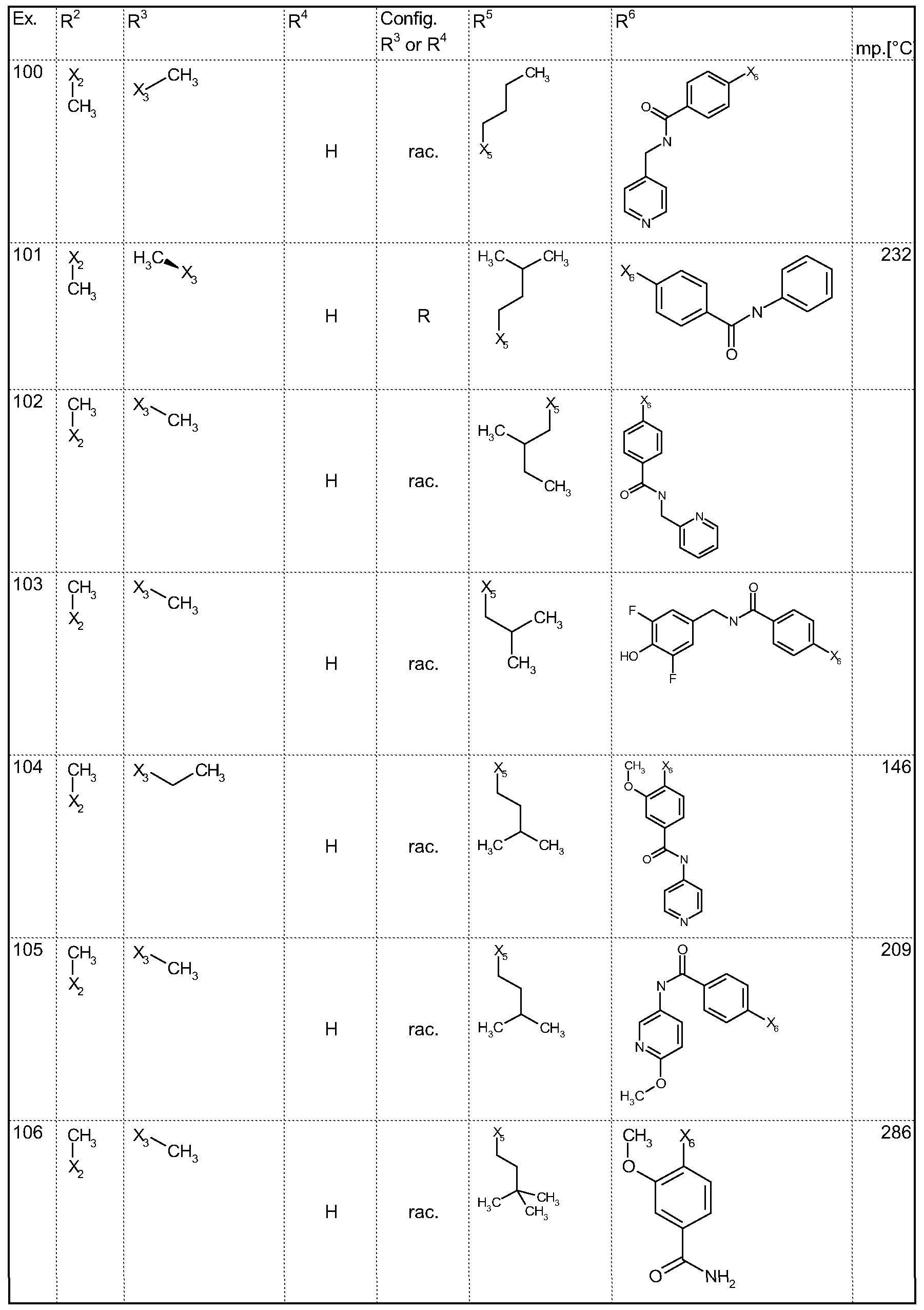


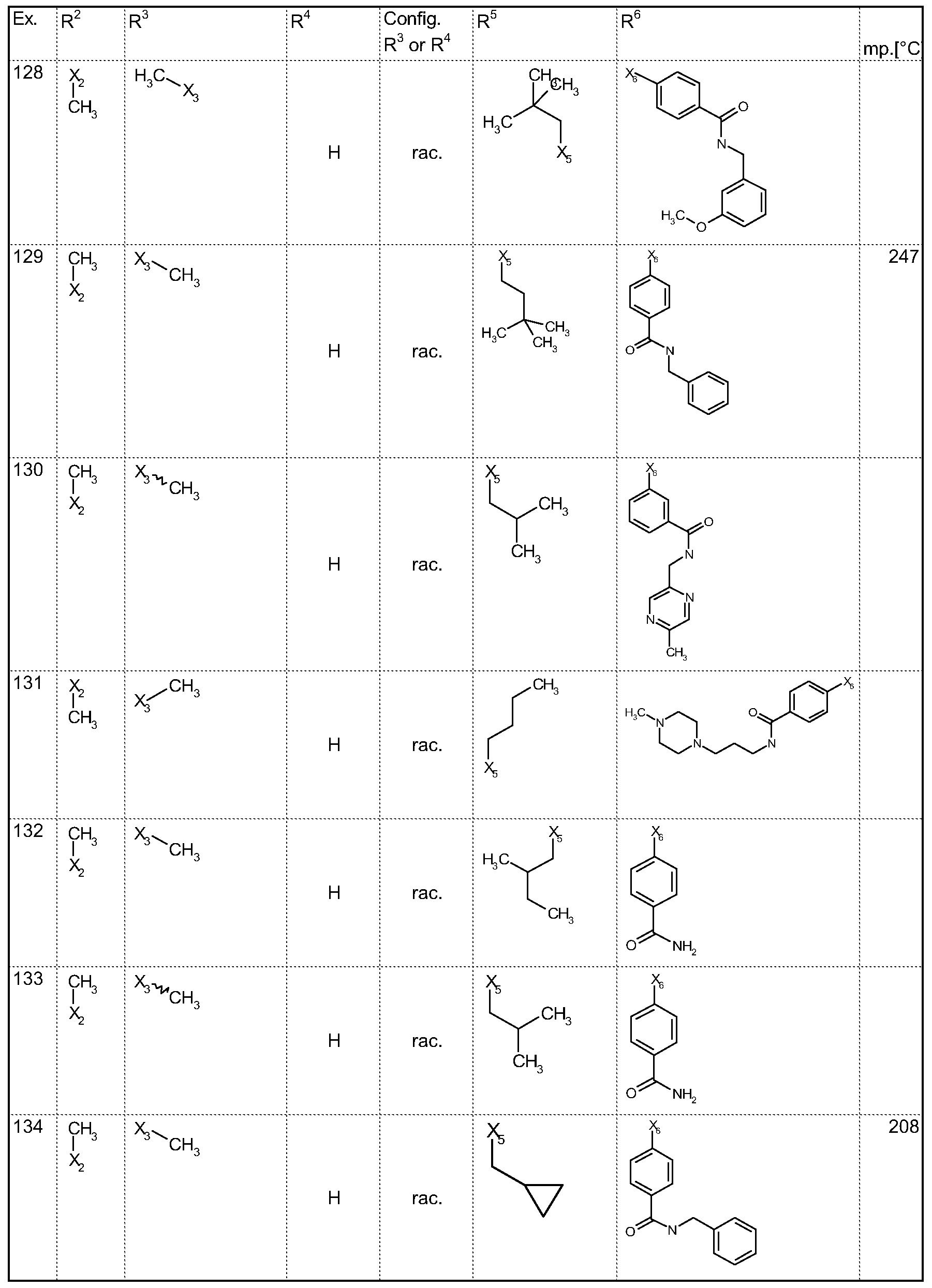


The compounds of general formula Λ_ may be used on their own or combined with other active substances according to the invention, optionally also in conjunction with other pharmacologically active substances.
In another preferred embodiment the invention relates to medicament combinations which contain in addition to one or more, preferably one compound of formula 1. a second active ingredient 2 which is selected from the group consisting of betamimetics (2a), anticholinergics (2b), PDEIV-inhibitors (2c), steroids (2d), LTD4 antagonists (2e), EGFR-inhibitors (2f), 5-lipoxygenase inhibitors (2cι), and anti-lgE monoclonal antibodies (2h) optionally together with a pharmaceutically acceptable excipient.
Within the instant application the term betamimetic is optionally also replaced by the term beta2- agonist. According to the instant invention preferred beta2 agonists 2a in the combinations according to the invention are selected from the group consisting of albuterol (2a.1 ), bambuterol (2a.2), bitolterol (2a.3), broxaterol (2a.4), carbuterol
(2a.5), clenbuterol (2a.6), fenoterol (2a.7), formoterol (2a.8), hexoprenaline (2a.9), ibuterol (2a.1O), isoetharine (2a.11 ), isoprenaline (2a.12), levosalbutamol (2a.13), mabuterol (2a.14), meluadrine (2a.15), metaproterenol (2a.16), orciprenaline (2a.17), pirbuterol (2a.18), procaterol (2a.19), reproterol (2a.2O), TD 3327 (2a.21), ritodrine (2a.22), salmeterol (2a.23), salmefamol (2a.24), soterenot (2a.25), sulphonterol (2a.26), tiaramide (2a.27), terbutaline (2a.28), tolubuterol (2a.29), CHF-4226 (= TA 2005 or carmoterol; 2a.3O), HOKU-81 (2a.31 ), KUL-1248 (2a.32), 3-(4-{6-[2-Hydroxy- 2-(4-hydroxy-3-hydroxymethyl-phenyl)-ethylamino]-hexyloxy}-butyl)- benzenesulfoneamide (2a.33) , 5-[2-(5,6-Diethyl-indan-2-ylamino)-1-hydroxy-ethyl]-8- hydroxy-1 H-quinolin-2-one (2a.34) , 4-hydroxy-7-[2-{[2-{[3-(2- phenylethoxy)propyl]sulphonyl}ethyl]-amino}ethyl]-2(3H)-benzothiazolone (2a.35), 1 - (2-fluoro-4-hydroxyphenyl)-2-[4-(1-benzimidazolyl)-2-methyl-2-butylamino]ethanol (2a.36), 1 -[3-(4-methoxybenzyl-amino)-4-hydroxyphenyl]-2-[4-(1 -benzimidazolyl)-2- methyl-2-butylamino]ethanol (2a.37), 1-[2H-5-hydroxy-3-oxo-4H-1 ,4-benzoxazin-8- yl]-2-[3-(4-N,N-dimethylaminophenyl)-2-methyl-2-propylamino]ethanol (2a.38), 1-[2H- 5-hydroxy-3-oxo-4H-1 ,4-benzoxazin-8-yl]-2-[3-(4-methoxyphenyl)-2-methyl-2- propylamino]ethanol (2a.39), 1-[2H-5-hydroxy-3-oxo-4H-1 ,4-benzoxazin-8-yl]-2-[3-(4- n-butyloxyphenyl)-2-methyl-2-propylamino]ethanol (2a.4O), 1 -[2H-5-hydroxy-3-oxo- 4H-1 ,4-benzoxazin-8-yl]-2-{4-[3-(4-methoxyphenyl)-1 ,2,4-triazol-3-yl]-2-methyl-2- butylamino}ethanol (2a.41 ), 5-hydroxy-8-(1-hydroxy-2-isopropylaminobutyl)-2H-1 ,4- benzoxazin-3-(4H)-one (2a.42), 1-(4-amino-3-chloro-5-trifluormethylphenyl)-2-tert.- butylamino)ethanol (2a.43), 1-(4-ethoxycarbonylamino-3-cyano-5-fluorophenyl)-2- (tert.-butylamino)ethanol (2a.44), and N-[2-Hydroxy-5-(1-hydroxy-2-{2-[4-(2-hydroxy- 2-phenyl-ethylamino)-phenyl]-ethylamino}-ethyl)-phenyl]-formamide (2a.45), optionally in the form of the racemates, the enantiomers, the diastereomers and optionally the pharmacologically acceptable acid addition salts and the hydrates thereof.
According to the instant invention more preferred beta2 agonists 2a in the combinations according to the invention are selected from the group consisting of bambuterol (2a.2), bitolterol (2a.3), carbuterol (2a.5), clenbuterol (2a.6), fenoterol (2a.7), formoterol (2a.8), hexoprenaline (2a.9), ibuterol (2a.1O), pirbuterol (2a.18), procaterol (2a.19), reproterol (2a.2O), TD 3327 (2a.21 ), salmeterol (2a.23), sulphonterol (2a.26), terbutaline (2a.28), tolubuterol (2a.29), CHF-4226 (= TA 2005 or carmoterol; 2a.3O), 3-(4-{6-[2-Hydroxy-2-(4-hydroxy-3-hydroxymethyl-phenyl)- ethylamino]-hexyloxy}-butyl)-benzenesulfoneamide (2a.33), 5-[2-(5,6-Diethyl-indan-2- ylamino)-1-hydroxy-ethyl]-8-hydroxy-1 H-quinolin-2-one (2a.34), 4-hydroxy-7-[2-{[2- {[3-(2-phenylethoxy)propyl]sulphonyl}ethyl]-amino}ethyl]-2(3H)-benzothiazolone (2a.35), 1 -(2-fluoro-4-hydroxyphenyl)-2-[4-(1 -benzimidazolyl)-2-methyl-2-
butylamino]ethanol (2a.36), 1 -[3-(4-methoxybenzyl-amino)-4-hydroxyphenyl]-2-[4-(1 - benzimidazolyl)-2-methyl-2-butylamino]ethanol (2a.37), 1-[2H-5-hydroxy-3-oxo-4H- 1 ,4-benzoxazin-8-yl]-2-[3-(4-N,N-dimethylaminophenyl)-2-methyl-2- propylamino]ethanol (2a.38), 1-[2H-5-hydroxy-3-oxo-4H-1 ,4-benzoxazin-8-yl]-2-[3-(4- methoxyphenyl)-2-methyl-2-propylamino]ethanol (2a.39), 1-[2H-5-hydroxy-3-oxo-4H- 1 ,4-benzoxazin-8-yl]-2-[3-(4-n-butyloxyphenyl)-2-methyl-2-propylamino]ethanol (2a.4O), 1 -[2H-5-hydroxy-3-oxo-4H-1 ,4-benzoxazin-8-yl]-2-{4-[3-(4-methoxy phenyl)- 1 ,2,4-triazol-3-yl]-2-methyl-2-butylamino}ethanol (2a.41), 5-hydroxy-8-(1-hydroxy-2- isopropylaminobutyl)-2H-1 ,4-benzoxazin-3-(4H)-one (2a.42), 1-(4-amino-3-chloro-5- trifluormethylphenyl)-2-tert.-butylamino)ethanol (2a.43), 1-(4-ethoxycarbonylamino-3- cyano-5-fluorophenyl)-2-(tert.-butylamino)ethanol (2a.44), and N-[2-Hydroxy-5-(1- hydroxy-2-{2-[4-(2-hydroxy-2-phenyl-ethylamino)-phenyl]-ethylamino}-ethyl)-phenyl]- formamide (2a.45), optionally in the form of the racemates, the enantiomers, the diastereomers and optionally the pharmacologically acceptable acid addition salts and the hydrates thereof.
More preferably, the betamimetics 2a used as within the compositions according to the invention are selected from the group consisting of fenoterol (2a.7), formoterol (2a.8), salmeterol (2a.23), CHF-4226 (= TA 2005 or carmoterol; 2a.3O), 3-(4-{6-[2- Hydroxy-2-(4-hydroxy-3-hydroxymethyl-phenyl)-ethylamino]-hexyloxy}-butyl)- benzenesulfoneamide (2a.33), 5-[2-(5,6-Diethyl-indan-2-ylamino)-1-hydroxy-ethyl]-8- hydroxy-1 H-quinolin-2-one (2a.34), 1-[3-(4-methoxybenzyl-amino)-4-hydroxyphenyl]- 2-[4-(1-benzimidazolyl)-2-methyl-2-butylamino]ethanol (2a.37), 1-[2H-5-hydroxy-3- oxo-4H-1 ,4-benzoxazin-8-yl]-2-[3-(4-N,N-dimethylaminophenyl)-2-methyl-2- propylamino]ethanol (2a.38), 1-[2H-5-hydroxy-3-oxo-4H-1 ,4-benzoxazin-8-yl]-2-[3-(4- methoxyphenyl)-2-methyl-2-propylamino]ethanol (2a.39), 1 -[2H-5-hydroxy-3-oxo-4H- 1 ,4-benzoxazin-8-yl]-2-[3-(4-n-butyloxyphenyl)-2-methyl-2-propylamino]ethanol (2a.4O), 1 -[2H-5-hydroxy-3-oxo-4H-1 ,4-benzoxazin-8-yl]-2-{4-[3-(4-methoxyphenyl)- 1 ,2,4-triazol-3-yl]-2-methyl-2-butylamino}ethanol (2a.41), and N-[2-Hydroxy-5-(1- hydroxy-2-{2-[4-(2-hydroxy-2-phenyl-ethylamino)-phenyl]-ethylamino}-ethyl)-phenyl]- formamide (2a.45), optionally in the form of the racemates, the enantiomers, the diastereomers and optionally the pharmacologically acceptable acid addition salts and the hydrates thereof. Of the betamimetics mentioned above the compounds formoterol (2a.8), salmeterol (2a.23), CHF-4226 (= TA 2005 or carmoterol; 2a.3O), 3- (4-{6-[2-Hydroxy-2-(4-hydroxy-3-hydroxymethyl-phenyl)-ethylamino]-hexyloxy}-butyl)- benzenesulfoneamide (2a.33), 5-[2-(5,6-Diethyl-indan-2-ylamino)-1-hydroxy-ethyl]-8- hydroxy-1 H-quinolin-2-one are (2a.34), and N-[2-Hydroxy-5-(1-hydroxy-2-{2-[4-(2- hydroxy-2-phenyl-ethylamino)-phenyl]-ethylamino}-ethyl)-phenyl]-formamide (2a.45), particularly preferred, optionally in the form of the racemates, the enantiomers, the
diastereomers and optionally the pharmacologically acceptable acid addition salts thereof, and the hydrates thereof.
Examples of pharmacologically acceptable acid addition salts of the betamimetics 2a according to the invention are the pharmaceutically acceptable salts which are selected from among the salts of hydrochloric acid, hydrobromic acid, sulphuric acid, phosphoric acid, methanesulphonic acid, acetic acid, fumaric acid, succinic acid, lactic acid, citric acid, tartaric acid, 1-hydroxy-2-naphthalenecarboxylic acid, A- phenylcinnamic acid, 5-(2.4-difluorophenyl)salicylic acid or maleic acid. If desired, mixtures of the abovementioned acids may also be used to prepare the salts 2a.
According to the invention, the salts of the betamimetics 2a selected from among the hydrochloride, hydrobromide, sulphate, phosphate, fumarate, methanesulphonate, A- phenylcinnamate, 5-(2.4-difluorophenyl)salicylate, maleate and xinafoate are preferred. Particularly preferred are the salts of 2a in the case of salmeterol selected from among the hydrochloride, sulphate, 4-phenylcinnamate, 5-(2.4- difluorophenyl)salicylate and xinafoate, of which the 4-phenylcinnamate, 5-(2.4- difluorophenyl)salicylate and especially xinafoate are particularly important. Particularly preferred are the salts of 2a in the case of formoterol selected from the hydrochloride, sulphate, hemifumarate and fumarate, of which the hydrochloride, hemifumarate and fumarate are particularly preferred. Of exceptional importance according to the invention is formoterol fumarate dihydrate or formoterol hemifumarate hydrate.
Any reference to the term betamimetics 2a also includes a reference to the relevant enantiomers or mixtures thereof.
In the pharmaceutical compositions according to the invention, the compounds 2a may be present in the form of their racemates, enantiomers or mixtures thereof. The separation of the enantiomers from the racemates may be carried out using methods known in the art (e.g. by chromatography on chiral phases, etc.) If the compounds 2a are used in the form of their enantiomers, it is particularly preferable to use the enantiomers in the R configuration at the C-OH group. If the compounds 2a possess 2 chiral carbon atoms they are preferably used in the form of their pure diastereomers, particularly in the form of those diasteromers that possess R configuration at the C-OH group. An example may be R,R-formoterol.
In the medicament combinations according to the invention the anticholinergic 2b is preferably selected from among the tiotropium salts (2b.1 ), oxitropium salts (2b.2),
flutropium salts (2b.3), ipratropium salts (2b.4), glycopyrronium salts (2b.5), trospium salts (2b.6) and the compounds of formulae 2b.7 to 2b.13.
In the above-mentioned salts 2b.1 to 2b.6 the cations tiotropium, oxitropium, flutropium, ipratropium, glycopyrronium and trospium are the pharmacologically active constituents. Explicit references to the above-mentioned cations are indicated by the numerals 2b.1' to 2b.6'. Each reference to the above-mentioned salts 2b.1 to 2b.6 naturally includes a reference to the corresponding cations tiotropium (2b.1'), oxitropium (2b.2'), flutropium (2b.3'), ipratropium (2b.4'), glycopyrronium (2b.5') and trospium (2b.6').
By the salts 2b.1 to 2b.6 are meant according to the invention those compounds which contain in addition to the cations tiotropium (2b.1 '), oxitropium (2b.2'), flutropium (2b.3'), ipratropium (2b.4'), glycopyrronium (2b.5') and trospium (2b.6') as counter-ion (anion) chloride, bromide, iodide, sulphate, phosphate, methanesulphonate, nitrate, maleate, acetate, citrate, fumarate, tartrate, oxalate, succinate, benzoate or p-toluenesulphonate contain, while the chloride, bromide, iodide, sulphate, methanesulphonate or p-toluenesulphonate are preferred as counter-ions. Of all the salts the chloride, bromide, iodide and methanesulphonate are particularly preferred.
In the case of the trospium salts (2b.6) the chloride is particularly preferred. Of the other salts 2b.1 to 2b.5 the methanesulphonates and bromides are of particular importance.
Of particular importance are medicament combinations which contain tiotropium salts (2b.1 ), oxitropium salts (2b.2) or ipratropium salts (2b.4), while the respective bromides are particularly important according to the invention. Of particular importance is the tiotropium bromide (2b.1 ). The above-mentioned salts may optionally be present in the medicament combinations according to the invention in the form of their solvates or hydrates, preferably in the form of their hydrates. In the case of tiotropium bromide the medicament combinations according to the invention preferably contain this in the form of the crystalline tiotropium bromide monohydrate, which is known from WO 02/30928. If the tiotropium bromide is used in anhydrous form in the medicament combinations according to the invention, it is preferable to use the anhydrous crystalline tiotropium bromide which is known from WO 03/000265.
The above-mentioned anticholinergics optionally have chiral carbon centres. In this case the medicament combinations according to the invention may contain the anticholinergics in the form of their enantiomers, mixtures of enantiomers or
racemates, while enantiomerically pure anticholinergics as for instance R, R- glycopyrrolate (2b.5) are preferably used .
In another preferred embodiment of the present invention the anticholinergics 2b contained in the medicament combinations according to the invention are selected from the salts of formula 2b.7

X ' denotes an anion with a single negative charge, preferably an anion selected from among the fluoride, chloride, bromide, iodide, sulphate, phosphate, methanesulphonate, nitrate, maleate, acetate, citrate, fumarate, tartrate, oxalate, succinate, benzoate and p- toluenesulphonate, optionally in the form of the racemates, enantiomers or hydrates thereof.
Particularly preferred medicament combinations contain the compound of formula 2b.7 in the form of the bromide.
Of particular importance are those medicament combinations which contain the enantiomers of formula 2b.7-en

In another preferred embodiment of the present invention the anticholinergics 2b contained in the medicament combinations according to the invention are selected from the salts of formula 2b.8
 wherein R denotes either methyl (2b.8.1 ) or ethyl (2b.8.2) and wherein X " may have the above-mentioned meanings. In an alternative embodiment the compound of formula 2b.8 is present in the form of the free base 2b.8-base

The medicament combinations according to the invention may contain the anticholinergic of formula 2b.8 (or 2b.8-base) in the form of the enantiomers, mixtures of enantiomers or racemates thereof . Preferably the anticholinergics of formula 2b.8 (or 2b.8-base) are present in the form of their R-enantiomers.
In another preferred embodiment of the present invention the anticholinergics 2b contained in the medicament combinations according to the invention are selected from the group consisting of tropenol 2,2-diphenylpropionate methobromide (2b.9.1 ), scopine 2,2-diphenylpropionate methobromide (2b.9.2), scopine 2-fluoro-2,2-diphenylacetate methobromide (2b.9.3), tropenol 2-fluoro-2,2-diphenylacetate methobromide (2b.9.4);
These compounds may optionally be present in the form of the enantiomers, mixtures of enantiomers or racemates thereof, as well as optionally in the form of the hydrates and/or solvates thereof.
The aforementioned compounds are known in the art (WO 02/32899).
In another preferred embodiment of the present invention the anticholinergics 2b contained in the medicament combinations according to the invention are selected from the group consisting of
tropenol 3,3',4,4'-tetrafluorobenzilate methobromide (2b.10.1 ), scopine 3,3',4,4'-tetrafluorobenzilate methobromide (2b.10.2), tropenol 4,4'-difluorobenzilate methobromide (2b.10.3), scopine 4,4'-difluorobenzilate methobromide (2b.10.4), - tropenol 3,3'-difluorobenzilate methobromide (2b.10.5), scopine 3,3'-difluorobenzilate methobromide (2b.10.6). These compounds may optionally be present in the form of the enantiomers, mixtures of enantiomers or racemates thereof, as well as optionally in the form of the hydrates and/or solvates thereof. The aforementioned compounds are known in the art (WO 02/32898).
In another preferred embodiment of the present invention the anticholinergics 2b contained in the medicament combinations according to the invention are selected from the group consisting of - tropenol 9-hydroxy-fluorene-9-carboxylate methobromide (2b.12a.1 ); tropenol 9-fluoro-fluorene-9-carboxylate methobromide (2b.12a.2) ; scopine 9-hydroxy-fluorene-9-carboxylate methobromide (2b.12a.3) ; scopine 9-fluoro-fluorene-9-carboxylate methobromide (2b.12a.4) ; tropenol 9-methyl-fluorene-9-carboxylate methobromide (2b.12a.5) ; - scopine 9-methyl-fluorene-9-carboxylate methobromide (2b.12a.6) ; These compounds may optionally be present in the form of the enantiomers, mixtures of enantiomers or racemates thereof, as well as optionally in the form of the hydrates and/or solvates thereof. The aforementioned compounds are known in the art (WO 03/064419).
In another preferred embodiment of the present invention the anticholinergics 2b contained in the medicament combinations according to the invention are selected from the group consisting of cyclopropyltropine benzilate methobromide (2b.12b.1 ); - cyclopropyltropine 2,2-diphenylpropionate methobromide (2b.12b.2); cyclopropyltropine 9-hydroxy-xanthene-9-carboxylate methobromide (2b.12b.3); cyclopropyltropine 9-methyl-fluorene-9-carboxylate methobromide (2b.12b.4); cyclopropyltropine 9-methyl-xanthene-9-carboxylate methobromide (2b.12b.5); cyclopropyltropine 9-hydroxy-fluorene-9-carboxylate methobromide
(2b.12b.6); cyclopropyltropine methyl 4,4'-difluorobenzilate methobromide (2b.12b.7).
In another preferred embodiment of the present invention the anticholinergics 2b contained in the medicament combinations according to the invention are selected from the group consisting of tropenol 9-hydroxy-xanthene-9-carboxylate methobromide (2b.12c.1 ); - scopine 9-hydroxy-xanthene-9-carboxylate methobromide (2b.12c.2); tropenol 9-methyl-xanthene-9-carboxylate methobromide (2b.12c.3); scopine 9-methyl-xanthene-9-carboxylate methobromide (2b.12c.4); tropenol 9-ethyl-xanthene-9-carboxylate methobromide (2b.12c.5); tropenol 9-difluoromethyl-xanthene-9-carboxylate methobromide (2b.12c.6); - scopine 9-hydroxymethyl-xanthene-9-carboxylate methobromide (2b.12c.7). These compounds may optionally be present in the form of the enantiomers, mixtures of enantiomers or racemates thereof, as well as optionally in the form of the hydrates and/or solvates thereof. The aforementioned compounds are known in the art (WO 03/064418).
The compounds of formula 2b.13 may optionally be present in the form of the enantiomers, mixtures of enantiomers or racemates thereof, as well as optionally in the form of the hydrates and/or solvates thereof.
Within the scope of the present invention any reference to anticholinergics 2b| is to be taken as a reference to the pharmacologically active cations of the various salts. These cations are for instance tiotropium (2b.1'), oxitropium (2b.2'), flutropium (2b.3'), ipratropium (2b.4'), glycopyrronium (2b.5'), trospium (2b.6').
In the medicament combinations according to the invention the PDE IV-inhibitor 2c is preferably selected from among enprofyllin (2c.1 ), theophyllin (2c.2), roflumilast (2c.3), ariflo (Cilomilast, 2cΛ)), CP-325,366 (2C1S), BY343 (2C.6), D-4396 (Sch- 351591 , 2C1Z)), AWD-12-281 (GW-842470, 2CjJ)), N-(3,5-dichloro-1-oxo-pyridin-4- ylH-difluoromethoxy-S-cyclopropylmethoxybenzamide (2c.9), NCS-613 (2c.1O), pumafentine (2c.11), (-)p-[(4aR*, 10fc>S*)-9-ethoxy-1 ,2,3,4,4a, 10b-hexahydro-8- methoxy-2-methylbenzo[s][1 ,6]naphthyridin-6-yl]-N,N-diisopropylbenzamide (2c.12), (R)-(+)-1-(4-bromobenzyl)-4-[(3-cyclopentyloxy)-4-methoxyphenyl]-2-pyrrolidone (2c.13), 3-(cyclopentyloxy-4-methoxyphenyl)-1-(4-N'-[N-2-cyano-S-methyl- isothioureido]benzyl)-2-pyrrolidone (2c.14), cis[4-cyano-4-(3-cyclopentyloxy-4- methoxyphenyl)cyclohexane-1-carboxylic acid] (2c.15), 2-carbomethoxy-4-cyano-4- (3-cyclopropylmethoxy-4-difluoromethoxyphenyl)cyclohexan-1 -one (2c.16), cis[4- cyano-4-(3-cyclopropylmethoxy-4-difluoromethoxyphenyl)cyclohexan-1-ol] (2c.17), (R)-(+)-ethyl[4-(3-cyclopentyloxy-4-methoxyphenyl)pyrrolidin-2-ylidene]acetate
(2c.18), (S)-(-)-ethyl[4-(3-cyclopentyloxy-4-methoxyphenyl)pyrrolidin-2- ylidenelacetate(2c.19), 4-(3-cyclopentyloxy-4-methoxy-phenyl)-3-(1-hydroxy-ethyl)-3- methyl-pyrrolidine-1-carboxylic acid methyl ester (=IC 485, 2c.2O), CDP840 (2c.21), Bay-198004 (2c.22), D-4418 (2c.23), PD-168787 (2c.24), T-440 (2c.25), T-2585 (2c26), arofyllin (2c.27), atizoram (2c.28), V- 11294A (2c.29), CI-1018 (2c.3O), CDC- 801 (2c.31 ), CDC-3052 (2c.32), D-22888 (2c.33), YM-58997 (2c.34), Z-15370 (2c.35), 9-cyclopentyl-5,6-dihydro-7-ethyl-3-(2-thienyl)-9H-pyrazolo[3,4-c]-1 ,2,4- triazolo[4,3-a]pyridine (2c.36), 9-cyclopentyl-5,6-dihydro-7-ethyl-3-(terf-butyl)-9H- pyrazolo[3,4-c]-1 ,2,4-triazolo[4,3-a]pyridine (2c.37), and tetomilast (2c.38), optionally in the form of the racemates, enantiomers or diastereomers thereof and optionally in the form of the pharmacologically acceptable acid addition salts, solvates and/or hydrates thereof.
In particularly preferred medicament combinations the PDE IV-inhibitor 2c is selected from the group comprising enprofyllin (2c.1 ), roflumilast (2c.3) optionally also in form of the roflumilast N-oxide, ariflo (cilomilast) (2cΛ), AWD-12-281 (GW-842470) (2c.8), N-(3,5-dichloro-1-oxo-pyridin-4-yl)-4-difluoromethoxy-3-cyclopropylmethoxy benzamide (2c.9), T-440 (2c.25), T-2585 (2c.26), cis[4-cyano-4-(3-cyclopentyloxy-4- methoxyphenyl)cyclohexane-1-carboxylic acid] (2c.15), 2-carbomethoxy-4-cyano-4- (3-cyclopropylmethoxy-4-difluoromethoxyphenyl)cyclohexan-1-one (2c.16), cis[4- cyano-4-(3-cyclopropylmethoxy-4-difluoromethoxyphenyl)cyclohexan-1 -ol] (2c.17), 4- (3-cyclopentyloxy-4-methoxy-phenyl)-3-(1-hydroxy-ethyl)-3-methyl-pyrrolidine-1- carboxylic acid methyl ester (=IC 485, 2c.2O), PD-168787 (2c.24), arofyllin (2c.27), atizoram (2c.28), V-11294A (2c.29), CI-1018 (2c.3O), CDC-801 (2c.31), D-22888 (2c33), YM-58997 (2c.34), Z-15370 (2c.35), 9-cyclopentyl-5,6-dihydro-7-ethyl-3-(2- thienyl)-9H-pyrazolo[3,4-c]-1 ,2,4-triazolo[4,3-a]pyridine (2c.36), 9-cyclopentyl-5,6- dihydro-7-ethyl-3-(tø/t-butyl)-9H-pyrazolo[3,4-c]-1 ,2,4-triazolo[4,3-a]pyridine (2c.37), and tetomilast (2c.38), optionally in the form of the racemates, enantiomers or diastereomers thereof and optionally in the form of the pharmacologically acceptable acid addition salts, solvates and/or hydrates thereof.
In particularly preferred medicament combinations the PDE IV-inhibitor 2c is selected from the group comprising roflumilast (2c.3), ariflo (cilomilast) (2c.4), AWD-12-281 (GW-842470) (2c.8), 2-carbomethoxy-4-cyano-4-(3-cyclopropylmethoxy-4- difluoromethoxyphenyl)cyclohexan-1-one (2c.16), cis[4-cyano-4-(3-cyclopropylme- thoxy-4-difluoromethoxyphenyl)cyclohexan-1-ol] (2c.17), 4-(3-cyclopentyloxy-4- methoxy-phenyl)-3-(1-hydroxy-ethyl)-3-methyl-pyrrolidine-1-carboxylic acid methyl ester (=IC 485, 2c.2O), arofyllin (2c.27), atizoram (2c.28), Z-15370 (2c.35), 9- cyclopentyl-5,6-dihydro-7-ethyl-3-(2-thienyl)-9H-pyrazolo[3,4-c]-1 ,2,4-triazolo[4,3-
a]pyridine (2c.36), 9-cyclopentyl-5,6-dihydro-7-ethyl-3-(terf-butyl)-9H-pyrazolo[3,4-c]- 1 ,2,4-triazolo[4,3-a]pyridine (2c.37), and tetomilast (2c.38), while roflumilast (2c.3), Z-15370 (2c35) and AWD-12-281 (2c.8) are of particular significance, optionally in the form of the racemates, enantiomers or diastereomers thereof and optionally in the form of the pharmacologically acceptable acid addition salts, solvates and/or hydrates thereof.
By the acid addition salts with pharmacologically acceptable acids which the compounds 2c may possibly be capable of forming are meant for example salts selected from the group comprising the hydrochloride, hydrobromide, hydroiodide, hydrosulphate, hydrophosphate, hydromethanesulphonate, hydronitrate, hydromaleate, hydroacetate, hydrobenzoate, hydrocitrate, hydrofumarate, hydrotartrate, hydrooxalate, hydrosuccinate, hydrobenzoate and hydro-p- toluenesulphonate, preferably the hydrochloride, hydrobromide, hydrosulphate, hydrophosphate, hydrofumarate and hydromethanesulphonate.
Other preferred medicament combinations according to the invention contain as an additional active substance, in addition to one or more, preferably one compound Λ_ , one or more, preferably one steroid 2d, optionally in combination with pharmaceutically acceptable excipients.
In such medicament combinations the steroid 2d is preferably selected from among prednisolone (2dJJ, prednisone (2d.2), butixocortpropionate (2d.3), RPR-106541 (2d.4), flunisolide (2d.5), beclomethasone (2d.6), triamcinolone (2d.7), budesonide (2d.8), fluticasone (2d.9), mometasone (2d.1O), ciclesonide (2d.11 ), rofleponide (2d.12), ST-126 (2d.13), dexamethasone (2d.14), (S)-fluoromethyl 6α,9α-difluoro- 17α-[(2-furanylcarbonyl)oxy]-11 β-hydroxy-16α-methyl-3-oxo-androsta-1 ,4-diene-17β- carbothionate (2d.15), (S)-(2-oxo-tetrahydro-furan-3S-yl)6α,9α-difluoro-11 β-hydroxy- 16α-methyl-3-oxo-17α-propionyloxy-androsta-1 ,4-diene-17β-carbothionate (2d.16) and etiprednol-dichloroacetate (BNP-166, 2d.17), optionally in the form of the racemates, enantiomers or diastereomers thereof and optionally in the form of the salts and derivatives thereof, the solvates and/or hydrates thereof.
In particularly preferred medicament combinations the steroid 2d is selected from the group comprising flunisolide (2d.5), beclomethasone (2d.6), triamcinolone (2d.7), budesonide (2d.8), fluticasone (2d.9), mometasone (2d.1O), ciclesonide (2d.11 ), rofleponide (2d.12), ST-126 (2d.13), dexamethasone (2d.14), (S)-fluoromethyl 6α,9α-difluoro-17? -[(2-furanylcarbonyl)oxy]-11 β-hydroxy-16? -methyl-3-oxo- androsta-1 ,4-diene-17β-carbothionate (2d.15), (S)-(2-oxo-tetrahydro-furan-3S-
yl)6α,9α-difluoro-11 β-hydroxy-16α-methyl-3-oxo-17α-propionyloxy-androsta-1 ,4- diene-17β-carbothionate (2d.16) and etiprednol-dichloroacetate (2d.17), optionally in the form of the racemates, enantiomers or diastereomers thereof and optionally in the form of the salts and derivatives thereof, the solvates and/or hydrates thereof.
In particularly preferred medicament combinations the steroid 2d is selected from the group comprising budesonide (2d.8), fluticasone (2d.9), mometasone (2d.1O), ciclesonide (2d.11 ), (S)-fluoromethyl 6α,9α-difluoro-17α-[(2-furanylcarbonyl)oxy]- 11 β-hydroxy-16α-methyl-3-oxo-androsta-1 ,4-diene-17β-carbothionate (2d.15) and etiprednol-dichloroacetate (2d.17), optionally in the form of the racemates, enantiomers or diastereomers thereof and optionally in the form of the salts and derivatives thereof, the solvates and/or hydrates thereof.
Any reference to steroids 2d includes a reference to any salts or derivatives, hydrates or solvates thereof which may exist. Examples of possible salts and derivatives of the steroids 2d may be: alkali metal salts, such as for example sodium or potassium salts, sulphobenzoates, phosphates, isonicotinates, acetates, propionates, dihydrogen phosphates, palmitates, pivalates or furoates.
Other preferred medicament combinations according to the invention contain, as an additional active substance, in addition to one or more, preferably one compound Λ_ , one or more, preferably one, LTD4 antagonist 2e, optionally in combination with pharmaceutically acceptable excipients.
In such medicament combinations the LTD4 antagonist 2e is preferably selected from among montelukast (2e.1 ), 1-(((R)-(3-(2-(6,7-difluoro-2-quinolinyl)ethenyl) phenyl)-3-(2-(2- hydroxy-2-propyl)phenyl)thio)methylcyclopropane-acetic acid (2e.2), 1-(((1 (R)-3(3-(2-(2,3-dichlorothieno[3,2-b]pyridin-5-yl)-(E)-ethenyl)phenyl)-3-(2-(1- hydroxy-1-methylethyl)phenyl)propyl)thio)methyl)cyclopropanacetic acid (2e.3), pranlukast (2e.4), zafirlukast (2e.5), [2-[[2-(4-tert-butyl-2-thiazolyl)-5-benzofuranyl]- oxymethyl]-phenyl]acetic acid (2eJ>), MCC-847 (ZD-3523) (2e^7), MN-001 (2e.8), MEN-91507 (LM-1507) (2eJΪ), VUF-5078 (2eJ0), VUF-K-8707 (2e.11 ) and L-733321 (2e.12), optionally in the form of the racemates, enantiomers or diastereomers thereof, optionally in the form of the pharmacologically acceptable acid addition salts thereof as well as optionally in the form of the salts and derivatives thereof, the solvates and/or hydrates thereof.
In preferred medicament combinations the LTD4 antagonist 2e is selected from the group comprising montelukast (2e.1 ), pranlukast (2e.4), zafirlukast (2e.5), MCC-847
(ZD-3523) (2eJ), MN-001 (2eΛ), MEN-91507 (LM-1507) (2eJ)), VUF-5078 (2e.1O), VUF-K-8707 (2e.11 ) and L-733321 (2e.12), optionally in the form of the racemates, enantiomers or diastereomers thereof, optionally in the form of the pharmacologically acceptable acid addition salts thereof as well as optionally in the form of the salts and derivatives thereof, the solvates and/or hydrates thereof.
In particularly preferred medicament combinations the LTD4 antagonist 2e is selected from the group comprising montelukast (2eJJ, pranlukast (2e.4), zafirlukast (2e.5), MCC-847 (ZD-3523) (2eT), MN-001 (2M) and MEN-91507 (LM-1507) (2e.9), while montelukast (2eJJ, pranlukast (2e.4) and zafirlukast (2e.5) are particularly preferred, optionally in the form of the racemates, enantiomers or diastereomers thereof, optionally in the form of the pharmacologically acceptable acid addition salts thereof as well as optionally in the form of the salts and derivatives thereof, the solvates and/or hydrates thereof.
By the acid addition salts with pharmacologically acceptable acids which the compounds 2e may possibly be capable of forming are meant for example salts selected from the group comprising the hydrochloride, hydrobromide, hydroiodide, hydrosulphate, hydrophosphate, hydromethanesulphonate, hydronitrate, hydromaleate, hydroacetate, hydrobenzoate, hydrocitrate, hydrofumarate, hydrotartrate, hydrooxalate, hydrosuccinate, hydrobenzoate and hydro-p- toluenesulphonate, preferably the hydrochloride, hydrobromide, hydrosulphate, hydrophosphate, hydrofumarate and hydromethanesulphonate. Examples of possible salts and derivatives which the compounds 2e may possibly be capable of forming include for example: alkali metal salts, such as for example sodium or potassium salts, alkaline earth metal salts, sulphobenzoates, phosphates, isonicotinates, acetates, propionates, dihydrogen phosphates, palmitates, pivalates or furoates.
Other preferred medicament combinations according to the invention contain, as an additional active substance, in addition to one or more, preferably one compound 1. , one or more, preferably one, EGFR-inhibitor 2f, optionally in combination with pharmaceutically acceptable excipients.
In such medicament combinations the EGFR-inhibitor 2f is selected for example from the group comprising 4-[(3-chloro-4-fluorophenyl)amino]-6-{[4-(morpholin-4-yl)-1-oxo- 2-buten-1-yl]amino}-7-cyclopropylmethoxy-quinazoline, 4-[(3-chloro-4- fluorophenyl)amino]-6-{[4-(N,N-diethylamino)-1-oxo-2-buten-1-yl]amino}-7- cyclopropylmethoxy-quinazoline, 4-[(3-chloro-4-fluorophenyl)amino]-6-{[4-(N,N-
dimethylamino)-1 -oxo-2-buten-1 -yl]amino}-7-cyclopropylmethoxy-quinazoline, 4-[(H)- (1-phenyl-ethyl)amino]-6-{[4-(morpholin-4-yl)-1-oxo-2-buten-1-yl]amino}-7- cyclopentyloxy-quinazoline, 4-[(3-chloro-4-fluoro-phenyl)amino]-6-{[4-((/:?)-6-methyl- 2-oxo-morpholin-4-yl)-1-oxo-2-buten-1-yl]amino}-7-cyclopropylmethoxy-quinazoline, 4-[(3-chloro-4-fluoro-phenyl)amino]-6-{[4-((/:?)-6-methyl-2-oxo-morpholin-4-yl)-1-oxo- 2-buten-1-yl]amino}-7-[(S)-(tetrahydrofuran-3-yl)oxy]-quinazoline, 4-[(3-chloro-4- fluoro-phenyl)amino]-6-{[4-((ff)-2-methoxymethyl-6-oxo-morpholin-4-yl)-1-oxo-2- buten-1-yl]amino}-7-cyclopropylmethoxy-quinazoline, 4-[(3-chloro-4-fluoro- phenyl)amino]-6-[2-((S)-6-methyl-2-oxo-morpholin-4-yl)-ethoxy]-7-methoxy- quinazoline, 4-[(3-chloro-4-fluorophenyl)amino]-6-({4-[N-(2-methoxy-ethyl)-N-methyl- amino]-1-oxo-2-buten-1-yl}amino)-7-cyclopropylmethoxy-quinazoline, 4-[(3-chloro-4- fluorophenyl)amino]-6-{[4-(N,N-dimethylamino)-1-oxo-2-buten-1-yl]amino}-7- cyclopentyloxy-quinazoline, 4-[(f?)-(1-phenyl-ethyl)amino]-6-{[4-(N,N-bis-(2-methoxy- ethyl)-amino)-1 -oxo-2-buten-1 -yl]amino}-7-cyclopropylmethoxy-quinazoline, 4-[(f?)-(1 - phenyl-ethyl)amino]-6-({4-[N-(2-methoxy-ethyl)-N-ethyl-amino]-1 -oxo-2-buten-1 - yl}amino)-7-cyclopropylmethoxy-quinazoline, 4-[(f?)-(1-phenyl-ethyl)amino]-6-({4-[N- (2-methoxy-ethyl)-N-methyl-amino]-1-oxo-2-buten-1-yl}amino)-7-cyclopropylmethoxy- quinazoline, 4-[(f?)-(1-phenyl-ethyl)amino]-6-({4-[N-(tetrahydropyran-4-yl)-N-methyl- amino]-1 -oxo-2-buten-1 -yl}amino)-7-cyclopropylmethoxy-quinazoline, 4-[(3-chloro-4- fluorophenyl)amino]-6-{[4-(N,N-dimethylamino)-1-oxo-2-buten-1-yl]amino}-7-((/:?)- tetrahydrofuran-3-yloxy)-quinazoline, 4-[(3-chloro-4-fluorophenyl)amino]-6-{[4-(N,N- dimethylamino)-1-oxo-2-buten-1-yl]amino}-7-((S)-tetrahydrofuran-3-yloxy)- quinazoline, 4-[(3-chloro-4-fluorophenyl)amino]-6-({4-[N-(2-methoxy-ethyl)-N-methyl- amino]-1 -oxo-2-buten-1 -yl}amino)-7-cyclopentyloxy-quinazoline, 4-[(3-chloro-4- fluorophenyl)amino]-6-{[4-(N-cyclopropyl-N-methyl-amino)-1 -oxo-2-buten-1 -yl]amino}- 7-cyclopentyloxy-quinazoline, 4-[(3-chloro-4-fluorophenyl)amino]-6-{[4-(N,N- dimethylamino^i-oxo^-buten-i-yljamino^-^^-^etrahydrofuran^-yOmethoxy]- quinazoline, 4-[(3-chloro-4-fluorophenyl)amino]-6-{[4-(N,N-dimethylamino)-1-oxo-2- buten-1-yl]amino}-7-[(S)-(tetrahydrofuran-2-yl)methoxy]-quinazoline, 4-[(3-ethynyl- phenyl)amino]-6,7-bis-(2-methoxy-ethoxy)-quinazoline, 4-[(3-chloro-4- fluorophenyl)amino]-7-[3-(morpholin-4-yl)-propyloxy]-6-[(vinylcarbonyl)amino]- quinazoline, 4-[(f?)-(1-phenyl-ethyl)amino]-6-(4-hydroxy-phenyl)-7l-l-pyrrolo[2,3- d]pyrimidine, 3-cyano-4-[(3-chloro-4-fluorophenyl)amino]-6-{[4-(N,N-dimethylamino)- 1 -oxo-2-buten-1 -yl]amino}-7-ethoxy-quinoline, 4-{[3-chloro-4-(3-fluoro-benzyloxy)- phenyl]amino}-6-(5-{[(2-methanesulphonyl-ethyl)amino]methyl}-furan-2- yl)quinazoline, 4-[(R)-(1-phenyl-ethyl)amino]-6-{[4-((R)-6-methyl-2-oxo-morpholin-4- yl)-1-oxo-2-buten-1-yl]amino}-7-methoxy-quinazoline, 4-[(3-chloro-4- fluorophenyl)amino]-6-{[4-(morpholin-4-yl)-1-oxo-2-buten-1-yl]amino}-7- [(tetrahydrofuran-2-yl)methoxy]-quinazoline, 4-[(3-chloro-4-fluorophenyl)amino]-6-({4-
[N,N-bis-(2-methoxy-ethyl)-amino]-1-oxo-2-buten-1-yl}amino)-7-[(tetrahydrofuran-2- yl)methoxy]-quinazoline, 4-[(3-ethynyl-phenyl)amino]-6-{[4-(5,5-dimethyl-2-oxo- morpholin-4-yl)-1 -oxo-2-buten-1 -yl]amino}-quinazoline, 4-[(3-chloro-4-fluoro- phenyl)amino]-6-[2-(2,2-dimethyl-6-oxo-morpholin-4-yl)-ethoxy]-7-methoxy- quinazoline, 4-[(3-chloro-4-fluoro-phenyl)amino]-6-[2-(2,2-dimethyl-6-oxo-morpholin- 4-yl)-ethoxy]-7-[(R)-(tetrahydrofuran-2-yl)methoxy]-quinazoline, 4-[(3-chloro-4-fluoro- phenyl)amino]-7-[2-(2,2-dimethyl-6-oxo-morpholin-4-yl)-ethoxy]-6-[(S)- (tetrahydrofuran-2-yl)methoxy]-quinazoline, 4-[(3-chloro-4-fluoro-phenyl)amino]-6-{2- [4-(2-oxo-morpholin-4-yl)-piperidin-1-yl]-ethoxy}-7-methoxy-quinazoline, 4-[(3-chloro- 4-fluoro-phenyl)amino]-6-[1-(tert.-butyloxycarbonyl)-piperidin-4-yloxy]-7-methoxy- quinazoline, 4-[(3-chloro-4-fluoro-phenyl)amino]-6-(trans-4-amino-cyclohexan-1- yloxy)-7-methoxy-quinazoline, 4-[(3-chloro-4-fluoro-phenyl)amino]-6-(trans-4- methanesulphonylamino-cyclohexan-1-yloxy)-7-methoxy-quinazoline, 4-[(3-chloro-4- fluoro-phenyl)amino]-6-(tetrahydropyran-3-yloxy)-7-methoxy-quinazoline, 4-[(3- chloro-4-fluoro-phenyl)amino]-6-(1-methyl-piperidin-4-yloxy)-7-methoxy-quinazoline, 4-[(3-chloro-4-fluoro-phenyl)amino]-6-{1-[(morpholin-4-yl)carbonyl]-piperidin-4-yloxy}- 7-methoxy-quinazoline, 4-[(3-chloro-4-fluoro-phenyl)amino]-6-{1- [(methoxymethyl)carbonyl]-piperidin-4-yloxy}-7-methoxy-quinazoline, 4-[(3-chloro-4- fluoro-phenyl)amino]-6-(piperidin-3-yloxy)-7-methoxy-quinazoline, 4-[(3-chloro-4- fluoro-phenyl)amino]-6-[1-(2-acetylamino-ethyl)-piperidin-4-yloxy]-7-methoxy- quinazoline, 4-[(3-chloro-4-fluoro-phenyl)amino]-6-(tetrahydropyran-4-yloxy)-7- ethoxy-quinazoline, 4-[(3-chloro-4-fluoro-phenyl)amino]-6-((S)-tetrahydrofuran-3- yloxy)-7-hydroxy-quinazoline, 4-[(3-chloro-4-fluoro-phenyl)amino]-6-(tetrahydropyran- 4-yloxy)-7-(2-methoxy-ethoxy)-quinazoline, 4-[(3-chloro-4-fluoro-phenyl)amino]-6- {trans-4-[(dimethylamino)sulphonylamino]-cyclohexan-1-yloxy}-7-methoxy- quinazoline, 4-[(3-chloro-4-fluoro-phenyl)amino]-6-{trans-4-[(morpholin-4- yOcarbonylaminol-cyclohexan-i-yloxy^-methoxy-quinazoline, 4-[(3-chloro-4-fluoro- phenyOaminol-θ-ltrans^-^morpholin^-yOsulphonylaminol-cyclohexan-i-yloxy}^- methoxy-quinazoline, 4-[(3-chloro-4-fluoro-phenyl)amino]-6-(tetrahydropyran-4- yloxy)-7-(2-acetylamino-ethoxy)-quinazoline, 4-[(3-chloro-4-fluoro-phenyl)amino]-6- (tetrahydropyran-4-yloxy)-7-(2-methanesulphonylamino-ethoxy)-quinazoline, 4-[(3- chloro^-fluoro-phenyOaminol-θ-li-^piperidin-i-yOcarbonyll-piperidin^-yloxy}^- methoxy-quinazoline, 4-[(3-chloro-4-fluoro-phenyl)amino]-6-(1-aminocarbonylmethyl- piperidin-4-yloxy)-7-methoxy-quinazoline, 4-[(3-chloro-4-fluoro-phenyl)amino]-6-(cis- 4-{N-[(tetrahydropyran-4-yl)carbonyl]-N-methyl-amino}-cyclohexan-1-yloxy)-7- methoxy-quinazoline, 4-[(3-chloro-4-fluoro-phenyl)amino]-6-(cis-4-{N-[(morpholin-4- yOcarbonylj-N-methyl-aminoJ-cyclohexan-i-yloxy^-methoxy-quinazoline, 4-[(3- chloro-4-fluoro-phenyl)amino]-6-(cis-4-{N-[(morpholin-4-yl)sulphonyl]-N-methyl- amino}-cyclohexan-1-yloxy)-7-methoxy- quinazoline, 4-[(3-chloro-4-fluoro-
phenyl)amino]-6-(trans-4-ethanesulphonylamino-cyclohexan-1-yloxy)-7-methoxy- quinazoline, 4-[(3-chloro-4-fluoro-phenyl)amino]-6-(1-methanesulphonyl-piperidin-4- yloxy)-7-ethoxy-quinazoline, 4-[(3-chloro-4-fluoro-phenyl)amino]-6-(1- methanesulphonyl-piperidin-4-yloxy)-7-(2-methoxy-ethoxy)-quinazoline, 4-[(3-chloro- 4-fluoro-phenyl)amino]-6-[1-(2-methoxy-acetyl)-piperidin-4-yloxy]-7-(2-methoxy- ethoxy)-quinazoline, 4-[(3-chloro-4-fluoro-phenyl)amino]-6-(cis-4-acetylamino- cyclohexan-1 -yloxy)-7-methoxy-quinazoline, 4-[(3-ethynyl-phenyl)amino]-6-[1 -(tert.- butyloxycarbonyl)-piperidin-4-yloxy]-7-methoxy-quinazoline, 4-[(3-ethynyl- phenyl)amino]-6-(tetrahydropyran-4-yloxy]-7-methoxy-quinazoline, 4-[(3-chloro-4- fluoro-phenyl)amino]-6-(cis-4-{N-[(piperidin-1-yl)carbonyl]-N-methyl-amino}- cyclohexan-1-yloxy)-7-methoxy-quinazoline, 4-[(3-chloro-4-fluoro-phenyl)amino]-6- (cis-4-{N-[(4-methyl-piperazin-1-yl)carbonyl]-N-methyl-amino}-cyclohexan-1-yloxy)-7- methoxy-quinazoline, 4-[(3-chloro-4-fluoro-phenyl)amino]-6-{cis-4-[(morpholin-4- yOcarbonylaminol-cyclohexan-i-yloxy^-methoxy-quinazoline, 4-[(3-chloro-4-fluoro- phenyl)amino]-6-{1 -[2-(2-oxopyrrolidin-1 -yl)ethyl]-piperidin-4-yloxy}-7-methoxy- quinazoline, 4-[(3-chloro-4-fluoro-phenyl)amino]-6-{1-[(morpholin-4-yl)carbonyl]- piperidin-4-yloxy}-7-(2-methoxy-ethoxy)-quinazoline, 4-[(3-ethynyl-phenyl)amino]-6- (1-acetyl-piperidin-4-yloxy)-7-methoxy-quinazoline, 4-[(3-ethynyl-phenyl)amino]-6-(1- methyl-piperidin-4-yloxy)-7-methoxy-quinazoline, 4-[(3-ethynyl-phenyl)amino]-6-(1- methanesulphonyl-piperidin-4-yloxy)-7-methoxy-quinazoline, 4-[(3-chloro-4-fluoro- phenyl)amino]-6-(1-methyl-piperidin-4-yloxy)-7(2-methoxy-ethoxy)-quinazoline, 4-[(3- chloro-4-fluoro-phenyl)amino]-6-(1-isopropyloxycarbonyl-piperidin-4-yloxy)-7- methoxy-quinazoline, 4-[(3-chloro-4-fluoro-phenyl)amino]-6-(cis-4-methylamino- cyclohexan-1-yloxy)-7-methoxy-quinazoline, 4-[(3-chloro-4-fluoro-phenyl)amino]-6- {cis-4-[N-(2-methoxy-acetyl)-N-methyl-amino]-cyclohexan-1-yloxy}-7-methoxy- quinazoline, 4-[(3-ethynyl-phenyl)amino]-6-(piperidin-4-yloxy)-7-methoxy-quinazoline, 4-[(3-ethynyl-phenyl)amino]-6-[1-(2-methoxy-acetyl)-piperidin-4-yloxy]-7-methoxy- quinazoline, 4-[(3-ethynyl-phenyl)amino]-6-{1-[(morpholin-4-yl)carbonyl]-piperidin-4- yloxy}-7-methoxy-quinazoline, 4-[(3-chloro-4-fluoro-phenyl)amino]-6-{1-[(cis-2,6- dimethyl-morpholin-4-yl)carbonyl]-piperidin-4-yloxy}-7-methoxy-quinazoline, 4-[(3- chloro^-fluoro-phenyOaminol-θ-li-^-methyl-morpholin^-yOcarbonyll-piperidin^- yloxy}-7-methoxy-quinazoline, 4-[(3-chloro-4-fluoro-phenyl)amino]-6-{1-[(S,S)-(2-oxa- S-aza-bicyclop^.ijhept-S-yOcarbonylJ-piperidin^-yloxy^-methoxy-quinazoline, 4- [(3-chloro-4-fluoro-phenyl)amino]-6-{1-[(N-methyl-N-2-methoxyethyl-amino)carbonyl]- piperidin-4-yloxy}-7-methoxy-quinazoline, 4-[(3-chloro-4-fluoro-phenyl)amino]-6-(1- ethyl-piperidin-4-yloxy)-7-methoxy-quinazoline, 4-[(3-chloro-4-fluoro-phenyl)amino]-6- {1-[(2-methoxyethyl)carbonyl]-piperidin-4-yloxy}-7-methoxy-quinazoline, 4-[(3-chloro- 4-fluoro-phenyl)amino]-6-{1-[(3-methoxypropyl-amino)-carbonyl]-piperidin-4-yloxy}-7- methoxy-quinazoline, 4-[(3-chloro-4-fluoro-phenyl)amino]-6-[cis-4-(N-
methanesulphonyl-N-methyl-amino)-cyclohexan-1-yloxy]-7-methoxy-quinazoline, 4- [(3-chloro-4-fluoro-phenyl)amino]-6-[cis-4-(N-acetyl-N-methyl-amino)-cyclohexan-1- yloxy]-7-methoxy-quinazoline, 4-[(3-chloro-4-fluoro-phenyl)amino]-6-(trans-4- methylamino-cyclohexan-1-yloxy)-7-methoxy-quinazoline, 4-[(3-chloro-4-fluoro- phenyl)amino]-6-[trans-4-(N-methanesulphonyl-N-methyl-amino)-cyclohexan-1- yloxy]-7-methoxy-quinazoline, 4-[(3-chloro-4-fluoro-phenyl)amino]-6-(trans-4- dimethylamino-cyclohexan-1-yloxy)-7-methoxy-quinazoline, 4-[(3-chloro-4-fluoro- phenyl)amino]-6-(trans-4-{N-[(morpholin-4-yl)carbonyl]-N-methyl-amino}-cyclohexan- 1-yloxy)-7-methoxy-quinazoline, 4-[(3-chloro-4-fluoro-phenyl)amino]-6-[2-(2,2- dimethyl-6-oxo-morpholin-4-yl)-ethoxy]-7-[(S)-(tetrahydrofuran-2-yl)methoxy]- quinazoline, 4-[(3-chloro-4-fluoro-phenyl)amino]-6-(1-methanesulphonyl-piperidin-4- yloxy)-7-methoxy-quinazoline, 4-[(3-chloro-4-fluoro-phenyl)amino]-6-(1-cyano- piperidin-4-yloxy)-7-methoxy-quinazoline, cetuximab, trastuzumab, ABX-EGF and Mab ICR-62, optionally in the form of the racemates, enantiomers or diastereomers thereof, optionally in the form of the pharmacologically acceptable acid addition salts thereof, the solvates and/or hydrates thereof.
In such medicament combinations the EGFR-inhibitor 2f is preferably selected from among the 4-[(3-chloro-4-fluorophenyl)amino]-6-{[4-(morpholin-4-yl)-1 -oxo-2-buten-1 - yl]amino}-7-cyclopropylmethoxy-quinazoline, 4-[(3-chloro-4-fluorophenyl)amino]-6- {[4-(N,N-diethylamino)-1-oxo-2-buten-1-yl]amino}-7-cyclopropylmethoxy-quinazoline, 4-[(3-chloro-4-fluorophenyl)amino]-6-{[4-(N,N-dimethylamino)-1-oxo-2-buten-1- yl]amino}-7-cyclopropylmethoxy-quinazoline, 4-[(R)-(1-phenyl-ethyl)amino]-6-{[4- (morpholin-4-yl)-1-oxo-2-buten-1-yl]amino}-7-cyclopentyloxy-quinazoline, 4-[(3- chloro-4-fluoro-phenyl)amino]-6-{[4-((R)-6-methyl-2-oxo-morpholin-4-yl)-1-oxo-2- buten-1-yl]amino}-7-cyclopropylmethoxy-quinazoline, 4-[(3-chloro-4-fluoro- phenyl)amino]-6-{[4-((R)-6-methyl-2-oxo-morpholin-4-yl)-1-oxo-2-buten-1-yl]amino}-7- [(S)-(tetrahydrofuran-3-yl)oxy]-quinazoline, 4-[(3-chloro-4-fluoro-phenyl)amino]-6-{[4- ((R)-2-methoxymethyl-6-oxo-morpholin-4-yl)-1-oxo-2-buten-1-yl]amino}-7- cyclopropylmethoxy-quinazoline, 4-[(3-chloro-4-fluoro-phenyl)amino]-6-[2-((S)-6- methyl-2-oxo-morpholin-4-yl)-ethoxy]-7-methoxy-quinazoline, 4-[(3-chloro-4- fluorophenyl)amino]-6-({4-[N-(2-methoxy-ethyl)-N-methyl-amino]-1-oxo-2-buten-1- yl}amino)-7-cyclopropylmethoxy-quinazoline, 4-[(3-chloro-4-fluorophenyl)amino]-6- {[4-(N,N-dimethylamino)-1-oxo-2-buten-1-yl]amino}-7-cyclopentyloxy-quinazoline, A- [(R)-(I -phenyl-ethyl)amino]-6-{[4-(N,N-bis-(2-methoxy-ethyl)-amino)-1-oxo-2-buten-1- yl]amino}-7-cyclopropylmethoxy-quinazoline, 4-[(R)-(1-phenyl-ethyl)amino]-6-({4-[N- (2-methoxy-ethyl)-N-ethyl-amino]-1-oxo-2-buten-1-yl}amino)-7-cyclopropylmethoxy- quinazoline, 4-[(R)-(1-phenyl-ethyl)amino]-6-({4-[N-(2-methoxy-ethyl)-N-methyl- amino]-1 -oxo-2-buten-1 -yl}amino)-7-cyclopropylmethoxy-quinazoline, 4-[(R)-(1 -
phenyl-ethyl)amino]-6-({4-[N-(tetrahydropyran-4-yl)-N-methyl-amino]-1-oxo-2-buten- 1-yl}amino)-7-cyclopropylmethoxy-quinazoline, 4-[(3-chloro-4-fluorophenyl)amino]-6- {[4-(N,N-dimethylamino)-1-oxo-2-buten-1-yl]amino}-7-((R)-tetrahydrofuran-3-yloxy)- quinazoline, 4-[(3-chloro-4-fluorophenyl)amino]-6-{[4-(N,N-dimethylamino)-1-oxo-2- buten-1 -yl]amino}-7-((S)-tetrahydrofuran-3-yloxy)-quinazoline, 4-[(3-chloro-4- fluorophenyl)amino]-6-({4-[N-(2-methoxy-ethyl)-N-methyl-amino]-1-oxo-2-buten-1- yl}amino)-7-cyclopentyloxy-quinazoline, 4-[(3-chloro-4-fluorophenyl)amino]-6-{[4-(N- cyclopropyl-N-methyl-amino)-1-oxo-2-buten-1-yl]amino}-7-cyclopentyloxy- quinazoline, 4-[(3-chloro-4-fluorophenyl)amino]-6-{[4-(N,N-dimethylamino)-1-oxo-2- buten-1 -yl]amino}-7-[(R)-(tetrahydrofuran-2-yl)methoxy]-quinazoline, 4-[(3-chloro-4- fluorophenyl)amino]-6-{[4-(N,N-dimethylamino)-1-oxo-2-buten-1-yl]amino}-7-[(S)- (tetrahydrofuran-2-yl)methoxy]-quinazoline, 4-[(3-ethynyl-phenyl)amino]-6,7-bis-(2- methoxy-ethoxy)-quinazoline, 4-[(3-chloro-4-fluorophenyl)amino]-7-[3-(morpholin-4- yl)-propyloxy]-6-[(vinylcarbonyl)amino]-quinazoline, 4-[(R)-(1-phenyl-ethyl)amino]-6- (4-hydroxy-phenyl)-7H-pyrrolo[2,3-d]pyrimidine, 3-cyano-4-[(3-chloro-4- fluorophenyl)amino]-6-{[4-(N,N-dimethylamino)-1-oxo-2-buten-1-yl]amino}-7-ethoxy- quinoline, 4-{[3-chloro-4-(3-fluoro-benzyloxy)-phenyl]amino}-6-(5-{[(2- methanesulphonyl-ethyl)amino]methyl}-furan-2-yl)quinazoline, 4-[(R)-(1-phenyl- ethyl)amino]-6-{[4-((R)-6-methyl-2-oxo-morpholin-4-yl)-1-oxo-2-buten-1-yl]amino}-7- methoxy-quinazoline, 4-[(3-chloro-4-fluorophenyl)amino]-6-{[4-(morpholin-4-yl)-1 -oxo- 2-buten-1-yl]amino}-7-[(tetrahydrofuran-2-yl)methoxy]-quinazoline, 4-[(3-chloro-4- fluorophenyl)amino]-6-({4-[N,N-bis-(2-methoxy-ethyl)-amino]-1-oxo-2-buten-1- yl}amino)-7-[(tetrahydrofuran-2-yl)methoxy]-quinazoline, 4-[(3-ethynyl-phenyl)amino]- 6-{[4-(5,5-dimethyl-2-oxo-morpholin-4-yl)-1-oxo-2-buten-1-yl]amino}-quinazoline, A- [(3-chloro-4-fluoro-phenyl)amino]-6-[2-(2,2-dimethyl-6-oxo-morpholin-4-yl)-ethoxy]-7- methoxy-quinazoline, 4-[(3-chloro-4-fluoro-phenyl)amino]-6-[2-(2,2-dimethyl-6-oxo- morpholin-4-yl)-ethoxy]-7-[(R)-(tetrahydrofuran-2-yl)methoxy]-quinazoline, 4-[(3- chloro-4-fluoro-phenyl)amino]-7-[2-(2,2-dimethyl-6-oxo-morpholin-4-yl)-ethoxy]-6-[(S)- (tetrahydrofuran-2-yl)methoxy]-quinazoline, 4-[(3-chloro-4-fluoro-phenyl)amino]-6-{2- [4-(2-oxo-morpholin-4-yl)-piperidin-1-yl]-ethoxy}-7-methoxy-quinazoline, 4-[(3-chloro- 4-fluoro-phenyl)amino]-6-[1-(tert.-butyloxycarbonyl)-piperidin-4-yloxy]-7-methoxy- quinazoline, 4-[(3-chloro-4-fluoro-phenyl)amino]-6-(trans-4-amino-cyclohexan-1- yloxy)-7-methoxy-quinazoline, 4-[(3-chloro-4-fluoro-phenyl)amino]-6-(trans-4- methanesulphonylamino-cyclohexan-1-yloxy)-7-methoxy-quinazoline, 4-[(3-chloro-4- fluoro-phenyl)amino]-6-(tetrahydropyran-3-yloxy)-7-methoxy-quinazoline, 4-[(3- chloro-4-fluoro-phenyl)amino]-6-(1-methyl-piperidin-4-yloxy)-7-methoxy-quinazoline, 4-[(3-chloro-4-fluoro-phenyl)amino]-6-{1-[(morpholin-4-yl)carbonyl]-piperidin-4-yloxy}- 7-methoxy-quinazoline, 4-[(3-chloro-4-fluoro-phenyl)amino]-6-{1- [(methoxymethyl)carbonyl]-piperidin-4-yloxy}-7-methoxy-quinazoline, 4-[(3-chloro-4-
fluoro-phenyl)amino]-6-(piperidin-3-yloxy)-7-methoxy-quinazoline, 4-[(3-chloro-4- fluoro-phenyl)amino]-6-[1-(2-acetylamino-ethyl)-piperidin-4-yloxy]-7-methoxy- quinazoline, 4-[(3-chloro-4-fluoro-phenyl)amino]-6-(tetrahydropyran-4-yloxy)-7- ethoxy-quinazoline, 4-[(3-chloro-4-fluoro-phenyl)amino]-6-((S)-tetrahydrofuran-3- yloxy)-7-hydroxy-quinazoline, 4-[(3-chloro-4-fluoro-phenyl)amino]-6-(tetrahydropyran- 4-yloxy)-7-(2-methoxy-ethoxy)-quinazoline, 4-[(3-chloro-4-fluoro-phenyl)amino]-6- {trans-4-[(dimethylamino)sulphonylamino]-cyclohexan-1-yloxy}-7-methoxy- quinazoline, 4-[(3-chloro-4-fluoro-phenyl)amino]-6-{trans-4-[(morpholin-4- yOcarbonylaminol-cyclohexan-i-yloxy^-methoxy-quinazoline, 4-[(3-chloro-4-fluoro- phenyOaminol-θ-ltrans^-^morpholin^-yOsulphonylaminol-cyclohexan-i-yloxy}^- methoxy-quinazoline, 4-[(3-chloro-4-fluoro-phenyl)amino]-6-(tetrahydropyran-4- yloxy)-7-(2-acetylamino-ethoxy)-quinazoline, 4-[(3-chloro-4-fluoro-phenyl)amino]-6- (tetrahydropyran-4-yloxy)-7-(2-methanesulphonylamino-ethoxy)-quinazoline, 4-[(3- chloro^-fluoro-phenyljaminoj-θ-ii-^piperidin-i-yljcarbonylj-piperidin^-yloxy}-?- methoxy-quinazoline, 4-[(3-chloro-4-fluoro-phenyl)amino]-6-(1 -aminocarbonylmethyl- piperidin-4-yloxy)-7-methoxy-quinazoline, 4-[(3-chloro-4-fluoro-phenyl)amino]-6-(cis- 4-{N-[(tetrahydropyran-4-yl)carbonyl]-N-methyl-amino}-cyclohexan-1-yloxy)-7- methoxy-quinazoline, 4-[(3-chloro-4-fluoro-phenyl)amino]-6-(cis-4-{N-[(morpholin-4- yOcarbonyll-N-methyl-aminoJ-cyclohexan-i-yloxy^-methoxy-quinazoline, 4-[(3- chloro-4-fluoro-phenyl)amino]-6-(cis-4-{N-[(morpholin-4-yl)sulphonyl]-N-methyl- amino}-cyclohexan-1-yloxy)-7-methoxy-quinazoline, 4-[(3-chloro-4-fluoro- phenyOaminol-θ-^rans^-ethanesulphonylamino-cyclohexan-i-yloxy^-methoxy- quinazoline, 4-[(3-chloro-4-fluoro-phenyl)amino]-6-(1-methanesulphonyl-piperidin-4- yloxy)-7-ethoxy-quinazoline, 4-[(3-chloro-4-fluoro-phenyl)amino]-6-(1- methanesulphonyl-piperidin-4-yloxy)-7-(2-methoxy-ethoxy)-quinazoline, 4-[(3-chloro- 4-fluoro-phenyl)amino]-6-[1-(2-methoxy-acetyl)-piperidin-4-yloxy]-7-(2-methoxy- ethoxy)-quinazoline, 4-[(3-chloro-4-fluoro-phenyl)amino]-6-(cis-4-acetylamino- cyclohexan-1 -yloxy)-7-methoxy-quinazoline, 4-[(3-ethynyl-phenyl)amino]-6-[1 -(tert.- butyloxycarbonyl)-piperidin-4-yloxy]-7-methoxy-quinazoline, 4-[(3-ethynyl- phenyl)amino]-6-(tetrahydropyran-4-yloxy]-7-methoxy-quinazoline, 4-[(3-chloro-4- fluoro-phenyl)amino]-6-(cis-4-{N-[(piperidin-1-yl)carbonyl]-N-methyl-amino}- cyclohexan-1-yloxy)-7-methoxy-quinazoline, 4-[(3-chloro-4-fluoro-phenyl)amino]-6- (cis-4-{N-[(4-methyl-piperazin-1-yl)carbonyl]-N-methyl-amino}-cyclohexan-1-yloxy)-7- methoxy-quinazoline, 4-[(3-chloro-4-fluoro-phenyl)amino]-6-{cis-4-[(morpholin-4- yl)carbonylamino]-cyclohexan-1-yloxy}-7-methoxy-quinazoline, 4-[(3-chloro-4-fluoro- phenyl)amino]-6-{1-[2-(2-oxopyrrolidin-1-yl)ethyl]-piperidin-4-yloxy}-7-methoxy- quinazoline, 4-[(3-chloro-4-fluoro-phenyl)amino]-6-{1-[(morpholin-4-yl)carbonyl]- piperidin-4-yloxy}-7-(2-methoxy-ethoxy)-quinazoline, 4-[(3-ethynyl-phenyl)amino]-6- (1-acetyl-piperidin-4-yloxy)-7-methoxy-quinazoline, 4-[(3-ethynyl-phenyl)amino]-6-(1-
methyl-piperidin-4-yloxy)-7-methoxy-quinazoline, 4-[(3-ethynyl-phenyl)amino]-6-(1- methanesulphonyl-piperidin-4-yloxy)-7-methoxy-quinazoline, 4-[(3-chloro-4-fluoro- phenyl)amino]-6-(1-methyl-piperidin-4-yloxy)-7(2-methoxy-ethoxy)-quinazoline, 4-[(3- chloro-4-fluoro-phenyl)amino]-6-(1-isopropyloxycarbonyl-piperidin-4-yloxy)-7- methoxy-quinazoline, 4-[(3-chloro-4-fluoro-phenyl)amino]-6-(cis-4-methylamino- cyclohexan-1-yloxy)-7-methoxy-quinazoline, 4-[(3-chloro-4-fluoro-phenyl)amino]-6- {cis-4-[N-(2-methoxy-acetyl)-N-methyl-amino]-cyclohexan-1-yloxy}-7-methoxy- quinazoline, 4-[(3-ethynyl-phenyl)amino]-6-(piperidin-4-yloxy)-7-methoxy-quinazoline, 4-[(3-ethynyl-phenyl)amino]-6-[1-(2-methoxy-acetyl)-piperidin-4-yloxy]-7-methoxy- quinazoline, 4-[(3-ethynyl-phenyl)amino]-6-{1 -[(morpholin-4-yl)carbonyl]-piperidin-4- yloxy}-7-methoxy-quinazoline, 4-[(3-chloro-4-fluoro-phenyl)amino]-6-{1-[(cis-2,6- dimethyl-morpholin-4-yl)carbonyl]-piperidin-4-yloxy}-7-methoxy-quinazoline, 4-[(3- chloro^-fluoro-phenyOaminol-θ-li-^-methyl-morpholin^-yOcarbonylj-piperidin^- yloxy}-7-methoxy-quinazoline, 4-[(3-chloro-4-fluoro-phenyl)amino]-6-{1-[(S,S)-(2-oxa- S-aza-bicyclop^.ilhept-S-yOcarbonyll-piperidin^-yloxy^-methoxy-quinazoline, 4- [(3-chloro-4-fluoro-phenyl)amino]-6-{1-[(N-methyl-N-2-methoxyethyl-amino)carbonyl]- piperidin-4-yloxy}-7-methoxy-quinazoline, 4-[(3-chloro-4-fluoro-phenyl)amino]-6-(1- ethyl-piperidin-4-yloxy)-7-methoxy-quinazoline, 4-[(3-chloro-4-fluoro-phenyl)amino]-6- {1-[(2-methoxyethyl)carbonyl]-piperidin-4-yloxy}-7-methoxy-quinazoline, 4-[(3-chloro- 4-fluoro-phenyl)amino]-6-{1-[(3-methoxypropyl-amino)-carbonyl]-piperidin-4-yloxy}-7- methoxy-quinazoline, 4-[(3-chloro-4-fluoro-phenyl)amino]-6-[cis-4-(N- methanesulphonyl-N-methyl-amino)-cyclohexan-1-yloxy]-7-methoxy-quinazoline, 4- [(3-chloro-4-fluoro-phenyl)amino]-6-[cis-4-(N-acetyl-N-methyl-amino)-cyclohexan-1- yloxy]-7-methoxy-quinazoline, 4-[(3-chloro-4-fluoro-phenyl)amino]-6-(trans-4- methylamino-cyclohexan-1 -yloxy)-7-methoxy-quinazoline, 4-[(3-chloro-4-fluoro- phenyl)amino]-6-[trans-4-(N-methanesulphonyl-N-methyl-amino)-cyclohexan-1- yloxy]-7-methoxy-quinazoline, 4-[(3-chloro-4-fluoro-phenyl)amino]-6-(trans-4- dimethylamino-cyclohexan-1-yloxy)-7-methoxy-quinazoline, 4-[(3-chloro-4-fluoro- phenyl)amino]-6-(trans-4-{N-[(morpholin-4-yl)carbonyl]-N-methyl-amino}-cyclohexan- 1 -yloxy)-7-methoxy-quinazoline, 4-[(3-chloro-4-fluoro-phenyl)amino]-6-[2-(2,2- dimethyl-6-oxo-morpholin-4-yl)-ethoxy]-7-[(S)-(tetrahydrofuran-2-yl)methoxy]- quinazoline, 4-[(3-chloro-4-fluoro-phenyl)amino]-6-(1-methanesulphonyl-piperidin-4- yloxy)-7-methoxy-quinazoline, 4-[(3-chloro-4-fluoro-phenyl)amino]-6-(1-cyano- piperidin-4-yloxy)-7-methoxy-quinazoline, and cetuximab, optionally in the form of the racemates, enantiomers or diastereomers thereof, optionally in the form of the pharmacologically acceptable acid addition salts thereof, the solvates and/or hydrates thereof.
Particularly preferably, the EGFR-inhibitors 2f used within the scope of the medicament combinations according to the invention are selected from the group comprising 4-[(3-chloro-4-fluorophenyl)amino]-6-{[4-(morpholin-4-yl)-1 -oxo-2-buten-1 - yl]amino}-7-cyclopropylmethoxy-quinazoline, 4-[(R)-(1-phenyl-ethyl)amino]-6-{[4- (morpholin-4-yl)-1-oxo-2-buten-1-yl]amino}-7-cyclopentyloxy-quinazoline, 4-[(3- chloro-4-fluoro-phenyl)amino]-6-{[4-((R)-6-methyl-2-oxo-morpholin-4-yl)-1-oxo-2- buten-1-yl]amino}-7-[(S)-(tetrahydrofuran-3-yl)oxy]-quinazoline, 4-[(3-chloro-4-fluoro- phenyl)amino]-6-[2-((S)-6-methyl-2-oxo-morpholin-4-yl)-ethoxy]-7-methoxy- quinazoline, 4-[(3-chloro-4-fluorophenyl)amino]-6-({4-[N-(2-methoxy-ethyl)-N-methyl- amino]-1 -oxo-2-buten-1 -yl}amino)-7-cyclopropylmethoxy-quinazoline, 4-[(R)-(1 - phenyl-ethyl)amino]-6-({4-[N-(tetrahydropyran-4-yl)-N-methyl-amino]-1-oxo-2-buten- 1-yl}amino)-7-cyclopropylmethoxy-quinazoline, 4-[(3-chloro-4-fluorophenyl)amino]-6- ({4-[N-(2-methoxy-ethyl)-N-methyl-amino]-1-oxo-2-buten-1-yl}amino)-7- cyclopentyloxy-quinazoline, 4-[(3-chloro-4-fluorophenyl)amino]-6-{[4-(N,N- dimethylamino)-1 -oxo-2-buten-1 -yl]amino}-7-[(R)-(tetrahydrofuran-2-yl)methoxy]- quinazoline, 4-[(3-ethynyl-phenyl)amino]-6,7-bis-(2-methoxy-ethoxy)-quinazoline, 4- [(R)-(I -phenyl-ethyl)amino]-6-(4-hydroxy-phenyl)-7H-pyrrolo[2,3-d]pyrimidine, 3- cyano-4-[(3-chloro-4-fluorophenyl)amino]-6-{[4-(N,N-dimethylamino)-1-oxo-2-buten- 1-yl]amino}-7-ethoxy-quinoline, 4-[(R)-(1-phenyl-ethyl)amino]-6-{[4-((R)-6-methyl-2- oxo-morpholin-4-yl)-1-oxo-2-buten-1-yl]amino}-7-methoxy-quinazoline, 4-[(3-chloro-4- fluorophenyl)amino]-6-{[4-(morpholin-4-yl)-1-oxo-2-buten-1-yl]amino}-7- [(tetrahydrofuran-2-yl)methoxy]-quinazoline, 4-[(3-ethynyl-phenyl)amino]-6-{[4-(5,5- dimethyl-2-oxo-morpholin-4-yl)-1-oxo-2-buten-1-yl]amino}-quinazoline, 4-[(3-chloro-4- fluoro-phenyl)amino]-6-{2-[4-(2-oxo-morpholin-4-yl)-piperidin-1-yl]-ethoxy}-7- methoxy-quinazoline, 4-[(3-chloro-4-fluoro-phenyl)amino]-6-(trans-4-amino- cyclohexan-1-yloxy)-7-methoxy-quinazoline, 4-[(3-chloro-4-fluoro-phenyl)amino]-6- (trans-4-methanesulphonylamino-cyclohexan-1-yloxy)-7-methoxy-quinazoline, 4-[(3- chloro-4-fluoro-phenyl)amino]-6-(tetrahydropyran-3-yloxy)-7-methoxy-quinazoline, 4- [(3-chloro-4-fluoro-phenyl)amino]-6-{1-[(morpholin-4-yl)carbonyl]-piperidin-4-yloxy}-7- methoxy-quinazoline, 4-[(3-chloro-4-fluoro-phenyl)amino]-6-(piperidin-3-yloxy)-7- methoxy-quinazoline, 4-[(3-chloro-4-fluoro-phenyl)amino]-6-[1-(2-acetylamino-ethyl)- piperidin-4-yloxy]-7-methoxy-quinazoline, 4-[(3-chloro-4-fluoro-phenyl)amino]-6- (tetrahydropyran-4-yloxy)-7-ethoxy-quinazoline, 4-[(3-chloro-4-fluoro-phenyl)amino]- 6-{trans-4-[(moφholin-4-yl)carbonylamino]-cyclohexan-1-yloxy}-7-methoxy- quinazoline, 4-[(3-chloro-4-fluoro-phenyl)amino]-6-{1 -[(piperidin-1 -yl)carbonyl]- piperidin-4-yloxy}-7-methoxy-quinazoline, 4-[(3-chloro-4-fluoro-phenyl)amino]-6-(cis- 4-{N-[(morpholin-4-yl)carbonyl]-N-methyl-amino}-cyclohexan-1-yloxy ^-methoxy- quinazoline, 4-[(3-chloro-4-fluoro-phenyl)amino]-6-(trans-4-ethanesulphonylamino- cyclohexan-1-yloxy)-7-methoxy-quinazoline, 4-[(3-chloro-4-fluoro-phenyl)amino]-6-(1-
methanesulphonyl-piperidin-4-yloxy)-7-(2-methoxy-ethoxy)-quinazoline, 4-[(3-chloro- 4-fluoro-phenyl)amino]-6-[1-(2-methoxy-acetyl)-piperidin-4-yloxy]-7-(2-methoxy- ethoxy)-quinazoline, 4-[(3-ethynyl-phenyl)amino]-6-(tetrahydropyran-4-yloxy]-7- methoxy-quinazoline, 4-[(3-chloro-4-fluoro-phenyl)amino]-6-(cis-4-{N-[(piperidin-1- yl)carbonyl]-N-methyl-amino}-cyclohexan-1-yloxy)-7-methoxy-quinazoline, 4-[(3- chloro-4-fluoro-phenyl)amino]-6-{cis-4-[(morpholin-4-yl)carbonylamino]-cyclohexan-1- yloxy}-7-methoxy-quinazoline, 4-[(3-chloro-4-fluoro-phenyl)amino]-6-{1-[2-(2- oxopyrrolidin-1-yl)ethyl]-piperidin-4-yloxy}-7-methoxy-quinazoline, 4-[(3-ethynyl- phenyl)amino]-6-(1-acetyl-piperidin-4-yloxy)-7-methoxy-quinazoline, 4-[(3-ethynyl- phenyl)amino]-6-(1 -methyl-piperidin-4-yloxy)-7-methoxy-quinazoline, 4-[(3-ethynyl- phenyl)amino]-6-(1-methanesulphonyl-piperidin-4-yloxy)-7-methoxy-quinazoline, 4- [(3-chloro-4-fluoro-phenyl)amino]-6-(1-methyl-piperidin-4-yloxy)-7(2-methoxy-ethoxy)- quinazoline, 4-[(3-ethynyl-phenyl)amino]-6-{1-[(morpholin-4-yl)carbonyl]-piperidin-4- yloxy}-7-methoxy-quinazoline, 4-[(3-chloro-4-fluoro-phenyl)amino]-6-{1-[(N-methyl-N- 2-methoxyethyl-amino)carbonyl]-piperidin-4-yloxy}-7-methoxy-quinazoline, 4-[(3- chloro-4-fluoro-phenyl)amino]-6-(1-ethyl-piperidin-4-yloxy)-7-methoxy-quinazoline, 4- [(3-chloro-4-fluoro-phenyl)amino]-6-[cis-4-(N-methanesulphonyl-N-methyl-amino)- cyclohexan-1-yloxy]-7-methoxy-quinazoline, 4-[(3-chloro-4-fluoro-phenyl)amino]-6- [cis-4-(N-acetyl-N-methyl-amino)-cyclohexan-1-yloxy]-7-methoxy-quinazoline, 4-[(3- chloro^-fluoro-phenyOaminol-θ-^rans^-methylamino-cyclohexan-i-yloxy)^- methoxy-quinazoline, 4-[(3-chloro-4-fluoro-phenyl)amino]-6-[trans-4-(N- methanesulphonyl-N-methyl-amino)-cyclohexan-1-yloxy]-7-methoxy-quinazoline, 4- [(S-chloro^-fluoro-phenyOaminol-θ-^rans^-dimethylamino-cyclohexan-i-yloxy)^- methoxy-quinazoline, 4-[(3-chloro-4-fluoro-phenyl)amino]-6-(trans-4-{N-[(morpholin- 4-yl)carbonyl]-N-methyl-amino}-cyclohexan-1-yloxy)-7-methoxy-quinazoline, 4-[(3- chloro-4-fluoro-phenyl)amino]-6-[2-(2,2-dimethyl-6-oxo-morpholin-4-yl)-ethoxy]-7-[(S)- (tetrahydrofuran-2-yl)methoxy]-quinazoline, 4-[(3-chloro-4-fluoro-phenyl)amino]-6-(1- methanesulphonyl-piperidin-4-yloxy)-7-methoxy-quinazoline, 4-[(3-chloro-4-fluoro- phenyl)amino]-6-(1 -cyano-piperidin-4-yloxy)-7-methoxy-quinazoline, and 4-[(3- chloro^-fluoro-phenyOaminol-θ-li-^-methoxyethyOcarbonylj-piperidin^-yloxy}^- methoxy-quinazoline, optionally in the form of the racemates, enantiomers or diastereomers thereof, optionally in the form of the pharmacologically acceptable acid addition salts thereof, the solvates and/or hydrates thereof.
Particularly preferred medicament combinations according to the invention contain as EGFR-inhibitors 2f those compounds which are selected from the group comprising
4-[(3-chloro-4-fluorophenyl)amino]-6-{[4-(morpholin-4-yl)-1-oxo-2-buten-1-yl]- amino}-7-cyclopropylmethoxy-quinazoline (2f.1 ),
4-[(3-chloro-4-fluoro-phenyl)amino]-6-{[4-((R)-6-methyl-2-oxo-morpholin-4-yl)-1- oxo-2-buten-1-yl]amino}-7-[(S)-(tetrahydrofuran-3-yl)oxy]-quinazoline (2f.2),
4-[(3-chloro-4-fluoro-phenyl)amino]-6-[2-((S)-6-methyl-2-oxo-morpholin-4-yl)- ethoxy]-7-methoxy-quinazoline (2f.3), - 4-[(3-chloro-4-fluorophenyl)amino]-6-({4-[N-(2-methoxy-ethyl)-N-methyl-amino]-1- oxo-2-buten-1-yl}amino)-7-cyclopropylmethoxy-quinazoline (2M),
4-[(3-ethynyl-phenyl)amino]-6,7-bis-(2-methoxy-ethoxy)-quinazoline (2f.5),
4-[(3-chloro-4-fluorophenyl)amino]-6-{[4-(morpholin-4-yl)-1-oxo-2-buten-1-yl]- amino}-7-[(tetrahydrofuran-2-yl)methoxy]-quinazoline (2f.6), - 4-[(3-ethynyl-phenyl)amino]-6-{[4-(5,5-dimethyl-2-oxo-morpholin-4-yl)-1 -oxo-2- buten-1 -yl]amino}-quinazoline (2f.7),
4-[(3-chloro-4-fluoro-phenyl)amino]-6-(trans-4-methanesulphonylamino- cyclohexan-1 -yloxy)-7-methoxy-quinazoline (2f.8),
4-[(3-chloro-4-fluoro-phenyl)amino]-6-(tetrahydropyran-3-yloxy)-7-methoxy- quinazoline (2f.9),
4-[(3-chloro-4-fluoro-phenyl)amino]-6-{1-[(morpholin-4-yl)carbonyl]-piperidin-4-yl- oxy}-7-methoxy-quinazoline (2f.1O),
4-[(3-chloro-4-fluoro-phenyl)amino]-6-{1-[2-(2-oxopyrrolidin-1-yl)ethyl]-piperidin-4- yloxy}-7-methoxy-quinazoline (2f.11 ), - 4-[(3-ethynyl-phenyl)amino]-6-(1 -acetyl-piperidin-4-yloxy)-7-methoxy-quinazoline
(2f.12),
4-[(3-ethynyl-phenyl)amino]-6-(1-methyl-piperidin-4-yloxy)-7-methoxy-quinazoline
(2fJ3),
4-[(3-ethynyl-phenyl)amino]-6-(1-methanesulphonyl-piperidin-4-yloxy)-7-methoxy- quinazoline (2f.14),
4-[(3-ethynyl-phenyl)amino]-6-{1-[(morpholin-4-yl)carbonyl]-piperidin-4-yloxy}-7- methoxy-quinazoline (2f.15),
4-[(3-chloro-4-fluoro-phenyl)amino]-6-{1-[(2-methoxyethyl)carbonyl]-piperidin-4- yloxy}-7-methoxy-quinazoline (2f.16), - 4-[(3-chloro-4-fluoro-phenyl)amino]-6-[cis-4-(N-methanesulphonyl-N-methyl- amino)-cyclohexan-1 -yloxy]-7-methoxy-quinazoline (2f.17),
4-[(3-chloro-4-fluoro-phenyl)amino]-6-[cis-4-(N-acetyl-N-methyl-amino)- cyclohexan-1-yloxy]-7-methoxy-quinazoline (2f.18),
4-[(3-chloro-4-fluoro-phenyl)amino]-6-(trans-4-methylamino-cyclohexan-1-yloxy)- 7-methoxy-quinazoline (2f.19),
4-[(3-chloro-4-fluoro-phenyl)amino]-6-[trans-4-(N-methanesulphonyl-N-methyl- amino)-cyclohexan-1 -yloxy]-7-methoxy-quinazoline (2f.2O),
4-[(3-chloro-4-fluoro-phenyl)amino]-6-(trans-4-dimethylamino-cyclohexan-1- yloxy)-7-methoxy-quinazoline (2f.21 ),
^[(S-chloro-^fluoro-phenyOaminol-θ-^rans^-IN-^morpholin^-yOcarbonylj-N- methyl-amino}-cyclohexan-1 -yloxy)-7-methoxy-quinazoline (2f.22), 4-[(3-chloro-4-fluoro-phenyl)amino]-6-[2-(2,2-dimethyl-6-oxo-morpholin-4-yl)- ethoxy]-7-[(S)-(tetrahydrofuran-2-yl)methoxy]-quinazoline (2f.23), - 4-[(3-chloro-4-fluoro-phenyl)amino]-6-(1-methanesulphonyl-piperidin-4-yloxy)-7- methoxy-quinazoline (2f.24) and
4-[(3-chloro-4-fluoro-phenyl)amino]-6-(1-cyano-piperidin-4-yloxy)-7-methoxy- quinazoline (2f.25), optionally in the form of the racemates, enantiomers or diastereomers thereof, optionally in the form of the pharmacologically acceptable acid addition salts thereof, the solvates and/or hydrates thereof.
By the acid addition salts with pharmacologically acceptable acids which the compounds 2f may possibly be capable of forming are meant for example salts selected from the group comprising the hydrochloride, hydrobromide, hydroiodide, hydrosulphate, hydrophosphate, hydromethanesulphonate, hydronitrate, hydromaleate, hydroacetate, hydrobenzoate, hydrocitrate, hydrofumarate, hydrotartrate, hydrooxalate, hydrosuccinate, hydrobenzoate and hydro-p- toluenesulphonate, preferably the hydrochloride, hydrobromide, hydrosulphate, hydrophosphate, hydrofumarate and hydromethanesulphonate.
Other preferred medicament combinations according to the invention contain, as an additional active substance, in addition to one or more, preferably one compound 1. , one or more, preferably one, 5-lipoxygenase inhibitor 2fl, optionally in combination with pharmaceutically acceptable excipients. A preferred 5-lipoxygenase inhibitor 2q is zileuton, optionally in the form of the racemates, enantiomers or diastereomers thereof, optionally in the form of the pharmacologically acceptable acid addition salts thereof, the solvates and/or hydrates thereof.
Other preferred medicament combinations according to the invention contain, as an additional active substance, in addition to one or more, preferably one compound 1 , one or more, preferably one, anti-lgE monoclonal antibody 2h, optionally in combination with pharmaceutically acceptable excipients. A preferred anti-lgE monoclonal antibody 2Ji is omalizumab.
In a yet another preferred embodiment the invention relates to medicament combinations comprising beside a compound of formula Λ_ two other active ingredients selected from the classes of compounds mentioned hereinbefore.
Particularly preferred combinations which contain two other active substances in addition to a compound of formula Λ_ are selected from the active substance combinations listed below . These are medicament combinations which may contain, for example : 1 ) compound I-, a betamimetic 2a, an anticholinergic 2b;
2) compound 1., a betamimetic 2a, a PDEIV inhibitor 2c;
3) compound 1., a betamimetic 2a, a steroid 2d;
4) compound 1., a betamimetic 2a, a LTD4 antagonist 2e;
5) compound 1., a betamimetic 2a, an EGFR inhibitor 2f ; 6) compound 1., a betamimetic 2a, a 5-lipoxygenase inhibitor 2q;
7) compound 1., a betamimetic 2a, an anti-lgE monoclonal antibody 2h;
8) compound 1., an anticholinergic 2b, a PDEIV inhibitor 2c;
9) compound I-, an anticholinergic 2b, a steroid 2d;
10) compound 1., an anticholinergic 2b, a LTD4 antagonist 2e; 11 ) compound 1., an anticholinergic 2b, an EGFR inhibitor 2f ;
12) compound !, an anticholinergic 2b, a 5-lipoxygenase inhibitor 2q;
13) compound I-, an anticholinergic 2b, an anti-lgE monoclonal antibody 2h;
14) compound 1,, a PDEIV inhibitor 2c, a steroid 2d;
15) compound 1., a PDEIV inhibitor 2c, a LTD4 antagonist 2e; 16) compound ±, a PDEIV inhibitor 2c, an EGFR inhibitor 2f;
17) compound I-, a PDEIV inhibitor 2c, a 5-lipoxygenase inhibitor 2q;
18) compound 1,, a PDEIV inhibitor 2c, an anti-lgE monoclonal antibody 2h;
19) compound 1., a steroid 2d, a LTD4 antagonist 2e;
20) compound 1., a steroid 2d, an EGFR inhibitor 2f; 21 ) compound I-, a steroid 2d, a 5-lipoxygenase inhibitor 2q;
22) compound 1,, a steroid 2d, an anti-lgE monoclonal antibody 2h;
23) compound 1., a LTD4 antagonist 2e, an EGFR inhibitor 2f;
24) compound 1., a LTD4 antagonist 2e, a 5-lipoxygenase inhibitor 2q;
25) compound I-, a LTD4 antagonist 2e, an anti-lgE monoclonal antibody 2h; 26) compound 1,, an EGFR inhibitor 2f, a 5-lipoxygenase inhibitor 2q;
27) compound 1., an EGFR inhibitor 2f, an anti-lgE monoclonal antibody 2h;
28) compound 1., a 5-lipoxygenase inhibitor 2g_, an anti-lgE monoclonal antibody 2h.
In a preferred embodiment the medicament combinations according to the invention contain as the betamimetic 2a one or more, preferably one compound selected from the group consisting of 2a.8, 2a.23, 2a.3O, 2a.33, 2a.34, and 2a.45 more preferably selected from among 2a.3O, 2a.33, and 2a.34.
In a yet another preferred embodiment the medicament combinations according to the invention contain as the anticholinergic 2b one or more, preferably one compound selected from the group consisting of 2b.1 , 2b.4, 2b.5, 2b.7, 2b.9.1 , 2b.9.2, 2b.12b.1 and 2b.12b.2, more preferably selected from among 2b.1 , 2b.5, 2b;7, 2b.9.1 and 2b.9.2.
In a yet another preferred embodiment the medicament combinations according to the invention contain as the PDE IV inhibitor 2c one or more, preferably one compound selected from among 2c.3, 2c.8, and 2c.35.
In a yet another preferred embodiment the medicament combinations according to the invention contain as steroid 2d one of the compounds 2d.5, 2d.6, 2d.7, 2d.8, 2d.9, 2d.1O, 2d.11 , 2d.12, 2d.13, 2d.14, 2d.15, 2d.16 or 2d.17 , while those combinations which contain one of the compounds 2d.8, 2d.9, 2d.1O, 2d.11 , 2d.15 or 2d.17 are particularly important according to the invention.
In a yet another preferred embodiment the medicament combinations according to the invention contain as compound 2e one of the compounds 2e.1 , 2e.4, 2e.5, 2e.7, 2e.8, 2e.9, 2e.1O, 2e.11 or 2e.12, while those combinations which contain one of the compounds 2e.1 , 2e.4, 2e.5, 2e.7, 2e.8 or 2e.9 are particularly important according to the invention, and those combinations which contain one of the compounds 2e.1 , 2e.4 or 2e.5 are of exceptional importance.
In a yet another preferred embodiment the medicament combinations according to the invention contain as compound 2f one of the compounds 2f.1 , 2f.2, 2f.3, 2f.4,
2f.1O, 2f .11. 2f.14, 2f.16, 2f.17, 2f.18, 2f.19, 2f.2O, 2f.21 , 2f.22, 2f.23, 2f.24 or 2f .25 , while those combinations which contain one of the compounds 2f.2, 2f.3 or 2f.4 are particularly important according to the invention.
Within the scope of the present invention by a pharmaceutical combination of components 1 and 2 is meant the joint administration of the active substances in a single preparation or formulation or the separate administration of the active substances in separate formulations. If the active substances are administered in separate formulations, this separate administration may be done simultaneously or at different times, i.e. successively.
In one aspect the present invention relates to the above-mentioned medicament combinations which contain in addition to therapeutically effective amounts of 1, optionally also 2 and a pharmaceutically acceptable carrier. In one aspect the
present invention relates to the above-mentioned pharmaceutical compositions which do not contain a pharmaceutically acceptable carrier in addition to therapeutically effective amounts of 1. and 2.
The present invention also relates to the use of therapeutically effective amounts of the active substances Λ_ for preparing a pharmaceutical composition also containing one or more, preferably one active substance 2 for the treatment of inflammatory and obstructive respiratory complaints, for inhibiting premature labour in midwifery (tocolysis), for restoring sinus rhythm in the heart in atrioventricular block, for correcting bradycardic heart rhythm disorders (antiarrhythmic), for treating circulatory shock (vasodilatation and increasing the heart volume) as well as for the treatment of skin irritations and inflammation .
In a preferred aspect the present invention relates to the use of therapeutically effective amounts of the active substance 1 for preparing a pharmaceutical composition also containing one or more, preferably one, active substance 2 for the treatment of respiratory complaints selected from the group comprising obstructive pulmonary diseases of various origins, pulmonary emphysema of various origins, restrictive pulmonary diseases, interstitial pulmonary diseases, cystic fibrosis, bronchitis of various origins, bronchiectasis, ARDS (adult respiratory distress syndrome) and all forms of pulmonary oedema.
Preferably the medicament combinations according to the invention are used as specified above for preparing a pharmaceutical composition for the treatment of obstructive pulmonary diseases selected from among bronchial asthma, paediatric asthma, severe asthma, acute asthma attacks, chronic bronchitis and COPD (chronic obstructive pulmonary disease), while it is particularly preferable according to the invention to use them for preparing a pharmaceutical composition for the treatment of bronchial asthma and COPD.
It is also preferable to use the medicament combinations according to the invention for preparing a pharmaceutical composition for the treatment of pulmonary emphysema which has its origins in COPD (chronic obstructive pulmonary disease) or α1 -proteinase inhibitor deficiency.
It is also preferable to use the medicament combinations according to the invention for preparing a pharmaceutical composition for the treatment of restrictive pulmonary diseases selected from among allergic alveolitis, restrictive pulmonary diseases triggered by work-related noxious substances, such as asbestosis or silicosis, and
restriction caused by lung tumours, such as for example lymphangiosis carcinomatosa, bronchoalveolar carcinoma and lymphomas.
It is also preferable to use the medicament combinations according to the invention for preparing a pharmaceutical composition for the treatment of interstitial pulmonary diseases selected from among pneumonia caused by infections, such as for example infection by viruses, bacteria, fungi, protozoa, helminths or other pathogens, pneumonitis caused by various factors, such as for example aspiration and left heart insufficiency, radiation-induced pneumonitis or fibrosis, collagenoses, such as for example lupus erythematodes, systemic sclerodermy or sarcoidosis, granulomatoses, such as for example Boeck's disease, idiopathic interstitial pneumonia or idiopathic pulmonary fibrosis (IPF).
It is also preferable to use the medicament combinations according to the invention for preparing a pharmaceutical composition for the treatment of cystic fibrosis or mucoviscidosis.
It is also preferable to use the medicament combinations according to the invention for preparing a pharmaceutical composition for the treatment of bronchitis, such as for example bronchitis caused by bacterial or viral infection, allergic bronchitis and toxic bronchitis.
It is also preferable to use the medicament combinations according to the invention for preparing a pharmaceutical composition for the treatment of bronchiectasis.
It is also preferable to use the medicament combinations according to the invention for preparing a pharmaceutical composition for the treatment of ARDS (adult respiratory distress syndrome).
It is also preferable to use the medicament combinations according to the invention for preparing a pharmaceutical composition for the treatment of pulmonary oedema, for example toxic pulmonary oedema after aspiration or inhalation of toxic substances and foreign substances.
It is particularly preferable to use the compounds detailed above for preparing a pharmaceutical composition for the treatment of asthma or COPD. Also of particular importance is the above-mentioned use of medicament combinations according to the invention for preparing a pharmaceutical composition for once-a-day treatment of
inflammatory and obstructive respiratory complaints, particularly for the once-a-day treatment of asthma or COPD.
The present invention also relates to the use of therapeutically effective amounts of an active substance Λ_ in combination with therapeutically effective amounts of active substance 2 for preparing a pharmaceutical composition for the treatment of one of the above-mentioned diseases.
The present invention also relates to a process for treating one of the above- mentioned diseases, which is characterised in that therapeutically effective amounts of active substance 1. are administered in combination with therapeutically effective amounts of active substance 2.
Within the scope of the instant invention for example, 1 - 10000 μg Λ_ are administered per single dose. Preferably, amounts of 1. are administered such that each single dose contains 10 - 5000μg, preferably 50 - 2500 μg, particularly preferably 100-1000 μg of I-- For example and without restricting the present invention thereto, 100μg, 115μg, 120μg, 125μg, 130μg, 135μg, 140μg, 145μg, 150μg, 155μg, 160μg, 165μg, 170μg, 175μg, 180μg, 185μg, 190μg, 195μg, 200μg, 205μg, 210μg, 215μg, 220μg, 225μg, 230μg, 235μg, 240μg, 245μg, 250μg, 255μg, 260μg, 265μg, 270μg, 275μg, 280μg, 285μg, 290μg, 295μg, 300μg, 305μg, 310μg, 315μg, 320μg, 325μg, 330μg, 335μg, 340μg, 345μg, 350μg, 355μg, 360μg, 365μg, 370μg, 375μg, 380μg, 385μg, 390μg, 395μg, 400μg, 405μg, 410μg, 415μg, 420μg, 425μg, 430μg, 435μg, 440μg, 445μg, 450μg, 455μg, 460μg, 465μg, 470μg, 475μg, 480μg, 485μg, 490μg, 495μg, 500μg, 505μg, 510μg, 515μg, 520μg, 525μg, 530μg, 535μg, 540μg, 545μg, 550μg, 555μg, 560μg, 565μg, 570μg, 575μg, 580μg, 585μg, 590μg, 595μg, 600μg, 605μg, 610μg, 615μg, 620μg, 625μg, 630μg, 635μg, 640μg, 645μg, 650μg, 655μg, 660μg, 665μg, 670μg, 675μg, 680μg, 685μg, 690μg, 695μg, 700μg, 705μg, 710μg, 715μg, 720μg, 725μg, 730μg, 735μg, 740μg, 745μg, 750μg, 755μg, 760μg, 765μg, 770μg, 775μg, 780μg, 785μg, 790μg, 795μg, 800μg, 805μg, 810μg, 815μg, 820μg, 825μg, 830μg, 835μg, 840μg, 845μg, 850μg, 855μg, 860μg, 865μg, 870μg, 875μg, 880μg, 885μg, 890μg, 895μg, 900μg, 905μg, 910μg, 915μg, 920μg, 925μg, 930μg, 935μg, 940μg, 945μg, 950μg, 955μg, 960μg, 965μg, 970μg, 975μg, 980μg, 985μg, 990μg, 995μg or 1000μg of 1, may be administered per single dose. In the event that acid addition salts of 1. are used, the corresponding amount of salt used can easily be calculated by the skilled man from the values given hereinbefore, depending on the choice of acid.
Without restricting the invention thereto, in the case of 2a.8 a dosage range of from 1 - 50μg, preferably from 2- 25 μg is preferred according to the invention. Particularly preferably, the pharmaceutical compositions according to the invention containing 2a.8 are administered in such an amount that 2 - 10 μg, in case of the fumarate dihydrate particularly preferably 4 - 10μg, in case of the hemifumarate monohydrate preferably 2.5 - 5 μg of the compound 2a.8 are administered per single dose . Without restricting the invention thereto, in the case of 2a.23 a dosage range of from 5 - 100μg, preferably from 10 - 75 μg is preferred according to the invention. Particularly preferably, the pharmaceutical compositions according to the invention containing 2a.23 are administered in such an amount that 30 - 60 μg of the compound 2a.8 , preferably in form of the xinafoate thereof are administered per single dose .
Without restricting the invention thereto, in the case of 2a.3O a dosage range of from 1 - 50μg, preferably from 2- 25 μg is preferred according to the invention. Particularly preferably, the pharmaceutical compositions according to the invention containing 2a.8 are administered in such an amount that 2 - 10 μg are administered per single dose .
Without restricting the invention thereto, in the case of 2a.34 a dosage range of from 50 - 800μg, preferably from 75 - 700 μg is preferred according to the invention. Particularly preferably, the pharmaceutical compositions according to the invention containing 2a.34 are administered in such an amount that 100 - 600 μg are administered per single dose .
Particularly preferably, the compounds of formula Λ_ are administered in the above- mentioned dosage ranges in the form of the enantiomerically pure compounds, particularly preferably in the form of the R-enantiomers thereof.
If the compounds of formula Λ_ are administered in conjunction with an anticholinergic 2, the amount of anticholinergic used will fluctuate considerably depending on the choice of active substance.
Without restricting the invention thereto, in the case of tiotropium 2b.1' amounts of anticholinergic 2b may be administered such that each single dose contains 0.1 - 80μg, preferably 0.5 - 60 μg, particularly preferably about 1 - 50μg of 2b.1' . For example and without restricting the present invention thereto, 2.5μg, 5μg, 10μg, 18μg, 20μg, 36μg or 40μg 2b.1' may be administered per single dose. The corresponding amount of salt 2b.1 or of any hydrate or solvate used in each case
can easily be calculated by the skilled man, depending on the choice of anion. If for example tiotropium bromide is used as the preferred tiotropium salt 2b.1 according to the invention, the amounts of the active substance 2b.V administered per single dose as specified by way of example hereinbefore correspond to the following amounts of 2b.1 administered per single dose: 3μg, 6μg, 12μg, 21.7μg, 24.1 μg, 43.3μg and 48.1 μg 2b.1. In the case of tiotropium 2b.1' the dosages specified above are preferably administered once or twice a day, while administration once a day is particularly preferred according to the invention.
Without restricting the invention thereto, in the case of the cation 2b.2' amounts of anticholinergic 2b may be administered such that each single dose contains 1 - 500μg, preferably 5 - 300 μg, particularly preferably 15-200 μg 2b.2' . For example and without restricting the present invention thereto, 15μg, 20μg, 25μg, 30μg, 35μg, 40μg, 45μg, 50μg, 55μg, 60μg, 65μg, 70μg, 75μg, 80μg, 85μg, 90μg, 95μg, 100μg, 105μg, 110μg, 115μg, 120μg, 125μg, 130μg, 135μg, 140μg, 145μg, 150μg, 155μg, 160μg, 165μg, 170μg, 175μg, 180μg, 185μg, 190μg, 195uα or 200uα of 2b.2' may be administered per single dose. The corresponding amount of salt 2b.2 used in each case or of any hydrate or solvate used can easily be calculated by the skilled man, depending on the choice of anion. In the case of oxitropium 2b.2' the dosages specified above are preferably administered one to four times a day, while administration two to three times a day is particularly preferred according to the invention.
Without restricting the invention thereto, in the case of the cation 2b.3' amounts of anticholinergic 2b may be administered such that each single dose contains 1 - 500μg, preferably 5 - 300 μg, particularly preferably 15-200 μg 2b.3' . For example and without restricting the present invention thereto, 15μg, 20μg, 25μg, 30μg, 35μg, 40μg, 45μg, 50μg, 55μg, 60μg, 65μg, 70μg, 75μg, 80μg, 85μg, 90μg, 95μg, 100μg, 105μg, 110μg, 115μg, 120μg, 125μg, 130μg, 135μg, 140μg, 145μg, 150μg, 155μg, 160μg, 165μg, 170μg, 175μg, 180μg, 185μg, 190μg, 195μg or 200uqof 2b.3' may be administered per single dose. The corresponding amount of salt 2b.3 used in each case or of any hydrate or solvate used can easily be calculated by the skilled man, depending on the choice of anion. In the case of flutropium 2b.3' the dosages specified above are preferably administered one to four times a day, while administration two to three times a day is particularly preferred according to the invention.
Without restricting the invention thereto, in the case of the cation 2b.4' amounts of anticholinergic 2b may be administered such that each single dose contains 1 -
500μg, preferably 5 - 300 μg, particularly preferably 20-200 μg 2b.4' . For example and without restricting the present invention thereto, 20μg, 25μg, 30μg, 35μg, 40μg, 45μg, 50μg, 55μg, 60μg, 65μg, 70μg, 75μg, 80μg, 85μg, 90μg, 95μg, 100μg, 105μg, 110μg, 115μg, 120μg, 125μg, 130μg, 135μg, 140μg, 145μg, 150μg, 155μg, 160μg, 165μg, 170μg, 175μg, 180μg, 185μg, 190μg, 195uq or 200uq of 2b.4' may be administered per single dose . The corresponding amount of salt 2b.4 used in each case or of any hydrate or solvate used can easily be calculated by the skilled man, depending on the choice of anion. In the case of ipratropium 2b.4' the dosages specified above are preferably administered one to four times a day, while administration two to three times a day, more preferably three times a day, is particularly preferred according to the invention.
Without restricting the invention thereto, in the case of the cation 2b.5' amounts of anticholinergic 2b may be administered such that each single dose contains 1 - 500μg, preferably 5 - 300 μg, particularly preferably 15-200 μg . For example and without restricting the present invention thereto, 15μg, 20μg, 25μg, 30μg, 35μg, 40μg, 45μg, 50μg, 55μg, 60μg, 65μg, 70μg, 75μg, 80μg, 85μg, 90μg, 95μg, 100μg, 105μg, 110μg, 115μg, 120μg, 125μg, 130μg, 135μg, 140μg, 145μg, 150μg, 155μg, 160μg, 165μg, 170μg, 175μg, 180μg, 185μg, 190μg, 195uq or 200uq of 2b.5' may be administered per single dose . The corresponding amount of salt 2b.5 used in each case or of any hydrate or solvate used can easily be calculated by the skilled man, depending on the choice of anion. In the case of glycopyrronium 2b.5' the dosages specified above are preferably administered one to four times a day, while administration two to three times a day is particularly preferred according to the invention.
Without restricting the invention thereto, in the case of the cation 2b.6' amounts of anticholinergic 2b may be administered such that each single dose contains 1000 - 6500μg, preferably 2000 - 6000μg, particularly preferably 3000 - 5500μg, particularly preferably 4000 - 5000μg 2b.6' . For example and without restricting the present invention thereto, 3500μg, 3750μg, 4000μg, 4250μg, 4500μg, 4750μg, or 5000μg of 2b.6' may be administered per single dose. The corresponding amount of salt 2b.6 used in each case or of any hydrate or solvate used can easily be calculated by the skilled man, depending on the choice of anion. In the case of trospium 2b.6' the dosages specified above are preferably administered one to four times a day, while administration two to three times a day is particularly preferred according to the invention.
Without restricting the invention thereto, in the case of the cation 2b.7' amounts of anticholinergic 2b may be administered such that each single dose contains 50 - 1000μg, preferably 100 - 800μg, particularly preferably 200 - 700μg, particularly preferably 300 - 600μg 2b.7' . For example and without restricting the present invention thereto, 300μg, 350μg, 400μg, 450μg, 500μg, 550μg, or 600μg of 2b.7' may be administered per single dose. The corresponding amount of salt 2b.7 used in each case or of any hydrate or solvate used can easily be calculated by the skilled man, depending on the choice of anion. In the case of the cation 2b.7' the dosages specified above are preferably administered one to three times a day, while administration once or twice a day, more preferably once a day, is particularly preferred according to the invention.
Without restricting the invention thereto, in the case of the cations in the compounds 2b.9 and 2b.1O , amounts of anticholinergic 2b may be administered such that each single dose contains 1 - 500μg, preferably 5 - 300 μg, particularly preferably 15-200 μg cation. For example and without restricting the present invention thereto, 15μg, 20μg, 25μg, 30μg, 35μg, 40μg, 45μg, 50μg, 55μg, 60μg, 65μg, 70μg, 75μg, 80μg, 85μg, 90μg, 95μg, 100μg, 105μg, 110μg, 115μg, 120μg, 125μg, 130μg, 135μg, 140μg, 145μg, 150μg, 155μg, 160μg, 165μg, 170μg, 175μg, 180μg, 185μg, 190μg, 195μg or 200μg of compounds 2b.9 or 2b.1O (based on amount of cation) may be administered per single dose. The corresponding amount of salt 2b.9 or 2b.1O or of any hydrate or solvate used in each case can easily be calculated by the skilled man, depending on the choice of anion. In the case of the cations in compounds 2b.9 or 2b.1O the dosages specified above are preferably administered one to three times a day, while administration once or twice a day, more preferably once a day, is particularly preferred according to the invention.
Without restricting the invention thereto, in the case of the cations in the compounds 2b.11 to 2b.13 , amounts of anticholinergic 2b may be administered such that each single dose contains 1 - 500μg, preferably 5 - 300 μg, particularly preferably 10-200 μg cation. For example and without restricting the present invention thereto, 10μg, 15μg, 20μg, 25μg, 30μg, 35μg, 40μg, 45μg, 50μg, 55μg, 60μg, 65μg, 70μg, 75μg, 80μg, 85μg, 90μg, 95μg, 100μg, 105μg, 110μg, 115μg, 120μg, 125μg, 130μg, 135μg, 140μg, 145μg, 150μg, 155μg, 160μg, 165μg, 170μg, 175μg, 180μg, 185μg, 190μg, 195μg or 200μg of compounds 2b.11 , 2b.12 or 2b.13 (based on amount of cation) may be administered per single dose . The corresponding amount of salt 2b.11 , 2b.12 or 2b.13 or of any hydrate or solvate used in each case can easily be calculated by the skilled man, depending on the choice of anion. In the case of the cations in compounds 2b.11 , 2b.12 or 2b.13 the dosages specified above are
preferably administered one to three times a day, while administration once or twice a day, more preferably once a day, is particularly preferred according to the invention.
In the combinations according to the invention the PDE IV-inhibitor 2c is preferably administered in such an amount that about 1 - 10000 μg 2c are administered per single dose. Preferably, amounts of 2c are administered such that each single dose contains 10 - 5000μg, preferably 50 - 2500 μg, particularly preferably 100-1000 μg of 2c . For example and without restricting the present invention thereto, 100μg, 115μg, 120μg, 125μg, 130μg, 135μg, 140μg, 145μg, 150μg, 155μg, 160μg, 165μg, 170μg, 175μg, 180μg, 185μg, 190μg, 195μg, 200μg, 205μg, 210μg, 215μg, 220μg, 225μg, 230μg, 235μg, 240μg, 245μg, 250μg, 255μg, 260μg, 265μg, 270μg, 275μg, 280μg, 285μg, 290μg, 295μg, 300μg, 305μg, 310μg, 315μg, 320μg, 325μg, 330μg, 335μg, 340μg, 345μg, 350μg, 355μg, 360μg, 365μg, 370μg, 375μg, 380μg, 385μg, 390μg, 395μg, 400μg, 405μg, 410μg, 415μg, 420μg, 425μg, 430μg, 435μg, 440μg, 445μg, 450μg, 455μg, 460μg, 465μg, 470μg, 475μg, 480μg, 485μg, 490μg, 495μg, 500μg, 505μg, 510μg, 515μg, 520μg, 525μg, 530μg, 535μg, 540μg, 545μg, 550μg, 555μg, 560μg, 565μg, 570μg, 575μg, 580μg, 585μg, 590μg, 595μg, 600μg, 605μg, 610μg, 615μg, 620μg, 625μg, 630μg, 635μg, 640μg, 645μg, 650μg, 655μg, 660μg, 665μg, 670μg, 675μg, 680μg, 685μg, 690μg, 695μg, 700μg, 705μg, 710μg, 715μg, 720μg, 725μg, 730μg, 735μg, 740μg, 745μg, 750μg, 755μg, 760μg, 765μg, 770μg, 775μg, 780μg, 785μg, 790μg, 795μg, 800μg, 805μg, 810μg, 815μg, 820μg, 825μg, 830μg, 835μg, 840μg, 845μg, 850μg, 855μg, 860μg, 865μg, 870μg, 875μg, 880μg, 885μg, 890μg, 895μg, 900μg, 905μg, 910μg, 915μg, 920μg, 925μg, 930μg, 935μg, 940μg, 945μg, 950μg, 955μg, 960μg, 965μg, 970μg, 975μg, 980μg, 985μg, 990μg, 995μg or 1000μg of 2c may be administered per single dose. In the event that acid addition salts of 2c are used, the corresponding amount of salt used can easily be calculated by the skilled man from the values given hereinbefore, depending on the choice of acid.
If the compounds of formula 1. are administered in combination with a steroid 2d , preferably about 1 - 10000 μg of 2d are administered per single dose . Preferably, amounts of 2d are administered such that each single dose contains 5 - 5000μg, preferably 5 - 2500 μg, particularly preferably 10-1000 μg of 2d . For example and without restricting the present invention thereto, 10μg, 15μg, 20μg, 25μg, 30μg, 35μg, 40μg, 45μg, 50μg, 55μg, 60μg, 65μg, 70μg, 75μg, 80μg, 85μg, 90μg, 95μg, 100μg, 115μg, 120μg, 125μg, 130μg, 135μg, 140μg, 145μg, 150μg, 155μg, 160μg, 165μg, 170μg, 175μg, 180μg, 185μg, 190μg, 195μg, 200μg, 205μg, 210μg, 215μg, 220μg, 225μg, 230μg, 235μg, 240μg, 245μg, 250μg, 255μg, 260μg, 265μg, 270μg,
275μg, 280μg, 285μg, 290μg, 295μg, 300μg, 305μg, 310μg, 315μg, 320μg, 325μg, 330μg, 335μg, 340μg, 345μg, 350μg, 355μg, 360μg, 365μg, 370μg, 375μg, 380μg, 385μg, 390μg, 395μg, 400μg, 405μg, 410μg, 415μg, 420μg, 425μg, 430μg, 435μg, 440μg, 445μg, 450μg, 455μg, 460μg, 465μg, 470μg, 475μg, 480μg, 485μg, 490μg, 495μg, 500μg, 505μg, 510μg, 515μg, 520μg, 525μg, 530μg, 535μg, 540μg, 545μg, 550μg, 555μg, 560μg, 565μg, 570μg, 575μg, 580μg, 585μg, 590μg, 595μg, 600μg, 605μg, 610μg, 615μg, 620μg, 625μg, 630μg, 635μg, 640μg, 645μg, 650μg, 655μg, 660μg, 665μg, 670μg, 675μg, 680μg, 685μg, 690μg, 695μg, 700μg, 705μg, 710μg, 715μg, 720μg, 725μg, 730μg, 735μg, 740μg, 745μg, 750μg, 755μg, 760μg, 765μg, 770μg, 775μg, 780μg, 785μg, 790μg, 795μg, 800μg, 805μg, 810μg, 815μg, 820μg, 825μg, 830μg, 835μg, 840μg, 845μg, 850μg, 855μg, 860μg, 865μg, 870μg, 875μg, 880μg, 885μg, 890μg, 895μg, 900μg, 905μg, 910μg, 915μg, 920μg, 925μg, 930μg, 935μg, 940μg, 945μg, 950μg, 955μg, 960μg, 965μg, 970μg, 975μg, 980μg, 985μg, 990μg, 995μg or 1000μg of 2d may be administered per single dose. In the event that salts or derivatives of 2d are used, the corresponding amount of salt/derivative used can easily be calculated by the skilled man from the values given hereinbefore, depending on the choice of salt/derivative.
If the compounds of formula 1. are administered in combination with an LTD4- antagonist 2e , preferably about 0,01 - 500 mg 2e are administered per single dose . Preferably, amounts of 2e are administered such that each single dose contains 0.1 - 250mg, preferably 0.5 - 100 mg, particularly preferably 1-50 mg of 2e . For example and without restricting the present invention thereto, 1 mg, 2.5mg, 5mg, 5.5mg, 7 mg, 7, 5mg, 10mg, 12.5mg, 15mg, 17.5mg, 20mg, 22.5mg, 25mg, 27.5mg, 30mg, 32.5mg, 35mg, 37.5mg, 40mg, 42.5mg, 45mg, 47.5mg or 50mg of 2e may be administered per single dose. In the event that acid addition salts, salts or derivatives of 2e are used, the corresponding amount of salt/derivative used can easily be calculated by the skilled man from the values given hereinbefore, depending on the choice of salt/derivative.
If the compounds of formula 1. are administered in combination with an EGFR- inhibitor 2f, preferably about 100 - 15000 μg of 2f are administered per single dose. Preferably, amounts of 2f are administered such that each single dose contains 500 - 10000μg, preferably 750 - 8000 μg, particularly preferably 1000-7000 μg of 2f . For example and without restricting the present invention thereto, 1000μg, 1150μg, 1200μg, 1250μg, 1300μg, 1350μg, 1400μg, 1450μg, 1500μg, 1550μg, 1600μg, 1650μg, 1700μg, 1750μg, 1800μg, 1850μg, 1900μg, 1950μg, 2000μg, 2050μg, 2100μg, 2150μg, 2200μg, 2250μg, 2300μg, 2350μg, 2400μg, 2450μg, 2500μg, 2550μg, 2600μg, 2650μg, 2700μg, 2750μg, 2800μg, 2850μg, 2900μg, 2950μg,
3000μg, 3050μg, 3100μg, 3150μg, 3200μg, 3250μg, 3300μg, 3350μg, 3400μg, 3450μg, 3500μg, 3550μg, 3600μg, 3650μg, 3700μg, 3750μg, 3800μg, 3850μg, 3900μg, 3950μg, 4000μg, 4050μg, 4100μg, 4150μg, 4200μg, 4250μg, 4300μg, 4350μg, 4400μg, 4450μg, 4500μg, 4550μg, 4600μg, 4650μg, 4700μg, 4750μg, 4800μg, 4850μg, 4900μg, 4950μg, 5000μg, 5050μg, 5100μg, 5150μg, 5200μg, 5250μg, 5300μg, 5350μg, 5400μg, 5450μg, 5500μg, 5550μg, 5600μg, 5650μg, 5700μg, 5750μg, 5800μg, 5850μg, 5900μg, 5950μg, 6000μg, 6050μg, 6100μg, 6150μg, 6200μg, 6250μg, 6300μg, 6350μg, 6400μg, 6450μg, 6500μg, 6550μg, 6600μg, 6650μg, 6700μg, 6750μg, 6800μg, 6850μg, 6900μg, 6950μg, or 7000μg of 2f may be administered per single dose. In the event that acid addition salts of 2f are used, the corresponding amount of the salt used can easily be calculated by the skilled man from the values given hereinbefore, depending on the choice of acid.
The active substance components Λ_ may be administered in each case by inhalation or by oral, parenteral or some other route, in known manner, in substantially conventional formulations such as for example plain or coated tablets, pills, granules, aerosols, syrups, emulsions, suspensions, powders and solutions, using inert, non-toxic, pharmaceutically suitable carriers or solvents.
In combinations of 1 and 2 the active substance components 1. and 2 may be administered - together or separately - in each case by inhalation or by oral, parenteral or some other route, in known manner, in substantially conventional formulations such as for example plain or coated tablets, pills, granules, aerosols, syrups, emulsions, suspensions, powders and solutions, using inert, non-toxic, pharmaceutically suitable carriers or solvents.
Suitable preparations for administering the compounds 1. (optionally combined with 2) include tablets, capsules, suppositories, solutions, powders, etc. The proportion of pharmaceutically active compound or compounds should be in the range from 0.05 to 90 % by weight, preferably 0.1 to 50 % by weight of the total composition. Suitable tablets may be obtained, for example, by mixing the active substance(s) with known excipients, for example inert diluents such as calcium carbonate, calcium phosphate or lactose, disintegrants such as corn starch or alginic acid, binders such as starch or gelatine, lubricants such as magnesium stearate or talc and/or agents for delaying release, such as carboxymethyl cellulose, cellulose acetate phthalate, or polyvinyl acetate. The tablets may also comprise several layers.
Coated tablets may be prepared accordingly by coating cores produced analogously to the tablets with substances normally used for tablet coatings, for example
collidone or shellac, gum arabic, talc, titanium dioxide or sugar. To achieve delayed release or prevent incompatibilities the core may also consist of a number of layers. Similarly the tablet coating may consist of a number or layers to achieve delayed release, possibly using the excipients mentioned above for the tablets.
Syrups or elixirs containing the active substances or combinations of active substances according to the invention may additionally contain a sweetener such as saccharine, cyclamate, glycerol or sugar and a flavour enhancer, e.g. a flavouring such as vanilline or orange extract. They may also contain suspension adjuvants or thickeners such as sodium carboxymethyl cellulose, wetting agents such as, for example, condensation products of fatty alcohols with ethylene oxide, or preservatives such as p-hydroxybenzoates.
Solutions are prepared in the usual way, e.g. with the addition of isotonic agents, preservatives such as p-hydroxybenzoates, or stabilisers such as alkali metal salts of ethylenediamine tetraacetic acid, optionally using emulsifiers and/or dispersants, whilst if water is used as the diluent, for example, organic solvents may optionally be used as solvating agents or dissolving aids, and transferred into injection vials or ampoules or infusion bottles.
Capsules containing one or more active substances or combinations of active substances may for example be prepared by mixing the active substances with inert carriers such as lactose or sorbitol and packing them into gelatine capsules. Suitable suppositories may be made for example by mixing with carriers provided for this purpose, such as neutral fats or polyethyleneglycol or the derivatives thereof. Excipients which may be used include, for example, water, pharmaceutically acceptable organic solvents such as paraffins (e.g. petroleum fractions), vegetable oils (e.g. groundnut or sesame oil), mono- or polyfunctional alcohols (e.g. ethanol or glycerol), carriers such as e.g. natural mineral powders (e.g. kaolins, clays, talc, chalk), synthetic mineral powders (e.g. highly dispersed silicic acid and silicates), sugars (e.g. cane sugar, lactose and glucose), emulsifiers (e.g. lignin, spent sulphite liquors, methylcellulose, starch and polyvinylpyrrolidone) and lubricants (e.g. magnesium stearate, talc, stearic acid and sodium lauryl sulphate).
For oral administration the tablets may, of course, contain, apart from the abovementioned carriers, additives such as sodium citrate, calcium carbonate and dicalcium phosphate together with various additives such as starch, preferably potato starch, gelatine and the like. Moreover, lubricants such as magnesium stearate, sodium lauryl sulphate and talc may be used at the same time for the tabletting
process. In the case of aqueous suspensions the active substances may be combined with various flavour enhancers or colourings in addition to the excipients mentioned above.
In case of combinations the components Λ_ and 2 may also be administered separately. In case 2 is selected from 2a and 2b, these components 2a and 2b are preferably always administered by inhalation even if Λ_ and/or other components 2 are administered by another route of administration. For instance component 2c may also be administered for example by oral or parenteral route using formulations conventional in the art such as plain or coated tablets, pills, granules, aerosols, syrups, emulsions, suspensions, powders and solutions, using inert, non-toxic, pharmaceutically suitable carriers or solvents.
In one preferred embodiment, however, the medicament combinations according to the invention are administered by inhalation by means of a single preparation containing the active substances 1. and 2 or by means of separate preparations each containing only one of the active substances Λ_ and 2 suitable for administration by inhalation.
lnhalable preparations comprising 1 alone or optionally combinations thereof with 2 include inhalable powders, propellant-containing metered dose aerosols or propellant-free inhalable solutions. Inhalable powders according to the invention containing the the active substance(s) 1 and optionally 2 may consist of the active substance on their own or of a mixture of the active substances with physiologically acceptable excipients. Within the scope of the present invention, the term propellant-free inhalable solutions also includes concentrates or sterile inhalable solutions ready for use. The preparations according to the invention may contain the active substance(s) 1. and optionally 2 either together in one formulation or in two separate formulations. These formulations which may be used within the scope of the present invention are described in more detail in the next part of the specification.
A) Inhalable powder:
The inhalable powders according to the invention may contain Λ_ and optionally 2 either on their own or in admixture with suitable physiologically acceptable excipients. If the active substances are present in admixture with physiologically acceptable excipients, the following physiologically acceptable excipients may be used to prepare these inhalable powders according to the invention: monosaccharides (e.g. glucose or arabinose), disaccharides (e.g. lactose, saccharose, maltose, trehalose), oligo- and polysaccharides (e.g. dextrans), polyalcohols (e.g. sorbitol, mannitol,
xylitol), salts (e.g. sodium chloride, calcium carbonate) or mixtures of these excipients with one another. Preferably, mono- or disaccharides are used, while the use of lactose, trehalose or glucose is preferred, particularly, but not exclusively, in the form of their hydrates.
Within the scope of the inhalable powders according to the invention the excipients have a maximum average particle size of up to 250μm, preferably between 10 and 150μm, most preferably between 15 and 80μm. It may sometimes seem appropriate to add finer excipient fractions with an average particle size of 1 to 9μm to the excipients mentioned above. These finer excipients are also selected from the group of possible excipients listed hereinbefore. Finally, in order to prepare the inhalable powders according to the invention, micronised active substance preferably with an average particle size of 0.5 to 10μm, more preferably from 1 to 6μm, is added to the excipient mixture. Processes for producing the inhalable powders according to the invention by grinding and micronising and finally mixing the ingredients together are known from the prior art. The inhalable powders according to the invention may be administered using inhalers known from the prior art. Inhalable powders according to the invention which contain a physiologically acceptable excipient in addition to Λ_ and optionally 2 may be administered, for example, by means of inhalers which deliver a single dose from a supply using a measuring chamber as described in US 4570630A, or by other means as described in DE 36 25 685 A. The inhalable powders according to the invention which contain Λ_ and optionally 2 optionally in conjunction with a physiologically acceptable excipient may be administered, for example, using the inhaler known by the name Turbuhaler® or using inhalers as disclosed for example in EP 237507 A. Preferably, the inhalable powders according to the invention which contain physiologically acceptable excipient in addition to 1 and optionally 2 are packed into capsules (to produce so-called inhalettes) which are used in inhalers as described, for example, in WO 94/28958.
A particularly preferred inhaler for using the pharmaceutical combination according to the invention in capsules is shown in Figure 1.
This inhaler (Handihaler®) for inhaling powdered pharmaceutical compositions from capsules is characterised by a housing 1 containing two windows 2, a deck 3 in which there are air inlet ports and which is provided with a screen 5 secured by a screen housing 4, an inhalation chamber 6 connected to the deck 3 on which there is a push button 9 provided with two sharpened pins 7 and movable counter to a spring 8, and a mouthpiece 12 which is connected to the housing 1 , the deck 3 and a cover
11 via a spindle 10 to enable it to be flipped open or shut, and air through-holes 13 for adjusting the flow resistance.
If the inhalable powders according to the invention are to be packaged in capsules, in accordance with the preferred method of administration described above, the capsules should preferably contain from 1 to 30 mg each. According to the invention they contain either together or separately the dosages per single dose specified for 1. and 2 hereinbefore.
B) Propellant gas-driven inhalation aerosols:
Inhalation aerosols containing propellant gas according to the invention may contain substances Λ_ and optionally 2 dissolved in the propellant gas or in dispersed form. Λ_ and optionally 2 may be present in separate formulations or in a single preparation, in which Λ_ and optionally 2 are either both dissolved, both dispersed or only one component is dissolved and the other is dispersed. The propellant gases which may be used to prepare the inhalation aerosols according to the invention are known from the prior art. Suitable propellant gases are selected from among hydrocarbons such as n-propane, n-butane or isobutane and halohydrocarbons such as preferably chlorinated and fluorinated derivatives of methane, ethane, propane, butane, cyclopropane or cyclobutane. The propellant gases mentioned above may be used on their own or in mixtures thereof. Particularly preferred propellant gases are halogenated alkane derivatives selected from TG11 , TG12, TG134a (1 ,1 ,1 ,2-tetrafluoroethane), TG227 (1 ,1 ,1 ,2,3,3,3-heptafluoropropane) and mixtures thereof, the propellant gases TG134a, TG227 and mixtures thereof being preferred.
The propellant-driven inhalation aerosols according to the invention may also contain other ingredients such as co-solvents, stabilisers, surfactants, antioxidants, lubricants and pH adjusters. All these ingredients are known in the art.
The inhalation aerosols containing propellant gas according to the invention may contain up to 5 wt.-% of active substance 1. and optionally 2. Aerosols according to the invention contain, for example, 0.002 to 5 wt.-%, 0.01 to 3 wt.-%, 0.015 to 2 wt.-%, 0.1 to 2 wt.-%, 0.5 to 2 wt.-% or 0.5 to 1 wt.-% of active substance 1 and optionally 2.
If the active substances Λ_ and optionally 2 are present in dispersed form, the particles of active substance preferably have an average particle size of up to 10 μm, preferably from 0.1 to 6 μm, more preferably from 1 to 5 μm.
The propellant-driven inhalation aerosols according to the invention mentioned above may be administered using inhalers known in the art (MDIs = metered dose inhalers). Accordingly, in another aspect, the present invention relates to pharmaceutical compositions in the form of propellant-driven aerosols as hereinbefore described combined with one or more inhalers suitable for administering these aerosols. In addition, the present invention relates to inhalers which are characterised in that they contain the propellant gas-containing aerosols described above according to the invention.
The present invention also relates to cartridges which are fitted with a suitable valve and can be used in a suitable inhaler and which contain one of the above-mentioned propellant gas-containing inhalation aerosols according to the invention. Suitable cartridges and methods of filling these cartridges with the inhalable aerosols containing propellant gas according to the invention are known from the prior art.
C) Propellant-free inhalable solutions or suspensions:
Propellant-free inhalable solutions according to the invention contain for example aqueous or alcoholic, preferably ethanolic solvents, possibly ethanolic solvents in admixture with aqueous solvents. In the case of aqueous/ethanolic solvent mixtures the relative proportion of ethanol to water is not restricted, but the maximum limit is up to 70 percent by volume, more particularly up to 60 percent by volume of ethanol. The remainder of the volume is made up of water. The solutions or suspensions containing 1. and optionally 2, separately or together, are adjusted to a pH of 2 to 7, preferably 2 to 5, using suitable acids. The pH may be adjusted using acids selected from inorganic or organic acids. Examples of particularly suitable inorganic acids include hydrochloric acid, hydrobromic acid, nitric acid, sulphuric acid and/or phosphoric acid. Examples of particularly suitable organic acids include ascorbic acid, citric acid, malic acid, tartaric acid, maleic acid, succinic acid, fumaric acid, acetic acid, formic acid and/or propionic acid, etc. Preferred inorganic acids are hydrochloric acid and sulphuric acid. It is also possible to use the acids which have already formed an acid addition salt with one of the active substances. Of the organic acids, ascorbic acid, fumaric acid and citric acid are preferred. If desired, mixtures of the above acids may also be used, particularly in the case of acids which have other properties in addition to their acidifying qualities, e.g. as flavourings, antioxidants or complexing agents, such as citric acid or ascorbic acid, for example. According to the invention, it is particularly preferred to use hydrochloric acid to adjust the pH.
According to the invention, the addition of edetic acid (EDTA) or one of the known salts thereof, sodium edetate, as stabiliser or complexing agent is unnecessary in the present formulation. Other embodiments may contain this compound or these compounds. In a preferred embodiment the content based on sodium edetate is less than 100mg/100ml, preferably less than 50mg/100 ml, more preferably less than 20mg/ 100 ml. Generally, inhalable solutions in which the content of sodium edetate is from 0 to 10mg/100ml are preferred.
Co-solvents and/or other excipients may be added to the propellant-free inhalable solutions according to the invention. Preferred co-solvents are those which contain hydroxyl groups or other polar groups, e.g. alcohols - particularly isopropyl alcohol, glycols - particularly propyleneglycol, polyethyleneglycol, polypropyleneglycol, glycolether, glycerol, polyoxyethylene alcohols and polyoxyethylene fatty acid esters. The terms excipients and additives in this context denote any pharmacologically acceptable substance which is not an active substance but which can be formulated with the active substance or substances in the pharmacologically suitable solvent in order to improve the qualitative properties of the active substance formulation. Preferably, these substances have no pharmacological effect or, in connection with the desired therapy, no appreciable or at least no undesirable pharmacological effect. The excipients and additives include, for example, surfactants such as soya lecithin, oleic acid, sorbitan esters, such as polysorbates, polyvinylpyrrolidone, other stabilisers, complexing agents, antioxidants and/or preservatives which guarantee or prolong the shelf life of the finished pharmaceutical formulation, flavourings, vitamins and/or other additives known in the art. The additives also include pharmacologically acceptable salts such as sodium chloride as isotonic agents.
The preferred excipients include antioxidants such as ascorbic acid, for example, provided that it has not already been used to adjust the pH, vitamin A, vitamin E, tocopherols and similar vitamins and provitamins occurring in the human body.
Preservatives may be used to protect the formulation from contamination with pathogens. Suitable preservatives are those which are known in the art, particularly cetyl pyridinium chloride, benzalkonium chloride or benzoic acid or benzoates such as sodium benzoate in the concentration known from the prior art. The preservatives mentioned above are preferably present in concentrations of up to 50mg/100ml, more preferably between 5 and 20mg/100ml.
Preferred formulations contain, in addition to the solvent water and the active substances Λ_ and optionally 2 only benzalkonium chloride and sodium edetate. In another preferred embodiment, no sodium edetate is present.
The propellant-free inhalable solutions according to the invention are administered in particular using inhalers of the kind which are capable of nebulising a small amount of a liquid formulation in the therapeutic dose within a few seconds to produce an aerosol suitable for therapeutic inhalation. Within the scope of the present invention, preferred inhalers are those in which a quantity of less than 100μl_, preferably less than 50μl_, more preferably between 10 and 30μl_ of active substance solution can be nebulised in preferably one spray action to form an aerosol with an average particle size of less than 20μm, preferably less than 10μm, such that the inhalable part of the aerosol corresponds to the therapeutically effective quantity.
An apparatus of this kind for propellant-free delivery of a metered quantity of a liquid pharmaceutical composition for inhalation is described for example in International Patent Application WO 91/14468 and also in WO 97/12687 (cf. in particular Figures 6a and 6b). The nebulisers (devices) described therein are known by the name Respimat®.
Claims
Patent Claims
1 ) Use of therapeutically effective amounts of a compound of general formula 1

wherein
R1 denotes a group selected from among hydrogen, NH2, XH, halogen and a Ci-C3-alkyl group optionally substituted by one or more halogen atoms,
R2 denotes a group selected from among hydrogen, CHO, XH, -X-Ci-C2-alkyl and an optionally substituted Ci-C3-alkyl group,
R3, R4 which may be identical or different denote a group selected from among optionally substituted d-C-10-alkyl, C2-Cio-alkenyl, C2-Cio-alkynyl, aryl, heteroaryl, Cs-Cs-cycloalkyl, Cs-Cs-heterocycloalkyl, -X-aryl, -X-heteroaryl, -X- cycloalkyl, -X-heterocycloalkyl, -NR8-aryl, -NR8-heteroaryl, -NR8-cycloalkyl and -NR8-heterocycloalkyl, or a group selected from among hydrogen, halogen, COXR8, CON(R8)2, COR8 and XR8, or
R3 and R4 together denote a 2- to 5-membered alkyl bridge which may contain 1 to 2 heteroatoms,
R5 denotes hydrogen or a group selected from among optionally substituted Ci-Cio-alkyl, C2-Cio-alkenyl, C2-Cio-alkynyl, aryl, heteroaryl and -C3-C6- cycloalkyl , or
R3 and R5 or R4 and R5 together denote a saturated or unsaturated C3-C4-alkyl bridge which may contain 1 to 2 heteroatoms,
R6 denotes optionally substituted aryl or heteroaryl,
R7 denotes hydrogen or -CO-X-Ci-C4-alkyl, and
X in each case independently of one another denotes O or S,
R8 in each case independently of one another denotes hydrogen or a group selected from among optionally substituted Ci-C4-alkyl, C2-C4-alkenyl, C2-C4-alkynyl and phenyl,
optionally in the form of the tautomers, the racemates, the enantiomers, the diastereomers and the mixtures thereof, and optionally the pharmacologically acceptable acid addition salts thereof, for the preparation of a pharmaceutical composition for the treatment of respiratory complaints.
2) Use according to claim 1 , wherein the respiratory complaints are selected from the group comprising obstructive pulmonary diseases of various origins, pulmonary emphysema of various origins, restrictive pulmonary diseases, interstitial pulmonary diseases, cystic fibrosis, bronchitis of various origins, bronchiectasis, ARDS (adult respiratory distress syndrome) and all forms of pulmonary oedema.
3) Use according to claim 2, wherein the obstructive pulmonary diseases are selected from among bronchial asthma, paediatric asthma, severe asthma, acute asthma attacks, chronic bronchitis and COPD (chronic obstructive pulmonary disease), while it is particularly preferable according to the invention to use them for preparing a pharmaceutical composition for the treatment of bronchial asthma and COPD.
4) Use according to claim 2, for preparing a pharmaceutical composition for the treatment of pulmonary emphysema which has its origins in COPD or α1 -proteinase inhibitor deficiency.
5) Use according to claim 2, for preparing a pharmaceutical composition for the treatment of restrictive pulmonary diseases selected from among allergic alveolitis, restrictive pulmonary diseases triggered by work-related noxious substances, such as asbestosis or silicosis, and restriction caused by lung tumours, such as for example lymphangiosis carcinomatosa, bronchoalveolar carcinoma and lymphomas.
6) Use according to claim 2, for preparing a pharmaceutical composition for the treatment of interstitial pulmonary diseases selected from among pneumonia caused by infections, such as for example infection by viruses, bacteria, fungi, protozoa, helminths or other pathogens, pneumonitis caused by various factors, such as for example aspiration and left heart insufficiency, radiation-induced pneumonitis or fibrosis, collagenoses, such as for example lupus erythematodes, systemic sclerodermy or sarcoidosis, granulomatoses, such as for example Boeck's disease, idiopathic interstitial pneumonia or idiopathic pulmonary fibrosis (IPF).
7) Use according to claim 2, for preparing a pharmaceutical composition for the treatment of cystic fibrosis or mucoviscidosis.
8) Use according to claim 2, for preparing a pharmaceutical composition for the treatment of bronchitis, such as bronchitis caused by bacterial or viral infection, allergic bronchitis and toxic bronchitis.
9) Use according to claim 2, for preparing a pharmaceutical composition for the treatment of bronchiectasis.
10) Use according to claim 2, for preparing a pharmaceutical composition for the treatment of ARDS (adult respiratory distress syndrome).
11 ) Use according to claim 2, for preparing a pharmaceutical composition for the treatment of pulmonary oedema.
12) Medicament combinations which contain in addition to one or more, preferably one compound of formula 1. as defined in claim 1 , a second active ingredient 2 which is selected from the group consisting of betamimetics (2a), anticholinergics (2b), PDEIV-inhibitors (2c), steroids (2d), LTD4 antagonists (2e), EGFR-inhibitors (2f), 5- lipoxygenase inhibitors (2fl), and anti-lgE monoclonal antibodies (2Ji) optionally together with a pharmaceutically acceptable excipient.
Priority Applications (3)
| Application Number | Priority Date | Filing Date | Title |
|---|---|---|---|
| EP06777805A EP1915155A1 (en) | 2005-08-03 | 2006-07-17 | Dihydropteridinones in the treatment of respiratory diseases |
| CA002617589A CA2617589A1 (en) | 2005-08-03 | 2006-07-17 | Dihydropteridinones in the treatment of respiratory diseases |
| JP2008524470A JP2009503014A (en) | 2005-08-03 | 2006-07-17 | Dihydropteridinone in the treatment of respiratory diseases |
Applications Claiming Priority (2)
| Application Number | Priority Date | Filing Date | Title |
|---|---|---|---|
| EP05107149 | 2005-08-03 | ||
| EP05107149.6 | 2005-08-03 |
Publications (1)
| Publication Number | Publication Date |
|---|---|
| WO2007014838A1 true WO2007014838A1 (en) | 2007-02-08 |
Family
ID=34940334
Family Applications (1)
| Application Number | Title | Priority Date | Filing Date |
|---|---|---|---|
| PCT/EP2006/064305 Ceased WO2007014838A1 (en) | 2005-08-03 | 2006-07-17 | Dihydropteridinones in the treatment of respiratory diseases |
Country Status (7)
| Country | Link |
|---|---|
| US (3) | US20070043055A1 (en) |
| EP (1) | EP1915155A1 (en) |
| JP (1) | JP2009503014A (en) |
| AR (1) | AR057712A1 (en) |
| CA (1) | CA2617589A1 (en) |
| TW (1) | TW200738242A (en) |
| WO (1) | WO2007014838A1 (en) |
Cited By (28)
| Publication number | Priority date | Publication date | Assignee | Title |
|---|---|---|---|---|
| USRE43115E1 (en) | 2004-12-02 | 2012-01-17 | Boehringer Ingelheim International Gmbh | Process for the manufacture of fused piperazin-2-one derivatives |
| US8138373B2 (en) | 2004-08-14 | 2012-03-20 | Boehringer Ingelheim International Gmbh | Process for the manufacture of dihydropteridinones |
| US8188086B2 (en) | 2006-02-08 | 2012-05-29 | Boehringer Ingelheim International Gmbh | Specific salt, anhydrous and crystalline form of a dihydropteridione derivative |
| US8329695B2 (en) | 2007-08-03 | 2012-12-11 | Boehringer Ingelheim International Gmbh | Crystalline form of the free base N-[trans-4-[4-(cyclopropylmethyl)-1-piperazinyl]cyclohexyl]-4-[[(7r)-7-ethyl-5,6,7,8-tetrahydro-5-methyl-8-(1-methylethyl)-6-oxo-2-pteridinyl]amino]-3-methoxy-benzamide |
| US8367670B2 (en) | 2008-12-09 | 2013-02-05 | Gilead Sciences, Inc. | Modulators of toll-like receptors |
| US8476270B2 (en) | 2009-09-14 | 2013-07-02 | Gilead Sciences, Inc. | Dihydropyrido[4,3-b]pyrazine-3-ones as modulators of toll-like receptors |
| US8546566B2 (en) | 2010-10-12 | 2013-10-01 | Boehringer Ingelheim International Gmbh | Process for manufacturing dihydropteridinones and intermediates thereof |
| US8791107B2 (en) | 2011-02-25 | 2014-07-29 | Takeda Pharmaceutical Company Limited | N-substituted oxazinopteridines and oxazinopteridinones |
| US9051269B2 (en) | 2011-11-18 | 2015-06-09 | Constellation Pharmaceuticals, Inc. | Modulators of methyl modifying enzymes, compositions and uses thereof |
| US9085583B2 (en) | 2012-02-10 | 2015-07-21 | Constellation—Pharmaceuticals, Inc. | Modulators of methyl modifying enzymes, compositions and uses thereof |
| US9206128B2 (en) | 2011-11-18 | 2015-12-08 | Constellation Pharmaceuticals, Inc. | Modulators of methyl modifying enzymes, compositions and uses thereof |
| US9351974B2 (en) | 2011-11-10 | 2016-05-31 | OSI Pharmaceuticals, LLC | Substituted pteridinones for the treatment of cancer |
| US9358233B2 (en) | 2010-11-29 | 2016-06-07 | Boehringer Ingelheim International Gmbh | Method for treating acute myeloid leukemia |
| US9371321B2 (en) | 2014-01-09 | 2016-06-21 | Astrazeneca Ab | Azaindole derivatives |
| US9370535B2 (en) | 2011-05-17 | 2016-06-21 | Boehringer Ingelheim International Gmbh | Method for treatment of advanced solid tumors |
| US9573952B2 (en) | 2014-09-16 | 2017-02-21 | Gilead Sciences, Inc. | Methods of preparing toll-like receptor modulators |
| US9745305B2 (en) | 2013-03-15 | 2017-08-29 | Constellation Pharmaceuticals, Inc. | Modulators of methyl modifying enzymes, compositions and uses thereof |
| US9867831B2 (en) | 2014-10-01 | 2018-01-16 | Boehringer Ingelheim International Gmbh | Combination treatment of acute myeloid leukemia and myelodysplastic syndrome |
| US9956225B2 (en) | 2013-07-26 | 2018-05-01 | Boehringer Ingelheim International Gmbh | Treatment of myelodysplastic syndrome |
| US9969716B2 (en) | 2013-08-15 | 2018-05-15 | Constellation Pharmaceuticals, Inc. | Indole derivatives as modulators of methyl modifying enzymes, compositions and uses thereof |
| US10202384B2 (en) | 2014-09-16 | 2019-02-12 | Gilead Sciences, Inc. | Solid forms of a toll-like receptor modulator |
| US10457640B2 (en) | 2016-10-19 | 2019-10-29 | Constellation Pharmaceuticals, Inc. | Synthesis of inhibitors of EZH2 |
| EP3439667A4 (en) * | 2016-04-05 | 2019-10-30 | Immune Sensor, LLC | CGAS ANTAGONIST COMPOUNDS |
| US10577350B2 (en) | 2015-08-28 | 2020-03-03 | Constellation Pharmaceuticals, Inc. | Crystalline forms of (R)-N-((4-methoxy-6-methyl-2-oxo-1,2-dihydropyridin-3-yl)methyl)-2-methyl-1-(1-(1-(2,2,2-trifluoroethyl)piperidin-4-yl)ethyl)-1H-indole-3-carboxamide |
| US11116774B2 (en) | 2014-07-11 | 2021-09-14 | Gilead Sciences, Inc. | Modulators of toll-like receptors for the treatment of HIV |
| WO2023016134A1 (en) * | 2021-08-12 | 2023-02-16 | 中国药科大学 | Compound containing tetrahydropterin structure, and preparation method therefor and use thereof |
| US11773096B2 (en) | 2018-08-10 | 2023-10-03 | Yale University | Small-molecule PI5P4K alpha/beta inhibitors and methods of treatment using same |
| US12611453B2 (en) | 2020-05-21 | 2026-04-28 | Gilead Sciences, Inc. | Method of inducing an HIV-1-specific immune response using a chimpanzee adenovirus vector encoding an hivacat t-cell immunogen and TLR7 agonist |
Families Citing this family (27)
| Publication number | Priority date | Publication date | Assignee | Title |
|---|---|---|---|---|
| US6861422B2 (en) * | 2003-02-26 | 2005-03-01 | Boehringer Ingelheim Pharma Gmbh & Co. Kg | Dihydropteridinones, processes for preparing them and their use as pharmaceutical compositions |
| DE102004029784A1 (en) * | 2004-06-21 | 2006-01-05 | Boehringer Ingelheim Pharma Gmbh & Co. Kg | Novel 2-Benzylaminodihydropteridinones, process for their preparation and their use as medicaments |
| DE102004033670A1 (en) * | 2004-07-09 | 2006-02-02 | Boehringer Ingelheim Pharma Gmbh & Co. Kg | New pyridodihydropyrazinone, process for its preparation and its use as a medicament |
| US20060058311A1 (en) | 2004-08-14 | 2006-03-16 | Boehringer Ingelheim International Gmbh | Combinations for the treatment of diseases involving cell proliferation |
| US20060035903A1 (en) * | 2004-08-14 | 2006-02-16 | Boehringer Ingelheim International Gmbh | Storage stable perfusion solution for dihydropteridinones |
| US20060074088A1 (en) * | 2004-08-14 | 2006-04-06 | Boehringer Ingelheim International Gmbh | Dihydropteridinones for the treatment of cancer diseases |
| US7728134B2 (en) * | 2004-08-14 | 2010-06-01 | Boehringer Ingelheim International Gmbh | Hydrates and polymorphs of 4[[(7R)-8-cyclopentyl-7-ethyl-5,6,7,8-tetrahydro-5-methyl-6-oxo-2-pteridinyl]amino]-3-methoxy-N-(1-methyl-4-piperidinyl)-benzamide, process for their manufacture and their use as medicament |
| EP1630163A1 (en) * | 2004-08-25 | 2006-03-01 | Boehringer Ingelheim Pharma GmbH & Co.KG | Dihydropteridinones, methods for their preparation and their use as drugs |
| CN102020643A (en) * | 2009-09-22 | 2011-04-20 | 上海恒瑞医药有限公司 | dihydropteridine ketone derivative, and preparation method and medicinal application thereof |
| PL2902030T3 (en) | 2010-05-14 | 2017-07-31 | Dana-Farber Cancer Institute, Inc. | Thienotriazolodiazepine compounds for treating neoplasia |
| MX354217B (en) | 2010-05-14 | 2018-02-19 | Dana Farber Cancer Inst Inc | Compositions and methods for treating leukemia. |
| CN103180318B (en) | 2010-05-14 | 2017-05-10 | 达那-法伯癌症研究所 | male contraceptive compositions and methods of use |
| US9714946B2 (en) | 2013-03-14 | 2017-07-25 | Dana-Farber Cancer Institute, Inc. | Bromodomain binding reagents and uses thereof |
| AU2014292888B2 (en) | 2013-07-25 | 2018-03-22 | Dana-Farber Cancer Institute, Inc. | Inhibitors of transcription factors and uses thereof |
| CA2929652A1 (en) | 2013-11-08 | 2015-05-14 | Dana-Farber Cancer Institute, Inc. | Combination therapy for cancer using bromodomain and extra-terminal (bet) protein inhibitors |
| CA2936865A1 (en) | 2014-01-31 | 2015-08-06 | Dana-Farber Cancer Institute, Inc. | Diaminopyrimidine benzenesulfone derivatives and uses thereof |
| BR112016017045A2 (en) | 2014-01-31 | 2017-08-08 | Dana Farber Cancer Inst Inc | DIAZEPANE DERIVATIVES AND USES THEREOF |
| WO2015117087A1 (en) | 2014-01-31 | 2015-08-06 | Dana-Farber Cancer Institute, Inc. | Uses of diazepane derivatives |
| WO2015117055A1 (en) * | 2014-01-31 | 2015-08-06 | Dana-Farber Cancer Institute, Inc. | Dihydropteridinone derivatives and uses thereof |
| SG11201607108XA (en) | 2014-02-28 | 2016-09-29 | Tensha Therapeutics Inc | Treatment of conditions associated with hyperinsulinaemia |
| CN106715437A (en) | 2014-08-08 | 2017-05-24 | 达纳-法伯癌症研究所股份有限公司 | Diazepane derivatives and uses thereof |
| KR20170032474A (en) | 2014-08-08 | 2017-03-22 | 다나-파버 캔서 인스티튜트 인크. | Dihydropteridinone derivatives and uses thereof |
| US10702527B2 (en) | 2015-06-12 | 2020-07-07 | Dana-Farber Cancer Institute, Inc. | Combination therapy of transcription inhibitors and kinase inhibitors |
| HK1256417A1 (en) | 2015-09-11 | 2019-09-20 | 达纳-法伯癌症研究所股份有限公司 | Cyano thienotriazolodiazepines and uses thereof |
| RU2018112953A (en) | 2015-09-11 | 2019-10-14 | Дана-Фарбер Кэнсер Инститьют, Инк. | ACETAMIDTIENOTRIAZOLODIAZODEPINE AND WAYS OF THEIR APPLICATION |
| MX2018006499A (en) | 2015-11-25 | 2018-08-01 | Dana Farber Cancer Inst Inc | Bivalent bromodomain inhibtors and uses thereof. |
| ES2969982T3 (en) * | 2018-04-24 | 2024-05-23 | Vertex Pharma | Pteridinone compounds and uses thereof |
Citations (2)
| Publication number | Priority date | Publication date | Assignee | Title |
|---|---|---|---|---|
| WO2003020722A1 (en) * | 2001-09-04 | 2003-03-13 | Boehringer Ingelheim Pharma Gmbh & Co. Kg | Novel dihydropteridinones, method for producing the same and the use thereof as medicaments |
| WO2005067935A1 (en) * | 2004-01-17 | 2005-07-28 | Boehringer Ingelheim International Gmbh | Use of substituted pteridines for the treatment of diseases of the respiratory tract |
Family Cites Families (6)
| Publication number | Priority date | Publication date | Assignee | Title |
|---|---|---|---|---|
| JP2002522541A (en) * | 1998-08-11 | 2002-07-23 | ファイザー・プロダクツ・インク | Substituted 1,8-naphthyridin-4 (1H) -ones as phosphodiesterase 4 inhibitors |
| US20020183292A1 (en) * | 2000-10-31 | 2002-12-05 | Michel Pairet | Pharmaceutical compositions based on anticholinergics and corticosteroids |
| US20030055026A1 (en) * | 2001-04-17 | 2003-03-20 | Dey L.P. | Formoterol/steroid bronchodilating compositions and methods of use thereof |
| SE0102716D0 (en) * | 2001-08-14 | 2001-08-14 | Astrazeneca Ab | Novel compounds |
| US6806272B2 (en) * | 2001-09-04 | 2004-10-19 | Boehringer Ingelheim Pharma Kg | Dihydropteridinones, processes for preparing them and their use as pharmaceutical compositions |
| PT1463493E (en) * | 2001-12-14 | 2008-01-04 | Serono Lab | METHOD FOR INDUCING OVULATION USING A NON-POLYPEPHYDIC CAMP LEVEL MODULATOR |
-
2006
- 2006-07-17 WO PCT/EP2006/064305 patent/WO2007014838A1/en not_active Ceased
- 2006-07-17 CA CA002617589A patent/CA2617589A1/en not_active Abandoned
- 2006-07-17 JP JP2008524470A patent/JP2009503014A/en active Pending
- 2006-07-17 EP EP06777805A patent/EP1915155A1/en not_active Withdrawn
- 2006-07-18 US US11/458,217 patent/US20070043055A1/en not_active Abandoned
- 2006-08-02 AR ARP060103361A patent/AR057712A1/en not_active Application Discontinuation
- 2006-08-02 TW TW095128229A patent/TW200738242A/en unknown
-
2008
- 2008-07-15 US US12/173,208 patent/US20090029990A1/en not_active Abandoned
-
2009
- 2009-03-13 US US12/403,767 patent/US20090280115A1/en not_active Abandoned
Patent Citations (2)
| Publication number | Priority date | Publication date | Assignee | Title |
|---|---|---|---|---|
| WO2003020722A1 (en) * | 2001-09-04 | 2003-03-13 | Boehringer Ingelheim Pharma Gmbh & Co. Kg | Novel dihydropteridinones, method for producing the same and the use thereof as medicaments |
| WO2005067935A1 (en) * | 2004-01-17 | 2005-07-28 | Boehringer Ingelheim International Gmbh | Use of substituted pteridines for the treatment of diseases of the respiratory tract |
Cited By (50)
| Publication number | Priority date | Publication date | Assignee | Title |
|---|---|---|---|---|
| US8138373B2 (en) | 2004-08-14 | 2012-03-20 | Boehringer Ingelheim International Gmbh | Process for the manufacture of dihydropteridinones |
| US8138341B2 (en) | 2004-08-14 | 2012-03-20 | Boehringer Ingelheim International Gmbh | Intermediate compounds useful for the manufacture of dihydropteridinones |
| USRE43115E1 (en) | 2004-12-02 | 2012-01-17 | Boehringer Ingelheim International Gmbh | Process for the manufacture of fused piperazin-2-one derivatives |
| US8664222B2 (en) | 2006-02-08 | 2014-03-04 | Boehringer Ingelheim International Gmbh | Specific salt, anhydrous and crystalline form of a dihydropteridione derivative |
| US8188086B2 (en) | 2006-02-08 | 2012-05-29 | Boehringer Ingelheim International Gmbh | Specific salt, anhydrous and crystalline form of a dihydropteridione derivative |
| US8329695B2 (en) | 2007-08-03 | 2012-12-11 | Boehringer Ingelheim International Gmbh | Crystalline form of the free base N-[trans-4-[4-(cyclopropylmethyl)-1-piperazinyl]cyclohexyl]-4-[[(7r)-7-ethyl-5,6,7,8-tetrahydro-5-methyl-8-(1-methylethyl)-6-oxo-2-pteridinyl]amino]-3-methoxy-benzamide |
| US9127006B2 (en) | 2008-12-09 | 2015-09-08 | Gilead Sciences, Inc. | Modulators of toll-like receptors |
| US9452166B2 (en) | 2008-12-09 | 2016-09-27 | Gilead Sciences, Inc. | Modulators of toll-like receptors |
| US8629142B2 (en) | 2008-12-09 | 2014-01-14 | Gilead Sciences, Inc. | Modulators of toll-like receptors |
| US8367670B2 (en) | 2008-12-09 | 2013-02-05 | Gilead Sciences, Inc. | Modulators of toll-like receptors |
| US10172860B2 (en) | 2008-12-09 | 2019-01-08 | Gilead Sciences, Inc. | Modulators of toll-like receptors |
| US8809527B2 (en) | 2008-12-09 | 2014-08-19 | Gilead Sciences, Inc. | Modulators of toll-like receptors |
| US11110091B2 (en) | 2008-12-09 | 2021-09-07 | Gilead Sciences, Inc. | Modulators of toll-like receptors |
| US8476270B2 (en) | 2009-09-14 | 2013-07-02 | Gilead Sciences, Inc. | Dihydropyrido[4,3-b]pyrazine-3-ones as modulators of toll-like receptors |
| US8546566B2 (en) | 2010-10-12 | 2013-10-01 | Boehringer Ingelheim International Gmbh | Process for manufacturing dihydropteridinones and intermediates thereof |
| US9358233B2 (en) | 2010-11-29 | 2016-06-07 | Boehringer Ingelheim International Gmbh | Method for treating acute myeloid leukemia |
| US9045496B2 (en) | 2011-02-25 | 2015-06-02 | Takeda Pharmaceutical Company Limited | N-substituted oxazinopteridines and oxazinopteridinones |
| US8791107B2 (en) | 2011-02-25 | 2014-07-29 | Takeda Pharmaceutical Company Limited | N-substituted oxazinopteridines and oxazinopteridinones |
| US9370535B2 (en) | 2011-05-17 | 2016-06-21 | Boehringer Ingelheim International Gmbh | Method for treatment of advanced solid tumors |
| US9351974B2 (en) | 2011-11-10 | 2016-05-31 | OSI Pharmaceuticals, LLC | Substituted pteridinones for the treatment of cancer |
| US9051269B2 (en) | 2011-11-18 | 2015-06-09 | Constellation Pharmaceuticals, Inc. | Modulators of methyl modifying enzymes, compositions and uses thereof |
| US9206128B2 (en) | 2011-11-18 | 2015-12-08 | Constellation Pharmaceuticals, Inc. | Modulators of methyl modifying enzymes, compositions and uses thereof |
| US9409865B2 (en) | 2011-11-18 | 2016-08-09 | Constellation_Pharmaceuticals, Inc. | Modulators of methyl modifying enzymes, compositions and uses thereof |
| US9469646B2 (en) | 2012-02-10 | 2016-10-18 | Constellation Pharmaceuticals, Inc. | Modulators of methyl modifying enzymes, compositions and uses thereof |
| USRE47428E1 (en) | 2012-02-10 | 2019-06-11 | Constellation Pharmaceuticals, Inc. | Modulators of methyl modifying enzymes, compositions and uses thereof |
| US9371331B2 (en) | 2012-02-10 | 2016-06-21 | Constellation Pharmaceuticals, Inc. | Modulators of methyl modifying enzymes, compositions and uses thereof |
| US9085583B2 (en) | 2012-02-10 | 2015-07-21 | Constellation—Pharmaceuticals, Inc. | Modulators of methyl modifying enzymes, compositions and uses thereof |
| US9980952B2 (en) | 2012-02-10 | 2018-05-29 | Constellation Pharmaceuticals, Inc. | Modulators of methyl modifying enzymes, compositions and uses thereof |
| US10016405B2 (en) | 2012-02-10 | 2018-07-10 | Constellation Pharmaceuticals, Inc. | Modulators of methyl modifying enzymes, compositions and uses thereof |
| US9745305B2 (en) | 2013-03-15 | 2017-08-29 | Constellation Pharmaceuticals, Inc. | Modulators of methyl modifying enzymes, compositions and uses thereof |
| US9956225B2 (en) | 2013-07-26 | 2018-05-01 | Boehringer Ingelheim International Gmbh | Treatment of myelodysplastic syndrome |
| US9969716B2 (en) | 2013-08-15 | 2018-05-15 | Constellation Pharmaceuticals, Inc. | Indole derivatives as modulators of methyl modifying enzymes, compositions and uses thereof |
| US9371321B2 (en) | 2014-01-09 | 2016-06-21 | Astrazeneca Ab | Azaindole derivatives |
| US11116774B2 (en) | 2014-07-11 | 2021-09-14 | Gilead Sciences, Inc. | Modulators of toll-like receptors for the treatment of HIV |
| US11773098B2 (en) | 2014-09-16 | 2023-10-03 | Gilead Sciences, Inc. | Solid forms of a toll-like receptor modulator |
| US9573952B2 (en) | 2014-09-16 | 2017-02-21 | Gilead Sciences, Inc. | Methods of preparing toll-like receptor modulators |
| US12486271B2 (en) | 2014-09-16 | 2025-12-02 | Gilead Sciences, Inc. | Solid forms of a toll-like receptor modulator |
| US10508117B2 (en) | 2014-09-16 | 2019-12-17 | Gilead Sciences, Inc. | Solid forms of a toll-like receptor modulator |
| US10202384B2 (en) | 2014-09-16 | 2019-02-12 | Gilead Sciences, Inc. | Solid forms of a toll-like receptor modulator |
| US11072615B2 (en) | 2014-09-16 | 2021-07-27 | Gilead Sciences, Inc. | Solid forms of a toll-like receptor modulator |
| US9867831B2 (en) | 2014-10-01 | 2018-01-16 | Boehringer Ingelheim International Gmbh | Combination treatment of acute myeloid leukemia and myelodysplastic syndrome |
| US10577350B2 (en) | 2015-08-28 | 2020-03-03 | Constellation Pharmaceuticals, Inc. | Crystalline forms of (R)-N-((4-methoxy-6-methyl-2-oxo-1,2-dihydropyridin-3-yl)methyl)-2-methyl-1-(1-(1-(2,2,2-trifluoroethyl)piperidin-4-yl)ethyl)-1H-indole-3-carboxamide |
| US11597707B2 (en) | 2016-04-05 | 2023-03-07 | Immunesensor Therapeutics, Inc. | CGAS antagonist compounds |
| US10947206B2 (en) | 2016-04-05 | 2021-03-16 | Immunesensor Therapeutics, Inc. | cGAS antagonist compounds |
| US12065416B2 (en) | 2016-04-05 | 2024-08-20 | Immunesensor Therapeutics, Inc. | cGAS antagonist compounds |
| EP3439667A4 (en) * | 2016-04-05 | 2019-10-30 | Immune Sensor, LLC | CGAS ANTAGONIST COMPOUNDS |
| US10457640B2 (en) | 2016-10-19 | 2019-10-29 | Constellation Pharmaceuticals, Inc. | Synthesis of inhibitors of EZH2 |
| US11773096B2 (en) | 2018-08-10 | 2023-10-03 | Yale University | Small-molecule PI5P4K alpha/beta inhibitors and methods of treatment using same |
| US12611453B2 (en) | 2020-05-21 | 2026-04-28 | Gilead Sciences, Inc. | Method of inducing an HIV-1-specific immune response using a chimpanzee adenovirus vector encoding an hivacat t-cell immunogen and TLR7 agonist |
| WO2023016134A1 (en) * | 2021-08-12 | 2023-02-16 | 中国药科大学 | Compound containing tetrahydropterin structure, and preparation method therefor and use thereof |
Also Published As
| Publication number | Publication date |
|---|---|
| CA2617589A1 (en) | 2007-02-08 |
| AR057712A1 (en) | 2007-12-12 |
| JP2009503014A (en) | 2009-01-29 |
| TW200738242A (en) | 2007-10-16 |
| US20090280115A1 (en) | 2009-11-12 |
| EP1915155A1 (en) | 2008-04-30 |
| US20090029990A1 (en) | 2009-01-29 |
| US20070043055A1 (en) | 2007-02-22 |
Similar Documents
| Publication | Publication Date | Title |
|---|---|---|
| EP1915155A1 (en) | Dihydropteridinones in the treatment of respiratory diseases | |
| US20050239778A1 (en) | Novel medicament combinations for the treatment of respiratory diseases | |
| JP2009526012A (en) | Pharmaceutical composition for aerosol comprising two or more active substances and at least one surfactant | |
| US20060002863A1 (en) | Aerosol suspension formulations containing TG 227 ea or TG 134 a as propellant | |
| CA2559699C (en) | Pharmaceutical combinations containing benzoxazine for treating respiratory diseases | |
| US20080051392A1 (en) | Pharmaceutical combinations for the treatment of respiratory diseases | |
| WO2006128847A2 (en) | Medicament containing a betamimetic in conjunction with an anticholinergic and a pde iv inhibitor | |
| WO2006134022A1 (en) | Mrp iv inhibitors for the treatment of respiratory diseases | |
| US20110135580A1 (en) | Novel Medicament Combinations for the Treatment of Respiratory Diseases | |
| EP2051714B1 (en) | Drug combinations for the treatment of respiratory tract diseases | |
| WO2005013992A1 (en) | Medicaments for inhalation comprising betamimetics and an anticholinergic agent | |
| US20100297028A1 (en) | Medicament combinations for the treatment of respiratory diseases | |
| EP2029127A1 (en) | New long-acting drug combinations for the treatment of respiratory diseases | |
| US20100234411A1 (en) | New Combination for the Treatment of Respiratory Diseases | |
| HK1134018A (en) | Drug combinations for treating airway diseases | |
| EP1592422A2 (en) | New pharmaceutical compositions based on anticholinergics and inhibitors of tnf alpha synthesis or action |
Legal Events
| Date | Code | Title | Description |
|---|---|---|---|
| 121 | Ep: the epo has been informed by wipo that ep was designated in this application | ||
| WWE | Wipo information: entry into national phase |
Ref document number: 2617589 Country of ref document: CA |
|
| WWE | Wipo information: entry into national phase |
Ref document number: 2008524470 Country of ref document: JP |
|
| NENP | Non-entry into the national phase |
Ref country code: DE |
|
| WWE | Wipo information: entry into national phase |
Ref document number: 2006777805 Country of ref document: EP |
|
| WWP | Wipo information: published in national office |
Ref document number: 2006777805 Country of ref document: EP |