WO2007017144A2 - Macrocylic inhibitors of hepatitis c virus - Google Patents

Macrocylic inhibitors of hepatitis c virus Download PDF

Info

Publication number
WO2007017144A2
WO2007017144A2 PCT/EP2006/007514 EP2006007514W WO2007017144A2 WO 2007017144 A2 WO2007017144 A2 WO 2007017144A2 EP 2006007514 W EP2006007514 W EP 2006007514W WO 2007017144 A2 WO2007017144 A2 WO 2007017144A2
Authority
WO
WIPO (PCT)
Prior art keywords
alkyl
formula
compounds
compound
mmol
Prior art date
Legal status (The legal status is an assumption and is not a legal conclusion. Google has not performed a legal analysis and makes no representation as to the accuracy of the status listed.)
Ceased
Application number
PCT/EP2006/007514
Other languages
French (fr)
Other versions
WO2007017144A3 (en
Inventor
Horst Wähling
Bertil Samuelsson
Current Assignee (The listed assignees may be inaccurate. Google has not performed a legal analysis and makes no representation or warranty as to the accuracy of the list.)
Medivir AB
Original Assignee
Medivir AB
Priority date (The priority date is an assumption and is not a legal conclusion. Google has not performed a legal analysis and makes no representation as to the accuracy of the date listed.)
Filing date
Publication date
Application filed by Medivir AB filed Critical Medivir AB
Priority to JP2008523260A priority Critical patent/JP2009502845A/en
Priority to BRPI0613933-7A priority patent/BRPI0613933A2/en
Priority to US11/997,082 priority patent/US7700552B2/en
Priority to EP06762894A priority patent/EP1910347A2/en
Publication of WO2007017144A2 publication Critical patent/WO2007017144A2/en
Publication of WO2007017144A3 publication Critical patent/WO2007017144A3/en
Anticipated expiration legal-status Critical
Ceased legal-status Critical Current

Links

Classifications

    • C—CHEMISTRY; METALLURGY
    • C07—ORGANIC CHEMISTRY
    • C07D—HETEROCYCLIC COMPOUNDS
    • C07D245/00—Heterocyclic compounds containing rings of more than seven members having two nitrogen atoms as the only ring hetero atoms
    • C07D245/04—Heterocyclic compounds containing rings of more than seven members having two nitrogen atoms as the only ring hetero atoms condensed with carbocyclic rings or ring systems
    • A—HUMAN NECESSITIES
    • A61—MEDICAL OR VETERINARY SCIENCE; HYGIENE
    • A61P—SPECIFIC THERAPEUTIC ACTIVITY OF CHEMICAL COMPOUNDS OR MEDICINAL PREPARATIONS
    • A61P1/00—Drugs for disorders of the alimentary tract or the digestive system
    • A61P1/16—Drugs for disorders of the alimentary tract or the digestive system for liver or gallbladder disorders, e.g. hepatoprotective agents, cholagogues, litholytics
    • A—HUMAN NECESSITIES
    • A61—MEDICAL OR VETERINARY SCIENCE; HYGIENE
    • A61P—SPECIFIC THERAPEUTIC ACTIVITY OF CHEMICAL COMPOUNDS OR MEDICINAL PREPARATIONS
    • A61P31/00—Antiinfectives, i.e. antibiotics, antiseptics, chemotherapeutics
    • A61P31/12—Antivirals
    • A—HUMAN NECESSITIES
    • A61—MEDICAL OR VETERINARY SCIENCE; HYGIENE
    • A61P—SPECIFIC THERAPEUTIC ACTIVITY OF CHEMICAL COMPOUNDS OR MEDICINAL PREPARATIONS
    • A61P31/00—Antiinfectives, i.e. antibiotics, antiseptics, chemotherapeutics
    • A61P31/12—Antivirals
    • A61P31/14—Antivirals for RNA viruses
    • A—HUMAN NECESSITIES
    • A61—MEDICAL OR VETERINARY SCIENCE; HYGIENE
    • A61P—SPECIFIC THERAPEUTIC ACTIVITY OF CHEMICAL COMPOUNDS OR MEDICINAL PREPARATIONS
    • A61P35/00—Antineoplastic agents
    • C—CHEMISTRY; METALLURGY
    • C07—ORGANIC CHEMISTRY
    • C07D—HETEROCYCLIC COMPOUNDS
    • C07D401/00—Heterocyclic compounds containing two or more hetero rings, having nitrogen atoms as the only ring hetero atoms, at least one ring being a six-membered ring with only one nitrogen atom
    • C07D401/02—Heterocyclic compounds containing two or more hetero rings, having nitrogen atoms as the only ring hetero atoms, at least one ring being a six-membered ring with only one nitrogen atom containing two hetero rings
    • C07D401/12—Heterocyclic compounds containing two or more hetero rings, having nitrogen atoms as the only ring hetero atoms, at least one ring being a six-membered ring with only one nitrogen atom containing two hetero rings linked by a chain containing hetero atoms as chain links
    • C—CHEMISTRY; METALLURGY
    • C07—ORGANIC CHEMISTRY
    • C07D—HETEROCYCLIC COMPOUNDS
    • C07D487/00—Heterocyclic compounds containing nitrogen atoms as the only ring hetero atoms in the condensed system, not provided for by groups C07D451/00 - C07D477/00
    • C07D487/02—Heterocyclic compounds containing nitrogen atoms as the only ring hetero atoms in the condensed system, not provided for by groups C07D451/00 - C07D477/00 in which the condensed system contains two hetero rings
    • C07D487/04—Ortho-condensed systems

Definitions

  • the present invention is concerned with macrocylic compounds having inhibitory activity on the replication of the hepatitis C virus (HCV). It further concerns compositions comprising these compounds as active ingredients as well as processes for preparing these compounds and compositions.
  • HCV hepatitis C virus
  • Hepatitis C virus is the leading cause of chronic liver disease worldwide and has become a focus of considerable medical research.
  • HCV is a member of the Flaviviridae family of viruses in the hepacivirus genus, and is closely related to the flavivirus genus, which includes a number of viruses implicated in human disease, such as dengue virus and yellow fever virus, and to the animal pestivirus family, which includes bovine viral diarrhea virus (BVDV).
  • BVDV bovine viral diarrhea virus
  • HCV is a positive-sense, single-stranded RNA virus, with a genome of around 9,600 bases. The genome comprises both 5' and 3' untranslated regions which adopt RNA secondary structures, and a central open reading frame that encodes a single polyprotein of around 3,010-3,030 amino acids.
  • the polyprotein encodes ten gene products which are generated from the precursor polyprotein by an orchestrated series of co- and posttranslational endoproteolytic cleavages mediated by both host and viral proteases.
  • the viral structural proteins include the core nucleocapsid protein, and two envelope glycoproteins El and E2.
  • the non-structural (NS) proteins encode some essential viral enzymatic functions (helicase, polymerase, protease), as well as proteins of unknown function. Replication of the viral genome is mediated by an RNA-dependent RNA polymerase, encoded by nonstructural protein 5b (NS5B).
  • HCV In addition to the polymerase, the viral helicase and protease functions, both encoded in the bifunctional NS3 protein, have been shown to be essential for replication of HCV RNA. In addition to the NS3 serine protease, HCV also encodes a metalloproteinase in the NS2 region.
  • Chronic hepatitis can progress to liver fibrosis leading to cirrhosis, end-stage liver disease, and HCC (hepatocellular carcinoma), making it the leading cause of liver transplantations.
  • HCV type 1 is the predominant genotype in Europe and the US.
  • the extensive genetic heterogeneity of HCV has important diagnostic and clinical implications, perhaps explaining difficulties in vaccine development and the lack of response to therapy.
  • HCV HCV
  • Transmission of HCV can occur through contact with contaminated blood or blood products, for example following blood transfusion or intravenous drug use.
  • the introduction of diagnostic tests used in blood screening has led to a downward trend in post- transfusion HCV incidence.
  • the existing infections will continue to present a serious medical and economic burden for decades.
  • HCV therapies are based on (pegylated) interferon-alpha (IFN- ⁇ ) in combination with ribavirin.
  • IFN- ⁇ interferon-alpha
  • This combination therapy yields a sustained virologic response in more than 40% of patients infected by genotype 1 viruses and about 80% of those infected by genotypes 2 and 3.
  • this combination therapy has significant side effects and is poorly tolerated in many patients.
  • Major side effects include influenza-like symptoms, hematologic abnormalities, and neuropsychiatric symptoms. Hence there is a need for more effective, convenient and better tolerated treatments.
  • HCV protease inhibitors have gained attention as clinical candidates, namely BILN-2061 disclosed in WO00/59929 and VX-950 disclosed in WO03/87092.
  • BILN-2061 disclosed in WO00/59929
  • VX-950 disclosed in WO03/87092.
  • a number of similar HCV protease inhibitors have also been disclosed in the academic and patent literature. It has already become apparent that the sustained administration of BILN-2061 or VX-950 selects HCV mutants which are resistant to the respective drug, so called drug escape mutants. These drug escape mutants have characteristic mutations in the HCV protease genome, notably D 168V, D 168 Y and/or A165S. Accordingly, additional drugs with different resistance patterns are required to provide failing patients with treatment options, and combination therapy with multiple drugs is likely to be the norm in the future, even for first line treatment.
  • HCV inhibitors which may overcome the disadvantages of current HCV therapy such as side effects, limited efficacy, the emerging of resistance, and compliance failures.
  • the present invention concerns inhibitors of HCV replication which not only show good activity as HCV inhibitors but also exhibit improved cell permeability which also results in an enhanced bioavailability. This is contrary to the currently prevailing opinion which expects less active drugs with decreasing structural flexibility such as in less flexible macrocylic rings.
  • the compounds of the present invention having relatively low molecular weight are easy to synthesize, starting from starting materials that are commercially available or readily available through art-known synthesis procedures.
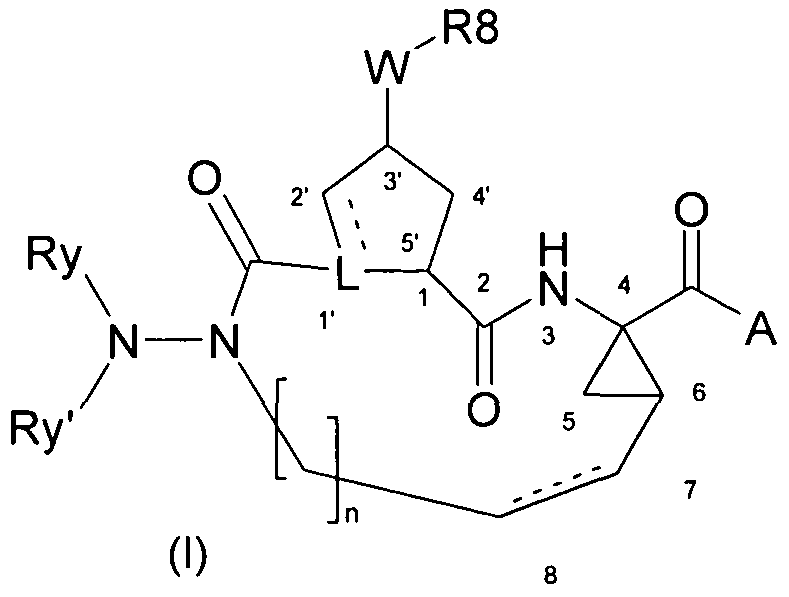
  • a first aspect of the invention provides compounds of the formula (I)
  • R 1 is hydrogen, Ci-C 6 alkyl, C 0 -C 3 alkylenecarbocyclyl, Co-C 3 alkyleneheterocyclyl;
  • R 2 is Ci-C 6 alkyl, C 0 -C 3 alkylenecarbocyclyl, C 0 -C 3 alkyleneheterocyclyl or NRaRb;
  • R 3 is Ci-C 6 alkyl, Co-C 3 alkylenecarbocyclyl, C 0 -C 3 alkyleneheterocyclyl, -OCi-C 6 alkyl, -OC 0 -C 3 alkylenecarbocyclyl, -OC 0 -C 3 alkyleneheterocyclyl; wherein any alkyl, carbocyclyl or heteroc
  • Rb is independently H, Ci-C 6 alkyl, Ci-C ⁇ alkoxy, C 0 -C 3 alkylenecarbocyclyl or Co- C 3 alkyleneheterocyclyl; or Ra and Rb together with the nitrogen to which they are attached join to form a heterocyclyl group; p is independently 1 or 2; n is 3, 4, 5 or 6; denotes an optional double bond; Rq is H or when L is CRz, Rq can also be Ci-C 6 alkyl; Ry and Ry' are independently Ci-C 6 alkyl; L is N or CRz;
  • Rz is H or forms a double bond with the asterisked carbon;
  • R is a ring system containing 1 or 2 saturated, partially saturated or unsaturated rings each of which has 4-7 ring atoms and each of which has O to 4 hetero atoms independently selected from S, O and N, the ring system being optionally spaced from W by a Ci-C 3 alkylene group; or R 8 is Ci-Qalkyl; any of which R 8 groups can be optionally mono-, di-, or tri-substituted with R 9 , wherein
  • R 10 is Ci-C 6 alkyl, C 3 -C 7 cycloalkyl, Ci-C 6 alkoxy, amino, amido, sulfonyl, (Ci-C 3 alkyl)sulfonyl, nitro, hydroxy, mercapto, halo, haloalkyl, carboxyl;
  • the invention further envisions compounds of the formula I represented by formula (It): the prodrugs, jV-oxides, addition salts, quaternary amines, metal complexes, and stereochemically isomeric forms thereof, wherein the dashed line represents an optional double bond between atoms C7 and C8;
  • Rt 1 is aryl or a saturated, a partially unsaturated or completely unsaturated 5 or 6 membered monocyclic or 9 to 12 membered bicyclic heterocyclic ring system wherein said ring system contains one nitrogen, and optionally one to three additional heteroatoms selected from the group consisting of oxygen, sulfur and nitrogen, and wherein the remaining ring members are carbon atoms; wherein said ring system may be optionally substituted on any carbon or nitrogen ring atom with one, two, three, or four substituents each independently selected from
  • Rt 6 is hydrogen; C 2-6 alkenyl; Het; C 3-7 cycloalkyl optionally substituted with Ci -6 alkyl; or Ci. 6 alkyl optionally substituted with C 3-7 cycloalkyl or Het;
  • Rt 6a is C 2-6 alkenyl, C 3-7 cycloalkyl, Het, or C
  • Rt 7 is hydrogen, Ci -6 alkyl, C 3-7 cycloalkyl, or aryl;
  • Rt 8 is hydrogen, polyhaloCi -6 alkyl, aryl, Het, C 3-7 cycloalkyl optionally substituted with
  • Het as a group or part of a group is a 5 or 6 membered saturated, partially unsaturated or completely unsaturated heterocyclic ring containing 1 to 4 heteroatoms each independently selected from nitrogen, oxygen and sulfur, being optionally condensed with a benzene ring, and wherein the group Het as a whole may be optionally substituted with one, two or three substituents each independently selected from the group consisting of halo, Ci -6 alkyl, polyhaloCi -6 alkyl, hydroxy, Ci -6 alkoxy, polyhaloCi.
  • -6 alkyl carboxyl
  • Ci -6 alkylcarbonyl cyano, nitro, amino, mono- or diCi -6 alkylamino, C 3 -C 7 cycloalkyl, (cyclopropyl), pyrrolidinyl, piperidinyl, piperazinyl, 4-Ci -6 alkylpiperazinyl, 4-Ci -6 alkylcarbonylpiperazinyl, and morpholinyl.
  • Rt broadly corresponds to R
  • Rt broadly corresponds to A
  • Lt broadly corresponds to W
  • aryl is broadly speaking embraced by C 0 - C 3 alkylenecarbocyclyl where C 0 -C 3 alkylene is zero (ie a bond) and Het is broadly speaking embraced by C 0 -C 3 alkylheterocyclyl, where C 0 -C 3 alkylene is zero (ie a bond).
  • the preferments expressed below for formula (I) apply even to the corresponding values in formula (It) and references to formula (I) shall be construed as including the corresponding compounds of formula (It).
  • the invention further relates to methods for the preparation of the compounds of formula (I), the prodrugs, N-oxides, addition salts, quaternary amines, metal complexes, and stereochemically isomeric forms thereof, its intermediates, and the use of the intermediates in the preparation of the compounds of formula (I).
  • the invention relates to the compounds of formula (I) per se, the prodrugs, N-oxides, addition salts, quaternary amines, metal complexes, and stereochemically isomeric forms thereof, for use as a medicament.
  • the invention further relates to pharmaceutical compositions comprising the aforementioned compounds for administration to a subject suffering from HCV infection.
  • the pharmaceutical compositions may comprise combinations of the aforementioned compounds with other anti-HCV agents.
  • the invention also relates to the use of a compound of formula (I), or a prodrug, iV-oxide, addition salt, quaternary amine, metal complex, or stereochemically isomeric forms thereof, for the manufacture of a medicament for inhibiting HCV replication.
  • the invention relates to a method of inhibiting HCV replication in a warm-blooded animal said method comprising the administration of an effective amount of a compound of formula (I), or a prodrug, N-oxide, addition salt, quaternary amine, metal complex, or stereochemically isomeric forms thereof.
  • halo is generic to fluoro, chloro, bromo and iodo.
  • haloCi -6 alkyl as a group or part of a group, e.g. in halo- Ci -6 alkoxy, is defined as mono- or polyhalo substituted Ci ⁇ alkyl, in particular Ci -6 alkyl substituted with up to one, two, three, four, five, six, or more halo atoms, such as methyl or ethyl with one or more fluoro atoms, for example, difluoromethyl, trifluoromethyl, trifluoroethyl. Preferred is trifluoromethyl.
  • perfluoroCi -6 alkyl groups which are Ci -6 alkyl groups wherein all hydrogen atoms are replaced by fluoro atoms, e.g. pentafluoroethyl.
  • fluoro atoms e.g. pentafluoroethyl.
  • the halogen atoms may be the same or different.
  • Ci -4 alkyl as a group or part of a group defines straight or branched chain saturated hydrocarbon radicals having from 1 to 4 carbon atoms such as for example methyl, ethyl, 1 -propyl, 2-propyl, 1 -butyl, 2-butyl, 2-methyl-l -propyl; "Ci -6 alkyl” encompasses Ci.
  • alkyl radicals and the higher homologues thereof having 5 or 6 carbon atoms such as, for example, 1-pentyl, 2-pentyl, 3-pentyl, 1-hexyl, 2-hexyl, 2-methyl-l -butyl, 2-methyl- 1-pentyl, 2-ethyl-l -butyl, 3-methyl-2-pentyl, and the like.
  • -6 alkyl is Ci -4 alkyl.
  • C 2-6 alkenyl as a group or part of a group defines straight and branched chained hydrocarbon radicals having saturated carbon-carbon bonds and at least one double bond, and having from 2 to 6 carbon atoms, such as, for example, ethenyl (or vinyl), 1-propenyl, 2-propenyl (or allyl), 1-butenyl, 2-butenyl, 3-butenyl, 2-methyl-2- propenyl, 2-pentenyl, 3-pentenyl, 2-hexenyl, 3-hexenyl, 4-hexenyl, 2-methyl-2-butenyl, 2-methyl-2-pentenyl and the like.
  • C 2 . 6 alkenyl is C 2-4 alkenyl.
  • C 2-6 alkynyl as a group or part of a group defines straight and branched chained hydrocarbon radicals having saturated carbon-carbon bonds and at least one triple bond, and having from 2 to 6 carbon atoms, such as, for example, ethynyl, 1-propynyl, 2-propynyl, 1-butynyl, 2-butynyl, 3-butynyl, 2-pentynyl, 3-pentynyl, 2-hexynyl, 3-hexynyl and the like.
  • C 2-6 alkynyl is C 2-4 alkynyl.
  • C 3 _ 7 cycloalkyl is generic to cyclopropyl, cyclobutyl, cyclopentyl, cyclohexyl and cycloheptyl.
  • C 0.3 alkylene defines a bond (C 0 ) or bivalent straight and branched chain saturated hydrocarbon radicals having from 1 to 3 carbon atoms such as, for example, methylene, ethylene, 1,3-propanediyl, 1 ,2-propanediyl, and the like, especially methylene.
  • Ci -6 alkoxy means Ci -6 alkyloxy wherein Ci -6 alkyl is as defined above.
  • the carbon atom to which the oxo is linked is a staturated carbon.
  • Ci-C 6 alkyl includes NH 2 , NHCi.C 6 alkyl or N(Ci- C 6 -alkyl) 2 , wherein in the definitions of amino each of the Ci-C 6 alkyl groups is especially Ci-C 3 alkyl s, or saturated cyclic amines such as pyrrolidinyl, piperidinyl, piperazinyl, 4-Ci-C 6 alkylpiperazinyl, such as 4-methylpiperazinyl, 4-C,- C ⁇ alkylcarbonylpiperazinyl and morpholinyl.
  • 'Co-C 3 alkylenearyl' as applied herein is meant to include an aryl moiety such as a phenyl, naphthyl or phenyl fused to a C 3 -C 7 cycloalkyl (for example indanyl), which aryl is directly bonded (i.e. Co) or through an intermediate methyl, ethyl, or propyl group as defined for C,-C 3 alkylene above.
  • aryl moiety such as a phenyl, naphthyl or phenyl fused to a C 3 -C 7 cycloalkyl (for example indanyl), which aryl is directly bonded (i.e. Co) or through an intermediate methyl, ethyl, or propyl group as defined for C,-C 3 alkylene above.
  • the aryl and/or its fused cycloalkyl moiety is optionally substituted with 1-3 substituents selected from halo, hydroxy, nitro, cyano, carboxy, C,-C 6 alkyl, C,-C 6 alkoxy, C,-C 6 alkoxyC,-C 6 alkyl, C,-C 6 alkanoyl, amino, azido, oxo, mercapto, nitro Co-C 3 alkylcarbocyclyl i C 0 - C 3 alkylheterocyclyl, it being understood that the heterocyclic and carbocyclic moieties in the Co-C 3 alkylcarbocyclyl or Co-C 3 alkylheterocyclyl substituent may itself be substituted as provided herein, but typically not with a further Co-C 3 alkylcarbocyclyl or C 0 -C 3 alkylheterocyclyl.
  • Aryl has the corresponding meaning, i
  • 'Co-C 3 alkyleneC 3 C 7 cycloalkyl' as applied herein is meant to include a C 3 -C 7 cycloalkyl group such as cyclopropyl, cyclobutyl, cyclopentyl, cyclohexyl or cycloheptyl, which cycloalkyl is directly bonded (i.e. C o alkyl) or through an intermediate methyl, ethyl, proyl or isopropyl group as defined for Ci-C 3 alkylene above.
  • the cycloalkyl group may contain an unsaturated bond.
  • the cycloalkyl moiety is optionally substituted with 1-3 substituents selected from halo, hydroxy, nitro, cyano, carboxy, C,-C 6 alkyl, C,-C 6 alkoxy, C,-C 6 alkoxyC,-C 6 alkyl, C t -C ⁇ alkanoyl, amino, azido, oxo, mercapto, nitro Co-Caalkylcarbocyclyl , C 0 -C 3 alkylheterocyclyl, it being understood that the heterocyclic and carbocyclic moieties in the C 0 -C 3 alkylcarbocyclyl or C 0 -C 3 alkylheterocyclyl substituent may itself be substituted as provided herein, but typically not with a further C 0 -C 3 alkylcarbocyclyl or Co-C 3 alkylheterocyclyl.
  • 'C 0 -C 3 alkylcarbocyclyP as applied herein is meant to include C 0 -C 3 alkylaryl and C 0 - C 3 alkylC 3 -C 7 cycloalkyl.
  • the aryl or cycloalkyl group is optionally substituted with 1 -3 substituents selected from halo, hydroxy, nitro, cyano, carboxy, C,-C 6 alkyl, C,-C 6 alkoxy, C,-C 6 alkoxyC,-C 6 alkyl, C-C ⁇ alkanoyl, amino, azido, oxo, mercapto, nitro, C 0 -C 3 alkylcarbocyclyl and/or C 0 -C 3 alkylheterocyclyl, it being understood that the heterocyclic and carbocyclic moieties in the C 0 - C 3 alkylcarbocyclyl or C 0 -C3alkylhe
  • 'Co-C 3 alkyleneheterocycylyl' as applied herein is meant to include a monocyclic, saturated or unsaturated, heteroatom-containing ring such as piperidinyl, morpholinyl, piperazinyl, pyrazolyl, imidazolyl, oxazolyl, isoxazolyl, thiazinolyl, isothiazinolyl, thiazolyl, oxadiazolyl, 1,2,3-triazolyl, 1,2,4-triazolyl, tetrazolyl, furanyl, thienyl, pyridyl, pyrimidyl, pyridazinyl, or any of such groups fused to a phenyl ring, such as quinolinyl, benzimidazolyl, benzoxazolyl, benzisoxazolyl, benzothiazinolyl, benzisothiazinolyl, benzothiazo
  • heteroaryl any such non-saturated rings having an aromatic character may be referred to as heteroaryl herein. Unless otherwise indicated the hetero ring and/or its fused phenyl moiety is optionally substituted with 1-3 substituents selected from halo, hydroxy, nitro, cyano, carboxy, Ci-C 6 alkyl, Ci-C 6 alkoxy, C
  • Heterocyclyl and “Heteroaryl” have the corresponding meaning, i.e. where the C 0 -C 3 alkyl linkage is absent.
  • heterocycyl and carbocyclyl moieties within the scope of the above definitions are thus a monocyclic ring with 5 or especially 6 ring atoms, or a bicyclic ring structure comprising a 6 membered ring fused to a 4, 5 or 6 membered ring.
  • Typical such groups include C 3 -C 8 cycloalkyl, phenyl, benzyl, tetrahydronaphthyl, indenyl, indanyl, heterocyclyl such as from azepanyl, azocanyl, pyrrolidinyl, piperidinyl, morpholinyl, thiomorpholinyl, piperazinyl, indolinyl, pyranyl, tetrahydropyranyl, tetrahydrothiopyranyl, thiopyranyl, furanyl, tetrahydrofuranyl, thienyl, pyrrolyl, oxazolyl, isoxazolyl, thiazolyl, imidazolyl, pyridinyl, pyrimidinyl, pyrazinyl, pyridazinyl, tetrazolyl, pyrazolyl, indolyl, benzofuranyl, be
  • the saturated heterocycle moiety thus includes radicals such as pyrrolinyl, pyrrolidinyl, pyrazolinyl, pyrazolidinyl, piperidinyl, morpholinyl, thiomorpholinyl, pyranyl, thiopyranyl, piperazinyl, indolinyl, azetidinyl, tetrahydropyranyl, tetrahydrothiopyranyl, tetrahydrofuranyl, hexahydropyrimidinyl, hexahydropyridazinyl, 1 ,4,5,6-tetrahydropyrimidinylamine, dihydro-oxazolyl, 1 ,2-thiazinanyl- 1 , 1 -dioxide, 1, 2, 6-thiadiazinanyl- 1,1 -dioxide, isothiazolidinyl-1,1 -dioxide and imidazolidinyl-2,4- dione,
  • Het is a heterocycle as specified in this specification and claims.
  • Het comprise, for example, pyrrolidinyl, piperidinyl, morpholinyl, thiomorpholinyl, piperazinyl, pyrrolyl, pyrazolyl, imidazolyl, oxazolyl, isoxazolyl, thiazinolyl, isothiazinolyl, thiazolyl, isothiazolyl, oxadiazolyl, thiadiazolyl, triazolyl (including 1,2,3-triazolyl, 1 ,2,4-triazolyl), tetrazolyl, furanyl, thienyl, pyridyl, pyrimidyl, pyridazinyl, triazinyl, or any of such heterocycles condensed with a benzene ring, such as indolyl, indazolyl (in particular lH-indazolyl)
  • Each of the Het or R 8 radicals mentioned in this and the following paragraph may be optionally substituted with the number and kind of substituents mentioned in the definitions of the compounds of formula (I) or any of the subgroups of compounds of formula (I).
  • Some of the Het or R 8 radicals mentioned in this and the following paragraph may be substituted with one, two or three hydroxy substituents.
  • Such hydroxy substituted rings may occur as their tautomeric forms bearing keto groups.
  • a 3-hydroxypyridazine moiety can occur in its tautomeric form 2H- pyridazin-3-one.
  • keto-substituted Het or R 1 radicals are 1,3-dihydro- benzimidazol-2-one, l,3-dihydro-indol-2-one, lH-indole-2,3-dione, IH- benzo[i/]isoxazole, lH-benzo[d]isothiazole, lH-quinolin-2-one, lH-quinolin-4-one, lH-quinazolin-4-one, 9H-carbazole, and lH-quinazolin-2-one.
  • R can be a saturated, a partially unsaturated or completely unsaturated 5 or 6 membered monocyclic or 9 to 12 membered bicyclic heterocyclic ring system as specified in this specification and claims.
  • said monocyclic or bicyclic ring system comprise for example, any of the rings mentioned in the previous paragraph as examples of the radical ⁇ et and additionally any of the monocyclic heterocycles mentioned in the previous paragraph condensed with pyridyl or pyrimidinyl such as, for example, pyrrolopyridine (in particular lH-pyrrolo[2,3]- ⁇ ]pyridine, lH-pyrrolo[2, 3- cjpyridine), naphtyridine (in particular 1,8-naphtyridine), imidazopyridine (in particular lH-imidazo[4, 5-c]pyridine, lH-imidazo[4,5-£]pyridine), pyridopyrimidine, purine (in particular 7H-purine) and the like.
  • radical positions on any molecular moiety used in the definitions may be anywhere on such moiety as long as it is chemically stable.
  • Radicals used in the definitions of the variables include all possible isomers unless otherwise indicated.
  • pyridyl includes 2-pyridyl, 3 -pyridyl and 4-pyridyl
  • pentyl includes 1-pentyl, 2-pentyl and 3-pentyl.
  • each definition is independent.
  • One embodiment comprises the compounds of formula (I) or any subgroup of compounds of formula (I) specified herein, as well as the N-oxides, salts, as the possible stereoisomeric forms thereof.
  • Another embodiment comprises the compounds of formula (I) or any subgroup of compounds of formula (I) specified herein, as well as the salts as the possible stereoisomeric forms thereof.
  • the compounds of formula (I) have several centers of chirality and exist as stereochemical ⁇ isomeric forms.
  • stereochemically isomeric forms as used herein defines all the possible compounds made up of the same atoms bonded by the same sequence of bonds but having different three-dimensional structures which are not interchangeable, which the compounds of formula (I) may possess.
  • the chemical designation of a compound encompasses the mixture of all possible stereochemically isomeric forms, which said compound may possess. Said mixture may contain all diastereomers and/or enantiomers of the basic molecular structure of said compound. All stereochemically isomeric forms of the compounds of the present invention both in pure form or mixed with each other are intended to be embraced within the scope of the present invention.
  • stereoisomerically pure concerns compounds or intermediates having a stereoisomeric excess of at least 80% (i.e. minimum 90% of one isomer and maximum 10% of the other possible isomers) up to a stereoisomeric excess of 100% (i.e.
  • Pure stereoisomeric forms of the compounds and intermediates of this invention may be obtained by the application of art-known procedures.
  • enantiomers may be separated from each other by the selective crystallization of their diastereomeric salts with optically active acids or bases. Examples thereof are tartaric acid, dibenzoyltartaric acid, ditoluoyltartaric acid and camphosulfonic acid.
  • enantiomers may be separated by chromatographic techniques using chiral stationary phases.
  • Said pure stereochemically isomeric forms may also be derived from the corresponding pure stereochemically isomeric forms of the appropriate starting materials, provided that the reaction occurs stereospecifically.
  • said compound will be synthesized by stereospecific methods of preparation. These methods will advantageously employ enantiomerically pure starting materials.
  • the diastereomeric racemates of the compounds of formula (I) can be obtained separately by conventional methods.
  • Appropriate physical separation methods that may advantageously be employed are, for example, selective crystallization and chromatography, e.g. column chromatography.
  • the absolute stereochemical configuration was not experimentally determined.
  • a person skilled in the art is able to determine the absolute configuration of such compounds using art-known methods such as, for example, X-ray diffraction.
  • the present invention is also intended to include all isotopes of atoms occurring on the present compounds.
  • Isotopes include those atoms having the same atomic number but different mass numbers.
  • isotopes of hydrogen include tritium and deuterium.
  • isotopes of carbon include C- 13 and C- 14.
  • prodrug as used throughout this text means the pharmacologically acceptable derivatives such as esters, amides and phosphates, such that the resulting in vivo biotransformation product of the derivative is the active drug as defined in the compounds of formula (I).
  • Prodrugs preferably have excellent aqueous solubility, increased bioavailability and are readily metabolized into the active inhibitors in vivo.
  • Prodrugs of a compound of the present invention may be prepared by modifying functional groups present in the compound in such a way that the modifications are cleaved, either by routine manipulation or in vivo, to the parent compound.
  • ester prodrugs that are hydrolysable in vivo and are derived from those compounds of formula (I) having a hydroxy or a carboxyl group.
  • An in vivo hydrolysable ester is an ester, which is hydrolysed in the human or animal body to produce the parent acid or alcohol.
  • Suitable pharmaceutically acceptable esters for carboxy include Ci- 6 alkoxymethyl esters for example methoxymethyl, Ci -6 alkanoyloxymethyl esters for example pivaloyloxymethyl, phthalidyl esters, C 3-8 cycloalkoxycarbonyloxyCi.
  • alkyl esters for example l-cyclohexylcarbonyloxyethyl; l,3-dioxolen-2-onylmethyl esters for example 5-methyl-l,3-dioxolen-2-onylmethyl; and Ci-6alkoxycarbonyloxyethyl esters for example 1 -methoxycarbonyloxyethyl which may be formed at any carboxy group in the compounds of this invention.
  • An in vivo hydrolysable ester of a compound of the formula (I) containing a hydroxy group includes inorganic esters such as phosphate esters and ⁇ -acyloxyalkyl ethers and related compounds which as a result of the in vivo hydrolysis of the ester breakdown to give the parent hydroxy group.
  • inorganic esters such as phosphate esters and ⁇ -acyloxyalkyl ethers and related compounds which as a result of the in vivo hydrolysis of the ester breakdown to give the parent hydroxy group.
  • ⁇ -acyloxyalkyl ethers include acetoxymethoxy and 2,2-dimethylpropionyloxy-methoxy.
  • a selection of in vivo hydrolysable ester forming groups for hydroxy include alkanoyl, benzoyl, phenylacetyl and substituted benzoyl and phenylacetyl, alkoxycarbonyl (to give alkyl carbonate esters), dialkylcarbamoyl and N-(dialkylaminoethyl)-N-alkylcarbamoyl (to give carbamates), dialkylaminoacetyl and carboxyacetyl.
  • substituents on benzoyl include morpholino and piperazino linked from a ring nitrogen atom via a methylene group to the 3- or 4-position of the benzoyl ring.
  • salts of the compounds of formula (I) are those wherein the counter-ion is pharmaceutically acceptable.
  • salts of acids and bases which are non-pharmaceutically acceptable may also find use, for example, in the preparation or purification of a pharmaceutically acceptable compound. All salts, whether pharmaceutically acceptable or not are included within the ambit of the present invention.
  • the pharmaceutically acceptable acid and base addition salts as mentioned hereinabove are meant to comprise the therapeutically active non-toxic acid and base addition salt forms which the compounds of formula (I) are able to form.
  • the pharmaceutically acceptable acid addition salts can conveniently be obtained by treating the base form with such appropriate acid.
  • Appropriate acids comprise, for example, inorganic acids such as hydrohalic acids, e.g. hydrochloric or hydrobromic acid, sulfuric, nitric, phosphoric and the like acids; or organic acids such as, for example, acetic, propanoic, hydroxyacetic, lactic, pyruvic, oxalic (i.e. ethanedioic), malonic, succinic (i.e.
  • butanedioic acid maleic, fumaric, malic (i.e. hydroxybutanedioic acid), tartaric, citric, methanesulfonic, ethanesulfonic, benzenesulfonic, p-toluenesulfonic, cyclamic, salicylic, ⁇ -aminosalicylic, pamoic and the like acids.
  • salt forms can be converted by treatment with an appropriate base into the free base form.
  • the compounds of formula (I) containing an acidic proton may also be converted into their non-toxic metal or amine addition salt forms by treatment with appropriate organic and inorganic bases.
  • Appropriate base salt forms comprise, for example, the ammonium salts, the alkali and earth alkaline metal salts, e.g. the lithium, sodium, potassium, magnesium, calcium salts and the like, salts with organic bases, e.g. the benzathine, N-methyl-D-glucamine, hydrabamine salts, and salts with amino acids such as, for example, arginine, lysine and the like.
  • addition salt as used hereinabove also comprises the solvates which the compounds of formula (I) as well as the salts thereof, are able to form.
  • solvates are for example hydrates, alcoholates and the like.
  • quaternary amine as used hereinbefore defines the quaternary ammonium salts which the compounds of formula (I) are able to form by reaction between a basic nitrogen of a compound of formula (I) and an appropriate quaternizing agent, such as, for example, an optionally substituted alkylhalide, arylhalide or arylalkylhalide, e.g. methyliodide or benzyliodide.
  • Other reactants with good leaving groups may also be used, such as alkyl trifluoromethanesulfonates, alkyl methanesulfonates, and alkyl p-toluenesulfonates.
  • a quaternary amine has a positively charged nitrogen.
  • Counterions include chloro, bromo, iodo, trifluoroacetate and acetate.
  • the counterion of choice can be introduced using ion exchange resins.
  • TV-oxide forms of the present compounds are meant to comprise the compounds of formula (I) wherein one or several nitrogen atoms are oxidized to the so-called N-oxide.
  • the compounds of formula (I) may have metal binding, chelating, complex forming properties and therefore may exist as metal complexes or metal chelates. Such metalated derivatives of the compounds of formula (I) are intended to be included within the scope of the present invention.
  • the compounds of formula (I) may also exist in their tautomeric form. Such forms although not explicitly indicated in the above formula are intended to be included within the scope of the present invention.
  • the compounds of formula (I) have several asymmetric centers. In order to more efficiently refer to each of these asymmetric centers, the numbering system as indicated in the following structural formula will be used.
  • Asymmetric centers are present at positions 1 , 4 and 6 of the macrocycle as well as at the carbon atom 3' in the 5-membered ring, carbon atom 2' when the Rq substituent is Ci -6 alkyl, and at carbon atom 1 ' when L is CH. Each of these asymmetric centers can occur in their R or S configuration.
  • the stereochemistry at position 1 preferably corresponds to that of an L-amino acid configuration, i.e. that of L-proline.
  • the 2 carbonyls borne by the cyclopentane ring are preferably trans as depicted below.
  • the stereochemistry at position 1 preferably corresponds to that of an L-amino acid configuration, i.e. that of L-proline.
  • the structure of formula (I) includes a cyclopropyl group as represented in the Pl fragment below: wherein C 7 represents the carbon at position 7 and carbons at position 4 and 6 are asymmetric carbon atoms of the cyclopropane ring.
  • the presence of these two asymmetric centers means that the compounds can exist as mixtures of diastereomers, such as the diastereomers of compounds of formula (I) wherein the carbon at position 7 is configured either syn to the carbonyl or syn to the amide as shown below.
  • the structure of formula (I) may include as well a proline residue (when L is N).
  • Preferred are the compounds of formula (I) wherein the substituent at the 1 (or 5') position and the substituent -W-R 8 (at position 3') are in a trans configuration.
  • position 1 has the configuration corresponding to L-proline and the -W-R substituent is in a trans configuration in respect of position 1.
  • the compounds of formula (I) have the stereochemistry as indicated in the structures of formulae (I-a) and (I-b) below:
  • One embodiment of the present invention concerns compounds of formula (I) or of formula (I-a) or of any subgroup of compounds of formula (I), wherein one or more of the following conditions apply:
  • One embodiment of the present invention concerns compounds of formula (I) or of formulae (I-a), (I-b), or of any subgroup of compounds of formula (I), wherein one or more of the following conditions apply: (a) Rq is hydrogen;
  • One embodiment of the present invention concerns compounds of formula (I) or of formulae (I-a), (I-b), or of any subgroup of compounds of formula (I), wherein one or more of the following conditions apply:
  • n 3 or 4.
  • n 2
  • the moiety -CH 2 - bracketed by "n” corresponds to a ethanediyl in the compounds of formula (I) or in any subgroup of compounds of formula (I).
  • n 3
  • the moiety -CH 2 - bracketed by "n” corresponds to a propanediyl in the compounds of formula (I) or in any subgroup of compounds of formula (I).
  • n 4
  • the moiety -CH 2 - bracketed by "n” corresponds to a butanediyl in the compounds of formula (I) or in any subgroup of compounds of formula (I).
  • n When n is 5, the moiety -CH 2 - bracketed by “n” corresponds to a pentanediyl in the compounds of formula (I) or in any subgroup of compounds of formula (I). When n is 6, the moiety -CH 2 - bracketed by “n” corresponds to a hexanediyl in the compounds of formula (I) or in any subgroup of compounds of formula (I). Particular subgroups of the compounds of formula (I) are those compounds wherein n is 4 or 5.
  • R is phenyl, naphthyl, pyridyl, pyridazinyl, triazolyl, tetrazolyl, quinolinyl, isoquinolinyl, ⁇ - quinazolinyl, pyrimidinyl, [l,8]naphthyridinyl, indolinyl, 1,2,3,4-tetrahydroquinoline, 1,2,3,4-tetrahydroisoquinoline; all optionally substituted with one, two or three substituents selected from R 9 in the definitions of the compounds of formula (I), especially any of which R 8 groups is, independently, optionally mono, di, or tri substituted with methyl, ethyl, isopropyl, tert-buty ⁇ , methoxy, trifluoromethyl, trifluoromethoxy, fluor
  • R 8 is phenyl, naphthyl (in particular naphth-1-yl, or naphth-2-yl), quinolinyl (in particular quinolin-4-yl), isoquinolinyl (in particular isoquinolin-1-yl), quinazolinyl (in particular quinazolin-4-yl), pyridyl (in particular 3 -pyridyl), pyrimidinyl (in particular pyrimidin-4-yl), pyridazinyl (in particular pyridazin-3-yl and pyridazin-2-yl), [l,8]naphtyridinyl (in particular [l,8]naphthyridin-4-yl);
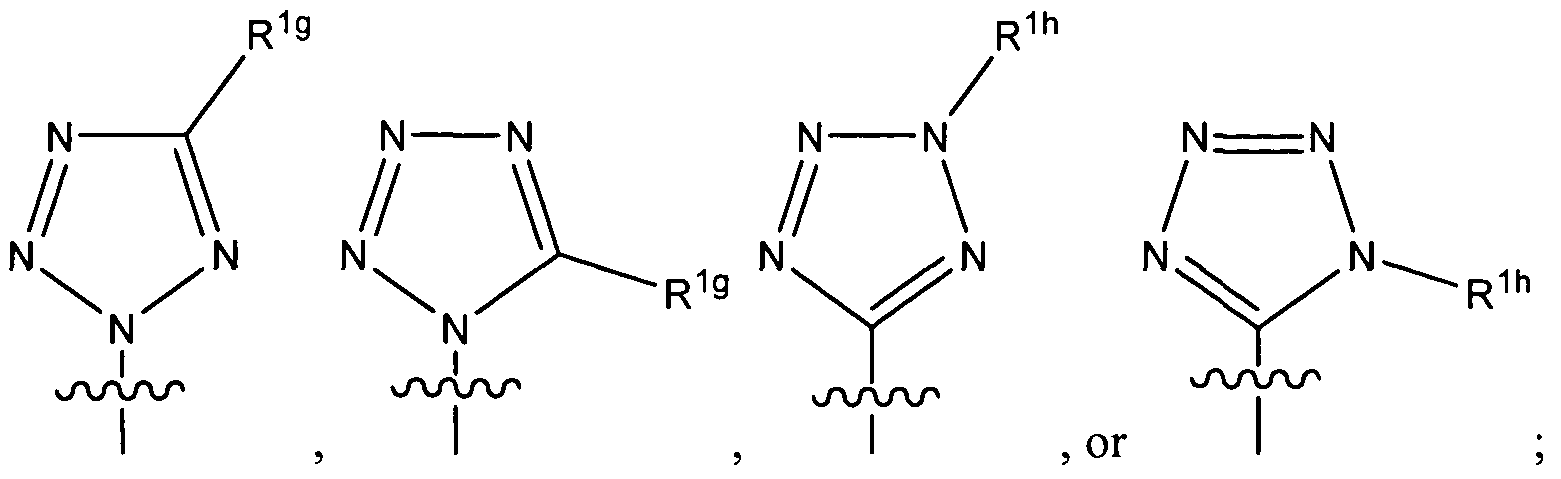
  • R 8 is triazolyl (in particular triazol-1-yl, triazol-2-yl), tetrazolyl (in particular tetrazol-1-yl, tetrazol-2-yl), 6-oxo-pyridazin-l-yl, pyrazolyl (in particular pyrazol-1-yl), or imidazolyl (in particular imidazol-1-yl, imidazol-2-yl);
  • R 8 is a heterocycle selected from
  • each of the R radicals may be optionally substituted with one, two or three substituents selected from R 9 in the definitions of the compounds of formula (I), especially any of which R groups is, independently, optionally mono, di, or tri substituted with methyl, ethyl, isopropyl, tert-butyl, methoxy, trifluoromethyl, trifluoromethoxy, fluoro, chloro, bromo, -NRt 5 3 a 3 rR>t.
  • Rt 5a and Rt are, independently, hydrogen, C 3-7 cycloalkyl, aryl, heterocyclyl, Ci -6 alkyl optionally substituted with halo, C
  • W is -O-, and R is as specified above in (a).
  • W is a direct bond
  • R 8 is as specified above in (b).
  • R 8 is as specified above in (c)
  • Embodiments of the invention are compounds of formula (I) or any of the subgroups of compounds of formula (I) wherein R 8 is quinolinyl, optionally substituted with 1 , 2, 3 or 4 (or with 1, 2 or 3) substituents selected from those mentioned as possible substituents on the monocyclic or bicyclic ring systems of R , as specified in the definitions of the compounds of formula (I) or of any of the subgroups of compounds of formula (I).
  • each R la , R lb , R lb' , R ld , R ld' , R le , R lf are independently any of the substituents selected from those mentioned as possible substituents on the monocyclic or bicyclic ring systems of R 1 , as specified in the definitions of the compounds of formula (I) or of any of the subgroups of compounds of formula (I);
  • each Rt 5a , Rt 5b , Rt 6a mentioned above or hereinafter independently is as defined in the definitions of the compounds of formula (I) or of any of the subgroups of compounds of formula (I);
  • R la is hydrogen, Ci -6 alkyl, Ci -6 alkoxy, Ci -6 alkylthio, monoCi -6 alkylamino, amino, C 3-7 cycloalkyl, aryl, or Het; more specifically R la is is aryl or Het; of interest are embodiments wherein R l a is phenyl, pyridyl, thiazolyl, pyrazolyl, each substituted as specified in the definitions of the compounds of formula (I) or of any of the subgroups of the compounds of formula (I); in specific embodiments said aryl or Het may each, independently, optionally substituted with Ci -6 alkyl, Ci -6 alkoxy, amino, mono- or diCi -6 alkylamino; and in particular
  • R la can be a radical Het; wherein Het may inculde pyrrolidinyl, piperidinyl, morpholinyl, thiomorpholinyl, piperazinyl, 4-Ci -6 alkylpiperazinyl; and wherein the morpholinyl, thiomorpholinyl and piperidinyl groups may optionally substituted with one or two Ci- 6 alkyl radicals;
  • Embodiments of the invention are compounds of formula (I) or any of the subgroups of compounds of formula (I) wherein R la is a radical:
  • R l a is selected from the group consisting of:
  • each R lc is any of the R 1 substituents may be selected from those mentioned as possible substituents on the monocyclic or bicyclic ring systems of R 1 , as specified in the definitions of the compounds of formula (I) or of any of the subgroups of compounds of formula (I);
  • each R ld and R ld independently may be hydrogen, Ci -6 alkyl, Ci -6 alkoxy, or halo;
  • each R ld in (d-3) may be hydrogen, Ci -6 alkyl, C
  • R le may be hydrogen, Ci -6 alkyl, amino, mono- or diCi -6 alkylamino, pyrrolidinyl, piperidinyl, morpholinyl, thiomorpholinyl, piperazinyl, 4-Ci -6 alkyl- piperazinyl (in particular 4-methylpiperazinyl); and wherein the morpholinyl and piperidinyl groups may optionally substituted with one or two Ci- 6 alkyl radicals;
  • each R lb is Ci -6 alkoxy, more preferably methoxy;
  • R l f may be hydrogen, Ci- 6 alkyl, amino, mono- or diCi- 6 alkylamino, pyrrolidinyl, piperidinyl, piperazinyl, N-methylpiperazinyl, or morpholinyl.
  • Embodiments of the invention are compounds of formula (I) or any of the subgroups of compounds of formula (I) wherein R 8 is
  • R is (e-1) a radical of formula:
  • R 9a , R 9b , R 9c independently form one another are any of the substituents selected from those mentioned as possible substituents on the monocyclic or bicyclic ring systems of R 8 , as specified in the definitions of the compounds of formula (I) or of any of the subgroups of compounds of formula (I); in particular
  • R 9a may have the same meanings as R la as specified above; in particular it may be aryl or Het, either of which is optionally substituted with any of the radicals mentioned as substituents of aryl or of Het as specified definitions of the compounds of formula (I) or of any of the subgroups of compounds of formula (I) (including the number of substituents); specifically said aryl or Het may be substituted with 1, 2 or 3 (in particular with one) radical or radicals R 10 ; wherein said
  • R 10 is is any of the radicals mentioned as substituents of Het as specified definitions of the compounds of formula (I) or of any of the subgroups of compounds of formula (I) as defined above; or in particular R 10 is hydrogen, Ci -6 alkyl, aryl, C 3-7 cycloalkyl, Het, amino optionally mono or disubstituted with Ci- 6 alkyl, or aminocarbonyl or mono- or diCi- 6 alkylaminocarbonyl; wherein Het also includes pyrrolidinyl, piperidinyl, piperazinyl, 4-Ci- 6 alkylpiperazinyl (e.g.
  • R 9b may have the same meanings as R lb as specified above; in particular it may be is hydrogen, Ci- 6 alkyl, cycloalkyl, aryl, Het, halo (e.g. bromo, chloro or fiuoro); R 9c may have the same meanings as R lc as specified above; in particular it may be is hydrogen or C)- 6 alkoxy.
  • R 9a in the isoquinolinyl radical specified under (e-1) or (1-e-a) includes phenyl, pyridyl, thiazolyl, oxazolyl or pyrazolyl either of which is optionally substituted with R 10 as defined above, in particular optionally substituted whith an R 1 which may be hydrogen, Ci -6 alkyl (e.g. methyl, ethyl, isopropyl, tert-butyl), Ci -6 alkoxy, amino, pyrrolidinyl, piperidinyl, piperazinyl, 4-Ci -6 alkylpiperazinyl (e.g.
  • R 9a in the isoquinolinyl radical specified under (e-1) or (e-l-a) includes any of radicals (q), (q-1), (q-2), (q-3), (q-4) specified above as well as:
  • each R 10 is any of the radicals mentioned as substituents of Het as specified definitions of the compounds of formula (I) or of any of the subgroups of compounds of formula (I) as defined above; or in particular R 10 is as defined above; especially R 10 is hydrogen, Ci- 6 alkyl (e.g. methyl, ethyl, isopropyl, tert-butyl), amino, pyrrolidinyl, piperidinyl, piperazinyl, 4-Ci- 6 alkylpiperazinyl (e.g.
  • R 9a in the isoquinolinyl radical specified under (e-1) or (e-l-a) includes:
  • each R 10 is as defined above, and especially is hydrogen, halo, Ci- 6 alkyl (e.g. methyl, ethyl, isopropyl, tert-butyl), amino, pyrrolidinyl, piperidinyl, piperazinyl, 4-Ci- 6 alkylpiperazinyl (e.g.
  • R 9b in the isoquinolinyl radical specified under (e-2) may be hydrogen, C
  • R 9b in the isoquinolinyl radical specified under (e-2) may be hydrogen or C
  • Embodiments of the invention are compounds of formula (I) or any of the subgroups of compounds of formula (I) wherein R is
  • R >9b is hydrogen or halo (e.g. bromo) and R 9c c is hydrogen or Ci -6 alkoxy (e.g. methoxy).
  • Embodiments of the invention are compounds of formula (I) or any of the subgroups of compounds of formula (I) wherein R 8 is (f) quinazolinyl (in particular quinazolin-4-yl), optionally substituted with 1 , 2, 3 or 4 (or with 1 , 2 or 3) substituents selected from those mentioned as possible substituents on the monocyclic or bicyclic ring systems of R 8 , as specified in the definitions of the compounds of formula (I) or of any of the subgroups of compounds of formula (I).
  • R 8 is (f) quinazolinyl (in particular quinazolin-4-yl), optionally substituted with 1 , 2, 3 or 4 (or with 1 , 2 or 3) substituents selected from those mentioned as possible substituents on the monocyclic or bicyclic ring systems of R 8 , as specified in the definitions of the compounds of formula (I) or of any of the subgroups of compounds of formula (I).
  • R 9a , R 9b and R 9c have the meanings stated above in relation to R 8 being isoquinlinyl (such as radicals (e-1), e-l-a) etc.).
  • R a is C 3 -C 7 cycloalkyl, aryl or Het, any of which is optionally substituted with one, two or three (in particular with one) R 10 ;
  • R 10 is hydrogen, Ci-C 6 alkyl, Ci-C 6 alkoxy, halo such as fluoro, C 3 -C 7 cycloalkyl, aryl, Het (preferably mono- or disubstituted with Ci-C 6 alkyl), pyrrolidinyl, piperidinyl, piperazinyl, 4- methyl-piperazinyl, thiomorpholinyl or morpholinyl, aminocarbonyl, mono or di Ci- Qalkylaminocarbonyl; wherein the piperidinyl, morpholinyl or thio
  • R 9b is hydrogen, halogen, Ci-C 6 alkyl, especially methyl, C 3 -C 7 cycloalkyl, aryl, Het, halo, in particular bromo, chloro or fluoro;
  • R 9c is hydrogen or Ci-C 6 alkoxy
  • R a for quinazolines include aryl or Het, especially wherein R 9a is phenyl, pyridyl, thiazolyl, oxazolyl or pyrazolyl either of which is optionally substituted with one, two or three (in particular with one) R 10 as defined.
  • R 9a for quinazolines is alkoxy, especially ethoxy and isopropoxy.
  • Embodiments of R 10 for quinazoline include hydrogen, methyl, ethyl, isopropyl, tert- butyl, alkoxy such as methoxy, halo (including dihalo, such as difluoro), saturated monocyclic amino, pyrrolidinyl, piperidinyl, piperazinyl, 4-Ci -6 alkylpiperazinyl (e.g.
  • R 9a in the quinazolinyl radical specified under (f-1) or (f-1-a) includes any of radicals (q), (q-1), (q-2), (q-3), (q-4), (q-5), (q-6), (q-7), (q-8) specified above as well as:
  • R 10 is as defined above or in particular hydrogen, Ci- 6 alkyl (such as methyl, ethyl, isopropyl, tert-butyl), saturated monocyclic amino, pyrrolidinyl, piperidinyl, piperazinyl, 4-Ci -6 alkylpiperazinyl, N-methylpiperazinyl, thiomorpholinyl or morpholinyl, Ci. 6 alkylamino, (Ci- 6 alkyl) 2 amino or amino carbonyl, mono or diC
  • Ci- 6 alkyl such as methyl, ethyl, isopropyl, tert-butyl
  • saturated monocyclic amino pyrrolidinyl, piperidinyl, piperazinyl, 4-Ci -6 alkylpiperazinyl, N-methylpiperazinyl, thiomorpholinyl or morpholinyl
  • Ci. 6 alkylamino (
  • R 9a for quinazolines may include:
  • R 10 is hydrogen, halogen, Ci -6 alkyl (such as methyl, ethyl, isopropyl, tert- butyl), Ci -6 alkylamino, (C
  • Ci -6 alkyl such as methyl, ethyl, isopropyl, tert- butyl
  • Ci -6 alkylamino (C
  • Ci -6 alkylamido morpholinyl, thiomo ⁇ holinyl or piperidin-1-yl
  • the morpholine and piperidine being optionally substituted with one or two Ci- 6 alkyl groups.
  • R 9a embodiments for quinazolines include phenyl substituted with one or two R 10 groups such as is hydrogen, methyl, ethyl, isopropyl, tert-butyl, methoxy, saturated monocyclic amino, Ci- 6 alkylamino, (Ci- 6 alkyl) 2 amino or Ci- 6 alkylamido or halo (in particular fluoro).
  • R 10 groups such as is hydrogen, methyl, ethyl, isopropyl, tert-butyl, methoxy, saturated monocyclic amino, Ci- 6 alkylamino, (Ci- 6 alkyl) 2 amino or Ci- 6 alkylamido or halo (in particular fluoro).
  • Embodiments of R 9b for quinazolines include hydrogen, Ci- 6 alkyl, halo (e.g. bromo, chloro or fluoro) especially wherein R 9b is hydrogen or bromo.
  • halo e.g. bromo, chloro or fluoro
  • Embodiments of R 9c for quinazolines include hydrogen or Ci -6 alkyloxy (in particular methoxy).
  • R 10 and R 9c are as specified above and in particular and R 9c is hydrogen or Ci -6 alkyloxy (e.g. methoxy) and R 10 is particularly hydrogen, methoxy or halo such as fluoro or difluoro.
  • R 10 is in the para position of the phenyl ring.
  • Further favoured structures are compounds of formula (I) or any other of the subgroups of formula (I) wherein R is:
  • R 10 and R 9c are as specified above and in particular R 9c is hydrogen or Ci-
  • R 10 is particularly hydrogen, methoxy or halo such as fluoro or difluoro.
  • R , 10 is in the para position of the phenyl ring.
  • X is OH or a leaving group such as a halide like chloride, bromide or iodide or a derivative of sulphonic acid such as a tosylate, triflate, mesylate or the like, Preferably X is OH.
  • R 9a , R 9b and R 9c are as defined above for compounds of formulae (f-1) and (f-l-a).
  • the compounds (III) and (Ilia) are a new compounds and constitutes a further aspect of the present invention.
  • R 9a embodiments for compounds of formula (III) and (Ilia) include pyridyl and phenyl optionally substituted with one or two R groups such as hydrogen, methyl, ethyl, isopropyl, tert-butyl, saturated monocyclic amino, Ci-C 6 alkylamino, (Ci- C 6 alkyl) 2 amino or Ci-C 6 alkylamido or halo (in particular fluoro) especially when R 6 is hydrogen, methyl or bromo.
  • R 9a is parafluorophenyl.
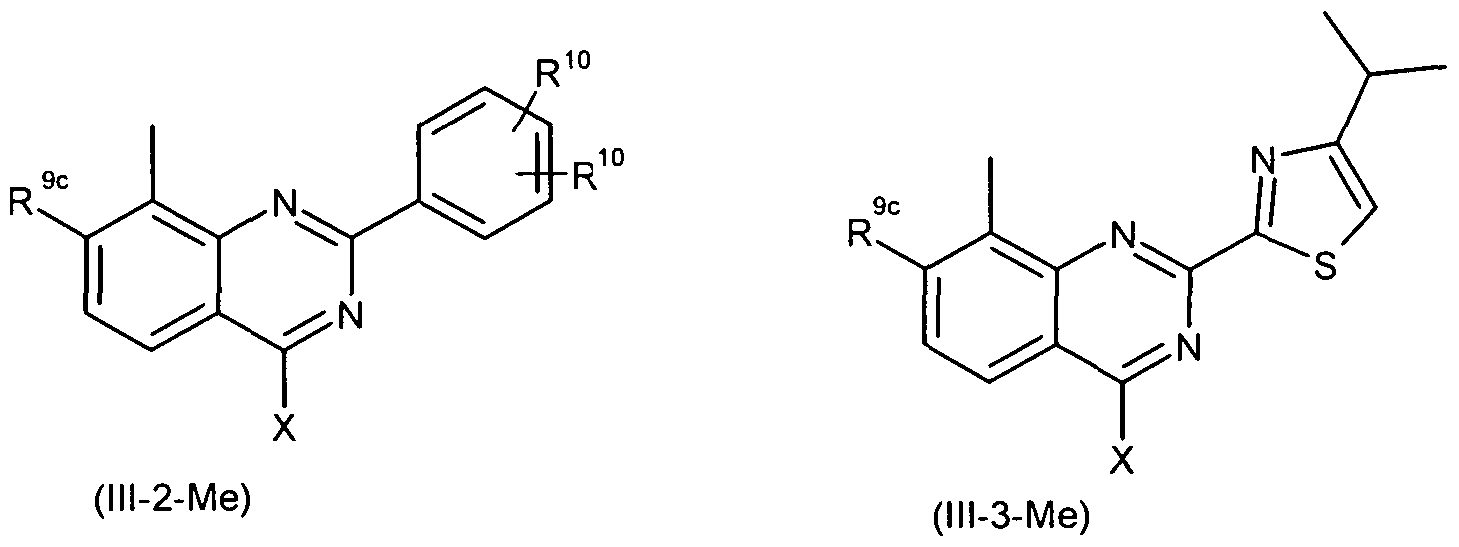
  • Specific embodiments of the compounds of formula (III) are those having the structure indicated in formula (III-2) and (III-3):
  • R , 10 is particularly hydrogen, methoxy or halo such as fluoro or difluoro.
  • R , 10 is in the para position of the phenyl ring.
  • R c is hydrogen or Ci. 6 alkoxy (e.g. methoxy) and R 10 is particularly hydrogen, methoxy or halo such as fluoro or difluoro. Conveniently R , 10 is in the para position of the phenyl ring.
  • Embodiments of the invention are compounds of formula (I) or any of the subgroups of compounds of formula (I) wherein Rr is quinazolin-4-yl optionally mono, di, or tri substituted with methyl, ethyl, isopropyl, tert-butyl, methoxy, trifluoro methyl, trifluoromethoxy, fluoro, chloro, bromo, mono- or diCi-C 6 alkylamino, mono- or diCi-C 6 alkylaminocarbonyl, phenyl, methoxyphenyl, cyanophenyl, halophenyl, pyridyl, Ci-C 4 alkylpyridyl, pyrimidinyl, morpholinyl, piperazinyl, Ci- Qalkylpiperazinyl, pyrrolidinyl, pyrazolyl, Ci-C 4 alkylpyrazolyl, thiazolyl
  • R 8 is a radical (d-1) - (d-5), (e-1) - (e-3), (f-1) - (f-3) as specified above, are those compounds whithin these subgroups wherein is W is -O-.
  • Embodiments of the invention are compounds of formula (I) or any of the subgroups of compounds of formula (I) wherein R is:
  • R la is hydrogen, Ci- 6 alkyl, Ci- 6 alkoxy, Ci- 6 alkylthio, monoCi -6 alkylamino, amino, C 3-7 cycloalkyl, aryl, or Het; said aryl or Het being each, independently, optionally substituted with C)- 6 alkyl, Ci- 6 alkoxy, amino, mono- or diCi -6 alkylamino; and each R lb and R lb' are, independently, hydrogen, Ci- 6 alkyl, Ci- 6 alkoxy, -NRt 5a Rt 5b , -
  • Embodiments of the invention are compounds of formula (I) or any of the subgroups of compounds of formula (I) wherein R la is selected from the group consisting of:
  • R lc is hydrogen, halo, Ci -6 alkyl, amino, or mono- or di-C]- 6 alkylamino.
  • R 1 is:
  • R , ld is independently hydrogen, Ci- 6 alkyl, Ci- 6 alkoxy, or halo; and each R , 1"b and R , 1 I b D ' are, independently, hydrogen, Ci- 6 alkyl, Ci- 6 alkoxy, -NRt 5 3 5 aa 3 rrR,».Ot5bt>
  • Embodiments of the invention are compounds of formula (I) or any of the subgroups of compounds of formula (I) wherein R 8 is 7-methoxy-2-phenyl-quinolin-4-yl and W is -0-.
  • Embodiments of the invention are compounds of formula (I) or any of the subgroups of compounds of formula (I) wherein R 8 is:
  • R is optionally substituted Co-C 3 alkylenecarbocyclyl or Co- C 3 alkyleneheterocyclyl, especially wherein the Co-C 3 alkyl moiety is methylene or preferably a bond.
  • the R8 is optionally mono-, di-, or trisubstituted with R 9 , wherein; R is Ci-C 6 alkyl, C
  • Embodiments include those wherein R 9 is Ci-C 6 alkyl, Ci-C 6 alkoxy, amino optionally mono- or disubstituted with Ci-C 6 alkyl, pyrrolidinyl, piperidinyl, piperazinyl, N- methylpiperazinyl, or morpholinyl, amido optionally substituted with Ci-C 6 alkyl, C 0 - C 3 alkylcarbocyclyl, C 0 -C 3 alkylheterocyclyl, bromo, chloro or fluoro, aryl or heteroaryl, the aryl or heteroaryl being optionally substituted with R 10 ; wherein R 10 is hydrogen, Ci-C 6 alkyl, C 3 -C 7 cycloalkyl, C 3 -C 7 heterocyclyl, Ci-C 6 alkoxy, amino optionally mono- or disubstituted with Ci-C 6 alkyl, pyrrolidinyl, piperidinyl, pipe
  • Embodiments include those in the paragraph above wherein R 10 is hydrogen, C ⁇ -
  • R 8 Convenient values for R 8 include 1-naphthylmethyl, 2-naphthylmethyl, benzyl, 1- naphthyl or 2-naphthyl any of which is unsubstituted, mono, di, or trisubstituted with R 9 as defined.
  • Embodiments of R include: wherein R 9a is aryl or heteroaryl either of which is optionally substituted with R 1 ; wherein
  • R 10 is hydrogen, Ci-C 6 alkyl, C 0 -C 3 alkylcycloalkyl, Co-C 3 alkylheterocyclyl, amino optionally mono or disubstituted with Ci-C 6 alkyl, pyrrolidinyl, piperidinyl, piperazinyl, N-methylpiperazinyl, or morpholinyl, amido optionally mono or disubstituted with C
  • R 9b is hydrogen, Ci-C 6 alkyl, Co-C 3 alkylenecarbocyclyl, C 0 -C 3 alkylheterocyclyl, bromo, chloro or fluoro; R 9c is hydrogen or C
  • Embodiments of R 9a include phenyl, pyridyl, thiazolyl, oxazolyl or pyrazolyl either of which is optionally substituted with R 10 as defined, especially wherein R 10 is hydrogen, methyl, ethyl, isopropyl, tert-butyl, halo (including dihalo, such as difluoro) saturated monocyclic amino, Ci-C 6 alkylamino, (Ci-C 6 alkyl) 2 amino, Ci-C 6 alkylamido or carbocyclyl.
  • R 10 is hydrogen, methyl, ethyl, isopropyl, tert-butyl, halo (including dihalo, such as difluoro) saturated monocyclic amino, Ci-C 6 alkylamino, (Ci-C 6 alkyl) 2 amino, Ci-C 6 alkylamido or carbocyclyl.
  • R 10 is hydrogen, methyl, ethyl, isopropyl, tert-butyl, saturated monocyclic amino, C 3 -C 7 cycloalkyl (such as cyclopropyl) Ci-C 6 alkylamino, (Ci-C 6 alkyl) 2 amino or Ci-C 6 alkylamido.
  • R 10 is hydrogen, methyl, ethyl, isopropyl, tert-buty ⁇ , cyclopropyl, Ci- C 6 alkylamino, (Ci-C 6 alkyl) 2 amino Ci-C 6 alkylamido, morpholin-4-yl or piperidin-1-yl, the morpholine and piperidine optionally substituted with Ci-C 3 alkyl.
  • Embodiments of R 9b include hydrogen, C
  • Embodiments of R 9c include hydrogen or methoxy.
  • R 10 is hydrogen, isopropyl, isopropylamino, dimethylamino, propanoylamino, cyclopropyl.
  • Embodiments of R 8 include isoquinolines:
  • R 9a is carbocyclyl or heterocyclyl either of which is optionally substituted with
  • R 10 is hydrogen, Ci-C ⁇ alkyl, Co-C 3 alkylcycloalkyl, C 0 -C 3 alkylheterocyclyl, amino optionally mono or disubstituted with Ci-C 6 alkyl, pyrrolidinyl, piperidinyl, piperazinyl,
  • R 9b is hydrogen, Ci-C 6 alkyl, C 0 -C 3 alkylcarbocyclyl, C 0 -C 3 alkylheterocyclyl, bromo, chloro or fluoro; R 9c is hydrogen or Ci-C 6 alkoxy.
  • Embodiments of R 9a for isoquinoline include phenyl, pyridyl, thiazolyl, oxazolyl or pyrazolyl either of which is optionally substituted with R 10 as defined, especially wherein R 10 is hydrogen, methyl, ethyl, isopropyl, tert-but ⁇ , amino, saturated monocyclic amino, Ci-C 6 lkylamino, (Ci-C 6 alkyl) 2 amino or Ci-C 6 alkylamido or saturated cyclic amino.
  • R 9a for isoquinolines include:
  • R 10 is hydrogen, methyl, ethyl, isopropyl, tert-butyl, saturated monocyclic amino, C
  • R ° is hydrogen, halogen, methyl, ethyl, isopropyl, tert-butyl, Q- C 6 alkylamino, (Ci-C 6 alkyl) 2 amino, Ci-C 6 alkylamido, mo ⁇ holin-4-yl or piperidin-1-yl, the morpholine and piperidine optionally substituted with Ci-C 3 alkyl.
  • Embodiments of R 9b for isoquinoline include hydrogen, Ci-C 3 alkyl, bromo, chloro or fluoro, especially hydrogen or bromo.
  • Embodiments of R 9c for isoquinoline include hydrogen or methoxy.
  • R 9b is hydrogen or bromo and R 9c is hydrogen or methoxy.
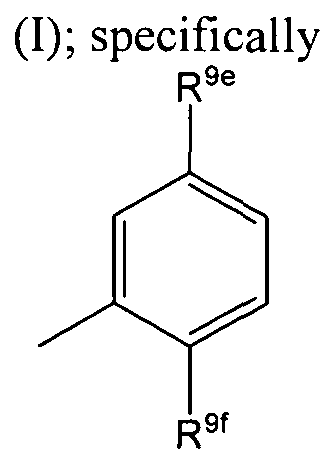
  • R >9e is hydrogen, Ci- 6 alkyl, polyhaloCi -6 alkyl or halo;
  • R 9e may be hydrogen, fluoro or trifluoromethyl.
  • R 10 and R 1 1 independently from one another are hydrogen, halo, hydroxy, nitro, cyano, carboxyl, Ci -6 alkyl, Ci -6 alkoxy, Ci -6 alkoxyCi -6 alkyl, Ci -6 alkylcarbonyl, Ci- 6 alkoxy-carbonyl, amino, azido, mercapto, Ci -6 alkylthio, polyhaloCi.
  • R 10 and R 1 1 independently from one another are hydrogen, halo, nitro, carboxyl, methyl, ethyl, isopropyl, t-butyl, methoxy, ethoxy, isopropoxy, t-butoxy, methylcarbonyl, ethylcarbonyl, isopropylcarbonyl, t-butyl-carbonyl, methoxycarbonyl, ethoxycarbonyl, isopropoxycarbonyl, t-butoxycarbonyl, methylthio, ethylthio, isopropylthio, t-butylthio, trifluoromethyl, or cyano;
  • W' is aryl or Het, or W 1 is -COOR 1 , wherein R 10 is H or Ci -6 alkyl, preferably methyl or ethyl.
  • Embodiments of W 1 include phenyl, naphth-1-yl, naphth-2-yl, pyrrol-1-yl, 3-pyridyl, pyrimidin-4-yl, pyridazin-3-yl, pyridazin-2-yl, 6-oxo-pyridazin-l-yl, l,2,3-triazol-2-yl, l,2,4-triazol-3-yl, tetrazol-1-yl, tetrazol-2-yl, pyrazol-1-yl, pyrazol-3-yl, imidazol-1-yl, imidazol-2-yl, thiazol-2-yl, pyrrolidin-1-yl, piperidin-1-yl, furan-2-yl, thien-3-yl, morpholin-4-yl; all optionally substituted with one or two substituents selected from Ci -6 alkyl, polyhaloCi -6 al
  • Embodiments of R 8 for carbamates include:
  • R 9e is hydrogen, Ci-C 3 alkyl haloCi-C 3 alkyl or halo;
  • R 1 is Ci-C 3 alkyl, preferably ethyl
  • Embodiments of R 9e for carbamates include hydrogen, fluoro or trifluoromethyl.
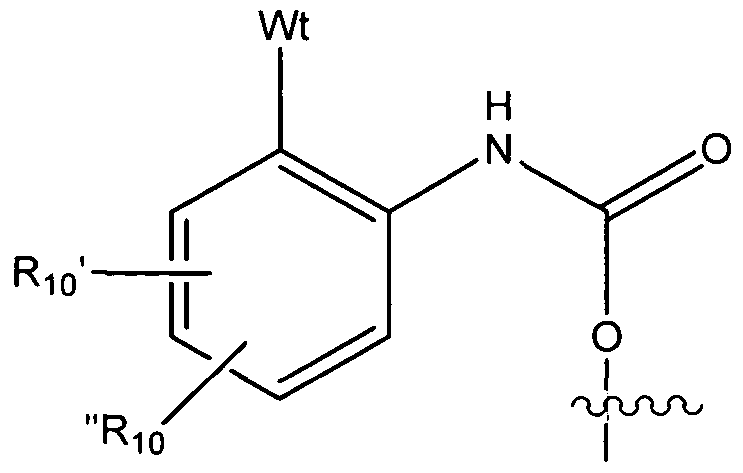
  • R 10 and RlO" are independently from one another are hydrogen, halo, hydroxy, nitro, cyano, carboxyl, Ci -6 alkyl, Ci -6 alkoxy, Ci -6 alkoxyC
  • 6 alkyl, aryl or Het especially hydrogen, halo, nitro, carboxyl, methyl, ethyl, isopropyl, t-butyl, methoxy, ethoxy, isopropoxy, t-butoxy, methylcarbonyl, ethylcarbonyl, isopropylcarbonyl, t-butyl-carbonyl, methoxycarbonyl, ethoxycarbonyl, isopropoxycarbonyl, t-butoxycarbonyl, methylthio, ethylthio, isopropylthio, t-butylthio, trifluoromethyl, or cyano;
  • Wt is aryl or Het, or COOR 1 , where R 1 is H or Ci-C 6 alkyl, such as ethyl or methyl.
  • Embodiments of Wt include phenyl, naphth-1-yl, naphth-2-yl, pyrrol- 1-yl, 3-pyridyl, pyrimidin-4-yl, pyridazin-3-yl, pyridazin-2-yl, 6-oxo-pyridazin-l-yl, l,2,3-triazol-2-yl, l,2,4-triazol-3-yl, tetrazol-1-yl, tetrazol-2-yl, pyrazol-1-yl, pyrazol-3-yl, imidazol-1-yl, imidazol-2-yl, thiazol-2-yl, pyrrolidin-1-yl, piperidin-1-yl, furan-2-yl, thien-3-yl, morpholin-4-yl; all optionally substituted with one or two substituents selected from Ci- 6 alkyl, haloCi -6 al
  • Embodiments of the invention are compounds of formula (I) or any of the subgroups of compounds of formula (I) wherein W is a direct bond and R is selected from the group consisting of lH-pyrrole, 1 //-imidazole, lH-pyrazole, furan, thiophene, oxazole, thiazole, isoxazole, isothiazole, pyridine, pyridazine, pyrimidine, pyrazine, phthalazine, quinoxaline, quinazoline, quinoline, cinnoline, lH-pyrrolo[2,3]-Z>]pyridine, lH-indole, lH-benzoimidazole, l//-indazole, 7H-purine, benzothiazole, benzoxazole, IH- imidazo[4, 5-c]pyridine, lH-imidazo[4,5-6]pyridine, 1 , 3-dihydro
  • R 8 is selected from the group consisting of pyrrolidine, 4,5-dihydro-lH-pyrazole, pyrazolidine, imidazolidin-2-one, pyr
  • Embodiments of the invention are compounds of formula (I) or any of the subgroups of compounds of formula (I) wherein W is a direct bond and R is optionally substituted triazolyl as depicted below:
  • R l k , R 11 and R l m are independently selected from the group consisting of hydrogen, azido, halo, C r C 6 alkyl, -NRt 5a Rt 5b , C 3-7 cycloalkyl, aryl, and Het; or alternatively, R lk and R 11 or R 11 and R lm taken together with the carbon atoms to which they are attached, form a phenyl moiety, which in turn may be optionally substituted with azido, halo, Ci-C 6 alkyl, -NRt 5a Rt 5b , C 3-7 cycloalkyl, aryl or Het.
  • Preferred embodiments of the invention include those wherein Ry and Ry' are the same
  • Ci-C 6 alkyl moiety notably methyl.
  • Embodiments of the invention are compounds of formula (I) or any of the subgroups of compounds of formula (I) wherein
  • A is -NHRt 5c , in particular wherein Rt 5c is Ci -6 alkyl, aryl, Het, Ci. 6 alkoxy, -O-aryl, or -O-Het;
  • A is -ORt 6 , in particular wherein Rt is Ci -6 alkyl, such as methyl, ethyl, or tert- butyl and most preferably where Rt 6 is hydrogen;
  • compounds of formula (I) wherein the bond between C 7 and C 8 is a double bond which are compounds of formula (I-c) may be prepared as outlined in the following reaction scheme:
  • Formation of the macrocycle can be carried out via an olefin metathesis reaction in the presence of a suitable metal catalyst such as e.g. the Ru-based catalyst reported by Miller, S.J., Blackwell, H.E., Grubbs, R.H. J. Am. Chem. Soc. 1 18, (1996), 9606-9614; Kingsbury, J. S., Harrity, J. P. A., Bonitatebus, P. J., Hoveyda, A. H., J. Am. Chem. Soc. 121, (1999), 791-799; and Huang et al., J. Am. Chem. Soc. 121, (1999), 2674- 2678; for example a Hoveyda-Grubbs catalyst.
  • a suitable metal catalyst such as e.g. the Ru-based catalyst reported by Miller, S.J., Blackwell, H.E., Grubbs, R.H. J. Am. Chem. Soc. 1 18, (1996), 96
  • the R 1 group can be connected to the Pl building block at any stage of the synthesis, i.e. before or after the cyclization, or before or after the cyclization and reduction as descibed herein above.
  • the compounds of formula (I) wherein A represents -NHSO 2 R 2 can be prepared by linking the R 1 group to Pl by forming an amide bond between both moieties.
  • the compounds of formula (I) wherein A represents -OR 1 i.e. compounds (I- k-2)
  • the -OR 1 groups are introduced in the last step of the synthesis of the compounds (I) as outlined in the following reaction schemes:
  • G represents a group:
  • Intermediate (2a) can be coupled with the amine (2b) by an amide forming reaction such as any of the procedures for the formation of an amide bond described hereinafter.
  • Intermediate (2a) can be coupled with the alcohol (2c) by an ester forming reaction.
  • (2a) and (2c) are reacted together with removal of water either physically, e.g. by azeotropical water removal, or chemically by using a dehydrating agent.
  • Intermediate (2a) can also be converted into an activated form, e.g. an acid chloride (G-CO-Cl) or a mixed acid anhydride (G-CO-O-CO-R, R being e.g. C 1-4 alkyl or benzyl), and subsequently reacted with the alcohol (2c).
  • G-CO-Cl an acid chloride
  • G-CO-O-CO-R mixed acid anhydride
  • the compounds of formula (I) can also be prepared by reacting an intermediate (4a) with intermediate (4b) as outlined in the following reaction scheme wherein the various radicals have the meanings specified above:
  • Y represents hydroxy or a leaving group such as a halide, e.g. bromide or chloride, or an arylsulfonyl group, e.g. mesylate, triflate or tosylate and the like.
  • a leaving group such as a halide, e.g. bromide or chloride, or an arylsulfonyl group, e.g. mesylate, triflate or tosylate and the like.
  • the reaction of (4a) withYR is an O-arylation reaction and Y represents a leaving group.
  • This reaction can be conducted following the procedures described by E. M. Smith et al. (J. Med. Chem. (1988), 31, 875-885).
  • starting material (4a) is reacted with YR 8 in the presence of a base and the resulting alcoholate is reacted with the arylating agent YR 8 , wherein Y is a suitable leaving group.
  • reaction of (4a) with YR can also be conducted via a Mitsunobu reaction (Mitsunobu, 1981, Synthesis, January, 1-28; Rano et al., Tetrahedron Lett., 1995, 36, 22, 3779-3792; Krchnak et al., Tetrahedron Lett, 1995, 36, 5, 6193-6196; Richter et al., Tetrahedron Lett., 1994, 35, 27, 4705-4706).
  • Synthesis of the compounds of the present invention can be performed by different chemical strategies in solution or solid phase or a combination of both.
  • the suitably protected individual building blocks can first be prepared and subsequently coupled together or precursors of the building blocks can be coupled together and modified at a later stage of the preparation of the compounds of the invention.
  • Coupling of the acid function of one compound to an amino function of another compound can be carried out using standard peptide coupling procedures such as the azide method, mixed carbonic- carboxylic acid anhydride (isobutyl chloroformate) method, carbodiimide (dicyclohexylcarbodiimide, diisopropylcarbodiimide, or water-soluble carbodiimide) method, active ester (p-nitrophenyl ester, N-hydroxysuccinic imido ester) method, Woodward reagent K-method, carbonyldiimidazole method, phosphorus reagents or oxidation-reduction methods. Some of these methods (especially the carbodiimide method) can be enhanced by adding 1 -hydroxybenzotriazole or 4-DMAP.
  • the coupling reaction is conducted in an inert solvent, e. g. dichloromethane, acetonitrile or dimethylformamide.
  • An excess of a tertiary amine e. g. diisopropylethylamine, N-methylmorpholine, N-methylpyrrolidine or 4-DMAP is added to maintain the reaction mixture at a pH of about 8.
  • the reaction temperature usually ranges between 0 0 C and 50 °C and the reaction time usually ranges between 15 min and 24 h.
  • the alpha-amino group of an amino acid to be coupled is typically protected. Any protecting group known in the art can be used. Examples of such groups include: 1) acyl groups such as formyl, trifluoroacetyl, phthalyl, and p-toluenesulfonyl; 2) aromatic carbamate groups such as benzyloxycarbonyl (Cbz or Z) and substituted benzyloxycarbonyls, and 9-fluorenylmethyloxycarbonyl (Fmoc); 3) aliphatic carbamate groups such as tert-butyloxycarbonyl (Boc), ethoxycarbonyl, diisopropylmethoxycarbonyl, and allyloxycarbonyl; 4) cyclic alkyl carbamate groups such as cyclopentyloxycarbonyl and adamantyloxycarbonyl; 5) alkyl groups such as triphenylmethyl and benzyl; 6) trialkylsilyl such
  • the alpha-amino protecting group is cleaved according to procedures well known in the art.
  • Boc group the methods of choice are trifluoroacetic acid, neat or in dichloromethane, or HCl in dioxane or in ethyl acetate.
  • the resulting ammonium salt is then neutralized either prior to the coupling or in situ with basic solutions such as aqueous buffers, or tertiary amines in dichloromethane or acetonitrile or dimethylformamide.
  • the Fmoc group the reagents of choice are piperidine or substituted piperidine in dimethylformamide, but any secondary amine can be used.
  • the deprotection is carried out at a temperature between 0 0 C and room temperature usually 20-22 °C.
  • the compounds of the present invention may be prepared in general by methods known to those skilled in the art.
  • the schemes below illustrates synthetic routes to the compounds of this invention.
  • Other equivalent schemes, which will be readly apparent to the ordinary skilled organic chemist, may alternatively be used to synthesize various parts of the molecule as illustrated by the general schemes below, and the preparative examples that follows.
  • the desired R 8 group on the cyclic P2 scaffold can be introduced by various methods at any convenient stage of the synthesis.
  • Scheme 1 exemplifies the introduction of a P2 substituent, R 8 , by way of a Mitsunobu reaction. Mitsunobu, 1981 , Synthesis, January, 1-28; Rano et al., Tetrahedron Lett., 1995, 36, 22, 3779-3792; Krchnak et al., Tetrahedron Lett., 1995, 36, 5, 6193-6196; Richter et al., Tetrahedron Lett., 1994, 35, 27, 4705-4706)
  • the hydroxy group may alternatively be transformed into any other suitable leaving group such as a derivative of sulphonic acid like a tosylate, mesylate or triflate or the like by subjection of the alcohol to the appropriate sulphonylating conditions, like treatment with the anhydride or halide of the desired acid in a solvent like pyridine or using the desired sulphonic acid and triphenylphosphine in the presence of DEAD in a solvent like toluene, or the hydroxy group can be converted to a halide by treatment of the alcohol with a suitable halogenating agent, for example the bromide can be prepared by using a reagent such as phosphorus tribromide or the like. The achieved leaving group can then be replaced by a desired nucleophile R -W to give the alkylated derivative (Ib)
  • a suitable leaving group such as a derivative of sulphonic acid like a tosylate, mesylate or triflate or the like by subjection of the alcohol
  • a reversed strategy can alternatively be used wherein the hydroxy compound (Ia) is used as nucleophile and is treated with a base such as sodium hydride or potassium t- butoxide or the like, in a solvent like dimethylformamide (DMF) followed by reaction of the resulting alkoxide with an alkylating agent R 8 -Lg, wherein Lg is a suitable leaving group such as a halide like chloride, bromide or iodide or a derivative of sulphonic acid or the like, provides the desired substituted derivative.
  • a base such as sodium hydride or potassium t- butoxide or the like
  • R 8 -Lg dimethylformamide
  • Lg is a suitable leaving group such as a halide like chloride, bromide or iodide or a derivative of sulphonic acid or the like
  • Alcohol (Ia) can alternatively be treated with a formylating agent such as phosgene, triphosgene, a carbonyl diester or carbonyl diimidazole or the like, optionally in the presence of a suitable base such as triethyl amine, pyridine or sodium hydrogencarbonate or the like, thus providing the corresponding formyl derivative which upon reaction with an amine, R 8 NH 2 , in the presence of a base like sodium hydro gencarbonate or triethylamine, provides carbamates i.e.
  • a formylating agent such as phosgene, triphosgene, a carbonyl diester or carbonyl diimidazole or the like
  • a suitable base such as triethyl amine, pyridine or sodium hydrogencarbonate or the like
  • Another route to compounds wherein the P2-substituent is linked to the scaffold via a carbamate is to react alcohol Ia with the isocyanate of the P2- substituent in the presence of a base such as potassium t-butoxide.
  • the R group in compounds of the present invention may also be linked directly to the cyclic scaffold, i.e. W is a bond.
  • the R group can then be introduced by a replacement reaction as shown in scheme 2 below, exemplified with a triazole derivative as R 8 group.
  • Transformation of the hydroxy group on the cyclic scaffold (2a) into a suitable leaving group such as a derivative of sulphonic acid like a mesylate, trifiate, tosylate or the like followed by reaction with the desired R 8 group provides the substituted compound (2b).
  • heterocyclic R group can be introduced by performing a Mitsunobu reaction as previously described wherein the hydroxy group of the cyclic scaffold is reacted with a nitrogen of the heterocyclic R group.
  • tetrazole derivatives wherein a tetrazole derivative is attached via a carbon atom of the heterocyclic ring are conveniently prepared by building up the tetrazole moiety directly on the cyclic P2 scaffold. This can be achieved for instance by transforming the hydroxy group of the P2 precursor into a cyano group followed by reaction with an azide reagent like sodium azide. Triazole derivatives can also be built up directly on the cyclic P2 scaffold for example by transforming the hydroxy group of the P2 precursor into an azide group followed by a 3+2 cycloaddition reaction of the afforded azide and a suitable alkyne derivative.
  • Structurally diverse tetrazoles for use in the above described substitution or Mitsunobu reactions can be prepared by reacting commercially available nitrile compounds with sodium azide.
  • Triazole derivatives can be prepared by reaction of an alkyne compound and trimethylsilyl azide.
  • Useful alkyne compounds are available either commercially or they can be prepared for instance according to the Sonogashira reaction i.e. reaction of a primary alkyne, an aryl halide and triethylamine in the presence OfPdCl 2 (PPh) 3 and CuI as described for example in A. Elangovan, Y. -H. Wang, T.-I. Ho, Org. Lett., (2003), 5, 1841-1844.
  • the heterocyclic substituent can also be modified when attached to the P2 building block either before or after coupling of the P2 building block to the other building blocks.
  • R group attached via an amine, amide, urea or sulphonamide can be performed on aminosubstituted cyclic scafolds which are commercially avaialable or can be prepared for example from the corresponding hydroxy derivative.
  • the hydroxy group of a desired hydroxy derivative can be transformed into an azide group for example by transforming the hydroxy group into a suitable leaving group as described above, followed by substitution of the leaving group with azide or by the use of an azide transfer agent like diphenylphosphoryl azide (DPPA). Reduction of the azide by catalytic hydrogenation or any other suitable reduction method provides the amine.
  • DPPA diphenylphosphoryl azide
  • the amino derivative can then be reacted in a displacement reaction with an alkylating agent of the general formula R 8 -Lg wherein R 8 is as described above and Lg is a leaving group, to form compounds of general formula I, or P2 building blocks for use in the preparation of compounds of general formula I, wherein W is -NH-.
  • a coupling agent such as O-(7- azabenzotriazol-l-yl)-N,N
  • Compounds wherein the linkage between the cyclic scaffold and the R group is constituted of a urea group can for example be achieved by treatment of amino proline analogue with a formylating agent, for example phosgene, to afford the corresponding chlorocarbamate followed by reaction with the desired amine.
  • a formylating agent for example phosgene
  • the amino derivative can be reacted with the carbamoyl chloride or isocyanate of the desired R froup for the formation of the urea linkage.
  • a reversed approach in which a leaving group of the cyclic scaffold is directly replaced by a desired amino derivative R -NH 2 may also be used for the preparation of compounds wherein W is N.
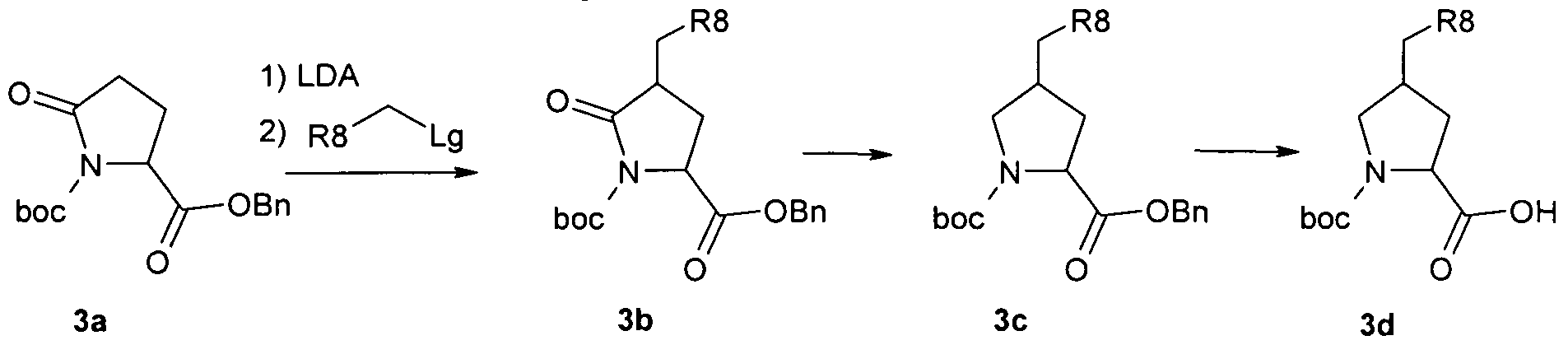
  • Substituted heterocyclic P2 building blocks wherein the R 8 substitutent is linked to the P2 scaffold via a methylene bridge, i.e. W is -CH 2 - in general formula 1 can be prepared as shown in Scheme 3, which illustrates the technique on a moiety where L is N, q is 0 and k is 1, according to the procedures described by J. Ezquerra et al., Tetrahedron,
  • R substituent can be introduced to a suitable cyclic scaffold prior to introduction of the other components of the compound or a hydroxy protected cyclic scaffold can be used throughout the synthesis and the R 8 group introduced as the last step of the synthesis.
  • R -OH, and alkylating agents R -X are described in WO 00/09543 and WO00/59929.
  • An example of the synthesis wherein R 8 is a substituted quinoline derivative is shown in Scheme 4.
  • Quinoline derivative (4e) can be coupled in a Mitsunobu reaction to an alcohol as described above, or the hydroxy group can be displaced by a suitable leaving group such as a halide like chloride, bromide or iodide, by treatment of quinoline (4e) with an appropriate halogenating agent for example phosphoryl chloride or the like.
  • a suitable leaving group such as a halide like chloride, bromide or iodide
  • R' is C r C 6 alkyl
  • R" is C r C 6 alkyl or H
  • Thiourea (5 c) with different alkyl substituents R' and R" can be formed by reaction of the appropriate amine (5a) with tert-butylisothiocyanate in the presence of a base like diisopropylethylamine in a solvent like dichloromethane followed by removal of the tert-butyl group under acidic conditions.
  • thiourea (5c) can be formed by reaction of the amine (5a) with thiocarbonyldiimidazole and subsequently with a saturated solution of amonia in methanol. Subsequent condensation of the afforded thiourea derivative (5c) with 3-bromopyruvic acid provides the acid (5d).
  • ⁇ -Bromoketones (5Ab) are commercially available or they can be prepared by ⁇ -bromination of the corresponding ketone.
  • the quinazoline derivative (5Bf) can then be coupled to the hydroxy group of a P2 scaffold in a Mitsunobu reaction as described above, or the 5 hydroxy group of the quinazoline can be displaced by a suitable leaving group such as a halide like chloride, bromide or iodide, by treatment of quinazolinol (5Bf) with an appropriate halogenating agent for example phosphoryl chloride or the like.
  • a suitable leaving group such as a halide like chloride, bromide or iodide
  • Scheme 6 shows an example of the preparation of a sulphonamide derivative to be used as a Pl fragment.
  • the sulphonamide group can be introduced on a suitably protected amino acid (6a) by treatment of the amino acid with a coupling agent, for example N 3 N'- carbonyldiimidazole (CDI) or the like, in a solvent like THF followed by reaction with the desired sulphonamide (6b) in the presence of a strong base such as 1,8- diazabicyclo[5.4.0]undec-7-ene (DBU).
  • a coupling agent for example N 3 N'- carbonyldiimidazole (CDI) or the like
  • CDI N 3 N'- carbonyldiimidazole
  • DBU 1,8- diazabicyclo[5.4.0]undec-7-ene
  • the amino acid can be treated with the desired sulphonamide (6b) in the presence of a base like diisopropyl ethylamine followed by treatment with a coupling agent like PyBOP® to effect the introduction of the sulphonamide group. Removal of the amino protecting
  • Pl units comprising a sulfamid function i.e. R 2 is NRaRb in general formula X
  • R 2 is NRaRb in general formula X
  • Sulfamoylchloride (7b) can be achieved by treatment of chloroisocyanate (7a) with water in a solvent like THF. Subsequent reaction with a desired amine (7c) in the presence of a base such as triethylamine gives the sulfamide derivative (7d).
  • Pl building blocks for the preparation of compounds according to general formula I wherein A is OH, NHR 3 or NRaRb can be prepared by reacting amino acid (6a) with the appropriate amine or alcohol respectively under standard conditions for amide or ester formation.
  • a general example of the coupling of a Pl building block to the acid function of the P2 scaffold is shown in scheme 8.
  • the sulphonamide group can be introduced at a later stage of the synthesis, for example as the last step.
  • A' in scheme 8 is an appropriately protected carboxylic acid, for example a methyl ester, and appropriately deprotected, for example with aqueous lithium hydroxide, prior to coupling of the sulphonamide group.
  • W and R8 are as defined or
  • W is O and R8 is a hydroxy protecting group
  • Aminoderivatives (9b) wherein Ra is H are described in Org. letters, 2, (2000), 2769- 2772 or they can be prepared according to the procedure described in J. Med. Chem., 37, (1994) 2918-2929, which is exemplified in scheme 10.
  • Reduction of a suitably protected amino acid derivative (10a) by reaction with a suitable hydride reagent such as LiBH 4 yields the corresponding aldehyde.
  • Conversion of the aldehyde to the cyanohydrine effected for example by treatment with potassium cyanide or acetone cyanohydrine followed by acidic hydrolysis and subsequent treatment with di-tert-butyl dicarbonate provides the ⁇ -hydroxy acid (10b).
  • Coupling of the acid with a desired amine using standard peptide conditions then gives the amide (1Od).
  • the hydrazine moiety group linked via a urea functionality to the P2 scaffold can be introduced as depicted in scheme 1 1, which illustrates the technique with a variant in wherein P2 is a 5-membered ring.
  • W and R8 are as defined or W is O and R8 is a hydroxy protecting group Rx is an ⁇ -unsaturated 5-8 membered alkylene chain
  • A' is a protected carboxylic acid, substituted amide or sulphone amide or HCR4R4'
  • trialkylated hydrazine drivatives to be used in scheme 1 1 can be prepared by alkylation of a desried N,N-dialkyl hydrazine using any convenient alkylation method. These methods are extensively described in the literature and a typical example is shown in scheme 12.
  • Rx is an ⁇ -unsaturated 5-8 membered alkyl chain
  • a 1 is a protected carboxylic acid, substituted amide or sulphone amide'
  • the saturated cycloalkyl scaffold (14b) can be prepared, for example, from 3,4- bis(methoxycarbonyl)cyclopentanone (14a), described by Rosenquist et al. in Acta Chem. Scand. 46 (1992) 1 127-1129 by reduction of the keto group with a reduction agent like sodium borohydride in a solvent like methanol followed by hydrolysis of the esters and finally ring closure in acetic anhydride in the presence of pyridine.
  • the provided bicyclic acid (14b) can then be coupled to the amine function of the desired hydrazine derivative (14c) using conventional peptide coupling conditions like with HATU and diisopropyl amine in a solvent like dimethyl formamide to give (14d).
  • Lactone opening of (14d) with for example lithium hydroxide provides the acid (14e) which subsequently can be coupled to the amino group of a Pl building block or a precursor of a desired Pl fragment (14f), using conventional peptide coupling conditions.
  • Introduction of the R 8 -group of the carbocycle can then be performed for example by a Mitsunobu reaction with the appropriate alcohol as described above or by any other suitable method previously described.
  • Scheme 15 shows an alternative route towards compounds of formula I comprising a saturated P2 scaffold where the building blocks are introduced in the reversed order, i.e. the Pl fragment is introduced before the hydrazine moiety.
  • Rx is an ⁇ -unsaturated 5 to 8 membered alkyl chain.
  • a 1 is a protected carboxylic acid, substituted amide or sulphone amide.
  • An unsaturated P2 scaffold useful for the preparation of compounds of formula I can be prepared as illustrated in scheme 16.
  • a P2 scaffold wherein Rq is other than hydrogen, such as a methyl, can be prepared as shown in scheme 17.
  • the ester (17e) can be prepared by treatment of the corresponding commercially available acid (17d) where k' is 1 to 3 with di-tert-butyl dicarbonate in the presence of a base like dimethylaminopyridine.
  • Cyclisation of (17f) by an olefin metathesis reaction performed as described above provides cyclopentene derivative (17g).
  • Stereoselective epoxidation of (17g) can be carried out using the Jacobsen asymmetric epoxidation method to furnish the epoxide (17h).
  • addition of a base like DBN (1 ,5-diazabicyclo- [4.3.0]non-5-ene) yields the alcohol (17i).
  • the double bond of compound (17i) can be reduced for example by catalytic hydrogenation using a catalyst like palladium on carbon which provides the corresponding saturated compound.
  • Rx is an ⁇ -unsaturated 5 to 8 membered alkylene chain.
  • A' is a protected carboxylic acid, substituted amide or sulphone amide.
  • the amino group of a Pl -building block or a suitable precursor thereof (18b) can be coupled to the acid of the cyclopentene derivative (18a) using standard amide coupling conditions such as using HATU in the presence of a base like diisopropyl phenylamine or the like, followed by introduction of the R 8 -substituent for example by Mitsunobu conditions as described above to provide (18d).
  • Hydrolysis of the remaining ester and subsequent amide coupling of a desired P3 or P3-P4 building block (18e) optionally followed by manipulations of the P 1 part provides cyclopentene containing compounds (18f) according to general formula VI.
  • R 7 , R 7 ' and A' contain functional groups, these are optionally suitably protected by methods recognized by persons skilled in the art, see for example Bodanzky or Greene cited above.
  • the macrocycle present in the compounds of the invention is typically formed by an olefin metatehsis reaction (macrocyclization).
  • the substituent W-R 8 of the cyclic P2 scaffold can be introduced by any of the previously described strategies before or after formation of the macrocycle.
  • 19a 19b n 1 , 2, 3, 4
  • W-R8 is as defined or W is O and R8 is a hydroxy protecting group
  • Compound (19a), prepared as described above, can be transformed into a macrocyclic compound by performing an olefin metathesis reaction.
  • a Ru-based catalyst such as the one reported by Miller, S.J., Blackwell, H.E.; Grubbs, R.H. J. Am. Chem. Soc. 1 18, (1996), 9606-9614, Kingsbury, J. S., Harrity, J. P. A., Bonitatebus, P. J., Hoveyda, A. H., J. Am. Chem. Soc. 121, (1999), 791-799 and Huang et al., J. Am. Chem. Soc. 121, (1999), 2674-2678 can be used to effect the metathesis reaction.
  • catalysts containing other transition metals such as Mo can be used for this reaction.
  • the double bond is reduced using standard hydrogenation methods well known in the art thus giving the corresponding saturated macrocyclic derivative.
  • W-R8 is as defined or W is O and R8 is a hydroxy protecting group n is 1 , 2, 3 or 4
  • N-alkylation of the hydrazine moiety can be performed after the macrocyclisation step as outlined in scheme 21.
  • W is O and R8 is a hydroxy protecting group
  • N-alkylated carbazates (21a) are conveniently prepared for instance by reaction of commersially available ter/-butylcarbazate with a desired ⁇ -unsaturated aldehyde in a reductive amination reaction.
  • Compounds E can be coupled to an quinazoline of Formula F using a Mitsunobu type reaction.
  • the resulting diolefin G can be submitted to ring closure using an olefin metathesis catalyst, such as the Hoveyda-Grubbs catalysts, or 5w(tricyclohexyl-phosphine)[(phenylthio)methylene]ruthenium (IV) dichloride, 5w(tricyclohexyl-phosphine)-3-phenyl-lH-inden-l-ylideneruthenium (IV) dichloride (Neolyst Ml ® ), in an appropriate solvent such as 1,2-dichloroethane, dichloromethane or toluene, to form a compound of Formula H, which can be hydrolyzed to the corresponding acid of Formula I.
  • an olefin metathesis catalyst such as the Hoveyda-Grubbs catalysts, or 5w(tricyclohe
  • the acid of formula I is coupled with R 6 SO 2 NH 2 , in presence of peptide coupling agent, such as CDI or EDAC, and in presence of a base such as l,8-diazabicyclo[5.4.0]undec-7-ene (DBU) or DMAP to provide a compound of Formula J.
  • peptide coupling agent such as CDI or EDAC
  • a base such as l,8-diazabicyclo[5.4.0]undec-7-ene (DBU) or DMAP
  • a compound of Formula K is reacted with a chlorooquinazoline L in presence of a base, such as NaH or tBuOK, to form a compound of Formula M.
  • the resulting acid M can be treated with l-(amino)-2-(vinyl)cyclopropanecarboxylic acid ethyl ester in the presence of peptide coupling agent, such as HATU or EDCI/HOAt and in presence of a base, such as DIPEA, to give a product of Formula N.
  • the deprotection of the Boc moiety of the compound of Formula N can be realized by treatment with an acid, such as TFA, in a solvent such as methylene chloride to provide the free amine of Formula O.
  • the urea of Formula P can be prepared from the compound of Formula O by treatment with phosgene, or an equivalent of phosgene, and an amine of Formula B, in presence of a base, such as NaHCO 3 .
  • the resulting diolefin P can be submitted to ring closure using an olefin metathesis catalyst, such as the Hoveyda-Grubbs catalysts or ⁇ /s(tricyclohexylphosphine)[(phenylthio)- methylenejruthenium (IV) dichloride, 5/s(tricyclohexylphosphine)-3-phenyl-lH-inden- 1 -ylideneruthenium (IV) dichloride (Neolyst Ml ® ), in an appropriate solvent such as 1 ,2-dichloroethane, dichloromethane or toluene, to form a compound of Formula Q, which can be hydrolyzed to the corresponding acid of Formula R.
  • an olefin metathesis catalyst such as the Hoveyda-Grubbs catalysts or ⁇ /s(tricyclohexylphosphine)[(phenylthio)- methylenejruthen
  • the acid of formula R is coupled with R 6 SO 2 NH 2 , in presence of peptide coupling agent, such as CDI or EDAC, and in presence of a base such as l,8-diazabicyclo[5.4.0]undec-7-ene (DBU) or DMAP to provide a compound of Formula S.
  • peptide coupling agent such as CDI or EDAC
  • a base such as l,8-diazabicyclo[5.4.0]undec-7-ene (DBU) or DMAP
  • the Boc-hydroxyproline is treated with l-(amino)-2-(vinyl)cyclopropane- carboxylic acid ethyl ester in the presence of peptide coupling agent, such as HATU or EDCI/HOAt and in presence of a base, such as DIPEA, to give the ester (1). Protection of the free hydroxyl group with p-nitrobenzoyl chloride followed by the removal of the Boc provides the free amine (3). Subsequently, the urea of Formula T can be prepared from (3) by treatment with phosgene, or an equivalent of phosgene, and an amine of Formula B, in presence of a base, such as NaHCO 3 .
  • a base such as NaHCO 3
  • the resulting diolef ⁇ n T can be submitted to ring closure using an olefin metathesis catalyst, such as the Hoveyda- Grubbs catalysts, or ⁇ z5(tricyclohexylphosphine)[(phenylthio)methylene]ruthenium (IV) dichloride, ⁇ w(tricyclohexylphosphine)-3-phenyl-lH-inden-l-ylideneruthenium (IV) dichloride (Neolyst Ml ® ) in an appropriate solvent such as 1 ,2-dichloroethane, dichloromethane or toluene, to form a compound of Formula U, which can be deprotected by using an hydroxide, such as lithium hydroxide, to give the corresponding alcohol of Formula V.
  • an olefin metathesis catalyst such as the Hoveyda- Grubbs catalysts, or ⁇ z5(tricyclohexylphosphine)[(
  • the proline derivative (1) is protected with p-nitrobenzoic acid followed by the removal of the Boc to give free amine (5).
  • the urea of Formula W can be prepared from (5) by treatment with phosgene, or an equivalent of phosgene, and an amine of Formula B, in presence of a base, such as NaHCO 3 .
  • the compound of Formula W can be deprotected by using an hydroxide, such as lithium hydroxide, to give the corresponding alcohol of Formula X.
  • Introduction of the P2 isoquinoline can be realized starting from the compound of Formula X and a hydroxyisoquinoline F, using a Mitsunobu reaction, to provide a compound of Formula Y.
  • the resulting diolefin Y can be submitted to ring closure using an olefin metathesis catalyst, such as the Hoveyda-Grubbs catalyst or the like, in an appropriate solvent such as 1,2- dichloroethane, dichloromethane or toluene, to form a compound of Formula Q.
  • an olefin metathesis catalyst such as the Hoveyda-Grubbs catalyst or the like
  • an appropriate solvent such as 1,2- dichloroethane, dichloromethane or toluene
  • R 3 corresponds to the present NRyRy'
  • X corresponds to L
  • R 4a corresponds to R 9
  • R 4b and R 4b correspond to other R8 substituents
  • R 5 corresponds to R 1
  • R 6 corresponds to R 3 , as defined above for the compounds of formula (I) or of any of the subgroups thereof.
  • schemes 28-33 are illustrated with a compound comprising a quinazolyl ether as W-R8 it will be readily apparent that the corresponding methodology is applicable to other -W-R8 values.
  • the reactions of the schemes above may be conducted in a suitable solvent in the presence of a base such as an alkali metal carbonate or hydroxide, e.g.
  • Suitable solvents for this reaction are for example ethers, e.g. THF, dioxane; halogenated hydrocarbons, e.g. dichoromethane, CHCl 3 , toluene, polar aprotic solvents such as DMF, DMSO, DMA and the like.
  • the compounds of formula (I) may be converted to the corresponding N-oxide forms following art-known procedures for converting a trivalent nitrogen into its yV-oxide form.
  • Said TV-oxidation reaction may generally be carried out by reacting the starting material of formula (I) with an appropriate organic or inorganic peroxide.
  • Appropriate inorganic peroxides comprise, for example, hydrogen peroxide, alkali metal or earth alkaline metal peroxides, e.g. sodium peroxide, potassium peroxide;
  • appropriate organic peroxides may comprise peroxy acids such as, for example, benzenecarboperoxoic acid or halo substituted benzenecarboperoxoic acid, e.g.
  • 3-chlorobenzenecarboperoxoic acid peroxoalkanoic acids, e.g. peroxoacetic acid, alkylhydroperoxides, e.g. tert-buty ⁇ hydro-peroxide.
  • Suitable solvents are, for example, water, lower alcohols, e.g. ethanol and the like, hydrocarbons, e.g. toluene, ketones, e.g. 2-butanone, halogenated hydrocarbons, e.g. dichloromethane, and mixtures of such solvents.
  • Diastereomers may be separated by physical methods such as selective crystallization and chromatographic techniques, e.g., counter-current distribution, liquid chromatography and the like.
  • the compounds of formula (I) may be obtained as racemic mixtures of enantiomers which can be separated from one another following art-known resolution procedures.
  • the racemic compounds of formula (I), which are sufficiently basic or acidic may be converted into the corresponding diastereomeric salt forms by reaction with a suitable chiral acid, respectively chiral base. Said diastereomeric salt forms are subsequently separated, for example, by selective or fractional crystallization and the enantiomers are liberated therefrom by alkali or acid.
  • An alternative manner of separating the enantiomeric forms of the compounds of formula (I) involves liquid chromatography, in particular liquid chromatography using a chiral stationary phase.
  • Said pure stereochemical Iy isomeric forms may also be derived from the corresponding pure stereochemical ⁇ isomeric forms of the appropriate starting materials, provided that the reaction occurs stereospecifically.
  • said compound may be synthesized by stereospecific methods of preparation. These methods may advantageously employ enantiomerically pure starting materials.
  • the present invention concerns a pharmaceutical composition
  • a pharmaceutical composition comprising a therapeutically effective amount of a compound of formula (I) as specified herein, or a compound of any of the subgroups of compounds of formula (I) as specified herein, and a pharmaceutically acceptable carrier.
  • a therapeutically effective amount in this context is an amount sufficient to prophylactically act against, to stabilize or to reduce viral infection, and in particular HCV viral infection, in infected subjects or subjects being at risk of being infected.
  • this invention relates to a process of preparing a pharmaceutical composition as specified herein, which comprises intimately mixing a pharmaceutically acceptable carrier with a therapeutically effective amount of a compound of formula (I), as specified herein, or of a compound of any of the subgroups of compounds of formula (I) as specified herein.
  • compositions of the present invention may be formulated into various pharmaceutical forms for administration purposes.
  • compositions there may be cited all compositions usually employed for systemically administering drugs.
  • an effective amount of the particular compound, optionally in addition salt form or metal complex, as the active ingredient is combined in intimate admixture with a pharmaceutically acceptable carrier, which carrier may take a wide variety of forms depending on the form of preparation desired for administration.
  • a pharmaceutically acceptable carrier which carrier may take a wide variety of forms depending on the form of preparation desired for administration.
  • These pharmaceutical compositions are desirable in unitary dosage form suitable, particularly, for administration orally, rectally, percutaneously, or by parenteral injection.
  • any of the usual pharmaceutical media may be employed such as, for example, water, glycols, oils, alcohols and the like in the case of oral liquid preparations such as suspensions, syrups, elixirs, emulsions and solutions; or solid carriers such as starches, sugars, kaolin, lubricants, binders, disintegrating agents and the like in the case of powders, pills, capsules, and tablets. Because of their ease in administration, tablets and capsules represent the most advantageous oral dosage unit forms, in which case solid pharmaceutical carriers are obviously employed.
  • the carrier will usually comprise sterile water, at least in large part, though other ingredients, for example, to aid solubility, may be included.
  • Injectable solutions may be prepared in which the carrier comprises saline solution, glucose solution or a mixture of saline and glucose solution.
  • Injectable suspensions may also be prepared in which case appropriate liquid carriers, suspending agents and the like may be employed. Also included are solid form preparations which are intended to be converted, shortly before use, to liquid form preparations.
  • the carrier optionally comprises a penetration enhancing agent and/or a suitable wetting agent, optionally combined with suitable additives of any nature in minor proportions, which additives do not introduce a significant deleterious effect on the skin.
  • the compounds of the present invention may also be administered via oral inhalation or insufflation by means of methods and formulations employed in the art for administration via this way.
  • the compounds of the present invention may be administered to the lungs in the form of a solution, a suspension or a dry powder, a solution being preferred. Any system developed for the delivery of solutions, suspensions or dry powders via oral inhalation or insufflation are suitable for the administration of the present compounds.
  • the present invention also provides a pharmaceutical composition adapted for administration by inhalation or insufflation through the mouth comprising a compound of formula (I) and a pharmaceutically acceptable carrier.
  • a pharmaceutical composition adapted for administration by inhalation or insufflation through the mouth comprising a compound of formula (I) and a pharmaceutically acceptable carrier.
  • the compounds of the present invention are administered via inhalation of a solution in nebulized or aerosolized doses.
  • Unit dosage form refers to physically discrete units suitable as unitary dosages, each unit containing a predetermined quantity of active ingredient calculated to produce the desired therapeutic effect in association with the required pharmaceutical carrier.
  • unit dosage forms are tablets (including scored or coated tablets), capsules, pills, suppositories, powder packets, wafers, injectable solutions or suspensions and the like, and segregated multiples thereof.
  • the compounds of formula (I) show antiviral properties. Viral infections and their associated diseases treatable using the compounds and methods of the present invention include those infections brought on by HCV and other pathogenic flaviviruses such as Yellow fever, Dengue fever (types 1-4), St.
  • the diseases associated with HCV include progressive liver fibrosis, inflammation and necrosis leading to cirrhosis, end-stage liver disease, and HCC; and for the other pathogenic flaviruses the diseases include yellow fever, dengue fever, hemorraghic fever and encephalitis.
  • a number of the compounds of this invention moreover are active against mutated strains of HCV. Additionally, many of the compounds of this invention show a favorable pharmacokinetic profile and have attractive properties in terms of bioavailabilty, including an acceptable half-life, AUC (area under the curve) and peak values and lacking unfavourable phenomena such as insufficient quick onset and tissue retention.
  • the compounds of formula (I) or any subgroup thereof, their prodrugs, N-oxides, addition salts, quaternary amines, metal complexes and stereochemically isomeric forms are useful in the treatment of individuals experiencing a viral infection, particularly a HCV infection, and for the prophylaxis of these infections.
  • the compounds of the present invention may be useful in the treatment of warm-blooded animals infected with viruses, in particular flaviviruses such as HCV.
  • the compounds of the present invention or any subgroup thereof may therefore be used as medicines.
  • Said use as a medicine or method of treatment comprises the systemic administration to viral infected subjects or to subjects susceptible to viral infections of an amount effective to combat the conditions associated with the viral infection, in particular the HCV infection.
  • the present invention also relates to the use of the present compounds or any subgroup thereof in the manufacture of a medicament for the treatment or the prevention of viral infections, particularly HCV infection.
  • the present invention furthermore relates to a method of treating a warm-blooded animal infected by a virus, or being at risk of infection by a virus, in particular by HCV, said method comprising the administration of an anti-virally effective amount of a compound of formula (I), as specified herein, or of a compound of any of the subgroups of compounds of formula (I), as specified herein.
  • an antiviral effective daily amount would be from 0.01 mg/kg to 500 mg/kg body weight, more preferably from 0.1 mg/kg to 50 mg/kg body weight. It may be appropriate to administer the required dose as two, three, four or more sub-doses at appropriate intervals throughout the day. Said sub-doses may be formulated as unit dosage forms, for example, containing 1 to 1000 mg, and in particular 5 to 200 mg of active ingredient per unit dosage form.
  • the exact dosage and frequency of administration depends on the particular compound of formula (I) used, the particular condition being treated, the severity of the condition being treated, the age, weight, sex, extent of disorder and general physical condition of the particular patient as well as other medication the individual may be taking, as is well known to those skilled in the art. Furthermore, it is evident that said effective daily amount may be lowered or increased depending on the response of the treated subject and/or depending on the evaluation of the physician prescribing the compounds of the instant invention. The effective daily amount ranges mentioned hereinabove are therefore only guidelines.
  • the combination of previously known anti-HCV compound such as, for instance, interferon- ⁇ (IFN- ⁇ ), pegylated interferon- ⁇ and/or ribavirin, and a compound of formula (I) can be used as a medicine in a combination therapy.
  • the term "combination therapy” relates to a product containing mandatory (a) a compound of formula (I), and (b) optionally another anti-HCV compound, as a combined preparation for simultaneous, separate or sequential use in treatment of HCV infections, in particular, in the treatment of infections with HCV.
  • the compounds of formula (I) may be co-administered in combination with for instance, interferon- ⁇ (IFN- ⁇ ), pegylated interferon- ⁇ and/or ribavirin, as well as therapeutics based on antibodies targeted against HCV epitopes, small interfering RNA (Si RNA), ribozymes, DNAzymes, antisense RNA, small molecule antagonists of for instance NS3 protease, NS3 helicase and NS5B polymerase.
  • IFN- ⁇ interferon- ⁇
  • Si RNA small interfering RNA
  • ribozymes DNAzymes
  • antisense RNA small molecule antagonists of for instance NS3 protease, NS3 helicase and NS5B polymerase.
  • the present invention relates to the use of a compound of formula (I) or any subgroup thereof as defined above for the manufacture of a medicament useful for inhibiting HCV activity in a mammal infected with HCV viruses, wherein said medicament is used in a combination therapy, said combination therapy preferably comprising a compound of formula (I) and (pegylated) IFN- ⁇ and/or ribavirin, and optionally an anti-HIV compound.
  • a combination therapy preferably comprising a compound of formula (I) and (pegylated) IFN- ⁇ and/or ribavirin, and optionally an anti-HIV compound.
  • the organic phase was washed with brine, saturated NaHCO 3 , brine, dried over MgSO 4 and evaporated.
  • the cyanoborane adduct was hydrolyzed by treatment with MeOH (3 mL) and 2 M NaOH (1.9 mL). The mixture was stirred for 2 h and the MeOH was evaporated. H 2 O (5 mL) and DCM (5 mL) were added and the water phase was extracted three times with DCM. The combined organic phases were dried and evaporated.
  • Compound 5 was kept in TFA-DCM 1 :2 (3 mL) at RT for 60 min. Toluene (3 mL) was added. The sample was co-evaporated to dryness. Purity by HPLC >95%. M+H + 502.4.
  • N-(ter/-Butyl)-N'-isopropylthiourea (8) To a solution of /ert-butylisothiocyanate (5.0 mL, 39 mmol) in CH 2 Cl 2 (200 mL) were added isopropylamine (4.0 mL, 47 mmol) and diisopropylethylamine (DIEA) (6.8 mL, 39 mmol), and the mixture was stirred at rt for 2h. The reaction mixture was diluted with EtOAc, washed with 10 % citric acid (2x), saturated NaHCO 3 (2x), H 2 O (2x), and brine (Ix). The organic layer was dried (MgSO 4 ) and evaporated to yield compound 94 (3.3 g, 52 %) as a white solid which was used without further purification.
  • Fmoc-4-amino-2-(l-ethoxycarbonyl-2-vinyl-cyclopropylcarbamoyl)-pyrrolidine-l- carbocyclic acid tert-butyl ester (2S,4R) Fmoc-4-amino-l-Boc-pyrrolidine-2-carboxylic acid (5.3 g, 1 1.8 mmol) was dissolved in DCM (100 ml), HATU (4.94 g, 12.99 mmol), DIEA (4.63 ml, 26.57 mmol) and vinylcyclopropylglycine ethyl ester (2.26 g, 1 1.81 mmol) were added successively.
  • the methyl ester 30 (35 mg, 59 mmol) was dissolved in dioxane/water (1 : 1 , 4mL) and LiOH (1.2 mmol) was added. The reaction was stirred over night and then co-concentrated. This gave the title compound (0.32 g, 90 %) as a yellow salt.
  • the catalyst was filtered of and washed with DMF. The solvent was evaporated under reduced pressure. Yield: 5.6 g, 95%.
  • Boc-protected prolin (4 g, 17.3 mmol), HATU (6.9 g, 18.2 mmol) and l-amino-2- vinyl-cyclopropanecarboxylic acid ethyl ester preprared as described in WO03/099274, (3.5 g, 18.3 mmol) were dissolved in DMF (60 ml) and cooled to 0 ° on an ice-bath. Diisopropylethyl amine (DIPEA) (6ml) was added. The ice-bath was removed and the mixture was left at ambient temperature over-night.
  • DIPEA Diisopropylethyl amine
  • 2-(2-Dimethylamino-thiazole-4-yl)-7-methoxy-quinolin-4-ol (68) 2-Dimethylamino-thiazole-4-carboxylic acid (2-acetyl-5-methoxy-phenyl)-amide (1.29 g, 4.04 mmol) was was dissolved in 20 mL pyridine in a microwave vial. Grinded KOH (0.48 g, 8.48 mmol) was added to the solution and the enclosed vial was reacted in the microwave oven at 100 0 C for 30 minutes. The mixture was transferred to a round- bottom flask and the solvent was removed by rotary evaporation.
  • reaction mixture was flushed with argon and cooled down in an ice bath and Hunigs base ( 1.5 ml) was added in one portion and the reaction mixture was stirred for 10-15 min.
  • Hunigs base 1.5 ml was added in one portion and the reaction mixture was stirred for 10-15 min.
  • HATU (2.93g, 7.7 mmol) was added to the cold reaction mixture in one portion and the reaction mixture was stirred for about 40 min in an ice bath (reaction was monitored by LC-MS). After 40 min the reaction mixture was concentrated by rotary evaporation (not to complete dryness), mixed with sat. sodium bicarbonate solution and extracted into EtOAc (3x100 ml), washed with brine, dried over magnesium sulfate and concentrated by rotary evaporation.
  • Biological Example 1 Activity of compounds of formula (I) in HCV replicon assays The compounds of formula (I) were examined for activity in the inhibition of HCV RNA replication in a cellular assay. The assay demonstrated that the compounds of formula (I) exhibited activity against HCV replicons functional in a cell culture. The cellular assay was based on a bicistronic expression construct, as described by
  • the assay utilized the stably transfected cell line Huh-7 luc/neo (hereafter referred to as Huh-Luc).
  • Huh-Luc This cell line harbors an RNA encoding a bicistronic expression construct comprising the wild type NS3-NS5B regions of HCV type Ib translated from an Internal Ribosome Entry Site (IRES) from encephalomyocarditis virus (EMCV), preceded by a reporter portion (FfL-luciferase), and a selectable marker portion (neo R , neomycine phosphotransferase).
  • IRS Internal Ribosome Entry Site
  • EMCV encephalomyocarditis virus
  • FfL-luciferase reporter portion
  • neo R neomycine phosphotransferase
  • the replicon cells were plated in 384 well plates in the presence of the test and control compounds which were added in various concentrations. Following an incubation of three days, HCV replication was measured by assaying luciferase activity (using standard luciferase assay substrates and reagents and a Perkin Elmer ViewLux Tm ultraHTS microplate imager). Replicon cells in the control cultures have high luciferase expression in the absence of any inhibitor. The inhibitory activity of the compound on luciferase activity was monitored on the Huh-Luc cells, enabling a dose- response curve for each test compound. EC50 values were then calculated, which value represents the amount of the compound required to decrease by 50% the level of detected luciferase activity, or more specifically, the ability of the genetically linked HCV replicon RNA to replicate.
  • Results are typically tabulated in ranges such as : value A corresponds to an EC 50 between lO ⁇ M and l ⁇ M; - value B corresponds to an EC 50 between 0.99 ⁇ M and 5OnM; - value C corresponds to an EC 50 between 49nM and 0.5nM.
  • the aim of this in vitro assay is to measure the inhibition of HCV NS3/4A protease complexes by the compounds of the present invention.
  • This assay provides an indication of how effective compounds of the present invention would be in inhibiting HCV NS3/4A proteolytic activity.
  • the enzyme (1 nM) was incubated in 50 mM HEPES, pH 7.5, 10 mM DTT, 40% glycerol, 0.1% n-octyl-D-glucoside, with 25 ⁇ M NS4A cofactor and inhibitor at 30 °C for 10 min, whereupon the reaction was initiated by addition of 0.5 ⁇ M substrate.
  • Inhibitors were dissolved in DMSO, sonicated for 30 sec. and vortexed. The solutions were stored at - 20°C between measurements.
  • Ki values are estimated by non-linear regression analysis (GraFit, Erithacus Software, Staines, MX, UK), using a model for competitive inhibition and a fixed value for Km (0.15 ⁇ M). A minimum of two replicates are performed for all measurements.
  • Results are typically tabulated in ranges such as - value E corresponds to a Ki > 2 ⁇ M; value F corresponds to a Ki between 2 ⁇ M and 10OnM; - value G corresponds to a Ki between 99.9nM and 5nM; value H corresponds to a Ki between 4.9nM and 0. InM.

Landscapes

  • Chemical & Material Sciences (AREA)
  • Organic Chemistry (AREA)
  • Health & Medical Sciences (AREA)
  • Life Sciences & Earth Sciences (AREA)
  • Pharmacology & Pharmacy (AREA)
  • Public Health (AREA)
  • Veterinary Medicine (AREA)
  • Chemical Kinetics & Catalysis (AREA)
  • General Chemical & Material Sciences (AREA)
  • Medicinal Chemistry (AREA)
  • Nuclear Medicine, Radiotherapy & Molecular Imaging (AREA)
  • General Health & Medical Sciences (AREA)
  • Animal Behavior & Ethology (AREA)
  • Virology (AREA)
  • Oncology (AREA)
  • Communicable Diseases (AREA)
  • Molecular Biology (AREA)
  • Gastroenterology & Hepatology (AREA)
  • Engineering & Computer Science (AREA)
  • Bioinformatics & Cheminformatics (AREA)
  • Pharmaceuticals Containing Other Organic And Inorganic Compounds (AREA)
  • Medicines That Contain Protein Lipid Enzymes And Other Medicines (AREA)
  • Plural Heterocyclic Compounds (AREA)
  • Peptides Or Proteins (AREA)
  • Nitrogen Condensed Heterocyclic Rings (AREA)

Abstract

Compounds of the formula (I): and N-oxides, salts and stereoisomers thereof wherein A is OR1, NHS(=O)PR2, NHR3, NRaRb, C(=O)NHR3 or C(=O)NRaRb wherein; R1 is hydrogen, C1-C6alkyl, C0-C3alkylenecarbocyclyl, C0-C3alkyleneheterocyclyl; R2 is C1-C6alkyl, C0-C3alkylenecarbocyclyl, C0-C3alkyleneheterocyclyl or NRaRb; R3 is C1-C6alkyl, C0-C3alkylenecarbocyclyl, C0-C3alkyleneheterocyclyl, -OC1- C6alkyl, -OC0-C3alkylenecarbocyclyl, -OC0-C3alkyleneheterocyclyl ; wherein any alkyl, carbocyclyl or heterocycylyl in R1, R2 or R3 are optionally substituted p is independently 1 or 2; n is 3, 4, 5 or 6; denotes an optional double bond; Rq is H or when L is CRz, Rq can also be C1-C6alkyl; Ry and Ry' are independently C1-C6alkyl; L is N or CRz; Rz is H or forms a double bond with the asterisked carbon; W is -CH2-, -O-, -OC(=O)NH-, -OC(=O)-, -S-, -NH-, -NRa, -NHS(=O)2-, -NHC(=0)NH- or -NHC(=O)-, -NHC(=S)NH- or a bond; R8 is an optionally substituted ring system containing 1 or 2 saturated, partially saturated or unsaturated carbo or heterocyclic rings have utility in the inhibition of NS-3 serine proteases, such as flavivirus infections.

Description

MACROCYLIC INHIBITORS OF HEPATITIS C VIRUS
The present invention is concerned with macrocylic compounds having inhibitory activity on the replication of the hepatitis C virus (HCV). It further concerns compositions comprising these compounds as active ingredients as well as processes for preparing these compounds and compositions.
Hepatitis C virus is the leading cause of chronic liver disease worldwide and has become a focus of considerable medical research. HCV is a member of the Flaviviridae family of viruses in the hepacivirus genus, and is closely related to the flavivirus genus, which includes a number of viruses implicated in human disease, such as dengue virus and yellow fever virus, and to the animal pestivirus family, which includes bovine viral diarrhea virus (BVDV). HCV is a positive-sense, single-stranded RNA virus, with a genome of around 9,600 bases. The genome comprises both 5' and 3' untranslated regions which adopt RNA secondary structures, and a central open reading frame that encodes a single polyprotein of around 3,010-3,030 amino acids. The polyprotein encodes ten gene products which are generated from the precursor polyprotein by an orchestrated series of co- and posttranslational endoproteolytic cleavages mediated by both host and viral proteases. The viral structural proteins include the core nucleocapsid protein, and two envelope glycoproteins El and E2. The non-structural (NS) proteins encode some essential viral enzymatic functions (helicase, polymerase, protease), as well as proteins of unknown function. Replication of the viral genome is mediated by an RNA-dependent RNA polymerase, encoded by nonstructural protein 5b (NS5B). In addition to the polymerase, the viral helicase and protease functions, both encoded in the bifunctional NS3 protein, have been shown to be essential for replication of HCV RNA. In addition to the NS3 serine protease, HCV also encodes a metalloproteinase in the NS2 region.
Following the initial acute infection, a majority of infected individuals develop chronic hepatitis because HCV replicates preferentially in hepatocytes but is not directly cytopathic. In particular, the lack of a vigorous T-lymphocyte response and the high propensity of the virus to mutate appear to promote a high rate of chronic infection. Chronic hepatitis can progress to liver fibrosis leading to cirrhosis, end-stage liver disease, and HCC (hepatocellular carcinoma), making it the leading cause of liver transplantations.
There are 6 major HCV genotypes and more than 50 subtypes, which are differently distributed geographically. HCV type 1 is the predominant genotype in Europe and the US. The extensive genetic heterogeneity of HCV has important diagnostic and clinical implications, perhaps explaining difficulties in vaccine development and the lack of response to therapy.
Transmission of HCV can occur through contact with contaminated blood or blood products, for example following blood transfusion or intravenous drug use. The introduction of diagnostic tests used in blood screening has led to a downward trend in post- transfusion HCV incidence. However, given the slow progression to the end-stage liver disease, the existing infections will continue to present a serious medical and economic burden for decades.
Current HCV therapies are based on (pegylated) interferon-alpha (IFN-α) in combination with ribavirin. This combination therapy yields a sustained virologic response in more than 40% of patients infected by genotype 1 viruses and about 80% of those infected by genotypes 2 and 3. Beside the limited efficacy on HCV type 1, this combination therapy has significant side effects and is poorly tolerated in many patients. Major side effects include influenza-like symptoms, hematologic abnormalities, and neuropsychiatric symptoms. Hence there is a need for more effective, convenient and better tolerated treatments.
Recently, two peptidomimetic HCV protease inhibitors have gained attention as clinical candidates, namely BILN-2061 disclosed in WO00/59929 and VX-950 disclosed in WO03/87092. A number of similar HCV protease inhibitors have also been disclosed in the academic and patent literature. It has already become apparent that the sustained administration of BILN-2061 or VX-950 selects HCV mutants which are resistant to the respective drug, so called drug escape mutants. These drug escape mutants have characteristic mutations in the HCV protease genome, notably D 168V, D 168 Y and/or A165S. Accordingly, additional drugs with different resistance patterns are required to provide failing patients with treatment options, and combination therapy with multiple drugs is likely to be the norm in the future, even for first line treatment.
Experience with HIV drugs, and HIV protease inhibitors in particular, has further emphasized that sub-optimal pharmacokinetics and complex dosage regimes quickly result in inadvertent compliance failures. This in turn means that the 24 hour trough concentration (minimum plasma concentration) for the respective drugs in an HIV regime frequently falls below the IC90 or ED90 threshold for large parts of the day. It is considered that a 24 hour trough level of at least the IC50, and more realistically, the IC90 or ED9Q, is essential to slow down the development of drug escape mutants. Achieving the necessary pharmacokinetics and drug metabolism to allow such trough levels provides a stringent challenge to drug design. The strong peptidomimetic nature of prior art HCV protease inhibitors, with multiple peptide bonds poses pharmacokinetic hurdles to effective dosage regimes.
There is a need for HCV inhibitors which may overcome the disadvantages of current HCV therapy such as side effects, limited efficacy, the emerging of resistance, and compliance failures.
The present invention concerns inhibitors of HCV replication which not only show good activity as HCV inhibitors but also exhibit improved cell permeability which also results in an enhanced bioavailability. This is contrary to the currently prevailing opinion which expects less active drugs with decreasing structural flexibility such as in less flexible macrocylic rings. The compounds of the present invention having relatively low molecular weight are easy to synthesize, starting from starting materials that are commercially available or readily available through art-known synthesis procedures.
A first aspect of the invention provides compounds of the formula (I)
Figure imgf000004_0001
and N-oxides, salts, prodrugs, esters and stereoisomers thereof wherein
A is OR1, NHS(=O)PR2, NHR3, NRaRb, C(=O)NHR3 or C(O)NRaRb wherein; R1 is hydrogen, Ci-C6alkyl, C0-C3alkylenecarbocyclyl, Co-C3alkyleneheterocyclyl; R2 is Ci-C6alkyl, C0-C3alkylenecarbocyclyl, C0-C3alkyleneheterocyclyl or NRaRb; R3 is Ci-C6alkyl, Co-C3alkylenecarbocyclyl, C0-C3alkyleneheterocyclyl, -OCi-C6alkyl, -OC0-C3alkylenecarbocyclyl, -OC0-C3alkyleneheterocyclyl; wherein any alkyl, carbocyclyl or heterocycylyl in R1, R2 or R3 are optionally substituted with 1 to 3 substituents independently selected from the group consisting of halo, oxo, cyano, azido, nitro, Ci-C6alkyl, Co-C3alkylenecarbocyclyl, Co-C3alkyleneheterocyclyl, -CC=O)NH2, Y-NRaRb, Y-O-Rb, Y-Q=O)Rb, Y-(C=O)NRaRb, Y-NRaC(=0)Rb, Y- NHSOpRb, Y-S(=O)pRb and Y-S(=0)pNRaRb, Y-C(=O)ORb, Y-NRaC(=0)0Rb; Y is independently a bond or Ci-C3alkylene; Ra is independently H, Ci-C6alkyl or Ci-C6alkoxy;
Rb is independently H, Ci-C6alkyl, Ci-Cβalkoxy, C0-C3alkylenecarbocyclyl or Co- C3alkyleneheterocyclyl; or Ra and Rb together with the nitrogen to which they are attached join to form a heterocyclyl group; p is independently 1 or 2; n is 3, 4, 5 or 6; denotes an optional double bond; Rq is H or when L is CRz, Rq can also be Ci-C6alkyl; Ry and Ry' are independently Ci-C6alkyl; L is N or CRz;
Rz is H or forms a double bond with the asterisked carbon; W is -CH2-, -O-, -0C(=0)NH-, -OC(=O)-, -S-, -NH-, -NRa, -NHSC=O)2-, -NHC(=0)NH- or -NHCC=O)-, -NHC(=S)NH- or a bond;
R is a ring system containing 1 or 2 saturated, partially saturated or unsaturated rings each of which has 4-7 ring atoms and each of which has O to 4 hetero atoms independently selected from S, O and N, the ring system being optionally spaced from W by a Ci-C3 alkylene group; or R8 is Ci-Qalkyl; any of which R8 groups can be optionally mono-, di-, or tri-substituted with R9, wherein
R9 is independently selected from the group consisting of halo, oxo, cyano, azido, nitro, C i -C6alkyl, C0-C3alkylenecarbocyclyl, C0-C3alkyleneheterocyclyl, -CC-O)NH2, Y-NRaRb, Y-O-Rb, Y-C(O)Rb, Y-(C=O)NRaRb, Y-NRaC(O)Rb, Y- NHS(=O)pRb, Y-S(=O)pRb, Y-S(O)pNRaRb, Y-C(O)ORb, Y-NRaC(O)ORb; wherein said carbocyclyl or heterocyclyl is optionally substituted with one to three substituents selected from R10; wherein
R10 is Ci-C6alkyl, C3-C7cycloalkyl, Ci-C6alkoxy, amino, amido, sulfonyl, (Ci-C3 alkyl)sulfonyl, nitro, hydroxy, mercapto, halo, haloalkyl, carboxyl;
The invention further envisions compounds of the formula I represented by formula (It):
Figure imgf000006_0001
the prodrugs, jV-oxides, addition salts, quaternary amines, metal complexes, and stereochemically isomeric forms thereof, wherein the dashed line represents an optional double bond between atoms C7 and C8; Rt1 is aryl or a saturated, a partially unsaturated or completely unsaturated 5 or 6 membered monocyclic or 9 to 12 membered bicyclic heterocyclic ring system wherein said ring system contains one nitrogen, and optionally one to three additional heteroatoms selected from the group consisting of oxygen, sulfur and nitrogen, and wherein the remaining ring members are carbon atoms; wherein said ring system may be optionally substituted on any carbon or nitrogen ring atom with one, two, three, or four substituents each independently selected from
C3-7cycloalkyl, aryl, Het, -C(=O)NRt5aRt5b, -C(=O)Rt7, -C(=O)OR6a, and C,-6alkyl optionally substituted with C3-7cycloalkyl, aryl, Het, -C(=O)NRt5aR5b, -NRt5aRt5b, -C(=O)Rt7, -NRt5aC(=O)Rt7, -NRt53SOpRt8, -SOpRt8, -SOpNRt5aRt5b, -C(=O)ORt6, or -NRt5aC(=O)OR6a; and wherein the substituents on any carbon atom of the heterocyclic ring may also be selected from Ci-6alkoxy, hydroxy, halo, polyhalo-Ci-6alkyl, Ci- 6alkylthio, oxo, cyano, nitro, azido, -NRt5aRt5b, -NRt5aC(=O)Rt7, -NRt5aSOpRt8, -SOpRt8, -SOpNRt5aRt5b, -C(=O)OH, and -NRt5aC(=O)ORt6a; Lt is a direct bond, -O-, -O-CMalkanediyl-, -O-CO-, -O-C(=O)-NRt5a- or -0-C(O)- NRt5a-Ci-4alkanediyl-; X is N, CH, or C bearing a double bond to the asterisked carbon; Rq is H, or when X is C may be Ci-C6 alkyl; Ry and Ry' are Ry and Ry' are independently C|-C6alkyl; or Ry and Ry' together with the N atom to which they are attached form a saturated heterocyclic ring selected from pyrrolidinyl, piperidinyl, piperazinyl, 4-Ci- C6alkylpiperazinyl, 4-Ci-C6alkylcarbonylpiperazinyl or morpholinyl; Rt2 represents hydrogen, -ORt6, -C(=O)ORt6, -C(=O)Rt7, -C(=O)NRt5aRt5b, -C(=O)NHRt5c, -NRt5aRt5b, -NHRt5c, -NHSOpNRt5aRt5b, -NRt5aSOpRt8, or -B(ORt6)2; n is 3, 4, 5 or 5; p is 1 or 2; each Rt5a and Rt5b are, independently, hydrogen, C3-7cycloalkyl, aryl, Het, C|-6alkyl optionally substituted with halo, Ci-6alkoxy, cyano, polyhaloCi^alkoxy, C3-7cycloalkyl, aryl, or with Het;
Rt5c is C3-7cycloalkyl, aryl, Het, -O-C3-7cycloalkyl, -O-aryl, -O-Het, Ci-6alkyl, or Ci-6alkoxy, wherein said Ci-6alkyl or Ci-6alkoxy may be each optionally substituted with -C(=O)ORt6, C3-7cycloalkyl, aryl, or Het;
Rt6 is hydrogen; C2-6alkenyl; Het; C3-7cycloalkyl optionally substituted with Ci-6alkyl; or Ci.6alkyl optionally substituted with C3-7cycloalkyl or Het; Rt6a is C2-6alkenyl, C3-7cycloalkyl, Het, or C|-6alkyl optionally substituted with C3-7cycloalkyl or Het;
Rt7 is hydrogen, Ci-6alkyl, C3-7cycloalkyl, or aryl;
Rt8 is hydrogen, polyhaloCi-6alkyl, aryl, Het, C3-7cycloalkyl optionally substituted with
Ci-6alkyl, or Ci-6alkyl optionally substituted with C3-7cycloalkyl, aryl or Het; aryl as a group or part of a group is phenyl, naphthyl, indanyl, or 1,2,3,4- tetrahydronaphthyl, each of which may be optionally substituted with one, two or three substituents selected from halo,
Figure imgf000007_0001
polyhaloCi-6alkyl, hydroxy, Ci-6alkoxy, polyhaloCi-6alkoxy, Ci-6alkoxyCi-6alkyl, carboxyl, Ci-6alkylcarbonyl, cyano, nitro, amino, mono- or diCi-6alkylamino, azido, mercapto, C3-C7 cycloalkyl, (cyclopropyl), pyrrolidinyl, piperidinyl, piperazinyl, 4-Ci-6alkylpiperazinyl, 4-Ci- 6alkylcarbonyl-piperazinyl, and morpholinyl; and
Het as a group or part of a group is a 5 or 6 membered saturated, partially unsaturated or completely unsaturated heterocyclic ring containing 1 to 4 heteroatoms each independently selected from nitrogen, oxygen and sulfur, being optionally condensed with a benzene ring, and wherein the group Het as a whole may be optionally substituted with one, two or three substituents each independently selected from the group consisting of halo, Ci-6alkyl, polyhaloCi-6alkyl, hydroxy, Ci-6alkoxy, polyhaloCi. 6alkoxy, Ci-6alkoxyC|-6alkyl, carboxyl, Ci-6alkylcarbonyl, cyano, nitro, amino, mono- or diCi-6alkylamino, C3-C7 cycloalkyl, (cyclopropyl), pyrrolidinyl, piperidinyl, piperazinyl, 4-Ci-6alkylpiperazinyl, 4-Ci-6alkylcarbonylpiperazinyl, and morpholinyl.
It will be apparent that in the alternative embodiment of the invention in the paragraph immediately above, that Rt broadly corresponds to R , Rt broadly corresponds to A, Lt broadly corresponds to W, aryl is broadly speaking embraced by C0- C3alkylenecarbocyclyl where C0-C3alkylene is zero (ie a bond) and Het is broadly speaking embraced by C0-C3alkylheterocyclyl, where C0-C3alkylene is zero (ie a bond). The preferments expressed below for formula (I) apply even to the corresponding values in formula (It) and references to formula (I) shall be construed as including the corresponding compounds of formula (It). The invention further relates to methods for the preparation of the compounds of formula (I), the prodrugs, N-oxides, addition salts, quaternary amines, metal complexes, and stereochemically isomeric forms thereof, its intermediates, and the use of the intermediates in the preparation of the compounds of formula (I).
The invention relates to the compounds of formula (I) per se, the prodrugs, N-oxides, addition salts, quaternary amines, metal complexes, and stereochemically isomeric forms thereof, for use as a medicament. The invention further relates to pharmaceutical compositions comprising the aforementioned compounds for administration to a subject suffering from HCV infection. The pharmaceutical compositions may comprise combinations of the aforementioned compounds with other anti-HCV agents.
The invention also relates to the use of a compound of formula (I), or a prodrug, iV-oxide, addition salt, quaternary amine, metal complex, or stereochemically isomeric forms thereof, for the manufacture of a medicament for inhibiting HCV replication. Or the invention relates to a method of inhibiting HCV replication in a warm-blooded animal said method comprising the administration of an effective amount of a compound of formula (I), or a prodrug, N-oxide, addition salt, quaternary amine, metal complex, or stereochemically isomeric forms thereof.
As used in the foregoing and hereinafter, the following definitions apply unless otherwise noted.
The term halo is generic to fluoro, chloro, bromo and iodo.
The term "haloCi-6alkyl" as a group or part of a group, e.g. in halo- Ci-6alkoxy, is defined as mono- or polyhalo substituted Ci^alkyl, in particular Ci-6alkyl substituted with up to one, two, three, four, five, six, or more halo atoms, such as methyl or ethyl with one or more fluoro atoms, for example, difluoromethyl, trifluoromethyl, trifluoroethyl. Preferred is trifluoromethyl. Also included are perfluoroCi-6alkyl groups, which are Ci-6alkyl groups wherein all hydrogen atoms are replaced by fluoro atoms, e.g. pentafluoroethyl. In case more than one halogen atom is attached to an alkyl group within the definition of polyhaloCi-6alkyl, the halogen atoms may be the same or different. As used herein "Ci-4alkyl" as a group or part of a group defines straight or branched chain saturated hydrocarbon radicals having from 1 to 4 carbon atoms such as for example methyl, ethyl, 1 -propyl, 2-propyl, 1 -butyl, 2-butyl, 2-methyl-l -propyl; "Ci-6alkyl" encompasses Ci.4alkyl radicals and the higher homologues thereof having 5 or 6 carbon atoms such as, for example, 1-pentyl, 2-pentyl, 3-pentyl, 1-hexyl, 2-hexyl, 2-methyl-l -butyl, 2-methyl- 1-pentyl, 2-ethyl-l -butyl, 3-methyl-2-pentyl, and the like. Of interest amongst C|-6alkyl is Ci-4alkyl.
The term "C2-6alkenyl" as a group or part of a group defines straight and branched chained hydrocarbon radicals having saturated carbon-carbon bonds and at least one double bond, and having from 2 to 6 carbon atoms, such as, for example, ethenyl (or vinyl), 1-propenyl, 2-propenyl (or allyl), 1-butenyl, 2-butenyl, 3-butenyl, 2-methyl-2- propenyl, 2-pentenyl, 3-pentenyl, 2-hexenyl, 3-hexenyl, 4-hexenyl, 2-methyl-2-butenyl, 2-methyl-2-pentenyl and the like. Of interest amongst C2.6alkenyl is C2-4alkenyl.
The term "C2-6alkynyl" as a group or part of a group defines straight and branched chained hydrocarbon radicals having saturated carbon-carbon bonds and at least one triple bond, and having from 2 to 6 carbon atoms, such as, for example, ethynyl, 1-propynyl, 2-propynyl, 1-butynyl, 2-butynyl, 3-butynyl, 2-pentynyl, 3-pentynyl, 2-hexynyl, 3-hexynyl and the like. Of interest amongst C2-6alkynyl is C2-4alkynyl.
C3_7cycloalkyl is generic to cyclopropyl, cyclobutyl, cyclopentyl, cyclohexyl and cycloheptyl.
C0.3alkylene defines a bond (C0) or bivalent straight and branched chain saturated hydrocarbon radicals having from 1 to 3 carbon atoms such as, for example, methylene, ethylene, 1,3-propanediyl, 1 ,2-propanediyl, and the like, especially methylene.
Ci-6alkoxy means Ci-6alkyloxy wherein Ci-6alkyl is as defined above.
As used herein before, the term (=0) or oxo forms a carbonyl moiety when attached to a carbon atom, a sulfoxide moiety when attached to a sulfur atom and a sulfonyl moiety when two of said terms are attached to a sulfur atom. Whenever a ring or ring system is substituted with an oxo group, the carbon atom to which the oxo is linked is a staturated carbon.
'Amino' unless the context suggests otherwise, includes NH2, NHCi.C6alkyl or N(Ci- C6-alkyl)2, wherein in the definitions of amino each of the Ci-C6 alkyl groups is especially Ci-C3 alkyl s, or saturated cyclic amines such as pyrrolidinyl, piperidinyl, piperazinyl, 4-Ci-C6alkylpiperazinyl, such as 4-methylpiperazinyl, 4-C,- Cόalkylcarbonylpiperazinyl and morpholinyl.
'Amido' includes C(=O)NH2, and alkylamido, such as C(=O)NHC,-C6alkyl, C(=O)N(Ci-C6alkyl)2 especially C(=O)NHC|-C3alkyl, C(^O)N(C, -C3alky I)2 or - NH(C=O)C, -C6alkyl, for example -NHC(=O)CHC(CH3)3, including -NH(C=O)C,- C3alkyl.
'Co-C3alkylenearyl' as applied herein is meant to include an aryl moiety such as a phenyl, naphthyl or phenyl fused to a C3-C7cycloalkyl (for example indanyl), which aryl is directly bonded (i.e. Co) or through an intermediate methyl, ethyl, or propyl group as defined for C,-C3alkylene above. Unless otherwise indicated the aryl and/or its fused cycloalkyl moiety is optionally substituted with 1-3 substituents selected from halo, hydroxy, nitro, cyano, carboxy, C,-C6alkyl, C,-C6alkoxy, C,-C6alkoxyC,-C6alkyl, C,-C6alkanoyl, amino, azido, oxo, mercapto, nitro Co-C3alkylcarbocyclyli C0- C3alkylheterocyclyl, it being understood that the heterocyclic and carbocyclic moieties in the Co-C3alkylcarbocyclyl or Co-C3alkylheterocyclyl substituent may itself be substituted as provided herein, but typically not with a further Co-C3alkylcarbocyclyl or C0-C3alkylheterocyclyl. "Aryl" has the corresponding meaning, i.e. where the Co- C3alkyl linkage is absent.
'Co-C3alkyleneC3C7cycloalkyl' as applied herein is meant to include a C3-C7cycloalkyl group such as cyclopropyl, cyclobutyl, cyclopentyl, cyclohexyl or cycloheptyl, which cycloalkyl is directly bonded (i.e. Coalkyl) or through an intermediate methyl, ethyl, proyl or isopropyl group as defined for Ci-C3alkylene above. The cycloalkyl group may contain an unsaturated bond. Unless otherwise indicated the cycloalkyl moiety is optionally substituted with 1-3 substituents selected from halo, hydroxy, nitro, cyano, carboxy, C,-C6alkyl, C,-C6alkoxy, C,-C6alkoxyC,-C6alkyl, Ct-Cβalkanoyl, amino, azido, oxo, mercapto, nitro Co-Caalkylcarbocyclyl, C0-C3alkylheterocyclyl, it being understood that the heterocyclic and carbocyclic moieties in the C0-C3alkylcarbocyclyl or C0-C3alkylheterocyclyl substituent may itself be substituted as provided herein, but typically not with a further C0-C3alkylcarbocyclyl or Co-C3alkylheterocyclyl.
'C0-C3alkylcarbocyclyP as applied herein is meant to include C0-C3alkylaryl and C0- C3alkylC3-C7cycloalkyl. Unless otherwise indicated the aryl or cycloalkyl group is optionally substituted with 1 -3 substituents selected from halo, hydroxy, nitro, cyano, carboxy, C,-C6alkyl, C,-C6alkoxy, C,-C6alkoxyC,-C6alkyl, C-Cδalkanoyl, amino, azido, oxo, mercapto, nitro, C0-C3alkylcarbocyclyl and/or C0-C3alkylheterocyclyl, it being understood that the heterocyclic and carbocyclic moieties in the C0- C3alkylcarbocyclyl or C0-C3alkylheterocyclyl substituent may itself be substituted as provided herein, but typically not with a further Co-C3alkylcarbocyclyl or C0- C3alkylheterocyclyl. "Carbocyclyl" has the corresponding meaning, i.e. where the Co- C3alkyl linkage is absent
'Co-C3alkyleneheterocycylyl' as applied herein is meant to include a monocyclic, saturated or unsaturated, heteroatom-containing ring such as piperidinyl, morpholinyl, piperazinyl, pyrazolyl, imidazolyl, oxazolyl, isoxazolyl, thiazinolyl, isothiazinolyl, thiazolyl, oxadiazolyl, 1,2,3-triazolyl, 1,2,4-triazolyl, tetrazolyl, furanyl, thienyl, pyridyl, pyrimidyl, pyridazinyl, or any of such groups fused to a phenyl ring, such as quinolinyl, benzimidazolyl, benzoxazolyl, benzisoxazolyl, benzothiazinolyl, benzisothiazinolyl, benzothiazolyl, benzoxadiazolyl, benzo- 1,2,3-triazolyl, benzo- 1 ,2,4-triazolyl, benzotetrazolyl, benzofuranyl, benzothienyl, benzopyridyl, benzopyrimidyl, benzopyridazinyl, benzopyrazolyl etc, which ring is bonded directly i.e. (Co), or through an intermediate methyl, ethyl, propyl, or isopropyl group as defined for Ci-C3alkylene above. Any such non-saturated rings having an aromatic character may be referred to as heteroaryl herein. Unless otherwise indicated the hetero ring and/or its fused phenyl moiety is optionally substituted with 1-3 substituents selected from halo, hydroxy, nitro, cyano, carboxy, Ci-C6alkyl, Ci-C6alkoxy, C|-C6alkoxyCi- Qalkyl, Ci-C6alkanoyl, amino, azido, oxo, mercapto, nitro, Co-C3alkylcarbocyclyl] C0- C3alkylheterocyclyl. "Heterocyclyl" and "Heteroaryl" have the corresponding meaning, i.e. where the C0-C3alkyl linkage is absent.
Typically heterocycyl and carbocyclyl moieties within the scope of the above definitions are thus a monocyclic ring with 5 or especially 6 ring atoms, or a bicyclic ring structure comprising a 6 membered ring fused to a 4, 5 or 6 membered ring.
Typical such groups include C3-C8cycloalkyl, phenyl, benzyl, tetrahydronaphthyl, indenyl, indanyl, heterocyclyl such as from azepanyl, azocanyl, pyrrolidinyl, piperidinyl, morpholinyl, thiomorpholinyl, piperazinyl, indolinyl, pyranyl, tetrahydropyranyl, tetrahydrothiopyranyl, thiopyranyl, furanyl, tetrahydrofuranyl, thienyl, pyrrolyl, oxazolyl, isoxazolyl, thiazolyl, imidazolyl, pyridinyl, pyrimidinyl, pyrazinyl, pyridazinyl, tetrazolyl, pyrazolyl, indolyl, benzofuranyl, benzothienyl, benzimidazolyl, benzthiazolyl, benzoxazolyl, benzisoxazolyl, quinolinyl, tetrahydroquinolinyl, isoquinolinyl, tetrahydroisoquinolinyl, quinazolinyl, tetrahydroquinazolinyl and quinoxalinyl, any of which may be optionally substituted as defined herein.
The saturated heterocycle moiety thus includes radicals such as pyrrolinyl, pyrrolidinyl, pyrazolinyl, pyrazolidinyl, piperidinyl, morpholinyl, thiomorpholinyl, pyranyl, thiopyranyl, piperazinyl, indolinyl, azetidinyl, tetrahydropyranyl, tetrahydrothiopyranyl, tetrahydrofuranyl, hexahydropyrimidinyl, hexahydropyridazinyl, 1 ,4,5,6-tetrahydropyrimidinylamine, dihydro-oxazolyl, 1 ,2-thiazinanyl- 1 , 1 -dioxide, 1, 2, 6-thiadiazinanyl- 1,1 -dioxide, isothiazolidinyl-1,1 -dioxide and imidazolidinyl-2,4- dione, whereas the unsaturated heterocycle include radicals with an aromatic character such as furanyl, thienyl, pyrrolyl, oxazolyl, thiazolyl, imidazolyl, pyrazolyl, isoxazolyl, isothiazolyl, oxadiazolyl, triazolyl, tetrazolyl, thiadiazolyl, pyridinyl, pyridazinyl, pyrimidinyl, pyrazinyl, indolizinyl, indolyl, isoindolyl. In each case the heterocycle may be condensed with a phenyl ring to form a bicyclic ring system.
The radical Het is a heterocycle as specified in this specification and claims. Examples of Het comprise, for example, pyrrolidinyl, piperidinyl, morpholinyl, thiomorpholinyl, piperazinyl, pyrrolyl, pyrazolyl, imidazolyl, oxazolyl, isoxazolyl, thiazinolyl, isothiazinolyl, thiazolyl, isothiazolyl, oxadiazolyl, thiadiazolyl, triazolyl (including 1,2,3-triazolyl, 1 ,2,4-triazolyl), tetrazolyl, furanyl, thienyl, pyridyl, pyrimidyl, pyridazinyl, triazinyl, or any of such heterocycles condensed with a benzene ring, such as indolyl, indazolyl (in particular lH-indazolyl), indolinyl, quinolinyl, tetrahydroquinolinyl (in particular 1,2,3,4-tetrahydroquinolinyl), isoquinolinyl, tetrahydroisoquinolinyl (in particular 1 ,2,3,4-tetrahydroisoquinolinyl), quinazolinyl, quinoxalinyl, cinnolinyl, phthalazinyl, benzimidazolyl, benzoxazolyl, benzisoxazolyl, benzothiazinolyl, benzisothiazinolyl, benzothiazolyl, benzoxadiazolyl, benzothiadiazolyl, benzo- 1,2, 3 -triazolyl, benzo-l,2,4-triazolyl, benzotetrazolyl, benzofuranyl, benzothienyl, benzopyrazolyl, and the like. Of interest amongst the Het radicals are those which are non-saturated, in particular those having an aromatic character. Of further interest are those Het radicals which are monocyclic.
Each of the Het or R8 radicals mentioned in this and the following paragraph may be optionally substituted with the number and kind of substituents mentioned in the definitions of the compounds of formula (I) or any of the subgroups of compounds of formula (I). Some of the Het or R8 radicals mentioned in this and the following paragraph may be substituted with one, two or three hydroxy substituents. Such hydroxy substituted rings may occur as their tautomeric forms bearing keto groups. For example a 3-hydroxypyridazine moiety can occur in its tautomeric form 2H- pyridazin-3-one. Some examples keto-substituted Het or R1 radicals are 1,3-dihydro- benzimidazol-2-one, l,3-dihydro-indol-2-one, lH-indole-2,3-dione, IH- benzo[i/]isoxazole, lH-benzo[d]isothiazole, lH-quinolin-2-one, lH-quinolin-4-one, lH-quinazolin-4-one, 9H-carbazole, and lH-quinazolin-2-one.
R can be a saturated, a partially unsaturated or completely unsaturated 5 or 6 membered monocyclic or 9 to 12 membered bicyclic heterocyclic ring system as specified in this specification and claims. Examples of said monocyclic or bicyclic ring system comprise for example, any of the rings mentioned in the previous paragraph as examples of the radical Ηet and additionally any of the monocyclic heterocycles mentioned in the previous paragraph condensed with pyridyl or pyrimidinyl such as, for example, pyrrolopyridine (in particular lH-pyrrolo[2,3]-ό]pyridine, lH-pyrrolo[2, 3- cjpyridine), naphtyridine (in particular 1,8-naphtyridine), imidazopyridine (in particular lH-imidazo[4, 5-c]pyridine, lH-imidazo[4,5-£]pyridine), pyridopyrimidine, purine (in particular 7H-purine) and the like.
It should be noted that the radical positions on any molecular moiety used in the definitions may be anywhere on such moiety as long as it is chemically stable.
Radicals used in the definitions of the variables include all possible isomers unless otherwise indicated. For instance pyridyl includes 2-pyridyl, 3 -pyridyl and 4-pyridyl; pentyl includes 1-pentyl, 2-pentyl and 3-pentyl.
When any variable occurs more than one time in any constituent, each definition is independent.
Whenever used hereinafter, the term "compounds of formula (I)", or "the present compounds" or similar terms, it is meant to include the compounds of formula (I), their prodrugs, N-oxides, addition salts, quaternary amines, metal complexes, and stereochemical^ isomeric forms. One embodiment comprises the compounds of formula (I) or any subgroup of compounds of formula (I) specified herein, as well as the N-oxides, salts, as the possible stereoisomeric forms thereof. Another embodiment comprises the compounds of formula (I) or any subgroup of compounds of formula (I) specified herein, as well as the salts as the possible stereoisomeric forms thereof.
The compounds of formula (I) have several centers of chirality and exist as stereochemical^ isomeric forms. The term "stereochemically isomeric forms" as used herein defines all the possible compounds made up of the same atoms bonded by the same sequence of bonds but having different three-dimensional structures which are not interchangeable, which the compounds of formula (I) may possess.
With reference to the instances where (R) or (S) is used to designate the absolute configuration of a chiral atom within a substituent, the designation is done taking into consideration the whole compound and not the substituent in isolation.
Unless otherwise mentioned or indicated, the chemical designation of a compound encompasses the mixture of all possible stereochemically isomeric forms, which said compound may possess. Said mixture may contain all diastereomers and/or enantiomers of the basic molecular structure of said compound. All stereochemically isomeric forms of the compounds of the present invention both in pure form or mixed with each other are intended to be embraced within the scope of the present invention.
Pure stereoisomeric forms of the compounds and intermediates as mentioned herein are defined as isomers substantially free of other enantiomeric or diastereomeric forms of the same basic molecular structure of said compounds or intermediates. In particular, the term "stereoisomerically pure" concerns compounds or intermediates having a stereoisomeric excess of at least 80% (i.e. minimum 90% of one isomer and maximum 10% of the other possible isomers) up to a stereoisomeric excess of 100% (i.e. 100% of one isomer and none of the other), more in particular, compounds or intermediates having a stereoisomeric excess of 90% up to 100%, even more in particular having a stereoisomeric excess of 94% up to 100% and most in particular having a stereoisomeric excess of 97% up to 100%. The terms "enantiomerically pure" and "diastereomerically pure" should be understood in a similar way, but then having regard to the enantiomeric excess, and the diastereomeric excess, respectively, of the mixture in question.
Pure stereoisomeric forms of the compounds and intermediates of this invention may be obtained by the application of art-known procedures. For instance, enantiomers may be separated from each other by the selective crystallization of their diastereomeric salts with optically active acids or bases. Examples thereof are tartaric acid, dibenzoyltartaric acid, ditoluoyltartaric acid and camphosulfonic acid. Alternatively, enantiomers may be separated by chromatographic techniques using chiral stationary phases. Said pure stereochemically isomeric forms may also be derived from the corresponding pure stereochemically isomeric forms of the appropriate starting materials, provided that the reaction occurs stereospecifically. Preferably, if a specific stereoisomer is desired, said compound will be synthesized by stereospecific methods of preparation. These methods will advantageously employ enantiomerically pure starting materials.
The diastereomeric racemates of the compounds of formula (I) can be obtained separately by conventional methods. Appropriate physical separation methods that may advantageously be employed are, for example, selective crystallization and chromatography, e.g. column chromatography.
For some of the compounds of formula (I), their prodrugs, TV-oxides, salts, solvates, quaternary amines, or metal complexes, and the intermediates used in the preparation thereof, the absolute stereochemical configuration was not experimentally determined. A person skilled in the art is able to determine the absolute configuration of such compounds using art-known methods such as, for example, X-ray diffraction.
The present invention is also intended to include all isotopes of atoms occurring on the present compounds. Isotopes include those atoms having the same atomic number but different mass numbers. By way of general example and without limitation, isotopes of hydrogen include tritium and deuterium. Isotopes of carbon include C- 13 and C- 14.
The term "prodrug" as used throughout this text means the pharmacologically acceptable derivatives such as esters, amides and phosphates, such that the resulting in vivo biotransformation product of the derivative is the active drug as defined in the compounds of formula (I). The reference by Goodman and Gilman (The Pharmacological Basis of Therapeutics, 8th ed, McGraw-Hill, Int. Ed. 1992, "Biotransformation of Drugs", p 13-15) describing prodrugs generally is hereby incorporated. Prodrugs preferably have excellent aqueous solubility, increased bioavailability and are readily metabolized into the active inhibitors in vivo. Prodrugs of a compound of the present invention may be prepared by modifying functional groups present in the compound in such a way that the modifications are cleaved, either by routine manipulation or in vivo, to the parent compound.
Preferred are pharmaceutically acceptable ester prodrugs that are hydrolysable in vivo and are derived from those compounds of formula (I) having a hydroxy or a carboxyl group. An in vivo hydrolysable ester is an ester, which is hydrolysed in the human or animal body to produce the parent acid or alcohol. Suitable pharmaceutically acceptable esters for carboxy include Ci-6alkoxymethyl esters for example methoxymethyl, Ci-6alkanoyloxymethyl esters for example pivaloyloxymethyl, phthalidyl esters, C3-8cycloalkoxycarbonyloxyCi.6alkyl esters for example l-cyclohexylcarbonyloxyethyl; l,3-dioxolen-2-onylmethyl esters for example 5-methyl-l,3-dioxolen-2-onylmethyl; and Ci-6alkoxycarbonyloxyethyl esters for example 1 -methoxycarbonyloxyethyl which may be formed at any carboxy group in the compounds of this invention.
An in vivo hydrolysable ester of a compound of the formula (I) containing a hydroxy group includes inorganic esters such as phosphate esters and α-acyloxyalkyl ethers and related compounds which as a result of the in vivo hydrolysis of the ester breakdown to give the parent hydroxy group. Examples of α-acyloxyalkyl ethers include acetoxymethoxy and 2,2-dimethylpropionyloxy-methoxy. A selection of in vivo hydrolysable ester forming groups for hydroxy include alkanoyl, benzoyl, phenylacetyl and substituted benzoyl and phenylacetyl, alkoxycarbonyl (to give alkyl carbonate esters), dialkylcarbamoyl and N-(dialkylaminoethyl)-N-alkylcarbamoyl (to give carbamates), dialkylaminoacetyl and carboxyacetyl. Examples of substituents on benzoyl include morpholino and piperazino linked from a ring nitrogen atom via a methylene group to the 3- or 4-position of the benzoyl ring.
For therapeutic use, salts of the compounds of formula (I) are those wherein the counter-ion is pharmaceutically acceptable. However, salts of acids and bases which are non-pharmaceutically acceptable may also find use, for example, in the preparation or purification of a pharmaceutically acceptable compound. All salts, whether pharmaceutically acceptable or not are included within the ambit of the present invention.
The pharmaceutically acceptable acid and base addition salts as mentioned hereinabove are meant to comprise the therapeutically active non-toxic acid and base addition salt forms which the compounds of formula (I) are able to form. The pharmaceutically acceptable acid addition salts can conveniently be obtained by treating the base form with such appropriate acid. Appropriate acids comprise, for example, inorganic acids such as hydrohalic acids, e.g. hydrochloric or hydrobromic acid, sulfuric, nitric, phosphoric and the like acids; or organic acids such as, for example, acetic, propanoic, hydroxyacetic, lactic, pyruvic, oxalic (i.e. ethanedioic), malonic, succinic (i.e. butanedioic acid), maleic, fumaric, malic (i.e. hydroxybutanedioic acid), tartaric, citric, methanesulfonic, ethanesulfonic, benzenesulfonic, p-toluenesulfonic, cyclamic, salicylic, ^-aminosalicylic, pamoic and the like acids.
Conversely said salt forms can be converted by treatment with an appropriate base into the free base form. The compounds of formula (I) containing an acidic proton may also be converted into their non-toxic metal or amine addition salt forms by treatment with appropriate organic and inorganic bases. Appropriate base salt forms comprise, for example, the ammonium salts, the alkali and earth alkaline metal salts, e.g. the lithium, sodium, potassium, magnesium, calcium salts and the like, salts with organic bases, e.g. the benzathine, N-methyl-D-glucamine, hydrabamine salts, and salts with amino acids such as, for example, arginine, lysine and the like.
The term addition salt as used hereinabove also comprises the solvates which the compounds of formula (I) as well as the salts thereof, are able to form. Such solvates are for example hydrates, alcoholates and the like.
The term "quaternary amine" as used hereinbefore defines the quaternary ammonium salts which the compounds of formula (I) are able to form by reaction between a basic nitrogen of a compound of formula (I) and an appropriate quaternizing agent, such as, for example, an optionally substituted alkylhalide, arylhalide or arylalkylhalide, e.g. methyliodide or benzyliodide. Other reactants with good leaving groups may also be used, such as alkyl trifluoromethanesulfonates, alkyl methanesulfonates, and alkyl p-toluenesulfonates. A quaternary amine has a positively charged nitrogen.
Pharmaceutically acceptable counterions include chloro, bromo, iodo, trifluoroacetate and acetate. The counterion of choice can be introduced using ion exchange resins.
The TV-oxide forms of the present compounds are meant to comprise the compounds of formula (I) wherein one or several nitrogen atoms are oxidized to the so-called N-oxide.
It will be appreciated that the compounds of formula (I) may have metal binding, chelating, complex forming properties and therefore may exist as metal complexes or metal chelates. Such metalated derivatives of the compounds of formula (I) are intended to be included within the scope of the present invention.
Some of the compounds of formula (I) may also exist in their tautomeric form. Such forms although not explicitly indicated in the above formula are intended to be included within the scope of the present invention. As mentioned above, the compounds of formula (I) have several asymmetric centers. In order to more efficiently refer to each of these asymmetric centers, the numbering system as indicated in the following structural formula will be used.
Figure imgf000018_0001
Asymmetric centers are present at positions 1 , 4 and 6 of the macrocycle as well as at the carbon atom 3' in the 5-membered ring, carbon atom 2' when the Rq substituent is Ci-6alkyl, and at carbon atom 1 ' when L is CH. Each of these asymmetric centers can occur in their R or S configuration.
The stereochemistry at position 1 preferably corresponds to that of an L-amino acid configuration, i.e. that of L-proline.
When L is CH, the 2 carbonyls borne by the cyclopentane ring are preferably trans as depicted below.
Figure imgf000018_0002
The stereochemistry at position 1 preferably corresponds to that of an L-amino acid configuration, i.e. that of L-proline.
The structure of formula (I) includes a cyclopropyl group as represented in the Pl fragment below:
Figure imgf000019_0001
wherein C7 represents the carbon at position 7 and carbons at position 4 and 6 are asymmetric carbon atoms of the cyclopropane ring.
Notwithstanding other possible asymmetric centers at other segments of the compounds of the invention, the presence of these two asymmetric centers means that the compounds can exist as mixtures of diastereomers, such as the diastereomers of compounds of formula (I) wherein the carbon at position 7 is configured either syn to the carbonyl or syn to the amide as shown below.
Figure imgf000019_0002
Figure imgf000019_0003
C7 syn to amide
Figure imgf000019_0004
The structure of formula (I) may include as well a proline residue (when L is N). Preferred are the compounds of formula (I) wherein the substituent at the 1 (or 5') position and the substituent -W-R8 (at position 3') are in a trans configuration. Of particular interest are the compounds of formula (I) wherein position 1 has the configuration corresponding to L-proline and the -W-R substituent is in a trans configuration in respect of position 1. Preferably the compounds of formula (I) have the stereochemistry as indicated in the structures of formulae (I-a) and (I-b) below:
Figure imgf000020_0001
One embodiment of the present invention concerns compounds of formula (I) or of formula (I-a) or of any subgroup of compounds of formula (I), wherein one or more of the following conditions apply:
(a) Rq is hydrogen;
(b) L is nitrogen;
(c) a double bond is present between carbon atoms 7 and 8. (d) n is 3 or 4
One embodiment of the present invention concerns compounds of formula (I) or of formulae (I-a), (I-b), or of any subgroup of compounds of formula (I), wherein one or more of the following conditions apply: (a) Rq is hydrogen;
(b) X is CH;
(c) a double bond is present between carbon atoms 7 and 8.
(d) n is 3 or 4
One embodiment of the present invention concerns compounds of formula (I) or of formulae (I-a), (I-b), or of any subgroup of compounds of formula (I), wherein one or more of the following conditions apply:
(a) Rq is methyl;
(b) X is C and bears a double bond to the asterisked carbon; (c) a double bond is present between carbon atoms 7 and 8.
(d) n is 3 or 4. One embodiment of the present invention include compounds of formula (I) wherein A is NHS(=O)2R2, in particular wherein R2 is C|-C6alkyl optionally substituted with C3- C7cycloalkyl, C3-C7cycloalkyl optionally substituted with Ci-C6alkyl, for example R2 can be 1-methylcyclopropyl.
One embodiment of the present invention thus provides compounds comprising the partial structure:
Figure imgf000021_0001
It is to be understood that the above defined subgroups of compounds of formulae (I-a) and (I-b) as well as any other subgroup defined herein, are meant to also comprise any prodrugs, N-oxides, addition salts, quaternary amines, metal complexes and stereochemically isomeric forms of such compounds.
When n is 2, the moiety -CH2- bracketed by "n" corresponds to a ethanediyl in the compounds of formula (I) or in any subgroup of compounds of formula (I). When n is 3, the moiety -CH2- bracketed by "n" corresponds to a propanediyl in the compounds of formula (I) or in any subgroup of compounds of formula (I). When n is 4, the moiety -CH2- bracketed by "n" corresponds to a butanediyl in the compounds of formula (I) or in any subgroup of compounds of formula (I). When n is 5, the moiety -CH2- bracketed by "n" corresponds to a pentanediyl in the compounds of formula (I) or in any subgroup of compounds of formula (I). When n is 6, the moiety -CH2- bracketed by "n" corresponds to a hexanediyl in the compounds of formula (I) or in any subgroup of compounds of formula (I). Particular subgroups of the compounds of formula (I) are those compounds wherein n is 4 or 5.
Further subgroups of the compounds of formula (I) are those compounds of formula (I), or any subgroup of compounds of formula (I) specified herein, wherein R is phenyl, naphthyl, pyridyl, pyridazinyl, triazolyl, tetrazolyl, quinolinyl, isoquinolinyl, ^- quinazolinyl, pyrimidinyl, [l,8]naphthyridinyl, indolinyl, 1,2,3,4-tetrahydroquinoline, 1,2,3,4-tetrahydroisoquinoline; all optionally substituted with one, two or three substituents selected from R9 in the definitions of the compounds of formula (I), especially any of which R8 groups is, independently, optionally mono, di, or tri substituted with methyl, ethyl, isopropyl, tert-buty\, methoxy, trifluoromethyl, trifluoromethoxy, fluoro, chloro, bromo, -NRt53R , -C(=O)NRt5aRt5b, phenyl, methoxyphenyl, cyanophenyl, halophenyl, pyridyl, Ci-4alkylpyridyl, pyrimidinyl, moφholinyl, piperazinyl, Ci-4alkylpiperazinyl, pyrrolidinyl, pyrazolyl, Ci-4alkyl- pyrazolyl, thiazolyl,
Ci-4alkylthiazolyl, cyclopropylthiazolyl, or mono- or
Figure imgf000022_0001
where Rt5a and Rt5b are, independently, hydrogen, C3-7cycloalkyl, aryl, heterocyclyl, Ci- 6alkyl optionally substituted with halo, Ci-6alkoxy, cyano, haloCi-6alkoxy, C3-7cycloalkyl, aryl or with heterocyclyl.
Other subgroups of the compounds of formula (I) are those compounds of formula (I), or any subgroup of compounds of formula (I) specified herein, wherein
(a) R8 is phenyl, naphthyl (in particular naphth-1-yl, or naphth-2-yl), quinolinyl (in particular quinolin-4-yl), isoquinolinyl (in particular isoquinolin-1-yl), quinazolinyl (in particular quinazolin-4-yl), pyridyl (in particular 3 -pyridyl), pyrimidinyl (in particular pyrimidin-4-yl), pyridazinyl (in particular pyridazin-3-yl and pyridazin-2-yl), [l,8]naphtyridinyl (in particular [l,8]naphthyridin-4-yl);
(a) (b) R8 is triazolyl (in particular triazol-1-yl, triazol-2-yl), tetrazolyl (in particular tetrazol-1-yl, tetrazol-2-yl), 6-oxo-pyridazin-l-yl, pyrazolyl (in particular pyrazol-1-yl), or imidazolyl (in particular imidazol-1-yl, imidazol-2-yl);
(c) R8 is a heterocycle selected from
Figure imgf000022_0002
and wherein each of the R radicals may be optionally substituted with one, two or three substituents selected from R9 in the definitions of the compounds of formula (I), especially any of which R groups is, independently, optionally mono, di, or tri substituted with methyl, ethyl, isopropyl, tert-butyl, methoxy, trifluoromethyl, trifluoromethoxy, fluoro, chloro, bromo, -NRt 5 3a3rR>t.5b , -C(=O)NRf Oaa nR +t5b , phenyl, methoxyphenyl, cyanophenyl, halophenyl, pyridyl, Ci-4alkylpyridyl, pyrimidinyl, morpholinyl, piperazinyl,Ci-4alkylpiperazinyl, pyrrolidinyl, pyrazolyl, Ci-4alkyl- pyrazolyl, thiazolyl, Ci-4alkylthiazolyl, cyclopropylthiazolyl, or mono- or diCMalkyl- aminothiazolyl., where Rt5a and Rt are, independently, hydrogen, C3-7cycloalkyl, aryl, heterocyclyl, Ci-6alkyl optionally substituted with halo, C|-6alkoxy, cyano, haloCi- 6alkoxy,C3-7cycloalkyl, aryl or with heterocyclyl.
Embodiments of the invention are compounds of formula (I) or any of the subgroups of compounds of formula (I) wherein W is a direct bond, -O-, -OC(-O) -, or -OC(=O)NH-, or in particular wherein W is -O-.
Preferably W is -O-, and R is as specified above in (a). Preferably W is a direct bond, and R8 is as specified above in (b). Preferably Lt is a -OC(=O)-, and R8 is as specified above in (c), or Lt is -OC(=O)NH- and R is phenyl which is optionally substituted with 1-3 R9 groups.
Embodiments of the invention are compounds of formula (I) or any of the subgroups of compounds of formula (I) wherein W is -O- and R is quinolin-4-yl, isoquinolin-1-yl, quinazolin-4-yl, or pyrimidin-4-yl, either of which is, independently, optionally mono, di, or tri substituted with Ci-6alkyl, Ci-6alkoxy, nitro, hydroxy, halo, trifluoromethyl, -NRt5aRt5b, -C(=O)NRt5aRt5b, C3-7cycloalkyl, aryl, Het, -C(=O)OH, or -C(=O)ORt6a; wherein aryl or Het are each, independently, optionally substituted with halo, Ci-6alkyl, Ci-6alkoxy, amino, mono- or diCi-6alkylamino, pyrrolidinyl, piperidinyl, piperazinyl, N-methylpiperazinyl or morpholinyl.
Embodiments of the invention are compounds of formula (I) or any of the subgroups of compounds of formula (I) wherein W is -O- and R is quinolin-4-yl, isoquinolin-1-yl, quinazolin-4-yl, or pyrimidin-4-yl, either of which is, independently, optionally mono, di, or tri substituted with methyl, ethyl, isopropyl, tert-buty\, methoxy, trifluoromethyl, trifluoromethoxy, fluoro, chloro, bromo, -NRt5aRt5b, -C(=O)NRt5aRt5b, phenyl, methoxyphenyl, cyanophenyl, halophenyl, pyridyl, Ci-4alkylpyridyl, pyrimidinyl, morpholinyl, piperazinyl, Ci-4alkylpiperazinyl, pyrrolidinyl, pyrazolyl, Ci-4alkyl- pyrazolyl, thiazolyl, Ci-4alkylthiazolyl, cyclopropylthiazolyl, or mono- or diCi^alkyl- amino thiazolyl.
Embodiments of the invention are compounds of formula (I) or any of the subgroups of compounds of formula (I) wherein W is -O- and R is quinolinyl (in particular quinolin- 4-yl), isoquinolinyl (in particular isoquinolin-1-yl), quinazolinyl (in particular quinazolin-4-yl), or pyrimidinyl (in particular pyrimidin-4-yl), either of which is, independently, optionally mono, di, or tri substituted with Ci-6alkyl, Ci-6alkoxy, nitro, hydroxy, halo, trifluoromethyl, -NRt5aRt5b, -C(=O)NRt5aRt5b, C3-7cycloalkyl, aryl, Het, -C(=O)OH, or -C(=O)OR6a; wherein aryl or Het are each, independently, optionally substituted with halo, Ci-6alkyl, Ci-6alkoxy, amino, mono- or diCi-6alkylamino, pyrrolidinyl, piperidinyl, piperazinyl, 4-Ci-6alkylpiperazinyl (e.g.4-methylpiperazinyl), thiomorpholinyl or morpholinyl; and wherein the moφholinyl, thiomorpholinyl and piperidinyl groups may optionally substituted with one or two Ci-6alkyl radicals;.
Embodiments of the invention are compounds of formula (I) or any of the subgroups of compounds of formula (I) wherein W is -O- and R is quinolinyl (in particular quinolin- 4-yl), isoquinolinyl (in particular isoquinolin-1-yl), quinazolinyl (in particular quinazolin-4-yl), or pyrimidinyl (in particular pyrimidin-4-yl), either of which is, independently, optionally mono, di, or tri substituted with methyl, ethyl, isopropyl, tert-butyl, methoxy, trifluoromethyl, trifluoromethoxy, fluoro, chloro, bromo, -NRt5aRt5b, -C(=O)NRt5aRt5b, phenyl, methoxyphenyl, cyanophenyl, halophenyl, pyridyl, Ci-4alkylpyridyl, pyrimidinyl, piperidinyl, morpholinyl, thiomorpholinyl, piperazinyl, C|-4alkylpiperazinyl, pyrrolidinyl, pyrazolyl, Ci-4alkyl-pyrazolyl, thiazolyl, Ci-4alkylthiazolyl, cyclopropylthiazolyl, or mono- or diCi^alkyl- aminothiazolyl; and wherein the moφholinyl, thiomorpholinyl and piperidinyl groups may optionally substituted with one or two Ci-6alkyl (in particular one or two methyl) radicals.
Embodiments of the invention are compounds of formula (I) or any of the subgroups of compounds of formula (I) wherein R8 is quinolinyl, optionally substituted with 1 , 2, 3 or 4 (or with 1, 2 or 3) substituents selected from those mentioned as possible substituents on the monocyclic or bicyclic ring systems of R , as specified in the definitions of the compounds of formula (I) or of any of the subgroups of compounds of formula (I).
Specific embodiments of the invention are those compounds of formula (I) or any of the subgroups of compounds of formula (I) wherein R is
(d-1) a radical of formula
Figure imgf000025_0001
(d-1)
(d-2) a radical of formula
Figure imgf000025_0002
(d-2) (d-3) a radical of formula
Figure imgf000025_0003
(d-4) a radical of formula
or in particular, (d-4-
Figure imgf000025_0004
(d-5) a radical of formula or in particular, (d-5
Figure imgf000026_0001
wherein in radicals (d-1) - (d-5), as well as in (d-4-a) and (d-5-a): each Rla , Rlb , Rlb' , Rld , Rld' , Rle , Rlf are independently any of the substituents selected from those mentioned as possible substituents on the monocyclic or bicyclic ring systems of R1, as specified in the definitions of the compounds of formula (I) or of any of the subgroups of compounds of formula (I);
or, in particular, wherein in radicals (d-1) - (d-5), as well as in (d-4-a) and (d-5-a):
R . I1bD and R , 1IbB' may, independently, be hydrogen, C,-6alkyl, C,-6alkoxy, -NRt 5 3a3τR}f.5b0 (in particular amino or mono- or diCi^alkylamino), -C(=O)NR > 5ar R> 5b , (in particular aminocarbonyl or mono- or diCi-6alkylaminocarbonyl), nitro, hydroxy, halo, trifluoromethyl, -C(=O)OH, or -C(=O)OR6a (in particular Ci.6alkyl);
wherein each Rt5a, Rt5b, Rt6a mentioned above or hereinafter independently is as defined in the definitions of the compounds of formula (I) or of any of the subgroups of compounds of formula (I);
or, in particular, wherein in radicals (d-1) - (d-5), as well as in (d-4-a) and (d-5-a): Rla is hydrogen, Ci-6alkyl, Ci-6alkoxy, Ci-6alkylthio, monoCi-6alkylamino, amino, C3-7cycloalkyl, aryl, or Het; more specifically Rla is is aryl or Het; of interest are embodiments wherein Rl a is phenyl, pyridyl, thiazolyl, pyrazolyl, each substituted as specified in the definitions of the compounds of formula (I) or of any of the subgroups of the compounds of formula (I); in specific embodiments said aryl or Het may each, independently, optionally substituted with Ci-6alkyl, Ci-6alkoxy, amino, mono- or diCi-6alkylamino; and in particular
Rla can be a radical Het; wherein Het may inculde pyrrolidinyl, piperidinyl, morpholinyl, thiomorpholinyl, piperazinyl, 4-Ci-6alkylpiperazinyl; and wherein the morpholinyl, thiomorpholinyl and piperidinyl groups may optionally substituted with one or two Ci-6alkyl radicals;
Embodiments of the invention are compounds of formula (I) or any of the subgroups of compounds of formula (I) wherein Rla is a radical:
Figure imgf000027_0001
or, in particular, wherein Rl a is selected from the group consisting of:
Figure imgf000027_0002
(q-1) (q-2) (q-3) (q-4) wherein each Rlc is any of the R1 substituents may be selected from those mentioned as possible substituents on the monocyclic or bicyclic ring systems of R1, as specified in the definitions of the compounds of formula (I) or of any of the subgroups of compounds of formula (I);
specifically each Rlc may be hydrogen, halo,
Figure imgf000027_0003
polyhaloCi-6alkyl (in particular trifluoromethyl), -NRt5aRt5b (in particular amino or mono- or diCi-6alkyl- amino), -C(=O)NR5aR5b, (in particular aminocarbonyl or mono- or diCi-6alkylamino- carbonyl), nitro, hydroxy, -C(=O)OH, or -C(=O)OR6a (in particular C,-6alkyl), pyrrolidinyl, piperidinyl, morpholinyl, thiomorpholinyl, piperazinyl, 4-C|-6alkyl- piperazinyl (in particular 4-methylpiperazinyl); and wherein the morpholinyl and piperidinyl groups may optionally substituted with one or two Ci-6alkyl radicals; more specifically each Rlc may be hydrogen, halo, C|-6alkyl, amino, or mono- or di- Ci-6alkylamino, pyrrolidinyl, piperidinyl, morpholinyl, thiomorpholinyl, piperazinyl, 4-Ci-6alkylpiperazinyl; and wherein the morpholinyl and piperidinyl groups may optionally substituted with one or two Ci-6alkyl radicals;
specifically each Rld and Rld independently may be hydrogen, Ci-6alkyl, Ci-6alkoxy, or halo;
or more specifically each Rld in (d-3) may be hydrogen, Ci-6alkyl, C|-6alkoxy or halo;
specifically Rle may be hydrogen, Ci-6alkyl, amino, mono- or diCi-6alkylamino, pyrrolidinyl, piperidinyl, morpholinyl, thiomorpholinyl, piperazinyl, 4-Ci-6alkyl- piperazinyl (in particular 4-methylpiperazinyl); and wherein the morpholinyl and piperidinyl groups may optionally substituted with one or two Ci-6alkyl radicals;
preferably each Rlb is Ci-6alkoxy, more preferably methoxy;
specifically Rl f may be hydrogen, Ci-6alkyl, amino, mono- or diCi-6alkylamino, pyrrolidinyl, piperidinyl, piperazinyl, N-methylpiperazinyl, or morpholinyl.
Specific embodiments of the invention are compounds of formula (I) or any of the subgroups of compounds of formula (I) wherein R8 is 7-methoxy-2-phenyl-quinolin- 4-yl and W is -O-.
Embodiments of the invention are compounds of formula (I) or any of the subgroups of compounds of formula (I) wherein R8 is
(e) isoquinolinyl (in particular 1-isoquinolinyl), optionally substituted with 1, 2, 3 or 4 (or with 1, 2 or 3) substituents selected from those mentioned as possible substituents on the monocyclic or bicyclic ring systems of R8, as specified in the definitions of the compounds of formula (I) or of any of the subgroups of compounds of formula (I).
Specific such embodiments are those wherein R is (e-1) a radical of formula:
Figure imgf000028_0001
or in particular (e-l-a) a radical of formula:
Figure imgf000029_0001
wherein R9a, R9b, R9c independently form one another are any of the substituents selected from those mentioned as possible substituents on the monocyclic or bicyclic ring systems of R8, as specified in the definitions of the compounds of formula (I) or of any of the subgroups of compounds of formula (I); in particular
R9a may have the same meanings as Rla as specified above; in particular it may be aryl or Het, either of which is optionally substituted with any of the radicals mentioned as substituents of aryl or of Het as specified definitions of the compounds of formula (I) or of any of the subgroups of compounds of formula (I) (including the number of substituents); specifically said aryl or Het may be substituted with 1, 2 or 3 (in particular with one) radical or radicals R10; wherein said
R10 is is any of the radicals mentioned as substituents of Het as specified definitions of the compounds of formula (I) or of any of the subgroups of compounds of formula (I) as defined above; or in particular R10 is hydrogen, Ci-6alkyl, aryl, C3-7cycloalkyl, Het, amino optionally mono or disubstituted with Ci-6alkyl, or aminocarbonyl or mono- or diCi-6alkylaminocarbonyl; wherein Het also includes pyrrolidinyl, piperidinyl, piperazinyl, 4-Ci-6alkylpiperazinyl (e.g. 4-methylpiperazinyl), thiomorpholinyl or morpholinyl; and wherein the morpholinyl, thiomorpholinyl or piperidinyl groups may optionally substituted with one or two Ci-6alkyl radicals;
R9b may have the same meanings as Rlb as specified above; in particular it may be is hydrogen, Ci-6alkyl, cycloalkyl, aryl, Het, halo (e.g. bromo, chloro or fiuoro); R9c may have the same meanings as Rlc as specified above; in particular it may be is hydrogen or C)-6alkoxy.
In particular R9a in the isoquinolinyl radical specified under (e-1) or (1-e-a) includes phenyl, pyridyl, thiazolyl, oxazolyl or pyrazolyl either of which is optionally substituted with R10 as defined above, in particular optionally substituted whith an R1 which may be hydrogen, Ci-6alkyl (e.g. methyl, ethyl, isopropyl, tert-butyl), Ci-6alkoxy, amino, pyrrolidinyl, piperidinyl, piperazinyl, 4-Ci-6alkylpiperazinyl (e.g. 4- methylpiperazinyl), thiomorpholinyl or morpholinyl, Ci-6alkylamino, (Ci- 6alkyl)2amino, aminocarbonyl, or mono- or diCi-όalkylaminocarbonyl; and wherein the morpholinyl, thiomorpholinyl and piperidinyl groups may optionally substituted with one or two Ci-6alkyl radicals.
Preferably R9a in the isoquinolinyl radical specified under (e-1) or (e-l-a) includes any of radicals (q), (q-1), (q-2), (q-3), (q-4) specified above as well as:
Figure imgf000030_0001
(q-5) (q-6) (q-7) (q-8)
wherein each R10 is any of the radicals mentioned as substituents of Het as specified definitions of the compounds of formula (I) or of any of the subgroups of compounds of formula (I) as defined above; or in particular R10 is as defined above; especially R10 is hydrogen, Ci-6alkyl (e.g. methyl, ethyl, isopropyl, tert-butyl), amino, pyrrolidinyl, piperidinyl, piperazinyl, 4-Ci-6alkylpiperazinyl (e.g. 4-methylpiperazinyl), thiomorpholinyl or morpholinyl; Ci-6alkylamino, (Ci-6alkyl)2amino, aminocarbonyl, or mono- or diCi-6alkylaminocarbonyl; and wherein the morpholine, thiomorpholine and piperidine may optionally substituted with one or two Ci-6alkyl radicals.
Also preferably R9a in the isoquinolinyl radical specified under (e-1) or (e-l-a) includes:
Figure imgf000030_0002
wherein each R10 is as defined above, and especially is hydrogen, halo, Ci-6alkyl (e.g. methyl, ethyl, isopropyl, tert-butyl), amino, pyrrolidinyl, piperidinyl, piperazinyl, 4-Ci-6alkylpiperazinyl (e.g. 4-methylpiperazinyl), thiomorpholinyl or morpholinyl; Ci-6alkylamino, (Ci-6alkyl)2amino, aminocarbonyl, or mono- or diCi-6alkylamino- carbonyl; and wherein the morpholinyl, thiomorpholinyl and piperidinyl groups may optionally substituted with one or two Ci-6alkyl radicals. R9b in the isoquinolinyl radical specified under (e-2) may be hydrogen, C|-6alkyl, halo (e.g. bromo, chloro or fluoro), especially hydrogen or bromo.
R9b in the isoquinolinyl radical specified under (e-2) may be hydrogen or C|-6alkoxy (e.g. methoxy).
Embodiments of the invention are compounds of formula (I) or any of the subgroups of compounds of formula (I) wherein R is
Figure imgf000031_0001
(e-2) (e-3)
wherein R >9b is hydrogen or halo (e.g. bromo) and R 9cc is hydrogen or Ci-6alkoxy (e.g. methoxy).
Embodiments of the invention are compounds of formula (I) or any of the subgroups of compounds of formula (I) wherein R8 is (f) quinazolinyl (in particular quinazolin-4-yl), optionally substituted with 1 , 2, 3 or 4 (or with 1 , 2 or 3) substituents selected from those mentioned as possible substituents on the monocyclic or bicyclic ring systems of R8, as specified in the definitions of the compounds of formula (I) or of any of the subgroups of compounds of formula (I).
Quinazoline embodiments of R8 include a radical (f-1):
Figure imgf000031_0002
or in particular a radical (f-1 -a):
Figure imgf000032_0001
wherein
R9a, R9b and R9c have the meanings stated above in relation to R8 being isoquinlinyl (such as radicals (e-1), e-l-a) etc.). wherein specifically R a is C3-C7cycloalkyl, aryl or Het, any of which is optionally substituted with one, two or three (in particular with one) R10; wherein R10 is hydrogen, Ci-C6alkyl, Ci-C6alkoxy, halo such as fluoro, C3-C7cycloalkyl, aryl, Het (preferably mono- or disubstituted with Ci-C6alkyl), pyrrolidinyl, piperidinyl, piperazinyl, 4- methyl-piperazinyl, thiomorpholinyl or morpholinyl, aminocarbonyl, mono or di Ci- Qalkylaminocarbonyl; wherein the piperidinyl, morpholinyl or thiomorpholinyl may be optionally substituted with one or two Ci-C6alkyl radicals; or R9 is Ci-C6alkoxy;
R9b is hydrogen, halogen, Ci-C6alkyl, especially methyl, C3-C7cycloalkyl, aryl, Het, halo, in particular bromo, chloro or fluoro;
R9c is hydrogen or Ci-C6alkoxy;
Favoured embodiments of R a for quinazolines include aryl or Het, especially wherein R9a is phenyl, pyridyl, thiazolyl, oxazolyl or pyrazolyl either of which is optionally substituted with one, two or three (in particular with one) R10 as defined.
A further embodiment of R9a for quinazolines is alkoxy, especially ethoxy and isopropoxy.
Embodiments of R10 for quinazoline include hydrogen, methyl, ethyl, isopropyl, tert- butyl, alkoxy such as methoxy, halo (including dihalo, such as difluoro), saturated monocyclic amino, pyrrolidinyl, piperidinyl, piperazinyl, 4-Ci-6alkylpiperazinyl (e.g. 4- methylpiperazinyl), thiomorpholinyl or morpholinyl, Ci-6alkylamino, (Ci- 6alkyl)2amino, amino carbonyl, mono or diCi-6alkylaminocarbonyl, carbocyclyl or C3- 7cycloalkyl (in particular cyclopropyl).
Preferably R9a in the quinazolinyl radical specified under (f-1) or (f-1-a) includes any of radicals (q), (q-1), (q-2), (q-3), (q-4), (q-5), (q-6), (q-7), (q-8) specified above as well as:
Figure imgf000033_0001
wherein R10 is as defined above or in particular hydrogen, Ci-6alkyl (such as methyl, ethyl, isopropyl, tert-butyl), saturated monocyclic amino, pyrrolidinyl, piperidinyl, piperazinyl, 4-Ci-6alkylpiperazinyl, N-methylpiperazinyl, thiomorpholinyl or morpholinyl, Ci.6alkylamino, (Ci-6alkyl)2amino or amino carbonyl, mono or diC|- 6alkylaminocarbonyl.
R9a for quinazolines may include:
Figure imgf000033_0002
wherein R10 is hydrogen, halogen, Ci-6alkyl (such as methyl, ethyl, isopropyl, tert- butyl), Ci-6alkylamino, (C|-6alkyl)2amino, Ci-6alkylamido, morpholinyl, thiomoφholinyl or piperidin-1-yl, the morpholine and piperidine being optionally substituted with one or two Ci-6alkyl groups.
Additional R9a embodiments for quinazolines include phenyl substituted with one or two R10 groups such as is hydrogen, methyl, ethyl, isopropyl, tert-butyl, methoxy, saturated monocyclic amino, Ci-6alkylamino, (Ci-6alkyl)2amino or Ci-6alkylamido or halo (in particular fluoro).
Embodiments of R9b for quinazolines include hydrogen, Ci-6alkyl, halo (e.g. bromo, chloro or fluoro) especially wherein R9b is hydrogen or bromo.
Embodiments of R9c for quinazolines include hydrogen or Ci-6alkyloxy (in particular methoxy).
Specific embodiments of the compounds of formula (I) or any of the subgroups of compounds of formula (I) are those wherein R8 is :
Figure imgf000034_0001
(f-2) (f-3)
wherein R10 and R9c are as specified above and in particular and R9c is hydrogen or Ci-6alkyloxy (e.g. methoxy) and R10 is particularly hydrogen, methoxy or halo such as fluoro or difluoro. Conveniently, when R10 is in the para position of the phenyl ring. Further favoured structures are compounds of formula (I) or any other of the subgroups of formula (I) wherein R is:
Figure imgf000034_0002
(f-2-Me) (f-3-Me)
wherein R10 and R9c are as specified above and in particular R9c is hydrogen or Ci-
6alkoxy (e.g. methoxy) and R10 is particularly hydrogen, methoxy or halo such as fluoro or difluoro. Conveniently R , 10 is in the para position of the phenyl ring.
Particularly favoured compounds of this embodiment are those wherein R is according to formulae (f-4), (f-5) or (f-6)
Figure imgf000034_0003
Compounds of the invention are prepared as generally described below and in detail in the experimental part. A convenient intermediate to compounds of formula (I) wherein R is an 8-methyl substituted quinazolinyl derivative is the tri-substituted aniline of formula (II):
Figure imgf000035_0001
(H) which aniline derivative constitutes a further aspect of the present invention.
Further useful intermediates for the preparation of compounds of formulae (I) are quinazolinyl derivatives having the general formula (III)
and in particular formula (III-a),
Figure imgf000035_0002
wherein X is OH or a leaving group such as a halide like chloride, bromide or iodide or a derivative of sulphonic acid such as a tosylate, triflate, mesylate or the like, Preferably X is OH. R9a, R9b and R9c are as defined above for compounds of formulae (f-1) and (f-l-a). The compounds (III) and (Ilia) are a new compounds and constitutes a further aspect of the present invention.
The various embodiments described above for the quinazolinyl moiety applies also to the compounds of formulae (III) and (Ilia).
Preferred R9a embodiments for compounds of formula (III) and (Ilia) include pyridyl and phenyl optionally substituted with one or two R groups such as hydrogen, methyl, ethyl, isopropyl, tert-butyl, saturated monocyclic amino, Ci-C6alkylamino, (Ci- C6alkyl)2amino or Ci-C6alkylamido or halo (in particular fluoro) especially when R6 is hydrogen, methyl or bromo. Preferably the substituent is in the para position of the phenyl ring. A favoured structure for R9a is parafluorophenyl. Specific embodiments of the compounds of formula (III) are those having the structure indicated in formula (III-2) and (III-3):
Figure imgf000036_0001
wherein X, R , 10 and R >9c are as specified above and in particular R 9cc is hydrogen or Ci-
6alkoxy (e.g. methoxy) and R , 10 is particularly hydrogen, methoxy or halo such as fluoro or difluoro. Conveniently R , 10 is in the para position of the phenyl ring.
Further favoured structures for compounds of formula (III) are those according to formula (III-2-Me) and (III-3-Me):
Figure imgf000036_0002
wherein X, R10 and R9c are as specified above and in particular R c is hydrogen or Ci. 6alkoxy (e.g. methoxy) and R10 is particularly hydrogen, methoxy or halo such as fluoro or difluoro. Conveniently R , 10 is in the para position of the phenyl ring.
Particularly favoured compounds of formula (III) are those having the formulae (III-4)
Figure imgf000036_0003
11-4) 1-5) (IH-6)
wherein X is as described above. Embodiments of the invention are compounds of formula (I) or any of the subgroups of compounds of formula (I) wherein Rr is quinazolin-4-yl optionally mono, di, or tri substituted with methyl, ethyl, isopropyl, tert-butyl, methoxy, trifluoro methyl, trifluoromethoxy, fluoro, chloro, bromo, mono- or diCi-C6alkylamino, mono- or diCi-C6alkylaminocarbonyl, phenyl, methoxyphenyl, cyanophenyl, halophenyl, pyridyl, Ci-C4alkylpyridyl, pyrimidinyl, morpholinyl, piperazinyl, Ci- Qalkylpiperazinyl, pyrrolidinyl, pyrazolyl, Ci-C4alkylpyrazolyl, thiazolyl, Ci- C4alkylthiazolyl, cyclopropyl-thiazolyl, or mono- or diCi-4alkylaminothiazolyl.
Preferred amongst the subgroups of compounds of the embodiments wherein R8 is a radical (d-1) - (d-5), (e-1) - (e-3), (f-1) - (f-3) as specified above, are those compounds whithin these subgroups wherein is W is -O-.
Embodiments of the invention are compounds of formula (I) or any of the subgroups of compounds of formula (I) wherein R is:
Figure imgf000037_0001
wherein Rla is hydrogen, Ci-6alkyl, Ci-6alkoxy, Ci-6alkylthio, monoCi-6alkylamino, amino, C3-7cycloalkyl, aryl, or Het; said aryl or Het being each, independently, optionally substituted with C)-6alkyl, Ci-6alkoxy, amino, mono- or diCi-6alkylamino; and each Rlb and Rlb' are, independently, hydrogen, Ci-6alkyl, Ci-6alkoxy, -NRt5aRt5b, -
C(=O)NR > 5 DaaoR5b , nitro, hydroxy, halo, trifluoromethyl, -C(=O)OH, or -C(=O)OR 6a .
Embodiments of the invention are compounds of formula (I) or any of the subgroups of compounds of formula (I) wherein Rlais selected from the group consisting of:
Figure imgf000037_0002
wherein Rlc is hydrogen, halo, Ci-6alkyl, amino, or mono- or di-C]-6alkylamino. Embodiments of the invention are compounds of formula (I) or any of the subgroups of compounds of formula (I) wherein R1 is:
Figure imgf000038_0001
wherein R , ld is independently hydrogen, Ci-6alkyl, Ci-6alkoxy, or halo; and each R , 1"b and R , 1IbD' are, independently, hydrogen, Ci-6alkyl, Ci-6alkoxy, -NRt 5 35aa3rrR,».Ot5bt>
C(=O)NRf ^Sa 3 nRf ,5b °, nitro, hydroxy, halo, trifluoromethyl, -C(O)OH, or -C(=O)OR 6a
Further embodiments of the invention are compounds of formula (I) or any of the subgroups of compounds of formula (I) wherein R1 is:
Figure imgf000038_0002
wherein each Rlb and Rlb are, independently, hydrogen, Ci-6alkyl, Ci-6alkoxy, -NRt5aRt5b, -C(=O)NRt5aRt5b, nitro, hydroxy, halo, trifluoromethyl, -C(=0)0H; C(=O)ORt6a and Rld is hydrogen, Ci-6alkyl, Ci-6alkoxy, or halo
Embodiments of the invention are compounds of formula (I) or any of the subgroups of compounds of formula (I) wherein R8 is 7-methoxy-2-phenyl-quinolin-4-yl and W is -0-.
Embodiments of the invention are compounds of formula (I) or any of the subgroups of compounds of formula (I) wherein R8 is:
Figure imgf000039_0001
wherein R , le is hydrogen, Ci-6alkyl, amino, mono- or diCi-6alkylamino, pyrrolidinyl, piperidinyl, piperazinyl, N-methylpiperazinyl, or morpholinyl; and each Rlb and Rlb' are, independently, hydrogen, Ci-6alkyl, Cr6alkoxy, -NRt5aRt5b, - C(=O)NRt5aRt5b, nitro, hydroxy, halo, trifluoromethyl, -C(=O)OH, or -C(=O)OR6a; preferably R1 is Cj-6alkoxy, most preferably methoxy.
Embodiments of the invention are compounds of formula (I) or any of the subgroups of compounds of formula (I) wherein R8 is:
Figure imgf000039_0002
wherein R1 is hydrogen, Ci-6alkyl, amino, mono- or diCi-6alkylamino, pyrrolidinyl, piperidinyl, piperazinyl, N-methylpiperazinyl, or morpholinyl; and each Rlb and Rlb' are, independently, hydrogen, Ci-6alkyl, C,-6alkoxy, -NRt5aRt5b, - C(=O)NRt5aRt5b, nitro, hydroxy, halo, trifluoromethyl, -C(=O)OH, or -C(=O)ORt6a; preferably Rlb is Ci-6alkoxy, most preferably methoxy.
Preferably R is optionally substituted Co-C3alkylenecarbocyclyl or Co- C3alkyleneheterocyclyl, especially wherein the Co-C3alkyl moiety is methylene or preferably a bond. Conveniently the R8 is optionally mono-, di-, or trisubstituted with R9, wherein; R is Ci-C6alkyl, C|-C6alkoxy, nitro, hydroxy, halo, trifluoromethyl, amino optionally mono- or di-substituted with Ci-C6alkyl, amido optionally mono- or di-substituted with Ci-C6alkyl, C0-C3alkyenearyl, C0-C3alkyleneheteroaryl, carboxy, the aryl or heteroaryl being optionally substituted with R10; wherein R10 is hydrogen, C|-C6alkyl, C3-C7cycloalkyl, C3-C7heterocyclyl, Ci-C6alkoxy, amino optionally mono- or disubstituted with Ci-C6alkyl, amido optionally mono- or disubstituted with Ci-C6alkyl, sulfonylCi-C3alkyl, nitro, hydroxy, halo, trifluoromethyl, carboxy or heteroaryl.
Embodiments include those wherein R9 is Ci-C6alkyl, Ci-C6alkoxy, amino optionally mono- or disubstituted with Ci-C6alkyl, pyrrolidinyl, piperidinyl, piperazinyl, N- methylpiperazinyl, or morpholinyl, amido optionally substituted with Ci-C6alkyl, C0- C3alkylcarbocyclyl, C0-C3alkylheterocyclyl, bromo, chloro or fluoro, aryl or heteroaryl, the aryl or heteroaryl being optionally substituted with R10; wherein R10 is hydrogen, Ci-C6alkyl, C3-C7cycloalkyl, C3-C7heterocyclyl, Ci-C6alkoxy, amino optionally mono- or disubstituted with Ci-C6alkyl, pyrrolidinyl, piperidinyl, piperazinyl, N-methylpiperazinyl, or morpholinyl, amido optionally mono- or disubstituted with Ci-C6alkyl, halo, trifluoromethyl or heteroaryl
Embodiments include those in the paragraph above wherein R10 is hydrogen, C\-
C6alkyl, C3-C7heterocyclyl, Ci-C6alkoxy, amino optionally mono- or disubstituted with Ci-C6alkyl, pyrrolidinyl, piperidinyl, piperazinyl, N-methylpiperazinyl, or morpholinyl, amido optionally mono- or disubstituted with C|-C3alkyl, Ci-C3alkylamido, halo or heteroaryl, especially those wherein R10 is methyl, ethyl, isopropyl, tert-butyl, methoxy, chloro, amino optionally mono- or di substituted with Ci-C3alkyl, pyrrolidinyl, piperidinyl, piperazinyl, N-methylpiperazinyl, or morpholinyl, amido optionally mono- or disubstituted with Ci-C3alkyl,.
Convenient values for R8 include 1-naphthylmethyl, 2-naphthylmethyl, benzyl, 1- naphthyl or 2-naphthyl any of which is unsubstituted, mono, di, or trisubstituted with R9 as defined.
Embodiments of R include:
Figure imgf000041_0001
wherein R9a is aryl or heteroaryl either of which is optionally substituted with R1 ; wherein
R10 is hydrogen, Ci-C6alkyl, C0-C3alkylcycloalkyl, Co-C3alkylheterocyclyl, amino optionally mono or disubstituted with Ci-C6alkyl, pyrrolidinyl, piperidinyl, piperazinyl, N-methylpiperazinyl, or morpholinyl, amido optionally mono or disubstituted with C|- C6alkyl;
R9b is hydrogen, Ci-C6alkyl, Co-C3alkylenecarbocyclyl, C0-C3alkylheterocyclyl, bromo, chloro or fluoro; R9c is hydrogen or C|-C6alkoxy.
Embodiments of R9a include phenyl, pyridyl, thiazolyl, oxazolyl or pyrazolyl either of which is optionally substituted with R10 as defined, especially wherein R10 is hydrogen, methyl, ethyl, isopropyl, tert-butyl, halo (including dihalo, such as difluoro) saturated monocyclic amino, Ci-C6alkylamino, (Ci-C6alkyl)2amino, Ci-C6alkylamido or carbocyclyl.
Favoured R9a include
Figure imgf000041_0002
wherein R10 is hydrogen, methyl, ethyl, isopropyl, tert-butyl, saturated monocyclic amino, C3-C7cycloalkyl (such as cyclopropyl) Ci-C6alkylamino, (Ci-C6alkyl)2amino or Ci-C6alkylamido.
Favoured R9a include
Figure imgf000041_0003
wherein R10 is hydrogen, methyl, ethyl, isopropyl, tert-buty\, cyclopropyl, Ci- C6alkylamino, (Ci-C6alkyl)2amino Ci-C6alkylamido, morpholin-4-yl or piperidin-1-yl, the morpholine and piperidine optionally substituted with Ci-C3alkyl.
Embodiments of R9b include hydrogen, C|-C3alkyl, bromo, chloro or fluoro, especially, especially methyl, hydrogen or bromo.
Embodiments of R9c include hydrogen or methoxy.
Embodiments of R include:
Figure imgf000042_0001
wherein R10 is hydrogen, isopropyl, isopropylamino, dimethylamino, propanoylamino, cyclopropyl.
Embodiments of R8 include isoquinolines:
Figure imgf000042_0002
wherein R9a is carbocyclyl or heterocyclyl either of which is optionally substituted with
R10; wherein
R10 is hydrogen, Ci-Cδalkyl, Co-C3alkylcycloalkyl, C0-C3alkylheterocyclyl, amino optionally mono or disubstituted with Ci-C6alkyl, pyrrolidinyl, piperidinyl, piperazinyl,
N-methylpiperazinyl, or morpholinyl, amido optionally mono or disubstituted with Ci-
C6alkyl;
R9b is hydrogen, Ci-C6alkyl, C0-C3alkylcarbocyclyl, C0-C3alkylheterocyclyl, bromo, chloro or fluoro; R9c is hydrogen or Ci-C6alkoxy.
Embodiments of R9a for isoquinoline include phenyl, pyridyl, thiazolyl, oxazolyl or pyrazolyl either of which is optionally substituted with R10 as defined, especially wherein R10 is hydrogen, methyl, ethyl, isopropyl, tert-butγ\, amino, saturated monocyclic amino, Ci-C6lkylamino, (Ci-C6alkyl)2amino or Ci-C6alkylamido or saturated cyclic amino.
Favoured embodiments of R9a for isoquinolines include:
Figure imgf000043_0001
wherein R10 is hydrogen, methyl, ethyl, isopropyl, tert-butyl, saturated monocyclic amino, C|-C6alkylamino, (Ci-C6alkyl)2amino or Ci-C6alkylamido.
Favoured embodiments of R a for isoquinolines include:
Figure imgf000043_0002
wherein R ° is hydrogen, halogen, methyl, ethyl, isopropyl, tert-butyl, Q- C6alkylamino, (Ci-C6alkyl)2amino, Ci-C6alkylamido, moφholin-4-yl or piperidin-1-yl, the morpholine and piperidine optionally substituted with Ci-C3alkyl.
Embodiments of R9b for isoquinoline include hydrogen, Ci-C3alkyl, bromo, chloro or fluoro, especially hydrogen or bromo.
Embodiments of R9c for isoquinoline include hydrogen or methoxy.
Isoquinoline embodiments of R include
Figure imgf000043_0003
wherein R9b is hydrogen or bromo and R9c is hydrogen or methoxy.
Embodiments of the invention are compounds of formula (I) or any of the subgroups of compounds of formula (I) wherein W is -O-(C=O)-NR5a- or in particular wherein W is -0-(C=O)-NH- and R is aryl as defined above; or R is phenyl optionally substituted with 1 , 2 or three substituents selected from those mentioned as possible substituents of the radical aryl as in the definitions of the compounds of formula (I) or of any of the subgroups of compounds of formula R8 is a radical of formula:
Figure imgf000044_0001
wherein
R >9e is hydrogen, Ci-6alkyl, polyhaloCi-6alkyl or halo;
R9f is -C 3((==OO))OORR1100,, hhaalloo,, HHeett oorr aarryyll;; wwhheerreeiinn HHeett aanndd aryl are as defined herein and R10 is H or Ci-βalkyl, preferably R10 is methyl or ethyl;
In particular, R9e may be hydrogen, fluoro or trifluoromethyl.
In particular, R9f may be -COOCi-6alkyl (e.g. -C(=O)OEt), phenyl, thiazolyl, 1- piperidinyl or 1- pyrazolyl, the phenyl, piperidinyl and pyrazolyl groups being optionally substituted with C]-6alkyl, in particular with methyl.
Other embodiments of the invention are compounds of formula (I) or any of the subgroups of compounds of formula (I) wherein W is -O-(C=O)-NR5a- or, in particular, wherein W is -0-(C=O)-NH- and R is a radical of formula:
Figure imgf000044_0002
wherein R10 and R1 1 independently from one another are hydrogen, halo, hydroxy, nitro, cyano, carboxyl, Ci-6alkyl, Ci-6alkoxy, Ci-6alkoxyCi-6alkyl, Ci-6alkylcarbonyl, Ci-6alkoxy-carbonyl, amino, azido, mercapto, Ci-6alkylthio, polyhaloCi.6alkyl, aryl or Het; especially R10 and R1 1 independently from one another are hydrogen, halo, nitro, carboxyl, methyl, ethyl, isopropyl, t-butyl, methoxy, ethoxy, isopropoxy, t-butoxy, methylcarbonyl, ethylcarbonyl, isopropylcarbonyl, t-butyl-carbonyl, methoxycarbonyl, ethoxycarbonyl, isopropoxycarbonyl, t-butoxycarbonyl, methylthio, ethylthio, isopropylthio, t-butylthio, trifluoromethyl, or cyano; W' is aryl or Het, or W1 is -COOR1, wherein R10 is H or Ci-6alkyl, preferably methyl or ethyl.
Embodiments of W1 include phenyl, naphth-1-yl, naphth-2-yl, pyrrol-1-yl, 3-pyridyl, pyrimidin-4-yl, pyridazin-3-yl, pyridazin-2-yl, 6-oxo-pyridazin-l-yl, l,2,3-triazol-2-yl, l,2,4-triazol-3-yl, tetrazol-1-yl, tetrazol-2-yl, pyrazol-1-yl, pyrazol-3-yl, imidazol-1-yl, imidazol-2-yl, thiazol-2-yl, pyrrolidin-1-yl, piperidin-1-yl, furan-2-yl, thien-3-yl, morpholin-4-yl; all optionally substituted with one or two substituents selected from Ci-6alkyl, polyhaloCi-6alkyl (such as trifluoromethyl) and Ci-6alkoxycarbonyl.
Embodiments of R8 for carbamates include:
Figure imgf000045_0001
wherein
R9e is hydrogen, Ci-C3alkyl haloCi-C3alkyl or halo;
R9f is CC=O)OR1, halo, or optionally substituted C3-C7heterocyclyl or C5-C6aryl; wherein
R1 is Ci-C3alkyl, preferably ethyl;
Embodiments of R9e for carbamates include hydrogen, fluoro or trifluoromethyl.
Embodiments of R9f for carbamates include C(=O)OEt, phenyl, thiazolyl, 1 -piperidinyl or 1- pyrazolyl, the phenyl, piperidinyl and pyrazolyl being optionally substituted with methyl.
Carbamate embodiments of -W-R include
Figure imgf000045_0002
wherein R10 and RlO" are independently from one another are hydrogen, halo, hydroxy, nitro, cyano, carboxyl, Ci-6alkyl, Ci-6alkoxy, Ci-6alkoxyC|-6alkyl, Ci- 6alkylcarbonyl, Ci-όalkoxy-carbonyl, amino, azido, mercapto, Ci-6alkylthio, polyhaloCi. 6alkyl, aryl or Het, especially hydrogen, halo, nitro, carboxyl, methyl, ethyl, isopropyl, t-butyl, methoxy, ethoxy, isopropoxy, t-butoxy, methylcarbonyl, ethylcarbonyl, isopropylcarbonyl, t-butyl-carbonyl, methoxycarbonyl, ethoxycarbonyl, isopropoxycarbonyl, t-butoxycarbonyl, methylthio, ethylthio, isopropylthio, t-butylthio, trifluoromethyl, or cyano;
Wt is aryl or Het, or COOR1, where R1 is H or Ci-C6 alkyl, such as ethyl or methyl.
Embodiments of Wt include phenyl, naphth-1-yl, naphth-2-yl, pyrrol- 1-yl, 3-pyridyl, pyrimidin-4-yl, pyridazin-3-yl, pyridazin-2-yl, 6-oxo-pyridazin-l-yl, l,2,3-triazol-2-yl, l,2,4-triazol-3-yl, tetrazol-1-yl, tetrazol-2-yl, pyrazol-1-yl, pyrazol-3-yl, imidazol-1-yl, imidazol-2-yl, thiazol-2-yl, pyrrolidin-1-yl, piperidin-1-yl, furan-2-yl, thien-3-yl, morpholin-4-yl; all optionally substituted with one or two substituents selected from Ci- 6alkyl, haloCi-6alkyl, such as trifluoromethyl, or Ci-6alkoxycarbonyl
Embodiments of the invention are compounds of formula (I) or any of the subgroups of compounds of formula (I) wherein W is a direct bond and R is selected from the group consisting of lH-pyrrole, 1 //-imidazole, lH-pyrazole, furan, thiophene, oxazole, thiazole, isoxazole, isothiazole, pyridine, pyridazine, pyrimidine, pyrazine, phthalazine, quinoxaline, quinazoline, quinoline, cinnoline, lH-pyrrolo[2,3]-Z>]pyridine, lH-indole, lH-benzoimidazole, l//-indazole, 7H-purine, benzothiazole, benzoxazole, IH- imidazo[4, 5-c]pyridine, lH-imidazo[4,5-6]pyridine, 1 , 3-dihydro-benzimidazol-2-one, 1, 3-dihydro-benzimidazol-2-thione, 2, 3-dihydro-lH-indole, l,3-dihydro-indol-2-one, lH-indole-2,3-dione, , lH-pyrrolo[2, 3-c]pyridine, benzofuran, benzo[6]thiophene, benzo[^/]isoxazole, benzo[ήf]isothiazole, lΗ-quinotin-2-one, lH-quinolin-4-one, IH- quinazolin-4-one, 9H-carbazole, and lH-quinazolin-2-one.
Further embodiments of the invention are compounds of formula (I) or any of the subgroups of compounds of formula (I) wherein W is a direct bond and R8 is selected from the group consisting of pyrrolidine, 4,5-dihydro-lH-pyrazole, pyrazolidine, imidazolidin-2-one, pyrrolidin-2-one, pyrrolidine-2,5-dione, piperidine-2,6-dione, piperidin-2-one, piperazine-2,6-dione, piperazin-2-one, piperazine, morpholine, thiomorpholine, pyrazolidin-3-one, imidazolidine-2,4-dione, piperidine, tetrahydrofuran, tetrahydropyran, 1,4-dioxane, and 1,2,3,6-tetrahydropyridine.
Embodiments of the invention are compounds of formula (I) or any of the subgroups of compounds of formula (I) wherein W is a direct bond and R is optionally substituted tetrazolyl as depicted below:
Figure imgf000047_0001
wherein Rlg is hydrogen, Ci-6alkoxy, hydroxy, -NRt5aRt5b, -C(=O)Rt7, -SOpRt8, C3-7cycloalkyl, aryl, Het, or Ci-6alkyl optionally substituted with C3-7cycloalkyl, aryl, or Het; Rlh is hydrogen, -NRt5aRt5b, C3-7cycloalkyl, aryl, Het, or Ci.6alkyl optionally substituted with C3-7cycloalkyl, aryl, or Het; and Rt5a, Rt5b, Rt7, and Rt8 are as defined above.
Embodiments of the invention are compounds of formula (I) or any of the subgroups of compounds of formula (I) wherein W is a direct bond and R is optionally substituted triazolyl as depicted below:
Figure imgf000047_0002
wherein R1' and Rlj are each, independently, selected from the group consisting of hydrogen, halo, -C(=O)NRt5aRt5b, -C(=O)Rt7, C3-7cycloalkyl, aryl, Het, and C,.6alkyl optionally substituted with -NR5aR5b, or aryl; or alternatively, R1' and Rlj taken together with the carbon atoms to which they are attached, form a cyclic moiety selected from the group consisting of aryl and Het.
Further preferred substituents for R when W is a direct bond, include pyridazinone and derivatives thereof as shown below:
Figure imgf000048_0001
wherein Rl k, R11 and Rl m are independently selected from the group consisting of hydrogen, azido, halo, CrC6alkyl, -NRt5aRt5b, C3-7cycloalkyl, aryl, and Het; or alternatively, Rlk and R11 or R11 and Rlm taken together with the carbon atoms to which they are attached, form a phenyl moiety, which in turn may be optionally substituted with azido, halo, Ci-C6alkyl, -NRt5aRt5b, C3-7cycloalkyl, aryl or Het.
Preferred embodiments of the invention include those wherein Ry and Ry' are the same
Ci-C6 alkyl moiety, notably methyl.
Embodiments of the invention are compounds of formula (I) or any of the subgroups of compounds of formula (I) wherein
(a) A is -NHRt5c, in particular wherein Rt5c is Ci-6alkyl, aryl, Het, Ci.6alkoxy, -O-aryl, or -O-Het; (b) A is -ORt6, in particular wherein Rt is Ci-6alkyl, such as methyl, ethyl, or tert- butyl and most preferably where Rt6 is hydrogen;
(c) A is -NHS(=O)2Rt8, in particular wherein Rt8 is Ci-6alkyl, C3-C7cycloalkyl, or aryl, e.g. wherein Rt8 is methyl, cyclopropyl, or phenyl;
(d) A is -C(=O)ORt6, -C(=O)Rt7, -C(=O)NR5aR5b, or -C(=O)NHR5c, wherein Rt5a, Rt5b, Rt5c, Rt6, or Rt7 are as defined above, and A preferably is -C(=O)NHRt5c wherein Rt5c is cyclopropyl;
(e) A is -NHS(=O)2NR5aR5b, in particular wherein Rt5a and Rt5b are, each independently, hydrogen, C3-7cycloalkyl or Ci-6alkyl, e.g. NHS(=O)2N(Ci-3alkyl)2.
Further embodiments of the invention are compounds of formula (I) or any of the subgroups of compounds of formula (I) wherein A is -NHRt5c, and RtDC is a Het group selected from
Figure imgf000048_0002
Figure imgf000049_0001
Further embodiments of the invention are compounds of formula (I) or any of the subgroups of compounds of formula (I) wherein R2 is -NHRt5c, and Rt5c is a Ci-6alkyl substituted with -C(=O)ORt6.
In a preferred embodiment, compounds of formula (I) wherein the bond between C7 and C8 is a double bond, which are compounds of formula (I-c), may be prepared as outlined in the following reaction scheme:
Figure imgf000049_0002
Formation of the macrocycle can be carried out via an olefin metathesis reaction in the presence of a suitable metal catalyst such as e.g. the Ru-based catalyst reported by Miller, S.J., Blackwell, H.E., Grubbs, R.H. J. Am. Chem. Soc. 1 18, (1996), 9606-9614; Kingsbury, J. S., Harrity, J. P. A., Bonitatebus, P. J., Hoveyda, A. H., J. Am. Chem. Soc. 121, (1999), 791-799; and Huang et al., J. Am. Chem. Soc. 121, (1999), 2674- 2678; for example a Hoveyda-Grubbs catalyst.
Compounds of formula (I) wherein the link between C7 and C8 in the macrocycle is a single bond, i.e. compounds of formula (I-d), can be prepared from the compounds of formula (I-c) by a reduction of the C7-C8 double bond in the compounds of formula (I-c).
Figure imgf000050_0001
The R1 group can be connected to the Pl building block at any stage of the synthesis, i.e. before or after the cyclization, or before or after the cyclization and reduction as descibed herein above. The compounds of formula (I) wherein A represents -NHSO2R2, said compounds being represented by formula (I-k-1), can be prepared by linking the R1 group to Pl by forming an amide bond between both moieties. Similarly, the compounds of formula (I) wherein A represents -OR1, i.e. compounds (I- k-2), can be prepared by linking the A group to Pl by forming an ester bond. In one embodiment, the -OR1 groups are introduced in the last step of the synthesis of the compounds (I) as outlined in the following reaction schemes:
O
G-COOH H2N-SO2R ■A HN-
-SO2Rb (2a) (2b)
(l-k-1 )
Figure imgf000050_0002
wherein G represents a group:
Figure imgf000050_0003
Intermediate (2a) can be coupled with the amine (2b) by an amide forming reaction such as any of the procedures for the formation of an amide bond described hereinafter. Intermediate (2a) can be coupled with the alcohol (2c) by an ester forming reaction. For example, (2a) and (2c) are reacted together with removal of water either physically, e.g. by azeotropical water removal, or chemically by using a dehydrating agent. Intermediate (2a) can also be converted into an activated form, e.g. an acid chloride (G-CO-Cl) or a mixed acid anhydride (G-CO-O-CO-R, R being e.g. C1-4alkyl or benzyl), and subsequently reacted with the alcohol (2c).
The compounds of formula (I) can also be prepared by reacting an intermediate (4a) with intermediate (4b) as outlined in the following reaction scheme wherein the various radicals have the meanings specified above:
Figure imgf000051_0001
wherein Y represents hydroxy or a leaving group such as a halide, e.g. bromide or chloride, or an arylsulfonyl group, e.g. mesylate, triflate or tosylate and the like.
In one embodiment, the reaction of (4a) withYR is an O-arylation reaction and Y represents a leaving group. This reaction can be conducted following the procedures described by E. M. Smith et al. (J. Med. Chem. (1988), 31, 875-885). In a particular embodiment, starting material (4a) is reacted with YR8 in the presence of a base and the resulting alcoholate is reacted with the arylating agent YR8, wherein Y is a suitable leaving group.
Alternatively, the reaction of (4a) with YR can also be conducted via a Mitsunobu reaction (Mitsunobu, 1981, Synthesis, January, 1-28; Rano et al., Tetrahedron Lett., 1995, 36, 22, 3779-3792; Krchnak et al., Tetrahedron Lett, 1995, 36, 5, 6193-6196; Richter et al., Tetrahedron Lett., 1994, 35, 27, 4705-4706).
Synthesis of the compounds of the present invention can be performed by different chemical strategies in solution or solid phase or a combination of both. The suitably protected individual building blocks can first be prepared and subsequently coupled together or precursors of the building blocks can be coupled together and modified at a later stage of the preparation of the compounds of the invention.
Coupling of the acid function of one compound to an amino function of another compound, for example coupling of two amino acid derivatives, can be carried out using standard peptide coupling procedures such as the azide method, mixed carbonic- carboxylic acid anhydride (isobutyl chloroformate) method, carbodiimide (dicyclohexylcarbodiimide, diisopropylcarbodiimide, or water-soluble carbodiimide) method, active ester (p-nitrophenyl ester, N-hydroxysuccinic imido ester) method, Woodward reagent K-method, carbonyldiimidazole method, phosphorus reagents or oxidation-reduction methods. Some of these methods (especially the carbodiimide method) can be enhanced by adding 1 -hydroxybenzotriazole or 4-DMAP.
Descriptions of coupling procedures are found in general textbooks on peptide chemistry, for example, M. Bodanszky, "Peptide Chemistry", 2nd rev ed., Springer- Verlag, Berlin, Germany, (1993) hereafter simply referred to as Bodanszky, the contents of which are hereby incorporated by reference. Examples of suitable coupling agents are N,N'-dicyclohexylcarbodiimide, 1 -hydroxybenzotriazole in the presence of N,N'- dicyclohexylcarbodiimide or N-ethyl-N'- [ (3-dimethylamino) propyl] carbodiimide. A practical and useful coupling agent is the commercially available
(benzotriazol-1-yloxy) tris- (dimethylamino) phosphonium hexafluorophosphate, either by itself or in the present of 1 -hydroxybenzotriazole or 4-DMAP. Another practical and useful coupling agent is commercially available 2-(lH-benzotriazol-l-yl)-N, N, N',N'- tetramethyluronium tetrafluoroborate. Still another practical and useful coupling agent is commercially available O-(7-azabenzotriazol-l-yl)-N, N,N', N'-tetramethyluronium hexafluorophosphate.
The coupling reaction is conducted in an inert solvent, e. g. dichloromethane, acetonitrile or dimethylformamide. An excess of a tertiary amine, e. g. diisopropylethylamine, N-methylmorpholine, N-methylpyrrolidine or 4-DMAP is added to maintain the reaction mixture at a pH of about 8. The reaction temperature usually ranges between 0 0C and 50 °C and the reaction time usually ranges between 15 min and 24 h.
Functional groups of constituent amino acids or other building blocks generally must be protected during the coupling reactions to avoid formation of undesired bonds. The protecting groups that can be used are listed in Greene, "Protective Groups in Organic Chemistry", John Wiley & Sons, New York (1981) and "The Peptides: Analysis, Synthesis, Biology", Vol. 3, Academic Press, New York (1981), hereafter referred to simply as Greene, the disclosures of which are hereby incorporated by reference.
The alpha-amino group of an amino acid to be coupled is typically protected. Any protecting group known in the art can be used. Examples of such groups include: 1) acyl groups such as formyl, trifluoroacetyl, phthalyl, and p-toluenesulfonyl; 2) aromatic carbamate groups such as benzyloxycarbonyl (Cbz or Z) and substituted benzyloxycarbonyls, and 9-fluorenylmethyloxycarbonyl (Fmoc); 3) aliphatic carbamate groups such as tert-butyloxycarbonyl (Boc), ethoxycarbonyl, diisopropylmethoxycarbonyl, and allyloxycarbonyl; 4) cyclic alkyl carbamate groups such as cyclopentyloxycarbonyl and adamantyloxycarbonyl; 5) alkyl groups such as triphenylmethyl and benzyl; 6) trialkylsilyl such as trimethylsilyl; and 7) thiol containing groups such asphenylthiocarbonyl anddithiasuccinoyl. The preferred amino protecting group is either Boc or Fmoc. Many amino acid derivatives are commercially available.
The alpha-amino protecting group is cleaved according to procedures well known in the art. When the Boc group is used, the methods of choice are trifluoroacetic acid, neat or in dichloromethane, or HCl in dioxane or in ethyl acetate. The resulting ammonium salt is then neutralized either prior to the coupling or in situ with basic solutions such as aqueous buffers, or tertiary amines in dichloromethane or acetonitrile or dimethylformamide. When the Fmoc group is used, the reagents of choice are piperidine or substituted piperidine in dimethylformamide, but any secondary amine can be used. The deprotection is carried out at a temperature between 0 0C and room temperature usually 20-22 °C.
Once the synthesis of the compounds of the invention is completed any protecting groups are removed in whatever manner is dictated by the choice of protecting groups. These procedures are well known to those skilled in the art.
The compounds of the present invention may be prepared in general by methods known to those skilled in the art. The schemes below illustrates synthetic routes to the compounds of this invention. Other equivalent schemes, which will be readly apparent to the ordinary skilled organic chemist, may alternatively be used to synthesize various parts of the molecule as illustrated by the general schemes below, and the preparative examples that follows.
Synthesis and introduction of the P2 substituent
The desired R8 group on the cyclic P2 scaffold can be introduced by various methods at any convenient stage of the synthesis. Scheme 1 exemplifies the introduction of a P2 substituent, R8, by way of a Mitsunobu reaction. Mitsunobu, 1981 , Synthesis, January, 1-28; Rano et al., Tetrahedron Lett., 1995, 36, 22, 3779-3792; Krchnak et al., Tetrahedron Lett., 1995, 36, 5, 6193-6196; Richter et al., Tetrahedron Lett., 1994, 35, 27, 4705-4706)
Figure imgf000054_0001
Scheme 1
Treatment of the appropriate cyclic hydroxy substituted P2 scaffold (Ia) with the desired alcohol, thiol or amine, R -WH, in the presence of triphenylphosphine and an activating agent like diethyl azodicarboxylate (DEAD), diisopropyl azodicarboxylate (DIAD) or the like, provides the alkylated compound (Ib). The hydroxy group may alternatively be transformed into any other suitable leaving group such as a derivative of sulphonic acid like a tosylate, mesylate or triflate or the like by subjection of the alcohol to the appropriate sulphonylating conditions, like treatment with the anhydride or halide of the desired acid in a solvent like pyridine or using the desired sulphonic acid and triphenylphosphine in the presence of DEAD in a solvent like toluene, or the hydroxy group can be converted to a halide by treatment of the alcohol with a suitable halogenating agent, for example the bromide can be prepared by using a reagent such as phosphorus tribromide or the like. The achieved leaving group can then be replaced by a desired nucleophile R -W to give the alkylated derivative (Ib)
A reversed strategy can alternatively be used wherein the hydroxy compound (Ia) is used as nucleophile and is treated with a base such as sodium hydride or potassium t- butoxide or the like, in a solvent like dimethylformamide (DMF) followed by reaction of the resulting alkoxide with an alkylating agent R8-Lg, wherein Lg is a suitable leaving group such as a halide like chloride, bromide or iodide or a derivative of sulphonic acid or the like, provides the desired substituted derivative. An example applied to a proline derivative is described by E. M. Smith et al. in J. Med. Chem. (1988), 31, 875-885.
Alcohol (Ia) can alternatively be treated with a formylating agent such as phosgene, triphosgene, a carbonyl diester or carbonyl diimidazole or the like, optionally in the presence of a suitable base such as triethyl amine, pyridine or sodium hydrogencarbonate or the like, thus providing the corresponding formyl derivative which upon reaction with an amine, R8NH2, in the presence of a base like sodium hydro gencarbonate or triethylamine, provides carbamates i.e. W is -OC(=O)NH-, whereas reaction of alcohol (Ia) with an acylating agent, R8-C(=O)-X, like an acid anhydride or acid halide for instance the acid chloride, to provide esters, i.e. W is - OC(=O)-. Another route to compounds wherein the P2-substituent is linked to the scaffold via a carbamate is to react alcohol Ia with the isocyanate of the P2- substituent in the presence of a base such as potassium t-butoxide.
The R group in compounds of the present invention may also be linked directly to the cyclic scaffold, i.e. W is a bond. The R group can then be introduced by a replacement reaction as shown in scheme 2 below, exemplified with a triazole derivative as R8 group.
Figure imgf000055_0001
Transformation of the hydroxy group on the cyclic scaffold (2a) into a suitable leaving group such as a derivative of sulphonic acid like a mesylate, trifiate, tosylate or the like followed by reaction with the desired R8 group provides the substituted compound (2b).
Alternatively the heterocyclic R group can be introduced by performing a Mitsunobu reaction as previously described wherein the hydroxy group of the cyclic scaffold is reacted with a nitrogen of the heterocyclic R group.
Compounds wherein a tetrazole derivative is attached via a carbon atom of the heterocyclic ring are conveniently prepared by building up the tetrazole moiety directly on the cyclic P2 scaffold. This can be achieved for instance by transforming the hydroxy group of the P2 precursor into a cyano group followed by reaction with an azide reagent like sodium azide. Triazole derivatives can also be built up directly on the cyclic P2 scaffold for example by transforming the hydroxy group of the P2 precursor into an azide group followed by a 3+2 cycloaddition reaction of the afforded azide and a suitable alkyne derivative. Structurally diverse tetrazoles for use in the above described substitution or Mitsunobu reactions can be prepared by reacting commercially available nitrile compounds with sodium azide. Triazole derivatives can be prepared by reaction of an alkyne compound and trimethylsilyl azide. Useful alkyne compounds are available either commercially or they can be prepared for instance according to the Sonogashira reaction i.e. reaction of a primary alkyne, an aryl halide and triethylamine in the presence OfPdCl2(PPh)3 and CuI as described for example in A. Elangovan, Y. -H. Wang, T.-I. Ho, Org. Lett., (2003), 5, 1841-1844. The heterocyclic substituent can also be modified when attached to the P2 building block either before or after coupling of the P2 building block to the other building blocks.
These methods and further alternatives for the preparation of compounds wherein W is a bond and R8 is an optionally substituted heterocycle are extensively described in WO2004/072243.
Introduction of the R group attached via an amine, amide, urea or sulphonamide, can be performed on aminosubstituted cyclic scafolds which are commercially avaialable or can be prepared for example from the corresponding hydroxy derivative. The hydroxy group of a desired hydroxy derivative can be transformed into an azide group for example by transforming the hydroxy group into a suitable leaving group as described above, followed by substitution of the leaving group with azide or by the use of an azide transfer agent like diphenylphosphoryl azide (DPPA). Reduction of the azide by catalytic hydrogenation or any other suitable reduction method provides the amine. The amino derivative can then be reacted in a displacement reaction with an alkylating agent of the general formula R8-Lg wherein R8 is as described above and Lg is a leaving group, to form compounds of general formula I, or P2 building blocks for use in the preparation of compounds of general formula I, wherein W is -NH-. Reaction of the aminosubstituted cyclic scaffold with an acid of the general formula R8-C(=O)OH under standard amide coupling conditions like with a coupling agent such as O-(7- azabenzotriazol-l-yl)-N,N,N',N'-tetramethyluronium hexafluorophosphate (HATU), PyBOP® or the like in the presence of a base such as diisopropylamine (DIPEA) or N- methylmorpholine (NMM) in a solvent like dimethylformamide, provides compounds wherein the R8 substituent is linked via an amide bond, whereas reaction of the amino derivative with an appropriate derivative of sulphonic acid, R -S(=O)2-Lg where Lg is a leaving group for example chloride, in the presence of a base, provides sulphonamides. Compounds wherein the linkage between the cyclic scaffold and the R group is constituted of a urea group can for example be achieved by treatment of amino proline analogue with a formylating agent, for example phosgene, to afford the corresponding chlorocarbamate followed by reaction with the desired amine. Alternatively, the amino derivative can be reacted with the carbamoyl chloride or isocyanate of the desired R froup for the formation of the urea linkage. A reversed approach in which a leaving group of the cyclic scaffold is directly replaced by a desired amino derivative R -NH2, may also be used for the preparation of compounds wherein W is N.
Substituted heterocyclic P2 building blocks wherein the R8 substitutent is linked to the P2 scaffold via a methylene bridge, i.e. W is -CH2- in general formula 1 can be prepared as shown in Scheme 3, which illustrates the technique on a moiety where L is N, q is 0 and k is 1, according to the procedures described by J. Ezquerra et al., Tetrahedron,
1993, 38, 8665-8678 and C. Pedregal et al. Tetrahedron Lett., 1994, 35, 2053-2056.
Figure imgf000057_0001
Scheme 3
Treatment of suitably acid protected pyrrolidone or piperidinone such as commercially available Boc-pyroglutamic acid (3 a) with a strong base such as lithium diisopropylamide in a solvent like tetrahydrofuran followed by addition of an alkylating agent R8-CH2-Lg where Lg is a suitable leaving group such as a halide like chloride or bromide, followed by reduction of the amide and deprotection of the ester gives the desired compound (3d).
It will be apparent that the above methods to introduce the R group to the cyclic P2 scaffold can be performed at any convenient stage of the synthesis of compounds according to the present invention. For example the R substituent can be introduced to a suitable cyclic scaffold prior to introduction of the other components of the compound or a hydroxy protected cyclic scaffold can be used throughout the synthesis and the R8 group introduced as the last step of the synthesis. Various alcohols R -OH, and alkylating agents R -X are described in WO 00/09543 and WO00/59929. An example of the synthesis wherein R8 is a substituted quinoline derivative is shown in Scheme 4.
Figure imgf000058_0001
Scheme 4
Friedel-Craft acylation of a suitable substituted aniline (4a), available either commercially or in the literature, using an acylating agent like acetyl chloride or the like in the presence of boron trichloride and aluminium trichloride in a solvent like dichloromethane provides acetophenone derivative (4b). Coupling of (4b) to a heterocyclic carboxylic acid (4c) under basic conditions, such as in pyridine, in the presence of an activating agent for the carboxylate group, for instance POCl3, followed by ring closure and dehydration under basic conditions like potassium tert-butoxide in /ert-butanol provides quinoline derivative (4e). Quinoline derivative (4e) can be coupled in a Mitsunobu reaction to an alcohol as described above, or the hydroxy group can be displaced by a suitable leaving group such as a halide like chloride, bromide or iodide, by treatment of quinoline (4e) with an appropriate halogenating agent for example phosphoryl chloride or the like.
A variety of carboxylic acids with the general structure (4c) can be used in Scheme 4. These acids are available either commercially or in the literature. An example of the preparation of 2-(substituted)-amino-carboxy-aminothiazole derivatives, following the procedure by Berdikhina et al. Chem. Heterocycl. Compd. (Engl. Transl.) (1991), 427- 433, is shown below. R 'N./' R' ^ V / . N.Λ' '.N.'.R' ^ ° »
Figure imgf000059_0001
R' is CrC6alkyl; R" is CrC6alkyl or H
Scheme 5
Thiourea (5 c) with different alkyl substituents R' and R" can be formed by reaction of the appropriate amine (5a) with tert-butylisothiocyanate in the presence of a base like diisopropylethylamine in a solvent like dichloromethane followed by removal of the tert-butyl group under acidic conditions. Alternatively, thiourea (5c) can be formed by reaction of the amine (5a) with thiocarbonyldiimidazole and subsequently with a saturated solution of amonia in methanol. Subsequent condensation of the afforded thiourea derivative (5c) with 3-bromopyruvic acid provides the acid (5d).
4-Substituted thiazole-2-carboxylic acids to be used in the reaction with the amine 4b in scheme 4 can be prepared as illustrated in scheme 5 A.
Figure imgf000059_0002
5Aa 5Ab 5Ac 5Ad
Scheme 5A
Condensation of ethyl thiooxamate (5Aa) with a desired α-bromoketone (5Ab) followed by ester hydrolysis effected by treatment with a base such as lithium hydroxide provides the thiazole caboxylic acid (5Ad). α-Bromoketones (5Ab) are commercially available or they can be prepared by α-bromination of the corresponding ketone.
An example of the synthesis of substituted quinazoline derivatives to be used as P2- substituents is shown in Scheme 5B. R11
Figure imgf000060_0001
Figure imgf000060_0002
Scheme 5B
5 Transformation of a nitro substituted benzoic acid derivative (5Ba) to the corresponding benzamide for example by subjection of the acid to Vilsmeyer conditions followed by reduction of the nitro group using conditions like catalytic hydrogenation over Raney-nickel gives the correspoding amine (5Bc). The afforded amine can subsequently be coupled to a heterocyclic carboxylic acid (2d) under peptide 0 coupling conditions, such as with HOBt and EDAC or any other suitable coupling agents well known in the art. Ring closure and dehydration can thereafter be effected by treatment with a base such as sodium hydrogencarbonate which provides the quinazoline derivative (5Bf). The quinazoline derivative (5Bf) can then be coupled to the hydroxy group of a P2 scaffold in a Mitsunobu reaction as described above, or the 5 hydroxy group of the quinazoline can be displaced by a suitable leaving group such as a halide like chloride, bromide or iodide, by treatment of quinazolinol (5Bf) with an appropriate halogenating agent for example phosphoryl chloride or the like.
Synthesis and introduction of Pl building blocks. 0 Amino acids and building blocks usefull for the preparation of Pl fragments are available either commercially or in the literature, see for example WO 00/09543 from Boehringer-Ingelheim,WO2005/046712 from BMS and WO2005/030796 from Schering Corporation.
5 Scheme 6 shows an example of the preparation of a sulphonamide derivative to be used as a Pl fragment.
Figure imgf000061_0001
Scheme 6
The sulphonamide group can be introduced on a suitably protected amino acid (6a) by treatment of the amino acid with a coupling agent, for example N3N'- carbonyldiimidazole (CDI) or the like, in a solvent like THF followed by reaction with the desired sulphonamide (6b) in the presence of a strong base such as 1,8- diazabicyclo[5.4.0]undec-7-ene (DBU). Alternatively the amino acid can be treated with the desired sulphonamide (6b) in the presence of a base like diisopropyl ethylamine followed by treatment with a coupling agent like PyBOP® to effect the introduction of the sulphonamide group. Removal of the amino protecting group by standard methods and subsequent coupling to a P2 moiety or precursor thereof.
Pl units comprising a sulfamid function, i.e. R2 is NRaRb in general formula X, can be prepared according to the general scheme 6 above by using a sulfamide derivative in the coupling with amino acid 6a. These sulfamides can be prepared as illustrated in scheme 7 below.
H
Ra' Rb ft H2O ft _τc ft ,Ra
OCN- S— Cl *- H,N— S— Cl *~ H7N-S-N
O O base Q Rb
7a 7b 7d
Scheme 7
Sulfamoylchloride (7b) can be achieved by treatment of chloroisocyanate (7a) with water in a solvent like THF. Subsequent reaction with a desired amine (7c) in the presence of a base such as triethylamine gives the sulfamide derivative (7d).
Pl building blocks for the preparation of compounds according to general formula I wherein A is OH, NHR3 or NRaRb can be prepared by reacting amino acid (6a) with the appropriate amine or alcohol respectively under standard conditions for amide or ester formation. A general example of the coupling of a Pl building block to the acid function of the P2 scaffold is shown in scheme 8.
Figure imgf000062_0001
Coupling of the Pl building block (8b), prepared as described above, to the acid function of the P2 moiety using standard methods for amide bond formation, like using a coupling agent as HATU in the presence of a base such as diisopropylamine in a solvent like dimethylformamide, gives the amide (8c).
Alternatively, the sulphonamide group can be introduced at a later stage of the synthesis, for example as the last step. In this case A' in scheme 8 is an appropriately protected carboxylic acid, for example a methyl ester, and appropriately deprotected, for example with aqueous lithium hydroxide, prior to coupling of the sulphonamide group.
Compounds according to formula 1 wherein the Pl part comprises a keto amide function can be prepared according to the procedures described in WO2005/028502 and WO2005/030796. An example is shown in scheme 9.
Figure imgf000063_0001
W and R8 are as defined or
W is O and R8 is a hydroxy protecting group
Figure imgf000063_0002
Scheme 9
Coupling of the acid (9a) with an amino derivative (9b) using standard peptide coupling conditions such as treatment with any commercially available coupling reagents for example HATU or PyBOP or the like in the presence of a base like DIPEA or NMM provides the amide (9c). Oxidation of the hydroxy group by any suitable oxidation method like using Dess Martin periodinane, affords diketo amide (9d).
Aminoderivatives (9b) wherein Ra is H are described in Org. letters, 2, (2000), 2769- 2772 or they can be prepared according to the procedure described in J. Med. Chem., 37, (1994) 2918-2929, which is exemplified in scheme 10.
Figure imgf000063_0003
Scheme 10
Reduction of a suitably protected amino acid derivative (10a) by reaction with a suitable hydride reagent such as LiBH4 yields the corresponding aldehyde. Conversion of the aldehyde to the cyanohydrine effected for example by treatment with potassium cyanide or acetone cyanohydrine followed by acidic hydrolysis and subsequent treatment with di-tert-butyl dicarbonate provides the α-hydroxy acid (10b). Coupling of the acid with a desired amine using standard peptide conditions then gives the amide (1Od).
Introduction of a urea linked hydrazine to a heterocyclic P2 scaffold
The hydrazine moiety group linked via a urea functionality to the P2 scaffold, can be introduced as depicted in scheme 1 1, which illustrates the technique with a variant in wherein P2 is a 5-membered ring.
Figure imgf000064_0001
W and R8 are as defined or W is O and R8 is a hydroxy protecting group Rx is an ω-unsaturated 5-8 membered alkylene chain A' is a protected carboxylic acid, substituted amide or sulphone amide or HCR4R4'
Scheme 11
Reaction of hydrazine derivative (1 Ia) with a formylating agent such as p-nitrophenyl chloro formate, carbonyl diimidazole, phosgene or the like in the presence of a base like sodium hydrogencarbonate followed by addition of the P2 building block (Ib) provides the urea derivative (1 Ic).
Suitably trialkylated hydrazine drivatives to be used in scheme 1 1 can be prepared by alkylation of a desried N,N-dialkyl hydrazine using any convenient alkylation method. These methods are extensively described in the literature and a typical example is shown in scheme 12.
Figure imgf000065_0001
12a 12b 12c
Figure imgf000065_0002
Scheme 12
Reaction of a suitably protected hydrazine derivative, for example (l ,3-dioxo-l,3- dihydro-isonidol-2-yl)-carbamic acid ter t-buty\ ester (12a), which is easily prepared for example from commercially available 2-amino-isoindole-l,3-dione, with a desired alcohol, Ry-OH, under Mitsunobu conditions provides N-alkylated hydrazine compound (12b). Removal of the boc group by standard methods, like acidic treatment 0 followed by introduction of a desired Ry group effected for example by a Mitsunobu reaction provides the dilakylated derivative (12d). Removal of the phtalimido group effected by treatment with hydrazine or a derivative thereof like hydrazine hydrate or hydrazine acetate provides the primary hydrazine (12e) which can be alkylated by performing a reductive amination reaction with the apropriate ω-unsaturated aldehyde 5 (12f) using a reducing agent such as NaCNBH4. Aldehydes (12f) are conveniently prepared by oxidation of the corresponding alcohol by a suitable oxidation method like for example with N-methyl morpholine oxide and tetrapropylammonium perruthenate in a solvent like dichloromethane. which yields the alkylated hydrazine derivative (12e). 0
Synthesis of compounds containing a carbocyclic P2 unit
A typical route to compounds containing a saturated carbocyclic P2 scaffold i.e. L is
CH in general formula 1, is shown in Scheme 14.
Figure imgf000066_0001
Rx is an ω-unsaturated 5-8 membered alkyl chain
A1 is a protected carboxylic acid, substituted amide or sulphone amide'
Scheme 14
The saturated cycloalkyl scaffold (14b) can be prepared, for example, from 3,4- bis(methoxycarbonyl)cyclopentanone (14a), described by Rosenquist et al. in Acta Chem. Scand. 46 (1992) 1 127-1129 by reduction of the keto group with a reduction agent like sodium borohydride in a solvent like methanol followed by hydrolysis of the esters and finally ring closure in acetic anhydride in the presence of pyridine. The provided bicyclic acid (14b) can then be coupled to the amine function of the desired hydrazine derivative (14c) using conventional peptide coupling conditions like with HATU and diisopropyl amine in a solvent like dimethyl formamide to give (14d). Lactone opening of (14d) with for example lithium hydroxide provides the acid (14e) which subsequently can be coupled to the amino group of a Pl building block or a precursor of a desired Pl fragment (14f), using conventional peptide coupling conditions. Introduction of the R8-group of the carbocycle can then be performed for example by a Mitsunobu reaction with the appropriate alcohol as described above or by any other suitable method previously described.
Scheme 15 shows an alternative route towards compounds of formula I comprising a saturated P2 scaffold where the building blocks are introduced in the reversed order, i.e. the Pl fragment is introduced before the hydrazine moiety.
Figure imgf000067_0001
Rx is an ω-unsaturated 5 to 8 membered alkyl chain.
A1 is a protected carboxylic acid, substituted amide or sulphone amide.
Scheme 15
Protection of the acid group of (15a) for example as the ter/-butyl ester by treatment with di-tert- butyl dicarbonate in the presence of a base like dimethylaminopyridine and triethylamine in a solvent like dichloromethane provides ester (15b). Lactone opening using for example lithium hydroxide and subsequent coupling of a Pl building block (15c) as described in scheme 12 or directly by the amine group of the Pl fragment provides (15d). Introduction of the R8-group as described above followed by removal of the acid protecting group by subjection of the ester to acidic conditions like trifluoroacetic acid and triethylsilane in a solvent like methylene chloride and finally coupling of the hydrazine moiety (15e) using the peptide coupling conditions as described above provides the hydrazide derivative (15f).
An unsaturated P2 scaffold useful for the preparation of compounds of formula I can be prepared as illustrated in scheme 16.
Figure imgf000067_0002
Scheme 16 A bromination-elemination reaction of 3,4-bis(methoxycarbonyl)cyclopentanone (15a) as described by Dolby et al. in J. Org. Chem. 36 (1971) 1277-1285 followed by reduction of the keto functionality with a reduction agent like sodium borohydride provides the unsaturated hydroxy compound (15b). Selective ester hydrolysis using for example lithium hydroxide in a solvent like a mixture of dioxane and water provides hydroxy substituted monoester derivative (15c).
A P2 scaffold wherein Rq is other than hydrogen, such as a methyl, can be prepared as shown in scheme 17.
Figure imgf000068_0001
i7g 17h 17i
Scheme 17
Oxidation of commercially available 3-methyl-3-buten-l-ol (17a) by the use of an oxidation agent like pyridinium chlorochromate followed by treatment with acetyl chloride, bromine and methanol provides the α-bromo ester (17c). The afforded ester (17c) can then be reacted with the enolate of(17e), achieved for example by treatment of the corresponding
Figure imgf000068_0002
ester with a base such as lithium diisopropyl amide in a solvent like tetrahydrofuran, to give the alkylated compound (17f). The
Figure imgf000068_0003
ester (17e) can be prepared by treatment of the corresponding commercially available acid (17d) where k' is 1 to 3 with di-tert-butyl dicarbonate in the presence of a base like dimethylaminopyridine. Cyclisation of (17f) by an olefin metathesis reaction performed as described above provides cyclopentene derivative (17g). Stereoselective epoxidation of (17g) can be carried out using the Jacobsen asymmetric epoxidation method to furnish the epoxide (17h). Finally, addition of a base like DBN (1 ,5-diazabicyclo- [4.3.0]non-5-ene) yields the alcohol (17i). Optionally the double bond of compound (17i) can be reduced for example by catalytic hydrogenation using a catalyst like palladium on carbon which provides the corresponding saturated compound.
The afforded cyclic scaffolds can then be used, as described above, to complete the synthesis of compounds of formula 1. An example is shown in scheme 18.
Figure imgf000069_0001
Rx is an ω-unsaturated 5 to 8 membered alkylene chain.
A' is a protected carboxylic acid, substituted amide or sulphone amide.
Scheme 18
The amino group of a Pl -building block or a suitable precursor thereof (18b) can be coupled to the acid of the cyclopentene derivative (18a) using standard amide coupling conditions such as using HATU in the presence of a base like diisopropyl phenylamine or the like, followed by introduction of the R8-substituent for example by Mitsunobu conditions as described above to provide (18d). Hydrolysis of the remaining ester and subsequent amide coupling of a desired P3 or P3-P4 building block (18e) optionally followed by manipulations of the P 1 part provides cyclopentene containing compounds (18f) according to general formula VI. When R7, R7' and A' contain functional groups, these are optionally suitably protected by methods recognized by persons skilled in the art, see for example Bodanzky or Greene cited above.
Macrocyclization The macrocycle present in the compounds of the invention is typically formed by an olefin metatehsis reaction (macrocyclization). The substituent W-R8 of the cyclic P2 scaffold can be introduced by any of the previously described strategies before or after formation of the macrocycle.
A typical route to macrocyclic urea compounds is shown in Scheme 19.
Figure imgf000070_0001
19a 19b n = 1 , 2, 3, 4
W-R8 is as defined or W is O and R8 is a hydroxy protecting group
Scheme 19
Compound (19a), prepared as described above, can be transformed into a macrocyclic compound by performing an olefin metathesis reaction. A Ru-based catalyst such as the one reported by Miller, S.J., Blackwell, H.E.; Grubbs, R.H. J. Am. Chem. Soc. 1 18, (1996), 9606-9614, Kingsbury, J. S., Harrity, J. P. A., Bonitatebus, P. J., Hoveyda, A. H., J. Am. Chem. Soc. 121, (1999), 791-799 and Huang et al., J. Am. Chem. Soc. 121, (1999), 2674-2678 can be used to effect the metathesis reaction. It will also be recognized that catalysts containing other transition metals such as Mo can be used for this reaction. Optionally the double bond is reduced using standard hydrogenation methods well known in the art thus giving the corresponding saturated macrocyclic derivative.
The macrocyclisation described in Scheme 19 can also be applied to compounds comprising a saturated or unsaturated carbocyclic P2 scaffold as exemplified in scheme 20.
Figure imgf000071_0001
20c 2Od
W-R8 is as defined or W is O and R8 is a hydroxy protecting group n is 1 , 2, 3 or 4
Scheme 20
Coupling of the hydrazine derivative (20b) to a P2-P1 building block (21a), prepared as desried above, using standard peptide coupling conditions such as with HATU in the presence of a suitable base for instance diisopropylamine provides intermediate (20c). Ring closure of (20c) by an olefin metathesis reaction as described in scheme 19 gives the macrocyclic compound (2Od).
Alternatively, the N-alkylation of the hydrazine moiety can be performed after the macrocyclisation step as outlined in scheme 21.
coupling of a proline or carbocyclic P2 building block Hoveyda-Grubbs
Figure imgf000072_0001
21a
Figure imgf000072_0002
21b
4
Figure imgf000072_0003
defined or
W is O and R8 is a hydroxy protecting group
21c
Scheme 21
Coupling of a suitably protected, for example boc protected, alkenyl hydrazine (21a) with a P2 building block followed by a ring closing metathesis reaction as described above in schemes, provides macrocyclic compound (21b). Removal of the boc group by standard methods such as treatment with TFA in dichloromethane followed by alkylation with a suitable alkylating agent such as an alkyl halide for example methyl iodide in the presence of a base like sodium hydride provides the dilakylated compound (2If). N-alkylated carbazates (21a) are conveniently prepared for instance by reaction of commersially available ter/-butylcarbazate with a desired ω-unsaturated aldehyde in a reductive amination reaction.
When intermediates in the above described schemes contain a functional group(s), these are suitably protected where apropriate and subsequently deprotected by methods recognized by persons skilled in the art. For an extensive description see for example Bodanzky or Greene cited above. A number of specific synthesis routes to prepare the compounds of formula (I) or particular subgroups of compounds of formula (I) are outlined in the following schemes in somewhat more detail.
Scheme 30
Figure imgf000073_0001
Compounds of the present invention can be synthesized, as shown in Scheme 30, from compounds of Formula A, B and F. The lactone A is coupled with an C3- ioalkenylamine of structure B, in the presence of peptide coupling agent, such as HATU or EDCI/HO At in presence of a base, such as DIPEA, to form a compound of Formula C. The subsequent lactone opening and coupling with l-(amino)-2- (vinyl)cyclopropane-carboxylic acid ethyl ester in the presence of peptide coupling agent, such as HATU or EDCI/HOAt in presence of a base, such as DIPEA, affords a compound of Formula E. Compounds E can be coupled to an quinazoline of Formula F using a Mitsunobu type reaction. The resulting diolefin G can be submitted to ring closure using an olefin metathesis catalyst, such as the Hoveyda-Grubbs catalysts, or 5w(tricyclohexyl-phosphine)[(phenylthio)methylene]ruthenium (IV) dichloride, 5w(tricyclohexyl-phosphine)-3-phenyl-lH-inden-l-ylideneruthenium (IV) dichloride (Neolyst Ml®), in an appropriate solvent such as 1,2-dichloroethane, dichloromethane or toluene, to form a compound of Formula H, which can be hydrolyzed to the corresponding acid of Formula I. The acid of formula I is coupled with R6SO2NH2, in presence of peptide coupling agent, such as CDI or EDAC, and in presence of a base such as l,8-diazabicyclo[5.4.0]undec-7-ene (DBU) or DMAP to provide a compound of Formula J. Scheme 31
Figure imgf000074_0001
In Scheme 31 , a compound of Formula K is reacted with a chlorooquinazoline L in presence of a base, such as NaH or tBuOK, to form a compound of Formula M. The resulting acid M can be treated with l-(amino)-2-(vinyl)cyclopropanecarboxylic acid ethyl ester in the presence of peptide coupling agent, such as HATU or EDCI/HOAt and in presence of a base, such as DIPEA, to give a product of Formula N. The deprotection of the Boc moiety of the compound of Formula N can be realized by treatment with an acid, such as TFA, in a solvent such as methylene chloride to provide the free amine of Formula O. Subsequently, the urea of Formula P can be prepared from the compound of Formula O by treatment with phosgene, or an equivalent of phosgene, and an amine of Formula B, in presence of a base, such as NaHCO3. The resulting diolefin P can be submitted to ring closure using an olefin metathesis catalyst, such as the Hoveyda-Grubbs catalysts or β/s(tricyclohexylphosphine)[(phenylthio)- methylenejruthenium (IV) dichloride, 5/s(tricyclohexylphosphine)-3-phenyl-lH-inden- 1 -ylideneruthenium (IV) dichloride (Neolyst Ml®), in an appropriate solvent such as 1 ,2-dichloroethane, dichloromethane or toluene, to form a compound of Formula Q, which can be hydrolyzed to the corresponding acid of Formula R. The acid of formula R is coupled with R6SO2NH2, in presence of peptide coupling agent, such as CDI or EDAC, and in presence of a base such as l,8-diazabicyclo[5.4.0]undec-7-ene (DBU) or DMAP to provide a compound of Formula S. An alternative method for the synthesis of compound of Formula Q is outlined in the Scheme 32 below.
Scheme 32
Figure imgf000075_0001
Accordingly, the Boc-hydroxyproline is treated with l-(amino)-2-(vinyl)cyclopropane- carboxylic acid ethyl ester in the presence of peptide coupling agent, such as HATU or EDCI/HOAt and in presence of a base, such as DIPEA, to give the ester (1). Protection of the free hydroxyl group with p-nitrobenzoyl chloride followed by the removal of the Boc provides the free amine (3). Subsequently, the urea of Formula T can be prepared from (3) by treatment with phosgene, or an equivalent of phosgene, and an amine of Formula B, in presence of a base, such as NaHCO3. The resulting diolefϊn T can be submitted to ring closure using an olefin metathesis catalyst, such as the Hoveyda- Grubbs catalysts, or βz5(tricyclohexylphosphine)[(phenylthio)methylene]ruthenium (IV) dichloride, βw(tricyclohexylphosphine)-3-phenyl-lH-inden-l-ylideneruthenium (IV) dichloride (Neolyst Ml®) in an appropriate solvent such as 1 ,2-dichloroethane, dichloromethane or toluene, to form a compound of Formula U, which can be deprotected by using an hydroxide, such as lithium hydroxide, to give the corresponding alcohol of Formula V. Introduction of the P2 quinazoline can be realized starting from the compound of Formula V and a chloroisoquinoline L, in presence of a base, such as NaH or tBuOK to provide a compound of Formula Q.
An alternative method for the synthesis of compound of Formula Q is outlined in the Scheme 33 below. Scheme 33
Figure imgf000076_0001
Accordingly, the proline derivative (1) is protected with p-nitrobenzoic acid followed by the removal of the Boc to give free amine (5). Subsequently, the urea of Formula W can be prepared from (5) by treatment with phosgene, or an equivalent of phosgene, and an amine of Formula B, in presence of a base, such as NaHCO3. The compound of Formula W can be deprotected by using an hydroxide, such as lithium hydroxide, to give the corresponding alcohol of Formula X. Introduction of the P2 isoquinoline can be realized starting from the compound of Formula X and a hydroxyisoquinoline F, using a Mitsunobu reaction, to provide a compound of Formula Y. The resulting diolefin Y can be submitted to ring closure using an olefin metathesis catalyst, such as the Hoveyda-Grubbs catalyst or the like, in an appropriate solvent such as 1,2- dichloroethane, dichloromethane or toluene, to form a compound of Formula Q.
In the above schemes 28-33 (only) R3 corresponds to the present NRyRy', X corresponds to L, R4a corresponds to R9, R4b and R4b correspond to other R8 substituents, R5 corresponds to R1 and R6 corresponds to R3, as defined above for the compounds of formula (I) or of any of the subgroups thereof. Although schemes 28-33 are illustrated with a compound comprising a quinazolyl ether as W-R8 it will be readily apparent that the corresponding methodology is applicable to other -W-R8 values. The reactions of the schemes above may be conducted in a suitable solvent in the presence of a base such as an alkali metal carbonate or hydroxide, e.g. sodium, potassium or cesium carbonate; or an organic base such as a trialkylamine, e.g. triethylamine. Suitable solvents for this reaction are for example ethers, e.g. THF, dioxane; halogenated hydrocarbons, e.g. dichoromethane, CHCl3, toluene, polar aprotic solvents such as DMF, DMSO, DMA and the like.
Compounds of formula (I) may be converted into each other following art-known functional group transformation reactions, comprising those described hereinafter.
A number of the intermediates used to prepare the compounds of formula (I) are known compounds or are analogs of known compounds, which can be prepared following modifications of art-known methodologies readily accessible to the skilled person. A number of preparations of intermediates are given hereafter in somewhat more detail.
The compounds of formula (I) may be converted to the corresponding N-oxide forms following art-known procedures for converting a trivalent nitrogen into its yV-oxide form. Said TV-oxidation reaction may generally be carried out by reacting the starting material of formula (I) with an appropriate organic or inorganic peroxide. Appropriate inorganic peroxides comprise, for example, hydrogen peroxide, alkali metal or earth alkaline metal peroxides, e.g. sodium peroxide, potassium peroxide; appropriate organic peroxides may comprise peroxy acids such as, for example, benzenecarboperoxoic acid or halo substituted benzenecarboperoxoic acid, e.g. 3-chlorobenzenecarboperoxoic acid, peroxoalkanoic acids, e.g. peroxoacetic acid, alkylhydroperoxides, e.g. tert-buty\ hydro-peroxide. Suitable solvents are, for example, water, lower alcohols, e.g. ethanol and the like, hydrocarbons, e.g. toluene, ketones, e.g. 2-butanone, halogenated hydrocarbons, e.g. dichloromethane, and mixtures of such solvents.
Pure stereochemically isomeric forms of the compounds of formula (I) may be obtained by the application of art-known procedures. Diastereomers may be separated by physical methods such as selective crystallization and chromatographic techniques, e.g., counter-current distribution, liquid chromatography and the like.
The compounds of formula (I) may be obtained as racemic mixtures of enantiomers which can be separated from one another following art-known resolution procedures. The racemic compounds of formula (I), which are sufficiently basic or acidic may be converted into the corresponding diastereomeric salt forms by reaction with a suitable chiral acid, respectively chiral base. Said diastereomeric salt forms are subsequently separated, for example, by selective or fractional crystallization and the enantiomers are liberated therefrom by alkali or acid. An alternative manner of separating the enantiomeric forms of the compounds of formula (I) involves liquid chromatography, in particular liquid chromatography using a chiral stationary phase. Said pure stereochemical Iy isomeric forms may also be derived from the corresponding pure stereochemical^ isomeric forms of the appropriate starting materials, provided that the reaction occurs stereospecifically. Preferably if a specific stereoisomer is desired, said compound may be synthesized by stereospecific methods of preparation. These methods may advantageously employ enantiomerically pure starting materials.
In a further aspect, the present invention concerns a pharmaceutical composition comprising a therapeutically effective amount of a compound of formula (I) as specified herein, or a compound of any of the subgroups of compounds of formula (I) as specified herein, and a pharmaceutically acceptable carrier. A therapeutically effective amount in this context is an amount sufficient to prophylactically act against, to stabilize or to reduce viral infection, and in particular HCV viral infection, in infected subjects or subjects being at risk of being infected. In still a further aspect, this invention relates to a process of preparing a pharmaceutical composition as specified herein, which comprises intimately mixing a pharmaceutically acceptable carrier with a therapeutically effective amount of a compound of formula (I), as specified herein, or of a compound of any of the subgroups of compounds of formula (I) as specified herein.
Therefore, the compounds of the present invention or any subgroup thereof may be formulated into various pharmaceutical forms for administration purposes. As appropriate compositions there may be cited all compositions usually employed for systemically administering drugs. To prepare the pharmaceutical compositions of this invention, an effective amount of the particular compound, optionally in addition salt form or metal complex, as the active ingredient is combined in intimate admixture with a pharmaceutically acceptable carrier, which carrier may take a wide variety of forms depending on the form of preparation desired for administration. These pharmaceutical compositions are desirable in unitary dosage form suitable, particularly, for administration orally, rectally, percutaneously, or by parenteral injection. For example, in preparing the compositions in oral dosage form, any of the usual pharmaceutical media may be employed such as, for example, water, glycols, oils, alcohols and the like in the case of oral liquid preparations such as suspensions, syrups, elixirs, emulsions and solutions; or solid carriers such as starches, sugars, kaolin, lubricants, binders, disintegrating agents and the like in the case of powders, pills, capsules, and tablets. Because of their ease in administration, tablets and capsules represent the most advantageous oral dosage unit forms, in which case solid pharmaceutical carriers are obviously employed. For parenteral compositions, the carrier will usually comprise sterile water, at least in large part, though other ingredients, for example, to aid solubility, may be included. Injectable solutions, for example, may be prepared in which the carrier comprises saline solution, glucose solution or a mixture of saline and glucose solution. Injectable suspensions may also be prepared in which case appropriate liquid carriers, suspending agents and the like may be employed. Also included are solid form preparations which are intended to be converted, shortly before use, to liquid form preparations. In the compositions suitable for percutaneous administration, the carrier optionally comprises a penetration enhancing agent and/or a suitable wetting agent, optionally combined with suitable additives of any nature in minor proportions, which additives do not introduce a significant deleterious effect on the skin.
The compounds of the present invention may also be administered via oral inhalation or insufflation by means of methods and formulations employed in the art for administration via this way. Thus, in general the compounds of the present invention may be administered to the lungs in the form of a solution, a suspension or a dry powder, a solution being preferred. Any system developed for the delivery of solutions, suspensions or dry powders via oral inhalation or insufflation are suitable for the administration of the present compounds.
Thus, the present invention also provides a pharmaceutical composition adapted for administration by inhalation or insufflation through the mouth comprising a compound of formula (I) and a pharmaceutically acceptable carrier. Preferably, the compounds of the present invention are administered via inhalation of a solution in nebulized or aerosolized doses.
It is especially advantageous to formulate the aforementioned pharmaceutical compositions in unit dosage form for ease of administration and uniformity of dosage. Unit dosage form as used herein refers to physically discrete units suitable as unitary dosages, each unit containing a predetermined quantity of active ingredient calculated to produce the desired therapeutic effect in association with the required pharmaceutical carrier. Examples of such unit dosage forms are tablets (including scored or coated tablets), capsules, pills, suppositories, powder packets, wafers, injectable solutions or suspensions and the like, and segregated multiples thereof. The compounds of formula (I) show antiviral properties. Viral infections and their associated diseases treatable using the compounds and methods of the present invention include those infections brought on by HCV and other pathogenic flaviviruses such as Yellow fever, Dengue fever (types 1-4), St. Louis encephalitis, Japanese encephalitis, Murray valley encephalitis, West Nile virus and Kunjin virus. The diseases associated with HCV include progressive liver fibrosis, inflammation and necrosis leading to cirrhosis, end-stage liver disease, and HCC; and for the other pathogenic flaviruses the diseases include yellow fever, dengue fever, hemorraghic fever and encephalitis. A number of the compounds of this invention moreover are active against mutated strains of HCV. Additionally, many of the compounds of this invention show a favorable pharmacokinetic profile and have attractive properties in terms of bioavailabilty, including an acceptable half-life, AUC (area under the curve) and peak values and lacking unfavourable phenomena such as insufficient quick onset and tissue retention.
The in vitro antiviral activity against HCV of the compounds of formula (I) was tested in a cellular HCV replicon system based on Lohmann et al. (1999) Science 285: 1 10- 113, with the further modifications described by Krieger et al. (2001) Journal of Virology 75: 4614-4624 (incorporated herein by reference), which is further exemplified in the examples section. This model, while not a complete infection model for HCV, is widely accepted as the most robust and efficient model of autonomous HCV RNA replication currently available. Compounds exhibiting anti-HCV activity in this cellular model are considered as candidates for further development in the treatment of HCV infections in mammals. It will be appreciated that it is important to distinguish between compounds that specifically interfere with HCV functions from those that exert cytotoxic or cytostatic effects in the HCV replicon model, and as a consequence cause a decrease in HCV RNA or linked reporter enzyme concentration. Assays are known in the field for the evaluation of cellular cytotoxicity based for example on the activity of mitochondrial enzymes using fluorogenic redox dyes such as resazurin. Furthermore, cellular counter screens exist for the evaluation of nonselective inhibition of linked reporter gene activity, such as firefly luciferase. Appropriate cell types can be equipped by stable transfection with a luciferase reporter gene whose expression is dependent on a constitutively active gene promoter, and such cells can be used as a counter-screen to eliminate non-selective inhibitors.
Due to their antiviral properties, particularly their anti-HCV properties, the compounds of formula (I) or any subgroup thereof, their prodrugs, N-oxides, addition salts, quaternary amines, metal complexes and stereochemically isomeric forms, are useful in the treatment of individuals experiencing a viral infection, particularly a HCV infection, and for the prophylaxis of these infections. In general, the compounds of the present invention may be useful in the treatment of warm-blooded animals infected with viruses, in particular flaviviruses such as HCV.
The compounds of the present invention or any subgroup thereof may therefore be used as medicines. Said use as a medicine or method of treatment comprises the systemic administration to viral infected subjects or to subjects susceptible to viral infections of an amount effective to combat the conditions associated with the viral infection, in particular the HCV infection.
The present invention also relates to the use of the present compounds or any subgroup thereof in the manufacture of a medicament for the treatment or the prevention of viral infections, particularly HCV infection.
The present invention furthermore relates to a method of treating a warm-blooded animal infected by a virus, or being at risk of infection by a virus, in particular by HCV, said method comprising the administration of an anti-virally effective amount of a compound of formula (I), as specified herein, or of a compound of any of the subgroups of compounds of formula (I), as specified herein.
In general it is contemplated that an antiviral effective daily amount would be from 0.01 mg/kg to 500 mg/kg body weight, more preferably from 0.1 mg/kg to 50 mg/kg body weight. It may be appropriate to administer the required dose as two, three, four or more sub-doses at appropriate intervals throughout the day. Said sub-doses may be formulated as unit dosage forms, for example, containing 1 to 1000 mg, and in particular 5 to 200 mg of active ingredient per unit dosage form.
The exact dosage and frequency of administration depends on the particular compound of formula (I) used, the particular condition being treated, the severity of the condition being treated, the age, weight, sex, extent of disorder and general physical condition of the particular patient as well as other medication the individual may be taking, as is well known to those skilled in the art. Furthermore, it is evident that said effective daily amount may be lowered or increased depending on the response of the treated subject and/or depending on the evaluation of the physician prescribing the compounds of the instant invention. The effective daily amount ranges mentioned hereinabove are therefore only guidelines. Also, the combination of previously known anti-HCV compound, such as, for instance, interferon-α (IFN-α), pegylated interferon-α and/or ribavirin, and a compound of formula (I) can be used as a medicine in a combination therapy. The term "combination therapy" relates to a product containing mandatory (a) a compound of formula (I), and (b) optionally another anti-HCV compound, as a combined preparation for simultaneous, separate or sequential use in treatment of HCV infections, in particular, in the treatment of infections with HCV. Thus, to combat or treat HCV infections, the compounds of formula (I) may be co-administered in combination with for instance, interferon-α (IFN-α), pegylated interferon-α and/or ribavirin, as well as therapeutics based on antibodies targeted against HCV epitopes, small interfering RNA (Si RNA), ribozymes, DNAzymes, antisense RNA, small molecule antagonists of for instance NS3 protease, NS3 helicase and NS5B polymerase.
Accordingly, the present invention relates to the use of a compound of formula (I) or any subgroup thereof as defined above for the manufacture of a medicament useful for inhibiting HCV activity in a mammal infected with HCV viruses, wherein said medicament is used in a combination therapy, said combination therapy preferably comprising a compound of formula (I) and (pegylated) IFN-α and/or ribavirin, and optionally an anti-HIV compound. For example in drugs prone to rapid metabolism by Cyp3A4, co-dosing with the HIV protease inhibitors such as ritonavir can allow lower dosage regimes to be administered.
Detailed Description of the Embodiments
Various embodiments of the invention will now be described by way of illustration only with reference to the following non-limiting examples.
Example 1
Figure imgf000082_0001
7-Methoxy-2-phenyl-quinolin-4-ol ( 1 ) To a stirred round bottled flask with toluene (100 mL) ethyl benzoyl acetate (18.7 g, 97 mmol) and m-anisidine (12 g, 97 mmol) was added. 4 M HCl in dioxane (0.5 mL) was added and the reaction mixture was refluxed for 6 h (140 °C). The mixture was co- evaporated with toluene. To the crude mixture diphenyl ether (50 mL) was added and the mixture was heated to 280 °C for 2 h. When the theoretical amount ethanol (6 mL) was collected in a Dean Stark trap the heating was stopped and the mixture was cooled to rt. The crude mixture was dissolved in CH2Cl2 (100 mL) and stirred for 30 min. The formed precipitate was filtered off and dried which gave 1 (4.12 g, 16.4 mmol, 17 %): pale yellow powder. 1H (300 MHz, DMSO-D6): δ 3.8 (s, 3H), 6.24 (s, IH), 6.88-6.96 (dd, IH, J= 9.07 Hz, J = 2.47 Hz), 7.19 (d, IH, J=2.19 Hz), 7.56 (t, 3H, J= 2.19 Hz), 7.8 (dd, 2H, J= 7.14 Hz, J= 2.19 Hz), 8.0 (d, IH, J= 9.06 Hz); 13C (75.5 MHz, DMSO-D6): δ 55.3, 99.6, 106.9, 113.1, 1 19.1, 126.4, 127.5, 128.8, 130.2, 134.1, 142.2, 149.4, 161.8, 176.4.
Example 2
Figure imgf000083_0001
Hept-6-enal (2)
To a solution of hept-6-en-l-ol (1 mL, 7.44 mmol) and N-methylmorpholine N-oxide (1.308 g, 11.17 mmol) in DCM (17 mL) was added ground molecular sieves (3.5 g, 4 A). The mixture was stirred for 10 min at room temperature under nitrogen atmosphere before tetrapropylammonium perruthenate (TPAP) (131 mg, 0.37 mmol) was added. After stirring for additional 2.5 h the solution was filtered through celite. The solvent was then carefully evaporated and the remaining liquid was purified by flash column chromatography (DCM) to give the volatile aldehyde (620 mg, 74%) as an oil.
Example 3
Figure imgf000083_0002
N-Hept-ό-en-CQ-ylidene-hydrazinecarboxylic acid /er/-butyl ester (3) To a solution of compound 2 (68 mg, 0.610 mmol) and
Figure imgf000083_0003
carbazate (81 mg, 0.613 mmol) in MeOH (5 mL) was added ground molecular sieves (1 15 mg, 3A). The mixture was stirred for 3 h after which it was filtered through celite and evaporated. The residue was dissolved in dry THF (3 mL) and AcOH (3mL). NaBH3CN (95 mg, 1.51 mmol) was added and the solution was stirred over night. The reaction mixture was diluted with saturated NaHCO3 solution (6 mL) and EtOAc (6 mL). The organic phase was washed with brine, saturated NaHCO3, brine, dried over MgSO4 and evaporated. The cyanoborane adduct was hydrolyzed by treatment with MeOH (3 mL) and 2 M NaOH (1.9 mL). The mixture was stirred for 2 h and the MeOH was evaporated. H2O (5 mL) and DCM (5 mL) were added and the water phase was extracted three times with DCM. The combined organic phases were dried and evaporated. Purification by flash column chromatography (toluene/ethyl acetate 9:1 with 1 % triethylamine and toluene/ethyl acetate 6: 1 with 1 % triethylamine) provided the title compound (85 mg, 61 %) as an oil.
Example 4
Figure imgf000084_0001
N-Boc-4R-(2-phenyl-7-methoxyquinoilne-4-oxo)proline (4)
To a stirred solution of N-Boc-trans-4-hydroxy-L-proline (3.9 g, 16.9 mmol) in DMSO (90 mL) was added potassium terΛbutoxide (4.5 g, 40.1 mmol). After 1 hrs 4-chloro-2- phenyl-7-methoxy quinoline (4.5 g, 16.7 mmol) was added and stirred at RT for 12 hrs. The mixture was diluted with water (180 mL), washed with ethyl acetate (1x30 mL) and neutralized with IN HCl. The solid was filtered, washed with water and dried which gave the title product (4.65 g, lOmmol) >95% purity by HPLC. M+H+ 464.2.
2-(l-Ethoxycarbonyl-2-vinyl-cyclopropylcarbamoyl)-4-(7-methoxy-2-phenyl- quinoline-4-yloxy)-pyrrolidine-l-carboxylic acid tert. butyl ester (5) To a solution of l-amino-2-vinyl-cyclopropanecarboxylic acid ethyl ester (41 mg, 0.26 mmol), compound 4 (1 1 mg, 0.22 mmol), HATU (204 mg, 0.54 mmol) in DMF (4 mL) was added diisopropyehtylamine (187 μL, 1.08 mmol). After stirring at RT for 1 hrs, dichloromethane (4 mL) was added. The solution was washed with aqueous NaHCO3 (sat) and with two portions of water. The organic layer was dried and concentrated. The product was pure enough (>95 % by HPLC) to be used in the next step. M+H+ 602.2.
Example 6
Figure imgf000085_0001
l-{[4-(7-Methoxy-2-phenyl-quinolin-4-yloxy)-pyrrolidine-2-carbonyl]-amino}-2- vinyl-cyclopropanecarboxylic acid ethyl ester (6).
Compound 5 was kept in TFA-DCM 1 :2 (3 mL) at RT for 60 min. Toluene (3 mL) was added. The sample was co-evaporated to dryness. Purity by HPLC >95%. M+H+ 502.4.
Example 7
Figure imgf000085_0002
1 -(2-Amino-4-methoxyphenyl)ethanone (7) m-Anisidine (10.0 g, 82 mmol) was dissolved in CH2Cl2 (50 mL), and the solution was cooled to -50 °C. BCl3 (1 M in CH2Cl2, 82 mL, 82 mmol) was added slowly during 20 min, after which the mixture was stirred at -50 0C for 30 min, followed by sequential addition of AcCl (6.0 mL, 84 mmol) and AlCl3 (1 1 g, 82 mmol). The mixture was stirred at -50 °C for 1 h and was then allowed to assume it. After stirring at rt overnight, the solution was heated at 40 °C for 4 h, after which the mixture was poured over ice. The aqueous mixture was made alkaline with 10 % NaOH (w/v) and extracted with EtOAc (4 x 200 mL). The combined organic phases were washed with brine, dried (MgSO4), and evaporated to give a black solid, which was purified by flash column chromatography (ether/CH2Cl2 20:80). The resulting solid was recrystallized from ether/hexane to give the title compound as shiny tan leaflets (5.6 g, 42 %).
Example 8
N-(ter/-Butyl)-N'-isopropylthiourea (8) To a solution of /ert-butylisothiocyanate (5.0 mL, 39 mmol) in CH2Cl2 (200 mL) were added isopropylamine (4.0 mL, 47 mmol) and diisopropylethylamine (DIEA) (6.8 mL, 39 mmol), and the mixture was stirred at rt for 2h. The reaction mixture was diluted with EtOAc, washed with 10 % citric acid (2x), saturated NaHCO3 (2x), H2O (2x), and brine (Ix). The organic layer was dried (MgSO4) and evaporated to yield compound 94 (3.3 g, 52 %) as a white solid which was used without further purification.
Example 9
Figure imgf000086_0001
N-Isopropylthiourea (9)
Compound 8 (3.3 g, 20 mmol) was dissolved in cone. HCl (45 mL) and the solution was refluxed for 40 min. The mixture was allowed to cool to it and then cooled in an ice bath and basifϊed to pH 9.5 with solid and saturated NaHCO3, after which the product was extracted into EtOAc (3x). The combined organic phases were washed with H2O (2x) and brine (Ix), dried (MgSO4), and evaporated to yield crude title compound (2.1 g, 90 %) which was used without further purification.
Example 10
Figure imgf000086_0002
2-(Isopropylamino)-l,3-thiazole-4-carboxylic acid hydrobromide (10) A suspension of compound 9 (2.1 g, 18 mmol) and 3-bromopyruvic acid (3.0 g, 18 mmol) in dioxane (180 mL) was heated to 80°C. Upon reaching 80 °C the mixture became clear, and soon thereafter the product started to precipitate as a white solid. After 2 h of heating, the reaction mixture was cooled to rt and the precipitate was filtered off and collected. This yielded pure title compound (4.4 g, 94 %).
Example 11
Figure imgf000086_0003
jV-(2-Acetyl-5-methoxyphenyl)-2-(isopropylamino)-l,3-thiazole-4-carboxamide (1 1) A mixture of compound 10 (4.4 g, 16.5 mmol) and the aniline derivative 7 (2.75 g, 16.5 mmol) in pyridine (140 mL) was cooled to -30 0C (upon cooling, the clear solution became partially a suspension). POCl3 (3.3 mL, 35 mmol) was added slowly over a 5 min period. The mixture was stirred at -30 0C for 1 h, and was then allowed to assume rt. After stirring at rt for 1.5 h the reaction mixture was poured over ice, and the pH was adjusted to about 9-10 using solid and saturated NaHCO3. The crude product was extracted into CH2Cl2 (3x) and the combined organic phases were dried (MgSO4) and evaporated. The crude dark-beige solid was purified by flash column chromatography (hexane/EtOAc 55:45) to give compound 47 (5.6 g, 76 %) as a pale yellow solid.
Example 12
Figure imgf000087_0001
2-[2-(Isopropylamino)-l,3-thiazol-4-yl]-7-methoxyquinolin-4-ol (12) A solution of t-BuOK (2.42 g, 21 mmol) in anhydrous t-BuOH (40 mL) was heated to reflux. Compound 11 (1.8 g, 5.4 mmol) was added portion- wise over a 5 min period, and the dark red solution formed was stirred at reflux for an additional 20 min. The mixture was cooled to rt, and HCl (4 M in dioxane, 8.0 mL, 32 mmol) was added, after which the reaction mixture was concentrated under vacuum. In order to assure that all of the HCl and dioxane were removed, the crude product was re-dissolved in CH2Cl2 twice and thoroughly evaporated to obtain the slightly impure HCl salt of compound 98 (1.62 g) as a brown solid. The product was dissolved in CH2Cl2 and washed with saturated NaHCO3, after which the aqueous phase was extracted several times with CH2Cl2. The combined organic phases were dried (MgSO4) and evaporated which gave the title compound (1.38 g, 81 %) as a light brown solid (> 95 % pure according to HPLC tests).
1H-NMR (MeOH-Cl4, 400 MHz): δ 1.30 (d, J= 6.0 Hz, 6H), 3.93 (s, 3H), 3.95-4.07 (m, IH), 6.73 (s, IH), 6.99 (dd, J= 2.4, 9.2 Hz, IH), 7.26 (d, J= 2.4 Hz, IH), 7.37 (s, IH), 8.10 (d, J= 9.2 Hz, IH).
Example 13
Figure imgf000087_0002
(2S,4R)-2-((lS,2R)l-Ethoxycarbonyl-2-vinyl-cyclopropylcarbamoyl)-4-hydroxy- pyrrolidine-1-carboxylic acid tert-butyϊ ester (13) A solution of HATU (6 g), diisopropylethylamine (6.8 mL), (lR,2S)-l-amino-2-vinyl- cyclopropanecarboxylic acid ethyl ester (1.5 g) and BOC-L-hydroxyproline (1.6 g) in dichloromethane was stirred for 1 hrs. The mixture was extracted with DCM-NaHCO3 (aq) dried and concentrated. HPLC purity ca 90% M+H+ 369.1.
Example 14
Figure imgf000088_0001
(lS,2R)-l-[(2S,4R)-(4-Hydroxy-pyrrolidine-2-carbonyl)-amino]-2-vinyl- cyclopropanecarboxylic acid ethyl ester (14)
Compound 13 was kept in 30% trifluoroacetic acid in dichloromethane and 1% MeOH for 2 hrs before it was concentrated to dryness. The residue was re-dissolved in dichloromethane and during stirring IN NaOH was added to pH 10-1 1. The organic layer was separated and concentrated which gave 1.6 g of the title product. HPLC purity ca. 90% M+H+ 269.1.
Example 15
Figure imgf000088_0002
(1 R,2S)- 1 - { [(2S,4R)-4-(7-Methoxy-2-phenyl-quinolin-4-yloxy)-pyrrolidine-2- carbonyl]-amino}-2-vinyl-cyclopropanecarboxylic acid (15)
To a solution of compound 6 (0.067mmol) in THF-MeOH 2:3 (2 ml) was added IM LiOH 10 equiv. The solution was kept at 50 °C for 2.5 hrs. After cooling to RT, HOAc 20 eq. was added followed by toluene (2 ml) and then concentrated to dryness. The residue was taken up in DCM and filtered form the salts which gave the title compound (0.07 mmol). Purity >95% by HPLC M+H+ 474.
Example 16
Figure imgf000089_0001
1 - { [ 1 -(N' -rert-Butoxycarbonyl-N-hept-6-enyl-hydrazinocarbonyl)-4-(7-methoxy-2- phenyl-quinolin-4-yloxy)-pyrrolidine-2-carbonyl]-amino}-2-vinyl- cyclopropanecarboxylic acid ethyl ester (16)
Compound 15 (200 mg, 0.4 mmol) was dissolved in tetrahydrofuran (10 ml). A teaspoon of sodium hydrogencarbonate was added, followed by phosgene (1.8 μl, 1.9 M in toluene). The reaction mixture was stirred for 30 min and filtrated. The solvent was evaporated and the crude chloride was re-dissolved in dichloromethane (10 ml). Sodium hydrogencarbonate (1 tea-spoon) and iV'-hept-ό-enyl-hydrazinecarboxylic acid tert-butyl ester (182 mg, 0.8 mmol). The reaction mixture was stirred at room temp, for 40 h. and then filtrated and purified by silica chromatography (1 % → 2 % methanol in ether) to give pure title product (240 mg, 79 %).
Example 17
Figure imgf000089_0002
14-tert-Butoxycarbonylamino-18-(7-methoxy-2-phenyl-quinolin-4-yloxy)-2,15-dioxo- 3,14,16-triaza-tricyclo[14.3.0.0*4,6*]nonadec-7-ene-4-carboxylic acid ethyl ester (17) Compound 16 (200mg, 0.26 mmol) was dissolved in degassed dichloromethane (30 ml). Hoveyda - Grubbs catalyst II generation (16 mg, 0.026 mmol) was then added and the mixture was refluxed under argon atmosphere overnight. The solvent was then evaporated and the crude product was purified by silica chromatography (1 % methanol in ether) which gave the title compound (39 mg, 20 %). MS (M+H+) 728.2. Example 18
Figure imgf000090_0001
14-tert-Butoxycarbonylamino- 18-(7-methoxy-2-phenyl-quinolin-4-yloxy)-2, 15-dioxo- 3,14,16-triaza-tricyclo[14.3.0.0*4,6*]nonadec-7-ene-4-carboxylic acid (18) Compound 17 (39 mg, 0.054 mmol) was dissolved in tetrahydrofuran (3.5 ml), water (1.75 ml) and methanol (1.75 ml). Lithium hydroxide (430 μl, 1 M in water) was then added and the reaction was stirred at room temperature for 24 h. The volume was reduced to half and water (10 ml) was added. Acidification (pH=5) followed by extraction with chloroform gave the pure title comppund (34 mg, 90 %). MS (M+H+) 700.2
Example 19
Figure imgf000090_0002
l-{[l-(N'-tert-Butoxycarbonyl-N-hex-5-enyl-hydrazinocarbonyl)-4-(7-methoxy-2- phenyl-quinolin-4-yloxy)-pyrrolidine-2-carbonyl]-amino}-2-vinyl- cycloprpanecarboxylic acid ethyl ester (19)
The title compound was prepared from compound 15 (800 mg, 1.6 mmol) and N'-hex- 5-enyl-hydrazinecarboxylic acid tert-butyl ester (620 mg, 2.9 mmol) according to the procedure described in Example 16 which gave the title compound (1 g, 85 %). MS (M+H+) 742.37 Example 20
Figure imgf000091_0001
13-terf-Butoxycarbonylamino- 17-(7-methoxy-2-phenyl-quinolin-4-yloxy)-2, 14-dioxo- 3,13,15-triaza-tricyclo[13.3.0.0*4,6*]octadec-7-ene-4-carboxylic acid ethyl ester (20) Treatment of compound 19 (400 mg, 0.54 mmol) according to the procedure described in example 17 gave a crude product. Purification by silica gel chromatography (1 % methanol in ether) gave the title compound (67 mg, 17 %). MS (M+H+) 714.29.
Figure imgf000091_0002
4-[2-(2-Isopropylamino-thiazol-4-yl)-7-methoxy-quinolin-4-yloxy]-pyrrolidine-l,2- dicarboxylic acid 1-tert-butyl ester (21)
To a stirred solution of N-Boc-trans-4-hydroxy-L-proline (221 mg, 0.96 mmol) in DMSO was added potassium tert-butoxide (320 mg, 2,9 mmol). After Ih compound 12 (319 mg, 0,96 mmol) was added and the mixture was stirred at 70 °C for 72 hours. The mixture was diluted with water and extracted with ethyl acetate. The product was used without further purification. Yield 429 mg, 85%.
Example 22
Figure imgf000092_0001
2-(l-Ethoxycarbonyl-2-vinyl-cyclopropylcarbamoyl)-4-[2-(2-isopropylamino-thiazol- 4-yl)-7-methoxy-quinolin-4-yloxy]-pyrrolidine-l-carboxylic acid tert-buty\ ester (22)
Compound 21 (300 mg, 0.56 mmol) was reacted with l-amino-2-vinyl- cyclopropanecarboxylic acid ethyl ester (130 mg, 0.84 mmol) as described in Example 5 which gave the title compound (302 mg, 80 %).
Figure imgf000092_0002
l-({4-[2-(2-Isopropylamino-thiazol-4-yl)-7-methoxy-quinolin-4-yloxy]-pyrrolidine-2- carbonyl} -amino)- 2-vinyl-cyclopropanecarboxylic acid ethyl ester (23)
Compound 22 (302 mg, 0.45 mmol) was treated as described in Example 6 which gave the title compound (195 mg, 76%).
Example 24
Figure imgf000092_0003
Fmoc-4-amino-2-(l-ethoxycarbonyl-2-vinyl-cyclopropylcarbamoyl)-pyrrolidine-l- carbocyclic acid tert-butyl ester (24) (2S,4R) Fmoc-4-amino-l-Boc-pyrrolidine-2-carboxylic acid (5.3 g, 1 1.8 mmol) was dissolved in DCM (100 ml), HATU (4.94 g, 12.99 mmol), DIEA (4.63 ml, 26.57 mmol) and vinylcyclopropylglycine ethyl ester (2.26 g, 1 1.81 mmol) were added successively. The mixture was stirred for 16 h at room temperature, and was then diluted with DCM (50 ml), washed with citric acid (10% aq), water, NaHCO3 (sat.aq) and water. The organic phase was dried over Na2SO4 and concentrated to afford a beige solid foam (8.1 1 g) which was subjected to silica gel column chromatography to afford the title compound (7.14 g, 12.1 1 mmol).
Example 25
Figure imgf000093_0001
l-[(Fmoc-4-amino-pyrrolidine-2-carbonyl)-amino]-2-vinyl-cyclopropanecarboxylic acid ethyl ester (25)
Compound 24 (3.65 g, 6.04 mmol) was treated with a solution of TFA/DCM (10ml TFA, 50ml DCM) for 2.5h and then concentrated to afford the titled compound (2.99 g, 6.12 mmol).
Example 26
Figure imgf000093_0002
(Rac)-4-oxocyclopent-2-ene-l, 2-dicarboxylic acid dimethyl ester (26)
(\R, 25)-4-oxo-cyclopentane-l, 2-dicarboxylic acid dimethyl ester (4.8 g, 23.8 mmol) and CuBr2 (1 1.9 g, 53.2 mmol) were dissolved in dry THF (70 mL) and the mixture was refluxed for two hours at 90 °C. The formed CuBr was filtrated off and the organic phase was concentrated. CaCO3 (2.7 g, 27.2 mmol) and DMF (70 mL) were added and the mixture was held at 100 °C for one hour. The dark brown mixture was poured over ice (35 g) and the formed precipitate was filtrated off. The aqueous layer was extracted with ethyl acetate (1 x 30OmL + 3 x 150 mL). The organic phases were dried, filtrated and concentrated. Purification by flash chromatography (toluene/EtOAc 9: 1) gave 2 (2.1 g, 45 %) as yellow crystals Example 27
Figure imgf000094_0001
((I S1, 4/?) & (li?,45))-4-hydroxy-cyclopent-2-ene-l,2-dicarboxylic acid dimethyl ester (27)
To a cold solution (-30 0C) of compound 26 (3.18 g, 16.1 mmol) dissolved in MeOH (23 mL), NaBH4 (0.66 g, 17.5 mmol) was added. After nine minutes the excess of NaBH4 was destroyed by adding brine (80 mL). The mixture was concentrated and extracted with ethyl acetate (4 x 80 mL). The organic phases were dried, filtrated and concentrated and gave the title compound (3.0 g, 92 %) as a yellow oil.
Example 28
Figure imgf000094_0002
(15,4/?) & (l/?,45)-4-hydroxy-cyclopent-2-ene-l,2-dicarboxylic acid 2-methyl ester (28)
To an ice-cold solution of compound 27 (3.4 g, 22 mmol) dissolved in dioxane and water (1 : 1, HOmL), LiOH (0.52 g, 22 mmol) was added. After two and a half hours the mixture was co-evaporated with toluene and methanol. Purification by flash chromatography (toluene/Ethyl acetate 3: 1 + 1 % HOAc) gave the title compound (1.0 g, 27 %) as yellow-white crystals.
1H-NMR (300 MHz, CD3OD): δ 1.78-1.89 (m, IH), 2.70-2.84 (m, IH), 3.56-3.71 (m, IH), 3.76 (s, 3H), 4.81-4.90 (m, IH), 6.76-6.81 (m, IH); 13C-NMR (75.5 MHz, CDCl3): δ 38.0, 48.0, 52.4, 75.7, 137.0, 146.2, 165.0 178.4.
Example 29
Figure imgf000094_0003
((35',5Λ) & (3/?J55))-5-((l/?,21S)-l-teA-/-Butoxycarbonyl-2-vinyl-cyclopropylcarbamoyl)- 3-hydroxy-cyclopent-l-enecarboxylic acid methyl ester (29) To an ice cooled solution of 28 (50 mg, 37 mmol) and (IR, 2S)-l-amino-2-vinyl- cyclopropane carboxylic acid tert-buty\ ester in DMF (5 mL), DIPEA (47 mmol) and HATU (47 mmol) were added. After two hours the solution was concentrated and purified using column chromatography (toluene/ethyl acetate 3: 1). This gave the title compound as a slightly yellow oil (50 mg, 38 %).
1H-NMR (300 MHz, CDCl3): δ [(1.38 & 1.42) s, 9H], 1.75-1.83 (m, IH), 2.00-2.21 (m, 3H), 3.55-3.63 (m, IH), [(3.77 & 3.82) s, 3H], 4.20-4.38 (m, IH), 4.65-4.80 (m, IH), 5.13-5.20 (m, IH), 5.22-5.38 (m, IH), 5.60-5.82 (m, IH), 6.95-6.96 (m, 2H).
Example 30
Figure imgf000095_0001
((3/?,57?) & (3S>,55))-5-((li?,2,S)-l-ter;-Butoxycarbonyl-2-vinyl-cyclopropylcarbamoyl)- 3-(7-methoxy-2-phenyl-quinolin-4-yloxy)-cyclopent-l-enecarboxylic acid methyl ester (30)
To an ice cooled solution of 29 (41 mg, 116 mmol) in dry THF, 7-methoxy-2-phenyl- quinolin-4-ol (150 mmol) and triphenylphosphine (150 mmol) were added. Then DIAD (160 mmol) was dissolved in THF (2 mL) and added drop wise to the solution. After one hour the mixture was concentrated and purified using flash chromatography (toluene/ethyl acetate 3: 1). This gave the title compound as a yellow oil. 1H-NMR (300 MHz, CDCl3): δ 1.52-1.57 (m, IH), 1.58 (m, 9H), 1.80-1.83 (m, IH), 2.00-2.17 (m, IH), 2.20-2.38 (m, IH), 3.20-3.37 (m, IH), 3.80 (s, 3H), 3.81-3-3.98 (m, IH), 3.99 (s, 3H), 5.12-5.20 (m, IH), 5.22-5.40 (m, IH), 5.63-5.80 (m, IH), 6.05-6-20 (m, IH), 7.00-7.21 (m, 4H), 7.40-7.58 (m, 4H), 8.02-8.18 (m, 3H).
Example 31
((3i?,5i?) & (3S',55))-5-((li?,2S)-l-te^-Butoxycarbonyl-2-vinyl-cyclopropylcarbamoyl)- 3-(7-methoxy-2-phenyl-quinolin-4-yloxy)-cyclopent-l-enecarboxylic acid (31)
The methyl ester 30 (35 mg, 59 mmol) was dissolved in dioxane/water (1 : 1 , 4mL) and LiOH (1.2 mmol) was added. The reaction was stirred over night and then co-concentrated. This gave the title compound (0.32 g, 90 %) as a yellow salt.
Example 32 HO
Figure imgf000096_0002
trα«5-(3/?,4/?)-Bis(methoxycarbonyl)cyclopentanol (32)
Sodium borohydride (1.1 1 g, 0.029 mol) was added to a stirred solution of (IR, 2S)-4- oxo-cyclopentane 1 ,2-dicarboxylic acid dimethyl ester (4.88 g, 0.0244 mol) in methanol (300 mL) at 0 0C. After 1 h the reaction was quenched with 90 mL brine, concentrated and extracted with ethyl acetate. The organic phases were pooled, dried, filtered and concentrated. The crude product was purified by flash column chromatography
(toluene/ethyl acetate 1 : 1) to give the title compound (3.73 g, 76%) as a yellow oil.
Example 33
Figure imgf000096_0003
3-Oxo-2-oxa-bicyclo[2.2.1]heptane-5-carboxylic acid (33)
Sodium hydroxide (IM, 74 mL, 0.074 mol) was added to a stirred solution of 30 (3.73 g, 0.018 mol) in methanol (105 mL) at room temperature. After 4 h, the reaction mixture was neutralized with 3M HCl, evaporated and co-evaporated with toluene several times. Pyridine (75 mL) and Ac2O (53 mL) were added and the reaction mixture was allowed to shake overnight at room temperature. The mixture was then co- evaporated with toluene and purified by flash column chromatography (ethyl acetate + 1% acetic acid) to give the title compound (2.51 g, 88%) as a yellow oil.
Example 34
Figure imgf000097_0001
3-Oxo-2-oxa-bicyclo[2.2.1]heptane-5-carboxylic acid tert-butyl ester (34)
DMAP (14 mg, 0.115 mmol) and Boc2O (252 mg, 1.44 mmol) was added to a stirred solution of 33 (180 mg, 1.15 mmol) in 2 mL CH2Cl2 under inert argon atmosphere at 0 0C. The reaction was allowed to warm to room temperature and was stirred overnight. The reaction mixture was concentrated and the crude product was purified by flash column chromatography (toluene/ethyl acetate gradient 15: 1, 9: 1, 6: 1, 4: 1, 2: 1) to give the title compound (124 mg, 51%) as white crystals. 1H-NMR (300 MHz, CD3OD) δ 1.45 (s, 9H), 1.90 (d, J= 11.0 Hz, IH), 2.10-2.19 (m, 3H), 2.76-2.83 (m, IH), 3.10 (s, IH), 4.99 (s, IH); 13C-NMR (75.5 MHz, CD3OD) δ 27.1, 33.0, 37.7, 40.8, 46.1, 81.1, 81.6, 172.0, 177.7.
Figure imgf000097_0002
( 1 R,2R,4S)-2-(( 1 R,2S)- 1 -Ethoxycarbonyl-2-vinyl-cyclopropylcarbamoyl)-4-hydroxy- cyclopentanecarboxylic acid tert-butyl ester (35)
Compound 34 (56 mg, 0.264 mmol) was dissolved in dioxane/ water 1 :1 (5 mL) and the mixture was cooled to 0 °C. 1 M lithium hydroxide (0.52 mL, 0.520 mmol) was added and the mixture was stirred at 0 0C for 45 minutes, after which the mixture was neutralized with IM hydrochloric acid and evaporated and coevaporated with toluene. The residue was dissolved in DMF (5 mL) and (ϋ?,25)-l-amino-2-vinylcyclopropane carboxylic acid ethyl ester hydrochloride (60 mg, 0.313 mmol) and diisopropylethylamine (DIEA) (138 μL, 0.792 mmol) were added and the solution was cooled to 0 °C. HATU (120 mg, 0.316 mmol) was added and the mixture was stirred for 0.5 h at 0 °C and for an additional 2 h at room temperature. The mixture was then evaporated and extracted with EtOAc, washed with brine, dried, filtered and concentrated. Purification by flash column chromatography (toluene/ EtOAc 1 : 1) provided the title compound (86 mg, 89 %) as a colorless oil.
Example 36
Figure imgf000098_0001
( 1 R,2RAR)-2-(( IR,2S)- 1 -Ethoxycarbonyl-2-vinyl-cyclopropylcarbamoyl)-4-(7- methoxy-2-phenyl-quinolin-4-yloxy)-cyclopentanecarboxylic acid ter /-butyl ester (36) Compound 35 (73 mg, 0.199 mmol) was dissolved in dry THF (4 mL) and 2-phenyl-7- methoxy-4-quinolinol (86 mg, 0.342 mmol) and triphenylphosphine (141 mg, 0.538 mmol) were added. The mixture was cooled to 0°C and DIAD (0.567 mmol) dissolved in 1 mL THF was added dropwise. The mixture was stirred for 48 h at room temperature. The solvent was evaporated and the crude product was purified by flash column chromatography gradient elution (toluene/ EtOAc 9: 1, 6: 1, 4: 1) to give the title compound (81 mg, 68 %).
Example 37
Figure imgf000098_0002
3-Oxo-2-oxa-bicyclo[2.2.1]heptane-5-carboxylic acid methyl ester (37) Compound 33 (1.014 g, 6.50 mmol) was dissolved in acetone (35 mL) whereafter methyl iodide (13.68 g, 96.4 mmol) and silver(I)oxide (1.61 g, 6.95 mmol) were added. After stirring for 3h the mixture was filtered through celite and the filtrate was evaporated before purification by flash column chromatography (toluene/ethyl acetate 4: 1) was performed yielding the methyl ester (702 mg, 64 %) as white crystals. 1H-NMR (300 MHz, CDCl3): δ 1.96 (d, J- 10.7 Hz, IH), 2.21-2.25 (m, 3H), 2.91-2.95 (m, IH), 3.16 (s, IH), 3.75 (s, 3H), 4.98 (app. s, IH).
Example 38
Figure imgf000099_0001
(lΛ,2S)-l-{[(l/?,27?,47?)-2-(7V-terr-Butoxycarbonyl-N-hept-6-enyl-hydrazinocarbonyl)- 4-(7-methoxy-2-phenyl-quinolin-4-yloxy)-cyclopentanecarbonyl]-amino}-2-vinyl- cyclopropanecarboxylic acid ethyl ester (38) Compound 36 (135 mg, 0.225 mmol) and triethylsilane (71 μL, 0.447 mmol) was dissolved in DCM (2 mL) after which trifluoroacetic acid (TFA) (2 mL) was added. The mixture was stirred for 2 h and thereafter co-evaporated with toluene in order to remove the TFA. The residue was dissolved in DMF (3 mL) and 3 (60 mg, 0.263 mmol) and DIEA (1 18 μL, 0.677 mmol) were added. The temperature was lowered to 0° C and the coupling reagent 0-(7-azabenzotriazol-l-yl)-7V,N,N',./V'- tetramethyluronium hexafluorophosphate (HATU) (94 mg, 0.247 mmol) was added. The cold solution was allowed to stir for half an hour and then for additional 16 h in room temperature. The solvent was removed by heating the reaction flask in a water bath under diminished pressure. The residue was thereafter dissolved in ethyl acetate and the organic phase was washed three times with brine, dried, filtered and evaporated. Purification by HPLC (MeOH/H2O 90:10 with 0.2 % triethylamine) gave 48 (140 mg, 82 %) as an oil.
1H-NMR (300 MHz, CDCl3, 4O0 C): δ 1.22 (t, J= 7.1 Hz, 3H), 1.28-1.42 (m, 6H), 1.46 (s, 9H), 1.52-1.62 (m, 2H), 1.82-1.91 (m, IH), 1.96-2.16 (m, 3H), 2.18-2.34 (m, 2H), 2.42-2.56 (m, IH), 2.58-2.72 (m, IH), 3.42 (app. bs, 3H), 3.66-3.84 (m, IH), 3.92 (s, 3H), 4.15 (q, J= 7.1 Hz, 2H), 4.88-5.02 (m, 2H), 5.07-5.18 (m, 2H), 5.20-5.32 (m, IH), 5.63-5.84 (m, 2H), 6.62 (bs, IH), 6.94 (s, IH), 7.09 (dd, J= 2.6, 9.2 Hz, IH), 7.36-7.51 (m, 4H), 7.99-8.10 (m, 3H); 13C-NMR (75.5 MHz, CDCl3): δ 14.3, 23.0, 26.4, 26.6, 28.3, 28.6, 33.2, 33.5, 35.6, 37.6, 40.6, 44.7, 47.1, 48.6, 55.5, 61.5, 81.9, 98.4, 107.9, 1 14.5, 115.6, 1 18.1, 123.2, 127.6, 128.3, 128.7, 129.1, 133.5, 138.7, 140.7, 151.5, 154.5, 159.2, 160.9, 161.5, 170.5, 174.2, 176.3.
Example 39
Figure imgf000100_0001
(Z)-( 1 R,4R,6S, \6R,l M)- 14-terr-Butoxycarbonylamino- 18-(7-methoxy-2-phenyl- quinolin-4-yloxy)-2,15-dioxo-3,14-diaza-tricyclo[14.3.0.0 ' ]nonadec-7-ene-4- carboxylic acid ethyl ester (39) A solution of 38 (158 mg, 0.209 mmol) in dry DCM (25 mL) was bubbled with argon for 5 min. To the stirred solution under argon atmosphere was then added a solution of Hoveyda-Grubbs catalyst 2nd generation (11 mg, 0.018 mmol) in dry DCM (5 mL). The mixture was stirred at reflux under argon atmosphere for 16 h. The solvent was evaporated and purification by HPLC (MeOH/H2O 90: 10 with 0.2 % triethylamine) yielded the target compound (107 mg, 70 %) as a colorless solid.
1H-NMR (300 MHz, CD3OD): δ 1.03-1.22 (m, IH), 1.28 (t, J= 7.1 Hz, 3H), 1.32-1.44 (m, 4H), 1.49 (s, 9H), 1.55-1.73 (m, 2H), 1.81-1.91 (m, IH), 2.04-2.28 (m, 3H), 2.30- 2.52 (m, 3H), 2.53-2.70 (m, IH), 2.86-3.00 (m, IH), 3.34-3.44 (m, IH), 3.46-3.62 (m, IH), 3.95 (s, 3H), 4.19 (q, J= 7.1 Hz, 2H), 4.32-4.48 (m, IH), 5.20-5.33 (m, IH), 5.34 (bs, IH), 5.58-5.70 (m, IH), 7.10 (s, IH), 7.14 (dd, J= 2.5, 9.1 Hz, IH), 7.39 (d, J = 2.5 Hz, IH), 7.45-7.55 (m, 3H), 8.00 (d, J= 8.0 Hz, 2H), 8.17 (d, J= 9.3 Hz, IH); 13C- NMR (75.5 MHz, CD3OD): δ 14.6, 23.4, 27.5, 27.7, 28.0, 28.5, 30.7, 36.1, 38.1, 42.5, 45.6, 56.0, 62.7, 79.9, 82.8, 100.2, 107.4, 1 16.6, 119.1, 124.5, 126.5, 128.9, 129.8, 130.5, 135.8, 141.5, 152.2, 156.4, 161.3, 162.5, 163.1, 171.9, 175.8, 179.0. MALDI- TOF-spectrum: (M+H)+ calcd: 727.4, found: 727.5.
Example 40
Figure imgf000100_0002
tert-Buty\ ( 1 Λ,2Λ,4Λ)-2-[[[(l R)- 1 -(ethoxycarbonyl)-2- vinylcyclopropyl]amino]carbonyl]-4-[[2-[2-(isopropylamino)-l,3-thiazol-4-yl]-7- methoxyquinolin-4-yl]oxy]cyclopentanecarboxylate (40)
To a solution of compound 35 (0.10 mmol) in dry THF (4 mL) was added the quinoline 12 (0.16 mmol) and Ph3P (0.40 mmol). After cooling to 0 °C DIAD (0.40 mmol) was added dropwise during 5 min. The solution was stirred at 0 °C for 1 h and at rt for 48 h. The solvent was evaporated and the remainder was purified using flash column chromatography (toluene/EtOAc 1 : 1 ) to give the title compound (10 %) as a white solid.
Example 41
Figure imgf000101_0001
(l/?,2/?,4/?)-2-[[[(l/?)-l-(Ethoxycarbonyl)-2-vinylcyclopropyl]amino]carbonyl]-4-[[2-
[2-(isopropylamino)-l,3-thiazol-4-yl]-7-methoxyquinolin-4- yl]oxy]cyclopentanecarboxylic acid (41)
To a solution of compound 40 (20 mg, 30 umol) in CH2Cl2 (2 mL) was added TFA (2 mL) and Et3SiH (10 μL, 63 umol). After 2 h the volatiles were evaporated and the product was used without any purification. Title compound: 18 mg, quant, as a white solid.
quinazolines
Example 42
Figure imgf000101_0002
l-bromo-3-methylbutan-2-one (42)
To an ice cooled solution of 3-methyl-2-butanone (25.8g, 300 mmol) in EtOH (250 ml) was added drop wise bromine (12.9 ml, 250 mmol) and the mixture was stirred for two hours in an ice bath. Petroleum ether (600ml) was added. The organic phase was washed twice with water. The combined water phases was extracted twice with petroleum ether. The combined organic phases was washed twice with a cold sodium carbonate solution and with brine. The organic phase was dried over sodium sulphate and evaporated under reduced pressure (room temperature). Yield: 50%.
Example 43
Figure imgf000102_0001
Ethyl 4-isoppropylthiazole-2-carboxylate (43)
To a boiling solution of ethyl thiooxamate (16.0 g, 120 mmol) in EtOH was added drop wise l-bromo-3-methyl-2-butanone over a period of 15 minutes. The mixture was refluxed for 1.5 hours. The solution was added to 300 ml of ice water and basified with concentrated ammonia solution. The mixture was extracted twice with ethyl acetate.
The organic phase was washed with brine, dried with sodium sulphate and evaporated under reduced pressure. The product was purificated by column on chromatography silica gel eluated with hexane and 20% ethyl acetate. Yield: 15.2 g, 67%
1H-NMR-CDCl3 1,35 (d, 6H) , 1,42 (t, 3H) , 3,25 (m,lH), 4,49 (m, 2H)
7,20 (s, IH)
Example 44
Figure imgf000102_0002
4-isopropylthiazole-2-carboxylic acid (44)
To a solution of ethyl 4-isopropylthiazole-2-carboxylate (9.1g, 46 mmol) in THF (100 ml) and MeOH (30 ml) was added a solution of lithium hydroxide (1.16 g, 48.5 mmol) and the mixture was stirred for two days at room temperature. The mixture was acidified with 2M hydrochloric acid and extracted four times with diethyl ether. The organic phase was dried with sodium sulphate and evaporated under reduced pressure. Yield: 7. Ig, 90%.
Example 45
Figure imgf000102_0003
4-methoxy-2-nitro-benzamide (45)
To an ice cooled suspension of 4-methoxy-2-nitro-benzoic acid (14.1 g, 71.5 mmol) and some drops of DMF in DCM (150 ml) was added drop wise oxalyl chloride (19.0 g, 150 mmol) and the mixture was stirred for two hours at room temperature. The solvent was evaporated and water was added. The product was filtered of and washed with water and hexane. The product was dried in vacuum. Yield: 1O g, 71%.
Example 46
Figure imgf000103_0001
4-methoxy-2-amino-benzamide (46)
A suspension of 4-methoxy-2-nitro-benzamide (6.9 g, 35.1 mmol) in EtOH (200 ml) was hydrogenated with Raney-Ni (4.0 g) for two days at room temperature and 50 psi.
The catalyst was filtered of and washed with DMF. The solvent was evaporated under reduced pressure. Yield: 5.6 g, 95%.
Example 47
Figure imgf000103_0002
4-isopropylthiazole-2-carboxylic acid (2-carbamoyl-5-methoxy-phenyl)- amide (47) To a cooled solution of 4-methoxy-2-aminobenzamide (5.6 g, 33.7 mmol),
4-isopropylthiazole-2-carboxlic acid (7.1 g, 42 mmol) and Hobt-hydrate
(6.4 g, 42 mmol) in DMF (150 ml) was added EDAC (8.6 g, 45 mmol) and TEA (6.4 ml, 45 mmol) and the mixture was stirred overnight at room temperature.
A 2.5% aquoeus solution of citric acid (600 ml) was added and the mixture was extracted three times with ethyl acetate. The organic phase was washed with brine and saturated sodium hydrogencarbonate. The solution was dried over sodium sulphate and evaporated under reduced pressure. Yield: 9.0 g, 91%.
Example 48
Figure imgf000104_0001
2-(4-isopopylthiazole-2-yl)-7-methoxy-quinazolin-4-ol (48)
A mixture of 4-isopropyl-2-carboxylic acid (2-carbamoyl-5-methoxy-phenyl)-amide
(9.0 g, 28.2 mmol) and sodium carbonate (7.5 g, 71 mmol) in EtOH water 50/50 (300 ml) was refluxed for two houres. The mixture was cooled an acidified with citric acid and extracted four times with ethyl acetate. The organic phase was dried with sodium sulphate and evaporated under reduced pressure. The product was crystallisized from EtOH. Yield: 4.8 g, 60%.
1H-NMR-DMSO-D6 δ 1,30 (d, 6H) , 3,10 (m, IH) , 3,90 (s, 3H) , 7,10 (dd, IH)
7,16 (d, IH) , 7,62 (d, IH) , 8,02 (d, IH).
Example 49
Figure imgf000104_0002
4-isopropylthiazole-2-carboxylic acid (2-carbamoyl-phenyl)-amide (49) 2-Aminobenzamide (2.04 g, 15 mmol) was reacted with 4-isopropylthiazole-2- carboxlic acid (2.5 g, 14.6 mmol) as described in example 47 which gave the title compound (2.4 g, 56%).
Example 50
Figure imgf000104_0003
2-(4-isopopylthiazole-2-yl)-quinazolin-4-ol (50)
4-isopropylthiazole-2-carboxylic acid (2-carbamoyl-phenyl)-amide (2.4 g, 8.3 mmol) was treated according to the procedure described in example 48 which gave the title compound (1.7 g, 77%). 1H-NMR CDCl3 δl.33 (d, 6H), 3.12 (m, IH), 7.55 (t, IH), 7.65 (s, IH), 7.72 (d, IH), 7.82 (t, IH), 8.14 (d, IH).
Example 51
Figure imgf000105_0001
7- Methoxy-2-phenyl-quinazolin-4-ol (51)
Treatment of 2-amino-5-methoxy-benzamide according the procedure described by
Raid J. Abdel-Jalil, Wolfgang Voelter and Muhammad Saeed in Tetrahedron Letters 45
(2004) 3475-3476 for the preparation of 2-phenyl-quinazoline 4-ol gave the title compound.
Example 52
Figure imgf000105_0002
2-(l-Ethoxycarbonyl-2-vinyl-cycloprpylcarbamoyl)-4-(7-methoxy-2-phenyl- quinazolin-4-yloxy)-cyclopentanecarboxylic acid ter /-butyl ester (52) Compound 35 (700 mg, 1.9 mmol), 7- methoxy-2-phenyl-quinazolin-4-ol (670 mg, 2.66 mmol) and triphenyl phosphine (1245 mg, 4.75 mmol) were dissolved in THF (50 ml) and cooled to 0 °C. Diisopropyl azidocarboxylate (960 mg, 4.75 mmol) was added slowly and the slurry was allowed to reach room temperature. After 12 h, the solvent was removed under reduced pressure and the residue taken up in ether and filtrated. Purification by column chromatography (SiO2; 1 % methanol in dichloromethane) gave the pure title compound (778 mg, 68 %). MS (M+H+) 603.
Example 53
Figure imgf000106_0001
2-(l-Ethoxycarbonyl-2-vinyl-cycloprpylcarbamoyl)-4-(7-methoxy-2-phenyl- quinazolin-4-yloxy)-cyclopentanecarboxylic acid (53)
Compound 52 (780 mg, 1.29 mmol) was dissolved in dichloromethane ( 20 mL) and triethyl silane (0.4 mL). Trifluoromethane sulfonic acid was added droppwise at room temperature. The mixture was then left for 2h at room temperature. Removal of the solvent gave pure title product (700 mg, 99%) MS (M+H+) 546.
Example 54
Figure imgf000106_0002
2-(l-Ethoxycarbonyl-2-vinyl-cyclopropylcarbamoyl)-4-[2-(4-isopropyl-thiazol-2-yl)-7- methoxy-quinazolin-4-yloxy]-cyclopentanecarboxylic acid (54) Compound 56 (850.0 mg, 2.30 mmol), PPh3 (1.60 g, 6 mmol), and the thiazole quinazoline 48 (820 mg, 2.72 mmol) were dissolved in THF (30 mL) in an ice bath. DIAD (1.18 ml, 6 mmol) was added dropwise. After stirring for 30 min, the mixture was stirred at RT for 2 days and then concentrated under vacuum. Flash column chromatography (silica, EtOAc - hexane) gave the Mitsunobu product. To a solution of this product (1.04 g, 1.60 mmol) and triethylsilane (460 mg, 4.00 mmol) in DCM (30 mL), TFA (30 mL) was added dropwise at RT. The mixture was stirred for 2 h at room temperature, evaporated under reduced pressure, and coevaporated twice with toluene. Flash column chromatography (silica, 94/6 DCM-MeOH) gave the title compound as a white solid (950 mg, 70%).
Lotta Example 55
Figure imgf000107_0001
1 -[(3-Oxo-2-oxa-bicyclo[2.2.1 ]heptane-5-carbonyl)-amino]-2-vinyl-cyclopropane carboxylic acid ethyl ester (55):
To a solution of 33 (857 mg, 5.5 mmol), in DMF (14 mL) and DCM (25 mL) at room temperature, was added the hydrochloride of l-amino-2-vinyl-cyclopropanecarboxylic acid ethyl ester, prepared as desecribed in WO03/099274, (1.15 g, 6.0 mmol), HATU
(2.29 g, 6.0 mmol) and DIPEA (3.82 mL, 22 mmol). The reaction was stirred under N2- atmosphere at ambient temperature for 1 h. LC/MS analysis showed complete conversion and the reaction mixture was concentrated in vacuo. The residue was redissolved in DCM (100 mL) and 0.1 M HCl (aq) and the phases were separated. The organic phase was washed with NaHCO3 (aq) and brine, dried (MgSO4) and filtered.
Removal of the solvent in vacuo afforded the target compound (1.6 g, 99%). LC/MS
>95%, m/z (ESI+)= 294(MH+)
Example 56 OH
Figure imgf000107_0002
2-(l-Ethoxycarbonyl-2-vinyl-cyclopropylcarbamoyl)-4-hydroxy-cyclopentane carboxylic acid diisopropylethylamine salt (56) To a solution of 55 (800 mg, 2.73 mmol) in water (15 mL) in a 20 mL microwave reaction vessel was added DIPEA (1.2 mL, 6.8 mmol) and a stirrbar. The reaction vessel was sealed and the imiscible slurry was shaken vigourously before insertion in the microwave cavity. After 1 min of pre-stirring, the reaction was irradiated for 40 min to a set temperature of 100 0C. After cooling to 40 °C, the transparent solution was concentrated in vacuo, and the residual brown oil co-evaporated 3x with MeCN to remove any residual water. The crude title compound, in the form of a DIPEA salt, was immediately taken forward to the next step. LC/MS >95%, m/z (ESI+)= 312(MH+).
Example 57
Figure imgf000108_0001
4-Chloro-2-(4-isopropyl-thiazol-2-yl)-quinazoline (57)
Compound 50 (lOOmg, 0.37 mmol) was added to phosphorous oxychloride (2 mL) and heated to 100 °C for 2 h. The reaction mixture was then poured on ice with vigorous stirring and made basic with NaOH (aq). The resulting slurry was extracted with ether
(3x20 mL) and the combined organic phases were dried (MgSO4) and filtered. Removal of the solvent in vacuo afforded the title compound in quantitative yield. LC/MS
>95%, m/z (ESI+)= 290(MH+).
Example 58
Figure imgf000108_0002
4-Chloro-2-(4-isopropyl-thiazol-2-yl)-7-methoxy-quinazoline (58) Compound 48 (300mg, 1 mmol) was added to phosphorous oxychloride (6 mL) and heated to 90 0C for 4 h. The reaction mixture was then poured on ice with vigorous stirring and made basic with NaOH (aq). The resulting slurry was extracted with ether (3x50 mL) and the combined organic phases were dried (MgSO4) and filtered. Removal of the solvent in vacuo afforded the title compound in quantitative yield. LC/MS >95%, m/z (ESI+)= 320(MH+).
Example 59
Figure imgf000109_0001
2-( 1 -Ethoxycarbonyl-2-vinyl-cyclopropylcarbamoyl)-4-hydroxy-pyrrolidine- 1 - carboxylic acid ter t-butyl ester (59)
Boc-protected prolin (4 g, 17.3 mmol), HATU (6.9 g, 18.2 mmol) and l-amino-2- vinyl-cyclopropanecarboxylic acid ethyl ester preprared as described in WO03/099274, (3.5 g, 18.3 mmol) were dissolved in DMF (60 ml) and cooled to 0 ° on an ice-bath. Diisopropylethyl amine (DIPEA) (6ml) was added. The ice-bath was removed and the mixture was left at ambient temperature over-night. Dichloromethane (-80 ml) was then added and the organic phase was washed with aqueous sodium hydrogen carbonate, citric acid, water, brine and dried over sodium sulphate. Purification by flash chromatography (ether — > 7% methanol in ether) gave pure title compound (6.13 g, 96%)
Example 60
Figure imgf000109_0002
2-(l-Ethoxycarbonyl-2-vinyl-cyclopropylcarbamoyl)-4-(4-nitro-benzoyloxy)- pyrrolidine-1 -carboxylic acid tert-butyl ester (60)
Compound 59 (6.13 g, 16.6 mmol), 4-nitrobenzoic acid (4.17g, 25 mmol) and PPh3
(6.55 g, 25 mmol) was dissolved in THF (130 ml). The solution was cooled to ~0° and diisopropyl azidocarboxylate (5.1 g, 25 mmol) was added slowly. The cooling was then removed and the mixture was left over-night at ambient condition. Aqueous sodium hydrogen carbonate (60 ml) was added and the mixture was extracted with dichloromethane. Purification by flash chromatography (pentane-ether, 2: 1 → pentane- ether, 1 :2 → 2 % methanol in ether) gave pure title compound (6.2 g, 72%).
Example 61
4-Nitro-benzoic acid 5-(l-ethoxycarbonyl-2-vinyl-cyclopropylcarbamoyl)-pyrrolidin- 3-yl ester (61)
Compound 62 (6.2 g, 12 mmol) was dissolved in an ice-cold mixture of trifluoromethanesulfonic acid 33 % in dichloromethane. The ice-bath was then removed and the mixture was left at room temperature for ~1.5 h. The solvent was evaporated and 0.25 M sodium carbonate added and the mixture was extracted with dichloromethane. Evaporation gave the title compound (4.8 g, 95 %) as a yellowish powder.
Example 62
Figure imgf000110_0002
N-(2-acetyl-5-methoxyphenyl)-2-thiazolecarboxamide (62)
To a solution of 2-thiazolecarboxaldehyde (500 mg, 3.87 mmol) in 35 mL of pyridine, l-(2-amino-4-methoxyphenyl)ethanone (640 mg, 3.87 mmol) was added and the solution was cooled to -30 0C before POCl3 (750 μl, 8.13 mmol) was added drop wise. The reaction mixture was stirred at - 10 0C for 1 hour and then at room temperature for 2 hours. The mixture was concentrated under vacuum and the residue was triturated with NaHCO3 to pH 7. The precipitate was filtrated, washed with water and dried. The amide was pure enough for the next step without purification (972 mg, 91%).
Example 63
Figure imgf000111_0001
1 ,4-dihydro-7-methoxy-2-(2-thiazolyl)- 4-quinolinol (63)
The precedent amide (441 mg, 1.6 mmol) was dissolved in pyridine (20 mL) and potassium hydroxide (180 mg, 3.2 mmol) was added. The mixture was treated by Micro-Waves (18O0C, 30 min). The reaction mixture was concentrated under vacuum and dissolved in a small amount of water. The solution was poured in phosphate buffer (136 mL, pH = 7) and stirred for 30 min. The solid was filtered and triturated with EtOAc and dried under vacuum to obtain the quinoline (361 mg, 87%).
Example 64
Figure imgf000111_0002
2-(l-Ethoxycarbonyl-2-vinylcyclopropylcarbamoyl)-4-(7-methoxy-2-thiazol-2-yl- quinolin-4-yloxy)-cyclopentanecarboxylic acid (64) 2-( 1 -Ethoxycarbonyl-2-vinylcyclopropylcarbamoyl)-4-(hydroxy- cyclopentanecarboxylic acid tert-butyl ester (450 mg, 1.22 mmol), PPh3 (837 mg, 3.19 mmol), and the compound 63 (465 mg, 1.80 mmol) were dissolved in 23 mL THF, cooled on an ice bath. DIAD (0,628 mL, 3.19 mmol) was added drop wise. After stirring for 30 min the mixture was stirred at RT for 2 days, and then concentrated under vacuum. Flash column chromatography (silica, eluant MeOH in CH2Cl2 5%) gave the Mitsunobu product. To a solution of this product (700 mg, 1.15 mmol) and triethylsilane (0.44 mL, 2.74 mmol ) in DCM (55 ml), TFA (55 ml) was added drop wise at RT. The mixture was stirred for 2 h at room temperature, evaporated under reduced pressure, and co-evaporated twice with toluene. Flash column chromatography (silica, eluant MeOH in CH2Cl2 2%) gave the title compound as a white solid (424mg , 63%). 1H-NMR (CD3OD): δ 8.12 (d, IH), 8.09 (d, IH), 7.90 (d, IH), 7.66 (s, IH), 7.47 (d, IH), 7.24 (dd, IH), 5.73 (m, IH), 5.46 (m, IH), 5.29 (dd, IH), 5.09 (dd, IH), 4.13 (m, 2H), 3.99 (s, 3H), 3.48 (m, IH), 3.35 (m, IH), 2.65 (m, IH), 2.48 (m, 2H), 2.30 (m, IH), 2.18 (m, IH), 1.75 (dd, IH), 1.37 (dd, IH), 1.22 (t, 3H). MS m/z 552 (M+H, 100%), 553 (33%), 554 (12%).
Figure imgf000112_0001
1,1 -Dimethyl-thiourea (65)
Dimethylamine (2M in THF, 27.5 mL, 55 mmol) was added to a stirred solution of thiocarbonyldiimidazole (10 g, 56.1 mmol) in dry THF (50 mL). The reaction mixture turned clear by addition and was stirred at 50 0C for 2 hrs. After the reaction mixture had reached rt, it was evaporated on silica and purified by flash chromatography (MeOH: DCM 2:98). The solvent was removed by rotary evaporation and the remaining product dried with high vacuum before it was added to a solution of MeOH (125 mL) saturated with NH3. The reaction mixture was stirred for 60 hrs until TLC indicated complete consumption of the starting material and LC-MS showed the product peak. The product precipitated while removing the solvent by rotary evaporation. The remaining solvent was diluted with diethyl ether and the white crystals were filtered off and dried to give a yield of 1.16 g (20%). The remaining oil was purified by flash chromatography (MeOH: DCM 5:95) and another 1.87 g (32%) was obtained.
Example 66
Figure imgf000112_0002
2-Dimethylamino-thiazole-4-carboxylic acid *HBr (66) 3-Bromopuruvic acid (2.94 g, 17.6 mmol) was added to a stirred solution of 1 ,1- dimethyl-thiourea (1.87 g, 17.6 mmol) in dry THF (60 mL). The reaction mixture was stirred at rt for 4 hrs. The precipitate that had formed was filtered off, washed with cold THF and dried on high vacuum. LC-MS showed the product peak. The product was obtained as a white solid (2.64 g, 59%).
Ill Example 67
Figure imgf000113_0001
2-Dimethylamino-thiazole-4-carboxylic acid (2-acetyl-5-methoxy-phenyl)-amide (67) POCl3 (2.07 niL, 21.8 mmol) was added to a stirred mixture of 2-dimethylamino- thiazole-4-carboxylic acid *HBr (2.63 g, 10.4 mmol) in dry pyridine (50 mL). The reaction was stirred at rt for 3 hrs and thereafter the solvent was removed by rotary evaporation and the residue dissolved in H2O. The brown precipitate that was formed was filtered, washed with water and was found to be pure by LC-MS and NMR. The product was obtained as a brown solid (2.85 g, 86%). LRMS (M+H) 320.
Example 68
Figure imgf000113_0002
2-(2-Dimethylamino-thiazole-4-yl)-7-methoxy-quinolin-4-ol (68) 2-Dimethylamino-thiazole-4-carboxylic acid (2-acetyl-5-methoxy-phenyl)-amide (1.29 g, 4.04 mmol) was was dissolved in 20 mL pyridine in a microwave vial. Grinded KOH (0.48 g, 8.48 mmol) was added to the solution and the enclosed vial was reacted in the microwave oven at 1000C for 30 minutes. The mixture was transferred to a round- bottom flask and the solvent was removed by rotary evaporation. The residue was transferred to a beaker with phosphate buffer (pH 7.0, 0.1 M, 300 mL) where the product precipitated while stirring. The precipitate was filtered, rinsed with water and dried with high vacuum. The product was found to be pure by LC-MS and NMR and was obtained in 74% yield (0.90 g). LRMS (M+H) 302.
Example 69
Figure imgf000113_0003
4-Chloro-2-(4-isopropyl-thiazol-2-yl)-7-methoxy-quinoline (69) 2-(4-Isopropylthiazol-2-yl)-7-methoxyquinolin-4-ol, prepared as described in WO00/59929, (3.6 g) was mixed with 20 ml of phosphorus oxychloride and heated at 100 0C for 40 min. Reaction was monitored by LC-MS. After 40 min of heating the excess of phosphorus oxychloride was removed by rotary evaporation. The residual oil was mixed with sat. sodium bicarbonate solution and extracted into ether (3x70 ml). The combined organic extracts were washed with brine, dried over magnesium sulfate, concentrated by rotary evaporation and passed through short pad of silica (hexane) to give the title compound as a white powder 3.6 g (yield 62%).
Example 70
Figure imgf000114_0001
4-[2-(4-Isopropyl-thiazol-2-yl)-7-methoxy-quinolin-4-yloxy]-pyrrolidine-l,2- dicarboxylic acid l-tert-butyl ester (70)
To a stirred solution of N-Boc-trans-4-hydroxy-L-proline (2.6 g, 11.2 mmol) in DMSO (80 mL) was added potassium ter/-butoxide (3.8 g, 3 eq). After approx. 1 hr of stirring 4-chloro-2-phenyl-7-methoxy quinoline (3.6 g, 1 1.2 mmol) was added and the reaction mixture was stirred at room temperature overnight. The mixture was diluted with water (350 mL) and neutralized with IN HCl. The resulting suspension was extracted into ethylacetate (3x100ml), washed with brine and dried over magnesium sulfate. Filtration and concentration by rotary evaporation gave after drying overnight on high vacuum 3.6 g of the title compound (yield 62 %). Purity by HPLC >95%. M+H+ 514.
Example 71
Figure imgf000115_0001
2-(l-Ethoxycarbonyl-2-vinyl-cyclopropylcarbamoyl)-4-[2-(4-isopropyl-thiazol-2-yl)-7- methoxy-quinolin-4-yloxy]-pyrrolidine-l-carboxylic acid tert-bnty\ ester (71) Acid 70 (3.6 g, 7 mmol) was mixed with the hydrochloride of l-methyl-2-vinyl- cyclopropanecarboxylic acid methyl ester, prepared as described in WO03/099274, (1.47g, 7.6 mmol), dissolved in DMF. The reaction mixture was flushed with argon and cooled down in an ice bath and Hunigs base ( 1.5 ml) was added in one portion and the reaction mixture was stirred for 10-15 min. HATU (2.93g, 7.7 mmol) was added to the cold reaction mixture in one portion and the reaction mixture was stirred for about 40 min in an ice bath (reaction was monitored by LC-MS). After 40 min the reaction mixture was concentrated by rotary evaporation (not to complete dryness), mixed with sat. sodium bicarbonate solution and extracted into EtOAc (3x100 ml), washed with brine, dried over magnesium sulfate and concentrated by rotary evaporation. Purified by column chromatography on silica (dissolved in DCM) and then applied on YMC silica (200 g, eluent hex/EA 3:2 then 2:3) to give 3.8 Ig of pure white compound (yield 84 %).
Figure imgf000115_0002
l-({4-[2-(4-Isopropyl-thiazol-2-yl)-7-methoxy-quinolin-4-yloxy]-pyrrolidine- 2-carbonyl}-amino)-2-vinyl-cyclopropanecarboxylic acid ethyl ester (72) Compound 71 (3.81 g, 5.8 mmol) was dissolved in dichloromethane (30 ml) and trifluoromethanesulphonic acid (30 ml). The mixture was stirred for about 1.5 h at room temp. The solvent was then removed by rotary evaporation. Saturated sodium bicarbonate (100 ml) was added to the obtained oil and the mixture was extracted with ether (3x100 ml). The ether layers were combined, washed with brine, dried over magnesium sulfate (overnight) and concentrated by rotary evaporation to give pure title compound (3.13 g after drying overnight on high vacuum, 98.3%). MS (M+H+) 551.
carbamates
Example 73
Figure imgf000116_0001
l-(2-Nitro-4-trifluoromethyl-phenyl)-lH-pyrazole (73)
1 -Fluoro-2-nitro-4-trifluoromethyl-bensene (209 mg, 1 mmol) was dissolved in EtOH (4.5 mL) in a 5 mL microwave reaction vessel. lH-pyrazole (83.5 mg, 1.2 mmol),
DIPEA (329 μL, 2 mmol) and a stirrbar was added followed by sealing of the reaction vessel. The reaction mixture was then heated in the microwave for 30 min at 120 °C. The reaction was concentrated in vacuo and the residue purified by flash chromatography (Silica, Hexane: EtOAc) to afford the title compoiund (206 mg, 81%). LC/MS >95%, m/z (ESI+)= 258(MH+).
Example 74
Figure imgf000116_0002
3-Methyl- 1 -(2-nitro-4-trifluoromethyl-phenyl)- 1 H-pyrazole (74) The title compound was synthesised according to the procedure described in Example 73, except that 3-methyl-l H-pyrazole replaced 1 H-pyrazole. TLC (Silica; Hexane: EtOAc, 4: 1): Rf= 0.3; LC/MS >95%, m/z (ESI+)= 272(MH+).
Example 75
Figure imgf000117_0001
5-Methyl-l-(2-nitro-4-trifluoromethyl-phenyl)-lH-pyrazole (75) The title compound was synthesised according to the procedure described in Example 73, except that 3-methyl-lH-pyrazole replaced lH-pyrazole. The 3-methyl-lH-pyrazole partially rearranges to 5-methyl-lH-pyrazole during the conditions in Example 10-1. TLC (Silica; Hexane: EtOAc, 4: 1): Rf= 0.4; LC/MS >95%, m/z (ESI+)= 272(MH+).
Example 76
Figure imgf000117_0002
5 l-(4-Fluoro-2-nitro-phenyl)-3-methyl-lH-pyrazole (76)
The title compound was synthesised according to the procedure described in Example 73, except that 3-methyl-lH-pyrazole replaced lH-pyrazole. TLC (Silica; Hexane: EtOAc, 4: 1): Rf = 0.3; LC/MS >95%, m/z (ESI+)= 222(MH+).
Example 77
Figure imgf000117_0003
2-Pyrazol-l-yl-5-trifluoromethyl-phenylamine (77) Compound 73 (206 mg, 0.8 mmol) was dissolved in EtOH (25 mL) in a 50 mL flask. 2 spatulas of 5 % Pd on Activated Carbon and a stirrbar was added followed by evacuation and N2(g) purging of the flask. H2(g) was then introduced into the flask by a balloon and the reaction stirred at room temperature under H2-atmosphere for 2 h. The H2(g) inlet was closed and the flask evacuated and N2(g) purged 3 times. LC/MS analysis showed complete hydrogenation and the mixture was filtered through a plug of Celite before removal of the solvent in vacuo to afford the crude aniline (163 mg, 90%). LC/MS, >95%, m/z (ESI+)= 228(MH+).
Example 78
Figure imgf000118_0001
2-(3-Methyl-pyrazol-l-yl)-5-trifluoromethyl-phenylamine (78)
The title compound was synthesised according to the procedure described in Example
77. LC/MS >95%, m/z (ESI+)= 242(MH+).
Example 79
Figure imgf000118_0002
5 2-(5-Methyl-pyrazol-l-yl)-5-trifluoromethyl-phenylamine (79) The title compound was synthesised according to the procedure described in Example 77. LC/MS >95%, m/z (ESI+)= 242(MH+).
Example 80
Figure imgf000118_0003
5-Fluoro-2-(3-methyl-pyrazol-l-yl)-phenylamine (80) The title compound was synthesised according to the procedure described in Example 77. LC/MS >95%, m/z (ESI+)= 192(MH+).
Dialkylhydrazines
Example 81
Figure imgf000118_0004
N-tert-butyloxycarbonylaminophthalimide (81)
A mixture of phthalic anhydride (29.63g, 200 mmol) and tert-butylcarbazate (26.4Og, 200mmole) in toluene was refluxed for two hours using a Dean-Stark trap. The mixture was allowed to cool and crystallize overnight. The crystals were filtered of and washed with cold toluene. The crystals were dried in vacuum. Yield: 48.7g = 92%
Example 82
Figure imgf000119_0001
N-Hex-5-enyl-N-ter?-butyloxycarbonylaminophthalimide (82)
To an ice cooled solution of N-tert-butyloxycarbonylaminophthalimide (19.8Og, 75 mmol), 5-hexen-l-ol (13.5 ml, 1 1 1 mmol) and triphenylphosphine (29.5 g, 1 11 mmol) in dry THF (300 ml) was added drop wise DIAD (22.2 ml, 1 11 mmol) and the mixture was stirred overnight at room temperature. The solvent was evaporated under reduced pressure and ether (200 ml) was added. The mixture was allowed to stay for five hours and the precipitated triphenylphosphine oxide was removed by filtration. The solvent was removed in vacuum. Yield: 35 g crude product.
Example 83
Figure imgf000119_0002
N-Hex-5-enyl-hydrazinecarboxylic acid fert-butylester (83)
The crude product from example 82 was dissolved in THF (200 ml) and hydrazine monohydrate (5.63 g, 1 12 mmol) was added. The mixture was stirred for five days at room temperature and the precipated phthalyhydrazide was removed by filtration. The solution was evaporated and the product was purificated by column chromatography on silica gel, using dichloromethane:methanol 99: 1 as eluent. Yield: 15 g, 93% from compound 81.
Example 84
Figure imgf000119_0003
N-Hex-5-enyl-N , N -dimethyl-hydrazinecarboxylic acid tørr-butylester (84)
To an ice cooled solution of N-hex-5-enyl-hydrazinecarboxylic acid tert-butylester
(5.10 g, 23.8 mmol) in dry DMF (100 ml) was added a 60% sodium hydride suspension (2.00 g, 50 mmol) and the mixture was stirred for two hours at room temperature. The mixture was cooled on an ice bath and methyl iodide (10.64 g, 75 mmol) was added slowly. The mixture was stirred overnight at room temperature. Water was added and the mixture was extracted three times with ethyl acetate. The organic phase was washed two times with brine, dried with sodium sulphate and evaporated under reduced pressure. The product was isolated by column chromatography on silica gel using hexane:ethyl acetate (10%-20% ethyl acetate:90- 80% hexane) as eluent.
Yield: 2.0 g = 36% (the monomethylated product was isolated as a byproduct).
Example 85
Figure imgf000120_0001
N -Hex-5-enyl-N,N-dimethylhydrazine (85)
To a solution of compound 5 (1.90 g, 7.8 mmol) in dichloromethane (25 ml) was added TFA and the solution was stirred for three hours at room temperature.
The solvent was evaporated under reduced pressure and a 2M solution of NaOH was added. The product was extracted four times with dichloromethane. The organic phase was dried with sodium sulphate and evaporated under reduced pressure.
Yield: LO g = 90% 1 H NMR (CDCl3) δ 1.40-1.54 (m, 4H) 2.06 (m, 2H) 2.44 (s, 6H) 2.75 (m, 2H)
5.00 (m, 2H) 5.8 (m, IH).
Example 86
Figure imgf000120_0002
1 - { [2-(N-Hex-5-enyl-N,N'-dimethylhydrazinocarbonyl)-4-(7-methoxy-2-phenyl- quinolin-4-yloxy)-cyclopntanecarbonyl]-amino}-2-vinyl-cycloprpanecarboxylic acid ethyl ester (86)
Compound 36 (135 mg, 0.225 mmol) and triethylsilane (71 μL, 0.447 mmol) was dissolved in DCM (2 mL) after which trifluoroacetic acid (TFA) (2 mL) was added. The mixture was stirred for 2 h and thereafter co-evaporated with toluene in order to remove the TFA. The residue was dissolved in DMF (15 mL) and 85 (142 mg, 1.0 mmol) and DIEA (530 μL, 3.10 mmol) were added. The temperature was lowered to 0° C and the coupling reagent O-(7-azabenzotriazol-l-yl)-N,N, N ',N'-tetrarnethyluronium hexafluorophosphate (HATU) (261 mg, 0.68 mmol) was added. The cold solution was allowed to stir for half an hour and then for additional 16 h in room temperature. The solvent was removed by heating the reaction flask in a water bath under diminished pressure. The residue was thereafter dissolved in ethyl acetate and the organic phase was washed three times with brine, dried, filtered and evaporated. Purification gave 48 (160 mg, 53 %) as an oil.
Example 87
Figure imgf000121_0001
13-Dimethylamino- 17-(7-methoxy-2-phenyl-quinolin-4-yloxy-2, 14-dioxo-3, 13-diaza- tricyclo[13.3.0.0*4,6*]octadec-7-ene-4-carboxylic acid ethyl ester (7)
A solution of 86 (145 mg, 0.216 mmol) in dry DCM (145 mL) was bubbled with argon for 5 min. To the stirred solution under argon atmosphere was then added a solution of Hoveyda-Grubbs catalyst 2nd generation (14.5 mg) in dry DCM (5 mL). The mixture was stirred at reflux under argon atmosphere for 16 h. The solvent was evaporated and purification yielded the title compound (100 mg, 71 %) as a colorless solid.
Example 88
Figure imgf000122_0001
13-Dimethylamino- 17-(7-methoxy-2-phenyl-quinolin-4-yloxy-2, 14-dioxo-3, 13-diaza- tricyclo[13.3.0.0*4,6*]octadec-7-ene-4-carboxylic acid (8)
To a solution of 87 (93 mg, 0.145 mmol) in THF/MeOH/H2O 2:1 :1 (10 niL) was added 1 M LiOH (600 μL, 0.600 mmol). The solution was stirred for 24 h at room temperature and finally for one hour at reflux. After acidification to pH 3-4 with 1 M HCl and evaporation the residue was purified providing the title compound (40 mg, 45 %) as a colorless solid.
Example 89
Figure imgf000122_0002
Cyclopropanesulphonic acid [13-dimethylamino-l 7-(7-methoxy-2-phenyl-quinolin-4- yloxy)-2,14-dioxo-3,13-diaza-tricyclo[13.3.0.0*4,6*]octadec-7-ene-4-carbonyl]-amide (9)
To a solution of the acid 8 (37 mg, 0.060 mmol) in DMF (1 mL) was added. DMAP (14.6 mg, 0.12 mmol) and EDAC (28.8 mg, 0.12 mmol). The solution was stirred at room temperature for 6h prior to the addition of a solution containing cyclopropylsulfonamide (36 mg, 0.3 mmol), and DBU (45.6 mg, 0.3 mmol) in dry DMF (1.5 mL). The mixture was stirred at room temperature over night, acidified with 5% aquoeos solution of citric acid, extracted with ethyl acetate. The combined organic layers were dried, concentrated and subjected to purification by HPLC, which gave the title compound (10 mg), Purity by HPLC > 95%, M+H+ 716. Example 90
Figure imgf000123_0001
2-(4-Fluoro-benzoylaminoV4-methoxy-3-methyl-benzoic acid methyl ester (90) 4-Fluoro benzoic acid (700 mg, 5 mmol) was dissolved in dichloromethane (20 ml) and pyridine (2 ml). 2-Amino-4-methoxy-3-methyl-benzoic acid methyl ester (81) (878 mg, 4.5 mmol) was added and the mixture was refluxed for 5 h. Water was added and the mixture was extracted with dichloromethane. The organic phase was dried, filtered and evaporated and the afforded residue was purified by column chromatography on silica gel, eluted with ether-pentane 1 :1 which gave pure title compound (870 mg, 61 %). MS (M+H+) 318.
Example 91
Figure imgf000123_0002
2-(4-Fluoro-benzoylamino)-4-methoxy-3-methyl-benzoic acid (91)
LiOH (IM, 4 mL) was added to a solution of 2-(4-fluoro-benzoylamino)-4-methoxy-3- methyl-benzoic acid methyl ester (90) (870 mg, 2.7 mmol), in tetrahydrofuran (15 ml), water (7.5 ml) and methanol (7.5 ml) . The mixture was heated to 50 0C for 4 h. Water
(30 ml) was then added and the volume reduced to half. Acidification with acetic acid followed by filtration gave pure title compound (830 mg, 100 %).
MS (M+H+) 304.
Example 92
Figure imgf000123_0003
2-(4-Fluoro-phenyl)-7-methoxy-8-methyl-quinazolin-4-ol (92)
2-(4-Fluoro-benzoylamino)-4-methoxy-3-methyl-benzoic acid (91) (830 mg, 2.7 mmol) was heated to 150 0C in formamide (20 ml) for 4 h. The excess formamide was removed by distillation. Water was added and the precipitated product was filtered of to give pure title compound (642 mg, 83 %). MS (M+H+) 285.
Example 93
Figure imgf000124_0001
7-Methoxy-8-methyl-2-(4-methoxyphenyl)-quiazolin-4-ol (93) To a suspension of 2-amino-4-methoxy-3 -methyl benzamide in dry THF (60 ml) was added pyridine (2 eq) and the mixture was cooled to 5 °C. 4-Methoxybenzoic acid chloride (1.25 eq) was added slowly and the mixture was stirred at room temperature overnight. The mixture was evaporated under reduced pressure and then suspended in water. The compound was left in the water for some hours, filtered and washed with cold water and diethyl ether and dried under vacuum. The residue was then added to a suspension of sodium carbonate (2.5 eq) in a 1:1 mixture of water and EtOH and the mixture was re fluxed for two hours. The EtOH was removed under reduced pressure, a solution of 5% citric acid was added and the mixture was allowed to stay overnight. The title compound was isolated by filtration, then washed with water and diethyl ether and dried under vacuum. (5.5 g, 92%).
1H-NMR DMSO-D6 δ 2.38 (s, 3H), 3.82 (s, 3H), 3.92 (s, 3H), 7.04 (d, 2H), 7.20 (d, IH), 8.00 (d, IH), 8.20 (d, 2H), 12.18 (s,lH).
Example 94 Alternative method for the preparation of compound 35
Figure imgf000124_0002
33 34
Compound 33 (13.9 g, 89 mmol) was dissolved in dichloromethane (200 ml) and then cooled to approximately -10°C under nitrogen. Isobutylene was then bubbled into the solution until the total volume had increased to approximately 250 ml which gave a "clowdy solution". BF3 x Et2O (5.6 ml, 44.5 mmol, 0.5 eq.) was added and the reaction mixture was kept at approximately -10°C under nitrogen. After 10 min, a clear solution was obtained. The reaction was monitored by TLC (EtO Ac-Toluene 3:2 acidified with a few drops of acetic acid and hexane-EtOAc 4:1, staining with basic permanganate solution). At 70 min only traces of compound 13 remained and aq. saturated NaHCO3 (200 ml) was added to the reaction mixture, which was then stirred vigorously for 10 min. The organic layer was washed with saturated NaHCO3 (3 x 200 ml) and brine (I x 150 ml), then dried with sodium sulfite, filtered and concentrated into an oil containing small droplets. Upon addition of hexane to the residue the product crashed out. Addition of more hexane and heating to reflux gave a clear solution from which the product crystallized. The crystals were collected by filtration and was washed with hexane (rt), then air-dried for 72 h giving colourless needles (12.45 g, 58.7 mmol, 66% from first harvest)
Example 95
Figure imgf000125_0001
( 1 R,2RAS)-2-(( 1 R,2S)- 1 -Ethoxycarbonyl-2-vinyl-cyclopropylcarbamoyl)-4-hvdroxy- cyclopentanecarboxylic acid ter t-butyl ester (35)
Compound 34 (56 mg, 0.264 mmol) was dissolved in dioxane/ water 1 : 1 (5 mL) and the mixture was cooled to 0 0C. 1 M lithium hydroxide (0.52 mL, 0.520 mmol) was added and the mixture was stirred at 0 °C for 45 minutes, after which the mixture was neutralized with IM hydrochloric acid and evaporated and coevaporated with toluene. The crystalline residue was dissolved in DMF (5 mL) and (lΛ,25)-l-amino-2- vinylcyclopropane carboxylic acid ethyl ester hydrochloride (60 mg, 0.313 mmol) and diisopropylethylamine (DIEA) (138 μL, 0.792 mmol) were added and the solution was cooled to 0 °C. HATU (120 mg, 0.316 mmol) was added and the mixture was stirred for 0.5 h at 0 °C and for an additional 2 h at room temperature. The mixture was then evaporated and extracted with EtOAc, washed with brine, dried, filtered and concentrated. Purification by flash column chromatography (toluene/ EtOAc 1 :1) provided the title compound (86 mg, 89 %) as a colourless oil. The afforded oil was crystallised from ethyl acetate-hexane.
Biological Example 1 : Activity of compounds of formula (I) in HCV replicon assays The compounds of formula (I) were examined for activity in the inhibition of HCV RNA replication in a cellular assay. The assay demonstrated that the compounds of formula (I) exhibited activity against HCV replicons functional in a cell culture. The cellular assay was based on a bicistronic expression construct, as described by
Lohmann et al. (1999) Science vol. 285 pp. 110-113 with modifications described by Krieger et al. (2001) Journal of Virology 75: 4614-4624, in a multi-target screening strategy. In essence, the method was as follows.
The assay utilized the stably transfected cell line Huh-7 luc/neo (hereafter referred to as Huh-Luc). This cell line harbors an RNA encoding a bicistronic expression construct comprising the wild type NS3-NS5B regions of HCV type Ib translated from an Internal Ribosome Entry Site (IRES) from encephalomyocarditis virus (EMCV), preceded by a reporter portion (FfL-luciferase), and a selectable marker portion (neoR, neomycine phosphotransferase). The construct is bordered by 5' and 3' NTRs (non- translated regions) from HCV type Ib. Continued culture of the replicon cells in the presence of G418 (neoR) is dependent on the replication of the HCV RNA. The stably transfected replicon cells that express HCV RNA, which replicates autonomously and to high levels, encoding inter alia luciferase, are used for screening the antiviral compounds.
The replicon cells were plated in 384 well plates in the presence of the test and control compounds which were added in various concentrations. Following an incubation of three days, HCV replication was measured by assaying luciferase activity (using standard luciferase assay substrates and reagents and a Perkin Elmer ViewLuxTm ultraHTS microplate imager). Replicon cells in the control cultures have high luciferase expression in the absence of any inhibitor. The inhibitory activity of the compound on luciferase activity was monitored on the Huh-Luc cells, enabling a dose- response curve for each test compound. EC50 values were then calculated, which value represents the amount of the compound required to decrease by 50% the level of detected luciferase activity, or more specifically, the ability of the genetically linked HCV replicon RNA to replicate.
Results are typically tabulated in ranges such as : value A corresponds to an EC50 between lOμM and lμM; - value B corresponds to an EC50 between 0.99μM and 5OnM; - value C corresponds to an EC50 between 49nM and 0.5nM. Biological Example 2 Inhibition assay
The aim of this in vitro assay is to measure the inhibition of HCV NS3/4A protease complexes by the compounds of the present invention. This assay provides an indication of how effective compounds of the present invention would be in inhibiting HCV NS3/4A proteolytic activity.
The inhibition of full-length hepatitis C NS3 protease enzyme was measured essentially as described in Poliakov, 2002 Prot Expression & Purification 25 363 371. Briefly, the hydrolysis of a depsipeptide substrate, Ac-DED(Edans)EEAbuψ[COO] ASK(Dabcyl)- NH2 (AnaSpec, San Jose, USA), was measured spectrofluorometrically in the presence of a peptide cofactor, KKGSVVIVGRIVLSGK (Ake Engstrδm, Department of Medical Biochemistry and Microbiology, Uppsala University, Sweden). [Landro, 1997 #Biochem 36 9340-9348]. The enzyme (1 nM) was incubated in 50 mM HEPES, pH 7.5, 10 mM DTT, 40% glycerol, 0.1% n-octyl-D-glucoside, with 25 μM NS4A cofactor and inhibitor at 30 °C for 10 min, whereupon the reaction was initiated by addition of 0.5 μM substrate. Inhibitors were dissolved in DMSO, sonicated for 30 sec. and vortexed. The solutions were stored at - 20°C between measurements.
The final concentration of DMSO in the assay sample is adjusted to 3.3%. The rate of hydrolysis is corrected for inner filter effects according to published procedures. [Liu, 1999 Analytical Biochemistry 267 331-335]. Ki values are estimated by non-linear regression analysis (GraFit, Erithacus Software, Staines, MX, UK), using a model for competitive inhibition and a fixed value for Km (0.15 μM). A minimum of two replicates are performed for all measurements.
Results are typically tabulated in ranges such as - value E corresponds to a Ki > 2μM; value F corresponds to a Ki between 2μM and 10OnM; - value G corresponds to a Ki between 99.9nM and 5nM; value H corresponds to a Ki between 4.9nM and 0. InM.
Re resentative compounds of the invention perform as shown in Table 1
Figure imgf000127_0001

Claims

Claims
1. A compound of the formula I:
Figure imgf000128_0001
and N-oxides, salts and stereoisomers thereof wherein
A is OR1, NHS(=O)PR2, NHR3, NRaRb, C(=O)NHR3 or C(=O)NRaRb wherein;
R1 is hydrogen, Ci-C6alkyl, Co-C3alkylenecarbocyclyl, C0-C3alkyleneheterocyclyl;
R2 is Ci-C6alkyl, Co-C3alkylenecarbocyclyl, C0-C3alkyleneheterocyclyl or NRaRb;
R3 is Ci-C6alkyl, Co-C3alkylenecarbocyclyl, C0-C3alkyleneheterocyclyl, -OCi-C6alkyl,
-OCo-Csalkylenecarbocyclyl, -OCo-C3alkyleneheterocyclyl; wherein any alkyl, carbocyclyl or heterocycylyl in R1, R2 or R3 are optionally substituted with 1 to 3 substituents independently selected from the group consisting of halo, oxo, cyano, azido, nitro, Ci-C6alkyl, C0-C3alkylenecarbocyclyl, C0-C3alkyleneheterocyclyl,
-C(=O)NH2, Y-NRaRb, Y-O-Rb, Y-C(=O)Rb, Y-(C=O)NRaRb, Y-NRaC(=O)Rb, Y-
NHSOpRb, Y-S(=O)pRb and Y-S(=O)pNRaRb, Y-C(=O)ORb, Y-NRaC(=O)ORb;
Y is independently a bond or Ci-C3alkylene;
Ra is independently H, Ci-C6alkyl or Ci-C6alkoxy;
Rb is independently H, Ci-C6alkyl, Ci-C6alkoxy, C0-C3alkylenecarbocyclyl or C0-
C3alkyleneheterocyclyl ; or Ra and Rb together with the nitrogen to which they are attached join to form a heterocyclyl group; p is independently 1 or 2; n is 3, 4, 5 or 6; denotes an optional double bond;
Rq is H or when L is CRz, Rq can also be Ci-C6alkyl; Ry and Ry' are independently Ci-C6alkyl; L is N or CRz;
Rz is H or forms a double bond with the asterisked carbon; W is -CH2-, -O-, -0C(=0)NH-, -OCC=O)-, -S-, -NH-, -NRa, -NHSC=O)2-, -NHC(=0)NH- or -NHCC=O)-, -NHC(=S)NH- or a bond; R is a ring system containing 1 or 2 saturated, partially saturated or unsaturated rings each of which has 4-7 ring atoms and each of which has O to 4 hetero atoms independently selected from S, O and N, the ring system being optionally spaced from W by a Ci-C3 alkylene group; or R8 is Ci-C6alkyl; any of which R8 groups can be optionally mono-, di-, or tri-substituted with R9, wherein R9 is independently selected from the group consisting of halo, oxo, cyano, azido, nitro, Ci-Cδalkyl, C0-C3alkylenecarbocyclyl, C0-C3alkyleneheterocyclyl, -CC=O)NH2, Y-NRaRb, Y-O-Rb, Y-CC=O)Rb, Y-(C=O)NRaRb, Y-NRaC(=0)Rb, Y- NHS(=O)pRb, Y-S(=O)pRb, Y-S(=O)pNRaRb, Y-C(=O)ORb, Y-NRaC(=0)0Rb; wherein said carbocyclyl or heterocyclyl is optionally substituted with R10; wherein R10 is Ci-Qalkyl, Ca-Cγcycloalkyl, Ci-C6alkoxy, amino, amido, sulfonyl, (Ci-C3 alkyl)sulfonyl, nitro, hydroxy, mercapto, halo, haloalkyl, carboxyl;
2. A compound according to claim 1, with the partial structure:
Figure imgf000129_0001
3. A compound according to claim 1, wherein n is 4 or 5.
4. A compound according to claim 1, wherein the dashed line denotes a double bond.
5. A compound according to claim 1, wherein Ry and Ry are each methyl.
6. A compound according to claim 1, wherein W is -O- and R is quinolin-4-yl, isoquinolin-1-yl, quinazolin-4-yl, or pyrimidin-4-yl, any of which is, independently, optionally mono, di, or tri substituted with methyl, ethyl, isopropyl, tert-butyl, methoxy, trifluoromethyl, trifluoromethoxy, fluoro, chloro, bromo, -NRt5aRt5b, - C(=O)NRt5aRt5b, phenyl, methoxyphenyl, cyanophenyl, halophenyl, pyridyl, Cp 4alkylpyridyl, pyrimidinyl, morpholinyl, piperazinyl Ci-4alkylpiperazinyl, pyrrolidinyl, pyrazolyl, Ci-4alkyl-pyrazolyl, thiazolyl, Ci-4alkylthiazolyl, cyclopropylthiazolyl, or mono- or diCi-4alkyl-aminothiazolyl or Ci-3alkylthiazolyl., where Rt5a and Rt5b are, independently, hydrogen, C3-7cycloalkyl, , aryl, heterocyclyl, Ci-6alkyl optionally substituted with halo, Ci-6alkoxy, cyano, haloCi-6alkoxy, C3-7cycloalkyl, aryl or with heterocyclyl.
8. A compound according to claim 1, wherein W is 0(C=O)NH and R8 is phenyl substituted with one to 3 substituents selected from R9.
9. A compound according to claim 1 , wherein A is -OR , wherein Rl is hydrogen, methyl, ethyl, or tert-butyl; or A is -NHS(=O)2R2 , where R2 is methyl, cyclopropyl, or phenyl; or A is -NHS(=O)2NR5aR5b where R5a and R5b are, each independently, hydrogen, C3- 7cycloalkyl or Ci-6alkyl.
10. Compounds according to any one of claims 1-9 for use as a medicament.
11. The use of compounds according to any one of claims 1 -9 for the manufacture of a medicament useful for inhibiting HCV activity in a mammal infected with HCV.
12. A method of treating a warm-blooded animal infected by HCV, said method comprising the administration of an anti-virally effective amount of a compound according to any one of claims 1-9.
13. A combination of a compound according to any one of claims 1-9 with one or two anti-HCV agents.
14. Pharmaceutical compositions comprising one or more compounds according to any one of claims 1-9.
15. A process for preparing a compound as claimed in any of claims 1-9, wherein said process comprises:
(a) Preparing a compound of formula (I) wherein the bond between C7 and C8 is a double bond, which is a compound of formula (I-c), by forming a double bond between C7 and C8, in particular via an olefin metathesis reaction, with concomitant cyclization to the macrocycle as outlined in the following reaction scheme:
Figure imgf000131_0001
(b) Converting a compound of formula (Ic) by a reduction of the C7-C8 double bond to a compound of formula (I-d) wherein the link between C7 and C8 in the macrocycle is a single bond, i.e. a compound of formula (I-d):
Figure imgf000131_0002
(c) preparing a compound of formula (I) wherein A represents -NHSO2R2, said compounds being represented by formula (I-k-1), by forming an amide bond between a intermediate (2a) and an sulfonylamine (2b), or preparing a compound of formula (I) wherein R1 represents -OR1, i.e. a compound (I-k-2), by forming an ester bond between an intermediate (2a) and an alcohol (2c) as outlined in the following scheme:
Figure imgf000131_0003
(2a) (2b)
(I-k-1 )
Figure imgf000131_0004
(I-k-2) wherein G represents a group:
Figure imgf000132_0001
(d) reacting an intermediate (4a) with an intermediate Y-R as outlined in the following reaction scheme:
Figure imgf000132_0002
wherein Y represents hydroxy or a leaving group; which reaction in particular is an O-arylation reaction wherein Y represents a leaving group, or a Mitsunobu reaction, wherein Y represents hydroxy;
(e) preparing a salt form by reacting the free form of a compound of formula (I) with a acid or base.
PCT/EP2006/007514 2005-07-29 2006-07-28 Macrocylic inhibitors of hepatitis c virus Ceased WO2007017144A2 (en)

Priority Applications (4)

Application Number Priority Date Filing Date Title
JP2008523260A JP2009502845A (en) 2005-07-29 2006-07-28 Macrocyclic inhibitor of hepatitis C virus
BRPI0613933-7A BRPI0613933A2 (en) 2005-07-29 2006-07-28 macrocyclic hepatitis c virus inhibitors
US11/997,082 US7700552B2 (en) 2005-07-29 2006-07-28 Macrocyclic inhibitors of hepatitis C virus
EP06762894A EP1910347A2 (en) 2005-07-29 2006-07-28 Macrocylic inhibitors of hepatitis c virus

Applications Claiming Priority (2)

Application Number Priority Date Filing Date Title
EP05107059.7 2005-07-29
EP05107059 2005-07-29

Publications (2)

Publication Number Publication Date
WO2007017144A2 true WO2007017144A2 (en) 2007-02-15
WO2007017144A3 WO2007017144A3 (en) 2007-11-29

Family

ID=35789183

Family Applications (1)

Application Number Title Priority Date Filing Date
PCT/EP2006/007514 Ceased WO2007017144A2 (en) 2005-07-29 2006-07-28 Macrocylic inhibitors of hepatitis c virus

Country Status (7)

Country Link
US (1) US7700552B2 (en)
EP (1) EP1910347A2 (en)
JP (1) JP2009502845A (en)
CN (1) CN101273038A (en)
BR (1) BRPI0613933A2 (en)
RU (1) RU2419619C2 (en)
WO (1) WO2007017144A2 (en)

Cited By (38)

* Cited by examiner, † Cited by third party
Publication number Priority date Publication date Assignee Title
JP2009502887A (en) * 2005-07-29 2009-01-29 テイボテク・フアーマシユーチカルズ・リミテツド Macrocyclic inhibitor of hepatitis C virus
JP2009502885A (en) * 2005-07-29 2009-01-29 テイボテク・フアーマシユーチカルズ・リミテツド Macrocyclic inhibitor of hepatitis C virus
JP2009502888A (en) * 2005-07-29 2009-01-29 テイボテク・フアーマシユーチカルズ・リミテツド Macrocycle inhibitor of hepatitis C virus
JP2009502890A (en) * 2005-07-29 2009-01-29 テイボテク・フアーマシユーチカルズ・リミテツド Macrocyclic inhibitor of hepatitis C virus
JP2009502886A (en) * 2005-07-29 2009-01-29 テイボテク・フアーマシユーチカルズ・リミテツド Macrocyclic inhibitor of hepatitis C virus
JP2009502881A (en) * 2005-07-29 2009-01-29 テイボテク・フアーマシユーチカルズ・リミテツド Macrocyclic inhibitor of hepatitis C virus
US7608590B2 (en) 2004-01-30 2009-10-27 Medivir Ab HCV NS-3 serine protease inhibitors
JP2010510192A (en) * 2006-11-17 2010-04-02 テイボテク・フアーマシユーチカルズ・リミテツド Macrocyclic inhibitor of hepatitis C virus
US7741281B2 (en) 2005-11-03 2010-06-22 Bristol-Myers Squibb Company Hepatitis C virus inhibitors
US7763584B2 (en) 2006-11-16 2010-07-27 Bristol-Myers Squibb Company Hepatitis C virus inhibitors
US7772180B2 (en) 2006-11-09 2010-08-10 Bristol-Myers Squibb Company Hepatitis C virus inhibitors
US7781474B2 (en) 2006-07-05 2010-08-24 Intermune, Inc. Inhibitors of hepatitis C virus replication
US7888464B2 (en) 2006-11-16 2011-02-15 Bristol-Myers Squibb Company Hepatitis C virus inhibitors
US7915291B2 (en) 2002-05-20 2011-03-29 Bristol-Myers Squibb Company Hepatitis C virus inhibitors
US7935670B2 (en) 2006-07-11 2011-05-03 Bristol-Myers Squibb Company Hepatitis C virus inhibitors
US7964560B2 (en) 2008-05-29 2011-06-21 Bristol-Myers Squibb Company Hepatitis C virus inhibitors
EP2206707A4 (en) * 2007-10-24 2011-08-17 Astellas Pharma Inc COMPOUND BASED ON AZOLECARBOXAMIDE OR ITS SALT
US8003604B2 (en) 2006-11-16 2011-08-23 Bristol-Myers Squibb Company Hepatitis C virus inhibitors
US8044023B2 (en) 2008-05-29 2011-10-25 Bristol-Myers Squibb Company Hepatitis C virus inhibitors
US8044087B2 (en) 2008-09-29 2011-10-25 Bristol-Myers Squibb Company Hepatitis C virus inhibitors
US8119592B2 (en) 2005-10-11 2012-02-21 Intermune, Inc. Compounds and methods for inhibiting hepatitis C viral replication
US8148399B2 (en) 2005-07-29 2012-04-03 Tibotec Pharmaceuticals Ltd. Macrocyclic inhibitors of hepatitis C virus
US8163921B2 (en) 2008-04-16 2012-04-24 Bristol-Myers Squibb Company Hepatitis C virus inhibitors
US8163746B2 (en) 2006-04-19 2012-04-24 Astellas Pharma Inc. Azolecarboxamide derivative
US8202996B2 (en) 2007-12-21 2012-06-19 Bristol-Myers Squibb Company Crystalline forms of N-(tert-butoxycarbonyl)-3-methyl-L-valyl-(4R)-4-((7-chloro-4-methoxy-1-isoquinolinyl)oxy)-N- ((1R,2S)-1-((cyclopropylsulfonyl)carbamoyl)-2-vinylcyclopropyl)-L-prolinamide
US8207341B2 (en) 2008-09-04 2012-06-26 Bristol-Myers Squibb Company Process or synthesizing substituted isoquinolines
JP2012520891A (en) * 2009-03-19 2012-09-10 ベーリンガー インゲルハイム インターナショナル ゲゼルシャフト ミット ベシュレンクテル ハフツング Method for producing sulfonylquinoline
US8283310B2 (en) 2008-12-15 2012-10-09 Bristol-Myers Squibb Company Hepatitis C virus inhibitors
US8343477B2 (en) 2006-11-01 2013-01-01 Bristol-Myers Squibb Company Inhibitors of hepatitis C virus
US8501681B2 (en) 2006-06-26 2013-08-06 Enanta Pharmaceuticals, Inc. Macrocyclic hepatitis C virus serine protease inhibitors
US8563505B2 (en) 2008-09-29 2013-10-22 Bristol-Myers Squibb Company Hepatitis C virus inhibitors
US8962551B2 (en) 2007-12-05 2015-02-24 Enanta Pharmaceuticals, Inc. Quinoxalinyl derivatives
US9334279B2 (en) 2012-11-02 2016-05-10 Bristol-Myers Squibb Company Hepatitis C virus inhibitors
US9409943B2 (en) 2012-11-05 2016-08-09 Bristol-Myers Squibb Company Hepatitis C virus inhibitors
US9499550B2 (en) 2012-10-19 2016-11-22 Bristol-Myers Squibb Company Hepatitis C virus inhibitors
US9580463B2 (en) 2013-03-07 2017-02-28 Bristol-Myers Squibb Company Hepatitis C virus inhibitors
US9598433B2 (en) 2012-11-02 2017-03-21 Bristol-Myers Squibb Company Hepatitis C virus inhibitors
US9643999B2 (en) 2012-11-02 2017-05-09 Bristol-Myers Squibb Company Hepatitis C virus inhibitors

Families Citing this family (13)

* Cited by examiner, † Cited by third party
Publication number Priority date Publication date Assignee Title
BRPI0906473A8 (en) 2008-01-04 2016-02-10 Intellikine Inc CERTAIN CHEMICAL ENTITIES, COMPOSITIONS AND METHODS
US8193182B2 (en) 2008-01-04 2012-06-05 Intellikine, Inc. Substituted isoquinolin-1(2H)-ones, and methods of use thereof
RU2490272C2 (en) * 2008-02-04 2013-08-20 Айденикс Фармасьютикалз, Инк. Macrocyclic serine protease inhibitors
TW201040181A (en) 2009-04-08 2010-11-16 Idenix Pharmaceuticals Inc Macrocyclic serine protease inhibitors
AR077712A1 (en) 2009-08-05 2011-09-14 Idenix Pharmaceuticals Inc SERINA PROTEASA MACROCICLICA INHIBITORS
EP3238722B1 (en) 2011-01-10 2019-03-13 Infinity Pharmaceuticals, Inc. Solid forms of isoquinolinones
TW201309690A (en) 2011-02-10 2013-03-01 Idenix Pharmaceuticals Inc Macrocyclic serine protease inhibitors, pharmaceutical compositions thereof, and their use for treating HCV infections
US8957203B2 (en) 2011-05-05 2015-02-17 Bristol-Myers Squibb Company Hepatitis C virus inhibitors
US8691757B2 (en) 2011-06-15 2014-04-08 Bristol-Myers Squibb Company Hepatitis C virus inhibitors
US8828998B2 (en) 2012-06-25 2014-09-09 Infinity Pharmaceuticals, Inc. Treatment of lupus, fibrotic conditions, and inflammatory myopathies and other disorders using PI3 kinase inhibitors
RU2702908C2 (en) 2012-11-01 2019-10-14 Инфинити Фармасьютикалз, Инк. Treating malignant tumours using modulators of pi3-kinase isoforms
WO2015160975A2 (en) 2014-04-16 2015-10-22 Infinity Pharmaceuticals, Inc. Combination therapies
EP3474856B1 (en) 2016-06-24 2022-09-14 Infinity Pharmaceuticals, Inc. Combination therapies

Family Cites Families (7)

* Cited by examiner, † Cited by third party
Publication number Priority date Publication date Assignee Title
US7041814B1 (en) * 1998-02-18 2006-05-09 Genome Therapeutics Corporation Nucleic acid and amino acid sequences relating to Enterobacter cloacae for diagnostics and therapeutics
US6867185B2 (en) 2001-12-20 2005-03-15 Bristol-Myers Squibb Company Inhibitors of hepatitis C virus
US20050075279A1 (en) 2002-10-25 2005-04-07 Boehringer Ingelheim International Gmbh Macrocyclic peptides active against the hepatitis C virus
JP3971348B2 (en) * 2003-06-25 2007-09-05 日立建機株式会社 Engine control device for construction machinery
US7125845B2 (en) 2003-07-03 2006-10-24 Enanta Pharmaceuticals, Inc. Aza-peptide macrocyclic hepatitis C serine protease inhibitors
EP1673385B1 (en) * 2003-09-22 2011-03-02 Boehringer Ingelheim International GmbH Macrocyclic peptides active against the hepatitis c virus
ES2336009T3 (en) 2004-01-30 2010-04-07 Medivir Ab INHIBITORS OF THE NS-3 SERINA PROTEASA HCV.

Cited By (55)

* Cited by examiner, † Cited by third party
Publication number Priority date Publication date Assignee Title
US7915291B2 (en) 2002-05-20 2011-03-29 Bristol-Myers Squibb Company Hepatitis C virus inhibitors
US8299094B2 (en) 2002-05-20 2012-10-30 Bristol-Myers Squibb Company Hepatitis C virus inhibitors
US9636375B2 (en) 2002-05-20 2017-05-02 Bristol-Myers Squibb Company Hepatitis C virus inhibitors
US7608590B2 (en) 2004-01-30 2009-10-27 Medivir Ab HCV NS-3 serine protease inhibitors
US10172846B2 (en) 2004-01-30 2019-01-08 Medivir Ab HCV NS-3 serine protease inhibitors
US7671032B2 (en) 2004-01-30 2010-03-02 Medivir Ab HCV NS-3 serine protease inhibitors
JP2009502887A (en) * 2005-07-29 2009-01-29 テイボテク・フアーマシユーチカルズ・リミテツド Macrocyclic inhibitor of hepatitis C virus
US9353103B2 (en) 2005-07-29 2016-05-31 Janssen Sciences Ireland Uc Macrocyclic inhibitors of hepatitis C virus
JP2009502886A (en) * 2005-07-29 2009-01-29 テイボテク・フアーマシユーチカルズ・リミテツド Macrocyclic inhibitor of hepatitis C virus
US8349869B2 (en) 2005-07-29 2013-01-08 Tibotec Pharmaceuticals Ltd. Macrocylic inhibitors of hepatitis C virus
US9856265B2 (en) 2005-07-29 2018-01-02 Janssen Sciences Ireland Uc Macrocyclic inhibitors of hepatitis C virus
JP2009502890A (en) * 2005-07-29 2009-01-29 テイボテク・フアーマシユーチカルズ・リミテツド Macrocyclic inhibitor of hepatitis C virus
JP2009502888A (en) * 2005-07-29 2009-01-29 テイボテク・フアーマシユーチカルズ・リミテツド Macrocycle inhibitor of hepatitis C virus
US9623022B2 (en) 2005-07-29 2017-04-18 Janssen Sciences Ireland Uc Macrocyclic inhibitors of hepatitis C virus
JP2009502885A (en) * 2005-07-29 2009-01-29 テイボテク・フアーマシユーチカルズ・リミテツド Macrocyclic inhibitor of hepatitis C virus
JP2009502881A (en) * 2005-07-29 2009-01-29 テイボテク・フアーマシユーチカルズ・リミテツド Macrocyclic inhibitor of hepatitis C virus
US9040562B2 (en) 2005-07-29 2015-05-26 Janssen R&D Ireland Macrocyclic inhibitors of hepatitis C virus
US8153800B2 (en) 2005-07-29 2012-04-10 Tibotec Pharmaceuticals Ltd. Macrocyclic inhibitors of hepatitis C virus
US8754106B2 (en) 2005-07-29 2014-06-17 Janssen R&D Ireland Macrocyclic inhibitors of hepatitis C virus
US8741926B2 (en) 2005-07-29 2014-06-03 Janssen R&D Ireland Macrocyclic inhibitors of hepatitis C virus
US8148399B2 (en) 2005-07-29 2012-04-03 Tibotec Pharmaceuticals Ltd. Macrocyclic inhibitors of hepatitis C virus
US8119592B2 (en) 2005-10-11 2012-02-21 Intermune, Inc. Compounds and methods for inhibiting hepatitis C viral replication
US7741281B2 (en) 2005-11-03 2010-06-22 Bristol-Myers Squibb Company Hepatitis C virus inhibitors
US8163746B2 (en) 2006-04-19 2012-04-24 Astellas Pharma Inc. Azolecarboxamide derivative
US8501681B2 (en) 2006-06-26 2013-08-06 Enanta Pharmaceuticals, Inc. Macrocyclic hepatitis C virus serine protease inhibitors
US8809264B2 (en) 2006-06-26 2014-08-19 Enanta Pharmaceuticals, Inc. Quinoxalinyl macrocyclic hepatitis C virus serine protease inhibitors
US7781474B2 (en) 2006-07-05 2010-08-24 Intermune, Inc. Inhibitors of hepatitis C virus replication
US7935670B2 (en) 2006-07-11 2011-05-03 Bristol-Myers Squibb Company Hepatitis C virus inhibitors
US8343477B2 (en) 2006-11-01 2013-01-01 Bristol-Myers Squibb Company Inhibitors of hepatitis C virus
US7772180B2 (en) 2006-11-09 2010-08-10 Bristol-Myers Squibb Company Hepatitis C virus inhibitors
US7763584B2 (en) 2006-11-16 2010-07-27 Bristol-Myers Squibb Company Hepatitis C virus inhibitors
US7888464B2 (en) 2006-11-16 2011-02-15 Bristol-Myers Squibb Company Hepatitis C virus inhibitors
US8003604B2 (en) 2006-11-16 2011-08-23 Bristol-Myers Squibb Company Hepatitis C virus inhibitors
JP2014221756A (en) * 2006-11-17 2014-11-27 ヤンセン・アールアンドデイ・アイルランド Macrocyclic inhibitors of hepatitis c virus
JP2010510192A (en) * 2006-11-17 2010-04-02 テイボテク・フアーマシユーチカルズ・リミテツド Macrocyclic inhibitor of hepatitis C virus
US8304547B2 (en) 2007-10-24 2012-11-06 Astellas Pharma Inc. Azolecarboxamide compound or salt thereof
RU2461551C2 (en) * 2007-10-24 2012-09-20 Астеллас Фарма Инк. Azolcarboxamide compound or its pharmaceutically acceptable salt
AU2008314922B2 (en) * 2007-10-24 2013-08-29 Astellas Pharma Inc. Azolecarboxamide compound or salt thereof
EP2206707A4 (en) * 2007-10-24 2011-08-17 Astellas Pharma Inc COMPOUND BASED ON AZOLECARBOXAMIDE OR ITS SALT
US8962551B2 (en) 2007-12-05 2015-02-24 Enanta Pharmaceuticals, Inc. Quinoxalinyl derivatives
US8202996B2 (en) 2007-12-21 2012-06-19 Bristol-Myers Squibb Company Crystalline forms of N-(tert-butoxycarbonyl)-3-methyl-L-valyl-(4R)-4-((7-chloro-4-methoxy-1-isoquinolinyl)oxy)-N- ((1R,2S)-1-((cyclopropylsulfonyl)carbamoyl)-2-vinylcyclopropyl)-L-prolinamide
US8163921B2 (en) 2008-04-16 2012-04-24 Bristol-Myers Squibb Company Hepatitis C virus inhibitors
US8044023B2 (en) 2008-05-29 2011-10-25 Bristol-Myers Squibb Company Hepatitis C virus inhibitors
US7964560B2 (en) 2008-05-29 2011-06-21 Bristol-Myers Squibb Company Hepatitis C virus inhibitors
US8207341B2 (en) 2008-09-04 2012-06-26 Bristol-Myers Squibb Company Process or synthesizing substituted isoquinolines
US8563505B2 (en) 2008-09-29 2013-10-22 Bristol-Myers Squibb Company Hepatitis C virus inhibitors
US8044087B2 (en) 2008-09-29 2011-10-25 Bristol-Myers Squibb Company Hepatitis C virus inhibitors
US8283310B2 (en) 2008-12-15 2012-10-09 Bristol-Myers Squibb Company Hepatitis C virus inhibitors
JP2012520891A (en) * 2009-03-19 2012-09-10 ベーリンガー インゲルハイム インターナショナル ゲゼルシャフト ミット ベシュレンクテル ハフツング Method for producing sulfonylquinoline
US9499550B2 (en) 2012-10-19 2016-11-22 Bristol-Myers Squibb Company Hepatitis C virus inhibitors
US9598433B2 (en) 2012-11-02 2017-03-21 Bristol-Myers Squibb Company Hepatitis C virus inhibitors
US9334279B2 (en) 2012-11-02 2016-05-10 Bristol-Myers Squibb Company Hepatitis C virus inhibitors
US9643999B2 (en) 2012-11-02 2017-05-09 Bristol-Myers Squibb Company Hepatitis C virus inhibitors
US9409943B2 (en) 2012-11-05 2016-08-09 Bristol-Myers Squibb Company Hepatitis C virus inhibitors
US9580463B2 (en) 2013-03-07 2017-02-28 Bristol-Myers Squibb Company Hepatitis C virus inhibitors

Also Published As

Publication number Publication date
RU2419619C2 (en) 2011-05-27
WO2007017144A3 (en) 2007-11-29
RU2008107765A (en) 2009-09-10
JP2009502845A (en) 2009-01-29
US7700552B2 (en) 2010-04-20
BRPI0613933A2 (en) 2011-02-22
EP1910347A2 (en) 2008-04-16
CN101273038A (en) 2008-09-24
US20090023758A1 (en) 2009-01-22

Similar Documents

Publication Publication Date Title
US7700552B2 (en) Macrocyclic inhibitors of hepatitis C virus
CA2617103C (en) Macrocyclic inhibitors of hepatitis c virus
CN101273042B (en) Macrocyclic inhibitors of hepatitis C virus
JP5426163B2 (en) Macrocyclic inhibitor of hepatitis C virus
EP1912997B1 (en) Macrocyclic inhibitors of hepatitis c virus
ES2369284T3 (en) MACROCYCLIC INHIBITORS OF HEPATITIS VIRUS C.
HK1124605A (en) Macrocylic inhibitors of hepatitis c virus
MX2008001393A (en) Macrocyclic inhibitors of hepatitis c virus
HK1116488B (en) Macrocyclic inhibitors of hepatitis c virus
MX2008001403A (en) Macrocylic inhibitors of hepatitis c virus
HK1116772B (en) Macrocylic inhibitors of hepatitis c virus

Legal Events

Date Code Title Description
WWE Wipo information: entry into national phase

Ref document number: MX/a/2008/001254

Country of ref document: MX

WWE Wipo information: entry into national phase

Ref document number: 11997082

Country of ref document: US

WWE Wipo information: entry into national phase

Ref document number: 2008523260

Country of ref document: JP

NENP Non-entry into the national phase

Ref country code: DE

WWE Wipo information: entry into national phase

Ref document number: 2006762894

Country of ref document: EP

WWE Wipo information: entry into national phase

Ref document number: 1450/DELNP/2008

Country of ref document: IN

WWE Wipo information: entry into national phase

Ref document number: 2008107765

Country of ref document: RU

WWE Wipo information: entry into national phase

Ref document number: 200680035599.6

Country of ref document: CN

WWP Wipo information: published in national office

Ref document number: 2006762894

Country of ref document: EP

ENP Entry into the national phase

Ref document number: PI0613933

Country of ref document: BR

Kind code of ref document: A2

Effective date: 20080123