WO2007028536A2 - Process for preparing olefin polymers in the presence of catalyst systems having photochromic groups - Google Patents
Process for preparing olefin polymers in the presence of catalyst systems having photochromic groups Download PDFInfo
- Publication number
- WO2007028536A2 WO2007028536A2 PCT/EP2006/008503 EP2006008503W WO2007028536A2 WO 2007028536 A2 WO2007028536 A2 WO 2007028536A2 EP 2006008503 W EP2006008503 W EP 2006008503W WO 2007028536 A2 WO2007028536 A2 WO 2007028536A2
- Authority
- WO
- WIPO (PCT)
- Prior art keywords
- transition metal
- group
- derivatives
- carbon atoms
- catalyst
- Prior art date
- Legal status (The legal status is an assumption and is not a legal conclusion. Google has not performed a legal analysis and makes no representation as to the accuracy of the status listed.)
- Ceased
Links
Classifications
-
- C—CHEMISTRY; METALLURGY
- C07—ORGANIC CHEMISTRY
- C07F—ACYCLIC, CARBOCYCLIC OR HETEROCYCLIC COMPOUNDS CONTAINING ELEMENTS OTHER THAN CARBON, HYDROGEN, HALOGEN, OXYGEN, NITROGEN, SULFUR, SELENIUM OR TELLURIUM
- C07F17/00—Metallocenes
-
- C—CHEMISTRY; METALLURGY
- C08—ORGANIC MACROMOLECULAR COMPOUNDS; THEIR PREPARATION OR CHEMICAL WORKING-UP; COMPOSITIONS BASED THEREON
- C08F—MACROMOLECULAR COMPOUNDS OBTAINED BY REACTIONS ONLY INVOLVING CARBON-TO-CARBON UNSATURATED BONDS
- C08F10/00—Homopolymers and copolymers of unsaturated aliphatic hydrocarbons having only one carbon-to-carbon double bond
-
- C—CHEMISTRY; METALLURGY
- C08—ORGANIC MACROMOLECULAR COMPOUNDS; THEIR PREPARATION OR CHEMICAL WORKING-UP; COMPOSITIONS BASED THEREON
- C08F—MACROMOLECULAR COMPOUNDS OBTAINED BY REACTIONS ONLY INVOLVING CARBON-TO-CARBON UNSATURATED BONDS
- C08F110/00—Homopolymers of unsaturated aliphatic hydrocarbons having only one carbon-to-carbon double bond
- C08F110/04—Monomers containing three or four carbon atoms
- C08F110/06—Propene
-
- C—CHEMISTRY; METALLURGY
- C08—ORGANIC MACROMOLECULAR COMPOUNDS; THEIR PREPARATION OR CHEMICAL WORKING-UP; COMPOSITIONS BASED THEREON
- C08F—MACROMOLECULAR COMPOUNDS OBTAINED BY REACTIONS ONLY INVOLVING CARBON-TO-CARBON UNSATURATED BONDS
- C08F210/00—Copolymers of unsaturated aliphatic hydrocarbons having only one carbon-to-carbon double bond
- C08F210/16—Copolymers of ethene with alpha-alkenes, e.g. EP rubbers
-
- C—CHEMISTRY; METALLURGY
- C08—ORGANIC MACROMOLECULAR COMPOUNDS; THEIR PREPARATION OR CHEMICAL WORKING-UP; COMPOSITIONS BASED THEREON
- C08F—MACROMOLECULAR COMPOUNDS OBTAINED BY REACTIONS ONLY INVOLVING CARBON-TO-CARBON UNSATURATED BONDS
- C08F4/00—Polymerisation catalysts
- C08F4/42—Metals; Metal hydrides; Metallo-organic compounds; Use thereof as catalyst precursors
- C08F4/44—Metals; Metal hydrides; Metallo-organic compounds; Use thereof as catalyst precursors selected from light metals, zinc, cadmium, mercury, copper, silver, gold, boron, gallium, indium, thallium, rare earths or actinides
- C08F4/60—Metals; Metal hydrides; Metallo-organic compounds; Use thereof as catalyst precursors selected from light metals, zinc, cadmium, mercury, copper, silver, gold, boron, gallium, indium, thallium, rare earths or actinides together with refractory metals, iron group metals, platinum group metals, manganese, rhenium technetium or compounds thereof
- C08F4/62—Refractory metals or compounds thereof
- C08F4/64—Titanium, zirconium, hafnium or compounds thereof
- C08F4/659—Component covered by group C08F4/64 containing a transition metal-carbon bond
- C08F4/65912—Component covered by group C08F4/64 containing a transition metal-carbon bond in combination with an organoaluminium compound
-
- C—CHEMISTRY; METALLURGY
- C08—ORGANIC MACROMOLECULAR COMPOUNDS; THEIR PREPARATION OR CHEMICAL WORKING-UP; COMPOSITIONS BASED THEREON
- C08F—MACROMOLECULAR COMPOUNDS OBTAINED BY REACTIONS ONLY INVOLVING CARBON-TO-CARBON UNSATURATED BONDS
- C08F4/00—Polymerisation catalysts
- C08F4/42—Metals; Metal hydrides; Metallo-organic compounds; Use thereof as catalyst precursors
- C08F4/44—Metals; Metal hydrides; Metallo-organic compounds; Use thereof as catalyst precursors selected from light metals, zinc, cadmium, mercury, copper, silver, gold, boron, gallium, indium, thallium, rare earths or actinides
- C08F4/60—Metals; Metal hydrides; Metallo-organic compounds; Use thereof as catalyst precursors selected from light metals, zinc, cadmium, mercury, copper, silver, gold, boron, gallium, indium, thallium, rare earths or actinides together with refractory metals, iron group metals, platinum group metals, manganese, rhenium technetium or compounds thereof
- C08F4/62—Refractory metals or compounds thereof
- C08F4/64—Titanium, zirconium, hafnium or compounds thereof
- C08F4/659—Component covered by group C08F4/64 containing a transition metal-carbon bond
- C08F4/6592—Component covered by group C08F4/64 containing a transition metal-carbon bond containing at least one cyclopentadienyl ring, condensed or not, e.g. an indenyl or a fluorenyl ring
-
- C—CHEMISTRY; METALLURGY
- C08—ORGANIC MACROMOLECULAR COMPOUNDS; THEIR PREPARATION OR CHEMICAL WORKING-UP; COMPOSITIONS BASED THEREON
- C08F—MACROMOLECULAR COMPOUNDS OBTAINED BY REACTIONS ONLY INVOLVING CARBON-TO-CARBON UNSATURATED BONDS
- C08F4/00—Polymerisation catalysts
- C08F4/42—Metals; Metal hydrides; Metallo-organic compounds; Use thereof as catalyst precursors
- C08F4/44—Metals; Metal hydrides; Metallo-organic compounds; Use thereof as catalyst precursors selected from light metals, zinc, cadmium, mercury, copper, silver, gold, boron, gallium, indium, thallium, rare earths or actinides
- C08F4/60—Metals; Metal hydrides; Metallo-organic compounds; Use thereof as catalyst precursors selected from light metals, zinc, cadmium, mercury, copper, silver, gold, boron, gallium, indium, thallium, rare earths or actinides together with refractory metals, iron group metals, platinum group metals, manganese, rhenium technetium or compounds thereof
- C08F4/62—Refractory metals or compounds thereof
- C08F4/64—Titanium, zirconium, hafnium or compounds thereof
- C08F4/659—Component covered by group C08F4/64 containing a transition metal-carbon bond
- C08F4/6592—Component covered by group C08F4/64 containing a transition metal-carbon bond containing at least one cyclopentadienyl ring, condensed or not, e.g. an indenyl or a fluorenyl ring
- C08F4/65922—Component covered by group C08F4/64 containing a transition metal-carbon bond containing at least one cyclopentadienyl ring, condensed or not, e.g. an indenyl or a fluorenyl ring containing at least two cyclopentadienyl rings, fused or not
- C08F4/65925—Component covered by group C08F4/64 containing a transition metal-carbon bond containing at least one cyclopentadienyl ring, condensed or not, e.g. an indenyl or a fluorenyl ring containing at least two cyclopentadienyl rings, fused or not two cyclopentadienyl rings being mutually non-bridged
-
- C—CHEMISTRY; METALLURGY
- C08—ORGANIC MACROMOLECULAR COMPOUNDS; THEIR PREPARATION OR CHEMICAL WORKING-UP; COMPOSITIONS BASED THEREON
- C08F—MACROMOLECULAR COMPOUNDS OBTAINED BY REACTIONS ONLY INVOLVING CARBON-TO-CARBON UNSATURATED BONDS
- C08F4/00—Polymerisation catalysts
- C08F4/42—Metals; Metal hydrides; Metallo-organic compounds; Use thereof as catalyst precursors
- C08F4/44—Metals; Metal hydrides; Metallo-organic compounds; Use thereof as catalyst precursors selected from light metals, zinc, cadmium, mercury, copper, silver, gold, boron, gallium, indium, thallium, rare earths or actinides
- C08F4/60—Metals; Metal hydrides; Metallo-organic compounds; Use thereof as catalyst precursors selected from light metals, zinc, cadmium, mercury, copper, silver, gold, boron, gallium, indium, thallium, rare earths or actinides together with refractory metals, iron group metals, platinum group metals, manganese, rhenium technetium or compounds thereof
- C08F4/62—Refractory metals or compounds thereof
- C08F4/64—Titanium, zirconium, hafnium or compounds thereof
- C08F4/659—Component covered by group C08F4/64 containing a transition metal-carbon bond
- C08F4/6592—Component covered by group C08F4/64 containing a transition metal-carbon bond containing at least one cyclopentadienyl ring, condensed or not, e.g. an indenyl or a fluorenyl ring
- C08F4/65922—Component covered by group C08F4/64 containing a transition metal-carbon bond containing at least one cyclopentadienyl ring, condensed or not, e.g. an indenyl or a fluorenyl ring containing at least two cyclopentadienyl rings, fused or not
- C08F4/65927—Component covered by group C08F4/64 containing a transition metal-carbon bond containing at least one cyclopentadienyl ring, condensed or not, e.g. an indenyl or a fluorenyl ring containing at least two cyclopentadienyl rings, fused or not two cyclopentadienyl rings being mutually bridged
Definitions
- the present invention relates to catalyst systems comprising one or more catalyst con- stituents, wherein the catalyst system comprises at least one photochromic group in one of the catalyst constituents, a process for preparing the catalyst systems of the invention, specific transition metal coordination compounds having photochromic groups, specific cyclopentadienyl derivatives and precursors thereof, in each case comprising a specific photochromic group, the use of the catalyst systems of the invention for the polymerization of olefins, the use of specific transition metal coordination compounds for preparing polymerization catalysts and polyolefins obtainable by the polymerization process of the invention.
- transition metal coordination compounds in particular metallocenes
- metallocenes as catalyst components for the polymerization and copolymerization of olefins with the objective of preparing tailored polyolefins
- These new catalyst systems are frequently also referred to as "single site catalysts”.
- the ethene-based polyolefins prepared by means of metallocene catalyst systems in particular the propene-based polyolefins prepared by means of metallocene catalyst systems, now repre- sent a dynamically growing market segment.
- new classes of transition metal coordination compounds which comprise no cyclopentadienyl ligands are now increasingly being examined as catalyst components. Examples are complexes of early transition metals which comprise phenoxyimine ligands (EP 874 005) or complexes of "late transition metals", e.g. Ni, Pd (WO 96/23010), Fe or Co (WO 98/27124), which comprise uncharged ligands, for example diimines or bisiminopyridines.
- Transition metal complexes comprising a photochromic group are known in principle.
- Angew. Chem. Int. Ed. 2005, 44, 2019-2021 describes a stereoselective cyclopropanation of styrene by means of ethyl diazoacetate in the presence of a copper-dithienylethene complex as catalyst.
- the photochemical isomerization of bridged zirconocenes, in which an rac-meso isomerization takes place, is likewise known (Organometallics 1997, 16, 1724-1728). However, the ligand system itself considered in isolation is not changed in this process.
- the process for preparing a particular polymer having defined structural features can be regulated and controlled via various process parameters. Suitable measures are, for example, choice of the catalyst, in particular the transition metal coordination compound as critical catalyst component, choice of the polymerization temperature, the monomer or comonomer concentration or the addition of regulators such as the molar mass regulator hydrogen.
- reactor blends i.e. mixtures of at least two different, defined polymers which are obtainable directly from one production plant
- one defined catalyst system for example a "single site catalyst”
- the catalyst system has to be subjected to at least two defined different reaction conditions during its residence time in the polymerization process, as can be achieved, for example, in a reactor cascade having at least two reactors connected in series or in a multizone reactor, with defined zones having different reaction conditions being present in the latter type of reactor.
- a further possibility which is discussed is the use of at least two catalyst systems which due to their nature produce different polymers under identical polymerization conditions.
- the combination of the two concepts i.e. the use of different reaction conditions and the use of different catalyst systems, offers further opportunities for producing reactor blends in a targeted manner.
- the process for preparing olefin polymers which has been mentioned at the outset and is defined in the claims and in which catalyst systems comprising one or more catalyst components of which at least one comprises at least one photochromic group are used. Furthermore, we have found the corresponding catalyst systems and a process for preparing them, specific transition metal coordination compounds and specific cyclopentadienyl derivatives which each comprise photochromic groups, and also polyolefins which can be obtained by the polymerization process of the invention.
- the term photochromism is a reversible transformation brought about by visible or ultraviolet light of a substance into another substance whose color (adsorption spectrum) differs from the starting compound.
- the reverse reaction can be triggered by light of a different wavelength or by heat or can occur spontaneously.
- the energy required for the reversible transformation of the organic photochromic group i.e. light of a particular wavelength, depends on the respective photochromic system and its specific substitution pattern. Examples and applications of photochromic systems are described in Chem. Rev. 2000, 100, 1685- 1890.
- olefins examples include 1 -olefins having 2 to 20, preferably from 2 to 10, carbon atoms, e.g. ethene, propene, 1-butene, 1-pentene, 1-hexene, 1-heptene, 1-octene, 1-decene or 4-methyl-1- pentene, or unsubstituted or substituted vinylaromatic compounds such as styrene and styrene derivatives, or dienes such as 1,3-butadiene, 1,4-hexadiene, 1,7-octadiene, 5-ethylidene-2- norbornene, norbornadiene, ethylnorbornadiene or cyclic olefins such as norbornene, tetracyclo- dodecene or methylnorbornene.
- carbon atoms e.g. ethene, propene, 1-butene, 1-pentene, 1-
- ethene preference is given to homopolymerizing ethene, propene or 1-butene or copolymerizing one of these together with a further comonomer such as ethene, propene, 1-butene, 1-pentene, 1-hexene, 4-methyl-1-pentene and/or 1-octene and/or cyclic olefins such as norbornene and/or dienes having from 4 to 20 carbon atoms, e.g. 1 ,4-hexadiene, norbornadiene, ethylidenenorbornene or ethylnorbornadiene.
- a further comonomer such as ethene, propene, 1-butene, 1-pentene, 1-hexene, 4-methyl-1-pentene and/or 1-octene and/or cyclic olefins such as norbornene and/or dienes having from 4 to 20 carbon atoms
- propene is copolymerized with ethene
- ethene is copolymerized with butene or hexene
- butene is copolymerized with propylene and/or ethene.
- the process of the invention is very particularly useful for preparing elastomers or plastomers, for example the polypropylene plastomers described in Macromol. Chem. Phys. 2005, 206, 1231-1240.
- the process of the invention can be carried out at temperatures in the range from -60 to 200 0 C, preferably in the range from 0 to 150 0 C, in particular from 50 to 100 0 C.
- the process of the invention can be carried out at a pressure of from 0.5 to 100 bar, preferably from 5 to 65 bar.
- the process of the invention can be carried out in a known manner in solution, in suspension or in the gas phase in the customary reactors used for the polymerization of olefins.
- the process can be carried out continuously or batchwise, preferably continuously, in one or more stages.
- solvents or suspension media it is possible to use inert hydrocarbons, for example propane, isobu- tane or hexane, or else the monomers themselves, for example propene.
- the process can, for example, be carried out in a reactor cascade in which the polymerization is carried out in a solvent or suspension medium, preferably in propene, in a first polymerization step and the reaction, in particular a copolymerization, is carried out in the gas phase in a second polymerization step.
- a solvent or suspension medium preferably in propene
- the mean residence times in the process of the invention are usually from 0.5 to 5 hours, preferably from 0.5 to 3 hours.
- the process of the invention is carried out in the presence of a catalyst system comprising one or more catalyst constituents, with the catalyst system comprising at least one photochromic group in one of the catalyst constituents.
- a catalyst system comprising one or more catalyst constituents
- the catalyst system comprising at least one photochromic group in one of the catalyst constituents.
- the photochromic group can, for example, be bound to the known internal and external donor compounds, for example to diether derivatives, succinate derivatives or benzoate derivatives.
- the photochromic group can be part of a transition metal coordination compound or of a cocatalyst.
- the photochromic group is preferably bound to a ligand of the transition metal coordination compound, with the photochromic group itself preferably not coordinating to the transition metal center.
- the photochromic group used in the process of the invention is usually an organic, i.e. carbon- containing, group, preferably selected from the group consisting of 1 ,2-diarylethene derivatives, 1 ,2-diheteroarylethene derivatives, dihydropyrene derivatives, fulgides, acetanilides, aldehyde hydrazones, thioindigo derivatives, rhodamine derivatives, spiropyrans, spirooxazines, azoben- zene derivatives and anthraquinone derivatives, in particular selected from the group consisting of 1,2-diarylethene derivatives, 1 ,2-diheteroarylethene derivatives and dihydropyrene derivatives and particularly preferably selected from among 1 ,2-di(3-thienyl)ethene derivatives.
- group preferably selected from the group consisting of 1 ,2-diarylethene derivatives, 1 ,
- the isomerization of the photochromic group brought about by light can in principle occur prior to the polymerization reaction or during the polymerization reaction.
- the light used for the isomerization of the photochromic group usually has a wavelength in the range from 150 nm to 1000 nm, in particular from 180 nm to 800 nm.
- light source it is in principle possible to use all known light-producing systems such as incandescent lamps, mercury vapor lamps, light-emitting diodes or the various types of laser.
- the choice of the light source depends on the energy required for the transformation of the photo- chromic group.
- the process of the invention is preferably carried out for at least part of the time in the presence of at least one light source which is suitable for transforming a photochromic group from the state A into the state B or from the state B into the state A.
- the above-described process of the invention is preferably carried out in the presence of a catalyst system comprising at least one transition metal coordination compound and, if appropriate, a cocatalyst, with the transition metal coordination compound comprising at least one ligand which is substituted by or fused with at least one photochromic group.
- a catalyst system comprising at least one transition metal coordination compound and, if appropriate, a cocatalyst, with the transition metal coordination compound comprising at least one ligand which is substituted by or fused with at least one photochromic group.
- the transition metal coordination compound comprises, for example, two different photochromic groups which can be isomerized by light of differing wavelength, further possible ways of controlling the polymerization process in a targeted manner are opened up in the process of the invention.
- transition metal coordination compound in the polymerization process of the invention it is in principle possible to use all known classes of polymerization-active transition metal compounds, in particular after preactivation by means of suitable cocatalysts, if one of the ligands of the transition metal center can comprise a photochromic group.
- Various classes of transition metal coordination compounds which can be used as catalyst component for preparing polymerization catalysts are described in Chem. Rev. 2000, Vol. 100, No. 4.
- a transition metal coordination compound which comprises at least one ligand selected from the group consisting of cyclopentadienyl derivatives, phenoxyimine derivatives and uncharged or singly or multiply negatively charged monodentate, bidentate or tridentate nitrogen ligands having one, two or three coordinating nitro- gen atoms which is bound to the transition metal center and is substituted by or fused with at least one photochromic group.
- transition metal coordination compound in which the transition metal is selected from the group of elements consisting of Sc, Yb, La, Ti, Zr, Hf, V, Nb, Ta, Cr, Mo, W, Fe, Co 1 Ni, Pd and the lanthanides, preferably Ti, Zr, Hf, Cr and Fe, particularly preferably Zr, Hf, Cr and Fe, in particular Zr and Hf, and which comprises at least one ligand comprising at least one photochromic group, with the ligand preferably being selected from the group consisting of cyclopentadienyl derivatives, phenoxyimine derivatives and uncharged or singly or multiply negatively charged monodentate, bidentate or tridentate nitrogen ligands having one, two or three coordinating nitrogen atoms, preferably cyclopentadienyl derivatives and uncharged, tridentate nitrogen ligands having three coordinating nitrogen atoms, in particular cyclopentadienyl derivatives.
- the transition metal is selected from the group of elements consisting
- the invention further provides a transition metal coordination compound which can preferably be used as catalyst component in the process of the invention.
- the transition metal is selected from the group of elements consisting of Sc 1 Yb, La, Ti, Zr, Hf, V, Nb, Ta, Mo, W, Fe, Co, Ni, Pd and the lanthanides, preferably Ti, Zr, Hf and Fe, particularly preferably Zr, Hf and Fe, in particular Zr and Hf, and the transition metal coordination compound comprises at least one ligand comprising at least one photochrome group.
- the photochromic group is preferably selected from the group consisting of 1 ,2-diarylethene derivatives, 1 ,2-diheteroarylethene derivatives, di- hydropyrene derivatives, fulgides, acetanilides, aldehyde hydrazones, thioindigo derivatives, rho- damine derivatives, spiropyrans, spirooxazines, azobenzene derivatives and anthraquinone derivatives, in particular 1 ,2-diarylethene derivatives, 1 ,2-diheteroarylethene derivatives and dihy- dropyrene derivatives and very particularly preferably 1,2-di(3-thienyl)ethene derivatives.
- the invention likewise provides a transition metal coordination compound in which the transition metal is selected from the group of the elements consisting of Sc, Yb, La, Ti, Zr, Hf, V, Nb, Ta, Cr, Mo, W, Fe, Co, Ni, Pd and the lanthanides, preferably Ti, Zr, Hf, Cr and Fe, particularly preferably Zr, Hf and Fe, in particular Zr and Hf, and which comprises at least one ligand selected from the group consisting of cyclopentadienyl derivatives, phenoxyimine derivatives and uncharged or singly or multiply negatively charged monodentate, bidentate or tridentate nitrogen ligands having one, two or three coordinating nitrogen atoms, preferably cyclopentadienyl derivatives and uncharged, tridentate nitrogen ligands having three coordinating nitrogen atoms, in particular cyclopentadienyl derivatives, which is substituted by or fused with at least one photochromic group.
- This transition metal coordination compound can be
- Z 1 is a ligand selected from the group consisting of cyclopentadienyl derivatives, phenoxyimine derivatives and uncharged or singly or multiply negatively charged monodentate, bidentate or tridentate nitrogen ligands having one, two or three coordinating nitrogen atoms, and Z 1 comprises a photochromic group PCG 1 selected from the group consisting of 1 ,2-diarylethene derivatives, 1 ,2-diheteroarylethene derivatives, dihydropyrene derivatives, fulgides, acetanilides, alde- hyde hydrazones, thioindigo derivatives, rhodamine derivatives, spiropyrans, spirooxazines, azobenzene derivatives and anthraquinone derivatives,
- PCG 1 selected from the group consisting of 1 ,2-diarylethene derivatives, 1 ,2-diheteroarylethene derivatives, dihydropyr
- A is a bridge between the ligands Z 1 and Z 2 which consists of a divalent atom or a divalent group,
- Z 2 is identical to or different from Z 1 and is selected from the group consisting of cyclopentadienyl derivatives, phenoxyimine derivatives and uncharged or singly or multiply negatively charged monodentate, bidentate or tridentate nitrogen ligands having one, two or three coordinating nitrogen atoms, with Z 2 optionally being able to comprise a photochromic group PCG 2 selected from the group consisting of 1 ,2-diarylethene derivatives, 1 ,2-diheteroarylethene derivatives, dihydro- pyrene derivatives, fulgides, acetanilides, aldehyde hydrazones, thioindigo derivatives, rhodamine derivatives, spiropyrans, spirooxazines, azobenzene derivatives and anthraquinone derivatives,
- a photochromic group PCG 2 selected from the group consisting of 1 ,2-diarylethene derivatives, 1 ,2-
- p is zero or 1 ,
- n zero or 1 ,
- M is a transition metal selected from the group of elements consisting of Sc, Yb, La, Ti, Zr, Hf, V, Nb, Ta, Cr, Mo, W, Fe, Co, Ni, Pd and the lanthanides,
- radicals X are identical or different and are each an organic or inorganic radical, with two radicals X also being able to be joined to one another, and
- n 0, 1 , 2 or 3.
- Z 1 is a ligand selected from the group consisting of cyclopentadienyl derivatives, phenoxyimine derivatives and uncharged or singly or multiply negatively charged monodentate, bidentate or tridentate nitrogen ligands having one, two or three coordinating nitrogen atoms, preferably cyclopentadienyl derivatives or uncharged, tridentate nitrogen ligands having three coordinating nitrogen atoms, in particular cyclopentadienyl derivatives, with Z 1 comprising a photochromic group PCG 1 selected from the group consisting of 1 ,2-diarylethene derivatives, 1,2-diheteroarylethene derivatives, dihydropyrene derivatives, fulgides, acetanilides, aldehyde hydrazones, thioindigo derivatives, rhodamine derivatives, spiropyrans, spirooxazines, azobenzene derivatives and anthraquinone derivatives
- R 1 is hydrogen or an organic radical having from 1 to 40 carbon atoms
- R 2 is hydrogen or an organic radical having from 1 to 40 carbon atoms, in particular hydrogen
- R 6 , R 7 are identical or different and are each hydrogen, halogen or an organic radical having from 1 to 40 carbon atoms or two adjacent radicals R 3 and R 4 and/or R 6 and R 7 together with the atoms connecting them form a monocyclic or polycyclic, substituted or unsubstituted, aliphatic or aromatic ring system which has from 4 to 40 carbon atoms and can also comprise heteroatoms selected from the group consisting of the elements Si 1 Ge, N, P, O, S 1 Se and Te,
- R 5 , R 8 are identical or different, preferably identical, and are each hydrogen or an organic radical having from 1 to 40 carbon atoms,
- R x is hydrogen or an organic radical having from 1 to 40 carbon atoms
- n is as defined in formula (I), i.e. zero in the case of unbridged ligands Z 1 and 1 in the case of a ligand Z 1 linked to A,
- T 1 is a single bond or a divalent organic group having from 1 to 40 carbon atoms
- T 2 is O, S, Se, Te, NR 9 , PR 9 or CR 9 2 , where the radicals R 9 are identical or different and are each hydrogen or an organic radical having from 1 to 40 carbon atoms, and
- T 3 , T 4 are identical or different and are each O, S, Se, Te, NR 9 or PR 9 .
- organic radical having from 1 to 40 carbon atoms refers to, for example, d-C 4 o-alkyl radicals, d-do-fluoroalkyl radicals, d-C 12 -alkoxy radicals, saturated C 3 -C 2 o-heterocyclic radicals, C 6 -C 40 -aryl radicals, C 2 -C 40 -heteroaromatic radicals, C 6 -C 10 -fluoroaryl radicals, C 6 -C 10 -aryloxy radicals, silyl radicals having from 3 to 24 carbon atoms, C 2 -C 20 -alkenyl radicals, C 2 -C 20 -alkynyl radicals, C 7 -C 40 -arylalkyl radicals or C 8 -C 40 -arylalkenyl radicals.
- organic radical is in each case derived from an organic compound.
- the organic compound methanol can in principle give rise to three different organic radicals having one carbon atom, namely methyl (H 3 C-), methoxy (H 3 C-O-) and hydroxymethyl (HOC(H 2 )-).
- alkyl encompasses linear or singly or multiply branched saturated hydrocarbons which can also be cyclic. Preference is given to a C ⁇ -C 18 -alkyl radical such as methyl, ethyl, n-propyl, n-butyl, n-pentyl, n-hexyl, n-heptyl, n-octyl, n-nonyl, n-decyl, cyclopentyl, cyclohexyl, isopropyl, isobutyl, isopentyl, isohexyl, sec-butyl or tert-butyl.
- alkenyl as used in the present text encompasses linear or singly or multiply branched hydrocarbons having one or more C-C double bonds which can be cumulated or alternating.
- saturated heterocyclic radical refers to, for example, monocyclic or polycyclic, substituted or unsubstituted aliphatic or aromatic hydrocarbon radicals in which one or more carbon atoms, CH groups and/or CH 2 groups have been replaced by heteroa- toms which are preferably selected from the group consisting of the elements O, S, N and P.
- substituted or unsubstituted saturated heterocyclic radicals are pyrrolidinyl, imidazolidinyl, pyrazolidinyl, piperidyl, piperazinyl, morpholinyl, tetrahydrofuranyl, tetrahydro- pyranyl, tetrahydrothiophenyl and the like, and also methyl-, ethyl-, propyl-, isopropyl- and tert- butyl-substituted derivatives thereof.
- aryl refers to, for example, aromatic and optionally fused polyaromatic hydrocarbon radicals which may be monosubstituted or polysubstituted by linear or branched d-d ⁇ -alkyl, C r C 18 -alkoxy, C 2 -C 10 -alkenyl or halogen, in particular fluorine.
- substituted and unsubstituted aryl radicals are, in particular, phenyl, pentafluoro- phenyl, 4-methylphenyl, 4-ethylphenyl, 4-n-propylphenyl, 4-isopropylphenyl, 4-terf-butylphenyl, 4- methoxyphenyl, 1-naphthyl, 9-anthryl, 9-phenanthryl, 3,5-dimethylphenyl, 3,5-di-ferf-butylphenyl or 4-trifluoromethylphenyl.
- heteromatic radical refers to, for example, aromatic hydrocarbon radicals in which one or more carbon atoms have been replaced by nitrogen, phosphorus, oxygen or sulfur atoms or combinations thereof. These may, like the aryl radicals, optionally be monosubstituted or polysubstituted by linear or branched C 1 -C 18 -SlRyI, C 2 -C 10 -alkenyl or halogen, in particular fluorine.
- Preferred examples are furyl, thienyl, pyrrolyl, pyridyl, pyrazolyl, imidazolyl, oxazolyl, thiazolyl, pyrimidinyl, pyrazinyl and the like, and also methyl-, ethyl-, propyl-, isopropyl- and tert-butyl-substituted derivatives thereof.
- arylalkyl refers to, for example, aryl-com prising substitu- ents whose aryl radical is linked via an alkyl chain to the remainder of the molecule.
- Preferred examples are benzyl, substituted benzyl, phenethyl, substituted phenethyl and the like.
- fluoroalkyl and fluoroaryl mean that at least one hydrogen atom, preferably more than one and at most all hydrogen atoms, of the corresponding radical have been replaced by fluorine atoms.
- preferred fluorine-comprising radicals are trifluoromethyl, 2,2,2-trifluoroethyl, pentafluorophenyl, 4-trifluoromethylphenyl, 4-perfluoro-tert-butylphenyl and the like.
- the radical R 1 is hydrogen or an organic radical having from 1 to 40 carbon atoms, for example C ⁇ C A o-alkyl, CrC ⁇ -fluoroalkyl, C 2 -C 4 o-alkenyl, C 6 -C 4 o-aryl, C 6 -Ci 0 -fluoroaryl, arylalkyl, arylalkenyl or alkylaryl having from 1 to 10, preferably from 1 to 4, carbon atoms in the alkyl radical and from 6 to 22, preferably from 6 to 10, carbon atoms in the aryl radical, a saturated heterocycle having from 2 to 40 carbon atoms or a C ⁇ -C ⁇ -heteroaromatic radical having at least one heteroatom selected from the group consisting of the elements O, N, S, P and Se, in particular O, N and S, with the heteroaromatic radical being able to be substituted by further radicals R 10 , where R 10 is an organic radical having from 1 to 20 carbon atoms, for example
- R 1 is preferably a linear C 1 -C 12 -, preferably C- ⁇ -C 4 -alkyl radical, a branched C 3 -C 12 -, preferably C 3 - C 6 -alkyl radical, a C 4 -C 10 -, preferably C 5 -C 8 -cycloalkyl radical, a substituted furyl radical or a substituted thienyl radical.
- the radical R 1 is particularly preferably hydrogen, methyl, ethyl, n-propyl, i- propyl, n-butyl or cyclohexyl.
- the radical R 2 is hydrogen or an organic radical having from 1 to 40 carbon atoms, for example CrCio-alkyl, CrC ⁇ -fluoroalkyl, C 2 -C 4 o-alkenyl, C 6 -C 4 o-aryl, C 6 -C 10 -fluoroaryl, arylalkyl, arylalkenyl or alkylaryl having from 1 to 10, preferably from 1 to 4, carbon atoms in the alkyl radical and from 6 to 22, preferably from 6 to 10, carbon atoms in the aryl radical, a saturated heterocycle having from 2 to 40 carbon atoms or a C 2 -C 4 o-heteroaromatic radical having at least one heteroatom selected from the group consisting of the elements O, N, S, P and Se, in particular O, N and S, with the heteroaromatic radical being able to be substituted by further radicals R 10 .
- R 2 is preferably hydrogen.
- the radicals R 3 , R 4 , R 6 and R 7 are identical or different and are each hydrogen, halogen such as fluorine, chlorine, bromine or iodine, preferably fluorine, or an organic radical having from 1 to 40 carbon atoms, for example a cyclic, branched or unbranched C 1 -C 2O -, preferably CrC ⁇ -alkyl radical, a C 2 -C 20 -, preferably C 2 -C 8 -alkenyl radical, a C 6 -C 22 -, preferably C 6 -C 10 -aryl radical, an alkylaryl or arylalkyl radical having from 1 to 10, preferably from 1 to 4, carbon atoms in the alkyl radi- cal and from 6 to 22, preferably from 6 to 10, carbon atoms in the aryl radical, where the radicals may also be halogenated, a saturated heterocycle having from 2 to 40 carbon atoms or a C 2 -C 40 - heteroaromatic
- radicals R 3 and R 4 or R 6 and R 7 together with the atoms connecting them preferably in each case form a substituted or unsubstituted, in particular unsubstituted, 1 ,3-butadiene-1 ,4-diyl group.
- the radicals R 5 and R 8 are identical or different, preferably identical, and are each hydrogen or an organic radical having from 1 to 40 carbon atoms, for example a cyclic, branched or unbranched C 1 -C 20 -, preferably radical, a C 1 -C 10 -, preferably d-C 4 -alkoxy radical, a C 2 -C 20 -, pref- erably C 2 -C 8 -alkenyl radical, a C 6 -C 22 -, preferably C 6 -C 10 -aryl radical, an alkylaryl or arylalkyl radical having from 1 to 10, preferably from 1 to 4, carbon atoms in the alkyl radical and from 6 to 22, preferably from 6 to 10, carbon atoms in the aryl radical, with the radicals also being able to be halogenated, a saturated heterocycle having from 2 to 40 carbon atoms or a C 2 -C 40 - heteroaromatic radical having at least one heteroatom selected from the
- R 5 and R 8 are preferably each hydrogen, methyl, hexyl, trifluoromethyl, isopropyl, methoxy or ethoxy, in particular methyl.
- the radical R x is hydrogen or an organic radical having from 1 to 40 carbon atoms, for example Ci-C 40 -alkyl, CrC ⁇ -fluoroalkyl, C 2 -C 40 -alkenyl, C 6 -C 40 -aryl, C 6 -Ci 0 -fluoroaryl, arylalkyl, arylalkenyl or alkylaryl having from 1 to 10, preferably from 1 to 4, carbon atoms in the alkyl radical and from 6 to 22, preferably from 6 to 10, carbon atoms in the aryl radical, a saturated heterocycle having from 2 to 40 carbon atoms or a C 2 -C 4 o-heteroaromatic radical having at least one heteroatom selected from the group consisting of the elements O, N, S, P and Se, in particular
- R x is preferably hydrogen, a linear C 1 -C 12 -, preferably Ci-C 4 -alkyl radical, a branched C 3 -C 12 -, preferably C 3 - C 6 -alkyl radical, a C 4 -C 10 -, preferably C 5 -C 8 -cycloalkyl radical, a substituted or alkyl-substituted C 6 -C 14 -aryl radical, a substituted furyl radical or a substituted thienyl radical such as 2-(5- methyl)thienyl.
- the radical R x is particularly preferably hydrogen, methyl, ethyl, n-propyl, i-propyl, n-butyl or cyclohexyl.
- T 1 is a single bond or a divalent organic group having from 1 to 40 carbon atoms.
- T 1 is preferably a single bond, a divalent radical CR 10 2 or a divalent radical CR 10 2 -CR 10 2 , where the radicals R 10 may be identical or different and are as defined above.
- T 1 is particularly preferably a single bond.
- T 2 is O, S, Se, Te, NR 9 , PR 9 or CR 9 2 , where the radicals R 9 are identical or different and are each hydrogen or an organic radical having from 1 to 40 carbon atoms, for example a cyclic, branched or unbranched C 1 -C 20 -, preferably radical, a C 2 -C 20 -, preferably C 2 -C 8 -alkenyl radical, a C 6 -C 22 -, preferably C 6 -C 10 -aryl radical, an alkylaryl or arylalkyl radical having from 1 to 10, preferably from 1 to 4, carbon atoms in the alkyl radical and from 6 to 22, preferably from 6 to 10, carbon atoms in the aryl radical, with the radicals also being able to be halogenated, a saturated heterocycle having from 2 to 40 carbon atoms or a C 2 -C 40 -heteroaromatic radical having at least one heteroatom selected from the group consisting of the elements O, N
- T 3 , T 4 are identical or different and are each O, S, Se, Te, NR 9 or PR 9 , where R 9 is as defined above. Preference is given to T 3 and T 4 being identical or different, preferably identical, and each being S, Se or NR 9 , in particular S.
- A is a bridge between the ligands Z 1 and Z 2 which consists of a divalent atom or a divalent group. Examples of A are:
- M 2 is silicon, germanium or tin, preferably silicon or germanium, particularly preferably silicon, and
- R 12 , R 13 and R 14 are identical or different and are each a hydrogen atom, a halogen atom, a trimethylsilyl group, a C 1 -Ci 0 -, preferably C r C 3 -alkyl group, a d-Cio-fluoroalkyl group, a C 6 - C 10 -fluoroaryl group, a C 6 -C 10 -aryl group, a C 1 -C 10 -, preferably CrC 3 -alkoxy group, a C 7 -C 15 - alkylaryloxy group, a C 2 -C 10 - , preferably C 2 -C 4 -alkenyl group, a group, a C 8 - C 40 -arylalkenyl group or a C 7 -C 40 -alkylaryl group, or two adjacent radicals together with the at- oms connecting them form a saturated or unsaturated ring having from 4 to 15 carbon atom
- Preferred embodiments of A are the bridges: dimethylsilanediyl, methylphenylsilanediyl, diphenylsilanediyl, methyl-tert-butylsilanediyl, di- methylgermanediyl, ethylidene, 1-methylethylidene, 1 ,1-dimethylethylidene,
- A is particularly preferably a substituted silylene group or a substituted or unsubstituted ethylene group, preferably a substituted silylene group such as dimethylsilanediyl, methylphenylsilanediyl, methyl-tert-butylsilanediyl or diphenylsilanediyl, in particular dimethylsilanediyl.
- Z 2 is identical to or different from Z 1 and is selected from the group consisting of cyclopentadienyl derivatives, phenoxyimine derivatives and uncharged or singly or multiply negatively charged monodentate, bidentate or tridentate nitrogen ligands having one, two or three coordinating nitrogen atoms, with Z 2 optionally being able to comprise a photochromic group PCG 2 selected from the group consisting of 1 ,2-diarylethene derivatives, 1 ,2-diheteroarylethene derivatives, dihydro- pyrene derivatives, fulgides, acetanilides, aldehyde hydrazones, thioindigo derivatives, rhodamine derivatives, spiropyrans, spirooxazines, azobenzene derivatives and anthraquinone derivatives, preferably 1 ,2-diarylethene derivatives, 1 ,2-diheteroarylethene derivatives and dihydropyr
- p is zero or 1 , preferably 1.
- n is zero or 1 , preferably 1.
- M is a transition metal selected from the group of elements consisting of Sc 1 Yb, La, Ti, Zr, Hf, V, Nb, Ta, Cr, Mo, W, Fe, Co, Ni, Pd and the lanthanides, preferably Ti, Zr, Hf, Cr and Fe, particularly preferably Zr, Hf and Fe, in particular Zr and Hf.
- the radicals X are identical or different, preferably identical, and are each an organic or inorganic radical, with two radicals X also being able to be joined to one another.
- X is preferably halogen, for example fluorine, chlorine, bromine, iodine, preferably chlorine, hydrogen, Ci-C 2O -, preferably d-C-alkyl, in particular methyl, C 2 -C 20 -, preferably C 2 -C 4 -alkenyl, C 6 -C 22 -, preferably C 6 -C 10 -aryl, an alkylaryl or arylalkyl group having from 1 to 10, preferably from 1 to 4, carbon atoms in the alkyl radical and from 6 to 22, preferably from 6 to 10, carbon atoms in the aryl radical, -OR 11 or -NR 11 R 11a , with two radicals X, preferably two radicals -OR 11 also being able to be joined to one another.
- radicals X are each C 1 -C 10 -, preferably d-C ⁇ alkyl, C 6 -C 15 -, preferably C 6 -C 10 -aryl, alkylaryl, arylalkyl, fluoroalkyl or fluoroaryl each having from 1 to 10, preferably from 1 to 4, carbon atoms in the alkyl radical and from 6 to 22, preferably from 6 to 10, carbon atoms in the aryl radical.
- X is very particularly preferably chlorine, methyl or dimethyl- amide.
- n 0, 1 , 2 or 3. If Z 1 and Z 2 are cyclopentadienyl derivatives and M is Zr or Hf, then m is preferably 2. Preference is given to transition metal coordination compounds of the formula (I)
- Z 1 is a cyclopentadienyl ligand of the formula (II) or an isomeric form thereof which is produced by irradiation with visible or ultraviolet light and has the formula (Ha)
- R 1 is hydrogen, methyl, ethyl, n-propyl, i-propyl, n-butyl or cyclohexyl, in particular methyl,
- R 2 is hydrogen
- R 3 , R 4 , R 6 , R 7 are identical or different and are each hydrogen, fluorine or CVC ⁇ -alkyl such as methyl, ethyl or isopropyl or two adjacent radicals R 3 and R 4 and/or R 6 and R 7 together with the atoms connecting them form a substituted or unsubstituted, in particular unsubstituted, 1 ,3-butadiene-1 ,4-diyl group,
- R 5 , R 8 are identical or different, preferably identical, and are each hydrogen, methyl, hexyl, trifluoromethyl, isopropyl, methoxy or ethoxy, in particular methyl,
- T 1 is a single bond
- A is a bridge between the ligands Z 1 and Z 2 and is dimethylsilanediyl, diphenylsilanediyl or ethylidene, in particular dimethylsilanediyl,
- Z 2 is identical to or different from Z 1 and is as defined for Z 1 or is a cyclopentadienyl group which may optionally comprise a 1 ,2-di(3-thienyl)ethene derivative as photochrome group PCG 2 , where the cyclopentadienyl group is specifically a substituted or unsubstituted cyclopentadienyl radical, a substituted or unsubstituted indenyl radical, a substituted or unsubstituted fluorenyl radical or a substituted or unsubstituted cyclopenta[b]thienylidene radical,
- n zero or 1 ,
- M is Ti, Zr or Hf, in particular Zr or Hf,
- radicals X are identical or different, preferably identical, and are each chlorine, methyl or di- methylamide, preferably chlorine, and
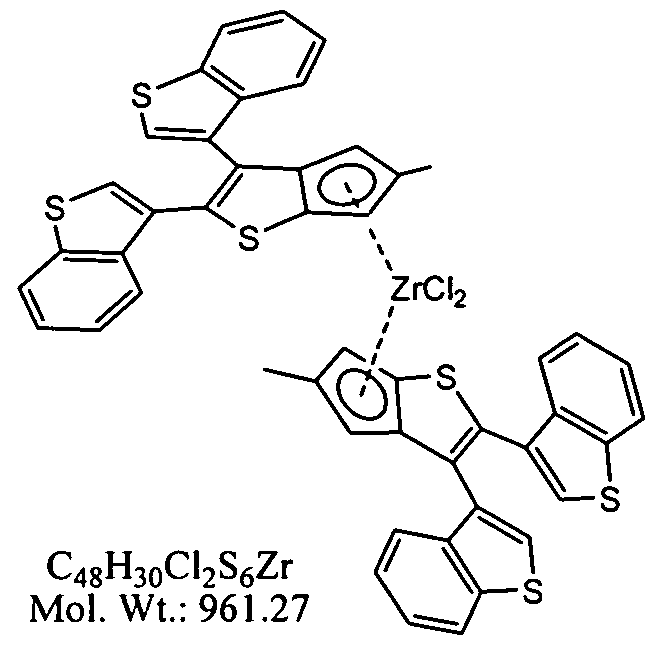
- transition metal coordination compounds of the invention are known in principle. It is usual to react a suitable transition metal source, e.g. zirconium tetrachloride, with the desired ligands, e.g. two equivalents of cyclopentadienyl ligand in the form of its lithium salt.
- a suitable transition metal source e.g. zirconium tetrachloride
- the desired ligands e.g. two equivalents of cyclopentadienyl ligand in the form of its lithium salt.
- the desired cyclopentadienyl radicals can firstly be joined to one another and subsequently, usually after prior deprotonation, reacted with the transition metal source.
- WO 03/045964 describes, for example, the synthesis of bridged biscyclopentadienyl metallocenes having two different cyclopentadienyl radicals.
- the resulting transition metal coordination compounds are usually obtained in the form of various diastereomers, which are frequently referred to as rac or pseudo-rac and meso or pseudo-meso (cf. WO 03/045551).
- the separation of the diastereomers is known in principle.
- the present invention further provides the compounds of the formulae (III), (IV) and / or (V) or their double bond isomers and / or their photoisomers
- R 1 is hydrogen, methyl, ethyl, n-propyl, i-propyl, n-butyl or cyclohexyl, in particular methyl,
- R 3 , R 4 , R 36 , R are identical or different and are each hydrogen, fluorine or such as methyl, ethyl or isopropyl or two adjacent radicals R 3 and R 4 and/or R 6 and R 7 together with the atoms connecting them form a substituted or unsubstituted, in particular unsubstituted, 1 ,3-butadiene-1 ,4-diyl group,
- R s , R are identical or different, preferably identical, and are each hydrogen, methyl, hexyl, trifluoromethyl, isopropyl, methoxy or ethoxy, in particular methyl,
- R x is hydrogen, methyl, ethyl, n-propyl, i-propyl, n-butyl or cyclohexyl, preferably hydrogen,
- T 1 is a single bond and T 2 , T 3 , T 4 are each S.
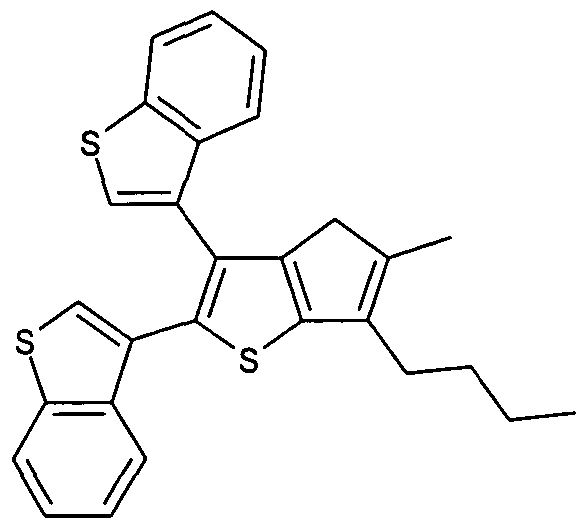
- novel compounds of the formulae (III), (IV) and (V) are all direct precursors of the particularly preferred cyclopentadienyl ligands Z 1 of the formula (II) or (Ma) which comprises a 1 ,2-di(3- thienyl)ethene derivative as photochromic group.
- the photochromic properties of the particularly preferred novel transition metal coordination compounds of the formula (I) are determined by the choice of the corresponding starting compound of the formula (III), (IV) or (V).
- the present invention accordingly also provides for the use of a compound of the formula (III) for preparing transition metal coordination compounds.
- a radical R x which is different from hydrogen can be introduced by reaction of the keto function with, for example, a Grignard compound or a lithium alkyl.
- the compounds of the formulae (III), (IV) and (V) can in principle also be used as photochromic compounds for purposes other than the synthesis of transition metal coordination compounds, as described, for example, in Chem. Rev. 2000, 100, 1685- 1890.
- the compounds of the formulae (III), (IV) and (V) are molecular switches and can, for example, also be used as component for preparing polymers or for preparing liquid crystals in order to make possible, in this form, the construction of new optoelectronic components or memory media.
- the preferred catalyst systems used in the polymerization process of the invention comprise not only a transition metal coordination compound comprising at least one ligand which is substituted by or fused with at least one photochromic group but also at least one cocatalyst.
- the present invention therefore also provides for the use of a transition metal coordination com- pound comprising at least one ligand which comprises at least one photochromic group for preparing a catalyst system for the polymerization of olefins.
- the cocatalyst which together with the transition metal coordination compounds forms a polymerization-active catalyst system is able to convert the transition metal coordination compound into a species which displays polymerization activity toward at least one olefin.
- the cocatalyst is therefore sometimes also referred to as activating compound.
- the polymerization-active transition metal species is frequently a cationic species. In this case, the cocatalyst is also frequently referred to as cation-forming compound.
- Suitable cocatalysts or cation-forming compounds are, for example, compounds such as an alu- minoxane, a strong uncharged Lewis acid, an ionic compound having a Lewis-acid cation or an ionic compound having a Br ⁇ nsted acid as cation. Preference is given to using an aluminoxane as cocatalyst in the process of the invention.
- the transition metal coordination compound is preactivated by means of an aluminoxane before use in the polymerization reaction.
- the transition metal coordination compounds are, for example as such or as a solution, brought into contact with an aluminoxane, in particular a solution of a methylaluminoxane, for some time, e.g. from 1 minute to 48 hours, preferably from 5 minutes to 4 hours, to form the catalyst system.
- metallocene complexes as transition metal coordination compounds
- the cocatalysts are frequently also referred to as metallocenium-ion-forming compounds.
- aluminoxanes it is possible to use, for example, the compounds described in WO 00/31090.
- Particularly suitable aluminoxanes are open-chain or cyclic aluminoxane compounds of the general formula (Xl) or (XII)
- R 51 is a C 1 -C 4 -SIkYl group, preferably a methyl or ethyl group, and v is an integer from 5 to
- oligomeric aluminoxane compounds are usually prepared by reacting a solution of trialky- laluminum with water.
- the oligomeric aluminoxane compounds obtained in this way are in the form of mixtures of both linear and cyclic chain molecules of various lengths, so that v is to be regarded as a mean.
- the aluminoxane compounds can also be present in admixture with other metal alkyls, preferably aluminum alkyls.
- modified aluminoxanes in which some of the hydrocarbon radicals or hydrogen atoms have been replaced by alkoxy, aryloxy, siloxy or amide radicals can also be used in place of the aluminoxane compounds of the general formula (Xl) or (XII).
- the transition metal coordination compounds and the aluminoxane compounds in such amounts that the atomic ratio of aluminum from the aluminoxane compounds to the transition metal from the transition metal coordination compound is in the range from 1 :1 to 100 000:1 , preferably in the range from 5:1 to 20 000:1 and in particular in the range from 10:1 to 2000: 1.
- M 3 is an element of group 13 of the Periodic Table of the Elements, in particular B, Al or Ga, preferably B,
- X 1 , X 2 and X 3 are each, independently of one another, hydrogen, d-do-alkyl, C 6 -C 15 -aryl, alkylaryl, arylalkyl, haloalkyl or haloaryl each having from 1 to 10 carbon atoms in the alkyl radical and from 6 to 20 carbon atoms in the aryl radical or fluorine, chlorine, bromine or iodine, in particular haloaryl, preferably pentafluorophenyl.
- Lewis acids which are suitable as cocatalyst or cation-forming compounds are the reaction products from the reaction of a boronic acid with two equivalents of a trialkylaluminum or the reaction products from the reaction of a trialkylaluminum with two equiva- lents of an acidic fluorinated, in particular perfluorinated, carbon compound such as pentafluoro- phenol or bis(pentafluorophenyl)borinic acid.
- Suitable ionic compounds having Lewis-acid cations include salt-like compounds of the cation of the general formula (XIV)
- Y is an element of groups 1 to 16 of the Periodic Table of the Elements
- Q 1 to Q z are singly negatively charged groups such as C 1 -C 28 -alkyl, C 6 -C 15 -aryl, alkylaryl, arylalkyl, haloalkyl, haloaryl each having from 6 to 20 carbon atoms in the aryl radical and from 1 to 28 carbon atoms in the alkyl radical, C 3 -C 10 -cycloalkyl which may optionally bear Ci-C ⁇ )-alkyl groups as substituents, halogen, C 1 -C 2S - alkoxy, C 6 -C 15 -aryloxy, silyl or mercaptyl groups,
- a is an integer from 1 to 6 and
- z is an integer from 0 to 5 and
- d corresponds to the difference a - z, but d is greater than or equal to 1.
- Particularly useful cations are carbonium cations, oxonium cations and sulfonium cations and also cationic transition metal complexes. Particular mention may be made of the triphenylmethyl cation, the silver cation and the 1 ,1 '-dimethylferrocenyl cation. They preferably have noncoordi- nating counterions, in particular boron compounds as are also mentioned in WO 91/09882, preferably tetrakis(pentafluorophenyl)borate.
- Salts having noncoordinating anions can also be prepared by combining a boron or aluminum compound, e.g. an aluminum alkyl, with a further compound which can react to link two or more boron or aluminum atoms, e.g. water, and a third compound which on reaction with the boron or aluminum compound forms an ionizing ionic compound, e.g. triphenylchloromethane.
- a fourth compound which likewise reacts with the boron or aluminum compound e.g. pentafluoro- phenol, can also be added.
- Ionic compounds having Br ⁇ nsted acids as cations preferably likewise have noncoordinating counterions.
- Br ⁇ nsted acid particular preference is given to protonated amine or aniline derivatives.
- Preferred cations are N,N-dimethylanilinium, N,N-dimethylcyclohexylammonium and N,N-dimethylbenzylamr ⁇ onium and also derivatives of the latter two.
- Preferred ionic compounds as cocatalysts or cation-forming compounds are, in particular, N,N-dimethylanilinium tetrakis(pentafluorophenyl)borate, N.N-dimethylcyclohexylammonium tetrakis(pentafluorophenyl)borate and N,N-dimethylbenzylammonium tetrakis(pentafluorophenyl)borate.
- borate anions it is also possible for two or more borate anions to be joined to one another, as in the dianion [(C 6 Fs) 2 B-C 6 F 4 -B(C 6 Fs) 2 ] 2* , or the borate anion can be bound via a bridge having a suitable functional group to the surface of a support particle.
- the amount of strong, uncharged Lewis acids, ionic compounds having Lewis-acid cations or ionic compounds having Br ⁇ nsted acids as cations is usually from 0.1 to 20 equivalents, preferably from 1 to 10 equivalents, based on the organic transition metal compound of the formula (I).
- boron-aluminum compounds such as di[bis(pentafluorophenyl)boroxy]methylalane.
- Appropriate boron-aluminum compounds are disclosed, for example, in WO 99/06414.
- mixtures of all the abovementioned cocatalysts or cation-forming com- pounds comprise aluminoxanes, in particular methylaluminoxane, and an ionic compound, in particular one comprising the tetrakis(pentafluorophenyl)borate anion, and/or a strong uncharged Lewis acid, in particular tris(pentafluorophenyl)borane.
- the catalyst in the process of the invention can further comprise a metal compound of the general formula (XV),
- M 4 is an alkali metal, an alkaline earth metal or a metal of group 13 of the Periodic Table, i.e. boron, aluminum, gallium, indium or thallium,
- R 52 is hydrogen, Ci-C 10 -alkyl, C 6 -C 15 -aryl, alkylaryl or arylalkyl each having from 1 to 10 carbon atoms in the alkyl radical and from 6 to 20 carbon atoms in the aryl radical,
- R 53 and R 54 are identical or different and are each hydrogen, halogen, C 6 -C 15 - aryl, alkylaryl, arylalkyl or alkoxy each having from 1 to 10 carbon atoms in the alkyl radical and from 6 to 20 carbon atoms in the aryl radical,
- r is an integer from 1 to 3
- s and t are integers from 0 to 2, with the sum r+s+t corresponding to the valence of M 4 ,
- metal compound of the formula (XV) is usually not identical to the cocatalyst or the cation-forming compound. It is also possible to use mixtures of various metal compounds of the formula (XV).
- M 4 is lithium, magnesium or aluminum and
- R 53 and R 54 are each C 1 -C 10 -SIkVl.
- metal compounds of the formula (XV) are n-butyllithium, n-butyl-n- octylmagnesium, n-butyl-n-heptylmagnesium, tri-n-hexylaluminum, triisobutylaluminum, triethy- laluminum and trimethylaluminum and mixtures thereof. If a metal compound of the formula (XV) is used, it is preferably comprised in the catalyst in such an amount that the molar ratio of M 4 from formula (XV) to the transition metal atom from the transition metal coordination compounds is from 800:1 to 1 :1 , in particular from 200:1 to 2:1.
- the catalyst system comprising a transition metal coordination compound and at least one co- catalyst can, depending on the polymerization process employed, further comprise a support.
- the unsupported catalyst system can be reacted with a support.
- the order in which the support, the transition metal coordination compounds and the cocatalyst are combined is in principle immaterial.
- the transition metal coordination compounds and the cocatalyst can be immobilized independently of one another or simultaneously.
- the solid can be washed with suitable inert solvents such as aliphatic or aromatic hydrocarbons.
- the support can be a porous solid such as talc, a sheet silicate, an inorganic oxide or a finely divided polymer powder (e.g. polyolefin).
- Suitable inorganic oxides may be found among oxides of the elements of groups 2, 3, 4, 5, 13, 14, 15 and 16 of the Periodic Table of the Elements.
- oxides preferred as supports comprise silicon dioxide, aluminum oxide and also mixed oxides of the elements calcium, aluminum, silicon, magnesium or titanium and also corresponding oxide mixtures.
- Other inorganic oxides which can be used alone or in combination with the abovementioned preferred oxidic supports are, for example, MgO, ZrO 2 , TiO 2 or B 2 O 3 .
- a preferred mixed oxide is, for example, calcined hy- drotalcite.
- the support materials used preferably have a specific surface area in the range from 10 to 1000 m 2 /g, a pore volume in the range from 0.1 to 5 ml/g and a mean particle size of from 1 to 500 ⁇ m.
- Particular preference is given to supports having a specific surface area in the range from 200 to 400 m 2 /g, a pore volume in the range from 0.8 to 3.0 ml/g and a mean particle size of from 10 to 100 ⁇ m.
- the inorganic support can be subjected to a thermal treatment, e.g. to remove adsorbed water.
- a thermal treatment is generally carried out at temperatures in the range from 80 to 300 0 C, preferably from 100 to 200 0 C, with drying at from 100 to 200 0 C preferably being carried out under reduced pressure and/or a blanket of inert gas (e.g. nitrogen), or the inorganic support can be calcined at temperatures of from 200 to 1000X to set, if appropriate, the desired structure of the solid and/or the desired OH concentration on the surface.
- inert gas e.g. nitrogen
- the support can also be treated chemically, for which purpose it is possible to use customary desiccants such as metal alkyls, preferably aluminum alkyls, chlorosilanes or SiCI 4 or else methylaluminoxane. Appropriate treatment methods are described, for example, in WO 00/31090.
- the inorganic support material can also be chemically modified. For example, treatment of silica gel with (NhU) 2 SiF 6 leads to fluorination of the silica gel surface, or treatment of silica gels with silanes comprising nitrogen-, fluorine- or sulfur-comprising groups leads to correspondingly modified silica gel surfaces.
- Organic support materials such as finely divided polyolefin powders (e.g. polyethylene, polypropylene or polystyrene) can also be used and should preferably likewise be freed of adhering moisture, solvent residues or other impurities by means of appropriate purification and drying operations before use. It is also possible to use functionalized polymer supports, e.g. ones based on polystyrene, via whose functional groups, for example ammonium or hydroxy groups, at least one of the catalyst components can be immobilized.
- functionalized polymer supports e.g. ones based on polystyrene, via whose functional groups, for example ammonium or hydroxy groups, at least one of the catalyst components can be immobilized.
- At least one of the transition metal coordination compounds is brought into contact with at least one cocatalyst as activating or cation-forming compound in a suitable solvent to give a soluble or insoluble, preferably soluble, reaction product, an adduct or a mixture.
- the preparation obtained in this way is then mixed with the dehydrated or passivated support material, the solvent is removed and the resulting supported organic transition metal compound catalyst system is dried to ensure that all or most of the solvent is removed from the pores of the support material.
- the supported catalyst is usually obtained as a free-flowing powder. Examples of the industrial implementation of the above process are described in WO 96/00243, WO 98/40419 or WO 00/05277.
- a further preferred embodiment comprises firstly applying the cocatalyst or the cation-forming compound to the support component and subsequently bringing this supported cocatalyst or this cation-forming compound into contact with the transition metal coordination compound.
- 1st component at least one defined boron or aluminum compound
- 2nd component at least one uncharged compound which has at least one acidic hydrogen atom
- 3rd component at least one support, preferably an inorganic oxidic support, and optionally, as 4th component, a base, preferably an organic nitrogen- comprising base such as an amine, an aniline derivative or a nitrogen heterocycle.
- the boron or aluminum compounds used in the preparation of these supported cocatalysts are preferably compounds of the formula (XVI)
- R 55 is an OSiR 56 3 group, where the radicals R 56 are identical or different and are each hydrogen, halogen, d-C ⁇ -alkyl, C 1 -C 20 - haloalkyl, d-do-alkoxy, C 6 -C 20 -aryl, C 6 -C 20 -haloaryl, C 6 -C 20 -aryloxy, C 7 -C 40 -arylalkyl, C 7 -C 4 o-haloarylalkyl, C 7 -C 4 o-alkylaryl, C 7 -C 40 -haloalkylaryl or R 55 is an OSiR 56 3 group, where the radicals R 56 are identical or different and are each hydrogen, halogen, d-C ⁇ -alkyl, C 1 -C 20 - haloalkyl, d-do-alkoxy, C 6 -C 20 -aryl, C 6 -C 20 -haloaryl, C 6 -
- Particularly preferred compounds of the formula (XVI) are trimethylaluminum, triethylaluminum and triisobutylaluminum.
- the uncharged compounds which have at least one acidic hydrogen atom and can react with compounds of the formula (XVI) are preferably compounds of the formulae (XVII), (XVIII) or
- the radicals R 57 are identical or different and are each hydrogen, halogen, a boron-free organic radical having from 1 to 40 carbon atoms, e.g. d-C ⁇ o-alkyl, d-C ⁇ o-haloalkyI, C 1 -C 10 - alkoxy, C 6 -C 20 -aryl, C 6 -C 20 -haloaryl, C 6 -C 20 -aryloxy, C 7 -C 40 -arylalkyl, C 7 -C 40 - haloarylalkyl, C 7 -C 40 -alkylaryl, C 7 -C 40 -haloalkylaryl, an Si(R 59 ) 3 -radical or a CH(SiR 59 3 ) 2 radical, where R 59 is a boron-free organic radical having from 1 to 40 carbon atoms, e.g. d-C ⁇ -alkyl, C 1 -
- R 58 is a divalent organic group having from 1 to 40 carbon atoms, e.g. d-C 20 -alkylene, d-C 20 -haloalkylene, C 6 -C 20 -arylene, C 6 -C 20 -haloarylene, C 7 -C 40 -arylalkylene, C 7 -C 40 - haloarylalkylene, C 7 -C 40 -alkylarylene, C 7 -C 40 -haloalkylarylene,
- D is an element of group 16 of the Periodic Table of the Elements or an NR 60 group, where R 60 is hydrogen or a d-C ⁇ o-hydrocarbon radical such as d-C 20 -alkyl or C 6 -C 20 -aryl, with preference being given to D being oxygen, and h is 1 or 2.
- Suitable compounds of the formula (XVII) are water, alcohols, phenol derivatives, thiophenol de- rivatives or aniline derivatives, with the halogenated and in particular perfluorinated alcohols and phenols being of particular importance.
- particularly suitable compounds are penta- fluorophenol, 1 , 1-bis(pentafluorophenyl)methanol and 4-hydroxy-2,2',3,3',4',5,5',6,6'- nonafluorobiphenyl.
- Suitable compounds of the formula (XVIII) are boronic acids and borinic acids, in particular borinic acids having perfluorinated aryl radicals, for example (C 6 Fs) 2 BOH.
- Suitable compounds of the formula (XIX) are dihydroxy compounds in which the divalent carbon- comprising group is preferably halogenated and in particular perfluorinated.
- An example of such a compound is 4,4'-dihydroxy-2,2',3,3',5,5',6,6'-octafluorobiphenyl hydrate.
- Examples of combinations of compounds of the formula (XVI) with compounds of the formula (XVII) or (XIX) are trimethylaluminum/pentafluorophenol, trimethylaluminum/1-bis(pentafluoro- phenyl)methanol, trimethylaluminum/4-hydroxy-2,2',3,3',4',5,5',6,6'-nonafluorobiphenyl, triethy- laluminum/pentafluorophenol or triisobutylaluminum/pentafluorophenol or triethylaluminum/4,4'- dihydroxy-2,2',3,3',5,5',6,6'-octafluorobiphenyl hydrate, with, for example, reaction products of the following type being able to be formed.
- reaction products from the reaction of at least one compound of the formula (XVI) with at least one compound of the formula (XVIII) are: F 5 C I 6 MIe CI 6 F 5 F 5 C I 6 EIt CI 6 F 5
- reaction products from the reaction of at least one compound of the formula (XVI) with at least one compound of the formula (XVII), (XVIII) or (XIX) and optionally the organic nitrogen base are additionally combined with an organometallic compound of the formula (Xl), (XII), (XIII) and / or (XV), in order then to form, together with the support, the supported cocatalyst system.
- the 1st component e.g. compounds of the formula (XII)
- the 2nd component e.g. compounds of the formulae (XVII), (XVIII) or (XIX)
- a support as 3rd component and a base as 4th component are combined separately and the two mixtures are subsequently reacted with one another, with the reaction preferably taking place in an inert solvent or suspension medium.
- the supported cocatalyst formed can be freed of the inert solvent or suspension medium before it is reacted with a transition metal coordination compound and, if appropriate, a metal compound of the formula (XV) to form the catalyst system.
- catalyst solid with ⁇ -olefins, preferably linear C 2 -C 10 - 1-alkenes and in particular ethylene or propylene, and then to use the resulting prepolymerized catalyst solid in the actual polymerization.
- ⁇ -olefins preferably linear C 2 -C 10 - 1-alkenes and in particular ethylene or propylene.
- the mass ratio of catalyst solid used in the prepoly- merization to monomer polymerized onto it is usually in the range from 1:0.1 to 1 :200.
- an olefin preferably an ⁇ -olefin, for example vinylcyclohexane, styrene or phenyldimethylvinylsilane
- an antistatic or a suitable inert compound such as a wax or oil
- the molar ratio of additives to transition metal coordination compound is usually from 1 :1000 to 1000:1 , preferably from 1 :5 to 20:1.
- the catalyst system is generally used together with a further metal compound of the general formula (XV), which may be different from the metal compound or compounds of the formula (XV) used in the preparation of the catalyst system, for the polymerization or copolymerization of olefins.
- the further metal compound is generally added to the monomer or the suspension medium and serves to free the monomer of substances which can impair the catalyst activity. It is also possible for one or more further cocatalytic or cation- forming compounds to be additionally added to the catalyst system in the polymerization process.
- polyolefins which can be obtained by the process of the invention for preparing olefin polymers are likewise subject matter of the present invention.
- the present invention further provides the catalyst system comprising one or more catalyst con- stituents, wherein the catalyst system comprises at least one photochromic group in one of the catalyst constituents, which is used in the process of the invention for preparing olefin polymers.
- the catalyst system can be either a Ziegler-Natta catalyst or a "single site catalyst". Preference is given to a catalyst system from the class of "single site catalysts”.
- the invention therefore further provides a process for preparing a catalyst system for preparing olefin polymers, in which the catalyst constituents are brought into contact with one another and the catalyst system comprises at least one photochromic group in one of the catalyst constituents.
- the order in which the catalyst constituents are combined is in principle immaterial. However, the catalyst constituents are preferably combined in one of the orders which are described in the Ht- erature and have been found to be useful for the respective catalyst type.
- the transition metal coordination compound comprises at least one ligand comprising at least one photochromic group.
- the transition metal coordination compound preferably comprises at least one ligand which is bound to the transition metal center and is selected from the group consisting of cyclopentadienyl derivatives, phenoxyimine derivatives and uncharged or singly or multiply negatively charged bidentate or tridentate nitrogen ligands having two or three coordinating nitrogen atoms.
- the invention further provides for the use of the catalyst system of the invention for the polymerization of olefins.
- the above-described catalyst system of the invention which may comprise a support, can be used either alone or together with one or more further catalyst systems which may likewise be supported and are suitable for the homopolymerization, copolymerization or oligomerization of olefins in the polymerization process of the invention.
- the at least one further catalyst system can be prepared independently of the catalyst system of the invention or can be produced together with this.
- the different catalyst systems can thus, for example, be present together on a support or they can be present independently of one another as supported or unsupported catalyst systems which can be premixed in any way and thus metered into the polymerization reactor either together or separately and thus independently of one another.
- the further catalyst system is preferably not able to be changed by light.
- Examples of known catalyst systems which can be used together with the catalyst system of the invention for preparing polyolefins are, in particular, classical Ziegler-Natta catalysts based on titanium, classical Phillips catalysts based on chromium oxides or single site catalysts which preferably comprise metallocenes, constrained geometry complexes (cf., for example, EP A 0 416 815 or EP A 0 420 436), chromium single site complexes as described, for example, in US 6437161 , nickel- and palladium-bisimine systems (which can be prepared as described in WO 9803559 A1) or iron- and cobalt-pyridinebisimine compounds (which can be prepared as described in WO 9827124 A1) as transition metal component. If the catalyst system of the invention is used together with at least one further catalyst for the polymerization, then preference is given to using a single site catalyst, in particular one based on an iron- pyridinebisimine compound.
- the presence of the photochromic group in the catalyst system provides a further means of control for influencing the polymerization process and the polymer produced in a targeted way.
- This further means of control is independent of the known means of control such as temperature, pressure or hydrogen concentration.
- the polymerization properties of the catalyst system are altered.
- the palladium catalysts used in the coupling experiments and zirconium-(IV)-chloride was purchased from Strem Chemical Co. (MA, USA); Bis(diphenylphosphino)propane nickel(ll) chloride (NiDPPP) was purchased from Aldrich Chemical Company.
- Methylalumoxane (solution in toluene; 30% by weight of MAO) used in the polymerizations was procured from Albemarle Corp. and Al(iso-Bu) 3 (1 M solution in toluene) was procured from Aldrich Chemical Company.
- Mass average (M w ) and number average (M n ) molar masses of the polymers were determined.
- the Q value is the ratio of mass average molar mass (M w ) to number average molar mass (M n ).
- the melting point T m was determined by DSC measurement in accordance with ISO Standard 3146 in a first heating phase at a heating rate of 20 0 C per minute to 200 0 C, a dynamic crystallization at a cooling rate of 20 0 C per minute down to 25°C and a second heating phase at a heating rate of 2O 0 C per minute back to 200°C.
- the melting point was then the temperature at which the curve of enthalpy versus temperature measured in the second heating phase displayed a maximum.
- the density [g/cm 3 ] was determined in accordance with ISO 1183.
- the methyl group content was determined by means of IR spectroscopy in analogy with ASTM D 6248-98.
- reaction mixture was refluxed for 2 h and then cooled.
- the reaction mixture was then poured into a 1 N HCI solution, washed with water, saturated bicarbonate solution, then water.
- the reaction mixture was dried over magnesium sulphate, filtered through silica using 1) hexane, then 2) 50:50 dichloromethane (to collect the product). Solvents were removed in vacuo: 2.03 g (92.8% by GCMS) of the product (1 b) were obtained. The product was used in subsequent reactions without further purification.
- reaction mixture was stirred for 18 h, then 0.6 g (0.26 mmol) of zirconium tetrachloride were added as a dry powder.
- the reaction mixture was stirred for 18 h, then filtered. Solvents were removed from the yellow ethereal solution and solids remaining were dried in vacuo: 0.34 g.
- Example P1 Solution polymerization of propene.
- Example P2 Solution polymerization of propene with 254 nm UV.
- Example P3 Solution polymerization of propene.
- Example P4 Solution polymerization of propene with 254 nm UV.
- Table 1 Propylene solution polymerizations comparing without (P1 , P3) and with (P2, P4) 254 nm UV irradiation during polymerization.
- Example P5 Solution co-polymerization of ethylene and hexene.
- Example P6 Solution co-polymerization of ethylene and hexene with 254 nm UV.
Landscapes
- Chemical & Material Sciences (AREA)
- Organic Chemistry (AREA)
- Health & Medical Sciences (AREA)
- Chemical Kinetics & Catalysis (AREA)
- Medicinal Chemistry (AREA)
- Polymers & Plastics (AREA)
- Transition And Organic Metals Composition Catalysts For Addition Polymerization (AREA)
Abstract
Description








Claims

Priority Applications (3)
| Application Number | Priority Date | Filing Date | Title |
|---|---|---|---|
| US11/991,585 US20090227748A1 (en) | 2005-09-06 | 2006-08-31 | Process for Preparing Olff in Polymers in the Presence of Catalyst Systems Having Photochromic Groups |
| EP06791746A EP1937700A2 (en) | 2005-09-06 | 2006-08-31 | Process for preparing olefin polymers in the presence of catalyst systems having photochromic groups |
| JP2008529512A JP2009507114A (en) | 2005-09-06 | 2006-08-31 | Process for producing an olefin polymer in the presence of a catalyst system having a photochromic group |
Applications Claiming Priority (4)
| Application Number | Priority Date | Filing Date | Title |
|---|---|---|---|
| DE200510042391 DE102005042391A1 (en) | 2005-09-06 | 2005-09-06 | Catalyst system useful for the polymerization of olefins e.g. ethene comprises at least one catalyst constituent containing at least one photochromic group |
| DE102005042391.4 | 2005-09-06 | ||
| US72541205P | 2005-10-11 | 2005-10-11 | |
| US60/725,412 | 2005-10-11 |
Publications (2)
| Publication Number | Publication Date |
|---|---|
| WO2007028536A2 true WO2007028536A2 (en) | 2007-03-15 |
| WO2007028536A3 WO2007028536A3 (en) | 2007-06-07 |
Family
ID=37836186
Family Applications (1)
| Application Number | Title | Priority Date | Filing Date |
|---|---|---|---|
| PCT/EP2006/008503 Ceased WO2007028536A2 (en) | 2005-09-06 | 2006-08-31 | Process for preparing olefin polymers in the presence of catalyst systems having photochromic groups |
Country Status (4)
| Country | Link |
|---|---|
| US (1) | US20090227748A1 (en) |
| EP (1) | EP1937700A2 (en) |
| JP (1) | JP2009507114A (en) |
| WO (1) | WO2007028536A2 (en) |
Cited By (4)
| Publication number | Priority date | Publication date | Assignee | Title |
|---|---|---|---|---|
| CN108440954A (en) * | 2018-03-15 | 2018-08-24 | 湖南格林美映鸿资源循环有限公司 | A kind of PA6 based composites and preparation method thereof |
| CN108948031A (en) * | 2018-08-21 | 2018-12-07 | 辽宁大学 | The preparation method and applications of 2- aldehyde radical rhodamine derivative |
| CN114702532A (en) * | 2021-01-01 | 2022-07-05 | 中国石油化工股份有限公司 | Metallocene, catalyst containing same, synthesis and application thereof |
| CN114702531A (en) * | 2021-01-01 | 2022-07-05 | 中国石油化工股份有限公司 | Metallocenes, catalysts containing them and their synthesis and applications |
Families Citing this family (1)
| Publication number | Priority date | Publication date | Assignee | Title |
|---|---|---|---|---|
| US20220220871A1 (en) * | 2019-05-03 | 2022-07-14 | Brandeis University | Thermal storage materials and applications thereof |
Family Cites Families (28)
| Publication number | Priority date | Publication date | Assignee | Title |
|---|---|---|---|---|
| US5055438A (en) * | 1989-09-13 | 1991-10-08 | Exxon Chemical Patents, Inc. | Olefin polymerization catalysts |
| US4882428A (en) * | 1987-10-08 | 1989-11-21 | Mitsubishi Chemical Industries Limited | Azaporphyrin compounds |
| EP0325742B1 (en) * | 1988-01-22 | 1994-03-30 | Mitsubishi Kasei Corporation | Phthalocyanine compound and optical recording material using it |
| NZ235032A (en) * | 1989-08-31 | 1993-04-28 | Dow Chemical Co | Constrained geometry complexes of titanium, zirconium or hafnium comprising a substituted cyclopentadiene ligand; use as olefin polymerisation catalyst component |
| US6075077A (en) * | 1989-08-31 | 2000-06-13 | The Dow Chemical Company | Asphalt, bitumen, and adhesive compositions |
| US6686488B2 (en) * | 1989-08-31 | 2004-02-03 | The Dow Chemical Company | Constrained geometry addition polymerization catalysts |
| KR100378973B1 (en) * | 1994-06-24 | 2003-08-19 | 엑손모빌 케미칼 패턴츠 인코포레이티드 | Polymerization catalyst systems, their production and use |
| US6897272B1 (en) * | 1995-01-24 | 2005-05-24 | E.I. Du Pont De Nemours And Company | α-olefins and olefin polymers and processes therefor |
| US6482907B1 (en) * | 1995-01-24 | 2002-11-19 | E.I. Du Pont De Nemours And Company | Polymerization of olefins |
| US6495646B1 (en) * | 1995-01-24 | 2002-12-17 | E. I. Du Pont De Nemours And Company | Polyolefins with new structures |
| US5880241A (en) * | 1995-01-24 | 1999-03-09 | E. I. Du Pont De Nemours And Company | Olefin polymers |
| AU3961797A (en) * | 1996-07-23 | 1998-02-10 | E.I. Du Pont De Nemours And Company | Polymerization processes for olefins |
| US6417305B2 (en) * | 1996-12-17 | 2002-07-09 | E. I. Du Pont De Nemours And Company | Oligomerization of ethylene |
| US6214761B1 (en) * | 1996-12-17 | 2001-04-10 | E. I. Du Pont De Nemours And Company | Iron catalyst for the polymerization of olefins |
| US6423848B2 (en) * | 1996-12-17 | 2002-07-23 | E. I. Du Pont De Nemours And Company | Tridentate ligand |
| IL129929A0 (en) * | 1996-12-17 | 2000-02-29 | Du Pont | Polymerization of ethylene with specific iron or cobalt complexes novel pyridinebis (imines) and novel complexes of pyridinebis(imines) with iron and cobalt |
| US6432862B1 (en) * | 1996-12-17 | 2002-08-13 | E. I. Du Pont De Nemours And Company | Cobalt catalysts for the polymerization of olefins |
| TWI246520B (en) * | 1997-04-25 | 2006-01-01 | Mitsui Chemicals Inc | Processes for olefin polymerization |
| US6605679B1 (en) * | 1997-07-23 | 2003-08-12 | E. I. Du Pont De Nemours And Company | Polymerization of olefins |
| DE19733017A1 (en) * | 1997-07-31 | 1999-02-04 | Hoechst Ag | Chemical compound |
| DE19833170A1 (en) * | 1998-07-23 | 2000-01-27 | Targor Gmbh | Metal containing catalyst support, especially for metallocene catalysts, useful for attachment of carbon-carbon or carbon-heteroatom covalent bonds obtained by streaming steeping solution containing metal through the support material |
| JP2000111839A (en) * | 1998-10-01 | 2000-04-21 | Nikon Corp | Polarizing device and projection device |
| EP1396495B1 (en) * | 1998-11-25 | 2007-01-17 | Basell Polyolefine GmbH | Metallocenes with a single halogenide attached to the metal |
| US6437161B1 (en) * | 1999-08-13 | 2002-08-20 | Basf Aktiengesellschaft | Monocyclopentadienyl complexes of chromium, molybdenum or tungsten |
| DE10158656A1 (en) * | 2001-11-30 | 2003-06-26 | Basell Polyolefine Gmbh | Organo transition metal compound, biscyclopentadienyl ligand system, catalyst system and process for making polyolefins |
| US7141637B2 (en) * | 2001-11-30 | 2006-11-28 | Basell Polyolefine Gmbh | Metallocene compounds and process for the preparation of propylene polymers |
| EP1648864B1 (en) * | 2003-07-07 | 2015-08-19 | The University of Hong Kong | Photochromic diarylethene-containing coordination compounds and the production thereof |
| US20070043186A1 (en) * | 2003-08-07 | 2007-02-22 | Zhibin Guan | Macrocyclic metal complexes and their uses as polymerization catylysts |
-
2006
- 2006-08-31 EP EP06791746A patent/EP1937700A2/en not_active Withdrawn
- 2006-08-31 WO PCT/EP2006/008503 patent/WO2007028536A2/en not_active Ceased
- 2006-08-31 JP JP2008529512A patent/JP2009507114A/en active Pending
- 2006-08-31 US US11/991,585 patent/US20090227748A1/en not_active Abandoned
Cited By (5)
| Publication number | Priority date | Publication date | Assignee | Title |
|---|---|---|---|---|
| CN108440954A (en) * | 2018-03-15 | 2018-08-24 | 湖南格林美映鸿资源循环有限公司 | A kind of PA6 based composites and preparation method thereof |
| CN108948031A (en) * | 2018-08-21 | 2018-12-07 | 辽宁大学 | The preparation method and applications of 2- aldehyde radical rhodamine derivative |
| CN108948031B (en) * | 2018-08-21 | 2021-08-24 | 辽宁大学 | Preparation method and application of 2-formyl rhodamine derivatives |
| CN114702532A (en) * | 2021-01-01 | 2022-07-05 | 中国石油化工股份有限公司 | Metallocene, catalyst containing same, synthesis and application thereof |
| CN114702531A (en) * | 2021-01-01 | 2022-07-05 | 中国石油化工股份有限公司 | Metallocenes, catalysts containing them and their synthesis and applications |
Also Published As
| Publication number | Publication date |
|---|---|
| WO2007028536A3 (en) | 2007-06-07 |
| JP2009507114A (en) | 2009-02-19 |
| US20090227748A1 (en) | 2009-09-10 |
| EP1937700A2 (en) | 2008-07-02 |
Similar Documents
| Publication | Publication Date | Title |
|---|---|---|
| AU2006224576B2 (en) | Metallocene compounds | |
| US6136936A (en) | Ethylene copolymers, process for the preparation of ethylene-based polymers and catalyst system used therein | |
| ES2341453T3 (en) | ORGANOMETAL TRANSITION METAL COMPOSITE, BISCICLOPENTADIENYL BINDING SYSTEM, CATALYTIC SYSTEM AND POLYOLEFINE PREPARATION. | |
| EP2824107B1 (en) | Ansa-metallocene compound and method for preparing supported catalyst using same | |
| KR100536794B1 (en) | Heterocyclic matallocenes and polymerization catalysys | |
| US7405261B2 (en) | Organometallic transition metal compound, biscyclopentadienyl ligand system, catalyst system and process for preparing polyolefins | |
| JP4372258B2 (en) | Bridged metallocene complexes for (co) polymerization of olefins | |
| EP1680453B1 (en) | Organometallic transition metal compound, biscyclopentadienyl ligand system, catalyst system and process for preparing polyolefins | |
| EP3106475A1 (en) | Method for producing ethylene/alpha-olefin copolymer | |
| US20070260023A1 (en) | Transition Metal Compound, Ligand System, Catalyst System and Process for Preparing Polyolefins | |
| Kaminsky et al. | Pentalene substituted metallocene complexes for olefin polymerization | |
| EP1937700A2 (en) | Process for preparing olefin polymers in the presence of catalyst systems having photochromic groups | |
| CA2350542A1 (en) | Methylene bridged metallocenes as olefin-polymerization-catalyst components | |
| EP1900715B1 (en) | Fluorene derivative, transition metal compound, catalyst for olefin polymerization, and process for producing olefin polymer | |
| WO2006053757A1 (en) | Process for preparing low molecular weight olefin polymers, organometallic transition metal compounds biscyclopentadienyl ligand systems and catalyst systems | |
| JP6227457B2 (en) | Fluorene compound, transition metal compound, catalyst for olefin polymerization, and method for producing olefin polymer | |
| DE102005042391A1 (en) | Catalyst system useful for the polymerization of olefins e.g. ethene comprises at least one catalyst constituent containing at least one photochromic group | |
| EP3971220A1 (en) | Method for preparing metallocene-loaded catalyst and metallocene-loaded catalyst | |
| JP2008501659A (en) | Transition metal compound, ligand, catalyst composition and method for producing polyolefin | |
| Abdelbagi | Synthesis of Bridged and Unbridged Group (IV) Metallocene Complexes as Catalyst Precursors for Ethylene Polymerization |
Legal Events
| Date | Code | Title | Description |
|---|---|---|---|
| WWE | Wipo information: entry into national phase |
Ref document number: 2006791746 Country of ref document: EP |
|
| WWE | Wipo information: entry into national phase |
Ref document number: 2008529512 Country of ref document: JP |
|
| WWE | Wipo information: entry into national phase |
Ref document number: 11991585 Country of ref document: US |
|
| NENP | Non-entry into the national phase |
Ref country code: DE |
|
| 121 | Ep: the epo has been informed by wipo that ep was designated in this application |
Ref document number: 06791746 Country of ref document: EP Kind code of ref document: A2 |
|
| WWP | Wipo information: published in national office |
Ref document number: 2006791746 Country of ref document: EP |