WO2007029021A1 - 1,5-substituted tetrazoles as therapeutic compounds - Google Patents
1,5-substituted tetrazoles as therapeutic compounds Download PDFInfo
- Publication number
- WO2007029021A1 WO2007029021A1 PCT/GB2006/003346 GB2006003346W WO2007029021A1 WO 2007029021 A1 WO2007029021 A1 WO 2007029021A1 GB 2006003346 W GB2006003346 W GB 2006003346W WO 2007029021 A1 WO2007029021 A1 WO 2007029021A1
- Authority
- WO
- WIPO (PCT)
- Prior art keywords
- independently
- substituted
- compound according
- ring
- unsubstituted
- Prior art date
- Legal status (The legal status is an assumption and is not a legal conclusion. Google has not performed a legal analysis and makes no representation as to the accuracy of the status listed.)
- Ceased
Links
- 0 CC(C(*)C(*)C(*)O1)C1S(*)S Chemical compound CC(C(*)C(*)C(*)O1)C1S(*)S 0.000 description 4
- JHUGLZLPDCIHKK-UHFFFAOYSA-N CCOC(CCc1nnn[n]1-c1ccccc1)=O Chemical compound CCOC(CCc1nnn[n]1-c1ccccc1)=O JHUGLZLPDCIHKK-UHFFFAOYSA-N 0.000 description 2
- CKOYRRWBOKMNRG-UHFFFAOYSA-N CC(OCc1ccc[o]1)=O Chemical compound CC(OCc1ccc[o]1)=O CKOYRRWBOKMNRG-UHFFFAOYSA-N 0.000 description 1
- MSMOWAACXLCKNU-UHFFFAOYSA-N CCN[n]1nnnc1C Chemical compound CCN[n]1nnnc1C MSMOWAACXLCKNU-UHFFFAOYSA-N 0.000 description 1
- UFNUADZXPXJYBD-UHFFFAOYSA-N CCOC(CCC(Nc1ccccc1)=O)=O Chemical compound CCOC(CCC(Nc1ccccc1)=O)=O UFNUADZXPXJYBD-UHFFFAOYSA-N 0.000 description 1
- HGZXQCCQZLSOPP-UHFFFAOYSA-N NCCC(c1ccccc1)=O Chemical compound NCCC(c1ccccc1)=O HGZXQCCQZLSOPP-UHFFFAOYSA-N 0.000 description 1
- LIGACIXOYTUXAW-UHFFFAOYSA-N O=C(CBr)c1ccccc1 Chemical compound O=C(CBr)c1ccccc1 LIGACIXOYTUXAW-UHFFFAOYSA-N 0.000 description 1
- KRXAZVDADYQNDN-UHFFFAOYSA-N O=C(CCNC(c1ccccc1)=O)c1ccccc1 Chemical compound O=C(CCNC(c1ccccc1)=O)c1ccccc1 KRXAZVDADYQNDN-UHFFFAOYSA-N 0.000 description 1
- JRSLAXDKWLZOMY-UHFFFAOYSA-N O=C(CSc1nnn[n]1-c1ccccc1)c1ccccc1 Chemical compound O=C(CSc1nnn[n]1-c1ccccc1)c1ccccc1 JRSLAXDKWLZOMY-UHFFFAOYSA-N 0.000 description 1
- PASDCCFISLVPSO-UHFFFAOYSA-N O=C(c1ccccc1)Cl Chemical compound O=C(c1ccccc1)Cl PASDCCFISLVPSO-UHFFFAOYSA-N 0.000 description 1
- LXRYKCMSJDQBJU-UHFFFAOYSA-N OC(CCc1nnn[n]1-c1ccccc1)=O Chemical compound OC(CCc1nnn[n]1-c1ccccc1)=O LXRYKCMSJDQBJU-UHFFFAOYSA-N 0.000 description 1
- GGZHVNZHFYCSEV-UHFFFAOYSA-N Sc1nnn[n]1-c1ccccc1 Chemical compound Sc1nnn[n]1-c1ccccc1 GGZHVNZHFYCSEV-UHFFFAOYSA-N 0.000 description 1
Classifications
-
- C—CHEMISTRY; METALLURGY
- C07—ORGANIC CHEMISTRY
- C07D—HETEROCYCLIC COMPOUNDS
- C07D413/00—Heterocyclic compounds containing two or more hetero rings, at least one ring having nitrogen and oxygen atoms as the only ring hetero atoms
- C07D413/02—Heterocyclic compounds containing two or more hetero rings, at least one ring having nitrogen and oxygen atoms as the only ring hetero atoms containing two hetero rings
- C07D413/12—Heterocyclic compounds containing two or more hetero rings, at least one ring having nitrogen and oxygen atoms as the only ring hetero atoms containing two hetero rings linked by a chain containing hetero atoms as chain links
-
- A—HUMAN NECESSITIES
- A61—MEDICAL OR VETERINARY SCIENCE; HYGIENE
- A61K—PREPARATIONS FOR MEDICAL, DENTAL OR TOILETRY PURPOSES
- A61K31/00—Medicinal preparations containing organic active ingredients
- A61K31/33—Heterocyclic compounds
- A61K31/395—Heterocyclic compounds having nitrogen as a ring hetero atom, e.g. guanethidine or rifamycins
- A61K31/41—Heterocyclic compounds having nitrogen as a ring hetero atom, e.g. guanethidine or rifamycins having five-membered rings with two or more ring hetero atoms, at least one of which being nitrogen, e.g. tetrazole
- A61K31/4164—1,3-Diazoles
- A61K31/4178—1,3-Diazoles not condensed 1,3-diazoles and containing further heterocyclic rings, e.g. pilocarpine, nitrofurantoin
-
- A—HUMAN NECESSITIES
- A61—MEDICAL OR VETERINARY SCIENCE; HYGIENE
- A61K—PREPARATIONS FOR MEDICAL, DENTAL OR TOILETRY PURPOSES
- A61K31/00—Medicinal preparations containing organic active ingredients
- A61K31/33—Heterocyclic compounds
- A61K31/395—Heterocyclic compounds having nitrogen as a ring hetero atom, e.g. guanethidine or rifamycins
- A61K31/41—Heterocyclic compounds having nitrogen as a ring hetero atom, e.g. guanethidine or rifamycins having five-membered rings with two or more ring hetero atoms, at least one of which being nitrogen, e.g. tetrazole
- A61K31/42—Oxazoles
- A61K31/422—Oxazoles not condensed and containing further heterocyclic rings
-
- A—HUMAN NECESSITIES
- A61—MEDICAL OR VETERINARY SCIENCE; HYGIENE
- A61K—PREPARATIONS FOR MEDICAL, DENTAL OR TOILETRY PURPOSES
- A61K31/00—Medicinal preparations containing organic active ingredients
- A61K31/33—Heterocyclic compounds
- A61K31/395—Heterocyclic compounds having nitrogen as a ring hetero atom, e.g. guanethidine or rifamycins
- A61K31/41—Heterocyclic compounds having nitrogen as a ring hetero atom, e.g. guanethidine or rifamycins having five-membered rings with two or more ring hetero atoms, at least one of which being nitrogen, e.g. tetrazole
- A61K31/42—Oxazoles
- A61K31/423—Oxazoles condensed with carbocyclic rings
-
- A—HUMAN NECESSITIES
- A61—MEDICAL OR VETERINARY SCIENCE; HYGIENE
- A61K—PREPARATIONS FOR MEDICAL, DENTAL OR TOILETRY PURPOSES
- A61K31/00—Medicinal preparations containing organic active ingredients
- A61K31/33—Heterocyclic compounds
- A61K31/395—Heterocyclic compounds having nitrogen as a ring hetero atom, e.g. guanethidine or rifamycins
- A61K31/41—Heterocyclic compounds having nitrogen as a ring hetero atom, e.g. guanethidine or rifamycins having five-membered rings with two or more ring hetero atoms, at least one of which being nitrogen, e.g. tetrazole
- A61K31/4245—Oxadiazoles
-
- A—HUMAN NECESSITIES
- A61—MEDICAL OR VETERINARY SCIENCE; HYGIENE
- A61K—PREPARATIONS FOR MEDICAL, DENTAL OR TOILETRY PURPOSES
- A61K31/00—Medicinal preparations containing organic active ingredients
- A61K31/33—Heterocyclic compounds
- A61K31/395—Heterocyclic compounds having nitrogen as a ring hetero atom, e.g. guanethidine or rifamycins
- A61K31/435—Heterocyclic compounds having nitrogen as a ring hetero atom, e.g. guanethidine or rifamycins having six-membered rings with one nitrogen as the only ring hetero atom
- A61K31/44—Non condensed pyridines; Hydrogenated derivatives thereof
- A61K31/4427—Non condensed pyridines; Hydrogenated derivatives thereof containing further heterocyclic ring systems
- A61K31/4439—Non condensed pyridines; Hydrogenated derivatives thereof containing further heterocyclic ring systems containing a five-membered ring with nitrogen as a ring hetero atom, e.g. omeprazole
-
- A—HUMAN NECESSITIES
- A61—MEDICAL OR VETERINARY SCIENCE; HYGIENE
- A61K—PREPARATIONS FOR MEDICAL, DENTAL OR TOILETRY PURPOSES
- A61K31/00—Medicinal preparations containing organic active ingredients
- A61K31/33—Heterocyclic compounds
- A61K31/395—Heterocyclic compounds having nitrogen as a ring hetero atom, e.g. guanethidine or rifamycins
- A61K31/435—Heterocyclic compounds having nitrogen as a ring hetero atom, e.g. guanethidine or rifamycins having six-membered rings with one nitrogen as the only ring hetero atom
- A61K31/47—Quinolines; Isoquinolines
- A61K31/4709—Non-condensed quinolines and containing further heterocyclic rings
-
- A—HUMAN NECESSITIES
- A61—MEDICAL OR VETERINARY SCIENCE; HYGIENE
- A61K—PREPARATIONS FOR MEDICAL, DENTAL OR TOILETRY PURPOSES
- A61K31/00—Medicinal preparations containing organic active ingredients
- A61K31/33—Heterocyclic compounds
- A61K31/395—Heterocyclic compounds having nitrogen as a ring hetero atom, e.g. guanethidine or rifamycins
- A61K31/435—Heterocyclic compounds having nitrogen as a ring hetero atom, e.g. guanethidine or rifamycins having six-membered rings with one nitrogen as the only ring hetero atom
- A61K31/47—Quinolines; Isoquinolines
- A61K31/472—Non-condensed isoquinolines, e.g. papaverine
- A61K31/4725—Non-condensed isoquinolines, e.g. papaverine containing further heterocyclic rings
-
- A—HUMAN NECESSITIES
- A61—MEDICAL OR VETERINARY SCIENCE; HYGIENE
- A61K—PREPARATIONS FOR MEDICAL, DENTAL OR TOILETRY PURPOSES
- A61K31/00—Medicinal preparations containing organic active ingredients
- A61K31/33—Heterocyclic compounds
- A61K31/395—Heterocyclic compounds having nitrogen as a ring hetero atom, e.g. guanethidine or rifamycins
- A61K31/495—Heterocyclic compounds having nitrogen as a ring hetero atom, e.g. guanethidine or rifamycins having six-membered rings with two or more nitrogen atoms as the only ring heteroatoms, e.g. piperazine or tetrazines
- A61K31/505—Pyrimidines; Hydrogenated pyrimidines, e.g. trimethoprim
- A61K31/506—Pyrimidines; Hydrogenated pyrimidines, e.g. trimethoprim not condensed and containing further heterocyclic rings
-
- A—HUMAN NECESSITIES
- A61—MEDICAL OR VETERINARY SCIENCE; HYGIENE
- A61P—SPECIFIC THERAPEUTIC ACTIVITY OF CHEMICAL COMPOUNDS OR MEDICINAL PREPARATIONS
- A61P25/00—Drugs for disorders of the nervous system
- A61P25/28—Drugs for disorders of the nervous system for treating neurodegenerative disorders of the central nervous system, e.g. nootropic agents, cognition enhancers, drugs for treating Alzheimer's disease or other forms of dementia
-
- A—HUMAN NECESSITIES
- A61—MEDICAL OR VETERINARY SCIENCE; HYGIENE
- A61P—SPECIFIC THERAPEUTIC ACTIVITY OF CHEMICAL COMPOUNDS OR MEDICINAL PREPARATIONS
- A61P3/00—Drugs for disorders of the metabolism
-
- A—HUMAN NECESSITIES
- A61—MEDICAL OR VETERINARY SCIENCE; HYGIENE
- A61P—SPECIFIC THERAPEUTIC ACTIVITY OF CHEMICAL COMPOUNDS OR MEDICINAL PREPARATIONS
- A61P3/00—Drugs for disorders of the metabolism
- A61P3/08—Drugs for disorders of the metabolism for glucose homeostasis
- A61P3/10—Drugs for disorders of the metabolism for glucose homeostasis for hyperglycaemia, e.g. antidiabetics
-
- A—HUMAN NECESSITIES
- A61—MEDICAL OR VETERINARY SCIENCE; HYGIENE
- A61P—SPECIFIC THERAPEUTIC ACTIVITY OF CHEMICAL COMPOUNDS OR MEDICINAL PREPARATIONS
- A61P9/00—Drugs for disorders of the cardiovascular system
-
- C—CHEMISTRY; METALLURGY
- C07—ORGANIC CHEMISTRY
- C07D—HETEROCYCLIC COMPOUNDS
- C07D257/00—Heterocyclic compounds containing rings having four nitrogen atoms as the only ring hetero atoms
- C07D257/02—Heterocyclic compounds containing rings having four nitrogen atoms as the only ring hetero atoms not condensed with other rings
- C07D257/04—Five-membered rings
-
- C—CHEMISTRY; METALLURGY
- C07—ORGANIC CHEMISTRY
- C07D—HETEROCYCLIC COMPOUNDS
- C07D401/00—Heterocyclic compounds containing two or more hetero rings, having nitrogen atoms as the only ring hetero atoms, at least one ring being a six-membered ring with only one nitrogen atom
- C07D401/02—Heterocyclic compounds containing two or more hetero rings, having nitrogen atoms as the only ring hetero atoms, at least one ring being a six-membered ring with only one nitrogen atom containing two hetero rings
- C07D401/12—Heterocyclic compounds containing two or more hetero rings, having nitrogen atoms as the only ring hetero atoms, at least one ring being a six-membered ring with only one nitrogen atom containing two hetero rings linked by a chain containing hetero atoms as chain links
-
- C—CHEMISTRY; METALLURGY
- C07—ORGANIC CHEMISTRY
- C07D—HETEROCYCLIC COMPOUNDS
- C07D403/00—Heterocyclic compounds containing two or more hetero rings, having nitrogen atoms as the only ring hetero atoms, not provided for by group C07D401/00
- C07D403/02—Heterocyclic compounds containing two or more hetero rings, having nitrogen atoms as the only ring hetero atoms, not provided for by group C07D401/00 containing two hetero rings
- C07D403/04—Heterocyclic compounds containing two or more hetero rings, having nitrogen atoms as the only ring hetero atoms, not provided for by group C07D401/00 containing two hetero rings directly linked by a ring-member-to-ring-member bond
-
- C—CHEMISTRY; METALLURGY
- C07—ORGANIC CHEMISTRY
- C07D—HETEROCYCLIC COMPOUNDS
- C07D403/00—Heterocyclic compounds containing two or more hetero rings, having nitrogen atoms as the only ring hetero atoms, not provided for by group C07D401/00
- C07D403/02—Heterocyclic compounds containing two or more hetero rings, having nitrogen atoms as the only ring hetero atoms, not provided for by group C07D401/00 containing two hetero rings
- C07D403/12—Heterocyclic compounds containing two or more hetero rings, having nitrogen atoms as the only ring hetero atoms, not provided for by group C07D401/00 containing two hetero rings linked by a chain containing hetero atoms as chain links
-
- C—CHEMISTRY; METALLURGY
- C07—ORGANIC CHEMISTRY
- C07D—HETEROCYCLIC COMPOUNDS
- C07D405/00—Heterocyclic compounds containing both one or more hetero rings having oxygen atoms as the only ring hetero atoms, and one or more rings having nitrogen as the only ring hetero atom
- C07D405/02—Heterocyclic compounds containing both one or more hetero rings having oxygen atoms as the only ring hetero atoms, and one or more rings having nitrogen as the only ring hetero atom containing two hetero rings
- C07D405/12—Heterocyclic compounds containing both one or more hetero rings having oxygen atoms as the only ring hetero atoms, and one or more rings having nitrogen as the only ring hetero atom containing two hetero rings linked by a chain containing hetero atoms as chain links
-
- C—CHEMISTRY; METALLURGY
- C07—ORGANIC CHEMISTRY
- C07D—HETEROCYCLIC COMPOUNDS
- C07D409/00—Heterocyclic compounds containing two or more hetero rings, at least one ring having sulfur atoms as the only ring hetero atoms
- C07D409/02—Heterocyclic compounds containing two or more hetero rings, at least one ring having sulfur atoms as the only ring hetero atoms containing two hetero rings
- C07D409/06—Heterocyclic compounds containing two or more hetero rings, at least one ring having sulfur atoms as the only ring hetero atoms containing two hetero rings linked by a carbon chain containing only aliphatic carbon atoms
-
- C—CHEMISTRY; METALLURGY
- C07—ORGANIC CHEMISTRY
- C07D—HETEROCYCLIC COMPOUNDS
- C07D409/00—Heterocyclic compounds containing two or more hetero rings, at least one ring having sulfur atoms as the only ring hetero atoms
- C07D409/02—Heterocyclic compounds containing two or more hetero rings, at least one ring having sulfur atoms as the only ring hetero atoms containing two hetero rings
- C07D409/12—Heterocyclic compounds containing two or more hetero rings, at least one ring having sulfur atoms as the only ring hetero atoms containing two hetero rings linked by a chain containing hetero atoms as chain links
-
- C—CHEMISTRY; METALLURGY
- C07—ORGANIC CHEMISTRY
- C07D—HETEROCYCLIC COMPOUNDS
- C07D413/00—Heterocyclic compounds containing two or more hetero rings, at least one ring having nitrogen and oxygen atoms as the only ring hetero atoms
- C07D413/02—Heterocyclic compounds containing two or more hetero rings, at least one ring having nitrogen and oxygen atoms as the only ring hetero atoms containing two hetero rings
- C07D413/04—Heterocyclic compounds containing two or more hetero rings, at least one ring having nitrogen and oxygen atoms as the only ring hetero atoms containing two hetero rings directly linked by a ring-member-to-ring-member bond
-
- C—CHEMISTRY; METALLURGY
- C07—ORGANIC CHEMISTRY
- C07D—HETEROCYCLIC COMPOUNDS
- C07D417/00—Heterocyclic compounds containing two or more hetero rings, at least one ring having nitrogen and sulfur atoms as the only ring hetero atoms, not provided for by group C07D415/00
- C07D417/02—Heterocyclic compounds containing two or more hetero rings, at least one ring having nitrogen and sulfur atoms as the only ring hetero atoms, not provided for by group C07D415/00 containing two hetero rings
- C07D417/04—Heterocyclic compounds containing two or more hetero rings, at least one ring having nitrogen and sulfur atoms as the only ring hetero atoms, not provided for by group C07D415/00 containing two hetero rings directly linked by a ring-member-to-ring-member bond
-
- C—CHEMISTRY; METALLURGY
- C07—ORGANIC CHEMISTRY
- C07D—HETEROCYCLIC COMPOUNDS
- C07D417/00—Heterocyclic compounds containing two or more hetero rings, at least one ring having nitrogen and sulfur atoms as the only ring hetero atoms, not provided for by group C07D415/00
- C07D417/02—Heterocyclic compounds containing two or more hetero rings, at least one ring having nitrogen and sulfur atoms as the only ring hetero atoms, not provided for by group C07D415/00 containing two hetero rings
- C07D417/12—Heterocyclic compounds containing two or more hetero rings, at least one ring having nitrogen and sulfur atoms as the only ring hetero atoms, not provided for by group C07D415/00 containing two hetero rings linked by a chain containing hetero atoms as chain links
Definitions
- the present invention pertains generally to the field of therapeutic compounds. More specifically the present invention pertains to certain 1 ,5-substituted-1H-tetrazole compounds that, inter alia, inhibit 11 ⁇ -hydroxysteroid dehydrogenase type 1 (11 ⁇ -HSD1).
- the present invention also pertains to pharmaceutical compositions comprising such compounds, and the use of such compounds and compositions, both in vitro and in vivo, to inhibit 11 ⁇ -hydroxysteroid dehydrogenase type 1 ; to treat conditions that are ameliorated by the inhibition of 11 ⁇ -hydroxysteroid dehydrogenase type 1 ; to treat the metabolic syndrome, which includes conditions such as type 2 diabetes and obesity, and associated disorders including insulin resistance, hypertension, lipid disorders and cardiovascular disorders such as ischaemic (coronary) heart disease; to treat CNS conditions such as mild cognitive impairment and early dementia, including Alzheimer's disease; etc.
- Glucocorticoids are hormones that regulate a range of pathways involved in stress and metabolic signalling. They are antagonists of insulin action and impair insulin-dependent glucose uptake, increase lipolysis, and enhance hepatic gluconeogenesis. These effects are evident in Cushing's syndrome, which is caused by elevated circulating levels of glucocorticoids.
- the features of Cushing's syndrome are diverse and reflect the tissue distribution of glucocorticoid receptors in the body. They include a cluster of metabolic (central/visceral obesity, insulin resistance, hyperglycaemia, dyslipidaemia) and cardiovascular (hypertension) abnormalities which, when observed in patients without Cushing's syndrome, constitute the metabolic syndrome.
- Cushing's syndrome is associated with neuropsychiatry manifestations including depression and cognitive impairment. The features of Cushing's syndrome are reversible upon removal of the cause of glucocorticoid excess.
- glucocorticoid activity is controlled at the tissue level by the intracellular conversion of active Cortisol and inactive cortisone by 11 ⁇ -hydroxysteroid dehydrogenases (see, e.g., Seckl et al., 2001). These enzymes exist in two distinct isoforms. 11 ⁇ -HSD1 , which catalyses the reaction that activates cortisone, is expressed in liver, adipose tissue, brain, skeletal muscle, vascular smooth muscle and other organs, while, 11 ⁇ -HSD2, which inactivates Cortisol, is predominantly expressed in the kidney.
- mice lacking 11 ⁇ -HSD1 possess low triglycerides, increased HDL cholesterol, and increased apo-lipoprotein Al levels (see, e.g., Morton et al., 2001), suggesting that inhibitors of 11 ⁇ -HSD1 may be of utility in the treatment of atherosclerosis.
- 11 ⁇ -HSD1 knockout mice on two different genetic backgrounds are protected from dietary obesity (see, e.g., Morton et al., 2004), while administration of carbenoxolone to patients with type 2 diabetes enhances insulin sensitivity (see, e.g., Andrews et al., 2003).
- the key tissue in which 11 ⁇ -HSD1 exerts the greatest influence upon metabolic disease is the adipose tissue rather than the liver.
- Mice with transgenic overexpression of 11 ⁇ -HSD1 in adipose tissue see, e.g.
- 11 ⁇ -HSD1 is highly expressed in regions important for cognition such as hippocampus, frontal cortex, and cerebellum (see, e.g., Moison et al., 1990). Elevated Cortisol is associated with cognitive dysfunction, and glucocorticoids have a range of neurotoxic effects. 11 ⁇ -HSD1 knockout mice are protected against age-related cognitive dysfunction (see, e.g., Yau et al., 2001), while administration of the 11 ⁇ -HSD inhibitor carbenoxolone has been shown to enhance cognitive function in elderly men and type 2 diabetics who have a selective impairment in verbal memory (see, e.g., Sandeep et al., 2004). Thus, 11 ⁇ -HSD1 inhibitors are of potential therapeutic utility in the treatment of diseases such as Alzheimer's Disease, which are characterised by cognitive impairment.
- the isozymes of 11 ⁇ -HSD are also expressed in the blood vessel wall (see, e.g., Walker et al., 1991 ; Christy et al., 2003).
- 11 ⁇ -HSD1 is expressed in vascular smooth muscle
- 11 ⁇ -HSD2 is expressed in endothelial cells where it modulates endothelial- dependent vasodilation (see, e.g., Hadoke et al., 2001).
- 1 1 ⁇ -HSD1 knockout mice have normal vascular function, but they exhibit enhanced angiogenesis in response to inflammation or ischaemia (see, e.g., Small et al., 2005). This offers therapeutic potential in the treatment of myocardial infarction, since inhibition of 11 ⁇ -HSD1 may enhance revascularisation of ischaemic tissues.
- 11 ⁇ -HSD1 affects intraocular pressure in man (see, e.g., Rauz et al., 2001). Inhibition of 11 ⁇ -HSD1 may be useful in reducing intraocular pressure in the treatment of glaucoma.
- Glucocorticoids are involved in the regulation of bone formation and skeletal development. Treatment of healthy volunteers with carbenoxolone led to a decrease in bone resorption markers suggesting that 11 ⁇ -HSD1 plays a role in bone resorption (see, e.g., Cooper et al., 2000). 11 ⁇ -HSD1 inhibitors could be used as protective agents in the treatment of osteoporosis.
- the inventors have discovered compounds that inhibit 11 ⁇ -hydroxysteroid dehydrogenase type 1 (11 ⁇ -HSD1) that are useful in the treatment, control, and/or prevention of conditions (e.g., disorders, diseases) that are responsive to the inhibiton of 11 ⁇ -HSD1.
- 11 ⁇ -HSD1 11 ⁇ -hydroxysteroid dehydrogenase type 1
- one aim of the present invention is the provision of active compounds that offer one or more of the above benefits.
- Figures 1 to 26 show examples of 1,5-substituted-1H-tetrazoles of the present invention.
- One aspect of the invention pertains to active compounds, specifically, certain 1 ,5-substituted-1 H-tetrazole compounds, as described herein.
- compositions comprising an active compound, as described herein, and a pharmaceutically acceptable carrier, diluent, or excipient.
- Another aspect of the present invention pertains to a method of inhibiting 11 ⁇ -hydroxysteroid dehydrogenase type 1 (11 ⁇ -HSD1) in a cell, in vitro or in vivo, comprising contacting the cell with an effective amount of an active compound, as described herein.
- 11 ⁇ -HSD1 11 ⁇ -hydroxysteroid dehydrogenase type 1
- Another aspect of the present invention pertains to a method of treatment comprising administering to a subject in need of treatment a therapeutically-effective amount of an active compound, as described herein, preferably in the form of a pharmaceutical composition.
- Another aspect of the present invention pertains to an active compound as described herein for use in a method of treatment of the human or animal body by therapy. Another aspect of the present invention pertains to use of an active compound, as described herein, in the manufacture of a medicament for use in treatment.
- the treatment is treatment of a condition (e.g., a disorder, a disease) that is ameliorated by the inhibition of 11 ⁇ -hydroxysteroid dehydrogenase type 1 (11 ⁇ -HSD1).
- a condition e.g., a disorder, a disease
- 11 ⁇ -HSD1 11 ⁇ -hydroxysteroid dehydrogenase type 1
- the treatment is treatment of the metabolic syndrome, which includes conditions such as type 2 diabetes and obesity, and associated disorders including insulin resistance, hypertension, lipid disorders and cardiovascular disorders such as ischaemic (coronary) heart disease.
- the metabolic syndrome includes conditions such as type 2 diabetes and obesity, and associated disorders including insulin resistance, hypertension, lipid disorders and cardiovascular disorders such as ischaemic (coronary) heart disease.
- the treatment is treatment of a CNS condition (e.g., a CNS disorder, a CNS disease) such as mild cognitive impairment and early dementia, including Alzheimer's disease.
- a CNS condition e.g., a CNS disorder, a CNS disease
- mild cognitive impairment and early dementia including Alzheimer's disease.
- kits comprising (a) an active compound, as described herein, preferably provided as a pharmaceutical composition and in a suitable container and/or with suitable packaging; and (b) instructions for use, for example, written instructions on how to administer the active compound.
- Another aspect of the present invention pertains to compounds obtainable by a method of synthesis as described herein, or a method comprising a method of synthesis as described herein.
- Another aspect of the present invention pertains to compounds obtained by a method of synthesis as described herein, or a method comprising a method of synthesis as described herein.
- Another aspect of the present invention pertains to novel intermediates, as described herein, which are suitable for use in the methods of synthesis described herein.
- Another aspect of the present invention pertains to the use of such novel intermediates, as described herein, in the methods of synthesis described herein.
- One aspect of the present invention pertains to compounds that may be described as 1 ,5-substituted-1 H-tetrazoles, and their surprising and unexpected ability to inhibit 11 ⁇ -hydroxysteroid dehydrogenase type 1 (11 ⁇ -HSD1).
- One aspect of the present invention pertains to compounds of the following formula:
- W 1 and W 5 are a group -J-L-Q; and the other of W 1 and W 5 is a group Z;
- Z is independently -H or R QZ ;
- J is independently:
- R NJ is independently -H or R N ; and if J is -CH 2 -, it is independently unsubstituted or substituted;
- L is independently C 1-6 alkylene; and is independently unsubstituted or substituted;
- Q is independently selected from:
- C 3-12 cycloalkyl and is independently unsubstituted or substituted
- C 3-12 cycloalkenyl and is independently unsubstituted or substituted
- each of R P3 , R P4 , R P5 , and R P6 is independently -H or a monovalent monodentate substituent
- each of R A1 , R A2 , R E1 , and R E2 is independently R Q ;
- each of R N1 , R N2 , R N3 , R N4 , R N5 , R N6 , and R N7 is -H or R N ;
- R N2 and R N3 taken together with the nitrogen atom to which they are attached, optionally form a ring having from 3 to 7 ring atoms, which may itself be fused to another ring;
- R QZ , each R QN , and each R Q is independently selected from:
- W 5 is a group -J-L-Q
- W 1 is a group Z:
- W 1 is a group -J-L-Q
- W 5 is a group Z:
- J is independently:
- J is independently:
- R NJ is independently -H or R N ; and if J is -CH 2 -, it is independently unsubstituted or substituted.
- W 5 is -J-L-Q and J is independently:
- W 5 is -J-L-Q 1 and J is -CH 2 - and is independently unsubstituted or substituted.
- W 5 is -J-L-Q, and J is independently a covalent bond.
- W 5 is -J-L-Q and J is independently: -S- or -O-.
- W 5 is -J-L-Q and J is independently -O-.
- R NJ is independently -H or -Me. In one embodiment, R NJ is independently -H.
- J is -CH 2 -, it is independently unsubstituted or substituted (see below).
- W 1 is -J-L-Q and J is independently -CH 2 - and is independently unsubstituted or substituted.
- W is -J-L-Q and J is independently a covalent bond.
- J is -CH 2 -, it is independently unsubstituted or substituted (see below).
- J is -CH 2 -, it is independently unsubstituted or substituted.
- J is -CH 2 -, it is independently unsubstituted. In one embodiment, if J is -CH 2 -, it is independently substituted. In one embodiment, if J is -CH 2 -, it is independently unsubstituted or substituted with one or more (e.g., 1, 2, 3, 4, etc.) substituents.
- substituents on J as -CH 2 - are selected from the substituents described under the heading "The Group R Q : Substituents Thereon” below.
- substituents on J as -CH 2 - are independently selected from: methyl, ethyl, n-propyl, i-propyl, t-butyl; cyclopropyl, cyclobutyl, cyclopentyl, cyclohexyl; phenyl, benzyl; nitrile, methyl nitrile (i.e., -CH 2 CN); hydroxy, hydroxymethyl, hydroxyethyl.
- the group L is independently C 1-6 alkylene, and is independently unsubstituted or substituted.
- linear C 1-6 alkylene groups include -(CH 2 )-, -(CH 2 ) 2 -, -(CH 2 ) 3 -, -(CH Z ) 4 -, -(CHa) 5 -, and -(CH 2 ) e -.
- Ci -6 alkylene groups examples include:
- L is independently C 1-4 alkylene, and is independently unsubstituted or substituted.
- L is independently linear C 1-4 alkylene, and is independently unsubstituted or substituted.
- L is independently branched C 1-4 alkylene, and is independently unsubstituted or substituted.
- L additionally has a carbon backbone length of 4 or less. In one embodiment, L additionally has a carbon backbone length of 3 or less. In one embodiment, L is independently -(CH 2 ) I r, where k is independently 1, 2, 3, or 4 (i.e., -(CH 2 )-, -(CH 2 ) 2 -, -(CH 2 J 3 -, or -(CH 2 J 4 -), wherein each -CH 2 - unit is independently unsubstituted or substituted.
- k is 1 , 2, or 3. In one embodiment, k is.1 or 2. In one embodiment, k is 1.
- L is independently -(CH 2 J-, -(CH 2 J 2 -, -(CH 2 J 3 -, or -(CH 2 J 4 -, wherein each -CH 2 - unit is independently unsubstituted or substituted.
- L is independently -(CH 2 J-, -(CH 2 J 2 -, -(CH 2 Jg-, or -(CH 2 J 4 -.
- L is independently -(CH 2 J-, -(CH 2 J 2 -, or -(CH 2 Js-, wherein each -CH 2 - unit is independently unsubstituted or substituted.
- L is independently -(CH 2 J-, -(CH 2 J 2 -, or -(CH 2 J 3 -. In one embodiment, L is independently -(CH 2 )- or -(CH 2 J 2 -. In one embodiment, L is independently -(CH 2 J 3 -. In one embodiment, L is independently -(CH 2 J 2 -. In one embodiment, L is independently -(CH 2 J-.
- L is selected from those L groups exemplified in the compounds shown below under the heading "Examples”.
- L is selected from those L groups exemplified in the compounds shown in the Figures.
- the Group L is independently unsubstituted or substituted.
- L is independently unsubstituted. In one embodiment, L is independently substituted.
- L is independently unsubstituted or substituted with one or more (e.g., 1 , 2, 3, 4, etc.) substituents.
- the substituents on L are selected from the substituents described under the heading "The Group R Q : Substituents Thereon” below. In one embodiment, the substituents on L, if present, are selected from: Ci -7 alkyl; phenyl, unsubsituted or substituted with 1 , 2, or 3 C 1-7 alkyl groups;
- any particular group R N is independently R QN .
- each R QN is independently as defined herein for R Q .
- R N is selected from those R N groups exemplified in the compounds shown below under the heading "Examples”.
- R N is selected from those R N groups exemplified in the compounds shown in the Figures.
- the group Z is independently -H or R QZ .
- Z is independently -H. In one embodiment, Z is independently -R QZ . In one embodiment, R QZ is independently as defined herein for R Q . Examples of suitable (unsubstitued) groups include
- R QZ may be selected from the substituents described below under the heading "The Group R Q : Substituents Thereon.”
- R QZ include those described below under the headings "The Group R Q ,” “The Group R Q : Subsitutents Thereof,” and “The Group R Q : Some Preferred Embodiments.”
- Z is selected from those Z groups exemplified in the compounds shown below under the heading "Examples”.
- Z is selected from those Z groups exemplified in the compounds shown in the Figures.
- the Group Q is selected from those Z groups exemplified in the compounds shown in the Figures.
- C 6 -i 4 carboaryl and is independently unsubstituted or substituted; C 5 .i 4 heteroaryl, and is independently unsubstituted or substituted; C 3- i 2 cycloalkyl, and is independently unsubstituted or substituted; C 3 -i 2 cycloalkenyl, and is independently unsubstituted or substituted; C 3 _i 2 heterocyclic, and is independently unsubstituted or substituted; -H.
- Suitable (unsubstitued) groups include:
- R A1 may be selected from the substituents described below under the heading "The Group R Q : Substituents Thereon.”
- R A1 includes those described below under the headings "The Group R Q ,” “The Group R Q : Subsitutents Thereof,” and “The Group R Q : Some Preferred Embodiments.”
- J is -CH 2 -, and is independently unsubstituted or substituted;
- L is -CH 2 -, -(CH 2 ) 2 -, or -(CH 2 ) 3 -, and is independently unsubstituted or substituted;
- R A1 is independently R Q .
- J is -CH 2 -, and is independently unsubstituted or substituted;
- L is -CH 2 - or -(CH 2 ) 2 -, and is independently unsubstituted or substituted;
- R A1 is independently R Q .
- J is -CH 2 -, and is independently unsubstituted or substituted
- L is -CH 2 -, and is independently unsubstituted or substituted
- J is -CH 2 -;
- L is -CH 2 -, -(CH 2 ) 2 -, or -(CH 2 ) 3 -;
- R A1 is independently R Q .
- J is -CH 2 -;
- L is -CH 2 - or -(CH 2 ) 2 -;
- R A1 is independently R Q .
- J is -CH 2 -;
- L is -CH 2 -
- R A1 is independently R Q .
- J, L, and Q are as defined above, and W 5 is -J-L-Q.
- J, L, and Q are as defined above, and W 1 is -J-L-Q.
- W 5 is a group -J-L-Q, and W 1 is a group Z;
- J is -CH 2 -, and is independently unsubstituted or substituted;
- L is -CH 2 -, -(CH 2 ) 2 -, or -(CH 2 ) 3 -, and is independently unsubstituted or substituted;
- R A1 is independently R Q .
- J is a covalent bond
- J is a covalent bond
- J is a covalent bond
- L is -CH 2 -, -(CHz) 2 -, or -(CH 2 ) 3 -;
- R A1 is independently R Q .
- L is -CH 2 - or -(CH 2 V;
- R A1 is independently R Q .
- L is -CH 2 -
- R A1 is independently R Q .
- J, L, and Q are as defined above, and W 5 is -J-L-Q.
- J, L, and Q are as defined above, and W 1 is -J-L-Q.
- W 5 is a group -J-L-Q, and VV 1 is a group Z; J is a covalent bond;
- J is -O-
- J is -O-
- J is -O-
- J is -O-
- L is -CH 2 -, -(CH 2 J 2 -. or -(CH 2 ) 3 -;
- J is -O- ;
- L is -CH 2 - or -(CH 2 J 2 -;
- R A1 is independently R Q .
- J is -O-
- L is -CH 2 -
- R A1 is independently R Q .
- J, L, and Q are as defined above, and W 5 is -J-L-Q.
- J is -S-
- J is -S-
- J is -S-
- J is -S-
- L is -CH 2 - or -(CH 2 ) 2 -;
- R A1 is independently R Q .
- L is -CH 2 -
- R A1 is independently R Q .
- J, L, and Q are as defined above, and W 5 is -J-L-Q.
- Suitable (unsubstitued and substituted) groups include:
- R E1 may be selected from the substituents described below under the heading "The Group R Q : Substituents Thereon.”
- R E1 Tetrahvdropyran-2-yl Groups
- Q is:
- each of R P3 , R P4 , R P5 , and R P6 is independently -H or a monovalent monodentate substituent; and additionally, R P3 and R P4 , or R P4 and R P5 , or R P5 and R P6 , taken together with the carbon atoms to which they are attached, optionally form a benzene ring fused to the tetrahydropyran-2-yl ring, which benzene ring itself is independently unsubstituted or substituted.
- each of R P3 , R P4 , R P5 , and R pe is independently -H; and additionally, R P3 and R P4 , or R P4 and R P5 , or R P5 and R P6 , taken together with the carbon atoms to which they are attached, optionally form a benzene ring fused to the tetrahydropyran-2-yl ring, which benzene ring itself is independently unsubstituted or substituted.
- R P3 , R P4 , R P5 , and R P6 is a monovalent monodentate substituent.
- R P3 , R P4 , R P5 , and R P6 is a monovalent monodentate substituent, and the tetrahydropyran-2-yl ring is not fused to any other ring.
- R P3 , R P4 , R P5 , and R P6 are monovalent monodentate substituents.
- R p3 , R P4 , R P5 , and R P6 are monovalent monodentate substituents, and the tetrahydropyran-2-yl ring is not fused to any other ring.
- Q is independently:
- Q is independently selected from:
- the or each monovalent monodentate substituent is independently selected from the monovalent monodentate substituents described below under the heading "The Group R Q : Substituents Thereon.”
- the or each substituent, if present, on the fused benzene ring, if present, is independently selected from the substituents (for example, the monovalent monodentate substituents) described below under the heading "The Group R Q : Substituents Thereon.”
- Q is independently selected from the following:
- each x is independently 0, 1 , 2, 3, or 4; and each R PB , if present, is independently a substituent, for example, a substituent selected from the substituents (for example, the monovalent monodentate substituents) described below under the heading "The Group R Q : Substituents Thereon.”
- each R PB is independently selected from:
- each R PB is independently selected from: -F, -Cl, -Br; -OMe, -OEt, -Ph, -Ph-F; -Me, -Et;
- R N1 is independently -H or R N ;
- ring atoms e.g., pyrrolidino, piperidino, piperazino, morpholino
- Suitable (unsubstitued) groups include:
- ring atoms e.g., pyrrolidino, piperidino, piperazino, morpholino
- another ring e.g., a benzene ring, a pyridine ring
- R N1 and R A2 may be selected from the substituents described below under the heading "The Group R Q : Substituents Thereon.” Additional examples of R A2 include those described below under the headings "The Group R Q ,” “The Group R Q : Subsitutents Thereof,” and "The Group R Q : Some Preferred Embodiments.”
- ring atoms e.g., azetidino, pyrrolidino, piperidino, piperazino, morpholino
- Suitable (unsubstituted) groups include:
- R N2 and R N3 may be selected from the substituents described below under the heading "The Group R Q : Substituents Thereon.”
- R N4 , R N5 , and R N6 may be selected from the substituents described below under the heading "The Group R Q : Substituents Thereon.”
- R N7 is -H or R N ;
- ring atoms e.g., pyrrolidino, piperidino, piperazino, morpholino
- Suitable (unsubstituted) groups include:
- R N7 and R E2 may be selected from the substituents described below under the heading "The Group R Q : Substituents Thereon.”
- R E2 includes those described below under the headings "The Group R Q ,” “The Group R Q : Subsitutents Thereof,” and “The Group R Q : Some Preferred Embodiments.”
- the Group Q Cg ⁇ Carboaryl and Cs- ⁇ Heteroaryl Groups
- Q is selected from:
- C 6-14 carboaryl and is independently unsubstituted or substituted; C 5-14 heteroaryl, and is independently unsubstituted or substituted.
- Q is C 6-14 carboaryl, and is independently unsubstituted or substituted. In one embodiment, Q is C 6-10 carboaryl, and is independently unsubstituted or substituted. In one embodiment, Q is C 5 . 14 heteroaryl, and is independently unsubstituted or substituted.
- Q is C 5-12 heteroaryl, and is independently unsubstituted or substituted.
- Q is C 5- ioheteroaryl, and is independently unsubstituted or substituted.
- Q is C 5 . 6 heteroaryl, and is independently unsubstituted or substituted.
- Suitable (unsubstituted) C 6 . 14 carboaryl groups include:
- Suitable (unsubstituted and substituted) C 5 .i 4 heteroaryl groups include:
- Q is selected from:
- Q is selected from:
- Q is selected from:
- C 3-7 cycloalkyl and is independently unsubstituted or substituted; and C ⁇ cycloalkenyl, and is independently unsubstituted or substituted.
- Q is:
- Q is: C 3-7 heterocyclic, and is independently unsubstituted or substituted.
- Suitable (unsubstituted) C 3-12 cycloalkyl groups include:
- Suitable (unsubstituted) C 3 . 12 heterocyclic groups include:
- Q is independently:
- each R PB is independently a substituent, for example, a substituent selected from the substituents (for example, the monovalent monodentate substituents) described below under the heading "The Group R Q : Substituents Thereon.”
- Q is independently -H.
- Each group R Q is independently selected from:
- any particular R Q is independently selected from:
- any particular R Q is independently selected from:
- any particular R Q is independently selected from:
- any particular R Q is independently selected from:
- any particular R Q , or each R Q is independently selected from: C 6- i 4 carboaryl;
- any particular R Q , or each R Q is independently selected from: C 1-7 alkyl; and is independently unsubstituted or substituted.
- any particular R Q is independently selected from: C 6 .i 4 carboaryl; C 6 -i 4 carboaryl-C 1-7 alkyl; and is independently unsubstituted or substituted.
- any particular, or each, C 1-7 alkyl is C 1-4 alkyl.
- any particular, or each, C 6- i 4 carboaryl is C 6- i 0 carboaryl. In one embodiment, any particular, or each, C 6 -i 4 carboaryl is C 6 carboaryl.
- any particular, or each, C 5-14 heteroaryl is C 5- i 2 heteroaryl. In one embodiment, any particular, or each, C 5-14 heteroaryl is C5. 10 heteroaryl. In one embodiment, any particular, or each, C 5 .i 4 heteroaryl is Ce- ⁇ heteroaryl.
- any particular, or each, C 3- i 2 heterocyclic is C 3-10 heterocyclic. In one embodiment, any particular, or each, C 3-12 heterocyclic is C 3 . 7 heterocyclic.
- any particular, or each, C 3 _i 2 heterocyclic is C 3-6 heterocyclic.
- any particular, or each, C 3- i 2 heterocyclic is C 5-10 heterocyclic.
- any particular, or each, C 3-1 heterocyclic is C 5-7 heterocyclic.
- any particular, or each, C 3 . 12 heterocyclic is C 5-6 heterocyclic.
- Ci -7 alkyl groups include: -Me, -Et, -nPr, -iPr, -nBu, -iBu, -sBu, -tBu.
- C 3-12 cycloalkyl groups include: cyclopropyl (C 3 ), cyclobutyl (C 4 ), cyclopentyl (C 5 ), cyclohexyl (C 6 ), adamantyl (C 10 ).
- C 6 - 14 carboaryl groups include: phenyl; naphthalenyl, e.g., naphthalen-1-yl, naphthalen-2-yl; indanyl, e.g., indan-1-yl; tetrahydro-naphthalenyl, e.g., 1,2,3,4-tetrahydro-naphthalen-1-yl.
- C 5-14 heteroaryl groups include: furanyl, e.g., furan-2-yl, furan-3-yl; thiophenyl, e.g., thiophen-2-yl, thiophen-3-yl;
- 1 H-pyrrolyl e.g., 1 H-pyrrol-2-yl, 1 H-pyrrol-3-yl; pyridinyl, e.g., pyridin-2-yl, pyridin-3-yl, pyridin-4-yl; pyrazinyl, pyrimidinyl, pyridazinyl; imidazolyl, pyrazolyl, oxazolyl, thiazolyl, thiadiazole; benzo[1 ,3]dioxolyl, e.g., benzo[1 ,3]dioxol-5-yl; 2,3-dihydro-benzo[1 ,4]dioxiny!, e.g., 2,3-dihydro-benzo[1 ,4]dioxin-6-yl; 2,3-dihydro-benzofuranyl, e.g, 2,3-dihydro-benzofuran-2
- 4H-benzo[1 ,4]oxazin-3-one-yl e.g., 4H-benzo[1 ,4]oxazin-3-one-6-yl.
- C 5- i 4 heteroaryl groups include: quinolinyl, e.g., quinolin-2-yl, quinolin-3-yl, quinolin-4-yl; isoquinolinyl, e.g., isoquinolin-2-yl, isoquinolin-3-yl, isoquinolin-6-yl.
- Cs- ⁇ heterocyclic groups include: pyrrolidinyl, imidazolidinyl, pyrazolidinyl; piperidinyl, piperazinyl; tetrahydrofuranyl, tetrahydrothiophenyl; tetrahydropyranyl, morpholinyl; azepinyl; azabicyclo[3,2,1]octane; azabicyclo[3,2,2]nonane.
- C 6-14 carboaryl-Ci -7 aIkyl groups include: benzyl; phenyl-ethyl.
- C 5- i 4 heteroaryl-C 1-7 alkyl groups include: pyridinyl-methyl; pyridinyl-ethyl; thiophenyl-methyl; furanyl-methyl.
- R Q is independently selected from: cyclohexyl, phenyl, naphthalenyl, furanyl, thiophenyl, pyridinyl, pyrazinyl, pyrimidinyl, and benzyl; and is optionally substituted.
- each R Q is independently selected from those (core groups) exemplified under the heading "Some Preferred Embodiments” and is independently unsubstituted or substituted, for example, with one or more substituents as defined under the heading "The Substituents, R Q : Substituents Thereon” below, or with one or more substituents independently selected from those substituents exemplified under the heading "Some Preferred Embodiments.”
- the Group R Q Substituents Thereon
- R Q is independently unsubstituted or substituted.
- any particular R Q , or each R Q is independently unsubstituted. In one embodiment, any particular R Q , or each R Q , is independently substituted.
- any particular R Q or each R Q , is independently unsubstituted or substituted with one or more (e.g., 1 , 2, 3, 4, etc.) substituents.
- substituents are independently selected from the following:
- R Q is alkyl, alkenyl, alkynyl, cycloalkyl, or cycloalkenyl, then it is not substituted with a moiety of group (24).
- substituents are independently selected from the following:
- R 1 is independently as defined in (21), (22), (23) or (24);
- R 3 is independently -H; or as defined in (21), (22), (23) or (24); or R 2 and R 3 taken together with the nitrogen atom to which they are attached form a ring having from 3 to 7 ring atoms;
- R 4 is independently -H, or as defined in (21), (22), (23) or (24);
- each of R 10 and R 11 is independently -H; or as defined in (21), (22), (23) or (24); or R 10 and R 11 taken together with the nitrogen atom to which they are attached form a ring having from 3 to 7 ring atoms;
- R 13 is independently -H, or as defined in (21), (22), (23) or (24);
- R 18 is independently -H, or as defined in (21), (22), (23) or (24);
- R 19 is independently as defined in (21), (22), (23) or (24);
- each of R 21 and R 22 is independently -H; or as defined in (21), (22), (23) or (24); or R 21 and R 22 taken together with the nitrogen atom to which they are attached form a ring having from 3 to 7 ring atoms;
- (22) C 5-20 carboaryl or C 6-2Q heteroaryi; unsubstituted or substituted, e.g., with one or more groups as defined in (1) to (27);
- (23) C 3-20 heterocyclyl; unsubstituted or substituted, e.g., with one or more groups as defined in (1) to (27);
- Ci -7 alkyl C 3- i 2 cycloalkenyl-C 1-7 alkyl; unsubstituted or substituted, e.g., with one or more groups as defined in (1) to (23) and (25) to (27); e.g., halo-Ci -7 alkyl; e.g., amino-Ci -7 alkyl (e.g., -(CH 2 ) w -amino, w is 1 , 2, 3, or 4); e.g., carboxy-C 1-7 alkyl (e.g., -(CH 2 ) W -COOH, w is 1 , 2, 3, or 4); e.g., acyl-d.
- halo-Ci -7 alkyl e.g., amino-Ci -7 alkyl (e.g., -(CH 2 ) w -amino, w is 1 , 2, 3, or 4); e.g., carboxy-C 1
- (26) NR 23 , wherein R 23 is independently -H; or as defined in (21), (22), (23) or (24);
- substituents are independently selected from the following:
- the substituents are independently selected from those defined above in groups: (5), (9), (22), (23), (24), (3), (21), (17), (6), (15).
- substituents are independently selected from:
- C 1-7 alkyl e.g., -Me, -Et, -nPr, -iPr, -nBu, -iBu, -sBu, -tBu;
- C 1-4 haloalkyl e.g., -CF 3 , -CH 2 F, -CHF 2 , -CH 2 CF 3 ;
- C 1-7 alkoxy e.g., -OMe, -OEt, -O-nPr, -O-iPr, -O-nBu, -O-iBu, -O-sBu, -O-tBu;
- the substituents are independently selected from: -F, -Cl, -Br, -CN, -OH, -OMe, -OEt, -CF 3 , -OCF 3 , -Me, -Et, -NMe 2 .
- the substituents are independently selected from those substituents exemplified under the heading "Some Preferred Embodiments.”
- R Q is independently selected from: cyclohexyl, optionally substituted with 1 , 2, 3, 4, or 5 substituents; phenyl, optionally substituted with 1 , 2, 3, 4, or 5 substituents; naphthalenyl, optionally substituted with 1 , 2, 3, 4, 5, 6, or 7 substituents; furanyl, optionally substituted with 1 , 2, or 3 substituents; thiophenyl, optionally substituted with 1 , 2, or 3 substituents; pyridinyl, optionally substituted with 1 , 2, 3, or 4 substituents; pyrazinyl, optionally substituted with 1 , 2, or 3 substituents; pyrimidinyl, optionally substituted with 1 , 2, or 3 substituents; and benzyl, optionally substituted with 1 , 2, 3, 4, or 5 substituents.
- R Q is independently selected from: phenyl, optionally substituted with 1 , 2, 3, 4, or 5 substituents.
- the above substituents are independently selected from: -F, -Cl, -Br, -CN, -OH, -OMe, -OEt, -CF 3 , -OCF 3 , -Me, -Et 1 and -NMe 2 .
- R Q is as defined above, for example, R Q is phenyl, optionally substituted with 1 , 2, 3, 4, or 5 substituents, for example, substituents independently selected from: -F, -Cl, -Br, -CN, -OH, -OMe, -OEt, -CF 3 , -OCF 3 , -Me, -Et, and -NMe 2 .
- the compound has a molecular weight of 300 to 1000.
- the bottom of range is 325; 350; 375; 400; 425; 450.
- the top of range is 900; 800; 700; 600; 500.
- the range is 300 to 900.
- the range is 300 to 800.
- ' the range is 300 to 700.
- the range is 300 to 600.
- the range is 300 to 500.
- Some preferred sub-classes of compounds include the following, for example, where k is independently 1 or 2:
- carbo refers to compounds and/or groups that have only carbon and hydrogen atoms (but see “carbocyclic” and “carboaromatic” below).
- hetero refers to compounds and/or groups which have at least one heteroatom, for example, multivalent heteroatoms (which are also suitable as ring heteroatoms) such as boron, silicon, nitrogen, phosphorus, oxygen, sulfur, and selenium (more commonly nitrogen, oxygen, and sulfur) and monovalent heteroatoms, such as fluorine, chlorine, bromine, and iodine.
- multivalent heteroatoms which are also suitable as ring heteroatoms
- oxygen, sulfur and selenium (more commonly nitrogen, oxygen, and sulfur)
- monovalent heteroatoms such as fluorine, chlorine, bromine, and iodine.
- saturated refers to compounds and/or groups that do not have any carbon-carbon double bonds or carbon-carbon triple bonds.
- unsaturated refers to compounds and/or groups that have at least one carbon-carbon double bond or carbon-carbon triple bond.
- Compounds and/or groups may be partially unsaturated or fully unsaturated.
- aliphatic refers to compounds and/or groups that are linear or branched, but not cyclic (also known as “acyclic” or “open-chain” groups).
- ring refers to a closed ring of from 3 to 10 covalently linked ring atoms, more preferably 3 to 8 covalently linked ring atoms, yet more preferably 5 to 6 covalently linked ring atoms.
- a ring may be an alicyclic ring or an aromatic ring.
- alicyclic ring as used herein, pertains to a ring that is not an aromatic ring.
- carbocyclic ring refers to a non-aromatic ring wherein all of the ring atoms are carbon atoms. Typically, the carbocyclic ring has from 3 to 7 ring atoms.
- heterocyclic ring refers to a non-aromatic ring wherein at least one of the ring atoms is a multivalent ring heteroatom, for example, nitrogen, phosphorus, silicon, oxygen, or sulfur, though more commonly nitrogen, oxygen, or sulfur.
- the heterocyclic ring has from 3 to 7, and more commonly from 5 to 7, ring atoms.
- the heterocyclic ring has from 1 to 4 ring heteroatoms.
- carboaromatic ring refers to an aromatic ring wherein all of the ring atoms are carbon atoms. Typically, the carboaromatic ring has 6 ring atoms.
- heteromatic ring refers to an aromatic ring wherein at least one of the ring atoms is a multivalent ring heteroatom, for example, nitrogen, phosphorus, silicon, oxygen, or sulfur, though more commonly nitrogen, oxygen, or sulfur.
- the heteroaromatic ring has from 3 to 7, and more commonly from 5 to 7, ring atoms.
- the heteroaromatic ring has from 1 to 4 ring heteroatoms.
- cyclic compound as used herein, pertains to a compound that has at least one ring.
- a cyclic compound may be fused (e.g., as in naphthalene, decalin, etc.), bridged (e.g., as in norbornane, adamantane, etc.), spiro (e.g., as in spiro[3.3]heptane), or a combination thereof.
- Cyclic compounds with one ring may be referred to as "monocyclic” or “mononuclear,” whereas cyclic compounds with two or more rings may be referred to as "polycyclic” or “polynuclear.”
- carbocyclic compound refers to a cyclic compound that has only carbocyclic ring(s) (and no other rings), and is not an aromatic compound.
- heterocyclic compound refers to a non-aromatic cyclic compound that has at least one heterocyclic ring, and is not an aromatic compound.
- aromatic compound as used herein, pertains to a cyclic compound that has at least one aromatic ring.
- carboaromatic compound as used herein, pertains to a cyclic compound that has only carboaromatic ring(s) (and not other rings).
- heteromatic compound refers to a cyclic compound that has at least one heteroaromatic ring; or at least one aromatic ring and at least one heterocyclic ring (typically fused together).
- substituted refers to a parent group that bears one or more substitutents.
- substitutents refers to a chemical moiety that is covalently attached to, or if appropriate, fused to, a parent group.
- substituents are well known, and methods for their formation and introduction into a variety of parent groups are also well known.
- Alkyl refers to a monovalent moiety obtained by removing a hydrogen atom from a carbon atom of an aliphatic saturated hydrocarbon compound having from 1 to 20 carbon atoms (unless otherwise specified). Examples of groups of alkyl groups include C 1-4 alkyl, C 1-7 alkyl, and C 2-2 oalkyl.
- C 1-4 alkyl refers to an alkyl group having from 1 to 4 carbon atoms.
- Examples of (unsubstituted) alkyl groups include: methyl (C 1 ), ethyl (C 2 ), propyl (C 3 ), butyl (C 4 ), pentyl (C 5 ), hexyl (C 6 ), heptyl (C 7 ), octyl (C 8 ), nonyl (C 9 ), decyl (C 10 ), undecyl (C 11 ), dodecyl (C 12 ), tridecyl (C 13 ), tetradecyl (C 14 ), pentadecyl (C 15 ), and eicodecyl (C 20 ).
- Examples of (unsubstituted) linear alkyl groups include: methyl (C 1 ), ethyl (C 2 ), n-propyl (C 3 ), n-butyl (C 4 ), n-pentyl (amyl) (C 5 ), n-hexyl (C 6 ), and n-heptyl (C 7 ).
- Examples of (unsubstituted) branched alkyl groups include: iso-propyl (C 3 ), iso-butyl (C 4 ), sec-butyl (C 4 ), tert-butyl (C 4 ), iso-pentyl (C 5 ), and neo-pentyl (C 5 ).
- Alkylene refers to a bidentate moiety obtained by removing two hydrogen atoms, either both from the same carbon atom, or one from each of two different carbon atoms, of an aliphatic saturated hydrocarbon compound having from 1 to 20 carbon atoms (unless otherwise specified).
- groups of alkylene groups include C 1 . 4 alkylene ("lower alkylene”), C 1-r alkylene, and Ci -2 oalkylene.
- Examples of (unsubsituted) linear alkylene groups include: -(CH 2 ) n - where n is an integer from 1 to 7, for example, -CH 2 - (methylene), -CH 2 CH 2 - (ethylene), -CH 2 CH 2 CH 2 - (propylene), and -CH 2 CH 2 CH 2 CH 2 - (butylene).
- Examples of (unsubsituted) branched alkylene groups include: -CH(CH 3 )-, -CH(CH 3 )CH 2 -, -CH(CH 3 )CH 2 CH 2 -, -CH(CH 3 )CH 2 CH 2 CH 2 -, -CH 2 CH(CH 3 )CH 2 -, -CH 2 CH(CH 3 )CH 2 CH 2 -, -CH(CH 2 CH 3 )-, -CH(CH 2 CH 3 )CH 2 -, and -CH 2 CH(CH 2 CH 3 )CH 2 -.
- Alkenyl refers to a monovalent moiety obtained by removing a hydrogen atom from a carbon atom of an aliphatic hydrocarbon compound having from 2 to 20 carbon atoms (unless otherwise specified), and one or more carbon- carbon double bonds.
- groups of alkenyl groups include C 2 . 4 alkenyl, C 2 . 7 alkenyl, and C 2-20 alkenyl.
- Alkynyl refers to a monovalent moiety obtained by removing a hydrogen atom from a carbon atom of an aliphatic hydrocarbon compound having from 2 to 20 carbon atoms (unless otherwise specified), and one or more carbon- carbon triple bonds.
- groups of alkynyl groups include C 2 . 4 alkynyl, C 2-7 alkynyl, and C 2-20 alkynyl.
- Cycloalkyl The term "cycloalkyl,” as used herein, pertains to a monovalent moiety obtained by removing a hydrogen atom from a ring carbon atom of a cyclic saturated hydrocarbon compound having from 3 to 20 carbon atoms (unless otherwise specified), and one or more carbocyclic rings.
- Examples of groups of cycloalkyl groups include C 3 . 6 cycloalkyl, C 3 _ 7 cycloalkyl, C 3- i 0 cycloalkyl, C 3- i 2 cycloalkyl, and C ⁇ ocycloalkyl.
- cycloalkyl groups include those derived from: cyclopropane (C 3 ), cyclobutane (C 4 ), cyclopentane (C 5 ), cyclohexane (C 6 ), cycloheptane (C 7 ), methylcyclopropane (C 4 ), dimethylcyclopropane (C 5 ), methylcyclobutane (C 5 ), dimethylcyclobutane (C 6 ), methylcyclopentane (C 6 ), dimethylcyclopentane (C 7 ), methylcyclohexane (C 7 ), dimethylcyclohexane (C 8 ), menthane (Ci 0 ), thujane (C 10 ), carane (C 10 ), pinane (C 10 ), bornane (C 10 ), norcarane (C 7 ), norpinane (C 7 ), norbornane (C 7 ), adamantane (C 10 ), decal
- Cycloalkenyl refers to a monovalent moiety obtained by removing a hydrogen atom from a ring carbon atom of a cyclic hydrocarbon compound having from 3 to 20 carbon atoms (unless otherwise specified), one or more carbocyclic rings, and one or more carbon-carbon double bonds.
- groups of cycloalkenyl groups include C 3 . s cycloalkenyl, C 3-7 cycIoalkenyl, C 3 .i 0 cycloalkenyl, C 3 .i 2 cycloalkenyl, and C 3-2 ocycloalkenyl.
- cycloalkenyl groups include those derived from: cyclopropene (C 3 ), cyclobutene (C 4 ), cyclopentene (C 5 ), cyclohexene (C 6 ), methylcyclopropene (C 4 ), dimethylcyclopropene (C 5 ), methylcyclobutene (C 5 ), dimethylcyclobutene (C 6 ), methylcyclopentene (C 6 ), dimethylcyclopentene (C 7 ), methylcyclohexene (C 7 ), dimethylcyclohexene (C 8 ), camphene (C 10 ), limonene (C 10 ), pinene (C 10 ).
- Aryl refers to a monovalent moiety obtained by removing a hydrogen atom from a ring atom (usually an aromatic ring atom) of an aromatic compound, which moiety has from 3 to 20 ring atoms (unless otherwise specified). Typically, each ring has from 5 to 7 ring atoms.
- Carboaryl refers to a monovalent moiety obtained by removing a hydrogen atom from a ring atom (usually an aromatic ring atom) of a carboaromatic compound, which moiety has from 3 to 20 ring atoms (unless otherwise specified). Typically, each ring has from 5 to 7 ring atoms.
- groups of carboaryl groups include C 6 . 20 carboaryl, C 6 . 14 carboaryl, C 6-12 carboaryl, and C 6-1o carboaryl.
- carboaryl groups include those derived from benzene (i.e., phenyl) (C 6 ), naphthalene (C 10 ), azulene (C 10 ), anthracene (C 14 ), phenanthrene (C 14 ), naphthacene (C 18 ), and pyrene (C 16 ).
- carboaryl groups include those derived from the following (which comprise fused rings, at least one of which is an aromatic ring): indane (e.g., 2,3-dihydro-1 H- indene) (C 9 ), indene (C 9 ), isoindene (C 9 ), tetraline (1 ,2,3,4-tetrahydronaphthalene (C 10 ), acenaphthene (C 12 ), fluorene (C 13 ), phenalene (C 13 ), acephenanthrene (Ci 5 ), and aceanthrene (C 16 ), cholanthrene (C 20 ).
- indane e.g., 2,3-dihydro-1 H- indene
- indene C 9
- isoindene C 9
- tetraline (1 ,2,3,4-tetrahydron
- Heteroaryl refers to a monovalent moiety obtained by removing a hydrogen atom from a ring atom (usually an aromatic ring atom) atom of a heteroaromatic compound, which moiety has from 3 to 20 ring atoms (unless otherwise specified). Typically, each ring has from 5 to 7 ring atoms. Typically, each heteroaromatic or heterocyclic ring has from 1 to 4 ring heteroatoms. Examples of groups of heteroaryl groups include C 5-20 heteroaryl, C 5- i 4 heteroaryl, C 5- i 2 heteroaryl, C 5 . 10 heteroaryl, and C 5-6 heteroaryl.
- C 3-20 , C 5-7 , C 5-6 , etc. denote the number of ring atoms, or range of number of ring atoms, whether carbon atoms or heteroatoms.
- C 5-6 heteroaryl as used herein, pertains to an aryl group having 5 or 6 ring atoms, at least one of which is a heteroatom.
- C 3-7 heterocyclic as used herein, pertains to a heterocyclic group having from 3 to 7 ring atoms, at least one of which is a heteroatom.
- Examples of (unsubstituted) monocyclic heteroaryl groups include those derived from:
- N 1 pyrrole (azole) (C 5 ), pyridine (azine) (C 6 ); O 1 : furan (oxole) (C 5 );
- N 1 O 1 oxazole (C 5 ), isoxazole (C 5 ), isoxazine (C 6 );
- N 3 O 1 oxatriazole (C 5 );
- N 1 S 1 thiazole (C 5 ), isothiazole (C 5 );
- N 2 imidazole (1 ,3-diazole) (C 5 ), pyrazole (1 ,2-diazole) (C 5 ), pyridazine (1 ,2-diazine) (C 6 ), pyrimidine (1 ,3-diazine) (C 6 ) (e.g., cytosine, thymine, uracil), pyrazine (1 ,4-diazine) (C 6 );
- Heterocyclyl refers to a monovalent moiety obtained by removing a hydrogen atom from a ring atom of a heterocyclic compound, which moiety has from 3 to 20 ring atoms (unless otherwise specified). Typically, each ring has from 3 to 7 ring atoms. Typically, each heterocyclic ring has from 1 to 4 ring heteroatoms. Examples of groups of heterocyclyl groups include C 3-20 heterocyclyl,
- N 1 aziridine (C 3 ), azetidine (C 4 ), pyrrolidine (tetrahydropyrrole) (C 5 ), pyrroline (e.g., 3-pyrroline, 2,5-dihydropyrrole) (C 5 ), 2H-pyrrole or 3H-pyrrole (isopyrrole, isoazole) (C 5 ), piperidine (C 6 ), dihydropyridine (C 6 ), tetrahydropyridine (C 6 ), azepine (C 7 );
- CM oxirane (C 3 ), oxetane (C 4 ), oxolane (tetrahydrofuran) (C 5 ), oxole (dihydrofuran) (C 5 ), oxane (tetrahydropyran) (C 6 ), dihydropyran (C 6 ), pyran (C 6 ), oxepin (C 7 );
- N 2 imidazolidine (C 5 ), pyrazolidine (diazolidine) (C 5 ), imidazoline (C 5 ), pyrazoline (dihydropyrazole) (C 5 ), piperazine (C 6 );
- N 1 O 1 tetrahydrooxazole (C 5 ), dihydrooxazole (C 5 ), tetrahydroisoxazole (C 5 ), dihydroisoxazole (C 5 ), morpholine (C 6 ), tetrahydrooxazine (C 6 ), dihydrooxazine (C 6 ), oxazine (C 6 );
- N 1 S 1 thiazoline (C 5 ), thiazolidine (C 5 ), thiomorpholine (C 6 );
- O 1 S 1 oxathiole (C 5 ) and oxathiane (thioxane) (C 6 ); and,
- N 1 O 1 Si oxathiazine (C 6 ).
- substituted monocyclic heterocyclyl groups include those derived from: saccharides, in cyclic form, for example, furanoses (C 5 ), such as arabinofuranose, lyxofuranose, ribofuranose, and xylofuranse, and pyranoses (C 6 ), such as allopyranose, altropyranose, glucopyranose, mannopyranose, gulopyranose, idopyranose, galactopyranose, and talopyranose.
- furanoses C 5
- arabinofuranose such as arabinofuranose, lyxofuranose, ribofuranose, and xylofuranse
- pyranoses C 6
- allopyranose altropyranose
- glucopyranose glucopyranose
- mannopyranose gulopyranose
- idopyranose galactopyranose
- Examples of (unsubstituted) heteroaryl groups and (unsubstituted) heterocyclic groups, that comprise fused rings include those derived from: C 9 groups (with 2 fused rings): benzofuran (O 1 ), isobenzofuran (O 1 ), indole (N 1 ), isoindole (N 1 ), indolizine (N 1 ), indoline (N 1 ), isoindoline (N 1 ), purine (N 4 ) (e.g., adenine, guanine), benzimidazole (N 2 ), indazole (N 2 ), benzoxazole (N 1 O 1 ), benzisoxazole (N 1 O 1 ), benzodioxole (O 2 ), benzofurazan (N 2 O 1 ), benzotriazole (N 3 ), benzothiofuran (S-i), benzothiazole (N 1 S 1 ), benzothiadiazole (
- Cio groups (with 2 fused rings): chromene (O 1 ), isochromene (O 1 ), chroman (O 1 ), isochroman (O 1 ), benzodioxan (O 2 ), quinoline (N 1 ), isoquinoline (N 1 ), quinolizine (N 1 ), benzoxazine (N 1 Oi), benzodiazine (N 2 ), pyridopyridine (N 2 ), quinoxaline (N 2 ), quinazoiine (N 2 ), cinnoline (N 2 ), phthalazine (N 2 ), naphthyridine (N 2 ), pteridine (N 4 );
- C 13 heterocyclic groups (with 3 fused rings): carbazole (N 1 ), dibenzofuran (O-i), dibenzothiophene (S 1 ), carboline (N 2 ), perimidine (N 2 ), pyridoindole (N 2 );
- C 14 heterocyclic groups (with 3 fused rings): acridine (N 1 ), xanthene (O 1 ), thioxanthene (S 1 ), oxanthrene (O 2 ), phenoxathiin (O 1 S 1 ), phenazine (N 2 ), phenoxazine (N 1 O 1 ), phenothiazine (N 1 Si), thianthrene (S 2 ), phenanthridine (N 1 ), phenanthroline (N 2 ), phenazine (N 2 ).
- Heteroaryl groups and heterocyclic groups that have a nitrogen ring atom in the form of an -NH- group may be N-substituted, that is, as -NR-.
- pyrrole may be N-methyl substituted, to give N-methylpyrrole.
- N-substitutents include, but are not limited to C 1-7 alkyl, C 6-2 ocarboaryl, C 5 . 20 heteroaryl, C 3-20 heterocyclyl, C 6-20 carboaryl- Ci -7 alkyl, C 5 . 20 heteroaryl-C 1-7 alkyl, C 3 - 2 oheterocyclyl-C 1-7 alkyl, and acyl groups
- quinoline may be substituted to give quinoline
- Monocyclic examples of such groups include those derived from: C 5 : cyclopentanone, cyclopentenone, cyclopentadienone; C 6 : cyclohexanone, cyclohexenone, cyclohexadienone; O 1 : furanone (C 5 ), pyrone (C 6 );
- N 1 pyrrolidone (pyrrolidinone) (C 5 ), piperidinone (piperidone) (C 6 ), piperidinedione (C 6 );
- N 2 imidazolidone (imidazolidinone) (C 5 ), pyrazolone (pyrazolinone) (C 5 ), piperazinone (C 6 ), piperazinedione (C 6 ), pyridazinone (C 6 ), pyrimidinone (C 6 ) (e.g., cytosine), pyrimidinedione (C 6 ) (e.g., thymine, uracil), barbituric acid (C 6 ); NiS 1 : thiazolone (C 5 ), isothiazolone (C 5 ); NiO 1 : oxazolinone (C 5 ).
- Polycyclic examples of such groups include those derived from:
- Cv benzopyrone e.g., coumarin, isocoumarin, chromone (Ci 0 );
- NiCv benzoxazolinone (C 9 );
- N 2 quinazolinedione (Ci 0 ); benzodiazepinone (Cn); benzodiazepinedione (Cn); N 4 : purinone (C 9 ) (e.g., guanine).
- a reference to a particular group also includes the well known ionic, salt, solvate, and protected forms thereof.
- a reference to carboxylic acid (-COOH) also includes the anionic (carboxylate) form (-COO " ), a salt or solvate thereof, as well as conventional protected forms.
- a reference to an amino group includes the protonated form (-N + HR 1 R 2 ), a salt or solvate of the amino group, for example, a hydrochloride salt, as well as conventional protected forms of an amino group.
- a reference to a hydroxyl group also includes the anionic form (-0 " ), a salt or solvate thereof, as well as conventional protected forms.
- Certain compounds may exist in one or more particular geometric, optical, enantiomeric, diasteriomeric, epimeric, atropic, stereoisomeric, tautomeric, conformational, or anomeric forms, including but not limited to, cis- and trans-forms; E- and Z-forms; c-, t-, and r- forms; endo- and exo-forms; R-, S-, and meso-forms; D- and L-forms; d- and l-forms; (+) and (-) forms; keto-, enol-, and enolate-forms; syn- and anti-forms; synclinal- and anticlinal-forms; ⁇ - and ⁇ -forms; axial and equatorial forms; boat-, chair-, twist-, envelope-, and halfchair-forms; and combinations thereof, hereinafter collectively referred to as "isomers” (or "isomeric forms").
- isomers are structural (or constitutional) isomers (i.e., isomers which differ in the connections between atoms rather than merely by the position of atoms in space).
- a reference to a methoxy group, -OCH 3 is not to be construed as a reference to its structural isomer, a hydroxymethyl group, -CH 2 OH.
- a reference to ortho-chlorophenyi is not to be construed as a reference to its structural isomer, meta-chlorophenyl.
- a reference to a class of structures may well include structurally isomeric forms falling within that class (e.g., C 1-7 alkyl includes n-propyl and iso-propyl; butyl includes n-, iso-, sec-, and tert-butyl; methoxyphenyl includes ortho-, meta-, and para-methoxyphenyl).
- C 1-7 alkyl includes n-propyl and iso-propyl
- butyl includes n-, iso-, sec-, and tert-butyl
- methoxyphenyl includes ortho-, meta-, and para-methoxyphenyl
- keto/enol (illustrated below), imine/enamine, amide/imino alcohol, amidine/amidine, nitroso/oxime, thioketone/enethiol, N-nitroso/hydroxyazo, and nitro/aci-nitro.
- H may be in any isotopic form, including 1 H, 2 H (D), and 3 H (T); C may be in any isotopic form, including 12 C, 13 C, and 14 C; O may be in any isotopic form, including 16 O and 18 O; and the like.
- a reference to a particular compound includes all such isomeric forms, including (wholly or partially) racemic and other mixtures thereof.
- Methods for the preparation (e.g., asymmetric synthesis) and separation (e.g., fractional crystallisation and chromatographic means) of such isomeric forms are either known in the art or are readily obtained by adapting the methods taught herein, or known methods, in a known manner.
- a corresponding salt of the active compound for example, a pharmaceutically-acceptable salt.
- a pharmaceutically-acceptable salt examples are discussed in Berge et a/., 1977, "Pharmaceutically Acceptable Salts," J. Pharm. ScL Vol. 66, pp. 1-19.
- a salt may be formed with a suitable cation.
- suitable inorganic cations include, but are not limited to, alkali metal ions such as Na + and K + , alkaline earth cations such as Ca 2+ and Mg 2+ , and other cations such as Al +3 .
- Suitable organic cations include, but are not limited to, ammonium ion (i.e., NH 4 + ) and substituted ammonium ions (e.g., NH 3 R + , NH 2 R 2 + , NHR 3 + , NR 4 + ).
- suitable substituted ammonium ions are those derived from: ethylamine, diethylamine, dicyclohexylamine, triethylamine, butylamine, ethylenediamine, ethanolamine, diethanolamine, piperazine, benzylamine, phenylbenzylamine, choline, meglumine, and tromethamine, as well as amino acids, such as lysine and arginine.
- An example of a common quaternary ammonium ion is N(CH 3 ) 4 + .
- a salt may be formed with a suitable anion.
- suitable inorganic anions include, but are not limited to, those derived from the following inorganic acids: hydrochloric, hydrobromic, hydroiodic, sulfuric, sulfurous, nitric, nitrous, phosphoric, and phosphorous.
- Suitable organic anions include, but are not limited to, those derived from the following organic acids: 2-acetyoxybenzoic, acetic, ascorbic, aspartic, benzoic, camphorsulfonic, cinnamic, citric, edetic, ethanedisulfonic, ethanesulfonic, fumaric, glucheptonic, gluconic, glutamic, glycolic, hydroxymaleic, hydroxynaphthalene carboxylic, isethionic, lactic, lactobionic, lauric, maleic, malic, methanesulfonic, mucic, oleic, oxalic, palmitic, pamoic, pantothenic, phenylacetic, phenylsulfonic, propionic, pyruvic, salicylic, stearic, succinic, sulfanilic, tartaric, toluenesulfonic, and valeric.
- solvate is used herein in the conventional sense to refer to a complex of solute (e.g., active compound, salt of active compound) and solvent. If the solvent is water, the solvate may be conveniently referred to as a hydrate, for example, a mono-hydrate, a di-hydrate, a tri-hydrate, etc.
- a reference to a particular compound also includes solvate forms thereof.
- chemically protected form is used herein in the conventional chemical sense and pertains to a compound in which one or more reactive functional groups are protected from undesirable chemical reactions under specified conditions (e.g., pH, temperature, radiation, solvent, and the like).
- specified conditions e.g., pH, temperature, radiation, solvent, and the like.
- well known chemical methods are employed to reversibly render unreactive a functional group, which otherwise would be reactive, under specified conditions.
- one or more reactive functional groups are in the form of a protected or protecting group (also known as a masked or masking group or a blocked or blocking group).
- the aldehyde or ketone group is readily regenerated by hydrolysis using a large excess of water in the presence of acid.
- an amine group may be protected, for example, as an amide (-NRCO-R) or a urethane (-NRCO-OR), for example, as: a methyl amide (-NHCO-CH 3 ); a benzyloxy amide (-NHCO-OCH 2 C 6 H 5 , -NH-Cbz); as a t-butoxy amide (-NHCO-OC(CH 3 ) 3 , -NH-Boc); a 2-biphenyl-2-propoxy amide (-NHCO-OC(CHs) 2 C 6 H 4 C 6 H 5 , -NH-Bpoc), as a 9- fluorenylmethoxy amide (-NH-Fmoc), as a 6-nitroveratryloxy amide (-NH-Nvoc), as a 2-trimethylsilylethyloxy amide (-NH-Teoc), as a 2,2,2-trichloroethyloxy amide (-NH-Troc), as
- a carboxylic acid group may be protected as an ester for example, as: an C 1-7 alkyl ester (e.g., a methyl ester; a t-butyl ester); a Ci- 7 haloalkyl ester (e.g., a
- Ci -7 trihaloalkyl ester a triC 1-7 alkylsilyl-C 1-7 alkyl ester; or a C 5-20 aryl-Ci. 7 alkyl ester (e.g., a benzyl ester; a nitrobenzyl ester); or as an amide, for example, as a methyl amide.
- prodrug refers to a compound which, when metabolised (e.g., in vivo), yields the desired active compound.
- the prodrug is inactive, or less active than the active compound, but may provide advantageous handling, administration, or metabolic properties.
- a reference to a particular compound also includes prodrugs thereof.
- prodrugs are activated enzymatically to yield the active compound, or a compound that, upon further chemical reaction, yields the active compound (for example, as in ADEPT, GDEPT, LIDEPT, etc.).
- the prodrug may be a sugar derivative or other glycoside conjugate, or may be an amino acid ester derivative.
- 1 ,5-substituted-1 H-tetrazoles are synthesised from a substituted azide and an appropriate substituted nitrile.
- An example of such a method is illustrated in the following scheme.
- 5-substituted-1 H-tetrazoles are synthesised from sodium azide and an appropriate substituted nitrile in the presence of zinc ions.
- An example of such a method is illustrated in the following scheme.
- the resulting 5-substituted-1 H-tetrazoles may be further functionalised at the 1 -position, for example, using an appropriate halide.
- An example of such a method is illustrated in the following scheme.
- 5-sulfanyl-1H-tetrazoies may be synthesised from appropriately substituted isothiocyanates and sodium azide.
- An example of such a method is illustrated in the following scheme.
- 5-sulfanyl-1H-tetrazoles may be functionalised by nucleophillic substitution with a suitable halide (e.g., haloalkane).
- a suitable halide e.g., haloalkane
- 1-substituted-5-amino-1 H-tetrazoles may be functionalised by nucleophillic substitution with a suitable halide (e.g., haloalkane).
- a suitable halide e.g., haloalkane
- 5-substituted-1 H-tetrazoles are synthesised from appropriately substituted secondary amides by formation of a chloroimine intermediate, followed by the addition of an azide, such as azidotrimethylsilane or sodium azide.
- an azide such as azidotrimethylsilane or sodium azide.
- 5-chloro-1H-tetrazoles may be functionalised by nucleophilic substitution with a suitable alcohol (or alkoxide).
- a suitable alcohol or alkoxide
- 1,5-substituted-1H-tetrazole compounds are useful, for example, in the treatment of conditions (e.g., disorders, diseases) that are ameliorated by the inhibition of 11 ⁇ -hydroxysteroid dehydrogenase type 1 (11 ⁇ -HSD1), as described herein.
- 11 ⁇ -HSD1 11 ⁇ -hydroxysteroid dehydrogenase type 1
- One aspect of the present invention pertains to a method of inhibiting 11 ⁇ -hydroxysteroid dehydrogenase type 1 in a cell, in vitro or in vivo, comprising contacting the cell with an effective amount of a compound, as described herein.
- Suitable assays for determining 11 ⁇ -hydroxysteroid dehydrogenase type 1 inhibition are described herein and/or are known in the art.
- the method is performed in vitro. In one embodiment, the method is performed in vivo.
- the compound is provided in the form of a pharmaceutically acceptable composition.
- Any type of cell may be treated, including but not limited to, lung, gastrointestinal (including, e.g., bowel, colon), breast (mammary), ovarian, prostate, liver (hepatic), kidney (renal), bladder, pancreas, brain, and skin.
- gastrointestinal including, e.g., bowel, colon
- breast mammary
- ovarian prostate
- liver hepatic
- kidney renal
- bladder pancreas
- pancreas brain, and skin.
- suitable assays are described herein.
- a sample of cells may be grown in vitro and a compound brought into contact with said cells, and the effect of the compound on those cells observed.
- effect the morphological status of the cells (e.g., alive or dead, etc.) may be determined. Where the compound is found to exert an influence on the cells, this may be used as a prognostic or diagnostic marker of the efficacy of the compound in methods of treating a patient carrying cells of the same cellular type.
- Another aspect of the present invention pertains to a compound as described herein for use in a method of treatment of the human or animal body by therapy.
- Another aspect of the present invention pertains to use of a compound, as described herein, in the manufacture of a medicament for use in treatment.
- the medicament comprises said compound.
- Another aspect of the present invention pertains to a method of treatment comprising administering to a patient in need of treatment a therapeutically effective amount of a compound as described herein, preferably in the form of a pharmaceutical composition.
- the treatment is treatment or prevention of a condition (e.g., a disorder, a disease) that is ameliorated by the inhibition of 11 ⁇ -hydroxysteroid dehydrogenase type 1.
- a condition e.g., a disorder, a disease
- the treatment is treatment or prevention of a condition (e.g., a disorder, a disease) that is characterised by one or more of: up-regulation of 11 ⁇ -HSD1 ; up-regulation of glucocorticoid receptor mediated pathways; elevated PEPCK levels; other biochemical markers pertaining to glucocorticoid excess and insulin resistance.
- a condition e.g., a disorder, a disease
- the treatment is treatment or prevention of one or more of the following: (1) Cushing's syndrome;
- insulin resistance syndromes such as myotonic dystrophy, Prader Willi, lipodystrophies, gastrointestinal diabetes, etc.;
- dementias such as Alheimer's disease, multi-infarct dementia, dementia with Lewy bodies, fronto-temporal dementia (including Pick's disease), progressive supranuclear palsy, Korsakoff's syndrome, Binswanger's disease, HIV-associated dementia, Creutzfeldt-Jakob disease (CJD), multiple sclerosis, motor neurone disease, Parkinson's disease, Huntington's disease, Niemann-Pick disease type C, normal pressure hydrocephalus, and Down's syndrome;
- dementias such as Alheimer's disease, multi-infarct dementia, dementia with Lewy bodies, fronto-temporal dementia (including Pick's disease), progressive supranuclear palsy, Korsakoff's syndrome, Binswanger's disease, HIV-associated dementia, Creutzfeldt-Jakob disease (CJD), multiple sclerosis, motor neurone disease, Parkinson's disease, Huntington's disease, Niemann-Pick disease type C, normal pressure hydrocephalus,
- depression and other affective disorders typical (melancholic) and atypical depression; dysthymia; post-partum depression; bipolar affective disorder; drug-induced affective disorders; anxiety; posttraumatic stress disorder; panic; phobias; (16) inflammatory disease;
- the treatment is treatment or prevention of one or more of the following:
- the treatment is treatment or prevention of an adverse effect of glucocorticoids used to treat inflammatory diseases, such as asthma, chronic obstructive pulmonary disease, skin diseases, rheumatoid arthritis and other arthropathies, inflammatory bowel disease, and giant cell arthritis/polymyalgia rheumatica.
- inflammatory diseases such as asthma, chronic obstructive pulmonary disease, skin diseases, rheumatoid arthritis and other arthropathies, inflammatory bowel disease, and giant cell arthritis/polymyalgia rheumatica.
- the treatment is treatment or prevention of the metabolic syndrome, which includes conditions such as type 2 diabetes and obesity, and associated disorders including insulin resistance, hypertension, lipid disorders and cardiovascular disorders such as ischaemic (coronary) heart disease.
- the metabolic syndrome includes conditions such as type 2 diabetes and obesity, and associated disorders including insulin resistance, hypertension, lipid disorders and cardiovascular disorders such as ischaemic (coronary) heart disease.
- the treatment is treatment or prevention of a CNS condition (e.g., a CNS disorder, a CNS disease) such as mild cognitive impairment and early dementia, including Alzheimer's disease.
- a CNS condition e.g., a CNS disorder, a CNS disease
- mild cognitive impairment and early dementia including Alzheimer's disease.
- treatment refers generally to treatment and therapy, whether of a human or an animal (e.g., in veterinary applications), in which some desired therapeutic effect is achieved, for example, the inhibition of the progress of the condition, and includes a reduction in the rate of progress, a halt in the rate of progress, alleviatiation of symptoms of the condition, amelioration of the condition, and cure of the condition.
- Treatment as a prophylactic measure i.e., prophylaxis, e.g., prevention
- treatment use with patients who have not yet developed the condition, but who are at risk of developing the condition, is encompassed by the term "treatment.”
- treatment of metabolic syndrome includes the prophylaxis of metabolic syndrome, reducing the incidence of metabolic syndrome, alleviating the symptoms of metabolic syndrome, etc.
- terapéuticaally-effective amount pertains to that amount of an active compound, or a material, composition or dosage form comprising an active compound, which is effective for producing some desired therapeutic effect, commensurate with a reasonable benefit/risk ratio, when administered in accordance with a desired treatment regimen.
- treatment includes combination treatments and therapies, in which two or more treatments or therapies are combined, for example, sequentially or simultaneously.
- the compounds described herein may also be used in combination therapies, e.g., in conjunction with other agents.
- treatments and therapies include, but are not limited to, chemotherapy (the administration of active agents, including, e.g., drugs, antibodies (e.g., as in immunotherapy), prodrugs (e.g., as in photodynamic therapy, GDEPT, ADEPT, etc.); surgery; radiation therapy; photodynamic therapy; gene therapy; and controlled diets.
- a compound as described herein may be beneficial to combine treatment with a compound as described herein with one or more (e.g., 1, 2, 3, 4, etc.) other agents or therapies.
- one or more e.g., 1, 2, 3, 4, etc.
- the agents may be administered simultaneously or sequentially; may be administered separately or together in a single formulation (e.g., in a single tablet or in separate tablets); and may be administered in individually varying dose schedules and via different routes.
- the agents when administered sequentially, can be administered at closely spaced intervals (e.g., over a period of 5-10 minutes) or at longer intervals (e.g., 1 , 2, 3, 4 or more hours apart, or even longer periods apart where required), the precise dosage regimen being commensurate with the properties of the therapeutic agent(s).
- agents i.e., the compound described here, plus one or more other agents
- the agents may be formulated together in a single dosage form, or alternatively, the individual agents may be formulated separately and presented together in the form of a kit, optionally with instructions for their use, as described below.
- agents/therapies that may be co-administered/combined with treatment with the 1 ,5-substituted-1 H-tetrazole compounds described herein include the following:
- insulin sensitising agents for example: PPAR- ⁇ agonists; PPAR- ⁇ agonists; PPAR- ⁇ / ⁇ dual agonists; biguanides;
- GIP GIP mimetics
- GIP receptor agonists GIP, GIP mimetics, and GIP receptor agonists
- PACAP PACAP mimetics
- PACAP receptor 3 agonists PACAP, PACAP mimetics, and PACAP receptor 3 agonists
- agents that suppress hepatic glucose output such as metformin
- agents designed to reduce the absorption of glucose from the intestine such as acarbose
- anti-obesity agents including: orilistat, sibutramine, fenfluramine, phentermine, dexfenfluramine, cannabinoid CB 1 receptor antagonists or inverse agonists such as rimonobant, ghrelin antagonists, oxyntomodulin, neuropeptide Y1 or Y5 antagonists, melanocortin receptor agonists, and melanin-concentrating hormone receptor antagonists;
- anti-dyslipidaemia agents including: HMG-CoA reductase inhibitors, PPAR- ⁇ agonists, PPAR- ⁇ / ⁇ dual agonists, bile acid sequestrants, ileal bile acid absorption inhibitors, acyl CoAxholesterol acyltransferase inhibitors, cholesterol absorption inhibitors, cholesterol ester transfer protein inhibitors, nicotinyl alcohol and its an
- the compounds described herein may also be used as cell culture additives to inhibit 11 ⁇ -hydroxysteroid dehydrogenase type 1 (11 ⁇ -HSD1), etc.
- the compounds described herein may also be used as part of an in vitro assay, for example, in order to determine whether a candidate host is likely to benefit from treatment with the compound in question.
- the compounds described herein may also be used as a standard, for example, in an assay, in order to identify other active compounds, other 11 ⁇ -hydroxysteroid dehydrogenase type 1 (11 ⁇ -HSD1) inhibitors, etc.
- 11 ⁇ -HSD1 11 ⁇ -hydroxysteroid dehydrogenase type 1
- kits comprising (a) an active compound as described herein, or a composition comprising an active compound as described herein, e.g., preferably provided in a suitable container and/or with suitable packaging; and (b) instructions for use, e.g., written instructions on how to administer the active compound or composition.
- the written instructions may also include a list of indications for which the active ingredient is a suitable treatment.
- the active compound or pharmaceutical composition comprising the active compound may be administered to a subject by any convenient route of administration, whether systemicaliy/peripherally or topically (i.e., at the site of desired action).
- Routes of administration include, but are not limited to, oral (e.g., by ingestion); buccal; sublingual; transdermal (including, e.g., by a patch, plaster, etc.); transmucosal (including, e.g., by a patch, plaster, etc.); intranasal (e.g., by nasal spray); ocular (e.g., by eyedrops); pulmonary (e.g., by inhalation or insufflation therapy using, e.g., via an aerosol, e.g., through the mouth or nose); rectal (e.g., by suppository or enema); vaginal (e.g., by pessary); parenteral, for example, by injection, including subcutaneous, intradermal, intramuscular, intravenous, intraarterial, intracardiac, intrathecal, intraspinal, intracapsular, subcapsular, intraorbital, intraperitoneal, intratracheal, subcuticular
- the subject/patient may be a chordate, a vertebrate, a mammal, a placental mammal, a marsupial (e.g., kangaroo, wombat), a monotreme (e.g., duckbilled platypus), a rodent (e.g., a guinea pig, a hamster, a rat, a mouse), murine (e.g., a mouse), a lagomorph (e.g., a rabbit), avian (e.g., a bird), canine (e.g., a dog), feline (e.g., a cat), equine (e.g., a horse), porcine (e.g., a pig), ovine (e.g., a sheep), bovine (e.g., a cow), a primate, simian (e.g., a monkey or ape), a monkey (e.g., mar
- the subject/patient may be any of its forms of development, for example, a foetus.
- the subject/patient is a human.
- the active compound While it is possible for the active compound to be administered alone, it is preferable to present it as a pharmaceutical formulation (e.g., composition, preparation, medicament) comprising at least one active compound, as defined above, together with one or more other pharmaceutically acceptable ingredients well known to those skilled in the art, including, but not limited to, pharmaceutically acceptable carriers, diluents, excipients, adjuvants, fillers, buffers, preservatives, anti-oxidants, lubricants, stabilisers, solubilisers, surfactants (e.g., wetting agents), masking agents, colouring agents, flavouring agents, and sweetening agents.
- the formulation may further comprise other active agents, for example, other therapeutic or prophylactic agents.
- the present invention further provides pharmaceutical compositions, as defined above, and methods of making a pharmaceutical composition
- a pharmaceutical composition comprising admixing at least one active compound, as defined above, together with one or more other pharmaceutically acceptable ingredients well known to those skilled in the art, e.g., carriers, diluents, excipients, etc. If formulated as discrete units (e.g., tablets, etc.), each unit contains a predetermined amount (dosage) of the active compound.
- pharmaceutically acceptable refers to compounds, ingredients, materials, compositions, dosage forms, etc., which are, within the scope of sound medical judgment, suitable for use in contact with the tissues of the subject in question (e.g., human) without excessive toxicity, irritation, allergic response, or other problem or complication, commensurate with a reasonable benefit/risk ratio.
- Each carrier, diluent, excipient, etc. must also be “acceptable” in the sense of being compatible with the other ingredients of the formulation.
- Suitable carriers, diluents, excipients, etc. can be found in standard pharmaceutical texts, for example, Remington's Pharmaceutical Sciences, 18th edition, Mack Publishing Company, Easton, Pa., 1990; and Handbook of Pharmaceutical Excipients, 2nd edition, 1994.
- the formulations may be prepared by any methods well known in the art of pharmacy. Such methods include the step of bringing into association the active compound with a carrier which constitutes one or more accessory ingredients. In general, the formulations are prepared by uniformly and intimately bringing into association the active compound with carriers (e.g., liquid carriers, finely divided solid carrier, etc.), and then shaping the product, if necessary.
- carriers e.g., liquid carriers, finely divided solid carrier, etc.
- the formulation may be prepared to provide for rapid or slow release; immediate, delayed, timed, or sustained release; or a combination thereof.
- Formulations may suitably be in the form of liquids, solutions (e.g., aqueous, nonaqueous), suspensions (e.g., aqueous, non-aqueous), emulsions (e.g., oil-in-water, water- in-oil), elixirs, syrups, electuaries, mouthwashes, drops, tablets (including, e.g., coated tablets), granules, powders, losenges, pastilles, capsules (including, e.g., hard and soft gelatin capsules), cachets, pills, ampoules, boluses, suppositories, pessaries, tinctures, gels, pastes, ointments, creams, lotions, oils, foams, sprays, mists, or aerosols.
- solutions e.g., aqueous, nonaqueous
- suspensions e.g., aqueous, non-aqueous
- emulsions
- Formulations may suitably be provided as a patch, adhesive plaster, bandage, dressing, or the like which is impregnated with one or more active compounds and optionally one or more other pharmaceutically acceptable ingredients, including, for example, penetration, permeation, and absorption enhancers. Formulations may also suitably be provided in the form of a depot or reservoir.
- the active compound may be dissolved in, suspended in, or admixed with one or more other pharmaceutically acceptable ingredients.
- the active compound may be presented in a liposome or other microparticulate that is designed to target the active compound, for example, to blood components or one or more organs.
- Formulations suitable for oral administration include liquids, solutions (e.g., aqueous, non-aqueous), suspensions (e.g., aqueous, non-aqueous), emulsions (e.g., oil-in-water, water-in-oil), elixirs, syrups, electuaries, tablets, granules, powders, capsules, cachets, pills, ampoules, boluses.
- Formulations suitable for buccal administration include mouthwashes, losenges, pastilles, as well as patches, adhesive plasters, depots, and reservoirs.
- Losenges typically comprise the active compound in a flavored basis, usually sucrose and acacia or tragacanth.
- Pastilles typically comprise the active compound in an inert matrix, such as gelatin and glycerin, or sucrose and acacia.
- Mouthwashes typically comprise the active compound in a suitable liquid carrier.
- Formulations suitable for sublingual administration include tablets, losenges, pastilles, capsules, and pills.
- Formulations suitable for oral transmucosal administration include liquids, solutions (e.g., aqueous, non-aqueous), suspensions (e.g., aqueous, non-aqueous), emulsions (e.g., oil- in-water, water-in-oil), mouthwashes, losenges, pastilles, as well as patches, adhesive plasters, depots, and reservoirs.
- solutions e.g., aqueous, non-aqueous
- suspensions e.g., aqueous, non-aqueous
- emulsions e.g., oil- in-water, water-in-oil
- mouthwashes e.g., gluges, pastilles, as well as patches, adhesive plasters, depots, and reservoirs.
- Formulations suitable for non-oral transmucosal administration include liquids, solutions (e.g., aqueous, non-aqueous), suspensions (e.g., aqueous, non-aqueous), emulsions
- suppositories e.g., oil-in-water, water-in-oil
- suppositories pessaries, gels, pastes, ointments, creams, lotions, oils, as well as patches, adhesive plasters, depots, and reservoirs.
- Formulations suitable for transdermal administration include gels, pastes, ointments, creams, lotions, and oils, as well as patches, adhesive plasters, bandages, dressings, depots, and reservoirs.
- Tablets may be made by conventional means, e.g., compression or moulding, optionally with one or more accessory ingredients.
- Compressed tablets may be prepared by compressing in a suitable machine the active compound in a free-flowing form such as a powder or granules, optionally mixed with one or more binders (e.g., povidone, gelatin, acacia, sorbitol, tragacanth, hydroxypropylmethyl cellulose); fillers or diluents (e.g., lactose, microcrystalline cellulose, calcium hydrogen phosphate); lubricants (e.g., magnesium stearate, talc, silica); disintegrants (e.g., sodium starch glycolate, cross-linked povidone, cross-linked sodium carboxymethyl cellulose); surface-active or dispersing or wetting agents (e.g., sodium lauryl sulfate); preservatives (e.g., methyl p-hydroxybenzoate, propyl
- Moulded tablets may be made by moulding in a suitable machine a mixture of the powdered compound moistened with an inert liquid diluent.
- the tablets may optionally be coated or scored and may be formulated so as to provide slow or controlled release of the active compound therein using, for example, hydroxypropylmethyl cellulose in varying proportions to provide the desired release profile.
- Tablets may optionally be provided with a coating, for example, to affect release, for example an enteric coating, to provide release in parts of the gut other than the stomach.
- Ointments are typically prepared from the active compound and a paraffinic or a water- miscible ointment base.
- Creams are typically prepared from the active compound and an oil-in-water cream base.
- the aqueous phase of the cream base may include, for example, at least about 30% w/w of a polyhydric alcohol, i.e., an alcohol having two or more hydroxyl groups such as propylene glycol, butane-1 ,3-diol, mannitol, sorbitol, glycerol and polyethylene glycol and mixtures thereof.
- the topical formulations may desirably include a compound that enhances absorption or penetration of the active compound through the skin or other affected areas. Examples of such dermal penetration enhancers include dimethylsulfoxide and related analogues.
- Emulsions are typically prepared from the active compound and an oily phase, which may optionally comprise merely an emulsifier (otherwise known as an emulgent), or it may comprises a mixture of at least one emulsifier with a fat or an oil or with both a fat and an oil.
- an emulsifier also known as an emulgent
- a hydrophilic emulsifier is included together with a lipophilic emulsifier that acts as a stabiliser. It is also preferred to include both an oil and a fat.
- the emulsifier(s) with or without stabiliser(s) make up the so-called emulsifying wax
- the wax together with the oil and/or fat make up the so-called emulsifying ointment base which forms the oily dispersed phase of the cream formulations.
- Suitable emulgents and emulsion stabilisers include Tween 60, Span 80, cetostearyl alcohol, myristyl alcohol, glyceryl monostearate and sodium lauryl sulphate.
- the choice of suitable oils or fats for the formulation is based on achieving the desired cosmetic properties, since the solubility of the active compound in most oils likely to be used in pharmaceutical emulsion formulations may be very low.
- the cream should preferably be a non-greasy, non-staining and washable product with suitable consistency to avoid leakage from tubes or other containers.
- Straight or branched chain, mono- or dibasic alkyl esters such as di-isoadipate, isocetyl stearate, propylene glycol diester of coconut fatty acids, isopropyl myristate, decyl oleate, isopropyl palmitate, butyl stearate, 2-ethylhexyl palmitate or a blend of branched chain esters known as Crodamol CAP may be used, the last three being preferred esters. These may be used alone or in combination depending on the properties required. Alternatively, high melting point lipids such as white soft paraffin and/or liquid paraffin or other mineral oils can be used.
- Formulations suitable for intranasal administration, where the carrier is a liquid include, for example, nasal spray, nasal drops, or by aerosol administration by nebuliser, include aqueous or oily solutions of the active compound.
- Formulations suitable for intranasal administration, where the carrier is a solid include, for example, those presented as a coarse powder having a particle size, for example, in the range of about 20 to about 500 microns which is administered in the manner in which snuff is taken, i.e., by rapid inhalation through the nasal passage from a container of the powder held close up to the nose.
- Formulations suitable for pulmonary administration include those presented as an aerosol spray from a pressurised pack, with the use of a suitable propellant, such as dichlorodifluoromethane, trichlorofluoromethane, dichoro-tetrafluoroethane, carbon dioxide, or other suitable gases.
- a suitable propellant such as dichlorodifluoromethane, trichlorofluoromethane, dichoro-tetrafluoroethane, carbon dioxide, or other suitable gases.
- Formulations suitable for ocular administration include eye drops wherein the active compound is dissolved or suspended in a suitable carrier, especially an aqueous solvent for the active compound.
- Formulations suitable for rectal administration may be presented as a suppository with a suitable base comprising, for example, natural or hardened oils, waxes, fats, semi-liquid or liquid polyols, for example, cocoa butter or a salicylate; or as a solution or suspension for treatment by enema.
- a suitable base comprising, for example, natural or hardened oils, waxes, fats, semi-liquid or liquid polyols, for example, cocoa butter or a salicylate; or as a solution or suspension for treatment by enema.
- Formulations suitable for vaginal administration may be presented as pessaries, tampons, creams, gels, pastes, foams or spray formulations containing in addition to the active compound, such carriers as are known in the art to be appropriate.
- Formulations suitable for parenteral administration include aqueous or non-aqueous, isotonic, pyrogen-free, sterile liquids (e.g., solutions, suspensions), in which the active compound is dissolved, suspended, or otherwise provided (e.g., in a liposome or other microparticulate).
- Such liquids may additional contain other pharmaceutically acceptable ingredients, such as anti-oxidants, buffers, preservatives, stabilisers, bacteriostats, suspending agents, thickening agents, and solutes which render the formulation isotonic with the blood (or other relevant bodily fluid) of the intended recipient.
- excipients include, for example, water, alcohols, polyols, glycerol, vegetable oils, and the like.
- suitable isotonic carriers for use in such formulations include Sodium Chloride Injection, Ringer's Solution, or Lactated Ringer's Injection.
- the concentration of the active compound in the liquid is from about 1 ng/mL to about 10 ⁇ g/ml, for example from about 10 ng/mL to about 1 ⁇ g/mL.
- the formulations may be presented in unit-dose or multi-dose sealed containers, for example, ampoules and vials, and may be stored in a freeze-dried (lyophilised) condition requiring only the addition of the sterile liquid carrier, for example water for injections, immediately prior to use. Extemporaneous injection solutions and suspensions may be prepared from sterile powders, granules, and tablets. Dosage
- appropriate dosages of the active compounds, and compositions comprising the active compounds can vary from patient to patient. Determining the optimal dosage will generally involve the balancing of the level of therapeutic benefit against any risk or deleterious side effects.
- the selected dosage level will depend on a variety of factors including, but not limited to, the activity of the particular compound, the route of administration, the time of administration, the rate of excretion of the compound, the duration of the treatment, other drugs, compounds, and/or materials used in combination, the severity of the condition, and the species, sex, age, weight, condition, general health, and prior medical history of the patient.
- the amount of compound and route of administration will ultimately be at the discretion of the physician, veterinarian, or clinician, although generally the dosage will be selected to achieve local concentrations at the site of action that achieve the desired effect without causing substantial harmful or deleterious side-effects.
- Administration can be effected in one dose, continuously or intermittently (e.g., in divided doses at appropriate intervals) throughout the course of treatment. Methods of determining the most effective means and dosage of administration are well known to those of skill in the art and will vary with the formulation used for therapy, the purpose of the therapy, the target cell(s) being treated, and the subject being treated. Single or multiple administrations can be carried out with the dose level and pattern being selected by the treating physician, veterinarian, or clinician.
- a suitable dose of the active compound is in the range of about 100 ⁇ g to about 250 mg (more typically about 100 ⁇ g to about 25 mg) per kilogram body weight of the subject per day.
- the active compound is a salt, an ester, an amide, a prodrug, or the like
- the amount administered is calculated on the basis of the parent compound and so the actual weight to be used is increased proportionately.
- reaction mixture was stirred under a nitrogen atmosphere for 15 minutes and 0.49 mL (0.036 mol) of azidotrimethylsilane was added.
- the reaction mixture was stirred at room temperature overnight before adding 20 mL of saturated NaHCO 3 (aq) to quench the reaction.
- a further 20 mL of dichloromethane was added and the organic solution washed with water then dried with anhydrous magnesium sulphate, filtered, and the solvent evaporated to give a brown gum.
- the gum was purified by column chromatography on silica eluting with a mixture of ethylacetate and pentane.
- the gum could be purified by preparative HPLC using a 150x20.6mm 7micron Genesis C18 column eluting at 10 mL/min with a gradient of water/MeCN (+0.1% thfluoroacetic acid). The fractions containing the desired product were concentrated in vacuo to give the title compound as a white powder.
- 1 H NMR ⁇ 2.4(3H 1 s), 3.3(2H 1 1), 3.7(2H 1 1), 7.4(3H 1 m), 7.5(3H 1 m), 7.6(1 H, t), 8.0(2H, d). m/z: 293.09 [M+H] + .
- HPLC Analytical Method 1 , ret. time 10.48 minutes.
- SPA Scintillation Proximity Assay
- HEK293 cells were stably tansfected with a construct containing full-length human 11 ⁇ -HSD1 enzyme to create HEK293/11 ⁇ -HSD1 cells.
- Cells were routinely cultured in DMEM containing 10% calf foetal serum, 1% glutamine, and 1 % penicillin and streptomycin. Prior to assay, cells were plated at 2 x 10 4 cells/well in 96-well poly-D-Lys coated flat-bottomed microplates and incubated in 5% CO 2 , 95% O 2 at 37 0 C for 24 hours. The media in each well was removed immediately before assay.
- IC50 median inhibitory concentration
- CHO cells stably transfected with full-length 1 1 ⁇ -HSD2 were used. Assays were carried out in 96-well microplates containing 1 x 10 5 cells/well. Controls and compounds were plated as above, so that the final DMSO concentration in each well was 1%. To initiate the assay, 90 ⁇ L of a solution of HAMS F-12 medium containing 1% glutamine, 1% penicillin and streptomycin, and 22 nM tritiated Cortisol was added to each well of the assay plate. The plate was then incubated in 5% CO 2 , 95% O 2 at 37°C for 16 hours.
- the assay solutions were transferred to glass tubes and 20 ⁇ L ethyl acetate added to each tube. Each tube was vortexed thoroughly and the upper layer containing the tritiated steroid transferred to a fresh glass tube.
- the solvent was evaporated by placing the tubes in a heating block at 65°C under a stream of Nitrogen gas. 20 ⁇ L ethanol was added to each of the dried samples and vortexed briefly. Each sample was applied to a si ⁇ ca TLC plate and the plate dried. The plate was placed vertically in a glass tank containing 92% chloroform : 8% ethanol and the solvent allowed to rise up the plate. The plate was dried, placed in an imaging cassette, and overlayed with a tritium imaging plate for 1-2 days. The amount of enzyme inhibition in each sample was determined by measuring the intensity of the substrate and product spots using a phosphoimager.
- IC 50 values for inhibitors were determined as described for 1 1 ⁇ -HSD1.
- HEK293/11 ⁇ -HSD1 cells were grown as described above to confluency in a 75 mL flask. The cells were washed twice with 1 mL PBS and then scraped from the flask into 1 mL of PBS. The cell suspension was pelleted by centrifugation at 10000 g for 15 minutes and the supernatant was discarded. The cell pellet was re-suspended in 100 ⁇ l_ lysis buffer (50 mM Tris.HCI, pH 7.0; 300 mM NaCI; 1 mM EDTA, 5% glycerol, 1% Triton X-100) and incubated at 37 0 C for 10 minutes.
- 100 ⁇ l_ lysis buffer 50 mM Tris.HCI, pH 7.0; 300 mM NaCI; 1 mM EDTA, 5% glycerol, 1% Triton X-100
- the suspension was centrifuged at 10000 g for 10 minutes. The supernatant containing the protein was retained and stored on ice. The protein concentration was adjusted to 20 ⁇ g/ ⁇ L in assay buffer (50 mM Tris.HCI, pH 7.0; 300 mM NaCI; 1 mM EDTA, 5% glycerol).
- 96-well flat bottomed assay plates were prepared such that the final concentration of components in each well was 0.3 ⁇ g/mL protein, 100 ⁇ M NADPH and 0.01-100 ⁇ M test compound in 1% DMSO. The plates were incubated at 37°C for 10 minutes before adding tritiated cortisone such that the final concentration in each well was 20 nM. Each solution was mixed briefly and the plates incubated for 20 minutes at 37°C. The reactions were stopped by addition of 20 ⁇ M carbenoxolone.
- the assay solutions were transferred to a 96-well scintillation microplate and the amount of inhibition in each well determined using the SPA assay protocol descibed above.
- a plasmid construct containing a truncated version of the HSD11 B1 gene was prepared and used to transform a suitable E. coli host strain.
- the truncated protein was over expressed from E. coli cultures, purified to homogeneity, and stored at -80 0 C.
- Enzyme inhibiton assays were carried out as described for the cell lysate assay above using an appropriate concentration of protein.
- mice Male C57BL/6 mice (25-30 g in weight) were group housed and allowed free access to food and water. Animals were dosed with vehicle or compound at 12-hourly intervals either intraperitoneal ⁇ or by oral gavage. Mice were euthanised 1-18 hours following the final dose by cervical dislocation and blood samples were obtained by cardiac puncture and immediately placed on ice. Blood samples were then spun, the plasma removed, and the samples frozen until further analysis was performed. Liver, adipose, and brain samples were also removed and frozen until analysis was performed.
- the 1 ,5-substituted-1 H-tetrazole compounds of the present invention generally have an IC 50 of less than about 20 ⁇ M, often less than about 10 ⁇ M, and in many cases less than about 100 nM.
- the IC 50 ratio for 11 ⁇ -HSD2 to 11 ⁇ -HSD1 is at least about two or greater, and in many cases about ten or greater. In some cases, the IC 50 ratio for 11 ⁇ - HSD2 to 11 ⁇ -HSD1 is about 100 or greater.
- the following results were obtained in cellular assays:
- Compounds that are dosed to mice orally or intraperitoneal ⁇ generally display inhibition of 11 ⁇ -HSD1 in the liver, adipose, and brain tissue, with different efficacy, when the enzyme activity is assayed ex wVo.
Landscapes
- Chemical & Material Sciences (AREA)
- Health & Medical Sciences (AREA)
- Organic Chemistry (AREA)
- General Health & Medical Sciences (AREA)
- Veterinary Medicine (AREA)
- Public Health (AREA)
- Medicinal Chemistry (AREA)
- Animal Behavior & Ethology (AREA)
- Pharmacology & Pharmacy (AREA)
- Life Sciences & Earth Sciences (AREA)
- Epidemiology (AREA)
- Bioinformatics & Cheminformatics (AREA)
- Engineering & Computer Science (AREA)
- General Chemical & Material Sciences (AREA)
- Diabetes (AREA)
- Chemical Kinetics & Catalysis (AREA)
- Nuclear Medicine, Radiotherapy & Molecular Imaging (AREA)
- Hematology (AREA)
- Obesity (AREA)
- Biomedical Technology (AREA)
- Neurology (AREA)
- Neurosurgery (AREA)
- Emergency Medicine (AREA)
- Endocrinology (AREA)
- Heart & Thoracic Surgery (AREA)
- Hospice & Palliative Care (AREA)
- Psychiatry (AREA)
- Cardiology (AREA)
- Pharmaceuticals Containing Other Organic And Inorganic Compounds (AREA)
Abstract
The present invention pertains to certain 1,5-substituted-1H-tetrazole compounds that, inter alia, inhibit 11β- hydroxysteroid dehydrogenase type 1 (11β-HSD1). The present invention also pertains to pharmaceutical compositions comprising such compounds, and the use of such compounds and compositions, both in vitro and in vivo, to inhibit 11β-hydroxysteroid dehydrogenase type 1; to treat conditions that are ameliorated by the inhibition of 11β-hydroxysteroid dehydrogenase type 1; to treat the metabolic syndrome, which includes conditions such as type 2 diabetes and obesity, and associated disorders including insulin resistance, hypertension, lipid disorders and cardiovascular disorders such as ischaemic (coronary) heart disease; to treat CNS conditions such as mild cognitive impairment and early dementia, including Alzheimer's disease; etc.
Description
1,5-SUBSTITUTED TETRAZOLES AS THERAPEUTIC COMPOUNDS
RELATED APPLICATION
This application is related to United Kingdom patent application 0518361.1 filed 08 September 2005, the contents of which are incorporated herein by reference in their entirety.
TECHNICAL FIELD
The present invention pertains generally to the field of therapeutic compounds. More specifically the present invention pertains to certain 1 ,5-substituted-1H-tetrazole compounds that, inter alia, inhibit 11 β-hydroxysteroid dehydrogenase type 1 (11 β-HSD1). The present invention also pertains to pharmaceutical compositions comprising such compounds, and the use of such compounds and compositions, both in vitro and in vivo, to inhibit 11 β-hydroxysteroid dehydrogenase type 1 ; to treat conditions that are ameliorated by the inhibition of 11 β-hydroxysteroid dehydrogenase type 1 ; to treat the metabolic syndrome, which includes conditions such as type 2 diabetes and obesity, and associated disorders including insulin resistance, hypertension, lipid disorders and cardiovascular disorders such as ischaemic (coronary) heart disease; to treat CNS conditions such as mild cognitive impairment and early dementia, including Alzheimer's disease; etc.
BACKGROUND
A number of patents and publications are cited herein in order to more fully describe and disclose the invention and the state of the art to which the invention pertains. Each of these references is incorporated herein by reference in its entirety into the present disclosure, to the same extent as if each individual reference was specifically and individually indicated to be incorporated by reference.
Throughout this specification, including the claims which follow, unless the context requires otherwise, the word "comprise," and variations such as "comprises" and "comprising," will be understood to imply the inclusion of a stated integer or step or group of integers or steps but not the exclusion of any other integer or step or group of integers or steps.
It must be noted that, as used in the specification and the appended claims, the singular forms "a," "an," and "the" include plural referents unless the context clearly dictates otherwise. Thus, for example, reference to "a pharmaceutical carrier" includes mixtures of two or more such carriers, and the like.
Ranges are often expressed herein as from "about" one particular value, and/or to "about" another particular value. When such a range is expressed, another embodiment includes from the one particular value and/or to the other particular value. Similarly, when values are expressed as approximations, by the use of the antecedent "about," it will be understood that the particular value forms another embodiment.
Glucocorticoids (Cortisol in man, corticosterone in rodents) are hormones that regulate a range of pathways involved in stress and metabolic signalling. They are antagonists of insulin action and impair insulin-dependent glucose uptake, increase lipolysis, and enhance hepatic gluconeogenesis. These effects are evident in Cushing's syndrome, which is caused by elevated circulating levels of glucocorticoids. The features of Cushing's syndrome are diverse and reflect the tissue distribution of glucocorticoid receptors in the body. They include a cluster of metabolic (central/visceral obesity, insulin resistance, hyperglycaemia, dyslipidaemia) and cardiovascular (hypertension) abnormalities which, when observed in patients without Cushing's syndrome, constitute the metabolic syndrome. These abnormalities confer a substantial risk of cardiovascular disease. In addition, Cushing's syndrome is associated with neuropsychiatry manifestations including depression and cognitive impairment. The features of Cushing's syndrome are reversible upon removal of the cause of glucocorticoid excess.
It is recognised that glucocorticoid activity is controlled at the tissue level by the intracellular conversion of active Cortisol and inactive cortisone by 11 β-hydroxysteroid dehydrogenases (see, e.g., Seckl et al., 2001). These enzymes exist in two distinct isoforms. 11β-HSD1 , which catalyses the reaction that activates cortisone, is expressed in liver, adipose tissue, brain, skeletal muscle, vascular smooth muscle and other organs, while, 11β-HSD2, which inactivates Cortisol, is predominantly expressed in the kidney. Pharmacological inhibition of 11β-HSD1 in rat and man with carbenoxolone (see, e.g., Walker et al., 1995), and transgenic knockout in mice (see, e.g., Kotelevtsev et al., 1997), results in enhanced hepatic insulin sensitivity and reduced gluconeogenesis and glycogenosis, suggesting that 11 β-HSD1 inhibition will be a useful treatment in type 2 diabetes and other insulin resistance syndromes. Furthermore, mice lacking 11β-HSD1 possess low triglycerides, increased HDL cholesterol, and increased apo-lipoprotein Al levels (see, e.g., Morton et al., 2001), suggesting that inhibitors of 11β-HSD1 may be of utility in the treatment of atherosclerosis.
The link between 11β-HSD1 and the metabolic syndrome has been strengthened by studies in transgenic mice and man. 11β-HSD1 knockout mice on two different genetic backgrounds are protected from dietary obesity (see, e.g., Morton et al., 2004), while administration of carbenoxolone to patients with type 2 diabetes enhances insulin sensitivity (see, e.g., Andrews et al., 2003). However, it has become apparent that the key tissue in which 11β-HSD1 exerts the greatest influence upon metabolic disease is the adipose tissue rather than the liver. Mice with transgenic overexpression of 11β-HSD1 in
adipose tissue (see, e.g. Masuzaki et al., 2001) have a more profound metabolic syndrome and obesity than mice with overexpression in liver (see, e.g., Paterson et al., 2004). In obese humans, 11 β-HSD1 activity is increased in adipose tissue, but enzyme activity is decreased in the liver (see, e.g., Rask et al., 2001).
In the CNS, 11 β-HSD1 is highly expressed in regions important for cognition such as hippocampus, frontal cortex, and cerebellum (see, e.g., Moison et al., 1990). Elevated Cortisol is associated with cognitive dysfunction, and glucocorticoids have a range of neurotoxic effects. 11 β-HSD1 knockout mice are protected against age-related cognitive dysfunction (see, e.g., Yau et al., 2001), while administration of the 11 β-HSD inhibitor carbenoxolone has been shown to enhance cognitive function in elderly men and type 2 diabetics who have a selective impairment in verbal memory (see, e.g., Sandeep et al., 2004). Thus, 11β-HSD1 inhibitors are of potential therapeutic utility in the treatment of diseases such as Alzheimer's Disease, which are characterised by cognitive impairment.
The isozymes of 11β-HSD are also expressed in the blood vessel wall (see, e.g., Walker et al., 1991 ; Christy et al., 2003). 11β-HSD1 is expressed in vascular smooth muscle, while 11β-HSD2 is expressed in endothelial cells where it modulates endothelial- dependent vasodilation (see, e.g., Hadoke et al., 2001). 1 1 β-HSD1 knockout mice have normal vascular function, but they exhibit enhanced angiogenesis in response to inflammation or ischaemia (see, e.g., Small et al., 2005). This offers therapeutic potential in the treatment of myocardial infarction, since inhibition of 11 β-HSD1 may enhance revascularisation of ischaemic tissues.
Studies have shown that 11 β-HSD1 affects intraocular pressure in man (see, e.g., Rauz et al., 2001). Inhibition of 11 β-HSD1 may be useful in reducing intraocular pressure in the treatment of glaucoma.
Glucocorticoids are involved in the regulation of bone formation and skeletal development. Treatment of healthy volunteers with carbenoxolone led to a decrease in bone resorption markers suggesting that 11 β-HSD1 plays a role in bone resorption (see, e.g., Cooper et al., 2000). 11 β-HSD1 inhibitors could be used as protective agents in the treatment of osteoporosis.
The inventors have discovered compounds that inhibit 11 β-hydroxysteroid dehydrogenase type 1 (11 β-HSD1) that are useful in the treatment, control, and/or prevention of conditions (e.g., disorders, diseases) that are responsive to the inhibiton of 11β-HSD1.
There is a recognized need for more and better treatments for such conditions that offer, for example, one or more the following benefits:
(a) improved potency;
(b) improved efficacy; (c) improved specificity;
(d) reduced toxicity (e.g., cytotoxicity);
(e) complement the activity of other treatments (e.g., chemotherapeutic agents);
(f) reduced intensity of undesired side-effects;
(g) fewer undesired side-effects; (h) simpler methods of administration (e.g., route, timing, compliance);
(i) reduction in required dosage amounts;
(j) reduction in required frequency of administration;
(k) increased ease of synthesis, purification, handling, storage, etc.;
(I) reduced cost of synthesis, purification, handling, storage, etc.
Thus, one aim of the present invention is the provision of active compounds that offer one or more of the above benefits.
BRIEF DESCRIPTION OF THE DRAWINGS
Figures 1 to 26 show examples of 1,5-substituted-1H-tetrazoles of the present invention.
SUMMARY OF THE INVENTION
One aspect of the invention pertains to active compounds, specifically, certain 1 ,5-substituted-1 H-tetrazole compounds, as described herein.
Another aspect of the invention pertains to a composition comprising an active compound, as described herein, and a pharmaceutically acceptable carrier, diluent, or excipient.
Another aspect of the present invention pertains to a method of inhibiting 11 β-hydroxysteroid dehydrogenase type 1 (11β-HSD1) in a cell, in vitro or in vivo, comprising contacting the cell with an effective amount of an active compound, as described herein.
Another aspect of the present invention pertains to a method of treatment comprising administering to a subject in need of treatment a therapeutically-effective amount of an active compound, as described herein, preferably in the form of a pharmaceutical composition.
Another aspect of the present invention pertains to an active compound as described herein for use in a method of treatment of the human or animal body by therapy.
Another aspect of the present invention pertains to use of an active compound, as described herein, in the manufacture of a medicament for use in treatment.
In one embodiment, the treatment is treatment of a condition (e.g., a disorder, a disease) that is ameliorated by the inhibition of 11β-hydroxysteroid dehydrogenase type 1 (11β-HSD1).
In one embodiment, the treatment is treatment of the metabolic syndrome, which includes conditions such as type 2 diabetes and obesity, and associated disorders including insulin resistance, hypertension, lipid disorders and cardiovascular disorders such as ischaemic (coronary) heart disease.
In one embodiment, the treatment is treatment of a CNS condition (e.g., a CNS disorder, a CNS disease) such as mild cognitive impairment and early dementia, including Alzheimer's disease.
Another aspect of the present invention pertains to a kit comprising (a) an active compound, as described herein, preferably provided as a pharmaceutical composition and in a suitable container and/or with suitable packaging; and (b) instructions for use, for example, written instructions on how to administer the active compound.
Another aspect of the present invention pertains to compounds obtainable by a method of synthesis as described herein, or a method comprising a method of synthesis as described herein.
Another aspect of the present invention pertains to compounds obtained by a method of synthesis as described herein, or a method comprising a method of synthesis as described herein.
Another aspect of the present invention pertains to novel intermediates, as described herein, which are suitable for use in the methods of synthesis described herein.
Another aspect of the present invention pertains to the use of such novel intermediates, as described herein, in the methods of synthesis described herein.
As will be appreciated by one of skill in the art, features and preferred embodiments of one aspect of the invention will also pertain to other aspect of the invention.
DETAILED DESCRIPTION OF THE INVENTION
One aspect of the present invention pertains to compounds that may be described as 1 ,5-substituted-1 H-tetrazoles, and their surprising and unexpected ability to inhibit 11 β-hydroxysteroid dehydrogenase type 1 (11 β-HSD1).
Compounds
One aspect of the present invention pertains to compounds of the following formula:

one of W1 and W5 is a group -J-L-Q; and the other of W1 and W5 is a group Z;
wherein:
Z is independently -H or RQZ;
if W5 is -J-L-Q, then J is independently:
-S-, -S(=O)-, -S(=O)2-, -O-, -NRNJ-, -CH2-, or a covalent bond;
and if W1 is -J-L-Q, then J is independently: -S(=O)2-, -CH2-, -C(=O)-, or a covalent bond;
wherein:
RNJ is independently -H or RN; and if J is -CH2-, it is independently unsubstituted or substituted;
L is independently C1-6alkylene; and is independently unsubstituted or substituted;
Q is independently selected from:
-C(=O)RA1;
-C(=O)ORE1;

-NRN1C(=O)RA2; -C(=O)NRN2RN3;
-NRN4C(=O)NRN5RN6; -NRN7C(=O)ORE2;
C6-i4carboaryl, and is independently unsubstituted or substituted; C5-i4heteroary!, and is independently unsubstituted or substituted;
C3-12cycloalkyl, and is independently unsubstituted or substituted; C3-12cycloalkenyl, and is independently unsubstituted or substituted;
C3-i2heterocyclic, and is independently unsubstituted or substituted;
-H;
wherein:
each of RP3, RP4, RP5, and RP6 is independently -H or a monovalent monodentate substituent;
additionally, RP3 and RP4, or RP4 and Rp5, or RP5 and RP6, taken together with the carbon atoms to which they are attached, optionally form a benzene ring fused to the tetrahydropyran-2-yl ring;
each of RA1, RA2, RE1, and RE2 is independently RQ;
each of RN1, RN2, RN3, RN4, RN5, RN6, and RN7 is -H or RN;
additionally, RN2 and RN3, taken together with the nitrogen atom to which they are attached, optionally form a ring having from 3 to 7 ring atoms, which may itself be fused to another ring;
additionally, RN5 and RN6, taken together with the nitrogen atom to which they are attached, optionally form a ring having from 3 to 7 ring atoms, which may itself be fused to another ring;
additionally, RN1 and RA2, taken together with the >N-C(=O)- group to which they are attached, optionally form a ring having from 5 to 7 ring atoms, which may itself be fused to another ring;
additionally, RN4 and RN5, taken together with the >N-C(=O)-N< group to which they are attached, optionally form a ring having from 5 to 7 ring atoms, which may itself be fused to another ring;
additionally, RN7 and RE2, taken together with the >N-C(=O)-O- group to which they are attached, optionally form a ring having from 5 to 7 ring atoms, which may itself be fused to another ring;
each RN, if present, is independently selected from: RQN and -C(=O)RQN;
RQZ, each RQN, and each RQ, if present, is independently selected from:
C1-7alkyl;
C2-7alkenyl; C2-7alkynyl;
C3-12cycloalkyl;
C3-i2cycloalkenyl;
C6-i4carboaryl;
C5.i4heteroaryl; C3-12heterocyclic;
C3-12cycloalkyl-Ci.7alkyl;
C3-12cycloalkenyl-Ci.7alkyl;
C6.i4carboaryl-C1-7alkyl;
C5-i4heteroaryl-C1-7alkyl; C3.12heterocyclic-Ci-7alkyl; and is independently unsubstituted or substituted;
and pharmaceutically acceptable salts, solvates, amides, esters, ethers, N-oxides, chemically protected forms, and prodrugs thereof.
Note that it is not intended that L be linked to the tetrazole ring except via the group J.
Similarly, it is not intended that Q be linked to J except via the group L.
Similarly, it is not intended that W1 and W5 are linked except via the tetrazole ring.
Note that is is not intended that W and W5 are linked so as to form a ring fused to the tetrazole ring.
The Groups W1 and W5
In one embodiment, W5 is a group -J-L-Q, and W1 is a group Z:

In one embodiment, W1 is a group -J-L-Q, and W5 is a group Z:

The Group J
If W5 is -J-L-Q, then J is independently:
-S-, -S(=O)-, -SC=O)2-, -O-, -NRNJ-, -CH2-, or covalent bond; and if W1 is -J-L-Q, then J is independently:
-S(=O)2-, -CH2-, -C(=O)-, or a covalent bond; wherein:
RNJ is independently -H or RN; and if J is -CH2-, it is independently unsubstituted or substituted.
The Group J: When W5 is -J-L-Q
In one embodiment, W5 is -J-L-Q and J is independently:
-S-, -S(=O)-, -S(=O)2-, -O-, -NRNJ-, -CH2-, or a covalent bond; and if J is -CH2-, it is independently unsubstituted or substituted.
In one embodiment, W5 is -J-L-Q and J is independently: -S-, -S(=O)-, -S(=O)2-, -O-, -CH2-, or covalent bond; and if J is -CH2-, it is independently unsubstituted or substituted.
In one embodiment, W5 is -J-L-Q and J is independently: -S-, -S(=O)-, -S(=O)2-, -O-, or -NRNJ-.
In one embodiment, W5 is -J-L-Q1 and J is -CH2- and is independently unsubstituted or substituted.
In one embodiment, W5 is -J-L-Q, and J is independently a covalent bond.
in one embodiment, W5 is -J-L-Q and J is independently: -S-, -S(=O)-, -S(=O)2-, or -O-. In one embodiment, W5 is -J-L-Q and J is independently: -S-, -S(=O)-, or -S(=O)2-. In one embodiment, W5 is -J-L-Q and J is independently: -S- or -O-. In one embodiment, W5 is -J-L-Q and J is independently -O-.
In one embodiment, RNJ is independently -H or -Me. In one embodiment, RNJ is independently -H.
In each case, if J is -CH2-, it is independently unsubstituted or substituted (see below).
The Group J: When W1 is -J-L-Q
In one embodiment, W1 is -J-L-Q and J is independently: -S(=O)2-, -CH2-, -C(=O)-, or a covalent bond; and if J is -CH2-, it is independently unsubstituted or substituted.
In one embodiment, W is -J-L-Q and J is independently: -S(=O)2-, -CH2-, or a covalent bond; and if J is -CH2-, it is independently unsubstituted or substituted.
In one embodiment, W is -J-L-Q and J is independently: -S(=O)2- or -CH2-; and if J is -CH2-, it is independently unsubstituted or substituted.
In one embodiment, W1 is -J-L-Q and J is independently -S(=O)2-.
In one embodiment, W1 is -J-L-Q and J is independently -CH2- and is independently unsubstituted or substituted.
In one embodiment, W is -J-L-Q and J is independently a covalent bond.
In each case, if J is -CH2-, it is independently unsubstituted or substituted (see below).
The Group J: -CH?-: Substituents
If J is -CH2-, it is independently unsubstituted or substituted.
In one embodiment, if J is -CH2-, it is independently unsubstituted. In one embodiment, if J is -CH2-, it is independently substituted.
In one embodiment, if J is -CH2-, it is independently unsubstituted or substituted with one or more (e.g., 1, 2, 3, 4, etc.) substituents.
In one embodiment, substituents on J as -CH2-, if present, are selected from the substituents described under the heading "The Group RQ: Substituents Thereon" below.
In one embodiment, substituents on J as -CH2-, if present, are independently selected from: methyl, ethyl, n-propyl, i-propyl, t-butyl; cyclopropyl, cyclobutyl, cyclopentyl, cyclohexyl; phenyl, benzyl; nitrile, methyl nitrile (i.e., -CH2CN); hydroxy, hydroxymethyl, hydroxyethyl.
The Group L
The group L is independently C1-6alkylene, and is independently unsubstituted or substituted.
Examples of linear C1-6alkylene groups include -(CH2)-, -(CH2)2-, -(CH2)3-, -(CHZ)4-, -(CHa)5-, and -(CH2)e-.
Examples of branched Ci-6alkylene groups include:
-CH2CH(CH3)-, -CH(CH3)CH2-; -CH2CH(CH2CH3)-, -CH(CH2CH3)CH2-, -CH2C(CH3)2-;
-CH2CH2CH(CH3)-, -CH(CH3)CH2CH2-, -CH2CH(CH3)CH2-;
-CH2CH2C(CHa)2-, -C(CH3)2CH2CH2-, -CH2C(CHs)2CH2-;
-CH2CH2CH(CH2CH3)-, -CH(CH2CH3)CH2CH2-, -CH2CH(CH2CH3)CH2-;
-CH(CH3)CH2CH2CH2-, -CH2CH(CH3)CH2CH2-, -CH2CH2CH(CH3)CH2-, -CH2CH2CH2CH(CH3)-.
In one embodiment, L is independently C1-4alkylene, and is independently unsubstituted or substituted.
In one embodiment, L is independently linear C1-4alkylene, and is independently unsubstituted or substituted.
In one embodiment, L is independently branched C1-4alkylene, and is independently unsubstituted or substituted.
In one embodiment, L additionally has a carbon backbone length of 4 or less. In one embodiment, L additionally has a carbon backbone length of 3 or less.
In one embodiment, L is independently -(CH2)Ir, where k is independently 1, 2, 3, or 4 (i.e., -(CH2)-, -(CH2)2-, -(CH2J3-, or -(CH2J4-), wherein each -CH2- unit is independently unsubstituted or substituted.
In one embodiment, k is 1 , 2, or 3. In one embodiment, k is.1 or 2. In one embodiment, k is 1.
In one embodiment, L is independently -(CH2J-, -(CH2J2-, -(CH2J3-, or -(CH2J4-, wherein each -CH2- unit is independently unsubstituted or substituted.
In one embodiment, L is independently -(CH2J-, -(CH2J2-, -(CH2Jg-, or -(CH2J4-.
In one embodiment, L is independently -(CH2J-, -(CH2J2-, or -(CH2Js-, wherein each -CH2- unit is independently unsubstituted or substituted.
In one embodiment, L is independently -(CH2J-, -(CH2J2-, or -(CH2J3-. In one embodiment, L is independently -(CH2)- or -(CH2J2-. In one embodiment, L is independently -(CH2J3-. In one embodiment, L is independently -(CH2J2-. In one embodiment, L is independently -(CH2J-.
In one embodiment, L is selected from those L groups exemplified in the compounds shown below under the heading "Examples".
In one embodiment, L is selected from those L groups exemplified in the compounds shown in the Figures.
The Group L: Substituents
The Group L is independently unsubstituted or substituted.
In one embodiment, L is independently unsubstituted. In one embodiment, L is independently substituted.
in one embodiment, L is independently unsubstituted or substituted with one or more (e.g., 1 , 2, 3, 4, etc.) substituents.
In one embodiment, the substituents on L, if present, are selected from the substituents described under the heading "The Group RQ: Substituents Thereon" below.
In one embodiment, the substituents on L, if present, are selected from: Ci-7alkyl; phenyl, unsubsituted or substituted with 1 , 2, or 3 C1-7alkyl groups;
(e.g., tolyl, xylyl, mesitylyl, cymenyi) benzyl, unsubsituted or substituted with 1 , 2, or 3 C1-7alkyl groups;
(e.g., tolyl-methyl; xylyl-methyl; mesitylyl-methyl; cymenyl-methyl) C5-i4heteroaryl, unsubsituted or substituted with 1 , 2, or 3 Ci-7alkyl groups;
(e.g., furanyl, thiophenyl, 1H-pyrrolyl, pyridinyl, pyrazinyl, pyrimidinyl, pyridazinyl, imidazolyl, pyrazolyl, oxazolyl, thiazolyl, or thiadiazole, each unsubsituted or substituted with 1 , 2, or 3 C1-7alkyl groups).
The Substituent, RN
Each group RN is independently selected from: RQN and -C(=O)RQN.
In one embodiment, any particular group RN is independently RQN.
In one embodiment, any particular group RN is independently -C(=O)RαN.
In one embodiment, each RQN is independently as defined herein for RQ.
In one embodiment, any particular group RN is independently -Me or -C(=O)Me. In one embodiment, any particular group RN is independently -Me.
In one embodiment, RN is selected from those RN groups exemplified in the compounds shown below under the heading "Examples".
In one embodiment, RN is selected from those RN groups exemplified in the compounds shown in the Figures.
The Group Z
The group Z is independently -H or RQZ.
In one embodiment, Z is independently -H. In one embodiment, Z is independently -RQZ. In one embodiment, RQZ is independently as defined herein for RQ.
Examples of suitable (unsubstitued) groups include

Additional examples of suitable (unsubstitued) groups include:

Substituents on RQZ, if present, may be selected from the substituents described below under the heading "The Group RQ: Substituents Thereon."
Additional examples of RQZ include those described below under the headings "The Group RQ," "The Group RQ: Subsitutents Thereof," and "The Group RQ: Some Preferred Embodiments."
In one embodiment, Z is selected from those Z groups exemplified in the compounds shown below under the heading "Examples".
In one embodiment, Z is selected from those Z groups exemplified in the compounds shown in the Figures.
The Group Q
The Group Q is independently selected from: -C(=O)RA1; -C(=O)ORE1;

-NRN1C(=O)RA2; -C(=O)NRN2RN3; -NRN4C(=O)NRN5RNs; -NRN7C(=O)ORE2;
C6-i4carboaryl, and is independently unsubstituted or substituted; C5.i4heteroaryl, and is independently unsubstituted or substituted; C3-i2cycloalkyl, and is independently unsubstituted or substituted; C3-i2cycloalkenyl, and is independently unsubstituted or substituted; C3_i2heterocyclic, and is independently unsubstituted or substituted; -H.
In one embodiment, Q is as defined herein, but with the proviso that if J is -S-, then Q is not -NRN1C(=O)RA2 or ~C(=O)NRN2RN3.
In one embodiment, Q is as defined herein, but with the proviso that if J is -S-, then Q is not -NRN1C(=O)RA2, -C(=O)NRN2RN3, -NRN4C(=O)NRN5RN6, or -NRN7C(=O)ORE2.
In one embodiment, Q is independently selected from: -C(=O)RA1; -C(=O)ORE1;

C6-14carboaryl, and is independently unsubstituted or substituted; C5.14heteroaryl, and is independently unsubstituted or substituted; C3-12CyClOaIRyI, and is independently unsubstituted or substituted; C3-i2cycloalkenyl, and is independently unsubstituted or substituted; C3.i2heterocyclic, and is independently unsubstituted or substituted; -H.
In one embodiment, Q is independently selected from: -C(=O)RA1; -C(=O)ORE1;

The Group Q: Acyl Groups: -Cf=O)R ιA1
In an especially preferred embodiment, Q is -C(=O)RA1, wherein RA1 is independently RQ.
Examples of suitable (unsubstitued) groups include:


Substituents on RA1, if present, may be selected from the substituents described below under the heading "The Group RQ: Substituents Thereon."
Additional examples of RA1 include those described below under the headings "The Group RQ," "The Group RQ: Subsitutents Thereof," and "The Group RQ: Some Preferred Embodiments."
In one embodiment, -C(=O)RA1 is selected from those -C(=O)RA1 groups exemplified in the compounds shown below under the heading "Examples".
In one embodiment, -C(=O)R is selected from those -C(=O)R groups exemplified in the compounds shown in the Figures.
Some Preferred Groups -J-L-Q: Where Q is -C(=O)RA1 and J is -CH7- etc.
In one embodiment:
J is -CH2-, and is independently unsubstituted or substituted;
L is -CH2-, -(CH2)2-, or -(CH2)3-, and is independently unsubstituted or substituted; and
Q is -C(=O)RA1, wherein RA1 is independently RQ.
In one embodiment:
J is -CH2-, and is independently unsubstituted or substituted;
L is -CH2- or -(CH2)2-, and is independently unsubstituted or substituted; and
Q is -C(=O)RA1, wherein RA1 is independently RQ.
In one embodiment:
J is -CH2-, and is independently unsubstituted or substituted; L is -CH2-, and is independently unsubstituted or substituted; and Q is -C(=O)RA1, wherein RA1 is independently RQ.
In one embodiment:
J is -CH2-;
L is -CH2-, -(CH2)2-, or -(CH2)3-; and
Q is -C(=O)RA1, wherein RA1 is independently RQ.
In one embodiment:
J is -CH2-;
L is -CH2- or -(CH2)2-; and
Q is -C(=O)RA1, wherein RA1 is independently RQ.
In one embodiment:
J is -CH2-;
L is -CH2-; and
Q is -C(=O)RA1, wherein RA1 is independently RQ.
In one embodiment, J, L, and Q are as defined above, and W5 is -J-L-Q.
In one embodiment, J, L, and Q are as defined above, and W1 is -J-L-Q.
For example, in one embodiment: W5 is a group -J-L-Q, and W1 is a group Z;
J is -CH2-, and is independently unsubstituted or substituted;
L is -CH2-, -(CH2)2-, or -(CH2)3-, and is independently unsubstituted or substituted; and
Q is -C(=O)RA\ wherein RA1 is independently RQ.
Some Preferred Groups -J-L-Q: Where Q is -C(=O)RA1 and J is a Covalent Bond etc.
In one embodiment: J is a covalent bond;
L is -CH2-, -(CH2)2-, or -(CH2)3-, and is independently unsubstituted or substituted; and Q is -C(=O)RA1, wherein RA1 is independently RQ.
In one embodiment: J is a covalent bond;
L is -CH2- or -(CH2)2-, and is independently unsubstituted or substituted; and Q is -C(=O)RA1, wherein RA1 is independently RQ.
In one embodiment: J is a covalent bond;
L is -CH2-, and is independently unsubstituted or substituted; and Q is -C(=O)RA1, wherein RA1 is independently RQ.
In one embodiment:
J is a covalent bond;
L is -CH2-, -(CHz)2-, or -(CH2)3-; and
Q is -C(=O)RA1, wherein RA1 is independently RQ.
In one embodiment:
J is a covalent bond;
L is -CH2- or -(CH2V; and
Q is -C(=O)RA1, wherein RA1 is independently RQ.
In one embodiment:
J is a covalent bond;
L is -CH2-; and
Q is -C(=O)RA1, wherein RA1 is independently RQ.
In one embodiment, J, L, and Q are as defined above, and W5 is -J-L-Q.
In one embodiment, J, L, and Q are as defined above, and W1 is -J-L-Q.
For example, in one embodiment: W5 is a group -J-L-Q, and VV1 is a group Z; J is a covalent bond;
L is -CH2-, -(CH2)2-, or -(CH2)3-, and is independently unsubstituted or substituted; and Q is -C(=O)RA1, wherein RA1 is independently RQ.
Some Preferred Groups -J-L-Q: Where Q is -C(=O)RA1 and J is -O-
In one embodiment: J is -O-;
L is -CH2-, -(CH2)2-, or -(CH2)3-, and is independently unsubstituted or substituted; and Q is -C(=O)RA1, wherein RA1 is independently RQ.
In one embodiment: J is -O-;
L is -CH2- or -(CH2V, and is independently unsubstituted or substituted; and Q is -C(=O)RA1, wherein RA1 is independently RQ.
In one embodiment: J is -O-;
L is -CH2-, and is independently unsubstituted or substituted; and Q is -C(=O)RA1, wherein RA1 is independently RQ.
In one embodiment:
J is -O-;
L is -CH2-, -(CH2J2-. or -(CH2)3-; and
Q is ~C(=O)RA1, wherein RA1 is independently RQ.
In one embodiment:
J is -O- ;
L is -CH2- or -(CH2J2-; and
Q is -C(=O)RA1, wherein RA1 is independently RQ.
In one embodiment:
J is -O-;
L is -CH2-; and
Q is -C(=O)RA1, wherein RA1 is independently RQ.
In one embodiment, J, L, and Q are as defined above, and W5 is -J-L-Q.
Some Preferred Groups -J-L-Q: Where Q is -C(=OJRA1 and J is -S-.
In one embodiment: J is -S-;
L is -CH2-, -(CH2J2-, or -(CH2J3-, and is independently unsubstituted or substituted; and Q is -C(=O)RA1, wherein RA1 is independently RQ.
In one embodiment: J is -S-;
L is -CH2- or -(CH2Jr, and is independently unsubstituted or substituted; and Q is -C(=O)RA\ wherein RA1 is independently RQ.
In one embodiment: J is -S-;
L is -CH2-, and is independently unsubstituted or substituted; and Q is -C(=O)RA1, wherein RA1 is independently RQ.
In one embodiment: J is -S-;
L is -CH2-, -(CH2J2-, or -(CH2J3-; and Q is -C(=O)RA1, wherein RA1 is independently RQ.
In one embodiment:
J is -S-;
L is -CH2- or -(CH2)2-; and
Q is -C(=O)RA1, wherein RA1 is independently RQ.
In one embodiment:
J is -S-;
L is -CH2-; and
Q is -C(=O)RA\ wherein RA1 is independently RQ.
In one embodiment, J, L, and Q are as defined above, and W5 is -J-L-Q.
The Group Q: Ester Groups: -Cf=O)OR E1
In one embodiment, Q is -C(=O)ORE1, wherein RE1 is independently RQ.
Examples of suitable (unsubstitued and substituted) groups include:

Substituents on RE1, if present, may be selected from the substituents described below under the heading "The Group RQ: Substituents Thereon."
Additional examples of RE1 include those described below under the headings "The Group RQ," "The Group RQ: Subsitutents Thereof," and "The Group RQ: Some Preferred Embodiments."
The Group Q: Tetrahvdropyran-2-yl Groups
In one embodiment, Q is:

In one embodiment: each of RP3, RP4, RP5, and Rpe is independently -H; and additionally, RP3 and RP4, or RP4 and RP5, or RP5 and RP6, taken together with the carbon atoms to which they are attached, optionally form a benzene ring fused to the tetrahydropyran-2-yl ring, which benzene ring itself is independently unsubstituted or substituted.
In one embodiment, exactly one of RP3, RP4, RP5, and RP6 is a monovalent monodentate substituent.
In one embodiment, exactly one of RP3, RP4, RP5, and RP6 is a monovalent monodentate substituent, and the tetrahydropyran-2-yl ring is not fused to any other ring.
In one embodiment, exactly two of RP3, RP4, RP5, and RP6 are monovalent monodentate substituents.
In one embodiment, exactly two of Rp3, RP4, RP5, and RP6 are monovalent monodentate substituents, and the tetrahydropyran-2-yl ring is not fused to any other ring.
In one embodiment, Q is independently:


In one embodiment, the or each monovalent monodentate substituent is independently selected from the monovalent monodentate substituents described below under the heading "The Group RQ: Substituents Thereon."
In one embodiment, the or each substituent, if present, on the fused benzene ring, if present, is independently selected from the substituents (for example, the monovalent monodentate substituents) described below under the heading "The Group RQ: Substituents Thereon."
For example, in one embodiment, Q is independently selected from the following:

In one embodiment, each RPB is independently selected from:
(3) aminoacyl or aminothioacyl;
(5) halo;
(9) ether;
(15) acylamino or thioacylamino;
(21) C5.2ocarboaryl-Ci,7alkyl or C5.2oheteroaryl-C1-7a'lkyl;
(22) C5.2ocarboaryl or C5.20heteroaryl.
In one embodiment, each RPB is independently selected from: -F, -Cl, -Br; -OMe, -OEt, -Ph, -Ph-F;
-Me, -Et;
-C(=O)NMe2, -(C=0)morpholino;
-NMe(C=O)Ph, pyridyl, furanyl.

In one embodiment, Q is -NRN1C(=O)RA2, wherein:
RN1 is independently -H or RN;
RA2 is independently RQ; and additionally, RN1 and RA2, taken together with the >N-C(=O)- group to which they are attached, optionally form a ring having from 5 to 7 ring atoms (e.g., pyrrolidino, piperidino, piperazino, morpholino), which may itself be fused to another ring (e.g., a benzene ring, a pyridine ring).
Examples of suitable (unsubstitued) groups include:

Examples of suitable (unsubstitued) groups (wherein RN1 and RA2, taken together with the >N-C(=O)- group to which they are attached, form a ring having from 5 to 7 ring atoms (e.g., pyrrolidino, piperidino, piperazino, morpholino), which may itself be fused to another ring (e.g., a benzene ring, a pyridine ring)) include:

Substituents on RN1 and RA2, if present, may be selected from the substituents described below under the heading "The Group RQ: Substituents Thereon."
Additional examples of RA2 include those described below under the headings "The Group RQ," "The Group RQ: Subsitutents Thereof," and "The Group RQ: Some Preferred Embodiments."
The Group Q: Amino Acyl Groups: -C(=O)NRN2RN3
In one embodiment, Q is -C(=O)NRN2RN3, wherein: each of RN2 and RN3 is independently -H or RN; and additionally, RN2 and RN3, taken together with the nitrogen atom to which they are attached, optionally form a ring having from 3 to 7 ring atoms (e.g., azetidino, pyrrolidino, piperidino, piperazino, morpholino), which may itself be fused to another ring (e.g., a benzene ring, a pyridine ring).
Examples of suitable (unsubstituted) groups include:

Substituents on RN2 and RN3, if present, may be selected from the substituents described below under the heading "The Group RQ: Substituents Thereon."

In one embodiment, Q is -NRN4C(=O)NRN5RN6, wherein: each of RN4, RN5, and RN6 is -H or RN; additionally, RN5 and RN6, taken together with the nitrogen atom to which they are attached, optionally form a ring having from 3 to 7 ring atoms (e.g., azetidino, pyrrolidino, piperidino, piperazino, morpholino), which may itself be fused to another ring (e.g., a benzene ring, a pyridine ring); and additionally, RN4 and RN5, taken together with the >N-C(=O)-N< group to which they are attached, optionally form a ring having from 5 to 7 ring atoms (e.g., pyrrolidino, piperidino, piperazino, morpholino), which may itself be fused to another ring (e.g., a benzene ring, a pyridine ring).
Examples of suitable (unsubstituted) groups include:

Substituents on RN4, RN5, and RN6, if present, may be selected from the substituents described below under the heading "The Group RQ: Substituents Thereon."
The Group Q: Carbamate Groups: -NRN'C(=Q)OR }E' 2
In one embodiment, Q is -NRN7C(=O)OREZ, wherein:
RN7 is -H or RN;
RE2 is independently RQ; and additionally, RN7 and RE2, taken together with the >N-C(=O)-O- group to which they are attached, optionally form a ring having from 5 to 7 ring atoms (e.g., pyrrolidino, piperidino, piperazino, morpholino), which may itself be fused to another ring (e.g., a benzene ring, a pyridine ring).
Examples of suitable (unsubstituted) groups include:

Substituents on RN7 and RE2, if present, may be selected from the substituents described below under the heading "The Group RQ: Substituents Thereon."
Additional examples of RE2 include those described below under the headings "The Group RQ," "The Group RQ: Subsitutents Thereof," and "The Group RQ: Some Preferred Embodiments."
The Group Q: Cg^Carboaryl and Cs-^Heteroaryl Groups
In one embodiment, Q is selected from:
C6-14carboaryl, and is independently unsubstituted or substituted; C5-14heteroaryl, and is independently unsubstituted or substituted.
In one embodiment, Q is C6-14carboaryl, and is independently unsubstituted or substituted. In one embodiment, Q is C6-10carboaryl, and is independently unsubstituted or substituted.
In one embodiment, Q is C5.14heteroaryl, and is independently unsubstituted or substituted.
In one embodiment, Q is C5-12heteroaryl, and is independently unsubstituted or substituted.
In one embodiment, Q is C5-ioheteroaryl, and is independently unsubstituted or substituted.
In one embodiment, Q is C5.6heteroaryl, and is independently unsubstituted or substituted.
Examples of suitable (unsubstituted) C6.14carboaryl groups include:

Examples of suitable (unsubstituted and substituted) C5.i4heteroaryl groups include:

Substituents on C6.14carboaryl and C3-14heteroaryl, if present, may be selected from the substituents described below under the heading "The Group RQ: Substituents Thereon."

In one embodiment, Q is selected from:
C3-I2CyClOaIkYl, and is independently unsubstituted or substituted; C3.12cycloalkenyl, and is independently unsubstituted or substituted; and
C3.12heterocyclic, and is independently unsubstituted or substituted.
In one embodiment, Q is selected from:
C3-12CyClOaIkYl, and is independently unsubstituted or substituted; and C3-12cycloalkenyl, and is independently unsubstituted or substituted.
In one embodiment, Q is selected from:
C3-7cycloalkyl, and is independently unsubstituted or substituted; and C^cycloalkenyl, and is independently unsubstituted or substituted.
In one embodiment, Q is:
C3-12heterocyclic, and is independently unsubstituted or substituted.
In one embodiment, Q is: C3-7heterocyclic, and is independently unsubstituted or substituted.
Examples of suitable (unsubstituted) C3-12cycloalkyl groups include:

Examples of suitable (unsubstituted) C3.12heterocyclic groups include:


wherein x is independently 0, 1 , 2, 3, or 4, and each RPB is independently a substituent, for example, a substituent selected from the substituents (for example, the monovalent monodentate substituents) described below under the heading "The Group RQ: Substituents Thereon."
The Group Q: -H
In one embodiment, Q is independently -H.
The Group RQ
Each group RQ is independently selected from:
C1-7alkyl;
C2-7alkenyl;
C2-7alkynyl;
C3.12cycloalkyl; C3-12cycloalkenyl;
C6.14carboaryl;
C5.14heteroaryl;
C3. ^heterocyclic;
C3.12cycloalkyl-C1-7alkyl; C3-i2cycloalkenyl-C1-7alkyl;
C6.14carboaryl-C1-7alkyl;
C5.14heteroaryl-C1-7alkyl;
C3-12heterocyclic-Ci-7alkyl; and is independently unsubstituted or substituted.
In one embodiment, any particular RQ, or each RQ, is independently selected from:
C1-7alkyl;
C3-12cycloalkyl;
C6-i4carboaryl; C5.i4heteroaryl;
C3-i2heterocyclic;
C3.12cycloalkyl-C1-7alkyl;
C3-12cycloalkenyl-C1-7alkyl;
C6.14carboaryl-C1-7alkyl;
C5.14heteroaryl-C1-7alkyl;
C3-i2heterocyclic-C1-7alkyl; and is independently unsubstituted or substituted.
In one embodiment, any particular RQ, or each RQ, is independently selected from:
C1-7alkyl;
C3.12cycloalkyl;
C6-Hcarboaryl;
C5.i4heteroaryl; C3.12cycloalkyl-C1-7alkyl;
C3.12cycloalkenyl-Ci-7alkyl;
C6-i4carboaryl-Ci-7alkyl;
C5-i4heteroaryl-C1-7alkyl; and is independently unsubstituted or substituted.
In one embodiment, any particular RQ, or each RQ, is independently selected from:
C1-7alkyl;
C3.12cycloalkyl;
C6-i4carboaryl; C5-14heteroaryl; and is independently unsubstituted or substituted.
In one embodiment, any particular RQ, or each RQ, is independently selected from:
C3.i2cycloalkyl; C6-14carboaryl;
C5.14heteroaryl; and is independently unsubstituted or substituted.
In one embodiment, any particular RQ, or each RQ, is independently selected from: C6-i4carboaryl;
C5.14heteroaryl; and is independently unsubstituted or substituted.
In one embodiment, any particular RQ, or each RQ, is independently selected from: C1-7alkyl; and is independently unsubstituted or substituted.
In one embodiment, any particular RQ, or each RQ, is independently selected from: C6.i4carboaryl; C6-i4carboaryl-C1-7alkyl; and is independently unsubstituted or substituted.
In one embodiment, any particular, or each, C1-7alkyl is C1-4alkyl.
In one embodiment, any particular, or each, C6-i4carboaryl is C6-i0carboaryl. In one embodiment, any particular, or each, C6-i4carboaryl is C6carboaryl.
In one embodiment, any particular, or each, C5-14heteroaryl is C5-i2heteroaryl. In one embodiment, any particular, or each, C5-14heteroaryl is C5.10heteroaryl. In one embodiment, any particular, or each, C5.i4heteroaryl is Ce-βheteroaryl.
In one embodiment, any particular, or each, C3-i2heterocyclic is C3-10heterocyclic. In one embodiment, any particular, or each, C3-12heterocyclic is C3.7heterocyclic.
In one embodiment, any particular, or each, C3_i2heterocyclic is C3-6heterocyclic.
In one embodiment, any particular, or each, C3-i2heterocyclic is C5-10heterocyclic.
In one embodiment, any particular, or each, C3-1 heterocyclic is C5-7heterocyclic.
In one embodiment, any particular, or each, C3.12heterocyclic is C5-6heterocyclic.
Some preferred examples of (unsubstituted) Ci-7alkyl groups include: -Me, -Et, -nPr, -iPr, -nBu, -iBu, -sBu, -tBu.
Some preferred examples of (unsubstituted) C3-12cycloalkyl groups include: cyclopropyl (C3), cyclobutyl (C4), cyclopentyl (C5), cyclohexyl (C6), adamantyl (C10).
Some preferred examples of (unsubstituted) C6-14carboaryl groups include: phenyl; naphthalenyl, e.g., naphthalen-1-yl, naphthalen-2-yl; indanyl, e.g., indan-1-yl; tetrahydro-naphthalenyl, e.g., 1,2,3,4-tetrahydro-naphthalen-1-yl.
Some preferred examples of (unsubstituted) C5-14heteroaryl groups include: furanyl, e.g., furan-2-yl, furan-3-yl; thiophenyl, e.g., thiophen-2-yl, thiophen-3-yl;
1 H-pyrrolyl, e.g., 1 H-pyrrol-2-yl, 1 H-pyrrol-3-yl; pyridinyl, e.g., pyridin-2-yl, pyridin-3-yl, pyridin-4-yl;
pyrazinyl, pyrimidinyl, pyridazinyl; imidazolyl, pyrazolyl, oxazolyl, thiazolyl, thiadiazole; benzo[1 ,3]dioxolyl, e.g., benzo[1 ,3]dioxol-5-yl; 2,3-dihydro-benzo[1 ,4]dioxiny!, e.g., 2,3-dihydro-benzo[1 ,4]dioxin-6-yl; 2,3-dihydro-benzofuranyl, e.g, 2,3-dihydro-benzofuran-2-yI;
4H-benzo[1 ,4]oxazin-3-one-yl, e.g., 4H-benzo[1 ,4]oxazin-3-one-6-yl.
Some additional preferred examples of (unsubstituted) C5-i4heteroaryl groups include: quinolinyl, e.g., quinolin-2-yl, quinolin-3-yl, quinolin-4-yl; isoquinolinyl, e.g., isoquinolin-2-yl, isoquinolin-3-yl, isoquinolin-6-yl.
Some preferred examples of (unsubstituted) Cs-^heterocyclic groups include: pyrrolidinyl, imidazolidinyl, pyrazolidinyl; piperidinyl, piperazinyl; tetrahydrofuranyl, tetrahydrothiophenyl; tetrahydropyranyl, morpholinyl; azepinyl; azabicyclo[3,2,1]octane; azabicyclo[3,2,2]nonane.
Some preferred examples of (unsubstituted) C6-14carboaryl-Ci-7aIkyl groups include: benzyl; phenyl-ethyl.
Some preferred examples of (unsubstituted) C5-i4heteroaryl-C1-7alkyl groups include: pyridinyl-methyl; pyridinyl-ethyl; thiophenyl-methyl; furanyl-methyl.
In one embodiment, RQ is independently selected from: cyclohexyl, phenyl, naphthalenyl, furanyl, thiophenyl, pyridinyl, pyrazinyl, pyrimidinyl, and benzyl; and is optionally substituted.
In one embodiment, each RQ is independently selected from those (core groups) exemplified under the heading "Some Preferred Embodiments" and is independently unsubstituted or substituted, for example, with one or more substituents as defined under the heading "The Substituents, RQ: Substituents Thereon" below, or with one or more substituents independently selected from those substituents exemplified under the heading "Some Preferred Embodiments."
The Group RQ: Substituents Thereon
Any particular RQ, or each RQ, is independently unsubstituted or substituted.
In one embodiment, any particular RQ, or each RQ, is independently unsubstituted. In one embodiment, any particular RQ, or each RQ, is independently substituted.
In one embodiment, any particular RQ, or each RQ, is independently unsubstituted or substituted with one or more (e.g., 1 , 2, 3, 4, etc.) substituents.
In one embodiment, the substituents are independently selected from the following:
(1) carboxylic acid; (2) ester; (3) aminoacyl or aminothioacyl; (4) acyl; (5) halo; (6) cyano; (7) nitro; (8) hydroxy; (9) ether; (10) thiol; (11) thioether; (12) acyloxy; (13) carbamate;
(14) amino; (15) acylamino or thioacylamino; (16) aminoacylamino or aminothioacylamino; (17) sulfonamino; (18) sulfonyl; (19) sulfonate; (20) sulfonamido; (21) C5.2ocarboaryl-C1-7alkyl or C5-2oheteroaryl-Ci-7alkyl; (22) C5-2ocarboaryl or C5-2oheteroaryl; (23) C3-2oheterocyclyl; (24) C1-7alkyl; C2-7aIkenyl; C2-7alkynyl; C3-12cycloalkyl; C3-i2cycloalkenyl; C3-i2cycloalkyl-C1-7alkyl; C3.i2cycloalkenyl-C1-7alkyl; (25) oxo; (26) imino; (27) hydroxyimino.
(Obviously, if a particular group (e.g., RQ) is alkyl, alkenyl, alkynyl, cycloalkyl, or cycloalkenyl, then it is not substituted with a moiety of group (24).)
In one embodiment, the substituents are independently selected from the following:
(1) -C(=O)OH;
(2) -C(=O)OR1, wherein R1 is independently as defined in (21), (22), (23) or (24); (3) -C(=O)NR2R3 or -C(=S)NR2R3, wherein each of R2 and R3 is independently -H; or as defined in (21), (22), (23) or (24); or R2 and R3 taken together with the nitrogen atom to which they are attached form a ring having from 3 to 7 ring atoms;
(4) -C(=O)R4, wherein R4 is independently -H, or as defined in (21), (22), (23) or (24);
(5) -F, -Cl, -Br, -I; (6) -CN;
(7) -NO2;
(8) -OH;
(9) -OR5, wherein R5 is independently as defined in (21), (22), (23) or (24); (1 O) -SH; (11) -SR6, wherein R6 is independently as defined in (21), (22), (23) or (24);
(12) -OC(=O)R7, wherein R7 is independently as defined in (21), (22), (23) or (24);
(13) -OC(=O)NR8R9, wherein each of R8 and R9 is independently -H; or as defined in (21),
(22), (23) or (24); or R8 and R9 taken together with the nitrogen atom to which they are attached form a ring having from 3 to 7 ring atoms;
(14) -NR10R11, wherein each of R10 and R11 is independently -H; or as defined in (21), (22), (23) or (24); or R10 and R11 taken together with the nitrogen atom to which they are attached form a ring having from 3 to 7 ring atoms;
(15) -NR12C(=O)R13 or -NR12C(=S)R13, wherein R12 is independently -H; or as defined in
(21), (22), (23) or (24); and R13 is independently -H, or as defined in (21), (22), (23) or (24); (16) -NR14C(=O)NR15R16 or -NR14C(=S)NR15R16, wherein R14 is independently -H; or as defined in (21), (22), (23) or (24); and each of R15 and R16 is independently -H; or as defined in (21), (22), (23) or (24); or R15 and R16 taken together with the nitrogen atom to which they are attached form a ring having from 3 to 7 ring atoms; (17) -NR17SO2R18, wherein R17 is independently -H; or as defined in (21), (22), (23) or
(24); and R18 is independently -H, or as defined in (21), (22), (23) or (24);
(18) -SO2R19, wherein R19 is independently as defined in (21), (22), (23) or (24);
(19) -OSO2R20 and wherein R20 is independently as defined in (21), (22), (23) or (24);
(20) -SO2NR21R22, wherein each of R21 and R22 is independently -H; or as defined in (21), (22), (23) or (24); or R21 and R22 taken together with the nitrogen atom to which they are attached form a ring having from 3 to 7 ring atoms;
(21) C5.2ocarboaryl-C1-7alkyl or Cs^oheteroaryl-C^alkyl; unsubstituted or substituted, e.g., with one or more groups as defined in (1) to (27);
(22) C5-20carboaryl or C6-2Qheteroaryi; unsubstituted or substituted, e.g., with one or more groups as defined in (1) to (27);
(23) C3-20heterocyclyl; unsubstituted or substituted, e.g., with one or more groups as defined in (1) to (27);
(24) d.7alkyl; C2.7alkenyl; C2-7alkynyl; C3.12cycloaikyl; C3-12cycloalkenyl; C3.i2cycloalkyl-
Ci-7alkyl; C3-i2cycloalkenyl-C1-7alkyl; unsubstituted or substituted, e.g., with one or more groups as defined in (1) to (23) and (25) to (27); e.g., halo-Ci-7alkyl; e.g., amino-Ci-7alkyl (e.g., -(CH2)w-amino, w is 1 , 2, 3, or 4); e.g., carboxy-C1-7alkyl (e.g., -(CH2)W-COOH, w is 1 , 2, 3, or 4); e.g., acyl-d.7alkyl (e.g., -(CH2)W-C(=O)R4, w is 1 , 2, 3, or 4); e.g., hydroxy-C1-7alkyl (e.g., -(CH2)W-OH, w is 1 , 2, 3, or 4); e.g., C1-7alkoxy-C1-7alkyl (e.g., -(CH2)w-O-C1-7alkyl, w is 1 , 2, 3, or 4);
(25) =0;
(26) =NR23, wherein R23 is independently -H; or as defined in (21), (22), (23) or (24);
(27) =NOH.
In one embodiment, the substituents are independently selected from the following:
(1) -C(=O)OH;
(2) -C(=O)OMe, -C(=O)OEt, -C(=O)O(iPr), -C(=O)O(tBu); -C(=O)O(cPr); -C(=O)OCH2CH2OH, -C(=O)OCH2CH2OMe, -C(=O)OCH2CH2OEt;
-C(=O)OPh, -C(=O)OCH2Ph;
(3) -(C=O)NH2, -(C=O)NMe2, -(C=O)NEt2, -(C=O)N(JPr)2, -(C=O)N(CH2CH2OH)2;
-(C=0)-morpholino, -(C=O)NHPh, -(C=O)NHCH2Ph;
(4) -C(=O)H, -(C=O)Me, -(C=O)Et, -(C=O)(tBu), -(C=O)-cHex, -(C=O)Ph; -(C=O)CH2Ph; (5) -F, -Cl, -Br, -I;
(6) -CN;
(7) -NO2;
(8) -OH;
(9) -OMe, -OEt, -O(iPr), -O(tBu), -OPh, -OCH2Ph; -OCF31 -OCH2CF3;
-OCH2CH2OH, -OCH2CH2OMe, -OCH2CH2OEt; -OCH2CH2NH2, -OCH2CH2NMe2, -OCH2CH2N(JPr)2; -OPh-Me, -OPh-OH, -OPh-OMe, -OPh-F, -OPh-CI, -OPh-Br, -OPh-I; (1 O) -SH; (11) -SMe, -SEt, -SPh, -SCH2Ph;
(12) -OC(=O)Me, -OC(=O)Et, -OC(=O)(iPr), -OC(=O)(tBu); -OC(=O)(cPr);
-OC(=O)CH2CH2OH, -OC(=O)CH2CH2OMe, -OC(=O)CH2CH2OEt; -OC(=O)Ph, -OC(=O)CH2Ph;
(13) -OC(=O)NH2, -OC(=O)NHMe, -OC(=O)NMe2, -OC(=O)NHEt, -OC(=O)NEt2, -OC(=O)NHPh, -OC(=O)NCH2Ph;
(14) -NH2, -NHMe, -NHEt, -NH(iPr), -NMe2, -NEt2, -N(iPr)2, -N(CH2CH2OH)2;
-NHPh, -NHCH2Ph; piperidino, piperazino, morpholino;
(15) -NH(C=O)Me, -NH(C=O)Et, -NH(C=O)nPr, -NH(C=O)Ph, -NHC(=O)CH2Ph;
-NMe(C=O)Me, -NMe(C=O)Et, -NMe(C=O)Ph, -NMeC(=O)CH2Ph; (16) -NH(C=O)NH2, -NH(C=O)NHMe, -NH(C=O)NHEt, -NH(C=O)NPh,
-NH(C=O)NHCH2Ph; -NH(C=S)NH2, -NH(C=S)NHMe, -NH(C=S)NHEt,
-NH(C=S)NPh, -NH(C=S)NHCH2Ph; (17) -NHSO2Me, -NHSO2Et, -NHSO2Ph, -NHSO2PhMe, -NHSO2CH2Ph;
-NMeSO2Me, -NMeSO2Et, -NMeSO2Ph, -NMeSO2PhMe, -NMeSO2CH2Ph; (18) -SO2Me, -SO2CF3, -SO2Et, -SO2Ph, -SO2PhMe, -SO2CH2Ph;
(19) -OSO2Me, -OSO2CF3, -OSO2Et, -OSO2Ph, -OSO2PhMe, -OSO2CH2Ph;
(20) -SO2NH2, -SO2NHMe, -SO2NHEt, -SO2NMe2, -SO2NEt2, -SO2-morpholino,
-SO2NHPh, -SO2NHCH2Ph;
(21) -CH2Ph, -CH2Ph-Me, -CH2Ph-OH, -CH2Ph-F, -CH2Ph-CI; (22) -Ph, -Ph-Me, -Ph-OH, -Ph-OMe, -Ph-NH2, -Ph-F, -Ph-Cl, -Ph-Br, -Ph-I; pyridyl, pyrazinyl, pyrimidinyl, pyridazinyl; furanyl, thiophenyl, pyrrolyl, imidazolyl, pyrazolyl, oxazolyl, thiazolyl, thiadiazolyl;
(23) pyrrolidinyl, imidazolidinyl, pyrazolidinyl, piperidinyl, piperazinyl, azepinyl, tetrahydrofuranyl, tetrahydropyranyl, morpholinyl, azetidinyl;
(24) -Me, -Et, -nPr, -iPr, -nBu, -iBu, -sBu, -tBu, -nPe;
-cPr, -cHex; -CH=CH2, -CH2-CH=CH2; -CF3, -CHF2, -CH2F, -CCI3, -CBr3, -CH2CH2F, -CH2CHF2, and -CH2CF3;
-CH2OH, -CH2OMe, -CH2OEt, -CH2NH2, -CH2NMe2; -CH2CH2OH, -CH2CH2OMe, -CH2CH2OEt, -CH2CH2CH2NH2, -CH2CH2NMe2;
(25) =0;
(26) =NH, =NMe; =NEt; (27) =NOH.
In one embodiment, the substituents are independently selected from those defined above in groups: (5), (9), (22), (23), (24), (3), (21), (17), (6), (15).
In one embodiment, the substituents are independently selected from:
C1-7alkyl, e.g., -Me, -Et, -nPr, -iPr, -nBu, -iBu, -sBu, -tBu;
C1-4haloalkyl, e.g., -CF3, -CH2F, -CHF2, -CH2CF3;
C1-7alkoxy, e.g., -OMe, -OEt, -O-nPr, -O-iPr, -O-nBu, -O-iBu, -O-sBu, -O-tBu;
C1-4naloalkoxy, e.g., -OCF3, -OCH2F, -OCHF2, -OCH2CF3; C1-7alkyl-acyl, e.g., -C(=0)Me, -C(=O)Et; halo, i.e., -F, -Cl, -Br, -I;
-NO2;
-CN; phenyl, unsubstituted or substituted; and C5.6heteroaryl, unsubstituted or substituted.
In one embodiment, the substituents are independently selected from: -F, -Cl, -Br, -CN, -OH, -OMe, -OEt, -CF3, -OCF3, -Me, -Et, -NMe2.
In one embodiment, the substituents are independently selected from those substituents exemplified under the heading "Some Preferred Embodiments."
The Group RQ: Some Preferred Embodiments
In one embodiment, RQ is independently selected from: cyclohexyl, optionally substituted with 1 , 2, 3, 4, or 5 substituents; phenyl, optionally substituted with 1 , 2, 3, 4, or 5 substituents; naphthalenyl, optionally substituted with 1 , 2, 3, 4, 5, 6, or 7 substituents; furanyl, optionally substituted with 1 , 2, or 3 substituents; thiophenyl, optionally substituted with 1 , 2, or 3 substituents; pyridinyl, optionally substituted with 1 , 2, 3, or 4 substituents; pyrazinyl, optionally substituted with 1 , 2, or 3 substituents;
pyrimidinyl, optionally substituted with 1 , 2, or 3 substituents; and benzyl, optionally substituted with 1 , 2, 3, 4, or 5 substituents.
In one embodiment, RQ is independently selected from: phenyl, optionally substituted with 1 , 2, 3, 4, or 5 substituents.
In one embodiment, the above substituents are independently selected from: -F, -Cl, -Br, -CN, -OH, -OMe, -OEt, -CF3, -OCF3, -Me, -Et1 and -NMe2.
For example, in one embodiment, Q is -C(=O)RA1, and RA1 is R°, and RQ is as defined above, for example, RQ is phenyl, optionally substituted with 1 , 2, 3, 4, or 5 substituents, for example, substituents independently selected from: -F, -Cl, -Br, -CN, -OH, -OMe, -OEt, -CF3, -OCF3, -Me, -Et, and -NMe2.
Molecular Weight
In one embodiment, the compound has a molecular weight of 300 to 1000. In one embodiment, the bottom of range is 325; 350; 375; 400; 425; 450. In one embodiment, the top of range is 900; 800; 700; 600; 500. In one embodiment, the range is 300 to 900. In one embodiment, the range is 300 to 800. In one embodiment,' the range is 300 to 700. In one embodiment, the range is 300 to 600. In one embodiment, the range is 300 to 500.
Some Preferred Sub-Classes of Compounds
All plausible and compatible combinations of the embodiments described above are explicitly disclosed herein. Each of these combinations is disclosed herein to the same extent as if each individual combination was specifically and individually recited.
Some preferred sub-classes of compounds include the following, for example, where k is independently 1 or 2:


Other sub-classes of compounds include the following, for example, where k is independently 1 or 2:

Some Preferred Embodiments
Examples of some preferred compounds include those shown in the Figures.
Chemical Terms
The term "carbo," "carbyl," "hydrocarbo," and "hydrocarbyl," as used herein, pertain to compounds and/or groups that have only carbon and hydrogen atoms (but see "carbocyclic" and "carboaromatic" below).
The term "hetero," as used herein, pertains to compounds and/or groups which have at least one heteroatom, for example, multivalent heteroatoms (which are also suitable as ring heteroatoms) such as boron, silicon, nitrogen, phosphorus, oxygen, sulfur, and
selenium (more commonly nitrogen, oxygen, and sulfur) and monovalent heteroatoms, such as fluorine, chlorine, bromine, and iodine.
The term "saturated," as used herein, pertains to compounds and/or groups that do not have any carbon-carbon double bonds or carbon-carbon triple bonds.
The term "unsaturated," as used herein, pertains to compounds and/or groups that have at least one carbon-carbon double bond or carbon-carbon triple bond. Compounds and/or groups may be partially unsaturated or fully unsaturated.
The term "aliphatic," as used herein, pertains to compounds and/or groups that are linear or branched, but not cyclic (also known as "acyclic" or "open-chain" groups).
The term "ring," as used herein, pertains to a closed ring of from 3 to 10 covalently linked ring atoms, more preferably 3 to 8 covalently linked ring atoms, yet more preferably 5 to 6 covalently linked ring atoms. A ring may be an alicyclic ring or an aromatic ring. The term "alicyclic ring," as used herein, pertains to a ring that is not an aromatic ring.
The term "carbocyclic ring," as used herein, pertains to a non-aromatic ring wherein all of the ring atoms are carbon atoms. Typically, the carbocyclic ring has from 3 to 7 ring atoms.
The term "heterocyclic ring," as used herein, pertains to a non-aromatic ring wherein at least one of the ring atoms is a multivalent ring heteroatom, for example, nitrogen, phosphorus, silicon, oxygen, or sulfur, though more commonly nitrogen, oxygen, or sulfur. Typically, the heterocyclic ring has from 3 to 7, and more commonly from 5 to 7, ring atoms. Typically, the heterocyclic ring has from 1 to 4 ring heteroatoms.
The term "carboaromatic ring," as used herein, pertains to an aromatic ring wherein all of the ring atoms are carbon atoms. Typically, the carboaromatic ring has 6 ring atoms.
The term "heteroaromatic ring," as used herein, pertains to an aromatic ring wherein at least one of the ring atoms is a multivalent ring heteroatom, for example, nitrogen, phosphorus, silicon, oxygen, or sulfur, though more commonly nitrogen, oxygen, or sulfur. Typically, the heteroaromatic ring has from 3 to 7, and more commonly from 5 to 7, ring atoms. Typically, the heteroaromatic ring has from 1 to 4 ring heteroatoms.
The term "cyclic compound," as used herein, pertains to a compound that has at least one ring.
Where a cyclic compound has two or more rings, they may be fused (e.g., as in naphthalene, decalin, etc.), bridged (e.g., as in norbornane, adamantane, etc.), spiro
(e.g., as in spiro[3.3]heptane), or a combination thereof. Cyclic compounds with one ring may be referred to as "monocyclic" or "mononuclear," whereas cyclic compounds with two or more rings may be referred to as "polycyclic" or "polynuclear."
The term "carbocyclic compound," as used herein, pertains to a cyclic compound that has only carbocyclic ring(s) (and no other rings), and is not an aromatic compound.
The term "heterocyclic compound," as used herein, pertains to a non-aromatic cyclic compound that has at least one heterocyclic ring, and is not an aromatic compound.
The term "aromatic compound," as used herein, pertains to a cyclic compound that has at least one aromatic ring.
The term "carboaromatic compound," as used herein, pertains to a cyclic compound that has only carboaromatic ring(s) (and not other rings).
The term "heteroaromatic compound," as used herein, pertains to a cyclic compound that has at least one heteroaromatic ring; or at least one aromatic ring and at least one heterocyclic ring (typically fused together).
The phrase "optionally substituted," as used herein, pertains to a parent group which may be unsubstituted or which may be substituted.
Unless otherwise specified, the term "substituted," as used herein, pertains to a parent group that bears one or more substitutents. The term "substituent" is used herein in the conventional sense and refers to a chemical moiety that is covalently attached to, or if appropriate, fused to, a parent group. A wide variety of substituents are well known, and methods for their formation and introduction into a variety of parent groups are also well known.
Alkyl: The term "alkyl," as used herein, pertains to a monovalent moiety obtained by removing a hydrogen atom from a carbon atom of an aliphatic saturated hydrocarbon compound having from 1 to 20 carbon atoms (unless otherwise specified). Examples of groups of alkyl groups include C1-4alkyl, C1-7alkyl, and C2-2oalkyl.
The prefixes (e.g., C1-4, C1-7, C1-2O, C2-7, C3-7, etc.) denote the number of carbon atoms, or range of number of carbon atoms. For example, the term "C1-4alkyl," as used herein, pertains to an alkyl group having from 1 to 4 carbon atoms.
Examples of (unsubstituted) alkyl groups include: methyl (C1), ethyl (C2), propyl (C3), butyl (C4), pentyl (C5), hexyl (C6), heptyl (C7), octyl (C8), nonyl (C9), decyl (C10),
undecyl (C11), dodecyl (C12), tridecyl (C13), tetradecyl (C14), pentadecyl (C15), and eicodecyl (C20).
Examples of (unsubstituted) linear alkyl groups include: methyl (C1), ethyl (C2), n-propyl (C3), n-butyl (C4), n-pentyl (amyl) (C5), n-hexyl (C6), and n-heptyl (C7).
Examples of (unsubstituted) branched alkyl groups include: iso-propyl (C3), iso-butyl (C4), sec-butyl (C4), tert-butyl (C4), iso-pentyl (C5), and neo-pentyl (C5).
Alkylene: The term "alkylene," as used herein, pertains to a bidentate moiety obtained by removing two hydrogen atoms, either both from the same carbon atom, or one from each of two different carbon atoms, of an aliphatic saturated hydrocarbon compound having from 1 to 20 carbon atoms (unless otherwise specified). Examples of groups of alkylene groups include C1.4alkylene ("lower alkylene"), C1-ralkylene, and Ci-2oalkylene.
Examples of (unsubsituted) linear alkylene groups include: -(CH2)n- where n is an integer from 1 to 7, for example, -CH2- (methylene), -CH2CH2- (ethylene), -CH2CH2CH2- (propylene), and -CH2CH2CH2CH2- (butylene).
Examples of (unsubsituted) branched alkylene groups include: -CH(CH3)-, -CH(CH3)CH2-, -CH(CH3)CH2CH2-, -CH(CH3)CH2CH2CH2-, -CH2CH(CH3)CH2-, -CH2CH(CH3)CH2CH2-, -CH(CH2CH3)-, -CH(CH2CH3)CH2-, and -CH2CH(CH2CH3)CH2-.
Alkenyl: The term "alkenyl," as used herein, pertains to a monovalent moiety obtained by removing a hydrogen atom from a carbon atom of an aliphatic hydrocarbon compound having from 2 to 20 carbon atoms (unless otherwise specified), and one or more carbon- carbon double bonds. Examples of groups of alkenyl groups include C2.4alkenyl, C2.7alkenyl, and C2-20alkenyl.
Examples of (unsubstituted) alkenyl groups include: ethenyl (vinyl, -CH=CH2), 1-propenyl (-CH=CH-CH3), 2-propenyl (allyl, -CH-CH=CH2), isopropenyl (1-methylvinyl, -C(CHs)=CH2), butenyl (C4), pentenyl (C5), and hexenyl (C6).
Alkynyl: The term "alkynyl," as used herein, pertains to a monovalent moiety obtained by removing a hydrogen atom from a carbon atom of an aliphatic hydrocarbon compound having from 2 to 20 carbon atoms (unless otherwise specified), and one or more carbon- carbon triple bonds. Examples of groups of alkynyl groups include C2.4alkynyl, C2-7alkynyl, and C2-20alkynyl.
Examples of (unsubstituted) alkynyl groups include: ethynyl (ethinyl, -C=CH) and 2-propynyl (propargyl, -CH2-C≡CH).
Cycloalkyl: The term "cycloalkyl," as used herein, pertains to a monovalent moiety obtained by removing a hydrogen atom from a ring carbon atom of a cyclic saturated hydrocarbon compound having from 3 to 20 carbon atoms (unless otherwise specified), and one or more carbocyclic rings. Examples of groups of cycloalkyl groups include C3.6cycloalkyl, C3_7cycloalkyl, C3-i0cycloalkyl, C3-i2cycloalkyl, and C^ocycloalkyl.
Examples of cycloalkyl groups include those derived from: cyclopropane (C3), cyclobutane (C4), cyclopentane (C5), cyclohexane (C6), cycloheptane (C7), methylcyclopropane (C4), dimethylcyclopropane (C5), methylcyclobutane (C5), dimethylcyclobutane (C6), methylcyclopentane (C6), dimethylcyclopentane (C7), methylcyclohexane (C7), dimethylcyclohexane (C8), menthane (Ci0), thujane (C10), carane (C10), pinane (C10), bornane (C10), norcarane (C7), norpinane (C7), norbornane (C7), adamantane (C10), decalin (decahydronaphthalene) (C10).
Cycloalkenyl: The term "cycloalkenyl," as used herein, pertains to a monovalent moiety obtained by removing a hydrogen atom from a ring carbon atom of a cyclic hydrocarbon compound having from 3 to 20 carbon atoms (unless otherwise specified), one or more carbocyclic rings, and one or more carbon-carbon double bonds. Examples of groups of cycloalkenyl groups include C3.scycloalkenyl, C3-7cycIoalkenyl, C3.i0cycloalkenyl, C3.i2cycloalkenyl, and C3-2ocycloalkenyl.
Examples of cycloalkenyl groups include those derived from: cyclopropene (C3), cyclobutene (C4), cyclopentene (C5), cyclohexene (C6), methylcyclopropene (C4), dimethylcyclopropene (C5), methylcyclobutene (C5), dimethylcyclobutene (C6), methylcyclopentene (C6), dimethylcyclopentene (C7), methylcyclohexene (C7), dimethylcyclohexene (C8), camphene (C10), limonene (C10), pinene (C10).
Aryl: The term "aryl," as used herein, pertains to a monovalent moiety obtained by removing a hydrogen atom from a ring atom (usually an aromatic ring atom) of an aromatic compound, which moiety has from 3 to 20 ring atoms (unless otherwise specified). Typically, each ring has from 5 to 7 ring atoms.
Carboaryl: The term "carboaryl," as used herein, pertains to a monovalent moiety obtained by removing a hydrogen atom from a ring atom (usually an aromatic ring atom) of a carboaromatic compound, which moiety has from 3 to 20 ring atoms (unless otherwise specified). Typically, each ring has from 5 to 7 ring atoms. Examples of groups of carboaryl groups include C6.20carboaryl, C6.14carboaryl, C6-12carboaryl, and C6-1ocarboaryl.
Examples of carboaryl groups include those derived from benzene (i.e., phenyl) (C6), naphthalene (C10), azulene (C10), anthracene (C14), phenanthrene (C14), naphthacene (C18), and pyrene (C16).
Examples of carboaryl groups include those derived from the following (which comprise fused rings, at least one of which is an aromatic ring): indane (e.g., 2,3-dihydro-1 H- indene) (C9), indene (C9), isoindene (C9), tetraline (1 ,2,3,4-tetrahydronaphthalene (C10), acenaphthene (C12), fluorene (C13), phenalene (C13), acephenanthrene (Ci5), and aceanthrene (C16), cholanthrene (C20).
Heteroaryl: The term "heteroaryl," as used herein, pertains to a monovalent moiety obtained by removing a hydrogen atom from a ring atom (usually an aromatic ring atom) atom of a heteroaromatic compound, which moiety has from 3 to 20 ring atoms (unless otherwise specified). Typically, each ring has from 5 to 7 ring atoms. Typically, each heteroaromatic or heterocyclic ring has from 1 to 4 ring heteroatoms. Examples of groups of heteroaryl groups include C5-20heteroaryl, C5-i4heteroaryl, C5-i2heteroaryl, C5.10heteroaryl, and C5-6heteroaryl.
Note that the prefixes (e.g., C3-20, C5-7, C5-6, etc.) denote the number of ring atoms, or range of number of ring atoms, whether carbon atoms or heteroatoms. For example, the term "C5-6heteroaryl," as used herein, pertains to an aryl group having 5 or 6 ring atoms, at least one of which is a heteroatom. Similarly, "C3-7heterocyclic," as used herein, pertains to a heterocyclic group having from 3 to 7 ring atoms, at least one of which is a heteroatom.
Examples of (unsubstituted) monocyclic heteroaryl groups include those derived from:
N1: pyrrole (azole) (C5), pyridine (azine) (C6); O1: furan (oxole) (C5);
S1: thiophene (thiole) (C5);
N1O1: oxazole (C5), isoxazole (C5), isoxazine (C6);
N2O1: oxadiazole (furazan) (C5);
N3O1: oxatriazole (C5); N1S1: thiazole (C5), isothiazole (C5);
N2: imidazole (1 ,3-diazole) (C5), pyrazole (1 ,2-diazole) (C5), pyridazine (1 ,2-diazine) (C6), pyrimidine (1 ,3-diazine) (C6) (e.g., cytosine, thymine, uracil), pyrazine (1 ,4-diazine) (C6);
N3: triazole (C5), triazine (C6); and,
N4: tetrazole (C5).
Heterocyclyl: The term "heterocyclyl," as used herein, pertains to a monovalent moiety obtained by removing a hydrogen atom from a ring atom of a heterocyclic compound, which moiety has from 3 to 20 ring atoms (unless otherwise specified). Typically, each ring has from 3 to 7 ring atoms. Typically, each heterocyclic ring has from 1 to 4 ring heteroatoms. Examples of groups of heterocyclyl groups include C3-20heterocyclyl,
C5-20heterocyclyl, C3,i5heterocyclyl, C5.15heterocyclyl, C3-12heterocyclyl, C5-12heterocyclyl,
C3-10heterocyclyl, C5-i0heterocyclyl, C^heterocyclyl, C^heterocyclyl, and C5.6heterocyclyl.
Examples of (unsubstituted) monocyclic heterocyclyl groups include those derived from:
N1: aziridine (C3), azetidine (C4), pyrrolidine (tetrahydropyrrole) (C5), pyrroline (e.g., 3-pyrroline, 2,5-dihydropyrrole) (C5), 2H-pyrrole or 3H-pyrrole (isopyrrole, isoazole) (C5), piperidine (C6), dihydropyridine (C6), tetrahydropyridine (C6), azepine (C7);
CM: oxirane (C3), oxetane (C4), oxolane (tetrahydrofuran) (C5), oxole (dihydrofuran) (C5), oxane (tetrahydropyran) (C6), dihydropyran (C6), pyran (C6), oxepin (C7);
S1: thiirane (C3), thietane (C4), thiolane (tetrahydrothiophene) (C5), thiane (tetrahydrothiopyran) (C6), thiepane (C7);
O2: dioxolane (C5), dioxane (C6), and dioxepane (C7);
O3: trioxane (C6);
N2: imidazolidine (C5), pyrazolidine (diazolidine) (C5), imidazoline (C5), pyrazoline (dihydropyrazole) (C5), piperazine (C6);
N1O1: tetrahydrooxazole (C5), dihydrooxazole (C5), tetrahydroisoxazole (C5), dihydroisoxazole (C5), morpholine (C6), tetrahydrooxazine (C6), dihydrooxazine (C6), oxazine (C6);
N1S1: thiazoline (C5), thiazolidine (C5), thiomorpholine (C6);
N2O1: oxadiazine (C6);
O1S1: oxathiole (C5) and oxathiane (thioxane) (C6); and,
N1O1Si: oxathiazine (C6).
Examples of substituted monocyclic heterocyclyl groups include those derived from: saccharides, in cyclic form, for example, furanoses (C5), such as arabinofuranose, lyxofuranose, ribofuranose, and xylofuranse, and pyranoses (C6), such as allopyranose, altropyranose, glucopyranose, mannopyranose, gulopyranose, idopyranose, galactopyranose, and talopyranose.
Examples of (unsubstituted) heteroaryl groups and (unsubstituted) heterocyclic groups, that comprise fused rings, include those derived from:
C9 groups (with 2 fused rings): benzofuran (O1), isobenzofuran (O1), indole (N1), isoindole (N1), indolizine (N1), indoline (N1), isoindoline (N1), purine (N4) (e.g., adenine, guanine), benzimidazole (N2), indazole (N2), benzoxazole (N1O1), benzisoxazole (N1O1), benzodioxole (O2), benzofurazan (N2O1), benzotriazole (N3), benzothiofuran (S-i), benzothiazole (N1S1), benzothiadiazole (N2S);
Cio groups (with 2 fused rings): chromene (O1), isochromene (O1), chroman (O1), isochroman (O1), benzodioxan (O2), quinoline (N1), isoquinoline (N1), quinolizine (N1), benzoxazine (N1Oi), benzodiazine (N2), pyridopyridine (N2), quinoxaline (N2), quinazoiine (N2), cinnoline (N2), phthalazine (N2), naphthyridine (N2), pteridine (N4);
C11 groups (with 2 fused rings): benzodiazepine (N2);
C13heterocyclic groups (with 3 fused rings): carbazole (N1), dibenzofuran (O-i), dibenzothiophene (S1), carboline (N2), perimidine (N2), pyridoindole (N2);
C14heterocyclic groups (with 3 fused rings): acridine (N1), xanthene (O1), thioxanthene (S1), oxanthrene (O2), phenoxathiin (O1S1), phenazine (N2), phenoxazine (N1O1), phenothiazine (N1Si), thianthrene (S2), phenanthridine (N1), phenanthroline (N2), phenazine (N2).
Heteroaryl groups and heterocyclic groups that have a nitrogen ring atom in the form of an -NH- group may be N-substituted, that is, as -NR-. For example, pyrrole may be N-methyl substituted, to give N-methylpyrrole. Examples of N-substitutents include, but are not limited to C1-7alkyl, C6-2ocarboaryl, C5.20heteroaryl, C3-20heterocyclyl, C6-20carboaryl- Ci-7alkyl, C5.20heteroaryl-C1-7alkyl, C3-2oheterocyclyl-C1-7alkyl, and acyl groups
Heteroaryl groups and heterocyclic groups that have a nitrogen ring atom in the form of an -N= group may be substituted in the form of an N-oxide, that is, as -N(→0)= (also denoted -N+(→0')=). For example, quinoline may be substituted to give quinoline
N-oxide; pyridine to give pyridine N-oxide; benzofurazan to give benzofurazan N-oxide (also known as benzofuroxan).
Cyclic groups (e.g., cycloalkyl, cycloalkenyl, carboaryl, heteroaryl, heterocyclyl) may additionally bear one or more oxo (=0) groups on ring carbon atoms.
Monocyclic examples of such groups include those derived from: C5: cyclopentanone, cyclopentenone, cyclopentadienone; C6: cyclohexanone, cyclohexenone, cyclohexadienone; O1: furanone (C5), pyrone (C6);
N1: pyrrolidone (pyrrolidinone) (C5), piperidinone (piperidone) (C6), piperidinedione (C6);
N2: imidazolidone (imidazolidinone) (C5), pyrazolone (pyrazolinone) (C5), piperazinone (C6), piperazinedione (C6), pyridazinone (C6), pyrimidinone (C6) (e.g., cytosine), pyrimidinedione (C6) (e.g., thymine, uracil), barbituric acid (C6); NiS1: thiazolone (C5), isothiazolone (C5); NiO1: oxazolinone (C5).
Polycyclic examples of such groups include those derived from:
C9: indenedione;
Ci0: tetralone, decalone; C14: anthrone, phenanthrone;
Nf. oxindole (C9);
Cv benzopyrone (e.g., coumarin, isocoumarin, chromone) (Ci0);
NiCv benzoxazolinone (C9);
N2: quinazolinedione (Ci0); benzodiazepinone (Cn); benzodiazepinedione (Cn); N4: purinone (C9) (e.g., guanine).
Still more examples of cyclic groups which bear one or more oxo (=0) groups on ring carbon atoms include those derived from: cyclic anhydrides (-C(=O)-O-C(=O)- in a ring), including but not limited to maleic anhydride (C5), succinic anhydride (C5), and glutaric anhydride (C6); cyclic carbonates (-O-C(=O)-O- in a ring), such as ethylene carbonate (C5) and 1 ,2-propylene carbonate (C5); imides (-C(=O)-NR-C(=O)- in a ring), including but not limited to, succinimide (C5), maleimide (C5), phthalimide, and glutarimide (C6); lactones (cyclic esters, -O-C(=0)- in a ring), including, but not limited to, β-propiolactone, γ-butyrolactone, δ-valerolactone (2-piperidone), and ε-caprolactone; lactams (cyclic amides, -NR-C(=O)- in a ring), including, but not limited to, β-propiolactam (C4), γ-butyrolactam (2-pyrrolidone) (C5), δ-valerolactam (C6), and ε-caprolactam (C7); cyclic carbamates (-O-C(=O)-NR- in a ring), such as 2-oxazolidone (C5); cyclic ureas (-NR-C(=O)-NR- in a ring), such as 2-imidazolidone (C5) and pyrimidine-2,4-dione (e.g., thymine, uracil) (C6).
Includes Other Forms
Unless otherwise specified, a reference to a particular group also includes the well known ionic, salt, solvate, and protected forms thereof. For example, a reference to carboxylic acid (-COOH) also includes the anionic (carboxylate) form (-COO"), a salt or solvate thereof, as well as conventional protected forms. Similarly, a reference to an amino group includes the protonated form (-N+HR1R2), a salt or solvate of the amino group, for example, a hydrochloride salt, as well as conventional protected forms of an amino group.
Similarly, a reference to a hydroxyl group also includes the anionic form (-0"), a salt or solvate thereof, as well as conventional protected forms.
Isomers
Certain compounds may exist in one or more particular geometric, optical, enantiomeric, diasteriomeric, epimeric, atropic, stereoisomeric, tautomeric, conformational, or anomeric forms, including but not limited to, cis- and trans-forms; E- and Z-forms; c-, t-, and r- forms; endo- and exo-forms; R-, S-, and meso-forms; D- and L-forms; d- and l-forms; (+) and (-) forms; keto-, enol-, and enolate-forms; syn- and anti-forms; synclinal- and anticlinal-forms; α- and β-forms; axial and equatorial forms; boat-, chair-, twist-, envelope-, and halfchair-forms; and combinations thereof, hereinafter collectively referred to as "isomers" (or "isomeric forms").
Note that, except as discussed below for tautomeric forms, specifically excluded from the term "isomers," as used herein, are structural (or constitutional) isomers (i.e., isomers which differ in the connections between atoms rather than merely by the position of atoms in space). For example, a reference to a methoxy group, -OCH3, is not to be construed as a reference to its structural isomer, a hydroxymethyl group, -CH2OH. Similarly, a reference to ortho-chlorophenyi is not to be construed as a reference to its structural isomer, meta-chlorophenyl. However, a reference to a class of structures may well include structurally isomeric forms falling within that class (e.g., C1-7alkyl includes n-propyl and iso-propyl; butyl includes n-, iso-, sec-, and tert-butyl; methoxyphenyl includes ortho-, meta-, and para-methoxyphenyl).
The above exclusion does not pertain to tautomeric forms, for example, keto-, enol-, and enolate-forms, as in, for example, the following tautomeric pairs: keto/enol (illustrated below), imine/enamine, amide/imino alcohol, amidine/amidine, nitroso/oxime, thioketone/enethiol, N-nitroso/hydroxyazo, and nitro/aci-nitro.

Note that specifically included in the term "isomer" are compounds with one or more isotopic substitutions. For example, H may be in any isotopic form, including 1H, 2H (D), and 3H (T); C may be in any isotopic form, including 12C, 13C, and 14C; O may be in any isotopic form, including 16O and 18O; and the like.
Unless otherwise specified, a reference to a particular compound includes all such isomeric forms, including (wholly or partially) racemic and other mixtures thereof. Methods for the preparation (e.g., asymmetric synthesis) and separation (e.g., fractional
crystallisation and chromatographic means) of such isomeric forms are either known in the art or are readily obtained by adapting the methods taught herein, or known methods, in a known manner.
Salts
It may be convenient or desirable to prepare, purify, and/or handle a corresponding salt of the active compound, for example, a pharmaceutically-acceptable salt. Examples of pharmaceutically acceptable salts are discussed in Berge et a/., 1977, "Pharmaceutically Acceptable Salts," J. Pharm. ScL Vol. 66, pp. 1-19.
For example, if the compound is anionic, or has a functional group which may be anionic (e.g., -COOH may be -COO"), then a salt may be formed with a suitable cation. Examples of suitable inorganic cations include, but are not limited to, alkali metal ions such as Na+ and K+, alkaline earth cations such as Ca2+ and Mg2+, and other cations such as Al+3.
Examples of suitable organic cations include, but are not limited to, ammonium ion (i.e., NH4 +) and substituted ammonium ions (e.g., NH3R+, NH2R2 +, NHR3 +, NR4 +). Examples of some suitable substituted ammonium ions are those derived from: ethylamine, diethylamine, dicyclohexylamine, triethylamine, butylamine, ethylenediamine, ethanolamine, diethanolamine, piperazine, benzylamine, phenylbenzylamine, choline, meglumine, and tromethamine, as well as amino acids, such as lysine and arginine. An example of a common quaternary ammonium ion is N(CH3)4 +.
If the compound is cationic, or has a functional group which may be cationic (e.g., -NH2 may be -NH3 +), then a salt may be formed with a suitable anion. Examples of suitable inorganic anions include, but are not limited to, those derived from the following inorganic acids: hydrochloric, hydrobromic, hydroiodic, sulfuric, sulfurous, nitric, nitrous, phosphoric, and phosphorous.
Examples of suitable organic anions include, but are not limited to, those derived from the following organic acids: 2-acetyoxybenzoic, acetic, ascorbic, aspartic, benzoic, camphorsulfonic, cinnamic, citric, edetic, ethanedisulfonic, ethanesulfonic, fumaric, glucheptonic, gluconic, glutamic, glycolic, hydroxymaleic, hydroxynaphthalene carboxylic, isethionic, lactic, lactobionic, lauric, maleic, malic, methanesulfonic, mucic, oleic, oxalic, palmitic, pamoic, pantothenic, phenylacetic, phenylsulfonic, propionic, pyruvic, salicylic, stearic, succinic, sulfanilic, tartaric, toluenesulfonic, and valeric. Examples of suitable polymeric organic anions include, but are not limited to, those derived from the following polymeric acids: tannic acid, carboxymethyl cellulose.
Unless otherwise specified, a reference to a particular compound also includes salt forms thereof.
Solvates
It may be convenient or desirable to prepare, purify, and/or handle a corresponding solvate of the active compound. The term "solvate" is used herein in the conventional sense to refer to a complex of solute (e.g., active compound, salt of active compound) and solvent. If the solvent is water, the solvate may be conveniently referred to as a hydrate, for example, a mono-hydrate, a di-hydrate, a tri-hydrate, etc.
Unless otherwise specified, a reference to a particular compound also includes solvate forms thereof.
Chemically Protected Forms
It may be convenient or desirable to prepare, purify, and/or handle the active compound in a chemically protected form. The term "chemically protected form" is used herein in the conventional chemical sense and pertains to a compound in which one or more reactive functional groups are protected from undesirable chemical reactions under specified conditions (e.g., pH, temperature, radiation, solvent, and the like). In practice, well known chemical methods are employed to reversibly render unreactive a functional group, which otherwise would be reactive, under specified conditions. In a chemically protected form, one or more reactive functional groups are in the form of a protected or protecting group (also known as a masked or masking group or a blocked or blocking group). By protecting a reactive functional group, reactions involving other unprotected reactive functional groups can be performed, without affecting the protected group; the protecting group may be removed, usually in a subsequent step, without substantially affecting the remainder of the molecule. See, for example, Protective Groups in Organic Synthesis (T. Green and P. Wuts; 3rd Edition; John Wiley and Sons, 1999).
Unless otherwise specified, a reference to a particular compound also includes chemically protected forms thereof.
A wide variety of such "protecting," "blocking," or "masking" methods are widely used and well known in organic synthesis. For example, a compound which has two nonequivalent reactive functional groups, both of which would be reactive under specified conditions, may be derivatized to render one of the functional groups "protected," and therefore unreactive, under the specified conditions; so protected, the compound may be used as a reactant which has effectively only one reactive functional group. After the desired reaction (involving the other functional group) is complete, the protected group may be "deprotected" to return it to its original functionality.
For example, a hydroxy group may be protected as an ether (-OR) or an ester (-OC(=O)R), for example, as: a t-butyl ether; a benzyl, benzhydryl (diphenylmethyl), or
trityl (triphenylmethyl) ether; a trimethylsilyl or t-butyldimethylsilyl ether; or an acetyl ester (-OC(=O)CH3, -OAc).
For example, an aldehyde or ketone group may be protected as an acetal (R-CH(OR)2) or ketal (R2C(OR)2), respectively, in which the carbonyl group (>C=O) is converted to a diether (>C(0R)2), by reaction with, for example, a primary alcohol. The aldehyde or ketone group is readily regenerated by hydrolysis using a large excess of water in the presence of acid.
For example, an amine group may be protected, for example, as an amide (-NRCO-R) or a urethane (-NRCO-OR), for example, as: a methyl amide (-NHCO-CH3); a benzyloxy amide (-NHCO-OCH2C6H5, -NH-Cbz); as a t-butoxy amide (-NHCO-OC(CH3)3, -NH-Boc); a 2-biphenyl-2-propoxy amide (-NHCO-OC(CHs)2C6H4C6H5, -NH-Bpoc), as a 9- fluorenylmethoxy amide (-NH-Fmoc), as a 6-nitroveratryloxy amide (-NH-Nvoc), as a 2-trimethylsilylethyloxy amide (-NH-Teoc), as a 2,2,2-trichloroethyloxy amide (-NH-Troc), as an allyloxy amide (-NH-Alloc), as a 2(-phenylsulphonyl)ethyloxy amide (-NH-Psec); or, in suitable cases (e.g., cyclic amines), as a nitroxide radical (>N-O»).
For example, a carboxylic acid group may be protected as an ester for example, as: an C1-7alkyl ester (e.g., a methyl ester; a t-butyl ester); a Ci-7haloalkyl ester (e.g., a
Ci-7trihaloalkyl ester); a triC1-7alkylsilyl-C1-7alkyl ester; or a C5-20aryl-Ci.7alkyl ester (e.g., a benzyl ester; a nitrobenzyl ester); or as an amide, for example, as a methyl amide.
For example, a thiol group may be protected as a thioether (-SR), for example, as: a benzyl thioether; an acetamidomethyl ether (-S-CH2NHC(=O)CH3).
Prodrugs
It may be convenient or desirable to prepare, purify, and/or handle the active compound in the form of a prodrug. The term "prodrug," as used herein, pertains to a compound which, when metabolised (e.g., in vivo), yields the desired active compound. Typically, the prodrug is inactive, or less active than the active compound, but may provide advantageous handling, administration, or metabolic properties.
Unless otherwise specified, a reference to a particular compound also includes prodrugs thereof.
For example, some prodrugs are esters of the active compound (e.g., a physiologically acceptable metabolically labile ester). During metabolism, the ester group (-C(=O)OR) is cleaved to yield the active drug. Such esters may be formed by esterification, for example, of any of the carboxylic acid groups (-C(=O)OH) in the parent compound, with,
where appropriate, prior protection of any other reactive groups present in the parent compound, followed by deprotection if required.
Also, some prodrugs are activated enzymatically to yield the active compound, or a compound that, upon further chemical reaction, yields the active compound (for example, as in ADEPT, GDEPT, LIDEPT, etc.). For example, the prodrug may be a sugar derivative or other glycoside conjugate, or may be an amino acid ester derivative.
Chemical Synthesis
Several methods for the chemical synthesis of 1,5-substituted-1H-tetrazole compounds are described herein. These and/or other well known methods may be modified and/or adapted in known ways in order to facilitate the synthesis of additional 1 ,5-substituted-1 H- tetrazole compounds and other compounds described herein, in accordance with standard techniques, from readily available starting materials, and using appropriate reagents and reaction conditions.
In one approach, 1 ,5-substituted-1 H-tetrazoles are synthesised from a substituted azide and an appropriate substituted nitrile. An example of such a method is illustrated in the following scheme.
Scheme 1

In another approach, 5-substituted-1 H-tetrazoles are synthesised from sodium azide and an appropriate substituted nitrile in the presence of zinc ions. An example of such a method is illustrated in the following scheme.
Scheme 2

The resulting 5-substituted-1 H-tetrazoles may be further functionalised at the 1 -position, for example, using an appropriate halide. An example of such a method is illustrated in the following scheme.
Scheme 3

In another approach, 5-sulfanyl-1H-tetrazoies may be synthesised from appropriately substituted isothiocyanates and sodium azide. An example of such a method is illustrated in the following scheme.
Scheme 4

Additionally, 5-sulfanyl-1H-tetrazoles may be functionalised by nucleophillic substitution with a suitable halide (e.g., haloalkane). An example of such a method is illustrated in the following scheme.
Scheme 5

Additionally, 1-substituted-5-amino-1 H-tetrazoles may be functionalised by nucleophillic substitution with a suitable halide (e.g., haloalkane). An example of such a method is illustrated in the following scheme.
Scheme 6
HCI
 ter
ter

In another approach, 5-substituted-1 H-tetrazoles are synthesised from appropriately substituted secondary amides by formation of a chloroimine intermediate, followed by the addition of an azide, such as azidotrimethylsilane or sodium azide. An example of such a method is illustrated in the following scheme.
Scheme 7

In another approach, 5-chloro-1H-tetrazoles may be functionalised by nucleophilic substitution with a suitable alcohol (or alkoxide). An example of such a method is illustrated in the following scheme.
Scheme 8

Uses
The 1,5-substituted-1H-tetrazole compounds, described herein, are useful, for example, in the treatment of conditions (e.g., disorders, diseases) that are ameliorated by the inhibition of 11β-hydroxysteroid dehydrogenase type 1 (11 β-HSD1), as described herein.
Use in Methods of Inhibiting 113-Hydroxysteroid Dehydrogenase Type 1 (113-HSD1)
One aspect of the present invention pertains to a method of inhibiting 11 β-hydroxysteroid dehydrogenase type 1 in a cell, in vitro or in vivo, comprising contacting the cell with an effective amount of a compound, as described herein.
Suitable assays for determining 11 β-hydroxysteroid dehydrogenase type 1 inhibition are described herein and/or are known in the art.
In one embodiment, the method is performed in vitro. In one embodiment, the method is performed in vivo.
In one embodiment, the compound is provided in the form of a pharmaceutically acceptable composition.
Any type of cell may be treated, including but not limited to, lung, gastrointestinal (including, e.g., bowel, colon), breast (mammary), ovarian, prostate, liver (hepatic), kidney (renal), bladder, pancreas, brain, and skin.
One of ordinary skill in the art is readily able to determine whether or not a candidate compound inhibits 11 β-hydroxysteroid dehydrogenase type 1. For example, suitable assays are described herein.
For example, a sample of cells may be grown in vitro and a compound brought into contact with said cells, and the effect of the compound on those cells observed. As an example of "effect," the morphological status of the cells (e.g., alive or dead, etc.) may be determined. Where the compound is found to exert an influence on the cells, this may be used as a prognostic or diagnostic marker of the efficacy of the compound in methods of treating a patient carrying cells of the same cellular type.
Use in Methods of Therapy
Another aspect of the present invention pertains to a compound as described herein for use in a method of treatment of the human or animal body by therapy.
Use in the Manufacture of Medicaments
Another aspect of the present invention pertains to use of a compound, as described herein, in the manufacture of a medicament for use in treatment.
In one embodiment, the medicament comprises said compound.
Methods of Treatment
Another aspect of the present invention pertains to a method of treatment comprising administering to a patient in need of treatment a therapeutically effective amount of a compound as described herein, preferably in the form of a pharmaceutical composition.
Conditions Treated - Conditions Ameliorated by the Inhibition of 11 β-Hvdroxysteroid Dehydrogenase Type 1
In one embodiment (e.g., of use in methods of therapy, of use in the manufacture of medicaments, of methods of treatment), the treatment is treatment or prevention of a condition (e.g., a disorder, a disease) that is ameliorated by the inhibition of 11 β-hydroxysteroid dehydrogenase type 1.
Conditions Treated - Conditions characterised by Up-Regulation of 113-HSD1 etc.
In one embodiment (e.g., of use in methods of therapy, of use in the manufacture of medicaments, of methods of treatment), the treatment is treatment or prevention of a condition (e.g., a disorder, a disease) that is characterised by one or more of:
up-regulation of 11β-HSD1 ; up-regulation of glucocorticoid receptor mediated pathways; elevated PEPCK levels; other biochemical markers pertaining to glucocorticoid excess and insulin resistance.
Conditions Treated
In one embodiment (e.g., of use in methods of therapy, of use in the manufacture of medicaments, of methods of treatment), the treatment is treatment or prevention of one or more of the following: (1) Cushing's syndrome;
(2) type 2 diabetes and impaired glucose treatment;
(3) insulin resistance syndromes such as myotonic dystrophy, Prader Willi, lipodystrophies, gastrointestinal diabetes, etc.;
(4) obesity and being overweight; (5) lipid disorders;
(6) atherosclerosis and its sequelae, including myocardial infarction and peripheral vascular disease;
(7) Metabolic Syndrome;
(8) steatohepatitis/fatty liver; (9) cognitive impairment in type 2 diabetes, glucose intolerance and ageing, and in psychotic disorders and pre-schizophrenia;
(10) dementias such as Alheimer's disease, multi-infarct dementia, dementia with Lewy bodies, fronto-temporal dementia (including Pick's disease), progressive supranuclear palsy, Korsakoff's syndrome, Binswanger's disease, HIV-associated dementia, Creutzfeldt-Jakob disease (CJD), multiple sclerosis, motor neurone disease, Parkinson's disease, Huntington's disease, Niemann-Pick disease type C, normal pressure hydrocephalus, and Down's syndrome;
(11) mild cognitive impairment (cognitive impairment, no dementia);
(12) β-cell dysfunction in pancreatic disease; (13) glaucoma;
(14) anxiety;
(15) depression and other affective disorders; typical (melancholic) and atypical depression; dysthymia; post-partum depression; bipolar affective disorder; drug-induced affective disorders; anxiety; posttraumatic stress disorder; panic; phobias; (16) inflammatory disease;
(17) osteoporosis;
(18) myocardial infarction, for example, to prevent left ventricular dysfunction after myocardial infarction; and
(19) stroke, for example, to limit ischaemic neuronal loss after cardiovascular accident.
In one embodiment (e.g., of use in methods of therapy, of use in the manufacture of medicaments, of methods of treatment), the treatment is treatment or prevention of one or more of the following:
(I) hyperglycaemia; (2) glucose intolerance and impaired glucose tolerance;
(3) insulin resistance;
(4) hyperlipidaemia;
(5) hypertriglyceridaemia;
(6) hypercholesterolemia; (7) low HDL levels;
(8) high LDL levels;
(9) vascular restenosis;
(10) abdominal obesity;
(I I) neurodegenerative disease; (12) retinopathy;
(13) neuropathy;
(14) hypertension; and
(15) other diseases where insulin resistance is a component.
In one embodiment (e.g., of use in methods of therapy, of use in the manufacture of medicaments, of methods of treatment), the treatment is treatment or prevention of an adverse effect of glucocorticoids used to treat inflammatory diseases, such as asthma, chronic obstructive pulmonary disease, skin diseases, rheumatoid arthritis and other arthropathies, inflammatory bowel disease, and giant cell arthritis/polymyalgia rheumatica.
In one embodiment (e.g., of use in methods of therapy, of use in the manufacture of medicaments, of methods of treatment), the treatment is treatment or prevention of the metabolic syndrome, which includes conditions such as type 2 diabetes and obesity, and associated disorders including insulin resistance, hypertension, lipid disorders and cardiovascular disorders such as ischaemic (coronary) heart disease.
In one embodiment (e.g., of use in methods of therapy, of use in the manufacture of medicaments, of methods of treatment), the treatment is treatment or prevention of a CNS condition (e.g., a CNS disorder, a CNS disease) such as mild cognitive impairment and early dementia, including Alzheimer's disease.
Treatment
The term "treatment," as used herein in the context of treating a condition, pertains generally to treatment and therapy, whether of a human or an animal (e.g., in veterinary applications), in which some desired therapeutic effect is achieved, for example, the inhibition of the progress of the condition, and includes a reduction in the rate of progress,
a halt in the rate of progress, alleviatiation of symptoms of the condition, amelioration of the condition, and cure of the condition. Treatment as a prophylactic measure (i.e., prophylaxis, e.g., prevention) is also included. For example, use with patients who have not yet developed the condition, but who are at risk of developing the condition, is encompassed by the term "treatment."
For example, treatment of metabolic syndrome includes the prophylaxis of metabolic syndrome, reducing the incidence of metabolic syndrome, alleviating the symptoms of metabolic syndrome, etc.
The term "therapeutically-effective amount," as used herein, pertains to that amount of an active compound, or a material, composition or dosage form comprising an active compound, which is effective for producing some desired therapeutic effect, commensurate with a reasonable benefit/risk ratio, when administered in accordance with a desired treatment regimen.
Combination Therapies
The term "treatment" includes combination treatments and therapies, in which two or more treatments or therapies are combined, for example, sequentially or simultaneously. For example, the compounds described herein may also be used in combination therapies, e.g., in conjunction with other agents. Examples of treatments and therapies include, but are not limited to, chemotherapy (the administration of active agents, including, e.g., drugs, antibodies (e.g., as in immunotherapy), prodrugs (e.g., as in photodynamic therapy, GDEPT, ADEPT, etc.); surgery; radiation therapy; photodynamic therapy; gene therapy; and controlled diets.
For example, it may be beneficial to combine treatment with a compound as described herein with one or more (e.g., 1, 2, 3, 4, etc.) other agents or therapies.
The particular combination would be at the discretion of the physician who would select dosages using his or her common general knowledge and dosing regimens known to a skilled practitioner.
The agents (i.e., the compound described here, plus one or more other agents) may be administered simultaneously or sequentially; may be administered separately or together in a single formulation (e.g., in a single tablet or in separate tablets); and may be administered in individually varying dose schedules and via different routes. For example, when administered sequentially, the agents can be administered at closely spaced intervals (e.g., over a period of 5-10 minutes) or at longer intervals (e.g., 1 , 2, 3, 4 or more hours apart, or even longer periods apart where required), the precise dosage regimen being commensurate with the properties of the therapeutic agent(s).
The agents (i.e., the compound described here, plus one or more other agents) may be formulated together in a single dosage form, or alternatively, the individual agents may be formulated separately and presented together in the form of a kit, optionally with instructions for their use, as described below.
Examples of additional agents/therapies that may be co-administered/combined with treatment with the 1 ,5-substituted-1 H-tetrazole compounds described herein include the following:
(1) insulin and insulin analogues;
(2) insulin sensitising agents, for example: PPAR-γ agonists; PPAR-α agonists; PPAR-α/γ dual agonists; biguanides;
(3) incretin and incretin mimetics; (4) sulfonylureas and other insulin secretogogues;
(5) α-glucosidase inhibitors;
(6) glucagon receptor antagonists;
(7) GLP-1 , GLP-1 analogues, and GLP-receptor agonists;
(8) GIP, GIP mimetics, and GIP receptor agonists; (9) PACAP, PACAP mimetics, and PACAP receptor 3 agonists;
(10) agents that suppress hepatic glucose output, such as metformin;
(11) agents designed to reduce the absorption of glucose from the intestine, such as acarbose;
(12) phosphotyrosine phosphatase 1 B inhibitors; (13) glucose 6-phosphatase inhibitors;
(14) glucokinase activators;
(15) glycogen phosphorylase inhibitors;
(16) fructose 1 ,6-biphosphatase inhibitors;
(17) glutamine:fructose-6-phosphate amidotransferase inhibitors; (18) anti-obesity agents, including: orilistat, sibutramine, fenfluramine, phentermine, dexfenfluramine, cannabinoid CB 1 receptor antagonists or inverse agonists such as rimonobant, ghrelin antagonists, oxyntomodulin, neuropeptide Y1 or Y5 antagonists, melanocortin receptor agonists, and melanin-concentrating hormone receptor antagonists; (19) anti-dyslipidaemia agents, including: HMG-CoA reductase inhibitors, PPAR-α agonists, PPAR-α/γ dual agonists, bile acid sequestrants, ileal bile acid absorption inhibitors, acyl CoAxholesterol acyltransferase inhibitors, cholesterol absorption inhibitors, cholesterol ester transfer protein inhibitors, nicotinyl alcohol and its analogues, and anti-oxidants; (20) anti-inflammatory agents, including: non-steroidal anti-inflammatory drugs such as aspirin; and steroidal anti-inflammatory agents such as hydrocortisone and dexamethasone;
(21) anti-hypertensive agents, including: β-blockers such as atenolol and inderal; calcium antagonists such as nifedipine; ACE inhibitors such as lisinopril, aptopril and captopril; angiotensin receptor antagonists such as candesartan, losartan and cilexetil; diuretic agents such as furosemide and benzthiazide; α-antagonists; centrally acting agents such as clonidine, methyl dopa, and indapamide; and vasodilators such as hydralazine;
(22) dipeptidyl peptidase IV (DPP-IV) inhibitors.
Other Uses
The compounds described herein may also be used as cell culture additives to inhibit 11β-hydroxysteroid dehydrogenase type 1 (11β-HSD1), etc.
The compounds described herein may also be used as part of an in vitro assay, for example, in order to determine whether a candidate host is likely to benefit from treatment with the compound in question.
The compounds described herein may also be used as a standard, for example, in an assay, in order to identify other active compounds, other 11β-hydroxysteroid dehydrogenase type 1 (11 β-HSD1) inhibitors, etc.
Kits
One aspect of the invention pertains to a kit comprising (a) an active compound as described herein, or a composition comprising an active compound as described herein, e.g., preferably provided in a suitable container and/or with suitable packaging; and (b) instructions for use, e.g., written instructions on how to administer the active compound or composition.
The written instructions may also include a list of indications for which the active ingredient is a suitable treatment.
Routes of Administration
The active compound or pharmaceutical composition comprising the active compound may be administered to a subject by any convenient route of administration, whether systemicaliy/peripherally or topically (i.e., at the site of desired action).
Routes of administration include, but are not limited to, oral (e.g., by ingestion); buccal; sublingual; transdermal (including, e.g., by a patch, plaster, etc.); transmucosal (including, e.g., by a patch, plaster, etc.); intranasal (e.g., by nasal spray); ocular (e.g., by eyedrops); pulmonary (e.g., by inhalation or insufflation therapy using, e.g., via an aerosol, e.g., through the mouth or nose); rectal (e.g., by suppository or enema); vaginal (e.g., by
pessary); parenteral, for example, by injection, including subcutaneous, intradermal, intramuscular, intravenous, intraarterial, intracardiac, intrathecal, intraspinal, intracapsular, subcapsular, intraorbital, intraperitoneal, intratracheal, subcuticular, intraarticular, subarachnoid, and intrasternal; by implant of a depot or reservoir, for example, subcutaneously or intramuscularly.
The Subject/Patient
The subject/patient may be a chordate, a vertebrate, a mammal, a placental mammal, a marsupial (e.g., kangaroo, wombat), a monotreme (e.g., duckbilled platypus), a rodent (e.g., a guinea pig, a hamster, a rat, a mouse), murine (e.g., a mouse), a lagomorph (e.g., a rabbit), avian (e.g., a bird), canine (e.g., a dog), feline (e.g., a cat), equine (e.g., a horse), porcine (e.g., a pig), ovine (e.g., a sheep), bovine (e.g., a cow), a primate, simian (e.g., a monkey or ape), a monkey (e.g., marmoset, baboon), an ape (e.g., gorilla, chimpanzee, orangutang, gibbon), or a human.
Furthermore, the subject/patient may be any of its forms of development, for example, a foetus.
In one preferred embodiment, the subject/patient is a human.
Formulations
While it is possible for the active compound to be administered alone, it is preferable to present it as a pharmaceutical formulation (e.g., composition, preparation, medicament) comprising at least one active compound, as defined above, together with one or more other pharmaceutically acceptable ingredients well known to those skilled in the art, including, but not limited to, pharmaceutically acceptable carriers, diluents, excipients, adjuvants, fillers, buffers, preservatives, anti-oxidants, lubricants, stabilisers, solubilisers, surfactants (e.g., wetting agents), masking agents, colouring agents, flavouring agents, and sweetening agents. The formulation may further comprise other active agents, for example, other therapeutic or prophylactic agents.
Thus, the present invention further provides pharmaceutical compositions, as defined above, and methods of making a pharmaceutical composition comprising admixing at least one active compound, as defined above, together with one or more other pharmaceutically acceptable ingredients well known to those skilled in the art, e.g., carriers, diluents, excipients, etc. If formulated as discrete units (e.g., tablets, etc.), each unit contains a predetermined amount (dosage) of the active compound.
The term "pharmaceutically acceptable" as used herein pertains to compounds, ingredients, materials, compositions, dosage forms, etc., which are, within the scope of
sound medical judgment, suitable for use in contact with the tissues of the subject in question (e.g., human) without excessive toxicity, irritation, allergic response, or other problem or complication, commensurate with a reasonable benefit/risk ratio. Each carrier, diluent, excipient, etc. must also be "acceptable" in the sense of being compatible with the other ingredients of the formulation.
Suitable carriers, diluents, excipients, etc. can be found in standard pharmaceutical texts, for example, Remington's Pharmaceutical Sciences, 18th edition, Mack Publishing Company, Easton, Pa., 1990; and Handbook of Pharmaceutical Excipients, 2nd edition, 1994.
The formulations may be prepared by any methods well known in the art of pharmacy. Such methods include the step of bringing into association the active compound with a carrier which constitutes one or more accessory ingredients. In general, the formulations are prepared by uniformly and intimately bringing into association the active compound with carriers (e.g., liquid carriers, finely divided solid carrier, etc.), and then shaping the product, if necessary.
The formulation may be prepared to provide for rapid or slow release; immediate, delayed, timed, or sustained release; or a combination thereof.
Formulations may suitably be in the form of liquids, solutions (e.g., aqueous, nonaqueous), suspensions (e.g., aqueous, non-aqueous), emulsions (e.g., oil-in-water, water- in-oil), elixirs, syrups, electuaries, mouthwashes, drops, tablets (including, e.g., coated tablets), granules, powders, losenges, pastilles, capsules (including, e.g., hard and soft gelatin capsules), cachets, pills, ampoules, boluses, suppositories, pessaries, tinctures, gels, pastes, ointments, creams, lotions, oils, foams, sprays, mists, or aerosols.
Formulations may suitably be provided as a patch, adhesive plaster, bandage, dressing, or the like which is impregnated with one or more active compounds and optionally one or more other pharmaceutically acceptable ingredients, including, for example, penetration, permeation, and absorption enhancers. Formulations may also suitably be provided in the form of a depot or reservoir.
The active compound may be dissolved in, suspended in, or admixed with one or more other pharmaceutically acceptable ingredients. The active compound may be presented in a liposome or other microparticulate that is designed to target the active compound, for example, to blood components or one or more organs.
Formulations suitable for oral administration (e.g., by ingestion) include liquids, solutions (e.g., aqueous, non-aqueous), suspensions (e.g., aqueous, non-aqueous), emulsions
(e.g., oil-in-water, water-in-oil), elixirs, syrups, electuaries, tablets, granules, powders, capsules, cachets, pills, ampoules, boluses.
Formulations suitable for buccal administration include mouthwashes, losenges, pastilles, as well as patches, adhesive plasters, depots, and reservoirs. Losenges typically comprise the active compound in a flavored basis, usually sucrose and acacia or tragacanth. Pastilles typically comprise the active compound in an inert matrix, such as gelatin and glycerin, or sucrose and acacia. Mouthwashes typically comprise the active compound in a suitable liquid carrier.
Formulations suitable for sublingual administration include tablets, losenges, pastilles, capsules, and pills.
Formulations suitable for oral transmucosal administration include liquids, solutions (e.g., aqueous, non-aqueous), suspensions (e.g., aqueous, non-aqueous), emulsions (e.g., oil- in-water, water-in-oil), mouthwashes, losenges, pastilles, as well as patches, adhesive plasters, depots, and reservoirs.
Formulations suitable for non-oral transmucosal administration include liquids, solutions (e.g., aqueous, non-aqueous), suspensions (e.g., aqueous, non-aqueous), emulsions
(e.g., oil-in-water, water-in-oil), suppositories, pessaries, gels, pastes, ointments, creams, lotions, oils, as well as patches, adhesive plasters, depots, and reservoirs.
Formulations suitable for transdermal administration include gels, pastes, ointments, creams, lotions, and oils, as well as patches, adhesive plasters, bandages, dressings, depots, and reservoirs.
Tablets may be made by conventional means, e.g., compression or moulding, optionally with one or more accessory ingredients. Compressed tablets may be prepared by compressing in a suitable machine the active compound in a free-flowing form such as a powder or granules, optionally mixed with one or more binders (e.g., povidone, gelatin, acacia, sorbitol, tragacanth, hydroxypropylmethyl cellulose); fillers or diluents (e.g., lactose, microcrystalline cellulose, calcium hydrogen phosphate); lubricants (e.g., magnesium stearate, talc, silica); disintegrants (e.g., sodium starch glycolate, cross-linked povidone, cross-linked sodium carboxymethyl cellulose); surface-active or dispersing or wetting agents (e.g., sodium lauryl sulfate); preservatives (e.g., methyl p-hydroxybenzoate, propyl p-hydroxybenzoate, sorbic acid); flavours, flavour enhancing agents, and sweeteners. Moulded tablets may be made by moulding in a suitable machine a mixture of the powdered compound moistened with an inert liquid diluent. The tablets may optionally be coated or scored and may be formulated so as to provide slow or controlled release of the active compound therein using, for example, hydroxypropylmethyl cellulose in varying proportions to provide the desired release
profile. Tablets may optionally be provided with a coating, for example, to affect release, for example an enteric coating, to provide release in parts of the gut other than the stomach.
Ointments are typically prepared from the active compound and a paraffinic or a water- miscible ointment base.
Creams are typically prepared from the active compound and an oil-in-water cream base. If desired, the aqueous phase of the cream base may include, for example, at least about 30% w/w of a polyhydric alcohol, i.e., an alcohol having two or more hydroxyl groups such as propylene glycol, butane-1 ,3-diol, mannitol, sorbitol, glycerol and polyethylene glycol and mixtures thereof. The topical formulations may desirably include a compound that enhances absorption or penetration of the active compound through the skin or other affected areas. Examples of such dermal penetration enhancers include dimethylsulfoxide and related analogues.
Emulsions are typically prepared from the active compound and an oily phase, which may optionally comprise merely an emulsifier (otherwise known as an emulgent), or it may comprises a mixture of at least one emulsifier with a fat or an oil or with both a fat and an oil. Preferably, a hydrophilic emulsifier is included together with a lipophilic emulsifier that acts as a stabiliser. It is also preferred to include both an oil and a fat. Together, the emulsifier(s) with or without stabiliser(s) make up the so-called emulsifying wax, and the wax together with the oil and/or fat make up the so-called emulsifying ointment base which forms the oily dispersed phase of the cream formulations.
Suitable emulgents and emulsion stabilisers include Tween 60, Span 80, cetostearyl alcohol, myristyl alcohol, glyceryl monostearate and sodium lauryl sulphate. The choice of suitable oils or fats for the formulation is based on achieving the desired cosmetic properties, since the solubility of the active compound in most oils likely to be used in pharmaceutical emulsion formulations may be very low. Thus the cream should preferably be a non-greasy, non-staining and washable product with suitable consistency to avoid leakage from tubes or other containers. Straight or branched chain, mono- or dibasic alkyl esters such as di-isoadipate, isocetyl stearate, propylene glycol diester of coconut fatty acids, isopropyl myristate, decyl oleate, isopropyl palmitate, butyl stearate, 2-ethylhexyl palmitate or a blend of branched chain esters known as Crodamol CAP may be used, the last three being preferred esters. These may be used alone or in combination depending on the properties required. Alternatively, high melting point lipids such as white soft paraffin and/or liquid paraffin or other mineral oils can be used.
Formulations suitable for intranasal administration, where the carrier is a liquid, include, for example, nasal spray, nasal drops, or by aerosol administration by nebuliser, include aqueous or oily solutions of the active compound.
Formulations suitable for intranasal administration, where the carrier is a solid, include, for example, those presented as a coarse powder having a particle size, for example, in the range of about 20 to about 500 microns which is administered in the manner in which snuff is taken, i.e., by rapid inhalation through the nasal passage from a container of the powder held close up to the nose.
Formulations suitable for pulmonary administration (e.g., by inhalation or insufflation therapy) include those presented as an aerosol spray from a pressurised pack, with the use of a suitable propellant, such as dichlorodifluoromethane, trichlorofluoromethane, dichoro-tetrafluoroethane, carbon dioxide, or other suitable gases.
Formulations suitable for ocular administration include eye drops wherein the active compound is dissolved or suspended in a suitable carrier, especially an aqueous solvent for the active compound.
Formulations suitable for rectal administration may be presented as a suppository with a suitable base comprising, for example, natural or hardened oils, waxes, fats, semi-liquid or liquid polyols, for example, cocoa butter or a salicylate; or as a solution or suspension for treatment by enema.
Formulations suitable for vaginal administration may be presented as pessaries, tampons, creams, gels, pastes, foams or spray formulations containing in addition to the active compound, such carriers as are known in the art to be appropriate.
Formulations suitable for parenteral administration (e.g., by injection), include aqueous or non-aqueous, isotonic, pyrogen-free, sterile liquids (e.g., solutions, suspensions), in which the active compound is dissolved, suspended, or otherwise provided (e.g., in a liposome or other microparticulate). Such liquids may additional contain other pharmaceutically acceptable ingredients, such as anti-oxidants, buffers, preservatives, stabilisers, bacteriostats, suspending agents, thickening agents, and solutes which render the formulation isotonic with the blood (or other relevant bodily fluid) of the intended recipient. Examples of excipients include, for example, water, alcohols, polyols, glycerol, vegetable oils, and the like. Examples of suitable isotonic carriers for use in such formulations include Sodium Chloride Injection, Ringer's Solution, or Lactated Ringer's Injection.
Typically, the concentration of the active compound in the liquid is from about 1 ng/mL to about 10 μg/ml, for example from about 10 ng/mL to about 1 μg/mL. The formulations may be presented in unit-dose or multi-dose sealed containers, for example, ampoules and vials, and may be stored in a freeze-dried (lyophilised) condition requiring only the addition of the sterile liquid carrier, for example water for injections, immediately prior to use. Extemporaneous injection solutions and suspensions may be prepared from sterile powders, granules, and tablets.
Dosage
It will be appreciated by one of skill in the art that appropriate dosages of the active compounds, and compositions comprising the active compounds, can vary from patient to patient. Determining the optimal dosage will generally involve the balancing of the level of therapeutic benefit against any risk or deleterious side effects. The selected dosage level will depend on a variety of factors including, but not limited to, the activity of the particular compound, the route of administration, the time of administration, the rate of excretion of the compound, the duration of the treatment, other drugs, compounds, and/or materials used in combination, the severity of the condition, and the species, sex, age, weight, condition, general health, and prior medical history of the patient. The amount of compound and route of administration will ultimately be at the discretion of the physician, veterinarian, or clinician, although generally the dosage will be selected to achieve local concentrations at the site of action that achieve the desired effect without causing substantial harmful or deleterious side-effects.
Administration can be effected in one dose, continuously or intermittently (e.g., in divided doses at appropriate intervals) throughout the course of treatment. Methods of determining the most effective means and dosage of administration are well known to those of skill in the art and will vary with the formulation used for therapy, the purpose of the therapy, the target cell(s) being treated, and the subject being treated. Single or multiple administrations can be carried out with the dose level and pattern being selected by the treating physician, veterinarian, or clinician.
In general, a suitable dose of the active compound is in the range of about 100 μg to about 250 mg (more typically about 100 μg to about 25 mg) per kilogram body weight of the subject per day. Where the active compound is a salt, an ester, an amide, a prodrug, or the like, the amount administered is calculated on the basis of the parent compound and so the actual weight to be used is increased proportionately.
EXAMPLES
The following are examples are provided solely to illustrate the present invention and are not intended to limit the scope of the invention, as described herein.
In the following examples, molecules with a single chiral centre, unless otherwise noted, were provided, prepared, or obtained as a racemic mixture of enantimomers. Individual enantiomers/diastereomers may be obtained using well known methods.
Temperatures are quoted in degrees Celcius. Unless otherwise indicated, all evaporations are performed under reduced pressure, preferably between about 15 and
100 mm Hg (~20-133 mbar). The structures of the final products, intermediates, and starting materials are confirmed by standard analytical methods, e.g., microanalysis, melting point, and spectroscopic analysis (e.g., MS, IR, NMR). The abbreviations used are conventional in the art.
LCMS Method 1:
A Waters Platform LCT system using a 100 x 3.0 mm 5 μm Higgins Clipeus C18 column eluting at 1 mL/min with a gradient (5-95% over 15 minutes) of MeCN/water (+0.1% formic acid). Detection was by mass spectrometry using the Waters Platform LCT system in positive electrospray mode. Detection was also performed using a UV2488 dual wavelength UV detector at 254 nm.
LCMS Method 2:
A Hewlett Packard 1100 LC system using a 100 x 3 mm 5 μm Higgins Clipeus C18 column eluting at 1 mL/min with a gradient (5 to 95% over 15 minutes) of MeCN/water (+0.1% formic acid). Detection was by mass spectrometry used a Waters Micromass ZQ quadrupole mass spectrometer in positive electrospray mode. Detection was also performed using a Sedex 65 evaporative light scattering detector and by UV absorption at 254 nm.
NMR spectroscopy:
Proton NMR analysis was carried out using a Varian Unity Inova 400 or a Varian
VXR-400 spectrometer operating at 400MHz. All spectra were obtained in deuterated chloroform unless stated otherwise.
Example 1 Synthesis of 1-phenyl-2-(1-phenyl-1 H-tetrazol-5-yl-sulfanyl)-ethanone

0.045 g (0.001 1 mol) of NaOH was dissolved in 5 mL of MeOH. After cooling, 0.178 g (0.001 mol) of 1-phenyl-1 H-tetrazole-5-thiol was added to the solution. 0.2 g (0.001 mol) of phenacylbromide was added to reaction mixture and the reaction mixture heated at 6O0C for 4 hours. After cooling, the solution was poured into water, and the white precipitate formed was collected by filtration, thoroughly washed with water, and
recrystallized from EtOH (yield 67%, mp = 15O0C). 1H NMR (d6-DMSO): δ 5.1 (2H, s), 7.5 (2H, t), 7.55-7.7 (6H1 m), 8.1 (2H, d); m/z: 297 [M+H]+.
By analogous methods, and using appropriate starting materials, the following compounds were also prepared:


By analogous methods, and using appropriate starting materials, the following compounds were also prepared:


0.045 g (0.0011 mol) of NaOH was dissolved in 5 mL of MeOH. After cooling, 0.178 g (0.001 mol) of 1-m-tolyl-1 H-tetrazole-5-thiol was added to the solution. 0.2 g (0.001 mol) of 4-chloro-1-(4-fluoro-phenyl)-butan-1-one was added to reaction mixture. The reaction mixture was heated at 600C for 6 hours. After cooling, the mixture was poured into water, and the white precipitate collected by filtration, thoroughly washed with water, and recrystallized from i-PrOH (m.p. 134°C). m/z: 357 [M+H]+.
By analogous methods, and using appropriate starting materials, the following compounds were also prepared:

Example 3 Synthesis of 1 -(dimethyl-phenyl)-5-(tetrahydro-pyran-2-yl-methyl-sulfanyl)-1 H-tetrazole
MeOH, MeONa
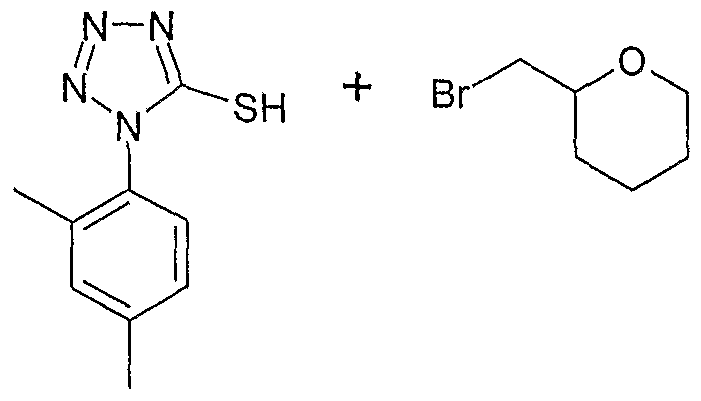

0.045 g (0.0011 mol) of NaOH was dissolved in 5 mL of MeOH. 0.206 g of 1-(2,4-dimethylphenyl)-1 H-tetrazole-5-thiol was added to the resulting solution and 0.180 g (0.001 mol) of 2-(bromomethyl)tetrahydro-2H-pyran added with caution. The reaction mixture was stirred for 2 hours at 6O0C, and then poured into water. The resulting oil was extracted with dichloromethane and extracts washed with Na2CO3 solution and water. After evaporation of solvent in vacuo, the target compound was obtained as a yellow oil. m/z: 305 [M+H]+.
Example 4
Synthesis of 1-[1-(2,4-dimethyl-phenyl)-1H-tetrazole-5-sulfinyl]-3,3-dimethyl-butan-2-one and 1-[1-(2,4-dimethyl-phenyl)-1 H-tetrazole-5-sulfonyl]-3,3-dimethy!-butan-2-one

To a solution of sulfide (4) (50 mg, 0.16 mmol) in methanol (5 mL) at O0C was added a solution of oxone (295 mg, 0.48 mmol, 3 eq.) in water (5 mL). The resulting cloudy suspension was stirred for 18 hours at room temperature and then diluted with water and extracted with CHCI3 (3 x 10 mL). The combined organic layers were washed with water, then brine, and then dried over MgSO4. Concentration in vacuo followed by flash column chromatography (SiO2, Hex/Et2O 40:60) afforded the desired sulfone (2) (31.7 mg) as a white solid, followed by the sulfoxide (1) (12.8 mg) as a colourless oil.
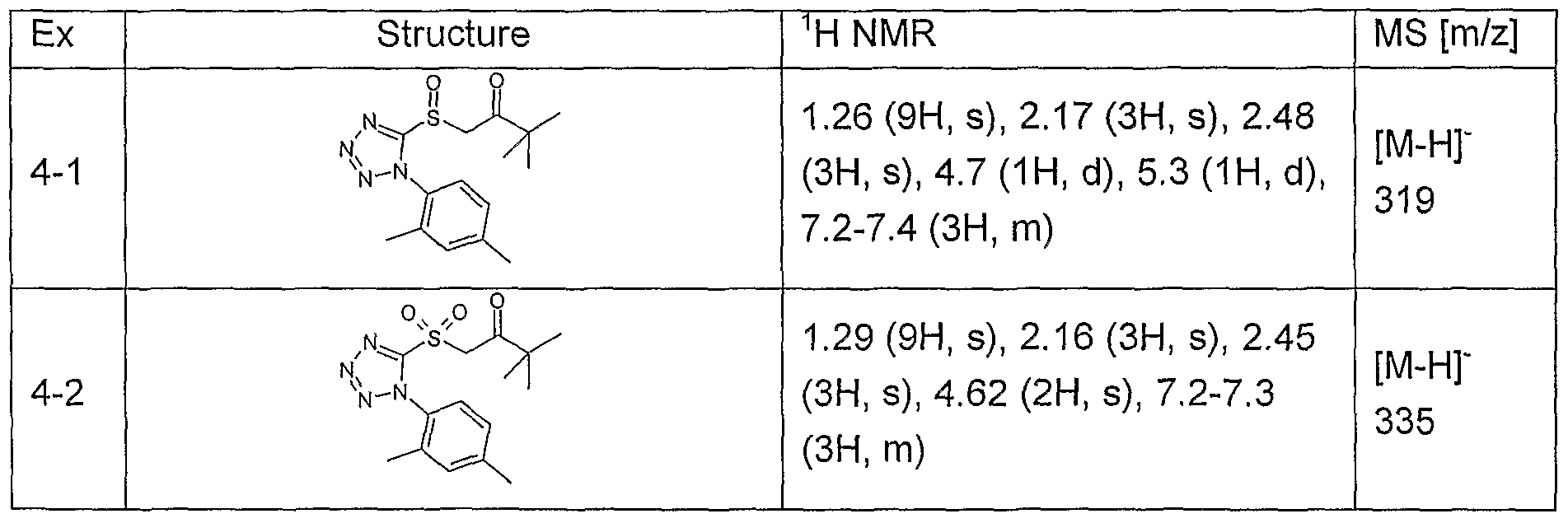
Example 5
Synthesis of 1-phenyl-3-(1-benzyl-1 H-tetrazol-5-yl)-propan-1-one

To a solution of NaOEt (0.5 mol, 37 g) in 250 mL of anhydrous EtOH, phenacylacetic acid ester was added with constant stirring and cooling. A solution of 1-benzyl-5- chloromethyltetrazole (0.5 mol, 105 g) in EtOH was then added dropwise and the solution stirred for 2-3 hours. The reaction mixture was poured into water and the resulting precipitate was collected by filtration, washed with water, and recrystallized from a benzene-hexane mixture yielding 4-oxo-4-phenyl-2-(1-benzyl-1 H-tetrazol-5-yl)-butyric acid ethyl ester 2 (50 g).
Crude compound 2 (5 g, 0.02 mol) was heated in a dioxane - cone. HCI mixture until gas evolution was complete. The solution was then neutralized by addition of aqueous NaOH and the aqueous solution extracted with CHCI3. Extracts were evaporated in vacuo and the resulting solid was crystallized from benzene yielding compound 3 as a white powder. 1H NMR (d6-DMSO): δ 3.1 (2H, t), 3.6(2H1 1), 5.7(2H1 s), 7.25 (2H, m), 7.35 (3H, m), 7.45 (1H, m), 7.9 (2H, m). m/z: 293.2 [M+HJ+.
Example 6
Preparation of 4-oxo-4-phenyl-N-m-tolyl-butyramide
HATU, DIPEA, DCM


1.O g (0.0093 mol) of m-toluidine was dissolved in 100 mL of dichloromethane followed by 1.8 g (0.0103 mol) of 3-benzoylpropionic acid. 1.8 mL (0.0103 mol) of diisopropylethylamine was added followed by 0.9 g (0.0103 mol) of (7-azabenzotriazol-1- yloxy)tripyrrolidino-phosponium hexafluorophosphate. The resulting yellow mixture was stirred for 20 minutes before being washed with 1 M HCI (aq), saturated NaHCO3 (aq), and then brine. The organic solution was then dried with anhydrous magnesium sulphate, filtered, and the solvent evaporated. The resulting solid was then triturated from diethyl ether / pentane to give the title compound as a white solid.
Example 7 Synthesis of 1 -phenyl-3-(1 -m-tolyl-1 H-tetrazol-5-yl)-propan-1 -one

0.5 g (0.0018 mol) of 4-oxo-4-phenyl-N-m-tolyl-butyramide was dissolved in 20 mL of dichloromethane and 0.385 g (0.0018 mol) of phosphorous pentachloride was added.
The reaction mixture was stirred under a nitrogen atmosphere for 15 minutes and 0.49 mL (0.036 mol) of azidotrimethylsilane was added. The reaction mixture was stirred at room temperature overnight before adding 20 mL of saturated NaHCO3 (aq) to quench the reaction. A further 20 mL of dichloromethane was added and the organic solution washed with water then dried with anhydrous magnesium sulphate, filtered, and the solvent evaporated to give a brown gum. The gum was purified by column chromatography on silica eluting with a mixture of ethylacetate and pentane. Alternatively, the gum could be purified by preparative HPLC using a 150x20.6mm 7micron Genesis C18 column eluting at 10 mL/min with a gradient of water/MeCN (+0.1% thfluoroacetic acid). The fractions containing the desired product were concentrated in vacuo to give the title compound as a white powder. 1H NMR: δ 2.4(3H1 s), 3.3(2H1 1), 3.7(2H1 1), 7.4(3H1 m), 7.5(3H1 m), 7.6(1 H, t), 8.0(2H, d). m/z: 293.09 [M+H]+. HPLC: Analytical Method 1 , ret. time 10.48 minutes.
By analogous methods, and using appropriate starting materials, the following compounds were also prepared:


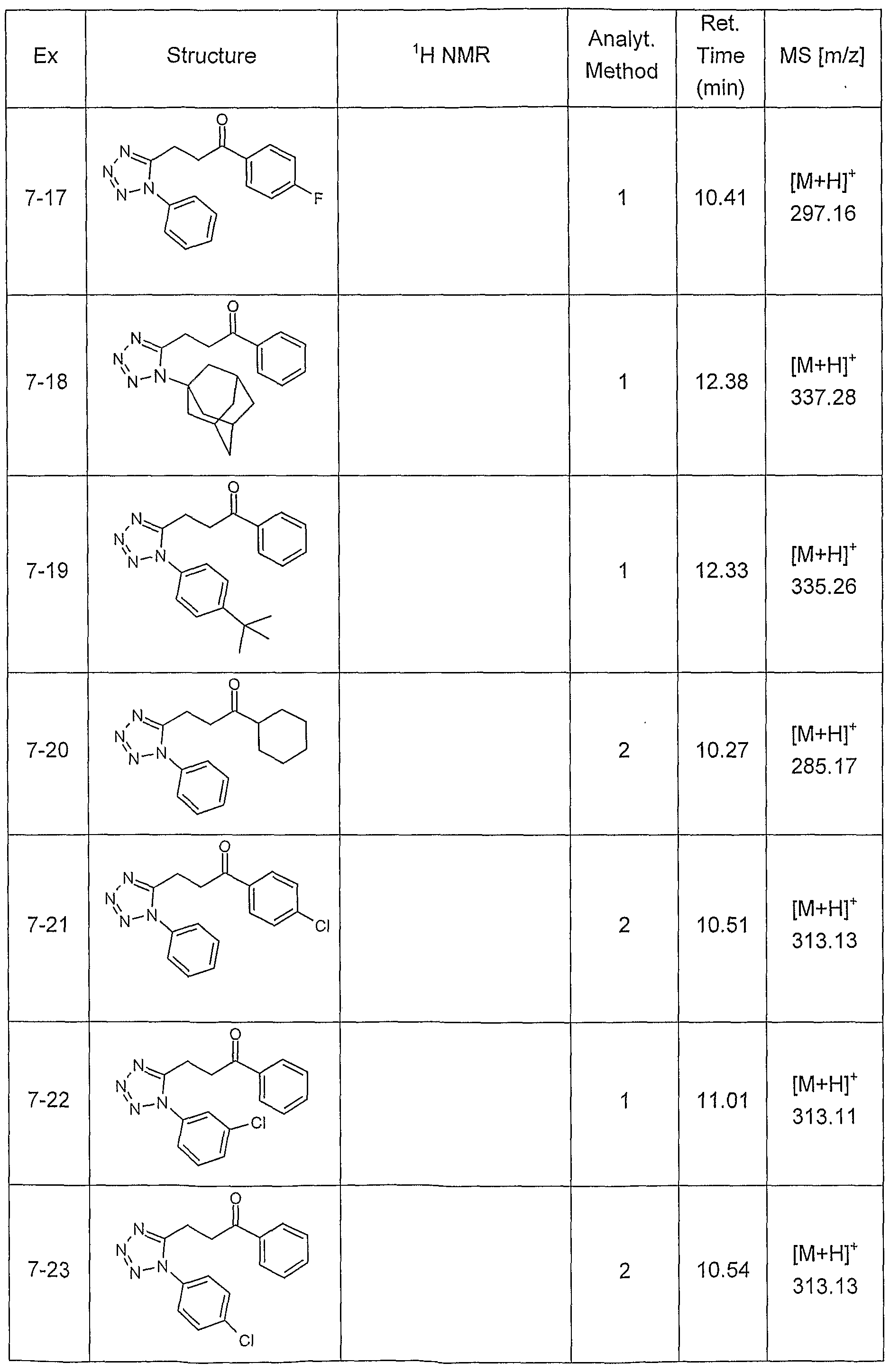


Example 8 Preparation of N-(3-oxo-3-phenyl-propyl)-benzamide
DIPEA, DCM


0.92 g (0.005 mol) of 3-amino-1-phenylpropan-1-one was dissolved in 20 mL of dichloromethane and 1.42 g (0.011 mol) of diisopropylethylamine. 0.7 g (0.005 mol) of benzoyl chloride was added and the reaction mixture stirred for one hour before being washed, first with 1 M HCI (aq) and then with brine. The organic solution was then dried with anhydrous magnesium sulphate, filtered, and the solvent evaporated to give the title compound as a white solid which was used without further purification.
Example 9 Synthesis of 1-phenyl-3-(5-phenyl-tetrazol-1-yl)-propan-1-one

0.296 g (0.003 mol) of N-(3-oxo-3-phenyl-propyl)-benzamide was dissolved in 30 mL of dichloromethane and 0.63 g (0.003 mol) of phosphorous pentachloride was added. The reaction mixture was stirred under a nitrogen atmosphere for 15 minutes before adding 0.69 g (0.006 mol) of azidotrimethylsilane. The reaction mixture was stirred at room temperature for 48 hours then 10 mL of saturated NaHCO3 (aq) was added to quench the reaction. A further 30 mL of dichloromethane was added and the organic solution was washed with water and then dried with anhydrous magnesium sulphate, filtered, and the solvent evaporated to give a clear oil. The oil was purified by preparative HPLC using a 150 x 20.6mm 7 μm Genesis C18 column eluting at 10 mL/min with a gradient of water/MeCN (+ 0.1% trifluoroacetic acid). The fractions containing the desired product were concentrated in vacuo to give the title compound as a white powder. An analytical sample was recrystallised from t-butyl ethyl ether. 1H NMR: δ 3.8(2H1 1), 4.85(2H, t), 7.5(2H1 1), 7.6(4H1 m), 7.8(2H1 m), 7.9(2H1 d). m/z: 270.11 [M+H]+. HPLC: Analytical Method 1 , ret. time 9.54 minutes.
By analogous methods, and using appropriate starting materials, the following compounds were also prepared:
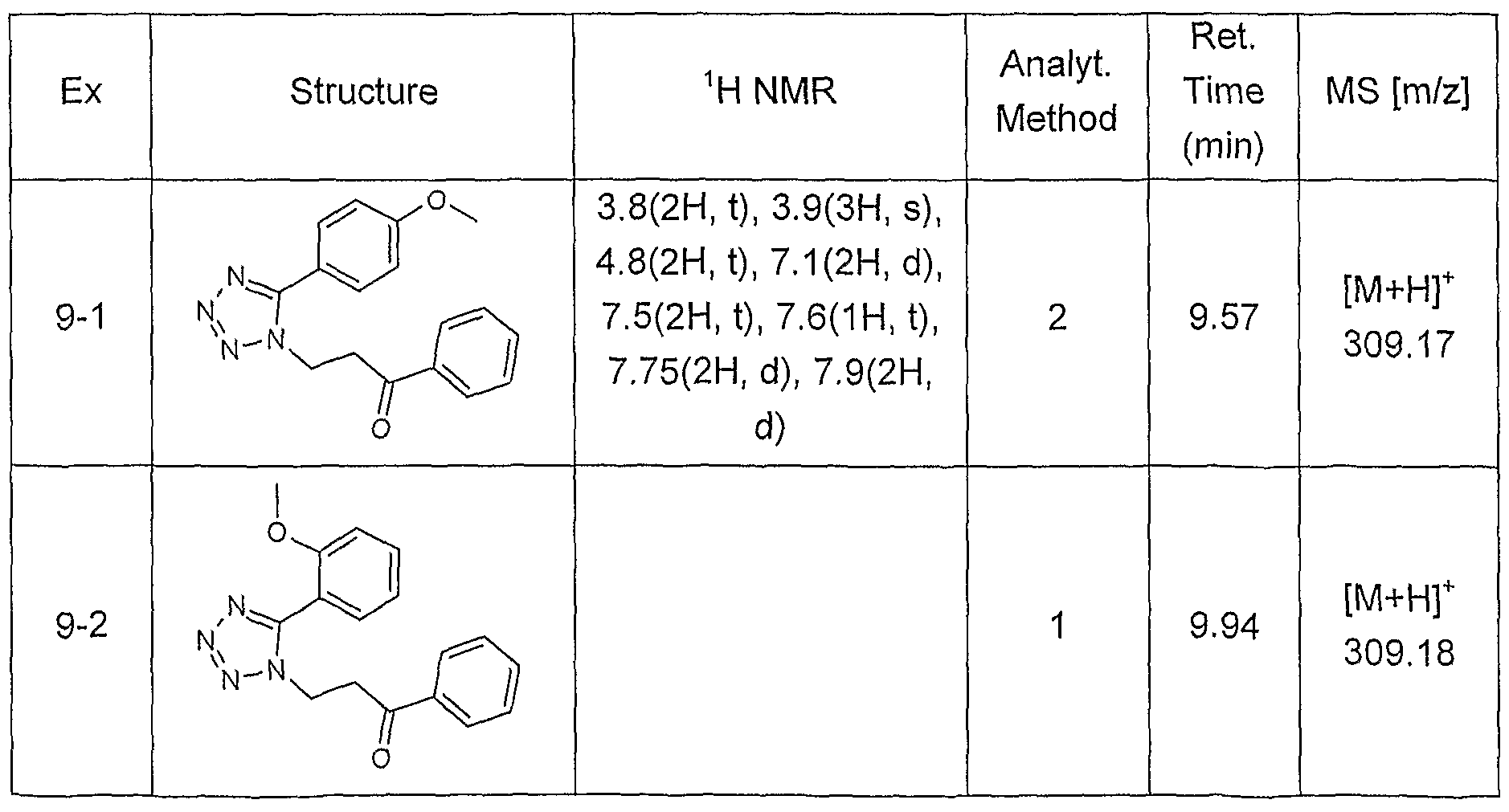
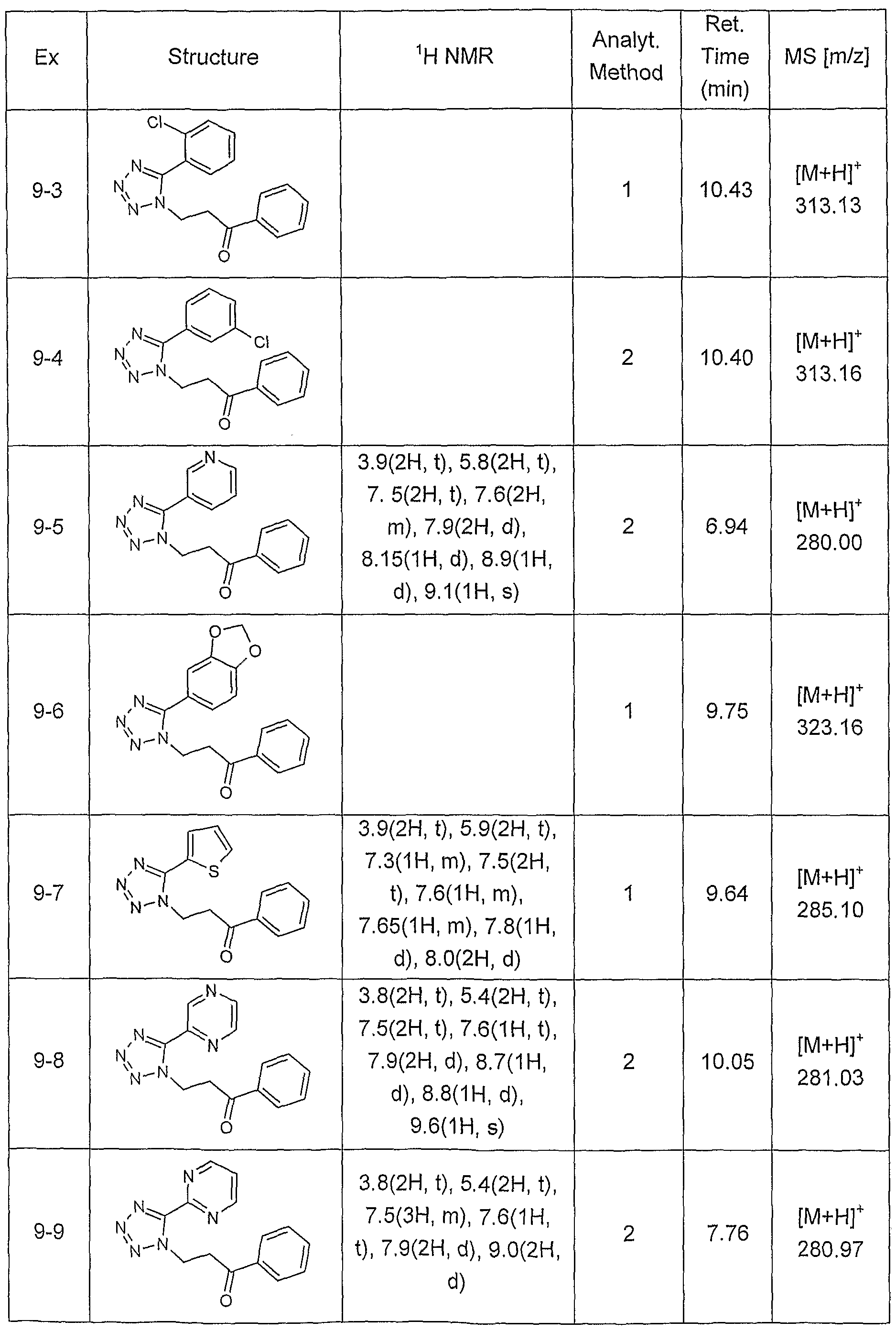

0.032 g (0.0013 mol) of NaH (60% dispersion in mineral oil) was added to a solution of 2-hydroxyacetophenone (0.151 g, 0.0011 mol) in dry DMF (10 mL). The reaction mixture was stirred at room temperature under a nitrogen atmosphere until effervescence ceased. 0.200 g (0.0011 mol) of 5-chloro-1-phenyl-1 H-tetrazoIe was then added, and the reaction mixture stirred for one hour. After quenching with 10 mL of water, the mixture was extracted with ethyl acetate (2 x 10 mL) and the organic solution dried with magnesium sulphate, filtered, and evaporated. The crude product was then purified by preparative HPLC using a 150 x 20.6 mm 7 μm Genesis C18 column eluting at 10 mL/min with a gradient of water/MeCN (+0.1% trifluoroacetic acid). The fractions containing the desired product were concentrated in vacuo to give the title compound as a colourless oil.
Example 11 Synthesis of 3-(1-phenyl-1 H-tetrazol-5-yl)-propionic acid ethyl ester

4.25 g (0.019 mol) of N-phenyl-succinamic acid ethyl ester was dissolved in 60 mL of dichloromethane and 4.5 g (0.019 mol) of phosphorous pentachloride was added. The reaction mixture was stirred under a nitrogen atmosphere for 20 minutes and 24 mL (0.38 mol) of azidotrimethylsilane was added. The reaction mixture was stirred at room temperature for 10 days before adding 20 mL of saturated NaHCO3 (aq.) to quench the reaction. A further 120 mL of dichloromethane was added and the organic solution washed with water then dried with anhydrous magnesium sulphate, filtered, and the solvent evaporated to give a brown gum. The gum was purified by column chromatography on silica eluting with a mixture of ethylacetate and pentane. The fractions containing the desired product were concentrated under vacuum to give an off- white solid which was recrystallised from t-butyl methyl ether to give the title compound as a white powder.
Example 12 Synthesis of 3-(1-phenyl-1H-tetrazol-5-yl)-propionic acid

2.46 g (0.010 mol) of 3-(1-phenyl-1 H-tetrazoI-5-yl)-propionic acid ethyl ester was added to 27 ml_ of ethanol and 54 mL of water in which 0.27 g of sodium hydroxide had been dissolved. The reaction mixture was stirred for one hour and then concentrated under vacuum and acidified with 1 N hydrochloric acid. The resulting white precipitate was then extracted into ethyl acetate and the organic solution washed with water and brine, and then dried with anhydrous magnesium sulphate, filtered, and the solvent evaporated to give the title compound as a white powder.
Example 13 Synthesis of 3-(1-phenyl-1 H-tetrazol-5-yl)-propionyl chloride
(i) Oxalyl chloride


1.0 g (0.0046 mol) of 3-(1-phenyl-1 H-tetrazol-5-yl)-propionic acid was suspended in 50 mL of dichloromethane and cooled to 0°C. 0.58 g (0.0046 mol) of oxalyl chloride was added followed by one drop of dimethylformamide. The reaction mixture was allowed to warm to room temperature and then the solution was evaporated under vacuum to give the title compound as a brown oil. This oil solidified on standing and was used in subsequent synthesis immediately without further purification.
Example 14 Synthesis of 3-(1 -phenyl- 1 H-tetrazol-5-yl)-1-thiophen-2-yl-propan-1-one

50 mg (0.00021 mol) of 3-(1-phenyl-1 H-tetrazol-5-yl)-propionyl chloride, 2.3 mg of palladium (II) acetate and 4 mg of tris-(o-tolyl)phosphine were suspended in 3 mL of α,α,α-trifluorotoluene under nitrogen. 72 mg (0.00023 mol) of 2-(tributylstannyl)thiophene was added and the mixture was irradiated at 14O0C for 5 minutes in a microwave. The reaction mixture was diluted with 20 mL of dichloromethane and washed with water, then
dried with anhydrous magnesium sulphate, filtered, and evaporated to give a dark brown oil. The oil was purified by column chromatography on silica eluting with a mixture of 0- 40% ethylac'etate in cyclohexane to give a gum that was triturated from ether to give the title compound as an off-white solid. 1H NMR: δ 3.3(2H1 1), 3.7(2H1 1), 7.15(1 H, t), 7.6(5H1 m), 7.7(1 H, d), 7.8(1 H, d). m/z: 285.00 [M+H]+. HPLC: Analytical Method 2, ret. time 8.70 minutes.
By analogous methods, and using appropriate starting materials, the following compound was also prepared:

Biological Methods
Cellular In Vitro 11 B-HSD1 Enzyme Inhibition Assay
Compounds were assessed by a Scintillation Proximity Assay (SPA) performed according to the following protocol:
HEK293 cells were stably tansfected with a construct containing full-length human 11 β-HSD1 enzyme to create HEK293/11β-HSD1 cells. Cells were routinely cultured in DMEM containing 10% calf foetal serum, 1% glutamine, and 1 % penicillin and streptomycin. Prior to assay, cells were plated at 2 x 10⁴ cells/well in 96-well poly-D-Lys coated flat-bottomed microplates and incubated in 5% CO2, 95% O2 at 370C for 24 hours. The media in each well was removed immediately before assay.
Compounds to be tested were dissolved in DMSO at 10 mM and serially diluted into water containing 10% DMSO. Diluted compounds at a volume of 10 μL were added to wells of a 96-well V-bottomed microplate. A solution of DMEM, 1 % glutamine, 1 % penicillin and streptomycin, and 22 nM tritiated cortisone was prepared and 90 μL added to each well of the assay plate. This solution (100 μL/well) was transferred to the plate containing the cells. The plate was then incubated in 5% CO2, 95% O2 at 37°C for 2 hours.
Following this incubation, 50 μL of the assay solution was transferred to each well of a 96-well scintillation microplate. A mixture consisting of anti-mouse YSi SPA beads,
pre-mixed with anti-cortisol antibody in assay buffer (50 mM Tris.HCI, pH 7.0; 300 mM NaCI; 1 mM EDTA, 5% glycerol) was prepared and 50 μl_ added to each well of the scintillation microplate. An adhesive strip was applied to the microplate and the plate gently shaken for at least 2 hours at room temperature, and then spun briefly on a low speed centrifuge. The plate was read on a scintillation counter suitable for 96-well microplates. For the calculation of percentage inhibition, a series of wells were added to the plate that represented the assay maximum and the assay minimum: one set that contained substrate without cells (mimimum) and another set that contained substrate and cells without any compound (maximum).
The calculation of median inhibitory concentration (IC50) values for the compounds was performed using GraphPad Prism® software. Dose-response curves for each compound were plotted as fractional inhibition and data fitted to the four parameter logistic equation.
Cellular In Vitro 11B-HSD1 Enzyme Inhibition Assay
For measurement of inhibition of 11β-HSD2, CHO cells stably transfected with full-length 1 1 β-HSD2 were used. Assays were carried out in 96-well microplates containing 1 x 10⁵ cells/well. Controls and compounds were plated as above, so that the final DMSO concentration in each well was 1%. To initiate the assay, 90 μL of a solution of HAMS F-12 medium containing 1% glutamine, 1% penicillin and streptomycin, and 22 nM tritiated Cortisol was added to each well of the assay plate. The plate was then incubated in 5% CO2, 95% O2 at 37°C for 16 hours.
The assay solutions were transferred to glass tubes and 20 μL ethyl acetate added to each tube. Each tube was vortexed thoroughly and the upper layer containing the tritiated steroid transferred to a fresh glass tube. The solvent was evaporated by placing the tubes in a heating block at 65°C under a stream of Nitrogen gas. 20 μL ethanol was added to each of the dried samples and vortexed briefly. Each sample was applied to a siϋca TLC plate and the plate dried. The plate was placed vertically in a glass tank containing 92% chloroform : 8% ethanol and the solvent allowed to rise up the plate. The plate was dried, placed in an imaging cassette, and overlayed with a tritium imaging plate for 1-2 days. The amount of enzyme inhibition in each sample was determined by measuring the intensity of the substrate and product spots using a phosphoimager.
IC50 values for inhibitors were determined as described for 1 1β-HSD1.
In Vitro 11B-HSD1 Enzyme Assay in Cell Lysates
HEK293/11 β-HSD1 cells were grown as described above to confluency in a 75 mL flask. The cells were washed twice with 1 mL PBS and then scraped from the flask into 1 mL of PBS. The cell suspension was pelleted by centrifugation at 10000 g for 15 minutes and
the supernatant was discarded. The cell pellet was re-suspended in 100 μl_ lysis buffer (50 mM Tris.HCI, pH 7.0; 300 mM NaCI; 1 mM EDTA, 5% glycerol, 1% Triton X-100) and incubated at 370C for 10 minutes. The suspension was centrifuged at 10000 g for 10 minutes. The supernatant containing the protein was retained and stored on ice. The protein concentration was adjusted to 20 μg/μL in assay buffer (50 mM Tris.HCI, pH 7.0; 300 mM NaCI; 1 mM EDTA, 5% glycerol).
96-well flat bottomed assay plates were prepared such that the final concentration of components in each well was 0.3 μg/mL protein, 100 μM NADPH and 0.01-100 μM test compound in 1% DMSO. The plates were incubated at 37°C for 10 minutes before adding tritiated cortisone such that the final concentration in each well was 20 nM. Each solution was mixed briefly and the plates incubated for 20 minutes at 37°C. The reactions were stopped by addition of 20 μM carbenoxolone.
The assay solutions were transferred to a 96-well scintillation microplate and the amount of inhibition in each well determined using the SPA assay protocol descibed above.
In Vitro Enzyme Assay of Recombinant Human 11 β-HSD1
A plasmid construct containing a truncated version of the HSD11 B1 gene was prepared and used to transform a suitable E. coli host strain. The truncated protein was over expressed from E. coli cultures, purified to homogeneity, and stored at -800C.
Enzyme inhibiton assays were carried out as described for the cell lysate assay above using an appropriate concentration of protein.
Ex Vivo Pharmacodynamic Assay
Male C57BL/6 mice (25-30 g in weight) were group housed and allowed free access to food and water. Animals were dosed with vehicle or compound at 12-hourly intervals either intraperitoneal^ or by oral gavage. Mice were euthanised 1-18 hours following the final dose by cervical dislocation and blood samples were obtained by cardiac puncture and immediately placed on ice. Blood samples were then spun, the plasma removed, and the samples frozen until further analysis was performed. Liver, adipose, and brain samples were also removed and frozen until analysis was performed. Inhibition of 1 1 β- HSD1 in liver, adipose, and brain was determined by incubating homogenates with 20 nM 3H-corticosterone and measuring 3H-dehydrocorticosterone and 3H-corticosterone levels by HPLC. Levels of compound in plasma were determined by HPLC-mass spectrometry.
Biological Data
In Vitro Enzyme Inhibition Data
The 1 ,5-substituted-1 H-tetrazole compounds of the present invention generally have an IC50 of less than about 20 μM, often less than about 10 μM, and in many cases less than about 100 nM. Generally, the IC50 ratio for 11 β-HSD2 to 11 β-HSD1 is at least about two or greater, and in many cases about ten or greater. In some cases, the IC50 ratio for 11 β- HSD2 to 11 β-HSD1 is about 100 or greater. For example, the following results were obtained in cellular assays:

Ex Vivo Enzyme lnhbition Data
The ex vivo data from typical examples are summarised in the following Table.

Compounds that are dosed to mice orally or intraperitoneal^ generally display inhibition of 11β-HSD1 in the liver, adipose, and brain tissue, with different efficacy, when the enzyme activity is assayed ex wVo.
The foregoing has described the principles, preferred embodiments, and modes of operation of the present invention. However, the invention should not be construed as limited to the particular embodiments discussed. Instead, the above-described embodiments should be regarded as illustrative rather than restrictive, and it should be appreciated that variations may be made in those embodiments by workers skilled in the art without departing from the scope of the present invention.
REFERENCES
A number of publications are cited above in order to more fully describe and disclose the invention and the state of the art to which the invention pertains. Full citations for these references are provided below. Each of these references is incorporated herein by reference in its entirety into the present disclosure, to the same extent as if each individual reference was specifically and individually indicated to be incorporated by reference.
Andrews, R.C., et al., 2003, "Effects of the 11beta-hydroxysteroid dehydrogenase inhibitor carbenoxolone on insulin sensitivity in men with type 2 diabetes," J. Clin. Endocrinol. Metab., Vol. 88, pp. 285-291. Christy, C, et al., 2003, "Glucocorticoid action in mouse aorta; localisation of
11 β-hydroxysteroid dehydrogenase type 2 and effects on responses to glucocorticoids in vitro," Hypertension, Vol. 42, pp. 580-587.
Cooper, M.S., et al., 2000, "Expression and functional consequences of
1 1 β-hydroxysteroid dehydrogenase activity in human bone," Bone, Vol. 27, pp. 375-381.
Hadoke, P.W.F., et al., 2001 , "Endothelial cell dysfunction in mice after transgenic knockout of type 2, but not type 1 , 11β-hydroxysteroid dehydrogenase,"
Circulation, Vol. 104, pp. 2832-2837.
Kotelevtsev, Y. V., et al., 1997, "11β-Hydroxysteroid dehydrogenase type 1 knockout mice show attenuated glucocorticoid inducible responses and resist hyperglycaemia on obesity and stress," Proc. Natl. Acad. ScL, Vol. 94, pp. 14924-14929 Masuzaki, H., et al., 2001 , "A Transgenic Model of Visceral Obesity and the Metabolic
Syndrome," Science, Vol. 294, pp. 2166-2170.
Moisan, M. P., et al., 1990, "1 1 beta-hydroxysteroid dehydrogenase bioactivity and messenger RNA expression in rat forebrain: localization in hypothalamus, hippocampus, and cortex," Endocrinology, Vol. 127, pp. 1450-1455. Morton, N. M., et al., 2001 , "Improved lipid and lipoprotein profile, hepatic insulin sensitivity, and glucose tolerance in 11β- hydroxy steroid dehydrogenase type 1 null mice," J. Biol. Chem., Vol. 276, pp. 41293-41300.
Morton, N. M., et al., 2004, "Novel adipose tissue-mediated resistance to diet-induced visceral obesity in 11β-hydroxysteroid dehydrogenase type 1 deficient mice," Diabetes, Vol. 53, pp. 931-938.
Paterson, J. M., et al., 2004, "Metabolic syndrome without obesity: hepatic overexpression of 1 1 β-hydroxysteroid dehydrogenase type 1 in transgenic mice," Proc. Natl. Acad. ScL, Vol. 101 , pp. 7088-7093).
Rask, E., et al., 2001, "Tissue-specific dysregulation of Cortisol metabolism in human obesity," J. Clin. Endocrinol. Metab., Vol. 86, pp. 1418-1421.
Rauz, S., et al., 2001 , "Expression and putative role of 11 beta-hydroxysteroid dehydrogenase isozymes within the human eye," Investigative Opthalmology & Visual Science, Vol. 42, pp. 2037-2042.
Sandeep, T.C., et al., 2004, "11 β-hydroxysteroid dehydrogenase inhibition improves cognitive function in healthy elderly men and type 2 diabetics," Proc. Natl. Acad.
ScL1 Vol. 101 , pp. 6734-6739.
Seckl, J. R., Walker, B. R., 2001, "11 β-Hydroxysteroid dehydrogenase type 1 - a tissue- specific amplifier of glucocorticoid action," Endocrinology, Vol. 142, pp. 1371-1376.
Small, G. R., et al., 2005, "Preventing local regeneration of glucocorticoids by 11 β-hydroxysteroid dehydrogenase type 1 enhances angiogenesis," Proc. Natl.
Acad. ScL, Vol. 102, pp. 12165-12170.
Walker, B.R., et al., 1991 , "11 β-Hydroxysteroid dehydrogenase in vascular smooth muscle and heart: implications for cardiovascular responses to glucocorticoids," Endocrinology, Vol. 129, pp. 3305-3312. Walker, B. R., et al., 1995, "Carbenoxolone increases hepatic insulin sensitivity in man: a novel role for 11-oxosteroid reductase in enhancing glucocorticoid receptor activation," J. Clin. Endocrinol. Metab., Vol. 80, pp. 3155-3139.
Yau, J.L.W., et al., 2001 , "Lack of tissue glucocorticoid reactivation in 11 β-hydroxysteroid dehydrogenase type 1 knockout mice ameliorates age-related learning impairments," Proc. Natl. Acad. ScL, Vol. 98, pp. 4716-4721.
Claims
1. A compound selected from compounds of the following formula:

one of W1 and W5 is a group -J-L-Q; and the other of W1 and W5 is a group Z;
wherein:
Z is independently -H or RQZ;
if W5 is -J-L-Q1 then J is independently: -S-, -S(=O)-, -S(=O)2-, -O-, -CH2-, or a covalent bond; and if W1 is -J-L-Q, then J is independently:
-S(=O)2-, -CH2-, -C(=O)-, or covalent bond;
wherein: RNJ is independently -H or RN; and if J is -CH2-, it is independently unsubstituted or substituted;
L is independently C1-6alkylene; and is independently unsubstituted or substituted;
Q is independently selected from:
-C(=O)RA1; -C(=O)ORE1;

-NRN1C(=O)RA2; -C(=O)NRN2RN3; -NRN4C(=O)NRN5RN6; -NRN7C(=O)ORE2;
C6-14carboaryl, and is independently unsubstituted or substituted; C5-14heteroaryl, and is independently unsubstituted or substituted;
C3-12cycloalkyl, and is independently unsubstituted or substituted;  and is independently unsubstituted or substituted;
C3.12heterocyclic, and is independently unsubstituted or substituted;
-H;
with the proviso that if J is -S-, then Q is not -NRN1C(=O)RA2, -C(=O)NRN2RN3, -NRN4C(=O)NRN5RN6, or -NRN7C(=O)ORE2;
wherein:
each of RP3, RP4, RP5, and RP6 is independently -H or a monovalent monodentate substituent;
additionally, RP3 and RP4, or Rp4 and Rps, or RP5 and RP6, taken together with the carbon atoms to which they are attached, optionally form a benzene ring fused to the tetrahydropyran-2-yl ring;
each of RA1, RA2, RE1, and RE2 is independently RQ;
each of RN\ RN2, RN3, RN4, RN5, RN5, and RN7 is -H or RN;
additionally, RN2 and RN3, taken together with the nitrogen atom to which they are attached, optionally form a ring having from 3 to 7 ring atoms, which may itself be fused to another ring;
additionally, RN5 and RN6, taken together with the nitrogen atom to which they are attached, optionally form a ring having from 3 to 7 ring atoms, which may itself be fused to another ring;
additionally, RN1 and RA2, taken together with the >N-C(=O)- group to which they are attached, optionally form a ring having from 5 to 7 ring atoms, which may itself be fused to another ring; additionally, RN7 and RE2, taken together with the >N-C(=O)-O- group to which they are attached, optionally form a ring having from 5 to 7 ring atoms, which may itself be fused to another ring;
additionally, RN4 and RN5, taken together with the >N-C(=O)-N< group to which they are attached, optionally form a ring having from 5 to 7 ring atoms, which may itself be fused to another ring;
each RN, if present, is independently selected from: RQN and -C(=O)RQN;
RQZ, each RQN, and each RQ, if present, is independently selected from:
C1-7alkyl;
C2-7alkenyl; C2-7alkynyl;
C3-12cycloalkyl;
C3-i2cycloalkenyl;
C6-i4carboaryl;
C5-14heteroaryl; C3.i2heterocyclic;
C3-12cycloalkyl-C1-7alkyl;
C3-12cycloalkenyl-C1-7alkyl;
C6-i4carboaryl-C1-7alkyl;
C5-i4heteroaryl-Ci-7alkyl; C3-i2heterocyclic-C1-7alkyl; and is independently unsubstituted or substituted;
and pharmaceutically acceptable salts, solvates, amides, esters, ethers, N-oxides, chemically protected forms, and prodrugs thereof.
2. A compound according to claim 1 , wherein W5 is a group -J-L-Q, and W1 is a group Z:

3. A compound according to claim 1 , wherein W is a group -J-L-Q, and W5 is a group Z:

4. A compound according to claim 1 or 2, wherein: W5 is -J-L-Q; and
J is independently -CH2- and is independently unsubstituted or substituted.
5. A compound according to claim 1 or 2, wherein:
W5 is -J-L-Q; and J is independently a covalent bond.
6. A compound according to claim 1 or 2, wherein:
W5 is -J-L-Q; and J is independently -O-.
7. A compound according to claim 1 or 2, wherein:
W5 is -J-L-Q; and
J is independently -S-.
8. A compound according to claim 1 or 2, wherein:
W5 is -J-L-Q; and J is independently -S(=O)-.
9. A compound according to claim 1 or 2, wherein: W5 is -J-L-Q; and
J is independently -S(=O)2-.
10. A compound according to claim 1 or 3, wherein:
W1 is -J-L-Q; and J is independently -CH2-, and is independently unsubstituted or substituted.
11. A compound according to claim 1 or 3, wherein:
W1 is -J-L-Q; and
J is independently a covalent bond.
12. A compound according to claim 1 or 3, wherein:
W1 is -J-L-Q;
J is independently -S(=O)2-.
13. A compound according to claim 1 or 3, wherein:
W1 is -J-L-Q; J is independently -C(=O)-.
14. A compound according to claim 1 or 3, wherein: W1 Js -J-L-Q;
J is independently -S(=O)2-, -CH2-, or -C(=O)-.
15. A compound according to any one of claims 1 to 14, wherein if J is -CH2-, it is independently unsubstituted or substituted with one or more substituents selected from: methyl, ethyl, n-propyl, i-propyl, t-butyl; cyclopropyl, cyclobutyl, cyclopentyl, cyclohexyl; phenyl, benzyl; nitrile, methyl nitrile (i.e., -CH2CN); hydroxy, hydroxymethyl, hydroxyethyl.
16. A compound according to any one of claims 1 to 15, wherein L is independently Ci-4alkylene, and is independently unsubstituted or substituted.
17. A compound according to any one of claims 1 to 15, wherein L is independently -(CH2)k-, where k is independently 1 , 2, 3, or 4, wherein each -CH2- unit is independently unsubstituted or substituted.
18. A compound according to any one of claims 1 to 15, wherein L is independently -(CH2Jk-, where k is independently 1 , 2, 3, or 4, wherein each -CH2- unit is independently unsubstituted or substituted with one or more substituents selected from:
C1-7alkyl; phenyl, unsubsituted or substituted with 1 , 2, or 3 C1-7alkyl groups; benzyl, unsubsituted or substituted with 1 , 2, or 3 C1-7alkyl groups;
C5-14heteroaryl, unsubsituted or substituted with 1 , 2, or 3 C1-7alkyl groups.
19. A compound according to any one of claims 1 to 15, wherein L is independently -(CH2)-, -(CH2)2-, -(CH2)3-, Or -(CH2J4-.
20. A compound according to any one of claims 1 to 15, wherein L is independently -(CHa)4-.
21. A compound according to any one of claims 1 to 15, wherein L is independently
22. A compound according to any one of claims 1 to 15, wherein L is independently -(CHz)2-.
23. A compound according to any one of claims 1 to 15, wherein L is independently -(CH2)-.
24. A compound according to any one of claims 1 to 23, wherein each RN, if present, is independently -Me or -C(=O)Me.
25. A compound according to any one of claims 1 to 24, wherein Z is independently -H.
26. A compound according to any one of claims 1 to 24, wherein Z is independently RQZ.
27. A compound according to any one of claims 1 to 24, wherein Z is independently selected from the following, which may be unsubstituted or substituted:


28. A compound according to any one of claims 1 to 27, wherein: Q is -C(=O)RA1, wherein: RA1 is independently RQ.
29. A compound according to any one of claims 1 to 27, wherein:' Q is -C(=O)ORE1, wherein: RE1 is independently RQ.
30. A compound according to any one of claims 1 to 27, wherein Q is:

31. A compound according to any one of claims 1 to 27, wherein:
Q is -NRN4C(=O)NRN5RNS, wherein: each of RN4, RN5, and RN6 is -H or RN; additionally, RN5 and RNS, taken together with the nitrogen atom to which they are attached, optionally form a ring having from 3 to 7 ring atoms (e.g., azetidino, pyrrolidino, piperidino, piperazino, morpholino), which may itself be fused to another ring (e.g., a benzene ring, a pyridine ring); and additionally, RN4 and RN5, taken together with the >N-C(=O)-N< group to which they are attached, optionally form a ring having from 5 to 7 ring atoms (e.g. pyrrolidino, piperidino, piperazino, morpholino), which may itself be fused to another ring (e.g., a benzene ring, a pyridine ring).
32. A compound according to any one of claims 1 to 27, wherein:
Q is -NRN7C(=O)ORE2, wherein: RN7 is -H or RN; RE2 is independently RQ; and additionally, RN7 and RE2, taken together with the >N-C(=O)-O- group to which they are attached, optionally form a ring having from 5 to 7 ring atoms (e.g., pyrrolidino, piperidino, piperazino, morpholino), which may itself be fused to another ring (e.g., a benzene ring, a pyridine ring).
33. A compound according to any one of claims 1 to 27, wherein Q is selected from:
C6-i4carboaryl, and is independently unsubstituted or substituted; C5-14heteroaryl, and is independently unsubstituted or substituted.
34. A compound according to any one of claims 1 to 27, wherein Q is selected from:
C3.i2cycloalkyl, and is independently unsubstituted or substituted; C3-12cycloalkenyl, and is independently unsubstituted or substituted; and C3-i2heterocyclic, and is independently unsubstituted or substituted.
35. A compound according to any one of claims 1 to 27, wherein Q is independently -H.
36. A compound according to any one of claims 1 to 35, wherein each RQ, if present, is independently selected from the following, which may be unsubstituted or substituted:
-Me, -Et, -nPr, -iPr, -nBu, -iBu, -sBu, -tBu;
cyclopropyl (C3), cyclobutyl (C4), cyclopentyl (C5), cyclohexyl (C6), adamantyl (C10);
phenyl; naphthalenyl, e.g., naphthalen-1-yl, naphthalen-2-yl; indanyl, e.g., indan-1-yl; tetrahydro-naphthalenyl, e.g., 1 ,2,3,4-tetrahydro-naphthalen-1-yl;
furanyl, e.g., furan-2-yl, furan-3-yl; thiophenyl, e.g., thiophen-2-yl, thiophen-3-yl;
1 H-pyrrolyl, e.g., 1 H-pyrrol-2-yl, 1 H-pyrrol-3-yl; pyridinyl, e.g., pyridin-2-yl, pyridin-3-yl, pyridin-4-yl; pyrazinyl, pyrimidinyl, pyridazinyl; imidazolyl, pyrazolyl, oxazolyl, thiazolyl, thiadiazole; benzo[1 ,3]dioxolyl, e.g., benzo[1 ,3]dioχol-5-yl; 2,3-dihydro-benzo[1 ,4]dioxinyl, e.g., 2,3-dihydro-benzo[1 ,4]dioxin-6-yl; 2,3-dihydro-benzofuranyl, e.g, 2,3-dihydro-benzofuran-2-yl; 4H-benzo[1 ,4]oxazin-3-one-yl, e.g., 4H-benzo[1 ,4]oxazin-3-one-6-yl; quinolinyl, e.g., quinolin-2-yl, quinolin-3-yl, quinolin-4-yl; isoquinolinyl, e.g., isoquinolin-2-yl, isoquinolin-3-yl, isoquinolin-6-yl; pyrrolidinyl, imidazolidinyl, pyrazolidinyl; piperidinyl, piperazinyl; tetrahydrofuranyl, tetrahydrothiophenyl; tetrahydropyranyl, morpholinyl; azepinyl; azabicyclo[3,2,1]octane; azabicyclo[3,2,2]nonane;
benzyl; phenyl-ethyl; pyridinyl-methyl; pyridinyl-ethyl; thiophenyl-methyl; furanyl-methyl.
37. A compound according to any one of claims 1 to 35, wherein each RQ, if present, is independently selected from the following, which may be unsubstituted or substituted: cyclohexyl, phenyl, naphthalenyl, furanyl, thiophenyl, pyridinyl, pyrazinyl, pyrimidinyl, and benzyl.
38. A compound according to any one of claims 1 to 35, wherein each RQ, if present, is independently selected from the following: cyclohexyl, optionally substituted with 1 , 2, 3, 4, or 5 substituents; phenyl, optionally substituted with 1 , 2, 3, 4, or 5 substituents; naphthalenyl, optionally substituted with 1 , 2, 3, 4, 5, 6, or 7 substituents; furanyl, optionally substituted with 1 , 2, or 3 substituents; thiophenyl, optionally substituted with 1 , 2, or 3 substituents; pyridinyl, optionally substituted with 1 , 2, 3, or 4 substituents; pyrazinyl, optionally substituted with 1 , 2, or 3 substituents; pyrimidinyl, optionally substituted with 1 , 2, or 3 substituents; and benzyl, optionally substituted with 1 , 2, 3, 4, or 5 substituents.
39. A compound according to any one of claims 1 to 28, wherein Q is independently selected from the following, which may be unsubstituted or substituted:

40. A compound according to any one of claims 1 to 39, wherein each RQ, if present, is independently unsubstituted or substituted with one or more substituents selected from:
(1) carboxylic acid; (2) ester; (3) aminoacyl or aminothioacyl; (4) acyl; (5) halo; (6) cyano; (7) nitro; (8) hydroxy; (9) ether; (10) thiol; (11) thioether;
(12) acyloxy; (13) carbamate; (14) amino; (15) acylamino or thioacylamino; (16) aminoacylamino or aminothioacylamino; (17) sulfonamino; (18) sulfonyl; (19) sulfonate; (20) sulfonamido; (21) C5-2ocarboaryl-C1-7alkyl or C5-2oheteroaryl-Ci-7a!kyl; (22) C5.2ocarboaryl or C5-2oheteroaryl; (23) C3-2oheterocyclyl; (24) C1-7alkyl; C2-7alkenyl; C2-7alkynyl; C3.12cycloalkyl;
C3-12cycIoalkenyl; C3.i2cycloalkyl-Ci-7alkyl; C3-i2cycloalkenyl-C1-7alkyl; (25) oxo; (26) imino; (27) hydroxyimino.
41. A compound according to any one of claims 1 to 39, wherein each RQ, if present, is independently unsubstituted or substituted with one or more substituents selected from:
C1-7alkyl, e.g., -Me, -Et, -nPr, -iPr, -nBu, -iBu, -sBu, -tBu;
Ci.4haloalkyl, e.g., -CF3, -CH2F, -CHF2, -CH2CF3;
C1-7alkoxy, e.g., -OMe, -OEt, -O-nPr, -O-iPr, -O-nBu, -O-iBu, -O-sBu, -O-tBu; C1-4haloalkoxy, e.g., -OCF3, -OCH2F, -OCHF2, -OCH2CF3;
C1-7alkyl-acyl, e.g., -C(=O)Me, -C(=O)Et; halo, i.e., -F, -CI, -Br, -I;
-NO2;
-CN; phenyl, unsubstituted or substituted; and
C5.6heteroaryl, unsubstituted or substituted.
42. A compound according to any one of claims 1 to 39, wherein each RQ, if present, is independently unsubstituted or substituted with one or more substituents selected from: -F, -Cl, -Br, -CN, -OH, -OMe, -OEt, -CF3, -OCF3, -Me, -Et, and
-NMe2.
43. A compound according to any one of claims 1 to 42, having a molecular weight of 300 to 1000.
44. A compound according to claim 1 selected from the compounds shown in Figures 1 to 26, and pharmaceutically acceptable salts, solvates, amides, esters, ethers, N-oxides, chemically protected forms, and prodrugs thereof.
45. A composition comprising a compound according to any one of claims 1 to 44 and a pharmaceutically acceptable carrier or diluent.
46. A method of inhibiting 11β-hydroxysteroid dehydrogenase type 1 in a cell, in vitro or in vivo, comprising contacting the cell with an effective amount of a compound according to any one of claims 1 to 44.
47. A compound according to any one of claims 1 to 44 for use in a method of treatment of the human or animal body by therapy.
48. A compound according to any one of claims 1 to 44 for use in a method of treatment or prevention of a condition of the human or animal body that is ameliorated by the inhibition of 11β-hydroxysteroid dehydrogenase type 1 by therapy.
49. Use of a compound according to any one of claims 1 to 44 in the manufacture of a medicament for use in the treatment or prevention of a condition of the human or animal body that is ameliorated by the inhibition of 11 β-hydroxysteroid dehydrogenase type 1.
50. A method of treatment or prevention of a condition of the human or animal body that is ameliorated by the inhibition of 11 β-hydroxysteroid dehydrogenase type 1 comprising administering to a patient in need of treatment a therapeutically effective amount a compound according to any one of claims 1 to 44.
51. A compound, use, or method according to any one of claims 48, 49, and 50, wherein the treatment or prevention is treatment or prevention of: (1) Cushing's syndrome;
(2) type 2 diabetes and impaired glucose tolerance;
(3) insulin resistance syndromes such as myotonic dystrophy, Prader Willi, lipodystrophies, gastrointestinal diabetes, etc;
(4) obesity and being overweight; (5) lipid disorders;
(6) atherosclerosis and its sequelae, including myocardial infarction and peripheral vascular disease;
(7) Metabolic Syndrome;
(8) steatohepatitis/fatty liver; (9) cognitive impairment in type 2 diabetes, glucose intolerance and ageing, and in psychotic disorders and pre-schizophrenia;
(10) dementias such as Alheimer's disease, multi-infarct dementia, dementia with Lewy bodies, fronto-temporal dementia (including Pick's disease), progressive supranuclear palsy, Korsakoff's syndrome, Binswanger's disease, HIV-associated dementia, Creutzfeldt-Jakob disease (CJD), multiple sclerosis, motor neurone disease, Parkinson's disease, Huntington's disease, Niemann-Pick disease type C, normal pressure hydrocephalus, and Down's syndrome; (11) mild cognitive impairment (cognitive impairment, no dementia);
(12) β-cell dysfunction in pancreatic disease;
(13) glaucoma;
(14) anxiety; (15) depression and other affective disorders; typical (melancholic) and atypical depression; dysthymia; post-partum depression; bipolar affective disorder; drug-induced affective disorders; anxiety; posttraumatic stress disorder; panic; phobias;
(16) inflammatory disease; (17) osteoporosis;
(18) myocardial infarction, for example, to prevent left ventricular dysfunction after myocardial infarction; or
(19) stroke, for example, to limit ischaemic neuronal loss after cardiovascular accident.
52. A compound, use, or method according to any one of claims 48, 49, and 50, wherein the treatment or prevention is treatment or prevention of:
(1) hyperglycaemia;
(2) glucose intolerance and impaired glucose tolerance; (3) insulin resistance;
(4) hyperlipidaemia;
(5) hypertriglyceridaemia;
(6) hypercholesterolemia;
(7) low HDL levels; (8) high LDL levels;
(9) vascular restenosis;
(10) abdominal obesity;
(11) neurodegenerative disease;
(12) retinopathy; (13) neuropathy;
(14) hypertension; or
(15) other diseases where insulin resistance is a component.
53. A compound, use, or method according to any one of claims 48, 49, and 50, wherein the treatment or prevention is treatment or prevention of an adverse effect of glucocorticoids used to treat inflammatory diseases, such as asthma, chronic obstructive pulmonary disease, skin diseases, rheumatoid arthritis and other arthropathies, inflammatory bowel disease, and giant cell arthritis/polymyalgia rheumatica.
54. A compound, use, or method according to any one of claims 48, 49, and 50, wherein the treatment or prevention is treatment or prevention of the metabolic syndrome, which includes conditions such as type 2 diabetes and obesity, and associated disorders including insulin resistance, hypertension, lipid disorders and cardiovascular disorders such as ischaemic (coronary) heart disease.
55. A compound, use, or method according to any one of claims 48, 49, and 50, wherein the treatment or prevention is treatment or prevention of a CNS condition such as mild cognitive impairment and early dementia, including Alzheimer's disease.
Applications Claiming Priority (2)
| Application Number | Priority Date | Filing Date | Title |
|---|---|---|---|
| GB0518361A GB2429975A (en) | 2005-09-08 | 2005-09-08 | 1,5-substituted-1H-tetrazole 11beta-hydroxysteroid dehydrogenase type 1 inhibitors |
| GB0518361.1 | 2005-09-08 |
Publications (1)
| Publication Number | Publication Date |
|---|---|
| WO2007029021A1 true WO2007029021A1 (en) | 2007-03-15 |
Family
ID=35221147
Family Applications (1)
| Application Number | Title | Priority Date | Filing Date |
|---|---|---|---|
| PCT/GB2006/003346 Ceased WO2007029021A1 (en) | 2005-09-08 | 2006-09-08 | 1,5-substituted tetrazoles as therapeutic compounds |
Country Status (2)
| Country | Link |
|---|---|
| GB (1) | GB2429975A (en) |
| WO (1) | WO2007029021A1 (en) |
Cited By (19)
| Publication number | Priority date | Publication date | Assignee | Title |
|---|---|---|---|---|
| WO2009021740A2 (en) | 2007-08-15 | 2009-02-19 | Sanofis-Aventis | Substituted tetrahydronaphthalenes, process for the preparation thereof and the use thereof as medicaments |
| WO2010007794A1 (en) | 2008-07-18 | 2010-01-21 | 興和株式会社 | Novel spiro compound, and pharmaceutical preparation comprising the same |
| WO2010023931A1 (en) | 2008-08-29 | 2010-03-04 | 興和株式会社 | 1-adamantylazetidin-2-one derivative and pharmaceutical preparation comprising same |
| WO2010050191A1 (en) | 2008-10-29 | 2010-05-06 | 興和株式会社 | 1,2-diazetidin-3-one derivative and pharmaceutical agent comprising same |
| WO2011107494A1 (en) | 2010-03-03 | 2011-09-09 | Sanofi | Novel aromatic glycoside derivatives, medicaments containing said compounds, and the use thereof |
| WO2011157827A1 (en) | 2010-06-18 | 2011-12-22 | Sanofi | Azolopyridin-3-one derivatives as inhibitors of lipases and phospholipases |
| WO2011161030A1 (en) | 2010-06-21 | 2011-12-29 | Sanofi | Heterocyclic substituted methoxyphenyl derivatives having an oxo group, method for producing same, and use thereof as gpr40 receptor modulators |
| WO2012004270A1 (en) | 2010-07-05 | 2012-01-12 | Sanofi | Spirocyclically substituted 1,3-propane dioxide derivatives, methods for the production thereof and use of the same as medicament |
| WO2012004269A1 (en) | 2010-07-05 | 2012-01-12 | Sanofi | (2-aryloxy-acetylamino)-phenyl-propionic acid derivatives, method for producing same and use thereof as pharmaceuticals |
| WO2012010413A1 (en) | 2010-07-05 | 2012-01-26 | Sanofi | Aryloxy-alkylene substituted hydroxyphenyl hexynoic acids, methods for the production thereof and use of the same as medicament |
| WO2012120054A1 (en) | 2011-03-08 | 2012-09-13 | Sanofi | Di- and tri-substituted oxathiazine derivates, method for the production thereof, use thereof as medicine and drug containing said derivatives and use thereof |
| WO2012120055A1 (en) | 2011-03-08 | 2012-09-13 | Sanofi | Di- and tri-substituted oxathiazine derivates, method for the production thereof, use thereof as medicine and drug containing said derivatives and use thereof |
| WO2012120052A1 (en) | 2011-03-08 | 2012-09-13 | Sanofi | Oxathiazine derivatives substituted with carbocycles or heterocycles, method for producing same, drugs containing said compounds, and use thereof |
| WO2012120053A1 (en) | 2011-03-08 | 2012-09-13 | Sanofi | Branched oxathiazine derivatives, method for the production thereof, use thereof as medicine and drug containing said derivatives and use thereof |
| WO2012120056A1 (en) | 2011-03-08 | 2012-09-13 | Sanofi | Tetrasubstituted oxathiazine derivatives, method for producing them, their use as medicine and drug containing said derivatives and the use thereof |
| WO2013037390A1 (en) | 2011-09-12 | 2013-03-21 | Sanofi | 6-(4-hydroxy-phenyl)-3-styryl-1h-pyrazolo[3,4-b]pyridine-4-carboxylic acid amide derivatives as kinase inhibitors |
| WO2013045413A1 (en) | 2011-09-27 | 2013-04-04 | Sanofi | 6-(4-hydroxy-phenyl)-3-alkyl-1h-pyrazolo[3,4-b]pyridine-4-carboxylic acid amide derivatives as kinase inhibitors |
| US8524894B2 (en) | 2009-06-04 | 2013-09-03 | Laboratorios Salvat, S.A. | Inhibitor compounds of 11-beta-hydroxysteroid dehydrogenase type 1 |
| CN106986843A (en) * | 2017-04-25 | 2017-07-28 | 湖南理工学院 | A kind of preparation method of α heterocycles thioether ketone compounds |
Families Citing this family (1)
| Publication number | Priority date | Publication date | Assignee | Title |
|---|---|---|---|---|
| GB0803494D0 (en) * | 2008-02-26 | 2008-04-02 | Sterix Ltd | Compound |
Citations (4)
| Publication number | Priority date | Publication date | Assignee | Title |
|---|---|---|---|---|
| DE855711C (en) * | 1950-09-29 | 1952-11-17 | Knoll Ag | Process for the preparation of tetrazoles |
| DE962798C (en) * | 1954-08-04 | 1957-04-25 | Dr Egon Wiberg | Process for the preparation of tetrazoles |
| EP0107859A1 (en) * | 1982-10-29 | 1984-05-09 | Meiji Seika Kaisha Ltd. | Tetrazole compounds, process for preparing the same and antibacterial and antifungal compositions containing the same as active ingredient |
| US20050154024A1 (en) * | 2003-12-22 | 2005-07-14 | Pfizer Inc | Compounds useful in therapy |
Family Cites Families (6)
| Publication number | Priority date | Publication date | Assignee | Title |
|---|---|---|---|---|
| AU6144098A (en) * | 1997-02-14 | 1998-09-08 | Bayer Corporation | Amide derivatives as selective neuropeptide y receptor antagonists |
| WO2001070753A1 (en) * | 2000-03-22 | 2001-09-27 | Merck Frosst Canada & Co. | Sulfur substituted aryldifluoromethylphosphonic acids as ptp-1b inhibitors |
| ATE482747T1 (en) * | 2003-04-11 | 2010-10-15 | High Point Pharmaceuticals Llc | NEW AMIDE DERIVATIVES AND THEIR PHARMACEUTICAL USES |
| WO2004089416A2 (en) * | 2003-04-11 | 2004-10-21 | Novo Nordisk A/S | Combination of an 11beta-hydroxysteroid dehydrogenase type 1 inhibitor and an antihypertensive agent |
| MXPA05013226A (en) * | 2003-06-12 | 2006-03-09 | Novo Nordisk As | Substituted piperidine carbamates for use as inhibitors of hormone sensitive lipase. |
| JP2005263787A (en) * | 2004-02-17 | 2005-09-29 | Ishihara Sangyo Kaisha Ltd | Amide compound or its salt and cytokine production inhibitor containing the same |
-
2005
- 2005-09-08 GB GB0518361A patent/GB2429975A/en not_active Withdrawn
-
2006
- 2006-09-08 WO PCT/GB2006/003346 patent/WO2007029021A1/en not_active Ceased
Patent Citations (4)
| Publication number | Priority date | Publication date | Assignee | Title |
|---|---|---|---|---|
| DE855711C (en) * | 1950-09-29 | 1952-11-17 | Knoll Ag | Process for the preparation of tetrazoles |
| DE962798C (en) * | 1954-08-04 | 1957-04-25 | Dr Egon Wiberg | Process for the preparation of tetrazoles |
| EP0107859A1 (en) * | 1982-10-29 | 1984-05-09 | Meiji Seika Kaisha Ltd. | Tetrazole compounds, process for preparing the same and antibacterial and antifungal compositions containing the same as active ingredient |
| US20050154024A1 (en) * | 2003-12-22 | 2005-07-14 | Pfizer Inc | Compounds useful in therapy |
Non-Patent Citations (4)
| Title |
|---|
| D. MODERHACK ET AL: "Aromatic azapentalenes: 1H-and (mesoionic) 2H-pyrrolo-tetrazoles. Part 1. Synthesis and spectral characteristics", J. CHEM SOC., PERKIN TRANSACTIONS 1, 2001, pages 720 - 728, XP002411685 * |
| N. IQBAL, E. E. KNAUS: "Synthesis and Calcium Channel Modulating Effects of alkyl-1,4-Dihydro-2,6-dimethyl-4-(pyridinyl or 2-trifluoromethylphenyl)-5-(1H-tetrazol-5-yl)-3-pyrdinecarboxylates", ARCH. PHARMACIE, vol. 328, 1995, pages 750 - 754, XP002411684 * |
| SPEAR R J: "POSITIONAL SELECTIVITY OF THE METHYLATION OF 5-SUBSTITUTED TETRAZOLATE ANIONS", AUSTRALIAN JOURNAL OF CHEMISTRY, vol. 37, 1984, pages 2453 - 2468, XP000653166, ISSN: 0004-9425 * |
| WALKER B R ET AL: "CARBENOXOLONE INCREASES HEPATIC INSULIN SENSITIVITY IN MAN: A NOVELROLE FOR 11-OXOSTEROID REDUCTASE IN ENHANCING GLUCOCORTICOID RECEPTOR ACTIVATION", JOURNAL OF CLINICAL ENDOCRINOLOGY AND METABOLISM, ENDOCRINE SOCIETY, CHEVY CHASE, MD, US, vol. 80, no. 11, 1 November 1995 (1995-11-01), pages 3155 - 3159, XP000612666, ISSN: 0021-972X * |
Cited By (22)
| Publication number | Priority date | Publication date | Assignee | Title |
|---|---|---|---|---|
| WO2009021740A2 (en) | 2007-08-15 | 2009-02-19 | Sanofis-Aventis | Substituted tetrahydronaphthalenes, process for the preparation thereof and the use thereof as medicaments |
| WO2010007794A1 (en) | 2008-07-18 | 2010-01-21 | 興和株式会社 | Novel spiro compound, and pharmaceutical preparation comprising the same |
| US8236789B2 (en) | 2008-08-29 | 2012-08-07 | Kowa Company, Ltd. | 1-adamantyl azetidin-2-one derivatives and drugs containing same |
| WO2010023931A1 (en) | 2008-08-29 | 2010-03-04 | 興和株式会社 | 1-adamantylazetidin-2-one derivative and pharmaceutical preparation comprising same |
| WO2010050191A1 (en) | 2008-10-29 | 2010-05-06 | 興和株式会社 | 1,2-diazetidin-3-one derivative and pharmaceutical agent comprising same |
| US8252781B2 (en) | 2008-10-29 | 2012-08-28 | Kowa Company, Ltd. | 1,2-diazetidin-3-one derivatives and drugs containing same |
| US8822452B2 (en) | 2009-06-04 | 2014-09-02 | Laboratorios Salvat, S.A. | Inhibitor compounds of 11-beta-hydroxysteroid dehydrogenase type 1 |
| US8524894B2 (en) | 2009-06-04 | 2013-09-03 | Laboratorios Salvat, S.A. | Inhibitor compounds of 11-beta-hydroxysteroid dehydrogenase type 1 |
| WO2011107494A1 (en) | 2010-03-03 | 2011-09-09 | Sanofi | Novel aromatic glycoside derivatives, medicaments containing said compounds, and the use thereof |
| WO2011157827A1 (en) | 2010-06-18 | 2011-12-22 | Sanofi | Azolopyridin-3-one derivatives as inhibitors of lipases and phospholipases |
| WO2011161030A1 (en) | 2010-06-21 | 2011-12-29 | Sanofi | Heterocyclic substituted methoxyphenyl derivatives having an oxo group, method for producing same, and use thereof as gpr40 receptor modulators |
| WO2012010413A1 (en) | 2010-07-05 | 2012-01-26 | Sanofi | Aryloxy-alkylene substituted hydroxyphenyl hexynoic acids, methods for the production thereof and use of the same as medicament |
| WO2012004269A1 (en) | 2010-07-05 | 2012-01-12 | Sanofi | (2-aryloxy-acetylamino)-phenyl-propionic acid derivatives, method for producing same and use thereof as pharmaceuticals |
| WO2012004270A1 (en) | 2010-07-05 | 2012-01-12 | Sanofi | Spirocyclically substituted 1,3-propane dioxide derivatives, methods for the production thereof and use of the same as medicament |
| WO2012120054A1 (en) | 2011-03-08 | 2012-09-13 | Sanofi | Di- and tri-substituted oxathiazine derivates, method for the production thereof, use thereof as medicine and drug containing said derivatives and use thereof |
| WO2012120055A1 (en) | 2011-03-08 | 2012-09-13 | Sanofi | Di- and tri-substituted oxathiazine derivates, method for the production thereof, use thereof as medicine and drug containing said derivatives and use thereof |
| WO2012120052A1 (en) | 2011-03-08 | 2012-09-13 | Sanofi | Oxathiazine derivatives substituted with carbocycles or heterocycles, method for producing same, drugs containing said compounds, and use thereof |
| WO2012120053A1 (en) | 2011-03-08 | 2012-09-13 | Sanofi | Branched oxathiazine derivatives, method for the production thereof, use thereof as medicine and drug containing said derivatives and use thereof |
| WO2012120056A1 (en) | 2011-03-08 | 2012-09-13 | Sanofi | Tetrasubstituted oxathiazine derivatives, method for producing them, their use as medicine and drug containing said derivatives and the use thereof |
| WO2013037390A1 (en) | 2011-09-12 | 2013-03-21 | Sanofi | 6-(4-hydroxy-phenyl)-3-styryl-1h-pyrazolo[3,4-b]pyridine-4-carboxylic acid amide derivatives as kinase inhibitors |
| WO2013045413A1 (en) | 2011-09-27 | 2013-04-04 | Sanofi | 6-(4-hydroxy-phenyl)-3-alkyl-1h-pyrazolo[3,4-b]pyridine-4-carboxylic acid amide derivatives as kinase inhibitors |
| CN106986843A (en) * | 2017-04-25 | 2017-07-28 | 湖南理工学院 | A kind of preparation method of α heterocycles thioether ketone compounds |
Also Published As
| Publication number | Publication date |
|---|---|
| GB2429975A (en) | 2007-03-14 |
| GB0518361D0 (en) | 2005-10-19 |
Similar Documents
| Publication | Publication Date | Title |
|---|---|---|
| EP1417196B1 (en) | Dna-pk inhibitors | |
| EP2563780B1 (en) | 3,3-disubstituted-(8-aza-bicyclo[3.2.1]oct-8-yl)-[5-(1h-pyrazol-4-yl)-thiophen-3-yl]-methanones as inhibitors of 11(beta)-hsd1 | |
| KR102104144B1 (en) | 3-aryl-5-substituted-isoquinolin-1-one compounds and their therapeutic use | |
| ES2540547T3 (en) | Compounds of (4-phenyl-piperidin-1-yl) - [5- (1H-pyrazol-4-yl) -thiophene-3-yl] -methanone and its use | |
| EP2283004B1 (en) | Amido-thiophene compounds and their use | |
| US7732483B2 (en) | DNA-PK inhibitors | |
| EP1305026B1 (en) | Barbituric acid analogs as therapeutic agents | |
| GB2429975A (en) | 1,5-substituted-1H-tetrazole 11beta-hydroxysteroid dehydrogenase type 1 inhibitors | |
| EP2229374A1 (en) | Amido-thiophene compounds and their use as 11-beta-hsd1 inhibitors | |
| WO2006085067A1 (en) | Atm inhibitors | |
| EP2041087A1 (en) | 2 -oxybenzamide derivatives as parp inhibitors | |
| WO1999024432A1 (en) | Purine derivatives and medicine containing the same as the active ingredient | |
| EP1828118A1 (en) | Parp inhibitors | |
| WO2010146338A1 (en) | Amido-isothiazole compounds and their use as inhibitors of 11beta-hsd1 for the treatment of metabolic syndrome and related disorders | |
| AU2008299721A1 (en) | Phthalazinone derivatives | |
| EP1416936B1 (en) | Thiopyrane-4-ones as dna protein kinase inhibitors |
Legal Events
| Date | Code | Title | Description |
|---|---|---|---|
| 121 | Ep: the epo has been informed by wipo that ep was designated in this application | ||
| NENP | Non-entry into the national phase |
Ref country code: DE |
|
| 122 | Ep: pct application non-entry in european phase |
Ref document number: 06779363 Country of ref document: EP Kind code of ref document: A1 |