WO2007046658A1 - New binaphthalene derivatives, preparation method thereof and organic electronic device using the same - Google Patents
New binaphthalene derivatives, preparation method thereof and organic electronic device using the same Download PDFInfo
- Publication number
- WO2007046658A1 WO2007046658A1 PCT/KR2006/004282 KR2006004282W WO2007046658A1 WO 2007046658 A1 WO2007046658 A1 WO 2007046658A1 KR 2006004282 W KR2006004282 W KR 2006004282W WO 2007046658 A1 WO2007046658 A1 WO 2007046658A1
- Authority
- WO
- WIPO (PCT)
- Prior art keywords
- group
- compound
- substituted
- unsubstituted
- preparation example
- Prior art date
- Legal status (The legal status is an assumption and is not a legal conclusion. Google has not performed a legal analysis and makes no representation as to the accuracy of the status listed.)
- Ceased
Links
- 0 C*c1cc2ccc(C=O)cc2cc1 Chemical compound C*c1cc2ccc(C=O)cc2cc1 0.000 description 3
- HMWGEVRNKPELMV-UHFFFAOYSA-N Brc(cc1)cc2c1cc(C1OCCO1)cc2 Chemical compound Brc(cc1)cc2c1cc(C1OCCO1)cc2 HMWGEVRNKPELMV-UHFFFAOYSA-N 0.000 description 1
- RJAIJBYQOKLRQG-RQIWQTQWSA-N C/C=C(\C=C1\C=CC(C=O)=CC1)/[Br]=C Chemical compound C/C=C(\C=C1\C=CC(C=O)=CC1)/[Br]=C RJAIJBYQOKLRQG-RQIWQTQWSA-N 0.000 description 1
- WURQCRGNWIBTBC-UHFFFAOYSA-N C=[O]Nc(cc1)cc(cc2)c1cc2-c(ccc1c2)cc1ccc2O Chemical compound C=[O]Nc(cc1)cc(cc2)c1cc2-c(ccc1c2)cc1ccc2O WURQCRGNWIBTBC-UHFFFAOYSA-N 0.000 description 1
- PZAJXNRYNJEGBK-LYNSOWIESA-N CC(C)(C(C1)CC=C[C@H]1[C@H](CC[C@@H]1C2)CC1=C(C)C=C2O)/C=C(\C=C)/C=O Chemical compound CC(C)(C(C1)CC=C[C@H]1[C@H](CC[C@@H]1C2)CC1=C(C)C=C2O)/C=C(\C=C)/C=O PZAJXNRYNJEGBK-LYNSOWIESA-N 0.000 description 1
- FJDUBXOCPMPNNX-UHFFFAOYSA-N c1c[s]c(-c2ccc(-c3ccccc3)[s]2)c1 Chemical compound c1c[s]c(-c2ccc(-c3ccccc3)[s]2)c1 FJDUBXOCPMPNNX-UHFFFAOYSA-N 0.000 description 1
Classifications
-
- C—CHEMISTRY; METALLURGY
- C07—ORGANIC CHEMISTRY
- C07C—ACYCLIC OR CARBOCYCLIC COMPOUNDS
- C07C13/00—Cyclic hydrocarbons containing rings other than, or in addition to, six-membered aromatic rings
- C07C13/28—Polycyclic hydrocarbons or acyclic hydrocarbon derivatives thereof
- C07C13/32—Polycyclic hydrocarbons or acyclic hydrocarbon derivatives thereof with condensed rings
- C07C13/54—Polycyclic hydrocarbons or acyclic hydrocarbon derivatives thereof with condensed rings with three condensed rings
- C07C13/547—Polycyclic hydrocarbons or acyclic hydrocarbon derivatives thereof with condensed rings with three condensed rings at least one ring not being six-membered, the other rings being at the most six-membered
- C07C13/567—Polycyclic hydrocarbons or acyclic hydrocarbon derivatives thereof with condensed rings with three condensed rings at least one ring not being six-membered, the other rings being at the most six-membered with a fluorene or hydrogenated fluorene ring system
-
- C—CHEMISTRY; METALLURGY
- C07—ORGANIC CHEMISTRY
- C07C—ACYCLIC OR CARBOCYCLIC COMPOUNDS
- C07C13/00—Cyclic hydrocarbons containing rings other than, or in addition to, six-membered aromatic rings
- C07C13/28—Polycyclic hydrocarbons or acyclic hydrocarbon derivatives thereof
- C07C13/32—Polycyclic hydrocarbons or acyclic hydrocarbon derivatives thereof with condensed rings
- C07C13/72—Spiro hydrocarbons
-
- C—CHEMISTRY; METALLURGY
- C07—ORGANIC CHEMISTRY
- C07C—ACYCLIC OR CARBOCYCLIC COMPOUNDS
- C07C15/00—Cyclic hydrocarbons containing only six-membered aromatic rings as cyclic parts
- C07C15/20—Polycyclic condensed hydrocarbons
-
- C—CHEMISTRY; METALLURGY
- C07—ORGANIC CHEMISTRY
- C07C—ACYCLIC OR CARBOCYCLIC COMPOUNDS
- C07C15/00—Cyclic hydrocarbons containing only six-membered aromatic rings as cyclic parts
- C07C15/20—Polycyclic condensed hydrocarbons
- C07C15/24—Polycyclic condensed hydrocarbons containing two rings
-
- C—CHEMISTRY; METALLURGY
- C07—ORGANIC CHEMISTRY
- C07C—ACYCLIC OR CARBOCYCLIC COMPOUNDS
- C07C15/00—Cyclic hydrocarbons containing only six-membered aromatic rings as cyclic parts
- C07C15/20—Polycyclic condensed hydrocarbons
- C07C15/27—Polycyclic condensed hydrocarbons containing three rings
- C07C15/28—Anthracenes
-
- C—CHEMISTRY; METALLURGY
- C07—ORGANIC CHEMISTRY
- C07C—ACYCLIC OR CARBOCYCLIC COMPOUNDS
- C07C15/00—Cyclic hydrocarbons containing only six-membered aromatic rings as cyclic parts
- C07C15/20—Polycyclic condensed hydrocarbons
- C07C15/38—Polycyclic condensed hydrocarbons containing four rings
-
- C—CHEMISTRY; METALLURGY
- C07—ORGANIC CHEMISTRY
- C07C—ACYCLIC OR CARBOCYCLIC COMPOUNDS
- C07C15/00—Cyclic hydrocarbons containing only six-membered aromatic rings as cyclic parts
- C07C15/40—Cyclic hydrocarbons containing only six-membered aromatic rings as cyclic parts substituted by unsaturated carbon radicals
- C07C15/56—Cyclic hydrocarbons containing only six-membered aromatic rings as cyclic parts substituted by unsaturated carbon radicals polycyclic condensed
- C07C15/58—Cyclic hydrocarbons containing only six-membered aromatic rings as cyclic parts substituted by unsaturated carbon radicals polycyclic condensed containing two rings
-
- C—CHEMISTRY; METALLURGY
- C07—ORGANIC CHEMISTRY
- C07C—ACYCLIC OR CARBOCYCLIC COMPOUNDS
- C07C211/00—Compounds containing amino groups bound to a carbon skeleton
- C07C211/43—Compounds containing amino groups bound to a carbon skeleton having amino groups bound to carbon atoms of six-membered aromatic rings of the carbon skeleton
- C07C211/54—Compounds containing amino groups bound to a carbon skeleton having amino groups bound to carbon atoms of six-membered aromatic rings of the carbon skeleton having amino groups bound to two or three six-membered aromatic rings
-
- C—CHEMISTRY; METALLURGY
- C07—ORGANIC CHEMISTRY
- C07C—ACYCLIC OR CARBOCYCLIC COMPOUNDS
- C07C211/00—Compounds containing amino groups bound to a carbon skeleton
- C07C211/43—Compounds containing amino groups bound to a carbon skeleton having amino groups bound to carbon atoms of six-membered aromatic rings of the carbon skeleton
- C07C211/57—Compounds containing amino groups bound to a carbon skeleton having amino groups bound to carbon atoms of six-membered aromatic rings of the carbon skeleton having amino groups bound to carbon atoms of six-membered aromatic rings being part of condensed ring systems of the carbon skeleton
- C07C211/58—Naphthylamines; N-substituted derivatives thereof
-
- C—CHEMISTRY; METALLURGY
- C07—ORGANIC CHEMISTRY
- C07C—ACYCLIC OR CARBOCYCLIC COMPOUNDS
- C07C211/00—Compounds containing amino groups bound to a carbon skeleton
- C07C211/43—Compounds containing amino groups bound to a carbon skeleton having amino groups bound to carbon atoms of six-membered aromatic rings of the carbon skeleton
- C07C211/57—Compounds containing amino groups bound to a carbon skeleton having amino groups bound to carbon atoms of six-membered aromatic rings of the carbon skeleton having amino groups bound to carbon atoms of six-membered aromatic rings being part of condensed ring systems of the carbon skeleton
- C07C211/61—Compounds containing amino groups bound to a carbon skeleton having amino groups bound to carbon atoms of six-membered aromatic rings of the carbon skeleton having amino groups bound to carbon atoms of six-membered aromatic rings being part of condensed ring systems of the carbon skeleton with at least one of the condensed ring systems formed by three or more rings
-
- C—CHEMISTRY; METALLURGY
- C07—ORGANIC CHEMISTRY
- C07D—HETEROCYCLIC COMPOUNDS
- C07D235/00—Heterocyclic compounds containing 1,3-diazole or hydrogenated 1,3-diazole rings, condensed with other rings
- C07D235/02—Heterocyclic compounds containing 1,3-diazole or hydrogenated 1,3-diazole rings, condensed with other rings condensed with carbocyclic rings or ring systems
- C07D235/04—Benzimidazoles; Hydrogenated benzimidazoles
- C07D235/18—Benzimidazoles; Hydrogenated benzimidazoles with aryl radicals directly attached in position 2
-
- C—CHEMISTRY; METALLURGY
- C07—ORGANIC CHEMISTRY
- C07D—HETEROCYCLIC COMPOUNDS
- C07D333/00—Heterocyclic compounds containing five-membered rings having one sulfur atom as the only ring hetero atom
- C07D333/02—Heterocyclic compounds containing five-membered rings having one sulfur atom as the only ring hetero atom not condensed with other rings
- C07D333/04—Heterocyclic compounds containing five-membered rings having one sulfur atom as the only ring hetero atom not condensed with other rings not substituted on the ring sulphur atom
- C07D333/06—Heterocyclic compounds containing five-membered rings having one sulfur atom as the only ring hetero atom not condensed with other rings not substituted on the ring sulphur atom with only hydrogen atoms, hydrocarbon or substituted hydrocarbon radicals, directly attached to the ring carbon atoms
- C07D333/08—Hydrogen atoms or radicals containing only hydrogen and carbon atoms
- C07D333/10—Thiophene
-
- C—CHEMISTRY; METALLURGY
- C07—ORGANIC CHEMISTRY
- C07D—HETEROCYCLIC COMPOUNDS
- C07D333/00—Heterocyclic compounds containing five-membered rings having one sulfur atom as the only ring hetero atom
- C07D333/02—Heterocyclic compounds containing five-membered rings having one sulfur atom as the only ring hetero atom not condensed with other rings
- C07D333/04—Heterocyclic compounds containing five-membered rings having one sulfur atom as the only ring hetero atom not condensed with other rings not substituted on the ring sulphur atom
- C07D333/06—Heterocyclic compounds containing five-membered rings having one sulfur atom as the only ring hetero atom not condensed with other rings not substituted on the ring sulphur atom with only hydrogen atoms, hydrocarbon or substituted hydrocarbon radicals, directly attached to the ring carbon atoms
- C07D333/14—Radicals substituted by singly bound hetero atoms other than halogen
- C07D333/18—Radicals substituted by singly bound hetero atoms other than halogen by sulfur atoms
-
- C—CHEMISTRY; METALLURGY
- C07—ORGANIC CHEMISTRY
- C07D—HETEROCYCLIC COMPOUNDS
- C07D403/00—Heterocyclic compounds containing two or more hetero rings, having nitrogen atoms as the only ring hetero atoms, not provided for by group C07D401/00
- C07D403/02—Heterocyclic compounds containing two or more hetero rings, having nitrogen atoms as the only ring hetero atoms, not provided for by group C07D401/00 containing two hetero rings
- C07D403/10—Heterocyclic compounds containing two or more hetero rings, having nitrogen atoms as the only ring hetero atoms, not provided for by group C07D401/00 containing two hetero rings linked by a carbon chain containing aromatic rings
-
- C—CHEMISTRY; METALLURGY
- C09—DYES; PAINTS; POLISHES; NATURAL RESINS; ADHESIVES; COMPOSITIONS NOT OTHERWISE PROVIDED FOR; APPLICATIONS OF MATERIALS NOT OTHERWISE PROVIDED FOR
- C09K—MATERIALS FOR MISCELLANEOUS APPLICATIONS, NOT PROVIDED FOR ELSEWHERE
- C09K11/00—Luminescent materials, e.g. electroluminescent or chemiluminescent
- C09K11/06—Luminescent materials, e.g. electroluminescent or chemiluminescent containing organic luminescent materials
-
- H—ELECTRICITY
- H05—ELECTRIC TECHNIQUES NOT OTHERWISE PROVIDED FOR
- H05B—ELECTRIC HEATING; ELECTRIC LIGHT SOURCES NOT OTHERWISE PROVIDED FOR; CIRCUIT ARRANGEMENTS FOR ELECTRIC LIGHT SOURCES, IN GENERAL
- H05B33/00—Electroluminescent light sources
- H05B33/12—Light sources with substantially two-dimensional [2D] radiating surfaces
- H05B33/14—Light sources with substantially two-dimensional [2D] radiating surfaces characterised by the chemical or physical composition or the arrangement of the electroluminescent material, or by the simultaneous addition of the electroluminescent material in or onto the light source
-
- H—ELECTRICITY
- H10—SEMICONDUCTOR DEVICES; ELECTRIC SOLID-STATE DEVICES NOT OTHERWISE PROVIDED FOR
- H10K—ORGANIC ELECTRIC SOLID-STATE DEVICES
- H10K10/00—Organic devices specially adapted for rectifying, amplifying, oscillating or switching; Organic capacitors or resistors having potential barriers
- H10K10/40—Organic transistors
- H10K10/46—Field-effect transistors, e.g. organic thin-film transistors [OTFT]
- H10K10/462—Insulated gate field-effect transistors [IGFETs]
-
- H—ELECTRICITY
- H10—SEMICONDUCTOR DEVICES; ELECTRIC SOLID-STATE DEVICES NOT OTHERWISE PROVIDED FOR
- H10K—ORGANIC ELECTRIC SOLID-STATE DEVICES
- H10K30/00—Organic devices sensitive to infrared radiation, light, electromagnetic radiation of shorter wavelength or corpuscular radiation
-
- H—ELECTRICITY
- H10—SEMICONDUCTOR DEVICES; ELECTRIC SOLID-STATE DEVICES NOT OTHERWISE PROVIDED FOR
- H10K—ORGANIC ELECTRIC SOLID-STATE DEVICES
- H10K50/00—Organic light-emitting devices
-
- H—ELECTRICITY
- H10—SEMICONDUCTOR DEVICES; ELECTRIC SOLID-STATE DEVICES NOT OTHERWISE PROVIDED FOR
- H10K—ORGANIC ELECTRIC SOLID-STATE DEVICES
- H10K85/00—Organic materials used in the body or electrodes of devices covered by this subclass
- H10K85/60—Organic compounds having low molecular weight
- H10K85/615—Polycyclic condensed aromatic hydrocarbons, e.g. anthracene
- H10K85/626—Polycyclic condensed aromatic hydrocarbons, e.g. anthracene containing more than one polycyclic condensed aromatic rings, e.g. bis-anthracene
-
- H—ELECTRICITY
- H10—SEMICONDUCTOR DEVICES; ELECTRIC SOLID-STATE DEVICES NOT OTHERWISE PROVIDED FOR
- H10K—ORGANIC ELECTRIC SOLID-STATE DEVICES
- H10K85/00—Organic materials used in the body or electrodes of devices covered by this subclass
- H10K85/60—Organic compounds having low molecular weight
- H10K85/631—Amine compounds having at least two aryl rest on at least one amine-nitrogen atom, e.g. triphenylamine
- H10K85/633—Amine compounds having at least two aryl rest on at least one amine-nitrogen atom, e.g. triphenylamine comprising polycyclic condensed aromatic hydrocarbons as substituents on the nitrogen atom
-
- H—ELECTRICITY
- H10—SEMICONDUCTOR DEVICES; ELECTRIC SOLID-STATE DEVICES NOT OTHERWISE PROVIDED FOR
- H10K—ORGANIC ELECTRIC SOLID-STATE DEVICES
- H10K85/00—Organic materials used in the body or electrodes of devices covered by this subclass
- H10K85/60—Organic compounds having low molecular weight
- H10K85/649—Aromatic compounds comprising a hetero atom
- H10K85/655—Aromatic compounds comprising a hetero atom comprising only sulfur as heteroatom
-
- H—ELECTRICITY
- H10—SEMICONDUCTOR DEVICES; ELECTRIC SOLID-STATE DEVICES NOT OTHERWISE PROVIDED FOR
- H10K—ORGANIC ELECTRIC SOLID-STATE DEVICES
- H10K85/00—Organic materials used in the body or electrodes of devices covered by this subclass
- H10K85/60—Organic compounds having low molecular weight
- H10K85/649—Aromatic compounds comprising a hetero atom
- H10K85/657—Polycyclic condensed heteroaromatic hydrocarbons
- H10K85/6572—Polycyclic condensed heteroaromatic hydrocarbons comprising only nitrogen in the heteroaromatic polycondensed ring system, e.g. phenanthroline or carbazole
-
- C—CHEMISTRY; METALLURGY
- C07—ORGANIC CHEMISTRY
- C07C—ACYCLIC OR CARBOCYCLIC COMPOUNDS
- C07C2603/00—Systems containing at least three condensed rings
- C07C2603/02—Ortho- or ortho- and peri-condensed systems
- C07C2603/04—Ortho- or ortho- and peri-condensed systems containing three rings
- C07C2603/06—Ortho- or ortho- and peri-condensed systems containing three rings containing at least one ring with less than six ring members
- C07C2603/10—Ortho- or ortho- and peri-condensed systems containing three rings containing at least one ring with less than six ring members containing five-membered rings
- C07C2603/12—Ortho- or ortho- and peri-condensed systems containing three rings containing at least one ring with less than six ring members containing five-membered rings only one five-membered ring
- C07C2603/18—Fluorenes; Hydrogenated fluorenes
-
- C—CHEMISTRY; METALLURGY
- C07—ORGANIC CHEMISTRY
- C07C—ACYCLIC OR CARBOCYCLIC COMPOUNDS
- C07C2603/00—Systems containing at least three condensed rings
- C07C2603/02—Ortho- or ortho- and peri-condensed systems
- C07C2603/04—Ortho- or ortho- and peri-condensed systems containing three rings
- C07C2603/22—Ortho- or ortho- and peri-condensed systems containing three rings containing only six-membered rings
- C07C2603/24—Anthracenes; Hydrogenated anthracenes
-
- C—CHEMISTRY; METALLURGY
- C07—ORGANIC CHEMISTRY
- C07C—ACYCLIC OR CARBOCYCLIC COMPOUNDS
- C07C2603/00—Systems containing at least three condensed rings
- C07C2603/02—Ortho- or ortho- and peri-condensed systems
- C07C2603/40—Ortho- or ortho- and peri-condensed systems containing four condensed rings
- C07C2603/42—Ortho- or ortho- and peri-condensed systems containing four condensed rings containing only six-membered rings
- C07C2603/50—Pyrenes; Hydrogenated pyrenes
-
- C—CHEMISTRY; METALLURGY
- C07—ORGANIC CHEMISTRY
- C07C—ACYCLIC OR CARBOCYCLIC COMPOUNDS
- C07C2603/00—Systems containing at least three condensed rings
- C07C2603/02—Ortho- or ortho- and peri-condensed systems
- C07C2603/52—Ortho- or ortho- and peri-condensed systems containing five condensed rings
-
- C—CHEMISTRY; METALLURGY
- C07—ORGANIC CHEMISTRY
- C07C—ACYCLIC OR CARBOCYCLIC COMPOUNDS
- C07C2603/00—Systems containing at least three condensed rings
- C07C2603/93—Spiro compounds
- C07C2603/94—Spiro compounds containing "free" spiro atoms
-
- C—CHEMISTRY; METALLURGY
- C09—DYES; PAINTS; POLISHES; NATURAL RESINS; ADHESIVES; COMPOSITIONS NOT OTHERWISE PROVIDED FOR; APPLICATIONS OF MATERIALS NOT OTHERWISE PROVIDED FOR
- C09K—MATERIALS FOR MISCELLANEOUS APPLICATIONS, NOT PROVIDED FOR ELSEWHERE
- C09K2211/00—Chemical nature of organic luminescent or tenebrescent compounds
- C09K2211/10—Non-macromolecular compounds
- C09K2211/1003—Carbocyclic compounds
- C09K2211/1007—Non-condensed systems
-
- C—CHEMISTRY; METALLURGY
- C09—DYES; PAINTS; POLISHES; NATURAL RESINS; ADHESIVES; COMPOSITIONS NOT OTHERWISE PROVIDED FOR; APPLICATIONS OF MATERIALS NOT OTHERWISE PROVIDED FOR
- C09K—MATERIALS FOR MISCELLANEOUS APPLICATIONS, NOT PROVIDED FOR ELSEWHERE
- C09K2211/00—Chemical nature of organic luminescent or tenebrescent compounds
- C09K2211/10—Non-macromolecular compounds
- C09K2211/1003—Carbocyclic compounds
- C09K2211/1011—Condensed systems
-
- C—CHEMISTRY; METALLURGY
- C09—DYES; PAINTS; POLISHES; NATURAL RESINS; ADHESIVES; COMPOSITIONS NOT OTHERWISE PROVIDED FOR; APPLICATIONS OF MATERIALS NOT OTHERWISE PROVIDED FOR
- C09K—MATERIALS FOR MISCELLANEOUS APPLICATIONS, NOT PROVIDED FOR ELSEWHERE
- C09K2211/00—Chemical nature of organic luminescent or tenebrescent compounds
- C09K2211/10—Non-macromolecular compounds
- C09K2211/1003—Carbocyclic compounds
- C09K2211/1014—Carbocyclic compounds bridged by heteroatoms, e.g. N, P, Si or B
-
- C—CHEMISTRY; METALLURGY
- C09—DYES; PAINTS; POLISHES; NATURAL RESINS; ADHESIVES; COMPOSITIONS NOT OTHERWISE PROVIDED FOR; APPLICATIONS OF MATERIALS NOT OTHERWISE PROVIDED FOR
- C09K—MATERIALS FOR MISCELLANEOUS APPLICATIONS, NOT PROVIDED FOR ELSEWHERE
- C09K2211/00—Chemical nature of organic luminescent or tenebrescent compounds
- C09K2211/10—Non-macromolecular compounds
- C09K2211/1018—Heterocyclic compounds
- C09K2211/1025—Heterocyclic compounds characterised by ligands
- C09K2211/1029—Heterocyclic compounds characterised by ligands containing one nitrogen atom as the heteroatom
-
- C—CHEMISTRY; METALLURGY
- C09—DYES; PAINTS; POLISHES; NATURAL RESINS; ADHESIVES; COMPOSITIONS NOT OTHERWISE PROVIDED FOR; APPLICATIONS OF MATERIALS NOT OTHERWISE PROVIDED FOR
- C09K—MATERIALS FOR MISCELLANEOUS APPLICATIONS, NOT PROVIDED FOR ELSEWHERE
- C09K2211/00—Chemical nature of organic luminescent or tenebrescent compounds
- C09K2211/10—Non-macromolecular compounds
- C09K2211/1018—Heterocyclic compounds
- C09K2211/1025—Heterocyclic compounds characterised by ligands
- C09K2211/1029—Heterocyclic compounds characterised by ligands containing one nitrogen atom as the heteroatom
- C09K2211/1033—Heterocyclic compounds characterised by ligands containing one nitrogen atom as the heteroatom with oxygen
-
- C—CHEMISTRY; METALLURGY
- C09—DYES; PAINTS; POLISHES; NATURAL RESINS; ADHESIVES; COMPOSITIONS NOT OTHERWISE PROVIDED FOR; APPLICATIONS OF MATERIALS NOT OTHERWISE PROVIDED FOR
- C09K—MATERIALS FOR MISCELLANEOUS APPLICATIONS, NOT PROVIDED FOR ELSEWHERE
- C09K2211/00—Chemical nature of organic luminescent or tenebrescent compounds
- C09K2211/10—Non-macromolecular compounds
- C09K2211/1018—Heterocyclic compounds
- C09K2211/1025—Heterocyclic compounds characterised by ligands
- C09K2211/1029—Heterocyclic compounds characterised by ligands containing one nitrogen atom as the heteroatom
- C09K2211/1037—Heterocyclic compounds characterised by ligands containing one nitrogen atom as the heteroatom with sulfur
-
- C—CHEMISTRY; METALLURGY
- C09—DYES; PAINTS; POLISHES; NATURAL RESINS; ADHESIVES; COMPOSITIONS NOT OTHERWISE PROVIDED FOR; APPLICATIONS OF MATERIALS NOT OTHERWISE PROVIDED FOR
- C09K—MATERIALS FOR MISCELLANEOUS APPLICATIONS, NOT PROVIDED FOR ELSEWHERE
- C09K2211/00—Chemical nature of organic luminescent or tenebrescent compounds
- C09K2211/10—Non-macromolecular compounds
- C09K2211/1018—Heterocyclic compounds
- C09K2211/1025—Heterocyclic compounds characterised by ligands
- C09K2211/1044—Heterocyclic compounds characterised by ligands containing two nitrogen atoms as heteroatoms
-
- C—CHEMISTRY; METALLURGY
- C09—DYES; PAINTS; POLISHES; NATURAL RESINS; ADHESIVES; COMPOSITIONS NOT OTHERWISE PROVIDED FOR; APPLICATIONS OF MATERIALS NOT OTHERWISE PROVIDED FOR
- C09K—MATERIALS FOR MISCELLANEOUS APPLICATIONS, NOT PROVIDED FOR ELSEWHERE
- C09K2211/00—Chemical nature of organic luminescent or tenebrescent compounds
- C09K2211/10—Non-macromolecular compounds
- C09K2211/1018—Heterocyclic compounds
- C09K2211/1025—Heterocyclic compounds characterised by ligands
- C09K2211/1059—Heterocyclic compounds characterised by ligands containing three nitrogen atoms as heteroatoms
-
- C—CHEMISTRY; METALLURGY
- C09—DYES; PAINTS; POLISHES; NATURAL RESINS; ADHESIVES; COMPOSITIONS NOT OTHERWISE PROVIDED FOR; APPLICATIONS OF MATERIALS NOT OTHERWISE PROVIDED FOR
- C09K—MATERIALS FOR MISCELLANEOUS APPLICATIONS, NOT PROVIDED FOR ELSEWHERE
- C09K2211/00—Chemical nature of organic luminescent or tenebrescent compounds
- C09K2211/10—Non-macromolecular compounds
- C09K2211/1018—Heterocyclic compounds
- C09K2211/1025—Heterocyclic compounds characterised by ligands
- C09K2211/1092—Heterocyclic compounds characterised by ligands containing sulfur as the only heteroatom
-
- H—ELECTRICITY
- H10—SEMICONDUCTOR DEVICES; ELECTRIC SOLID-STATE DEVICES NOT OTHERWISE PROVIDED FOR
- H10K—ORGANIC ELECTRIC SOLID-STATE DEVICES
- H10K50/00—Organic light-emitting devices
- H10K50/10—OLEDs or polymer light-emitting diodes [PLED]
- H10K50/11—OLEDs or polymer light-emitting diodes [PLED] characterised by the electroluminescent [EL] layers
-
- H—ELECTRICITY
- H10—SEMICONDUCTOR DEVICES; ELECTRIC SOLID-STATE DEVICES NOT OTHERWISE PROVIDED FOR
- H10K—ORGANIC ELECTRIC SOLID-STATE DEVICES
- H10K50/00—Organic light-emitting devices
- H10K50/10—OLEDs or polymer light-emitting diodes [PLED]
- H10K50/14—Carrier transporting layers
-
- Y—GENERAL TAGGING OF NEW TECHNOLOGICAL DEVELOPMENTS; GENERAL TAGGING OF CROSS-SECTIONAL TECHNOLOGIES SPANNING OVER SEVERAL SECTIONS OF THE IPC; TECHNICAL SUBJECTS COVERED BY FORMER USPC CROSS-REFERENCE ART COLLECTIONS [XRACs] AND DIGESTS
- Y02—TECHNOLOGIES OR APPLICATIONS FOR MITIGATION OR ADAPTATION AGAINST CLIMATE CHANGE
- Y02E—REDUCTION OF GREENHOUSE GAS [GHG] EMISSIONS, RELATED TO ENERGY GENERATION, TRANSMISSION OR DISTRIBUTION
- Y02E10/00—Energy generation through renewable energy sources
- Y02E10/50—Photovoltaic [PV] energy
- Y02E10/549—Organic PV cells
Definitions
- the present invention relates to a new binaphthalene derivative, a preparation method thereof, and an organic electronic device using the same.
- organic electronic device refers to a device requiring charge exchange between an electrode and an organic material, using holes and/or electrons.
- the organic electronic device can be largely classified into two types according to its operational principle as follows: One type is an electronic device having a configuration in which an exciton is formed in an organic material layer by photons flown from an external light source into the device and the exciton is separated into an electron and a hole, the electron and the hole formed are transported to a different electrode, respectively and used as a current source (voltage source), and the other type is an electronic device having a configuration in which a hole and/or electron are/is injected into an organic material semiconductor forming an interface with an electrode by applying a voltage or current to two or more electrodes to allow the device to operate by means of the injected electron and hole.
- Examples of the organic electronic device include an organic light-emitting device, an organic solar cell, an organic photoconductor (OPC) drum and an organic transistor, which all require a hole-injecting or hole-transporting material, an electron-injecting or electron-transporting material, or a light-emitting material for driving the device.
- OPC organic photoconductor
- the organic light-emitting device will be mainly and specifically described, but in the above-mentioned organic electronic devices, the hole-injecting or hole-transporting material, the electron-injecting or electron-transporting material, or the light-emitting material functions according to a similar principle.
- the term "organic light-emitting phenomenon” refers to a phenomenon in which electric energy is converted to light energy by means of an organic material.
- the organic light-emitting device using the organic light-emitting phenomenon has a structure usually comprising an anode, a cathode and an organic material layer interposed therebetween.
- the organic material layer may be mostly formed in a multilayer structure comprising layers of different materials, for example, the hole- injecting layer, the hole-transporting layer, the light-emitting layer, the electron- transporting layer, the electron-injecting layer and the like, in order to improve efficiency and stability of the organic light-emitting device.
- the organic light- emitting device having such a structure, when a voltage is applied between two electrodes, holes from the anode and electrons from a cathode are injected into the organic material layer, the holes and the electrons injected are combined together to form excitons. Further, when the excitons drop to a ground state, lights are emitted.
- Such the organic light-emitting device is known to have characteristics such as self- luminescence, high brightness, high efficiency, low drive voltage, wide viewing angle, high contrast and high-speed response.
- the materials used for the organic material layer of the organic light-emitting device can be classified into a light-emitting material and a charge-transporting material, for example, a hole-injecting material, a hole-transporting material, an electron-transporting material and an electron-injecting material, according to their functions. Further, the light-emitting material can be divided into a blue, green or red light-emitting material and a yellow or orange light-emitting material required for giving more natural color, according to a light-emitting color.
- an efficiency of a device is lowered owing to maximum luminescence wavelength moved to a longer wavelength due to the interaction between the molecules, the deterioration of color purity and the reduction in light emitting efficiency when only one material is used for the light-emitting material, and therefore a host/dopant system can be used as the light-emitting material for the purpose of enhancing the color purity and the light emitting efficiency through energy transfer.
- a material constituting the organic material layer in the device for example, a hole-injecting material, a hole-transporting material, a light- emitting material, an electron-transporting material and an electron-injecting material should be essentially composed of a stable and efficient material.
- a stable and efficient organic material layer material for the organic light- emitting device has not yet been fully realized. Accordingly, the development of new materials is continuously desired. The development of such a material is equally required to the above-mentioned other organic electronic devices. Disclosure of Invention Technical Problem
- the present inventors have synthesized a binaphthalene derivative having a new structure, and then have found that the compound has effects of a low voltage and a long life time when it acts as a layer for electron transportation and electron injection in an organic light-emitting device, thus completing the present invention.
- the present inventors have found that the compound has effects of emitting blue, green or red light when it acts as a layer for light-emitting in an organic light-emitting device, thus completing the present invention.
- the present invention provides a binaphthalene derivative represented by the following formula (1):
- Rl and R2 may be the same or different from each other, and are each respectively selected from the group consisting of a substituted or unsubstituted alkenyl group, a substituted or unsubstituted aryl group, a substituted or unsubstituted het- eroaromatic group, and a substituted or unsubstituted arylamino group, provided that one of Rl and R2 may be hydrogen.
- substituted or unsubstituted alkenyl group include an alkenyl group unsubstituted or substituted by a substituted or unsubstituted C ⁇ C aryl group or a substituted or unsubstituted C ⁇ C heteroaryl group.
- the substituted or unsubstituted aryl group include a C ⁇ C aryl group unsubstituted or substituted by at least one group selected from the group consisting of a halogen atom, an amino group, a nitrile group, a nitro group, an alkylboronate, a C ⁇ C alkyl group, a C ⁇ C alkenyl group, a C ⁇ C alkoxy group, a C ⁇ C cycloalkyl group, a C ⁇ C heterocycloalkyl group, a C ⁇ C aryl group, a C ⁇ C heteroaryl group and a C ⁇ C arylamino group.
- a halogen atom an amino group, a nitrile group, a nitro group, an alkylboronate, a C ⁇ C alkyl group, a C ⁇ C alkenyl group, a C ⁇ C alkoxy group, a C ⁇ C cycl
- the substituted or unsubstituted heteraromatic group include a C ⁇ C heteroaromatic group unsubstituted or substituted by at least one group selected from the group consisting of a halogen atom, an amino group, a nitrile group, a nitro group, an alkylboronate, a C ⁇ C alkyl group, a C ⁇ C alkenyl group, a C ⁇ C alkoxy group, a C ⁇ C cycloalkyl group, a C ⁇ C heterocycloalkyl group, a C ⁇ C aryl group, a C ⁇ C heteroaryl group and a C ⁇ C arylamino group.
- a halogen atom an amino group, a nitrile group, a nitro group, an alkylboronate, a C ⁇ C alkyl group, a C ⁇ C alkenyl group, a C ⁇ C alkoxy group, a C
- substituted or unsubstituted arylamino group include a C ⁇ C arylamino group unsubstituted or substituted by at least one group selected from
- a halogen atom an amino group, a nitrile group, a nitro group, an alkylboronate, a C ⁇ C alkyl group, a C ⁇ C alkenyl group, a C ⁇ C alkoxy group, a C ⁇ C cycloalkyl group, a C ⁇ C heterocycloalkyl group, a C ⁇ C aryl group, a C ⁇ C heteroaryl group and a C ⁇ C arylamino group.
- Rl and R2 may be selected from the group consisting of the following structural formulas, but not limited thereto.
- X, X , X and X may be each respectively the same or different from each other, and are each selected from the group consisting of hydrogen, a substituted or unsubstituted alkyl group, a substituted or unsubstituted alkoxy group, a substituted or unsubstituted alkenyl group, a substituted or unsubstituted aryl group, a substituted or unsubstituted arylamine group, a substituted or unsubstituted heterocyclic group, a substituted or unsubstituted alicyclic group, a substituted or unsubstituted silicone group, a substituted or unsubstituted boron group, a substituted or unsubstituted amino group, a nitrile group, a nitro group, a halogen group, a substituted or unsubstituted amide group, and a substituted or unsubstituted ester
- the alkyl group preferably has 1 to 30 carbon atoms and does not give steric hindrance. Specific examples thereof include, but not limited thereto, a methyl group, an ethyl group, a propyl group, an isopropyl group, a butyl group, a t-butyl group, a pentyl group, a hexyl group and a heptyl group.
- alkoxy group examples include an alkoxy group having 1 to 30 carbon atoms.
- alkenyl group examples include an alkenyl group linked with an aryl group such as a stylbenyl group and a styrenyl group.
- aryl group examples include those selected from the group consisting of a phenyl group, a naphthyl group, an anthracenyl group, a biphenyl group, a pyrenyl group and a perylenyl group.
- Examples of the arylamine group include those selected from the group consisting of a diphenylamine group, a phenylnaphthylamine group, a ditolylamine group, a phenyltolylamine group, a carbazolyl group and a triphenylamine group.
- heterocyclic group examples include those selected from the group consisting of a pyridyl group, a bipyridyl group, an acridinyl group, a thiophene group, an imidazolyl group, an oxazolyl group, a thiazolyl group and a quinolyl group.
- the alicyclic group preferably has 3 to 30 carbon atoms and does not give steric hindrance. More preferable specific examples thereof include, but not limited thereto, a cyclopentyl group or a cyclohexyl group.
- halogen group examples include fluorine, chlorine, bromine and iodine.
- Tables 1 and 2 show specific examples of the compound in which Rl is hydrogen and R2 is a group selected from the groups defined above except for hydrogen.
- Table 2 shows specific examples of the compound in which Rl and R2 are groups selected from the groups defined above except for hydrogen.
- the present invention provides a representative method for preparing a bi- naphthalene derivative represented by the formula 1, and the method is represented by Reaction Scheme 1.
- the compound (B) can be easily prepared by reacting trifluoroacetic anhydride and the naphtol derivatives (A) as a starting material under the presence of a base such pyridine or triethylamine.
- the compound (C) can be prepared by reacting the compound (B) and a bispinacolatodiboron reagent.
- the compounds of the formula (1) can be prepared by Suzuki coupling reaction between the compound (B) and a naphthalene boron ester compound or a naphthalene boronic acid compound under the presence of a palladium catalyst [II] and a base(for example, an inorganic base such as potassium carbonate).
- the compounds of the formula (1) can be prepared by Suzuki coupling reaction between a naphthyl boron ester compound (C) and a bromonaphthalene derivetive or a trifluoroacetoxynaphthalene derivative under the presence of a palladium catalyst [II] and a base(for example, an inorganic base such as potassium carbonate).
- the present invention also provides an organic electronic device using the bi- naphthalene derivative of the formula 1.
- the organic electronic device of the present invention can be prepared by a usual method and materials for preparing an organic electronic device, except that the above- described compounds are used to form an organic material layer having at least one layer.
- the compound of the formula 1 can be used as an organic material layer in the organic light-emitting device due to its structural specificity.
- the organic light-emitting device can have a structure comprising a first electrode, a second electrode, an organic material layer interposed therebetween, and can be prepared by a usual method and materials for preparing an organic electronic device, except that the above-described compound according to the present inventions are used in at least one layer of the organic material layers in the organic light-emitting device.
- the organic material layer in the organic light-emitting device of the present invention may be a monolayer structure comprising a single layer, or a multilayer structure comprising two or more layers including a light-emitting layer. If the organic material layer in the organic light-emitting device of the present invention has a multilayer structure, it can has a structure in which a hole-injecting layer, a hole- transporting layer, a light-emitting layer, electron-transporting layer, and the like are laminated. However, the structure of the organic light-emitting device is not limited thereto, and it can further include a fewer number of organic materials layer.
- the compound of the formula 1 can be contained in a hole-injecting layer, a hole-transporting layer, a light-emitting layer, a hole-injecting/hole-transporting and light-emitting layer, and a hole-transporting and light-emitting layer, or an electron-transporting and light-emitting layer, an electron- transporting layer, an electron-injecting and electron-transporting layer, and the like.
- the structure of the organic light-emitting device of the present invention can be those as shown Figs. 1 to 4, but not limited thereto.
- Fig. 1 illustrates a structure of an organic light-emitting device in which an anode
- a light-emitting layer (105) and a cathode (107) are sequentially laminated on a substrate (101).
- the compound of the formula 1 can be contained in the light-emitting layer (105).
- Fig. 2 illustrates a structure of an organic light-emitting device in which an anode
- the compound of the formula 1 can be contained in the hole- injecting/hole-transporting, and light-emitting layer (105) or the electron-transporting layer (106).
- Fig. 3 illustrates a structure of an organic light-emitting device in which a substrate
- the compound of the formula 1 can be contained in the hole-injecting layer (103), the hole-transporting and light-emitting layer (105) or the electron-transporting layer (106).
- Fig. 4 illustrates a structure of an organic light-emitting device in which a substrate
- the compound of the formula 1 can be contained in the hole-injecting layer (103), the hole-transporting layer (104) or the electron- transporting and light-emitting layer (105).
- the organic light-emitting device can be prepared by depositing a metal, a metal oxide having conductivity, or metal alloys thereof on a substrate to form an anode; forming an organic material layer comprising a hole-injecting layer, a hole-transporting layer, a light-emitting layer and an electron-transporting layer on the anode; and depositing a material, which can be used as a cathode, thereon, using a PVD (physical vapor deposition) process such as sputtering and e-beam evaporation.
- PVD physical vapor deposition
- an organic light-emitting device can be prepared by depositing a cathode material, an organic material layer, and an anode material on a substrate.
- the organic material layer may be of a multilayer structure containing a hole- injecting layer, a hole-transporting layer, a light-emitting layer, an electron- transporting layer, and the like, but not limited thereto, and may be of a monolayer structure.
- the organic material layer can be produced to have a fewer number of layers, by using a variety of polymeric materials, by means of a solvent process rather than a deposit process, such as spin coating, dip coating, doctor blading, screen printing, ink jet printing, and heat transfer processes.
- the anode material is preferably a material having a large work function to facilitate hole injection usually to an organic material layer.
- Specific examples of the anode material which can be used in the present invention include metals such as vanadium, chromium, copper, zinc and gold, or an alloy thereof; metal oxides such as zinc oxide, indium oxide, indium-tin oxide (ITO), and indium zinc oxide (IZO); a combination of a metal and an oxide such as ZnO:Al and SnO 2 :Sb; conductive polymers such as poly(3-methylthiophene), poly[3,4-(ethylene-l,2-dioxy)thiophene] (PEDT), polypyrrole and polyaniline, but not limited thereto.
- the cathode material is preferably a material having a small work function to facilitate electron injection usually to an organic material layer.
- Specific examples of the cathode material include metals such as magnesium, calcium, sodium, potassium, titanium, indium, yttrium, lithium, gadolinium, aluminum, silver, tin and lead, or an alloy thereof; multilayer structure materials such as LiF/ Al and LiO /Al, but not limited thereto.
- the hole-injecting material is a material facilitating hole injection from an anode at low voltage.
- the HOMO (highest occupied molecular orbital) level of the hole- injecting material is preferably located between the work function of the anode materials and the HOMO level of its neighboring organic material layer.
- Specific examples of the hole-injecting material include organic materials of metal porphyrin, oligothiophene and arylamine series, organic materials of hexanitrile hexaazat- riphenylene, organic materials of quinacridone series, organic materials of perylene series, and conductive polymers of anthraquinone, polyaniline, and polythiophene series, but are not limited thereto.
- the hole-transporting material is a material having high hole mobility, which can transfer holes from the anode or the hole-injecting layer toward the light-emitting layer.
- Specific examples thereof include organic materials of arylamine series, conductive polymers and block copolymers having both conjugated portions and non- conjugated portions, but are not limited thereto.
- the light-emitting material are a material capable of emitting visible light by accepting and recombining holes from the hole-transporting layer and electrons from the electron-transporting layer, preferably a material having high quantum efficiency for fluorescence and phosphorescence. Specific examples thereof include
- the electron-transporting material is suitably a material having high electron mobility, which can transfer electrons from the cathode to the light-emitting layer.
- the organic light-emitting device according to the invention may be of a top emission structure, a bottom emission structure or a top and bottom emission structure according to the materials used.
- the compound according to the invention can function in an organic electronic device including an organic solar cell, an organic photoconductor and an organic transistor, according to a principle similar to that applied to the organic light-emitting device.
- the binaphthalene derivative according to the present invention can perform functions of hole injection and transportation, electron injection and transportation, or light emission in an organic electronic device including an organic light-emitting device, and the device according to the present invention has excellent characteristics in terms of efficiency, drive voltage and stability, and in particular excellent effects such as a low voltage and a long life time.
- Figs. 1 to 4 illustrate the structures of the organic light-emitting devices applicable to the present invention.
- FIG. 5 to 14 show data to confirm the synthesis of compounds prepared in
- a compound B-5 was prepared in the same manner as in the method for preparing the compound B-I of Preparation Example II- 1, except that in the method for preparing the compound B-I of Preparation Example II- 1, the compound A- 5 prepared in the Preparation Example 1-5 (12 g, 34.8 mmol) was used instead of the compound A-I. (12.1g, yield 79%): MS [M+H] + 441
- a compound C-9 was prepared in the same manner as in the method for preparing the compound C-8 of Preparation Example III-8, except that in the method for preparing the compound C-8 of Preparation Example III-8, the compound B-8 prepared in the Preparation Example II-8 (10.7 g, 41.3 mmol) was used instead of the compound C-8-1. (4.44 g, yield 48%)
- a compound C-10 was prepared in the same manner as in the method for preparing the compound C-8 of Preparation Example III-8, except that in the method for preparing the compound C-8 of Preparation Example III-8, the compound B- 14 prepared in the Preparation Example 11-14 (18.3 g, 56.8 mmol) was used instead of the compound C-8-1 (7.1 g, yield 48.8%).
- Preparation Example III-ll Preparation of Compound C-Il
- FIG. 5 shows the synthesis data of the compound 2-41.
- Example 1-4 Preparation of Compound 1-157
- Fig. 6 shows the synthesis data of the compound 1-157.
- Example 1-5 Preparation of Compound 1-173 [233]
- Fig. 7 shows the synthesis data of the compound 1-173.
- Example 1-6 Preparation of Compound 1-166 [237]
- Fig. 8 shows the synthesis data of the compound 1-166.
- Example 1-7 Preparation of Compound 2-44 [241]
- FIG. 9 shows the synthesis data of the compound 2-44.
- Example 1-8 Preparation of Compound 1-70 [245]
- Fig. 10 shows the synthesis data of the compound 1-70.
- Example 1-9 Preparation of Compound 1-71 [249]
- Fig. 11 shows the synthesis data of the compound 1-71.
- Example 1-10 Preparation of Compound 1-72 [253]
- FIG. 12 shows the synthesis data of the compound 1-72.
- Example 1-11 Preparation of Compound 1-201 [257]
- a compound 2-50 was prepared in the same manner as in the method for preparing the compound A-I of Preparation Example 1-1, except that in the method for preparing the compound A-I of Preparation Example 1-1, the compound C-4 of the Preparation Example III-4 (3.4 g, 5 mmol) was used instead of naphthyl-2-boronic acid, and the compound B-9 of the Preparation Example II-9 (1.9 g, 5 mmol) was used instead of 6-bromo-2-naphtol.
- a compound 2-51 was prepared in the same manner as in the method for preparing the compound A-I of Preparation Example 1-1, except that in the method for preparing the compound A-I of Preparation Example 1-1, the compound C-4 of the Preparation Example III-4 (3.4 g, 5 mmol) was used instead of naphthyl-2-boronic acid, and the compound 2-51-2 shown in the above reaction scheme (2.0 g, 5 mmol) was used instead of 6-bromo-2-naphtol.
- ITO was washed for 30 minutes, and then washing with ultrasonic waves was repeated twice for 10 minutes by using distilled water. After the completion of washing with distilled water, washing with ultrasonic waves was carried out by using solvents such as isopropyl alcohol, acetone and methanol. The resultant product was dried, and then transported to a plasma washing machine. Using an oxygen plasma, the substrate was washed for 5 minutes and then transported to a vacuum depositing machine.
- hexanitrile hexaazatriphenylene was coated to thicknesses of 500 A by thermal vacuum deposition to form a hole- injecting layer.
- NPB (400 A) as a hole-transporting material was vacuum deposited, and then an Alq3 compound was vacuum deposited to thicknesses of 300 A for a light- emitting layer.
- Example 1-2 The compound 2-41 as prepared in Example 1-2 was vacuum deposited on the light-emitting layer to thickness of 200 A to form an electron-injecting and - transporting layer. Lithium fluoride (LiF) and aluminum were sequentially deposited on the electron-injecting and -transporting layer to thicknesses of 12 A and 2000 A respectively, to form a cathode.
- LiF lithium fluoride
- aluminum were sequentially deposited on the electron-injecting and -transporting layer to thicknesses of 12 A and 2000 A respectively, to form a cathode.
- the deposition rate of lithium fluoride was maintained at 0.2 A/sec and the deposition rate of aluminum was maintained at 3 to 7 A/sec.
Landscapes
- Chemical & Material Sciences (AREA)
- Organic Chemistry (AREA)
- Engineering & Computer Science (AREA)
- Materials Engineering (AREA)
- Physics & Mathematics (AREA)
- Spectroscopy & Molecular Physics (AREA)
- Electromagnetism (AREA)
- Optics & Photonics (AREA)
- Electroluminescent Light Sources (AREA)
- Organic Low-Molecular-Weight Compounds And Preparation Thereof (AREA)
- Indole Compounds (AREA)
- Low-Molecular Organic Synthesis Reactions Using Catalysts (AREA)
- Luminescent Compositions (AREA)
Abstract
The present invention relates to a new binaphthalene derivative, a preparation method thereof, and an organic electronic device using the same. The binaphthalene derivative according to the present invention can perform functions of hole injection and transportation, electron injection and transportation, or light emission in an organic electronic device including an organic light- emitting device, and the device according to the present invention has excellent characteristics in terms of efficiency, drive voltage and stability, and in particular excellent effects such as a low voltage and a long life time.
Description
Description
NEW BINAPHTHALENE DERIVATIVES, PREPARATION METHOD THEREOF AND ORGANIC ELECTRONIC DEVICE
USING THE SAME
Technical Field
[1] The present invention relates to a new binaphthalene derivative, a preparation method thereof, and an organic electronic device using the same.
[2] This application claims priority benefits from Korean Patent Application No.
10-2005-0099873, filed on October 21, 2005, the entire contents of which are fully incorporated herein by reference. Background Art
[3] The term "organic electronic device" as used in the present specification refers to a device requiring charge exchange between an electrode and an organic material, using holes and/or electrons. The organic electronic device can be largely classified into two types according to its operational principle as follows: One type is an electronic device having a configuration in which an exciton is formed in an organic material layer by photons flown from an external light source into the device and the exciton is separated into an electron and a hole, the electron and the hole formed are transported to a different electrode, respectively and used as a current source (voltage source), and the other type is an electronic device having a configuration in which a hole and/or electron are/is injected into an organic material semiconductor forming an interface with an electrode by applying a voltage or current to two or more electrodes to allow the device to operate by means of the injected electron and hole.
[4] Examples of the organic electronic device include an organic light-emitting device, an organic solar cell, an organic photoconductor (OPC) drum and an organic transistor, which all require a hole-injecting or hole-transporting material, an electron-injecting or electron-transporting material, or a light-emitting material for driving the device. Hereinafter, the organic light-emitting device will be mainly and specifically described, but in the above-mentioned organic electronic devices, the hole-injecting or hole-transporting material, the electron-injecting or electron-transporting material, or the light-emitting material functions according to a similar principle.
[5] In general, the term "organic light-emitting phenomenon" refers to a phenomenon in which electric energy is converted to light energy by means of an organic material. The organic light-emitting device using the organic light-emitting phenomenon has a structure usually comprising an anode, a cathode and an organic material layer interposed therebetween. Herein, the organic material layer may be mostly formed in a
multilayer structure comprising layers of different materials, for example, the hole- injecting layer, the hole-transporting layer, the light-emitting layer, the electron- transporting layer, the electron-injecting layer and the like, in order to improve efficiency and stability of the organic light-emitting device. In the organic light- emitting device having such a structure, when a voltage is applied between two electrodes, holes from the anode and electrons from a cathode are injected into the organic material layer, the holes and the electrons injected are combined together to form excitons. Further, when the excitons drop to a ground state, lights are emitted. Such the organic light-emitting device is known to have characteristics such as self- luminescence, high brightness, high efficiency, low drive voltage, wide viewing angle, high contrast and high-speed response.
[6] The materials used for the organic material layer of the organic light-emitting device can be classified into a light-emitting material and a charge-transporting material, for example, a hole-injecting material, a hole-transporting material, an electron-transporting material and an electron-injecting material, according to their functions. Further, the light-emitting material can be divided into a blue, green or red light-emitting material and a yellow or orange light-emitting material required for giving more natural color, according to a light-emitting color. On the other hand, an efficiency of a device is lowered owing to maximum luminescence wavelength moved to a longer wavelength due to the interaction between the molecules, the deterioration of color purity and the reduction in light emitting efficiency when only one material is used for the light-emitting material, and therefore a host/dopant system can be used as the light-emitting material for the purpose of enhancing the color purity and the light emitting efficiency through energy transfer.
[7] In order to allow the organic light-emitting device to fully exhibit the above- mentioned excellent characteristics, a material constituting the organic material layer in the device, for example, a hole-injecting material, a hole-transporting material, a light- emitting material, an electron-transporting material and an electron-injecting material should be essentially composed of a stable and efficient material. However, the development of a stable and efficient organic material layer material for the organic light- emitting device has not yet been fully realized. Accordingly, the development of new materials is continuously desired. The development of such a material is equally required to the above-mentioned other organic electronic devices. Disclosure of Invention Technical Problem
[8] The present inventors have synthesized a binaphthalene derivative having a new structure, and then have found that the compound has effects of a low voltage and a
long life time when it acts as a layer for electron transportation and electron injection in an organic light-emitting device, thus completing the present invention. In addition, the present inventors have found that the compound has effects of emitting blue, green or red light when it acts as a layer for light-emitting in an organic light-emitting device, thus completing the present invention.
[9] Therefore, it is an object of the present invention to provide a new binaphthalene derivative and a preparation method thereof. Further, it is another object of the present invention to provide an organic electronic device using the binaphthalene derivative. Technical Solution
[10] The present invention provides a binaphthalene derivative represented by the following formula (1):
[H]

(1)
[12] wherein Rl and R2 may be the same or different from each other, and are each respectively selected from the group consisting of a substituted or unsubstituted alkenyl group, a substituted or unsubstituted aryl group, a substituted or unsubstituted het- eroaromatic group, and a substituted or unsubstituted arylamino group, provided that one of Rl and R2 may be hydrogen.
[13] Preferable examples of the substituted or unsubstituted alkenyl group include an alkenyl group unsubstituted or substituted by a substituted or unsubstituted C ~C aryl group or a substituted or unsubstituted C ~C heteroaryl group.
[14] Preferable examples of the substituted or unsubstituted aryl group include a C ~C aryl group unsubstituted or substituted by at least one group selected from the group consisting of a halogen atom, an amino group, a nitrile group, a nitro group, an alkylboronate, a C ~C alkyl group, a C ~C alkenyl group, a C ~C alkoxy group, a C ~C cycloalkyl group, a C ~C heterocycloalkyl group, a C ~C aryl group, a C ~C heteroaryl group and a C ~C arylamino group.
[15] Preferable examples of the substituted or unsubstituted heteraromatic group include a C ~C heteroaromatic group unsubstituted or substituted by at least one group selected from the group consisting of a halogen atom, an amino group, a nitrile group, a nitro group, an alkylboronate, a C ~C alkyl group, a C ~C alkenyl group, a C ~C alkoxy group, a C ~C cycloalkyl group, a C ~C heterocycloalkyl group, a C ~C aryl group, a C ~C heteroaryl group and a C ~C arylamino group.
[16] Preferable examples of the substituted or unsubstituted arylamino group include a C
~C arylamino group unsubstituted or substituted by at least one group selected from
6 30 the group consisting of a halogen atom, an amino group, a nitrile group, a nitro group, an alkylboronate, a C ~C alkyl group, a C ~C alkenyl group, a C ~C alkoxy group, a C ~C cycloalkyl group, a C ~C heterocycloalkyl group, a C ~C aryl group, a C ~C heteroaryl group and a C ~C arylamino group.
[17] Preferably, in the formula 1, Rl and R2 may be selected from the group consisting of the following structural formulas, but not limited thereto.
[18]
[19]


[20]

[21]

[22] In the above structural formulas, X, X , X and X may be each respectively the same or different from each other, and are each selected from the group consisting of hydrogen, a substituted or unsubstituted alkyl group, a substituted or unsubstituted alkoxy group, a substituted or unsubstituted alkenyl group, a substituted or unsubstituted aryl group, a substituted or unsubstituted arylamine group, a substituted or unsubstituted heterocyclic group, a substituted or unsubstituted alicyclic group, a substituted or unsubstituted silicone group, a substituted or unsubstituted boron group,
a substituted or unsubstituted amino group, a nitrile group, a nitro group, a halogen group, a substituted or unsubstituted amide group, and a substituted or unsubstituted ester group, and these may form an aliphatic, aromatic, or heterocyclic fused ring, together with the adjacent group.
[23] The alkyl group preferably has 1 to 30 carbon atoms and does not give steric hindrance. Specific examples thereof include, but not limited thereto, a methyl group, an ethyl group, a propyl group, an isopropyl group, a butyl group, a t-butyl group, a pentyl group, a hexyl group and a heptyl group.
[24] Examples of the alkoxy group include an alkoxy group having 1 to 30 carbon atoms.
[25] Examples of the alkenyl group include an alkenyl group linked with an aryl group such as a stylbenyl group and a styrenyl group.
[26] Examples of the aryl group include those selected from the group consisting of a phenyl group, a naphthyl group, an anthracenyl group, a biphenyl group, a pyrenyl group and a perylenyl group.
[27] Examples of the arylamine group include those selected from the group consisting of a diphenylamine group, a phenylnaphthylamine group, a ditolylamine group, a phenyltolylamine group, a carbazolyl group and a triphenylamine group.
[28] Examples of the heterocyclic group include those selected from the group consisting of a pyridyl group, a bipyridyl group, an acridinyl group, a thiophene group, an imidazolyl group, an oxazolyl group, a thiazolyl group and a quinolyl group.
[29] The alicyclic group preferably has 3 to 30 carbon atoms and does not give steric hindrance. More preferable specific examples thereof include, but not limited thereto, a cyclopentyl group or a cyclohexyl group.
[30] Examples of the halogen group include fluorine, chlorine, bromine and iodine.
[31] The term "unsubstituted," in the explanation regarding groups described in this specification, means that hydrogen is bonded to the groups.
[32] Specific examples of the compound of the formula 1 are shown in the following
Tables 1 and 2, but the scope of the present invention is not limited thereto. Table 1 shows specific examples of the compound in which Rl is hydrogen and R2 is a group selected from the groups defined above except for hydrogen. Table 2 shows specific examples of the compound in which Rl and R2 are groups selected from the groups defined above except for hydrogen.
[33] As described in the following Preparation Examples and Examples of the present invention, a variety of derivatives, such as the compounds showed at Table 1 and 2, can be synthesized under the presence of a Pd catalyst. Also, simple intermediates can be synthesized as described in the following Preparation Examples. In other words, the compound containing the binaphthyl group of the above formula (1) can be
synthesized by the method.
[34] Table 1
Groups as R2 in the compounds of formula (1) having hydrogen as Rl [35]
[36]


[37]

[38]

[39]

[40]

[41]

[42]
[43]

[44] Table 2
Groups as Rl and R2 in the compounds of formula (1)
[45]
[46]


[47]
[48]


[49]

[50] Further, the present invention provides a representative method for preparing a bi- naphthalene derivative represented by the formula 1, and the method is represented by Reaction Scheme 1.
[51] [Reaction Scheme 1] [52]

[54] As shown in the Reaction Scheme 1, the compound (B) can be easily prepared by reacting trifluoroacetic anhydride and the naphtol derivatives (A) as a starting material under the presence of a base such pyridine or triethylamine. The compound (C) can be prepared by reacting the compound (B) and a bispinacolatodiboron reagent.
[55] The compounds of the formula (1) can be prepared by Suzuki coupling reaction between the compound (B) and a naphthalene boron ester compound or a naphthalene boronic acid compound under the presence of a palladium catalyst [II] and a base(for example, an inorganic base such as potassium carbonate).
[56] In addition, the compounds of the formula (1) can be prepared by Suzuki coupling reaction between a naphthyl boron ester compound (C) and a bromonaphthalene derivetive or a trifluoroacetoxynaphthalene derivative under the presence of a palladium catalyst [II] and a base(for example, an inorganic base such as potassium carbonate).
[57] The present invention also provides an organic electronic device using the bi- naphthalene derivative of the formula 1.
[58] The organic electronic device of the present invention can be prepared by a usual method and materials for preparing an organic electronic device, except that the above- described compounds are used to form an organic material layer having at least one layer.
[59] Hereinbelow, the organic light-emitting device will be exemplified.
[60] The compound of the formula 1 can be used as an organic material layer in the organic light-emitting device due to its structural specificity.
[61] In one embodiment of the present invention, the organic light-emitting device can have a structure comprising a first electrode, a second electrode, an organic material layer interposed therebetween, and can be prepared by a usual method and materials for preparing an organic electronic device, except that the above-described compound according to the present inventions are used in at least one layer of the organic material layers in the organic light-emitting device.
[62] The organic material layer in the organic light-emitting device of the present invention may be a monolayer structure comprising a single layer, or a multilayer structure comprising two or more layers including a light-emitting layer. If the organic material layer in the organic light-emitting device of the present invention has a multilayer structure, it can has a structure in which a hole-injecting layer, a hole- transporting layer, a light-emitting layer, electron-transporting layer, and the like are laminated. However, the structure of the organic light-emitting device is not limited thereto, and it can further include a fewer number of organic materials layer. In such
the multilayer structure of organic material layer, the compound of the formula 1 can be contained in a hole-injecting layer, a hole-transporting layer, a light-emitting layer, a hole-injecting/hole-transporting and light-emitting layer, and a hole-transporting and light-emitting layer, or an electron-transporting and light-emitting layer, an electron- transporting layer, an electron-injecting and electron-transporting layer, and the like.
[63] For example, the structure of the organic light-emitting device of the present invention can be those as shown Figs. 1 to 4, but not limited thereto.
[64] Fig. 1 illustrates a structure of an organic light-emitting device in which an anode
(102), a light-emitting layer (105) and a cathode (107) are sequentially laminated on a substrate (101). In this structure, the compound of the formula 1 can be contained in the light-emitting layer (105).
[65] Fig. 2 illustrates a structure of an organic light-emitting device in which an anode
(102), a hole-injecting/hole-transporting, and light-emitting layer (105), an electron- transporting layer (106) and a cathode (107) are sequentially laminated on a substrate (101). In this structure, the compound of the formula 1 can be contained in the hole- injecting/hole-transporting, and light-emitting layer (105) or the electron-transporting layer (106).
[66] Fig. 3 illustrates a structure of an organic light-emitting device in which a substrate
(101), an anode (102), a hole-injecting layer (103), a hole-transporting and light- emitting layer (105), an electron-transporting layer (106) and a cathode (107) are sequentially laminated. In this structure, the compound of the formula 1 can be contained in the hole-injecting layer (103), the hole-transporting and light-emitting layer (105) or the electron-transporting layer (106).
[67] Fig. 4 illustrates a structure of an organic light-emitting device in which a substrate
(101), an anode (102), a hole-injecting layer (103), a hole-transporting layer (104), an electron-transporting and light-emitting layer (105) and a cathode (107) are sequentially laminated. In this structure, the compound of the formula 1 can be contained in the hole-injecting layer (103), the hole-transporting layer (104) or the electron- transporting and light-emitting layer (105).
[68] For example, the organic light-emitting device according to the present invention can be prepared by depositing a metal, a metal oxide having conductivity, or metal alloys thereof on a substrate to form an anode; forming an organic material layer comprising a hole-injecting layer, a hole-transporting layer, a light-emitting layer and an electron-transporting layer on the anode; and depositing a material, which can be used as a cathode, thereon, using a PVD (physical vapor deposition) process such as sputtering and e-beam evaporation. Alternatively, an organic light-emitting device can be prepared by depositing a cathode material, an organic material layer, and an anode material on a substrate.
[69] The organic material layer may be of a multilayer structure containing a hole- injecting layer, a hole-transporting layer, a light-emitting layer, an electron- transporting layer, and the like, but not limited thereto, and may be of a monolayer structure. Further, the organic material layer can be produced to have a fewer number of layers, by using a variety of polymeric materials, by means of a solvent process rather than a deposit process, such as spin coating, dip coating, doctor blading, screen printing, ink jet printing, and heat transfer processes.
[70] The anode material is preferably a material having a large work function to facilitate hole injection usually to an organic material layer. Specific examples of the anode material which can be used in the present invention include metals such as vanadium, chromium, copper, zinc and gold, or an alloy thereof; metal oxides such as zinc oxide, indium oxide, indium-tin oxide (ITO), and indium zinc oxide (IZO); a combination of a metal and an oxide such as ZnO:Al and SnO 2 :Sb; conductive polymers such as poly(3-methylthiophene), poly[3,4-(ethylene-l,2-dioxy)thiophene] (PEDT), polypyrrole and polyaniline, but not limited thereto.
[71] The cathode material is preferably a material having a small work function to facilitate electron injection usually to an organic material layer. Specific examples of the cathode material include metals such as magnesium, calcium, sodium, potassium, titanium, indium, yttrium, lithium, gadolinium, aluminum, silver, tin and lead, or an alloy thereof; multilayer structure materials such as LiF/ Al and LiO /Al, but not limited thereto.
[72] The hole-injecting material is a material facilitating hole injection from an anode at low voltage. The HOMO (highest occupied molecular orbital) level of the hole- injecting material is preferably located between the work function of the anode materials and the HOMO level of its neighboring organic material layer. Specific examples of the hole-injecting material include organic materials of metal porphyrin, oligothiophene and arylamine series, organic materials of hexanitrile hexaazat- riphenylene, organic materials of quinacridone series, organic materials of perylene series, and conductive polymers of anthraquinone, polyaniline, and polythiophene series, but are not limited thereto.
[73] The hole-transporting material is a material having high hole mobility, which can transfer holes from the anode or the hole-injecting layer toward the light-emitting layer. Specific examples thereof include organic materials of arylamine series, conductive polymers and block copolymers having both conjugated portions and non- conjugated portions, but are not limited thereto.
[74] The light-emitting material are a material capable of emitting visible light by accepting and recombining holes from the hole-transporting layer and electrons from the electron-transporting layer, preferably a material having high quantum efficiency
for fluorescence and phosphorescence. Specific examples thereof include
8 -hydroxy quinoline aluminum complex (AIq ); compounds of carbazole series; dimerized styryl compounds; BAIq; 10-hydroxybenzoquinoline-metal compounds; compounds of benzoxazole, benzthiazole and benzimidazole series; polymers of poly(p-phenylenevinylene) (PPV) series; spiro compounds; and compounds of polyfluorene and rubrene series, but are not limited thereto. [75] The electron-transporting material is suitably a material having high electron mobility, which can transfer electrons from the cathode to the light-emitting layer.
Specific examples thereof include 8 -hydroxy quinoline aluminum complex (AIq ); complexes including AIq ; organic radical compounds; and hydroxyflavone-metal complexes, but are not limited thereto. [76] The organic light-emitting device according to the invention may be of a top emission structure, a bottom emission structure or a top and bottom emission structure according to the materials used. [77] The compound according to the invention can function in an organic electronic device including an organic solar cell, an organic photoconductor and an organic transistor, according to a principle similar to that applied to the organic light-emitting device.
Advantageous Effects
[78] The binaphthalene derivative according to the present invention can perform functions of hole injection and transportation, electron injection and transportation, or light emission in an organic electronic device including an organic light-emitting device, and the device according to the present invention has excellent characteristics in terms of efficiency, drive voltage and stability, and in particular excellent effects such as a low voltage and a long life time. Brief Description of the Drawings
[79] Figs. 1 to 4 illustrate the structures of the organic light-emitting devices applicable to the present invention.
[80] Figs. 5 to 14 show data to confirm the synthesis of compounds prepared in
Examples 1-2, 1-4, 1-5, 1-6, 1-7, 1-8, 1-9, 1-10, 2-1 and 2-4. Mode for the Invention
[81] Hereinafter, the present invention will be described in more detail by means of
Synthesis Examples and Experimental Examples, but the scope of the invention is not limited thereto.
[82] Preparation Example 1-1: Preparation of Compound A-I
[83]

[84] Naphthyl-2-boronic acid (17.2 g, 100 mmol), 6-bromo-2-naphtol (22.3 g, 100 mmol) and sodium carbonate (27.6 g, 200 mmol) were suspended in a mixture of tetrahydrofuran (500 mL) and water (100 mL). To the suspension, tetrakis(triphenylphosphine)palladium [II] (4.6 g, 4 mmol) was added. The resulting mixture was stirred under reflux for about 24 hours and then cooled to room temperature. The organic layer was separated and the aqueous layer was extracted from tetrahydrofuran. The combined organic extract was dried over magnesium sulfate, and concentrated in vacuum. The residue was purified with THF/EtOH to prepare a compound A-I (23.5 g , yield 87%): MS [M+H]+ = 271.
[85] Preparation Example 1-2: Preparation of Compound A-2 [86]
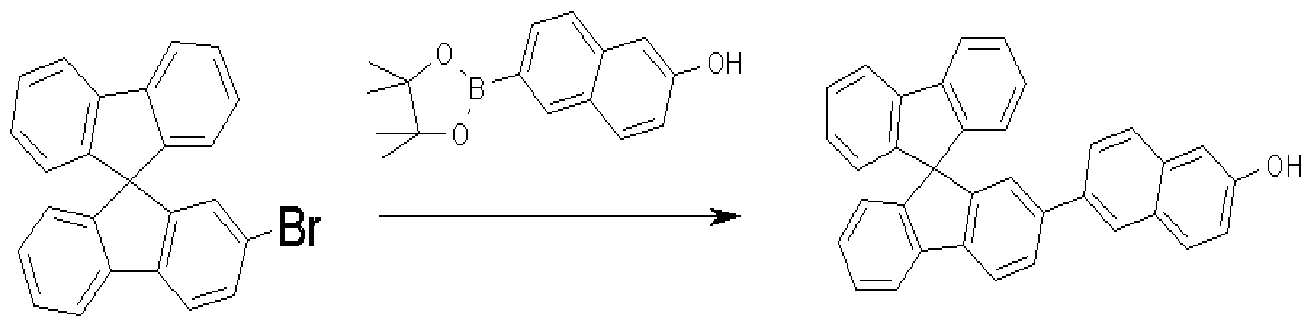
[87] A compound A-2 was prepared in the same manner as in the method for preparing the compound A-I of Preparation Example 1-1, except that in the method for preparing the compound A-I of Preparation Example 1-1, bromo spiro compound (26.5 g, 67 mmol) shown in the above reaction scheme was used instead of 6-bromo-2-naphtol, and 6-hydroxynaphthyl-2-boronate (18.0 g, 67 mmol) was used instead of naphthyl- 2-boronic acid. (27.5 g , yield 90%): MS [M+H]+ = 459
[88] Preparation Example 1-3: Preparation of Compound A-3 [89]

[90] A compound A-3 was prepared in the same manner as in the method for preparing the compound A-I of Preparation Example 1-1, except that in the method for preparing the compound A-I of Preparation Example 1-1, 9-bromo-lO-naphthylanthracene
compound (19.1 g, 50 mmol) was used instead of 6-bromo-2-naphtol, and 6-hydroxynaphthyl-2-boronate (13.5 g, 50 mmol) was used instead of naphthyl- 2-boronic acid. (20.5 g , yield 92%): MS [M+H]+ = 447
[91] Preparation Example 1-4: Preparation of Compound A-4 [92]

[93] A compound A-4 was prepared in the same manner as in the method for preparing the compound A-I of Preparation Example 1-1, except that in the method for preparing the compound A-I of Preparation Example 1-1, 6-bromo-2-naphtol (4.5 g, 20 mmol) was used, and 9,10-dinaphthylanthracenyl-2-boronate compound (11.1 g, 20 mmol) was used instead of naphthyl-2-boronic acid. (10 g , yield 87%): MS [M+H]+ = 573
[94] Preparation Example 1-5: Preparation of Compound A-5 [95]

[96] A compound A-5 was prepared in the same manner as in the method for preparing the compound A-I of Preparation Example 1-1, except that in the method for preparing the compound A-I of Preparation Example 1-1, 1-bromopyrene compound (10 g, 35.6 mmol) was used instead of 6-bromo-2-naphtol, and 6-hydroxynaphthyl-2-boronate (9.6 g, 35.6 mmol) was used instead of naphthyl-2-boronic acid (9.3 g , yield 76%): MS [M+H]+ = 345
[97] Preparation Example 1-6: Preparation of Compound A-6 [98]

[99] [Compound A -6-1] [100] A compound A-6 was prepared in the same manner as in the method for preparing the compound A-I of Preparation Example 1-1, except that in the method for preparing the compound A-I of Preparation Example 1-1, the compound A-6-1 shown in the above reaction scheme (10.5 g, 20 mmol) was used instead of 6-bromo-2-naphtol, and 6-hydroxynaphthyl-2-boronate (5.4 g, 20 mmol) was used instead of naphthyl- 2-boronic acid. (8.0 g , yield 68%): MS [M+H]+ = 589
[101] Preparation Example 1-7: Preparation of Compound A-7 [102]

[103] A compound A-7 was prepared in the same manner as in the method for preparing the compound A-I of Preparation Example 1-1, except that in the method for preparing the compound A-I of Preparation Example 1-1, 6-bromo-2-naphtol (11.2 g, 50 mmol) was used, and 6-hydroxynaphthyl-2-boronate (13.5 g, 50 mmol) was used instead of naphthyl-2-boronic acid. (11.2 g , yield 78%): MS [M+H]+ = 287
[104] Preparation Example II- 1: Preparation of Compound B-I [105]

[106] To the compound A-I prepared in the Preparation Example 1-1 (23.5 g, 87 mmol),
100 mL of CH Cl was added, and then triethylamine (13.3 g, 130.5 mmol) and triflu- oroacetic acid anhydride (25.8 g, 130.5 mmol) were slowly added drop wise while stirring the mixture. The resulting mixture was stirred at room temperature for 2 hours. Water and CH Cl were added to separate the organic layer, and the organic extract was dried over magnesium sulfate, and concentrated in vacuum. The residue was
purified with CH Cl /EtOH to prepare a compound B-I. (28.7 g , yield 90%): MS [M+H]+ = 403 [107] Preparation Example II-2: Preparation of Compound B-2
[108]

[109] A compound B-2 was prepared in the same manner as in the method for preparing the compound B-I of Preparation Example II- 1, except that in the method for preparing the compound B-I of Preparation Example II- 1, the compound A-2 prepared in the Preparation Example 1-2 (27.5 g, 60 mmol) was used instead of the compound A-I (29.6 g, yield 89%): MS [M+H]+ = 555
[HO] Preparation Example II-3: Preparation of Compound B-3 [111]

[112] A compound B-3 was prepared in the same manner as in the method for preparing the compound B-I of Preparation Example II- 1, except that in the method for preparing the compound B-I of Preparation Example II- 1, the compound A- 3 prepared in the Preparation Example 1-3 (20.5 g, 45.9 mmol) was used instead of the compound A-I. (19.7 g, yield 79%): MS [M+H]+ = 543
[113] Preparation Example II-4: Preparation of Compound B-4 [114]

[115] A compound B-4 was prepared in the same manner as in the method for preparing
the compound B-I of Preparation Example II- 1, except that in the method for preparing the compound B-I of Preparation Example II- 1, the compound A-4 prepared in the Preparation Example 1-4 (10 g, 17.5 mmol) was used instead of the compound A-I. (7.83 g, yield 67 %): MS [M+H]+ = 669
[116] Preparation Example II-5: Preparation of Compound B-5 [117]

[118] A compound B-5 was prepared in the same manner as in the method for preparing the compound B-I of Preparation Example II- 1, except that in the method for preparing the compound B-I of Preparation Example II- 1, the compound A- 5 prepared in the Preparation Example 1-5 (12 g, 34.8 mmol) was used instead of the compound A-I. (12.1g, yield 79%): MS [M+H]+ 441
[119] Preparation Example II-6: Preparation of Compound B-6 [120]

[121] A compound B-6 was prepared in the same manner as in the method for preparing the compound B-I of Preparation Example II- 1, except that in the method for preparing the compound B-I of Preparation Example II- 1, the compound A-6 prepared in the Preparation Example 1-6 (12 g, 20.4 mmol) was used instead of the compound A-I. (7.5 g, yield 54 %): MS [M+H]+ = 685
[122] Preparation Example II-7: Preparation of Compound B-7 [123]

[124] A compound B-7 was prepared in the same manner as in the method for preparing the compound B-I of Preparation Example II- 1, except that in the method for preparing the compound B-I of Preparation Example II- 1, the compound A-7 prepared
in the Preparation Example 1-7 (10 g, 35 mmol), triethylamine (8.6 g, 84 mmol) and trifluoroacetic acid anhydride (4.5 g, 84 mmol) were used instead of the compound A- 1. (2.2 g, yield 45 %): MS [M+H]+= 479 [125] Preparation Example II-8: Preparation of Compound B-8
[126]

[127] A solution of diphenylethylene (7.8 g, 43.3 mmol) in 100 mL of CCl 4 was maintained at -150C, and bromine (Br , 2.45 mL, 47.6 mmol) was slowly added thereto. 10 g of well-dried silica gel was added to the reactant, and then the resultant was stirred at 8O0C for 1 hour. The temperature of the reactant was lowered to ambient temperature, and the resultant was purified by column chromatography to prepare a compound B-8 having a bromine group introduced (10.7 g, yield 95%).
[128] MS [M+H]+= 259
[129] Preparation Example II-9: Preparation of Compound B-9
[130]

[131] To 6-bromo-2-naphthoic acid (5.0 g, 20 mmol), 20 mL of thionyl chloride (SOCl ), and dimethylformaldehyde (DMF, 1 mL) were added, and the mixture was stirred under heating for 4 hours. An excessive amount of thionyl chloride (SOCl ) was distilled off in vacuum, and then to the reaction mixture, 20 mL of N- methylpyrrolidine (NMP), and N-phenyl-l,2-diaminobenzene(3.7 g, 20 mmol) were added, and the mixture was stirred at 160 0C for 12 hours. The mixture was cooled to ambient temperature, and then an excessive amount of water was added thereto to form a solid. The solid was filtered, washed with water and then ethanol, and dried to prepare a compound B-9 (6.2 g, yield 78 %).
[132] MS [M+H]+ = 399
[133] Preparation Example 11-10: Preparation of Compound B-10
[134]

[Compound B- IO- I ] [Compound B- IO]
[135] Bromobenzene (4.24g, 27mmol) was diluted by 100 mL of tetrahydrofuran anhydride and maintained at D78°C. To the resulting mixture, n-BuLi (2.5M in Hex, 13.OmL, 32.4mmol) was added dropwise and then stirred for 40 minutes. 2,7-dibromofluorene (7.6g, 22.5mmol) was added. The reaction solution was stirred at D78°C for 4 hours. The temperature of the reaction solution was raised to ambient temperature, and the aqueous solution of 2N HCl was added to the reaction solution and then stirred for 6 hours. The layer was separated using ethylether and dried over magnesium anhydride. The separated organic solvent layer was subjected to reduced pressure in vacuum and purified by column chromatography (SiO , EtOAc/Hexane = 1/10) to prepare a compound B- 10-1 (6.6 g, yield 70 %).
[136] MS: [M-H2O]+=398 [137] The compound B-10-1 (6.6 g, 15.9 mmol) and benzene (10OmL) were mixed, CF SO H (1.6mL, 18.4 mmol) was added thereto, and the mixture was refluxed at 8O0C for 6 hours. Using an ice -bath, the reaction solution was cooled to O0C and a saturated aqueous solution of NaHCO was added thereto. The layer was separated using water and ethylacetate, and the organic layer was separated and dried over magnesium anhydride. Then, the organic layer was subjected to reduced pressure in vacuum, and recrystallized with THF/Hexane to prepare a compound B- 10 (7.0 g, yield 93%).
[138] MS : [M]+ = 476 [139] Preparation Example 11-11: Preparation of Compound B-Il [140]

[Compound B- 11- 1 ]
[141] A compound B-11-1 was prepared in the same manner as in the method for preparing the compound A-I of Preparation Example 1-1, except that in the method for preparing the compound A-I of Preparation Example 1-1, the compound B- 10 prepared in Preparation Example 11-10 (9.5 g, 20 mmol) was used instead of 6-bromo-2-naphtol, and naphthyl-2-boronic acid (3.4 g, 20 mmol) was used. (4.5 g , yield 43%): MS [M]+
= 523
[142]

[Compound B- l l - 1 ] [Compound B- l l - 2 ]
[143] A compound B-l l-2 was prepared in the same manner as in the method for preparing the compound A-I of Preparation Example 1-1, except that the compound B- 11-1 (4.5 g, 8.6 mmol) was used instead of 6-bromo-2-naphtol, and 6-hydroxynaphthyl-2-boronate (2.3 g, 8.6 mmol) was used instead of naphthyl- 2-boronic acid. (4.84 g , yield 96 %): MS [M+H]+ = 587
[144]

[Compound B- l l-2 ] [Compound B- I l .
[145] A compound B-I l was prepared in the same manner as in the method for preparing the compound B-I of Preparation Example II- 1, except that in the method for preparing the compound B-I of Preparation Example II- 1, the compound B-l l-2 (4.8 g, 8.2 mmol) was used instead of the compound A-I. (4.3 g, yield 76 %): MS [M+H]+ = 683
[146] Preparation Example 11-12: Preparation of Compound B-12 [147]

[148] [Compound B- 12-1] [149] A compound B- 12-1 was prepared in the same manner as in the method for preparing the compound A-I of Preparation Example 1-1, except that 6-bromo-2-naphthaldehyde (5.1 g, 21.5 mmol) was used instead of 6-bromo-2-naphtol, and 6-hydroxynaphthyl-2-boronate (5.8 g, 21.5 mmol) was used instead of naphthyl- 2-boronic acid. (5.3 g , yield 82 %): MS [M+H]+ = 299
[150]

[151] [Compound B- 12] [152] A compound B- 12 was prepared in the same manner as in the method for preparing the compound B-I of Preparation Example II- 1, except that in the method for preparing the compound B-I of Preparation Example II- 1, the compound B- 12-1 (5.3 g, 17.8 mmol) was used instead of the compound A-I. (3.9 g, yield 56 %): MS [M+H]+ = 395
[153] Preparation Example 11-13: Preparation of Compound B-13 [154]

[155] [Compound B- 13-1] [156] To the compound B- 12-1 of Preparation Example 11-12 (6.Og, 20 mmol), N- phenyl-l,2-diamino benzene (3.7 g, 20 mmol), 30 mL of toluene and 10 mL of acetic acid were added and stirred at 150 0C for 12 hours. The mixture was cooled to ambient temperature and an excessive amount of water was added thereto to form a solid. The solid was filtered, washed with water and then ethanol, and dried to prepare a compound B-13-1. (7.2 g, yield 78 %): MS [M+H]+ = 463
[157]

[158] [Compound B-13] [159] A compound B-13 was prepared in the same manner as in the method for preparing the compound B-I of Preparation Example II- 1, except that in the method for preparing the compound B-I of Preparation Example II- 1, the compound B-13-1 (6.2 g, 13.4 mmol) was used instead of the compound A-I. (5.8 g, yield 77 %): MS [M+H]+ = 559
[160] Preparation Example 11-14: Preparation of Compound B-14
[161]

[162] [Compound B- 14-1]
[163] 5,5'-Dibromo-2,2'-dithiophene (5.00 g, 15.4 mmol), phenylboric acid (2.07 g, 17.0 mmol) and sodium carbonate (4.90 g, 46.3 mmol) were suspended in a mixture of toluene (30 mL) and water (15 mL). To the suspension, tetrakis(triphenylphosphine)palladium (0.50 g, 0.46 mmol) was added. The resulting mixture was stirred under reflux for about 24 hours. The refluxed mixture was cooled to room temperature and extracted using chloroform. The organic extract was dried over magnesium sulfate, and concentrated in vacuum. The residue was purified by column chromatography (n-hexane) to prepare a phenylthiophene compound B- 14-1 (2.8O g, yield 75%).
[164] MS [M+H]+= 243
[165]

[166] [Compound B-14]
[167] To a solution of the compound B-14-1 prepared as the above (2.80 g, 11.6 mmol) in a mixture of chloroform (40 mL) and acetic acid (40 mL), N-bromosuccinimide (5.60 g, 2.1 mmol) was added at O0C. The mixture was heated to 6O0C, and stirred at the same temperature for about 1 hour. Thereafter, the mixture was cooled to room temperature, and stirred for about 24 hours. Then, the mixture was added to an aqueous potassium hydroxide solution, and the mixture was extracted using chloroform. The organic layer was dried over magnesium sulfate and concentrated in vacuum. The resultant was recrystallized from ethanol and purified to obtain a compound B-14 (1.83 g, yield 49%).
[168] MS [M+H]+= 321
[169] Preparation Example HI-I: Preparation of Compound C-I
[170]

[171] [Compound C-I]
[172] The compound B-I prepared in the Preparation Example II- 1 (28.7 g, 78 mmol), bis(pinacolato)diboron (23.4 g, 92 mmol) and potassium acetic acid (23 g, 234 mmol) were suspended in dioxane (400 mL). To the suspension, palladium(diphenylphosphinoferrocene)chloride (1.7 g, 2.34 mmol) was added. The mixtuer was stirred at 12O0C for about 6 hours and cooled to room temperature. The mixture was diluted by water (50 mL) and extracted using dichloromethane (3 x 50 mL). The organic extract was dried over magnesium sulfate and concentrated in vacuum. The resultant was washed with ethanol and dried in vacuum to prepare a compound C-I (27.3 g, yield 92 %): MS [M+H]+ = 381
[173] Preparation Example III-2: Preparation of Compound C-2
[174]

[175] [Compound C-2]
[176] A compound C-2 was prepared in the same manner as in the method for preparing the compound C-I of Preparation Example III- 1 , except that in the method for preparing the compound C-I of Preparation Example III- 1 , the compound B-2 prepared in the Preparation Example II-2 (12 g, 21.6 mmol) was used instead of the compound B-I. (11.3 g, yield 92 %): MS [M+H]+ = 569
[177] Preparation Example III-3: Preparation of Compound C-3
[178]

[179] [Comound C-3]
[180] A compound C-3 was prepared in the same manner as in the method for preparing
the compound C-I of Preparation Example III- 1 , except that in the method for preparing the compound C-I of Preparation Example III- 1 , the compound B-3 prepared in the Preparation Example II-3 (10 g, 18.4 mmol) was used instead of the compound B-I. (6.86 g, yield 67%): MS [M+H]+ = 557
[181] Preparation Example III-4: Preparation of Compound C-4 [182]

[183] [Comound C-4] [184] A compound C-4 was prepared in the same manner as in the method for preparing the compound C-I of Preparation Example III- 1 , except that in the method for preparing the compound C-I of Preparation Example III- 1 , the compound B-4 prepared in the Preparation Example II-4 (5 g, 7.5 mmol) was used instead of the compound B-I. (4.5 g, yield 87 %): MS [M+H]+ = 683
[185] Preparation Example III-5: Preparation of Compound C-5 [186]
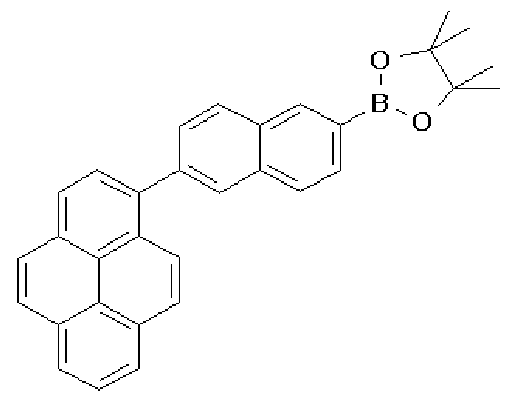
[187] [Comound C-5] [188] A compound C-5 was prepared in the same manner as in the method for preparing the compound C-I of Preparation Example III- 1 , except that in the method for preparing the compound C-I of Preparation Example III- 1 , the compound B-5 prepared in the Preparation Example II-5 (20 g, 45.4 mmol) was used instead of the compound B-I. (11.6 g, yield 56 %): MS [M+H]+ = 455
[189] Preparation Example III-6: Preparation of Compound C-6 [190]

[191] [Comound C-6] [192] A compound C-6 was prepared in the same manner as in the method for preparing the compound C-I of Preparation Example III- 1 , except that in the method for preparing the compound C-I of Preparation Example III- 1 , the compound B-6 prepared in the Preparation Example II-6 (20.5 g, 30 mmol) was used instead of the compound B-I. (15.1 g, yield 72 %): MS [M+H]+ = 699
[193] Preparation Example III-7: Preparation of Compound C-7 [194]

[195] [Comound C-7] [196] A compound C-7 was prepared in the same manner as in the method for preparing the compound C-I of Preparation Example III- 1 , except that in the method for preparing the compound C-I of Preparation Example III- 1 , the compound B-I l prepared in the Preparation Example II- 11 (31 g, 45.4 mmol) was used instead of the compound B-I. (28.8 g, yield 91 %): MS [M]+ =697
[197] Preparation Example III-8: Preparation of Compound C-8 [198]

[Comound C-8- 1 ] [Comound C-8]
[199] 6-bromo-2-naphthaldehyde (4.7g, 20 mmol) was mixed with 100 mL of toluene, 20 mL of ethylene glycol and p-toluene sulfonic acid (0.2g, 1.2 mmol) and the mixture was stirred under heating for 48 hours. The reaction mixture was cooled to ambient temperature and the toluene solvent was distilled off in vacuum under reduced pressure. Ethanol and a small amount of water were added thereto, and thus formed solid was filtered and dried to prepare a compound C-8-1 (5.14 g, yield 92%).
[200] MS [M]+ = 279
[201] The compound C-8-1 prepared as the above, 2-(6-bromonaphthalene)-l,3-dioxolane
(5 g, 17.9 mmol), was dissolved in anhydrous THF (60 rnL), and n-BuLi (26.9 mmol, 2.5M in hexane solution, 10.7 rnL) was added dropwise thereto at -780C under nitrogen atmosphere. The mixture was stirred for about 1 hour and trimethylborate (6.2 mL, 53.7 mmol) was added dropwise at -780C. After about 30 minutes, the ice bath was removed and the mixture was stirred at room temperature for about 3 hours. IN HCl (80 ml) was added to the mixture and the mixture was extracted using ethylacetate. The organic layer was dried over magnesium sulfate and concentrated in vacuum. A crude product was slurrified in petroleum ether, suction filtered, and dried to prepare 2-(6-formylnaphthalene)boronic acid compound C-8 (2.07 g, yield 57.8 %).
[202] Preparation Example III-9: Preparation of Compound C-9
[203]

[204] [Compound C-9]
[205] A compound C-9 was prepared in the same manner as in the method for preparing the compound C-8 of Preparation Example III-8, except that in the method for preparing the compound C-8 of Preparation Example III-8, the compound B-8 prepared in the Preparation Example II-8 (10.7 g, 41.3 mmol) was used instead of the compound C-8-1. (4.44 g, yield 48%)
[206] Preparation Example III-10: Preparation of Compound C-10
[207]

[208] [Comound C-10]
[209] A compound C-10 was prepared in the same manner as in the method for preparing the compound C-8 of Preparation Example III-8, except that in the method for preparing the compound C-8 of Preparation Example III-8, the compound B- 14 prepared in the Preparation Example 11-14 (18.3 g, 56.8 mmol) was used instead of the compound C-8-1 (7.1 g, yield 48.8%).
[210] Preparation Example III-ll: Preparation of Compound C-Il
[211]

[Comound C- 11- 1 ]
[212] A compound C-11-1 was prepared in the same manner as in the method for preparing the compound A-I of Preparation Example 1-1, except that in the method for preparing the compound A-I of Preparation Example 1-1, 6-bromo-2-naphtol (4.4 g, 20 mmol) was used, and the compound C-I of the Preparation Example III-l (7.6 g, 20 mmol) was used instead of naphthyl-2-boronic acid. (6.1g , yield 77%): MS [M+H]+ = 397
[213]

[214] [Comound C-ll-2]
[215] A compound C-l l-2 was prepared in the same manner as in the method for preparing the compound B-I of Preparation Example II- 1, except that in the method for preparing the compound B-I of Preparation Example II- 1, the compound C-11-1 (6.1 g, 15.4 mmol) was used instead of the compound A-I. (6.9 g, yield 91 %): MS [M+H]+ = 699
[216]

[Comound C- l l-2 ] [Comound C- I l ]
[217] A compound C-I l was prepared in the same manner as in the method for preparing the compound C-I of Preparation Example III-l, except that in the method for preparing the compound C-I of Preparation Example III-l, the compound C-l l-2 (6.0 g, 12.2 mmol) was used instead of the compound B-I. (3.5 g, yield 56 %): MS [M+H]+ = 507
[218] Example 1-1 : Preparation of Compound 1-17
[219]

[220] A compound 1-17 was prepared in the same manner as in the method for preparing the compound A-I of Preparation Example 1-1, except that in the method for preparing the compound A-I of Preparation Example 1-1, the compound C-I of the Preparation Example III-l (1.9 g, 5 mmol) was used instead of naphthyl-2-boronic acid, and the compound B-2 of the Preparation Example II-2 (2.8 g, 5mmol) was used instead of 6-bromo-2-naphtol. (3.0 g , yield 86 %): MS [M+H]+ = 695
[221] Example 1-2 : Preparation of Compound 2-41 [222]

[223] A compound 2-41 was prepared in the same manner as in the method for preparing the compound A-I of Preparation Example 1-1, except that in the method for preparing the compound A-I of Preparation Example 1-1, the compound C-2 of the Preparation Example III-2 (2.8 g, 5 mmol) was used instead of naphthyl-2-boronic acid, and the compound B-9 (2.0 g, 5 mmol) was used instead of 6-bromo-2-naphtol. (2.9 g , yield 77 %): MS [M+H]+ = 761
[224] Fig. 5 shows the synthesis data of the compound 2-41. [225] Example 1-3 : Preparation of Compound 2-43 [226]

[227] A compound 2-43 was prepared in the same manner as in the method for preparing the compound A-I of Preparation Example 1-1, except that in the method for preparing the compound A-I of Preparation Example 1-1, the compound C-2 of the Preparation Example III-2 (2.8 g, 5 mmol) was used instead of naphthyl-2-boronic acid, and the compound B-6 of the Preparation Example II-6 (3.4 g, 5 mmol) was used instead of
6-bromo-2-naphtol. (3.4 g , yield 67 %): MS [M+H]+ = 1013 [228] Example 1-4 : Preparation of Compound 1-157
[229]

[230] A compound 1-157 was prepared in the same manner as in the method for preparing the compound A-I of Preparation Example 1-1, except that in the method for preparing the compound A-I of Preparation Example 1-1, the compound C-I of the Preparation Example III-l (3.8 g, 10 mmol) was used instead of naphthyl-2-boronic acid, and the compound B-9 of the Preparation Example II-9 (4.0 g, 10 mmol) was used instead of 6-bromo-2-naphtol. (4.0 g , yield 70 %): MS [M+H]+ = 573
[231] Fig. 6 shows the synthesis data of the compound 1-157. [232] Example 1-5 : Preparation of Compound 1-173 [233]

[234] A compound 1-173 was prepared in the same manner as in the method for preparing the compound A-I of Preparation Example 1-1, except that in the method for preparing the compound A-I of Preparation Example 1-1, the compound C-I l of the Preparation Example III-l 1 (5.1 g, 10 mmol) was used instead of naphthyl-2-boronic acid, and the compound B-9 of the Preparation Example II-9 (4.0 g, 10 mmol) was used instead of 6-bromo-2-naphtol. (3.4 g , yield 49 %): MS [M+H]+ = 699
[235] Fig. 7 shows the synthesis data of the compound 1-173. [236] Example 1-6 : Preparation of Compound 1-166 [237]

[238] A compound 1-166 was prepared in the same manner as in the method for preparing
the compound A-I of Preparation Example 1-1, except that in the method for preparing the compound A-I of Preparation Example 1-1, naphthyl-2-boronic acid (1.7 g, 10 mmol) was used, and the compound B-6 of the Preparation Example II-6 (6.5 g, 9.5 mmol) was used instead of 6-bromo-2-naphtol. (6.0 g , yield 90 %): MS [M+H]+ = 699
[239] Fig. 8 shows the synthesis data of the compound 1-166. [240] Example 1-7 : Preparation of Compound 2-44 [241]

[242] A compound 2-44 was prepared in the same manner as in the method for preparing the compound A-I of Preparation Example 1-1, except that in the method for preparing the compound A-I of Preparation Example 1-1, the compound C-5 of the Preparation Example III-5 (4.5 g, 10 mmol) was used instead of naphthyl-2-boronic acid, and the compound B-9 of the Preparation Example II-9 (4.0 g, 10 mmol) was used instead of 6-bromo-2-naphtol. (3.6 g , yield 56 %): MS [M+H]+ = 647
[243] Fig. 9 shows the synthesis data of the compound 2-44. [244] Example 1-8 : Preparation of Compound 1-70 [245]

[246] A compound 1-70 was prepared in the same manner as in the method for preparing the compound A-I of Preparation Example 1-1, except that in the method for preparing the compound A-I of Preparation Example 1-1, the compound C-I of the Preparation Example III-l (3.8 g, 10 mmol) was used instead of naphthyl-2-boronic acid, and the compound 1-70-2 shown in the above reaction scheme (4.9g, 10 mmol) was used instead of 6-bromo-2-naphtol. (4.6 g , yield 72 %): MS [M+H]+ = 633
[247] Fig. 10 shows the synthesis data of the compound 1-70. [248] Example 1-9 : Preparation of Compound 1-71 [249]

[250] A compound 1-71 was prepared in the same manner as in the method for preparing the compound A-I of Preparation Example 1-1, except that in the method for preparing the compound A-I of Preparation Example 1-1, the compound C-I of the Preparation Example III-l (3.8 g, 10 mmol) was used instead of naphthyl-2-boronic acid, and the compound 1-71-2 shown in the above reaction scheme (4.9g, 10 mmol) was used instead of 6-bromo-2-naphtol. (4.2 g , yield 66 %): MS [M+H]+ = 633
[251] Fig. 11 shows the synthesis data of the compound 1-71. [252] Example 1-10 : Preparation of Compound 1-72 [253]

[254] A compound 1-72 was prepared in the same manner as in the method for preparing the compound A-I of Preparation Example 1-1, except that in the method for preparing the compound A-I of Preparation Example 1-1, the compound C-I of the Preparation Example III-l (3.8 g, 10 mmol) was used instead of naphthyl-2-boronic acid, and the compound B-3 of the Preparation Example II-3 (5.4 g, 10 mmol) was used instead of 6-bromo-2-naphtol. (5.0 g , yield 73 %): MS [M+H]+ = 683
[255] Fig. 12 shows the synthesis data of the compound 1-72. [256] Example 1-11 : Preparation of Compound 1-201 [257]

[258] To the compound C-11-2 prepared in the Preparation Exampl III-l 1 (2.5 g, 5.1 mmol), 80 mL of xylene was added, N-phenyl-3- perylenamine(1.7 g , 5.0 mmol), Na(O1Bu) (0.97g, 10 mmol), Pd(OAc) [O.Olg, 0.048mmol] and P(t-Bu) (O.Olg, 0.072 mmol) were added, and the mixture was stirred under heating at 14O0C for 3 hours. The
reaction temperature was lowered to ambient temperature and ethanol was added to the mixture to form a precipitate. The resulting solid was filtered, and dried. The solid was dissolved in an excessive amount of THF, and passed through a silica gel layer for purification. THF was removed in vacuum under reduced pressure, and purified with ethylacetate and ethanol to prepare a compound 1-201(2.3 g, yield 64 %). MS [M+H]+ = 722
[259] Example 2-1 : Preparation of Compound 1-18 [260]

[261] A compound 1-18 was prepared in the same manner as in the method for preparing the compound A-I of Preparation Example 1-1, except that in the method for preparing the compound A-I of Preparation Example 1-1, the compound C-I of the Preparation Example III-l (3.8 g, 10 mmol) was used instead of naphthyl-2-boronic acid, and the compound B- 10 of the Preparation Example 11-10 (2.1 g, 4.4 mmol) was used instead of 6-bromo-2-naphtol. (3.5 g , yield 97 %): MS [M+H]+ = 823
[262] Fig. 13 shows the synthesis data of the compound 1-18. [263] Example 2-2 : Preparation of Compound 2-45 [264]

[265] A compound 2-45 was prepared in the same manner as in the method for preparing the compound A-I of Preparation Example 1-1, except that in the method for preparing the compound A-I of Preparation Example 1-1, the compound C-7 of the Preparation Example III-7 (3.5 g, 5 mmol) was used instead of naphthyl-2-boronic acid, and the compound B-9 of the Preparation Example II-9 (1.9 g, 5 mmol) was used instead of 6-bromo-2-naphtol. (2.5 g , yield 56 %): MS [M+H]+ = 889
[266] Example 2-3 : Preparation of Compound 2-47 [267]

[268] A compound 2-47 was prepared in the same manner as in the method for preparing the compound A-I of Preparation Example 1-1, except that in the method for preparing the compound A-I of Preparation Example 1-1, the compound C-3 of the Preparation Example III-3 (5.6 g, 10 mmol) was used instead of naphthyl-2-boronic acid, and the compound 2-47-2 shown in the above reaction scheme (3.2 g, 10 mmol) was used instead of 6-bromo-2-naphtol. (3.5 g , yield 56 %): MS [M+H]+ = 633
[269] Example 2-4 : Preparation of Compound 2-8 [270]

[271] The compound C-I of the Preparation Example III-l (5 g, 12.6 mmol), Pd(OAc) [0.14 g, 0.63 mmol], n-Bu NBr (2.03 g, 6.3 mmol), K CO (1.74 g, 12.6 mmol), dimethylformaldehyde (DMF, 40 mL) and distilled water (H O, 10 mL) were mixed, and the mixture was stirred under heating for 12 hours. The mixture was cooled to ambient temperature, and then purified by column chromatography (THF/n-Hex = 1/4) to prepare a compound 2-8 (0.6 g, yield 7.4%).
[272] MS [M+H]+= 639 [273] Tm; 306.50C [274] Tg; 130.90C [275] Fig. 14 shows the synthesis data of the compound 2-8. [276] Example 2-5 : Preparation of Compound 2-50 [277]

[279] (2.5 g , yield 56 %): MS [M+H]+ = 875
[280] Example 2-6 : Preparation of Compound 2-51
[281]

[282] A compound 2-51 was prepared in the same manner as in the method for preparing the compound A-I of Preparation Example 1-1, except that in the method for preparing the compound A-I of Preparation Example 1-1, the compound C-4 of the Preparation Example III-4 (3.4 g, 5 mmol) was used instead of naphthyl-2-boronic acid, and the compound 2-51-2 shown in the above reaction scheme (2.0 g, 5 mmol) was used instead of 6-bromo-2-naphtol.
[283] (2.8 g , yield 67 %): MS [M+H]+ = 848
[284] Example 2-7 : Preparation of Compound 2-9
[285]
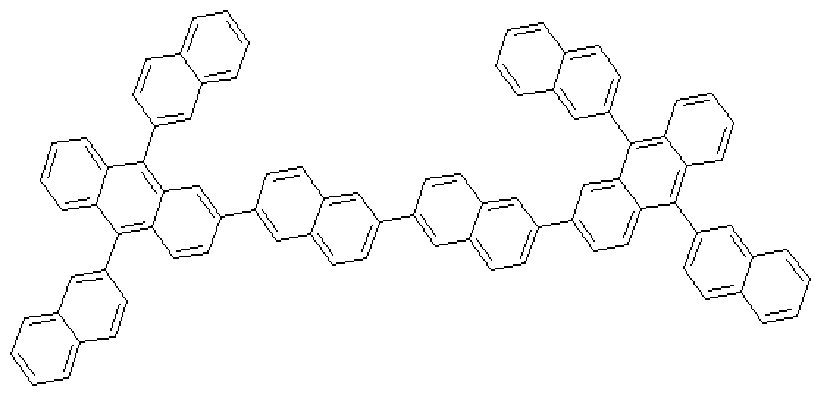
[286] The compound B-7 prepared in the Preparation Example II-7 (1.2 g, 2.5 mmol),
9,10-dinaphthylanthracenyl-2-boronate compound (4.1 g, 7.4 mmol), and sodium carbonate (1.34 g, 9.72 mmol) were suspended in a mixture of tetrahydrofuran (60 mL) and water (10 mL). To the suspension, tetrakis(triphenylphosphine)palladium (0.06 g, 0.05 mmol) was added. The mixture was stirred under reflux for about 24 hours, and then cooled to room temperature. The organic layer was separated, and the aqueous
layer was extracted using tetrahydrofuran. The combined organic extract was dried over magnesium sulfate, and concentrated in vacuum. The residue was purified with THF/EtOH to prepare a compound 2-9 (1.81 g, yield 65%): MS [M+H]+ = 1111 [287] Example 2-8 : Preparation of Compound 2-12
[288]

[289] A compound 2-12 was prepared in the same manner as in the method for preparing the compound A-I of Preparation Example 1-1, except that in the method for preparing the compound A-I of Preparation Example 1-1, the compound C-3 of the Preparation Example III-3 (5.6 g, 10 mmol) was used instead of naphthyl-2-boronic acid, and the compound B-3 of the Preparation Example II-3 (5.4 g, 10 mmol) was used instead of 6-bromo-2-naphtol. (4.6 g , yield 54 %): MS [M+H]+ = 859
[290] Example 2-9 : Preparation of Compound 2-38 [291]

[292] The compound B-7 prepared in the Preparation Example II-7 (l.lg, 2.30 mmol), the compound C-10 prepared in the Preparation Example III- 10 (1.86g, 7.29 mmol), and sodium carbonate (1.34 g, 9.72 mmol) were suspended in a mixture of tetrahydrofuran (60 mL) and water (10 mL). To the suspension, tetrakis(triphenylphosphine)palladium (0.06 g, 0.05 mmol) was added. The mixture was stirred under reflux for about 24 hours, and then cooled to room temperature. The organic layer was separated, and the aqueous layer was extracted using tetrahydrofuran. The combined organic extract was dried over magnesium sulfate, and concentrated in vacuum. The residue was purified with THF/EtOH to prepare a compound 2-38. (0.78g, yield 44%)
[293] MS [M+H]+= 735 [294] Example 2-10 : Preparation of Compound 2-49 [295]

[296] The compound B-7 prepared in the Preparation Example II-7 (1.16 g, 2.43 mmol), the compound C-9 prepared in the Preparation Example III-9 (1.3 g, 5.83 mmol), and sodium carbonate (1.34 g, 9.72 mmol) were suspended in a mixture of tetrahydrofuran (60 mL) and water (10 mL). To the suspension, tetrakis(triphenylphosphine)palladium (0.06 g, 0.05 mmol) was added. The mixture was stirred under reflux for about 24 hours, and then cooled to room temperature. The organic layer was separated, and the aqueous layer was extracted using tetrahydrofuran. The combined organic extract was dried over magnesium sulfate, and concentrated in vacuum. The residue was purified with THF/EtOH to prepare a compound 2-49. (0.9 g, yield 61 %):
[297] MS [M+H]+ = 611
[298] Example 2-11 : Preparation of Compound 2-53
[299]

[300] To the compound B-I prepared in the Preparation Exampl II- 1 (3.7 g, 10 mmol),
100 mL of xylene was added, N-phenylbenzidine (1.4 g , 4.2 mmol), Na(O1Bu) (0.97 g, 10 mmol), Pd(OAc) [0.02 g, 0.096 mmol] and P(t-Bu) (0.02 g, 0.144 mmol) were added, and the mixture was stirred under heating at 14O0C for 3 hours. The reaction temperature was lowered to ambient temperature and ethanol was added to the mixture to form a precipitate. The resulting solid was filtered, and dried. The solid was dissolved in an excessive amount of THF, and passed through a silica gel layer for purification. THF was removed in vacuum under reduced pressure, and purified with ethylacetate and ethanol to prepare a compound 2-53 (5.2 g, yield 62 %).
[301] MS [M+H]+ = 841
[302] As described in the Preparation Examples, a variety of intermediates can be synthesized. In addition, as described in the Examples, a variety of derivatives as shown in Table 1 and 2 can be prepared under a Pd catalyst by a variety of combination of the intermediates synthesized as above.
[303] Experimental Example 1 : [304] A glass substrate on which a thin film of ITO (indium tin oxide) was coated to a thickness of 1500 A was immersed in distilled water having a detergent dissolved therein to wash the substrate with ultrasonic waves. At this time, the detergent was a product commercially available from Fisher Co. and the distilled water was distilled water which had been twice filtered by using a filter commercially available from Millipore Co. ITO was washed for 30 minutes, and then washing with ultrasonic waves was repeated twice for 10 minutes by using distilled water. After the completion of washing with distilled water, washing with ultrasonic waves was carried out by using solvents such as isopropyl alcohol, acetone and methanol. The resultant product was dried, and then transported to a plasma washing machine. Using an oxygen plasma, the substrate was washed for 5 minutes and then transported to a vacuum depositing machine.
[305] On the ITO transparent electrode thus prepared, hexanitrile hexaazatriphenylene was coated to thicknesses of 500 A by thermal vacuum deposition to form a hole- injecting layer. NPB (400 A) as a hole-transporting material was vacuum deposited, and then an Alq3 compound was vacuum deposited to thicknesses of 300 A for a light- emitting layer.
[306]
[Hexanitrile hexaazatriphenylene ]

[NBP ]

[AIq3 ]

[307] The compound 2-41 as prepared in Example 1-2 was vacuum deposited on the
light-emitting layer to thickness of 200 A to form an electron-injecting and - transporting layer. Lithium fluoride (LiF) and aluminum were sequentially deposited on the electron-injecting and -transporting layer to thicknesses of 12 A and 2000 A respectively, to form a cathode.
[308] In the above process, the deposition rate of the organic material was maintained at 1
A/sec, the deposition rate of lithium fluoride was maintained at 0.2 A/sec and the deposition rate of aluminum was maintained at 3 to 7 A/sec.
[309] When a forward electric field of 7.2 V was applied to the organic light-emitting device as prepared above, green light emission was observed with x = 0.33 and y = 0.55 based on the 1931 CIE color coordinate at a current density of 50 mA/D. When a forward electric field of 7.9 V was applied, green light emission of 3.1 cd/A was observed at a current density of 100 mA/D.
[310] Experimental Example 2 :
[311] On the ITO electrode as prepared as in Experimental Example 1, hexanitrile hex- aazatriphenylene (500 A, 4,4'-bis[N-(l-naphthyl)-N-phenylamino]biphenyl (NPB) (400 A), AIq (300 A), the compound 1-157 prepared in Example 1-4 (300 A), lithium fluoride(LiF) (12 A) were sequentially coated by thermal vacuum deposition, to form a hole-injecting layer, a hole-transporting layer, a light-emitting layer, an electron- transporting layer and an electron-injecting layer in this order. Aluminum was deposited thereon to a thickness of 2000 A to form a cathode, and then to prepare an organic light-emitting device.
[312] When a forward electric field of 6.12 V was applied to the organic light-emitting device as prepared above, green light emission was observed with x = 0.32 and y = 0.58 based on the 1931 CIE color coordinate at a current density of 50 mA/D. When a forward electric field of 7.4 V was applied, green light emission of 2.9 cd/A was observed at a current density of 100 mA/D.
[313] Experimental Example 3 :
[314] On the ITO electrode as prepared as in Experimental Example 1, hexanitrile hex- aazatriphenylene (500 A), 4,4'-bis[N-(l-naphthyl)-N-phenylamino]biphenyl (NPB) (400 A), AIq (300 A), the compound 1-166 prepared in Example 1-6 (300 A), lithium fluoride(LiF) (12 A) were sequentially coated by thermal vacuum deposition, to form a hole-injecting layer, a hole-transporting layer, a light-emitting layer, an electron- transporting layer and an electron-injecting layer in this order. Aluminum was deposited thereon to a thickness of 2000 A to form a cathode, and then to prepare an organic light-emitting device.
[315] When a forward electric field of 7.3 V was applied to the organic light-emitting device as prepared above, green light emission was observed with x = 0.33 and y = 0.56 based on the 1931 CIE color coordinate at a current density of 50 mA/D. When a
forward electric field of 8.9 V was applied, green light emission of 3.3 cd/A was observed at a current density of 100 mA/D.
[316] Experimental Example 4 :
[317] On the ITO electrode as prepared as in Experimental Example 1, hexanitrile hex- aazatriphenylene (500 A), 4,4'-bis[N-(l-naphthyl)-N-phenylamino]biphenyl (NPB) (400 A), AIq (300 A), the compound 2-8 prepared in Example 2-4 (300 A), lithium fluoride(LiF) (12 A) were sequentially coated by thermal vacuum deposition, to form a hole-injecting layer, a hole-transporting layer, a light-emitting layer, an electron- transporting layer and an electron-injecting layer in this order. Aluminum was deposited thereon to a thickness of 2000 A to form a cathode, and then to prepare an organic light-emitting device.
[318] When a forward electric field of 8.9 V was applied to the organic light-emitting device as prepared above, green light emission was observed with x = 0.33 and y = 0.54 based on the 1931 CIE color coordinate at a current density of 50 mA/D. When a forward electric field of 10.7 V was applied, green light emission of 3.7 cd/A was observed at a current density of 100 mA/D.
[319] Experimental Example 5 :
[320] On the ITO electrode as prepared as in Experimental Example 1, hexanitrile hex- aazatriphenylene (500 A), 4,4'-bis[N-(l-naphthyl)-N-phenylamino]biphenyl (NPB) (400 A), AIq (300 A), the compound 2-44 prepared in Example 1-7 (300 A), lithium fluoride(LiF) (12 A) were sequentially coated by thermal vacuum deposition, to form a hole-injecting layer, a hole-transporting layer, a light-emitting layer, an electron- transporting layer and an electron-injecting layer in this order. Aluminum was deposited thereon to a thickness of 2000 A to form a cathode, and then to prepare an organic light-emitting device.
[321] When a forward electric field of 7.1 V was applied to the organic light-emitting device as prepared above, green light emission was observed with x = 0.31 and y = 0.54 based on the 1931 CIE color coordinate at a current density of 50 mA/D. When a forward electric field of 8.6 V was applied, green light emission of 3.5 cd/A was observed at a current density of 100 mA/D.
[322] Experimental Example 6 :
[323] On the ITO electrode as prepared as in Experimental Example 1, hexanitrile hex- aazatriphenylene (500 A), 4,4'-bis[N-(l-naphthyl)-N-phenylamino]biphenyl (NPB) (400 A), the compound 1-71 prepared in Example 1-9 (300 A), AIq (300 A), lithium fluoride(LiF) (12 A) were sequentially coated by thermal vacuum deposition, to form a hole-injecting layer, a hole-transporting layer, a light-emitting layer, an electron- transporting layer and an electron-injecting layer in this order. Aluminum was deposited thereon to a thickness of 2000 A to form a cathode, and then to prepare an
organic light-emitting device.
[324] When a forward electric field of 7.9 V was applied to the organic light-emitting device as prepared above, blue light emission was observed with x = 0.137 and y = 0.281 based on the 1931 CIE color coordinate at a current density of 50 mA/D. When a forward electric field of 9.6 V was applied, blue light emission of 2.6 cd/A was observed at a current density of 100 mA/D.
[325] Experimental Example 7 :
[326] On the ITO electrode as prepared as in Experimental Example 1, hexanitrile hex- aazatriphenylene (500 A), 4,4'-bis[N-(l-naphthyl)-N-phenylamino]biphenyl (NPB) (400 A), the compound 1-72 prepared in Example 1-10 (300 A), AIq (300 A), lithium fluoride(LiF) (12 A) were sequentially coated by thermal vacuum deposition, to form a hole-injecting layer, a hole-transporting layer, a light-emitting layer, an electron- transporting layer and an electron-injecting layer in this order. Aluminum was deposited thereon to a thickness of 2000 A to form a cathode, and then to prepare an organic light-emitting device.
[327] When a forward electric field of 6.7 V was applied to the organic light-emitting device as prepared above, blue light emission was observed with x = 0.136 and y = 0.154 based on the 1931 CIE color coordinate at a current density of 50 mA/D. When a forward electric field of 7.9 V was applied, blue light emission of 2.9 cd/A was observed at a current density of 100 mA/D.
[328]
[329]
Claims
(1) wherein Rl and R2 may be same or different from each other, and are each respectively selected from the group consisting of a substituted or unsubstituted alkenyl group, a substituted or unsubstituted aryl group, a substituted or unsubstituted heteroaromatic group, and a substituted or unsubstituted arylamino group, provided that one of Rl and R2 may be hydrogen.
[2] The binaphthalene derivative according to claim 1, wherein the substituted or unsubstituted alkenyl group includes an alkenyl group unsubstituted or substituted by a substituted or unsubstituted C ~C aryl group or a substituted or unsubstituted C ~C heteroaryl group.
[3] The binaphthalene derivative according to claim 1, wherein the substituted or unsubstituted aryl group includes a C ~C aryl group unsubstituted or substituted by at least one group selected from the group consisting of a halogen atom, an amino group, a nitrile group, a nitro group, an alkylboronate, a C ~C alkyl group, a C ~C alkenyl group, a C ~C alkoxy group, a C ~C cycloalkyl group, a C ~C heterocycloalkyl group, a C ~C aryl group, a C ~C heteroaryl group and a C ~C arylamino group.
6 30
[4] The binaphthalene derivative according to claim 1, wherein the substituted or unsubstituted heteraromatic group includes a C ~C heteroaromatic group unsubstituted or substituted by at least one group selected from the group consisting of a halogen atom, an amino group, a nitrile group, a nitro group, an alkylboronate, a C ~C alkyl group, a C ~C alkenyl group, a C ~C alkoxy group, a C ~C cycloalkyl group, a C ~C heterocycloalkyl group, a C ~C aryl group, a C ~C heteroaryl group and a C ~C arylamino group.
[5] The binaphthalene derivative according to claim 1, wherein the substituted or unsubstituted arylamino group includes a C ~C arylamino group unsubstituted or
6 30 substituted by at least one group selected from the group consisting of a halogen atom, an amino group, a nitrile group, a nitro group, an alkylboronate, a C ~C alkyl group, a C ~C alkenyl group, a C ~C alkoxy group, a C ~C cycloalkyl group, a C ~C heterocycloalkyl group, a C ~C aryl group, a C ~C heteroaryl group and a C ~C arylamino group. [6] The binaphthalene derivative according to claim 5, wherein the substituted or un-
substituted arylamino group includes a substituted or unsubstituted carbazolyl group.
[7] The binaphthalene derivative according to claim 1, wherein Rl or R2 in the formula (1) is selected from the following formulas:


In the above structural formulas, X, X , X and X may be each respectively the same or different from each other, and are each selected from the group consisting of hydrogen, a substituted or unsubstituted alkyl group, a substituted or unsubstituted alkoxy group, a substituted or unsubstituted alkenyl group, a substituted or unsubstituted aryl group, a substituted or unsubstituted arylamine group, a substituted or unsubstituted heterocyclic group, a substituted or unsubstituted alicyclic group, a substituted or unsubstituted silicon group, a substituted or unsubstituted boron group, a substituted or unsubstituted amino group, a nitrile group, a nitro group, a halogen group, a substituted or unsubstituted amide group, and a substituted or unsubstituted ester group, and these may form an aliphatic, aromatic, or heterocyclic fused ring, together with the adjacent group.
[8] The binaphthalene derivative according to claim 1, wherein, in the formula (1), Rl is hydrogen and R2 is selected from the groups shown in the following table:


[9] The binaphthalene derivative according to claim 1, wherein, in the formula (1), Rl and R2 are selected from the groups shown in the following table:


[10] A method for preparing the binaphthalene derivatives according to claim 1, comprising the steps of
(a) reacting a naphtol derivative compound with trifluoroacetic acid anhydride under the presence of a base; and
(b) reacting the compound obtained from the step (a) with naphthalene boron ester compound or naphthalene boronic compound under the presence of a palladium[II] catalyst and a base using Suzuki-coupling process.
[H] A method for preparing the binaphthalene derivatives according to claim 1, comprising the steps of
(a) reacting a naphtol derivative compound with trifluoroacetic acid anhydride under the presence of a base; and
(b) reacting the compound obtained from the step (a) with a bispinacolatodiboron reagent under the presence of a palladium[II] catalyst and a base; and
(c) reacting the compound obtained from the step (b) with a bromonaphthalene derivative or a trifluoroacetoxynaphthalene derivative under the presence of a palladium[II] catalyst and a base using Suzuki-coupling process.
[12] An organic electronic device comprising a first electrode, a second electrode, and
an organic material layer having at least one layer interposed between the first electrode and the second electrode, wherein at least one layer of the organic material layers comprises the compound of claim 1.
[13] The organic electronic device according to claim 12, wherein the organic material layer comprises a hole-injecting layer and a hole-transporting layer, and the hole-injecting layer and the hole-transporting layer comprise the compound of claim 1.
[14] The organic electronic device according to claim 12, wherein the organic material layer comprises a light-emitting layer, and the light-emitting layer comprises the compound of claim 1.
[15] The organic electronic device according to claim 12, wherein the organic material layer comprises an electron-transporting layer, and the electron- transporting layer comprises the compound of claim 1.
[16] The organic electronic device according to claim 12, wherein the organic electronic device is selected from the group consisting of an organic light- emitting device, an organic solar cell, an organic photoconductor (OPC) and an organic transistor.
Priority Applications (3)
| Application Number | Priority Date | Filing Date | Title |
|---|---|---|---|
| EP06799356.8A EP1937616B1 (en) | 2005-10-21 | 2006-10-20 | New binaphthalene derivatives, preparation method thereof and organic electronic device using the same |
| CN2006800392961A CN101291897B (en) | 2005-10-21 | 2006-10-20 | New binaphthalene derivatives, preparation method thereof and organic electronic device using the same |
| JP2008536502A JP4991737B2 (en) | 2005-10-21 | 2006-10-20 | Novel binaphthalene derivative, method for producing the same, and organic electronic device using the same |
Applications Claiming Priority (2)
| Application Number | Priority Date | Filing Date | Title |
|---|---|---|---|
| KR10-2005-0099873 | 2005-10-21 | ||
| KR20050099873 | 2005-10-21 |
Publications (1)
| Publication Number | Publication Date |
|---|---|
| WO2007046658A1 true WO2007046658A1 (en) | 2007-04-26 |
Family
ID=37962713
Family Applications (1)
| Application Number | Title | Priority Date | Filing Date |
|---|---|---|---|
| PCT/KR2006/004282 Ceased WO2007046658A1 (en) | 2005-10-21 | 2006-10-20 | New binaphthalene derivatives, preparation method thereof and organic electronic device using the same |
Country Status (7)
| Country | Link |
|---|---|
| US (2) | US8674138B2 (en) |
| EP (1) | EP1937616B1 (en) |
| JP (1) | JP4991737B2 (en) |
| KR (2) | KR100878115B1 (en) |
| CN (1) | CN101291897B (en) |
| TW (1) | TWI313675B (en) |
| WO (1) | WO2007046658A1 (en) |
Cited By (25)
| Publication number | Priority date | Publication date | Assignee | Title |
|---|---|---|---|---|
| EP2031036A1 (en) * | 2007-08-31 | 2009-03-04 | Semiconductor Energy Laboratory Co., Ltd. | Light-emitting element, light-emitting device, and electronic appliance |
| EP2045231A1 (en) | 2007-10-03 | 2009-04-08 | Canon Kabushiki Kaisha | Binaphthyl compound and organic light emitting element using the same |
| WO2009084544A1 (en) * | 2007-12-27 | 2009-07-09 | Idemitsu Kosan Co., Ltd. | Nitrogen-containing heterocyclic derivative and organic electroluminescent device using the same |
| EP2075307A3 (en) * | 2007-12-25 | 2009-08-12 | Yamagata Promotional Organization for Industrial Technology | Organic electroluminescence material and element using the same |
| KR20100017960A (en) * | 2007-06-01 | 2010-02-16 | 이 아이 듀폰 디 네모아 앤드 캄파니 | Charge transport materials for luminescent applications |
| KR20100039369A (en) | 2007-07-07 | 2010-04-15 | 이데미쓰 고산 가부시키가이샤 | Organic electroluminescent device and material for organic electroluminescent device |
| WO2010044607A1 (en) * | 2008-10-14 | 2010-04-22 | Cheil Industries Inc. | Benzimidazole compounds and organic photoelectric device with the same |
| WO2010074181A1 (en) | 2008-12-26 | 2010-07-01 | 出光興産株式会社 | Organic electroluminescence element and compound |
| WO2010074087A1 (en) | 2008-12-26 | 2010-07-01 | 出光興産株式会社 | Material for organic electroluminescent element, and organic electroluminescent element |
| WO2010076878A1 (en) | 2009-01-05 | 2010-07-08 | 出光興産株式会社 | Organic electroluminescent element material and organic electroluminescent element comprising same |
| EP2100941A3 (en) * | 2008-03-14 | 2010-10-06 | Gracel Display Inc. | Novel organic electroluminescent compounds and organic electroluminescent device using the same |
| US8021574B2 (en) | 2007-07-07 | 2011-09-20 | Idemitsu Kosan Co., Ltd. | Naphthalene derivative, material for organic electroluminescence device, and organic electroluminescence device using the same |
| US8039129B2 (en) | 2009-04-06 | 2011-10-18 | Idemitsu Kosan Co., Ltd. | Organic electroluminescence device and material for organic electroluminescence device |
| US8039127B2 (en) | 2009-04-06 | 2011-10-18 | Idemitsu Kosan Co., Ltd. | Organic electroluminescence device and material for organic electroluminescence device |
| US8154195B2 (en) | 2007-07-07 | 2012-04-10 | Idemitsu Kosan Co., Ltd. | Organic electroluminescence device and material for organic electroluminescence device |
| US8211552B2 (en) | 2007-07-07 | 2012-07-03 | Idemitsu Kosan Co., Ltd. | Organic electroluminescence device |
| US8288012B2 (en) | 2006-12-28 | 2012-10-16 | Semiconductor Energy Laboratory Co., Ltd. | Anthracene derivatives and light-emitting devices using the anthracene derivatives |
| US8551624B2 (en) | 2008-12-01 | 2013-10-08 | E I Du Pont De Nemours And Company | Electroactive materials |
| US8759818B2 (en) | 2009-02-27 | 2014-06-24 | E I Du Pont De Nemours And Company | Deuterated compounds for electronic applications |
| US8779655B2 (en) | 2007-07-07 | 2014-07-15 | Idemitsu Kosan Co., Ltd. | Organic electroluminescence device and material for organic electroluminescence device |
| US8941099B2 (en) | 2010-07-07 | 2015-01-27 | Universal Display Corporation | Organic light emitting device and materials for use in same |
| US9153790B2 (en) | 2009-05-22 | 2015-10-06 | Idemitsu Kosan Co., Ltd. | Organic electroluminescent device |
| US9379336B2 (en) | 2012-08-31 | 2016-06-28 | Nitto Denko Corporation | Compounds for use in light emitting devices |
| WO2018221986A1 (en) * | 2017-05-31 | 2018-12-06 | 주식회사 엘지화학 | Novel heterocyclic compound and organic light emitting element using same |
| WO2023239193A1 (en) * | 2022-06-10 | 2023-12-14 | 주식회사 엘지화학 | Novel compound and organic light-emitting device using same |
Families Citing this family (22)
| Publication number | Priority date | Publication date | Assignee | Title |
|---|---|---|---|---|
| CN1914293B (en) | 2003-12-19 | 2010-12-01 | 出光兴产株式会社 | Luminescent material for organic electroluminescent device, organic electroluminescent device using same, and material for organic electroluminescent device |
| EP1937616B1 (en) * | 2005-10-21 | 2014-12-17 | LG Chem, Ltd. | New binaphthalene derivatives, preparation method thereof and organic electronic device using the same |
| KR100989467B1 (en) * | 2006-12-06 | 2010-10-22 | 주식회사 엘지화학 | Novel fluorene derivative and organic electronic device using same |
| TWI479712B (en) | 2007-10-19 | 2015-04-01 | Semiconductor Energy Lab | Light-emitting device |
| KR101511379B1 (en) * | 2008-04-08 | 2015-04-10 | 동우 화인켐 주식회사 | Asymmetric naphthalenylcarbazole derivatives, the organic thin layer material and the organic electroluminescent element employing the same |
| EP2200407B1 (en) * | 2008-12-17 | 2017-11-22 | Semiconductor Energy Laboratory Co., Ltd. | Light-Emitting element, light emitting device, and electronic device |
| KR100972993B1 (en) | 2009-08-03 | 2010-07-30 | 주식회사 유피케미칼 | Organic compounds for organic electroluminescent device and organic electroluminescent device using same |
| CN104744349B (en) * | 2010-11-04 | 2017-09-22 | 捷恩智株式会社 | Electron transport material and use its organic electroluminescent element |
| JP5946264B2 (en) | 2011-11-16 | 2016-07-06 | ユー・ディー・シー アイルランド リミテッド | ORGANIC ELECTROLUMINESCENT ELEMENT, ORGANIC ELECTROLUMINESCENT ELEMENT MATERIAL, LIGHT EMITTING DEVICE, DISPLAY DEVICE AND LIGHTING DEVICE USING THE ELEMENT |
| CN104364250B (en) | 2012-04-13 | 2017-05-31 | 株式会社Lg化学 | New nitrogen-containing heterocyclic compounds and organic electronic devices using them |
| CN102898352A (en) * | 2012-10-26 | 2013-01-30 | 吉林奥来德光电材料股份有限公司 | Efficient organic fluorescent material and preparation method of efficient organic fluorescent material |
| KR101499356B1 (en) * | 2013-06-28 | 2015-03-05 | 주식회사 엘지화학 | Hetero-cyclic compound and organic light emitting device comprising the same |
| KR102181234B1 (en) | 2013-08-28 | 2020-11-23 | 삼성디스플레이 주식회사 | Compound and organic light emitting device comprising the same |
| KR101837565B1 (en) | 2014-08-06 | 2018-03-12 | 삼성에스디아이 주식회사 | Organic compound and organic optoelectric device and display device |
| KR101778742B1 (en) | 2015-12-24 | 2017-09-14 | 에스케이씨 주식회사 | Composition for the formation of a protective thin film having high heat resistance and chemical resistance, and method for preparing a protective thin film using same |
| KR102064993B1 (en) | 2017-05-31 | 2020-01-10 | 주식회사 엘지화학 | Novel hetero-cyclic compound and organic light emitting device comprising the same |
| KR102064994B1 (en) * | 2017-05-31 | 2020-01-10 | 주식회사 엘지화학 | Novel hetero-cyclic compound and organic light emitting device comprising the same |
| KR102214595B1 (en) | 2018-09-20 | 2021-02-10 | 주식회사 엘지화학 | Organic light emitting device |
| CN109912563A (en) * | 2019-04-10 | 2019-06-21 | 宁波大学 | A kind of derivative containing trifluoromethyl thiophene and its preparation method and use |
| CN111233676B (en) * | 2020-01-17 | 2022-03-29 | 华南理工大学 | High-performance hole transport material and preparation and application thereof |
| KR20240078109A (en) * | 2022-11-25 | 2024-06-03 | 엘지디스플레이 주식회사 | Organic light emitting diode |
| CN117720491A (en) * | 2023-06-30 | 2024-03-19 | 宁波卢米蓝新材料有限公司 | An organic electroluminescent compound and its application |
Citations (7)
| Publication number | Priority date | Publication date | Assignee | Title |
|---|---|---|---|---|
| EP1009043A2 (en) | 1998-12-09 | 2000-06-14 | Eastman Kodak Company | Electroluminescent device with polyphenyl hydrocarbon hole transport layer |
| JP2003081923A (en) | 2001-09-17 | 2003-03-19 | Mitsui Chemicals Inc | Amine compound and organic electroluminescent element containing the same |
| JP2004018510A (en) | 2002-06-20 | 2004-01-22 | Nippon Hoso Kyokai <Nhk> | Compound, and optical device, electronic device, electroluminescent element, transistor, display device, and display device using the compound |
| JP2005019219A (en) | 2003-06-26 | 2005-01-20 | Sony Corp | Organic EL light emitting device |
| US20050095456A1 (en) * | 2003-10-01 | 2005-05-05 | International Business Machines Corporation | Organic electroluminescence device and method of manufacture |
| WO2005061656A1 (en) | 2003-12-19 | 2005-07-07 | Idemitsu Kosan Co., Ltd. | Light-emitting material for organic electroluminescent device, organic electroluminescent device using same, and material for organic electroluminescent device |
| EP1864962A1 (en) | 2005-03-28 | 2007-12-12 | Idemitsu Kosan Co., Ltd. | Anthrylarylene derivative, material for organic electroluminescent device, and organic electroluminescent device using same |
Family Cites Families (19)
| Publication number | Priority date | Publication date | Assignee | Title |
|---|---|---|---|---|
| JPH0586009A (en) * | 1991-09-24 | 1993-04-06 | Mita Ind Co Ltd | Azo-based compound and diazonium salt |
| DE69422256D1 (en) * | 1993-10-15 | 2000-01-27 | Merck Patent Gmbh | Reactive liquid crystal compounds |
| US5766510A (en) * | 1995-08-25 | 1998-06-16 | Dai Nippon Printing Co., Ltd. | Liquid crystalline compound and use thereof |
| US5935721A (en) * | 1998-03-20 | 1999-08-10 | Eastman Kodak Company | Organic electroluminescent elements for stable electroluminescent |
| JP4112719B2 (en) | 1998-12-25 | 2008-07-02 | 出光興産株式会社 | Aromatic hydrocarbon compound and organic electroluminescence device using the same |
| JP2000273055A (en) | 1999-03-25 | 2000-10-03 | Idemitsu Kosan Co Ltd | Distyrylarylene derivatives and organic electroluminescent devices using the same |
| JP2001097897A (en) * | 1999-09-30 | 2001-04-10 | Idemitsu Kosan Co Ltd | Organic compound and organic electroluminescent device using the same |
| JP3825969B2 (en) * | 1999-11-29 | 2006-09-27 | キヤノン株式会社 | Conductive element and manufacturing method thereof |
| JP2004107292A (en) | 2002-09-20 | 2004-04-08 | Tosoh Corp | Novel binaphthalene derivative and method for producing the same |
| US6872475B2 (en) * | 2002-12-03 | 2005-03-29 | Canon Kabushiki Kaisha | Binaphthalene derivatives for organic electro-luminescent devices |
| EP2174932B1 (en) * | 2003-03-13 | 2019-07-03 | Idemitsu Kosan Co., Ltd. | Nitrogen-containing heterocycle derivative and organic electroluminescent element using the same |
| JP4001118B2 (en) * | 2003-03-24 | 2007-10-31 | ソニー株式会社 | Organic electroluminescent device and amino monostyryl naphthalene compound |
| JP4802479B2 (en) | 2004-02-18 | 2011-10-26 | Jnc株式会社 | Polymerizable binaphthalene derivative |
| WO2005090365A1 (en) | 2004-03-18 | 2005-09-29 | Sharp Kabushiki Kaisha | Organosilanes, process for production of the same, and use thereof |
| WO2005112519A1 (en) | 2004-05-14 | 2005-11-24 | Idemitsu Kosan Co., Ltd. | Organic electroluminescent device |
| JPWO2005123634A1 (en) * | 2004-06-16 | 2008-04-10 | 出光興産株式会社 | Fluorene derivative and organic electroluminescence device using the same |
| US20100025661A1 (en) | 2004-07-02 | 2010-02-04 | Guofang Wang | Luminescent material and organic electroluminescent device using the same |
| JP4788202B2 (en) | 2004-07-09 | 2011-10-05 | Jnc株式会社 | Luminescent material and organic electroluminescent device using the same |
| EP1937616B1 (en) * | 2005-10-21 | 2014-12-17 | LG Chem, Ltd. | New binaphthalene derivatives, preparation method thereof and organic electronic device using the same |
-
2006
- 2006-10-20 EP EP06799356.8A patent/EP1937616B1/en not_active Not-in-force
- 2006-10-20 WO PCT/KR2006/004282 patent/WO2007046658A1/en not_active Ceased
- 2006-10-20 CN CN2006800392961A patent/CN101291897B/en not_active Expired - Fee Related
- 2006-10-20 KR KR1020060102329A patent/KR100878115B1/en not_active Expired - Fee Related
- 2006-10-20 JP JP2008536502A patent/JP4991737B2/en not_active Expired - Fee Related
- 2006-10-20 US US11/583,794 patent/US8674138B2/en active Active
- 2006-10-20 TW TW095138889A patent/TWI313675B/en not_active IP Right Cessation
-
2008
- 2008-11-17 KR KR1020080114255A patent/KR100958000B1/en not_active Expired - Fee Related
-
2014
- 2014-02-06 US US14/174,431 patent/US8951831B2/en active Active
Patent Citations (7)
| Publication number | Priority date | Publication date | Assignee | Title |
|---|---|---|---|---|
| EP1009043A2 (en) | 1998-12-09 | 2000-06-14 | Eastman Kodak Company | Electroluminescent device with polyphenyl hydrocarbon hole transport layer |
| JP2003081923A (en) | 2001-09-17 | 2003-03-19 | Mitsui Chemicals Inc | Amine compound and organic electroluminescent element containing the same |
| JP2004018510A (en) | 2002-06-20 | 2004-01-22 | Nippon Hoso Kyokai <Nhk> | Compound, and optical device, electronic device, electroluminescent element, transistor, display device, and display device using the compound |
| JP2005019219A (en) | 2003-06-26 | 2005-01-20 | Sony Corp | Organic EL light emitting device |
| US20050095456A1 (en) * | 2003-10-01 | 2005-05-05 | International Business Machines Corporation | Organic electroluminescence device and method of manufacture |
| WO2005061656A1 (en) | 2003-12-19 | 2005-07-07 | Idemitsu Kosan Co., Ltd. | Light-emitting material for organic electroluminescent device, organic electroluminescent device using same, and material for organic electroluminescent device |
| EP1864962A1 (en) | 2005-03-28 | 2007-12-12 | Idemitsu Kosan Co., Ltd. | Anthrylarylene derivative, material for organic electroluminescent device, and organic electroluminescent device using same |
Non-Patent Citations (1)
| Title |
|---|
| See also references of EP1937616A4 |
Cited By (48)
| Publication number | Priority date | Publication date | Assignee | Title |
|---|---|---|---|---|
| US8288012B2 (en) | 2006-12-28 | 2012-10-16 | Semiconductor Energy Laboratory Co., Ltd. | Anthracene derivatives and light-emitting devices using the anthracene derivatives |
| JP2010529030A (en) * | 2007-06-01 | 2010-08-26 | イー・アイ・デュポン・ドウ・ヌムール・アンド・カンパニー | Charge transport materials for light emitting applications |
| KR101644193B1 (en) | 2007-06-01 | 2016-07-29 | 이 아이 듀폰 디 네모아 앤드 캄파니 | Charge transport materials for luminescent applications |
| KR101589864B1 (en) | 2007-06-01 | 2016-01-29 | 이 아이 듀폰 디 네모아 앤드 캄파니 | Charge transport materials for luminescent applications |
| KR20150016582A (en) * | 2007-06-01 | 2015-02-12 | 이 아이 듀폰 디 네모아 앤드 캄파니 | Charge transport materials for luminescent applications |
| KR20100017960A (en) * | 2007-06-01 | 2010-02-16 | 이 아이 듀폰 디 네모아 앤드 캄파니 | Charge transport materials for luminescent applications |
| US8021574B2 (en) | 2007-07-07 | 2011-09-20 | Idemitsu Kosan Co., Ltd. | Naphthalene derivative, material for organic electroluminescence device, and organic electroluminescence device using the same |
| US8330350B2 (en) | 2007-07-07 | 2012-12-11 | Idemitsu Kosan Co., Ltd. | Organic electroluminescence device and material for organic electroluminescence device |
| US8587192B2 (en) | 2007-07-07 | 2013-11-19 | Idemitsu Kosan Co., Ltd. | Organic electroluminescence device and material for organic electroluminescence device |
| US8568903B2 (en) | 2007-07-07 | 2013-10-29 | Idemitsu Kosan Co., Ltd. | Phenanthrene derivative, and material for organic EL element |
| US8779655B2 (en) | 2007-07-07 | 2014-07-15 | Idemitsu Kosan Co., Ltd. | Organic electroluminescence device and material for organic electroluminescence device |
| KR20100039369A (en) | 2007-07-07 | 2010-04-15 | 이데미쓰 고산 가부시키가이샤 | Organic electroluminescent device and material for organic electroluminescent device |
| US8211552B2 (en) | 2007-07-07 | 2012-07-03 | Idemitsu Kosan Co., Ltd. | Organic electroluminescence device |
| US8025815B2 (en) | 2007-07-07 | 2011-09-27 | Idemitsu Kosan Co., Ltd. | Naphthalene derivative, material for organic electroluminescence device, and organic electroluminescence device using the same |
| US8029697B2 (en) | 2007-07-07 | 2011-10-04 | Idemitsu Kosan Co., Ltd. | Naphthalene derivative, material for organic electroluminescence device, and organic electroluminescence device using the same |
| US8034256B2 (en) | 2007-07-07 | 2011-10-11 | Idemitsu Kosan Co., Ltd. | Naphthalene derivative, material for organic electroluminescence device, and organic electroluminescence device using the same |
| US8154195B2 (en) | 2007-07-07 | 2012-04-10 | Idemitsu Kosan Co., Ltd. | Organic electroluminescence device and material for organic electroluminescence device |
| CN101378612B (en) * | 2007-08-31 | 2013-05-22 | 株式会社半导体能源研究所 | Light-emitting element, light-emitting device, and electronic apparatus |
| US8101289B2 (en) | 2007-08-31 | 2012-01-24 | Semiconductor Energy Laboratory Co., Ltd. | Light-emitting element, light-emitting device, and electronic appliance |
| US8617725B2 (en) | 2007-08-31 | 2013-12-31 | Semiconductor Energy Laboratory Co., Ltd. | Light-emitting element, light-emitting device, and electronic appliance |
| EP2031036A1 (en) * | 2007-08-31 | 2009-03-04 | Semiconductor Energy Laboratory Co., Ltd. | Light-emitting element, light-emitting device, and electronic appliance |
| KR101562598B1 (en) | 2007-08-31 | 2015-10-22 | 가부시키가이샤 한도오따이 에네루기 켄큐쇼 | Light-emitting device and electronic appliance |
| EP2045231A1 (en) | 2007-10-03 | 2009-04-08 | Canon Kabushiki Kaisha | Binaphthyl compound and organic light emitting element using the same |
| US8084937B2 (en) | 2007-10-03 | 2011-12-27 | Canon Kabushiki Kaisha | Binaphthyl compound and organic light emitting element using the same |
| EP2075307A3 (en) * | 2007-12-25 | 2009-08-12 | Yamagata Promotional Organization for Industrial Technology | Organic electroluminescence material and element using the same |
| WO2009084544A1 (en) * | 2007-12-27 | 2009-07-09 | Idemitsu Kosan Co., Ltd. | Nitrogen-containing heterocyclic derivative and organic electroluminescent device using the same |
| EP2100941A3 (en) * | 2008-03-14 | 2010-10-06 | Gracel Display Inc. | Novel organic electroluminescent compounds and organic electroluminescent device using the same |
| EP2344611A4 (en) * | 2008-10-14 | 2012-04-04 | Cheil Ind Inc | BENZIMIDAZOLE COMPOUNDS AND ORGANIC PHOTOELECTRIC DEVICE COMPRISING THE SAME |
| US9530970B2 (en) | 2008-10-14 | 2016-12-27 | Cheil Industries, Inc. | Benzimidazole compound, organic photoelectric device including the same, and display element including the same |
| WO2010044607A1 (en) * | 2008-10-14 | 2010-04-22 | Cheil Industries Inc. | Benzimidazole compounds and organic photoelectric device with the same |
| JP2012505829A (en) * | 2008-10-14 | 2012-03-08 | チェイル インダストリーズ インコーポレイテッド | Benzimidazole compound and organic photoelectric device including the same |
| US8551624B2 (en) | 2008-12-01 | 2013-10-08 | E I Du Pont De Nemours And Company | Electroactive materials |
| EP2713415A1 (en) | 2008-12-26 | 2014-04-02 | Idemitsu Kosan Co., Ltd | Material for organic electroluminescent element, and organic electroluminescent element |
| WO2010074087A1 (en) | 2008-12-26 | 2010-07-01 | 出光興産株式会社 | Material for organic electroluminescent element, and organic electroluminescent element |
| US8940412B2 (en) | 2008-12-26 | 2015-01-27 | Idemitsu Kosan Co., Ltd. | Material for organic electroluminescent element, and organic electroluminescent element |
| WO2010074181A1 (en) | 2008-12-26 | 2010-07-01 | 出光興産株式会社 | Organic electroluminescence element and compound |
| WO2010076878A1 (en) | 2009-01-05 | 2010-07-08 | 出光興産株式会社 | Organic electroluminescent element material and organic electroluminescent element comprising same |
| US8759818B2 (en) | 2009-02-27 | 2014-06-24 | E I Du Pont De Nemours And Company | Deuterated compounds for electronic applications |
| US8890131B2 (en) | 2009-02-27 | 2014-11-18 | E I Du Pont De Nemours And Company | Deuterated compounds for electronic applications |
| US8039129B2 (en) | 2009-04-06 | 2011-10-18 | Idemitsu Kosan Co., Ltd. | Organic electroluminescence device and material for organic electroluminescence device |
| US8039127B2 (en) | 2009-04-06 | 2011-10-18 | Idemitsu Kosan Co., Ltd. | Organic electroluminescence device and material for organic electroluminescence device |
| US9153790B2 (en) | 2009-05-22 | 2015-10-06 | Idemitsu Kosan Co., Ltd. | Organic electroluminescent device |
| US8941099B2 (en) | 2010-07-07 | 2015-01-27 | Universal Display Corporation | Organic light emitting device and materials for use in same |
| US9379336B2 (en) | 2012-08-31 | 2016-06-28 | Nitto Denko Corporation | Compounds for use in light emitting devices |
| WO2018221986A1 (en) * | 2017-05-31 | 2018-12-06 | 주식회사 엘지화학 | Novel heterocyclic compound and organic light emitting element using same |
| WO2023239193A1 (en) * | 2022-06-10 | 2023-12-14 | 주식회사 엘지화학 | Novel compound and organic light-emitting device using same |
| JP2024531282A (en) * | 2022-06-10 | 2024-08-29 | エルジー・ケム・リミテッド | Novel compound and organic light-emitting device using the same |
| EP4375265A4 (en) * | 2022-06-10 | 2025-01-29 | LG Chem, Ltd. | Novel compound and organic light emitting device using same |
Also Published As
| Publication number | Publication date |
|---|---|
| CN101291897A (en) | 2008-10-22 |
| KR100958000B1 (en) | 2010-05-17 |
| US8951831B2 (en) | 2015-02-10 |
| EP1937616A4 (en) | 2010-06-30 |
| TWI313675B (en) | 2009-08-21 |
| CN101291897B (en) | 2012-09-05 |
| EP1937616A1 (en) | 2008-07-02 |
| US20070108892A1 (en) | 2007-05-17 |
| US8674138B2 (en) | 2014-03-18 |
| JP4991737B2 (en) | 2012-08-01 |
| KR20070043666A (en) | 2007-04-25 |
| TW200728250A (en) | 2007-08-01 |
| US20140183505A1 (en) | 2014-07-03 |
| KR100878115B1 (en) | 2009-01-14 |
| JP2009514812A (en) | 2009-04-09 |
| KR20080103953A (en) | 2008-11-28 |
| EP1937616B1 (en) | 2014-12-17 |
Similar Documents
| Publication | Publication Date | Title |
|---|---|---|
| JP4991737B2 (en) | Novel binaphthalene derivative, method for producing the same, and organic electronic device using the same | |
| JP5154569B2 (en) | Novel fluorene derivative and organic electronic device using the same | |
| JP5432147B2 (en) | Organometallic complex derivative and organic light emitting device using the same | |
| CN114591183B (en) | Organic compound, electronic component, and electronic device | |
| KR20110097784A (en) | Aromatic Amine Derivatives and Organic Electroluminescent Devices | |
| KR101041867B1 (en) | Binaphthyl compound and organic light emitting device using the same | |
| KR101597865B1 (en) | New compounds and organic electronic device using the same | |
| WO2008153338A2 (en) | Organic metal complexes derivative and organic light emitting devices using the same | |
| WO2022242521A1 (en) | Condensed azacyclic compound, use thereof, and organic electroluminescent device comprising condensed azacyclic compound | |
| CN113121408A (en) | Nitrogen-containing compound, electronic component, and electronic device | |
| CN114989069B (en) | Nitrogen-containing compound, electronic component and electronic device | |
| CN114335399B (en) | Organic electroluminescent device and electronic device including the same | |
| CN111909154A (en) | Organic compound, application thereof and organic electroluminescent device comprising organic compound | |
| CN116396253B (en) | Nitrogen-containing compounds and electronic components and electronic devices | |
| KR20110006129A (en) | Novel anthracene derivatives and organic electronic devices using them | |
| CN114497424B (en) | Organic electroluminescent device and electronic device including the same | |
| WO2007046651A9 (en) | Indene derivatives and organic light emitting diode using the same | |
| KR20080016007A (en) | Novel anthracene derivatives and organic electronic devices using the same | |
| CN115521242A (en) | Organic compounds and electronic components and electronic devices | |
| CN116589424B (en) | Organic compound, electronic component, and electronic device | |
| KR101350524B1 (en) | New anthracene derivatives and organic electronic device using the same | |
| KR101273057B1 (en) | New anthracene derivatives and organic electronic device using the same | |
| TWI706943B (en) | Aminodibenzofuran-based compound and organic light-emitting element using the same | |
| CN118978447A (en) | Organic compounds, electronic components and electronic devices | |
| CN120965499A (en) | Organic compounds, electronic components and electronic devices |
Legal Events
| Date | Code | Title | Description |
|---|---|---|---|
| WWE | Wipo information: entry into national phase |
Ref document number: 200680039296.1 Country of ref document: CN |
|
| 121 | Ep: the epo has been informed by wipo that ep was designated in this application | ||
| WWE | Wipo information: entry into national phase |
Ref document number: 2006799356 Country of ref document: EP |
|
| ENP | Entry into the national phase |
Ref document number: 2008536502 Country of ref document: JP Kind code of ref document: A |
|
| NENP | Non-entry into the national phase |
Ref country code: DE |