WO2007046719A2 - Encapsulation system - Google Patents

Encapsulation system Download PDF

Info

Publication number
WO2007046719A2
WO2007046719A2 PCT/NZ2006/000270 NZ2006000270W WO2007046719A2 WO 2007046719 A2 WO2007046719 A2 WO 2007046719A2 NZ 2006000270 W NZ2006000270 W NZ 2006000270W WO 2007046719 A2 WO2007046719 A2 WO 2007046719A2
Authority
WO
WIPO (PCT)
Prior art keywords
alginate
mannuronic acid
poly
minutes
concentration
Prior art date
Legal status (The legal status is an assumption and is not a legal conclusion. Google has not performed a legal analysis and makes no representation as to the accuracy of the status listed.)
Ceased
Application number
PCT/NZ2006/000270
Other languages
French (fr)
Other versions
WO2007046719A3 (en
Inventor
Alfred Vasconcellos
Dwaine Emerich
Chris Thanos
Briannan Bintz
Marilyn Sandra Geaney
Stephen John Martin Skiner
Paul Lip Jin Tan
Current Assignee (The listed assignees may be inaccurate. Google has not performed a legal analysis and makes no representation or warranty as to the accuracy of the list.)
Living Cell Products Pty Ltd
Original Assignee
Living Cell Products Pty Ltd
Priority date (The priority date is an assumption and is not a legal conclusion. Google has not performed a legal analysis and makes no representation as to the accuracy of the date listed.)
Filing date
Publication date
Application filed by Living Cell Products Pty Ltd filed Critical Living Cell Products Pty Ltd
Priority to CA2625875A priority Critical patent/CA2625875C/en
Priority to EP06812845A priority patent/EP1940427A4/en
Priority to US12/090,981 priority patent/US20090214660A1/en
Priority to CN2006800391390A priority patent/CN101312736B/en
Priority to AU2006302744A priority patent/AU2006302744B8/en
Priority to NZ567216A priority patent/NZ567216A/en
Priority to MX2008004962A priority patent/MX2008004962A/en
Publication of WO2007046719A2 publication Critical patent/WO2007046719A2/en
Publication of WO2007046719A3 publication Critical patent/WO2007046719A3/en
Anticipated expiration legal-status Critical
Ceased legal-status Critical Current

Links

Classifications

    • AHUMAN NECESSITIES
    • A61MEDICAL OR VETERINARY SCIENCE; HYGIENE
    • A61KPREPARATIONS FOR MEDICAL, DENTAL OR TOILETRY PURPOSES
    • A61K9/00Medicinal preparations characterised by special physical form
    • A61K9/48Preparations in capsules, e.g. of gelatin, of chocolate
    • A61K9/50Microcapsules having a gas, liquid or semi-solid filling; Solid microparticles or pellets surrounded by a distinct coating layer, e.g. coated microspheres, coated drug crystals
    • A61K9/5005Wall or coating material
    • A61K9/5021Organic macromolecular compounds
    • A61K9/5036Polysaccharides, e.g. gums, alginate; Cyclodextrin
    • AHUMAN NECESSITIES
    • A61MEDICAL OR VETERINARY SCIENCE; HYGIENE
    • A61KPREPARATIONS FOR MEDICAL, DENTAL OR TOILETRY PURPOSES
    • A61K38/00Medicinal preparations containing peptides
    • A61K38/16Peptides having more than 20 amino acids; Gastrins; Somatostatins; Melanotropins; Derivatives thereof
    • A61K38/43Enzymes; Proenzymes; Derivatives thereof
    • A61K38/46Hydrolases (3)
    • A61K38/47Hydrolases (3) acting on glycosyl compounds (3.2), e.g. cellulases, lactases
    • AHUMAN NECESSITIES
    • A61MEDICAL OR VETERINARY SCIENCE; HYGIENE
    • A61PSPECIFIC THERAPEUTIC ACTIVITY OF CHEMICAL COMPOUNDS OR MEDICINAL PREPARATIONS
    • A61P1/00Drugs for disorders of the alimentary tract or the digestive system
    • A61P1/16Drugs for disorders of the alimentary tract or the digestive system for liver or gallbladder disorders, e.g. hepatoprotective agents, cholagogues, litholytics
    • AHUMAN NECESSITIES
    • A61MEDICAL OR VETERINARY SCIENCE; HYGIENE
    • A61PSPECIFIC THERAPEUTIC ACTIVITY OF CHEMICAL COMPOUNDS OR MEDICINAL PREPARATIONS
    • A61P25/00Drugs for disorders of the nervous system
    • AHUMAN NECESSITIES
    • A61MEDICAL OR VETERINARY SCIENCE; HYGIENE
    • A61PSPECIFIC THERAPEUTIC ACTIVITY OF CHEMICAL COMPOUNDS OR MEDICINAL PREPARATIONS
    • A61P3/00Drugs for disorders of the metabolism
    • A61P3/08Drugs for disorders of the metabolism for glucose homeostasis
    • A61P3/10Drugs for disorders of the metabolism for glucose homeostasis for hyperglycaemia, e.g. antidiabetics
    • AHUMAN NECESSITIES
    • A61MEDICAL OR VETERINARY SCIENCE; HYGIENE
    • A61PSPECIFIC THERAPEUTIC ACTIVITY OF CHEMICAL COMPOUNDS OR MEDICINAL PREPARATIONS
    • A61P37/00Drugs for immunological or allergic disorders
    • A61P37/02Immunomodulators
    • A61P37/04Immunostimulants
    • CCHEMISTRY; METALLURGY
    • C08ORGANIC MACROMOLECULAR COMPOUNDS; THEIR PREPARATION OR CHEMICAL WORKING-UP; COMPOSITIONS BASED THEREON
    • C08BPOLYSACCHARIDES; DERIVATIVES THEREOF
    • C08B37/00Preparation of polysaccharides not provided for in groups C08B1/00 - C08B35/00; Derivatives thereof
    • C08B37/006Heteroglycans, i.e. polysaccharides having more than one sugar residue in the main chain in either alternating or less regular sequence; Gellans; Succinoglycans; Arabinogalactans; Tragacanth or gum tragacanth or traganth from Astragalus; Gum Karaya from Sterculia urens; Gum Ghatti from Anogeissus latifolia; Derivatives thereof
    • C08B37/0084Guluromannuronans, e.g. alginic acid, i.e. D-mannuronic acid and D-guluronic acid units linked with alternating alpha- and beta-1,4-glycosidic bonds; Derivatives thereof, e.g. alginates
    • CCHEMISTRY; METALLURGY
    • C12BIOCHEMISTRY; BEER; SPIRITS; WINE; VINEGAR; MICROBIOLOGY; ENZYMOLOGY; MUTATION OR GENETIC ENGINEERING
    • C12NMICROORGANISMS OR ENZYMES; COMPOSITIONS THEREOF; PROPAGATING, PRESERVING, OR MAINTAINING MICROORGANISMS; MUTATION OR GENETIC ENGINEERING; CULTURE MEDIA
    • C12N5/00Undifferentiated human, animal or plant cells, e.g. cell lines; Tissues; Cultivation or maintenance thereof; Culture media therefor
    • C12N5/0012Cell encapsulation
    • CCHEMISTRY; METALLURGY
    • C12BIOCHEMISTRY; BEER; SPIRITS; WINE; VINEGAR; MICROBIOLOGY; ENZYMOLOGY; MUTATION OR GENETIC ENGINEERING
    • C12NMICROORGANISMS OR ENZYMES; COMPOSITIONS THEREOF; PROPAGATING, PRESERVING, OR MAINTAINING MICROORGANISMS; MUTATION OR GENETIC ENGINEERING; CULTURE MEDIA
    • C12N2533/00Supports or coatings for cell culture, characterised by material
    • C12N2533/30Synthetic polymers
    • C12N2533/32Polylysine, polyornithine
    • CCHEMISTRY; METALLURGY
    • C12BIOCHEMISTRY; BEER; SPIRITS; WINE; VINEGAR; MICROBIOLOGY; ENZYMOLOGY; MUTATION OR GENETIC ENGINEERING
    • C12NMICROORGANISMS OR ENZYMES; COMPOSITIONS THEREOF; PROPAGATING, PRESERVING, OR MAINTAINING MICROORGANISMS; MUTATION OR GENETIC ENGINEERING; CULTURE MEDIA
    • C12N2533/00Supports or coatings for cell culture, characterised by material
    • C12N2533/70Polysaccharides
    • C12N2533/74Alginate

Definitions

  • step b) spraying the dissolved alginate solution of step a) through an air- or frequency-based droplet generator into a stirring solution of an excess of a cross-linking agent, such as for example, about 15 to about 12OmM, and more preferably from about 40 to about 11OmM, and more preferably still from about 90 to HOmM calcium chloride, for about 5 to 30 minutes, preferably for 5 to 10 minutes to form gelled capsules;
  • a cross-linking agent such as for example, about 15 to about 12OmM, and more preferably from about 40 to about 11OmM, and more preferably still from about 90 to HOmM calcium chloride
  • step b) coating the gelled capsules of step b) with a polycation having a polydispersity index of ⁇ 1.5, such as poly-L-ornithine at a concentration of between about 0.02 to about 0.01% (w/v), preferably 0.05% (w/v), for between about 5 to 30 minutes, (preferably for about
  • step c) applying a final high mannuronic acid alginate coating to the capsule of step c) for between 5 and 30 minutes, (preferably for between about 5 and 10 minutes); and e) collecting the microcapsules;
  • the alginate solution of step a) comprises an alginate concentration of about 1.0% to 2.0% w/v.
  • the present invention comprises a method of preparing microencapsulated cells comprising the steps:
  • step b) spraying the cell-alginate solution of step a) through an air- or frequency-based droplet generator into a stirring solution of an excess of a cross-linking agent, such as about 15mM to about 12OmM calcium chloride (preferably HOmM), for about 5 to about 30 minutes (preferably 5-10 minutes) to form gelled cell-containing capsules;
  • a cross-linking agent such as about 15mM to about 12OmM calcium chloride (preferably HOmM)
  • alginate used in steps a) and d) is the same or different and contains between about 50% to about 95% mannuronic acid residues, preferably between about 50% to about 90%, more preferably between about 50% to about 70%, and most preferably between about 60% and 70% mannuronic acid residues.
  • the alginate solution of step a) comprises an alginate concentration of about 1.0% to 2.0% w/v.
  • the alginate solution of step d) comprises an alginate concentration of about 0.01 to 1.7% w/v.
  • the invention provides a method for coating non-degradable cell delivery constructs comprising the steps a) immersing the non-degradable cell delivery constructs in a solution of alginate containing between about 50 and about 95% mannuronic acid residues (preferably between about 50 and 90%, more preferably between about 50 and 70% and most preferably about 60% and 70% mannuronic acid) and isotonic saline; b) crosslinking the mannuronic acid residues by incubating in an excess of a cross-linking agent, such as a 15mM to 12OmM solution of calcium chloride (preferably HOmM) 5 for about 5 to about 30 minutes (preferably between about 5 and 10 minutes) to form a gelled coating; c) further coating the gelled constructs of step b) with a polycation having a polydispersity index of less than 1.5, for example poly-L-ornithine, at a concentration of between about 0.02 and 0.1% w/v, (preferably 0.05%
  • the alginate solution of step a) comprises an alginate concentration of about 1.0% to 2.0% w/v.
  • the alginate solution of step d) comprises an alginate concentration of about 0.01 to 1.7% w/v.
  • the invention provides a method for encapsulating small molecule, protein or DNA therapeutics comprising the steps a) dispersing the therapeutics in a solution of alginate containing a high proportion of mannuronic acid residues dissolved in isotonic saline; b) crosslinking the mannuronic acid residues by incubation in an excess of a cross-linking agent, such as a 15mM- 12OmM solution of calcium chloride (preferably HOmM), for about 5 to 30 minutes (preferably about 10 minutes) to form gelled therapeutic-containing capsules; c) coating the gelled therapeutic- containing capsules with a polycation having a polydispersity index of less than 1.5, for example poly-L-ornithine, at a concentration of about 0.02 to 0.1% w/v, (preferably 0.05% w/v) for about 5 to 30 minutes, (preferably 10 minutes); d) applying a final alginate coating to the therapeutic- containing capsules of step c)
  • the alginate used in steps a) and d) is the same or different and contains between about 50% to about 95% mannuronic acid residues, preferably between about 50% to about 90%, more preferably between about 50% to about 70%, and most preferably between about 60% and 70% mannuronic acid residues.
  • the alginate solution of step a) comprises an alginate concentration of about 1.0% to 2.0% w/v.
  • the alginate solution of step d) comprises an alginate concentration of about 0.01 to 1.7% w/v.
  • the invention provides a method of ameliorating or treating a disease or condition in an animal, including a human, comprising transplanting an effective amount of the cell- containing microcapsules of the invention into said animal, wherein said cells secrete a therapeutic that is effective at ameliorating or treating said disease or condition.
  • the invention provides a method of ameliorating or treating a disease or condition in an animal, including a human, comprising transplanting an effective amount of the therapeutic-containing microcapsules of the invention into said animal, wherein said therapeutic is effective at ameliorating or treating said disease or condition.
  • the invention provides a use of an alginate containing between about 50 and about 95% mannuronic acid residues and a polycation in the manufacture of a microcapsule preparation for use in allo- or xeno- transplantation applications.
  • the microcapsule preparations of the invention may be administered to a subject.
  • a "subject” as used herein shall mean a human or vertebrate mammal including but not limited to a dog, cat, horse, cow, pig, sheep, goat, or primate, e.g., monkey.
  • the microcapsule preparations comprise cells that secrete therapeutic agents or contain therapeutic agents per se and are administered in an amount sufficient to provide an effective amount of the therapeutic agent to the subject.
  • An effective amount of a particular agent will depend on factors such as the type of agent, the purpose for administration, the severity of disease if a disease is being treated etc. Those of skill in the art will be able to determine effective amounts.
  • Figure 1 shows a protein NMR spectrum of alginate at 90 0 C, wherein peaks are shifted downfield due to temperature and the chemical structure of alginate (see boxed insert) with the location of the protons responsible for the NMR peaks;
  • Figure 2a shows FTIR of material components prior to encapsulation and the adsorptions of the carbonyl region in high magnification (see boxed insert);
  • Figure 2b shows alginate mixtures with varying poly-L-ornithine (PLO) concentrations whereby the highlighted region represents the PLO amide II absorption;
  • Figure 2c shows a quantitative FTIR measuring the ratio of PLO amide absorption to alginate coo- absorption
  • Figure 3 shows 5x magnification phase-contrast image of VPMG capsules prior to implantation
  • Figure 4 shows 5x magnification-phase-contrast micrographs for 60-day explant specimens for different alginate types
  • Figure 5 shows the cross-sectional uniformity (A) and the % original diameter (B) for the 60-day explant specimens for figure 4, mean ISD.
  • Figure 6 shows FTIR, 1590cm “1 and 1550 cm “1 peaks for each capsule group over the 90-day study period;
  • Figure 7 shows quantitative FTIR stability index as a measure of the alginate carboxylic acid peak to the onithine amide II peak ( ⁇ ) VPMG; (0) VPLG; (-) pKel; ( ⁇ )pFlu; (»)pMan;
  • Figure 8 shows photomicrographs of lyophilized alginate capsule surfaces for each of the alginate types VPMG, VPLG, pKel, pFlu and pMan over the 90 day study period;
  • Figure 9 shows a higher magnification of a photomicrograph to show the surface pitting of a pKel microcapsule at day 30.
  • the present invention is directed to an encapsulation system for living cells and therapeutics which has improved biostability when the encapsulated cells and therapeutics are implanted into a subject.
  • This improved biostability enables the encapsulated cells and therapeutics to remain within a living body for longer periods than is currently the case which will result in improved therapeutic delivery and thus treatment efficacy.
  • the encapsulation system comprises a biodurable composition comprising alginate which is high in mannuronic acid.
  • Alginate is a polysaccharide composed of guluronic (G) and mannuronic (M) acid linked by (l,4)- ⁇ - and - ⁇ -glycoside bonds (see the boxed insert in Figure 1).
  • G guluronic
  • M mannuronic
  • the ratio of these monomers contributes directly to certain physical characteristics of the polysaccharide. It has been found for the first time that once cationically crosslinked, alginates high in G 5 due to a more networked structure resulting from ⁇ (l-4) bonds, are more brittle with a higher elastic modulus, while those that are high in M, with more linear ⁇ (l-4) linkages, exhibit decreased 3-D crosslinking and greater elasticity and form very stable microcapsules when tested in vivo.
  • the present invention provides a composition
  • a composition comprising a high mannuronic acid alginate, specifically containing between about 50% to 95% mannuronic acid residues, and a polycation having a polydispersity index of ⁇ 1.5, such as poly-L-ornithine.
  • the high mannuronic acid containing alginate contains between about 50% and 90% mannuronic acid residues, more preferably between about 50% and 70% mannuronic acid residues, and most preferably between about 60% and 70% mannuronic acid residues.
  • the high mannuronic acid alginate and the polycation are in a ratio of approximately 5:1 to 10:1 by weight, preferably about 7:1 by weight.
  • the composition of the present invention may include calcium chloride and sodium chloride.
  • the composition comprises high mannuronic acid alginate at a concentration of about 80% to about 90%, preferably about 87%, poly-L-ornithine at a concentration of about 10% to about 15%, preferably about 13%, calcium chloride at a concentration of less than about 1% and sodium chloride at a concentration of less than about 1%.
  • the average molecular weight of the alginate is greater than about 400 KDa, preferably greater than about 600 KDa.
  • the high mannuronic acid containing alginate used in the proportions in the present invention may comprise a glucuronic acid content of between about 10 and about 40%.
  • the ratio of M:G in the alginate useful in the present invention is from between about 1.55:1 to 9.5:1.
  • the alginate source is purified and contains less than 1 endotoxin unit/ml of 1.7% (w/v) alginate.
  • Examples of commercially available alginates suitable for use in the present invention include Keltone LVCR and Pronova SLM20. However, any other alginate with suitable high mannuronic acid content (or suitable M:G ratios) can be used as a raw material for use in the present invention.
  • the alginate may have a pH of 7.0 ⁇ 0.4 when dissolved in 1.7% (w/v) saline.
  • the molecular weight of the polycation is also important in the structural and functional composition of the microcapsules of the invention. It has been found for the first time that a polycation having a polydispersity index of less than about 1.5, preferably less than about 1.2 and more preferably less than 1.1, together with the high mannuronic acid aliginate, results in superior microcapsules which are highly stable and can remain in vivo for long periods of time, and certainly for more than one month.
  • Polycatonic agents comprising a high polydispersity index and therefore including a wide range of MW species are shown to result in inferior microcapsules. This is thought to be caused by the larger MW molecules being unable to diffuse into the alginate coat resulting in a weak coating. The smaller MW molecules, on the other hand, can diffuse too rapidly into the alginate coating and can penetrate into the core and displace cells or beads within the core. A polycation with a limited range of MW species has been shown to result in superior microcapsules.
  • the preferred average MW for the polycation is from between 10 to 40 KDa, more preferably between 15 to 30 KDa and most preferably around 20-25 KDa.
  • the poly-L-lysine or poly-L-ornithine will contain ⁇ about 20% of molecules having a MW of 10 KDa or less and more preferably ⁇ about 10% of molecules having a MW of 10 KDa or less.
  • the invention further provides biocompatible microcapsules prepared using the composition of the invention, and comprising a core layer of high mannuronic acid alginate cross-linked with a cationic cross-linking agent, an intermediate layer of polycations having a polydispersity index of less than about 1.5 forming a semi-permeable membrane, and an outer layer of high mannuronic acid alginate.
  • the high mannuronic acid alginate may comprise from about 50% to about 95% mannuronic acid residues, preferably from about 50% to about 90%, more preferably from about 50% to about 70% and most preferably from about 60% to about 70% mannuronic acid residues.
  • the alginate used in the core layer and the outer layer may be the same or different.
  • the core layer may comprise alginate composed of 50-70% mannuronic acid residues and the outer layer may comprise alginate composed of 10-40% glucuronic acid residues.
  • the cationic cross-linking agent may be selected from salts of the group consisting of Ag + , Al 3+ , Ba 2+ , Ca 2+ , Cd 2+ , Cu 2+ , Fe 2+ , Fe 3+ , H + , K + , Li + , Mg 2+ , Mn 2+ , Na + , NH 4+ , Ni 2+ , Pb 2+ , Sn 2+ and Zn 2+ .
  • the cationic cross-linking agent is calcium chloride.
  • the cross-linking agent is preferably in excess, for example from 15mM to 12OmM calcium chloride. More preferably 11OmM calcium chloride.
  • the polycationic agent may be selected from the group consisting of chitosan glutamate, chitosan glycol, modified dextran, lysozyme, poly-L-lysine, poly-L-ornithine, salmine sulfate, protamine sulfate, polyacrylimide, polyacrylimide-co-methacryloxyethyltrimethylammonium bromide, polyallylamine, polyamide, polyamine, polybrene, Polybutylacrylate-co-Methacryloxyethyl Trimethylammonium Bromide (80/20), Poly-3-chloro-2-hydroxypropylmethacryl-oxyethyl dimethylammonium Chloride, Polydiallyldimethylammonium, Polydiallyldimethylammonium Chloride, Polydiallyldimethylammonium Chloride-co-Acrylatnide, Polydiallyldimethylammonium Chloride-co-N- Isopropyl
  • the polycationic agent is poly-L-omithine at a concentration of between 0.02% and 0.1 %wv.
  • Poly-L-ornithine is preferably purified to remove the higher and/or lower MW species to give a polydispersity index of preferably less than 1.2 and more preferably less than 1.1.
  • the average MW for the poly-L-omithine polycationic agent is from between 10 to 40 KDa, more preferably between 15 and 30 KDa and most preferably around 20 to 25 KDa. Any molecular weight molecules below 10 KDa and above 40 KDa can be removed by dialysis and other known methods.
  • the poly-L-ornithine used in the present invention comprises less than about 20% of molecules having a MW of 10 KDa or less and more preferably less than 10% of molecules having a MW of 10 KDa or less.
  • the intermediate layer which is formed of polycations around the core layer, comprise a semipermeable membrane of between about 10 and about 80 ⁇ m in thickness.
  • the alginate of the core layer may be solid or may be depolymerised by a chelation agent to form a hollow core.
  • suitable chelation agents are sodium citrate and EDTA.
  • microcapsules of the present invention may also have a solid core for further enhanced stability and durability.
  • the ratio of the core layer of alginate to the polycationic agent is about 7:1 to about 8:1 by weight.
  • the ratio of the outer layer of alginate to the polycationic agent is about 1.5:1 to about 1.4:1 by weight.
  • microcapsules swell approximately 10% or greater in volume when placed in vitro in physiological conditions for about one month or more. Swelling of microcapsules is thought to be caused by surplus divalent cations causing an osmotic gradient leading to water uptake. This can be problematic and lead to the decomposition of the microcapsules. This problem can be overcome by mopping up the excess cations with anions (as for example in US 6,592,886).
  • the use of a high mannuronic acid containing alginate together with the use of a polycation agent having a polydispersity index of less than 1.5 results in fewer surplus cations and the microcapsule of the invention is highly stable and less likely to decompose, although as described, there is some limited swelling.
  • the surface of the microcapsule when formed has an ionically neutral surface.
  • the microcapsules may further comprise living cells within the core layer.
  • the cells may comprise naturally occurring or genetically engineered cells which may be in the form of single cells and/or cell clusters selected from the group consisting of ⁇ islet cells, hepatocytes, neuronal cells such as choroid plexus cells, pituitary cells, chromafin cells, chondrocytes and any other cell type capable of secreting factors that would be useful in the treatment of a disease or condition.
  • the cells may be islet cells capable of secretory insulin useful for the treatment of diabetes.
  • the cells may alternatively comprise hepatocyte or non-hepatocyte cells capable of secreting liver secretory factors useful in the treatment of liver diseases or disorders.
  • the cells may alternatively comprise neuronal cells, such as choroids plexus, pituitary cells, chromoffm cells, chondrocytes and any other cell capable of secreting neuronal factors useful in the treatment of neuronal diseases such as Parkinson's disease, Alzheimer's disease, epilepsy, Huntington's disease, stroke, riiotor neurone disease, amyotrophic lateral sclerosis (ALS), multiple sclerosis, aging, vascular disease, Menkes Kinky Hair Syndrome, Wilson's disease, trauma or injury to the nervous system.
  • microcapsules of the present invention may be between 50 and 2000 microns in diameter. Preferably the microcapsules are between about 100 and 1000 microns in diameter, and more preferably between about 500 and 700 microns in diameter.
  • microcapsules of the present invention will be able to remain functional in vivo in a subject for a significant period of time and certainly for periods greater than one month.
  • the functional duration of the microcapsules may be controlled by one or more of the following methods: by varying the polydispersity of the alginate range used in the inner and/or outer layers of the microcapsule; by varying the total protein content of the inner and/or outer alginate layers; by inducing calcification of the alginate layers; by varying the range and distribution of molecular weight of the polycationic agent; by varying the concentration of polycationic unreacted contaminant with concentrations from about 0.01% to about 0.25% (w/w); by varying the uniformity of the polycation concentration, creating a gradient across the intermediate layer of the microcapsule; by varying the amount of cell-surface interaction by coating the external surface with inhibitory agents such as surfactants including pluronics F127, anti-fibrotics, and other suitable agents.
  • the present invention further provides a method for preparing the biocompatible microcapsules of the invention comprising the steps:
  • step b) spraying the dissolved alginate solution of step a) through an air- or frequency-based droplet generator into a stirring solution of an excess of a cross-linking agent, for about
  • step b) coating the gelled capsules of step b) with a polycation having a polydispersity index of less than about 1.5, such as poly-L-ornithine, at a concentration of 0.01 to 0.2% w/v, (preferably 0.05% w/v), for 5-30 minutes (preferably 10 minutes);
  • a polycation having a polydispersity index of less than about 1.5 such as poly-L-ornithine
  • step c) applying a final high mannuronic acid alginate coating to the capsule of step c) for between about 5-30 minutes (preferably for between 5 and 10 minutes);
  • the high mannuronic acid containing alginate used in steps a) and d) is the same or different and contains between about 50% and about 95% mannuronic acid residues, preferably between 50 and 90%, more preferably between about 50 and 70%, and most preferably about 60% and about 70% mannuronic acid residues.
  • the alginate solution of step a) comprises an alginate concentration of about 1.0% to 2.0% w/v.
  • the alginate solution of step d) comprises an alginate concentration of about 0.01 to 1.7% w/v.
  • the cross-linking agent may be selected from the group listed above and is preferably about 11OmM calcium chloride.
  • step b) spraying the cell-alginate solution of step a) through an air- or frequency-based droplet generator into a stirring solution of an excess of a cationic cross-linking agent, such as about 15mM to 12OmM calcium chloride (preferably 11OmM), for about 5-30 minutes (preferably 5 to 10 minutes) to form gelled cell-containing capsules;
  • a cationic cross-linking agent such as about 15mM to 12OmM calcium chloride (preferably 11OmM)
  • the invention further provides a method for coating non-degradable cell delivery constructs comprising the steps a) immersing the non-degradable cell delivery constructs in a solution of alginate containing between about 50 to about 95% mannuronic acid residues and isotonic saline; b) crosslinking the mannuronic acid residues by incubating with an excess of a cross-linking agent, for example a solution of about 15mM to 12OmM (preferably HOmM) calcium chloride, for about 5-30 minutes (preferably 5 to 10 minutes) to form a gelled coating; c) further coating the gelled constructs of step b) with a poly cation having a polydispersity index of less than 1.5, preferably poly-L-ornithine at a concentration of about 0.02 to 0.1% w/v, (preferably 0.05% w/v), for about 5 to 30 minutes (preferably 10 minutes); d) applying a final alginate coating for between about 5 to 30 minutes to form immunoisol
  • the alginate solution of step d) comprises an alginate concentration of about 0.01 to 1.7% w/v.
  • the non-degradable cell delivery construct may be selected from the group consisting of hollow- fiber membrane devices, flat sheets, porous scaffolds for cell ingrowth and other novel scaffolding constructs, as would be appreciated by a skilled worker.
  • Suitable protein therapeutics include erythropoietin, insulin, CNTF, BDNF, GDNF, GH 3 and others, as would be appreciated by a skilled worker.
  • the invention further provides a method of ameliorating or treating a disease or condition in an animal, including a human, comprising transplanting an effective amount of the therapeutic- containing microcapsules of the invention into said animal, wherein said therapeutic is effective at ameliorating or treating said disease or condition.
  • This invention may also be said broadly to consist in the parts, elements and features referred to or indicated in the specification of the application, individually or collectively, and any or all combinations of any two or more said parts, elements or features, and where specific integers are mentioned herein which have known equivalents in the art to which this invention relates, such known equivalents are deemed to be incorporated herein as if individually set forth.
  • Total protein in alginate samples was measured by the Micro BCA Protein Assay (Pierce, USA). Following spike and recover experiments with roughly 100% accuracy and dilution linearity of about 95%, 1 mL 1.7% (W/V) alginate samples were diluted 2, 5, 10, and 20-fold and were incubated with the working reagent for 2 hours at 37°C for development. The developed reagent was detected on a 96- well plate with a U V- Vis spectrophotometer at 562 nm and quantified against a linear standard curve with bovine serum albumin.
  • LAL CL-1000 Chromogenic LAL Endpoint Assay (Cambrex, USA) was used to quantify the total endotoxin content of the alginates under study. 1.7% (W/V) samples were incubated at a 10-fold dilution in dH 2 O for 18 hours at 50°C for endotoxin extraction and reacted over a defined time course against standard concentrations(36). Endpoint product was analyzed on a Beckman-Coulter DTX-880 UV-VIS Spectrophotometer. The assay had a detection range of 1-50 EU/mL.
  • Rats were anesthetized transiently with 3% isoflurane gas and 1 mL capsule volume suspended in 1 mL calcium- and magnesium-free PBS (for 2 mL total volume) was administered through a 16- gauge needle into the peritoneum at the midline. Animals were recovered and returned to cages at the termination of the procedure. Time 0 (pre-implantation) material and image analysis cohorts were also passed through a 16-gauge needle.
  • Samples for SEM were placed on aluminum mounts lined with adhesive-coated carbon discs and were sputter-coated with a gold-palladium target under vacuum in an argon atmosphere. Coated specimens were examined on a Hitachi 2700 at an accelerating voltage of 5 to 8 kV. Digital capture images were used throughout.
  • Capsules freshly collected following encapsulation were analyzed based on geometry and morphology prior to lyophilization. Diameter, cross-sectional uniformity, and wall thickness were measured using image analysis (Table 3 below). Microcapsule formulations were similar in size and spanned a range of roughly 170 ⁇ m in diameter. Similarly, the range of wall thickness was narrow ranging from 18.0 to 19.7 ⁇ m.
  • Pre-implant capsule morphology was characterized by well-rounded, smooth surfaces with homogeneous size distributions within each sample population. Cross-sectional thickness was constant throughout the perimeter of the capsule wall and no gross defects were noted in any sample group.
  • the most monodisperse capsule population at the experimental onset was the VPLG group with only 0.07% variation while the pMan group varied the most but only at 1.6%. No obvious morphologic differences, aside from diameter, were observed between groups.
  • a representative sample of a starting dose capsules (VPMG) is shown in Figure 3 in a phase-contrast micrograph. Here, the symmetry and monodisperse nature of the capsule preparation is apparent. This is highly representative of all groups at the onset of the experiment.
  • the ratio of these peaks starts at a similar value for all groups (0.25 ⁇ 0.03) and demonstrates uniformity at time 0.
  • the change in the amplitude of the peaks over 90 days ( Figure 6) is directly reflected in the index calculated here.
  • the stability index of VPMG exhibits a slow, continual increase throughout the time period to 0.4 at 90 days. This gradual increase in the relative proportion of polyornithine functional groups to alginate functional groups is linear and may be indicative of a surface erosion mechanism.
  • pKel and VPLG showed a similar progression of surface erosion, however the 30 day timepoint revealed the onset of degradation in the form of surface pits. These pits, shown in high magnification in Figure 9, progressed to small holes that continued to increase in size through day 90.
  • VPMG maintained a completely smooth surface through the duration of the experiment although the level of apparent wrinkling of the surface increased at day 60 and further at day 90. This is likely artifact of the lyophilization process but may be related to the physical integrity of the capsule over time. The other materials were so highly degraded at these time points that it is probable that such gross deformation would be masked.
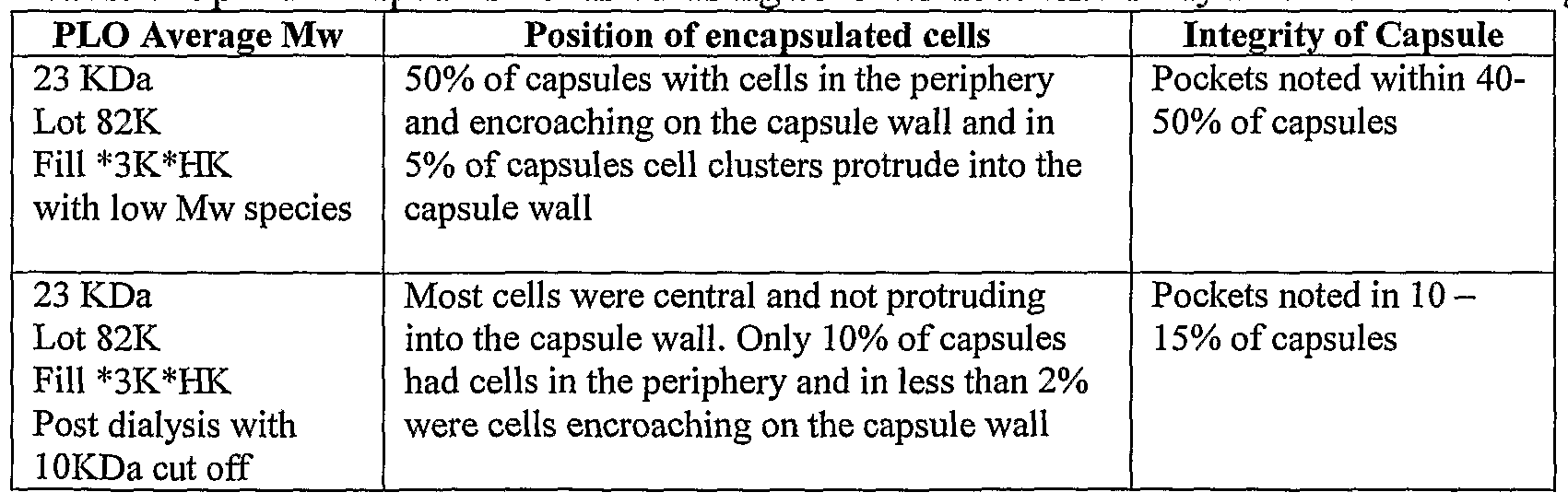
  • Molecular Weight Polydispersity An analysis of the polydispersity of PLO batches showed that the polycation is supplied as a mixture of polypeptides with a range of molecular weights (Table 6). Based on the quality of biocapsules made with different batches of PLO, the molecular weight distribution profile of a PLO batch should exclude molecular species at the extremes of the molecular size range. It is concluded that the optimal PLO composition had a polydispersity ratio (defined as the ratio of the average Mw to the median Mw) of less than 1.5, and preferably less than 1.1.
  • Purified alginate with the highest levels of mannuronic acid residues (VPMG) and a polycationic agent having a polydispersity index of less than 1.5 produced microcapsules which are superior to other prior art microcapsules, as well as to the other purified alginates tested, in terms of capsule geometry and their durability and functionality in vivo.
  • VPMG mannuronic acid residues
  • polycationic agent having a polydispersity index of less than 1.5 produced microcapsules which are superior to other prior art microcapsules, as well as to the other purified alginates tested, in terms of capsule geometry and their durability and functionality in vivo.
  • compositions of the present invention are useful in the formation of immunoisolatory microcapsules for use in delivering living cells capable of secreting therapeutics, or to deliver therapeutics per se, for the treatment of diseases or disorders.

Landscapes

  • Health & Medical Sciences (AREA)
  • Life Sciences & Earth Sciences (AREA)
  • Chemical & Material Sciences (AREA)
  • Engineering & Computer Science (AREA)
  • Bioinformatics & Cheminformatics (AREA)
  • General Health & Medical Sciences (AREA)
  • Organic Chemistry (AREA)
  • Medicinal Chemistry (AREA)
  • Public Health (AREA)
  • Veterinary Medicine (AREA)
  • Animal Behavior & Ethology (AREA)
  • Pharmacology & Pharmacy (AREA)
  • Chemical Kinetics & Catalysis (AREA)
  • Immunology (AREA)
  • Biomedical Technology (AREA)
  • General Chemical & Material Sciences (AREA)
  • Epidemiology (AREA)
  • Nuclear Medicine, Radiotherapy & Molecular Imaging (AREA)
  • Biochemistry (AREA)
  • Zoology (AREA)
  • Wood Science & Technology (AREA)
  • Genetics & Genomics (AREA)
  • Biotechnology (AREA)
  • Diabetes (AREA)
  • Gastroenterology & Hepatology (AREA)
  • General Engineering & Computer Science (AREA)
  • Proteomics, Peptides & Aminoacids (AREA)
  • Microbiology (AREA)
  • Polymers & Plastics (AREA)
  • Cell Biology (AREA)
  • Materials Engineering (AREA)
  • Molecular Biology (AREA)
  • Endocrinology (AREA)
  • Neurology (AREA)
  • Obesity (AREA)
  • Neurosurgery (AREA)
  • Hematology (AREA)
  • Emergency Medicine (AREA)
  • Medicinal Preparation (AREA)
  • Medicines Containing Material From Animals Or Micro-Organisms (AREA)

Abstract

The present invention is directed to a composition comprising high mannuronic acid-containing alginate and a polycation having a polydispersity index of less than 1.5. The composition is particularly useful for making biocompatible microcapsules containing living cells for allo- or xeno-transplantation. Such microcapsules have enhanced durability and can maintain their structural and functional integrity over long periods of time compared to prior art alginate microcapsules.

Description

ENCAPSULATION SYSTEM
FIELD OF THE INVENTION
The invention relates to an encapsulation system comprising alginate biocapsules for the immunoisolation of living cells or therapeutics. Specifically, although by no means exclusively, the encapsulation system is for use in allo- and xeno- transplantation. The invention is also directed to methods of making and using the encapsulation system.
BACKGROUND OF THE INVENTION
Cell transplantation is becoming increasingly more successful both experimentally and clinically. One iteration of cell transplantation takes advantage of developments in material science, cell biology, and drug delivery to develop micro- and macro-encapsulated cell therapy platforms. These include 2-D and 3-D tissue engineered conformations composed of nonerodible thermoplastic polymers, bioerodible materials, and hybrid combinations. These constructs allow for the controlled delivery of therapeutic molecules for the treatment of acute and chronic diseases, but their widespread use is precluded by the need for frequent administration for erodible materials, and retrieval and chronic biocompatibility issues for nondegradable materials. In the case of biodegradable materials, the success of encapsulated cell therapy will depend to a large degree on an understanding of the stability of the material once transplanted and ultimately how that stability impacts the ability of the graft to support cell survival, protein secretion and diffusion, immunoisolation, biocompatibility, physical placement and fixation, degradation, and the efficacy and pharmacodynamics of the secreted product. One of the most common materials used for such biocapsules for cell therapy is alginate, a bioerodible carbohydrate.
Alginate has long been studied as a biomaterial in a wide range of physiologic and therapeutic applications. Its potential as a biocompatible implant material was first explored in 1964 in the surgical role of artificially expanding plasma volume (1). More than a decade later, the matrix capability of alginate for cell support was realized in vitro in a series of experiments that demonstrated microbial cell survival for 23 days (2). Over the last twenty years, there has been remarkable progress in alginate cell microencapsulation for the treatment of diabetes (3-10), chronic pain (11), hemophilia (12; 13), central nervous system (CNS) disorders (14-24), and others. Despite success in numerous animal models and in limited clinical allotransplantation, there have been variable degradation kinetics impacting diffusion, immunoisolation, and ultimately leading to loss of graft survival and rejection. Some well designed studies have been carried out to characterize and control certain aspects of alginate degradation in vitro (25-30) and in vivo (31; 32), but the general understanding of the stability of alginate-polycation capsules in vivo from a strict materials perspective is limited and this in turn limits their use.
It is an object of the present invention to go some way towards furthering the understanding of the stability of alginate-polycation biocapsules to produce more stable biocapsules for in vivo applications and/or to provide the public with a useful choice.
SUMMARY OF THE INVENTION
The invention is directed to a biodurable composition comprising alginate which has a high mannuronic acid content, and a polycation which has a polydispersity index of < 1.5 for producing microcapsules. Such microcapsules may be produced by standard methods. The composition of the present invention is advantageous over known compositions as it can be used to produce microcapsules that are more durable than known microcapsules and thus may allow for prolonged protection from the host immune system when discordant cells are encapsulated. This is demonstrated herein, whereby a decreased rate of degradation in vivo was observed for microcapsules composed of the composition of the present invention. The microcapsules also exhibit enhanced surface morphology and may be administered to sites which, previously, were hyperinflammatory, as set out below.
In a first aspect, the invention provides a composition comprising alginate containing between from about 50% to about 95%, preferably from about 50% to about 90%, more preferably from about 50% to about 70%, and most preferably from about 60% to about 70% mannuronic acid residues and a polycation such as poly-L-ornithine. In a preferred embodiment, the high mannuronic acid alginate and the polycation are in a ratio of approximately 5:1 to about 10:1, preferably around 7:1. In addition, the composition of the present invention may include calcium chloride and sodium chloride. In one embodiment, the composition may comprise a high mannuronic acid alginate at a concentration of about 80% to about 90%, and preferably from about 85% to about 90% and more preferably, about 87%; poly-L-ornithine at a concentration of about 10% to about 15%, preferably about 13%; calcium chloride at a concentration of less than about 1%; and sodium chloride at a concentration of less than about 1 %. The polycation, for example poly-L- ornithine, is present in the composition in a relatively purified form whereby the range of molecular weight species is limited and the polydispersity index (ie average MW ÷ median MW) is less than 1.5, preferably less than 1.2, most preferably less than 1.1.
In a second aspect, the invention provides biocompatible microcapsules prepared using the composition of the invention, and comprising a core layer of high mannuronic acid alginate cross- linked with a cross-linking agent, such as calcium ions, an intermediate layer of polycations having a polydispersity index of < 1.5 forming a semi-permeable membrane, and an outer layer of high mannuronic acid alginate. The core layer and the outer layer may comprise the same or different high mannuronic acid alginate.
The microcapsules may further comprise living cells within the core layer. The cells may comprise naturally occurring or genetically engineered cells which may be in the form of single cells or cell clusters selected from the group comprising β islet cells, hepatocytes, neuronal cells such as choroid plexus cells, pituitary cells, chromaffin cells, chondrocytes, and any other cell type capable of secreting factors that would be useful in the treatment of a disease or condition.
In a third aspect, the present invention comprises a method for preparing biocompatible microcapsules comprising the steps:
a) dissolving a high mannuronic acid containing alginate in isotonic saline;
b) spraying the dissolved alginate solution of step a) through an air- or frequency-based droplet generator into a stirring solution of an excess of a cross-linking agent, such as for example, about 15 to about 12OmM, and more preferably from about 40 to about 11OmM, and more preferably still from about 90 to HOmM calcium chloride, for about 5 to 30 minutes, preferably for 5 to 10 minutes to form gelled capsules;
c) coating the gelled capsules of step b) with a polycation having a polydispersity index of <1.5, such as poly-L-ornithine at a concentration of between about 0.02 to about 0.01% (w/v), preferably 0.05% (w/v), for between about 5 to 30 minutes, (preferably for about
10 minutes);
d) applying a final high mannuronic acid alginate coating to the capsule of step c) for between 5 and 30 minutes, (preferably for between about 5 and 10 minutes); and e) collecting the microcapsules;
wherein the alginate used in steps a) and d) is the same or different and contains between about 50% to about 95% mannuronic acid residues, preferably between about 50% to about 90%, more preferably between about 50% to about 70%, and most preferably between about 60% and 70% mannuronic acid residues.
The alginate solution of step a) comprises an alginate concentration of about 1.0% to 2.0% w/v.
The alginate solution of step d) comprises an alginate concentration of about 0.01 to 1.7% w/v.
In a fourth aspect, the present invention comprises a method of preparing microencapsulated cells comprising the steps:
a) incubating living cells with a solution of high mannuronic acid containing alginate dissolved in isotonic saline;
b) spraying the cell-alginate solution of step a) through an air- or frequency-based droplet generator into a stirring solution of an excess of a cross-linking agent, such as about 15mM to about 12OmM calcium chloride (preferably HOmM), for about 5 to about 30 minutes (preferably 5-10 minutes) to form gelled cell-containing capsules;
c) coating the gelled cell-containing capsules of step b) with a polycation having a polydispersity index of < 1.5, such as poly-L-ornithine, at a concentration of between about 0.02% to 0.1% (w/v) (preferably 0.05% w/v) for between about 5 and 30 minutes (preferably for about 10 minutes);
d) applying a final alginate coating to the cell-containing capsules of step c) for between about 5 and 30 minutes (preferably about 10 minutes); and
e) collecting the cell-containing microcapsules;
wherein the alginate used in steps a) and d) is the same or different and contains between about 50% to about 95% mannuronic acid residues, preferably between about 50% to about 90%, more preferably between about 50% to about 70%, and most preferably between about 60% and 70% mannuronic acid residues. The alginate solution of step a) comprises an alginate concentration of about 1.0% to 2.0% w/v.
The alginate solution of step d) comprises an alginate concentration of about 0.01 to 1.7% w/v.
In a fifth aspect, the invention provides a method for coating non-degradable cell delivery constructs comprising the steps a) immersing the non-degradable cell delivery constructs in a solution of alginate containing between about 50 and about 95% mannuronic acid residues (preferably between about 50 and 90%, more preferably between about 50 and 70% and most preferably about 60% and 70% mannuronic acid) and isotonic saline; b) crosslinking the mannuronic acid residues by incubating in an excess of a cross-linking agent, such as a 15mM to 12OmM solution of calcium chloride (preferably HOmM)5 for about 5 to about 30 minutes (preferably between about 5 and 10 minutes) to form a gelled coating; c) further coating the gelled constructs of step b) with a polycation having a polydispersity index of less than 1.5, for example poly-L-ornithine, at a concentration of between about 0.02 and 0.1% w/v, (preferably 0.05% w/v), for between about 5 and 30 minutes, (preferably about 10 minutes); d) applying a final alginate coating for between about 5 to 30 minutes, (preferably about 10 minutes), to produce immunoisolatory membrane coated non-degradable cell delivery constructs; and e) isolating the final immunoisolatory membrane coated non-degradable cell delivery constructs.
The alginate solution of step a) comprises an alginate concentration of about 1.0% to 2.0% w/v.
The alginate solution of step d) comprises an alginate concentration of about 0.01 to 1.7% w/v.
In a sixth aspect, the invention provides a method for encapsulating small molecule, protein or DNA therapeutics comprising the steps a) dispersing the therapeutics in a solution of alginate containing a high proportion of mannuronic acid residues dissolved in isotonic saline; b) crosslinking the mannuronic acid residues by incubation in an excess of a cross-linking agent, such as a 15mM- 12OmM solution of calcium chloride (preferably HOmM), for about 5 to 30 minutes (preferably about 10 minutes) to form gelled therapeutic-containing capsules; c) coating the gelled therapeutic- containing capsules with a polycation having a polydispersity index of less than 1.5, for example poly-L-ornithine, at a concentration of about 0.02 to 0.1% w/v, (preferably 0.05% w/v) for about 5 to 30 minutes, (preferably 10 minutes); d) applying a final alginate coating to the therapeutic- containing capsules of step c) for between 5 to 30 minutes, (preferably about 10 minutes), and e) collecting the therapeutic-containing microcapsules. The alginate used in steps a) and d) is the same or different and contains between about 50% to about 95% mannuronic acid residues, preferably between about 50% to about 90%, more preferably between about 50% to about 70%, and most preferably between about 60% and 70% mannuronic acid residues.
The alginate solution of step a) comprises an alginate concentration of about 1.0% to 2.0% w/v.
The alginate solution of step d) comprises an alginate concentration of about 0.01 to 1.7% w/v.
In a seventh aspect, the invention provides a method of ameliorating or treating a disease or condition in an animal, including a human, comprising transplanting an effective amount of the cell- containing microcapsules of the invention into said animal, wherein said cells secrete a therapeutic that is effective at ameliorating or treating said disease or condition.
In an eighth aspect, the invention provides a method of ameliorating or treating a disease or condition in an animal, including a human, comprising transplanting an effective amount of the therapeutic-containing microcapsules of the invention into said animal, wherein said therapeutic is effective at ameliorating or treating said disease or condition.
In an ninth aspect, the invention provides a use of an alginate containing between about 50 and about 95% mannuronic acid residues and a polycation in the manufacture of a microcapsule preparation for use in allo- or xeno- transplantation applications.
The microcapsule preparations of the invention may be administered to a subject. A "subject" as used herein shall mean a human or vertebrate mammal including but not limited to a dog, cat, horse, cow, pig, sheep, goat, or primate, e.g., monkey. The microcapsule preparations comprise cells that secrete therapeutic agents or contain therapeutic agents per se and are administered in an amount sufficient to provide an effective amount of the therapeutic agent to the subject. An effective amount of a particular agent will depend on factors such as the type of agent, the purpose for administration, the severity of disease if a disease is being treated etc. Those of skill in the art will be able to determine effective amounts.
The term "comprising" as used in this specification and claims means "consisting at least in part of, that is to say when interpreting independent claims including that term, the features prefaced by that term in each claim all need to be present but other features can also be present. DESCRIPTION OF THE DRAWINGS
The invention will now be described with reference to the figures of the accompanying drawings in which:
Figure 1 shows a protein NMR spectrum of alginate at 900C, wherein peaks are shifted downfield due to temperature and the chemical structure of alginate (see boxed insert) with the location of the protons responsible for the NMR peaks;
Figure 2a shows FTIR of material components prior to encapsulation and the adsorptions of the carbonyl region in high magnification (see boxed insert);
Figure 2b shows alginate mixtures with varying poly-L-ornithine (PLO) concentrations whereby the highlighted region represents the PLO amide II absorption;
Figure 2c shows a quantitative FTIR measuring the ratio of PLO amide absorption to alginate coo- absorption;
Figure 3 shows 5x magnification phase-contrast image of VPMG capsules prior to implantation;
Figure 4 shows 5x magnification-phase-contrast micrographs for 60-day explant specimens for different alginate types;
Figure 5 shows the cross-sectional uniformity (A) and the % original diameter (B) for the 60-day explant specimens for figure 4, mean ISD. (Δ) VPMG; (0) VPLG; (-) pKel; (π)pFlu; (*)pMan;
Figure 6 shows FTIR, 1590cm"1 and 1550 cm"1 peaks for each capsule group over the 90-day study period;
Figure 7 shows quantitative FTIR stability index as a measure of the alginate carboxylic acid peak to the onithine amide II peak (Δ) VPMG; (0) VPLG; (-) pKel; (α)pFlu; (»)pMan;
Figure 8 shows photomicrographs of lyophilized alginate capsule surfaces for each of the alginate types VPMG, VPLG, pKel, pFlu and pMan over the 90 day study period; and
Figure 9 shows a higher magnification of a photomicrograph to show the surface pitting of a pKel microcapsule at day 30. DETAILED DESCRIPTION OF THE INVENTION
The present invention is directed to an encapsulation system for living cells and therapeutics which has improved biostability when the encapsulated cells and therapeutics are implanted into a subject. This improved biostability enables the encapsulated cells and therapeutics to remain within a living body for longer periods than is currently the case which will result in improved therapeutic delivery and thus treatment efficacy.
The encapsulation system comprises a biodurable composition comprising alginate which is high in mannuronic acid.
Alginate is a polysaccharide composed of guluronic (G) and mannuronic (M) acid linked by (l,4)-α- and -β-glycoside bonds (see the boxed insert in Figure 1). The ratio of these monomers contributes directly to certain physical characteristics of the polysaccharide. It has been found for the first time that once cationically crosslinked, alginates high in G5 due to a more networked structure resulting from α(l-4) bonds, are more brittle with a higher elastic modulus, while those that are high in M, with more linear β(l-4) linkages, exhibit decreased 3-D crosslinking and greater elasticity and form very stable microcapsules when tested in vivo.
Thus, the present invention provides a composition comprising a high mannuronic acid alginate, specifically containing between about 50% to 95% mannuronic acid residues, and a polycation having a polydispersity index of <1.5, such as poly-L-ornithine. Preferably the high mannuronic acid containing alginate contains between about 50% and 90% mannuronic acid residues, more preferably between about 50% and 70% mannuronic acid residues, and most preferably between about 60% and 70% mannuronic acid residues. In a preferred embodiment, the high mannuronic acid alginate and the polycation are in a ratio of approximately 5:1 to 10:1 by weight, preferably about 7:1 by weight. In addition, the composition of the present invention may include calcium chloride and sodium chloride. Preferably, the composition comprises high mannuronic acid alginate at a concentration of about 80% to about 90%, preferably about 87%, poly-L-ornithine at a concentration of about 10% to about 15%, preferably about 13%, calcium chloride at a concentration of less than about 1% and sodium chloride at a concentration of less than about 1%. The average molecular weight of the alginate is greater than about 400 KDa, preferably greater than about 600 KDa.
The high mannuronic acid containing alginate used in the proportions in the present invention may comprise a glucuronic acid content of between about 10 and about 40%. Thus, the ratio of M:G in the alginate useful in the present invention is from between about 1.55:1 to 9.5:1.
The alginate source is purified and contains less than 1 endotoxin unit/ml of 1.7% (w/v) alginate. Examples of commercially available alginates suitable for use in the present invention include Keltone LVCR and Pronova SLM20. However, any other alginate with suitable high mannuronic acid content (or suitable M:G ratios) can be used as a raw material for use in the present invention.
The alginate may have a pH of 7.0 ± 0.4 when dissolved in 1.7% (w/v) saline.
The molecular weight of the polycation is also important in the structural and functional composition of the microcapsules of the invention. It has been found for the first time that a polycation having a polydispersity index of less than about 1.5, preferably less than about 1.2 and more preferably less than 1.1, together with the high mannuronic acid aliginate, results in superior microcapsules which are highly stable and can remain in vivo for long periods of time, and certainly for more than one month.
Polycatonic agents comprising a high polydispersity index and therefore including a wide range of MW species are shown to result in inferior microcapsules. This is thought to be caused by the larger MW molecules being unable to diffuse into the alginate coat resulting in a weak coating. The smaller MW molecules, on the other hand, can diffuse too rapidly into the alginate coating and can penetrate into the core and displace cells or beads within the core. A polycation with a limited range of MW species has been shown to result in superior microcapsules.
For example, when the polycation is poly-L-ornithine, or poly-L-lysine, the preferred average MW for the polycation is from between 10 to 40 KDa, more preferably between 15 to 30 KDa and most preferably around 20-25 KDa. Preferably, the poly-L-lysine or poly-L-ornithine will contain < about 20% of molecules having a MW of 10 KDa or less and more preferably < about 10% of molecules having a MW of 10 KDa or less.
The invention further provides biocompatible microcapsules prepared using the composition of the invention, and comprising a core layer of high mannuronic acid alginate cross-linked with a cationic cross-linking agent, an intermediate layer of polycations having a polydispersity index of less than about 1.5 forming a semi-permeable membrane, and an outer layer of high mannuronic acid alginate.
The high mannuronic acid alginate may comprise from about 50% to about 95% mannuronic acid residues, preferably from about 50% to about 90%, more preferably from about 50% to about 70% and most preferably from about 60% to about 70% mannuronic acid residues.
The alginate used in the core layer and the outer layer may be the same or different.
The core layer may comprise alginate composed of 50-70% mannuronic acid residues and the outer layer may comprise alginate composed of 10-40% glucuronic acid residues.
The cationic cross-linking agent may be selected from salts of the group consisting of Ag+, Al3+, Ba2+, Ca2+, Cd2+, Cu2+, Fe2+, Fe3+, H+, K+, Li+, Mg2+, Mn2+, Na+, NH4+, Ni2+, Pb2+, Sn2+ and Zn2+. Preferably the cationic cross-linking agent is calcium chloride. The cross-linking agent is preferably in excess, for example from 15mM to 12OmM calcium chloride. More preferably 11OmM calcium chloride.
The polycationic agent may be selected from the group consisting of chitosan glutamate, chitosan glycol, modified dextran, lysozyme, poly-L-lysine, poly-L-ornithine, salmine sulfate, protamine sulfate, polyacrylimide, polyacrylimide-co-methacryloxyethyltrimethylammonium bromide, polyallylamine, polyamide, polyamine, polybrene, Polybutylacrylate-co-Methacryloxyethyl Trimethylammonium Bromide (80/20), Poly-3-chloro-2-hydroxypropylmethacryl-oxyethyl dimethylammonium Chloride, Polydiallyldimethylammonium, Polydiallyldimethylammonium Chloride, Polydiallyldimethylammonium Chloride-co-Acrylatnide, Polydiallyldimethylammonium Chloride-co-N- Isopropyl Acrylamide, Polydimethylarnine-co-epichlorohydrin, Polydimethylaminoethylacrylate-co- Acrylamide, Polydiniethylaminoethylmethacrylate, Polydimethylaminoethyl Methacrylate, Polyethyleneimine, Polyethyleneimine-Epichlorohydrin Modified, Polyethyleneimine, Poly-2-hydrøxy-3-methacryloxypropyl Trimethylammonium Chloride, Poly~2-hydroxy-3-me1hacryloxyethyl, Trimethylammonium Chloride, Polyhdroxyproplymethacryloxy Ethyldi methyl Ammonium Chloride, Polyimadazoline (Quaternary), PoIy- 2-methacryloxyethyltrimethylammonium Bromide, Polym'emacryloxyethyltrimethylammonium Bromide/Chloride, Polymethyldiethylaminoethylmethacrylate-co-Acrylamide, Poly-l-methyl-2- vinylpyridinium Bromide, Poly-l-methyl-4-vinylpyridinium Bromide, Polymethylene-co-Guanidine Hydrochloride, Polyvinylamine, Poly-N-vinylpyrrolidone-co-Dimethylaminoelhyl-Methacrylate, and Poly-4-vinylbenzyltrimethylammonium Chloride, and Poly-4-vinylbenzyltrimethylammonium Chloride.
Preferably the polycationic agent is poly-L-omithine at a concentration of between 0.02% and 0.1 %wv.
Poly-L-ornithine is preferably purified to remove the higher and/or lower MW species to give a polydispersity index of preferably less than 1.2 and more preferably less than 1.1. Specifically, the average MW for the poly-L-omithine polycationic agent is from between 10 to 40 KDa, more preferably between 15 and 30 KDa and most preferably around 20 to 25 KDa. Any molecular weight molecules below 10 KDa and above 40 KDa can be removed by dialysis and other known methods. Preferably, the poly-L-ornithine used in the present invention comprises less than about 20% of molecules having a MW of 10 KDa or less and more preferably less than 10% of molecules having a MW of 10 KDa or less.
The intermediate layer, which is formed of polycations around the core layer, comprise a semipermeable membrane of between about 10 and about 80 μm in thickness.
The alginate of the core layer may be solid or may be depolymerised by a chelation agent to form a hollow core. Examples of suitable chelation agents are sodium citrate and EDTA.
It is thought that chelation of the alginate (degelling) core solubilises the internal structural support of the capsule, thereby adversely affecting the durability of the microcapsule. This problem is overcome in the prior art by not carrying out the chelation step so that the core is solid (see US
6,365,385, for example). However, the use of a high mannuronic acid containing alginate in the microcapsules of the present invention together with the use of a polycation having a polydispersity index of less than 1.5 significantly increases the durability of the microcapsules even when the core is liquidised by chelation. The microcapsules of the present invention may also have a solid core for further enhanced stability and durability.
The ratio of the core layer of alginate to the polycationic agent is about 7:1 to about 8:1 by weight.
The ratio of the outer layer of alginate to the polycationic agent is about 1.5:1 to about 1.4:1 by weight.
The formed microcapsules swell approximately 10% or greater in volume when placed in vitro in physiological conditions for about one month or more. Swelling of microcapsules is thought to be caused by surplus divalent cations causing an osmotic gradient leading to water uptake. This can be problematic and lead to the decomposition of the microcapsules. This problem can be overcome by mopping up the excess cations with anions (as for example in US 6,592,886). However, in the present invention, the use of a high mannuronic acid containing alginate together with the use of a polycation agent having a polydispersity index of less than 1.5 results in fewer surplus cations and the microcapsule of the invention is highly stable and less likely to decompose, although as described, there is some limited swelling.
The surface of the microcapsule when formed has an ionically neutral surface.
The microcapsules may further comprise living cells within the core layer. The cells may comprise naturally occurring or genetically engineered cells which may be in the form of single cells and/or cell clusters selected from the group consisting of β islet cells, hepatocytes, neuronal cells such as choroid plexus cells, pituitary cells, chromafin cells, chondrocytes and any other cell type capable of secreting factors that would be useful in the treatment of a disease or condition.
For example, the cells may be islet cells capable of secretory insulin useful for the treatment of diabetes. The cells may alternatively comprise hepatocyte or non-hepatocyte cells capable of secreting liver secretory factors useful in the treatment of liver diseases or disorders.
The cells may alternatively comprise neuronal cells, such as choroids plexus, pituitary cells, chromoffm cells, chondrocytes and any other cell capable of secreting neuronal factors useful in the treatment of neuronal diseases such as Parkinson's disease, Alzheimer's disease, epilepsy, Huntington's disease, stroke, riiotor neurone disease, amyotrophic lateral sclerosis (ALS), multiple sclerosis, aging, vascular disease, Menkes Kinky Hair Syndrome, Wilson's disease, trauma or injury to the nervous system.
The microcapsules of the present invention may be between 50 and 2000 microns in diameter. Preferably the microcapsules are between about 100 and 1000 microns in diameter, and more preferably between about 500 and 700 microns in diameter.
It is expected that the microcapsules of the present invention will be able to remain functional in vivo in a subject for a significant period of time and certainly for periods greater than one month.
The functional duration of the microcapsules may be controlled by one or more of the following methods: by varying the polydispersity of the alginate range used in the inner and/or outer layers of the microcapsule; by varying the total protein content of the inner and/or outer alginate layers; by inducing calcification of the alginate layers; by varying the range and distribution of molecular weight of the polycationic agent; by varying the concentration of polycationic unreacted contaminant with concentrations from about 0.01% to about 0.25% (w/w); by varying the uniformity of the polycation concentration, creating a gradient across the intermediate layer of the microcapsule; by varying the amount of cell-surface interaction by coating the external surface with inhibitory agents such as surfactants including pluronics F127, anti-fibrotics, and other suitable agents. The present invention further provides a method for preparing the biocompatible microcapsules of the invention comprising the steps:
a) dissolving a high mannuronic acid containing alginate in isotonic saline;
b) spraying the dissolved alginate solution of step a) through an air- or frequency-based droplet generator into a stirring solution of an excess of a cross-linking agent, for about
5-30 minutes (preferably 5 to 10 minutes) to form gelled capsules;
c) coating the gelled capsules of step b) with a polycation having a polydispersity index of less than about 1.5, such as poly-L-ornithine, at a concentration of 0.01 to 0.2% w/v, (preferably 0.05% w/v), for 5-30 minutes (preferably 10 minutes);
d) applying a final high mannuronic acid alginate coating to the capsule of step c) for between about 5-30 minutes (preferably for between 5 and 10 minutes); and
e) collecting the microcapsules;
wherein the high mannuronic acid containing alginate used in steps a) and d) is the same or different and contains between about 50% and about 95% mannuronic acid residues, preferably between 50 and 90%, more preferably between about 50 and 70%, and most preferably about 60% and about 70% mannuronic acid residues.
The alginate solution of step a) comprises an alginate concentration of about 1.0% to 2.0% w/v.
The alginate solution of step d) comprises an alginate concentration of about 0.01 to 1.7% w/v.
The cross-linking agent may be selected from the group listed above and is preferably about 11OmM calcium chloride.
The final alginate coating preferably contains between about 10 and about 40% glucuronic acid residues.
The alginate of the core layer may be solid or may be depolymerised by a chelation agent to form a hollow core as described above. The present invention further provides a method of preparing microencapsulated cells comprising the steps:
a) incubating living cells with a solution of high mannuronic acid containing alginate dissolved in isotonic saline;
b) spraying the cell-alginate solution of step a) through an air- or frequency-based droplet generator into a stirring solution of an excess of a cationic cross-linking agent, such as about 15mM to 12OmM calcium chloride (preferably 11OmM), for about 5-30 minutes (preferably 5 to 10 minutes) to form gelled cell-containing capsules;
c) coating the gelled cell-containing capsules of step b) with a polycation having a polydispersity index of less than 1.5, preferably poly-L-ornithine, at a concentration of about
0.02% to 0.1% w/v, (preferably 0.05% w/v), for between 5 to about 30 minutes (preferably about 10 minutes);
d) applying a final alginate coating the cell-containing capsules of step c) for between 5 and 30 minutes (preferably about 10 minutes); and
e) collecting the cell-containing microcapsules;
wherein the alginate used in steps a) and d) is the same or different and contains between about 50% to about 95% mannuronic acid residues, preferably between about 50% to about 90%, more preferably between about 50% to about 70%, and most preferably between about 60% and 70% mannuronic acid residues.
The alginate solution of step a) comprises an alginate concentration of about 1.0% to 2.0% w/v.
The alginate solution of step d) comprises an alginate concentration of about 0.01 to 1.7% w/v.
The cells may be naturally occurring or genetically engineered cells which may be in he form of single cells and/or cell clusters selected from the group comprising of β islet cells, hepatocytes, neuronal cells such as choroid plexus cells, pituitary cells, chromaffin cells, chondrocytes and any other cell type capable of secreting factors that would be useful in the treatment of a disease or condition. The cells may be isolated from the same species as a recipient host, for use in allo-transplantation, or from a different species, for use in xeno-transplantation.
The cells are preferably contained within the core alginate layer but can alternatively or additionally be contained within the outer alginate layer.
The invention further provides a method for coating non-degradable cell delivery constructs comprising the steps a) immersing the non-degradable cell delivery constructs in a solution of alginate containing between about 50 to about 95% mannuronic acid residues and isotonic saline; b) crosslinking the mannuronic acid residues by incubating with an excess of a cross-linking agent, for example a solution of about 15mM to 12OmM (preferably HOmM) calcium chloride, for about 5-30 minutes (preferably 5 to 10 minutes) to form a gelled coating; c) further coating the gelled constructs of step b) with a poly cation having a polydispersity index of less than 1.5, preferably poly-L-ornithine at a concentration of about 0.02 to 0.1% w/v, (preferably 0.05% w/v), for about 5 to 30 minutes (preferably 10 minutes); d) applying a final alginate coating for between about 5 to 30 minutes to form immunoisolatory membrane coated non-degradable cell delivery constructs; and e) isolating the final immunoisolatory membrane coated non-degradable cell delivery constructs.
The alginate solution of step a) comprises an alginate concentration of about 1.0% to 2.0% w/v.
The alginate solution of step d) comprises an alginate concentration of about 0.01 to 1.7% w/v.
The non-degradable cell delivery construct may be selected from the group consisting of hollow- fiber membrane devices, flat sheets, porous scaffolds for cell ingrowth and other novel scaffolding constructs, as would be appreciated by a skilled worker.
The non-degradable cell delivery construct may comprise living cells which may be naturally occurring or genetically engineered cells in the form of single cells and/or cell clusters selected from β islet cells, hepatocytes, neuronal cells such as choroids plexus cells, pituatary cells, chromaffin cells, chondrocytes and any other cell type capable of secreting factors that would be useful in the treatment of a disease or condition. The invention further provides a method for encapsulating small molecule, protein or DNA therapeutics comprising the steps a) dispersing the therapeutics in a solution of a high mannuronic acid alginate dissolved in isotonic saline; b) crosslinking the mannuronic acid residues by incubation in an excess of a cross-linking agent, preferably in a solution of about 15-12OmM calcium chloride (preferably HOmM), for about 5 to about 30 minutes to form gelled therapeutic-containing capsules; c) coating the gelled therapeutic-containing capsules with a polycation having a polydispersity index of less than 1.5, preferably poly-L-ornithine at a concentration of about 0.02 to 0.1% w/v, (preferably 0.05% w/v), for about 5 to 30 minutes; d) applying a final alginate coating to the therapeutic-containing capsules of c) for 5 and 30 minutes, and e) collecting the therapeutic- containing microcapsules.
The alginate solution of step a) comprises an alginate concentration of about 1.0% to 2.0% w/v.
The alginate solution of step d) comprises an alginate concentration of about 0.01 to 1.7% w/v.
The small molecule, protein or DNA therapeutic is preferably contained within the core alginate layer but may alternatively or additionally be contained within the outer alginate layer.
Alternatively, the small molecule, protein or DNA therapeutic may be bound to the outer alginate layer or may be contained within the (polycationic) intermediate layer.
Examples of suitable protein therapeutics include erythropoietin, insulin, CNTF, BDNF, GDNF, GH3 and others, as would be appreciated by a skilled worker.
In certain aspects, it may be desirable to utilise an alginate that contains from between about 50% to about 90% mannuronic acid residues, and in certain embodiments, a range of from between about 50% to about 70% mannuronic acid residues, and preferably between 60% to 70% mannuronic acid residues. Likewise, it may be desirable in certain aspects of the invention to apply the final alginate coating in a concentration of from about 0.05% to about 0.20% w/v. As mentioned above, the times for spraying, coating and then applying the alginate coating, may be substantially shorter or longer than about 10 minutes, and may in certain cases require about 1 to about 45 minutes for each step, while in some applications of the invention, each of these steps may be performed for a period of from about 5 to about 20 minutes each. The invention further provides a method of ameliorating or treating a disease or condition in an animal, including a human, comprising transplanting an effective amount of the cell-containing microcapsules of the invention into said animal, wherein said cells secrete a therapeutic that is effective at ameliorating or treating said disease or condition.
The invention further provides a method of ameliorating or treating a disease or condition in an animal, including a human, comprising transplanting an effective amount of the cell-containing immunoisolatory membrane coated non-degradable cell delivery construct of the invention into said animal, wherein said cells secrete a therapeutic that is effective at ameliorating or treating said disease or condition.
The invention further provides a method of ameliorating or treating a disease or condition in an animal, including a human, comprising transplanting an effective amount of the therapeutic- containing microcapsules of the invention into said animal, wherein said therapeutic is effective at ameliorating or treating said disease or condition.
In these methods of treatment, the microcapsules or coated delivery constructs of the invention may be administered in an amount that would deliver sufficient therapeutic so as to be effective against the disease. For example, in the treatment of diabetes, a single niL of microcapsules would contain approximately 10,000-60,000 β islet equivalents and approximately 1-10 niL microcapsules would be implanted per kg body weight into a subject to secrete the required amount of insulin to control blood glucose levels.
A skilled practitioner would be able to test the secretion rate of the particular therapeutic from the microcapsules in vitro and, for any particular patient need, be able to calculate how many microcapsules would be required to treat that particular patient effectively.
The microcapsules of the invention may be formulated for allo- or xeno- transplantation depending on the source of the living cells and/or therapeutics. The microcapsules of the invention may be transplanted within the tissues of the body or within fluid-filled spaces of the body, which ever is the most appropriate in terms of accessibility and efficacy. For example, if the living cells within the microcapsules are β islet cells, they may be transplanted in the peritoneal cavity. If the living cells with the microcapsules are choroid plexus cells and are for treating neurological disorders and any therapeutic agent secreted by the cells must be in contact with the cerebro spinal fluid surrounding the brain, such microcapsules may be implanted into or onto the brain.
Alternatively, the microcapsules may be formulated for oral or topical administration, particularly when they contain a therapeutic bioactive agent, such as an antibiotic.
The invention provides a use of an alginate containing between about 50 and about 95% mannuronic acid residues and a polycation in the manufacture of a microcapsule preparation for use in allo- or xeno- transplantation applications.
Such microcapsules may comprise living cells comprising naturally occurring or genetically or genetically engineered cells which may be in he form of single cells and/or cell clusters selected from the group comprising of β islet cells, hepatocytes, neuronal cells such as choroid plexus cells, pituitary cells, chromaffin cells, chondrocytes and any other cell type capable of secreting factors that would be useful in the treatment of a disease or condition.
Alternatively the microcapsules may comprise a therapeutic agent.
This invention may also be said broadly to consist in the parts, elements and features referred to or indicated in the specification of the application, individually or collectively, and any or all combinations of any two or more said parts, elements or features, and where specific integers are mentioned herein which have known equivalents in the art to which this invention relates, such known equivalents are deemed to be incorporated herein as if individually set forth.
The invention consists in the foregoing and also envisages constructions of which the following gives examples only. EXAMPLES
The invention consists in the foregoing and also envisages constructions of which the following gives examples only. The following examples are included to demonstrate preferred embodiments of the invention. It should be appreciated by those of skill in the art that the techniques disclosed in the examples which follow represent techniques discovered by the inventor to function well in the practice of the invention, and thus can be considered to constitute preferred modes for its practice. However, those of skill in the art should, in light of the present disclosure, appreciate that many changes can be made in the specific embodiments which are disclosed and still obtain a like or similar result without departing from the spirit and scope of the invention.
EXAMPLE 1
Intraperitoneal Stability of Alginate-Poly ornithine Microcapsules in Rats: An FTIR and SEM Analysis
Materials and methods
Study Design Monodisperse alginate-PLO microcapsules were fabricated from 5 different types of alginate and injected into the peritoneal cavity of Long-Evans rats. Prior to transplantation, the materials were characterized in vitro for the ratio of mannuronic acid to guluronic acid (M: G Ratio), endotoxin and protein levels, viscosity, and molecular weight. After 14, 30, 60, and 90 days, capsules were retrieved from each animal. The geometry of the retrieved capsules was assessed and the capsules were analyzed for chemical integrity by Fourier-Transform Infrared spectroscopy (FTIR) and surface morphology by scanning electron microscopy (SEM).
Encapsulation Materials: Source and Purification
Lyophilized alginate was purchased from 5 sources either in raw or purified form. 2 sources were provided in purified form by the manufacturer (see below) and the other 3 were received raw and subseqently purified using a solvent extraction method(33). Briefly, a 1% (W/V) solution was dissolved in a 1.0 mM sodium EGTA solution and filtered through successively more restrictive membranes (5.0, 1.5, 0.8, 0.45, and 0.22 μm filters). pH was lowered gradually to 1.5 and the precipitated alginate was washed three times in 0.0 IN HCl + 20 mM NaCl. Using chloroform and butanol, proteins were extracted 3 times during a 30 minute exposure with vigorous shaking. After returning to neutral pH, the organic extraction was repeated and the alginate was precipitated in ethanol, filtered, washed with diethyl ether, and lyophilized for at least 72 hours. Prior to microcapsule formation, all alginates were dissolved in 1.5% (W/V) solutions in calcium and magnesium-free phosphate buffered saline (PBS) (Gibco, USA) and passed through a 0.22 μm filter for sterility. The alginates were designated as vendor-purified medium G (VPMG), vendor-purified low G (VPLG), purified Keltone LVCR (pKel), purified Fluka (pFlu), and purified Manucol (pMan) based on the approximated G-fraction specified by the suppliers. Keltone and Manucol alginates were obtained from ISP Corporation (USA) while Fluka was ordered from Sigma-Aldrich.
Polyornithine hydrobromide (MW = 5-15 KDa, Sigma-Aldrich, USA) was dissolved in calcium and magnesium-free PBS and sterile filtered immediately prior to capsule fabrication. AU other encapsulation reagents, including calcium chloride, sodium citrate, and sodium chloride, were purchased from Sigma-Aldrich and were made as sterile solutions on the day of encapsulation.
Encapsulation Materials: Alginate Characterization
Alginates were analyzed using a variety of techniques to distinguish important chemical properties including nuclear magnetic resonance spectroscopy (NMR), FTIR, viscometry, and gel permeation chromatography (GPC). The relative levels of protein and endotoxin were also determined for each alginate solution.
NMR Spectroscopy
NMR spectroscopy was used to determine the ratio of mannuronic acid to guluronic acid residues in the carbohydrate copolymer. Samples were partially hydrolyzed to reduce viscosity and allow for the appropriate resolution on NMR as described by Grasdalen et al(34). Briefly, 1.0% (w/v) alginate was brought to pH 3.0 and maintained under reflux at 100°C for 30 minutes. A Buchi Rotavapor (Switzerland) was used to remove the majority of the water while the remainder was lyophilized to complete dryness. Samples were then dissolved (20 mg/niL) in deuterium oxide and were analyzed on a Bruker NMR (300 MHz at 90°C). The elevated temperature effectively shifted the water peak downfield to reveal the peaks of interest for integration. Bruker XWIN-NMR was used to measure the area under these peaks (δ~5.7 ppm for Gl, 5.3 ppm for Ml and GM5, and 4.9 ppm for GG5). The ratio of the area under Gl divided by the area under M1/GM5 + GG5 was calculated to give the G-fraction. Samples were run in triplicate throughout the process. FTIR Spectroscopy
A Perkin-Elmer Series 1600 FTIR was used attached to a horizontal attenuated total reflectance (H- ATR) accessory for all measurements. Alginate powder or lyophilized microcapsules were placed onto the ZnSe crystal until it was fully covered and 100 psi pressure was applied to the sample. Scans from 4000-650 cm"1 were acquired (N=32) and ATR correction was applied to the resulting spectra. Quantitative assessment was made by measuring the area under peaks of interest with the Perkin-Elmer Spectrum 5 software(35).
To characterize and quantify the effect of increasing PLO on the resultant spectra, PLO: Alginate was precipitated together with the concentration of PLO at 80%, 60%, 40%, 35%, 30%, 25%, 21%, 17%, 10%, and 5% (W/W). To achieve a homogeneous sample, a PLO solution in dH2O was placed on top of frozen alginate aliquots. Using probe sonication, the PLO was gradually reacted and precipitated with the thawing alginate until the entire mixture was thawed and opaque. Sonication was carried out until a homogeneously opaque solution was obtained. Next, samples were flash-frozen in liquid nitrogen and immediately lyophilized. These dry samples were run in triplicate with spectra averaged over N=32 scans.
Viscometry Viscosity was measured using a Brookfield Cone/Plate Viscometer. The gap between the cup and the spindle was set for 0.013 mm prior to each run to eliminate noise related to sample level. 1 mL of 1.0% (W/V) alginate sample was added to the sample cup and distributed in a thin layer across the bottom of the cup in a manner that excluded air bubbles. The spindle was inserted to assess rotational resistance at a variety of speeds ranging from 1 to 20 rpm. Torque at the different shear speeds ranged from 25-95 % within the optimum working range of the viscometer. Dynamic viscosity was calculated by the change in resistance verses the speed of the probe. AU measurements were carried out at room temperature (25°C).
GPC Alginate samples were dissolved at a concentration of 0.17% (W/V) and 50 μL was injected into a Waters (USA) Ultrahydrogel Linear Column affixed to a Perkin-Elmer GPC apparatus with an Isocratic 250 pump, 101 Oven, LC30 RI detector, and 900 series interface. Calibration standards used were poly(ethylene oxide) at molecular weights of 932, 571, 177, and 70 KDa dissolved in PBS buffer also at 0.17% (W/V). Using Nelson Turbochrom software, Mw, Mn, and M- were calculated. The polydispersity index, or degree of polymorphism in molecular weight species, was calculated as MJMn. Alginate Protein Content
Total protein in alginate samples was measured by the Micro BCA Protein Assay (Pierce, USA). Following spike and recover experiments with roughly 100% accuracy and dilution linearity of about 95%, 1 mL 1.7% (W/V) alginate samples were diluted 2, 5, 10, and 20-fold and were incubated with the working reagent for 2 hours at 37°C for development. The developed reagent was detected on a 96- well plate with a U V- Vis spectrophotometer at 562 nm and quantified against a linear standard curve with bovine serum albumin.
Endotoxin Content
The Limulus Amebocyte Lysate (LAL) CL-1000 Chromogenic LAL Endpoint Assay (Cambrex, USA) was used to quantify the total endotoxin content of the alginates under study. 1.7% (W/V) samples were incubated at a 10-fold dilution in dH2O for 18 hours at 50°C for endotoxin extraction and reacted over a defined time course against standard concentrations(36). Endpoint product was analyzed on a Beckman-Coulter DTX-880 UV-VIS Spectrophotometer. The assay had a detection range of 1-50 EU/mL.
Alginate Microencapsulation
A 60-cc syringe was used to collect 30 mL of 1.7% (W/V) sterilized alginate solution that was affixed to the Inotech IE-50R electrostatic encapsulation machine (Switzerland). A syringe pump operating at roughly 8 mL/min was used to feed the solution through the nozzle vibrating at approximately 900 Hz. Due to the differences in the inherent viscosity of the various alginate solutions, these parameters were varied slightly as needed to maintain optimal machine operation. The fluid stream passed through an electrostatic ring with an applied current of approximately 1.5 kV and into a bath of 300 mL 100 niM CaCl2 with 50 mM NaCl stirring without vortex. After crosslinking for 5 minutes, capsules were removed and immediately reacted with 100 mL 0.05% (W/V) PLO for 10 minutes followed by 2 washes in 3-(N-morpholino) propanesulfonic acid (MOPS) buffer. An outer alginate coat was then applied by stirring the capsules in 0.05% alginate for 5 minutes and the coated capsules were washed twice again in MOPS buffer. Capsules were prepared fresh and brought to 37°C in ImL aliquots in sterile PBS prior to implantation. Aliquots were retained for pre-implantation analyses.
Capsule Characterization: Microscopy and Image Analysis
Capsule geometry was characterized by phase contrast light microscopy in conjunction with Scion Image (USA) morphometry. Capsules suspended in PBS were placed into 24- well plates, ensuring that only one layer of capsules remained on the bottom of the well. Using a 5X lens with phase contrast, images with large fields and clearly defined capsule outlines were obtained. At the same resolution, an image of a hemocytometer was acquired for calibration against a known distance. In Scion Image, the calibration image was used to set the appropriate scale and capsule diameters were measured approximating the maximum diameter and minimum diameter in case of spherical deviation. For simplification to a 2-D parameter, % cross-sectional uniformity was measured as the area based on the smaller radius divided by the area based on the larger radius X 100. At least 100 capsules were measured in each group at every timepoint.
Animal Use
Male Long-Evans rats weighing between 250-350 g were housed in pairs and kept in a controlled environment with a 12:12 hour light-dark cycle. All animal use and handling was conducted under strict standards that either met or exceeded NIH guidelines. In addition, all procedures were approved in advance by the Brown University IACUC governing body. There were 5 animals in each material group (N=5) within each timepoint (N=4) for a total of 100 animals in the study.
Rats were anesthetized transiently with 3% isoflurane gas and 1 mL capsule volume suspended in 1 mL calcium- and magnesium-free PBS (for 2 mL total volume) was administered through a 16- gauge needle into the peritoneum at the midline. Animals were recovered and returned to cages at the termination of the procedure. Time 0 (pre-implantation) material and image analysis cohorts were also passed through a 16-gauge needle.
At 14, 30, 60, and 90 days after implantation, animals were sacrificed with CO2 overdose and the capsules were retrieved under microscopy using a transfer pipette and PBS to collect free-floating capsules from all quadrants. Location, abundance, and gross appearance were documented. Next, pooled samples were characterized using image analysis, washed, and flash frozen for lyophilization.
Post-Explant Capsule Characterization
Following a 72-hour period of lyophilization, capsules were analyzed using FTIR and SEM for surface chemistry and morphology. A similar procedure was used for FTIR as previously described for raw materials, except lyophilized beads were visually inspected for integrity in order to limit the analysis to the external surface of the capsule and not the bulk, and to confirm that adherent cells were flaked off to minimize tissue interference. Roughly 20 capsules were placed onto the ATR crystal to complete coverage and spectra were acquired at 100 psi. Multiple spectra from different capsules were acquired to confirm homogeneity of the sample population and combined.
Samples for SEM were placed on aluminum mounts lined with adhesive-coated carbon discs and were sputter-coated with a gold-palladium target under vacuum in an argon atmosphere. Coated specimens were examined on a Hitachi 2700 at an accelerating voltage of 5 to 8 kV. Digital capture images were used throughout.
RESULTS
Pre-Encapsulation Characterization
Alginate materials were characterized prior to encapsulation based on their respective M:G ratios, protein and endotoxin levels, viscosity, and molecular weight. The results are shown in Table 1 below:
Table 1. Pre-encapsulatioii alginate characterization. Manufacturer specifications are included for comparison.
Figure imgf000027_0001
In general, the rough specifications supplied by the manufacturer were similar to the results obtained from NMR with the exception that the pMan alginate was higher in guluronic acid content than expected. Viscosity, an indicator of molecular weight, was similar between groups as measured by dynamic viscosity. The 2 commercially-purified alginates had the lowest viscosity at 1.0% and 25°C (VPMG: 25 Cp; VPLG: 22 Cp) while the alginates purified in house had increasing higher viscosities, respectively. Protein was also relatively consistent between all groups except for the pMan, which, at 86 μg/mL, had at least twice the amount of the other materials. Endotoxin levels trended similarly with the highest levels observed in the pFlu and pMan groups.
The peaks integrated from NMR spectra acquired at 90°C are shown in Figure 1. This spectrum, obtained from one of the samples at 90°C, shows the three peaks described earlier, where peak A represents the proton resonance at Gl, peak B for Ml and GM5, and peak C for GG5. The peak due to protons present in the solvent, HDO, is shown at 4.7 ppm. It should be noted that the entire spectra at 90°C, aside from the HDO peak, was shifted downfield 0.8 ppm compared to room temperature conditions to further elucidate the alginate peaks.
Molecular weights were assessed by GPC and are shown in Table 1 above. In general, the weight- average molecular weight, Mw, correlated well with viscosity as predicted by the Sakurade-Houwmk equation [η = KM"]. pMan had the highest molecular weight at 609 KDa while the other groups ranged between 317-534 KDa. As expected with naturally synthesized biopolymers, the polydispersity index, or Mw/Mn of these samples showed some variability of sample polymorphism. The VPMG, VPLG, and pKel groups showed the narrowest distributions here while pFlu and pMan had the highest polydispersity.
ATR-FTIR was used to characterize functional groups. In addition to using absorption values from previously reported findings using FTIR to study alginate and polycation capsules (35), we confirmed the range of reported findings on homogeneous lyophilized PLO: Alginate precipitates as well as the raw starting materials. This was carried out to characterize the relationship between the two components on the outer surface of the capsule for proper assessment of surface changes over time. The raw spectra, shown in Figure 2a, reveal a number of peaks in both samples. Table 2, below, lists some of the relevant peaks detected in these samples and associated functional groups in alginate and alginate-PLO. Figure 2b shows the differences in critical areas of interest, particularly in the carbonyl region associated with the Amide II bond of PLO (1550 cm'1) and the carboxylic acid portion of the uronic acids (1590 cm"1). Differences exist in the -NH and -CH2 absorptions of Alginate/PLO compared to alginate alone but at a lower magnitude.
Table 2. FTIR peaks in Alginate and Alginate-PLO samples. Corresponding functional groups are shown in the far right column.
Figure imgf000028_0001
Figure imgf000029_0001
The effect of increasing PLO on the sample surface is shown in Figure 2c and 2d. The spectra shown in Figure 2c show decreasing amplitude of the peak related to the PLO Amide II absorption at 1550 cm"1 as the PLO in the sample is reduced. Quantitatively, this relationship can be expressed by the ratio of the area under the curve of the Amide II absorption to the Alginate COO" absorption. As PLO is increased in the sample, this ratio increases linearly as shown in Figure 2d. These samples lack calcium while the explanted capsules retain it, which can affect spectral shift (35) and the exact position of the absorption peak. Regardless, this observation signifies that small changes in relative composition can be detected with this method.
Microcapsule Characterization
Capsules freshly collected following encapsulation were analyzed based on geometry and morphology prior to lyophilization. Diameter, cross-sectional uniformity, and wall thickness were measured using image analysis (Table 3 below). Microcapsule formulations were similar in size and spanned a range of roughly 170 μm in diameter. Similarly, the range of wall thickness was narrow ranging from 18.0 to 19.7 μm.
Table 3. Geometric evaluation of microcapsules prior to implantation.
Figure imgf000030_0001
Pre-implant capsule morphology was characterized by well-rounded, smooth surfaces with homogeneous size distributions within each sample population. Cross-sectional thickness was constant throughout the perimeter of the capsule wall and no gross defects were noted in any sample group. The most monodisperse capsule population at the experimental onset was the VPLG group with only 0.07% variation while the pMan group varied the most but only at 1.6%. No obvious morphologic differences, aside from diameter, were observed between groups. A representative sample of a starting dose capsules (VPMG) is shown in Figure 3 in a phase-contrast micrograph. Here, the symmetry and monodisperse nature of the capsule preparation is apparent. This is highly representative of all groups at the onset of the experiment.
Gross Observations and Geometry of Explanted Microcapsules
Capsules implanted into the peritoneum were found localized to the omenta, porta hepatis, intestinal mesentery, and pelvis in all groups at all time points. Occasionally, aggregates were found in close proximity to the liver or the posterior abdominal wall. In the latter case, capsule aggregates existed as 2-D cakes and 3-D clusters. Only capsules retrieved in a free-floating manner were used for FTIR and SEM characterization, which accounted for the bulk of samples.
At day 14, all animals contained free-floating individual capsules localized to the areas described above. At day 14, a marked decrease in the clarity and round shape of the capsules was observed in the pFlu and pMan groups, which continued to become more apparent at each successive time point. After 90 days of implantation, the pMan group was difficult to retrieve as most capsules were found in amorphous aggregates of 1-3 with no defined shape or 3-D architecture. pFlu became more amorphous over the same time frame but to a lesser extent than pMan. This apparent change in morphology was observed at day 60 in both the pKel and VPLG groups, where a portion of the population showed deformation in addition to mild opacification of the interior. In contrast, the VPMG group maintained morphology for the duration of the experiment and even on day 90 showed no surface gross irregularity indicative of stability loss. In this group, there was some internal opacification present starting at day 60. For comparison, representative micrographs immediately following explantation on day 60 are shown in Figure 4.
Capsules were measured to characterize the change in diameter as well as cross-sectional uniformity, or concentricity, over time. The data are plotted in Figure 5. The cross-sectional uniformity, shown in Figure 5A5 was initially 100% in all groups, indicating that the starting product was completely concentric. Over time, this value drops notably in each group although the VPMG group maintained over 90% for the duration. The change in cross-sectional uniformity can be attributed to the deformation that occurred as the material degraded, losing stability and becoming more susceptible to physical stress. The magnitude of this change was greatest in the pMan, pFlu, and VPLG groups. The change in diameter over time is shown in Figure 5B. All of the groups showed a small increase in diameter over time, with the pMan group exhibiting the most significant increase, to 108% by 60 days. The change in diameter can initially be attributed to swelling of the hydrogel matrix but, as cross-sectional uniformity decreases and some groups undergo deformation, this too affects the overall diameter. This is likely the cause of the large increase in the pMan group. Finally, the pKel group, which exhibited a reduction in diameter between 60 and 90 days, supports a degradation mechanism leading to capsule deflation.
FTIR Analysis of Explanted Microcapsule Surface
ATR-FTIR was carried out on the surface of capsules from each group at the time of explant following lyophilization. As confirmed visually and shown on electron microscopy, cells adhering to the surface were detached in the lyophilization process and thus did not interfere with the surface. The spectra generated from raw materials in addition to information reported elsewhere (35) was used to compare the capsules over time. Specifically, as mentioned previously and highlighted in Table 2, above, the peaks at 1590 cm"1 / 1640 cm"1 and 1550 cm"1 (alginate COO" and polyornithine COO" / Amide II respectively) were used to differentiate the surface chemistry of the outermost layer. The other peaks related to polyornthine exposure, for example the -NH peak at 3062 cm"1 and the -CH2 peak at 2920 cm"1, were of lower intensity and thus were more difficult to obtain repeatable quantitative results from integration.
The relevant peaks are shown in comparison in Figure 6. The peaks are displayed over time from time 0 (top) to 90 days (bottom). In all groups except for the VPMG group, the small shoulder due to the Amide II component of polyornithine on the surface became a distinct second peak and the PLO peak at 1640 cm"1 emerged, indicating surface erosion of alginate and prominence of PLO on the surface. In the case of pMan and pFlu, this emergence is clear by day 30 and reaches its maximum amplitude by day 60. pKel and VPLG provide additional stability as the Amide II peak does not fully emerge until day 60. Importantly, the VPMG group maintains a consistent surface chemistry as evidenced by the Amide II shoulder at day 90. Its amplitude does increase slowly over time but a fully discrete peak is not observed.
To quantitatively characterize the changes in these chemical absorptions, the area under the alginate -COO" and polyornithine -Amide II peaks were integrated and compared over time. The ratio of the area under the alginate peak to the area under the polyornithine peak was calculated and is displayed in Figure 7. A relative . stability index can be assigned to this value correlative of the amount of alginate degradation on the surface with the assumption that the amount of alginate on the surface compared to the amount of PLO on the surface is related to the ratio of these two peaks, to a point of total disappearance and a emergence of the PLO carboxylic peak at 1640 cm"1. The utility of using this index as a measure of how much of each wall is present on the surface is exemplified by the fact that bulk PLO Alginate samples demonstrated linearity between composition and this ratio, and these capsules are composed of distinct walls of alginate and PLO.
As shown in Figure 7, the ratio of these peaks starts at a similar value for all groups (0.25 ±0.03) and demonstrates uniformity at time 0. The change in the amplitude of the peaks over 90 days (Figure 6) is directly reflected in the index calculated here. There are 3 groups of materials, those that degrade rapidly by 30 days (pMan, pFlu), those that maintain stability to 60 days (VPLG, pKel), and those that are stable for the duration of the experiment (VPMG). All of the groups except for VPMG experience a modest decrease initially and then increase to roughly 0.7 to 0.8. The stability index of VPMG exhibits a slow, continual increase throughout the time period to 0.4 at 90 days. This gradual increase in the relative proportion of polyornithine functional groups to alginate functional groups is linear and may be indicative of a surface erosion mechanism.
Explanted Microcapsule Morphological Analysis: SEM Analysis of Explanted Microcapsule Morphology
Lyophilized cohorts were coated and the surface was scanned using SEM. Bulk capsule analysis was initially carried out at a magnification of 100-200X followed by microanalysis of the surface at 1000-2000X. High magnification images were acquired at 5000-15000X as required and as permitted by material. In cases of degraded materials, it was often not possible to achieve such high magnification due to damage of the material by the electron beam. In some cases, debris from the lyophilization process was unavoidable and was included in certain images.
Intermediate magnification images (1-2K X) were used for the bulk of the comparative analysis and are presented in Figure 8. In general, these findings support the gross morphologic observations from phase-contrast light microscopy and the FTIR analysis of the surface stability. The magnifications used further allowed visualization of micro-pitting on the surface and slight changes in morphology. All groups had extremely smooth surfaces over the first 14 days followed by the appearance of surface defects at various time points. pMan and pFlu both showed extreme degeneration of the surface by 30 days with continued erosion until 90 days. The small holes in the surface at day 30 became increasingly larger and discrete alginate and PLO layers were separated. The initiation of this erosion probably occurred between day 14 and 30 but was not captured morphologically. pKel and VPLG showed a similar progression of surface erosion, however the 30 day timepoint revealed the onset of degradation in the form of surface pits. These pits, shown in high magnification in Figure 9, progressed to small holes that continued to increase in size through day 90. VPMG maintained a completely smooth surface through the duration of the experiment although the level of apparent wrinkling of the surface increased at day 60 and further at day 90. This is likely artifact of the lyophilization process but may be related to the physical integrity of the capsule over time. The other materials were so highly degraded at these time points that it is probable that such gross deformation would be masked.
Example 2: Characteristics of the Polycation PLO (poly — L-ornithine) The polyanionic core of calcium alginate requires a polycationic coating to contribute to the strength and the semipermeable characteristics of the biocompatible capsule. The polycation exists as a mixed population of molecular species of varying lengths and hence of varying molecular weights. Studies were conducted to determine the preferred molecular weight species of PLO. Biocapsules were made as described in Example 1 using different batches of PLO to obtain capsules wherein the encapsulated cells or beads were centrally placed and the capsule wall not compromised.
High MW Species: As summarized in the Table 4 below, biocapsules were optimally intact when the composition of the PLO did not contain high molecular weight species above 42KDa. PLO of average MW of 42 KDa and 56 KDa produced unacceptable capsules which adhered to each other forming clumps.
Table 4 O timal Ca sules usin PLO of low Molecular Wei ht
Figure imgf000034_0001
Extremely Low MW Species: A poorly performing batch of PLO of expected MW of 23 KDa was subjected to dialysis using a dialysis cassette with a membrane molecular weight cut off of 10 KDa ( Pierce, Slide-A-Lyzer Dialysis Cassette, Gamma Irradiated, 1OK MZCO, 12-30 ml, Rockford, IL 61105, USA). Superior capsules were obtained with the PLO batch which had been dialysed to remove polypeptides of less than 10 KDa. See Table 5.
Table 5 O timal Ca sules obtained usin PLO without extremely low molecular weight species
Figure imgf000034_0002
Molecular Weight Polydispersity: An analysis of the polydispersity of PLO batches showed that the polycation is supplied as a mixture of polypeptides with a range of molecular weights (Table 6). Based on the quality of biocapsules made with different batches of PLO, the molecular weight distribution profile of a PLO batch should exclude molecular species at the extremes of the molecular size range. It is concluded that the optimal PLO composition had a polydispersity ratio (defined as the ratio of the average Mw to the median Mw) of less than 1.5, and preferably less than 1.1.
Table 6 Polydispersity (MW/MN) of PLO
Figure imgf000035_0001
DISCUSSION
Purified alginate with the highest levels of mannuronic acid residues (VPMG) and a polycationic agent having a polydispersity index of less than 1.5 produced microcapsules which are superior to other prior art microcapsules, as well as to the other purified alginates tested, in terms of capsule geometry and their durability and functionality in vivo.
INDUSTRIAL APPLICATION
The compositions of the present invention are useful in the formation of immunoisolatory microcapsules for use in delivering living cells capable of secreting therapeutics, or to deliver therapeutics per se, for the treatment of diseases or disorders.
It is not the intention to limit the scope of the invention to the abovementioned examples only. As would be appreciated by a skilled person in the art, many variations are possible without departing from the scope of the invention as defined in the accompanying claims. REFERENCES
I. Murphy, G. P.;Mundy, R. L.Ewald, R. A. The Physiologic Properties Of Glyco-Alginate, A New Japanese Plasma- Volume Expander. Surgery. 56: 1099-108; 1964. 2. Kierstan, M.Bucke, C. The immobilization of microbial cells, subcellular organelles, and enzymes in calcium alginate gels. Biotechnol Bioeng. 19: 387-97; 1977.
3. Fan, M. Y.;Lum, Z. P.;Fu, X. W.;Levesque, L.;Tai, I. T.Sun, A. M. Reversal of diabetes in BB rats by transplantation of encapsulated pancreatic islets. Diabetes. 39: 519-22; 1990.
4. Fritschy, W. M.;Wolters, G. H.van Schilfgaarde, R. Effect of alginate-polylysine-alginate microencapsulation on in vitro insulin release from rat pancreatic islets. Diabetes. 40: 37-43;
1991.
5. - Hobbs, H. A.;Kendall, W. F., Jr.;Darrabie, M.Opara, E. C. Prevention of morphological changes in alginate microcapsules for islet xenotransplantation. J Investig Med. 49: 572-5;
2001. 6. Korbutt, G. S.;Mallett, A. G.;Ao, Z.;Flashner, M.Rajotte, R. V. Improved survival of microencapsulated islets during in vitro culture and enhanced metabolic function following transplantation. Diabetologia. 47: 1810-8; 2004. 7. Leung, Y. F.;O'Shea, G. M.;Goosen, M. F.Sun, A. M. Microencapsulation of crystalline insulin or islets of Langerhans: an insulin diffusion study. Artif Organs. 7: 208-12; 1983. 8. Schrezenmeir, J.;Kirchgessner, J.;Gero, L.;Kunz, L. A.;Beyer, J.Mueller-Klieser, W. Effect of microencapsulation on oxygen distribution in islets organs. Transplantation. 57: 1308-14;
1994.
9. Trivedi, N.;Keegan, M.;Steil, G. M.;Hollister-Lock, J.;Hasenkamp, W. M.;Colton, C. K.;Bonner-Weir, S.Weir, G. C. Islets in alginate macrobeads reverse diabetes despite minimal acute insulin secretory responses. Transplantation. 71 : 203-11; 2001.
10. Wang, T.;Lacik, I.;Brissova, M.;Anilkumar, A. V.;Prokop, A.;Hunkeler, D.;Green, R.;Shahrokhi, K.Powers, A. C. An encapsulation system for the immunoisolation of pancreatic islets. Nat Biotechnol. 15: 358-62; 1997.
I I. Joseph, J. M.;Goddard, M. B.;Mills, J.;Padrun, V.;Zurn, A.;Zielinski, B.;Favre, J.;Gardaz, J. P.;Mosimann5 F.;Sagen, J.et al. Transplantation of encapsulated bovine chromaffin cells in the sheep subarachnoid space: a preclinical study for the treatment of cancer pain. Cell Transplant. 3: 355-64; 1994.
12. Garcia-Martin, C.;Chuah, M. K.;Van Damme, A.;Robinson, K. E.;Vanzieleghem, B.;Saint- Remy, J. M.;Gallardo, D.;Ofosu, F. A.;Vandendriessche, T.Hortelano, G. Therapeutic levels of human factor VIII in mice implanted with encapsulated cells: potential for gene therapy of haemophilia A. J Gene Med. 4: 215-23; 2002.
13. Hortelano, G.;A1-Hendy, A.;Ofosu, F. A.Chang, P. L. Delivery of human factor IX in mice by encapsulated recombinant myoblasts: a novel approach towards allogeneic gene therapy of hemophilia B. Blood. 87: 5095-103; 1996. 14. Aebischer, P.;Tresco, P. A.;Sagen, J.Winn, S. R. Transplantation of microencapsulated bovine chromaffin cells reduces lesion-induced rotational asymmetry in rats. Brain Res. 560: 43-9; 1991.
15. Borlongan, C. V.;Skinner, S. J.;Geaney, M.;Vasconcellos, A. V.;Elliott, R. B.Emerich, D. F. Neuroprotection by encapsulated choroid plexus in a rodent model of Huntington's disease. Neuroreport. 15: 2521-5; 2004.
16. Borlongan, C. V.;Skinner, S. J.;Geaney, M.;Vasconcellos, A. V.;Elliott, R. B.Emerich, D. F. Intracerebral transplantation of porcine choroid plexus provides structural and functional neuroprotection in a rodent model of stroke. Stroke. 35: 2206-10; 2004.
17. Borlongan, C. V.;Skinner, S. J.;Geaney, M.;Vasconcellos5 A. V.;Elliott, R. B.Emerich, D. F. CNS grafts of rat choroid plexus protect against cerebral ischemia in adult rats. Neuroreport.
15: 1543-7; 2004.
18. Maysinger, D.;Piccardo, P.;Filipovic-Grcic, J.Cuello, A. C. Microencapsulation of genetically engineered fibroblasts secreting nerve growth factor. Neurochem Int. 23: 123-9; 1993. 19. Maysinger, D.;Piccardo, P.;Liberini, P.;Jalsenjak, I.Cuello, C. Encapsulated genetically engineered fibroblasts: release of nerve growth factor and effects in vivo on recovery of cholinergic markers after devascularizing cortical lesions. Neurochem Int. 24: 495-503; 1994.
20. Ross, C. J.Chang, P. L. Development of small alginate microcapsules for recombinant gene product delivery to the rodent brain. J Biomater Sci Polym Ed. 13: 953-62; 2002. 21. Tresco, P. A.;Winn, S. RΛebischer, P. Polymer encapsulated neurotransmitter secreting cells. Potential treatment for Parkinson's disease. Asaio J. 38: 17-23; 1992. 22. Visted, T.;Bjerkvig, R.Enger, P. O. Cell encapsulation technology as a therapeutic strategy for CNS malignancies. Neuro-oncol. 3: 201-10; 2001.
23. Winn, S. R.;Tresco, P. A.;Zielinski, B.;Greene, L. A.;Jaeger, C. B.Aebischer, P. Behavioral recovery following intrastriatal implantation of microencapsulated PC12 cells. Exp Neurol. 113: 322-9; 1991.
24. Xue, Y.;Gao, J.;Xi, Z.;Wang, Z.;Li, X.;Cui, X.;Luo, Y.;Li, C.;Wang, L.;Zhou, D.;Sun, R.Sun,
A. M. Microencapsulated bovine chromaffin cell xenografts into hemiparkinsonian rats: a drug-induced rotational behavior and histological changes analysis. Artif Organs. 25: 131-5; 2001. 25. Boontheekul, T.;Kong, H. J.Mooney, D. J. Controlling alginate gel degradation utilizing partial oxidation and bimodal molecular weight distribution. Biomaterials. 26: 2455-65; 2005.
26. Bouhadir, K. H.;Lee, K. Y.;Alsberg, E.;Damm, K. L.;Anderson, K. W.Mooney, D. J. Degradation of partially oxidized alginate and its potential application for tissue engineering. Biotechnol Prog. 17: 945-50; 2001.
27. Kendall, W.;Darrabie, M.;Freeman, B.;Hobbs, H.;Collins, B.Opara, E. Effect of bead swelling on the durability of polylysine alginate microcapsules. Curr Surg. 57: 636-637; 2000.
28. Kendall, W. F., Jr.;Darrabie, M. D.;E1-Shewy, H. M.Opara, E. C. Effect of alginate composition and purity on alginate microspheres. J Microencapsul. 21: 821-8; 2004.
29. Kong, H. J.;Kaigler, D.;Kim, K.Mooney, D. J. Controlling rigidity and degradation of alginate hydrogels via molecular weight distribution. Biomacromolecules. 5: 1720-7; 2004.
30. Lee, K. Y.;Bouhadir, K. HLMooney, D. J. Controlled degradation of hydrogels using multifunctional cross-linking molecules. Biomaterials. 25: 2461-6; 2004. 31. De Vos, P.;De Haan, B.Van Schilfgaarde, R. Effect of the alginate composition on the biocompatibility of alginate-polylysine microcapsules. Biomaterials. 18: 273-8; 1997. 32. De Vos, P.;De Haan, B. J.;Wolters, G. H.;Strubbe, J. H. Van Schilfgaarde, R. Improved biocompatibility but limited graft survival after purification of alginate for microencapsulation of pancreatic islets. Diabetologia. 40: 262-70; 1997. 33. Bunger, C. M.;Gerlach5 C.;Freier, T.;Schmitz, K. P.;Pilz, M.;Werner, C.;Jonas, L.;Schareck, W.;Hopt, U. T.de Vos, P. Biocompatibility and surface structure of chemically modified immunoisolating alginate-PLL capsules. J Biomed Mater Res A. 67: 1219-27; 2003. 34. Grasdalen, H.;Larsen, B.Smidsrod, O. A P.M.R. Study of the Composition and Sequence of Uronate Residues in Alginates. Carbohydrate Research. 68: 23-31; 1979.
35. van Hoogmoed, C. G.;Busscher, H. J.de Vos, P. Fourier transform infrared spectroscopy studies of alginate-PLL capsules with varying compositions. J Biomed Mater Res A. 67: 172-8; 2003.
36. Nakagawa, Y.;Murai, T.;Hasegawa, C.;Hirata, M.;Tsuchiya, T.;Yagami, T.Haishima, Y. Endotoxin Contamination in Would Dressings Made of Natural Biomaterials. J Biomed Mater Res. 66B: 347-355; 2003.

Claims

WHAT WE CLAIM IS:
1 A composition comprising alginate containing between from about 50% to about 95% mannuronic acid residues and a polycation having a polydispersity index of less than about 1.5.
2 A composition as claimed in claim 1, comprising from about 50% to about 90% mannuronic acid residues.
3 A composition as claimed in claim 2, comprising from about 50% to about 70% mannuronic acid residues.
4 A composition as claimed in claim 1, comprising a high mannuronic acid alginate at a concentration of between about 80% and about 90%.
5 A composition as claimed in claim 4, comprising 87% of a high mannuronic acid alginate.
6 A composition as claimed in claim 1, where the polycation is selected from the group consisting of chitosan glutamate, chitosan glycol, modified dextran, lysozyme, poly-L-lysine, poly-
L-ornithine, salmine sulfate, protamine sulfate, polyacrylimide, polyacrylimide-co- methacryloxyethyltrimethylammonium bromide, polyallylamine, polyamide, polyamine, polybrene, Polybutylacrylate-co-Methacryloxyethyl Trimethylammonium Bromide (80/20), Poly-3-chloro-2- hydroxypropylmethacryl-oxyethyl dimethylammonium Chloride, Polydiallyldimethylammonium, Polydiallyldimethylammonium Chloride, Polydiallyldimethylammonium Chloride-co-Acrylamide, Polydiallyldimethylammonium Chloride-co-N-Isopropyl Acrylamide, Polydiinethylamine-co-epichlorohydriα, Polydimethylaminoethylacrylate-co- Acrylamide, Polydimethylaminoethylmethacrylate,
Polydimethylaminoethyl Methacrylate, Polyethyleneimine, Polyethyleneimine-Epichlorohydrin Modified, Polyethyleneimine, Poly^-hydroxy-S-methacryloxypropyl Trimethylammonium Chloride, Poly-2- hydroxy-3-methacryloxyethyl, Trimethylammonium Chloride, Polyhdroxyproplymethacryloxy Ethyldi methyl Ammonium Chloride, Polyimadazoline (Quaternary), Poly-2- methacryloxyethyltrimethylammonium Bromide, Polyrdethacryloxyethyltrimethylammonium
Bromide/Chloride, Polymethyldiethylaminoethylmethacrylate-co-Acrylamide, Pory-l-methyl-2- vinylpyridinium Bromide, Poly-l-methyl-4-vinylpyridinium Bromide, Polymethylene-co-Guanidine Hydrochloride, Polyvinylamine, Poly-N-vinylpyrrolidone-co-Dimethylaminoelhyl-Methacrylate, and PoIy- 4-vinylbenzyltrimethylammonium Chloride, and Poly-4-vinylbenzyltrimethylammonium Chloride. 7 A composition as claimed in claim 6, where in the polycation is poly-L-ornithine having an average molecular weight of between about 10-40 KDa.
8 A composition as claimed in claim 7, wherein the average molecular weight is between about 15 and 30 KDa. 9 A composition as claimed in claim 8, wherein the average molecular weight is between 20 and 25 KDa and contains less than 20% of a molecular weight species of 10 KDa or less.
10 A composition as claimed in any one of claims 1 to 9, wherein the ratio of mannuronic acid alginate to polycation is from about 5:1 to about 10:1.
11 A composition as claimed in any one of claims 1 to 10, further comprising less than about 1% calcium chloride and/or sodium chloride.
12 A biocompatible microcapsule comprising a core layer of a high mannuronic acid alginate cross-linked with a cationic cross-linking agent, an intermediate layer of polycations forming a semi-permeable membrane, and an outer layer of a high mannuronic acid alginate, wherein the high mannuronic acid alginate in the core and outer layers is the same or different and contains between from about 50% to about 95% mannuronic acid residues.
13 A biocomparable microcapsule as claimed in claim 12, wherein the high mannuronic acid alginate has an average molecule weight of greater than about 400 KDa and the polycationic agent has an average molecular weight of between 10 and 40 KDa.
14 A biocomparable microscapsule as claimed in claim 13, wherein the high mannuronic acid alginate has an average molecular weight of greater than about 600KDa and the polycationic agent has an average molecular weight of between 15 and 30 KDa.
15 A biocomparable microcapsule as claimed in claim 12, wherein the cross-linking agent is selected from salts of the group consisting Of Ag+, Al3+, Ba2+, Ca2+, Cd2+, Cu2+, Fe2+, Fe3+, H+, K+, Li+, Mg2+, Mn2+, Na+, NH4+, Ni2+, Pb2+, Sn2+ and Zn2+. 16 A biocomparable microcapsule as claimed in claim 15, wherein the cross-linking agent is calcium chloride.
17 A biocomparable microcapsule as claimed in any one of claims 12 to 16, wherein the intermediate layer is between about 10 and about 80 microns in thickness.
18 A biocomparable microcapsule as claimed in any of claims 12 to 17, wherein the core layer is depolymerised by a chelation agent to form a hollow core.
19 A biocomparable microcapsule as claimed in claim 18, wherein the chelation agent is selected from sodium citrate and EDTA. 20 A bioconiparable microcapsule as claimed in any one of claims 12 to 19, wherein the ratio of the core layer to the intermediate layer is about 7:1 to about 8:1 by weight.
21 A biocomparable microcapsule as claimed in any one of claims 12 to 20, wherein the ratio of the outer layer to the intermediate layer is about 1.5:1 to about 1.4:1 by weight. 22 A biocomparable microcapsule as claimed in any one of claims 12 to 21, comprising living cells within the core layer.
23 A- biocomparable microcapsule as claimed in claim 22, wherein the cells are selected from naturally occurring and genetically altered cells.
24 A biocomparable microcapsule as claimed in claim 23, wherein the cells are present as single cells and/or cell clusters selected from the group consisting of β islet cells, hepatocytes, neuronal cells and any other cell type capable of secreting factors useful in the treatment of a disease or condition.
25 A biocomparable microcapsule as claimed in claim 24, wherein the neuronal cells are selected from the group comprising chroid plexus cells, pituitary cells, chromatin cells and chondrocytes.
26 A biocomparable microcapsule is claimed in any one of claims 12 to 25, having a diameter of between 50 and 2000 microns.
27 A method of preparing a biocampatible microcapsule comprising the steps: a) dissolving a high mannuronic acid containing alginate in isotonic saline to a concentration of between about 1.0% to 2.0% w/v; b) spraying the dissolved alginate solution of step a) through an air- or frequency-based droplet generator into a stirring solution of an excess of a cross-linking agent to form gelled capsules; c) coating the gelled capsules of step b) with a polycation having a polydispersity index of less than 1.5; d) dissolving a high mannuronic acid alginate in isotonic saline to a concentration of about 0.01 to about 1.7% w/v and applying as a final coating to the capsule of step c); and e) collecting the microcapsules; wherein the high mannuronic acid containing alginate of steps a) and d) is the same or different and contains between about 50% to about 95% mannuronic acid residues. 28 A method as claimed in claim 27, wherein step b) comprises stirring in about 15mM to about 12OmM calcium chloride for between about 5 to about 30 minutes. 29 A method as claimed in claim 28, wherein step b) comprises stirring in about HOmM calcium chloride for between about 5 to about 10 minutes.
30 A method as claimed in claim 27, wherein step c) comprises coating the capsules with poly- L-ornithine at a concentration of between about 0.02% to about 0.10% (w/v) for between about 1 to about 45 minutes.
31 A method as claimed in claim 30 wherein the poly-L-ornithine has an average molecular weight of between about 10 and 40 KDa.
32 A method as claimed in claim 31, wherein the poly-L-ornithine has an average molecular weight of between 15 and 30 KDa. 33 A method as claimed in claim 32, wherein the poly-L-ornithine has an average molecular weight of between 20 and 25 KDa and contains less than 20% of a molecular weight species of 10 KDa or less.
34 A method as claimed in any one of claims 30-33, wherein step c) comprises coating the capsules with poly-L-ornithine at a concentration of about 0.05% (w/v) for about 10 minutes. 35 A method as claimed in claim 27, wherein in step d) the final high mannuronic acid alginate coating solution is applied at a concentration of between 0.02% and about 1.0% w/v for between about 5 and about 30 minutes.
36 A method as claimed in claim 35, wherein step d) comprises applying a final high mannuronic acid alginate coating solution at a concentration of about 0.05% w/v for between 5 and about 10 minutes.
37 A method as claimed in any one of claims 27 to 36, wherein the high mannuronic acid alginate solution of step a) and step d) is the same or different and comprises from about 50% to about 70% mannuronic acid residues.
38 A method of preparing microencapsulated cells comprising the steps: a) incubating living cells in a solution of high mannuronic acid containing alginate dissolved in isotonic saline to a concentration of between about 1.0% and 2.0% w/v; b) spraying the cell-containing alginate solution of step c) through an air- or frequency- based droplet generator into a stirring solution of an excess of a cross-linking agent to form gelled cell-containing capsules; c) coating the gelled cell-containing capsules of step b) with a poly cation having a polydispersity index of less than 1.5; d) dissolving a high mannuronic acid containing alginate in isotonic saline to a concentration of about 0.01 to about 1.7% w/v and applying as a final coating to the cell-containing capsules of step c); and e) collecting the cell-containing microcapsules; wherein the high mannuronic acid containing alginate of steps a) and d) is the same or different contains from about 50% to about 95% mannuronic acid residues.
39 A method as claimed in claim 38, wherein step b) comprises stirring in about 15mM to about 12OmM calcium chloride for between about 5 to about 30 minutes.
40 A method as claimed in claim 39, wherein step b) comprises stirring in about HOmM calcium chloride for between about 5 to about 10 minutes.
41 A method as claimed in claim 38, wherein step c) comprises coating the capsules with poly- L-ornithine at a concentration of between about 0.02% to about 0.10% (w/v) for between about 1 to about 45 minutes.
42 A method as claimed in claim 41, wherein step c) comprises coating the capsules with poly- L-ornithine at a concentration of about 0.05% (w/v) for about 10 minutes.
43 A method as claimed in claim 40 or 41, wherein the poly-L-ornithine has an average molecular weight of between 10 and 40 KDa.
44 A method as claimed in claim 43, wherein the poly-L-ornithine has an average molecular weight of between 15 and 30 KDa. 45 A method as claimed in claim 44, wherein the poly-L-ornithine has an average molecular weight of between 20 and 25 KDa and contains less than 20% of a molecular weight species of 10 KDa or less.
46 A method as claimed in claim 38, wherein in step d) the final high mannuronic acid alginate coating solution is applied at a concentration of between 0.02% and about 1.0% w/v for between about 5 and about 30 minutes.
47 A method as claimed in claim 46, wherein step d) comprises applying a final high mannuronic acid alginate coating solution at a concentration of about 0.05% w/v for between 5 and about 10 minutes.
48 A method as claimed in any one of claims 38 to 47, wherein the high mannuronic acid alginate solution of step a) and step d) is the same or different and contains from about 50% to about
70% mannuronic acid residues.
49 A method for coating non-degradable cell delivery construct comprising the steps: a) immerising the non-degradable cell delivery construct in a solution of high mannuronic acid containing alginate dissolved in isotonic saline to a concentration of between 1.0% to 2.0% w/v; b) incubating the construct of step a) in a solution containing an excess of a cross- linking agent to form a gelled coating; c) further coating the gelled construct of step b) with a polycation having a polydispersity index of less than 1.5; d) dissolving a high mannuronic acid containing alginate in isotonic saline to a concentration of from about 0.01 to about 1.7% w/v and applying as a final coat to produce an immunoisolatory membrane coated non-degradable cell delivery construct; and e) isolating the immunoisolatory membrane coated non-degradable cell delivery construct; wherein the high mannuronic acid containing alginate of steps a) and d) is the same or different and contains between about 50% to about 95% mannuronic acid residues. 50 A method as claimed in claim 49, wherein step b) comprises stirring in about 15mM to about 12OmM calcium chloride for between about 5 to about 30 minutes.
51 A method as claimed in claim 50, wherein step b) comprises stirring in about HOmM calcium chloride for between about 5 to about 10 minutes.
52 A method as claimed in claim 49, wherein step c) comprises coating the capsules with poly- L-ornithine at a concentration of between about 0.02% to about 0.10% (w/v) for between about 1 to about 45 minutes.
53 A method as claimed in claim 52, wherein step c) comprises coating the capsules with poly- L-omithine at a concentration of about 0.05% (w/v) for about 10 minutes.
54 A method as claimed in claim 52 or 53, wherein the poly-L-ornithine has an average molecular weight beteen 10 and 40 KDa.
55 A method as claimed in claim 54, wherein the poly-L-ornithine has an average molecular weight of between 15 and 30 KDa.
56 A method as claimed in claim 55, wherein the poly-L-ornithine has an average molecular weight of between 20 and 25 KDa and contains less than 20% of a molecular weight species of 10 KDa or less. 57 A method as claimed in claim 49, wherein in step d) the final high mannuronic acid alginate coating solution is applied at a concentration of between 0.02% and about 1.0% w/v for between about 5 and about 30 minutes.
58 A method as claimed in claim 57, wherein step d) comprises applying a final high mannuronic acid alginate coating solution at a concentration of about 0.05% w/v for between 5 and about 10 minutes.
59 A method as claimed in any one of claims 49 to 58, wherein the high mannuronic acid alginate solution of step a) and step d) is the same or different and contains from about 50% to about 70% mannuronic acid residues. 60 A method for encapsulating small molecule, protein or DNA therapeutic agents comprising the steps: a) dispersing a small molecule, protein or DNA therapeutic agent in a solution of a high mannuronic acid containing alginate dissolved in isotonic saline to a concentration to 1.0% to 2.0% w/v; b) spraying the therapeutic agent-containing alginate solution of step a) through an air- or frequency-based droplet generator into a stirring solution of an excess of a cross-linking agent to form gelled therapeutic agent-containing capsules; c) coating the gelled therapeutic agent-containing capsules of step b) with a polycation having a polydispersity index of less than 1.5; d) applying a final high mannuronic acid containing alginate coating dissolved in isotonic saline to a concentration of about 0.01 to about 1.7% w/v to the therapeutic agent- containing capsules of step c); and e) collecting the therapeutic agent-containing microcapsules; wherein the high mannuronic acid containing alginate of steps a) and d) is the same or different and contains between about 50% to about 95% mannuronic acid residues.
61 A method as claimed in claim 60, wherein step b) comprises stirring in about 15mM to about 12OmM calcium chloride for between about 5 to about 30 minutes.
62 A method as claimed in claim 61, wherein step b) comprises stirring in about HOmM calcium chloride for between about 5 to about 10 minutes. 63 A method as claimed in claim 60, wherein step c) comprises coating the capsules with poly- L-ornithine at a concentration of between about 0.02% to about 0.10% (w/v) for between about 1 to about 45 minutes. 64 A method as claimed in claim 63, wherein step c) comprises coating the capsules with poly- L-ornithine at a concentration of about 0.05% (w/v) for about 10 minutes.
65 A method as claimed in claim 52 or 53, wherein the poly-L-ornithine has an average molecular weight beteen 10 and 40 BCDa. 66 A method as claimed in claim 54, wherein the poly-L-ornithine has an average molecular weight of between 15 and 30 KDa.
67 A method as claimed in claim 55, wherein the poly-L-ornithine has an average molecular weight of between 20 and 25 KDa and contains less than 20% of a molecular weight species of 10 KDa or less. 68 A method as claimed in claim 60, wherein in step d) the final high mannuronic acid alginate coating solution is applied at a concentration of between 0.02% and about 1.0% w/v for between about 5 and about 30 minutes.
69 A method as claimed in claim 68, wherein step d) comprises applying a final high mannuronic acid alginate coating solution at a concentration of about 0.05% w/v for between 5 and about 10 minutes.
70 A method as claimed in any one of claims 60 to 69, wherein the high mannuronic acid alginate solution of step a) and step d) is the same or different and contains from about 50% to about 70% mannuronic acid residues.
71 A biocompatible microcapsule prepared by the method of any one of claims 25 to 37. 72 A cell-containing microcapsule prepared by the method of any one of claims 38 to 48.
73 An immuniosolatory membrane coated non-degradable cell delivery construct prepared by the method of any one of claims 49 to 59.
74 A therapeutic agent-containing microcapsule prepared by the method of any one of claims 60 to 70. 75 A method of ameliorating or treating a disease or condition in a subject comprising transplanting an effective amount of a cell containing microcapsule of any one of claims 22 to 25 or
72 into said subject, when said cells secrete a therapeutic that is effective at ameliorating or treating said disease or condition.
76 A method of ameliorating or treating a disease or condition in a subject comprising transplanting an effective amount of a therapeutic-containing microcapsules as claimed in claim 74 in the said subject, when said therapeutic is effective at ameliorating or treating said disease or condition. 77 A use of a high mannuronic acid-containing alginate and a polycation in the manufacture of a microcapsule preparation for use in allo- or xeno-transplanation.
78 A use of a high mannuronic acid-containing alginate, a polycation and living cells in the manufacture of a cell-containing biocomparable microcapsule to treat or ameliorate a disease or condition in a subject in need thereof, wherein said living cells secrete a therapeutic that is effective at ameliorating or treating said disease or condition. 79 A use of a high mannuronic acid-containing alginate, a polycation and a therapeutic agent in the manufacture of a therapeutic agent-containing biocomparable microcapsule to treat or ameliorate a disease or condition in a subject in need thereof, wherein said therapeutic is effective at ameliorating or treating said disease or condition.
80 A method or use as claimed in claim 75 or 78, wherein said living cells comprise β islet cells and said disease or condition is diabetes.
81 A method or use as claimed in claim 75 and 78, wherein said living cells comprise hepatocytes and said disease or condition is a disease or disorder of the liver. 82 A method or use as claimed in claims 75 or 78, wherein said living cells comprise neuronal cells selected from the group consisting of choroids plexus cells, pituitary cells, chromatin cells, chondrocytes and any other neuronal cell capable of secreting neuronal factors, and the disease or condition is a neurological disease or condition.
PCT/NZ2006/000270 2005-10-21 2006-10-24 Encapsulation system Ceased WO2007046719A2 (en)

Priority Applications (7)

Application Number Priority Date Filing Date Title
CA2625875A CA2625875C (en) 2005-10-21 2006-10-24 Encapsulation system
EP06812845A EP1940427A4 (en) 2005-10-21 2006-10-24 ENCAPSULATION SYSTEM
US12/090,981 US20090214660A1 (en) 2005-10-21 2006-10-24 Encapsulation system
CN2006800391390A CN101312736B (en) 2005-10-21 2006-10-24 Encapsulation system
AU2006302744A AU2006302744B8 (en) 2005-10-21 2006-10-24 Encapsulation system
NZ567216A NZ567216A (en) 2005-10-21 2006-10-24 Encapsulation system
MX2008004962A MX2008004962A (en) 2005-10-21 2006-10-24 Encapsulation system.

Applications Claiming Priority (2)

Application Number Priority Date Filing Date Title
US72942205P 2005-10-21 2005-10-21
US60/729,422 2005-10-21

Publications (2)

Publication Number Publication Date
WO2007046719A2 true WO2007046719A2 (en) 2007-04-26
WO2007046719A3 WO2007046719A3 (en) 2007-06-14

Family

ID=37962914

Family Applications (1)

Application Number Title Priority Date Filing Date
PCT/NZ2006/000270 Ceased WO2007046719A2 (en) 2005-10-21 2006-10-24 Encapsulation system

Country Status (9)

Country Link
US (1) US20090214660A1 (en)
EP (1) EP1940427A4 (en)
CN (1) CN101312736B (en)
AU (1) AU2006302744B8 (en)
CA (1) CA2625875C (en)
MX (1) MX2008004962A (en)
NZ (1) NZ567216A (en)
RU (1) RU2429864C2 (en)
WO (1) WO2007046719A2 (en)

Cited By (18)

* Cited by examiner, † Cited by third party
Publication number Priority date Publication date Assignee Title
WO2009000955A1 (en) * 2007-06-26 2008-12-31 Universidad Del País Vasco Microparticles of alginate modified with rgd as a release system for medicines
WO2009036851A3 (en) * 2007-09-13 2009-07-09 Kornelia Tebbe Use of microcapsules and microcapsule
ES2332169A1 (en) * 2008-07-24 2010-01-27 Universidad Del Pais Vasco EMPLOYMENT OF MICROPARTICLES THAT INCLUDE GENETICALLY MODIFIED CELLS IN THE TREATMENT OF NEURODEGENERATIVE DISEASES.
EP2201940A1 (en) 2008-12-23 2010-06-30 Grifols, S.A. Composition of biocompatible microparticles of alginic acid for the controlled release of active ingredients by intravenous administration
US20100196441A1 (en) * 2007-09-17 2010-08-05 The Trustees Of Columbia University In The City Of New York Uses of immunologically modified scaffold for tissue prevascularization cell transplantation
WO2012113859A1 (en) 2011-02-23 2012-08-30 Université Catholique de Louvain Modified pig islets for diabetes treatment
US8529890B2 (en) 2009-03-23 2013-09-10 Ntnu Technology Transfer As Composition for the administration of polymeric drugs
US8535923B2 (en) 2009-04-27 2013-09-17 Cytonet Gmbh & Co. Kg Encapsulated liver cell composition
US8673878B2 (en) 2005-10-06 2014-03-18 Ntnu Technology Transfer As Mucosal treatment
DE102013202454A1 (en) 2013-02-14 2014-08-14 Technische Universität Dresden Apparatus for homogenizing wood chips for shredding of wood chips into e.g. disk hacker, has knife and/or toothed racks that are arranged at rear end along rotational direction, where slits of drivers are virtually filled in form fit manner
US8841279B2 (en) 2007-04-12 2014-09-23 Norwegian University Of Science And Technology Oligo-guluronate and galacturonate compositions
WO2014171842A1 (en) * 2013-04-19 2014-10-23 Living Cell Technologies New Zealand Limited Biocompatible encapsulation system
US8987215B2 (en) 2009-03-23 2015-03-24 Ntnu Technology Transfer As Composition for use in gene therapy
CN108289942A (en) * 2015-09-25 2018-07-17 迈斯免疫公司 With the cell inoculation vaccine of immune-separation of production immunomodulator
CN110201234A (en) * 2019-06-26 2019-09-06 山东百多安医疗器械有限公司 A kind of used in tissue engineering prostatic cell micro-capsule and preparation method thereof
EP3604498A1 (en) 2014-04-11 2020-02-05 Université catholique de Louvain Transgenic pig islets and uses thereof for treating diabetes
WO2020101914A1 (en) * 2018-11-16 2020-05-22 GH Care Inc. d/b/a Altucell, Inc. Alginate microcapsules for cell and molecular therapy that secrete bioactive immune molecules
CN115721781A (en) * 2022-09-09 2023-03-03 哈尔滨工业大学(深圳) Preparation process of an artificial tendon with both cell density and mechanical strength

Families Citing this family (15)

* Cited by examiner, † Cited by third party
Publication number Priority date Publication date Assignee Title
WO2009025866A1 (en) 2007-08-23 2009-02-26 Intrexon Corporation Methods and compositions for diagnosing disease
ES2363397B1 (en) * 2010-01-18 2013-01-24 Sphieric Nanohealth, S.L. ANTISEPTIC MICROSPHERES.
DE102010001179A1 (en) 2010-01-25 2011-07-28 Technische Universität Dresden, 01069 Use of hydrogels based on guluronsäure- and / or mannuronsäurehaltiger polysaccharides for the treatment of damage to the nervous system, for the promotion of nerve growth, for the treatment of neurodegenerative diseases and for the cultivation of neurons
JP2014509617A (en) * 2011-03-29 2014-04-21 ベタ−セル エンフェー Method for encapsulating therapeutic agents and uses thereof
US9555007B2 (en) * 2013-03-14 2017-01-31 Massachusetts Institute Of Technology Multi-layer hydrogel capsules for encapsulation of cells and cell aggregates
US10172791B2 (en) * 2013-03-14 2019-01-08 Massachusetts Institute Of Technology Multi-layer hydrogel capsules for encapsulation of cells and cell aggregates
WO2015040176A1 (en) * 2013-09-19 2015-03-26 Beta-Cell Nv Method for the treatment of diabetes mellitus
EP3169374B1 (en) 2014-07-14 2022-01-05 University of Utah Research Foundation In situ solidifying complex coacervates and methods of making and using thereof
EP3328456A4 (en) * 2015-07-27 2019-06-26 Drexel University HETEROGENEOUS FILAMENTS, METHODS OF PRODUCTION THEREOF, SCAFFOLDING, PROCESSES OF PRODUCTION THEREOF, DROPLETS, AND METHODS OF PRODUCING THE SAME
US10697972B2 (en) 2016-01-12 2020-06-30 Bioatla, Llc Diagnostics using conditionally active antibodies
EP3403098B1 (en) 2016-01-12 2021-09-22 BioAtla, Inc. Diagnostics using conditionally active antibodies
CN111565707A (en) 2017-06-14 2020-08-21 森玛治疗公司 Devices and methods for delivering therapeutics
CA3089480C (en) 2018-01-26 2025-05-27 Fluidx Medical Technology, Inc. Apparatus and method of using in situ solidifying complex coacervates for vascular occlusion
WO2020209273A1 (en) 2019-04-09 2020-10-15 富士フイルム株式会社 Method for producing microcapsules, and coating solution
CN116496772A (en) * 2023-05-05 2023-07-28 延安双丰集团有限公司 Preparation method and application of a water-based fracturing fluid ultra-low temperature gel breaker

Citations (1)

* Cited by examiner, † Cited by third party
Publication number Priority date Publication date Assignee Title
US5693514A (en) 1992-05-29 1997-12-02 The Regents Of The Univesity Of California Non-fibrogenic high mannuronate alginate coated transplants, processes for their manufacture, and methods for their use

Family Cites Families (4)

* Cited by examiner, † Cited by third party
Publication number Priority date Publication date Assignee Title
EP0610441A4 (en) * 1991-10-29 1996-01-10 Clover Cons Ltd Crosslinkable polysaccharides, polycations and lipids useful for encapsulation and drug release.
US5286495A (en) * 1992-05-11 1994-02-15 University Of Florida Process for microencapsulating cells
CA2437250A1 (en) * 2003-08-14 2005-02-14 Ims Recherche Inc. Microencapsulation of living cells in covalently crosslinked alginate-poly-l-lysine-alginate membranes
EP1807506B1 (en) * 2004-10-08 2013-04-17 Georgia Tech Research Corporation Microencapsulation of cells in hydrogels using electrostatic potentials

Patent Citations (1)

* Cited by examiner, † Cited by third party
Publication number Priority date Publication date Assignee Title
US5693514A (en) 1992-05-29 1997-12-02 The Regents Of The Univesity Of California Non-fibrogenic high mannuronate alginate coated transplants, processes for their manufacture, and methods for their use

Non-Patent Citations (2)

* Cited by examiner, † Cited by third party
Title
See also references of EP1940427A4
THU ET AL., BIOMATERIALS, vol. 17, 1996, pages 1031 - 1040

Cited By (27)

* Cited by examiner, † Cited by third party
Publication number Priority date Publication date Assignee Title
US8754063B2 (en) 2005-10-06 2014-06-17 NTNU Technology Transfers AS Use of oligouronates for treating mucus hyperviscosity
US8673878B2 (en) 2005-10-06 2014-03-18 Ntnu Technology Transfer As Mucosal treatment
US8841279B2 (en) 2007-04-12 2014-09-23 Norwegian University Of Science And Technology Oligo-guluronate and galacturonate compositions
WO2009000955A1 (en) * 2007-06-26 2008-12-31 Universidad Del País Vasco Microparticles of alginate modified with rgd as a release system for medicines
WO2009036851A3 (en) * 2007-09-13 2009-07-09 Kornelia Tebbe Use of microcapsules and microcapsule
US20100196441A1 (en) * 2007-09-17 2010-08-05 The Trustees Of Columbia University In The City Of New York Uses of immunologically modified scaffold for tissue prevascularization cell transplantation
ES2332169B1 (en) * 2008-07-24 2010-10-25 Universidad Del Pais Vasco EMPLOYMENT OF MICROPARTICLES THAT INCLUDE GENETICALLY MODIFIED CELLS IN THE TREATMENT OF NEURODEGENERATIVE DISEASES.
ES2332169A1 (en) * 2008-07-24 2010-01-27 Universidad Del Pais Vasco EMPLOYMENT OF MICROPARTICLES THAT INCLUDE GENETICALLY MODIFIED CELLS IN THE TREATMENT OF NEURODEGENERATIVE DISEASES.
WO2010010223A1 (en) * 2008-07-24 2010-01-28 Universidad Del País Vasco Use of microparticles containing genetically modified cells in the treatment of neurodegenerative diseases
US7931916B2 (en) 2008-12-23 2011-04-26 Grifols, S.A. Composition of biocompatible microparticles of alginic acid for the controlled release of active ingredients by intravenous administration
EP2201940A1 (en) 2008-12-23 2010-06-30 Grifols, S.A. Composition of biocompatible microparticles of alginic acid for the controlled release of active ingredients by intravenous administration
US8529890B2 (en) 2009-03-23 2013-09-10 Ntnu Technology Transfer As Composition for the administration of polymeric drugs
US8987215B2 (en) 2009-03-23 2015-03-24 Ntnu Technology Transfer As Composition for use in gene therapy
US9517247B2 (en) 2009-04-27 2016-12-13 Cytonet Gmbh & Co. Kg Encapsulated liver cell composition
US8535923B2 (en) 2009-04-27 2013-09-17 Cytonet Gmbh & Co. Kg Encapsulated liver cell composition
WO2012113859A1 (en) 2011-02-23 2012-08-30 Université Catholique de Louvain Modified pig islets for diabetes treatment
DE102013202454A1 (en) 2013-02-14 2014-08-14 Technische Universität Dresden Apparatus for homogenizing wood chips for shredding of wood chips into e.g. disk hacker, has knife and/or toothed racks that are arranged at rear end along rotational direction, where slits of drivers are virtually filled in form fit manner
WO2014171842A1 (en) * 2013-04-19 2014-10-23 Living Cell Technologies New Zealand Limited Biocompatible encapsulation system
EP3604498A1 (en) 2014-04-11 2020-02-05 Université catholique de Louvain Transgenic pig islets and uses thereof for treating diabetes
US11160836B2 (en) 2014-04-11 2021-11-02 Université Catholique de Louvain Transgenic pig islets and uses thereof for treating diabetes
CN108289942A (en) * 2015-09-25 2018-07-17 迈斯免疫公司 With the cell inoculation vaccine of immune-separation of production immunomodulator
WO2020101914A1 (en) * 2018-11-16 2020-05-22 GH Care Inc. d/b/a Altucell, Inc. Alginate microcapsules for cell and molecular therapy that secrete bioactive immune molecules
US11096898B2 (en) 2018-11-16 2021-08-24 GH Care Inc. Alginate microcapsules for cell and molecular therapy that secrete bioactive immune molecules
EP3880741A4 (en) * 2018-11-16 2022-08-17 GH Care Inc. d/b/a Altucell, Inc. ALGINATE MICROCAPSULES FOR CELLULAR AND MOLECULAR THERAPY SECRETING BIOACTIVE IMMUNE MOLECULES
CN110201234A (en) * 2019-06-26 2019-09-06 山东百多安医疗器械有限公司 A kind of used in tissue engineering prostatic cell micro-capsule and preparation method thereof
CN115721781A (en) * 2022-09-09 2023-03-03 哈尔滨工业大学(深圳) Preparation process of an artificial tendon with both cell density and mechanical strength
CN115721781B (en) * 2022-09-09 2023-11-07 哈尔滨工业大学(深圳) Preparation process of artificial tendon with cell density and mechanical strength

Also Published As

Publication number Publication date
MX2008004962A (en) 2009-03-02
CA2625875C (en) 2013-12-24
RU2429864C2 (en) 2011-09-27
EP1940427A4 (en) 2013-01-02
NZ567216A (en) 2010-03-26
AU2006302744A1 (en) 2007-04-26
WO2007046719A3 (en) 2007-06-14
US20090214660A1 (en) 2009-08-27
CN101312736B (en) 2013-03-20
CN101312736A (en) 2008-11-26
AU2006302744B2 (en) 2010-08-26
AU2006302744B8 (en) 2011-02-10
CA2625875A1 (en) 2007-04-26
RU2008120025A (en) 2009-11-27
EP1940427A2 (en) 2008-07-09

Similar Documents

Publication Publication Date Title
AU2006302744B2 (en) Encapsulation system
JP6881877B2 (en) Multilayer hydrogel capsule for cell encapsulation and cell assembly
US12551449B2 (en) Tunable degradation in hydrogel microparticles
Huang et al. A conductive dual-network hydrogel composed of oxidized dextran and hyaluronic-hydrazide as BDNF delivery systems for potential spinal cord injury repair
EP3317326B1 (en) Method for the production of hydrogel comprising chitosan and negatively charged polyelectrolytes, and cellular, porous material resulting from said hydrogel
De Groot et al. In vitro biocompatibility of biodegradable dextran-based hydrogels tested with human fibroblasts
DE69330344T2 (en) NETWORKED BIOCOMPATIBLE ENCLOSURE COMPOSITIONS AND METHODS
WO2014171842A1 (en) Biocompatible encapsulation system
CN101227913A (en) Self-gelling alginate systems and uses thereof
KR20140051161A (en) Method for encapsulated therapeutic products and uses thereof
KR20030051687A (en) Biodegradable microparticles for controlled release administration, with purified amylopectin-based starch of reduced molecular weight
JP4002299B2 (en) Improved hydrogel for tissue treatment
Toso et al. Effect of microcapsule composition and short-term immunosuppression on intraportal biocompatibility
Thanos et al. Intraperitoneal stability of alginate–polyornithine microcapsules in rats: an FTIR and SEM analysis
EP3838927B1 (en) Cross-linked hyaluronic acid and use thereof for limiting the recurrence of a tumour
Lv et al. Microcapsules for Cell Transplantation: Design, Preparation, and Application

Legal Events

Date Code Title Description
WWE Wipo information: entry into national phase

Ref document number: 200680039139.0

Country of ref document: CN

WWE Wipo information: entry into national phase

Ref document number: 2006812845

Country of ref document: EP

WWE Wipo information: entry into national phase

Ref document number: 2006302744

Country of ref document: AU

Ref document number: 567216

Country of ref document: NZ

ENP Entry into the national phase

Ref document number: 2625875

Country of ref document: CA

WWE Wipo information: entry into national phase

Ref document number: MX/A/2008/004962

Country of ref document: MX

NENP Non-entry into the national phase

Ref country code: DE

ENP Entry into the national phase

Ref document number: 2006302744

Country of ref document: AU

Date of ref document: 20061024

Kind code of ref document: A

WWE Wipo information: entry into national phase

Ref document number: 2008120025

Country of ref document: RU

WWE Wipo information: entry into national phase

Ref document number: 12090981

Country of ref document: US