WO2007049657A1 - 新規なフルオロアダマンタン誘導体、含フッ素重合体、および製造方法 - Google Patents
新規なフルオロアダマンタン誘導体、含フッ素重合体、および製造方法 Download PDFInfo
- Publication number
- WO2007049657A1 WO2007049657A1 PCT/JP2006/321298 JP2006321298W WO2007049657A1 WO 2007049657 A1 WO2007049657 A1 WO 2007049657A1 JP 2006321298 W JP2006321298 W JP 2006321298W WO 2007049657 A1 WO2007049657 A1 WO 2007049657A1
- Authority
- WO
- WIPO (PCT)
- Prior art keywords
- group
- formula
- hydrogen atom
- different
- compound
- Prior art date
- Legal status (The legal status is an assumption and is not a legal conclusion. Google has not performed a legal analysis and makes no representation as to the accuracy of the status listed.)
- Ceased
Links
Classifications
-
- C—CHEMISTRY; METALLURGY
- C07—ORGANIC CHEMISTRY
- C07C—ACYCLIC OR CARBOCYCLIC COMPOUNDS
- C07C17/00—Preparation of halogenated hydrocarbons
- C07C17/361—Preparation of halogenated hydrocarbons by reactions involving a decrease in the number of carbon atoms
- C07C17/363—Preparation of halogenated hydrocarbons by reactions involving a decrease in the number of carbon atoms by elimination of carboxyl groups
-
- C—CHEMISTRY; METALLURGY
- C07—ORGANIC CHEMISTRY
- C07C—ACYCLIC OR CARBOCYCLIC COMPOUNDS
- C07C31/00—Saturated compounds having hydroxy or O-metal groups bound to acyclic carbon atoms
- C07C31/34—Halogenated alcohols
- C07C31/44—Halogenated alcohols containing saturated rings
-
- C—CHEMISTRY; METALLURGY
- C07—ORGANIC CHEMISTRY
- C07C—ACYCLIC OR CARBOCYCLIC COMPOUNDS
- C07C17/00—Preparation of halogenated hydrocarbons
- C07C17/361—Preparation of halogenated hydrocarbons by reactions involving a decrease in the number of carbon atoms
-
- C—CHEMISTRY; METALLURGY
- C07—ORGANIC CHEMISTRY
- C07C—ACYCLIC OR CARBOCYCLIC COMPOUNDS
- C07C23/00—Compounds containing at least one halogen atom bound to a ring other than a six-membered aromatic ring
- C07C23/18—Polycyclic halogenated hydrocarbons
- C07C23/20—Polycyclic halogenated hydrocarbons with condensed rings none of which is aromatic
- C07C23/38—Polycyclic halogenated hydrocarbons with condensed rings none of which is aromatic with three condensed rings
-
- C—CHEMISTRY; METALLURGY
- C07—ORGANIC CHEMISTRY
- C07C—ACYCLIC OR CARBOCYCLIC COMPOUNDS
- C07C29/00—Preparation of compounds having hydroxy or O-metal groups bound to a carbon atom not belonging to a six-membered aromatic ring
- C07C29/36—Preparation of compounds having hydroxy or O-metal groups bound to a carbon atom not belonging to a six-membered aromatic ring increasing the number of carbon atoms by reactions with formation of hydroxy groups, which may occur via intermediates being derivatives of hydroxy, e.g. O-metal
- C07C29/38—Preparation of compounds having hydroxy or O-metal groups bound to a carbon atom not belonging to a six-membered aromatic ring increasing the number of carbon atoms by reactions with formation of hydroxy groups, which may occur via intermediates being derivatives of hydroxy, e.g. O-metal by reaction with aldehydes or ketones
-
- C—CHEMISTRY; METALLURGY
- C07—ORGANIC CHEMISTRY
- C07C—ACYCLIC OR CARBOCYCLIC COMPOUNDS
- C07C67/00—Preparation of carboxylic acid esters
- C07C67/14—Preparation of carboxylic acid esters from carboxylic acid halides
-
- C—CHEMISTRY; METALLURGY
- C07—ORGANIC CHEMISTRY
- C07C—ACYCLIC OR CARBOCYCLIC COMPOUNDS
- C07C69/00—Esters of carboxylic acids; Esters of carbonic or haloformic acids
- C07C69/62—Halogen-containing esters
- C07C69/65—Halogen-containing esters of unsaturated acids
- C07C69/653—Acrylic acid esters; Methacrylic acid esters; Haloacrylic acid esters; Halomethacrylic acid esters
-
- C—CHEMISTRY; METALLURGY
- C08—ORGANIC MACROMOLECULAR COMPOUNDS; THEIR PREPARATION OR CHEMICAL WORKING-UP; COMPOSITIONS BASED THEREON
- C08F—MACROMOLECULAR COMPOUNDS OBTAINED BY REACTIONS ONLY INVOLVING CARBON-TO-CARBON UNSATURATED BONDS
- C08F220/00—Copolymers of compounds having one or more unsaturated aliphatic radicals, each having only one carbon-to-carbon double bond, and only one being terminated by only one carboxyl radical or a salt, anhydride ester, amide, imide or nitrile thereof
- C08F220/02—Monocarboxylic acids having less than ten carbon atoms; Derivatives thereof
- C08F220/10—Esters
- C08F220/22—Esters containing halogen
- C08F220/24—Esters containing halogen containing perhaloalkyl radicals
-
- C—CHEMISTRY; METALLURGY
- C07—ORGANIC CHEMISTRY
- C07C—ACYCLIC OR CARBOCYCLIC COMPOUNDS
- C07C2603/00—Systems containing at least three condensed rings
- C07C2603/56—Ring systems containing bridged rings
- C07C2603/58—Ring systems containing bridged rings containing three rings
- C07C2603/70—Ring systems containing bridged rings containing three rings containing only six-membered rings
- C07C2603/74—Adamantanes
Definitions
- the present invention relates to a novel fluoroadamantane derivative, a novel fluoropolymer, and a production method.
- Non-Patent Document 1 and Non-Patent Document 2 describe a compound represented by the following formula (Ad-I) from a reaction intermediate obtained by reacting a compound represented by the following formula (Ad-H) with methyllithium.
- the following compound (Ad-I) is a compound represented by the following formula (Ad-I) from a reaction intermediate obtained by reacting a compound represented by the following formula (Ad-H) with methyllithium.
- Patent Document 1 International Publication No. 04Z052832 Pamphlet
- Patent Document 2 Pamphlet of International Publication No. 03Z055841
- Non-Patent Document 1 Org. Chem. 1992, 57, 4749
- Non-Patent Document 2 Org. Chem. 1993, 58, 1999
- the radically polymerizable fluoroadamantane is preferably studied for various molecular structures in order to improve the polymerizability and the physical properties of the polymer.
- the fluoroadamantane actually provided is limited to fluoroadamantane, in which the hydrogen atom bonded to the carbon atom of adamantane is directly substituted with a (meth) atarylloyoxy group, and the molecular structure is sufficiently investigated. Not been.
- the present inventors examined the reactivity of a fluorocarbon group in a fluoroadamantane having a fluorocarbon group at a tertiary carbon atom. As a result, it was found that the fluorocarbonyl group can be easily replaced with a hydrogen atom.
- the present inventors have determined that the hydrogen atom bonded to the tertiary carbon atom of adamantane is (meth) Fluoroadamantane substituted with an allyloyloxy group via a linking group was considered highly polymerizable.
- the present invention has the gist characterized by the following.
- Q A monofluoromethylene group or a difluoromethylene group, and six Qs may be the same or different.
- X m a hydrogen atom, a fluorine atom, or a fluorocarbonyl group, and the three X m may be the same or different! / ⁇ .
- Y p a respective X m corresponding group
- Y P is a hydrogen atom corresponding to X m is a hydrogen atom
- is Upsilon [rho corresponding to X m is a fluorine atom fluorine atom, a full O b group ⁇ ⁇ ⁇ corresponding to a certain X m is a fluorocarbonyl group or a hydrogen atom.
- ⁇ 0012> ⁇ 2> A method for producing a compound represented by the following formula ( ⁇ 21), wherein a compound represented by the following formula (mi l) is reacted with a protic nucleophilic species.
- Q A monofluoromethylene group or a difluoromethylene group, and six Qs may be the same or different.
- X ml a hydrogen atom or a fluorine atom, and the three X ml may be the same or different.
- Y pl each X ml A corresponding group, Y Pl water atom, Upsilon .rho.1 fluorine atom corresponding to x ml is a fluorine atom corresponding to x ml hydrogen atom.
- Q A monofluoromethylene group or a difluoromethylene group, and six Qs may be the same or different.
- Y m A fluorine atom or a hydrogen atom, and three Y m may be the same or different.
- Z p a corresponding group to Y m
- Z p hydrofluoric corresponding to Y m is a fluorine atom
- Z p corresponding to Y m which is an elementary atom or a hydrogen atom is a hydrogen atom or a group represented by the formula CHWOH.
- W A hydrogen atom or a monovalent hydrocarbon group having 1 to 10 carbon atoms.
- Q A monofluoromethylene group or a difluoromethylene group, and six Qs may be the same or different.
- W A hydrogen atom or a monovalent hydrocarbon group having 1 to 10 carbon atoms.
- Q A monofluoromethylene group or a difluoromethylene group, and six Qs may be the same or different.
- Q A monofluoromethylene group or a difluoromethylene group, and six Qs may be the same or different.
- G A neurogenic atom.
- W A hydrogen atom or a monovalent hydrocarbon group having 1 to 10 carbon atoms.
- R a hydrogen atom, a fluorine atom, a methyl group, or a trifluoromethyl group.
- Q A monofluoromethylene group or a difluoromethylene group, and six Qs may be the same or different.
- Z m a hydrogen atom, a fluorine atom, or a group represented by the formula CHWOH, and the three Z m may be the same or different! /! /.
- J P a corresponding group Z m
- W A hydrogen atom or a monovalent hydrocarbon group having 1 to 10 carbon atoms.
- R a hydrogen atom, a fluorine atom, a methyl group, or a trifluoromethyl group.
- Q A monofluoromethylene group or a difluoromethylene group, and six Qs may be the same or different.
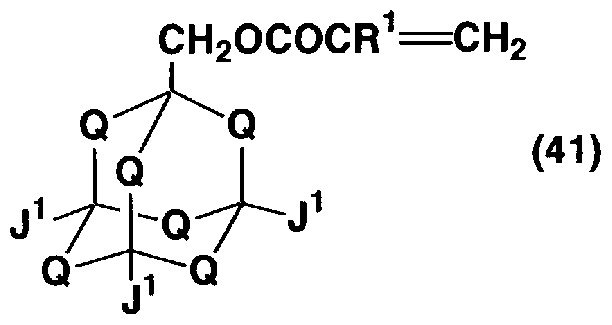
- R 1 hydrogen atom or methyl group.
- Q A monofluoromethylene group or a difluoromethylene group, and six Qs may be the same or different.
- J 1 is a hydrogen atom or a fluorine atom, and three J 1 s may be the same or different.
- a novel fluoroadamantane derivative a novel fluoropolymer, and a method for producing them.
- the fluoropolymer of the present invention is excellent in heat resistance, releasability, chemical resistance, transparency, light resistance, water repellency, oil repellency, low refractive index and the like.
- the compound represented by the formula (ml) is referred to as a compound (ml).
- acrylic acid and methacrylic acid are generically referred to as (meth) acrylic acid
- acrylate and metatalylate are generically referred to as (meth) acrylate
- acryloyl group and methacryloyl group are generically referred to as (meth) attalyloyl. I will write it as a group.
- the present invention provides a method for producing the following compound (p2) by reacting the following compound (ml) with a protic nucleophile.
- Six Qs in the compound of the present invention may be the same or different, and it is preferable that four or more are difluoromethylene groups. All six Qs are difluoromethylene groups. It is particularly preferable (the same applies hereinafter) o
- the three X m in the compound (ml) are preferably each independently a fluorine atom or a fluoropolyol group.
- Y P in the compound (p2) is a group corresponding to X m .
- the hydrogen atom is Y P corresponding to X m is full O b carbonyl group. That is, in the production method of the present invention, it is preferable that all of the fluorocarbo- col groups in the compound (ml) are replaced with hydrogen atoms.
- the fluorocarbonyl group attached to the tertiary carbon atom of the compound (ml) is unexpectedly chemically unstable. Since the fluorocarbonyl group reacts with the protic nucleophile and then undergoes a decarbonylation reaction, it is considered that the compound ( P2 ) is formed.
- a protic nucleophilic species refers to a compound having a proton and performing a nucleophilic reaction.
- the protic nuclide is particularly preferably ammonia, hydrogen sulfide, or water, preferably water.
- the amount of water relative to the compound (ml) having k ml of fluorocarbon group is lk ml ⁇ : L00k ml times mole is preferred lk ml ⁇ : L0k ml times mole is particularly preferred.
- the reaction is preferably carried out in the presence of an organic solvent.
- organic solvents include jetyl ether, acetone, tetrahydrofuran, dioxane, toluene, xylene, trichloro-or tri-ortho-ethane, dichloropentafluoropropane, Fluorinert FC-77 (Threem, trade name), fluoroether E2 (Lancaster, product) Name), perfluorooctane, perfluorodecalin and the like.
- the temperature in the reaction is preferably 0 to 90 ° C. 0 to 50 ° c is particularly preferred.
- the pressure in the reaction is not particularly limited.
- One preferred embodiment of the production method of the present invention is a production method of the following compound (p21) in which the following compound (mi l) is reacted with a protic nucleophilic species.
- the present invention provides a process for producing the following compound (p3), which comprises reacting the following compound (m2) with a compound represented by the formula W—CHO in the presence of a basic compound.
- Compound (m2) the compound obtained in the production method (p2) is preferably tool Furuorokarubo - compounds in which all are substituted by hydrogen atoms of the Le group (P 2) and even particularly preferable is.
- W is preferably a hydrogen atom or a hydrocarbon group having 1 to 7 carbon atoms, and a reaction atom more preferably a hydrogen atom, an alkyl group having 1 to 7 carbon atoms, or a phenyl group.
- a hydrogen atom or a hydrogen atom in which an alkyl group having 1 to 7 carbon atoms is particularly preferable, or a hydrogen atom in which a methyl group is more preferable is most preferable.
- Specific examples of the compound represented by the formula W-CHO include formaldehyde, acetate aldehyde, benzaldehyde and the like.
- Z P in the compound (p3) is a group corresponding to Y m .
- Z P corresponding to Y m being a hydrogen atom is preferably a group represented by the formula —CHWOH. That is, in the production method of the present invention, all the hydrogen atoms bonded to the tertiary carbon atom in the compound (m2) Substitution with a group of the formula CHWOH is preferred.
- the hydrogen atom bonded to the tertiary carbon atom of the compound (m2) has high acidity due to the influence of a monofluoromethylene group or difluoromethylene group adjacent to the tertiary carbon atom. For this reason, the hydrogen atom is easily dissociated as a proton by the basic compound, and the compound (m2) force is generated by the dissociation of the proton and the compound represented by the formula W-CHO. It is thought that compound (p3) was produced due to the reaction.
- Basic compounds include alkali metal hydroxides (sodium hydroxide, potassium hydroxide, etc.), organic metal basic compounds (ptyl lithium, methyl lithium, furyl lithium, methyl magnesium chloride, Particularly preferred are alkali metal hydroxides, such as tilmagnesium bromide and phenolmagnesium bromide.
- the reaction temperature is preferably 50 to 120 ° C. 60 to: LOO ° C is particularly preferable.
- the reaction pressure is not particularly limited.
- the reaction temperature is preferably 80 to 0 ° C, particularly preferably 80 to -40 ° C.
- the reaction pressure is not particularly limited.
- the reaction is preferably carried out in the presence of a polar solvent.
- the polar solvent is preferably selected from known organic polar solvents.
- the basic compound is an alkali metal hydroxide, methanol, ethanol, 2-propanol, dimethyl sulfoxide, or N, N dimethylformamide is preferred. Further, a mixed solvent of these organic solvents and water may be used.
- the basic compound is an organometallic basic compound, jetyl ether, tetrahydrofuran, or dioxane is preferred.
- the present invention provides the following compound (3).
- the three Z in the compound (3) are preferably each independently a fluorine atom or a hydroxymethyl group.
- the compound (3) is preferably the following compound (31).
- Specific examples of the compound (3) include the following compounds.
- Compound (3) is a novel compound having a characteristic structure having a hydroxymethyl group bonded to the tertiary carbon atom of adamantane. Since the hydroxymethyl group in compound (3) is highly reactive, various adamantane derivatives can be produced by reacting compound (3) with a compound having a functional group capable of reacting with a hydroxy group. Examples of the functional group capable of reacting with a hydroxy group include a carboxyl group, a derivative group thereof, and an isocyanate group.
- a (fluoroadamantanemethyl) ester can be produced by an esterification reaction between compound (3) and a carboxylic acid or a derivative thereof.
- a polyester can be produced by an esterification reaction between a compound (3) having two or more hydroxymethyl groups and a polycarboxylic acid having two or more carboxyl groups or a derivative thereof.
- the polyester is excellent in heat resistance, releasability, chemical resistance, transparency, durability light resistance, low refractive index property and the like.
- G is preferably a chlorine atom or a bromine atom.
- R is preferably a hydrogen atom or a methyl group.
- Z m is preferably a fluorine atom or a group represented by the formula CHWOH.
- CH CRCOG
- CH CHCOCl
- CHCOBr C (CH) COCl
- CH C (CH) COBr
- CH CFCOCl
- the reaction is preferably performed according to a known method.
- the hydroxyl group of compound (m3) is considered to be highly reactive because it is bonded to the carbon atom of adamantane via an alkylene group. Therefore, the production method of the present invention can be carried out with a high reaction yield.
- k m3 compounds having the group represented by the formula CHWOH (m3) (km 3 represents an integer of 1 to 4) per mole of the compound represented by the formula CH CRCOG
- the hydrogen atom bonded to the tertiary carbon atom of adamantane is
- a novel polymerizable fluoradamantane derivative substituted by a linking group (a group represented by the formula CHW—) to a (meth) ataryloxy group is provided.
- 3 Js are each independently a fluorine atom, or the formula CHWOCOCR
- OCH CH or one CH OCOC (CH 3) ⁇ CH is particularly preferred.
- Preferable embodiments of the compound (4) include the following compound (41) and the following compound (42).
- R 2 represents a hydrogen atom or a methyl group.
- J 2 is a hydrogen atom or a fluorine atom, and two J 2 may be the same or different.
- Compound (41) And two J 2 in the compound (42) are preferably fluorine atoms.
- Specific examples of the compound (4) include the following compounds.
- a hydrogen atom bonded to the tertiary carbon atom of adamantane is substituted with a group represented by the formula —CHWOCOCR 2 CH, and the remaining hydrogen atom is a fluorine atom.
- Compound (4) is useful as a polymerizable monomer. By polymerizing the compound (4), a novel fluoropolymer can be produced.
- the present invention provides a polymer obtained by polymerizing the compound (4).
- the weight average molecular weight of the polymer of the present invention is not particularly limited, and 1000 to 1000000 force S is preferable.
- the polymer of the present invention may be a homopolymer obtained by monopolymerizing only the compound (4), but may be a copolymer of the compound (4) and another monomer that can be copolymerized with the compound (4). It may be a copolymer obtained.
- the polymer of the present invention contains 0.1 to 99.9 mol% of repeating units formed by polymerization of compound (4) with respect to all repeating units, and is formed by polymerization of other monomers. has been repeating units from 0.1 to 99.9 mole 0/0 preferably contains.
- Other monomers are not particularly limited, and (meth) atarylates other than compound (4), unsaturated carboxylic acid amides, styrenes, bursilanes, olefins, fluorephines, chloroolefins , Butyl esters, butyl ethers, (meth) acrylic acid, acrylo-tolyl.
- (meth) acrylates include methyl (meth) acrylate, ethyl (meth) acrylate, butyl (meth) acrylate, 2-ethyl hexyl (meth) acrylate, isooctyl ( (Meth) Atalylate, isononyl (meth) atarylate, decyl (meth) atalylate, octadecyl (meth) atalylate, jetylaminoethyl (meth) atalylate, 2-hydroxyethyl (meth) acrylate, 2— Acyclic alkyl (meth) acrylate, such as hydroxypropyl (meth) acrylate; 1-adamantyl (meth) acrylate, 3-hydroxyl 1-adamantyl (meth) acrylate, 2-methyl-2-adamantyl ( (Meth) Atalylate, 2—Ethyl-2-adamantyl (
- unsaturated carboxylic acid amides include acrylamide, itaconic acid diamide, a ethylacrylamide, crotonic acid amide, fumaric acid diamide, maleic acid diamide, N- Examples include butoxymethylacrylamide and N-methylolacrylamide.
- styrenes include styrene, ⁇ -methylstyrene, chlorostyrene, and hydroxystyrene.
- bursilanes include butylmethyldimethoxysilane, butylmethylmethoxysilane, vinylmethyldichlorosilane, vinyltrimethoxysilane, vinyltriethoxysilane, and butyltrichlorosilane.
- olefins include ethylene, propylene, and isobutylene.
- fluororefins include acyclic fluoroolefins such as fluorinated buluene, vinylidene fluoride, tetrafluoroethylene, hexafnoreo-propylene, and perfnoreo-orifice (buterbi-noreether); And cyclic fluoroolefins such as perfluoro (2,2 dimethyl-1,3 dioxolane) and perfluoro (2-methylene 1,3 dioxolane).
- acyclic fluoroolefins such as fluorinated buluene, vinylidene fluoride, tetrafluoroethylene, hexafnoreo-propylene, and perfnoreo-orifice (buterbi-noreether);
- cyclic fluoroolefins such as perfluoro (2,2 dimethyl-1,3 dioxolane) and perfluoro (2-m
- chloroolefins include vinyl chloride, vinylidene chloride, and black-opened plane.
- bur esters include butyl acetate, butyl propionate, and allylmethyl.
- butyl ethers include 2-hydroxy butyl ether and aminoethyl butyl ether.
- the method of polymerizing the compound (4) may be a method of polymerizing the compound (4) as it is.
- the compound (4) is dispersed and dissolved in an organic solvent to prepare a solution composition. It is also possible to use a method. The latter is preferable from the viewpoint of operability.
- the content of the compound (4) in the solution composition is preferably 0.001 to 50% by mass, more preferably 0.01 to 50% by mass, and particularly preferably 0.1 to 20% by mass.
- organic solvent examples include perfluoroalkylamines such as perfluorotripropylamine and perfluorotributylamine; Fluorine-based compounds such as florinate (manufactured by 3 ⁇ ) and vertrel (manufactured by DuPont) Organic solvents; non-fluorinated organic solvents (hydrocarbons, alcohols, ketones, ethers, esters, chlorinated hydrocarbons, etc.). Organic solvent May be used alone or in combination of two or more.
- the compound (4) is preferably polymerized in the presence of a polymerization initiator.
- the polymerization initiator is preferably used in an amount of 0.01 to 5% by mass, particularly preferably 0.5 to 2.5% by mass, based on the compound (4).
- the polymerization initiator may be a heat-sensitive polymerization initiator or a light-sensitive polymerization initiator.
- a peroxide, an azo compound, or a persulfate that is preferable as a radical generator is particularly preferable.
- azo compound examples include azobisisobutyric-tolyl.
- peroxides are (C H COO—), (C F COO—), (C F COO—)
- C H is a phenyl group
- C F is a pentafluorophenyl group
- C H is 1, 4
- 6 5 6 5 6 10 represents a cyclohexyl group.
- the polymerization temperature and the polymerization pressure are not particularly limited.
- the polymerization temperature is preferably 0 to 200 ° C.
- the polymerization pressure is preferably from atmospheric pressure to lOMPa.
- the polymer of the present invention is a polymer excellent in water / oil repellency, heat resistance, mold release, chemical resistance, transparency, durability light resistance, and low refractive index, and is a heavy polymer soluble in an organic solvent. It is a coalescence.
- the coating or film containing the polymer of the present invention is useful for applications such as an optical fiber material, a pellicle material, a resist material, a lens material, and a surface protective film material for a display.
- the film or film containing the polymer of the present invention is prepared by applying a solution composition obtained by dissolving the polymer of the present invention in an organic solvent to the surface of the substrate, and then evaporating the organic solvent by drying. It is preferable to obtain it.
- organic solvent examples include alcohols such as methanol, ethanol, propanol, butanol, pentanol, hexanol, cyclohexanol, and pentanediol; ketones such as acetone, methyl isobutyl ketone, and cyclohexanone; Acetic esters such as ethyl acetate and butyl acetate; Aromatic hydrocarbons such as toluene and xylene; Glycol ethers such as propylene glycolenomonomethinoleether and propyleneglycolenomonoethylenoateol; Propylene glycol monomethyl ether acetate , Carbitol Glycol esters such as acetate; perfluorocarbons, hydrated fluorocarbons, hydrated chlorofluorocarbons, perfluoroethers, fluoroalcohols, fluoroketones, hydrated fluoro
- the amount of the polymer of the present invention in the solution composition is preferably 0.1 to 25% by mass, more preferably 5 to 15% by mass with respect to the organic solvent.
- the film thickness of the film or film containing the polymer of the present invention can be easily controlled, and the solution composition is stable.
- a known method can be adopted, for example, a roll coating method, a casting method, a dip method, a spin coating method, a water casting method, a die coating method, and a Langmuir's mouth. Examples thereof include a jet method.
- FC-77 is a fluorine-containing organic solvent.
- the number average molecular weight is denoted by Mn, and the weight average molecular weight is denoted by Mw.
- the flask was stirred at 25 ° C for 2 hours.
- the filtrate obtained by filtering the solution in the flask was washed with water (50 Washed twice with mL).
- the solution in the flask was dried over magnesium sulfate and then concentrated to obtain a pale yellow solid (6.19 g).
- the solid was purified by column chromatography to obtain the following compound (4 1 ).
- the polymerization reaction was carried out while maintaining the temperature at 40 ° C for 18 hours. After the polymerization reaction, the reactor contents were dropped into methanol. The agglomerated solid was collected and vacuum dried at 90 ° C. for 24 hours. As a result, a polymer (0.62 g) (hereinafter referred to as polymer (411 1 )) obtained by polymerization of compound (4 1 ) was obtained.
- the polymer (411 1 ) was a white powdery amorphous polymer at 25 ° C.
- the polymer (lh) By using a mixed solvent containing 99% by volume of R-225 and 1% by volume of HFIP as a mobile phase and using polymethylmethalate as an internal standard, the polymer (lh) The molecular weight was measured. Mn of the polymer (411 1 ) was 20000, and Mw was 7000. Further, the contact angle of the polymer (411 1 ) with respect to water was 107.8 °, and the falling angle was 7 °.
- the molecular weight of the polymer (4c 1 ) was measured by GPC method using tetrahydrofuran as a mobile phase and polystyrene as an internal standard. Mn of the polymer (4c 1 ) was 3800, and Mw was 9300. The polymer (4c 1 ) was soluble in tetrahydrofuran, propylene glycol monomethyl ether acetate, or cyclopentanone.
- Example 3-1 A polymer (5.2 g) (hereinafter referred to as polymer (4c 2 )) obtained by copolymerization of furan-3-yl methacrylate was obtained.
- the polymer (4c 2 ) was a white powdery amorphous polymer at 25 ° C.
- the polymer of the present invention includes an optical fiber material (core material and clad material of an optical fiber), a pellicle material, a resist material (resist film material, resist protective film material, etc.), lens material (eyeglass lens, optical lens). , Optical cells, etc.) and surface protective films for displays (PDP, LCD, CRT, FED, etc.).
Landscapes
- Chemical & Material Sciences (AREA)
- Organic Chemistry (AREA)
- Chemical Kinetics & Catalysis (AREA)
- Health & Medical Sciences (AREA)
- Medicinal Chemistry (AREA)
- Polymers & Plastics (AREA)
- Addition Polymer Or Copolymer, Post-Treatments, Or Chemical Modifications (AREA)
- Organic Low-Molecular-Weight Compounds And Preparation Thereof (AREA)
Description


Claims


Priority Applications (3)
| Application Number | Priority Date | Filing Date | Title |
|---|---|---|---|
| JP2007542628A JPWO2007049657A1 (ja) | 2005-10-28 | 2006-10-25 | 新規なフルオロアダマンタン誘導体、含フッ素重合体、および製造方法 |
| EP06822275A EP1942091A4 (en) | 2005-10-28 | 2006-10-25 | NEW FLUORADAMANTANDERIVAT, FLUOROUS POLYMER AND MANUFACTURING PROCESS |
| US12/091,846 US7649065B2 (en) | 2005-10-28 | 2006-10-25 | Fluoroadamantane derivative, fluorine-containing polymer and production method |
Applications Claiming Priority (4)
| Application Number | Priority Date | Filing Date | Title |
|---|---|---|---|
| JP2005-314801 | 2005-10-28 | ||
| JP2005314801 | 2005-10-28 | ||
| JP2006-045299 | 2006-02-22 | ||
| JP2006045299 | 2006-02-22 |
Publications (1)
| Publication Number | Publication Date |
|---|---|
| WO2007049657A1 true WO2007049657A1 (ja) | 2007-05-03 |
Family
ID=37967769
Family Applications (1)
| Application Number | Title | Priority Date | Filing Date |
|---|---|---|---|
| PCT/JP2006/321298 Ceased WO2007049657A1 (ja) | 2005-10-28 | 2006-10-25 | 新規なフルオロアダマンタン誘導体、含フッ素重合体、および製造方法 |
Country Status (6)
| Country | Link |
|---|---|
| US (1) | US7649065B2 (ja) |
| EP (1) | EP1942091A4 (ja) |
| JP (1) | JPWO2007049657A1 (ja) |
| KR (1) | KR20080063351A (ja) |
| RU (1) | RU2008121245A (ja) |
| WO (1) | WO2007049657A1 (ja) |
Cited By (3)
| Publication number | Priority date | Publication date | Assignee | Title |
|---|---|---|---|---|
| WO2007125829A1 (ja) * | 2006-04-28 | 2007-11-08 | Idemitsu Kosan Co., Ltd. | 含フッ素アダマンタン誘導体、重合性基含有含フッ素アダマンタン誘導体、それを含有する樹脂組成物及び反射防止膜 |
| JP2010174174A (ja) * | 2009-01-30 | 2010-08-12 | Agc Seimi Chemical Co Ltd | 電子部品用樹脂付着防止剤、それを含む電子部材および電子部品 |
| JP2012072283A (ja) * | 2010-09-29 | 2012-04-12 | Neos Co Ltd | 耐指紋性向上剤、これを用いた活性エネルギー線硬化型ハードコート剤、これらを用いて得られる硬化膜および硬化膜を有する物品 |
Citations (3)
| Publication number | Priority date | Publication date | Assignee | Title |
|---|---|---|---|---|
| WO2004052832A1 (ja) * | 2002-12-11 | 2004-06-24 | Asahi Glass Company, Limited | フッ素化されたアダマンタン誘導体 |
| JP2006131879A (ja) * | 2004-10-04 | 2006-05-25 | Asahi Glass Co Ltd | 含フッ素共重合体とその製造方法およびそれを含むレジスト組成物 |
| JP2006137798A (ja) * | 2004-11-10 | 2006-06-01 | Asahi Glass Co Ltd | 新規なアダマンタン反応物の製造方法 |
Family Cites Families (10)
| Publication number | Priority date | Publication date | Assignee | Title |
|---|---|---|---|---|
| US4402984A (en) * | 1980-07-03 | 1983-09-06 | Sun Tech, Inc. | Preparation of 1-hydropentadecafluoroadamantane and perfluoroadamantane |
| JP4173352B2 (ja) | 2001-12-25 | 2008-10-29 | 出光興産株式会社 | パーフルオロアダマンチルアクリル酸エステル類及びその中間体 |
| JP4233314B2 (ja) | 2002-11-29 | 2009-03-04 | 東京応化工業株式会社 | レジスト組成物および溶解制御剤 |
| US7488847B2 (en) | 2002-12-11 | 2009-02-10 | Asahi Glass Company, Limited | Fluorinated adamantane and its derivatives |
| JP2005089363A (ja) * | 2003-09-17 | 2005-04-07 | Idemitsu Kosan Co Ltd | 生成アダマンタン誘導体の分離精製方法及び原料の回収方法 |
| JPWO2005123650A1 (ja) | 2004-06-16 | 2008-04-10 | 旭硝子株式会社 | 新規なフッ素化されたアダマンタン誘導体 |
| EP1757575A4 (en) | 2004-06-16 | 2008-05-07 | Asahi Glass Co Ltd | FLUORADAMANTANDERIVAT |
| JP4523830B2 (ja) * | 2004-11-08 | 2010-08-11 | 出光興産株式会社 | ポリカーボネート樹脂、その製造方法及びそれを用いた光学材料 |
| WO2006077862A1 (ja) * | 2005-01-24 | 2006-07-27 | Idemitsu Kosan Co., Ltd. | エポキシ樹脂組成物及びそれを用いた光学材料 |
| CN101175707A (zh) | 2005-05-17 | 2008-05-07 | 旭硝子株式会社 | 含氟烷基醚的处理方法 |
-
2006
- 2006-10-25 RU RU2008121245/04A patent/RU2008121245A/ru not_active Application Discontinuation
- 2006-10-25 KR KR1020087009637A patent/KR20080063351A/ko not_active Withdrawn
- 2006-10-25 EP EP06822275A patent/EP1942091A4/en not_active Withdrawn
- 2006-10-25 US US12/091,846 patent/US7649065B2/en not_active Expired - Fee Related
- 2006-10-25 JP JP2007542628A patent/JPWO2007049657A1/ja not_active Withdrawn
- 2006-10-25 WO PCT/JP2006/321298 patent/WO2007049657A1/ja not_active Ceased
Patent Citations (3)
| Publication number | Priority date | Publication date | Assignee | Title |
|---|---|---|---|---|
| WO2004052832A1 (ja) * | 2002-12-11 | 2004-06-24 | Asahi Glass Company, Limited | フッ素化されたアダマンタン誘導体 |
| JP2006131879A (ja) * | 2004-10-04 | 2006-05-25 | Asahi Glass Co Ltd | 含フッ素共重合体とその製造方法およびそれを含むレジスト組成物 |
| JP2006137798A (ja) * | 2004-11-10 | 2006-06-01 | Asahi Glass Co Ltd | 新規なアダマンタン反応物の製造方法 |
Cited By (3)
| Publication number | Priority date | Publication date | Assignee | Title |
|---|---|---|---|---|
| WO2007125829A1 (ja) * | 2006-04-28 | 2007-11-08 | Idemitsu Kosan Co., Ltd. | 含フッ素アダマンタン誘導体、重合性基含有含フッ素アダマンタン誘導体、それを含有する樹脂組成物及び反射防止膜 |
| JP2010174174A (ja) * | 2009-01-30 | 2010-08-12 | Agc Seimi Chemical Co Ltd | 電子部品用樹脂付着防止剤、それを含む電子部材および電子部品 |
| JP2012072283A (ja) * | 2010-09-29 | 2012-04-12 | Neos Co Ltd | 耐指紋性向上剤、これを用いた活性エネルギー線硬化型ハードコート剤、これらを用いて得られる硬化膜および硬化膜を有する物品 |
Also Published As
| Publication number | Publication date |
|---|---|
| EP1942091A4 (en) | 2011-04-27 |
| EP1942091A1 (en) | 2008-07-09 |
| US20090176954A1 (en) | 2009-07-09 |
| KR20080063351A (ko) | 2008-07-03 |
| RU2008121245A (ru) | 2009-12-10 |
| US7649065B2 (en) | 2010-01-19 |
| JPWO2007049657A1 (ja) | 2009-04-30 |
Similar Documents
| Publication | Publication Date | Title |
|---|---|---|
| JP5789545B2 (ja) | 含フッ素化合物、撥液性処理剤、及び硬化膜 | |
| WO2008015876A1 (en) | Polymerizable compound having adamantane structure, process for production of the same, and resin composition | |
| JP3012324B2 (ja) | ヒドロキシ含有フルオロビニル化合物及びそのポリマー | |
| US7750178B2 (en) | Polymerizable acrylate compound containing hexafluorocarbinol group and polymer made therefrom | |
| TW200301760A (en) | Perfluoroadamantyl acrylate compound and intermediate thereof | |
| JP5206746B2 (ja) | 含フッ素ポリエーテルカルボン酸エステル | |
| JP4590703B2 (ja) | 含フッ素ポリエーテルカルボン酸エステル | |
| KR101936282B1 (ko) | 과불소계 공중합체 및 이를 포함하는 방오성 광경화 수지 조성물 | |
| TW200422280A (en) | Fluorinated adamantane derivatives | |
| JPWO2007049657A1 (ja) | 新規なフルオロアダマンタン誘導体、含フッ素重合体、および製造方法 | |
| JP2007254451A (ja) | 新規な重合性のフルオロアダマンタン誘導体 | |
| CN101296890A (zh) | 新的氟代金刚烷衍生物、含氟聚合物及制备方法 | |
| WO2004018534A1 (ja) | 含フッ素化合物、含フッ素ポリマー及びその製造方法 | |
| KR20230117582A (ko) | 함불소 중합체 | |
| JP7381948B2 (ja) | 含フッ素重合体の製造方法及び組成物 | |
| EP2039672B1 (en) | Fluorine-containing compound having highly fluorinated norbornane structure, fluorine-containing polymer, and their production methods | |
| JP2004250379A (ja) | 含フッ素化合物、その製造方法、含フッ素重合体および撥水撥油剤組成物 | |
| JP5320720B2 (ja) | 新規な、含フッ素化合物および含フッ素重合体 | |
| JP5109163B2 (ja) | 新規な含フッ素化合物、含フッ素重合体、およびその製造方法 | |
| JP2008137973A (ja) | 含フッ素ポリエーテルカルボン酸エステルおよびその製造法 | |
| JP2008201909A (ja) | フッ素系表面改質剤 | |
| JP2008115106A (ja) | 含フッ素ポリエーテルカルボン酸エステルおよびその製造法 | |
| JPH1129525A (ja) | 新規なシクロペンチルアクリレート化合物及びその製造方法 |
Legal Events
| Date | Code | Title | Description |
|---|---|---|---|
| WWE | Wipo information: entry into national phase |
Ref document number: 200680040042.1 Country of ref document: CN |
|
| DPE2 | Request for preliminary examination filed before expiration of 19th month from priority date (pct application filed from 20040101) | ||
| 121 | Ep: the epo has been informed by wipo that ep was designated in this application | ||
| WWE | Wipo information: entry into national phase |
Ref document number: 2007542628 Country of ref document: JP |
|
| WWE | Wipo information: entry into national phase |
Ref document number: 2006822275 Country of ref document: EP |
|
| WWE | Wipo information: entry into national phase |
Ref document number: 1020087009637 Country of ref document: KR |
|
| WWE | Wipo information: entry into national phase |
Ref document number: 12091846 Country of ref document: US |
|
| NENP | Non-entry into the national phase |
Ref country code: DE |
|
| WWE | Wipo information: entry into national phase |
Ref document number: 2008121245 Country of ref document: RU |