WO2007050468A2 - Method of manufacturing polystyrene foam with polymer processing additives - Google Patents
Method of manufacturing polystyrene foam with polymer processing additives Download PDFInfo
- Publication number
- WO2007050468A2 WO2007050468A2 PCT/US2006/041121 US2006041121W WO2007050468A2 WO 2007050468 A2 WO2007050468 A2 WO 2007050468A2 US 2006041121 W US2006041121 W US 2006041121W WO 2007050468 A2 WO2007050468 A2 WO 2007050468A2
- Authority
- WO
- WIPO (PCT)
- Prior art keywords
- polymeric foam
- foam according
- expanded polymeric
- manufacturing expanded
- foamable mixture
- Prior art date
- Legal status (The legal status is an assumption and is not a legal conclusion. Google has not performed a legal analysis and makes no representation as to the accuracy of the status listed.)
- Ceased
Links
Classifications
-
- C—CHEMISTRY; METALLURGY
- C08—ORGANIC MACROMOLECULAR COMPOUNDS; THEIR PREPARATION OR CHEMICAL WORKING-UP; COMPOSITIONS BASED THEREON
- C08J—WORKING-UP; GENERAL PROCESSES OF COMPOUNDING; AFTER-TREATMENT NOT COVERED BY SUBCLASSES C08B, C08C, C08F, C08G or C08H
- C08J9/00—Working-up of macromolecular substances to porous or cellular articles or materials; After-treatment thereof
- C08J9/0014—Use of organic additives
- C08J9/0023—Use of organic additives containing oxygen
-
- B—PERFORMING OPERATIONS; TRANSPORTING
- B23—MACHINE TOOLS; METAL-WORKING NOT OTHERWISE PROVIDED FOR
- B23K—SOLDERING OR UNSOLDERING; WELDING; CLADDING OR PLATING BY SOLDERING OR WELDING; CUTTING BY APPLYING HEAT LOCALLY, e.g. FLAME CUTTING; WORKING BY LASER BEAM
- B23K20/00—Non-electric welding by applying impact or other pressure, with or without the application of heat, e.g. cladding or plating
- B23K20/12—Non-electric welding by applying impact or other pressure, with or without the application of heat, e.g. cladding or plating the heat being generated by friction; Friction welding
- B23K20/122—Non-electric welding by applying impact or other pressure, with or without the application of heat, e.g. cladding or plating the heat being generated by friction; Friction welding using a non-consumable tool, e.g. friction stir welding
- B23K20/1225—Particular aspects of welding with a non-consumable tool
-
- B—PERFORMING OPERATIONS; TRANSPORTING
- B23—MACHINE TOOLS; METAL-WORKING NOT OTHERWISE PROVIDED FOR
- B23K—SOLDERING OR UNSOLDERING; WELDING; CLADDING OR PLATING BY SOLDERING OR WELDING; CUTTING BY APPLYING HEAT LOCALLY, e.g. FLAME CUTTING; WORKING BY LASER BEAM
- B23K20/00—Non-electric welding by applying impact or other pressure, with or without the application of heat, e.g. cladding or plating
- B23K20/12—Non-electric welding by applying impact or other pressure, with or without the application of heat, e.g. cladding or plating the heat being generated by friction; Friction welding
- B23K20/122—Non-electric welding by applying impact or other pressure, with or without the application of heat, e.g. cladding or plating the heat being generated by friction; Friction welding using a non-consumable tool, e.g. friction stir welding
- B23K20/1275—Non-electric welding by applying impact or other pressure, with or without the application of heat, e.g. cladding or plating the heat being generated by friction; Friction welding using a non-consumable tool, e.g. friction stir welding involving metallurgical change
-
- C—CHEMISTRY; METALLURGY
- C08—ORGANIC MACROMOLECULAR COMPOUNDS; THEIR PREPARATION OR CHEMICAL WORKING-UP; COMPOSITIONS BASED THEREON
- C08F—MACROMOLECULAR COMPOUNDS OBTAINED BY REACTIONS ONLY INVOLVING CARBON-TO-CARBON UNSATURATED BONDS
- C08F112/00—Homopolymers of compounds having one or more unsaturated aliphatic radicals, each having only one carbon-to-carbon double bond, and at least one being terminated by an aromatic carbocyclic ring
- C08F112/02—Monomers containing only one unsaturated aliphatic radical
- C08F112/04—Monomers containing only one unsaturated aliphatic radical containing one ring
- C08F112/06—Hydrocarbons
- C08F112/08—Styrene
-
- C—CHEMISTRY; METALLURGY
- C08—ORGANIC MACROMOLECULAR COMPOUNDS; THEIR PREPARATION OR CHEMICAL WORKING-UP; COMPOSITIONS BASED THEREON
- C08J—WORKING-UP; GENERAL PROCESSES OF COMPOUNDING; AFTER-TREATMENT NOT COVERED BY SUBCLASSES C08B, C08C, C08F, C08G or C08H
- C08J9/00—Working-up of macromolecular substances to porous or cellular articles or materials; After-treatment thereof
- C08J9/0014—Use of organic additives
- C08J9/0028—Use of organic additives containing nitrogen
-
- C—CHEMISTRY; METALLURGY
- C08—ORGANIC MACROMOLECULAR COMPOUNDS; THEIR PREPARATION OR CHEMICAL WORKING-UP; COMPOSITIONS BASED THEREON
- C08J—WORKING-UP; GENERAL PROCESSES OF COMPOUNDING; AFTER-TREATMENT NOT COVERED BY SUBCLASSES C08B, C08C, C08F, C08G or C08H
- C08J9/00—Working-up of macromolecular substances to porous or cellular articles or materials; After-treatment thereof
- C08J9/04—Working-up of macromolecular substances to porous or cellular articles or materials; After-treatment thereof using blowing gases generated by a previously added blowing agent
- C08J9/12—Working-up of macromolecular substances to porous or cellular articles or materials; After-treatment thereof using blowing gases generated by a previously added blowing agent by a physical blowing agent
- C08J9/122—Hydrogen, oxygen, CO2, nitrogen or noble gases
-
- C—CHEMISTRY; METALLURGY
- C08—ORGANIC MACROMOLECULAR COMPOUNDS; THEIR PREPARATION OR CHEMICAL WORKING-UP; COMPOSITIONS BASED THEREON
- C08J—WORKING-UP; GENERAL PROCESSES OF COMPOUNDING; AFTER-TREATMENT NOT COVERED BY SUBCLASSES C08B, C08C, C08F, C08G or C08H
- C08J9/00—Working-up of macromolecular substances to porous or cellular articles or materials; After-treatment thereof
- C08J9/04—Working-up of macromolecular substances to porous or cellular articles or materials; After-treatment thereof using blowing gases generated by a previously added blowing agent
- C08J9/12—Working-up of macromolecular substances to porous or cellular articles or materials; After-treatment thereof using blowing gases generated by a previously added blowing agent by a physical blowing agent
- C08J9/14—Working-up of macromolecular substances to porous or cellular articles or materials; After-treatment thereof using blowing gases generated by a previously added blowing agent by a physical blowing agent organic
- C08J9/143—Halogen containing compounds
- C08J9/144—Halogen containing compounds containing carbon, halogen and hydrogen only
- C08J9/146—Halogen containing compounds containing carbon, halogen and hydrogen only only fluorine as halogen atoms
-
- C—CHEMISTRY; METALLURGY
- C23—COATING METALLIC MATERIAL; COATING MATERIAL WITH METALLIC MATERIAL; CHEMICAL SURFACE TREATMENT; DIFFUSION TREATMENT OF METALLIC MATERIAL; COATING BY VACUUM EVAPORATION, BY SPUTTERING, BY ION IMPLANTATION OR BY CHEMICAL VAPOUR DEPOSITION, IN GENERAL; INHIBITING CORROSION OF METALLIC MATERIAL OR INCRUSTATION IN GENERAL
- C23C—COATING METALLIC MATERIAL; COATING MATERIAL WITH METALLIC MATERIAL; SURFACE TREATMENT OF METALLIC MATERIAL BY DIFFUSION INTO THE SURFACE, BY CHEMICAL CONVERSION OR SUBSTITUTION; COATING BY VACUUM EVAPORATION, BY SPUTTERING, BY ION IMPLANTATION OR BY CHEMICAL VAPOUR DEPOSITION, IN GENERAL
- C23C24/00—Coating starting from inorganic powder
- C23C24/02—Coating starting from inorganic powder by application of pressure only
- C23C24/04—Impact or kinetic deposition of particles
-
- C—CHEMISTRY; METALLURGY
- C08—ORGANIC MACROMOLECULAR COMPOUNDS; THEIR PREPARATION OR CHEMICAL WORKING-UP; COMPOSITIONS BASED THEREON
- C08J—WORKING-UP; GENERAL PROCESSES OF COMPOUNDING; AFTER-TREATMENT NOT COVERED BY SUBCLASSES C08B, C08C, C08F, C08G or C08H
- C08J2201/00—Foams characterised by the foaming process
- C08J2201/02—Foams characterised by the foaming process characterised by mechanical pre- or post-treatments
- C08J2201/03—Extrusion of the foamable blend
-
- C—CHEMISTRY; METALLURGY
- C08—ORGANIC MACROMOLECULAR COMPOUNDS; THEIR PREPARATION OR CHEMICAL WORKING-UP; COMPOSITIONS BASED THEREON
- C08J—WORKING-UP; GENERAL PROCESSES OF COMPOUNDING; AFTER-TREATMENT NOT COVERED BY SUBCLASSES C08B, C08C, C08F, C08G or C08H
- C08J2325/00—Characterised by the use of homopolymers or copolymers of compounds having one or more unsaturated aliphatic radicals, each having only one carbon-to-carbon double bond, and at least one being terminated by an aromatic carbocyclic ring; Derivatives of such polymers
- C08J2325/02—Homopolymers or copolymers of hydrocarbons
- C08J2325/04—Homopolymers or copolymers of styrene
- C08J2325/06—Polystyrene
Definitions
- This invention relates to processes for forming polymeric foams, particularly to the manufacture of extruded polystyrene (XPS) foams in the absence of chlorofluorocarbon and fluorocarbon blowing agents by using one or more esters, particularly adipates, benzoates and dibenzoates, as polymer processing aids (PPA) for improving the appearance and properties of the resulting foam, and more particularly to processes for preparing extruded polystyrene foam products from polystyrene blends using carbon dioxide as a primary blowing agent.
- XPS extruded polystyrene
- PPA polymer processing aids
- the invention relates to compositions and methods for producing extruded polystyrene (XPS) foam board suitable for insulation applications, particularly for exterior insulation finish system (EIFS) for building construction.
- XPS extruded polystyrene
- halocarbons such as methyl chloride, ethyl chloride, chlorocarbons, fluorocarbons (including HFCs) and chlorofluorocarbons (CFCs) including dichlorodifluoromethane, fmorohydrocarbons or chlorofluorohydrocarbons (which are also referred to as "soft CFCs", "HCFCs” or "HFCs”).
- halocarbons include a range of CFCs such as CFC-11 (chlorotrifluoromethane), CFC-12 (dichlorodifluoromethane), and CFC-113 (1,2,2- trifluoro-l,l,2-tri-chloroethane), and hydrohalocarbons, also referred to as "soft" CFCs, HCFCs and HFCs, including HCFC-22 (chlorodifluoromethane), HCFC-123 (1,1- dichloro-2,2,2-trifluoroethane), HCFC-142b (l-chloro-l,l-difluoroethane), HFC-134a (1,1,1,2-tetrafluoroethane), HFC-152a (1,1-difluoroethane), and HCFC-141b (1,1- dichloro- 1 -fluoroethane.
- CFCs such as CFC-11 (chlorotrifluoromethane), CFC
- the general procedure utilized in the preparation of extruded synthetic foam bodies generally includes the steps of melting a base polymeric composition, incorporating one or more blowing agents and other additives into the polymeric melt under conditions that provide for the thorough mixing of the blowing agent and the polymer while preventing the mixture from foaming prematurely, for example, under pressure.
- This mixture is then typically extruded through a single or multi-stage extrusion die to cool and reduce the pressure on the mixture, allowing the mixture to foam and produce a foamed product.
- the relative quantities of the polymer(s), blowing agent(s) and additives, the temperature and the manner in which the pressure is reduced will tend to affect the qualities and properties of the resulting foam product.
- the solubility of chlorofluorocarbons and certain alkanes in polystyrene tends to reduce the extrusion melt viscosity and improve cooling of expanded polystyrene (PS) melts.
- PS expanded polystyrene
- the combination of pentane and a chlorofluorocarbon such as Freon 11 and 12 is partially soluble in polystyrene and has been used for generating polystyrene foams that exhibited a generally acceptable appearance and physical properties such as surface finish, cell size and distribution, orientation, shrinkage and stiffness.
- Hydrocarbons such as pentane, hexane, cyclopentane and other homologs of this series have also been considered, but they are highly flammable and volatile, thereby raising both safety and VOC emission concerns.
- Carbon dioxide is an attractive candidate as a blowing agent, from both the environmental and economic standpoints.
- the challenges associated with successfully using CO 2 as a blowing agent are, however, significant in light of the relatively low solubility, high diffusivity and poor processability of CO 2 in polystyrene resins.
- CO 2 also has an increased thermal conductivity relative to that of HCFC-142b and HFC-134a, with CO 2 -blown foam exhibiting about 17% and about 10% lower overall product insulation values respectively than corresponding foams produced with HCFC-142b and HFC-134a.
- the objectives of the present invention include providing an improved method of making polymeric foams using one or more atmospheric gases as a blowing agent in combination with at least one ester, particularly an adipate ester, as a polymer processing aid.
- extruded polystyrene foams are prepared from a polymeric melt, typically one that includes a high melt flow polystyrene as the primary polymeric component, an atmospheric gas such as CO 2 as the primary blowing agent and at least one polymer processing aid selected from a group of esters, especially adipates having a bis(n-R) structure, wherein R is aliphatic (linear, cyclic and branched, saturated and unsaturated) or aromatic with a preferred adipate being bis(n- decanyl) adipate.
- the polymer melt will be prepared from a major portion of one or more styrenic polymers that exhibit a high melt index, for example, a melt index of at least about 10.0 (g/ 10 minutes) (as measured according to ASTM D 1238, Condition L) that is combined with no more than about 5 wt% of bis(n- decanyl) adipate as a polymer processing aid and less than about 4 wt% CO 2 as a blowing agent,
- the polymer melt will be prepared from preformed styrenic polymers or copolymers that may have been precompounded with bis(n-decanyl) adipate.
- the bis(n-decanyl) adipate can be injected directly into the polymeric melt at an intermediate position along the screw extruder path.
- other processing aids may be incorporated in the preformed styrenic polymers or may be injected into the melt as it moves through the extruder.
- the blowing agent(s), such as CO 2 is also injected into the polymeric melt at an intermediate portion along the screw extruder path.
- each of the additives and blowing agent(s) should be introduced into the polymeric melt sufficiently upstream of the extrusion die to ensure that adequate blending is achieved before the composition reaches the extrusion die.
- the method of making polystyrene foam comprises mixing an atmospheric gas such as carbon dioxide, nitrogen or air and at least one a non- volatile blending agent into a polystyrene melt.
- the polystyrene melt may also include one or more nucleating agents such as talc, sodium bicarbonate or citric acid.
- the mixture of the polystyrene melt, the atmospheric gas and the blending agent are then emitted through an extrusion die, thereby reducing the pressure and allowing the blowing agent to expand and form polystyrene foam.
- the resultant foam may have substantially no residual blowing agent and will exhibit acceptable foam and surface properties.
- FIG. 1 is a schematic drawing of an exemplary extrusion apparatus useful for practicing methods according to the invention
- FIG. 2 is a schematic drawing of another exemplary extrusion apparatus useful for practicing methods according to the invention.
- FIG. 3 is a chart illustrating pressure measurements obtained using a variety of comparative and demonstrative compositions and methods.
- an extrusion apparatus 100 useful for practicing methods according to the invention may comprise a single or double (not shown) screw extruder including a barrel 102 surrounding a screw 104 on which are provided a spiral flight 106 configured to compress, and thereby, heat material introduced into the screw extruder.
- the basic polymeric composition can be feed into the screw extruder as a flowable solid, such as beads, granules or pellets, or as a liquid or semiliquid melt, from one or more (not shown) feed hoppers 108.
- the decreasing spacing of the flight 106 define a successively smaller space through which the polymer composition is forced by the rotation of the screw.
- This decreasing volume acts to increase the temperature of the polymer composition to obtain a polymeric melt (if solid starting material was used) and/or to increase the temperature of the polymeric melt.
- one or more ports may be provided through the barrel 102 with associated apparatus 110 configured for injecting one or more polymer processing aids into the polymer composition.
- one or more ports may be provided through the barrel 102 with associated apparatus 112 for injecting one or more blowing agents into the polymer composition.
- an extrusion apparatus 200 useful for practicing methods according to the invention may comprise a single or double (not shown) screw extruder including a barrel 202 surrounding a screw 204 on which are provided a spiral flight 206 configured to compress, and thereby, heat material introduced into the screw extruder. As illustrated in FIG.
- the basic polymeric composition can be feed into the screw extruder as a flowable solid, such as beads, granules or pellets, or as a liquid or semiliquid melt, from one or more (not shown) feed hoppers 208.
- a flowable solid such as beads, granules or pellets, or as a liquid or semiliquid melt
- the decreasing spacing of the flight 206 define a successively smaller space through which the polymer composition is forced by the rotation of the screw. This decreasing volume acts to increase the temperature of the polymer composition to obtain a polymeric melt (if solid starting material was used) and/or to increase the temperature of the polymeric melt.
- one or more ports may be provided through the barrel 202 with associated apparatus 212 configured for injecting one or more blowing agents and, optionally one or more polymer processing aids, into the polymer composition.
- associated apparatus 212 configured for injecting one or more blowing agents and, optionally one or more polymer processing aids, into the polymer composition.
- This extrusion composition is then forced through an extrusion die 214 and exits the die into a region of reduced pressure (which may be below atmospheric pressure), thereby allowing the blowing agent to expand and produce a polymeric foam layer or slab.
- this pressure reduction may be obtained gradually as the extruded polymeric mixture advances through successively larger openings provided in the die or through some suitable apparatus (not shown) provided downstream of the extrusion die for controlling to some degree the manner in which the pressure applied to the polymeric mixture is reduced.
- the polymeric foam may also be subjected to additional processing such as calendaring, water immersion, cooling sprays or other operations to control the thickness and other properties of the resulting polymeric foam product.
- Exemplary methods according to the invention may utilize one or more of a variety of blowing agents to achieve the desired polymeric foam properties in the final product.
- the polymeric composition will include at least a major portion of a high melt flow polystyrene (for example, a polystyrene having a melt flow index of at least about 10 g/10 minutes (as measured according to ASTM D 1238 Condition L) using an atmospheric gas, preferably CO 2 , as the primary blowing agent.
- a high melt flow polystyrene for example, a polystyrene having a melt flow index of at least about 10 g/10 minutes (as measured according to ASTM D 1238 Condition L) using an atmospheric gas, preferably CO 2 , as the primary blowing agent.
- one or more polymer processing aids selected from a group of esters, particularly adipate esters, and more particularly bis(n-R) adipate esters, wherein R is selected from a group consisting Of C 6 -C 16 , and preferably C 8 -C 1S , aliphatic (linear, cyclic and branched, saturated and unsaturated) and aromatic (substituted and unsubstituted) groups, particularly compounds such as bis(n-decanyl) adipate.
- PPA polymer processing aids
- the processing aid(s) will improve the stability of the extrusion pressure/temperature profile and thereby improve the uniformity in the production of different thicknesses of polystyrene foam board using an atmospheric gas such as air, N 2 or, preferably, CO 2 as the primary blowing agent.
- the polymeric composition will preferably be a styrenic polymer and/or another polymer having a sufficiently high melt flow index (MFI or melt flow number), for example, a melt flow index of at least about 10 (g/10 minutes), thereby increasing the CO 2 solubility relative to that which can be achieved with polystyrenes having a MFI of less than 10.
- This polymeric composition may then be combined with minor amount of a polymer processing aid, typically an ester and preferably an adipate ester according to the general Formula I provided below:
- R 1 is selected from a group consisting Of C 1 -C 20 alkyl, aryl or alkaryl and R 2 and R 3 are independently selected from a group consisting of hydrogen, C 1 -C 20 , preferably C 6 -C 16 , and more preferably C 8 -C 13 , aliphatic (linear, cyclic and branched, saturated and unsaturated) and aromatic (substituted and unsubstituted) groups (and are generally identical), alkaryl and alkoxylate, wherein R and R cannot both be H.
- Representative compounds are represented by Formulas II-IV as provided below:
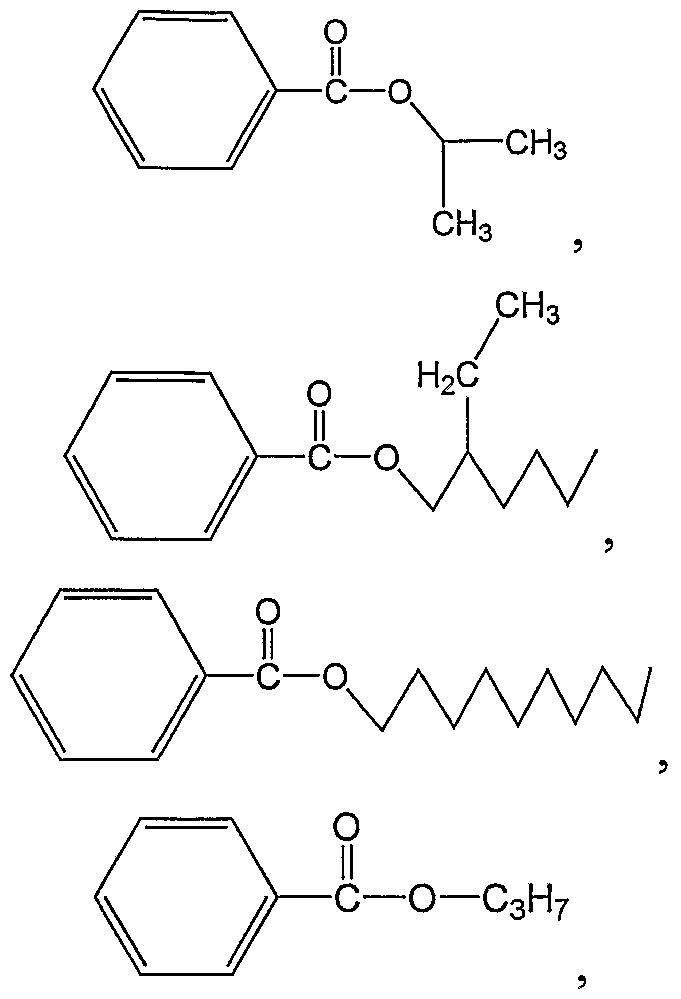
- benzoates generally corresponding to the general Formula V and reproduced below may be useful for increasing the solubility of CO 2 in polymeric compositions, such as polystyrene.
- R 5 is selected from a group consisting of C 1 -C 20 alkyl, aryl, alkaryl and alkoxylate.
- Suitable compounds corresponding to the general structure illustrated in Formula V for use in this invention are illustrated below as Formulas VI-X:
- dibenzoates generally corresponding to the general Formula XI and reproduced below may be useful for increasing the solubility of CO 2 in polymeric compositions, such as polystyrene.
- R 4 is selected from a group consisting of C 1 -C 20 alkyl, aryl, alkaryl and alkoxylate.
- Suitable compounds corresponding to the general structure illustrated in Formula V for use in this invention are illustrated below as Formulas XII-XVI:
- a minor portion typically less than about 5 wt%, preferably less than about 3 wt% or, perhaps, even less than about 2 wt% of a PPA, such as an adipate polymer processing aid, can be used in combination with a similar or greater concentration of the blowing agent(s).
- bis(n-decanyl) adipate can be incorporated into a polymeric system or melt at a rates as low as about 0.5 wt% and still exhibit improvements to the CO 2 solubility, extrusion process stability as reflected by temperature/pressure profiles of the process to produce foam board exhibiting improved dimensional stability.
- the esters, and particularly adipate esters will tend to outperform smaller alcohol compounds, such as ethanol, for maintaining the properties of the resulting foam board products, particularly when CO 2 is used as the only blowing agent.
- the PPA may be pumped through an injector and into an intermediate point in the movement of the polymeric composition through the extrusion device or extruder. Accordingly, for systems or apparatus that incorporated suitable liquid handling equipment, such as the assemblies that were utilized to inject one or more conventional PPA' s such as ethanol, these same assemblies can be utilized to inject one or more of the new PPAs.
- PPA additives such as bis(3-ethylhexyl) adipate (Formula II) and bis(n- tridecanyl) (Formula IV) and other similar compounds tend to exhibit similar effects with regard to improving the processability of CO 2 in the polymeric melt.
- Other polymers and copolymers such as styrene methyl methacrylate (SMMA) copolymers can also be utilized as the polymeric composition in methods according to the present invention and can be processed on the same apparatus as general purpose crystalline polystyrene.
- SMMA styrene methyl methacrylate
- PAAs including the bis(n-decanyl) adipate
- PAAs can be compounded with other polymers and copolymers such as ethylene methyl acrylate and added directly to the flowable particles, beads, pellets or other compounded forms and tend to exhibit similar effects on the foaming process in general and improving CO 2 solubility within the polymeric composition.
- the PAA compound(s) can be incorporated into the melt through direct injection into the extruder or through precompounding (blending) the PAA compound(s) with one or more of the other compatible polymers or additives to achieve similar effective concentrations in the final extrusion composition and thereby produce similar effects.
- the plastified foamable mixture was cooled to a second temperature (generally referred to as die melt temperature) and extruded into a region of reduced pressure to form a foam product.
- the mixture was cooled to a die melt temperature of 116 0 F (about 47 0 C) and was then ejected through a die opening (27 cm x 1.41 mm) into a region of lower pressure.
- Exemplary samples according to the invention were generated by foaming the mixture under both atmospheric pressure (101.3 kPa) and subatmospheric pressure conditions, specifically a vacuum of 8, 12 or 16 inches of Hg (about 74.3, 60.8 and 47.3 kPa respectively).
- Comparative samples were prepared using HCFC- 142b (11 wt% based on the polymer content) as the blowing agent and using a combination of CO 2 (3.7 wt%) and ethanol (1.5 wt%) as a blowing agent system. Additional exemplary samples were produced using CO 2 (3.7 wt%) and bis(n-decanyl) adipate (Formula III) (0.5 wt%) as a blowing agent system.
- the low level of bis(n-decanyl) adipate helps foam surface characteristics and at the same time enhances polymer melt processability
- the die pressure fluctuation usually is an indication of how any of the polymeric blowing agent system processes on the pilot line.
- FIG. 3 shows a comparison between current HCFC- 142b 11%, CO 2 3.7%/ethanol 1.5% and CO 2 3.7%/ bis(n-decanyl) adipate at 0.5%, 1.0% and 1.5% levels with the respective extrusion out pressure, static cooler pressure and die pressure monitored on pilot line runs with these compositions.
- PS NOVA 1220
- melt flow index 1.6 (g/10.0 minutes) was used.
- PS high melt flow index 10.0 (g/10 minutes) (NOVA NN0038) was been used. Attempts were made to produce foam board have a thickness of around 1 inch (about 25.4 mm) while keeping all other process parameters relatively constant.
- FIG. 3 shows the extrusion pressures at atmospheric condition, this relationship appears to hold true for 10 inches of Hg (about 67.5 kPa) (or any other vacuum levels) as well too. These results were achieved on an Owens Corning pilot line facility at Tallmadge, Ohio.
- the extrusion pressure profile is an indication of ease of process ability and blowing agent solubility in the melt.
- the extrusion out, cooler and die pressures for CO 2 /bis(n-decanyl) adipate system were higher relative to the conventional 142b system, they were very comparable to the CO 2 /ethanol system. In fact CO 2 / bis(n-decanyl) adipate at 1.5% level outperforms CO 2 /Ethanol system in terms of ease of process ability.
- R- value or total thermal resistance
- k is defined as the the ratio of the heat flow per unit cross-sectional to the temperature drop per unit thickness with the US unit: Btu - in
- the heat transfer through an insulating material can occur through solid conductivity, gas conductivity, radiation, and convection.
- the total thermal resistance (R- value), R is the measure of the resistance to heat transfer, and is determined as:
- a polymer processing aid comprising one or more esters, particularly adipates, benzoates and dibenzoates.
- the melt can be foamed and cooled to a degree sufficient to maintain generally normal process levels and can, accordingly, be controlled with conventional practices for obtaining foam products adapted for particular final uses.
- These conventional practices may be adapted for use with the present invention to provide some degree of control over the foam density and cell size while utilizing conventional extrusion apparatus and post-extrusion processing.
Landscapes
- Chemical & Material Sciences (AREA)
- Engineering & Computer Science (AREA)
- Health & Medical Sciences (AREA)
- Organic Chemistry (AREA)
- Chemical Kinetics & Catalysis (AREA)
- Materials Engineering (AREA)
- Medicinal Chemistry (AREA)
- Polymers & Plastics (AREA)
- Mechanical Engineering (AREA)
- Emergency Medicine (AREA)
- Metallurgy (AREA)
- Manufacture Of Porous Articles, And Recovery And Treatment Of Waste Products (AREA)
- Extrusion Moulding Of Plastics Or The Like (AREA)
Abstract
Description


Claims




Priority Applications (6)
| Application Number | Priority Date | Filing Date | Title |
|---|---|---|---|
| MX2014013873A MX372928B (en) | 2005-10-27 | 2006-10-20 | METHOD FOR MANUFACTURING POLYSTYRENE FOAM WITH POLYMER PROCESSING ADDITIVES. |
| MX2008005375A MX2008005375A (en) | 2005-10-27 | 2006-10-20 | METHOD FOR MANUFACTURING POLYSTYRENE FOAM WITH POLYMER PROCESSING ADDITIVES. |
| CN2006800442956A CN101326225B (en) | 2005-10-27 | 2006-10-20 | Method for preparing polystyrene foam using polymer processing additives |
| BRPI0617875-8A BRPI0617875B1 (en) | 2005-10-27 | 2006-10-20 | Methods for manufacturing expanded polymeric foam and foam board |
| CA2626307A CA2626307C (en) | 2005-10-27 | 2006-10-20 | Method of manufacturing polystyrene foam with polymer processing additives |
| EP06817240A EP1945699A2 (en) | 2005-10-27 | 2006-10-20 | Method of manufacturing polystyrene foam with polymer processing additives |
Applications Claiming Priority (2)
| Application Number | Priority Date | Filing Date | Title |
|---|---|---|---|
| US11/259,970 | 2005-10-27 | ||
| US11/259,970 US20070173554A1 (en) | 2005-10-27 | 2005-10-27 | Method of manufacturing polystyrene foam with polymer processing additives |
Publications (2)
| Publication Number | Publication Date |
|---|---|
| WO2007050468A2 true WO2007050468A2 (en) | 2007-05-03 |
| WO2007050468A3 WO2007050468A3 (en) | 2008-07-24 |
Family
ID=37968415
Family Applications (1)
| Application Number | Title | Priority Date | Filing Date |
|---|---|---|---|
| PCT/US2006/041121 Ceased WO2007050468A2 (en) | 2005-10-27 | 2006-10-20 | Method of manufacturing polystyrene foam with polymer processing additives |
Country Status (7)
| Country | Link |
|---|---|
| US (2) | US20070173554A1 (en) |
| EP (1) | EP1945699A2 (en) |
| CN (1) | CN101326225B (en) |
| BR (1) | BRPI0617875B1 (en) |
| CA (2) | CA2626307C (en) |
| MX (2) | MX2008005375A (en) |
| WO (1) | WO2007050468A2 (en) |
Cited By (4)
| Publication number | Priority date | Publication date | Assignee | Title |
|---|---|---|---|---|
| US8119701B2 (en) | 2005-10-24 | 2012-02-21 | Owens Corning Intellectual Capital, Llc | Method of manufacturing polystyrene foam with polymer processing additives |
| US9714330B2 (en) | 2005-10-27 | 2017-07-25 | Owens Corning Intellectual Capital, Llc | Method of manufacturing polystyrene foam with polymer processing additives |
| US10059822B2 (en) | 2005-10-27 | 2018-08-28 | Owens Corning Intellectual Capital, Llc | Method of manufacturing polystyrene foam with polymer processing additives |
| EP3495407A1 (en) * | 2013-03-15 | 2019-06-12 | Owens Corning Intellectual Capital, LLC | Processing aids for use in manufacturing extruded polystyrene foams using low global warming potential blowing agents |
Families Citing this family (6)
| Publication number | Priority date | Publication date | Assignee | Title |
|---|---|---|---|---|
| US20110144221A1 (en) * | 2008-06-04 | 2011-06-16 | Owens Corning Intellectual Capital, Llc | Extruded Polystyrene Foam Containing Propylene Carbonate, Ethylene Carbonate or Butylene Carbonate as a Process Aids |
| BR112012030589A2 (en) * | 2010-06-01 | 2016-08-16 | Basf Se | composition, process for producing expandable styrene polymer compositions, and a foam material, foam material, method for using a foam material and a cyclohexanecarboxylic ester |
| US8889748B2 (en) | 2010-06-01 | 2014-11-18 | Basf Se | Process for producing expandable styrene polymer compositions |
| US9850357B2 (en) * | 2011-02-10 | 2017-12-26 | Fina Technology, Inc. | Use of polar additives for enhancing blowing agent solubility in polystyrene |
| MX2017000515A (en) | 2014-07-16 | 2017-08-18 | Owens Corning Intellectual Capital Llc | Non-voc processing aids for use in manufacturing foams using low global warming potential blowing agents. |
| KR102164729B1 (en) * | 2019-08-05 | 2020-10-14 | 강현식 | A process for preparing co-extruded lamination sheet for packing tray |
Family Cites Families (48)
| Publication number | Priority date | Publication date | Assignee | Title |
|---|---|---|---|---|
| US3975316A (en) | 1972-05-04 | 1976-08-17 | Thiokol Corporation | Curing liquid polyurethane prepolymers |
| US3870841A (en) | 1972-10-02 | 1975-03-11 | Exxon Research Engineering Co | Flexible polymeric compositions comprising a normally plastic polymer sulfonated to about 0.2 to about 10 mole % sulfonate |
| JPS61246237A (en) * | 1985-04-25 | 1986-11-01 | Sumitomo Deyurezu Kk | Production of phenolic resin composite foam |
| EP0276452A1 (en) | 1986-12-24 | 1988-08-03 | Cape Industries | Viscosity reducing agents for aromatic polyester polyols and polyether polyols |
| US5356944A (en) * | 1988-06-27 | 1994-10-18 | Mobil Oil Corporation | High melt index polystytene foam and method |
| US5082608A (en) | 1990-06-14 | 1992-01-21 | Owens-Illinois Plastic Products Inc. | Polystyrene foam sheet manufacture |
| DE4137405A1 (en) | 1991-11-14 | 1993-05-19 | Basf Ag | EXPANDABLE STYRENE POLYMERISATES, CONTAINING CARBON DIOXIDE AS A DRIVING AGENT |
| US5258415A (en) | 1991-11-14 | 1993-11-02 | Basf Aktiengesellschaft | Expandable styrene polymers containing carbon dioxide as blowing agent |
| US5434205A (en) | 1992-01-21 | 1995-07-18 | Solcas Polymer Limited Partnership | Acrylonitrile polymer compositions and articles and methods for their preparation |
| US5340844A (en) * | 1992-04-24 | 1994-08-23 | The Dow Chemical Company | Polystyrene foam and a process for making the same |
| US5633289A (en) | 1993-03-16 | 1997-05-27 | Toyoda Gosei Co., Ltd. | Process for molding an integral skin foam and a polyurethane material for molding the same |
| TW422739B (en) | 1995-03-24 | 2001-02-21 | Bayer Ag | Azeotropic compositions of perfluorohexane, or 1,1,1,4,4,4-hexafluorobutane, or 1,3-dioxolane and hydrocarbons having 5 or 6 carbon atoms and the use thereof in the production of foams |
| EP0864589A4 (en) * | 1995-12-01 | 2003-04-02 | Chisso Corp | MOLDED RESIN OBJECTS |
| US5565497A (en) | 1995-12-07 | 1996-10-15 | The Celotex Corporation | Dispersant for filled, rigid cellular polymers |
| US5997781A (en) * | 1996-04-04 | 1999-12-07 | Mitsui Chemicals, Inc. | Injection-expansion molded, thermoplastic resin product and production process thereof |
| JPH1036548A (en) | 1996-07-24 | 1998-02-10 | Kanegafuchi Chem Ind Co Ltd | Polystyrene resin foam and method for producing the same |
| JPH10110796A (en) | 1996-10-03 | 1998-04-28 | Aisin Aw Co Ltd | Oil pressure control device for control valve and continuously variable transmission |
| KR100505774B1 (en) | 1997-06-13 | 2005-08-04 | 헌츠만 아이씨아이 케미칼스 엘엘씨 | Isocyanate Compositions for Blown Polyurethane Foams |
| US6225364B1 (en) * | 1997-12-18 | 2001-05-01 | The Dow Chemical Company | Foams comprising HFC-134 and a low solubility co-blowing agent and a process for making |
| AU747560B2 (en) * | 1998-03-16 | 2002-05-16 | Dow Chemical Company, The | Open-cell foam and method of making |
| US6093352A (en) * | 1998-09-16 | 2000-07-25 | Owens Corning Fiberglas Technology, Inc. | Process for producing foam by monitoring key process parameters |
| ES2156458T3 (en) * | 1999-01-20 | 2001-06-16 | Poliglas Sa | PROCEDURE AND INSTALLATION FOR THE PRODUCTION OF POLYSTYRENE IN FOAM, AS WELL AS BLOCKS AND FOAM PLATES OBTAINED WITH THOSE. |
| AU5314400A (en) * | 1999-06-01 | 2000-12-18 | Solutia Inc. | Composition for use in flexible polyurethane foams |
| US6689830B1 (en) | 1999-10-15 | 2004-02-10 | Velsicol Chemical Corporation | Film forming compositions containing benzoic acid esters of 8-carbon alcohols as additives |
| ES2269342T3 (en) * | 2000-02-04 | 2007-04-01 | Dow Global Technologies Inc. | A PROCESS TO PRODUCE A THERMOCONFORMABLE FOAM SHEET USING A PHYSICAL BLOWING AGENT. |
| US6166099A (en) * | 2000-04-20 | 2000-12-26 | Nova Chemicals Inc | Tetrafunctional initiator |
| WO2002032986A1 (en) | 2000-10-18 | 2002-04-25 | Mitsui Chemicals, Inc. | Foam of thermoplastic urethane elastomer composition and process for producing the foam |
| US20020123535A1 (en) | 2000-12-21 | 2002-09-05 | Araullo-Mcadams Carina | Isocyanate - reactive benzoate adduct polyol for use in the prodcution of rigid foam |
| US20040143068A1 (en) * | 2001-05-08 | 2004-07-22 | Souichiro Honda | Modifier for thermoplastic resin and thermoplastic resin composition using the same |
| EP1271259B1 (en) | 2001-06-26 | 2013-11-20 | Ricoh Company, Ltd. | Image forming apparatus and process cartridge therefor |
| JP4901026B2 (en) * | 2001-06-29 | 2012-03-21 | 株式会社ジェイエスピー | Manufacturing method of polystyrene resin extruded foam plate and polystyrene resin extruded foam plate |
| ITVR20010086A1 (en) | 2001-08-06 | 2003-02-06 | Interplastica Srl | PROCESS PROCESSING FOR OBTAINING A SYNTHETIC MATERIAL CONTAINING EXPANDABLE MICROSPHERES, AS WELL AS LIGHTWEIGHT OBJECTS |
| EP1288239A1 (en) | 2001-08-30 | 2003-03-05 | Huntsman International Llc | Process for making rigid urethane-modified polyisocyanurate foams |
| US6908950B2 (en) | 2001-10-25 | 2005-06-21 | Owens Corning Fiberglas Technology, Inc. | Asphalt filled polymer foam |
| US20030225172A1 (en) | 2002-05-31 | 2003-12-04 | Miller Larry M. | To enhance the thermal insulation of polymeric foam by reducing cell anisotropic ratio and the method for production thereof |
| JP3981945B2 (en) * | 2002-07-12 | 2007-09-26 | 株式会社ジェイエスピー | Production method of polystyrene resin extruded foam plate and polystyrene resin extruded foam plate |
| DE10241298A1 (en) | 2002-09-04 | 2004-03-18 | Basf Ag | Process for the production of polystyrene foam particles with low bulk density |
| US20040087754A1 (en) | 2002-10-31 | 2004-05-06 | Paul Foley | Polyurethane compounds and articles prepared therefrom |
| US20040162359A1 (en) | 2002-12-30 | 2004-08-19 | Barber Thomas Allan | Rigid foam from highly functionalized aromatic polyester polyols |
| US8568632B2 (en) | 2003-11-26 | 2013-10-29 | Owens Corning Intellectual Capital, Llc | Method of forming thermoplastic foams using nano-particles to control cell morphology |
| US7605188B2 (en) | 2004-12-31 | 2009-10-20 | Owens Corning Intellectual Capital, Llc | Polymer foams containing multi-functional layered nano-graphite |
| US20070213418A1 (en) | 2004-05-18 | 2007-09-13 | Vermilion Donn R | Asphalt-filled polymers |
| US20050260400A1 (en) | 2004-05-20 | 2005-11-24 | Schweitzer Mandy B | Foam products with silane impregnated facer |
| JP4773065B2 (en) | 2004-05-31 | 2011-09-14 | 三菱樹脂株式会社 | Porous film, separator for nonaqueous electrolyte battery, and nonaqueous electrolyte battery |
| US8309619B2 (en) | 2004-09-03 | 2012-11-13 | Pactiv LLC | Reduced-VOC and non-VOC blowing agents for making expanded and extruded thermoplastic foams |
| US8119701B2 (en) | 2005-10-24 | 2012-02-21 | Owens Corning Intellectual Capital, Llc | Method of manufacturing polystyrene foam with polymer processing additives |
| US20070173554A1 (en) | 2005-10-27 | 2007-07-26 | Yadollah Delaviz | Method of manufacturing polystyrene foam with polymer processing additives |
| US20110144221A1 (en) * | 2008-06-04 | 2011-06-16 | Owens Corning Intellectual Capital, Llc | Extruded Polystyrene Foam Containing Propylene Carbonate, Ethylene Carbonate or Butylene Carbonate as a Process Aids |
-
2005
- 2005-10-27 US US11/259,970 patent/US20070173554A1/en not_active Abandoned
-
2006
- 2006-10-20 EP EP06817240A patent/EP1945699A2/en not_active Withdrawn
- 2006-10-20 BR BRPI0617875-8A patent/BRPI0617875B1/en active IP Right Grant
- 2006-10-20 MX MX2008005375A patent/MX2008005375A/en active IP Right Grant
- 2006-10-20 MX MX2014013873A patent/MX372928B/en unknown
- 2006-10-20 CA CA2626307A patent/CA2626307C/en active Active
- 2006-10-20 CA CA2883548A patent/CA2883548C/en active Active
- 2006-10-20 CN CN2006800442956A patent/CN101326225B/en active Active
- 2006-10-20 WO PCT/US2006/041121 patent/WO2007050468A2/en not_active Ceased
-
2014
- 2014-03-07 US US14/200,135 patent/US10059822B2/en not_active Expired - Lifetime
Cited By (5)
| Publication number | Priority date | Publication date | Assignee | Title |
|---|---|---|---|---|
| US8119701B2 (en) | 2005-10-24 | 2012-02-21 | Owens Corning Intellectual Capital, Llc | Method of manufacturing polystyrene foam with polymer processing additives |
| US9714330B2 (en) | 2005-10-27 | 2017-07-25 | Owens Corning Intellectual Capital, Llc | Method of manufacturing polystyrene foam with polymer processing additives |
| US10059822B2 (en) | 2005-10-27 | 2018-08-28 | Owens Corning Intellectual Capital, Llc | Method of manufacturing polystyrene foam with polymer processing additives |
| EP3495407A1 (en) * | 2013-03-15 | 2019-06-12 | Owens Corning Intellectual Capital, LLC | Processing aids for use in manufacturing extruded polystyrene foams using low global warming potential blowing agents |
| EP4310135A3 (en) * | 2013-03-15 | 2024-03-27 | Owens Corning Intellectual Capital, LLC | Processing aids for use in manufacturing extruded polystyrene foams using low global warming potential blowing agents |
Also Published As
| Publication number | Publication date |
|---|---|
| US20140187656A1 (en) | 2014-07-03 |
| CN101326225A (en) | 2008-12-17 |
| BRPI0617875A2 (en) | 2011-08-09 |
| CN101326225B (en) | 2012-04-25 |
| US20170114201A9 (en) | 2017-04-27 |
| CA2883548A1 (en) | 2007-05-03 |
| MX2008005375A (en) | 2009-03-02 |
| CA2883548C (en) | 2016-08-02 |
| MX372928B (en) | 2020-04-27 |
| CA2626307C (en) | 2016-02-09 |
| EP1945699A2 (en) | 2008-07-23 |
| CA2626307A1 (en) | 2007-05-03 |
| WO2007050468A3 (en) | 2008-07-24 |
| US20070173554A1 (en) | 2007-07-26 |
| BRPI0617875B1 (en) | 2018-07-24 |
| US10059822B2 (en) | 2018-08-28 |
Similar Documents
| Publication | Publication Date | Title |
|---|---|---|
| US9714330B2 (en) | Method of manufacturing polystyrene foam with polymer processing additives | |
| US10059822B2 (en) | Method of manufacturing polystyrene foam with polymer processing additives | |
| US9453090B2 (en) | Reduced-VOC and non-VOC blowing agents for making expanded and extruded thermoplastic foams | |
| US8119701B2 (en) | Method of manufacturing polystyrene foam with polymer processing additives | |
| MX2010013201A (en) | Extruded polystyrene foam containing propylene carbonate, ethylene carbonate or butylene carbonate as a process aids. | |
| CA2399239C (en) | Extruded foam product with reduced surface defects | |
| EP3824021B1 (en) | Blowing agent blends | |
| JP2022539332A (en) | Blowing agent blends for thermoplastic polymers | |
| WO1996016111A1 (en) | Polystyrene resin foam and process for producing the foam | |
| JP2024177394A (en) | Blowing Agent Blends for Thermoplastic Polymers |
Legal Events
| Date | Code | Title | Description |
|---|---|---|---|
| WWE | Wipo information: entry into national phase |
Ref document number: 200680044295.6 Country of ref document: CN |
|
| ENP | Entry into the national phase |
Ref document number: 2626307 Country of ref document: CA |
|
| WWE | Wipo information: entry into national phase |
Ref document number: MX/A/2008/005375 Country of ref document: MX |
|
| NENP | Non-entry into the national phase |
Ref country code: DE |
|
| WWE | Wipo information: entry into national phase |
Ref document number: 2006817240 Country of ref document: EP |
|
| ENP | Entry into the national phase |
Ref document number: PI0617875 Country of ref document: BR Kind code of ref document: A2 Effective date: 20080425 |