WO2007054100A2 - Lna nucleoside phosphoramidates - Google Patents
Lna nucleoside phosphoramidates Download PDFInfo
- Publication number
- WO2007054100A2 WO2007054100A2 PCT/DK2006/000627 DK2006000627W WO2007054100A2 WO 2007054100 A2 WO2007054100 A2 WO 2007054100A2 DK 2006000627 W DK2006000627 W DK 2006000627W WO 2007054100 A2 WO2007054100 A2 WO 2007054100A2
- Authority
- WO
- WIPO (PCT)
- Prior art keywords
- compound
- group
- alkyl
- formula
- medicament
- Prior art date
- Legal status (The legal status is an assumption and is not a legal conclusion. Google has not performed a legal analysis and makes no representation as to the accuracy of the status listed.)
- Ceased
Links
Classifications
-
- C—CHEMISTRY; METALLURGY
- C07—ORGANIC CHEMISTRY
- C07H—SUGARS; DERIVATIVES THEREOF; NUCLEOSIDES; NUCLEOTIDES; NUCLEIC ACIDS
- C07H19/00—Compounds containing a hetero ring sharing one ring hetero atom with a saccharide radical; Nucleosides; Mononucleotides; Anhydro-derivatives thereof
- C07H19/02—Compounds containing a hetero ring sharing one ring hetero atom with a saccharide radical; Nucleosides; Mononucleotides; Anhydro-derivatives thereof sharing nitrogen
- C07H19/04—Heterocyclic radicals containing only nitrogen atoms as ring hetero atom
- C07H19/06—Pyrimidine radicals
- C07H19/10—Pyrimidine radicals with the saccharide radical esterified by phosphoric or polyphosphoric acids
-
- A—HUMAN NECESSITIES
- A61—MEDICAL OR VETERINARY SCIENCE; HYGIENE
- A61P—SPECIFIC THERAPEUTIC ACTIVITY OF CHEMICAL COMPOUNDS OR MEDICINAL PREPARATIONS
- A61P35/00—Antineoplastic agents
-
- C—CHEMISTRY; METALLURGY
- C07—ORGANIC CHEMISTRY
- C07H—SUGARS; DERIVATIVES THEREOF; NUCLEOSIDES; NUCLEOTIDES; NUCLEIC ACIDS
- C07H19/00—Compounds containing a hetero ring sharing one ring hetero atom with a saccharide radical; Nucleosides; Mononucleotides; Anhydro-derivatives thereof
- C07H19/02—Compounds containing a hetero ring sharing one ring hetero atom with a saccharide radical; Nucleosides; Mononucleotides; Anhydro-derivatives thereof sharing nitrogen
- C07H19/04—Heterocyclic radicals containing only nitrogen atoms as ring hetero atom
- C07H19/16—Purine radicals
- C07H19/20—Purine radicals with the saccharide radical esterified by phosphoric or polyphosphoric acids
Definitions
- the present invention provides compounds that are LNA nucleoside phosphoramidates which act as inhibitors of cell proliferation and the use of LNA nucleoside phosphoramidates in medicine.
- Nucleoside analogues such as fluorodeoxyuridine, cytarabine and gemcitabine are well established as anticancer agents. They function as inhibitors of DNA synthesis after activation to their 5'-phosphate form.
- NA's The chemotherapeutic effect of NA's depends on their ability to penetrate into the cells and for some NA also to be phosphorylated (to their triphosphates) intracellular ⁇ .
- the free bioactive phosphate forms do not in general represent useful drugs due to their poor membrane permeation. This poses two problems; first the transformation from nucleoside to monophosphates is often a highly controlled process and therefore the key step in the intracellular conversion of the NA.[McGuigan, C; Kinchington, D.; Nicholls, S. R.; Nickson, C; O'Connor, T. J. Bioorg. Med. Chem. Lett. 1993, 3, 1207-1210.]. Second NA's phosphates are relatively polar compounds, which often limit their ability to penetrate the cell membrane
- LNA Locked Nucleic Acid
- LNA nucleotides as therapeutic agent in their own right, remains a rather unexplored area. We have therefore synthesised a series of lipophilic prodrugs of different LNA analogues in combination with the phosphoramidite approach. Detailed descriptions on methods of preparation of LNA monomers and manipulations of suitable protecting groups in such compounds can be found in WO/2003095476.
- the present invention is based upon the surprising discovery that despite the absence of any activity against HIV, LNA nucleoside/phoshoramidate conjugates have a marked activity against cancer cells, and are therefore suited for use in medicine, particularly in the treatment of cancer.
- the present invention provides compounds of the Formula I for use as a medicament
- B is a nucleobase
- Ar is a substituted or unsubstituted aryl group
- X is selected from the group consisting of -O, -S-, >NH and >NR', wherein R' is selected from the group consisting of hydrogen, C 1 -C 6 BCyI and C 1 -C 6 alkyl;
- R 1 is selected from the group consisting aikyl, aryl and alkylaryl
- R 2 and R 3 are, independently, selected from the group comprising H, C 1-6 primary, secondary or tertiary alkyl, C 1 -C 3 alkyl C 5 -C 7 aryl, or, when together they form an alkylene chain, they provide, together with the C atom to which they are attached, a C 3 -C 8 carbocyclic aliphatic ring.
- R 4 is selected from the group consisting of hydrogen, hydroxyl, amino, azido, halo, optionally substituted C 1 -C 6 alkyl, optionally substituted C 1 -C 6 alkoxy, carboxy, nitrilo, nitro, aryl, thiol, and -Y-CO-Rd, wherein Y is selected from the group consisting of O , >NH and -S , and Rd is selected from the group consisting of NH 2 , OH and C 1 -C 6 alkyl;
- stereocenters 1, 3, 4 and 7 may be present in either orientation.
- the present invention further provides various methods of treatment/therapy comprising administering a compound of formula I to a patient, as well as the use of a compound of Formula I in the manufacture of a medicament for the treatment or prophylaxis of cancer.
- the present invention further provides a compound of formula I, as herein defined, wherein R 1 is benzyl.
- the present invention further provides a compound of formula I,
- Figure 1 illustrates the general synthesis of the compounds of this invention: A) Et 3 N, Et 2 O, - 78 0 C, 5-12 h; B) Et 3 N, L-alanine methyl/benzyl ester hydrochloride, DCM, -78 0 C to RT, 2-5 h; C) LNA nucleoside 1-4, 1 BuMgCl, Pyr/MeCN 2:1, 2 days.
- Figure 2 illustrates the phosphoramidates synthesized.
- FIG. 3 illustrates MTS assay data of selected LNA phosphoramidates and Gemcitabine (GEM) (positive control) normalised to Mock (blank).
- C 1 -Ci 0 alky is intended to mean a linear, cyclic or branched hydrocarbon group having 1 to 10 carbon atoms, such as methyl, ethyl, propyl, iso- propyl, cyclopropyl, butyl, /so-butyl, tert-butyl, cyclobutyl, pentyl, cyclopentyl, hexyl, cyclohexyl, etc.
- the cyclic variants hereof are often referred to as “cycloalkyl", more particular "C 3 -Ci 0 cycloalkyl".
- C x -C 6 alkyl (which is often preferred) - of course - refers to shorter variants having 1 to 6 carbon atoms.
- C 2 -C 6 alkenyl is intended to cover linear, cyclic or branched hydrocarbon groups having 2 to 6 carbon atoms and comprising one unsaturated double bond.
- alkenyl groups are vinyl, allyl, butenyl, pentenyl, hexenyl, heptenyl, octenyl, hepta- decaenyl.
- Preferred examples of alkenyl are vinyl, allyl, butenyl, especially allyl.
- C 2 -C 6 alkynyl is intended to cover linear, cyclic or branched hydrocarbon groups having 2 to 6 carbon atoms and comprising one unsaturated triple bond.
- Ci-C 6 alkylene is intended to mean a linear, cyclic or branched hydrocarbon biradical having 1 to 6 carbon atoms, such as methylene, ethylene, propylene, /so-propylene, cyclopropylene, butylene, /so-butylene, te/t-butylene, cyclobutylene, pentylene, cyclopentylene, hexylene, cyclohexylene, etc.
- the cyclic variants hereof are often referred to as “cycloalkylene", more particular "C 3 -C 6 cycloalkylene".
- haloalkyl and haloalkylene are intended to mean alkyl and alkylene, respectively, being substituted with one or more halogen atoms, e.g. one, two, three or four halogen atoms, or even halogen atoms corresponding to all hydrogen atoms of the alkylene (perhalogenation).
- acyl means alkylcarbonyl, e.g. "Ci-C 6 acyl” means Ci-C 6 alkyl-carbonyl.
- alkoxy means alkyloxy, e.g. "C 1 -C 6 alkoxy” means C 1 -C 6 alkyl-oxy.
- alkyl alkylene, alkoxy, acyl, “alkenyl”, and “alkynyl
- the substituents are selected from hydroxy (which when bound to an unsaturated carbon atom may be present in the tautomeric keto form), C 1 -C 6 alkoxy, C 2 -C 6 alkenyloxy, carboxy, oxo (forming a keto or aldehyde functionality), C 1 -C 6 acyl, formyl, aryl, aryloxy, arylamino, arylcarbonyl, heteroaryl, heteroaryloxy, heteroarylamino, heteroarylcarbonyl, heterocyclyl, heterocyclyloxy, heterocyclyiamino, heterocyclylcarbonyl, amino, mono- and di(Ci-C 6 alkyl)amino; carbamoyl, mono- and di(Ci-C 6 alkyl)aminocarbonyl, amino-Ci-C ⁇ alkylaminocarbonyl, mono- and (H(Cx-C 6 alkyOamino-Ci-Q alkyl-amino
- substituents are selected from hydroxy, C 1 -C 6 alkoxy, amino, mono- and di(C 1 -C 6 alkyl)amino, carboxy, C 1 -C 6 acylamino, C 1 -C 6 alkylaminocarbonyl, and halogen.
- halogen includes fluoro, chloro, bromo, and iodo.
- Boc means tert-butoxycarbonyl, i.e. an N-protecting group.
- aryl is intended to mean a fully or partially aromatic carbocyclic ring or ring system, such as phenyl, naphthyl, 1,2,3,4-tetrahydronaphthyl, anthracyl, phenanthracyl, pyrenyl, benzopyrenyl, fluorenyl and xanthenyl, among which phenyl is a preferred example.
- heteroaryl groups are oxazolyl, isoxazolyl, thiazolyl, isothiazolyl, pyrrolyl, imidazolyl, pyrazolyl, pyridinyl, pyrimidinyl, pyrazinyl, pyridazinyl, triazinyl, coumaryl, furanyi, thienyl, quinolyl, benzothiazolyl, benzotriazolyl, benzodiazolyl, benzooxozolyl, phthalazinyl, phthalanyl, triazolyl, tetrazolyl, isoquinolyl, acridinyl, carbazolyl, dibenzazepinyl, indolyl, benzopyrazolyl, phenoxazonyl.
- heteroaryl groups are benzimidazolyl, oxazolyl, isoxazolyl, thiazolyl, isothiazolyl, pyrrolyl, imidazolyl, pyrazolyl, pyridinyl, pyrimidinyl, pyrazinyl, pyridazinyl, furyl, thienyl, quinolyl, triazolyl, tetrazolyl, isoquinolyl, indolyl in particular benzimidazolyl, pyrrolyl, imidazolyl, pyridinyl, pyrimidinyl, furyl, thienyl, quinolyl, tetrazolyl, and isoquinolyl.
- heterocyclyl groups examples include imidazolidine, piperazine, hexahydropyridazine, hexahydropyrimidine, diazepane, diazocane, pyrrolidine, piperidine, azepane, azocane, aziridine, azirine, azetidine, pyroline, tropane, oxazinane (morpholine), azepine, dihydroazepine, tetrahydroazepine, and hexahydroazepine, oxazolane, oxazepane, oxazocane, thiazolane, thiazinane, thiazepane, thiazocane, oxazetane, diazetane, thiazetane, tetrahydrofuran, tetrahydropyran, oxepane, tetrahydrothioph
- the most interesting examples are tetrahydrofuran, imidazolidine, piperazine, hexahydropyridazine, hexahydropyrimidine, diazepane, diazocane, pyrrolidine, piperidine, azepane, azocane, azetidine, tropane, oxazinane (morpholine), oxazolane, oxazepane, thiazolane, thiazinane, and thiazepane, in particular tetrahydrofuran, imidazolidine, piperazine, hexahydropyridazine, hexahydropyrimidine, diazepane, pyrrolidine, piperidine, azepane, oxazinane (morpholine), and thiazinane.
- heterocyclic ring is intended to means a ring of the type specified above under “heteroaryl” and “heterocyclyl” provided that the ring comprises 4 to 8 ring atoms.
- the term “optionally substituted” is intended to mean that the group in question may be substituted one or several times, preferably 1-5 times, in particular 1-3 times, with group(s) selected from hydroxy (which when present in an enol system may be represented in the tautomeric keto form), Ci-C 6 alkyl, C 1 -C 6 alkoxy, C 2 -C 6 alkenyloxy, oxo (which may be represented in the tautomeric enol form), carboxy, Cj-C 6 alkoxycarbonyl, C 1 -C 6 acyl, formyl, aryl, aryloxy, arylamino, aryloxycarbonyl, arylcarbonyl, hetero
- acetamido cyano, guanidino, carbamido, Ci-C 6 alkanoyloxy, Ci-C 6 alkyl- sulphonyl-amino, aryl-sulphonyl-amino, heteroaryl-sulphonyl-amino, Ci-C 6 alkyl-suphonyl, Ci-C 6 alkyl-sulphinyl, Ci-C 6 alkylsulphonyloxy, nitro, sulphanyl, amino, amino-sulfonyl, mono- and di(Ci-C 6 alkyl)amino-sulfonyl, halogen-Ci-C 4 alkyl, dihalogen-Ci-C 4 alkyl, trihalogen-Ci- C 4 alkyl, halogen, where aryl and heteroaryl representing substituents may be substituted 1- 3 times with Ci-C 4 alkyl, Ci-C 4 alkoxy, nitro, cyano, amino or
- the substituents are selected from hydroxy, Ci-C 6 alkyl, Ci-C 6 alkoxy, oxo (which may be represented in the tautomeric enol form), carboxy, C x -C 6 acyl, formyl, amino, mono- and di(Ci-C 6 alkyl)amino; carbamoyl, mono- and di(Ci-C 6 alkyl)aminocarbonyl, amino-Ci-C 6 alkyl-aminocarbonyl, C ⁇ -C 6 acylamino, guanidino, carbamido, C 1 -C 6 alkyl-sulphonyl-amino, aryl-sulphonyl-amino, heteroaryl-sulphonyl-amino, Ci-C 6 alkyl-suphonyl, Ci-C 6 alkyl- sulphinyl, Ci-C 6 alkylsulphonyloxy, sulphanyl, amino
- the substituents are selected from Ci-C 6 alkyl, Ci-C 6 alkoxy, amino, mono- and di(Ci-C 6 alkyl)amino, sulphanyl, carboxy or halogen, where any alkyl, alkoxy and the like, representing substituents may be substituted with hydroxy, Ci-C 6 alkoxy, C 2 -C 6 alkenyloxy, amino, mono- and di(Ci-C 6 alkyl)amino, carboxy, C 1 -C 6 acylamino, halogen, C 1 -C 6 alkylthio, C 1 -C 6 alkyl-sulphonyl-amino, or guanidino.
- prodrug used herein is intended to mean a derivative of a compound of the formula (I) which - upon exposure to physiological conditions - will liberate a compound of the formula (I) which then will be able to exhibit the desired biological action.
- prodrugs are esters (carboxylic acid ester, phosphate esters, sulphuric acid esters, etc.), acid labile ethers, acetals, ketals, etc.
- salts is intended to include acid addition salts and basic salts.
- acid addition salts are pharmaceutically acceptable salts formed with non-toxic acids.
- organic salts are those with maleic, fumaric, benzoic, ascorbic, succinic, oxalic, bis-methylenesalicylic, methanesulfonic, ethanedisulfonic, acetic, propionic, tartaric, salicylic, citric, gluconic, lactic, malic, mandelic, cinnamic, citraconic, aspartic, stearic, palmitic, itaconic, glycolic, p-aminobenzoic, glutamic, benzenesulfonic, and theophylline acetic acids, as well as the 8-halotheophyllines, for example 8-bromotheophylline.
- Exemplary of such inorganic salts are those with hydrochloric, hydrobromic, sulfuric, sulfamic, phosphoric, and nitric acids.
- Examples of basic salts are salts where the (remaining) counter ion is selected from alkali metals, such as sodium and potassium, alkaline earth metals, such as calcium, and ammonium ions C + N(R) 3 R", where R and R' independently designates optionally substituted C 1 -C 6 alkyl, optionally substituted C 2 -C 6 alkenyl, optionally substituted aryl, or optionally substituted heteroaryl).
- Pharmaceutically acceptable salts and pharmaceutically acceptable carnerss are, e.g., those described in Remington's Pharmaceutical Sciences, 17. Ed.
- B is typically a natural or non natural nucleobase selected form the group consisting of adenine, cytosine, 5-methylcytosine, isocytosine, pseudoisocytosine, guanine, thymine, uracil, 5-bromouracil, 5-propynyluracii, 5-propyny-6-fluorouracil, 5-methylthiazoleuracil, 6- aminopurine, 2-aminopurine, inosine, diaminopurine, 7-propyne-7-deazaadenine, 7-propyne- 7-deazaguanine, and 2-chloro-6-aminopurine.
- B is adenine or an adenine analogue.
- B is cytosine or a cytosine analogue.
- B is guanine or a guanine analogue.
- B is thymine or a thymine analogue.
- B is selected from the group consisting of adenine, cytosine and guanine, and analogues thereof.
- X in Formula I is selected from the group consisting of -O-, -S-, >NH and >NR', wherein R' is selected from the group consisting of hydrogen, C 1 -C 6 acyl (e.g. acetyl and benzyl) and C 1 -C 6 alkyl (e.g. methyl and isopropyl).
- the compounds of the invention may be in the ⁇ -D form.
- X is either -O- ( ⁇ -D-oxy).
- the compounds of the invention may be in the ⁇ -L form.
- X is -O- ( ⁇ -L-oxy).
- the compounds of the invention may be in the xylo form.
- X is -0-.
- Ar is a substituted or an unsubstituted aryl group
- Ar is substituted or an unsubstituted monocyclic aromatic ring moiety or a fused bicyclic aromatic ring moiety, preferably a substituted or an unsubstituted phenyl group,
- Ar may be a substituted monocyclic aromatic ring moiety or a fused bicyclic aromatic ring moiety, wherein said substitution is selected from the group consisting of halogen (preferably chlorine or fluorine), trihalomethyl (preferably trifluoromethyl), cyano and nitro groups.
- halogen preferably chlorine or fluorine
- trihalomethyl preferably trifluoromethyl
- cyano and nitro groups preferably a halogen, such as chlorine or fluorine.
- R 1 is selected from the group consisting of methyl, ethyl, n-or i-propyl, n-or i-butyl, or benzyl. In a preferable embodiment, R 1 is selected from the group consisting of -Me and -Bn, preferably benzyl (-Bn)
- R 2 and R 3 are, independently selected from the group consisting of
- R 2 is -H or Me (hydrogen or methyl).
- R 3 is -H or Me.
- R 4 is R 4 is selected from the group consisting of hydrogen, hydroxyl, amino, azido, and halo;
- Preferred compounds include one or more of the following: 4, 5, and 6. (see Figure 2)
- Most preferred compounds may include: 5 and 6.
- the compounds of Formula I may be selected from the group comprising a ⁇ -D-oxy, a xylo or an alpha-L-oxy locked nucleoside.
- the compounds may suitable be formulated as a pharmaceutical composition in order to facilitate the proper absorbance of the compound in the relevant region or tissue.
- the invention also provides a pharmaceutical composition
- a pharmaceutical composition comprising compound of Formula I (as defined herein) and a pharmaceutically acceptable carrier.
- a compound having formula I according to the present invention for use in a method of treatment, preferably in the prophylaxis or treatment of cancer.
- a method of phrophylaxis or treatment of cancer comprising administration to a patient in need of such treatment an effective dose of a compound having formula I according to the present invention.
- a pharmaceutical composition comprising a compound having formula I of the present invention in combination with a pharmaceutically acceptable excipient, carrier or diluent.
- a method of preparing a pharmaceutical composition comprising the step of combining a compound having formula I of the present invention with a pharmaceutically acceptable excipient, carrier or diluent.
- the pharmaceutical composition of the invention further comprises anti- inflamatory compounds and/or antiviral compounds.
- the pharmaceutical composition of the invention comprises two or more non-identical compounds of Formula I, for example the pharmaceutical composition according to the invention may comprise both compound 5 and compound 6, or compounds 4 and 6, or compounds 4 and 5, or compounds 4, 5 and 6 (see Figure 2).
- the invention described herein encompasses a method of preventing or treating cancer comprising a therapeutically effective amount of the compound of the invention.
- the cancer which may be treated by the pharmaceutical composition according to the invention, may be selected form the group consisting of: non-Hodgkin's lymphoma, Hodgkin's lymphoma, leukemia (e.g., acute leukemia such as acute lymphocytic leukemia, acute myelocytic leukemia, chronic myeloid leukemia, chronic lymphocytic leukemia, multiple myeloma), colon carcinoma, rectal carcinoma, pancreatic cancer, breast cancer, ovarian cancer, prostate cancer, renal cell carcinoma, hepatoma, bile duct carcinoma, choriocarcinoma, cervical cancer, testicular cancer, lung carcinoma, bladder carcinoma, melanoma, head and neck cancer, brain cancer, cancers of unknown primary site, neoplasms, cancers of the peripheral nervous system, cancers of the central nervous system, tumors (e.g., fibrosarcoma, myxosarcoma, liposarcoma, chondrosarcoma
- the term 'treatment' as used herein refers to both treatment of an exisiting disease (e.g. a cancer as herein referred to), or prevention of a disease, i.e. prophylaxis.
- an exisiting disease e.g. a cancer as herein referred to
- prevention of a disease i.e. prophylaxis.
- the invention also provides for the use of the compound or conjugate of the invention as described for the manufacture of a medicament for the treatment of cancer.
- a medicament for the treatment of cancer is in the form of i) a solid tumor and/or a carcinoma, and/or ii) a sarcoma, and/or iii) glioma.
- said carcinoma as referred to in the use(s) according to the invention is selected from the group consisting of malignant melanoma, basal cell carcinoma, ovarian carcinoma, breast carcinoma, non-small cell lung cancer, renal cell carcinoma, bladder carcinoma, recurrent superficial bladder cancer, stomach carcinoma, prostatic carcinoma, pancreatic carcinoma, lung carcinoma, cervical carcinoma, cervical dysplasia, laryngeal papillomatosis, colon carcinoma, colorectal carcinoma and carcinoid tumors. More preferably, said carcinoma is selected from the group consisting of malignant melanoma, non-small cell lung cancer, breast carcinoma, colon carcinoma and renal cell carcinoma.
- said carcinoma is a malignant melanoma, preferably selected from the group consisting of superficial spreading melanoma, nodular melanoma, lentigo maligna melanoma, acral melagnoma, amelanotic melanoma and desmoplastic melanoma.
- said sarcoma as referred to in the use(s), such as use for the manufacture of a medicament and/or methods according to the invention, such as methods for treating cancer is selected from the group consisting of osteosarcoma, Ewing's sarcoma, chondrosarcoma, malignant fibrous histiocytoma, fibrosarcoma and Kaposi's sarcoma.
- the invention also provides for a method for treating cancer, said method comprising administering a compound according to the invention as herein described, and/or a conjugate according to the invention, and/or a pharmaceutical composition according to the invention to a patient in need thereof.
- the cancer referred to in the methods of treatment according to the invention and/or uses for the manufacture of a medicament are selected from the group consisting of cancer diseases is a lung, breast, colon, prostate, pancreas, lung, liver, thyroid, kidney, brain, testes, stomach, intestine, bowel, spinal cord, sinuses, bladder, urinary tract or ovaries cancer.
- the invention provides for the use of the compounds per se or as conjugate as herein defined for the manufacture of a medicament for the treatment of cancer, and/or for reducing inflammation associated with the cancers herein disclosed, preferably lung cancer.
- the phosphorodichloridates (1) and phosphochloridates (2) were synthesized according to McGuigan et al (references 1 and 2).
- the LNA nucleosides were synthesized according to Koshkin et al (reference 3).
- the nucleoside (1 mol eq.) was evaporated twice from anhydrous pyridine and dried over P 2 O 5 for 2 h then dissolved in pyridine/acetonitrile (2: 1; 10 mL/ mol. Eq.). To this solution was added 'BuMgCl (IM in THF; 1.1 mol eq) and the solution was stirred at room temperature under argon for 15 min. The appropriate phosphochloridate (0.2M in THF, 2 mol eq.) was added and the solution was stirred under argon for 24 h.
- EXAMPLE 4 Synthesis of p-chloro-phenyl-[Benzyloxy-L-alaninyi]-[((l ⁇ / 3jR,4 «,7S)-3- (adenine-9-yl)-7-hydroxy-2,5-dioxabicyclo[2:2: l]heptane-l-yl)methyl] phosphate (6):
- EXAMPLE 7 Synthesis of p-chloro-phenyl-[Benzyloxy-L-alaninylH((lR,3R,4/R,7R)-3- (adenine-9-yl)-7-hydroxy-2,5-dioxabicyclo[2:2: l]heptane ⁇ l-yl)methyl] phosphate (9):
- EXAMPLE 13 Synthesis of p-chloro-phenyl-[Benzyloxy-L-alaninyl]-t((lR,3 ⁇ ,4R,7S)-3- (thymin-l-yl)-7-hydroxy-2,5-dioxabicyclo[2:2: l]heptane-l-yl)methyl] phosphate (12):
- EXAMPLE 16 Synthesis of p-chloro-phenyl-[Benzyloxy-L-alaninyl]-[((lS,3R,4S,7R)-3- (thymin-l-yl)-7-hydroxy-2,5-dioxabicyclo[2:2: l]heptane-l-yl)methyl] phosphate (15):
- 15PC3 cells were seeded to a density of 12000 cells per well in white 96 well plate (Nunc 136101) in DMEM the day prior to transfection. The next day, cells were washed once in prewarmed OptiMEM followed by addition of 72 ⁇ l OptiMEM containing 5 ⁇ g/ml Lipofectamine2000 (In vitrogen). Cells were incubated for 7 min. before adding 18 ⁇ l LNA phosphoramidate diluted in OptiMEM. The final LNA phosphoramidate concentration ranged from 0,1 nM to 500 nM. After 4 h of treatment, cells were washed in OptiMEM and 100 ⁇ l serum containing DMEM was added.
- viable cells were measured by adding 20 ⁇ l the tetrazolium compound [3-(4,5-dimethyl-2-yl)-5-(3- carboxymethoxyphenyl)-2-(4-sulfophenyl)-2H-tetrazolium, inner salt; MTS] and an electron coupling reagent (phenazine ethosulfate; PES) (CellTiter 96 ® AQ ueoU s One Solution Cell Proliferation Assay, Promega) per 100 ⁇ l DMEM. Viable cells were measured at 490 nm in a
Landscapes
- Chemical & Material Sciences (AREA)
- Organic Chemistry (AREA)
- Health & Medical Sciences (AREA)
- General Health & Medical Sciences (AREA)
- Life Sciences & Earth Sciences (AREA)
- Biotechnology (AREA)
- Engineering & Computer Science (AREA)
- Molecular Biology (AREA)
- Genetics & Genomics (AREA)
- Biochemistry (AREA)
- Veterinary Medicine (AREA)
- Public Health (AREA)
- Nuclear Medicine, Radiotherapy & Molecular Imaging (AREA)
- General Chemical & Material Sciences (AREA)
- Animal Behavior & Ethology (AREA)
- Chemical Kinetics & Catalysis (AREA)
- Medicinal Chemistry (AREA)
- Pharmacology & Pharmacy (AREA)
- Pharmaceuticals Containing Other Organic And Inorganic Compounds (AREA)
- Saccharide Compounds (AREA)
Abstract
The invention provides for a compound of formula I for use in medicine: (Formula I).
Description
LNA NUCLEOSIDE PHOSPHORAMIDATES
FIELD OF THE INVENTION
The present invention provides compounds that are LNA nucleoside phosphoramidates which act as inhibitors of cell proliferation and the use of LNA nucleoside phosphoramidates in medicine.
BACKGROUND OF THE INVENTION
Nucleoside analogues such as fluorodeoxyuridine, cytarabine and gemcitabine are well established as anticancer agents. They function as inhibitors of DNA synthesis after activation to their 5'-phosphate form.
The chemotherapeutic effect of NA's depends on their ability to penetrate into the cells and for some NA also to be phosphorylated (to their triphosphates) intracellular^. The free bioactive phosphate forms do not in general represent useful drugs due to their poor membrane permeation. This poses two problems; first the transformation from nucleoside to monophosphates is often a highly controlled process and therefore the key step in the intracellular conversion of the NA.[McGuigan, C; Kinchington, D.; Nicholls, S. R.; Nickson, C; O'Connor, T. J. Bioorg. Med. Chem. Lett. 1993, 3, 1207-1210.]. Second NA's phosphates are relatively polar compounds, which often limit their ability to penetrate the cell membrane
The use of lipophilic monophosphate prodrugs of NA's such as CycloSal, SATE, and phosphoramidates [Cahard, D.; McGuigan, C; Balzarini, J. Mini-Reviews in Med. Chem. 2004, 4, 371-381] have in many cases proven be the solution to both problems, and the research within this field is progressing.
The last few years has seen the development of quite a few LNA (Locked Nucleic Acid) nucleosides but with a few exceptions [Bryld, T.; Sørensen, M. H.; Nielsen, P.; Koch, T.; Wengel, J. J.Chem.Soc, Perkin Trans.l 2002, 1655-1662.] they have only been used as building blocks for oligonucleotides in antisense treatment.
LNA nucleotides, as therapeutic agent in their own right, remains a rather unexplored area. We have therefore synthesised a series of lipophilic prodrugs of different LNA analogues in combination with the phosphoramidite approach.
Detailed descriptions on methods of preparation of LNA monomers and manipulations of suitable protecting groups in such compounds can be found in WO/2003095476.
Detailed descriptions on methods of preparation of phosphoramidates in general and various variations in the ester can be found in [McGuigan et al, AVCC, 1998,9, 473-9], variations in amino acid in [McGuigan et al, Antiviral Res. , 1997,35, 195-204], and variations in aryl in [Siddiqui et al, J. Med. Chem. , 1999,42, 393-9] regions of the phosphoramidate, and nucleoside [McGuigan et al, BioOrg. Med, Chem. Lett. , 1996,6, 2369-72; McGuigan et al, Bioorg. Med. Chem. Lett., 2000,10, 645- 7]. This work has lead to the optimal description of phenyl methoxyalaninyl phosphoramidate as the prototype pro-moiety for the intracellular delivery of bioactive nucleotides [Balzarini et al, PNAS, 1996,93, 7295-9; McGuigan et al, J. Med. Chem. 1996,39, 1748- 53].
Certain phosphoramiditates conjugated to LNA nucleosides have been prepared and tested against against HIV in vitro. But none of the analogues prepared had activity against HIV (Bryld et al., J. Chem. Soc, Perkin Trans. 1, 2002, 1655-1662).
The present invention is based upon the surprising discovery that despite the absence of any activity against HIV, LNA nucleoside/phoshoramidate conjugates have a marked activity against cancer cells, and are therefore suited for use in medicine, particularly in the treatment of cancer.
SUMMARY OF THE INVENTION
The present invention provides compounds of the Formula I for use as a medicament

Formula I
wherein:
B is a nucleobase
Ar is a substituted or unsubstituted aryl group
X is selected from the group consisting of -O, -S-, >NH and >NR', wherein R' is selected from the group consisting of hydrogen, C1-C6 BCyI and C1-C6 alkyl;
R1 is selected from the group consisting aikyl, aryl and alkylaryl;
R2 and R3 are, independently, selected from the group comprising H, C1-6 primary, secondary or tertiary alkyl, C1-C3 alkyl C5-C 7 aryl, or, when together they form an alkylene chain, they provide, together with the C atom to which they are attached, a C3-C8 carbocyclic aliphatic ring.
R4 is selected from the group consisting of hydrogen, hydroxyl, amino, azido, halo, optionally substituted C1-C6 alkyl, optionally substituted C1-C6 alkoxy, carboxy, nitrilo, nitro, aryl, thiol, and -Y-CO-Rd, wherein Y is selected from the group consisting of O , >NH and -S , and Rd is selected from the group consisting of NH2, OH and C1-C6 alkyl;
and wherein the stereocenters 1, 3, 4 and 7 may be present in either orientation.
The present invention further provides various methods of treatment/therapy comprising administering a compound of formula I to a patient, as well as the use of a compound of Formula I in the manufacture of a medicament for the treatment or prophylaxis of cancer.
The present invention further provides a compound of formula I, as herein defined, wherein R1 is benzyl.
The present invention further provides a compound of formula I,

Formula I
as defined herein, wherein, either, said compound is not selected from one of the following:

BRIEF DESCRIPTION OF THE FIGURES
Figure 1 illustrates the general synthesis of the compounds of this invention: A) Et3N, Et2O, - 780C, 5-12 h; B) Et3N, L-alanine methyl/benzyl ester hydrochloride, DCM, -780C to RT, 2-5 h; C) LNA nucleoside 1-4, 1BuMgCl, Pyr/MeCN 2:1, 2 days.
Figure 2 illustrates the phosphoramidates synthesized.
Figure 3 illustrates MTS assay data of selected LNA phosphoramidates and Gemcitabine (GEM) (positive control) normalised to Mock (blank).
DESCRIPTION OF THE INVENTION
Definitions
In the present context, the term "C1-Ci0 alky!" is intended to mean a linear, cyclic or branched hydrocarbon group having 1 to 10 carbon atoms, such as methyl, ethyl, propyl, iso- propyl, cyclopropyl, butyl, /so-butyl, tert-butyl, cyclobutyl, pentyl, cyclopentyl, hexyl, cyclohexyl, etc. The cyclic variants hereof are often referred to as "cycloalkyl", more particular "C3-Ci0 cycloalkyl". "Cx-C6 alkyl" (which is often preferred) - of course - refers to shorter variants having 1 to 6 carbon atoms.
Similarly, the term "C2-C6 alkenyl" is intended to cover linear, cyclic or branched hydrocarbon groups having 2 to 6 carbon atoms and comprising one unsaturated double bond. Examples of alkenyl groups are vinyl, allyl, butenyl, pentenyl, hexenyl, heptenyl, octenyl, hepta- decaenyl. Preferred examples of alkenyl are vinyl, allyl, butenyl, especially allyl. The term "C2-C6 alkynyl" is intended to cover linear, cyclic or branched hydrocarbon groups having 2 to 6 carbon atoms and comprising one unsaturated triple bond.
Moreover, the term "Ci-C6 alkylene" is intended to mean a linear, cyclic or branched hydrocarbon biradical having 1 to 6 carbon atoms, such as methylene, ethylene, propylene, /so-propylene, cyclopropylene, butylene, /so-butylene, te/t-butylene, cyclobutylene, pentylene, cyclopentylene, hexylene, cyclohexylene, etc. The cyclic variants hereof are often referred to as "cycloalkylene", more particular "C3-C6 cycloalkylene".
The terms "haloalkyl" and "haloalkylene" are intended to mean alkyl and alkylene, respectively, being substituted with one or more halogen atoms, e.g. one, two, three or four halogen atoms, or even halogen atoms corresponding to all hydrogen atoms of the alkylene (perhalogenation).
The term "acyl" means alkylcarbonyl, e.g. "Ci-C6 acyl" means Ci-C6 alkyl-carbonyl.
The term "alkoxy" means alkyloxy, e.g. "C1-C6 alkoxy" means C1-C6 alkyl-oxy.
In the present context, i.e. in connection with the terms "alkyl", "alkylene", "alkoxy", "acyl", "alkenyl", and "alkynyl", the term "optionally substituted" is intended to mean that the group in question may be substituted one or several times, preferably 1-3 times, with group(s) selected from hydroxy (which when bound to an unsaturated carbon atom may be present in the tautomeric keto form), C1-C6 alkoxy, C2-C6 alkenyloxy, carboxy, oxo (forming a keto or
aldehyde functionality), C1-C6 alkoxycarbonyl, Ci-C6 acyl, formyl, aryl, aryloxy, arylamino, arylcarbonyl, aryloxycarbonyl, arylcarbonyloxy, arylaminocarbonyl, arylcarbonylamino, heteroaryl, heteroaryloxy, heteroarylamino, heteroarylcarbonyl, heteroaryloxycarbonyl, heteroarylcarbonyloxy, heteroarylaminocarbonyl, heteroarylcarbonylamino, heterocyclyl, heterocyclyloxy, heterocyclyiamino, heterocyclylcarbonyl, heterocyclyloxycarbonyl, heterocyclylcarbonyloxy, heterocyclylaminocarbonyl, heterocyclylcarbonylamino, amino, mono- and di(CrC6 alkyl)amino, carbamoyl, mono- and Ui(C1-C6 alkyl)aminocarbonyl, Ci-C6 acylamino, cyano, guanidino, carbamido, C1-C6 alkyl-sulphonyl-amino, aryl-sulphonyl-amino, heteroaryl-sulphonyl-amino, C1-C6 alkanoyloxy, C1-C6 alkyl-sulphonyl, C1-C6 alkyl-sulphinyl, C1-C6 alkylsulphonyloxy, nitro, C1-C6 alkylthio, and halogen, where any aryl, heteroaryl and heterocyclyl may be substituted as specifically described below for aryl, heteroaryl and heterocyclyl, and any alkyl, alkoxy, and the like, representing substituents may be substituted with hydroxy, C1-C6 alkoxy, amino, mono- and di(Ci-C6 alkyl)amino, carboxy, C1-C6 acylamino, C1-C6 alkylaminocarbonyl, or halogen(s).
Typically, the substituents are selected from hydroxy (which when bound to an unsaturated carbon atom may be present in the tautomeric keto form), C1-C6 alkoxy, C2-C6 alkenyloxy, carboxy, oxo (forming a keto or aldehyde functionality), C1-C6 acyl, formyl, aryl, aryloxy, arylamino, arylcarbonyl, heteroaryl, heteroaryloxy, heteroarylamino, heteroarylcarbonyl, heterocyclyl, heterocyclyloxy, heterocyclyiamino, heterocyclylcarbonyl, amino, mono- and di(Ci-C6 alkyl)amino; carbamoyl, mono- and di(Ci-C6 alkyl)aminocarbonyl, amino-Ci-Cβ alkylaminocarbonyl, mono- and (H(Cx-C6 alkyOamino-Ci-Q alkyl-aminocarbonyl, C1-C6 acylamino, guanidino, carbamido, C1-C6 alkyl-sulphonyl-amino, C1-C6 alkyl-sulphonyl, C1-C6 alkyl- sulphinyl, C1-C6 alkylthio, halogen, where any aryl, heteroaryl and heterocyclyl may be substituted as specifically described below for aryl, heteroaryl and heterocyclyl.
In some embodiments, substituents are selected from hydroxy, C1-C6 alkoxy, amino, mono- and di(C1-C6 alkyl)amino, carboxy, C1-C6 acylamino, C1-C6 alkylaminocarbonyl, and halogen.
The term "halogen" includes fluoro, chloro, bromo, and iodo.
The term "Boc" means tert-butoxycarbonyl, i.e. an N-protecting group.
In the present context, the term "aryl" is intended to mean a fully or partially aromatic carbocyclic ring or ring system, such as phenyl, naphthyl, 1,2,3,4-tetrahydronaphthyl, anthracyl, phenanthracyl, pyrenyl, benzopyrenyl, fluorenyl and xanthenyl, among which phenyl is a preferred example.
The term "heteroaryl" is intended to mean a fully or partially aromatic carbocyclic ring or ring system where one or more of the carbon atoms have been replaced with heteroatoms, e.g. nitrogen (=N- or -NH-), sulphur, and/or oxygen atoms. Examples of such heteroaryl groups are oxazolyl, isoxazolyl, thiazolyl, isothiazolyl, pyrrolyl, imidazolyl, pyrazolyl, pyridinyl, pyrimidinyl, pyrazinyl, pyridazinyl, triazinyl, coumaryl, furanyi, thienyl, quinolyl, benzothiazolyl, benzotriazolyl, benzodiazolyl, benzooxozolyl, phthalazinyl, phthalanyl, triazolyl, tetrazolyl, isoquinolyl, acridinyl, carbazolyl, dibenzazepinyl, indolyl, benzopyrazolyl, phenoxazonyl. Particularly interesting heteroaryl groups are benzimidazolyl, oxazolyl, isoxazolyl, thiazolyl, isothiazolyl, pyrrolyl, imidazolyl, pyrazolyl, pyridinyl, pyrimidinyl, pyrazinyl, pyridazinyl, furyl, thienyl, quinolyl, triazolyl, tetrazolyl, isoquinolyl, indolyl in particular benzimidazolyl, pyrrolyl, imidazolyl, pyridinyl, pyrimidinyl, furyl, thienyl, quinolyl, tetrazolyl, and isoquinolyl.
The term "heterocyclyl" is intended to mean a non-aromatic carbocyclic ring or ring system where one or more of the carbon atoms have been replaced with heteroatoms, e.g. nitrogen (=N- or -NH-), sulphur, and/or oxygen atoms. Examples of such heterocyclyl groups (named according to the rings) are imidazolidine, piperazine, hexahydropyridazine, hexahydropyrimidine, diazepane, diazocane, pyrrolidine, piperidine, azepane, azocane, aziridine, azirine, azetidine, pyroline, tropane, oxazinane (morpholine), azepine, dihydroazepine, tetrahydroazepine, and hexahydroazepine, oxazolane, oxazepane, oxazocane, thiazolane, thiazinane, thiazepane, thiazocane, oxazetane, diazetane, thiazetane, tetrahydrofuran, tetrahydropyran, oxepane, tetrahydrothiophene, tetrahydrothiopyrane, thiepane, dithiane, dithiepane, dioxane, dioxepane, oxathiane, oxathiepane. The most interesting examples are tetrahydrofuran, imidazolidine, piperazine, hexahydropyridazine, hexahydropyrimidine, diazepane, diazocane, pyrrolidine, piperidine, azepane, azocane, azetidine, tropane, oxazinane (morpholine), oxazolane, oxazepane, thiazolane, thiazinane, and thiazepane, in particular tetrahydrofuran, imidazolidine, piperazine, hexahydropyridazine, hexahydropyrimidine, diazepane, pyrrolidine, piperidine, azepane, oxazinane (morpholine), and thiazinane.
The expression "4- to 8-membered heterocyclic ring" is intended to means a ring of the type specified above under "heteroaryl" and "heterocyclyl" provided that the ring comprises 4 to 8 ring atoms.
In the present context, i.e. in connection with the terms "aryl", "heteroaryl", "heterocyclyl", "4- to 8-membered heterocyclic ring", and the like (e.g. "aryloxy", "heterarylcarbonyl", etc.), the term "optionally substituted" is intended to mean that the group in question may be substituted one or several times, preferably 1-5 times, in particular 1-3 times, with group(s) selected from hydroxy (which when present in an enol system may be represented in the
tautomeric keto form), Ci-C6 alkyl, C1-C6 alkoxy, C2-C6 alkenyloxy, oxo (which may be represented in the tautomeric enol form), carboxy, Cj-C6 alkoxycarbonyl, C1-C6 acyl, formyl, aryl, aryloxy, arylamino, aryloxycarbonyl, arylcarbonyl, heteroaryl, heteroarylamino, amino, mono- and d^Q-Q alkyl)amino; carbamoyl, mono- and di(Ci-C6 alkyi)aminocarbonyl, amino- Ci-C6 alkyl-aminocarbonyl, mono- and di(Ci-C6 alkyl)amino-Ci-C6 alkyl-aminocarbonyl, Ci-C6 acylamino (e.g. acetamido), cyano, guanidino, carbamido, Ci-C6 alkanoyloxy, Ci-C6 alkyl- sulphonyl-amino, aryl-sulphonyl-amino, heteroaryl-sulphonyl-amino, Ci-C6 alkyl-suphonyl, Ci-C6 alkyl-sulphinyl, Ci-C6 alkylsulphonyloxy, nitro, sulphanyl, amino, amino-sulfonyl, mono- and di(Ci-C6 alkyl)amino-sulfonyl, halogen-Ci-C4 alkyl, dihalogen-Ci-C4 alkyl, trihalogen-Ci- C4 alkyl, halogen, where aryl and heteroaryl representing substituents may be substituted 1- 3 times with Ci-C4 alkyl, Ci-C4 alkoxy, nitro, cyano, amino or halogen, and any alkyl, alkoxy, and the like, representing substituents may be substituted with hydroxy, Ci-C6 alkoxy, C2-C6 alkenyloxy, amino, mono- and di(Ci-C6 alkyl)amino, carboxy, Ci-C6 acylamino, halogen, Ci-C6 alkylthio, Ci-C6 alkyl-sulphonyl-amino, or guanidino.
Typically, the substituents are selected from hydroxy, Ci-C6 alkyl, Ci-C6 alkoxy, oxo (which may be represented in the tautomeric enol form), carboxy, Cx-C6 acyl, formyl, amino, mono- and di(Ci-C6 alkyl)amino; carbamoyl, mono- and di(Ci-C6 alkyl)aminocarbonyl, amino-Ci-C6 alkyl-aminocarbonyl, Cα-C6 acylamino, guanidino, carbamido, C1-C6 alkyl-sulphonyl-amino, aryl-sulphonyl-amino, heteroaryl-sulphonyl-amino, Ci-C6 alkyl-suphonyl, Ci-C6 alkyl- sulphinyl, Ci-C6 alkylsulphonyloxy, sulphanyl, amino, amino-sulfonyl, mono- and di(Ci-C6 alkyl)amino-sulfonyl or halogen, where any alkyl, alkoxy and the like, representing substituents may be substituted with hydroxy, Ci-C6 alkoxy, C2-C6 alkenyloxy, amino, mono- and di(Ci-C6 alkyl)amino, carboxy, Ci-C6 acylamino, halogen, Ci-C6 alkylthio, Ci-C6 alkyl- sulphonyl-amino, or guanidino. In some embodiments, the substituents are selected from Ci-C6 alkyl, Ci-C6 alkoxy, amino, mono- and di(Ci-C6 alkyl)amino, sulphanyl, carboxy or halogen, where any alkyl, alkoxy and the like, representing substituents may be substituted with hydroxy, Ci-C6 alkoxy, C2-C6 alkenyloxy, amino, mono- and di(Ci-C6 alkyl)amino, carboxy, C1-C6 acylamino, halogen, C1-C6 alkylthio, C1-C6 alkyl-sulphonyl-amino, or guanidino.
The term "prodrug" used herein is intended to mean a derivative of a compound of the formula (I) which - upon exposure to physiological conditions - will liberate a compound of the formula (I) which then will be able to exhibit the desired biological action. Examples of prodrugs are esters (carboxylic acid ester, phosphate esters, sulphuric acid esters, etc.), acid labile ethers, acetals, ketals, etc.
The term "pharmaceutically acceptable salts" is intended to include acid addition salts and basic salts. Illustrative examples of acid addition salts are pharmaceutically acceptable salts
formed with non-toxic acids. Exemplary of such organic salts are those with maleic, fumaric, benzoic, ascorbic, succinic, oxalic, bis-methylenesalicylic, methanesulfonic, ethanedisulfonic, acetic, propionic, tartaric, salicylic, citric, gluconic, lactic, malic, mandelic, cinnamic, citraconic, aspartic, stearic, palmitic, itaconic, glycolic, p-aminobenzoic, glutamic, benzenesulfonic, and theophylline acetic acids, as well as the 8-halotheophyllines, for example 8-bromotheophylline. Exemplary of such inorganic salts are those with hydrochloric, hydrobromic, sulfuric, sulfamic, phosphoric, and nitric acids. Examples of basic salts are salts where the (remaining) counter ion is selected from alkali metals, such as sodium and potassium, alkaline earth metals, such as calcium, and ammonium ions C+N(R)3R", where R and R' independently designates optionally substituted C1-C6 alkyl, optionally substituted C2-C6 alkenyl, optionally substituted aryl, or optionally substituted heteroaryl). Pharmaceutically acceptable salts and pharmaceutically acceptable carnerss are, e.g., those described in Remington's Pharmaceutical Sciences, 17. Ed. Alfonso R. Gennaro (Ed.), Mack Publishing Company, Easton, PA, U.S.A., 1985 and more recent editions and in Encyclopedia of Pharmaceutical Technology. Thus, the term "an acid addition salt or a basic salt thereof" used herein is intended to comprise such salts. Furthermore, the compounds as well as any intermediates or starting materials may also be present in hydrate form.
Compounds of the Formula I
B is typically a natural or non natural nucleobase selected form the group consisting of adenine, cytosine, 5-methylcytosine, isocytosine, pseudoisocytosine, guanine, thymine, uracil, 5-bromouracil, 5-propynyluracii, 5-propyny-6-fluorouracil, 5-methylthiazoleuracil, 6- aminopurine, 2-aminopurine, inosine, diaminopurine, 7-propyne-7-deazaadenine, 7-propyne- 7-deazaguanine, and 2-chloro-6-aminopurine.
In one embodiment B is adenine or an adenine analogue.
In one embodiment B is cytosine or a cytosine analogue.
In one embodiment B is guanine or a guanine analogue.
In one embodiment B is thymine or a thymine analogue.
In one embodiment B is selected from the group consisting of adenine, cytosine and guanine, and analogues thereof.
X in Formula I is selected from the group consisting of -O-, -S-, >NH and >NR', wherein R' is selected from the group consisting of hydrogen, C1-C6 acyl (e.g. acetyl and benzyl) and C1-C6 alkyl (e.g. methyl and isopropyl).
Compounds of Formula I may exist in a number of alternative stereochemical forms as the stereocenters 1, 3, 4 and 7 of Formula I gives rise to all in all 16 different stereoisomers of the bicyclic structure. Some of the more interesting and currently explored forms are:

the β-D form

the xylo form

the α-L form (alpha-L form)
The compounds of the invention may be in the β -D form. In β -D formation, preferably X is either -O- (β -D-oxy).
The compounds of the invention may be in the α -L form. In α -L form, preferably X is -O- (α -L-oxy).
The compounds of the invention may be in the xylo form. In the xylo form, preferably X is -0-.
Ar is a substituted or an unsubstituted aryl group
In one embodiment, Ar is substituted or an unsubstituted monocyclic aromatic ring moiety or a fused bicyclic aromatic ring moiety, preferably a substituted or an unsubstituted phenyl group,
Therefore, Ar may be a substituted monocyclic aromatic ring moiety or a fused bicyclic aromatic ring moiety, wherein said substitution is selected from the group consisting of halogen (preferably chlorine or fluorine), trihalomethyl (preferably trifluoromethyl), cyano and nitro groups. A preferable substituent is a halogen, such as chlorine or fluorine.
In one embodiment, R1 is selected from the group consisting of methyl, ethyl, n-or i-propyl, n-or i-butyl, or benzyl. In a preferable embodiment, R1 is selected from the group consisting of -Me and -Bn, preferably benzyl (-Bn)
In one embodiment R2 and R3 are, independently selected from the group consisting of
Hydrogen, methyl, secondary butyl, benzyl, or, together with the C atom to which they are attached, provide a C5-C6 ring.
In one embodiment, R2 is -H or Me (hydrogen or methyl).
In one embodiment, R3 is -H or Me.
In the same or different embodiments, R4 is R4 is selected from the group consisting of hydrogen, hydroxyl, amino, azido, and halo;
Compounds of the invention, or for use in the composition of the invention include the list shown in figure 2.
Methods for the synthesis of the above compounds are provided herein (see "Synthesis of Compounds" further below).
Preferred compounds include one or more of the following: 4, 5, and 6. (see Figure 2)
Most preferred compounds may include: 5 and 6.
The compounds of Formula I, such as those used within the compositions and or methods of the present invention, may be selected from the group comprising a β-D-oxy, a xylo or an alpha-L-oxy locked nucleoside.
Pharmaceutical compositions
The compounds may suitable be formulated as a pharmaceutical composition in order to facilitate the proper absorbance of the compound in the relevant region or tissue.
Hence, the invention also provides a pharmaceutical composition comprising compound of Formula I (as defined herein) and a pharmaceutically acceptable carrier.
Medical use of compounds of Formula I
According to a further aspect of the present invention there is provided a compound having formula I according to the present invention for use in a method of treatment, preferably in the prophylaxis or treatment of cancer.
According to a further aspect of the present invention there is provided a method of phrophylaxis or treatment of cancer comprising administration to a patient in need of such
treatment an effective dose of a compound having formula I according to the present invention.
According to a further aspect of the present invention there is provided use of a compound having formula I of the present invention in the manufacture of a medicament for use in the treatment or prophlylaxis of cancer.
According to a further aspect of the present invention there is provided a pharmaceutical composition comprising a compound having formula I of the present invention in combination with a pharmaceutically acceptable excipient, carrier or diluent.
According to a further aspect of the present invention there is provided a method of preparing a pharmaceutical composition comprising the step of combining a compound having formula I of the present invention with a pharmaceutically acceptable excipient, carrier or diluent.
In one embodiment, the pharmaceutical composition of the invention further comprises anti- inflamatory compounds and/or antiviral compounds.
In one embodiment, the pharmaceutical composition of the invention comprises two or more non-identical compounds of Formula I, for example the pharmaceutical composition according to the invention may comprise both compound 5 and compound 6, or compounds 4 and 6, or compounds 4 and 5, or compounds 4, 5 and 6 (see Figure 2).
The invention described herein encompasses a method of preventing or treating cancer comprising a therapeutically effective amount of the compound of the invention.
The cancer, which may be treated by the pharmaceutical composition according to the invention, may be selected form the group consisting of: non-Hodgkin's lymphoma, Hodgkin's lymphoma, leukemia (e.g., acute leukemia such as acute lymphocytic leukemia, acute myelocytic leukemia, chronic myeloid leukemia, chronic lymphocytic leukemia, multiple myeloma), colon carcinoma, rectal carcinoma, pancreatic cancer, breast cancer, ovarian cancer, prostate cancer, renal cell carcinoma, hepatoma, bile duct carcinoma, choriocarcinoma, cervical cancer, testicular cancer, lung carcinoma, bladder carcinoma, melanoma, head and neck cancer, brain cancer, cancers of unknown primary site, neoplasms, cancers of the peripheral nervous system, cancers of the central nervous system, tumors (e.g., fibrosarcoma, myxosarcoma, liposarcoma, chondrosarcoma, osteogenic sarcoma, chordoma, angiosarcoma, endotheliosarcoma, lymphangiosarcoma, lymphangioendotheliosarcoma, synovioma, mesothelioma, Ewing's tumor, leiomyosarcoma,
rhabdomyosarcoma, squamous cell carcinoma, basal cell carcinoma, adenocarcinoma, sweat gland carcinoma, sebaceous gland carcinoma, papillary carcinoma, papillary adenocarcinomas, cystadenocarcinoma, medullary carcinoma, bronchogenic carcinoma, seminoma, embryonal carcinoma, Wilms' tumor, small cell lung carcinoma, epithelial carcinoma, glioma, astrocytoma, medulloblastoma, craniopharyngioma, ependymoma, pinealoma, hemangioblastoma, acoustic neuroma, oligodendroglioma, meningioma, neuroblastoma, and retinoblastoma), heavy chain disease, metastases, and any disease or disorder characterized by uncontrolled or abnormal cell growth.
In one embodiment, the term 'treatment' as used herein refers to both treatment of an exisiting disease (e.g. a cancer as herein referred to), or prevention of a disease, i.e. prophylaxis.
The invention also provides for the use of the compound or conjugate of the invention as described for the manufacture of a medicament for the treatment of cancer. Preferably said medicament is for the treatment of cancer which is in the form of i) a solid tumor and/or a carcinoma, and/or ii) a sarcoma, and/or iii) glioma.
Preferably said carcinoma as referred to in the use(s) according to the invention, such as use for the manufacture of a medicament and/ or methods according to the invention, such as methods for treating cancer, is selected from the group consisting of malignant melanoma, basal cell carcinoma, ovarian carcinoma, breast carcinoma, non-small cell lung cancer, renal cell carcinoma, bladder carcinoma, recurrent superficial bladder cancer, stomach carcinoma, prostatic carcinoma, pancreatic carcinoma, lung carcinoma, cervical carcinoma, cervical dysplasia, laryngeal papillomatosis, colon carcinoma, colorectal carcinoma and carcinoid tumors. More preferably, said carcinoma is selected from the group consisting of malignant melanoma, non-small cell lung cancer, breast carcinoma, colon carcinoma and renal cell carcinoma. Preferably, said carcinoma is a malignant melanoma, preferably selected from the group consisting of superficial spreading melanoma, nodular melanoma, lentigo maligna melanoma, acral melagnoma, amelanotic melanoma and desmoplastic melanoma.
Preferably said sarcoma as referred to in the use(s), such as use for the manufacture of a medicament and/or methods according to the invention, such as methods for treating cancer, is selected from the group consisting of osteosarcoma, Ewing's sarcoma, chondrosarcoma, malignant fibrous histiocytoma, fibrosarcoma and Kaposi's sarcoma.
The invention also provides for a method for treating cancer, said method comprising administering a compound according to the invention as herein described, and/or a conjugate
according to the invention, and/or a pharmaceutical composition according to the invention to a patient in need thereof.
Preferably, the cancer referred to in the methods of treatment according to the invention and/or uses for the manufacture of a medicament, are selected from the group consisting of cancer diseases is a lung, breast, colon, prostate, pancreas, lung, liver, thyroid, kidney, brain, testes, stomach, intestine, bowel, spinal cord, sinuses, bladder, urinary tract or ovaries cancer.
The invention provides for the use of the compounds per se or as conjugate as herein defined for the manufacture of a medicament for the treatment of cancer, and/or for reducing inflammation associated with the cancers herein disclosed, preferably lung cancer.
EXAMPLES
The phosphorodichloridates (1) and phosphochloridates (2) were synthesized according to McGuigan et al (references 1 and 2).
The LNA nucleosides were synthesized according to Koshkin et al (reference 3).
Standard procedure for the synthesis of phosphoroamidate derivatives:
The nucleoside (1 mol eq.) was evaporated twice from anhydrous pyridine and dried over P2O5 for 2 h then dissolved in pyridine/acetonitrile (2: 1; 10 mL/ mol. Eq.). To this solution was added 'BuMgCl (IM in THF; 1.1 mol eq) and the solution was stirred at room temperature under argon for 15 min. The appropriate phosphochloridate (0.2M in THF, 2 mol eq.) was added and the solution was stirred under argon for 24 h.
In some cases it was necessary to add further 1BuMgCI (IM in THF, 2 mol eq.) and the appropriate phosphochloridate (0.2M in THF, 2 mol eq.). After another 24h the solution was concentrated in vacuo and redissolved in DCM (50 mL/ mol eq.). The DCM solution was washed with HCI (IN, 50 mL/ mol eq) and brine (2 x 50 mL/ mol eq). The combined organic phase was dried with MgSO4 and concentrated in vacuo. Purified by DCVC (reference 4), eluted with MeOH in DCM 0-10 %.
EXAMPLE 1: Synthesis of Phenyl-[Benzyloxy-L-alaninyl]-[((lR,3R,4R,7S)-3-(adenine-9-yl)- 7-hydroxy-2,5-dioxabicyclo[2:2: l]heptane-l-yl)methyl] phosphate (5):

(lS,3R,4R,7S)-3-(adenine-9-yl)-7-hydroxy-l-hydroxymethyl-2,5-dioxabicyclo[2:2: l]heptane (125 mg, 0,45mmol) was evaporated twice from anhydrous pyridine and dried over P2O5 for 2 h. hereafter it was dissolved in pyridine/acetonitrile (2: 1; 5 mL). To this solution was added 'BuMgCI (IM in THF, 0.5 mL, 0.5mmol) and the solution was stirred at room temperate under argon for 15 min. The Phenyl-[Benzyloxy-L-alaninyl]phosphorchloridate (0.2M in THF, 4.5 mL, 0.9 mmol) was added and the solution was stirred under argon for 24 h. After this time 1BuMgCI (IM in THF, 0.5 ml, 0.5mmol) was added followed by the The Phenyl-[Benzyloxy-L- alaninyljphosphorchloridate (0.2M in THF, 4.5 mL, 0.9mmol). After another 24h the solution was concentrated in vacuo and redissolved in DCM (25 mL). The DCM solution was washed with HCI (IN, 25mL) and brine (2 x 25 mL). Hereafter it was dried with MgSO4 and cone, in vacuo. Purified by DCVC4, eluted with MeOH in DCM 0-10 %. Purified yield: 13 mg
MS(ESI) Found [M+H]+ 597.2
31 P NMR (400 MHz, CDCI3) δP: 4.53 (double peak)
1H NMR (400 MHz, DMSO-d6) δP: 8.21 (IH, s, H2); 8.15 (IH, s, H8); 7.39-7.11 (1OH, m, 2 x Ph); 6.12 (IH, m, CHCH3); 5.91 (IH, s, H ' I); 5.06 (2H, d, J=5.35 Hz); 4.48-4.32 (4H, m, H '5 + Ph-CH2); 3.94 (IH, d, 3JHH=8,05, H '2/H '3); 3.75 (IH, d, 3JHH=8.00, H '2/H '3); 1.27 (3H, d, 3JHH=7.02Hz, £H3)
EXAMPLE 2: Synthesis of Phenyl-[Methoxy-L-alaninyi]-[((l/?,3R,4Λ,7S)-3-(adenine-9-yl)-7- hydroxy-2,5-dioxabicyclo[2:2: l]heptane-l-yl)methyl] phosphate (4)

The synthesis of 4 was done by using Phenol, Methoxy-L-alanine hydrochloride and (lS,3R/4/R/7S)-3-(adenine-9-yl)-7-hydroxy-l-hydroxymethyl-2,5-dioxabicyclo[2:2: l]heptane as starting materials for the standard produces.
MS(ESI) Found [M+H]+ 521.2
31 P NMR (400 MHz, CDCl3) δP: 5.37; 4.35
EXAMPLE 3: Synthesis of Phenyl-[Benzyloxy-L-alaninyl]-[((l/R,3R,4«,7S)-3-(adenine-9-yl)- 7-hydroxy-2,5~dioxabicyclo[2:2:l]heptane-l-yl)methyl] phosphate (5):

The synthesis of 5 was done by using Phenol, Benzyloxy-L-alanine hydrochloride and (lS,3/?,4/?,7S)-3-(adenine-9-yl)-7-hydroxy-l-hydroxymethyl-2,5-dioxabicyclo[2:2: l]heptane as starting materials for the standard produces.
MS(ESI) Found [M+H]+ 597.2
31P NMR (400 MHz, CDCI3) δP: 5.04; 4.46
1H NMR (400 MHz, DMSOd6) δP: 8.21 (IH, s, H2); 8.15 (IH, s, H8); 7.39-7.11 (1OH, m, 2 x Ph); 6.12 (IH, m, CHCH3); 5.91 (IH, s, H 'I); 5.06 (2H, d, J=5.35 Hz); 4.48-4.32 (4H, m, H '5 + Ph-CH2); 3.94 (IH, d, 3JHH=8,05, H '2/H '3); 3.75 (IH, d, 3JHH=8.00, H '2/H '3); 1.27 (3H, d, 3JHH=7.02Hz, CH3)
EXAMPLE 4: Synthesis of p-chloro-phenyl-[Benzyloxy-L-alaninyi]-[((lΛ/3jR,4«,7S)-3- (adenine-9-yl)-7-hydroxy-2,5-dioxabicyclo[2:2: l]heptane-l-yl)methyl] phosphate (6):

The synthesis of 6 was done by using p-chlorophenol, Methoxy-L-alanine hydrochloride and (lS,3R,4R,7S)-3-(adenine-9-yl)-7-hydroxy-l-hydroxymethyl-2,5-dioxabicyclo[2:2: l]heptane as starting materials for the standard produces.
MS(ESI) Found [M+H]+ 555.0
EXAMPLE 5: Synthesis of Phenyl-[Methoxy-L-alaninyl]-[((lR,3if?,4R,7/R)-3-(adenine-9-yl)-7- hydroxy-2,5-dioxabicyclo[2:2: l]heptane-l-yl)methyl] phosphate (7)

The synthesis of 7 was done by using Phenol, Methoxy-L-alanine hydrochloride and
(lS,3R,4R,7R)-3-(adenine-9-yl)-7-hydroxy-l-hydroxymethyl-2,5-dioxabicyclo[2:2: l]heptane as starting materials for the standard produces.
MS(ESI) Found [M+H]+ 521.1
31 P NMR (400 MHz, CDCI3) δP: 5.95; 5.29
EXAMPLE 6: Synthesis of Phenyl-[Benzyloxy-L-alaninyl]-[((l/R,3R,4R,7R)-3-(adenine-9-y!)- 7-hydroxy-2,5-dioxabicyclo[2:2: l]heptane-l-yl)methyl] phosphate (8):

The synthesis of 8 was done by using Phenol, Benzyloxy-L-alanine hydrochloride and (lS,3R,4/R,7«)-3-(adenine-9-yl)-7-hydroxy-l-hydroxymethyl-2,5-dioxabicyclo[2:2: l]heptane as starting materials for the standard produces.
MS(ESI) Found [M+H]+ 597.2
31P NMR (400 MHz, CDCI3) δP: 5.11; 4.46
EXAMPLE 7: Synthesis of p-chloro-phenyl-[Benzyloxy-L-alaninylH((lR,3R,4/R,7R)-3- (adenine-9-yl)-7-hydroxy-2,5-dioxabicyclo[2:2: l]heptane~l-yl)methyl] phosphate (9):

The synthesis of 9 was done by using p-chlorophenol, Methoxy-L-alanine hydrochloride and (lS,3R,4R,7/?)-3-(adenine-9-yl)-7-hydroxy-l-hydroxymethyl-2,5-dioxabicyclo[2:2: l]heptane as starting materials for the standard produces.
MS(ESI) Found [M+H]+ 555.0
EXAMPLE 8: Synthesis of Phenyl-[Methoxy-L-alaninyl]-[((lR,3«,4/?,7R)-3-(adenine-9-yl)-7- hydroxy-2,5-dioxabicyclo[2:2: l]heptane-l-yl)methyl] phosphate (7)

The synthesis of 7 was done by using Phenol, Methoxy-L-aianine hydrochloride and
(lS,3Λ,4/?,7Λ)-3-(adenine-9-yl)-7-hydroxy-l-hydroxymethyl-2,5-dioxabicyclo[2:2:l]heptane as starting materials for the standard produces.
MS(ESI) Found [M+H]+ 521.1
31 P NMR (400 MHz, CDCl3) δP: 5.95; 5.29
EXAMPLE 9: Synthesis of Phenyl-[Benzyloxy-L-alaninyl]-[((l/R,3Λ,4Λ,7Λ)-3-(adenine-9-yl)- 7-hydroxy-2,5-dioxabicyclo[2:2: l]heptane-l-yl)methyl] phosphate (8):

The synthesis of 8 was done by using Phenol, Benzyloxy-L-alanine hydrochloride and (lS,3R,4/?,7/R)-3-(adenine-9-yl)-7-hydroxy-l-hydroxymethyl-2,5-dioxabicyclo[2:2: l]heptane as starting materials for the standard produces.
MS(ESI) Found [M+H]+ 597.2
31 P NMR (400 MHz, CDCI3) δP: 5.11; 4.46
EXAMPLE 10: Synthesis of p-chloro-phenyi-[Benzyloxy-L-alaninyl]-[((lR,3R,4R,7/R)-3- (adenine~9-yl)-7~hydroxy-2,5-dioxabicyclo[2:2: l]heptane-l-yl)methyl] phosphate (9):

The synthesis of 9 was done by using p-chlorophenol, Methoxy-L-alanine hydrochloride and (lS,3R,4R,7R)-3-(adenine-9-yl)-7-hydroxy-l-hydroxymethyl-2,5-dioxabicyclo[2:2: l]heptane as starting materials for the standard produces.
MS(ESI) Found [M+H]+ 555.0
EXAMPLE 11: Synthesis of Phenyl-[Methoxy-L-alaninyl]-[((lΛ,3/?,4«,7S)-3-(thymin-l-yl)-7- hydroxy-2,5-dioxabicyclo[2:2: l]heptane-l-yl)methyl] phosphate (10)

The synthesis of 10 was done by using Phenol, Methoxy-L-alanine hydrochloride and (lS,3R,4R,7S)-3-(thymin-l-yl)-7-hydroxy-l-hydroxymethyl-2,5-dioxabicyclo[2:2: l]heptane as starting materials for the standard produces.
MS(ESI) Found [M+H]+ 512.1
31 P NMR (400 MHz, CDCl3) δP: 4.93; 4.78
EXAMPLE 12: Synthesis of Phenyl-[Benzyloxy-L-alaninyl]-[((l«,3Λ,4Λ,7S)-3-(thynnin-l-yI)- 7-hydroxy-2,5-dioxabicycio[2:2: l]heptane-l-yl)methyl] phosphate (11):

The synthesis of 11 was done by using Phenol, Benzyloxy-L-alanine hydrochloride and (lS,3R,4/R,7S)-3-(thymin-l-yl)-7-hydroxy-l-hydroxymethyl-2,5-dioxabicyclo[2:2:l]heptane as starting materials for the standard produces.
MS(ESI) Found [M+H]+ 588.2
1P NMR (400 MHz, CDCl3) δP: 5.75;4.19
EXAMPLE 13: Synthesis of p-chloro-phenyl-[Benzyloxy-L-alaninyl]-t((lR,3Λ,4R,7S)-3- (thymin-l-yl)-7-hydroxy-2,5-dioxabicyclo[2:2: l]heptane-l-yl)methyl] phosphate (12):

MS(ESI) Found [M+H]+ 546.0
61P NMR (400 MHz, CDCl3) δP: 5.04; 4.46
EXAMPLE 14: Synthesis of Phenyl-[Methoxy-L-alaninyl]-[((lS,3Λ,4S,7«)-3-(thymin-l-yl)-7- hydroxy-2,5-dioxabicyclo[2:2: l]heptane-l-yl)methyl] phosphate (13)

The synthesis of 13 was done by using Phenol, Methoxy-L-alanine hydrochloride and (l/?,3«,4S,7/R)-3-(thymin-l-yl)-7-hydroxy-l-hydroxymethyl-2,5-dioxabicyclo[2:2: l]heptane as starting materials for the standard produces.
MS(ESI) Found [M+H]+ 512.1
31P NMR (400 MHz, CDCI3) δP: 5.43; 4.86
EXAMPLE 15: Synthesis of Phenyl-[Benzyloxy-L-alaninyl]-[((lS,3«,4S,7/R)-3-(thymin-l-yl)- 7-hydroxy-2,5-dioxabicycIo[2:2:l]heptane-l-yl)methyl] phosphate (14):

The synthesis of 14 was done by using Phenol, Benzyioxy-L-alanine hydrochloride and (lR,3/R,4S,7/R)-3-(thymin-l-yl)-7-hydroxy-l-hydroxymethyl-2,5-dioxabicyclo[2:2: l]heptane as starting materials for the standard produces.
MS(ESI) Found [MH-H]+ 588.2
31 P NMR (400 MHz, CDCl3) δP: 5.30; 4.64
EXAMPLE 16: Synthesis of p-chloro-phenyl-[Benzyloxy-L-alaninyl]-[((lS,3R,4S,7R)-3- (thymin-l-yl)-7-hydroxy-2,5-dioxabicyclo[2:2: l]heptane-l-yl)methyl] phosphate (15):

The synthesis of 15 was done by using p-chlorophenol, Methoxy-L-alanine hydrochloride and (lR,3R,4S,7/R)-3-(thymin-l-yl)-7-hydroxy-l-hydroxymethyl-2,5-dioxabicyclo[2:2: l]heptane as starting materials for the standard produces.
MS(ESI) Found [M+H]+ 546.0
31P NMR (400 MHz, CDCI3) δP: 4.66; 4.40
EXAMPLE 17: MTS assay
15PC3 cells were seeded to a density of 12000 cells per well in white 96 well plate (Nunc 136101) in DMEM the day prior to transfection. The next day, cells were washed once in prewarmed OptiMEM followed by addition of 72 μl OptiMEM containing 5 μg/ml Lipofectamine2000 (In vitrogen). Cells were incubated for 7 min. before adding 18 μl LNA phosphoramidate diluted in OptiMEM. The final LNA phosphoramidate concentration ranged from 0,1 nM to 500 nM. After 4 h of treatment, cells were washed in OptiMEM and 100 μl serum containing DMEM was added. Following treatment with the LNA phosphoramidate compound, cells were allowed to recover for the period indicated, viable cells were measured by adding 20 μl the tetrazolium compound [3-(4,5-dimethyl-2-yl)-5-(3- carboxymethoxyphenyl)-2-(4-sulfophenyl)-2H-tetrazolium, inner salt; MTS] and an electron coupling reagent (phenazine ethosulfate; PES) (CellTiter 96® AQueoUs One Solution Cell Proliferation Assay, Promega) per 100 μl DMEM. Viable cells were measured at 490 nm in a
Powerwave (Biotek Instruments). Growth rates (δOD/h) were plotted against the concentration of the LNA phosphoramidate.
Reference List
(1) McGuigan, C; Thiery, J. C; Daverio, F.; Jiang, W. G.; Davies, G.; Mason, M. Bioorg.Med.Chem. 2005, 13, 3219-3227.
(2) McGuigan, C. Chemical compounds. WO 2005/012327 A2. 20-7-2004.
(3) Koshkin, A. A.; Fensholdt, J.; Pfundheller, H. M.; Lomholt, C. J.org.chem. 2001, 66, 8504-8512.
(4) Pedersen, D. S.; Rosenbohm, C. Synthesis 2001, 2431-2434.
Claims
1. A compound of formula I for use as a medicament

Formula I
wherein:
B is a nucleobase;
Ar is a substituted or unsubstituted aryl group;
X is selected from the group consisting of -O-, -S-, >NH and >NR', wherein R' is selected from the group consisting of hydrogen, Ci-C6 acyl and C1-C6 alkyl;
R1 is selected from the group consisting alkyl, aryl and alkylaryl;
R2 and R3 are, independently, selected from the group comprising H, C1-6 primary, secondary or tertiary alkyl, CrC3 alkyl C5-C 7 aryl, or, when together they form an alkylene chain, they provide, together with the C atom to which they are attached, a C3-C8 carbocyclic aliphatic ring;
R4 is selected from the group consisting of hydrogen, hydroxyl, amino, azido, halo, optionally substituted Ci-C6 alkyl, optionally substituted C1-C6 alkoxy, carboxy, nitrilo, nitro, aryl, thiol, and -Y-CO-Rd, wherein Y is selected from the group consisting of O , >NH and -S , and Rd is selected from the group consisting of NH2, OH and Ci-C6 alkyl;
and wherein the stereocenters 1, 3, 4 and 7 may be present in either orientation.
2. The compound for use as a medicament according to claim 1, wherein B is a natural or non natural nucleobase selected form the group consisting of adenine, cytosine, 5- methylcytosine, isocytosine, pseudoisocytosine, guanine, thymine, uracil, 5-bromouracil, 5- propynyluracil, 5-propyny-6-fluorouracil, 5-methylthiazoleuracil, 6-aminopurine, 2- aminopurine, inosine, diaminopurine, 7-propyne-7-deazaadenine, 7-propyne-7- deazaguanine, and 2-chloro-6-aminopurine.
3. The compound for use as a medicament according to claim 1, wherein B is adenine or an adenine analogue.
4. The compound for use as a medicament according to any one of claims 1 to 3, wherein Ar is substituted or unsubstituted monocyclic aromatic ring moiety or a fused bicyclic aromatic ring moiety.
5. The compound for use as a medicament according to claim 4, wherein Ar is a substituted or unsubstituted phenyl group.
6. The compound for use as a medicament according to claim 4 or 5, wherein Ar is a substituted monocyclic aromatic ring moiety or a fused bicyclic aromatic ring moiety, wherein said substitution is selected from the group consisting of halogen (preferably chlorine or fluorine), trihalomethyl (preferably trifluoromethyl), cyano and nitro groups.
7. The compound for use as a medicament according to claim 6, wherein the substituent is a halogen.
8. The compound for use as a medicament according to any one of claims 1 - 7, wherein X is selected from -O-, -S-, and -NH-; preferably -O-.
9. The compound for use as a medicament according to any one of claims 1 - 8, wherein R1 is selected from the group consisting of methyl, ethyl, n-or i-propyl, n-or i-butyl, or benzyl.
10. The compound for use as a medicament according to claim 9, wherein R1 is methyl or benzyl, preferably benzyl.
11. The compound for use as a medicament according to any one of claims 1 - 10, wherein R2 and R3 are, independently selected from the group consisting of Hydrogen, methyl, secondary butyl, benzyl, or, together with the C atom to which they are attached, provide a C5-C6 ring.
12. The compound for use as a medicament according to claim 11, wherein R2 and R3 are independently selected from hydrogen or methyl.
13. The compound according to any one of claims 1 - 12, wherein R4 is selected from hydrogen, hydroxyl, amino, azido or halo
14. A pharmaceutical composition comprising the compound according to any one of claims 1 - 13 and a pharmaceutically acceptable carrier, diluent or salt.
15. A method of treatment comprising administering the compound according to any one of claims 1 - 13, or the pharmaceutical composition according to claim 14 to a patient in need of treatment or prophylaxis.
16. The method of treatment according to claim 15. wherein said patient is suffering from or may develop cancer.
17. The use of a compound according to any one of claims 1-13 for the preparation of a medicament for the treatment or prophylaxis of cancer.
18. A compound of formula I

Formula I
wherein:
B, Ar, X, R , R , R are as defined in any one of the preceding claims;
and wherein the stereocentres 1, 3, 4 and 7 may be present in either orientation.
Wherein said compound not selected from one of the following: 
19. The compound according to claim 18, wherein R1 is benzyl.
20. A compound of formula I

Formula I
wherein:
B, Ar, X, R , R , R are as defined in any one of the preceding claims;
wherein R1 is benzyl
and wherein the stereocentres 1, 3, 4 and 7 may be present in either orientation.
21. A method for the preparation of the compound according to claim 20, said method comprising reacting of a compound of formula II

Formula II, wherein B, X and R4 are as according to any one of the preceding claims,
with a compound of formula (III):
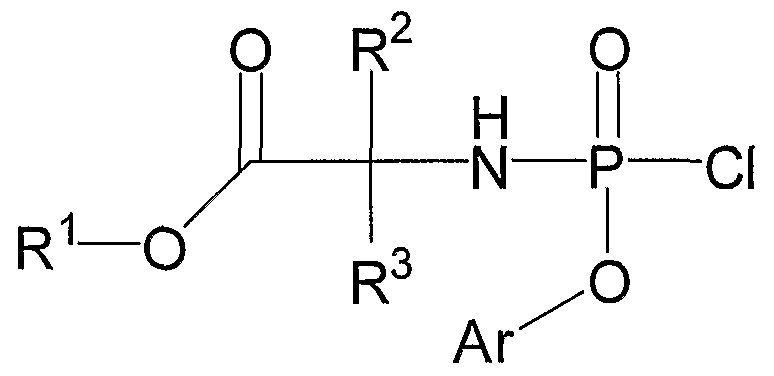
Formula III, wherein Ar, R2, and R3 are as defined in any one of the preceding claims and R1 is benzyl.
to produce the compound according to claim 20.
Priority Applications (4)
| Application Number | Priority Date | Filing Date | Title |
|---|---|---|---|
| PCT/DK2006/000627 WO2007054100A2 (en) | 2006-11-13 | 2006-11-13 | Lna nucleoside phosphoramidates |
| EP06805565A EP2099461B1 (en) | 2006-11-13 | 2006-11-13 | Lna nucleoside phosphoramidates |
| DK06805565.6T DK2099461T3 (en) | 2006-11-13 | 2006-11-13 | LNA Nucleoside Phosphoramidates |
| AT06805565T ATE551061T1 (en) | 2006-11-13 | 2006-11-13 | LNA NUCLEOSIDE PHOSPHORAMIDATE |
Applications Claiming Priority (1)
| Application Number | Priority Date | Filing Date | Title |
|---|---|---|---|
| PCT/DK2006/000627 WO2007054100A2 (en) | 2006-11-13 | 2006-11-13 | Lna nucleoside phosphoramidates |
Publications (2)
| Publication Number | Publication Date |
|---|---|
| WO2007054100A2 true WO2007054100A2 (en) | 2007-05-18 |
| WO2007054100A3 WO2007054100A3 (en) | 2007-10-04 |
Family
ID=37853036
Family Applications (1)
| Application Number | Title | Priority Date | Filing Date |
|---|---|---|---|
| PCT/DK2006/000627 Ceased WO2007054100A2 (en) | 2006-11-13 | 2006-11-13 | Lna nucleoside phosphoramidates |
Country Status (4)
| Country | Link |
|---|---|
| EP (1) | EP2099461B1 (en) |
| AT (1) | ATE551061T1 (en) |
| DK (1) | DK2099461T3 (en) |
| WO (1) | WO2007054100A2 (en) |
Cited By (1)
| Publication number | Priority date | Publication date | Assignee | Title |
|---|---|---|---|---|
| US20140112887A1 (en) * | 2012-10-22 | 2014-04-24 | Indenix Pharmaceuticals, Inc. | 2',4'-bridged nucleosides for hcv infection |
Families Citing this family (9)
| Publication number | Priority date | Publication date | Assignee | Title |
|---|---|---|---|---|
| GB201410693D0 (en) | 2014-06-16 | 2014-07-30 | Univ Southampton | Splicing modulation |
| EP3201339A4 (en) | 2014-10-03 | 2018-09-19 | Cold Spring Harbor Laboratory | Targeted augmentation of nuclear gene output |
| AU2016334804B2 (en) | 2015-10-09 | 2022-03-31 | University Of Southampton | Modulation of gene expression and screening for deregulated protein expression |
| US11096956B2 (en) | 2015-12-14 | 2021-08-24 | Stoke Therapeutics, Inc. | Antisense oligomers and uses thereof |
| ES2882500T3 (en) | 2015-12-14 | 2021-12-02 | Cold Spring Harbor Laboratory | Antisense oligomers for the treatment of Dravet syndrome |
| SI3673080T1 (en) | 2017-08-25 | 2024-03-29 | Stoke Therapeutics, Inc. | Antisense oligomers for treatment of conditions and diseases |
| WO2019213525A1 (en) | 2018-05-04 | 2019-11-07 | Stoke Therapeutics, Inc. | Methods and compositions for treatment of cholesteryl ester storage disease |
| KR20210134003A (en) | 2019-02-27 | 2021-11-08 | 스톡 테라퓨틱스, 인크. | Antisense oligomers for the treatment of conditions and diseases |
| BR112022022889A2 (en) | 2020-05-11 | 2023-04-04 | Stoke Therapeutics Inc | OPA1 ANTI-SENSE OLIGOMERS FOR TREATMENT OF CONDITIONS AND DISEASES |
Family Cites Families (2)
| Publication number | Priority date | Publication date | Assignee | Title |
|---|---|---|---|---|
| AU2002351077A1 (en) * | 2001-11-05 | 2003-05-19 | Exiqon A/S | Oligonucleotides modified with novel alpha-l-rna analogues |
| GB0317009D0 (en) * | 2003-07-21 | 2003-08-27 | Univ Cardiff | Chemical compounds |
-
2006
- 2006-11-13 WO PCT/DK2006/000627 patent/WO2007054100A2/en not_active Ceased
- 2006-11-13 DK DK06805565.6T patent/DK2099461T3/en active
- 2006-11-13 AT AT06805565T patent/ATE551061T1/en active
- 2006-11-13 EP EP06805565A patent/EP2099461B1/en active Active
Non-Patent Citations (1)
| Title |
|---|
| None |
Cited By (3)
| Publication number | Priority date | Publication date | Assignee | Title |
|---|---|---|---|---|
| US20140112887A1 (en) * | 2012-10-22 | 2014-04-24 | Indenix Pharmaceuticals, Inc. | 2',4'-bridged nucleosides for hcv infection |
| WO2014066239A1 (en) * | 2012-10-22 | 2014-05-01 | Idenix Pharmaceuticals, Inc. | 2',4'-bridged nucleosides for hcv infection |
| US10723754B2 (en) | 2012-10-22 | 2020-07-28 | Idenix Pharmaceuticals Llc | 2′,4′-bridged nucleosides for HCV infection |
Also Published As
| Publication number | Publication date |
|---|---|
| DK2099461T3 (en) | 2012-07-02 |
| EP2099461A2 (en) | 2009-09-16 |
| WO2007054100A3 (en) | 2007-10-04 |
| ATE551061T1 (en) | 2012-04-15 |
| EP2099461B1 (en) | 2012-03-28 |
Similar Documents
| Publication | Publication Date | Title |
|---|---|---|
| AU2004261455B2 (en) | Nucleotide phosphoramidates as anticancer agents | |
| AU780879B2 (en) | Anti-viral pyrimidine nucleoside analogues | |
| AU2017315670A1 (en) | Compositions comprising reversibly modified oligonucleotides and uses thereof | |
| EP2099461B1 (en) | Lna nucleoside phosphoramidates | |
| CN104903307A (en) | Disulfide masked prodrug compositions and methods | |
| EP4219520A1 (en) | Method for producing nucleic acid oligomer | |
| US7419965B2 (en) | Nucleotide lipid ester derivatives | |
| JP7602734B2 (en) | Oligonucleotide derivative or its salt | |
| WO2025047679A1 (en) | Stable target editing guide rna having phosphate moiety modification introduced thereinto | |
| US20220112493A1 (en) | Phosphonoacetate gapmer oligonucleotides | |
| WO2015125845A1 (en) | Phosphate site modification of nucleic acid containing nitrogen-containing non-aromatic heterocycle | |
| WO2024024873A1 (en) | Thionizing solution | |
| EP1323727A2 (en) | Composition and methods for the synthesis of organophosphorus derivatives | |
| WO2021167029A1 (en) | Bridged nucleoside and nucleotide using same | |
| US20220073916A1 (en) | Novel phosphoramidites | |
| WO2025229953A1 (en) | Method for producing oligonucleotide | |
| WO1990004603A1 (en) | Nucleoside derivatives | |
| HK40060207A (en) | Novel phosphoramidites | |
| HK40092714A (en) | Novel synthesis of phosphorodithioate oligonucleotides | |
| HK40060208A (en) | Phosphonoacetate gapmer oligonucleotides | |
| UEMURA et al. | Synthesis and antitumor activities of 5'-O-aminoacyl-3'-O-benzyl derivatives of 2'-deoxy-5-fluorouridine and related compounds |
Legal Events
| Date | Code | Title | Description |
|---|---|---|---|
| NENP | Non-entry into the national phase |
Ref country code: DE |
|
| WWE | Wipo information: entry into national phase |
Ref document number: 2006805565 Country of ref document: EP |