WO2007070760A2 - Compounds which modulate the cb2 receptor - Google Patents
Compounds which modulate the cb2 receptor Download PDFInfo
- Publication number
- WO2007070760A2 WO2007070760A2 PCT/US2006/061726 US2006061726W WO2007070760A2 WO 2007070760 A2 WO2007070760 A2 WO 2007070760A2 US 2006061726 W US2006061726 W US 2006061726W WO 2007070760 A2 WO2007070760 A2 WO 2007070760A2
- Authority
- WO
- WIPO (PCT)
- Prior art keywords
- phenyl
- ylmethyl
- biphenyl
- benzyl
- optionally substituted
- Prior art date
- Legal status (The legal status is an assumption and is not a legal conclusion. Google has not performed a legal analysis and makes no representation as to the accuracy of the status listed.)
- Ceased
Links
- JKPPUAQFWOWNTA-UHFFFAOYSA-N Cc(cc1)cc(-c2ccc(CN3CC(c4ccccc4)NCC3)cc2)c1Cl Chemical compound Cc(cc1)cc(-c2ccc(CN3CC(c4ccccc4)NCC3)cc2)c1Cl JKPPUAQFWOWNTA-UHFFFAOYSA-N 0.000 description 4
- PTGRNZJJWZXWFM-QFIPXVFZSA-N Clc1ccccc1-c1ccc(CN2C[C@H](Cc3ccccc3)NCC2)cc1 Chemical compound Clc1ccccc1-c1ccc(CN2C[C@H](Cc3ccccc3)NCC2)cc1 PTGRNZJJWZXWFM-QFIPXVFZSA-N 0.000 description 4
- 0 C*N1**C(*)*(*)C1 Chemical compound C*N1**C(*)*(*)C1 0.000 description 3
- OVGCELQLZADPEM-UHFFFAOYSA-N FC(c(cccc1)c1-c1ccc(CN2CC(c3ccccc3)NCC2)cc1)(F)F Chemical compound FC(c(cccc1)c1-c1ccc(CN2CC(c3ccccc3)NCC2)cc1)(F)F OVGCELQLZADPEM-UHFFFAOYSA-N 0.000 description 3
- YLRBJYMANQKEAW-UHFFFAOYSA-N BrCc(cc1)ccc1Br Chemical compound BrCc(cc1)ccc1Br YLRBJYMANQKEAW-UHFFFAOYSA-N 0.000 description 1
- PJKGRYFXOGARRX-QGZVFWFLSA-N Brc1ccc(CN2C[C@H](c3ccccc3)OCC2)cc1 Chemical compound Brc1ccc(CN2C[C@H](c3ccccc3)OCC2)cc1 PJKGRYFXOGARRX-QGZVFWFLSA-N 0.000 description 1
- ZLNGFYDJXZZFJP-SNVBAGLBSA-N C1NC[C@H](c2ccccc2)OC1 Chemical compound C1NC[C@H](c2ccccc2)OC1 ZLNGFYDJXZZFJP-SNVBAGLBSA-N 0.000 description 1
- POUWGGKVPXGRBS-VWLOTQADSA-N CC(C)(C)C(N1[C@@H](Cc2ccccc2)CN(Cc(cc2)ccc2-c2ccccc2Cl)CC1)=O Chemical compound CC(C)(C)C(N1[C@@H](Cc2ccccc2)CN(Cc(cc2)ccc2-c2ccccc2Cl)CC1)=O POUWGGKVPXGRBS-VWLOTQADSA-N 0.000 description 1
- QAIPUYRGKATZFS-CYBMUJFWSA-N CC(C)(C)OC(N(CCO)C[C@H](c1ccccc1)O)=O Chemical compound CC(C)(C)OC(N(CCO)C[C@H](c1ccccc1)O)=O QAIPUYRGKATZFS-CYBMUJFWSA-N 0.000 description 1
- PMZZFILMUDPHMY-UHFFFAOYSA-N CC(C)(C)OC(NC(C(NCC(OC)=O)=O)c1ccccc1)=O Chemical compound CC(C)(C)OC(NC(C(NCC(OC)=O)=O)c1ccccc1)=O PMZZFILMUDPHMY-UHFFFAOYSA-N 0.000 description 1
- HOBFSNNENNQQIU-UHFFFAOYSA-N CC(C)(C)OC(NC(C(O)=O)c1ccccc1)=O Chemical compound CC(C)(C)OC(NC(C(O)=O)c1ccccc1)=O HOBFSNNENNQQIU-UHFFFAOYSA-N 0.000 description 1
- IULFBTHVPRNQCG-UHFFFAOYSA-N CC(C)C(C(NC1)=O)NC1=O Chemical compound CC(C)C(C(NC1)=O)NC1=O IULFBTHVPRNQCG-UHFFFAOYSA-N 0.000 description 1
- ANHLFUWXEKATOI-UHFFFAOYSA-N CC(C)C(C(NCC(OC)=O)=O)NC(OC(C)(C)C)=O Chemical compound CC(C)C(C(NCC(OC)=O)=O)NC(OC(C)(C)C)=O ANHLFUWXEKATOI-UHFFFAOYSA-N 0.000 description 1
- AAILOISGVHAOBC-UHFFFAOYSA-N CC(C)C(C1)OCCN1C(OC(C)(C)C)=O Chemical compound CC(C)C(C1)OCCN1C(OC(C)(C)C)=O AAILOISGVHAOBC-UHFFFAOYSA-N 0.000 description 1
- DNBOOEPFXFVICE-UHFFFAOYSA-N CC(C)C1OCCNC1 Chemical compound CC(C)C1OCCNC1 DNBOOEPFXFVICE-UHFFFAOYSA-N 0.000 description 1
- MFABZVTZDWKWHK-UHFFFAOYSA-N CC(C)CC(OC(C(c1ccccc1)NC(OC(C)(C)C)=O)=O)=O Chemical compound CC(C)CC(OC(C(c1ccccc1)NC(OC(C)(C)C)=O)=O)=O MFABZVTZDWKWHK-UHFFFAOYSA-N 0.000 description 1
- QYMWJEXXJVCHFK-DEOSSOPVSA-N CC(N1[C@@H](Cc2ccccc2)CN(Cc(cc2)ccc2-c2ccccc2Cl)CC1)=O Chemical compound CC(N1[C@@H](Cc2ccccc2)CN(Cc(cc2)ccc2-c2ccccc2Cl)CC1)=O QYMWJEXXJVCHFK-DEOSSOPVSA-N 0.000 description 1
- XIKGKDQYGOIUFA-UHFFFAOYSA-N CC1(CN2CC(c3ccccc3)OCC2)C=CC=CC1c1c(C)ccc(Cl)c1 Chemical compound CC1(CN2CC(c3ccccc3)OCC2)C=CC=CC1c1c(C)ccc(Cl)c1 XIKGKDQYGOIUFA-UHFFFAOYSA-N 0.000 description 1
- ZDMCSBUZWKHUMU-UHFFFAOYSA-N CC1C=C(CC2NCCN(Cc(cc3)ccc3-c(cc(C)cc3)c3Cl)C2)CCC1 Chemical compound CC1C=C(CC2NCCN(Cc(cc3)ccc3-c(cc(C)cc3)c3Cl)C2)CCC1 ZDMCSBUZWKHUMU-UHFFFAOYSA-N 0.000 description 1
- ZOXOOFKRELBRFY-UHFFFAOYSA-N CC1C=C(CN(CC2)CC(c3ccccc3)N2C(NC)=O)C=CC1c1ccccc1C(F)(F)F Chemical compound CC1C=C(CN(CC2)CC(c3ccccc3)N2C(NC)=O)C=CC1c1ccccc1C(F)(F)F ZOXOOFKRELBRFY-UHFFFAOYSA-N 0.000 description 1
- MJOYOIGRAXFPBW-UHFFFAOYSA-N CN(CCN(Cc(cc1)ccc1-c1ccccc1Cl)C1)C1c1ccccc1 Chemical compound CN(CCN(Cc(cc1)ccc1-c1ccccc1Cl)C1)C1c1ccccc1 MJOYOIGRAXFPBW-UHFFFAOYSA-N 0.000 description 1
- YQUHJNIRTHBHKU-QHCPKHFHSA-N CS(N1[C@@H](Cc2ccccc2)CN(Cc(cc2)ccc2-c(cccc2)c2Cl)CC1)(=O)=O Chemical compound CS(N1[C@@H](Cc2ccccc2)CN(Cc(cc2)ccc2-c(cccc2)c2Cl)CC1)(=O)=O YQUHJNIRTHBHKU-QHCPKHFHSA-N 0.000 description 1
- YKHVUWVIYHJVFE-UHFFFAOYSA-N Cc(cc1)cc(-c2ccc(CN(CC3)CC(Cc4ccccc4)N3C(Nc3ccccc3)=O)cc2)c1Cl Chemical compound Cc(cc1)cc(-c2ccc(CN(CC3)CC(Cc4ccccc4)N3C(Nc3ccccc3)=O)cc2)c1Cl YKHVUWVIYHJVFE-UHFFFAOYSA-N 0.000 description 1
- ZRSPWPQOWCBALR-UHFFFAOYSA-N Cc(cc1)cc(-c2ccc(CN(CC3)CC(c4ccccc4)N3C(Cc3ccccc3)=O)cc2)c1Cl Chemical compound Cc(cc1)cc(-c2ccc(CN(CC3)CC(c4ccccc4)N3C(Cc3ccccc3)=O)cc2)c1Cl ZRSPWPQOWCBALR-UHFFFAOYSA-N 0.000 description 1
- GEZXQOOKWDWWTC-UHFFFAOYSA-N Cc(cc1)cc(-c2ccc(CN(CC3)CC(c4ccccc4)N3C(NC)=O)cc2)c1Cl Chemical compound Cc(cc1)cc(-c2ccc(CN(CC3)CC(c4ccccc4)N3C(NC)=O)cc2)c1Cl GEZXQOOKWDWWTC-UHFFFAOYSA-N 0.000 description 1
- UGLVWENARWDOIH-UHFFFAOYSA-N Cc(cc1-c2ccc(CN3CC(Cc4ccccc4)NCC3)cc2)ccc1Cl Chemical compound Cc(cc1-c2ccc(CN3CC(Cc4ccccc4)NCC3)cc2)ccc1Cl UGLVWENARWDOIH-UHFFFAOYSA-N 0.000 description 1
- JBFRDFVKXGVSGL-UHFFFAOYSA-N Clc(cc1)cc(-c2ccc(CN3CC(c4ccccc4)OCC3)cc2)c1Cl Chemical compound Clc(cc1)cc(-c2ccc(CN3CC(c4ccccc4)OCC3)cc2)c1Cl JBFRDFVKXGVSGL-UHFFFAOYSA-N 0.000 description 1
- BXISZBSQHKGVKK-UHFFFAOYSA-N Clc(cccc1)c1-c1ccc(CN2CC(c3ccccc3)NCC2)cc1 Chemical compound Clc(cccc1)c1-c1ccc(CN2CC(c3ccccc3)NCC2)cc1 BXISZBSQHKGVKK-UHFFFAOYSA-N 0.000 description 1
- PTGRNZJJWZXWFM-UHFFFAOYSA-N Clc1ccccc1-c1ccc(CN2CC(Cc3ccccc3)NCC2)cc1 Chemical compound Clc1ccccc1-c1ccc(CN2CC(Cc3ccccc3)NCC2)cc1 PTGRNZJJWZXWFM-UHFFFAOYSA-N 0.000 description 1
- PTGRNZJJWZXWFM-JOCHJYFZSA-N Clc1ccccc1-c1ccc(CN2C[C@@H](Cc3ccccc3)NCC2)cc1 Chemical compound Clc1ccccc1-c1ccc(CN2C[C@@H](Cc3ccccc3)NCC2)cc1 PTGRNZJJWZXWFM-JOCHJYFZSA-N 0.000 description 1
- CMDWUYTVRBRJNV-UHFFFAOYSA-N FC(c1ccccc1-c1ccc(CN(CC2)CC(c3ccccc3)N2C2CCCCC2)cc1)(F)F Chemical compound FC(c1ccccc1-c1ccc(CN(CC2)CC(c3ccccc3)N2C2CCCCC2)cc1)(F)F CMDWUYTVRBRJNV-UHFFFAOYSA-N 0.000 description 1
- DCGKFKZZAUMKMP-JOCHJYFZSA-N FC(c1ccccc1-c1ccc(CN2C[C@@H](Cc3ccccc3)NCC2)cc1)(F)F Chemical compound FC(c1ccccc1-c1ccc(CN2C[C@@H](Cc3ccccc3)NCC2)cc1)(F)F DCGKFKZZAUMKMP-JOCHJYFZSA-N 0.000 description 1
- OLAPHVAMBPXOKK-UHFFFAOYSA-N O=C(c(cc1)ccc1Br)N(CC1)CC1c1ccccc1 Chemical compound O=C(c(cc1)ccc1Br)N(CC1)CC1c1ccccc1 OLAPHVAMBPXOKK-UHFFFAOYSA-N 0.000 description 1
- IVXIYLZQVISYAZ-SGWCAAJKSA-N O=C(c1ccccc1)N(CCN(Cc(cc1)ccc1-c1c(C(F)(F)F)cccc1)C1)/C1=C/c1ccccc1 Chemical compound O=C(c1ccccc1)N(CCN(Cc(cc1)ccc1-c1c(C(F)(F)F)cccc1)C1)/C1=C/c1ccccc1 IVXIYLZQVISYAZ-SGWCAAJKSA-N 0.000 description 1
- MUVDCGZZUNOJIV-MHZLTWQESA-N O=S(c1ccccc1)(N1[C@@H](Cc2ccccc2)CN(Cc(cc2)ccc2-c2ccccc2Cl)CC1)=O Chemical compound O=S(c1ccccc1)(N1[C@@H](Cc2ccccc2)CN(Cc(cc2)ccc2-c2ccccc2Cl)CC1)=O MUVDCGZZUNOJIV-MHZLTWQESA-N 0.000 description 1
- JNSBEPKGFVENFS-UHFFFAOYSA-N OB(c1c(C(F)(F)F)cccc1)O Chemical compound OB(c1c(C(F)(F)F)cccc1)O JNSBEPKGFVENFS-UHFFFAOYSA-N 0.000 description 1
- TUXYZHVUPGXXQG-UHFFFAOYSA-N OC(c(cc1)ccc1Br)=O Chemical compound OC(c(cc1)ccc1Br)=O TUXYZHVUPGXXQG-UHFFFAOYSA-N 0.000 description 1
- DWHMVQBMCPNHCR-UHFFFAOYSA-L O[Sc](C1CCCCC1)(N(CCN(Cc(cc1)ccc1-c1c(C(F)(F)F)cccc1)C1)C1c1ccccc1)O Chemical compound O[Sc](C1CCCCC1)(N(CCN(Cc(cc1)ccc1-c1c(C(F)(F)F)cccc1)C1)C1c1ccccc1)O DWHMVQBMCPNHCR-UHFFFAOYSA-L 0.000 description 1
- VCQZGVMRTJHVMH-VTTXPQSASA-L O[Sc](c1ccccc1)(N1[C@H](Cc2ccccc2)CN(Cc(cc2)ccc2-c2ccccc2Cl)CC1)O Chemical compound O[Sc](c1ccccc1)(N1[C@H](Cc2ccccc2)CN(Cc(cc2)ccc2-c2ccccc2Cl)CC1)O VCQZGVMRTJHVMH-VTTXPQSASA-L 0.000 description 1
- CUCKXDPCCYHFMQ-UHFFFAOYSA-N SCc(cc1)ccc1Br Chemical compound SCc(cc1)ccc1Br CUCKXDPCCYHFMQ-UHFFFAOYSA-N 0.000 description 1
Classifications
-
- C—CHEMISTRY; METALLURGY
- C07—ORGANIC CHEMISTRY
- C07D—HETEROCYCLIC COMPOUNDS
- C07D265/00—Heterocyclic compounds containing six-membered rings having one nitrogen atom and one oxygen atom as the only ring hetero atoms
- C07D265/28—1,4-Oxazines; Hydrogenated 1,4-oxazines
- C07D265/30—1,4-Oxazines; Hydrogenated 1,4-oxazines not condensed with other rings
-
- A—HUMAN NECESSITIES
- A61—MEDICAL OR VETERINARY SCIENCE; HYGIENE
- A61P—SPECIFIC THERAPEUTIC ACTIVITY OF CHEMICAL COMPOUNDS OR MEDICINAL PREPARATIONS
- A61P1/00—Drugs for disorders of the alimentary tract or the digestive system
- A61P1/02—Stomatological preparations, e.g. drugs for caries, aphtae, periodontitis
-
- A—HUMAN NECESSITIES
- A61—MEDICAL OR VETERINARY SCIENCE; HYGIENE
- A61P—SPECIFIC THERAPEUTIC ACTIVITY OF CHEMICAL COMPOUNDS OR MEDICINAL PREPARATIONS
- A61P1/00—Drugs for disorders of the alimentary tract or the digestive system
- A61P1/04—Drugs for disorders of the alimentary tract or the digestive system for ulcers, gastritis or reflux esophagitis, e.g. antacids, inhibitors of acid secretion, mucosal protectants
-
- A—HUMAN NECESSITIES
- A61—MEDICAL OR VETERINARY SCIENCE; HYGIENE
- A61P—SPECIFIC THERAPEUTIC ACTIVITY OF CHEMICAL COMPOUNDS OR MEDICINAL PREPARATIONS
- A61P1/00—Drugs for disorders of the alimentary tract or the digestive system
- A61P1/16—Drugs for disorders of the alimentary tract or the digestive system for liver or gallbladder disorders, e.g. hepatoprotective agents, cholagogues, litholytics
-
- A—HUMAN NECESSITIES
- A61—MEDICAL OR VETERINARY SCIENCE; HYGIENE
- A61P—SPECIFIC THERAPEUTIC ACTIVITY OF CHEMICAL COMPOUNDS OR MEDICINAL PREPARATIONS
- A61P11/00—Drugs for disorders of the respiratory system
-
- A—HUMAN NECESSITIES
- A61—MEDICAL OR VETERINARY SCIENCE; HYGIENE
- A61P—SPECIFIC THERAPEUTIC ACTIVITY OF CHEMICAL COMPOUNDS OR MEDICINAL PREPARATIONS
- A61P13/00—Drugs for disorders of the urinary system
- A61P13/12—Drugs for disorders of the urinary system of the kidneys
-
- A—HUMAN NECESSITIES
- A61—MEDICAL OR VETERINARY SCIENCE; HYGIENE
- A61P—SPECIFIC THERAPEUTIC ACTIVITY OF CHEMICAL COMPOUNDS OR MEDICINAL PREPARATIONS
- A61P17/00—Drugs for dermatological disorders
-
- A—HUMAN NECESSITIES
- A61—MEDICAL OR VETERINARY SCIENCE; HYGIENE
- A61P—SPECIFIC THERAPEUTIC ACTIVITY OF CHEMICAL COMPOUNDS OR MEDICINAL PREPARATIONS
- A61P17/00—Drugs for dermatological disorders
- A61P17/02—Drugs for dermatological disorders for treating wounds, ulcers, burns, scars, keloids, or the like
-
- A—HUMAN NECESSITIES
- A61—MEDICAL OR VETERINARY SCIENCE; HYGIENE
- A61P—SPECIFIC THERAPEUTIC ACTIVITY OF CHEMICAL COMPOUNDS OR MEDICINAL PREPARATIONS
- A61P19/00—Drugs for skeletal disorders
- A61P19/08—Drugs for skeletal disorders for bone diseases, e.g. rachitism, Paget's disease
-
- A—HUMAN NECESSITIES
- A61—MEDICAL OR VETERINARY SCIENCE; HYGIENE
- A61P—SPECIFIC THERAPEUTIC ACTIVITY OF CHEMICAL COMPOUNDS OR MEDICINAL PREPARATIONS
- A61P21/00—Drugs for disorders of the muscular or neuromuscular system
-
- A—HUMAN NECESSITIES
- A61—MEDICAL OR VETERINARY SCIENCE; HYGIENE
- A61P—SPECIFIC THERAPEUTIC ACTIVITY OF CHEMICAL COMPOUNDS OR MEDICINAL PREPARATIONS
- A61P25/00—Drugs for disorders of the nervous system
-
- A—HUMAN NECESSITIES
- A61—MEDICAL OR VETERINARY SCIENCE; HYGIENE
- A61P—SPECIFIC THERAPEUTIC ACTIVITY OF CHEMICAL COMPOUNDS OR MEDICINAL PREPARATIONS
- A61P25/00—Drugs for disorders of the nervous system
- A61P25/04—Centrally acting analgesics, e.g. opioids
-
- A—HUMAN NECESSITIES
- A61—MEDICAL OR VETERINARY SCIENCE; HYGIENE
- A61P—SPECIFIC THERAPEUTIC ACTIVITY OF CHEMICAL COMPOUNDS OR MEDICINAL PREPARATIONS
- A61P25/00—Drugs for disorders of the nervous system
- A61P25/06—Antimigraine agents
-
- A—HUMAN NECESSITIES
- A61—MEDICAL OR VETERINARY SCIENCE; HYGIENE
- A61P—SPECIFIC THERAPEUTIC ACTIVITY OF CHEMICAL COMPOUNDS OR MEDICINAL PREPARATIONS
- A61P27/00—Drugs for disorders of the senses
- A61P27/16—Otologicals
-
- A—HUMAN NECESSITIES
- A61—MEDICAL OR VETERINARY SCIENCE; HYGIENE
- A61P—SPECIFIC THERAPEUTIC ACTIVITY OF CHEMICAL COMPOUNDS OR MEDICINAL PREPARATIONS
- A61P29/00—Non-central analgesic, antipyretic or antiinflammatory agents, e.g. antirheumatic agents; Non-steroidal antiinflammatory drugs [NSAID]
-
- A—HUMAN NECESSITIES
- A61—MEDICAL OR VETERINARY SCIENCE; HYGIENE
- A61P—SPECIFIC THERAPEUTIC ACTIVITY OF CHEMICAL COMPOUNDS OR MEDICINAL PREPARATIONS
- A61P35/00—Antineoplastic agents
-
- A—HUMAN NECESSITIES
- A61—MEDICAL OR VETERINARY SCIENCE; HYGIENE
- A61P—SPECIFIC THERAPEUTIC ACTIVITY OF CHEMICAL COMPOUNDS OR MEDICINAL PREPARATIONS
- A61P37/00—Drugs for immunological or allergic disorders
-
- A—HUMAN NECESSITIES
- A61—MEDICAL OR VETERINARY SCIENCE; HYGIENE
- A61P—SPECIFIC THERAPEUTIC ACTIVITY OF CHEMICAL COMPOUNDS OR MEDICINAL PREPARATIONS
- A61P37/00—Drugs for immunological or allergic disorders
- A61P37/02—Immunomodulators
- A61P37/06—Immunosuppressants, e.g. drugs for graft rejection
-
- A—HUMAN NECESSITIES
- A61—MEDICAL OR VETERINARY SCIENCE; HYGIENE
- A61P—SPECIFIC THERAPEUTIC ACTIVITY OF CHEMICAL COMPOUNDS OR MEDICINAL PREPARATIONS
- A61P37/00—Drugs for immunological or allergic disorders
- A61P37/08—Antiallergic agents
-
- A—HUMAN NECESSITIES
- A61—MEDICAL OR VETERINARY SCIENCE; HYGIENE
- A61P—SPECIFIC THERAPEUTIC ACTIVITY OF CHEMICAL COMPOUNDS OR MEDICINAL PREPARATIONS
- A61P43/00—Drugs for specific purposes, not provided for in groups A61P1/00-A61P41/00
-
- A—HUMAN NECESSITIES
- A61—MEDICAL OR VETERINARY SCIENCE; HYGIENE
- A61P—SPECIFIC THERAPEUTIC ACTIVITY OF CHEMICAL COMPOUNDS OR MEDICINAL PREPARATIONS
- A61P5/00—Drugs for disorders of the endocrine system
-
- A—HUMAN NECESSITIES
- A61—MEDICAL OR VETERINARY SCIENCE; HYGIENE
- A61P—SPECIFIC THERAPEUTIC ACTIVITY OF CHEMICAL COMPOUNDS OR MEDICINAL PREPARATIONS
- A61P7/00—Drugs for disorders of the blood or the extracellular fluid
-
- A—HUMAN NECESSITIES
- A61—MEDICAL OR VETERINARY SCIENCE; HYGIENE
- A61P—SPECIFIC THERAPEUTIC ACTIVITY OF CHEMICAL COMPOUNDS OR MEDICINAL PREPARATIONS
- A61P9/00—Drugs for disorders of the cardiovascular system
-
- A—HUMAN NECESSITIES
- A61—MEDICAL OR VETERINARY SCIENCE; HYGIENE
- A61P—SPECIFIC THERAPEUTIC ACTIVITY OF CHEMICAL COMPOUNDS OR MEDICINAL PREPARATIONS
- A61P9/00—Drugs for disorders of the cardiovascular system
- A61P9/04—Inotropic agents, i.e. stimulants of cardiac contraction; Drugs for heart failure
-
- A—HUMAN NECESSITIES
- A61—MEDICAL OR VETERINARY SCIENCE; HYGIENE
- A61P—SPECIFIC THERAPEUTIC ACTIVITY OF CHEMICAL COMPOUNDS OR MEDICINAL PREPARATIONS
- A61P9/00—Drugs for disorders of the cardiovascular system
- A61P9/10—Drugs for disorders of the cardiovascular system for treating ischaemic or atherosclerotic diseases, e.g. antianginal drugs, coronary vasodilators, drugs for myocardial infarction, retinopathy, cerebrovascula insufficiency, renal arteriosclerosis
-
- C—CHEMISTRY; METALLURGY
- C07—ORGANIC CHEMISTRY
- C07D—HETEROCYCLIC COMPOUNDS
- C07D207/00—Heterocyclic compounds containing five-membered rings not condensed with other rings, with one nitrogen atom as the only ring hetero atom
- C07D207/02—Heterocyclic compounds containing five-membered rings not condensed with other rings, with one nitrogen atom as the only ring hetero atom with only hydrogen or carbon atoms directly attached to the ring nitrogen atom
- C07D207/04—Heterocyclic compounds containing five-membered rings not condensed with other rings, with one nitrogen atom as the only ring hetero atom with only hydrogen or carbon atoms directly attached to the ring nitrogen atom having no double bonds between ring members or between ring members and non-ring members
- C07D207/06—Heterocyclic compounds containing five-membered rings not condensed with other rings, with one nitrogen atom as the only ring hetero atom with only hydrogen or carbon atoms directly attached to the ring nitrogen atom having no double bonds between ring members or between ring members and non-ring members with radicals, containing only hydrogen and carbon atoms, attached to ring carbon atoms
-
- C—CHEMISTRY; METALLURGY
- C07—ORGANIC CHEMISTRY
- C07D—HETEROCYCLIC COMPOUNDS
- C07D211/00—Heterocyclic compounds containing hydrogenated pyridine rings, not condensed with other rings
- C07D211/04—Heterocyclic compounds containing hydrogenated pyridine rings, not condensed with other rings with only hydrogen or carbon atoms directly attached to the ring nitrogen atom
- C07D211/06—Heterocyclic compounds containing hydrogenated pyridine rings, not condensed with other rings with only hydrogen or carbon atoms directly attached to the ring nitrogen atom having no double bonds between ring members or between ring members and non-ring members
- C07D211/08—Heterocyclic compounds containing hydrogenated pyridine rings, not condensed with other rings with only hydrogen or carbon atoms directly attached to the ring nitrogen atom having no double bonds between ring members or between ring members and non-ring members with hydrocarbon or substituted hydrocarbon radicals directly attached to ring carbon atoms
- C07D211/10—Heterocyclic compounds containing hydrogenated pyridine rings, not condensed with other rings with only hydrogen or carbon atoms directly attached to the ring nitrogen atom having no double bonds between ring members or between ring members and non-ring members with hydrocarbon or substituted hydrocarbon radicals directly attached to ring carbon atoms with radicals containing only carbon and hydrogen atoms attached to ring carbon atoms
- C07D211/14—Heterocyclic compounds containing hydrogenated pyridine rings, not condensed with other rings with only hydrogen or carbon atoms directly attached to the ring nitrogen atom having no double bonds between ring members or between ring members and non-ring members with hydrocarbon or substituted hydrocarbon radicals directly attached to ring carbon atoms with radicals containing only carbon and hydrogen atoms attached to ring carbon atoms with hydrocarbon or substituted hydrocarbon radicals attached to the ring nitrogen atom
-
- C—CHEMISTRY; METALLURGY
- C07—ORGANIC CHEMISTRY
- C07D—HETEROCYCLIC COMPOUNDS
- C07D211/00—Heterocyclic compounds containing hydrogenated pyridine rings, not condensed with other rings
- C07D211/04—Heterocyclic compounds containing hydrogenated pyridine rings, not condensed with other rings with only hydrogen or carbon atoms directly attached to the ring nitrogen atom
- C07D211/06—Heterocyclic compounds containing hydrogenated pyridine rings, not condensed with other rings with only hydrogen or carbon atoms directly attached to the ring nitrogen atom having no double bonds between ring members or between ring members and non-ring members
- C07D211/08—Heterocyclic compounds containing hydrogenated pyridine rings, not condensed with other rings with only hydrogen or carbon atoms directly attached to the ring nitrogen atom having no double bonds between ring members or between ring members and non-ring members with hydrocarbon or substituted hydrocarbon radicals directly attached to ring carbon atoms
- C07D211/10—Heterocyclic compounds containing hydrogenated pyridine rings, not condensed with other rings with only hydrogen or carbon atoms directly attached to the ring nitrogen atom having no double bonds between ring members or between ring members and non-ring members with hydrocarbon or substituted hydrocarbon radicals directly attached to ring carbon atoms with radicals containing only carbon and hydrogen atoms attached to ring carbon atoms
- C07D211/16—Heterocyclic compounds containing hydrogenated pyridine rings, not condensed with other rings with only hydrogen or carbon atoms directly attached to the ring nitrogen atom having no double bonds between ring members or between ring members and non-ring members with hydrocarbon or substituted hydrocarbon radicals directly attached to ring carbon atoms with radicals containing only carbon and hydrogen atoms attached to ring carbon atoms with acylated ring nitrogen atom
-
- C—CHEMISTRY; METALLURGY
- C07—ORGANIC CHEMISTRY
- C07D—HETEROCYCLIC COMPOUNDS
- C07D241/00—Heterocyclic compounds containing 1,4-diazine or hydrogenated 1,4-diazine rings
- C07D241/02—Heterocyclic compounds containing 1,4-diazine or hydrogenated 1,4-diazine rings not condensed with other rings
- C07D241/04—Heterocyclic compounds containing 1,4-diazine or hydrogenated 1,4-diazine rings not condensed with other rings having no double bonds between ring members or between ring members and non-ring members
-
- C—CHEMISTRY; METALLURGY
- C07—ORGANIC CHEMISTRY
- C07D—HETEROCYCLIC COMPOUNDS
- C07D279/00—Heterocyclic compounds containing six-membered rings having one nitrogen atom and one sulfur atom as the only ring hetero atoms
- C07D279/10—1,4-Thiazines; Hydrogenated 1,4-thiazines
- C07D279/12—1,4-Thiazines; Hydrogenated 1,4-thiazines not condensed with other rings
-
- C—CHEMISTRY; METALLURGY
- C07—ORGANIC CHEMISTRY
- C07D—HETEROCYCLIC COMPOUNDS
- C07D295/00—Heterocyclic compounds containing polymethylene-imine rings with at least five ring members, 3-azabicyclo [3.2.2] nonane, piperazine, morpholine or thiomorpholine rings, having only hydrogen atoms directly attached to the ring carbon atoms
- C07D295/02—Heterocyclic compounds containing polymethylene-imine rings with at least five ring members, 3-azabicyclo [3.2.2] nonane, piperazine, morpholine or thiomorpholine rings, having only hydrogen atoms directly attached to the ring carbon atoms containing only hydrogen and carbon atoms in addition to the ring hetero elements
- C07D295/027—Heterocyclic compounds containing polymethylene-imine rings with at least five ring members, 3-azabicyclo [3.2.2] nonane, piperazine, morpholine or thiomorpholine rings, having only hydrogen atoms directly attached to the ring carbon atoms containing only hydrogen and carbon atoms in addition to the ring hetero elements containing only one hetero ring
- C07D295/033—Heterocyclic compounds containing polymethylene-imine rings with at least five ring members, 3-azabicyclo [3.2.2] nonane, piperazine, morpholine or thiomorpholine rings, having only hydrogen atoms directly attached to the ring carbon atoms containing only hydrogen and carbon atoms in addition to the ring hetero elements containing only one hetero ring with the ring nitrogen atoms directly attached to carbocyclic rings
-
- C—CHEMISTRY; METALLURGY
- C07—ORGANIC CHEMISTRY
- C07D—HETEROCYCLIC COMPOUNDS
- C07D295/00—Heterocyclic compounds containing polymethylene-imine rings with at least five ring members, 3-azabicyclo [3.2.2] nonane, piperazine, morpholine or thiomorpholine rings, having only hydrogen atoms directly attached to the ring carbon atoms
- C07D295/04—Heterocyclic compounds containing polymethylene-imine rings with at least five ring members, 3-azabicyclo [3.2.2] nonane, piperazine, morpholine or thiomorpholine rings, having only hydrogen atoms directly attached to the ring carbon atoms with substituted hydrocarbon radicals attached to ring nitrogen atoms
- C07D295/06—Heterocyclic compounds containing polymethylene-imine rings with at least five ring members, 3-azabicyclo [3.2.2] nonane, piperazine, morpholine or thiomorpholine rings, having only hydrogen atoms directly attached to the ring carbon atoms with substituted hydrocarbon radicals attached to ring nitrogen atoms substituted by halogen atoms or nitro radicals
- C07D295/073—Heterocyclic compounds containing polymethylene-imine rings with at least five ring members, 3-azabicyclo [3.2.2] nonane, piperazine, morpholine or thiomorpholine rings, having only hydrogen atoms directly attached to the ring carbon atoms with substituted hydrocarbon radicals attached to ring nitrogen atoms substituted by halogen atoms or nitro radicals with the ring nitrogen atoms and the substituents separated by carbocyclic rings or by carbon chains interrupted by carbocyclic rings
-
- C—CHEMISTRY; METALLURGY
- C07—ORGANIC CHEMISTRY
- C07D—HETEROCYCLIC COMPOUNDS
- C07D409/00—Heterocyclic compounds containing two or more hetero rings, at least one ring having sulfur atoms as the only ring hetero atoms
- C07D409/02—Heterocyclic compounds containing two or more hetero rings, at least one ring having sulfur atoms as the only ring hetero atoms containing two hetero rings
- C07D409/10—Heterocyclic compounds containing two or more hetero rings, at least one ring having sulfur atoms as the only ring hetero atoms containing two hetero rings linked by a carbon chain containing aromatic rings
-
- C—CHEMISTRY; METALLURGY
- C07—ORGANIC CHEMISTRY
- C07D—HETEROCYCLIC COMPOUNDS
- C07D413/00—Heterocyclic compounds containing two or more hetero rings, at least one ring having nitrogen and oxygen atoms as the only ring hetero atoms
- C07D413/02—Heterocyclic compounds containing two or more hetero rings, at least one ring having nitrogen and oxygen atoms as the only ring hetero atoms containing two hetero rings
- C07D413/04—Heterocyclic compounds containing two or more hetero rings, at least one ring having nitrogen and oxygen atoms as the only ring hetero atoms containing two hetero rings directly linked by a ring-member-to-ring-member bond
-
- C—CHEMISTRY; METALLURGY
- C07—ORGANIC CHEMISTRY
- C07D—HETEROCYCLIC COMPOUNDS
- C07D413/00—Heterocyclic compounds containing two or more hetero rings, at least one ring having nitrogen and oxygen atoms as the only ring hetero atoms
- C07D413/02—Heterocyclic compounds containing two or more hetero rings, at least one ring having nitrogen and oxygen atoms as the only ring hetero atoms containing two hetero rings
- C07D413/06—Heterocyclic compounds containing two or more hetero rings, at least one ring having nitrogen and oxygen atoms as the only ring hetero atoms containing two hetero rings linked by a carbon chain containing only aliphatic carbon atoms
-
- C—CHEMISTRY; METALLURGY
- C07—ORGANIC CHEMISTRY
- C07D—HETEROCYCLIC COMPOUNDS
- C07D413/00—Heterocyclic compounds containing two or more hetero rings, at least one ring having nitrogen and oxygen atoms as the only ring hetero atoms
- C07D413/02—Heterocyclic compounds containing two or more hetero rings, at least one ring having nitrogen and oxygen atoms as the only ring hetero atoms containing two hetero rings
- C07D413/10—Heterocyclic compounds containing two or more hetero rings, at least one ring having nitrogen and oxygen atoms as the only ring hetero atoms containing two hetero rings linked by a carbon chain containing aromatic rings
Definitions
- the present invention relates to novel compounds which modulate the CB2 receptor and their use as medicaments.
- Cannabinoids are a group of about 60 distinct compounds found in Cannabis sativa (also know as marijuana) with cannabinol, cannabidiol and ⁇ 9 -tetrahydrocannabinol (THC) being the most representative molecules.
- THC cannabinol
- cannabidiol cannabidiol
- ⁇ 9 -tetrahydrocannabinol THC
- the therapeutic usage of Cannabis can be dated back to ancient dynasties of China and includes applications for various illnesses ranging from lack of appetite, emesis, cramps, menstrual pain, spasticity to rheumatism.
- Marinol and Cesamet which are based on THC and its analogous nabilone, respectively, are used as anti-emetic and appetite stimulant.
- CBl and CB2 G-protein coupled receptors
- CBl receptors regulate the release of neurotransmitters from the pre-synaptic neurons and are believed to mediate most of the euphoric and other central nervous system effects of cannabis, such as THC-induced ring-catalepsy, hypomobility, and hypothermia, which were found to be completely absent in mice with a deletion of the CBl gene (Zimmer et al, Increased mortality, hypoactivity, and hypoalgesia in cannabinoid CBl receptor knockout mice. Proc Natl Acad Sci U S A. (1999) 96:5780-5785.)
- CB2 receptors are almost exclusively found in the immune system, with the greatest density in the spleen. It is estimated that the expression level of CB 2 in the immune cells is about 10 to 100 times higher than CBl .
- CB2 is found in various cell types, includung B cells, NK cells, monocytes, microglial cells, neutrophils, T cells, dentritic cells and mast cells, suggesting that a wide range of immune functions can be regulated through CB2 modulators (Klein et al., The cannabinoid system and immune system. J Leukoc Biol (2003) 74:.486-496).
- CB2 selective ligands have been developed and tested for their effects in various imflammatory settings. For example, in animal models of inflammation, CB2 selective agonists, inverse agonists and antagonists have been shown to be effective in suppressing inflammation (Hanus et al., HU-308: a specific agonist for CB(2), a peripheral cannabinoid receptor. Proc Natl Acad Sci U S A.
- CB2 agonists have been shown to inhibit pain and emesis.
- CB2 selective agonists blunt the pain response induced by thermal or other stimuli (Malan et al., CB2 cannabinoid receptor-mediated peripheral antinociception. Pain. (2001) 93:239-45 andNackley et al., Selective activation of cannabinoid CB(2) receptors suppresses spinal fos protein expression and pain behavior in a rat model of inflammation.
- CB2 activation has also been demonstrated to inhibit neuropathic pain response (Ibrahim et al., Activation of CB2 cannabinoid receptors by AM1241 inhibits experimental neuropathic pain: pain inhibition by receptors not present in the CNS. Proc Natl Acad Sci U S A. (2003) 100:10529-33.)
- a recent article demonstrated the expression of CB2 in the brain, at about 1.5 % of the level in the spleen.
- CB2 activation is shown by this article to be responsible for the anti-emetic effect of endocannabinoid (Van Sickle et al., Identification and functional characterization of brainstem cannabinoid CB2 receptors. Science. 2005 310:329- 332. )
- the foregoing results confirm that CB2 agonists can be used for the treatment of inflammatory and neuropathic pain as well as emesis.
- the present invention provides novel compounds which bind to and are agonists, antagonists or inverse agonists of the CB2 receptor.
- the invention also provides a method and pharmaceutical compositions for treating inflammation by way of the administration of therapeutic amounts of these compounds.
- the invention provides a method and pharmaceutical compositions for treating pain by way of the administration of therapeutic amounts of a subset of the new compounds which are CB2 agonists.
- R 1 is hydrogen, C 1 -C 6 alkyl optionally substituted with aryl or heteroaryl, C 3 -C 10 cycloalkyl, optionally substituted aryl, optionally substituted heteroaryl; or,
- R 1 is C 1 -C 3 alkyl substituted with Z-R 6 , wherein Z is O, S, SO 2 , NH, NMe or CH 2 and R 6 is optionally substituted aryl or heteroaryl, provided that Y is O or NR 3 and n is 2 or 3;
- R 2 is hydrogen or C 1 -C 6 alkyl
- A is a group of the formula -(CH 2 ) n - ,wherein n is 1, 2 or 3, which is optionally substituted with one or two C 1 -C 6 alkyl groups;
- Y is a methylene group, provided that n is 1, 2 or 3, wherein said methylene group is optionally substituted with a halogen atom or with a C 1 -C 6 alkyl group (which, in turn, is optionally substituted with one to three halogen atoms); or,
- Y is selected from the group consisting of O and NR 3 , provided that n is 2 or 3, wherein, R 3 is hydrogen, C 1 -C 6 alkyl (optionally substituted by one to 3 halogen atoms), C 3 -
- R 4 is hydrogen, C 1 -C 6 alkyl (optionally substituted by one to 3 halogen atoms), C 3 -C 6 cycloalkyl, phenyl, benzyl or pyridyl; or,
- Y is selected from the group consisting of S, SO and SO 2 , provided that n is 2;
- X is a methylene group (which is optionally mono- or disubstituted with methyl) or a carbonyl group;
- Ar 1 is a divalent moiety which is either phenylene or a six-membered heteroarylene, which divalent moiety is optionally mono- or disubstituted with moieties selected from the group consisting OfC 1 -C 6 alkyl (optionally substituted by one to 3 halogen atoms), C 3 -C 10 cycloalkyl and halogen; and,
- Ar 2 is an aryl or heteroaryl moiety which is optionally substituted with C 1 -C 6 alkyl (which is optionally substituted with 1 to 3 halogen atoms), Ci-Ce alkoxy (which is optionally substituted with 1 to 3 halogen atoms), Ci-C 6 alkylthio, Ci-C 6 alkoxycarbonyl, Ci-C 6 alkylaminocarbonyl, C 1 -C 6 dialkylaminocarbonyl, hydroxyl, halogen, cyano or nitro.
- the invention provides compounds of the formula I wherein, R 1 is hydrogen, Ci-C 6 alkyl, C 3 -C 1O cycloalkyl, phenyl, benzyl or pyridyl;
- R 2 is hydrogen or C 1 -C 6 alkyl
- A is a group of the formula -(CH 2 ) H - , wherein n is 1 , 2 or 3, which is optionally substituted with one or two C 1 -C 6 alkyl groups;
- Y is a methylene group, provided that n is 1 , 2 or 3, wherein said methylene group is optionally substituted with a halogen atom or with a C 1 -C 6 alkyl group (which, in turn, is optionally substituted with one to three halogen atoms); or,
- Y is selected from the group consisting of O and NR 3 , provided that n is 2 or 3, wherein, R 3 is hydrogen, C 1 -C 6 alkyl (optionally substituted by one to 3 halogen atoms), C 3 - C 6 cycloalkyl, phenyl, benzyl, pyridyl, C(O)R 4 , SO 2 R 4 , C(O)NHR 4 , or C(O)NMeR 4 , wherein,
- R 4 is hydrogen, C 1 -C 6 alkyl (optionally substituted by one to 3 halogen atoms), C 3 -C 6 cycloalkyl, phenyl, benzyl or pyridyl; or,
- Y is selected from the group consisting of S, SO and SO 2 , provided that n is 2;
- X is a methylene group (which is optionally mono- or disubstituted with methyl) or a carbonyl group;
- Ar 1 is a divalent moiety which is either phenylene or a six-membered heteroarylene, which divalent moiety is optionally mono- or disubstituted with moieties selected from the group consisting OfC 1 -Ce alkyl (optionally substituted by one to 3 halogen atoms), C 3 -C 10 cycloalkyl and halogen; and,
- Ar 2 is an aryl or heteroaryl moiety which is optionally substituted with C 1 -C O alkyl (which is optionally substituted with 1 to 3 halogen atoms), C 1 -C 6 alkoxy (which is optionally substituted with 1 to 3 halogen atoms), C 1 -C 6 alkylthio, C 1 -C 6 alkoxycarbonyl, C 1 -C 6 alkylaminocarbonyl, C 1 -C 6 dialkylaminocarbonyl, hydroxyl, halogen, cyano or nitro.
- the invention provides compounds of the formula I wherein, R 1 is hydrogen, Ci-Ce alkyl, C 3 -C 10 cycloalkyl, phenyl, benzyl or pyridyl;
- R 2 is hydrogen
- A is a group of the formula -(CHz) n - ,wherein n is 1, 2 or 3;
- Y is a methylene group, provided that n is 1 , 2 or 3 ; or,
- Y is selected from the group consisting of O and NH, provided that n is 2 or 3 ;
- Y is selected from the group consisting of S, SO and SO 2 , provided that n is 2;
- X is a methylene group
- Ar 1 is a divalent moiety which is either phenylene or a six-membered heteroarylene, which divalent moiety is optionally mono- or disubstituted with moieties selected from the group consisting OfC 1 -C 6 alkyl (optionally substituted by one to 3 halogen atoms), C 3 -C 10 cycloalkyl and halogen; and,
- Ar 2 is a moiety selected from the group consisting of phenyl, thienyl and furanyl, which moiety is optionally substituted with Ci-C 6 alkyl (which is optionally substituted with 1 to 3 halogen atoms), Ci-C 6 alkoxy (which is optionally substituted with 1 to 3 halogen atoms), hydroxyl, halogen, cyano or nitro.
- the invention provides compounds of the formula I wherein, R 1 is phenyl or benzyl;
- R 2 is hydrogen or C 1 -C 6 atkyl
- Y is a methylene group, O or NH
- X is a methylene group
- Ar 1 is 1,4-phenylene or 1,4-pyridylene
- Ar 2 is phenyl or thienyl, which are optionally mono-substituted with chloro, cyano, trifluoromethyl, methoxy or ethoxy or disubstituted with chloro.
- the invention also includes tautomers, prodrugs and pharmaceutically acceptable salts the above-described compounds of the formula I.
- Compounds of the formula I are agonists, antagonists or inverse agonists of the CB2 receptor and modulate the activity of this receptor. By virtue of this fact the compounds of the formula I can be used for treating inflammation, in a manner described more fully below.
- R 1 is hydrogen, C 1 -C 6 alkyl, C 3 -C 1O cycloalkyl, phenyl, benzyl or pyridyl;
- R 2 is hydrogen or C 1 -C 6 alkyl
- A is a group of the formula -(CH 2 ) n - , wherein n is 1 , 2 or 3, which is optionally substituted with one or two C 1 -C 6 alkyl groups;
- Y is a methylene group, provided that n is 1 or 2, wherein said methylene group is optionally substituted with a halogen atom or with a C 1 -C 6 alkyl group (which, in turn, is optionally substituted with one to three halogen atoms); or,
- Y is selected from the group consisting of O, S, SO, SO 2 and NR 3 , provided that n is 2 or 3, wherein,
- R 3 is hydrogen, C 1 -C 6 alkyl (optionally substituted by one to 3 halogen atoms), C 3 - C 6 cycloalkyl, phenyl, benzyl, pyridyl, C(O)R 4 , SO 2 R 4 or C(O)NHR 4 , C(O)NMeR 4 , wherein,
- R 4 is hydrogen, C 1 -C 6 alkyl (optionally substituted by one to 3 halogen atoms), C 3 -C 6 cycloalkyl, phenyl, benzyl or pyridyl;
- X is a methylene group (which is optionally mono- or disubstituted with methyl) or a carbonyl group
- Ar 1 is a divalent moiety which is either phenylene or a six-membered heteroarylene, which divalent moiety is optionally mono- or disubstituted with moieties selected from the group consisting OfC 1 -C 6 alkyl (optionally substituted by one to 3 halogen atoms), C 3 -C 1 O cycloalkyl and halogen; and,
- Hal is a halogen atom which is affixed to Ar 1 .
- Preferred compounds of the formula IA are those wherein:
- R 1 is phenyl or benzyl
- R 2 is hydrogen or C 1 -C 6 alkyl
- A is-(CH 2 ) 2 -;
- Y is O or NH
- X is a methylene group
- Ar 1 phenylene or pyridylene
- Hal is a bromine atom.
- Compounds of the formula IA use useful as intermediates for the production of compounds of the formula I. Some compounds of the formula IA also modulate the activity of the CB2 receptor and by virtue of this fact the can be used for treating inflammation, in the manner described more fully below.
- the compounds of formula I may be made using the general synthetic methods described below, which also constitute part of the invention.
- the invention also provides processes for making compounds of Formula (I).
- Ar 1 , Ar 2 , R 1 , R 2 , A, n, X, and Y in the formulas below shall have the meaning OfAr 1 , Ar 2 , R 1 , R 2 , A, n, X, and Y in Formula (I) of the invention described herein above.
- reaction conditions and reaction times may vary depending on the particular reactants used. Unless otherwise specified, solvents, temperatures, pressures, and other reaction conditions may be readily selected by one of ordinary skill in the art. Specific procedures are provided in the Synthetic Examples section. Typically, reaction progress may be monitored by thin layer chromatography (TLC), if desired, and intermediates and products may be purified by chromatography on silica gel and/or by recrystallization.
- TLC thin layer chromatography
- intermediates and products may be purified by chromatography on silica gel and/or by recrystallization.
- the examples which follow are illustrative and, as recognized by one skilled in the art, particular reagents or conditions could be modified as needed for individual compounds without undue experimentation. Starting materials and intermediates used, in the schemes below, are either commercially available or easily prepared from commercially available materials by those skilled in the art.
- Scheme 1 As illustrated in Scheme 1 , reacting a starting material of formula II with an aldehyde of formula Br-Ar 1 -CHO or a ketone, in a suitable solvent such as THF, in the presence of a suitable reducing agent provides the alkylated amine of formula III.
- the starting amine II may also be reacted with an halide of formula Br-Ar 1 -CH 2 -HaI (Hal is Cl, Br or I) 5 in a suitable solvent such as acetonitrile, in the presence of a base such as potassium carbonate to provide the alkylated amine of formula III.
- the appropriately substituted starting amine II may be obtained either commercially or made by procedures known to one skilled in the art.
- Scheme 2 As outlined in Scheme 2, reacting a starting material of formula II with an acid of formula Br- Ar 1 -COOH provides a coupled compound of formula IV.
- the appropriately substituted starting amine II may be obtained either commercially or made by procedures known to one skilled in the art. Standard peptide coupling reactions known in the art (see for example M. Bodanszky, 1984, The Practice of Peptide Synthesis, Springer-Verlag) maybe employed in these syntheses.
- An example of suitable coupling conditions is treatment of a solution of the carboxylic acid in a suitable solvent such as DMF with EDC, HOBT, and a base such as diisopropylethylamine, followed by the desired amine.
- reaction of the carboxylic acid with reagents such as oxalyl chloride provides the corresponding acid chloride.
- Reaction of the acid chloride with the desired amine in a suitable solvent provides a compound of formula (IV) .
- Example 2 the intermediate used in Example 2 is synthesized as follows:
- Example 10 4-(2',4'-Dichloro-biphenyl-4-ylmethyl)-2-phenyl-morpholine
- Example 16 4-[4-(2-Chloro-thiophen-3-yl)-benzyl]-2-phenyl-morpholine
- Example 18 4-(2'-Trifluoromethyl-biphenyl-4-ylmethyl)-morpholine 4-(4-Bromo- benzyl)-morplioline
- Example 36 l-(5'-Chloro-2 l -methyl-biphenyl-4-ylmethyl)-3-phenyl-piperazine
- Example 38 ,6-Dimethyl-4-(2'-trifluoromethyl-biphenyl-4-ylmethyl)-morpholine 4-(4- Bromo-benzyl)-2,6-dimethyl-morpholine
- Example 48 3-Phenyl-l-(2'-trifluoromethyl-biphenyl-4-ylmethyl)-piperidine l-(4-Bromo-benzyl)-3-phenyl-piperidine
- Example 60 The above example was made in a similar manner to Example 60 but with the appropriate boronic acid. 59% yield, ES MS m/z 378.
- Example 60 The above example was made in a similar manner to Example 60 but with the appropriate boronic acid. 68% yield, ES MS m/z 372.
- Example 60 The above example was made in a similar manner to Example 60 but with the appropriate boronic acid. 19% yield, ES MS m/z 412.
- Example 56 (3-Phenyl-piperidin-l-yl)-(2'-trifluoromethyl-biphenyl-4-yI)-methanone (4-Bromo-phenyl)-(3 -phenyl-piperidin- 1 -yl)-methanone
- the above compound could be made in the following manner, analogous to Example 60.
- 1 eq. of p-Bromobenzoic acid could be combined with 1 eq. 3-Phenylpiperidine HCl, 1.1 equivalents EDC, 1.1 equivalents HOBt and 2.2 equivalents Hunig's Base in DMF (concentration of ImL of DMF/mmol acid) would be stirred at room temperature overnight.
- the solution would then be diluted with water and extracted with ethyl acetate.
- the organic layers would then be combined and washed with water, aqueous saturated sodium bicarbonate solution, IN HCl and brine.
- the organic layers would be dried with sodium sulfate, filtered and concentrated. Purification would be done with flash chromatography to afford product.
- This compound could be made in the following manner analogous to Example 60; 1 equivalent of (4-Bromo-phenyl)-(3-phenyl-piperidin-l-yl)-methanone would be combined with 1.5 equivalents of 2-(Trifluoromethyl)phenyl boronic acid, 10 mol% of tetrakis(triphenylphosphine)palladium(0), 6.7 equivalents of 2M sodium carbonate solution, toluene and ethanol.
- the reaction mixture would be heated in a sealed tube at 120°C overnight in an oil bath.
- the reaction mixture would then be filtered through Celite and concentrated in vacuo.
- the residue would be diluted with water and extracted with ethyl acetate.
- the combined organic phases would be washed with brine, dried over sodium sulfate, filtered and concentrated in vacuo.
- the crude material would be purified by flash chromatography to afford product.
- Example 57 (3-Phenyl-pyrrolidin-l-yl)-(2'-trifluoromethyl-biphenyl-4-yl)-methanone (4-Bromo-phenyl)-(3-phenyl-pyrrolidin-l-yl)-methanone
- the above compound could be made in the following manner: 1 eq. of (4-Bromo-phenyl)-(3- phenyl-pvrrolidin-l-yl)-rnethanone would be combined with 1.5 eq. of 2- (Trifluoromethyl)phenyl boronic acid, 10mol% of tetrakis(triphenylphosphine)palladium(0), 6.7eq. of 2M sodium carbonate solution, toluene and ethanol.
- the reaction mixture would be heated in a sealed tube at 120 0 C overnight in an oil bath.
- the reaction mixture would be filtered through Celite and concentrated in vacuo.
- the residue would be diluted with water and extracted with ethyl acetate.
- the combined organic phases would be washed with brine, dried over sodium sulfate, filtered and concentrated in vacuo.
- the crude material would be purified by flash chromatography to afford product.
- the above compound could be made in the same manner as Example 1 using the appropriate epoxide.
- 1 eqivalent of (2,3-Epoxypropyl)benzene oxide and 4 eq. ethanol amine could be stirred at room temperature overnight.
- the solution could be poured into water and the water is extracted with dichloromethane.
- the combined dichloromethane layers could be washed with brine and concentrated.
- the above compound could be made in the following manner: 1 eq. l-(2-Hydroxy- ethylamino)-3-phenyl-propan-2-ol and 1.1 eq. di-t-butyl dicarbonate in methylene chloride could be stirred together at room temperature and 1.5eq. triethylamine could be added. The solution could be stirred at room temperature overnight. The solution could be poured into water and extracted with methylene chloride. The combined organics could be washed with brine and dried with sodium sulfate. After filtration, the crude material could be purified by flash chromatography.
- the above compound could be made in the following manner: 1 eq. of (2-Hydroxy-ethyl)-(2- hydroxy-3-phenyl-propyl)-carbamic acid tert-butyl ester and 1.2 eq. of triphenylphosphine could be dissolved in toluene. 1.2 eq. of diethylazodicarboxylate in toluene could be added dropwise to the resulting solution at room temperature under argon atmosphere and the mixture could be stirred overnight. The solvent could be removed in vacuo and the material purified by column chromatography.
- the above compound could be made in the following manner: 1 eq.
- 2-Benzyl-morpholine-4- carboxylic acid tert-butyl ester could be dissolved in 4N solution of hydrogen chloride in dioxane and the mixture could be stirred at 60 0 C for 3h.
- the solvent could be removed in vacuo and IN aqueous hydrogen chloride solution could be added to the resulting residue, and the mixture could be washed with diethyl ether.
- the aqueous layer could be adjusted to pH 14 by addition of 2N NaOH solution and extracted with methylene chloride.
- the organic layer could be washed with brine and dried over sodium sulfate. After filtering, the material could be purified by column chromatography.
- the above compound could be made in the following manner: 1.5 eq. of 4-Bromobenzyl bromide and 1 eq. of 2-Benzyl-morpholine in acetonitrile could be stirred at room temperature and 3 eq. of potassium carbonate could be added. The reaction could be stirred at room temperature overnight. The solution could be filtered through Celite and concentrated in vacuo to afford a brown solid. Purification could be done by flash chromatography to afford product.
- the above compound could be made in the following manner: 1 eq. of 2-Benzyl-4-(4-bromo- benzyl)-morpholine could be combined with 1.5 eq. of 2-(Trifluoromethyl)phenyl boronic acid, 10mol% of tetrakis(triphenylphosphine)palladium(0), 6.7 eq. of 2M sodium carbonate solution, toluene and ethanol.
- the reaction mixture could be heated in a sealed tube at 12O 0 C overnight in an oil bath.
- the reaction mixture could be filtered through Celite and concentrated in vacuo.
- the residue could be diluted with water and extracted with ethyl acetate.
- the combined organic phases could be washed with brine, dried over sodium sulfate, filtered and concentrated in vacuo.
- the crude material could be purified by flash chromatography to afford product.
- the above compound could be made in the same manner as Example 1 using the appropriate epoxide: 1 eq. of (2,3-Epoxypropyl)benzene oxide and 4 eq. ethanol amine
- the above compound could be made in the following manner: stirred at room temperature overnight. The solution could be poured into water and the water is extracted with dichloromethane. The combined dichloromethane layers could be washed with brine and concentrated. .
- the above compound could be made in the following manner: 1 eq. l-(2-Hydroxy- ethylamino)-3 -methyl-butan-2-ol and 1.1 eq. di-t-butyl dicarbonate in methylene chloride could be stirred together at room temperature and 1.5 eq. triethylamine could be added. The solution could be stirred at room temperature overnight. The solution could be then poured into water and extracted with methylene chloride. The combined organics could be washed with brine and dried with sodium sulfate. After filtration, the crude material could be purified by flash chromatography. 2-Isopropyl-morpholine-4-carboxylic acid tert-butyl ester
- the above compound could be made in the following manner: 1 eq. of (2-Hydroxy-ethyl)-(2- hydroxy-3-methyl-butyl)-carbamic acid tert-butyl ester and 1.2 eq. of triphenylphosphine could be dissolved in toluene. 1.2 eq. of diethylazodicarboxylate in toluene could be added dropwise to the resulting solution at room temperature under argon atmosphere and the mixture could be stirred overnight. The solvent could be removed in vacuo and the material purified by column chromatography.
- the above compound could be made in the following manner: 2-Isopropyl-morpholine-4- carboxylic acid tert-butyl ester in 4N solution of hydrogen chloride in dioxane could be stirred at 6O 0 C for 3h. The solvent could be removed in vacuo and IN aqueous hydrogen chloride solution could be added to the resulting residue, and the mixture could be washed with diethyl ether. The aqueous layer could be adjusted to pH 14 by addition of 2N NaOH solution and extracted with methylene chloride. The organic layer could be washed with brine and dried over sodium sulfate. After filtering, the material could be purified by column chromatography.
- the above compound could be made in the following manner: 1.5 eq. of 4-Bromobenzyl bromide and 1 eq. of 2-Isopropyl-morpholine in acetonitrile could be stirred at room temperature and 3 eq. of potassium carbonate could be added. The reaction could be stirred at room temperature overnight. The solution could be filtered through Celite and concentrated in vacuo to afford a brown solid. Purification could be done by flash chromatography to afford product.
- the above compound could be made in the following manner: 1 eq. of 4-(4-Bromo-benzyl)- 2-isopropyl-morpholine could be combined with 1.5 eq. of 2-(Trifluoromethyl)phenyl boronic acid, 10mol% of tetrakis(triphenylphosphine)palladium(0), 6.7 eq. of 2M sodium carbonate solution, toluene and ethanol.
- the reaction mixture could be heated in a sealed tube at 120 0 C overnight in an oil bath.
- the reaction mixture is filtered through Celite and concentrated in vacuo.
- the residue could be diluted with water and extracted with ethyl acetate.
- the combined organic phases could be washed with brine, dried over sodium sulfate, filtered and concentrated in vacuo.
- the crude material could be purified by flash chromatography to afford product.
- This compound could be made in the following manner: 2g of 4-Bromobenzyl bromide and 1 equ. piperazine in acetonitrile would be stirred at room temperature and l.lg of potassium carbonate would be added. The reaction would be stirred at room temperature overnight. The solution would then be filtered through Celite and concentrated in vacuo to afford the crude product. Purification would be done by flash chromatography using a methylene chloride/methanol gradient.
- This compound could be made in the following manner: 1 -(4-Bromo-benzyl)-piperazme would be combined with lequ of 2-(Trifluoromethyl)phenyl boronic acid, 10mol% of tetrakis(triphenylphosphine)palladium(0), 2M sodium carbonate solution, toluene and ethanol. The reaction mixture would be heated in a sealed tube at 120°C overnight in an oil bath. The reaction mixture would then be filtered through Celite and concentrated in vacuo. The residue would then be purified by flash chromatography.
- This compound could be made in the same manner as example 62 but with iodomethane as the appropriate alkylating agent.
- Example 65 l-[2-Phenyl-4-(2'-trifluoromethyl-biphenyl-4-ylmethyl)-piperazin-l-yl]- ethanone
- Example 70 2-Phenyl-4-(2'-trifluoromethyl-biphenyl-4-ylmethyl)-piperazi ⁇ e-l- carboxylic acid diethylamide
- Example 72 l-Methanesulfonyl-2-phenyl-4-(2'-trifluoromethyl-biphenyl-4-ylmethyl)- piperazine
- hydrochloride salt of the above compound was made in the same manner as example 65, but with methanesulfonyl chloride as the appropriate acid chloride. Yield 44%, ES MS m/z 475.
- This compound could be made the following manner: lOOmg of 3 -phenyl- 1 -(2'- trifluoromethyl-biphenyl-4-ylmethyl)-piperazine would be dissolved in acetonitrile, 3 equiv. of N,N-diisopropylethylamine would be added followed by 1.1 equiv. ofiodomethane. The reaction would be stirred at 80 0 C overnight. The reaction would be diluted with dichloromethane and washed with IN aqueous NaOH solution. The organic layer would be dried over Na2SO4, filtered and concentrated in vacuo. The crude residue would be purified by column chromatography to afford l-methyl-2-phenyl-4-(2'-chloro-biphenyl-4-yhnethyl)- piperazine.
- This compound could be made the following manner: lOOmg of 3-phenyl-l-(2'-chloro- biphenyl-4-ylmethyl) ⁇ piperazine would be dissolved in a 2:1 mixture of dichloroethane and acetone, 2 equiv. of sodium triacetoxyborohydride would be added followed by 30 ⁇ L of acetic acid. The reaction would be stirred at room temperature under nitrogen overnight. The reaction would be diluted with 5mL of dichloromethane. The reaction mixture would be washed with IM aqueous sodium hydroxide solution and brine, then dried over sodium sulfate, filtered and concentrated in vacuo. The crude residue would be purified by column chromatography to afford the title compound.
- This compound could be made the following manner: lOOmg of 3-phenyl-l-(2'-chloro- biphenyl-4-ylmethyl)-piperazine would be dissolved in dichloromethane, 1.1 equiv. of acetylchloride and 2 equiv. of N, N-diisoproylethylamine would be added. The reaction would be stirred at room temperature under nitrogen overnight. The reaction, would be diluted with DCM, washed with IM aqueous sodium hydroxide solution, then dried over sodium sulfate, filtered and concentrated in vacuo. The crude residue would be purified by column chromatography to afford the title compound.
- This compound could be made in the following manner: lOOmg of 3-phenyl-l-(2'-chloro- biphenyl-4-ylmethyl)-piperazine would be dissolved in dichloromethane, 1.1 equiv. methylisocyanate would be added. The reaction would be stirred at room temperature under nitrogen overnight. Aminomethylpolystyrene (loading 1.6 mmol/g) could be added and the reaction would be shaken for further ⁇ h. The polymer could be separated by filtration and rinsed with dichloromethane. The filtrate could be concentrated in vacuo to afford the title compound.
- This compound could be made the following manner: lOOmg of 3 -phenyl- 1 -(2'- trifluoromethyl-biphenyl-4-ylmethyl)-piperazine would be dissolved in acetonitrile, 3 equiv. of N,N-diisopropylethylamine would be added followed by 1.1 equiv. of iodomethane. The reaction would be stirred at 80 0 C overnight. The reaction would be diluted with dichloromethane and washed with IN aqueous NaOH solution. The organic layer would be dried over Na2SO4, filtered and concentrated in vacuo. The crude residue would be purified by column chromatography to afford l-methyl-2-phenyl-4-(2'-chloro-5'-methyl-biphenyl-4- ylmethyl)-piperazine.
- Example 89 The above compound could be made in the same manner as Example 89, but with iodoethane as the appropriate alkylating reagent.
- This compound could be made the following manner: lOOmg of 3-phenyl-l-(2'-chloro-5'- methyl-biphenyl-4-ylmethyl)-piperazine would be dissolved in a 2:1 mixture of dichloroethane and acetone, 2 equiv. of sodium triacetoxyborohydride would be added followed by 30 ⁇ L of acetic acid. The reaction would be stirred at room temperature under nitrogen overnight. The reaction would be diluted with 5mL of dichloromethane. The reaction mixture would be washed with IM aqueous sodium hydroxide solution and brine, then dried over sodium sulfate, filtered and concentrated in vacuo. The crude residue would be purified by column chromatography to afford the title compound.
- Example 92 l-Cyclohexyl-2-phenyI-4-(2'-chloro-5'methyl-biphenyl-4-ylmethy ⁇ )- piperazi ⁇ e
- This compound was made the following manner: 55 mg of 3-phenyl-l-(2'-chloro-5'-methyl- biphenyl-4-ylmethyl)-piperazine were dissolved in THF, 2 equiv. of acetylchloride and 2 equiv. of N, N-diisoproylethylamine were added. The reaction was shaken at room temperature overnight. The reaction was concentrated in vacuo. The residue was diluted with DCM, washed with IM aqueous sodium hydroxide solution, then dried over sodium sulfate, filtered and concentrated in vacuo. The crude residue was purified by column chromatography to afford the title compound as free base. Addition of 1 equiv.
- Example 97 2-Phenyl-4-(2 '-chloro-5 'methyl-biphenyl-4-ylmethyl)-piperazine-l- carboxylic acid Diethylamide
- This compound could be made in the following manner: 55 mg of 3-phenyl-l-(2'-chloro-5'- methyl-biphenyl-4-ylmethyl)-piperazine would be dissolved in dichloromethane, 2 equiv. methylisocyanate would be added. The reaction would be shaken at room temperature overnight. The reaction would be concentrated in vacuo. The residue would be diluted with DCM, washed with IM aqueous sodium hydroxide solution, then dried over sodium sulfate, filtered and concentrated in vacuo. The crude residue would be purified by column chromatography to afford the title compound as free base. Addition of 1 equiv. of IM HCl in dioxane and concenrratation in vacuo would afford the title compound as hydrochloride salt.
- Example 102 l-Cyclohexanesulfonyl-2-phenyl-4-(2'-chloro-5'-methyl-biphenyl-4- ylmethyl)-piperazine
- This compound could be made in the following manner: 500mg of 2-phenylpiperazine would be dissolved in dichloromethane and cooled to 0 0 C. A solution of 0.5 equiv. of 4- bromobenzoyl chloride in dichloromethane would be added dropwise over Ih at O 0 C. The reaction would be stirred at O 0 C for 0.5h, then allowed to warm to room temperature and stirred for a further 3h until complete conversion. The reaction mixture would be diluted with dichloromethane, washed with IM aqueous sodium hydroxide solution and brine, then dried over sodium sulfate, filtered and concentrated in vacuo. The crude residue would be purified by column chromatography to afford (4-bromo-phenyl)-(3-phenyl-piperazin-l-yl)-methanone.
- This compound could be made in the following manner: 100 mg of (4-bromo-phenyl)-(3- phenyl-piperazin-l-yl)-methanone would be combined with 1 equiv. of 2- trifluoromethylphenyl boronic acid, 10mol% of tetrakis(rriphenylphosphine) palladium(O), 2M aqueous sodium carbonate solution, toluene and ethanol. The reaction mixture would be heated in a sealed tube at 120 °C overnight. The reaction mixture would be filtered through Celite and concentrated in vacuo. The residue would be diluted with water and extracted with ethyl acetate.
- Example 104 (4-Methyl-3-phenyl-piperazin- l-yl)-(2 '-trifluoromethyl-biphenyl-4-yl)- methanone
- This compound could be made in the following manner: 100 mg of (3-phenyl-piperazm-l-yl)- (2'-trifluoromethyl-biphenyl-4-yl)-methanone would be dissolved in 3mL of acetonitrile, 2 equiv. of N, N-diisopropylethylamine would be added followed by 1.1 equiv. of iodomethane. The reaction would be heated to 80 0 C overnight. After cooling to room temperature, the reaction would be diluted with dichloromethane and washed with IM aqueous sodium hydroxide solution, dried over sodium sulfate and concentrated in vacuo. The crude residue would be purified by column chromatography to afford the title compound.
- This compound could be made in the same manner as example 109, but with 3-(R)-benzyl-l- (4-bromo-benzyl)-piperazine as the corresponding starting material.
- This compound could be made in the same manner as example 111, but with 3-(R)-benzyl-l- (4-bromo-benzyl)-piperazine as the corresponding starting material.
- This compound could be made in the same manner as example 113, but with 3-(R)-ben2yl-l- (4-bromo-benzyl)-piperazine as the corresponding starting material.
- This compound could be made in the same manner as example 115, but with 3-(R)-benzyl-l- (4-bromo-benzyl)-piperazine as the corresponding starting material.
- This compound could be made the following manner: lOOmg of 3-benzyl-l-(2'- trifluoromethyl-biphenyl-4-ylmethyi)-piperazine would be dissolved in acetonitrile, 3 equiv. ofN,N-diisopropylethylamine would be added followed by 1.1 equiv. of iodomethane. The reaction would be stirred at 80 0 C overnight. The reaction would be diluted with dichloromethane and washed with IN aqueous NaOH solution. The organic layer would be dried over Na2SO4, filtered and concentrated in vacuo. The crude residue would be purified by column chromatography to afford l-methyl-2-phenyl-4-(2'-trifluoromethyl-biphenyl-4- ylmethyl)-piperazine.
- Example 119 l-Isopropyl-2-benzyl-4-(2'-trifluoromethyl-biphenyl-4-ylmethyl)- piperazine
- This compound could be made in the following manner: lOOmg of 3 -phenyl- 1 -(2'- trifluoromethyl-biphenyl-4-ylmethyl)-piperazine would be dissolved in a 2:1 mixture of dichloroethane and acetone, 2 equiv. of sodium triacetoxyborohydride would be added followed by 30 ⁇ L of acetic acid. The reaction would be stirred at room temperature under nitrogen overnight. The reaction would be diluted with 5mL of dichloromethane. The reaction- mixture would be washed with IM aqueous sodium hydroxide solution and brine, then dried over sodium sulfate, filtered and concentrated in vacuo. The crude residue would be purified by column chromatography to afford the title compound.
- Example 121 l-[2-(S)-Benzyl-4-(2'-trifluoromethyl-biphenyl-4-ylmethyl)-piperazin-l- yl]-ethanone
- Example 122 l-[2-(R)-Benzyl-4-(2'-trifluoromethyl-biphenyl-4-ylmethyl)-piperazin-l- yl]-ethanone
- HCl salt of the above compound could be made in the same manner as example 123, but with 3-(R)-benzyl-l-(2'-trifluoromethyl-biphenyl-4-ylmethyl)-piperazine as the appropriate starting material
- HCl salt of the above compound could be made in the same manner as example 121, but with phenylacetyl chloride as the appropriate acidchloride.
- This compound could be made in the following manner: lOOmg of 3-benzyl-l-(2'- trifluoromethyl-biphenyl-4-ylmethyl)-piperazine would be dissolved in dichloromethane, 1.1 equiv. methylisocyanate would be added. The reaction would be shaken at room, temperature overnight. The reaction would be concentrated in vacuo. The residue would be diluted with DCM, washed with IM aqueous sodium hydroxide solution, then dried over sodium sulfate, filtered and concentrated in vacuo. The crude residue would be purified by column chromatography to afford the title compound as free base. Addition of 1 equiv. of IM HCl in dioxane and concentratation in vacuo would afford the title compound as hydrochloride salt.
- Example 130 2-Benzyl-4-(2 t -trifluoromethyl-biphenyl-4-ylmethyl)-piperazine-l- carboxylic acid phenylamide
- the above compound was made in the following manner: lOOmg of 3 -benzyl- 1-(2'- trifluoromethyl-biphenyl-4-ylmethyl)-piperazine dissolved in dichloromethane, 1.1 equiv. methylisocyanate added. The reaction was shaken at room temperature overnight. The reaction was concentrated in vacuo. The residue was diluted with. DCM, washed with IM aqueous sodium hydroxide solution, then dried over sodium sulfate, filtered and concentrated in vacuo. The crude product was identified by ES MS(+) (m/z 530).
- Example 133 l-Cyclohexanesulfonyl-2-phenyl-4-(2'-trifluoromethyl-biphenyI-4- ylmethyl)-piperazine
- This compound could be made the following manner: lOOmg of 3-benzyl-l-(2'-chloro-5'- methyl-biphenyl-4-ylmethyl)-piperazine would be dissolved in acetonitrile, 3 equiv. of N 9 N- diisopropylethylamine would be added followed by 1.1 equiv. of iodomethane. The reaction would be stirred at 80 0 C overnight. The reaction would be diluted with dichloroniethane and washed with IN aqueous NaOH solution. The organic layer would be dried over Na 2 SO 4 , filtered and concentrated in vacuo. The crude residue would be purified by column chromatography to afford l-methyl-2-phenyl-4-(2'-chloro-5'-methyl-biphenyl-4-ylmethyl)- piperazine.
- Example 135 l-Ethyl-2-(S)-ben2yI-4-(2'-chloro-5'-methyl-biphenyl-4-ylmethyl)- piperazine
- This compound was made in the following manner: 50 mg of 3-(S)-benzyl-l-(2'-chloro-5'- methyl-biphenyl-4-ylmethyl)-piperazine was dissolved in THF, 2 equ. of bromoethane and 2 equ. of N,N-diisopropylethylamine were added. The reaction was stirred at room temperature overnight. The reaction mixture was concentrated under reduced pressure. The residue was diluted with DCM, washed with saturated aqueous sodium bicarbonate solution, then dried over sodium sulfate, filtered and concentrated in vacuo. The crude residue was purified by column chromatography to afford the title compound as the free base. Treatment with 1 equ. IM HCl in dioxane and concentration in vacuo afforded 29.5 mg of the corresponding hydrochloride salt. Yield 51%, ES MS m/z 419/421.
- This compound could be made the following manner: lOOmg of 3-phenyl-l-(2'-chloro-5'- methyl-biphenyl-4-ylmethyl)-piperazine would be dissolved in a 2:1 mixture of dichloroethane and acetone, 2 equiv. of sodium triacetoxyborohydride would be added followed by 30 ⁇ L of acetic acid. The reaction would be stirred at room temperature under nitrogen overnight. The reaction would be diluted with 5mL of dichloromethane. The reaction mixture would be washed with IM aqueous sodium hydroxide solution and brine, then dried over sodium sulfate, filtered and concentrated in vacuo. The crude residue would be purified by column chromatography to afford the title compound.
- Example 138 l-[2-(S)-Benzyl-4-(2'-chloro-5'-methyl-biphenyl-4-ylmethyl)-piperazin-l- yl]-ethanone
- This compound could be made in the same manner as example 138, but with 3-(R)-benzyl-l- (2'-chloro-5'-methyl-biphenyl-4-ylmethyl)-piperazine as the appropriate starting material.
- HCl salt of the above compound could be made in the same manner as example 142, but with 3-(R)-benzyl-l-(2'-chloro-5'-methyl-biphenyl-4-ylmethyl)-piperazine as the appropriate starting material.
- This compound was made in the following manner: 50mg of 3-(S)-benzyl-l-(2'-chloro-5'- methyl-biphenyl-4-ylmethyl)-piperazine was dissolved in THF, 2 equiv. methylisocyanate was added. The reaction was stirred at room temperature overnight. The reaction was diluted with DCM, washed with saturated aqueous sodium bicarbonate solution, then dried over sodium sulfate, filtered and concentrated in vacuo. The crude residue was purified by column chromatography to afford the title compound as the free base. Treatment with 1 equiv IM HCl in dioxane an concentration in vacuo afforded 52 mg of the corresponding hydrochloride salt. Yield 84%, ES MS m/z 448
- HCl salt of the above compound could be made in the same manner as example 143, but with 3-(R)-benzyl-l-(2'-chloro-5'-methyl-biphenyl-4-ylmethyl)-piperazine as the appropriate starting material.
- Examplel49 l-Methanesulfonyl-2-(S)-benzyl-4-(2'-chloro-5'-methyl-biphenyl-4- ylmethyl)-piperazine
- Example 150 l-Methanesulfonyl-2-(R)-benzyl-4-(2'-chloro-5'-methyl-biphenyl-4- ylmethyl)-piperazine
- hydrochloride salt of the above compound could be made in the same manner as example 149, but with 3-(R)-ben2yl-l-(2'-chloro-5'-methyl-biphenyl-4-ylmethyl)-piperazine as the appropriate starting material.
- Example 151 l-Benzenesulfonyl-2-(S)-benzyl-4-(2'-chloro-5'-methyl-biphenyl-4- ylmethyl)-piperazine
- Example 152 l-Benzenesulfonyl-2-(S)-benzyl-4-(2'-chloro-5'-methyl-biphenyl-4- ylmethyl)-piperazine
- hydrochloride salt of the above compound could be made in the same manner as example 151, but with 3-(R)-benzyl-l-(2'-chloro-5'-methyl-biphenyl-4-ylmethyl)-piperazine as the appropriate starting material.
- Example 153 l-Cyclohexanesulfonyl-2-benzyl-4-(2'-chloro-5'-methyl-biphenyl-4- ylmethyl)-piperazine
- Example 154 l-[2-(S)Benzyl-4-(2'-chloro-biphenyl-4-ylmethyl)-piperazin-l-yl]-ethanone
- Example 158 2-tert. Butyl-l-[2-(S)-benzyl-4-(2'-chloro-biphenyl-4-ylmethyl)-piperazin-
- Example 159 2-tert. Butyl-l-[2-(R)-benzyl-4-(2'-chloro-biphenyl-4-ylmethyl)-piperazin- l-yl]-methanone
- hydrochloride salt of the above compound could be made in the same manner as example 158, but with 3-(R)-ben2yl-l-(2'-chloro-biphenyl-4-ylmethyl)-piperazine as the corresponding starting material.
- Example 165 l-Methanesulfonyl-2-(R)- benzyl-4-(2 t -chloro ⁇ biphenyl-4-ylmethyl)- piperazine
- hydrochloride salt of the above compound could be made in the same manner as example 168, but with 3-(R)-benzyl-l-(2'-chloro-5'-methyl-biphenyl-4-ylmethyl)-piperazine as the corresponding starting material.
- hydrochloride salt of the above compound could be made in the same manner as example 172, but with 3-(R)-benzyl-l-(2'-chloro-biphenyl-4-yknethyl)-piperazine as the appropriate starting material.
- 4g of iV-tert-butoxycarbonyl valine could be dissolved in THF under nitrogen atmosphere and cooled to 0 0 C.
- 1.1 equiv. of triethylamine could be added, followed by 1.1 equiv. of isobutylchloroformate to form the mixed anhydride solution.
- the reaction could be stirred at room temperature for Ih.
- 1.1 equiv. of the HCl salt of glycine methyl ester could be dissolved in anhydrous dichloromethane, 1 eqiv. of triethylamine would be added. This solution would then be added dropwise to the cooled, mixed anhydride solution.
- the reaction could be stirred for 3h at 0 0 C.
- the reaction could be stirred at room temperature for 2.5h.
- the reaction could be concentrated in vacuo and then be redissolved in 5% aqueous sodium bicarbonate solution.
- the reaction could be stirred at room temperature for 20 min, then methanol could be added.
- the reaction could be heated to 80 0 C for 3h.
- the basic aqueous phase could be extracted with ethyl acetate.
- the combined organic extracts could be dried over sodium sulfate, filtered and concentrated in vacuo to give 3-isopropyl-piperazine-2,5-dione.
- lOOmg of l-(4-bromo-benzyl)-3-isopropyl-piperazine could be combined with 1 equiv. of 2- trifluoromethylphenyl boronic acid, 10 mol% of tetrakis(triphenylphosphine)palladium(0), 2M sodium carbonate solution, toluene and ethanol.
- the reaction mixture could be heated in a sealed tube at 120°C overnight.
- the reaction mixture could be filtered through Celite and concentrated in vacuo.
- the residue could be diluted with water and extracted with ethyl acetate.
- the combined organic phases could be washed with brine, dried over sodium sulfate, filtered and concentrated in vacuo.
- the crude material could be purified by flash chromatography to afford 3-isopropyl-l-(2'-trifluoromethyl-biphenyl-4-ylmethyl)-piperazine.
- the above compound could be made the following way: 1 eq. of 2-Phenylmorpholine (Array) in dichloroethane could be combined with 1.2 eq.4'-Bromoacetophenone (Aldrich) and stirred overnight at room temperature. 1.5 eq. borane-pyridine complex could be added and the reaction stirred for several hours. The reaction mixture could be diluted with methylene chloride and washed with water and brine. The organics could be dried over sodium sulfate and purified by column chromatography.
- Example 178 2-Phenyl-4-[2-(2-trifluoromethyl-phenyl)-pyrimidin-5-ylmethyl]- morpholine
- Example 180 ((S)-3-Benzyl-piperazin-l-yl)-(2',3'-dichIoro-biphenyl-4-yl)-methanone
- CB2 membranes were purchased and made from HEK293 EBNA cells stably transfected with human CB2 receptor cDNA (Perkin Elmer Life and Analytical Sciences).
- CBl membranes were isolated from HEK cells stably co-transfected with human CBl receptor and God 6 cDNA's.
- the membrane preparation was bound to scintillation beads (Ysi-Poly-L-lysine SPA beads, GE Healthcare) for 4 hours at room temperature in assay buffer containing 5OmM Tris, pH 7.5, 2.5mM EDTA, 5mM MgCl 2 , 0.8% fatty acid free Bovine Serum Albumin. Unbound membrane was removed by washing in assay buffer.
- Membrane-bead mixture was added to 96-well assay plates in the amounts of 15ug membrane per well (CB2) or 2.5ug per well
- IC50 values for each compound were calculated as the concentration of compound that inhibits the specific binding of the radioactively labeled ligand to the receptor by 50% using the XLFit 4.1 four parameter logistic model. IC50 values were converted to inhibition constant (Ki) values using Cheng-Prusoff equation.
- CHO cells expressing human CB2R (Euroscreen) were plated at a density of 5000 cells per well in 384 well plates and incubated overnight at 37°C. After removing the media, the cells were treated with test compounds diluted in stimulation buffer containing ImM IBMX, 0.25% BSA and lOuM Forskolin. The assay was incubated for 30 minutes at 37°C. Cells were lysed and the cAMP concentration was measured using DiscoverX -XS cAMP kit, following the manufacturer's protocol. In this setting, agonists will decrease forskolin induced production of cAMP while inverse agonists will further increase forskolin induced production of cAMP. EC50 of agonists were calculated as follows.
- the maximal amount of c AMP produced by forskolin compared to the level of cAMP inhibited by IuM CP55940 is defined as 100%.
- the EC50 value of each test compound was determined as the concentration at which 50% of the forskolin-stimulated cAMP synthesis was inhibited. Data was analyzed using a four-parameter logistic model. (Model 205 of XLfit 4.0).
- CHO cells expressing human CBlR (Euroscreen) were plated at a density of 5000 cells per well in 384 well plates and incubated overnight at 37°C. After removing the media, the cells were treated with test compounds diluted in stimulation buffer containing ImM IBMX, 0.25% BSA and lOuM Forskolin. The assay was incubated for 30 minutes at 37°C. Cells were lysed and the cAMP concentration was measured using DiscoverX -XS cAMP kit, following the manufacturer's protocol. In this setting, agonists will decrease forskolin induced production of cAMP while inverse agonists will further increase forskolin induced production of cAMP. EC50 of agonists were calculated as follows.
- the maximal amount of cAMP produced by forskolin compared to the level of cAMP inhibited by IuM CP55940 is defined as 100%.
- the EC50 value of each test compound was determined as the concentration at which 50% of the forskolin-stimulated cAMP synthesis was inhibited. Data was analyzed using a four-parameter logistic model. (Model 205 of XLfIt 4.0).
- the compounds of the invention are useful in modulating the CB2 receptor function.
- these compounds have therapeutic use in treating disease-states and conditions mediated by the CB2 receptor function or that would benefit from modulation of the CB2 receptor function.
- the compounds of the invention modulate the CB2 receptor function, they have very useful anti-inflammatory and immune-suppressive activity and they can be used in patients as drugs, particularly in the form of pharmaceutical compositions as set forth below, for the treatment of disease-states and conditions.
- the agonist, antagonist and inverse agonist compounds according to the invention can be used in patients as drugs for the treatment of the following disease-states or indications that are accompanied by inflammatory processes:
- Lung diseases e.g. asthma, bronchitis, allergic rhinitis, emphysema, adult respiratory distress syndrome (ARDS), pigeon fancier's disease, farmer's lung, chronic obstructive pulmonary disease (COPD), asthma including allergic asthma (atopic or non-atopic) as well as exercise-induced bronchoconstriction, occupational asthma, viral- or bacterial exacerbation of asthma, other non-allergic asthmas and "whez- infant syndrome", pneumoconiosis, including aluminosis, anthracosis, asbestosis, chalicosis, ptilosis, siderosis, silicosis, tabacosis and byssinosis; (ii) Rheumatic diseases or autoimmune diseases or musculoskeletal diseases: all forms of rheumatic diseases, especially rheumatoid arthritis, acute rheumatic fever, and polymyalgia rheumatic
- Allergic diseases all forms of allergic reactions, e.g., angioneurotic edema, hay fever, insect bites, allergic reactions to drugs, blood derivatives, contrast agents, etc., anaphylactic shock (anaphylaxis), urticaria, angioneurotic edema, and contact dermatitis;
- Vascular diseases panarteritis nodosa, polyarteritis nodosa, periarteritis nodosa, arteritis temporalis, Wegner granulomatosis, giant cell arthritis, atherosclerosis, reperfusion injury and erythema nodosum;
- Dermatological diseases e.g. dermatitis, psoriasis; sunburn, burns, eczema;
- Renal diseases e.g. nephrotic syndrome; and all types of nephritis, e.g., glomerulonephritis; pancreatits;
- Hepatic diseases e.g. acute liver cell disintegration; acute hepatitis of various genesis, e.g., viral, toxic, drug-induced; and chronically aggressive and/or chronically intermittent hepatitis;
- Gastrointestinal diseases e.g. inflammatory bowel diseases, irritable bowel syndrome, regional enteritis (Crohns disease), colitis ulcerosa; gastritis; aphthous ulcer, celiac disease, regional ileitis, gastroesophageal reflux disease;
- Neuroprotection e.g. in the treatment of neurodegeneration following stroke; cardiac arrest; pulmonary bypass; traumatic brain injury; spinal cord injury or the like;
- Eye diseases allergic keratitis, uveitis, or ulcerative colitis; conjunctivitis; blepharitis; neuritis nervi optici; choroiditis; glaucoma and sympathetic ophthalmia;
- Neurological diseases e.g. brain edema, particularly tumor-related brain edema; multiple sclerosis; acute encephalomyelitis; meningitis; acute spinal cord injury; trauma; dementia, particularly degenerative dementia (including senile dementia, Alzheimer's disease; Parkinson's disease and Creutzfeldt- Jacob disease;
- Tumor diseases acute lymphatic leukemia; Hodgkin's disease, malignant lymphoma; lymphogranulomatoses; lymphosarcoma; solid malignant tumors; extensive metastases,;
- Endocrine diseases endocrine ophthalmopathy; endocrine orbitopathia; thyrotoxic crisis; Thyroiditis de Quervain; Hashimoto thyroiditis; Morbus Basedow; granulomatous thyroiditis; struma lymphomatosa; and Graves disease; type I diabetes
- insulin-dependent diabetes insulin-dependent diabetes
- Acute pain such as dental pain, perioperative, post-operative pain, traumatic pain, muscle pain, pain in burned skin, sun burn, trigeminal neuralgia, sun burn; spasm of the gastrointestinal tract or uterus, colics;
- Visceral pain such as pain associated with chronic pelvic pain, pancreatitis, peptic ulcer, interstitial cystitis, renal colic, angina, dysmenorrhoea, menstruation, gynaecological pain, irritable bowel syndrome (IBS), non-ulcer dyspepsia, non-cardiac chest pain, myocardial ischemia;
- Neuropathic pain such as low back pain, non-herpetic neuralgia, post herpetic neuralgia, diabetic neuropathy, nerve injury, acquired immune deficiency syndrome
- AIDS AIDS related neuropathic pain
- head trauma painful traumatic mononeuropathy, toxin and chemotherapy induced pain
- phantom limb pain painful polyneuropathy
- thalamic pain syndrome post-stroke pain
- central nervous system injury post surgical pain
- stump pain repetitive motion pain
- pain induced by post mastectomy syndrome multiple sclerosis
- root avulsions postthoracotomy syndrome
- neuropathic pain associated hyperalgesia and allodynia neuropathic pain associated hyperalgesia and allodynia.
- Inflammatory/nociceptive pain induced by or associated with disorders such as osteoarthritis, rheumatoid arthritis, rheumatic disease, teno-synovitis, gout, vulvodynia, myofascial pain (muscular injury, fibromyalgia), tendonitis, osteoarthritis, juvenile arthritis, spondylitis, gouty arthritis, psoriatic arthritis, muscoskeletal pain, fibromyalgia, sprains and strains, sympathetically maintained pain, myositis, pain associated with migraine, toothache, influenza and other viral infections such as the common cold, rheumatic fever, systemic lupus erythematosus; (xxii) Cancer pain induced by or associated with tumors such as lymphatic leukemia; Hodgkin's disease, malignant lymphoma; lymphogranulomatoses; lymphosarcoma; solid malignant tumors; extensive metastases; (
- various other disease-states or conditions including, restenosis following percutaneous transluminal coronary angioplasty, acute and chronic pain, atherosclerosis, reperfusion injury, congestive heart failure, myocardial infarction, thermal injury, multiple organ injury secondary to trauma, necrotizing enterocolitis and syndromes associated with hemodialysis, leukopheresis, and granulocyte transfusion, sarcoidosis, gingivitis, pyrexia, edema resulting from trauma associated with bums, sprains or fracture, cerebral oedema and angioedema, Diabetes such as diabetic vasculopathy, diabetic neuropathy, diabetic retinopathy, post capillary resistance or diabetic symptoms associated with insulitis (e.g. hyperglycemia, diuresis, proteinuria and increased nitrite and kallikrein urinary excretion).
- insulitis e.g. hyperglycemia, diuresis, proteinuria and increased nitrite and
- septic shock e.g. as antihypovolemic and/or antihypotensive agents, cancer, sepsis, osteoporosis, benign prostatic hyperplasia and hyperactive bladder, pruritis, vitiligo, general gastrointestinal disorders, disturbances of visceral motility at respiratory, genitourinary, gastrointestinal or vascular regions, wounds, burns, tissue damage and postoperative fever, syndromes associated with Itching.
- these compounds are also useful for veterinary treatment of companion animals, exotic animals and farm animals, including mammals, rodents, and the like.
- those compounds which are CB2 agonists can also be employed for the treatment of pain.
- a therapeutically effective dose will generally be in the range from about 0.01 mg to about 100 mg/kg of body weight per dosage of a compound of the invention; preferably, from about 0.1 mg to about 20 mg/kg of body weight per dosage.
- the dosage range would be from about 0.7 mg to about 7000 mg per dosage of a compound of the invention, preferably from about 7.0 mg to about 1400 mg per dosage.
- Some degree of routine dose optimization may be required to determine an optimal dosing level and pattern.
- the active ingredient may be administered from 1 to 6 times a day.
- Non-steroidal antiinflammatory drugs including COX-2 inhibitors such as propionic acid derivatives (alminoprofen, benoxaprofen, bucloxic acid, carprofen, fenhufen, fenoprofen, flurbiprofen, ibuprofen, indoprofen, ketoprofen, miroprofen, naproxen, oxaprozin, pirprofen, pranoprofen, suprofen, tiaprofenic acid, and tioxaprofen), acetic acid derivatives
- COX-2 inhibitors such as propionic acid derivatives (alminoprofen, benoxaprofen, bucloxic acid, carprofen, fenhufen, fenoprofen, flurbiprofen, ibuprofen, indoprofen, ketoprofen, miroprofen, naproxen, oxaprozin, pirpro
- N-type calcium channel blockers such as Ziconotide, NMED-160, SPI-860; serotonergic and noradrenergic modulators such as SR-57746, paroxetine, duloxetine, clonidine, amitriptyline, citalopram; corticosteroids such as betamethasone, budesonide, cortisone, dexamethasone, hydrocortisone; methylprednisolone, prednisolone, prednisone and triamcinolone; histamine Hl receptor antagonists such as bromopheniramine, chlorpheniramine, dexchlorpheniramine, triprolidine, clemastine, diphenhydramine, diphenylpyraline, tripelennamine, hydroxyzine, methdiazine, promethazine, trimeprazine, azatadine, cyproheptadine, antazoline, pheniramine pyrilamine, as
- P2X3 receptor antagonists such as A-317491, ISIS-13920, AZD-9056; NGF agonists and antagonists such as RI-724, RI- 1024, AMG-819, AMG-403 , PPH 207; NKl andNK2 antagonists such as DA-5018, R-116301; CP-728663, ZD-2249; NMDA antagonist such as NER-MD-11, CNS-5161, EAA-090, AZ-756, CNP-3381; potassium channel modulators such as CL-888, ICA-69673, retigabine; GABA modulators such as lacosamide; serotonergic and noradrenergic modulators such as SR-57746, paroxetine, duloxetine, clonidine, amitriptyline, citalopram, flibanserin; and combination with anti-migraine drugs like sumatriptan, zolmitriptan, naratriptan, eletriptan.
- compositions When used as pharmaceuticals, the compounds of the invention are typically administered in the form of a pharmaceutical composition. Such compositions can be prepared using procedures well known in the pharmaceutical art and comprise at least one compound of the invention.
- the compounds of the invention may also be administered alone or in combination with adjuvants that enhance stability of the compounds of the invention, facilitate administration of pharmaceutical compositions containing them in certain embodiments, provide increased dissolution or dispersion, increased inhibitory activity, provide adjunct therapy, and the like.
- the compounds according to the invention may be used on their own or in conjunction with other active substances according to the invention, optionally also in conjunction with other pharmacologically active substances.
- the compounds of this invention are administered in a therapeutically or pharmaceutically effective amount, but may be administered in lower amounts for diagnostic or other purposes.
- Administration of the compounds of the invention, in pure form or in an appropriate pharmaceutical composition can be carried out using any of the accepted modes of administration of pharmaceutical compositions.
- administration can be, for example, orally, buccally (e.g., sublingually), nasally, parenterally, topically, transdermally, vaginally, or rectally, in the form of solid, semi-solid, lyophilized powder, or liquid dosage forms, such as, for example, tablets, suppositories, pills, soft elastic and hard gelatin capsules, powders, solutions, suspensions, or aerosols, or the like, preferably in unit dosage forms suitable for simple administration of precise dosages.
- the pharmaceutical compositions will generally include a conventional pharmaceutical carrier or excipient and a compound of the invention as the/an active agent, and, in addition, may include other medicinal agents, pharmaceutical agents, carriers, adjuvants, diluents, vehicles, or combinations thereof.
- Such pharmaceutically acceptable excipients, carriers, or additives as well as methods of making pharmaceutical compositions for various modes or administration are well-known to those of skill in the art. The state of the art is evidenced, e.g., by Remington: The Science and Practice of Pharmacy, 20th Edition, A.
- compositions suitable for buccal (sub-lingual) administration include lozenges comprising a compound of the present invention in a flavored base, usually sucrose, and acacia or tragacanth, and pastilles comprising the compound in an inert base such as gelatin and glycerin or sucrose and acacia.
- compositions suitable for parenteral administration comprise sterile aqueous preparations of a compound of the present invention. These preparations are preferably administered intravenously, although administration can also be effected by means of subcutaneous, intramuscular, or intradermal injection.
- injectable pharmaceutical formulations are commonly based upon injectable sterile saline, phosphate-buffered saline, oleaginous suspensions, or other injectable carriers known in the art and are generally rendered sterile and isotonic with the blood.
- the injectable pharmaceutical formulations may therefore be provided as a sterile injectable solution or suspension in a nontoxic parenterally acceptable diluent or solvent, including 1,3-butanediol, water, Ringer's solution, isotonic sodium chloride solution, fixed oils such as synthetic mono- or diglycerides, fatty acids such as oleic acid, and the like.
- a nontoxic parenterally acceptable diluent or solvent including 1,3-butanediol, water, Ringer's solution, isotonic sodium chloride solution, fixed oils such as synthetic mono- or diglycerides, fatty acids such as oleic acid, and the like.
- injectable pharmaceutical formulations are formulated according to the known art using suitable dispersing or setting agents and suspending agents.
- Injectable compositions will generally contain from 0.1 to 5% w/w of a compound of the invention.
- Solid dosage forms for oral administration of the compounds include capsules, tablets, pills, powders, and granules.
- a pharmaceutically acceptable composition containing a compound(s) of the invention is formed by the incorporation of any of the normally employed excipients, such as, for example, pharmaceutical grades of mannitol, lactose, starch, pregelatinized starch, magnesium stearate, sodium saccharine, talcum, cellulose ether derivatives, glucose, gelatin, sucrose, citrate, propyl gallate, and the like.
- Such solid pharmaceutical formulations may include formulations, as are well-known in the art, to provide prolonged or sustained delivery of the drug to the gastrointestinal tract by any number of mechanisms, which include, but are not limited to, pH sensitive release from the dosage form based on the changing pH of the small intestine, slow erosion of a tablet or capsule, retention in the stomach based on the physical properties of the formulation, bioadhesion of the dosage form to the mucosal lining of the intestinal tract, or enzymatic release of the active drug from the dosage form.
- Liquid dosage forms for oral administration of the compounds include emulsions, microemulsions, solutions, suspensions, syrups, and elixirs, optionally containing pharmaceutical adjuvants in a carrier, such as, for example, water, saline, aqueous dextrose, glycerol, ethanol and the like. These compositions can also contain additional adjuvants such as wetting, emulsifying, suspending, sweetening, flavoring, and perfuming agents.
- a carrier such as, for example, water, saline, aqueous dextrose, glycerol, ethanol and the like.
- additional adjuvants such as wetting, emulsifying, suspending, sweetening, flavoring, and perfuming agents.
- Topical dosage forms of the compounds include ointments, pastes, creams, lotions, gels, powders, solutions, sprays, inhalants, eye ointments, eye or ear drops, impregnated dressings and aerosols, and may contain appropriate conventional additives such as preservatives, solvents to assist drug penetration and emollients in ointments and creams. Topical application may be once or more than once per day depending upon the usual medical considerations.
- preferred compounds for the present invention can be administered in intranasal form via topical use of suitable intranasal vehicles.
- the formulations may also contain compatible conventional carriers, such as cream or ointment bases and ethanol or oleyl alcohol for lotions. Such carriers may be present as from about 1% up to about 98% of the formulation, more usually they will form up to about 80% of the formulation.
- Transdermal administration is also possible.
- Pharmaceutical compositions suitable for transdermal administration can be presented as discrete patches adapted to remain in intimate contact with the epidermis of the recipient for a prolonged period of time.
- the dosage administration will, of course, be continuous rather than intermittent throughout the dosage regimen.
- patches suitably contain a compound of the invention in an optionally buffered, aqueous solution, dissolved and/or dispersed in an adhesive, or dispersed in a polymer.
- a suitable concentration of the active compound is about 1% to 35%, preferably about 3% to 15%.
- the compounds of the invention are conveniently delivered in the form of an aerosol spray from a pump spray device not requiring a propellant gas or from a pressurized pack or a nebulizer with the use of a suitable propellant, e.g., dichlorodifluoromethane, trichlorofluoromethane, dichlorotetrafluoroethane, tetrafluoroethane, heptafluoropropane, carbon dioxide, or other suitable gas.
- a suitable propellant e.g., dichlorodifluoromethane, trichlorofluoromethane, dichlorotetrafluoroethane, tetrafluoroethane, heptafluoropropane, carbon dioxide, or other suitable gas.
- the aerosol spray dosage unit may be determined by providing a valve to deliver a metered amount so that the resulting metered dose inhaler (MDI) is used to administer the compounds of the invention in
- Rectal administration can be effected utilizing unit dose suppositories in which the compound is admixed with low-melting water-soluble or insoluble solids such as fats, cocoa butter, glycerinated gelatin, hydrogenated vegetable oils, mixtures of polyethylene glycols of various molecular weights, or fatty acid esters of polyethylene glycols, or the like.
- the active compound is usually a minor component, often from about 0.05 to 10% by weight, with the remainder being the base component.
- the compounds of the invention are formulated with an acceptable carrier or excipient.
- the carriers or excipients used must, of course, be acceptable in the sense of being compatible with the other ingredients of the composition and must not be deleterious to the patient.
- the carrier or excipient can be a solid or a liquid, or both, and is preferably formulated with the compound of the invention as a unit- dose composition, for example, a tablet, which can contain from 0.05% to 95% by weight of the active compound.
- Such carriers or excipients include inert fillers or diluents, binders, lubricants, disintegrating agents, solution retardants, resorption accelerators, absorption agents, and coloring agents.
- Suitable binders include starch, gelatin, natural sugars such as glucose or ⁇ -lactose, corn sweeteners, natural and synthetic gums such as acacia, tragacanth or sodium alginate, carboxymethylcellulose, polyethylene glycol, waxes, and the like.
- Lubricants include sodium oleate, sodium stearate, magnesium stearate, sodium benzoate, sodium acetate, sodium chloride, and the like.
- Disintegrators include starch, methyl cellulose, agar, bentonite, xanthan gum, and the like.
- compositions encompass all the foregoing additives and the like.
- the finely ground active substance, lactose, and some of the corn starch are mixed together.
- the mixture is screened, then moistened with a solution of polyvinylpyrrolidone in water, kneaded, wet-granulated and dried.
- the granules, the remaining corn starch and the magnesium stearate are screened and mixed together.
- the mixture is compressed to produce tablets of suitable shape and size.
- the finely ground active substance, some of the corn starch, lactose, microcrystalline cellulose, and polyvinylpyrrolidone are mixed together, the mixture is screened and worked with the remaining corn starch and water to form a granulate which is dried and screened.
- the sodium-carboxymethyl starch and the magnesium stearate are added and mixed in and the mixture is compressed to form tablets of a suitable size.
- the active substance,corn starch, lactose, and polyvinylpyrrolidone are thoroughly mixed and moistened with water.
- the moist mass is pushed through a screen with a 1 mm mesh size, dried at about 45 0 C and the granules are then passed through the same screen.
- convex tablet cores with a diameter of 6 mm are compressed in a tablet-making machine.
- the tablet cores thus produced are coated in known manner with a covering consisting essentially of sugar and talc.
- the finished coated tablets are polished with wax.
- the substance and corn starch are mixed and moistened with water.
- the moist mass is screened and dried.
- the dry granules are screened and mixed with magnesium stearate.
- the finished mixture is packed into size 1 hard gelatine capsules.
- the active substance is dissolved in water at its own pH or optionally at pH 5.5 to 6.5 and sodium chloride is added to make it isotonic.
- the solution obtained is filtered free from, pyrogens and the filtrate is transferred under aseptic conditions into ampoules which are then sterilized and sealed by fusion.
- the ampoules contain 5 mg, 25 mg, and 50 mg of active substance.
- the hard fat is melted. At 40°C, the ground active substance is homogeneously dispersed therein. The mixture is cooled to 38°C and poured into slightly chilled suppository molds.
- the suspension is transferred into a conventional aerosol container with a metering valve.
- a metering valve Preferably, 50 ⁇ L of suspension are delivered per spray.
- the active substance may also be metered in higher doses if desired (e.g., 0.02% by weight).
Landscapes
- Organic Chemistry (AREA)
- Chemical & Material Sciences (AREA)
- Health & Medical Sciences (AREA)
- Bioinformatics & Cheminformatics (AREA)
- Engineering & Computer Science (AREA)
- Medicinal Chemistry (AREA)
- Life Sciences & Earth Sciences (AREA)
- Pharmacology & Pharmacy (AREA)
- Nuclear Medicine, Radiotherapy & Molecular Imaging (AREA)
- Chemical Kinetics & Catalysis (AREA)
- General Chemical & Material Sciences (AREA)
- Animal Behavior & Ethology (AREA)
- General Health & Medical Sciences (AREA)
- Public Health (AREA)
- Veterinary Medicine (AREA)
- Immunology (AREA)
- Neurology (AREA)
- Cardiology (AREA)
- Physical Education & Sports Medicine (AREA)
- Neurosurgery (AREA)
- Heart & Thoracic Surgery (AREA)
- Pain & Pain Management (AREA)
- Biomedical Technology (AREA)
- Diabetes (AREA)
- Rheumatology (AREA)
- Orthopedic Medicine & Surgery (AREA)
- Pulmonology (AREA)
- Urology & Nephrology (AREA)
- Dermatology (AREA)
- Gastroenterology & Hepatology (AREA)
- Hospice & Palliative Care (AREA)
- Endocrinology (AREA)
- Vascular Medicine (AREA)
- Hematology (AREA)
- Transplantation (AREA)
- Pharmaceuticals Containing Other Organic And Inorganic Compounds (AREA)
- Heterocyclic Carbon Compounds Containing A Hetero Ring Having Nitrogen And Oxygen As The Only Ring Hetero Atoms (AREA)
- Acyclic And Carbocyclic Compounds In Medicinal Compositions (AREA)
- Nitrogen- Or Sulfur-Containing Heterocyclic Ring Compounds With Rings Of Six Or More Members (AREA)
- Hydrogenated Pyridines (AREA)
Abstract
Compounds are provided which bind to and are agonists, antagonists or inverse agonists of the CB2 receptor, the compounds having the general formula (I) wherein, R<SUP>1</SUP>, R<SUP>2</SUP>, A, Y, X, Ar<SUP>1</SUP> and Ar<SUP>2</SUP> have the meanings given in the specification, and the preparation and use thereof. The compounds are valuable CB2 receptor modulators.
Description
Compounds Which Modulate The CB2 Receptor
CROSS REFERENCE TO RELATED APPLICATIONS
This application claims the benefit of U.S. Provisional Patent Application No. 60/750,638, filed December 15, 2005 entitled "Compounds Which Modulate The CB2 Receptor," the disclosure of which is hereby incorporated by reference in its entirety.
BACKGROUND OF THE INVENTION
1. TECHNICAL FIELD
The present invention relates to novel compounds which modulate the CB2 receptor and their use as medicaments.
2. BACKGROUND INFORMATION
Cannabinoids are a group of about 60 distinct compounds found in Cannabis sativa (also know as marijuana) with cannabinol, cannabidiol and Δ9-tetrahydrocannabinol (THC) being the most representative molecules. The therapeutic usage of Cannabis can be dated back to ancient dynasties of China and includes applications for various illnesses ranging from lack of appetite, emesis, cramps, menstrual pain, spasticity to rheumatism. The long history of Cannabis use has led to the development of several pharmaceutical drugs. For example, Marinol and Cesamet which are based on THC and its analogous nabilone, respectively, are used as anti-emetic and appetite stimulant. Despite of the clinical benefits, the therapeutic usage of cannabis is limited by its psychoactive effects including hallucination, addiction and dependence. Mechoulam R, ed. Cannabinoids as Therapeutic Agents, Boca Raton, FL; CRC Press, 1986 provides a review of the medicinal use of cannabis.
The physiological effects of cannabinoids are mediated by at least two G-protein coupled receptors, CBl and CB2. Autoradiographic studies have demonstrated that CBl receptors are expressed primarily in the central nervous system, specifically in the cerebral cortex, hippocampus, basal ganglia and cerebellum. They are also found in the reproductive system
and other peripheral tissues including that of the immune system, but to a lesser degree. CBl receptors regulate the release of neurotransmitters from the pre-synaptic neurons and are believed to mediate most of the euphoric and other central nervous system effects of cannabis, such as THC-induced ring-catalepsy, hypomobility, and hypothermia, which were found to be completely absent in mice with a deletion of the CBl gene (Zimmer et al, Increased mortality, hypoactivity, and hypoalgesia in cannabinoid CBl receptor knockout mice. Proc Natl Acad Sci U S A. (1999) 96:5780-5785.)
CB2 receptors are almost exclusively found in the immune system, with the greatest density in the spleen. It is estimated that the expression level of CB 2 in the immune cells is about 10 to 100 times higher than CBl . Within the immune system, CB2 is found in various cell types, includung B cells, NK cells, monocytes, microglial cells, neutrophils, T cells, dentritic cells and mast cells, suggesting that a wide range of immune functions can be regulated through CB2 modulators (Klein et al., The cannabinoid system and immune system. J Leukoc Biol (2003) 74:.486-496). This is supported by the finding that the immunomodulatory effect of THC is absent in CB2 deficient mice mice (Bicklet et al., Immunomodulation by cannabinoid is absent in mice deficient for the cannabinoid CB2 receptor. Eur J Pharmacol (2000) 396:141- 149). CB2 selective ligands have been developed and tested for their effects in various imflammatory settings. For example, in animal models of inflammation, CB2 selective agonists, inverse agonists and antagonists have been shown to be effective in suppressing inflammation (Hanus et al., HU-308: a specific agonist for CB(2), a peripheral cannabinoid receptor. Proc Natl Acad Sci U S A. (1999) 96: 14228-14233, Ueda et al., Involvement of cannabinoid CB(2) receptor-mediated response and efficacy of cannabinoid CB(2) receptor inverse agonist, JTE-907, in cutaneous inflammation in mice. Eur J Pharmacol. (2005) 520:164-171 and Smith et al., The anti-inflammatory activities of cannabinoid receptor ligands in mouse peritonitis models Eur J Pharmacol. (2001) 432:107-119.). Furthermore, CB2 selective agonists inhibit disease severity and spasticity in animal models for multiple sclerosis (Baker et al., Cannabinoids control spasticity and tremor in a multiple sclerosis model. Nature (2000) 404:84-87.Arevalo-Martin et al., Therapeutic action of cannabinoids in
a murine model of multiple sclerosis J Neurosci. (2003) 23 :2511 -2516.). Taken together, these results support the notion that CB2 receptor modulators can be employed for the treatment of medical conditions having an inflammatory component.
In addition to inflammation, CB2 agonists have been shown to inhibit pain and emesis. For instance, CB2 selective agonists blunt the pain response induced by thermal or other stimuli (Malan et al., CB2 cannabinoid receptor-mediated peripheral antinociception. Pain. (2001) 93:239-45 andNackley et al., Selective activation of cannabinoid CB(2) receptors suppresses spinal fos protein expression and pain behavior in a rat model of inflammation. Neuroscience (2003) 119:747-57.) CB2 activation has also been demonstrated to inhibit neuropathic pain response (Ibrahim et al., Activation of CB2 cannabinoid receptors by AM1241 inhibits experimental neuropathic pain: pain inhibition by receptors not present in the CNS. Proc Natl Acad Sci U S A. (2003) 100:10529-33.) Finally, in contrast to the earlier data which did not find CB2 in the brain, a recent article demonstrated the expression of CB2 in the brain, at about 1.5 % of the level in the spleen. CB2 activation is shown by this article to be responsible for the anti-emetic effect of endocannabinoid (Van Sickle et al., Identification and functional characterization of brainstem cannabinoid CB2 receptors. Science. 2005 310:329- 332. ) The foregoing results confirm that CB2 agonists can be used for the treatment of inflammatory and neuropathic pain as well as emesis.
BRIEF SUMMARY OF THE INVENTION
The present invention provides novel compounds which bind to and are agonists, antagonists or inverse agonists of the CB2 receptor. The invention also provides a method and pharmaceutical compositions for treating inflammation by way of the administration of therapeutic amounts of these compounds. Lastly, the invention provides a method and pharmaceutical compositions for treating pain by way of the administration of therapeutic amounts of a subset of the new compounds which are CB2 agonists.
DETAILED DESCRIPTION OF THE INVENTION
In its broadest generic aspect the invention provides compounds of the formula

wherein,
R1 is hydrogen, C1-C6 alkyl optionally substituted with aryl or heteroaryl, C3-C10 cycloalkyl, optionally substituted aryl, optionally substituted heteroaryl; or,
R1 is C1-C3 alkyl substituted with Z-R6, wherein Z is O, S, SO2, NH, NMe or CH2 and R6 is optionally substituted aryl or heteroaryl, provided that Y is O or NR3 and n is 2 or 3;
R2 is hydrogen or C1-C6 alkyl;
A is a group of the formula -(CH2)n- ,wherein n is 1, 2 or 3, which is optionally substituted with one or two C1-C6 alkyl groups;
Y is a methylene group, provided that n is 1, 2 or 3, wherein said methylene group is optionally substituted with a halogen atom or with a C1-C6 alkyl group (which, in turn, is optionally substituted with one to three halogen atoms); or,
Y is selected from the group consisting of O and NR3, provided that n is 2 or 3, wherein,
R3 is hydrogen, C1-C6 alkyl (optionally substituted by one to 3 halogen atoms), C3-
C6 cycloalkyl, phenyl, benzyl, pyridyl, C(O)R4, SO2R4, C(O)NHR4, or C(O)NMeR4, wherein,
R4 is hydrogen, C1-C6 alkyl (optionally substituted by one to 3 halogen atoms), C3-C6 cycloalkyl, phenyl, benzyl or pyridyl; or,
Y is selected from the group consisting of S, SO and SO2, provided that n is 2;
X is a methylene group (which is optionally mono- or disubstituted with methyl) or a carbonyl group;
Ar1 is a divalent moiety which is either phenylene or a six-membered heteroarylene, which divalent moiety is optionally mono- or disubstituted with moieties selected from the group consisting OfC1-C6 alkyl (optionally substituted by one to 3 halogen atoms), C3-C10 cycloalkyl and halogen; and,
Ar2 is an aryl or heteroaryl moiety which is optionally substituted with C1-C6 alkyl (which is optionally substituted with 1 to 3 halogen atoms), Ci-Ce alkoxy (which is optionally substituted with 1 to 3 halogen atoms), Ci-C6 alkylthio, Ci-C6 alkoxycarbonyl, Ci-C6 alkylaminocarbonyl, C1-C6 dialkylaminocarbonyl, hydroxyl, halogen, cyano or nitro.
In a first subgeneric aspect, the invention provides compounds of the formula I wherein, R1 is hydrogen, Ci-C6 alkyl, C3-C1O cycloalkyl, phenyl, benzyl or pyridyl;
R2 is hydrogen or C1-C6 alkyl;
A is a group of the formula -(CH2)H- , wherein n is 1 , 2 or 3, which is optionally substituted with one or two C1-C6 alkyl groups;
Y is a methylene group, provided that n is 1 , 2 or 3, wherein said methylene group is optionally substituted with a halogen atom or with a C1-C6 alkyl group (which, in turn, is optionally substituted with one to three halogen atoms); or,
Y is selected from the group consisting of O and NR3, provided that n is 2 or 3, wherein, R3 is hydrogen, C1-C6 alkyl (optionally substituted by one to 3 halogen atoms), C3- C6 cycloalkyl, phenyl, benzyl, pyridyl, C(O)R4, SO2R4, C(O)NHR4, or C(O)NMeR4, wherein,
R4 is hydrogen, C1-C6 alkyl (optionally substituted by one to 3 halogen atoms), C3-C6 cycloalkyl, phenyl, benzyl or pyridyl; or,
Y is selected from the group consisting of S, SO and SO2, provided that n is 2;
X is a methylene group (which is optionally mono- or disubstituted with methyl) or a carbonyl group;
Ar1 is a divalent moiety which is either phenylene or a six-membered heteroarylene, which divalent moiety is optionally mono- or disubstituted with moieties selected from the group consisting OfC1-Ce alkyl (optionally substituted by one to 3 halogen atoms), C3-C10 cycloalkyl and halogen; and,
Ar2 is an aryl or heteroaryl moiety which is optionally substituted with C1-CO alkyl (which is optionally substituted with 1 to 3 halogen atoms), C1-C6 alkoxy (which is optionally substituted with 1 to 3 halogen atoms), C1-C6 alkylthio, C1-C6 alkoxycarbonyl, C1-C6 alkylaminocarbonyl, C1-C6 dialkylaminocarbonyl, hydroxyl, halogen, cyano or nitro.
In a further subgeneric aspect, the invention provides compounds of the formula I wherein, R1 is hydrogen, Ci-Ce alkyl, C3-C10 cycloalkyl, phenyl, benzyl or pyridyl;
R2 is hydrogen;
A is a group of the formula -(CHz)n- ,wherein n is 1, 2 or 3;
Y is a methylene group, provided that n is 1 , 2 or 3 ; or,
Y is selected from the group consisting of O and NH, provided that n is 2 or 3 ;
Y is selected from the group consisting of S, SO and SO2 , provided that n is 2;
X is a methylene group;
Ar1 is a divalent moiety which is either phenylene or a six-membered heteroarylene, which divalent moiety is optionally mono- or disubstituted with moieties selected from the group consisting OfC1-C6 alkyl (optionally substituted by one to 3 halogen atoms), C3-C10 cycloalkyl and halogen; and,
Ar2 is a moiety selected from the group consisting of phenyl, thienyl and furanyl, which moiety is optionally substituted with Ci-C6 alkyl (which is optionally substituted with 1 to 3 halogen atoms), Ci-C6 alkoxy (which is optionally substituted with 1 to 3 halogen atoms), hydroxyl, halogen, cyano or nitro.
In a still further subgeneric aspect, the invention provides compounds of the formula I wherein, R1 is phenyl or benzyl;
R2 is hydrogen or C1-C6 atkyl;
A Is -(CHz)2- ;
Y is a methylene group, O or NH;
X is a methylene group;
Ar1 is 1,4-phenylene or 1,4-pyridylene; and,
Ar2 is phenyl or thienyl, which are optionally mono-substituted with chloro, cyano, trifluoromethyl, methoxy or ethoxy or disubstituted with chloro.
The invention also includes tautomers, prodrugs and pharmaceutically acceptable salts the above-described compounds of the formula I.
Compounds of the formula I are agonists, antagonists or inverse agonists of the CB2 receptor and modulate the activity of this receptor. By virtue of this fact the compounds of the formula I can be used for treating inflammation, in a manner described more fully below.
Those compounds of the formula I which are agonists of the CB2 receptor can additionally be used for treating pain, in a manner described more fully below.
The invention also includes compounds of the formula

R1 is hydrogen, C1-C6 alkyl, C3-C1O cycloalkyl, phenyl, benzyl or pyridyl;
R2 is hydrogen or C1-C6 alkyl;
A is a group of the formula -(CH2)n- , wherein n is 1 , 2 or 3, which is optionally substituted with one or two C1-C6 alkyl groups;
Y is a methylene group, provided that n is 1 or 2, wherein said methylene group is optionally substituted with a halogen atom or with a C1-C6 alkyl group (which, in turn, is optionally substituted with one to three halogen atoms); or,
Y is selected from the group consisting of O, S, SO, SO2 and NR3, provided that n is 2 or 3, wherein,
R3 is hydrogen, C1-C6 alkyl (optionally substituted by one to 3 halogen atoms), C3- C6 cycloalkyl, phenyl, benzyl, pyridyl, C(O)R4, SO2R4 or C(O)NHR4, C(O)NMeR4, wherein,
R4 is hydrogen, C1-C6 alkyl (optionally substituted by one to 3 halogen atoms), C3-C6 cycloalkyl, phenyl, benzyl or pyridyl;
X is a methylene group (which is optionally mono- or disubstituted with methyl) or a carbonyl group;
Ar1 is a divalent moiety which is either phenylene or a six-membered heteroarylene, which divalent moiety is optionally mono- or disubstituted with moieties selected from the group consisting OfC1-C6 alkyl (optionally substituted by one to 3 halogen atoms), C3-C1O cycloalkyl and halogen; and,
Hal is a halogen atom which is affixed to Ar1.
Preferred compounds of the formula IA are those wherein:
R1 is phenyl or benzyl;
R2 is hydrogen or C1-C6 alkyl;
A is-(CH2)2-;
Y is O or NH;
X is a methylene group;
Ar1 phenylene or pyridylene; and,
Hal is a bromine atom.
Compounds of the formula IA use useful as intermediates for the production of compounds of the formula I. Some compounds of the formula IA also modulate the activity of the CB2
receptor and by virtue of this fact the can be used for treating inflammation, in the manner described more fully below.
The compounds of formula I may be made using the general synthetic methods described below, which also constitute part of the invention.
GENERAL SYNTHETICMETHODS
The invention also provides processes for making compounds of Formula (I). In all schemes, unless specified otherwise, Ar1, Ar2, R1, R2, A, n, X, and Y in the formulas below shall have the meaning OfAr1, Ar2, R1, R2, A, n, X, and Y in Formula (I) of the invention described herein above.
Optimum reaction conditions and reaction times may vary depending on the particular reactants used. Unless otherwise specified, solvents, temperatures, pressures, and other reaction conditions may be readily selected by one of ordinary skill in the art. Specific procedures are provided in the Synthetic Examples section. Typically, reaction progress may be monitored by thin layer chromatography (TLC), if desired, and intermediates and products may be purified by chromatography on silica gel and/or by recrystallization. The examples which follow are illustrative and, as recognized by one skilled in the art, particular reagents or conditions could be modified as needed for individual compounds without undue experimentation. Starting materials and intermediates used, in the schemes below, are either commercially available or easily prepared from commercially available materials by those skilled in the art.
Compounds of Formula (I) may be synthesized by the methods illustrated in Schemes 1-5

Scheme 1
As illustrated in Scheme 1 , reacting a starting material of formula II with an aldehyde of formula Br-Ar1-CHO or a ketone, in a suitable solvent such as THF, in the presence of a suitable reducing agent provides the alkylated amine of formula III. Alternatively, the starting amine II may also be reacted with an halide of formula Br-Ar1-CH2-HaI (Hal is Cl, Br or I)5 in a suitable solvent such as acetonitrile, in the presence of a base such as potassium carbonate to provide the alkylated amine of formula III. The appropriately substituted starting amine II may be obtained either commercially or made by procedures known to one skilled in the art.
Cross coupling the above compound of formula III with a boronic acid of formula Ar2- B(OH)2, in a suitable solvent, in the presence of a suitable catalyst such as tetrakis(triphenylphosphine)palladium(0) provides the compound of formula (I). Alternatively the compound of formula III may also be reacted with an aryl or heteroaryl halide of formula Ar2-Br, in a suitable solvent such as DMF, in the presence of bis(pinacolato)diboron and a suitable catalyst such as tetrakis(triphenylphosphine)palladium(0) to provide the compound of formula (I). Further modification of the initial product of formula (I), when Y=NH, by methods known in the art and illustrated in the Examples below, may be used to prepare additional compounds of this invention.
Compounds of formula (I), wherein X is a carbonyl may be prepared by the method outlined in Scheme 2

Scheme 2
As outlined in Scheme 2, reacting a starting material of formula II with an acid of formula Br- Ar1-COOH provides a coupled compound of formula IV. The appropriately substituted starting amine II may be obtained either commercially or made by procedures known to one skilled in the art. Standard peptide coupling reactions known in the art (see for example M. Bodanszky, 1984, The Practice of Peptide Synthesis, Springer-Verlag) maybe employed in these syntheses. An example of suitable coupling conditions is treatment of a solution of the carboxylic acid in a suitable solvent such as DMF with EDC, HOBT, and a base such as diisopropylethylamine, followed by the desired amine. Alternatively, reaction of the carboxylic acid with reagents such as oxalyl chloride provides the corresponding acid chloride. Reaction of the acid chloride with the desired amine in a suitable solvent provides a compound of formula (IV) .
Cross coupling the above compound of formula IV with a boronic acid of formula Ar2- B(OH)2, in a suitable solvent, in the presence of a suitable catalyst such as tetrakis(triphenylphosphine)palladium(0) provides the compound of formula (I). Alternatively the compound of formula IV may also be reacted with an aryl or heteroaryl halide of formula Ar2-Br, in a suitable solvent such as DMF, in the presence of bis(pinacolato)diboron and a suitable catalyst such as tetrakis(triphenylphosphine)palladium(0) to provide the compound of formula (I). Further modification of the initial product of formula (T), when Y=NH, by methods known in the art and illustrated in the Examples below, may be used to prepare additional compounds of this invention.
Starting materials of the formula II wherein n is 2 and Y is O, may be prepared by the method outlined in Scheme 3

V V1 VII
deprotection


Scheme 3
As illustrated in Scheme 3, reacting an epoxide of formula V with amino ethanol VI, provides a diol of formula VII. Reacting the compound of formula VII with di-t-butyl dicarbonate, in a suitable solvent such as methylene chloride, in the presence of a base such as triethylamine provides a N- protected compound of the formula VIII, wherein P is a protecting group such as BOC. Cyclizing compound VIII in a suitable solvent such as toluene, in the presence of triphenyl phosphine and diethylazodicarboxylate followed by deprotection under standard conditions, provides compound of formula II. Starting materials of the formula II wherein n is 3 and Y is O, may also be prepared by the method outlined in Scheme 3 by using propanolamine instead ethanolamine VT.
Starting materials of the formula II wherein n is 2 and Y is NH, may be prepared by the method outlined in Scheme 4
cyclization

Scheme 4
Coupling a N-protected amino acid X with glycine methyl ester via the formation of a mixed anhydride using isobutylchloroformate in a suitable solvent, in the presence of a suitable base provides the coupled product of formula XII. Cyclizing the compound of formula XII in a suitable solvent such as methylene chloride in the presence of an acid provides the cyclized compound of formula XIII. Reacting the compound of formula XIII with a reducing agent such as lithium aluminium hydride in a suitable solvent, such as THF, provides the compound of formula II. Starting materials of the formula II wherein n is 3 and Y is NH, may also be prepared by the method outlined in Scheme 4 by using homoglycine methyl ester instead glycine methyl ester XI.
Starting materials of the formula II wherein n is 1, 2 or 3, and Y is methylene may be either available commercially or made by the method outlined in Scheme 5.

XIV XV "
Scheme 5
As illustrated in Scheme 5, alkylation of the starting material XIV wherein PG is a protecting group and n is 3, in the presence of a base in a suitable solvent provides the alkylated intermediate XV. Reduction followed by deprotection of the intermediate XV, under standard conditions, provides the starting material of formula II.
Specific Synthetic Examples
The manner in which the compounds of the invention can be made will be further understood by way of the following Examples.
Example 1 : 2-Phenyl-4-(2'-trifluoromethyI-biphenyl-4-vImethvI)-morpholine
4-(4-Bromo-benzyl)-2-phenyl morpholine

429mg of 4-Bromobenzaldehyde was dissolved in 6mL of THF and 386 mg of the HCl salt of 2-Phenylmorpholine (Array) and 1.15g OfMP-BH(OAc)3 (2.77mmol/g) was added. The reaction was agitated on an orbital shaker overnight at room temperature. The reaction was filtered and the resin washed several times with dichloromethane. The filtrate was concentrated and purified by flash chromatography. Yield: 281mg.
2-Phenyl-4-(2'-trifluoromethyl-biphenyl-4-ylmethyl)-morpholine

(Trifluoromethyl)phenyl boronic acid, 18mg of tetrakis(triphenylphosphine)palladium(0), l.lmL of 2M sodium carbonate solution, 2.9mL toluene and 1.4mL ethanol. The reaction mixture was heated in a sealed tube at 120°C overnight in an oil bath. The reaction mixture was filtered through Celite and concentrated in vacuo. The residue was diluted with water and extracted with ethyl acetate. The combined organic phases were washed with brine, dried over sodium sulfate, filtered and concentrated in vacuo. The crude material was purified by flash chromatography eluting in a 10 to 40% ethyl acetate/hexanes gradient. The product fractions were pooled and concentrated to afford 88.3mg of product. ES MS (+) m/z 398
Example 2: (S)-2-Phenyl-4-(2'-trifluoromethyl-biphenyl-4-ylmethyl)-morpholine
(S)-2-(2-Hydroxy-ethylamino)- 1 -phenyl-ethanol

5g of (S)-(+)-styrene oxide and 15.41OmL ethanol amine were stirred at room temperature overnight. The solution is poured into water and the water was extracted with dichloromethane. The combined dichloromethane layers were washed with brine and concentrated. The oil was used crude. Assumed quantitative yield carried on to the next step. Theoretical wt: 7.9g
(S)-(2-Hydroxy-ethyl)-(2-hydroxy-2-phenyl-ethyl)-carbamic acid tert-butyl ester

7.92Og (S)-2-(2-Hydroxy-ethylamino)-l -phenyl-ethanol and 10.5g di-t-butyl dicarbonate in 262mL methylene chloride were stirred together at room temperature and 9.14mL triethylamine was added. The solution was stirred at room temperature overnight. The
solution was then poured into water and extracted with methylene chloride. The combined organics were washed with brine and dried with sodium sulfate. After filtration, the crude material was purified by flash chromatography. Wt: 3.1832g, 26% yield
(S)-2-Phenyl-morpholine-4-carboxylic acid tert-butyl ester

3g of (S)-(2-Hydroxy-ethyl)-(2-hydroxy-2-phenyl-ethyl)-carbamic acid tert-butyl ester and 0.327g of triphenylphosphine were dissolved in 53.3mL toluene. 0.217g of diethylazodicarboxylate in 5.4mL toluene was added dropwise to the resulting solution at room temperature under argon atmosphere and the mixture was stirred overnight. The solvent was removed in vacuo and the material purified by column chromatography.
(S)-2-Phenyl-morpholine

1.28Og (S)-2-Phenyl-niorpholine-4-carboxylic acid tert-butyl ester was dissolved in 3ImL 4N HCl in dioxane and stirred at room temperature overnight. Concentrated in vacuo and diluted with IN HCl. The aqueous was extracted with ether and then basicified to pH 12- 14 with 2N NaOH followed by extraction with DCM. The organic layers were dried over Na2SO4, filtered and concentrated in vacuo to afford 617mg of product by H NMR. 78% yield.
(S)- 4-(4-Bromo-benzyl)-2-phenyl-morpholine

1.417g of 4-Bromobenzyl bromide and 0.617g of (S)-2-Phenyl-morpholine in HmL of acetonitrile were stirred at room temperature and 1.567g of potassium carbonate was added. The reaction was stirred at room temperature overnight. The solution was filtered through Celite and concentrated in vacuo to afford a brown solid. Purification by flash chromatography afforded 0.851g of product. 68% yield ES MS m/z331.
(S)-2-Phenyl-4-(2'-trifluoromethyl-biphenyl-4-ylmeth.yl)-morpholine

106mg of (S)-4-(4-Bromo-benzyl)-2-phenyl-morpholine was combined with 91mg of 2- (Trifluoromethyl)phenyl boronic acid, 18mg of tetrakis(triphenylphosphine)palladium(0), LImL of 2M sodium carbonate solution, 2.9mL toluene and 1.4mL ethanol. The reaction mixture was heated in a sealed tube at 1200C overnight in an oil bath. The reaction mixture was filtered through Celite and concentrated in vacuo. The residue was diluted with water and extracted with ethyl acetate. The combined organic phases were washed with brine, dried over sodium sulfate, filtered and concentrated in vacuo. The crude material was purified by flash chromatography eluting in a 10 to 40% ethyl acetate/hexanes gradient. The product fractions were pooled and concentrated to afford 88.3mg of product. ES MS (+) m/z 398. In an alternate embodiment the intermediate used in Example 2 is synthesized as follows:
2-Bromo-iV-((S)-2-hydroxy-2-phenyl-ethyl)-acetamide

To a cold (O 0C) biphasic solution of (S)-(+)-2-amino-l-phenylethanol (6.2 g, 45.2 mmol) in EtOAc (450 mL) and saturated aqueous NaHCO3 (125 mL) was added bromoacetyl bromide (4.32 mL, 49.7 mmol) via syringe. The mixture was stirred at 0 0C for 1 h then layers were separated. The aqueous layer was extracted with EtOAc (2 x 100 mL) then combined organics were dried with Na2SO4, filtered, and concentrated to dryness to afford the desired product as a residue (11.6 g, quant.) that was used in the next transformation: ES MS (+) m/z 258.
(S)-6-Phenyl-morpholin-3-one

To a solution of the above bromide (11.6 g, 49.6 mmol) in dry t-BuOH (575 mL) was added potassium t-butoxide (13.9 g, 124.0 mmol). The reaction mixture was stirred for 1.5 h then treated with aqueous 6M HCl (25 mL). The solution was concentrated in vacuo. The solids were extracted with CH2Cl2 (600 mL), washed with aqueous saturated NaHCO3 (2 x 200 mL), dried with Na2SO4, filtered, and concentrated to give the desired pure product (2.9Og, 33%) that was used in the next transformation: ES MS (+) m/z 178
. (S)-2-Phenyl-morpholine

To a cold (0 0C) suspension of LAH (1.24 g, 32.7 mmol) in dry THF (40 mL) was added a solution of the morpholine amide (2.9 g, 16.46 mmol) in THF (35 mL). The cold bath was removed and the reaction mixture was stirred at 23 0C for 2 h then cooled to 0 0C, diluted with Et2O (100 mL), carefully treated with water until gas evolution ceased. A white precipitate had formed at this point. The solution was treated with Na2SO4, and all solids were filtered. The filter cake was washed with CH2Cl2 (100 mL) and the filtrate was concentrated in vacuo to give a pale yellow oil (2.00 g, 75%) that was used without further purification. An analytically pure sample can be obtained via purification by flash chromatography (SiO2, CH2Cl2 to 9:1 CH2Cl2:Me0H) to give a 46% yield of the desired product: ES MS (+) m/z 164.
Example 3: 4-(2'-ChIoro-biphenyl-3-ylmethyl)-2-phenyl-morpholine

The above compound was made in the same manner as Example 1 but with the appropriate boronic acid. 84% yield ES MS m/z(+) 364
Example 4: 4-(2',5'-Dichloro-biphenyl-4-ylmethyl)-2-phenyl-morpholine

The above compound was made in the same manner as Example 1 but with the appropriate boronic acid. 70% yield ES MS m/z(+) 398
ExampIe S: 4-(2',5'-Dimethyl-biphenyl-4-ylmethyI)-2-phenyl-morpholine

The above compound was made in the same manner as Example 1 but with the appropriate boronic acid. 75% yield ES MS m/z(+) 358
Example 6: 4-(5'-Chloro-2'-methyl-biphenyl-4-ylmethyl)-2-phenyl-morpholine

The above compound was made in the same manner as Example 1 but with the appropriate boronic acid. 86% yield ES MS m/z(+)378
Example 7: 4-(2'-Chloro-5'-methyl-biphenyl-4-ylmethyl)-2-phenyl-morpholine

109mg of 4-(4-Bromo-benzyl)-2-phenyl-morpholine was combined with 102mg of bis(pinacolato)diboron, 97mg of potassium acetate, l lmg tetrakis(triphenylphosphine)palladium(0), and 1.9mL DMF. The mixture was heated in a microwave reactor at 12O0C for 7 minutes and cooled. 0.8mL of 2M aqueous sodium bicarbonate was added along with lOlmg of 3-Bromo-4-chlorotoluene in 0.15mL DMF. The mixture was heated in the microwave reactor for an additional 5 minutes at 120°C. The
reaction was cooled and filtered through Celite, washing with methylene chloride. The eluant was concentrated and purified by flash chromatography twice using an ethyl acetate/hexanes gradient to afford 3.5mg of product. ES MS (+) m/z 378
Example 8: 4-(4'-Methyl-biphenyl-4-ylmethyl)-2-phenyl-morpholine

91 mg of 4-(4-Bromo-benzyl)-2-phenyl-morpholine was combined with 56mg of 4- Methylphenyl boronic acid. 16mg of tetrakis(triphenylphosphine)palladium(0), 0.92mL of 2M sodium carbonate solution, 2.5mL toluene and 1.23mL ethanol. The reaction mixture was heated in a sealed tube at 120°C overnight in an oil bath. The reaction mixture was filtered through Celite and concentrated in vacuo. The residue was diluted with 4mL DCM and 130mg of MP-TsOH resin (4.2mmol/g loading) was added and the mixture agitated at room temperature overnight. The solution is filtered and the resin is then washed with 2M NH3 in methanol to liberate product. The resin is washed several times with methylene chloride, concentrated in vacuo and purified by reverse phase HPLC. 18.5mg of product was obtained as oil. ES MS m/z344, 20% yield
Example 9: 4-(2',3'-DichIoro-biphenyl-4-ylmethyl)-2-phenyl-morpholine

The above compound was made in the same manner as Example 8 but with the appropriate boronic acid. 10% yield, ES MS m/z 398
Example 10: 4-(2',4'-Dichloro-biphenyl-4-ylmethyl)-2-phenyl-morpholine

The above compound was made in the same manner as Example 8 but with the appropriate boronic acid. 3% yield, ES MS m/z 398
Example 11: 4'-(2-Phenyl-morpholin-4-ylmethyl)-biphenyl-2-carbonitrile

The above compound was made in the same manner as Example 8 but with the appropriate boronic acid. 5% yield, ES MS m/z 355
Example 12: 4-(4-Naphthalen-2-yl-benzyl)-2-phenyl-morpholine
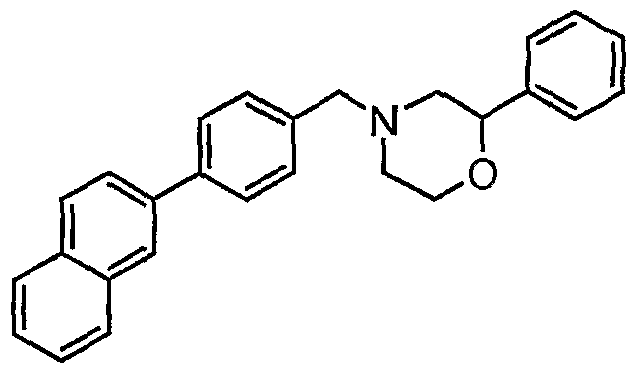
The above compound was made in the same manner as Example 8 but with the appropriate boronic acid. 4% yield, ES MS m/z 380
Example 13: 2-Phenyl-4-(4-thiophen-3-yl-benzyl)-morpholine

The above compound was made in the same manner as Example 8 but with the appropriate boronic acid. 16% yield, ES MS m/z 336
Example 14 : 4-(2 '-Ethoxy-biphenyl-4-yImethyl)-2-phenyl-morpholine

The above compound was made in the same manner as Example 8 but with the appropriate boronic acid. 12% yield, ES MS m/z 374
Example 15: 2-Phenyl-4-(4-pyridin-4-yl-benzyI)-morpholine

The above compound was made in the same manner as Example 8 but with the appropriate boronic acid. 21% yield, ES MS m/z 331
Example 16: 4-[4-(2-Chloro-thiophen-3-yl)-benzyl]-2-phenyl-morpholine

91mg of 4-(4-Bromo-ben2yl)-2-phenyl-morpholine was combined with 77mg of bis(pinacolato)diboron, 81mg of potassium acetate, 16mg tetrakis(triphenylphosphine)palladium(0), and 1.9mL DMF. The mixture was heated in a microwave reactor at 120°C for 7 minutes and cooled. 0.7mL of 2M aqueous sodium carbonate was added along with 81mg of 2-Chloro-3-bromothiophene in 0.12mL DMF. The mixture was heated in the microwave reactor for an additional 5 minutes at 12O0C. The reaction was cooled and filtered through Celite, washing with methylene chloride. The residue was diluted with 4mL DCM and 130mg of MP-TsOH resin (4.2mmol/g loading) was added and the mixture agitated at room temperature overnight. The solution is filtered and the resin is then washed with 2M NH3 in methanol to liberate product. The resin is washed several times with methylene chloride, concentrated in vacuo and purified by reverse phase HPLC. 10.9mg of product is obtained as oil, 10% yield. ES MS m/z 398 The above compound was made in the same manner as Example 24 but with the appropriate aryl bromide. 5% yield, ES MS m/z 370
Example 17: 2-Phenyl-4-(4-pyridin-2-yI-benzyl)-morpholine

The above compound was made in the same manner as Example 16 but with the appropriate aryl bromide. 6% yield, ES MS m/z 331
Example 18: 4-(2'-Trifluoromethyl-biphenyl-4-ylmethyl)-morpholine 4-(4-Bromo- benzyl)-morplioline

2g of 4-Bromobenzyl bromide and 0.7mL morpholine in 24mL of acetonitrile were stirred at room temperature and 1. Ig of potassium carbonate was added. The reaction was stirred at room temperature overnight. The solution was filtered through Celite and concentrated in vacuo to afford a brown solid. Purification was done by flash chromatography using a methylene chloride/methanol gradient to afford 1.9g of product as a white solid. ES MS (+) m/z 257 mp=72°C
4-(2'-Trifluoromethyl-biphenyl-4-ylmethyl)-morpholine

Example 19: 4-(2'-Chloro-biphenyl-4-ylmethyl)-morpholine

Example 20: 4-(2',5'-Dichloro-biphenyl-4-ylmethyl)-morpholine

Example 21: 4-(2',5'-Dimethyl-biphenyI-4-ylmethyl)-morpholine

Example 22: 4-(5'-Chloro-2t-methyl-biphenyl-4-ylmethyl)-morpholine

Example 23: 4-(2'-Chloro-5'-methyl-biphenyl-4-ylmethyl)-morpholine

Example 24: 4-(3-Bromo-benzyl)-2-phenyl-morpholine

1.877g of 3-Bromobenzyl bromide and Ig of 2-Phenyl-morpholine in 15mL of acetonitrile were stirred at room temperature and 2.076g of potassium carbonate was added. The reaction was stirred at room temperature overnight. The solution was filtered through Celite and concentrated in vacuo to afford a brown solid. Purification by flash chromatography afforded 1.073g of product. 65% yield ES MS m/z332
Example 25: 2-Phenyl-4-(2'-trifluoromethyl-biphenyl-3-ylmethyl)-morpholine

Example 26: 4-(2'-Chloro-biphenyl-3-ylmethyl)-2-phenyl-morpholine

The above compound was made in the same manner as Example 24 but with the appropriate boronic acid. 77% yield, ES MS m/z 364
Example 27: 4-(2',5'-Dichloro-biphenyI-3-ylmethyl)-2-phenyl-morpholine

The above compound was made in the same manner as Example 24 but with the appropriate boronic acid. 87% yield, ES MS m/z 398
Example 28: 4-(2',5'-Dimethyl-biphenyl-3-ylmethyl)-2-phenyl-morpholine

The above compound was made in the same manner as Example 24 but with the appropriate boronic acid. 82% yield, ES MS m/z 358
Example 29: 4-(2-Bromo-benzyl)-2-phenyl-morpholine

1.877g of 2-Bromobenzyl bromide and Ig of 2-Phenyl-morpholine in 15mL of acetonitrile were stirred at room temperature and 2.076g of potassium carbonate was added. The reaction was stirred at room temperature overnight. The solution was filtered through Celite and
concentrated in vacuo to afford a brown solid. Purification by flash chromatography afforded 1.052g of product. 63% yield ES MS rø/z332 Example 30: 2-Phenyl-4-(2'-trifluoromethyl-biphenyl-2-ylmethyl)-morpholine

Example 31: 4-(5'-Chloro-2'-methyl-biphenyl-2-ylmethyl)-2-phenyl-morpholine

The above compound was made in the same manner as Example 7 but with 4-(2-Bromo- benzyl)-morpholine and the appropriate arylbromide. 45% yield, ES MS m/z 378
Example 32: 4-(2'-Chloro-5'-methyl-biphenyl-2-ylmethyl)-2-phenyl-morpholine

Example 33 : 3-Phenyl-l-(2 f-trifluoromethyI-biphenyl-4-ylmethyl)-piperazine
(2-tert-Butoxycarbonylamino-2-phenyl-acetylamino)-acetic acid methyl ester

5g of iV-te/t-butoxycarbonyl phenylglycine were dissolved in THF under nitrogen atmosphere and cooled to 00C. 1.1 equiv. of triethylamine were added, followed by 1.1 equiv. of isobutylchloroformate to form the mixed anhydride solution. The reaction was stirred at room temperature for Ih. 1.1 equiv. of the HCl salt of glycine methyl ester were dissolved in anhydrous dichloromethane, 1 eqiv. of triethylamine were added. This solution was then added dropwise to the cooled, mixed anhydride solution. The reaction was stirred for 3h at 0 0C. The reaction was filtered and the filtrate concentrated in vacuo. The residue was taken up into ethyl acetate, washed with 5% aqueous citric acid solution, 5% aqueous sodium bicarbonate solution, water and brine. The organic phase was dried over sodium sulfate, filtered and concentrated in vacuo to afford in a quantitative yield (2-tert- butoxycarbonylamino-2-phenyl-acetylamino)-acetic acid methyl ester as colorless oil. ES MS(+) m/z 323
3 -Phenyl-piperazine-2, 5 -dione

The reaction was stirred at room temperature for 2.5h. The reaction was concentrated in vacuo to give a yellow oil which was redissolved in 5% aqueous sodium bicarbonate solution. The reaction was stirred at room temperature for 20 min, and then methanol was added. The reaction was heated to 80 0C for 3h. After cooling to room temperature, the basic aqueous phase was extracted with ethyl acetate. The combined organic extracts were dried over sodium sulfate, filtered and concentrated in vacuo to give 2.3g of 3-phenyl-piperazine-2,5-dione as orange solids. ES MS (+) m/z 191 2-Phenylpiperazine

2.3 g of 3-phenyl-piperazine-2,5-dione were suspended in anhydrous THF under nitrogen and cooled in an ice-bath. 4 equiv. of lithium aluminium hydride were added. The reaction was stirred at 0 0C for 0.5h, and then heated to reflux overnight. The reaction was quenched by the subsequent addition of ImLZgLiAlH4 of water, lmL/gLiAlH4 of 5% aqueous Sodium hydroxide solution and 3mL/gLiAlH4 of water. The resulting solid were separated by filtration through Celite and rinsed with ethyl acetate. The filtrate was concentrated in vacuo to afford 2g of 2-phenylpiperazine as brown oil. ES MS (+) m/z 163
l-(4-Bromo-benzyl)-3-phenyl-piperazine

2g of 2-phenylpiperazine were dissolved in acetonitrile and cooled to 0 oC. A solution of 0.5 quiv. 4-bromobenzylchloride in acetonitrile was added dropwise over 1 h. The reaction was stirred at room temperature overnight. The reaction mixture was concentrated and the residue
was purified by column chromatography (silica, eluent dichloromethane, 0-5% methanol) to afford Ig of l-(4-bromo-benzyl)-3-phenyl-piperazine. ES MS (+) m/z 301. or: l-(4-Bromo-benzyl)-3-phenyl-piperazine

1.03g of 4-Bromobenzaldehyde was dissolved in 15mL of THF and Ig of 2-Phenylpiperazine and 2.67g of MP-BH(O Ac)3 (2.77mmol/g) was added. The reaction was agitated on an orbital shaker overnight at room temperature. The reaction was concentrated in vacuo and purified by flash chromatography. 530mg of product is isolated. ES MS (+) m/z 331. or.

1.54g of 4-Bromobenzyl bromide and Ig of 3-Phenylpiperazine in 2OmL of acetonitrile were stirred at room temperature and 0.85g of potassium carbonate was added. The reaction was stirred at room temperature overnight. The solution was filtered through Celite and concentrated in vacuo. Purification was done by flash chromatography to afford 1.13g of product.
3 -Phenyl- 1 -(2'-trifluoromethyl-biphenyl-4-ylmethyl)-piperazine

Example 34: l-(2'-Chloro-biphenyl-4-ylmethyl)-3-phenyl-piperazine

The above compound was made in the same manner as Example 33 but with the appropriate boronic acid. 28% yield, ES MS m/z 363
Example 35: l-(2',5'-Dimethyl-biphenyl-4-ylmethyl)-3-phenyI-piperazine

The above compound was made in the same manner as Example 33 but with the appropriate boronic acid. 21% yield, ES MS m/z 357
Example 36: l-(5'-Chloro-2l-methyl-biphenyl-4-ylmethyl)-3-phenyl-piperazine

The above compound was made in the same manner as Example 33 but with the appropriate boronic acid. 24% yield, ES MS m/z 377
Example 37: l-(2'-Chloro-5'-methyl-biphenyl-4-ylmethyl)-3-phenyl-piperazine

The above compound was made in the same manner as Example 7 but with l-(4-Bromo- benzyl)-3-phenyl-piperazine. 26% yield, ES MS m/z 377
Example 38: ,6-Dimethyl-4-(2'-trifluoromethyl-biphenyl-4-ylmethyl)-morpholine 4-(4- Bromo-benzyl)-2,6-dimethyl-morpholine
2g of 4-Bromobenzyl bromide and 0.99mL 3,5-Dimethylmorpholine in 24mL of acetonitrile were stirred at room temperature and 1.106g of potassium carbonate was added. The reaction was stirred at room temperature overnight. The solution was filtered through Celite and concentrated in vacuo to afford a brown solid. Purification was done by flash chromatography using a methylene chloride/methanol gradient to afford 365mg of product as one regioisomer, the trans methyl, and 1.54g of the cis methyl regioisomer. ES MS (+) m/z 284.
2,6-Dimethyl-4-(2'-trifluoromethyl-biphenyl-4-ylmethyl)-morpholine

Example 39: 4-(2'-ChIoro-biphenyl-4-ylmethyl)- trans-2,6-dimethyl-morpholine

The above compound was made in the same manner as Example 38 but with the appropriate boronic acid. 32% yield, ES MS nι/z 316
Example 40: 4-(2',5'-Dichloro-biphenyl-4-ylmethyl)-2,6-dimethyl-morpholine

The above compound was made in the same manner as Example 38 but with the appropriate boronic acid. 35% yield, ES MS m/z 350
Example 41 : 4-(2',5'-Dimethyl-biphenyl-4-ylmethyl)-2,6-dimethyl-morpholine

The above compound was made in the same manner as Example 50 but with the appropriate boronic acid. 38% yield, ES MS m/z 310
Example 42: 4-(5'-Chloro-2'-methyl-biphenyl-4-ylmethyl)-trans-2,6-dimethyI- morpholine

The above compound was made in the same manner as Example 7 but with the appropriate arylbromide and 4-(4-Bromo-benzyl)-2,6-dimethyl-morpholine . 9% yield, ES MS m/z 330
Example 43: 2-Pyridin-3-yl-4-(2'-chloro-biphenyl-4-ylmethyl)-morpholine
4-(4-Bromo-benzyl)-2-pyridin-3-yl-morpholme

5.632g of 4-Bromobenzyl bromide and 3.819g of 2-Pyridin-3-yl morpholine oxalate (Array) in 5OmL of acetonitrile were stirred at room temperature and 6.229g of potassium carbonate was added. The reaction was stirred at room temperature overnight. The solution was filtered through Celite and concentrated in vacuo to afford a brown solid. Purification is done by flash chromatography to afford product. Wt: 211mg; 16%yield. ES MS m/z 334
2-Pyridin-3-yl-4-(2'-chloro-biphenyl-4-ylmethyl)-morpholine

105mg of 4-(4-Bromo-ben2yl)-2-pyridin-3-yl-morpholine was combined with 74mg of 2- Chlorophenyl boronic acid, 36mg of tetrakis(triphenylphosphine)palladium(0), 1.055mL of 2M sodium, carbonate solution, 2.8mL toluene and 1.4mL ethanol. The reaction mixture was heated in a sealed tube at 120°C overnight in an oil bath. The reaction mixture was filtered through Celite and concentrated in vacuo. The residue was purified by reverse phase HPLC. ES MS (+) m/z 365, 97% yield.
Example 44: 2-Phenyl-4-(2'-trifluoromethyl-biphenyl-4-ylmethyI)-thiomorphoIine
4-(4-Bromo-benzyl)-2-phenyl-thiomorpholine

5.632g of 4-Bromobenzyl bromide and 2.694g of 2-Phenylthiomorpholine (Array) in 5OmL of acetonitrile were stirred at room temperature and 6.229g of potassium carbonate was added. The reaction was stirred at room temperature overnight. The solution was filtered through Celite and concentrated in vacuo to afford a brown solid. Purification was done by flash chromatography to afford product. Wt: 0.859g, 53% yield. ES MS m/z 348/350
2-Phenyl-4-(2'-trifluoromethyl-biphenyl-4-ylmethyl)-thiomorpholine

(Trifluoromethyl)phenyl boronic acid, 33mg of tetrakis(triphenylphosphine)palladium(0), 0.96ImL of 2M sodium carbonate solution, 2.6mL toluene and 1.3mL ethanol. The reaction mixture was heated in a sealed tube at 120°C overnight in an oil bath. The reaction mixture was filtered through Celite and concentrated in vacuo. The residue was purified by reverse phase HPLC. ES MS (+) m/z 414, 75% yield.
Example 45: 4-(2'-Chloro-biphenyl-4-yImethyl)-2-phenyl-thiomorpholine

The above compound was made in a similar manner to Example 44 but with the appropriate boronic acid. 78%yield, ES MS m/z380.
Example 46: 4-(2',5'-Dichloro-biphenyl-4-ylmethyl)-2-phenyl-thiomorpholine

The above compound was made in a similar manner to Example 44 but with the appropriate boronic acid. 16%yield, ES MS w/z414.
Example 47: 3-Phenyl-l-(2'-trifluoromethyl-biphenyl-4-ylmethyl)-pyrrolidine l-(4-Bromo-benzyl)-3-phenyl-pyrrolidine

3-Phenyl-l-(2'-chloromethyl-biphenyl-4-ylmethyl)-pyrrolidine

33 of 41 -(4-Bromo-benzyl)-3 -phenyl-pyrrolidine was combined with 24mg of 2-Chlorophenyl boronic acid, 12mg of tetrakis(triphenylphosphine)palladium(0), 0.348mL of 2M sodium carbonate solution, 0.936mL toluene and 0.468rnL ethanol. The reaction mixture was heated in a sealed tube at 1200C overnight in an oil bath. The reaction mixture was filtered through Celite and concentrated in vacuo. The residue was purified by reverse phase HPLC. ES MS (+) m/* 348, 36%yield.
Example 48: 3-Phenyl-l-(2'-trifluoromethyl-biphenyl-4-ylmethyl)-piperidine l-(4-Bromo-benzyl)-3-phenyl-piperidine

5.632g of 4-Bromobenzyl bromide and 2.422g of 2-Phenylpiperidine (Array) in 5OmL of acetonitrile were stirred at room temperature and 6.229g of potassium carbonate was added. The reaction was stirred at room temperature overnight. The solution was filtered through Celite and concentrated in vacuo to afford a brown solid. Purification was done by flash chromatography to afford product. Wt:0.908g, 54%yield.
3 -Phenyl- 1 -(2'-trifluoromethyl-bipheny l-4-ylmethyl)-piperidine
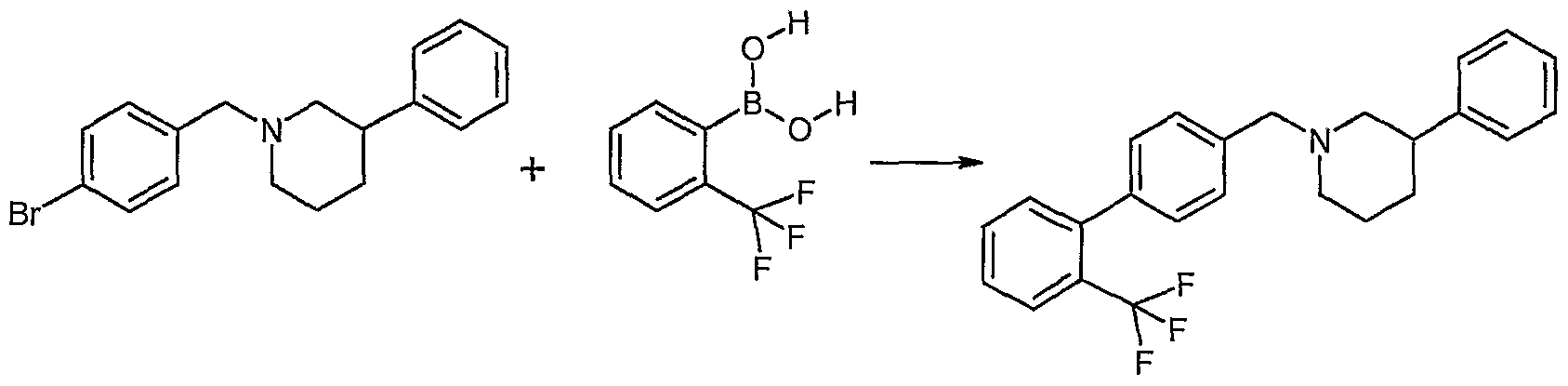
Example 49: l-(5'-ChIoro-2'-methyl-biphenyI-4-yImethyl)-3-phenyl-piperidine
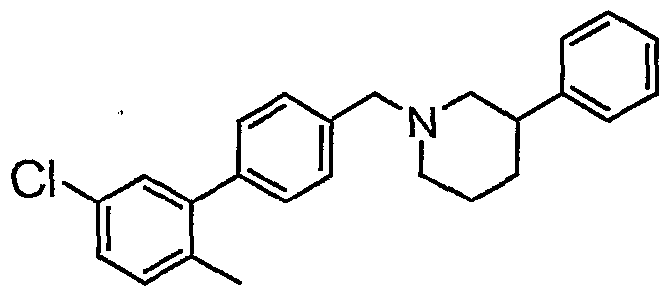
The above compound was made in the same manner as Example 7 but with the appropriate arylbromide and l-(4-Bromo-ben2yl)-3-phenyl-piperidine. 27% yield, ES MS m/z 376
Example 50: l-(2'-Chloro-biphenyl-4-ylmethyl)-3-phenyl-piperidine

Example 51 : l-(2',5'-Dichloro-biphenyl-4-ylmethyl)-3-phenyl-piperidine

Example 52: (2-Phenyl-morpholin-4-yl)-(2'-trifluoromethyl-biphenyl-4-yl)-methanone
(4-Bromo-phenyl)-(2-phenyl-morpholm-4-yl)-methanone

5g of p-Bromobenzoic acid, 4.966% 3-Phenyϊrnorρhomie HCl, 5.245g EDC, 3.696g HOBt and 4.766mL Hunig's Base in 25mL DMF was stirred at room temperature overnight. The reaction was diluted with water and extracted with ethyl acetate. The organic layers were combined, washed with IN HCl, aqueous saturated sodium bicarbonate solution and brine. The organics were concentrated in vacuo and purified by flash chromatography to afford product. Wt: 1.335g, 77% yield. ES MS m/z 346/348
(2-Phenyl-morpholin-4-yl)-(2'-trifluoromethyl-biphenyl-4-yl)-methanone
 lOOmg of (4-Bromo-phenyl)-(2-phenyl-morpholin-4-yl)-methanone was combined with 82mg of 2-(Trifluoromethyl)phenyl boronic acid, 33mg of tetrakis(triphenylphosphine)palladium(0), 0.968mL of 2M sodium carbonate solution, 2.6mL toluene and 1.3mL ethanol. The reaction mixture was heated in a sealed tube at 1200C overnight in an oil bath. The reaction mixture was filtered through Celite and concentrated in vacuo. The residue was purified by reverse phase HPLC. ES MS (+) m/z 412, 97% yield.
Example 53: (2'-Chloro-biphenyl-4-yl)-(2-phenyl-morpholin-4-yl)-methanone

The above example was made in a similar manner to Example 60 but with the appropriate boronic acid. 59% yield, ES MS m/z 378.
Example 54: (2',5'-Dimethyl-biphenyl-4-yl)-(2-phenyl-morpholin-4-yl)-methanone

The above example was made in a similar manner to Example 60 but with the appropriate boronic acid. 68% yield, ES MS m/z 372.
Example 55: (2 ',3 '-Dichloro-biphenyl-4-yl)-(2-phenyl-morpholin-4-yl)-methanone

The above example was made in a similar manner to Example 60 but with the appropriate boronic acid. 19% yield, ES MS m/z 412.
Example 56: (3-Phenyl-piperidin-l-yl)-(2'-trifluoromethyl-biphenyl-4-yI)-methanone (4-Bromo-phenyl)-(3 -phenyl-piperidin- 1 -yl)-methanone

The above compound could be made in the following manner, analogous to Example 60. 1 eq. of p-Bromobenzoic acid could be combined with 1 eq. 3-Phenylpiperidine HCl, 1.1 equivalents EDC, 1.1 equivalents HOBt and 2.2 equivalents Hunig's Base in DMF (concentration of ImL of DMF/mmol acid) would be stirred at room temperature overnight. The solution would then be diluted with water and extracted with ethyl acetate. The organic layers would then be combined and washed with water, aqueous saturated sodium bicarbonate solution, IN HCl and brine. The organic layers would be dried with sodium sulfate, filtered and concentrated. Purification would be done with flash chromatography to afford product.
(3-Phenyl-piperidin-l-yl)-(2'-trifluoromethyl-biphenyl-4-yl)-methaiione

Example 57: (3-Phenyl-pyrrolidin-l-yl)-(2'-trifluoromethyl-biphenyl-4-yl)-methanone (4-Bromo-phenyl)-(3-phenyl-pyrrolidin-l-yl)-methanone

The above compound could be made in the following manner analogous to Example 60: 1 equivalent of p-Bromobenzoic acid, 1 equivalent 3 -Phenylpyrrolidine, 1.1 equivalents of
EDC, 1.1 equivalents of HOBt and 1 equivalent of Hunig's Base in DMF would be stirred at room temperature overnight. The solution would then be diluted with water and extracted with ethyl acetate. The organic layers would be combined and washed with water, aqueous saturated sodium bicarbonate solution, IN HCl and brine. The organic layers would be dried with sodium sulfate, filtered and concentrated. Purification would be done with flash chromatography to afford product.
(3-Phenyl-pyrrolidin-l-yl)-(2'-trifluoromethyl-biphenyl-4-yl)-methanone

The above compound could be made in the following manner: 1 eq. of (4-Bromo-phenyl)-(3- phenyl-pvrrolidin-l-yl)-rnethanone would be combined with 1.5 eq. of 2- (Trifluoromethyl)phenyl boronic acid, 10mol% of tetrakis(triphenylphosphine)palladium(0), 6.7eq. of 2M sodium carbonate solution, toluene and ethanol. The reaction mixture would be heated in a sealed tube at 1200C overnight in an oil bath. The reaction mixture would be filtered through Celite and concentrated in vacuo. The residue would be diluted with water and extracted with ethyl acetate. The combined organic phases would be washed with brine, dried over sodium sulfate, filtered and concentrated in vacuo. The crude material would be purified by flash chromatography to afford product.
Example 58: 2-Ben2yl-4-(2'-trifluoromethyl-biphenyl-4-ylmethyl)-morpholine l-(2-Hydroxy-ethylamino)-3-phenyl-propan-2-ol

The above compound could be made in the same manner as Example 1 using the appropriate epoxide. 1 eqivalent of (2,3-Epoxypropyl)benzene oxide and 4 eq. ethanol amine could be stirred at room temperature overnight. The solution could be poured into water and the water is extracted with dichloromethane. The combined dichloromethane layers could be washed with brine and concentrated.
(2-Hydroxy-ethyl)-(2-hydroxy-3-phenyl-propyl)-carbamic acid tert-butyl ester

The above compound could be made in the following manner: 1 eq. l-(2-Hydroxy- ethylamino)-3-phenyl-propan-2-ol and 1.1 eq. di-t-butyl dicarbonate in methylene chloride could be stirred together at room temperature and 1.5eq. triethylamine could be added. The solution could be stirred at room temperature overnight. The solution could be poured into water and extracted with methylene chloride. The combined organics could be washed with brine and dried with sodium sulfate. After filtration, the crude material could be purified by flash chromatography.
2-Benzyl-morpholine-4-carboxylic acid tert-butyl ester

The above compound could be made in the following manner: 1 eq. of (2-Hydroxy-ethyl)-(2- hydroxy-3-phenyl-propyl)-carbamic acid tert-butyl ester and 1.2 eq. of triphenylphosphine could be dissolved in toluene. 1.2 eq. of diethylazodicarboxylate in toluene could be added dropwise to the resulting solution at room temperature under argon atmosphere and the mixture could be stirred overnight. The solvent could be removed in vacuo and the material purified by column chromatography.
2-Benzyl-morpholine

2-Benzyl-4-(4-bromo-benzyl)-morpholine

The above compound could be made in the following manner: 1.5 eq. of 4-Bromobenzyl bromide and 1 eq. of 2-Benzyl-morpholine in acetonitrile could be stirred at room temperature and 3 eq. of potassium carbonate could be added. The reaction could be stirred at room temperature overnight. The solution could be filtered through Celite and concentrated in vacuo to afford a brown solid. Purification could be done by flash chromatography to afford product.
2-Benzyl-4-(2'-trifluoromethyl-biphenyl-4-ylmethyl)-morpholine

Example 59: 2-Isopropyl-4-(2'-trifluoromethyl-biphenyl-4-ylmethyl)-morpholine 1 -(2-Hydroxy-ethylamino)-3 -methyl-butan-2-ol

The above compound could be made in the same manner as Example 1 using the appropriate epoxide: 1 eq. of (2,3-Epoxypropyl)benzene oxide and 4 eq. ethanol amine The above compound could be made in the following manner: stirred at room temperature overnight. The solution could be poured into water and the water is extracted with dichloromethane. The combined dichloromethane layers could be washed with brine and concentrated. .
(2-Hydroxy-ethyl)-(2-hydroxy-3-methyl-butyl)-carbamic acid tert-butyl ester

The above compound could be made in the following manner: 1 eq. l-(2-Hydroxy- ethylamino)-3 -methyl-butan-2-ol and 1.1 eq. di-t-butyl dicarbonate in methylene chloride could be stirred together at room temperature and 1.5 eq. triethylamine could be added. The solution could be stirred at room temperature overnight. The solution could be then poured into water and extracted with methylene chloride. The combined organics could be washed with brine and dried with sodium sulfate. After filtration, the crude material could be purified by flash chromatography.
2-Isopropyl-morpholine-4-carboxylic acid tert-butyl ester
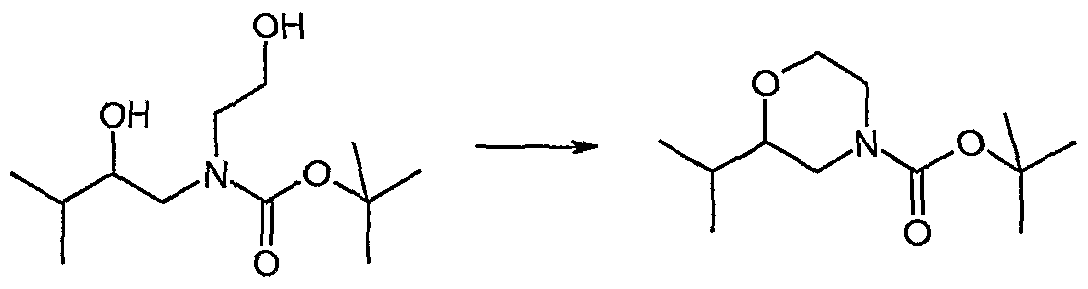
The above compound could be made in the following manner: 1 eq. of (2-Hydroxy-ethyl)-(2- hydroxy-3-methyl-butyl)-carbamic acid tert-butyl ester and 1.2 eq. of triphenylphosphine could be dissolved in toluene. 1.2 eq. of diethylazodicarboxylate in toluene could be added dropwise to the resulting solution at room temperature under argon atmosphere and the mixture could be stirred overnight. The solvent could be removed in vacuo and the material purified by column chromatography.
2-Isopropyl-morpholine
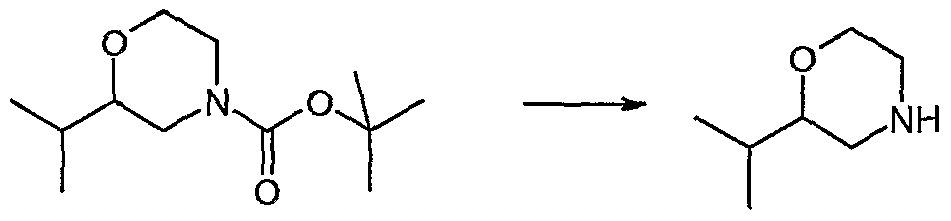
The above compound could be made in the following manner: 2-Isopropyl-morpholine-4- carboxylic acid tert-butyl ester in 4N solution of hydrogen chloride in dioxane could be stirred at 6O0C for 3h. The solvent could be removed in vacuo and IN aqueous hydrogen chloride solution could be added to the resulting residue, and the mixture could be washed with diethyl ether. The aqueous layer could be adjusted to pH 14 by addition of 2N NaOH solution and extracted with methylene chloride. The organic layer could be washed with brine and dried over sodium sulfate. After filtering, the material could be purified by column chromatography.
4-(4-Bromo-benzyl)-2-isopropyl-morpholine

The above compound could be made in the following manner: 1.5 eq. of 4-Bromobenzyl bromide and 1 eq. of 2-Isopropyl-morpholine in acetonitrile could be stirred at room temperature and 3 eq. of potassium carbonate could be added. The reaction could be stirred at room temperature overnight. The solution could be filtered through Celite and concentrated in vacuo to afford a brown solid. Purification could be done by flash chromatography to afford product.
2-Isopropyl-4-(2'-trifluoromethyl-biphenyl-4-ylmethyl)-morpholme

Example 60: l-Cl'-Trifluoromethyl-biphenyl^-ylmethyϊJ-piperazine
1 -(4-Bromo-benzyl)-piperazine

This compound could be made in the following manner: 2g of 4-Bromobenzyl bromide and 1 equ. piperazine in acetonitrile would be stirred at room temperature and l.lg of potassium carbonate would be added. The reaction would be stirred at room temperature overnight. The solution would then be filtered through Celite and concentrated in vacuo to afford the crude product. Purification would be done by flash chromatography using a methylene chloride/methanol gradient.
l-(2'-Trifluoromethyl-biphenyl-4-ylmethyl)-piperazine

Example 61 : l-Methyl-2-phenyl-4-(2'-trifluoromethyl-biphenyl-4-ylmethyl)-piperazine

Example 62: l-Ethyl-2-phenyI-4-(2'-trifluoromethyl-biphenyI-4-ylmethyl)-piperazine

Example 63: l-Isopropyl-2-phenyl-4-(2'-trifluoromethyl-biphenyl-4-ylmethyl)- piperazine

Example 64: l-Cyclohexyl-2-phenyl-4-(2'-trifluoromethyl-biphenyl-4-yImethyl)- piperazine

The above compound could be made in the same manner as example 62, but with bromo cyclohexane as the appropriate alkylating reagent.
Example 65: l-[2-Phenyl-4-(2'-trifluoromethyl-biphenyl-4-ylmethyl)-piperazin-l-yl]- ethanone

55mg of 3-phenyl-l-(2'-trifluoromethyl-biphenyl-4-yhnethyl)-piperazine was dissolved in THF, 2 equiv. of acetylchloride and 2 equiv. of N, N-diisoproylethylamine were added. The reaction was shaken at room temperature overnight. The solvent was removed in vacuo, the residue was dissolved in DCM, washed with IM aqueous sodium hydroxide solution, then dried over sodium sulfate, filtered and concentrated in vacuo. The crude residue was purified by column chromatography to afford the title compound as free base. Addition of 1 equiv. of
IM HCl in dioxane and concentratation in vacuo afforded 27 mg of the title compound as hydrochloride salt. Yield 40% ES MS m/z 439
Example 66: Phenyl-[2-phenyl-4-(2'-trifluoromethyl-biphenyl-4-ylmethyl)-piperazin-l- yl]-methanone

The hydrochloride salt of the above compound was made in the same manner as example 65, but with benzoylchloride as the appropriate acidchloride. Yield 54%, ES MS m/z 502
Example 67: 2,2-Dimethyl-l-[2-phenyl-4-(2'-trifluoromethyl-biphenyl-4-ylmethyl)- piperazm-l-yl]-propan-l-one
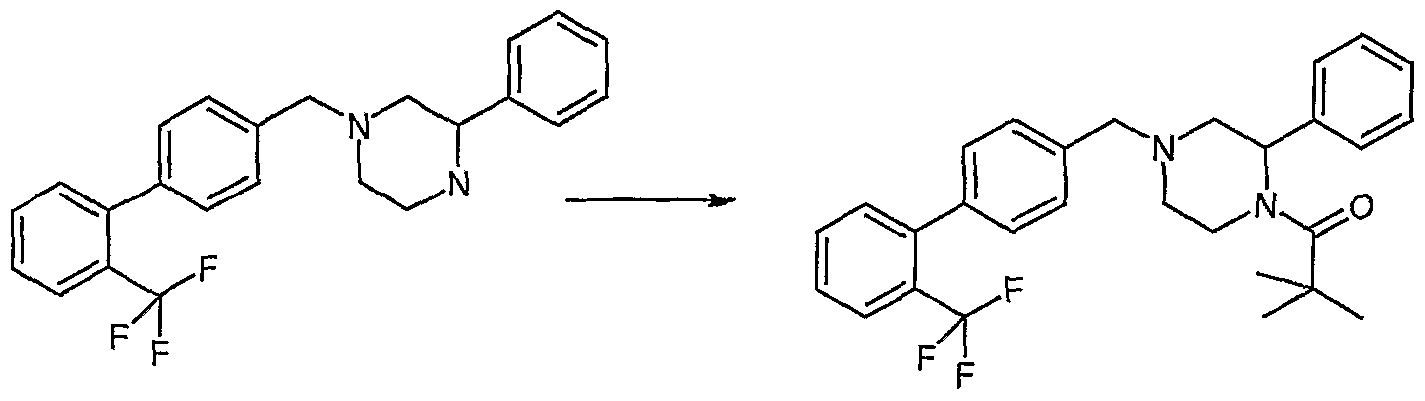
The hydrochloride salt of the above compound was made in the same manner as example 65, but with pivaloylchloride as the appropriate acidchloride. Yield 48%, ES MS m/z 481
Example 68: 2-Phenyl-l-[2-phenyl-4-(2'-trifluoromethyl-biphenyl-4-ylmethyl)- piperazin-l-yl]-ethanone

The hydrochloride salt of the above compound was made in the same manner as example 65, but with phenylacetyl chloride as the appropriate acidchloride. Yield 42%, ES MS m/z 515
Example 69: 2-Phenyl-4-(2'-trifluoromethyl-biphenyl-4-ylmethyl)-piperazine-l- carboxylic acid Diethylamide

This compound was made in the following manner: 55 mg of 3-phenyl-l-(2'-trifluoromethyl- biphenyl-4-ylmethyl)-piperazine was dissolved in THF5 2 equiv. methylisocyanate were added. The reaction was shaken at room temperature overnight. The solvent was removed in vacuo, the residue was dissolved in DCM, washed with IM aqueous sodium hydroxide solution, then dried over sodium sulfate, filtered and concentrated in vacuo. The crude residue was purified by column chromatography to afford the title compound as free base. Addition of 1 equiv. of IM HCl in dioxane and concentratation in vacuo afforded 33 mg of the title compound as hydrochloride salt. Yield 48% ES MS m/z 454
Example 70 : 2-Phenyl-4-(2'-trifluoromethyl-biphenyl-4-ylmethyl)-piperaziπe-l- carboxylic acid diethylamide

The hydrochloride salt of the above compound was made in the same manner as example 69, but with N,N-dirnethylcarbamoyl chloride as the appropriate acidchloride. Yield 48%, ES MS m/z 468
Example 71: 2-Phenyl-4-(2'-trifluoromethyl-biphenyl-4-ylmethyl)-piperazine-l- carboxylic acid phenylamide

The hydrochloride salt of the above compound was made in the same manner as example 69, but with phenylisocyanate as the appropriate isocyanate. Yield 35%, ES MS m/z 516
Example 72: l-Methanesulfonyl-2-phenyl-4-(2'-trifluoromethyl-biphenyl-4-ylmethyl)- piperazine

Example 73 : l-Benzenesulfonyl-2-phenyl-4-(2'-trifluoromethyI-biphenyl-4-ylmethyl)- piperazine

The above compound was made in the same manner as example 65, but with of benzenesulforryl chloride as the appropriate acidchloride. Yield 59%, ES MS m/zSYl
Example 74: l-Cyelohexanesulfonyl-2-phenyl-4-(2'-trifluoromethyl-biphenyl-4- ylmethyl)-piperazine

The above compound could be made in the same manner as example 65, but with of cyclohexanesulfonyl chloride as the appropriate acidchloride.
Example 75: l-Methyl-2-phenyl-4-(2 '-chloro-biphenyl-4-ylmethyl)-piperazine

This compound could be made the following manner: lOOmg of 3 -phenyl- 1 -(2'- trifluoromethyl-biphenyl-4-ylmethyl)-piperazine would be dissolved in acetonitrile, 3 equiv. of N,N-diisopropylethylamine would be added followed by 1.1 equiv. ofiodomethane. The reaction would be stirred at 80 0C overnight. The reaction would be diluted with dichloromethane and washed with IN aqueous NaOH solution. The organic layer would be dried over Na2SO4, filtered and concentrated in vacuo. The crude residue would be purified by column chromatography to afford l-methyl-2-phenyl-4-(2'-chloro-biphenyl-4-yhnethyl)- piperazine.
Example 76: l-EthyI-2-phenyl-4-(2'-chloro-biphenyl-4-ylmethyl)-piperazine

The above compound could be made in the same manner as example 75, but with iodoethane as the appropriate alkylating reagent.
Example 77: l-Isopropyl-2-phenyl-4-(2'chloro-biphenyl-4-ylmethyl)-piperazine

Example 78 : l-Cyclohexyl-2-phenyl-4-(2 '-chϊoro-biphenyϊ-4-ylmethyl)-piper azine

The above compound could be made in the same manner as example 75, but with cyclohexylbromide as the appropriate alkylating reagent.
Example 79: l-[2-Phenyl-4-(2'-chIoro-biphenyl-4-ylmethyl)-piperazin-l-yl]-ethanone

This compound could be made the following manner: lOOmg of 3-phenyl-l-(2'-chloro- biphenyl-4-ylmethyl)-piperazine would be dissolved in dichloromethane, 1.1 equiv. of acetylchloride and 2 equiv. of N, N-diisoproylethylamine would be added. The reaction would be stirred at room temperature under nitrogen overnight. The reaction, would be diluted with DCM, washed with IM aqueous sodium hydroxide solution, then dried over sodium sulfate,
filtered and concentrated in vacuo. The crude residue would be purified by column chromatography to afford the title compound.
Example 80: Phenyl-[2-phenyl-4-(2'-chloro-biphenyl-4-yImethyl)-piperazin-l-yI]- methanone

The above compound could be made in the same manner as example 84, but with benzoylchloride as the appropriate acidchloride.
Example 81 : 2,2-Dimethyl-l-[2-phenyl-4-(2'-chloro-biphenyl-4-ylmethyl)-piperazin-l- yl]-propan-l-one

The above compound could be made in the same manner as example 79, but with pivaloylchloride as the appropriate acidchloride.
Example 82: 2-Phenyl-l-[2-phenyl-4-(2'-chloro-biphenyl-4-yImethyl)-piperazin-l-yl]- ethanone

The above compound could be made in the same manner as example 79, but with phenylacetyl chloride as the appropriate acidchloride.
Example 83: 2-Phenyl-4-(2'-chloro-biphenyl-4-ylmethyl)-piperazine-l-carboxylic acid methylamide

This compound could be made in the following manner: lOOmg of 3-phenyl-l-(2'-chloro- biphenyl-4-ylmethyl)-piperazine would be dissolved in dichloromethane, 1.1 equiv. methylisocyanate would be added. The reaction would be stirred at room temperature under nitrogen overnight. Aminomethylpolystyrene (loading 1.6 mmol/g) could be added and the reaction would be shaken for further όh.The polymer could be separated by filtration and rinsed with dichloromethane. The filtrate could be concentrated in vacuo to afford the title compound.
Example 84: 2-Phenyl-4-(2'-chloromethyl-biphenyl-4-ylmethyl)-piperazine-l-carboxylic acid dimethylamide

The above compound could be made in the same manner as example 19, but with N,N- dimethylcarbamoyl chloride as the appropriate acidchloride.
Example 85: 2-PhenyI-4-(2'-chloro-biphenyl-4-yImethyl)-piperazine-l-carboxylic acid phenylamide

The above compound could be made in the same manner as example 83, but with phenylisocyanate as the appropriate isocyanate.
Example 86: l-Methanesulfonyl-2-phenyl-4-(2'-chloro-biphenyl-4-ylmethyl)-piperazine

The above compound could be made in the same manner as example 79, but with of methanesulfonyl chloride as the appropriate acidchloride.
Example 87: l-Benzenesulfonyl-2-phenyl-4-(2'-chloro-biphenyl-4-ylmethyl)-piperazine

The above compound could be made in the same manner as example 79, but with of benzenesulfonyl chloride as the appropriate acidchloride.
Example 88: l-Cyclohexanesulfonyl-2-phenyl-4-(2'-chloro-biphenyI-4-ylmethyl)- piperazine

The above compound could be made in the same manner as example 79, but with of cyclohexanesulfonyl chloride as the appropriate acidchloride.
Example 89: l-Methyl-2-phenyl-4-(2'-chloro-5'-methyl-biphenyl-4-ylmethyI)-piperazine

This compound could be made the following manner: lOOmg of 3 -phenyl- 1 -(2'- trifluoromethyl-biphenyl-4-ylmethyl)-piperazine would be dissolved in acetonitrile, 3 equiv. of N,N-diisopropylethylamine would be added followed by 1.1 equiv. of iodomethane. The reaction would be stirred at 800C overnight. The reaction would be diluted with dichloromethane and washed with IN aqueous NaOH solution. The organic layer would be
dried over Na2SO4, filtered and concentrated in vacuo. The crude residue would be purified by column chromatography to afford l-methyl-2-phenyl-4-(2'-chloro-5'-methyl-biphenyl-4- ylmethyl)-piperazine.
Example 90: l-Ethyl-2-phenyl-4-(2t-chloro-5'-methyl-biphenyI-4-ylmethyl)-piperazine

The above compound could be made in the same manner as Example 89, but with iodoethane as the appropriate alkylating reagent.
Example 91: l-Isopropyl-2-phenyl-4-(2fchloro-5'methyl-biphenyl-4-ylmethyl)- piperazine

This compound could be made the following manner: lOOmg of 3-phenyl-l-(2'-chloro-5'- methyl-biphenyl-4-ylmethyl)-piperazine would be dissolved in a 2:1 mixture of dichloroethane and acetone, 2 equiv. of sodium triacetoxyborohydride would be added followed by 30μL of acetic acid. The reaction would be stirred at room temperature under nitrogen overnight. The reaction would be diluted with 5mL of dichloromethane. The reaction mixture would be washed with IM aqueous sodium hydroxide solution and brine, then dried over sodium sulfate, filtered and concentrated in vacuo. The crude residue would be purified by column chromatography to afford the title compound.
Example 92: l-Cyclohexyl-2-phenyI-4-(2'-chloro-5'methyl-biphenyl-4-ylmethyϊ)- piperaziπe

The above compound could be made in the same manner as example 90, but with cyclohexanone as the appropriate alkylating reagent.
Example 93: l-[2-Phenyl-4-(2'-chloro-5'methyl-biphenyl-4-yImethyl)-piperazin-l-yl]- ethanone

yl]-methanone

The hydrochloride salt of the above compound was made in the same manner as example 93, but with benzoylchloride as the appropriate acidchloride. Yield 44%, ES MS m/z 481
Example 95: 2,2-Dimethyl-l-[2-phenyl-4-(2'-chloro-5'-methyl-biphenyl-4-ylmethyl)- piperazin-1-yl] -propan-1-one

The above compound could be made in the same manner as example 93, but with pivaloylchloride as the appropriate acidchloride.
Example 96: 2-Phenyl-l-[2-phenyl-4-(2'-chloro-5'-methyl-biphenyl-4-ylmethyl)- piperazin-l-yl]-ethanone

The above compound could be made in the same manner as example 93, but with phenylacetyl chloride as the appropriate acidchloride.
Example 97: 2-Phenyl-4-(2 '-chloro-5 'methyl-biphenyl-4-ylmethyl)-piperazine-l- carboxylic acid Diethylamide

This compound could be made in the following manner: 55 mg of 3-phenyl-l-(2'-chloro-5'- methyl-biphenyl-4-ylmethyl)-piperazine would be dissolved in dichloromethane, 2 equiv. methylisocyanate would be added. The reaction would be shaken at room temperature overnight. The reaction would be concentrated in vacuo. The residue would be diluted with DCM, washed with IM aqueous sodium hydroxide solution, then dried over sodium sulfate, filtered and concentrated in vacuo. The crude residue would be purified by column chromatography to afford the title compound as free base. Addition of 1 equiv. of IM HCl in dioxane and concenrratation in vacuo would afford the title compound as hydrochloride salt.
Example 98: 2-Phenyl-4-(2'-chloro-5'-methyl-bipheπyl-4-ylmethyl)-piperazine-l- carboxylic acid dimethylamide

The above compound could be made in the same manner as example 93, but with N5N- dimethylcarbamoyl chloride as the appropriate acidchloride.
Example 99: 2-Phenyl-4-(2'-chloro-5'-methyl-biphenyl-4-ylmethyl)-piperazine-l- carboxylic acid phenylamide

55 mg of 3-phenyl-l-(2'-chloro-5'-methyl-biphenyl-4-ylmethyl)-piperazine were dissolved in dichloromethane, 2 equiv. methylisocyanate were added. The reaction was shaken at room temperature overnight. The reaction was concentrated in vacuo. The residue was diluted with DCM, washed with IM aqueous sodium hydroxide solution, then dried over sodium sulfate, filtered and concentrated in vacuo. The crude residue was purified by column chromatography to afford the title compound as free base. Addition of 1 equiv. of IM HCl in dioxane and concentratation in vacuo afforded the title compound as hydrochloride salt. Yield 33%, ES MS nι/z 496.
Example 100: l-MethanesuIfonyl-2-phenyl-4-(2'-chloro-5'-methyl-biphenyl-4-ylmethyl)- piperaziπe

The hydrochloride salt of the above compound was made in the same manner as example 93, but with methanesulfonyl chloride as the appropriate acidchloride. Yield 49%, ES MS m/z 455
Example 101 : l-Benzenesulfonyl-2-phenyl-4-(2'-chloro-5'-methyl-biphenyl-4-ylmethyl)- piperazine

The above compound could be made in the same manner as example 93, but with of benzenesulfonyl chloride as the appropriate acidchloride.
Example 102: l-Cyclohexanesulfonyl-2-phenyl-4-(2'-chloro-5'-methyl-biphenyl-4- ylmethyl)-piperazine

The above compound could be made in the same manner as example 93, but with of cyclohexanesulfonyl chloride as the appropriate acidchloride.
Example 103 : (3-Phenyl-piperazin-l-yl)-(2'-trifluoromethyl-biphenyl-4-yl)-methanone
(4-Bromo-phenyl)-(3-phenyl-piperazin-l-yl)-methanone

This compound could be made in the following manner: 500mg of 2-phenylpiperazine would be dissolved in dichloromethane and cooled to 0 0C. A solution of 0.5 equiv. of 4- bromobenzoyl chloride in dichloromethane would be added dropwise over Ih at O0C. The reaction would be stirred at O0C for 0.5h, then allowed to warm to room temperature and stirred for a further 3h until complete conversion. The reaction mixture would be diluted with
dichloromethane, washed with IM aqueous sodium hydroxide solution and brine, then dried over sodium sulfate, filtered and concentrated in vacuo. The crude residue would be purified by column chromatography to afford (4-bromo-phenyl)-(3-phenyl-piperazin-l-yl)-methanone.
(3-Phenyl-piperazin-l-yl)-(2'-trifluoromethyl-biphenyl-4-yl)-methanone
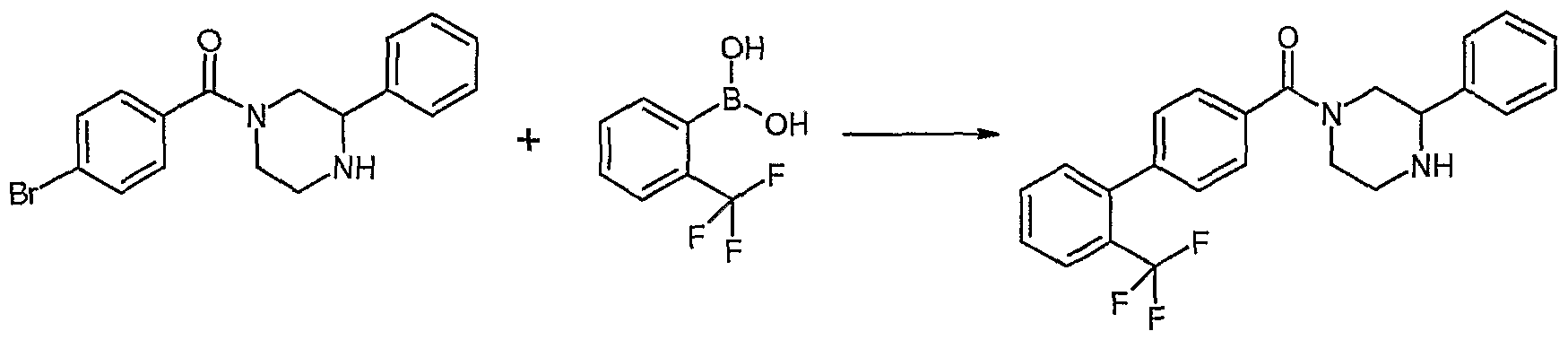
This compound could be made in the following manner: 100 mg of (4-bromo-phenyl)-(3- phenyl-piperazin-l-yl)-methanone would be combined with 1 equiv. of 2- trifluoromethylphenyl boronic acid, 10mol% of tetrakis(rriphenylphosphine) palladium(O), 2M aqueous sodium carbonate solution, toluene and ethanol. The reaction mixture would be heated in a sealed tube at 120 °C overnight. The reaction mixture would be filtered through Celite and concentrated in vacuo. The residue would be diluted with water and extracted with ethyl acetate. The combined organic phases would be washed with brine, dried over sodium sulfate, filtered and concentrated in vacuo. The crude material would be purified by flash chromatography to afford (3-phenyl-piperazin-l-yl)-(2'-trifluoromethyl-biphenyl-4-yl)- methanone.
Example 104 : (4-Methyl-3-phenyl-piperazin- l-yl)-(2 '-trifluoromethyl-biphenyl-4-yl)- methanone

Example 105:(S) 3-Benzyl-l-(2'-trifluoromethyl-biphenyl-4-ylmethyl)-piperazine

3-(S)-Benzyl-piperazine-2,5-dione

5g of (S)-(2-tert-Butoxycarbonylammo-3-phenyl-propionylamino)-acetic acid methyl ester were dissolved in dichloromethane and trifluoroacetic acid was added. The reaction was stirred at room temperature for 2.5h. The reaction was concentrated in vacuo to give a yellow oil which was re-dissolved in 5% aqueous sodium bicarbonate solution. The reaction was stirred at room temperature for 20 min, then methanol was added. The reaction was heated to 80 0C for 3h. After cooling to room temperature, the basic aqueous phase was extracted with ethyl acetate. The combined organic extracts were dried over sodium sulfate, filtered and concentrated in vacuo to give 2.3g of 3-(S)-benzyl-piperazine-2,5-dione as an orange solid. ES MS (+) m/z 205
2-(S)-Benzylpiperazine
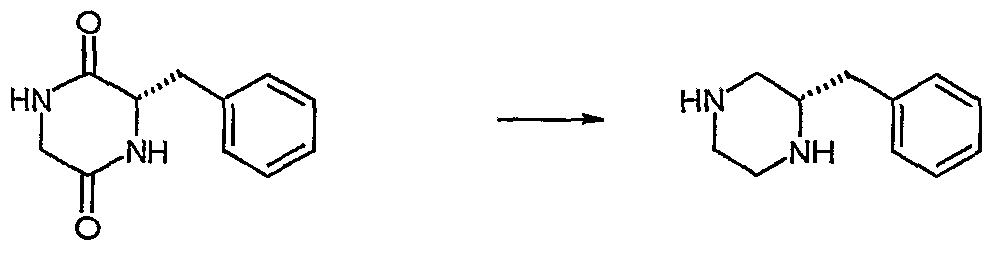
2.3g of 3-(S)-benzyl-piperazine-2,5-dione were suspended in anhydrous THF under nitrogen and cooled in an ice-bath. 4 equiv. of lithium aluminium hydride were added. The reaction was stirred at 0 0C for 0.5h, then heated to reflux overnight. The reaction was quenched by the subsequent addition of ImLZgLiAlH4 of water, ImLZgLiAlH4 of 5% aqueous sodium hydroxide solution and 3mLZgLiAlH4 of water. The resulting solid were separated by filtration through Celite and rinsed with ethyl acetate. The filtrate was concentrated in vacuo to afford 1.6g of 2-(S)-benzylpiperazine as yellow oil. ES MS (+) m/z 111
3-(S)-benzyl- 1 -(4-bromo-benzyl)-piperazine

0.7g of 2-(S) benzylpiperazine were dissolved in acetonitrile and cooled to 0 0C. A solution of 0.5 quiv. 4-bromobenzylbromide in acetonitrile was added dropwise over 1 h. The reaction was stirred at room temperature for 2h. The reaction mixture was concentrated and the residue was purified by column chromatography (silica, eluent dichloromethane, 0-5% methanol, 0- 0.5% dimethylethylamine) to afford 0.6g of 3-(S)-benzyl-l-(4-bromo-benzyl)-piperazine. ES MS (+) m/z 346.
3-(S)-benzyl-l-(2'-trifluoromethyl-biphenyl-4-ylmethyl)-piperazine

Example 106:(R) 3-BenzyI-l-(2'-trifluoromethyl-biphenyl-4-ylmethyl)-piperazine

Example 107:(S) 3-Benzyl-l-(2'-trifluoromethyl-biphenyl-4-ylmethyl)-piperazine

Ig of 3-(S)-benzyl-l-(4-bromo-benzyl)-piperazine were combined with 1.5 equiv. of 2- chlorophenyl boronic acid, 0.05 equiv. of tetrakis(triphenylphosphine)palladium(0), 6 equiv. of 2M aqueous sodium carbonate solution, toluene and ethanol. The reaction mixture was heated at 850C under nitrogen overnight. The reaction mixture was concentrated in vacuo. The residue was diluted with water and extracted with ethyl acetate. The combined organic phases were washed with brine, dried over sodium sulfate, filtered and concentrated in vacuo. The crude material was purified by flash chromatography to afford 0.98g of the title compound. Yield 91%ES MS (+) m/z 377.
Example 108:(R) 3-Benzyl-l-(2'-trifluoromethyl-biphenyl-4-ylmethyl)-piperazine

0.28g of 3-(S)-ben2yl-l-(4-bromo-benzyl)-piperazine were combined with 1.5 equiv. of 2- chlorophenyl boronic acid, 0.05 equiv. of tetrakis(triphenylphosphine)palladium(0), 6 equiv. of 2M aqueous sodium carbonate solution, toluene and ethanol. The reaction mixture was heated at 85°C under nitrogen overnight. The reaction mixture was concentrated in vacuo. The
residue was diluted with water and extracted with ethyl acetate. The combined organic phases were washed with brine, dried over sodium sulfate, filtered and concentrated in vacuo. The crude material was purified by flash chromatography to afford 0.26g of the title compound. Yield 84%ES MS (+) m/z 377.
Example 109: (S) 3-Benzyl-l-(2f-chloro-5'-methyl-biphenyl-4-ylmethyl)-piperazine

Ig of 3-(S)-benzyl-l-(4-bromo-benzyl)-piperazine were combined with 1.5 equiv. of 2-chloro- 5-methylphenyl boronic acid, 0.05 equiv. of tetrakis(triphenylphosphine)palladium(0), 6 equiv. of 2M aqueous sodium carbonate solution, toluene and ethanol. The reaction mixture was heated at 85°C under nitrogen overnight. The reaction mixture was concentrated in vacuo. The residue was diluted with water and extracted with ethyl acetate. The combined organic phases were washed with brine, dried over sodium sulfate, filtered and concentrated in vacuo. The crude material was purified by flash chromatography to afford 1.Ig of the title compound. Yield 99%ES MS (+) m/z 391.
Example 110:(R) 3-BenzyI-l-(2'-chloro-5'-methyl-biphenyl-4-ylmethyl)-piperazine

This compound could be made in the same manner as example 109, but with 3-(R)-benzyl-l- (4-bromo-benzyl)-piperazine as the corresponding starting material.
Example 111: (S) 3-Benzyl-l-(5'-chloro-2'-methyl-biphenyl-4-ylmethyl)-piperazine

O.lg of 3-(S)-ben2yl-l-(4-bromo-benzyl)-piperazine were combined with 1.5 equiv. of 5- cliloro-2-rαethylplieuyl boronic acid, 0.05 equiv. of tetrakis(triphenylphosphine)palladium(0), 6 equiv. of 2M aqueous sodium carbonate solution, toluene and ethanol. The reaction mixture was heated at 85°C under nitrogen overnight. The reaction mixture was concentrated in vacuo. The residue was diluted with water and extracted with ethyl acetate. The combined organic phases were washed with brine, dried over sodium sulfate, filtered and concentrated in vacuo. The crude material was purified by flash chromatography to afford 0.077g of the title compound. Yield 68%ES MS (+) m/z 391.
Example 112: (R) 3-Benzyl-l-(2'-chIoro-5'-methyI-biphenyI-4-yImethyl)-piperazine

This compound could be made in the same manner as example 111, but with 3-(R)-benzyl-l- (4-bromo-benzyl)-piperazine as the corresponding starting material.
Example 113: (S)-3-BenzyI-l-(2',5'-dimethyl-biphenyl-4-ylmethyl)-piperazine

O.lg of 3-(S)-benzyl-l-(4-bromo-benzyl)-piperazin.e were combined with 1.5 equiv. of 2,5- dimethylphenyl boronic acid, 0.05 equiv. oftetrakis(triphenylphosphine)palladium(0), 6 equiv. of 2M aqueous sodium carbonate solution, toluene and ethanol. The reaction mixture was heated at 850C under nitrogen overnight. The reaction mixture was concentrated in vacuo.
The residue was diluted with water and extracted with ethyl acetate. The combined organic phases were washed with brine, dried over sodium sulfate, filtered and concentrated in vacuo. The crude material was purified by flash chromatography to afford 0.04g of the title compound. Yield 37%ES MS (+) m/z 371.
Example 114:(R) 3-Benzyl-l-(2',5'-dimethyI-biphenyl-4-ylmethyl)-piperazine

This compound could be made in the same manner as example 113, but with 3-(R)-ben2yl-l- (4-bromo-benzyl)-piperazine as the corresponding starting material.
Example 115 : (S) 3-Benzyl-l-(2 ' ,5 ' -dichlor o-biphenyl-4-ylmethyl)-piper azine

O.lg of 3-(S)-ben2yl-l-(4-bromo-benzyl)-piperazine were combined with 1.5 equiv. of 2,5- dichlorophenyl boronic acid, 0.05 equiv. of tetrakis(triphenylphosphine)palladium(0), 6 equiv. of 2M aqueous sodium carbonate solution, toluene and ethanol. The reaction mixture was heated at 85°C under nitrogen overnight. The reaction mixture was concentrated in vacuo. The residue was diluted with water and extracted with ethyl acetate. The combined organic phases were washed with brine, dried over sodium sulfate, filtered and concentrated in vacuo. The crude material was purified by flash chromatography to afford 0.07g of the title compound. Yield 59%ES MS (+) m/z 411.
Example 116:(R) 3-Benzyl-l-(2',5'-dichloro-biphenyl-4-ylmethyl)-piperazine

This compound could be made in the same manner as example 115, but with 3-(R)-benzyl-l- (4-bromo-benzyl)-piperazine as the corresponding starting material.
Example 117: l-Methyl-2-benzyl-4-(2'-trifluoromethyl-biphenyl-4-ylmethyI)-piperazine

This compound could be made the following manner: lOOmg of 3-benzyl-l-(2'- trifluoromethyl-biphenyl-4-ylmethyi)-piperazine would be dissolved in acetonitrile, 3 equiv. ofN,N-diisopropylethylamine would be added followed by 1.1 equiv. of iodomethane. The reaction would be stirred at 80 0C overnight. The reaction would be diluted with dichloromethane and washed with IN aqueous NaOH solution. The organic layer would be dried over Na2SO4, filtered and concentrated in vacuo. The crude residue would be purified by column chromatography to afford l-methyl-2-phenyl-4-(2'-trifluoromethyl-biphenyl-4- ylmethyl)-piperazine.
Example 118: l-Ethyl-2-benzyl-4-(2'-trifluoromethyl-biphenyI-4-ylmethyl)-piperazine

The above compound could be made in the same manner as example 117, but with bromoethane as the appropriate alkylating reagent.
Example 119: l-Isopropyl-2-benzyl-4-(2'-trifluoromethyl-biphenyl-4-ylmethyl)- piperazine

This compound could be made in the following manner: lOOmg of 3 -phenyl- 1 -(2'- trifluoromethyl-biphenyl-4-ylmethyl)-piperazine would be dissolved in a 2:1 mixture of dichloroethane and acetone, 2 equiv. of sodium triacetoxyborohydride would be added followed by 30μL of acetic acid. The reaction would be stirred at room temperature under nitrogen overnight. The reaction would be diluted with 5mL of dichloromethane. The reaction- mixture would be washed with IM aqueous sodium hydroxide solution and brine, then dried over sodium sulfate, filtered and concentrated in vacuo. The crude residue would be purified by column chromatography to afford the title compound.
Example 120: l-Cyclohexyl-2-benzyl-4-(2'-trifluoromethyl-biphenyl-4-ylmethyl)- piperazine

The above compound could be made in the same manner as example 117, but with cyclohexylbromide as the appropriate alkylating reagent.
Example 121: l-[2-(S)-Benzyl-4-(2'-trifluoromethyl-biphenyl-4-ylmethyl)-piperazin-l- yl]-ethanone

45mg of 3-(S)-benzyl-l-(2'-trifluoromethyl-biphenyl-4-ylmethyl)-piperazine was dissolved in dichloromethane, 1.1 equiv. of acetylchloride and 1.5 equiv. of N,N-diisopropylethylamine were added. The reaction was stirred at room temperature under nitrogen overnight. The reaction was diluted with DCM, washed with saturated aqueous sodium bicarbonate solution, then dried over sodium sulfate, filtered and concentrated in vacuo. The crude residue was purified by column chromatography to afford 51 mg of the title compound as free base. Yield 84%, Treatment with 1 equiv. of IM HCl in dioxane gave the HCl salt. ES MS(+) m/z 453
Example 122: l-[2-(R)-Benzyl-4-(2'-trifluoromethyl-biphenyl-4-ylmethyl)-piperazin-l- yl]-ethanone

The HCl salt of the above compound was made in the same manner as example 121, but with 3-(R)-benzyl-l-(2'-trifluoromethyl-biphenyl-4-ylmethyl)-piperazine as the appropriate starting material. Yield 61%, ES MS(+) m/z 453
Example 123: Pheπyl-[2-(S)-benzyl-4-(2'-trifluoromethyl-biphenyl-4-ylmethyl)- piperazin-l-yl]-methanone
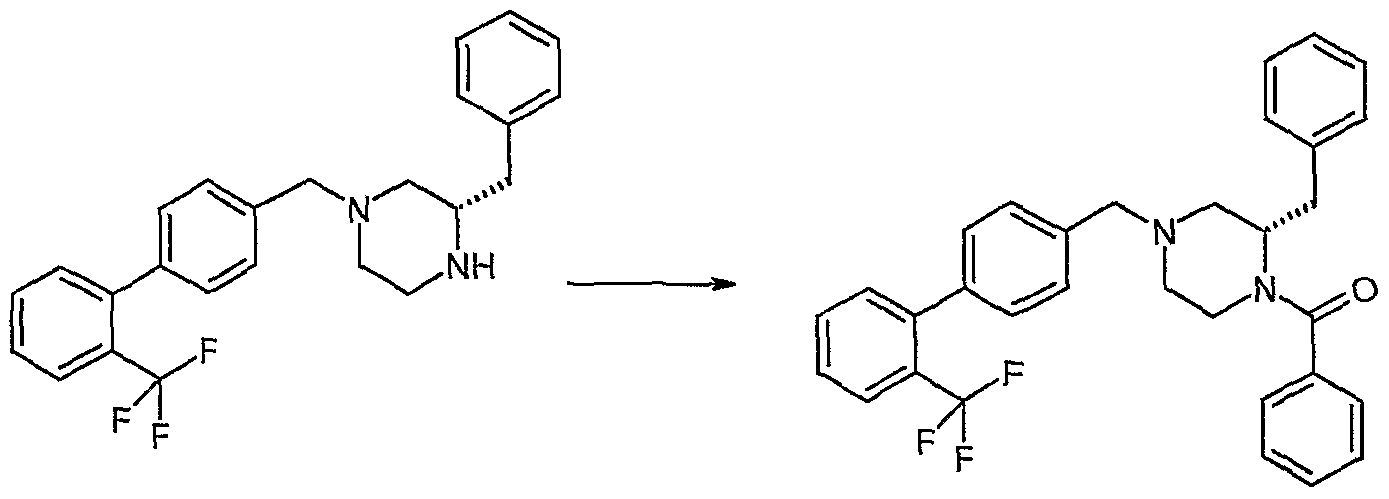
The HCl salt of the above compound was made in the same manner as example 121, but with benzoylchloride as the appropriate acidchloride. Yield 65%, ES MS(+) m/z 515
Example 124: Phenyl-[2-(R)-benzyl-4-(2'-trifluoromethyI-biphenyl-4-ylmethyl)- piperazin-1-yl] -methanone

Example 125: 2,2-Dimethyl-l-[2-benzyl-4-(2'-trifluoromethyl-biphenyl-4-ylmethyI)- piperazin-l-yl]-propan-l-one

The HCL salt of the above compound was made in the same manner as example 121, but with pivaloylchloride as the appropriate acidchloride. Yield: 40%, ES MS(+) m/z 495
Example 126: 2-Phenyl-l-[2-(S)-benzyl-4-(2'-trifluoromethyl-biphenyl-4-ylmethyl)- piperazin-l-yl]-ethanone

The HCl salt of the above compound could be made in the same manner as example 121, but with phenylacetyl chloride as the appropriate acidchloride.
Example 127: 2-Phenyl-l-[2-(R)-benzyl-4-(2'-trifluoromethyl-biphenyl-4-ylmethyl)- piperazin-l-yl]-ethanone

Example 128 : 2-Ben2yl-4-(2'-trifluoromethyl-biphenyl-4-ylmethyl)-piperazine-l- carboxylic acid methylamide

This compound could be made in the following manner: lOOmg of 3-benzyl-l-(2'- trifluoromethyl-biphenyl-4-ylmethyl)-piperazine would be dissolved in dichloromethane, 1.1 equiv. methylisocyanate would be added. The reaction would be shaken at room, temperature overnight. The reaction would be concentrated in vacuo. The residue would be diluted with DCM, washed with IM aqueous sodium hydroxide solution, then dried over sodium sulfate, filtered and concentrated in vacuo. The crude residue would be purified by column chromatography to afford the title compound as free base. Addition of 1 equiv. of IM HCl in dioxane and concentratation in vacuo would afford the title compound as hydrochloride salt.
Example 129: 2-Benzyl-4-(2'-trifluoromethyl-biphenyl-4-ylmethyI)-piperazine-l- carboxylic acid dimethylamide

The above compound could be made in the same manner as example 121, but with N5N- dimethylcarbamoyl chloride as the appropriate acidchloride.
Example 130: 2-Benzyl-4-(2t-trifluoromethyl-biphenyl-4-ylmethyl)-piperazine-l- carboxylic acid phenylamide

The above compound was made in the following manner: lOOmg of 3 -benzyl- 1-(2'- trifluoromethyl-biphenyl-4-ylmethyl)-piperazine dissolved in dichloromethane, 1.1 equiv. methylisocyanate added. The reaction was shaken at room temperature overnight. The reaction was concentrated in vacuo. The residue was diluted with. DCM, washed with IM aqueous sodium hydroxide solution, then dried over sodium sulfate, filtered and concentrated in vacuo. The crude product was identified by ES MS(+) (m/z 530).
Example 131: l-Methanesulfonyl-2-benzyl-4-(2'-trifluoromethyl-biphenyl-4-ylmethyl)- piperazine

The above compound was made in the same manner as example 121, but with methanesulfonyl chloride as the appropriate acidchloride. The crude product was identified by ES MS(+) (m/z 489).
Example 132: l-BenzenesulfonyI-2-phenyl-4-(2'-trifluoromethyl-biphenyl-4-yImethyl)- piperazine

The above compound was made in the same manner as example 121 , but with benzenesulfonyl chloride as the appropriate acidchloride. The crude product was identified by ES MS(+) (m/z 551).
Example 133 : l-Cyclohexanesulfonyl-2-phenyl-4-(2'-trifluoromethyl-biphenyI-4- ylmethyl)-piperazine

The above compound could be made in the same manner as example 121, but with of cyclohexanesulfonyl chloride as the appropriate acidchloride.
Example 134: l-Methyl-2-benzyl-4-(2'-chloro-5'-methyI-biphenyl-4-ylmethyl)-piperazine

This compound could be made the following manner: lOOmg of 3-benzyl-l-(2'-chloro-5'- methyl-biphenyl-4-ylmethyl)-piperazine would be dissolved in acetonitrile, 3 equiv. of N9N- diisopropylethylamine would be added followed by 1.1 equiv. of iodomethane. The reaction would be stirred at 80 0C overnight. The reaction would be diluted with dichloroniethane and washed with IN aqueous NaOH solution. The organic layer would be dried over Na2SO4, filtered and concentrated in vacuo. The crude residue would be purified by column chromatography to afford l-methyl-2-phenyl-4-(2'-chloro-5'-methyl-biphenyl-4-ylmethyl)- piperazine.
Example 135: l-Ethyl-2-(S)-ben2yI-4-(2'-chloro-5'-methyl-biphenyl-4-ylmethyl)- piperazine
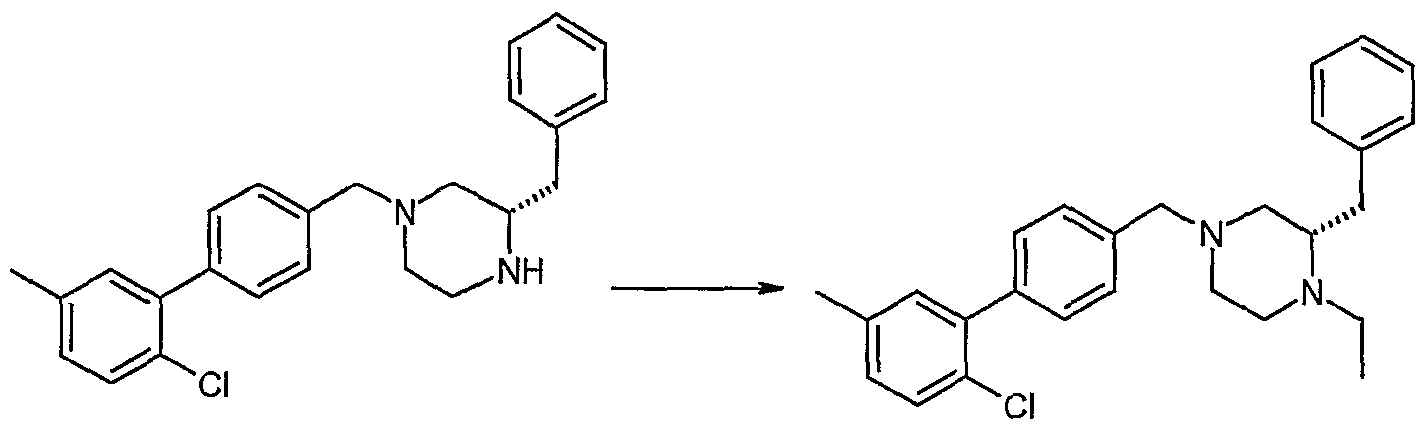
This compound was made in the following manner: 50 mg of 3-(S)-benzyl-l-(2'-chloro-5'- methyl-biphenyl-4-ylmethyl)-piperazine was dissolved in THF, 2 equ. of bromoethane and 2 equ. of N,N-diisopropylethylamine were added. The reaction was stirred at room temperature overnight. The reaction mixture was concentrated under reduced pressure. The residue was diluted with DCM, washed with saturated aqueous sodium bicarbonate solution, then dried over sodium sulfate, filtered and concentrated in vacuo. The crude residue was purified by column chromatography to afford the title compound as the free base. Treatment with 1 equ. IM HCl in dioxane and concentration in vacuo afforded 29.5 mg of the corresponding hydrochloride salt. Yield 51%, ES MS m/z 419/421.
Example 136: l-Isopropyl-2-benzyI-4-(2'-chloro-5'-methyl-biphenyI-4-ylmethyl)- piperazine
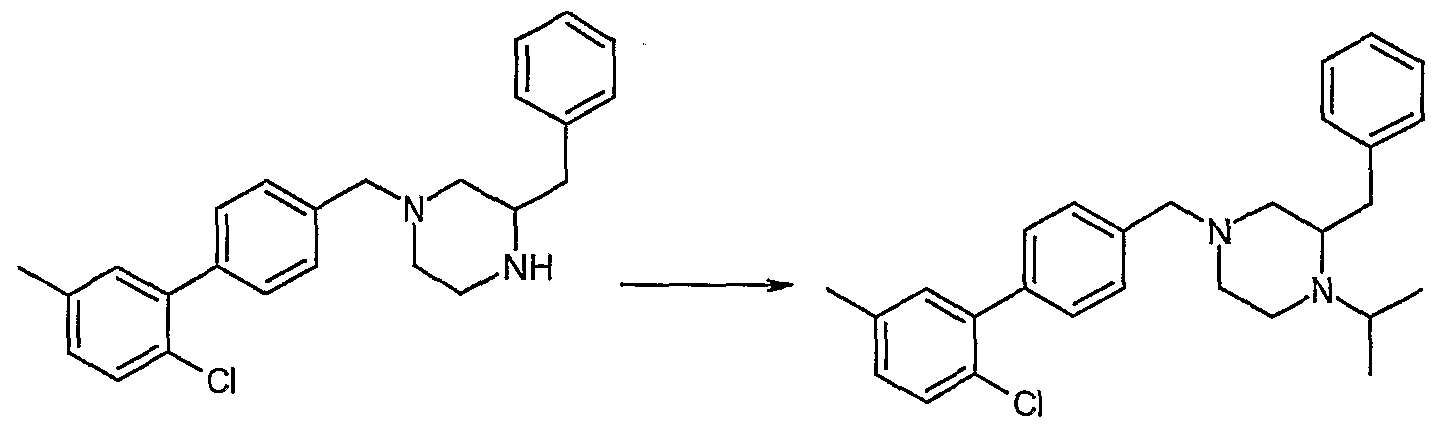
This compound could be made the following manner: lOOmg of 3-phenyl-l-(2'-chloro-5'- methyl-biphenyl-4-ylmethyl)-piperazine would be dissolved in a 2:1 mixture of dichloroethane and acetone, 2 equiv. of sodium triacetoxyborohydride would be added followed by 30μL of acetic acid. The reaction would be stirred at room temperature under nitrogen overnight. The reaction would be diluted with 5mL of dichloromethane. The reaction mixture would be washed with IM aqueous sodium hydroxide solution and brine, then dried
over sodium sulfate, filtered and concentrated in vacuo. The crude residue would be purified by column chromatography to afford the title compound.
Example 137: l-CycIohexyl-2-benzyl-4-(2'-chloro-5'-methyI-biphenyl-4-yImethyl)- piperazine

The above compound could be made in the same manner as example 134, but with cyclohexylbromide as the appropriate alkylating reagent.
Example 138: l-[2-(S)-Benzyl-4-(2'-chloro-5'-methyl-biphenyl-4-ylmethyl)-piperazin-l- yl]-ethanone

This compound was made in the following manner: 50mg of 3-(S)-benzyl-l-(2'-chloro-5'- methyl-biphenyl-4-ylmethyl)-piperazine was dissolved in THF, 2 equiv. of acetylchloride and 2 equiv. of N,N-diisopropylethylamine were added. The reaction was stirred at room temperature overnight. The reaction was diluted with DCM, washed with saturated aqueous sodium bicarbonate solution, then dried over sodium sulfate, filtered and concentrated in vacuo. The crude residue was purified by column chromatography to afford the title
compound as the free base. Treatment with 1 equiv IM HCl in dioxane and concentration in vacuo afforded 46 mg of the corresponding hydrochloride salt. Yield 77%, ES MS m/z 433
Example 139: l-[2-(R)-Benzyl-4-(2'-chloro-5'-methyl-biphenyl-4-ylmethyl)-piperazin-l- yl]-ethanone

This compound could be made in the same manner as example 138, but with 3-(R)-benzyl-l- (2'-chloro-5'-methyl-biphenyl-4-ylmethyl)-piperazine as the appropriate starting material.
Example 140: Phenyl-[2-benzyl-4-(2'-chloro-5'methyl-biphenyl-4-ylmethyl)-piperazin-l- yl]-methanone

The above compound was made in the same manner as example 138, but with benzoylchloride as the appropriate acidchloride. Yield 82%, ES MS m/z 495/497
Example 141: 2,2-Dimethyl-l-[2-benzyl-4-(2'-chloro-5'-methyl-biphenyl-4-ylmethyl)- piperazin-1-yl] -propan-1-one
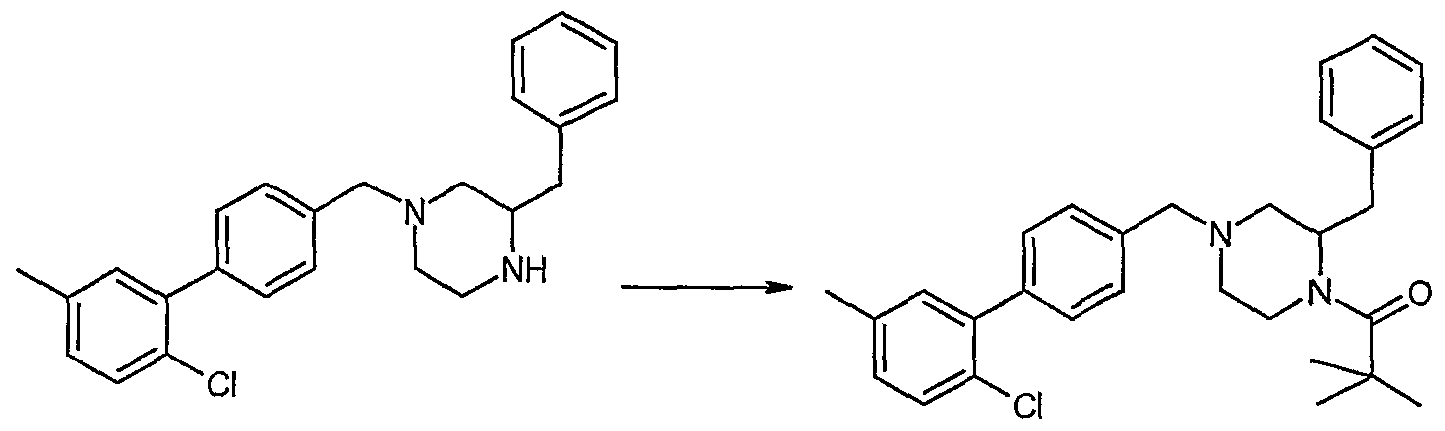
The above compound was made in the same manner as example 138, but with pivaloylchlori.de as the appropriate acidchlori.de. Yield 75%, ES MS m/z 475/477
Example 142: 2-Phenyl-l-[2-(S)-benzyl-4-(2'-chloro-5'-methyl-biphenyl-4-ylmethyl)- piperazin-l-yl]-ethanone

The HCl salt of the above compound was made in the same manner as example 138, but with phenylacetyl chloride as the appropriate acidchlori.de. Yield 62% ES MS m/z 509
Example 143: 2-Phenyl-l-[2-(S)-benzyl-4-(2'-chloro-5'-methyl-biphenyl-4-ylmethyl)- piperazin-l-yl]-ethanone

Example 144: 2-(S)-Benzyl-4-(2'-chloro-5'-methyl-biphenyl-4-ylmethyl)-piperazine-l- carboxylic acid Diethylamide

This compound was made in the following manner: 50mg of 3-(S)-benzyl-l-(2'-chloro-5'- methyl-biphenyl-4-ylmethyl)-piperazine was dissolved in THF, 2 equiv. methylisocyanate was added. The reaction was stirred at room temperature overnight. The reaction was diluted with DCM, washed with saturated aqueous sodium bicarbonate solution, then dried over sodium sulfate, filtered and concentrated in vacuo. The crude residue was purified by column chromatography to afford the title compound as the free base. Treatment with 1 equiv IM HCl in dioxane an concentration in vacuo afforded 52 mg of the corresponding hydrochloride salt. Yield 84%, ES MS m/z 448
Example 145: 2-(R)-Benzyl-4-(2'-chloro-5'-methyl-biphenyl-4-ylmethyl)-piperazine-l- carboxylic acid methylamide

Example 146: 2-(S)-Benzyl-4-(2f-chloro-5'-methyl-biphenyI-4-yImethyl)-piperazine-l- carboxylic acid dimethylamide

The above compound was made in the same manner as example 138, but with N5N- dimethylcarbamoyl chloride as the appropriate acidchloride. Yield 71%, ES MS m/z 462
Example 147: 2-(R)-Benzyl-4-(2'-chloro-5'-methyl-biphenyl-4-ylmethyl)-piperazine-l- carboxylic acid dimethylamide

The above compound could be made in the same manner as example 138, but with 3-(R)- benzyl-l-(2'-chloro-5'-methyl-biphenyl-4-ylmethyl)-piperazine as the appropriate starting material.
Example 148: 2-Benzyl-4-(2'-chloro-5'-methyl-biphenyl-4-ylmethyl)-piperazine-l- carboxylic acid phenylamide

The above compound was made in the same manner as example 144, but with phenylisocyanate as the appropriate isocyanate. Yield 88%, ES MS m/z 510/512
Examplel49: l-Methanesulfonyl-2-(S)-benzyl-4-(2'-chloro-5'-methyl-biphenyl-4- ylmethyl)-piperazine

The hydrochloride salt of the above compound was made in the same manner as example 138, but with methanesulfonyl chloride as the appropriate acidchloride. Yield 67%, ES MS m/z 469
Example 150: l-Methanesulfonyl-2-(R)-benzyl-4-(2'-chloro-5'-methyl-biphenyl-4- ylmethyl)-piperazine

Example 151 : l-Benzenesulfonyl-2-(S)-benzyl-4-(2'-chloro-5'-methyl-biphenyl-4- ylmethyl)-piperazine

The hydrochloride salt of the above compound was made in the same manner as example 138, but with benzenesulfonyl chloride as the appropriate acidchloride. Yield 77%, ES MS m/z 531
Example 152: l-Benzenesulfonyl-2-(S)-benzyl-4-(2'-chloro-5'-methyl-biphenyl-4- ylmethyl)-piperazine

The hydrochloride salt of the above compound could be made in the same manner as example 151, but with 3-(R)-benzyl-l-(2'-chloro-5'-methyl-biphenyl-4-ylmethyl)-piperazine as the appropriate starting material.
Example 153: l-Cyclohexanesulfonyl-2-benzyl-4-(2'-chloro-5'-methyl-biphenyl-4- ylmethyl)-piperazine

The above compound was made in the same manner as example 138, but with cyclohexanesulfonyl chloride as the appropriate acidchloride. Yield 8%, ES MS m/z A13IA15
Example 154: l-[2-(S)Benzyl-4-(2'-chloro-biphenyl-4-ylmethyl)-piperazin-l-yl]-ethanone

50mg of 3-(S)-benzyl-l-(2'-chloro-5'-methyl-biphenyl-4-ylmethyl)-piperazine were dissolved in THF, 2 equiv. of acetylchloride and 2 equiv. of N,N-diisopropylethylamine were added. The reaction was stirred at room temperature under nitrogen overnight. The reaction was concentrated, the residue redissolved in DCM, washed with saturated aqueous sodium bicarbonate solution, then dried over sodium sulfate, filtered and concentrated in vacuo. The crude residue was purified by column chromatography to afford the title compound as its freebase. Treatment with IM HCl in dioxane gave 38 mg of the title compound as its hydrochloride salt Yield: 63%, ES MS (+) m/z 419.
Example 155: 1-[2-(R) Benzyl-4-(2'-chloro-biphenyl-4-ylmethyl)-piperazin-l-yl]- ethanone

The hydrochloride salt of the above compound was made in the same manner as example 154, but with 3-(R)-benzyl-l-(2'-chloro-5'-methyl-biphenyl-4-ylmethyl)-piperazme as the appropriate starting material. Yield 39%, ES MS (+) m/z 419
Example 156: Phenyl-[2-(S)-benzyl-4-(2'-chloro-biphenyl-4-ylmethyl)-piperazin-l-yl]- methanone

Example 157: Phenyl-[2-(R)-benzyl-4-(2'-chIoro-biphenyl-4-ylmethyl)-piperazin-l-yl]- methanone
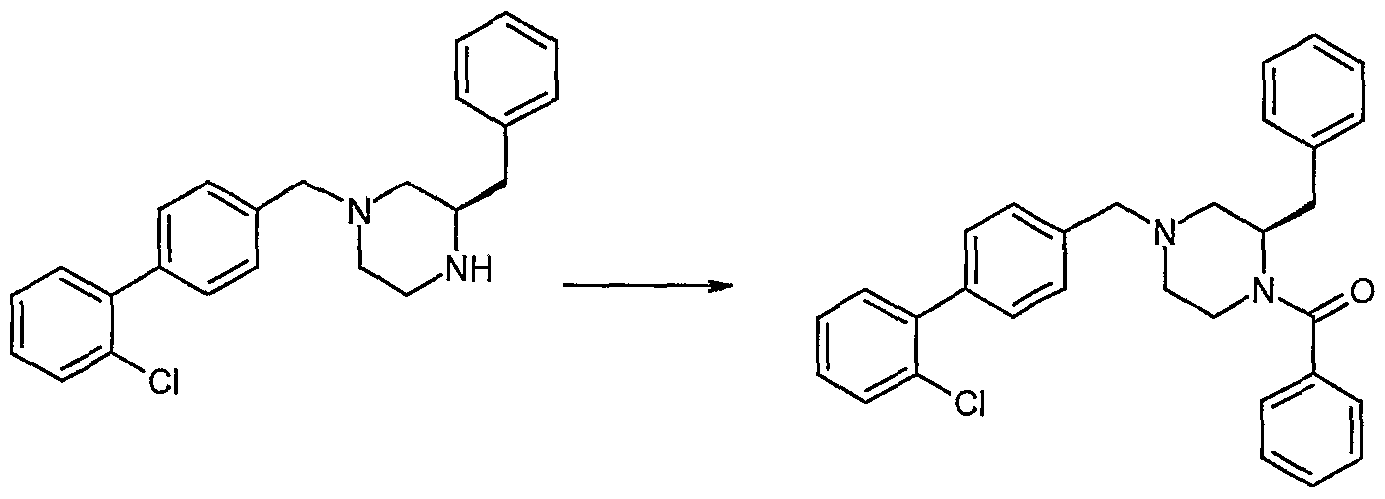
The hydrochloride salt of the above compound was made in the same manner as example 156 but with 3-(R)-benzyl-l-(2'-chloro-5'-methyl-biphenyl-4-ylmethyl)-piperazine as the corresponding starting material. Yield 65%, ES MS (+) m/z 481
Example 158: 2-tert. Butyl-l-[2-(S)-benzyl-4-(2'-chloro-biphenyl-4-ylmethyl)-piperazin-
l-yl]-methanone

The hydrochloride salt of the above compound was made in the same manner as example 154, but with pivaloyl chloride as the appropriate acidchloride. Yield: 42%, ES MS (+) m/z 461
Example 159: 2-tert. Butyl-l-[2-(R)-benzyl-4-(2'-chloro-biphenyl-4-ylmethyl)-piperazin- l-yl]-methanone

Example 160: 2-Phenyl-l-[2-(S)-benzyl-4-(2'-chloro-biphenyl-4-ylmethyl)-piperazin-l- yl]-ethanone

The hydrochloride salt of the above compound was made in the same manner as example 154, but with phenylacetyl chloride as the appropriate acidchloride. Yield: 58%, ES MS (+) m/z 495
Example 161: 2-Phenyl-l-[2-(R)-benzyl-4-(2'-chloro-biphenyl-4-ylmethyl)-piperazin-l- yl]-ethanone

The hydrochloride salt of the above compound was made in the same manner as example 160, but with 3-(R)-benzyl-l-(2'-chloro-biphenyl-4-ylmethyl)-piperazine as the corresponding starting material. Yield: 65%, ES MS (+) m/z 495
Example 162: 2-(S)-Ben2yl-4-(2'-chloro-biphenyl-4-ylmethyl)-piperazine-l-carboxylic acid phenylamide

50 mg of 3-(S)-benzyl-l-(2'-chloro-biph.enyl-4-ylmetliyl)-piperazine were dissolved in dichloromethane, 2 equiv.phenylisocyanate was be added. The reaction was shaken at room temperature overnight. The reaction was concentrated in vacuo and the crude purified by column chromatography to afford 50 mg of the title compound as the free base. Treatment with 1 equiv. 2 M HCl in dioxane afforded 44 mg of its hydrochloride salt. Yield: 62%, ES MS (+) m/z 496.
Example 163: 2-(R)-Benzyl-4-(2'-chloro-biphenyl-4-ylmethyl)-piperazine-l-carboxylic acid phenylamide

The hydrochloride salt of the above compound was prepared as in example 162, but with 3- (R)-benzyl-l-(2'-chloro-5'-methyl-biphenyl-4-ylmethyl)-piperazine as the corresponding starting material. Yield:63%, ES MS (+) m/z 496.
Example 164: l-MethanesuIfonyϊ-2-(S)- benzyl-4-(2'-chloro~biphenyl-4-ylmethyl)- piperazine

The above hydrochloride salt of the compound was made in the same manner as example 154, but with methanesulfonyl chloride as the appropriate acidchloride. Yield: 59%, ES MS (+) m/z 455.
Example 165: l-Methanesulfonyl-2-(R)- benzyl-4-(2t-chloro~biphenyl-4-ylmethyl)- piperazine

Example 166: (S)-l-Benzenesulfonyl-4-(2'-cMoro-biphenyl-4-ylmethyl)-2-[(Z)-((Z)-2- propenyl)-penta-2,4-dienyl]-piperazine

The hydrochloride salt of the above compound was made in the same manner as example 154, but with benzenesulfonyl chloride as the appropriate acidchloride. Yield: 52%, ES MS (+) m/z 517
Example 167: (R)-l-Benzenesulfonyl-4-(2'-chloro-biphenyl-4-ylmethyl)-2-[(Z)-((Z)-2- propenyl)-penta-2,4-dienyl]-piperazine

The hydrochloride salt of the above compound was made in the same manner as example 167, but with 3-(R)-benzyH-(2'-chloro-5'-methyl-biphenyl-4-ylmethyl)-piperazine as the corresponding starting material. Yield 33% ES MS (+) m/z 455
Example 168: l-Ethyl-2-(S)-benzyl-4-(2'-chloro-biphenyl-4-ylmethyl)-piperazine

Example 169: l-Ethyl-2-(R)-benzyl-4-(2'-chloro-biphenyl-4-ylmethyl)-piperazine

The hydrochloride salt of the above compound could be made in the same manner as example 168, but with 3-(R)-benzyl-l-(2'-chloro-5'-methyl-biphenyl-4-ylmethyl)-piperazine as the corresponding starting material.
Example 170: 2-(S)-Benzyl-4-(2'-chloro-biphenyl-4-ylmethyl)-piperazine-l-carboxylic acid dimethylamide

Example 171: 2-(R)-Benzyl-4-(2'-chloro-biphenyl-4-ylmethyl)-piperazine-l-carboxyIic acid dimethylamide

The above compound could be made in the same manner as example 170, but with 3-(R)- benzyl-l-(2'-chloro-biphenyl-4-ylmethyl)-piperazine as the appropriate starting material.
Example 172: 2-(S)-Benzyl-4-(2'-chloro-biphenyl-4-ylmethyl)-piperazine-l-carboxylic acid Diethylamide

The hydrochloride salt of the above compound was made in the same manner as example 162, but with methyl isocyante as the appropriate isocyanate. Yield 70%, ES MS (+) m/z 434
Example 173: 2-(R)-Benzyl-4-(2'-chloro-biphenyl-4-ylmethyl)-piperazine-l-carboxylic acid Diethylamide
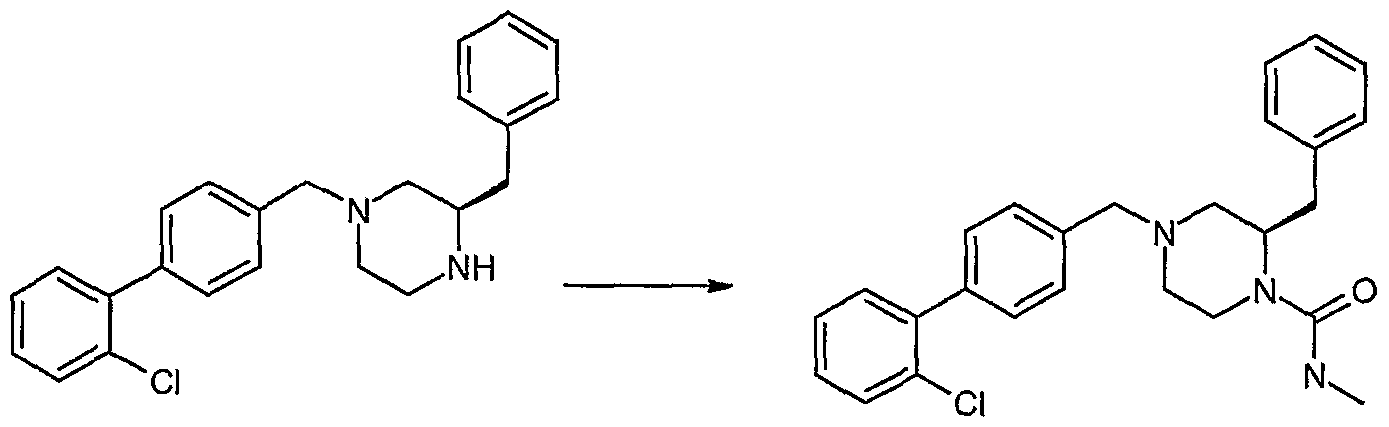
The hydrochloride salt of the above compound could be made in the same manner as example 172, but with 3-(R)-benzyl-l-(2'-chloro-biphenyl-4-yknethyl)-piperazine as the appropriate starting material.
Example 174: 3-Isopropyl-l-(2'-trifluoromethyl-biphenyl-4-ylmethyI)-piperazine
This compound could be made in the same manner as Example 33 or 105: (2-ter?-butoxycarbonylammo-3-methyl-butyrylamino)-acetic acid methyl ester

4g of iV-tert-butoxycarbonyl valine could be dissolved in THF under nitrogen atmosphere and cooled to 0 0C. 1.1 equiv. of triethylamine could be added, followed by 1.1 equiv. of isobutylchloroformate to form the mixed anhydride solution. The reaction could be stirred at room temperature for Ih. 1.1 equiv. of the HCl salt of glycine methyl ester could be dissolved in anhydrous dichloromethane, 1 eqiv. of triethylamine would be added. This solution would then be added dropwise to the cooled, mixed anhydride solution. The reaction could be stirred for 3h at 0 0C. The reaction could be filtered and the filtrate could be concentrated in vacuo. The residue could be taken up into ethyl acetate, washed with 5% aqueous citric acid solution, 5% aqueous sodium bicarbonate solution, water and brine. The organic phase could be dried over sodium sulfate, filtered and concentrated in vacuo to afford in a quantitative yield (2-tert- butoxycarbonylamino-3-methyl-butyrylamino)-acetic acid methyl ester.
3-Isopropyl-piperazine-2,5-dione

5g of (2-ter?-butoxycarbonylamino-3-methyl-butyrylamin.o)-acetic acid methyl ester could be dissolved in dichloromethane and trifluoroacetic acid could be added.
The reaction could be stirred at room temperature for 2.5h. The reaction could be concentrated in vacuo and then be redissolved in 5% aqueous sodium bicarbonate solution. The reaction could be stirred at room temperature for 20 min, then methanol could be added. The reaction could be heated to 80 0C for 3h. After cooling to room temperature, the basic aqueous phase could be extracted with ethyl acetate. The combined organic extracts could be dried over sodium sulfate, filtered and concentrated in vacuo to give 3-isopropyl-piperazine-2,5-dione.
2-Isopropyl-piperazine

2 g of 3-isopropyl-piperazine-2,5-dione could be suspended in anhydrous THF under nitrogen and cooled in an ice-bath. 4 equiv. of lithium aluminium hydride could be added. The reaction could be stirred at 0 0C for 0.5h, then heated to reflux overnight. The reaction could be quenched by the subsequent addition of lmL/gLiAlELt of water, lmL/gLiAlH4 of 5% aqueous sodium hydroxide solution and 3mL/gLiAlH4 of water. The resulting solid could be separated by filtration through Celite and rinsed with ethyl acetate. The filtrate could be concentrated in vacuo to afford 2-isopropyl-piperazine.
1 -(4-Bromo-benzyl)-3 -isopropyl-piperazine

0.7g of 2-isopropyl-piperazine could be dissolved in acetonitrile and cooled to 0 0C. A solution of 0.5 quiv. 4-bromobenzylbromide in acetonitrile could be added dropwise over 1 h. The reaction would be stirred at room temperature for 2h. The reaction mixture could be concentrated and the residue could be purified by column chromatography (silica, eluent dichloromethane, 0-5% methanol, 0-0.5% dimethylethylamine) to afford l-(4-bromo-benzyl)- 3-isopropyl-piperazine.
3 -Isopropyl- 1 -(2'-trifluoromethyl-biphenyl-4-ylmethyl)-piperazine

Example 175: 2-Phenyl-4-[l-(2'-trifluoromethyl-biphenyl-4-yl)-ethyI]-morpholine
4-[l-(4-Bromo-phenyl)-ethyl]-2-phenyl-morpholine

The above compound could be made the following way: 1 eq. of 2-Phenylmorpholine (Array) in dichloroethane could be combined with 1.2 eq.4'-Bromoacetophenone (Aldrich) and stirred overnight at room temperature. 1.5 eq. borane-pyridine complex could be added and the reaction stirred for several hours. The reaction mixture could be diluted with methylene chloride and washed with water and brine. The organics could be dried over sodium sulfate and purified by column chromatography.
2-Phenyl-4-[l-(2'-trifluoromethyl-biphenyl-4-yl)-ethyl]-morpholine

Example 176: 2-Phenyl-4-[6-(2-trifluoromethyl-phenyl)-pyridin-3-ylmethyl]-morpholine
4-(6-Bromo-pyridin-3-ylmethyl)-2-phenyl-morpholine

The above compound was made in the same manner as Example 1 but with the appropriate aldehyde and morpholine. 20% yield. ES MS (+)m/z333
2-Phenyl-4-[6-(2-trifluoromethyl-ph.enyl)-pyridin-3-ylmetliyl]-morplioline
above compound was made in the same manner as Example 1 but with the appropriate aryl halide and boronic acid. 97% yield. ES MS (+)m/z399
Example 177: 3-Phenyl-l-[6-(2-trifluoromethyl-phenyl)-pyridin-3-ylmethyl]-piperazine
1 -(6-Bromo-pyridin-3 -ylmethyl)-3 -phenyl-pip erazine

3-Phenyl-l-[6-(2-trifluoromethyl-phenyl)-pyridin-3-ylmethyl]-piperazine

4-(2-Ch.loro-pyrimidin-5-ylmetliyl)-2-phenyl-m.orplioline

2-Ph.enyl-4-[2-(2-trifluoromethyl-phenyl)-pyrimidin-5-ylmethyl]-morpholine

Example 179 : 5-(3-PhenyI-piper azin-l-ylmethyl)-2-(2-trifluoromethyl-phenyl)- pyrimidine
2-Chloro-5-(3-phenyl-piperazin-l-ylmethyl)-pyrimidine

5-(3-Phenyl-piperazin-l-ylmethyl)-2-(2-trifluoromethyl-phenyl)-pyrimidine

((S)-3-Benzyl-piperazin- 1 -yl)-(4-chloro-phenyl)-methanone

((S)-3-Benzyl-piperazin-l-yl)-(2',3'-dichloro-biρhenyl-4-yl)-methanone

The above compound was made in the same manner as Example 1 but with the appropriate aryl bromide and boronic acid. 3% yield. ES MS (+)m/z426.
Example 181 : (S)-3-Benzyl-l-[4-(2-chloro-thiophen-3-yl)-benzyl]-piperazine

The above compound was made in the same manner as Example 7 but with the appropriate arylbromides. 56% yield. ES MS (+)m/z383
Example 182: 4'-((S)-3-Benzyl-piperazin-l-ylmethyl)-biphenyl-2-carbonitrile

The above compound was made in the same manner as Example 1 but with the appropriate aryl bromide and boronic acid. 24% yield. ES MS (+)m/z368
Example 183: (S)-4-(2',3'-Dichloro-biphenyl-4-ylmethyl)-2-phenyl-morpholine

The above compound was made in the same manner as Example 1 but with the appropriate aryl bromide and boronic acid. 78% yield. ES MS (+)m/z398/400
Example 184: (S)-2-Benzyl-l-methyl-4-(2'-trifluoromethyl-biphenyl-4-ylmethyl)- piperazine
(S)-2-Ben2yl-4-(4-bromo-benzyl)-l-methyl-piperazine

To a solution of 369mg of 3-(S)-benzyl-l-(4-bromobenzyl)-piperazine in 3mL of tetrahydrofuran was added 0.8mL of formaldehyde and 0.15mL acetic acid. After 2h, 453mg of sodium triacetoxyborohydride was added and the reaction was stirred overnight. Diluted carefully with aqueous saturated sodium bicarbonate solution and extracted with ethyl acetate. The combined organics were washed with brine, dried with sodium sulfate, filtered and concentrated in vacuo. Used crude in subsequent reactions. 82% yield. ES MS (+)m/z361
(S)-2 -Benzyl- 1 -methyl-4-(2l-tri enyl-4-ylmethyl)-piperazine


The above compound was made in the same manner as Example 1 but with the appropriate aryl bromide and boronic acid. 94% yield. ES MS (+)m/z425
Example 185: (S)-2-Benzyl-4-(2'-chloro-biphenyl-4-ylmethyl)-l-methyl-piperazine

The above compound was made in the same manner as Example 1 but with the appropriate aryl bromide and boronic acid. 100% yield. ES MS (+)m/z390
Example 186: (S)-3-Benzyl-l-(6-phenyl-pyridin-3-ylmethyl)-piperazine

The above compound was made in the same manner as Example 1 but with the appropriate aryl halide and boronic acid. 33% yield. ES MS m/z344
Example 187: (S)-2-Benzyl-4-(2',3 '-dichloro-biphenyl-4-ylmethyl)-l-methyl-piperazine

Example 188: (S)-2-Phenyl-4-(6-phenyl-pyridin-3-ylmethyl)-morpholine

The above compound was made in the same manner as Example 1 but with the appropriate aryl halide and boronic acid. 50% yield. ES MS m/z331
Example 189: (S)-4-[6-(3-Chloro-phenyl)-pyridin-3-ylmethyl]-2-phenyl-morpholine

Example 190: (S)-4-(2'-Chloro-5'-methyl-biphenyl-4-ylmethyl)-2-phenyl-morpholine

The above compound was made in the same manner as Example 7 but with the appropriate arylbromides. 34% yield. ES MS (+>z/z377
Example 191: (S)-4- [4-(2-Chloro-thiophen-3-yl)-benzyl] -2-phenyl-morpholine

The above compound was made in the same manner as Example 7 but with the appropriate arylbromides. 42% yield. ES MS (+)m/z370
Example 192: 4'-((S)-2-Phenyl-morpholin-4-ylmethyl)-biphenyl-2-carbonitrile

The above compound was made in the same manner as Example 1 but with the appropriate aryl halide and boronic acid. 29% yield. ES MS m/z355
Example 193: (S)-4-(2'-Chloro-biphenyl-4-ylmethyl)-2-phenyl-morpholine

The above compound was made in the same manner as Example 1 but with the appropriate aryl halide and boronic acid. 100% yield. ES MS m/z364
Example 194: (S)-4-(2',5'-Dichloro-biphenyI-4-ylmethyl)-2-phenyl-morpholine

The above compound was made in the same manner as Example 1 but with the appropriate aryl halide and boronic acid. 57% yield. ES MS rø/z398
Example 195: 2-Phenyl-4-(2'-trifluoromethyl-biphenyl-4-ylmethyl)-thiomorpholine 1,1- dioxide
4-(4-Bromo-benzyl)-2-phenyl-thiomorpholine

The above compound was made in the same manner as Example 2 but from commercially available 2-Phenylthiomorpholine. 28% yield. ES MS m/z348/350
4-(4-Bromo-benzyl)-2-phenyl-thiomorpholine 1 -oxide and 4-(4-Bromo-benzyl)-2-phenyl- thiomorpholine 1,1 -dioxide

317mg of 4-(4-Bromo-benzyl)-2-phenyl-thiomorpholine was dissolved in 3.2mL of dichloromethane and a solution of 0.28mL hydrogen peroxide (30% in water) and 2.76mL of trifluoroacetic acid was added. The reaction stirred for 3.5 days at room temperature. The solution was diluted with aqueous saturated sodium bicarbonate solution and extracted with dichloromethane. The combined organics were washed with brine, dried with sodium sulfate and concentrated. The crude material was purified by flash chromatography to afford 37mg of 4-(4-Bromo-benzyl)-2-phenyl-thiomorpholine 1 -oxide and 36.5mg of 4-(4-Bromo-benzyl)-2- phenyl-thiomorpholine 1,1-dioxide. ES MS m/z365 and 382 respectively.
2-Phenyl-4-(2'-trifluoromethyl-biphenyl-4-ylmethyl)-thiomorpholine 1 , 1 -dioxide

Example 196: 2-Phenyl-4-(2'-trifluoromethyl-biphenyl-4-yImethyl)-thiomorpholine 1- oxide

Example 197:l-(2f-Chloro-5'-methyl-biphenyl-4-ylmethyl)-3-phenyl-piperidine

The above compound was made in a similar manner as Example 48 but with the appropriate boronic acid. 26% yield ES MS m/z376.
Example 198: l-(2',5'-Dimethyl-biphenyl-4-ylmethyl)-3-phenyl-piperidme

The above compound was made in a similar manner as Example 48 but with the appropriate boronic acid. 68% yield ES MS m/z356.
Assessment of Biological Properties
The biological properties of the compounds of the formula I were assessed using the assays described below.
A. Human CBl and CB2 Receptor Binding:
Experimental Method:
CB2 membranes were purchased and made from HEK293 EBNA cells stably transfected with human CB2 receptor cDNA (Perkin Elmer Life and Analytical Sciences). CBl membranes
were isolated from HEK cells stably co-transfected with human CBl receptor and God 6 cDNA's. The membrane preparation was bound to scintillation beads (Ysi-Poly-L-lysine SPA beads, GE Healthcare) for 4 hours at room temperature in assay buffer containing 5OmM Tris, pH 7.5, 2.5mM EDTA, 5mM MgCl2, 0.8% fatty acid free Bovine Serum Albumin. Unbound membrane was removed by washing in assay buffer. Membrane-bead mixture was added to 96-well assay plates in the amounts of 15ug membrane per well (CB2) or 2.5ug per well
(CBl) and lmg SPA bead per well. Compounds were added to the membrane-bead mixture in dose-response concentrations ranging from Ix 10"5 M to IxIO"10 M with 0.25% DMSO, final. The competition reaction was initiated with the addition of 3H-CP55940 (Perkin Elmer Life and Analytical Sciences) at a final concentration of 1.5nM (CB2) or 2.5nM (CBl). The reaction was incubated at room temperature for 18hours and read on TopCount NXT plate reader. Total and non-specific binding was determined in the absence and presence of 1.25uM Win 55212 (Sigma). IC50 values for each compound were calculated as the concentration of compound that inhibits the specific binding of the radioactively labeled ligand to the receptor by 50% using the XLFit 4.1 four parameter logistic model. IC50 values were converted to inhibition constant (Ki) values using Cheng-Prusoff equation.
B. CB2R mediated modulation of cAMP synthesis:
Compounds of the invention were evaluated for their CB2 agonist or inverse agonistic activity in accordance with the following experimental method. Compounds which were shown to bind to CB2 by the binding assay described above but which were not shown to exhibit CB2R-mediated modulation of cAMP synthesis by this assay were presumed to be CB2 antagonists.
Experimental Method: CHO cells expressing human CB2R (Euroscreen) were plated at a density of 5000 cells per well in 384 well plates and incubated overnight at 37°C. After removing the media, the cells were treated with test compounds diluted in stimulation buffer containing ImM IBMX, 0.25%
BSA and lOuM Forskolin. The assay was incubated for 30 minutes at 37°C. Cells were lysed and the cAMP concentration was measured using DiscoverX -XS cAMP kit, following the manufacturer's protocol. In this setting, agonists will decrease forskolin induced production of cAMP while inverse agonists will further increase forskolin induced production of cAMP. EC50 of agonists were calculated as follows. The maximal amount of c AMP produced by forskolin compared to the level of cAMP inhibited by IuM CP55940 is defined as 100%. The EC50 value of each test compound was determined as the concentration at which 50% of the forskolin-stimulated cAMP synthesis was inhibited. Data was analyzed using a four-parameter logistic model. (Model 205 of XLfit 4.0).
C. CBlR mediated modulation of cAMP synthesis:
Compounds of the invention were evaluated for their CBl agonist or inverse agonistic activity in accordance with the following experimental method. Compounds which were shown to bind to CB 1 by the binding assay described above but which were not shown to exhibit CBIR-mediated modulation of cAMP synthesis by this assay were presumed to be CBl antagonists.
Experimental Method:
CHO cells expressing human CBlR (Euroscreen) were plated at a density of 5000 cells per well in 384 well plates and incubated overnight at 37°C. After removing the media, the cells were treated with test compounds diluted in stimulation buffer containing ImM IBMX, 0.25% BSA and lOuM Forskolin. The assay was incubated for 30 minutes at 37°C. Cells were lysed and the cAMP concentration was measured using DiscoverX -XS cAMP kit, following the manufacturer's protocol. In this setting, agonists will decrease forskolin induced production of cAMP while inverse agonists will further increase forskolin induced production of cAMP. EC50 of agonists were calculated as follows. The maximal amount of cAMP produced by forskolin compared to the level of cAMP inhibited by IuM CP55940 is defined as 100%. The EC50 value of each test compound was determined as the concentration at which 50% of the
forskolin-stimulated cAMP synthesis was inhibited. Data was analyzed using a four-parameter logistic model. (Model 205 of XLfIt 4.0).
Compounds Having Agonist Activity Through the use of the above described assays the following compounds were found to exhibit agonistic activity and thus to be particularly well suited for the treatment of pain as well as for the treatment of inflammation.
2-Phenyl-4-(2'-trifiuoromethyl-biphenyl-4-ylmethyl)-morpholme;
4-(2'-Chloro-biphenyl-4-ylmethyl)-2-phenyl-morpholine; 4-(2'-Chloro-5'-methyl-biphenyl-4-ylmethyl)-2-phenyl-morpholine;
4-(2'-Trifiuoromethyl-biphenyl-4-ylmethyl)-morpholine;
4-(2',3'-Dichloro-biphenyl-4-ylmethyl)-2-phenyl-morpholine;
4'-(2-Phenyl-morpholin-4-ylmethyl)-biphenyl-2-carbonitrile;
4-(2'-Ethoxy-biphenyl-4-ylmethyl)-2-phenyl-morpholine; 4-[4-(2-Chloro-thiophen-3-yl)-ben2yl]-2-phenyl-morpholine;
2-Phenyl-4-(4-pyridin-2-yl-benzyl)-morpholine; l-Benzenesulfonyl-2-phenyl-4-(2'-rrifluoromethyl-biphenyl-4-ylmethyl)-piperazine;
3-Benzyl- 1 -(2'-trifluoromethyl-biphenyl-4-ylmethyl)-piperazine;
Phenyl-[2- ben2yl-4-(2'-trifluoromethyl-biphenyl-4-ylmethyl)-piperazin-l-yl]-methanone; 2-Phenyl-4-(4-thiophen-3-yl-benzyl)-morpholine;
3-Phenyl-l-(2'-trifluoromethyl-biphenyl-4-ylmethyl)-piperidine; l-(2'-Chloro-biphenyl-4-ylmethyl)-3-phenyl-piperidme;
(S)-4-(2',3'-Dichloro-biphenyl-4-ylmethyl)-2-phenyl-morpholine;
(S)-2-Phenyl-4-[6-(2-trifluoromethyl-phenyl)-pyridin-3-ylmethyl]-morpholine; (S)-3-Benzyl-l-(6-phenyl-pyridin-3-ylmethyl)-piperazine;
(S)-2-Phenyl-4-(6-phenyl-pyridin.-3-ylmethyl)-morpholine;
(S)-4-[6-(3-Chloro-phenyl)-pyridin-3-ylmethyl]-2-phenyl-morpholine;
(S)-4-(2'-Chloro-5l-methyl-biphenyl-4-ylmethyl)-2-phenyl-moφholine; (S)-4-[4-(2-Chloro-thiophen-3-yl)-benzyl]-2-phenyl-morplioline; 4'-((S)-2-Phenyl-morpholin-4-ylmethyl)-biphenyl-2-carbonitrile; and (S)-4-(2'-Chloro-biphenyl-4-ylmeth.yl)-2-plienyl-πιorph.oline;
Of the above compounds, the following are preferred:
2-Phenyl-4-(21-trifluoromethyl-biphenyl-4-ylmethyl)-morpholine;
4-(2'-Chloro-biphenyl-4-ylmethyl)-2-phenyl-rriorpholine;
4-(2'-Chloro-5'-methyl-biphenyl-4-ylmethyl)-2-phenyl-morpholine;
3-Phenyl- 1 -(2'-trifluorometh.yl-biphenyl-4-ylmethyl)-piperidine; l-(2'-Chloro-biphenyl-4-ylmethyl)-3-phenyl-piperidine;
(S)-4-(2',3'-Dichloro-biphenyl-4-ylmethyl)-2-phenyl-morpholine;
(S)-2-Phenyl-4-[6-(2-trifluoromethyl-phenyl)-pyridin-3-ylmethyl]-rnorpholine;
(S)-2-Phenyl-4-(6-phenyl-pyridin-3-ylmethyl)-morpholine;
(S)-4-(2'-Chloro-5'-methyl-biphenyl-4-ylmethyl)-2-phenyl-morpholine; (S)-4-[4-(2-Chloro-thiophen-3-yl)-benzyl]-2-phenyl-morpholine;
4'-((S)-2-Phenyl-morpholin-4-ylmethyl)-biphenyl-2-carbonitrile; and
(S)-4-(2'-Chloro-biphenyl-4-ylmethyl)-2-phenyl-morpholine.
Therapeutic Use As can be demonstrated by the assays described above, the compounds of the invention are useful in modulating the CB2 receptor function. By virtue of this fact, these compounds have therapeutic use in treating disease-states and conditions mediated by the CB2 receptor function or that would benefit from modulation of the CB2 receptor function.
As the compounds of the invention modulate the CB2 receptor function, they have very useful anti-inflammatory and immune-suppressive activity and they can be used in patients as drugs,
particularly in the form of pharmaceutical compositions as set forth below, for the treatment of disease-states and conditions.
The agonist, antagonist and inverse agonist compounds according to the invention can be used in patients as drugs for the treatment of the following disease-states or indications that are accompanied by inflammatory processes:
(i) Lung diseases: e.g. asthma, bronchitis, allergic rhinitis, emphysema, adult respiratory distress syndrome (ARDS), pigeon fancier's disease, farmer's lung, chronic obstructive pulmonary disease (COPD), asthma including allergic asthma (atopic or non-atopic) as well as exercise-induced bronchoconstriction, occupational asthma, viral- or bacterial exacerbation of asthma, other non-allergic asthmas and "wheezy- infant syndrome", pneumoconiosis, including aluminosis, anthracosis, asbestosis, chalicosis, ptilosis, siderosis, silicosis, tabacosis and byssinosis; (ii) Rheumatic diseases or autoimmune diseases or musculoskeletal diseases: all forms of rheumatic diseases, especially rheumatoid arthritis, acute rheumatic fever, and polymyalgia rheumatica; reactive arthritis; rheumatic soft tissue diseases; inflammatory soft tissue diseases of other genesis; arthritic symptoms in degenerative joint diseases (arthroses); tendinitis, bursitis, osteoarthritis, traumatic arthritis; collagenoses of any genesis, e.g., systemic lupus erythematosus, scleroderma, polymyositis, dermatomyositis, Sjogren syndrome, Still disease, Felty syndrome; and osteoporosis and other bone resorption diseases;
(in) Allergic diseases: all forms of allergic reactions, e.g., angioneurotic edema, hay fever, insect bites, allergic reactions to drugs, blood derivatives, contrast agents, etc., anaphylactic shock (anaphylaxis), urticaria, angioneurotic edema, and contact dermatitis;
(iv) Vascular diseases: panarteritis nodosa, polyarteritis nodosa, periarteritis nodosa, arteritis temporalis, Wegner granulomatosis, giant cell arthritis, atherosclerosis, reperfusion injury and erythema nodosum;
(v) Dermatological diseases: e.g. dermatitis, psoriasis; sunburn, burns, eczema;
(vi) Renal diseases: e.g. nephrotic syndrome; and all types of nephritis, e.g., glomerulonephritis; pancreatits;
(vii) Hepatic diseases: e.g. acute liver cell disintegration; acute hepatitis of various genesis, e.g., viral, toxic, drug-induced; and chronically aggressive and/or chronically intermittent hepatitis;
(viii) Gastrointestinal diseases: e.g. inflammatory bowel diseases, irritable bowel syndrome, regional enteritis (Crohns disease), colitis ulcerosa; gastritis; aphthous ulcer, celiac disease, regional ileitis, gastroesophageal reflux disease;
(ix) Neuroprotection: e.g. in the treatment of neurodegeneration following stroke; cardiac arrest; pulmonary bypass; traumatic brain injury; spinal cord injury or the like;
(x) Eye diseases: allergic keratitis, uveitis, or iritis; conjunctivitis; blepharitis; neuritis nervi optici; choroiditis; glaucoma and sympathetic ophthalmia;
(xi) Diseases of the ear, nose, and throat (ENT) area: e.g. tinnitus; allergic rhinitis or hay fever; otitis externa; caused by contact eczema, infection, etc.; and otitis media;
(xii) Neurological diseases: e.g. brain edema, particularly tumor-related brain edema; multiple sclerosis; acute encephalomyelitis; meningitis; acute spinal cord injury; trauma; dementia, particularly degenerative dementia (including senile dementia, Alzheimer's disease; Parkinson's disease and Creutzfeldt- Jacob disease;
Huntington's chorea, Pick's disease; motor neuron disease), vascular dementia
(including multi-infarct dementia) as well as dementia associated with intracranial space occupying lesions; infections and related conditions (including HIV infection); Guillain-Barre syndrome; myasthenia gravis, stroke; and various forms of seizures, e.g., nodding spasms;
(xiii) Blood diseases: acquired hemolytic anemia; aplastic anemia, and idiopathic thrombocytopenia;
(xiv) Tumor diseases: acute lymphatic leukemia; Hodgkin's disease, malignant lymphoma; lymphogranulomatoses; lymphosarcoma; solid malignant tumors; extensive metastases,; (xv) Endocrine diseases: endocrine ophthalmopathy; endocrine orbitopathia; thyrotoxic crisis; Thyroiditis de Quervain; Hashimoto thyroiditis; Morbus Basedow; granulomatous thyroiditis; struma lymphomatosa; and Graves disease; type I diabetes
(insulin-dependent diabetes);
(xvi) Organ and tissue transplantations and graft-versus-host diseases; (xvii) Severe states of shock, e.g., septic shock, anaphylactic shock, and systemic inflammatory response syndrome (SIRS);
(xviii) Acute pain such as dental pain, perioperative, post-operative pain, traumatic pain, muscle pain, pain in burned skin, sun burn, trigeminal neuralgia, sun burn; spasm of the gastrointestinal tract or uterus, colics; (xix) Visceral pain such as pain associated with chronic pelvic pain, pancreatitis, peptic ulcer, interstitial cystitis, renal colic, angina, dysmenorrhoea, menstruation, gynaecological pain, irritable bowel syndrome (IBS), non-ulcer dyspepsia, non-cardiac chest pain, myocardial ischemia;
(xx) Neuropathic pain such as low back pain, non-herpetic neuralgia, post herpetic neuralgia, diabetic neuropathy, nerve injury, acquired immune deficiency syndrome
(AIDS) related neuropathic pain, head trauma, painful traumatic mononeuropathy, toxin and chemotherapy induced pain, phantom limb pain, painful polyneuropathy, thalamic pain syndrome, post-stroke pain, central nervous system injury, post surgical pain, stump pain, repetitive motion pain, pain induced by post mastectomy syndrome, multiple sclerosis, root avulsions, postthoracotomy syndrome, neuropathic pain associated hyperalgesia and allodynia.
(xxi) Inflammatory/nociceptive pain induced by or associated with disorders such as osteoarthritis, rheumatoid arthritis, rheumatic disease, teno-synovitis, gout, vulvodynia, myofascial pain (muscular injury, fibromyalgia), tendonitis, osteoarthritis, juvenile arthritis, spondylitis, gouty arthritis, psoriatic arthritis, muscoskeletal pain, fibromyalgia, sprains and strains, sympathetically maintained pain, myositis, pain associated with migraine, toothache, influenza and other viral infections such as the common cold, rheumatic fever, systemic lupus erythematosus; (xxii) Cancer pain induced by or associated with tumors such as lymphatic leukemia; Hodgkin's disease, malignant lymphoma; lymphogranulomatoses; lymphosarcoma; solid malignant tumors; extensive metastases; (xxiii) Headache such as cluster headache, migraine with and without aura, tension type headache, headache with different origins, headache disorders including prophylactic and acute use;
(xxiv) various other disease-states or conditions including, restenosis following percutaneous transluminal coronary angioplasty, acute and chronic pain, atherosclerosis, reperfusion injury, congestive heart failure, myocardial infarction, thermal injury, multiple organ injury secondary to trauma, necrotizing enterocolitis and syndromes associated with hemodialysis, leukopheresis, and granulocyte transfusion, sarcoidosis, gingivitis, pyrexia, edema resulting from trauma associated with bums, sprains or fracture, cerebral oedema and angioedema, Diabetes such as diabetic vasculopathy, diabetic neuropathy, diabetic retinopathy, post capillary resistance or diabetic symptoms associated with insulitis (e.g. hyperglycemia, diuresis, proteinuria and increased nitrite and kallikrein urinary excretion).
Other indications include: epilepsy, septic shock e.g. as antihypovolemic and/or antihypotensive agents, cancer, sepsis, osteoporosis, benign prostatic hyperplasia and hyperactive bladder, pruritis, vitiligo, general gastrointestinal disorders, disturbances of
visceral motility at respiratory, genitourinary, gastrointestinal or vascular regions, wounds, burns, tissue damage and postoperative fever, syndromes associated with Itching.
Besides being useful for human treatment, these compounds are also useful for veterinary treatment of companion animals, exotic animals and farm animals, including mammals, rodents, and the like.
As noted before, those compounds which are CB2 agonists can also be employed for the treatment of pain.
For treatment of the above-described diseases and conditions, a therapeutically effective dose will generally be in the range from about 0.01 mg to about 100 mg/kg of body weight per dosage of a compound of the invention; preferably, from about 0.1 mg to about 20 mg/kg of body weight per dosage. For example, for administration to a 70 kg person, the dosage range would be from about 0.7 mg to about 7000 mg per dosage of a compound of the invention, preferably from about 7.0 mg to about 1400 mg per dosage. Some degree of routine dose optimization may be required to determine an optimal dosing level and pattern. The active ingredient may be administered from 1 to 6 times a day.
Combination Therapy These compounds may also be employed in combination therapies with the following compounds: non-steroidal antiinflammatory drugs (NSAIDs) including COX-2 inhibitors such as propionic acid derivatives (alminoprofen, benoxaprofen, bucloxic acid, carprofen, fenhufen, fenoprofen, flurbiprofen, ibuprofen, indoprofen, ketoprofen, miroprofen, naproxen, oxaprozin, pirprofen, pranoprofen, suprofen, tiaprofenic acid, and tioxaprofen), acetic acid derivatives
(indomethacin, acemetacin, alclofenac, clidanac, diclofenac, fenclofenac, fenclozic acid,
fentiazac, furofenac, ibufenac, isoxepac, oxpinac, sulindac, tiopinac, tolmetin, zidometacin, and zomepirac), fenamic acid derivatives (meclofenamic acid, mefe- namic acid, and tolfenamic acid), biphenyl- carboxylic acid derivatives, oxicams (isoxicam, meloxicam, piroxicam, sudoxicam and tenoxican), salicylates (acetyl salicylic acid, sulfasalazine) and the pyrazolones (apazone, bezpiperylon, feprazone, mofebutazone, oxyphenbutazone, phenylbutazone), and the coxibs (celecoxib, valecoXID, rofecoxib and etoricoxib); opiate receptor agonists such as morphine, propoxyphene (Darvon), tramadol, buprenorphin; sodium channel blockers such as carbamazepine, mexiletine, lamotrigine, pregabaline, tectin, NW-1029, CGX-1002;
N-type calcium channel blockers such as Ziconotide, NMED-160, SPI-860; serotonergic and noradrenergic modulators such as SR-57746, paroxetine, duloxetine, clonidine, amitriptyline, citalopram; corticosteroids such as betamethasone, budesonide, cortisone, dexamethasone, hydrocortisone; methylprednisolone, prednisolone, prednisone and triamcinolone; histamine Hl receptor antagonists such as bromopheniramine, chlorpheniramine, dexchlorpheniramine, triprolidine, clemastine, diphenhydramine, diphenylpyraline, tripelennamine, hydroxyzine, methdiazine, promethazine, trimeprazine, azatadine, cyproheptadine, antazoline, pheniramine pyrilamine, astemizole, terfenadine, loratadine, cetirizine, desloratadine, fexofenadine and levocetirizine; histamine H2 receptor antagonists such as cimetidine, famotidine and ranitidine; proton pump inhibitors such as omeprazole, pantoprazole and esomeprazole; leukotriene antagonists and 5-lipoxygenase inhibitors such as zafirlukast, montelukast, pranlukast and zileuton; local anesthetics such as ambroxol, lidocaine;
VRl agonists and antagonists such as NGX-4010, WL-1002, ALGRX-4975, WL-10001, AMG-517; nicotinic acetylcholine receptor agonists such as ABT-202, A-366833, ABT-594; BTG-102, A-85380, CGX1204;
P2X3 receptor antagonists such as A-317491, ISIS-13920, AZD-9056; NGF agonists and antagonists such as RI-724, RI- 1024, AMG-819, AMG-403 , PPH 207; NKl andNK2 antagonists such as DA-5018, R-116301; CP-728663, ZD-2249; NMDA antagonist such as NER-MD-11, CNS-5161, EAA-090, AZ-756, CNP-3381; potassium channel modulators such as CL-888, ICA-69673, retigabine; GABA modulators such as lacosamide; serotonergic and noradrenergic modulators such as SR-57746, paroxetine, duloxetine, clonidine, amitriptyline, citalopram, flibanserin; and combination with anti-migraine drugs like sumatriptan, zolmitriptan, naratriptan, eletriptan.
General Administration and Pharmaceutical Compositions When used as pharmaceuticals, the compounds of the invention are typically administered in the form of a pharmaceutical composition. Such compositions can be prepared using procedures well known in the pharmaceutical art and comprise at least one compound of the invention. The compounds of the invention may also be administered alone or in combination with adjuvants that enhance stability of the compounds of the invention, facilitate administration of pharmaceutical compositions containing them in certain embodiments, provide increased dissolution or dispersion, increased inhibitory activity, provide adjunct therapy, and the like. The compounds according to the invention may be used on their own or in conjunction with other active substances according to the invention, optionally also in conjunction with other pharmacologically active substances. In general, the compounds of
this invention are administered in a therapeutically or pharmaceutically effective amount, but may be administered in lower amounts for diagnostic or other purposes.
Administration of the compounds of the invention, in pure form or in an appropriate pharmaceutical composition, can be carried out using any of the accepted modes of administration of pharmaceutical compositions. Thus, administration can be, for example, orally, buccally (e.g., sublingually), nasally, parenterally, topically, transdermally, vaginally, or rectally, in the form of solid, semi-solid, lyophilized powder, or liquid dosage forms, such as, for example, tablets, suppositories, pills, soft elastic and hard gelatin capsules, powders, solutions, suspensions, or aerosols, or the like, preferably in unit dosage forms suitable for simple administration of precise dosages. The pharmaceutical compositions will generally include a conventional pharmaceutical carrier or excipient and a compound of the invention as the/an active agent, and, in addition, may include other medicinal agents, pharmaceutical agents, carriers, adjuvants, diluents, vehicles, or combinations thereof. Such pharmaceutically acceptable excipients, carriers, or additives as well as methods of making pharmaceutical compositions for various modes or administration are well-known to those of skill in the art. The state of the art is evidenced, e.g., by Remington: The Science and Practice of Pharmacy, 20th Edition, A. Gennaro (ed.), Lippincott Williams & Wilkins, 2000; Handbook of Pharmaceutical Additives, Michael & Irene Ash (eds.), Gower, 1995; Handbook of Pharmaceutical Excipients, A.H. Kibbe (ed.), American Pharmaceutical Ass'n, 2000; H.C. Ansel and N.G. Popovish, Pharmaceutical Dosage Forms and Drug Delivery Systems, 5th ed., Lea and Febiger, 1990; each of which is incorporated herein by reference in their entireties to better describe the state of the art.
As one of skill in the art would expect, the forms of the compounds of the invention utilized in a particular pharmaceutical formulation will be selected (e.g., salts) that possess suitable physical characteristics (e.g., water solubility) that is required for the formulation to be efficacious.
Pharmaceutical compositions suitable for buccal (sub-lingual) administration include lozenges comprising a compound of the present invention in a flavored base, usually sucrose, and acacia or tragacanth, and pastilles comprising the compound in an inert base such as gelatin and glycerin or sucrose and acacia.
Pharmaceutical compositions suitable for parenteral administration comprise sterile aqueous preparations of a compound of the present invention. These preparations are preferably administered intravenously, although administration can also be effected by means of subcutaneous, intramuscular, or intradermal injection. Injectable pharmaceutical formulations are commonly based upon injectable sterile saline, phosphate-buffered saline, oleaginous suspensions, or other injectable carriers known in the art and are generally rendered sterile and isotonic with the blood. The injectable pharmaceutical formulations may therefore be provided as a sterile injectable solution or suspension in a nontoxic parenterally acceptable diluent or solvent, including 1,3-butanediol, water, Ringer's solution, isotonic sodium chloride solution, fixed oils such as synthetic mono- or diglycerides, fatty acids such as oleic acid, and the like. Such injectable pharmaceutical formulations are formulated according to the known art using suitable dispersing or setting agents and suspending agents. Injectable compositions will generally contain from 0.1 to 5% w/w of a compound of the invention.
Solid dosage forms for oral administration of the compounds include capsules, tablets, pills, powders, and granules. For such oral administration, a pharmaceutically acceptable composition containing a compound(s) of the invention is formed by the incorporation of any of the normally employed excipients, such as, for example, pharmaceutical grades of mannitol, lactose, starch, pregelatinized starch, magnesium stearate, sodium saccharine, talcum, cellulose ether derivatives, glucose, gelatin, sucrose, citrate, propyl gallate, and the like. Such solid pharmaceutical formulations may include formulations, as are well-known in the art, to provide prolonged or sustained delivery of the drug to the gastrointestinal tract by
any number of mechanisms, which include, but are not limited to, pH sensitive release from the dosage form based on the changing pH of the small intestine, slow erosion of a tablet or capsule, retention in the stomach based on the physical properties of the formulation, bioadhesion of the dosage form to the mucosal lining of the intestinal tract, or enzymatic release of the active drug from the dosage form.
Liquid dosage forms for oral administration of the compounds include emulsions, microemulsions, solutions, suspensions, syrups, and elixirs, optionally containing pharmaceutical adjuvants in a carrier, such as, for example, water, saline, aqueous dextrose, glycerol, ethanol and the like. These compositions can also contain additional adjuvants such as wetting, emulsifying, suspending, sweetening, flavoring, and perfuming agents.
Topical dosage forms of the compounds include ointments, pastes, creams, lotions, gels, powders, solutions, sprays, inhalants, eye ointments, eye or ear drops, impregnated dressings and aerosols, and may contain appropriate conventional additives such as preservatives, solvents to assist drug penetration and emollients in ointments and creams. Topical application may be once or more than once per day depending upon the usual medical considerations. Furthermore, preferred compounds for the present invention can be administered in intranasal form via topical use of suitable intranasal vehicles. The formulations may also contain compatible conventional carriers, such as cream or ointment bases and ethanol or oleyl alcohol for lotions. Such carriers may be present as from about 1% up to about 98% of the formulation, more usually they will form up to about 80% of the formulation.
Transdermal administration is also possible. Pharmaceutical compositions suitable for transdermal administration can be presented as discrete patches adapted to remain in intimate contact with the epidermis of the recipient for a prolonged period of time. To be administered in the form of a transdermal delivery system, the dosage administration will, of course, be
continuous rather than intermittent throughout the dosage regimen. Such patches suitably contain a compound of the invention in an optionally buffered, aqueous solution, dissolved and/or dispersed in an adhesive, or dispersed in a polymer. A suitable concentration of the active compound is about 1% to 35%, preferably about 3% to 15%.
For administration by inhalation, the compounds of the invention are conveniently delivered in the form of an aerosol spray from a pump spray device not requiring a propellant gas or from a pressurized pack or a nebulizer with the use of a suitable propellant, e.g., dichlorodifluoromethane, trichlorofluoromethane, dichlorotetrafluoroethane, tetrafluoroethane, heptafluoropropane, carbon dioxide, or other suitable gas. In any case, the aerosol spray dosage unit may be determined by providing a valve to deliver a metered amount so that the resulting metered dose inhaler (MDI) is used to administer the compounds of the invention in a reproducible and controlled way. Such inhaler, nebulizer, or atomizer devices are known in the prior art, for example, in PCT International Publication Nos. WO 97/12687 (particularly Figure 6 thereof, which is the basis for the commercial RESPIMAT® nebulizer); WO 94/07607; WO 97/12683; and WO 97/20590, to which reference is hereby made and each of which is incorporated herein by reference in their entireties.
Rectal administration can be effected utilizing unit dose suppositories in which the compound is admixed with low-melting water-soluble or insoluble solids such as fats, cocoa butter, glycerinated gelatin, hydrogenated vegetable oils, mixtures of polyethylene glycols of various molecular weights, or fatty acid esters of polyethylene glycols, or the like. The active compound is usually a minor component, often from about 0.05 to 10% by weight, with the remainder being the base component.
In all of the above pharmaceutical compositions, the compounds of the invention are formulated with an acceptable carrier or excipient. The carriers or excipients used must, of course, be acceptable in the sense of being compatible with the other ingredients of the
composition and must not be deleterious to the patient. The carrier or excipient can be a solid or a liquid, or both, and is preferably formulated with the compound of the invention as a unit- dose composition, for example, a tablet, which can contain from 0.05% to 95% by weight of the active compound. Such carriers or excipients include inert fillers or diluents, binders, lubricants, disintegrating agents, solution retardants, resorption accelerators, absorption agents, and coloring agents. Suitable binders include starch, gelatin, natural sugars such as glucose or β-lactose, corn sweeteners, natural and synthetic gums such as acacia, tragacanth or sodium alginate, carboxymethylcellulose, polyethylene glycol, waxes, and the like. Lubricants include sodium oleate, sodium stearate, magnesium stearate, sodium benzoate, sodium acetate, sodium chloride, and the like. Disintegrators include starch, methyl cellulose, agar, bentonite, xanthan gum, and the like.
Pharmaceutically acceptable carriers and excipients encompass all the foregoing additives and the like.
Examples of Pharmaceutical Formulations

The finely ground active substance, lactose, and some of the corn starch are mixed together. The mixture is screened, then moistened with a solution of polyvinylpyrrolidone in water,
kneaded, wet-granulated and dried. The granules, the remaining corn starch and the magnesium stearate are screened and mixed together. The mixture is compressed to produce tablets of suitable shape and size.

The finely ground active substance, some of the corn starch, lactose, microcrystalline cellulose, and polyvinylpyrrolidone are mixed together, the mixture is screened and worked with the remaining corn starch and water to form a granulate which is dried and screened. The sodium-carboxymethyl starch and the magnesium stearate are added and mixed in and the mixture is compressed to form tablets of a suitable size.


The active substance,corn starch, lactose, and polyvinylpyrrolidone are thoroughly mixed and moistened with water. The moist mass is pushed through a screen with a 1 mm mesh size, dried at about 450C and the granules are then passed through the same screen. After the magnesium stearate has been mixed in, convex tablet cores with a diameter of 6 mm are compressed in a tablet-making machine. The tablet cores thus produced are coated in known manner with a covering consisting essentially of sugar and talc. The finished coated tablets are polished with wax.

The substance and corn starch are mixed and moistened with water. The moist mass is screened and dried. The dry granules are screened and mixed with magnesium stearate. The finished mixture is packed into size 1 hard gelatine capsules.


The hard fat is melted. At 40°C, the ground active substance is homogeneously dispersed therein. The mixture is cooled to 38°C and poured into slightly chilled suppository molds.

The suspension is transferred into a conventional aerosol container with a metering valve. Preferably, 50 μL of suspension are delivered per spray. The active substance may also be metered in higher doses if desired (e.g., 0.02% by weight).


In Examples H, I, J, and K, the powder for inhalation is produced in the usual way by mixing the individual ingredients together.
Claims
1. A compound of a formula:

or the pharmaceutically acceptable salts thereof wherein,
R1 is hydrogen, Ci-C6 alkyl optionally substituted with aryl or heteroaryl, C3-C10 cycloalkyi, optionally substituted aryl, optionally substituted heteroaryl; or,
R1 is Ci-C3 alkyl substituted with Z-R6, wherein Z is O, S, SO2, NH, NMe or CH2 and R6 is optionally substituted aryl or heteroaryl, provided that Y is O or NR3 and n is 2 or 3;
R2 is hydrogen or C1-C6 alkyl;
A is a group of the formula -(CH2V , wherein n is 1, 2 or 3, which is optionally substituted with one or two Ci-C6 alkyl groups;
Y is a methylene group, provided that n is 1 , 2 or 3 , wherein, said methylene group is optionally substituted with a halogen atom or with a C1-C6 alkyl group optionally substituted with one to three halogen atoms; or,
Y is selected from the group consisting of O and NR3, provided that n is 2 or 3, wherein, R3 is hydrogen, C1-C6 alkyl optionally substituted by one to 3 halogen atoms, C3-
C6 cycloalkyl, phenyl, benzyl, pyridyl, C(O)R4, SO2R4, C(O)NHR4, or C(O)NMeR4, wherein,
R4 is hydrogen, Ci-C6 alkyl optionally substituted by one to 3 halogen atoms, C3-Q cycloalkyl, phenyl, benzyl or pyridyl; or,
Y is selected from the group consisting of S, SO and SO2, provided that n is 2;
X is a methylene group optionally mono- or disubstituted with methyl; or a carbonyl group;
Ar1 is a divalent moiety which is either phenylene or a six-membered heteroarylene, which divalent moiety is optionally mono- or disubstituted with moieties selected from the group consisting OfC1-C6 alkyl optionally substituted by one to 3 halogen atoms, C3-C1O cycloalkyl and halogen; and,
Ar2 is an aryl or heteroaryl moiety which is optionally substituted with C1-C6 alkyl optionally substituted with 1 to 3 halogen atoms, Ci-Cβ alkoxy optionally substituted with 1 to 3 halogen atoms, C1-C6 alkylthio, C1-C6 alkoxycarbonyl, Ci-C6 alkylaminocarbonyl, Ci-C6 dialkylaminocarbonyl, hydroxyl, halogen, cyano or nitro.
2. The compound according to claim 1, wherein:
R1 is hydrogen, Ci-C6 alkyl, C3-CiO cycloalkyl, phenyl, benzyl or pyridyl;
R2 is hydrogen or Ci-C6 alkyl;
A is a group of the formula -(CH2)n- ,wherein n is 1 , 2 or 3, which is optionally substituted with one or two Ci-C6 alkyl groups; Y is a methylene group, provided that n is 1 , 2 or 3 , wherein said methylene group is optionally substituted with a halogen atom or with a C1-C6 alkyl group optionally substituted with one to three halogen atoms; or,
Y is selected from the group consisting of O and NR3 , provided that n is 2 or 3 , wherein, R3 is hydrogen, C1-C6 alkyl optionally substituted by one to 3 halogen atoms, C3- C6 cycloalkyl, phenyl, benzyl, pyridyl, C(O)R4, SO2R4, C(O)NHR4, or C(O)NMeR4, wherein,
R4 is hydrogen, C1-C6 alkyl optionally substituted by one to 3 halogen atoms, C3-C6 cycloalkyl, phenyl, benzyl or pyridyl; or,
Y is selected from the group consisting of S, SO and SO2, provided that n is 2;
X is a methylene group optionally mono- or disubstituted with methyl; or a carbonyl group;
Ar1 is a divalent moiety which is either phenylene or a six-membered heteroarylene, which divalent moiety is optionally mono- or disubstituted with moieties selected from the group consisting OfC1-C6 alkyl optionally substituted by one to 3 halogen atoms, C3-C10 cycloalkyl and halogen; and,
Ar2 is an aryl or heteroaryl moiety which is optionally substituted with C1-C6 alkyl optionally substituted with 1 to 3 halogen atoms, C1-C6 alkoxy optionally substituted with 1 to 3 halogen atoms, Ci-C6 alkylthio, Ci-Ce alkoxycarbonyl, Ci-C6 alkylaminocarbonyl, C1-CO dialkylaminocarbonyl, hydroxy 1, halogen, cyano or nitro.
3. The compound according to claim 1, wherein: R1 is hydrogen, Ci-C6 alkyl, C3-Ci0 cycloalkyl, phenyl, benzyl or pyridyl;
R2 is hydrogen or Ci-C6 alkyl;
A is a group of the formula ~(CH2)n- , wherein n is 1, 2 or 3, which is optionally substituted with one or two C1-Ce alkyl groups;
Y is a methylene group, provided that n is 1 , 2 or 3, wherein said methylene group is optionally substituted with a halogen atom or with a Ci-C6 alkyl group optionally substituted with one to three halogen atoms; or,
Y is selected from the group consisting of O and NR3, provided that n is 2 or 3, wherein, R3 is hydrogen, Ci-C6 alkyl optionally substituted by one to 3 halogen atoms, C3- C6 cycloalkyl, phenyl, benzyl, pyridyl, C(O)R4, SO2R4, C(O)NHR4, or C(O)NMeR4, wherein,
R4 is hydrogen, C1-C6 alkyl optionally substituted by one to 3 halogen atoms, C3-C6 cycloalkyl, phenyl, benzyl or pyridyl; or,
Y is selected from the group consisting of S, SO and SO2, provided that n is 2;
X is a methylene group optionally mono- or disubstituted with methyl; or a carbonyl group;
Ar1 is a divalent moiety which is either phenylene or a six-membered heteroarylene, which divalent moiety is optionally mono- or disubstituted with moieties selected from the group consisting of Ci-C6 alkyl optionally substituted by one to 3 halogen atoms, C3-C10 cycloalkyl and halogen; and, Ar2 is an aryl or heteroaryl moiety which is optionally substituted with C1-C6 alkyl optionally substituted with 1 to 3 halogen atoms, C1-C6 alkoxy optionally substituted with 1 to 3 halogen atoms, C1-C6 alkylthio, C1-C6 alkoxycarbonyl, C1-C6 alkylaminocarbonyl, C1-C6 dialkylaminocarbonyl, hydroxy 1, halogen, cyano or nitro.
4. The compound according to claim 1, wherein:
R1 is phenyl or benzyl;
R2 is hydrogen or C1-C6 alkyl;
A is -(CH2)2- ;
Y is a methylene group, O or NH;
X is a methylene group;
Ar1 is 1,4-phenylene or 1,4-pyridylene; and,
Ar2 is phenyl or thienyl, which are optionally mono-substituted with chloro, cyano, trifluoromethyl, methoxy or ethoxy or disubstituted with chloro.
5. A compound of a formula:

R1 is hydrogen, C1-C6 alkyl, C3-C10 cycloalkyl, phenyl, benzyl or pyridyl;
R2 is hydrogen or C1-C6 alkyl;
A is a group of the formula -(CEb)n- , wherein n is 1, 2 or 3, which is optionally substituted with one or two Ci-C6 alkyl groups;
Y is a methylene group, provided that n is 1 or 2, wherein said methylene group is optionally substituted with a halogen atom or with a Ci-C6 alkyl group optionally substituted with one to three halogen atoms; or,
Y is selected from the group consisting of O, S, SO, SO2 and NR3, provided that n is 2 or 3, wherein, R3 is hydrogen, Ci-C6 alkyl optionally substituted by one to 3 halogen atoms, C3-
C6 cycloalkyl, phenyl, benzyl, pyridyl, C(O)R4, SO2R4, C(O)NHR4 or C(O)NMeR4, wherein,
R4 is hydrogen, Ci-C6 alkyl optionally substituted by one to 3 halogen atoms, C3-C6 cycloalkyl, phenyl, benzyl or pyridyl;
X is a methylene group optionally mono- or disubstituted with methyl or a carbonyl group;
Ar1 is a divalent moiety which is either phenylene or a six-membered heteroarylene, which divalent moiety is optionally mono- or disubstituted with moieties selected from the group consisting OfCi-C6 alkyl optionally substituted by one to 3 halogen atoms, C3-Ci0 cycloalkyl and halogen; and, Hal is a halogen atom affixed to Ar1.
6. The compound according to claim 5, wherein:
R1 is phenyl or benzyl;
R2 is hydrogen or C1-C6 alkyl;
A is -(CH2),-;
Y is O or NH;
X is a methylene group;
Ar1 is phenylene or pyridylene; and, Hal is a bromine atom.
7. The compound according to claim 1 wherein said compound is selected from the group consisting of: 2-Phenyl-4-(2'-trifluoromethyl-biphenyl-4-ylmethyl)-morpholine;
4-(2'-Chloro-biphenyl-4-ylmethyl)-2-phenyl-morpholine;
4-(2'-Chloro-5'-methyl-biphenyl-4-ylmethyl)-2-phenyl-morpholine;
4-(2'-Trifluoromethyl-biphenyl-4-ylmethyl)-morpholine;
4-(2',3'-Dichloro-biphenyl-4-ylmethyl)-2-phenyl-morpholine; 4'-(2-Phenyl-morpholin-4-y lmethyl)-biphenyl-2-carbonitrile;
4-(2'-Ethoxy-biphenyl-4-ylmethyl)-2-phenyl-morpholine;
4-[4-(2-Chloro-thiophen-3-yl)-ben2yl]-2-phenyl-morpholine; 2-Phenyl-4-(4-pyridin-2-yl-ben2yl)-morpholine; l-Benzenesulfoiryl-2-phenyl-4-(2'-trifluoroinethyl-biplienyl-4-ylmetliyl)-piperazine;
3-Benzyl-l-(2'-trifluoromethyl-biph.enyl-4-ylmethyl)-piperazine;
Phenyl-[2- ben2yl-4-(2'-trifluoromethyl-biphenyl-4-ylmetkyl)-piperaziii-l-yl]-inethanone;
2-Phenyl-4-(4-thiophen-3-yl-benzyl)-moφholine; 3-Phenyl-l-(2'-trifluoromethyl-biphenyl-4-ylmetIiyl)-piperid.ine; l-(2'-Chloro-biρhenyl-4-ylmethyl)-3-phenyl-piperidine;
(S)-4-(2',3l-Dichloro-biphenyl-4-ylmethyl)-2-phenyl-morpholine;
(S)-2-Phenyl-4-[6-(2-trifluoromethyl-phenyl)-pyridin-3-ylmethyl]-morpholme;
(S)-3-Benzyl-l-(6-pb.enyl-pyridin-3-ylmethyl)-piperazine; (S)-2-Phenyl-4-(6-phenyl-pyridin-3-ylmethyl)-morpholine;
(S)-4-[6-(3-Chloro-phenyl)-pyridm-3-ylmetbyl]-2-phenyl-morpholine;
(S)-4-(2'-Chloro-5'-metliyl-bipb.enyl-4-ylmethyl)-2-phenyl-morpb.olme;
(S)-4-[4-(2-CMoro-thiophen-3-yl)-benzyl]-2-phenyl-morpholine;
4'-((S)-2-Phenyl-morpholin-4-ylmethyl)-biphenyl-2-carbonitrile; and (S)-4-(2'-Chloro-biphenyl-4-ylmethyl)-2-phenyl-morpholine; or the salt thereof.
8. The compound according to claim 1 wherein said compound is selected from the group consisting of: 2-Phenyl-4-(2'-trifluoromethyl-biphenyl-4-ylmethyl)-morpholine;
4-(2'-Chloro-biphenyl-4-ylmethyl)-2-phenyl-morpholine;
4-(2'-Chloro-5'-methyl-biphenyl-4-ylmethyl)-2-phenyl-morpholine;
3-Phenyl-l-(2'-trifluoromethyl-biphenyl-4-ylmethyl)-piperidine; l-(2'-Chloro-biphenyl-4-ylmethyl)-3-phenyl-piperidine; (S)-4-(2',3'-Dichloro-biphenyl-4-ylmethyl)-2-phenyl-morpholine;
(S)-2-Phenyl-4-[6-(2-trifluoromethyl-phenyl)-pyridin-3-ylmethyl]-morpholine;
(S)-2-Phenyl-4-(6-phenyl-pyridin-3-ylmethyl)-morpholine; (S)-4-(2'-Chloro-5'-methyl-biphenyl-4-ylmethyl)-2-phenyl-morpholine;
(S)-4-[4-(2-Chloro-thiophen-3-yl)-benzyl]-2-phenyl-morpholine;
4'-((S)-2-Phenyl-morpholin-4-ylmethyl)-biphenyl-2-carbonitrile; and
(S)-4-(2'-Cliloro-biplienyl-4-ylmethyl)-2-phenyl-morpholine; or the salt thereof.
9. A process for preparing a compound of a formula

reacting a starting material of a formula

with an aldehyde of formula Br-Ar1-CHO or a ketone, in a solvent, in the presence of a reducing agent to provide an alkylated amine of a formula

or, reacting the starting material with a halide of formula Br-Ar1-CH2-HaI wherein Hal is Cl, Br or I, in a solvent, in the presence of a base to provide the alkylated amine; and cross coupling the alkylated amine with a boronic acid of formula Ar2-B(OH)2, in a solvent, in the presence of a catalyst; or reacting the alkylated amine with an aryl or heteroaryl halide of formula Ar2-Br, in a solvent, in the presence of bis(pinacolato)diboron and a catalyst.
10. The process according to claim 9, wherein in the step of reacting a starting material of a formula

Il
with an aldehyde of formula Br-Ar1-CHO or a ketone, the solvent comprises THF; or wherein in the step of reacting the starting material of formula

with an halide of formula Br-Ar1-CH2-HaI, the solvent comprises acetonitrile and the base comprises potassium carbonate; wherein in the step of cross coupling the alkylated amine with a boronic acid of formula Ar2- B(OH)2, in a solvent, the catalyst comprises tetrakis (triphenylphosphine) palladium(O); or wherein in the step of reacting the alkylated amine with an aryl or heteroaryl halide of formula Ar2-Br, in a solvent, the solvent comprises DMF and the catalyst comprises tetrakis (triphenylphosphine) palladium(O) .
11. A process for preparing a compound of a formula 
0) according to claim 1 comprising:
reacting a starting material of a formula

with an acid of formula Br-Ar1-COOH to provide a coupled compound of a formula

IV
and optionally, cross coupling the coupled compound with a boronic acid of formula Ar2-B(OH)2, in a solvent, in the presence of a catalyst; or reacting the coupled compound with an aryl or an heteroaryl halide of formula Ar2-Br, in a solvent, in the presence of bis(pinacolato)diboron and a catalyst.
12. The process according to claim 11 , wherein: the solvent in the cross coupling step is DMF; and the catalyst is tetrakis(triphenylphosphine) palladium(O).
13. A method for the treatment of a CB2 receptor-mediated disease or condition in an animal subject comprising administering to said animal subject in need of such treatment a therapeutically effective dose of the compound according to claim 1 or a pharmaceutically acceptable salt thereof.
14. The method according to claim 13 wherein said CB2 receptor-mediated disease or condition is selected from the group consisting of an inflammatory disease and an autoimmune disease.
15. The method according to claim 13 wherein said CB2 receptor-mediated disease or condition is pain.
16. The method according to claim 13 wherein said CB2 receptor-mediated disease or condition is a lung disease, a rheumatic disease, an autoimmune disease, a musculoskeletal disease, an allergic disease, an allergic reaction, a vascular disease, a dermatological disease, a renal disease, a hepatic disease, a gastrointestinal disease, neurodegeneration eye disease, diseases of the ear, nose, and throat, neurological disease blood disease, tumors, endocrine diseases, organ and tissue transplantations and graft-versus-host diseases, severe states of shock, acute pain, visceral pain, spasm of the gastrointestinal tract or uterus, colics, neuropathic pain, inflammatory and nociceptive pain, cancer pain, headache, restenosis, atherosclerosis, reperfusion injury, congestive heart failure, myocardial infarction, thermal injury, multiple organ injury secondary to trauma, necrotizing enterocolitis and syndromes associated with hemodialysis, leukopheresis, and granulocyte transfusion, sarcoidosis, gingivitis, and pyrexia.
17. A pharmaceutical composition comprising the compound according to claim 1 or a pharmaceutically acceptable salt thereof and a pharmaceutically acceptable carrier.
18. Use of the compound according to claim 1 in the manufacture of a medicament for treatment of a CB2 receptor-mediated disease or condition.
19. The use according to claim 18 wherein said CB2 receptor-mediated disease or condition is selected from the group consisting of an inflammatory disease and an autoimmune disease.
20. The use according to claim 18 wherein said CB2 receptor-mediated disease or condition is pain.
21. The use according to claim 18 wherein said CB2 receptor-mediated disease or condition is a lung disease, a rheumatic disease, an autoimmune disease, a musculoskeletal disease, an allergic disease, an allergic reaction, a vascular disease, a dermatological disease, a renal disease, a hepatic disease, a gastrointestinal disease, neurodegeneration eye disease, diseases of the ear, nose, and throat, neurological disease blood disease, tumors, endocrine diseases, organ and tissue transplantations and graft-versus-host diseases, severe states of shock, acute pain, visceral pain, spasm of the gastrointestinal tract or uterus, colics, neuropathic pain, inflammatory and nociceptive pain, cancer pain, headache, restenosis, atherosclerosis, reperfusion injury, congestive heart failure, myocardial infarction, thermal injury, multiple organ injury secondary to trauma, necrotizing enterocolitis and syndromes associated with hemodialysis, leukopheresis, and granulocyte transfusion, sarcoidosis, gingivitis, and pyrexia.
Priority Applications (3)
| Application Number | Priority Date | Filing Date | Title |
|---|---|---|---|
| JP2008545918A JP2009519349A (en) | 2005-12-15 | 2006-12-07 | Compounds that modulate the CB2 receptor |
| EP06840142A EP1966132A2 (en) | 2005-12-15 | 2006-12-07 | Compounds which modulate the cb2 receptor |
| CA002632030A CA2632030A1 (en) | 2005-12-15 | 2006-12-07 | Compounds which modulate the cb2 receptor |
Applications Claiming Priority (2)
| Application Number | Priority Date | Filing Date | Title |
|---|---|---|---|
| US75063805P | 2005-12-15 | 2005-12-15 | |
| US60/750,638 | 2005-12-15 |
Publications (2)
| Publication Number | Publication Date |
|---|---|
| WO2007070760A2 true WO2007070760A2 (en) | 2007-06-21 |
| WO2007070760A3 WO2007070760A3 (en) | 2007-08-02 |
Family
ID=37944382
Family Applications (1)
| Application Number | Title | Priority Date | Filing Date |
|---|---|---|---|
| PCT/US2006/061726 Ceased WO2007070760A2 (en) | 2005-12-15 | 2006-12-07 | Compounds which modulate the cb2 receptor |
Country Status (6)
| Country | Link |
|---|---|
| US (1) | US7595397B2 (en) |
| EP (1) | EP1966132A2 (en) |
| JP (1) | JP2009519349A (en) |
| AR (1) | AR057244A1 (en) |
| CA (1) | CA2632030A1 (en) |
| WO (1) | WO2007070760A2 (en) |
Cited By (22)
| Publication number | Priority date | Publication date | Assignee | Title |
|---|---|---|---|---|
| WO2008048914A1 (en) * | 2006-10-17 | 2008-04-24 | Boehringer Ingelheim International Gmbh | Polycyclic compounds which modulate the cb2 receptor |
| WO2010063721A1 (en) * | 2008-12-02 | 2010-06-10 | N.V. Organon | 1- (biphenyl-4-ylmethyl) imidazolidine-2, 4-dione derivatives and their use as cb2 receptor agonists |
| WO2010063666A1 (en) | 2008-12-02 | 2010-06-10 | N.V. Organon | 1-(4-(pyridin-2-yl)benzyl)imidazolidine-2,4-dione derivatives |
| US7928123B2 (en) | 2006-09-25 | 2011-04-19 | Boehringer Ingelheim International Gmbh | Compounds which modulate the CB2 receptor |
| US7935715B2 (en) | 2006-07-28 | 2011-05-03 | Boehringer Ingelheim International Gmbh | Compounds which modulate the CB2 receptor |
| US8048899B2 (en) | 2008-09-25 | 2011-11-01 | Boehringer Ingelheim International Gmbh | Compounds which selectively modulate the CB2 receptor |
| JP2011527676A (en) * | 2008-07-10 | 2011-11-04 | ベーリンガー インゲルハイム インターナショナル ゲゼルシャフト ミット ベシュレンクテル ハフツング | Sulfone compounds that modulate the CB2 receptor |
| US8093249B2 (en) | 2008-07-17 | 2012-01-10 | Convergence Pharmaceuticals Limited | Pyrazolo[1,5-A]pyrimidine-carbonyl-piperazine derivatives |
| US8173638B2 (en) | 2006-11-21 | 2012-05-08 | Boehringer Ingelheim International Gmbh | Compounds which modulate the CB2 receptor |
| US8288388B2 (en) | 2008-07-17 | 2012-10-16 | Convergence Pharmaceuticals Limited | 3-pyridylcarbonyl-piperazinylsulfonyl derivatives |
| US8299103B2 (en) | 2009-06-15 | 2012-10-30 | Boehringer Ingelheim International Gmbh | Compounds which selectively modulate the CB2 receptor |
| US8329735B2 (en) | 2010-03-05 | 2012-12-11 | Boehringer Ingelheim International Gmbh | Tetrazole compounds which selectively modulate the CB2 receptor |
| US8367679B2 (en) | 2008-12-09 | 2013-02-05 | Merck Sharp & Dohme Corp. | Biaryl carboxamides |
| US8383651B2 (en) | 2009-09-22 | 2013-02-26 | Boehringer Ingelheim International Gmbh | Compounds which selectively modulate the CB2 receptor |
| US8383615B2 (en) | 2009-06-16 | 2013-02-26 | Boehringer Ingelheim International Gmbh | Azetidine 2-carboxamide derivatives which modulate the CB2 receptor |
| US8546563B2 (en) | 2007-11-07 | 2013-10-01 | Boehringer Ingelheim International Gmbh | Compounds which modulate the CB2 receptor |
| US8629157B2 (en) | 2009-01-05 | 2014-01-14 | Boehringer Ingelheim International Gmbh | Pyrrolidine compounds which modulate the CB2 receptor |
| US8846936B2 (en) | 2010-07-22 | 2014-09-30 | Boehringer Ingelheim International Gmbh | Sulfonyl compounds which modulate the CB2 receptor |
| US8865744B1 (en) | 2013-05-17 | 2014-10-21 | Boehringer Ingelheim International Gmbh | (Cyano-dimethyl-methyl)-isoxazoles and -[1,3,4]thiadiazoles |
| US8889670B2 (en) | 2009-02-18 | 2014-11-18 | Boehringer Ingelheim International Gmbh | Heterocyclic compounds which modulate the CB2 receptor |
| US8957063B2 (en) | 2008-02-21 | 2015-02-17 | Boehringer Ingelheim International Gmbh | Amine and ether compounds which modulate the CB2 receptor |
| US9315454B2 (en) | 2010-01-15 | 2016-04-19 | Boehringer Ingelheim International Gmbh | Compounds which modulate the CB2 receptor |
Families Citing this family (37)
| Publication number | Priority date | Publication date | Assignee | Title |
|---|---|---|---|---|
| WO2009055357A1 (en) * | 2007-10-25 | 2009-04-30 | Boehringer Ingelheim International Gmbh | Diazepane compounds which modulate the cb2 receptor |
| KR101831685B1 (en) * | 2010-01-25 | 2018-02-23 | 롬 앤드 하스 일렉트로닉 머트어리얼즈 엘엘씨 | Photoresist comprising nitrogen-containing compound |
| US9745319B2 (en) | 2013-03-15 | 2017-08-29 | Araxes Pharma Llc | Irreversible covalent inhibitors of the GTPase K-Ras G12C |
| US9227978B2 (en) | 2013-03-15 | 2016-01-05 | Araxes Pharma Llc | Covalent inhibitors of Kras G12C |
| US9486419B2 (en) | 2013-04-17 | 2016-11-08 | Ariel-University Research And Development Company | CB2 receptor ligands for the treatment of psychiatric disorders |
| JO3805B1 (en) | 2013-10-10 | 2021-01-31 | Araxes Pharma Llc | Inhibitors of kras g12c |
| AU2015280412B2 (en) | 2014-06-26 | 2018-07-26 | Island Breeze Systems Ca, Llc | MDI related products and methods of use |
| JO3556B1 (en) | 2014-09-18 | 2020-07-05 | Araxes Pharma Llc | Combination therapies for treatment of cancer |
| JP2017528498A (en) * | 2014-09-25 | 2017-09-28 | アラクセス ファーマ エルエルシー | Inhibitors of KRAS G12C mutant protein |
| WO2016049568A1 (en) | 2014-09-25 | 2016-03-31 | Araxes Pharma Llc | Methods and compositions for inhibition of ras |
| MX382355B (en) | 2015-04-10 | 2025-03-13 | Araxes Pharma Llc | SUBSTITUTED QUINAZOLINE COMPOUNDS AND METHODS OF USING SAME. |
| EP3283462B1 (en) | 2015-04-15 | 2020-12-02 | Araxes Pharma LLC | Fused-tricyclic inhibitors of kras and methods of use thereof |
| US10144724B2 (en) | 2015-07-22 | 2018-12-04 | Araxes Pharma Llc | Substituted quinazoline compounds and methods of use thereof |
| EP3356349A1 (en) | 2015-09-28 | 2018-08-08 | Araxes Pharma LLC | Inhibitors of kras g12c mutant proteins |
| US10689356B2 (en) | 2015-09-28 | 2020-06-23 | Araxes Pharma Llc | Inhibitors of KRAS G12C mutant proteins |
| EP3356347A1 (en) | 2015-09-28 | 2018-08-08 | Araxes Pharma LLC | Inhibitors of kras g12c mutant proteins |
| EP3356351A1 (en) | 2015-09-28 | 2018-08-08 | Araxes Pharma LLC | Inhibitors of kras g12c mutant proteins |
| EP3356354A1 (en) | 2015-09-28 | 2018-08-08 | Araxes Pharma LLC | Inhibitors of kras g12c mutant proteins |
| WO2017058728A1 (en) | 2015-09-28 | 2017-04-06 | Araxes Pharma Llc | Inhibitors of kras g12c mutant proteins |
| WO2017058792A1 (en) | 2015-09-28 | 2017-04-06 | Araxes Pharma Llc | Inhibitors of kras g12c mutant proteins |
| WO2017070256A2 (en) | 2015-10-19 | 2017-04-27 | Araxes Pharma Llc | Method for screening inhibitors of ras |
| EP3377481A1 (en) | 2015-11-16 | 2018-09-26 | Araxes Pharma LLC | 2-substituted quinazoline compounds comprising a substituted heterocyclic group and methods of use thereof |
| WO2017100546A1 (en) | 2015-12-09 | 2017-06-15 | Araxes Pharma Llc | Methods for preparation of quinazoline derivatives |
| US10822312B2 (en) | 2016-03-30 | 2020-11-03 | Araxes Pharma Llc | Substituted quinazoline compounds and methods of use |
| US10646488B2 (en) | 2016-07-13 | 2020-05-12 | Araxes Pharma Llc | Conjugates of cereblon binding compounds and G12C mutant KRAS, HRAS or NRAS protein modulating compounds and methods of use thereof |
| EP3519402A1 (en) | 2016-09-29 | 2019-08-07 | Araxes Pharma LLC | Inhibitors of kras g12c mutant proteins |
| US10377743B2 (en) | 2016-10-07 | 2019-08-13 | Araxes Pharma Llc | Inhibitors of RAS and methods of use thereof |
| EP3573954A1 (en) | 2017-01-26 | 2019-12-04 | Araxes Pharma LLC | Fused bicyclic benzoheteroaromatic compounds and methods of use thereof |
| WO2018140513A1 (en) | 2017-01-26 | 2018-08-02 | Araxes Pharma Llc | 1-(3-(6-(3-hydroxynaphthalen-1-yl)benzofuran-2-yl)azetidin-1yl)prop-2-en-1-one derivatives and similar compounds as kras g12c modulators for treating cancer |
| CN110382482A (en) | 2017-01-26 | 2019-10-25 | 亚瑞克西斯制药公司 | Condensed miscellaneous-Heterobicyclic compounds and its application method |
| US11136308B2 (en) | 2017-01-26 | 2021-10-05 | Araxes Pharma Llc | Substituted quinazoline and quinazolinone compounds and methods of use thereof |
| US11358959B2 (en) | 2017-01-26 | 2022-06-14 | Araxes Pharma Llc | Benzothiophene and benzothiazole compounds and methods of use thereof |
| CN110831933A (en) | 2017-05-25 | 2020-02-21 | 亚瑞克西斯制药公司 | Quinazoline derivatives as modulators of mutated KRAS, HRAS or NRAS |
| CN110869358A (en) | 2017-05-25 | 2020-03-06 | 亚瑞克西斯制药公司 | Covalent inhibitors of KRAS |
| JP2020521741A (en) | 2017-05-25 | 2020-07-27 | アラクセス ファーマ エルエルシー | Compounds for the treatment of cancer and methods of their use |
| BR112021001709A2 (en) | 2018-08-01 | 2021-05-04 | Araxes Pharma Llc | heterocyclic spiro compounds and methods of using them for the treatment of cancer |
| CN115282279B (en) * | 2022-08-08 | 2024-03-12 | 暨南大学附属第一医院(广州华侨医院) | Application of CNR2 as sepsis acute lung injury treatment target through mediating DCs maturation and function |
Family Cites Families (23)
| Publication number | Priority date | Publication date | Assignee | Title |
|---|---|---|---|---|
| AU658134B2 (en) | 1989-12-28 | 1995-04-06 | Virginia Commonwealth University | Sigma receptor ligands and the use thereof |
| US5256658A (en) * | 1993-01-15 | 1993-10-26 | Ortho Pharmaceutical Corporation | Angiotensin II inhibitors |
| US5428037A (en) | 1993-04-09 | 1995-06-27 | Syntex Pharmaceuticals, Ltd. | Heterocyclic derivatives in the treatment of Ischaemia and related diseases |
| ID21897A (en) | 1996-09-27 | 1999-08-05 | Upjohn Co | ACID B-SULFONYL HYDROXYCAMM AS A MATERIAL HANDLING MATRIX METALOPROTEINASE |
| US5968929A (en) | 1996-10-30 | 1999-10-19 | Schering Corporation | Piperazino derivatives as neurokinin antagonists |
| GEP20022626B (en) | 1997-02-27 | 2002-02-25 | American Cyanamid Company Us | N-Hydroxy-2-(Alkyl, Aryl, or Heteroaryl Sulfanyl, Sulfinil or Sulfonyl)-3-Substituted Alkyl, Aryl or Heteroarylamides as Matrix Metalloproteinase Inhibitors |
| IL135586A0 (en) | 1997-11-21 | 2001-05-20 | Upjohn Co | α-HYDROXY, -AMINO, AND HALO DERIVATIVES OF β-SULFONYL HYDROXAMIC ACIDS AND PHARMACEUTICAL COMPOSITIONS CONTAINING THE SAME |
| US6528529B1 (en) | 1998-03-31 | 2003-03-04 | Acadia Pharmaceuticals Inc. | Compounds with activity on muscarinic receptors |
| GB9810671D0 (en) | 1998-05-18 | 1998-07-15 | Pfizer Ltd | Anti-pruritic agents |
| ES2345921T3 (en) | 1999-03-26 | 2010-10-06 | Euro-Celtique S.A. | PIRAZOLES, IMIDAZOLES, OXAZOLES, TIAZOLES AND PIRROLES REPLACED WITH ARILO AND ITS USE. |
| AU780572B2 (en) * | 1999-10-18 | 2005-04-07 | University Of Connecticut, The | Pyrazole derivatives as cannabinoid receptor antagonists |
| US20020099035A1 (en) | 2001-01-24 | 2002-07-25 | Sandanayaka Vincent P. | Method for preparing alpha-sulfonyl hydroxamic acid derivatives |
| US7507767B2 (en) * | 2001-02-08 | 2009-03-24 | Schering Corporation | Cannabinoid receptor ligands |
| US20040242913A1 (en) | 2001-10-04 | 2004-12-02 | Pierre Ducray | Organic compounds |
| WO2003055482A1 (en) | 2001-12-21 | 2003-07-10 | Novo Nordisk A/S | Amide derivatives as gk activators |
| UY27939A1 (en) * | 2002-08-21 | 2004-03-31 | Glaxo Group Ltd | COMPOUNDS |
| US7642277B2 (en) | 2002-12-04 | 2010-01-05 | Boehringer Ingelheim International Gmbh | Non-nucleoside reverse transcriptase inhibitors |
| SE0300010D0 (en) | 2003-01-07 | 2003-01-07 | Astrazeneca Ab | Novel Compounds |
| WO2005030127A2 (en) | 2003-09-23 | 2005-04-07 | Merck & Co., Inc. | Novel crystalline form of a phosphoric acid salt of a dipeptidyl peptidase-iv inhibitor |
| JP2007527412A (en) | 2003-10-24 | 2007-09-27 | エグゼリクシス, インコーポレイテッド | TAO kinase modulator and methods of use |
| FR2866885B1 (en) * | 2004-02-26 | 2007-08-31 | Sanofi Synthelabo | PIPERIDINYLALKYLCARBAMATES DERIVATIVES, THEIR PREPARATION AND THERAPEUTIC USE THEREOF |
| WO2006012227A2 (en) | 2004-06-24 | 2006-02-02 | Incyte Corporation | Amido compounds and their use as pharmaceuticals |
| WO2006060461A1 (en) * | 2004-12-03 | 2006-06-08 | Schering Corporation | Substituted piperazines as cb1 antagonists |
-
2006
- 2006-12-07 EP EP06840142A patent/EP1966132A2/en not_active Withdrawn
- 2006-12-07 JP JP2008545918A patent/JP2009519349A/en active Pending
- 2006-12-07 WO PCT/US2006/061726 patent/WO2007070760A2/en not_active Ceased
- 2006-12-07 CA CA002632030A patent/CA2632030A1/en not_active Abandoned
- 2006-12-08 US US11/608,537 patent/US7595397B2/en active Active
- 2006-12-15 AR ARP060105537A patent/AR057244A1/en not_active Application Discontinuation
Cited By (40)
| Publication number | Priority date | Publication date | Assignee | Title |
|---|---|---|---|---|
| US7935715B2 (en) | 2006-07-28 | 2011-05-03 | Boehringer Ingelheim International Gmbh | Compounds which modulate the CB2 receptor |
| US8299111B2 (en) | 2006-07-28 | 2012-10-30 | Boehringer Ingelheim International Gmbh | Compounds which modulate the CB2 receptor |
| US7928123B2 (en) | 2006-09-25 | 2011-04-19 | Boehringer Ingelheim International Gmbh | Compounds which modulate the CB2 receptor |
| US8829034B2 (en) | 2006-09-25 | 2014-09-09 | Boehringer Ingerlheim International GmbH | Compounds which modulate the CB2 receptor |
| WO2008048914A1 (en) * | 2006-10-17 | 2008-04-24 | Boehringer Ingelheim International Gmbh | Polycyclic compounds which modulate the cb2 receptor |
| US7928103B2 (en) | 2006-10-17 | 2011-04-19 | Boehringer Ingelheim International Gmbh | Compounds which modulate the CB2 receptor |
| US8173638B2 (en) | 2006-11-21 | 2012-05-08 | Boehringer Ingelheim International Gmbh | Compounds which modulate the CB2 receptor |
| US8546563B2 (en) | 2007-11-07 | 2013-10-01 | Boehringer Ingelheim International Gmbh | Compounds which modulate the CB2 receptor |
| US8957063B2 (en) | 2008-02-21 | 2015-02-17 | Boehringer Ingelheim International Gmbh | Amine and ether compounds which modulate the CB2 receptor |
| JP2011527676A (en) * | 2008-07-10 | 2011-11-04 | ベーリンガー インゲルハイム インターナショナル ゲゼルシャフト ミット ベシュレンクテル ハフツング | Sulfone compounds that modulate the CB2 receptor |
| US8178568B2 (en) | 2008-07-10 | 2012-05-15 | Boehringer Ingelheim International Gmbh | Sulfone compounds which modulate the CB2 receptor |
| US8288388B2 (en) | 2008-07-17 | 2012-10-16 | Convergence Pharmaceuticals Limited | 3-pyridylcarbonyl-piperazinylsulfonyl derivatives |
| US8093249B2 (en) | 2008-07-17 | 2012-01-10 | Convergence Pharmaceuticals Limited | Pyrazolo[1,5-A]pyrimidine-carbonyl-piperazine derivatives |
| US8536183B2 (en) | 2008-07-17 | 2013-09-17 | Convergence Pharmaceuticals Limited | 3-pyridylcarbonyl-piperazinylsulfonyl derivatives |
| US8349871B2 (en) | 2008-09-25 | 2013-01-08 | Boehringer Ingelheim International Gmbh | Therapeutic uses of compounds which selectively modulate the CB2 receptor |
| US8048899B2 (en) | 2008-09-25 | 2011-11-01 | Boehringer Ingelheim International Gmbh | Compounds which selectively modulate the CB2 receptor |
| US8362039B2 (en) | 2008-09-25 | 2013-01-29 | Boehringer Ingelheim International Gmbh | Therapeutic uses of compounds which selectively modulate the CB2 receptor |
| US8372874B2 (en) | 2008-09-25 | 2013-02-12 | Boehringer Ingelheim International Gmbh | Compounds which selectively modulate the CB2 receptor |
| JP2012510496A (en) * | 2008-12-02 | 2012-05-10 | ナームローゼ・フエンノートチヤツプ・オルガノン | 1- (4- (Pyridin-2-yl) benzyl) imidazolidine-2,4-dione derivative |
| US7960560B2 (en) | 2008-12-02 | 2011-06-14 | N.V. Organon | 1-(biphenyl-4-ylmethyl)imidazolidine-2,4-dione |
| US8143246B2 (en) | 2008-12-02 | 2012-03-27 | Msd Oss B.V. | 1-(4-(pyridin-2-yl)benzyl)imidazolidine-2,4-dione derivatives |
| WO2010063666A1 (en) | 2008-12-02 | 2010-06-10 | N.V. Organon | 1-(4-(pyridin-2-yl)benzyl)imidazolidine-2,4-dione derivatives |
| WO2010063721A1 (en) * | 2008-12-02 | 2010-06-10 | N.V. Organon | 1- (biphenyl-4-ylmethyl) imidazolidine-2, 4-dione derivatives and their use as cb2 receptor agonists |
| US8367679B2 (en) | 2008-12-09 | 2013-02-05 | Merck Sharp & Dohme Corp. | Biaryl carboxamides |
| US8629157B2 (en) | 2009-01-05 | 2014-01-14 | Boehringer Ingelheim International Gmbh | Pyrrolidine compounds which modulate the CB2 receptor |
| US8889670B2 (en) | 2009-02-18 | 2014-11-18 | Boehringer Ingelheim International Gmbh | Heterocyclic compounds which modulate the CB2 receptor |
| US8735430B2 (en) | 2009-06-15 | 2014-05-27 | Boehringer Ingelheim International Gmbh | Compounds which selectively modulate the CB2 receptor |
| US8299103B2 (en) | 2009-06-15 | 2012-10-30 | Boehringer Ingelheim International Gmbh | Compounds which selectively modulate the CB2 receptor |
| US8383615B2 (en) | 2009-06-16 | 2013-02-26 | Boehringer Ingelheim International Gmbh | Azetidine 2-carboxamide derivatives which modulate the CB2 receptor |
| US8383651B2 (en) | 2009-09-22 | 2013-02-26 | Boehringer Ingelheim International Gmbh | Compounds which selectively modulate the CB2 receptor |
| US9315454B2 (en) | 2010-01-15 | 2016-04-19 | Boehringer Ingelheim International Gmbh | Compounds which modulate the CB2 receptor |
| US8329735B2 (en) | 2010-03-05 | 2012-12-11 | Boehringer Ingelheim International Gmbh | Tetrazole compounds which selectively modulate the CB2 receptor |
| US8846936B2 (en) | 2010-07-22 | 2014-09-30 | Boehringer Ingelheim International Gmbh | Sulfonyl compounds which modulate the CB2 receptor |
| US8865744B1 (en) | 2013-05-17 | 2014-10-21 | Boehringer Ingelheim International Gmbh | (Cyano-dimethyl-methyl)-isoxazoles and -[1,3,4]thiadiazoles |
| US9650370B2 (en) | 2013-05-17 | 2017-05-16 | Centrexion Therapeutics Corporation | (Cyano-dimethyl-methyl)-isoxazoles and -[1,3,4]thiadiazoles |
| US10112934B2 (en) | 2013-05-17 | 2018-10-30 | Centrexion Therapeutics Corporation | (Cyano-dimethyl-methyl)-isoxazoles and -[1,3,4]thiadiazoles |
| US10570125B2 (en) | 2013-05-17 | 2020-02-25 | Centrexion Therapeutics Corporation | (Cyano-dimethyl-methyl)-isoxazoles and -[1,3,4]thiadiazoles |
| US11084810B2 (en) | 2013-05-17 | 2021-08-10 | Centrexion Therapeutics Corporation | (Cyano-dimethyl-methyl)-isoxazoles and -[1,3,4]thiadiazoles |
| US11725004B2 (en) | 2013-05-17 | 2023-08-15 | Centrexion Therapeutics Corporation | (Cyano-dimethyl-methyl)-isoxazoles and -[1,3,4]thiadiazoles |
| US12344601B2 (en) | 2013-05-17 | 2025-07-01 | Centrexion Therapeutics Corporation | (cyano-dimethyl-methyl)-isoxazoles and -[1,3,4]thiadiazoles |
Also Published As
| Publication number | Publication date |
|---|---|
| WO2007070760A3 (en) | 2007-08-02 |
| EP1966132A2 (en) | 2008-09-10 |
| US7595397B2 (en) | 2009-09-29 |
| US20070191340A1 (en) | 2007-08-16 |
| CA2632030A1 (en) | 2007-06-21 |
| JP2009519349A (en) | 2009-05-14 |
| AR057244A1 (en) | 2007-11-21 |
Similar Documents
| Publication | Publication Date | Title |
|---|---|---|
| US7595397B2 (en) | Compounds which modulate the CB2 receptor | |
| US8173638B2 (en) | Compounds which modulate the CB2 receptor | |
| EP2398771B1 (en) | Heterocyclic compounds which modulate the cb2 receptor | |
| US20090275611A1 (en) | Compounds Which Modulate The CB2 Receptor | |
| EP2074084B1 (en) | Compounds which modulate the cb2 receptor | |
| WO2008098025A1 (en) | Arylsulfonamide compounds which modulate the cb2 receptor | |
| US7928103B2 (en) | Compounds which modulate the CB2 receptor | |
| EP2443107B1 (en) | Azetidine 2 -carboxamide derivatives which modulate the cb2 receptor | |
| EP2326629B1 (en) | Sulfone compounds which modulate the cb2 receptor | |
| EP2217565B1 (en) | Compounds which modulate the cb2 receptor | |
| US20100261708A1 (en) | Diazepane Compounds Which Modulate The CB2 Receptor | |
| EP2595959B1 (en) | Sulfonyl compounds which modulate the cb2 receptor | |
| EP2265585A1 (en) | Amine and ether compounds which modulate the cb2 receptor |
Legal Events
| Date | Code | Title | Description |
|---|---|---|---|
| 121 | Ep: the epo has been informed by wipo that ep was designated in this application | ||
| WWE | Wipo information: entry into national phase |
Ref document number: 2006840142 Country of ref document: EP |
|
| WWE | Wipo information: entry into national phase |
Ref document number: 2632030 Country of ref document: CA |
|
| WWE | Wipo information: entry into national phase |
Ref document number: 2008545918 Country of ref document: JP |
|
| NENP | Non-entry into the national phase |
Ref country code: DE |