WO2007081755A2 - Indole-benzimidazole and indazole inhibitors of tyrosine phosphatases - Google Patents
Indole-benzimidazole and indazole inhibitors of tyrosine phosphatases Download PDFInfo
- Publication number
- WO2007081755A2 WO2007081755A2 PCT/US2007/000198 US2007000198W WO2007081755A2 WO 2007081755 A2 WO2007081755 A2 WO 2007081755A2 US 2007000198 W US2007000198 W US 2007000198W WO 2007081755 A2 WO2007081755 A2 WO 2007081755A2
- Authority
- WO
- WIPO (PCT)
- Prior art keywords
- methyl
- phenyl
- bromo
- difluoro
- phosphonic acid
- Prior art date
- Legal status (The legal status is an assumption and is not a legal conclusion. Google has not performed a legal analysis and makes no representation as to the accuracy of the status listed.)
- Ceased
Links
- RIRLCGIFOBWVEP-UHFFFAOYSA-N CCO[O](CC)P(C(c(ccc(C[n]1c2ccccc2c(Cc2ccccc2)c1)c1)c1Br)(F)F)O Chemical compound CCO[O](CC)P(C(c(ccc(C[n]1c2ccccc2c(Cc2ccccc2)c1)c1)c1Br)(F)F)O RIRLCGIFOBWVEP-UHFFFAOYSA-N 0.000 description 1
- GIVISYKBWQXOEP-UHFFFAOYSA-N CCO[O](CC)P(C(c1c(C)cc(CBr)cc1)(F)F)=O Chemical compound CCO[O](CC)P(C(c1c(C)cc(CBr)cc1)(F)F)=O GIVISYKBWQXOEP-UHFFFAOYSA-N 0.000 description 1
Classifications
-
- C—CHEMISTRY; METALLURGY
- C07—ORGANIC CHEMISTRY
- C07F—ACYCLIC, CARBOCYCLIC OR HETEROCYCLIC COMPOUNDS CONTAINING ELEMENTS OTHER THAN CARBON, HYDROGEN, HALOGEN, OXYGEN, NITROGEN, SULFUR, SELENIUM OR TELLURIUM
- C07F9/00—Compounds containing elements of Groups 5 or 15 of the Periodic Table
- C07F9/02—Phosphorus compounds
- C07F9/547—Heterocyclic compounds, e.g. containing phosphorus as a ring hetero atom
- C07F9/553—Heterocyclic compounds, e.g. containing phosphorus as a ring hetero atom having one nitrogen atom as the only ring hetero atom
- C07F9/572—Five-membered rings
- C07F9/5728—Five-membered rings condensed with carbocyclic rings or carbocyclic ring systems
-
- A—HUMAN NECESSITIES
- A61—MEDICAL OR VETERINARY SCIENCE; HYGIENE
- A61P—SPECIFIC THERAPEUTIC ACTIVITY OF CHEMICAL COMPOUNDS OR MEDICINAL PREPARATIONS
- A61P3/00—Drugs for disorders of the metabolism
- A61P3/08—Drugs for disorders of the metabolism for glucose homeostasis
- A61P3/10—Drugs for disorders of the metabolism for glucose homeostasis for hyperglycaemia, e.g. antidiabetics
-
- C—CHEMISTRY; METALLURGY
- C07—ORGANIC CHEMISTRY
- C07F—ACYCLIC, CARBOCYCLIC OR HETEROCYCLIC COMPOUNDS CONTAINING ELEMENTS OTHER THAN CARBON, HYDROGEN, HALOGEN, OXYGEN, NITROGEN, SULFUR, SELENIUM OR TELLURIUM
- C07F9/00—Compounds containing elements of Groups 5 or 15 of the Periodic Table
- C07F9/02—Phosphorus compounds
- C07F9/547—Heterocyclic compounds, e.g. containing phosphorus as a ring hetero atom
- C07F9/645—Heterocyclic compounds, e.g. containing phosphorus as a ring hetero atom having two nitrogen atoms as the only ring hetero atoms
- C07F9/6503—Five-membered rings
- C07F9/65031—Five-membered rings having the nitrogen atoms in the positions 1 and 2
- C07F9/65038—Five-membered rings having the nitrogen atoms in the positions 1 and 2 condensed with carbocyclic rings or carbocyclic ring systems
-
- C—CHEMISTRY; METALLURGY
- C07—ORGANIC CHEMISTRY
- C07F—ACYCLIC, CARBOCYCLIC OR HETEROCYCLIC COMPOUNDS CONTAINING ELEMENTS OTHER THAN CARBON, HYDROGEN, HALOGEN, OXYGEN, NITROGEN, SULFUR, SELENIUM OR TELLURIUM
- C07F9/00—Compounds containing elements of Groups 5 or 15 of the Periodic Table
- C07F9/02—Phosphorus compounds
- C07F9/547—Heterocyclic compounds, e.g. containing phosphorus as a ring hetero atom
- C07F9/645—Heterocyclic compounds, e.g. containing phosphorus as a ring hetero atom having two nitrogen atoms as the only ring hetero atoms
- C07F9/6503—Five-membered rings
- C07F9/6506—Five-membered rings having the nitrogen atoms in positions 1 and 3
- C07F9/65068—Five-membered rings having the nitrogen atoms in positions 1 and 3 condensed with carbocyclic rings or carbocyclic ring systems
-
- C—CHEMISTRY; METALLURGY
- C07—ORGANIC CHEMISTRY
- C07F—ACYCLIC, CARBOCYCLIC OR HETEROCYCLIC COMPOUNDS CONTAINING ELEMENTS OTHER THAN CARBON, HYDROGEN, HALOGEN, OXYGEN, NITROGEN, SULFUR, SELENIUM OR TELLURIUM
- C07F9/00—Compounds containing elements of Groups 5 or 15 of the Periodic Table
- C07F9/02—Phosphorus compounds
- C07F9/547—Heterocyclic compounds, e.g. containing phosphorus as a ring hetero atom
- C07F9/6558—Heterocyclic compounds, e.g. containing phosphorus as a ring hetero atom containing at least two different or differently substituted hetero rings neither condensed among themselves nor condensed with a common carbocyclic ring or ring system
- C07F9/65583—Heterocyclic compounds, e.g. containing phosphorus as a ring hetero atom containing at least two different or differently substituted hetero rings neither condensed among themselves nor condensed with a common carbocyclic ring or ring system each of the hetero rings containing nitrogen as ring hetero atom
-
- C—CHEMISTRY; METALLURGY
- C07—ORGANIC CHEMISTRY
- C07F—ACYCLIC, CARBOCYCLIC OR HETEROCYCLIC COMPOUNDS CONTAINING ELEMENTS OTHER THAN CARBON, HYDROGEN, HALOGEN, OXYGEN, NITROGEN, SULFUR, SELENIUM OR TELLURIUM
- C07F9/00—Compounds containing elements of Groups 5 or 15 of the Periodic Table
- C07F9/02—Phosphorus compounds
- C07F9/547—Heterocyclic compounds, e.g. containing phosphorus as a ring hetero atom
- C07F9/6558—Heterocyclic compounds, e.g. containing phosphorus as a ring hetero atom containing at least two different or differently substituted hetero rings neither condensed among themselves nor condensed with a common carbocyclic ring or ring system
- C07F9/65586—Heterocyclic compounds, e.g. containing phosphorus as a ring hetero atom containing at least two different or differently substituted hetero rings neither condensed among themselves nor condensed with a common carbocyclic ring or ring system at least one of the hetero rings does not contain nitrogen as ring hetero atom
-
- C—CHEMISTRY; METALLURGY
- C07—ORGANIC CHEMISTRY
- C07F—ACYCLIC, CARBOCYCLIC OR HETEROCYCLIC COMPOUNDS CONTAINING ELEMENTS OTHER THAN CARBON, HYDROGEN, HALOGEN, OXYGEN, NITROGEN, SULFUR, SELENIUM OR TELLURIUM
- C07F9/00—Compounds containing elements of Groups 5 or 15 of the Periodic Table
- C07F9/02—Phosphorus compounds
- C07F9/547—Heterocyclic compounds, e.g. containing phosphorus as a ring hetero atom
- C07F9/6561—Heterocyclic compounds, e.g. containing phosphorus as a ring hetero atom containing systems of two or more relevant hetero rings condensed among themselves or condensed with a common carbocyclic ring or ring system, with or without other non-condensed hetero rings
-
- C—CHEMISTRY; METALLURGY
- C07—ORGANIC CHEMISTRY
- C07F—ACYCLIC, CARBOCYCLIC OR HETEROCYCLIC COMPOUNDS CONTAINING ELEMENTS OTHER THAN CARBON, HYDROGEN, HALOGEN, OXYGEN, NITROGEN, SULFUR, SELENIUM OR TELLURIUM
- C07F9/00—Compounds containing elements of Groups 5 or 15 of the Periodic Table
- C07F9/02—Phosphorus compounds
- C07F9/547—Heterocyclic compounds, e.g. containing phosphorus as a ring hetero atom
- C07F9/6564—Heterocyclic compounds, e.g. containing phosphorus as a ring hetero atom having phosphorus atoms, with or without nitrogen, oxygen, sulfur, selenium or tellurium atoms, as ring hetero atoms
- C07F9/6571—Heterocyclic compounds, e.g. containing phosphorus as a ring hetero atom having phosphorus atoms, with or without nitrogen, oxygen, sulfur, selenium or tellurium atoms, as ring hetero atoms having phosphorus and oxygen atoms as the only ring hetero atoms
- C07F9/657163—Heterocyclic compounds, e.g. containing phosphorus as a ring hetero atom having phosphorus atoms, with or without nitrogen, oxygen, sulfur, selenium or tellurium atoms, as ring hetero atoms having phosphorus and oxygen atoms as the only ring hetero atoms the ring phosphorus atom being bound to at least one carbon atom
- C07F9/657181—Heterocyclic compounds, e.g. containing phosphorus as a ring hetero atom having phosphorus atoms, with or without nitrogen, oxygen, sulfur, selenium or tellurium atoms, as ring hetero atoms having phosphorus and oxygen atoms as the only ring hetero atoms the ring phosphorus atom being bound to at least one carbon atom the ring phosphorus atom and, at least, one ring oxygen atom being part of a (thio)phosphonic acid derivative
Definitions
- indole benzimidazole and indazole inhibitors of tyrosine phosphatases.
- Cellular signal transduction is a fundamental mechanism whereby external stimuli that regulate cellular processes are relayed to the interior of cells.
- the biochemical pathways through which signals are transmitted within cells comprise a circuitry of directly or functionally connected interactive proteins.
- One of the key biochemical mechanisms of signal transduction involves the reversible phosphorylation of tyrosine residues on proteins.
- the phosphorylation state of a protein may affect its conformation and/or enzymatic activity as well as its cellular location.
- the phosphorylation state of a protein is modified through the reciprocal actions of protein tyrosine kinases (PTKs) and protein tyrosine phosphatases
- receptors regulate cell function is through an inducible tyrosine kinase activity which is either endogenous to the receptor or is imparted by other proteins that become associated with the receptor (Darnell et al. , 1994, Science
- Protein tyrosine kinases comprise a large family of transmembrane receptor and intracellular enzymes with multiple functional domains (Taylor et al, 1992, Ann. Rev. Cell
- the protein tyrosine phosphatases comprise a family of transmembrane and cytoplasmic enzymes, possessing at least an approximately 230 amino acid catalytic domain containing a highly conserved active site with the consensus motif >I/V!HCXAGXXR>S/T!G.
- the substrates of PTPs may be PTKs which possess phosphotyrosine residues or the substrates of PTKs (Hunter, 1989, Cell 58:1013-16; Fischer et al, 1991, Science 253:401-6; Saito & Streuli, 1991, Cell Growth and Differentiation 2:59- 65; Pot and Dixon, 1992, Biochem. Biophys. Acta /735:35-43).
- Transmembrane or receptor-like PTPs possess an extracellular domain, a single transmembrane domain, and one or two catalytic domains followed by a short cytoplasmic tail.
- the extracellular domains of these RPTPs are highly divergent, with small glycosylated segments (e.g., RPTPa, RPTPe), tandem repeats of immunoglobulin-like and/or fibronectin type III domains (e.g., LAR) or carbonic anhydrase like domains (e.g., RPTPg, RPTPb).
- Intracellular or cytoplasmic PTPs such as PTPlC, PTPlD
- PTPlC a hemopoietic cell CPTP
- SH2 Src-homology homology 2 domains that recognize short peptide motifs bearing phosphotyrosine
- SH2-containing proteins are able to bind pTyr sites in activated receptors and cytoplasmic phosphoproteins.
- Another conserved domain known as SH3 binds to proteins with proline-rich regions.
- a third type known as pleckstrin-homology (PH) domain has also been identified.
- Multiprotein signaling complexes comprising receptor subunits, kinases, phosphatases and adapter molecules are assembled in subcellular compartments through the specific and dynamic interactions between these domains with their binding motifs.
- Such signaling complexes integrate the extracellular signal from the ligand-bound receptor and relay the signal to other downstream signaling proteins or complexes in other locations inside the cell or in the nucleus (Koch et al, 1991, Science 252:668-674; Pawson, 1994, Nature 373:573- 580; Mauro et al, 1994, Trends Biochem Sci iP:151-155; Cohen et al, 1995, Cell 80:237- 248).
- tyrosine phosphorylation required for normal cell growth and differentiation at any time are achieved through the coordinated action of PTKs and PTPS.
- these two types of enzymes may either antagonize or cooperate with each other during signal transduction. An imbalance between these enzymes may impair normal cell functions leading to metabolic disorders and cellular transformation.
- insulin binding to the insulin receptor which is a PTK
- PTK insulin receptor
- a variety of metabolic and growth promoting effects such as glucose transport, biosynthesis of glycogen and fats, DNA synthesis, cell division and differentiation.
- Diabetes mellitus which is characterized by insufficient or a lack of insulin signal transduction, can be caused by any abnormality at any step along the insulin signaling pathway (Olefsky, 1988, in "Cecil Textbook of Medicine,” 18th Ed., 2:1360-81).
- RPTPs may play a role in human diseases.
- ectopic expression of RPTPa produces a transformed phenotype in embryonic fibroblasts (Zheng et al, Nature 35.9:336-339), and overexpression of RPTPa in embryonal carcinoma cells causes the cells to differentiate into a cell type with neuronal phenotype (den Hertog et al. , EMBO J /2:3789-3798).
- the gene for human RPTPg has been localized to chromosome 3p21 which is a segment frequently altered in renal and small lung carcinoma.
- compounds and compositions for modulation of tyrosine phosphatase activity are provided.
- compounds and compositions for inhibiting protein tyrosine phosphatase activity are provided.
- compounds and compositions that are useful in the treatment, prevention, or amelioration of one or more symptoms of diseases caused by dysfunctional signal transduction, or in which dysfunctional signal transduction is implicated are provided.
- compounds and compositions for treatment, prevention, or amelioration of one or more symptoms of diabetes are more active in in vitro and in vivo assays as compared to similar compounds previously disclosed.
- the compounds for use in the compositions and methods provided herein have formulae I:
- X is CR 1 or N
- R 1 and R 2 are selected from (i) or (ii):
- R 1 is H, alkyl, alkenyl, alkynyl, cycloalkyl, heterocyclyl, aryl, aralkyl, heteroaryl or heteroaralkyl; and R 2 , which is selected independently from R 1 , is H, alkyl, alkenyl, alkynyl, cycloalkyl, heterocyclyl, aryl or heteroaryl; or (ii) R 1 and R 2 together form alkylene, alkenylene or alkylenoxyalkylene;
- R 3 is H, alkyl, alkenyl, haloalkyl, halo, alkoxy, aryloxy, heteroaryloxy, alkynyl, heteroaralkoxyor aralkoxy;
- R 4 is H, alkyl, alkenyl, alkynyl, halo or alkoxy
- R 5 is H, alkyl, alkenyl, alkynyl, halo, alkoxy, haloalkyl, amino or hydroxy
- R 6 is H, alkyl, alkenyl, alkynyl, halo or haloalkyl
- R 7 is halo; and R 8 is CF 2 PO 3 H 2 or a prodrug thereof; each of R 1 -R 8 is unsubstituted or substituted with one or more, in certain embodiments, one, two or three, substituents each independently selected from Q 1 , where Q 1 is halo, pseudohalo, hydroxy, oxo, thia, nitrile, nitro, formyl, mercapto, hydroxycarbonyl, hydroxycarbonylalkyl, alkyl, haloalkyl, polyhaloalkyl.
- each Q 1 is independently unsubstituted or substituted with one or more substituents, in one embodiment one, two or three substituents, each independently selected from Q 2 ; each Q 2 is independently halo, pseudohalo, hydroxy, oxo, thia, nitrile, nitro, formyl, mercapto, hydroxycarbonyl, hydroxycarbonylalkyl, alkyl, haloalkyl, polyhaloalkyl, aminoalkyl, diaminoalkyl, alkenyl containing 1 to 2 double bonds, alkynyl containing 1 to 2 triple bonds, cycloalkyl, cycloalkylalkyl, heterocyclyl, heterocyclylalkyl,
- R 50 is hydroxy, alkoxy, aralkoxy, alkyl, heteroaryl, heterocyclyl, aryl or -NR 70 R 71 , where R 70 and R 71 are each independently hydrogen, alkyl, aralkyl, aryl, heteroaryl, heteroaralkyl or heterocyclyl, or R 70 and R 71 together form alkylene, azaalkylene, oxaalkylene or thiaalkylene;
- R 51 , R 52 and R 53 are each independently hydrogen, alkyl, aryl, aralkyl, heteroaryl, heteroaralkyl, heterocyclyl or heterocyclylalkyl;
- R 60 is hydrogen, alkyl, aryl, aralkyl, heteroaryl, heteroaralkyl, heterocyclyl or heterocyclylalkyl;
- R 63 is alkoxy, aralkoxy, alkyl, heteroaryl, heterocyclyl, aryl or -NR 70 R 71 .
- pharmaceutically-acceptable derivatives including salts, esters, enol ethers, enol esters, solvates, hydrates and prodrugs of the compounds described herein.
- salts include, but are not limited to, amine salts, such as but not limited to N,N'-dibenzylethylenediam ⁇ ne, chloroprocaine, choline, ammonia, diethanolamine and other hydroxyalkylamines, ethylenediamine, N-methylglucamine, procaine, N- benzylphenethylamine, 1 -para-chlorobenzy 1-2-pyrrolidin- 1 '-ylmethy Ibenzimidazole, diethylamine and other alkylamines, piperazine and tris(hydroxymethyl)aminomethane; alkali metal salts, such as but not limited to lithium, potassium and sodium; alkali earth metal salts, such as but not limited to barium, calcium and magnesium; transition metal salts, such as but not limited to zinc, aluminum, and other metal salts, such as but not limited to sodium hydrogen phosphate and disodium phosphate; and also including, but not limited to, salt
- compositions containing the compounds provided herein and a pharmaceutically acceptable carrier.
- the pharmaceutical compositions are formulated for single dosage administration.
- Methods of modulating protein tyrosine phosphatase , including PTP-IB, using the compounds and compositions provided herein are provided. Further provided are methods of inhibiting protein tyrosine phosphatase, including PTP-IB, using the compounds and compositions provided herein. Also provided are methods of increasing insulin sensitivity using the compounds and compositions provided herein. Methods of treating, preventing, or ameliorating one or more symptoms of protein tyrosine phosphatase, including PTP-IB, mediated diseases are also provided.
- Protein tyrosine phosphatase including PTP-IB, mediated diseases and disorders include, but are not limited to, diabetes including Type 1 and Type 2 diabetes (and associated complications such as hypertension, ischemic diseases of the large and small blood vessels, blindness, circulatory problems, kidney failure and atherosclerosis), syndrome X, metabolic syndrome, glucose intolerance, insulin resistance, leptin resistance, obesity, cancer, neurodegenerative diseases, and other diseases in which the activity of a tyrosine phosphatase or multiple tyrosine phosphatases contributes to the symptoms or pathology thereof.
- diabetes including Type 1 and Type 2 diabetes (and associated complications such as hypertension, ischemic diseases of the large and small blood vessels, blindness, circulatory problems, kidney failure and atherosclerosis), syndrome X, metabolic syndrome, glucose intolerance, insulin resistance, leptin resistance, obesity, cancer, neurodegenerative diseases, and other diseases in which the activity of a tyrosine phosphatase or multiple tyrosine phosphatases contribute
- Articles of manufacture are provided containing packaging material, a compound or composition provided herein which is useful for treating, preventing, or ameliorating one or more symptoms of protein tyrosine phosphatase, including PTP-IB, mediated diseases or disorders, and a label that indicates that the compound or composition is useful for treating, preventing, or ameliorating one or more symptoms of protein tyrosine phosphatase, including PTP-IB, mediated diseases or disorders.
- protein tyrosine phosphatase refers to an enzyme of the PTP class, including enzymes that are both tyrosine-specific and dual-specific in their phoshpatase activity.
- phosphatases encompass both transmembrane receptor- like PTPs (RPTPs) as well as soluble cytosolic proteins.
- RPTPs include small glycosylated segments (e.g., RPTPa, RPTPe), tandem repeats of immunoglobulin-like and/or fibronectin type III domains (e.g., LAR) or carbonic anhydrase like domains (e.g., RPTPg, RPTPb).
- Intracellular or cytoplasmic PTPs include PTPlB or PTP-IB, PTPlC and PTPlD, and typically contain a single catalytic domain flanked by several types of modular conserved domains.
- protein tyrosine phosphatase IB refers to a 37-kD protein comprised of a single domain, is topologically organized into 8 alpha helices and 12 beta sheets. See, e.g. , Jia, Z., Barford, D., Flint, AJ., and N.K.Tonks (1995) Science 268: 1754- 1758; Pannifer A., Flint A., TonksN., and Barford D.(1998) The Journal of Biological Chemistry 275:10454-10462.
- pharmaceutically acceptable derivatives of a compound include salts, esters, enol ethers, enol esters, acetals, ketals, orthoesters, hemiacetals, hemiketals, acids, bases, solvates, hydrates or prodrugs thereof.
- Such derivatives may be readily prepared by those of skill in this art using known methods for such derivatization.
- the compounds produced may be administered to animals or humans without substantial toxic effects and either are pharmaceutically active or are prodrugs.
- salts include, but are not limited to, amine salts, such as but not limited to N,N'-dibenzylethylenediamine, chloroprocaine, choline, ammonia, diethanolamine and other hydroxyalkylamines, ethylenediamine, N-methylglucamine, procaine, N-benzylphenethylamine, 1-para- chlorobenzyl-2-pyrrolidin-r-ylmethyl-benzimidazole, diethylamine and other alkylamines, piperazine and tris(hydroxymethyl)aminomethane; alkali metal salts, such as but not limited to lithium, potassium and sodium; alkali earth metal salts, such as but not limited to barium, calcium and magnesium; transition metal salts, such as but not limited to zinc; and other metal salts, such as but not limited to sodium hydrogen phosphate and disodium phosphate; and also including, but not limited to, nitrates, borates, methanesulfon
- esters include, but are not limited to, alkyl, alkenyl, alkynyl, aryl, heteroaryl, aralkyl, heteroaralkyl, cycloalkyl and heterocyclyl esters of acidic groups, including, but not limited to, carboxylic acids, phosphoric acids, phosphinic acids, sulfonic acids, sulfinic acids and boronic acids.
- Pharmaceutically acceptable solvates and hydrates are complexes of a compound with one or more solvent or water molecules, or 1 to about 100, or 1 to about 10, or one to about 2, 3 or 4, solvent or water molecules.
- treatment means any manner in which one or more of the symptoms of a disease or disorder are ameliorated or otherwise beneficially altered. Treatment also encompasses any pharmaceutical use of the compositions herein, such as use for treating diseases or disorders in which ⁇ -synuclein fibril formation is implicated.
- amelioration of the symptoms of a particular disorder by administration of a particular compound or pharmaceutical composition refers to any lessening, whether permanent or temporary, lasting or transient that can be attributed to or associated with administration of the composition.
- ICso refers to an amount, concentration or dosage of a particular test compound that achieves a 50% inhibition of a maximal response, such as modulation of ⁇ - synuclein fibril formation, in an assay that measures such response.
- EC 50 refers to a dosage, concentration or amount of a particular test compound that elicits a dose-dependent response at 50% of maximal expression of a particular response that is induced, provoked or potentiated by the particular test compound.
- a prodrug is a compound that, upon in vivo administration, is metabolized by one or more steps or processes or otherwise converted to the biologically, pharmaceutically or therapeutically active form of the compound. To produce a prodrug, the pharmaceutically active compound is modified such that the active compound will be regenerated by metabolic processes.
- the prodrug may be designed to alter the metabolic stability or the transport characteristics of a drug, to mask side effects or toxicity, to improve the flavor of a drug or to alter other characteristics or properties of a drug.
- the compounds provided herein may contain chiral centers. Such chiral centers may be of either the (R) or (S) configuration, or may be a mixture thereof. Thus, the compounds provided herein may be enantiomerically pure, or be stereoisomeric or diastereomeric mixtures.
- amino acid residues such residues may be of either the L- or D-form.
- the configuration for naturally occurring amino acid residues is generally L. When not specified the residue is the L form.
- amino acid refers to ⁇ -amino acids which are racemic, or of either the D- or L-configuration.
- the designation "d” preceding an amino acid designation refers to the D-isomer of the amino acid.
- the designation "dl” preceding an amino acid designation refers to a mixture of the L- and D-isomers of the amino acid. It is to be understood that the chiral centers of the compounds provided herein may undergo epimerization in vivo- As such, one of skill in the art will recognize that administration of a compound in its (R) form is equivalent, for compounds that undergo epimerization in vivo, to administration of the compound in its (S) form.
- substantially pure means sufficiently homogeneous to appear free of readily detectable impurities as determined by standard methods of analysis, such as thin layer chromatography (TLC), gel electrophoresis, high performance liquid chromatography (HPLC) and mass spectrometry (MS), used by those of skill in the art to assess such purity, or sufficiently pure such that further purification would not detectably alter the physical and chemical properties, such as enzymatic and biological activities, of the substance.
- TLC thin layer chromatography
- HPLC high performance liquid chromatography
- MS mass spectrometry
- alkyl As used herein, “alkyl,” “alkenyl” and “alkynyl” carbon chains, if not specified, contain from 1 to 20 carbons, or 1 or 2 to 16 carbons, and are straight or branched. Alkenyl carbon chains of from 2 to 20 carbons, in certain embodiments, contain 1 to 8 double bonds and alkenyl carbon chains of 2 to 16 carbons, in certain embodiments, contain 1 to 5 double bonds. Alkynyl carbon chains of from 2 to 20 carbons, in certain embodiments, contain 1 to 8 triple bonds, and the alkynyl carbon chains of 2 to 16 carbons, in certain embodiments, contain 1 to 5 triple bonds.
- alkyl, alkenyl and alkynyl groups herein include, but are not limited to, methyl, ethyl, propyl, isopropyl, isobutyl, n-butyl, sec-butyl, tert-butyl, isopentyl, neopentyl, tert-pentyl, isohexyl, allyl (propenyl) and propargyl (propynyl).
- lower alkyl, lower alkenyl, and lower alkynyl refer to carbon chains having from about 1 or about 2 carbons up to about 6 carbons.
- alk(en)(yn)yl refers to an alkyl group containing at least one double bond and at least one triple bond.
- cycloalkyl refers to a saturated mono- or multi- cyclic ring system, in certain embodiments of 3 to 10 carbon atoms, in other embodiments of 3 to 6 carbon atoms; cycloalkenyl and cycloalkynyl refer to mono- or multicyclic ring systems that respectively include at least one double bond and at least one triple bond. Cycloalkenyl and 1 cycloalkynyl groups may, in certain embodiments, contain 3 to 10 carbon atoms, with cycloalkenyl groups, in further embodiments, containing 4 to 7 carbon atoms and cycloalkynyl groups, in further embodiments, containing 8 to 10 carbon atoms.
- ring systems of the cycloalkyl, cycloalkenyl and cycloalkynyl groups may be composed of one ring or two or more rings which may be joined together in a fused, bridged or spiro- connected fashion.
- Cycloalk(en)(yn)yl refers to a cycloalkyl group containing at least one double bond and at least one triple bond.
- aryl refers to aromatic monocyclic or multicyclic groups containing from 6 to 19 carbon atoms.
- Aryl groups include, but are not limited to groups such as unsubstituted or substituted fluorenyl, unsubstituted or substituted phenyl, and unsubstituted or substituted naphthyl.
- heteroaryl refers to a monocyclic or multicyclic aromatic ring system, in certain embodiments, of about 5 to about 15 members where one or more, in one embodiment 1 to 3, of the atoms in the ring system is aheteroatom, that is, an element other than carbon, including but not limited to, nitrogen, oxygen or sulfur.
- the heteroaryl group may be optionally fused to a benzene ring.
- Heteroaryl groups include, but are not limited to, furyl, imidazolyl, pyrimidinyl, tetrazolyl, thienyl, pyridyl, pyrrolyl, thiazolyl, isothiazolyl, oxazolyl, isoxazolyl, triazolyl, quinolinyl and isoquinolinyl.
- a "heteroarylium” group is a heteroaryl group that is positively charged on one or more of the heteroatoms.
- heterocyclyl refers to a monocyclic or multicyclic non-aromatic ring system, in one embodiment of 3 to 10 members, in another embodiment of 4 to 7 members, in a further embodiment of 5 to 6 members, where one or more, in certain embodiments, 1 to 3, of the atoms in the ring system is a heteroatom, that is, an element other than carbon, including but not limited to, nitrogen, oxygen or sulfur.
- the nitrogen is optionally substituted with alkyl, alkenyl, alkynyl, aryl, heteroaryl, aralkyl, heteroaralkyl, cycloalkyl, heterocyclyl.
- cycloalkylalkyl, heterocyclylalkyl, acyl, guanidino, or the nitrogen may be quaternized to form an ammonium group where the substituents are selected as above.
- aralkyl refers to an alkyl group in which one of the hydrogen atoms of the alkyl is replaced by an aryl group.
- heteroarylkyl refers to an alkyl group in which one of the hydrogen atoms of the alkyl is replaced by a heteroaryl group.
- halo refers to F, Cl, Br or I.
- pseudohalides or pseudohalo groups are groups that behave substantially similar to halides. Such compounds can be used in the same manner and treated in the same manner as halides. Pseudohalides include, but are not limited to, cyanide, cyanate, thiocyanate, selenocyanate, trifluoromethoxy, and azide.
- haloalkyl refers to an alkyl group in which one or more of the hydrogen atoms are replaced by halogen.
- groups include, but are not limited to, chloromethyl, trifluoromethyl andl-chloro-2-fluoroethyl.
- haloalkoxy refers to RO- in which R is a haloalkyl group.
- sulfmyl or “thionyl” refers to -S(O)-.
- sulfonyl or
- sulfuryl refers to -S(O) 2 -.
- sulfo refers to -S(O) 2 O-.
- carboxy refers to a divalent radical, -C(O)O-.
- aminocarbonyl refers to -C(O)NH 2 .
- alkylaminocarbonyl refers to -C(O)NHR in which R is alkyl, including lower alkyl.
- dialkylaminocarbonyl refers to -C(O)NR 1 R in which R' and R are independently alkyl, including lower alkyl;
- carboxamide refers to groups of formula -NR 1 COR in which R 1 and R are independently alkyl, including lower alkyl.
- diarylaminocarbonyl refers to -C(O)NRR' in which R and R' are independently selected from aryl, including lower aryl, such as phenyl.
- arylalkylaminocarbonyl refers to -C(O)NRR' in which one of R and R' is aryl, including lower aryl, such as phenyl, and the other of R and R' is alkyl, including lower alkyl.
- arylaminocarbonyl refers to -C(O)NHR in which R is aryl, including lower aryl, such as phenyl.
- hydroxycarbonyl refers to -COOH.
- alkoxycarbonyl refers to -C(O)OR in which R is alkyl, including lower alkyl.
- aryloxycarbonyl refers to -C(O)OR in which R is aryl, including lower aryl, such as phenyl.
- alkoxy and arylthio refer to RO- and RS-, in which R is alkyl, including lower alkyl.
- aryloxy and arylthio refer to RO- and RS-, in which R is aryl, including lower aryl, such as phenyl.
- alkylene refers to a straight, branched or cyclic, in certain embodiments straight or branched, divalent aliphatic hydrocarbon group, in one embodiment having from 1 to about 20 carbon atoms, in another embodiment having from 1 to 12 carbons. In a further embodiment alkylene includes lower alkylene.
- Alkylene groups include, but are not limited to, methylene (-CH 2 -), ethylene (-CH 2 CH 2 -), propylene (-(CH 2 )3-), methylenedioxy (-0-CH 2 -O-) and ethylenedioxy (-0-(CH 2 )I-O-).
- lower alkylene refers to alkylene groups having 1 to 6 carbons. In certain embodiments, alkylene groups are lower alkylene, including alkylene of 1 to 3 carbon atoms.
- “azaalkylene” refers to -(CRR) n -NR-(CRR) m -, where n and m are each independently an integer from O to 4.
- oxaalkylene refers to -(CRR) n -O- (CRR) m -, where n and m are each independently an integer from O to 4.
- alkenylene refers to a straight, branched or cyclic, in one embodiment straight or branched, divalent aliphatic hydrocarbon group, in certain embodiments having from 2 to about 20 carbon atoms and at least one double bond, in other embodiments 1 to 12 carbons.
- alkenylene groups include lower alkenylene. There may be optionally inserted along the alkenylene group one or more oxygen, sulfur or substituted or unsubstituted nitrogen atoms, where the nitrogen substituent is alkyl.
- the term "lower alkenylene” refers to alkenylene groups having 2 to 6 carbons. In certain embodiments, alkenylene groups are lower alkenylene, including alkenylene of 3 to 4 carbon atoms.
- alkynylene refers to a straight, branched or cyclic, in certain embodiments straight or branched, divalent aliphatic hydrocarbon group, in one embodiment having from 2 to about 20 carbon atoms and at least one triple bond, in another embodiment 1 to 12 carbons.
- alkynylene includes lower alkynylene. There may be optionally inserted along the alkynylene group one or more oxygen, sulfur or substituted or unsubstituted nitrogen atoms, where the nitrogen substituent is alkyl.
- the term "lower alkynylene” refers to alkynylene groups having 2 to 6 carbons. In certain embodiments, alkynylene groups are lower alkynylene, including alkynylene of 3 to 4 carbon atoms.
- alk(en)(yn)ylene refers to a straight, branched or cyclic, in certain embodiments straight or branched, divalent aliphatic hydrocarbon group, in one embodiment having from 2 to about 20 carbon atoms and at least one triple bond, and at least one double bond; in another embodiment 1 to 12 carbons.
- alk(en)(yn)ylene includes lower alk(en)(yn)ylene. There may be optionally inserted along the alkynylene group one or more oxygen, sulfur orsubstituted or unsubstituted nitrogen atoms, where the nitrogen substituent is alkyl.
- the term "lower alk(en)(yn)ylene” refers to alk(en)(yn)ylene groups having up to 6 carbons. In certain embodiments, alk(en)(yn)ylene groups have about 4 carbon atoms.
- cycloalkylene refers to a divalent saturated mono- or multicyclic ring system, in certain embodiments of 3 to 10 carbon atoms, in other embodiments 3 to 6 carbon atoms; cycloalkenylene and cycloalkynylene refer to divalent mono- or multicyclic ring systems that respectively include at least one double bond and at least one triple bond. Cycloalkenylene and cycloalkynylene groups may, in certain embodiments, contain 3 to 10 carbon atoms, with cycloalkenylene groups in certain embodiments containing 4 to 7 carbon atoms and cycloalkynylene groups in certain embodiments containing 8 to 10 carbon atoms.
- ring systems of the cycloalkylene, cycloalkenylene and cycloalkynylene groups may be composed of one ring or two or more rings which may be joined together in a fused, bridged or spiro-connected fashion.
- Cycloalk(en)(yn)ylene refers to a cycloalkylene group containing at least one double bond and at least one triple bond.
- arylene refers to a monocyclic or polycyclic, in certain embodiments monocyclic, divalent aromatic group, in one embodiment having from 5 to about 20 carbon atoms and at least one aromatic ring, in another embodiment 5 to 12 carbons. In further embodiments, arylene includes lower arylene.
- Arylene groups include, but are not limited to, 1,2-, 1,3- and 1,4-phenylene.
- the term "lower arylene” refers to arylene groups having 6 carbons.
- heteroarylene refers to a divalent monocyclic or multicyclic aromatic ring system, in one embodiment of about 5 to about 15 atoms in the ring(s), where one or more, in certain embodiments 1 to 3, of the atoms in the ring system is a heteroatom, that is, an element other than carbon, including but not limited to, nitrogen, oxygen or sulfur.
- heteroarylene refers to heteroarylene groups having 5 or 6 atoms in the ring.
- heterocyclylene refers to a divalent monocyclic or multicyclic non- aromatic ring system, in certain embodiments of 3 to 10 members, in one embodiment 4 to 7 members, in another embodiment 5 to 6 members, where one or more, including 1 to 3, of the atoms in the ring system is a heteroatom, that is, an element other than carbon, including but not limited to, nitrogen, oxygen or sulfur.
- substituted alkyl refers to alkyl, alkenyl, alkynyl, cycloalkyl, cycloalkenyl, cycloalkynyl, aryl, substituted heteroaryl, substituted heterocyclyl, “substituted alkylene,” “substituted alkenylene,” “substituted alkynylene,” “substituted cycloalkylene,” “substituted cycloalkenylene,” “substituted cycloalkynylene,” “substituted arylene,” “substituted heteroarylene” and “substituted heterocyclylene” refer to alkyl, alkenyl, alkynyl, cycloalkyl, cycloalkenyl, cycloalkynylene, cycloalkyl, cycloalkenyl, cycloalkynylene, cycloalkynylene,” “substituted arylene
- arylalkylidene refers to an alkylidene group in which either R 1 or R" is an aryl group.
- Cycloalkylidene are those where R' and R" are linked to form a carbocyclic ring.
- Heterocyclylid-ene are those where at least one of R' and R" contain a heteroatom in the chain, and R' and R" are linked to form a heterocyclic ring.
- amido refers to the divalent group -C(O)NH-.
- Thioamido refers to the divalent group -C(S)NH-.
- Oxyamido refers to the divalent group -OC(O)NH-.
- Thiaamido refers to the divalent group -SC(O)NH-.
- Dithiaamido refers to the divalent group -SC(S)NH-.
- Ureido refers to the divalent group -HNC(O)NH-.
- Thioureido refers to the divalent group -HNC(S)NH-.
- “semicarbazide” refers to -NHC(O)NHNH-.
- “Carbazate” refers to the divalent group -OC(O)NHNH-.
- “Isothiocarbazate” refers to the divalent group -SC(O)NHNH-.
- Thiocarbazate refers to the divalent group -OC(S)NHNH-.
- “Sulfonylhydrazide” refers to the divalent group -SO 2 NHNH-.
- “Hydrazide” refers to the divalent group -C(O)NHNH-.
- “Hydrazinyl” refers to the divalent group -NH-NH-.
- haloalkyl may include one or more of the same or different halogens.
- the compounds provided herein exhibit activity in assays that measure protein tyrosine phosphatase activity, in particular PTP-IB activity.
- the compounds for use in the compositions and methods provided herein have formulae I:
- X is CR 1 or N
- R 1 and R 2 are selected from (i) or (ii):
- R 1 is H, alkyl, aryl or aralkyl
- R 2 which is selected independently from R 1 , is H, alkyl, aryl or heteroaryl
- R 1 and R 2 together form alkylene, alkenylene or alky lenoxy alkylene;
- R 3 is H, alkyl, haloalkyl, halo, alkoxy, aryloxy, alkynyl or aralkoxy;
- R 4 is H, alkyl, halo or alkoxy
- R 5 is H, alkyl, halo, alkoxy, haloalkyl, amino or hydroxy
- R 6 is H, alkyl, halo or haloalkyl
- R 7 is halo
- R 8 is CF 2 PO 3 H 2 or a prodrug thereof
- each of R 1 -R 8 is unsubstituted or substituted with one or more, in certain embodiments, one, two or three, substituents each independently selected from Q 1 , where Q 1 is halo, pseudohalo, hydroxy, oxo, thia, nitr ⁇ le, nitro, formyl, mercapto, hydroxycarbonyl, hydroxycarbonylalkyl, alkyl, haloalkyl, polyhaloalkyl, aminoalkyl, diaminoalkyl, alkenyl containing 1 to 2 double bonds, alkynyl containing 1 to 2 triple bonds, cycloalkyl, cycloalkylalkyl,
- R 50 is hydroxy, alkoxy, aralkoxy, alkyl, heteroaryl, heterocyclyl., aryl or -NR 70 R 71 , where R 70 and R 71 are each independently hydrogen, alkyl, aralkyl, aryl, heteroaryl, heteroaralkyl or heterocyclyl, or R 70 and R 71 together form alkylene, azaalkylene, oxaalkylene or thiaalkylene;
- R 51 , R 52 and R 53 are each independently hydrogen, alkyl, aryl, aralkyl, heteroaryl, heteroaralkyl, heterocyclyl or heterocyclylalkyl;
- R 60 is hydrogen, alkyl, aryl, aralkyl, heteroaryl, heteroaralkyl, heterocyclyl or heterocyclylalkyl; and R 63 is alkoxy, aralkoxy, alkyl, heteroaryl, heterocyclyl, aryl or -NR 70 R 71 .
- X is CR 1 . In another embodiment, X is N.
- R 1 and R 2 are selected from (i) or (ii):
- R 1 is H, alkyl, aryl or aralkyl; and R 2 , which is selected independently from R 1 , is H, alkyl, aryl or heteroaryl; or (ii) R 1 and R 2 together form alkylene, alkenylene or alkylenoxyalkylene; and are each optionally substituted with alkoxy or heterocyclyl.
- R 1 and R 2 are selected from (i) or (ii):
- R 1 is H, methyl, benzyl, ethyl, isopropyl, ethoxymethyl, diethoxymethyl, 1,3- dioxanylmethyl, isobutyl, phenyl, tert-butyl or n-butyl; and R 2 , which is selected independently from R 1 , is H, methyl, 2-pyridyl, ethyl or phenyl; or
- R 1 and R 2 together form 1,3-butadienyl, pentylenyl, butylenyl, propylenyl, hexylenyl or methylenoxyethylenyl.
- R 1 is H, methyl, benzyl, ethyl, isopropyl, ethoxymethyl, diethoxymethyl, 1,3-dioxanylmethyl, isobutyl, phenyl, tert-butyl or n-butyl.
- R 2 which is selected independently from R 1 , is H, methyl, 2-pyridyl, ethyl or phenyl.
- R 1 and R 2 together form 1,3-butadienyl, pentylenyl, butylenyl, propylenyl, hexylenyl or methylenoxyethylenyl.
- R 3 is H, alkyl, haloalkyl, halo, alkoxy, aryloxy, alkynyl or aralkoxy, and is optionally substituted with halo, alkylendioxy or alkoxy.
- R 3 is H, methyl, ethyl, trifluoromethyl, chloro, methoxy, bromo, 4- fluorophenoxy, 3,4-methylenedioxyphenoxy, 3 -methoxy- 1-propynyl, 4-fluorobenzyloxy, ethoxymethyl or ethoxy.
- R 4 is H, alkyl, halo or alkoxy. In another embodiment, R 4 is H, methyl, chloro or methoxy.
- R 5 is H, alkyl, halo, alkoxy, haloalkyl, amino or hydroxy. In another embodiment, R 5 is H, methyl, chloro, methoxy, trifluoromethyl, fluoro, amino, hydroxy or bromo.
- R 6 is H, alkyl, halo or haloalkyl. In another embodiment, R 6 is H, methyl, chloro or trifluoromethyl.
- R 7 is halo. In another embodiment, R7 is bromo.
- R 8 is CF 2 PO 3 H 2 .
- A 0.1-1.0 micromolar
- the compounds for use in the compositions and methods provided herein may be obtained from commercial sources ⁇ e.g., Aldrich Chemical Company, Milwaukee, WI), may be prepared by methods well known to those of skill in the art, or by the methods shown herein. One of skill in the art would be able to prepar all of the compounds for use herein by routine modification of these methods using the appropriate starting materials (see the Examples).
- compositions provided herein contain therapeutically effective amounts of one or more of the compounds provided herein that are useful in the prevention, treatment, or amelioration of one or more of the symptoms of diseases or disorders associated with protein tyrosine phosphatase, including PTP-IB, activity, or in which protein tyrosine phosphatase, including PTP-IB, activity is implicated, and a pharmaceutically acceptable carrier.
- Pharmaceutical carriers suitable for administration of the compounds provided herein include any such carriers known to those skilled in the art to be suitable for the particular mode of administration.
- the compounds may be formulated as the sole pharmaceutically active ingredient in the composition or may be combined with other active ingredients.
- compositions contain one or more compounds provided herein.
- the compounds are, in one embodiment, formulated into suitable pharmaceutical preparations such as solutions, suspensions, tablets, dispersible tablets, pills, capsules, powders, sustained release formulations or elixirs, for oral administration or in sterile solutions or suspensions for parenteral administration, as well as transdermal patch preparation and dry powder inhalers.
- suitable pharmaceutical preparations such as solutions, suspensions, tablets, dispersible tablets, pills, capsules, powders, sustained release formulations or elixirs, for oral administration or in sterile solutions or suspensions for parenteral administration, as well as transdermal patch preparation and dry powder inhalers.
- the compounds described above are formulated into pharmaceutical compositions using techniques and procedures well known in the art (see, e.g., Ansel Introduction to Pharmaceutical Dosage Forms, Fourth Edition 1985, 126).
- compositions effective concentrations of one or more compounds or pharmaceutically acceptable derivatives thereof is (are) mixed with a suitable pharmaceutical carrier.
- the compounds may be derivatized as the corresponding salts, esters, enol ethers or esters, acetals, ketals, orthoesters, hemiacetals, hemiketals, acids, bases, solvates, hydrates or prodrugs prior to formulation, as described above.
- concentrations of the compounds in the compositions are effective for delivery of an amount, upon administration, that treats, prevents, or ameliorates one or more of the symptoms of diseases or disorders associated with protein tyrosine phosphatase, including PTP-IB, activity or in which protein tyrosine phosphatase, including PTP-IB, activity is implicated.
- compositions are formulated for single dosage administration.
- the weight fraction of compound is dissolved, suspended, dispersed or otherwise mixed in a selected carrier at an effective concentration such that the treated condition is relieved, prevented, or one or more symptoms are ameliorated.
- the active compound is included in the pharmaceutically acceptable carrier in an amount sufficient to exert a therapeutically useful effect in the absence of undesirable side effects on the patient treated.
- the therapeutically effective concentration may be determined empirically by testing the compounds in in vitro and in vivo systems well known to those of skill in the art and described herein (see, e.g., EXAMPLES 5 and 6) and then extrapolated therefrom for dosages for humans.
- the concentration of active compound in the pharmaceutical composition will depend on absorption, inactivation and excretion rates of the active compound, the physicochemical characteristics of the compound, the dosage schedule, and amount administered as well as other factors known to those of skill in the art.
- the amount that is delivered is sufficient to ameliorate one or more of the symptoms of diseases or disorders associated with protein tyrosine phosphatase, including PTP-IB, activity or in which protein tyrosine phosphatase, including PTP-IB, activity is implicated, as described herein.
- a therapeutically effective dosage should produce a serum concentration of active ingredient of from about 0.1 ng/ml to about 50- 100 ⁇ g/ml.
- the pharmaceutical compositions in another embodiment, should provide a dosage of from about 0.001 mg to about 2000 mg of compound per kilogram of body weight per day.
- Pharmaceutical dosage unit forms are prepared to provide from about 0.01 mg, 0.1 mg or 1 mg to about 500mg, 1000 mg or 2000 mg, and in one embodiment from about 10 mg to about 500 mg of the active ingredient or a combination of essential ingredients per dosage unit form.
- the active ingredient may be administered at once, or may be divided into a number of smaller doses to be administered at intervals of time. It is understood that the precise dosage and duration of treatment is a function of the disease being treated and may be determined empirically using known testing protocols or by extrapolation from in vivo or in vitro test data. It is to be noted that concentrations and dosage values may also vary with the severity of the condition to be alleviated. It is to be further understood that for any particular subject, specific dosage regimens should be adjusted over time according to the individual need and the professional judgment of the person administering or supervising the administration of the compositions, and that the concentration ranges set forth herein are exemplary only and are not intended to limit the scope or practice of the claimed compositions.
- solubilizing compounds may be used. Such methods are known to those of skill in this art, and include, but are not limited to, using cosolvents, such as dimethyl sulfoxide (DMSO), using surfactants, such as TWEEN®, or dissolution in aqueous sodium bicarbonate. Derivatives of the compounds, such as prodrugs of the compounds may also be used in formulating effective pharmaceutical compositions.
- cosolvents such as dimethyl sulfoxide (DMSO)
- surfactants such as TWEEN®
- dissolution in aqueous sodium bicarbonate such as sodium bicarbonate
- the resulting mixture may be a solution, suspension, emulsion or the like.
- the form of the resulting mixture depends upon a number of factors, including the intended mode of administration and the solubility of the compound in the selected carrier or vehicle.
- the effective concentration is sufficient for ameliorating the symptoms of the disease, disorder or condition treated and may be empirically determined.
- the pharmaceutical compositions are provided for administration to humans and animals in unit dosage forms, such as tablets, capsules, pills, powders, granules, sterile parenteral solutions or suspensions, and oral solutions or suspensions, and oil-water emulsions containing suitable quantities of the compounds or pharmaceutically acceptable derivatives thereof.
- the pharmaceutically therapeutically active compounds and derivatives thereof are, in one embodiment, formulated and administered in unit-dosage forms or multiple-dosage forms.
- Unit-dose forms as used herein refers to physically discrete units suitable for human and animal subjects and packaged individually as is known in the art. Each unit-dose contains a predetermined quantity of the therapeutically active compound sufficient to produce the desired therapeutic effect, in association with the required pharmaceutical carrier, vehicle or diluent. Examples of unit-dose forms include ampoules and syringes and individually packaged tablets or capsules. Unit-dose forms may be administered in fractions or multiples thereof.
- a multiple-dose form is a plurality of identical unit-dosage forms packaged in a single container to be administered in segregated unit-dose form. Examples of multiple-dose forms include vials, bottles of tablets or capsules or bottles of pints or gallons. Hence, multiple dose form is a multiple of unit-doses which are not segregated in packaging.
- Liquid pharmaceutically administrable compositions can, for example, be prepared by dissolving, dispersing, or otherwise mixing an active compound as defined above and optional pharmaceutical adjuvants in a carrier, such as, for example, water, saline, aqueous dextrose, glycerol, glycols, ethanol, and the like, to thereby form a solution or suspension.
- a carrier such as, for example, water, saline, aqueous dextrose, glycerol, glycols, ethanol, and the like, to thereby form a solution or suspension.
- the pharmaceutical composition to be administered may also contain minor amounts of nontoxic auxiliary substances such as wetting agents, emulsifying agents, solubilizing agents, pH buffering agents and the like, for example, acetate, sodium citrate, cyclodextrine derivatives, sorbitan monolaurate, triethanolamine sodium acetate, triethanolamine oleate, and other such agents.
- nontoxic auxiliary substances such as wetting agents, emulsifying agents, solubilizing agents, pH buffering agents and the like, for example, acetate, sodium citrate, cyclodextrine derivatives, sorbitan monolaurate, triethanolamine sodium acetate, triethanolamine oleate, and other such agents.
- compositions containing active ingredient in the range of 0.005% to 100% with the balance made up from non-toxic carrier may be prepared. Methods for preparation of these compositions are known to those skilled in the art.
- the contemplated compositions may contain 0.001%-100% active ingredient, in one embodiment 0.1-95%, in another embodiment 75-85%.
- compositions for oral administration are provided.
- Oral pharmaceutical dosage forms are either solid, gel or liquid.
- the solid dosage forms are tablets, capsules, granules, and bulk powders.
- Types of oral tablets include compressed, chewable lozenges and tablets which may be enteric-coated, sugar-coated or film-coated.
- Capsules may be hard or soft gelatin capsules, while granules and powders may be provided in non-effervescent or effervescent form with the combination of other ingredients known to those skilled in the art. a.
- the formulations are solid dosage forms, in one embodiment, capsules or tablets.
- the tablets, pills, capsules, troches and the like can contain one or more of the following ingredients, or compounds of a similar nature: a binder; a lubricant; a diluent; a glidant; a disintegrating agent; a coloring agent; a sweetening agent; a flavoring agent; a wetting agent; an emetic coating; and a film coating.
- binders include microcrystalline cellulose, gum tragacanth, glucose solution, acacia mucilage, gelatin solution, molasses, polvinylpyrrolidine, povidone, crospovidones, sucrose and starch paste.
- Lubricants include talc, starch, magnesium or calcium stearate, lycopodium and stearic acid.
- Diluents include, for example, lactose, sucrose, starch, kaolin, salt, mannitol and dicalcium phosphate.
- Glidants include, but are not limited to, colloidal silicon dioxide.
- Disintegrating agents include crosscarmellose sodium, sodium starch glycolate, alginic acid, corn starch, potato starch, bentonite, methylcellulose, agar and carboxymethylcellulose.
- Coloring agents include, for example, any of the approved certified water soluble FD and C dyes, mixtures thereof; and water insoluble FD and C dyes suspended on alumina hydrate.
- Sweetening agents include sucrose, lactose, mannitol and artificial sweetening agents such as saccharin, and any number of spray dried flavors.
- Flavoring agents include natural flavors extracted from plants such as fruits and synthetic blends of compounds which produce a pleasant sensation, such as, but not limited to peppermint and methyl salicylate.
- Wetting agents include propylene glycol monostearate, sorbitan monooleate, diethylene glycol monolaurate and polyoxyethylene laural ether.
- Emetic-coatings include fatty acids, fats, waxes, shellac, ammoniated shellac and cellulose acetate phthalates.
- Film coatings include hydroxyethylcellulose, sodium carboxymethylcellulose, polyethylene glycol 4000 and cellulose acetate phthalate.
- the compound, or pharmaceutically acceptable derivative thereof could be provided in a composition that protects it from the acidic environment of the stomach.
- the composition can be formulated in an enteric coating that maintains its integrity in the stomach and releases the active compound in the intestine.
- the composition may also be formulated in combination with an antacid or other such ingredient.
- the dosage unit form When the dosage unit form is a capsule, it can contain, in addition to material of the above type, a liquid carrier such as a fatty oil.
- dosage unit forms can contain various other materials which modify the physical form of the dosage unit, for example, coatings of sugar and other enteric agents.
- the compounds can also be administered as a component of an elixir, suspension, syrup, wafer, sprinkle, chewing gum or the like.
- a syrup may contain, in addition to the active compounds, sucrose as a sweetening agent and certain preservatives, dyes and colorings and flavors.
- the active materials can also be mixed with other active materials which do not impair the desired action, or with materials that supplement the desired action, such as antacids, H2 blockers, and diuretics.
- the active ingredient is a compound or pharmaceutically acceptable derivative thereof as described herein. Higher concentrations, up to about 98% by weight of the active ingredient may be included.
- tablets and capsules formulations may be coated as known by those of skill in the art in order to modify or sustain dissolution of the active ingredient.
- they may be coated with a conventional enterically digestible coating, such as phenylsalicylate, waxes and cellulose acetate phthalate.
- enterically digestible coating such as phenylsalicylate, waxes and cellulose acetate phthalate.
- Liquid oral dosage forms include aqueous solutions, emulsions, suspensions, solutions and/or suspensions reconstituted from non-effervescent granules and effervescent preparations reconstituted from effervescent granules.
- Aqueous solutions include, for example, elixirs and syrups.
- Emulsions are either oil-in-water or water-in-oil.
- Elixirs are clear, sweetened, hydroalcoholic preparations.
- Pharmaceutically acceptable carriers used in elixirs include solvents. Syrups are concentrated aqueous solutions of a sugar, for example, sucrose, and may contain a preservative.
- An emulsion is a two-phase system in which one liquid is dispersed in the form of small globules throughout another liquid.
- Pharmaceutically acceptable carriers used in emulsions are non-aqueous liquids, emulsifying agents and preservatives. Suspensions use pharmaceutically acceptable suspending agents and preservatives.
- Pharmaceutically acceptable substances used in non-effervescent granules, to be reconstituted into a liquid oral dosage form include diluents, sweeteners and wetting agents.
- Pharmaceutically acceptable substances used in effervescent granules, to be reconstituted into a liquid oral dosage form include organic acids and a source of carbon dioxide. Coloring and flavoring agents are used in all of the above dosage forms.
- Solvents include glycerin, sorbitol, ethyl alcohol and syrup.
- preservatives include glycerin, methyl and propylparaben, benzoic acid, sodium benzoate and alcohol.
- non-aqueous liquids utilized in emulsions include mineral oil and cottonseed oil.
- emulsifying agents examples include gelatin, acacia, tragacanth, bentonite, and surfactants such as polyoxyethylene sorbitan monooleate.
- Suspending agents include sodium carboxymethylcellulose, pectin, tragacanth, Veegum and acacia.
- Sweetening agents include sucrose, syrups, glycerin and artificial sweetening agents such as saccharin.
- Wetting agents include propylene glycol monostearate, sorbitan monooleate, diethylene glycol monolaurate and polyoxyethylene lauryl ether.
- Organic acids include citric and tartaric acid.
- Sources of carbon dioxide include sodium bicarbonate and sodium carbonate.
- Coloring agents include any of the approved certified water soluble FD and C dyes, and mixtures thereof.
- Flavoring agents include natural flavors extracted from plants such fruits, and synthetic blends of compounds which produce a pleasant taste sensation.
- the solution or suspension in for example propylene carbonate, vegetable oils or triglycerides, is in one embodiment encapsulated in a gelatin capsule.
- a gelatin capsule Such solutions, and the preparation and encapsulation thereof, are disclosed in U.S. Patent Nos. 4,328,245; 4,409,239; and 4,410,545.
- the solution e.g., for example, in a polyethylene glycol, may be diluted with a sufficient quantity of a pharmaceutically acceptable liquid carrier, e.g., water, to be easily measured for administration.
- liquid or semi-solid oral formulations may be prepared by dissolving or dispersing the active compound or salt in vegetable oils, glycols, triglycerides, propylene glycol esters (e.g., propylene carbonate) and other such carriers, and encapsulating these solutions or suspensions in hard or soft gelatin capsule shells.
- Other useful formulations include those set forth in U.S. Patent Nos. RE28,819 and 4,358,603.
- such formulations include, but are not limited to, those containing a compound provided herein, a dialkylated mono- or poly-alkyiene glycol, including, but not limited to, 1 ,2- dimethoxymethane, diglyme, triglyme, tetraglyme, polyethylene glycol-350-dimethyl ether, polyethylene glycol-550-dimethyl ether, polyethylene glycol-750-dimethyl ether wherein 350, 550 and 750 refer to the approximate average molecular weight of the polyethylene glycol, and one or more antioxidants, such as butylated hydroxytoluene (BHT), butylated hydroxyanisole (BHA), propyl gallate, vitamin E, hydroquinone, hydroxy coumarins, ethanolamine, lecithin, cephalin, ascorbic acid, malic acid, sorbitol, phosphoric acid, thiodipropionic acid and its esters, and dithiocarbamates.
- BHT but
- formulations include, but are not limited to, aqueous alcoholic solutions including a pharmaceutically acceptable acetal.
- Alcohols used in these formulations are any pharmaceutically acceptable water-miscible solvents having one or more hydroxyl groups, including, but not limited to, propylene glycol and ethanol.
- Acetals include, but are not limited to, di(Iower alkyl) acetals of lower alkyl aldehydes such as acetaldehyde diethyl acetal.
- injectables can be prepared in conventional forms, either as liquid solutions or suspensions, solid forms suitable for solution or suspension in liquid prior to injection, or as emulsions.
- the injectables, solutions and emulsions also contain one or more excipients. Suitable excipients are, for example, water, saline, dextrose, glycerol or ethanol.
- compositions to be administered may also contain minor amounts of non- toxic auxiliary substances such as wetting or emulsifying agents, pH buffering agents, stabilizers, solubility enhancers, and other such agents, such as for example, sodium acetate, sorbitan monolaurate, triethanolamine oleate and cyclodextrins.
- non- toxic auxiliary substances such as wetting or emulsifying agents, pH buffering agents, stabilizers, solubility enhancers, and other such agents, such as for example, sodium acetate, sorbitan monolaurate, triethanolamine oleate and cyclodextrins.
- a compound provided herein is dispersed in a solid inner matrix, e.g., polymethylmethacrylate, polybutyhnethacrylate, plasticized or unplasticized polyvinylchloride, plasticized nylon, plasticized polyethyleneterephthalate, natural rubber, polyisoprene, polyisobutylene, polybutadiene, polyethylene, ethylene-vinylacetate copolymers, silicone rubbers, polydimethylsiloxanes, silicone carbonate copolymers, hydrophilic polymers such as hydrogels of esters of acrylic and methacrylic acid, collagen, cross-linked polyvinylalcohol and cross-linked partially hydrolyzed polyvinyl acetate, that is - surrounded by an outer polymeric membrane, e.g., polyethylene,
- Parenteral administration of the compositions includes intravenous, subcutaneous and intramuscular administrations.
- Preparations for parenteral administration include sterile solutions ready for injection, sterile dry soluble products, such as lyophilized powders, ready to be combined with a solvent just prior to use, including hypodermic tablets, sterile suspensions ready for injection, sterile dry insoluble products ready to be combined with a vehicle just prior to use and sterile emulsions.
- the solutions may be either aqueous or nonaqueous.
- suitable carriers include physiological saline or phosphate buffered saline (PBS), and solutions containing thickening and solubilizing agents, such as glucose, polyethylene glycol, and polypropylene glycol and mixtures thereof.
- Pharmaceutically acceptable carriers used in parenteral preparations include aqueous vehicles, nonaqueous vehicles, antimicrobial agents, isotonic agents, buffers, antioxidants, local anesthetics, suspending and dispersing agents, emulsifying agents, sequestering or chelating agents and other pharmaceutically acceptable substances.
- aqueous vehicles include Sodium Chloride Injection, Ringers Injection,
- Nonaqueous parenteral vehicles include fixed oils of vegetable origin, cottonseed oil, corn oil, sesame oil and peanut oil.
- Antimicrobial agents in bacteriostatic or fungistatic concentrations must be added to parenteral preparations packaged in multiple-dose containers which include phenols or cresols, mercurials, benzyl alcohol, chlorobutanol, methyl and propyl p-hydroxybenzoic acid esters, thimerosal, benzalkonium chloride and benzethonium chloride.
- Isotonic agents include sodium chloride and dextrose. Buffers include phosphate and citrate.
- Antioxidants include sodium bisulfate.
- Local anesthetics include procaine hydrochloride.
- Suspending and dispersing agents include sodium carboxymethylcelluose, hydroxypropyl methylcellulose and polyvinylpyrrolidone.
- Emulsifying agents include
- Polysorbate 80 (TWEENa 80).
- a sequestering or chelating agent of metal ions include EDTA.
- Pharmaceutical carriers also include ethyl alcohol, polyethylene glycol and propylene glycol for water miscible vehicles; and sodium hydroxide, hydrochloric acid, citric acid or lactic acid for pH adjustment. The concentration of the pharmaceutically active compound is adjusted so that an injection provides an effective amount to produce the desired pharmacological effect. The exact dose depends on the age, weight and condition of the patient or animal as is known in the art.
- the unit-dose parenteral preparations are packaged in an ampoule, a vial or a syringe with a needle. All preparations for parenteral administration must be sterile, as is known and practiced in the art.
- intravenous or intraarterial infusion of a sterile aqueous solution containing an active compound is an effective mode of administration.
- Another embodiment is a sterile aqueous or oily solution or suspension containing an active material injected as necessary to produce the desired pharmacological effect.
- Injectables are designed for local and systemic administration.
- a therapeutically effective dosage is formulated to contain a concentration of at least about 0.1% w/w up to about 90% w/w or more, in certain embodiments more than 1% w/w of the active compound to the treated tissue(s).
- the compound may be suspended in micronized or other suitable form or may be derivatized to produce a more soluble active product or to produce a prodrug.
- the form of the resulting mixture depends upon a number of factors, including the intended mode of administration and the solubility of the compound in the selected carrier or vehicle.
- the effective concentration is sufficient for ameliorating the symptoms of the condition and may be empirically determined.
- Lyophilized powders Of interest herein are also lyophilized powders, which can be reconstituted for administration as solutions, emulsions and other mixtures. They may also be reconstituted and formulated as solids or gels.
- the sterile, lyophilized powder is prepared by dissolving a compound provided herein, or a pharmaceutically acceptable derivative thereof, in a suitable solvent.
- the solvent may contain an excipient which improves the stability or other pharmacological component of the powder or reconstituted solution, prepared from the powder. Excipients that may be used include, but are not limited to, dextrose, sorbital, fructose, corn syrup, xylitol, glycerin, glucose, sucrose or other suitable agent.
- the solvent may also contain a buffer, such as citrate, sodium or potassium phosphate or other such buffer known to those of skill in the art at, in one embodiment, about neutral pH.
- the resulting solution will be apportioned into vials for lyophilization.
- Each vial will contain a single dosage or multiple dosages of the compound.
- the lyophilized powder can be stored under appropriate conditions, such as at about 4 0 C to room temperature.
- Reconstitution of this lyophilized powder with water for injection provides a formulation for use in parenteral administration.
- the lyophilized powder is added to sterile water or other suitable carrier. The precise amount depends upon the selected compound. Such amount can be empirically determined. 4. Topical administration
- Topical mixtures are prepared as described for the local and systemic administration.
- the resulting mixture may be a solution, suspension, emulsions or the like and are formulated as creams, gels, ointments, emulsions, solutions, elixirs, lotions, suspensions, tinctures, pastes, foams, aerosols, irrigations, sprays, suppositories, bandages, dermal patches or any other formulations suitable for topical administration.
- the compounds or pharmaceutically acceptable derivatives thereof may be formulated as aerosols for topical application, such as by inhalation (see, e.g., U.S. Patent Nos. 4,044,126, 4,414,209, and 4,364,923, which describe aerosols for delivery of a steroid useful for treatment of inflammatory diseases, particularly asthma).
- These formulations for administration to the respiratory tract can be in the form of an aerosol or solution for a nebulizer, or as a microf ⁇ ne powder for insufflation, alone or in combination with an inert carrier such as lactose.
- the particles of the formulation will, in one embodiment, have diameters of less than 50 microns, in one embodiment less than 10 microns.
- the compounds may be formulated for local or topical application, such as for topical application to the skin and mucous membranes, such as in the eye, in the form of gels, creams, and lotions and for application to the eye or for intracisternal or intraspinal application.
- Topical administration is contemplated for transdermal delivery and also for administration to the eyes or mucosa, or for inhalation therapies. Nasal solutions of the active compound alone or in combination with other pharmaceutically acceptable excipients can also be administered.
- solutions particularly those intended for ophthalmic use, may be formulated as 0.01% - 10% isotonic solutions, pH about 5-7, with appropriate salts.
- compositions for other routes of administration are provided.
- transdermal patches including iontophoretic and electrophoretic devices, and rectal administration, are also contemplated herein.
- Transdermal patches including iotophoretic and electrophoretic devices, are well known to those of skill in the art. For example, such patches are disclosed in U.S. Patent
- rectal suppositories are used herein mean solid bodies for insertion into the rectum which melt or soften at body temperature releasing one or more pharmacologically or therapeutically active ingredients.
- Pharmaceutically acceptable substances utilized in rectal suppositories are bases or vehicles and agents to raise the melting point. Examples of bases include cocoa butter (theobroma oil), glycerin-gelatin, carbowax (polyoxyethylene glycol) and appropriate mixtures of mono-, di- and triglycerides of fatty acids. Combinations of the various bases may be used.
- spermaceti and wax agents to raise the melting point of suppositories include spermaceti and wax.
- Rectal suppositories may be prepared either by the compressed method or by molding.
- the weight of a rectal suppository in one embodiment, is about 2 to 3 gm.
- Tablets and capsules for rectal administration are manufactured using the same pharmaceutically acceptable substance and by the same methods as for formulations for oral administration.
- Targeted Formulations The compounds provided herein, or pharmaceutically acceptable derivatives thereof, may also be formulated to be targeted to a particular tissue, receptor, or other area of the body of the subject to be treated. Many such targeting methods are well known to those of skill in the art. All such targeting methods are contemplated herein for use in the instant compositions. For non-limiting examples of targeting methods, see, e.g., U.S. Patent Nos.
- liposomal suspensions including tissue-targeted liposomes, such as tumor-targeted liposomes, may also be suitable as pharmaceutically acceptable carriers.
- tissue-targeted liposomes such as tumor-targeted liposomes
- liposome formulations may be prepared according to methods known to those skilled in the art.
- liposome formulations may be prepared as described in U.S. Patent No. 4,522,811. Briefly, liposomes such as multilamellar vesicles (MLVs) may be formed by drying down egg phosphatidyl choline and brain phosphatidyl serine (7:3 molar ratio) on the inside of a flask.
- MLVs multilamellar vesicles
- a solution of a compound provided herein in phosphate buffered saline lacking divalent cations (PBS) is added and the flask shaken until the lipid film is dispersed.
- PBS phosphate buffered saline lacking divalent cations
- the compounds or pharmaceutically acceptable derivatives may be packaged as articles of manufacture containing packaging material, a compound or pharmaceutically acceptable derivative thereof provided herein, which is effective for modulating protein tyrosine phosphatase, including PTP-IB, activity, or for treatment, prevention or amelioration of one or more symptoms of diseases or disorders in which protein tyrosine phosphatase, including PTP-IB, activity, is implicated, within the packaging material, and a label that indicates that the compound or composition, or pharmaceutically acceptable derivative thereof, is used for modulating protein tyrosine phosphatase, including PTP-IB, activity, or for treatment, prevention or amelioration of one or more symptoms of diseases or disorders in which protein tyrosine phosphatase, including PTP-IB, activity is implicated.
- the articles of manufacture provided herein contain packaging materials.
- Packaging materials for use in packaging pharmaceutical products are well known to those of skill in the art. See, e.g., U.S. Patent Nos. 5,323,907, 5,052,558 and 5,033,252.
- Examples of pharmaceutical packaging materials include, but are not limited to, blister packs, bottles, tubes, inhalers, pumps, bags, vials, containers, syringes, bottles, and any packaging material suitable for a selected formulation and intended mode of administration and treatment.
- a wide array of formulations of the compounds and compositions provided herein are contemplated as are a variety of treatments for any disease or disorder in which protein tyrosine phosphatase, including PTP-IB, activity is implicated as a mediator or contributor to the symptoms or cause.
- prodrug is to prepare acetoxymethyl esters of the compounds provided herein, which may be prepared by the general procedure reported by C. Schultz et al., J. Biol. Chem. 1993, 268:6316-6322: A carboxylic acid (leq) is suspended in dry acetonitrile (2mL/0.1mmol). Diisopropyl amine (3.0eq) is added followed by bromomethyl acetate (1.5eq). The mixture is stirred under nitrogen overnight at room temperature. Acetonitrile is removed under reduced pressure to yield an oil, which is diluted in ethylacetate and washed with water (3 x). The organic layer is dried over anhydrous magnesium sulfate. Filtration, followed by solvent removal under reduced pressure, affords a crude oil. The product is purified by column chromatography on silica gel, using an appropriate solvent system.
- prodrugs can routinely be prepared from compounds provided herein by the procedures outlined in the following, the disclosures of which are incorporated herein by reference in their entirety: Stankovic CJ et al. , "The Role of 4-Phosphonodifluoromethyl- and 4-
- prodrug preparations are routinely prepared, once a novel drug compound is identified, such as the novel PTP-IB inhibitors disclosed herein.
- Other prodrugs, of the compounds provided herein are prodrugs of difluoromethylphosphonic acids and have the formulae
- prodrugs of the compounds provided herein have the formulae ROCH 2 CHROH 2 O- P(O)(OH)CF 2 Ar or (ROCH 2 CHR 5 CH 2 O) 2 -P(O)CF 2 Ar 5 where R is C 14 - 2 o-n-alkyl and R' is H, OH or OMe.
- Further prodrugs of the compounds provided herein are prodrugs as described in EP 0 350 287; EP 0 674 646; U.S. 6,599,887; U.S. 6,448,392; U.S. 6,752,981; U.S. 6,312,662; U.S. 2002/0173490; Friis et al. Eur. J. Pharm. Sci.
- the prodrugs provided herein exhibit improved activity in cell-based assays (e.g., EXAMPLE 5) as compared to the parent compounds.
- the activity of the compounds as modulators of protein tyrosine phosphatase, including PTP-IB, may be measured in standard assays (see, e.g. , Examples 5 and 6). Briefly, an assay described herein employes human recombinant PTP-IB and a pNPP substrate in a rescue assay.
- the PTP by contacting the protein tyrosine phosphatase with a compound or composition provided herein are provided.
- the PTP including PTP-IB, is inhibited by the compound or composition.
- Methods of increasing insulin sensitivity by administering a compound or composition provided herein are provided.
- Such diseases include, but are not limited to, diabetes including Type 1 and Type 2 diabetes (and associated complications such as hypertension, ischemic diseases of the large and small blood vessels, blindness, circulatory problems, kidney failure and atherosclerosis), syndrome X, metabolic syndrome, glucose intolerance, insulin resistance, leptin resistance, obesity, cancer, neurodegenerative diseases, and other diseases in which the activity of a tyrosine phosphatase or multiple tyrosine phosphatases contributes to the symptoms or pathology thereof.
- the compounds and compositions provided herein may also be used in combination with other active ingredients.
- the compounds may be administered in combination, or sequentially, with another therapeutic agent.
- Such other therapeutic agents include those known for treatment, prevention, or amelioration of one or more symptoms of protein tyrosine phosphatase, including PTP-IB, mediated diseases .
- Such therapeutic agents include, but are not limited to, antiobesity agents, antidiabetics, antihypertensive agents, agents for the treatment and/or prevention of complications resulting from or associated with diabetes and agents for the treatment and/or prevention of complications and disorders resulting from or associated with obesity.
- the compounds provided herein may be administered in combination with one or more antiobesity agents or appetite regulating agents.
- agents include, but are not limited to, CART (cocaine amphetamine regulated transcript) agonists, NPY (neuropeptide Y) antagonists, MC4 (melanocortin 4) agonists, orexin antagonists, TNF (tumor necrosis factor) agonists, CRF (corticotropin releasing factor) agonists, CRF BP (corticotropin releasing factor binding protein) antagonists, urocortin agonists, B3 agonists, MSH (melanocyte-stimulating hormone) agonists, MCH (melanocyte-concentrating hormone) antagonists, CCK (cholecystokinin) agonists, serotonin re-uptake inhibitors, serotonin and noradrenaline re-uptake inhibitors, mixed serotonin and noradrenergic compounds, 5HT (serotonin
- the antiobesity agent is leptin. In other embodiments, the antiobesity agent is dexamphetamine or amphetamine, fenfluramine or dexfenfluramine, sibutramine, orlistat, mazindol or phentermine.
- the antidiabetic is insulin, GLP-I (glucagons like peptide- 1) derivatives such as those disclosed in WO 98/08871, which is incorporated herein by reference, as well as orally active hypoglycemic agents.
- the orally active hypoglycemic agents include, but are not limited to, sulfonylureas, biguanides, meglitinides, oxadiazolidinediones, thizolidinediones, glucosidase inhibitors, glucagons antagonists such as those disclosed in WO 99/01423, GLP-I agonists, potassium channel openers such as those disclosed in WO 98/26265 and WO 99/03861, insulin sensitizers, DPP-IV (dipeptidyl peptidase-IV) inhibitors, inhibitors of hepatic enzymes involved in stimulation of gluconeogensis and/or glycogenolysis, glucose uptake modulators, compounds modifying the lipid metabolism such as antihyperlipidemic agents and antilipedimic agents as HMG CoA inhibitors (statins), compounds lowering food intake, PPAR and RXR agonists and agents acting on the ATP- dependent potassium channel of the B-cells.
- the present compounds are administered in combination with insulin.
- the present compounds are administered in combination with a sulphonylurea e.g., tolbutamide, glibenclamide, glipizide or glicazide, a biguanide e.g.
- metformin a meglitinide e.g., repaglinide, a thizolidinedione e.g., troglitazone, ciglitazone, pioglitazone, rosiglitazone or compounds disclosed in WO 97/41097 such as 5-[[4-[3- Methyl-4-oxo-3, 4-dihydro-2-quinazolinyl]methoxy]phenyl-methyl]thiazolidine-2, 4-dione or a pharmaceutically acceptable salt thereof.
- a meglitinide e.g., repaglinide
- a thizolidinedione e.g., troglitazone, ciglitazone, pioglitazone, rosiglitazone or compounds disclosed in WO 97/41097 such as 5-[[4-[3- Methyl-4-oxo-3, 4-dihydro-2-quinazolinyl]me
- the present compounds may be administered in combination with the insulin sensitizers disclosed in WO 99/19313 such as (-) 3-[4-[2-phenoxazin-10- yl)ethoxy]phenyl]-2-ethoxypropanoic acid or a pharmaceutically acceptable salts thereof, preferably the arginine salt.
- the insulin sensitizers disclosed in WO 99/19313 such as (-) 3-[4-[2-phenoxazin-10- yl)ethoxy]phenyl]-2-ethoxypropanoic acid or a pharmaceutically acceptable salts thereof, preferably the arginine salt.
- the present compounds are administered in combination with an ⁇ -glucosidase inhibitor e.g. miglitol or acarbose, an agent acting on the ATP-dependent potassium channel of the B-cells e.g. tolbutamide, glibenclamide.
- an ⁇ -glucosidase inhibitor e.g. miglitol or acarbose
- an agent acting on the ATP-dependent potassium channel of the B-cells e.g. tolbutamide, glibenclamide.
- the present compounds are administered in combination with more than one of the above-mentioned compounds e.g., in combination with a sulphonylurea and metformin, a sulphonylurea and acarbose, repaglinide and metformin, insulin and a sulphonylurea, insulin and metformin, insulin and lovastatin, CART agonist and a CCK agonist, etc.
- the present compounds may be administered in combination with one or more antihypertensive agents.
- antihypertensive agents are B- blockers such as alprenolol, atenolol, timolot, pindolol, propranolol and metoprolol, ACE
- angiotensin converting enzyme inhibitors such as benazepril, captopril, analapril, fosinopril, lisinopril, quinapril and ramipril, calcium channel blockers such as nifedipine, felodipine, nicardipine, isradipine, nimodipine, diltiazem and verapamil, and ⁇ -blockers such as doxazosin, urapidil, prazosin and terazosin.
- benazepril such as benazepril, captopril, analapril, fosinopril, lisinopril, quinapril and ramipril
- calcium channel blockers such as nifedipine, felodipine, nicardipine, isradipine, nimodipine, diltiazem and verapamil
- ⁇ -blockers such as
- any suitable combination of the compounds provided herein with one or more of the above-mentioned compounds and optionally one or more further pharmacologically active substances are considered to be within the scope of the present disclosure.
- the compound provided herein is administered prior to or subsequent to the one or more additional active ingredients.
- Diethyl (bromodifluoromethyl)phosphonate A solution of triethyl phosphite (95.50 g, 575 mmol) in 300 mL of anhydrous diethyl ether was cooled, under a nitrogen atmosphere, to 4 0 C before addition of dibromodifluoromethane (144.72 g, 690 mmol). The mixture was allowed to warm to room temperature and stirred overnight, then heated to reflux for 24 hours. Ether was removed by rotary evaporation, and the resultant liquid was distilled to afford 142.75 g (93%) of a clear colorless liquid: bp 144-145 0 C (25 mmHg) [lit. bp 97-98 0 C (19 mmHg)] (This material is commercially available from Lancaster and Aldrich).
- Enzyme Human recombinant PTP-IB, containing amino acids 1-321, fused to GST enzyme (glutathione S-transferase) purified by affinity chromatography (Huyer et al, 1997, J. Biol Chem., 272, 843-852).
- pNPP p-Nitrophenyl Phosphate (Calbiochem)
- Assay Buffer 50 mM HEPES (pH 7.4), 100 mM NaCl, 2 mM EDTA, 3 mM DTT
- Assay buffer 50 mM HEPES (pH 7.4), 100 mM NaCl, 2 mM EDTA, 3 mM DTT
- Enzyme dilution buffer 50 mM HEPES (pH 7.4), 100 mM NaCl, 2 mM EDTA, 3 mM DTT
- the assay was carried out at 30 0 C in 96 well plates.
- the reaction mixture in 60 ul contained 50 mM HEPES (pH 7.4), 100 mM NaCl, 2 mM EDTA, 3 mM DTT, and 2 mM p- Nitrophenyl Phosphate (pNPP). 5 ul of the test compound (inhibitor) dissolved in DMSO or DMSO alone for control was added to each well and the plate was mixed for 2 min.
- the reaction was initiated by adding 20 ul of diluted PTPlB ( 5 ng/ul in 50 mM HEPES (pH 7.4), 100 mM NaCl, 2 mM EDTA, 3 mM DTT). After 20 min at 30 0 C, the enzyme reaction was terminated by adding 100 ul of 2 M K2CO3 to each well. The phosphatase activity was detected by using Victor II plate reader (Wallac) with absorbance detection at 405 nm. All the assays were done at least in duplicate. The initial rate of pNP is plotted against the concentration of inhibitor. EXAMPLE 6
- the antibody against phosphorylated insulin receptor (pIR) and the ELISA kit for detection of pIR were from Biosource (Camarillo, CA).
- Rabbit anti-IR/IGF-lR [pYpYl 162/1163] phosphospecific antibody recognizes both the insulin receptor (IR) and the insulin-like growth factor- 1 receptor (IGF-IR) phosphorylated at the active site tyrosine residues, 1162 and 1163 (1135 and 1136 for IGF-IR) (pIR/pIGF-lR).
- the Insulin Receptor [pYpYl 162/1163] ELISA kit specifically recognizes IR phosphorylated at tyrosine residues 1162 and 1163 (and does not recognize phosphorylated IGF-IR).
- HRP- conjugated secondary antibodies were from Cell Signaling Technology (Beverly, MA).
- the ECL detection system was from Amersham (Buckinghamshire, UK), and human insulin was from Invitrogen (Carlsbad, CA).
- FAO rat hepatoma cells were obtained from ECACC (#89042701) and maintained at 37 0 C in a 5% CO 2 environment in Dulbecco's modified Eagle's medium with high glucose (DMEM-high glucose) (4500 mg/liter) supplemented with 10% FBS and 50 units/mi penicillin, 100 Dg/ml streptomycin and 0.292 mg/ml L-glutamine.
- DMEM-high glucose Dulbecco's modified Eagle's medium with high glucose
- FBS penicillin
- streptomycin 100 Dg/ml streptomycin
- 0.292 mg/ml L-glutamine 0.292 mg/ml L-glutamine.
- cells were seeded in 24-well plates at a density of 2 x 10 5 cells/well and maintained until they reached confluency (about 3 days).
- IR phosphorylation assays Cells in 24-well plates were serum starved overnight in
- DMEM-low glucose 1000 mg/liter
- the starvation medium was discarded and replaced with 0.5 ml of DMEM without serum.
- Cells were treated for 1 hour with indicated concentrations of compounds, followed by stimulation with or without insulin for 15-30 minutes.
- the reaction was stopped by discarding the medium and adding 80 ⁇ l of boiling SDS sample lysis buffer [62.5 mM Tris-HCl (pH 6.8),
- the pIR/pIGF-lR signals were scanned (HP ScanJet 3570c) and quantified (Scion Image).
- the medium was discarded and the plates placed onto a dry ice/ethanol bath for 3 minutes to stop the reaction, then placed on ice.
- the cells were then lysed and processed according to the ELISA instruction kit manuals for detection of pIR and pAkt (Biosource, Camarillo, CA)
Landscapes
- Chemical & Material Sciences (AREA)
- Organic Chemistry (AREA)
- Health & Medical Sciences (AREA)
- Life Sciences & Earth Sciences (AREA)
- General Health & Medical Sciences (AREA)
- Biochemistry (AREA)
- Molecular Biology (AREA)
- Diabetes (AREA)
- Hematology (AREA)
- General Chemical & Material Sciences (AREA)
- Engineering & Computer Science (AREA)
- Bioinformatics & Cheminformatics (AREA)
- Emergency Medicine (AREA)
- Obesity (AREA)
- Chemical Kinetics & Catalysis (AREA)
- Endocrinology (AREA)
- Medicinal Chemistry (AREA)
- Nuclear Medicine, Radiotherapy & Molecular Imaging (AREA)
- Pharmacology & Pharmacy (AREA)
- Animal Behavior & Ethology (AREA)
- Public Health (AREA)
- Veterinary Medicine (AREA)
- Pharmaceuticals Containing Other Organic And Inorganic Compounds (AREA)
- Indole Compounds (AREA)
Abstract
Compounds and compositions are provided for modulating the activity of protein tyrosine phosphatases. In one embodiment, the compounds and compositions inhibit the activity of protein tyrosine phosphatase IB.
Description
INDOLE, BENZIMIDAZOLE AND INDAZOLE INHIBITORS OF TYROSINE
PHOSPHATASES
FIELD
Provided herein are indole, benzimidazole and indazole inhibitors of tyrosine phosphatases. In another embodiment, provided herein are methods of treatment, prevention, or amelioration of one or more symptoms of diabetes using the compounds and compositions provided herein.
BACKGROUND
Cellular signal transduction is a fundamental mechanism whereby external stimuli that regulate cellular processes are relayed to the interior of cells. The biochemical pathways through which signals are transmitted within cells comprise a circuitry of directly or functionally connected interactive proteins. One of the key biochemical mechanisms of signal transduction involves the reversible phosphorylation of tyrosine residues on proteins.
The phosphorylation state of a protein may affect its conformation and/or enzymatic activity as well as its cellular location. The phosphorylation state of a protein is modified through the reciprocal actions of protein tyrosine kinases (PTKs) and protein tyrosine phosphatases
(PTPs) at various specific tyrosine residues.
A common mechanism by which receptors regulate cell function is through an inducible tyrosine kinase activity which is either endogenous to the receptor or is imparted by other proteins that become associated with the receptor (Darnell et al. , 1994, Science
25*1415-1421; Heldin, 1995, Cell §0:213-223; Pawson, 1995, Nature 375:573-580). Protein tyrosine kinases comprise a large family of transmembrane receptor and intracellular enzymes with multiple functional domains (Taylor et al, 1992, Ann. Rev. Cell
Biol. 5:429-62). The binding of ligand allosterically transduces a signal across the cell membrane where the cytoplasmic portion of the PTKs initiates a cascade of molecular interactions that disseminate the signal throughout the cell and into the nucleus.
Like the PTKs, the protein tyrosine phosphatases (PTPs) comprise a family of transmembrane and cytoplasmic enzymes, possessing at least an approximately 230 amino acid catalytic domain containing a highly conserved active site with the consensus motif >I/V!HCXAGXXR>S/T!G. The substrates of PTPs may be PTKs which possess phosphotyrosine residues or the substrates of PTKs (Hunter, 1989, Cell 58:1013-16; Fischer
et al, 1991, Science 253:401-6; Saito & Streuli, 1991, Cell Growth and Differentiation 2:59- 65; Pot and Dixon, 1992, Biochem. Biophys. Acta /735:35-43).
Transmembrane or receptor-like PTPs (RPTPs) possess an extracellular domain, a single transmembrane domain, and one or two catalytic domains followed by a short cytoplasmic tail. The extracellular domains of these RPTPs are highly divergent, with small glycosylated segments (e.g., RPTPa, RPTPe), tandem repeats of immunoglobulin-like and/or fibronectin type III domains (e.g., LAR) or carbonic anhydrase like domains (e.g., RPTPg, RPTPb). These extracellular features might suggest that these RPTPs function as a receptor on the cell surface, and their enzymatic activity might be modulated by ligands. Intracellular or cytoplasmic PTPs (CPTPs), such as PTPlC, PTPlD, typically contain a single catalytic domain flanked by several types of modular conserved domains. For example, PTPlC, a hemopoietic cell CPTP, is characterized by two Src-homology homology 2 (SH2) domains that recognize short peptide motifs bearing phosphotyrosine (pTyr).
In general, these modular conserved domains influence the intracellular localization of the protein. SH2-containing proteins are able to bind pTyr sites in activated receptors and cytoplasmic phosphoproteins. Another conserved domain known as SH3 binds to proteins with proline-rich regions. A third type known as pleckstrin-homology (PH) domain has also been identified. These modular domains have been found in both CPTKs and CPTPs as well as in non-catalytic adapter molecules, such as Grbs (Growth factor Receptor Bound), which mediate protein-protein interactions between components of the signal transduction pathway
(Skolnik et al, 1991, Cell 55:83-90; Pawson, 1995, Nature 373:573-580).
Multiprotein signaling complexes comprising receptor subunits, kinases, phosphatases and adapter molecules are assembled in subcellular compartments through the specific and dynamic interactions between these domains with their binding motifs. Such signaling complexes integrate the extracellular signal from the ligand-bound receptor and relay the signal to other downstream signaling proteins or complexes in other locations inside the cell or in the nucleus (Koch et al, 1991, Science 252:668-674; Pawson, 1994, Nature 373:573- 580; Mauro et al, 1994, Trends Biochem Sci iP:151-155; Cohen et al, 1995, Cell 80:237- 248). The levels of tyrosine phosphorylation required for normal cell growth and differentiation at any time are achieved through the coordinated action of PTKs and PTPS. Depending on the cellular context, these two types of enzymes may either antagonize or
cooperate with each other during signal transduction. An imbalance between these enzymes may impair normal cell functions leading to metabolic disorders and cellular transformation.
For example, insulin binding to the insulin receptor, which is a PTK, triggers a variety of metabolic and growth promoting effects such as glucose transport, biosynthesis of glycogen and fats, DNA synthesis, cell division and differentiation. Diabetes mellitus, which is characterized by insufficient or a lack of insulin signal transduction, can be caused by any abnormality at any step along the insulin signaling pathway (Olefsky, 1988, in "Cecil Textbook of Medicine," 18th Ed., 2:1360-81).
Relatively less is known with respect to the direct role of tyrosine phosphatases in signal transduction; PTPs may play a role in human diseases. For example, ectopic expression of RPTPa produces a transformed phenotype in embryonic fibroblasts (Zheng et al, Nature 35.9:336-339), and overexpression of RPTPa in embryonal carcinoma cells causes the cells to differentiate into a cell type with neuronal phenotype (den Hertog et al. , EMBO J /2:3789-3798). The gene for human RPTPg has been localized to chromosome 3p21 which is a segment frequently altered in renal and small lung carcinoma. Mutations may occur in the extracellular segment of RPTPg which result in RPTPs that no longer respond to external signals (LaForgia et al. , Wary et al., 1993, Cancer Res 52:478-482). Mutations in the gene encoding PTPlC (also known as HCP, SHP) are the cause of the motheaten phenotype in mice which suffer severe immunodeficiency, and systemic autoimmune disease accompanied by hyperproliferation of macrophages (Schultz et al, 1993, Cell 73:1445-1454). PTPlD
(also known as Syp or PTP2C) has been shown to bind through SH2 domains to sites of phosphorylation in PDGFR, EGFR and insulin receptor substrate 1 (IRS-I). Reducing the activity of PTPlD by microinjection of anti-PTPlD antibody has been shown to block insulin or EGF-induced mitogenesis (Xiao et al, 1994, J Biol Chem 269:21244-21248). Thus, there is a need for compounds and compositions that modulate the activity of tyrosine phosphatases, including PTP-IB.
SUMMARY
Provided herein are compounds and compositions for modulation of tyrosine phosphatase activity. In one embodiment, compounds and compositions for inhibiting protein tyrosine phosphatase activity are provided. In another embodiment, provided herein are compounds and compositions that are useful in the treatment, prevention, or amelioration of one or more symptoms of diseases caused by dysfunctional signal transduction, or in
which dysfunctional signal transduction is implicated. In another embodiment, provided herein are compounds and compositions for treatment, prevention, or amelioration of one or more symptoms of diabetes. In certain, embodiments, the compounds provided herein are more active in in vitro and in vivo assays as compared to similar compounds previously disclosed.
In one embodiment, the compounds for use in the compositions and methods provided herein have formulae I:

R1 and R2 are selected from (i) or (ii):
(i) R1 is H, alkyl, alkenyl, alkynyl, cycloalkyl, heterocyclyl, aryl, aralkyl, heteroaryl or heteroaralkyl; and R2, which is selected independently from R1, is H, alkyl, alkenyl, alkynyl, cycloalkyl, heterocyclyl, aryl or heteroaryl; or (ii) R1 and R2 together form alkylene, alkenylene or alkylenoxyalkylene;
R3 is H, alkyl, alkenyl, haloalkyl, halo, alkoxy, aryloxy, heteroaryloxy, alkynyl, heteroaralkoxyor aralkoxy;
R4 is H, alkyl, alkenyl, alkynyl, halo or alkoxy;
R5 is H, alkyl, alkenyl, alkynyl, halo, alkoxy, haloalkyl, amino or hydroxy; R6 is H, alkyl, alkenyl, alkynyl, halo or haloalkyl;
R7 is halo; and
R8 is CF2PO3H2 or a prodrug thereof; each of R1 -R8 is unsubstituted or substituted with one or more, in certain embodiments, one, two or three, substituents each independently selected from Q1, where Q1 is halo, pseudohalo, hydroxy, oxo, thia, nitrile, nitro, formyl, mercapto, hydroxycarbonyl, hydroxycarbonylalkyl, alkyl, haloalkyl, polyhaloalkyl. aminoalkyl, diaminoalkyl, alkenyl containing 1 to 2 double bonds, alkynyl containing 1 to 2 triple bonds, cycloalkyl, cycloalkylalkyl, heterocyclyl, heterocyclylalkyl, aryl, heteroaryl, aralkyl, aralkenyl, aralkynyl, heteroarylalkyl, trialkylsilyl, dialkylarylsilyl, alkyldiarylsilyl, triarylsilyl, alkylidene, arylalkylidene, alkylcarbonyl, arylcarbonyl, heteroarylcarbonyl, alkoxycarbonyl, alkoxycarbonylalkyl, aryloxycarbonyl, aryloxycarbonylalkyl, aralkoxycarbonyl, aralkoxycarbonylalkyl, arylcarbonylalkyl, aminocarbonyl, alkylaminocarbonyl, dialkylaminocarbonyl, arylaminocarbonyl, diarylaminocarbonyl, arylalkylaminocarbonyl, alkoxy, aryloxy, heteroaryloxy, heteroaralkoxy, heterocyclyloxy, cycloalkoxy, perfluoroalkoxy, alkenyloxy, alkynyloxy, aralkoxy, alkylcarbonyloxy, arylcarbonyloxy, aralkylcarbonyloxy, alkoxycarbonyloxy, aryloxycarbonyloxy, aralkoxycarbonyloxy, aminocarbonyloxy, alkylaminocarbonyloxy, dialkylaminocarbonyloxy, alkylarylaminocarbonyloxy, diarylaminocarbonyloxy, guanidino, isothioureido, ureido, N- alkylureido, N-arylureido, N'-alkylureido, N',N'-dialkylureido, N'-alkyl-N'-arylureido, N',N'- diarylureido, N'-arylureido, N,N'-dialkylureido, N-alkyl-N'-arylureido, N-aryl-N'-alkylureido, N,N'-diarylureido, N,N',N'-trialkylureido, N,N'-dialkyl-N'-arylureido, N-aIkyl-N',N'- diarylureido, N-aryl-N',N'-dialkylureido, N,N'-diaryl-N'-alkylureido, N,N'SN' -triarylureido, amidino, alkylamidino, arylamidino, aminothiocarbonyl, alkylaminothiocarbonyl, arylaminothiocarbonyl, amino, aminoalkyl, alkylaminoalkyl, dialkylaminoalkyl, arylaminoalkyl, diarylaminoalkyl, alkylarylaminoalkyl, alkylamino, dialkylamino, haloalkylamino, arylamino, diarylamino, alkylarylamino, alkylcarbonylamino, alkoxycarbonylamino, aralkoxycarbonylamino, arylcarbonylamino, arylcarbonylaminoalkyl, aryloxycarbonylaminoalkyl, aryloxyarylcarbonylamino, aryloxycarbonylamino, alkylsulfonylamino, arylsulfonylamino, heteroarylsulfonylamino, heterocyclylsulfonylamino, heteroarylthio, azido, -N+R51R52R53, P(R50)2> P(=O)(R50)2, OP(=O)(RS0)2j -NR60C(-O)R63, dialkylphosphonyl, alkylarylphosphonyl, diarylphosphonyl, hydroxyphosphonyl, alkylthio, arylthio, perfluoroalkylthio, hydroxycarbonylalkylthio, thiocyano, isothiocyano, alkylsulfinyloxy, alkylsulfonyloxy, arylsulfinyloxy, arylsulfonyloxy, hydroxysulfonyloxy, alkoxysulfonyloxy, aminosulfonyloxy, alkylaminosulfonyloxy, dialkylaminosulfonyloxy,
arylaminosulfonyloxy, diarylaminosulfonyloxy, alkylarylaminosulfonyloxy, alkylsulfinyl, alkylsulfonyl, arylsulfinyl, arylsulfonyl, hydroxysulfonyl, alkoxysulfonyl, aminosulfonyl, alkylaminosulfonyl, dialkylarninosulfonyl, arylaminosulfonyl, diarylaminosulfonyl or alkylarylaminosulfonyl; or two Q1 groups, which substitute atoms in a 1,2 or 1,3 arrangement, together form alkylenedioxy (i.e., -O-(CH2)y-O-), thioalkylenoxy (i.e., -S-
(CH2)y-O-)or alkylenedithioxy (i.e., -S-(CH2)y-S-) where y is 1 or 2; or two Q1 groups, which substitute the same atom, together form alkylene; and each Q1 is independently unsubstituted or substituted with one or more substituents, in one embodiment one, two or three substituents, each independently selected from Q2; each Q2 is independently halo, pseudohalo, hydroxy, oxo, thia, nitrile, nitro, formyl, mercapto, hydroxycarbonyl, hydroxycarbonylalkyl, alkyl, haloalkyl, polyhaloalkyl, aminoalkyl, diaminoalkyl, alkenyl containing 1 to 2 double bonds, alkynyl containing 1 to 2 triple bonds, cycloalkyl, cycloalkylalkyl, heterocyclyl, heterocyclylalkyl, aryl, heteroaryl, aralkyl, aralkenyl, aralkynyl, heteroarylalkyl, trialkylsilyl, dialkylarylsilyl, alkyldiarylsilyl, triarylsilyl, alkylidene, arylalkylidene, alkylcarbonyl, arylcarbonyl, heteroarylcarbonyl, alkoxycarbonyl, alkoxycarbonylalkyl, aryloxycarbonyl, aryloxycarbonylalkyl, aralkoxycarbonyl, aralkoxycarbonylalkyl, arylcarbonylalkyl, aminocarbonyl, alkylaminocarbonyl, dialkylaminocarbonyl, arylaminocarbonyl, diarylaminocarbonyl, arylalkylaminocarbonyl, alkoxy, aryloxy, heteroaryloxy, heteroaralkoxy, heterocyclyloxy, cycloalkoxy, perfluoroalkoxy, alkenyloxy, alkynyloxy, aralkoxy, alkylcarbonyloxy, arylcarbonyloxy, aralkylcarbonyloxy, alkoxycarbonyloxy, aryloxycarbonyloxy, aralkoxycarbonyloxy, aminocarbonyloxy, alkylaminocarbonyloxy, dialkylaminocarbonyloxy, alkylarylaminocarbonyloxy, diarylaminocarbonyloxy, guanidino, isothioureido, ureido, N- alkylureido, N-arylureido, N'-alkylureido, N',N'-dialkylureido, N'-alkyl-N'-arylureido, N\N'- diarylureido, N'-arylureido, N,N'-dialkylureido, N-alkyl-N'-arylureido, N-aryl-N'-alkylureido, N,N'-diarylureido5 N,N',N'-trialkylureido, HN'-dialkyl-N'-arylureido, N-alkyl-N'-N1- diarylureido, N-aryl-N',N'-dialkylureido, N5N'-diaryl-N'-alkylureido, N,N',N'-triarylureido, amidino, alkylamidino, arylamidino, aminothiocarbonyl, alkylaminothiocarbonyl, arylaminothiocarbonyl, amino, aminoalkyl, alkylaminoalkyl, dialkylaminoalkyl, arylaminoalkyl, diarylaminoalkyl, alkylarylaminoalkyl, alkylamino, dialkylarnino, haloalkylamino, arylamino, diarylamino, alkylarylamino, alkylcarbonylamino, alkoxycarbonylamino, aralkoxycarbonylamino, arylcarbonylamino, arylcarbonylaminoalkyl, aryloxycarbonylaminoalkyl, aryloxyarylcarbonylamino, aryloxycarbonylamino,
alkylsulfonylamino, arylsulfonylamino, heteroarylsulfonylamino, heterocyclylsulfonylamino, heteroarylthio, azido, -N^R51R52R53, P(R50)2, P(=O)(R50)2, OP(=O)(R50)2, -NR60C(=O)R63, dialkylphosphonyl, alkylarylphosphonyl, diarylphosphonyl, hydroxyphosphonyl, alkylthio, arylthio, perfiuoroalkylthio, hydroxycarbonylalkylthio, thiocyano, isothiocyano, alkylsulfinyloxy, alkylsulfonyloxy, arylsulfinyloxy, arylsulfonyloxy, hydroxysulfonyloxy, alkoxysulfonyloxy, aminosulfonyloxy, alkylaminosulfonyloxy, dialkylaminosulfonyloxy, arylaminosulfonyloxy, diarylaminosulfonyloxy, alkylarylaminosulfonyloxy, alkylsulfmyl, alkylsulfonyl, arylsulfinyl, arylsulfonyl, hydroxysulfonyl, alkoxysulfonyl, aminosulfonyl, alkylaminosulfonyl, dialkylaminosulfonyl, arylaminosulfonyl, diarylaminosulfonyl or alkylarylaminosulfonyl; or two Q2 groups, which substitute atoms in a 1,2 or 1,3 arrangement, together form alkylenedioxy (i.e., -O-(CH2)y-O-), thioalkylenoxy (i.e., -S- (CH2)y-0-)or alkylenedithioxy (i.e., -S-(CH2)y-S-) where y is 1 or 2; or two Q2 groups, which substitute the same atom, together form alkylene;
R50 is hydroxy, alkoxy, aralkoxy, alkyl, heteroaryl, heterocyclyl, aryl or -NR70R71, where R70 and R71 are each independently hydrogen, alkyl, aralkyl, aryl, heteroaryl, heteroaralkyl or heterocyclyl, or R70 and R71 together form alkylene, azaalkylene, oxaalkylene or thiaalkylene;
R51, R52 and R53 are each independently hydrogen, alkyl, aryl, aralkyl, heteroaryl, heteroaralkyl, heterocyclyl or heterocyclylalkyl; R60 is hydrogen, alkyl, aryl, aralkyl, heteroaryl, heteroaralkyl, heterocyclyl or heterocyclylalkyl; and
R63 is alkoxy, aralkoxy, alkyl, heteroaryl, heterocyclyl, aryl or -NR70R71. Also provided are pharmaceutically-acceptable derivatives, including salts, esters, enol ethers, enol esters, solvates, hydrates and prodrugs of the compounds described herein. Pharmaceutically-acceptable salts, include, but are not limited to, amine salts, such as but not limited to N,N'-dibenzylethylenediamϊne, chloroprocaine, choline, ammonia, diethanolamine and other hydroxyalkylamines, ethylenediamine, N-methylglucamine, procaine, N- benzylphenethylamine, 1 -para-chlorobenzy 1-2-pyrrolidin- 1 '-ylmethy Ibenzimidazole, diethylamine and other alkylamines, piperazine and tris(hydroxymethyl)aminomethane; alkali metal salts, such as but not limited to lithium, potassium and sodium; alkali earth metal salts, such as but not limited to barium, calcium and magnesium; transition metal salts, such as but not limited to zinc, aluminum, and other metal salts, such as but not limited to sodium hydrogen phosphate and disodium phosphate; and also including, but not limited to, salts of
mineral acids, such as but not limited to hydrochlorides and sulfates; and salts of organic acids, such as but not limited to acetates, lactates, malates, tartrates, citrates, ascorbates, succinates, butyrates, valerates and fumarates.
Further provided are pharmaceutical compositions containing the compounds provided herein and a pharmaceutically acceptable carrier. In one embodiment, the pharmaceutical compositions are formulated for single dosage administration.
Methods of modulating protein tyrosine phosphatase , including PTP-IB, using the compounds and compositions provided herein are provided. Further provided are methods of inhibiting protein tyrosine phosphatase, including PTP-IB, using the compounds and compositions provided herein. Also provided are methods of increasing insulin sensitivity using the compounds and compositions provided herein. Methods of treating, preventing, or ameliorating one or more symptoms of protein tyrosine phosphatase, including PTP-IB, mediated diseases are also provided.
Protein tyrosine phosphatase, including PTP-IB, mediated diseases and disorders include, but are not limited to, diabetes including Type 1 and Type 2 diabetes (and associated complications such as hypertension, ischemic diseases of the large and small blood vessels, blindness, circulatory problems, kidney failure and atherosclerosis), syndrome X, metabolic syndrome, glucose intolerance, insulin resistance, leptin resistance, obesity, cancer, neurodegenerative diseases, and other diseases in which the activity of a tyrosine phosphatase or multiple tyrosine phosphatases contributes to the symptoms or pathology thereof.
In practicing the methods, effective amounts of the compounds or compositions containing therapeutically effective concentrations of the compounds are administered.
Articles of manufacture are provided containing packaging material, a compound or composition provided herein which is useful for treating, preventing, or ameliorating one or more symptoms of protein tyrosine phosphatase, including PTP-IB, mediated diseases or disorders, and a label that indicates that the compound or composition is useful for treating, preventing, or ameliorating one or more symptoms of protein tyrosine phosphatase, including PTP-IB, mediated diseases or disorders.
DETAILED DESCRIPTION A. Definitions
Unless defined otherwise, all technical and scientific terms used herein have the same meaning as is commonly understood by one of ordinary skill in the art to which this invention
belongs. All patents, applications, published applications and other publications are incorporated by reference in their entirety. In the event that there are a plurality of definitions for a term herein, those in this section prevail unless stated otherwise.
As used herein, protein tyrosine phosphatase (PTP) refers to an enzyme of the PTP class, including enzymes that are both tyrosine-specific and dual-specific in their phoshpatase activity. In one embodiment, such phosphatases encompass both transmembrane receptor- like PTPs (RPTPs) as well as soluble cytosolic proteins. RPTPs include small glycosylated segments (e.g., RPTPa, RPTPe), tandem repeats of immunoglobulin-like and/or fibronectin type III domains (e.g., LAR) or carbonic anhydrase like domains (e.g., RPTPg, RPTPb). Intracellular or cytoplasmic PTPs (CPTPs), include PTPlB or PTP-IB, PTPlC and PTPlD, and typically contain a single catalytic domain flanked by several types of modular conserved domains.
As used herein, protein tyrosine phosphatase IB (PTP-IB) refers to a 37-kD protein comprised of a single domain, is topologically organized into 8 alpha helices and 12 beta sheets. See, e.g. , Jia, Z., Barford, D., Flint, AJ., and N.K.Tonks (1995) Science 268: 1754- 1758; Pannifer A., Flint A., TonksN., and Barford D.(1998) The Journal of Biological Chemistry 275:10454-10462.
As used herein, pharmaceutically acceptable derivatives of a compound include salts, esters, enol ethers, enol esters, acetals, ketals, orthoesters, hemiacetals, hemiketals, acids, bases, solvates, hydrates or prodrugs thereof. Such derivatives may be readily prepared by those of skill in this art using known methods for such derivatization. The compounds produced may be administered to animals or humans without substantial toxic effects and either are pharmaceutically active or are prodrugs. Pharmaceutically acceptable salts include, but are not limited to, amine salts, such as but not limited to N,N'-dibenzylethylenediamine, chloroprocaine, choline, ammonia, diethanolamine and other hydroxyalkylamines, ethylenediamine, N-methylglucamine, procaine, N-benzylphenethylamine, 1-para- chlorobenzyl-2-pyrrolidin-r-ylmethyl-benzimidazole, diethylamine and other alkylamines, piperazine and tris(hydroxymethyl)aminomethane; alkali metal salts, such as but not limited to lithium, potassium and sodium; alkali earth metal salts, such as but not limited to barium, calcium and magnesium; transition metal salts, such as but not limited to zinc; and other metal salts, such as but not limited to sodium hydrogen phosphate and disodium phosphate; and also including, but not limited to, nitrates, borates, methanesulfonates, benzenesulfonates, toluenesulfonates, salts of mineral acids, such as but not limited to hydrochlorides,
hydrobromides, hydroiodides and sulfates; and salts of organic acids, such as but not limited to acetates, trifluoroacetates, maleates, oxalates, lactates, malates, tartrates, citrates, benzoates, salicylates, ascorbates, succinates, butyrates, valerates and fumarates. Pharmaceutically acceptable esters include, but are not limited to, alkyl, alkenyl, alkynyl, aryl, heteroaryl, aralkyl, heteroaralkyl, cycloalkyl and heterocyclyl esters of acidic groups, including, but not limited to, carboxylic acids, phosphoric acids, phosphinic acids, sulfonic acids, sulfinic acids and boronic acids. Pharmaceutically acceptable enol ethers include, but are not limited to, derivatives of formula C=C(OR) where R is hydrogen, alkyl, alkenyl, alkynyl, aryl, heteroaryl, aralkyl, heteroaralkyl, cycloalkyl or heterocyclyl. Pharmaceutically acceptable enol esters include, but are not limited to, derivatives of formula C=C(OC(O)R) where R is hydrogen, alkyl, alkenyl, alkynyl, aryl, heteroaryl, aralkyl, heteroaralkyl, cycloalkyl or heterocyclyl. Pharmaceutically acceptable solvates and hydrates are complexes of a compound with one or more solvent or water molecules, or 1 to about 100, or 1 to about 10, or one to about 2, 3 or 4, solvent or water molecules. As used herein, treatment means any manner in which one or more of the symptoms of a disease or disorder are ameliorated or otherwise beneficially altered. Treatment also encompasses any pharmaceutical use of the compositions herein, such as use for treating diseases or disorders in which α-synuclein fibril formation is implicated.
As used herein, amelioration of the symptoms of a particular disorder by administration of a particular compound or pharmaceutical composition refers to any lessening, whether permanent or temporary, lasting or transient that can be attributed to or associated with administration of the composition.
As used herein, ICso refers to an amount, concentration or dosage of a particular test compound that achieves a 50% inhibition of a maximal response, such as modulation of α- synuclein fibril formation, in an assay that measures such response.
As used herein, EC50 refers to a dosage, concentration or amount of a particular test compound that elicits a dose-dependent response at 50% of maximal expression of a particular response that is induced, provoked or potentiated by the particular test compound. As used herein, a prodrug is a compound that, upon in vivo administration, is metabolized by one or more steps or processes or otherwise converted to the biologically, pharmaceutically or therapeutically active form of the compound. To produce a prodrug, the pharmaceutically active compound is modified such that the active compound will be regenerated by metabolic processes. The prodrug may be designed to alter the metabolic
stability or the transport characteristics of a drug, to mask side effects or toxicity, to improve the flavor of a drug or to alter other characteristics or properties of a drug. By virtue of knowledge of pharmacodynamic processes and drug metabolism in vivo, those of skill in this art, once a pharmaceutically active compound is known, can design prodrugs of the compound (see, e.g., Nogrady (1985) Medicinal Chemistry A Biochemical Approach, Oxford University Press, New York, pages 388-392). Other prodrugs for use herein are described elsewhere herein.
It is to be understood that the compounds provided herein may contain chiral centers. Such chiral centers may be of either the (R) or (S) configuration, or may be a mixture thereof. Thus, the compounds provided herein may be enantiomerically pure, or be stereoisomeric or diastereomeric mixtures. In the case of amino acid residues, such residues may be of either the L- or D-form. The configuration for naturally occurring amino acid residues is generally L. When not specified the residue is the L form. As used herein, the term "amino acid" refers to α-amino acids which are racemic, or of either the D- or L-configuration. The designation "d" preceding an amino acid designation (e.g., dAla, dSer, dVal, etc.) refers to the D-isomer of the amino acid. The designation "dl" preceding an amino acid designation (e.g., dlPip) refers to a mixture of the L- and D-isomers of the amino acid. It is to be understood that the chiral centers of the compounds provided herein may undergo epimerization in vivo- As such, one of skill in the art will recognize that administration of a compound in its (R) form is equivalent, for compounds that undergo epimerization in vivo, to administration of the compound in its (S) form.
As used herein, substantially pure means sufficiently homogeneous to appear free of readily detectable impurities as determined by standard methods of analysis, such as thin layer chromatography (TLC), gel electrophoresis, high performance liquid chromatography (HPLC) and mass spectrometry (MS), used by those of skill in the art to assess such purity, or sufficiently pure such that further purification would not detectably alter the physical and chemical properties, such as enzymatic and biological activities, of the substance. Methods for purification of the compounds to produce substantially chemically pure compounds are known to those of skill in the art. A substantially chemically pure compound may, however, be a mixture of stereoisomers. In such instances, further purification might increase the specific activity of the compound.
As used herein, "alkyl," "alkenyl" and "alkynyl" carbon chains, if not specified, contain from 1 to 20 carbons, or 1 or 2 to 16 carbons, and are straight or branched. Alkenyl
carbon chains of from 2 to 20 carbons, in certain embodiments, contain 1 to 8 double bonds and alkenyl carbon chains of 2 to 16 carbons, in certain embodiments, contain 1 to 5 double bonds. Alkynyl carbon chains of from 2 to 20 carbons, in certain embodiments, contain 1 to 8 triple bonds, and the alkynyl carbon chains of 2 to 16 carbons, in certain embodiments, contain 1 to 5 triple bonds. Exemplary alkyl, alkenyl and alkynyl groups herein include, but are not limited to, methyl, ethyl, propyl, isopropyl, isobutyl, n-butyl, sec-butyl, tert-butyl, isopentyl, neopentyl, tert-pentyl, isohexyl, allyl (propenyl) and propargyl (propynyl). As used herein, lower alkyl, lower alkenyl, and lower alkynyl refer to carbon chains having from about 1 or about 2 carbons up to about 6 carbons. As used herein, "alk(en)(yn)yl" refers to an alkyl group containing at least one double bond and at least one triple bond.
As used herein, "cycloalkyl" refers to a saturated mono- or multi- cyclic ring system, in certain embodiments of 3 to 10 carbon atoms, in other embodiments of 3 to 6 carbon atoms; cycloalkenyl and cycloalkynyl refer to mono- or multicyclic ring systems that respectively include at least one double bond and at least one triple bond. Cycloalkenyl and1 cycloalkynyl groups may, in certain embodiments, contain 3 to 10 carbon atoms, with cycloalkenyl groups, in further embodiments, containing 4 to 7 carbon atoms and cycloalkynyl groups, in further embodiments, containing 8 to 10 carbon atoms. The ring systems of the cycloalkyl, cycloalkenyl and cycloalkynyl groups may be composed of one ring or two or more rings which may be joined together in a fused, bridged or spiro- connected fashion. "Cycloalk(en)(yn)yl" refers to a cycloalkyl group containing at least one double bond and at least one triple bond.
As used herein, "aryl" refers to aromatic monocyclic or multicyclic groups containing from 6 to 19 carbon atoms. Aryl groups include, but are not limited to groups such as unsubstituted or substituted fluorenyl, unsubstituted or substituted phenyl, and unsubstituted or substituted naphthyl.
As used herein, "heteroaryl" refers to a monocyclic or multicyclic aromatic ring system, in certain embodiments, of about 5 to about 15 members where one or more, in one embodiment 1 to 3, of the atoms in the ring system is aheteroatom, that is, an element other than carbon, including but not limited to, nitrogen, oxygen or sulfur. The heteroaryl group may be optionally fused to a benzene ring. Heteroaryl groups include, but are not limited to, furyl, imidazolyl, pyrimidinyl, tetrazolyl, thienyl, pyridyl, pyrrolyl, thiazolyl, isothiazolyl, oxazolyl, isoxazolyl, triazolyl, quinolinyl and isoquinolinyl.
As used herein, a "heteroarylium" group is a heteroaryl group that is positively charged on one or more of the heteroatoms.
As used herein, "heterocyclyl" refers to a monocyclic or multicyclic non-aromatic ring system, in one embodiment of 3 to 10 members, in another embodiment of 4 to 7 members, in a further embodiment of 5 to 6 members, where one or more, in certain embodiments, 1 to 3, of the atoms in the ring system is a heteroatom, that is, an element other than carbon, including but not limited to, nitrogen, oxygen or sulfur. In embodiments where the heteroatom(s) is(are) nitrogen, the nitrogen is optionally substituted with alkyl, alkenyl, alkynyl, aryl, heteroaryl, aralkyl, heteroaralkyl, cycloalkyl, heterocyclyl. cycloalkylalkyl, heterocyclylalkyl, acyl, guanidino, or the nitrogen may be quaternized to form an ammonium group where the substituents are selected as above.
As used herein, "aralkyl" refers to an alkyl group in which one of the hydrogen atoms of the alkyl is replaced by an aryl group.
As used herein, "heteroaralkyl" refers to an alkyl group in which one of the hydrogen atoms of the alkyl is replaced by a heteroaryl group.
As used herein, "halo", "halogen" or "halide" refers to F, Cl, Br or I. As used herein, pseudohalides or pseudohalo groups are groups that behave substantially similar to halides. Such compounds can be used in the same manner and treated in the same manner as halides. Pseudohalides include, but are not limited to, cyanide, cyanate, thiocyanate, selenocyanate, trifluoromethoxy, and azide.
As used herein, "haloalkyl" refers to an alkyl group in which one or more of the hydrogen atoms are replaced by halogen. Such groups include, but are not limited to, chloromethyl, trifluoromethyl andl-chloro-2-fluoroethyl.
As used herein, "haloalkoxy" refers to RO- in which R is a haloalkyl group. As used herein, "sulfmyl" or "thionyl" refers to -S(O)-. As used herein, "sulfonyl" or
"sulfuryl" refers to -S(O)2-. As used herein, "sulfo" refers to -S(O)2O-. As used herein, "carboxy" refers to a divalent radical, -C(O)O-. As used herein, "aminocarbonyl" refers to -C(O)NH2.
As used herein, "alkylaminocarbonyl" refers to -C(O)NHR in which R is alkyl, including lower alkyl. As used herein, "dialkylaminocarbonyl" refers to -C(O)NR1R in which R' and R are independently alkyl, including lower alkyl; "carboxamide" refers to groups of formula -NR1COR in which R1 and R are independently alkyl, including lower alkyl.
As used herein, "diarylaminocarbonyl" refers to -C(O)NRR' in which R and R' are independently selected from aryl, including lower aryl, such as phenyl.
As used herein, "arylalkylaminocarbonyl" refers to -C(O)NRR' in which one of R and R' is aryl, including lower aryl, such as phenyl, and the other of R and R' is alkyl, including lower alkyl.
As used herein, "arylaminocarbonyl" refers to -C(O)NHR in which R is aryl, including lower aryl, such as phenyl.
As used herein, "hydroxycarbonyl" refers to -COOH.
As used herein, "alkoxycarbonyl" refers to -C(O)OR in which R is alkyl, including lower alkyl.
As used herein, "aryloxycarbonyl" refers to -C(O)OR in which R is aryl, including lower aryl, such as phenyl.
As used herein, "alkoxy" and "alkylthio" refer to RO- and RS-, in which R is alkyl, including lower alkyl. As used herein, "aryloxy" and "arylthio" refer to RO- and RS-, in which R is aryl, including lower aryl, such as phenyl.
As used herein, "alkylene" refers to a straight, branched or cyclic, in certain embodiments straight or branched, divalent aliphatic hydrocarbon group, in one embodiment having from 1 to about 20 carbon atoms, in another embodiment having from 1 to 12 carbons. In a further embodiment alkylene includes lower alkylene. There may be optionally inserted along the alkylene group one or more oxygen, sulfur, including S(=O) and S(=O)2 groups, or substituted or unsubstituted nitrogen atoms, including -NR- and -N+RR- groups, where the nitrogen substituent(s) is(are) alkyl, aryl, aralkyl, heteroaryl, heteroaralkyl or COR', where R1 is alkyl, aryl, aralkyl, heteroaryl, heteroaralkyl, -OY or -NYY, where Y is hydrogen, alkyl, aryl, heteroaryl, cycloalkyl or heterocyclyl. Alkylene groups include, but are not limited to, methylene (-CH2-), ethylene (-CH2CH2-), propylene (-(CH2)3-), methylenedioxy (-0-CH2-O-) and ethylenedioxy (-0-(CH2)I-O-). The term "lower alkylene" refers to alkylene groups having 1 to 6 carbons. In certain embodiments, alkylene groups are lower alkylene, including alkylene of 1 to 3 carbon atoms. As used herein, "azaalkylene" refers to -(CRR)n-NR-(CRR)m-, where n and m are each independently an integer from O to 4. As used herein,"oxaalkylene" refers to -(CRR)n-O- (CRR)m-, where n and m are each independently an integer from O to 4. As used herein,
"thiaalkylene" refers to -(CRR)n-S-(CRR)n,-, -(CRR)n-S(=0)-(CRR)m-, and -(CRR)n-S(=0)2- (CRR)m-, where n and m are each independently an integer from 0 to 4.
As used herein, "alkenylene" refers to a straight, branched or cyclic, in one embodiment straight or branched, divalent aliphatic hydrocarbon group, in certain embodiments having from 2 to about 20 carbon atoms and at least one double bond, in other embodiments 1 to 12 carbons. In further embodiments, alkenylene groups include lower alkenylene. There may be optionally inserted along the alkenylene group one or more oxygen, sulfur or substituted or unsubstituted nitrogen atoms, where the nitrogen substituent is alkyl. Alkenylene groups include, but are not limited to, — CH=CH-CH=CH- and - CH=CH-CH2-. The term "lower alkenylene" refers to alkenylene groups having 2 to 6 carbons. In certain embodiments, alkenylene groups are lower alkenylene, including alkenylene of 3 to 4 carbon atoms.
As used herein, "alkynylene" refers to a straight, branched or cyclic, in certain embodiments straight or branched, divalent aliphatic hydrocarbon group, in one embodiment having from 2 to about 20 carbon atoms and at least one triple bond, in another embodiment 1 to 12 carbons. In a further embodiment, alkynylene includes lower alkynylene. There may be optionally inserted along the alkynylene group one or more oxygen, sulfur or substituted or unsubstituted nitrogen atoms, where the nitrogen substituent is alkyl. Alkynylene groups include, but are not limited to, — C≡C— C≡C— , -O=C- and -C≡C-CH2-. The term "lower alkynylene" refers to alkynylene groups having 2 to 6 carbons. In certain embodiments, alkynylene groups are lower alkynylene, including alkynylene of 3 to 4 carbon atoms.
As used herein, "alk(en)(yn)ylene" refers to a straight, branched or cyclic, in certain embodiments straight or branched, divalent aliphatic hydrocarbon group, in one embodiment having from 2 to about 20 carbon atoms and at least one triple bond, and at least one double bond; in another embodiment 1 to 12 carbons. In further embodiments, alk(en)(yn)ylene includes lower alk(en)(yn)ylene. There may be optionally inserted along the alkynylene group one or more oxygen, sulfur orsubstituted or unsubstituted nitrogen atoms, where the nitrogen substituent is alkyl. Alk(en)(yn)ylene groups include, but are not limited to, -C=C- (CH2)n-C≡C— , where n is 1 or 2. The term "lower alk(en)(yn)ylene" refers to alk(en)(yn)ylene groups having up to 6 carbons. In certain embodiments, alk(en)(yn)ylene groups have about 4 carbon atoms.
As used herein, "cycloalkylene" refers to a divalent saturated mono- or multicyclic ring system, in certain embodiments of 3 to 10 carbon atoms, in other embodiments 3 to 6
carbon atoms; cycloalkenylene and cycloalkynylene refer to divalent mono- or multicyclic ring systems that respectively include at least one double bond and at least one triple bond. Cycloalkenylene and cycloalkynylene groups may, in certain embodiments, contain 3 to 10 carbon atoms, with cycloalkenylene groups in certain embodiments containing 4 to 7 carbon atoms and cycloalkynylene groups in certain embodiments containing 8 to 10 carbon atoms. The ring systems of the cycloalkylene, cycloalkenylene and cycloalkynylene groups may be composed of one ring or two or more rings which may be joined together in a fused, bridged or spiro-connected fashion. "Cycloalk(en)(yn)ylene" refers to a cycloalkylene group containing at least one double bond and at least one triple bond. As used herein, "arylene" refers to a monocyclic or polycyclic, in certain embodiments monocyclic, divalent aromatic group, in one embodiment having from 5 to about 20 carbon atoms and at least one aromatic ring, in another embodiment 5 to 12 carbons. In further embodiments, arylene includes lower arylene. Arylene groups include, but are not limited to, 1,2-, 1,3- and 1,4-phenylene. The term "lower arylene" refers to arylene groups having 6 carbons.
As used herein, "heteroarylene" refers to a divalent monocyclic or multicyclic aromatic ring system, in one embodiment of about 5 to about 15 atoms in the ring(s), where one or more, in certain embodiments 1 to 3, of the atoms in the ring system is a heteroatom, that is, an element other than carbon, including but not limited to, nitrogen, oxygen or sulfur. The term "lower heteroarylene" refers to heteroarylene groups having 5 or 6 atoms in the ring.
As used herein, "heterocyclylene" refers to a divalent monocyclic or multicyclic non- aromatic ring system, in certain embodiments of 3 to 10 members, in one embodiment 4 to 7 members, in another embodiment 5 to 6 members, where one or more, including 1 to 3, of the atoms in the ring system is a heteroatom, that is, an element other than carbon, including but not limited to, nitrogen, oxygen or sulfur.
As used herein, "substituted alkyl," "substituted alkenyl," "substituted alkynyl," "substituted cycloalkyl," "substituted cycloalkenyl," "substituted cycloalkynyl," "substituted aryl," "substituted heteroaryl," "substituted heterocyclyl," "substituted alkylene," "substituted alkenylene," "substituted alkynylene," "substituted cycloalkylene," "substituted cycloalkenylene," "substituted cycloalkynylene," "substituted arylene," "substituted heteroarylene" and "substituted heterocyclylene" refer to alkyl, alkenyl, alkynyl, cycloalkyl, cycloalkenyl, cycloalkynyl, aryl, heteroaryl, heterocyclyl, alkylene, alkenylene, alkynylene,
cycloalkylene, cycloalkenylene, cycloalkynylene, arylene, heteroarylene and heterocyclylene groups, respectively, that are substituted with one or more substituents, in certain embodiments one, two, three or four substituents, where the substituents are as defined herein, in one embodiment selected from Ql . As used herein, "alkylidene" refers to a divalent group, such as =CR'R", which is attached to one atom of another group, forming a double bond. Alkylidene groups include, but are not limited to, methylidene (=CH2) and ethylidene (=CHCH3). As used herein, "arylalkylidene" refers to an alkylidene group in which either R1 or R" is an aryl group. "Cycloalkylidene" groups are those where R' and R" are linked to form a carbocyclic ring. "Heterocyclylid-ene" groups are those where at least one of R' and R" contain a heteroatom in the chain, and R' and R" are linked to form a heterocyclic ring.
As used herein, "amido" refers to the divalent group -C(O)NH-. "Thioamido" refers to the divalent group -C(S)NH-. "Oxyamido" refers to the divalent group -OC(O)NH-. "Thiaamido" refers to the divalent group -SC(O)NH-. "Dithiaamido" refers to the divalent group -SC(S)NH-. "Ureido" refers to the divalent group -HNC(O)NH-. "Thioureido" refers to the divalent group -HNC(S)NH-.
As used herein, "semicarbazide" refers to -NHC(O)NHNH-. "Carbazate" refers to the divalent group -OC(O)NHNH-. "Isothiocarbazate" refers to the divalent group -SC(O)NHNH-. "Thiocarbazate" refers to the divalent group -OC(S)NHNH-. "Sulfonylhydrazide" refers to the divalent group -SO2NHNH-. "Hydrazide" refers to the divalent group -C(O)NHNH-. "Azo" refers to the divalent group -N=N-. "Hydrazinyl" refers to the divalent group -NH-NH-.
Where the number of any given substituent is not specified (e.g., haloalkyl), there may be one or more substituents present. For example, "haloalkyl" may include one or more of the same or different halogens.
As used herein, the abbreviations for any protective groups, amino acids and other compounds, are, unless indicated otherwise, in accord with their common usage, recognized abbreviations, or the IUPAC-IUB Commission on Biochemical Nomenclature (see, (1972) Biochem. 77:942-944). B. Compounds
The compounds provided herein exhibit activity in assays that measure protein tyrosine phosphatase activity, in particular PTP-IB activity.
In one embodiment, the compounds for use in the compositions and methods provided herein have formulae I:

R1 and R2 are selected from (i) or (ii):
(i) R1 is H, alkyl, aryl or aralkyl; and R2, which is selected independently from R1, is H, alkyl, aryl or heteroaryl; or
(ii) R1 and R2 together form alkylene, alkenylene or alky lenoxy alkylene; R3 is H, alkyl, haloalkyl, halo, alkoxy, aryloxy, alkynyl or aralkoxy;
R4 is H, alkyl, halo or alkoxy;
R5 is H, alkyl, halo, alkoxy, haloalkyl, amino or hydroxy; R6 is H, alkyl, halo or haloalkyl; R7 is halo; and R8 is CF2PO3H2 or a prodrug thereof; each of R1 -R8 is unsubstituted or substituted with one or more, in certain embodiments, one, two or three, substituents each independently selected from Q1, where Q1 is halo, pseudohalo, hydroxy, oxo, thia, nitrϊle, nitro, formyl, mercapto, hydroxycarbonyl, hydroxycarbonylalkyl, alkyl, haloalkyl, polyhaloalkyl, aminoalkyl, diaminoalkyl, alkenyl containing 1 to 2 double bonds, alkynyl containing 1 to 2 triple bonds, cycloalkyl, cycloalkylalkyl, heterocyclyl, heterocyclylalkyl, aryl, heteroaryl, aralkyl, aralkenyl,
aralkynyl, heteroarylalkyl, trialkylsilyl, dialkylarylsilyl, alkyldiarylsilyl, triarylsilyl, alkylidene, arylalkylidene, alkylcarbonyl, arylcarbonyl, heteroarylcarbonyl, alkoxycarbonyl, alkoxycarbonylalkyl, aryloxycarbonyl, aryloxycarbonylalkyl, aralkoxycarbonyl, aralkoxycarbonylalkyl, arylcarbonylalkyl, aminocarbonyl, alkylaminocarbonyl, dialkylaminocarbonyl, arylamϊnocarbonyl, diarylaminocarbonyl, arylalkylaminocarbonyl, alkoxy, aryloxy, heteroaryloxy, heteroaralkoxy, heterocyclyloxy, cycloalkoxy, perfluoroalkoxy, alkenyloxy, alkynyloxy, aralkoxy, alkylcarbonyloxy, arylcarbonyloxy, aralkylcarbonyloxy, alkoxycarbonyloxy, aryloxycarbonyloxy, aralkoxycarbonyloxy, aminocarbonyloxy, alkylaminocarbonyloxy, dialkylaminocarbonyloxy, alkylarylaminocarbonyloxy, diarylaminocarbonyloxy, guanidino, isothiouxeido, ureido, N- alkylureido, N-arylureido, N'-alkylureido, N',N'-dialkylureido, N'-alkyl-N'-arylureido, N',N'- diarylureido, N'-arylvireido, N,N'-dialkylureido, N-alkyl-N'-arylureido, N-aryl-N'-alkylureido, N,N'-diarylureido, N^'-N'-trialkylureido, HN'-dialkyl-N'-arylureido, N-alkyl-N'.N1- diarylureido, N-aryl-N',N'-dialkylureido, N,N'-diaryl-N'-alkylureido, N,N',N'-triarylureido, amidino, alkylamidino^ arylamidino, aminothiocarbonyl, alkylaminothiocarbonyl, arylaminothiocarbonyl, amino, aminoalkyl, alkylaminoalkyl, dialkylaminoalkyl, arylaminoalkyl, diarylaminoalkyl, alkylarylaminoalkyl, alkylamino, dialkylamino, haloalkylamino, arylamino, diarylamino, alkylarylamino, alkylcarbonylamino, alkoxycarbonylamino, aralkoxycarbonylamino, arylcarbonylamino, arylcarbonylaminoalkyl, aryloxycarbonylaminoalkyl, aryloxyarylcarbonylamino, aryloxycarbonylamino, alkyisulfonylamino, arylsulfonylamino, heteroarylsulfonylaraino, heterocyclylsulfonylamino, heteroarylthio, azido, -N+R51R52R53, P(R50)2, P(=O)(R50)2, OP(=O)(R50)2, -NRδ0C(=O)R63, dialkylphosphonyl, alkylarylphosphonyl, diarylphosphonyl, hydroxyphosphonyl, alkylthio, arylthio, perfluoroalkylthio, hydroxycarbonylalkylthio, thiocyano, isothiocyano, alkylsulfϊnyloxy, alkylsulfonyloxy, arylsuljQnyloxy, arylsulfonyloxy, hydroxysulfonyloxy, alkoxysulfonyloxy, aminosulfonyloxy, alkylaminosulfonyloxy, dialkylaminosulfonyloxy, arylaminosulfonyloxy, diarylaminosulfonyloxy, alkylarylaminosulfonyloxy, alkylsulfinyl, alkylsulfonyl, arylsulfinyl, arylsulfonyl, hydroxysulfonyl, alkoxysulfonyl, aminosulfonyl, alkylaminosulfonyl, dialkylaminosulfonyl, arylaminosulfonyl, diarylaminosulfonyl or alkylarylamino sulfonyl; or two Q1 groups, which substitute atoms in a 1,2 or 1,3 arrangement, together form alkylenedioxy (i.e., -O-(CH2)y-O-), thioalkylenoxy (i.e., -S- (CH2)y-O-)or alkylenedithioxy (i.e., -S-(CH2)y-S-) where y is 1 or 2; or two Q1 groups, which substitute the same atom, together form alkylene; and
each Q1 is independently unsubstituted or substituted with one or more substituents, in one embodiment one, two or three substituents, each independently selected from Q2; each Q2 is independently halo, pseudohalo, hydroxy, oxo, thia, nitrile, nitro, formyl, mercapto, hydroxycarbonyl, hydroxycarbonylalkyl, alkyl, haloalkyl, polyhaloalkyl, aminoalkyl, diaminoalkyl, alkenyl containing 1 to 2 double bonds, alkynyl containing 1 to 2 triple bonds, cycloalkyl, cycloalkylalkyl, heterocyclyl, heterocyclylalkyl, aryl, heteroaryl, aralkyl, aralkenyl, aralkynyl, heteroarylalkyl, trialkylsilyl, dialkylarylsilyl, alkyldiarylsilyl, triarylsilyl, alkylidene, arylalkylidene, alkylcarbonyl, arylcarbonyl, heteroarylcarbonyl, alkoxycarbonyl, alkoxycarbonylalkyl, aryloxycarbonyl, aryloxycarbonylalkyl, aralkoxycarbonyl, aralkoxycarbonylalkyl, arylcarbonylalkyl, aminocarbonyl, alkylaminocarbonyl, dialkylaminocarbonyl, arylaminocarbonyl, diarylaminocarbonyl, arylalkylaminocarbonyl, alkoxy, aryloxy, heteroaryloxy, heteroaralkoxy, heterocyclyloxy, cycloalkoxy, perfluoroalkoxy, alkenyloxy, alkynyloxy, aralkoxy, alkylcarbonyloxy, arylcarbonyloxy, aralkylcarbonyloxy, alkoxycarbonyloxy, aryloxycarbonyloxy, aralkoxy carbonyloxy, aminocarbonyloxy, alkylaminocarbonyloxy, dialkylaminocarbonyloxy, alkylarylaminocarbonyloxy, diarylaminocarbonyloxy, guanidino, isothioureido, ureido, N- alkylureido, N-arylureido, N'-alkylureido, N',N'-dialkylureido, N'-alkyl-N'-arylureido, N',N'- diarylureido, N'-arylureido, N,N'-dialkylureido, N-alkyl-N'-arylureido, N-aryl-N'-alkylureido, N,N'-diarylureido, N^N'-trialkylureido, N,N'-dialkyl-N'-arylureido3 N-alkyl-N',N'- diarylureido, N-aryl-N',N'-dialkylureido, N,Nr-diaryl-N'-alkylureido, N,N',N'-triarylureido, amidino, alkylamidino, arylamidino, aminothiocarbonyl, alkylaminothiocarbonyl, arylaminothiocarbonyl, amino, aminoalkyl, alkylaminoalkyl, dialkylaminoalkyl, arylaminoalkyl, diarylaminoalkyl, alkylarylaminoalkyl, alkylamino, dialkylamino, haloalkylamino, arylamino, diarylamino, alkylarylamino, alkylcarbonylamino, alkoxycarbonylamino, aralkoxycarbonylamino, arylcarbonylamino, arylcarbonylaminoalkyl, aryloxycarbonylaminoalkyl, aryloxyarylcarbonylamino, aryloxycarbonylamino, alkylsulfonylamino, arylsulfonylamino, heteroarylsulfbnylamino, heterocyclylsulfonylamino, heteroarylthio, azido, -N+R51R52R53, P(R50)2, P(=O)(R50)2, OP(=O)(R50)2, -NR60C(=O)R63, dialkylphosphonyl, alkylarylphosphonyl, diarylphosphonyl, hydroxyphosphonyl, alkylthio, arylthio, perfluoroalkylthio, hydroxycarbonylalkylthio, thiocyano, isothiocyano, alkylsulfinyloxy, alkylsulfonyloxy. arylsulfinyloxy, arylsulfonyloxy, hydroxysulfonyloxy, alkoxysulfonyloxy, aminosulfonyloxy, alkylaminosulfonyloxy, dialkylaminosulfonyloxy, arylaminosulfonyloxy, diarylaminosulfonyloxy, alkylarylaminosulfonyloxy, alkylsulfinyl,
alkylsulfonyl, arylsulfϊnyl, arylsulfonyl, hydroxysulfonyl, alkoxysulfonyl, aminosulfonyl, alkylaminosulfonyl, dialkylaminosulfonyl, arylaminosulfonyl, diarylaminosulfonyl or alkylarylaminosulfonyl; or two Q2 groups, which substitute atoms in a 1 ,2 or 1,3 arrangement, together form alkylenedioxy (i.e., -O-(CH2)y-O-)5 thioalkylenoxy {i.e., -S- (CH/2)y-O-)or alkylenedithioxy (i.e., -S-(CH2)^S-) where y is 1 or 2; or two Q2 groups, which substitute the same atom, together form alkylene;
R50 is hydroxy, alkoxy, aralkoxy, alkyl, heteroaryl, heterocyclyl., aryl or -NR70R71, where R70 and R71 are each independently hydrogen, alkyl, aralkyl, aryl, heteroaryl, heteroaralkyl or heterocyclyl, or R70 and R71 together form alkylene, azaalkylene, oxaalkylene or thiaalkylene;
R51, R52 and R53 are each independently hydrogen, alkyl, aryl, aralkyl, heteroaryl, heteroaralkyl, heterocyclyl or heterocyclylalkyl;
R60 is hydrogen, alkyl, aryl, aralkyl, heteroaryl, heteroaralkyl, heterocyclyl or heterocyclylalkyl; and R63 is alkoxy, aralkoxy, alkyl, heteroaryl, heterocyclyl, aryl or -NR70R71.
In another embodiment, X is CR1. In another embodiment, X is N.
In another embodiment, R1 and R2 are selected from (i) or (ii):
(i) R1 is H, alkyl, aryl or aralkyl; and R2, which is selected independently from R1, is H, alkyl, aryl or heteroaryl; or (ii) R1 and R2 together form alkylene, alkenylene or alkylenoxyalkylene; and are each optionally substituted with alkoxy or heterocyclyl.
In another embodiment, R1 and R2 are selected from (i) or (ii):
(i) R1 is H, methyl, benzyl, ethyl, isopropyl, ethoxymethyl, diethoxymethyl, 1,3- dioxanylmethyl, isobutyl, phenyl, tert-butyl or n-butyl; and R2, which is selected independently from R1, is H, methyl, 2-pyridyl, ethyl or phenyl; or
(ii) R1 and R2 together form 1,3-butadienyl, pentylenyl, butylenyl, propylenyl, hexylenyl or methylenoxyethylenyl.
In another embodiment, R1 is H, methyl, benzyl, ethyl, isopropyl, ethoxymethyl, diethoxymethyl, 1,3-dioxanylmethyl, isobutyl, phenyl, tert-butyl or n-butyl. In another embodiment, R2, which is selected independently from R1, is H, methyl, 2-pyridyl, ethyl or phenyl. In another embodiment, R1 and R2 together form 1,3-butadienyl, pentylenyl, butylenyl, propylenyl, hexylenyl or methylenoxyethylenyl.
In another embodiment, R3 is H, alkyl, haloalkyl, halo, alkoxy, aryloxy, alkynyl or aralkoxy, and is optionally substituted with halo, alkylendioxy or alkoxy. In another embodiment, R3 is H, methyl, ethyl, trifluoromethyl, chloro, methoxy, bromo, 4- fluorophenoxy, 3,4-methylenedioxyphenoxy, 3 -methoxy- 1-propynyl, 4-fluorobenzyloxy, ethoxymethyl or ethoxy.
In another embodiment, R4 is H, alkyl, halo or alkoxy. In another embodiment, R4 is H, methyl, chloro or methoxy.
In another embodiment, R5 is H, alkyl, halo, alkoxy, haloalkyl, amino or hydroxy. In another embodiment, R5 is H, methyl, chloro, methoxy, trifluoromethyl, fluoro, amino, hydroxy or bromo.
In another embodiment, R6 is H, alkyl, halo or haloalkyl. In another embodiment, R6 is H, methyl, chloro or trifluoromethyl.
In another embodiment, R7 is halo. In another embodiment, R7 is bromo.
In another embodiment, R8 is CF2PO3H2.
Example
Structure Number Chemical Name ICso micromolar
{[2-Bromo-4-(2,3,7-trimethyl-indol- 1 -ylmethyl)-pheny l]-difluoro- methyl}-phosphonic acid
{[4-(3-Benzyl-indoi-1-ylmethyl)-2- bromo-phenyl]-difluoro-methyl}- phosphonic acid
[(4-Benzoimidazol-1-ylmethyl-2- bromo-phenyl)-difluoro-methyl]- B phosphonic acid

{[2-Bromo-4-(2-pyridin-2-y!- benzoimidazol-1-ylrnethyl)-phenyl]- B difluoro-methylj-phosphonic acid
{[2-Bromo-4-(2,3,7-trimethyl-indol- 1 -ylmethyl)-pheπyl]-difluoro- methylj-phosphonic acid monoisopropoxycarbonyloxymethyl ester
{[2-Bromo-4-(3-ethyl-2,7-dimethyl- indol-1-ylmethyl)-pheπyl]-difluoro- methyl}-phosphonic acid

{[2-Bromo-4-(2,3,5,7-tetramethyl- indol-1-ylmethyl)-phenyl]-difluoro- methyl}-phosphonϊc acid

{[2-Bromo-4-(5-chloro-2,3,7- trimethyl-indol-1-ylmethyl)-phenyl]- difluoro-methylj-phosphonic acid
{[2-Bromo-4-(2,3,6,7-tetramethyl- indol-1-ylmethyl)-phenyl]-difluoro- methylj-phosphonic acid
 Example Number Structure Chemical Name IC50 micromolar
{[2-Bromo-4-(2,3,4,7-tetramethyl- indol-1-ylmethyl)-phenyl]-difluoro- methyl}-phosphonic acid
{[2-Bromo-4-(7-ethyl-2,3-dimethyl- indol-1-ylmethyl)-phenyl]-difluoro- methyl}-phosphonic acid
{[2-Bromo-4-(2,3-dimethyl-7- trifluoromethyl-indol-1-ylmethyl)- phenylj-difluoro-methyl}- phosphonic acid
{[2-Bromo-4-(5-methoxy-2,3,7- trimethyl-indo!-1-ylmethyl)-phenyl]- difluoro-methyt}-phosphonic acid
{t2-Bromo-4-(4,7-dichloro-2,3- dimethyl-indol-1-ylmethyl)-phenyl]- difluoro-methyl}-phosphonic acid
{t2-Bromo-4-(7-ch!oro-2,3- dimethyl-indol-1-ylnnethyl)-pheπyl]- difluoro-methylj-phosphonic acid
{[2-Bromo-4-(5 , 7-d ich loro-2 , 3- dimethyl-indol-1-ylmethyl)-phenyl]- difluoro-methylj-phosphonic acid
{[2-Bromo-4-(6,7-dichioro-2,3- dimethyl-indoM-ylmethyl)-phenyl]- difluoro-methyl}-phosphonic acid
 Example Number Structure Chemical Name IC50 micromolar
{[2-Bromo-4-(7-chloro-2,3- dimeth yl-4-trifl uorometh yl-i ndol-1 - ylmethyl)-phenyl]-difluoro-methyl}- phosphonic acid
{[2-Bromo-4-(7-chioro-2,3- dimethyl-5-trifluoromethyl-indol-1- ylmethyl)-phenyl]-difluoro-methyl}- phosphonic acid
{[2-Bromo-4-(7-chloro-5-fluoro-2,3- dimethyl-indol-1-ylmethyl)-phenyl]- difluoro-methyl}-phosphonic acid
{[2-Bromo-4-(7-methoxy-2, 3- dimethyl-indol-1-ylmethyl)-phenyl]- difluoro-methylj-phosphonic acid
{[2-Bromo-4-(7-bromo-2 , 3- dimethyl-iπdol-1-ylmethyl)-phenyl]- difluorc-methyl}-phosphonic acid
{[2-Bromo-4-(3-isopropyl-2,7- dimethyl-indol-1-ylmethyl)-phenyl]- difluoro-methyl}-phosphonic acid
{[2-Bromo-4-(2-ethyl-3-isopropyl-7- methyl-indol-1-ylmethyl)-phenyl]- difluoro-methyl}-phosphonic acid
 Example Number Structure Chemical Name IC50 micromolar
[(2-Bromo-4-carbazol-9-ylmethyl- phenyl)-difluoro-methyl]- phosphonic acid
{[2-Bromo-4-(5-fluoro-3-methyl- indol-1-ylmethyl)-phenyl]-difluoro- methyl}-phosphonic acid
{[2-Bromo-4-(3-ethoxymethy!-7- methoxy-indol-1-ylrnethyl)-phenyl]- difluoro-methyl}-phosphonic acid
{[2-Bromo-4-(3-diethoxymethyl-7- methoxy-indol-1-ylmethyl)-phenyl]- difluoro-methyl}-phosphonic acid
{[2-Bromo-4-(3-[1,3]dioxan-2-yl-7- methoxy-indol-1-ylmethyl)-phenyl]- difluoro-methyl}-phosphonic acid
{[2-Bromo-4-(5,6-dichlorc~3- ethoxymethyl-7-methyl-indol-1 - ylmethyl)-phenyl]-difluoro-methyl}- phosphonic acid
 Example Number Structure Chemical Name ICso micromolar
{[2-Bromo-4-(3-ethoxymethyl- 4,5,6,7-tetramethyl-indol-i- ylmethyl)-phenyl]-difluoro-methyl}- phosphonic acid
{[2-B romo-4-(3-ethoxy methy !- 5,6,7-trimethoxy-indol-i-ylmethyl)- phenylj-difluoromethyl}- phosphonic acid
{[2-Bromo-4-(3-isobuty 1-5,6 , 7- trimethoxy-indol-1 -ylmethyl)- phenyl]-difluoro-methyl}- phosphonic acid
({2-Bromo-4-[6-(4-fluoro-phenoxy)- 3,4-dihydro-1 H-pyranot4,3-b]indol- 5-ylmethyl]-phenyl}-difluoro- methyl)-phosphonic acid
({4-[6-(Benzo[1,3]dioxol-5-yloxy)- 3,4-dihydro-1 H-pyrano[4,3-b]indol- 5-ylmethyl]-2-bromo-phenyl}- difluoro-methyl)-phosphonic acid
({2-Bromo-4-[6-(3-methoxy-prop-1- ynyl)-3,4-dihydro-1H-pyrano[4,3- b]indol-5-ylmethyl]-phenyl}- difluoro-methyl)-phosphonic acid

 Example Structure Number Chemical Name IC50 micromolar
{[2-Bromo-4-(3-tert-butyl-indol-1- ylmethyl)-phenyl]-difluoro-methyl}- phosphonic acid
{[2-Bromo-4-(3-butyl-indol-1 - ylmethyl)-phenyl]-difluoro-methyl}- phosphonic acid
{[4-(3-Benzyl-5-methyl-indol-1- ylmethyl)-2-bromo-phenyl]-difIuoro- methy!}-phosphonic acid
{[4-(5-Amino-3-benzyl-indol-1 - ylmethyl)-2-bromo-pheπyl]-difluoro- methyl}-phosphonic acid
{[4-(3-Benzyl-5-methoxy-indol-1- ylmethyl)-2-bromo-phenyl]-difluoro- methylj-phosphonic acid
{[4-(3-Benzyl-5-hydroxy-indol-1- ylmethyl)-2-bromo-phenyl]-difluoro- methyl}-phosphoπic acid

{[4-(3-Benzyl-5-fluoro-indol-1 - ylmethyl)-2-bromo-phenyl]-difluoro- methyl}-phosphonic acid
{[4-(3-Benzyl-5-trifluoromethyl- indol-1-ylmethyl)-2-bromo-phenyl]- difluoro-methyl}-phosphonic acid
{[2-Bromo-4-(2,3-dimethyl-indol-1- ylmethyl)-phenyl]-difluorc-methyl}- phosphonic acid
{[2-Bromo-4-(1 ,2,3,4-tetrahydro- carbazol-9-ylmethyl)-phenyl]- difluoro-methyl}-phosphonic acid
{[2-Bromo-4-(6,7,8,9,10,11- hexahydro-cycloocta[b]indol-5- ylmethyl)-phenyl]-difluoro-methyl}- phosphonic acid
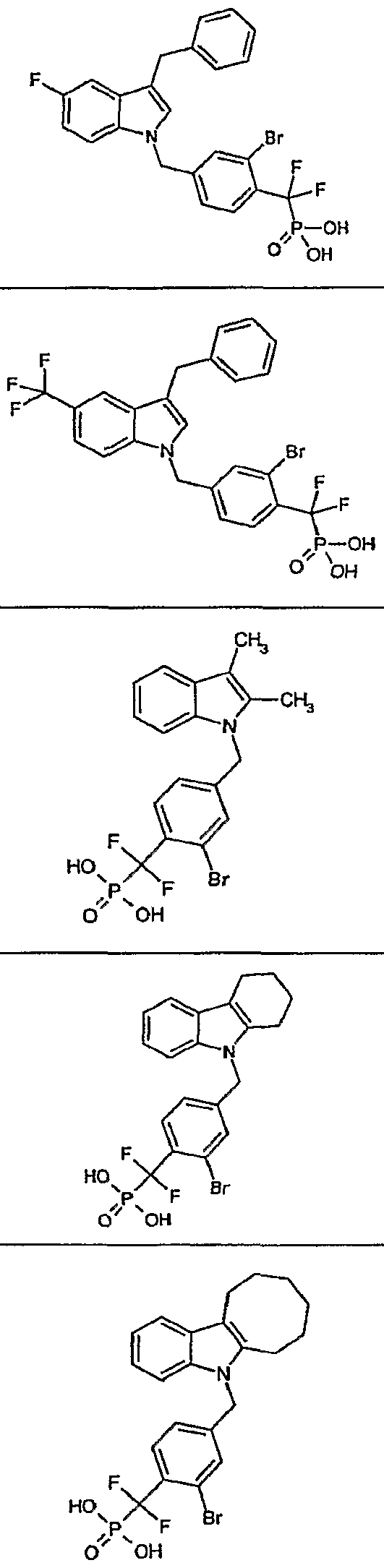
{[2-Bromo-4-(7,8,9,10-tetrahydro- 6H-cyclohepta[b]indol-5-ylmethyl)- pheny l]-difluoro-meth yl}- phosphonic acid
{[2-Bromo-4-(2,3-dihydro-1 H- cyclopenta[b]indoI-4-ylmethyl)- phenyl]-difluoro-methyl}- phosphonic acid
{[2-Bromo-4-(6-chloro-1 ,2,3,4- tetrahydro-carbazol-9-ylmethyl)- phenyl]-difluoro-methyl}- phosphonic acid
{[2-Bromo-4-(7-chloro-2,3-dihydro- 1H-cyclopenta[b]indol-4-ylmethyl)- phenyl]-difluoro-methyl}- phosphonic acid
{[2-Bromo-4-(5-bromo-3-methyl- indol-1-ylmethyl)-phenyl]-difluoro- methyl}-phosphonic acid

{[2-Bromo-4-(5-fIuoro-2-methyl- indol-1-ylmethyl)-phenyl]-difluorc- methyl}-phosphonic acid
{[2-Bromo-4-(2-phenyl-indol-1 - ylmethyl)-phenyl]-difluoro-methyl}- phosphonic acid
{[2-Bromo-4-(5-fluoro-indol-1 - ylmethyl)-phenyl]-difluoro-methyl}- phosphonic acid
{[2-Bromo-4-(2,4,7-trimethyl- benzoimidazol-1-ylmethyl)-phenyl]- difluoro-methyl}-phosphonic acid

A = 0.1-1.0 micromolar
B = 1.0-10.0 micromolar
C. Preparation of the Compounds
The compounds for use in the compositions and methods provided herein may be obtained from commercial sources {e.g., Aldrich Chemical Company, Milwaukee, WI), may be prepared by methods well known to those of skill in the art, or by the methods shown herein. One of skill in the art would be able to prepar all of the compounds for use herein by
routine modification of these methods using the appropriate starting materials (see the Examples).
D. Formulation of pharmaceutical compositions
The pharmaceutical compositions provided herein contain therapeutically effective amounts of one or more of the compounds provided herein that are useful in the prevention, treatment, or amelioration of one or more of the symptoms of diseases or disorders associated with protein tyrosine phosphatase, including PTP-IB, activity, or in which protein tyrosine phosphatase, including PTP-IB, activity is implicated, and a pharmaceutically acceptable carrier. Pharmaceutical carriers suitable for administration of the compounds provided herein include any such carriers known to those skilled in the art to be suitable for the particular mode of administration.
In addition, the compounds may be formulated as the sole pharmaceutically active ingredient in the composition or may be combined with other active ingredients.
The compositions contain one or more compounds provided herein. The compounds are, in one embodiment, formulated into suitable pharmaceutical preparations such as solutions, suspensions, tablets, dispersible tablets, pills, capsules, powders, sustained release formulations or elixirs, for oral administration or in sterile solutions or suspensions for parenteral administration, as well as transdermal patch preparation and dry powder inhalers. In one embodiment, the compounds described above are formulated into pharmaceutical compositions using techniques and procedures well known in the art (see, e.g., Ansel Introduction to Pharmaceutical Dosage Forms, Fourth Edition 1985, 126).
In the compositions, effective concentrations of one or more compounds or pharmaceutically acceptable derivatives thereof is (are) mixed with a suitable pharmaceutical carrier. The compounds may be derivatized as the corresponding salts, esters, enol ethers or esters, acetals, ketals, orthoesters, hemiacetals, hemiketals, acids, bases, solvates, hydrates or prodrugs prior to formulation, as described above. The concentrations of the compounds in the compositions are effective for delivery of an amount, upon administration, that treats, prevents, or ameliorates one or more of the symptoms of diseases or disorders associated with protein tyrosine phosphatase, including PTP-IB, activity or in which protein tyrosine phosphatase, including PTP-IB, activity is implicated.
In one embodiment, the compositions are formulated for single dosage administration. To formulate a composition, the weight fraction of compound is dissolved, suspended,
dispersed or otherwise mixed in a selected carrier at an effective concentration such that the treated condition is relieved, prevented, or one or more symptoms are ameliorated.
The active compound is included in the pharmaceutically acceptable carrier in an amount sufficient to exert a therapeutically useful effect in the absence of undesirable side effects on the patient treated. The therapeutically effective concentration may be determined empirically by testing the compounds in in vitro and in vivo systems well known to those of skill in the art and described herein (see, e.g., EXAMPLES 5 and 6) and then extrapolated therefrom for dosages for humans.
The concentration of active compound in the pharmaceutical composition will depend on absorption, inactivation and excretion rates of the active compound, the physicochemical characteristics of the compound, the dosage schedule, and amount administered as well as other factors known to those of skill in the art. For example, the amount that is delivered is sufficient to ameliorate one or more of the symptoms of diseases or disorders associated with protein tyrosine phosphatase, including PTP-IB, activity or in which protein tyrosine phosphatase, including PTP-IB, activity is implicated, as described herein.
In one embodiment, a therapeutically effective dosage should produce a serum concentration of active ingredient of from about 0.1 ng/ml to about 50- 100 μg/ml. The pharmaceutical compositions, in another embodiment, should provide a dosage of from about 0.001 mg to about 2000 mg of compound per kilogram of body weight per day. Pharmaceutical dosage unit forms are prepared to provide from about 0.01 mg, 0.1 mg or 1 mg to about 500mg, 1000 mg or 2000 mg, and in one embodiment from about 10 mg to about 500 mg of the active ingredient or a combination of essential ingredients per dosage unit form.
The active ingredient may be administered at once, or may be divided into a number of smaller doses to be administered at intervals of time. It is understood that the precise dosage and duration of treatment is a function of the disease being treated and may be determined empirically using known testing protocols or by extrapolation from in vivo or in vitro test data. It is to be noted that concentrations and dosage values may also vary with the severity of the condition to be alleviated. It is to be further understood that for any particular subject, specific dosage regimens should be adjusted over time according to the individual need and the professional judgment of the person administering or supervising the administration of the compositions, and that the concentration ranges set forth herein are
exemplary only and are not intended to limit the scope or practice of the claimed compositions.
In instances in which the compounds exhibit insufficient solubility, methods for solubilizing compounds may be used. Such methods are known to those of skill in this art, and include, but are not limited to, using cosolvents, such as dimethyl sulfoxide (DMSO), using surfactants, such as TWEEN®, or dissolution in aqueous sodium bicarbonate. Derivatives of the compounds, such as prodrugs of the compounds may also be used in formulating effective pharmaceutical compositions.
Upon mixing or addition of the compound(s), the resulting mixture may be a solution, suspension, emulsion or the like. The form of the resulting mixture depends upon a number of factors, including the intended mode of administration and the solubility of the compound in the selected carrier or vehicle. The effective concentration is sufficient for ameliorating the symptoms of the disease, disorder or condition treated and may be empirically determined. The pharmaceutical compositions are provided for administration to humans and animals in unit dosage forms, such as tablets, capsules, pills, powders, granules, sterile parenteral solutions or suspensions, and oral solutions or suspensions, and oil-water emulsions containing suitable quantities of the compounds or pharmaceutically acceptable derivatives thereof. The pharmaceutically therapeutically active compounds and derivatives thereof are, in one embodiment, formulated and administered in unit-dosage forms or multiple-dosage forms. Unit-dose forms as used herein refers to physically discrete units suitable for human and animal subjects and packaged individually as is known in the art. Each unit-dose contains a predetermined quantity of the therapeutically active compound sufficient to produce the desired therapeutic effect, in association with the required pharmaceutical carrier, vehicle or diluent. Examples of unit-dose forms include ampoules and syringes and individually packaged tablets or capsules. Unit-dose forms may be administered in fractions or multiples thereof. A multiple-dose form is a plurality of identical unit-dosage forms packaged in a single container to be administered in segregated unit-dose form. Examples of multiple-dose forms include vials, bottles of tablets or capsules or bottles of pints or gallons. Hence, multiple dose form is a multiple of unit-doses which are not segregated in packaging.
Liquid pharmaceutically administrable compositions can, for example, be prepared by dissolving, dispersing, or otherwise mixing an active compound as defined above and
optional pharmaceutical adjuvants in a carrier, such as, for example, water, saline, aqueous dextrose, glycerol, glycols, ethanol, and the like, to thereby form a solution or suspension. If desired, the pharmaceutical composition to be administered may also contain minor amounts of nontoxic auxiliary substances such as wetting agents, emulsifying agents, solubilizing agents, pH buffering agents and the like, for example, acetate, sodium citrate, cyclodextrine derivatives, sorbitan monolaurate, triethanolamine sodium acetate, triethanolamine oleate, and other such agents.
Actual methods of preparing such dosage forms are known, or will be apparent, to those skilled in this art; for example, see Remington's Pharmaceutical Sciences, Mack Publishing Company, Easton, Pa., 15th Edition, 1975.
Dosage forms or compositions containing active ingredient in the range of 0.005% to 100% with the balance made up from non-toxic carrier may be prepared. Methods for preparation of these compositions are known to those skilled in the art. The contemplated compositions may contain 0.001%-100% active ingredient, in one embodiment 0.1-95%, in another embodiment 75-85%.
1. Compositions for oral administration
Oral pharmaceutical dosage forms are either solid, gel or liquid. The solid dosage forms are tablets, capsules, granules, and bulk powders. Types of oral tablets include compressed, chewable lozenges and tablets which may be enteric-coated, sugar-coated or film-coated. Capsules may be hard or soft gelatin capsules, while granules and powders may be provided in non-effervescent or effervescent form with the combination of other ingredients known to those skilled in the art. a. Solid compositions for oral administration
In certain embodiments, the formulations are solid dosage forms, in one embodiment, capsules or tablets. The tablets, pills, capsules, troches and the like can contain one or more of the following ingredients, or compounds of a similar nature: a binder; a lubricant; a diluent; a glidant; a disintegrating agent; a coloring agent; a sweetening agent; a flavoring agent; a wetting agent; an emetic coating; and a film coating. Examples of binders include microcrystalline cellulose, gum tragacanth, glucose solution, acacia mucilage, gelatin solution, molasses, polvinylpyrrolidine, povidone, crospovidones, sucrose and starch paste. Lubricants include talc, starch, magnesium or calcium stearate, lycopodium and stearic acid. Diluents include, for example, lactose, sucrose, starch, kaolin, salt, mannitol and dicalcium phosphate. Glidants include, but are not limited to, colloidal silicon dioxide. Disintegrating
agents include crosscarmellose sodium, sodium starch glycolate, alginic acid, corn starch, potato starch, bentonite, methylcellulose, agar and carboxymethylcellulose. Coloring agents include, for example, any of the approved certified water soluble FD and C dyes, mixtures thereof; and water insoluble FD and C dyes suspended on alumina hydrate. Sweetening agents include sucrose, lactose, mannitol and artificial sweetening agents such as saccharin, and any number of spray dried flavors. Flavoring agents include natural flavors extracted from plants such as fruits and synthetic blends of compounds which produce a pleasant sensation, such as, but not limited to peppermint and methyl salicylate. Wetting agents include propylene glycol monostearate, sorbitan monooleate, diethylene glycol monolaurate and polyoxyethylene laural ether. Emetic-coatings include fatty acids, fats, waxes, shellac, ammoniated shellac and cellulose acetate phthalates. Film coatings include hydroxyethylcellulose, sodium carboxymethylcellulose, polyethylene glycol 4000 and cellulose acetate phthalate.
The compound, or pharmaceutically acceptable derivative thereof, could be provided in a composition that protects it from the acidic environment of the stomach. For example, the composition can be formulated in an enteric coating that maintains its integrity in the stomach and releases the active compound in the intestine. The composition may also be formulated in combination with an antacid or other such ingredient.
When the dosage unit form is a capsule, it can contain, in addition to material of the above type, a liquid carrier such as a fatty oil. In addition, dosage unit forms can contain various other materials which modify the physical form of the dosage unit, for example, coatings of sugar and other enteric agents. The compounds can also be administered as a component of an elixir, suspension, syrup, wafer, sprinkle, chewing gum or the like. A syrup may contain, in addition to the active compounds, sucrose as a sweetening agent and certain preservatives, dyes and colorings and flavors.
The active materials can also be mixed with other active materials which do not impair the desired action, or with materials that supplement the desired action, such as antacids, H2 blockers, and diuretics. The active ingredient is a compound or pharmaceutically acceptable derivative thereof as described herein. Higher concentrations, up to about 98% by weight of the active ingredient may be included.
In all embodiments, tablets and capsules formulations may be coated as known by those of skill in the art in order to modify or sustain dissolution of the active ingredient. Thus,
for example, they may be coated with a conventional enterically digestible coating, such as phenylsalicylate, waxes and cellulose acetate phthalate. b. Liquid compositions for oral administration
Liquid oral dosage forms include aqueous solutions, emulsions, suspensions, solutions and/or suspensions reconstituted from non-effervescent granules and effervescent preparations reconstituted from effervescent granules. Aqueous solutions include, for example, elixirs and syrups. Emulsions are either oil-in-water or water-in-oil.
Elixirs are clear, sweetened, hydroalcoholic preparations. Pharmaceutically acceptable carriers used in elixirs include solvents. Syrups are concentrated aqueous solutions of a sugar, for example, sucrose, and may contain a preservative. An emulsion is a two-phase system in which one liquid is dispersed in the form of small globules throughout another liquid. Pharmaceutically acceptable carriers used in emulsions are non-aqueous liquids, emulsifying agents and preservatives. Suspensions use pharmaceutically acceptable suspending agents and preservatives. Pharmaceutically acceptable substances used in non-effervescent granules, to be reconstituted into a liquid oral dosage form, include diluents, sweeteners and wetting agents. Pharmaceutically acceptable substances used in effervescent granules, to be reconstituted into a liquid oral dosage form, include organic acids and a source of carbon dioxide. Coloring and flavoring agents are used in all of the above dosage forms. Solvents include glycerin, sorbitol, ethyl alcohol and syrup. Examples of preservatives include glycerin, methyl and propylparaben, benzoic acid, sodium benzoate and alcohol. Examples of non-aqueous liquids utilized in emulsions include mineral oil and cottonseed oil. Examples of emulsifying agents include gelatin, acacia, tragacanth, bentonite, and surfactants such as polyoxyethylene sorbitan monooleate. Suspending agents include sodium carboxymethylcellulose, pectin, tragacanth, Veegum and acacia. Sweetening agents include sucrose, syrups, glycerin and artificial sweetening agents such as saccharin. Wetting agents include propylene glycol monostearate, sorbitan monooleate, diethylene glycol monolaurate and polyoxyethylene lauryl ether. Organic acids include citric and tartaric acid. Sources of carbon dioxide include sodium bicarbonate and sodium carbonate. Coloring agents include any of the approved certified water soluble FD and C dyes, and mixtures thereof. Flavoring agents include natural flavors extracted from plants such fruits, and synthetic blends of compounds which produce a pleasant taste sensation.
For a solid dosage form, the solution or suspension, in for example propylene carbonate, vegetable oils or triglycerides, is in one embodiment encapsulated in a gelatin
capsule. Such solutions, and the preparation and encapsulation thereof, are disclosed in U.S. Patent Nos. 4,328,245; 4,409,239; and 4,410,545. For a liquid dosage form, the solution, e.g., for example, in a polyethylene glycol, may be diluted with a sufficient quantity of a pharmaceutically acceptable liquid carrier, e.g., water, to be easily measured for administration.
Alternatively, liquid or semi-solid oral formulations may be prepared by dissolving or dispersing the active compound or salt in vegetable oils, glycols, triglycerides, propylene glycol esters (e.g., propylene carbonate) and other such carriers, and encapsulating these solutions or suspensions in hard or soft gelatin capsule shells. Other useful formulations include those set forth in U.S. Patent Nos. RE28,819 and 4,358,603. Briefly, such formulations include, but are not limited to, those containing a compound provided herein, a dialkylated mono- or poly-alkyiene glycol, including, but not limited to, 1 ,2- dimethoxymethane, diglyme, triglyme, tetraglyme, polyethylene glycol-350-dimethyl ether, polyethylene glycol-550-dimethyl ether, polyethylene glycol-750-dimethyl ether wherein 350, 550 and 750 refer to the approximate average molecular weight of the polyethylene glycol, and one or more antioxidants, such as butylated hydroxytoluene (BHT), butylated hydroxyanisole (BHA), propyl gallate, vitamin E, hydroquinone, hydroxy coumarins, ethanolamine, lecithin, cephalin, ascorbic acid, malic acid, sorbitol, phosphoric acid, thiodipropionic acid and its esters, and dithiocarbamates. Other formulations include, but are not limited to, aqueous alcoholic solutions including a pharmaceutically acceptable acetal. Alcohols used in these formulations are any pharmaceutically acceptable water-miscible solvents having one or more hydroxyl groups, including, but not limited to, propylene glycol and ethanol. Acetals include, but are not limited to, di(Iower alkyl) acetals of lower alkyl aldehydes such as acetaldehyde diethyl acetal.
2. Injectables, solutions and emulsions
Parenteral administration, in one embodiment characterized by injection, either subcutaneously, intramuscularly or intravenously is also contemplated herein. Injectables can be prepared in conventional forms, either as liquid solutions or suspensions, solid forms suitable for solution or suspension in liquid prior to injection, or as emulsions. The injectables, solutions and emulsions also contain one or more excipients. Suitable excipients are, for example, water, saline, dextrose, glycerol or ethanol. In addition, if desired, the pharmaceutical compositions to be administered may also contain minor amounts of non-
toxic auxiliary substances such as wetting or emulsifying agents, pH buffering agents, stabilizers, solubility enhancers, and other such agents, such as for example, sodium acetate, sorbitan monolaurate, triethanolamine oleate and cyclodextrins.
Implantation of a slow-release or sustained-release system, such that a constant level of dosage is maintained (see, e.g., U.S. Patent No. 3,710,795) is also contemplated herein. Briefly, a compound provided herein is dispersed in a solid inner matrix, e.g., polymethylmethacrylate, polybutyhnethacrylate, plasticized or unplasticized polyvinylchloride, plasticized nylon, plasticized polyethyleneterephthalate, natural rubber, polyisoprene, polyisobutylene, polybutadiene, polyethylene, ethylene-vinylacetate copolymers, silicone rubbers, polydimethylsiloxanes, silicone carbonate copolymers, hydrophilic polymers such as hydrogels of esters of acrylic and methacrylic acid, collagen, cross-linked polyvinylalcohol and cross-linked partially hydrolyzed polyvinyl acetate, that is - surrounded by an outer polymeric membrane, e.g., polyethylene, polypropylene, ethylene/propylene copolymers, ethylene/ethyl acrylate copolymers, ethylene/vinylacetate copolymers, silicone rubbers, polydimethyl siloxanes, neoprene rubber, chlorinated polyethylene, polyvinylchloride, vinylchloride copolymers with vinyl acetate, vinylidene chloride, ethylene and propylene, ionomer polyethylene terephthalate, butyl rubber epichlorohydrin rubbers, ethylene/vinyl alcohol copolymer, ethylene/vinyl acetate/vinyl alcohol terpolymer, and ethylene/vinyloxyethanol copolymer, that is insoluble in body fluids. The compound diffuses through the outer polymeric membrane in a release rate controlling step. The percentage of active compound contained in such parenteral compositions is highly dependent on the specific nature thereof, as well as the activity of the compound and the needs of the subject.
Parenteral administration of the compositions includes intravenous, subcutaneous and intramuscular administrations. Preparations for parenteral administration include sterile solutions ready for injection, sterile dry soluble products, such as lyophilized powders, ready to be combined with a solvent just prior to use, including hypodermic tablets, sterile suspensions ready for injection, sterile dry insoluble products ready to be combined with a vehicle just prior to use and sterile emulsions. The solutions may be either aqueous or nonaqueous.
If administered intravenously, suitable carriers include physiological saline or phosphate buffered saline (PBS), and solutions containing thickening and solubilizing agents, such as glucose, polyethylene glycol, and polypropylene glycol and mixtures thereof.
Pharmaceutically acceptable carriers used in parenteral preparations include aqueous vehicles, nonaqueous vehicles, antimicrobial agents, isotonic agents, buffers, antioxidants, local anesthetics, suspending and dispersing agents, emulsifying agents, sequestering or chelating agents and other pharmaceutically acceptable substances. Examples of aqueous vehicles include Sodium Chloride Injection, Ringers Injection,
Isotonic Dextrose Injection, Sterile Water Injection, Dextrose and Lactated Ringers Injection. Nonaqueous parenteral vehicles include fixed oils of vegetable origin, cottonseed oil, corn oil, sesame oil and peanut oil. Antimicrobial agents in bacteriostatic or fungistatic concentrations must be added to parenteral preparations packaged in multiple-dose containers which include phenols or cresols, mercurials, benzyl alcohol, chlorobutanol, methyl and propyl p-hydroxybenzoic acid esters, thimerosal, benzalkonium chloride and benzethonium chloride. Isotonic agents include sodium chloride and dextrose. Buffers include phosphate and citrate. Antioxidants include sodium bisulfate. Local anesthetics include procaine hydrochloride. Suspending and dispersing agents include sodium carboxymethylcelluose, hydroxypropyl methylcellulose and polyvinylpyrrolidone. Emulsifying agents include
Polysorbate 80 (TWEENa 80). A sequestering or chelating agent of metal ions include EDTA. Pharmaceutical carriers also include ethyl alcohol, polyethylene glycol and propylene glycol for water miscible vehicles; and sodium hydroxide, hydrochloric acid, citric acid or lactic acid for pH adjustment. The concentration of the pharmaceutically active compound is adjusted so that an injection provides an effective amount to produce the desired pharmacological effect. The exact dose depends on the age, weight and condition of the patient or animal as is known in the art.
The unit-dose parenteral preparations are packaged in an ampoule, a vial or a syringe with a needle. All preparations for parenteral administration must be sterile, as is known and practiced in the art.
Illustratively, intravenous or intraarterial infusion of a sterile aqueous solution containing an active compound is an effective mode of administration. Another embodiment is a sterile aqueous or oily solution or suspension containing an active material injected as necessary to produce the desired pharmacological effect.
Injectables are designed for local and systemic administration. In one embodiment, a therapeutically effective dosage is formulated to contain a concentration of at least about
0.1% w/w up to about 90% w/w or more, in certain embodiments more than 1% w/w of the active compound to the treated tissue(s).
The compound may be suspended in micronized or other suitable form or may be derivatized to produce a more soluble active product or to produce a prodrug. The form of the resulting mixture depends upon a number of factors, including the intended mode of administration and the solubility of the compound in the selected carrier or vehicle. The effective concentration is sufficient for ameliorating the symptoms of the condition and may be empirically determined.
3. Lyophilized powders Of interest herein are also lyophilized powders, which can be reconstituted for administration as solutions, emulsions and other mixtures. They may also be reconstituted and formulated as solids or gels.
The sterile, lyophilized powder is prepared by dissolving a compound provided herein, or a pharmaceutically acceptable derivative thereof, in a suitable solvent. The solvent may contain an excipient which improves the stability or other pharmacological component of the powder or reconstituted solution, prepared from the powder. Excipients that may be used include, but are not limited to, dextrose, sorbital, fructose, corn syrup, xylitol, glycerin, glucose, sucrose or other suitable agent. The solvent may also contain a buffer, such as citrate, sodium or potassium phosphate or other such buffer known to those of skill in the art at, in one embodiment, about neutral pH. Subsequent sterile filtration of the solution followed by lyophilization under standard conditions known to those of skill in the art provides the desired formulation. In one embodiment, the resulting solution will be apportioned into vials for lyophilization. Each vial will contain a single dosage or multiple dosages of the compound. The lyophilized powder can be stored under appropriate conditions, such as at about 4 0C to room temperature.
Reconstitution of this lyophilized powder with water for injection provides a formulation for use in parenteral administration. For reconstitution, the lyophilized powder is added to sterile water or other suitable carrier. The precise amount depends upon the selected compound. Such amount can be empirically determined. 4. Topical administration
Topical mixtures are prepared as described for the local and systemic administration. The resulting mixture may be a solution, suspension, emulsions or the like and are formulated as creams, gels, ointments, emulsions, solutions, elixirs, lotions, suspensions, tinctures,
pastes, foams, aerosols, irrigations, sprays, suppositories, bandages, dermal patches or any other formulations suitable for topical administration.
The compounds or pharmaceutically acceptable derivatives thereof may be formulated as aerosols for topical application, such as by inhalation (see, e.g., U.S. Patent Nos. 4,044,126, 4,414,209, and 4,364,923, which describe aerosols for delivery of a steroid useful for treatment of inflammatory diseases, particularly asthma). These formulations for administration to the respiratory tract can be in the form of an aerosol or solution for a nebulizer, or as a microfϊne powder for insufflation, alone or in combination with an inert carrier such as lactose. In such a case, the particles of the formulation will, in one embodiment, have diameters of less than 50 microns, in one embodiment less than 10 microns.
The compounds may be formulated for local or topical application, such as for topical application to the skin and mucous membranes, such as in the eye, in the form of gels, creams, and lotions and for application to the eye or for intracisternal or intraspinal application. Topical administration is contemplated for transdermal delivery and also for administration to the eyes or mucosa, or for inhalation therapies. Nasal solutions of the active compound alone or in combination with other pharmaceutically acceptable excipients can also be administered.
These solutions, particularly those intended for ophthalmic use, may be formulated as 0.01% - 10% isotonic solutions, pH about 5-7, with appropriate salts.
5. Compositions for other routes of administration
Other routes of administration, such as transdermal patches, including iontophoretic and electrophoretic devices, and rectal administration, are also contemplated herein.
Transdermal patches, including iotophoretic and electrophoretic devices, are well known to those of skill in the art. For example, such patches are disclosed in U.S. Patent
Nos. 6,267,983, 6,261,595, 6,256,533, 6,167,301, 6,024,975, 6,010715, 5,985,317, 5,983,134, 5,948,433, and 5,860,957.
For example, pharmaceutical dosage forms for rectal administration are rectal suppositories, capsules and tablets for systemic effect. Rectal suppositories are used herein mean solid bodies for insertion into the rectum which melt or soften at body temperature releasing one or more pharmacologically or therapeutically active ingredients. Pharmaceutically acceptable substances utilized in rectal suppositories are bases or vehicles and agents to raise the melting point. Examples of bases include cocoa butter (theobroma
oil), glycerin-gelatin, carbowax (polyoxyethylene glycol) and appropriate mixtures of mono-, di- and triglycerides of fatty acids. Combinations of the various bases may be used. Agents to raise the melting point of suppositories include spermaceti and wax. Rectal suppositories may be prepared either by the compressed method or by molding. The weight of a rectal suppository, in one embodiment, is about 2 to 3 gm.
Tablets and capsules for rectal administration are manufactured using the same pharmaceutically acceptable substance and by the same methods as for formulations for oral administration.
6. Targeted Formulations The compounds provided herein, or pharmaceutically acceptable derivatives thereof, may also be formulated to be targeted to a particular tissue, receptor, or other area of the body of the subject to be treated. Many such targeting methods are well known to those of skill in the art. All such targeting methods are contemplated herein for use in the instant compositions. For non-limiting examples of targeting methods, see, e.g., U.S. Patent Nos. 6,316,652, 6,274,552, 6,271,359, 6,253,872, 6,139,865, 6,131,570, 6,120,751, 6,071,495, 6,060,082, 6,048,736, 6,039,975, 6,004,534, 5,985,307, 5,972,366, 5,900,252, 5,840,674, 5,759,542 and 5,709,874.
In one embodiment, liposomal suspensions, including tissue-targeted liposomes, such as tumor-targeted liposomes, may also be suitable as pharmaceutically acceptable carriers. These may be prepared according to methods known to those skilled in the art. For example, liposome formulations may be prepared as described in U.S. Patent No. 4,522,811. Briefly, liposomes such as multilamellar vesicles (MLVs) may be formed by drying down egg phosphatidyl choline and brain phosphatidyl serine (7:3 molar ratio) on the inside of a flask. A solution of a compound provided herein in phosphate buffered saline lacking divalent cations (PBS) is added and the flask shaken until the lipid film is dispersed. The resulting vesicles are washed to remove unencapsulated compound, pelleted by centrifugation, and then resuspended in PBS.
7. Articles of manufacture
The compounds or pharmaceutically acceptable derivatives may be packaged as articles of manufacture containing packaging material, a compound or pharmaceutically acceptable derivative thereof provided herein, which is effective for modulating protein tyrosine phosphatase, including PTP-IB, activity, or for treatment, prevention or amelioration of one or more symptoms of diseases or disorders in which protein tyrosine phosphatase,
including PTP-IB, activity, is implicated, within the packaging material, and a label that indicates that the compound or composition, or pharmaceutically acceptable derivative thereof, is used for modulating protein tyrosine phosphatase, including PTP-IB, activity, or for treatment, prevention or amelioration of one or more symptoms of diseases or disorders in which protein tyrosine phosphatase, including PTP-IB, activity is implicated.
The articles of manufacture provided herein contain packaging materials. Packaging materials for use in packaging pharmaceutical products are well known to those of skill in the art. See, e.g., U.S. Patent Nos. 5,323,907, 5,052,558 and 5,033,252. Examples of pharmaceutical packaging materials include, but are not limited to, blister packs, bottles, tubes, inhalers, pumps, bags, vials, containers, syringes, bottles, and any packaging material suitable for a selected formulation and intended mode of administration and treatment. A wide array of formulations of the compounds and compositions provided herein are contemplated as are a variety of treatments for any disease or disorder in which protein tyrosine phosphatase, including PTP-IB, activity is implicated as a mediator or contributor to the symptoms or cause.
8. Prodrugs
One form of prodrug is to prepare acetoxymethyl esters of the compounds provided herein, which may be prepared by the general procedure reported by C. Schultz et al., J. Biol. Chem. 1993, 268:6316-6322: A carboxylic acid (leq) is suspended in dry acetonitrile (2mL/0.1mmol). Diisopropyl amine (3.0eq) is added followed by bromomethyl acetate (1.5eq). The mixture is stirred under nitrogen overnight at room temperature. Acetonitrile is removed under reduced pressure to yield an oil, which is diluted in ethylacetate and washed with water (3 x). The organic layer is dried over anhydrous magnesium sulfate. Filtration, followed by solvent removal under reduced pressure, affords a crude oil. The product is purified by column chromatography on silica gel, using an appropriate solvent system.
Other prodrugs can routinely be prepared from compounds provided herein by the procedures outlined in the following, the disclosures of which are incorporated herein by reference in their entirety: Stankovic CJ et al. , "The Role of 4-Phosphonodifluoromethyl- and 4-
Phosphono-phenylalanine in the Selectivity and Cellular Uptake of SH2 Domain
Ligands." Bioorg. Med. Chem. Lett. 1997; 7(14):1909-14.
Ortmann R et al, "Acyloxyalkyl ester prodrugs of FR900098 with improved in vivo
anti-malarial activity." Bioorg. Med. Chem. Lett. 2003; 13(13):2163-6. Hughes WT et ah, "Single-dose pharmacokinetic's and safety of the oral antiviral compound adefovir dipivoxil in children infected with human immunodeficiency virus type 1." Antimicrob Agents Chemother. 2000; 44(4):1041-θ. Starrer. JE Jr et al, "Synthesis and in vitro evaluation of a phosphonate prodrug: bis(pivaloyloxymethyl) 9-(2-phosphonylmethoxyethyl)adenine." Antiviral Res. 1992; 19(3):267-73.
Such prodrug preparations are routinely prepared, once a novel drug compound is identified, such as the novel PTP-IB inhibitors disclosed herein. Other prodrugs, of the compounds provided herein are prodrugs of difluoromethylphosphonic acids and have the formulae
ArCF2P(O)(OH)(OCH(H/Me)OC(=O)OiPr, ArCF2P(O)[(OCH(H/Me)OC(=O)OiPr]23 ArCF2P(0)(OH)(OCH(H/Me)OC(=0)tBu, or ArCF2P(0)[(OCH(H/Me)OC(=0)tBu]2. Other prodrugs of the compounds provided herein have the formulae ROCH2CHROH2O- P(O)(OH)CF2Ar or (ROCH2CHR5CH2O)2-P(O)CF2Ar5 where R is C14-2o-n-alkyl and R' is H, OH or OMe. Further prodrugs of the compounds provided herein are prodrugs as described in EP 0 350 287; EP 0 674 646; U.S. 6,599,887; U.S. 6,448,392; U.S. 6,752,981; U.S. 6,312,662; U.S. 2002/0173490; Friis et al. Eur. J. Pharm. Sci. 4:49-59 (1996); Erion et al. J. Am. Chem. Soc. 126:5154-5163 (2004); WO 03/095665; Krise et al. Adv. Drug. Deliv. Rev. 19:287-310 (1996); and Ettmayer et al. J. Med. Chem. 47:2393-2404 (2004). The disclosures of these patents and publications are incorporated by reference herein in their entirety.
In certain embodiments, the prodrugs provided herein exhibit improved activity in cell-based assays (e.g., EXAMPLE 5) as compared to the parent compounds.
E. Evaluation of the activity of the compounds The activity of the compounds as modulators of protein tyrosine phosphatase, including PTP-IB, may be measured in standard assays (see, e.g. , Examples 5 and 6). Briefly, an assay described herein employes human recombinant PTP-IB and a pNPP substrate in a rescue assay.
F. Methods of use of the compounds and compositions Methods of modulating the activity of a protein tyrosine phosphatase, including PTP-
IB, by contacting the protein tyrosine phosphatase with a compound or composition provided herein are provided. In one embodiment, the PTP, including PTP-IB, is inhibited by the compound or composition.
Methods of increasing insulin sensitivity by administering a compound or composition provided herein are provided.
Methods of treating, preventing, or ameliorating one or more symptoms of a protein tyrosine phosphatase mediated disease, including PTP-IB mediated diseases, by administering a compound or composition provided herein are provided. Such diseases include, but are not limited to, diabetes including Type 1 and Type 2 diabetes (and associated complications such as hypertension, ischemic diseases of the large and small blood vessels, blindness, circulatory problems, kidney failure and atherosclerosis), syndrome X, metabolic syndrome, glucose intolerance, insulin resistance, leptin resistance, obesity, cancer, neurodegenerative diseases, and other diseases in which the activity of a tyrosine phosphatase or multiple tyrosine phosphatases contributes to the symptoms or pathology thereof. GL Combination Therapy
The compounds and compositions provided herein may also be used in combination with other active ingredients. In another embodiment, the compounds may be administered in combination, or sequentially, with another therapeutic agent. Such other therapeutic agents include those known for treatment, prevention, or amelioration of one or more symptoms of protein tyrosine phosphatase, including PTP-IB, mediated diseases . Such therapeutic agents include, but are not limited to, antiobesity agents, antidiabetics, antihypertensive agents, agents for the treatment and/or prevention of complications resulting from or associated with diabetes and agents for the treatment and/or prevention of complications and disorders resulting from or associated with obesity.
In another embodiment, the compounds provided herein may be administered in combination with one or more antiobesity agents or appetite regulating agents. Such agents include, but are not limited to, CART (cocaine amphetamine regulated transcript) agonists, NPY (neuropeptide Y) antagonists, MC4 (melanocortin 4) agonists, orexin antagonists, TNF (tumor necrosis factor) agonists, CRF (corticotropin releasing factor) agonists, CRF BP (corticotropin releasing factor binding protein) antagonists, urocortin agonists, B3 agonists, MSH (melanocyte-stimulating hormone) agonists, MCH (melanocyte-concentrating hormone) antagonists, CCK (cholecystokinin) agonists, serotonin re-uptake inhibitors, serotonin and noradrenaline re-uptake inhibitors, mixed serotonin and noradrenergic compounds, 5HT (serotonin) agonists, bombesin agonists, galanin antagonists, growth hormone, growth hormone releasing compounds, TRH (thyreotropin releasing hormone) agonists, UCP 2 or 3 (uncoupling protein 2 or 3) modulators, leptin agonists, DA agonists
(bromocriptin, doprexin), lipase/amylase inhibitors, PPAR (peroxisome proliferator activated receptor) modulators, RXR (retinoid X receptor) modulators or TR B agonists.
In one embodiment the antiobesity agent is leptin. In other embodiments, the antiobesity agent is dexamphetamine or amphetamine, fenfluramine or dexfenfluramine, sibutramine, orlistat, mazindol or phentermine.
In another embodiment, the antidiabetic is insulin, GLP-I (glucagons like peptide- 1) derivatives such as those disclosed in WO 98/08871, which is incorporated herein by reference, as well as orally active hypoglycemic agents. The orally active hypoglycemic agents include, but are not limited to, sulfonylureas, biguanides, meglitinides, oxadiazolidinediones, thizolidinediones, glucosidase inhibitors, glucagons antagonists such as those disclosed in WO 99/01423, GLP-I agonists, potassium channel openers such as those disclosed in WO 98/26265 and WO 99/03861, insulin sensitizers, DPP-IV (dipeptidyl peptidase-IV) inhibitors, inhibitors of hepatic enzymes involved in stimulation of gluconeogensis and/or glycogenolysis, glucose uptake modulators, compounds modifying the lipid metabolism such as antihyperlipidemic agents and antilipedimic agents as HMG CoA inhibitors (statins), compounds lowering food intake, PPAR and RXR agonists and agents acting on the ATP- dependent potassium channel of the B-cells.
In one embodiment the present compounds are administered in combination with insulin. In further embodiments, the present compounds are administered in combination with a sulphonylurea e.g., tolbutamide, glibenclamide, glipizide or glicazide, a biguanide e.g. metformin, a meglitinide e.g., repaglinide, a thizolidinedione e.g., troglitazone, ciglitazone, pioglitazone, rosiglitazone or compounds disclosed in WO 97/41097 such as 5-[[4-[3- Methyl-4-oxo-3, 4-dihydro-2-quinazolinyl]methoxy]phenyl-methyl]thiazolidine-2, 4-dione or a pharmaceutically acceptable salt thereof. In another embodiment, the present compounds may be administered in combination with the insulin sensitizers disclosed in WO 99/19313 such as (-) 3-[4-[2-phenoxazin-10- yl)ethoxy]phenyl]-2-ethoxypropanoic acid or a pharmaceutically acceptable salts thereof, preferably the arginine salt.
In further embodiments, the present compounds are administered in combination with an α-glucosidase inhibitor e.g. miglitol or acarbose, an agent acting on the ATP-dependent potassium channel of the B-cells e.g. tolbutamide, glibenclamide. glipizide, glicazide or repaglinide, nateglinide, an antihyperlipidemic agent or antilipidemic agent e.g.,
cholestyramine, colestipol, clόfibrate, gemfibrozil, lovastatin, pravastatin, simvastatin, probucol or dextrothyroxine,
In still further embodiments, the present compounds are administered in combination with more than one of the above-mentioned compounds e.g., in combination with a sulphonylurea and metformin, a sulphonylurea and acarbose, repaglinide and metformin, insulin and a sulphonylurea, insulin and metformin, insulin and lovastatin, CART agonist and a CCK agonist, etc.
In another embodiment, the present compounds may be administered in combination with one or more antihypertensive agents. Examples of antihypertensive agents are B- blockers such as alprenolol, atenolol, timolot, pindolol, propranolol and metoprolol, ACE
(angiotensin converting enzyme) inhibitors such as benazepril, captopril, analapril, fosinopril, lisinopril, quinapril and ramipril, calcium channel blockers such as nifedipine, felodipine, nicardipine, isradipine, nimodipine, diltiazem and verapamil, and α-blockers such as doxazosin, urapidil, prazosin and terazosin. Further reference can be made to Remington: The Science and Practice of Pharmacy, 19th Edition, Gennaro, Ed., Mack Publishing Co., Easton, PA, 1995.
It should be understood that any suitable combination of the compounds provided herein with one or more of the above-mentioned compounds and optionally one or more further pharmacologically active substances are considered to be within the scope of the present disclosure. In another embodiment, the compound provided herein is administered prior to or subsequent to the one or more additional active ingredients.
The following examples are provided for illustrative purposes only and are not intended to limit the scope of the invention.
EXAMPLE 1
{[2-Bromo-4-(2,3,7-trimethyl-indoI-l-ylmethyI)-phenyI]-difluoro-methyl}-phosphonic acid

To a solution of 2,3,7-trimethyl-lH-indole (0.318 g, 2.0 mmol) in 10 mL of dry DMF was added sodium hydride ( 0.088 g, 2.2 mmol, 60%) at 0 0C under an nitrogen atmosphere. After 30 minutes, [(2-Bromo-4-bromomethyl-phenyl)-difluoro-methyl]-phosphonic acid diethyl ester (0.1.74 g, 2.0 mmol 50% pure) was added, and the solution was stirred at room temperature for overnight. The DMF was evaporated (rotavap) under vacuum. The crude residue was purified by flash chromatography (ethyl acetate / hexanes, 100% hexanes to 1 :2) to isolate the {[2-Bromo-4-(2,3>'7-trimethyl-indol-l-ylmethyl)-phenyl]-difluoro-methyl}- phosphonic acid diethyl ester (0.250 g) as yellow oil. MS (M+H4)"1" 514, 516. A solution of {[2-Bromo-4-(2,3,7-trimethyl-indol-l-ylmethyl)-phenyl]-difluoro- methyl}-phosphonic acid diethyl ester (0.200 g, 0.40 mmol) in dry dichloromethane (6 mL) was cool to —20 0C, then added iodotrimethylsilane (0.55 mL, 4.0 mmol). The reaction mixture was slowly warmed up to room temperature to stir for an additional 2 hour. The solvent and excess iodotrimethylsilane was removed by vacuum. The residue was treated with acetonitrile (16 mL) and H2O (4 mL), and stirred for overnight at room temperature.
The reaction was then rotary evaporated to an oil which was dissolved in ethyl acetate and washed with 5% Na2SaO4 (acidified) followed by a wash with saturated NaCl. The organic layer was dried (Na2SO4) and concentrated. The crude residue was purified by C- 18 flash chromatography (MeOH / H2O, 100% H2O to 7:3) to give the {[2-Brorno-4-(2,3,7-trimethyl- indol-l-ylmethyl)-phenyl]-difluoro-methyl}-phosphonic acid (0.110 g) as light white solid.
MS (M+H)+ 458, 460; (M-H)" 456, 456.
EXAMPLE 2 {[4-(3-Benzyl-indol-l-ylmethyl)-2-bromo-phenyl]-difluoro-methyl}-phosphonic acid


To a solution of 3-Benzyl-lH-indole (0.200 g, 0.96 mmol) in 10 mL of dry DMF was added sodium hydride ( 0.039 g, 0.96 mmol, 60%) at 0 0C under an nitrogen atmosphere. 5 After 30 minute, [{2-Bromo-4-bromomethyl-phenyl)-difluoro-methyl]-phosphonic acid diethyl ester (0.421 g, 0.96 mmol) was added, and the solution was stirred at room temperature for overnight. The DMF was evaporated (rotavap) under vacuum. The crude residue was purified by flash chromatography (ethyl acetate / hexanes, 100% hexanes to 1 :2) to isolate the {[4-(3-Benzyl-indol-l-ylmethyl)-2-bromo-phenyl]-difluoro-methyl}- phosphonic acid diethyl ester (0.351 g) in 65% yield as yellow oil. MS (M+NH4)+ 579, 581; (M-Et)- 532, 534.
A solution of {[4-(3-Benzyl-indol-l-ylmethyl)-2-bromo-phenyl]-difluoro-methyl}- phosphonic acid diethyl ester (0.331 g, 0.59 mmol) in dry dichloromethane (6 mL) was cool to -20 0C, then added iodotrimethylsilane (0.67 mL, 4.71 mmol). The reaction mixture was slowly warmed up to room temperature to stir for an additional 2 hour. The solvent and excess iodotrimethylsilane was removed by vacuum. The residue was treated with acetonitrile (16 mL) and H2O (4 mL), and stirred for overnight at room temperature. The reaction was then rotary evaporated to an oil which was dissolved in ethyl acetate and washed with 5% Na2S2O4 (acidified) followed by a wash with saturated NaCl. The organic layer was dried (Na2SO4) and concentrated. The crude residue was purified by C- 18 flash chromatography (MeOH / H2O, 100% H2O to 7:3) to give the {[4-(3~Benzyl-indol-l- ylmethyl)-2-bromo-phenyl]-difluoro-methyl}-phosphonic acid (0.222 g) in 74% yield as light brown solid. MS (M+NH4)+ 523, 525; (M-H)- 504, 506.
EXAMPLE 3 [(4-BenzoiraidazoH-ylmethyl-2-bromo-phenyl)-difluoro-raethyI]-phosphonic acid

Diethyl (bromodifluoromethyl)phosphonate: A solution of triethyl phosphite (95.50 g, 575 mmol) in 300 mL of anhydrous diethyl ether was cooled, under a nitrogen atmosphere, to 40C before addition of dibromodifluoromethane (144.72 g, 690 mmol). The mixture was allowed to warm to room temperature and stirred overnight, then heated to reflux for 24 hours. Ether was removed by rotary evaporation, and the resultant liquid was distilled to afford 142.75 g (93%) of a clear colorless liquid: bp 144-145 0C (25 mmHg) [lit. bp 97-98 0C (19 mmHg)] (This material is commercially available from Lancaster and Aldrich).
[(2-Bromo-4-methyl-phenyl)-difluoromethyl]-phosphonie acid diethyl ester: To activated zinc (12 g, 190 mmol) in DMA (70 mL) was added bromodifluoromethyldiethyl- phosphonate (50 g, 190mmol) in DMA (70 mL). The resulting mixture was stirred at 45 0C for 3 hours, after which copper (I) bromide (27 g, 190 mmol) was added and stirring was continued for 0.5 hours at room temperature. 3-Bromo-4-iodotoluene (28 g, 94 mmol) was then added and the mixture was sonicated at room temperature for 12 hours. The reaction mixture was partitioned between ether and H2O, filtered through Celite, and the organic layer was dried over MgSO4 and concentrated in vacuo to yield 21 g (63%) of a clear, colorless oil. [(2-Bromo-4-bromomethyl-phenyl)-difluoro-methyl]-phosphonic acid diethyl ester: To [(2-Bromo-4-methyl-phenyl)-difluoromethyl]-phosphonic acid diethyl ester (21 g, 58 mmol) in benzene (500 mL) was added N-bromosuccinimide (12 g, 68 mmol) and AIBN (0.50 g). The resulting mixture was stirred for 12 hours at room temperature in front of a IOOW bulb. It was then washed with H2O, sat. NaHC O3, and brine, and the organic layer was dried over MgSO4, and concentrated in vacuo. The resulting material was purified via column chromatography (4/1 hexanes/ethyl acetate) to yield 1.7 g (66%) of clear, colorless oil.
[(4-Benzimidazol-l-ylmethyl-2-bromo-phenyl)-difluoro-methyl]-phosphonic acid diethyl ester: To a solution of benimidazole (59 mg, 0.5 mmol) and [(2-Bromo-4- bromomethyl-phenyl)-difluoro-methyl]-phosphonic acid diethyl ester (218 mg, 0.5 mmol) in 3 ml anhydrous dimethylformamide in a 25 ml round-bottom flask kept in an ice-bath was slowly added IM solution of potassium terf-butoxide in ferΛ-butanol (0.5 ml, 0.5 mmol). After the addition the mixture was tirred at room temperature for 12 hours. Solvent was evaporated and the residue was purified on a silica gel column to get 130 mg (55%) of title compound.
[(4-Benzimidazol-l-ylniethyl-2-bromo-phenyl)-difluoro-methyl]-phosphonic acid: To a solution of [(4-Benzimidazol-l-ylmethyl-2-bromo-phenyl)-difluoro-methyl]- phosphonic acid diethyl ester (130 mg, 0.27 mmol) in CH2Cl2 (5 ml) was added bistrimethylsilyltrifluoroacetamide (353 mg, 1.37 mmol) and reaction mixture was stirred at room temperature for 1 h after which the reaction mixture was cooled to -20 0C and iodotriniethylsilane (274 mg, 1.37 mmol) was added drop wise. The resulting mixture was stirred at room temperature for 1.5 hours, after which it was concentrated in vacuo. The residue was dissolved in 5 mL dichloromethane and cooled in ice-bath. To this solution was added methanol (5 mL) slowly. The mixture was stirred at room temperature for 2 h and then solvent was removed under reduced pressure. The residue was purified on a Ci8 reverse phase silica gel column using 20% acetonitrile in water to elute the compound. Solvent was evaporated to get 70 mg (62%) pure title compound. MS (ESI) 416 (M-H).
EXAMPLE 4
{[2-Bromo-4-(2-pyridin-2-yl-benzoimidazol-l-yIniethyI)-phenyl]-difluoro-methyϊ}- phosphonic acid

(M+H).
EXAMPLE 5
Assay for PTP-IB Activity
Materials:
EDTA-ethylenediaminetetraacetic acid (Sigma) HEPES-N-(2-Hydroxyethyl)piperazine-N'-(2-ethanesulfonic acid) (Sigma)
DTT-dithiothreitol (Sigma)
NaCl-sodium chloride
Enzyme: Human recombinant PTP-IB, containing amino acids 1-321, fused to GST enzyme (glutathione S-transferase) purified by affinity chromatography (Huyer et al, 1997, J. Biol Chem., 272, 843-852). pNPP: p-Nitrophenyl Phosphate (Calbiochem)
Assay Buffer: 50 mM HEPES (pH 7.4), 100 mM NaCl, 2 mM EDTA, 3 mM DTT
(5x) pNPP substrate : 10 mM pNPP in assay buffer
Enzyme: 1 mg/ml PTPlB (1-321), dilute 1:200 in assay buffer Enzyme Assay PTP-IB
Assay buffer: 50 mM HEPES (pH 7.4), 100 mM NaCl, 2 mM EDTA, 3 mM DTT
Enzyme dilution buffer: 50 mM HEPES (pH 7.4), 100 mM NaCl, 2 mM EDTA, 3 mM DTT
Substrate 198 mM p-Nitrophenyl Phosphate (pNPP) store at 4°C The assay was carried out at 300C in 96 well plates. The reaction mixture in 60 ul contained 50 mM HEPES (pH 7.4), 100 mM NaCl, 2 mM EDTA, 3 mM DTT, and 2 mM p- Nitrophenyl Phosphate (pNPP). 5 ul of the test compound (inhibitor) dissolved in DMSO or DMSO alone for control was added to each well and the plate was mixed for 2 min. The reaction was initiated by adding 20 ul of diluted PTPlB ( 5 ng/ul in 50 mM HEPES (pH 7.4), 100 mM NaCl, 2 mM EDTA, 3 mM DTT). After 20 min at 300C, the enzyme reaction was terminated by adding 100 ul of 2 M K2CO3 to each well. The phosphatase activity was detected by using Victor II plate reader (Wallac) with absorbance detection at 405 nm. All the assays were done at least in duplicate. The initial rate of pNP is plotted against the concentration of inhibitor. EXAMPLE 6
Cell based assays
Antibodies and Chemicals. The antibody against phosphorylated insulin receptor (pIR) and the ELISA kit for detection of pIR were from Biosource (Camarillo, CA). Rabbit
anti-IR/IGF-lR [pYpYl 162/1163] phosphospecific antibody recognizes both the insulin receptor (IR) and the insulin-like growth factor- 1 receptor (IGF-IR) phosphorylated at the active site tyrosine residues, 1162 and 1163 (1135 and 1136 for IGF-IR) (pIR/pIGF-lR). The Insulin Receptor [pYpYl 162/1163] ELISA kit specifically recognizes IR phosphorylated at tyrosine residues 1162 and 1163 (and does not recognize phosphorylated IGF-IR). HRP- conjugated secondary antibodies were from Cell Signaling Technology (Beverly, MA). The ECL detection system was from Amersham (Buckinghamshire, UK), and human insulin was from Invitrogen (Carlsbad, CA).
Tissue Culture. FAO rat hepatoma cells were obtained from ECACC (#89042701) and maintained at 370C in a 5% CO2 environment in Dulbecco's modified Eagle's medium with high glucose (DMEM-high glucose) (4500 mg/liter) supplemented with 10% FBS and 50 units/mi penicillin, 100 Dg/ml streptomycin and 0.292 mg/ml L-glutamine. For assays, cells were seeded in 24-well plates at a density of 2 x 10⁵ cells/well and maintained until they reached confluency (about 3 days). IR phosphorylation assays. Cells in 24-well plates were serum starved overnight in
DMEM-low glucose (1000 mg/liter) without serum. Just before use, the starvation medium was discarded and replaced with 0.5 ml of DMEM without serum. Cells were treated for 1 hour with indicated concentrations of compounds, followed by stimulation with or without insulin for 15-30 minutes. For Western analysis, the reaction was stopped by discarding the medium and adding 80 μl of boiling SDS sample lysis buffer [62.5 mM Tris-HCl (pH 6.8),
50 mM DTT, 2% w/v SDS, 10% glycerol, 50 mM NaF, 1 mM Na3VO4, 2 mM pNPP, 20 mM β-glycerol phosphate and 0.1% w/v bromophenol blue]. 20 μl of the lysates were loaded onto 4-20% Tris-Glycine grandient gels (Invitrogen, Carlsbad, CA) and the proteins resolved by SDS-PAGE and transferred to nitrocellulose membranes. The membranes were probed for detection of pIR/pIGF-lRand total PTP-IB using the ECL chemiluminescence detection system. The pIR/pIGF-lR signals were scanned (HP ScanJet 3570c) and quantified (Scion Image). For ELISA analysis, the medium was discarded and the plates placed onto a dry ice/ethanol bath for 3 minutes to stop the reaction, then placed on ice. The cells were then lysed and processed according to the ELISA instruction kit manuals for detection of pIR and pAkt (Biosource, Camarillo, CA)
Since modifications will be apparent to those of skill in the art, it is intended that the invention be limited only by the scope of the appended claims.
Claims
1. A compound that has formulae I:

X is CR1 or N;
R1 and R2 are selected from (i) or (ii):
(i) R1 is H, alkyl, alkenyl, alkynyl, cycloalkyl, heterocyclyl, aryl, aralkyl, heteroaryl or heteroaralkyl; and R2,N which is selected independently from R1, is H, alkyl, alkenyl, alkynyl, cycloalkyl, heterocyclyl, aryl or heteroaryl; or
(ii) R and R together form alkylene, alkenylene or alkylenoxyalkylene;
R3 is H, alkyl, alkenyl, haloalkyl, halo, alkoxy, aryloxy, heteroaryloxy, alkynyl, heteroaralkoxyor aralkoxy;
R4 is H, alkyl, alkenyl, alkynyl, halo or alkoxy;
R5 is H, alkyl, alkenyl, alkynyl, halo, alkoxy, haloalkyl, amino or hydroxy;
R6 is H, alkyl, alkenyl, alkynyl, halo or haloalkyl;
R7 is halo; and
R8 is CF2PO3H2 or a prodrug thereof; each of R -R is unsubstituted or substituted with one or more, in certain embodiments, one, two or three, substituents each independently selected from Q1, where Q1 is halo, pseudohalo, hydroxy, oxo, thia, nitrile, nitro, formyl, mercapto, hydroxycarbonyl, hydroxycarbonylalkyl, alkyl, haloalkyl, polyhaloalkyl, aminoalkyl, diaminoalkyl, alkenyl containing 1 to 2 double bonds, alkynyl containing 1 to 2 triple bonds, cycloalkyl, cycloalkylalkyl, heterocyclyl, heterocyclylalkyl, aryl, heteroaryl, aralkyl, aralkenyl, aralkynyl, heteroarylalkyl, trialkylsilyl, dialkylarylsilyl, alkyldiarylsilyl, triarylsilyl, alkylidene, arylalkylidene, alkylcarbonyl, arylcarbonyl, heteroarylcarbonyl, alkoxycarbonyl, alkoxycarbonylalkyl, aryloxycarbonyl, aryloxycarbonylalkyl, aralkoxycarbonyl, aralkoxycarbonylalkyl, arylcarbonylalkyl, aminocarbonyl, alkylaminocarbonyl, dialkylaminocarbonyl, arylaminocarbonyl, diarylaminocarbonyl, arylalkylaminocarbonyl, alkoxy, aryloxy, heteroaryloxy, heteroaralkoxy, heterocyclyloxy, cycloalkoxy, perfluoroalkoxy, alkenyloxy, alkynyloxy, aralkoxy, alkylcarbonyloxy, arylcarbonyloxy, aralkylcarbonyloxy, alkoxycarbonyloxy, aryloxycarbonyloxy, aralkoxycarbonyloxy, aminocarbonyloxy, alkylaminocarbonyloxy, dialkylaminocarbonyloxy, alkylarylaminocarbonyloxy, diarylaminocarbonyloxy, guanidino, isothioureido, ureido, N- alkylureido, N-arylureϊdo, N'-alkylureido, N'5N'-dialkylureido, N'-alkyl-N'-arylureido, N',N'- diarylureido, N'-arylureido, N,N'-dialkylureido, N-alkyl-N'-arylureido, N-aryl-N'-alkylureido, N,N'-diarylureido, N,N',N'-trialkylureido, N,N'-dialkyl-N'-arylureido3 N-alkyl-N',N'- diarylureido, N-aryl-N',N'-dialkylureido, NjN'-diaryl-N'-alkylureido, NjN'jN'-triarylureido, amidino, alkylamidino, arylamidino, aminothiocarbonyl, alkylaminothiocarbonyl, arylaminothiocarbonyl, amino, aminoalkyl, alkylaminoalkyl, dialkylaminoalkyl, arylaminoalkyl, diarylaminoalkyl, alkylarylaminoalkyl, alkylamino, dialkylamino, haloalkylamino, arylamino, diarylamino, alkylarylamino, alkylcarbonylamino, alkoxycarbonylamino, aralkoxycarbonylamino, arylcarbonylamino, arylcarbonylaminoalkyl, aryloxycarbonylaminoalkyl, aryloxyarylcarbonylamino, aryloxycarbonylamino, alkylsulfonylamino, arylsulfonylamino, heteroarylsulfonylamino, heterocyclylsulfonylamino, heteroarylthio, azido, -N+R51R52R53, P(R50)2, P(=O)(R50)2, OP(=O)(R50)2, -NR60C(=O)R63, dialkylphosphonyl, alkylarylphosphonyl, diarylphosphonyl, hydroxyphosphonyl, alkylthio, arylthio, perfluoroalkylthio, hydroxycarbonylalkylthio, thiocyano, isothiocyano, alkylsulfinyloxy, alkylsulfonyloxy, arylsulfinyloxy, arylsulfonyloxy, hydroxysulfonyloxy, alkoxysulfonyloxy, aminosulfonyloxy, alkylaminosulfonyloxy, dialkylaminosulfonyloxy, arylaminosulfonyloxy, diarylaminosulfonyloxy, alkylarylaminosulfonyloxy, alkylsulfinyl, alkylsulfonyl, arylsulfinyl, arylsulfonyl, hydroxysulfonyl, alkoxysulfonyl, aminosulfonyl, alkylaminosulfonyl, dialkylaminosulfonyl, arylaminosulfonyl, diarylaminosulfonyl or alkylarylaminosulfonyl; or two Q1 groups, which substitute atoms in a 1,2 or 1,3 arrangement, together form alkylenedioxy (Le., -0-(CHbVO-), thioalkylenoxy (i.e., -S- (CH2)y-O-)or alkylenedithioxy (Le., -S-(CH2)y-S-) where y is 1 or 2; or two Q1 groups, which substitute the same atom, together form alkylene; and each Q1 is independently unsubstituted or substituted with one or more substituents, in one embodiment one, two or three substituents, each independently selected from Q2; each Q2 is independently halo, pseudohalo, hydroxy, oxo, thia, nitrile, nitro, formyl, mercapto, hydroxycarbonyl, hydroxycarbonylalkyl, alkyl, haloalkyl, polyhaloalkyl, aminoalkyl, diaminoalkyl, alkenyl containing 1 to 2 double bonds, alkynyl containing 1 to 2 triple bonds, cycloalkyl, cycloalkylalkyl, heterocyclyl, heterocyclylalkyl, aryl, heteroaryl, aralkyl, aralkenyl, aralkynyl, heteroarylalkyl, trialkylsilyl, dialkylarylsilyl, alkyldiarylsilyl, triarylsilyl, alkylidene, arylalkylidene, alkylcarbonyl, arylcarbonyl, heteroarylcarbonyl, alkoxycarbonyl, alkoxycarbonylalkyl, aryloxycarbonyl, aryloxycarbonylalkyl, aralkoxycarbonyl, aralkoxycarbonylalkyl, arylcarbonylalkyl, aminocarbonyl, alkylaminocarbonyl, dialkylaminocarbonyl, arylaminocarbonyl, diarylaminocarbonyl, arylalkylaminocarbonyl, alkoxy, aryloxy, heteroaryloxy, heteroaralkoxy, heterocyclyloxy, cycloalkoxy, perfluoroalkoxy, alkenyloxy, alkynyloxy, aralkoxy, alkylcarbonyloxy, arylcarbonyloxy, aralkylcarbonyloxy, alkoxycarbonyloxy, aryloxycarbonyloxy, aralkoxycarbonyloxy, aminocarbonyloxy, alkylaminocarbonyloxy, dialkylaminocarbonyloxy, alkylarylaminocarbonyloxy, diarylaminocarbonyloxy, guanidino, isothioureido, ureido, N- alkylureido, N-arylureido, N'-alkylureido, N'jN'-dialkylureido, N'-alkyl-N'-arylureido, N',N'- diarylureido, N'-arylureido, N,N'-dialkylureido, N-alkyl-N'-arylureido, N-aryl-N'-alkylureido, N,N'-diarylureido, N,N',N'-trialkylureido, N,N'-dialkyl-N'-arylureido, N-alkyI-N',N'- diarylureido, N-aryl-N\N'-dialkylureido, N,N'-diaryl-N'-alkylureido, N,N',N'-triarylureido, amidino, alkylamidino, arylamidino, aminothiocarbonyl, alkylaminothiocarbonyl, arylaminothiocarbonyl, amino, aminoaikyl, alkylaminoalkyl, dialkylaminoalkyl, arylaminoalkyl, diarylaminoalkyl, alkylarylaminoalkyl, alkylamino, dialkylamino, haloalkylamino, arylamino, diarylamino, alkylarylamino, alkylcarbonylamino, alkoxycarbonylamino, aralkoxycarbonylamino, arylcarbonylamino, arylcarbonylaminoalkyl, aryloxycarbonylaminoalkyl, aryloxyarylcarbonylamino, aryloxycarbonylamino, alkylsulfonylamino, arylsulfonylamino, heteroarylsulfonylamino, heterocyclylsulfonylamino, heteroarylthio, azido, -N1Tt51R52R53, P(R50)2, P(=O)(R50)2, OP(=O)(R50)2, -NR60C(O)R63, dialkylphosphonyl, alkylarylphosphonyl. diarylphosphonyl, hydroxyphosphonyl, alkylthio, arylthio, perfluoroalkylthio, hydroxycarbonylalkylthio, thiocyano, isothiocyano, alkylsulfinyloxy, alkylsulfonyloxy, arylsulfinyloxy, arylsulfonyloxy, hydroxysulfonyloxy, alkoxysulfonyloxy, aminosulfonyloxy, alkylaminosulfonyloxy, dialkylaminosulfonyloxy, arylaminosulfonyloxy, diarylaminosulfonyloxy, alkylarylaminosulfonyloxy, alkylsulfinyl, alkylsulfonyl, arylsulfinyl, arylsulfonyl, hydroxysulfonyl, alkoxysulfonyl, aminosulfonyl, alkylaminosulfonyl, dialkylaminosulfonyl, arylaminosulfonyl, diarylaminosulfonyl or alkylarylaminosulfonyl; or two Q2 groups, which substitute atoms in a 1,2 or 1,3 arrangement, together form alkylenedioxy (i.e., -O-(CH2)y-O-), thioalkylenoxy (i.e., -S- (CH2)y-O-)or alkylenedithioxy (i.e., -S-(CH2)^S-) where y is 1 or 2; or two Q2 groups, which substitute the same atom, together form alkylene;
R50 is hydroxy, alkoxy, aralkoxy, alkyl, heteroaryl, heterocyclyl, aryl or -NR70R71, where R70 and R71 are each independently hydrogen, alkyl, aralkyl, aryl, heteroaryl, heteroaralkyl or heterocyclyl, or R70 and R71 together form alkylene, azaalkylene, oxaalkylene or thiaalkylene; R51, R52 and R53 are each independently hydrogen, alkyl, aryl, aralkyl, heteroaryl, heteroaralkyl, heterocyclyl or heterocyclylalkyl;
R60 is hydrogen, alkyl, aryl, aralkyl, heteroaryl, heteroaralkyl, heterocyclyl or heterocyclylalkyl; and
R63 is alkoxy, aralkoxy, alkyl, heteroaryl, heterocyclyl, aryl or -NR70R71.
2. The compound of claim 1 , wherein:
X is CR1 or N;
R1 and R2 are selected from (i) or (ii):
(i) R1 is H, alkyl, aryl or aralkyl; and R2, which is selected independently from R1, is H, alkyl, aryl or heteroaryl; or
(ii) R1 and R2 together form alkylene, alkenylene or alkylenoxyalkylene;
R3 is H, alkyl, haloalkyl, halo, alkoxy, aryloxy, alkynyl or aralkoxy;
R4 is H, alkyl, halo or alkoxy;
R5 is H, alkyl, halo, alkoxy, haloalkyl, amino or hydroxy; R6 is H, alkyl, halo or haloalkyl;
R7 is halo; and
R8 is CF2PO3H2 or a prodrug thereof; each of R1 -R8 is unsubstituted or substituted with one or more, in certain embodiments, one, two or three, substituents each independently selected from Q1, where Q' is halo, pseudohalo, hydroxy, oxo, thia, nitrile, nitro, formyl, mercapto, hydroxycarbonyl, hydroxycarbonylalkyl, alkyl, haloalkyl, polyhaloalkyl, aminoalkyl, diaminoalkyl, alkenyl containing 1 to 2 double bonds, alkynyl containing 1 to 2 triple bonds, cycloalkyl, cycloalkylalkyl, heterocyclyl, heterocyclylalkyl, aryl, heteroaryl, aralkyl, aralkenyl, aralkynyl, heteroarylalkyl, trialkylsilyl, dialkylarylsilyl, alkyldiarylsilyl, triarylsilyl, ■ alkylidene, arylalkylidene, alkylcarbonyl, arylcarbonyl, heteroarylcarbonyl, alkoxycarbonyl, alkoxycarbonylalkyl, aryloxycarbonyl, aryloxycarbonylalkyl, aralkoxycarbonyl, aralkoxycarbonylalkyl, arylcarbonylalkyl, aminocarbonyl, alkylaminocarbonyl, dialkylaminocarbonyl, arylaminocarbonyl, diarylaminocarbonyl, arylalkylaminocarbonyl, alkoxy, aryloxy, heteroaryloxy, heteroaralkoxy, heterocyclyloxy, cycloalkoxy, perfluoroalkoxy, alkenyloxy, alkynyloxy, aralkoxy, alkylcarbonyloxy, arylcarbonyloxy, aralkylcarbonyloxy, alkoxycarbonyloxy, aryloxycarbonyloxy, aralkoxycarbonyloxy, aminocarbonyloxy, alkylaminocarbonyloxy, dialkylaminocarbonyloxy, alkylarylaminocarbonyloxy, diarylaminocarbonyloxy, guanidino, isothioureido, ureido, N- alkylureido, N-arylureido, N'-alkylureido, N',N'-dialkylureido, N'-alkyl-N'-arylureido, N',N'- diarylureido, N'-arylureido, N,N'-dialkylureido, N-alkyl-N'-arylureido, N-aryl-N'-alkylureido, N5N'-diarylureido, N,N',N'-trialkylureido, N,N'-dialkyl-N'-arylureido, N-aIkyl~N',Nr- diarylureido, N-aryl-N',N'-dialkylureido, N,N'-diaryl-N'-alkylureido, N.N'jN'-triarylureido, arnidino, alkylamidino, arylamidino, aminothiocarbonyl, alkylaminothiocarbonyl, arylaminothiocarbonyl, amino, aminoalkyl, alkylaminoalkyl, dialkylaminoalkyl, arylaminoalkyl, diarylaminoalkyl, alkylarylaminoalkyl, alkylamino, dialkylamino, haloalkylamino, arylamino, diarylamino, alkylarylamino, alkylcarbonylamino, alkoxycarbonylamino, aralkoxycarbonylamino, arylcarbonylamino, arylcarbonylaminoalkyl, aryloxycarbonylaminoalkyl, aryloxyarylcarbonylamino, aryloxycarbonylamino, alkylsulfonylamino, arylsulfonylamino, heteroarylsulfonylamino, heterocyclylsulfonylamino, heteroarylthio, azido, -N+R51R52R53, P(R50)2, P(=O)(R50)2, OP(=O)(R50)2, -NR60C(=O)R63, dialkylphosphonyl, alkylarylphosphonyl, diarylphosphonyl, hydroxyphosphonyl, alkylthio, arylthio, perfluoroalkylthio, hydroxycarbonylalkylthio, thiocyano, isothiocyano, alkylsulflnyloxy, alkylsulfonyloxy, arylsulfinyloxy, arylsulfonyloxy, hydroxysulfonyloxy, alkoxysulfonyloxy, aminosulfonyloxy, alkylaminosulfonyloxy, dialkylaminosulfonyloxy, arylaminosulfonyloxy, diarylaminosulfonyloxy, alkylarylaminosulfonyloxy, alkylsulfϊnyl, alkylsulfonyl, arylsulfinyl, arylsulfonyl, hydroxysulfonyl, alkoxysulfonyl, aminosulfonyl, alkylaminosulfonyl, dialkylaminosulfonyl, arylaminosulfonyl, diarylaminosulfonyl or alkylarylaminosulfonyl; or two Q1 groups, which substitute atoms in a 1,2 or 1,3 arrangement, together form alkylenedioxy (i.e., -0-(CH2VO-), thioalkylenoxy (i.e., -S- (CH2)y-O-)or alkylenedithioxy (i.e., -S-(CH2)y-S-) where y is 1 or 2; or two Q1 groups, which substitute the same atom, together form alkylene; and each Q1 is independently unsubstituted or substituted with one or more substituents, in one embodiment one, two or three substituents, each independently selected from Q2; each Q2 is independently halo, pseudohalo, hydroxy, oxo, thia, nitrile, nitro, formyl, mercapto, hydroxycarbonyl, hydroxycarbonylalkyl, alkyl, haloalkyl, polyhaloalkyl, aminoalkyl, diaminoalkyl, alkenyl containing 1 to 2 double bonds, alkynyl containing 1 to 2 triple bonds, cycloalkyl, cycloalkylalkyl, heterocyclyl, heterocyclylalkyl, aryl, heteroaryl, aralkyl, aralkenyl, aralkynyl, heteroarylalkyl, trialkylsilyl, dialkylarylsilyl, alkyldiarylsilyl, triarylsilyl, alkylidene, arylalkylidene, alkylcarbonyl, arylcarbonyl, heteroarylcarbonyl, alkoxycarbonyl, alkoxycarbonylalkyl, aryloxycarbonyl, aryloxycarbonylalkyl, aralkoxycarbonyl, aralkoxycarbonylalkyl, arylcarbonylalkyl, aminocarbonyl, alkylaminocarbonyl, dialkylaminocarbonyl, arylaminocarbonyl, diarylaminocarbonyl, arylalkylaminocarbonyl, alkoxy, aryloxy, heteroaryloxy, heteroaralkoxy, heterocyclyloxy, cycloalkoxy, perfiuoroalkoxy, alkenyloxy, alkynyloxy, aralkoxy, alkylcarbonyloxy, arylcarbonyloxy, aralkylcarbonyloxy, alkoxycarbonyloxy, aryloxycarbonyloxy, aralkoxycarbonyloxy, aminocarbonyloxy, alkylaminocarbonyloxy, dialkylaminocarbonyloxy, alkylarylaminocarbonyloxy, diarylaminocarbonyloxy, guanidino, isothioureido, ureido, N- alkylureido, N-arylureido, N'-alkylureido, N',N'-dialkylureido, N'-alkyl-N'-arylureido, N',N'- diarylureido, N'-arylureido, N,N'-dialkylureido, N-alkyl-N'-arylureido, N-aryl-N'-alkylureido, N,N'-diarylureido, N,N\N'-trialkylureido, N,N'-dialkyl-N'-arylureido, N-alkyl-N'JNT1- diarylureido, N-aryl-N',N'-dialkylureido, N,N'-diaryl-N'-alkylureido, N,N',N'-triarylureido, amidino, alkylamidino, arylamidino, aminothiocarbonyl, alkylaminothiocarbonyl, arylaminothiocarbonyL, amino, aminoalkyl, alkylaminoalkyl, dialkylaminoalkyl, arylaminoalkyl, diarylaminoalkyl, alkylarylaminoalkyl, alkylamino, dialkylamino, haloalkylamino, arylamino, diarylamino, alkylarylamino, alkylcarbonylamino, alkoxycarbonylamino, aralkoxycarbonylamino, arylcarbonylamino, arylcarbonylaminoalkyl, aryloxycarbonylaminoalkyl, aryloxyarylcarbonylamino, aryloxycarbonylamino, alkylsulfonylamino, arylsulfonylamino, heteroarylsulfonylamino, heterocyclylsulfonylamino, heteroarylthio, azido, -N+R51R52R53, P(R50)2, P(=O)(R50)2, OP(=O)(R50)2, -NR60C(=O)R63, dialkylphosphonyl, alkylarylphosphonyl, diarylphosphonyl, hydroxyphosphonyl, alkylthio, arylthio, perfluoroalkylthio, hydroxycarbonylalkylthio, thiocyano, isothiocyano, alkylsulfinyloxy, alkylsulfonyloxy, arylsulfinyloxy, arylsulfonyloxy, hydroxysulfonyloxy, alkoxysulfonyloxy, aminosulfonyloxy, alkylaminosulfonyloxy, dialkylaminosulfonyloxy, arylaminosulfonyloxy, diarylaminosulfonyloxy, alkylarylaminosulfonyloxy, alkylsulfinyl, alkylsulfonyl, arylsulfinyl, arylsulfonyl, hydroxysulfonyl, alkoxysulfonyl, aminosulfonyl, alkylaminosulfonyl, dialkylaminosulfonyl, arylaminosulfonyl, diarylaminosulfonyl or alkylarylaminosulfonyl; or two Q2 groups, which substitute atoms in a 1,2 or 1,3 arrangement, together form alkylenedioxy (i.e., -O-(CH2)y-O-), thioalkylenoxy (i.e., -S-
(CH2)y-O-)or alkylenedithioxy (i.e., -S-(CH2)y-S-) where y is 1 or 2; or two Q2 groups, which substitute the same atom, together form alkylene;
R50 is hydroxy, alkoxy, aralkoxy, alkyl, heteroaryl, heterocyclyl, aryl or -NR70R71, where R70 and R71 are each independently hydrogen, alkyl, aralkyl, aryl, heteroaryl, heteroaralkyl or heterocyclyl, or R70 and R71 together form alkylene, azaalkylene, oxaalkylene or thiaalkylene;
R51, R52 and R53 are each independently hydrogen, alkyl, aryl, aralkyl, heteroaryl, heteroaralkyl, heterocyclyl or heterocyclylalkyl;
R60 is hydrogen, alkyl, aryl, aralkyl, heteroaryl, heteroaralkyl, heterocyclyl or heterocyclylalkyl; and
R63 is alkoxy, aralkoxy, alkyl, heteroaryl, heterocyclyl, aryl or -NR70R71.
3. The compound of claim 1 or claim 2, wherein X is CR1.
4. The compound of claim 1 or claim 2, wherein X is N.
5. The compound of any of claims 1-4, wherein R1 and R2 are selected from (i) or (ii):
(i) R1 is H, alkyl, aryl or aralkyl; and R2, which is selected independently from R1, is H, alkyl, aryl or heteroaryl; or
(ii) R1 and R2 together form alkylene, alkenylene or alkylenoxyalkylene; and are each optionally substituted with alkoxy or heterocyclyl.
6. The compound of any of claims 1-5, wherein R1 and R^ are selected from (i) or (ii):
(i) R1 is H, methyl, benzyl, ethyl, isopropyl, ethoxymethyl, diethoxymethyl, 1,3- dioxanylmethyl, isobutyl, phenyl, tert-butyl or n-butyl; and R2, which is selected independently from R1, is H, methyl, 2-pyridyl, ethyl or phenyl; or
(ii) R1 and R2 together form 1,3-butadienyl, pentylenyl, butylenyl, propylenyl, hexylenyl or methylenoxyethylenyl.
7. The compound of any of claims 1-6, wherein R1 is H, methyl, benzyl, ethyl, isopropyl, ethoxymethyl, diethoxymethyl, 1,3-dioxanylmethyl, isobutyl, phenyl, tert-butyl or n-butyl.
8. The compound of any of claims 1-7, wherein R2 is H, methyl, 2-pyridyl, ethyl or phenyl.
9. The compound of any of claims 1 -6, wherein R1 and R2 together form 1,3- butadienyl, pentylenyl, butylenyl, propylenyl, hexylenyl or methylenoxyethylenyl.
10. The compound of any of claims 1-9, wherein R3 is H, alkyl, haloalkyl, halo, alkoxy, aryloxy, alkynyl or aralkoxy, and is optionally substituted with halo, alkylendioxy or alkoxy.
11. The compound of any of claims 1-10, wherein R3 is H, methyl, ethyl, trifluoromethyl, chloro, methoxy, bromo, 4-fluorophenoxy, 3,4-methylenedioxy-phenoxy, 3- methoxy- 1-propynyl, 4-fluorobenzyloxy, ethoxymethyl or ethoxy.
12. The compound of any of claims 1-11, wherein R4 is H, alkyl, halo or alkoxy.
13. The compound of any of claims 1-12, wherein R4 is H, methyl, chloro or methoxy.
14. The compound of any of claims 1-13, wherein R5 is H, alkyl, halo, alkoxy, haloalkyl, amino or hydroxy.
15. The compound of any of claims 1-14, wherein R5 is H, methyl, chloro, methoxy, trifluoromethyl, fluoro, amino, hydroxy or bromo.
16. The compound of any of claims 1-15, wherein R6 is H, alkyl, halo or haloalkyl.
17. The compound of any of claims 1-16, wherein R6 is H, methyl, chloro or trifluoromethyl .
18. The compound of any of claims 1-17, wherein R7 is halo.
19. The compound of any of claims 1-18, wherein R7 is bromo.
20. The compound of any of claims 1-19, wherein R8 is CF2PO3H2.
21. The compound of any of claims 1 -20 that is
{[2-Bromo-4-(2,3,7-trimethyl-indol-l-ylmethyl)-phenyl]-difluoro-methyl}-phosphonic acid;
{[4-(3-Benzyl-indol-l-ylmethyl)-2-bromo-phenyl]-difluoro-methyl}-phosphonic acid; [(4-Benzoimidazol-l -ylmethyl-2-bromo-phenyl)-difiuoro-methyl]-phosphonic acid;
{[2-Bromo-4-(2-pyridin-2-yl-benzoimidazol-l-ylmethyl)-phenyl]-difluoro-methyl}- phosphonic acid;
{[2-Bromo-4-(2,3,7-trimethyl-indol-l-ylmethyl)-phenyl]-difluoro-methyl}-phosphonic acid monoisopropoxycarbonyloxymethyl ester; { [2-Bromo-4-(3 -ethyl-2,7-dimethyl-indol- 1 -ylmethyl)-phenyl]-difluoro-methyl } -phosphonic acid;
{[2-Bromo-4-(2,3,5,7-tetramethyl-indol-l-ylmethyl)-phenyl]-difluoro-methyl}-phosphonic acid;
{ [2-Bromo-4-(5-chloro-2,3,7-trimethyl-indol- 1 -ylmethyl)-phenyl]-difluoro-methyl} - phosphonic acid;
{[2-Bromo-4-(2,3,6,7-tetramethyl-indol-l-ylmethyl)-phenyl]-difluoro-methyl}-phosphonic acid; {[2-Bromo-4-(23,4J-tetramethyl-indol-l-ylmethyl)-phenyl]-difluoro-methyl}-phosphonic acid;
{ [2-Bromo-4-(7-ethyl-2,3-dimethyl-indol- 1 -ylmethyl)-phenyl]-difluoro-methyl} -phosphonic acid; { [2-Bromo-4-(2,3 -dimethyl-7-trifluoromethy 1-indol- 1 -ylmethyl)-phenyl]-difluoro-methyl } - phosphonic acid;
{[2-Bromo-4-(5-methoxy-2,3:,7-trimethyl-indol-l-ylmethyl)-phenyl]-difluoro-methyl}- phosphonic acid;
{[2-Bromo-4-(4,7-dichloro-2,3-dimethyl-indol-l-ylmethyl)-phenyl]-difluoro-methyI}- phosphonic acid;
{[2-Bromo-4-(7-chloro-2,3-dimethyl-indol-l-ylmethyl)-phenyl]-difluoro-methyl}- phosphonic acid;
{[2-Bromo-4-(5,7-dichloro-2,3-dimethyl-indol-l-ylmethyl)-phenyl]-difluoro-methyl}- phosphonic acid; {[2-Bromo-4-(6,7-dichloro-2,3-dimethyl-indol-l-ylmethyl)-phenyl]-difluoro-methyl}- phosphonic acid;
{[2-Bromo-4-(7-chloro-2,3-dimethyl-4-trifluoromethyl-indol-l-ylmethyl)-phenyl]-difluoro- methyl} -phosphonic acid;
{[2-Bromo-4-(7-chloro-2,3-dimethyl-5-trifluoromethyl-indol-l-ylmethyl)-phenyl]-difluoro- methyl}-ρhosphonic acid;
{[2-Bromo-4-(7-chloro-5-fluoro-2,3-dimethyl-indol-l-ylmethyl)-phenyl]-difluoro-methyl}- phosphonic acid;
{ [2-Bromo-4-(7-methoxy-2,3-dimethyl-indol-l -ylmethyl)-phenyl]-difluoro -methyl} - phosphonic acid; {[2-Bromo-4-(7-bromo-2,3-dimethyl-indol-l-ylmethyl)-phenyl]-difluoro-methyl}- phosphonic acid;
{ [2-Bromo-4-(3-isopropyl-2,7-dimethyl-indol- 1 -ylmethyl)-phenyl]-difluoro-methyl}- phosphonic acid;
{ [2-Bromo-4-(2-ethyl-3 -isopropyl-7-methy 1-indol- 1 -ylmethy l)-phenyl] -difluoro-methyl } - phosphonic acid;
[(2-Bromo-4-carbazol-9-ylmethyl-phenyl)-difluoro-methyl]-phosphonic acid;
{ [2-Bromo-4-(5 -fluoro-3 -methy 1-indol- 1 -ylmethy l)-phenyl] -difluoro-methyl } -phosphonic acid; {[2-Bromo-4-(3-eώoxymethyl-7-methoxy-indol-l-ylmethyl)-phenyl]-difluoro-methyl}- phosphonic acid;
{ [2-Bromo-4-(3 -diethoxymethyl-7-methoxy-indol- 1 -y lmethyl)-phenyl]-difluoro-methyl } - phosphonic acid; {[2-Bromo-4-(3-[l,3]dioxan-2-yl-7-methoxy-indol-l-ylmethyl)-phenyl]-difluoro-methyI}- phosphonic acid;
{[2-Bromo-4-(5,6-dichloro-3-ethoxymethyl-7-methyl-indol-l-ylmethyl)-phenyl]-difluoro- methylj-phosphonic acid;
{[2-Bromo-4-(3-ethoxymethyl-4,5,6,7-tetramethyl-indol-l-ylmethyl)-phenyl]-difluoro- methyl} -phosphonic acid;
{[2-Bromo-4-(3-ethoxymethyl-5,6,7-trimethoxy-indol-l-ylmethyl)-phenyl]-difluoro-methyl}- phosphonic acid;
{[2-Bromo-4-(3-isobutyl-5>6,7-trimethoxy-indol-l-ylmethyl)-phenyl]-difluoro-methyl}- phosphonic acid; ({2-Bromo-4-[6-(4-fluoro-phenoxy)-3,4-dihydro-lH-pyrano[4,3-b]indol-5-ylmethyl]- phenyl } -difluoro-methy l)-phosphonic acid
({4-[6-(Benzo[l,3]dioxol-5-yloxy)-3,4-dihydro-lH-pyrano[4,3-b]indol-5-ylmethyl]-2-bromo- phenyl}-difluoro-methyl)-phosphonic acid;
( { 2-Bromo-4-[6-(3 -methoxy-prop- 1 -ynyl)-3 ,4-dihydro- 1 H-pyrano [4,3 -b] indol-5-ylmethyl] - phenyl}-difluoro-methyl)-phosphonic acid;
({2-Bromo-4-[6-(4-fluoro-benzyloxy)-3,4-dihydro-lH-pyrano[4,3-b]indol-5-ylmethyl]- phenyl}-difluoro-methyl)-phosphonic acid;
{[2-Bromo-4-(4-ethoxymethyl-7,8,9,10-tetrahydro-6H-cyclohepta[b]indol-5-ylmethyl)- phenyl] -difluoro-methy 1} -phosphonic acid; { [2-Bromo-4-(6-ethoxy-3 ,4-dihydro- 1 H-pyrano [4,3 -b]indol-5 -ylmethyl)-phenyl]-difluoro- methyl} -phosphonic acid; l-(3-Bromo-4-{[4-(3-chloro-phenyl)-2-oxo-21ambda*5*-[l33J2]dioxaphosphinan-2-yl]- difluoro-methyl}-benzyl)-2,3,7-trimethyl-lH-indole;
{[4-(3-Ben2yl-7-methyl-indol-l-ykαethyl)-2-bromo-phenyl]-difluoro-methyl}-phosphonic acid;
{[2-Bromo-4-(3-phenyl-indol-l-ylmethyl)-phenyl]-difluoro-methyl}-phosphonic acid;
{[2-Bromo-4-(3-tert-butyl-indol-l-ylmethyl)-phenyl]-difluoro-methyl}-phosphonic acid;
{ [2-Bromo-4-(3-butyl-indol- 1 -ylmethyl)-phenyl]-difluoro-methyl} -phosphonic acid; { [4-(3 -Benzyl-5-methyl-indol- 1 -ylmethyl)-2-bromo-phenyl]-difluoro-methyl} -phosphonic acid;
{ [4-(5 - Amino-3 -benzyl-indol- 1 -y lmethyl)-2-bromo-pheny l]-difluoro-methyl } -phosphonic acid; {[4-(3-Benzyl-5-methoxy-indol-l-ylmethyl)-2-bromo-phenyl]-difluoro-methyl}-phosphonic acid;
{[4-(3-Benzyl-5-hydroxy-indol-l-ylmethyl)-2-bromo-phenyl]-difluoro-methyl}-phosphonic acid;
{[4-(3-Benzyl-5-fluoro-indol-l-ylmethyl)-2-bromo-phenyl]-difluoro-methyl}-phosphonic acid;
{[4-(3-Benzyl-5-trifluoromethyl-indol-l-ylmethyl)-2-bromo-phenyl]-difluoro-methyl}- phosphonic acid;
{[2-Bromo-4-(2,3-dimethyl-indol-l-ylmethyl)-phenyl]-difluoro-methyl}-phosphonic acid;
{[2-Bromo-4-(l,2,3>4-tetrahydro-carbazol-9-ylmethyl)-phenyl]-difluoro-methyl}-phosphonic acid;
{[2-Bromo-4-(6,7,8,9,10,l l-hexahydro-cycloocta[b]indol-5-ylmethyl)-phenyl]-difluoro- methyl) -phosphonic acid;
{ [2-Bromo-4-(7,S,9, 10-tetrahydro-βH-cycloheptatblindol-S-y lmethyl)-phenyl]-difluoro- methyl} -phosphonic acid; {[2-Bromo-4-(2,3-dihydro-lH-cyclopenta[b]indol-4-ylmethyl)-phenyl]-difluoro-methyl}- phosphonic acid;
{ [2-Bromo-4-(6-chloro- 1 ,2,3,4-tetrahydro-carbazol-9-ylmethyl)-phenyl]-difluoro-methyl}- phosphonic acid;
{ [2-Bromo-4-(7-chloro-2,3-dihydro- 1 H-cycIopenta[b]indol-4-ylmethyl)-phenyl]-difluoro- methyl} -phosphonϊc acid;
{ [2-Bromo-4-(5-bromo-3 -methy 1-indol- 1 -y lmethyl)-phenyl] -difluoro-methy 1 } -phosphonic acid;
{[2-Bromo-4-(5-fluoro-2-methyl-indol-l-ylmethyl)-phenyl]-difluoro-methyl}-phosphonic acid; { [2-Bromo-4-(2-phenyl-indol- 1 -ylmethyl)-phenyl]-difluoro-methyl } -phosphonic acid;
{[2-Bromo-4-(5-fluoro-indol-l-ylmethyl)-phenyl]-difluoro-methyl}-phosphonic acid; and
{ [2-Bromo-4-(2,4,7-trimethy 1-benzoimidazol- 1 -y lmethyl)-phenyl] -difluoro-methyl } - phosphonic acid.
22. A pharmaceutical composition, comprising the compound of any of claims 1- 21 and a pharmaceutically acceptable carrier.
S 23. The pharmaceutical composition of claim 22 that is formulated for single dosage administration.
24. A method of modulating the activity of a protein tyrosine phosphatase, comprising contacting the protein tyrosine phosphatase with a compound of any of claims 1- 0 21.
25. A method of modulating the activity of a protein tyrosine phosphatase, comprising contacting the protein tyrosine phosphatase with a composition of claim 22 or claim 23. 5
26. The method of claim 24 or claim 25, wherein the protein tyrosine phosphatase is protein tyrosine phosphatase IB.
27. The method of any of claims 24-26, wherein the protein tyrosine phosphatase 0 is inhibited by the compound or composition.
28. A method of increasing insulin sensitivity, comprising administering a compound of any of claims 1-21.
5 29. A method of increasing insulin sensitivity, comprising administering a composition of claim 22 or claim 23.
30. A method of treating, preventing, or ameliorating one or more symptoms of a protein tyrosine phosphatase mediated disease, comprising administering a compound of any 0 of claims 1-21.
31. A method of treating, preventing, or ameliorating one or more symptoms of a protein tyrosine phosphatase mediated disease, comprising administering a composition of claim 22 or claim 23.
32. The method of claim 30 or claim 31 , wherein the protein tyrosine phosphatase is protein tyrosine phosphatase IB.
33. The method of any of claims 30-32, wherein the disease is diabetes including Type 1 and Type 2 diabetes (and associated complications such as hypertension, ischemic diseases of the large and small blood vessels, blindness, circulatory problems, kidney failure and atherosclerosis), syndrome X, metabolic syndrome, glucose intolerance, insulin resistance, leptin resistance, obesity, cancer, neurodegenerative diseases, and other diseases in which the activity of a tyrosine phosphatase or multiple tyrosine phosphatases contributes to the symptoms or pathology thereof.
34. A pharmaceutical composition, comprising a compound of any of claims 1-21 and one or more of the following: antiobesity agents, antidiabetics, antihypertensive agents, agents for the treatment and/or prevention of complications resulting from or associated with diabetes and agents for the treatment and/or prevention of complications and disorders resulting from or associated with obesity.
35. A pharmaceutical composition, comprising a compound of any of claims 1-21 and one or more of the following: antiobesity agents or appetite regulating agents.
36. A pharmaceutical composition, comprising a compound of any of claims 1-21 and one or more of the following: CART (cocaine amphetamine regulated transcript) agonists, NPY (neuropeptide Y) antagonists, MC4 (melanocortin 4) agonists, orexin antagonists, TNF (tumor necrosis factor) agonists, CELF (corticotropin releasing factor) agonists, CRF BP (corticotropin releasing factor binding protein) antagonists, urocortin agonists, B3 agonists, MSH (melanocyte-stimulating hormone) agonists, MCH (melanocyte- concentrating hormone) antagonists, CCK (cholecystokinin) agonists, serotonin re-uptake inhibitors, serotonin and noradrenaline re-uptake inhibitors, mixed serotonin and noradrenergic compounds, 5HT (serotonin) agonists, bombesin agonists, galanin antagonists, growth hormone, growth hormone releasing compounds, TRH (thyreotropin releasing hormone) agonists, UCP 2 or 3 (uncoupling protein 2 or 3) modulators, leptin agonists, DA agonists (bromocriptin, doprexin), lipase/amylase inhibitors, PPAR (peroxisome proliferator activated receptor) modulators, RXR. (retinoid X receptor) modulators or TR B agonists.
37. A pharmaceutical composition, comprising a compound of any of claims 1-21 and one or more of the following: leptin, dexamphetamine or amphetamine, fenfluramine or dexfenfluramine, sibutramine, orlistat, mazindol or phentermine.
38. A pharmaceutical composition, comprising a compound of any of claims 1-21 and one or more of the following: insulin, GLP-I (glucagons like peptide- 1) derivatives such as those disclosed in WO 98/08871, or an orally active hypoglycemic agents.
39. A pharmaceutical composition, comprising a compound of any of claims 1-21 and one or more of the following: sulfonylureas, biguanides, meglitinides, oxadiazolidinediones, thizolidinediones, glucosidase inhibitors, glucagons antagonists such as those disclosed in WO 99/01423, GLP-I agonists, potassium channel openers such as those disclosed in WO 98/26265 and WO 99/03861, insulin sensitizers, DPP-IV (dipeptidyl peptidase-IV) inhibitors, inhibitors of hepatic enzymes involved in stimulation of gluconeogensis and/or glycogenolysis, glucose uptake modulators, compounds modifying the lipid metabolism such as antihyperlipidemic agents and antilipedimic agents as HMG CoA inhibitors (statins), compounds lowering food intake, PPAR and RXR agonists and agents acting on the ATP- dependent potassium channel of the B-cells.
40. A pharmaceutical composition, comprising a compound of any of claims 1-21 and insulin.
41. A pharmaceutical composition, comprising a compound of any of claims 1-21 and one or more of the following: a sulphonylurea e.g., tolbutamide, glibenclamide, glipizide or glicazide, a biguanide e.g. metformin, a meglitinide e.g., repaglinide, a thizolidinedione e.g., troglitazone, ciglitazone, pioglitazone, rosiglitazone or compounds disclosed in WO 97/41097 such as 5-[[4-[3-Methyl-4-oxo-3, 4-dihydro-2-quinazolinyl]methoxy]phenyl- methyl]thiazolidine-2, 4-dione or a pharmaceutically acceptable salt thereof.
42. A pharmaceutical composition, comprising a compound of any of claims 1-21 and one or more of the following: the insulin sensitizers disclosed in WO 99/19313 such as (-) 3-[4-[2-ρhenoxazin-10-yl)ethoxy]phenyl]-2-ethoxypropanoic acid or a pharmaceutically acceptable salts thereof, preferably the arginine salt.
43. A pharmaceutical composition, comprising a compound of any of claims 1-21 and one or more of the following: an α-glucosidase inhibitor e.g. miglitol or acarbose, an agent acting on the ATP-dependent potassium channel of the B-cells e.g. tolbutamide, glibenclamide, glipizide, glicazide or repaglinide, nateglinide, an antihyperlipidemic agent or antilipidemic agent e.g., cholestyramine, colestipol, clofibrate, gemfibrozil, lovastatin, pravastatin, simvastatin, probucol or dextrothyroxine,
44. A pharmaceutical composition, comprising a compound of any of claims 1-21 and one or more of the following: a sulphonylurea and metformin, a sulphonylurea and acarbose, repaglinide and metformin, insulin and a sulphonylurea, insulin and metformin, insulin and lovastatin, CART agonist and a CCK agonist.
45. A pharmaceutical composition, comprising a compound of any of claims 1-21 and one or more antihypertensive agents.
46. A pharmaceutical composition, comprising a compound of any of claims 1-21 and one or more of the following: B-blockers such as alprenolol, atenolol, timolot, pindolol, propranolol and metoprolol, ACE (angiotensin converting enzyme) inhibitors such as benazepril, captopril, analapril, fosinopril, lisinopril, quinapril and ramipril, calcium channel blockers such as nifedipine, felodipine, nicardipine, isradipine, nimodipine, diltiazem and verapamil, and α-blockers such as doxazosin, urapidil, prazosin and terazosin.
47. A method of treating, preventing, or ameliorating one or more symptoms of a protein tyrosine phosphatase mediated disease, comprising administering a composition of any of claims 34-46.
48. The method of claim 47, wherein the protein tyrosine phosphatase is protein tyrosine phosphatase IB.
49. The method of claim 47 or claim 48, wherein the disease is diabetes including Type 1 and Type 2 diabetes (and associated complications such as hypertension, ischemic diseases of the large and small blood vessels, blindness, circulatory problems,, kidney failure and atherosclerosis), syndrome X, metabolic syndrome, glucose intolerance, insulin resistance, leptin resistance, obesity, cancer, neurodegenerative diseases, and other diseases in which the activity of a tyrosine phosphatase or multiple tyrosine phosphatases contributes to the symptoms or pathology thereof.
50. A prodrug of a compound of any one of claims 1-21, wherein the prodrug has the formula ArCF2P(O)(OH)(OCH(H/Me)OC(=O)OiPr, ArCF2P(0)[(OCH(H/Me)OC(=0)OiPr]2, ArCF2P(0)(OH)(OCH(H/Me)OC(=0)tBu, or ArCF2P(O)[(OCH(H/Me)OC(=O)tBu]2.
51. A prodrug of a compound of any one of claims 1-21 that is a mono- or bis- amidate prodrug, a mono- or di-lipid ester prodrug, a mono- or di-alpha-acyloxyalkyl ester or amide prodrug, a cytochrome P450 3A activated prodrug, a cyclic diester prodrug, a cyclic monoester monoamϊde prodrug, a cyclic diamide prodrug, or a carbohydrate prodrug.
52. A prodrug of a compound of any one of claims 1-21, wherein the prodrug has the formula ROCH2CHR1CH2O-P(O)(OH)CF2Ar or (ROCH2CHR5CH2O)2-P(O)CF2Ar, where R is Ci4-2o-n-alkyl and R' is H, OH or OMe.
Applications Claiming Priority (2)
| Application Number | Priority Date | Filing Date | Title |
|---|---|---|---|
| US75735106P | 2006-01-09 | 2006-01-09 | |
| US60/757,351 | 2006-01-09 |
Publications (2)
| Publication Number | Publication Date |
|---|---|
| WO2007081755A2 true WO2007081755A2 (en) | 2007-07-19 |
| WO2007081755A3 WO2007081755A3 (en) | 2007-11-01 |
Family
ID=38256901
Family Applications (1)
| Application Number | Title | Priority Date | Filing Date |
|---|---|---|---|
| PCT/US2007/000198 Ceased WO2007081755A2 (en) | 2006-01-09 | 2007-01-08 | Indole-benzimidazole and indazole inhibitors of tyrosine phosphatases |
Country Status (1)
| Country | Link |
|---|---|
| WO (1) | WO2007081755A2 (en) |
Cited By (23)
| Publication number | Priority date | Publication date | Assignee | Title |
|---|---|---|---|---|
| WO2009021740A2 (en) | 2007-08-15 | 2009-02-19 | Sanofis-Aventis | Substituted tetrahydronaphthalenes, process for the preparation thereof and the use thereof as medicaments |
| WO2010003624A2 (en) | 2008-07-09 | 2010-01-14 | Sanofi-Aventis | Heterocyclic compounds, processes for their preparation, medicaments comprising these compounds, and the use thereof |
| WO2010068601A1 (en) | 2008-12-08 | 2010-06-17 | Sanofi-Aventis | A crystalline heteroaromatic fluoroglycoside hydrate, processes for making, methods of use and pharmaceutical compositions thereof |
| WO2011023754A1 (en) | 2009-08-26 | 2011-03-03 | Sanofi-Aventis | Novel crystalline heteroaromatic fluoroglycoside hydrates, pharmaceuticals comprising these compounds and their use |
| WO2011107494A1 (en) | 2010-03-03 | 2011-09-09 | Sanofi | Novel aromatic glycoside derivatives, medicaments containing said compounds, and the use thereof |
| WO2011157827A1 (en) | 2010-06-18 | 2011-12-22 | Sanofi | Azolopyridin-3-one derivatives as inhibitors of lipases and phospholipases |
| WO2011161030A1 (en) | 2010-06-21 | 2011-12-29 | Sanofi | Heterocyclic substituted methoxyphenyl derivatives having an oxo group, method for producing same, and use thereof as gpr40 receptor modulators |
| WO2012004270A1 (en) | 2010-07-05 | 2012-01-12 | Sanofi | Spirocyclically substituted 1,3-propane dioxide derivatives, methods for the production thereof and use of the same as medicament |
| WO2012004269A1 (en) | 2010-07-05 | 2012-01-12 | Sanofi | (2-aryloxy-acetylamino)-phenyl-propionic acid derivatives, method for producing same and use thereof as pharmaceuticals |
| WO2012010413A1 (en) | 2010-07-05 | 2012-01-26 | Sanofi | Aryloxy-alkylene substituted hydroxyphenyl hexynoic acids, methods for the production thereof and use of the same as medicament |
| WO2012120055A1 (en) | 2011-03-08 | 2012-09-13 | Sanofi | Di- and tri-substituted oxathiazine derivates, method for the production thereof, use thereof as medicine and drug containing said derivatives and use thereof |
| WO2012120053A1 (en) | 2011-03-08 | 2012-09-13 | Sanofi | Branched oxathiazine derivatives, method for the production thereof, use thereof as medicine and drug containing said derivatives and use thereof |
| WO2012120052A1 (en) | 2011-03-08 | 2012-09-13 | Sanofi | Oxathiazine derivatives substituted with carbocycles or heterocycles, method for producing same, drugs containing said compounds, and use thereof |
| WO2012120054A1 (en) | 2011-03-08 | 2012-09-13 | Sanofi | Di- and tri-substituted oxathiazine derivates, method for the production thereof, use thereof as medicine and drug containing said derivatives and use thereof |
| WO2012120056A1 (en) | 2011-03-08 | 2012-09-13 | Sanofi | Tetrasubstituted oxathiazine derivatives, method for producing them, their use as medicine and drug containing said derivatives and the use thereof |
| WO2013037390A1 (en) | 2011-09-12 | 2013-03-21 | Sanofi | 6-(4-hydroxy-phenyl)-3-styryl-1h-pyrazolo[3,4-b]pyridine-4-carboxylic acid amide derivatives as kinase inhibitors |
| WO2013045413A1 (en) | 2011-09-27 | 2013-04-04 | Sanofi | 6-(4-hydroxy-phenyl)-3-alkyl-1h-pyrazolo[3,4-b]pyridine-4-carboxylic acid amide derivatives as kinase inhibitors |
| WO2014139388A1 (en) * | 2013-03-14 | 2014-09-18 | Merck Sharp & Dohme Corp. | Novel indole derivatives useful as anti-diabetic agents |
| JP2017513812A (en) * | 2014-02-28 | 2017-06-01 | ザ ロイヤル インスティチューション フォー ジ アドヴァンスメント オブ ラーニング/マギル ユニヴァーシティ | TC-PTP inhibitors as APC activators for immunotherapy |
| WO2020033919A1 (en) | 2018-08-10 | 2020-02-13 | Diapin Therapeutics, Llc | Tri-peptides and treatment of metabolic, cardiovascular and inflammatory disorders |
| WO2024008341A1 (en) * | 2022-07-08 | 2024-01-11 | Institut Curie | Serotonin analogues for use in treating metalloptosis-associated disorders |
| US12029744B2 (en) | 2019-04-12 | 2024-07-09 | Riboscience Llc | Bicyclic heteroaryl derivatives as ectonucleotide pyrophosphatase phosphodiesterase 1 inhibitors |
| WO2024199444A1 (en) * | 2023-03-31 | 2024-10-03 | 上海翊维康医药有限责任公司 | Heteroaromatic ring compound, preparation method therefor, and use thereof |
Families Citing this family (1)
| Publication number | Priority date | Publication date | Assignee | Title |
|---|---|---|---|---|
| WO2006028970A1 (en) | 2004-09-02 | 2006-03-16 | Cengent Therapeutics, Inc. | Derivatives of thiazole and thiadiazole inhibitors of tyrosine phosphatases |
Family Cites Families (2)
| Publication number | Priority date | Publication date | Assignee | Title |
|---|---|---|---|---|
| WO2001046204A1 (en) * | 1999-12-22 | 2001-06-28 | Merck Frosst Canada & Co. | Aromatic phosphonates as protein tyrosine phosphatase 1b (ptp-1b) inhibitors |
| US20080070867A1 (en) * | 2005-01-19 | 2008-03-20 | Metabasis Therapeutics, Inc. | 2-Imidazolone and 2-Imidazolidinone Heterocyclic Inhibitors of Tyrosine Phosphatases |
-
2007
- 2007-01-08 WO PCT/US2007/000198 patent/WO2007081755A2/en not_active Ceased
Cited By (24)
| Publication number | Priority date | Publication date | Assignee | Title |
|---|---|---|---|---|
| WO2009021740A2 (en) | 2007-08-15 | 2009-02-19 | Sanofis-Aventis | Substituted tetrahydronaphthalenes, process for the preparation thereof and the use thereof as medicaments |
| WO2010003624A2 (en) | 2008-07-09 | 2010-01-14 | Sanofi-Aventis | Heterocyclic compounds, processes for their preparation, medicaments comprising these compounds, and the use thereof |
| WO2010068601A1 (en) | 2008-12-08 | 2010-06-17 | Sanofi-Aventis | A crystalline heteroaromatic fluoroglycoside hydrate, processes for making, methods of use and pharmaceutical compositions thereof |
| WO2011023754A1 (en) | 2009-08-26 | 2011-03-03 | Sanofi-Aventis | Novel crystalline heteroaromatic fluoroglycoside hydrates, pharmaceuticals comprising these compounds and their use |
| WO2011107494A1 (en) | 2010-03-03 | 2011-09-09 | Sanofi | Novel aromatic glycoside derivatives, medicaments containing said compounds, and the use thereof |
| WO2011157827A1 (en) | 2010-06-18 | 2011-12-22 | Sanofi | Azolopyridin-3-one derivatives as inhibitors of lipases and phospholipases |
| WO2011161030A1 (en) | 2010-06-21 | 2011-12-29 | Sanofi | Heterocyclic substituted methoxyphenyl derivatives having an oxo group, method for producing same, and use thereof as gpr40 receptor modulators |
| WO2012004270A1 (en) | 2010-07-05 | 2012-01-12 | Sanofi | Spirocyclically substituted 1,3-propane dioxide derivatives, methods for the production thereof and use of the same as medicament |
| WO2012004269A1 (en) | 2010-07-05 | 2012-01-12 | Sanofi | (2-aryloxy-acetylamino)-phenyl-propionic acid derivatives, method for producing same and use thereof as pharmaceuticals |
| WO2012010413A1 (en) | 2010-07-05 | 2012-01-26 | Sanofi | Aryloxy-alkylene substituted hydroxyphenyl hexynoic acids, methods for the production thereof and use of the same as medicament |
| WO2012120052A1 (en) | 2011-03-08 | 2012-09-13 | Sanofi | Oxathiazine derivatives substituted with carbocycles or heterocycles, method for producing same, drugs containing said compounds, and use thereof |
| WO2012120053A1 (en) | 2011-03-08 | 2012-09-13 | Sanofi | Branched oxathiazine derivatives, method for the production thereof, use thereof as medicine and drug containing said derivatives and use thereof |
| WO2012120055A1 (en) | 2011-03-08 | 2012-09-13 | Sanofi | Di- and tri-substituted oxathiazine derivates, method for the production thereof, use thereof as medicine and drug containing said derivatives and use thereof |
| WO2012120054A1 (en) | 2011-03-08 | 2012-09-13 | Sanofi | Di- and tri-substituted oxathiazine derivates, method for the production thereof, use thereof as medicine and drug containing said derivatives and use thereof |
| WO2012120056A1 (en) | 2011-03-08 | 2012-09-13 | Sanofi | Tetrasubstituted oxathiazine derivatives, method for producing them, their use as medicine and drug containing said derivatives and the use thereof |
| WO2013037390A1 (en) | 2011-09-12 | 2013-03-21 | Sanofi | 6-(4-hydroxy-phenyl)-3-styryl-1h-pyrazolo[3,4-b]pyridine-4-carboxylic acid amide derivatives as kinase inhibitors |
| WO2013045413A1 (en) | 2011-09-27 | 2013-04-04 | Sanofi | 6-(4-hydroxy-phenyl)-3-alkyl-1h-pyrazolo[3,4-b]pyridine-4-carboxylic acid amide derivatives as kinase inhibitors |
| WO2014139388A1 (en) * | 2013-03-14 | 2014-09-18 | Merck Sharp & Dohme Corp. | Novel indole derivatives useful as anti-diabetic agents |
| US9650375B2 (en) | 2013-03-14 | 2017-05-16 | Merck Sharp & Dohme Corp. | Indole derivatives useful as anti-diabetic agents |
| JP2017513812A (en) * | 2014-02-28 | 2017-06-01 | ザ ロイヤル インスティチューション フォー ジ アドヴァンスメント オブ ラーニング/マギル ユニヴァーシティ | TC-PTP inhibitors as APC activators for immunotherapy |
| WO2020033919A1 (en) | 2018-08-10 | 2020-02-13 | Diapin Therapeutics, Llc | Tri-peptides and treatment of metabolic, cardiovascular and inflammatory disorders |
| US12029744B2 (en) | 2019-04-12 | 2024-07-09 | Riboscience Llc | Bicyclic heteroaryl derivatives as ectonucleotide pyrophosphatase phosphodiesterase 1 inhibitors |
| WO2024008341A1 (en) * | 2022-07-08 | 2024-01-11 | Institut Curie | Serotonin analogues for use in treating metalloptosis-associated disorders |
| WO2024199444A1 (en) * | 2023-03-31 | 2024-10-03 | 上海翊维康医药有限责任公司 | Heteroaromatic ring compound, preparation method therefor, and use thereof |
Also Published As
| Publication number | Publication date |
|---|---|
| WO2007081755A3 (en) | 2007-11-01 |
Similar Documents
| Publication | Publication Date | Title |
|---|---|---|
| JP2866688B2 (en) | Antiviral agents containing purine derivatives | |
| KR102871875B1 (en) | Nucleotide analogs | |
| EP1802303B1 (en) | Compounds, compositions and methods of inhibiting a-synuclein toxicity | |
| ES2613739T3 (en) | Sphingosine 1-phosphate heterobicyclic analogs | |
| RU2664534C9 (en) | Tenofovir prodrug and pharmaceutical uses thereof | |
| US11014950B2 (en) | Nucleotide analogs | |
| WO2006078698A1 (en) | 2-imidazolone and 2-imidazolidinone heterocyclic inhibitors of tyrosine phosphatases | |
| EP3209658A1 (en) | Diterpenoid derivatives and methods of use thereof | |
| WO2006028970A1 (en) | Derivatives of thiazole and thiadiazole inhibitors of tyrosine phosphatases | |
| AU2005306612B2 (en) | Protein tyrosine phosphatase inhibitors and methods of use thereof | |
| US6667340B1 (en) | Inhibitors of phosphatidyl myo-inositol cycle | |
| WO2013016441A1 (en) | Hiv integrase inhibitory oxoisoindoline sulfonamides | |
| EP1574216A1 (en) | Inhibitors of phosphatidyl Myo-Inositol Cycle | |
| US9187507B2 (en) | Acyclic nucleoside phosphonate derivatives and medical uses thereof | |
| WO1999058514A1 (en) | (2-acylaminothiazole-4-yl)acetic acid derivatives | |
| EP0042596B1 (en) | Novel adenine nucleoside derivatives, their preparation and pharmaceutical compositions containing them | |
| HK40060900A (en) | Nucleotide analogs | |
| HK1105893B (en) | Compounds, compositions and methods of inhibiting a-synuclein toxicity |
Legal Events
| Date | Code | Title | Description |
|---|---|---|---|
| NENP | Non-entry into the national phase |
Ref country code: DE |
|
| 121 | Ep: the epo has been informed by wipo that ep was designated in this application |
Ref document number: 07716313 Country of ref document: EP Kind code of ref document: A2 |
|
| 122 | Ep: pct application non-entry in european phase |
Ref document number: 07716313 Country of ref document: EP Kind code of ref document: A2 |