WO2007085521A1 - Rubber mixtures - Google Patents
Rubber mixtures Download PDFInfo
- Publication number
- WO2007085521A1 WO2007085521A1 PCT/EP2007/050174 EP2007050174W WO2007085521A1 WO 2007085521 A1 WO2007085521 A1 WO 2007085521A1 EP 2007050174 W EP2007050174 W EP 2007050174W WO 2007085521 A1 WO2007085521 A1 WO 2007085521A1
- Authority
- WO
- WIPO (PCT)
- Prior art keywords
- rubber
- weight
- aik
- bis
- compounds
- Prior art date
- Legal status (The legal status is an assumption and is not a legal conclusion. Google has not performed a legal analysis and makes no representation as to the accuracy of the status listed.)
- Ceased
Links
Classifications
-
- C—CHEMISTRY; METALLURGY
- C07—ORGANIC CHEMISTRY
- C07F—ACYCLIC, CARBOCYCLIC OR HETEROCYCLIC COMPOUNDS CONTAINING ELEMENTS OTHER THAN CARBON, HYDROGEN, HALOGEN, OXYGEN, NITROGEN, SULFUR, SELENIUM OR TELLURIUM
- C07F7/00—Compounds containing elements of Groups 4 or 14 of the Periodic Table
- C07F7/02—Silicon compounds
- C07F7/08—Compounds having one or more C—Si linkages
- C07F7/0834—Compounds having one or more O-Si linkage
-
- C—CHEMISTRY; METALLURGY
- C08—ORGANIC MACROMOLECULAR COMPOUNDS; THEIR PREPARATION OR CHEMICAL WORKING-UP; COMPOSITIONS BASED THEREON
- C08K—Use of inorganic or non-macromolecular organic substances as compounding ingredients
- C08K5/00—Use of organic ingredients
- C08K5/54—Silicon-containing compounds
- C08K5/548—Silicon-containing compounds containing sulfur
-
- C—CHEMISTRY; METALLURGY
- C07—ORGANIC CHEMISTRY
- C07F—ACYCLIC, CARBOCYCLIC OR HETEROCYCLIC COMPOUNDS CONTAINING ELEMENTS OTHER THAN CARBON, HYDROGEN, HALOGEN, OXYGEN, NITROGEN, SULFUR, SELENIUM OR TELLURIUM
- C07F7/00—Compounds containing elements of Groups 4 or 14 of the Periodic Table
- C07F7/02—Silicon compounds
- C07F7/08—Compounds having one or more C—Si linkages
- C07F7/18—Compounds having one or more C—Si linkages as well as one or more C—O—Si linkages
-
- C—CHEMISTRY; METALLURGY
- C07—ORGANIC CHEMISTRY
- C07F—ACYCLIC, CARBOCYCLIC OR HETEROCYCLIC COMPOUNDS CONTAINING ELEMENTS OTHER THAN CARBON, HYDROGEN, HALOGEN, OXYGEN, NITROGEN, SULFUR, SELENIUM OR TELLURIUM
- C07F7/00—Compounds containing elements of Groups 4 or 14 of the Periodic Table
- C07F7/02—Silicon compounds
- C07F7/08—Compounds having one or more C—Si linkages
- C07F7/18—Compounds having one or more C—Si linkages as well as one or more C—O—Si linkages
- C07F7/1804—Compounds having Si-O-C linkages
-
- C—CHEMISTRY; METALLURGY
- C08—ORGANIC MACROMOLECULAR COMPOUNDS; THEIR PREPARATION OR CHEMICAL WORKING-UP; COMPOSITIONS BASED THEREON
- C08K—Use of inorganic or non-macromolecular organic substances as compounding ingredients
- C08K5/00—Use of organic ingredients
- C08K5/54—Silicon-containing compounds
- C08K5/549—Silicon-containing compounds containing silicon in a ring
-
- C—CHEMISTRY; METALLURGY
- C08—ORGANIC MACROMOLECULAR COMPOUNDS; THEIR PREPARATION OR CHEMICAL WORKING-UP; COMPOSITIONS BASED THEREON
- C08L—COMPOSITIONS OF MACROMOLECULAR COMPOUNDS
- C08L21/00—Compositions of unspecified rubbers
Definitions
- the invention relates to rubber mixtures, to their preparation and to their use.
- hydrolysable sulphur-containing organosilicon compounds are capable of reacting with fillers containing hydroxy groups, e.g. natural and synthetic silicates, carbonates, glasses and metal oxides. They are used here for surface modification and to promote adhesion.
- fillers containing hydroxy groups e.g. natural and synthetic silicates, carbonates, glasses and metal oxides. They are used here for surface modification and to promote adhesion.
- the rubber-processing industry uses them as coupling agents between the reinforcing filler and the polymer used (DE2141159, DE2212239, DE19544469A1, US3978103, US4048206, EP784072A1) .
- silane coupling agents having three alkyloxy substituents on the silicon atom e.g. bis [3-triethoxysilylpropyl] tetrasulphide or bis [3- triethoxysilylpropyl] disulphide leads to liberation of considerable amounts of alcohol during and after coupling to the filler. Since trimethoxy- and triethoxy-substituted silanes are generally used, the corresponding alcohols methanol and ethanol are liberated in the course of the application (e.g.
- methoxy-substituted silanes have higher hydrolysis-activity than ethoxy-substituted silanes.
- Ethoxy-substituted silanes have higher hydrolysis-activity than longer-chain or branched alkoxy-substituted silanes having more than 2 carbon atoms (E. R. Pohl, F. D. Osterholtz J. Adhesion Sci. Technology 6(1) 1992, 127-149). They are therefore capable of faster coupling to the filler, and use of methoxy- and ethoxy-substituted silanes has therefore hitherto been essential for economic reasons.
- alkoxy silane coupling agents specifically of bis (trialkoxysilylalkyl) polysulphide coupling agents, is the liberation of stoichiometric amounts of volatile alcohols, such as methanol and ethanol, into the environment during and after coupling of the alkoxysilane to the filler.
- the invention provides rubber mixtures, comprising
- R is identical or different and is H, a cyclic, straight-chain or branched Ci-Ci2-alkyl, preferably Ci- Cs-alkyl, particularly preferably Ci-alkyl, a carboxy group (-COOH) , a substituted or unsubstituted aryl group, preferably a phenyl group or a substituted or unsubstituted aralkyl group,
- R' is identical or different and is a branched or unbranched, saturated or unsaturated, aliphatic, aromatic or mixed aliphatic/aromatic divalent C1-C30, preferably C1-C20, particularly preferably C2-C20, very particularly preferably C3-C15, extremely preferably C 4 - Ci 5 , hydrocarbon group
- x is an average chain length of from 1 to 10, (d) from 0.3 to 5% by weight, preferably from 0.3 to 4% by weight, particularly preferably from 0.3 to 3% by weight, very particularly preferably from 0.5 to 2.5% by weight, of rubber accelerator, based on the rubber used, selected from the group of the thiazoles, sulphenamides, thiurams, thioureas, thiocarbonates and dithiocarbamates and
- the rubber mixture can comprise no co-accelerator.
- the rubber mixture can comprise from 0.1 to 1% by weight of co-accelerator.
- the amounts that can be used of the organosilicon compounds of the formula I can be from 0.1 to 50% by weight, preferably from 0.1 to 25% by weight, particularly preferably from 1 to 15% by weight, very particularly preferably from 3 to 10% by weight, based on the amount of the rubber used (phr) .
- i ⁇ can be OH 2 , CH 2 OH 2 , CH 2 CH 2 CJ1 21 CH 2 CH 2 CJ1 2 CJ1 21 OH (OH 3 ) , CH 2 CH(CH 3 ), CH(CH 3 )CH 2 , C (CH 3 ) 2 , CH(C 2 H 5 ), CH 2 CH 2 CH(CH 3 ), CH(CH 3 )CH 2 CH 2 , CH 2 CH(CH 3 )CH 2
- Organosilicon compounds of the general formula I can be mixtures composed of organosilicon compounds of the general formula I .
- Organosilicon compounds of the general formula I can be mixtures composed of organosilicon compounds of the general formula I which have different values of x.
- the index x here is the average sulphur chain length in the mixture of substances and can be from 1.1 to 5, preferably from 1.5 to 4.5, particularly preferably from 3 to 4 and, respectively, from 1.8 to 3, very particularly preferably from 3.5 to 3.8 and, respectively, from 1.9 to 2.6.
- the proportion of S2 compounds in mixtures of the organosilicon compounds of the general formula I can be more than 50% by weight, preferably more than 60% by weight, particularly preferably more than 70% by weight, very particularly preferably more than 80% by weight, based on the amount of organosilicon compound used of the general formula I.
- the proportion of S3 compounds in mixtures of the organosilicon compounds of the general formula I can be from 0.5 to 60% by weight, preferably from 1 to 50% by weight, particularly preferably from 1 to 45% by weight, very particularly preferably from 1 to 40% by weight, based on the amount of organosilicon compound used of the general formula I.
- the proportion of S4 compounds in mixtures of the organosilicon compounds of the general formula I can be more than 0.5% by weight, preferably more than 5% by weight, particularly preferably more than 9% by weight, very particularly preferably more than 15% by weight, extremely preferably more than 25% by weight, based on the amount of organosilicon compound used of the general formula I.
- Organosilicon compounds of the formula I can be any organic radicals of the formula I.
- Condensates i.e. oligo- and polysiloxanes
- oligo- and polysiloxanes can be formed from the organosilicon compounds of the formula I via addition of water.
- the oligo- and polysiloxanes can be obtained via oligomerization or co- oligomerization of the corresponding organosilicon compounds of the general formula I via addition of water using the procedure and additive addition known to the person skilled in the art in this field.
- organosilicon compounds of the formula I can also be mixtures of organosilicon compounds of the general formula I with mixtures of oligomeric or polymeric siloxanes of the organosilicon compounds of the general formula I .
- the constitution of the mixtures of the organosilicon compounds of the general formula I can be determined via nuclear magnetic resonance spectroscopy, preferably via 1 H-, 13 C- and 29 Si-nuclear magnetic resonance spectroscopy.
- the average -S x - chain length in the mixtures of the inventive organosilicon compounds can preferably be determined via 1 H nuclear magnetic resonance spectroscopy.
- the organosilicon compounds of the formula I can have a molar ratio (N/S) between the analytically determinable content of nitrogen (N) and sulphur (S) of from 2 (2/1) to 0.2 (2/10), preferably from 1.33 (2/1.5) to 0.5 (2/4), particularly preferably from 1.11 (2/1.8) to 0.66 (2/3), very particularly preferably from 1.05 (2/1.9) to 0.8 (2/2.5) .
- the average sulphur content can be determined analytically using equipment from LECO (LECO SC- 144 DR), using ASTM 6741-01 method B.
- the average nitrogen content can be determined by the Kjeldahl method, or by using an elemental analyser, such as Carlo Erba EA 1108 (combustion of substance and determination of N 2 ) .
- the melting point of the inventive organic silicon compounds can be from 50 0 C to 200 0 C, preferably from 70 0 C to 180 0 C, particularly preferably from 90° to 170 0 C, very particularly preferably from 110 0 C to 160°C.
- the melting point can be defined as the peak of the melting curve.
- the melting range of the mixtures of organosilicon compounds can be from 30 0 C to 220 0 C, preferably from 50°C to 200°C, particularly preferably from 70° to 180°C, very particularly preferably from 90°C to 180°C.
- the melting range can be defined as the temperature range between peak-start temperature and peak-end temperature during a DSC measurement.
- the organosilicon compounds of the general formula I can comprise, as ancillary components, amounts of less than 10% by weight, preferably less than 8% by weight, particularly preferably less than 5% by weight, very particularly preferably less than 3% by weight, of compounds which have silicon atoms substituted by alkyloxy groups (alkyl-O-) .
- organosilicon compounds of the general formula I can comprise less than 15% by weight, preferably less than 12% by weight, particularly preferably less than 8% by weight, very particularly preferably less than 5% by weight, of compounds of the general formula II
- R and R' are as defined above.
- the organosilicon compounds used of the general formula I can comprise less than 10% by weight, preferably less than 8% by weight, particularly preferably less than 5% by weight, very particularly preferably less than 3% by weight, of chloride ions (Cl " ) .
- the form in which the organosilicon compounds of the formula I are added to the mixing process can either be pure form or else absorbed onto an inert organic or inorganic carrier, or else pre-reacted with an organic or inorganic carrier.
- Preferred carrier materials can be precipitated or fumed silicas, waxes, thermoplastics, natural or synthetic silicates, natural or synthetic oxides, such as aluminium oxide, or carbon blacks.
- Another form in which the organosilicon compounds of the formula I can be added to the mixing process is pre-reacted with the filler to be used.
- Preferred waxes can be waxes with melting points, melting ranges or softening ranges of from 50° to 200 0 C, preferably from 70° to 180 0 C, particularly preferably from 90° to 150 0 C, very particularly preferably from 100° to 120 0 C.
- the waxes used can be olefinic waxes.
- the waxes used can contain saturated and unsaturated hydrocarbon chains .
- the waxes used can comprise polymers or oligomers, preferably emulsion SBR or/and solution SBR.
- the waxes used can comprise long-chain alkanes or/and long-chain carboxylic acids.
- the waxes used can comprise ethylene-vinyl acetate and/or polyvinyl alcohols.
- a form in which the organosilicon compounds of the formula I can be added to the mixing process is a physical mixture with an organic substance or with an organic substance mixture.
- the organic substance or the organic substance mixture can comprise polymers or oligomers.
- Polymers or oligomers can be heteroatom-containing polymers or oligomers, e.g. ethylene-vinyl alcohol or/and polyvinyl alcohols.
- Polymers or oligomers can be saturated or unsaturated elastomers, preferably emulsion SBR or/and solution SBR.
- the melting point, melting range or softening range of the mixture composed of organosilicon compounds of the formula I and of organic substance or of an organic substance mixture can be from 50 to 200 0 C, preferably from 70 to 180 0 C, particularly preferably from 70 to 150 0 C, very particularly preferably from 70 to 130 0 C, extremely preferably from 90 to 110 0 C.
- Fillers that can be used for the inventive rubber mixtures are:
- Carbon blacks such as flame blacks, furnace blacks, gas blacks or thermal blacks.
- the BET surface areas of the carbon blacks can be from 20 to 200 m 2 /g.
- the carbon blacks can, if appropriate, also contain heteroatoms, such as Si.
- Amorphous silicas prepared by way of example via precipitation of solutions of silicates (precipitated silicas) or flame hydrolysis of silicon halides (fumed silicas) .
- the surface areas of the silicas can be from 5 to 1000 m 2 /g, preferably from 20 to 400 m 2 /g (BET surface area) and their primary particle sizes can be from 10 to 400 nm.
- the silicas can, if appropriate, also take the form of mixed oxides with other metal oxides, such as Al oxides, Mg oxides, Ca oxides, Ba oxides, Zn oxides and titanium oxides.
- Synthetic silicates such as aluminium silicate, alkaline earth metal silicates, such as magnesium silicate or calcium silicate, with BET surface areas of from 20 to 400 m 2 /g and with primary particle diameters of from 10 to 400 nm.
- Synthetic or natural calcium carbonates e.g. precipitated calcium carbonat .
- Natural silicates such as kaolin and other naturally occurring silicas.
- Glass fibre and glass fibre products (mats, strands) or glass microbeads.
- amorphous silicas prepared via precipitation of solutions of silicates (precipitated silicas) with BET surface areas of from 20 to 400 m 2 /g.
- the amounts that can be used of the amorphous silicas are from 5 to 150 parts by weight, based in each case on 100 parts of rubber (phr) .
- the fillers mentioned can be used alone or in a mixture.
- the rubber mixtures can comprise from 10 to 150 parts by weight of pale-coloured fillers, if appropriate together with from 0 to 100 parts by weight of carbon black, and also from 1 to 20 parts by weight or organosilicon compounds of the formula I, based in each case on 100 parts by weight of rubber.
- Suitable materials for preparation of the inventive rubber mixtures are not only natural rubber but also synthetic rubbers.
- Preferred synthetic rubbers are described by way of example in W. Hofmann, Kautschuktechnologie [Rubber technology] , Genter Verlag, Stuttgart 1980. Synthetic rubbers that can be used are, inter alia
- BR polybutadiene
- SBR styrene-butadiene copolymers
- E-SBR emulsion SBR
- S-SBR solution SBR
- the styrene-butadiene copolymers can have styrene content of from 1 to 60% by weight, preferably from 2 to 50% by weight, particularly preferably from 10 to 40% by weight, very particularly preferably from 15 to 35% by weight;
- IIR isobutylene-isoprene copolymers
- butadiene-acrylonitrile copolymers whose acrylo- nitrile contents are from 5 to 60% by weight, preferably from 10 to 50% by weight (NBR), particularly preferably from 10 to 45% by weight (NBR), very particularly preferably from 19 to 45% by weight (NBR) ;
- HNBR partially hydrogenated or fully hydrogenated NBR rubber
- EPDM ethylene-propylene-diene copolymers
- rubbers which also have functional groups, e.g. carboxy groups, silanol groups or epoxy groups, e.g. epoxidized NR, carboxy- functionalized NBR or silanol- (-SiOH) or silyl- alkoxy-functionalized (-Si-OR) SBR;
- functional groups e.g. carboxy groups, silanol groups or epoxy groups, e.g. epoxidized NR, carboxy- functionalized NBR or silanol- (-SiOH) or silyl- alkoxy-functionalized (-Si-OR) SBR;
- Anionically polymerized SSBR rubbers (solution SBR) whose glass transition temperature is above -50 0 C and their mixtures with diene rubbers are of particular interest for production of car tyre treads.
- the inventive rubber mixtures can comprise other rubber auxiliaries, such as reaction accelerators, antioxidants, heat stabilizers, light stabilizers, anti-ozonants, processing aids, plasticizers, tackifiers, blowing agents, dyes, pigments, waxes, extenders, organic acids, retarders, metal oxides, and also activators, such as triethanolamine or hexanetriol.
- rubber auxiliaries such as reaction accelerators, antioxidants, heat stabilizers, light stabilizers, anti-ozonants, processing aids, plasticizers, tackifiers, blowing agents, dyes, pigments, waxes, extenders, organic acids, retarders, metal oxides, and also activators, such as triethanolamine or hexanetriol.
- rubber auxiliaries can be: polyethylene glycol or/and polypropylene glycol or/and polybutylene glycol with molar masses from 50 to 50 000 g/mol, preferably from 50 to 20 000 g/mol, particularly preferably from 200 to 10 000 g/mol, very particularly preferably from 400 to 6000 g/mol, extremely preferably from 500 to 3000 g/mol,
- AIk-O- (CH 2 -CH(CH 3 ) -O) y i-H or AIk-O- (CH 2 -CH (CH 3 ) -O) y i-Alk
- AIk-O- (CH 2 -CH 2 -CH 2 -CH 2 -O) y i-H
- AIk-O- (CH 2 -CH (CH 3 ) -CH 2 -O) y i-H
- AIk-O- (CH 2 -CH 2 -CH 2 -CH 2 -O) y i-Alk
- AIk-O- (CH 2 -CH (CH 3 ) -CH 2 -O) y i-Alk
- AIk-O- (CH 2 -CH 2 -CH 2 -CH 2 -O) y i-Alk
- AIk is a branched or unbranched, unsubstituted or substituted, saturated or unsaturated hydrocarbon having from 1 to 35, preferably from 4 to 25, particularly preferably from 6 to 20, very particularly preferably from 10 to 20, extremely preferably from 11 to 14, carbon atoms,
- neopentyl glycol HO-CH 2 -C(Me) 2 -CH 2 -OH, pentaerythritol C(CH 2 -OH) 4 or trimethylolpropane CH 3 -CH 2 -C(CH 2 -OH) 3 etherified with polyethylene glycol, etherified with polypropylene glycol, etherified with polybutylene glycol, or etherified with a mixture thereof, where the number of repeat units of ethylene glycol, propylene glycol or/and butylene glycol in the etherified polyalcohols can be from 2 to 100, preferably from 2 to 50, particularly preferably from 3 to 30, very particularly preferably from 3 to 15.
- the analytically determinable amount of polyalkylene glycol units can be divided by the analytically determinable amount of -AIk [ (amount of polyalkylene glycol units) / (amount of
- the amounts used of the rubber auxiliaries can be known amounts, oriented inter alia to the intended purpose.
- amounts can be from 0.001 to 50% by weight, preferably from 0.001 to 30% by weight, particularly preferably from 0.01 to 30% by weight, very particularly preferably from 0.1 to 30% by weight, based on rubber (phr) .
- the inventive rubber mixtures can be sulphur- vulcanizable rubber mixtures.
- the inventive rubber mixtures can be peroxidically crosslinkable rubber mixtures.
- Crosslinking agents used can be sulphur or sulphur- donor substances.
- the amounts of sulphur used can be from 0.1 to 10% by weight, preferably from 0.1 to 5% by weight, based on rubber.
- the following substances can be used as rubber accelerator: 2-mercaptobenzothiazole, dibenzothiazyl disulphide, zinc mercaptobenzothiazole, 2- (morpholino- thio) benzothiazole, diisopropylbenzothiazyl- sulphenamide, N-cyclohexyl-2-benzothiazylsulphenamide, N, N-dicyclohexyl-2-benzothiazylsulphenamide, N-tert- butyl-2-benzothiazylsulphenamide, benzothiazyl-
- 2-sulphenomorpholide N-dicyclohexyl-2-benzothiazyl- sulphenamide, tetramethylthiuram monosulphide, tetramethylthiuram disulphide, tetraethylthiuram disulphide, tetrabutylthiuram disulphide, tetra- benzylthiuram disulphide, tetraisobutylthiuram disulphide, N, N ' -dimethyl-N, N ' -diphenylthiuram disulphide, dipentamethylenethiuram disulphide, dipentamethylenethiuram tetra/hexasulphide, N,N' -ethyl- thiourea, N, N ' -diethylthiourea, N, N ' -diphenylthiourea, N ' - (3, 4-dichlorophenyl) -N, N ' -dimethyl
- the co-accelerator used can comprise diphenylguanidine, di-o-tolylguanidine, o-tolylbiguanidine, N, N ' -diphenylguanidine, hexamethylenetetramine, condensates of homologous acroleins with aromatic bases or condensates of aldehydes with amines.
- the invention also provides a process for preparation of the organosilicon compounds of the formula I, characterized in that organosilicon compounds of the general formula III
- R' is as defined above and alkyl is identical or different and is a monovalent C1-C8 hydrocarbon radical, preferably methyl, ethyl and propyl, are reacted with compounds of the general formula IV
- the inventive process for preparation of the organosilicon compounds can take place with or without catalysis.
- the alkyl-OH can be removed continuously or batchwise from the reaction mixture.
- a high monomer content (e.g. detectable via 29 Si NMR or HPLC) of the compounds of the formula III used as starting material can have a favourable effect on the product constitution and the product properties of the organosilicon compounds.
- a high monomer content corresponds to a low content of siloxanes which have Si-O-Si bonds and which have been formed via hydrolysis from the alkoxysilanes of the formula III with alkyl-OH alcohol elimination.
- the monomer content of the compounds of the formula III in the starting material can preferably be greater than 50% by weight, particularly preferably greater than 75% by weight, very particularly preferably greater than 85% by weight, extremely preferably greater than 92.5% by weight .
- the organosilicon compounds of the general formula III can be pure compounds or mixtures of compounds.
- a low water content of the compounds of the formula IV used can have a favourable effect on the constitution and the product properties of the organosilicon compounds.
- the water content can preferably be smaller than 5% by weight, particularly preferably smaller than 1.5% by weight, very particularly preferably smaller than 0.75% by weight, extremely preferably smaller than 0.3% by weight .
- Metal-free or metal-containing catalysts can be used as catalyst in the inventive process.
- Alkali metal hydroxides can be used as catalyst in the inventive process.
- Preferred alkali metal hydroxides can be LiOH, NaOH, KOH and CsOH.
- Alkoxides can be used as catalyst in the inventive process.
- Preferred alkoxides can be alkali metal alkoxides and aluminium alkoxides.
- Preferred alkali metal alkoxides can be LiOMe and LiOEt, NaOMe, NaOEt, NaOC 3 H 7 , KOMe, KOEt and KOC 3 H 7 .
- Compounds of the 3rd-7th group, of the 13th-14th group and/or the lanthanoids group can be used as metal- containing catalysts.
- Transition metal compounds can be used as metal- containing catalysts.
- the metal-containing catalysts can be metal compounds, such as metal chlorides, metal oxides, metal oxychlorides, metal sulphides, metal sulphochlorides, metal alcoholates, metal thiolates, metal oxyalcoholates, metal amides, metal imides or transition metal compounds having multiple bonded ligands .
- the metal compounds and transition metal compounds can have a free coordination site on the metal.
- catalysts that can be used are metal compounds and, respectively, transition metal compounds which are formed via addition of water to hydrolysable metal compounds or to hydrolysable transition metal compounds.
- titanium alkoxides can be used as metal-containing catalysts.
- titanium alkoxides such as tetra-n-butyl orthotitanate, tetraethyl orthotitanate, tetra-n-propyl orthotitanate or tetraisopropyl orthotitanate can be used as catalysts.
- Organic acids can be used as metal-free catalysts.
- organic acids examples include trifluoroacetic acid, trifluoromethanesulphonic acid or p-toluenesulphonic acid, tetraalkylphosphonium halides or trialkylammonium compounds RsNH + X " .
- Organic bases can be used as metal-free catalysts.
- Organic bases that can be used are amines, e.g. alkylamines, dialkylamines or trialkylamines, arylamines, substituted or unsubstituted heterocycles, e.g. DABCO, diisopropylaniline, pyridine or DMAP (4-dimethylaminopyridine) .
- amines e.g. alkylamines, dialkylamines or trialkylamines
- arylamines substituted or unsubstituted heterocycles
- DABCO diisopropylaniline
- pyridine diisopropylaniline
- DMAP 4-dimethylaminopyridine
- the inventive process can be carried out at atmospheric pressure or at reduced pressure.
- the inventive process can preferably be carried out at from 1 to 600 mbar, particularly preferably at from 5 to 400 mbar, very particularly preferably at from 5 to 200 mbar.
- the inventive process can be carried out at temperatures > 25°C.
- the inventive process can be carried out in the temperature range from 80 0 C to 200 0 C, preferably from 100°C to 180 0 C, particularly preferably from 110 0 C to 160°C.
- the reaction mixture can receive additions of substances which promote transport of water from the product via formation of azeotropic mixtures.
- the corresponding substances can be cyclic or straight-chain aliphatics, aromatics, mixed aromatic-aliphatic compounds, ethers, alcohols or acids.
- the reaction can be carried out continuously or batchwise .
- the alcohol alkyl-OH corresponding to the substituent (alkyl-O) - in formula III can be used as solvent, the temperature can be from 0 to 100 0 C, preferably from 10 to 80 0 C, particularly preferably from 20 to 80°C, and alkali metal hydroxides can be used as catalyst.
- An amount of alkali metal hydroxides which is less than 10% by weight, preferably less than 5% by weight, particularly preferably less than 2% by weight, extremely preferably less than 1% by weight, based on the weight of the compound used of the general formula III, can be used as catalyst.
- the conduct of the inventive process for preparation of the organosilicon compounds of the formula I can be such that the product obtained comprises a solid that can be filtered from the solvent used, and that the mother liquor produced during the precipitation process is recycled in order to permit use in a fresh reaction to give compounds of the formula I. This can increase the overall yield and reduce the amount of waste.
- the inventive process for preparation of the organosilicon compounds of the formula I removal of the alcohol alkyl-OH liberated during the transesterification process can take place, via filtration and/or distillation from the resultant product, only after the reaction has ended.
- the distillation process can preferably be carried out in vacuo and at an elevated temperature, preferably >80°C, particularly preferably >100°C, very particularly preferably >120°C.
- additives prior to, during or after the reaction of the reaction mixture.
- the additives can preferably be added prior to the reaction.
- the additives can reduce the alteration induced thermally or by a free-radical route in the average chain length -Sx-.
- the additives can be free-radical scavengers and stabilizers known to the person skilled in the art.
- the additives can be monofunctional or oligofunctional secondary aromatic amines, monofunctional or oligofunctional substituted phenols or heterocyclic mercaptofunctional compounds.
- the additives can be IPPD (N-isopropyl-N ' -phenyl- p-phenylenediamine) , 6PPD (N- (1, 3-dimethylbutyl) - N ' -phenyl-p-phenylenediamine) , 77PD (N, N ' -di (1, 4- dimethylpentyl) -p-phenylenediamine) , DTPD (a mixture of diaryl-p-phenylenediamines) , N, N-diphenyl-p-phenylene- diamine, TMQ (2, 2, 4-trimethyl-l, 2-dihydroquinoline) , mixtures of alkylated and aralkylated phenols, SPH (styrenated phenol), BPH (2, 2 ' -methylenebis (4-methyl- 6-tert-butylphenol) ) , sterically hindered phenols, BHT (2 , 6-di-tert-but
- the inventive process after the reaction or else as a final step of the process it is possible to add compounds which improve the odour of the product.
- the substances added can be capable of entering into chemical or physical interactions with sulphur- containing compounds .
- the compounds added can be epoxy compounds or other substances capable of reactions with inorganic or organic sulphur compounds.
- the product of the process can be used as it stands or else after separation to give individual compounds or isolated fractions.
- the organosilicon compounds of the formula I can be used as coupling agents between inorganic materials (e.g. glass beads, crushed glass, glass surfaces, glass fibres, metals, oxidic fillers, silicas) and organic polymers (e.g. thermosets, thermoplastics, elastomers) or as crosslinking agents and surface modifiers for oxidic surfaces.
- inorganic materials e.g. glass beads, crushed glass, glass surfaces, glass fibres, metals, oxidic fillers, silicas
- organic polymers e.g. thermosets, thermoplastics, elastomers
- crosslinking agents and surface modifiers for oxidic surfaces e.g. thermosets, thermoplastics, elastomers
- the organosilicon compounds of the formula I can be used as coupling reagents in filled rubber mixtures, such as tyre treads.
- organosilicon compounds of the formula I can be prepared and used as solids, powder or pellets, with various particle sizes. Prior to their use they can be milled, sieved, pressed or pelletized, or only certain sieve fractions can be used after sieve separation. The use of certain sieve fractions can be advantageous for processing or rubber properties.
- the invention provides a process for preparation of rubber mixtures, characterized in that
- an organosilicon compound of general formula I (d) from 0 to 5% by weight, preferably from 0 to 4% by weight, particularly preferably from 0 to 3% by weight, very particularly preferably from 0.5 to 2.5% by weight, of rubber accelerator, based on the rubber used, selected from the group of the thiazoles, sulphenamides, thiurams, thioureas, thiocarbonates and dithiocarbamates and
- organosilicon compounds of the formula I can take place when the temperatures of the composition are from 90 to 230 0 C, preferably from 110 to 210 0 C, particularly preferably from 120 to 190 0 C.
- the organosilicon compounds of the formula I can be added together with other rubber auxiliaries.
- the mixing of the rubbers with the filler, if appropriate with rubber auxiliaries and with the inventive organosilicon compound can take place in known mixing assemblies, for example on rolls, in internal mixers or in mixing extruders .
- the inventive rubber mixtures can be vulcanized at temperatures of from 90 to 230 0 C, preferably from 110 to 210°C, particularly preferably from 120 to 190°C, if appropriate under a pressure of from 10 to 200 bar.
- the inventive rubber mixtures can be used for production of mouldings, e.g. for production of tyres, including pneumatic tyres, tyre treads, cable sheathing, hoses, drive belts, conveyor belts, roll coverings, shoe soles, sealing rings and damping elements .
- inventive rubber mixtures can be prepared at temperatures markedly higher than those for mixtures with the familiar bis (trialkoxysilylalkyl) polysulphide coupling agents, with simultaneous improvement in processing properties and in physical data.
- the inventive rubber mixtures have the particular advantage that, despite a marked reduction in the amount of co-accelerator in the mixture, very good vulcanization behaviour is achieved, specifically high vulcanization rate with sufficiently low level of processing risk.
- Another advantage of the inventive rubber mixtures is that no high-volatility alcohol, normally methanol or ethanol, is liberated from the resultant organosilicon compounds of the general formula I. Coupling between filler and polymer is not adversely affected thereby. Coupling of the incorporated organosilicon compounds to the oxidic filler takes place within an economically acceptable period of time.
- the involatile silicon substituents that can be cleaved via hydrolysis e.g. triethanolamine or triisopropanolamine, are hydrolysed at a sufficient rate and at least to some extent eliminated from the fundamental silane structure, the result being sufficient coupling of the organosilicon compounds to the filler during the mixing process.
- the consequence is a high level of reinforcement in the inventive rubber vulcanizates .
- Triethanolamine and triisopropanolamine have boiling points >240°C at atmospheric pressure and are therefore not volatile organic compounds (VOC) .
- VOC volatile organic compounds
- the triethanolamine used is from BASF AG and its water content is 0.28 mg/kg.
- the bis (triethoxysilylpropyl) polysulphide Si 261 used for the experiments contains, according to NMR analysis, 8.1% by weight of bis (triethoxysilylpropyl) monosulphide, 73.9% by weight of bis (triethoxysilylpropyl) disulphide, 14.7% by weight of bis (triethoxysilylpropyl) trisulphide and 1.8% by weight of bis (triethoxysilylpropyl) tetrasulphide .
- the average chain length determined for the polysulphide mixture is 2.09 (the S1-S5 average value being taken).
- the bis (triethoxysilylpropyl) polysulphide used comprises 0.9% by weight of 3-chloropropyl (triethoxysilane) .
- the monomer content is 88% by weight.
- the bis (triethoxysilylpropyl) polysulphide Si 262 used for the experiments contains, according to NMR analysis, 0.3% by weight of bis (triethoxysilylpropyl) monosulphide, 56.8% by weight of bis (triethoxysilylpropyl) disulphide, 27.7% by weight of bis (triethoxysilylpropyl) trisulphide and 9.9% by weight of bis (triethoxysilylpropyl) tetrasulphide.
- the average chain length determined for the polysulphide mixture is 2.62 (the Sl-SlO average value being taken) .
- the bis (triethoxysilylpropyl) polysulphide used comprises 0.2% by weight of 3-chloropropyl (triethoxysilane) .
- the monomer content is 95% by weight.
- the bis (triethoxysilylpropyl) polysulphide Si 266/2 used for the experiments contains, according to NMR analysis, 6.8% by weight of bis (triethoxysilylpropyl) monosulphide, 91.3% by weight of bis (triethoxysilylpropyl) disulphide and 0.6% by weight of bis (triethoxysilylpropyl) trisulphide.
- the average chain length determined for the polysulphide mixture is 1.93 (the Sl-SlO average value being taken) .
- the bis (triethoxy- silylpropyl) polysulphide used comprises 0.9% by weight of 3-chloropropyl (triethoxysilane) .
- the monomer content is 96% by weight.
- the bis (triethoxysilylpropyl) polysulphide Si 266 used for the experiments contains, according to NMR analysis, 2.2% by weight of bis (triethoxysilylpropyl) monosulphide, 80.9% by weight of bis (triethoxysilylpropyl) disulphide, 13.1% by weight of bis (triethoxysilylpropyl) trisulphide, 2.0% by weight of bis (triethoxysilylpropyl) tetrasulphide and 1.2% by weight of bis (triethoxysilylpropyl) pentasulphide .
- the average chain length determined for the polysulphide mixture is 2.2 (the Sl-SlO average value being taken).
- the bis (triethoxysilylpropyl) polysulphide used comprises 0.5% by weight of 3-chloropropyl (triethoxysilane) .
- the monomer content is 87.6% by weight, determined via 29 Si NMR.
- the bis (triethoxysilylpropyl) polysulphide Si 69 used for the experiments contains, according to IH NMR analysis, 18.2% by weight of bis (triethoxysilylpropyl) disulphide, 26.9% by weight of bis (triethoxysilylpropyl) trisulphide and 24.2% by weight of bis (triethoxysilylpropyl) tetrasulphide.
- the average chain length determined for the polysulphide mixture is 3.72 (the Sl-SlO average value being taken).
- the bis (triethoxysilylpropyl) polysulphide used comprises 1.9% by weight of 3-chloropropyl (triethoxysilane) .
- the monomer content is 93% by weight.
- the bis (triethoxysilylpropyl) polysulphide Si 69 from Rizhao Lanxing used for the experiments contains, according to IH NMR analysis, 16.9% by weight of bis (triethoxysilylpropyl) disulphide, 23.8% by weight of bis (triethoxysilylpropyl) trisulphide, 24.5% by weight of bis (triethoxysilylpropyl) tetrasulphide and 34.7% by weight of bis (triethoxysilylpropyl) penta- sulphide or longer-chain polysulphide silanes.
- the average chain length determined for the polysulphide mixture is 3.7 (the Sl-SlO average value being taken) .
- the bis (triethoxysilylpropyl) polysulphide used comprises 0.5% by weight of 3-chloropropyl (triethoxysilane) .
- the monomer content is 87.1% by weight.
- the product comprises 29.8% by weight of bis (silatranylpropyl) disulphide, 34.1% by weight of bis (silatranylpropyl) trisulphide and 35.2% by weight of bis (silatranylpropyl) tetrasulphide .
- the average chain length determined for the polysulphide mixture is 3.0 (the Sl-SlO average value being taken) .
- the total chloride content of the material from Example 1 is ⁇ 0.2% by weight.
- the product comprises 8.7% by weight of bis (silatranylpropyl) monosulphide, 77.2% by weight of bis (silatranylpropyl) disulphide, 12.6% by weight of bis (silatranylpropyl) trisulphide and 1.5% by weight of bis (silatranylpropyl) tetrasulphide.
- the average chain length determined for the polysulphide mixture is 2.1 (the Sl-SlO average value being taken) .
- Example 3 Example 3 :
- the product comprises 70.2% by weight of bis (silatranylpropyl) disulphide, 22.0% by weight of bis (silatranylpropyl) trisulphide and 3.1% by weight of bis (silatranylpropyl) tetrasulphide .
- the average chain length determined for the polysulphide mixture is 2.3 (the Sl-SlO average value being taken) .
- the product comprises 2.5% by weight of bis (silatranylpropyl) monosulphide, 77% by weight of bis (silatranylpropyl) disulphide, 17.5% by weight of bis (silatranylpropyl) trisulphide and 2% by weight of bis (silatranylpropyl) tetrasulphide .
- the average chain length determined for the polysulphide mixture is 2.2 (the Sl-SlO average value being taken) .
- the product comprises 15.7% by weight of bis (silatranylpropyl) disulphide, 29.7% by weight of bis (silatranylpropyl) trisulphide, 32.7% by weight of bis (silatranylpropyl) tetrasulphide and 21.9% by weight of bis (silatranylpropyl) polysulphide having a >-S4 ⁇ sulphur chain.
- the average chain length determined for the polysulphide mixture is 3.6 (the Sl-SlO average value being taken).
- the product comprises 4.6% by weight of bis (silatranylpropyl) monosulphide, 93.8% by weight of bis (silatranylpropyl) disulphide and 1.5% by weight of bis (silatranylpropyl) trisulphide.
- the average chain length determined for the polysulphide mixture is 1.97 (the Sl-SlO average value being taken) .
- DSC differential scanning calorimetry
- the total chloride content of the material from Example 6 is ⁇ 0.1% by weight
- the mixing specification used for the rubber mixtures is stated in Table 1 below.
- the unit phr here is parts by weight, based on 100 parts of the crude rubber used.
- the silanes are added in equimolar amounts, i.e. an equal molar amount is used.
- the general process for preparation of rubber mixtures and their vulcanizates is described in the book: "Rubber Technology Handbook", W. Hofmann, Hanser Verlag 1994. Table 1
- the polymer VSL 5025-1 is a solution-polymerized SBR copolymer from Bayer AG whose styrene content is 25% by weight and whose butadiene content is 75% by weight.
- the copolymer comprises 37.5 phr of oil and its Mooney viscosity (ML 1+4/100 0 C) is 50.
- the polymer Buna CB 24 is a cis-1, 4-polybutadiene (neodymium type) from Bayer AG, having cis-1, 4 content of at least 96% and Mooney viscosity of 44 ⁇ 5.
- Ultrasil 7000 GR is a readily dispersible silica from Degussa AG, its BET surface area being 170 m 2 /g.
- the aromatic oil used comprises Naftolen ZD from Chemetall, and Vulkanox 4020 is PPD from Bayer AG and Protektor G3108 is an antiozonant wax from Paramelt B.V.
- Vulkacit D (DPG) and Vulkacit CZ (CBS) are commercially available products from Bayer AG.
- Perkacit TBzTD tetrabenzylthiuram tetrasulphide
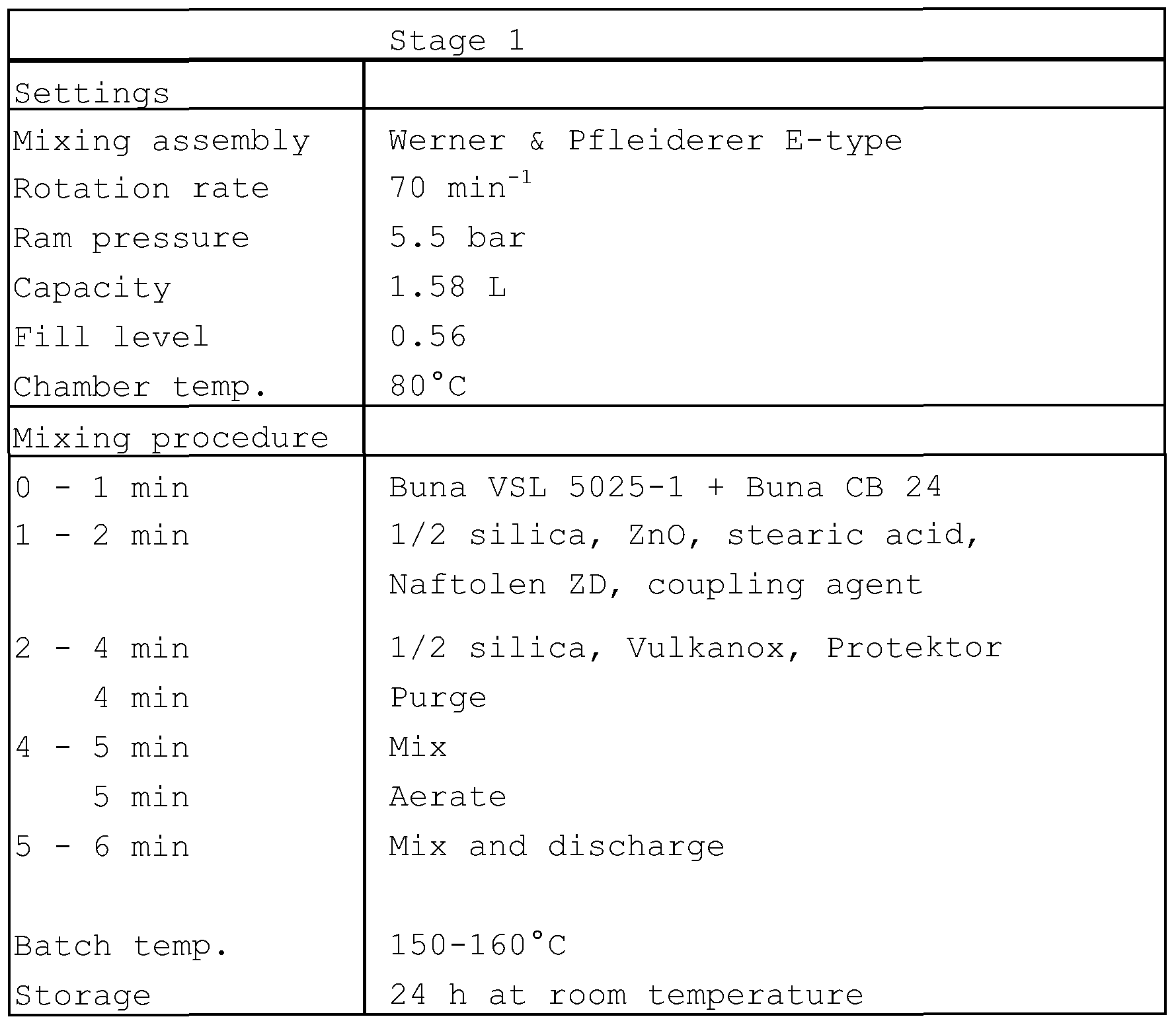
- the rubber mixtures are prepared in an internal mixer in accordance with the mixing specification in Table 2.
- Table 3 collates the methods for rubber testing.
- Table 4 shows the results of vulcanizate testing.
- the ideal vulcanization characteristic of a rubber mixture is a rectangular curve (Bayer AG, Handbuch fur die Kunststoffindustrie, 2 nd edition, 1991, page 360-361) .
- This incubation time can be characterized via the tl ⁇ % time.
- the intention is to minimize the reaction time, in order to ensure that cycle times are short.
- This reaction time can be characterized via the t80%-t20% time.
- the intention is therefore to maximize tl ⁇ % and minimize t80%-t20%.
- Figure 1 shows the vulcameter curves for mixtures 1, 2, 3 and 7.
- the rubber mixtures are prepared with the compounds from Examples 2 and 5. As in the previous example, addition is equimolar. Table 5 states the mixing specification. The mixtures are prepared as stated in Table 2 and tested as described in Table 3.
- Table 6 and Figure 2 show the vulcanizate results.
- Example 9 Variation in discharge temperature of mixtures from kneader
- the mixing specification used for the rubber mixtures is stated in Table 7 below.
- the silanes used comprise Example 6 (mixtures 17 - 22) and Si 266/2 bis (triethoxysilylpropyl) polysulphide, which was used for its preparation (mixtures 23 - 26) .
- Table 9 shows the results.
- Si NMR shows that >98% of all of the Si-OEt bonds have been replaced.
- Example 11 Vulcanizate study on the compound from Example 10
- the mixing specification used for the vulcanizate study is shown in Table 11.
- the mixing specification for preparation of the rubber mixtures is stated in Table 2.
- Table 3 lists the vulcanizate tests.
- the amounts added of the silanes used are equimolar .
- Si NMR shows that >98% of all of the Si-OEt bonds have been replaced.
- 1 H NMR analysis shows that the product comprises >91 mol% of compound [N (CH 2 -CH 2 -O-) 3 Si (CH 2 ) 3 ] S 2 [ (CH 2 ) 3 Si (-0- CH 2 -CH 2 ) 3 N].
- the melting range of the product isolated is 142-148°C.
- Si 266 bis (triethoxysilylpropyl) polysulphide are mixed in an apparatus with flask and reflux condenser under inert gas at room temperature with 159.5 g of triethanolamine (BASF AG), 700 g of ethanol and 3 g of finely divided NaOH.
- the mixture is stirred at 35°C for 240 min.
- the mixture is then stirred for 60 min at 0-5 0 C.
- the precipitated, colourless product is removed by filtration and dried at 70-105 0 C and 5-10 mbar. 229 g of product are isolated (86% of theory) .
- Si NMR shows that >97% of all of the Si-OEt bonds have been replaced.
- Si 266 bis (triethoxysilylpropyl) polysulphide are mixed in an apparatus with flask and reflux condenser under inert gas at room temperature with 159.5 g of triethanolamine (BASF AG) , 700 g of ethanol and 6 g of powdered NaOH. The mixture is stirred at 35°C for 120 min.
- the colourless product precipitated is removed by filtration at room temperature, washed with ethanol and dried at 65-100 0 C and 5-10 mbar. 204 g of product are isolated (77% of theory) .
- Si NMR shows that >98% of all of the Si-OEt bonds have been replaced.
- the melting range of the product isolated is 142-147°C.
- 1 H NMR analysis shows that the product comprises >91 mol% of compound [N (CH 2 -CH 2 -O-) 3 Si (CH 2 ) 3 ] S 2 [ (CH 2 ) 3 Si (-0-CH 2 -CH 2 ) 3 N] .
Landscapes
- Chemical & Material Sciences (AREA)
- Organic Chemistry (AREA)
- Health & Medical Sciences (AREA)
- Chemical Kinetics & Catalysis (AREA)
- Medicinal Chemistry (AREA)
- Polymers & Plastics (AREA)
- Compositions Of Macromolecular Compounds (AREA)
- Low-Molecular Organic Synthesis Reactions Using Catalysts (AREA)
- Processes Of Treating Macromolecular Substances (AREA)
Abstract
Description




Claims


Priority Applications (9)
| Application Number | Priority Date | Filing Date | Title |
|---|---|---|---|
| ES07703724.0T ES2658844T3 (en) | 2006-01-28 | 2007-01-09 | Rubber blends |
| US12/159,942 US8252863B2 (en) | 2006-01-28 | 2007-01-09 | Rubber mixtures |
| BRPI0707318-6A BRPI0707318B1 (en) | 2006-01-28 | 2007-01-09 | Rubber mixtures, their uses and processes for their preparation, and process for preparing organosilicon compounds |
| CA2640155A CA2640155C (en) | 2006-01-28 | 2007-01-09 | Rubber mixtures |
| SI200732016T SI1976926T1 (en) | 2006-01-28 | 2007-01-09 | Rubber mixtures |
| JP2008551746A JP5419463B2 (en) | 2006-01-28 | 2007-01-09 | Rubber mixture |
| EP07703724.0A EP1976926B1 (en) | 2006-01-28 | 2007-01-09 | Rubber mixtures |
| PL07703724T PL1976926T3 (en) | 2006-01-28 | 2007-01-09 | Rubber mixtures |
| KR1020087018399A KR101350101B1 (en) | 2006-01-28 | 2007-01-09 | Rubber mixtures |
Applications Claiming Priority (2)
| Application Number | Priority Date | Filing Date | Title |
|---|---|---|---|
| DE102006004062A DE102006004062A1 (en) | 2006-01-28 | 2006-01-28 | rubber compounds |
| DE102006004062.7 | 2006-01-28 |
Publications (1)
| Publication Number | Publication Date |
|---|---|
| WO2007085521A1 true WO2007085521A1 (en) | 2007-08-02 |
Family
ID=37913597
Family Applications (1)
| Application Number | Title | Priority Date | Filing Date |
|---|---|---|---|
| PCT/EP2007/050174 Ceased WO2007085521A1 (en) | 2006-01-28 | 2007-01-09 | Rubber mixtures |
Country Status (16)
| Country | Link |
|---|---|
| US (1) | US8252863B2 (en) |
| EP (1) | EP1976926B1 (en) |
| JP (1) | JP5419463B2 (en) |
| KR (1) | KR101350101B1 (en) |
| CN (2) | CN103756039B (en) |
| BR (1) | BRPI0707318B1 (en) |
| CA (1) | CA2640155C (en) |
| DE (1) | DE102006004062A1 (en) |
| ES (1) | ES2658844T3 (en) |
| HU (1) | HUE036212T2 (en) |
| PL (1) | PL1976926T3 (en) |
| PT (1) | PT1976926T (en) |
| RU (1) | RU2431643C2 (en) |
| SI (1) | SI1976926T1 (en) |
| TW (1) | TWI457388B (en) |
| WO (1) | WO2007085521A1 (en) |
Cited By (14)
| Publication number | Priority date | Publication date | Assignee | Title |
|---|---|---|---|---|
| WO2008084885A1 (en) * | 2007-01-12 | 2008-07-17 | Dow Corning Toray Co., Ltd. | Method for manufacturing a bis(silatranylalkyl) polysulfide, method for manufacturing a mixture of bis(silatranylalkyl) polysulfide etc., a mixture of bis(silatranylalkyl) polysulfide etc., and rubber composition |
| US7518009B2 (en) | 2005-05-03 | 2009-04-14 | Evonik Degussa Gmbh | Process for preparing mercaptoorganyl (alkoxysilanes) |
| US7705076B2 (en) | 2006-06-09 | 2010-04-27 | Evonik Degussa Gmbh | Rubber mixtures |
| JP2010111753A (en) * | 2008-11-05 | 2010-05-20 | Sumitomo Rubber Ind Ltd | Rubber composition and tire |
| DE102008054967A1 (en) | 2008-12-19 | 2010-06-24 | Evonik Degussa Gmbh | Silatran-containing particles |
| US7777063B2 (en) | 2005-08-17 | 2010-08-17 | Evonik Degussa Gmbh | Organosilicon compounds their preparation and their use |
| US7799938B2 (en) | 2005-12-16 | 2010-09-21 | Evonik Degussa Gmbh | Method for the production of (mercaptoorganyl)alkyl polyether silanes |
| US8067491B2 (en) | 2006-12-28 | 2011-11-29 | Momentive Performance Materials Inc. | Silated cyclic core polysulfides, their preparation and use in filled elastomer compositions |
| EP2246355A4 (en) * | 2008-02-22 | 2012-02-22 | Bridgestone Corp | Organic silicon compound, and rubber compositions, tires, primer compositions, paint compositions, and adhesives using same |
| US8188174B2 (en) | 2006-12-28 | 2012-05-29 | Momentive Performance Materials Inc. | Silated core polysulfides, their preparation and use in filled elastomer compositions |
| US8252863B2 (en) | 2006-01-28 | 2012-08-28 | Evonik Degussa Gmbh | Rubber mixtures |
| EP2875967A3 (en) * | 2013-11-25 | 2015-06-03 | The Goodyear Tire & Rubber Company | Functionalized elastomer and rubber composition with such an elastomer |
| EP2952778A1 (en) * | 2014-06-05 | 2015-12-09 | ContiTech Antriebssysteme GmbH | Elastic item, in particular v-ribbed belt |
| US9688837B2 (en) | 2013-11-25 | 2017-06-27 | The Goodyear Tire & Rubber Company | Functionalized polymer, rubber composition and pneumatic tire |
Families Citing this family (102)
| Publication number | Priority date | Publication date | Assignee | Title |
|---|---|---|---|---|
| DE102010003387A1 (en) | 2010-03-29 | 2011-09-29 | Evonik Degussa Gmbh | Process for the preparation of silicon-containing azodicarbamides |
| DE102010017501B4 (en) * | 2010-06-22 | 2016-05-04 | Continental Reifen Deutschland Gmbh | Rubber compound and its use |
| JP5845247B2 (en) * | 2011-04-06 | 2016-01-20 | 株式会社ブリヂストン | Method for producing rubber composition |
| WO2013058130A1 (en) | 2011-10-19 | 2013-04-25 | ダイキン工業株式会社 | Laminate |
| JP5838089B2 (en) * | 2011-12-26 | 2015-12-24 | 株式会社ブリヂストン | Method for producing rubber composition |
| DE102012107608A1 (en) | 2012-08-20 | 2014-02-20 | Continental Reifen Deutschland Gmbh | rubber compound |
| DE102012107607A1 (en) | 2012-08-20 | 2014-02-20 | Continental Reifen Deutschland Gmbh | rubber compound |
| DE102012110121A1 (en) | 2012-10-24 | 2014-04-24 | Continental Reifen Deutschland Gmbh | Rubber compound and pneumatic vehicle tires |
| DE102013101343A1 (en) | 2012-10-24 | 2014-04-24 | Continental Reifen Deutschland Gmbh | Rubber compound and pneumatic vehicle tires |
| CN104981509B (en) * | 2012-11-14 | 2017-12-12 | 普睿司曼股份公司 | Process for recycling waste polymer compositions including peroxide crosslinkers |
| CN103146085B (en) * | 2013-03-27 | 2015-07-22 | 东莞市建东橡胶制品有限公司 | Proportional remote control racing car tire and preparation method thereof |
| DE102013105193B4 (en) | 2013-05-22 | 2024-10-17 | Continental Reifen Deutschland Gmbh | rubber compound and use thereof in vehicle tires |
| DE102013106476B4 (en) | 2013-06-20 | 2025-01-02 | Continental Reifen Deutschland Gmbh | Rubber compound, its use, and vulcanized product |
| JP6147594B2 (en) * | 2013-07-09 | 2017-06-14 | 東洋ゴム工業株式会社 | Rubber composition for tire sidewall and pneumatic tire |
| EP2853557B1 (en) | 2013-09-27 | 2016-11-09 | Continental Reifen Deutschland GmbH | Sulfur crosslinkable rubber composition |
| DE102013110719A1 (en) | 2013-09-27 | 2015-04-02 | Continental Reifen Deutschland Gmbh | Sulfur crosslinkable rubber compound and pneumatic vehicle tires |
| DE102013110720A1 (en) | 2013-09-27 | 2015-04-02 | Continental Reifen Deutschland Gmbh | Sulfur crosslinkable rubber compound and pneumatic vehicle tires |
| JP6206152B2 (en) * | 2013-12-13 | 2017-10-04 | 信越化学工業株式会社 | Sulfur-containing organosilicon compound and production method thereof, compounding agent for rubber, and rubber composition |
| DE102014207668A1 (en) | 2014-04-23 | 2015-10-29 | Continental Reifen Deutschland Gmbh | Rubber compound and vehicle tires |
| DE102014211365A1 (en) | 2014-06-13 | 2015-12-17 | Continental Reifen Deutschland Gmbh | Reinforcement layer and vehicle tires |
| DE102014212489A1 (en) | 2014-06-27 | 2015-12-31 | Continental Reifen Deutschland Gmbh | Sulfur crosslinkable rubber compound and vehicle tires |
| DE102014212485B4 (en) | 2014-06-27 | 2025-11-20 | Continental Reifen Deutschland Gmbh | Method for producing a sulfur-crosslinkable rubber compound |
| DE102014214144A1 (en) | 2014-07-21 | 2016-01-21 | Continental Reifen Deutschland Gmbh | Sulfur crosslinkable rubber compound and vehicle tires |
| DE102014215865B4 (en) | 2014-08-11 | 2024-01-04 | Continental Reifen Deutschland Gmbh | Sulfur-cured rubber compound and vehicle tires |
| US9109073B1 (en) * | 2014-08-19 | 2015-08-18 | The Goodyear Tire & Rubber Company | Bifunctionalized polymer |
| US9090730B1 (en) | 2014-08-19 | 2015-07-28 | The Goodyear Tire & Rubber Company | Rubber composition and pneumatic tire |
| US9428628B2 (en) * | 2014-08-20 | 2016-08-30 | The Goodyear Tire & Rubber Company | Functionalized polymer, rubber composition and pneumatic tire |
| DE102014216710A1 (en) | 2014-08-22 | 2016-02-25 | Continental Reifen Deutschland Gmbh | Sulfur crosslinkable rubber compound and vehicle tires |
| DE102015203869A1 (en) | 2014-10-06 | 2016-04-07 | Continental Reifen Deutschland Gmbh | Sulfur crosslinkable rubber compound and vehicle tires |
| DE102014225821A1 (en) | 2014-12-15 | 2016-06-16 | Continental Reifen Deutschland Gmbh | A method for producing a vehicle tire having at least one reinforcement layer with Polyhexamethylenadipinamid as a reinforcing material, and vehicle tires |
| JP6378100B2 (en) * | 2015-01-28 | 2018-08-22 | 住友ゴム工業株式会社 | Rubber composition for tire and tire |
| DE102015208810A1 (en) | 2015-05-12 | 2016-11-17 | Continental Reifen Deutschland Gmbh | RAFT agent, process for the polymerization, polymer and rubber mixture and their use |
| DE102015208814A1 (en) | 2015-05-12 | 2016-11-17 | Continental Reifen Deutschland Gmbh | Process for the preparation of a copolymer, copolymer and rubber mixture and their use |
| DE102015208813A1 (en) | 2015-05-12 | 2016-11-17 | Continental Reifen Deutschland Gmbh | Monomer for copolymerization with alkenes, dienes, vinyl compounds and / or vinylidene compounds, process for the preparation of a copolymer, copolymer and rubber mixture and their use |
| DE102015210422A1 (en) | 2015-06-08 | 2016-12-08 | Continental Reifen Deutschland Gmbh | Rubber compound and vehicle tires |
| DE102015210421A1 (en) | 2015-06-08 | 2016-12-08 | Continental Reifen Deutschland Gmbh | Rubber compound and vehicle tires |
| DE102015210424A1 (en) | 2015-06-08 | 2016-12-08 | Continental Reifen Deutschland Gmbh | Rubber compound and vehicle tires |
| DE102015211563A1 (en) | 2015-06-23 | 2016-12-29 | Continental Reifen Deutschland Gmbh | Process for co-polymerization, co-polymer and rubber mixture and their use |
| JP6866348B2 (en) * | 2015-07-29 | 2021-04-28 | 株式会社ブリヂストン | Methods for preparing functionalized polymers, related functionalized compounds, and their preparation |
| DE102015214731B4 (en) | 2015-08-03 | 2024-10-17 | Continental Reifen Deutschland Gmbh | vehicle tires |
| DE102015215152A1 (en) | 2015-08-07 | 2017-02-09 | Continental Reifen Deutschland Gmbh | Rubber compound and vehicle tires |
| DE102015215327B4 (en) | 2015-08-11 | 2025-08-21 | Continental Reifen Deutschland Gmbh | Vulcanizate, its use and vehicle tires |
| DE102015216308B4 (en) | 2015-08-26 | 2024-10-17 | Continental Reifen Deutschland Gmbh | Rubber mixture, process for its preparation, vulcanizate thereof and use for the production of vehicle tires |
| DE102015218745B4 (en) | 2015-09-29 | 2024-09-12 | Continental Reifen Deutschland Gmbh | Rubber compound and vehicle tires |
| DE102015218746A1 (en) | 2015-09-29 | 2017-03-30 | Continental Reifen Deutschland Gmbh | Rubber compound and vehicle tires |
| ES2711632T3 (en) | 2015-09-29 | 2019-05-06 | Continental Reifen Deutschland Gmbh | Mixture of rubber and vehicle tire |
| ES2711631T3 (en) | 2015-09-29 | 2019-05-06 | Continental Reifen Deutschland Gmbh | Mixture of rubber and vehicle tire |
| DE102015224436A1 (en) * | 2015-12-07 | 2017-06-08 | Evonik Degussa Gmbh | rubber compounds |
| FR3045625A1 (en) * | 2015-12-22 | 2017-06-23 | Michelin & Cie | RUBBER COMPOSITION COMPRISING A PARTICULAR ORGANOSILANE AND AN ORGANIC ACID |
| DE102016201195A1 (en) | 2016-01-27 | 2017-07-27 | Continental Reifen Deutschland Gmbh | Rubber compound and vehicle tires |
| DE102016210469A1 (en) | 2016-06-14 | 2017-12-28 | Continental Reifen Deutschland Gmbh | Process for producing a reinforcement layer, reinforcement layer and vehicle tires |
| DE102016210468A1 (en) | 2016-06-14 | 2017-12-14 | Continental Reifen Deutschland Gmbh | Process for producing a reinforcement layer, reinforcement layer and vehicle tires |
| DE102016210467A1 (en) | 2016-06-14 | 2017-12-14 | Continental Reifen Deutschland Gmbh | Process for producing a reinforcement layer, reinforcement layer and vehicle tires |
| DE102016225581A1 (en) | 2016-12-20 | 2018-06-21 | Continental Reifen Deutschland Gmbh | Sulfur crosslinkable rubber compound, vulcanizate of the rubber mixture and vehicle tires |
| DE102016225584B4 (en) | 2016-12-20 | 2023-05-25 | Continental Reifen Deutschland Gmbh | Sulphur-crosslinkable rubber mixture, vulcanizate of the rubber mixture and its use in vehicle tires |
| KR102070382B1 (en) * | 2017-01-06 | 2020-01-29 | 주식회사 엘지화학 | Amine compound, Modified conjugated diene polymer comprising functional group derived therefrom and preparation method the modified conjugated diene polymer |
| WO2018128330A1 (en) * | 2017-01-06 | 2018-07-12 | 주식회사 엘지화학 | Amine compound, modified conjugated diene polymer comprising functional group derived from same, and method for producing modified conjugated diene polymer |
| CN106866723A (en) * | 2017-01-25 | 2017-06-20 | 湖北新蓝天新材料股份有限公司 | A kind of synthetic method of the double triethoxy silicon substrate ethane of alcohol silane crosslinker |
| DE102017201503A1 (en) | 2017-01-31 | 2018-08-02 | Continental Reifen Deutschland Gmbh | Process for the preparation of a raw material mixture, process for the preparation of a rubber mixture and process for the preparation of a vulcanizate |
| US20180282588A1 (en) | 2017-04-03 | 2018-10-04 | Eastman Chemical Company | Modified resins and uses thereof |
| US11236217B2 (en) | 2017-04-03 | 2022-02-01 | Continental Reifen Deutschland Gmbh | Modified resins and uses thereof |
| EP3606991B1 (en) | 2017-04-03 | 2025-02-19 | Synthomer Adhesive Technologies LLC | Modified resins and uses thereof |
| KR102511397B1 (en) | 2017-04-03 | 2023-03-17 | 신쏘머 어드히시브 테크놀로지스 엘엘씨 | Modified resins and uses thereof |
| WO2018191185A1 (en) | 2017-04-10 | 2018-10-18 | Eastman Chemical Company | Functionalized resin having a polar linker |
| JP6847257B2 (en) | 2017-04-10 | 2021-03-24 | コンチネンタル・ライフェン・ドイチュラント・ゲゼルシャフト・ミト・ベシュレンクテル・ハフツング | Functionalized resin with polar linker |
| CN110891989B (en) | 2017-04-10 | 2023-02-24 | 大陆轮胎德国有限公司 | Functionalized resins with polar linkers |
| US10815320B2 (en) | 2017-04-10 | 2020-10-27 | Eastman Chemical Company | Functionalized resin having a polar linker |
| DE102017207715A1 (en) * | 2017-05-08 | 2018-11-08 | Evonik Degussa Gmbh | Benzothiazole-containing silanes, processes for their preparation and their use |
| DE102017208137A1 (en) | 2017-05-15 | 2018-11-15 | Continental Reifen Deutschland Gmbh | Sulfur-crosslinked rubber mixture for vehicle tires comprising carbon nanotubes (CNT), vehicle tires having the sulfur-crosslinked rubber mixture, and processes for producing the sulfur-crosslinked rubber mixture containing CNT |
| DE102017211109A1 (en) | 2017-06-30 | 2019-01-03 | Continental Reifen Deutschland Gmbh | Silane, rubber composition containing the silane and vehicle tire comprising the rubber composition in at least one component |
| DE102017212455A1 (en) | 2017-07-20 | 2019-01-24 | Continental Reifen Deutschland Gmbh | A method of making a vehicle tire and vehicle tires made by the method and use of treated strength members |
| EP3450201B1 (en) | 2017-09-04 | 2020-07-01 | Continental Reifen Deutschland GmbH | Method for producing a rubber mixture and rubber mixture produced according to the method |
| EP3681751A1 (en) * | 2017-09-12 | 2020-07-22 | ARLANXEO Deutschland GmbH | Copolymer vulcanizates for use in contact with oxymethylene ether comprising media |
| EP3470457B2 (en) | 2017-10-10 | 2023-09-20 | Continental Reifen Deutschland GmbH | Sulphur-linkable rubber compound, vulcanizate of the rubber compound and vehicle tyres |
| DE102017218435A1 (en) | 2017-10-16 | 2019-04-18 | Continental Reifen Deutschland Gmbh | Rubber compound for vehicle tires, Vulkanisat the rubber compound and vehicle tires |
| CN107674260B (en) * | 2017-11-02 | 2019-09-24 | 山东兴鸿源轮胎有限公司 | A kind of tire tread glue of non-oxidation zinc |
| DE102017221232A1 (en) * | 2017-11-28 | 2019-05-29 | Continental Reifen Deutschland Gmbh | Sulfur crosslinkable rubber compound, vulcanizate of the rubber mixture and vehicle tires |
| DE102017221272A1 (en) * | 2017-11-28 | 2019-05-29 | Evonik Degussa Gmbh | Silane mixtures and process for their preparation |
| DE102017221863A1 (en) | 2017-12-05 | 2019-06-06 | Continental Reifen Deutschland Gmbh | Sulfur crosslinkable rubber compound, vulcanizate of the rubber mixture and vehicle tires |
| EP3524639B1 (en) | 2018-02-07 | 2020-10-07 | Continental Reifen Deutschland GmbH | Vehicle tyres |
| DE102018203650A1 (en) | 2018-03-12 | 2019-09-12 | Continental Reifen Deutschland Gmbh | Silane, rubber composition containing the silane and vehicle tire having the rubber composition in at least one component |
| DE102018203652A1 (en) | 2018-03-12 | 2019-09-12 | Continental Reifen Deutschland Gmbh | Silane, rubber composition containing the silane and vehicle tire having the rubber composition in at least one component |
| KR102005963B1 (en) | 2018-05-26 | 2019-07-31 | 에스케이이노베이션 주식회사 | Composition for etching and silane compound |
| KR102024758B1 (en) * | 2018-05-26 | 2019-09-25 | 에스케이이노베이션 주식회사 | Etching composition, method for etching insulating layer of semiconductor devices, method for preparing semiconductor devices and silane compound |
| US11208518B2 (en) | 2018-12-11 | 2021-12-28 | The Goodyear Tire & Rubber Company | Functionalized polymer, rubber composition and pneumatic tire |
| DE102018222073A1 (en) | 2018-12-18 | 2020-06-18 | Continental Reifen Deutschland Gmbh | Device for producing a rubber mixture by mixing rubber mixture components and using an extraction unit and method for producing a rubber mixture from rubber mixture components |
| US10947380B2 (en) | 2018-12-20 | 2021-03-16 | The Goodyear Tire & Rubber Company | Functionalized polymer, rubber composition and pneumatic tire |
| KR102576576B1 (en) * | 2018-12-27 | 2023-09-08 | 에스케이이노베이션 주식회사 | Etching composition, method for etching insulating layer of semiconductor devices using the same and method for preparing semiconductor devices |
| KR102576575B1 (en) * | 2018-12-27 | 2023-09-08 | 에스케이이노베이션 주식회사 | Etching composition, method for etching insulating layer of semiconductor devices using the same and method for preparing semiconductor devices |
| KR102576574B1 (en) * | 2018-12-27 | 2023-09-08 | 에스케이이노베이션 주식회사 | Etching composition, method for etching insulating layer of semiconductor devices using the same and method for preparing semiconductor devices |
| DE102019206001A1 (en) | 2019-04-26 | 2020-10-29 | Continental Reifen Deutschland Gmbh | Silane, rubber mixture containing the silane and vehicle tire which has the rubber mixture in at least one component and a method for producing the silane |
| DE102019205996A1 (en) | 2019-04-26 | 2020-10-29 | Continental Reifen Deutschland Gmbh | Silane, rubber mixture containing the silane and vehicle tire which has the rubber mixture in at least one component and a method for producing the silane |
| DE102019206005A1 (en) | 2019-04-26 | 2020-10-29 | Continental Reifen Deutschland Gmbh | Silane, rubber mixture containing the silane and vehicle tire which has the rubber mixture in at least one component and a method for producing the silane |
| DE102019206000A1 (en) | 2019-04-26 | 2020-10-29 | Continental Reifen Deutschland Gmbh | Silane, rubber mixture containing the silane and vehicle tire which has the rubber mixture in at least one component and a method for producing the silane |
| DE102019212728A1 (en) | 2019-08-26 | 2021-03-04 | Continental Reifen Deutschland Gmbh | Rubber compound and pneumatic vehicle tires |
| CN110777603B (en) * | 2019-10-26 | 2022-02-22 | 苏州大乘环保新材有限公司 | Construction method of environment-friendly water-based all-plastic runway and environment-friendly water-based all-plastic runway |
| DE102020202090A1 (en) | 2020-02-19 | 2021-08-19 | Continental Reifen Deutschland Gmbh | Device for producing silica-containing rubber mixtures, method for producing a rubber mixture and corresponding uses of the device |
| DE102020207121A1 (en) | 2020-06-08 | 2021-12-09 | Continental Reifen Deutschland Gmbh | Method for devulcanizing a vulcanized rubber mixture, device for carrying out the method and uses of the device as well as rubber mixture as well as pneumatic vehicle tires or technical rubber articles, comprising a component made from the rubber mixture |
| US20220033627A1 (en) | 2020-07-29 | 2022-02-03 | Fina Technology, Inc. | Silane modified styrene butadiene copolymer for high performance in dry adherence, wet adherence and rolling resistance |
| KR102541346B1 (en) * | 2021-09-14 | 2023-06-12 | 삼영기술주식회사 | Waterproof insulation ring and insulated valve chamber using the same |
| CN113861522A (en) * | 2021-10-25 | 2021-12-31 | 昆明翔鹰机电设备有限公司 | Wear-resistant anti-fatigue synthetic rubber material |
| KR20250026327A (en) * | 2022-06-23 | 2025-02-25 | 란세스 도이치란트 게엠베하 | Rubber blend containing at least one functionalized synthetic rubber and at least one ethoxylated alcohol |
Citations (6)
| Publication number | Priority date | Publication date | Assignee | Title |
|---|---|---|---|---|
| DE2405758A1 (en) | 1974-02-07 | 1975-08-21 | Degussa | PROCESS FOR PRODUCING ORGANOSILICIUM COMPOUNDS CONTAINING SULFUR |
| US4048206A (en) | 1975-04-22 | 1977-09-13 | Mikhail Grigorievich Voronkov | Process for the production of 1-organylsilatranes and carbofunctional derivatives thereof |
| DE2712866A1 (en) | 1977-03-24 | 1978-09-28 | Degussa | PROCESS FOR PRODUCING SULFUR-CONTAINING ORGANOSILICIUM COMPOUNDS |
| DE2542534C3 (en) | 1975-09-24 | 1979-08-02 | Deutsche Gold- Und Silber-Scheideanstalt Vormals Roessler, 6000 Frankfurt | Process for the preparation of sulfur-containing organosilicon compounds |
| US6433206B1 (en) | 2001-11-05 | 2002-08-13 | Crompton Corporation | Process for preparing silylorganomercaptans |
| EP1323549A2 (en) * | 2001-12-04 | 2003-07-02 | The Goodyear Tire & Rubber Company | Tire with a cord reinforced carcass ply and/or circumferential carcass belt of a natural rubber-rich, silica-rich rubber composition |
Family Cites Families (33)
| Publication number | Priority date | Publication date | Assignee | Title |
|---|---|---|---|---|
| DE2141159C3 (en) | 1971-08-17 | 1983-11-24 | Degussa Ag, 6000 Frankfurt | Organosilicon compounds containing sulfur |
| US3978103A (en) | 1971-08-17 | 1976-08-31 | Deutsche Gold- Und Silber-Scheideanstalt Vormals Roessler | Sulfur containing organosilicon compounds |
| DE2212239C3 (en) | 1972-03-14 | 1984-03-15 | Degussa Ag, 6000 Frankfurt | Process for the preparation of sulfur-containing organosilicon compounds |
| SU514841A1 (en) * | 1974-07-09 | 1976-05-25 | Иркутский Институт Органической Химии Сибирского Отделения Ссср | Method of producing bis (silatranylalkyl) sulfides |
| JPS5148634A (en) | 1974-10-08 | 1976-04-26 | Microbial Chem Res Found | Taiseikinnyukona 11nn * arufua hidorokishi omega aminoashiru * 6**nn mechiru 3* *hh jideokishikanamaishin b no seizoho |
| JPS6033838A (en) | 1983-08-01 | 1985-02-21 | Mitsubishi Heavy Ind Ltd | Tube expanding device |
| US4689082A (en) * | 1985-10-28 | 1987-08-25 | Basf Corporation | Polymer composition |
| JP3771942B2 (en) * | 1993-02-15 | 2006-05-10 | 住友ゴム工業株式会社 | Tread rubber composition |
| FR2743564A1 (en) | 1996-01-11 | 1997-07-18 | Michelin & Cie | RUBBER COMPOSITIONS FOR SILICA-BASED TIRE CASINGS CONTAINING A REINFORCING ADDITIVE BASED ON A FUNCTIONALIZED POLYORGANOSILOXANE AND AN ORGANOSILANE COMPOUND. |
| JP2002121327A (en) * | 2000-10-16 | 2002-04-23 | Sumitomo Rubber Ind Ltd | Tread rubber composition and method for producing the same |
| DE10132943A1 (en) | 2001-07-06 | 2003-01-23 | Degussa | Silane-modified oxidic or silicate filler, process for its production and its use |
| DE10132941A1 (en) | 2001-07-06 | 2003-01-23 | Degussa | Oligomeric organosilanes, process for their preparation and their use |
| EP1285926B1 (en) | 2001-08-06 | 2004-05-12 | Degussa AG | Organosilicon compounds |
| JP4391238B2 (en) * | 2001-12-20 | 2009-12-24 | ソシエテ ド テクノロジー ミシュラン | Tire rubber composition containing coupling agent having polythiosulfenamide functional group |
| DE10218350A1 (en) | 2002-04-25 | 2003-11-20 | Degussa | Silane-modified oxidic or silicate filler, process for its production and its use |
| DE10223658A1 (en) | 2002-05-28 | 2003-12-18 | Degussa | Organosilicon compounds, process for their preparation and their use |
| DE10330221A1 (en) * | 2002-08-03 | 2004-02-12 | Degussa Ag | Highly disperse precipitated silica having high CTAB surface area, useful e.g. as filler in tires for commercial vehicles, motor cycles and high speed vehicles, and as antiblocking agents, and carriers for agrochemicals and foodstuffs |
| ES2268210T5 (en) * | 2003-05-02 | 2010-05-19 | Evonik Degussa Gmbh | ORGANOSILAN MOTHER BLEND. |
| DE10320779A1 (en) | 2003-05-09 | 2004-11-18 | Degussa Ag | Corrosion protection on metals |
| DE10320765A1 (en) | 2003-05-09 | 2004-11-25 | Degussa Ag | Means for coating metals to protect against corrosion |
| DE10327624B3 (en) | 2003-06-20 | 2004-12-30 | Degussa Ag | Organosilicon compounds, process for their preparation, and their use |
| DE10351736B3 (en) | 2003-11-06 | 2005-01-13 | Degussa Ag | Preparation of (mercaptoorganyl)alkoxysilanes comprises reacting alkali metal sulfide with mixture of (haloorganyl)alkoxysilane and (haloorganyl)halosilane in alcohol with exclusion of air and at elevated pressure |
| DE10354616A1 (en) | 2003-11-21 | 2005-06-23 | Degussa Ag | rubber compounds |
| US7211611B2 (en) * | 2003-12-11 | 2007-05-01 | Nike, Inc. | Rubber compositions with non-petroleum oils |
| DE102004061014A1 (en) | 2004-12-18 | 2006-06-29 | Degussa Ag | rubber compounds |
| DE102005057801A1 (en) | 2005-01-20 | 2006-08-03 | Degussa Ag | mercaptosilanes |
| DE102005052233A1 (en) | 2005-03-07 | 2006-09-21 | Degussa Ag | Process for the preparation of organosilanes |
| DE102005020535B3 (en) | 2005-05-03 | 2006-06-08 | Degussa Ag | Preparation of mercapto organyl(alkoxysilane) comprises reaction of bis(alkoxysilylorganyl)polysulfide with hydrogen in the presence of an alcohol and a doped metal catalyst (containing e.g. (iron) compound and a doping component) |
| DE102005038791A1 (en) | 2005-08-17 | 2007-02-22 | Degussa Ag | New organosilicon compounds based on triethanolamine, useful as components of rubber mixtures for making e.g. tires, tubes and cable coatings |
| DE102005038794A1 (en) | 2005-08-17 | 2007-02-22 | Degussa Ag | rubber compounds |
| DE102005060122A1 (en) | 2005-12-16 | 2007-06-21 | Degussa Gmbh | Process for the preparation of (mercaptoorganyl) alkyl polyether silanes |
| DE102006004062A1 (en) | 2006-01-28 | 2007-08-09 | Degussa Gmbh | rubber compounds |
| DE102006008670A1 (en) | 2006-02-24 | 2007-08-30 | Degussa Gmbh | rubber compounds |
-
2006
- 2006-01-28 DE DE102006004062A patent/DE102006004062A1/en not_active Ceased
-
2007
- 2007-01-09 US US12/159,942 patent/US8252863B2/en not_active Expired - Fee Related
- 2007-01-09 HU HUE07703724A patent/HUE036212T2/en unknown
- 2007-01-09 EP EP07703724.0A patent/EP1976926B1/en active Active
- 2007-01-09 CN CN201310432303.6A patent/CN103756039B/en active Active
- 2007-01-09 JP JP2008551746A patent/JP5419463B2/en active Active
- 2007-01-09 BR BRPI0707318-6A patent/BRPI0707318B1/en active IP Right Grant
- 2007-01-09 WO PCT/EP2007/050174 patent/WO2007085521A1/en not_active Ceased
- 2007-01-09 CN CNA2007800037644A patent/CN101374899A/en active Pending
- 2007-01-09 RU RU2008134624/05A patent/RU2431643C2/en active
- 2007-01-09 PL PL07703724T patent/PL1976926T3/en unknown
- 2007-01-09 ES ES07703724.0T patent/ES2658844T3/en active Active
- 2007-01-09 PT PT77037240T patent/PT1976926T/en unknown
- 2007-01-09 SI SI200732016T patent/SI1976926T1/en unknown
- 2007-01-09 KR KR1020087018399A patent/KR101350101B1/en active Active
- 2007-01-09 CA CA2640155A patent/CA2640155C/en active Active
- 2007-01-25 TW TW096102878A patent/TWI457388B/en active
Patent Citations (7)
| Publication number | Priority date | Publication date | Assignee | Title |
|---|---|---|---|---|
| US3997581A (en) * | 1974-02-04 | 1976-12-14 | Deutsche Gold- Und Silber-Scheideanstalt Vormals Roessler | Process for the production of sulfur containing organosilicon compounds |
| DE2405758A1 (en) | 1974-02-07 | 1975-08-21 | Degussa | PROCESS FOR PRODUCING ORGANOSILICIUM COMPOUNDS CONTAINING SULFUR |
| US4048206A (en) | 1975-04-22 | 1977-09-13 | Mikhail Grigorievich Voronkov | Process for the production of 1-organylsilatranes and carbofunctional derivatives thereof |
| DE2542534C3 (en) | 1975-09-24 | 1979-08-02 | Deutsche Gold- Und Silber-Scheideanstalt Vormals Roessler, 6000 Frankfurt | Process for the preparation of sulfur-containing organosilicon compounds |
| DE2712866A1 (en) | 1977-03-24 | 1978-09-28 | Degussa | PROCESS FOR PRODUCING SULFUR-CONTAINING ORGANOSILICIUM COMPOUNDS |
| US6433206B1 (en) | 2001-11-05 | 2002-08-13 | Crompton Corporation | Process for preparing silylorganomercaptans |
| EP1323549A2 (en) * | 2001-12-04 | 2003-07-02 | The Goodyear Tire & Rubber Company | Tire with a cord reinforced carcass ply and/or circumferential carcass belt of a natural rubber-rich, silica-rich rubber composition |
Non-Patent Citations (2)
| Title |
|---|
| H.D LUGINSLAND: "A Review on the chemistry and the reinforcement of the silica-silane filler system for rubber applications", 2002, SHAKER VERLAG, pages: 34 |
| TECHNOLOGY, vol. 6, no. 1, 1992, pages 127 - 149 |
Cited By (22)
| Publication number | Priority date | Publication date | Assignee | Title |
|---|---|---|---|---|
| US7518009B2 (en) | 2005-05-03 | 2009-04-14 | Evonik Degussa Gmbh | Process for preparing mercaptoorganyl (alkoxysilanes) |
| US7777063B2 (en) | 2005-08-17 | 2010-08-17 | Evonik Degussa Gmbh | Organosilicon compounds their preparation and their use |
| US7799938B2 (en) | 2005-12-16 | 2010-09-21 | Evonik Degussa Gmbh | Method for the production of (mercaptoorganyl)alkyl polyether silanes |
| US8252863B2 (en) | 2006-01-28 | 2012-08-28 | Evonik Degussa Gmbh | Rubber mixtures |
| US7705076B2 (en) | 2006-06-09 | 2010-04-27 | Evonik Degussa Gmbh | Rubber mixtures |
| US8501849B2 (en) | 2006-12-28 | 2013-08-06 | Momentive Performance Materials Inc. | Silated core polysulfides, their preparation and use in filled elastomer compositions |
| US8188174B2 (en) | 2006-12-28 | 2012-05-29 | Momentive Performance Materials Inc. | Silated core polysulfides, their preparation and use in filled elastomer compositions |
| US8067491B2 (en) | 2006-12-28 | 2011-11-29 | Momentive Performance Materials Inc. | Silated cyclic core polysulfides, their preparation and use in filled elastomer compositions |
| US8093323B2 (en) | 2007-01-12 | 2012-01-10 | Dow Corning Toray Company, Ltd. | Method for manufacturing a bis(silatranylalkyl) polysulfide, method for manufacturing a mixture of bis(silatranylalkyl) polysulfide etc., a mixture of bis(silatranylalkyl) polysulfide etc., and rubber composition |
| WO2008084885A1 (en) * | 2007-01-12 | 2008-07-17 | Dow Corning Toray Co., Ltd. | Method for manufacturing a bis(silatranylalkyl) polysulfide, method for manufacturing a mixture of bis(silatranylalkyl) polysulfide etc., a mixture of bis(silatranylalkyl) polysulfide etc., and rubber composition |
| CN102007135B (en) * | 2008-02-22 | 2014-07-23 | 株式会社普利司通 | Silicone compound, rubber composition, tire, primer composition, coating composition and adhesive using the same |
| EP2246355A4 (en) * | 2008-02-22 | 2012-02-22 | Bridgestone Corp | Organic silicon compound, and rubber compositions, tires, primer compositions, paint compositions, and adhesives using same |
| US8183403B2 (en) | 2008-02-22 | 2012-05-22 | Bridgestone Corporation | Organosilicon compound as well as rubber composition, tire, primer composition, paint composition and adhesive using the same |
| JP2010111753A (en) * | 2008-11-05 | 2010-05-20 | Sumitomo Rubber Ind Ltd | Rubber composition and tire |
| DE102008054967A1 (en) | 2008-12-19 | 2010-06-24 | Evonik Degussa Gmbh | Silatran-containing particles |
| EP2206742A1 (en) * | 2008-12-19 | 2010-07-14 | Evonik Degussa GmbH | Particle containing silatrane |
| CN103756021A (en) * | 2008-12-19 | 2014-04-30 | 赢创德固赛有限公司 | Particle containing silatrane |
| CN101759891A (en) * | 2008-12-19 | 2010-06-30 | 赢创德固赛有限责任公司 | Particle containing silatrane |
| EP2875967A3 (en) * | 2013-11-25 | 2015-06-03 | The Goodyear Tire & Rubber Company | Functionalized elastomer and rubber composition with such an elastomer |
| US9109103B2 (en) | 2013-11-25 | 2015-08-18 | The Goodyear Tire & Rubber Company | Functionalized polymer, rubber composition and pneumatic tire |
| US9688837B2 (en) | 2013-11-25 | 2017-06-27 | The Goodyear Tire & Rubber Company | Functionalized polymer, rubber composition and pneumatic tire |
| EP2952778A1 (en) * | 2014-06-05 | 2015-12-09 | ContiTech Antriebssysteme GmbH | Elastic item, in particular v-ribbed belt |
Also Published As
| Publication number | Publication date |
|---|---|
| EP1976926A1 (en) | 2008-10-08 |
| RU2008134624A (en) | 2010-03-10 |
| CA2640155C (en) | 2014-02-25 |
| JP5419463B2 (en) | 2014-02-19 |
| EP1976926B1 (en) | 2017-12-20 |
| CA2640155A1 (en) | 2007-08-02 |
| JP2009524715A (en) | 2009-07-02 |
| SI1976926T1 (en) | 2018-04-30 |
| HUE036212T2 (en) | 2018-06-28 |
| PT1976926T (en) | 2018-02-02 |
| US20090221751A1 (en) | 2009-09-03 |
| DE102006004062A1 (en) | 2007-08-09 |
| BRPI0707318B1 (en) | 2018-03-06 |
| CN103756039B (en) | 2017-08-18 |
| KR20080098589A (en) | 2008-11-11 |
| CN101374899A (en) | 2009-02-25 |
| BRPI0707318A2 (en) | 2011-05-03 |
| TWI457388B (en) | 2014-10-21 |
| PL1976926T3 (en) | 2018-06-29 |
| KR101350101B1 (en) | 2014-01-09 |
| ES2658844T3 (en) | 2018-03-12 |
| US8252863B2 (en) | 2012-08-28 |
| RU2431643C2 (en) | 2011-10-20 |
| TW200740905A (en) | 2007-11-01 |
| CN103756039A (en) | 2014-04-30 |
Similar Documents
| Publication | Publication Date | Title |
|---|---|---|
| EP1976926B1 (en) | Rubber mixtures | |
| JP4921799B2 (en) | Mercaptosilane | |
| KR101122952B1 (en) | Organosilicon Compounds | |
| US7662874B2 (en) | Rubber mixtures | |
| CA2530346C (en) | Rubber mixtures containing mercaptosilanes | |
| KR100964805B1 (en) | Organosilicon compounds | |
| EP2026982A1 (en) | Rubber mixtures | |
| EP2041146A1 (en) | Mixtures of silicon-containing coupling reagents | |
| CA2556156A1 (en) | Organosilicon compounds, their preparation and their use | |
| US8242193B2 (en) | Rubber mixtures | |
| KR20000011376A (en) | New oligomeric organosilicon compounds, their use in rubber mixtures and for the production of shaped articles | |
| MXPA06000698A (en) | Mercaptosilanes |
Legal Events
| Date | Code | Title | Description |
|---|---|---|---|
| 121 | Ep: the epo has been informed by wipo that ep was designated in this application | ||
| WWE | Wipo information: entry into national phase |
Ref document number: 2277/KOLNP/2008 Country of ref document: IN |
|
| WWE | Wipo information: entry into national phase |
Ref document number: 2007703724 Country of ref document: EP |
|
| WWE | Wipo information: entry into national phase |
Ref document number: MX/a/2008/009346 Country of ref document: MX |
|
| WWE | Wipo information: entry into national phase |
Ref document number: 2640155 Country of ref document: CA |
|
| WWE | Wipo information: entry into national phase |
Ref document number: 1020087018399 Country of ref document: KR |
|
| WWE | Wipo information: entry into national phase |
Ref document number: 200780003764.4 Country of ref document: CN Ref document number: 2008551746 Country of ref document: JP |
|
| NENP | Non-entry into the national phase |
Ref country code: DE |
|
| ENP | Entry into the national phase |
Ref document number: 2008134624 Country of ref document: RU Kind code of ref document: A |
|
| WWE | Wipo information: entry into national phase |
Ref document number: 12159942 Country of ref document: US |
|
| ENP | Entry into the national phase |
Ref document number: PI0707318 Country of ref document: BR Kind code of ref document: A2 Effective date: 20080728 |