WO2007103348A2 - Process for preparing water-soluble polyethylene glycol conjugates of macrolide immunosuppressants - Google Patents
Process for preparing water-soluble polyethylene glycol conjugates of macrolide immunosuppressants Download PDFInfo
- Publication number
- WO2007103348A2 WO2007103348A2 PCT/US2007/005646 US2007005646W WO2007103348A2 WO 2007103348 A2 WO2007103348 A2 WO 2007103348A2 US 2007005646 W US2007005646 W US 2007005646W WO 2007103348 A2 WO2007103348 A2 WO 2007103348A2
- Authority
- WO
- WIPO (PCT)
- Prior art keywords
- lipase
- process according
- acylated
- rapamycin
- reacting
- Prior art date
- Legal status (The legal status is an assumption and is not a legal conclusion. Google has not performed a legal analysis and makes no representation as to the accuracy of the status listed.)
- Ceased
Links
- 0 C[C@](Cc(cc1OC)ccc1OC(C(C)(CO)COC(***)=O)=O)[C@](CC([C@](C)C=C(C)[C@]([C@](C([C@](C)C[C@](C)C=CC=CC=C(C)[C@](C[C@@](CC[C@]1C)O[C@]1(C(C(N1[C@]2CCCC1)=O)=O)O)OC)=O)OC)O)=O)OC2=* Chemical compound C[C@](Cc(cc1OC)ccc1OC(C(C)(CO)COC(***)=O)=O)[C@](CC([C@](C)C=C(C)[C@]([C@](C([C@](C)C[C@](C)C=CC=CC=C(C)[C@](C[C@@](CC[C@]1C)O[C@]1(C(C(N1[C@]2CCCC1)=O)=O)O)OC)=O)OC)O)=O)OC2=* 0.000 description 3
Classifications
-
- C—CHEMISTRY; METALLURGY
- C07—ORGANIC CHEMISTRY
- C07D—HETEROCYCLIC COMPOUNDS
- C07D498/00—Heterocyclic compounds containing in the condensed system at least one hetero ring having nitrogen and oxygen atoms as the only ring hetero atoms
- C07D498/12—Heterocyclic compounds containing in the condensed system at least one hetero ring having nitrogen and oxygen atoms as the only ring hetero atoms in which the condensed system contains three hetero rings
- C07D498/18—Bridged systems
-
- A—HUMAN NECESSITIES
- A61—MEDICAL OR VETERINARY SCIENCE; HYGIENE
- A61K—PREPARATIONS FOR MEDICAL, DENTAL OR TOILETRY PURPOSES
- A61K47/00—Medicinal preparations characterised by the non-active ingredients used, e.g. carriers or inert additives; Targeting or modifying agents chemically bound to the active ingredient
- A61K47/50—Medicinal preparations characterised by the non-active ingredients used, e.g. carriers or inert additives; Targeting or modifying agents chemically bound to the active ingredient the non-active ingredient being chemically bound to the active ingredient, e.g. polymer-drug conjugates
-
- A—HUMAN NECESSITIES
- A61—MEDICAL OR VETERINARY SCIENCE; HYGIENE
- A61K—PREPARATIONS FOR MEDICAL, DENTAL OR TOILETRY PURPOSES
- A61K47/00—Medicinal preparations characterised by the non-active ingredients used, e.g. carriers or inert additives; Targeting or modifying agents chemically bound to the active ingredient
- A61K47/50—Medicinal preparations characterised by the non-active ingredients used, e.g. carriers or inert additives; Targeting or modifying agents chemically bound to the active ingredient the non-active ingredient being chemically bound to the active ingredient, e.g. polymer-drug conjugates
- A61K47/51—Medicinal preparations characterised by the non-active ingredients used, e.g. carriers or inert additives; Targeting or modifying agents chemically bound to the active ingredient the non-active ingredient being chemically bound to the active ingredient, e.g. polymer-drug conjugates the non-active ingredient being a modifying agent
- A61K47/56—Medicinal preparations characterised by the non-active ingredients used, e.g. carriers or inert additives; Targeting or modifying agents chemically bound to the active ingredient the non-active ingredient being chemically bound to the active ingredient, e.g. polymer-drug conjugates the non-active ingredient being a modifying agent the modifying agent being an organic macromolecular compound, e.g. an oligomeric, polymeric or dendrimeric molecule
- A61K47/59—Medicinal preparations characterised by the non-active ingredients used, e.g. carriers or inert additives; Targeting or modifying agents chemically bound to the active ingredient the non-active ingredient being chemically bound to the active ingredient, e.g. polymer-drug conjugates the non-active ingredient being a modifying agent the modifying agent being an organic macromolecular compound, e.g. an oligomeric, polymeric or dendrimeric molecule obtained otherwise than by reactions only involving carbon-to-carbon unsaturated bonds, e.g. polyureas or polyurethanes
- A61K47/60—Medicinal preparations characterised by the non-active ingredients used, e.g. carriers or inert additives; Targeting or modifying agents chemically bound to the active ingredient the non-active ingredient being chemically bound to the active ingredient, e.g. polymer-drug conjugates the non-active ingredient being a modifying agent the modifying agent being an organic macromolecular compound, e.g. an oligomeric, polymeric or dendrimeric molecule obtained otherwise than by reactions only involving carbon-to-carbon unsaturated bonds, e.g. polyureas or polyurethanes the organic macromolecular compound being a polyoxyalkylene oligomer, polymer or dendrimer, e.g. PEG, PPG, PEO or polyglycerol
-
- A—HUMAN NECESSITIES
- A61—MEDICAL OR VETERINARY SCIENCE; HYGIENE
- A61P—SPECIFIC THERAPEUTIC ACTIVITY OF CHEMICAL COMPOUNDS OR MEDICINAL PREPARATIONS
- A61P37/00—Drugs for immunological or allergic disorders
- A61P37/02—Immunomodulators
- A61P37/06—Immunosuppressants, e.g. drugs for graft rejection
-
- A—HUMAN NECESSITIES
- A61—MEDICAL OR VETERINARY SCIENCE; HYGIENE
- A61P—SPECIFIC THERAPEUTIC ACTIVITY OF CHEMICAL COMPOUNDS OR MEDICINAL PREPARATIONS
- A61P43/00—Drugs for specific purposes, not provided for in groups A61P1/00-A61P41/00
Definitions
- This invention relates to processes for preparing water soluble poly(ethylene glycol) conjugates of macrolide immunosuppressants sirolimus (rapamycin), everolimus, temsirolimus (CCI-779), tacrolimus (FK506) and ascomycin (FK520).
- Rapamycin (1), tacrolimus (FK506, 2) and ascomycin (FK520, 3) are structurally similar macrocyclic polyketides and all are potent immunosuppressants that interact with the same intracellular receptors, but have different modes of action, suppressing T-cell activation at different stages (Rosen et al., "Natural products as probes of cellular function: studies of immunophilins” Angew. Chem. Int. Ed. Engl. 1992, 31, 384-400).
- These macrolides have antimicrobial activity and are also effective in animal models of autoimmune diseases including experimental allergic encephalomyelitis, arthritis, animal models of diabetes, the MRL/lpr mouse model of SLE, hyperproliferative ski diseases, and uveoretinitis.
- tacrolimus has a solubility of 12 ⁇ g/rnL in water.
- Such a low solubility requires a rather complicated formulation.
- 200 mg/mL of hydrogenated polyoxy 60 castor oil (HCO-60) and 80% (v/v) absolute alcohol are required as the solubilizing aid for dissolving 5 mg of tacrolimus for intravenous injections.
- Rapamycin has a solubility of about 2.6 ⁇ g/mL in water and low oral bioavailability ( ⁇ 15%) (Yatscoff et al., "Rapamycin: distribution, pharmacokinetics, and therapeutic range investigations” Ther. Drug Monit. 1995, 17, 666-671). These characteristics have limited rapamycin's clinical applications other than low-dosage treatment such as immunosuppression, despite it is also a potent inhibitor of tumor growth with a typical IC 5 o ⁇ 5O nm against various solid tumors.
- Polyethylene glycol (PEG) and methoxy polyethylene glycol (mPEG) are linear or branched, neutral polymers available in a variety of molecular weights with low polydispersities (M w /M n ⁇ 1.05). These water/organic solvent soluble, non-toxic polymers have been found useful in biological and pharmaceutical applications. One such application is the binding of these polymers with the non or sparingly water-soluble small molecule therapeutics to make water soluble PEG-drug conjugates, termed PEGylation.
- processes are provided for preparing polyethylene glycol conjugates of immunosuppressive macrolides.
- rapamycin including rapamycin, everolimus, temsirolimus; tacrolimus; or ascomycin in high yields.
- the processes include simple isolation steps, which center on the installation of an ester linkage in these macrolides using lipases with complete regioselectivity and excellent yield of the pegylated conjugate.
- a polyethylene glycol, abbreviated (PEG) is a linear polymer having hydroxyl groups at each terminus:
- This formula can be represented as HO-PEG-OH, where it is understood that -PEG- represents the polymer backbone without the terminal groups:
- a polyethylene glycol can also include mono-activated, alkyl-terminated polyethylene glycols, such as methoxy-PEG-OH (mPEGOH):
- mPEGOH methoxy-PEG-OH
- the activated mPEG's are methoxy-PEG-SH (mPEGSH):
- a polyethylene glycol can also include bis-activated, thiol-terminated polyethylene glycols, such as HS-PEG-SH (PEGSH):
- polyethylene glycols vary substantially by molecular weight, polymers having molecular weights ranges from about 400 to about 30,000 are usually selected. In one example, polyethylene glycols of molecular weights of from about 1000 to about 30,000 are selected. In another example, polyethylene glycols of molecular weights of from about 2500 to 20,000 are selected. In a further example, polyethylene glycols of molecular weights of from about 5000 to about 20,000 are selected.
- n is an integer, typically in the range of from 10 to 1000.
- a rapamycin refers to rapamycin and to compounds which may be chemically or biologically modified as derivatives of the rapamycin nucleus, while still retaining biological activities. Accordingly, the term “a rapamycin” includes esters, ethers, carbonates, carbamates, oximes, hydrazones, and hydroxylamines of rapamycin, as well as rapamycins in which functional groups on the nucleus have been modified, for example through reduction or oxidation. The term “a rapamycin” also includes pharmaceutically acceptable salts of rapamycins, which are capable of forming such salts, either by virtue of containing an acidic or basic moiety.
- the esters and ethers of rapamycin are esters and ethers of the hydroxyl group at the 31 -position of the rapamycin nucleus, esters and ethers of a hydroxyl group at the 27-position (following chemical reduction of the 27-ketone), esters and ethers of the hydroxyl group at the 42-position, particularly hydroxyalkyl, hydroxyalkenyl, hydroxyalkylaryl esters or ethers of hydroxyl group at the 42-position of the rapamycin.
- the oximes, hydrazones, and hydroxylamines are of a ketone of the rapamycin nucleus.
- 31 -esters and ethers of rapamycin are described in the following patents: alkyl esters (US Patent No. 4,316,885); aminoalkyl esters (US Patent No. 4,650,803); fluorinated esters (US Patent No. 5,100,883); amide esters (US Patent No. 5,118,677); carbamate esters (US Patent Nos. 5,118,678; 5,441,967; 5,434,260; 5,480,988; 5,480,989; and 5,489,680); silyl ethers (US Patent No. 5,120,842); aminoesters (US Patent No. 5,130,307); acetals (US Patent No.
- 27-esters and ethers of rapamycin are discussed in US Patent No. 5,256,790. The preparation of these esters and ethers is described in the patents listed above.
- 42-hydroxyalkyl, 42-hydroxyalkenyl, 42- hydroxyalkylaryl ethers of the rapamycin are disclosed in US Patent Nos. 6,440,990; 5,665,772; and 5,258,389.
- 42-Hydroxyalkyl, 42-hydroxyalkenyl, 42- hydroxyalkylaryl esters of the rapamycin are disclosed in US Patent No. 5,362,718. The preparation of these esters and ethers is described in the patents listed above.
- the immunosuppressive macrolide contains a shikimic acid derived cyclohexyl region, hi one example, the immunosuppressive macrolide is a rapamycin, tacrolimus or ascomycin.
- the immunosuppressive macrolide is a rapamycin and has the structure:
- R 1 is selected from among H, and alkyl, alkenyl, aryl, and arylalkyl
- R 2 is selected from among H, hydroxyl, and -O-alkyl
- R 3 is H, alkyl, alkenyl, aryl, arylalkyl, and -C(O)R 31
- R 31 is selected from among H, alkyl, alkenyl, aryl, and arylalkyl
- R 4 is selected from among H, hydroxyl, and -O-alkyl
- R 5 is selected from among H, hydroxyalkyl, hydroxyalkenyl, hydroxyaryl, hydroxyaralkyl, and -C(O)R 51
- R 51 is selected from among hydroxyalkyl, hydroxyalkenyl, hydroxyaryl, and hydroxyaralkyl.
- a rapamycin examples include, without limitation, rapamycin (US Patent No. 3,929,992), 32-desmethylrapamycin, 32-desmethoxyrapamycin, 41- desmethylrapamycin, 41 -desmethoxyrapamycin (International Patent Publication No. WO-2004/007709), 7,32-bis-desmethylrapamycin, proline-rapamycin, rapamycin 42-ester with 3-hydroxy-2-(hydroxymethyl)-2-methylpropionic acid (CCI-779, US Patent No. 5,362,718), and 42-O-(2-hydroxy)ethyl rapamycin (Everolimus, RADOOl, US Patent No. 5,665,772).
- the processes described herein thereby provide for preparing polyethylene glycol conjugates of immunosuppressive macrolides.
- the processes include reacting an acylating agent with an immunosuppressive macrolide having a shikimic acid derived cyclohexyl region in the presence of a lipase to form an acylated macrolide.
- the acylated macrolide is then reacted with a methoxy poly(ethylene glycol) derivative in the presence of a base.
- the immunosuppressive macrolide is a rapamycin compound.
- a PEG-rapamycin conjugate has the following structure:
- R 1 is selected from among H, and alkyl, alkenyl, aryl, and arylalkyl
- R 2 is selected from among H, hydroxyl, and -O-alkyl
- R 3 is H, alkyl, alkenyl, aryl, arylalkyl, or -C(O)R 31
- R 31 is selected from among H, alkyl, alkenyl, aryl, and arylalkyl
- R 4 is selected from among H, hydroxyl, and -O-alkyl
- X is selected from among oxygen (-O-), -O-alkyl-O-, -O-alkenyl-O, -O-aryl-O-, -O-arylalkyl- O-, and -OC(O)R 7
- R 7 is selected from among -alkyl-O-, -alkenyl-O- ⁇ -aryl-O-, and -arylalkyl-O-
- a PEG-rapamycin conjugate has structure (I):
- n is an integer from 10 to 1000; and X is O or S.
- a PEG-rapamycin conjugate has structure (II):
- a PEG-rapamycin conjugate has structure
- a PEG-rapamycin conjugate has structure (IV):
- the processes are also useful for preparing PEG conjugates with immunophilins other than the rapamycin compounds.
- the immunophilins contain a shikimic acid derived cyclohexyl region analogous to the 42-OH functionality of the rapamycin compounds, including, without limitation, FK-506 related natural products.
- FK-506 related natural products refers to compounds having the following core structure:
- R 7 , R 8 , and R 9 are, independently, H or alkyl and R is ethyl or allyl.
- R 7 , R s , and R 9 are Me; and R is CH 2 CH 3 .
- alkyl is used herein to refer to both straight- and branched- chain saturated aliphatic hydrocarbon groups having one to ten carbon atoms (e.g., C 1 , C 2 , C3, C4, C 5 , Ce, C 7 , C 8 , C 9 , or C 1 O), such as one to eight carbon atoms (e.g., Ci, C 2 , C3, C 4 , C 5 , Ce, C 7 , or C 8 ), one to six carbon atoms (e.g., Ci, C 2 , C3, C 4 , C 5 , or Ce), or one or four carbon atoms (e.g., Ci, C 2 , C 3 , or C 4 ).
- carbon atoms e.g., C 1 , C 2 , C3, C4, C 5 , Ce, C 7 , C 8 , C 9 , or C 1 O
- one to eight carbon atoms e.g., Ci, C 2 , C3, C 4 , C
- alkenyl refers to both straight- and branched-chain alkyl groups with at least one carbon- carbon double bond and two to eight carbon atoms (e.g., C 2 , C 3 , C 4 , C 5 , C 6 , C 7 , or C 8 ), two to six carbon atoms (e.g., C 2 , C 3 , C 4 , C 5 , or Ce), or two to four carbon atoms (e.g., C 2 , C 3 , or C 4 ).
- alkynyl refers to both straight- and branched-chain alkyl groups with at least one carbon-carbon triple bond and two to eight carbon atoms (e.g., C 2 , C3, C 4 , C 5 , Ce, C 7 , or Cs), two to six carbon atoms (e.g., C 2 , C3, C 4 , C 5 , or C 6 ), or two to four carbon atoms (e.g., C 2 , C 3 , or C 4 ).
- aryl is used herein to refer to a carbocyclic aromatic system, which may be a single ring, or multiple aromatic rings fused or linked together as such that at least one part of the fused or linked rings forms the conjugated aromatic system.
- the aryl groups include, but are not limited to, phenyl, naphthyl, biphenyl, anthryl, tetrahydronaphthyl, phenanthryl, and indane.
- arylalkyl refers to an alkyl group which is substituted by an aryl group.
- the alkyl group may be located at any point on the aryl group provided that the attachment constitutes a stable chemical bond.
- aralkyl refers to an alkyl group having an aryl group attached to any carbon-atom on the alkyl group.
- hydroxyalkyl refers to alkyl, alkenyl, aryl, and aralkyl groups as just described having a -OH group attached to any carbon-atom of the alkyl, alkenyl, aryl, or aralkyl group provided that the attachment constitutes a stable chemical bond.
- halogen refers to Cl, Br 5 F, or I.
- the FK506 related natural product conjugate is PEG- tacrolimus has the structure of formula (V):
- n is an integer from 10 to 1000; and X is O or S.
- the FK506 related natural product conjugate is PEG-ascomycin has the structure of formula (VI):
- n is an integer from 10 to 1000; and X is O or S.
- R 1 , R 2 , R 3 , R 4 are defined above.
- X is S or O; Y is a leaving group such as a halogen; and Rg is H or methyl.
- the rapamycin conjugate is in the form of an ester wherein the methoxy polyethylene glycol is attached to rapamycin through an ester linker at position 42.
- the synthesis of this activated rapamycin 42-ester derivative as described herein is accomplished via a lipase-catalyzed acylation of rapamycin with an activated ester (A) having the following general formula:
- leaving groups include, but are not limited to, halogens and sulfonates such as methanesulfonate (mesylate, MsO) and p-toluenesulfonate (tosylate, TsO).
- the leaving group is a halogen such as I, Br, or Cl.
- the activated ester is a vinyl ester of bromoacetic acid.
- the acylated rapamycin (VII) may be prepared in greater than a 95%, 96%, 97%, 98%, or 99% yield.
- the lipase is a microbial lipase, i.e., a lipase with microbial origin which catalyzes the hydrolysis and formation of ester bonds.
- Microbial Upases include, for example, Candida antarctica, Candida rugosa, Mucor miehei, Pseudomonas cepacia, Pseudomonas fluorescens, Rhizopus delemar, and Aspergillus niger.
- the lipase selected for use herein need not be directly isolated and purified from the original source, but can be prepared synthetically or recombinantly, or through other suitable means.
- these enzymes are available from some commercial sources, further, these enzyme preparations can be used as crude, partially purified, purified or immobilized from different microbial origin under different trade names by various suppliers.
- the lipase from Candida antarctica, type B is utilized.
- C. antarctica lipase is commercially available, e.g., under the product designation Novo SP43TM, Novozym 43TM (Novo Nordisk), or Chirazyme L-2TM (Roche Molecular Biochemicals and BioCatalytics).
- the lipase from Pseudomonas cepacia is used.
- Pseudomonas cepacia is commercially available, e.g., under the product designation lipase PS (Amano Enzymes, Inc).
- the enzyme is used as its immobilized form.
- the immobilized lipase is lipase PS-C "Amano” IITM or lipase PS-C "Amano” ITM (Amano Enzymes, Inc.). In another embodiment, the immobilized lipase is lipase PS-D "Amano” ITM (Amano Enzymes, Inc.).
- the lipase is used in an effective catalytic amount, i.e., an amount which effectively catalyzes the acylation at a reasonable rate.
- the enzyme can be used in an amount of about 20 to about-800 wt% (relative to the amount of the rapamycin or FK506/FK520). In one embodiment, the enzyme is used in an amount of about 25 to about 500 wt%. In another embodiment, the enzyme is used in an amount of about 50 to about 250 wt%. In a further embodiment, the enzyme is used in an amount of about 75 to about 150 wt%.
- the reaction is typically carried out in an organic solvent.
- Suitable solvents include, but are not limited to, toluene, tert-butyl methyl ether (TBME), ethyl ether, tetrahydrofuran (THF), acetonitrile (MeCN), methylene chloride (CH2CI2), chloroform (CHCI3), di-isopropyl ether ('P ⁇ O), hexane, dioxane, or mixtures including these solvents.
- TBME is used. It will be appreciated by those skilled in the art that the solvent is used in an amount which can effectively dissolve all or part of starting rapamycin at the beginning and allows the reaction to proceed at a reasonable rate.
- a solvent such as TBME
- a solvent can be used in an amount of at least 4 wt volume (/. e. , a volume that is in an excess of 4 times (4X) the amount of rapamycin) to about 10 wt volume.
- a solvent can be used in an amount of about 5 to 8 wt volume )i.e., a volume that is in an excess of 5 to 8 times the amount of rapamycin).
- TBME may contain residual water (e.g., about 0.05%) which could decompose the rapamycin compound. In order to minimize this side-reaction, a low amount of moisture is maintained in the reaction system.
- anhydrous TBME is used with a standard commercial preparation of the lipase catalyst, hi another embodiment, moisture can be controlled through adjusting the amount of water present in the lipase solution by adding a drying agent.
- a molecular sieve can be used to control the moisture. Since a molecular sieve will slow the reaction, more enzyme may be added to compensate, or a longer reaction time can be used. Ih one embodiment, a 5 A molecular sieve is used.
- acylation reaction is conducted at a temperature low enough to reduce the formation of unwanted by-products, but not so low as to require an unreasonably long reaction time. In one embodiment, the acylation is carried out at from about 20 to about 55 0 C. In another embodiment, the acylation reaction is carried out at about 25 to 50 0 C. In a further embodiment, the acylation reaction is carried out at about 35 to 45 0 C.
- the acylation is carried out by combining rapamycin, vinyl bromoacetate, and lipase PS-C "Amano" IITM (100% w/w as rapamycin) in anhydrous TBME.
- the mixture is heated under nitrogen at 40 0 C for about 8 hours or until the rapamycin starting material disappears as monitored by thin layer chromatography (TLC) or HPLC. After removing enzyme by filtration, rapamycin 42-bromoacetate was obtained in nearly quantitative yield.
- the next step includes attachment of the PEG molecule to this activated rapamycin acetate (VII).
- the pegylation was accomplished by reacting (VII) with a methoxy polyethylene derivative having general formula HX-(CH 2 CH 2 O) n -CHs (B) wherein X and n are defined above, in an organic solvent in the presence of a non-nucleophilic base.
- non-nucleophilic base refers to a chemical compound that functions as a base with no nucleophilicity. Desirably, the non- nucleophilic base does not react with the other compounds and reagents of the pegylation.
- a variety of non-nucleophilic bases are known to those of skill in the art. See, e.g., Richard C. Larock, in "Comprehensive Organic Transformation", 2 nd edition, 1999.
- the non-nucleophilic base is a tertiary amine.
- the tertiary amine is an aliphatic amine.
- the tertiary amine is an aromatic amine.
- the tertiary amine is a trialkylamine such as triethylamine or diisopropylethylamine.
- Suitable solvents useful in the pegylation include, but are not limited to, THF, MeCN, CH 2 Cl 2 , CHCl 3 , dioxane, dimethylforamide (DMF) or mixtures including these solvents.
- MeCN is the solvent.
- the PEG-rapamycin conjugate can be isolated using procedures well known to those of skill in the art including precipitation, extraction, filtration, among others.
- rapamycin 42-bromoacetate and mPEG thiol (MW ⁇ 5000) was treated with diisopropylethylamine in acetonitrile for a certain period of time.
- the desired PEG-rapamycin conjugate (I) may be obtained in excellent yield after a simple precipitation by adding isopropanol to reaction mixture.
- a process for preparing a water soluble PEG-Everolimus (42-O-(2-hydroxy)ethyl rapamycin, RADOOl) conjugate represented by the formula (H) through a two-step sequence as outlined in Scheme 3.
- the PEG-everolimus conjugate (II) may be prepared in a similar fashion as described for PEG-rapamycin conjugate (I).
- the reaction is performed via intermediate (VIII) which is available via a lipase-catalyzed acylation with an acylating agent of formula (A).
- Compound (VOT) is then reacted with a methoxypolyethylene derivative of formula (B) in the presence of a non-nucleophilic base in an organic solvent described above.
- the non-nucleophilic base is a trialkylamine.
- the organic solvent is acetonitrile.
- Compound II is thereby prepared in excellent yields and high purities with no need for further purification.
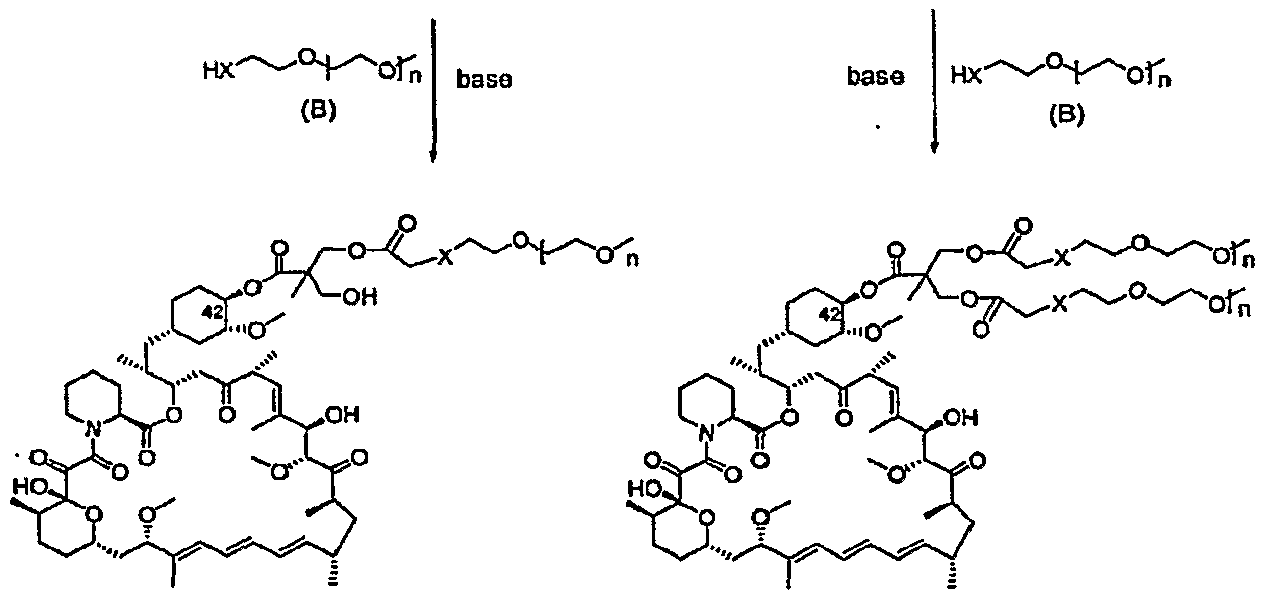
- a process for preparing a water soluble PEG-CCI-779 conjugate represented by the formula (HI), (IV), or a combination thereof through a similar two-step sequence. See, Scheme 4.
- One or both of the OH groups in the ester side chain at the 42-position of the CCI-779 molecule may be acylated with an acylating agent of formula (A) catalyzed by a lipase, as described in Scheme 3.
- the ratio of mono-acylated product (IX) and bis-acylated product (X) can be altered by the modification of the amount of lipase, amount of vinyl ester (A), reaction time, and temperature.
- the compounds of formulas (IX) and (X) can be respectively separated from the mixture using chromatography. Compounds (IX) and (X) may then separately be used to prepare the corresponding PEG-CCI-779 conjugates (111) and (IV). Alternatively, compounds (IX) and (X) may be retained as a mixture, which mixture is used to prepare the corresponding PEG-CCI-779 conjugates (TH) and (IV).
- PEG-conjugates (III) and (IV) were performed by reacting compounds (IX) and (X) with a methoxypolyethylene derivative of formula (B) in the presence of a non-nucleophilic base described above in an organic solvent described above.
- the non-nucleophilic base is a trialkylamine.
- the organic solvent is acetonitrile.
- a process for separately preparing water soluble PEG-tacrolimus and PEG-ascomycin conjugate represented by the formula (V) and (VI).
- the respective 32-esterifed intermediate (XI) can be obtained by acylating tacrolimus (FK506) or ascolimus (FK520) with an acylating agent of formula (A) in the presence of a lipase with excellent yield in a regiospecific fashion.
- Novozym 435 is a trademark for Candida antarctica lipase B immobilized on an acrylic resin.
- VTS Everolimus 42-bromoacetate
Landscapes
- Health & Medical Sciences (AREA)
- Chemical & Material Sciences (AREA)
- Organic Chemistry (AREA)
- Bioinformatics & Cheminformatics (AREA)
- Engineering & Computer Science (AREA)
- General Health & Medical Sciences (AREA)
- Veterinary Medicine (AREA)
- Medicinal Chemistry (AREA)
- Public Health (AREA)
- Pharmacology & Pharmacy (AREA)
- Life Sciences & Earth Sciences (AREA)
- Animal Behavior & Ethology (AREA)
- Immunology (AREA)
- Epidemiology (AREA)
- Nuclear Medicine, Radiotherapy & Molecular Imaging (AREA)
- General Chemical & Material Sciences (AREA)
- Chemical Kinetics & Catalysis (AREA)
- Transplantation (AREA)
- Nitrogen And Oxygen Or Sulfur-Condensed Heterocyclic Ring Systems (AREA)
- Pharmaceuticals Containing Other Organic And Inorganic Compounds (AREA)
- Preparation Of Compounds By Using Micro-Organisms (AREA)
- Medicinal Preparation (AREA)
Abstract
Description




Claims


Priority Applications (8)
| Application Number | Priority Date | Filing Date | Title |
|---|---|---|---|
| JP2008558347A JP2009529050A (en) | 2006-03-07 | 2007-03-05 | Process for preparing water-soluble polyethylene glycol conjugates of macrolide immunosuppressants |
| CA002644156A CA2644156A1 (en) | 2006-03-07 | 2007-03-05 | Process for preparing water-soluble polyethylene glycol conjugates of macrolide immunosuppressants |
| BRPI0708562-1A BRPI0708562A2 (en) | 2006-03-07 | 2007-03-05 | processes for preparing conjugated polyethylene glycol conjugates of immunosuppressive macrolides, a pegylated immunosuppressive macrolide, a pegylated rapamycin, a pegylated everolimus, a pegylated cci-779 and a pegylated tacrolimus, and, product |
| AU2007223963A AU2007223963A1 (en) | 2006-03-07 | 2007-03-05 | Process for preparing water-soluble polyethylene glycol conjugates of macrolide immunosuppressants |
| MX2008011458A MX2008011458A (en) | 2006-03-07 | 2007-03-05 | Process for preparing water-soluble polyethylene glycol conjugates of macrolide immunosuppressants. |
| EP07752356A EP1993610A2 (en) | 2006-03-07 | 2007-03-05 | Process for preparing water-soluble polyethylene glycol conjugates of macrolide immunosuppressants |
| IL193636A IL193636A0 (en) | 2006-03-07 | 2008-08-21 | Process for preparing water-soluble polyethylene glycol conjugates of macrolide immunosuppressants |
| NO20083716A NO20083716L (en) | 2006-03-07 | 2008-08-29 | Process for the preparation of water-soluble polyethylene glycol conjugates of immunosuppressive macrolides. |
Applications Claiming Priority (2)
| Application Number | Priority Date | Filing Date | Title |
|---|---|---|---|
| US77993906P | 2006-03-07 | 2006-03-07 | |
| US60/779,939 | 2006-03-07 |
Publications (2)
| Publication Number | Publication Date |
|---|---|
| WO2007103348A2 true WO2007103348A2 (en) | 2007-09-13 |
| WO2007103348A3 WO2007103348A3 (en) | 2008-05-08 |
Family
ID=38420553
Family Applications (1)
| Application Number | Title | Priority Date | Filing Date |
|---|---|---|---|
| PCT/US2007/005646 Ceased WO2007103348A2 (en) | 2006-03-07 | 2007-03-05 | Process for preparing water-soluble polyethylene glycol conjugates of macrolide immunosuppressants |
Country Status (19)
| Country | Link |
|---|---|
| US (1) | US7605257B2 (en) |
| EP (1) | EP1993610A2 (en) |
| JP (1) | JP2009529050A (en) |
| KR (1) | KR20080106225A (en) |
| CN (1) | CN101394867A (en) |
| AR (1) | AR059740A1 (en) |
| AU (1) | AU2007223963A1 (en) |
| BR (1) | BRPI0708562A2 (en) |
| CA (1) | CA2644156A1 (en) |
| CR (1) | CR10234A (en) |
| EC (1) | ECSP088719A (en) |
| IL (1) | IL193636A0 (en) |
| MX (1) | MX2008011458A (en) |
| NO (1) | NO20083716L (en) |
| PE (1) | PE20080138A1 (en) |
| RU (1) | RU2008134369A (en) |
| SV (1) | SV2009003017A (en) |
| TW (1) | TW200812622A (en) |
| WO (1) | WO2007103348A2 (en) |
Cited By (5)
| Publication number | Priority date | Publication date | Assignee | Title |
|---|---|---|---|---|
| WO2008048611A1 (en) * | 2006-10-18 | 2008-04-24 | Wyeth | Process for the synthesis of individual isomers of mono-peg cci-779 |
| ITMI20090908A1 (en) * | 2009-05-22 | 2010-11-23 | Poli Ind Chimica Spa | NEW CHEMICAL-ENAZYMATIC APPROACH TO THE SYNTHESIS OF THE PIMECROLIMUS |
| US9598439B2 (en) | 2013-03-15 | 2017-03-21 | Biosensors International Group, Ltd. | Purification of rapamycin derivatives using temperature induced phase separation |
| EP4157241A4 (en) * | 2020-05-29 | 2025-01-08 | The Regents of the University of California | Agents and methods for treating tauopathies |
| EP4316523A4 (en) * | 2021-04-02 | 2025-08-06 | Hangzhou Yisheng Pharmaceutical Tech Development Co Ltd | PEGYLATED RAPAMYCIN COMPOUND AND METHOD OF PREPARATION AND USE THEREOF |
Families Citing this family (8)
| Publication number | Priority date | Publication date | Assignee | Title |
|---|---|---|---|---|
| SV2006002188A (en) * | 2004-08-10 | 2006-03-15 | Wyeth Corp | DERIVATIVES OF CCI - 779 AND METHODS FOR THEIR PREPARATION REF. AM-101759SALVO |
| TW200845960A (en) * | 2007-04-05 | 2008-12-01 | Wyeth Corp | Wortmannin-rapalog conjugate and uses thereof |
| US9408884B2 (en) * | 2012-06-08 | 2016-08-09 | Biotronik Ag | Rapamycin 40-O-cyclic hydrocarbon esters, compositions and methods |
| DK3421051T3 (en) | 2012-08-16 | 2020-06-22 | Pfizer | Methods for glycoconjugation and compositions |
| WO2015081821A1 (en) * | 2013-12-02 | 2015-06-11 | 北京键凯科技有限公司 | Polyethylene glycol -cactus oligopeptide bonding rapamycin derivatives |
| JP7123399B2 (en) | 2016-03-24 | 2022-08-23 | ザ アドミニストレイターズ オブ ザ テューレイン エデュケイショナル ファンド | Conjugates of tacrolimus, compositions thereof and uses thereof |
| CN108641075B (en) * | 2018-03-05 | 2019-12-06 | 江苏千之康生物医药科技有限公司 | Rapamycin and double short-chain polyethylene glycol prodrug of rapamycin derivative and application of rapamycin and double short-chain polyethylene glycol prodrug |
| US20210023232A1 (en) * | 2018-03-29 | 2021-01-28 | Jenkem Technology Co., Ltd. (Tianjin) | Combination of polyethylene glycol and rapamycin and use thereof |
Family Cites Families (9)
| Publication number | Priority date | Publication date | Assignee | Title |
|---|---|---|---|---|
| GB9221220D0 (en) | 1992-10-09 | 1992-11-25 | Sandoz Ag | Organic componds |
| US5362718A (en) | 1994-04-18 | 1994-11-08 | American Home Products Corporation | Rapamycin hydroxyesters |
| US5780462A (en) | 1995-12-27 | 1998-07-14 | American Home Products Corporation | Water soluble rapamycin esters |
| KR100244164B1 (en) | 1997-07-15 | 2000-03-02 | 김용옥 | Water soluble polymer takurolimus conjugate compounds and its manufacturing process |
| US6331547B1 (en) | 1999-08-18 | 2001-12-18 | American Home Products Corporation | Water soluble SDZ RAD esters |
| US6277983B1 (en) | 2000-09-27 | 2001-08-21 | American Home Products Corporation | Regioselective synthesis of rapamycin derivatives |
| CA2421485A1 (en) | 2000-09-19 | 2002-03-28 | Wyeth | Water soluble rapamycin esters |
| EP1737869A1 (en) | 2004-04-14 | 2007-01-03 | Wyeth a Corporation of the State of Delaware | Regiospecific synthesis of rapamycin 42-ester derivatives |
| ES2313328T3 (en) | 2004-04-14 | 2009-03-01 | Wyeth | PROCEDURE FOR THE PREPARATION OF 42-ESTERES OF RAPAMYCIN AND 32-ESTERS OF FK-506 WITH DICARBOXYLIC ACID, PRECURSORS FOR RAPAMYCIN CONJUGATES AND ANTIBODIES. |
-
2007
- 2007-03-05 KR KR1020087021729A patent/KR20080106225A/en not_active Withdrawn
- 2007-03-05 TW TW096107516A patent/TW200812622A/en unknown
- 2007-03-05 AR ARP070100901A patent/AR059740A1/en unknown
- 2007-03-05 CN CNA2007800079204A patent/CN101394867A/en not_active Withdrawn
- 2007-03-05 JP JP2008558347A patent/JP2009529050A/en active Pending
- 2007-03-05 BR BRPI0708562-1A patent/BRPI0708562A2/en not_active Application Discontinuation
- 2007-03-05 CA CA002644156A patent/CA2644156A1/en not_active Abandoned
- 2007-03-05 AU AU2007223963A patent/AU2007223963A1/en not_active Abandoned
- 2007-03-05 US US11/713,973 patent/US7605257B2/en not_active Expired - Fee Related
- 2007-03-05 MX MX2008011458A patent/MX2008011458A/en unknown
- 2007-03-05 EP EP07752356A patent/EP1993610A2/en not_active Withdrawn
- 2007-03-05 WO PCT/US2007/005646 patent/WO2007103348A2/en not_active Ceased
- 2007-03-05 PE PE2007000234A patent/PE20080138A1/en not_active Application Discontinuation
- 2007-03-05 RU RU2008134369/15A patent/RU2008134369A/en not_active Application Discontinuation
-
2008
- 2008-08-21 IL IL193636A patent/IL193636A0/en unknown
- 2008-08-21 CR CR10234A patent/CR10234A/en not_active Application Discontinuation
- 2008-08-29 NO NO20083716A patent/NO20083716L/en not_active Application Discontinuation
- 2008-09-05 SV SV2008003017A patent/SV2009003017A/en unknown
- 2008-09-05 EC EC2008008719A patent/ECSP088719A/en unknown
Cited By (15)
| Publication number | Priority date | Publication date | Assignee | Title |
|---|---|---|---|---|
| WO2008048611A1 (en) * | 2006-10-18 | 2008-04-24 | Wyeth | Process for the synthesis of individual isomers of mono-peg cci-779 |
| US7605258B2 (en) | 2006-10-18 | 2009-10-20 | Wyeth | Processes for the synthesis of individual isomers of mono-peg CCI-779 |
| ITMI20090908A1 (en) * | 2009-05-22 | 2010-11-23 | Poli Ind Chimica Spa | NEW CHEMICAL-ENAZYMATIC APPROACH TO THE SYNTHESIS OF THE PIMECROLIMUS |
| WO2010134027A1 (en) | 2009-05-22 | 2010-11-25 | Poli Industria Chimica Spa | A chemo-enzymatic approach to the synthesis of pimecrolimus |
| JP2012527229A (en) * | 2009-05-22 | 2012-11-08 | ユーティカルズ ソシエタ ペル アチオニ | A chemoenzymatic approach to the synthesis of pimecrolimus. |
| EP2706061A1 (en) | 2009-05-22 | 2014-03-12 | Euticals S.P.A. | A chemo-enzymatic approach to the synthesis of pimecrolimus |
| AU2010250802B2 (en) * | 2009-05-22 | 2014-05-22 | Euticals Spa | A chemo-enzymatic approach to the synthesis of pimecrolimus |
| US8778636B2 (en) | 2009-05-22 | 2014-07-15 | Euticals S.P.A. | Chemo-enzymatic approach to the synthesis of pimecrolimus |
| US9598439B2 (en) | 2013-03-15 | 2017-03-21 | Biosensors International Group, Ltd. | Purification of rapamycin derivatives using temperature induced phase separation |
| US10202402B2 (en) | 2013-03-15 | 2019-02-12 | Biosensors International Group, Ltd. | Purification of rapamycin derivatives using temperature induced phase separation |
| US10597406B2 (en) | 2013-03-15 | 2020-03-24 | Biosensors International Group, Ltd. | Purification of rapamycin derivatives using temperature induced phase separation |
| US11046711B2 (en) | 2013-03-15 | 2021-06-29 | Biosensors International Group, Ltd. | Purification of rapamycin derivatives using temperature induced phase separation |
| US11780850B2 (en) | 2013-03-15 | 2023-10-10 | Biosensors International Group, Ltd. | Purification of rapamycin derivatives using temperature induced phase separation |
| EP4157241A4 (en) * | 2020-05-29 | 2025-01-08 | The Regents of the University of California | Agents and methods for treating tauopathies |
| EP4316523A4 (en) * | 2021-04-02 | 2025-08-06 | Hangzhou Yisheng Pharmaceutical Tech Development Co Ltd | PEGYLATED RAPAMYCIN COMPOUND AND METHOD OF PREPARATION AND USE THEREOF |
Also Published As
| Publication number | Publication date |
|---|---|
| MX2008011458A (en) | 2008-09-24 |
| NO20083716L (en) | 2008-10-06 |
| IL193636A0 (en) | 2009-05-04 |
| US20070212371A1 (en) | 2007-09-13 |
| ECSP088719A (en) | 2008-10-31 |
| US7605257B2 (en) | 2009-10-20 |
| RU2008134369A (en) | 2010-04-20 |
| PE20080138A1 (en) | 2008-03-05 |
| KR20080106225A (en) | 2008-12-04 |
| AU2007223963A1 (en) | 2007-09-13 |
| WO2007103348A3 (en) | 2008-05-08 |
| JP2009529050A (en) | 2009-08-13 |
| CA2644156A1 (en) | 2007-09-13 |
| SV2009003017A (en) | 2009-03-04 |
| EP1993610A2 (en) | 2008-11-26 |
| CN101394867A (en) | 2009-03-25 |
| AR059740A1 (en) | 2008-04-23 |
| TW200812622A (en) | 2008-03-16 |
| CR10234A (en) | 2008-10-29 |
| BRPI0708562A2 (en) | 2011-06-07 |
Similar Documents
| Publication | Publication Date | Title |
|---|---|---|
| US7605257B2 (en) | Processes for preparing water-soluble polyethylene glycol conjugates of macrolide immunosuppressants | |
| US7625726B2 (en) | Process for preparing rapamycin 42-esters and FK-506 32-esters with dicarboxylic acid, precursors for rapamycin conjugates and antibodies | |
| EP1644392B1 (en) | Rapamycin carbohydrate derivatives | |
| US6331547B1 (en) | Water soluble SDZ RAD esters | |
| US5955457A (en) | Water soluble rapamycin esters | |
| US5446048A (en) | Rapamycin oximes | |
| CA2385461C (en) | Regioselective synthesis of rapamycin derivatives | |
| CA2065790A1 (en) | Carbamates of rapamycin | |
| US6790935B1 (en) | Cyclosporin derivatives and method for the production of said derivatives | |
| ES2548847T3 (en) | A chemo-enzymatic approach to the synthesis of pimecrolimus | |
| WO2007056175A2 (en) | 41-methoxy isotope labeled rapamycin 42-ester | |
| CN1156480C (en) | Water-soluble SDZ-RAD ester, its preparation method and use and its composition |
Legal Events
| Date | Code | Title | Description |
|---|---|---|---|
| 121 | Ep: the epo has been informed by wipo that ep was designated in this application | ||
| WWE | Wipo information: entry into national phase |
Ref document number: 193636 Country of ref document: IL Ref document number: CR2008-010234 Country of ref document: CR |
|
| WWW | Wipo information: withdrawn in national office |
Ref document number: CR2008-010234 Country of ref document: CR |
|
| WWE | Wipo information: entry into national phase |
Ref document number: 2007752356 Country of ref document: EP |
|
| WWE | Wipo information: entry into national phase |
Ref document number: 2644156 Country of ref document: CA Ref document number: 3525/KOLNP/2008 Country of ref document: IN |
|
| WWE | Wipo information: entry into national phase |
Ref document number: 2007223963 Country of ref document: AU Ref document number: 570880 Country of ref document: NZ |
|
| WWE | Wipo information: entry into national phase |
Ref document number: 12008501988 Country of ref document: PH |
|
| WWE | Wipo information: entry into national phase |
Ref document number: 2008558347 Country of ref document: JP Ref document number: 200780007920.4 Country of ref document: CN Country of ref document: MX Ref document number: MX/a/2008/011458 |
|
| NENP | Non-entry into the national phase |
Ref country code: DE |
|
| ENP | Entry into the national phase |
Ref document number: 2007223963 Country of ref document: AU Date of ref document: 20070305 Kind code of ref document: A |
|
| ENP | Entry into the national phase |
Ref document number: 2008134369 Country of ref document: RU Kind code of ref document: A |
|
| WWP | Wipo information: published in national office |
Ref document number: CR2008-010234 Country of ref document: CR |
|
| ENP | Entry into the national phase |
Ref document number: PI0708562 Country of ref document: BR Kind code of ref document: A2 Effective date: 20080904 |