WO2007103694A2 - Triazine 11-beta hydroxysteroid dehydrogenase type i inhibitors - Google Patents
Triazine 11-beta hydroxysteroid dehydrogenase type i inhibitors Download PDFInfo
- Publication number
- WO2007103694A2 WO2007103694A2 PCT/US2007/063012 US2007063012W WO2007103694A2 WO 2007103694 A2 WO2007103694 A2 WO 2007103694A2 US 2007063012 W US2007063012 W US 2007063012W WO 2007103694 A2 WO2007103694 A2 WO 2007103694A2
- Authority
- WO
- WIPO (PCT)
- Prior art keywords
- nri
- heterocyclyl
- aryl
- heteroaryl
- alkyl
- Prior art date
- Legal status (The legal status is an assumption and is not a legal conclusion. Google has not performed a legal analysis and makes no representation as to the accuracy of the status listed.)
- Ceased
Links
Classifications
-
- C—CHEMISTRY; METALLURGY
- C07—ORGANIC CHEMISTRY
- C07D—HETEROCYCLIC COMPOUNDS
- C07D253/00—Heterocyclic compounds containing six-membered rings having three nitrogen atoms as the only ring hetero atoms, not provided for by group C07D251/00
- C07D253/08—Heterocyclic compounds containing six-membered rings having three nitrogen atoms as the only ring hetero atoms, not provided for by group C07D251/00 condensed with carbocyclic rings or ring systems
- C07D253/10—Condensed 1,2,4-triazines; Hydrogenated condensed 1,2,4-triazines
-
- A—HUMAN NECESSITIES
- A61—MEDICAL OR VETERINARY SCIENCE; HYGIENE
- A61P—SPECIFIC THERAPEUTIC ACTIVITY OF CHEMICAL COMPOUNDS OR MEDICINAL PREPARATIONS
- A61P3/00—Drugs for disorders of the metabolism
- A61P3/06—Antihyperlipidemics
-
- A—HUMAN NECESSITIES
- A61—MEDICAL OR VETERINARY SCIENCE; HYGIENE
- A61P—SPECIFIC THERAPEUTIC ACTIVITY OF CHEMICAL COMPOUNDS OR MEDICINAL PREPARATIONS
- A61P3/00—Drugs for disorders of the metabolism
- A61P3/08—Drugs for disorders of the metabolism for glucose homeostasis
- A61P3/10—Drugs for disorders of the metabolism for glucose homeostasis for hyperglycaemia, e.g. antidiabetics
-
- A—HUMAN NECESSITIES
- A61—MEDICAL OR VETERINARY SCIENCE; HYGIENE
- A61P—SPECIFIC THERAPEUTIC ACTIVITY OF CHEMICAL COMPOUNDS OR MEDICINAL PREPARATIONS
- A61P5/00—Drugs for disorders of the endocrine system
- A61P5/38—Drugs for disorders of the endocrine system of the suprarenal hormones
- A61P5/46—Drugs for disorders of the endocrine system of the suprarenal hormones for decreasing, blocking or antagonising the activity of glucocorticosteroids
-
- A—HUMAN NECESSITIES
- A61—MEDICAL OR VETERINARY SCIENCE; HYGIENE
- A61P—SPECIFIC THERAPEUTIC ACTIVITY OF CHEMICAL COMPOUNDS OR MEDICINAL PREPARATIONS
- A61P9/00—Drugs for disorders of the cardiovascular system
- A61P9/02—Non-specific cardiovascular stimulants, e.g. drugs for syncope, antihypotensives
-
- C—CHEMISTRY; METALLURGY
- C07—ORGANIC CHEMISTRY
- C07D—HETEROCYCLIC COMPOUNDS
- C07D253/00—Heterocyclic compounds containing six-membered rings having three nitrogen atoms as the only ring hetero atoms, not provided for by group C07D251/00
- C07D253/02—Heterocyclic compounds containing six-membered rings having three nitrogen atoms as the only ring hetero atoms, not provided for by group C07D251/00 not condensed with other rings
- C07D253/06—1,2,4-Triazines
- C07D253/065—1,2,4-Triazines having three double bonds between ring members or between ring members and non-ring members
- C07D253/07—1,2,4-Triazines having three double bonds between ring members or between ring members and non-ring members with hetero atoms, or with carbon atoms having three bonds to hetero atoms with at the most one bond to halogen, e.g. ester or nitrile radicals, directly attached to ring carbon atoms
Definitions
- Cortisol The steroid hormone Cortisol is a key regulator of many physiological processes.
- an excess of Cortisol as occurs in Cushing's Disease, provokes severe metabolic abnormalities including: type 2 diabetes, cardiovascular disease, obesity, and osteoporosis.
- Many patients with these diseases do not show significant increases in plasma Cortisol levels.
- individual tissues can regulate their glucocorticoid tone via the in situ conversion of inactive cortisone to the active hormone Cortisol.
- 11-beta-HSDl is a member of the short chain dehydrogenase superfamily of enzymes.
- 11-beta-HSDl controls the intracellular glucocorticoid tone according to its expression and activity levels. In this manner, 11-beta-HSDl can determine the overall metabolic status of the organ.
- 11-beta-HSDl is expressed at high levels in the liver and at lower levels in many metabolically active tissues including the adipose, the CNS, the pancreas, and the pituitary. Taking the example of the liver, it is predicted that high levels of 11-beta-HSDl activity will stimulate gluconeogenesis and overall glucose output. Conversely, reduction of 11-beta-HSDl activity will downregulate gluconeogenesis resulting in lower plasma glucose levels. [0003] Various studies have been conducted that support this hypothesis. For example, transgenic mice expressing 2X the normal level of 11-beta-HSDl in only the adipose tissue show abdominal obesity, hyperglycemia, and insulin resistance. (H.
- Compounds of the present invention inhibit the activity of the enzyme
- Compounds of the present invention inhibit the activity of the enzyme 11 -beta- hydroxysteroid dehydrogenase type I. Consequently, the compounds of the present invention may be used in the treatment of multiple diseases or disorders associated with 11-beta-hydroxysteroid dehydrogenase type I, such as diabetes and related conditions, microvascular complications associated with diabetes, the macrovascular complications associated with diabetes, cardiovascular diseases, Metabolic Syndrome and its component conditions, and other maladies.
- diseases or disorders associated with the activity of the enzyme 11-beta-hydroxysteroid dehydrogenase type I that can be prevented, inhibited, or treated according to the present invention include, but are not limited to, diabetes, hyperglycemia, impaired glucose tolerance, insulin resistance, hyperinsulinemia, retinopathy, neuropathy, nephropathy, delayed wound healing, atherosclerosis and its sequelae, abnormal heart function, myocardial ischemia, stroke, Metabolic Syndrome, hypertension, obesity, dislipidemia, dylsipidemia, hyperlipidemia, hypertriglyceridemia, hypercholesterolemia, low HDL, high LDL, non-cardiac ischemia, infection, cancer, vascular restenosis, pancreatitis, neurodegenerative disease, lipid disorders, cognitive impairment and dementia, bone disease, HIV protease associated lipodystrophy and glaucoma.
- the present invention provides for compounds of formula I, pharmaceutical compositions employing such compounds, and for methods of using such compounds.
- the present invention provides a pharmaceutical composition comprising a therapeutically effective amount of a compound of formula I, alone or in combination with a pharmaceutically acceptable carrier.
- a method for preventing, inhibiting, or treating the progression or onset of diseases or disorders associated with the activity of the enzyme 11-beta-hydroxysteroid dehydrogenase type I, such as defined above and hereinafter, wherein a therapeutically effective amount of a compound of formula I is administered to a mammalian, i.e., human, patient in need of treatment.
- the compounds of the invention can be used alone, in combination with other compounds of the present invention, or in combination with one or more other agent(s).
- the present invention provides a method for preventing, inhibiting, or treating the diseases as defined above and hereinafter, wherein a therapeutically effective amount of a combination of a compound of formula I and another compound of formula I and/or at least one other type of therapeutic agent, is administered to a mammalian, i.e., human, patient in need of treatment.
- Ri is alkyl, aryl, heteroaryl, cycloalkyl, adamantyl or heterocyclyl, other than heteroaryl, all of which may be optionally substituted with one or more R 4 5 S;
- R 2 and R 3 are taken together with the carbon atoms to which each is attached to form a 4- to 15-membered mono-, bi- or tricylic ring, wherein said ring may be optionally substituted with one or more R 4 5 S; or
- R 2 and R 3 are taken together with the carbon atoms to which each is attached to form a 4- to 15-membered mono-, bi- or tricylic heterocyclyl ring wherein the heterocyclyl ring contains 1-4 heteroatoms selected from N, O, and S, and said ring may be optionally substituted with one or more R 4 5 S;
- R 9 is independently hydrogen, alkyl, alkoxy, cycloalkyl, aryl, arylalkyl, heteroaryl, heteroarylalkyl, heterocyclyl or heterocyclylalkyl, wherein the aryl, arylalkyl, heteroaryl, heteroarylalkyl, heterocyclyl or heterocyclylalkyl may be optionally substituted with 0-5 R 9a , and the heteroaryl, heteroarylalkyl, heterocyclyl or heterocyclylalkyl contain 1-4 heteroatoms selected from N, O, and S;
- R 9' is independently alkyl, alkoxy, cycloalkyl, aryl, arylalkyl, heteroaryl, heteroarylalkyl, heterocyclyl or heterocyclylalkyl, wherein the aryl, arylalkyl, heteroaryl, heteroarylalkyl, heterocyclyl or heterocyclylalkyl may be optionally substituted with 0-5 R 9a , and the heteroaryl, heteroarylalkyl, heterocyclyl or heterocyclylalkyl contain 1-4 heteroatoms selected from N, O, and S;
- R 9a is independently selected from alkyl, haloalkyl, aryl, alkenyl, alkynyl, cycloalkyl, cycloalkylalkyl, heteroaryl, heteroarylalkyl, heterocyclyl heterocyclylalkyl, halo, -NH 2 , -CN, -NO 2 , -C(O)OH, -C(O)OR 14 , -OCF 3 , -ORi 4 , -OH, -SH, -SRi 4 , -S(O) 3 H, -P(O) 3 H 2 , -C(O)NR 14 R 14 , -NRi 4 Ri 4 , -S(O) 2 NRi 4 Ri 4 , -NRi 4 S(O) 2 CF 3 , -C(K))NRi 4 S(O) 2 Ri 0 , -S(O) 2 NRi 4 C(K))OR
- Ri 0 is independently selected from alkyl, alkenyl, alkynyl, aryl, arylalkyl, heterocyclyl or heterocyclylalkyl, wherein the aryl, arylalkyl, heterocyclyl or heterocyclylalkyl may be optionally substituted with 0-3 R 1 Oa, and the heterocyclyl and heterocyclylalkyl contain 1-4 heteroatoms selected from N, O, and S;
- Ri is alkyl, aryl, heteroaryl, adamantyl, a 3-membered cycloalkyl or an 8- to 20-membered cycloalkyl, other than adamantyl, all of which may be optionally substituted with one or more R 4 5 S;
- R 2 and R3 are taken together with the carbon atoms to which each is attached to form a 4- to 15-membered mono-, bi- or tricylic ring, wherein said ring may be optionally substituted with one or more R 4 5 S; or
- R 2 and R3 are taken together with the carbon atoms to which each is attached to form a 4- to 15-membered mono-, bi- or tricylic heterocyclyl ring wherein the heterocyclyl ring contains 1-4 heteroatoms selected from N, O, and S, and said ring may be optionally substituted with one or more R 4 5 S;
- R 5 is independently selected from alkyl, haloalkyl, aryl, alkenyl, alkynyl, cycloalkyl, cycloalkylalkyl, heteroaryl, heteroarylalkyl, heterocyclyl heterocyclylalkyl, halo, -NH 2 , -CN, -NO 2 , -C(O)OH, -C(O)ORi 0 , -OCF 3 , -ORi 0 , -OH, -SH, -SRi 0 , -S(O) 3 H, -P(O) 3 H 2 , -C(O)NR 9 R 9 , -NR 9 R 9 , -S(O) 2 NR 9 R 9 , -NR 9 S(O) 2 CF 3 , -C(O)NR 9 S(O) 2 R 9 , -S(O) 2 NR 9 C(O)OR 9 , --
- R 8 at each occurrence, is independently alkyl or aryl
- R 9 at each occurrence, is independently hydrogen, alkyl, alkoxy, cycloalkyl, aryl, arylalkyl, heteroaryl, heteroarylalkyl, heterocyclyl or heterocyclylalkyl, wherein the aryl, arylalkyl, heteroaryl, heteroarylalkyl, heterocyclyl or heterocyclylalkyl may be optionally substituted with 0-5 R 9a , and the heteroaryl, heteroarylalkyl, heterocyclyl or heterocyclylalkyl contain 1-4 heteroatoms selected from N, O, and S;
- R 9' is independently alkyl, alkoxy, cycloalkyl, aryl, arylalkyl, heteroaryl, heteroarylalkyl, heterocyclyl or heterocyclylalkyl, wherein the aryl, arylalkyl, heteroaryl, heteroarylalkyl, heterocyclyl or heterocyclylalkyl may be optionally substituted with 0-5 R 9a , and the heteroaryl, heteroarylalkyl, heterocyclyl or heterocyclylalkyl contain 1-4 heteroatoms selected from N, O, and S;
- Rio at each occurrence, is independently selected from alkyl, alkenyl, alkynyl, aryl, arylalkyl, heterocyclyl or heterocyclylalkyl, wherein the aryl, arylalkyl, heterocyclyl or heterocyclylalkyl may be optionally substituted with 0-3 Rioa, and the heterocyclyl and heterocyclylalkyl contain 1 -4 heteroatoms selected from N, O, and S;
- Rioa at each occurrence, is independently selected from alkyl, haloalkyl, aryl, alkenyl, alkynyl, cycloalkyl, cycloalkylalkyl, heteroaryl, heteroarylalkyl, heterocyclyl heterocyclylalkyl, halo, -NH 2 , -CN, -NO 2 , -C(O)OH, -C(O)OR 14 , -OCF 3 , -ORi 4 , -OH, -SH, -SRi 4 , -S(O) 3 H, -P(O) 3 H 2 , -C(O)NR 14 R 14 , -NRi 4 Ri 4 , -S(O) 2 NRi 4 Ri 4 , -NRi 4 S(O) 2 CF 3 , -C(K ) )NRi 4 S(O) 2 R 9 , -S(O) 2 NR 14 C(O)OR 9 ,
- Ri 4 is independently selected from hydrogen, alkyl, cycloalkyl or aryl.
- Ri is aryl, heteroaryl, adamantyl, a 3-membered cycloalkyl or an 8- to 15- membered cycloalkyl, other than adamantyl, all of which may be optionally substituted with one or more R 4 5 S;
- R 2 and R3 are taken together with the carbon atoms to which each is attached to form a 4- to 15-membered mono-, bi- or tricylic ring, wherein said ring may be optionally substituted with one or more R 4 5 S; or
- R 8 at each occurrence, is independently alkyl or aryl
- R 9 at each occurrence, is independently hydrogen, alkyl, alkoxy, cycloalkyl, aryl, arylalkyl, heteroaryl, heteroarylalkyl, heterocyclyl or heterocyclylalkyl, wherein the aryl, arylalkyl, heteroaryl, heteroarylalkyl, heterocyclyl or heterocyclylalkyl may be optionally substituted with 0-5 R 9a , and the heteroaryl, heteroarylalkyl, heterocyclyl or heterocyclylalkyl contain 1-4 heteroatoms selected from N, O, and S;
- R 9' at each occurrence, is independently alkyl, alkoxy, cycloalkyl, aryl, arylalkyl, heteroaryl, heteroarylalkyl, heterocyclyl or heterocyclylalkyl, wherein the aryl, arylalkyl, heteroaryl, heteroarylalkyl, heterocyclyl or heterocyclylalkyl, where
- Rio at each occurrence, is independently selected from alkyl, alkenyl, alkynyl, aryl, arylalkyl, heterocyclyl or heterocyclylalkyl, wherein the aryl, arylalkyl, heterocyclyl or heterocyclylalkyl may be optionally substituted with 0-3 R 1 Oa, and the heterocyclyl and heterocyclylalkyl contain 1-4 heteroatoms selected from N, O, and S;
- RiOa is independently selected from alkyl, haloalkyl, aryl, alkenyl, alkynyl, cycloalkyl, cycloalkylalkyl, heteroaryl, heteroarylalkyl, heterocyclyl heterocyclylalkyl, halo, -NH 2 , -CN, -NO 2 , -C(O)OH, -C(O)OR 14 , -OCF 3 , -OR 14 , -OH, -SH, -SRi 4 , -S(O) 3 H, -P(O) 3 H 2 , -C(O)NR 14 R 14 , -NRi 4 Ri 4 , -S(O) 2 NRi 4 Ri 4 , -NRi 4 S(O) 2 CF 3 , -C(O)NRi 4 S(O) 2 R 9 , -S(O) 2 NR 14 C(O)OR 9 ,
- Ri 4 is independently selected from hydrogen, alkyl, cycloalkyl or aryl.
- Ri is aryl, heteroaryl, adamantyl, a 3-membered cycloalkyl or an 8- to 15- membered cycloalkyl, other than adamantyl, all of which may be optionally substituted with one or more R 4 5 S;
- R 9 is independently hydrogen, alkyl, alkoxy, cycloalkyl, aryl, arylalkyl, heteroaryl, heteroarylalkyl, heterocyclyl or heterocyclylalkyl, wherein the aryl, arylalkyl, heteroaryl, heteroarylalkyl, heterocyclyl or heterocyclylalkyl may be optionally substituted with 0-5 Rg a , and the heteroaryl, heteroarylalkyl, heterocyclyl or heterocyclylalkyl contain 1-4 heteroatoms selected from N, O, and S;
- R 9' is independently alkyl, alkoxy, cycloalkyl, aryl, arylalkyl, heteroaryl, heteroarylalkyl, heterocyclyl or heterocyclylalkyl, wherein the aryl, arylalkyl, heteroaryl, heteroarylalkyl, heterocyclyl or heterocyclylalkyl may be optionally substituted with 0-5 Rg a , and the heteroaryl, heteroarylalkyl, heterocyclyl or heterocyclylalkyl contain 1-4 heteroatoms selected from N, O, and S;
- Rio at each occurrence, is independently selected from alkyl, alkenyl, alkynyl, aryl, arylalkyl, heterocyclyl or heterocyclylalkyl, wherein the aryl, arylalkyl, heterocyclyl or heterocyclylalkyl may be optionally substituted with 0-3 R 1 Oa, and the heterocyclyl and heterocyclylalkyl contain 1-4 heteroatoms selected from N, O, and S;
- RiOa is independently selected from alkyl, haloalkyl, aryl, alkenyl, alkynyl, cycloalkyl, cycloalkylalkyl, heteroaryl, heteroarylalkyl, heterocyclyl heterocyclylalkyl, halo, -NH 2 , -CN, -NO 2 , -C(O)OH, -C(O)OR 14 , -OCF 3 , -OR 14 , -OH, -SH, -SRi 4 , -S(O) 3 H, -P(O) 3 H 2 , -C(O)NR 14 R 14 , -NRi 4 Ri 4 , -S(O) 2 NRi 4 Ri 4 , -NRi 4 S(O) 2 CF 3 , -C(O)NRi 4 S(O) 2 R 9 , -S(O) 2 NR 14 C(O)OR 9 , -S
- Ri is aryl, heteroaryl, adamantyl, a 3-membered cycloalkyl or an 8- to 15- membered cycloalkyl, other than adamantyl, all of which may be optionally substituted with one or more R 4 5 S;
- R 8 at each occurrence, is independently alkyl or aryl
- R 9 is independently hydrogen, alkyl, alkoxy, cycloalkyl, aryl, arylalkyl, heteroaryl, heteroarylalkyl, heterocyclyl or heterocyclylalkyl, wherein the aryl, arylalkyl, heteroaryl, heteroarylalkyl, heterocyclyl or heterocyclylalkyl may be optionally substituted with 0-5 R 9a , and the heteroaryl, heteroarylalkyl, heterocyclyl or heterocyclylalkyl contain 1-4 heteroatoms selected from N, O, and S;
- R 9' is independently alkyl, alkoxy, cycloalkyl, aryl, arylalkyl, heteroaryl, heteroarylalkyl, heterocyclyl or heterocyclylalkyl, wherein the aryl, arylalkyl, heteroaryl, heteroarylalkyl, heterocyclyl or heterocyclylalkyl may be optionally substituted with 0-5 R 9a , and the heteroaryl, heteroarylalkyl, heterocyclyl or heterocyclylalkyl contain 1-4 heteroatoms selected from N, O, and S;
- R 9a is independently selected from alkyl, haloalkyl, aryl, alkenyl, alkynyl, cycloalkyl, cycloalkylalkyl, heteroaryl, heteroarylalkyl, heterocyclyl heterocyclylalkyl, halo, -NH 2 , -CN, -NO 2 , -C(O)OH, -C(O)OR 14 , -OCF 3 , -ORi 4 , -OH, -SH, -SRi 4 , -S(O) 3 H, -P(O) 3 H 2 , -C(O)NR 14 R 14 , -NRi 4 Ri 4 , -S(O) 2 NRi 4 Ri 4 , -NRi 4 S(O) 2 CF 3 , -C(K))NRi 4 S(O) 2 Ri 0 , -S(O) 2 NRi 4 C(O)ORi
- Ri 0 is independently selected from alkyl, alkenyl, alkynyl, aryl, arylalkyl, heterocyclyl or heterocyclylalkyl, wherein the aryl, arylalkyl, heterocyclyl or heterocyclylalkyl may be optionally substituted with 0-3 R 1 Oa, and the heterocyclyl and heterocyclylalkyl contain 1-4 heteroatoms selected from N, O, and S;
- Ri Oa is independently selected from alkyl, haloalkyl, aryl, alkenyl, alkynyl, cycloalkyl, cycloalkylalkyl, heteroaryl, heteroarylalkyl, heterocyclyl heterocyclylalkyl, halo, -NH 2 , -CN, -NO 2 , -C(O)OH, -C(O)OR 14 , -OCF 3 , -OR 14 , -OH, -SH, -SRi 4 , -S(O) 3 H, -P(O) 3 H 2 , -C(O)NR 14 R 14 , -NRi 4 Ri 4 , -S(O) 2 NRi 4 Ri 4 , -NRi 4 S(O) 2 CF 3 , -C(O)NRi 4 S(O) 2 R 9 , -S(O) 2 NR 14 C(O)OR 9 , -
- Ri 4 is independently selected from hydrogen, alkyl, cycloalkyl or aryl.
- Ri is aryl, heteroaryl, adamantyl, a 3-membered cycloalkyl or an 8- to 15- membered cycloalkyl, other than adamantyl, all of which may be optionally substituted with one or more R 4 5 S;
- R 2 is halo, cyano, alkyl, cycloalkyl, aryl, heteroaryl, heterocyclyl,
- R 2 and R 3 are taken together with the carbon atoms to which each is attached to form a 4- to 15-membered mono-, bi- or tricylic ring, wherein said ring may be optionally substituted with one or more R 4 5 S; or
- R 8 at each occurrence, is independently alkyl or aryl
- R 9 at each occurrence, is independently hydrogen, alkyl, alkoxy, cycloalkyl, aryl, arylalkyl, heteroaryl, heteroarylalkyl, heterocyclyl or heterocyclylalkyl, wherein the heteroaryl, heteroarylalkyl, heterocyclyl or heterocyclylalkyl contain 1-4 heteroatoms selected from N, O, and S;
- R 9' is independently alkyl, alkoxy, cycloalkyl, aryl, arylalkyl, heteroaryl, heteroarylalkyl, heterocyclyl or heterocyclylalkyl, wherein the heteroaryl, heteroarylalkyl, heterocyclyl or heterocyclylalkyl contain 1-4 heteroatoms selected from N, O, and S;
- Ri 0 at each occurrence, is independently selected from alkyl, alkenyl, alkynyl, aryl, arylalkyl, heterocyclyl or heterocyclylalkyl, wherein the heterocyclyl and heterocyclylalkyl contain 1-4 heteroatoms selected from N, O, and S;
- R 14 is independently selected from hydrogen, alkyl, cycloalkyl or aryl.
- Ri is aryl, adamantyl, a 3-membered cycloalkyl or an 8- to 15-membered cycloalkyl, other than adamantyl, all of which may be optionally substituted with one or more R 4 5 S;
- R 5 is independently selected from alkyl, haloalkyl, aryl, cycloalkyl, heteroaryl, heterocyclyl, halo, -NH 2 , -CN, -NO 2 , -C(O)OH, -C(O)ORi 0 , -OCF 3 , -ORi 0 , -OH, -SH, -SRi 0 , -C(O)NR 9 R 9 , -NR 9 R 9 , -S(O) 2 NR 9 R 9 , -NR 9 S(O) 2 CF 3 , -C(O)NR 9 S(O) 2 R 9 , -S(O) 2 NR 9 C(O)OR 9 , -S(O) 2 NR 9 C(O)NR 9 R 9 , -C(O)NR 9 S(O) 2 CF 3 , -C(O)Ri 0 , -NR 9 C(O)OR 9 ,
- R 8 at each occurrence, is independently alkyl or aryl
- R 9 is independently hydrogen, alkyl, alkoxy, cycloalkyl, aryl, heteroaryl or heterocycly, wherein the heteroaryl or heterocyclyl contain 1-4 heteroatoms selected from N, O, and S; and
- Rio at each occurrence, is independently selected from alkyl, aryl or heterocyclyl, wherein the heterocyclyl contains 1 -4 heteroatoms selected from N, O, and S.
- Ri is adamantyl, a 3-membered cycloalkyl or an 8- to 15-membered cycloalkyl, other than adamantyl, all of which may be optionally substituted with one or more R 4 5 S;
- R 2 and R3 are taken together with the carbon atoms to which each is attached to form a 4- to 15-membered mono-, bi- or tricylic ring, wherein said ring may be optionally substituted with one or more R 4 5 S; or
- R5 at each occurrence, is independently selected from alkyl, haloalkyl, aryl, cycloalkyl, heteroaryl, heterocyclyl, halo, -NH 2 , -CN, -NO 2 , -C(O)OH, -C(O)OR 10 , -OCF 3 , -ORi 0 , -OH, -SH, -SRi 0 , -C(O)NR 9 R 9 , -NR 9 R 9 , -S(O) 2 NR 9 R 9 ,
- R 9 is independently hydrogen, alkyl, cycloalkyl, aryl, heteroaryl or heterocycly, wherein the heteroaryl or heterocyclyl contain 1-4 heteroatoms selected from N, O, and S;
- Ri 0 is independently selected from alkyl, aryl or heterocyclyl, wherein the heterocyclyl contains 1 -4 heteroatoms selected from N, O, and S.
- Ri is a 4- to 7-membered cycloalkyl or heterocyclyl, other than heteroaryl, all of which may be optionally substituted with one or more R 4 5 S;
- R 2 and R 3 are taken together with the carbon atoms to which each is attached to form a 4- to 15-membered mono-, bi- or tricylic ring, wherein said ring may be optionally substituted with one or more R 4 5 S; or
- R 2 and R 3 are taken together with the carbon atoms to which each is attached to form a 4- to 15-membered mono-, bi- or tricylic heterocyclyl ring wherein the heterocyclyl ring contains 1-4 heteroatoms selected from N, O, and S, and said ring may be optionally substituted with one or more R 4 5 S;
- NHC( NRi 4 )NRi 4 Ri4, -S(O)Ri 0 , -S(O) 2 Ri 0 , -NR 9 C(O)OR 8 or -NR 9 S(O 2 )R 8 , wherein the alkyl, aryl, alkenyl, alkynyl, cycloalkyl, heteroaryl or heterocyclyl may be optionally substituted with one or more R 5 5 S;
- R 9 is independently hydrogen, alkyl, alkoxy, cycloalkyl, aryl, arylalkyl, heteroaryl, heteroarylalkyl, heterocyclyl or heterocyclylalkyl, wherein the aryl, arylalkyl, heteroaryl, heteroarylalkyl, heterocyclyl or heterocyclylalkyl may be optionally substituted with 0-5 R 9a , and the heteroaryl, heteroarylalkyl, heterocyclyl or heterocyclylalkyl contain 1-4 heteroatoms selected from N, O, and S;
- R 9' is independently alkyl, alkoxy, cycloalkyl, aryl, arylalkyl, heteroaryl, heteroarylalkyl, heterocyclyl or heterocyclylalkyl, wherein the aryl, arylalkyl, heteroaryl, heteroarylalkyl, heterocyclyl or heterocyclylalkyl may be optionally substituted with 0-5 R 9a , and the heteroaryl, heteroarylalkyl, heterocyclyl or heterocyclylalkyl contain 1-4 heteroatoms selected from N, O, and S;
- R 9a is independently selected from alkyl, haloalkyl, aryl, alkenyl, alkynyl, cycloalkyl, cycloalkylalkyl, heteroaryl, heteroarylalkyl, heterocyclyl heterocyclylalkyl, halo, -NH 2 , -CN, -NO 2 , -C(O)OH, -C(O)OR 14 , -OCF 3 , -ORi 4 , -OH, -SH, -SRi 4 , -S(O) 3 H, -P(O) 3 H 2 , -C(O)NR 14 R 14 , -NRi 4 Ri 4 , -S(O) 2 NRi 4 Ri 4 , -NRi 4 S(O) 2 CF 3 , -C(K))NRi 4 S(O) 2 Ri 0 , -S(O) 2 NRi 4 C(K))OR
- Ri 0 is independently selected from alkyl, alkenyl, alkynyl, aryl, arylalkyl, heterocyclyl or heterocyclylalkyl, wherein the aryl, arylalkyl, heterocyclyl or heterocyclylalkyl may be optionally substituted with 0-3 R 1 Oa, and the heterocyclyl and heterocyclylalkyl contain 1-4 heteroatoms selected from N, O, and S;
- Ri is a 4- to 7-membered cycloalkyl or heterocyclyl, other than heteroaryl, all of which may be optionally substituted with one or more R 4 5 S;
- R 3 is hydrogen, halo, cyano, alkyl, cycloalkyl, aryl, heteroaryl, heterocyclyl,
- R 8 at each occurrence, is independently alkyl or aryl
- R 9 at each occurrence, is independently hydrogen, alkyl, alkoxy, cycloalkyl, aryl, arylalkyl, heteroaryl, heteroarylalkyl, heterocyclyl or heterocyclylalkyl, wherein the aryl, arylalkyl, heteroaryl, heteroarylalkyl, heterocyclyl or heterocyclylalkyl may be optionally substituted with 0-5 R 9a , and the heteroaryl, heteroarylalkyl, heterocyclyl or heterocyclylalkyl contain 1-4 heteroatoms selected from N, O, and S;
- R 9' at each occurrence, is independently alkyl, alkoxy, cycloalkyl, aryl, arylalkyl, heteroaryl, heteroarylalkyl, heterocyclyl or heterocyclylalkyl, wherein the aryl, arylalkyl, heteroaryl, heteroaryl
- Ri 0 is independently selected from alkyl, alkenyl, alkynyl, aryl, arylalkyl, heterocyclyl or heterocyclylalkyl, wherein the aryl, arylalkyl, heterocyclyl or heterocyclylalkyl may be optionally substituted with 0-3 R 1 Oa, and the heterocyclyl and heterocyclylalkyl contain 1-4 heteroatoms selected from N, O, and S; RiOa, at each occurrence, is independently selected from alkyl, haloalkyl, aryl, alkenyl, alkynyl, cycloalkyl, cycloalkylalkyl, heteroaryl, heteroarylalkyl, heterocyclyl heterocyclylalkyl, halo, -NH 2 , -CN, -NO 2 , -C(O)OH, -C(O)OR 14 , -OCF 3 , -ORi 4 ,
- Ri 4 is independently selected from hydrogen, alkyl, cycloalkyl or aryl.
- Ri is a 4- to 7-membered cycloalkyl or heterocyclyl, other than heteroaryl, all of which may be optionally substituted with one or more R 4 5 S;
- R 2 is halo, cyano, alkyl, alkenyl, alkynyl, cycloalkyl, aryl, heteroaryl, heterocyclyl, -C(O)R 9 , -SR 9 or -SO 2 R 9' , or wherein the alkyl, alkenyl, alkynyl, cycloalkyl, aryl, heteroaryl or heterocyclyl may be optionally substituted with one or more R 4 5 S;
- R 8 at each occurrence, is independently alkyl or aryl
- R 9 at each occurrence, is independently hydrogen, alkyl, alkoxy, cycloalkyl, aryl, arylalkyl, heteroaryl, heteroarylalkyl, heterocyclyl or heterocyclylalkyl, wherein the aryl, arylalkyl, heteroaryl, heteroarylalkyl, heterocyclyl or heterocyclylalkyl may be optionally substituted with 0-5 R 9a , and the heteroaryl, heteroarylalkyl, heterocyclyl or heterocyclylalkyl contain 1-4 heteroatoms selected from N, O, and S;
- R 9' at each occurrence, is independently alkyl, alkoxy, cycloalkyl, aryl, arylalkyl, heteroaryl, heteroarylalkyl, heterocyclyl or heterocyclylalkyl, wherein the aryl, arylalkyl, heteroaryl, heteroaryl
- Ri 0 is independently selected from alkyl, alkenyl, alkynyl, aryl, arylalkyl, heterocyclyl or heterocyclylalkyl, wherein the aryl, arylalkyl, heterocyclyl or heterocyclylalkyl may be optionally substituted with 0-3 R 1 Oa, and the heterocyclyl and heterocyclylalkyl contain 1-4 heteroatoms selected from N, O, and S; RiOa, at each occurrence, is independently selected from alkyl, haloalkyl, aryl, alkenyl, alkynyl, cycloalkyl, cycloalkylalkyl, heteroaryl, heteroarylalkyl, heterocyclyl heterocyclylalkyl, halo, -NH 2 , -CN, -NO 2 , -C(O)OH, -C(O)OR 14 , -OCF 3 , -ORi 4 ,
- Ri 4 is independently selected from hydrogen, alkyl, cycloalkyl or aryl.
- Ri is a 4- to 7-membered cycloalkyl or heterocyclyl, other than heteroaryl, all of which may be optionally substituted with one or more R 4 5 S;
- R 2 is halo, cyano, alkyl, alkenyl, alkynyl, cycloalkyl, aryl, heteroaryl, heterocyclyl, -SR 9 or -SO 2 R 9' , or wherein the alkyl, alkenyl, alkynyl, cycloalkyl, aryl, heteroaryl, heterocyclyl may be optionally substituted with one or more R 4 5 S;
- R 8 at each occurrence, is independently alkyl or aryl
- R 9 at each occurrence, is independently hydrogen, alkyl, alkoxy, cycloalkyl, aryl, arylalkyl, heteroaryl, heteroarylalkyl, heterocyclyl or heterocyclylalkyl, wherein the aryl, arylalkyl, heteroaryl, heteroarylalkyl, heterocyclyl or heterocyclylalkyl may be optionally substituted with 0-5 R 9a , and the heteroaryl, heteroarylalkyl, heterocyclyl or heterocyclylalkyl contain 1-4 heteroatoms selected from N, O, and S;
- R 9' at each occurrence, is independently alkyl, alkoxy, cycloalkyl, aryl, arylalkyl, heteroaryl, heteroarylalkyl, heterocyclyl or heterocyclylalkyl, wherein the aryl, arylalkyl, heteroaryl, heteroaryl
- Ri 0 is independently selected from alkyl, alkenyl, alkynyl, aryl, arylalkyl, heterocyclyl or heterocyclylalkyl, wherein the aryl, arylalkyl, heterocyclyl or heterocyclylalkyl may be optionally substituted with 0-3 R 1 Oa, and the heterocyclyl and heterocyclylalkyl contain 1-4 heteroatoms selected from N, O, and S; RiOa, at each occurrence, is independently selected from alkyl, haloalkyl, aryl, alkenyl, alkynyl, cycloalkyl, cycloalkylalkyl, heteroaryl, heteroarylalkyl, heterocyclyl heterocyclylalkyl, halo, -NH 2 , -CN, -NO 2 , -C(O)OH, -C(O)OR 14 , -OCF 3 , -ORi 4 ,
- Ri 4 is independently selected from hydrogen, alkyl, cycloalkyl or aryl.
- Ri is a 4- to 7-membered cycloalkyl or heterocyclyl, other than heteroaryl, all of which may be optionally substituted with one or more R 4 5 S;
- R 2 is halo, cyano, alkyl, alkenyl, alkynyl, cycloalkyl, aryl, heteroaryl, heterocyclyl or -SO 2 R 9' , or wherein the alkyl, alkenyl, alkynyl, cycloalkyl, aryl, heteroaryl or heterocyclyl may be optionally substituted with one or more R 4 5 S;
- R 8 at each occurrence, is independently alkyl or aryl
- R 9 is independently hydrogen, alkyl, alkoxy, cycloalkyl, aryl, arylalkyl, heteroaryl, heteroarylalkyl, heterocyclyl or heterocyclylalkyl, wherein the heteroaryl, heteroarylalkyl, heterocyclyl or heterocyclylalkyl contain 1-4 heteroatoms selected from N, O, and S;
- R 9' at each occurrence, is independently alkyl, alkoxy, cycloalkyl, aryl, arylalkyl, heteroaryl, heteroarylalkyl, heterocyclyl or heterocyclylalkyl, wherein the heteroaryl, heteroarylalkyl, heterocyclyl or heterocyclylalkyl contain 1-4 heteroatoms selected from N, O, and S;
- Ri 0 is independently selected from alkyl, alkenyl, alkynyl, aryl, arylalkyl, heterocyclyl or heterocyclylalkyl, wherein the heterocyclyl and heterocyclylalkyl contain 1-4 heteroatoms selected from N, O, and S; and
- R 14 is independently selected from hydrogen, alkyl, cycloalkyl or aryl.
- Ri is a 4- to 7-membered cycloalkyl or heterocyclyl, other than heteroaryl, all of which may be optionally substituted with one or more R 4 5 S;
- R 2 is halo, cyano, alkyl, alkenyl, alkynyl, cycloalkyl, aryl, heteroaryl, or heterocyclyl, wherein the alkyl, alkenyl, alkynyl, cycloalkyl, aryl, heteroaryl or heterocyclyl may be optionally substituted with one or more R 4 5 S;
- R 3 is halo, alkyl, cycloalkyl, aryl, heteroaryl, heterocyclyl, -NR 9 C(O)R 9 ,
- R 9 is independently hydrogen, alkyl, alkoxy, cycloalkyl, aryl, heteroaryl or heterocycly, wherein the heteroaryl or heterocyclyl contain 1-4 heteroatoms selected from N, O, and S; and
- Ri 0 is independently selected from alkyl, aryl or heterocyclyl, wherein the heterocyclyl contains 1-4 heteroatoms selected from N, O, and S.
- Ri is a 4- to 7-membered cycloalkyl or heterocyclyl, other than heteroaryl, all of which may be optionally substituted with one or more R 4 5 S;
- R 2 is halo, cyano, alkenyl, alkynyl, cycloalkyl, aryl, heteroaryl or heterocyclyl, wherein the alkenyl, alkynyl, cycloalkyl, aryl, heteroaryl or heterocyclyl may be optionally substituted with one or more R 4 5 S;
- R 9 is independently hydrogen, alkyl, cycloalkyl, aryl, heteroaryl or heterocycly, wherein the heteroaryl or heterocyclyl contain 1-4 heteroatoms selected from N, O, and S;
- Ri 0 at each occurrence, is independently selected from alkyl, aryl or heterocyclyl, wherein the heterocyclyl contains 1 -4 heteroatoms selected from N, O, and S.
- compounds of the present invention are selected from the compounds exemplified in the examples.
- the present invention relates to pharmaceutical compositions comprised of a therapeutically effective amount of a compound of the present invention, alone or, optionally, in combination with a pharmaceutically acceptable carrier and/or one or more other agent(s).
- the present invention relates to methods of inhibiting the activity of the enzyme 11 -beta-hydroxysteroid dehydrogenase type I comprising administering to a mammalian patient, for example, a human patient, in need thereof a therapeutically effective amount of a compound of the present invention, alone, or optionally, in combination with another compound of the present invention and/or at least one other type of therapeutic agent.
- the present invention relates to a method for preventing, inhibiting, or treating the progression or onset of diseases or disorders associated with the activity of the enzyme 11-beta-hydroxysteroid dehydrogenase type I comprising administering to a mammalian patient, for example, a human patient, in need of prevention, inhibition, or treatment a therapeutically effective amount of a compound of the present invention, alone, or, optionally, in combination with another compound of the present invention and/or at least one other type of therapeutic agent.
- diseases or disorders associated with the activity of the enzyme 11-beta-hydroxysteroid dehydrogenase type I that can be prevented, inhibited, or treated according to the present invention include, but are not limited to, diabetes, hyperglycemia, impaired glucose tolerance, insulin resistance, hyperinsulinemia, retinopathy, neuropathy, nephropathy, delayed wound healing, atherosclerosis and its sequelae, abnormal heart function, myocardial ischemia, stroke, Metabolic Syndrome, hypertension, obesity, dislipidemia, dylsipidemia, hyperlipidemia, hypertriglyceridemia, hypercholesterolemia, low HDL, high LDL, non-cardiac ischemia, infection, cancer, vascular restenosis, pancreatitis, neurodegenerative disease, lipid disorders, cognitive impairment and dementia, bone disease, HIV protease associated lipodystrophy and glaucoma.
- the present invention relates to a method for preventing, inhibiting, or treating the progression or onset of diabetes, hyperglycemia, obesity,dyslipidemia, hypertension and cognitive impairment comprising administering to a mammalian patient, for example, a human patient, in need of prevention, inhibition, or treatment a therapeutically effective amount of a compound of the present invention, alone, or, optionally, in combination with another compound of the present invention and/or at least one other type of therapeutic agent.
- the present invention relates to a method for preventing, inhibiting, or treating the progression or onset of diabetes, comprising administering to a mammalian patient, for example, a human patient, in need of prevention, inhibition, or treatment a therapeutically effective amount of a compound of the present invention, alone, or, optionally, in combination with another compound of the present invention and/or at least one other type of therapeutic agent.
- the present invention relates to a method for preventing, inhibiting, or treating the progression or onset of hyperglycemia comprising administering to a mammalian patient, for example, a human patient, in need of prevention, inhibition, or treatment a therapeutically effective amount of a compound of the present invention, alone, or, optionally, in combination with another compound of the present invention and/or at least one other type of therapeutic agent.
- the present invention relates to a method for preventing, inhibiting, or treating the progression or onset of obesity comprising administering to a mammalian patient, for example, a human patient, in need of prevention, inhibition, or treatment a therapeutically effective amount of a compound of the present invention, alone, or, optionally, in combination with another compound of the present invention and/or at least one other type of therapeutic agent.
- the present invention relates to a method for preventing, inhibiting, or treating the progression or onset of dyslipidemia comprising administering to a mammalian patient, for example, a human patient, in need of prevention, inhibition, or treatment a therapeutically effective amount of a compound of the present invention, alone, or, optionally, in combination with another compound of the present invention and/or at least one other type of therapeutic agent.
- the present invention relates to a method for preventing, inhibiting, or treating the progression or onset of hypertension comprising administering to a mammalian patient, for example, a human patient, in need of prevention, inhibition, or treatment a therapeutically effective amount of a compound of the present invention, alone, or, optionally, in combination with another compound of the present invention and/or at least one other type of therapeutic agent.
- the present invention relates to a method for preventing, inhibiting, or treating the progression or onset of cognitive impairment comprising administering to a mammalian patient, for example, a human patient, in need of prevention, inhibition, or treatment a therapeutically effective amount of a compound of the present invention, alone, or, optionally, in combination with another compound of the present invention and/or at least one other type of therapeutic agent.
- the compounds herein described may have asymmetric centers.
- One enantiomer of a compound of Formula I may display superior activity compared with the other. Thus, all of the stereochemistries are considered to be a part of the present invention.
- separation of the racemic material can be achieved by HPLC using a chiral column or by a resolution using a resolving agent such as camphonic chloride as in Steven D. Young, et al, Antimicrobial Agents and Chemother aphy, 1995, 2602-2605.
- a resolving agent such as camphonic chloride as in Steven D. Young, et al, Antimicrobial Agents and Chemother aphy, 1995, 2602-2605.
- substituted means that any one or more hydrogens on the designated atom or ring is replaced with a selection from the indicated group, provided that the designated atom's or ring atom's normal valency is not exceeded, and that the substitution results in a stable compound.
- 2 hydrogens on the atom are replaced.
- any variable e.g., R 4
- its definition at each occurrence is independent of its definition at every other occurrence.
- alkyl is intended to include both branched and straight- chain saturated aliphatic hydrocarbon groups containing 1 to 20 carbons, preferably 1 to 10 carbons, more preferably 1 to 8 carbons, in the normal chain, such as methyl, ethyl, propyl, isopropyl, butyl, t-butyl, isobutyl, pentyl, hexyl, isohexyl, heptyl, 4,4- dimethylpentyl, octyl, 2,2,4-trimethyl-pentyl, nonyl, decyl, undecyl, dodecyl, the various branched chain isomers thereof, and the like as well as such groups may optionally include 1 to 4 substituents such as halo, for example F, Br, Cl, or I, or CF3, alkyl, alk
- alkenyl refers to straight or branched chain radicals of 2 to 20 carbons, preferably 2 to 12 carbons, and more preferably 1 to 8 carbons in the normal chain, which include one to six double bonds in the normal chain, such as vinyl, 2- propenyl, 3-butenyl, 2-butenyl, 4-pentenyl, 3-pentenyl, 2-hexenyl, 3-hexenyl, 2- heptenyl, 3-heptenyl, 4-heptenyl, 3-octenyl, 3-nonenyl, 4-decenyl, 3-undecenyl, 4- dodecenyl, 4,8,12-tetradecatrienyl, and the like, and which may be optionally substituted with 1 to 4 substituents, namely, halogen, haloalkyl, alkyl, alkoxy, alkenyl, alkynyl, ary
- alkynyl refers to straight or branched chain radicals of 2 to 20 carbons, preferably 2 to 12 carbons and more preferably 2 to 8 carbons in the normal chain, which include one triple bond in the normal chain, such as 2-propynyl, 3- butynyl, 2-butynyl, 4-pentynyl, 3-pentynyl, 2-hexynyl, 3-hexynyl, 2-heptynyl, 3- heptynyl, 4-heptynyl, 3-octynyl, 3-nonynyl, 4-decynyl,3-undecynyl, 4-dodecynyl, and the like, and which may be optionally substituted with 1 to 4 substituents, namely, halogen, haloalkyl, alkyl, alkoxy, alkenyl, alkyny
- cycloalkyl as employed herein alone or as part of another group includes saturated or partially unsaturated (containing 1 or 2 double bonds) cyclic hydrocarbon groups containing 1 to 10 rings, preferably 1 to 3 rings, including monocyclic alkyl, bicyclic alkyl (or bicycloalkyl) and tricyclic alkyl, containing a total of 3 to 20 carbons forming the ring, preferably 3 to 15 carbons, more preferably 3 to 10 carbons, forming the ring and which may be fused to 1 or 2 aromatic rings as described for aryl, which includes cyclopropyl, cyclobutyl, cyclopentyl, cyclohexyl, cycloheptyl, cyclooctyl, cyclodecyl, cyclododecyl, cyclohexenyl,
- any of which groups may be optionally substituted with 1 to 4 substituents such as halogen, alkyl, alkoxy, hydroxy, aryl, aryloxy, arylalkyl, cycloalkyl, alkylamido, alkanoylamino, oxo, acyl, arylcarbonylamino, amino, nitro, cyano, thiol, and/or alkylthio, and/or any of the substituents for alkyl.
- substituents such as halogen, alkyl, alkoxy, hydroxy, aryl, aryloxy, arylalkyl, cycloalkyl, alkylamido, alkanoylamino, oxo, acyl, arylcarbonylamino, amino, nitro, cyano, thiol, and/or alkylthio, and/or any of the substituents for alkyl.
- alkenyl groups as defined above and alkynyl groups as defined above, respectively have single bonds for attachment at two different carbon atoms, they are termed “alkenylene groups” and “alkynylene groups”, respectively, and may optionally be substituted as defined above for “alkenyl” and “alkynyl”.
- aryl refers to monocyclic and bicyclic aromatic groups containing 6 to 10 carbons in the ring portion (such as phenyl or naphthyl, including 1-naphthyl and 2-naphthyl) and may optionally include 1 to 3 additional rings fused to a carbocyclic ring or a heterocyclic ring (such as aryl, cycloalkyl, heteroaryl, or cycloheteroalkyl rings for example
- substituents for example, hydrogen, halo, haloalkyl, alkyl, haloalkyl, alkoxy, haloalkoxy, alkenyl, trifluoromethyl, trifluoromethoxy, alkynyl, cycloalkyl-alkyl, cycloheteroalkyl, cycloheteroalkylalkyl, aryl, heteroaryl, arylalkyl, aryloxy, aryloxyalkyl, arylalkoxy, arylthio, arylazo, heteroarylalkyl, heteroarylalkenyl, heteroarylheteroaryl, heteroaryloxy, hydroxy, nitro, cyano, amino, substituted amino wherein the amino includes 1 or 2 substituents (which are alkyl, aryl, or any of the other aryl compounds mentioned in the definitions), thiol, alkylthio
- lower alkoxy as employed herein alone or as part of another group includes any of the above alkyl, aralkyl, or aryl groups linked to an oxygen atom.
- amino refers to amino that may be substituted with one or two substituents, which may be the same or different, such as alkyl, aryl, arylalkyl, heteroaryl, heteroarylalkyl, cycloheteroalkyl, cycloheteroalkylalkyl, cycloalkyl, cycloalkylalkyl, haloalkyl, hydroxyalkyl, alkoxyalkyl, or thioalkyl.
- substituents may be further substituted with a carboxylic acid and/or any of the R 1 groups or substituents for R 1 as set out above.
- amino substituents may be taken together with the nitrogen atom to which they are attached to form 1-pyrrolidinyl, 1 -piperidinyl, 1 -azepinyl, 4-morpholinyl, 4-thiamorpholinyl, 1 -piperazinyl, 4-alkyl-l-piperazinyl, 4-arylalkyl- 1 -piperazinyl, 4-diarylalkyl-l-piperazinyl, 1-pyrrolidinyl, 1 -piperidinyl, or 1 -azepinyl, optionally substituted with alkyl, alkoxy, alkylthio, halo, trifluoromethyl, or hydroxy.
- lower alkylthio As employed herein alone or as part of another group includes any of the above alkyl, aralkyl, or aryl groups linked to a sulfur atom.
- lower alkylamino As employed herein alone or as part of another group includes any of the above alkyl, aryl, or arylalkyl groups linked to a nitrogen atom.
- heterocyclyl or “heterocyclic system” is intended to mean a stable 4- to 14-membered monocyclic, bicyclic or tricyclic heterocyclic ring which is saturated, partially unsaturated or unsaturated (aromatic), and which consists of carbon atoms and 1, 2, 3, or 4 heteroatoms independently selected from the group consisting of N, NH, O and S and including any bicyclic group in which any of the above-defined heterocyclic rings is fused to a benzene ring.
- the nitrogen and sulfur heteroatoms may optionally be oxidized.
- the heterocyclic ring may be attached to its pendant group at any heteroatom or carbon atom, which results in a stable structure.
- heterocyclic rings described herein may be substituted on carbon or on a nitrogen atom if the resulting compound is stable. If specifically noted, a nitrogen in the heterocycle may optionally be quaternized. It is preferred that when the total number of S and O atoms in the heterocycle exceeds 1, then these heteroatoms are not adjacent to one another.
- aromatic heterocyclic system or “heteroaryl” is intended to mean a stable 5- to 7- membered monocyclic or bicyclic or 7- to 10-membered bicyclic heterocyclic aromatic ring which consists of carbon atoms and from 1 to 4 heterotams independently selected from the group consisting of N, O and S and is aromatic in nature.
- heterocycles include, but are not limited to, lH-indazole, 2- pyrrolidonyl, 2H,6H-l,5,2-dithiazinyl, 2H-pyrrolyl, lH-indolyl, 4-piperidonyl, 4aH- carbazole, 4H-quinolizinyl, 6H-l,2,5-thiadiazinyl, acridinyl, azocinyl, benzimidazolyl, benzofuranyl, benzothiofuranyl, benzothiophenyl, benzoxazolyl, benzthiazolyl, benztriazolyl, benztetrazolyl, benzisoxazolyl, benzisothiazolyl, benzimidazalonyl, carbazolyl, 4aH-carbazolyl, ⁇ -carbolinyl, chromanyl, chromenyl, cinnolinyl, de
- the heterocycles include, but are not limited to, pyridinyl, thiophenyl, furanyl, indazolyl, benzothiazolyl, benzimidazolyl, benzothiaphenyl, benzofuranyl, benzoxazolyl, benzisoxazolyl, quinolinyl, isoquinolinyl, imidazolyl, indolyl, isoidolyl, piperidinyl, piperidonyl, 4-piperidonyl, piperonyl, pyrrazolyl, 1 ,2,4- triazolyl, 1,2,3-triazolyl, tetrazolyl, thiazolyl, oxazolyl, pyrazinyl, and pyrimidinyl.
- heteroaryls are l ⁇ -indazole, 2 ⁇ ,6 ⁇ -l,5,2-dithiazinyl, indolyl, 4aH-carbazole, 4H-quinolizinyl, 6H-l,2,5-thiadiazinyl, acridinyl, azocinyl, benzimidazolyl, benzofuranyl, benzothiofuranyl, benzothiophenyl, benzoxazolyl, benzthiazolyl, benztriazolyl, benztetrazolyl, benzisoxazolyl, benzisothiazolyl, benzimidazalonyl, carbazolyl, 4aH-carbazolyl, ⁇ -carbolinyl, chromanyl, chromenyl, cinnolinyl, decahydroquinolinyl
- heteroaryls are indolyl, benzimidazolyl, benzofuranyl, benzothiofuranyl, benzoxazolyl, benzthiazolyl, benztriazolyl, benztetrazolyl, benzisoxazolyl, benzisothiazolyl, benzimidazalonyl, cinnolinyl, furanyl, imidazolyl, indazolyl, indolyl, isoquinolinyl isothiazolyl, isoxazolyl, oxazolyl, pyrazinyl, pyrazolyl, pyrazolotriazinyl, pyridazinyl, pyridyl, pyridinyl, pyrimidinyl, pyrrolyl, quinazolinyl, quinolinyl, thiazolyl, thienyl, and tetrazolyl.
- heterocyclylalkyl or “heterocyclyl” as used herein alone or as part of another group refers to heterocyclyl groups as defined above linked through a C atom or heteroatom to an alkyl chain.
- heteroarylalkyl or “heteroarylalkenyl” as used herein alone or as part of another group refers to a heteroaryl group as defined above linked through a C atom or heteroatom to an alkyl chain, alkylene, or alkenylene as defined above.
- cyano as used herein, refers to a -CN group.
- nitro refers to an -NO 2 group.
- hydroxy refers to an OH group.
- pharmaceutically acceptable is employed herein to refer to those compounds, materials, compositions, and/or dosage forms which are, within the scope of sound medical judgment, suitable for use in contact with the tissues of human beings and animals without excessive toxicity, irritation, allergic response, or other problem or complication, commensurate with a reasonable benefit/risk ratio.
- pharmaceutically acceptable salts refer to derivatives of the disclosed compounds wherein the parent compound is modified by making acid or base salts thereof.
- Examples of pharmaceutically acceptable salts include, but are not limited to, mineral or organic acid salts of basic residues such as amines; alkali or organic salts of acidic residues such as carboxylic acids; and the like.
- the pharmaceutically acceptable salts include the conventional non-toxic salts or the quaternary ammonium salts of the parent compound formed, for example, from nontoxic inorganic or organic acids.
- such conventional non-toxic salts include those derived from inorganic acids such as hydrochloric, hydrobromic, sulfuric, sulfamic, phosphoric, nitric and the like; and the salts prepared from organic acids such as acetic, propionic, succinic, glycolic, stearic, lactic, malic, tartaric, citric, ascorbic, pamoic, maleic, hydroxymaleic, phenylacetic, glutamic, benzoic, salicylic, sulfanilic, 2-acetoxybenzoic, fumaric, toluenesulfonic, methanesulfonic, ethane disulfonic, oxalic, isethionic, and the like.
- inorganic acids such as hydrochloric, hydrobromic, sulfuric, sulfamic, phosphoric, nitric and the like
- organic acids such as acetic, propionic, succinic, glycolic, stearic, lactic,
- the pharmaceutically acceptable salts of the present invention can be synthesized from the parent compound which contains a basic or acidic moiety by conventional chemical methods.
- such salts can be prepared by reacting the free acid or base forms of these compounds with a stoichiometric amount of the appropriate base or acid in water or in an organic solvent, or in a mixture of the two; generally, nonaqueous media like ether, ethyl acetate, ethanol, isopropanol, or acetonitrile are preferred.
- Lists of suitable salts are found in Remington 's Pharmaceutical Sciences, 17th ed., Mack Publishing Company, Easton, PA, 1985, p. 1418, the disclosure of which is hereby incorporated by reference.
- any compound that can be converted in vivo to provide the bioactive agent i.e., the compound of formula I
- prodrugs as employed herein includes esters and carbonates formed by reacting one or more hydroxyls of compounds of formula I with alkyl, alkoxy, or aryl substituted acylating agents employing procedures known to those skilled in the art to generate acetates, pivalates, methylcarbonates, benzoates, and the like.
- Various forms of prodrugs are well known in the art and are described in: a) The Practice of Medicinal Chemistry, Camille G. Wermuth et al, Ch.
- compounds of the formula I are, subsequent to their preparation, preferably isolated and purified to obtain a composition containing an amount by weight equal to or greater than 99% formula I compound ("substantially pure” compound I), which is then used or formulated as described herein. Such “substantially pure” compounds of the formula I are also contemplated herein as part of the present invention.
- All stereoisomers of the compounds of the instant invention are contemplated, either in admixture or in pure or substantially pure form.
- the compounds of the present invention can have asymmetric centers at any of the carbon atoms including any one of the R substituents and/or exhibit polymorphism.
- “Therapeutically effective amount” is intended to include an amount of a compound of the present invention alone or an amount of the combination of compounds claimed or an amount of a compound of the present invention in combination with other active ingredients effective to inhibit MIP- l ⁇ or effective to treat or prevent inflammatory disorders.
- treating cover the treatment of a disease- state in a mammal, particularly in a human, and include: (a) preventing the disease- state from occurring in a mammal, in particular, when such mammal is predisposed to the disease-state but has not yet been diagnosed as having it; (b) inhibiting the disease-state, i.e., arresting it development; and/or (c) relieving the disease-state, i.e., causing regression of the disease state.
- Scheme I describes a method for preparing compounds of formula I.
- a carbohydrazide intermediate II and a dicarbonyl intermediate III can be obtained commercially, prepared by methods known in the literature or other methods used by one skilled in the art.
- Formation of compound I can be carried by heating a carbohydrazide intermediate II, a dicarbonyl intermediate III, and an ammonia source, such as ammonium acetate ("NH 4 OAc”), in a high boling point solvent, such as glacial acetic acid, bromobenzene or xylene.
- a high boling point solvent such as glacial acetic acid, bromobenzene or xylene.
- the reaction can be carried out in a microwave reactor.
- Scheme II describes a method for preparing an amidrazone intermediate V and compounds of formula I.
- a nitrile intermediate IV can be obtained commercially, prepared by methods known in the literature or by other methods known to one skilled in the art.
- Formation of an amidrazone intermediate V can be obtained by treating a nitrile intermediate IV with lithium hydrazide ("NH 2 NHVn- BuLi").
- Subsequent treatment of amidrazone intermediate V with an appropriate dicarbonyl intermediate III in an appropriate solvent, for example, anhydrous ethanol (“EtOH”) provides compounds of formula I. (J. Org. Chem. 2004, 69, 7171-7182)
- the compounds of the present invention possess activity as inhibitors of the enzyme 11 -beta-hydroxysteroid dehydrogenase type I, and, therefore, may be used in the treatment of diseases associated with 11 -beta-hydroxysteroid dehydrogenase type I activity.
- the compounds of the present invention may preferably be employed to inhibit glucocorticoid, thereby interrupting or modulating cortisone or Cortisol production.
- the compounds of the present invention can be administered to mammals, preferably humans, for the treatment of a variety of conditions and disorders, including, but not limited to, treating, preventing, or slowing the progression of diabetes and related conditions, microvascular complications associated with diabetes, macrovascular complications associated with diabetes, cardiovascular diseases, Metabolic Syndrome and its component conditions, inflammatory diseases and other maladies.
- the compounds of the present invention may be used in preventing, inhibiting, or treating diabetes, hyperglycemia, impaired glucose tolerance, insulin resistance, hyperinsulinemia, retinopathy, neuropathy, nephropathy, wound healing, atherosclerosis and its sequelae (acute coronary syndrome, myocardial infarction, angina pectoris, peripheral vascular disease, intermittent claudication, myocardial ischemia, stroke), Metabolic Syndrome, hypertension, obesity, dyslipidemia, hyperlipidemia, hypertriglyceridemia, hypercholesterolemia, low HDL, high LDL, vascular restenosis, lipid disorders, cognitive impairment and dementia, depression, bone disease (including osteporosis), PCOS, HIV protease associated lipodystrophy, glaucoma and inflammatory diseases, such as, psoriasis, rheumatoid arthritis and osteoarthritis, and treatment of side-effects related to diabetes, lipodistrophy and osteoporosis from
- the present invention includes within its scope pharmaceutical compositions comprising, as an active ingredient, a therapeutically effective amount of at least one of the compounds of formula I, alone or in combination with a pharmaceutical carrier or diluent.
- a pharmaceutical carrier or diluent e.g., a pharmaceutically acceptable carrier or diluent.
- compounds of the present invention can be used alone, in combination with other compounds of the invention, or in combination with one or more other therapeutic agent(s), e.g., an antidiabetic agent or other pharmaceutically active material.
- the compounds of the present invention may be employed in combination with other 11 -beta-hydroxysteroid dehydrogenase type I inhibitors or one or more other suitable therapeutic agents useful in the treatment of the aforementioned disorders including: anti-diabetic agents, anti-hyperglycemic agents, anti- hyperinsulinemic agents, anti-retinopathic agents, anti-neuropathic agents, anti- nephropathic agents, anti-atherosclerotic agents, anti-ischemic agents, antihypertensive agents, anti-obesity agents, anti-dislipidemic agents, anti-dylsipidemic agents, anti-hyperlipidemic agents, anti-hypertriglyceridemic agents, anti- hypercholesterolemic agents, anti-restenotic agents, anti-pancreatic agents, lipid lowering agents, appetite suppressants, memory enhancing agents, cognition promoting agents and anti-inflammatory agents.
- anti-diabetic agents anti-hyperglycemic agents, anti- hyperinsulinemic
- Suitable anti-diabetic agents for use in combination with the compounds of the present invention include insulin and insulin analogs (e.g. LysPro insulin, inhaled formulations comprising insulin); glucagon-like peptides; sulfonylureas and analogs (e.g. chlorpropamide, glibenclamide, tolbutamide, tolazamide, acetohexamide, glypizide, glyburide, glimepiride, repaglinide, meglitinide); biguanides (e.g. metformin, phenformin, buformin); alpha2 -antagonists and imidazolines (e.g.
- insulin and insulin analogs e.g. LysPro insulin, inhaled formulations comprising insulin
- glucagon-like peptides e.g. chlorpropamide, glibenclamide, tolbutamide, tolazamide, acetohexamide, glypizide, gly
- midaglizole isaglidole, deriglidole, idazoxan, efaroxan, fluparoxan); other insulin secretagogues (e.g. linogliride, insulinotropin, exendin-4, BTS-67582, A-4166); thiazolidinediones and PPAR-gamma agonists (e.g. ciglitazone, pioglitazone, troglitazone, rosiglitazone); PPAR-alpha agonists e.g. fenofibrate, gemfibrozil) ; PPAR alpha/gamma dual agonists (e.g.
- SGLT2 inhibitors e.g. T-1095 (Tanabe Seiyaku), phlorizin, TS-033 (Taisho), dapagliflozin (BMS), sergliflozin (Kissei), AVE 2268 (Sanofi-Aventis)
- DPP4 inhibitors e.g. saxagliptan, sitagliptan, vildagliptan, and denagliptan
- GLP-I glucagon-like peptide- 1 receptor agonists
- Exenatide (ByettaTM), NN2211 (Liraglutide, Novo Nordisk), AVEOOlO (Sanofi-Aventis), R1583 (Roche/Ipsen), SUN E7001 (Daiichi/Santory), GSK-716155 (GSK/Human Genome Sciences) and Exendin-4 (PC-DACTM); aldose reductase inhibitors (e.g. those disclosed in WO 99/26659); RXR agonists (e.g. JTT-501, MCC-555, MX-6054, DRF2593, GI-262570, KRP-297, LG100268); fatty acid oxidation inhibitors (e.g.
- clomoxir etomoxir
- ⁇ -glucosidase inhibitors precose, acarbose, miglitol, emiglitate, voglibose, MDL-25,637, camiglibose, MDL-73,945)
- beta-agonists e.g. BRL 35135, BRL 37344, Ro 16-8714, ICI D7114, CL 316,243, TAK-667, AZ40140
- phosphodiesterase inhibitors both cAMP and cGMP type (e.g. sildenafil, L686398: L-386,398)
- amylin agonists e.g.
- pramlintide, AC-137 lipoxygenase inhibitors (e.g. masoprocal); somatostatin analogs (e.g. BM-23014, seglitide, octreotide); glucagon antagonists (e.g. BAY 276-9955); insulin signaling agonists, insulin mimetics, PTPlB inhibitors (e.g. L-783281, TER17411, TER17529); gluconeogenesis inhibitors (e.g. GP3034); somatostatin analogs and antagonists; antilipolytic agents (e.g. nicotinic acid, acipimox, WAG 994); glucose transport stimulating agents (e.g.
- lipoxygenase inhibitors e.g. masoprocal
- somatostatin analogs e.g. BM-23014, seglitide, octreotide
- glucagon antagonists e.g. BAY 2
- BM- 130795) glucose synthase kinase inhibitors (e.g. lithium chloride, CT98014, CT98023); galanin receptor agonists; Chemokine receptor antagonist CCR2/5 (e.g. NCB3284, MK-0812, INCB8696, maraviroc (Pfizer) and vicriviroc); thyriod receptor agonists (e.g. KB-2115 (Karo Bio)); Glucokinase activators (e.g. RO-27-4375, RO-28-1675 (Roche), GKA-50 (AstraZeneca)); GPRl 19 agonists (e.g. PSN-632408 (OSI Prosidion)); GDIR agonists (e.g. APD668 (Arena)).
- Chemokine receptor antagonist CCR2/5 e.g. NCB3284, MK-0812, INCB8696, maraviroc (Pfizer) and vicriviroc
- lipid lowering agents and anti-atherosclerotic agents for use in combination with the compounds of the present invention include one or more MTP/ApoB secretion inhibitors (e.g. dirlopatide, BMS-201038, CP-741952 (Pfizer), SLx-4090 (Surface Logix)); HMG CoA reductase inhibitors (e.g.
- atorvastatin rosuvastatin, simvastatin, pravastatin, lovastatin, fluvastatin
- squalene synthetase inhibitors PPAR alpha agonists and fibric acid derivatives (e.g fenofibrate, gemfibrozil); ACAT inhibitors; lipoxygenase inhibitors; cholesterol absorption inhibitors (e.g ezetimibe); thyriod receptor agonists (e.g. as set forth above); Ileal Na /bile acid cotransporter inhibitors (e.g. compounds as disclosed in Drugs of the Future, 24, 425-430 (1999); upregulators of LDL receptor activity (e.g.
- bile acid sequestrants e.g. Welchol ® , Colestid ® , LoCholest ® and Questran ®
- fibric acid derivatives such as Atromid ® ' Lopid ® and Tricot ®
- cholesterol ester transfer protein inhibitors e.g.
- Preferred hypolipidemic agents are pravastatin, lovastatin, simvastatin, atorvastatin, fluvastatin, cerivastatin, atavastatin, and ZD-4522.
- suitable anti-hypertensive agents for use in combination with the compounds of the present invention include beta adrenergic blockers, calcium channel blockers (L-type and T-type; e.g.
- diltiazem verapamil, nifedipine, amlodipine and mybefradil
- diuretics e.g., chlorothiazide, hydrochlorothiazide, flumethiazide, hydroflumethiazide, bendroflumethiazide, methylchlorothiazide, trichloromethiazide, polythiazide, benzthiazide, ethacrynic acid tricrynafen, chlorthalidone, furosemide, musolimine, bumetanide, triamtrenene, amiloride, spironolactone), renin inhibitors (e.g., aliskiren), ACE inhibitors (e.g., captopril, zofenopril, fosinopril, enalapril, ceranopril, cilazopril, delapril, pentopril, quinapril,
- Dual ET/AII antagonist e.g., compounds disclosed in WO 00/01389
- neutral endopeptidase (NEP) inhibitors e.g., neutral endopeptidase (NEP) inhibitors
- vasopeptidase inhibitors dual NEP-ACE inhibitors
- nitrates e.g., central alpha agonists (e.g. clonidine), alpha 1 blockers (e.g. prazosine), arterial vasodilators (e.g. minoxidil), sympatolytics (e.g. resperine), renin inhibitors (e.g. Aliskiren (Novartis)).
- Suitable anti-obesity agents for use in combination with the compounds of the present invention include a cannabinoid receptor 1 antagonist or inverse agonist (e.g. rimonabant, SLV 319, CP-945598 (Pfizer), SR-147778 (Sanofi- Aventis), MK0364 (Merck) and those discussed in D. L. Hertzog, Expert Opin. Ther. Patents 2004, 14, 1435-1452); a beta 3 adrenergic agonist (e.g. include AJ9677 (Takeda/Dainippon), L750355 (Merck), or CP331648 (Pfizer,) or other known beta 3 agonists, as disclosed in U.S.
- a cannabinoid receptor 1 antagonist or inverse agonist e.g. rimonabant, SLV 319, CP-945598 (Pfizer), SR-147778 (Sanofi- Aventis), MK0364 (Merck) and those
- GSK- 856464 (GlaxoSmithkline), T-0910792 (Amgen)); DGAT inhibitors (e.g. BAY-74- 4113 (Bayer)); ACC inhibitors (e.g. A-80040 (Abbott), CP-640186 (Pfizer)), SCD-I inhibitors as descried by Jiang et al, Diabetes 2004, 53, (abs 653-p); amylin receptor agonists (e.g., compounds disclosed in WO 2005025504); thyroid receptor agonists (e.g. as set forth above); GHSR antagonists (e.g. A-778193 (Abbott), leptin and leptin mimetics (e.g.
- OB-3 (Aegis/Albany Medical College), leptin analogs A-100 and A- 200 (Amgen), CBT-001452 (Cambridge Biotechnology), ML-22952 (Millennium)), PYY receptor agonist (e.g. AC- 162352 (Amylin), PYY-3-36 (Emishere), PYY(3- 36)NH2 (Unigene)), NPY-5 agonists (e.g. NPY5RA-972 (AstraZeneca), GW- 594884A (GlaxoSmithkline), J- 104870 (Banyu)); MTP/apoB secretion inhibitors (as set forth above), and/or an anorectic agent.
- PYY receptor agonist e.g. AC- 162352 (Amylin), PYY-3-36 (Emishere), PYY(3- 36)NH2 (Unigene)
- NPY-5 agonists e.g
- the anorectic agent which may be optionally employed in combination with compounds of the present invention include dexamphetamine, phentermine, phenylpropanolamine, or mazindol, with dexamphetamine being preferred.
- Other compounds that can be used in combination with the compounds of the present invention include CCK receptor agonists (e.g., SR-27895B); galanin receptor antagonists; MCR-4 antagonists (e.g., HP -228); urocortin mimetics, CRF antagonists, and CRF binding proteins (e.g., RU-486, urocortin).
- the compounds of the present invention may be used in combination with HIV protease inhibitors, including but not limited to Reyataz and Kaletra ® .
- Suitable memory enhancing agents, anti-dementia agents, or cognition promoting agents for use in combination with the compounds of the present invention include, but are not limited to aricept, razadyne, donepezil, rivastigmine, galantamine, memantine, tacrine, metrifonate, muscarine, xanomelline, deprenyl and physostigmine.
- Suitable anti-inflammatory agents for use in combination with the compounds of the present invention include, but are not limited to, NSAIDS, prednisone, acetaminophen, aspirin, codeine, fentanyl, ibuprofen, indomethacin, ketorolac, morphine, naproxen, phenacetin, piroxicam, sufentanyl, sunlindac, interferon alpha, prednisolone, methylprednisolone, dexamethazone, flucatisone, betamethasone, hydrocortisone, beclomethasone, remicade, orencia, and enbrel.
- the compounds of formula I can be administered for any of the uses described herein by any suitable means, for example, orally, such as in the form of tablets, capsules, granules or powders; sublingually; bucally; parenterally, such as by subcutaneous, intravenous, intramuscular, or intrasternal injection, or infusion techniques (e.g., as sterile injectable aqueous or non-aqueous solutions or suspensions); nasally, including administration to the nasal membranes, such as by inhalation spray; topically, such as in the form of a cream or ointment; or rectally such as in the form of suppositories; in dosage unit formulations containing non-toxic, pharmaceutically acceptable vehicles or diluents.
- suitable means for example, orally, such as in the form of tablets, capsules, granules or powders; sublingually; bucally; parenterally, such as by subcutaneous, intravenous, intramuscular, or intrasternal injection, or infusion techniques (e
- a pharmaceutical composition will be employed containing the compounds of formula I, with or without other antidiabetic agent(s) and/or antihyperlipidemic agent(s) and/or other type therapeutic agents in association with a pharmaceutical vehicle or diluent.
- the pharmaceutical composition can be formulated employing conventional solid or liquid vehicles or diluents and pharmaceutical additives of a type appropriate to the mode of desired administration, such as pharmaceutically acceptable carriers, excipients, binders, and the like.
- the compounds can be administered to a mammalian patient, including humans, monkeys, dogs, etc. by an oral route, for example, in the form of tablets, capsules, beads, granules or powders.
- a typical capsule for oral administration contains compounds of structure I (250 mg), lactose (75 mg), and magnesium stearate (15 mg). The mixture is passed through a 60 mesh sieve and packed into a No. 1 gelatin capsule.
- a typical injectable preparation is produced by aseptically placing 250 mg of compounds of structure I into a vial, aseptically freeze-drying and sealing. For use, the contents of the vial are mixed with 2 mL of physiological saline, to produce an injectable preparation.
- Recombinant human 11-beta-HSDl was expressed stably in HEK 293 EBNA cells.
- Cells were grown in DMEM (high glucose) containing MEM non- essential amino acids, L-glutamine, hygromycine B (200ug/ml), and G418 (200ug/ml).
- DMEM high glucose
- MEM non- essential amino acids
- L-glutamine L-glutamine
- hygromycine B 200ug/ml
- G418 200ug/ml
- 11-beta-HSDl over expressed microsomes were used as the enzyme source for the Scintillation Proximity Assay (SPA).
- SPA Scintillation Proximity Assay
- test compounds at the desired concentration were incubated at room temperature with 12.5 ⁇ g of microsomal enzyme, 250 nM [ 3 H] -cortisone, 500 ⁇ M NADPH, 50 mM MES, pH 6.5, and 5 mM EDTA in 96-well OptiPlates.
- the reaction was terminated with the addition of 1 mM 18 ⁇ -glycerrhentic acid.
- SPA reagent mixture (YSi anti- rabbit IgG, anti-cortisol antibody in 50 mM Tris, pH 8.0 containing 1% CHAPS and 1% glycerol) was added and the reaction was further incubated at room temperature over night and counted in TopCount.
- the IC50 concentration of compound required for 50% inhibition of Cortisol formation
- the IC50 concentration of compound required for 50% inhibition of Cortisol formation
- the in vitro inhibition of recombinant human 1 l-betaHSD2 was determined as follows:
- Recombinant human 1 l-betaHSD2 was expressed stably in HEK 293 EBNA cells.
- the microsomal fraction over expressing 1 l-betaHSD2 was prepared from the cell homogenate.
- the test compounds at the desired concentration were incubated at 37°C with 10 ⁇ g of microsomal enzyme, 100 nM-cortisol, 1 mM NAD, and 20 mM Tris, pH 7.5 in 96-well plates for 3h.
- the reaction was stopped with the addition of equal volume of acetonitrile containing 200 ng/mL triamcinolone (internal standard).
- the plate was centrifuged and the supernatant was transferred to another 96-well assay plate.
- Cortisone in the samples was analyzed by LC/MS/MS (Micromass Quattro Ultima Triple Quadrupole Mass Spectrometer). From the MS response (ratio of compound to the internal standard), cortisone formation was calculated using the cortisone standard curve determined on each plate. The IC50 (concentration of compound required for 50% inhibition of cortisone formation) was determined using XLfit.
- preferred compounds of the present invention have been identified to inhibit the catalytic activity of 11 -beta-hydroxysteroid dehydrogenase type I at concentrations equivalent to, or more potently than, 10 ⁇ M, preferably 5 ⁇ M, more preferably 3 ⁇ M, thereby demonstrating compounds of the present invention as especially effective inhibitors of 11 -beta-hydroxysteroid dehydrogenase type I.
- Potencies can be calculated and expressed as either inhibition constants (Ki values) or as IC50 values, and refer to activity measured employing the assay system described above.
- HPLC refers to a Shimadzu high performance liquid chromatography with one of following methods.
- Method A YMC or Phenomenex Cl 8 5 micron 4.6 X 50mm column using a 4 minute gradient of 0-100% solvent B [90% MeOH: 10% H 2 O:0.2% H 3 PO 4 ] and 100-0% solvent A [10% MeOH:90% H 2 O:0.2% H 3 PO 4 ] with 4 mL/min flow rate and a 1 min. hold, an ultra violet (UV) detector set at 220 nm.
- UV ultra violet
- prep HPLC refers to an automated Shimadzu HPLC system using a mixture of solvent A (10% MeOH/90%H 2 O/0.2%TFA) and solvent B (90% MeOH/10%H 2 O/0.2% TFA).
- solvent A 10% MeOH/90%H 2 O/0.2%TFA
- solvent B 90% MeOH/10%H 2 O/0.2% TFA.
- the preparative columns were packed with YMC or
- Na 2 CO 3 sodium carbonate
- HPLC high performance liquid chromatography
- HPLC Rt HPLC retention time
- Examples 3 to 32 in the following table can be prepared according to the procedures described in Examples 1 or 2, or by other similar methods known to one skilled in the art, with other appropriate reagents.
Landscapes
- Chemical & Material Sciences (AREA)
- Organic Chemistry (AREA)
- Health & Medical Sciences (AREA)
- Engineering & Computer Science (AREA)
- Bioinformatics & Cheminformatics (AREA)
- Diabetes (AREA)
- Chemical Kinetics & Catalysis (AREA)
- Veterinary Medicine (AREA)
- Public Health (AREA)
- General Chemical & Material Sciences (AREA)
- Medicinal Chemistry (AREA)
- Nuclear Medicine, Radiotherapy & Molecular Imaging (AREA)
- Pharmacology & Pharmacy (AREA)
- Life Sciences & Earth Sciences (AREA)
- Animal Behavior & Ethology (AREA)
- General Health & Medical Sciences (AREA)
- Hematology (AREA)
- Obesity (AREA)
- Endocrinology (AREA)
- Cardiology (AREA)
- Heart & Thoracic Surgery (AREA)
- Emergency Medicine (AREA)
- Pharmaceuticals Containing Other Organic And Inorganic Compounds (AREA)
- Enzymes And Modification Thereof (AREA)
Abstract
Novel compounds are provided which are 11-beta-hydroxysteroid dehydrogenase type I inhibitors. 11-beta-hydroxysteroid dehydrogenase type I inhibitors are useful in treating, preventing, or slowing the progression of diseases requiring 11-beta-hydroxysteroid dehydrogenase type I inhibitor therapy. These novel compounds have the structure: (I) or stereoisomers or prodrugs or pharmaceutically acceptable salts thereof, wherein R1, R2 and R3 are defined herein.
Description
TRIAZINE 11-BETA HYDROXYSTEROID DEHYDROGENASE TYPE I
INHIBITORS
BACKGROUND OF THE INVENTION [0001] The steroid hormone Cortisol is a key regulator of many physiological processes. However, an excess of Cortisol, as occurs in Cushing's Disease, provokes severe metabolic abnormalities including: type 2 diabetes, cardiovascular disease, obesity, and osteoporosis. Many patients with these diseases, however, do not show significant increases in plasma Cortisol levels. In addition to plasma Cortisol, individual tissues can regulate their glucocorticoid tone via the in situ conversion of inactive cortisone to the active hormone Cortisol. Indeed, the normally high plasma concentration of cortisone provides a ready supply of precursor for conversion to Cortisol via the intracellular enzyme 11-beta-hydroxysteroid dehydrogenase type I (11-beta-HSDl). [0002] 11-beta-HSDl is a member of the short chain dehydrogenase superfamily of enzymes. By catalyzing the conversion of biologically inactive cortisone to Cortisol, 11-beta-HSDl controls the intracellular glucocorticoid tone according to its expression and activity levels. In this manner, 11-beta-HSDl can determine the overall metabolic status of the organ. 11-beta-HSDl is expressed at high levels in the liver and at lower levels in many metabolically active tissues including the adipose, the CNS, the pancreas, and the pituitary. Taking the example of the liver, it is predicted that high levels of 11-beta-HSDl activity will stimulate gluconeogenesis and overall glucose output. Conversely, reduction of 11-beta-HSDl activity will downregulate gluconeogenesis resulting in lower plasma glucose levels. [0003] Various studies have been conducted that support this hypothesis. For example, transgenic mice expressing 2X the normal level of 11-beta-HSDl in only the adipose tissue show abdominal obesity, hyperglycemia, and insulin resistance. (H. Masuzaki, J. Paterson, H. Shinyama, N.M. Morton, JJ. Mullins, J.R. Seckl, J. S. Flier, A Transgenic Model of Visceral Obesity and the Metabolic Syndrome, Science 294:2166-2170 (2001). Conversely, when the 11-beta-HSDl gene is ablated by homologous recombination, the resulting mice are resistant to diet induced obesity and the accompanying dysregulation of glucose metabolism (N.M. Morton, J.M.
Paterson, H. Masuzaki, M.C. Holmes, B. Staels, C. Fievet, B.R. Walker, J.S. Flier, JJ. Mullings, J.R. Seckl, Novel Adipose Tissue-Mediated Resistance to Diet-induced Visceral Obesity in 11 β-Hydroxysteroid Dehydrogenase Type 1 -Deficient Mice. Diabetes 53: 931-938 (2004). In addition, treatment of genetic mouse models of obesity and diabetes (ob/ob, db/db and KKAy mice) with a specific inhibitor of 11- beta-HSDl causes a decrease in glucose output from the liver and an overall increase in insulin sensitivity (P. Alberts, C. Nilsson, G. Selen, L.O.M. Engblom, N.H.M. Edling, S. Norling, G. Klingstrom, C. Larsson, M. Forsgren, M. Ashkzari, CE. Nilsson, M. Fiedler, E. Bergqvist, B. Ohman, E. Bjorkstrand, L.B. Abrahmsen, Selective Inhibition of 11 β-Hydroxysteroid Dehydrogenase Type I Improves Hepatic Insuling Sensuitivity in Hyperglycemic Mice Strains, Endocrinology 144: 4755-4762 (2003)). Based in part on these studies, it is believed that local control of Cortisol levels is important in metabolic diseases in these model systems. In addition, the results of these studies also suggest that inhibition of 11-beta-HSDl will be a viable strategy for treating metabolic diseases such as type 2 diabetes, obesity, and the metabolic syndrome.
[0004] Lending further support to this idea are the results of a series of preliminary clinical studies. For example, several reports have shown that adipose tissue from obese individuals has elevated levels of 11-beta-HSDl activity. In addition, studies with carbenoxolone, a natural product derived from licorice that inhibits both 11-beta-HSDl and l l-beta-HSD2 (converts Cortisol to cortisone in kidney) have shown promising results. A seven day, double blind, placebo controlled, cross over study with carbenoxolone in mildly overweight individuals with type 2 diabetes showed that patients treated with the inhibitor, but not the placebo group, displayed a decrease in hepatic glucose production (R.C. Andrews, O. Rooyackers, B.R. Walker, J. Clin. Endocrinol. Metab. 88: 285-291 (2003)). This observation is consistent with the inhibition of 11-beta-HSDl in the liver. Furthermore, another clinical study reported that the inhibition of 11-beta-HSDl may provide a novel treatment option for patients with glacoma (Rauz et al., IOVS, Vol. 42, No. 9, pp. 2037-2042 (August 2001)). The results of these preclinical and early clinical studies strongly support the concept that treatment with a potent and selective
inhibitor of 11-beta-HSDl will be an efficacious therapy in patients afflicted with various disorders.
SUMMARY OF THE INVENTION
[0005] In accordance with the present invention, aryl and heterocyclyl and related compounds are provided that have the general structure of formula I:
N - N

R2
(I) wherein R1, R2 and R3 are defined below. [0006] Compounds of the present invention inhibit the activity of the enzyme Compounds of the present invention inhibit the activity of the enzyme 11 -beta- hydroxysteroid dehydrogenase type I. Consequently, the compounds of the present invention may be used in the treatment of multiple diseases or disorders associated with 11-beta-hydroxysteroid dehydrogenase type I, such as diabetes and related conditions, microvascular complications associated with diabetes, the macrovascular complications associated with diabetes, cardiovascular diseases, Metabolic Syndrome and its component conditions, and other maladies. Examples of diseases or disorders associated with the activity of the enzyme 11-beta-hydroxysteroid dehydrogenase type I that can be prevented, inhibited, or treated according to the present invention include, but are not limited to, diabetes, hyperglycemia, impaired glucose tolerance, insulin resistance, hyperinsulinemia, retinopathy, neuropathy, nephropathy, delayed wound healing, atherosclerosis and its sequelae, abnormal heart function, myocardial ischemia, stroke, Metabolic Syndrome, hypertension, obesity, dislipidemia, dylsipidemia, hyperlipidemia, hypertriglyceridemia, hypercholesterolemia, low HDL, high LDL, non-cardiac ischemia, infection, cancer, vascular restenosis, pancreatitis, neurodegenerative disease, lipid disorders, cognitive impairment and dementia, bone disease, HIV protease associated lipodystrophy and glaucoma.
[0007] The present invention provides for compounds of formula I, pharmaceutical compositions employing such compounds, and for methods of using such compounds. In particular, the present invention provides a pharmaceutical composition comprising a therapeutically effective amount of a compound of formula I, alone or in combination with a pharmaceutically acceptable carrier.
[0008] Further, in accordance with the present invention, a method is provided for preventing, inhibiting, or treating the progression or onset of diseases or disorders associated with the activity of the enzyme 11-beta-hydroxysteroid dehydrogenase type I, such as defined above and hereinafter, wherein a therapeutically effective amount of a compound of formula I is administered to a mammalian, i.e., human, patient in need of treatment.
[0009] The compounds of the invention can be used alone, in combination with other compounds of the present invention, or in combination with one or more other agent(s). [0010] Further, the present invention provides a method for preventing, inhibiting, or treating the diseases as defined above and hereinafter, wherein a therapeutically effective amount of a combination of a compound of formula I and another compound of formula I and/or at least one other type of therapeutic agent, is administered to a mammalian, i.e., human, patient in need of treatment.
DESCRIPTION OF THE INVENTION
[0011] In accordance with the present invention, compounds of formula I are provided
N - N

R2 (I) enantiomers, diastereomers, solvates, salts or prodrugs thereof wherein:
Ri is alkyl, aryl, heteroaryl, cycloalkyl, adamantyl or heterocyclyl, other than heteroaryl, all of which may be optionally substituted with one or more R4 5S;
R2 is hydrogen, halo, cyano, alkyl, alkenyl, alkynyl, cycloalkyl, aryl, heteroaryl, heterocyclyl, -NR9C(=O)R9, -NR9C(=O)OR9S -NR9C(=O)NR9R9, -OC(=O)NR9R9, -C(=O)NR9R9, -NR9R9, -C(=0)R9, -C(=0)0R9, -OR9, -SR9, -SO2R9S -SO2NR9R9, nitro, -OP(=O)(OR9)2 or -NHSO2R9S wherein the alkyl, alkenyl, alkynyl, cycloalkyl, aryl, heteroaryl or heterocyclyl may be optionally substituted with one or more R4 5S;
R3 is hydrogen, halo, cyano, alkyl, alkenyl, alkynyl, cycloalkyl, aryl, heteroaryl, heterocyclyl, -NR9C(=O)R9, -NR9C(=O)OR9S -NR9C(=O)NR9R9, -OC(=O)NR9R9, -C(=O)NR9R9, -NR9R9, -C(=0)R9, -C(=0)0R9, -OR9, -SR9, -SO2R9S -SO2NR9R9, nitro, -OP(=O)(OR9)2 or -NHSO2R9S wherein the alkyl, alkenyl, alkynyl, cycloalkyl, aryl, heteroaryl or heterocyclyl may be optionally substituted with one or more R4 5S; or
R2 and R3 are taken together with the carbon atoms to which each is attached to form a 4- to 15-membered mono-, bi- or tricylic ring, wherein said ring may be optionally substituted with one or more R4 5S; or
R2 and R3 are taken together with the carbon atoms to which each is attached to form a 4- to 15-membered mono-, bi- or tricylic heterocyclyl ring wherein the heterocyclyl ring contains 1-4 heteroatoms selected from N, O, and S, and said ring may be optionally substituted with one or more R4 5S; R4, at each occurrence, is independently selected from alkyl, aryl, alkenyl, alkynyl, cycloalkyl, heteroaryl, heterocyclyl, halo, =0, -NH2, -CN, -NO2, -C(=0)0H, -C(=0)ORio, -OCF3, -OR10, -OH, -SH, -SRi0, -S(O)3H, -P(O)3H2, -C(=O)NR9R9, -NR9R9, -S(O)2NR9R9, -NR9S(O)2CF3, -C(K))NR9S(O)2R9, -S(O)2NR9C(=O)OR9, -S(O)2NR9C(=O)NR9R9, -C(K))NR9S(O)2CF3, -C(K))Ri0, -NR9C(K))H, -NR9C(=0)Rio, -OC(=0)Rio, -OC(=O)NR9R9, -C(=NRi4)NR9R9, -
NHC(=NRi4)NRi4Ri4, -S(K))Ri0, -S(O)2Ri0, -NR9C(=O)OR8 or -NR9S(O2)R8, wherein the alkyl, aryl, alkenyl, alkynyl, cycloalkyl, heteroaryl or heterocyclyl may be optionally substituted with one or more Rs's;
R5, at each occurrence, is independently selected from alkyl, haloalkyl, aryl, alkenyl, alkynyl, cycloalkyl, cycloalkylalkyl, heteroaryl, heteroarylalkyl, heterocyclyl heterocyclylalkyl, halo, -NH2, -CN, -NO2, -C(K))OH, -C(K))ORi0, -OCF3, -ORi0, -OH, -SH, -SRi0, -S(O)3H, -P(O)3H2, -C(=O)NR9R9, -NR9R9, -S(O)2NR9R9,
-NR9S(O)2CF3, -CC=O)NR9S(O)2R9, -S(O)2NR9C(=O)OR9, -S(O)2NR9C(=O)NR9R9, -CC=O)NR9S(O)2CF3, -C(=O)R10, -NR9C(=0)H, -NR9C(=O)Ri0, -OC(=O)R10, -CC=NRi4)NR9R9, -NHC(=NRi4)NRi4Ri4, -S(O)R10, -S(O)2Ri0, -NR9C(=O)OR8 or -NR9S(O2)R8; R8, at each occurrence, is independently alkyl or aryl;
R9, at each occurrence, is independently hydrogen, alkyl, alkoxy, cycloalkyl, aryl, arylalkyl, heteroaryl, heteroarylalkyl, heterocyclyl or heterocyclylalkyl, wherein the aryl, arylalkyl, heteroaryl, heteroarylalkyl, heterocyclyl or heterocyclylalkyl may be optionally substituted with 0-5 R9a, and the heteroaryl, heteroarylalkyl, heterocyclyl or heterocyclylalkyl contain 1-4 heteroatoms selected from N, O, and S;
R9', at each occurrence, is independently alkyl, alkoxy, cycloalkyl, aryl, arylalkyl, heteroaryl, heteroarylalkyl, heterocyclyl or heterocyclylalkyl, wherein the aryl, arylalkyl, heteroaryl, heteroarylalkyl, heterocyclyl or heterocyclylalkyl may be optionally substituted with 0-5 R9a, and the heteroaryl, heteroarylalkyl, heterocyclyl or heterocyclylalkyl contain 1-4 heteroatoms selected from N, O, and S;
R9a, at each occurrence, is independently selected from alkyl, haloalkyl, aryl, alkenyl, alkynyl, cycloalkyl, cycloalkylalkyl, heteroaryl, heteroarylalkyl, heterocyclyl heterocyclylalkyl, halo, -NH2, -CN, -NO2, -C(O)OH, -C(O)OR14, -OCF3, -ORi4, -OH, -SH, -SRi4, -S(O)3H, -P(O)3H2, -C(O)NR14R14, -NRi4Ri4, -S(O)2NRi4Ri4, -NRi4S(O)2CF3, -C(K))NRi4S(O)2Ri0, -S(O)2NRi4C(K))ORi0,
-S(O)2NRi4C(=O)NRi4Ri4, -C(O)NR14S(O)2CF3, -C(O)R14, -NR14C(O)H, -NR14C(O)R14, -OC(O)R14, -C(=NRi4)NRMRi4, -NHC(=NRi4)NRi4Ri4, -S(O)R14, -S(O)2Ri4, -NRi4C(=O)OR8, -NRi4S(O2)R8 or arylalkyl;
Ri0, at each occurrence, is independently selected from alkyl, alkenyl, alkynyl, aryl, arylalkyl, heterocyclyl or heterocyclylalkyl, wherein the aryl, arylalkyl, heterocyclyl or heterocyclylalkyl may be optionally substituted with 0-3 R1Oa, and the heterocyclyl and heterocyclylalkyl contain 1-4 heteroatoms selected from N, O, and S;
RiOa, at each occurrence, is independently selected from alkyl, haloalkyl, aryl, alkenyl, alkynyl, cycloalkyl, cycloalkylalkyl, heteroaryl, heteroarylalkyl, heterocyclyl heterocyclylalkyl, halo, -NH2, -CN, -NO2, -C(O)OH, -C(O)OR14, -OCF3, -ORi4, -OH, -SH, -SRi4, -S(O)3H, -P(O)3H2, -C(O)NR14R14, -NRi4Ri4, -S(O)2NRi4Ri4,
-NRi4S(O)2CF3,
 -S(O)2NRi4C(=O)OR9, -S(O)2NRi4C(=O)NRMRi4, -CC=O)NR14S(O)2CF3, -C(O)R14, -NR14C(O)H, -NRi4CC=O)Ri4, -0C(=0)RM, -C(=NR14)NR14R14, -NHC(=NRi4)NRi4Ri4, -S(=0)Ri4, -S(O)2Ri4, -NRi4C(=O)OR8, -NRi4S(O2)R8 or arylalkyl; and Ri4, at each occurrence, is independently selected from hydrogen, alkyl, cycloalkyl or aryl.
[0012] In one embodiment, compounds of formula I are provided wherein:
Ri is alkyl, aryl, heteroaryl, adamantyl, a 3-membered cycloalkyl or an 8- to 20-membered cycloalkyl, other than adamantyl, all of which may be optionally substituted with one or more R4 5S;
R2 is hydrogen, halo, cyano, alkyl, alkenyl, alkynyl, cycloalkyl, aryl, heteroaryl, heterocyclyl, -NR9C(=O)R9, -NR9C(O)OR9-, -NR9C(=O)NR9R9, -OC(=O)NR9R9, -C(=O)NR9R9, -NR9R9, -C(O)R9, -C(O)OR9, -OR9, -SR9, -SO2R9S -SO2NR9R9, nitro, -OP(=O)(OR9)2 or -NHSO2R9-, wherein the alkyl, alkenyl, alkynyl, cycloalkyl, aryl, heteroaryl or heterocyclyl may be optionally substituted with one or more R4 5S;
R3 is hydrogen, halo, cyano, alkyl, alkenyl, alkynyl, cycloalkyl, aryl, heteroaryl, heterocyclyl, -NR9C(=O)R9, -NR9C(=O)OR9-, -NR9C(=O)NR9R9, -OC(=O)NR9R9, -C(=O)NR9R9, -NR9R9, -C(O)R9, -C(O)OR9, -OR9, -SR9,
-SO2R9-, -SO2NR9R9, nitro, -OP(=O)(OR9)2 or -NHSO2R9-, wherein the alkyl, alkenyl, alkynyl, cycloalkyl, aryl, heteroaryl or heterocyclyl may be optionally substituted with one or more R4 5S; or
R2 and R3 are taken together with the carbon atoms to which each is attached to form a 4- to 15-membered mono-, bi- or tricylic ring, wherein said ring may be optionally substituted with one or more R4 5S; or
R2 and R3 are taken together with the carbon atoms to which each is attached to form a 4- to 15-membered mono-, bi- or tricylic heterocyclyl ring wherein the heterocyclyl ring contains 1-4 heteroatoms selected from N, O, and S, and said ring may be optionally substituted with one or more R4 5S;
R4, at each occurrence, is independently selected from alkyl, aryl, alkenyl, alkynyl, cycloalkyl, heteroaryl, heterocyclyl, halo, =0, -NH2, -CN, -NO2, -C(O)OH,
-C(=O)OR10, -OCF3, -ORio, -OH, -SH, -SRi0, -S(O)3H, -P(O)3H2, -C(K))NR9R9, -NR9R9, -S(O)2NR9R9, -NR9S(O)2CF3, -C(O)NR9S(O)2R9, -S(O)2NR9C(=O)OR9, -S(O)2NR9C(=O)NR9R9, -C(O)NR9S(O)2CF3, -C(O)Ri0, -NR9C(O)H, -NR9C(O)Ri0, -OCC=O)R10, -OC(O)NR9R9, -C(=NRi4)NR9R9, - NHC(=NRi4)NRi4Ri4, -S(O)Ri0, -S(O)2Ri0, -NR9C(O)OR8 or -NR9S(O2)R8, wherein the alkyl, aryl, alkenyl, alkynyl, cycloalkyl, heteroaryl or heterocyclyl may be optionally substituted with one or more Rs's;
R5, at each occurrence, is independently selected from alkyl, haloalkyl, aryl, alkenyl, alkynyl, cycloalkyl, cycloalkylalkyl, heteroaryl, heteroarylalkyl, heterocyclyl heterocyclylalkyl, halo, -NH2, -CN, -NO2, -C(O)OH, -C(O)ORi0, -OCF3, -ORi0, -OH, -SH, -SRi0, -S(O)3H, -P(O)3H2, -C(O)NR9R9, -NR9R9, -S(O)2NR9R9, -NR9S(O)2CF3, -C(O)NR9S(O)2R9, -S(O)2NR9C(O)OR9, -S(O)2NR9C(O)NR9R9, -C(O)NR9S(O)2CF3, -CC=O)R10, -NR9C(O)H, -NR9C(O)Ri0, -OC(O)Ri0, -C(=NRi4)NR9R9, -NHC(=NRi4)NRi4Ri4, -S(O)Ri0, -S(O)2Ri0, -NR9C(O)OR8 or -NR9S(O2)R8;
R8, at each occurrence, is independently alkyl or aryl; R9, at each occurrence, is independently hydrogen, alkyl, alkoxy, cycloalkyl, aryl, arylalkyl, heteroaryl, heteroarylalkyl, heterocyclyl or heterocyclylalkyl, wherein the aryl, arylalkyl, heteroaryl, heteroarylalkyl, heterocyclyl or heterocyclylalkyl may be optionally substituted with 0-5 R9a, and the heteroaryl, heteroarylalkyl, heterocyclyl or heterocyclylalkyl contain 1-4 heteroatoms selected from N, O, and S;
R9', at each occurrence, is independently alkyl, alkoxy, cycloalkyl, aryl, arylalkyl, heteroaryl, heteroarylalkyl, heterocyclyl or heterocyclylalkyl, wherein the aryl, arylalkyl, heteroaryl, heteroarylalkyl, heterocyclyl or heterocyclylalkyl may be optionally substituted with 0-5 R9a, and the heteroaryl, heteroarylalkyl, heterocyclyl or heterocyclylalkyl contain 1-4 heteroatoms selected from N, O, and S;
R9a, at each occurrence, is independently selected from alkyl, haloalkyl, aryl, alkenyl, alkynyl, cycloalkyl, cycloalkylalkyl, heteroaryl, heteroarylalkyl, heterocyclyl heterocyclylalkyl, halo, -NH2, -CN, -NO2, -C(O)OH, -C(=O)OR14, -OCF3, -ORi4, -OH, -SH, -SRi4, -S(O)3H, -P(O)3H2, -CC=O)NR14R14, -NRi4Ri4, -S(O)2NRi4Ri4, -NRi4S(O)2CF3, -C(O)NRi4S(O)2Ri0, -S(O)2NRi4C(O)ORi0, -S(O)2NRi4C(O)NRi4Ri4, -CC=O)NR14S(O)2CF3, -C(O)Ri4, -NRi4C(O)H,
 -NHC(=NRi4)NRi4Ri4, -S(=O)RM, -S(O)2Ri4, -NRi4CC=O)OR8, -NRi4S(O2)R8 or arylalkyl;
Rio, at each occurrence, is independently selected from alkyl, alkenyl, alkynyl, aryl, arylalkyl, heterocyclyl or heterocyclylalkyl, wherein the aryl, arylalkyl, heterocyclyl or heterocyclylalkyl may be optionally substituted with 0-3 Rioa, and the heterocyclyl and heterocyclylalkyl contain 1 -4 heteroatoms selected from N, O, and S;
Rioa, at each occurrence, is independently selected from alkyl, haloalkyl, aryl, alkenyl, alkynyl, cycloalkyl, cycloalkylalkyl, heteroaryl, heteroarylalkyl, heterocyclyl heterocyclylalkyl, halo, -NH2, -CN, -NO2, -C(O)OH, -C(O)OR14, -OCF3, -ORi4, -OH, -SH, -SRi4, -S(O)3H, -P(O)3H2, -C(O)NR14R14, -NRi4Ri4, -S(O)2NRi4Ri4, -NRi4S(O)2CF3, -C(K))NRi4S(O)2R9, -S(O)2NR14C(O)OR9, -S(O)2NRi4C(=O)NRMRi4, -C(O)NR14S(O)2CF3, -C(O)R14, -NR14C(O)H, -NR14C(O)R14, -OC(O)R14, -C(=NR14)NR14R14, -NHC(=NRi4)NRi4Ri4, -S(O)R14, -S(O)2Ri4, -NRi4C(=O)OR8, -NRi4S(O2)R8 or arylalkyl; and
Ri4, at each occurrence, is independently selected from hydrogen, alkyl, cycloalkyl or aryl.
[0013] In another embodiment, compounds of formula I are provided wherein: Ri is aryl, heteroaryl, adamantyl, a 3-membered cycloalkyl or an 8- to 15- membered cycloalkyl, other than adamantyl, all of which may be optionally substituted with one or more R4 5S;
R2 is hydrogen, halo, cyano, alkyl, alkenyl, alkynyl, cycloalkyl, aryl, heteroaryl, heterocyclyl, -NR9C(=O)R9, -NR9C(O)OR9-, -NR9C(=O)NR9R9, -OC(=O)NR9R9, -C(=O)NR9R9, -NR9R9, -C(O)R9, -C(O)OR9, -OR9, -SR9,
-SO2R9S -SO2NR9R9, nitro, -OP(=O)(OR9)2 or -NHSO2R9-, wherein the alkyl, alkenyl, alkynyl, cycloalkyl, aryl, heteroaryl or heterocyclyl may be optionally substituted with one or more R4 5S;
R3 is hydrogen, halo, cyano, alkyl, alkenyl, alkynyl, cycloalkyl, aryl, heteroaryl, heterocyclyl, -NR9C(=O)R9, -NR9C(=O)OR9-, -NR9C(=O)NR9R9,
-OC(=O)NR9R9, -C(=O)NR9R9, -NR9R9, -C(O)R9, -C(O)OR9, -OR9, -SR9,
-SO2R9-, -SO2NR9R9, nitro, -OP(=O)(OR9)2 or -NHSO2R9-, wherein the alkyl, alkenyl,
alkynyl, cycloalkyl, aryl, heteroaryl or heterocyclyl may be optionally substituted with one or more R4 5S; or
R2 and R3 are taken together with the carbon atoms to which each is attached to form a 4- to 15-membered mono-, bi- or tricylic ring, wherein said ring may be optionally substituted with one or more R4 5S; or
R4, at each occurrence, is independently selected from alkyl, aryl, alkenyl, alkynyl, cycloalkyl, heteroaryl, heterocyclyl, halo, =0, -NH2, -CN, -NO2, -C(=O)OH, -C(=O)OR10, -OCF3, -OR10, -OH, -SH, -SRi0, -S(O)3H, -P(O)3H2, -C(K))NR9R9, -NR9R9, -S(O)2NR9R9, -NR9S(O)2CF3, -C(O)NR9S(O)2R9, -S(O)2NR9C(=O)OR9, -S(O)2NR9C(=O)NR9R9, -C(O)NR9S(O)2CF3, -C(O)Ri0, -NR9C(O)H, -NR9C(O)Ri0, -OCC=O)R10, -OC(O)NR9R9, -C(=NRi4)NR9R9, - NHC(=NRi4)NRi4Ri4, -S(O)Ri0, -S(O)2Ri0, -NR9C(O)OR8 or -NR9S(O2)R8, wherein the alkyl, aryl, alkenyl, alkynyl, cycloalkyl, heteroaryl or heterocyclyl may be optionally substituted with one or more Rs's; R5, at each occurrence, is independently selected from alkyl, haloalkyl, aryl, alkenyl, alkynyl, cycloalkyl, cycloalkylalkyl, heteroaryl, heteroarylalkyl, heterocyclyl heterocyclylalkyl, halo, -NH2, -CN, -NO2, -C(O)OH, -C(O)ORi0, -OCF3, -ORi0, -OH, -SH, -SRi0, -S(O)3H, -P(O)3H2, -C(O)NR9R9, -NR9R9, -S(O)2NR9R9, -NR9S(O)2CF3, -C(O)NR9S(O)2R9, -S(O)2NR9C(O)OR9, -S(O)2NR9C(O)NR9R9, -C(O)NR9S(O)2CF3, -C(O)R10, -NR9C(O)H, -NR9C(O)Ri0, -OC(O)Ri0,
-C(=NRi4)NR9R9, -NHC(=NRi4)NRi4Ri4, -S(O)Ri0, -S(O)2Ri0, -NR9C(O)OR8 or -NR9S(O2)R8;
R8, at each occurrence, is independently alkyl or aryl;
R9, at each occurrence, is independently hydrogen, alkyl, alkoxy, cycloalkyl, aryl, arylalkyl, heteroaryl, heteroarylalkyl, heterocyclyl or heterocyclylalkyl, wherein the aryl, arylalkyl, heteroaryl, heteroarylalkyl, heterocyclyl or heterocyclylalkyl may be optionally substituted with 0-5 R9a, and the heteroaryl, heteroarylalkyl, heterocyclyl or heterocyclylalkyl contain 1-4 heteroatoms selected from N, O, and S; R9', at each occurrence, is independently alkyl, alkoxy, cycloalkyl, aryl, arylalkyl, heteroaryl, heteroarylalkyl, heterocyclyl or heterocyclylalkyl, wherein the aryl, arylalkyl, heteroaryl, heteroarylalkyl, heterocyclyl or heterocyclylalkyl may be
optionally substituted with 0-5 R9a, and the heteroaryl, heteroarylalkyl, heterocyclyl or heterocyclylalkyl contain 1-4 heteroatoms selected from N, O, and S;
Rga, at each occurrence, is independently selected from alkyl, haloalkyl, aryl, alkenyl, alkynyl, cycloalkyl, cycloalkylalkyl, heteroaryl, heteroarylalkyl, heterocyclyl heterocyclylalkyl, halo, -NH2, -CN, -NO2, -C(O)OH, -C(O)OR14, -OCF3, -ORi4, -OH, -SH, -SR14, -S(O)3H, -P(O)3H2, -C(O)NR14R14, -NRi4Ri4, -S(O)2NRi4Ri4, -NRi4S(O)2CF3, -C(=0)NRi4S(0)2Rio, -S(O)2NRi4C(O)ORi0, -S(O)2NR14C(O)NR14R14, -C(O)NR14S(O)2CF3, -C(O)R14, -NRi4C(O)H, -NR14C(O)R14, -OC(O)R14, -C(=NR14)NR14R14, -NHC(=NRi4)NRi4Ri4, -S(O)R14, -S(O)2Ri4, -NRi4C(O)OR8, -NRi4S(O2)R8 or arylalkyl;
Rio, at each occurrence, is independently selected from alkyl, alkenyl, alkynyl, aryl, arylalkyl, heterocyclyl or heterocyclylalkyl, wherein the aryl, arylalkyl, heterocyclyl or heterocyclylalkyl may be optionally substituted with 0-3 R1Oa, and the heterocyclyl and heterocyclylalkyl contain 1-4 heteroatoms selected from N, O, and S;
RiOa, at each occurrence, is independently selected from alkyl, haloalkyl, aryl, alkenyl, alkynyl, cycloalkyl, cycloalkylalkyl, heteroaryl, heteroarylalkyl, heterocyclyl heterocyclylalkyl, halo, -NH2, -CN, -NO2, -C(O)OH, -C(O)OR14, -OCF3, -OR14, -OH, -SH, -SRi4, -S(O)3H, -P(O)3H2, -C(O)NR14R14, -NRi4Ri4, -S(O)2NRi4Ri4, -NRi4S(O)2CF3, -C(O)NRi4S(O)2R9, -S(O)2NR14C(O)OR9,
-S(O)2NR14C(O)NR14R14, -C(O)NR14S(O)2CF3, -C(O)R14, -NR14C(O)H, -NR14C(O)R14, -OC(O)R14, -C(=NR14)NR14R14, -NHC(=NRi4)NRi4Ri4, -S(O)R14, -S(O)2Ri4, -NRi4C(O)OR8, -NRi4S(O2)R8 or arylalkyl; and
Ri4, at each occurrence, is independently selected from hydrogen, alkyl, cycloalkyl or aryl.
[0014] In still another embodiment, compounds of formula I are provided wherein:
Ri is aryl, heteroaryl, adamantyl, a 3-membered cycloalkyl or an 8- to 15- membered cycloalkyl, other than adamantyl, all of which may be optionally substituted with one or more R4 5S;
R2 is hydrogen, halo, cyano, alkyl, cycloalkyl, aryl, heteroaryl, heterocyclyl, -NR9CC=O)R9, -NR9C(=O)OR9S -NR9CC=O)NR9R9, -OC(=O)NR9R9, -C(=O)NR9R9, -NR9R9, -C(=0)R9, -CC=O)OR9, -OR9, -SR9 or nitro, wherein the alkyl, cycloalkyl, aryl, heteroaryl or heterocyclyl may be optionally substituted with one or more R4 5S; R3 is hydrogen, halo, cyano, alkyl, cycloalkyl, aryl, heteroaryl, heterocyclyl,
-NR9CC=O)R9, -NR9C(=O)OR9S -NR9CC=O)NR9R9, -OC(=O)NR9R9, -C(=O)NR9R9, -NR9R9, -C(=0)R9, -CC=O)OR9, -OR9, -SR9 or nitro, wherein the alkyl, cycloalkyl, aryl, heteroaryl or heterocyclyl may be optionally substituted with one or more R4 5S; or R2 and R3 are taken together with the carbon atoms to which each is attached to form a 4- to 15-membered mono-, bi- or tricylic ring, wherein said ring may be optionally substituted with one or more R4 5S;
R4, at each occurrence, is independently selected from alkyl, aryl, alkenyl, alkynyl, cycloalkyl, heteroaryl, heterocyclyl, halo, =0, -NH2, -CN, -NO2, -C(=0)0H, -CC=O)ORi0, -OCF3, -ORi0, -OH, -SH, -SRi0, -S(O)3H, -P(O)3H2, -C(=O)NR9R9, -NR9R9, -S(O)2NR9R9, -NR9S(O)2CF3, -C(K))NR9S(O)2R9, -S(O)2NR9C(=O)OR9, -S(O)2NR9C(=O)NR9R9, -C(K))NR9S(O)2CF3, -C(O)R10, -NR9C(K))H, -NR9C(=0)Rio, -OC(O)R10, -OC(=O)NR9R9, -C(=NRi4)NR9R9, - NHC(=NRi4)NRi4Ri4, -S(O)R10, -S(O)2Ri0, -NR9C(=O)OR8 or -NR9S(O2)R8, wherein the alkyl, aryl, alkenyl, alkynyl, cycloalkyl, heteroaryl or heterocyclyl may be optionally substituted with one or more Rs's;
R5, at each occurrence, is independently selected from alkyl, haloalkyl, aryl, alkenyl, alkynyl, cycloalkyl, cycloalkylalkyl, heteroaryl, heteroarylalkyl, heterocyclyl heterocyclylalkyl, halo, -NH2, -CN, -NO2, -C(O)OH, -C(O)OR10, -OCF3, -ORi0, -OH, -SH, -SRi0, -S(O)3H, -P(O)3H2, -C(=O)NR9R9, -NR9R9, -S(O)2NR9R9,
-NR9S(O)2CF3, -C(K))NR9S(O)2R9, -S(O)2NR9C(K))OR9, -S(O)2NR9C(=O)NR9R9, -C(=O)NR9S(O)2CF3, -C(O)R10, -NR9C(=0)H, -NR9C(K))Ri0, -OC(O)R10, -C(=NRi4)NR9R9, -NHC(=NRi4)NRi4Ri4, -S(O)R10, -S(O)2Ri0, -NR9C(=O)OR8 or -NR9S(O2)R8; R8, at each occurrence, is independently alkyl or aryl;
R9, at each occurrence, is independently hydrogen, alkyl, alkoxy, cycloalkyl, aryl, arylalkyl, heteroaryl, heteroarylalkyl, heterocyclyl or heterocyclylalkyl, wherein
the aryl, arylalkyl, heteroaryl, heteroarylalkyl, heterocyclyl or heterocyclylalkyl may be optionally substituted with 0-5 Rga, and the heteroaryl, heteroarylalkyl, heterocyclyl or heterocyclylalkyl contain 1-4 heteroatoms selected from N, O, and S;
R9', at each occurrence, is independently alkyl, alkoxy, cycloalkyl, aryl, arylalkyl, heteroaryl, heteroarylalkyl, heterocyclyl or heterocyclylalkyl, wherein the aryl, arylalkyl, heteroaryl, heteroarylalkyl, heterocyclyl or heterocyclylalkyl may be optionally substituted with 0-5 Rga, and the heteroaryl, heteroarylalkyl, heterocyclyl or heterocyclylalkyl contain 1-4 heteroatoms selected from N, O, and S;
R9a, at each occurrence, is independently selected from alkyl, haloalkyl, aryl, alkenyl, alkynyl, cycloalkyl, cycloalkylalkyl, heteroaryl, heteroarylalkyl, heterocyclyl heterocyclylalkyl, halo, -NH2, -CN, -NO2, -C(O)OH, -C(O)OR14, -OCF3, -ORi4, -OH, -SH, -SRi4, -S(O)3H, -P(O)3H2, -C(O)NR14R14, -NRi4Ri4, -S(O)2NRi4Ri4, -NRi4S(O)2CF3, -C(=0)NRi4S(0)2Rio, -S(O)2NRi4C(O)ORi0, -S(O)2NR14C(O)NR14R14, -C(O)NR14S(O)2CF3, -C(O)R14, -NRi4C(O)H, -NR14C(O)R14, -OC(O)R14, -C(=NR14)NR14R14, -NHC(=NRi4)NRi4Ri4, -S(O)Ri4, -S(O)2Ri4, -NRi4C(O)OR8, -NRi4S(O2)R8 or arylalkyl;
Rio, at each occurrence, is independently selected from alkyl, alkenyl, alkynyl, aryl, arylalkyl, heterocyclyl or heterocyclylalkyl, wherein the aryl, arylalkyl, heterocyclyl or heterocyclylalkyl may be optionally substituted with 0-3 R1Oa, and the heterocyclyl and heterocyclylalkyl contain 1-4 heteroatoms selected from N, O, and S;
RiOa, at each occurrence, is independently selected from alkyl, haloalkyl, aryl, alkenyl, alkynyl, cycloalkyl, cycloalkylalkyl, heteroaryl, heteroarylalkyl, heterocyclyl heterocyclylalkyl, halo, -NH2, -CN, -NO2, -C(O)OH, -C(O)OR14, -OCF3, -OR14, -OH, -SH, -SRi4, -S(O)3H, -P(O)3H2, -C(O)NR14R14, -NRi4Ri4, -S(O)2NRi4Ri4, -NRi4S(O)2CF3, -C(O)NRi4S(O)2R9, -S(O)2NR14C(O)OR9, -S(O)2NR14C(O)NR14R14, -C(O)NR14S(O)2CF3, -C(O)R14, -NR14C(O)H, -NR14C(O)R14, -OC(O)R14, -C(=NRi4)NRMRi4, -NHC(=NRi4)NRi4Ri4, -S(O)R14, -S(O)2Ri4, -NRi4C(O)OR8, -NRi4S(O2)R8 or arylalkyl; and Ri4, at each occurrence, is independently selected from hydrogen, alkyl, cycloalkyl or aryl.
[0015] In yet still another embodiment, compounds of formula I are provided wherein:
Ri is aryl, heteroaryl, adamantyl, a 3-membered cycloalkyl or an 8- to 15- membered cycloalkyl, other than adamantyl, all of which may be optionally substituted with one or more R4 5S;
R2 is halo, cyano, alkyl, cycloalkyl, aryl, heteroaryl, heterocyclyl, -NR9CC=O)R9, -NR9C(=O)OR9S -NR9CC=O)NR9R9, -OC(=O)NR9R9, -C(=O)NR9R9, -NR9R9, -C(=O)R9, -CC=O)OR9, -OR9, -SR9 or nitro, wherein the alkyl, cycloalkyl, aryl, heteroaryl or heterocyclyl may be optionally substituted with one or more R4 5S; R3 is hydrogen, halo, cyano, alkyl, cycloalkyl, aryl, heteroaryl, heterocyclyl,
-NR9CC=O)R9, -NR9C(=O)OR9S -NR9CC=O)NR9R9, -OC(=O)NR9R9, -C(=O)NR9R9, -NR9R9, -C(=0)R9, -CC=O)OR9, -OR9, -SR9 or nitro, wherein the alkyl, cycloalkyl, aryl, heteroaryl or heterocyclyl may be optionally substituted with one or more R4 5S; or R2 and R3 are taken together with the carbon atoms to which each is attached to form a 4- to 15-membered mono-, bi- or tricylic ring, wherein said ring may be optionally substituted with one or more R4 5S;
R4, at each occurrence, is independently selected from alkyl, aryl, alkenyl, alkynyl, cycloalkyl, heteroaryl, heterocyclyl, halo, =0, -NH2, -CN, -NO2, -C(=0)0H, -CC=O)ORi0, -OCF3, -ORi0, -OH, -SH, -SRi0, -S(O)3H, -P(O)3H2, -C(=O)NR9R9, -NR9R9, -S(O)2NR9R9, -NR9S(O)2CF3, -C(K))NR9S(O)2R9, -S(O)2NR9C(=O)OR9, -S(O)2NR9C(=O)NR9R9, -C(K))NR9S(O)2CF3, -C(O)R10, -NR9C(K))H, -NR9C(=0)Rio, -OC(O)R10, -OC(=O)NR9R9, -C(=NRi4)NR9R9, - NHC(=NRi4)NRi4Ri4, -S(O)R10, -S(O)2Ri0, -NR9C(=O)OR8 or -NR9S(O2)R8, wherein the alkyl, aryl, alkenyl, alkynyl, cycloalkyl, heteroaryl or heterocyclyl may be optionally substituted with one or more Rs's;
R5, at each occurrence, is independently selected from alkyl, haloalkyl, aryl, alkenyl, alkynyl, cycloalkyl, cycloalkylalkyl, heteroaryl, heteroarylalkyl, heterocyclyl heterocyclylalkyl, halo, -NH2, -CN, -NO2, -C(O)OH, -C(O)OR10, -OCF3, -ORi0, -OH, -SH, -SRi0, -S(O)3H, -P(O)3H2, -C(=O)NR9R9, -NR9R9, -S(O)2NR9R9,
-NR9S(O)2CF3, -C(K))NR9S(O)2R9, -S(O)2NR9C(K))OR9, -S(O)2NR9C(=O)NR9R9, -C(=O)NR9S(O)2CF3, -C(O)R10, -NR9C(=0)H, -NR9C(K))Ri0, -OC(O)R10,
 -NHC(=NRi4)NRi4Ri4, -S(O)R10, -S(O)2Ri0, -NR9C(=O)OR8 or -NR9S(O2)R8;
R8, at each occurrence, is independently alkyl or aryl;
R9, at each occurrence, is independently hydrogen, alkyl, alkoxy, cycloalkyl, aryl, arylalkyl, heteroaryl, heteroarylalkyl, heterocyclyl or heterocyclylalkyl, wherein the aryl, arylalkyl, heteroaryl, heteroarylalkyl, heterocyclyl or heterocyclylalkyl may be optionally substituted with 0-5 R9a, and the heteroaryl, heteroarylalkyl, heterocyclyl or heterocyclylalkyl contain 1-4 heteroatoms selected from N, O, and S;
R9', at each occurrence, is independently alkyl, alkoxy, cycloalkyl, aryl, arylalkyl, heteroaryl, heteroarylalkyl, heterocyclyl or heterocyclylalkyl, wherein the aryl, arylalkyl, heteroaryl, heteroarylalkyl, heterocyclyl or heterocyclylalkyl may be optionally substituted with 0-5 R9a, and the heteroaryl, heteroarylalkyl, heterocyclyl or heterocyclylalkyl contain 1-4 heteroatoms selected from N, O, and S;
R9a, at each occurrence, is independently selected from alkyl, haloalkyl, aryl, alkenyl, alkynyl, cycloalkyl, cycloalkylalkyl, heteroaryl, heteroarylalkyl, heterocyclyl heterocyclylalkyl, halo, -NH2, -CN, -NO2, -C(O)OH, -C(O)OR14, -OCF3, -ORi4, -OH, -SH, -SRi4, -S(O)3H, -P(O)3H2, -C(O)NR14R14, -NRi4Ri4, -S(O)2NRi4Ri4, -NRi4S(O)2CF3, -C(K))NRi4S(O)2Ri0, -S(O)2NRi4C(O)ORi0, -S(O)2NRi4C(=O)NRi4Ri4, -C(O)NR14S(O)2CF3, -C(O)R14, -NR14C(O)H, -NR14C(O)R14, -OC(O)R14, -C(=NRi4)NRi4Ri4, -NHC(=NRi4)NRi4Ri4, -S(O)R14, -S(O)2Ri4, -NRi4C(=O)OR8, -NRi4S(O2)R8 or arylalkyl;
Ri0, at each occurrence, is independently selected from alkyl, alkenyl, alkynyl, aryl, arylalkyl, heterocyclyl or heterocyclylalkyl, wherein the aryl, arylalkyl, heterocyclyl or heterocyclylalkyl may be optionally substituted with 0-3 R1Oa, and the heterocyclyl and heterocyclylalkyl contain 1-4 heteroatoms selected from N, O, and S;
RiOa, at each occurrence, is independently selected from alkyl, haloalkyl, aryl, alkenyl, alkynyl, cycloalkyl, cycloalkylalkyl, heteroaryl, heteroarylalkyl, heterocyclyl heterocyclylalkyl, halo, -NH2, -CN, -NO2, -C(O)OH, -C(O)OR14, -OCF3, -OR14, -OH, -SH, -SRi4, -S(O)3H, -P(O)3H2, -C(O)NR14R14, -NRi4Ri4, -S(O)2NRi4Ri4, -NRi4S(O)2CF3, -C(O)NRi4S(O)2R9, -S(O)2NR14C(O)OR9, -S(O)2NRi4C(=O)NRi4Ri4, -C(O)NR14S(O)2CF3, -C(O)R14, -NR14C(O)H,
 -NHC(=NRi4)NRi4Ri4, -S(=O)RM, -S(O)2Ri4, -NRi4CC=O)OR8, -NRi4S(O2)R8 or arylalkyl; and
Ri4, at each occurrence, is independently selected from hydrogen, alkyl, cycloalkyl or aryl.
[0016] In one embodiment, compounds of formula I are provided wherein:
Ri is aryl, heteroaryl, adamantyl, a 3-membered cycloalkyl or an 8- to 15- membered cycloalkyl, other than adamantyl, all of which may be optionally substituted with one or more R4 5S; R2 is halo, cyano, alkyl, cycloalkyl, aryl, heteroaryl, heterocyclyl,
-NR9CC=O)R9, -NR9C(=O)OR9s -NR9CC=O)NR9R9, -OC(=O)NR9R9, -C(=O)NR9R9, -NR9R9, -C(=0)R9, -CC=O)OR9, -OR9 or -SR9, wherein the alkyl, cycloalkyl, aryl, heteroaryl, heterocyclyl may be optionally substituted with one or more R4 5S;
R3 is hydrogen, halo, cyano, alkyl, cycloalkyl, aryl, heteroaryl, heterocyclyl, -NR9CC=O)R9, -NR9C(=O)OR9S -NR9CC=O)NR9R9, -OC(=O)NR9R9, -C(=O)NR9R9, -NR9R9, -C(=0)R9, -CC=O)OR9, -OR9, or -SR9, wherein the alkyl, cycloalkyl, aryl, heteroaryl, heterocyclyl may be optionally substituted with one or more R4 5S; or
R2 and R3 are taken together with the carbon atoms to which each is attached to form a 4- to 15-membered mono-, bi- or tricylic ring, wherein said ring may be optionally substituted with one or more R4 5S; or
R4, at each occurrence, is independently selected from alkyl, aryl, alkenyl, alkynyl, cycloalkyl, heteroaryl, heterocyclyl, halo, =0, -NH2, -CN, -NO2, -C(=0)0H, -C(=0)ORio, -OCF3, -OR10, -OH, -SH, -SRi0, -S(O)3H, -P(O)3H2, -C(=O)NR9R9, -NR9R9, -S(O)2NR9R9, -NR9S(O)2CF3, -C(K))NR9S(O)2R9, -S(O)2NR9C(=O)OR9, -S(O)2NR9C(=O)NR9R9, -C(K))NR9S(O)2CF3, -C(O)R10, -NR9C(K))H, -NR9C(=0)Rio, -OC(O)R10, -OC(=O)NR9R9, -C(=NRi4)NR9R9, - NHC(=NRi4)NRi4Ri4, -S(O)R10, -S(O)2Ri0, -NR9C(=O)OR8 or -NR9S(O2)R8, wherein the alkyl, aryl, alkenyl, alkynyl, cycloalkyl, heteroaryl or heterocyclyl may be optionally substituted with one or more Rs5s; R5, at each occurrence, is independently selected from alkyl, haloalkyl, aryl, alkenyl, alkynyl, cycloalkyl, cycloalkylalkyl, heteroaryl, heteroarylalkyl, heterocyclyl heterocyclylalkyl, halo, -NH2, -CN, -NO2, -C(O)OH, -C(O)OR10, -OCF3, -ORi0,
-OH, -SH, -SRio, -S(O)3H, -P(O)3H2, -C(=O)NR9R9, -NR9R9, -S(O)2NR9R9, -NR9S(O)2CF3, -C(K))NR9S(O)2R9, -S(O)2NR9C(O)OR9, -S(O)2NR9C(=O)NR9R9, -CC=O)NR9S(O)2CF3, -C(=O)R10, -NR9C(=0)H, -NR9C(=O)Ri0, -OC(=O)R10, -C(=NRi4)NR9R9, -NHC(=NRi4)NRi4Ri4, -S(=O)R10, -S(O)2Ri0, -NR9C(=O)OR8 or -NR9S(O2)R8;
R8, at each occurrence, is independently alkyl or aryl; R9, at each occurrence, is independently hydrogen, alkyl, alkoxy, cycloalkyl, aryl, arylalkyl, heteroaryl, heteroarylalkyl, heterocyclyl or heterocyclylalkyl, wherein the heteroaryl, heteroarylalkyl, heterocyclyl or heterocyclylalkyl contain 1-4 heteroatoms selected from N, O, and S;
R9', at each occurrence, is independently alkyl, alkoxy, cycloalkyl, aryl, arylalkyl, heteroaryl, heteroarylalkyl, heterocyclyl or heterocyclylalkyl, wherein the heteroaryl, heteroarylalkyl, heterocyclyl or heterocyclylalkyl contain 1-4 heteroatoms selected from N, O, and S; Ri0, at each occurrence, is independently selected from alkyl, alkenyl, alkynyl, aryl, arylalkyl, heterocyclyl or heterocyclylalkyl, wherein the heterocyclyl and heterocyclylalkyl contain 1-4 heteroatoms selected from N, O, and S; and
R14, at each occurrence, is independently selected from hydrogen, alkyl, cycloalkyl or aryl.
[0017] In another embodiment, compounds of formula I are provided wherein:
Ri is aryl, adamantyl, a 3-membered cycloalkyl or an 8- to 15-membered cycloalkyl, other than adamantyl, all of which may be optionally substituted with one or more R4 5S; R2 is halo, alkyl, cycloalkyl, aryl, heteroaryl, heterocyclyl, -NR9C(=O)R9,
-NR9CC=O)OR9-, -NR9CC=O)NR9R9, -OC(=O)NR9R9, -C(=O)NR9R9, -NR9R9, -C(=0)R9, -C(=0)0R9 or -OR9, wherein the alkyl, cycloalkyl, aryl, heteroaryl or heterocyclyl may be optionally substituted with one or more R4 5S;
R3 is hydrogen, halo, alkyl, cycloalkyl, aryl, heteroaryl, heterocyclyl, -NR9CC=O)R9, -NR9C(=O)OR9S -NR9CC=O)NR9R9, -OC(=O)NR9R9, -C(=O)NR9R9, -NR9R9, -C(=0)R9, -CC=O)OR9, or -OR9, wherein the alkyl, cycloalkyl, aryl, heteroaryl or heterocyclyl may be optionally substituted with one or more R4 5S; or
R2 and R3 are taken together with the carbon atoms to which each is attached to form a 4- to 15-membered mono-, bi- or tricylic ring, wherein said ring may be optionally substituted with one or more R4 5S; or
R4, at each occurrence, is independently selected from alkyl, aryl, cycloalkyl, heteroaryl, heterocyclyl, halo, =0, -NH2, -CN, -NO2, -C(=O)OH, -C(=O)ORi0, -OCF3, -OR10, -OH, -SH, -SRi0, -C(K))NR9R9, -NR9R9, -S(O)2NR9R9, -NR9S(O)2CF3, -C(O)NR9S(O)2R9, -S(O)2NR9C(O)OR9, -S(O)2NR9C(O)NR9R9, -C(O)NR9S(O)2CF3, -C(O)Ri0, -NR9C(O)H, -NR9C(O)Ri0, -OC(O)Ri0, -OC(O)NR9R9, -S(O)Ri0, -S(O)2Ri0, -NR9C(O)OR8, or -NR9S(O2)R8, wherein the alkyl, aryl, cycloalkyl, heteroaryl, heterocyclyl may be optionally substituted with one or more Rs's;
R5, at each occurrence, is independently selected from alkyl, haloalkyl, aryl, cycloalkyl, heteroaryl, heterocyclyl, halo, -NH2, -CN, -NO2, -C(O)OH, -C(O)ORi0, -OCF3, -ORi0, -OH, -SH, -SRi0, -C(O)NR9R9, -NR9R9, -S(O)2NR9R9, -NR9S(O)2CF3, -C(O)NR9S(O)2R9, -S(O)2NR9C(O)OR9, -S(O)2NR9C(O)NR9R9, -C(O)NR9S(O)2CF3, -C(O)Ri0, -NR9C(O)H, -NR9C(O)Ri0, -OC(O)Ri0, -S(O)Ri0, -S(O)2Ri0, -NR9C(O)OR8 or -NR9S(O2)R8;
R8, at each occurrence, is independently alkyl or aryl;
R9, at each occurrence, is independently hydrogen, alkyl, alkoxy, cycloalkyl, aryl, heteroaryl or heterocycly, wherein the heteroaryl or heterocyclyl contain 1-4 heteroatoms selected from N, O, and S; and
Rio, at each occurrence, is independently selected from alkyl, aryl or heterocyclyl, wherein the heterocyclyl contains 1 -4 heteroatoms selected from N, O, and S.
[0018] In still another embodiment, compounds of formula I are provided wherein:
Ri is adamantyl, a 3-membered cycloalkyl or an 8- to 15-membered cycloalkyl, other than adamantyl, all of which may be optionally substituted with one or more R4 5S;
R2 is alkyl, cycloalkyl, aryl, heteroaryl, heterocyclyl, -NR9C(O)R9, -NR9C(O)OR9', -NR9C(O)NR9R9, -OC(O)NR9R9, -C(O)NR9R9, -NR9R9,
-C(=O)R9, -C(=O)OR9 or -OR9, wherein the alkyl, cycloalkyl, aryl, heteroaryl or heterocyclyl may be optionally substituted with one or more R4 5S;
R3 is hydrogen, alkyl, cycloalkyl, aryl, heteroaryl, heterocyclyl, - NR9C(=O)R9, -NR9CC=O)OR9-, -NR9CC=O)NR9R9, -OC(=O)NR9R9, -C(=O)NR9R9, - NR9R9,
-C(=0)R9, -C(=0)0R9, or -OR9, wherein the alkyl, cycloalkyl, aryl, heteroaryl or heterocyclyl may be optionally substituted with one or more R4 5S; or
R2 and R3 are taken together with the carbon atoms to which each is attached to form a 4- to 15-membered mono-, bi- or tricylic ring, wherein said ring may be optionally substituted with one or more R4 5S; or
R4, at each occurrence, is independently selected from alkyl, aryl, cycloalkyl, heteroaryl, heterocyclyl, halo, -NH2, -CN, -NO2, -C(=0)0H, -C(=O)OR10, -OCF3, -OR10, -OH, -SH, -SR10, -C(=O)NR9R9, -NR9R9, -S(O)2NR9R9, -NR9S(O)2CF3, -C(=O)NR9S(O)2R9, -S(O)2NR9C(=O)OR9, -S(O)2NR9C(K))NR9R9, -C(O)NR9S(O)2CF3, -C(O)R10, -NR9C(=0)H, -NR9C(=0)Rio, -OC(O)R10, -OC(=O)NR9R9, -S(O)R10 or -S(O)2Ri0, wherein the alkyl, aryl, cycloalkyl, heteroaryl or heterocyclyl may be optionally substituted with one or more Rs's;
R5, at each occurrence, is independently selected from alkyl, haloalkyl, aryl, cycloalkyl, heteroaryl, heterocyclyl, halo, -NH2, -CN, -NO2, -C(O)OH, -C(O)OR10, -OCF3, -ORi0, -OH, -SH, -SRi0, -C(O)NR9R9, -NR9R9, -S(O)2NR9R9,
-NR9S(O)2CF3, -C(O)NR9S(O)2R9, -S(O)2NR9C(O)OR9, -S(O)2NR9C(O)NR9R9, -C(O)NR9S(O)2CF3, -C(O)R10, -NR9C(O)H, -NR9C(O)Ri0, -OC(O)Ri0, -S(O)R10 or -S(O)2Ri0;
R9, at each occurrence, is independently hydrogen, alkyl, cycloalkyl, aryl, heteroaryl or heterocycly, wherein the heteroaryl or heterocyclyl contain 1-4 heteroatoms selected from N, O, and S; and
Ri0, at each occurrence, is independently selected from alkyl, aryl or heterocyclyl, wherein the heterocyclyl contains 1 -4 heteroatoms selected from N, O, and S.
[0019] In yet still another embodiment, compounds of formula I are provided wherein:
Ri is a 4- to 7-membered cycloalkyl or heterocyclyl, other than heteroaryl, all of which may be optionally substituted with one or more R4 5S;
R2 is halo, cyano, alkyl, alkenyl, alkynyl, cycloalkyl, aryl, heteroaryl, heterocyclyl, -NR9CC=O)OR9-, -NR9CC=O)NR9R9, -C(=0)R9, -SR9 or -SO2R9-, or wherein the alkyl, alkenyl, alkynyl, cycloalkyl, aryl, heteroaryl or heterocyclyl may be optionally substituted with one or more R4 5S;
R3 is hydrogen, halo, cyano, alkyl, alkenyl, alkynyl, cycloalkyl, aryl, heteroaryl, heterocyclyl, -NR9C(=O)R9, -NR9CC=O)OR9-, -NR9CC=O)NR9R9, -OCC=O)NR9R9, -CC=O)NR9R9, -NR9R9, -C(O)R9, -C(O)OR9, -OR9, -SR9, -SO2R9-, -SO2NR9R9, nitro, -OP(=O)(OR9)2 or -NHSO2R9-, wherein the alkyl, alkenyl, alkynyl, cycloalkyl, aryl, heteroaryl or heterocyclyl may be optionally substituted with one or more R4 5S; or
R2 and R3 are taken together with the carbon atoms to which each is attached to form a 4- to 15-membered mono-, bi- or tricylic ring, wherein said ring may be optionally substituted with one or more R4 5S; or
R2 and R3 are taken together with the carbon atoms to which each is attached to form a 4- to 15-membered mono-, bi- or tricylic heterocyclyl ring wherein the heterocyclyl ring contains 1-4 heteroatoms selected from N, O, and S, and said ring may be optionally substituted with one or more R4 5S; R4, at each occurrence, is independently selected from alkyl, aryl, alkenyl, alkynyl, cycloalkyl, heteroaryl, heterocyclyl, halo, =0, -NH2, -CN, -NO2, -C(O)OH, -C(=0)ORio, -OCF3, -OR10, -OH, -SH, -SRi0, -S(O)3H, -P(O)3H2, -C(O)NR9R9, -NR9R9, -S(O)2NR9R9, -NR9S(O)2CF3, -C(O)NR9S(O)2R9, -S(O)2NR9C(O)OR9, -S(O)2NR9C(O)NR9R9, -C(O)NR9S(O)2CF3, -C(O)Ri0, -NR9C(O)H, -NR9C(O)Ri0, -OC(O)R10, -OC(O)NR9R9, -C(=NRi4)NR9R9, -
NHC(=NRi4)NRi4Ri4, -S(O)Ri0, -S(O)2Ri0, -NR9C(O)OR8 or -NR9S(O2)R8, wherein the alkyl, aryl, alkenyl, alkynyl, cycloalkyl, heteroaryl or heterocyclyl may be optionally substituted with one or more R5 5S;
R5, at each occurrence, is independently selected from alkyl, haloalkyl, aryl, alkenyl, alkynyl, cycloalkyl, cycloalkylalkyl, heteroaryl, heteroarylalkyl, heterocyclyl heterocyclylalkyl, halo, -NH2, -CN, -NO2, -C(O)OH, -C(O)ORi0, -OCF3, -ORi0, -OH, -SH, -SRi0, -S(O)3H, -P(O)3H2, -C(O)NR9R9, -NR9R9, -S(O)2NR9R9,
-NR9S(O)2CF3, -CC=O)NR9S(O)2R9, -S(O)2NR9C(=O)OR9, -S(O)2NR9C(=O)NR9R9, -CC=O)NR9S(O)2CF3, -C(=O)R10, -NR9C(=0)H, -NR9C(=O)Ri0, -OC(=O)R10, -CC=NRi4)NR9R9, -NHC(=NRi4)NRi4Ri4, -S(O)R10, -S(O)2Ri0, -NR9C(=O)OR8 or -NR9S(O2)R8; R8, at each occurrence, is independently alkyl or aryl;
R9, at each occurrence, is independently hydrogen, alkyl, alkoxy, cycloalkyl, aryl, arylalkyl, heteroaryl, heteroarylalkyl, heterocyclyl or heterocyclylalkyl, wherein the aryl, arylalkyl, heteroaryl, heteroarylalkyl, heterocyclyl or heterocyclylalkyl may be optionally substituted with 0-5 R9a, and the heteroaryl, heteroarylalkyl, heterocyclyl or heterocyclylalkyl contain 1-4 heteroatoms selected from N, O, and S;
R9', at each occurrence, is independently alkyl, alkoxy, cycloalkyl, aryl, arylalkyl, heteroaryl, heteroarylalkyl, heterocyclyl or heterocyclylalkyl, wherein the aryl, arylalkyl, heteroaryl, heteroarylalkyl, heterocyclyl or heterocyclylalkyl may be optionally substituted with 0-5 R9a, and the heteroaryl, heteroarylalkyl, heterocyclyl or heterocyclylalkyl contain 1-4 heteroatoms selected from N, O, and S;
R9a, at each occurrence, is independently selected from alkyl, haloalkyl, aryl, alkenyl, alkynyl, cycloalkyl, cycloalkylalkyl, heteroaryl, heteroarylalkyl, heterocyclyl heterocyclylalkyl, halo, -NH2, -CN, -NO2, -C(O)OH, -C(O)OR14, -OCF3, -ORi4, -OH, -SH, -SRi4, -S(O)3H, -P(O)3H2, -C(O)NR14R14, -NRi4Ri4, -S(O)2NRi4Ri4, -NRi4S(O)2CF3, -C(K))NRi4S(O)2Ri0, -S(O)2NRi4C(K))ORi0,
-S(O)2NRi4C(=O)NRi4Ri4, -C(O)NR14S(O)2CF3, -C(O)R14, -NR14C(O)H, -NR14C(O)R14, -OC(O)R14, -C(=NRi4)NRMRi4, -NHC(=NRi4)NRi4Ri4, -S(O)R14, -S(O)2Ri4, -NRi4C(=O)OR8, -NRi4S(O2)R8 or arylalkyl;
Ri0, at each occurrence, is independently selected from alkyl, alkenyl, alkynyl, aryl, arylalkyl, heterocyclyl or heterocyclylalkyl, wherein the aryl, arylalkyl, heterocyclyl or heterocyclylalkyl may be optionally substituted with 0-3 R1Oa, and the heterocyclyl and heterocyclylalkyl contain 1-4 heteroatoms selected from N, O, and S;
RiOa, at each occurrence, is independently selected from alkyl, haloalkyl, aryl, alkenyl, alkynyl, cycloalkyl, cycloalkylalkyl, heteroaryl, heteroarylalkyl, heterocyclyl heterocyclylalkyl, halo, -NH2, -CN, -NO2, -C(O)OH, -C(O)OR14, -OCF3, -ORi4, -OH, -SH, -SRi4, -S(O)3H, -P(O)3H2, -C(O)NR14R14, -NRi4Ri4, -S(O)2NRi4Ri4,
-NRi4S(O)2CF3,
 -S(O)2NRi4C(=O)OR9, -S(O)2NRi4C(=O)NRMRi4, -CC=O)NR14S(O)2CF3, -C(O)R14, -NR14C(O)H, -NRi4CC=O)Ri4, -0C(=0)RM, -C(=NR14)NR14R14, -NHC(=NRi4)NRi4Ri4, -S(=0)Ri4, -S(O)2Ri4, -NRi4C(=O)OR8, -NRi4S(O2)R8 or arylalkyl; and Ri4, at each occurrence, is independently selected from hydrogen, alkyl, cycloalkyl or aryl.
[0020] In one embodiment, compounds of formula I are provided wherein:
Ri is a 4- to 7-membered cycloalkyl or heterocyclyl, other than heteroaryl, all of which may be optionally substituted with one or more R4 5S;
R2 is halo, cyano, alkyl, alkenyl, alkynyl, cycloalkyl, aryl, heteroaryl, heterocyclyl, -NR9C(=O)NR9R9, -C(O)R9, -SR9 or -SO2R9-, or wherein the alkyl, alkenyl, alkynyl, cycloalkyl, aryl, heteroaryl or heterocyclyl may be optionally substituted with one or more R4 5S; R3 is hydrogen, halo, cyano, alkyl, cycloalkyl, aryl, heteroaryl, heterocyclyl,
-NR9C(O)R9, -NR9C(O)OR9-, -NR9C(O)NR9R9, -OC(O)NR9R9, -C(O)NR9R9, -NR9R9, -C(O)R9, -C(O)OR9, -OR9, -SR9, -SO2R9-, -SO2NR9R9, nitro, -0P(O)(0R9)2 or -NHSO2R9-, wherein the alkyl, cycloalkyl, aryl, heteroaryl or heterocyclyl may be optionally substituted with one or more R4 5S; or R2 and R3 are taken together with the carbon atoms to which each is attached to form a 4- to 15-membered mono-, bi- or tricylic ring, wherein said ring may be optionally substituted with one or more R4 5S;
R4, at each occurrence, is independently selected from alkyl, aryl, alkenyl, alkynyl, cycloalkyl, heteroaryl, heterocyclyl, halo, =0, -NH2, -CN, -NO2, -C(O)OH, -C(O)OR10, -OCF3, -OR10, -OH, -SH, -SRi0, -S(O)3H, -P(O)3H2, -C(O)NR9R9, -NR9R9, -S(O)2NR9R9, -NR9S(O)2CF3, -C(O)NR9S(O)2R9, -S(O)2NR9C(O)OR9, -S(O)2NR9C(O)NR9R9, -C(O)NR9S(O)2CF3, -C(O)Ri0, -NR9C(O)H, -NR9C(O)Ri0, -OC(O)R10, -OC(O)NR9R9, -C(=NRi4)NR9R9, - NHC(=NRi4)NRi4Ri4, -S(O)Ri0, -S(O)2Ri0, -NR9C(O)OR8 or -NR9S(O2)R8, wherein the alkyl, aryl, alkenyl, alkynyl, cycloalkyl, heteroaryl or heterocyclyl may be optionally substituted with one or more Rs's;
R5, at each occurrence, is independently selected from alkyl, haloalkyl, aryl, alkenyl, alkynyl, cycloalkyl, cycloalkylalkyl, heteroaryl, heteroarylalkyl, heterocyclyl heterocyclylalkyl, halo, -NH2, -CN, -NO2, -C(O)OH, -C(O)OR10, -OCF3, -ORi0, -OH, -SH, -SRio, -S(O)3H, -P(O)3H2, -C(=O)NR9R9, -NR9R9, -S(O)2NR9R9, -NR9S(O)2CF3, -C(K))NR9S(O)2R9, -S(O)2NR9C(O)OR9, -S(O)2NR9C(O)NR9R9, -C(O)NR9S(O)2CF3, -C(O)R10, -NR9C(O)H, -NR9C(O)Ri0, -OC(O)Ri0, -C(=NRi4)NR9R9, -NHC(=NRi4)NRi4Ri4, -S(O)Ri0, -S(O)2Ri0, -NR9C(O)OR8 or -NR9S(O2)R8;
R8, at each occurrence, is independently alkyl or aryl; R9, at each occurrence, is independently hydrogen, alkyl, alkoxy, cycloalkyl, aryl, arylalkyl, heteroaryl, heteroarylalkyl, heterocyclyl or heterocyclylalkyl, wherein the aryl, arylalkyl, heteroaryl, heteroarylalkyl, heterocyclyl or heterocyclylalkyl may be optionally substituted with 0-5 R9a, and the heteroaryl, heteroarylalkyl, heterocyclyl or heterocyclylalkyl contain 1-4 heteroatoms selected from N, O, and S; R9', at each occurrence, is independently alkyl, alkoxy, cycloalkyl, aryl, arylalkyl, heteroaryl, heteroarylalkyl, heterocyclyl or heterocyclylalkyl, wherein the aryl, arylalkyl, heteroaryl, heteroarylalkyl, heterocyclyl or heterocyclylalkyl may be optionally substituted with 0-5 R9a, and the heteroaryl, heteroarylalkyl, heterocyclyl or heterocyclylalkyl contain 1-4 heteroatoms selected from N, O, and S; R9a, at each occurrence, is independently selected from alkyl, haloalkyl, aryl, alkenyl, alkynyl, cycloalkyl, cycloalkylalkyl, heteroaryl, heteroarylalkyl, heterocyclyl heterocyclylalkyl, halo, -NH2, -CN, -NO2, -C(O)OH, -C(O)OR14, -OCF3, -ORi4, -OH, -SH, -SRi4, -S(O)3H, -P(O)3H2, -C(O)NRi4Ri4, -NRi4Ri4, -S(O)2NRi4Ri4, -NRi4S(O)2CF3, -C(O)NRi4S(O)2Ri0, -S(O)2NRi4C(O)ORi0, -S(O)2NRi4C(O)NRi4Ri4, -C(O)NR14S(O)2CF3, -C(O)Ri4, -NRi4C(O)H, -NR14C(O)R14, -OC(O)R14, -C(=NR14)NR14R14, -NHC(=NRi4)NRi4Ri4, -S(O)R14, -S(O)2Ri4, -NRi4C(O)OR8, -NRi4S(O2)R8 or arylalkyl;
Ri0, at each occurrence, is independently selected from alkyl, alkenyl, alkynyl, aryl, arylalkyl, heterocyclyl or heterocyclylalkyl, wherein the aryl, arylalkyl, heterocyclyl or heterocyclylalkyl may be optionally substituted with 0-3 R1Oa, and the heterocyclyl and heterocyclylalkyl contain 1-4 heteroatoms selected from N, O, and S;
RiOa, at each occurrence, is independently selected from alkyl, haloalkyl, aryl, alkenyl, alkynyl, cycloalkyl, cycloalkylalkyl, heteroaryl, heteroarylalkyl, heterocyclyl heterocyclylalkyl, halo, -NH2, -CN, -NO2, -C(O)OH, -C(O)OR14, -OCF3, -ORi4, -OH, -SH, -SRi4, -S(O)3H, -P(O)3H2, -C(O)NR14R14, -NRi4Ri4, -S(O)2NRi4Ri4, -NRi4S(O)2CF3, -C(K))NRi4S(O)2R9, -S(O)2NR14C(O)OR9,
-S(O)2NRi4C(=O)NRMRi4, -C(O)NR14S(O)2CF3, -C(O)R14, -NR14C(O)H, -NR14C(O)R14, -OC(O)R14, -C(=NRi4)NRi4Ri4, -NHC(=NRi4)NRi4Ri4, -S(O)R14, -S(O)2Ri4, -NRi4C(=O)OR8, -NRi4S(O2)R8 or arylalkyl; and
Ri4, at each occurrence, is independently selected from hydrogen, alkyl, cycloalkyl or aryl.
[0021] In another embodiment, compounds of formula I are provided wherein: Ri is a 4- to 7-membered cycloalkyl or heterocyclyl, other than heteroaryl, all of which may be optionally substituted with one or more R4 5S; R2 is halo, cyano, alkyl, alkenyl, alkynyl, cycloalkyl, aryl, heteroaryl, heterocyclyl, -C(O)R9, -SR9 or -SO2R9', or wherein the alkyl, alkenyl, alkynyl, cycloalkyl, aryl, heteroaryl or heterocyclyl may be optionally substituted with one or more R4 5S;
R3 is hydrogen, halo, cyano, alkyl, cycloalkyl, aryl, heteroaryl, heterocyclyl, -NR9C(=O)R9, -NR9C(O)OR9-, -NR9C(=O)NR9R9, -OC(=O)NR9R9, -C(=O)NR9R9, -NR9R9, -C(O)R9, -C(O)OR9, -OR9, -SR9 or nitro, wherein the alkyl, cycloalkyl, aryl, heteroaryl or heterocyclyl may be optionally substituted with one or more R4 5S;
R4, at each occurrence, is independently selected from alkyl, aryl, alkenyl, alkynyl, cycloalkyl, heteroaryl, heterocyclyl, halo, =0, -NH2, -CN, -NO2, -C(O)OH, -C(O)OR10, -OCF3, -ORio, -OH, -SH, -SRi0, -S(O)3H, -P(O)3H2, -C(O)NR9R9, -NR9R9, -S(O)2NR9R9, -NR9S(O)2CF3, -C(O)NR9S(O)2R9, -S(O)2NR9C(=O)OR9, -S(O)2NR9C(=O)NR9R9, -C(O)NR9S(O)2CF3, -C(O)R10, -NR9C(O)H, -NR9C(=0)Rio, -OC(O)R10, -OC(=O)NR9R9, -C(=NRi4)NR9R9, - NHC(=NRi4)NRi4Ri4, -S(O)R10, -S(O)2Ri0, -NR9C(=O)OR8 or -NR9S(O2)R8, wherein the alkyl, aryl, alkenyl, alkynyl, cycloalkyl, heteroaryl or heterocyclyl may be optionally substituted with one or more Rs's;
R5, at each occurrence, is independently selected from alkyl, haloalkyl, aryl, alkenyl, alkynyl, cycloalkyl, cycloalkylalkyl, heteroaryl, heteroarylalkyl, heterocyclyl heterocyclylalkyl, halo, -NH2, -CN, -NO2, -C(O)OH, -C(O)OR10, -OCF3, -ORi0, -OH, -SH, -SRio, -S(O)3H, -P(O)3H2, -C(=O)NR9R9, -NR9R9, -S(O)2NR9R9, -NR9S(O)2CF3, -C(K))NR9S(O)2R9, -S(O)2NR9C(O)OR9, -S(O)2NR9C(O)NR9R9, -C(O)NR9S(O)2CF3, -C(O)R10, -NR9C(O)H, -NR9C(O)Ri0, -OC(O)Ri0, -C(=NRi4)NR9R9, -NHC(=NRi4)NRi4Ri4, -S(O)Ri0, -S(O)2Ri0, -NR9C(O)OR8 or -NR9S(O2)R8;
R8, at each occurrence, is independently alkyl or aryl; R9, at each occurrence, is independently hydrogen, alkyl, alkoxy, cycloalkyl, aryl, arylalkyl, heteroaryl, heteroarylalkyl, heterocyclyl or heterocyclylalkyl, wherein the aryl, arylalkyl, heteroaryl, heteroarylalkyl, heterocyclyl or heterocyclylalkyl may be optionally substituted with 0-5 R9a, and the heteroaryl, heteroarylalkyl, heterocyclyl or heterocyclylalkyl contain 1-4 heteroatoms selected from N, O, and S; R9', at each occurrence, is independently alkyl, alkoxy, cycloalkyl, aryl, arylalkyl, heteroaryl, heteroarylalkyl, heterocyclyl or heterocyclylalkyl, wherein the aryl, arylalkyl, heteroaryl, heteroarylalkyl, heterocyclyl or heterocyclylalkyl may be optionally substituted with 0-5 R9a, and the heteroaryl, heteroarylalkyl, heterocyclyl or heterocyclylalkyl contain 1-4 heteroatoms selected from N, O, and S; R9a, at each occurrence, is independently selected from alkyl, haloalkyl, aryl, alkenyl, alkynyl, cycloalkyl, cycloalkylalkyl, heteroaryl, heteroarylalkyl, heterocyclyl heterocyclylalkyl, halo, -NH2, -CN, -NO2, -C(O)OH, -C(O)OR14, -OCF3, -ORi4, -OH, -SH, -SRi4, -S(O)3H, -P(O)3H2, -C(O)NRi4Ri4, -NRi4Ri4, -S(O)2NRi4Ri4, -NRi4S(O)2CF3, -C(O)NRi4S(O)2Ri0, -S(O)2NRi4C(O)ORi0, -S(O)2NRi4C(O)NRi4Ri4, -C(O)NR14S(O)2CF3, -C(O)Ri4, -NRi4C(O)H, -NR14C(O)R14, -OC(O)R14, -C(=NR14)NR14R14, -NHC(=NRi4)NRi4Ri4, -S(O)R14, -S(O)2Ri4, -NRi4C(O)OR8, -NRi4S(O2)R8 or arylalkyl;
Ri0, at each occurrence, is independently selected from alkyl, alkenyl, alkynyl, aryl, arylalkyl, heterocyclyl or heterocyclylalkyl, wherein the aryl, arylalkyl, heterocyclyl or heterocyclylalkyl may be optionally substituted with 0-3 R1Oa, and the heterocyclyl and heterocyclylalkyl contain 1-4 heteroatoms selected from N, O, and S;
RiOa, at each occurrence, is independently selected from alkyl, haloalkyl, aryl, alkenyl, alkynyl, cycloalkyl, cycloalkylalkyl, heteroaryl, heteroarylalkyl, heterocyclyl heterocyclylalkyl, halo, -NH2, -CN, -NO2, -C(O)OH, -C(O)OR14, -OCF3, -ORi4, -OH, -SH, -SRi4, -S(O)3H, -P(O)3H2, -C(O)NR14R14, -NRi4Ri4, -S(O)2NRi4Ri4, -NRi4S(O)2CF3, -C(K))NRi4S(O)2R9, -S(O)2NR14C(O)OR9,
-S(O)2NRi4C(=O)NRMRi4, -C(O)NR14S(O)2CF3, -C(O)R14, -NR14C(O)H, -NR14C(O)R14, -OC(O)R14, -C(=NRi4)NRi4Ri4, -NHC(=NRi4)NRi4Ri4, -S(O)R14, -S(O)2Ri4, -NRi4C(=O)OR8, -NRi4S(O2)R8 or arylalkyl; and
Ri4, at each occurrence, is independently selected from hydrogen, alkyl, cycloalkyl or aryl.
[0022] In still another embodiment, compounds of formula I are provided wherein:
Ri is a 4- to 7-membered cycloalkyl or heterocyclyl, other than heteroaryl, all of which may be optionally substituted with one or more R4 5S;
R2 is halo, cyano, alkyl, alkenyl, alkynyl, cycloalkyl, aryl, heteroaryl, heterocyclyl, -SR9 or -SO2R9', or wherein the alkyl, alkenyl, alkynyl, cycloalkyl, aryl, heteroaryl, heterocyclyl may be optionally substituted with one or more R4 5S; R3 is halo, cyano, alkyl, cycloalkyl, aryl, heteroaryl, heterocyclyl, -NR9C(=O)R9, -NR9C(O)OR9-, -NR9C(=O)NR9R9, -OC(=O)NR9R9, -C(=O)NR9R9, -NR9R9, -C(O)R9, -C(O)OR9, -OR9, -SR9 or nitro, wherein the alkyl, cycloalkyl, aryl, heteroaryl or heterocyclyl may be optionally substituted with one or more R4 5S;
R4, at each occurrence, is independently selected from alkyl, aryl, alkenyl, alkynyl, cycloalkyl, heteroaryl, heterocyclyl, halo, =0, -NH2, -CN, -NO2, -C(O)OH, -C(O)OR10, -OCF3, -ORio, -OH, -SH, -SRi0, -S(O)3H, -P(O)3H2, -C(O)NR9R9, -NR9R9, -S(O)2NR9R9, -NR9S(O)2CF3, -C(O)NR9S(O)2R9, -S(O)2NR9C(=O)OR9, -S(O)2NR9C(=O)NR9R9, -C(O)NR9S(O)2CF3, -C(O)R10, -NR9C(O)H, -NR9C(=0)Rio, -OC(O)R10, -OC(=O)NR9R9, -C(=NRi4)NR9R9, - NHC(=NRi4)NRi4Ri4, -S(O)R10, -S(O)2Ri0, -NR9C(=O)OR8 or -NR9S(O2)R8, wherein the alkyl, aryl, alkenyl, alkynyl, cycloalkyl, heteroaryl or heterocyclyl may be optionally substituted with one or more Rs's;
R5, at each occurrence, is independently selected from alkyl, haloalkyl, aryl, alkenyl, alkynyl, cycloalkyl, cycloalkylalkyl, heteroaryl, heteroarylalkyl, heterocyclyl heterocyclylalkyl, halo, -NH2, -CN, -NO2, -C(O)OH, -C(O)OR10, -OCF3, -ORi0, -OH, -SH, -SRio, -S(O)3H, -P(O)3H2, -C(=O)NR9R9, -NR9R9, -S(O)2NR9R9, -NR9S(O)2CF3, -C(K))NR9S(O)2R9, -S(O)2NR9C(O)OR9, -S(O)2NR9C(O)NR9R9, -C(O)NR9S(O)2CF3, -C(O)R10, -NR9C(O)H, -NR9C(O)Ri0, -OC(O)Ri0, -C(=NRi4)NR9R9, -NHC(=NRi4)NRi4Ri4, -S(O)Ri0, -S(O)2Ri0, -NR9C(O)OR8 or -NR9S(O2)R8;
R8, at each occurrence, is independently alkyl or aryl; R9, at each occurrence, is independently hydrogen, alkyl, alkoxy, cycloalkyl, aryl, arylalkyl, heteroaryl, heteroarylalkyl, heterocyclyl or heterocyclylalkyl, wherein the aryl, arylalkyl, heteroaryl, heteroarylalkyl, heterocyclyl or heterocyclylalkyl may be optionally substituted with 0-5 R9a, and the heteroaryl, heteroarylalkyl, heterocyclyl or heterocyclylalkyl contain 1-4 heteroatoms selected from N, O, and S; R9', at each occurrence, is independently alkyl, alkoxy, cycloalkyl, aryl, arylalkyl, heteroaryl, heteroarylalkyl, heterocyclyl or heterocyclylalkyl, wherein the aryl, arylalkyl, heteroaryl, heteroarylalkyl, heterocyclyl or heterocyclylalkyl may be optionally substituted with 0-5 R9a, and the heteroaryl, heteroarylalkyl, heterocyclyl or heterocyclylalkyl contain 1-4 heteroatoms selected from N, O, and S; R9a, at each occurrence, is independently selected from alkyl, haloalkyl, aryl, alkenyl, alkynyl, cycloalkyl, cycloalkylalkyl, heteroaryl, heteroarylalkyl, heterocyclyl heterocyclylalkyl, halo, -NH2, -CN, -NO2, -C(O)OH, -C(O)OR14, -OCF3, -ORi4, -OH, -SH, -SRi4, -S(O)3H, -P(O)3H2, -C(O)NRi4Ri4, -NRi4Ri4, -S(O)2NRi4Ri4, -NRi4S(O)2CF3, -C(O)NRi4S(O)2Ri0, -S(O)2NRi4C(O)ORi0, -S(O)2NRi4C(O)NRi4Ri4, -C(O)NR14S(O)2CF3, -C(O)Ri4, -NRi4C(O)H, -NR14C(O)R14, -OC(O)R14, -C(=NR14)NR14R14, -NHC(=NRi4)NRi4Ri4, -S(O)R14, -S(O)2Ri4, -NRi4C(O)OR8, -NRi4S(O2)R8 or arylalkyl;
Ri0, at each occurrence, is independently selected from alkyl, alkenyl, alkynyl, aryl, arylalkyl, heterocyclyl or heterocyclylalkyl, wherein the aryl, arylalkyl, heterocyclyl or heterocyclylalkyl may be optionally substituted with 0-3 R1Oa, and the heterocyclyl and heterocyclylalkyl contain 1-4 heteroatoms selected from N, O, and S;
RiOa, at each occurrence, is independently selected from alkyl, haloalkyl, aryl, alkenyl, alkynyl, cycloalkyl, cycloalkylalkyl, heteroaryl, heteroarylalkyl, heterocyclyl heterocyclylalkyl, halo, -NH2, -CN, -NO2, -C(O)OH, -C(O)OR14, -OCF3, -ORi4, -OH, -SH, -SRi4, -S(O)3H, -P(O)3H2, -C(O)NR14R14, -NRi4Ri4, -S(O)2NRi4Ri4, -NRi4S(O)2CF3, -C(K))NRi4S(O)2R9, -S(O)2NR14C(O)OR9,
-S(O)2NRi4C(=O)NRMRi4, -C(O)NR14S(O)2CF3, -C(O)R14, -NR14C(O)H, -NR14C(O)R14, -OC(O)R14, -C(=NRi4)NRi4Ri4, -NHC(=NRi4)NRi4Ri4, -S(O)R14, -S(O)2Ri4, -NRi4C(=O)OR8, -NRi4S(O2)R8 or arylalkyl; and
Ri4, at each occurrence, is independently selected from hydrogen, alkyl, cycloalkyl or aryl.
[0023] In another embodiment, compounds of formula I are provided wherein:
Ri is a 4- to 7-membered cycloalkyl or heterocyclyl, other than heteroaryl, all of which may be optionally substituted with one or more R4 5S; R2 is halo, cyano, alkyl, alkenyl, alkynyl, cycloalkyl, aryl, heteroaryl, heterocyclyl or -SO2R9', or wherein the alkyl, alkenyl, alkynyl, cycloalkyl, aryl, heteroaryl or heterocyclyl may be optionally substituted with one or more R4 5S;
R3 is halo, cyano, alkyl, cycloalkyl, aryl, heteroaryl, heterocyclyl, -NR9C(=O)R9, -NR9C(O)OR9-, -NR9C(=O)NR9R9, -OC(=O)NR9R9, -C(=O)NR9R9, -NR9R9, -C(O)R9, -C(O)OR9, -OR9, or -SR9, wherein the alkyl, cycloalkyl, aryl, heteroaryl or heterocyclyl may be optionally substituted with one or more R4 5S;
R4, at each occurrence, is independently selected from alkyl, aryl, alkenyl, alkynyl, cycloalkyl, heteroaryl, heterocyclyl, halo, =0, -NH2, -CN, -NO2, -C(O)OH, -C(O)OR10, -OCF3, -ORio, -OH, -SH, -SRi0, -S(O)3H, -P(O)3H2, -C(O)NR9R9, -NR9R9, -S(O)2NR9R9, -NR9S(O)2CF3, -C(O)NR9S(O)2R9, -S(O)2NR9C(=O)OR9, -S(O)2NR9C(=O)NR9R9, -C(O)NR9S(O)2CF3, -C(O)R10, -NR9C(O)H, -NR9C(=0)Rio, -OC(O)R10, -OC(=O)NR9R9, -C(=NRi4)NR9R9, - NHC(=NRi4)NRi4Ri4, -S(O)R10, -S(O)2Ri0, -NR9C(=O)OR8 or -NR9S(O2)R8, wherein the alkyl, aryl, alkenyl, alkynyl, cycloalkyl, heteroaryl or heterocyclyl may be optionally substituted with one or more Rs 's;
R5, at each occurrence, is independently selected from alkyl, haloalkyl, aryl, alkenyl, alkynyl, cycloalkyl, cycloalkylalkyl, heteroaryl, heteroarylalkyl, heterocyclyl
heterocyclylalkyl, halo, -NH2, -CN, -NO2, -C(O)OH, -C(O)OR10, -OCF3, -ORi0, -OH, -SH, -SRio, -S(O)3H, -P(O)3H2, -C(=O)NR9R9, -NR9R9, -S(O)2NR9R9, -NR9S(O)2CF3, -C(K))NR9S(O)2R9, -S(O)2NR9C(O)OR9, -S(O)2NR9C(O)NR9R9, -C(O)NR9S(O)2CF3, -C(O)R10, -NR9C(O)H, -NR9C(O)Ri0, -OC(O)Ri0, -C(=NRi4)NR9R9, -NHC(=NRi4)NRi4Ri4, -S(O)Ri0, -S(O)2Ri0, -NR9C(O)OR8 or -NR9S(O2)R8;
R8, at each occurrence, is independently alkyl or aryl;
R9, at each occurrence, is independently hydrogen, alkyl, alkoxy, cycloalkyl, aryl, arylalkyl, heteroaryl, heteroarylalkyl, heterocyclyl or heterocyclylalkyl, wherein the heteroaryl, heteroarylalkyl, heterocyclyl or heterocyclylalkyl contain 1-4 heteroatoms selected from N, O, and S;
R9', at each occurrence, is independently alkyl, alkoxy, cycloalkyl, aryl, arylalkyl, heteroaryl, heteroarylalkyl, heterocyclyl or heterocyclylalkyl, wherein the heteroaryl, heteroarylalkyl, heterocyclyl or heterocyclylalkyl contain 1-4 heteroatoms selected from N, O, and S;
Ri0, at each occurrence, is independently selected from alkyl, alkenyl, alkynyl, aryl, arylalkyl, heterocyclyl or heterocyclylalkyl, wherein the heterocyclyl and heterocyclylalkyl contain 1-4 heteroatoms selected from N, O, and S; and
R14, at each occurrence, is independently selected from hydrogen, alkyl, cycloalkyl or aryl.
[0024] In one embodiment, compounds of formula I are provided wherein:
Ri is a 4- to 7-membered cycloalkyl or heterocyclyl, other than heteroaryl, all of which may be optionally substituted with one or more R4 5S; R2 is halo, cyano, alkyl, alkenyl, alkynyl, cycloalkyl, aryl, heteroaryl, or heterocyclyl, wherein the alkyl, alkenyl, alkynyl, cycloalkyl, aryl, heteroaryl or heterocyclyl may be optionally substituted with one or more R4 5S;
R3 is halo, alkyl, cycloalkyl, aryl, heteroaryl, heterocyclyl, -NR9C(O)R9,
-NR9C(O)OR9-, -NR9C(O)NR9R9, -OC(O)NR9R9, -C(O)NR9R9, -NR9R9, -C(O)R9, -C(O)OR9, or -OR9, wherein the alkyl, cycloalkyl, aryl, heteroaryl or heterocyclyl may be optionally substituted with one or more R4 5S;
R4, at each occurrence, is independently selected from alkyl, aryl, cycloalkyl, heteroaryl, heterocyclyl, halo, =0, -NH2, -CN, -NO2, -C(=O)OH, -C(=O)OR10, -OCF3, -ORio, -OH, -SH, -SRi0, -C(K))NR9R9, -NR9R9, -S(O)2NR9R9, -NR9S(O)2CF3, -C(O)NR9S(O)2R9, -S(O)2NR9C(O)OR9, -S(O)2NR9C(O)NR9R9, -C(O)NR9S(O)2CF3, -C(=O)R10, -NR9C(O)H, -NR9C(O)Ri0, -OC(O)Ri0,
-OC(O)NR9R9, -SC=O)R10, -S(O)2Ri0, -NR9C(O)OR8, or -NR9S(O2)R8, wherein the alkyl, aryl, cycloalkyl, heteroaryl, heterocyclyl may be optionally substituted with one or more R5 's;
R5, at each occurrence, is independently selected from alkyl, haloalkyl, aryl, cycloalkyl, heteroaryl, heterocyclyl, halo, -NH2, -CN, -NO2, -C(O)OH, -C(O)ORi0, -OCF3, -ORi0, -OH, -SH, -SRi0, -C(O)NR9R9, -NR9R9, -S(O)2NR9R9, -NR9S(O)2CF3, -C(O)NR9S(O)2R9, -S(O)2NR9C(O)OR9, -S(O)2NR9C(O)NR9R9, -C(O)NR9S(O)2CF3, -CC=O)R10, -NR9C(O)H, -NR9C(O)Ri0, -OC(O)Ri0, -SC=O)R10, -S(O)2Ri0, -NR9C(O)OR8 or -NR9S(O2)R8; R8, at each occurrence, is independently alkyl or aryl;
R9, at each occurrence, is independently hydrogen, alkyl, alkoxy, cycloalkyl, aryl, heteroaryl or heterocycly, wherein the heteroaryl or heterocyclyl contain 1-4 heteroatoms selected from N, O, and S; and
Ri0, at each occurrence, is independently selected from alkyl, aryl or heterocyclyl, wherein the heterocyclyl contains 1-4 heteroatoms selected from N, O, and S.
[0025] In another embodiment, compounds of formula I are provided wherein:
Ri is a 4- to 7-membered cycloalkyl or heterocyclyl, other than heteroaryl, all of which may be optionally substituted with one or more R4 5S;
R2 is halo, cyano, alkenyl, alkynyl, cycloalkyl, aryl, heteroaryl or heterocyclyl, wherein the alkenyl, alkynyl, cycloalkyl, aryl, heteroaryl or heterocyclyl may be optionally substituted with one or more R4 5S;
R3 is alkyl, cycloalkyl, aryl, heteroaryl, heterocyclyl, -NR9C(O)R9, -NR9CC=O)OR9-, -NR9C(=O)NR9R9, -OC(O)NR9R9, -C(O)NR9R9, -NR9R9,
-C(O)R9, -C(O)OR9, or -OR9, wherein the alkyl, cycloalkyl, aryl, heteroaryl or heterocyclyl may be optionally substituted with one or more R4 5S;
R4, at each occurrence, is independently selected from alkyl, aryl, cycloalkyl, heteroaryl, heterocyclyl, halo, -NH2, -CN, -NO2, -C(=O)OH, -C(=O)OR10, -OCF3, -ORio, -OH, -SH, -SRio, -C(K))NR9R9, -NR9R9, -S(O)2NR9R9, -NR9S(O)2CF3, -C(=O)NR9S(O)2R9, -S(O)2NR9C(=O)OR9, -S(O)2NR9C(=O)NR9R9, -C(O)NR9S(O)2CF3, -C(=O)R10, -NR9C(=0)H, -NR9C(=O)Ri0, -OC(=O)R10, -OC(=O)NR9R9, -SC=O)R10 or -S(O)2Ri0, wherein the alkyl, aryl, cycloalkyl, heteroaryl or heterocyclyl may be optionally substituted with one or more Rs's;
R5, at each occurrence, is independently selected from alkyl, haloalkyl, aryl, cycloalkyl, heteroaryl, heterocyclyl, halo, -NH2, -CN, -NO2, -C(=0)0H, -C(=O)OR10, -OCF3, -ORi0, -OH, -SH, -SRi0, -C(O)NR9R9, -NR9R9, -S(O)2NR9R9,
-NR9S(O)2CF3, -C(O)NR9S(O)2R9, -S(O)2NR9C(O)OR9, -S(O)2NR9C(O)NR9R9, -C(O)NR9S(O)2CF3, -CC=O)R10, -NR9C(O)H, -NR9C(O)Ri0, -OC(O)Ri0, -S(O)Ri0 or -S(O)2Ri0;
R9, at each occurrence, is independently hydrogen, alkyl, cycloalkyl, aryl, heteroaryl or heterocycly, wherein the heteroaryl or heterocyclyl contain 1-4 heteroatoms selected from N, O, and S; and
Ri0, at each occurrence, is independently selected from alkyl, aryl or heterocyclyl, wherein the heterocyclyl contains 1 -4 heteroatoms selected from N, O, and S. [0026] In another embodiment, compounds of the present invention are selected from the compounds exemplified in the examples.
[0027] In another embodiment, the present invention relates to pharmaceutical compositions comprised of a therapeutically effective amount of a compound of the present invention, alone or, optionally, in combination with a pharmaceutically acceptable carrier and/or one or more other agent(s).
[0028] In another embodiment, the present invention relates to methods of inhibiting the activity of the enzyme 11 -beta-hydroxysteroid dehydrogenase type I comprising administering to a mammalian patient, for example, a human patient, in need thereof a therapeutically effective amount of a compound of the present invention, alone, or optionally, in combination with another compound of the present invention and/or at least one other type of therapeutic agent.
[0029] In another embodiment, the present invention relates to a method for preventing, inhibiting, or treating the progression or onset of diseases or disorders associated with the activity of the enzyme 11-beta-hydroxysteroid dehydrogenase type I comprising administering to a mammalian patient, for example, a human patient, in need of prevention, inhibition, or treatment a therapeutically effective amount of a compound of the present invention, alone, or, optionally, in combination with another compound of the present invention and/or at least one other type of therapeutic agent. [0030] Examples of diseases or disorders associated with the activity of the enzyme 11-beta-hydroxysteroid dehydrogenase type I that can be prevented, inhibited, or treated according to the present invention include, but are not limited to, diabetes, hyperglycemia, impaired glucose tolerance, insulin resistance, hyperinsulinemia, retinopathy, neuropathy, nephropathy, delayed wound healing, atherosclerosis and its sequelae, abnormal heart function, myocardial ischemia, stroke, Metabolic Syndrome, hypertension, obesity, dislipidemia, dylsipidemia, hyperlipidemia, hypertriglyceridemia, hypercholesterolemia, low HDL, high LDL, non-cardiac ischemia, infection, cancer, vascular restenosis, pancreatitis, neurodegenerative disease, lipid disorders, cognitive impairment and dementia, bone disease, HIV protease associated lipodystrophy and glaucoma. [0031] In another embodiment, the present invention relates to a method for preventing, inhibiting, or treating the progression or onset of diabetes, hyperglycemia, obesity,dyslipidemia, hypertension and cognitive impairment comprising administering to a mammalian patient, for example, a human patient, in need of prevention, inhibition, or treatment a therapeutically effective amount of a compound of the present invention, alone, or, optionally, in combination with another compound of the present invention and/or at least one other type of therapeutic agent. [0032] In still another embodiment, the present invention relates to a method for preventing, inhibiting, or treating the progression or onset of diabetes, comprising administering to a mammalian patient, for example, a human patient, in need of prevention, inhibition, or treatment a therapeutically effective amount of a compound of the present invention, alone, or, optionally, in combination with another compound of the present invention and/or at least one other type of therapeutic agent.
[0033] In yet still another embodiment, the present invention relates to a method for preventing, inhibiting, or treating the progression or onset of hyperglycemia comprising administering to a mammalian patient, for example, a human patient, in need of prevention, inhibition, or treatment a therapeutically effective amount of a compound of the present invention, alone, or, optionally, in combination with another compound of the present invention and/or at least one other type of therapeutic agent. [0034] In another embodiment, the present invention relates to a method for preventing, inhibiting, or treating the progression or onset of obesity comprising administering to a mammalian patient, for example, a human patient, in need of prevention, inhibition, or treatment a therapeutically effective amount of a compound of the present invention, alone, or, optionally, in combination with another compound of the present invention and/or at least one other type of therapeutic agent. [0035] In one embodiment, the present invention relates to a method for preventing, inhibiting, or treating the progression or onset of dyslipidemia comprising administering to a mammalian patient, for example, a human patient, in need of prevention, inhibition, or treatment a therapeutically effective amount of a compound of the present invention, alone, or, optionally, in combination with another compound of the present invention and/or at least one other type of therapeutic agent. [0036] In another embodiment, the present invention relates to a method for preventing, inhibiting, or treating the progression or onset of hypertension comprising administering to a mammalian patient, for example, a human patient, in need of prevention, inhibition, or treatment a therapeutically effective amount of a compound of the present invention, alone, or, optionally, in combination with another compound of the present invention and/or at least one other type of therapeutic agent. [0037] In another embodiment, the present invention relates to a method for preventing, inhibiting, or treating the progression or onset of cognitive impairment comprising administering to a mammalian patient, for example, a human patient, in need of prevention, inhibition, or treatment a therapeutically effective amount of a compound of the present invention, alone, or, optionally, in combination with another compound of the present invention and/or at least one other type of therapeutic agent.
DEFINITIONS
[0038] The compounds herein described may have asymmetric centers. Compounds of the present invention containing an asymmetrically substituted atom may be isolated in optically active or racemic forms. It is well known in the art how to prepare optically active forms, such as by resolution of racemic forms or by synthesis from optically active starting materials. Many geometric isomers of olefins, C=N double bonds, and the like can also be present in the compounds described herein, and all such stable isomers are contemplated in the present invention. Cis and trans geometric isomers of the compounds of the present invention are described and may be isolated as a mixture of isomers or as separated isomeric forms. All chiral, diastereomeric, racemic forms and all geometric isomeric forms of a structure are intended, unless the specific stereochemistry or isomeric form is specifically indicated.
[0039] One enantiomer of a compound of Formula I may display superior activity compared with the other. Thus, all of the stereochemistries are considered to be a part of the present invention. When required, separation of the racemic material can be achieved by HPLC using a chiral column or by a resolution using a resolving agent such as camphonic chloride as in Steven D. Young, et al, Antimicrobial Agents and Chemother aphy, 1995, 2602-2605. [0040] To the extent that compounds of the formula I, and salts thereof, may exist in their tautomeric form, all such tautomeric forms are contemplated herein as part of the present invention.
[0041] The term "substituted," as used herein, means that any one or more hydrogens on the designated atom or ring is replaced with a selection from the indicated group, provided that the designated atom's or ring atom's normal valency is not exceeded, and that the substitution results in a stable compound. When a substitent is keto (i.e., =0), then 2 hydrogens on the atom are replaced. [0042] When any variable (e.g., R4) occurs more than one time in any constituent or formula for a compound, its definition at each occurrence is independent of its definition at every other occurrence. Thus, for example, if a group is shown to be substituted with (RA)111 and m is 0-3, then said group may optionally be substituted with up to three R4 groups and R4 at each occurrence is selected independently from
the definition of R4. Also, combinations of substituents and/or variables are permissible only if such combinations result in stable compounds. [0043] When a bond to a substituent is shown to cross a bond connecting two atoms in a ring, then such substituent may be bonded to any atom on the ring. When a substituent is listed without indicating the atom via which such substituent is bonded to the rest of the compound of a given formula, then such substituent may be bonded via any atom in such substituent. Combinations of substituents and/or variables are permissible only if such combinations result in stable compounds. [0044] As used herein, "alkyl" is intended to include both branched and straight- chain saturated aliphatic hydrocarbon groups containing 1 to 20 carbons, preferably 1 to 10 carbons, more preferably 1 to 8 carbons, in the normal chain, such as methyl, ethyl, propyl, isopropyl, butyl, t-butyl, isobutyl, pentyl, hexyl, isohexyl, heptyl, 4,4- dimethylpentyl, octyl, 2,2,4-trimethyl-pentyl, nonyl, decyl, undecyl, dodecyl, the various branched chain isomers thereof, and the like as well as such groups may optionally include 1 to 4 substituents such as halo, for example F, Br, Cl, or I, or CF3, alkyl, alkoxy, aryl, aryloxy, aryl(aryl) or diaryl, arylalkyl, arylalkyloxy, alkenyl, cycloalkyl, cycloalkylalkyl, cycloalkylalkyloxy, amino, hydroxy, hydroxyalkyl, acyl, heteroaryl, heteroaryloxy, heteroarylalkyl, heteroarylalkoxy, aryloxyalkyl, alkylthio, arylalkylthio, aryloxyaryl, alkylamido, alkanoylamino, arylcarbonylamino, nitro, cyano, thiol, haloalkyl, trihaloalkyl, and/or alkylthio.
[0045] Unless otherwise indicated, the term "alkenyl" as used herein by itself or as part of another group refers to straight or branched chain radicals of 2 to 20 carbons, preferably 2 to 12 carbons, and more preferably 1 to 8 carbons in the normal chain, which include one to six double bonds in the normal chain, such as vinyl, 2- propenyl, 3-butenyl, 2-butenyl, 4-pentenyl, 3-pentenyl, 2-hexenyl, 3-hexenyl, 2- heptenyl, 3-heptenyl, 4-heptenyl, 3-octenyl, 3-nonenyl, 4-decenyl, 3-undecenyl, 4- dodecenyl, 4,8,12-tetradecatrienyl, and the like, and which may be optionally substituted with 1 to 4 substituents, namely, halogen, haloalkyl, alkyl, alkoxy, alkenyl, alkynyl, aryl, arylalkyl, cycloalkyl, amino, hydroxy, heteroaryl, cycloheteroalkyl, alkanoylamino, alkylamido, arylcarbonyl-amino, nitro, cyano, thiol, alkylthio, and/or any of the alkyl substituents set out herein.
[0046] Unless otherwise indicated, the term "alkynyl" as used herein by itself or as part of another group refers to straight or branched chain radicals of 2 to 20 carbons, preferably 2 to 12 carbons and more preferably 2 to 8 carbons in the normal chain, which include one triple bond in the normal chain, such as 2-propynyl, 3- butynyl, 2-butynyl, 4-pentynyl, 3-pentynyl, 2-hexynyl, 3-hexynyl, 2-heptynyl, 3- heptynyl, 4-heptynyl, 3-octynyl, 3-nonynyl, 4-decynyl,3-undecynyl, 4-dodecynyl, and the like, and which may be optionally substituted with 1 to 4 substituents, namely, halogen, haloalkyl, alkyl, alkoxy, alkenyl, alkynyl, aryl, arylalkyl, cycloalkyl, amino, heteroaryl, cycloheteroalkyl, hydroxy, alkanoylamino, alkylamido, arylcarbonylamino, nitro, cyano, thiol, and/or alkylthio, and/or any of the alkyl substituents set out herein.
[0047] Unless otherwise indicated, the term "cycloalkyl" as employed herein alone or as part of another group includes saturated or partially unsaturated (containing 1 or 2 double bonds) cyclic hydrocarbon groups containing 1 to 10 rings, preferably 1 to 3 rings, including monocyclic alkyl, bicyclic alkyl (or bicycloalkyl) and tricyclic alkyl, containing a total of 3 to 20 carbons forming the ring, preferably 3 to 15 carbons, more preferably 3 to 10 carbons, forming the ring and which may be fused to 1 or 2 aromatic rings as described for aryl, which includes cyclopropyl, cyclobutyl, cyclopentyl, cyclohexyl, cycloheptyl, cyclooctyl, cyclodecyl, cyclododecyl, cyclohexenyl,

[0049] Where alkenyl groups as defined above and alkynyl groups as defined above, respectively, have single bonds for attachment at two different carbon atoms, they are termed "alkenylene groups" and "alkynylene groups", respectively, and may optionally be substituted as defined above for "alkenyl" and "alkynyl".
[0050] "Halo" or "halogen" as used herein refers to fluoro, chloro, bromo, and iodo; and "haloalkyl" is intended to include both branched and straight-chain saturated aliphatic hydrocarbon groups, for example CF3, having the specified number of carbon atoms, substituted with 1 or more halogen (for example -CVFW where v = 1 to 3 and w = 1 to (2v+l)).
[0051] Unless otherwise indicated, the term "aryl" as employed herein alone or as part of another group refers to monocyclic and bicyclic aromatic groups containing 6 to 10 carbons in the ring portion (such as phenyl or naphthyl, including 1-naphthyl and 2-naphthyl) and may optionally include 1 to 3 additional rings fused to a carbocyclic ring or a heterocyclic ring (such as aryl, cycloalkyl, heteroaryl, or cycloheteroalkyl rings for example

[0056] As used herein, the term "heterocyclyl" or "heterocyclic system" is intended to mean a stable 4- to 14-membered monocyclic, bicyclic or tricyclic
heterocyclic ring which is saturated, partially unsaturated or unsaturated (aromatic), and which consists of carbon atoms and 1, 2, 3, or 4 heteroatoms independently selected from the group consisting of N, NH, O and S and including any bicyclic group in which any of the above-defined heterocyclic rings is fused to a benzene ring. The nitrogen and sulfur heteroatoms may optionally be oxidized. The heterocyclic ring may be attached to its pendant group at any heteroatom or carbon atom, which results in a stable structure. The heterocyclic rings described herein may be substituted on carbon or on a nitrogen atom if the resulting compound is stable. If specifically noted, a nitrogen in the heterocycle may optionally be quaternized. It is preferred that when the total number of S and O atoms in the heterocycle exceeds 1, then these heteroatoms are not adjacent to one another. As used herein, the term "aromatic heterocyclic system" or "heteroaryl" is intended to mean a stable 5- to 7- membered monocyclic or bicyclic or 7- to 10-membered bicyclic heterocyclic aromatic ring which consists of carbon atoms and from 1 to 4 heterotams independently selected from the group consisting of N, O and S and is aromatic in nature.
[0057] Examples of heterocycles include, but are not limited to, lH-indazole, 2- pyrrolidonyl, 2H,6H-l,5,2-dithiazinyl, 2H-pyrrolyl, lH-indolyl, 4-piperidonyl, 4aH- carbazole, 4H-quinolizinyl, 6H-l,2,5-thiadiazinyl, acridinyl, azocinyl, benzimidazolyl, benzofuranyl, benzothiofuranyl, benzothiophenyl, benzoxazolyl, benzthiazolyl, benztriazolyl, benztetrazolyl, benzisoxazolyl, benzisothiazolyl, benzimidazalonyl, carbazolyl, 4aH-carbazolyl, β-carbolinyl, chromanyl, chromenyl, cinnolinyl, decahydroquinolinyl, 2H,6H-l,5,2-dithiazinyl, dihydrofuro[2,3- &]tetrahydrofuran, furanyl, furazanyl, imidazolidinyl, imidazolinyl, imidazolyl, indazolyl, indolenyl, indolinyl, indolizinyl, indolyl, isobenzofuranyl, isochromanyl, isoindazolyl, isoindolinyl, isoindolyl, isoquinolinyl (benzimidazolyl), isothiazolyl, isoxazolyl, morpholinyl, naphthyridinyl, octahydroisoquinolinyl, oxadiazolyl, 1,2,3- oxadiazolyl, 1,2,4-oxadiazolyl, 1,2,5-oxadiazolyl, 1,3,4-oxadiazolyl, oxazolidinyl, oxazolyl, oxazolidinylperimidinyl, phenanthridinyl, phenanthrolinyl, phenarsazinyl, phenazinyl, phenothiazinyl, phenoxathiinyl, phenoxazinyl, phthalazinyl, piperazinyl, piperidinyl, pteridinyl, piperidonyl, 4-piperidonyl, pteridinyl, purinyl, pyranyl, pyrazinyl, pyrazolidinyl, pyrazolinyl, pyrazolyl, pyridazinyl, pyridooxazole,
pyridoimidazole, pyridothiazole, pyridinyl, pyridyl, pyrimidinyl, pyrrolidinyl, pyrrolinyl, pyrrolyl, quinazolinyl, quinolinyl, 4H-quinolizinyl, quinoxalinyl, quinuclidinyl, carbolinyl, tetrahydrofuranyl, tetrahydroisoquinolinyl, tetrahydroquinolinyl, 6H-l,2,5-thiadiazinyl, 1,2,3-thiadiazolyl, 1,2,4-thiadiazolyl, 1,2,5-thiadiazolyl, 1,3,4-thiadiazolyl, thianthrenyl, thiazolyl, thienyl, thienothiazolyl, thienooxazolyl, thienoimidazolyl, thiophenyl, triazinyl, 1,2,3-triazolyl, 1 ,2,4-triazolyl, 1,2,5-triazolyl, 1,3,4-triazolyl, tetrazolyl, and xanthenyl. In another aspect of the invention, the heterocycles include, but are not limited to, pyridinyl, thiophenyl, furanyl, indazolyl, benzothiazolyl, benzimidazolyl, benzothiaphenyl, benzofuranyl, benzoxazolyl, benzisoxazolyl, quinolinyl, isoquinolinyl, imidazolyl, indolyl, isoidolyl, piperidinyl, piperidonyl, 4-piperidonyl, piperonyl, pyrrazolyl, 1 ,2,4- triazolyl, 1,2,3-triazolyl, tetrazolyl, thiazolyl, oxazolyl, pyrazinyl, and pyrimidinyl. Also included are fused ring and spiro compounds containing, for example, the above heterocycles. [0058] Examples of heteroaryls are lΗ-indazole, 2Η,6Η-l,5,2-dithiazinyl, indolyl, 4aH-carbazole, 4H-quinolizinyl, 6H-l,2,5-thiadiazinyl, acridinyl, azocinyl, benzimidazolyl, benzofuranyl, benzothiofuranyl, benzothiophenyl, benzoxazolyl, benzthiazolyl, benztriazolyl, benztetrazolyl, benzisoxazolyl, benzisothiazolyl, benzimidazalonyl, carbazolyl, 4aH-carbazolyl, β-carbolinyl, chromanyl, chromenyl, cinnolinyl, decahydroquinolinyl, 2H,6H-l,5,2-dithiazinyl, dihydrofuro[2,3- έjtetrahydrofuran, furanyl, furazanyl, imidazolidinyl, imidazolinyl, imidazolyl, indazolyl, indolenyl, indolinyl, indolizinyl, indolyl, isobenzofuranyl, isochromanyl, isoindazolyl, isoindolinyl, isoindolyl, isoquinolinyl (benzimidazolyl), isothiazolyl, isoxazolyl, morpholinyl, naphthyridinyl, octahydroisoquinolinyl, oxadiazolyl, 1,2,3- oxadiazolyl, 1,2,4-oxadiazolyl, 1,2,5-oxadiazolyl, 1,3,4-oxadiazolyl, oxazolidinyl, oxazolyl, oxazolidinylperimidinyl, phenanthridinyl, phenanthrolinyl, phenarsazinyl, phenazinyl, phenothiazinyl, phenoxathiinyl, phenoxazinyl, phthalazinyl, piperazinyl, piperidinyl, pteridinyl, piperidonyl, 4-piperidonyl, pteridinyl, purinyl, pyranyl, pyrazinyl, pyrazolidinyl, pyrazolinyl, pyrazolyl, pyrazolotriazinyl, pyridazinyl, pyridooxazole, pyridoimidazole, pyridothiazole, pyridinyl, pyridyl, pyrimidinyl, pyrrolidinyl, pyrrolinyl, pyrrolyl, quinazolinyl, quinolinyl, 4H-quinolizinyl, quinoxalinyl, quinuclidinyl, carbolinyl, tetrahydrofuranyl, tetrahydroisoquinolinyl,
tetrahydroquinolinyl, 6H-l,2,5-thiadiazinyl, 1,2,3-thiadiazolyl, 1,2,4-thiadiazolyl, 1,2,5-thiadiazolyl, 1,3,4-thiadiazolyl, thianthrenyl, thiazolyl, thienyl, thienothiazolyl, thienooxazolyl, thienoimidazolyl, thiophenyl, triazinyl, 1,2,3-triazolyl, 1 ,2,4-triazolyl, 1,2,5-triazolyl, 1,3,4-triazolyl, tetrazolyl, and xanthenyl. In another aspect of the invention, examples of heteroaryls are indolyl, benzimidazolyl, benzofuranyl, benzothiofuranyl, benzoxazolyl, benzthiazolyl, benztriazolyl, benztetrazolyl, benzisoxazolyl, benzisothiazolyl, benzimidazalonyl, cinnolinyl, furanyl, imidazolyl, indazolyl, indolyl, isoquinolinyl isothiazolyl, isoxazolyl, oxazolyl, pyrazinyl, pyrazolyl, pyrazolotriazinyl, pyridazinyl, pyridyl, pyridinyl, pyrimidinyl, pyrrolyl, quinazolinyl, quinolinyl, thiazolyl, thienyl, and tetrazolyl.
[0059] The term " heterocyclylalkyl" or "heterocyclyl" as used herein alone or as part of another group refers to heterocyclyl groups as defined above linked through a C atom or heteroatom to an alkyl chain. [0060] The term "heteroarylalkyl" or "heteroarylalkenyl" as used herein alone or as part of another group refers to a heteroaryl group as defined above linked through a C atom or heteroatom to an alkyl chain, alkylene, or alkenylene as defined above. [0061] The term "cyano" as used herein, refers to a -CN group. [0062] The term "nitro" as used herein, refers to an -NO2 group. [0063] The term "hydroxy" as used herein, refers to an OH group. [0064] The phrase "pharmaceutically acceptable" is employed herein to refer to those compounds, materials, compositions, and/or dosage forms which are, within the scope of sound medical judgment, suitable for use in contact with the tissues of human beings and animals without excessive toxicity, irritation, allergic response, or other problem or complication, commensurate with a reasonable benefit/risk ratio. [0065] As used herein, "pharmaceutically acceptable salts" refer to derivatives of the disclosed compounds wherein the parent compound is modified by making acid or base salts thereof. Examples of pharmaceutically acceptable salts include, but are not limited to, mineral or organic acid salts of basic residues such as amines; alkali or organic salts of acidic residues such as carboxylic acids; and the like. The pharmaceutically acceptable salts include the conventional non-toxic salts or the quaternary ammonium salts of the parent compound formed, for example, from nontoxic inorganic or organic acids. For example, such conventional non-toxic salts
include those derived from inorganic acids such as hydrochloric, hydrobromic, sulfuric, sulfamic, phosphoric, nitric and the like; and the salts prepared from organic acids such as acetic, propionic, succinic, glycolic, stearic, lactic, malic, tartaric, citric, ascorbic, pamoic, maleic, hydroxymaleic, phenylacetic, glutamic, benzoic, salicylic, sulfanilic, 2-acetoxybenzoic, fumaric, toluenesulfonic, methanesulfonic, ethane disulfonic, oxalic, isethionic, and the like.
[0066] The pharmaceutically acceptable salts of the present invention can be synthesized from the parent compound which contains a basic or acidic moiety by conventional chemical methods. Generally, such salts can be prepared by reacting the free acid or base forms of these compounds with a stoichiometric amount of the appropriate base or acid in water or in an organic solvent, or in a mixture of the two; generally, nonaqueous media like ether, ethyl acetate, ethanol, isopropanol, or acetonitrile are preferred. Lists of suitable salts are found in Remington 's Pharmaceutical Sciences, 17th ed., Mack Publishing Company, Easton, PA, 1985, p. 1418, the disclosure of which is hereby incorporated by reference.
[0067] Any compound that can be converted in vivo to provide the bioactive agent (i.e., the compound of formula I) is a prodrug within the scope and spirit of the invention.
[0068] The term "prodrugs" as employed herein includes esters and carbonates formed by reacting one or more hydroxyls of compounds of formula I with alkyl, alkoxy, or aryl substituted acylating agents employing procedures known to those skilled in the art to generate acetates, pivalates, methylcarbonates, benzoates, and the like. [0069] Various forms of prodrugs are well known in the art and are described in: a) The Practice of Medicinal Chemistry, Camille G. Wermuth et al, Ch.
31, (Academic Press, 1996); b) Design of Prodrugs, edited by H. Bundgaard, (Elsevier, 1985); c) A Textbook of Drug Design and Development, P. Krogsgaard-Larson and H. Bundgaard, eds. Ch. 5, pgs 113 - 191 (Harwood Academic Publishers, 1991); and d) Hydrolysis in Drug and Prodrug Metabolism, Bernard Testa and Joachim M. Mayer, (Wiley-VCH, 2003).
Said references are incorporated herein by reference.
[0070] In addition, compounds of the formula I are, subsequent to their preparation, preferably isolated and purified to obtain a composition containing an amount by weight equal to or greater than 99% formula I compound ("substantially pure" compound I), which is then used or formulated as described herein. Such "substantially pure" compounds of the formula I are also contemplated herein as part of the present invention. [0071] All stereoisomers of the compounds of the instant invention are contemplated, either in admixture or in pure or substantially pure form. The compounds of the present invention can have asymmetric centers at any of the carbon atoms including any one of the R substituents and/or exhibit polymorphism. Consequently, compounds of formula I can exist in enantiomeric, or diastereomeric forms, or in mixtures thereof. The processes for preparation can utilize racemates, enantiomers, or diastereomers as starting materials. When diastereomeric or enantiomeric products are prepared, they can be separated by conventional methods for example, chromatographic or fractional crystallization. [0072] "Stable compound" and "stable structure" are meant to indicate a compound that is sufficiently robust to survive isolation to a useful degree of purity from a reaction mixture, and formulation into an efficacious therapeutic agent. The present invention is intended to embody stable compounds.
[0073] "Therapeutically effective amount" is intended to include an amount of a compound of the present invention alone or an amount of the combination of compounds claimed or an amount of a compound of the present invention in combination with other active ingredients effective to inhibit MIP- lα or effective to treat or prevent inflammatory disorders.
[0074] As used herein, "treating" or "treatment" cover the treatment of a disease- state in a mammal, particularly in a human, and include: (a) preventing the disease- state from occurring in a mammal, in particular, when such mammal is predisposed to the disease-state but has not yet been diagnosed as having it; (b) inhibiting the disease-state, i.e., arresting it development; and/or (c) relieving the disease-state, i.e., causing regression of the disease state.
SYNTHESIS
[0075] Compounds of formula I of may be prepared as shown in the following reaction schemes and description thereof, as well as relevant literature procedures that may be used by one skilled in the art. Exemplary reagents and procedures for these reactions appear hereinafter and in the working examples set forth below.
SCHEME I

SCHEME II
O
R1 R2

V I
[0077] Scheme II describes a method for preparing an amidrazone intermediate V and compounds of formula I. A nitrile intermediate IV can be obtained commercially, prepared by methods known in the literature or by other methods known to one skilled in the art. Formation of an amidrazone intermediate V can be obtained by treating a nitrile intermediate IV with lithium hydrazide ("NH2NHVn-
BuLi"). Subsequent treatment of amidrazone intermediate V with an appropriate dicarbonyl intermediate III in an appropriate solvent, for example, anhydrous ethanol ("EtOH"), provides compounds of formula I. (J. Org. Chem. 2004, 69, 7171-7182)
UTILITIES AND COMBINATIONS
A. Utilities
[0078] The compounds of the present invention possess activity as inhibitors of the enzyme 11 -beta-hydroxysteroid dehydrogenase type I, and, therefore, may be used in the treatment of diseases associated with 11 -beta-hydroxysteroid dehydrogenase type I activity. Via the inhibition of 11 -beta-hydroxysteroid dehydrogenase type I, the compounds of the present invention may preferably be employed to inhibit glucocorticoid, thereby interrupting or modulating cortisone or Cortisol production. [0079] Accordingly, the compounds of the present invention can be administered to mammals, preferably humans, for the treatment of a variety of conditions and disorders, including, but not limited to, treating, preventing, or slowing the progression of diabetes and related conditions, microvascular complications associated with diabetes, macrovascular complications associated with diabetes, cardiovascular diseases, Metabolic Syndrome and its component conditions, inflammatory diseases and other maladies. Consequently, it is believed that the compounds of the present invention may be used in preventing, inhibiting, or treating diabetes, hyperglycemia, impaired glucose tolerance, insulin resistance, hyperinsulinemia, retinopathy, neuropathy, nephropathy, wound healing, atherosclerosis and its sequelae (acute coronary syndrome, myocardial infarction, angina pectoris, peripheral vascular disease, intermittent claudication, myocardial ischemia, stroke), Metabolic Syndrome, hypertension, obesity, dyslipidemia, hyperlipidemia, hypertriglyceridemia, hypercholesterolemia, low HDL, high LDL, vascular restenosis, lipid disorders, cognitive impairment and dementia, depression, bone disease (including osteporosis), PCOS, HIV protease associated lipodystrophy, glaucoma and inflammatory diseases, such as, psoriasis, rheumatoid arthritis and osteoarthritis, and treatment of side-effects related to diabetes, lipodistrophy and osteoporosis from corticosteroid treatment.
[0080] Metabolic Syndrome or "Syndrome X" is described in Ford, et al., J. Am. Med. Assoc. 2002, 287, 356-359 and Arbeeny, et al., Curr. Med. Chem. - lmm., Endoc. & Metab. Agents 2001, 1, 1-24.
B. Combinations
[0081] The present invention includes within its scope pharmaceutical compositions comprising, as an active ingredient, a therapeutically effective amount of at least one of the compounds of formula I, alone or in combination with a pharmaceutical carrier or diluent. Optionally, compounds of the present invention can be used alone, in combination with other compounds of the invention, or in combination with one or more other therapeutic agent(s), e.g., an antidiabetic agent or other pharmaceutically active material.
[0082] The compounds of the present invention may be employed in combination with other 11 -beta-hydroxysteroid dehydrogenase type I inhibitors or one or more other suitable therapeutic agents useful in the treatment of the aforementioned disorders including: anti-diabetic agents, anti-hyperglycemic agents, anti- hyperinsulinemic agents, anti-retinopathic agents, anti-neuropathic agents, anti- nephropathic agents, anti-atherosclerotic agents, anti-ischemic agents, antihypertensive agents, anti-obesity agents, anti-dislipidemic agents, anti-dylsipidemic agents, anti-hyperlipidemic agents, anti-hypertriglyceridemic agents, anti- hypercholesterolemic agents, anti-restenotic agents, anti-pancreatic agents, lipid lowering agents, appetite suppressants, memory enhancing agents, cognition promoting agents and anti-inflammatory agents. [0083] Examples of suitable anti-diabetic agents for use in combination with the compounds of the present invention include insulin and insulin analogs (e.g. LysPro insulin, inhaled formulations comprising insulin); glucagon-like peptides; sulfonylureas and analogs (e.g. chlorpropamide, glibenclamide, tolbutamide, tolazamide, acetohexamide, glypizide, glyburide, glimepiride, repaglinide, meglitinide); biguanides (e.g. metformin, phenformin, buformin); alpha2 -antagonists and imidazolines (e.g. midaglizole, isaglidole, deriglidole, idazoxan, efaroxan, fluparoxan); other insulin secretagogues (e.g. linogliride, insulinotropin, exendin-4, BTS-67582, A-4166); thiazolidinediones and PPAR-gamma agonists (e.g.
ciglitazone, pioglitazone, troglitazone, rosiglitazone); PPAR-alpha agonists e.g. fenofibrate, gemfibrozil) ; PPAR alpha/gamma dual agonists (e.g. muraglitazar, peliglitazar); SGLT2 inhibitors (e.g. T-1095 (Tanabe Seiyaku), phlorizin, TS-033 (Taisho), dapagliflozin (BMS), sergliflozin (Kissei), AVE 2268 (Sanofi-Aventis)); dipeptidyl peptidase-IV (DPP4) inhibitors (e.g. saxagliptan, sitagliptan, vildagliptan, and denagliptan); glucagon-like peptide- 1 (GLP-I) receptor agonists (e.g. Exenatide (Byetta™), NN2211 (Liraglutide, Novo Nordisk), AVEOOlO (Sanofi-Aventis), R1583 (Roche/Ipsen), SUN E7001 (Daiichi/Santory), GSK-716155 (GSK/Human Genome Sciences) and Exendin-4 (PC-DAC™); aldose reductase inhibitors (e.g. those disclosed in WO 99/26659); RXR agonists (e.g. JTT-501, MCC-555, MX-6054, DRF2593, GI-262570, KRP-297, LG100268); fatty acid oxidation inhibitors (e.g. clomoxir, etomoxir; α-glucosidase inhibitors: precose, acarbose, miglitol, emiglitate, voglibose, MDL-25,637, camiglibose, MDL-73,945); beta-agonists (e.g. BRL 35135, BRL 37344, Ro 16-8714, ICI D7114, CL 316,243, TAK-667, AZ40140); phosphodiesterase inhibitors, both cAMP and cGMP type (e.g. sildenafil, L686398: L-386,398); amylin agonists (e.g. pramlintide, AC-137); lipoxygenase inhibitors (e.g. masoprocal); somatostatin analogs (e.g. BM-23014, seglitide, octreotide); glucagon antagonists (e.g. BAY 276-9955); insulin signaling agonists, insulin mimetics, PTPlB inhibitors (e.g. L-783281, TER17411, TER17529); gluconeogenesis inhibitors (e.g. GP3034); somatostatin analogs and antagonists; antilipolytic agents (e.g. nicotinic acid, acipimox, WAG 994); glucose transport stimulating agents (e.g. BM- 130795); glucose synthase kinase inhibitors (e.g. lithium chloride, CT98014, CT98023); galanin receptor agonists; Chemokine receptor antagonist CCR2/5 (e.g. NCB3284, MK-0812, INCB8696, maraviroc (Pfizer) and vicriviroc); thyriod receptor agonists (e.g. KB-2115 (Karo Bio)); Glucokinase activators (e.g. RO-27-4375, RO-28-1675 (Roche), GKA-50 (AstraZeneca)); GPRl 19 agonists (e.g. PSN-632408 (OSI Prosidion)); GDIR agonists (e.g. APD668 (Arena)).
[0084] Examples of suitable lipid lowering agents and anti-atherosclerotic agents for use in combination with the compounds of the present invention include one or more MTP/ApoB secretion inhibitors (e.g. dirlopatide, BMS-201038, CP-741952 (Pfizer), SLx-4090 (Surface Logix)); HMG CoA reductase inhibitors (e.g. atorvastatin, rosuvastatin, simvastatin, pravastatin, lovastatin, fluvastatin); squalene
synthetase inhibitors, PPAR alpha agonists and fibric acid derivatives (e.g fenofibrate, gemfibrozil); ACAT inhibitors; lipoxygenase inhibitors; cholesterol absorption inhibitors (e.g ezetimibe); thyriod receptor agonists (e.g. as set forth above); Ileal Na /bile acid cotransporter inhibitors (e.g. compounds as disclosed in Drugs of the Future, 24, 425-430 (1999); upregulators of LDL receptor activity (e.g. such as MD-700 (Taisho Pharmaceutical Co. Ltd) and LY295427 (Eli Lilly); bile acid sequestrants (e.g. Welchol®, Colestid®, LoCholest® and Questran®; and fibric acid derivatives, such as Atromid®' Lopid® and Tricot®); cholesterol ester transfer protein inhibitors (e.g. torcetrapib and (2R)-3-{[3-(4-chloro-3-ethyl-phenoxy)-phenyl]-[[3- (1 , l,2,2-tetrafluoroethoxy)phenyl]methyl]amino} -1,1,1 -trifluoro-2-propanol); nicotinic acid and derivatives thereof (e.g. niacin, acipimox); PCSK9 inhibitors; LXR agonists (e.g. those disclosed in U.S. Patent Application Publication Nos. 2003/01814206, 2005/0080111, and 2005/0245515); lipoxygenase inhibitors (e.g. such as benzimidazole derivatives, as disclosed in WO 97/12615, 15-LO inhibitors, as disclosed in WO 97/12613, isothiazolones, as disclosed in WO 96/38144, and 15-LO inhibitors, as disclosed by Sendobry et al "Attenuation of diet-induced atherosclerosis in rabbits with a highly selective 15 -lipoxygenase inhibitor lacking significant antioxidant properties", Brit. J. Pharmacology (1997) 120, 1199-1206, and Cornicelli et al, "15-Lipoxygenase and its Inhibition: A Novel Therapeutic Target for Vascular Disease", Current Pharmaceutical Design, 1999, 5, 11-20). .
[0085] Preferred hypolipidemic agents are pravastatin, lovastatin, simvastatin, atorvastatin, fluvastatin, cerivastatin, atavastatin, and ZD-4522. [0086] Examples of suitable anti-hypertensive agents for use in combination with the compounds of the present invention include beta adrenergic blockers, calcium channel blockers (L-type and T-type; e.g. diltiazem, verapamil, nifedipine, amlodipine and mybefradil), diuretics (e.g., chlorothiazide, hydrochlorothiazide, flumethiazide, hydroflumethiazide, bendroflumethiazide, methylchlorothiazide, trichloromethiazide, polythiazide, benzthiazide, ethacrynic acid tricrynafen, chlorthalidone, furosemide, musolimine, bumetanide, triamtrenene, amiloride, spironolactone), renin inhibitors (e.g., aliskiren), ACE inhibitors (e.g., captopril, zofenopril, fosinopril, enalapril, ceranopril, cilazopril, delapril, pentopril, quinapril, ramipril, lisinopril), AT-I receptor antagonists (e.g., losartan, irbesartan, valsartan),
ET receptor antagonists (e.g., sitaxsentan, atrsentan, and compounds disclosed in U.S. Patent Nos. 5,612,359 and 6,043,265), Dual ET/AII antagonist (e.g., compounds disclosed in WO 00/01389), neutral endopeptidase (NEP) inhibitors, vasopeptidase inhibitors (dual NEP-ACE inhibitors) (e.g., omapatrilat and gemopatrilat), nitrates, central alpha agonists (e.g. clonidine), alpha 1 blockers (e.g. prazosine), arterial vasodilators (e.g. minoxidil), sympatolytics (e.g. resperine), renin inhibitors ( e.g. Aliskiren (Novartis)).
[0087] Examples of suitable anti-obesity agents for use in combination with the compounds of the present invention include a cannabinoid receptor 1 antagonist or inverse agonist (e.g. rimonabant, SLV 319, CP-945598 (Pfizer), SR-147778 (Sanofi- Aventis), MK0364 (Merck) and those discussed in D. L. Hertzog, Expert Opin. Ther. Patents 2004, 14, 1435-1452); a beta 3 adrenergic agonist (e.g. include AJ9677 (Takeda/Dainippon), L750355 (Merck), or CP331648 (Pfizer,) or other known beta 3 agonists, as disclosed in U.S. Patent Nos. 5,541,204, 5,770,615, 5,491,134, 5,776,983, and 5,488,064, with AJ9677, L750,355, and CP331648 being preferred); a lipase inhibitor (e.g. orlistat or ATL-962 (Alizyme), with orlistat being preferred); a serotonin (and dopamine) reuptake inhibitor or 5HT2C agonist (e.g. sibutramine, topiramate (Johnson & Johnson), APD-356 (Arena) or axokine (Regeneron), with sibutramine and APD-356 being preferred); MCHRl receptor antagonists (e.g. GSK- 856464 (GlaxoSmithkline), T-0910792 (Amgen)); DGAT inhibitors (e.g. BAY-74- 4113 (Bayer)); ACC inhibitors (e.g. A-80040 (Abbott), CP-640186 (Pfizer)), SCD-I inhibitors as descried by Jiang et al, Diabetes 2004, 53, (abs 653-p); amylin receptor agonists (e.g., compounds disclosed in WO 2005025504); thyroid receptor agonists (e.g. as set forth above); GHSR antagonists (e.g. A-778193 (Abbott), leptin and leptin mimetics (e.g. OB-3 (Aegis/Albany Medical College), leptin analogs A-100 and A- 200 (Amgen), CBT-001452 (Cambridge Biotechnology), ML-22952 (Millennium)), PYY receptor agonist (e.g. AC- 162352 (Amylin), PYY-3-36 (Emishere), PYY(3- 36)NH2 (Unigene)), NPY-5 agonists (e.g. NPY5RA-972 (AstraZeneca), GW- 594884A (GlaxoSmithkline), J- 104870 (Banyu)); MTP/apoB secretion inhibitors (as set forth above), and/or an anorectic agent.
[0088] The anorectic agent which may be optionally employed in combination with compounds of the present invention include dexamphetamine, phentermine, phenylpropanolamine, or mazindol, with dexamphetamine being preferred. [0089] Other compounds that can be used in combination with the compounds of the present invention include CCK receptor agonists (e.g., SR-27895B); galanin receptor antagonists; MCR-4 antagonists (e.g., HP -228); urocortin mimetics, CRF antagonists, and CRF binding proteins (e.g., RU-486, urocortin). [0090] Further, the compounds of the present invention may be used in combination with HIV protease inhibitors, including but not limited to Reyataz and Kaletra®.
[0091] Examples of suitable memory enhancing agents, anti-dementia agents, or cognition promoting agents for use in combination with the compounds of the present invention include, but are not limited to aricept, razadyne, donepezil, rivastigmine, galantamine, memantine, tacrine, metrifonate, muscarine, xanomelline, deprenyl and physostigmine.
[0092] Examples of suitable anti-inflammatory agents for use in combination with the compounds of the present invention include, but are not limited to, NSAIDS, prednisone, acetaminophen, aspirin, codeine, fentanyl, ibuprofen, indomethacin, ketorolac, morphine, naproxen, phenacetin, piroxicam, sufentanyl, sunlindac, interferon alpha, prednisolone, methylprednisolone, dexamethazone, flucatisone, betamethasone, hydrocortisone, beclomethasone, remicade, orencia, and enbrel. [0093] The aforementioned patents and patent applications are incorporated herein by reference. [0094] The above other therapeutic agents, when employed in combination with the compounds of the present invention may be used, for example, in those amounts indicated in the Physician's Desk Reference, as in the patents set out above, or as otherwise determined by one of ordinary skill in the art.
[0095] The compounds of formula I can be administered for any of the uses described herein by any suitable means, for example, orally, such as in the form of tablets, capsules, granules or powders; sublingually; bucally; parenterally, such as by subcutaneous, intravenous, intramuscular, or intrasternal injection, or infusion
techniques (e.g., as sterile injectable aqueous or non-aqueous solutions or suspensions); nasally, including administration to the nasal membranes, such as by inhalation spray; topically, such as in the form of a cream or ointment; or rectally such as in the form of suppositories; in dosage unit formulations containing non-toxic, pharmaceutically acceptable vehicles or diluents.
[0096] In carrying out the method of the invention for treating diabetes and related diseases, a pharmaceutical composition will be employed containing the compounds of formula I, with or without other antidiabetic agent(s) and/or antihyperlipidemic agent(s) and/or other type therapeutic agents in association with a pharmaceutical vehicle or diluent. The pharmaceutical composition can be formulated employing conventional solid or liquid vehicles or diluents and pharmaceutical additives of a type appropriate to the mode of desired administration, such as pharmaceutically acceptable carriers, excipients, binders, and the like. The compounds can be administered to a mammalian patient, including humans, monkeys, dogs, etc. by an oral route, for example, in the form of tablets, capsules, beads, granules or powders. The dose for adults is preferably between 1 and 2,000 mg per day, which can be administered in a single dose or in the form of individual doses from 1-4 times per day. [0097] A typical capsule for oral administration contains compounds of structure I (250 mg), lactose (75 mg), and magnesium stearate (15 mg). The mixture is passed through a 60 mesh sieve and packed into a No. 1 gelatin capsule. [0098] A typical injectable preparation is produced by aseptically placing 250 mg of compounds of structure I into a vial, aseptically freeze-drying and sealing. For use, the contents of the vial are mixed with 2 mL of physiological saline, to produce an injectable preparation.
ASSAY(S) FOR 11-BETA-HYDROXYSTEROID DEHYDROGENASE
ACTIVITY
[0099] The in vitro inhibition of recombinant human 11-beta-HSDl was determined as follows.
[00100] Recombinant human 11-beta-HSDl was expressed stably in HEK 293 EBNA cells. Cells were grown in DMEM (high glucose) containing MEM non-
essential amino acids, L-glutamine, hygromycine B (200ug/ml), and G418 (200ug/ml). The cell pellets were homogenized, and the microsomal fraction was obtained by differential centrifugation. 11-beta-HSDl over expressed microsomes were used as the enzyme source for the Scintillation Proximity Assay (SPA). The test compounds at the desired concentration were incubated at room temperature with 12.5 μg of microsomal enzyme, 250 nM [3H] -cortisone, 500 μM NADPH, 50 mM MES, pH 6.5, and 5 mM EDTA in 96-well OptiPlates. The reaction was terminated with the addition of 1 mM 18β-glycerrhentic acid. SPA reagent mixture (YSi anti- rabbit IgG, anti-cortisol antibody in 50 mM Tris, pH 8.0 containing 1% CHAPS and 1% glycerol) was added and the reaction was further incubated at room temperature over night and counted in TopCount. The IC50 (concentration of compound required for 50% inhibition of Cortisol formation) was determined using XLfit. [00101] As a means of confirming selectivity for 11-betaHSDl, the compounds of the present invention were also screened for 11 -betaHSD2 activity. The in vitro inhibition of recombinant human 1 l-betaHSD2 was determined as follows:
[00102] Recombinant human 1 l-betaHSD2 was expressed stably in HEK 293 EBNA cells. The microsomal fraction over expressing 1 l-betaHSD2 was prepared from the cell homogenate. The test compounds at the desired concentration were incubated at 37°C with 10 μg of microsomal enzyme, 100 nM-cortisol, 1 mM NAD, and 20 mM Tris, pH 7.5 in 96-well plates for 3h. The reaction was stopped with the addition of equal volume of acetonitrile containing 200 ng/mL triamcinolone (internal standard). The plate was centrifuged and the supernatant was transferred to another 96-well assay plate. Cortisone in the samples was analyzed by LC/MS/MS (Micromass Quattro Ultima Triple Quadrupole Mass Spectrometer). From the MS response (ratio of compound to the internal standard), cortisone formation was calculated using the cortisone standard curve determined on each plate. The IC50 (concentration of compound required for 50% inhibition of cortisone formation) was determined using XLfit. [00103] In general, preferred compounds of the present invention, such as particular compounds disclosed in the following examples, have been identified to inhibit the catalytic activity of 11 -beta-hydroxysteroid dehydrogenase type I at concentrations equivalent to, or more potently than, 10 μM, preferably 5 μM, more
preferably 3 μM, thereby demonstrating compounds of the present invention as especially effective inhibitors of 11 -beta-hydroxysteroid dehydrogenase type I. Potencies can be calculated and expressed as either inhibition constants (Ki values) or as IC50 values, and refer to activity measured employing the assay system described above.
EXAMPLES
[00104] The following working Examples serve to better illustrate, but not limit, some of the preferred embodiments of the present invention.
GENERAL
[00105] The term HPLC refers to a Shimadzu high performance liquid chromatography with one of following methods.
[00106] Method A: YMC or Phenomenex Cl 8 5 micron 4.6 X 50mm column using a 4 minute gradient of 0-100% solvent B [90% MeOH: 10% H2O:0.2% H3PO4] and 100-0% solvent A [10% MeOH:90% H2O:0.2% H3PO4] with 4 mL/min flow rate and a 1 min. hold, an ultra violet (UV) detector set at 220 nm.
[00107] The term prep HPLC refers to an automated Shimadzu HPLC system using a mixture of solvent A (10% MeOH/90%H2O/0.2%TFA) and solvent B (90% MeOH/10%H2O/0.2% TFA). The preparative columns were packed with YMC or
Phenomenex ODS Cl 8 5 micron resin or equivalent.
ABBREVIATIONS
[00108] The following abbreviations are employed in the Examples and elsewhere herein:
EtOAc = ethyl acetate
HOAc or AcOH = acetic acid n-BuLi = n-butyllithium
Na2CO3 = sodium carbonate MgSO4 = magnesium sulfate min = minute(s) h or hr = hour(s)
mL = milliliter mg = milligram(s) mmol = millimole(s) RT = room temperature sat or sat' d = saturated aq. = aqueous
HPLC = high performance liquid chromatography HPLC Rt = HPLC retention time
LC/MS = high performance liquid chromatography/mass spectrometry NMR = nuclear magnetic resonance.
EXAMPLE 1
3-Adamantan-l-yl-5,6-dimethyl-[l,2,4]triazine

EXAMPLE 2
3-Adamantan-l-yl-6,7,8,9-tetrahydro-5H-cyclohepta[l,2,4]triazine
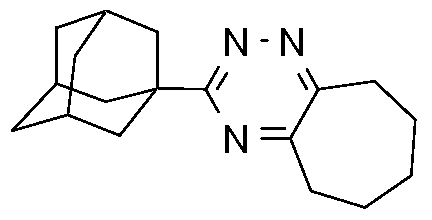
EXAMPLES 3 TO 73
[00111] Examples 3 to 32 in the following table can be prepared according to the procedures described in Examples 1 or 2, or by other similar methods known to one skilled in the art, with other appropriate reagents.


Claims
1. A compound of formula (I)
N - N

R2 (I) enantiomers, diastereomers, solvates, salts or prodrugs thereof wherein:
Ri is alkyl, aryl, heteroaryl, cycloalkyl, adamantyl or heterocyclyl, other than heteroaryl, all of which may be optionally substituted with one or more R4 5S; R2 is hydrogen, halo, cyano, alkyl, alkenyl, alkynyl, cycloalkyl, aryl, heteroaryl, heterocyclyl, -NR9C(=O)R9, -NR9CC=O)OR9-, -NR9CC=O)NR9R9, -OCC=O)NR9R9, -CC=O)NR9R9, -NR9R9, -C(O)R9, -C(O)OR9, -OR9, -SR9, -SO2R9-, -SO2NR9R9, nitro, -OP(=O)(OR9)2 or -NHSO2R9-, wherein the alkyl, alkenyl, alkynyl, cycloalkyl, aryl, heteroaryl or heterocyclyl may be optionally substituted with one or more R4 5S; R3 is hydrogen, halo, cyano, alkyl, alkenyl, alkynyl, cycloalkyl, aryl, heteroaryl, heterocyclyl, -NR9C(=O)R9, -NR9CC=O)OR9-, -NR9CC=O)NR9R9, -OCC=O)NR9R9, -CC=O)NR9R9, -NR9R9, -C(O)R9, -C(O)OR9, -OR9, -SR9, -SO2R9-, -SO2NR9R9, nitro, -OP(=O)(OR9)2 or -NHSO2R9-, wherein the alkyl, alkenyl, alkynyl, cycloalkyl, aryl, heteroaryl or heterocyclyl may be optionally substituted with one or more R4 5S; or
R2 and R3 are taken together with the carbon atoms to which each is attached to form a 4- to 15-membered mono-, bi- or tricylic ring, wherein said ring may be optionally substituted with one or more R4 5S; or
R2 and R3 are taken together with the carbon atoms to which each is attached to form a 4- to 15-membered mono-, bi- or tricylic heterocyclyl ring wherein the heterocyclyl ring contains 1-4 heteroatoms selected from N, O, and S, and said ring may be optionally substituted with one or more R4 5S; R4, at each occurrence, is independently selected from alkyl, aryl, alkenyl, alkynyl, cycloalkyl, heteroaryl, heterocyclyl, halo, =0, -NH2, -CN, -NO2, -C(=O)OH, -C(=O)OR10, -OCF3, -ORio, -OH, -SH, -SRi0, -S(O)3H, -P(O)3H2, -C(K))NR9R9, -NR9R9, -S(O)2NR9R9, -NR9S(O)2CF3, -C(O)NR9S(O)2R9, -S(O)2NR9C(=O)OR9, -S(O)2NR9C(=O)NR9R9, -C(O)NR9S(O)2CF3, -C(O)Ri0, -NR9C(O)H, -NR9C(O)Ri0, -OCC=O)R10, -OC(O)NR9R9, -C(=NRi4)NR9R9, - NHC(=NRi4)NRi4Ri4, -S(O)Ri0, -S(O)2Ri0, -NR9C(O)OR8 or -NR9S(O2)R8, wherein the alkyl, aryl, alkenyl, alkynyl, cycloalkyl, heteroaryl or heterocyclyl may be optionally substituted with one or more Rs's; R5, at each occurrence, is independently selected from alkyl, haloalkyl, aryl, alkenyl, alkynyl, cycloalkyl, cycloalkylalkyl, heteroaryl, heteroarylalkyl, heterocyclyl heterocyclylalkyl, halo, -NH2, -CN, -NO2, -C(O)OH, -C(O)ORi0, -OCF3, -ORi0, -OH, -SH, -SRi0, -S(O)3H, -P(O)3H2, -C(O)NR9R9, -NR9R9, -S(O)2NR9R9, -NR9S(O)2CF3, -C(O)NR9S(O)2R9, -S(O)2NR9C(O)OR9, -S(O)2NR9C(O)NR9R9, -C(O)NR9S(O)2CF3, -C(O)R10, -NR9C(O)H, -NR9C(O)Ri0, -OC(O)Ri0,
-C(=NRi4)NR9R9, -NHC(=NRi4)NRi4Ri4, -S(O)Ri0, -S(O)2Ri0, -NR9C(O)OR8 or -NR9S(O2)R8;
R8, at each occurrence, is independently alkyl or aryl;
R9, at each occurrence, is independently hydrogen, alkyl, alkoxy, cycloalkyl, aryl, arylalkyl, heteroaryl, heteroarylalkyl, heterocyclyl or heterocyclylalkyl, wherein the aryl, arylalkyl, heteroaryl, heteroarylalkyl, heterocyclyl or heterocyclylalkyl may be optionally substituted with 0-5 R9a, and the heteroaryl, heteroarylalkyl, heterocyclyl or heterocyclylalkyl contain 1-4 heteroatoms selected from N, O, and S; R9', at each occurrence, is independently alkyl, alkoxy, cycloalkyl, aryl, arylalkyl, heteroaryl, heteroarylalkyl, heterocyclyl or heterocyclylalkyl, wherein the aryl, arylalkyl, heteroaryl, heteroarylalkyl, heterocyclyl or heterocyclylalkyl may be optionally substituted with 0-5 R9a, and the heteroaryl, heteroarylalkyl, heterocyclyl or heterocyclylalkyl contain 1-4 heteroatoms selected from N, O, and S;
R9a, at each occurrence, is independently selected from alkyl, haloalkyl, aryl, alkenyl, alkynyl, cycloalkyl, cycloalkylalkyl, heteroaryl, heteroarylalkyl, heterocyclyl heterocyclylalkyl, halo, -NH2, -CN, -NO2, -C(O)OH, -C(O)0RM, -OCF3, -OR14, -OH, -SH, -SRi4, -S(O)3H, -P(O)3H2, -C(O)NR14Rw, -NRi4Ri4, -S(O)2NRi4Ri4, -NRi4S(O)2CF3, -CC=O)NRi4S(O)2RiO, -S(0)2NRi4C(=0)ORio, -S(O)2NRi4C(=O)NRMRi4, -CC=O)NR14S(O)2CF3, -C(O)R14, -NR14C(O)H, -NRi4CC=O)Ri4, -0C(=0)RM, -C(=NR14)NR14R14, -NHC(=NRi4)NRi4Ri4, -S(=0)Ri4, -S(O)2Ri4, -NRi4C(=O)OR8, -NRi4S(O2)R8 or arylalkyl; Rio, at each occurrence, is independently selected from alkyl, alkenyl, alkynyl, aryl, arylalkyl, heterocyclyl or heterocyclylalkyl, wherein the aryl, arylalkyl, heterocyclyl or heterocyclylalkyl may be optionally substituted with 0-3 R1Oa, and the heterocyclyl and heterocyclylalkyl contain 1-4 heteroatoms selected from N, O, and S; Rioa, at each occurrence, is independently selected from alkyl, haloalkyl, aryl, alkenyl, alkynyl, cycloalkyl, cycloalkylalkyl, heteroaryl, heteroarylalkyl, heterocyclyl heterocyclylalkyl, halo, -NH2, -CN, -NO2, -C(O)OH, -C(O)OR14, -OCF3, -ORi4, -OH, -SH, -SRi4, -S(O)3H, -P(O)3H2, -C(O)NR14R14, -NRi4Ri4, -S(O)2NRi4Ri4, -NRi4S(O)2CF3, -C(K))NRi4S(O)2R9, -S(O)2NR14C(O)OR9, -S(O)2NR14C(O)NR14R14, -C(O)NR14S(O)2CF3, -C(O)R14, -NR14C(O)H, -NR14C(O)R14, -OC(O)R14, -C(=NR14)NR14R14, -NHC(=NRi4)NRi4Ri4, -S(O)R14, -S(O)2Ri4, -NRi4C(=O)OR8, -NRi4S(O2)R8 or arylalkyl; and
Ri4, at each occurrence, is independently selected from hydrogen, alkyl, cycloalkyl or aryl.
2. The compound of claim 1, wherein:
Ri is alkyl, aryl, heteroaryl, adamantyl, a 3-membered cycloalkyl or an 8- to 20-membered cycloalkyl, other than adamantyl, all of which may be optionally substituted with one or more R4 5S; R2 is hydrogen, halo, cyano, alkyl, alkenyl, alkynyl, cycloalkyl, aryl, heteroaryl, heterocyclyl, -NR9C(=O)R9, -NR9C(O)OR9-, -NR9C(=O)NR9R9, -OC(=O)NR9R9, -C(=O)NR9R9, -NR9R9, -C(O)R9, -C(O)OR9, -OR9, -SR9, -SO2R9S -SO2NR9R9, nitro, -OP(=O)(OR9)2 or -NHSO2R9-, wherein the alkyl, alkenyl, alkynyl, cycloalkyl, aryl, heteroaryl or heterocyclyl may be optionally substituted with one or more R4 5S;
R3 is hydrogen, halo, cyano, alkyl, alkenyl, alkynyl, cycloalkyl, aryl, heteroaryl, heterocyclyl, -NR9C(=O)R9, -NR9C(=O)OR9-, -NR9C(=O)NR9R9, -OC(=O)NR9R9, -C(=O)NR9R9, -NR9R9, -C(O)R9, -C(O)OR9, -OR9, -SR9, -SO2R9S -SO2NR9R9, nitro, -OP(=O)(OR9)2 or -NHSO2R9-, wherein the alkyl, alkenyl, alkynyl, cycloalkyl, aryl, heteroaryl or heterocyclyl may be optionally substituted with one or more R4 5S; or R2 and R3 are taken together with the carbon atoms to which each is attached to form a 4- to 15-membered mono-, bi- or tricylic ring, wherein said ring may be optionally substituted with one or more R4 5S; or
R2 and R3 are taken together with the carbon atoms to which each is attached to form a 4- to 15-membered mono-, bi- or tricylic heterocyclyl ring wherein the heterocyclyl ring contains 1-4 heteroatoms selected from N, O, and S, and said ring may be optionally substituted with one or more R4 5S;
R4, at each occurrence, is independently selected from alkyl, aryl, alkenyl, alkynyl, cycloalkyl, heteroaryl, heterocyclyl, halo, =0, -NH2, -CN, -NO2, -C(O)OH, -C(O)OR10, -OCF3, -OR10, -OH, -SH, -SRi0, -S(O)3H, -P(O)3H2, -C(O)NR9R9, -NR9R9, -S(O)2NR9R9, -NR9S(O)2CF3, -C(O)NR9S(O)2R9, -S(O)2NR9C(O)OR9, -S(O)2NR9C(O)NR9R9, -C(O)NR9S(O)2CF3, -C(O)Ri0, -NR9C(O)H, -NR9C(O)Ri0, -OC(O)R10, -OC(O)NR9R9, -C(=NRi4)NR9R9, - NHC(=NRi4)NRi4Ri4, -S(O)Ri0, -S(O)2Ri0, -NR9C(O)OR8 or -NR9S(O2)R8, wherein the alkyl, aryl, alkenyl, alkynyl, cycloalkyl, heteroaryl or heterocyclyl may be optionally substituted with one or more Rs's;
R5, at each occurrence, is independently selected from alkyl, haloalkyl, aryl, alkenyl, alkynyl, cycloalkyl, cycloalkylalkyl, heteroaryl, heteroarylalkyl, heterocyclyl heterocyclylalkyl, halo, -NH2, -CN, -NO2, -C(O)OH, -C(O)ORi0, -OCF3, -ORi0, -OH, -SH, -SRi0, -S(O)3H, -P(O)3H2, -C(O)NR9R9, -NR9R9, -S(O)2NR9R9, -NR9S(O)2CF3, -C(O)NR9S(O)2R9, -S(O)2NR9C(O)OR9, -S(O)2NR9C(O)NR9R9, -C(O)NR9S(O)2CF3, -C(O)R10, -NR9C(O)H, -NR9C(O)Ri0, -OC(O)Ri0, -C(=NRi4)NR9R9, -NHC(=NRi4)NRi4Ri4, -S(O)R10, -S(O)2Ri0, -NR9C(O)OR8 or -NR9S(O2)R8;
R8, at each occurrence, is independently alkyl or aryl; R9, at each occurrence, is independently hydrogen, alkyl, alkoxy, cycloalkyl, aryl, arylalkyl, heteroaryl, heteroarylalkyl, heterocyclyl or heterocyclylalkyl, wherein the aryl, arylalkyl, heteroaryl, heteroarylalkyl, heterocyclyl or heterocyclylalkyl may be optionally substituted with 0-5 R9a, and the heteroaryl, heteroarylalkyl, heterocyclyl or heterocyclylalkyl contain 1-4 heteroatoms selected from N, O, and S;
R9', at each occurrence, is independently alkyl, alkoxy, cycloalkyl, aryl, arylalkyl, heteroaryl, heteroarylalkyl, heterocyclyl or heterocyclylalkyl, wherein the aryl, arylalkyl, heteroaryl, heteroarylalkyl, heterocyclyl or heterocyclylalkyl may be optionally substituted with 0-5 Rga, and the heteroaryl, heteroarylalkyl, heterocyclyl or heterocyclylalkyl contain 1-4 heteroatoms selected from N, O, and S;
Rga, at each occurrence, is independently selected from alkyl, haloalkyl, aryl, alkenyl, alkynyl, cycloalkyl, cycloalkylalkyl, heteroaryl, heteroarylalkyl, heterocyclyl heterocyclylalkyl, halo, -NH2, -CN, -NO2, -C(O)OH, -C(O)OR14, -OCF3, -ORi4, -OH, -SH, -SR14, -S(O)3H, -P(O)3H2, -C(O)NR14R14, -NRi4Ri4, -S(O)2NRi4Ri4, -NRi4S(O)2CF3, -C(=0)NRi4S(0)2Rio, -S(O)2NRi4C(O)ORi0, -S(O)2NR14C(O)NR14R14, -C(O)NR14S(O)2CF3, -C(O)R14, -NRi4C(O)H, -NR14C(O)R14, -OC(O)R14, -C(=NR14)NR14R14, -NHC(=NRi4)NRi4Ri4, -S(O)R14, -S(O)2Ri4, -NRi4C(O)OR8, -NRi4S(O2)R8 or arylalkyl;
Rio, at each occurrence, is independently selected from alkyl, alkenyl, alkynyl, aryl, arylalkyl, heterocyclyl or heterocyclylalkyl, wherein the aryl, arylalkyl, heterocyclyl or heterocyclylalkyl may be optionally substituted with 0-3 R1Oa, and the heterocyclyl and heterocyclylalkyl contain 1-4 heteroatoms selected from N, O, and S;
RiOa, at each occurrence, is independently selected from alkyl, haloalkyl, aryl, alkenyl, alkynyl, cycloalkyl, cycloalkylalkyl, heteroaryl, heteroarylalkyl, heterocyclyl heterocyclylalkyl, halo, -NH2, -CN, -NO2, -C(O)OH, -C(O)OR14, -OCF3, -OR14, -OH, -SH, -SRi4, -S(O)3H, -P(O)3H2, -C(O)NR14R14, -NRi4Ri4, -S(O)2NRi4Ri4, -NRi4S(O)2CF3, -C(O)NRi4S(O)2R9, -S(O)2NR14C(O)OR9,
-S(O)2NR14C(O)NR14R14, -C(O)NR14S(O)2CF3, -C(O)R14, -NR14C(O)H, -NR14C(O)R14, -OC(O)R14, -C(=NR14)NR14R14, -NHC(=NRi4)NRi4Ri4, -S(O)R14, -S(O)2Ri4, -NRi4C(O)OR8, -NRi4S(O2)R8 or arylalkyl; and
Ri4, at each occurrence, is independently selected from hydrogen, alkyl, cycloalkyl or aryl.
3. The compound of claim 1, wherein: Ri is aryl, heteroaryl, adamantyl, a 3-membered cycloalkyl or an 8- to 15- membered cycloalkyl, other than adamantyl, all of which may be optionally substituted with one or more R4 5S;
R2 is hydrogen, halo, cyano, alkyl, alkenyl, alkynyl, cycloalkyl, aryl, heteroaryl, heterocyclyl, -NR9C(=O)R9, -NR9C(=O)OR9-, -NR9C(=O)NR9R9, -OC(=O)NR9R9, -C(=O)NR9R9, -NR9R9, -C(O)R9, -C(O)OR9, -OR9, -SR9, -SO2R9S -SO2NR9R9, nitro, -OP(=O)(OR9)2 or -NHSO2R9-, wherein the alkyl, alkenyl, alkynyl, cycloalkyl, aryl, heteroaryl or heterocyclyl may be optionally substituted with one or more R4 5S; R3 is hydrogen, halo, cyano, alkyl, alkenyl, alkynyl, cycloalkyl, aryl, heteroaryl, heterocyclyl, -NR9C(=O)R9, -NR9C(=O)OR9-, -NR9C(=O)NR9R9, -OC(=O)NR9R9, -C(=O)NR9R9, -NR9R9, -C(O)R9, -C(O)OR9, -OR9, -SR9, -SO2R9-, -SO2NR9R9, nitro, -OP(=O)(OR9)2 or -NHSO2R9-, wherein the alkyl, alkenyl, alkynyl, cycloalkyl, aryl, heteroaryl or heterocyclyl may be optionally substituted with one or more R4 5S; or
R2 and R3 are taken together with the carbon atoms to which each is attached to form a 4- to 15-membered mono-, bi- or tricylic ring, wherein said ring may be optionally substituted with one or more R4 5S; or
R4, at each occurrence, is independently selected from alkyl, aryl, alkenyl, alkynyl, cycloalkyl, heteroaryl, heterocyclyl, halo, =0, -NH2, -CN, -NO2, -C(O)OH, -C(O)OR10, -OCF3, -OR10, -OH, -SH, -SRi0, -S(O)3H, -P(O)3H2, -C(=O)NR9R9, -NR9R9, -S(O)2NR9R9, -NR9S(O)2CF3, -C(K))NR9S(O)2R9, -S(O)2NR9C(=O)OR9, -S(O)2NR9C(=O)NR9R9, -C(K))NR9S(O)2CF3, -C(O)R10, -NR9C(K))H, -NR9C(=0)Rio, -OC(O)R10, -OC(=O)NR9R9, -C(=NRi4)NR9R9, - NHC(=NRi4)NRi4Ri4, -S(O)R10, -S(O)2Ri0, -NR9C(=O)OR8 or -NR9S(O2)R8, wherein the alkyl, aryl, alkenyl, alkynyl, cycloalkyl, heteroaryl or heterocyclyl may be optionally substituted with one or more R5's;
R5, at each occurrence, is independently selected from alkyl, haloalkyl, aryl, alkenyl, alkynyl, cycloalkyl, cycloalkylalkyl, heteroaryl, heteroarylalkyl, heterocyclyl heterocyclylalkyl, halo, -NH2, -CN, -NO2, -C(O)OH, -C(O)OR10, -OCF3, -ORi0, -OH, -SH, -SRi0, -S(O)3H, -P(O)3H2, -C(=O)NR9R9, -NR9R9, -S(O)2NR9R9, -NR9S(O)2CF3, -C(K))NR9S(O)2R9, -S(O)2NR9C(K))OR9, -S(O)2NR9C(=O)NR9R9, -CC=O)NR9S(O)2CF3, -C(=O)R10, -NR9C(=O)H, -NR9C(=0)Rio, -OC(=O)R10,  -NHC(=NRi4)NRi4Ri4, -S(O)R10, -S(O)2Ri0, -NR9C(=O)OR8 or -NR9S(O2)R8;
R8, at each occurrence, is independently alkyl or aryl; R9, at each occurrence, is independently hydrogen, alkyl, alkoxy, cycloalkyl, aryl, arylalkyl, heteroaryl, heteroarylalkyl, heterocyclyl or heterocyclylalkyl, wherein the aryl, arylalkyl, heteroaryl, heteroarylalkyl, heterocyclyl or heterocyclylalkyl may be optionally substituted with 0-5 R9a, and the heteroaryl, heteroarylalkyl, heterocyclyl or heterocyclylalkyl contain 1-4 heteroatoms selected from N, O, and S; R9', at each occurrence, is independently alkyl, alkoxy, cycloalkyl, aryl, arylalkyl, heteroaryl, heteroarylalkyl, heterocyclyl or heterocyclylalkyl, wherein the aryl, arylalkyl, heteroaryl, heteroarylalkyl, heterocyclyl or heterocyclylalkyl may be optionally substituted with 0-5 R9a, and the heteroaryl, heteroarylalkyl, heterocyclyl or heterocyclylalkyl contain 1-4 heteroatoms selected from N, O, and S; R9a, at each occurrence, is independently selected from alkyl, haloalkyl, aryl, alkenyl, alkynyl, cycloalkyl, cycloalkylalkyl, heteroaryl, heteroarylalkyl, heterocyclyl heterocyclylalkyl, halo, -NH2, -CN, -NO2, -C(O)OH, -C(O)OR14, -OCF3, -ORi4, -OH, -SH, -SRi4, -S(O)3H, -P(O)3H2, -C(O)NR14R14, -NRi4Ri4, -S(O)2NRi4Ri4, -NRi4S(O)2CF3, -C(K))NRi4S(O)2Ri0, -S(O)2NRi4C(K))ORi0, -S(O)2NRi4C(=O)NRi4Ri4, -C(O)NR14S(O)2CF3, -C(O)R14, -NR14C(O)H, -NR14C(O)R14, -OC(O)R14, -C(=NRi4)NRi4Ri4, -NHC(=NRi4)NRi4Ri4, -S(O)R14, -S(O)2Ri4, -NRi4C(=O)OR8, -NRi4S(O2)R8 or arylalkyl;
Ri0, at each occurrence, is independently selected from alkyl, alkenyl, alkynyl, aryl, arylalkyl, heterocyclyl or heterocyclylalkyl, wherein the aryl, arylalkyl, heterocyclyl or heterocyclylalkyl may be optionally substituted with 0-3 R1Oa, and the heterocyclyl and heterocyclylalkyl contain 1-4 heteroatoms selected from N, O, and S;
RiOa, at each occurrence, is independently selected from alkyl, haloalkyl, aryl, alkenyl, alkynyl, cycloalkyl, cycloalkylalkyl, heteroaryl, heteroarylalkyl, heterocyclyl heterocyclylalkyl, halo, -NH2, -CN, -NO2, -C(O)OH, -C(O)OR14, -OCF3, -ORi4, -OH, -SH, -SRi4, -S(O)3H, -P(O)3H2, -C(O)NR14R14, -NRi4Ri4, -S(O)2NRi4Ri4, -NRi4S(O)2CF3, -C(K))NRi4S(O)2R9, -S(O)2NR14C(O)OR9,  -C(=O)NRi4S(O)2CF3, -C(O)R14, -NR14C(O)H, -NR14C(O)R14, -OC(O)R14, -C(=NR14)NR14R14, -NHC(=NRi4)NRi4Ri4, -S(O)R14, -S(O)2Ri4, -NRi4C(=O)OR8, -NRi4S(O2)R8 or arylalkyl; and
Ri4, at each occurrence, is independently selected from hydrogen, alkyl, cycloalkyl or aryl.
4. The compound of claim 1, wherein:
Ri is aryl, heteroaryl, adamantyl, a 3-membered cycloalkyl or an 8- to 15- membered cycloalkyl, other than adamantyl, all of which may be optionally substituted with one or more R4 5S;
R2 is hydrogen, halo, cyano, alkyl, cycloalkyl, aryl, heteroaryl, heterocyclyl, -NR9C(=O)R9, -NR9C(O)OR9-, -NR9C(=O)NR9R9, -OC(=O)NR9R9, -C(=O)NR9R9, - NR9R9, -C(O)R9, -C(O)OR9, -OR9, -SR9 or nitro, wherein the alkyl, cycloalkyl, aryl, heteroaryl or heterocyclyl may be optionally substituted with one or more R4 5S; R3 is hydrogen, halo, cyano, alkyl, cycloalkyl, aryl, heteroaryl, heterocyclyl,
-NR9C(=O)R9, -NR9C(O)OR9-, -NR9C(=O)NR9R9, -OC(=O)NR9R9, -C(=O)NR9R9, - NR9R9, -C(O)R9, -C(O)OR9, -OR9, -SR9 or nitro, wherein the alkyl, cycloalkyl, aryl, heteroaryl or heterocyclyl may be optionally substituted with one or more R4 5S; or R2 and R3 are taken together with the carbon atoms to which each is attached to form a 4- to 15-membered mono-, bi- or tricylic ring, wherein said ring may be optionally substituted with one or more R4 5S;
R4, at each occurrence, is independently selected from alkyl, aryl, alkenyl, alkynyl, cycloalkyl, heteroaryl, heterocyclyl, halo, =0, -NH2, -CN, -NO2, -C(O)OH, -C(O)OR10, -OCF3, -OR10, -OH, -SH, -SRi0, -S(O)3H, -P(O)3H2, -C(K))NR9R9, -NR9R9, -S(O)2NR9R9, -NR9S(O)2CF3, -C(O)NR9S(O)2R9, -S(O)2NR9C(=O)OR9, -S(O)2NR9C(=O)NR9R9, -C(O)NR9S(O)2CF3, -C(O)R10, -NR9C(O)H, -NR9C(=0)Rio, -OC(O)R10, -OC(=O)NR9R9, -C(=NRi4)NR9R9, - NHC(=NRi4)NRi4Ri4, -S(O)R10, -S(O)2Ri0, -NR9C(=O)OR8 or -NR9S(O2)R8, wherein the alkyl, aryl, alkenyl, alkynyl, cycloalkyl, heteroaryl or heterocyclyl may be optionally substituted with one or more Rs's; R5, at each occurrence, is independently selected from alkyl, haloalkyl, aryl, alkenyl, alkynyl, cycloalkyl, cycloalkylalkyl, heteroaryl, heteroarylalkyl, heterocyclyl heterocyclylalkyl, halo, -NH2, -CN, -NO2, -C(O)OH, -C(O)OR10, -OCF3, -ORi0, -OH, -SH, -SRio, -S(O)3H, -P(O)3H2, -C(=O)NR9R9, -NR9R9, -S(O)2NR9R9, -NR9S(O)2CF3, -C(K))NR9S(O)2R9, -S(O)2NR9C(O)OR9, -S(O)2NR9C(O)NR9R9, -C(O)NR9S(O)2CF3, -C(O)R10, -NR9C(O)H, -NR9C(O)Ri0, -OC(O)Ri0, -C(=NRi4)NR9R9, -NHC(=NRi4)NRi4Ri4, -S(O)Ri0, -S(O)2Ri0, -NR9C(O)OR8 or -NR9S(O2)R8;
R8, at each occurrence, is independently alkyl or aryl; R9, at each occurrence, is independently hydrogen, alkyl, alkoxy, cycloalkyl, aryl, arylalkyl, heteroaryl, heteroarylalkyl, heterocyclyl or heterocyclylalkyl, wherein the aryl, arylalkyl, heteroaryl, heteroarylalkyl, heterocyclyl or heterocyclylalkyl may be optionally substituted with 0-5 R9a, and the heteroaryl, heteroarylalkyl, heterocyclyl or heterocyclylalkyl contain 1-4 heteroatoms selected from N, O, and S; R9', at each occurrence, is independently alkyl, alkoxy, cycloalkyl, aryl, arylalkyl, heteroaryl, heteroarylalkyl, heterocyclyl or heterocyclylalkyl, wherein the aryl, arylalkyl, heteroaryl, heteroarylalkyl, heterocyclyl or heterocyclylalkyl may be optionally substituted with 0-5 R9a, and the heteroaryl, heteroarylalkyl, heterocyclyl or heterocyclylalkyl contain 1-4 heteroatoms selected from N, O, and S; R9a, at each occurrence, is independently selected from alkyl, haloalkyl, aryl, alkenyl, alkynyl, cycloalkyl, cycloalkylalkyl, heteroaryl, heteroarylalkyl, heterocyclyl heterocyclylalkyl, halo, -NH2, -CN, -NO2, -C(O)OH, -C(O)OR14, -OCF3, -ORi4, -OH, -SH, -SRi4, -S(O)3H, -P(O)3H2, -C(O)NRi4Ri4, -NRi4Ri4, -S(O)2NRi4Ri4, -NRi4S(O)2CF3, -C(O)NRi4S(O)2Ri0, -S(O)2NRi4C(O)ORi0, -S(O)2NRi4C(O)NRi4Ri4, -C(O)NR14S(O)2CF3, -C(O)Ri4, -NRi4C(O)H, -NR14C(O)R14, -OC(O)R14, -C(=NR14)NR14R14, -NHC(=NRi4)NRi4Ri4, -S(O)R14, -S(O)2Ri4, -NRi4C(O)OR8, -NRi4S(O2)R8 or arylalkyl;
Ri0, at each occurrence, is independently selected from alkyl, alkenyl, alkynyl, aryl, arylalkyl, heterocyclyl or heterocyclylalkyl, wherein the aryl, arylalkyl, heterocyclyl or heterocyclylalkyl may be optionally substituted with 0-3 R1Oa, and the heterocyclyl and heterocyclylalkyl contain 1-4 heteroatoms selected from N, O, and S; RiOa, at each occurrence, is independently selected from alkyl, haloalkyl, aryl, alkenyl, alkynyl, cycloalkyl, cycloalkylalkyl, heteroaryl, heteroarylalkyl, heterocyclyl heterocyclylalkyl, halo, -NH2, -CN, -NO2, -C(O)OH, -C(O)OR14, -OCF3, -ORi4, -OH, -SH, -SRi4, -S(O)3H, -P(O)3H2, -C(O)NR14R14, -NRi4Ri4, -S(O)2NRi4Ri4, -NRi4S(O)2CF3, -C(K))NRi4S(O)2R9, -S(O)2NR14C(O)OR9,
-S(O)2NRi4C(=O)NRMRi4, -C(O)NR14S(O)2CF3, -C(O)R14, -NR14C(O)H, -NR14C(O)R14, -OC(O)R14, -C(=NRi4)NRi4Ri4, -NHC(=NRi4)NRi4Ri4, -S(O)R14, -S(O)2Ri4, -NRi4C(=O)OR8, -NRi4S(O2)R8 or arylalkyl; and
Ri4, at each occurrence, is independently selected from hydrogen, alkyl, cycloalkyl or aryl.
5. The compound of claim 1, wherein:
Ri is aryl, heteroaryl, adamantyl, a 3-membered cycloalkyl or an 8- to 15- membered cycloalkyl, other than adamantyl, all of which may be optionally substituted with one or more R4 5S;
R2 is halo, cyano, alkyl, cycloalkyl, aryl, heteroaryl, heterocyclyl, -NR9C(=O)R9, -NR9C(O)OR9-, -NR9C(=O)NR9R9, -OC(=O)NR9R9, -C(=O)NR9R9, - NR9R9, -C(O)R9, -C(O)OR9, -OR9, -SR9 or nitro, wherein the alkyl, cycloalkyl, aryl, heteroaryl or heterocyclyl may be optionally substituted with one or more R4 5S; R3 is hydrogen, halo, cyano, alkyl, cycloalkyl, aryl, heteroaryl, heterocyclyl,
-NR9C(=O)R9, -NR9C(O)OR9-, -NR9C(=O)NR9R9, -OC(=O)NR9R9, -C(=O)NR9R9, - NR9R9, -C(O)R9, -C(O)OR9, -OR9, -SR9 or nitro, wherein the alkyl, cycloalkyl, aryl, heteroaryl or heterocyclyl may be optionally substituted with one or more R4 5S; or R2 and R3 are taken together with the carbon atoms to which each is attached to form a 4- to 15-membered mono-, bi- or tricylic ring, wherein said ring may be optionally substituted with one or more R4 5S;
R4, at each occurrence, is independently selected from alkyl, aryl, alkenyl, alkynyl, cycloalkyl, heteroaryl, heterocyclyl, halo, =0, -NH2, -CN, -NO2, -C(O)OH, -C(O)OR10, -OCF3, -ORio, -OH, -SH, -SRi0, -S(O)3H, -P(O)3H2, -C(O)NR9R9, -NR9R9, -S(O)2NR9R9, -NR9S(O)2CF3, -C(O)NR9S(O)2R9, -S(O)2NR9C(=O)OR9, -S(O)2NR9C(=O)NR9R9, -C(O)NR9S(O)2CF3, -C(O)R10, -NR9C(O)H, -NR9C(=0)Rio, -OC(=O)R10, -OC(=O)NR9R9,  - NHC(=NRi4)NRi4Ri4, -S(=O)R10, -S(O)2Ri0, -NR9C(=O)OR8 or -NR9S(O2)R8, wherein the alkyl, aryl, alkenyl, alkynyl, cycloalkyl, heteroaryl or heterocyclyl may be optionally substituted with one or more Rs's; R5, at each occurrence, is independently selected from alkyl, haloalkyl, aryl, alkenyl, alkynyl, cycloalkyl, cycloalkylalkyl, heteroaryl, heteroarylalkyl, heterocyclyl heterocyclylalkyl, halo, -NH2, -CN, -NO2, -C(=0)0H, -C(=O)OR10, -OCF3, -ORi0, -OH, -SH, -SRi0, -S(O)3H, -P(O)3H2, -C(=O)NR9R9, -NR9R9, -S(O)2NR9R9, -NR9S(O)2CF3, -C(K))NR9S(O)2R9, -S(O)2NR9C(O)OR9, -S(O)2NR9C(=O)NR9R9, -C(=O)NR9S(O)2CF3, -CC=O)R10, -NR9C(=0)H, -NR9C(=O)Ri0, -OC(=O)R10,
-CC=NRi4)NR9R9, -NHCC=NRI4)NRI4RI4, -S(=O)R10, -S(O)2RI0, -NR9C(=O)OR8 or -NR9S(O2)R8;
R8, at each occurrence, is independently alkyl or aryl;
R9, at each occurrence, is independently hydrogen, alkyl, alkoxy, cycloalkyl, aryl, arylalkyl, heteroaryl, heteroarylalkyl, heterocyclyl or heterocyclylalkyl, wherein the aryl, arylalkyl, heteroaryl, heteroarylalkyl, heterocyclyl or heterocyclylalkyl may be optionally substituted with 0-5 R9a, and the heteroaryl, heteroarylalkyl, heterocyclyl or heterocyclylalkyl contain 1-4 heteroatoms selected from N, O, and S; R9', at each occurrence, is independently alkyl, alkoxy, cycloalkyl, aryl, arylalkyl, heteroaryl, heteroarylalkyl, heterocyclyl or heterocyclylalkyl, wherein the aryl, arylalkyl, heteroaryl, heteroarylalkyl, heterocyclyl or heterocyclylalkyl may be optionally substituted with 0-5 R9a, and the heteroaryl, heteroarylalkyl, heterocyclyl or heterocyclylalkyl contain 1-4 heteroatoms selected from N, O, and S;
R9a, at each occurrence, is independently selected from alkyl, haloalkyl, aryl, alkenyl, alkynyl, cycloalkyl, cycloalkylalkyl, heteroaryl, heteroarylalkyl, heterocyclyl heterocyclylalkyl, halo, -NH2, -CN, -NO2, -C(=0)0H, -C(=0)0R14, -OCF3, -ORi4, -OH, -SH, -SRi4, -S(O)3H, -P(O)3H2, -CC=O)NR14R14, -NRi4Ri4, -S(O)2NRi4Ri4, -NRi4S(O)2CF3, -C(K))NRi4S(O)2Ri0, -S(O)2NRi4C(K))ORi0, -S(O)2NRi4C(=O)NRMRi4, -CC=O)NR14S(O)2CF3, -C(K))Ri4, -NRi4C(K))H, -NR14CC=O)R14, -OCC=O)Ri4, -CC=NR14)NR14R14, -NHC(=NRi4)NRi4Ri4, -SC=O)R14, -S(O)2Ri4, -NRi4C(=O)OR8, -NRi4S(O2)R8 or arylalkyl; Rio, at each occurrence, is independently selected from alkyl, alkenyl, alkynyl, aryl, arylalkyl, heterocyclyl or heterocyclylalkyl, wherein the aryl, arylalkyl, heterocyclyl or heterocyclylalkyl may be optionally substituted with 0-3 R1Oa, and the heterocyclyl and heterocyclylalkyl contain 1 -4 heteroatoms selected from N, O, and S;
RiOa, at each occurrence, is independently selected from alkyl, haloalkyl, aryl, alkenyl, alkynyl, cycloalkyl, cycloalkylalkyl, heteroaryl, heteroarylalkyl, heterocyclyl heterocyclylalkyl, halo, -NH2, -CN, -NO2, -C(O)OH, -C(O)OR14, -OCF3, -ORi4, -OH, -SH, -SRi4, -S(O)3H, -P(O)3H2, -C(O)NR14R14, -NRi4Ri4, -S(O)2NRi4Ri4, -NRi4S(O)2CF3, -C(K))NRi4S(O)2R9, -S(O)2NRi4C(O)OR9,
-S(O)2NRi4C(O)NRi4Ri4, -C(O)NR14S(O)2CF3, -C(O)Ri4, -NRi4C(O)H, -NR14C(O)R14, -OC(O)R14, -C(=NRi4)NRMRi4, -NHC(=NRi4)NRi4Ri4, -S(O)R14, -S(O)2Ri4, -NRi4C(O)OR8, -NRi4S(O2)R8 or arylalkyl; and
Ri4, at each occurrence, is independently selected from hydrogen, alkyl, cycloalkyl or aryl.
6. The compound of claim 1, wherein:
Ri is aryl, heteroaryl, adamantyl, a 3-membered cycloalkyl or an 8- to 15- membered cycloalkyl, other than adamantyl, all of which may be optionally substituted with one or more R4 5S;
R2 is halo, cyano, alkyl, cycloalkyl, aryl, heteroaryl, heterocyclyl, -NR9C(O)R9, -NR9C(O)0R9S -NR9C(O)NR9R9, -OC(O)NR9R9, -C(O)NR9R9, - NR9R9, -C(O)R9, -C(O)OR9, -OR9 or -SR9, wherein the alkyl, cycloalkyl, aryl, heteroaryl, heterocyclyl may be optionally substituted with one or more R4 5S; R3 is hydrogen, halo, cyano, alkyl, cycloalkyl, aryl, heteroaryl, heterocyclyl,
-NR9C(O)R9, -NR9C(O)0R9S -NR9C(O)NR9R9, -OC(O)NR9R9, -C(O)NR9R9, - NR9R9, -C(O)R9, -C(O)OR9, -OR9, or -SR9, wherein the alkyl, cycloalkyl, aryl, heteroaryl, heterocyclyl may be optionally substituted with one or more R4 5S; or
R2 and R3 are taken together with the carbon atoms to which each is attached to form a 4- to 15-membered mono-, bi- or tricylic ring, wherein said ring may be optionally substituted with one or more R4 5S; or R4, at each occurrence, is independently selected from alkyl, aryl, alkenyl, alkynyl, cycloalkyl, heteroaryl, heterocyclyl, halo, =0, -NH2, -CN, -NO2, -C(=O)OH, -C(=O)OR10, -OCF3, -ORio, -OH, -SH, -SRi0, -S(O)3H, -P(O)3H2, -C(K))NR9R9, -NR9R9, -S(O)2NR9R9, -NR9S(O)2CF3, -C(O)NR9S(O)2R9, -S(O)2NR9C(=O)OR9, -S(O)2NR9C(=O)NR9R9, -C(O)NR9S(O)2CF3, -C(O)Ri0, -NR9C(O)H, -NR9C(O)Ri0, -OCC=O)R10, -OC(O)NR9R9, -C(=NRi4)NR9R9, - NHC(=NRi4)NRi4Ri4, -S(O)Ri0, -S(O)2Ri0, -NR9C(O)OR8 or -NR9S(O2)R8, wherein the alkyl, aryl, alkenyl, alkynyl, cycloalkyl, heteroaryl or heterocyclyl may be optionally substituted with one or more Rs's; R5, at each occurrence, is independently selected from alkyl, haloalkyl, aryl, alkenyl, alkynyl, cycloalkyl, cycloalkylalkyl, heteroaryl, heteroarylalkyl, heterocyclyl heterocyclylalkyl, halo, -NH2, -CN, -NO2, -C(O)OH, -C(O)ORi0, -OCF3, -ORi0, -OH, -SH, -SRi0, -S(O)3H, -P(O)3H2, -C(O)NR9R9, -NR9R9, -S(O)2NR9R9, -NR9S(O)2CF3, -C(O)NR9S(O)2R9, -S(O)2NR9C(O)OR9, -S(O)2NR9C(O)NR9R9, -C(O)NR9S(O)2CF3, -C(O)R10, -NR9C(O)H, -NR9C(O)Ri0, -OC(O)Ri0,
-C(=NRi4)NR9R9, -NHC(=NRi4)NRi4Ri4, -S(O)Ri0, -S(O)2Ri0, -NR9C(O)OR8 or -NR9S(O2)R8;
R8, at each occurrence, is independently alkyl or aryl;
R9, at each occurrence, is independently hydrogen, alkyl, alkoxy, cycloalkyl, aryl, arylalkyl, heteroaryl, heteroarylalkyl, heterocyclyl or heterocyclylalkyl, wherein the heteroaryl, heteroarylalkyl, heterocyclyl or heterocyclylalkyl contain 1-4 heteroatoms selected from N, O, and S;
R9', at each occurrence, is independently alkyl, alkoxy, cycloalkyl, aryl, arylalkyl, heteroaryl, heteroarylalkyl, heterocyclyl or heterocyclylalkyl, wherein the heteroaryl, heteroarylalkyl, heterocyclyl or heterocyclylalkyl contain 1-4 heteroatoms selected from N, O, and S;
Ri0, at each occurrence, is independently selected from alkyl, alkenyl, alkynyl, aryl, arylalkyl, heterocyclyl or heterocyclylalkyl, wherein the heterocyclyl and heterocyclylalkyl contain 1-4 heteroatoms selected from N, O, and S; and Ri4, at each occurrence, is independently selected from hydrogen, alkyl, cycloalkyl or aryl.
7. The compound of claim 1, wherein:
Ri is aryl, adamantyl, a 3-membered cycloalkyl or an 8- to 15-membered cycloalkyl, other than adamantyl, all of which may be optionally substituted with one or more R4 5S; R2 is halo, alkyl, cycloalkyl, aryl, heteroaryl, heterocyclyl, -NR9C(=O)R9,
-NR9C(=O)OR9s -NR9C(=O)NR9R9, -OC(=O)NR9R9, -C(=O)NR9R9, -NR9R9, -C(=0)R9, -C(=0)0R9 or -OR9, wherein the alkyl, cycloalkyl, aryl, heteroaryl or heterocyclyl may be optionally substituted with one or more R4 5S;
R3 is hydrogen, halo, alkyl, cycloalkyl, aryl, heteroaryl, heterocyclyl, -NR9C(=O)R9, -NR9C(O)OR9', -NR9C(=O)NR9R9, -OC(=O)NR9R9, -C(=O)NR9R9, - NR9R9, -C(O)R9, -C(O)OR9, or -OR9, wherein the alkyl, cycloalkyl, aryl, heteroaryl or heterocyclyl may be optionally substituted with one or more R4 5S; or
R2 and R3 are taken together with the carbon atoms to which each is attached to form a 4- to 15-membered mono-, bi- or tricylic ring, wherein said ring may be optionally substituted with one or more R4 5S; or
R4, at each occurrence, is independently selected from alkyl, aryl, cycloalkyl, heteroaryl, heterocyclyl, halo, =0, -NH2, -CN, -NO2, -C(O)OH, -C(O)ORi0, -OCF3, -OR10, -OH, -SH, -SRi0, -C(O)NR9R9, -NR9R9, -S(O)2NR9R9, -NR9S(O)2CF3, -C(O)NR9S(O)2R9, -S(O)2NR9C(O)OR9, -S(O)2NR9C(O)NR9R9, -C(O)NR9S(O)2CF3, -C(O)R10, -NR9C(O)H, -NR9C(O)Ri0, -OC(O)Ri0, -
OC(O)NR9R9, -S(O)Ri0, -S(O)2Ri0, -NR9C(O)OR8, or -NR9S(O2)R8, wherein the alkyl, aryl, cycloalkyl, heteroaryl, heterocyclyl may be optionally substituted with one or more Rs's;
R5, at each occurrence, is independently selected from alkyl, haloalkyl, aryl, cycloalkyl, heteroaryl, heterocyclyl, halo, -NH2, -CN, -NO2, -C(O)OH, -C(O)OR10, -OCF3, -ORi0, -OH, -SH, -SRi0, -C(O)NR9R9, -NR9R9, -S(O)2NR9R9, -NR9S(O)2CF3, -C(O)NR9S(O)2R9, -S(O)2NR9C(O)OR9, -S(O)2NR9C(O)NR9R9, -C(O)NR9S(O)2CF3, -C(O)R10, -NR9C(O)H, -NR9C(O)Ri0, -OC(O)Ri0, -S(O)R10, -S(O)2Ri0, -NR9C(O)OR8 or -NR9S(O2)R8; R8, at each occurrence, is independently alkyl or aryl; R9, at each occurrence, is independently hydrogen, alkyl, alkoxy, cycloalkyl, aryl, heteroaryl or heterocycly, wherein the heteroaryl or heterocyclyl contain 1-4 heteroatoms selected from N, O, and S; and
Rio, at each occurrence, is independently selected from alkyl, aryl or heterocyclyl, wherein the heterocyclyl contains 1 -4 heteroatoms selected from N, O, and S.
8. The compound of claim 1, wherein:
Ri is adamantyl, a 3-membered cycloalkyl or an 8- to 15-membered cycloalkyl, other than adamantyl, all of which may be optionally substituted with one or more R4 5S;
R2 is alkyl, cycloalkyl, aryl, heteroaryl, heterocyclyl,  -NR9C(=O)OR9s -NR9C(=O)NR9R9, -OC(=O)NR9R9, -C(=O)NR9R9, -NR9R9, -C(=0)R9, -C(=0)0R9 or -OR9, wherein the alkyl, cycloalkyl, aryl, heteroaryl or heterocyclyl may be optionally substituted with one or more R4 5S;
R3 is hydrogen, alkyl, cycloalkyl, aryl, heteroaryl, heterocyclyl, - NR9C(=O)R9, -NR9CC=O)OR9-, -NR9CC=O)NR9R9, -OC(=O)NR9R9, -C(=O)NR9R9, - NR9R9,
-C(=0)R9, -C(=0)0R9, or -OR9, wherein the alkyl, cycloalkyl, aryl, heteroaryl or heterocyclyl may be optionally substituted with one or more R4 5S; or
R2 and R3 are taken together with the carbon atoms to which each is attached to form a 4- to 15-membered mono-, bi- or tricylic ring, wherein said ring may be optionally substituted with one or more R4 5S; or
R4, at each occurrence, is independently selected from alkyl, aryl, cycloalkyl, heteroaryl, heterocyclyl, halo, -NH2, -CN, -NO2, -C(=0)0H, -C(=O)OR10, -OCF3, -OR10, -OH, -SH, -SR10, -C(=O)NR9R9, -NR9R9, -S(O)2NR9R9, -NR9S(O)2CF3, -C(=O)NR9S(O)2R9, -S(O)2NR9C(=O)OR9, -S(O)2NR9C(K))NR9R9, -C(O)NR9S(O)2CF3, -CC=O)R10, -NR9C(=0)H, -NR9C(K))Ri0, -OC(K))Ri0, - OC(=O)NR9R9, -SC=O)R10 or -S(O)2Ri0, wherein the alkyl, aryl, cycloalkyl, heteroaryl or heterocyclyl may be optionally substituted with one or more R5's;
R5, at each occurrence, is independently selected from alkyl, haloalkyl, aryl, cycloalkyl, heteroaryl, heterocyclyl, halo, -NH2, -CN, -NO2, -C(O)OH, -C(O)OR10, -OCF3, -ORio, -OH, -SH, -SRi0, -C(K))NR9R9, -NR9R9, -S(O)2NR9R9, -NR9S(O)2CF3, -C(O)NR9S(O)2R9, -S(O)2NR9C(O)OR9, -S(O)2NR9C(O)NR9R9, -C(O)NR9S(O)2CF3, -C(=O)R10, -NR9C(O)H, -NR9C(O)Ri0, -OC(O)Ri0, -S(O)Ri0 or -S(O)2Ri0; R9, at each occurrence, is independently hydrogen, alkyl, cycloalkyl, aryl, heteroaryl or heterocycly, wherein the heteroaryl or heterocyclyl contain 1-4 heteroatoms selected from N, O, and S; and
Ri0, at each occurrence, is independently selected from alkyl, aryl or heterocyclyl, wherein the heterocyclyl contains 1-4 heteroatoms selected from N, O, and S.
9. The compound of claim 1, wherein:
Ri is a 4- to 7-membered cycloalkyl or heterocyclyl, other than heteroaryl, all of which may be optionally substituted with one or more R4 5S; R2 is halo, cyano, alkyl, alkenyl, alkynyl, cycloalkyl, aryl, heteroaryl, heterocyclyl, -NR9CC=O)OR9-, -NR9CC=O)NR9R9, -C(O)R9, -SR9 or -SO2R9-, or wherein the alkyl, alkenyl, alkynyl, cycloalkyl, aryl, heteroaryl or heterocyclyl may be optionally substituted with one or more R4 5S;
R3 is hydrogen, halo, cyano, alkyl, alkenyl, alkynyl, cycloalkyl, aryl, heteroaryl, heterocyclyl, -NR9C(O)R9, -NR9C(O)OR9-, -NR9C(O)NR9R9,
-OC(O)NR9R9, -C(O)NR9R9, -NR9R9, -C(O)R9, -C(O)OR9, -OR9, -SR9,
-SO2R9-, -SO2NR9R9, nitro, -OP(=O)(OR9)2 or -NHSO2R9-, wherein the alkyl, alkenyl, alkynyl, cycloalkyl, aryl, heteroaryl or heterocyclyl may be optionally substituted with one or more R4 5S; or R2 and R3 are taken together with the carbon atoms to which each is attached to form a 4- to 15-membered mono-, bi- or tricylic ring, wherein said ring may be optionally substituted with one or more R4 5S; or
R2 and R3 are taken together with the carbon atoms to which each is attached to form a 4- to 15-membered mono-, bi- or tricylic heterocyclyl ring wherein the heterocyclyl ring contains 1-4 heteroatoms selected from N, O, and S, and said ring may be optionally substituted with one or more R4 5S; R4, at each occurrence, is independently selected from alkyl, aryl, alkenyl, alkynyl, cycloalkyl, heteroaryl, heterocyclyl, halo, =0, -NH2, -CN, -NO2, -C(=O)OH, -C(=O)OR10, -OCF3, -ORio, -OH, -SH, -SRi0, -S(O)3H, -P(O)3H2, -C(K))NR9R9, -NR9R9, -S(O)2NR9R9, -NR9S(O)2CF3, -C(O)NR9S(O)2R9, -S(O)2NR9C(=O)OR9, -S(O)2NR9C(=O)NR9R9, -C(O)NR9S(O)2CF3, -C(O)Ri0, -NR9C(O)H, -NR9C(O)Ri0, -OCC=O)R10, -OC(O)NR9R9, -C(=NRi4)NR9R9, - NHC(=NRi4)NRi4Ri4, -S(O)Ri0, -S(O)2Ri0, -NR9C(O)OR8 or -NR9S(O2)R8, wherein the alkyl, aryl, alkenyl, alkynyl, cycloalkyl, heteroaryl or heterocyclyl may be optionally substituted with one or more Rs's; R5, at each occurrence, is independently selected from alkyl, haloalkyl, aryl, alkenyl, alkynyl, cycloalkyl, cycloalkylalkyl, heteroaryl, heteroarylalkyl, heterocyclyl heterocyclylalkyl, halo, -NH2, -CN, -NO2, -C(O)OH, -C(O)ORi0, -OCF3, -ORi0, -OH, -SH, -SRi0, -S(O)3H, -P(O)3H2, -C(O)NR9R9, -NR9R9, -S(O)2NR9R9, -NR9S(O)2CF3, -C(O)NR9S(O)2R9, -S(O)2NR9C(O)OR9, -S(O)2NR9C(O)NR9R9, -C(O)NR9S(O)2CF3, -C(O)R10, -NR9C(O)H, -NR9C(O)Ri0, -OC(O)Ri0,
-C(=NRi4)NR9R9, -NHC(=NRi4)NRi4Ri4, -S(O)Ri0, -S(O)2Ri0, -NR9C(O)OR8 or -NR9S(O2)R8;
R8, at each occurrence, is independently alkyl or aryl;
R9, at each occurrence, is independently hydrogen, alkyl, alkoxy, cycloalkyl, aryl, arylalkyl, heteroaryl, heteroarylalkyl, heterocyclyl or heterocyclylalkyl, wherein the aryl, arylalkyl, heteroaryl, heteroarylalkyl, heterocyclyl or heterocyclylalkyl may be optionally substituted with 0-5 R9a, and the heteroaryl, heteroarylalkyl, heterocyclyl or heterocyclylalkyl contain 1-4 heteroatoms selected from N, O, and S; R9', at each occurrence, is independently alkyl, alkoxy, cycloalkyl, aryl, arylalkyl, heteroaryl, heteroarylalkyl, heterocyclyl or heterocyclylalkyl, wherein the aryl, arylalkyl, heteroaryl, heteroarylalkyl, heterocyclyl or heterocyclylalkyl may be optionally substituted with 0-5 R9a, and the heteroaryl, heteroarylalkyl, heterocyclyl or heterocyclylalkyl contain 1-4 heteroatoms selected from N, O, and S;
R9a, at each occurrence, is independently selected from alkyl, haloalkyl, aryl, alkenyl, alkynyl, cycloalkyl, cycloalkylalkyl, heteroaryl, heteroarylalkyl, heterocyclyl heterocyclylalkyl, halo, -NH2, -CN, -NO2, -C(O)OH, -C(O)0RM, -OCF3, -OR14, -OH, -SH, -SRi4, -S(O)3H, -P(O)3H2, -C(O)NR14Rw, -NRi4Ri4, -S(O)2NRi4Ri4, -NRi4S(O)2CF3, -CC=O)NRi4S(O)2RiO, -S(0)2NRi4C(=0)ORio, -S(O)2NRi4C(=O)NRMRi4, -CC=O)NR14S(O)2CF3, -C(O)R14, -NR14C(O)H, -NRi4CC=O)Ri4, -0C(=0)RM, -C(=NR14)NR14R14, -NHC(=NRi4)NRi4Ri4, -S(=0)Ri4, -S(O)2Ri4, -NRi4C(=O)OR8, -NRi4S(O2)R8 or arylalkyl; Rio, at each occurrence, is independently selected from alkyl, alkenyl, alkynyl, aryl, arylalkyl, heterocyclyl or heterocyclylalkyl, wherein the aryl, arylalkyl, heterocyclyl or heterocyclylalkyl may be optionally substituted with 0-3 R1Oa, and the heterocyclyl and heterocyclylalkyl contain 1-4 heteroatoms selected from N, O, and S; Rioa, at each occurrence, is independently selected from alkyl, haloalkyl, aryl, alkenyl, alkynyl, cycloalkyl, cycloalkylalkyl, heteroaryl, heteroarylalkyl, heterocyclyl heterocyclylalkyl, halo, -NH2, -CN, -NO2, -C(O)OH, -C(O)OR14, -OCF3, -ORi4, -OH, -SH, -SRi4, -S(O)3H, -P(O)3H2, -C(O)NR14R14, -NRi4Ri4, -S(O)2NRi4Ri4, -NRi4S(O)2CF3, -C(K))NRi4S(O)2R9, -S(O)2NR14C(O)OR9, -S(O)2NR14C(O)NR14R14, -C(O)NR14S(O)2CF3, -C(O)R14, -NR14C(O)H, -NR14C(O)R14, -OC(O)R14, -C(=NR14)NR14R14, -NHC(=NRi4)NRi4Ri4, -S(O)R14, -S(O)2Ri4, -NRi4C(=O)OR8, -NRi4S(O2)R8 or arylalkyl; and
Ri4, at each occurrence, is independently selected from hydrogen, alkyl, cycloalkyl or aryl.
10. The compound of claim 1, wherein:
Ri is a 4- to 7-membered cycloalkyl or heterocyclyl, other than heteroaryl, all of which may be optionally substituted with one or more R4 5S;
R2 is halo, cyano, alkyl, alkenyl, alkynyl, cycloalkyl, aryl, heteroaryl, heterocyclyl, -NR9C(=O)NR9R9, -C(O)R9, -SR9 or -SO2R9-, or wherein the alkyl, alkenyl, alkynyl, cycloalkyl, aryl, heteroaryl or heterocyclyl may be optionally substituted with one or more R4 5S;
R3 is hydrogen, halo, cyano, alkyl, cycloalkyl, aryl, heteroaryl, heterocyclyl, -NR9C(=O)R9, -NR9C(=O)OR9-, -NR9C(=O)NR9R9, -OC(=O)NR9R9, -C(=O)NR9R9, - NR9R9, -C(O)R9, -C(O)OR9, -OR9, -SR9, -SO2R9-, -SO2NR9R9, nitro,
-OP(=O)(OR9)2 or -NHSO2R9-, wherein the alkyl, cycloalkyl, aryl, heteroaryl or heterocyclyl may be optionally substituted with one or more R4 5S; or R2 and R3 are taken together with the carbon atoms to which each is attached to form a 4- to 15-membered mono-, bi- or tricylic ring, wherein said ring may be optionally substituted with one or more R4 5S;
R4, at each occurrence, is independently selected from alkyl, aryl, alkenyl, alkynyl, cycloalkyl, heteroaryl, heterocyclyl, halo, =0, -NH2, -CN, -NO2, -C(=O)OH, -C(=0)ORio, -OCF3, -OR10, -OH, -SH, -SRi0, -S(O)3H, -P(O)3H2, -C(K))NR9R9, -NR9R9, -S(O)2NR9R9, -NR9S(O)2CF3, -C(O)NR9S(O)2R9, -S(O)2NR9C(=O)OR9, -S(O)2NR9C(=O)NR9R9, -C(O)NR9S(O)2CF3, -C(=O)Ri0, -NR9C(O)H, -NR9C(O)Ri0, -OC(O)Ri0, -OC(O)NR9R9, -C(=NRi4)NR9R9, - NHC(=NRi4)NRi4Ri4, -S(O)Ri0, -S(O)2Ri0, -NR9C(O)OR8 or -NR9S(O2)R8, wherein the alkyl, aryl, alkenyl, alkynyl, cycloalkyl, heteroaryl or heterocyclyl may be optionally substituted with one or more Rs's;
R5, at each occurrence, is independently selected from alkyl, haloalkyl, aryl, alkenyl, alkynyl, cycloalkyl, cycloalkylalkyl, heteroaryl, heteroarylalkyl, heterocyclyl heterocyclylalkyl, halo, -NH2, -CN, -NO2, -C(O)OH, -C(O)ORi0, -OCF3, -ORi0, -OH, -SH, -SRi0, -S(O)3H, -P(O)3H2, -C(O)NR9R9, -NR9R9, -S(O)2NR9R9, -NR9S(O)2CF3, -C(O)NR9S(O)2R9, -S(O)2NR9C(O)OR9, -S(O)2NR9C(O)NR9R9, -C(O)NR9S(O)2CF3, -C(O)Ri0, -NR9C(O)H, -NR9C(O)Ri0, -OC(O)Ri0, -C(=NRi4)NR9R9, -NHC(=NRi4)NRi4Ri4, -S(O)Ri0, -S(O)2Ri0, -NR9C(O)OR8 or -NR9S(O2)R8;
R8, at each occurrence, is independently alkyl or aryl;
R9, at each occurrence, is independently hydrogen, alkyl, alkoxy, cycloalkyl, aryl, arylalkyl, heteroaryl, heteroarylalkyl, heterocyclyl or heterocyclylalkyl, wherein the aryl, arylalkyl, heteroaryl, heteroarylalkyl, heterocyclyl or heterocyclylalkyl may be optionally substituted with 0-5 R9a, and the heteroaryl, heteroarylalkyl, heterocyclyl or heterocyclylalkyl contain 1-4 heteroatoms selected from N, O, and S;
R9', at each occurrence, is independently alkyl, alkoxy, cycloalkyl, aryl, arylalkyl, heteroaryl, heteroarylalkyl, heterocyclyl or heterocyclylalkyl, wherein the aryl, arylalkyl, heteroaryl, heteroarylalkyl, heterocyclyl or heterocyclylalkyl may be optionally substituted with 0-5 R9a, and the heteroaryl, heteroarylalkyl, heterocyclyl or heterocyclylalkyl contain 1-4 heteroatoms selected from N, O, and S; R9a, at each occurrence, is independently selected from alkyl, haloalkyl, aryl, alkenyl, alkynyl, cycloalkyl, cycloalkylalkyl, heteroaryl, heteroarylalkyl, heterocyclyl heterocyclylalkyl, halo, -NH2, -CN, -NO2, -C(O)OH, -C(O)OR14, -OCF3, -ORi4, -OH, -SH, -SRi4, -S(O)3H, -P(O)3H2, -C(O)NR14R14, -NRi4Ri4, -S(O)2NRi4Ri4, -NRi4S(O)2CF3, -C(=0)NRi4S(0)2Rio, -S(O)2NRi4C(O)ORi0,
-S(O)2NRi4C(O)NRi4Ri4, -C(O)NR14S(O)2CF3, -C(O)Ri4, -NRi4C(O)H, -NRi4C(O)Ri4, -OC(O)Ri4, -C(=NRi4)NRi4Ri4, -NHC(=NRi4)NRi4Ri4, -S(O)R14, -S(O)2Ri4, -NRi4C(O)OR8, -NRi4S(O2)R8 or arylalkyl;
Rio, at each occurrence, is independently selected from alkyl, alkenyl, alkynyl, aryl, arylalkyl, heterocyclyl or heterocyclylalkyl, wherein the aryl, arylalkyl, heterocyclyl or heterocyclylalkyl may be optionally substituted with 0-3 R1Oa, and the heterocyclyl and heterocyclylalkyl contain 1 -4 heteroatoms selected from N, O, and S;
RiOa, at each occurrence, is independently selected from alkyl, haloalkyl, aryl, alkenyl, alkynyl, cycloalkyl, cycloalkylalkyl, heteroaryl, heteroarylalkyl, heterocyclyl heterocyclylalkyl, halo, -NH2, -CN, -NO2, -C(O)OH, -C(O)0RM, -OCF3, -OR14, -OH, -SH, -SRi4, -S(O)3H, -P(O)3H2, -C(O)NRi4Ri4, -NRi4Ri4, -S(O)2NRi4Ri4, -NRi4S(O)2CF3, -C(O)NRi4S(O)2R9, -S(O)2NRi4C(O)OR9, -S(O)2NRi4C(O)NRi4Ri4, -C(O)NR14S(O)2CF3, -C(O)Ri4, -NRi4C(O)H, -NR14C(O)R14, -OC(O)R14, -C(=NR14)NR14R14, -NHC(=NRi4)NRi4Ri4, -S(O)R14, -S(O)2Ri4, -NRi4C(O)OR8, -NRi4S(O2)R8 or arylalkyl; and
Ri4, at each occurrence, is independently selected from hydrogen, alkyl, cycloalkyl or aryl.
11. The compound of claim 1, wherein:
Ri is a 4- to 7-membered cycloalkyl or heterocyclyl, other than heteroaryl, all of which may be optionally substituted with one or more R4 5S;
R2 is halo, cyano, alkyl, alkenyl, alkynyl, cycloalkyl, aryl, heteroaryl, heterocyclyl, -C(O)R9, -SR9 or -SO2R9', or wherein the alkyl, alkenyl, alkynyl, cycloalkyl, aryl, heteroaryl or heterocyclyl may be optionally substituted with one or more R4 5S; R3 is hydrogen, halo, cyano, alkyl, cycloalkyl, aryl, heteroaryl, heterocyclyl, -NR9CC=O)R9, -NR9C(=O)OR9S -NR9CC=O)NR9R9, -OC(=O)NR9R9, -C(=O)NR9R9, - NR9R9, -C(=0)R9, -CC=O)OR9, -OR9, -SR9 or nitro, wherein the alkyl, cycloalkyl, aryl, heteroaryl or heterocyclyl may be optionally substituted with one or more R4 5S; R4, at each occurrence, is independently selected from alkyl, aryl, alkenyl, alkynyl, cycloalkyl, heteroaryl, heterocyclyl, halo, =0, -NH2, -CN, -NO2, -C(=0)0H, -C(=0)ORio, -OCF3, -ORio, -OH, -SH, -SRi0, -S(O)3H, -P(O)3H2, -C(=O)NR9R9, -NR9R9, -S(O)2NR9R9, -NR9S(O)2CF3, -C(K))NR9S(O)2R9, -S(O)2NR9C(=O)OR9, -S(O)2NR9C(=O)NR9R9, -C(K))NR9S(O)2CF3, -C(O)R10, -NR9C(K))H, -NR9C(=0)Rio, -OC(O)R10, -OC(=O)NR9R9, -C(=NRi4)NR9R9, -
NHC(=NRi4)NRi4Ri4, -S(O)R10, -S(O)2Ri0, -NR9C(=O)OR8 or -NR9S(O2)R8, wherein the alkyl, aryl, alkenyl, alkynyl, cycloalkyl, heteroaryl or heterocyclyl may be optionally substituted with one or more R5 's;
R5, at each occurrence, is independently selected from alkyl, haloalkyl, aryl, alkenyl, alkynyl, cycloalkyl, cycloalkylalkyl, heteroaryl, heteroarylalkyl, heterocyclyl heterocyclylalkyl, halo, -NH2, -CN, -NO2, -C(O)OH, -C(O)OR10, -OCF3, -ORi0, -OH, -SH, -SRi0, -S(O)3H, -P(O)3H2, -C(=O)NR9R9, -NR9R9, -S(O)2NR9R9, -NR9S(O)2CF3, -C(K))NR9S(O)2R9, -S(O)2NR9C(K))OR9, -S(O)2NR9C(=O)NR9R9, -C(=O)NR9S(O)2CF3, -C(O)R10, -NR9C(=0)H, -NR9C(K))Ri0, -OC(O)R10, -C(=NRi4)NR9R9, -NHC(=NRi4)NRi4Ri4, -S(O)R10, -S(O)2Ri0, -NR9C(=O)OR8 or -NR9S(O2)R8;
R8, at each occurrence, is independently alkyl or aryl; R9, at each occurrence, is independently hydrogen, alkyl, alkoxy, cycloalkyl, aryl, arylalkyl, heteroaryl, heteroarylalkyl, heterocyclyl or heterocyclylalkyl, wherein the aryl, arylalkyl, heteroaryl, heteroarylalkyl, heterocyclyl or heterocyclylalkyl may be optionally substituted with 0-5 R9a, and the heteroaryl, heteroarylalkyl, heterocyclyl or heterocyclylalkyl contain 1-4 heteroatoms selected from N, O, and S;
R9S at each occurrence, is independently alkyl, alkoxy, cycloalkyl, aryl, arylalkyl, heteroaryl, heteroarylalkyl, heterocyclyl or heterocyclylalkyl, wherein the aryl, arylalkyl, heteroaryl, heteroarylalkyl, heterocyclyl or heterocyclylalkyl may be optionally substituted with 0-5 R9a, and the heteroaryl, heteroarylalkyl, heterocyclyl or heterocyclylalkyl contain 1-4 heteroatoms selected from N, O, and S; R9a, at each occurrence, is independently selected from alkyl, haloalkyl, aryl, alkenyl, alkynyl, cycloalkyl, cycloalkylalkyl, heteroaryl, heteroarylalkyl, heterocyclyl heterocyclylalkyl, halo, -NH2, -CN, -NO2, -C(O)OH, -C(O)OR14, -OCF3, -ORi4, -OH, -SH, -SRi4, -S(O)3H, -P(O)3H2, -C(O)NR14R14, -NRi4Ri4, -S(O)2NRi4Ri4, -NRi4S(O)2CF3, -C(=0)NRi4S(0)2Rio, -S(O)2NRi4C(O)ORi0,
-S(O)2NRi4C(O)NRi4Ri4, -C(O)NR14S(O)2CF3, -C(O)Ri4, -NRi4C(O)H, -NRi4C(O)Ri4, -OC(O)Ri4, -C(=NRi4)NRi4Ri4, -NHC(=NRi4)NRi4Ri4, -S(O)R14, -S(O)2Ri4, -NRi4C(O)OR8, -NRi4S(O2)R8 or arylalkyl;
Rio, at each occurrence, is independently selected from alkyl, alkenyl, alkynyl, aryl, arylalkyl, heterocyclyl or heterocyclylalkyl, wherein the aryl, arylalkyl, heterocyclyl or heterocyclylalkyl may be optionally substituted with 0-3 R1Oa, and the heterocyclyl and heterocyclylalkyl contain 1 -4 heteroatoms selected from N, O, and S;
RiOa, at each occurrence, is independently selected from alkyl, haloalkyl, aryl, alkenyl, alkynyl, cycloalkyl, cycloalkylalkyl, heteroaryl, heteroarylalkyl, heterocyclyl heterocyclylalkyl, halo, -NH2, -CN, -NO2, -C(O)OH, -C(O)0RM, -OCF3, -OR14, -OH, -SH, -SRi4, -S(O)3H, -P(O)3H2, -C(O)NRi4Ri4, -NRi4Ri4, -S(O)2NRi4Ri4, -NRi4S(O)2CF3, -C(O)NRi4S(O)2R9, -S(O)2NRi4C(O)OR9, -S(O)2NRi4C(O)NRi4Ri4, -C(O)NR14S(O)2CF3, -C(O)Ri4, -NRi4C(O)H, -NR14C(O)R14, -OC(O)R14, -C(=NR14)NR14R14, -NHC(=NRi4)NRi4Ri4, -S(O)R14, -S(O)2Ri4, -NRi4C(O)OR8, -NRi4S(O2)R8 or arylalkyl; and
Ri4, at each occurrence, is independently selected from hydrogen, alkyl, cycloalkyl or aryl.
12. The compound of claim 1, wherein:
Ri is a 4- to 7-membered cycloalkyl or heterocyclyl, other than heteroaryl, all of which may be optionally substituted with one or more R4 5S;
R2 is halo, cyano, alkyl, alkenyl, alkynyl, cycloalkyl, aryl, heteroaryl, heterocyclyl, -SR9 or -SO2R9', or wherein the alkyl, alkenyl, alkynyl, cycloalkyl, aryl, heteroaryl, heterocyclyl may be optionally substituted with one or more R4 5S;
R3 is halo, cyano, alkyl, cycloalkyl, aryl, heteroaryl, heterocyclyl, -NR9C(O)R9, -NR9C(O)0R9S -NR9C(O)NR9R9, -OC(O)NR9R9, -C(O)NR9R9, - NR9R9, -C(=O)R9, -C(=O)OR9, -OR9, -SR9 or nitro, wherein the alkyl, cycloalkyl, aryl, heteroaryl or heterocyclyl may be optionally substituted with one or more R4 5S;
R4, at each occurrence, is independently selected from alkyl, aryl, alkenyl, alkynyl, cycloalkyl, heteroaryl, heterocyclyl, halo, =0, -NH2, -CN, -NO2, -C(=0)0H, -C(=0)ORio, -OCF3, -ORio, -OH, -SH, -SRi0, -S(O)3H, -P(O)3H2, -C(K))NR9R9, -NR9R9, -S(O)2NR9R9, -NR9S(O)2CF3, -C(O)NR9S(O)2R9, -S(O)2NR9C(=O)OR9, -S(O)2NR9C(=O)NR9R9, -C(O)NR9S(O)2CF3, -C(O)Ri0, -NR9C(O)H, -NR9C(O)Ri0, -OC(O)Ri0, -OC(O)NR9R9, -C(=NRi4)NR9R9, - NHC(=NRi4)NRi4Ri4, -S(O)Ri0, -S(O)2Ri0, -NR9C(O)OR8 or -NR9S(O2)R8, wherein the alkyl, aryl, alkenyl, alkynyl, cycloalkyl, heteroaryl or heterocyclyl may be optionally substituted with one or more Rs's;
R5, at each occurrence, is independently selected from alkyl, haloalkyl, aryl, alkenyl, alkynyl, cycloalkyl, cycloalkylalkyl, heteroaryl, heteroarylalkyl, heterocyclyl heterocyclylalkyl, halo, -NH2, -CN, -NO2, -C(O)OH, -C(O)ORi0, -OCF3, -ORi0, -OH, -SH, -SRi0, -S(O)3H, -P(O)3H2, -C(O)NR9R9, -NR9R9, -S(O)2NR9R9,
-NR9S(O)2CF3, -C(O)NR9S(O)2R9, -S(O)2NR9C(O)OR9, -S(O)2NR9C(O)NR9R9, -C(O)NR9S(O)2CF3, -C(O)Ri0, -NR9C(O)H, -NR9C(O)Ri0, -OC(O)Ri0, -C(=NRi4)NR9R9, -NHC(=NRi4)NRi4Ri4, -S(O)Ri0, -S(O)2Ri0, -NR9C(O)OR8 or -NR9S(O2)R8; R8, at each occurrence, is independently alkyl or aryl;
R9, at each occurrence, is independently hydrogen, alkyl, alkoxy, cycloalkyl, aryl, arylalkyl, heteroaryl, heteroarylalkyl, heterocyclyl or heterocyclylalkyl, wherein the aryl, arylalkyl, heteroaryl, heteroarylalkyl, heterocyclyl or heterocyclylalkyl may be optionally substituted with 0-5 R9a, and the heteroaryl, heteroarylalkyl, heterocyclyl or heterocyclylalkyl contain 1-4 heteroatoms selected from N, O, and S;
R9', at each occurrence, is independently alkyl, alkoxy, cycloalkyl, aryl, arylalkyl, heteroaryl, heteroarylalkyl, heterocyclyl or heterocyclylalkyl, wherein the aryl, arylalkyl, heteroaryl, heteroarylalkyl, heterocyclyl or heterocyclylalkyl may be optionally substituted with 0-5 R9a, and the heteroaryl, heteroarylalkyl, heterocyclyl or heterocyclylalkyl contain 1-4 heteroatoms selected from N, O, and S;
R9a, at each occurrence, is independently selected from alkyl, haloalkyl, aryl, alkenyl, alkynyl, cycloalkyl, cycloalkylalkyl, heteroaryl, heteroarylalkyl, heterocyclyl heterocyclylalkyl, halo, -NH2, -CN, -NO2, -C(O)OH, -C(O)OR14, -OCF3, -ORi4, -OH, -SH, -SRi4, -S(O)3H, -P(O)3H2, -C(O)NR14R14, -NRi4Ri4, -S(O)2NRi4Ri4, -NRi4S(O)2CF3, -C(=0)NRi4S(0)2Rio, -S(O)2NRi4C(O)ORi0, -S(O)2NRi4C(O)NRi4Ri4, -C(O)NR14S(O)2CF3, -C(O)Ri4, -NRi4C(O)H, -NR14C(O)R14, -OC(O)R14, -C(=NR14)NR14R14, -NHC(=NRi4)NRi4Ri4, -S(O)Ri4, -S(O)2Ri4, -NRi4C(O)OR8, -NRi4S(O2)R8 or arylalkyl;
Rio, at each occurrence, is independently selected from alkyl, alkenyl, alkynyl, aryl, arylalkyl, heterocyclyl or heterocyclylalkyl, wherein the aryl, arylalkyl, heterocyclyl or heterocyclylalkyl may be optionally substituted with 0-3 R1Oa, and the heterocyclyl and heterocyclylalkyl contain 1-4 heteroatoms selected from N, O, and S;
RiOa, at each occurrence, is independently selected from alkyl, haloalkyl, aryl, alkenyl, alkynyl, cycloalkyl, cycloalkylalkyl, heteroaryl, heteroarylalkyl, heterocyclyl heterocyclylalkyl, halo, -NH2, -CN, -NO2, -C(O)OH, -C(O)0RM, -OCF3, -OR14, -OH, -SH, -SRi4, -S(O)3H, -P(O)3H2, -C(O)NR14R14, -NRi4Ri4, -S(O)2NRi4Ri4, -NRi4S(O)2CF3, -C(O)NRi4S(O)2R9, -S(O)2NRi4C(O)OR9, -S(O)2NRi4C(O)NRi4Ri4, -C(O)NR14S(O)2CF3, -C(O)Ri4, -NRi4C(O)H, -NR14C(O)R14, -OC(O)R14, -C(=NRi4)NRMRi4, -NHC(=NRi4)NRi4Ri4, -S(O)R14, -S(O)2Ri4, -NRi4C(O)OR8, -NRi4S(O2)R8 or arylalkyl; and Ri4, at each occurrence, is independently selected from hydrogen, alkyl, cycloalkyl or aryl.
13. The compound of claim 1, wherein:
Ri is a 4- to 7-membered cycloalkyl or heterocyclyl, other than heteroaryl, all of which may be optionally substituted with one or more R4 5S;
R2 is halo, cyano, alkyl, alkenyl, alkynyl, cycloalkyl, aryl, heteroaryl, heterocyclyl or -SO2R9', or wherein the alkyl, alkenyl, alkynyl, cycloalkyl, aryl, heteroaryl or heterocyclyl may be optionally substituted with one or more R4 5S;
R3 is halo, cyano, alkyl, cycloalkyl, aryl, heteroaryl, heterocyclyl, -NR9C(O)R9, -NR9C(O)0R9S -NR9C(O)NR9R9, -OC(O)NR9R9, -C(O)NR9R9, - NR9R9, -C(O)R9, -C(O)OR9, -OR9, or -SR9, wherein the alkyl, cycloalkyl, aryl, heteroaryl or heterocyclyl may be optionally substituted with one or more R4 5S; R4, at each occurrence, is independently selected from alkyl, aryl, alkenyl, alkynyl, cycloalkyl, heteroaryl, heterocyclyl, halo, =0, -NH2, -CN, -NO2, -C(=O)OH, -C(=O)OR10, -OCF3, -ORio, -OH, -SH, -SRi0, -S(O)3H, -P(O)3H2, -C(K))NR9R9, -NR9R9, -S(O)2NR9R9, -NR9S(O)2CF3, -C(O)NR9S(O)2R9, -S(O)2NR9C(=O)OR9, -S(O)2NR9C(=O)NR9R9, -C(O)NR9S(O)2CF3, -C(O)Ri0, -NR9C(O)H, -NR9C(O)Ri0, -OCC=O)R10, -OC(O)NR9R9, -C(=NRi4)NR9R9, - NHC(=NRi4)NRi4Ri4, -S(O)Ri0, -S(O)2Ri0, -NR9C(O)OR8 or -NR9S(O2)R8, wherein the alkyl, aryl, alkenyl, alkynyl, cycloalkyl, heteroaryl or heterocyclyl may be optionally substituted with one or more Rs's; R5, at each occurrence, is independently selected from alkyl, haloalkyl, aryl, alkenyl, alkynyl, cycloalkyl, cycloalkylalkyl, heteroaryl, heteroarylalkyl, heterocyclyl heterocyclylalkyl, halo, -NH2, -CN, -NO2, -C(O)OH, -C(O)ORi0, -OCF3, -ORi0, -OH, -SH, -SRi0, -S(O)3H, -P(O)3H2, -C(O)NR9R9, -NR9R9, -S(O)2NR9R9, -NR9S(O)2CF3, -C(O)NR9S(O)2R9, -S(O)2NR9C(O)OR9, -S(O)2NR9C(O)NR9R9, -C(O)NR9S(O)2CF3, -C(O)R10, -NR9C(O)H, -NR9C(O)Ri0, -OC(O)Ri0,
-C(=NRi4)NR9R9, -NHC(=NRi4)NRi4Ri4, -S(O)Ri0, -S(O)2Ri0, -NR9C(O)OR8 or -NR9S(O2)R8;
R8, at each occurrence, is independently alkyl or aryl;
R9, at each occurrence, is independently hydrogen, alkyl, alkoxy, cycloalkyl, aryl, arylalkyl, heteroaryl, heteroarylalkyl, heterocyclyl or heterocyclylalkyl, wherein the heteroaryl, heteroarylalkyl, heterocyclyl or heterocyclylalkyl contain 1-4 heteroatoms selected from N, O, and S;
R9', at each occurrence, is independently alkyl, alkoxy, cycloalkyl, aryl, arylalkyl, heteroaryl, heteroarylalkyl, heterocyclyl or heterocyclylalkyl, wherein the heteroaryl, heteroarylalkyl, heterocyclyl or heterocyclylalkyl contain 1-4 heteroatoms selected from N, O, and S;
Ri0, at each occurrence, is independently selected from alkyl, alkenyl, alkynyl, aryl, arylalkyl, heterocyclyl or heterocyclylalkyl, wherein the heterocyclyl and heterocyclylalkyl contain 1-4 heteroatoms selected from N, O, and S; and Ri4, at each occurrence, is independently selected from hydrogen, alkyl, cycloalkyl or aryl.
14. The compound of claim 1, wherein:
Ri is a 4- to 7-membered cycloalkyl or heterocyclyl, other than heteroaryl, all of which may be optionally substituted with one or more R4 5S;
R2 is halo, cyano, alkyl, alkenyl, alkynyl, cycloalkyl, aryl, heteroaryl, or heterocyclyl, wherein the alkyl, alkenyl, alkynyl, cycloalkyl, aryl, heteroaryl or heterocyclyl may be optionally substituted with one or more R4 5S;
R3 is halo, alkyl, cycloalkyl, aryl, heteroaryl, heterocyclyl, -NR9C(=O)R9, -NR9CC=O)OR9-, -NR9CC=O)NR9R9, -OC(=O)NR9R9, -C(=O)NR9R9, -NR9R9, -C(=0)R9, -C(=0)0R9, or -OR9, wherein the alkyl, cycloalkyl, aryl, heteroaryl or heterocyclyl may be optionally substituted with one or more R4 5S;
R4, at each occurrence, is independently selected from alkyl, aryl, cycloalkyl, heteroaryl, heterocyclyl, halo, =0, -NH2, -CN, -NO2, -C(=0)0H, -C(=O)OR10, -OCF3, -OR10, -OH, -SH, -SRi0, -C(=O)NR9R9, -NR9R9, -S(O)2NR9R9, -NR9S(O)2CF3, -CC=O)NR9S(O)2R9, -S(O)2NR9C(K))OR9, -S(O)2NR9C(=O)NR9R9, -C(O)NR9S(O)2CF3, -C(O)R10, -NR9C(=0)H, -NR9C(=0)Rio, -OC(O)R10, -
OC(=O)NR9R9, -S(O)R10, -S(O)2Ri0, -NR9C(=O)OR8, or -NR9S(O2)R8, wherein the alkyl, aryl, cycloalkyl, heteroaryl, heterocyclyl may be optionally substituted with one or more Rs's;
R5, at each occurrence, is independently selected from alkyl, haloalkyl, aryl, cycloalkyl, heteroaryl, heterocyclyl, halo, -NH2, -CN, -NO2, -C(O)OH, -C(O)OR10, -OCF3, -OR10, -OH, -SH, -SRi0, -C(O)NR9R9, -NR9R9, -S(O)2NR9R9, -NR9S(O)2CF3, -C(O)NR9S(O)2R9, -S(O)2NR9C(O)OR9, -S(O)2NR9C(O)NR9R9, -C(O)NR9S(O)2CF3, -C(O)R10, -NR9C(O)H, -NR9C(O)Ri0, -OC(O)Ri0, -S(O)R10, -S(O)2Ri0, -NR9C(O)OR8 or -NR9S(O2)R8; R8, at each occurrence, is independently alkyl or aryl;
R9, at each occurrence, is independently hydrogen, alkyl, alkoxy, cycloalkyl, aryl, heteroaryl or heterocycly, wherein the heteroaryl or heterocyclyl contain 1-4 heteroatoms selected from N, O, and S; and
Ri0, at each occurrence, is independently selected from alkyl, aryl or heterocyclyl, wherein the heterocyclyl contains 1-4 heteroatoms selected from N, O, and S.
15. The compound of claim 1, wherein:
Ri is a 4- to 7-membered cycloalkyl or heterocyclyl, other than heteroaryl, all of which may be optionally substituted with one or more R4 5S;
R2 is halo, cyano, alkenyl, alkynyl, cycloalkyl, aryl, heteroaryl or heterocyclyl, wherein the alkenyl, alkynyl, cycloalkyl, aryl, heteroaryl or heterocyclyl may be optionally substituted with one or more R4 5S;
R3 is alkyl, cycloalkyl, aryl, heteroaryl, heterocyclyl, -NR9C(=O)R9, -NR9CC=O)OR9-, -NR9CC=O)NR9R9, -OC(=O)NR9R9, -C(=O)NR9R9, -NR9R9, -C(=0)R9, -C(=0)0R9, or -OR9, wherein the alkyl, cycloalkyl, aryl, heteroaryl or heterocyclyl may be optionally substituted with one or more R4 5S;
R4, at each occurrence, is independently selected from alkyl, aryl, cycloalkyl, heteroaryl, heterocyclyl, halo, -NH2, -CN, -NO2, -C(=0)0H, -C(=O)OR10, -OCF3, -OR10, -OH, -SH, -SR10, -C(=O)NR9R9, -NR9R9, -S(O)2NR9R9, -NR9S(O)2CF3, -CC=O)NR9S(O)2R9, -S(O)2NR9C(=O)OR9, -S(O)2NR9C(K))NR9R9, -C(O)NR9S(O)2CF3, -C(O)R10, -NR9C(=0)H, -NR9C(=0)Rio, -OC(O)R10, - OC(=O)NR9R9, -S(O)R10 or -S(O)2Ri0, wherein the alkyl, aryl, cycloalkyl, heteroaryl or heterocyclyl may be optionally substituted with one or more Rs's;
R5, at each occurrence, is independently selected from alkyl, haloalkyl, aryl, cycloalkyl, heteroaryl, heterocyclyl, halo, -NH2, -CN, -NO2, -C(O)OH, -C(O)OR10, -OCF3, -ORi0, -OH, -SH, -SRi0, -C(O)NR9R9, -NR9R9, -S(O)2NR9R9,
-NR9S(O)2CF3, -C(O)NR9S(O)2R9, -S(O)2NR9C(O)OR9, -S(O)2NR9C(O)NR9R9, -C(O)NR9S(O)2CF3, -C(O)R10, -NR9C(O)H, -NR9C(O)Ri0, -OC(O)Ri0, -S(O)R10 or -S(O)2Ri0;
R9, at each occurrence, is independently hydrogen, alkyl, cycloalkyl, aryl, heteroaryl or heterocycly, wherein the heteroaryl or heterocyclyl contain 1-4 heteroatoms selected from N, O, and S; and
Ri0, at each occurrence, is independently selected from alkyl, aryl or heterocyclyl, wherein the heterocyclyl contains 1 -4 heteroatoms selected from N, O, and S.
16. A pharmaceutical composition comprising a compound of formula (I) 
R2 (i) enantiomers, diastereomers, solvates, salts or prodrugs thereof wherein:
Ri is alkyl, aryl, heteroaryl, cycloalkyl, adamantyl or heterocyclyl, other than heteroaryl, all of which may be optionally substituted with one or more R4 5S;
R2 is hydrogen, halo, cyano, alkyl, alkenyl, alkynyl, cycloalkyl, aryl, heteroaryl, heterocyclyl, -NR9C(=O)R9, -NR9C(O)OR9-, -NR9C(=O)NR9R9, -OC(=O)NR9R9, -C(=O)NR9R9, -NR9R9, -C(O)R9, -C(O)OR9, -OR9, -SR9, -SO2R9-, -SO2NR9R9, nitro, -OP(=O)(OR9)2 or -NHSO2R9-, wherein the alkyl, alkenyl, alkynyl, cycloalkyl, aryl, heteroaryl or heterocyclyl may be optionally substituted with one or more R4 5S;
R3 is hydrogen, halo, cyano, alkyl, alkenyl, alkynyl, cycloalkyl, aryl, heteroaryl, heterocyclyl, -NR9C(=O)R9, -NR9C(=O)OR9-, -NR9C(=O)NR9R9, -OC(=O)NR9R9, -C(=O)NR9R9, -NR9R9, -C(O)R9, -C(O)OR9, -OR9, -SR9, -SO2R9-, -SO2NR9R9, nitro, -OP(=O)(OR9)2 or -NHSO2R9-, wherein the alkyl, alkenyl, alkynyl, cycloalkyl, aryl, heteroaryl or heterocyclyl may be optionally substituted with one or more R4 5S; or
R2 and R3 are taken together with the carbon atoms to which each is attached to form a 4- to 15-membered mono-, bi- or tricylic ring, wherein said ring may be optionally substituted with one or more R4 5S; or
R2 and R3 are taken together with the carbon atoms to which each is attached to form a 4- to 15-membered mono-, bi- or tricylic heterocyclyl ring wherein the heterocyclyl ring contains 1-4 heteroatoms selected from N, O, and S, and said ring may be optionally substituted with one or more R4 5S; R4, at each occurrence, is independently selected from alkyl, aryl, alkenyl, alkynyl, cycloalkyl, heteroaryl, heterocyclyl, halo, =0, -NH2, -CN, -NO2, -C(O)OH, -C(O)OR10, -OCF3, -OR10, -OH, -SH, -SRi0, -S(O)3H, -P(O)3H2, -C(K))NR9R9, -NR9R9, -S(O)2NR9R9, -NR9S(O)2CF3, -C(O)NR9S(O)2R9, -S(O)2NR9C(=O)OR9, -S(O)2NR9CC=O)NR9R9, -C(=O)NR9S(O)2CF3, -C(O)R10, -NR9C(=0)H, -NR9C(=0)Rio, -OC(O)R10, -OC(=O)NR9R9, -C(=NRi4)NR9R9, - NHC(=NRi4)NRi4Ri4, -S(O)R10, -S(O)2Ri0, -NR9C(=O)OR8 or -NR9S(O2)R8, wherein the alkyl, aryl, alkenyl, alkynyl, cycloalkyl, heteroaryl or heterocyclyl may be optionally substituted with one or more Rs's;
R5, at each occurrence, is independently selected from alkyl, haloalkyl, aryl, alkenyl, alkynyl, cycloalkyl, cycloalkylalkyl, heteroaryl, heteroarylalkyl, heterocyclyl heterocyclylalkyl, halo, -NH2, -CN, -NO2, -C(O)OH, -C(O)OR10, -OCF3, -ORi0, -OH, -SH, -SRi0, -S(O)3H, -P(O)3H2, -C(=O)NR9R9, -NR9R9, -S(O)2NR9R9, -NR9S(O)2CF3, -C(K))NR9S(O)2R9, -S(O)2NR9C(O)OR9, -S(O)2NR9C(=O)NR9R9, -C(=O)NR9S(O)2CF3, -C(O)R10, -NR9C(=O)H, -NR9C(=O)Ri0, -OC(O)R10, -C(=NRi4)NR9R9, -NHC(=NRi4)NRi4Ri4, -S(O)R10, -S(O)2Ri0, -NR9C(=O)OR8 or -NR9S(O2)R8;
R8, at each occurrence, is independently alkyl or aryl; R9, at each occurrence, is independently hydrogen, alkyl, alkoxy, cycloalkyl, aryl, arylalkyl, heteroaryl, heteroarylalkyl, heterocyclyl or heterocyclylalkyl, wherein the aryl, arylalkyl, heteroaryl, heteroarylalkyl, heterocyclyl or heterocyclylalkyl may be optionally substituted with 0-5 R9a, and the heteroaryl, heteroarylalkyl, heterocyclyl or heterocyclylalkyl contain 1-4 heteroatoms selected from N, O, and S; R9', at each occurrence, is independently alkyl, alkoxy, cycloalkyl, aryl, arylalkyl, heteroaryl, heteroarylalkyl, heterocyclyl or heterocyclylalkyl, wherein the aryl, arylalkyl, heteroaryl, heteroarylalkyl, heterocyclyl or heterocyclylalkyl may be optionally substituted with 0-5 R9a, and the heteroaryl, heteroarylalkyl, heterocyclyl or heterocyclylalkyl contain 1-4 heteroatoms selected from N, O, and S; R9a, at each occurrence, is independently selected from alkyl, haloalkyl, aryl, alkenyl, alkynyl, cycloalkyl, cycloalkylalkyl, heteroaryl, heteroarylalkyl, heterocyclyl heterocyclylalkyl, halo, -NH2, -CN, -NO2, -C(O)OH, -C(O)OR14, -OCF3, -ORi4, -OH, -SH, -SRi4, -S(O)3H, -P(O)3H2, -C(O)NR14R14, -NRi4Ri4, -S(O)2NRi4Ri4, -NRi4S(O)2CF3, -C(O)NRi4S(O)2Ri0, -S(O)2NRi4C(O)ORi0, -S(O)2NRi4C(=O)NRMRi4, -C(O)NR14S(O)2CF3, -C(O)R14, -NR14C(O)H, -NR14C(O)R14, -OC(O)R14, -C(=NR14)NR14R14, -NHC(=NRi4)NRi4Ri4, -S(O)R14, -S(O)2Ri4, -NRi4C(=O)OR8, -NRi4S(O2)R8 or arylalkyl; Rio, at each occurrence, is independently selected from alkyl, alkenyl, alkynyl, aryl, arylalkyl, heterocyclyl or heterocyclylalkyl, wherein the aryl, arylalkyl, heterocyclyl or heterocyclylalkyl may be optionally substituted with 0-3 R1Oa, and the heterocyclyl and heterocyclylalkyl contain 1 -4 heteroatoms selected from N, O, and S;
RiOa, at each occurrence, is independently selected from alkyl, haloalkyl, aryl, alkenyl, alkynyl, cycloalkyl, cycloalkylalkyl, heteroaryl, heteroarylalkyl, heterocyclyl heterocyclylalkyl, halo, -NH2, -CN, -NO2, -C(O)OH, -C(O)OR14, -OCF3, -ORi4, -OH, -SH, -SRi4, -S(O)3H, -P(O)3H2, -C(O)NR14R14, -NRi4Ri4, -S(O)2NRi4Ri4, -NRi4S(O)2CF3, -C(K))NRi4S(O)2R9, -S(O)2NRi4C(O)OR9,
-S(O)2NRi4C(O)NRi4Ri4, -C(O)NR14S(O)2CF3, -C(O)Ri4, -NRi4C(O)H, -NR14C(O)R14, -OC(O)R14, -C(=NRi4)NRMRi4, -NHC(=NRi4)NRi4Ri4, -S(O)R14, -S(O)2Ri4, -NRi4C(O)OR8, -NRi4S(O2)R8 or arylalkyl; and
Ri4, at each occurrence, is independently selected from hydrogen, alkyl, cycloalkyl or aryl.
17. The pharmaceutical composition of claim 16 further comprising a pharmaceutically acceptable carrier.
18. The pharmaceutical composition of claim 16 further comprising at least one additional therapeutic agent.
19. A method for treating, preventing, or slowing the progression of a disease requiring 11 -beta-hydroxysteroid dehydrogenase type I inhibitor therapy, which comprises administering to a mammalian patient in need of treatment a therapeutically effective amount of a compound of claim 1.
20. A method for treating, preventing, or slowing the progression of diabetes, hyperglycemia, obesity, dyslipidemia, hypertension, cognitive impairment and Metabolic Syndrome, which comprises administering to a mammalian patient in need of treatment a therapeutically effective amount of a compound of formula I 
R2 (i) enantiomers, diastereomers, solvates, salts or prodrugs thereof wherein:
Ri is alkyl, aryl, heteroaryl, cycloalkyl, adamantyl or heterocyclyl, other than heteroaryl, all of which may be optionally substituted with one or more R4 5S;
R2 is hydrogen, halo, cyano, alkyl, alkenyl, alkynyl, cycloalkyl, aryl, heteroaryl, heterocyclyl, -NR9C(=O)R9, -NR9C(O)OR9-, -NR9C(=O)NR9R9, -OC(=O)NR9R9, -C(=O)NR9R9, -NR9R9, -C(O)R9, -C(O)OR9, -OR9, -SR9, -SO2R9-, -SO2NR9R9, nitro, -OP(=O)(OR9)2 or -NHSO2R9-, wherein the alkyl, alkenyl, alkynyl, cycloalkyl, aryl, heteroaryl or heterocyclyl may be optionally substituted with one or more R4 5S;
R3 is hydrogen, halo, cyano, alkyl, alkenyl, alkynyl, cycloalkyl, aryl, heteroaryl, heterocyclyl, -NR9C(=O)R9, -NR9C(=O)OR9-, -NR9C(=O)NR9R9, -OC(=O)NR9R9, -C(=O)NR9R9, -NR9R9, -C(O)R9, -C(O)OR9, -OR9, -SR9, -SO2R9-, -SO2NR9R9, nitro, -OP(=O)(OR9)2 or -NHSO2R9-, wherein the alkyl, alkenyl, alkynyl, cycloalkyl, aryl, heteroaryl or heterocyclyl may be optionally substituted with one or more R4 5S; or
R2 and R3 are taken together with the carbon atoms to which each is attached to form a 4- to 15-membered mono-, bi- or tricylic ring, wherein said ring may be optionally substituted with one or more R4 5S; or
R2 and R3 are taken together with the carbon atoms to which each is attached to form a 4- to 15-membered mono-, bi- or tricylic heterocyclyl ring wherein the heterocyclyl ring contains 1-4 heteroatoms selected from N, O, and S, and said ring may be optionally substituted with one or more R4 5S; R4, at each occurrence, is independently selected from alkyl, aryl, alkenyl, alkynyl, cycloalkyl, heteroaryl, heterocyclyl, halo, =0, -NH2, -CN, -NO2, -C(O)OH, -C(O)OR10, -OCF3, -OR10, -OH, -SH, -SRi0, -S(O)3H, -P(O)3H2, -C(K))NR9R9, -NR9R9, -S(O)2NR9R9, -NR9S(O)2CF3, -C(O)NR9S(O)2R9, -S(O)2NR9C(=O)OR9, -S(O)2NR9CC=O)NR9R9, -C(=O)NR9S(O)2CF3, -C(O)R10, -NR9C(=0)H, -NR9C(=0)Rio, -OC(O)R10, -OC(=O)NR9R9, -C(=NRi4)NR9R9, - NHC(=NRi4)NRi4Ri4, -S(O)R10, -S(O)2Ri0, -NR9C(=O)OR8 or -NR9S(O2)R8, wherein the alkyl, aryl, alkenyl, alkynyl, cycloalkyl, heteroaryl or heterocyclyl may be optionally substituted with one or more Rs's;
R5, at each occurrence, is independently selected from alkyl, haloalkyl, aryl, alkenyl, alkynyl, cycloalkyl, cycloalkylalkyl, heteroaryl, heteroarylalkyl, heterocyclyl heterocyclylalkyl, halo, -NH2, -CN, -NO2, -C(O)OH, -C(O)OR10, -OCF3, -ORi0, -OH, -SH, -SRi0, -S(O)3H, -P(O)3H2, -C(=O)NR9R9, -NR9R9, -S(O)2NR9R9, -NR9S(O)2CF3, -C(K))NR9S(O)2R9, -S(O)2NR9C(O)OR9, -S(O)2NR9C(=O)NR9R9, -C(=O)NR9S(O)2CF3, -C(O)R10, -NR9C(=O)H, -NR9C(=O)Ri0, -OC(O)R10, -C(=NRi4)NR9R9, -NHC(=NRi4)NRi4Ri4, -S(O)R10, -S(O)2Ri0, -NR9C(=O)OR8 or -NR9S(O2)R8;
R8, at each occurrence, is independently alkyl or aryl; R9, at each occurrence, is independently hydrogen, alkyl, alkoxy, cycloalkyl, aryl, arylalkyl, heteroaryl, heteroarylalkyl, heterocyclyl or heterocyclylalkyl, wherein the aryl, arylalkyl, heteroaryl, heteroarylalkyl, heterocyclyl or heterocyclylalkyl may be optionally substituted with 0-5 R9a, and the heteroaryl, heteroarylalkyl, heterocyclyl or heterocyclylalkyl contain 1-4 heteroatoms selected from N, O, and S; R9', at each occurrence, is independently alkyl, alkoxy, cycloalkyl, aryl, arylalkyl, heteroaryl, heteroarylalkyl, heterocyclyl or heterocyclylalkyl, wherein the aryl, arylalkyl, heteroaryl, heteroarylalkyl, heterocyclyl or heterocyclylalkyl may be optionally substituted with 0-5 R9a, and the heteroaryl, heteroarylalkyl, heterocyclyl or heterocyclylalkyl contain 1-4 heteroatoms selected from N, O, and S; R9a, at each occurrence, is independently selected from alkyl, haloalkyl, aryl, alkenyl, alkynyl, cycloalkyl, cycloalkylalkyl, heteroaryl, heteroarylalkyl, heterocyclyl heterocyclylalkyl, halo, -NH2, -CN, -NO2, -C(O)OH, -C(O)OR14, -OCF3, -ORi4, -OH, -SH, -SRi4, -S(O)3H, -P(O)3H2, -C(O)NR14R14, -NRi4Ri4, -S(O)2NRi4Ri4, -NRi4S(O)2CF3, -C(O)NRi4S(O)2Ri0, -S(O)2NRi4C(O)ORi0, -S(O)2NRi4C(=O)NRMRi4, -C(O)NR14S(O)2CF3, -C(O)R14, -NR14C(O)H, -NR14C(O)R14, -OC(O)R14, -C(=NR14)NR14R14, -NHC(=NRi4)NRi4Ri4, -S(O)R14, -S(O)2Ri4, -NRi4C(=O)OR8, -NRi4S(O2)R8 or arylalkyl; Rio, at each occurrence, is independently selected from alkyl, alkenyl, alkynyl, aryl, arylalkyl, heterocyclyl or heterocyclylalkyl, wherein the aryl, arylalkyl, heterocyclyl or heterocyclylalkyl may be optionally substituted with 0-3 R1Oa, and the heterocyclyl and heterocyclylalkyl contain 1 -4 heteroatoms selected from N, O, and S;
RiOa, at each occurrence, is independently selected from alkyl, haloalkyl, aryl, alkenyl, alkynyl, cycloalkyl, cycloalkylalkyl, heteroaryl, heteroarylalkyl, heterocyclyl heterocyclylalkyl, halo, -NH2, -CN, -NO2, -C(O)OH, -C(O)OR14, -OCF3, -ORi4, -OH, -SH, -SRi4, -S(O)3H, -P(O)3H2, -C(O)NR14R14, -NRi4Ri4, -S(O)2NRi4Ri4, -NRi4S(O)2CF3, -C(K))NRi4S(O)2R9, -S(O)2NRi4C(O)OR9,
-S(O)2NRi4C(O)NRi4Ri4, -C(O)NR14S(O)2CF3, -C(O)Ri4, -NRi4C(O)H, -NR14C(O)R14, -OC(O)R14, -C(=NRi4)NRMRi4, -NHC(=NRi4)NRi4Ri4, -S(O)R14, -S(O)2Ri4, -NRi4C(O)OR8, -NRi4S(O2)R8 or arylalkyl; and
Ri4, at each occurrence, is independently selected from hydrogen, alkyl, cycloalkyl or aryl.
21. A method of inhibiting the enzyme 11-beta-hydroxysteroid dehydrogenase type I which comprises administering to a mammalian patient in need of treatment a therapeutically effective amount of a compound of claim 1.
22. A compound selected from the compounds exemplified in the examples.
Priority Applications (3)
| Application Number | Priority Date | Filing Date | Title |
|---|---|---|---|
| AT07757668T ATE507211T1 (en) | 2006-03-01 | 2007-03-01 | TRIAZINE-11-BETA-HYDROXYSTEROID DEHYDROGENASE-LIKE INHIBITORS |
| EP07757668A EP1989190B1 (en) | 2006-03-01 | 2007-03-01 | Triazine 11-beta hydroxysteroid dehydrogenase type i inhibitors |
| DE602007014186T DE602007014186D1 (en) | 2006-03-01 | 2007-03-01 | TRIAZIN-11-BETA-HYDROXYSTEROID DEHYDROGENASE ARTIFICIAL HEMMER |
Applications Claiming Priority (4)
| Application Number | Priority Date | Filing Date | Title |
|---|---|---|---|
| US77815906P | 2006-03-01 | 2006-03-01 | |
| US60/778,159 | 2006-03-01 | ||
| US11/679,898 | 2007-02-28 | ||
| US11/679,898 US7834178B2 (en) | 2006-03-01 | 2007-02-28 | Triazine 11-beta hydroxysteroid dehydrogenase type 1 inhibitors |
Publications (2)
| Publication Number | Publication Date |
|---|---|
| WO2007103694A2 true WO2007103694A2 (en) | 2007-09-13 |
| WO2007103694A3 WO2007103694A3 (en) | 2007-11-01 |
Family
ID=38375689
Family Applications (1)
| Application Number | Title | Priority Date | Filing Date |
|---|---|---|---|
| PCT/US2007/063012 Ceased WO2007103694A2 (en) | 2006-03-01 | 2007-03-01 | Triazine 11-beta hydroxysteroid dehydrogenase type i inhibitors |
Country Status (5)
| Country | Link |
|---|---|
| US (1) | US7834178B2 (en) |
| EP (1) | EP1989190B1 (en) |
| AT (1) | ATE507211T1 (en) |
| DE (1) | DE602007014186D1 (en) |
| WO (1) | WO2007103694A2 (en) |
Cited By (2)
| Publication number | Priority date | Publication date | Assignee | Title |
|---|---|---|---|---|
| WO2019199972A1 (en) * | 2018-04-10 | 2019-10-17 | Skyhawk Therapeutics, Inc. | Compounds for the treatment of cancer |
| US11634417B2 (en) | 2019-04-02 | 2023-04-25 | Array Biopharma Inc. | Protein tyrosine phosphatase inhibitors |
Families Citing this family (31)
| Publication number | Priority date | Publication date | Assignee | Title |
|---|---|---|---|---|
| EP2025674A1 (en) | 2007-08-15 | 2009-02-18 | sanofi-aventis | Substituted tetra hydro naphthalines, method for their manufacture and their use as drugs |
| WO2009097995A1 (en) * | 2008-02-07 | 2009-08-13 | Sanofi-Aventis | Novel phenyl-substituted imidazolidines, method for the production thereof, medicaments containing said compounds and use thereof |
| WO2011107494A1 (en) | 2010-03-03 | 2011-09-09 | Sanofi | Novel aromatic glycoside derivatives, medicaments containing said compounds, and the use thereof |
| EP2582709B1 (en) | 2010-06-18 | 2018-01-24 | Sanofi | Azolopyridin-3-one derivatives as inhibitors of lipases and phospholipases |
| US8530413B2 (en) | 2010-06-21 | 2013-09-10 | Sanofi | Heterocyclically substituted methoxyphenyl derivatives with an oxo group, processes for preparation thereof and use thereof as medicaments |
| TW201215388A (en) | 2010-07-05 | 2012-04-16 | Sanofi Sa | (2-aryloxyacetylamino)phenylpropionic acid derivatives, processes for preparation thereof and use thereof as medicaments |
| TW201221505A (en) | 2010-07-05 | 2012-06-01 | Sanofi Sa | Aryloxyalkylene-substituted hydroxyphenylhexynoic acids, process for preparation thereof and use thereof as a medicament |
| TW201215387A (en) | 2010-07-05 | 2012-04-16 | Sanofi Aventis | Spirocyclically substituted 1,3-propane dioxide derivatives, processes for preparation thereof and use thereof as a medicament |
| WO2012120056A1 (en) | 2011-03-08 | 2012-09-13 | Sanofi | Tetrasubstituted oxathiazine derivatives, method for producing them, their use as medicine and drug containing said derivatives and the use thereof |
| US8828994B2 (en) | 2011-03-08 | 2014-09-09 | Sanofi | Di- and tri-substituted oxathiazine derivatives, method for the production thereof, use thereof as medicine and drug containing said derivatives and use thereof |
| EP2683704B1 (en) | 2011-03-08 | 2014-12-17 | Sanofi | Branched oxathiazine derivatives, method for the production thereof, use thereof as medicine and drug containing said derivatives and use thereof |
| EP2683699B1 (en) | 2011-03-08 | 2015-06-24 | Sanofi | Di- and tri-substituted oxathiazine derivates, method for the production thereof, use thereof as medicine and drug containing said derivatives and use thereof |
| EP2766349B1 (en) | 2011-03-08 | 2016-06-01 | Sanofi | Oxathiazine derivatives substituted with carbocycles or heterocycles, method for producing same, drugs containing said compounds, and use thereof |
| WO2013037390A1 (en) | 2011-09-12 | 2013-03-21 | Sanofi | 6-(4-hydroxy-phenyl)-3-styryl-1h-pyrazolo[3,4-b]pyridine-4-carboxylic acid amide derivatives as kinase inhibitors |
| WO2013045413A1 (en) | 2011-09-27 | 2013-04-04 | Sanofi | 6-(4-hydroxy-phenyl)-3-alkyl-1h-pyrazolo[3,4-b]pyridine-4-carboxylic acid amide derivatives as kinase inhibitors |
| MY176401A (en) * | 2014-04-24 | 2020-08-05 | Mitsubishi Tanabe Pharma Corp | Novel disubstituted 1,2,4-triazine compound |
| EP3337497B1 (en) | 2015-08-21 | 2023-07-12 | SRX Cardio, LLC | Composition and methods of use of novel phenylalanine small organic compounds to directly modulate pcsk9 protein activity |
| EP3337564A4 (en) | 2015-08-21 | 2019-01-23 | Portola Pharmaceuticals, Inc. | COMPOSITION AND METHODS FOR USING SMALL TETRAHYDROISOQUINOLINE MOLECULES TO BIND PCSK9 AND MODULATE PCSK9 PROTEIN ACTIVITY |
| HK1257102A1 (en) | 2015-08-21 | 2019-10-11 | Portola Pharmaceuticals, Inc. | Phenylpiperazine proprotein convertase subtilisin/kexin type 9 (pcsk9) modulators and their use |
| WO2017147328A1 (en) | 2016-02-23 | 2017-08-31 | Portola Pharmaceuticals, Inc. | Compounds for binding proprotein convertase subtilisin/kexin type 9 (pcsk9) |
| WO2018234488A1 (en) | 2017-06-23 | 2018-12-27 | Basf Se | SUBSTITUTED CYCLOPROPYL DERIVATIVES |
| WO2019028440A1 (en) | 2017-08-04 | 2019-02-07 | Skyhawk Therapeutics, Inc. | Methods and compositions for modulating splicing |
| CN110746429B (en) * | 2018-12-10 | 2022-11-25 | 广州华睿光电材料有限公司 | Adamantane-containing compound, polymer, mixture, composition, and electronic device |
| WO2020163248A1 (en) | 2019-02-04 | 2020-08-13 | Skyhawk Therapeutics, Inc. | Methods and compositions for modulating splicing |
| EP3920915A4 (en) | 2019-02-05 | 2022-10-05 | Skyhawk Therapeutics, Inc. | Methods and compositions for modulating splicing |
| CN114126613A (en) | 2019-02-05 | 2022-03-01 | 斯基霍克疗法公司 | Methods and compositions for modulating splicing |
| WO2020163544A1 (en) | 2019-02-06 | 2020-08-13 | Skyhawk Therapeutics, Inc. | Methods and compositions for modulating splicing |
| CN113661162A (en) | 2019-02-06 | 2021-11-16 | 斯基霍克疗法公司 | Methods and compositions for modulating splicing |
| AU2020291468A1 (en) * | 2019-06-14 | 2022-01-06 | Srx Cardio, Llc | Compounds for the modulation of proprotein convertase subtilisin/kexin type 9 (PCSK9) |
| US12115154B2 (en) | 2020-12-16 | 2024-10-15 | Srx Cardio, Llc | Compounds for the modulation of proprotein convertase subtilisin/kexin type 9 (PCSK9) |
| EP4611743A1 (en) * | 2022-11-02 | 2025-09-10 | Merck Sharp & Dohme LLC | Triazines useful as inhibitors of nod-like receptor protein 3 |
Citations (1)
| Publication number | Priority date | Publication date | Assignee | Title |
|---|---|---|---|---|
| WO2003104207A2 (en) | 2002-06-10 | 2003-12-18 | Merck & Co., Inc. | 11-beta-hydroxysteroid dehydrogenase 1 inhibitors useful for the treatment of diabetes, obesity and dyslipidemia |
Family Cites Families (30)
| Publication number | Priority date | Publication date | Assignee | Title |
|---|---|---|---|---|
| US3836531A (en) * | 1969-12-11 | 1974-09-17 | Asahi Chemical Ind | Synthetic nacreous pigments and method for production thereof |
| BE786840A (en) * | 1971-07-29 | 1973-01-29 | Bayer Ag | PROCESS FOR PREPARING 1,2,4-TRIAZINE -5-ONES |
| DE2802488A1 (en) * | 1978-01-20 | 1979-07-26 | Bayer Ag | 3-AZOLYL-BENZOTRIAZINE AND -BENZOTRIAZINE-1-OXIDES, METHOD FOR THE PRODUCTION THEREOF AND THEIR USE FOR CONTROLLING PLANT DISEASES |
| EP0186868A3 (en) | 1985-01-02 | 1988-09-21 | Eastman Kodak Company | Photographic element and process for providing metal complex color images |
| US4701420A (en) | 1985-04-01 | 1987-10-20 | Eastman Kodak Company | Analytical compositions, elements and methods utilizing reduction of ferric ion chelates to form detectable dyes |
| US5616584A (en) * | 1986-09-25 | 1997-04-01 | Sri International | 1,2,4-benzotriazine oxides as radiosensitizers and selective cytotoxic agents |
| US5069708A (en) * | 1989-07-14 | 1991-12-03 | Basf Aktiengesellschaft | Pyrimido(5,4-e)-as-triazine-5,7(6H,8H)-diones |
| CA2041800C (en) | 1990-07-31 | 2003-04-29 | Claudia C. Pierce | On-line iron (ii) concentration monitoring to continuously determine corrosion in boiler systems |
| US5110347A (en) * | 1990-11-26 | 1992-05-05 | E. I Du Pont De Nemours And Company | Substituted fused heterocyclic herbicides |
| JPH0551369A (en) * | 1991-05-21 | 1993-03-02 | Sumitomo Chem Co Ltd | 6-substituted 3,5-diphenyl-1,2,4-triazine derivative, herbicide containing the same as active ingredient and its production intermediate |
| US5484612A (en) * | 1993-09-22 | 1996-01-16 | The Board Of Trustees Of The Leland Stanford Junior University | Method of treating a mammal having a solid tumor susceptible to treatment with cisplatin |
| US5633218A (en) * | 1995-05-24 | 1997-05-27 | E. I. Du Pont De Nemours And Company | Herbicidal benzodioxoles and benzodioxanes |
| US5827850A (en) * | 1995-09-25 | 1998-10-27 | Sanofi Pharmaceuticals, Inc. | 1,2,4-benzotriazine oxides formulations |
| CO5210943A1 (en) * | 1999-05-04 | 2002-10-30 | Novartis Ag | PESTICIDE COMPOUNDS DERIVED FROM TRIAZINE, COMPOSITIONS FOR THE CONTROL OF PESTS THAT UNDERSTAND SUCH COMPOUND AND WHEN LESS THAN AN AUXILIARY AND METHODS FOR CONTROLLING PESTS |
| WO2002020500A2 (en) | 2000-09-01 | 2002-03-14 | Icos Corporation | Materials and methods to potentiate cancer treatment |
| US6610677B2 (en) * | 2000-09-15 | 2003-08-26 | Vertex Pharmaceuticals Incorporated | Pyrazole compounds useful as protein kinase inhibitors |
| DK1397351T3 (en) * | 2001-06-01 | 2010-01-18 | Hoffmann La Roche | Pyrimidine, triazine and pyrazine derivatives as glutamate receptors |
| DE60332433D1 (en) * | 2002-03-15 | 2010-06-17 | Vertex Pharma | AZOLYLAMINOAZINE AS PROTEIN KINASE INHIBITOR |
| US6846928B2 (en) * | 2002-03-15 | 2005-01-25 | Vertex Pharmaceuticals Incorporated | Compositions useful as inhibitors of protein kinases |
| US7304061B2 (en) * | 2002-04-26 | 2007-12-04 | Vertex Pharmaceuticals Incorporated | Heterocyclic inhibitors of ERK2 and uses thereof |
| WO2004007499A1 (en) * | 2002-07-15 | 2004-01-22 | Janssen Pharmaceutica N.V. | 3-furanyl analogs of toxoflavine as kinase inhibitors |
| AU2003262642B2 (en) * | 2002-08-14 | 2010-06-17 | Vertex Pharmaceuticals Incorporated | Protein kinase inhibitors and uses thereof |
| AU2003286876A1 (en) * | 2002-11-01 | 2004-06-07 | Vertex Pharmaceuticals Incorporated | Compositions useful as inhibitors of jak and other protein kinases |
| WO2006071644A1 (en) * | 2004-12-23 | 2006-07-06 | Vertex Pharmaceuticals Incorporated | Selective inhibitors of erk protein kinases and uses therof |
| ATE451363T1 (en) * | 2005-01-26 | 2009-12-15 | Schering Corp | 3-(INDAZOL-5-YL)-(1,2,4)TRIAZINE DERIVATIVES AND RELATED COMPOUNDS AS PROTEIN KINASE INHIBITORS FOR THE TREATMENT OF CANCER |
| TW200716594A (en) | 2005-04-18 | 2007-05-01 | Neurogen Corp | Substituted heteroaryl CB1 antagonists |
| CN101528713B (en) | 2005-07-05 | 2013-05-22 | 霍夫曼-拉罗奇有限公司 | Pyridazine derivatives as 11β-hydroxysteroid dehydrogenase type 1 inhibitors |
| WO2007038452A1 (en) | 2005-09-28 | 2007-04-05 | Merck & Co., Inc. | Process for synthesizing 1,2,4-triazoles |
| CA2623728A1 (en) * | 2005-09-30 | 2007-04-12 | F. Hoffmann-La Roche Ag | Nnrt inhibitors |
| US7981910B2 (en) | 2005-10-20 | 2011-07-19 | Merck Sharp & Dohme Corp. | Triazole derivatives as inhibitors of 11-β-hydroxysteroid dehydrogenase-1 |
-
2007
- 2007-02-28 US US11/679,898 patent/US7834178B2/en active Active
- 2007-03-01 EP EP07757668A patent/EP1989190B1/en not_active Not-in-force
- 2007-03-01 WO PCT/US2007/063012 patent/WO2007103694A2/en not_active Ceased
- 2007-03-01 DE DE602007014186T patent/DE602007014186D1/en active Active
- 2007-03-01 AT AT07757668T patent/ATE507211T1/en not_active IP Right Cessation
Patent Citations (1)
| Publication number | Priority date | Publication date | Assignee | Title |
|---|---|---|---|---|
| WO2003104207A2 (en) | 2002-06-10 | 2003-12-18 | Merck & Co., Inc. | 11-beta-hydroxysteroid dehydrogenase 1 inhibitors useful for the treatment of diabetes, obesity and dyslipidemia |
Non-Patent Citations (5)
| Title |
|---|
| "A Textbook of Drug Design and Development", 1991, HARWOOD ACADEMIC PUBLISHERS, pages: 113 - 191 |
| "Design of Prodrugs", 1985, ELSEVIER |
| "Remington's Pharmaceutical Sciences", 1985, MACK PUBLISHING COMPANY, pages: 1418 |
| BERNARD TESTA; JOACHIM M. MAYER: "Hydrolysis in Drug and Prodrug Metabolism", 2003, WILEY-VCH |
| CAMILLE G. WERMUTH ET AL.: "The Practice of Medicinal Chemistry", 1996, ACADEMIC PRESS |
Cited By (4)
| Publication number | Priority date | Publication date | Assignee | Title |
|---|---|---|---|---|
| WO2019199972A1 (en) * | 2018-04-10 | 2019-10-17 | Skyhawk Therapeutics, Inc. | Compounds for the treatment of cancer |
| US11530207B2 (en) | 2018-04-10 | 2022-12-20 | Skyhawk Therapeutics, Inc. | Compounds for the treatment of cancer |
| US11634417B2 (en) | 2019-04-02 | 2023-04-25 | Array Biopharma Inc. | Protein tyrosine phosphatase inhibitors |
| US11884664B2 (en) | 2019-04-02 | 2024-01-30 | Array Biopharma Inc. | Protein tyrosine phosphatase inhibitors |
Also Published As
| Publication number | Publication date |
|---|---|
| ATE507211T1 (en) | 2011-05-15 |
| EP1989190A2 (en) | 2008-11-12 |
| DE602007014186D1 (en) | 2011-06-09 |
| EP1989190B1 (en) | 2011-04-27 |
| US7834178B2 (en) | 2010-11-16 |
| US20070207985A1 (en) | 2007-09-06 |
| WO2007103694A3 (en) | 2007-11-01 |
Similar Documents
| Publication | Publication Date | Title |
|---|---|---|
| EP1989190B1 (en) | Triazine 11-beta hydroxysteroid dehydrogenase type i inhibitors | |
| EP2142551B1 (en) | Fused heterocyclic 11-beta-hydroxysteroid dehydrogenase type i inhibitors | |
| EP2054368B1 (en) | Cyclic 11-beta hydroxysteroid dehydrogenase type i inhibitors | |
| US8318941B2 (en) | Pyridone/hydroxypyridine 11-beta hydroxysteroid dehydrogenase type I inhibitors | |
| AU2008309101B2 (en) | Triazolopyridine 11-beta hydroxysteroid dehydrogenase type I inhibitors | |
| EP2173737B1 (en) | Method for modulating gpr119 g protein-coupled receptor and selected compounds | |
| CA2611529C (en) | Imidazo- and triazolopyridines as inhibitors of 11-beta hydroxysteroid dehydrogenase type i | |
| US8158648B2 (en) | Heteroaryl 11-beta hydroxysteroid dehydrogenase type I inhibitors | |
| EP2527337A1 (en) | Inhibitors of 11-beta hydroxysteroid dehydrogenase type I | |
| EP2152707A1 (en) | [6,5]-bicyclic gpr119 g protein-coupled receptor agonists | |
| US8263630B2 (en) | 1,2,3-triazoles as 11-beta hydroxysteroid dehydrogenase type I inhibitors | |
| US20140128365A1 (en) | Pyridone/hydroxypyridine 11-beta hydroxysteroid dehydrogenase type i inhibitors | |
| ES2363175T3 (en) | TRIAZIN 11-BETA HYDROXIESTEROID HYDROGENASE TYPE I INHIBITORS. | |
| HK1178515A (en) | Cyclic 11-beta hydroxysteroid dehydrogenase type i inhibitors | |
| HK1136298B (en) | Method for modulating gpr119 g protein-coupled receptor and selected compounds |
Legal Events
| Date | Code | Title | Description |
|---|---|---|---|
| NENP | Non-entry into the national phase |
Ref country code: DE |
|
| WWE | Wipo information: entry into national phase |
Ref document number: 2007757668 Country of ref document: EP |