WO2007105803A1 - 液晶組成物および液晶素子 - Google Patents

液晶組成物および液晶素子 Download PDF

Info

Publication number
WO2007105803A1
WO2007105803A1 PCT/JP2007/055300 JP2007055300W WO2007105803A1 WO 2007105803 A1 WO2007105803 A1 WO 2007105803A1 JP 2007055300 W JP2007055300 W JP 2007055300W WO 2007105803 A1 WO2007105803 A1 WO 2007105803A1
Authority
WO
WIPO (PCT)
Prior art keywords
liquid crystal
replaced
alkyl
crystal composition
compound
Prior art date
Legal status (The legal status is an assumption and is not a legal conclusion. Google has not performed a legal analysis and makes no representation as to the accuracy of the status listed.)
Ceased
Application number
PCT/JP2007/055300
Other languages
English (en)
French (fr)
Inventor
Yasuhiro Haseba
Yuji Kikuchi
Current Assignee (The listed assignees may be inaccurate. Google has not performed a legal analysis and makes no representation or warranty as to the accuracy of the list.)
JNC Corp
Kyushu University NUC
JNC Petrochemical Corp
Original Assignee
Kyushu University NUC
Chisso Petrochemical Corp
Chisso Corp
Priority date (The priority date is an assumption and is not a legal conclusion. Google has not performed a legal analysis and makes no representation as to the accuracy of the date listed.)
Filing date
Publication date
Application filed by Kyushu University NUC, Chisso Petrochemical Corp, Chisso Corp filed Critical Kyushu University NUC
Priority to EP07738747.0A priority Critical patent/EP2006352B1/en
Priority to KR1020087024719A priority patent/KR101436877B1/ko
Priority to US12/282,872 priority patent/US8349209B2/en
Priority to CN200780008868.4A priority patent/CN101400761B/zh
Publication of WO2007105803A1 publication Critical patent/WO2007105803A1/ja
Anticipated expiration legal-status Critical
Ceased legal-status Critical Current

Links

Classifications

    • CCHEMISTRY; METALLURGY
    • C09DYES; PAINTS; POLISHES; NATURAL RESINS; ADHESIVES; COMPOSITIONS NOT OTHERWISE PROVIDED FOR; APPLICATIONS OF MATERIALS NOT OTHERWISE PROVIDED FOR
    • C09KMATERIALS FOR MISCELLANEOUS APPLICATIONS, NOT PROVIDED FOR ELSEWHERE
    • C09K19/00Liquid crystal materials
    • CCHEMISTRY; METALLURGY
    • C09DYES; PAINTS; POLISHES; NATURAL RESINS; ADHESIVES; COMPOSITIONS NOT OTHERWISE PROVIDED FOR; APPLICATIONS OF MATERIALS NOT OTHERWISE PROVIDED FOR
    • C09KMATERIALS FOR MISCELLANEOUS APPLICATIONS, NOT PROVIDED FOR ELSEWHERE
    • C09K19/00Liquid crystal materials
    • C09K19/04Liquid crystal materials characterised by the chemical structure of the liquid crystal components, e.g. by a specific unit
    • C09K19/42Mixtures of liquid crystal compounds covered by two or more of the preceding groups C09K19/06 - C09K19/40
    • CCHEMISTRY; METALLURGY
    • C09DYES; PAINTS; POLISHES; NATURAL RESINS; ADHESIVES; COMPOSITIONS NOT OTHERWISE PROVIDED FOR; APPLICATIONS OF MATERIALS NOT OTHERWISE PROVIDED FOR
    • C09KMATERIALS FOR MISCELLANEOUS APPLICATIONS, NOT PROVIDED FOR ELSEWHERE
    • C09K19/00Liquid crystal materials
    • C09K19/02Liquid crystal materials characterised by optical, electrical or physical properties of the components, in general
    • CCHEMISTRY; METALLURGY
    • C09DYES; PAINTS; POLISHES; NATURAL RESINS; ADHESIVES; COMPOSITIONS NOT OTHERWISE PROVIDED FOR; APPLICATIONS OF MATERIALS NOT OTHERWISE PROVIDED FOR
    • C09KMATERIALS FOR MISCELLANEOUS APPLICATIONS, NOT PROVIDED FOR ELSEWHERE
    • C09K19/00Liquid crystal materials
    • C09K19/04Liquid crystal materials characterised by the chemical structure of the liquid crystal components, e.g. by a specific unit
    • C09K19/06Non-steroidal liquid crystal compounds
    • C09K19/08Non-steroidal liquid crystal compounds containing at least two non-condensed rings
    • C09K19/10Non-steroidal liquid crystal compounds containing at least two non-condensed rings containing at least two benzene rings
    • C09K19/14Non-steroidal liquid crystal compounds containing at least two non-condensed rings containing at least two benzene rings linked by a carbon chain
    • C09K19/16Non-steroidal liquid crystal compounds containing at least two non-condensed rings containing at least two benzene rings linked by a carbon chain the chain containing carbon-to-carbon double bonds, e.g. stilbenes
    • CCHEMISTRY; METALLURGY
    • C09DYES; PAINTS; POLISHES; NATURAL RESINS; ADHESIVES; COMPOSITIONS NOT OTHERWISE PROVIDED FOR; APPLICATIONS OF MATERIALS NOT OTHERWISE PROVIDED FOR
    • C09KMATERIALS FOR MISCELLANEOUS APPLICATIONS, NOT PROVIDED FOR ELSEWHERE
    • C09K19/00Liquid crystal materials
    • C09K19/04Liquid crystal materials characterised by the chemical structure of the liquid crystal components, e.g. by a specific unit
    • C09K19/06Non-steroidal liquid crystal compounds
    • C09K19/08Non-steroidal liquid crystal compounds containing at least two non-condensed rings
    • C09K19/10Non-steroidal liquid crystal compounds containing at least two non-condensed rings containing at least two benzene rings
    • C09K19/14Non-steroidal liquid crystal compounds containing at least two non-condensed rings containing at least two benzene rings linked by a carbon chain
    • C09K19/18Non-steroidal liquid crystal compounds containing at least two non-condensed rings containing at least two benzene rings linked by a carbon chain the chain containing carbon-to-carbon triple bonds, e.g. tolans
    • CCHEMISTRY; METALLURGY
    • C09DYES; PAINTS; POLISHES; NATURAL RESINS; ADHESIVES; COMPOSITIONS NOT OTHERWISE PROVIDED FOR; APPLICATIONS OF MATERIALS NOT OTHERWISE PROVIDED FOR
    • C09KMATERIALS FOR MISCELLANEOUS APPLICATIONS, NOT PROVIDED FOR ELSEWHERE
    • C09K19/00Liquid crystal materials
    • C09K19/04Liquid crystal materials characterised by the chemical structure of the liquid crystal components, e.g. by a specific unit
    • C09K19/06Non-steroidal liquid crystal compounds
    • C09K19/08Non-steroidal liquid crystal compounds containing at least two non-condensed rings
    • C09K19/10Non-steroidal liquid crystal compounds containing at least two non-condensed rings containing at least two benzene rings
    • C09K19/20Non-steroidal liquid crystal compounds containing at least two non-condensed rings containing at least two benzene rings linked by a chain containing carbon and oxygen atoms as chain links, e.g. esters or ethers
    • CCHEMISTRY; METALLURGY
    • C09DYES; PAINTS; POLISHES; NATURAL RESINS; ADHESIVES; COMPOSITIONS NOT OTHERWISE PROVIDED FOR; APPLICATIONS OF MATERIALS NOT OTHERWISE PROVIDED FOR
    • C09KMATERIALS FOR MISCELLANEOUS APPLICATIONS, NOT PROVIDED FOR ELSEWHERE
    • C09K19/00Liquid crystal materials
    • C09K19/04Liquid crystal materials characterised by the chemical structure of the liquid crystal components, e.g. by a specific unit
    • C09K19/06Non-steroidal liquid crystal compounds
    • C09K19/34Non-steroidal liquid crystal compounds containing at least one heterocyclic ring
    • CCHEMISTRY; METALLURGY
    • C09DYES; PAINTS; POLISHES; NATURAL RESINS; ADHESIVES; COMPOSITIONS NOT OTHERWISE PROVIDED FOR; APPLICATIONS OF MATERIALS NOT OTHERWISE PROVIDED FOR
    • C09KMATERIALS FOR MISCELLANEOUS APPLICATIONS, NOT PROVIDED FOR ELSEWHERE
    • C09K19/00Liquid crystal materials
    • C09K19/52Liquid crystal materials characterised by components which are not liquid crystals, e.g. additives with special physical aspect: solvents, solid particles
    • C09K19/58Dopants or charge transfer agents
    • C09K19/586Optically active dopants; chiral dopants
    • C09K19/588Heterocyclic compounds
    • CCHEMISTRY; METALLURGY
    • C09DYES; PAINTS; POLISHES; NATURAL RESINS; ADHESIVES; COMPOSITIONS NOT OTHERWISE PROVIDED FOR; APPLICATIONS OF MATERIALS NOT OTHERWISE PROVIDED FOR
    • C09KMATERIALS FOR MISCELLANEOUS APPLICATIONS, NOT PROVIDED FOR ELSEWHERE
    • C09K19/00Liquid crystal materials
    • C09K19/04Liquid crystal materials characterised by the chemical structure of the liquid crystal components, e.g. by a specific unit
    • C09K19/06Non-steroidal liquid crystal compounds
    • C09K19/08Non-steroidal liquid crystal compounds containing at least two non-condensed rings
    • C09K19/10Non-steroidal liquid crystal compounds containing at least two non-condensed rings containing at least two benzene rings
    • C09K19/12Non-steroidal liquid crystal compounds containing at least two non-condensed rings containing at least two benzene rings at least two benzene rings directly linked, e.g. biphenyls
    • C09K2019/121Compounds containing phenylene-1,4-diyl (-Ph-)
    • C09K2019/122Ph-Ph
    • CCHEMISTRY; METALLURGY
    • C09DYES; PAINTS; POLISHES; NATURAL RESINS; ADHESIVES; COMPOSITIONS NOT OTHERWISE PROVIDED FOR; APPLICATIONS OF MATERIALS NOT OTHERWISE PROVIDED FOR
    • C09KMATERIALS FOR MISCELLANEOUS APPLICATIONS, NOT PROVIDED FOR ELSEWHERE
    • C09K19/00Liquid crystal materials
    • C09K19/04Liquid crystal materials characterised by the chemical structure of the liquid crystal components, e.g. by a specific unit
    • C09K19/06Non-steroidal liquid crystal compounds
    • C09K19/08Non-steroidal liquid crystal compounds containing at least two non-condensed rings
    • C09K19/10Non-steroidal liquid crystal compounds containing at least two non-condensed rings containing at least two benzene rings
    • C09K19/14Non-steroidal liquid crystal compounds containing at least two non-condensed rings containing at least two benzene rings linked by a carbon chain
    • C09K19/18Non-steroidal liquid crystal compounds containing at least two non-condensed rings containing at least two benzene rings linked by a carbon chain the chain containing carbon-to-carbon triple bonds, e.g. tolans
    • C09K2019/181Ph-C≡C-Ph
    • CCHEMISTRY; METALLURGY
    • C09DYES; PAINTS; POLISHES; NATURAL RESINS; ADHESIVES; COMPOSITIONS NOT OTHERWISE PROVIDED FOR; APPLICATIONS OF MATERIALS NOT OTHERWISE PROVIDED FOR
    • C09KMATERIALS FOR MISCELLANEOUS APPLICATIONS, NOT PROVIDED FOR ELSEWHERE
    • C09K19/00Liquid crystal materials
    • C09K19/04Liquid crystal materials characterised by the chemical structure of the liquid crystal components, e.g. by a specific unit
    • C09K19/06Non-steroidal liquid crystal compounds
    • C09K19/08Non-steroidal liquid crystal compounds containing at least two non-condensed rings
    • C09K19/10Non-steroidal liquid crystal compounds containing at least two non-condensed rings containing at least two benzene rings
    • C09K19/14Non-steroidal liquid crystal compounds containing at least two non-condensed rings containing at least two benzene rings linked by a carbon chain
    • C09K19/18Non-steroidal liquid crystal compounds containing at least two non-condensed rings containing at least two benzene rings linked by a carbon chain the chain containing carbon-to-carbon triple bonds, e.g. tolans
    • C09K2019/188Ph-C≡C-Ph-C≡C-Ph
    • CCHEMISTRY; METALLURGY
    • C09DYES; PAINTS; POLISHES; NATURAL RESINS; ADHESIVES; COMPOSITIONS NOT OTHERWISE PROVIDED FOR; APPLICATIONS OF MATERIALS NOT OTHERWISE PROVIDED FOR
    • C09KMATERIALS FOR MISCELLANEOUS APPLICATIONS, NOT PROVIDED FOR ELSEWHERE
    • C09K19/00Liquid crystal materials
    • C09K19/04Liquid crystal materials characterised by the chemical structure of the liquid crystal components, e.g. by a specific unit
    • C09K19/06Non-steroidal liquid crystal compounds
    • C09K19/08Non-steroidal liquid crystal compounds containing at least two non-condensed rings
    • C09K19/10Non-steroidal liquid crystal compounds containing at least two non-condensed rings containing at least two benzene rings
    • C09K19/20Non-steroidal liquid crystal compounds containing at least two non-condensed rings containing at least two benzene rings linked by a chain containing carbon and oxygen atoms as chain links, e.g. esters or ethers
    • C09K19/2007Non-steroidal liquid crystal compounds containing at least two non-condensed rings containing at least two benzene rings linked by a chain containing carbon and oxygen atoms as chain links, e.g. esters or ethers the chain containing -COO- or -OCO- groups
    • C09K2019/2035Ph-COO-Ph
    • CCHEMISTRY; METALLURGY
    • C09DYES; PAINTS; POLISHES; NATURAL RESINS; ADHESIVES; COMPOSITIONS NOT OTHERWISE PROVIDED FOR; APPLICATIONS OF MATERIALS NOT OTHERWISE PROVIDED FOR
    • C09KMATERIALS FOR MISCELLANEOUS APPLICATIONS, NOT PROVIDED FOR ELSEWHERE
    • C09K19/00Liquid crystal materials
    • C09K19/04Liquid crystal materials characterised by the chemical structure of the liquid crystal components, e.g. by a specific unit
    • C09K19/06Non-steroidal liquid crystal compounds
    • C09K19/08Non-steroidal liquid crystal compounds containing at least two non-condensed rings
    • C09K19/30Non-steroidal liquid crystal compounds containing at least two non-condensed rings containing saturated or unsaturated non-aromatic rings, e.g. cyclohexane rings
    • C09K19/3001Cyclohexane rings
    • C09K19/3003Compounds containing at least two rings in which the different rings are directly linked (covalent bond)
    • C09K2019/3016Cy-Ph-Ph
    • CCHEMISTRY; METALLURGY
    • C09DYES; PAINTS; POLISHES; NATURAL RESINS; ADHESIVES; COMPOSITIONS NOT OTHERWISE PROVIDED FOR; APPLICATIONS OF MATERIALS NOT OTHERWISE PROVIDED FOR
    • C09KMATERIALS FOR MISCELLANEOUS APPLICATIONS, NOT PROVIDED FOR ELSEWHERE
    • C09K19/00Liquid crystal materials
    • C09K19/04Liquid crystal materials characterised by the chemical structure of the liquid crystal components, e.g. by a specific unit
    • C09K19/06Non-steroidal liquid crystal compounds
    • C09K19/08Non-steroidal liquid crystal compounds containing at least two non-condensed rings
    • C09K19/30Non-steroidal liquid crystal compounds containing at least two non-condensed rings containing saturated or unsaturated non-aromatic rings, e.g. cyclohexane rings
    • C09K19/3001Cyclohexane rings
    • C09K19/3003Compounds containing at least two rings in which the different rings are directly linked (covalent bond)
    • C09K2019/3019Cy-Cy-Ph-Ph
    • CCHEMISTRY; METALLURGY
    • C09DYES; PAINTS; POLISHES; NATURAL RESINS; ADHESIVES; COMPOSITIONS NOT OTHERWISE PROVIDED FOR; APPLICATIONS OF MATERIALS NOT OTHERWISE PROVIDED FOR
    • C09KMATERIALS FOR MISCELLANEOUS APPLICATIONS, NOT PROVIDED FOR ELSEWHERE
    • C09K19/00Liquid crystal materials
    • C09K19/04Liquid crystal materials characterised by the chemical structure of the liquid crystal components, e.g. by a specific unit
    • C09K19/06Non-steroidal liquid crystal compounds
    • C09K19/08Non-steroidal liquid crystal compounds containing at least two non-condensed rings
    • C09K19/30Non-steroidal liquid crystal compounds containing at least two non-condensed rings containing saturated or unsaturated non-aromatic rings, e.g. cyclohexane rings
    • C09K19/3001Cyclohexane rings
    • C09K19/3003Compounds containing at least two rings in which the different rings are directly linked (covalent bond)
    • C09K2019/3025Cy-Ph-Ph-Ph
    • CCHEMISTRY; METALLURGY
    • C09DYES; PAINTS; POLISHES; NATURAL RESINS; ADHESIVES; COMPOSITIONS NOT OTHERWISE PROVIDED FOR; APPLICATIONS OF MATERIALS NOT OTHERWISE PROVIDED FOR
    • C09KMATERIALS FOR MISCELLANEOUS APPLICATIONS, NOT PROVIDED FOR ELSEWHERE
    • C09K19/00Liquid crystal materials
    • C09K19/04Liquid crystal materials characterised by the chemical structure of the liquid crystal components, e.g. by a specific unit
    • C09K19/06Non-steroidal liquid crystal compounds
    • C09K19/08Non-steroidal liquid crystal compounds containing at least two non-condensed rings
    • C09K19/30Non-steroidal liquid crystal compounds containing at least two non-condensed rings containing saturated or unsaturated non-aromatic rings, e.g. cyclohexane rings
    • C09K19/3001Cyclohexane rings
    • C09K19/3028Cyclohexane rings in which at least two rings are linked by a carbon chain containing carbon to carbon single bonds
    • C09K2019/304Cy-C2H4-Ph-Ph
    • CCHEMISTRY; METALLURGY
    • C09DYES; PAINTS; POLISHES; NATURAL RESINS; ADHESIVES; COMPOSITIONS NOT OTHERWISE PROVIDED FOR; APPLICATIONS OF MATERIALS NOT OTHERWISE PROVIDED FOR
    • C09KMATERIALS FOR MISCELLANEOUS APPLICATIONS, NOT PROVIDED FOR ELSEWHERE
    • C09K19/00Liquid crystal materials
    • C09K19/04Liquid crystal materials characterised by the chemical structure of the liquid crystal components, e.g. by a specific unit
    • C09K19/06Non-steroidal liquid crystal compounds
    • C09K19/34Non-steroidal liquid crystal compounds containing at least one heterocyclic ring
    • C09K19/3402Non-steroidal liquid crystal compounds containing at least one heterocyclic ring having oxygen as hetero atom
    • C09K19/3405Non-steroidal liquid crystal compounds containing at least one heterocyclic ring having oxygen as hetero atom the heterocyclic ring being a five-membered ring
    • C09K2019/3408Five-membered ring with oxygen(s) in fused, bridged or spiro ring systems
    • CCHEMISTRY; METALLURGY
    • C09DYES; PAINTS; POLISHES; NATURAL RESINS; ADHESIVES; COMPOSITIONS NOT OTHERWISE PROVIDED FOR; APPLICATIONS OF MATERIALS NOT OTHERWISE PROVIDED FOR
    • C09KMATERIALS FOR MISCELLANEOUS APPLICATIONS, NOT PROVIDED FOR ELSEWHERE
    • C09K19/00Liquid crystal materials
    • C09K19/04Liquid crystal materials characterised by the chemical structure of the liquid crystal components, e.g. by a specific unit
    • C09K19/06Non-steroidal liquid crystal compounds
    • C09K19/34Non-steroidal liquid crystal compounds containing at least one heterocyclic ring
    • C09K19/3402Non-steroidal liquid crystal compounds containing at least one heterocyclic ring having oxygen as hetero atom
    • C09K2019/343Non-steroidal liquid crystal compounds containing at least one heterocyclic ring having oxygen as hetero atom the heterocyclic ring being a seven-membered ring
    • C09K2019/3433Seven-membered ring with oxygen(s) in fused, bridged or spiro ring systems
    • CCHEMISTRY; METALLURGY
    • C09DYES; PAINTS; POLISHES; NATURAL RESINS; ADHESIVES; COMPOSITIONS NOT OTHERWISE PROVIDED FOR; APPLICATIONS OF MATERIALS NOT OTHERWISE PROVIDED FOR
    • C09KMATERIALS FOR MISCELLANEOUS APPLICATIONS, NOT PROVIDED FOR ELSEWHERE
    • C09K19/00Liquid crystal materials
    • C09K19/04Liquid crystal materials characterised by the chemical structure of the liquid crystal components, e.g. by a specific unit
    • C09K19/06Non-steroidal liquid crystal compounds
    • C09K19/34Non-steroidal liquid crystal compounds containing at least one heterocyclic ring
    • C09K19/3402Non-steroidal liquid crystal compounds containing at least one heterocyclic ring having oxygen as hetero atom
    • C09K2019/3438Crown ethers
    • CCHEMISTRY; METALLURGY
    • C09DYES; PAINTS; POLISHES; NATURAL RESINS; ADHESIVES; COMPOSITIONS NOT OTHERWISE PROVIDED FOR; APPLICATIONS OF MATERIALS NOT OTHERWISE PROVIDED FOR
    • C09KMATERIALS FOR MISCELLANEOUS APPLICATIONS, NOT PROVIDED FOR ELSEWHERE
    • C09K2323/00Functional layers of liquid crystal optical display excluding electroactive liquid crystal layer characterised by chemical composition
    • CCHEMISTRY; METALLURGY
    • C09DYES; PAINTS; POLISHES; NATURAL RESINS; ADHESIVES; COMPOSITIONS NOT OTHERWISE PROVIDED FOR; APPLICATIONS OF MATERIALS NOT OTHERWISE PROVIDED FOR
    • C09KMATERIALS FOR MISCELLANEOUS APPLICATIONS, NOT PROVIDED FOR ELSEWHERE
    • C09K2323/00Functional layers of liquid crystal optical display excluding electroactive liquid crystal layer characterised by chemical composition
    • C09K2323/03Viewing layer characterised by chemical composition
    • GPHYSICS
    • G02OPTICS
    • G02FOPTICAL DEVICES OR ARRANGEMENTS FOR THE CONTROL OF LIGHT BY MODIFICATION OF THE OPTICAL PROPERTIES OF THE MEDIA OF THE ELEMENTS INVOLVED THEREIN; NON-LINEAR OPTICS; FREQUENCY-CHANGING OF LIGHT; OPTICAL LOGIC ELEMENTS; OPTICAL ANALOGUE/DIGITAL CONVERTERS
    • G02F1/00Devices or arrangements for the control of the intensity, colour, phase, polarisation or direction of light arriving from an independent light source, e.g. switching, gating or modulating; Non-linear optics
    • G02F1/01Devices or arrangements for the control of the intensity, colour, phase, polarisation or direction of light arriving from an independent light source, e.g. switching, gating or modulating; Non-linear optics for the control of the intensity, phase, polarisation or colour 
    • G02F1/13Devices or arrangements for the control of the intensity, colour, phase, polarisation or direction of light arriving from an independent light source, e.g. switching, gating or modulating; Non-linear optics for the control of the intensity, phase, polarisation or colour  based on liquid crystals, e.g. single liquid crystal display cells
    • G02F1/137Devices or arrangements for the control of the intensity, colour, phase, polarisation or direction of light arriving from an independent light source, e.g. switching, gating or modulating; Non-linear optics for the control of the intensity, phase, polarisation or colour  based on liquid crystals, e.g. single liquid crystal display cells characterised by the electro-optical or magneto-optical effect, e.g. field-induced phase transition, orientation effect, guest-host interaction or dynamic scattering
    • G02F1/13718Devices or arrangements for the control of the intensity, colour, phase, polarisation or direction of light arriving from an independent light source, e.g. switching, gating or modulating; Non-linear optics for the control of the intensity, phase, polarisation or colour  based on liquid crystals, e.g. single liquid crystal display cells characterised by the electro-optical or magneto-optical effect, e.g. field-induced phase transition, orientation effect, guest-host interaction or dynamic scattering based on a change of the texture state of a cholesteric liquid crystal

Definitions

  • the present invention relates to an optically isotropic liquid crystal composition used for an element driven in an optically isotropic liquid crystal phase, and a liquid crystal element using the composition.
  • non-liquid crystal isotropic phase the electric birefringence value (birefringence value induced when an electric field is applied to an isotropic medium) ⁇ .
  • a liquid crystal material capable of observing a large electric birefringence (including a Kerr effect having a large Kerr coefficient) is demanded. Further, there is a demand for a liquid crystal material in which birefringence does not remain even after returning to a state where no electric field is applied after applying a high electric field. There is a demand for liquid crystal materials with excellent long-term reliability. There is also a need for liquid crystal materials that do not contain polymers. 'The inventors found a new liquid crystal composition and completed the present invention based on this finding. The present invention provides the following liquid crystal composition, liquid crystal element and the like.
  • a nematic phase means a nematic phase in a narrow sense that does not include a chiral nematic phase.
  • liquid crystal composition according to claim 7 comprising 30 to 60% by weight of Compound 1 and 30 to 70% by weight of Compound 2 with respect to the liquid crystal composition.
  • any one CH 2 — in the alkyl may be replaced by one O—, one CH ⁇ CH— or one C ⁇ C one, and any hydrogen in the alkyl is a halogen may be replaced by one CH 3 in the alkyl it can be replaced by one CN; a ⁇ 5 are independently a benzene ring, a naphthalene ring or a cyclohexane ring, any of these rings In the ring may be replaced by halogen, alkyl having 1 to 3 carbon atoms, or alkyl halide, and one CH 2 — in the ring may be replaced by one O— or one S—.
  • R a is alkyl having 1 to 1 carbon atoms, and any one CH 2 — in the alkyl may be replaced by one CH ⁇ CH— or one C3 C—;
  • R b hydrofluoric Elemental, chlorine, _CN, or alkyl having 1 to 10 carbon atoms, and any one CH 2 — in the alkyl may be replaced by one O—;
  • Zi ⁇ Z 4 is a single bond independently or a C ⁇ C
  • a 6 and A 7 are independently aromatic or non- An aromatic 3- to 8-membered ring or a condensed ring having 9 or more carbon atoms, and any hydrogen in this ring may be replaced by halogen, alkyl having 1 to 3 carbon atoms, or alkyl halide.
  • R e is an alkyl having 1 to 10 carbon atoms, and any one CH 2 in the alkyl is one O—, one S—, one COO—, one OCO—, one CH ⁇ CH— Or — may be replaced by C ⁇ C;
  • a 6 and A 7 are independently a benzene ring, a naphthalene ring, or a cyclohexane ring, and any hydrogen in these rings may be replaced with a halogen, an alkyl having 1 to 3 carbon atoms, or an alkyl halide.
  • Any hydrogen in the alkylene may be replaced by halogen; n 6 is 0 or 1, and when A 7 is a naphthalene ring, n 6 is 0.
  • the liquid crystal composition according to any one of [1 0] to [1 3].
  • Rc is alkyl having 1 to 10 carbon atoms, and any one of these alkyls CH 2 — may be replaced by 1 CH—CH— or 1 C 3 C—;
  • a 6 and A 7 are independently a benzene ring, naphthalene ring, or cyclohexane ring, and any hydrogen in these rings is fluorine, chlorine, methyl, or methyl halide.
  • Z 6 is a single bond 1 COO—, 1 CF 2 O 1 or 1 C ⁇ C 1; 11 6 is 0 or 1; and
  • a 7 is 0 when it is a naphthalene ring, [1 0] to [1 3]
  • the liquid crystal composition according to any one of the above.
  • R. Is an alkyl having 1 to 10 carbon atoms, and any one CH 2 — in the alkyl may be replaced by one 0—;
  • R d is halogen, 1 CN;
  • a 6 and A 7 are Independently a benzene ring, dioxane ring or cyclohexane ring, wherein any hydrogen on the benzene ring may be replaced by fluorine;
  • Z 6 is a single bond or one COO—;
  • n 6 is 0 or 1 [1 0] ′ to [1 3]
  • the liquid crystal composition according to any one of items 1 to 3.
  • Z 12 is a single bond, 1 COO—still 1 C ⁇ C 1;
  • L s ⁇ Ln is independently hydrogen or fluorine, which is a compound represented by any one of [1 0] to [1 3]
  • Re is alkyl having 1 to 10 carbon atoms, and any one CH 2 — in the alkyl may be replaced by one O—, one CH ⁇ CH— or one C ⁇ C one. ;
  • X a is fluorine or a CN;
  • Z 12 is an CO_ ⁇ one,
  • L 8 Ln is hydrogen or fluorine independent, their at least two fluorine, [10] - [1 3]
  • the liquid crystal composition according to any one of items 1.
  • Any hydrogen in the alkyl may be replaced by halogen;
  • A is independently an aromatic or non-aromatic 3- to 8-membered ring, or a condensed ring having 9 or more carbon atoms Any hydrogen in these rings may be replaced by halogen, alkyl of 1 to 3 carbons or haloalkyl, and one CH 2 — in the ring is one O—, one S— or one NH—.
  • any hydrogen may be replaced by halogen;
  • X is Single bond, one COO—, one CH 2 O—, one CF 2 O—, -CH 2 CH 2 —; m is! ⁇ 4.
  • liquid crystal composition comprising at least one compound represented by:
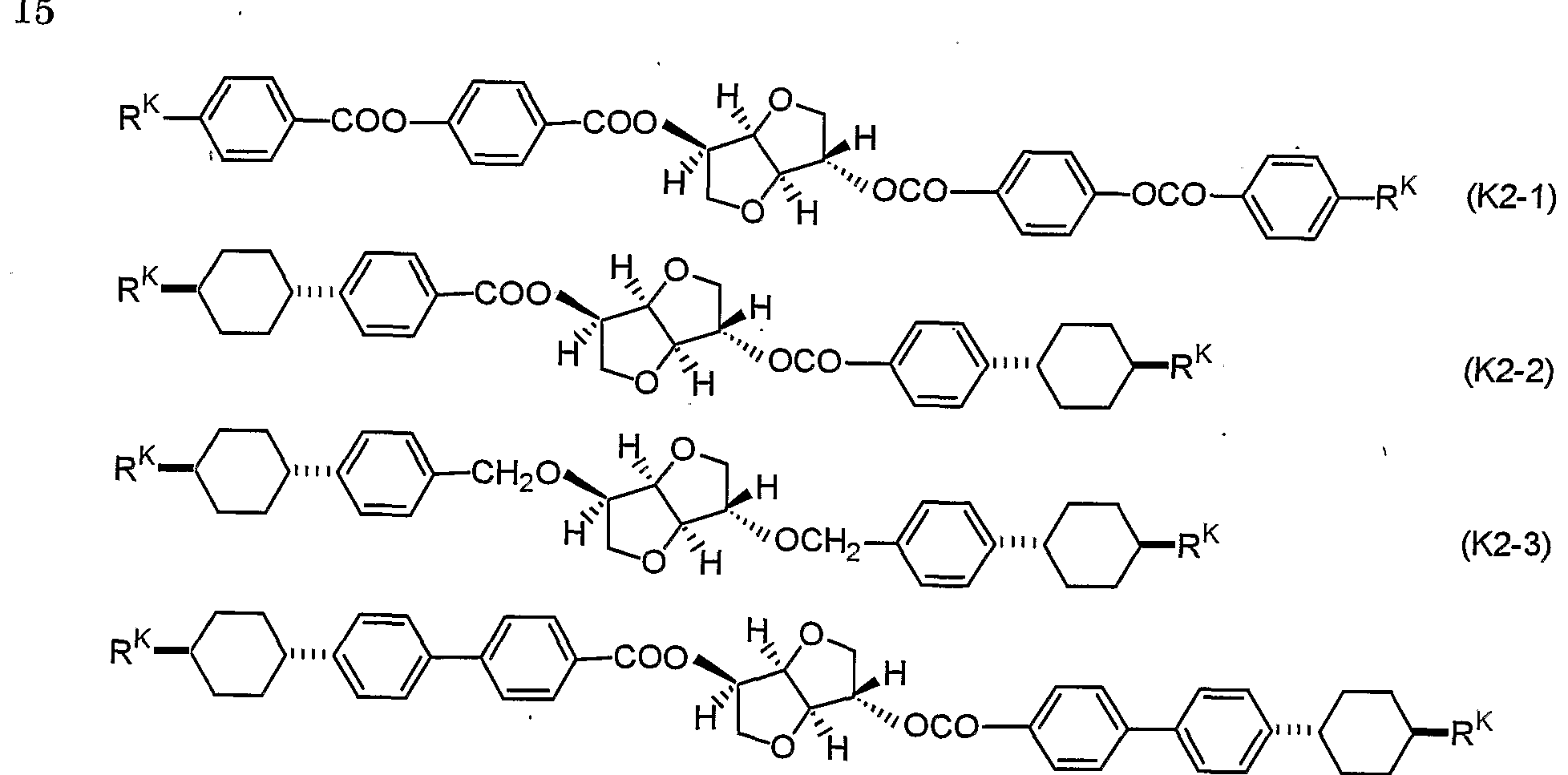
  • Chiral agents are represented by the following formulas (K2-1) to (K2-8) and (K5-1) to (K5_3)
  • R a and R b are any one CH 2 of independently an alkyl of carbon numbers 1-1 0 in the alkyl - it may be replaced by one O-; eight 1 A 4 is independently a benzene ring, dioxane ring or cyclohexane ring, any hydrogen in these rings may be replaced by fluorine, .
  • a 5 is a benzene ring; Z to 4 are independently single A bond or one C ⁇ C; n 1 is 1, n 2 and n 3 are 0),
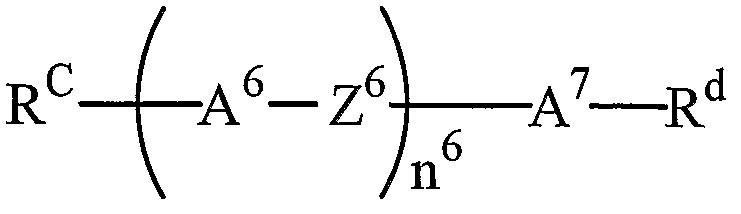
  • Compound 2 is represented by the following general formula (2)
  • R e is alkyl having 1 to 10 carbon atoms, and any one CH 2 — in the alkyl may be replaced by one O—;
  • R d is halogen, one CN;
  • a 6 is a benzene ring or a cyclohexane ring, and any hydrogen in these rings may be replaced by fluorine,
  • a 7 is independently a benzene ring;
  • Z 6 is a single bond or a single COO— N 6 is 1.
  • R e is an alkyl having 1 to 10 carbon atoms, and any one CH 2 — in the alkyl may be replaced by one O—, one CH ⁇ CH—, or one C ⁇ C one.
  • the chiral agent is represented by the following formulas (K2-5) to (K2-8):
  • R a is alkyl having 1 to 10 carbon atoms, and any one CH 2 — in the alkyl may be replaced by 1 O—;
  • D to 4 are independently benzene rings;
  • a 5 is a benzene ring;
  • Zi Z 4 is independently a single bond or a single C ⁇ C one; n 1 and n 2 are 1, n 3 is 0)
  • Compound 2 is represented by the following general formula (3)
  • R e is alkyl having 1 to 10 carbon atoms, and any one CH 2 — in the alkyl may be replaced with _ ⁇ 1, one CH ⁇ CH— or one C ⁇ C—.
  • Well; X a is fluorine or 1 CN; Z 12 is 1 COO—, L 8 to Ln are independently hydrogen or fluorine, at least two of them are fluorine, L 1 G And at least one of L 11 is fluorine.
  • a chiral agent is represented by the following formulas (K2-5) to (K2-8):
  • the compound represented by comprises one or more, clearing point 1 ⁇ and the clearing point T 2 and the clearing point Tx of the liquid crystal composition
  • liquid crystal composition having an optically isotropic phase in which the optically isotropic liquid crystal phase exhibits two or more colors of diffracted light.
  • a liquid crystal composition clearing point T X comprising the compound 2 of the clearing point T 2 and the chiral agent, a compound 1 to the liquid crystal composition 20-40 wt%
  • Compound 2 contains 20 to 60% by weight and chiral agent 5 to 25% by weight
  • Compound 1 is represented by the following general formula (1)
  • R a is alkyl having 1 to 10 carbon atoms, and any one C in this alkyl is H 2 — may be replaced by 1 O—;
  • a to a 4 are benzene rings is independently Jiokisan ring or cyclohexane ring, may be any hydrogen on the benzene ring is replaced by fluorine, a 5 is located at the benzene ring; 1? 4 is independently a single bond or one C ⁇ C—; n 1 is 1, n 2 and n 3 are 0), and compound 2 is represented by the following general formula (2)
  • Rc is alkyl having 1 to 10 carbon atoms, and any one CH 2 — in the alkyl may be replaced by one O—;
  • R d is halogen, one CN;
  • a 6 is a benzene ring or cyclohexane ring, any hydrogen in these rings may be replaced by fluorine,
  • a 7 is independently a benzene ring;
  • Z 6 is a single bond or a single COO—;
  • n 6 is 1.
  • R e is alkyl having 1 to 10 carbon atoms, and any one CH 2 — in the alkyl may be replaced by one O—, one CH ⁇ CH— or one C ⁇ C—.
  • Well; X a is fluorine or 1 CN; Z 12 is 1 COO—, and 8 to! ⁇ 11 are independently hydrogen or fluorine, at least two of which are fluorine, L 1 At least one of 0 and L 11 is fluorine.
  • the chiral agent is represented by the following formulas (K2-5) to (K2-8):
  • a liquid crystal device comprising an electrode disposed on one or both surfaces, a liquid crystal composition disposed between substrates, and an electric field applying means for applying an electric field to the liquid crystal composition via the electrode.
  • the liquid crystal device, wherein the liquid crystal composition is the liquid crystal composition according to any one of [1] to [30].
  • [3 2] having a pair of substrates in which electrodes are disposed on one or both sides, at least one of which is transparent, a liquid crystal composition disposed between the substrates, and a polarizing plate disposed on the outside of the substrate,
  • a liquid crystal element comprising an electric field applying means for applying an electric field to a liquid crystal composition via an electrode, wherein the liquid crystal composition is the liquid crystal composition according to any one of [1] to [30] A liquid crystal element.
  • an electrode is configured to apply an electric field in at least two directions on at least one of the pair of substrates.
  • each pixel has an active element, and this active element is a thin film transistor (TFT) [3 1] [34] The liquid crystal element according to item 1.
  • TFT thin film transistor
  • a liquid crystal composition having a clearing point ⁇ X comprising compound 1 having a clearing point of 1 ⁇ and compound 2 having a clearing point of T 2 , wherein 10 to 80 wt.% Of compound 1 with respect to the liquid crystal composition %, And 20 to 90% by weight of Compound 2, and clearing point 1 ⁇ and clearing point ⁇ 2 and clearing point ⁇ X of the liquid crystal composition
  • a liquid crystal composition used for an element driven by an optically isotropic liquid crystal phase isotropic
  • any one CH 2 — in this alkyl is 1 O—, 1 S—, 1 CO 2 O—, —OCO—, 1 CH ⁇ CH—, 1 CF ⁇ CF— or 1 C ⁇ C— may be replaced, and any hydrogen in the alkyl is replaced by halogen.
  • one CH 3 one CN may be replaced by in the alkyl; eight to eight 5 aromatic or non-aromatic 3-8 membered ring in independent, or 9 or more carbon atoms
  • a 6 and A 7 are independently aromatic or non-aromatic 3 to 8 membered rings or condensed rings having 9 or more carbon atoms, and any hydrogen in this ring may be replaced by halogen, alkyl having 1 to 3 carbon atoms, or alkyl halide.
  • Z 6 is a single bond or carbon number 1-8 of
  • Any hydrogen in the alkylene may be replaced by halogen;
  • n 6 is 0 or 1, and when A 7 is a condensed ring having 9 or more carbon atoms, n 6 is 0.
  • the liquid crystal composition according to [3 6], [38] or [39], which is a compound having the following structure.
  • R e is an alkyl having 1 to 10 carbon atoms, and any one CH in the alkyl.
  • One CF CF— or — C ⁇ C— and any hydrogen in the alkyl may be replaced by halogen;
  • Z 12 is a single bond, 1 COO— or 1 C ⁇ C;
  • L ⁇ L 11 is independently Hydrogen or fluorine.
  • the liquid crystal composition according to a preferred embodiment of the present invention can exhibit an optically isotropic liquid crystal phase in a wide temperature range without substantially containing a polymer substance.
  • the liquid crystal composition according to a preferred embodiment of the present invention can observe a large electric birefringence (including a power effect of a large Kerr coefficient).
  • the liquid crystal composition according to a preferred embodiment of the present invention has an extremely fast response speed and can be monochromatic.
  • the liquid crystal composition according to a preferred embodiment of the present invention can reduce the remaining birefringence even when the electric field is not applied after applying a high electric field.
  • the liquid crystal composition according to a preferred embodiment of the present invention can be suitably used for liquid crystal elements such as display elements based on these effects.
  • Figure 1 shows a polarizing microscope image of liquid crystal composition B-2 during the temperature drop process.
  • FIG. 2 shows the comb-shaped electrode substrate used in Example 5.
  • FIG. 3 shows the optical system used in Example 5.
  • the liquid crystal composition of the present invention is an optically isotropic liquid crystal composition used for an element driven in an optically isotropic liquid crystal phase. That is, the liquid crystal composition of the present invention is a liquid crystal composition used for a liquid crystal element, and can be used for a liquid crystal element in a liquid crystal state (for example, a blue phase) exhibiting optically isotropic properties. It is.
  • a liquid crystal composition that exhibits a nematic phase does not exhibit an optically isotropic liquid crystal phase at any temperature. Therefore, the liquid crystal of the present invention
  • the composition is a composition that does not develop a nematic phase at any temperature.
  • liquid crystal composition of the present invention used for an element driven with an optically isotropic liquid crystal phase does not include a liquid crystal composition used for an element driven with a nematic phase or a chiral nematic phase.
  • the liquid crystal composition of the present invention includes, for example, a liquid crystal composition A obtained by mixing the compound 1 represented by the formula (1) and the compound 2 represented by the formula (2) or the formula (3), And a liquid crystal composition B obtained by adding a certain amount of a chiral agent to the composition and exhibiting an optically isotropic liquid crystal phase.
  • the liquid crystal composition A may contain a chiral agent as long as it does not exhibit an optically isotropic liquid crystal phase.
  • the compound 1 may be one compound represented by the formula (1) or a plurality of compounds represented by the formula (1).
  • Compound 2 may be a single compound represented by Formula (2) or Formula (3), or may be composed of a plurality of compounds represented by Formula (2) or Formula (3).
  • a liquid crystal composition refers to a composition having a liquid crystal phase, or a liquid crystal phase that does not significantly reduce the liquid crystal phase / non-liquid crystal isotropic phase transition temperature by mixing with a liquid crystal material. .
  • the clearing point of the compound 1 included in the liquid crystal composition A (T) and the clearing point of the compound 2 (T 2) and the liquid crystal composition A is
  • the clearing point refers to a point at which a compound or composition develops a non-liquid crystal isotropic phase during a temperature rising process.
  • Specific examples of the clearing point include the N—I point, which is the phase transition point from the nematic phase to the non-liquid crystal isotropic phase.
  • the coexistence state of the non-liquid crystal isotropic phase and the liquid crystal phase may appear. Let it be a light spot.
  • the clearing point of a compound that does not exhibit a liquid crystal phase that is, a compound having a K-1 I point, is not more than the K-I point. You may apply the calculation method by.
  • Compound 1 is preferably a compound having a relatively high clearing point.
  • the compound 1 is preferably a compound represented by the formula (1).
  • R a is preferably alkyl having 1 to 10 carbon atoms, and any _CH 2 — in the alkyl is 1 O—, 1 S—, 1 COO—, 10 CO— , 1 CH ⁇ CH— or 1 C ⁇ C, and more preferably alkyl having 1 to 10 carbon atoms, wherein any one CH 2 — in the alkyl is 1 CH ⁇ CH —Or one C ⁇ C may be replaced by one.
  • Ra is an alkyl having 1 to 10 carbon atoms. Or alkoxy is most preferred. ⁇
  • Ai A 5 is most preferably independently a benzene ring, a dioxane ring or a hex
  • 1 in formula (.1) 1 ⁇ n 3 are independently 0 or 1, if R b is hydrogen or fluorine is n 2 and n 3 are 1, when Z 4 is an COO-, n 2 and n 3 is 1 And all n 3 can be 0 only when at least one of A 4 or A 5 is a condensed ring having 9 or more carbon atoms.
  • ! ! 1 ⁇ ! ! 3 is preferably independently 0 or 1
  • n 2 and n 3 are 1 when R b is hydrogen or fluorine, and at least one of A 4 or A 5 is a condensed ring having 9 or more carbon atoms. Only if there is n ⁇ ⁇ ! ! All three can be zero. Among these ,! !
  • n 2 and n 3 are 1 when R b is hydrogen or fluorine, and at least one of A 4 or A 5 has 9 or more carbon atoms All n 3 can be 0 only when they are condensed rings.
  • the clearing point of the compound represented by the formula (1) is preferably 150 ° C to 400 ° C, and more preferably 200 ° C to 35 ° C.
  • the clearing point is lower than 1550 ° C, the relationship between the clearing point of compound 1 (T) and the clearing point (TX) of liquid crystal composition A (T_TX ⁇ 1100 ° C) is satisfied. It will be disadvantageous.
  • the clearing point exceeds 400 ° C., the lower limit temperature of the liquid crystal phase may be increased, for example, depending on other compounds to be combined, the compatibility may deteriorate and crystals may precipitate at low temperatures. 1. 3 Compound 2
  • Compound 2 is preferably a compound having a low clearing point and a large dielectric anisotropy. Specifically, the compound 2 is preferably a compound represented by the formula (2) or the formula (3). 1. 3. 1 Compound represented by formula (2)
  • Rc is the preferred carbon number! Any one CH 2 — in this alkynole is replaced by one O—, one S—, one COO—, one OCO—, one CH ⁇ CH— or one C ⁇ C one.
  • R e is more preferably an alkyl having 1 to 10 carbon atoms, and any _CH 2 — in the alkyl is 1 O—, 1 CH ⁇ CH— or 1 C ⁇ C It may be replaced with —.
  • R c is most preferably alkyl having 1 to 10 carbon atoms, and any one CH 2 — in the alkyl may be replaced by one O—.
  • R d is preferably halogen, 1 CN, 1 N ⁇ C ⁇ S, 1 CF 3 , —C ⁇ C 1 CN, 1 C ⁇ C 1 CF 3 .
  • a 6 and A 7 are independently an aromatic or non-aromatic 3- to 8-membered ring or a condensed ring having 9 or more carbon atoms, and any hydrogen in this ring is halogen, carbon May be substituted with an alkyl of the number 1 to 3, or an alkyl halide, Any one CH 2 — may be replaced by one O—, one S— or one NH—, and one CH ⁇ may be replaced by one N ⁇ .
  • a 6 and A 7 are most preferably independently a benzene ring, dioxane ring or cyclohexane ring, and any hydrogen in the benzene ring may be replaced by fluorine.
  • Z 6 is preferably a single bond and an alkylene having 1 to 4 carbon atoms, and any one CH 2 — in the alkylene is one O—, one S—, one COO—, one OCO—, 1 C SO—, 1 OC S—, 1 CH ⁇ CH—, —CF ⁇ CF—, or 1 C ⁇ C—may be replaced by any hydrogen in this alkylene More preferably, Z 6 is a single bond, 1 CO 2 O—, 1 CF 2 0—, or 1 C ⁇ C—. Most preferably, Z 6 is a single bond or one CO 2 O—.
  • n 6 is 0 or 1, but when A 7 is a condensed ring having 9 or more carbon atoms, n 6 is 0. Among these, n 6 is preferably 0 or 1, but when A 7 is a naphthalene ring, n 6 is 0, more preferably n 6 is 0. Or 1 and 0 if A 7 is naphthalene. n 6 is most preferably n 6 is 0 or 1.
  • Z 12 is a single bond, one COO— or one C ⁇ C one, and among these, _C OO— is preferred.
  • 8 to! ⁇ 11 are independently hydrogen or fluorine.
  • 8 to] ⁇ 11 are preferably independently hydrogen or fluorine, and at least two of them are fluorine.
  • Compound 1 When the clearing point of Compound 1 is 150 to 250 ° C., Compound 1 preferably contains 10 to 80% by weight of Compound 1 and 20 to 90% by weight of Compound 2 with respect to Liquid Crystal Composition A. Compound 1 It is more preferable that 30 to 60% by weight of Compound 2 and 30 to 70% by weight of Compound 2 are contained. Further, when the clearing point of Compound 1 is 250 to 400 ° C., it is preferable that 5 to 70% by weight of Compound 1 and 30 to 95% by weight of Compound 2 are included with respect to Liquid Crystal Composition A. As described above, in the liquid crystal composition of the present invention, the compound 1 may include a plurality of compounds represented by the formula (1). Similarly, the compound 2 may be represented by the formula (2).
  • a plurality of compounds 2 may be included.
  • the sum of all of the compounds represented by the formula (1) becomes 1 0-8 0 weight 0/0 (or for 5-7 0 wt ° / 0) that.
  • liquid crystal composition A does not contain a chiral agent
  • a coexistence state of a nematic phase and a non-liquid crystal isotropic phase is manifested in the temperature lowering process.
  • the coexistence state of the (chiral) nematic phase and the non-liquid crystal isotropic phase can be confirmed, for example, by observation with a polarizing microscope. This coexistence state is not due to a temperature gradient applied to the liquid crystal composition.
  • the liquid crystal composition of the present invention has a temperature range in which the (chiral) nematic phase and the non-liquid crystal isotropic phase coexist in the liquid crystal composition A in which the (chiral) nematic phase and the non-liquid crystal isotropic phase coexist. Specifically, it is preferable that the difference between the upper limit temperature and the lower limit temperature at which these phases coexist is 3 ° C. to 150 ° C. This is because if the temperature range where both coexist is wide, the liquid crystal composition B obtained by further adding a chiral agent tends to have an optically isotropic liquid crystal phase over a wide temperature range.
  • liquid crystal composition A that does not contain a chiral agent in which a nematic phase and a non-liquid crystal or the like ⁇ phase coexist in a wide temperature range
  • a chiral nematic phase and a non-liquid crystal isotropic phase are obtained in a wide temperature range. It is easy to obtain a liquid crystal composition A in which coexists.
  • the pitch of the chiral nematic phase that does not coexist with the non-liquid crystal isotropic phase is 700 nm or more.
  • a liquid crystal composition B with a short pitch can be obtained by adding a chiral agent.
  • the liquid crystal composition B is a composition that exhibits an optically isotropic liquid crystal phase.
  • Liquid crystal composition B can be obtained, for example, by adding a chiral agent to the liquid crystal composition A. Power depending on the composition of the liquid crystal composition A and the kind of chiral agent added, etc.
  • the chiral agent contained in the liquid crystal composition B is 1 to 40 weights, preferably 5 based on the total weight of the composition B.
  • a liquid crystal composition added so as to have a content of ⁇ 15% by weight tends to have an optically isotropic liquid crystal phase and is preferable.
  • liquid crystal composition B which comprises adding a chiral agent to liquid crystal composition A, a chiral agent that liquid crystal composition A can contain in advance, and a chiral agent that is further added to obtain liquid crystal composition B May be the same or different.
  • a compound having a large twisting power is preferable.
  • a compound having a large torsional force can reduce the amount of addition necessary to obtain a desired pitch, and therefore, an increase in driving voltage can be suppressed, which is practically advantageous.
  • compounds represented by the above formulas (K 1) to (K5) ′ are preferable.
  • the chiral agent added to the liquid crystal composition B is included in the formulas (K2-1) to (K2-8) and (K5) included in the formula (K2).
  • the chiral agent is preferably contained in an amount of 1 to 40% by weight, more preferably 3 to 25% by weight, and most preferably 5 to 15% by weight based on the total weight of the liquid crystal composition B.
  • the liquid crystal composition B has an optically isotropic liquid crystal phase.
  • the liquid crystal composition has optical isotropy. Macroscopically, the liquid crystal molecular arrangement is isotropic, so it is optically isotropic, but microscopically, there is liquid crystal order. Say.
  • the pitch based on the liquid crystal order that the liquid crystal composition B has is preferably 700 nm or less, more preferably 500 nm or less, and most preferably 350 nm or less.
  • non-liquid crystalline isotropic phase is a generally defined isotropic phase, that is, a disordered phase, and even if a region where the local order parameter is not zero is generated, the cause is due to fluctuations.
  • Isotropic phase of things.
  • the isotropic phase that appears on the high temperature side of the nematic phase corresponds to the non-liquid crystal isotropic phase in this specification.
  • the same definition shall apply to the chiral liquid crystal in this specification.
  • “optically isotropic liquid crystal phase” refers to a phase that expresses an optically isotropic liquid crystal phase rather than fluctuations, for example, a phase that expresses a platelet structure (in a narrow sense). Blue phase) is an example.
  • liquid crystal composition B of the present invention although it is an optically isotropic liquid crystal phase, a platelet structure typical of a blue phase may not be observed under a polarizing microscope. Therefore, in this specification, only the phase that develops the platelet structure is referred to as a blue phase (narrowly defined blue phase), and is distinguished from an optically isotropic liquid crystal phase that does not exhibit diffracted light of two or more colors.
  • blue phases are classified into three types (blue phase I, blue phase I I, blue phase I I I), and these three types of blue phases are all optically active and isotropic.
  • blue phase I and blue phase I I blue phase two or more kinds of diffracted light due to Bragg reflection from different lattice planes are observed.
  • the state in which the optically isotropic liquid crystal phase does not show diffracted light of two or more colors means that the platelet structure observed in the blue phase I and the blue phase II is not observed and is generally monochromatic. Means. In an optically isotropic liquid crystal phase that does not show diffracted light of two or more colors, it is not necessary until the color brightness is uniform in the plane.
  • An optically isotropic liquid crystal phase that does not exhibit diffracted light of two or more colors has the advantage that the reflected light intensity due to Bragg reflection can be suppressed or shifted to the lower wavelength side.
  • color may be a problem when used as a display element.
  • the reflected wavelength shifts by a low wavelength. Therefore, it is possible to eliminate the reflection of visible light at a longer pitch than the narrowly defined blue phase (a phase that develops a platelet structure).
  • the electric birefringence in the optically isotropic liquid crystal phase increases as the pitch becomes longer, the electric birefringence can be increased.
  • an electric field is applied to the liquid crystal composition B in this state, a quick response with no afterimage can be obtained.
  • the liquid crystal composition of the present invention may further contain other compounds such as a polymer substance as long as the properties of the composition are not affected.
  • the liquid crystal composition of the present invention may contain, for example, a dichroic dye or a photochromic compound.
  • the positive or negative dielectric anisotropy of the liquid crystal composition of the present invention is not particularly limited, but a positive one is preferable. The larger the absolute value of the dielectric anisotropy value ( ⁇ ⁇ ) and the refractive index anisotropy value ( ⁇ ⁇ ) of the liquid crystal material, the larger the electric birefringence.
  • is a crystalline phase
  • I is a non-liquid crystal isotropic phase
  • is a nematic phase
  • ⁇ * is a chiral nematic phase
  • BP is a blue phase
  • B PX is not diffracted in two or more colors.
  • the coexistence state of two phases may be expressed in the form of (N * + I) or (N * + B P X).
  • (N * + I) represents a phase in which a non-liquid crystal isotropic phase and a chiral nematic phase coexist
  • (N * + B PX) is an optical in which diffracted light of two or more colors is not observed. This is a phase in which an isotropic liquid crystal phase and a chiral nematic phase coexist.
  • U n represents an unidentified phase that is not optically isotropic.
  • the I_N phase transition point is sometimes referred to as the N—I point.
  • I 1 N * transition point is sometimes called N * —I point.
  • the I—B P phase transition point is sometimes referred to as the B P—I point.
  • a nematic liquid crystal composition comprising 85% by weight of a mother liquid crystal exhibiting a nematic phase and 15% by weight of a liquid crystal compound or liquid crystal composition is prepared.
  • the liquid crystal phase-one non-liquid crystal isotropic phase transition is extrapolated linearly from the liquid crystal phase-one non-liquid crystal isotropic phase transition point and the latter liquid crystal phase-one non-liquid crystal isotropic phase transition point. I asked for a point.
  • Minimum temperature of nematic phase (TC;. C)
  • a sample with a nematic phase was placed in a glass bottle and stored in a freezer at 0 ° C, 10 ° C, _20 ° C, 30 ° C, and -40 ° C for 10 days, and then the liquid crystal phase was observed. .
  • TC ⁇ -20 ° C was described when the sample remained in the nematic phase at 20 and changed to crystalline or smectic phase at -30 ° C.
  • the minimum temperature of the nematic phase is sometimes abbreviated as “minimum temperature”.
  • Viscosity (77; measured at 20 ° C; mP a ⁇ s)
  • the sample was placed in a TN cell with a gap (gap) between the two glass substrates of about 9 m and a twist angle of 80 degrees.
  • Sine waves (10 V, 1 kHz) were applied to the cell, and after 2 seconds, the dielectric constant ( ⁇ II) in the major axis direction of the liquid crystal molecules was measured.
  • a sine wave (0.5 V, 1 kHz) was applied to the cell, and after 2 seconds, the dielectric constant ⁇ ⁇ ⁇ ⁇ in the minor axis direction of the liquid crystal molecules was measured.
  • the TN device used for measurement has a polyimide alignment film, and the cell gap is 6 ⁇ m. This element was sealed with an adhesive that polymerizes by ultraviolet rays after the sample was placed.
  • the TN device was charged by applying a pulse voltage (60V / s at 5V).
  • the decaying voltage was measured for 16.7 milliseconds with a high-speed voltmeter, and the area between the voltage curve and the horizontal axis in a unit cycle was determined. The area was determined in the same way from the voltage waveform measured after removing the TN device.
  • the voltage holding ratio was calculated by comparing the values of the two areas.
  • Pitch P; measured at 25 ° C; nm
  • the pitch length was measured using selective reflection (Liquid Crystal Handbook, page 196 (published in 2000, Maruzen))
  • the selective reflection wavelength was measured with a microspectrophotometer (JEOL Ltd., trade name: MSV-350).
  • the pitch was determined by dividing the obtained reflection wavelength by the average refractive index.
  • the pitch of cholesteric liquid crystal having a reflection wavelength in the longer wavelength region than visible light is proportional to the reciprocal of the concentration of the optically active compound in the region where the optically active compound concentration is low, the liquid crystal having a selective reflection wavelength in the visible light region.
  • the pitch length was measured at several points and obtained by the linear outer diameter method.
  • a nematic liquid crystal composition A-1 was prepared, specifically, as compound 1 represented by the above formula (1), compound a having a clear point N—I point of 202 ° C., the above formula As compound 2 represented by (2), compound c having a clearing point (N—I point) of 35.5 ° C, and as compound 2 represented by the above formula (3), K 1 point is 49.8.
  • liquid crystal composition A-1 is added with the chiral agent ISO-60 BA 2 represented by the following formula, and the liquid crystal composition A-2, A-3, A-4, A-5, A- 6 and A-7 were obtained.
  • the phase transition temperatures of the liquid crystal compositions A-1 to A-7 were as shown in Table 1. Specifically, in the temperature drop process of 1 ° C / min, the upper limit temperature (77 ° C) and lower limit of liquid crystal composition A-1 in which the nematic phase (N) and the non-liquid crystal isotropic phase (I) coexist The difference from the temperature (73 ° C) (hereinafter also referred to as “coexistence temperature range”) was 4.0 ° C. In the liquid crystal composition A_2, the upper limit temperature (63.7 ° C) and lower limit temperature (6 ° C) where the chiral nematic phase (N *) and the non-liquid crystal isotropic phase (I) coexist in the temperature-decreasing process of 11 ° C / min. The difference (coexistence temperature range) from 5 6 ° C was 7.7 ° C. Similarly, the coexistence temperature ranges of liquid crystal compositions A-3 to A_4 were 11.3 and 13.1 ° C, respectively.
  • the upper limit temperature (57 ° C to 52.2 ° C) and the lower limit temperature (42 ° C) at which the optically isotropic liquid crystal phase appears in the liquid crystal composition A-5 at 1 ° C / min. (4 ° C) was 9.8 ° C to 14.6 ° C.
  • the B PX temperature range of liquid crystal compositions A-6 and A-7 was The temperatures were 20 and 21 ° C, respectively.
  • the liquid crystal compositions A-5 and A-7 exhibited an optically isotropic liquid crystal phase in a wide temperature range during the temperature rising process. .
  • the plate structure confirmed in the pull phases I and II is not observed, and the diffracted light of two or more colors is not Not observed.
  • the liquid crystal composition A_7 had a dark field with no color when observed with a cross-cold polarizing microscope.
  • N—I point (1 ⁇ ), which is the clearing point of Compound a, which is Compound 1, is 20 2 ° C, and N—I point (Tx), which is the clearing point of Liquid Crystal Composition A-1, is 75.5 °. C and 1 X 1 26.5 ° C.
  • N—I point (T), which is the clearing point of Compound a, which is Compound 1 is 202 ° C
  • N * —I point (T x), which is the clearing point of Liquid Crystal Composition A—2 is 6
  • Tx was 141.3 ° C.
  • ⁇ ⁇ - ⁇ in the liquid crystal compositions A-3 to A_7 is as follows.
  • Liquid crystal composition E-1 was prepared using only compound b-1 to compound d without using compound a contained in the component of liquid crystal composition A-1 in Example 1.
  • the specific composition was as follows.
  • the chiral agent I SO-60 BA2 was mixed with the liquid crystal composition E_1 to obtain liquid crystal compositions E-2-E-5.
  • liquid crystal compositions having chiral agent concentrations of 2.0, 3.5, 5.0, and 7.0% by weight were prepared.
  • E-3, E-4, and E-5 were prepared.
  • each liquid crystal composition E-1 to E-5 is sandwiched between two uncoated glass with ITO glass (cell thickness: 13 ⁇ m) and a polarizing microscope is used. The phase transition temperature was measured.
  • liquid crystal composition E-5 blue phase I was confirmed during the temperature lowering process and the temperature rising process, and the difference between the upper limit temperature and the lower limit temperature at which blue phase I developed during the temperature increase process was 2.0 ° C. It was.
  • Nematic liquid crystal composition B-1 was prepared by mixing the compounds represented by the following formulas (e-1), (e-2), (f) to (i) and (d) in the weight ratio shown below.
  • the clearing point N_I point is 250 ° C or higher
  • compound e-1 and compound e -2 and the above formula (3).
  • Compound 2 is prepared by mixing Compound d with 1 ⁇ -1 point of 49.8 ° C and clearing point (extrapolated value) of 7.7 ° C, and Compound f to Compound i. did.
  • the value shown to the right of the weight ratio is Phase transition temperature of the object ( N> 250 N> 250
  • liquid crystal composition B_1 liquid crystal compositions having chiral agent concentrations of 2.9, 5.0, 8.1, and 10.0% by weight were prepared. 2, B-3, B-4, and B-5. Then, each liquid crystal composition B-1 to B-5 is sandwiched between cells (cell thickness: 13 ⁇ m) made of two glass with ITO that has not been subjected to alignment treatment, and a phase is observed using a polarizing microscope. The transition temperature was measured. ⁇
  • the difference (BP temperature range) from (34.7 ° C) was 7.2 ° C 10.2 ° C.
  • the BP temperature range of Liquid Crystal Composition B-5 was 10 ° C.
  • the liquid crystal compositions B-4 and B-5 exhibited an optically isotropic liquid crystal phase in a wide temperature range during the temperature rising process.
  • the polarization microscope image (Fig. 1) at 54.5 ° C 52 ° C 49 ° C in the temperature drop process of liquid crystal composition B-2, the non-liquid crystal isotropic phase and chirality were observed in the liquid crystal composition. It was found that the nematic phase coexists.
  • N 1 I which is the clearing point of an equal weight mixture of Compound e-1 and Compound e-2, which are Compound 1
  • TJ is 270 ° C or higher
  • N—I is the clearing point of Liquid Crystal Composition B-1 Since the point (Tx) is 56.5 ° C, (1 ⁇ —Tx) was 213.5 ° C or higher, and the clear point of the liquid crystal composition B-2 N * —I point (Tx ) was 51.5 ° C, and (Ti-Tx) was 218.5 ° C or higher.
  • Ti 1 TX in the liquid crystal compositions B-3 to B-5 was as follows.
  • a liquid crystal composition C-11 was prepared using compound j to compound 1 and compound c.
  • the specific composition was as follows.
  • liquid crystal composition C-1 liquid crystal compositions having chiral agent concentrations of 1.9, 4.0, 6.0, and 8.1% by weight were prepared. 2, C_3, C-4, C-5.
  • Each liquid crystal composition C_ 1 to C-15 is sandwiched between two uncoated glass with ITO glass (cell thickness: 13 ⁇ m) and phase transition is performed using a polarizing microscope. The temperature was measured. (Table 4)
  • Liquid crystal composition C The phase transition temperature of ⁇ 15 was as shown in Table 4. Specifically, in liquid crystal composition C-11, the upper limit temperature (62 ° C) and lower limit temperature at which the nematic phase (N) and the non-liquid crystal isotropic phase (I) coexist in the temperature drop process of 11 ° CZmin. The difference (coexistence temperature range) from (61.9 ° C) was 0.1 ° C.
  • liquid crystal composition C-12 the upper limit temperature (59. 2 ° C) and lower limit temperature at which the chiral nematic phase (N *) and non-liquid crystal isotropic phase (I) coexist in the temperature-decreasing process at 11 ° C / min.
  • the difference (coexistence temperature range) from the temperature (58.7 ° C) was 0.5 ° C.
  • the coexistence temperature range of liquid crystal composition C-13 was 1.2 ° C, respectively.
  • the difference between the upper limit temperature (53.0 ° C) and the lower limit temperature (5 1.5 ° C) in which the optically isotropic liquid crystal phase developed in the temperature rising process appears in the liquid crystal composition C-14 ( P temperature range) was 1.5 ° C.
  • the BP temperature range of the liquid crystal composition C-15 was 1.8 ° C.
  • a nematic liquid crystal composition D-1 was prepared by mixing the compounds represented by the following formulas (m), (n), (c) and (d) in the weight ratio shown below. Specifically, as compound 1 represented by the above formula (1), compound m having a clear point N—I point of 239 ° C., compound n having a N_I point of 222 ° C., As compound 2 represented by formula (2), compound c having a clearing point (N—I point) of 36.5 ° C, and represented by formula (3) above Compound 2 was prepared by mixing compound d having a K-1 point of 49.8 ° C and a clearing point (outer limit value) of 7.7 ° C. The value shown to the right of the weight ratio is the phase transition temperature of each compound.
  • liquid crystal composition D-1 a chiral agent ISO-60 BA2 was added to obtain liquid crystal compositions D-2, D-3 and D-4.
  • liquid crystal compositions having chiral agent concentrations of 9.1, 14.3, and 20.4% by weight were prepared, and the liquid crystal compositions D-2 and D-3 were respectively prepared. , D-4.
  • each liquid crystal composition D—! D-4 was held in a cell (cell thickness: 13 micrometers) composed of two ITO-attached glasses not subjected to orientation treatment, and the phase transition temperature was measured using a polarizing microscope.
  • Table 5 Liquid crystal composition D— :! The phase transition temperature of ⁇ D-4 was as shown in Table 5.
  • liquid crystal composition D-1 the upper limit temperature (1 0 7.6 ° C) where the nematic phase (N) and the non-liquid crystal isotropic phase (I) coexist in the temperature drop process of 11 ° C / min. ) And the lower limit temperature (95 ° C) (coexistence temperature range) was 12.6 ° C.
  • the difference from the temperature (72.0 ° C) (coexistence temperature range) was 19.5 ° C.
  • the coexistence temperature range of the liquid crystal composition D_3 was 30.8 ° C.
  • liquid crystal composition D-4 exhibited an optically isotropic liquid crystal phase in a wide temperature range during the temperature rising process.
  • the platelet structure of the optically isotropic liquid crystal phase in the liquid crystal composition D-4 confirmed in the pull phase I and II was not observed, and diffracted light of two or more colors was not observed. .
  • D-4 it was dark field with no color in the crossed Nicol polarization microscope.
  • N—I point (T is 2 30 ° C, the clearing point of the equal weight mixture of compound m and compound n, which is compound 1, and N—I point (T Since x) was 1 0 3.7 ° C, (Ti—T x) was 1 2 6.3 ° C.
  • 1 1 Tx in the liquid crystal compositions D-3 to D-4 is as follows. It was.
  • a nematic liquid crystal composition F-1 was prepared by mixing the compounds represented by the following formulas (o-1), (o-2), (o-3) and (p) in the weight ratio shown below. Specifically, as the compound represented by the above formula (1), compounds (o-1) to (o-3) having a clearing point N—I point of 2550 ° C. or higher, Compound 2 represented by formula (3) is prepared by mixing compound p with a K 1 point of 21.4 ° C and a clearing point (extrapolated value) of 41.6 ° C. did. The value shown to the right of the weight ratio is the phase transition temperature of each compound.
  • liquid crystal composition F_1 liquid crystal compositions having a chiral agent concentration of 0.8, 10.0 wt ° / 0 were prepared, and the liquid crystal compositions were F-2 and F-13, respectively. .
  • each liquid crystal composition F-2-F-3 is not subjected to alignment treatment
  • the phase transition temperature was measured using a polarizing microscope, sandwiched between two ITO glass cells (cell thickness: 13 micrometers).
  • the clearing point of F-3 is the same as the cell used in Example 4, and while applying a 80V AC sine wave while confirming the polarizing microscope, the transmittance decreases rapidly under the temperature rising condition. The temperature was defined as the clearing point.
  • Table 6 shows the phase transition temperatures of the liquid crystal compositions F-1 to F-3.
  • the difference from the temperature (85 ° C) (coexistence temperature range) was 13.7 ° C.
  • the difference from the temperature (81 ° C) (coexistence temperature range) was 16.2 ° C.
  • the difference between the upper limit temperature (74 ° C) and the lower limit temperature (54 ° C) at which the optically isotropic liquid crystal phase appears in the temperature rise process of l ° CZmin. (BP (X) or BP temperature range) was 20 ° C.
  • the liquid crystal composition F-3 exhibited an optically isotropic liquid crystal phase in a wide temperature range during the temperature rising process.
  • N—I point ( ⁇ ⁇ ), which is the clearing point of the equal weight mixture of Compound o—1, Compound o—2, and Compound o—3, which is Compound 1, is 254 ° C
  • the liquid crystal composition F-1 Since the clearing point N_I (T x) is 89.2 ° C, (T ⁇ — Tx) is more than 1 64. 8 ° C.
  • the clearing point N * _I (TX) of liquid crystal composition F-2 is 84 ° C. Therefore, (T ⁇ -Tx) was 1.70 ° C.
  • the liquid crystal composition A-7 of Example 1 is sandwiched between a comb-shaped electrode substrate (FIG. 2) that has not been subjected to alignment treatment and a counter glass substrate (non-electrode provided) (cell thickness: 12 micrometers). These substrates (comb electrode cells) containing the composition were placed in the optical system shown in FIG. 3, and the electro-optical characteristics were measured.
  • the incident angle of the laser beam to the cell is perpendicular to the cell surface, and the line direction of the comb electrode is 45 ° with respect to the Polarizer and the Analyzer polarizing plate, respectively.
  • the transmittance was saturated by applying a rectangular wave with an amplitude of 110 V.
  • the transmitted light intensity detected by the photodetector when no electric field is applied is 0.
  • the transmitted light intensity when an electric field was applied was 3 10, and the contrast was calculated to be 3970.
  • the response speed at this time rises (the time required for the transmittance light intensity to change from 10% to 90% of the intensity when an electric field is applied) to 150 microseconds, and falls (the transmittance light intensity is applied to the electric field)
  • the time required to change from 90% to 10% of the intensity of time was 110 microseconds.
  • liquid crystal composition A-7 can realize two states, bright and dark, with the electric field on and off, and a high-speed response even when an electric field is applied until the transmittance is saturated.
  • Examples of the utilization method of the present invention include a liquid crystal material and a liquid crystal element using the liquid crystal material.

Landscapes

  • Chemical & Material Sciences (AREA)
  • Crystallography & Structural Chemistry (AREA)
  • Engineering & Computer Science (AREA)
  • Materials Engineering (AREA)
  • Organic Chemistry (AREA)
  • Liquid Crystal Substances (AREA)
  • Organic Low-Molecular-Weight Compounds And Preparation Thereof (AREA)
  • Liquid Crystal (AREA)

Abstract

透明点T1の化合物1と、透明点T2の化合物2とを含む、透明点がTxの液晶組成物であって、液晶組成物に対して化合物1を10~80重量%および化合物2を20~90重量%含み、透明点T1と透明点T2と液晶組成物の透明点Txとが、T1>T2,T1−Tx≧100℃を満たす、光学的に等方性の液晶相を有し、光学的に等方性の液晶相で駆動させる素子に用いられる液晶組成物。

Description

' 液晶組成物および液晶素子 技術分野
本発明は、 光学的に等方性の液晶相で駆動させる素子に用いられる光学的に等 方性の液晶組成物およびその組成物を用レ、た液晶素子に関する。 背景技術 明
ネマチック液晶材料をネマチック相が発現している状態から加熱していくと等 糸
方相が発現する。 このようなネマチック液晶材料における等方相 (本明細書中、
「非液晶等方相」 ということがある) では、 電気複屈折値 (等方性媒体に電界を 印加した時に誘起される複屈折値) Δ. n Eが電場 Eの二乗に比例する現象である カー効果 [ Δ η Ε = Κ λ Ε 2 (Κ:カー係数 (カー定数) 、 λ :波長) ] が観測 される。.具体的には、 ネマチック相一等方相転移温度直上において、 大きなカー 係数が観測されている。 このようなカー効果は非液晶等方相中において熱ゆらぎ によ て生じるネマチック的分子配列の短距離秩序の存在に起因するものと考え られている。
液晶材料では、 非液晶等方相だけではなくブルー相においても力一効果が観測 される。 一般的に、 プル一相はキラルネマチック相と非液晶.等方相との間で発現 するが、 その温度範囲は一般に 1〜2 °C程度と極めて狭い。
他方、 高分子とキラル液晶の複合材料において、 比較的広い温度範囲で、 「光 学的に等方性の液晶相 (巨視的には液晶分子配列は等方的であるが微視的には液 晶秩序が存在する相) 」 を発現し、 これらの相では大きなカー係数のカー効果が 観測されている [例えば、 特開 2 0 0 3— 3 2 7 9 6 6号公報、 Nature Materials, 1, 64 - 68 (2002)、 Advanced Materials, 17, 96-98 (2005) 、 Advanced Materials, 17, 2311-2315 (2005)を参照] 。
しかしながら、 このような複合材料では高分子を含有するため、 高電界印加後 に電界を印加しない状態に戻しても複屈折が残存する場合があるという問題点が あった。 また、 高分子を含む複合材料を液晶素子に用いた場合、 駆動電圧の上昇 や長期的信頼性に問題点が生じる可能性があった。 したがって、 表示素子等の液 晶素子では、 高分子との複合材料を用いることができるケースは限られていた。 発明の開示
上記の状況の下、 大きな電気複屈折 (大きなカー係数のカー効果を含む) が観 測できる液晶材料が求められている。 また、 高電界印加後に電界を印加しない状 態に戻しても複屈折が残存しない液晶材料が求められている。 長期的信頼性に優 れた液晶材料が求められている。 また、 高分子を含まない液晶材料が求められて いる。 ' 本発明者等は、 新しい液晶組成物を見出し、 この知見に基づいて本発明を完成 した。 本発明は以下のような液晶組成物および液晶素子等を提供する。 なお、 本明細書において、 特に言及がなければ、 ネマチック相はキラルネマ チック相を含まない、 狭義のネマチック相を意味する。
[ 1 ] 光学的に等方性の液晶相で駆動させる素子に用いられ、 ネマチック相を 発現しない、 光学的に等方性の液晶組成物。 ·
[ 2 ] 光学的に等方性の液晶相が二色以上の回折光を示さない、 請求項 1に記 載の液晶組成物。
[ 3 ] 光学的に等方性の液晶相が二色以上の回折光を示す、 請求項 1に記載の 液晶組成物。
[ 4 ] 透明点 1 の化合物 1と、 透明点 T 2の化合物 2とを含む、 透明点が Τ の液晶組成物であって、 液晶組成物に対して化合物 1を 1 0〜 8 0重量%お よび化合物 2を 2 0〜9 0重量%含み、 透明点 1\と透明点 Τ 2と液晶組成物 の透明点 Τ Xとが、
τ χ > τ 2 T「Tx≥ 1 00°C
を満たす、 [ 2 ] または [ 3 ] に記載の液晶組成物。
[5] 透明点 1\の化合物 1と、 透明点 T2の化合物 2とを含む、 透明点が T Xの液晶組成物であって、 液晶組成物に対して化合物 1を.5〜 70重量%およ び化合物 2を 30〜 9 5重量%含み、 透明点 1\と透明点 Τ2と液晶組成物の透 明点 Τ Xとが、
Τ! > Τ 2'
Τ! -Τ ≥ 1 50°C
を満たす、 [ 2 ] または [ 3 ] に記載の液晶組成物。
[6] 透明点 T\の化合物 1と、 透明点 T2の化合物 2とを含む、 透明点が T の液晶組成物であって、 液晶組成物に対して化合物 1を 5〜 70重量%およ ぴ化合物 2を 30〜9 5重量%含み、 透明点 1\と透明点 Τ2と液晶組成物の透 明点 Τχとが、
ΤΧ2
T1-Tx≥ 200°C
を満たす、 [ 2 ] または [ 3 ] に記載の液晶組成物。
[7} 透明点 T\の化合物 1と、 透明点 Τ2の化合物 2とを含む、 透明点が Τ Xの液晶組成物であって、 液晶組成物に対して化合物 1を 1 0〜 80重量%およ び化合物 2を 20〜 90重量%含み、 透明点 1\と透明点 Τ2と液晶組成物の透 明点 Τχと力
τχ2
Ί 一 Tx≥ 1 00°C
を満たし、 キラルネマチック相と非液晶等方相とが共存する上限温度と下限温 度との差が 3°C〜1 50°Cである組成物に、 さらにキラル剤を添加して得られる.
[ 2 ] または [ 3 ] に記載の液晶組成物。
[8] 透明点 1\の化合物 1と、 透明点 T2の化合物 2とを含む、 透明点が Τ の液晶組成物であって、 液晶組成物に対して化合物 1を 5〜 70重量%および 化合物 2を 3 0〜 9 5重量%含み、 透明点 と透明点 Τ2と液晶組成物の透明 点 T χと力
τ\>τ2
Τ\一 Tx≥ 1 50°C '
を満たし、 キラルネマチック相と非液晶等方相とが共存する上限温度と下限温 度との差が 3°C〜 1 50°Cである組成物に、 さらにキラル剤を添加して得られる
[ 2 ] または [ 3 ] に記載の液晶組成物。
[9] 液晶組成物に対して化合物 1を 30〜60重量%、 および、 化合物 2を 30〜 70重量%含む、 請求項 7に記載の液晶組成物。
[1 0] 化合物 1が、'下記一般式 ( 1 )
Figure imgf000005_0001
(式中、 Raは水素、 炭素数 1〜 20のアルキルであり、 このアルキル中の任意 の一 CH2_は、 一 O—、 一 一、 一 COO—、 一 OCO—、 - CH= CH-, —CF=CF—または一 C≡C一で置き換えられてもよく、 このアルキル基中の 任意の水素はハロゲンで置き換えられてもよく ; Rbは水素、 ハロゲン、 一 CN _N = C = 0、 一 N = C = S、 _CF3、 一 O C F 3または炭素数 1〜 20のァ ルキルであり、 このアルキル中の任意の一 CH2_は、 一0—、 一 S—、 -CO O—、 一 OCO_、 一 CH=CH―、 一 CF = CF—または一 C≡G—で置き換 えられてもよく、 このアルキル中の任意の水素はハロゲンで置き換えられてもよ く、 このアルキル中の一 CH3は一 CNで置き換えられてもよく ; 八ェ〜 5は独 立に芳香族性あるいは非芳香族性の 3〜 8員環、 または炭素数 9以上の縮合環で あり、 これらの環の任 の水素がハロゲン、 炭素数 1〜3のアルキル、 またはハ ロゲン化アルキルで置き換えられてもよく、 環の一 CH2—は一 O—、 一 S—ま たは一NH—で置き換えられてもよく、 一 CH =は一 N二で置き換えられてもよ いが、 A A5がテトラヒ ドロピラン環であることはなく、 ; Zi Z4は独立 に単結合、 炭素数 1〜 8のアルキレンであり、 このアルキレン中の任意の一 CH 2—は、 一 O—、 — S―、 一 COO—、 一 OCO—、 一 C SO—、 一 OC S—、 — N = N―、 — CH = N―、 一 N = CH—、 一 N (O) =N—、 一 N = N (O) ―、 一CH = CH—、 一CF = CF—または一C≡C一で置き換えられてもよく 任意の水素はハロゲンで置き換えられてもよく ; nェ〜11 3は独立に 0または 1 であり、 Rbが水素またはフッ素の場合は n 2および η 3は 1であり、 ∑4が一。 ΟΟ—である場合は、 η2と η3が 1であり、 A 4または A 5の少なく とも一つ が炭素数 9以上の縮合環である場合のみ!! 1〜 n 3すべてが 0となり うる。 ) で 表され、 透明点が 1 5 0 °C〜 4 0 0 °Cである化合物である、 [ 4 :! 〜
[ 9 ] のいずれか 1項に記載の液晶組成物。
[1 1] Raは炭素数 1〜 1 0のアルキルであり、 このアルキル中の任意の一 CH2—は、 一O—、 一S—、 一 COO—、 一OCO_、 一 CH = CH—または 一 C≡C一で置き換えられてもよく ; Rbはハロゲン、 一 CN、 _N=C = 0、 一 N = C= S、 一 CF3、 一 OC F 3または炭素数:!〜 20のアルキルであり、 このアルキル中の任意の一 CH2—は、 一 O—、 一 CH = CH—または一 C≡C 一で置き換えられてもよく、 このアルキル中の任意の水素はハロゲンで置き換え られてもよく、 このアルキル中の一CH3は一 CNで置き換えられてもよく ; A 〜 5は独立にベンゼン環、 ナフタレン環またはシクロへキサン環であり、 こ れらの環の任意の水素がハロゲン、.炭素数 1〜3のアルキル、 またはハロゲン化 アルキルで置き換えられてもよく、 環の一 CH2—は一 O—または一 S—で置き 換えられてもよく、 一 CH =は一 N==で置き換えられてもよく ; 14は独 立に単結合、 炭素数 1〜4のアルキレンであり、 このアルキレン中の任意の一 C H2—は、 一〇一、 一 S—、 一 COO—、 一OCO—、 一 C SO—、 一 OC S— 一 CH = CH—、 一 C.F = C F—または一 C≡C—で置き換えられてもよく、 任 意の水素はハロゲンで置き換えられてもよく ; n 3は独立に 0または 1で あり、 Rbが水素またはフッ素の場合は n 2および n 3は 1であり、 A4または A 5の少なく とも一つが炭素数 9以上の縮合環である場合のみ r! 1〜 113すべてが 0となり うる、 [1 0] に記載の液晶組成物。 W 200
[1 2] Raが炭素数 1〜 1 ひのアルキルであり、 このアルキル中の任意の一 CH2—は、 一CH = CH—または一 C三 C—で置き換えられてもよく ; Rbは フッ素、 塩素、 一 CN、 一 N = C = Sまたは炭素数 1〜20のアルキルであり、 このアルキル中の任意の一 CH2—は、 一O—、. 一 CH=CH—または一 Cミ C 一で置き換えられてもよく ; ュ〜 5が独立にベンゼン環、 ナフタレン環また はシクロへキサン環であり、 これらの環の任意の水素がフッ素または塩素、 メチ ル、 またはハロゲン化メチルで置き換えられてもよく、 一 CH2—は一 O—また は一 S—で置き換えられてもよく、 一 CH =は一 N =で置き換えられてもよく ; Zェ〜 4は独立に単結合または一 C≡C一であり ; r! 1〜 n 3は独立に 0または 1であり、 Rbが水素またはフッ素の場合は η 2および n 3は 1であり、 A 4また は A 5の少なく とも一つが炭素数 9以上の縮合環である場合のみ n 3すべ てが 0となり うる、 [1 0] に記載の液晶組成物。
[1 3] Raが炭素数 1〜1 0のアルキルであり、 このアルキル中の任意の一 CH2—は、 一 O—または一 CH=CH—で置き換えられてもよく ; Rbがフッ 素、 塩素、 _CN、 または炭素数 1〜 1 0のアルキルであり、 このアルキル中の 任意の一 CH2—は、 一 O—で置き換えられてもよく ;
Ai〜A5が独立にベンゼン環、 ジォキサン環またはシク口へキサン環であり . ベンゼン環の任意の水素がフッ素で置き換えられてもよく ; Zi〜Z4は独立に 単結合または一 C≡C一であり ; n 1が 1、 n2と n3が 0である、 [1 0] に記 載の液晶組成物。 .
[14] 化合物 2が、 下記一般式 (2)
Figure imgf000007_0001
(式中、 は水素、 炭素数 1〜 20のアルキルであり、 このアルキル中の任意 の _CH2—は、 _〇一、 一S—、 一 COO—、 一 OCO—、 _CH=CH—、 一 CF二 CF—または一 C≡C一で置き換えられてもよく、 このアルキル中の任 意の水素はハロゲンで置き換えられてもよく ; Rdはハロゲン、 一 CN、 一 N = C = 0、 _N = C = S、 一CF3、 一 OCF3、 一 C≡C— CN、 または一 C≡ C一 C F 3であり' ; A6と A7は独立に芳香族性あるいは非芳香族性の 3〜 8員環 または炭素数 9以上の縮合環であり、 この環の任意の水素がハロゲン、 炭素数 1 〜 3のアルキル、 またはハロゲン化アルキルで置き換えられてもよく、 この環の 任意の一 CH2—は一 O—、 一 S—または— NH—で置き換えられてもよく、 一 CH =は—N =で置き換えられてもよく ; Z6は単結合または炭素数 1〜8のァ ルキレンで り、 このアルキレン中の任意の一 CH2—は、 一 O—、 一 S—、 - COO—、 一 OCO—、 一 C SO—、 一 OC S—、 一 N = N—、 一 CH = N—、 一 N=CH―、 -N (0) =N—、 -N = N (O) 一、 —CH = CH—、 - C F =C F—または一 C≡C一で置き換えられてもよく、 このアルキレン中の任意の 水素はハロゲンで置き換えられてもよく ; n6は 0または 1であり、 A7が炭素 数 9以上の縮合環である場合、 n6は 0である。 ) で表される化合物である [ 1 0] 〜 [1 3] のいずれか 1項に記載の液晶組成物。
[1 5] Reは炭素数 1〜1 0のアルキルであり、 このアルキル中の任意の一 CH2 は、 一 O—、 一 S—、 一COO—、 一 OCO—、 一 CH=CH—または — C≡C一で置き換えられてもよく ; Rdはハロゲン、 一 CN、 一 N = C=S、 — CF3、 一 C≡C一 CN、 一 C≡C— CF3であり ; A6と A7は独立にベンゼ ン環、 ナフタレン環、 シクロへキサン環であり、 これらの環の任意の水素がハロ ゲン、 炭素数 1 ~ 3のアルキル、 またはハロゲン化アルキルで置き換えられても よく、 この環の任意の一 CH2—は一 O—または一 S—で置.き換えられてもよく , 一 CH =は—N =で置き換えられてもよく ; Z 6は単結合、 炭素数 1〜4のアル キレンであり、 このアルキレン中の任意の一 CH2—は、 _〇一、 一 S―、 - C 0〇一、 一 OCO—、 一 CSO—、 一 OC S—、 一 CH=CH—、 -C F = C F 一または一 C≡C一で置き換えられてもよく、 このアルキレン中の任意の水素は ハロゲンで置き換えられてもよく ; n6は 0または 1であり、 A7がナフタレン 環である場合、 n6は 0である、 [1 0] 〜 [1 3] のいずれか 1項に記載の液 晶組成物。
[1 6] Rcは炭素数 1〜 1 0のアルキルであり、 このアルキル中の任意の一 CH2—は、 一 CH-CH—または一 C三 C—で置き換えられてもよく ; Rdは ハロゲン、 一 CN、 一 N=C = S、 一 CF3、 一 C≡C一 CN、 一 Cョ C— CF 3であり ; A6と A7は独立にベンゼン環、 ナフタレン環、 シクロへキサン環であ り、 これらの環の任意の水素がフッ素または塩素、 メチル、 またはハロゲン化メ チルで置き換えられてもよく、 この環の任意の一 CH2—は一 O—または一 S— で置き換えられてもよく、 一 CH=は一 N=で置き換えられてもよく ; Z6は単 結合、 一 COO—、 一CF2〇一または一 C≡C一であり ; 11 6は0または 1で あり、 A7がナフタレン環である場合は 0である、 [1 0] 〜 [1 3] のいずれ か 1項に記載の液晶組成物。
[1 7] R。は炭素数 1〜 1 0のアルキルであり、 このアルキル中の任意の一 CH2—は、 一 0—で置き換えられてもよく ; Rdはハロゲン、 一 CNであり ; A 6と A7は独立にベンゼン環、 ジォキサン環またはシクロへキサン環であり、 ベンゼン環の任意の水素がフッ素で置き換えられてもよく ; Z 6は単結合または 一 COO—であり ; n6は 0または 1であり、 [1 0]' 〜 [1 3] のいずれか 1 項に記載の液晶組成物。
[1 8] 化合物 2が、 下記一般式 (3)
Figure imgf000009_0001
(式中、 Reは炭素数 1〜 1 0のアルキルであり、 このアルキル中の任意の一 C H2—は、 一 O—、 一S―、 一 CO〇_、 一OCO—、 一 CH = CH—、 一 CF =C F—または一 C≡C一で置き換えられてもよく、 このアルキル中の任意の水 素はハロゲンで置き換えられてもよく ; Xaはフッ素、 塩素、 一 CN、 -N = C =S、 一 CF3—、 一 C≡C一 CNまたは一 C≡C— CF3であり ; Z 12は単結 合、 一 COO—まだは一 C≡C一であり ; Ls〜Lnは独立して水素またはフッ 素である。 ) で表される化合物である、 [1 0] 〜 [1 3] のいずれか 1項 に記載の液晶組成物。
[1 9] Reは炭素数 1〜 10のアルキルであり、 このアルキル中の任意の一 CH2—は、 一 O—、 一CH=CH—または一 C≡C一で置き換えられてもよ く ;
Xaはフッ素または一CNであり ; Z 12は一 CO〇一であり、 L8〜Lnは独 立して水素またはフッ素であり、 それらの少なくとも 2個以上がフッ素である、 [10] 〜 [1 3] のいずれか 1項に記載の液晶組成物。
[20] キラルネマチック相と非液晶等方相とが共存する上限温度と下限温度 との差が 3°C〜150°Cである組成物に、 さらにキラル剤を添加して得られる、 [ 2 ] または [ 3 ] に記載の液晶組成物。
[21] キラルネマチック相と非液晶等方相とが共存する上限温度と下限瘟度 との差が 5°C〜 1 50である組成物に、 さらにキラル剤を添加して得られる、
[ 2 ] または [ 3 ] に記載の液晶.組成物。
[22] ネマチック相と非液晶等方相とが共存する上限温度と下限温度との差 が 3 °C〜 1 5 0 °Cである組成物に、 さらにキラル剤を添加して得られる、 [ 2 ] または [ 3 ] に記載の液晶組成物。
[2 3] 液晶組成物の全重量に対して、 キラル剤を 1〜 40重量%含む、 [1] 〜 [22] のいずれか 1項に記載の液晶組成物。
[24] 液晶組成物の全重量に対して、 キラル剤を 5〜 1 5重量%含む、 [1] 〜 [22] のいずれか 1項に記載の液晶組成物。 .
[25] ピッチが 700 nm以下である、 [23] または [24] に記載の液 晶組成物。
[26] キラル剤が、 下記式 (K1) 〜 (K5)
Figure imgf000011_0001
(式 (.K l) 〜 (K 5) 中、 RKは独立に、 水素、 ハロゲン、 一 CN、 -N = C =0、 一 N = C = Sまたは炭'素数;!〜 20のァノレキノレであり、 このァノレキル中の 任意の一 CH2 —は、 一0—、 一S—、 一 COO—、 _OCO—、 _CH=CH ―、 一 CF = CF—または一 C≡C一で置き換えられてもよく、 このアルキル中 の任意の水素はハロゲンで置き換えられてもよく ; Aは独立に、 芳香族性あるい は非芳香族性の 3ないし 8員環、 または、 炭素数 9以上の縮合環であり、 これら の環の任意の水素がハロゲン、 炭素数 1〜 3のアルキルまたはハロアルキルで置 き換えられてもよく、 環の一 CH2 —は一 O—、 一 S—または一 NH—で置き換 えられてもよく、 一 CH =は一N =で置き換えられてもよく ; Zは独立に、 単結 合、 炭素数 1〜8のァ レキレンであるが、 任意の一 CH2 —は、 一 O—、 一 S— 一 COO—、 一 OCO—、 一 CSO—、 一 OCS—、 一 N = N—、 一 CH = N— 一 N=CH—、 一 N (O) =N—、 一 N = N (O) 一、 一 CH=CH—、 一 CF =CF—または一 C≡C—で置き換えられてもよく、 任意の水素はハロゲンで置 き換えられてもよく ; Xは単結合、 一 COO—、 一 CH2 O—、 一 CF2 O—、 -CH2 CH2 —であり ; mは;!〜 4である。 )
で表される化合物を 1種以上含む、 [23] 〜 [25] のいずれか 1項に記載の 液晶組成物。
[27] キラル剤が、 下記式 (K2— 1) 〜 (K2— 8) および (K5— 1) 〜 (K 5 _ 3)
Figure imgf000012_0001
(K2-4)
Figure imgf000013_0001
Figure imgf000013_0002
(RK は独立に、 炭素数 3〜 1 0のアルキルであり、 このアルキル中の環に隣接 する一CH2—は一 O—で置き換えられてもよく、 任意の一 CH2 - は、 一 CH =CH—で置き換えられてもよい。 ) で表される化合物を 1種以上含む、 [2 3] 〜 [25] のいずれか 1項に記載の液晶組成物。
[2 8] 透明点 1\の化合物 1と、 透明点 T2の化合物 2とキラル剤とを含む 透明点が Τ Xの液晶組成物であって、 液晶組成物に対して化合物 1を 20〜40 重量%、 化合物 2を 20〜60重量%およびキラル剤を 5〜20重量%含み、 化合物 1が下記一般式 (1)
Figure imgf000014_0001
(式中、 Raおよび Rbは、 それぞれ独立して炭素数 1〜 1 0のアルキルであり このアルキル中の任意の一 CH2—は、 一 O—で置き換えられてもよく ;八1〜 A4が独立にベンゼン環、 ジォキサン環またはシクロへキサン環であり、 これら の環の任意の水素がフッ素で置き換えられてもよく、 .A 5がベンゼン環であり ; Z 〜 4は独立に単結合または一 C≡C一であり ; n 1が 1、 n2と n 3が 0で ある) で表される化合物であり、
化合物 2が下記一般式 (2)
Figure imgf000014_0002
(式中、 Reは炭素数 1〜 1 0のアルキルであり、 このアルキル中の任意の一 C H2—は、 一O—で置き換えられてもよく ; Rdはハロゲン、 一CNであり ; A6 はベンゼン環またはシクロへキサン環であり、 これらの環の任意の水素がフッ素 で置き換えられてもよ'く、 A7は独立にベンゼン環であり ; Z 6は単結合または 一 COO—であり ; n6は 1である。 ) で表される化合物と、 下記一般式 (3)
Figure imgf000015_0001
(式中、 Reは炭素数 1〜1 0のアルキルであり、 このアルキル中の任意の一 C H2—は、 一O—、 一CH=CH—または一 C≡C一で置き換えられてもよく ; Xaはフッ素または一 CNであり'; Z 12は一 COO—であり、 し8〜!^11は独 立して水素またはフッ素であり、 それらの少なくとも 2個以上がフッ素であり、 L1 Qおよび L11のうち少なくとも 1つはフッ素である。 ) で表される化合物と からなり、 キラル剤が、 下記式 (K2 - 5) 〜 (K 2 - 8)
Figure imgf000015_0002
(RKは独立に、 炭素数 3〜 1 0のアルキルであり、 このアルキル中の環に隣接 する一 CH2—は一 O—で置き換えられてもよく、 任意の一 CH2 — は、 一 CH =CH—で置き換えられてもよい。 ) で表される化合物を 1種以上含み、 透明点 T iと透明点 T 2と液晶組成物の透明点 T Xとが、
T1>T2
1\一 Tx≥ 1 00°C を満たし、 光学的に等方性の液晶相が二色以上の回折光を示さない光学的に等 方性の相を有する液晶組成物。
[2 9] 透明点 1\の化合物 1と、 透明点 T2の化合物 2とキラル剤とを含む 透明点が Τ Xの液晶組成物であって、 液晶組成物に対して化合物 1を 8〜 30重 量%、 化合物 2を 40〜60重量%およびキラル剤を 5〜20重量%含み、 化合物 1が下記一般式 (1)
Figure imgf000016_0001
(式中、 Raは、 炭素数 1〜1 0のアルキルであり、 このアルキル中の任意の一 CH2—は、 一 O—で置き換えられてもよく ; ェ〜 4が独立にベンゼン環、 ジ ォキサン環またはシクロへキサン環であり、 これらベンゼン環の任意の水素がフ ッ素で置き換えられてもよく、 A5がベンゼン環であり ; Zi Z4は独立に単結 合または一 C≡C一であり ; n1と n2が 1、 n3が 0である)
で表される化合物であり、 化合物 2が下記一般式 (3)
Figure imgf000016_0002
(式中、 Reは炭素数 1〜 1 0のアルキルであり、 このアルキル中の任意の一 C H2—は、 _〇一、 一 CH=CH—または一 C≡C—で置き換えられてもよく ; Xaはフッ素または一 CNであり ; Z12は一COO—であり、 L8〜Lnは独 立して水素またはフッ素であり、 それらの少なくとも 2個以上がフッ素であり、 L1 Gおよび L11のうち少なくとも 1つはフッ素である。 ) で表される化合物で あり、 キラル剤が、 下記式 (K2— 5) 〜 (K2— 8)
Figure imgf000017_0001
(RKは独立に、 炭素数 3〜 1 0のアルキルであり、 このアルキル中の環に隣接 する— CH2—は一 O—で置き換えら.れてもよく、 任意の一 CH2―は、 一CH =CH—で置き換えられてもよい。 ) で表される化合物を 1種以上含み、 透明点 1\と透明点 T2と液晶組成物の透明点 Txとが、
τ,>τ2
Figure imgf000017_0002
を満たし、 光学的に等方性の液晶相が二色以上の回折光を示す光学的に等方性 の相を有する液晶組成物。 .
[30] 透明点 の化合物 1と、 透明点 T2の化合物 2とキラル剤とを含む 透明点が Τ Xの液晶組成物であって、 液晶組成物に対して化合物 1を 20〜 40 重量%、 化合物 2を 20〜60重量%およぴキラル剤を 5〜25重量%含み、 化合物 1が下記一般式 (1)
Figure imgf000017_0003
(式中、 R aが炭素数 1〜 1 0のアルキルであり、 このアルキル中の任意の一 C H2—は、 一O—で置き換えられてもよく ; Rbは、 ハロゲン、 一 CN、 -N = C = 0、 一 N=C=S、 一 C F3、 一OC F3であり ; A 〜A4が独立にベンゼ ン環、 ジォキサン環またはシクロへキサン環であり、 ベンゼン環の任意の水素が フッ素で置き換えられてもよく、 A5がベンゼン環であり ; 1〜?4は独立に単 結合または一 C≡C—であり ; n1が 1、 n2と n3が 0である) で表される化合 物であり、 化合物 2が下記一般式 (2)
Figure imgf000018_0001
(式中、 Rcは炭素数 1〜 1 0のアルキルであり、 このアルキル中の任意の一 C H2—は、 一O—で置き換えられてもよく ; Rdはハロゲン、 一 CNであり ; A6 はベンゼン環またはシクロへキサン環であり、 これらの環の任意の水素がフッ素 で置き換えられてもよく、 A7は独立にベンゼン環であり ; Z 6は単結合または 一 COO—であり ; n6は 1である。 ) で表される化合物と、 下記一般式 (3)
Figure imgf000018_0002
(式中、 Reは炭素数 1〜 1 0のアルキルであり、 このアルキル中め任意の一 C H2—は、 一 O—、 一 CH=CH—または一 C≡C—で置き換えられてもよく ; Xaはフッ素または一 CNであり ; Z 12は一 COO—であり、 し8〜!^11は独立 して水素またはフッ素であり、 それらの少なくとも 2個以上がフッ素であり、 L 10および L11のうち少なく とも 1つはフッ素である。 ) で表される化合物とか らなり、 キラル剤が、 下記式 (K2— 5) 〜 (K2— 8)
Figure imgf000019_0001
(RKは独立に、 炭素数 3〜 1 0のアルキルであり、 このアルキル中の環に隣接 する _CH2—は一 O—で置き換えられてもよく、 任意の _CH2 - は、 一 CH =CH—で置き換えられてもよい。 ) で表される化合物を 1種以上含み、 透明点 T と透明点 T 2と液晶組成物の透明点 T Xとが、
τ,>τ2
Τ ^-Τ X ≥ 1 0 o°c
を満たし、 光学的に等方性の液晶相が二色以上の回折光を示さない光学的に等 方性の相を有する液晶組成物。 . · [3 1] 一方または両方の面に電極が配置され、 基板間に配置された液晶 組成物、 および電極を介して液晶組成物に電界を印加する電界印加手段を備 えた液晶素子であって、 前記液晶組成物が、 [1] 〜 [3 0] のいずれか 1項に 記載の液晶組成物である液晶素子。
[3 2] —方または両方の面に電極が配置され、 少なくとも一方が透明な一組 の基板、 基板間に配置された液晶組成物、 および基板の外側に配置され た偏光板を有し、 電極を介して液晶組成物に電界を印加する電界印加手段を備え た液晶素子であって、 前記液晶組成物が、 [1] 〜 [30] のいずれか 1項に記 載の液晶組成物である液晶素子。 [33] 一組の基板の少なくとも一方の基板上において、 少なくとも 2方向に 電界を印加できるように電極が構成されている [32] に記載の液晶素子。
[34] 互いに平行に配置された一組の基板の一方または両方に、 少なくとも 2方向に電界を印加できるように電極が構成されている [3.2] に記載の液晶素 子。
[35] 電極がマトリックス状に配置されて、 画素電極を構成し、 各画素がァ クティブ素子を備え、 このアクティブ素子が薄膜トランジスター' (TFT) であ る [3 1] [34] のいずれか 1項に記載の液晶素子。
[36] 透明点 1\の化合物 1と、 透明点 T2の化合物 2とを含む、 透明点が Τ Xの液晶組成物であって、 液晶組成物に対して化合物 1を 1 0〜 80重量%お よび化合物 2を 20〜90重量%含み、 透明点 1\と透明点 Τ2と液晶組成物の 透明点 Τ Xとが、
τχ2
Figure imgf000020_0001
を満たす、 光学的に等方性の液晶相で駆動させる素子に用いられる液 晶組成物。
[ 3 '7 ] キラルネマチック相と非液晶等方相とが共存する上限温度 と下限温度との差が 3 °C〜 1 5 0 °Cである、 光学的に等方性の液晶相 で駆動させる素子に用いられる液晶組成物の成分である液晶組成物。
[ 3 8 ] キラルネマチック相と非液晶等方相とが *存する上限温度 と下限温度との差が 3 °C〜 1 5 0 °Cである、 [ 3 6 ] に記載の液晶組 成物。
[39] 化合物 1が、 下記一般式 ( 1 )
Figure imgf000020_0002
(式中、 Raは水素、 炭素数 1〜20のアルキルであり、 このアルキル中の任意 の _CH2—は、 一 O—、 一 S—、 一COO—、 一 OCO—、 一 CH=CH—、 —CF=CF—または一 C≡C一で置き換えられてもよく、 このアルキル基中の 任意の水素はハロゲンで置き換えられてもよく .; Rbは水素、 ハロゲン、 一 CN、 一 N=C =〇、 一 N = C = S、 — C F3、 一 OC F3または炭素数:!〜 20のァ ルキルであり、 このアルキル中の任意の一 CH2—は、 一O—、 一 S―、 一 CO O—、 —OCO—、 一 CH=CH—、 一 CF=CF—または一 C≡C—で置き換 えられてもよく、 このアルキル中の任意の水素はハロゲンで置き換えられてもよ く、 このアルキル中の一 CH3は一 CNで置き換えられてもよく ; 八 〜八5は独 立に芳香族性あるいは非芳香族性の 3〜 8員環、 または炭素数 9以上の縮合環で あり、 これらの環の任意の水素がハロゲン、 炭素数 1〜 3のアルキル、 またはハ ロゲン化アルキルで置き換えられてもよく、 環の一 CH2—は一 O—、 一 S—ま たは一 NH—で置き換えられてもよぐ、 一 CH =は一 N =で置き換えられてもよ いが、 〜 5がテトラヒ ドロピラン環であることはなく、 ; 14は独立 に単結合、 炭素数 1〜8のアルキレンであり、 このアルキレン中の任意の一 CH 2—は、 一 O—、 一 S—、 _COO_、 _OCO—、 一 C SO—、 一 OC S—、 — N N—、 一 CH = N—、 一 N = CH—、 一 N (O) =N—、 -N = N (O) ―、 _CH=CH—、 一 C F = C F—または一 Cョ C一で置き換えられてもよく、 任意の水素はハロゲンで置き換えられてもよく ; n 3は独立に 0または 1 であり、 Rbが水素またはフッ素の場合は n2および n3は 1であり、 Z4がー C 0〇一である場合は、 n2と n3が 1であり、 A4または A 5の少なく とも一つ が炭素数 9以上の縮合環である場合のみ n 3すべてが 0となり うる。 ) で 表され透明点が 1 50°C〜400°Cである化合物である、 [ 3 6 ] または
[ 3 8 ] に記載の液晶組成物。
[40] 化合物 2が、 下記一般式 (2)
Figure imgf000022_0001
(式中、 Reは水素、 炭素数 1〜 20のアルキルであり、 このアルキル中の任意 の一 CH2—は、 一 O—、 一 S—、 一COO—、 一 OCO—、 一 CH=CH—、 一 CF = CF—または一 C≡C一で置き換えられてもよく、 このアルキル中の任 意の水素はハロゲンで置き換えられてもよく ; Rdはハロゲン、 CN、 _N = C = 0、 一 N = C = S、 一CF3、 一 OC F3、 一 C≡C一 CN、 または一 C≡ C一 CF3であり ; A6と A7は独立に芳香族性あるいは非芳香族性の 3〜8員環、 または炭素数 9以上の縮合環であり、 この環の任意の水素がハロゲン、 炭素数 1 〜 3のアルキル、 またはハロゲン化アルキルで置き換えられてもよく、 この環の 任意の一 CH2—は一0—、 一 S—または一 NH—で置き換えられてもよく、 一 CH =は一 N =で置き換えられてもよく ; Z 6は単結合または炭素数 1〜8のァ ルキレンであり、 このアルキレン中の任意の一 CH2 は、 一〇_、 一 S—、 一 COO—、 一 OCO—、 一 C SO—、 一 OC S—、 一 N = N—、 一 CH = N—、 _N=CH—、 一 N (O) 二 N―、 一 N = N (〇) 一、 一 CH = CH—、 一 CF =CF—または一 C≡C一で置き換えられてもよく、 このアルキレン中の任意の 水素はハロゲンで置き換えられてもよく ; n6は 0または 1であり、 A7が炭素 数 9以上の縮合環である場合、 n6は 0である。 ) で表される化合物である [3 6] 、 [38] または [3 9] に記載の液晶組成物。
[41] 化合物 2が、 下記一般式 (3) '
Figure imgf000022_0002
(式中、 Reは炭素数 1〜1 0のアルキルであり、 このアルキル中の任意の一 C H。一は、 一 O—、 一 S—、 一 COO—、 一 OCO—、 一 CH = CH—、 一 CF =C F—または— C≡C—で置き換えられてもよく、 このアルキル中の任意の水 素はハロゲンで置き換えられてもよく ; Xaはフッ素、 塩素、 一 CN、 -N = C =S、 一CF3—、 一 Cョ C— CNまたは一 C≡C— CF3であり ; Z 12は単結 合、 一 COO—または一 C≡ C一であり ; L^^L11は独立して水素またはフッ 素である。 ) で表される化合物である、 [36] または [3 8] 〜 [40] のいずれか 1項に記載の液晶組成物。 本発明の好ましい態様に係る液晶組成物は、 高分子物質を実質的に含まずに、 光学的に等方性の液晶相を広い温度範囲で発現させることができる。 また、 本発 明の好ましい態様に係る液晶組成物は、 大きな電気複屈折 (大きなカー係数の力 一効果を含む) が観測できる。 また、 本発明の好ましい態様に係る液晶組成物は、 応答速度が極めて速く、 また単色化が可能である。 本発明の好ましい態様に係る 液晶組成物は、 高電界印加後に電界を印加しない状態に戻しても残留する複屈折 を軽減できる。 また、 本発明の好ましい態様に係る液晶組成物は、 これらの効果 に基づいて表示素子等の液晶素子等に好適に用いることができる。 図面の簡単な説明
図 1は、 液晶組成物 B— 2の降温過程における偏光顕微鏡像を示す。
図 2は、 実施例 5で用いた櫛型電極基板を示す。
図 3は、 実施例 5で用いた光学系を示す。 . 発明を実施するための最良の形態
本発明の液晶組成物は、 光学的に等方性の液晶相で駆動させる素子に用いられ る光学的に等方性の液晶組成物である。 すなわち、 本発明の液晶組成物は、 液晶 素子に用いられる液晶組成物であって、 光学的に等方性の性質を示す液晶状態 (例えばブルー相) で液晶素子に用いることができる液晶組成物である。
ネマチック相 (キラルネマチック相を除く) を発現する液晶組成物は、 どのよ うな温度でも光学的に等方性の液晶相を発現しない。 したがって、 本発明の液晶 組成物は、 ネマチック相を、 どのような温度でも発現しない組成物である。
また、 ネマチック相とキラルネマチック相は共に光学的に等方性の相ではない。 したがって、 光学的に等方性の液晶相で駆動する素子に用いる本発明の液晶組成 物は、 ネマチック相またはキラルネマチック相で駆動される素子に用いられる液 晶組成物を含まない。
本発明の液晶組成物は、 たとえば、 式 ( 1 ) で表される化合物 1 と、 式 ( 2 ) または式 ( 3 ) で表される化合物 2 とを混合して得られる液 晶組成物 A、 および当該組成物にさ らに一定量のキラル剤を添加して 得られる、 光学的に等方性の液晶相を発現する液晶組成物 Bである。 ただし液晶組成物 Aは光学的に等方性の液晶相を発現しない範囲内で キラル剤を含有していてもよい。
本発明の液晶組成物 Aにおいて、 化合物 1 は、 式 ( 1 ) で表される 1つの化合物でも、 式 ( 1 ) で表される複数の化合物からなるもので もよい。 同様に、 化合物 2は、 式 ( 2 ) または式 ( 3 ) で表される 1 つの化合物でも、 式 ( 2 ) または式 ( 3 ) で表される複数の化合物か らなるものでもよレ、。
また、 本明細書において、 液晶組成物とは液晶相を有する組成物、 ま たは、 液晶材料との混合により液晶相一非液晶等方相転移温度を著しく低下させ ることのないものをいう。
また、 液晶性化合物あるいは液晶性組成物が液晶相を発 しない場合は、 後述 する液晶相一非液晶等方相転移点の外挿法による算出法を適用する。 液晶相一非 液晶等方相転移点が液晶の熱分解温度より高温である化合物、 組成物についても この外揷法を適用してもよい。 1 液晶組成物 A
1 . 1 透明点
本発明の液晶組成物 Aにおいて、 当該液晶組成物 Aに含まれる化合 物 1 の透明点 ( T ) と化合物 2 の透明点 ( T 2 ) と液晶組成物 Aの 透明点 ( T X ) は、
T ! > T 2
T i— T x ^ l O O :
を満たすこ とが好ま しい。 また、 .
T x > T 2
— T x≥ 1 5 0。C
であるこ がさ らに好ま しい。
ここで、 透明点とは、 化合物または組成物が昇温過程で、 非液晶等 方相を発現する点をいう。 透明点の具体例と しては、 ネマチック相か ら非液晶等方相への相転移点である N— I 点等が挙げられる。 また、 本発明の液晶組成物の場合、 非液晶等方相と液晶相の共存状態が発現すること があるが、 この場合は昇温過程において非液晶等方相が最初に発現した温度を透 明点とする。 また液晶相を発現しない化合物、 すなわち K一 I点を有する化合物 の透明点は、 K— I点以下であり、 必要に応じて、 後述の液晶相一非液晶等方相 転移点の外揷法による算出法を適用してもよい。
1. 2 化合物 1
化合物 1 は、 比較的透明点が高い化合物が好ま しい。 具体的には、 化合物 1 は、 式 ( 1 ) で表される化合物である こ とが好ま しい。 式 ( 1 ) 中、 R aは水素、 炭素数 1〜 20のアルキルであり.、 このアルキル中の 任意の一 CH2—は、 一〇_、 _S—、 一 COO—、 一〇CO—、 _CH=CH 一、 一 CF二 CF—または一 C≡C一で置き換えられてもよく、 このアルキル基 中の任意の水素はハロゲンで置き換えられてもよい。 これらの中でも、 Raは、 好ましくは、 炭素数 1〜 1 0のアルキルであり、 このアルキル中の任意の _ CH 2—は、 一 O—、 一 S—、 一 COO—、 一〇CO—、 一 CH=CH—または一 C ≡C一で置き換えられてもよく、 さらに好ましくは、 炭素数 1〜 1 0のアルキル であり、 このアルキル中の任意の一 CH2—は、 一 CH= CH—または一 C≡ C 一で置き換えられてもよい。 これらの中でも、 Raは炭素数 1〜 1 0のアルキル またはアルコキシが最も好ましい。 ·
式 (1) 中、 Rbは水素、 ハロゲン、 一 CN、 一 N = C =〇、 — N=C=S、 —CF3、 一 OCF3または炭素数 1〜20のアルキルであり、 このアルキル中 の任意の一 CH2—は、 一 O—、 一 S—、 一 CQO—、 -OCO-, — CH = C H—、 一CF = CF—または一 C≡C一で置き換えられてもよく、 このアルキル 中の任意の水素はハロゲンで置き換えられてもよく、 このアルキル中の一 CH3 は一 CNで蚩き換えられてもよい。 これらの中でも、 Rbは好ましくは、 ハロゲ ン、 — CN、 一 N=C =〇、 一 N = C=S、 一 CF3、 一OCF3または炭素数 1〜 20のアルキルであり、 このアルキル中の任意の _ CH2—は、 一 O—、 一 CH=CH—または一 C≡C一で置き換えられてもよく、 このアルキル中の任意 の水素はハロゲンで置き換えられてもよく、 このアルキル中の一 CH3は一 CN で置き換えられてもよく、 さらに好ましくは、 Rbはフッ素、 塩素、 一 CN、 一 N=C = Sまたは炭素数 1〜20のアルキルであり、 このアルキル中の任意の一 CH2—は、 一〇_、 一CH=CH—または一 C≡C一で置き換えられてもよレ、。 式 (.1) 中、 1〜 A5は独立に芳香族性あるいは非芳香族性の 3〜 8員環、 または炭素数 9以上の縮合環であり、 これらの環の任意の水素がハロゲン、 炭素 数 1 3のアルキル、 またはハロゲン化アルキルで置き換えられてもよく、 環の —CH2—は一 O—、 一 S—または一NH—で置き換えられてもよく、 一 CH= は一 N =で置き換えられてもよいが、 ェ〜 5がテトラヒ ドロビラン環である ことはない。 これらの中でも、 〜 5は好ましくは、 独.立にベンゼン環、 ナ フタレン環、 ジォキサン環またはシクロへキサン環であり、 これらの環の任意の 水素がハロゲン、 炭素数 1〜3のアルキル、 またはハロゲン化アルキルで置き換 えられてもよく、 環の一 CH2_は一 O—または一 S—で置き換えられてもよく、 一 CH =は一 N =で置き換えられてもよく、 さらに好ましくは、 〜 5は独 立にベンゼン環、 ナフタレン環、 ジォキサン環またはシクロへキサン環であり、 ベンゼン環またはナフタレン環の任意の水素がフッ素または塩素、 メチル、 また はハロゲン化メチルで置き換えられてもよく、 一 CH2—は一 O—または一 S— で置き換えられてもよく、 一 CH=は一N二で置き換えられてもよい。 これらの 中でも、 Ai A5は、 最も好ましぐは、 独立にベンゼン環、 ジォキサン環また はシク口へキサン環であり、 ベンゼン環の任意の水素がフッ素で置き換えられて もよい。
式 (1) 中、 Z i〜Z4は独立に単結合、 炭素数 1〜 8のアルキレンであり、 このアルキレン中の任意の一 CH2—は、 一O—、 一S―、 一 COO—、 -0 C O—、 一 C SO—、 一 OC S—、 一 N = N—、 _CH = N—、 一 N = CH—、 一 N (O) =N―、 一 N = N (O) 一、 一 CH二 CH—、 一 CF = CF—または一 C≡C—で置き換えられてもよく、 任意の水素はハロゲンで置き換えられてもよ い。 これらの中でも、 Z i~Z4は好ましくは、 独立に単結合、 炭素数 1〜4の アルキレンであり、 このアルキレン中の任意の一 CH2—は、 一〇_、 一 S—、 — COO—、 — OC〇一、 一 C SO—、 _OC S—、 一 CH=CH—、 - C F = CF—または一 C≡C一で置き換えられてもよく、 任意の水素はハロゲンで置き 換えられてもよく、 さらに好ましくは、 Z i~Z4は独立に単結合または一 C≡ C—である。
式 (.1) 中、 1!1〜 n 3は独立に 0または 1であり、 Rbが水素またはフッ素の 場合は n 2および n 3は 1であり、 Z4が一COO—である場合は、 n2と n 3が 1であり、 A 4または A 5の少なくとも一つが炭素数 9以上の縮合環である場合 のみ n 3すべてが 0となり うる。 これらの中でも、 !! 1〜!!3は好ましくは、 独立に 0または 1であり、 R bが水素またはフッ素の場合は n 2および n 3は 1で あり、 A 4または A 5の少なく とも一つが炭素数 9以上の縮合環である場合のみ n丄〜!!3すべてが 0となり うる。 これらの中でも、 !! 1〜!!3は、 さらに好まし くは、 独立に 0または 1であり、 Rbが水素またはフッ素の場合は n 2および n 3 は 1であり、 A 4または A 5の少なく とも一つが炭素数 9以上の縮合環である場 合のみ n 3すべてが 0となり うる。
また、 式 (1) で表される化合物は、 透明点が 1 50°C〜400°Cであること が好ましく、 200°C〜 3 5 0°Cであることがさらに好ましい。 透明点が 1 5 0 °Cより低いと、 化合物 1 の透明点 ( Tェ) と液晶組成物 Aの透明点 ( T X ) の関係式 ( T _ T X ≥ 1 0 0 °C ) を満たす上で不利となる。 透明点が 4 0 0 °Cを超える と、 '組み合わせる他の化合物によっては、 相溶性が悪く なり 、 低温で結晶が析出するなど、 液晶相の下限温度が 高く なることがある。 1. 3 化合物 2
化合物 2は、 透明点が低く 、 誘電率異方性が大きい化合物が好ま し い。 具体的には、 化合物 2 は、 式 ( 2 ) または式 ( 3 ) で表される化 合物であるこ とが好ましい。 1. 3. 1 式 ( 2 ) で表される化合物
式 (2) 中、 Rcは水素、 炭素数 1〜 2 0のアルキルであり、 このアルキル中 の任意の一 CH2—は、 一 0_、 一 S―、 一 COO—、 一OCO—、 一 CH= C H—、 一 C F=CF—または一 C≡C—で置き換えられてもよく、 このアルキル 中の任意の水素はハロゲンで置き換えられてもよい。 'これらの中でも、 Rcは好 ましぐは、 炭素数:!〜 1 0のアルキルであり、 このアルキノレ中の任意の一 CH2 —は、 一 O—、 一 S—、 一 COO—、 一OCO—、 一 CH = CH—または一 C≡ C一で置き換えられてもよく、 Reは、 さらに好ましくは、 炭素数 1〜 1 0のァ ルキルであり、 このアルキル中の任意の _ CH2—は、 一 O—、 一 CH=CH— または一 C≡C—で置き換えられてもよい。 Rcは、 最も好ましくは、 炭素数 1 〜 1 0のアルキルであり、 このアルキル中の任意の一 CH2—は、 一 O—で置き 換えられてもよレ、。
式 (2) 中、 Rdはハロゲン、 一 CN、 _N=C = 0、 一 N = C = S、 一 C F 3—、 一 OC F3—、 一 C≡C_CN、 または一 C≡C— C F3である。 これらの 中でも、 Rdは好ましくは、 ハロゲン、 一 CN、 一 N=C= S、 一 C F 3、 — C ≡C一 CN、 一 C≡C一 CF3である。
式 (2) 中、 A6と A7は独立に芳香族性あるいは非芳香族性の 3〜8員環、 または炭素数 9以上の縮合環であり、 この環の任意の水素がハロゲン、 炭素数 1 〜 3のアルキル、 またはハロゲン化アルキルで置き換えられてもよく、 この環の 任意の一 CH2—は一 O—、 一 S—または一NH—で置き換えられてもよく、 一 CH=は一 N=で置き換えられてもよい。
これらの中でも、 A6と A7は、 さらに好ましくは、 独立にベンゼン環、 ナフタ レン環、 シクロへキサン環であり、 これらの環の任意の水素がハロゲン、 炭素数 :!〜 3のアルキル、 またはハロゲン化アルキルで置き換えられてもよく、 この環 の任意の一 CH2—は一 O—または一 S—で置き換えられてもよく、 一 CH =は 一 N =で置き換えられてもよく、 さらに好ましくは、 A6と A7は独立にベンゼ ン環、 ナフタレン環、 シクロへキサン環であり、 これらの環の任意の水素がフッ 素または塩素、 メチル、 またはハロゲン化メチルで置き換えられてもよく、 この 環の任意の一 CH2—は一 O—または一 S—で置き換えられてもよく、 一 CH = は一 N =で置き換えられてもよい。 A6と A7は、 最も好ましくは、 独立にベン ゼン環、 ジォキサン環またはシクロへキサン環であり、 ベンゼン環の任意の水素 がフッ素で置き換えられてもよい。 - 式 (2) 中、 Z 6は単結合または炭素数 1〜8のアルキレンであり、 このアル キレン中の任意の一 CH2—は、 一〇_、 一 S—、 一 COO_、 一 OCO—、 一 CSO—、 _OC S―、 _N = N—、 一 CH = N—、 一 N = CH—、 一 N (O) =N 、 一 N = N (O) 一、 一CH=CH—、 _C F二 C F—または一 C≡C一 で置き換えられてもよく、 このアルキレン中の任意の水素はハロゲンで置き換え られてもよい。 これらの中でも、 Z 6は好ましくは、 単結合、 炭素数 1〜4のァ ルキレンであり、 このアルキレン中の任意の一CH2—は、 .一 O—、 一S—、 一 COO—、 一 OCO—、 一 C SO—、 一 OC S—、 一 CH = CH—、 - C F = C F—または一 C≡C一で置き換えられてもよく、 このアルキレン中の任意の水素 はハロゲンで置き換えられてもよく、 さらに好ましくは、 Z 6は単結合、 一CO O—、 一 C F 20—または一 C≡ C—である。 最も好ましくは、 Z6は単結合ま たは一 CO O—である。
式 (2) 中、 n6は 0または 1であるが A7が炭素数 9以上の縮合環である場 合、 n6は 0である。 これらの中でも、 n 6は、 好ましくは、 0または 1である が A7がナフタレン環である場合、 n6は 0であり、 さらに好ましくは、 n6は 0 または 1であり、 A7がナフタレン璨である場合は 0である。 n6は、 最も好ま しくは、 n6は 0または 1である。
1. 3. 2 式 ( 3 ) で表される化合物
式 (3) 中、 Reは炭素数 1〜 1 0のアルキルであり、 このアルキル中の任意 の一 CH2—は、 一 O—、 一 S―、 一 COO—、 一 OCO—、 一CH=CH—、 — CF=CF—または一 C≡C—で置き換えられてもよく、 このアルキル中の任 意の水素はハロゲンで置き換えられてもよい。 これらの中でも、 Reは、 好まし くは、 炭素数 1〜 1 0のアルキルであり、 このアルキル中の任意の一 CH2—は —0—、 一 CH=CH—または— C≡C—で置き換えられてもよい。
式 (3) 中、 Xaはフッ素、 塩素、 一 CN、 一 N=C=S、 一 CF3—、 一 C ≡C— CNまたはーC≡C_CF3でぁる。
式 (3) 中、 Z 12は単結合、 一 COO—または一 C≡C一であり、 これらの 中でも _C OO—が好ましい。
式 ('3) 中、 8〜!^11は独立して水素またはフッ素である。 これらの中でも し8〜]^11は、 好ましくは、 独立して水素またはフッ素であり、 それらの少なく とも 2個以上がフッ素である。
1 . 4 重量比
化合物 1の透明点が 1 50〜250°Cである場合、 液晶組成物 Aに対して化合 物 1を 1 0〜8 0重量%および化合物 2を 20〜 90重量%含むことが好ましく . 化合物 1を 30〜6 0重量%および化合物 2を 3 0〜70重量%含むことがさら に好ましい。 また、 化合物 1の透明点が 250〜400°Cである場合、 液晶組成 物 Aに対して化合物 1を 5〜 70重量%および化合物 2を 30〜9 5重量%含む ことが好ましい。 なお、 上述の通り、 本発明の液晶組成物において、 化合 物 1 と して式 ( 1 ) で表される複数の化合物を含んでもよく 、 同様に. 化合物 2 と して式 ( 2 ) で表される複数の化合物 2を含んでもよい。 したがって、 たとえば、 式 (1) で表される化合物が複数含まれている場合 には、 式 (1 ) で表される全ての化合物の合計が 1 0〜8 0重量0 /0 (または 5〜 7 0重量 °/0) ということになる。
1 . 5 (キラル) ネマチック相と非液晶等方相とが共存する温度範 囲
液晶組成物 Aは、 キラル剤を含んでいない場合、 降温過程でネマチック相と非 液晶等方相の共存状態が発現し、 キラル剤を含んでいる場合、 降温過程でキラ ルネマチック相と非液晶等方相の共存状態が発現する液晶組成物であって、 光 学的等方性の液晶相を ¾現しない組成物である。 なお、 (キラル) ネマチック 相と非液晶等方相との共存状態は、 たとえば偏光顕微鏡観察で確認できる。 な お、 この共存状態は液晶組成物にかかる温度勾配によるものではない。
本発明の液晶組成物と しては、 (キラル) ネマチック相と非液晶等 方相とが共存する液晶組成物 Aにおいて、 (キラル) ネマチック相と非 液晶等方相とが共存する温度範囲が広いことが好ましく、 具体的には、 これらの 相が共存する上限温度と下限温度との差が、 3 °C〜 1 5 0 °Cであることがさらに 好ましい。 両者が共存する温度範囲が広いと、 さらにキラル剤を添加して得られ る液晶組成物 Bが、 広い温度範囲で光学的に等方性の液晶相を有するようになり やすいからである。
また、 ネマチック相と非液晶等^^相とが広い温度範囲で共存するキラル剤を 含まない液晶組成物 Aにキラル剤を添加すると、 広い温度範囲でキラルネマチ ック相と非液晶等方相とが共存する液晶組成物 Aを得ることが容易である。 液晶組成物 Aにおいて非液晶等方相と共存しないキラルネマチック相のピッチ が 7 0 0 n m以上であるが、 後述の通り、 さらにキラル剤を添加すると、 ピッチ が短い液晶組成物 Bが得られる。
2 液晶組成物 B
2 . 1 液晶組成物 Bの組成
液晶組成物 Bは、 光学的等方性の液晶相を発現する組成物である。 液晶組成物 Bは、 例えば、 液晶組成物 Aにさらにキラル剤を添加して得ることができる。 当該液晶組成物 Aの組成おょぴさらに添加されるキラル剤の種類等に依存する 力 液晶組成物 Bに含まれるキラル剤が組成物 Bの全重量に対して 1〜40重量、 好ましくは 5〜 1 5重量%となるように添加した液晶組成物は、 光学的に等方性 の液晶相を有するようになりやすく、 好ましい。
液晶組成物 Aにキラル剤を添加することを特徴とする液晶組成物 Bの製造工程 において、 予め液晶組成物 Aが含み得るキラル剤と、 液晶組成物 Bを得るために さらに添加されるキラル剤とは同一でも異なっていてもよい。 2. 2 キラル剤
液晶組成物 Bが含有するキラル剤としては、 ねじり力 (Helical Twisting Power) が大きい化合物が好ましい。 ねじり力が大きい化合物は所望のピッチを 得るために必要な添加量が少なくでき.るので、 駆動電圧の上昇を抑えられ、 実用 上有利である。 具体的には、 上記式 (K 1) 〜 (K5)'で表される化合物が好ま しい。 ' 式 (K 1) 〜 (; K5) 中、 RKは独立に、 水素、 ハロゲン、 一 CN、 -N = C =0、 一 N=C= Sまたは炭素数 1〜 20のアルキルであり、 このアルキル中の 任意の _CH2 —は、 一 O—、 一 S—、 一 COO—、 一OCO—、 -CH=CH —、 一 CF = CF_または一 Cョ C—で置き換えられてもよ.く、 このアルキル中 の任意の水素はハロゲンで置き換えられてもよく ; Aは独立に、 芳香族性あるい は非芳香族性の 3ないし 8員環、 または、 炭素数 9以上の縮合環であり、 これら の環の任意の水素がハロゲン、 炭素数 1〜 3のアルキルまたはハロアルキルで置 き換えられてもよく、 CH2 —は _0—、 一 S—または一 NH—で置き換えら れてもよく、 一 CH =は一N =で置き換えられてもよく ; Zは独立に、 単結合、 炭素数 1〜 8のアルキレンであるが、 任意の一 CH2 —は、 一 0_、 一 S—、 一 COO—、 一 OCO—、 一 C SO—、 一 OC S—、 一 N = N—、 一 CH = N—、 一 N=CH—、 -N (O) =N—、 一 N = N (O) 一、 一 CH二 CH―、 一 CF =CF—または一 C≡C一で置き換えられてもよく、 任意の水素はハロゲンで置 き換えられてもよく ; Xは単結合、 一 COO—、 一 CH2 O—、 一 CF2 O—、 一 CH2 CH2 一であり ; mは:!〜 4である。
これらの中でも、 液晶組成物 Bに添加されるキラル剤としては、 式 (K2) に 含まれる式 (K 2— 1) 〜式 (K 2— 8) 、 および、 式 (K 5) に含まれる式 (K 5 - 1) 〜式 (K5— 3) が好ましい (式中、 RKは独立に、 炭素数 3〜 1 0のアルキルであり、 このアルキル中の環に隣接する一 CH2—は一 O—で置き 換えられてもよく、 任意の一 CH2 — は、 一CH = CH—で置き換えられても よい。 ) 。
液晶組成物 Bの全重量に対して、 キラル剤を 1〜40重量%含むことが好まし く、 3〜25重量%含むことがさらに好ましく、 5〜 1 5重量%含むことが最も 好ましい。
2. 3 光学的に等方性の液晶相
液晶組成物 Bは、 光学的に等方性の液晶相を有する。 液晶組成物が光学 的等方性を有するとは、 巨視的には液晶分子配列は等方的であるため光学的に等 方性を示すが、 微視的には液晶秩序が存在することをいう。 液晶組成物 Bが微視 的に有する液晶秩序に基づくピッチは 700 nm以下であることが好ましく、 5 00 nm以下であることがさらに好ましく、 350 n m以下であることが最も好 ましい。
ここで、 「非液晶等方相」 とは一般的に定義される等方相、 すなわち、 無秩序 相であり、 局所的な秩序パラメーターがゼロでない領域が生成したとしても、 そ の原因がゆらぎによるものである等方相である。 たとえばネマチック相の高温側 に発現する等方相は、 本明細書では非液晶等方相に該当する。 本明細書における キラルな液晶についても、 同様の定義があてはまるものとする。 そして、 本明細 書において 「光学的に等方性の液晶相」 とは、 ゆらぎではなく光学的に等方性の 液晶相を発現する相を表し、 たとえばプレートレット組織を発現する相 (狭義の ブルー相) はその一例である。 本発明の液晶組成物 Bにおいて、 光学的に等方性の液晶相ではあるが、 偏光顕 微鏡観察下、 ブルー相に典型的なプレートレツト組織が観測されないことがある。 そこで本明細書において、 プレートレット組織を発現する相のみをブルー相 (狭 義のブルー相) と称し、 二色以上の回折光を示さない光学的に等方性の液晶相と は区別する。
一般的に、 ブルー相は 3種類に分類され (ブルー相 I、 ブルー相 I I、 ブルー 相 I I I ) 、 これら 3種類のブルー相はすべて光学活性であり、 かつ、 等方性で ある。 ブルー相 Iやブルー相 I Iのブルー相では異なる格子面からのブラッグ反 射に起因する 2種以上の回折光が観測される。
光学的に等方性の液晶相が二色以上の回折光を示さない状態とは、 ブルー相 I、 ブルー相 I Iに観測されるプレートレツト組織が観測されず、 概ね一面単色'であ ることを意味する。 二色以上の回折光を示さない光学的に等方性の液晶相では、 色の明暗が面内で均一であることまでは不要である。
二色以上の回折光を示さない光学的に等方性の液晶相は、 ブラッグ反射による 反射光強度が抑えられる、 あるいは低波長側にシフトするという利点がある。 また、 可視光の光を反射する液晶材料では、 表示素子として利用する場合に色 味が問題となることがあるが、 二色以上の回折光を示さない液晶では、 反射波長 が低波長シフトするため、 狭義のブルー相 (プレートレツト組織を発現する相) より長いピッチで可視光の反射を消失させることができる。
光学的に等方性の液晶相における電気複屈折はピッチが長くなるほど大きくな るので、 電気複屈折を大きくすることができる。 この状態で液晶組成物 Bに電界 を印加すると残像のない速やかな応答が得られる。
3 その他 .
本発明の液晶組成物は、 その組成物の特性に影響を与えない範囲で、 さ らに高分子物質等の他の化合物が添加されてもよい。 本発明の液晶 組成物は、 高分子物質の他にも、 たとえば二色性色素、 フォ トクロミック 化合物を含有していてもよい。 本発明の液晶組成物の誘電率異方性の正負に関しては、 特に制限されるもので はないが、 正のものが好ましい。,液晶材料の誘電率異方性値 (Δ ε ) の絶対値と 屈折率異方性値 (Δ η) とは大きいほど電気複屈折は大きくなるため、 いずれも 大きいほど好ましい。 実施例
以下、 実施例により本発明さらに具体的に説明するが、 本発明はこれらの実施 例により限定されるものではない。 本明細書の実施例において、 Κは結晶相、 Iは非液晶等方相、 Νはネマチック 相、 Ν*はキラルネマチック相、 BPはブルー相、 B PXは二色以上の回折光が 観測されない光学的に等方性の液晶相を表す。 2相の共存状態は (N*+ I ) 、 (N* + B P X) という形式で表記することがある。 具体的には、 (N*+ I ) は、 それぞれ非液晶等方相とキラルネマチック相がと共存する相を表し、 (N* +B PX) は、 二色以上の回折光が観測されない光学的に等方性の液晶相とキラ ルネマチック相が共存した相を表す。 U nは光学的等方性ではない未確認の相を 表す。'
本明細書において、 I _N相転移点を N— I点ということがある。 I一 N*転 移点を N*— I点ということがある。 I— B P相転移点を B P— I点ということ がある。
本明細書の実施例において、 物性値等の測定 ·算出は特に断らない限り、 日本 亀ナ機械工桌規格 (Standard of Electronic Industries Association of Japan) 、 E I A J · ED— 2521 Aに記載された方法に従った。 具体的な測 定方法、 算出方法等は以下のとおりである。 相転移点
偏光顕微鏡を備えた融点測定装置のホットプレートに試料を置き、 クロスニコ ルの状態で、 まず試料が非液晶等方相になる温度まで昇温した後、 1°CZ分の速 度で降温し、 完全にキラルネマチック相または光学的異方性の相が出現させた。 その過程での相転移温度を測定し、 次いで i°cz分の速度で加熱し、 その過程に おける相転移温度を測定した。 光学的に等方性の液晶相においてクロス-コル下 では暗視野で相転移点の判別が困難な場合は、 偏光板をクロスニコルの状態から 1〜: 10° ずらして相転移温度を測定した。 液晶相一非液晶等方相転移点の外揷法による算出法
ネマチック相を呈する母液晶 85重量%と液晶性化合物あるいは液晶性組成物 15重量%からなるネマチック液晶組成物を調製する。 母液晶の液晶相一非液晶 等方相転移点と後者の液晶相一非液晶等方相転移点から直線外挿し、 液晶性化合 物あるいは液晶性組成物の液晶相一非液晶等方相転移点を求めた。 ネマチック相の下限温度 (TC ;。 C)
ネマチック相を有する試料をガラス瓶に入れ、 0°C、 一 10°C、 _20°C、 一 3 0°C、 および _ 40°Cのフリーザー中に 10日間保管したあと、 液晶相を観察し た。 例えば、 試料が一 20でではネマチック相のままであり、 _ 30 °Cでは結晶 またはスメクチック相に変化したとき、 TC≤- 20°Cと記載した。 ネマチック 相の下限温度を 「下限温度」 と略すことがある。 粘度 (77 ; 20°Cで測定; mP a · s )
粘度の測定には E型粘度計を用いた。 光学異方性 (屈折率異方性; Δ n ; 25°Cで測定) :
波長 589 nmの光によりを用い、 接眼鏡に偏光板を取り付けたアッベ屈折計 により測定した。 主プリズムの表面を一方向にラビングしたあと、 試料を主プリ ズムに滴下した。 屈折率 n IIは偏光の方向がラビングの方向と平行であるときに 測定した。 屈折率 n丄は偏光の方向がラビングの方向と垂直であるときに測定し た。 Δη = η ||— n丄、 の式から計算した。 誘電率異方性 (Δ £ ; 25°Cで測定)
1) 誘電率異方性が正である液晶材料
2枚のガラス基板の間隔 (ギャップ) が約 9 m、 ツイスト角が 80度の TN セルに試料を入れた。 このセルにサイン波 (10V、 1 k H z ) を印加し、 2秒 後に液晶分子の長軸方向における誘電率 (ε II) を測定した。 このセルにサイン 波 (0. 5V、 1 kHz) を印加し、 2秒後に液晶分子の短軸方向における誘電 率 丄) を測定した。 誘電率異方性の値は、 Δ ε = ε II— ε丄、 の式から計算 した。
2) 誘電率異方性が負である液晶材料
2枚のガラス基板の間隔 (ギャップ) が約 9 μπι、 ホメオト口ピック配向に処 理した液晶セルに試料を入れ、 サイン波 (0. 5V、 1 kH z) を印加し、 2秒 後の誘電率 (ε || ) を測定した。 さらに 2枚のガラス基板の間隔 (ギャップ) が 約 9 / m、 ホモジニァス配向に処理した液晶セルに試料を入れ、 サイン波 (0. 5V、 1 k H z ) を印加し、 2秒後の誘電率 (ε丄) を測定した。 誘電率異方性 の値は、 Δ ε = Ε II— ε丄、 の式から計算した。 電圧保持率 (VHR ; 25°Cで測定;%)
測定に用いた TN素子はポリイミ ド配向膜を有し、 そしてセルギャップは 6 μ mである。 この素子は試料を入れたあと紫外線によって重合する接着剤で密閉し た。 この TN素子にパルス電圧 (5Vで 60 /秒) を印加して充電した。 減衰す る電圧を高速電圧計で 1 6. 7m秒のあいだ測定し、 単位周期において電圧曲線 と横軸との間の面積を求めた。 TN素子を取り除いたあと測定した電圧の波形か ら同様にして面積を求めた。 2つの面積の値を比較して電圧保持率を算出した。 ピッチ (P ; 25°Cで測定; nm)
ピッチ長は選択反射を用いて測定した (液晶便覧 196 頁 (2000 年発行、 丸 善) 。 選択反射波長 には、 関係式く η>ρ/λ = 1が成立する。 ここでく η>は平 均屈折率を表し、 次式で与えられる。 く ii>={(n i| 2+ n l2)/2}1/2。 選択反射 波長は顕微分光光度計 (日本電子 (株) 、 商品名 MSV- 350) で測定した。 得られ た反射波長を平均屈折率で除すことにより、 ピッチを求めた。
可視光より長波長領域に反射波長を有するコレステリック液晶のピッチは、 光 学活性化合物濃度が低い領域では光学活性化合物の濃度の逆数に比例することか ら、 可視光領域に選択反射波長を有する液晶のピッチ長を数点測定し、 直線外揷 法により求めた。
[実施例 1 ]
下記式 (a) , (b— 1) 〜 (b— 5) , (c) および (d) で表される化合 物 (以下、 「化合物 a j 等という) を下記に示す重量比で混合してネマチック液 晶組成物 A— 1を調製した。 具体的には、 上記式 (1 ) で表される化合物 1とし て透明点である N— I点が 2 0 2°Cの化合物 a、 上記式 (2) で表される化合物 2として透明点 (N— I点) が 3 5. 5°Cの化合物 c、 上記式 (3) で表される 化合物 2として K一 I点が 4 9. 8°Cの化合物 d、 およびその他の化合物 (化合 物 b— 1〜化合物 b 5) を混合して調整した。 重量比の右に示す値は、 各化合物 の相転移温度である。 化合物 dの透明点は、 7. 7°Cであった。 当該透明点は、 母液晶 Z L I— 1 1 3 2 (メルク社製) に化合物 dを 1 5重量%混合して測定し た N I点の外揷値として求めた。 '
Figure imgf000039_0001
C2H5— -OCH3 (b-1) 5% K73.0
C3H7 - -OCH3 (b-2) 5% K 65.5 (N 62.3)
Figure imgf000039_0002
C4H9 - -OC2H5 (b-4) 5% K 52.9 N 80.3
Figure imgf000039_0003
次に、 液晶組成物 A— 1に、 下記式で表されるキラル剤 I S O— 60 B A 2を 添加して、 液晶組成物 A— 2、 A— 3、 A— 4、 A— 5、 A— 6および A— 7を 得た。
I SO-60BA2
Figure imgf000039_0004
具体的には、 表 1に示すように、 キラル剤の濃度が得られる液晶組成物に対し て 7. 5、 1 0. 0、 1 1. 0、 1 2. 5、 1 6. 6、 20. 0重量0 /0となる液 晶組成物を調製し、 それぞれ液晶組成物 A— 2、 A〜3、 A— 4、 A— 5、 A— 6、 A— 7とした。 そして、 各液晶組成物 A— 1〜 A— 7を配向処理の施されて いない I TO付ガラス 2枚からなるセル (セル厚 1 3マイクロメ一トル) に狭持 し、 偏光顕微鏡を用いて相転移温度を測定した。.
(表 1)
Figure imgf000040_0001
液晶組成物 A— 1〜A— 7の相転移温度は表 1に示すとおりであった。 具体的 には、 ― 1 °C/m i nの降温過程において、 液晶組成物 A— 1ではネマチック相 (N) と非液晶等方相 ( I ) とが共存する上限温度 (77°C) と下限温度 (7 3°C) との差 (以下、 「共存温度範囲」 ともいう) は 4. 0°Cであった。 液晶組 成物 A_2では、 一 1 °C/m i nの降温過程においてキラルネマチック相 (N *) と非液晶等方相 ( I ) とが共存する上限温度 (63. 7°C) と下限温度 (5 6°C) との差 (共存温度範囲) が 7. 7°Cであった。 同様に、 液晶組成物 A— 3 〜A_ 4の共存温度範囲はそれぞれ 1 1. 3、 1 3. 1°Cであった。
また、 液晶組成物 A— 5の 1 °C/m i nの昇温過程において、 光学的に等方性 の液晶相が発現する上限温度 (57°C〜52. 2°C) と下限温度 (42. 4 °C) との差 (以下、 「B PX温度範囲」 ともいう) は 9. 8°C〜1 4. 6°Cであった 同様に、 液晶組成物 A— 6と A— 7の B PX温度範囲はそれぞれ 20、 2 1 °Cで あった。 このように、 液晶組成物 A— 5と A— 7は昇温過程で、 光学的に当方性 の液晶相を広い温度範囲で発現した。 .
液晶組成物 A— 5〜A— 7の光学的に等方性の液晶相の光学組織において、 プ ルー相 I、 I Iで確認されるプレートレツト組織は観測されず、 二色以上の回折 光は観測されなかった。 また液晶組成物 A_ 7ではクロス-コルでの偏光顕微鏡 観察において、 色味もなく暗視野であった。
化合物 1である化合物 aの透明点である N— I点 (1\) は 20 2°Cであり、 液晶組成物 A— 1の透明点である N— I点 (Tx) は 75. 5°Cであり、 一 Τ X = 1 26. 5°Cであった。
同様に、 化合物 1である化合物 aの透明点である N— I点 (T ) は 202°C であり、 液晶組成物 A— 2の透明点である N*— I点 (T x) は 6 0. 7°Cであ り、 Tx= 141. 3°Cであった。
同様.に、 液晶組成物 A— 3〜A_ 7における Τ^— Τχは以下のとおりであつ た。
液晶組成物 A— 3 : 一 τ X =202。C一 5 5. 4。C = 1 46. 6。C 液晶組成物 A— 4 : 一 τ X =202。C一 52. 2°C = 1 49. 8°C 液晶組成物 A— 5 : 一 τ X =202°C— 5 7°C = 1 45。C
液晶組成物 A— 6 : 一 τ X =202。C_ 48°C = 1 54°C
液晶組成物 A— 7 : — τ X =202°C— 4 1 °C = 1 6 1。C
[比較例 1 ]
実施例 1における液晶組成物 A— 1の成分に含まれる化合物 aを用いずに、 化 合物 b— 1〜化合物 dだけを用いて液晶組成物 E— 1を調製した。 具体的な組成 は以下のとおりであった。
Figure imgf000042_0001
C4H9- -OC2H5 (b-4) 6.68%
Figure imgf000042_0002
C5H"- (c) 33.3%
Figure imgf000042_0003
次に、 液晶組成物 E_ 1に、 キラル剤 I SO— 60 BA2を混合して、 液晶組 成物 E— 2〜 E— 5を得た。
具体的には、 表 2に示すように、 キラル剤の濃度が 2. 0、 3. 5、 5. 0、 7. 0重量%となる液晶組成物を調製し、 それぞれ液晶組成物 E— 2、 E— 3、 E— 4、 E— 5とした。 そして、 各液晶組成物 E— 1〜E— 5を配向処理の施さ れていない I TO付ガラス 2枚からなるセル (セル厚 1 3マイクロメ'一トル) に 狭持し、 偏光顕微鏡を用いて相転移温度を測定した。
(表 2)
Figure imgf000043_0001
液晶組成物 E—:! 〜 E— 5の相転移温度は表 2に示すとおりであつた。 具体的 には、 液晶組成物 E— 1では、 一 l°CZm i nの降温過程において、 ネマチック 相 (N) と非液晶等方相 (I) とが共存する上限温度 (3 1. 1°C) と下限温度 ( 30. 8 °C) との差 (共存温度範囲) は 0. 3 °Cであった。 液晶組成物 E— 2 では、 一 l°C/m i nの降温過程においてキラルネマチック相 (N*) と非液晶 等方相.(I ) とが共存する上限温度 (28. 3°C) と下限温度 (27. 5°C) と の差 (共存温度範囲) が 0. '8°Cであった。 同様に、 液晶組成物 E— 3〜E_4 の共存温度範囲はそれぞれ 1. 2、 1. 3°Cであった。
また、 液晶組成物 E— 5では降温過程と昇温過程においてブルー相 Iが確認さ れ、 昇温過程におけるブルー相 Iが発現する上限温度と下限温度との差は 2. 0°Cであった。
[実施例 2]
下記式 (e- 1) (e -2) , (f ) 〜 ( i) および (d) で表される化合物 を下記に示す重量比で混合してネマチック液晶組成物 B— 1を調製した。 具体的 には、 上記式 (1) で表される化合物として、 透明点である N_ I点が 250°C 以上であるの化合物 e— 1と化合物 e— 2、 上記式 (3) で表される化合物 2と して、 1^ー 1点が49. 8°Cで透明点 (外挿値) が 7. 7°Cである化合物 d、 お よび、 化合物 f 〜化合物 iを混合して調整した。 重量比の右に示す値は、 各化合 物の相転移温度である ( N >250 N >250
Figure imgf000044_0001
次に、 液晶組成物 B _ 1に、 キラル剤 I SO— 60 BA2を添加して液晶組成 物 B— 2、 B— 3、 B_4および B_ 5を得た。 具体的には、 表 3に示すように, キラル剤の濃度が 2. 9、 5. 0、 8. 1、 1 0. 0重量%となる液晶組成物を 調製し、 それぞれ液晶組成物 B— 2、 B— 3、 B— 4、 B— 5とした。 そして、 各液晶組成物 B— 1〜B— 5を配向処理の施されていない I TO付ガラス 2枚か らなるセル (セル厚 1 3マイクロメートル) に狭持し、 偏光顕微鏡を用いて相転 移温度を測定した。 ■
(表 3)
Figure imgf000045_0001
液晶組成物 B—:!〜 B— 5の相転移温度は表 3に示すとおりであつた。 具体的 には、 液晶組成物 B_ 1では一 l°CZm i nの降温過程においてネマチック相 (N) と非液晶等方相 ( I ) とが共存する上限温度 (60°C) と下限温度 (5 4°C) との差 (共存温度範囲) が 6. 0°Cであった。 液晶組成物 B— 2では、 一 l°CZm i ηの降温過程においてキラルネマチック相 (Ν*) と非液晶等方相 ( I ) とが共存する上限温度 (54. 7°C) と下限温度 (48. 6°C) との差 (共存'温度範囲) が 6. 1°Cであった。
また、 液晶組成物 B— 4の 1 °C/m i nの昇温過程において、 光学的に等方性 の液晶相が発現する上限温度 (4 1. 9°C 44. 9°C) と下限温度 (34. 7°C) との差 (BP温度範囲) は 7. 2°C 10. 2°Cであった。 同様に、 液晶 組成物 B— 5の B P温度範囲は 10°Cであった。 このように、 液晶組成物 B— 4 と B— 5は昇温過程で、 光学的に等方性の液晶相を広い温度範囲で発現した。 また、 液晶組成物 B— 2の降温過程における 54. 5°C 52°C 49°Cにお ける偏光顕微鏡像 (図 1) によれば、 当該液晶組成物において非液晶等方相とキ ラルネマチック相が共存していることがわかった。
化合物 1である化合物 e— 1と化合物 e— 2の等重量混合物の透明点である N 一 I点 (TJ は 270°C以上であり、 液晶組成物 B— 1の透明点である N— I 点 (Tx) は 56. 5 °Cであるから (1\— Tx) は 21 3. 5 °C以上であった, また液晶組成物 B— 2の透明点である N*— I点 (Tx) は 5 1. 5°Cであるか ら、 (Ti— Tx) は 218. 5°C以上であった。 同様に、 液晶組成物 B— 3〜 B— 5における T i一 T Xは以下のとおりであつ た。
液晶組成物 B— 3 : T\— T X = 270。C以上一 5 1. 0°C= 2 1 9. 0°C以 上
液晶組成物 B— 4 : Ti-T X = 270。C以上— 4 1. 9°C= 228. 1 °0以 上
液晶組成物 B - 5 : T1-Tx = 2 70 °C以上— 40 °C = 230 °C以上 [比較例 2]
化合物 j〜化合物 1および化合物 cを用いて、 液晶組成物 C一 1を調製した。 具体的な組成は以下のとおりであった。
Figure imgf000046_0001
次に、 液晶組成物 C— 1に、 キラル剤 I S O— 60 B A 2を添加して、 液晶組 成物 C_ 2〜C— 5を得た。 具体的には、 表 4に示すように、 キラル剤の濃度が 1. 9、 4. 0、 6. 0、 8. 1重量%となる液晶組成物を調製し、 それぞれ液 晶組成物 C一 2、 C_ 3、 C一 4、 C— 5とした。 そして、 各液晶組成物 C _ 1 〜C一 5を配向処理の施されていない I TO付ガラス 2枚からなるセル (セル厚 1 3マイクロメートル) に狭持し、 偏光顕微鏡を用いて相転移温度を測定した。 (表 4)
Figure imgf000047_0001
液晶組成物 C一;!〜 C一 5の相転移温度は表 4に示すとおりであつた。 具体的 には、 液晶組成物 C一 1では一 1 °CZm i nの降温過程において、 ネマチック相 (N) と非液晶等方相 (I) とが共存する上限温度 (62°C) と下限温度 (61. 9°C) との差 (共存温度範囲) は 0. 1°Cであった。
液晶組成物 C一 2では、 一 1 °C/m i nの降温過程においてキラルネマチック 相 (N*) と非液晶等方相 ( I) とが共存する上限温度 (59. 2°C) と下限温 度 (58. 7°C) との差 (共存温度範囲) が 0. 5°Cであった。 同様に、 液晶組 成物 C一 3の共存温度範囲はそれぞれ 1. 2°Cであった。
液晶組成物 C一 4は昇温過程で発現した光学的に等方性の液晶相が発現する上 限温度 (53. 0°C) と下限温度 (5 1. 5°C) との差 ( P温度範囲) は 1. 5°Cであった。 同様に液晶組成物 C一 5の B P温度範囲は 1. 8°Cであった。
[実施例 3]
下記式 (m) , (n) , (c) および (d) で表される化合物を下記に示す重 量比で混合してネマチック液晶組成物 D— 1を調製した。 具体的には、 上記式 (1) で表される化合物 1として透明点である N— I点が 239°Cであるの化合 物 mと、 N_ I点が 222°Cである化合物 n、 上記式 (2) で表される化合物 2 として透明点 (N— I点) が 36. 5°Cの化合物 c、 および、 上記式 (3) で表 される化合物 2として K一 I点が 49. 8°Cで透明点 (外揷値) が 7. 7°Cであ る化合物 dを混合して調整した。 .重量比の右に示す値は、 各化合物の相転移温度 である。
Figure imgf000048_0001
次に、 液晶組成物 D— 1に.、 キラル剤 I SO— 60 BA2を添加して液晶組成 物 D— 2、 D— 3および D— 4を得た。
具体的には、 表 5に示すように、 キラル剤の濃度が 9. 1、 14. 3、 20. 4重量%となる液晶組成物を調製し、 それぞれ液晶組成物 D— 2、 D— 3、 D- 4とした。 そして、 各液晶組成物 D—:!〜 D— 4を配向処理の施されていない I TO付ガラス 2枚からなるセル (セル厚 1 3マイクロメートル) に狭持し、 偏光 顕微鏡を用いて相転移温度を測定した。 (表 5)
Figure imgf000049_0001
液晶組成物 D—:!〜 D— 4の相転移温度は表 5に示すとおりであった。 具体的 には、 液晶組成物 D— 1では一 1 °C/m i nの降温過程においてネマチック相 (N) と非液晶等方相 ( I ) とが共存する上限温度 (1 0 7. 6°C) と下限温度 ( 9 5 °C) との差 (共存温度範囲) が 1 2. 6°Cであった。
液晶組成物 D— 2では、 一 l °C/m i nの降温過程においてキラルネマチック 相 (N*) と非液晶等方相 ( I ) とが共存する上限温度 (9 1. 5°C) と下限温 度 (7 2. 0°C) との差 (共存温度範囲) が 1 9. 5 °Cであった。 同様に、 液晶 組成物 D _ 3の共存温度範囲は 3 0. 8 °Cであった。
また、 液晶組成物 D— 4の 1 °C/m i nの昇温過程において、 光学的に等方性 の液晶相が発現する上限温度 (6 8 °C〜 7 2°C) と下限温度 (3 7°C) との差 (B P X温度範囲) は 3 1 °C〜 3 5°Cであった。 このように、 液晶組成物 D— 4 は昇温過程で、 光学的に当方性の液晶相を広い温度範囲で発現した。
液晶組成物 D— 4における光学的に等方性の液晶相の光学組織はプル一相 I 、 I Iで確認されるプレートレット組織は観測されず、 二色以上の回折光は観測さ れなかった。 また D— 4ではクロスニコルでの偏光顕微鏡観察において、 色味も なく暗視野であった。
化合物 1である化合物 mと化合物 nの等重量混合物の透明点である N— I点 (T は 2 3 0°Cであり、 液晶組成物 D— 1の透明点である N— I点 (T x) は 1 0 3. 7°Cであるから、 (Ti— T x) は 1 2 6. 3 °Cであった。
同様に、 液晶組成物 D— 3〜D— 4における 1 一 T xは以下のとおりであつ た。
液晶組成物 D— 3 T 1-Ύ χ = 2 3 0°C- 6 5. 3°C= 1 6 4. 7 °C 液晶組成物 D— 4 T ! -T x = 2 3 0°C— 6 8°C= 1 6 2 °C
[実施例 4]
下記式 (o— 1) 、 (o— 2) 、 (o— 3) および (p) で表される化合物を 下記に示す重量比で混合してネマチック液晶組成物 F— 1を調製した。 具体的に は、 上記式 (1) で表される化合物として、 透明点である N— I点が 2 5 0°C以 上であるの化合物 (o - 1 ) 〜 (o— 3) 、 上記式 ( 3) で表される化合物 2と して、 K一 I点が 2 1. 4°Cで透明点 (外挿値) が一 4 1. 6°Cである化合物 p を混合して調整した。 重量比の右に示す値は、 各化合物の相転移温度である。
Figure imgf000050_0001
次に、 液晶組成物 F _ 1に、 キラル剤 I SO— 6 0 BA 2を添加して液晶組成 物 F— 2、 F— 3を得た。 具体的には、 表に示すように、 キラル剤の濃度が 0. 8, 1 0. 0重量 °/0となる液晶組成物を調製し、 それぞれ液晶組成物 F— 2、 F 一 3とした。 そして、 各液晶組成物 F— 2〜F— 3を配向処理の施されていない I TO付ガラス 2枚からなるセル (セル厚 1 3マイクロメートル) に狭持し、 偏 光顕微鏡を用いて相転移温度を測定した。 ここで F— 3の透明点は実施例 4で用 いたセルと同様のセルを用い、 偏光顕微鏡を確認しながら、 80V交流正弦波を 印加し、 昇温条件下、 透過率が急激に低下する温度を透明点.とした。
(表 6)
Figure imgf000051_0001
液晶組成物 F— 1〜 F— 3の相転移温度は表 6に示すとおりであった。 具体的 には、 液晶組成物 F— 1では一 l ^Zm i nの降温過程においてネマチック相 (N) と非液晶等方相 ( I ) とが共存する上限温度 (98. 7°C) と下限温度 ( 85 °C) との差 (共存温度範囲) が 13. 7 °Cであつた。 液晶組成物 F— 2で は、 _ 1 °CZm i nの降温過程においてキラルネマチック相 (N*) と非液晶等 方相 ( I ) とが共存する上限温度 · (97. 2°C) と下限温度 (8 1°C) との差 (共存温度範囲) が 16. 2°Cであった。
また、 液晶組成物 F— 3では、 l°CZm i nの昇温過程において、 光学的に等 方性の液晶相が発現する上限温度 (74°C) と下限温度 (54°C) との差 (BP (X) または B P温度範囲) は 20°Cであった。 このように、 液晶組成物 F— 3 は昇温過程で、 光学的に等方性の液晶相を広い温度範囲で発現した。
化合物 1である化合物 o— 1、 化合物 o— 2および化合物 o— 3の等重量混合 物の透明点である N— I点 (Ί\) は 254°Cであり、 液晶組成物 F— 1の透明 点である N_ I点 (T x) は 8 9. 2 °Cであるから (T^— Tx) は 1 64. 8 °C以上であった。 また液晶組成物 F— 2の透明点 N * _ I点 ( T X ) は 84 °C であるから、 (T\— Tx) は 1.70°Cであった。 [実施例 5 ]
実施例 1の液晶組成物 A— 7を配向処理の施されていない櫛型電極基板 (図 2) と対向ガラス基板 (非電極付与) との間 (セル厚 1 2マイクロメートル) に 狭持し、 組成物を含むこれらの基板 (櫛歯電極セル) を図 3に示した光学系に設 置し、 電気光学特性を測定した。
櫛歯電極セルは、 レーザー光のセルへの入射角度がセル面に対して垂直となる ように、 かつ、 櫛型電極の線方向が Polarizer と Analyzer偏光板に対してそれ ぞれ 45° となるように設置した。 振幅 1 1 0Vの矩形波を印加することで透過 率が飽和した。 フォトディテクターで検出した電界無印加時の透過光強度は 0.
078、 電界印加時の透過光強度は 3 1 0であり、 コントラストは 39 70と算 出された。 このときの応答速度は立ち上がり (透過率光強度が電界印加時の強度 の 1 0%から 90%まで変化するのに要する時間) が 1 50マイクロ秒、 立ち下 がり (透過率光強度が電界印加時の強度の 90%から 1 0%まで変化するのに要 する時間) が 1 1 0マイクロ秒であった。 クロスニコルの偏光顕微鏡下で同様に 電界を印加したところ残像は確認されなかった。 なお、 測定温度は室温の 22°C である。
このように、 液晶組成物 A— 7は電界のオン Zオフで明と喑の 2状態を実現で き、 かつ透過率が飽和するまで電界を印加しても高速応答が実現できた。 産業上の利用可能性
本発明の活用法として、 たとえば、 液晶材料、 および、 液晶材料を用いる液晶 素子が挙げられる。

Claims

請 求 の 範 囲
1. 光学的に等方性の液晶相で駆動させる素子に用いられ、 ネマチック相を発 現しない、 光学的に等方性の液晶組成物。
2. 光学的に等方性の液晶相が二色以上の回折光を示さない、 請求項 1に記載 の液晶組成'物。
3. 光学的に等方性の液晶相が二色以上の回折光を示す、 請求項 1に記載の液 晶組成物。
4. 透明点 T\の化合物 1と、 透明点 Τ2の化合物 2とを含む、 透明点が Τ χ の液晶組成物であって、 .
液晶組成物に対して化合物 1を 1 0〜 80重量%および化合物 2を 20〜 90 重量%含み、
透明点 Τェと透明点 Τ 2と液晶組成物の透明点 Τ Xとが、
Ti>T2
一 Tx≥ 1 00°C
を満たす、 請求項 2または 3に記載の液晶組成物。
5. 透明点 1\の化合物 1と、 透明点 T2の化合物 2とを含む、 透明点が T X の液晶組成物であって、
液晶組成物に対して化合物 1を 5〜70重量%および化合物 2を 30〜9 5重 量%含み、 .
透明点 Τ!と透明点 Τ 2と液晶組成物の透明点 Τ Xとが、
Τχ2
Τχ-Τ χ≥ 1 50°C
を満たす、 請求項 2または 3に記載の液晶組成物。
6. 透明点 の化合物 1と、 透明点 T2の化合物 2とを含む、 透明点が Τ χ ' の液晶組成物であって、
液晶組成物に対して化合物 1を 5〜70重量 ° /。および化合物 2を 30〜9 5重 量%含み、
透明点 Τ\と透明点 Τ2と液晶組成物の透明点 Τ Xとが、
T1-Tx≥ 200°C
を満たす、 請求項 2または 3に記載の液晶組成物。
7. 透明点 1\の化合物 1と、 透明点 T 2の化合物 2とを含む、 透明点が Tx の液晶組成物であって、
液晶組成物に対して化合物 1を 1 0.〜 80重量%および化合物 2を 20〜 90 重量%含み、
透明点 Τェと透明点 Τ 2と液晶組成物の透明点 Τ Xとが、
ΤΧ2
Τ Χ -Τ X ≥ 1 00°C
を満たし、
キラルネマチック相と非液晶等方相とが共存する上限温度と下限温度との差が 3°C〜 1 50°Cである組成物に、 さらにキラル剤を添加して得られる、 請求項 2または 3に記載の液晶組成物。
8. 透明点 の化合物 1と、 透明点 T2の化合物 2とを含む、 透明点が T x の液晶組成物であって、'
液晶組成物に対して化合物 1を 5〜 70重量%および化合物 2を 30〜9 5重 量%含み、
透明点 Tェと透明点 T 2と液晶組成物の透明点 T Xとが、
τχ2 T\一 Tx≥ 1 50°C
を満たし、
キラルネマチック相と非液晶等方相とが共存する上限温度と下限温度との差が 3° ( 〜 1 50°Cである組成物に、 さらにキラル剤を添加して得られる、 請求項 2または 3に記載の液晶組成物。
9. 液晶組成物に対して化合物 1を 30〜60重量%、 および、 化合物 2を 3 0〜 70重量%含む、 請求項 7に記載の液晶組成物。 化合物 1が、 下記一般式
Figure imgf000055_0001
(式中、 Raは水素、 炭素数.1〜 20のアルキルであり、 このアルキル中の任意 の一 CH2—は、 一 O—、 一 S—、 一 COO—、 一 OCO—、 一 CH=CH—、 — CF = CF—または一 C≡C一で置き換えられてもよく、 このアルキル基中の 任意の水素はハロゲンで置き換えられてもよく ;
Rbは水素、 ハロゲン、 一 CN、 一 N=C = 0、 一 N = C = S、 一 CF3、 一 O C F 3または炭素数 1〜 20のアルキルであり、 このアルキル中の任意の一 C H2—は、 一 0_、 一 S—、 一COO—、 一 OC〇一、 一 CH=CH—、 一 CF =C F—または一 C≡C一で置き換えられてもよく、 このアルキル中の任意の水 素はハロゲンで置き換えられてもよく、 このアルキル中の一 CH3は一CNで置 き換えられてもよく ; '
Ai〜A5は独立に芳香族性あるいは非芳香族性の 3〜8員環、 または炭素数 9以上の縮合環であり、 これらの環の任意の水素がハロゲン、 炭素数 1〜 3のァ ルキル、 またはハロゲン化アルキルで置き換えられてもよく、 環の一 CH2—は 一 O—、 一 S—または一 NH—で置き換えられてもよく、 一 CH=は一 N=で置 き換えられてもよいが、 A1〜A5がテ トラヒ ドロピラン環であることはな ' ;
Z i〜Z4は独立に単結合、 炭素数 1〜 8のアルキレンであり、 このアルキレ ン中の任意の一 CH2—は、 一 O—、 一 S―、 一 COO—、 一OCO—、 一 C S O—、 一 OC S—、 — N = N—、 一 CH = N—、 一 N = CH—、 一 N (O) =N 一、 一 N = N (O) 一、 一 CH=CH—、 一CF = CF_または一 C≡C—で置 き換えられてもよく、 任意の水素はハロゲンで置き換えられてもよく ;
r! 1〜 n 3は独立に 0または 1であり、 Rbが水素またはフッ素の場合は n 2お ょぴ n3は 1であり、 Z4がー COO—である場合は、 n2と n3が 1であり、 A 4または A 5の少なく とも一つが炭素数 9以上の縮合環である場合のみ!! 1〜 n 3すべてが 0となり うる。 )
で表され、 透明点が 1 50°C〜40.0°Cである化合物である、 請求項 4〜 9のいずれか 1項に記載の液晶組成物。
1 1. R aは炭素数 1〜 1 0のアルキルであり、 このアルキル中の任意の一 C H2—は、 一0—、 一 S—、 一 COO—、 _OCO—、 一 CH=CH—または一 c≡c一で置き換えられてもよく ;
Rbはハロゲン、 一 CN、 一 N=C = 0、 N=C = S、 一 CF3、 _OCF3 または炭素数 1〜 20のアルキルであり、 このアルキル中の任意の一 CH2—は. 一 O—、 一CH=CH—または一 C三 C一で置き換えられてもよく、 このアルキ ル中の任意の水素はハロゲンで置き換えられてもよく、 このアルキル中の一 CH 3は一 CNで置き換えられてもよく ;
丄 〜 5は独立にベンゼン環、 ナフタレン環またはシク口へキサン環であり , これらの環の任意の水素がハロゲン、 炭素数 1〜3のアルキル、 またはハロゲン 化アルキルで置き換えられてもよく、 環の一 CH2—は一 O—または一 S—で置 き換えられてもよく、 一CH =は一 N =で置き換えられてもよく ;
Zェ〜 4は独立に単結合、 炭素数 1〜4のアルキレンであり、 このアルキレ ン中の任意の一 CH2—は、 一 o—、 一 S―、 一 COO—、 一 OCO—、 一 C S O—、 一 OCS―、 一 CH=CH―、 一CF = CF—または一 C≡C一で置き換 ' えられてもよく、 任意の水素はハロゲンで置き換えられてもよく ;
r! 1〜 n 3は独立に 0または 1であり、 R bが水素またはフッ素の場合は η 2お よび η 3は 1であり、 A 4または A 5の少なく とも一つが炭素数 9以上の縮合環 である場合のみ n丄〜!! 3すべてが 0となり うる、
請求項 1 0に記載の液晶組成物。
1 2. Raが炭素数 1〜 1 0のアルキルであり、 このアルキル中の任意の一 C H2—は、 一 CH = CH_または一 C≡C一で置き換えられてもよく ;
Rbはフッ素、 塩素、 一 CN、 一 N = C = Sまたは炭素数 1〜20のアルキル であり、 このアルキル中の任意の一 CH2—は、 一 O—、 一CH=CH—または — C≡C一で置き換えられてもよく ;.
ェ〜八5が独立にベンゼン環、 ナフタレン環またはシク口へキサン環であり . これら'の環の任意の水素がフッ素または塩素、 メチル、 またはハロゲン化メチル で置き換えられてもよく、 一 CH2—は一 0—または一 S—で置き換えられても よく、' 一 CH =は一 N二で置き換えられてもよく ;
Z1 ? 4は独立に単結合または一 C≡C一であり ;
r! 1〜 n 3は独立に 0または 1であり、 Rbが水素またはフッ素の場合は n 2お ょぴ n 3は 1であり、 A 4または A 5の少なく とも一つが炭素数 9以上の縮合環 である場合のみ!!1〜!! 3すべてが 0となり うる、
請求項 1 0に記載の液晶組成物。
1 3. Raが炭素数 1〜 1 0のアルキルであり、 このアルキル中の任意の一 C H2—は、 一 O—または一CH=CH—で置き換えられてもよく ;
Rbがフッ素、 塩素、 _CN、 または炭素数 1〜 1 0のアルキルであり、 この アルキル中の任意の一 CH2—は、 一 O—で置き換えられてもよく ;
ェ〜 5が独立にベンゼン環、 ジォキサン環またはシク口へキサン環であり , ベンゼン環の任意の水素がフッ素で置き換えられてもよく
1〜? 4は独立に単結合または一C≡C一であり ;
" n 4S l、 11 2と 113が0でぁる、
請求項 1 0に記載の液晶組成物。
14. 化合物 2が、 下記一般式 (2)
Figure imgf000058_0001
(式中、 Reは水素、 炭素数 1〜 20のアルキルであり、 このアルキル中の任意 の一 CH2—は、 一 O—、 _S—、 一 COO—、 一 OC〇一、 一 CH=CH—、 _CF = CF—または一 C≡C一で置き換えられてもよく、 このアルキル中の任 意の水素はハロゲンで置き換えられてもよく ;
Rdはハロゲン、 一 CN、 一 N=C = 0、 一 N = C = S、 一 CF3、 _OCF3 一 C≡C_CN、 またはーじ≡〇_〇 3でぁり ;
A6と A7は独立に芳香族性あるいは非芳香族性の 3〜8員環、 または炭素数 9以上の縮合環であり、 この環の任意の水素がハロゲン、 炭素数 1〜 3のアルキ ル、 またはハロゲン化アルキルで置き換えられてもよく、 この環の任意の一 CH 2—は一 O—、 一 S—または一 NH—で置き換えられてもよく、 一 CH =は一N =で置き換えられてもよく ;
Z 6は単結合または炭素数 1〜 8のアルキレンであり、 このアル^レン中の任 意の一 CH2—は、 一 O—、 一 S—、 一 COO—、 一 OCO—、 一 C SO_、 一 OCS—、 _N = N—、 一 CH = N—、 一 N=CH—、 一 N (O) =N—、 一 N =N (O) ―、 一 CH=CH—、 一 CF = CF—または一 C≡C—で置き換えら れてもよく、 このアルキレン中の任意の水素はハロゲンで置き換えられてもよ < ;
n6は 0または 1であり、 A 7が炭素数 9以上の縮合環である場合、 !16は0で ある。 ) で表される化合物である
請求項 1 0〜 1 3のいずれか 1項に記載の液晶組成物。
1 5. R。は炭素数 1〜 1 0のアルキルであり、 このアルキル中の任意の一 C H2—は、 一 O—、 一 S—、 一 COO—、 一 OCO—、 一 CH=CH—または一 c≡c一で置き換えられてもよく ;
Rdはハロゲン、 一 CN、 一 N=C = S、 _C F3、 一 C≡C— CN、 一 C≡ C一 CF3であり ;
A6と A7は独立にベンゼン環、 ナフタレン環、 シクロへキサン環であり、 こ れらの環の任意の水素がハロゲン、 炭素数 1〜3のアルキル、 またはハロゲン化 アルキルで置き換えられてもよく、 この環の任意の一 CH2—は一 O—または一 S—で置き換えられてもよく、 一 CH =は一 N =で置き換えられてもよく ;
Z 6は単結合、 炭素数 1〜 4のアルキレンであり、 このアルキレン中の任意の 一 CH2—は、 一 O—、 一 S—、 一 COO—、 一 OCO—、 一 C SO—、 一 OC S—、 .一CH=CH―、 一 CF = CF_または一 C≡C一で置き換えられてもよ く、 このアルキレン中の任意の水素はハロゲンで置き換えられてもよく ; n6は 0または 1であり、 A7がナフタレン環である場合、 n6は 0である、 請求項 10〜 1 3のいずれか 1項に記載の液晶組成物。 1 6. R cは炭素数:!〜 1 0のアルキルであり、 このァノレキノレ中の任意の一 C H2—は、 一 CH=CH—または一 C≡C一で置き換えられてもよく ;
Rdはハロゲン、 一 CN、 一 N=C= S、 一CF3、 一 C≡C— CN、 一 C≡ C一 C F 3であり ;
A6と A7は独立にベンゼン環、 ナフタレン環、 シクロへキサン環であり、 こ れらの環の任意の水素がフッ素または塩素、 メチル、 またはハロゲン化メチルで 置き換えられてもよく、 この環の任意の一 CH 2—は一 O—または一 S—で置き 換えられてもよく、 一 CH=は一 N二で置き換えられてもよく ;
Z6は単結合、 一COO—、 一 CF2〇一または一 C≡C—であり ; n 6は 0または 1であり、 A 7がナフタレン環である場合は 0である、 請求項 1 0〜 1 3のいずれか 1項に記載の液晶組成物。
1 7. Rcは炭素数 1〜 1 0のアルキルであり、 このアルキル中の任意の _ C H2—は、 一 O—で置き換えられてもよく ;
Rdはハロゲン、 一 CNであり ;
A 6と A7は独立にベンゼン環、 ジォキサン環またはシク口へキサン環であり ベンゼン環の任意の水素がフッ素で置き換えられてもよく ;
Z 6は単結合または一 CO O—であり ;
n 6は 0または 1であり、
請求項 1 0〜: 1 3のいずれか 1項に記載の液晶組成物。 化合物 2が、 下記一般式 (3)
Figure imgf000060_0001
(式中、 Reは炭素数:!〜 1 0のアルキノレであり、 このァノレキル中の任意の一 C H2—は、 一0—、 一 S—、 一 CO〇一、 一OCO—、 一 CH = CH—、 - C F =CF—または一 C≡C—で置き換えられてもよく、 このアルキル中の任意の水 素はハロゲンで置き換えられてもよく ;
X aはフッ素、 塩素、 _CN、 一 N = C = S、 一 CF3—、 一 C≡C一 CNま たは一 C≡ C一 C F 3であり ;
Z 12は単結合、 一 COO—または一 C≡C—であり ;
L8〜L 11は独立して水素またはフッ素である。 )
で表される化合物である、 請求項 1 0〜 1 3のいずれか 1項に記載の液晶組 成物。
1 9. Reは炭素数 1〜 1 0のアルキルであり、 このアルキル中の任意の一 C ' H2—は、 一 O—、 一 CH=CH—または一 C≡C—で置ぎ換えられてもよく ;
X aはフッ素または一 CNであり ; . .
Z 12は一 CO O—であり、
L8〜L 11は独立して水素またはフッ素であり、 それらの少なくとも 2個以上 がフッ素である、
請求項 1 0〜 1 3のいずれか 1項に記載の液晶組成物。 20. キラルネマチック相と非液晶等方相とが共存する上限温度と下限温度と の差が 3°C〜 1 5 0°Cである組成物に、 さらにキラル剤を添加して得られる、 請求項 2または 3に記載の液晶組成物。
21. キラルネマチック相と非液晶等方相とが共存する上限温度と下限温度と の差が '5°C〜 1 5 0である組成物に、 さらにキラル剤を添加して得られる、 請 求項 2または 3に記載の液晶組成物。
22. ネマチック相と非液晶等方相とが共存する上限温度と下限温度との差が 3°C〜 1 50°Cである組成物に、 さらにキラル剤を添加して得られる、 請求項 2または 3に記載の液晶組成物。 .
23. 液晶組成物の全重量に対して、 キラル剤を 1〜40重量%含む、 請求項 1〜 2 2のいずれか 1項に記載の液晶組成物。 24. 液晶組成物の全重量に対して、 キラル剤を 5〜1 5重量%含む、 請求項 1〜 22のいずれか 1項に記載の液晶組成物。
25. ピッチが 700 n m以下である、 請求項 23または 24に記載の液晶組 成物。 キラル剤が、 下記式 (K 1)
2)
Figure imgf000062_0001
(式 (K 1 ) 〜 (K 5) 中、
RK は独立に、 水素、 ハロゲン、 一 CN、 一 N=C = 0、 一 N=C=Sまたは 炭素数 1〜 20のアルキルであり、 このアルキル中の任意の一 CH2 —は、 一0 ―、 一 S―、 _COO_、 一 OC〇一、 一CH=CH—、 _CF = CF—または 一 C≡C一で置き換えられてもよく、 このアルキル中の任意の水素はハロゲンで 置き換えられてもよく .;
Aは独立に、 芳香族性あるいは非芳香族性の 3ないし 8員環、 または、 炭素数 9以上の縮合環であり、 これらの環の任意の水素がハロゲン、 炭素数 1〜 3のァ ルキルまたはハロアルキルで置き換えられてもよく、 環の一 CH2 —は一 O—、 —S—または一NH—で置き換えられてもよく、 一 CH =は一 N二で置き換えら れてもよく ;
Zは独立に、 単結合、 炭素数 1〜 8のアルキレンであるが、 任意の一 CH2 — は、 一 O—、 一S—、 一COO—、 一 OCO—、 一 C SO—、 一 OCS—、 一 N =N—、 — CH = N—、 — N = CH—、 -N (O) =N—、 -N = N (O) 一、 — CH = CH—、 一 CF = CF—または一 C≡C一で置き換えられてもよく、 任 意の水素はハロゲンで置き換えられてもよく ;
Xは単結合、 一 COO—、 一 CH2 0_、 -C F 2 O—、 — CH2 CH2 —で あり ;
mは:!〜 4である。 )
で表される化合物を 1種以上含む、 請求項 23〜25のいずれか 1項に記載の液 晶組成物。
27. キラル剤が、 下記式 (K2 l) 〜 (Κ 2— 8) および (Κ5— 1) 〜 (Κ 5 - 3 )
Figure imgf000063_0001
(Κ2-4)
Figure imgf000064_0001
(RK ίま独立に、 炭素数 3〜 10のアルキルであり、 このアルキル中の環に隣接 する一 CH2—は一Ο—で置き換えられてもよく、 任意の一 CH2 — は、 一 CH =CH—で置き換えられてもよい。 )
で表される化合物を 1種以上含む、 請求項 23〜25のいずれか 1項に記載の液 晶組成物。
28. 透明点 の化合物 1と、 透明点 T2の化合物 2とキラル剤'とを含む、 透明点が Τ Xの液晶組成物であって、
液晶組成物に対して化合物 1を 20~40重量%、 化合物 2を 20〜60重 量 °/0およびキラル剤を 5〜 20重量%含み、
化合物 1が下記一般式 (1)
Figure imgf000064_0002
(式中、 Raおよび Rbは、 それぞれ独立して炭素数 1〜 1 0のアルキルであり このアルキル中の任意の一 CH2—は、 一 O—で置き換えられてもよく ;
Ai〜A4が独立にベンゼン環、 ジォキサン環またはシクロへキサン環であり これらの環の任意の水素がフッ素で置き換えら.れてもよく、 A5がベンゼン環で あり ;
Z i Z4は独立に単結合または一 C≡C一であり ;
!^が;!、 II 2と n3が 0である)
で表される化合物であり、
化合物 2が下記一般式 (2)
Figure imgf000065_0001
(式中、 R cは炭素数 1〜 1 0のアルキルであり、 このアルキル中の任意の _ C H2—は、 _0_で置き換えられてもよく ;
Rdはハロゲン、 一CNであり ;
A6はベンゼン環またはシクロへキサン環であり、 これらの環の任意の水素が フッ素で置き換えられてもよく、 A7は独立にベンゼン環であり ;
Z 6は単結合または一 CO O—であり ;
n 6は 1である。 )
で表される化合物と、 下記一般式 (3) ' 、
Figure imgf000065_0002
(式中、 Reは炭素数 1〜 1 0のアルキルであり、 このアルキル中の任意の一 C H2—は、 一 O—、 一CH=CH—または一 C≡C一で置き換えられてもよく ; Xaはフッ素または一 CNであり ;
Z 12は一 COO—であり、
8〜!^11は独立して水素またはフッ素であり、 それらの少なくとも 2個以上 がフッ素であり、 L 10および L 11のうち少なぐとも 1つはフッ素である。 ) で表される化合物とからなり、
キラル剤が、 下記式 (K 2 - 5) 〜 (K 2— 8)
Figure imgf000066_0001
(RKは独立に、 炭素数 3〜 1 0のアルキルであり、 このアルキル中の環に隣接 する一 CH2—は一O—で置き換えられてもよく、 任意の _CH2 — は、 一CH =CH—で置き換えられてもよい。 )
で表される化合物を 1種以上含み、
透明点 T と透明点 T 2と液晶組成物の透明点 T Xとが、
TX>T2
Figure imgf000066_0002
を満たし、
光学的に等方性の'液晶相が二色以上の回折光を示さない光学的に等方性の相を 有する液晶組成物。
29. 透明点 1 の化合物 1と、 透明点 T2の化合物 2とキラル剤とを含む、 ' 透明点が Τ Xの液晶組成物であって、
液晶組成物に対して化合物 1を 8〜 30重量。/。、 化合物 2を 40〜 6 0重量% およびキラル剤を 5〜 20重量0 /0含み、
化合物 1が下記一般式 (1)
Figure imgf000067_0001
(式中、 Raは、 炭素数 1〜 1 0のアルキルであり、 このアルキル中の任意の一 CH2—は、 _0—で置き換えられてもよく ;
A1〜A4が独立にベンゼン環、 ジォキサン環またはシク口へキサン環であり、 これらベンゼン環の任意の水素がフッ素で置き換えられてもよく、 A 5がべンゼ ン環であり ;
Z 1〜 Z 4は独立に単結合または一 C≡C—であり ;
n と n 2が 1、 n 3が 0である)
で表される化合物であり、
化合物 2が下記一般式 (3)
Figure imgf000067_0002
(式中、 R eは炭素数:!〜 1 0のアルキルであり、 このアルキル中の任意の一 C H2—は、 一 O—、 一 CH=CH—または一 C≡C—で置き換えられてもよく ; Xaはフッ素または一 CNであり ;
Z 12は一 CQO—であり、 し8〜!^11は独立して水素またはフッ素であり、 それらの少なくとも 2個以上 がフッ素であり、 L 10および L11のうち少なくとも 1つはフッ素である。 ) で表される化合物であり、
キラル剤が、 下記式 (K2— 5) 〜 (K2— 8)
Figure imgf000068_0001
(RK は独立に、 炭素数 3〜1 0のアルキルであり、 このアルキル中の環に隣接 する一CH2—は一0—で置き換えられてもよく、 任意の _CH2 - は、 一 CH =CH—で置き換えられてもよい。 )
で表される化合物を 1種以上含み、
透明点 T iと透明点 T2と液晶組成物の透明点 T Xとが、
τ,>τ2
1 一 Tx≥ 1 50°C
を満たし、
光学的に等方性の液晶相が二色以上の回折光を示す光学的に等方性の相を有す る液晶組成物。
30. 透明点 の化合物 1と、 透明点 Τ2の化合物 2とキラル剤とを含む、 透明点が T χの液晶組成物であって、
液晶組成物に対して化合物 1を 20〜4 0重量%、 化合物 2を 2 0〜6 0重 量%およびキラル剤を 5〜25重量%含み、
化合物 1が下記一般式 (1)
Figure imgf000069_0001
(式中、 R aが炭素数 1〜1 0のアルキルであり、 このアルキル中の任意の一 C H2—は、 一 O—で置き換えられてもよく ;
Rbは、 ハロゲン、 一CN、 一 N=C = 0、 _N=C = S、 一 C F3、 一 OC F 3であり ;
ェ〜 4が独立にベンゼン環、 ジォキサン環またはシク口へキサン環であり ベンゼン環の任意の水素がフッ素で置き換えられてもよく、 A5がベンゼン環で あり ;
Z 〜 4は独立に単結合または一 C≡C一であり ;
η4 1、 n2と n3が 0である)
で表される化合物であり、
化合物 2が下記一般式 (2)
Figure imgf000069_0002
(式中、 R。は炭素数 1〜1 0のアルキルであり、 このアルキル中の任意の一 C H2—は、 一 0—で置き換えられてもよく ;
Rdはハロゲン、 一 CNであり ;
A6はベンゼン環またはシクロへキサン環であり、 これらの環の任意の水素が フッ素で置.き換えられてもよく、 A7は独立にベンゼン環であり ;
Z 6は単結合または一CO O—であり ; n6は 1である。 )
で表される化合物と、 下記一般式 (3)
Figure imgf000070_0001
(式中、 R eは炭素数 1〜 1 0のアルキルであり、 このアルキル中の任意の一 C H2—は、 一 O—、 一 C'H=CH—または一 C≡C一で置き換えられてもよく ; Xaはフッ素または一 CNであり ;
Z 12は一 CO O—であり、
8〜!^11は独立して水素またはフッ素であり、 それらの少なく とも 2個以上 がフッ素であり、 L10および L11のうち少なくとも 1つはフッ素である。 ) で表される化合物とからなり、
キラル剤が、 下記式 (K2- 5) 〜 (K 2 - 8)
Figure imgf000070_0002
(RK は独立に、 炭素数 3〜 1 0のアルキルであり、 このアルキル中の環に隣接 する一CH2—は一 O—で置き換えられてもよく、 任意の _CH2 — は、 一CH = CH—で置き換えられてもよい。 )
' で表される化合物を 1種以上含み、
透明点 1 と透明点 T 2と液晶組成物の透明点 Txとが、
Τ χ2
T1-Tx≥ 1 00°C
を満たし、'
光学的に等方性の液晶相が二色以上の回折光を示さない光学的に等方性の相を 有する液晶組成物。 '
3 1. —方または両方の面に電極が配置され、
基板間に配置された液晶組成物、 および
電極を介して液晶組成物に電界を印加する電界印加手段を備えた液晶素子であ つて、
前記液晶組成物が、 請求項 1〜 30のいずれか 1項に記載の液晶組成物である 液晶素子。
3 2. —方または両方の面に電極が配置され、 少なくとも一方が透明な一組の 基板、
基板間に配置された液晶組成物、 および
基板の外側に配置された偏光板
を有し、 電極を介して液晶組成物に電界を印加する電界印加手段を備えた液晶素 子であって、
前記液晶組成物が、 請求項 1〜 30のいずれか 1項に記載の液晶組成物である 液晶素子。
33. —組の基板の少なくとも一方の基板上において、 少なくとも 2方向に電 界を印加できるように電極が構成されている請求項 32に記載の液晶素子。
34. 互いに平行に配置された一組の基板の一方または両方に、 少なくとも 2 ' 方向に電界を印加できるように電極が構成されている請求項 3 2に記載の液晶素 子。
35. 電極がマトリ ックス状に配置されて、 画素電極を構成し、 各画素がァク ティブ素子を備え、 このアクティブ素子が薄膜トランジスター (TFT) である 請求項 3 1〜 34のいずれか 1項に記載の液晶素子。 36. 透明点 1\の化合物 1と、 透明点 T2の化合物 2とを含む、 透明点が T Xの液晶組成物であって、
液晶組成物に対して化合物 1を 1 0〜80重量%および化合物 2を 20〜90 重量%含み、 .
透明点 Τェと透明点 Τ 2と液晶組成物の透明点 Τ Xとが、
t>T2
T\一 Tx≥ 1 00°C
を満たす、 光学的に等方性の液晶相で駆動させる素子に用いられる液 晶組成物。 3 7. キラルネマチック相と非液晶等方相とが共存する上限温度と 下限温度との差が 3 °C〜 1 5 0 °Cである、 光学的に等方性の液晶相で 駆動させる素子に用いられる液晶組成物の成分である液晶組成物。
3 8. キラルネマチック相と非液晶等方相とが共存する上限温度と 下限温度との差が 3 °C〜 1 5 0 °Cである、 請求項 3 6 に記載の液晶組 成物。
3 9. 化合物 1力 下記一般式 (
Figure imgf000073_0001
(式中、 Raは水素、 炭素数 1〜20のアルキルであり、 このアルキル中の任意 の一 CH2—は、 一 0_、 一 S—、 一 COO—、 一 OCO—、 - CH = CH-, — CF = C F—または一 C≡C一で置き換えられてもよく、 このアルキル基中の 任意の水素はハロゲンで置き換えられてもよく ;
Rbは水素、 ハロゲン、 一 CN、 一 N=C = 0、 -N = C = S, _CF3、 - 〇 C F 3または炭素数:!〜 20のアルキルであり、 このアルキル中の任意の一 C H2—は、 一 O—、 一 S—、 —COO—、 一 OCO—、 _CH=CH—、 一 CF ==CF—または一 C≡C—で置き換えられてもよく、 このアルキル中の任意の水 素はハロゲンで置き換えられてもよく、 このアルキル中の一CH3は—CNで置 き換えられてもよく ;
A i〜A 5は独立に芳香族 ftあるいは非芳香族性の 3〜 8員環、 または炭素数 9以上の縮合環であり、 これらの環の任意の水素がハロゲン、 炭素数 1〜3のァ ルキル、 またはハロゲン化アルキルで置き換えられてもよく、 環の一 CH2_は _0_、 一S—または一NH—で置き換えられてもよく、 一 CH =は一 N =で置 き換えられてもよいが、 A1〜A5がテ トラヒ ドロピラン環であることはな ; - Z i〜Z4は独立に単結合、 炭素数 1〜8のアルキレンであり、 このアルキレ ン中の任意の一 CH2—は、 一0—、 一 S—、 一 COO_、 一 OCO_、 - C S O—、 一 OCS—、 一 N = N—、 一 CH二 N—、 一 N = CH—、 一 N (O) =N ―、 一 N = N (O) 一、 一 CH=CH—、 一 CF = C F—または一 C≡C一で置 き換えられてもよく、 任意の水素はハロゲンで置き換えられてもよく ;
n 〜1 3は独立に 0または 1であり、 Rbが水素またはフッ素の場合は n 2お よび n3は 1であり、 Z4がー COO—である場合は、 n2と n3が 1であり、 A 4または A 5の少なくとも一つが炭素数 9以上の縮合環である場合のみ n 3すべてが 0となりうる。 )
' で表され透明点が 1 5 0°C〜400°Cである化合物である、 請求項 3 6ま たは 3 8に記載の液晶組成物。
40. 化合物 2が、 下記一般式 (2)
(2)
Figure imgf000074_0001
(式中、 Rcは水素、 炭素数 1〜 20のアルキルであり、 このアルキル中の任意 の一 CH2—は、 一 O—、 _S—、 一 COO—、 一〇CO—、 一 CH=CH—、 — CF = CF—または一 C≡C—で置き換えられてもよく、 このアルキル中の任 意の水素はハロゲンで置き換えられてもよく ;
Rdはハロゲン、 一CN、 一 N=C = 0、 一 N=C = S、 一 CF3、 一OCF3 一 C≡C一 CN、 または一 C≡C— CF3であり ;
A 6 ;と A 7は独立に芳香族性あるいは非芳香族性の 3〜 8員環、 または炭素数 9以上の縮合環であり、 この環の任意の水素がハロゲン、 炭素数 1〜 3のアルキ ル、 またはハロゲン化アルキルで置き換えられてもよく、 この環の任意の一 CH 2—は一O—、 一S—または一 NH—で置き換えられてもよく、 一 CH=は一N =で置き換えちれてもよく ; ' 、
Z 6は単結合または炭素数 1〜 8のアルキレンであり、 このアルキレン中の任 意の _CH2—は、 一 O—、 一 S—、 一 COO—、 一 oco_、 _cso_、 一 OC S—、 一 N = N—、 一CH = N—、 一 N=CH—、 一 N (O) =N—、 一 N =N (O) ―、 _CH=CH—、 一 C F = C F—または一 C三 C一で置き換えら れてもよく、 このアルキレン中の任意の水素はハロゲンで置き換えられてもよ < ;
n6は 0または 1であり、 A7が炭素数 9以上の縮合環である場合、 n6は 0で ある。 )
で表される化合物である
請求項 36、 38または 3 9に記載の液晶組成物。 化合物 2が、 下記一般式 (3)
任意の C
Figure imgf000075_0001
—、 一 CF =C F—または一 C≡C一で置き換えられてもよく、 このアルキル中の任意の水 素はハロゲンで置き換えられてもよく ;
Xaはフッ素、 塩素、 一 CN、 一 N = C = S、 一 CF3—、 一 C≡C_CNま たは一 C≡C— CF3であり ;
Z 1.2は単結合、 一 COO—または一 C≡C一であり ;
L8〜L 11は独立して水素またはフッ素である。 )
で表される化合物である、 請求項 3 6または 3 8〜40のいずれか 1項に記 載の液晶組成物。
PCT/JP2007/055300 2006-03-13 2007-03-09 液晶組成物および液晶素子 Ceased WO2007105803A1 (ja)

Priority Applications (4)

Application Number Priority Date Filing Date Title
EP07738747.0A EP2006352B1 (en) 2006-03-13 2007-03-09 Liquid-crystal composition and liquid-crystal element
KR1020087024719A KR101436877B1 (ko) 2006-03-13 2007-03-09 액정 조성물 및 액정 소자
US12/282,872 US8349209B2 (en) 2006-03-13 2007-03-09 Liquid crystal composition and liquid crystal element
CN200780008868.4A CN101400761B (zh) 2006-03-13 2007-03-09 液晶组成物及液晶元件

Applications Claiming Priority (2)

Application Number Priority Date Filing Date Title
JP2006-067521 2006-03-13
JP2006067521 2006-03-13

Publications (1)

Publication Number Publication Date
WO2007105803A1 true WO2007105803A1 (ja) 2007-09-20

Family

ID=38509616

Family Applications (1)

Application Number Title Priority Date Filing Date
PCT/JP2007/055300 Ceased WO2007105803A1 (ja) 2006-03-13 2007-03-09 液晶組成物および液晶素子

Country Status (5)

Country Link
US (1) US8349209B2 (ja)
EP (2) EP2698415B1 (ja)
KR (1) KR101436877B1 (ja)
CN (1) CN101400761B (ja)
WO (1) WO2007105803A1 (ja)

Families Citing this family (9)

* Cited by examiner, † Cited by third party
Publication number Priority date Publication date Assignee Title
JP5577566B2 (ja) * 2007-08-31 2014-08-27 Jnc株式会社 液晶組成物および液晶素子
JP5477296B2 (ja) * 2008-11-19 2014-04-23 Jnc株式会社 光学的に等方性の液晶媒体及び光素子
KR101843416B1 (ko) * 2009-08-28 2018-03-29 고쿠리쓰다이가쿠호진 규슈다이가쿠 액정 표시 소자 및 상기 소자에 사용되는 기판
US20130100369A1 (en) * 2010-06-22 2013-04-25 Jnc Petrochemical Corporation Compound having branched alkyl or branched alkenyl, optically isotropic liquid crystal medium and optical element
DE102011119900A1 (de) * 2011-01-21 2012-07-26 Merck Patent Gmbh Flüssigkristalline Medien, Bauteile für die Hochfrequenztechnik und mesogene Verbindungen
KR101942441B1 (ko) * 2011-03-10 2019-01-25 고쿠리츠다이가쿠호진 토쿄고교 다이가꾸 유기반도체 재료
JP5948832B2 (ja) * 2011-12-08 2016-07-06 Jnc株式会社 単官能性の一環モノマーを含有する光学的等方性の液晶組成物および光素子
JP6942457B2 (ja) 2016-10-25 2021-09-29 Jnc株式会社 液晶媒体、光素子および液晶化合物
TWI775904B (zh) * 2018-07-24 2022-09-01 德商馬克專利公司 液晶透鏡

Citations (5)

* Cited by examiner, † Cited by third party
Publication number Priority date Publication date Assignee Title
JPH06316541A (ja) 1992-07-28 1994-11-15 Seiko Epson Corp トラン誘導体及びそれを含有する液晶組成物及びそれを用いた液晶表示素子
WO1998000428A1 (en) 1996-07-01 1998-01-08 Merck Patent Gmbh Chiral dopants
EP1191082A1 (de) 2000-09-21 2002-03-27 MERCK PATENT GmbH Flüssigkristalline Mischungen
JP2004182881A (ja) 2002-12-04 2004-07-02 Chisso Corp 液晶組成物および液晶表示素子
JP2005336477A (ja) 2004-04-30 2005-12-08 Japan Science & Technology Agency 高分子とキラリティーを有する液晶材料とからなる複合材料、該複合材料の製造方法、および該複合材料を用いる光素子

Family Cites Families (6)

* Cited by examiner, † Cited by third party
Publication number Priority date Publication date Assignee Title
WO1997029167A1 (en) * 1996-02-09 1997-08-14 Chisso Corporation Liquid crystal composition and liquid crystal display element
JP2002363564A (ja) * 2001-06-01 2002-12-18 Minolta Co Ltd 液晶組成物及び反射型液晶表示素子
JP3779937B2 (ja) 2002-05-08 2006-05-31 独立行政法人科学技術振興機構 光学変調素子用液晶材料
JP2004018581A (ja) * 2002-06-13 2004-01-22 Chisso Corp 高分子/液晶複合材料およびそれを用いた光素子
WO2005090520A1 (ja) * 2004-03-19 2005-09-29 Japan Science And Technology Agency 液晶表示素子
US7648647B2 (en) * 2007-05-08 2010-01-19 Kyushu University, National University Corporation Polymer/liquid crystal composite and liquid crystal element

Patent Citations (7)

* Cited by examiner, † Cited by third party
Publication number Priority date Publication date Assignee Title
JPH06316541A (ja) 1992-07-28 1994-11-15 Seiko Epson Corp トラン誘導体及びそれを含有する液晶組成物及びそれを用いた液晶表示素子
WO1998000428A1 (en) 1996-07-01 1998-01-08 Merck Patent Gmbh Chiral dopants
JP2000515496A (ja) * 1996-07-01 2000-11-21 メルク パテント ゲゼルシャフト ミット ベシュレンクテル ハフトング カイラルドーパント
EP1191082A1 (de) 2000-09-21 2002-03-27 MERCK PATENT GmbH Flüssigkristalline Mischungen
JP2002155281A (ja) * 2000-09-21 2002-05-28 Merck Patent Gmbh 液晶混合物
JP2004182881A (ja) 2002-12-04 2004-07-02 Chisso Corp 液晶組成物および液晶表示素子
JP2005336477A (ja) 2004-04-30 2005-12-08 Japan Science & Technology Agency 高分子とキラリティーを有する液晶材料とからなる複合材料、該複合材料の製造方法、および該複合材料を用いる光素子

Non-Patent Citations (5)

* Cited by examiner, † Cited by third party
Title
"Ekisho no Kagaku", 1994, JAPAN SCIENTIFIC SOCIETIES PERSS
"Extension of Blue Phase Temperature Range by Polymer Network", 2002 NEN JAPANES LIQUID CRYSTAL SOCIETY TORONKAI KOEN YOKOSHU, 2002, pages 165 - 166, XP003017829 *
"Extension of Blue Phase Temperature Range by Polymer Network", 2002, NEN JAPANES LIQUID CRYSTAL SOCIETY TORONKAI KOEN YOKOSHU, pages: 165 - 166
See also references of EP2006352A4 *
THE CHEMICAL SOCIETY OF JAPAN: "Ekisho no Kagaku", 1994, JAPAN SCIENTIFIC SOCIETIES PRESS, pages: 47, XP003017830 *

Also Published As

Publication number Publication date
US20090323010A1 (en) 2009-12-31
KR20080104189A (ko) 2008-12-01
CN101400761A (zh) 2009-04-01
EP2006352B1 (en) 2013-12-11
KR101436877B1 (ko) 2014-09-02
EP2698415A2 (en) 2014-02-19
US8349209B2 (en) 2013-01-08
CN101400761B (zh) 2016-03-09
EP2006352A4 (en) 2012-11-28
EP2006352A1 (en) 2008-12-24
EP2698415A3 (en) 2014-06-11
EP2698415B1 (en) 2016-03-09

Similar Documents

Publication Publication Date Title
WO2007105803A1 (ja) 液晶組成物および液晶素子
JP5871445B2 (ja) 液晶組成物および液晶素子
JP5496660B2 (ja) 液晶媒体および液晶ディスプレイ
JP5269284B2 (ja) 高分子とキラリティーを有する液晶材料とからなる複合材料、該複合材料の製造方法、および該複合材料を用いる光素子
KR100687681B1 (ko) 표시 소자 및 표시 장치, 표시 소자의 구동 방법, 및프로그램
Wang et al. A stable and switchable uniform lying helix structure in cholesteric liquid crystals
TW202003808A (zh) 正介電各向異性液晶組合物及液晶顯示元件
KR20110116175A (ko) 유전율 이방성이 부인 액정성 화합물, 이것을 사용한 액정 조성물 및 액정 표시 소자
KR20130026516A (ko) 유전율 이방성이 부인 액정성 화합물, 이것을 사용한 액정 조성물 및 액정 표시 소자
JP6115472B2 (ja) 光学的に等方性の液晶媒体及び光素子
JP2018537706A (ja) 光変調素子
US11466212B2 (en) Liquid crystal composition and photoelectric display device thereof
WO2012043145A1 (ja) 光学的に等方性の液晶媒体及び光素子
JP4642334B2 (ja) 液晶媒体および液晶ディスプレイ
CN114196420A (zh) 液晶组合物及其液晶显示器件
JP6447331B2 (ja) モノマーを含有する液晶組成物、高分子/液晶複合材料および光素子
JP2003183655A (ja) 液晶媒体および液晶ディスプレイ
CN104419428B (zh) 可聚合液晶组合物及其液晶显示器件
TWI859430B (zh) 膽甾醇型液晶組成物及其用途、液晶元件
JP7678088B2 (ja) 液晶組成物及びその液晶表示装置
CN108690639A (zh) 一种液晶组合物及其应用
JP2007529767A (ja) 電気光学光変調素子、ディスプレイおよび媒体
CN114574219B (zh) 液晶组合物及其液晶显示器件
CN120442262A (zh) 液晶组合物及液晶元件
CN121249380A (zh) 一种液晶组合物及光学元件

Legal Events

Date Code Title Description
121 Ep: the epo has been informed by wipo that ep was designated in this application

Ref document number: 07738747

Country of ref document: EP

Kind code of ref document: A1

WWE Wipo information: entry into national phase

Ref document number: 200780008868.4

Country of ref document: CN

NENP Non-entry into the national phase

Ref country code: DE

WWE Wipo information: entry into national phase

Ref document number: 2007738747

Country of ref document: EP

WWE Wipo information: entry into national phase

Ref document number: 1020087024719

Country of ref document: KR

WWE Wipo information: entry into national phase

Ref document number: 12282872

Country of ref document: US