WO2007107680A2 - Empreintes moleculaires pour une reconnaissance en milieux aqueux, leurs procedes de preparation et leurs utilisations - Google Patents
Empreintes moleculaires pour une reconnaissance en milieux aqueux, leurs procedes de preparation et leurs utilisations Download PDFInfo
- Publication number
- WO2007107680A2 WO2007107680A2 PCT/FR2007/050988 FR2007050988W WO2007107680A2 WO 2007107680 A2 WO2007107680 A2 WO 2007107680A2 FR 2007050988 W FR2007050988 W FR 2007050988W WO 2007107680 A2 WO2007107680 A2 WO 2007107680A2
- Authority
- WO
- WIPO (PCT)
- Prior art keywords
- hydrophobic
- nanospheres
- polymeric
- molecule
- hydrophilic
- Prior art date
- Legal status (The legal status is an assumption and is not a legal conclusion. Google has not performed a legal analysis and makes no representation as to the accuracy of the status listed.)
- Ceased
Links
Classifications
-
- C—CHEMISTRY; METALLURGY
- C08—ORGANIC MACROMOLECULAR COMPOUNDS; THEIR PREPARATION OR CHEMICAL WORKING-UP; COMPOSITIONS BASED THEREON
- C08F—MACROMOLECULAR COMPOUNDS OBTAINED BY REACTIONS ONLY INVOLVING CARBON-TO-CARBON UNSATURATED BONDS
- C08F290/00—Macromolecular compounds obtained by polymerising monomers on to polymers modified by introduction of aliphatic unsaturated end or side groups
- C08F290/02—Macromolecular compounds obtained by polymerising monomers on to polymers modified by introduction of aliphatic unsaturated end or side groups on to polymers modified by introduction of unsaturated end groups
- C08F290/06—Polymers provided for in subclass C08G
- C08F290/062—Polyethers
-
- B—PERFORMING OPERATIONS; TRANSPORTING
- B01—PHYSICAL OR CHEMICAL PROCESSES OR APPARATUS IN GENERAL
- B01J—CHEMICAL OR PHYSICAL PROCESSES, e.g. CATALYSIS OR COLLOID CHEMISTRY; THEIR RELEVANT APPARATUS
- B01J20/00—Solid sorbent compositions or filter aid compositions; Sorbents for chromatography; Processes for preparing, regenerating or reactivating thereof
- B01J20/22—Solid sorbent compositions or filter aid compositions; Sorbents for chromatography; Processes for preparing, regenerating or reactivating thereof comprising organic material
- B01J20/26—Synthetic macromolecular compounds
-
- B—PERFORMING OPERATIONS; TRANSPORTING
- B01—PHYSICAL OR CHEMICAL PROCESSES OR APPARATUS IN GENERAL
- B01J—CHEMICAL OR PHYSICAL PROCESSES, e.g. CATALYSIS OR COLLOID CHEMISTRY; THEIR RELEVANT APPARATUS
- B01J20/00—Solid sorbent compositions or filter aid compositions; Sorbents for chromatography; Processes for preparing, regenerating or reactivating thereof
- B01J20/22—Solid sorbent compositions or filter aid compositions; Sorbents for chromatography; Processes for preparing, regenerating or reactivating thereof comprising organic material
- B01J20/26—Synthetic macromolecular compounds
- B01J20/268—Polymers created by use of a template, e.g. molecularly imprinted polymers
-
- B—PERFORMING OPERATIONS; TRANSPORTING
- B01—PHYSICAL OR CHEMICAL PROCESSES OR APPARATUS IN GENERAL
- B01J—CHEMICAL OR PHYSICAL PROCESSES, e.g. CATALYSIS OR COLLOID CHEMISTRY; THEIR RELEVANT APPARATUS
- B01J20/00—Solid sorbent compositions or filter aid compositions; Sorbents for chromatography; Processes for preparing, regenerating or reactivating thereof
- B01J20/28—Solid sorbent compositions or filter aid compositions; Sorbents for chromatography; Processes for preparing, regenerating or reactivating thereof characterised by their form or physical properties
- B01J20/28002—Solid sorbent compositions or filter aid compositions; Sorbents for chromatography; Processes for preparing, regenerating or reactivating thereof characterised by their form or physical properties characterised by their physical properties
- B01J20/28004—Sorbent size or size distribution, e.g. particle size
- B01J20/28007—Sorbent size or size distribution, e.g. particle size with size in the range 1-100 nanometers, e.g. nanosized particles, nanofibers, nanotubes, nanowires or the like
-
- B—PERFORMING OPERATIONS; TRANSPORTING
- B01—PHYSICAL OR CHEMICAL PROCESSES OR APPARATUS IN GENERAL
- B01J—CHEMICAL OR PHYSICAL PROCESSES, e.g. CATALYSIS OR COLLOID CHEMISTRY; THEIR RELEVANT APPARATUS
- B01J20/00—Solid sorbent compositions or filter aid compositions; Sorbents for chromatography; Processes for preparing, regenerating or reactivating thereof
- B01J20/28—Solid sorbent compositions or filter aid compositions; Sorbents for chromatography; Processes for preparing, regenerating or reactivating thereof characterised by their form or physical properties
- B01J20/28014—Solid sorbent compositions or filter aid compositions; Sorbents for chromatography; Processes for preparing, regenerating or reactivating thereof characterised by their form or physical properties characterised by their form
- B01J20/28016—Particle form
- B01J20/28019—Spherical, ellipsoidal or cylindrical
-
- B—PERFORMING OPERATIONS; TRANSPORTING
- B82—NANOTECHNOLOGY
- B82Y—SPECIFIC USES OR APPLICATIONS OF NANOSTRUCTURES; MEASUREMENT OR ANALYSIS OF NANOSTRUCTURES; MANUFACTURE OR TREATMENT OF NANOSTRUCTURES
- B82Y30/00—Nanotechnology for materials or surface science, e.g. nanocomposites
-
- C—CHEMISTRY; METALLURGY
- C07—ORGANIC CHEMISTRY
- C07K—PEPTIDES
- C07K1/00—General methods for the preparation of peptides, i.e. processes for the organic chemical preparation of peptides or proteins of any length
- C07K1/107—General methods for the preparation of peptides, i.e. processes for the organic chemical preparation of peptides or proteins of any length by chemical modification of precursor peptides
- C07K1/1072—General methods for the preparation of peptides, i.e. processes for the organic chemical preparation of peptides or proteins of any length by chemical modification of precursor peptides by covalent attachment of residues or functional groups
- C07K1/1077—General methods for the preparation of peptides, i.e. processes for the organic chemical preparation of peptides or proteins of any length by chemical modification of precursor peptides by covalent attachment of residues or functional groups by covalent attachment of residues other than amino acids or peptide residues, e.g. sugars, polyols, fatty acids
-
- C—CHEMISTRY; METALLURGY
- C08—ORGANIC MACROMOLECULAR COMPOUNDS; THEIR PREPARATION OR CHEMICAL WORKING-UP; COMPOSITIONS BASED THEREON
- C08F—MACROMOLECULAR COMPOUNDS OBTAINED BY REACTIONS ONLY INVOLVING CARBON-TO-CARBON UNSATURATED BONDS
- C08F210/00—Copolymers of unsaturated aliphatic hydrocarbons having only one carbon-to-carbon double bond
- C08F210/02—Ethene
-
- C—CHEMISTRY; METALLURGY
- C12—BIOCHEMISTRY; BEER; SPIRITS; WINE; VINEGAR; MICROBIOLOGY; ENZYMOLOGY; MUTATION OR GENETIC ENGINEERING
- C12N—MICROORGANISMS OR ENZYMES; COMPOSITIONS THEREOF; PROPAGATING, PRESERVING, OR MAINTAINING MICROORGANISMS; MUTATION OR GENETIC ENGINEERING; CULTURE MEDIA
- C12N11/00—Carrier-bound or immobilised enzymes; Carrier-bound or immobilised microbial cells; Preparation thereof
- C12N11/02—Enzymes or microbial cells immobilised on or in an organic carrier
- C12N11/08—Enzymes or microbial cells immobilised on or in an organic carrier the carrier being a synthetic polymer
- C12N11/082—Enzymes or microbial cells immobilised on or in an organic carrier the carrier being a synthetic polymer obtained by reactions only involving carbon-to-carbon unsaturated bonds
-
- C—CHEMISTRY; METALLURGY
- C12—BIOCHEMISTRY; BEER; SPIRITS; WINE; VINEGAR; MICROBIOLOGY; ENZYMOLOGY; MUTATION OR GENETIC ENGINEERING
- C12N—MICROORGANISMS OR ENZYMES; COMPOSITIONS THEREOF; PROPAGATING, PRESERVING, OR MAINTAINING MICROORGANISMS; MUTATION OR GENETIC ENGINEERING; CULTURE MEDIA
- C12N11/00—Carrier-bound or immobilised enzymes; Carrier-bound or immobilised microbial cells; Preparation thereof
- C12N11/02—Enzymes or microbial cells immobilised on or in an organic carrier
- C12N11/08—Enzymes or microbial cells immobilised on or in an organic carrier the carrier being a synthetic polymer
- C12N11/082—Enzymes or microbial cells immobilised on or in an organic carrier the carrier being a synthetic polymer obtained by reactions only involving carbon-to-carbon unsaturated bonds
- C12N11/087—Acrylic polymers
-
- C—CHEMISTRY; METALLURGY
- C12—BIOCHEMISTRY; BEER; SPIRITS; WINE; VINEGAR; MICROBIOLOGY; ENZYMOLOGY; MUTATION OR GENETIC ENGINEERING
- C12N—MICROORGANISMS OR ENZYMES; COMPOSITIONS THEREOF; PROPAGATING, PRESERVING, OR MAINTAINING MICROORGANISMS; MUTATION OR GENETIC ENGINEERING; CULTURE MEDIA
- C12N11/00—Carrier-bound or immobilised enzymes; Carrier-bound or immobilised microbial cells; Preparation thereof
- C12N11/02—Enzymes or microbial cells immobilised on or in an organic carrier
- C12N11/08—Enzymes or microbial cells immobilised on or in an organic carrier the carrier being a synthetic polymer
- C12N11/089—Enzymes or microbial cells immobilised on or in an organic carrier the carrier being a synthetic polymer obtained otherwise than by reactions only involving carbon-to-carbon unsaturated bonds
Definitions
- the present invention relates to the field of molecular fingerprints useful for the recognition of target molecules.
- the present invention aims in particular molecular fingerprints in the form of polymeric nanospheres, crosslinked, heart-branch type and more particularly formed of a hydrophobic core and branches of hydrophilic nature.
- the present invention also relates to nanogels and hydrogels formed from such polymeric nanospheres, as well as to their uses.
- Molecular imprinted materials also called MIPs in English, are obtained by a molecular printing technique.
- these molecular fingerprints are obtained by copolymerizing monomers and crosslinking agent (s) in the presence of a molecule whose fingerprint is precisely to be fixed.
- the monomers arrange specifically around this molecule, also called “boss molecule", by strong or weak interactions, and then are polymerized generally in the presence of a high level of crosslinking agent. After polymerization, the molecule is extracted from the polymer material and thus leaves its molecular imprint in cavities within the material. These cavities are real synthetic receptors comparable to the biological receptors of antibody type.
- Artificial-type molecular fingerprinting materials have been used in chromatographic separation applications, sensors, chemical reaction catalysis, solid phase extraction, immunoanalysis, molecular library screening ...
- the interactions between the monomers and the master molecule are of the covalent bond type.
- the recognition of target molecules is also carried out by the formation of a covalent bond between the imprint and the target molecule in question.
- the interactions between the monomers and the template molecule are weak bonds of the hydrogen bond, ionic bonds, acceptor pi - pi, Van der Waals bonds or hydrophobic interactions.
- the recognition of target molecules is also carried out by non-covalent interactions between the imprint and the target molecule.
- This printing technique has shown its effectiveness when the printing is carried out in aprotic organic solvents but, on the other hand, has shown weaknesses and limitations when the printing is carried out in polar protic solvents (water, alcohols).
- the molecular fingerprints are synthesized in the form of a monolith, by solubilization of all the compounds in a solvent also acting as a porogen.
- the gels thus formed must then be crushed and sieved before use.
- methods based on polymerization in a dispersed medium, and in particular in the form of an oil-in-water emulsion have also been developed.
- the dispersion obtained according to these methods is not always stable because the absorption-desorption equilibrium of the surfactants between the surface of the particles and the continuous phase can be displaced as a result of a variation of certain parameters such as the pH or the temperature, causing depending on the case the precipitation of the polymeric particles.
- the acid function of the monomer allows the complexation of the metal on the surface of the resin and the hydrophobic character of the monomer allows the maintenance of this function on the surface.
- the present invention aims precisely to propose a new method of polymerization, useful for the synthesis of molecular fingerprint materials suitable for recognition in aqueous medium, and complies with the above requirements.
- the present invention relates to crosslinked polymeric nanospheres having a core-branched star structure, in which the branches are hydrophilic in nature and the core is of a polymeric, cross-linked, hydrophobic and formable nature. the fingerprint of all or part of at least one target molecule.
- the invention relates to a process for the preparation of polymeric nanospheres according to the invention by copolymerization, for example in dispersed medium, of at least one amphiphilic macromonomer with at least one hydrophobic monomer in the presence of at least one a hydrophobic crosslinking agent and at least one master molecule, followed by the extraction of said master molecule out of said nanospheres thus formed, for example by washing.
- amphiphilic macromonomer that is to say having at least one unit, in particular a hydrophilic segment and at least one hydrophobic polymerizable unit, allows the synthesis of amphiphilic polymeric nanospheres comprising hydrophilic segments covalently bonded to the surface of a hydrophobic core.
- the invention also relates to crosslinked polymeric nanospheres having a core-branch star structure in which the branches are hydrophilic in nature and respectively formed by the hydrophilic segment of at least one amphiphilic macromonomer, especially as defined above, and the core is polymeric in nature, crosslinked, hydrophobic, forms the imprint of all or part of a target molecule, and derives from the copolymerization, in particular radical, of the hydrophobic polymerizable unit said amphiphilic macromonomer with at least one hydrophobic monomer in the presence of at least one hydrophobic crosslinking agent and a template molecule.
- the invention also relates to a method for preparing polymeric nanospheres according to the invention comprising: a first step of copolymerization of at least one hydrophobic monomer functionalized in the presence of at least one hydrophobic crosslinking agent, at least one master molecule, and optionally at least one hydrophobic monomer, especially as defined below, a second step of surface transformation of the hydrophobic and crosslinked polymeric entity obtained at the end of the first step with one or more hydrophilic entities, and extracting said template molecule out of said polymeric nanospheres thus formed, for example by washing.
- the nanospheres according to the invention are particularly advantageous in view of their amphiphilic behavior, related to the concomitant presence within their structure of a hydrophobic core, and hydrophilic branches grafted covalently to said core, soluble in aqueous media. .
- Such an organization makes it possible for them to be dispersed and stabilized in an aqueous medium by steric repulsion between the hydrophilic branches.
- Such a structure is also particularly advantageous insofar as it guarantees an increased stabilization of the dispersion of the nanospheres thus obtained, especially over a wider range of operating conditions, for example in terms of solvent polarity or pH variations.
- polymeric nanospheres according to the invention are packaged in the form of a powder, they also have the advantage of being easily put back into stable solution without the addition of surfactants.
- polymeric nanospheres according to the invention is the stabilization in polar and protic media such as water and alcohols of the molecular imprints formed at their hydrophobic core. The recognition of target molecules in these media is therefore more efficient.
- the polymeric nanospheres according to the invention are also useful for forming nanogels and hydrogels.
- the invention relates to a nanogel in the form of a dispersion of polymeric nanospheres according to the invention.
- Such a nanogel can in particular be obtained directly at the end of the processes for preparing the polymeric nanospheres according to the invention previously proposed.
- the invention therefore also relates in particular to a method for preparing a nanogel of polymeric nanospheres according to the invention comprising at least the copolymerization, for example in dispersed medium, of at least one amphiphilic macromonomer comprising a single hydrophobic unit capable of copolymerizing with at least one hydrophobic monomer in the presence of at least one hydrophobic crosslinking agent and at least one master molecule, and extraction of said master molecule out of said polymeric nanospheres thus formed, for example by washing.
- the invention relates to a hydrogel in the form of a network of polymeric nanospheres according to the invention.
- the invention also relates to a method for preparing a hydrogel of polymeric nanospheres according to the invention comprising at least the copolymerization, for example in dispersed medium, of at least one amphiphilic macromonomer comprising at least two hydrophobic units able to copolymerize with at least one less a monomer hydrophobic in the presence of at least one hydrophobic crosslinking agent and at least one master molecule, and extraction of said master molecule out of said polymeric nanospheres thus formed, for example by washing.
- the present invention also relates to the use of the polymeric nanospheres, nanogels and hydrogels according to the invention for purposes of extraction, detection, separation, purification, absorption, adsorption, retention or controlled release or in selected applications among sensors, catalysis of chemical reactions, screening of molecules, directed chemical synthesis, sample processing, combinatorial chemistry, chiral separation, cluster protection, displacement equilibrium, polymeric drugs and encapsulation.
- the polymeric nanospheres according to the invention especially organized in the nanogel and / or hydrogel state, the nanogels according to the invention and the hydrogels according to the invention are particularly useful for the selective isolation in their hydrophobic core.
- sensitive target molecules in an aqueous medium or in complex biological liquids for example certain metabolites or molecules degradable by enzymes.
- nanogels according to the invention and hydrogels according to the invention mention may also be made of the recognition and the extraction of hydrophobic or amphiphilic target molecules in an organic medium.
- Most of the macromonomers that can be used in the present invention are indeed also soluble in organic solvents, thus allowing the polymeric nanospheres, and thus the molecular impression materials according to the invention, to be maintained in solution.
- target molecule is intended to denote any entity capable of binding specifically to the molecular imprint, and "master molecule” any molecule which may be used as a template for the preparation of the molecule.
- the template molecule may be analogous to the target molecule, and in particular of similar molecular size.
- the target molecules and the template molecules considered in the present invention are more particularly hydrophobic or amphiphilic.
- the imprint formed in the core of the polymeric nanospheres according to the invention is that of a hydrophobic or amphiphilic molecule.
- the template molecule is identical to the target molecule.
- the template molecule is different from the target molecule but is such that it forms a molecular fingerprint having at least one recognition site for at least one target molecule.
- recognition site is meant the site of the molecular imprint matrix that effectively intervenes in the recognition of the target molecule (s),
- interaction between the master molecule or the target molecule and a recognition site is meant, in the sense of the invention, the formation of weak bonds (for example of Van der Waals bonds, hydrogen bonds, pi-donor-pi linkages). acceptor, or hydrophobic interactions) and / or strong bonds (for example ionic bonds, covalent bonds, iono-covalent bonds, dative bonds, or coordination bonds).
- weak bonds for example of Van der Waals bonds, hydrogen bonds, pi-donor-pi linkages. acceptor, or hydrophobic interactions
- strong bonds for example ionic bonds, covalent bonds, iono-covalent bonds, dative bonds, or coordination bonds.
- hydrophilic nature is meant to qualify an ability to be solubilized in water.
- a hydrophilic compound or segment may carry functional groups capable of forming hydrogen bonds with water molecules, for example hydroxyl, amine, amide or carboxylic acid functions.
- an entity is qualified as having a "hydrophilic" nature when it has a log P in water, at 25 ° C, less than or equal to 0.
- Log P is a parameter commonly used to estimate the hydrophilicity (respectively the hydrophobicity) of a chemical compound.
- partition coefficient P defined as being the ratio of the concentration of said compound in the form of a neutral molecule in a given lipophilic phase, called a partitioning solvent, to the concentration of this same compound in an aqueous phase, in a mixture biphasic consisting of the partitioning solvent and the aqueous phase, at a given temperature and pH.
- the partitioning solvent conventionally used to evaluate the partition coefficient is octanol. It is however possible to select an organic solvent with a different behavior such as for example cyclohexane, chloroform, or propylene glycol dipelargonate.
- the log P values indicated are calculated by modeling or measured by taking octanol as a partitioning solvent at a temperature of 25 ° C. and a pH such that the compound is in the form of a neutral molecule. .
- log P may in particular be calculated theoretically by computer chemistry software, such as, for example, Advanced Chemistry Development software (ACD / Labs) V8.14.
- computer chemistry software such as, for example, Advanced Chemistry Development software (ACD / Labs) V8.14.
- an entity is described as having a "hydrophobic nature" when it has a log P in water, at 25 ° C, greater than or equal to 0.
- an entity called "amphiphilic” has at least one hydrophobic unit and at least one hydrophilic segment.
- polymer a product resulting from the polymerization or copolymerization of at least monomers and characterized by certain properties such as molecular weight.
- monomer covers a molecule capable of being converted into a polymer by combination with itself or with other molecules of the same type, for example a macromonomer.
- macromonomer covers a molecule capable of being converted into a polymer by combination with itself or with other molecules of the same type, for example a macromonomer.
- Macromonomer a polymeric macromolecule capable of copolymerizing constituted, at at least one of its ends, a polymerizable unit allowing it to react as a monomer, on which is grafted covalently a pendant linear or branched macromolecule.
- the polymeric nanospheres according to the invention are substantially spherical particles of polymeric nature, with a size ranging from about 1 nm to 10 microns, preferably from about 1 nm to 1 micron, or even from 5 to 500 nm.
- the average number size of the particles according to the invention can be evaluated by light scattering.
- the polymeric nanospheres according to the invention have a star structure of the "core-branch” type, this three-dimensional architecture being formed of an entity of a crosslinked and hydrophobic polymeric nature constituting the "core”, and hydrophilic linked segments. covalently on the outer surface of the heart, called “branches”.
- the branches are thus covalently linked to the heart.
- the branches of hydrophilic nature may, for example, have a molecular weight ranging from 300 to 300,000 g / mol and preferably from 500 g / mol to 50,000 g / mol.
- the hydrophilic branches may comprise hydrophilic segments chosen from polyoxyethylene (POE), polysaccharide, polyoxyethylene-polyoxypropylene-polyoxyethylene (POE-PPO-POE), polyoxypropylene-polyoxyethylene-polyoxypropylene (PPO-POE-PPO), and polyvinyl alcohol segments.
- POE polyoxyethylene
- POE-PPO-POE polyoxyethylene-polyoxypropylene-polyoxyethylene
- PPO-POE-PPO polyoxypropylene-polyoxyethylene-polyoxypropylene
- PPO-POE-PPO polyvinyl alcohol segments.
- polydioxalane poly (N-isopropylacrylamide) (poly (NIPAM)) polyethylene imine, polyzwitterion, poly (meth) acrylamide, poly (amino alkyl (meth) acrylate), polyvinyl pyrrolidone, polypropylene glycol, polynucleotide, polypeptide, polyelectrolyte such as polysulfonic, polycarboxylic, polyphosphate and hydrophilic copolymers thereof.
- the branches may also comprise at least one segment having an LCST (Low Critical Solution Temperature), such as, for example, poly (NIPAM), in an amount sufficient to be able advantageously to confer on the nanospheres that integrate them an aptitude to to move from a solid state to a state liquid, when the temperature reaches a certain critical value.
- LCST Low Critical Solution Temperature
- NIPAM poly
- the branches may also comprise within their (their) polymeric segment (s) one or more labile bonds liable to break under the action of temperature, a pH variation, a reaction. oxidation reduction, ultrasound beam, or shear.
- the nanospheres according to the invention can be implemented in an individualized form that is to say without any link being established between them. Such an organization notably involves a lack of reactivity between the hydrophilic segments appearing in the branches of the star structures.
- the nanospheres according to the invention may be in the form of a nanogel, and may for example be dispersed in water.
- the nanospheres according to the invention can be organized into a network so as to form a hydrogel, in which for example the hydrophobic polymer cores which form the molecular imprints are cross-linking nodes of said hydrogel.
- hydrophilic branches establish links between two distinct hearts.
- the hydrophilic branches may have a labile bond.
- the breaking of such labile bonds within the hydrophilic branches can lead to the individualization of the nanospheres, initially organized in the form of a network and in particular a hydrogel.
- the nanospheres according to the invention can then be found again in an individualized form in dispersion in the continuous phase, and in particular in the state of a nanogel as described above.
- the core-branch type star structure of the polymeric nanospheres according to the invention can, according to a first embodiment of the invention, be obtained by copolymerization of at least one amphiphilic macromonomer with at least one hydrophobic monomer in the presence of at least one hydrophobic crosslinking agent and at least one master molecule followed by the extraction of said master molecule from the nanospheres thus formed, for example by washing.
- the polymerization can be carried out by radical, ionic, polycondensation, coordination or sol-gel route.
- the polymerization may preferably be carried out according to a dispersed phase polymerization technique, for example in an aqueous continuous phase.
- This polymerization technique makes it possible to obtain particles of size ranging from nanometers to microns, the size of the particles depending in particular on the relative amounts of dispersing and dispersed media as well as the dispersion mode.
- the size of the polymeric nanospheres may advantageously be adapted by methods known to those skilled in the art depending on the size of the target molecule whose imprint is desired to be formed.
- amphiphilic macromonomers that may be used according to the present invention are amphiphilic macromolecules, at least one of whose ends bears a polymerizable hydrophobic unit, also called a hydrophobic unit capable of copolymerizing in the present invention.
- the branches of the polymeric nanospheres according to the invention can thus be formed hydrophilic segments of the macromonomers according to the invention.
- the amphiphilic macromonomers considered according to the invention are particularly advantageous compared to nonionic surfactants.
- the hydrophilic segments of the macromonomers that stabilize the polymeric nanospheres are covalently bound to the hydrophobic core forming the molecular imprint.
- the macromonomers which can be used in the present invention preferably have a weight average molecular weight of from 300 to 300,000 g / mol, in particular from 500 to 50,000 g / mol.
- the hydrophilic segments of the macromonomers usable in the present invention meet the definition proposed for the hydrophilic branches described above.
- polyoxyethylene polysaccharide
- polyoxyethylene-polyoxypropylene-polyoxyethylene POE-PPO-POE
- polyoxypropylene-polyoxyethylene-polyoxypropylene PPO-POE-PPO
- polyvinylalcohol polydioxalane, poly (N-isopropylacrylamide) type.
- hydrophilic unit capable of coploymerizing may be present in a macromonomer according to the present invention, there may be mentioned vinylic, acrylic, methacrylic, allylic, styrenic or any other unsaturated unit capable of reacting by a radical route, as well as chemical groups allowing a polycondensation reaction or sol gel.
- amphiphilic macromonomer may comprise, in addition to at least one hydrophilic segment and at least one hydrophobic polymerizable unit, other segments provided that these do not affect its amphiphilic nature necessary for the formation of the star structure of the cells. nanospheres deriving from its copolymerization.
- amphiphilic macromonomer suitable for carrying out this embodiment of the invention may also comprise, in addition to the polymerizable unit described above, a hydrophobic segment adjacent to said polymerizable unit and of the polystyrene, polyalkyl or polyaryl type, poly (methylstyrene), polyurethane, polyvinyl chloride, polyimide, polyvinyl acetate, polyester, polyoxypropylene, poly (meth) acrylic or polyamide esters, it being understood that the hydrophilic segments of the macromonomer make it possible to confer on the corresponding branches the properties required by 'invention
- At least one amphiphilic macromonomer that can be used for the implementation of the present invention, and in particular that can be used for the synthesis of the polymeric nanospheres according to the invention can have a single hydrophobic unit capable of copolymerizing, present for example at one of the ends of the segment hydrophilic.
- the polymeric nanospheres then obtained, are in an individualized form, for example in the form of a nanogel.
- amphiphilic macromonomers having a single polymerizable unit there may be mentioned polyethylene glycol ethyl ether methacrylate, polyethylene glycol (meth) acrylate, polyethylene glycol methyl ether-block-polylactide, polyethylene glycol alkyl ether (meth) acrylate, polyethylene glycol aryl ether (meth) acrylate, polyethylene glycol vinyl benzene, block copolymers comprising a hydrophilic segment and a polymerizable hydrophobic unit such as acrylic poly-block-polystyryl styrene, polyacrylamide styrene-polystyryl block polysaccharide-polymethacryloyl block (meth) acrylate, as well as any triblock copolymer comprising a hydrophobic segment, a hydrophilic segment and a single polymerizable hydrophobic unit.
- polyethylene glycol ethyl ether methacrylate polyethylene glycol (
- amphiphilic macromonomers having a single polymerizable unit which are preferred in this variant embodiment of the invention are polyethylene glycol (meth) acrylate and polyethylene glycol alkyl ether (meth) acrylate.
- At least one amphiphilic macromonomer that can be used for the implementation of the present invention, and in particular that can be used for the synthesis of the polymeric nanospheres according to the invention may have at least two hydrophobic units capable of copolymerizing, for example fixed at each end of a hydrophilic segment.
- the polymeric nanospheres are then obtained in a form organized into a network so as to form a hydrogel in which the hydrophobic cores in which the molecular imprints are formed are cross-linking nodes and the hydrophilic segments establish covalent bonds between two distinct cores.
- amphiphilic macromonomers having at least two polymerizable units there may be mentioned in particular polyethylene glycol di (meth) acrylate, polyethylene glycol divinylbenzene, or else triblock polymers consisting of a hydrophilic central block.
- polystyryl styrene or polymethacryloyl type For example based on polyethylene glycol, polyacrylic acid, polyacrylamide, poly (vinylpyrrolidone), or polysaccharide and a hydrophobic block modified by a polymerizable function at each end (for example of the polystyryl styrene or polymethacryloyl type).
- (meth) acrylate) Amphiphilic macromonomers having at least two polymerizable units that are preferred in this embodiment of the invention are polyethylene glycol diacrylate and polyethylene glycol dimethacrylate.
- At least one amphiphilic macromonomer having a single hydrophobic unit capable of copolymerizing, for example as described above, can be furthermore copolymerized during the synthesis of the polymeric nanospheres.
- the polymeric nanospheres according to the invention can result in particular from the copolymerization of at least one amphiphilic macromonomer having a single polymerizable unit and at least one amphiphilic macromonomer having at least two polymerizable units.
- hydrophilic segments of the amphiphilic macromonomers having a single polymerizable unit can then advantageously be useful for stabilizing the nanospheres.
- This stabilization thus advantageously makes it possible to overcome the need to use other stabilization systems, such as, for example, surfactants.
- amphiphilic macromonomers having a single polymerizable unit also makes it possible to act on the physical properties of the gel such as elasticity.
- amphiphilic macromonomers having a single polymerizable unit with respect to amphiphilic macromonomers having at least two polymerizable is optimized according to the physical properties of the hydrogel and properties of the desired nanospheres.
- amphiphilic macromonomers having a single polymerizable unit may in particular be present in a content of between 0 and 50% by weight relative to the total weight of amphiphilic macromonomers having at least two polymerizable units.
- the amphiphilic macromonomer considered is copolymerized with at least one hydrophobic monomer in the presence of at least one hydrophobic crosslinking agent, and at least one master molecule.
- Hydrophobic monomers suitable for the implementation of the present invention also advantageously have affinities with the template molecule which is to be imprinted.
- They may for example be chosen from acrylic, methacrylic, acrylamide, styrene, vinyl, allylic or any other unsaturated monomer monomers, as well as chemical groups allowing a polycondensation or sol-gel reaction.
- hydrophobic monomers that are suitable for implementing the present invention have a log P greater than 0, and preferably greater than 0.5, or even greater than 1.
- hydrophobic monomers that can be used in the context of the present invention, mention may especially be made of methyl methacrylate, styrene, ethylstyrene, methacrylic acid, alkyl methacrylates and alkyl acrylates.
- allyl acrylates allyl methacrylates, aryl acrylates, aryl methacrylates, styrene derivatives, vinyl acetate, acrylonitrile, methacrylonitrile, 2-aminoethyl methacrylate, methacrylate t-amyl, 2- (1-aziridinyl) ethyl methacrylate, t-butylacrylamide, butyl acrylate, butyl methacrylate, 4-vinyl pyridine, 2-vinyl pyridine, 2-vinyl quinoline dimethylaminoethyl acrylate, 3-phenoxy-2-hydroxypropylacrylate and 2-carboxyethyl methacrylate.
- the nanospheres result from the copolymerization of at least one polyethylene glycol methacrylate macromonomer and at least one (meth) acrylate type monomer.
- a hydrophobic monomer capable of copolymerizing with the amphiphilic macromonomer may also be covalently bound to the target molecule, or to the master molecule by a labile bond of the ester, disulfide, amide or boronic ester type, ketal, hemiketal, carbamate, silyl, ether, thioester or thioether.
- this bond can be broken by a pH variation, a redox reaction, or by a reaction with an acid or a Lewis base, then leading to the release and elimination of the template molecule.
- the nanospheres result from the copolymerization of at least one macromonomer, at least one monomer and at least one cross-linking agent of log P greater than 0 in the presence of a log template molecule. P greater than 0, in the fatty phase dispersed in an aqueous solution.
- the nanospheres result from the copolymerization of at least one macromonomer, and from at least one monomer of log P greater than 0.5 and from at least one crosslinking agent of log P greater than 0. , 75 in the presence of a patron molecule of log P greater than 0, in the fatty phase dispersed in an aqueous solution.
- the nanospheres result from the copolymerization of at least one macromonomer, at least one monomer and at least one cross-linking agent of log P greater than 1 in the presence of a log template molecule. P greater than 0 in the fatty phase dispersed in an aqueous solution.
- the core-branch type star structure characterizing the polymeric nanospheres according to the invention can also be obtained by other synthetic routes than that described above.
- this synthesis can be carried out in two successive stages, the first stage being intended for the formation of a hydrophobic and crosslinked polymeric entity forming the molecular imprint of a master molecule, and the second stage for surface transformation of this entity with entities of hydrophilic nature.
- the invention relates to a method for preparing polymeric nanospheres according to the invention comprising: a first step of copolymerization of at least one functionalized hydrophobic monomer in the presence of at least one crosslinking agent hydrophobic, at least one molecule boss, and optionally at least one hydrophobic monomer as described above, a second step of surface transformation of the hydrophobic and crosslinked polymeric entity obtained at the end of the first step with a or several hydrophilic entities, and extracting said template molecule from the nanospheres thus formed, for example by washing.
- the first step must implement at least a functionalized hydrophobic monomer.
- ком ⁇ онент is meant, for the purpose of the present invention, a monomer comprising, in addition to its polymerizable unit (s) involved during the synthesis of the crosslinked hydrophobic polymeric entity. at least one other function not involved in the formation of said hydrophobic entity, and capable of subsequently reacting with a compound different from the monomer to which it is linked.
- the term "functionalized” may also be used to designate the hydrophobic polymeric entity resulting from the copolymerization of such monomers, and also having reactive functions on its surface. These functions can be of the type of all the reactive functions conventionally encountered in organic chemistry, such as, for example, the alcohol, acid, amine, acid halide, alkyl halide, vinyl, anhydride, amide or urethane function.
- the hydrophobic polymeric entity is derived from the polymerization of at least one hydrophobic monomer of log P greater than 0 and at least one crosslinking agent of log P greater than 0, in the presence of a log P molecule greater than 0.
- the hydrophobic polymeric entity bearing at least one reactive function is brought into contact with at least one functionalized hydrophilic macromolecule, in particular formed of at least one linear main chain, where appropriate branched, carrying at at least one of its ends a function capable of reacting with at least one function of the surface of the crosslinked hydrophobic polymeric entity.
- the transformation according to the second step comprises at least one covalent graft, in particular by condensation, of at least one macromolecule of hydrophilic nature functionalized on the surface of the hydrophobic and crosslinked entity resulting from the first step.
- macromolecules of hydrophilic nature may be formed of hydrophilic segment (s) conforming to the definition proposed above for the amphiphilic macromonomers, provided that they are able as such to react with the reactive function of the surface of the hydrophobic entity or have been previously functionalized for this purpose.
- the macromolecules of hydrophilic nature may be formed of hydrophilic segments of polyoxyethylene (POE), polysaccharide, polyoxyethylene-polyoxypropylene-polyoxyethylene (POE-PPO-POE), polyoxypropylene-polyoxyethylene-polyoxypropylene (PPO-POE-PPO), polyvinyl alcohol, polydioxalane, poly (N-isopropylacrylamide) (poly (NIPAM)), ethylene imine, polyzwitterion, poly (meth) acrylamide, poly (amino alkyl (meth) acrylate), polyvinyl pyrrolidone, polypropylene glycol, polynucleotide, polypeptide, polyelectrolyte such as polysulfonic, polycarboxylic, polyphosphate and hydrophilic copolymers thereof, and further comprise, at at least one of their ends, a function capable of reacting with the functionalized hydrophobic entity, for example by condensation.
- the functions that can react with the functionalized polymeric entity are, for example, all the reactive functions conventionally encountered in organic chemistry, for example the alcohol, amino acid, acid halide, anhydride, amide or urethane function.
- polyethylene glycol amine As an example of a macromolecule of hydrophilic functionalized nature, there may be mentioned polyethylene glycol amine and polyethylene glycol mercaptan.
- the hydrophobic entity obtained at the end of the first step is brought into contact with at least one functionalized hydrophilic monomer.
- the second step further comprises at least one polymerization reaction of at least one hydrophilic monomer functionalized on the surface of the hydrophobic and crosslinked polymeric entity obtained at the end of the first step of in order to form hydrophilic segments able to confer on the final star structure an amphiphilic behavior.
- hydrophilic monomers suitable for the surface conversion of the hydrophobic core must have a log P of less than 0.
- functionalized hydrophilic monomers suitable for the implementation of this second embodiment variant mention may in particular be made of the oxide ethers, cyclic ethers, lactones, lactams, cyclic amines, cationic, anionic or zwitterionic acrylates, styrene sulfonate, poly (meth) acrylic esters, methacrylamide, acrylamide, 2- acrylamidoglycolic acid, 2-acrylamido-2-methylpropanesulphonic acid, N-acryloxysuccinimide, N-acryloyl pyrrolidinone, N- (3-aminopropyl) methacrylamide, N, N'-dimethylacrylamide, 2-methylene-1 3-propanediol, vinyl methyl sulfone, vinyl phosphonic acid or the sodium salt of vinyl sulfonic acid.
- the formation of the hydrophobic core requires the simultaneous presence of a hydrophobic crosslinking agent and at least one template molecule.
- the hydrophobic polymeric core is advantageously crosslinked, which allows it to retain the shape of the footprint regardless of the operating conditions.
- the crosslinking agent must be hydrophobic in nature, so as to be incorporated into the core of the nanospheres during the polymerization process.
- crosslinking agent that is suitable for the implementation of the present invention has a log P greater than 0, preferably greater than 0.75, or even greater than 1.
- crosslinking agents that can be used in the context of the present invention, invention, there may be mentioned divinylbenzene (DVB), 1,3-diisopropenyl benzene
- DIP ethylene glycol dimethacrylate
- TDMA tetramethylene dimethacrylate
- N O-bisacryloyl-L-phenylalaninol
- 1,4-phenylene diacrylamide N, N'-1,3-phenylenebis (2-methyl-2-propenamide) (PDBMP)
- PDBMP 1, 4,6-dianhydro-D-sorbitol-2,5-dimethacrylate
- difunctional acrylates difunctional methacrylates, trifunctional acrylates, trifunctional methacrylates, tetrafunctional acrylates, tetrafunctional methacrylates, alkylene glycol diacrylates, alkylene glycol methacrylates, diallyl
- the crosslinking agent is present in the reaction medium in a proportion ranging from 0.05% to 30% by weight, preferably ranging from 0.10% to 10% by weight.
- this polymerization or copolymerization can be carried out by radical initiation, by polycondensation or by sol-gel in the presence of at least one crosslinking agent and at least one master molecule.
- the template molecule may initially be present, during the synthesis of the polymeric nanospheres according to the invention, in free form in solution.
- the template molecule may initially be covalently bound to at least one monomer used for the synthesis of the polymeric nanospheres according to the invention, and then be released once said polymeric nanospheres have been formed, by rupture of said covalent bond.
- the covalent bond between said monomer and said master molecule can in particular be a labile bond liable to break under the action of temperature, a pH variation, an oxidation-reduction reaction, a beam of ultrasound, or shear, such as for example an ester, disulfide, or amide bond.
- the molecular recognition can be obtained by covalent and / or non-covalent interactions for the same target molecule.
- the interaction with the polymeric imprint can take place at least at two distinct sites of the recognition site, as is for example disclosed in Wulff G. et al, Macromol. Chem. Phy. 1989, 190, 1717 and 1727.
- processes for preparing the polymeric nanospheres according to the invention, a nanogel according to the invention, and a hydrogel according to the invention can implement at least one monomer linked to the molecule boss by at least one covalent bond, preferably labile.
- the molecule desired to be imprinted is hydrophobic, it is fully soluble in the dispersed fatty phase of the emulsion, and the polymerization reaction described above takes place all around its surface, leading to the imprint of the molecule as a whole.
- the molecule which one wishes to imprint is amphiphilic, that is to say comprises a hydrophilic part and a hydrophobic part, in the image of a surfactant for example, then only the hydrophobic part of the The molecule will be present in the dispersed phase, and therefore, the polymerization reaction described above will only take place around the surface of this hydrophobic part, leading to the imprint of only a portion of the target molecule, or the boss molecule.
- the template molecules, corresponding or otherwise to the target molecule, suitable for the implementation of the present invention advantageously have a log P greater than 0. They may be hydrophobic or amphiphilic.
- the molecule which one wishes to make the imprint can moreover be of any size and any molecular mass. It may thus in particular be a molecule with a molecular mass of between 50 and 2000 g / mol, or a macromolecule with a molecular mass of up to 100,000 g / mol, for example. It can be chosen in particular from heterocyclic polyaromatics, pesticides, molecules with organoleptic properties such as perfumes and flavors, food coloring agents such as carotenoids, riboflavins, tartrazine or amaranth, molecules that are biologically active. therapeutic or pharmaceutical character, antioxidant molecules such as polyphenols or flavonoid, dyes such as azo dyes, anthraquinone, polymethine, phthalocyanine.
- the target molecule, or the master molecule is a biologically active molecule, and in particular of a therapeutic or pharmaceutical nature.
- a biologically active molecule there may be mentioned for example hypnotic, anxiolytic, anti-cancer, muscle relaxant, diuretic, antiulcer, anti-epileptic, antibiotic, anesthetic, analgesic, antihistaminic, antihypertensive, antihyperthyroid, anti-inflammatory, antimigraine, antimuscarinic, antiosteoporotic, antiparkinsonian, antiprotozoal, antipsychotic, antiseptic, antispasmodic, antithrombotic, antituberculous, bronchodilator, cardiotonic, cholinergic, central nervous system stimulant, neurotransmitters, contraceptive, immunomodulatory, immunosuppressant, laxative, blocking agent, antiarrhythmics, tocopherols, steroids or sterols.
- the target molecule considered according to the present invention may especially be chosen from polypeptides, hormones, cytokines, enzymes, proteins of all molecular masses such as antibodies, albumin, fibr
- the target molecule, or the template molecule is chosen from polypeptides, hormones, enzymes, cytokines and proteins, and in particular proteins with a molecular mass of less than 65 000 g / mol, and in particular less than 50 000 g / mol or even less than 5000 g / mol.
- the target molecule, or the master molecule has a molecular mass less than or equal to 2000 g / mol, in particular less than or equal to 1500 g / mol, or even less than or equal to 1000 g / mol.
- the solvent for the polymerization may be hydrophobic and pore-forming, such as, for example, toluene, benzene, dichloromethane or chloroform, may optionally be used to form the dispersed phase.
- initiation it can be carried out according to any method known to those skilled in the art, and will depend on the selected polymerization technique (radical, ionic, by condensation, by coordination or by sol-gel) .
- the polymeric nanospheres, nanogels and hydrogels according to the present invention find their application generally in extraction, separation, purification, detection, absorption, adsorption, retention and controlled release.
- nanospheres, nanogels and hydrogels according to the invention thus find particular application in the field of analysis in the field of agri-food, pharmaceuticals, biomedical, food, defense or medical care. 'environment.
- sensors such as biosensors, in molecular screening, directed chemical synthesis, sample processing, combinatorial chemistry, chiral separation, cluster protection, catalysis, displacement balance, polymeric drugs, and encapsulation.
- the subject of the present invention is also the use of the polymeric nanospheres, nanogels and hydrogels according to the invention for purposes of selective isolation of sensitive target molecules in aqueous media, or in liquids complex biological
- the present invention also relates to the use of the polymeric nanospheres, nanogels and hydrogels according to the invention for the purpose of recognizing hydrophobic or amphiphilic target molecules in an organic medium.
- the template molecules are identical to the targeted target molecules.
- the pH is then adjusted so that the master molecule is the most hydrophobic in the water.
- 9 mg of the relevant template molecule are then added to the test sample, while a control sample consisting of the same reaction medium with the exception of a target molecule is produced.
- the control nanogel has an average size of 200 nm while the two test nanogels have an average size of 80 nm, accounting for the interaction of the target molecule concerned with the core of the nanogel.
- the target molecule is washed out in an aqueous solution followed by precipitation in cold ethylene glycol.
- test nanogels Two types are prepared using the same target molecules as for Example 1, according to the following operating protocol.
- 0.15 g of PEG polyethylene glycol, ie 0.105 g of 700 diacrylate and 0.045 g of polyethylene glycol monomethacrylate of molar mass 0.15 g of PEG polyethylene glycol, ie 0.105 g of 700 diacrylate and 0.045 g of polyethylene glycol monomethacrylate of molar mass
- the pH is adjusted as described in Example 1, depending on the nature of the target molecule used. 30 mg of target molecule are then added to the test sample, while a control sample consisting of the same reaction medium with the exception of the target molecule is made.
- the reaction medium is then heated at 60 ° C. overnight to give rise to the formation of a homogeneous and turbid gel.
- the gels are then washed several times with water and then twice using a solution of 5% in acetic acid and are finally rinsed several times with water, allowing the extraction of more than 95% of the water. target molecule.
- Example 3 Characterization of the adsorption rate of nanospheres according to the invention.
- the two gels (test and control) are dried and placed in an aqueous solution of Boc Tyrosine (126 ⁇ g / ml). Percentages of Boc tyrosine adsorbed as a function of time are shown in Table 1 below.
- Table 1 percentage adsorption of Boc tyrosine as a function of time for an initial concentration (126 ⁇ g / ml).
- test gel adsorbs the target molecule much more strongly and more rapidly than the control gel.
- the molecular imprint performed according to the invention thus has a high affinity for the target molecule while the non-specific adsorption observed on the control is low.
- Example 3 The samples used in Example 3 are dried and then placed in two aqueous solutions of 2.5 ml, respectively. Samples of these solutions are taken at regular intervals to determine the percentage of Boc Tyrosine release relative to the amount of Boc Tyrosine adsorbed during the evaluation of the adsorption rate described in Example 3. The release percentages for the gels test and control are shown in Table 2 below.
- I-First step deformation of the hydrophobic and crosslinked polymeric entity The synthesis is carried out in a reactor equipped with a stirring device, a circulation of argon, a thermometer and graduated tubes containing the various purified reagents .
- 150 ml of THF are first introduced into the reactor.
- Example 6 Synthesis of a degradable hydrogel whose branches forming the star structure are triblock segments of POE having a central block of poly (1,3-dioxolane) (PDXL)
- PDXL with a molecular weight of 2000 mol / g by reaction of 2.87 mol of 1,3-DXL is prepared with 0.12 mol of Et (OH) 2 and 2.9 ⁇ 10 -3 mol of CF 3 SO 3. H, under a nitrogen atmosphere according to the following protocol. 1,3-DXL is first introduced, then the triflic acid solution in methylene chloride is added. The temperature increases to 21 ° C. The reaction mixture is then deactivated by addition of a solution comprising 500 mg of sodium in 10 ml of methanol.
- the polymer thus obtained is precipitated in 1.5 L of methanol at -40 ° C. Its number-average molecular weight is determined by CES and by 19 F.
- the number average molecular weight of the copolymer and functional macromonomer is 3500, characterized by THF in THF.
- the level of macromonomer double bonds can be determined by UV spectroscopy.
- copolymers thus formed can be used for the synthesis of hydrogels as degradable difunctional macromonomers.
- the degradation by hydrolysis of PDXL fragments of said hydrogels can lead to the formation of nanogels.
- the solution whose pH is of the order of 4, is introduced into a jacketed jacketed reactor of 200 ml regulated at 60 ° C. Stirring is produced by a turbine at a speed of 1000 rpm.
- a control solution is carried out in the same way in the absence of molecule patterns.
- the nanogel solution is purified by dialysis in an aqueous medium with regenerated cellulose having a cutoff of 6000-8000.
- the size of the nanogels obtained is measured with a nanosizer.
- the control nanogel consists of particles of which 65% have an average size of 600 nm and 35% have an average size of 35 nm.
- the nanogel test consists of particles of which 30% have an average size of 300 nm and 70% have an average size of
- the nanogel solution is then lyophilized to give a white powder.
- the powder is dispersed in a volume of acetonitrile and then precipitated in ten volumes of ether cooled to -40 ° C.
- the precipitated polymer is isolated by filtration. This operation is repeated until there are no more extractable template molecules.
Landscapes
- Chemical & Material Sciences (AREA)
- Organic Chemistry (AREA)
- Engineering & Computer Science (AREA)
- Health & Medical Sciences (AREA)
- Life Sciences & Earth Sciences (AREA)
- Chemical Kinetics & Catalysis (AREA)
- Genetics & Genomics (AREA)
- Bioinformatics & Cheminformatics (AREA)
- Wood Science & Technology (AREA)
- Zoology (AREA)
- Analytical Chemistry (AREA)
- Biochemistry (AREA)
- General Health & Medical Sciences (AREA)
- Biomedical Technology (AREA)
- General Engineering & Computer Science (AREA)
- Microbiology (AREA)
- Biotechnology (AREA)
- Medicinal Chemistry (AREA)
- Nanotechnology (AREA)
- Materials Engineering (AREA)
- Crystallography & Structural Chemistry (AREA)
- Polymers & Plastics (AREA)
- Molecular Biology (AREA)
- Proteomics, Peptides & Aminoacids (AREA)
- Condensed Matter Physics & Semiconductors (AREA)
- General Physics & Mathematics (AREA)
- General Chemical & Material Sciences (AREA)
- Biophysics (AREA)
- Physics & Mathematics (AREA)
- Composite Materials (AREA)
- Macromonomer-Based Addition Polymer (AREA)
- Addition Polymer Or Copolymer, Post-Treatments, Or Chemical Modifications (AREA)
- Medicinal Preparation (AREA)
- Treatments Of Macromolecular Shaped Articles (AREA)
- Processes Of Treating Macromolecular Substances (AREA)
- Other Resins Obtained By Reactions Not Involving Carbon-To-Carbon Unsaturated Bonds (AREA)
Abstract
La présente invention concerne des nanosphères polymériques réticulées possédant une structure en étoile de type coer-branches, dans laquelle les branches sont de nature hydrophile et le coer est de nature polymérique, réticulé, hydrophobe et forme l'empreinte de tout ou partie d'au moins une molécule cible et son procédé de préparation.
Description
Empreintes moléculaires pour une reconnaissance en milieux aqueux, leurs procédés de préparation et leurs utilisations
La présente invention se rapporte au domaine des empreintes moléculaires utiles pour la reconnaissance de molécules cibles. La présente invention vise en particulier des empreintes moléculaires sous la forme de nanosphères polymériques, réticulées, de type cœur-branches et plus particulièrement formées d'un cœur hydrophobe et de branches de nature hydrophile.
La présente invention concerne également les nanogels et les hydrogels formés à partir de telles nanosphères polymériques, ainsi qu'à leurs utilisations. Les matériaux à empreintes moléculaires, encore appelés MIPs en langue anglaise, sont obtenus par une technique d'impression moléculaire.
De façon générale, on obtient ces empreintes moléculaires en copolymérisant des monomères et agent(s) de réticulation en présence d'une molécule dont on cherche précisément à fixer l'empreinte. Les monomères s'arrangent spécifiquement autour de cette molécule, encore dénommée "molécule patron", par des interactions fortes ou faibles, puis sont polymérisés généralement en présence d'un taux élevé en agent de réticulation. Après polymérisation, la molécule est extraite du matériau polymère et laisse ainsi son empreinte moléculaire dans des cavités au sein du matériau. Ces cavités sont de réels récepteurs synthétiques comparables aux récepteurs biologiques de type anticorps. Des matériaux à empreintes moléculaires de type anticorps artificiels ont été utilisés dans les applications de séparation en chromatographie, les capteurs, la catalyse de réaction chimique, l'extraction en phase solide, l'immunoanalyse, le criblage de librairies moléculaires...
Plus précisément, il existe deux approches possibles pour faire des empreintes moléculaires, l'approche covalente développée par Wulff dans le document US 4 127 730 et l'approche non covalente développée par Mosbach dans le document US 5 110 833.
Dans l'approche covalente, les interactions entre les monomères et la molécule patron sont de type liaisons covalentes labiles. Dans ce cas, après l'extraction de la molécule patron par rupture de la liaison covalente, la reconnaissance de molécules cibles s'effectue également par la formation d'une liaison covalente entre l'empreinte et la molécule cible considérée.
Dans l'approche non covalente de Mosbach, les interactions entre les monomères et la molécule patron sont des liaisons faibles de type liaisons hydrogène, liaisons ioniques, pi donneur - pi accepteur, liaisons de Van Der Waals ou interactions hydrophobiques. Après l'extraction de la molécule patron, la reconnaissance de molécules cibles s'effectue également par des interactions non covalentes entre l'empreinte et la molécule cible.
Les deux approches peuvent être combinées en utilisant la première approche de type covalente pour la préparation du matériau à empreinte moléculaire et la deuxième approche pour obtenir une reconnaissance par des interactions non covalentes, comme cela est par exemple divulgué dans MJ. WHITCOMBE et al. "A New Method for the Introduction of Récognition Site Functionality into Polymers prepared by molecular Imprinting : Synthesis and Characterization of Polymeric Receptors for Cholestérol " J. Am. Chem. Soc, 1995, 117, 7105-7111.
Cette technique d'impression a montré son efficacité quand l'impression est réalisée dans des solvants organiques aprotiques mais, en revanche, a montré des faiblesses et des limitations quand l'impression est réalisée dans des solvants protiques polaires (eau, alcools).
Des tentatives ont été faites pour accroître la reconnaissance, notamment des molécules hydrophiles à l'image des sucres, dans l'eau ou dans des solvants protiques polaires, en mettant en œuvre des interactions de type coordination métallique (Striegler et al. "Evaluation of new stratégies to prépare templated polymers with sufficient oligosacharide récognition capacity", Analytica Chimica Acta 484, 2003, 53-62) sans toutefois donner entière satisfaction.
Egalement dans le cadre de la mise au point d'empreintes utiles pour une reconnaissance dans l'eau, des matrices très hydrophiles ont été préparées pour la riboflavine et ses dérivées dans le document WO 2004/067578, ou encore pour le D- glucose dans E.Oral et al. "Dynamic Studies of Molecular Imprinting Polymerizations",
Polymer 45, 2004, 6163-6173.
Classiquement, les empreintes moléculaires sont synthétisées sous la forme d'un monolithe, par solubilisation de l'ensemble des composés dans un solvant jouant également le rôle de porogène. Les gels ainsi formés doivent ensuite être broyées et tamisées avant utilisation.
Pour s'affranchir de ces étapes de broyage et de tamisage, des méthodes reposant sur la polymérisation en milieu dispersé, et en particulier sous la forme d'une émulsion huile-dans-eau, ont par ailleurs été développées.
Parmi les techniques de polymérisation en milieu dispersé, certaines méthodes de précipitation utilisant des monomères solubles dans la phase continue ne nécessitent pas l'utilisation d'un agent tensio-actif (Lei Ye et al, Analytica Chimica Acta 435, 2001, 187- 196). Ce type de méthode permet effectivement d'obtenir des microsphères uniformes avec un bon rendement, mais est en revanche limité par la dispersion de la molécule patron dans l'ensemble du mélange. En fait, la plupart des méthodes par polymérisation en milieu dispersé nécessite généralement l'utilisation d'un agent tensioactif car les monomères ne sont pas solubles dans la phase continue. Ainsi, des exemples de polymérisation en suspension utilisant un agent tensioactif classique et une phase continue aqueuse (J. Matsui et al, Anal. Commun. 34, 1997, 85) ou une phase continue perfluorée (A.G. Mayes et al, Anal. Chem. 68, 1996, 3769) sont déjà bien connus. Dans le document US 2003/139483, il est par ailleurs proposé d'utiliser un agent tensioactif portant la molécule patron à l'une de ses extrémités.
On peut également citer le cas de la polymérisation en émulsion ensemencée (seed polymérisation) (K. Hosoya et al. in : R.A. Bartsch, M. Maeda (Eds.), "Molecular and Ionic récognition With Imprinted Polymers", American Chemical Society, Washingtion, DC, 1998, p. 143), la polymérisation par mini-émulsion (D Vaihinger et al, MacromolChem. Phys. 2002, 203, 1965-1973), la polymérisation "core-shell" (N. Perez et al, J. Appl. Polym. Sd 2000, 77, 1851-1859), ou encore la photopolymérisation UV (M.B. Mellott et al, Biomaterials 22, 2001, 929-941). Les agents tensioactifs utilisés selon ces méthodes s'absorbent sur la surface des particules polymériques par des interactions intermoléculaires physiques conduisant à la formation de micelles et à la réduction de la tension interfaciale des particules polymériques et donc à leur stabilisation.
Toutefois, la dispersion obtenue suivant ces procédés n'est pas toujours stable car l'équilibre d'absorption-désorption des agents tensioactifs entre la surface des particules et la phase continue peut être déplacé par suite d'une variation de certains paramètres tels le pH ou la température, entraînant selon les cas la précipitation des particules polymériques.
II est connu, par Koide et al. d'utiliser un monomère fonctionnalisé à l'une de ces extrémités par une fonction carboxylique et à l'autre par une fonction vinylique pour la synthèse dans l'eau de résines de divinylbenzène complexant des ions métalliques (Y. Koide et al, Bull. Chem. Soc. Jpn. 1996, 69, 125). La fonction acide du monomère permet la complexation du métal à la surface de la résine et le caractère hydrophobe du monomère permet le maintien de cette fonction à la surface.
D'autres auteurs synthétisent des microgels solubles, qui sont des polymères réticulés en solution ayant des tailles suffisamment petites pour rester en solution malgré l'absence d'agents tensioactifs (Maddock et al. Chem . Commun . Novel imprinted soluble microgels with hydrolytic catalytic activity, 2004 , 536 - 537) (Biffis et al., Macromol. Chem. Phys. The Synthesis, Characterization and Molecular Récognition Properties of Imprinted Microgels 2001, 202, 163-171). Ces microgels sont synthétisés dans des solvants organiques tels que le diméthylsulfoxyde ou des cétones. Cette option ne s'avère donc appropriée que pour la préparation de particules polymériques de taille très réduite. II demeure donc un besoin d'une méthode permettant de stabiliser efficacement et durablement des particules polymériques obtenues par polymérisation en milieu dispersé, et qui soit dénuée des inconvénients précités.
La présente invention vise précisément à proposer une nouvelle méthode de polymérisation, utile pour la synthèse de matériaux à empreintes moléculaires appropriés à une reconnaissance en milieu aqueux, et conforme aux exigences précitées.
Ainsi, selon un premier de ses aspects, la présente invention concerne des nanosphères polymériques réticulées possédant une structure en étoile de type cœur- branches, dans laquelle les branches sont de nature hydrophile et le cœur est de nature polymérique, réticulé, hydrophobe et forme l'empreinte de tout ou partie au moins d'une molécule cible.
Selon un autre de ses aspects, l'invention concerne un procédé de préparation de nanosphères polymériques selon l'invention par copolymérisation, par exemple en milieu dispersé, d'au moins un macromonomère amphiphile avec au moins un monomère hydrophobe en présence d'au moins un agent de réticulation hydrophobe et d'au moins une molécule patron, suivie de l'extraction de ladite molécule patron hors desdites nanosphères ainsi formées, par exemple par lavage.
De manière inattendue, les inventeurs ont ainsi constaté que l'utilisation d'un macromonomère amphiphile, c'est-à-dire possédant au moins un motif, en particulier un segment, hydrophile et au moins un motif polymérisable hydrophobe, permet la synthèse de nanosphères polymériques amphiphiles comprenant des segments hydrophiles liés de façon covalente en surface d'un cœur hydrophobe.
Ainsi, selon un mode de réalisation particulier, l'invention concerne également des nanosphères polymériques réticulées possédant une structure en étoile de type cœur- branches dans laquelle les branches sont de nature hydrophile et respectivement formées par le segment hydrophile d'au moins au moins un macromonomère amphiphile, notamment tel que défini ci-dessus, et le cœur est de nature polymérique, réticulé, hydrophobe, forme l'empreinte de tout ou partie d'une molécule cible, et dérive de la copolymérisation, notamment radicalaire, du motif polymérisable hydrophobe dudit macromonomère amphiphile avec au moins un monomère hydrophobe en présence d'au moins un agent de réticulation hydrophobe et d'une molécule patron. Selon un autre de ses aspects, l'invention concerne également un procédé de préparation de nanosphères polymériques selon l'invention comprenant : une première étape de copolymérisation d'au moins un monomère hydrophobe fonctionnalisé en présence d'au moins un agent de réticulation hydrophobe, d'au moins une molécule patron, et éventuellement d'au moins un monomère hydrophobe, notamment tel que défini ci-après, une deuxième étape de transformation en surface de l'entité polymérique hydrophobe et réticulée obtenue à l'issue de la première étape avec une ou plusieurs entités hydrophiles, et l'extraction de ladite molécule patron hors desdites nanosphères polymériques ainsi formées, par exemple par lavage.
Les nanosphères selon l'invention s'avèrent particulièrement avantageuses au regard de leur comportement amphiphile, lié à la présence concomitante au sein de leur structure d'un cœur hydrophobe, et de branches hydrophiles greffées de façon covalente audit cœur, solubles dans les milieux aqueux. Une telle organisation rend possible leur mise en dispersion et leur stabilisation en milieu aqueux par répulsion stérique entre les branches hydrophiles.
Une telle structure est également particulièrement avantageuse dans la mesure où elle garantit une stabilisation accrue de la dispersion des nanosphères ainsi obtenues, notamment sur une plus grande gamme de conditions opératoires, par exemple en terme de polarité du solvant ou de variations de pH. Par ailleurs, lorsque des nanosphères polymériques selon l'invention sont conditionnées sous la forme d'une poudre, elles présentent également l'avantage de pouvoir être remises aisément en solution stable, sans ajout d'agents tensioactifs.
Un autre avantage des nanosphères polymériques selon l'invention est la stabilisation dans des milieux polaires et protiques tels que l'eau et les alcools des empreintes moléculaires formées au niveau de leur cœur hydrophobe. La reconnaissance de molécules cibles dans ces milieux y est par conséquent plus efficace.
Les nanosphères polymériques selon l'invention sont également utiles pour former des nanogels et des hydrogels.
Ainsi, selon un autre de ses aspects, l'invention concerne un nanogel se présentant sous la forme d'une dispersion de nanosphères polymériques conformes à l'invention.
Un tel nanogel peut notamment être obtenu directement à l'issue des procédés de préparation des nanosphères polymériques selon l'invention proposés précédemment.
L'invention concerne donc également en particulier un procédé de préparation d'un nanogel de nanosphères polymériques selon l'invention comprenant au moins la copolymérisation, par exemple en milieu dispersé, d'au moins un macromonomère amphiphile comprenant un unique motif hydrophobe apte à copolymériser avec au moins un monomère hydrophobe en présence d'au moins un agent de réticulation hydrophobe et d'au moins une molécule patron, et l'extraction de ladite molécule patron hors desdites nanosphères polymériques ainsi formées, par exemple par lavage.
Selon encore un autre de ses aspects, l'invention concerne un hydrogel se présentant sous la forme d'un réseau de nanosphères polymériques conformes à l'invention.
L'invention concerne également un procédé de préparation d'un hydrogel de nanosphères polymériques selon l'invention comprenant au moins la copolymérisation, par exemple en milieu dispersé, d'au moins un macromonomère amphiphile comprenant au moins deux motifs hydrophobes aptes à copolymériser avec au moins un monomère
hydrophobe en présence d'au moins un agent de réticulation hydrophobe et d'au moins une molécule patron, et l'extraction de ladite molécule patron hors desdites nanosphères polymériques ainsi formées, par exemple par lavage.
La présente invention a également pour objet l'utilisation des nanosphères polymériques, des nanogels et des hydrogels selon l'invention à des fins d'extraction, de détection, de séparation, de purification, d'absorption, d'adsorption, de rétention ou de libération contrôlée ou encore dans des applications choisies parmi les capteurs, la catalyse de réactions chimiques, le criblage de molécules, la synthèse chimique dirigée, le traitement d'échantillons, la chimie combinatoire, la séparation chirale, la protection de groupement, le déplacement d'équilibre, les médicaments polymériques et l'encapsulation.
Les nanosphères polymériques selon l'invention, notamment organisées à l'état de nanogel et/ou d'hydrogel, les nanogels selon l'invention et les hydrogels selon l'invention s'avèrent particulièrement utiles pour l'isolement sélectif dans leur cœur hydrophobe de molécules cibles sensibles en milieu aqueux ou dans des liquides biologiques complexes, comme par exemple certains métabolites ou des molécules dégradables par des enzymes.
Comme autre application des nanosphères polymériques selon l'invention, des nanogels selon l'invention et des hydrogels selon l'invention, on peut également citer la reconnaissance et l'extraction de molécules cibles hydrophobes ou amphiphiles en milieu organique. La plupart des macromonomères utilisables dans la présente invention sont en effet également solubles dans les solvants organiques, permettant ainsi le maintien en solution des nanosphères polymériques, et donc des matériaux à empreintes moléculaires selon l'invention.
Définition
Dans le cadre de la présente invention, on entend désigner par "molécule cible" toute entité capable de se lier spécifiquement à l'empreinte moléculaire, et par "molécule patron" toute molécule pouvant être utilisée à titre de patron pour la préparation de l'empreinte moléculaire. La molécule patron peut être analogue à la molécule cible, et en particulier de taille moléculaire similaire. Les molécules cibles et les molécules patrons considérées dans la présente invention sont plus particulièrement hydrophobes ou amphiphiles.
Ainsi, selon un mode de réalisation de l'invention, l'empreinte formée dans le cœur des nanosphères polymériques selon l'invention est celle d'une molécule hydrophobe ou amphiphile.
Selon une variante, la molécule patron est identique à la molécule cible. Selon une autre variante, la molécule patron est différente de la molécule cible mais est telle qu'elle forme une empreinte moléculaire possédant au moins un site de reconnaissance pour au moins une molécule cible.
Par "site de reconnaissance ", on entend désigner le site de la matrice de l'empreinte moléculaire qui intervient effectivement dans la reconnaissance de la (ou des) molécule(s) cible(s),
Par interaction entre la molécule patron ou la molécule cible et un site de reconnaissance s'entend, au sens de l'invention, la formation de liaisons faibles (par exemple de type liaisons de Van der Waals, liaisons hydrogène, liaisons pi donneur- pi accepteur, ou interactions hydrophobiques) et/ou de liaisons fortes (par exemple de type liaisons ioniques, liaisons covalentes, liaisons iono-covalentes, liaisons datives, ou encore de type liaisons de coordination).
Par "nature hydrophile", on entend qualifier une aptitude à être solubilisé dans l'eau. Un composé ou segment hydrophile peut par exemple porter des fonctions capables de former des liaisons hydrogènes avec des molécules d'eau, comme par exemple les fonctions hydroxyle, aminé, amide, ou acide carboxylique.
Dans le cadre de la présente invention, une entité est qualifiée comme ayant une nature "hydrophile" lorsqu'elle présente un log P dans l'eau, à 25 °C, inférieur ou égal à 0.
Le log P est un paramètre communément utilisé pour estimer l'hydrophilie (respectivement l'hydrophobie) d'un composé chimique.
Il repose sur le coefficient de partage P, défini comme étant le rapport de la concentration dudit composé sous forme de molécule neutre dans une phase lipophile donnée, appelé solvant de partage, sur la concentration de ce même composé dans une phase aqueuse, dans un mélange biphasique constitué du solvant de partage et de la phase aqueuse, à une température et à un pH donnés.
Le solvant de partage classiquement utilisé pour évaluer le coefficient de partage est l'octanol. Il est toutefois possible de sélectionner un solvant organique
présentant un comportement différent tel par exemple le cyclohexane, le chloroforme, ou encore le propylène glycol dipelargonate.
Dans la présente demande, les valeurs de log P indiquées sont calculées par modélisation ou mesurées en prenant pour solvant de partage l'octanol, à une température de 25 °C et un pH tel que le composé soit sous la forme d'une molécule neutre.
Les valeurs de log P peuvent être notamment calculées de façon théorique par des logiciels de chimie informatique, à l'image par exemple du logiciel Advanced Chemistry Development (ACD/Labs) V8.14.
Dans le cadre de la présente invention, une entité est qualifiée comme ayant une "nature hydrophobe" lorsqu'elle présente un log P dans l'eau, à 25 °C, supérieur ou égal à 0.
A titre d'exemple de monomères hydrophobes au sens de l'invention, on peut notamment citer le 3-phénoxy-2-hydroxypropylacrylate (log P = l,978±0,295), le 2-vinyl pyridine (log P = l,338±0,264), le 2-carboxyéthyle méthacrylate (log P = l,152±0,279), le styrène (log P = 2,700±0,191), l'acide méthacrylique (log P = 0,831±0,269) le méthacrylate de méthyle (log P = l,346±0,250) ou encore le 2-(diméthylamino)éthyl acrylate (log P = 0,948±0,276), les log P indiqués étant ceux calculés par le logiciel Advanced Chemistry Development (ACD/Labs) V8.14.
A titre d'agents de réticulation hydrophobes au sens de l'invention, on peut notamment citer l'éthylène glycol diméthacrylate (log P = 2,783±0,342), le divinyl benzène (log P = 3,181±0,209), ou encore le triméthylolpropane triméthacrylate (log P =
3,154±0,453), les log P indiqués étant ceux calculés par le logiciel Advanced Chemistry
Development (ACD/Labs) V8.14.
- Dans le cadre de la présente invention, une entité dite "amphiphile" présente au moins un motif hydrophobe et au moins un segment hydrophile.
Au sens de la présente invention on entend désigner par "polymère" un produit issu de la polymérisation ou de la copolymérisation d'au moins des monomères et caractérisé par certaines propriétés telles que la masse moléculaire. - Au sens de la présente invention, le terme "monomère" couvre une molécule capable d'être convertie en un polymère par combinaison avec elle-même ou avec d'autres molécules du même type, comme par exemple un macromonomère.
Au sens de la présente invention on entend désigner par
"macromonomère" une macromolécule polymérique apte à copolymériser constituée, à au moins une de ses extrémités, d'un motif polymérisable lui permettant de réagir comme un monomère, sur lequel est greffée de façon covalente une macromolécule pendante, linéaire ou ramifiée.
NANOSPHERES POLYMERIOUES
Les nanosphères polymériques selon l'invention sont des particules sensiblement sphériques de nature polymérique, de taille pouvant variant de 1 nm à 10 micron environ, de préférence de 1 nm à 1 micron environ, voire de 5 à 500 nm. La taille moyenne en nombre des particules selon l'invention peut être évaluée par diffusion de la lumière.
Comme précisé précédemment, les nanosphères polymériques selon l'invention possèdent une structure en étoile de type "cœur-branches", cette architecture tridimensionnelle étant formée d'une entité de nature polymérique réticulée et hydrophobe constituant le "cœur", et de segments hydrophiles liés de façon covalente sur la surface extérieure du coeur, appelés "branches".
Les branches sont donc liées de façon covalente au cœur.
Les branches de nature hydrophile peuvent par exemple avoir un poids moléculaire variant de 300 à 300 000 g/mol et de préférence de 500 g/mol à 50 000 g/mol.
Les branches de nature hydrophile peuvent comprendre des segments hydrophiles choisis parmi les segments de type polyoxyéthylène (POE), polysaccharide, polyoxyéthylène-polyoxypropylène-polyoxyéthylène (POE-PPO-POE), polyoxypropylène- polyoxyéthylène-polyoxypropylène (PPO-POE-PPO), polyvinylalcool, polydioxalane, poly(N-isopropylacrylamide) (poly(NIPAM)) polyéthylène imine, polyzwitterion, poly(méth)acrylamide, poly(amino alkyl(méth)acrylate), polyvinyl pyrrolidone, polypropylène glycol, polynucléotide, de polypeptide, polyélectrolyte tel que polysulfonique, polycarboxylique, polyphosphate et leurs copolymères hydrophiles.
Selon une variante de réalisation, les branches peuvent également comprendre au moins un segment présentant une LCST (Low Critical Solution Température), comme par exemple le poly(NIPAM), en une quantité suffisante pour pouvoir avantageusement conférer aux nanosphères qui les intègrent une aptitude à passer d'un état solide à un état
liquide, lorsque la température atteint une certaine valeur critique. Cette propriété peut être particulièrement avantageuse pour isoler les nanosphères.
Les branches peuvent également comporter en outre au sein de leur(s) segment(s) polymérique(s) une ou plusieurs liaisons labiles susceptibles de se rompre sous l'action de la température, d'une variation de pH, d'une réaction d'oxydo-réduction, d'un faisceau d'ultrasons, ou d'un cisaillement.
Selon un premier mode de réalisation, les nanosphères selon l'invention peuvent être mises en oeuvre sous une forme individualisée c'est-à-dire sans qu'aucun lien ne soit établi entre elles. Une telle organisation implique notamment un défaut de réactivité entre les segments hydrophiles figurant les branches des structures en étoile. En particulier, les nanosphères conformes à l'invention peuvent se présenter sous la forme d'un nanogel, et peuvent par exemple être en dispersion dans l'eau.
Selon un second mode de réalisation, les nanosphères selon l'invention peuvent être organisées en un réseau de manière à former un hydrogel, dans lequel par exemple les cœurs polymériques hydrophobes qui forment les empreintes moléculaires figurent des nœuds de réticulation dudit hydrogel. Dans ce type d'organisation, des branches hydrophiles établissent des liens entre deux cœurs distincts.
Concernant cette seconde variante de réalisation, il peut être avantageux que les branches hydrophiles possèdent une liaison labile. Ainsi, la rupture de telles liaisons labiles au sein des branches hydrophiles peut entraîner l'individualisation des nanosphères, initialement organisées sous la forme d'un réseau et notamment d'un hydrogel. Les nanosphères selon l'invention peuvent alors se retrouver à nouveau sous une forme individualisée en dispersion dans la phase continue, et notamment à l'état d'un nanogel tel que décrit précédemment.
PROCEDE DE PREPARATION DES NANOSPHERES
Comme précisé précédemment, la structure en étoile de type cœur-branches des nanosphères polymériques selon l'invention peut, selon un premier mode de réalisation de l'invention, être obtenue par copolymérisation d'au moins un macromonomère amphiphile avec au moins un monomère hydrophobe en présence d'au moins un agent de réticulation hydrophobe et d'au moins une molécule patron suivie de l'extraction de ladite molécule patron hors des nanosphères ainsi formées, par exemple par lavage.
La polymérisation peut être conduite par voie radicalaire, ionique, par polycondensation, par coordination, ou encore par voie sol-gel.
La polymérisation peut de préférence être réalisée selon une technique de polymérisation en phase dispersée, par exemple en phase continue aqueuse. Cette technique de polymérisation permet d'obtenir des particules de taille allant du nanomètre au micron, la taille des particules dépendant notamment des quantités relatives de milieux dispersant et dispersé ainsi que du mode de dispersion.
Bien évidemment, la taille des nanosphères polymériques pourra être avantageusement adaptée par des méthodes connues de l'homme de métier en fonction de la taille de la molécule cible dont on souhaite former l'empreinte.
Macromonomères amphiphiles
Les macromonomères amphiphiles utilisables selon la présente invention sont des macromolécules amphiphiles dont au moins une des extrémités porte un motif hydrophobe polymérisable, appelé encore motif hydrophobe apte à copolymériser dans la présente invention.
Les branches des nanosphères polymériques conformes à l'invention peuvent ainsi être formées des segments hydrophiles des macromonomères selon l'invention. Les macromonomères amphiphiles considérés selon l'invention s'avèrent particulièrement avantageux comparativement aux agents tensioactifs non ioniques. Ainsi, à la différence des agents tensioactifs classiques, les segments hydrophiles des macromonomères qui assurent la stabilisation des nanosphères polymériques, sont liés de façon covalente au cœur hydrophobe formant l'empreinte moléculaire. Ces macromonomères permettent ainsi la formation de micelles en milieu aqueux, via leurs segments hydrophiles qui sont solubles dans l'eau tandis que leur motif polymérisable hydrophobe participe à la formation du cœur de la nanosphère à stabiliser.
Les macromonomères utilisables dans la présente invention possèdent de préférence une masse moléculaire moyenne en poids allant de 300 à 300 000 g/mol, en particulier allant de 500 à 50 000 g/mol.
Les segments hydrophiles des macromonomères utilisables dans la présente invention répondent à la définition proposée pour les branches hydrophiles décrites ci- dessus.
Ainsi, ils peuvent notamment être de type polyoxyéthylène (POE), polysaccharide, polyoxyéthylène-polyoxypropylène-polyoxyéthylène (POE-PPO-POE), polyoxypropylène-polyoxyéthylène-polyoxypropylène (PPO-POE-PPO), polyvinylalcool, polydioxalane, poly(N-isopropylacrylamide) (poly(NIPAM)), éthylène imine, polyzwitterion, poly(méth)acrylamide, poly(amino alkyl(méth)acrylate), polyvinyl pyrrolidone, polypropylène glycol, polynucléotide, polypeptide, polyélectrolyte tel que polysulfonique, polycarboxylique, polyphosphate et leurs copolymères hydrophiles ou tout autre polymère hydrosoluble modifié par une ou plusieurs fonctions hydrophobes polymérisables.
Comme motif hydrophobe apte à coploymériser pouvant être présent dans un macromonomère selon la présente invention, on peut notamment citer les motifs vinyliques, acryliques, méthacryliques, allyliques, styréniques ou tout autre motif insaturé susceptible de réagir par voie radicalaire, ainsi que les groupements chimiques permettant une réaction de polycondensation ou de sol gel.
Il est entendu que le macromonomère amphiphile peut comprendre, outre au moins un segment hydrophile et au moins un motif polymérisable hydrophobe, d'autres segments sous réserve que ceux-ci n'affectent pas sa nature amphiphile nécessaire à la formation de la structure étoile des nanosphères dérivant de sa copolymérisation. Ainsi, le macromonomère amphiphile convenant à la mise en œuvre de ce mode de réalisation de l'invention peut également comprendre, en plus du motif polymérisable décrit ci-dessus, un segment hydrophobe adjacent audit motif polymérisable et du type polystyrène, polyalkyle, polyaryle, poly(méthylstyrène), polyuréthane, polychlorure de vinyle, polyimide, polyacétate de vinyle, polyester, polyoxypropylène, esters poly(méth)acrylique ou encore polyamide, étant entendu que les segments hydrophiles du macromonomère permettent de conférer aux branches correspondantes les propriétés requises selon l'invention
Selon une première variante, au moins un macromonomère amphiphile utilisable pour la mise en œuvre de la présente invention, et en particulier utilisable pour la synthèse des nanosphères polymériques selon l'invention, peut posséder un unique motif hydrophobe apte à copolymériser, présent par exemple à l'une des extrémités du segment
hydrophile. Les nanosphères polymériques alors obtenues, se présentent sous une forme individualisée, par exemple sous la forme d'un nanogel.
A titre d'exemple de macromonomères amphiphiles possédant un unique motif polymérisable utilisables dans la présente invention, on peut notamment citer le polyéthylène glycol éthyl éther méthacrylate, le polyéthylène glycol (méth)acrylate, le polyéthylène glycol méthyl éther-bloc-polylactide, le polyéthylène glycol alkyl éther (méth)acrylate, le polyéthylène glycol aryl éther (méth)acrylate, le polyéthylène glycol vinyl benzène, les copolymères à blocs comportant un segment hydrophile et un motif hydrophobe polymérisable tels que le polyacide acrylique-bloc-polystyryle styrène, le polyacrylamide-bloc-polystyryle styrène, le polysaccharide-bloc-polyméthacryloyle (méth)acrylate, ainsi que tout copolymère tribloc comportant un segment hydrophobe, un segment hydrophile et un unique motif hydrophobe polymérisable.
Les macromonomères amphiphiles possédant un unique motif polymérisable préférés dans cette variante de réalisation de l'invention sont le polyéthylène glycol (méth)acrylate et le polyéthylène glycol alkyl éther (méth)acrylate.
Selon une seconde variante, au moins un macromonomère amphiphile utilisable pour la mise en œuvre de la présente invention, et en particulier utilisable pour la synthèse des nanosphères polymériques selon l'invention, peut posséder au moins deux motifs hydrophobes aptes à copolymériser, par exemple fixés à chacune des extrémités d'un segment hydrophile.
Les nanosphères polymériques sont alors obtenues sous une forme organisée en un réseau de manière à former un hydrogel dans lequel les cœurs hydrophobes dans lesquels sont formées les empreintes moléculaires figurent des nœuds de réticulation et les segments hydrophiles établissent des liens covalents entre deux cœurs distincts. A titre d'exemple de macromonomères amphiphiles possédant au moins deux motifs polymérisables utilisables dans la présente invention, on peut notamment citer le polyéthylène glycol di(méth)acrylate, le polyéthylène glycol divinylbenzène, ou encore les polymères triblocs constitués d'un bloc central hydrophile (par exemple à base de polyéthylène glycol, d'acide polyacrylique, de polyacrylamide, de poly(vinylpyrrolidone), ou de polysaccharide et d'un bloc hydrophobe modifié par une fonction polymérisable à chaque extrémité (par exemple du type polystyryle styrène, ou polyméthacryloyle (méth)acrylate).
Les macromonomères amphiphiles possédant au moins deux motifs polymérisables préférés dans cette variante de réalisation de l'invention sont le polyéthylène glycol diacrylate et le polyéthylène glycol diméthacrylate.
Il est entendu que la synthèse d'un macromonomère convenant à la réalisation de l'invention relève des compétences de l'homme de métier.
Selon cette variante, au moins un macromonomère amphiphile possédant un unique motif hydrophobe apte à copolymériser, par exemple tels que décrits précédemment peut être en outre copolymérisé lors de la synthèse des nanosphères polymériques.
En d'autres termes, les nanosphères polymériques selon l'invention peuvent résulter notamment de la copolymérisation d'au moins un macromonomère amphiphile possédant un unique motif polymérisable et d'au moins un macromonomère amphiphile possédant au moins deux motifs polymérisables.
C'est le cas en particulier des nanosphères polymériques se présentant sous une forme organisée en un réseau de manière à former un hydrogel.
Les segments hydrophiles des macromonomères amphiphiles possédant un unique motif polymérisable peuvent alors avantageusement être utiles pour stabiliser les nanosphères.
Cette stabilisation permet ainsi avantageusement de s'affranchir de la nécessité d'utiliser d'autres systèmes de stabilisation, comme par exemple des agents tensioactifs.
D'autre part, l'ajout de ces macromonomères amphiphiles possédant un unique motif polymérisable permet également d'agir sur les propriétés physiques du gel tel que l'élasticité.
Ainsi, la teneur en macromonomères amphiphiles possédant un unique motif polymérisable par rapport aux macromonomères amphiphiles possédant au moins deux polymérisables est optimisée en fonction des propriétés physiques de l'hydrogel et des propriétés des nanosphères désirées.
Ces macromonomères amphiphiles possédant un unique motif polymérisable peuvent notamment être présents dans une teneur comprise entre 0 et 50 % en poids par rapport au poids total en macromonomères amphiphiles possédant au moins deux motifs polymérisables.
Comme précisé précédemment, le macromonomère amphiphile considéré est copolymérisé avec au moins un monomère hydrophobe en présence d'au moins un agent de réticulation hydrophobe, et d'au moins une molécule patron.
Les monomères hydrophobes convenant à la mise en œuvre de la présente invention possèdent également avantageusement des affinités avec la molécule patron dont on veut faire l'empreinte.
Ils peuvent par exemple être choisis parmi les monomères acryliques, méthacryliques, acrylamides, styréniques, vinyliques, allyliques ou tout autre monomère insaturé, ainsi que les groupements chimiques permettant une réaction de polycondensation ou de sol-gel.
Les monomères hydrophobes convenant à la mise en œuvre de la présente invention présentent un log P supérieur à 0, et de préférence supérieur à 0,5, voire supérieur à 1.
A titre d'exemple de monomères hydrophobes utilisables dans le cadre de la présente invention, on peut notamment citer le méthacrylate de méthyle, le styrène, l'éthylstyrène, l'acide méthacrylique, les méthacrylates d'alkyle, les acrylates d'alkyle, les acrylates d'allyle, les méthacrylates d'allyle, les acrylates d'aryle, les méthacrylates d'aryle, les dérivés du styrène, l'acétate de vinyle, Facrylonitrile, le méthacrylonitrile, le méthacrylate de 2-amino éthyle, le méthacrylate de t-amylle, le méthacrylate de 2-(l- aziridinyl)éthyle, le t-butylacrylamide, l'acrylate de butyle, le méthacrylate de butyle, la 4- vinyl pyridine, la 2-vinyl pyridine, la 2-vinyl quinoléine, le diméthylamino éthyl acrylate, le 3-phénoxy-2-hydroxypropylacrylate et le 2-carboxyéthyle méthacrylate.
Selon un mode de réalisation particulier, les nanosphères résultent de la copolymérisation d'au moins un macromonomère méthacrylate de polyéthylèneglycol et d'au moins un monomère de type (méth)acrylate.
Selon un mode de réalisation particulier, un monomère hydrophobe apte à copolymériser avec le macromonomère amphiphile peut en outre être lié de façon covalente à la molécule cible, ou à la molécule patron par une liaison labile du type ester, disulfure, amide, ester boronique, cétal, hémicétal, carbamate, silyle, éther, thioester ou thioéther. Après synthèse de la nanosphère et formation de l'empreinte moléculaire, cette liaison peut être rompue par une variation de pH, une réaction d'oxydoréduction, ou par
une réaction avec un acide ou une base de Lewis, conduisant alors à la libération et à l'élimination de la molécule patron.
Selon un autre mode de réalisation, les nanosphères résultent de la copolymérisation d'au moins un macromonomère, d'au moins un monomère et d'au moins un agent de réticulation de log P supérieur à 0 en présence d'une molécule patron de log P supérieur à 0, en phase grasse dispersée dans une solution aqueuse.
Selon un autre mode de réalisation, les nanosphères résultent de la copolymérisation d'au moins un macromonomère, et d'au moins un monomère de log P supérieur à 0,5 et d'au moins un agent de réticulation de log P supérieur à 0,75 en présence d'une molécule patron de log P supérieur à 0, en phase grasse dispersée dans une solution aqueuse.
Selon un autre mode de réalisation, les nanosphères résultent de la copolymérisation d'au moins un macromonomère, d'au moins un monomère et d'au moins un agent de réticulation de log P supérieur à 1 en présence d'une molécule patron de log P supérieur à 0 en phase grasse dispersée dans une solution aqueuse.
La structure en étoile de type cœur-branche caractérisant les nanosphères polymériques selon l'invention peut également être obtenue par d'autres voies de synthèse que celle exposée ci-dessus.
Par exemple, cette synthèse peut être conduite en deux étapes successives, la première étape étant destinée à la formation d'une entité polymérique hydrophobe et réticulée formant l'empreinte moléculaire d'une molécule patron, et la seconde étape à la transformation en surface de cette entité avec des entités de nature hydrophile.
Ainsi, selon un autre de ses aspects, l'invention concerne un procédé de préparation de nanosphères polymériques selon l'invention comprenant : - une première étape de copolymérisation d'au moins un monomère hydrophobe fonctionnalisé en présence d'au moins un agent de réticulation hydrophobe, d'au moins une molécule patron, et éventuellement d'au moins un monomère hydrophobe tel que décrit précédemment, une deuxième étape de transformation en surface de l'entité polymérique hydrophobe et réticulée obtenue à l'issue de la première étape avec une ou plusieurs entités hydrophiles,
et l'extraction de ladite molécule patron hors des nanosphères ainsi formées, par exemple par lavage.
Dans la mesure où la surface externe de l'entité réticulée obtenue à l'issue de la première étape doit être transformée afin de comprendre des entités hydrophiles nécessaires pour conférer à la structure finale un comportement amphiphile, la première étape doit mettre en œuvre au moins un monomère hydrophobe fonctionnalisé.
Par "fonctionnalisé", on entend désigner, au sens de la présente invention, un monomère comportant, en outre de son (ses) motif(s) polymérisable(s) mis en jeu au cours de la synthèse de l'entité polymérique hydrophobe réticulée, au moins une autre fonction non impliquée dans la formation de ladite entité hydrophobe, et susceptible de réagir ultérieurement avec un composé différent du monomère auquel elle est liée.
Le terme "fonctionnalisé" peut également être utilisé pour désigner l'entité polymérique hydrophobe résultant de la copolymérisation de tels monomères, et présentant également sur sa surface des fonctions réactives. Ces fonctions peuvent être du type de toutes les fonctions réactives classiquement rencontrées en chimie organique, comme par exemple la fonction alcool, acide, aminé, halogénure d'acide, halogénure d'alkyle, vinylique, anhydride, amide ou encore uréthane.
A titre d'exemple de monomères hydrophobes fonctionnalisés, on peut ainsi notamment citer le l,6-heptadièn-4-ol, le l-hexèn-3-ol, le l,5-hexadièn-3,4-diol, le chlorométhyl styrène, le bromométhyl styrène, le méth(acrylate) d'aminoéthyle, le méth(acrylate) d'hydroxyéthyle et le divinyl benzène.
Selon un mode de réalisation de l'invention l'entité polymérique hydrophobe est issue de la polymérisation d'au moins un monomère hydrophobe de log P supérieur à 0 et d'au moins un agent de réticulation de log P supérieur à 0, en présence d'une molécule patron de log P supérieur à 0.
En ce qui concerne la deuxième étape visant à conférer un comportement amphiphile à l'entité hydrophobe, réticulée obtenue à l'issue de la première étape, elle peut être effectuée selon plusieurs alternatives. Selon une première alternative, l'entité polymérique hydrophobe portant au moins une fonction réactive est mise en présence d'au moins une macromolécule de nature hydrophile fonctionnalisée, notamment formée d'au moins une chaîne principale linéaire,
le cas échéant ramifiée, porteuse à au moins l'une de ses extrémités d'une fonction apte à réagir avec au moins une fonction de la surface de l'entité polymérique hydrophobe réticulée.
Selon cette alternative, la transformation selon la deuxième étape comprend au moins un greffage covalent, notamment par condensation, d'au moins une macromolécule de nature hydrophile fonctionnalisée en surface de l'entité hydrophobe et réticulée issue de la première étape. Ces macromolécules de nature hydrophile peuvent être formées de segment(s) hydrophile(s) conforme(s) à la définition proposée ci-dessus pour les macromonomères amphiphiles, sous réserve qu'ils soient aptes en tant que tels à réagir avec la fonction réactive de la surface de l'entité hydrophobe ou aient été au préalable fonctionnalisés à cette fin.
Ainsi, les macromolécules de nature hydrophile peuvent être formées de segments hydrophiles de type polyoxyéthylène (POE), polysaccharide, polyoxyéthylène- polyoxypropylène-polyoxyéthylène (POE-PPO-POE), polyoxypropylène-polyoxyéthylène- polyoxypropylène (PPO-POE-PPO), polyvinylalcool, polydioxalane, po Iy(N- isopropylacrylamide) (poly(NIPAM)), éthylène imine, polyzwitterion, poly(méth)acrylamide, poly(amino alkyl(méth)acrylate), polyvinyl pyrrolidone, polypropylène glycol, polynucléotide, polypeptide, polyélectrolyte tel que polysulfonique, polycarboxylique, polyphosphate et leurs copolymères hydrophiles, et comportent en outre, à au moins l'une de leurs extrémités, une fonction susceptible de réagir avec l'entité hydrophobe fonctionnalisée, par exemple par condensation.
Les fonctions susceptibles de réagir avec l'entité polymérique fonctionnalisée sont par exemple toutes les fonctions réactives classiquement rencontrées en chimie organique, comme par exemple la fonction alcool, acide aminé, halogénure d'acide, anhydride, amide ou encore uréthane.
A titre d'exemple de macromolécule de nature hydrophile fonctionnalisée, on peut notamment citer le polyéthylène glycol aminé et le polyéthylène glycol mercaptan.
Selon une seconde alternative, l'entité hydrophobe obtenue à l'issue de la première étape est mise en présence d'au moins un monomère hydrophile fonctionnalisé. Selon cette seconde variante, la deuxième étape comprend en outre au moins une réaction de polymérisation d'au moins un monomère hydrophile fonctionnalisé en surface de l'entité polymérique hydrophobe et réticulée obtenue à l'issue de la première étape de
manière à former des segments hydrophiles aptes à conférer à la structure étoile finale un comportement amphiphile.
Les monomères hydrophiles convenant à la transformation en surface du cœur hydrophobe doivent avoir un log P inférieur à 0. A titre d'exemples de monomères hydrophiles fonctionnalisés convenant à la mise en œuvre de cette seconde variante de réalisation, on peut notamment citer l'oxyde d'éthylène, les éthers cycliques, les lactones, les lactames, les aminés cycliques, les acrylates cationiques, anioniques ou zwitterioniques, le styrène sulfonate, des esters poly(méth)acryliques, le méthacrylamide, l'acrylamide, l'acide 2- acrylamidoglycolique, l'acide 2-acrylamido-2-méthyl propane sulfonique, le N-acryloxysuccinimide, le N- acryloyl pyrrolidinone, le N-(3-aminopropyl)méthacrylamide, le N,N'-diméthylacrylamide, le 2-méthylène-l,3- propanediol, le vinyl méthyl sulfone, l'acide vinyl phosphonique ou encore le sel de sodium de l'acide vinyl sulfonique.
Bien entendu, l'homme de l'art est à même de sélectionner les composés convenables pour synthétiser des nanosphères selon l'invention suivant les différentes variantes de réalisation décrites ci-dessus.
Par ailleurs, toute combinaison des modes de réalisation décrits ci-dessus est considérée comme variante de mise en œuvre de la présente invention.
Quelque soit le mode de préparation considéré, à savoir via une unique étape impliquant la copolymérisation d'un monomère hydrophobe avec un macromonomère amphiphile ou via deux étapes selon le procédé précisé ci-dessus, la formation du cœur hydrophobe requiert la présence simultanée d'un agent de réticulation hydrophobe et d'au moins une molécule patron.
En effet, le cœur polymérique hydrophobe est avantageusement réticulé, ce qui lui permet notamment de conserver la forme de l'empreinte quelles que soient les conditions opératoires. L'agent de réticulation doit être de nature hydrophobe, de sorte à être incorporé dans le cœur des nanosphères au cours du processus de polymérisation.
L'agent de réticulation convenant à la mise en œuvre de la présente invention présente un log P supérieur à 0, de préférence supérieur à 0,75, voire supérieur à 1. A titre d'agents de réticulation utilisables dans le cadre de la présente invention, on peut notamment citer le divinylbenzène (DVB), le 1,3 diisopropènyl benzène
(DIP), le diméthacrylate d'éthylène glycol (EGDMA), le diméthacrylate de tétraméthylène
(TDMA), le iV,O-bisacryloyl-L-phénylalaninol, le 1,4-phénylène diacrylamide, le N,N'- l,3-phénylènebis(2-méthyl-2-propenamide) (PDBMP), le 1,4 ;3,6-dianhydro-D-sorbitol- 2,5-diméthacrylate, le isopropoylénébis(l,4-phénylène) diméthacrylate, le triméthylolpropane triméthacrylate (TRIM), le pentaérythritol triacrylate (PETRA), le pentaérythritol tétraacrylate (PETEA), les acrylates difonctionnels, les méthacrylates difonctionnels, les acrylates trifonctionnels, les méthacrylates trifonctionnels, les acrylates tétrafonctionnels, les méthacrylates tétrafonctionnels, les alkylène glycol diacrylates, les alkylène glycol méthacrylates, le dicarbonate de diallyldiglycol, le diallyl maléate, le diallyl fumarate, le diallyl itaconate, le divinyl oxalate, le divinyl malonate, le diallyl succinate, le bis-phénol A diméthacrylate, le bis-phénol A diacrylate, les di (alkène) aminés, le triméthylol propane triacrylate, le divinyl éther, la divinyl sulfone, et le diallyl phthalate.
L'agent de réticulation est présent dans le milieu réactionnel en une proportion allant de 0,05 % à 30 % en poids, de préférence allant de 0,10 % à 10 % en poids.
Molécules patrons
Comme précisé précédemment, cette polymérisation ou copolymérisation peut être conduite par amorçage radicalaire, par polycondensation ou par sol-gel en présence d'au moins un agent de réticulation et d'au moins une molécule patron. Selon une première variante de l'invention, la molécule patron peut être initialement présente, lors de la synthèse des nanosphères polymériques selon l'invention, sous forme libre en solution.
Selon une seconde variante de l'invention, la molécule patron peut être initialement liée de façon covalente à au moins un monomère utilisé pour la synthèse des nanosphères polymériques selon l'invention, et être libérée ensuite une fois lesdites nanosphères polymériques formées, par rupture de ladite liaison covalente.
La liaison covalente entre ledit monomère et ladite molécule patron peut notamment être une liaison labile susceptible de se rompre sous l'action de la température, d'une variation de pH, d'une réaction d'oxydo-réduction, d'un faisceau d'ultrasons, ou d'un cisaillement, à l'image par exemple d'une liaison ester, disulfure, ou encore amide.
En d'autres termes, il est possible, selon cette seconde variante, d'utiliser en outre pour la synthèse des nanosphères polymériques selon l'invention, des monomères
spécifiques selon la (ou les) molécule(s) cible(s) visée(s), et en particulier des monomères dérivés d'une molécule patron jouant ainsi en partie le rôle de monomères destinés à former le cœur de nature polymérique, et en partie le rôle de la molécule patron. Autrement dit, une partie de ces monomères, une fois la polymérisation terminée, a vocation à être éliminée de sorte à donner naissance aux sites de reconnaissance.
Par suite, la reconnaissance moléculaire peut être obtenue par des interactions covalentes et/ou non covalentes pour une même molécule cible. Ainsi, pour une molécule cible unique, l'interaction avec l'empreinte polymérique peut se dérouler au moins en deux sites distincts du site de reconnaissance comme cela est par exemple divulgué dans Wulff G. et al, Macromol. Chem. Phy. 1989, 190, 1717 et 1727.
Selon un mode de réalisation, des procédés de préparation des nanosphères polymériques selon l'invention, d'un nanogel selon l'invention, et d'un hydrogel selon l'invention, la copolymérisation peut mettre en œuvre au moins un monomère lié à la molécule patron par au moins une liaison covalente, de préférence labile. Lorsque la molécule dont on souhaite faire l'empreinte est hydrophobe, elle est entièrement soluble dans la phase grasse dispersée de l'émulsion, et la réaction de polymérisation décrite ci-dessus se déroule tout autour de sa surface, conduisant à l'empreinte de la molécule dans son ensemble.
En revanche, si la molécule dont on souhaite faire l'empreinte est amphiphile, c'est-à-dire comporte une partie hydrophile et une partie hydrophobe, à l'image d'un tensioactif par exemple, alors seule la partie hydrophobe de la molécule sera présente dans la phase dispersée, et par conséquent, la réaction de polymérisation décrite ci-dessus ne se déroulera qu'autour de la surface de cette partie hydrophobe, conduisant à l'empreinte de seulement une partie de la molécule cible, ou de la molécule patron. Les molécules patrons, correspondant ou non à la molécule cible, convenant à la mise en œuvre de la présente invention présentent avantageusement un log P supérieur à 0. Elles peuvent être hydrophobes ou amphiphiles.
La molécule dont on souhaite faire l'empreinte peut par ailleurs être de toute taille et de toute masse moléculaire. Il peut ainsi notamment s'agir d'une molécule de masse moléculaire comprise entre 50 et 2000 g/mol, ou encore d'une macromolécule de masse moléculaire pouvant par exemple aller jusqu'à 100000 g/mol.
Elle peuvent notamment être choisies parmi des polyaromatiques hétérocycliques, des pesticides, des molécules ayant des propriétés organoleptiques tels que les parfums et les arômes, des colorants alimentaires tels que les caroténoïdes, les riboflavines, la tartrazine ou l'amarante, des molécules biologiquement actives à caractère thérapeutique ou pharmaceutique, des molécules antioxydantes telles que les polyphénols ou la flavonoïde, des colorants tels que les colorants azoïques, l'anthraquinonique, la polyméthinique, la phtalocyanine.
Selon un mode de réalisation de l'invention, la molécule cible, ou la molécule patron est une molécule biologiquement active, et notamment à caractère thérapeutique ou pharmaceutique.
Comme molécule biologiquement active, on peut par exemple citer les molécules hypnotiques, anxiolitiques, anti cancéreuses, myorelaxants, diurétiques, antiulcéreuses, anti-épileptiques, antibiotiques, anesthésiques, analgésiques, antihistaminiques, antihypertensifs, antihyperthyroidique, anti inflammatoire, antimigraineux, antimuscarinique, antiostéoporotiques, antiparkinsonien, antiprotozoaire, antipsychotique, antiseptiques, antispasmodique, antithrombotique, antituberculeux, bronchodilatateur, cardiotonique, cholinergique, stimulant du système nerveux central, les neurotransmetteurs, contraceptives, immunomodulateur, immunosuppresseur, laxatifs, agent bloquant, antiarrhythmiques, les tocophérols, stéroïdes ou stérols. La molécule cible considérée selon la présente invention peut notamment être choisie parmi des polypeptides, des hormones, des cytokines, des enzymes, des protéines de toutes masses moléculaires telles que les anticorps, l'albumine, la fibrinogène, la fibronectine, l'insuline ou la fétoprotéine.
Selon un mode de réalisation de l'invention, la molécule cible, ou la molécule patron, est choisie parmi des polypeptides, des hormones, des enzymes, des cytokines et des protéines, et notamment des protéines de masse moléculaire inférieure à 65 000 g/mol, et notamment inférieure à 50 000 g/mol, voire inférieure à 5 000 g/mol.
Selon un autre mode de réalisation de l'invention, la molécule cible, ou la molécule patron, présente une masse moléculaire inférieure ou égale à 2000 g/mol, notamment inférieure ou égale à 1500 g/mol, voire même inférieure ou égale à 1000 g/mol.
La réalisation des opérations de polymérisation ou de polycondensation considérées selon l'invention relève clairement des compétences de l'homme de l'art. En
particulier, le choix du solvant, de la température, du pH et les conditions d'amorçage constituent des opérations de routine pour l'homme de métier.
Par exemple, le solvant pour la polymérisation peut être hydrophobe et porogène, comme par exemple le toluène, le benzène, le dichlorométhane ou le chloroforme, peut éventuellement être utilisé pour former la phase dispersée.
En ce qui concerne l'amorçage, il peut être réalisé suivant tout procédé connu de l'homme de l'art, et dépendra de la technique de polymérisation sélectionnée (radicalaire, ionique, par poly condensation, par coordination ou par sol-gel).
APPLICATIONS
Les nanosphères polymériques, les nanogels et les hydrogels selon la présente invention trouvent leur application d'une façon générale dans l'extraction, la séparation, la purification, la détection, l'absorption, l'adsorption, la rétention et la libération contrôlée.
Les nanosphères, les nanogels et les hydrogels selon l'invention trouvent ainsi notamment leur application dans le domaine de l'analyse dans le domaine de l'agroalimentaire, de la pharmacie, du biomédical, de l'alimentaire, de la défense ou de l'environnement.
Ils peuvent également trouver une application dans le domaine des capteurs, tels que biocapteurs, dans le criblage moléculaire, la synthèse chimique dirigée, le traitement d'échantillon, la chimie combinatoire, la séparation chirale, la protection de groupement, la catalyse, le déplacement d'équilibre, les médicaments polymériques, et l'encapsulation.
Ils peuvent également trouver une application dans le domaine des sciences de la vie, par la formation de particules furtives capable de résister à l'adsorption non spécifique des protéines et/ou de libérer des molécules biologiquement actives ou de cibler une partie spécifique des cellules ou d'un organe.
Comme cela a déjà été mentionné précédemment, la présente invention a également pour objet l'utilisation des nanosphères polymériques, des nanogels et des hydrogels selon l'invention à des fins d'isolement sélectif de molécules cibles sensibles en milieux aqueux, ou dans des liquides biologiques complexes.
La présente invention concerne aussi l'utilisation des nanosphères polymériques, des nanogels et des hydrogels selon l'invention à des fins de reconnaissance de molécules cibles hydrophobes ou amphiphiles en milieu organique.
Les exemples ci-après sont donnés à titre illustratif et sans caractère limitatif de l'invention.
Dans les exemples ci-après, les molécules patron sont identiques aux molécules cibles visées.
Les log de P indiqués dans les exemples ci-après ont été calculés par le logiciel Advanced Chemistry Development (ACD/Labs) V8.14.
Exemple 1 : Synthèse de nanosphères selon l'invention sous la forme d'un nanogel
Deux types de nanogels test sont préparés, l'un en utilisant à titre de molécule patron le Boc Tyrosine (log P = 2,64), et l'autre du propranolol (log P = 3,10), selon le protocole opératoire suivant.
Dans un tube à essai, 3,00 g de PEG méthacrylate (M = 2000 g/mol, 50 % dans l'eau) sont dilués dans 3,2 g d'eau pour conduire à une solution transparente. 30 mg de triméthacrylate triméthylol proprane (log P = 3,15) et 3,2 mg de 3-phénoxy-2- hydroxypropylacrylate (log P = 1,98) sont alors ajoutés sous forte agitation pour conduire à une dispersion dudit agent de réticulation.
Le pH est ensuite ajusté de sorte que la molécule patron soit la plus hydrophobe dans l'eau. Ainsi, le pH est ajusté à 11 dans le cas du propranolol qui est insoluble dans l'eau en milieu basique, alors qu'il vaut 4 lorsqu'on utilise la Boc Tyrosine (log P= 2,64). 9 mg de la molécule patron considérée sont alors ajoutés dans l'échantillon test, tandis qu'un échantillon témoin constitué du même milieu réactionnel à l'exception d'une molécule cible est réalisé.
Après bullage d'azote pendant 10 minutes, 2,2 mg de persulfate de sodium sont ajoutés, puis le milieu réactionnel est mis sous agitation pendant quelques minutes jusqu'à obtention d'une mise en dispersion des agents de réticulation et des monomères. Puis le milieu réactionnel est chauffé à 60°C une nuit pour conduire à la formation d'un gel homogène et trouble.
Les gels obtenus sont ensuite lyophilisés et la taille des nanogels est mesurée avec un nanosizer.
Le nanogel témoin présente une taille moyenne de 200 nm tandis que les deux nanogels test possèdent une taille moyenne de 80 nm, rendant compte de l'interaction de la molécule cible considérée avec le coeur du nanogel.
La molécule cible est extraite par lavage dans une solution aqueuse suivie d'une précipitation dans l'éthylène glycol à froid.
Exemple 2 : Synthèse de nanosphères selon l'invention organisées en réseau de manière à former un hydrogel
Deux types de nanogels test sont préparés en utilisant les mêmes molécules cibles que pour l'Exemple 1, selon le protocole opératoire suivant. Dans un flacon de 2 mL, 0,15 g de polyéthylène glycol PEG soit 0,105 g de diacrylate 700 et 0,045 g de monométhacrylate de polyéthylèneglycol de masse molaire
2000 g/mol, sont introduits pour conduire, après mélange, à une solution micellaire homogène transparente dans laquelle les micelles mesurent environ 2 nm. 36 mg de triméthacrylate de triméthylol proprane sont alors introduits conduisant à la formation d'un système biphasique. 15 mg de 2-(diméthylamino) éthylacrylate (log P = 0,95) et 23 mg de
3-phénoxy-2-hydroxypropylacrylate (log P = 1,98) sont alors ajoutés sous forte agitation pour conduire à une dispersion des monomères.
Le pH est ajusté tel que décrit en exemple 1, selon la nature de la molécule cible utilisée. 30 mg de molécule cible sont alors ajoutés dans l'échantillon test, tandis qu'un échantillon témoin constitué du même milieu réactionnel à l'exception de la molécule cible est réalisé.
Après bullage d'azote pendant 10 minutes, 2,29 mg de persulfate de sodium sont ajoutés, puis le milieu réactionnel est mis sous agitation pendant quelques minutes jusqu'à obtention d'une mise en dispersion des agents de réticulation et des monomères.
Puis le milieu réactionnel est chauffé à 60 °C une nuit pour conduire à la formation d'un gel homogène et trouble.
Les gels sont ensuite lavés plusieurs fois à l'eau puis deux fois en utilisant une solution de 5 % dans l'acide acétique et sont enfin rincés encore plusieurs fois avec de l'eau, permettant l'extraction de plus de 95 % de la molécule cible.
Exemple 3 : Caractérisation du taux d'adsorption de nanosphères selon l'invention.
Des gels test et témoin de Boc Tyrosine sont obtenus selon un protocole similaire à celui mis en œuvre dans l'exemple 1, en utilisant comme monomères un mélange de 3-phénoxy-2-hydroxypropylacrylate et de carboxyéthylacrylate (log P = 0,6). Ces gels subissent ensuite les mêmes étapes d'extraction de la molécule cible que celles décrites dans l'exemple 2, de sorte à extraire plus de 95 % de Boc Tyrosine.
Les deux gels (test et témoin) sont séchés et placés dans une solution aqueuse de Boc Tyrosine (126 μg/ml). Les pourcentages de Boc tyrosine adsorbés en fonction du temps sont présentés dans le Tableau 1 ci-dessous.
Tableau 1 : pourcentage d'adsorption de la Boc tyrosine en fonction du temps pour une concentration initiale (126 μg/mL).

Le gel test adsorbe la molécule cible beaucoup plus fortement et plus rapidement que le gel témoin. L'empreinte moléculaire réalisée selon l'invention présente ainsi une affinité importante pour la molécule cible tandis que l'adsorption non spécifique observée sur le témoin est faible.
Exemple 4 : Caractérisation de la capacité de relargage des nanosphères selon l'invention
Les échantillons utilisés en Exemple 3 sont séchés puis placés dans deux solutions aqueuses de 2,5 mL, respectivement. Des prélèvements de ces solutions sont effectués à intervalles réguliers pour déterminer le pourcentage de relargage de Boc Tyrosine rapporté à la quantité de Boc Tyrosine adsorbée au cours de l'évaluation du taux d'adsorption décrite en Exemple 3. Les pourcentages de relargage pour les gels test et témoin figurent dans le Tableau 2 ci-dessous.
Tableau 2 : pourcentage de Boc tyrosine relarguée en fonction du temps
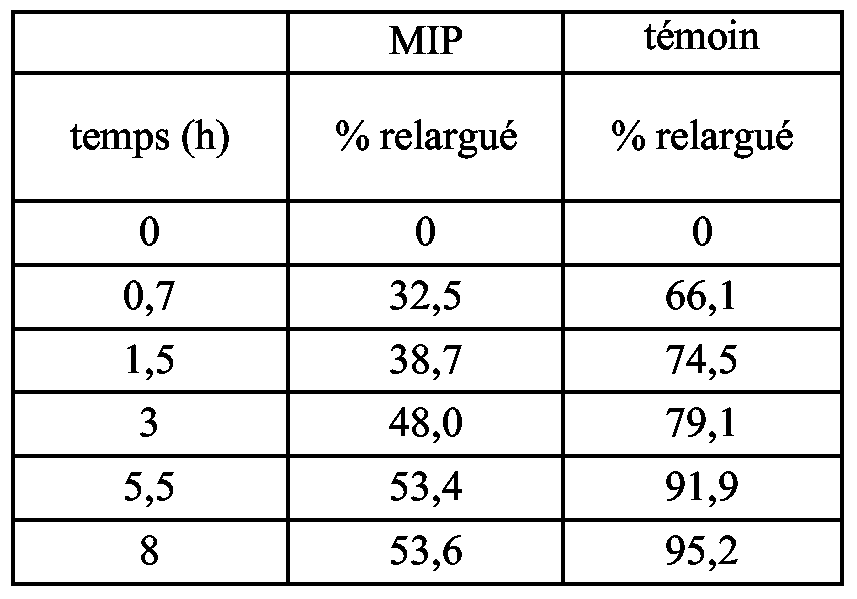
Le pourcentage de Boc Tyrosine relarguée est toujours plus faible pour le gel test que pour le gel témoin, la différence pouvant atteindre jusqu'à 40 %.
Ainsi la cinétique de relargage est plus lente pour le gel test que pour le gel témoin.
Exemple 5 : Synthèse de nanosphères polvmériques conformes à l'invention suivant le procédé de préparation en deux étapes
I- Première étape déformation de l'entité polymérique hydrophobe et réticulée La synthèse est effectuée dans un réacteur muni d'un dispositif d'agitation, d'une circulation d'argon, d'un thermomètre et de tubes gradués contenant les différents réactifs purifiés. 150ml de THF sont tout d'abord introduits dans le réacteur. Le milieu réactionnel est ensuite refroidi à -10 °C, puis 3,2 g de butyl lithium, 10 g de divinylbenzène
(log P = 3,18), 2 g d'éthylstyrène (log P = 3,70) et 0,75 g d'anthracène (molécule cible) sont introduits à leur tour dans le réacteur, et la polymérisation se déroule pendant 30 minutes, à -10 °C.
2- Deuxième étape de transformation en surface de ladite entité polymérique hydrophobe et réticulée par une entité hydrophile
Sous un vide statique à -30 °C, 100 g d'oxyde éthylène sont ajoutés au milieu réactionnel. Le milieu réactionnel est alors réchauffé jusqu'à atteindre la température ambiante, et la polymérisation se déroule pendant 48h à 30 °C. L'oxyde d'éthylène polymérise, selon un processus anionique, sur les sites réactifs portés en surface de l'entité polymérique. A la fin de la réaction, quelques gouttes d'un mélange de méthanol et d'acide sont ajoutées, à 30 °C, pour désactiver les espèces vivantes. La solution obtenue est ensuite filtrée sur papier, centrifugée, à nouveau filtrée sur papier puis précipitée dans de l'heptane ou de l'éther.
Exemple 6 : Synthèse d'un hydrogel dégradable dont les branches formant la structure étoile sont des segments triblocs de POE présentant une séquence centrale de poly(l,3-dioxolane) (PDXL)
1. Synthèse du PDXL. On prépare du PDXL de masse moléculaire en poids 2000 mol/g par réaction de 2,87 moles de 1,3-DXL avec 0,12 mole de Et(OH)2 et 2,9 x 10^ mole de CF3SO3H, sous atmosphère d'azote selon le protocole suivant. Le 1,3-DXL est tout d'abord introduit, puis la solution d'acide triflique dans le chlorure de méthylène est ajoutée. La température augmente jusqu'à 21 °C. Le mélange réactionnel est ensuite désactivé par addition d'une solution comprenant 500 mg de sodium dans 10 ml du méthanol.
Après filtration et évaporation du solvant, le produit obtenu est dissout dans du dichlorométhane.
Le polymère ainsi obtenu est précipité dans 1,5 L de méthanol à - 40 °C. Sa masse moléculaire moyenne en nombre est déterminée par CES et par RMN19F.
2. Synthèse d'un copolymère et macromonomère de POE à séquence centrale de PDXL.
10g du PDXL obtenu à l'issue de la première étape sont lyophilisés dans du benzène puis dissout, sous atmosphère contrôlée, dans 50 mL de THF. L'addition de 10 mL de diphénylméthyl potassium, à température ambiante, permet alors la transformation des extrémités hydroxyle du PDXL en groupements alcoolates. Le milieu réactionnel est ensuite maintenu sous agitation pendant environ deux heures puis 7,5g d'oxyde d'éthylène sont ajoutés, et la polymérisation de l'oxyde d'éthylène amorcée par les alcoolates formés lors de la précédente étape débute. Le milieu réactionnel revient ensuite à température ambiante, puis il est chauffé à 30 °C pendant environ 48h.
On additionne alors 1 g de chlorure de méthacryloyle pour fonctionnaliser le copolymère ainsi obtenu.
La masse moléculaire moyenne en nombre du copolymère et du macromonomère fonctionnel sont 3500, caractérisés par CES dans le THF. Le taux de doubles liaisons de macromonomère peut être déterminé quant à lui par spectroscopie UV.
Les copolymères ainsi formés peuvent être utilisés pour la synthèse d'hydrogels au titre de macromonomères difonctionnels dégradables. Par suite, la dégradation par hydrolyse des fragments PDXL desdits hydrogels peut conduire à la formation de nanogels.
Exemple 7 : Synthèse de nanosphères à plus grande échelle selon l'invention sous la forme d'un nanogel et leurs purifications
Des nanogels tests sont préparés en utilisant à titre de molécule patron le Boc phénylalanine anilide (log P = 4,4) selon le protocole opératoire suivant.
367 mg de molécule patron sont mélangés avec 355 mg d'acide méthacrylique (log P = 0,83) et 2,66 g d'éthylène glycol diméthacrylate (log P= 2,78). A cette solution est additionnée 22 g de PEG méthacrylate (M = 2000 g/mol, 50 % dans l'eau) pour former une solution trouble qui est agitée avec 100 g d'eau. La solution, dont le pH est de l'ordre de 4, est introduite dans un réacteur à double enveloppe de 200 mL régulée à 60°C. L'agitation est produite par une turbine à une vitesse de 1000 tpm.
Une solution témoin est réalisée de la même façon en absence de molécules patrons.
Après bullage d'azote pendant 20 minutes, l'agitation est poursuivie pendant trente minutes jusqu'à obtention d'une solution uniformément trouble. L'addition de
360 mg de V50 entame la réaction de polymérisation qui dure toute la nuit. Une solution uniformément trouble et stable, plus visqueuse que la solution initiale est obtenue.
La solution de nanogel est purifiée par dialyse en milieu aqueux avec de la cellulose régénérée possédant un seuil de coupure de 6000-8000. La taille des nanogels obtenus est mesurée avec un nanosizer.
Le nanogel témoin est constitué de particules dont 65 % ont une taille moyenne de 600 nm et 35 % ont une taille moyenne de 35 nm. Le nanogel test est constitué de particules dont 30% ont une taille moyenne de 300 nm et 70% ont une taille moyenne de
30 nm, rendant compte de l'interaction de la molécule cible considérée avec le coeur du nanogel.
La solution de nanogel est ensuite lyophilisée pour donner une poudre blanche.
Pour l'extraction de la molécule patron, la poudre est dispersée dans un volume d'acétonitrile puis précipitée dans dix volumes d'éther refroidi à -40 °C. Le polymère précipité est isolé par filtration. Cette opération est répétée jusqu'à ce qu'il n'y ait plus de molécules patrons extractibles.
Une analyse du taux d'adsorption obtenue par séparation des molécules cibles liées des molécules cibles libres par filtration à travers une membrane (seuil de coupure 5000) au cours d'une centrifugation, confirme la forte affinité de l'empreinte préparée pour la molécule cible.
Claims
1. Nanosphères polymériques réticulées possédant une structure en étoile de type cœur-branches, dans laquelle les branches sont de nature hydrophile et le cœur est de nature polymérique, réticulé, hydrophobe et forme l'empreinte de tout ou partie d'au moins une molécule cible.
2. Nanosphères selon la revendication 1, dans lesquelles l'empreinte est celle d'une molécule hydrophobe ou amphiphile.
3. Nanosphères selon la revendication 1 ou 2, dans lesquelles les branches sont liées de façon covalente au cœur.
4. Nanosphères selon l'une quelconque des revendications 1 à 3, dans lesquelles les branches de nature hydrophile comprennent des segments hydrophiles choisis parmi les segments de type polyoxyéthylène (POE), polysaccharide, polyoxyéthylène-polyoxypropylène-polyoxyéthylène (POE-PPO-POE), polyoxypropylène- polyoxyéthylène-polyoxypropylène (PPO-POE-PPO), polyvinylalcool, polydioxalane, poly(N-isopropylacrylamide) (poly(NIPAM)) polyéthylène imine, polyzwitterion, poly(méth)acrylamide, poly(amino alkyl(méth)acrylate), polyvinyl pyrrolidone, polypropylène glycol, polynucléotide, de polypeptide, polyélectrolyte tel que polysulfonique, polycarboxylique, polyphosphate et leurs copolymères hydrophiles.
5. Nanosphères selon l'une quelconque des revendications 1 à 4, dans lesquelles les branches sont formées par le segment hydrophile d'au moins un macromonomère amphiphile et le cœur dérive de la copolymérisation du motif polymérisable hydrophobe dudit macromonomère amphiphile avec au moins un monomère hydrophobe, en présence d'au moins un agent de réticulation hydrophobe et d'au moins une molécule patron.
6. Nanosphères selon la revendication 5, dans lesquelles au moins un macromonomère amphiphile possède un unique motif hydrophobe apte à copolymériser.
7. Nanosphères selon la revendication 5 ou 6, dans lesquelles au moins un macromonomère amphiphile possède au moins deux motifs hydrophobes aptes à copolymériser.
8. Nanosphères selon la revendication 6 ou 7, dans lesquelles le motif hydrophobe apte à copolymériser est choisi parmi les motifs vinyliques, acryliques, méthacryliques, allyliques, styréniques ou tout autre motif insaturé susceptible de réagir par voie radicalaire, ainsi que les groupements chimiques permettant une réaction de polycondensation ou de sol gel.
9. Nanosphères selon la revendication 6, dans lesquelles ledit macromonomère est choisi parmi le polyéthylène glycol éthyl éther méthacrylate, le polyéthylène glycol (méth)acrylate, le polyéthylène glycol méthyl éther-bloc-polylactide, le polyéthylène glycol alkyl éther (méth)acrylate, le polyéthylène glycol aryl éther (méth)acrylate, le polyéthylène glycol vinyl benzène, les copolymères à blocs comportant un segment hydrophile et un motif hydrophobe polymérisable tels que le polyacide acrylique-bloc-polystyryle styrène, le polyacrylamide-bloc-polystyryle styrène et le polysaccharide-bloc-polyméthacryloyle (méth)acrylate.
10. Nanosphères selon la revendication 7, dans lesquelles ledit macromonomère est choisi parmi le polyéthylène glycol di(méth)acrylate, le polyéthylène glycol divinylbenzène, ou encore les polymères triblocs constitués d'un bloc central hydrophile (par exemple à base de polyéthylène glycol, d'acide polyacrylique, de polyacrylamide, de poly(vinylpyrrolidone), ou de polysaccharide et d'un bloc hydrophobe modifié par une fonction polymérisable à chaque extrémité (par exemple du type polystyryle styrène, ou polyméthacryloyle (méth)acrylate).
11. Nanosphères selon l'une quelconque des revendications 5 à 10, dans lesquelles le monomère hydrophobe est choisi parmi les monomères acryliques, méthacryliques, acrylamides, styréniques, vinyliques, allyliques ainsi que les groupements chimiques permettant une réaction de polycondensation ou de sol-gel.
12. Nanosphères polymériques selon la revendication précédente, dans lesquelles le monomère hydrophobe est choisi parmi le méthacrylate de méthyle, le styrène, l'éthylstyrène, l'acide méthacrylique, les méthacrylates d'alkyle, les acrylates d'alkyle, les acrylates d'allyle, les méthacrylates d'allyle, les acrylates d'aryle, les méthacrylates d'aryle, les dérivés du styrène, l'acétate de vinyle, Facrylonitrile, le méthacrylonitrile, le méthacrylate de 2-amino éthyle, le méthacrylate de t-amylle, le méthacrylate de 2-(l-aziridinyl)éthyle, le t-butylacrylamide, l'acrylate de butyle, le méthacrylate de butyle, la 4-vinyl pyridine, la 2-vinyl pyridine, la 2-vinyl quinoléine, le diméthylamino éthyl acrylate, le 3-phénoxy-2-hydroxypropylacrylate et le 2-carboxyéthyle méthacrylate.
13. Nanosphères selon l'une quelconque des revendication 5 à 12, caractérisées en ce que le macromonomère amphiphile est un méthacrylate de polyéthylène glycol et le monomère hydrophobe est de type (méth)acrylate.
14. Nanosphères selon l'une quelconque des revendications précédentes, dans lesquelles la molécule cible, ou la molécule patron, présente une masse moléculaire inférieure ou égale à 2000 g/mol, et notamment inférieure ou égale à 1500 g/mol, voire même inférieure ou égale à 1000 g/mol.
15. Nanosphères selon l'une quelconque des revendications précédentes, dans lesquelles la molécule cible, ou la molécule patron, est une molécule biologiquement active, et notamment à caractère thérapeutique ou pharmaceutique.
16. Nanosphères selon la revendication précédente, dans lesquelles la molécule cible, ou la molécule patron, est choisie parmi des polypeptides, des hormones, des enzymes, des cytokines et des protéines.
17. Nanogel caractérisé en ce qu'il se présente sous la forme d'une dispersion de nanosphères polymériques selon l'une quelconque des revendications 1 à 16
18. Nanogel selon la revendication précédente, caractérisé en ce que les nanosphères polymériques sont en dispersion dans l'eau.
19. Hydrogel caractérisé en ce qu'il se présente sous la forme d'un réseau de nanosphères polymériques selon l'une quelconque des revendications 1 à 16.
20. Hydrogel selon la revendication précédente, caractérisé en ce que les cœurs polymériques hydrophobes des nanosphères polymériques figurent des nœuds de réticulation dudit hydrogel.
21. Procédé de préparation de nanosphères polymériques selon l'une quelconque des revendication 1 à 16, par copolymérisation d'au moins un macromonomère amphiphile avec au moins un monomère hydrophobe en présence d'au moins un agent de réticulation hydrophobe et d'au moins une molécule patron, suivie de l'extraction de ladite molécule patron hors desdites nanosphères polymériques.
22. Procédé de préparation d'un nanogel selon la revendication 17 ou 18, comprenant au moins la copolymérisation d'au moins un macromonomère amphiphile comprenant un unique motif hydrophobe apte à copolymériser avec au moins un monomère hydrophobe en présence d'au moins un agent de réticulation hydrophobe et d'au moins une molécule patron, et l'extraction de ladite molécule patron hors desdites nanosphères polymériques.
23. Procédé de préparation d'un hydrogel selon la revendication 19 ou 20, comprenant au moins la copolymérisation d'au moins un macromonomère amphiphile comprenant au moins deux motifs hydrophobes aptes à copolymériser avec au moins un monomère hydrophobe en présence d'au moins un agent de réticulation hydrophobe et d'au moins une molécule patron, et l'extraction de ladite molécule patron hors desdites nanosphères polymériques.
24. Procédé selon l'une quelconque des revendications 21 à 23, dans lequel le monomère hydrophobe est tel que défini dans la revendication 11 ou 12.
25. Procédé selon l'une quelconque des revendications 21 à 24, dans lequel le macromonomère amphiphile est tel que défini dans l'une quelconques des revendications 6 à 10.
26. Procédé de préparation de nanosphères polymériques selon l'une quelconque des revendications 1 à 4 comprenant : une première étape de copolymérisation d'au moins un monomère hydrophobe fonctionnalisé en présence d'au moins un agent de réticulation hydrophobe, d'au moins une molécule patron, et éventuellement d'au moins un monomère hydrophobe, notamment tel que défini dans la revendication 11 ou 12. une deuxième étape de transformation en surface de l'entité polymérique hydrophobe et réticulée obtenue à l'issue de la première étape avec une ou plusieurs entités hydrophiles, et l'extraction de ladite molécule patron hors desdites nanosphères polymériques.
27. Procédé selon la revendication 26, caractérisé en ce que la deuxième étape comprend au moins un greffage covalent d'au moins une macromolécule de nature hydrophile fonctionnalisée, en surface de ladite entité polymérique hydrophobe et réticulée.
28. Procédé selon la revendication 26, caractérisé en ce que la deuxième étape comprend au moins une réaction de polymérisation d'au moins un monomère hydrophile fonctionnalisé en surface de ladite entité polymérique hydrophobe.
29. Procédé selon la revendication 28, caractérisé en ce que le monomère hydrophile fonctionnalisé est choisi parmi l'oxyde d'éthylène, les éthers cycliques, les lactones, les lactames, les aminés cycliques, les acrylates cationiques, anioniques ou zwitterioniques, le styrène sulfonate, des esters poly(méth)acryliques, le méthacrylamide, l'acrylamide, l'acide 2- acrylamidoglycolique, l'acide 2-acrylamido-2-méthyl propane sulfonique, le N-acryloxysuccinimide, le N-acryloyl pyrrolidinone, le N-(3- aminopropyl)méthacrylamide, le N,N'-diméthylacrylamide, le 2-méthylène-l,3- propanediol, le vinyl méthyl sulfone, l'acide vinyl phosphonique ou encore le sel de sodium de l'acide vinyl sulfonique.
30. Procédé selon l'une quelconque des revendications 26 à 29, dans lequel le monomère hydrophobe fonctionnalisé est choisi parmi le l,6-heptadièn-4-ol, le l-hexèn-3- ol, le l,5-hexadièn-3,4-diol, le chlorométhyl styrène, le bromométhyl styrène, le méth(acrylate) de aminoéthyle, le méth(acrylate) d'hydroxyéthyle et le divinyl benzène.
31. Procédé selon l'une quelconque des revendications 21 à 30, dans lequel la copolymérisation met en œuvre au moins un monomère lié à la molécule patron par au moins une liaison covalente, de préférence labile.
32. Utilisation de nanosphères polymériques selon l'une quelconque des revendications 1 à 16, d'un nanogel selon la revendication 17 ou 18, ou d'un hydrogel selon la revendication 19 ou 20 à des fins d'extraction, de détection, de séparation, de purification, d'absorption, d'adsorption, de rétention ou de libération contrôlée ou encore dans des applications choisies parmi les capteurs, la catalyse de réactions chimiques, le criblage de molécules, la synthèse chimique dirigée, le traitement d'échantillons, la chimie combinatoire, la séparation chirale, la protection de groupement, le déplacement d'équilibre, les médicaments polymériques et l'encapsulation.
33. Utilisation de nanosphères polymériques selon l'une quelconque des revendications 1 à 16 d'un nanogel selon la revendication 17 ou 18 ou d'un hydrogel selon la revendication 19 ou 20 à des fins d'isolement sélectif de molécules cibles sensibles en milieux aqueux ou dans des liquides biologiques complexes.
34. Utilisation de nanosphères polymériques selon l'une quelconque des revendications 1 à 16 d'un nanogel selon la revendication 17 ou 18 ou d'un hydrogel selon la revendication 19 ou 20 à des fins de reconnaissance et d'extraction de molécules cibles hydrophobes ou amphiphiles en milieu organique.
Priority Applications (4)
| Application Number | Priority Date | Filing Date | Title |
|---|---|---|---|
| AT07731801T ATE467649T1 (de) | 2006-03-22 | 2007-03-22 | Molekulare prägungen zur erkennung in wässrigen medien, herstellungsverfahren dafür und verwendungen davon |
| DE602007006441T DE602007006441D1 (de) | 2006-03-22 | 2007-03-22 | Molekulare prägungen zur erkennung in wässrigen medien, herstellungsverfahren dafür und verwendungen davon |
| US12/282,623 US20090099301A1 (en) | 2006-03-22 | 2007-03-22 | Molecular imprintings for recognition in aqueous media, methods for preparing same and uses thereof |
| EP07731801A EP1996633B1 (fr) | 2006-03-22 | 2007-03-22 | Empreintes moleculaires pour une reconnaissance en milieux aqueux, leurs procedes de preparation et leurs utilisations |
Applications Claiming Priority (2)
| Application Number | Priority Date | Filing Date | Title |
|---|---|---|---|
| FR0650992A FR2898898B1 (fr) | 2006-03-22 | 2006-03-22 | Empreintes moleculaires pour une reconnaissance en milieu aqueux, leurs procedes de preparation et leurs utilisations |
| FR0650992 | 2006-03-22 |
Publications (2)
| Publication Number | Publication Date |
|---|---|
| WO2007107680A2 true WO2007107680A2 (fr) | 2007-09-27 |
| WO2007107680A3 WO2007107680A3 (fr) | 2007-12-06 |
Family
ID=36754683
Family Applications (1)
| Application Number | Title | Priority Date | Filing Date |
|---|---|---|---|
| PCT/FR2007/050988 Ceased WO2007107680A2 (fr) | 2006-03-22 | 2007-03-22 | Empreintes moleculaires pour une reconnaissance en milieux aqueux, leurs procedes de preparation et leurs utilisations |
Country Status (6)
| Country | Link |
|---|---|
| US (1) | US20090099301A1 (fr) |
| EP (1) | EP1996633B1 (fr) |
| AT (1) | ATE467649T1 (fr) |
| DE (1) | DE602007006441D1 (fr) |
| FR (1) | FR2898898B1 (fr) |
| WO (1) | WO2007107680A2 (fr) |
Cited By (2)
| Publication number | Priority date | Publication date | Assignee | Title |
|---|---|---|---|---|
| CN102432738A (zh) * | 2011-09-19 | 2012-05-02 | 江苏大学 | 选择性分离2-氨基-4-硝基酚磁性聚合物的制备方法 |
| CN116444734A (zh) * | 2023-04-04 | 2023-07-18 | 苏州浩微生物医疗科技有限公司 | 一种可降解水凝胶微球及其制备方法和应用 |
Families Citing this family (16)
| Publication number | Priority date | Publication date | Assignee | Title |
|---|---|---|---|---|
| US11786036B2 (en) | 2008-06-27 | 2023-10-17 | Ssw Advanced Technologies, Llc | Spill containing refrigerator shelf assembly |
| US8286561B2 (en) | 2008-06-27 | 2012-10-16 | Ssw Holding Company, Inc. | Spill containing refrigerator shelf assembly |
| AU2009302329B2 (en) | 2008-10-07 | 2015-10-29 | Ssw Advanced Technologies, Llc | Spill resistant surfaces having hydrophobic and oleophobic borders |
| ES2613885T3 (es) | 2009-11-04 | 2017-05-26 | Ssw Holding Company, Inc. | Superficies de aparatos de cocción que tienen un patrón de confinamiento de salpicaduras y procedimientos de fabricación de las mismas |
| JP5858441B2 (ja) | 2010-03-15 | 2016-02-10 | ロス テクノロジー コーポレーション.Ross Technology Corporation | プランジャーおよび疎水性表面を得るための方法 |
| TWI520990B (zh) | 2011-01-26 | 2016-02-11 | 丸善石油化學股份有限公司 | Metal nano particle composite and its manufacturing method |
| EP2674759B1 (fr) | 2011-02-04 | 2016-01-06 | Council of Scientific & Industrial Research | Capteurs d'acide aminé aqueux à base de film polymère conducteur à empreinte moléculaire |
| JP2014512417A (ja) | 2011-02-21 | 2014-05-22 | ロス テクノロジー コーポレーション. | 低voc結合剤系を含む超疎水性および疎油性被覆物 |
| DE102011085428A1 (de) | 2011-10-28 | 2013-05-02 | Schott Ag | Einlegeboden |
| EP2791255B1 (fr) | 2011-12-15 | 2017-11-01 | Ross Technology Corporation | Composition et revêtement pour une performance superhydrophobe |
| CA2907916C (fr) | 2012-03-22 | 2020-08-11 | The Regents Of The University Of Colorado | Compositions de nanogel compatibles avec l'eau |
| EP2864430A4 (fr) | 2012-06-25 | 2016-04-13 | Ross Technology Corp | Revêtements élastomères ayant des propriétés hydrophobes et/ou oléophobes |
| FR3000076B1 (fr) * | 2012-12-21 | 2015-01-16 | Univ Toulon | Polymere a empreinte et procede de preparation |
| CN106188437B (zh) * | 2016-07-12 | 2018-06-26 | 江苏大学 | 一种Pickering乳液聚合制备金属有机框架粒子印迹吸附剂的方法 |
| CN112334127A (zh) * | 2018-05-11 | 2021-02-05 | 北卡罗莱纳州立大学 | 生物响应水凝胶基质及使用方法 |
| CN112048045B (zh) * | 2020-08-31 | 2022-06-03 | 陕西科技大学 | 基于嵌段大分子链单体的敏感性蛋白印迹材料的制备方法 |
Family Cites Families (11)
| Publication number | Priority date | Publication date | Assignee | Title |
|---|---|---|---|---|
| US4127730A (en) * | 1972-08-31 | 1978-11-28 | Dynamit Nobel Aktiengesellschaft | Method of preparing polymers analogous to enzymes |
| SE8900130L (sv) * | 1989-01-16 | 1990-07-17 | Klaus Mosbach | Konceptet att med hjaelp av molekylavtrycksmetoden framstaella konstgjorda antikroppar genom imprinting av t ex antigener samt att framstaella konstgjorda entzymer genom imprintning med transition state analoger |
| US6884842B2 (en) * | 1997-10-14 | 2005-04-26 | Alnis Biosciences, Inc. | Molecular compounds having complementary surfaces to targets |
| US6310110B1 (en) * | 1999-07-30 | 2001-10-30 | Michael A. Markowitz | Molecularly-imprinted material made by template-directed synthesis |
| US6458599B1 (en) * | 2000-02-18 | 2002-10-01 | Aspira Biosystems, Inc. | Compositions and methods for capturing, isolating, detecting, analyzing and quantifying macromolecules |
| AU2001286651A1 (en) * | 2000-08-22 | 2002-03-04 | Purdue Research Foundation | Microparticle composition and method |
| US20050158271A1 (en) * | 2000-10-11 | 2005-07-21 | Lee Sang C. | Pharmaceutical applications of hydrotropic polymer micelles |
| US7985424B2 (en) * | 2004-04-20 | 2011-07-26 | Dendritic Nanotechnologies Inc. | Dendritic polymers with enhanced amplification and interior functionality |
| US7771732B2 (en) * | 2005-04-28 | 2010-08-10 | Board Of Regents, The University Of Texas System | Polymer network compositions and associated methods |
| FR2887885B1 (fr) * | 2005-07-04 | 2007-09-14 | Polyintell Sarl | Empreintes moleculaires a capacite de reconnaissance amelioree, leur procede de preparation et leur utilisation |
| EP1864777B1 (fr) * | 2006-06-08 | 2009-09-23 | DWI an der RWTH Aachen e.V. | Structuration de hydrogels |
-
2006
- 2006-03-22 FR FR0650992A patent/FR2898898B1/fr not_active Expired - Fee Related
-
2007
- 2007-03-22 EP EP07731801A patent/EP1996633B1/fr not_active Not-in-force
- 2007-03-22 US US12/282,623 patent/US20090099301A1/en not_active Abandoned
- 2007-03-22 AT AT07731801T patent/ATE467649T1/de not_active IP Right Cessation
- 2007-03-22 DE DE602007006441T patent/DE602007006441D1/de active Active
- 2007-03-22 WO PCT/FR2007/050988 patent/WO2007107680A2/fr not_active Ceased
Non-Patent Citations (2)
| Title |
|---|
| ORAL EBRU ET AL: "Responsive and recognitive hydrogels using star polymers" J. BIOMED. MATER. RES. PART A; JOURNAL OF BIOMEDICAL MATERIALS RESEARCH - PART A FEB 1 2004, vol. 68, no. 3, 1 février 2004 (2004-02-01), pages 439-447, XP002394866 * |
| TOMONORI NAKAYAMA: "Star Shaped Molecularly Imprinted Polymer Working as a Drug Carrier"[Online] juillet 2006 (2006-07), XP002452282 Extrait de l'Internet: URL:http://aiche.confex.com/aiche/2006/techprogram/P61653.HTM> [extrait le 2006-08-10] * |
Cited By (4)
| Publication number | Priority date | Publication date | Assignee | Title |
|---|---|---|---|---|
| CN102432738A (zh) * | 2011-09-19 | 2012-05-02 | 江苏大学 | 选择性分离2-氨基-4-硝基酚磁性聚合物的制备方法 |
| CN102432738B (zh) * | 2011-09-19 | 2013-11-20 | 江苏大学 | 选择性分离2-氨基-4-硝基酚磁性聚合物的制备方法 |
| CN116444734A (zh) * | 2023-04-04 | 2023-07-18 | 苏州浩微生物医疗科技有限公司 | 一种可降解水凝胶微球及其制备方法和应用 |
| CN116444734B (zh) * | 2023-04-04 | 2024-01-30 | 苏州浩微生物医疗科技有限公司 | 一种可降解水凝胶微球及其制备方法和应用 |
Also Published As
| Publication number | Publication date |
|---|---|
| EP1996633B1 (fr) | 2010-05-12 |
| FR2898898A1 (fr) | 2007-09-28 |
| EP1996633A2 (fr) | 2008-12-03 |
| DE602007006441D1 (de) | 2010-06-24 |
| WO2007107680A3 (fr) | 2007-12-06 |
| US20090099301A1 (en) | 2009-04-16 |
| FR2898898B1 (fr) | 2008-06-06 |
| ATE467649T1 (de) | 2010-05-15 |
Similar Documents
| Publication | Publication Date | Title |
|---|---|---|
| EP1996633B1 (fr) | Empreintes moleculaires pour une reconnaissance en milieux aqueux, leurs procedes de preparation et leurs utilisations | |
| EP2342247B1 (fr) | Procédé de préparation de polymères à empreintes moléculaires (pem) par polymérisation radicalaire | |
| Zhang et al. | Morphological stabilization of block copolymer worms using asymmetric cross-linkers during polymerization-induced self-assembly | |
| US6048546A (en) | Immobilized lipid-bilayer materials | |
| Brooks et al. | Synthesis and applications of boronic acid-containing polymers: from materials to medicine | |
| Oral et al. | Responsive and recognitive hydrogels using star polymers | |
| Zahedi et al. | Biomacromolecule template‐based molecularly imprinted polymers with an emphasis on their synthesis strategies: a review | |
| Wei et al. | Synthesis and applications of shell cross-linked thermoresponsive hybrid micelles based on poly (N-isopropylacrylamide-co-3-(trimethoxysilyl) propyl methacrylate)-b-poly (methyl methacrylate) | |
| Li et al. | Synthesis and characterization of functional methacrylate copolymers and their application in molecular imprinting | |
| Silvestri et al. | Molecularly imprinted membranes for an improved recognition of biomolecules in aqueous medium | |
| Jantarat et al. | S-Propranolol imprinted polymer nanoparticle-on-microsphere composite porous cellulose membrane for the enantioselectively controlled delivery of racemic propranolol | |
| EP2480609B1 (fr) | Polymeres fluorescents de composes de la 7-hydroxycoumarine, capteurs chimiques les comprenant, et compose fluorescent polymerisable de la 7-hydroxycoumarine | |
| US20060102556A1 (en) | Porous molecularly imprinted polymer membranes | |
| Holowka et al. | Synthesis and crosslinking of L‐DOPA containing polypeptide vesicles | |
| EP1966260B1 (fr) | Procede de preparation de particules composites, particules composites obtenues et leur utilisation dans un test diagnostic | |
| Ulrich et al. | Wide range of functionalized poly (N-alkyl acrylamide)-based amphiphilic polymer conetworks via active ester precursors | |
| WO2003091302A1 (fr) | Polymere reticule, particule fine de polymere et leur procede de production | |
| Nagase et al. | Thermoresponsive polymer brush on monolithic-silica-rod for the high-speed separation of bioactive compounds | |
| JP4874179B2 (ja) | 限外濾過膜およびその製造方法、並びにナノ粒子のサイズ分別方法 | |
| Pester et al. | Responsive Macroscopic Materials From Self‐Assembled Cross‐Linked SiO2‐PNIPAAm Core/Shell Structures | |
| Karchilakis et al. | Capturing enzyme-loaded diblock copolymer vesicles using an aldehyde-functionalized hydrophilic polymer brush | |
| EP2655454B1 (fr) | Particules polymeriques filementeuses et leur utilisation comme modificateurs de rheologie | |
| Théato et al. | Synthesis of End‐Functionalized Lipopolymers and Their Characterization with Regard to Polymer‐Supported Lipid Membranes | |
| Schillemans et al. | Molecularly imprinted polymer particles: synthetic receptors for future medicine | |
| FR2887885A1 (fr) | Empreintes moleculaires a capacite de reconnaissance amelioree, leur procede de preparation et leur utilisation |
Legal Events
| Date | Code | Title | Description |
|---|---|---|---|
| WWE | Wipo information: entry into national phase |
Ref document number: 2007731801 Country of ref document: EP |
|
| NENP | Non-entry into the national phase |
Ref country code: DE |
|
| 121 | Ep: the epo has been informed by wipo that ep was designated in this application |
Ref document number: 07731801 Country of ref document: EP Kind code of ref document: A2 |
|
| WWE | Wipo information: entry into national phase |
Ref document number: 12282623 Country of ref document: US |