WO2007113153A1 - Piperidine derivatives useful as serotonin transporter inhibitors and neurokinin-1 receptor antagonists - Google Patents

Piperidine derivatives useful as serotonin transporter inhibitors and neurokinin-1 receptor antagonists Download PDF

Info

Publication number
WO2007113153A1
WO2007113153A1 PCT/EP2007/052852 EP2007052852W WO2007113153A1 WO 2007113153 A1 WO2007113153 A1 WO 2007113153A1 EP 2007052852 W EP2007052852 W EP 2007052852W WO 2007113153 A1 WO2007113153 A1 WO 2007113153A1
Authority
WO
WIPO (PCT)
Prior art keywords
formula
compound
compounds
trifluoromethyl
hydrogen
Prior art date
Legal status (The legal status is an assumption and is not a legal conclusion. Google has not performed a legal analysis and makes no representation as to the accuracy of the status listed.)
Ceased
Application number
PCT/EP2007/052852
Other languages
French (fr)
Inventor
Christophe Grundschober
Patrick Schnider
Current Assignee (The listed assignees may be inaccurate. Google has not performed a legal analysis and makes no representation or warranty as to the accuracy of the list.)
F Hoffmann La Roche AG
Original Assignee
F Hoffmann La Roche AG
Priority date (The priority date is an assumption and is not a legal conclusion. Google has not performed a legal analysis and makes no representation as to the accuracy of the date listed.)
Filing date
Publication date
Priority to EP07727325A priority Critical patent/EP2004605B1/en
Priority to KR1020087024162A priority patent/KR101101107B1/en
Priority to CA2648065A priority patent/CA2648065C/en
Priority to JP2009503526A priority patent/JP5027208B2/en
Priority to MX2008012634A priority patent/MX2008012634A/en
Priority to AU2007233812A priority patent/AU2007233812B2/en
Priority to BRPI0709742-5A priority patent/BRPI0709742A2/en
Priority to CN2007800205495A priority patent/CN101460460B/en
Priority to AT07727325T priority patent/ATE514677T1/en
Application filed by F Hoffmann La Roche AG filed Critical F Hoffmann La Roche AG
Publication of WO2007113153A1 publication Critical patent/WO2007113153A1/en
Priority to IL194392A priority patent/IL194392A/en
Anticipated expiration legal-status Critical
Ceased legal-status Critical Current

Links

Classifications

    • AHUMAN NECESSITIES
    • A61MEDICAL OR VETERINARY SCIENCE; HYGIENE
    • A61KPREPARATIONS FOR MEDICAL, DENTAL OR TOILETRY PURPOSES
    • A61K31/00Medicinal preparations containing organic active ingredients
    • A61K31/33Heterocyclic compounds
    • A61K31/395Heterocyclic compounds having nitrogen as a ring hetero atom, e.g. guanethidine or rifamycins
    • A61K31/435Heterocyclic compounds having nitrogen as a ring hetero atom, e.g. guanethidine or rifamycins having six-membered rings with one nitrogen as the only ring hetero atom
    • A61K31/44Non condensed pyridines; Hydrogenated derivatives thereof
    • A61K31/445Non condensed piperidines, e.g. piperocaine
    • A61K31/451Non condensed piperidines, e.g. piperocaine having a carbocyclic group directly attached to the heterocyclic ring, e.g. glutethimide, meperidine, loperamide, phencyclidine, piminodine
    • CCHEMISTRY; METALLURGY
    • C07ORGANIC CHEMISTRY
    • C07DHETEROCYCLIC COMPOUNDS
    • C07D211/00Heterocyclic compounds containing hydrogenated pyridine rings, not condensed with other rings
    • C07D211/04Heterocyclic compounds containing hydrogenated pyridine rings, not condensed with other rings with only hydrogen or carbon atoms directly attached to the ring nitrogen atom
    • C07D211/06Heterocyclic compounds containing hydrogenated pyridine rings, not condensed with other rings with only hydrogen or carbon atoms directly attached to the ring nitrogen atom having no double bonds between ring members or between ring members and non-ring members
    • C07D211/08Heterocyclic compounds containing hydrogenated pyridine rings, not condensed with other rings with only hydrogen or carbon atoms directly attached to the ring nitrogen atom having no double bonds between ring members or between ring members and non-ring members with hydrocarbon or substituted hydrocarbon radicals directly attached to ring carbon atoms
    • C07D211/18Heterocyclic compounds containing hydrogenated pyridine rings, not condensed with other rings with only hydrogen or carbon atoms directly attached to the ring nitrogen atom having no double bonds between ring members or between ring members and non-ring members with hydrocarbon or substituted hydrocarbon radicals directly attached to ring carbon atoms with substituted hydrocarbon radicals attached to ring carbon atoms
    • C07D211/20Heterocyclic compounds containing hydrogenated pyridine rings, not condensed with other rings with only hydrogen or carbon atoms directly attached to the ring nitrogen atom having no double bonds between ring members or between ring members and non-ring members with hydrocarbon or substituted hydrocarbon radicals directly attached to ring carbon atoms with substituted hydrocarbon radicals attached to ring carbon atoms with hydrocarbon radicals, substituted by singly bound oxygen or sulphur atoms
    • C07D211/22Heterocyclic compounds containing hydrogenated pyridine rings, not condensed with other rings with only hydrogen or carbon atoms directly attached to the ring nitrogen atom having no double bonds between ring members or between ring members and non-ring members with hydrocarbon or substituted hydrocarbon radicals directly attached to ring carbon atoms with substituted hydrocarbon radicals attached to ring carbon atoms with hydrocarbon radicals, substituted by singly bound oxygen or sulphur atoms by oxygen atoms
    • AHUMAN NECESSITIES
    • A61MEDICAL OR VETERINARY SCIENCE; HYGIENE
    • A61KPREPARATIONS FOR MEDICAL, DENTAL OR TOILETRY PURPOSES
    • A61K31/00Medicinal preparations containing organic active ingredients
    • A61K31/33Heterocyclic compounds
    • A61K31/395Heterocyclic compounds having nitrogen as a ring hetero atom, e.g. guanethidine or rifamycins
    • A61K31/435Heterocyclic compounds having nitrogen as a ring hetero atom, e.g. guanethidine or rifamycins having six-membered rings with one nitrogen as the only ring hetero atom
    • A61K31/44Non condensed pyridines; Hydrogenated derivatives thereof
    • A61K31/445Non condensed piperidines, e.g. piperocaine
    • A61K31/4465Non condensed piperidines, e.g. piperocaine only substituted in position 4
    • AHUMAN NECESSITIES
    • A61MEDICAL OR VETERINARY SCIENCE; HYGIENE
    • A61PSPECIFIC THERAPEUTIC ACTIVITY OF CHEMICAL COMPOUNDS OR MEDICINAL PREPARATIONS
    • A61P25/00Drugs for disorders of the nervous system
    • A61P25/22Anxiolytics
    • AHUMAN NECESSITIES
    • A61MEDICAL OR VETERINARY SCIENCE; HYGIENE
    • A61PSPECIFIC THERAPEUTIC ACTIVITY OF CHEMICAL COMPOUNDS OR MEDICINAL PREPARATIONS
    • A61P25/00Drugs for disorders of the nervous system
    • A61P25/24Antidepressants
    • AHUMAN NECESSITIES
    • A61MEDICAL OR VETERINARY SCIENCE; HYGIENE
    • A61PSPECIFIC THERAPEUTIC ACTIVITY OF CHEMICAL COMPOUNDS OR MEDICINAL PREPARATIONS
    • A61P43/00Drugs for specific purposes, not provided for in groups A61P1/00-A61P41/00

Definitions

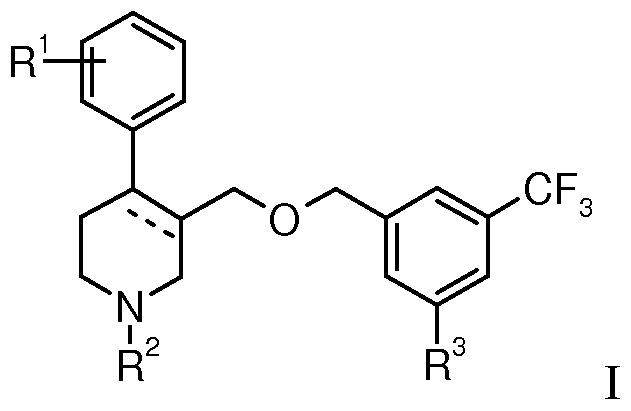
  • the present invention relates to trans- derivatives of formula
  • R 1 is hydrogen, halogen or lower alkyl
  • R z is hydrogen, lower alkyl or -(CH 2 ) n CN
  • R 3 is hydrogen or CF 3
  • n is 1 or 2
  • the dotted line may be a bond or not; and to pharmaceutically acceptable acid addition salts thereof.
  • the compounds of formula I are good inhibitors of the serotonin transporter (SERT inhibitors) and simultaneously, they have a good activity on the NK- 1 receptor (dual effect).
  • SERT inhibitors serotonin transporter
  • the compounds in the present invention are particularly useful for the treatment of CNS disorders and psychotic disorders, in particular in the treatment or prevention of depressive states and/or in the treatment of anxiety.
  • SERT Inhibitors including the selective serotonin transporter inhibitors also called selective serotonin reuptake inhibitors (SSRTs)
  • SSRTs selective serotonin reuptake inhibitors
  • the object of the present invention was to find compounds which have SERT inhibitory activity with an additional beneficial effect on the onset of action and which allow major improvements for SSRI-resistant patients, e.g. with a reduced anxiogenic or even anxiolytic profile.
  • NK- 1 antagonists are believed to indirectly modulate 5-HT function via noradrenergic pathways and have been shown to attenuate presynaptic 5HT IA receptor function (Bioorg. Med. Chem., Lett. 12, (2002), 261-264).
  • combination of serotonin uptake inhibition with NK-I antagonism may lead to compounds with an improved onset of action and a better efficacy during the treatment of depressive/ anxiolytic states.
  • the compounds of the present invention combine serotonin transporter inhibition and NK-I antagonism.
  • NK- 1/SSRI approach has also been proposed as a potential treatment for obesity (WO98/47514).
  • WO2005/032464 describes trans-phenyl pyrrolidine ethers which are tachykinin receptor antagonists.
  • a small group of trans- derivatives of piperidine or tetrahydropyridine derivatives of the present formula I are SERT inhibitors and simultaneously, they have a good activity as NK-I receptor antagonists.
  • a drug with a dual mode of action combines the advantages of both receptor sites, and the dosage of the drug may therefore be reduced, thus leading to a decreased risk of side effects as compared to a combination of two drugs.
  • trans- derivatives of formula I (piperidine or tetrahydropyridine) have a dual activity and therefore they can share the advantages as mentioned above.
  • NK- 1 and SERT activities of compounds of present trans- derivatives of formula I compared with structure- related trans- derivatives of formulas II and III, not encompassed by the present invention.
  • HEK- 293 cells stably expressing recombinant human SERT are maintained with DMEM high glucose with 10 % FBS, 300 ⁇ g/ml G418 and 2 mM L-Glutamine and incubated at 37 °C with 5 % CO 2 .
  • Cells are released from culture flasks using PBS for l-2min. The cells are subsequently centrifuged at 1000 g's for 5 min and resuspended in PBS prior to being used in the membrane preparation.
  • Cells are homogenized using a Polytron in 50 mM Tris (pH 7.4). Centrifuged at 48,000 xg for 15 min, and the pellet resuspended in fresh buffer. After a second centrifugation, the pellet is re-homogenized and resuspended in fresh buffer. Typically, membrane portions are aliquoted in 3mg/ml (w:v). and stored at -80 °C.
  • a serial dilution of test compounds in 50 mM Tris-HCl, 120 mM NaCl, KCl 5 mM (pH 7.4) is made in a white Optiplate (Packard) ( lOO ⁇ l/well) and the radioligand 3 [H] Citalopram (Specific activity: 60-86 Ci/mmol, Final concentration: 1 nM) is added at 50 ⁇ l/well.
  • Membrane and beads are prepared to a ratio of 5 ⁇ g:0.6 mg, with 0.6 mg PVT-WGA Amersham beads (Cat# RPQ0282V) added per well. 50 ⁇ l of the membrane/bead mixture is added to the assay plate for a final volume of 200 ⁇ l.
  • the mixtures are allowed to stand at room temperature for one hour, and are then counted on a Packard TopCount.
  • the % inhibition is calculated for each compound tested (with 100 % binding being the value obtained with the incubation of membrane/beads and radioligand in buffer without compound minus the non-specific binding measured in presence of lO ⁇ M Fluoxetine).
  • the concentration producing 50 % inhibition (IC50) is determined using an iterative non-linear curve fitting technique.
  • the inhibition dissociation constant (Ki) of each compound is determined according to the method of Cheng- Prusoff. hNK-1 binding assay
  • Binding assays were performed in HEPES buffer (50 mM, pH 7.4) containing BSA (0.04 %) leupeptin (8 ⁇ g / ml), MnCl 2 (3mM) and phosphoramidon (2 ⁇ M). Binding assays consisted of 250 ⁇ l of membrane suspension ( 1.25xlO 5 cells / assay tube) , 125 ⁇ l of buffer of displacing agent and 125 ⁇ l of [ 3 H] substance P.
  • Displacement curves were determined with at least ten concentrations of the compound.
  • the assay tubes were incubated for 60 min at room temperature after which time the tube contents were rapidly filtered under vacuum through GF/C filters presoaked for 60 min with PEI (0.3 %) with 2 x 2 ml washes of HEPES buffer (50 rnM, pH 7.4) . The radioactivity retained on the filters was measured by scintillation counting. All assays were performed in duplicate in at least 2 separate experiments.
  • the inhibition dissociation constant (Ki) of each compound for NKl is determined as described above for hSERT.
  • NKl receptors - Millan, M.J., Lejeune, F., de Nanteuil, G. and Gobert, A., A selective blockade of neurokinin NKl receptors facilitates the activity of adrenergic pathways projecting to the frontal cortex and dorsal hippocampus in rats. J. Neurochem., 76, 1949-1954 (2001). - Rupniak, N.M.J. New Insights into the antidepressant actions of substance P (NKl receptor) antagonists. N.M.J Can. J. Physiol. Pharmacol. 80, 489-494 (2002).
  • Objects of the present invention are the compounds of formula I per se, the use of compounds of formula I and their pharmaceutically acceptable salts for the manufacture of medicaments for the treatment of diseases related to activation of Serotonin Transporter (SERT), such as for the treatment of depression and anxiety, their manufacture, medicaments based on a compound in accordance with the invention and their production as well as the use of compounds of formula I in the control or prevention of illnesses such as depression and anxiety.
  • SERT Serotonin Transporter
  • the invention includes all trans- derivatives and their pharmaceutically active salts.
  • lower alkyl denotes a saturated straight- or branched- chain group containing from 1 to 7 carbon atoms, for example, methyl, ethyl, propyl, isopropyl, n-butyl, i-butyl, 2-butyl, t-butyl and the like.
  • Preferred alkyl groups are groups with 1 - 4 carbon atoms.
  • halogen denotes chlorine, iodine, fluorine and bromine.
  • pharmaceutically acceptable acid addition salts embraces salts with inorganic and organic acids, such as hydrochloric acid, nitric acid, sulfuric acid, phosphoric acid, citric acid, formic acid, fumaric acid, maleic acid, acetic acid, succinic acid, tartaric acid, methane-sulfonic acid, p-toluenesulfonic acid and the like.
  • Preferred compounds of formula I are those of formula IA, for example the following compounds:
  • Preferred compounds of formula I are further those of formula I-B, for example the following compound 5-(3,5-bis-trifluoromethyl-benzyloxymethyl)-4-o-tolyl- 1,2,3,6- tetrahydro-pyridine.
  • novel trans- derivatives of formula I and their pharmaceutically acceptable salts can be prepared by methods known in the art, for example by processes described below, which processes comprise a) reacting a compound of formula with sodium hydride and a compound of formula
  • R 1 is as described above, and, if desired, converting the compounds obtained into pharmaceutically acceptable acid addition salts.
  • Schemes I to 4 show the preparation of compounds of formula I in more detail.
  • the starting material used in schemes 1 to 4 are known compounds or maybe prepared by methods known in the art.
  • Example 1 (-)-(3 l S',4R)-3-(3,5-Bis-trifluoromethyl-benzyloxymethyl)-4-(4-fluoro-phenyl)- piperidine hydrochloride a) (+)-(3R,4R)-4-(4-Fluoro-phenyl)-piperidine-l,3-dicarboxylic acid-1-tert-butyl ester
  • the asymmetric hydrogenation was run for 42 h at 8O 0 C under 40 bar of hydrogen. After cooling to room temperature the pressure was released from the autoclave, the methanol solution was diluted with 50 ml of tert-butyl methyl ether and extracted with two 50-ml portions of a 1 M aqueous sodium hydroxide solution. The aqueous layer was poured on ice, acidified with ice-cold 2 M aqueous hydrochloric acid solution to pH 1 and extracted with two 100-ml portions of ethyl acetate.

Landscapes

  • Health & Medical Sciences (AREA)
  • Chemical & Material Sciences (AREA)
  • Organic Chemistry (AREA)
  • General Health & Medical Sciences (AREA)
  • Veterinary Medicine (AREA)
  • Public Health (AREA)
  • Medicinal Chemistry (AREA)
  • Animal Behavior & Ethology (AREA)
  • Life Sciences & Earth Sciences (AREA)
  • Pharmacology & Pharmacy (AREA)
  • Bioinformatics & Cheminformatics (AREA)
  • Nuclear Medicine, Radiotherapy & Molecular Imaging (AREA)
  • Engineering & Computer Science (AREA)
  • General Chemical & Material Sciences (AREA)
  • Chemical Kinetics & Catalysis (AREA)
  • Neurosurgery (AREA)
  • Biomedical Technology (AREA)
  • Neurology (AREA)
  • Epidemiology (AREA)
  • Psychiatry (AREA)
  • Pain & Pain Management (AREA)
  • Hydrogenated Pyridines (AREA)
  • Pharmaceuticals Containing Other Organic And Inorganic Compounds (AREA)
  • Plural Heterocyclic Compounds (AREA)

Abstract

The present invention relates to trans-derivatives of Formula (I) wherein R1 is hydrogen, halogen or lower alkyl; R2 is hydrogen, lower alkyl or -(CH2)nCN; R3 is hydrogen or CF3; n is 1 or 2; the dotted line may be a bond or not; and to pharmaceutically acceptable acid addition salts thereof. Encompassed by the present formula I are compounds of Formulas (IA) and (IB). The compounds of Formula (I) are good inhibitors of the serotonin transporter (SERT inhibitors) and simultaneously, they have a good activity on the NK-1 receptor (dual effect). By virtue of their efficacy as SERT inhibitors, the compounds in the present invention are particularly useful for the treatment of CNS disorders and psychotic disorders, in particular in the treatment or prevention of depressive states and/or in the treatment of anxiety.

Description

PIPERIDINE DERIVATIVES USEFUL AS SEROTONIN TRANSPORTER INHIBITORS AND
NEUROKININ- i RECEPTOR ANTAGONISTS
The present invention relates to trans- derivatives of formula
Figure imgf000002_0001
wherein
R1 is hydrogen, halogen or lower alkyl; Rz is hydrogen, lower alkyl or -(CH2)nCN; R3 is hydrogen or CF3; n is 1 or 2; the dotted line may be a bond or not; and to pharmaceutically acceptable acid addition salts thereof.
Encompassed by the present formula I are compounds of formulas
Figure imgf000002_0002
The compounds of formula I are good inhibitors of the serotonin transporter (SERT inhibitors) and simultaneously, they have a good activity on the NK- 1 receptor (dual effect). By virtue of their efficacy as SERT inhibitors, the compounds in the present invention are particularly useful for the treatment of CNS disorders and psychotic disorders, in particular in the treatment or prevention of depressive states and/or in the treatment of anxiety. SERT Inhibitors including the selective serotonin transporter inhibitors, also called selective serotonin reuptake inhibitors (SSRTs), have become the most frequently prescribed antidepressant drugs. They are believed to exert their effect by increasing extracellular 5-HT levels in the serotoninergic terminal fields such as the hippocampus and prefrontal cortex. However, approximately 30 % of patients appear to be resistant to SSRI treatment. In addition, those patients who do benefit from SSRI treatment often exhibit various side-effects which include sexual dysfunction, gastrointestinal distress, insomnia and in some cases anxiogenesis due to their indirect activation (through elevation of 5-HT levels) of all 5-HT receptors. Furthermore, a common problem in current antidepressant therapies is their slow onset of action, since a delay of about 4 weeks is normally observed between the beginning of the treatment and alleviation of the symptoms. The delay appears to parallel the progressive desensitization of somatodendritic 5HTIA receptors, increasing serotoninergic function, thus allowing alleviation of depressive symptoms.
Therefore, the object of the present invention was to find compounds which have SERT inhibitory activity with an additional beneficial effect on the onset of action and which allow major improvements for SSRI-resistant patients, e.g. with a reduced anxiogenic or even anxiolytic profile.
It has surprisingly been found that present compounds of formula I have a good activity as SERT inhibitors and that they are concomitantly active as NK- 1 receptor antagonists. NK- 1 antagonists are believed to indirectly modulate 5-HT function via noradrenergic pathways and have been shown to attenuate presynaptic 5HTIA receptor function (Bioorg. Med. Chem., Lett. 12, (2002), 261-264).
Thus, combination of serotonin uptake inhibition with NK-I antagonism may lead to compounds with an improved onset of action and a better efficacy during the treatment of depressive/ anxiolytic states. The compounds of the present invention combine serotonin transporter inhibition and NK-I antagonism.
Recent reports have indicated that the combination of a SSRI and a NK- 1 antagonist produces beneficial responses in animal models of anxiety and depression such as guinea-pig pup maternal separation vocalization, with relatively reduced doses
{W 098/47514; . Bioorg. Med. Chem. Lett. 12(2), 261-264 (2002) and Bioorg. Med. Chem. Lett. 12(21), 3195-3198 (2002).
This suggests that by adopting a dual approach which is mechanistically dissimilar, a synergism between the two modes of action may occur, enabling enhanced responses. This may not only be beneficial in patients resistant to treatment with SSRI alone but also in improving the rapidity of onset of therapeutic action. A drug with a dual mode of action potentially allows for a reduction in dosing and therefore a decreased risk of side effects as compared to a combination of two drugs.
In the patent literature the combined NK- 1/SSRI approach has also been proposed as a potential treatment for obesity (WO98/47514). WO2005/032464 describes trans-phenyl pyrrolidine ethers which are tachykinin receptor antagonists. Now it has surprisingly been found that a small group of trans- derivatives of piperidine or tetrahydropyridine derivatives of the present formula I are SERT inhibitors and simultaneously, they have a good activity as NK-I receptor antagonists. A drug with a dual mode of action combines the advantages of both receptor sites, and the dosage of the drug may therefore be reduced, thus leading to a decreased risk of side effects as compared to a combination of two drugs.
It has been shown that trans- derivatives of formula I (piperidine or tetrahydropyridine) have a dual activity and therefore they can share the advantages as mentioned above. In the table below are shown NK- 1 and SERT activities of compounds of present trans- derivatives of formula I, compared with structure- related trans- derivatives of formulas II and III, not encompassed by the present invention.
Figure imgf000004_0001
Figure imgf000004_0002
-A-
Figure imgf000005_0001
Figure imgf000006_0001
Related compounds of formulas II and III have a high selectivity to the NK- 1 receptor (not desired in the present case). The data has been generated in accordance with the following assays: hSERT SPA binding assay
HEK- 293 cells stably expressing recombinant human SERT are maintained with DMEM high glucose with 10 % FBS, 300 μg/ml G418 and 2 mM L-Glutamine and incubated at 37 °C with 5 % CO2. Cells are released from culture flasks using PBS for l-2min. The cells are subsequently centrifuged at 1000 g's for 5 min and resuspended in PBS prior to being used in the membrane preparation.
Cells are homogenized using a Polytron in 50 mM Tris (pH 7.4). Centrifuged at 48,000 xg for 15 min, and the pellet resuspended in fresh buffer. After a second centrifugation, the pellet is re-homogenized and resuspended in fresh buffer. Typically, membrane portions are aliquoted in 3mg/ml (w:v). and stored at -80 °C.
A serial dilution of test compounds in 50 mM Tris-HCl, 120 mM NaCl, KCl 5 mM (pH 7.4) is made in a white Optiplate (Packard) ( lOOμl/well) and the radioligand 3[H] Citalopram (Specific activity: 60-86 Ci/mmol, Final concentration: 1 nM) is added at 50 μl/well. Membrane and beads are prepared to a ratio of 5 μg:0.6 mg, with 0.6 mg PVT-WGA Amersham beads (Cat# RPQ0282V) added per well. 50 μl of the membrane/bead mixture is added to the assay plate for a final volume of 200μl. The mixtures are allowed to stand at room temperature for one hour, and are then counted on a Packard TopCount. The % inhibition is calculated for each compound tested (with 100 % binding being the value obtained with the incubation of membrane/beads and radioligand in buffer without compound minus the non-specific binding measured in presence of lOμM Fluoxetine). The concentration producing 50 % inhibition (IC50) is determined using an iterative non-linear curve fitting technique. The inhibition dissociation constant (Ki) of each compound is determined according to the method of Cheng- Prusoff. hNK-1 binding assay
The affinity of test compounds for the NK- 1 receptor was evaluated at human NK- 1 receptors in CHO cells transfected with the human NK- 1 receptor using the Semliki virus expression system and radio labelled with [3H] substance P (final concentration 0.6 nM). Binding assays were performed in HEPES buffer (50 mM, pH 7.4) containing BSA (0.04 %) leupeptin (8 μg / ml), MnCl2 (3mM) and phosphoramidon (2 μM). Binding assays consisted of 250 μl of membrane suspension ( 1.25xlO5 cells / assay tube) , 125 μl of buffer of displacing agent and 125 μl of [3H] substance P. Displacement curves were determined with at least ten concentrations of the compound. The assay tubes were incubated for 60 min at room temperature after which time the tube contents were rapidly filtered under vacuum through GF/C filters presoaked for 60 min with PEI (0.3 %) with 2 x 2 ml washes of HEPES buffer (50 rnM, pH 7.4) . The radioactivity retained on the filters was measured by scintillation counting. All assays were performed in duplicate in at least 2 separate experiments.
The inhibition dissociation constant (Ki) of each compound for NKl is determined as described above for hSERT.
References
- Froger, N., Gardier, A.M., Moratalla, R., et al., 5-HTlA autoreceptor adaptive changes in substance P (Neurokinin 1) receptor knock-out mice mimic antidepressant- induced desensitization. J. Neuroscience, 21(20), 8188-8197 (2001). - Kramer M.S., Cutler, N., Feighner, J. et al., Distinct Mechanism of antidepressant activity by blockade of central substance P receptors. Science 281, 1640-1645 (1998).
- Millan, M.J., Lejeune, F., de Nanteuil, G. and Gobert, A., A selective blockade of neurokinin NKl receptors facilitates the activity of adrenergic pathways projecting to the frontal cortex and dorsal hippocampus in rats. J. Neurochem., 76, 1949-1954 (2001). - Rupniak, N.M.J. New Insights into the antidepressant actions of substance P (NKl receptor) antagonists. N.M.J Can. J. Physiol. Pharmacol. 80, 489-494 (2002).
- Rupniak, N.M.J. Elucidating the antidepressant actions of substance P (NKl receptor) antagonists. Current Opinion in Investigational Drugs, 3(2), 257-261 (2002).
- Ryckmans, T., Balancon, L, Berton, O., et al., First dual NKl antagonists- serotonin reuptake inhibitors: synthesis and SAR of a new class of potential antidepressants. Bioorg. Med. Chem. Lett. 12(2), 261-264 (2002).
- Ryckmans, T., Berton, O., Grimee, R., et al., Dual NKl Antagonists- serotonin reuptake inhibitors as potential antidepressants. Part 2 :SAR and activity of benzyloxyphen ethyl piperazine derivatives. Bioorg. Med. Chem. Lett. 12(21), 3195-3198 (2002). - WO98/47514 Al. Use of an NKl receptor antagonist and an SSRI for treating obesity.
- WO03/015784 Al. 2-Substituted 1-arylpiperazines as tachykinin antagonists and/or serotonin reuptake inhibitors.
Objects of the present invention are the compounds of formula I per se, the use of compounds of formula I and their pharmaceutically acceptable salts for the manufacture of medicaments for the treatment of diseases related to activation of Serotonin Transporter (SERT), such as for the treatment of depression and anxiety, their manufacture, medicaments based on a compound in accordance with the invention and their production as well as the use of compounds of formula I in the control or prevention of illnesses such as depression and anxiety. The invention includes all trans- derivatives and their pharmaceutically active salts.
As used herein, the term "lower alkyl" denotes a saturated straight- or branched- chain group containing from 1 to 7 carbon atoms, for example, methyl, ethyl, propyl, isopropyl, n-butyl, i-butyl, 2-butyl, t-butyl and the like. Preferred alkyl groups are groups with 1 - 4 carbon atoms.
The term "halogen" denotes chlorine, iodine, fluorine and bromine.
The term "pharmaceutically acceptable acid addition salts" embraces salts with inorganic and organic acids, such as hydrochloric acid, nitric acid, sulfuric acid, phosphoric acid, citric acid, formic acid, fumaric acid, maleic acid, acetic acid, succinic acid, tartaric acid, methane-sulfonic acid, p-toluenesulfonic acid and the like.
Preferred compounds of formula I are those of formula IA, for example the following compounds:
(-)-(3lS',4R)-3-(3,5-bis-trifluoromethyl-benzyloxymethyl)-4-(4-fluoro-phenyl)- piperidine, (-)-(3lSr,4R)-3-(3,5-bis-trifluoromethyl-benzyloxymethyl)-4-(4-fluoro-phenyl)- piperidine,
(-)-[(3lS',4R)-3-(3,5-bis-trifluoromethyl-benzyloxymethyl)-4-(4-fluoro-phenyl)- piperidin- 1-yl] -acetonitrile,
(-)-(3lS',4R)-4-(4-fluoro-phenyl)-3-(3-trifluoromethyl-benzyloxymethyl)-piperidine, (3lS'R,4RlSr)-3-(3,5-bis-trifluoromethyl-benzyloxymethyl)-4-phenyl-piperidine or
(-)-(?ra«5')-3-(3,5-bis-trifluoromethyl-benzyloxymethyl)-4-c>-tolyl-piperidine.
Preferred compounds of formula I are further those of formula I-B, for example the following compound 5-(3,5-bis-trifluoromethyl-benzyloxymethyl)-4-o-tolyl- 1,2,3,6- tetrahydro-pyridine.
The novel trans- derivatives of formula I and their pharmaceutically acceptable salts can be prepared by methods known in the art, for example by processes described below, which processes comprise a) reacting a compound of formula
Figure imgf000010_0001
with sodium hydride and a compound of formula
Figure imgf000010_0002
followed by treatement with acid such as HCl or triflu or o acetic acid to give a compound of formula
Figure imgf000010_0003
wherein X is Cl, Br or I and R1 and R3 are as described above, or b) reacting a compound of formula
Figure imgf000010_0004
with a compound of formula
R2'CHO to a compound of formula
Figure imgf000010_0005
1-2 wherein R ' is (CHi)nCN for n = 1 or 2, or lower alkyl, with the exception of methyl and the other substituents are as described above, or c) reacting a compound of formula
Figure imgf000011_0001
with a compound of formula R X, wherein X is halide to a compound of formula
Figure imgf000011_0002
or d) deprotecting a compound of formula
Figure imgf000011_0003
to a compound of formula
Figure imgf000011_0004
wherein R1 is as described above, and, if desired, converting the compounds obtained into pharmaceutically acceptable acid addition salts.
Schemes I to 4 show the preparation of compounds of formula I in more detail. The starting material used in schemes 1 to 4 are known compounds or maybe prepared by methods known in the art.
Scheme 1
Figure imgf000012_0001
Scheme 2
Figure imgf000012_0002
3) HCI
Figure imgf000012_0003
Scheme 3
Figure imgf000013_0001
R2X, K2CO3, CH3CN X = hahde
Figure imgf000013_0002
Scheme 4
Figure imgf000013_0003
Intermediate 1
4-(4-Fluoro-phenyl)-5,6-dihydro-2H-pyridine-l,3-dicarboxylic acid l-tert-buty\ ester a) 4-Trifluoromethanesulfonyloxy-5,6-dihvdro-2H-pyridine-l,3-dicarboxylic acid l-tert- butyl ester 3-methyl ester
Figure imgf000014_0001
To a solution of 4-oxo-piperidine-l,3-dicarboxylic acid l-tert-butyl ester 3-methyl ester (8.64 g, 33.5 mmol) in 230 ml THF was added sodium hydride (suspension in oil, 55 %, 3.26 g, 74.6 mmol) at O 0C. After stirring for 30 min. at O 0C N- phenyltrifluoromethanesulfonimide (20.4 g , 56.0 mmol) was added. The ice- water bath was removed and the reaction mixture was stirred for 2 days. Quenching with ice was followed by concentration in vacuo to remove THF. The residue was diluted with tert- butyl methyl ether and washed with three portions of 1 M aqueous sodium hydroxide solution. The organic layer was washed with brine and dried over sodium sulfate. Concentration in vacuo gave the crude title compound with a purity of 90 % ( 11.4 g, 26.4 mmol, 71 %). MS m/e (%): 334 (M+H+ -C4H8, 100).
b) 4-(4-Fluoro-phenyl)-5,6-dihvdro-2H-pyridine- l,3-dicarboxylic acid l-tert-butγl ester 3-methyl ester
Figure imgf000014_0002
To a mixture of 4-trifluoromethanesulfonyloxy-5,6-dihydro-2H-pyridine-l,3- dicarboxylic acid l-tert-buty\ ester 3-methyl ester (10.1 g, 25.9 mmol), 4- fluorophenylzinc bromide solution (0.5 M in TΗF, 86.3 ml, 43.1 mmol) and 290 ml TΗF was added tetrakis(triphenylphosphine)palladium(0) (0.83 g, 0.72 mmol) at RT. After stirring for 6 h the reaction was quenched with ice. The mixture was diluted with tert- butyl methyl ether and washed with 2 M aqueous sodium carbonate solution. The aqueous layer was extracted with two portions of tert-buty\ methyl ether. The combined organic layers were washed with brine, dried over sodium sulfate and concentrated in vacuo. Purification of the residue by flash chromatography (heptane / ethyl) gave the title compound as a lightly yellow amorphous residue (6.8 g, 71 %). MS m/e (%): 336 (M+H+, 10).
c) 4-(4-Huoro-phenyl)-5,6-dihvdro-2H-pyridine- l,3-dicarboxyric acid l-tert-butγl ester
Figure imgf000015_0001
A mixture of 4-(4-fluoro-phenyl)-5,6-dihydro-2H-pyridine- 1,3-dicarboxylic acid l-tert- butyl ester 3-methyl ester (6.8 g, 20 mmol), 100 ml 1,4-dioxane and 100 ml 2 M NaOH was stirred at RT for 20 h. After extraction of the reaction mixture with two portions of tert-butyl methyl ether, the combined organic layers were extracted with 1 M aqueous sodium hydroxide solution (100 ml). The combined aqueous layers were cooled to 0 0C by addition of ice (150 g) and acidified to pΗ 1 with ice-cold 4 M aqueous hydrochloric acid solution (70 ml). The aqueous layer was extracted with three 150 ml-portions of ethyl acetate. The combined organic layers were washed with brine (50 ml), dried over sodium sulfate and concentrated in vacuo. Crystallization of the crude acid (6.4 g) from a mixture of n-heptane and ethyl acetate (19 : 1, 120 ml) gave the title compound as white crystals (5.1 g, 78 %).
MS m/e (%): 320 (M-H+, 100).
Intermediate 2
4- Ph en yl-5,6-dihydro-2H-pyridine- 1,3-dicarboxylic acid 1-tert-butyl ester
Figure imgf000015_0002
The title compound was obtained as white crystals in comparable yields according to the procedures described above for the preparation of 4-(4-fluoro-phenyl)-5,6-dihydro-2H- pyridine- 1,3-dicarboxylic acid 1-tert-butyl ester using phenylzinc iodide instead of 4- fluorophenylzinc bromide in step b). MS m/e (%): 302 (M-H+, 100)
Intermediate 3
4-o-Toryl-5,6-dihydro-2H-pyridine-l,3-dicarboxylic acid l-tert-buty\ ester a) 4-o-Tolyl-5,6-dihydro-2H-pyridine-l,3-dicarboxyric acid l-tert-butyl ester 3-methyl ester
Figure imgf000016_0001
To a 1 M solution of o-tolylmagnesium chloride in TΗF (6.26 ml, 41.5 mmol) was added dropwise a freshly prepared solution of dried zink chloride (8.48 g, 62.2 mmol) in dry TΗF (200 ml) at 0 0C. After completed addition the reaction mixture was allowed to slowly warm to room temperature over a period of 1 h. To this mixture were added a solution of 4-trifluoromethanesulfonyloxy-5,6-dihydro-2H-pyridine- 1,3-dicarboxylic acid l-tert-butyl ester 3-methyl ester (10.7 g, 27.5 mmol) in TΗF (270 ml) and tetrakis(triphenylphosphine)palladium(0) (0.96 g, 0.83 mmol). After stirring for 6 h at room temperature the reaction was quenched with ice. The mixture was diluted with tert- butyl methyl ether and washed with 2 M aqueous sodium carbonate solution. The aqueous layer was extracted with two portions of tert-butyl methyl ether. The combined organic layers were washed with water and brine, dried over sodium sulfate and concentrated in vacuo. Purification of the residue by flash chromatography (heptane / ethyl acetate) gave the title compound as a light yellow viscous oil (6.31 g, 69 %). MS m/e (%): 332 (M+Η+, 16).
b) 4-o-Tolyl-5,6-dihvdro-2H-pyridine-l,3-dicarboxyric acid l-tert-butyl ester
Figure imgf000016_0002
The title compound was obtained as white crystals after crystallization from n- heptane/ethyl acetate 19:1 in comparable yield according to the procedure described above for the preparation of 4-(4-fluoro-phenyl)-5,6-dihydro-2H-pyridine-l,3- dicarboxylic acid l-tert-butyl ester using 4-o-tolyl-5,6-dihydro-2H-pyridine-l,3- dicarboxylic acid l-tert-butyl ester 3-methyl ester instead of 4-(4-fluoro-phenyl)-5,6- dihydro-2H-pyridine-l,3-dicarboxylic acid l-tert-butyl ester 3-methyl ester in step c). MS m/e (%): 316 (M-H+, 100)
Example 1 (-)-(3lS',4R)-3-(3,5-Bis-trifluoromethyl-benzyloxymethyl)-4-(4-fluoro-phenyl)- piperidine hydrochloride a) (+)-(3R,4R)-4-(4-Fluoro-phenyl)-piperidine-l,3-dicarboxylic acid-1-tert-butyl ester
Figure imgf000017_0001
In a glove box (O2 content < 2 ppm) a 35 ml autoclave equipped with a 15 ml glass insert and a magnetic stirring bar was charged with 4-(4-fluoro-phenyl)-5,6-dihydro-2H- pyridine-l,3-dicarboxylic acid- l-tert-butyl ester (0.300 g, 0.934 mmol), [ Ru (OAc) 2( (S)- 3,5-Xyl-4-MeO)-MeOBIPΗEP] (9.67 mg, 0.00936 mmol), triethylamine (15 mg, 0.16 mmol, 0.16 eq.) and 5 ml of methanol. The asymmetric hydrogenation was run for 42 h at 8O0C under 40 bar of hydrogen. After cooling to room temperature the pressure was released from the autoclave, the methanol solution was diluted with 50 ml of tert-butyl methyl ether and extracted with two 50-ml portions of a 1 M aqueous sodium hydroxide solution. The aqueous layer was poured on ice, acidified with ice-cold 2 M aqueous hydrochloric acid solution to pH 1 and extracted with two 100-ml portions of ethyl acetate. The combined organic layers were dried over sodium sulfate, filtered and concentrated in vacuo to give (+)-(3R,4R)-4-(4-fluoro-phenyl)-piperidine-l,3- dicarboxylic acid- l-tert-butyl ester in 89 % yield (0.27 g) and with 96.6% ee.
MS m/e (%): 322 (M-H+, 100). GC method for ee determination:
A 2-mg sample of the title compound was converted to the methyl ester by treatment with 0.5 ml of an approximately 0.5 M solution of diazomethane in diethyl ether at room temperature. After evaporation of excess diazomethane and diethyl ether under a gentle stream of argon the residue was dissolved in 1 ml of ethyl acetate. BGB- 175 column, 10 m*0.1 mm*df 0.1 μm, hydrogen 230 kPa, split ratio 1 : 300; temperature gradient 100 - 200 0C, program with 2 °C/min; injector temperature 200 0C, detector temperature 210 0C. Retention times: 46.59 min (methyl ester of (+)-acid), 46.76 min (methyl ester of (-)- acid) . b) (+)-(3R,4R)-4-(4-Huoro-phenyl)-piperidine-l,3-dicarboxyric acid l-tert-butγ\ ester 3- methyl ester hiral
Figure imgf000018_0001
To a solution of triphenylphosphine (3.82 g, 14.6 mmol) in 70 ml tetrahydrofuran was added diethyl azodicarboxylate (2.53 g, 14.6 mmol) at 0 0C. After 30' methanol (4.55 ml, 112.0 mmol) and a solution of (+)-(3/?,4/?)-4-(4-fluoro-phenyl)-piperidine-l,3- dicarboxylic acid 1-tert-butyl ester (3.62 g, 11.2 mmol, 93.6% ee) in 30 ml tetrahydrofuran were added subsequently at 0-5 0C. The reaction mixture was stirred for 20 h at room temperature. Quenching with water was followed by extraction with tert- butyl methyl ether (3 x 100ml). The combined organic layers were dried over sodium sulfate, concentrated under reduced pressure and purified by flash chromatography (n- heptane / ethyl acetate) to give the title compound (3.55 g, 94%) as a colorless oil. MS m/e (%): 338 (M+H+, 28). [CC]D = +68.69 (c = 0.310, CHCl3) [CC]578 = +71.27 (c = 0.310, CHCl3) [CC]365 = +221.60 (c = 0.310, CHCl3)
c) (-)-(35',4/?)-4-(4-Fluoro-phenyl)-piperidine-l,3-dicarboxylic acid 1-tert-butyl ester Chiral
Figure imgf000019_0001
A mixture of (+)-(3R,4R)-4-(4-fluoro-phenyl)-piperidine-l,3-dicarboxylic acid l-tert- butyl ester 3-methyl ester (3.55 g, 10.5 mmol) and sodium methoxide (1.14 g, 21.1 mmol) in 100 ml anhydrous toluene was heated at reflux over night. After cooling to room temperature the reaction mixture was quenched with water and concentrated in vacuo. The residue was dissolved in a mixture of 100 ml 1,4-dioxane and 50 ml 2 M aqueous sodium hydroxide solution. After stirring at RT for 5 h the mixture was diluted with water and washed with two portions of tert-butyl methyl ether. The aqueous layer was cooled to 0 0C, acidified to pH 1-2 with ice-cold 1 M aqueous hydrochloric acid solution and extracted with three portions of tert-butyl methyl ether. The combined organic layers were dried over sodium sulfate and concentrated in vacuo. Flash column chromatography and crystallization from heptane/ethyl acetate 9:1 (30 ml) gave the title compound as white crystals (1.76 g, 52 %, 97.5% ee). MS m/e (%): 322 (M-H+, 100). [CC]D = -0.650 (c = 0.154, CHCl3)
HPLC method for ee determination:
Chiralpak-OD-H column, 25 cm*4.6 mm, 95 % n-heptane + 5 % 2-propanol with 0.1 % trifluro acetic acid, flow 0.7 ml/min, 30 0C, 0.001 ml injection volume, 210 nm. Retention times: (-)-acid 9.5 min, (+)-acid 11.5 min.
Assignment of the absolute configuration
The absolute configuration of the title compound was assigned as (3S,4R) by comparison of the optical rotation and the retention time by HPLC analysis on a Chiralpak-OD-H column with the values of a sample of (-)-(3S,4/?)-4-(4-fluoro-phenyl)-piperidine-l,3- dicarboxylic acid 1-tert-butyl ester which was derived from (-)- (35,4/?) -4- (4- fluorophenyl)- l-methyl-piperidine-3-carboxylic acid methyl ester (prepared as described in WO0129031) as follows:
A solution of (-)-(35r,4R)-4-(4-fluoro-phenyl)- l-methyl-piperidine-3-carboxylic acid methyl ester (575 mg, 2.29 mmol) and 1-chloroethyl chloroformate (393 mg, 2.75 mmol) in 5 ml 1,2-dichloroethane was heated at reflux for 4 h. After cooling to room temperature and evaporation of the solvent in vacuo the residue was dissolved in 5 ml methanol. The solution was heated at reflux for 1 h, followed by cooling to room temperature and concentration in vacuo. The residue was dissolved in 11.5 ml of a 2 M aqueous solution of hydrochloric acid and heated at reflux over night. After cooling the reaction mixture to 0 0C on an ice- water bath were added consecutively 2.8 ml of a 32% aqueous solution of sodium hydroxide and a solution of di-tøt-butyl dicarbonate (1.00 g, 4.58 mmol) in 15 ml 1,4-dioxane. The ice-water bath was removed after completed addition and stirring was continued at room temperatue for 4 h. The pH of the reaction mixture was adjusted to 8 by the addition of 1 M aqueous sodium hydroxide solution. Washing with two portions of tert-butyl methyl ether was followed by back-extraction of the combined organic layers with 1 M aqueous sodium hydroxide solution. The combined aqueous layers were cooled to 0 0C, acidified to pH 1 with ice-cold 4 M aqueous hydrochloric acid solution and extractred with three portions of ethyl acetate. The combined organic layers were washed with brine, dried over sodium sulfate and concentrated in vacuo to give (-)-(3S,4R)-4-(4-fluoro-phenyl)-piperidine-l,3- dicarboxylic acid 1-tert-butyl ester (590 mg, 80%) with 93.8% ee. MS m/e (%): 322 (M-H+, 100). [a] D = -0.867 (c = 0.462, CHCl3)
d) (3tS',4R)-4-(4-Fluoro-phenyl)-3-hvdroxymethyl-piperidine-l-carboxylic acid tert-butyl ester
Figure imgf000020_0001
To a solution of (-)-(3lS',4R)-4-(4-fluoro-phenyl)-piperidine-l,3-dicarboxylic acid 1-tert- butyl ester ( 1.71 g, 5.29 mmol) in 35 ml THF was added a 2 M borane dimethylsulfide complex solution in THF (5.44 ml, 10.9 mmol) at 0 0C. The mixture was stirred for 15 min at 0 0C and then at room temperature over night. After cooling to 0 0C the reaction was quenched by the addition of methanol. Stirring was continued until no evolution of gas was observed any more. The reaction mixture was diluted with water and extracted with 3 portions of tert-butyl methyl ethyl. The combined organic layers were dried over sodium sulfate and concentrated in vacuo. Flash chromatography gave 1.58 g (94%) of the title compound as a colorless viscous oil.
MS m/e (%): 310 (M+H+, 32) e) (-)-(35',4R)-3-(3,5-Bis-trifluoromethyl-benzyloxymethyl)-4-(4-fluoro-phenyl)- piperidine-1-carboxylic acid tert-butyl ester
Chiral
Figure imgf000021_0001
To a solution of (3lS',4R)-4-(4-fluoro-phenyl)-3-hydroxymethyl-piperidine-l-carboxylic acid tert-butyl ester (1.58 g, 5.11 mmol) in 30ml DMF were added 0. 29 g (6.0 mmol) sodium hydride (50% in mineral oil) at 0 0C. The reaction mixture was allowed to warm to room temperature. After 20 min. 3,5-bis(trifluoromethyl)benzyl bromide (3.14 g, 10.2 mmol) was added. Stirring at room temperature for 2 h was followed by quenching with water and extraction with three portions of tert-butyl methyl ether. The combined organic layers were washed with brine, dried over sodium sulfate and concentrated in vacuo. The crude product was purified by flash column chromatography (silica gel, heptane / ethyl acetate) to give 3.4 g (> 100%) of the title compound as a white solid. MS m/e (%): 536 (M+H+, 13)
[a] D = -5.26 (c = 0.362, CHCl3) f) (-)-(3tS',4R)-3-(3,5-Bis-trifluoromethyl-benzyloxymethyl)-4-(4-fluoro-phenyl)- piperidine hydrochloride
Figure imgf000021_0002
A solution of (-)-(3S,4R)-3-(3,5-bis-trifluoromethyl-benzyloxymethyl)-4-(4-fluoro- phenyl)-piperidine-l-carboxylic acid tert-butyl ester (1.10 g, 2.05 mmol) in a 1.25 M solution of hydrochloric acid in methanol (16.4 ml, 3.3 mmol) was stirred for 30 min. at 40 0C. The reaction mixture was concentrated to dryness and the residue was partitioned between tert-butyl methyl ether and a 1 M aqueous sodium hydroxide solution. After extraction with three portions of tert-butyl methyl ether the combined organic layers were dried over sodium sulfate and concentrated in vacuo to 0.890 g (99.5%) of the title compound as a colorless white solid. MS m/e (%): 436 (M+H+, 100)
[CC]D = -40.8 (c = 0.385, CHCl3)
Example 2
(-)-(3lS',4R)-3-(3,5-Bis-trifluoromethyl-benzyloxymethyl)-4-(4-fluoro-phenyl)- piperidine
Figure imgf000022_0001
A solution of (-)-(3lS',4R)-3-(3,5-bis-trifluoromethyl-benzyloxymethyl)-4-(4- fluorophenyl) -piperidine (121 mg, 0.278 mmol) and paraformaldehyde (67 mg, 2.2 mmol) in 5 ml of methanol was heated at reflux for 2.5 h. The mixture was cooled to 0 0C, treated with sodium cyanoborohydride (37 mg, (0.56 mmol) and stirred for 30 min. Quenching with 2 M aqueous hydrochloric acid solution was followed by basification to pH 14 with 2 M aqueous sodium hydroxide solution and extraction with three portions of tert-butyl methyl ether. The combined organic layers were dried over sodium sulfate and concentrated in vacuo. Flash column chromatography gave 85 mg (68%) of the title compound as a colorless amorphous solid. MS m/e (%): 450 (M+H+, 100)
[CC]D = -37.8 (c = 0.558, CHCl3)
Example 3
(-)-[(3lSr,4R)-3-(3,5-Bis-trifluoromethyl-benzyloxymethyl)-4-(4-fluoro-phenyl)- piperidin-l-yl]-acetonitrile
Figure imgf000022_0002
A mixture of (-)-(3lSr,4R)-3-(3,5-bis-trifluoromethyl-benzyloxymethyl)-4-(4- fluorophenyl) -piperidine (150 mg, 0.345 mmol), bromoacetonitrile (45 mg, 0.37 mmol) and potassium carbonate (95 mg, 0.69 mmol) in 4 ml of acetonitrile was stirred at room temperature over night. Quenching with water was followed by extraction with three portions of tert-butyl methyl ether. The combined organic layers were dried over sodium sulfate and concentrated in vacuo. Flash column chromatography gave 163 mg (99.7%) of the title compound as a white solid.
MS m/e (%): 475 (M+H+, 100)
[a] D = -46.16 (c = 0.496, CHCl3) Example 4
(-)-(3lS',4R)-4-(4-Fluoro-phenyl)-3-(3-trifluoromethyl-benzyloxymethyl)-piperidine hydrochloride
Figure imgf000023_0001
The title compound was obtained as a light yellow amorphous solid in comparable yields according to steps e) and f) of the procedure described above for the preparation of (-)- (3lS',4R)-3-(3,5-bis-trifluoromethyl-benzyloxymethyl)-4-(4-fluoro-phenyl)-piperidine hydrochloride using 3-trifluoromethylbenzyl bromide instead of 3,5- bis(trifluoromethyl)benzyl bromide in step e).
MS m/e (%): 368 (M+H+, 100) [CC]D = -39.93 (c = 0.431, CHCl3)
Example 5
(3SR,4RS)-3-(3,5-Bis-trifluoromethyl-benzyloxymethyl)-4-phenyl-piperidine hydrochloride
Figure imgf000023_0002
The title compound was obtained as a light yellow amorphous solid in comparable yields according to the procedure described above for the preparation of (-)-(35',4/?)-3-(3,5-bis- trifluoromethyl-benzyloxymethyl) -4- (4- fluoro-phenyl)-piperidine hydrochloride using (3lS'R,4RlSr)-4-(phenyl)-piperidine-l,3-dicarboxylic acid 1-tert-butyl ester instead of (-)- (3lS',4R)-4-(4-fluoro-phenyl)-piperidine-l,3-dicarboxylic acid 1-tert-butyl ester in step d).
MS m/e (%): 418 (M+H+, 100)
Example 6 (-)-(?ra«5')-3-(3,5-Bis-trifluoromethyl-benzyloxymethyl)-4-c>-tolyl-piperidine hydrochloride
a) (+)-(α's)-4-o-Tolyl-piperidine-l,3-dicarboxyric acid l-tert-butγl ester
Figure imgf000024_0001
The title compound was obtained as white crystals in 98.1% ee after crystallization from n-heptane/ethyl acetate according to the procedure described above for the preparation of (+)-(3R,4R)-4-(4-fluoro-phenyl)-piperidine- 1,3-dicarboxylic acid- l-tert-butyl ester described above.using Ru ( OAc) 2(( S) -BITIANP) instead of [Ru(OAc)2((S)-3,5-Xyl-4- MeO)-MeOBIPHEP] .
MS m/e (%): 318 (M-H+, 100) [a] D = +78.71 (c = 0.700, CHCl3)
HPLC method for ee determination:
Chiralpak-ADH column, 25 cm*4.6 mm, 85 % n-heptane + 15 % ethanol with 1 % trifluro acetic acid, flow 0.7 ml/min, 20 0C, 0.005 ml injection volume, 215 nm. Retention times: (-)-acid 8.1 min, (+)-acid 8.8 min.
b) (-)-(?rαn5')-3-(3,5-Bis-trifluoromethyl-benzyloxymethyl)-4-6>-tolyl-piperidine hydrochloride
Chiral
Figure imgf000024_0002
The title compound was obtained as a colorless amorphous solid in comparable yields according to steps b) to f) of the procedure described above for the preparation of (-)- (3lS',4R)-3-(3,5-bis-trifluoromethyl-benzyloxymethyl)-4-(4-fluoro-phenyl)-piperidine hydrochloride using (+)-(ds)-4-ø-tolyl-piperidine- l,3-dicarboxylic acid l-tert-buty\ ester instead of (+)-(3R,4R)-4-(4-fluoro-phenyl)-piperidine- 1,3-dicarboxylic acid- l-tert-butyl ester in step b).
MS m/e (%): 432 (M+H+, 100)
[CC]D = -33.36 (c = 0.408, CHCl3)
Example 7
5-(3,5-Bis-trifluoromethyl-benzyloxymethyl)-4-o-tolyl-l,2,3,6-tetrahydro-pyridine hydrochloride a) l-Benzyl-3-(3,5-bis-trifluoromethyl-benzyloxymethyl)-4-6>-tolyl-pyridinium bromide
Figure imgf000025_0001
To a solution of 3-(3,5-bis-trifluoromethyl-benzyloxymethyl)-4-o-tolyl-pyridine (prepared as described in DE 10008042 Al; 150 mg, 0.353 mmol) and benzyl bromide (60 mg, 0.35 mmol) in 3 ml acetonitrile was heated at reflux for 5 h. The mixture was concentrated in vacuo and the residue was purified by flash column chromatography to give 163 mg (78%) of the title compound as a white solid. MS m/e (%): 516 (M +, 100).
b) l-Benzyl-5-(3,5-bis-trifluoromethyl-benzyloxymethyl)-4-6>-tolyl- 1,2,3,6- tetrahvdro- pyridine
Figure imgf000025_0002
A solution of l-benzyl-3-(3,5-bis-trifluoromethyl-benzyloxymethyl)-4-o-tolyl- pyridinium bromide ( 163 mg, 0.273 mmol) in 6 ml of ethanol was added sodium borohydride (10 mg, 0.26 mmol) at 0 0C. The mixture was heated to 35 0C and stirred at this temperature over night. Another portion of sodium borohydride (10 mg, 0.26 mmol) was added and the mixture was heated to 50 0C for 2 h. After cooling to room temperature and quenching with water the mixture was diluted with a saturated aqueous solution of sodium carbonated and extracted with three portions of tert-butyl methyl ether. The combined organic layers were dried over sodium sulfate and concentrated in vacuo. Flash column chromatography gave 78 mg (55%) of the title compound as a light yellow oil. MS m/e (%): 520 (M+H+, 100).
c) 5-(3,5-Bis-trifluoromethyl-benzyloxymethyl)-4-6>-tolyl- 1,2,3,6- tetrahydro-pyridine hydrochloride
Figure imgf000026_0001
A mixture of l-benzyl-5-(3,5-bis-trifluoromethyl-benzyloxymethyl)-4-o-tolyl- 1,2,3,6- tetrahydro-pyridine (76 mg, 0.15 mmol), potassium carbonate (20 mg, 0.15 mmol) and 1-chloroethyl chloroformate (23 mg, 0.16 mmol) in 3 ml of 1,2-dichloroethane was heated at 50 0C for 3 h. The mixture was filtered and concentrated in vacuo. The residue was dissolved in 2 ml of methanol and heated at reflux over night. Evaporation of the solvent in vacuo was followed by flash column chromatography to give the free base of the title compound. Dissolution in a 2 M solution of hydrochloric acid in diethyl ether and concentration in vacuo gave 57 mg (84%) of the title compound as a white solid. MS m/e (%): 430 (M+H+, 100)

Claims

Claims
1. Tr an s- derivatives of formula
Figure imgf000027_0001
wherein
R1 is hydrogen, halogen or lower alkyl; R2 is hydrogen, lower alkyl or -(CHi)nCN; R3 is hydrogen or CF3; n is 1 or 2; the dotted line may be a bond or not; and pharmaceutically acceptable acid addition salts thereof.
2. Compounds of formula
Figure imgf000027_0002
according to claim 1, wherein
R1 is hydrogen, halogen or lower alkyl;
R2 is hydrogen, lower alkyl or -(CH2)nCN;
R3 is hydrogen or CF3; n is 1 or 2; and pharmaceutically acceptable acid addition salts thereof.
3. Compounds of formula
Figure imgf000028_0001
according to claim 1, wherein
R1 is hydrogen, halogen or lower alkyl;
Rz is hydrogen, lower alkyl or -(CHi)nCN; R3 is hydrogen or CF3; n is 1 or 2; and pharmaceutically acceptable acid addition salts thereof.
4. Compounds of formula I- A according to claim 2, which compounds are
(-)-(3lS',4R)-3-(3,5-bis-trifluoromethyl-benzyloxymethyl)-4-(4-fluoro-phenyl)- piperidine,
(-)-(3lSr,4R)-3-(3,5-bis-trifluoromethyl-benzyloxymethyl)-4-(4-fluoro-phenyl)- piperidine, (-)-[(3lS',4R)-3-(3,5-bis-trifluoromethyl-benzyloxymethyl)-4-(4-fluoro-phenyl)- piperidin- 1-yl] -acetonitrile,
(-)-(3lS',4R)-4-(4-fluoro-phenyl)-3-(3-trifluoromethyl-benzyloxymethyl)-piperidine, (3lS'R,4RlSr)-3-(3,5-bis-trifluoromethyl-benzyloxymethyl)-4-phenyl-piperidine or (-)-(?ra«5')-3-(3,5-bis-trifluoromethyl-benzyloxymethyl)-4-c>-tolyl-piperidine.
5. Compounds of formula I-B according to claim 3, which compound is 5-(3,5-bis-trifluoromethyl-benzyloxymethyl)-4-o-tolyl- 1,2,3,6- tetrahydro-pyridine.
6. Process for preparation of compounds of formula I and their pharmaceutically acceptable salts, which process comprises a) reacting a compound of formula
Figure imgf000029_0001
with sodium hydride and a compound of formula
Figure imgf000029_0002
followed by treatement with acid such as HCl or triflu or o acetic acid to give a compound of formula
Figure imgf000029_0003
wherein X is Cl, Br or I and R1 and R3 are as described above, or b) reacting a compound of formula
Figure imgf000029_0004
with a compound of formula
R2'CHO to a compound of formula
Figure imgf000029_0005
1-2 wherein R >2,' i •s (CHi)nCN for n = 1 or 2, or lower alkyl, with the exception of methyl and the other substituents are as described above, or c) reacting a compound of formula
Figure imgf000030_0001
with a compound of formula R X, wherein X is halide to a compound of formula
Figure imgf000030_0002
or d) deprotecting a compound of formula
Figure imgf000030_0003
to a compound of formula
Figure imgf000030_0004
wherein R1 is as described above, and, if desired, converting the compounds obtained into pharmaceutically acceptable acid addition salts.
7. A compound according to claim 1, whenever prepared by a process as claimed in claim 6 or by an equivalent method.
8. A medicament containing one or more compounds as claimed in claim 1 and pharmaceutically acceptable excipients.
9. A medicament according to claim 8 for the treatment of illnesses based on the Serotonin Transporter (SERT) Inhibitors.
10. A medicament according to claims 8 and 9, wherein the illnesses are anxiety and depression.
11. The use of a compound as claimed in claim 1 for the manufacture of medicaments for the treatment of anxiety and depression.
12. The invention as herein before described.
***
PCT/EP2007/052852 2006-04-03 2007-03-26 Piperidine derivatives useful as serotonin transporter inhibitors and neurokinin-1 receptor antagonists Ceased WO2007113153A1 (en)

Priority Applications (10)

Application Number Priority Date Filing Date Title
CN2007800205495A CN101460460B (en) 2006-04-03 2007-03-26 Piperidine derivatives useful as serotonin transporter inhibitors and neurokinin-1 receptor antagonists
KR1020087024162A KR101101107B1 (en) 2006-04-03 2007-03-26 Piperidine Derivatives Useful as Serotonin Transporter Inhibitors and Neurokinin-1 Receptor Antagonists
CA2648065A CA2648065C (en) 2006-04-03 2007-03-26 Piperidine derivatives useful as serotonin transporter inhibitors and neurokinin-1 receptor antagonists
JP2009503526A JP5027208B2 (en) 2006-04-03 2007-03-26 Piperidine derivatives useful as serotonin transporter inhibitors and neurokinin-1 receptor antagonists
MX2008012634A MX2008012634A (en) 2006-04-03 2007-03-26 Piperidine derivatives useful as serotonin transporter inhibitors and neurokinin-1 receptor antagonists.
EP07727325A EP2004605B1 (en) 2006-04-03 2007-03-26 Piperidine derivatives useful as serotonin transporter inhibitors and neurokinin-1 receptor antagonists
BRPI0709742-5A BRPI0709742A2 (en) 2006-04-03 2007-03-26 piperidine derivatives useful as serotonin transporter inhibitors and neurokinin-1 receptor antagonists
AU2007233812A AU2007233812B2 (en) 2006-04-03 2007-03-26 Piperidine derivatives useful as serotonin transporter inhibitors and neurokinin-1 receptor antagonists
AT07727325T ATE514677T1 (en) 2006-04-03 2007-03-26 PIPERIDINE DERIVATIVES SUITABLE AS SEROTONIN TRANSPORTER INHIBITORS AND NEUROKININ-1 RECEPTOR ANTAGONISTS
IL194392A IL194392A (en) 2006-04-03 2008-09-25 Piperidine derivatives, process for their preparation, medicaments comprising them and use thereof for the manufacture of medicaments for the treatment of anxiety and depression

Applications Claiming Priority (2)

Application Number Priority Date Filing Date Title
EP06112170.3 2006-04-03
EP06112170 2006-04-03

Publications (1)

Publication Number Publication Date
WO2007113153A1 true WO2007113153A1 (en) 2007-10-11

Family

ID=36923892

Family Applications (1)

Application Number Title Priority Date Filing Date
PCT/EP2007/052852 Ceased WO2007113153A1 (en) 2006-04-03 2007-03-26 Piperidine derivatives useful as serotonin transporter inhibitors and neurokinin-1 receptor antagonists

Country Status (13)

Country Link
US (2) US7872022B2 (en)
EP (1) EP2004605B1 (en)
JP (1) JP5027208B2 (en)
KR (1) KR101101107B1 (en)
CN (1) CN101460460B (en)
AT (1) ATE514677T1 (en)
AU (1) AU2007233812B2 (en)
BR (1) BRPI0709742A2 (en)
CA (1) CA2648065C (en)
ES (1) ES2367219T3 (en)
IL (1) IL194392A (en)
MX (1) MX2008012634A (en)
WO (1) WO2007113153A1 (en)

Families Citing this family (3)

* Cited by examiner, † Cited by third party
Publication number Priority date Publication date Assignee Title
US7872022B2 (en) * 2006-04-03 2011-01-18 Hoffmann-La Roche Inc. Serotonin transporter (SERT) inhibitors for the treatment of depression and anxiety
US12084472B2 (en) 2015-12-18 2024-09-10 Ardelyx, Inc. Substituted 4-phenyl pyridine compounds as non-systemic TGR5 agonists
TWI773657B (en) 2015-12-18 2022-08-11 美商亞德利克斯公司 Substituted 4-phenyl pyridine compounds as non-systemic tgr5 agonists

Citations (2)

* Cited by examiner, † Cited by third party
Publication number Priority date Publication date Assignee Title
US5328917A (en) * 1990-07-18 1994-07-12 Novo Nordisk A/S Piperidine compounds for treating anoxia, cerebral ischemia migraine or epilepsy
US6136824A (en) * 1999-02-03 2000-10-24 Merck Sharp & Dohme Ltd. 1-piperidinyl-propan-2-derivatives and their use as therapeutic agents

Family Cites Families (19)

* Cited by examiner, † Cited by third party
Publication number Priority date Publication date Assignee Title
WO1998047514A1 (en) 1997-04-24 1998-10-29 Merck Sharp & Dohme Limited Use of an nk-1 receptor antagonist and an ssri for treating obesity
DK1394150T3 (en) * 1999-02-24 2011-03-21 Hoffmann La Roche 4-phenylpyridine derivatives and their use as NK-1 receptor antagonists
GB9924855D0 (en) 1999-10-20 1999-12-22 Smithkline Beecham Plc Novel processes
JP3860445B2 (en) * 2001-04-19 2006-12-20 独立行政法人科学技術振興機構 Cu-Be based amorphous alloy
GB0119797D0 (en) 2001-08-14 2001-10-03 Glaxo Group Ltd Chemical compounds
WO2003023790A1 (en) * 2001-09-06 2003-03-20 Noritake Co.,Limited Conductor composition and method for production thereof
GB0203020D0 (en) 2002-02-08 2002-03-27 Glaxo Group Ltd Chemical compounds
JP3963802B2 (en) * 2002-08-30 2007-08-22 独立行政法人科学技術振興機構 Cu-based amorphous alloy
KR100677805B1 (en) * 2003-07-23 2007-02-02 샤프 가부시키가이샤 Silver alloy materials, circuit boards, electronic devices and methods of manufacturing circuit boards
US7468437B2 (en) 2003-09-30 2008-12-23 Merck & Co., Inc. Phenyl pyrrolidine ether tachykinin receptor antagonists
KR100583230B1 (en) * 2004-03-29 2006-05-25 한국과학기술연구원 Copper-based amorphous alloy composition
US7872022B2 (en) * 2006-04-03 2011-01-18 Hoffmann-La Roche Inc. Serotonin transporter (SERT) inhibitors for the treatment of depression and anxiety
WO2008001518A1 (en) * 2006-06-30 2008-01-03 Mitsubishi Materials Corporation Composition for forming electrode in solar cell, method of forming the electrode, and solar cell employing electrode obtained by the formation method
JPWO2008078374A1 (en) * 2006-12-25 2010-04-15 ナミックス株式会社 Conductive paste for solar cell
US20080196794A1 (en) * 2007-02-20 2008-08-21 Centre National De La Recherche Scientifique Institut National Polytechnique De Grenoble Bulk metallic glass/metal composites produced by codeformation
TWI477332B (en) * 2007-02-27 2015-03-21 Mitsubishi Materials Corp Metal nanoparticle dispersion liquid, preparation method thereof and synthesis method of metal nano particle
TWI423462B (en) * 2008-10-22 2014-01-11 Ind Tech Res Inst Method for manufacturing back electrode of twin crystal solar battery
KR101741683B1 (en) * 2010-08-05 2017-05-31 삼성전자주식회사 Conductive paste and electronic device and solar cell including an electrode formed using the conductive paste
US8974703B2 (en) * 2010-10-27 2015-03-10 Samsung Electronics Co., Ltd. Conductive paste and electronic device and solar cell including an electrode formed using the same

Patent Citations (2)

* Cited by examiner, † Cited by third party
Publication number Priority date Publication date Assignee Title
US5328917A (en) * 1990-07-18 1994-07-12 Novo Nordisk A/S Piperidine compounds for treating anoxia, cerebral ischemia migraine or epilepsy
US6136824A (en) * 1999-02-03 2000-10-24 Merck Sharp & Dohme Ltd. 1-piperidinyl-propan-2-derivatives and their use as therapeutic agents

Non-Patent Citations (2)

* Cited by examiner, † Cited by third party
Title
RYCKMANS THOMAS ET AL: "Dual NK1 antagonists-serotonin reuptake inhibitors as potential antidepressants. Part 2: SAR and activity of benzyloxyphenethyl piperazine derivatives", BIOORGANIC & MEDICINAL CHEMISTRY LETTERS, OXFORD, GB, vol. 12, no. 21, 2002, pages 3195 - 3198, XP002418848, ISSN: 0960-894X *
RYCKMANS THOMAS ET AL: "First dual NK1 antagonists-serotonin reuptake inhibitors: synthesis and SAR of a new class of potential antidepressants", BIOORGANIC & MEDICINAL CHEMISTRY LETTERS, OXFORD, GB, vol. 12, no. 2, 2002, pages 261 - 264, XP002418849, ISSN: 0960-894X *

Also Published As

Publication number Publication date
US20070232652A1 (en) 2007-10-04
US7872022B2 (en) 2011-01-18
EP2004605A1 (en) 2008-12-24
CA2648065A1 (en) 2007-10-11
ES2367219T3 (en) 2011-10-31
KR20080100383A (en) 2008-11-17
EP2004605B1 (en) 2011-06-29
AU2007233812B2 (en) 2013-03-21
CN101460460A (en) 2009-06-17
IL194392A (en) 2013-10-31
IL194392A0 (en) 2009-08-03
BRPI0709742A2 (en) 2011-07-26
JP2009532409A (en) 2009-09-10
ATE514677T1 (en) 2011-07-15
MX2008012634A (en) 2008-10-13
US20110105561A1 (en) 2011-05-05
AU2007233812A1 (en) 2007-10-11
US8580821B2 (en) 2013-11-12
CA2648065C (en) 2015-06-02
KR101101107B1 (en) 2012-01-03
JP5027208B2 (en) 2012-09-19
CN101460460B (en) 2011-07-27

Similar Documents

Publication Publication Date Title
JP4754494B2 (en) N- [phenyl (alkylpiperidin-2-yl) methyl] benzamide derivatives, methods for their preparation and use in this method of treatment
US7683053B2 (en) Phenyl-piperazine derivatives as serotonin reuptake inhibitors
JP4488891B2 (en) N- [phenyl (piperidin-2-yl) methyl] benzamide derivative, process for producing the same, and therapeutic use thereof
KR20040103973A (en) Derivatives of n-[phenyl(piperidin-2-yl)methyl]benzamide, the preparation method thereof and application of same in therapeutics
NO314662B1 (en) Gastro-kinetic monocyclic benzamides of 3- or 4- substituted 4- (aminomethyl) -piperidine derivatives
US20040132710A1 (en) Lactams as tachkinin antagonists
JP2011500693A (en) Substituted N-phenyl-bipyrrolidinecarboxamides and therapeutic uses thereof
IL191468A (en) Serotonin transporter (sert) inhibitors, process for their preparation, medicaments containing them and use thereof in the preparation of medicaments for the treatment of anxiety and depression
CA2648065C (en) Piperidine derivatives useful as serotonin transporter inhibitors and neurokinin-1 receptor antagonists
EP1613594B1 (en) 4-(2-phenylsulfanyl-phenyl)-1,2,3,6-tetrahydropyridine derivatives as serotonin reuptake inhibitors
AU2004226837A1 (en) 4-(2-phenyloxyphenyl)-piperidine or -1,2,3,6-tetrahydropyridine derivatives as serotonin reuptake inhibitors

Legal Events

Date Code Title Description
WWE Wipo information: entry into national phase

Ref document number: 200780020549.5

Country of ref document: CN

DPE2 Request for preliminary examination filed before expiration of 19th month from priority date (pct application filed from 20040101)
121 Ep: the epo has been informed by wipo that ep was designated in this application

Ref document number: 07727325

Country of ref document: EP

Kind code of ref document: A1

WWE Wipo information: entry into national phase

Ref document number: 2007727325

Country of ref document: EP

WWE Wipo information: entry into national phase

Ref document number: 194392

Country of ref document: IL

WWE Wipo information: entry into national phase

Ref document number: 2648065

Country of ref document: CA

WWE Wipo information: entry into national phase

Ref document number: MX/a/2008/012634

Country of ref document: MX

WWE Wipo information: entry into national phase

Ref document number: KR

Ref document number: 1020087024162

Country of ref document: KR

WWE Wipo information: entry into national phase

Ref document number: 2009503526

Country of ref document: JP

Ref document number: 5311/CHENP/2008

Country of ref document: IN

NENP Non-entry into the national phase

Ref country code: DE

WWE Wipo information: entry into national phase

Ref document number: 2007233812

Country of ref document: AU

ENP Entry into the national phase

Ref document number: 2007233812

Country of ref document: AU

Date of ref document: 20070326

Kind code of ref document: A

ENP Entry into the national phase

Ref document number: PI0709742

Country of ref document: BR

Kind code of ref document: A2

Effective date: 20081003