WO2007114358A1 - ベンズアントラセン誘導体、及びそれを用いた有機エレクトロルミネッセンス素子 - Google Patents
ベンズアントラセン誘導体、及びそれを用いた有機エレクトロルミネッセンス素子 Download PDFInfo
- Publication number
- WO2007114358A1 WO2007114358A1 PCT/JP2007/057171 JP2007057171W WO2007114358A1 WO 2007114358 A1 WO2007114358 A1 WO 2007114358A1 JP 2007057171 W JP2007057171 W JP 2007057171W WO 2007114358 A1 WO2007114358 A1 WO 2007114358A1
- Authority
- WO
- WIPO (PCT)
- Prior art keywords
- group
- substituted
- unsubstituted
- carbon atoms
- general formula
- Prior art date
- Legal status (The legal status is an assumption and is not a legal conclusion. Google has not performed a legal analysis and makes no representation as to the accuracy of the status listed.)
- Ceased
Links
Classifications
-
- H—ELECTRICITY
- H10—SEMICONDUCTOR DEVICES; ELECTRIC SOLID-STATE DEVICES NOT OTHERWISE PROVIDED FOR
- H10K—ORGANIC ELECTRIC SOLID-STATE DEVICES
- H10K85/00—Organic materials used in the body or electrodes of devices covered by this subclass
- H10K85/60—Organic compounds having low molecular weight
- H10K85/615—Polycyclic condensed aromatic hydrocarbons, e.g. anthracene
- H10K85/622—Polycyclic condensed aromatic hydrocarbons, e.g. anthracene containing four rings, e.g. pyrene
-
- C—CHEMISTRY; METALLURGY
- C07—ORGANIC CHEMISTRY
- C07C—ACYCLIC OR CARBOCYCLIC COMPOUNDS
- C07C13/00—Cyclic hydrocarbons containing rings other than, or in addition to, six-membered aromatic rings
- C07C13/28—Polycyclic hydrocarbons or acyclic hydrocarbon derivatives thereof
- C07C13/32—Polycyclic hydrocarbons or acyclic hydrocarbon derivatives thereof with condensed rings
- C07C13/54—Polycyclic hydrocarbons or acyclic hydrocarbon derivatives thereof with condensed rings with three condensed rings
- C07C13/547—Polycyclic hydrocarbons or acyclic hydrocarbon derivatives thereof with condensed rings with three condensed rings at least one ring not being six-membered, the other rings being at the most six-membered
- C07C13/567—Polycyclic hydrocarbons or acyclic hydrocarbon derivatives thereof with condensed rings with three condensed rings at least one ring not being six-membered, the other rings being at the most six-membered with a fluorene or hydrogenated fluorene ring system
-
- C—CHEMISTRY; METALLURGY
- C07—ORGANIC CHEMISTRY
- C07C—ACYCLIC OR CARBOCYCLIC COMPOUNDS
- C07C13/00—Cyclic hydrocarbons containing rings other than, or in addition to, six-membered aromatic rings
- C07C13/28—Polycyclic hydrocarbons or acyclic hydrocarbon derivatives thereof
- C07C13/32—Polycyclic hydrocarbons or acyclic hydrocarbon derivatives thereof with condensed rings
- C07C13/62—Polycyclic hydrocarbons or acyclic hydrocarbon derivatives thereof with condensed rings with more than three condensed rings
-
- C—CHEMISTRY; METALLURGY
- C07—ORGANIC CHEMISTRY
- C07C—ACYCLIC OR CARBOCYCLIC COMPOUNDS
- C07C15/00—Cyclic hydrocarbons containing only six-membered aromatic rings as cyclic parts
- C07C15/20—Polycyclic condensed hydrocarbons
- C07C15/38—Polycyclic condensed hydrocarbons containing four rings
-
- C—CHEMISTRY; METALLURGY
- C07—ORGANIC CHEMISTRY
- C07C—ACYCLIC OR CARBOCYCLIC COMPOUNDS
- C07C43/00—Ethers; Compounds having groups, groups or groups
- C07C43/02—Ethers
- C07C43/20—Ethers having an ether-oxygen atom bound to a carbon atom of a six-membered aromatic ring
-
- C—CHEMISTRY; METALLURGY
- C07—ORGANIC CHEMISTRY
- C07D—HETEROCYCLIC COMPOUNDS
- C07D271/00—Heterocyclic compounds containing five-membered rings having two nitrogen atoms and one oxygen atom as the only ring hetero atoms
- C07D271/02—Heterocyclic compounds containing five-membered rings having two nitrogen atoms and one oxygen atom as the only ring hetero atoms not condensed with other rings
- C07D271/10—1,3,4-Oxadiazoles; Hydrogenated 1,3,4-oxadiazoles
- C07D271/107—1,3,4-Oxadiazoles; Hydrogenated 1,3,4-oxadiazoles with two aryl or substituted aryl radicals attached in positions 2 and 5
-
- C—CHEMISTRY; METALLURGY
- C07—ORGANIC CHEMISTRY
- C07D—HETEROCYCLIC COMPOUNDS
- C07D413/00—Heterocyclic compounds containing two or more hetero rings, at least one ring having nitrogen and oxygen atoms as the only ring hetero atoms
- C07D413/02—Heterocyclic compounds containing two or more hetero rings, at least one ring having nitrogen and oxygen atoms as the only ring hetero atoms containing two hetero rings
- C07D413/10—Heterocyclic compounds containing two or more hetero rings, at least one ring having nitrogen and oxygen atoms as the only ring hetero atoms containing two hetero rings linked by a carbon chain containing aromatic rings
-
- C—CHEMISTRY; METALLURGY
- C07—ORGANIC CHEMISTRY
- C07D—HETEROCYCLIC COMPOUNDS
- C07D413/00—Heterocyclic compounds containing two or more hetero rings, at least one ring having nitrogen and oxygen atoms as the only ring hetero atoms
- C07D413/02—Heterocyclic compounds containing two or more hetero rings, at least one ring having nitrogen and oxygen atoms as the only ring hetero atoms containing two hetero rings
- C07D413/12—Heterocyclic compounds containing two or more hetero rings, at least one ring having nitrogen and oxygen atoms as the only ring hetero atoms containing two hetero rings linked by a chain containing hetero atoms as chain links
-
- C—CHEMISTRY; METALLURGY
- C07—ORGANIC CHEMISTRY
- C07F—ACYCLIC, CARBOCYCLIC OR HETEROCYCLIC COMPOUNDS CONTAINING ELEMENTS OTHER THAN CARBON, HYDROGEN, HALOGEN, OXYGEN, NITROGEN, SULFUR, SELENIUM OR TELLURIUM
- C07F7/00—Compounds containing elements of Groups 4 or 14 of the Periodic Table
- C07F7/02—Silicon compounds
- C07F7/08—Compounds having one or more C—Si linkages
- C07F7/0803—Compounds with Si-C or Si-Si linkages
- C07F7/0805—Compounds with Si-C or Si-Si linkages comprising only Si, C or H atoms
-
- C—CHEMISTRY; METALLURGY
- C09—DYES; PAINTS; POLISHES; NATURAL RESINS; ADHESIVES; COMPOSITIONS NOT OTHERWISE PROVIDED FOR; APPLICATIONS OF MATERIALS NOT OTHERWISE PROVIDED FOR
- C09B—ORGANIC DYES OR CLOSELY-RELATED COMPOUNDS FOR PRODUCING DYES, e.g. PIGMENTS; MORDANTS; LAKES
- C09B3/00—Dyes with an anthracene nucleus condensed with one or more carbocyclic rings
- C09B3/02—Benzathrones
-
- C—CHEMISTRY; METALLURGY
- C09—DYES; PAINTS; POLISHES; NATURAL RESINS; ADHESIVES; COMPOSITIONS NOT OTHERWISE PROVIDED FOR; APPLICATIONS OF MATERIALS NOT OTHERWISE PROVIDED FOR
- C09B—ORGANIC DYES OR CLOSELY-RELATED COMPOUNDS FOR PRODUCING DYES, e.g. PIGMENTS; MORDANTS; LAKES
- C09B3/00—Dyes with an anthracene nucleus condensed with one or more carbocyclic rings
- C09B3/02—Benzathrones
- C09B3/12—Dibenzanthronyls
-
- C—CHEMISTRY; METALLURGY
- C09—DYES; PAINTS; POLISHES; NATURAL RESINS; ADHESIVES; COMPOSITIONS NOT OTHERWISE PROVIDED FOR; APPLICATIONS OF MATERIALS NOT OTHERWISE PROVIDED FOR
- C09B—ORGANIC DYES OR CLOSELY-RELATED COMPOUNDS FOR PRODUCING DYES, e.g. PIGMENTS; MORDANTS; LAKES
- C09B57/00—Other synthetic dyes of known constitution
- C09B57/007—Squaraine dyes
-
- C—CHEMISTRY; METALLURGY
- C09—DYES; PAINTS; POLISHES; NATURAL RESINS; ADHESIVES; COMPOSITIONS NOT OTHERWISE PROVIDED FOR; APPLICATIONS OF MATERIALS NOT OTHERWISE PROVIDED FOR
- C09K—MATERIALS FOR MISCELLANEOUS APPLICATIONS, NOT PROVIDED FOR ELSEWHERE
- C09K11/00—Luminescent materials, e.g. electroluminescent or chemiluminescent
- C09K11/06—Luminescent materials, e.g. electroluminescent or chemiluminescent containing organic luminescent materials
-
- H—ELECTRICITY
- H05—ELECTRIC TECHNIQUES NOT OTHERWISE PROVIDED FOR
- H05B—ELECTRIC HEATING; ELECTRIC LIGHT SOURCES NOT OTHERWISE PROVIDED FOR; CIRCUIT ARRANGEMENTS FOR ELECTRIC LIGHT SOURCES, IN GENERAL
- H05B33/00—Electroluminescent light sources
- H05B33/12—Light sources with substantially two-dimensional [2D] radiating surfaces
- H05B33/14—Light sources with substantially two-dimensional [2D] radiating surfaces characterised by the chemical or physical composition or the arrangement of the electroluminescent material, or by the simultaneous addition of the electroluminescent material in or onto the light source
-
- H—ELECTRICITY
- H10—SEMICONDUCTOR DEVICES; ELECTRIC SOLID-STATE DEVICES NOT OTHERWISE PROVIDED FOR
- H10K—ORGANIC ELECTRIC SOLID-STATE DEVICES
- H10K50/00—Organic light-emitting devices
- H10K50/10—OLEDs or polymer light-emitting diodes [PLED]
- H10K50/11—OLEDs or polymer light-emitting diodes [PLED] characterised by the electroluminescent [EL] layers
-
- H—ELECTRICITY
- H10—SEMICONDUCTOR DEVICES; ELECTRIC SOLID-STATE DEVICES NOT OTHERWISE PROVIDED FOR
- H10K—ORGANIC ELECTRIC SOLID-STATE DEVICES
- H10K85/00—Organic materials used in the body or electrodes of devices covered by this subclass
- H10K85/30—Coordination compounds
- H10K85/321—Metal complexes comprising a group IIIA element, e.g. Tris (8-hydroxyquinoline) gallium [Gaq3]
- H10K85/324—Metal complexes comprising a group IIIA element, e.g. Tris (8-hydroxyquinoline) gallium [Gaq3] comprising aluminium, e.g. Alq3
-
- H—ELECTRICITY
- H10—SEMICONDUCTOR DEVICES; ELECTRIC SOLID-STATE DEVICES NOT OTHERWISE PROVIDED FOR
- H10K—ORGANIC ELECTRIC SOLID-STATE DEVICES
- H10K85/00—Organic materials used in the body or electrodes of devices covered by this subclass
- H10K85/40—Organosilicon compounds, e.g. TIPS pentacene
-
- H—ELECTRICITY
- H10—SEMICONDUCTOR DEVICES; ELECTRIC SOLID-STATE DEVICES NOT OTHERWISE PROVIDED FOR
- H10K—ORGANIC ELECTRIC SOLID-STATE DEVICES
- H10K85/00—Organic materials used in the body or electrodes of devices covered by this subclass
- H10K85/60—Organic compounds having low molecular weight
- H10K85/615—Polycyclic condensed aromatic hydrocarbons, e.g. anthracene
- H10K85/626—Polycyclic condensed aromatic hydrocarbons, e.g. anthracene containing more than one polycyclic condensed aromatic rings, e.g. bis-anthracene
-
- H—ELECTRICITY
- H10—SEMICONDUCTOR DEVICES; ELECTRIC SOLID-STATE DEVICES NOT OTHERWISE PROVIDED FOR
- H10K—ORGANIC ELECTRIC SOLID-STATE DEVICES
- H10K85/00—Organic materials used in the body or electrodes of devices covered by this subclass
- H10K85/60—Organic compounds having low molecular weight
- H10K85/649—Aromatic compounds comprising a hetero atom
- H10K85/657—Polycyclic condensed heteroaromatic hydrocarbons
-
- H—ELECTRICITY
- H10—SEMICONDUCTOR DEVICES; ELECTRIC SOLID-STATE DEVICES NOT OTHERWISE PROVIDED FOR
- H10K—ORGANIC ELECTRIC SOLID-STATE DEVICES
- H10K85/00—Organic materials used in the body or electrodes of devices covered by this subclass
- H10K85/60—Organic compounds having low molecular weight
- H10K85/649—Aromatic compounds comprising a hetero atom
- H10K85/657—Polycyclic condensed heteroaromatic hydrocarbons
- H10K85/6576—Polycyclic condensed heteroaromatic hydrocarbons comprising only sulfur in the heteroaromatic polycondensed ring system, e.g. benzothiophene
-
- C—CHEMISTRY; METALLURGY
- C07—ORGANIC CHEMISTRY
- C07C—ACYCLIC OR CARBOCYCLIC COMPOUNDS
- C07C2603/00—Systems containing at least three condensed rings
- C07C2603/02—Ortho- or ortho- and peri-condensed systems
- C07C2603/04—Ortho- or ortho- and peri-condensed systems containing three rings
- C07C2603/06—Ortho- or ortho- and peri-condensed systems containing three rings containing at least one ring with less than six ring members
- C07C2603/10—Ortho- or ortho- and peri-condensed systems containing three rings containing at least one ring with less than six ring members containing five-membered rings
- C07C2603/12—Ortho- or ortho- and peri-condensed systems containing three rings containing at least one ring with less than six ring members containing five-membered rings only one five-membered ring
- C07C2603/18—Fluorenes; Hydrogenated fluorenes
-
- C—CHEMISTRY; METALLURGY
- C07—ORGANIC CHEMISTRY
- C07C—ACYCLIC OR CARBOCYCLIC COMPOUNDS
- C07C2603/00—Systems containing at least three condensed rings
- C07C2603/02—Ortho- or ortho- and peri-condensed systems
- C07C2603/04—Ortho- or ortho- and peri-condensed systems containing three rings
- C07C2603/22—Ortho- or ortho- and peri-condensed systems containing three rings containing only six-membered rings
- C07C2603/24—Anthracenes; Hydrogenated anthracenes
-
- C—CHEMISTRY; METALLURGY
- C07—ORGANIC CHEMISTRY
- C07C—ACYCLIC OR CARBOCYCLIC COMPOUNDS
- C07C2603/00—Systems containing at least three condensed rings
- C07C2603/02—Ortho- or ortho- and peri-condensed systems
- C07C2603/40—Ortho- or ortho- and peri-condensed systems containing four condensed rings
- C07C2603/42—Ortho- or ortho- and peri-condensed systems containing four condensed rings containing only six-membered rings
-
- C—CHEMISTRY; METALLURGY
- C07—ORGANIC CHEMISTRY
- C07C—ACYCLIC OR CARBOCYCLIC COMPOUNDS
- C07C2603/00—Systems containing at least three condensed rings
- C07C2603/02—Ortho- or ortho- and peri-condensed systems
- C07C2603/40—Ortho- or ortho- and peri-condensed systems containing four condensed rings
- C07C2603/42—Ortho- or ortho- and peri-condensed systems containing four condensed rings containing only six-membered rings
- C07C2603/50—Pyrenes; Hydrogenated pyrenes
-
- C—CHEMISTRY; METALLURGY
- C07—ORGANIC CHEMISTRY
- C07C—ACYCLIC OR CARBOCYCLIC COMPOUNDS
- C07C2603/00—Systems containing at least three condensed rings
- C07C2603/02—Ortho- or ortho- and peri-condensed systems
- C07C2603/52—Ortho- or ortho- and peri-condensed systems containing five condensed rings
-
- C—CHEMISTRY; METALLURGY
- C09—DYES; PAINTS; POLISHES; NATURAL RESINS; ADHESIVES; COMPOSITIONS NOT OTHERWISE PROVIDED FOR; APPLICATIONS OF MATERIALS NOT OTHERWISE PROVIDED FOR
- C09K—MATERIALS FOR MISCELLANEOUS APPLICATIONS, NOT PROVIDED FOR ELSEWHERE
- C09K2211/00—Chemical nature of organic luminescent or tenebrescent compounds
- C09K2211/10—Non-macromolecular compounds
- C09K2211/1003—Carbocyclic compounds
- C09K2211/1007—Non-condensed systems
-
- C—CHEMISTRY; METALLURGY
- C09—DYES; PAINTS; POLISHES; NATURAL RESINS; ADHESIVES; COMPOSITIONS NOT OTHERWISE PROVIDED FOR; APPLICATIONS OF MATERIALS NOT OTHERWISE PROVIDED FOR
- C09K—MATERIALS FOR MISCELLANEOUS APPLICATIONS, NOT PROVIDED FOR ELSEWHERE
- C09K2211/00—Chemical nature of organic luminescent or tenebrescent compounds
- C09K2211/10—Non-macromolecular compounds
- C09K2211/1003—Carbocyclic compounds
- C09K2211/1011—Condensed systems
-
- H—ELECTRICITY
- H10—SEMICONDUCTOR DEVICES; ELECTRIC SOLID-STATE DEVICES NOT OTHERWISE PROVIDED FOR
- H10K—ORGANIC ELECTRIC SOLID-STATE DEVICES
- H10K85/00—Organic materials used in the body or electrodes of devices covered by this subclass
- H10K85/60—Organic compounds having low molecular weight
- H10K85/631—Amine compounds having at least two aryl rest on at least one amine-nitrogen atom, e.g. triphenylamine
- H10K85/633—Amine compounds having at least two aryl rest on at least one amine-nitrogen atom, e.g. triphenylamine comprising polycyclic condensed aromatic hydrocarbons as substituents on the nitrogen atom
-
- Y—GENERAL TAGGING OF NEW TECHNOLOGICAL DEVELOPMENTS; GENERAL TAGGING OF CROSS-SECTIONAL TECHNOLOGIES SPANNING OVER SEVERAL SECTIONS OF THE IPC; TECHNICAL SUBJECTS COVERED BY FORMER USPC CROSS-REFERENCE ART COLLECTIONS [XRACs] AND DIGESTS
- Y10—TECHNICAL SUBJECTS COVERED BY FORMER USPC
- Y10S—TECHNICAL SUBJECTS COVERED BY FORMER USPC CROSS-REFERENCE ART COLLECTIONS [XRACs] AND DIGESTS
- Y10S428/00—Stock material or miscellaneous articles
- Y10S428/917—Electroluminescent
Definitions
- the present invention relates to a benzanthracene derivative having a hydrogen atom at the 12-position and an organic electoluminescence (EL) device using the same, and more specifically, a benzanthracene derivative having a hydrogen atom at the 12-position, and the same
- the present invention relates to an organic EL device that improves the chromaticity of light emission by using.
- Organic-electric luminescence elements may be abbreviated as EL to recombine holes injected from an anode and electrons injected from a cathode by applying an electric field. It is a self-luminous element that utilizes the principle that fluorescent substances emit light by energy.
- Eastman's Kodak CW Tang et al. Reported a low-voltage driven organic EL device using a stacked device (CW Tang, SA Vanslyke, Applied Physics Letters, 51 ⁇ , 913, 1987, etc.). Since then, research on organic EL devices using organic materials as constituent materials has been actively conducted. Tang et al.
- the device structure of the organic EL device is a two-layer type of hole transport (injection) layer, electron transport light-emitting layer, or hole transport (injection) layer, light-emitting layer, electron transport (injection) layer
- the three-layer type is well known. In such a multilayer structure element, the element structure and the formation method have been devised in order to increase the recombination efficiency of injected holes and electrons.
- light-emitting materials such as chelate complexes such as tris (8-quinolinolato) aluminum complexes, coumarin derivatives, tetraphenylbutadiene derivatives, bisstyrylarylene derivatives, oxadiazole derivatives, and the like are known. Is blue to red It has been reported that light emission in the visible region can be obtained, and a color display element is expected to be realized (for example, Patent Document 1, Patent Document 2, Patent Document 3, etc.).
- chelate complexes such as tris (8-quinolinolato) aluminum complexes, coumarin derivatives, tetraphenylbutadiene derivatives, bisstyrylarylene derivatives, oxadiazole derivatives, and the like. Is blue to red It has been reported that light emission in the visible region can be obtained, and a color display element is expected to be realized (for example, Patent Document 1, Patent Document 2, Patent Document 3, etc.).
- Patent Document 4 discloses a benzanthracene derivative having an aromatic hydrocarbon ring at the 12-position as a light-emitting material. Such a benzanthracene derivative is used as a blue light-emitting material, but has a defect that the device life is sufficient and the chromaticity is not good.
- Patent Document 1 Japanese Patent Application Laid-Open No. 8-239655
- Patent Document 2 JP-A-7-138561
- Patent Document 3 JP-A-3-200289
- Patent Document 4 Japanese Patent Laid-Open No. 2000-178548
- the present invention has been made to solve the above-described problems, and provides an organic EL device having good chromaticity, and is particularly suitable as a light-emitting material used for the organic EL device of the present invention.
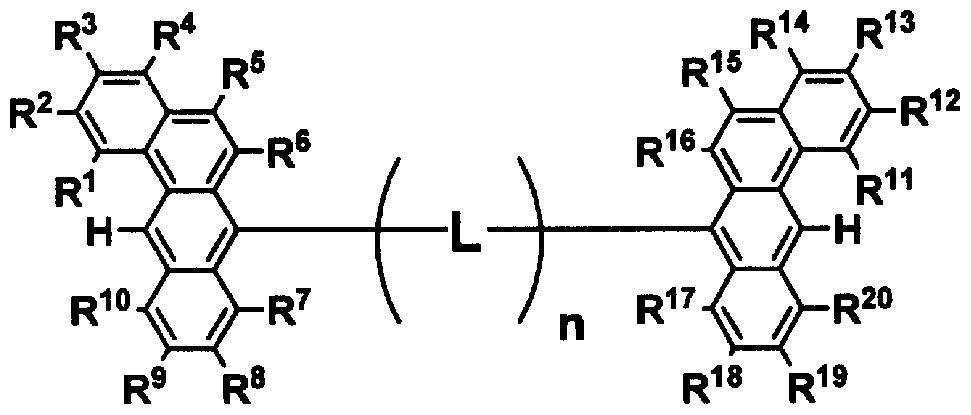
- the present invention provides a benzanthracene derivative having a hydrogen atom at the 12-position represented by the following general formula (1).
- R 1 -R 10 independently of each other, a hydrogen atom, a substituted or unsubstituted aromatic hydrocarbon ring group having 6 to 50 nuclear carbon atoms, a substituted or unsubstituted aromatic group having 5 to 50 nuclear atoms Heterocyclic group, substituted or unsubstituted alkyl group having 1 to 50 carbon atoms, substituted or unsubstituted nucleus cycloalkyl group having 3 to 50 carbon atoms, substituted or unsubstituted alkoxy group having 1 to 50 carbon atoms, substituted Or an unsubstituted aralkyl group having 6 to 50 nuclear carbon atoms, a substituted or unsubstituted aryloxy group having 5 to 50 nuclear carbon atoms, a substituted or unsubstituted aryloxy group having 5 to 50 nuclear carbon atoms, substituted or unsubstituted A substituted alkoxycarbonyl group having 1 to 50 carbon atom
- L is a linking group, a single bond, a substituted or unsubstituted divalent aromatic hydrocarbon ring group having 6 to 50 nuclear carbon atoms, a substituted or unsubstituted divalent aromatic group having 5 to 50 nuclear atoms.
- n is an integer of:! ⁇ 4.
- each L may be the same or different.
- Ar is a single bond, a hydrogen atom, a substituted or unsubstituted aromatic hydrocarbon ring group having 6 to 50 nuclear carbon atoms, a substituted or unsubstituted aromatic heterocyclic group having 5 to 50 nucleus atoms, a fluorenyl group, Or it is a carbazolyl group.
- n is an integer between :! When m is an integer of 2 or more, multiple 1 ⁇ to 1 ⁇ ° and L may be the same or different. ]
- the present invention also relates to an organic EL outer luminescence device in which an organic thin film layer composed of one or more layers including at least a light emitting layer is sandwiched between an anode and a cathode.
- the present invention provides an organic electoluminescence device containing a benzanthracene derivative having a hydrogen atom at the 12-position as a single component or a mixture component. The invention's effect
- the organic EL device containing a benzanthracene derivative having a hydrogen atom at the 12-position of the present invention can produce an organic EL device having high luminous efficiency, long life, and good chromaticity. Is possible.
- the benzanthracene derivative having a hydrogen atom at the 12-position of the present invention is represented by the following general formula (1).
- -° is independently a hydrogen atom, a substituted or unsubstituted aromatic hydrocarbon ring group having 6 to 50 nuclear carbon atoms, a substituted or unsubstituted nuclear atom number of 5 to 50.
- Aromatic heterocyclic group substituted or unsubstituted alkyl group having 1 to 50 carbon atoms, substituted or unsubstituted cycloalkyl group having 3 to 50 nuclear carbon atoms, substituted or unsubstituted carbon number 1 to 50 Alkoxy groups, substituted or unsubstituted aralkyl groups having 6 to 50 nuclear carbon atoms, substituted or unsubstituted aryloxy groups having 5 to 50 nuclear carbon atoms, substituted or unsubstituted aryloxy groups having 5 to 50 nuclear carbon atoms.
- silyl group, carboxyl group, halogen atom, cyano group, nitro group, or hydroxyl group is there.
- L is a linking group, a single bond, a substituted or unsubstituted divalent aromatic hydrocarbon ring group having 6 to 50 nuclear carbon atoms, a substituted or unsubstituted divalent aromatic group having 5 to 50 nuclear atoms.
- n is an integer of:! ⁇ 4.
- each L may be the same or different.
- Ar is a single bond, a hydrogen atom, a substituted or unsubstituted aromatic hydrocarbon ring group having 6 to 50 nuclear carbon atoms, a substituted or unsubstituted aromatic heterocyclic group having 5 to 50 nucleus atoms, a fluorenyl group, Or it is a carbazolyl group.
- n is an integer of :! to 4, preferably an integer of 1 to 3.
- m is an integer of 2 or more, a plurality of 1 ⁇ -1 ⁇ ° and L may be the same or different.
- the benzanthracene derivative having a hydrogen atom at the 12-position represented by the general formula (1) is preferably a compound represented by the following general formula (2).
- Ar represents a hydrogen atom, a substituted or unsubstituted aromatic hydrocarbon ring group having 6 to 50 nuclear carbon atoms, a substituted or unsubstituted aromatic heterocyclic group having 5 to 50 nucleus atoms, a fluorenyl group, or a carbazolyl group. It is.
- the benzanthracene derivative having a hydrogen atom at the 12-position represented by the general formula (1) is preferably a compound represented by the following general formula (3).
- ⁇ ° is independently the same as ⁇ ⁇ ⁇ ⁇ 1 ⁇ in general formula (1).
- L and ⁇ are independently the same as those in general formula (1).
- the benzanthracene derivative having a hydrogen atom at the 12-position represented by the general formula (1) is preferably a compound represented by the following general formula (4).
- R 1 to ° are independently the same as ⁇ to 1 ⁇ ° in general formula (1).
- L is the same as in general formula (1).
- q, r and s are each independently the same as n in the general formula (1).
- Ar is a substituted or unsubstituted aromatic hydrocarbon ring group having 6 to 50 nuclear carbon atoms, a substituted or unsubstituted aromatic heterocyclic group having 5 to 50 nuclear atoms, a fluorenyl group, or a carbazolyl group.
- Examples of the substituted or unsubstituted aromatic hydrocarbon ring group of 1 to! ⁇ include, for example, a vinylol group, 1_naphthyl group, 2_naphthyl group, 1_anthryl group, 2_anthryl group, 9_anthryl group, 1-phenanthryl group, 2-phenanthryl group, 3-phenanthryl group, 4-phenanthryl group, 9-phenanthryl group, 1_naphthacenyl group, 2_naphthacenyl group, 9_naphtha Cenyl group, 1-pyrenyl group, 2-pyrenyl group, 4-pyrenyl group, 2-biphenylyl group, 3-biphenylyl group, 4-biphenylyl group, p-terphenyl-2-yl group, p-telphenyl 2-lu 3-yl group, p-terphenyl 2-ru 2-myl group, m-terphenyl-2
- a phenyl group, 1_naphthyl group, 2_naphthyl group, 9_ (10-phenyl) anthryl group, 9_ (10_naphthyl_1-yl) anthryl group, 9_ (10-naphthyl group) are preferable.
- substituted or unsubstituted aromatic heterocyclic groups of R 1 -R ⁇ are 1-pyrrolyl group, 2 pyrrolyl group, 3 pyrrolyl group, pyradyl group, 2 pyridinyl group, 3 pyridinyl group, 4 —pyridinyl group, 1 Indolinol group, 2-Indolinole group, 3-Indolyl group, 4-Indolinole group, 5-Indolyl group, 6-Indolyl group, 7-Indolyl group, 1 Isoindolyl group, 2-Isoindolyl group, 3-Isoindolyl group, 4 Isoindolyl group, 5 —Isoindolyl group, 6—Isoindolyl group, 7—Isoindolyl group, 2 Furyl group, 3 Furyl group, 2 Benzofuranyl group, 3—Benzofuranyl group, 4—Benzofur
- substituted or unsubstituted alkyl groups for R 1 ! ⁇ include methyl, ethyl, propyl, isopropyl, n butyl, s butyl, isobutyl, t butyl, and n-pentyl.
- Examples of ⁇ ⁇ to ⁇ 3 ⁇ substituted or unsubstituted cycloalkyl groups include, for example, cyclopropinole group, cyclobutyl group, cyclopentyl group, cyclohexyl group, 4-methylcyclohexinole group, 1-adamantyl group Group, 2-adamantyl group, 1_norbornyl group, 2-nonolebornyl group and the like.
- the alkoxy group of ⁇ to ° is a group represented by — ⁇ , and examples of ⁇ include the same examples as the above alkyl group.
- ⁇ ⁇ 1 3 As examples of the substituted or unsubstituted Ararukiru groups °, benzyl group, 1 _ Hue Niruechiru group, 2-Fueniruechiru group, 1-phenylalanine isopropyl, 2-Fueniruiso propyl group, Hue 2-luo t-butyl group, ⁇ -naphthylmethyl group, 1 ⁇ naphthylethyl group, 2-a naphthylethyl group, 1 ⁇ naphthylisopropyl group, 2- ⁇ naphthylisopropyl group, ⁇ naphthylmethyl group, 1- ⁇ naphthylethyl group, 2 ⁇ -naphthylethyl group, 1- ⁇ -naphthylisopropyl group, 2- ⁇ -naphthylisopropyl group, 1-pyrrolinoremethinole group
- the substituted or unsubstituted aryloxy group of ⁇ ⁇ to ⁇ 3 ⁇ is represented by _ ⁇ ', and examples of Y' include the same as the aryl group and aromatic heterocyclic group.
- a substituted or unsubstituted alkoxycarbonyl group I ⁇ R 315 is - represented as COOZ, as T example, as the examples of the alkyl group.
- Examples of the substituted or unsubstituted silyl group include a trimethylsilyl group, a tritylsilyl group, a t-butyldimethylsilyl group, a butyldimethylsilyl group, a propyldimethylsilyl group, and a triphenylsilyl group. May be.
- halogen atom of ⁇ ⁇ to ⁇ 3 ⁇ examples include fluorine, chlorine, bromine, iodine and the like.
- L is a linking group, a single bond, a substituted or unsubstituted divalent aromatic hydrocarbon ring group having 6 to 50 carbon atoms, a substituted or unsubstituted group.
- An example of a divalent aromatic hydrocarbon ring group having 6 to 50 nuclear carbon atoms having a substituted or unsubstituted L is generated by removing one hydrogen atom from the ⁇ to ° aromatic hydrocarbon group 2
- a divalent group formed from benzene, naphthalene, anthracene, phenanthrene, naphthacene, thalylene, pyrene, etc. is preferable.
- divalent aromatic heterocyclic residue of a substituted or unsubstituted 5 to 50 ring atoms of L the! ⁇ ⁇ 1 3 aromatic heterocyclic group ° further removing one hydrogen atom
- the resulting divalent groups include pyrrole, pyridine, indole, isoindole, quinoline, carbazolone, phenanthorin, thiophene, furan, benzothiophene, benzofuran, benzoimidazole, dibenzothiophene, dibenzofuran, etc.
- a valent group is preferred.
- ⁇ is an integer between :!
- L may be the same or different.
- Ar is a single bond, a hydrogen atom, a substituted or unsubstituted aromatic hydrocarbon ring group, a substituted or unsubstituted aromatic heterocyclic group, a fluorenyl group, or a strong ruberazolyl. It is a group.
- Ar in the general formula (2) is a hydrogen atom, a substituted or unsubstituted aromatic hydrocarbon ring group, a substituted or unsubstituted aromatic heterocyclic group, a fluorenyl group, or a carbazolyl group.
- Ar in the general formula (4) is a substituted or unsubstituted aromatic hydrocarbon A cyclic group, a substituted or unsubstituted aromatic heterocyclic group, a fluorenyl group, or a carbazolyl group.
- a substituted or unsubstituted divalent aromatic hydrocarbon ring residue of Ar as in the case of L, it is generated by removing one hydrogen atom from the 1 ⁇ to ° aromatic hydrocarbon group.
- a divalent group is mentioned, and a preferable example is also the same.
- a substituted or unsubstituted divalent aromatic heterocyclic residue of Ar as in the case of L, it is formed by further removing one hydrogen atom from the 1 ⁇ -° aromatic heterocyclic group 2 A valent group, and preferred examples are also the same.
- n is an integer of :! to 4, preferably an integer of 1 to 3.
- m is an integer of 2 or more, a plurality of 1 ⁇ to ° and L may be the same or different.
- Examples of the substituent of 1 ⁇ to 1 ⁇ ° and Ar include an alkyl group (methyl group, ethyl group, propyl group, isopropyl group, n_butyl group, s_butyl group, isobutyl group, t_ Butyl group, n pentyl group, n hexyl group, n-heptyl group, n-octyl group, hydroxymethyl group, 1-hydroxyethyl group, 2-hydroxyethyl group, 2-hydroxyisobutynole group, 1 , 2 Dihydroxyethyl group, 1,3 dihydroxyisopropyl group, 2,3 dihydroxyt-butyl group, 1,2,3-trihydroxypropyl group, chloromethyl group, 1-chloroethyl group, 2-chloroethyl group , 2-chlorodiethyl isobutyl group, 1,2-dichlorodiethyl group, 1,3 dicyclodiethyl group,
- the benzanthracene derivative having a hydrogen atom at the 12-position of the present invention is preferably a light-emitting material for an organic EL device, and particularly preferably a host material for an organic EL device.
- the organic EL device of the present invention is an organic electoluminescence device in which an organic thin film layer composed of one or more layers including at least a light emitting layer is sandwiched between an anode and a cathode, wherein the organic thin film layer has the general formula (1) Containing at least one selected from benzanthracene derivatives having a hydrogen atom at the 12-position as described above alone or as a component of a mixture.
- the light emitting layer further comprises an arylamine compound and Z Or, preferably containing a styrylamine compound.
- Ar 3 is a group selected from a phenyl group, a biphenyl group, a terphenyl group, a stilbene group, and a distyryl aryl group
- Ar 4 and Ar 5 are each a hydrogen atom or an aromatic having a carbon number of 3 ⁇ 4 to 20 Ar 3 , Ar 4 and Ar 5 may be substituted
- p is an integer of 1 to 4. More preferably, at least one of Ar 4 or Ar 5 is substituted with a styryl group However, at least one of Ar 3 to Ar 5 contains a substituted or unsubstituted styryl group.
- examples of the aromatic hydrocarbon group having 6 to 20 carbon atoms include a phenyl group, a naphthyl group, an anthranyl group, a phenanthryl group, and a terphenyl group.
- arylamine compound those represented by the following general formula (B) are preferable.
- Ar 6 to Ar 8 are each a substituted or unsubstituted aryl group having 5 to 40 nuclear carbon atoms.
- Q is an integer of 1 to 4.
- the aryl group having 5 to 40 nuclear carbon atoms includes, for example, a phenyl group, a naphthyl group, an anthranyl group, a phenanthryl group, a pyrenyl group, a coronyl group, a biphenyl group, a terphee group.
- preferable substituents of the aryl group include alkyl groups having 1 to 6 carbon atoms (ethyl group, methylol group, isopropyl group, n_propyl group, s-butynole group, t_butyl group, Pentynole group, hexyl group, cyclopentyl group, cyclohexyl group, etc.), C1-C6 alkoxy group (ethoxy group, methoxy group, isopropoxy group, n-propoxy group, s-butoxy group, t- Butoxy group, pentoxy group, hexyloxy group, cyclopentoxy group, cyclohexyloxy group, etc.), aryl group having 5 to 40 nuclear carbon atoms, amino group substituted with aryl group having 5 to 40 nuclear carbon atoms, Examples thereof include an ester group having an aryl group having 5 to 40 nuclear carbon atoms, an ester group having an alky
- Anode / light emitting layer / electron injection layer / cathode (3) Anode / hole injection layer / light emitting layer / electron injection layer / cathode (4) Anode / hole injection layer / light emitting layer / electron injection layer / cathode
- the force S in which the configuration of (8) is preferably used is not limited thereto.
- the benzanthracene derivative having a hydrogen atom at the 12-position of the present invention may be used in any of the organic layers described above.
- the amount contained preferably in the transport zone is selected from 30 to: 100 mol% force.
- This organic EL element is usually produced on a translucent substrate.
- This translucent substrate is a substrate that supports the organic EL element.
- the transmissivity of light in the visible region of 400 to 700 nm is 50% or more, and a smoother substrate is desired. I prefer to use it.
- a translucent substrate for example, a glass plate, a synthetic resin plate, or the like is preferably used.
- the glass plate include a plate formed of soda-lime glass, norlium-strontium-containing glass, lead glass, aluminosilicate glass, borosilicate glass, barium borosilicate glass, quartz, and the like.
- the synthetic resin plate include polycarbonate resin, acrylic resin, polyethylene terephthalate resin, polyether sulfide resin, and polysulfone resin.
- the anode plays a role of injecting holes into the hole transport layer or the light emitting layer. It is effective to have a work function of 5 eV or more.
- Specific examples of the anode material used in the present invention include indium tin oxide alloy (ITO), tin oxide (NESA), gold, silver, platinum, and copper.
- the cathode is preferably made of a material having a small work function for the purpose of injecting electrons into the electron transport layer or the light emitting layer.
- the anode can be produced by forming a thin film of these electrode materials by a method such as vapor deposition or sputtering.
- the transmittance of the anode for light emission is greater than 10%.
- the sheet resistance of the anode is preferably several hundred ⁇ / mouth or less.
- the film thickness of the anode is a force that depends on the material.
- the light emitting layer is
- Injection function function that can inject holes from the anode or hole injection layer when an electric field is applied, and can inject electrons from the negative electrode or electron injection layer
- Transport function Function to move injected charges (electrons and holes) by the force of electric field
- Luminescent function provides a field for recombination of electrons and holes, and has a function to connect this to light emission.
- the light emitting layer is particularly preferably a molecular deposited film.
- the molecular deposited film is a thin film formed by deposition from a material compound in a gas phase state or a film formed by solidification from a material compound in a solution state or a liquid phase state.
- This molecular deposited film can be distinguished from a thin film (molecular accumulation film) formed by the LB method by the difference in aggregated structure and higher-order structure and the functional differences resulting from it.
- a binder such as a resin and a material compound are dissolved in a solvent to form a solution, which is then thin-filmed by a spin coating method or the like.
- the light emitting layer can also be formed by this.
- the light emitting layer may contain other known light emitting materials other than the light emitting material comprising a benzanthracene derivative having a hydrogen atom at the 12-position of the present invention.
- other known light emitting layers are added to the light emitting layer containing the light emitting material of the present invention. Laminate a light-emitting layer containing a light material.
- the hole injecting / transporting layer is a layer that helps injecting holes into the light emitting layer and transports them to the light emitting region, and has a high hole mobility and usually has an ion energy of 5.5 eV or less. And small.
- a material that transports holes to the light-emitting layer with a lower electric field strength is preferred.
- the mobility force of holes is, for example, 10 4 ⁇ : When an electric field of OV / cm is applied. , even without least a 10- 4 cm 2 ZV 'seconds is preferable.
- a material conventionally used as a hole charge transport material in a photoconductive material or a known medium strength arbitrary material used for a hole injection layer of an organic EL element is selected. Can be used.
- Porphyrin compounds (disclosed in JP-A-63-29556965), aromatic tertiary amine compounds and styrylamine compounds (US) Patent No. 4, 127, 412, JP-A 53-27033, 54-58445, 54-149634, 54-64299, 55-79450, 55-144250 gazette, 56-119132 gazette, 61-295 558 gazette, 61-98353 gazette, 63-295695 gazette, etc.), especially using aromatic tertiary amine compounds preferable.
- US Pat. No. 5,061,569 has two condensed aromatic rings in the molecule, for example, 4,4,1bis (N_ (1-naphthyl) 1N-phenylamino) biphenyl. (Hereinafter abbreviated as NPD), and four triamineramine units described in JP-A-4-308688 are connected in a starburst type 4, 4 ', 4 "-Tris (N- (3 —Methylphenyl) _N_phenylamino) triphenylamine (hereinafter abbreviated as MTDATA), and the like.
- NPD 1,4-naphthyl 1N-phenylamino
- MTDATA triphenylamine
- inorganic compounds such as p-type Si and p-type SiC are also used as the material for the hole injection layer. Can be used.
- the hole injection and transport layer can be formed by thin-filming the above-described compound by a known method such as a vacuum deposition method, a spin coating method, a casting method, or an LB method.
- the thickness of the hole injection or transport layer is not particularly limited, but is usually 5 nm to 5 zm.
- the organic semiconductor layer is a layer that assists hole injection or electron injection into the light-emitting layer, and preferably has a conductivity of 10-1 Q S / cm or more.
- Examples of materials for such an organic semiconductor layer include thiophene oligomers, conductive oligomers such as allylamin oligomers disclosed in JP-A-8-193191, and conductive materials such as allylamin dendrimers. Sex dendrimers and the like can be used.
- the electron injection layer 'transport layer is a layer that assists the injection of electrons into the light emitting layer and transports it to the light emitting region, and has a high electron mobility
- the adhesion improving layer is the electron injection layer.
- it is a layer made of a material that particularly adheres well to the cathode.
- the electron transport layer is appropriately selected with a film thickness of several nm to several ⁇ , but particularly when the film thickness is large, in order to avoid a voltage rise, 10 4 to 10 / ( : 111 electron mobility of at least 10 5 when an electric field is applied in (: 111 2 / ⁇ 3 is preferably the following.
- 8-hydroxyquinoline or a metal complex of its derivative, a oxadiazole derivative is preferable.
- Specific examples of the above-mentioned metal complexes of 8-hydroxyquinoline or its derivatives include metal chelate oxinoid compounds containing a chelate of oxine (generally 8-quinolinol or 8-hydroxyquinoline), such as tris (8-quinolinone).
- No) Aluminum can be used as an electron injection material.
- examples of the oxadiazole derivative include an electron transfer compound represented by the following general formula.
- Ar 1 , Ar 2 , Ar 3 , Ar 5 , Ar 6 , Ar 9 each represents a substituted or unsubstituted aryl group, which may be the same or different from each other.
- Ar 4 , Ar 7 , Ar 8 represent a substituted or unsubstituted arylene group, and may be the same or different.
- the aryl group is a phenyl group, a biphenyl group, an anthranyl group, a perylenyl group. Group, pyrenyl group.
- Examples of the arylene group include a phenylene group, a naphthylene group, a biphenylene group, an anthranylene group, a peryleneylene group, and a pyrenylene group.
- Examples of the substituent include an alkyl group having 1 to 10 carbon atoms, an alkoxy group having 1 to 10 carbon atoms, and a cyan group. This electron transfer compound is preferably a film-forming compound.
- electron transfer compound examples include the following.
- ⁇ ⁇ 3 each independently represents a nitrogen atom or a carbon atom.
- Ar 1 is a substituted or unsubstituted aryl group having 6 to 60 nuclear carbon atoms, or a substituted or unsubstituted heteroaryl group having 3 to 60 nuclear carbon atoms
- Ar 2 is a hydrogen atom, substituted or unsubstituted Aryl group having 6 to 60 nuclear carbon atoms, substituted or unsubstituted heteroaryl group having 3 to 60 nuclear carbon atoms, substituted or unsubstituted alkyl group having 1 to 20 carbon atoms, or substituted or unsubstituted carbon number 1 to 20 alkoxy groups, or these divalent groups.
- any one of Ar 1 and Ar 2 is a substituted or unsubstituted condensed ring group having 10 to 60 nuclear carbon atoms, or a substituted or unsubstituted monoheterocondensed ring group having 3 to 60 nuclear carbon atoms. .
- ⁇ L 2 and L are each independently a single bond, a substituted or unsubstituted arylene group having 6 to 60 nuclear carbon atoms, a substituted or unsubstituted heteroarylene group having 3 to 60 nuclear carbon atoms, or a substituted or unsubstituted group. It is a substituted fluorenylene group.
- R represents a hydrogen atom, a substituted or unsubstituted aryl group having 6 to 60 nuclear carbon atoms, a substituted or unsubstituted heteroaryl group having 3 to 60 nuclear carbon atoms, a substituted or unsubstituted alkyl group having! To 20 carbon atoms.
- a substituted or unsubstituted alkoxy group having 1 to 20 carbon atoms, ⁇ is an integer of 0 to 5 , and when ⁇ is 2 or more, a plurality of R may be the same or different.
- a plurality of adjacent R groups may be bonded together to form a carbocyclic aliphatic ring or carbocyclic aromatic ring. The nitrogen-containing heterocyclic derivative represented by this. [0045] HAr-L-Ar'-A
- HAr is a nitrogen-containing heterocycle having 3 to 40 carbon atoms which may have a substituent
- L is a single bond and having 6 to 60 carbon atoms which may have a substituent.
- Ariren group, Les substituted, also good Le, Re has a heteroarylene group or substituent to the 3 to 60 carbon atoms, it may also be a full Oreniren group
- Ar 1 is, A divalent aromatic hydrocarbon group having 6 to 60 carbon atoms which may have a substituent
- Ar 2 is an aryl group or substituted having 6 to 60 carbon atoms which may have a substituent.
- X and Y are each independently a saturated or unsaturated hydrocarbon group having from 6 to 6 carbon atoms: alkoxy group, alkenyloxy group, alkynyloxy group, hydroxy group, substituted or substituted Is a structure in which an unsubstituted aryl group, a substituted or unsubstituted heterocyclic ring, or X and Y are combined to form a saturated or unsaturated ring.
- R to R are independently hydrogen, halogen, or halogen.
- Atoms substituted or unsubstituted alkyl groups having 1 to 6 carbon atoms, alkoxy groups, aryloxy groups, perfluoroalkyl groups, perfluoroalkoxy groups, amino groups, alkylcarbonyl groups, aryls.
- R to R and Z are each independently a hydrogen atom, saturated or unsaturated carbonization
- a hydrogen group, an aromatic hydrocarbon group, a heterocyclic group, a substituted amino group, a substituted boryl group, an alkoxy group or an aryloxy group, and X, Y and Z are each independently saturated or unsaturated.
- a hydrocarbon group, an aromatic hydrocarbon group, a heterocyclic group, a substituted amino group, an alkoxy group, or an aryloxy group, and z and a substituent may be bonded to each other to form a condensed ring.
- N represents an integer from 1 to 3, and when n is 2 or more, Z may be different.
- n is 1, X, Y
- R is a methyl group
- R is a hydrogen atom or a substituted boryl group
- n is 3,
- Q 1 and Q 2 each independently represent a ligand represented by the following general formula (K), and L represents a halogen atom, a substituted or unsubstituted alkyl group, substituted or unsubstituted Substituted cycloalkyl group, substituted or unsubstituted aryl group, substituted or unsubstituted heterocyclic group, one OR 1 (R 1 is a hydrogen atom, substituted or unsubstituted alkyl group, substituted or unsubstituted cycloalkyl group , A substituted or unsubstituted aryl group, a substituted or unsubstituted heterocyclic group) or —0—0 & — ⁇ 3 3 ((3 4 ) (Q 3 and Q 4 are Q 1 and Q 2 and Represents the same ligand.] [0052] [Chemical 18]
- ring 1 and ring 2 are each a 6-membered aryl ring structure condensed with each other which may have a substituent. ]
- This metal complex is strong as an n-type semiconductor and has a high electron injection capability. Furthermore, since the generation energy at the time of complex formation is low, the bond between the metal and the ligand of the formed metal complex is strengthened, and the fluorescence quantum efficiency as a light emitting material is also increasing.
- substituents of the rings A 1 and A 2 that form the ligand of the general formula (K) include chlorine, bromine, iodine, a halogen atom of fluorine, a methylol group, an ethyl group, a propyl group, Butyl group, s-butynol group, t-butyl group, pentyl group, hexyl group, heptyl group, octyl group, stearyl group, trichloromethyl group, etc., substituted or unsubstituted alkyl group, fuel group, naphthyl group, 3 Substituted or unsubstituted aryl groups such as _methylphenyl group, 3-methoxyphenyl group, 3_fluorophenylene group, 3_trichloromethylphenyl group, 3_trifluoromethylphenyl group, 3_nitrophenyl group , Methoxy, n-butoxy
- arylothio group such as 3-trifluoromethylphenylthio group, cyano group, nitro group, amino group, methylamino group, jetylamino group, ethylamino group
- a preferred form of the organic EL device of the present invention is a device containing a reducing dopant in a region for transporting electrons or an interface region between the cathode and the organic layer.
- the reducing dopant is defined as a substance capable of reducing the electron transporting compound. Accordingly, various materials can be used as long as they have a certain reducibility, such as alkali metals, alkaline earth metals, rare earth metals, alkali metal oxides, alkali metal halides, alkaline earth metals.
- At least one substance can be preferably used.
- Na (work function: 2. 36 eV)
- K (work function: 2. 28 eV)
- Rb (work function: 2. 16 eV)
- Cs (work function: 1. 95 eV) force at least one alkali metal selected from the group consisting of Ca (work function: 2 9eV), Sr (work function: 2.0 to 2.5 eV), and Ba (work function: 2.52 eV) force.
- the work function includes at least one alkaline earth metal selected from the group of 2. Particularly preferred is 9 eV or less.
- a more preferred reducing dopant is at least one alkali metal selected from the group consisting of K, Rb and Cs, more preferably Rb or Cs, and most preferably Cs. It is.
- alkali metals can improve emission brightness and extend the life of organic EL devices by adding a relatively small amount to the electron injection region, which has a particularly high reducing ability.
- a reducing dopant having a work function of 2.9 eV or less a combination of these two or more alkali metals is also preferred.
- combinations containing Cs, such as Cs and Na, Cs and K, A combination of Cs and Rb or Cs, Na and ⁇ is preferred.
- an electron injection layer composed of an insulator or a semiconductor may be further provided between the cathode and the organic layer.
- an insulator it is preferable to use at least one metal compound selected from the group consisting of alkali metal chalcogenides, alkaline earth metal chalcogenides, alkali metal halides, and alkaline earth metal halides. If the electron injection layer is composed of these alkali metal chalcogenides or the like, it is preferable in that the electron injection property can be further improved.
- preferable alkali metal rucogenides include, for example, LiO, KO, Na S, Na Se and NaO
- preferable alkaline earth metal chalcogenides include, for example, CaO, BaO, SrO, BeO, BaS, and CaSe
- preferable alkali metal halides include, for example, LiF, NaF, KF, LiCl, KC1, and NaCl.
- examples of preferable alkaline earth metal halides include CaF, BaF, SrF, MgF and BeF, and fluorides, and halides other than fluorides.
- the semiconductors that make up the electron transport layer include Ba, Ca, Sr, Yb, Al, Ga, In, Li, One kind or a combination of two or more kinds of oxides, nitrides or oxynitrides containing at least one element of Na, Cd, Mg, Si, Ta, Sb and Zn may be mentioned.
- the inorganic compound constituting the electron transport layer is preferably a microcrystalline or amorphous insulating thin film. If the electron transport layer is composed of these insulating thin films, a more uniform thin film is formed, and pixel defects such as dark spots can be reduced. Examples of such inorganic compounds include the above-mentioned alkali metal chalcogenides, alkaline earth metal force rucogenides, alkali metal halides and alkaline earth metal halides.
- the cathode those having a low work function, (4 eV or less) metal, alloy, electrically conductive compound, and a mixture thereof as an electrode material are used.
- electrode materials include sodium, sodium-potassium alloy, magnesium, lithium, magnesium silver alloy, aluminum / aluminum oxide, AlZLiO, Al / LiO, Al / LiF, aluminum lithium alloy. , Indium, and rare earth metals.
- This cathode can be produced by forming a thin film of these electrode materials by a method such as vapor deposition or sputtering.
- the transmittance for the light emission of the cathode is preferably larger than 10%.
- the sheet resistance as a cathode is preferably several hundred ⁇ / b or less, and the film thickness is usually 10 nm to l / im, preferably 50 to 200 nm.
- an organic EL element applies an electric field to an ultra-thin film, pixel defects are likely to occur due to leakage or a short circuit.
- an insulating thin film layer may be inserted between the pair of electrodes.
- Examples of the material used for the insulating layer include aluminum oxide, lithium fluoride, lithium oxide, cesium fluoride, cesium oxide, magnesium oxide, magnesium fluoride, oxidizing power, subsequentlyium, calcium fluoride, aluminum nitride, titanium oxide, Examples thereof include silicon oxide, germanium oxide, silicon nitride, boron nitride, molybdenum oxide, ruthenium oxide, and vanadium oxide. A mixture or laminate of these may be used.
- the organic EL device of the present invention for example, an anode, a light emitting layer, a hole injection layer as necessary, and an electron injection layer as necessary by the materials and methods described above.
- the cathode may be formed last.
- the organic EL element can be fabricated in the reverse order from the cathode to the anode.
- a thin film made of an anode material is formed by vapor deposition or sputtering so as to have a film thickness of 1 zm or less, preferably in the range of 10 to 200 nm, and used as an anode.
- a hole injection layer is provided on the anode.
- the hole injection layer can be formed by a method such as a vacuum deposition method, a spin coating method, a casting method, or an LB method. A homogeneous film can be obtained immediately and pinholes are not easily generated. In view of the above, it is preferable to form the film by a vacuum evaporation method.
- the deposition conditions vary depending on the compound used (material of the hole injection layer), the crystal structure and recombination structure of the target hole injection layer, etc.
- deposition source temperature 50 to 450 ° C, vacuum degree of 10- 7 ⁇ : 10- 3 ⁇ :, deposition rate 0. 01 ⁇ 50nm / sec, a substrate temperature of 50 to 300 ° C, in the range of thickness of 5 nm to 5 mu m It is preferable to select appropriately.
- a light emitting layer is provided on the hole injection layer.
- the light emitting layer can also be formed by thinning the light emitting material by a method such as vacuum deposition, sputtering, spin coating, or casting using the light emitting material according to the present invention. It is preferable to form the film by a vacuum vapor deposition method from the viewpoint that it is obtained immediately and does not easily generate pinholes.
- the vapor deposition conditions vary depending on the compound used, but in general, the medium range of conditions similar to the formation of the hole injection layer can be selected.
- the film thickness is preferably in the range of 10 to 40 nm.
- an electron injection layer is provided on the light emitting layer. Also in this case, like the hole injection layer and the light emitting layer, it is preferable to form by a vacuum evaporation method because it is necessary to obtain a homogeneous film.
- the vapor deposition conditions can be selected from the same condition ranges as those for the hole injection layer and the light emitting layer.
- the cathode is made of metal, and vapor deposition or sputtering can be used. However, vacuum deposition is preferred to protect the underlying organic layer from damage during film formation.
- the above organic EL devices are manufactured from the anode to the cathode consistently with a single vacuum. It is preferable to manufacture.
- the method for forming each layer of the organic EL device of the present invention is not particularly limited. Conventionally known methods such as vacuum deposition and spin coating can be used.
- the organic thin film layer containing the compound represented by the general formula (1) used in the organic EL device of the present invention is prepared by a vacuum deposition method, a molecular beam deposition method (MBE method), or a solution dating method using a solvent. Further, it can be formed by a known method using a coating method such as a spin coating method, a casting method, a bar coating method, or a roll coating method.
- each organic layer of the organic EL device of the present invention is not particularly limited, but is usually in the range of several nm to 1 zm in order to improve defects such as pinholes and efficiency.
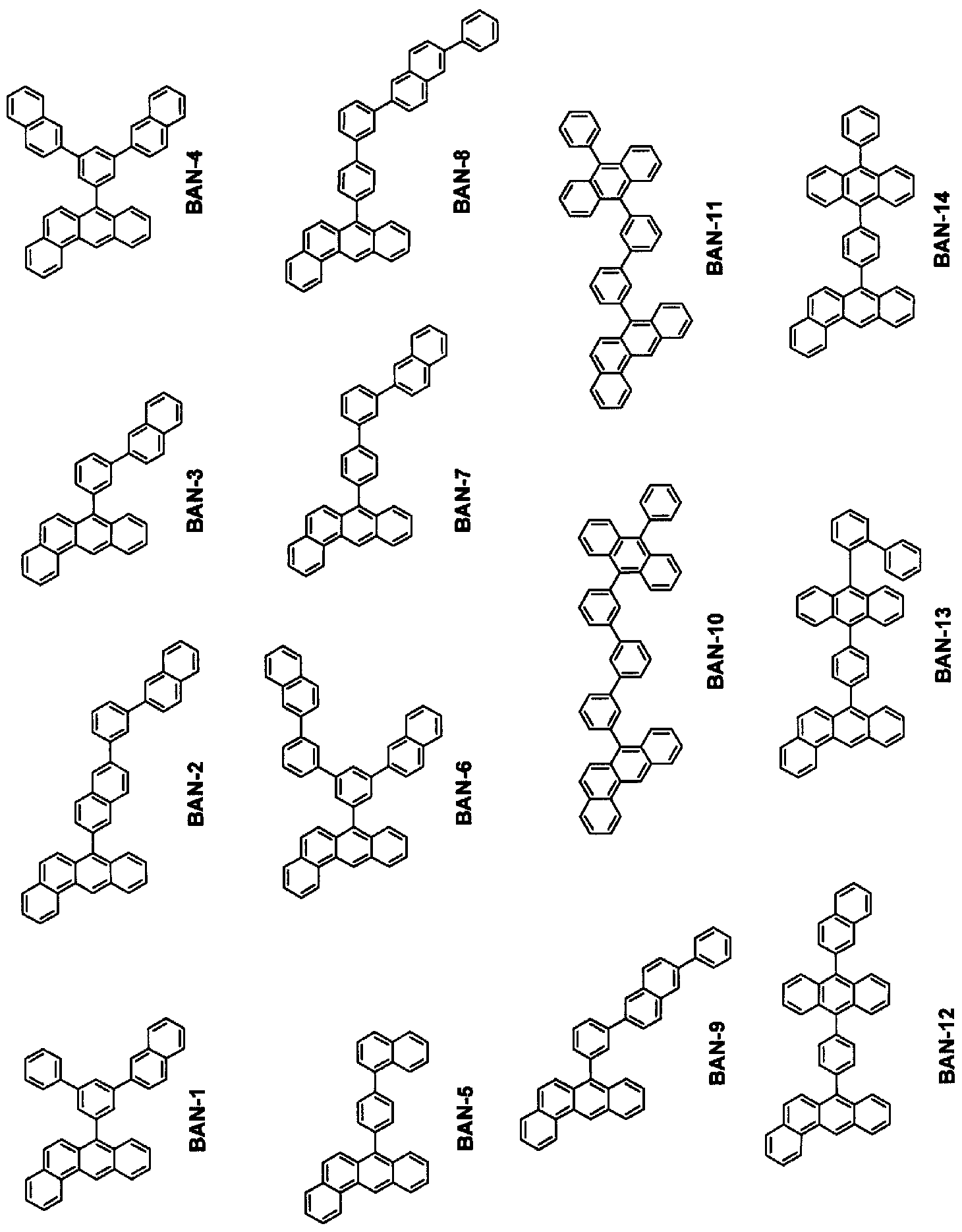
- This compound was identified as BAN-3.
- the compound was identified as BAN-22.
- Alq film with a thickness of 10 nm was formed on this film. This functions as an electron injection layer. Thereafter, Li (Li source: manufactured by SAES Getter Co., Ltd.), which is a reducing point, and Alq were subjected to binary evaporation to form an Alq: Li film (film thickness: 10 nm) as an electron injection layer (cathode).
- Li Li source: manufactured by SAES Getter Co., Ltd.
- Alq Li film (film thickness: 10 nm) as an electron injection layer (cathode).
- metal A1 was deposited to form a metal cathode, and an organic EL light emitting device was formed. This element was subjected to a current test. However, a blue light emission of 7680 (1/111 2 was obtained at a voltage of 6.9 V and a current density of 10111 8 / (: 111 2.
- the initial luminance was set to lOOOcd / m 2 to reduce the half-life of this organic EL device
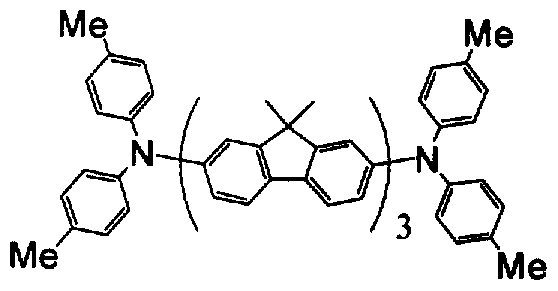
- An organic EL device was prepared in the same manner as in Example 1 except that the amine compound BD2 was used instead of the amine compound BD1 as the material of the light emitting layer, and the half-life was measured in the same manner as in Example 1. The results are shown in Table 1.
- An organic EL device was prepared in the same manner as in Example 1 except that the amine compound BD3 was used instead of the amine compound BD1 as the material of the light emitting layer, and the half-life was measured in the same manner as in Example 1. The results are shown in Table 1.
- An organic EL device was fabricated in exactly the same manner as in Example 1 except that ban_l was used instead of BAN-3.
- Table 1 shows the results of measuring the half-life of this organic EL device with an initial luminance of 1000 cd / m 2 .
- Table 1 shows the results of measuring the half-life of this organic EL device with an initial luminance of 1000 cd / m 2 .
- An organic EL device was fabricated in exactly the same manner as in Example 1 except that ban-3 was used instead of BAN_3.
- the benzanthracene derivative having a hydrogen atom at the 12-position of the present invention has better chromaticity and longer life than the prior art.
- the organic EL device containing a benzanthracene derivative having a hydrogen atom at the 12-position of the present invention has a long lifetime and good chromaticity.
Landscapes
- Chemical & Material Sciences (AREA)
- Organic Chemistry (AREA)
- Engineering & Computer Science (AREA)
- Materials Engineering (AREA)
- Physics & Mathematics (AREA)
- Spectroscopy & Molecular Physics (AREA)
- Optics & Photonics (AREA)
- Inorganic Chemistry (AREA)
- Electroluminescent Light Sources (AREA)
- Organic Low-Molecular-Weight Compounds And Preparation Thereof (AREA)
Abstract
Description






Claims



Priority Applications (1)
| Application Number | Priority Date | Filing Date | Title |
|---|---|---|---|
| EP07740607A EP2003108A4 (en) | 2006-04-03 | 2007-03-30 | BENZANTHRACEN DERIVATIVE AND ORGANIC ELECTROLUMINESCENSE DEVICE USING THIS DERIVATIVE |
Applications Claiming Priority (2)
| Application Number | Priority Date | Filing Date | Title |
|---|---|---|---|
| JP2006102339A JP4995475B2 (ja) | 2006-04-03 | 2006-04-03 | ベンズアントラセン誘導体、及びそれを用いた有機エレクトロルミネッセンス素子 |
| JP2006-102339 | 2006-04-03 |
Publications (1)
| Publication Number | Publication Date |
|---|---|
| WO2007114358A1 true WO2007114358A1 (ja) | 2007-10-11 |
Family
ID=38563626
Family Applications (1)
| Application Number | Title | Priority Date | Filing Date |
|---|---|---|---|
| PCT/JP2007/057171 Ceased WO2007114358A1 (ja) | 2006-04-03 | 2007-03-30 | ベンズアントラセン誘導体、及びそれを用いた有機エレクトロルミネッセンス素子 |
Country Status (7)
| Country | Link |
|---|---|
| US (1) | US7829206B2 (ja) |
| EP (1) | EP2003108A4 (ja) |
| JP (1) | JP4995475B2 (ja) |
| KR (1) | KR20080114785A (ja) |
| CN (1) | CN101415663A (ja) |
| TW (1) | TW200804232A (ja) |
| WO (1) | WO2007114358A1 (ja) |
Cited By (65)
| Publication number | Priority date | Publication date | Assignee | Title |
|---|---|---|---|---|
| WO2010074181A1 (ja) * | 2008-12-26 | 2010-07-01 | 出光興産株式会社 | 有機エレクトロルミネッセンス素子及び化合物 |
| WO2011012212A1 (de) | 2009-07-27 | 2011-02-03 | Merck Patent Gmbh | Neue materialien für organische elektrolumineszenzvorrichtungen |
| WO2011015265A2 (en) | 2009-08-04 | 2011-02-10 | Merck Patent Gmbh | Electronic devices comprising multi cyclic hydrocarbons |
| DE102009051172A1 (de) | 2009-10-29 | 2011-05-05 | Merck Patent Gmbh | Materialien für elektronische Vorrichtungen |
| WO2011054442A2 (de) | 2009-11-06 | 2011-05-12 | Merck Patent Gmbh | Materialien für elektronische vorrichtungen |
| WO2011076314A1 (en) | 2009-12-22 | 2011-06-30 | Merck Patent Gmbh | Electroluminescent formulations |
| WO2011076323A1 (en) | 2009-12-22 | 2011-06-30 | Merck Patent Gmbh | Formulations comprising phase-separated functional materials |
| WO2011076326A1 (en) | 2009-12-22 | 2011-06-30 | Merck Patent Gmbh | Electroluminescent functional surfactants |
| DE102010009193A1 (de) | 2010-02-24 | 2011-08-25 | Merck Patent GmbH, 64293 | Fluor-Fluor Assoziate |
| WO2011110277A1 (en) | 2010-03-11 | 2011-09-15 | Merck Patent Gmbh | Fibers in therapy and cosmetics |
| WO2011110275A2 (en) | 2010-03-11 | 2011-09-15 | Merck Patent Gmbh | Radiative fibers |
| WO2011147522A1 (en) | 2010-05-27 | 2011-12-01 | Merck Patent Gmbh | Compositions comprising quantum dots |
| WO2012013272A1 (en) | 2010-07-26 | 2012-02-02 | Merck Patent Gmbh | Quantum dots and hosts |
| WO2012013270A1 (en) | 2010-07-26 | 2012-02-02 | Merck Patent Gmbh | Nanocrystals in devices |
| WO2012110178A1 (en) | 2011-02-14 | 2012-08-23 | Merck Patent Gmbh | Device and method for treatment of cells and cell tissue |
| WO2012126566A1 (en) | 2011-03-24 | 2012-09-27 | Merck Patent Gmbh | Organic ionic functional materials |
| WO2012152366A1 (en) | 2011-05-12 | 2012-11-15 | Merck Patent Gmbh | Organic ionic compounds, compositions and electronic devices |
| WO2013113349A1 (en) | 2012-01-30 | 2013-08-08 | Merck Patent Gmbh | Nanocrystals on fibers |
| WO2016034262A1 (de) | 2014-09-05 | 2016-03-10 | Merck Patent Gmbh | Formulierungen und elektronische vorrichtungen |
| WO2016107663A1 (de) | 2014-12-30 | 2016-07-07 | Merck Patent Gmbh | Formulierungen und elektronische vorrichtungen |
| WO2016155866A1 (en) | 2015-03-30 | 2016-10-06 | Merck Patent Gmbh | Formulation of an organic functional material comprising a siloxane solvent |
| WO2016198141A1 (en) | 2015-06-12 | 2016-12-15 | Merck Patent Gmbh | Esters containing non-aromatic cycles as solvents for oled formulations |
| WO2017036572A1 (en) | 2015-08-28 | 2017-03-09 | Merck Patent Gmbh | Formulation of an organic functional material comprising an epoxy group containing solvent |
| WO2017097391A1 (en) | 2015-12-10 | 2017-06-15 | Merck Patent Gmbh | Formulations containing ketones comprising non-aromatic cycles |
| WO2017102049A1 (en) | 2015-12-16 | 2017-06-22 | Merck Patent Gmbh | Formulations containing a mixture of at least two different solvents |
| WO2017102048A1 (en) | 2015-12-15 | 2017-06-22 | Merck Patent Gmbh | Esters containing aromatic groups as solvents for organic electronic formulations |
| WO2017102052A1 (en) | 2015-12-16 | 2017-06-22 | Merck Patent Gmbh | Formulations containing a solid solvent |
| WO2017140404A1 (en) | 2016-02-17 | 2017-08-24 | Merck Patent Gmbh | Formulation of an organic functional material |
| WO2017157783A1 (de) | 2016-03-15 | 2017-09-21 | Merck Patent Gmbh | Behälter umfassend eine formulierung enthaltend mindestens einen organischen halbleiter |
| WO2017194435A1 (de) | 2016-05-11 | 2017-11-16 | Merck Patent Gmbh | Zusammensetzungen für elektrochemische zellen |
| WO2017216129A1 (en) | 2016-06-16 | 2017-12-21 | Merck Patent Gmbh | Formulation of an organic functional material |
| WO2017216128A1 (en) | 2016-06-17 | 2017-12-21 | Merck Patent Gmbh | Formulation of an organic functional material |
| WO2018001928A1 (en) | 2016-06-28 | 2018-01-04 | Merck Patent Gmbh | Formulation of an organic functional material |
| WO2018024719A1 (en) | 2016-08-04 | 2018-02-08 | Merck Patent Gmbh | Formulation of an organic functional material |
| WO2018077660A1 (en) | 2016-10-31 | 2018-05-03 | Merck Patent Gmbh | Formulation of an organic functional material |
| WO2018077662A1 (en) | 2016-10-31 | 2018-05-03 | Merck Patent Gmbh | Formulation of an organic functional material |
| WO2018087346A1 (de) | 2016-11-14 | 2018-05-17 | Merck Patent Gmbh | Verbindungen mit einer akzeptor- und einer donorgruppe |
| WO2018104202A1 (en) | 2016-12-06 | 2018-06-14 | Merck Patent Gmbh | Preparation process for an electronic device |
| WO2018108760A1 (en) | 2016-12-13 | 2018-06-21 | Merck Patent Gmbh | Formulation of an organic functional material |
| WO2018114883A1 (de) | 2016-12-22 | 2018-06-28 | Merck Patent Gmbh | Mischungen umfassend mindestens zwei organisch funktionelle verbindungen |
| WO2018138318A1 (en) | 2017-01-30 | 2018-08-02 | Merck Patent Gmbh | Method for forming an organic element of an electronic device |
| WO2018138319A1 (en) | 2017-01-30 | 2018-08-02 | Merck Patent Gmbh | Method for forming an organic electroluminescence (el) element |
| WO2018178136A1 (en) | 2017-03-31 | 2018-10-04 | Merck Patent Gmbh | Printing method for an organic light emitting diode (oled) |
| WO2018189050A1 (en) | 2017-04-10 | 2018-10-18 | Merck Patent Gmbh | Formulation of an organic functional material |
| WO2018202603A1 (en) | 2017-05-03 | 2018-11-08 | Merck Patent Gmbh | Formulation of an organic functional material |
| WO2019016184A1 (en) | 2017-07-18 | 2019-01-24 | Merck Patent Gmbh | FORMULATION OF AN ORGANIC FUNCTIONAL MATERIAL |
| WO2019115573A1 (en) | 2017-12-15 | 2019-06-20 | Merck Patent Gmbh | Formulation of an organic functional material |
| WO2019162483A1 (en) | 2018-02-26 | 2019-08-29 | Merck Patent Gmbh | Formulation of an organic functional material |
| WO2019238782A1 (en) | 2018-06-15 | 2019-12-19 | Merck Patent Gmbh | Formulation of an organic functional material |
| WO2020064582A1 (de) | 2018-09-24 | 2020-04-02 | Merck Patent Gmbh | Verfahren zur herstellung von granulat |
| WO2020094538A1 (en) | 2018-11-06 | 2020-05-14 | Merck Patent Gmbh | Method for forming an organic element of an electronic device |
| WO2021132535A1 (ja) * | 2019-12-27 | 2021-07-01 | 出光興産株式会社 | 有機エレクトロルミネッセンス素子及び電子機器 |
| WO2021213917A1 (en) | 2020-04-21 | 2021-10-28 | Merck Patent Gmbh | Emulsions comprising organic functional materials |
| WO2021213918A1 (en) | 2020-04-21 | 2021-10-28 | Merck Patent Gmbh | Formulation of an organic functional material |
| WO2021259824A1 (de) | 2020-06-23 | 2021-12-30 | Merck Patent Gmbh | Verfahren zur herstellung einer mischung |
| WO2022122607A1 (en) | 2020-12-08 | 2022-06-16 | Merck Patent Gmbh | An ink system and a method for inkjet printing |
| WO2022223675A1 (en) | 2021-04-23 | 2022-10-27 | Merck Patent Gmbh | Formulation of an organic functional material |
| WO2022243403A1 (de) | 2021-05-21 | 2022-11-24 | Merck Patent Gmbh | Verfahren zur kontinuierlichen aufreinigung von mindestens einem funktionalen material und vorrichtung zur kontinuierlichen aufreinigung von mindestens einem funktionalen material |
| WO2022264826A1 (ja) * | 2021-06-18 | 2022-12-22 | 出光興産株式会社 | 化合物、有機エレクトロルミネッセンス素子用材料、有機エレクトロルミネッセンス素子、及び電子機器 |
| WO2023057327A1 (en) | 2021-10-05 | 2023-04-13 | Merck Patent Gmbh | Method for forming an organic element of an electronic device |
| WO2024126635A1 (en) | 2022-12-16 | 2024-06-20 | Merck Patent Gmbh | Formulation of an organic functional material |
| WO2025032039A1 (en) | 2023-08-07 | 2025-02-13 | Merck Patent Gmbh | Process for the preparation of an electronic device |
| WO2026008710A1 (de) | 2024-07-05 | 2026-01-08 | Merck Patent Gmbh | Cyclische siliciumverbindungen für organische elektrolumineszenzvorrichtungen |
| WO2026041632A1 (de) | 2024-08-21 | 2026-02-26 | Merck Patent Gmbh | Heterocyclische materialien für organische lichtemittierende vorrichtungen |
| WO2026073855A1 (de) | 2024-10-01 | 2026-04-09 | Merck Patent Gmbh | Siliciumverbindungen für organische elektrolumineszenz-vorrichtungen |
Families Citing this family (23)
| Publication number | Priority date | Publication date | Assignee | Title |
|---|---|---|---|---|
| JP5159164B2 (ja) * | 2007-05-14 | 2013-03-06 | キヤノン株式会社 | ベンゾ[ghi]フルオランテン誘導体及びこれを用いた有機発光素子 |
| DE102007024850A1 (de) * | 2007-05-29 | 2008-12-04 | Merck Patent Gmbh | Neue Materialien für organische Elektrolumineszenzvorrichtungen |
| JPWO2009069602A1 (ja) | 2007-11-29 | 2011-04-14 | 出光興産株式会社 | ベンズアントラセン化合物及びそれを用いた有機エレクトロルミネッセンス素子 |
| US8563969B2 (en) | 2007-12-20 | 2013-10-22 | Idemitsu Kosan Co., Ltd. | Benzanthracene compound and organic electroluminescence device using the same |
| WO2009081774A1 (ja) * | 2007-12-20 | 2009-07-02 | Idemitsu Kosan Co., Ltd. | ベンズアントラセン化合物及びそれを用いた有機エレクトロルミネッセンス素子 |
| KR100984341B1 (ko) * | 2008-05-09 | 2010-09-30 | (주)씨에스엘쏠라 | 유기 발광 소자 및 이에 사용되는 유기 발광 화합물 |
| KR101097312B1 (ko) | 2009-08-10 | 2011-12-23 | 삼성모바일디스플레이주식회사 | 유기 발광 소자 |
| CN106058048B (zh) | 2009-09-16 | 2018-11-30 | 默克专利有限公司 | 用于制造电子器件的化合物和电子器件及其制造方法 |
| KR101778825B1 (ko) | 2010-05-03 | 2017-09-14 | 메르크 파텐트 게엠베하 | 제형물 및 전자 소자 |
| DE102010055901A1 (de) | 2010-12-23 | 2012-06-28 | Merck Patent Gmbh | Organische Elektrolumineszenzvorrichtung |
| KR20140036279A (ko) | 2011-06-01 | 2014-03-25 | 메르크 파텐트 게엠베하 | 하이브리드 양극성 tft들 |
| JP6174024B2 (ja) | 2011-07-25 | 2017-08-02 | メルク パテント ゲーエムベーハー | 機能性側鎖を有するコポリマー |
| KR101937257B1 (ko) | 2011-08-22 | 2019-01-11 | 삼성디스플레이 주식회사 | 신규한 헤테로고리 화합물 및 이를 포함한 유기발광 소자 |
| DE102011117422A1 (de) | 2011-10-28 | 2013-05-02 | Merck Patent Gmbh | Hyperverzweigte Polymere, Verfahren zu deren Herstellung sowie deren Verwendung in elektronischen Vorrichtungen |
| CN103805168B (zh) * | 2012-11-14 | 2015-08-26 | 吉林奥来德光电材料股份有限公司 | 苯并蒽类有机电致发光材料及其制备方法和应用 |
| CN105409021B (zh) | 2013-07-29 | 2018-07-13 | 默克专利有限公司 | 电致发光器件 |
| CN105409022B (zh) | 2013-07-29 | 2018-06-19 | 默克专利有限公司 | 电光器件及其用途 |
| KR102375992B1 (ko) * | 2014-04-16 | 2022-03-17 | 메르크 파텐트 게엠베하 | 전자 소자용 물질 |
| WO2019229591A1 (ja) | 2018-05-31 | 2019-12-05 | 株式会社半導体エネルギー研究所 | 有機化合物、発光素子、発光装置、電子機器、および照明装置 |
| JP7325731B2 (ja) | 2018-08-23 | 2023-08-15 | 国立大学法人九州大学 | 有機エレクトロルミネッセンス素子 |
| CN112838168A (zh) | 2019-11-22 | 2021-05-25 | 学校法人关西学院 | 有机电场发光元件、显示装置、照明装置及苯并蒽化合物 |
| JP2024528219A (ja) | 2021-08-02 | 2024-07-26 | メルク パテント ゲーエムベーハー | インクを組み合わせることによる印刷方法 |
| TW202411366A (zh) | 2022-06-07 | 2024-03-16 | 德商麥克專利有限公司 | 藉由組合油墨來印刷電子裝置功能層之方法 |
Citations (25)
| Publication number | Priority date | Publication date | Assignee | Title |
|---|---|---|---|---|
| DE1110518B (de) | 1959-04-09 | 1961-07-06 | Kalle Ag | Material fuer die elektrophotographische Bilderzeugung |
| US3112197A (en) | 1956-06-27 | 1963-11-26 | Azoplate Corp | Electrophotographic member |
| US3180729A (en) | 1956-12-22 | 1965-04-27 | Azoplate Corp | Material for electrophotographic reproduction |
| US3180703A (en) | 1963-01-15 | 1965-04-27 | Kerr Mc Gee Oil Ind Inc | Recovery process |
| US3189447A (en) | 1956-06-04 | 1965-06-15 | Azoplate Corp | Electrophotographic material and method |
| US3240597A (en) | 1961-08-21 | 1966-03-15 | Eastman Kodak Co | Photoconducting polymers for preparing electrophotographic materials |
| US3257203A (en) | 1958-08-20 | 1966-06-21 | Azoplate Corp | Electrophotographic reproduction material |
| US3526501A (en) | 1967-02-03 | 1970-09-01 | Eastman Kodak Co | 4-diarylamino-substituted chalcone containing photoconductive compositions for use in electrophotography |
| US3542544A (en) | 1967-04-03 | 1970-11-24 | Eastman Kodak Co | Photoconductive elements containing organic photoconductors of the triarylalkane and tetraarylmethane types |
| US3567450A (en) | 1968-02-20 | 1971-03-02 | Eastman Kodak Co | Photoconductive elements containing substituted triarylamine photoconductors |
| US3615402A (en) | 1969-10-01 | 1971-10-26 | Eastman Kodak Co | Tetra-substituted methanes as organic photoconductors |
| US3615404A (en) | 1968-04-25 | 1971-10-26 | Scott Paper Co | 1 3-phenylenediamine containing photoconductive materials |
| US3658520A (en) | 1968-02-20 | 1972-04-25 | Eastman Kodak Co | Photoconductive elements containing as photoconductors triarylamines substituted by active hydrogen-containing groups |
| US3717462A (en) | 1969-07-28 | 1973-02-20 | Canon Kk | Heat treatment of an electrophotographic photosensitive member |
| US3820989A (en) | 1969-09-30 | 1974-06-28 | Eastman Kodak Co | Tri-substituted methanes as organic photoconductors |
| US4012376A (en) | 1975-12-29 | 1977-03-15 | Eastman Kodak Company | Photosensitive colorant materials |
| US4127412A (en) | 1975-12-09 | 1978-11-28 | Eastman Kodak Company | Photoconductive compositions and elements |
| US4175961A (en) | 1976-12-22 | 1979-11-27 | Eastman Kodak Company | Multi-active photoconductive elements |
| US4232103A (en) | 1979-08-27 | 1980-11-04 | Xerox Corporation | Phenyl benzotriazole stabilized photosensitive device |
| US4278746A (en) | 1978-06-21 | 1981-07-14 | Konishiroku Photo Industry Co., Ltd. | Photosensitive elements for electrophotography |
| JPS6144975A (ja) * | 1984-08-09 | 1986-03-04 | Canon Inc | El素子 |
| US4950950A (en) | 1989-05-18 | 1990-08-21 | Eastman Kodak Company | Electroluminescent device with silazane-containing luminescent zone |
| US5061569A (en) | 1990-07-26 | 1991-10-29 | Eastman Kodak Company | Electroluminescent device with organic electroluminescent medium |
| JP2000178548A (ja) | 1998-12-16 | 2000-06-27 | Toppan Printing Co Ltd | 発光材料 |
| WO2005090365A1 (ja) * | 2004-03-18 | 2005-09-29 | Sharp Kabushiki Kaisha | 有機シラン化合物、その製造方法及びその用途 |
Family Cites Families (9)
| Publication number | Priority date | Publication date | Assignee | Title |
|---|---|---|---|---|
| JP2897138B2 (ja) | 1989-06-30 | 1999-05-31 | 株式会社リコー | 電界発光素子 |
| JP3200889B2 (ja) | 1991-10-23 | 2001-08-20 | ソニー株式会社 | 画像の振動補正装置 |
| JPH07138561A (ja) | 1993-11-17 | 1995-05-30 | Idemitsu Kosan Co Ltd | 有機エレクトロルミネッセンス素子 |
| JP3724833B2 (ja) | 1995-03-06 | 2005-12-07 | 出光興産株式会社 | 有機エレクトロルミネッセンス素子 |
| JP4067259B2 (ja) * | 2000-01-12 | 2008-03-26 | 富士フイルム株式会社 | 縮環多環式炭化水素化合物、発光素子材料およびそれを使用した発光素子 |
| JP4125076B2 (ja) * | 2002-08-30 | 2008-07-23 | キヤノン株式会社 | モノアミノフルオレン化合物およびそれを使用した有機発光素子 |
| TWI224473B (en) * | 2003-06-03 | 2004-11-21 | Chin-Hsin Chen | Doped co-host emitter system in organic electroluminescent devices |
| JP2005263721A (ja) | 2004-03-19 | 2005-09-29 | Sharp Corp | 多環式縮合芳香族炭化水素骨格含有有機シラン化合物及びその製造方法 |
| US20060040131A1 (en) * | 2004-08-19 | 2006-02-23 | Eastman Kodak Company | OLEDs with improved operational lifetime |
-
2006
- 2006-04-03 JP JP2006102339A patent/JP4995475B2/ja not_active Expired - Lifetime
-
2007
- 2007-03-30 EP EP07740607A patent/EP2003108A4/en not_active Withdrawn
- 2007-03-30 CN CNA2007800121150A patent/CN101415663A/zh active Pending
- 2007-03-30 KR KR1020087024178A patent/KR20080114785A/ko not_active Withdrawn
- 2007-03-30 WO PCT/JP2007/057171 patent/WO2007114358A1/ja not_active Ceased
- 2007-04-02 US US11/695,219 patent/US7829206B2/en active Active
- 2007-04-03 TW TW096111905A patent/TW200804232A/zh unknown
Patent Citations (25)
| Publication number | Priority date | Publication date | Assignee | Title |
|---|---|---|---|---|
| US3189447A (en) | 1956-06-04 | 1965-06-15 | Azoplate Corp | Electrophotographic material and method |
| US3112197A (en) | 1956-06-27 | 1963-11-26 | Azoplate Corp | Electrophotographic member |
| US3180729A (en) | 1956-12-22 | 1965-04-27 | Azoplate Corp | Material for electrophotographic reproduction |
| US3257203A (en) | 1958-08-20 | 1966-06-21 | Azoplate Corp | Electrophotographic reproduction material |
| DE1110518B (de) | 1959-04-09 | 1961-07-06 | Kalle Ag | Material fuer die elektrophotographische Bilderzeugung |
| US3240597A (en) | 1961-08-21 | 1966-03-15 | Eastman Kodak Co | Photoconducting polymers for preparing electrophotographic materials |
| US3180703A (en) | 1963-01-15 | 1965-04-27 | Kerr Mc Gee Oil Ind Inc | Recovery process |
| US3526501A (en) | 1967-02-03 | 1970-09-01 | Eastman Kodak Co | 4-diarylamino-substituted chalcone containing photoconductive compositions for use in electrophotography |
| US3542544A (en) | 1967-04-03 | 1970-11-24 | Eastman Kodak Co | Photoconductive elements containing organic photoconductors of the triarylalkane and tetraarylmethane types |
| US3658520A (en) | 1968-02-20 | 1972-04-25 | Eastman Kodak Co | Photoconductive elements containing as photoconductors triarylamines substituted by active hydrogen-containing groups |
| US3567450A (en) | 1968-02-20 | 1971-03-02 | Eastman Kodak Co | Photoconductive elements containing substituted triarylamine photoconductors |
| US3615404A (en) | 1968-04-25 | 1971-10-26 | Scott Paper Co | 1 3-phenylenediamine containing photoconductive materials |
| US3717462A (en) | 1969-07-28 | 1973-02-20 | Canon Kk | Heat treatment of an electrophotographic photosensitive member |
| US3820989A (en) | 1969-09-30 | 1974-06-28 | Eastman Kodak Co | Tri-substituted methanes as organic photoconductors |
| US3615402A (en) | 1969-10-01 | 1971-10-26 | Eastman Kodak Co | Tetra-substituted methanes as organic photoconductors |
| US4127412A (en) | 1975-12-09 | 1978-11-28 | Eastman Kodak Company | Photoconductive compositions and elements |
| US4012376A (en) | 1975-12-29 | 1977-03-15 | Eastman Kodak Company | Photosensitive colorant materials |
| US4175961A (en) | 1976-12-22 | 1979-11-27 | Eastman Kodak Company | Multi-active photoconductive elements |
| US4278746A (en) | 1978-06-21 | 1981-07-14 | Konishiroku Photo Industry Co., Ltd. | Photosensitive elements for electrophotography |
| US4232103A (en) | 1979-08-27 | 1980-11-04 | Xerox Corporation | Phenyl benzotriazole stabilized photosensitive device |
| JPS6144975A (ja) * | 1984-08-09 | 1986-03-04 | Canon Inc | El素子 |
| US4950950A (en) | 1989-05-18 | 1990-08-21 | Eastman Kodak Company | Electroluminescent device with silazane-containing luminescent zone |
| US5061569A (en) | 1990-07-26 | 1991-10-29 | Eastman Kodak Company | Electroluminescent device with organic electroluminescent medium |
| JP2000178548A (ja) | 1998-12-16 | 2000-06-27 | Toppan Printing Co Ltd | 発光材料 |
| WO2005090365A1 (ja) * | 2004-03-18 | 2005-09-29 | Sharp Kabushiki Kaisha | 有機シラン化合物、その製造方法及びその用途 |
Non-Patent Citations (4)
| Title |
|---|
| C. W. TANG; S. A. VANSLYKE, APPLIED PHYSICS LETTERS, vol. 51, 1987, pages 913 |
| SARAF S.D. ET AL.: "The Use of mixed Grignard reagents in the double Bradsher reaction", SYNTHESIS, no. 12, 1970, pages 655, XP003018344 * |
| See also references of EP2003108A4 |
| VINGIELLO F.A. ET AL.: "An unusual Elbs-type reaction observed during a study of the cyclization of ketones", JOURNAL OF THE AMERICAN CHEMICAL SOCIETY, vol. 80, 1958, pages 1714 - 1716, XP003018345 * |
Cited By (76)
| Publication number | Priority date | Publication date | Assignee | Title |
|---|---|---|---|---|
| WO2010074181A1 (ja) * | 2008-12-26 | 2010-07-01 | 出光興産株式会社 | 有機エレクトロルミネッセンス素子及び化合物 |
| JPWO2010074181A1 (ja) * | 2008-12-26 | 2012-06-21 | 出光興産株式会社 | 有機エレクトロルミネッセンス素子及び化合物 |
| WO2011012212A1 (de) | 2009-07-27 | 2011-02-03 | Merck Patent Gmbh | Neue materialien für organische elektrolumineszenzvorrichtungen |
| DE102009034625A1 (de) | 2009-07-27 | 2011-02-03 | Merck Patent Gmbh | Neue Materialien für organische Elektrolumineszenzvorrichtungen |
| CN102471191A (zh) * | 2009-07-27 | 2012-05-23 | 默克专利有限公司 | 用于有机电致发光器件的新颖的材料 |
| WO2011015265A2 (en) | 2009-08-04 | 2011-02-10 | Merck Patent Gmbh | Electronic devices comprising multi cyclic hydrocarbons |
| DE102009051172A1 (de) | 2009-10-29 | 2011-05-05 | Merck Patent Gmbh | Materialien für elektronische Vorrichtungen |
| WO2011050888A1 (de) | 2009-10-29 | 2011-05-05 | Merck Patent Gmbh | Materialien für elektronische vorrichtungen |
| WO2011054442A2 (de) | 2009-11-06 | 2011-05-12 | Merck Patent Gmbh | Materialien für elektronische vorrichtungen |
| DE102009053191A1 (de) | 2009-11-06 | 2011-05-12 | Merck Patent Gmbh | Materialien für elektronische Vorrichtungen |
| WO2011076326A1 (en) | 2009-12-22 | 2011-06-30 | Merck Patent Gmbh | Electroluminescent functional surfactants |
| WO2011076323A1 (en) | 2009-12-22 | 2011-06-30 | Merck Patent Gmbh | Formulations comprising phase-separated functional materials |
| WO2011076314A1 (en) | 2009-12-22 | 2011-06-30 | Merck Patent Gmbh | Electroluminescent formulations |
| DE102010009193A1 (de) | 2010-02-24 | 2011-08-25 | Merck Patent GmbH, 64293 | Fluor-Fluor Assoziate |
| WO2011103953A1 (de) | 2010-02-24 | 2011-09-01 | Merck Patent Gmbh | Fluor-fluor assoziate |
| DE102010009193B4 (de) | 2010-02-24 | 2022-05-19 | MERCK Patent Gesellschaft mit beschränkter Haftung | Zusammensetzung enthaltend Fluor-Fluor Assoziate, Verfahren zu deren Herstellung, deren Verwendung sowie organische elektronische Vorrichtung diese enthaltend |
| WO2011110277A1 (en) | 2010-03-11 | 2011-09-15 | Merck Patent Gmbh | Fibers in therapy and cosmetics |
| WO2011110275A2 (en) | 2010-03-11 | 2011-09-15 | Merck Patent Gmbh | Radiative fibers |
| WO2011147522A1 (en) | 2010-05-27 | 2011-12-01 | Merck Patent Gmbh | Compositions comprising quantum dots |
| EP3309236A1 (en) | 2010-05-27 | 2018-04-18 | Merck Patent GmbH | Compositions comprising quantum dots |
| WO2012013272A1 (en) | 2010-07-26 | 2012-02-02 | Merck Patent Gmbh | Quantum dots and hosts |
| WO2012013270A1 (en) | 2010-07-26 | 2012-02-02 | Merck Patent Gmbh | Nanocrystals in devices |
| WO2012110178A1 (en) | 2011-02-14 | 2012-08-23 | Merck Patent Gmbh | Device and method for treatment of cells and cell tissue |
| WO2012126566A1 (en) | 2011-03-24 | 2012-09-27 | Merck Patent Gmbh | Organic ionic functional materials |
| WO2012152366A1 (en) | 2011-05-12 | 2012-11-15 | Merck Patent Gmbh | Organic ionic compounds, compositions and electronic devices |
| WO2013113349A1 (en) | 2012-01-30 | 2013-08-08 | Merck Patent Gmbh | Nanocrystals on fibers |
| WO2016034262A1 (de) | 2014-09-05 | 2016-03-10 | Merck Patent Gmbh | Formulierungen und elektronische vorrichtungen |
| WO2016107663A1 (de) | 2014-12-30 | 2016-07-07 | Merck Patent Gmbh | Formulierungen und elektronische vorrichtungen |
| WO2016155866A1 (en) | 2015-03-30 | 2016-10-06 | Merck Patent Gmbh | Formulation of an organic functional material comprising a siloxane solvent |
| WO2016198141A1 (en) | 2015-06-12 | 2016-12-15 | Merck Patent Gmbh | Esters containing non-aromatic cycles as solvents for oled formulations |
| EP3581633A1 (en) | 2015-06-12 | 2019-12-18 | Merck Patent GmbH | Esters containing non-aromatic cycles as solvents for oled formulations |
| WO2017036572A1 (en) | 2015-08-28 | 2017-03-09 | Merck Patent Gmbh | Formulation of an organic functional material comprising an epoxy group containing solvent |
| WO2017097391A1 (en) | 2015-12-10 | 2017-06-15 | Merck Patent Gmbh | Formulations containing ketones comprising non-aromatic cycles |
| WO2017102048A1 (en) | 2015-12-15 | 2017-06-22 | Merck Patent Gmbh | Esters containing aromatic groups as solvents for organic electronic formulations |
| EP4084109A1 (en) | 2015-12-15 | 2022-11-02 | Merck Patent GmbH | Esters containing aromatic groups as solvents for organic electronic formulations |
| WO2017102052A1 (en) | 2015-12-16 | 2017-06-22 | Merck Patent Gmbh | Formulations containing a solid solvent |
| WO2017102049A1 (en) | 2015-12-16 | 2017-06-22 | Merck Patent Gmbh | Formulations containing a mixture of at least two different solvents |
| WO2017140404A1 (en) | 2016-02-17 | 2017-08-24 | Merck Patent Gmbh | Formulation of an organic functional material |
| WO2017157783A1 (de) | 2016-03-15 | 2017-09-21 | Merck Patent Gmbh | Behälter umfassend eine formulierung enthaltend mindestens einen organischen halbleiter |
| DE102016003104A1 (de) | 2016-03-15 | 2017-09-21 | Merck Patent Gmbh | Behälter umfassend eine Formulierung enthaltend mindestens einen organischen Halbleiter |
| WO2017194435A1 (de) | 2016-05-11 | 2017-11-16 | Merck Patent Gmbh | Zusammensetzungen für elektrochemische zellen |
| WO2017216129A1 (en) | 2016-06-16 | 2017-12-21 | Merck Patent Gmbh | Formulation of an organic functional material |
| WO2017216128A1 (en) | 2016-06-17 | 2017-12-21 | Merck Patent Gmbh | Formulation of an organic functional material |
| WO2018001928A1 (en) | 2016-06-28 | 2018-01-04 | Merck Patent Gmbh | Formulation of an organic functional material |
| WO2018024719A1 (en) | 2016-08-04 | 2018-02-08 | Merck Patent Gmbh | Formulation of an organic functional material |
| WO2018077660A1 (en) | 2016-10-31 | 2018-05-03 | Merck Patent Gmbh | Formulation of an organic functional material |
| WO2018077662A1 (en) | 2016-10-31 | 2018-05-03 | Merck Patent Gmbh | Formulation of an organic functional material |
| WO2018087346A1 (de) | 2016-11-14 | 2018-05-17 | Merck Patent Gmbh | Verbindungen mit einer akzeptor- und einer donorgruppe |
| WO2018104202A1 (en) | 2016-12-06 | 2018-06-14 | Merck Patent Gmbh | Preparation process for an electronic device |
| WO2018108760A1 (en) | 2016-12-13 | 2018-06-21 | Merck Patent Gmbh | Formulation of an organic functional material |
| WO2018114883A1 (de) | 2016-12-22 | 2018-06-28 | Merck Patent Gmbh | Mischungen umfassend mindestens zwei organisch funktionelle verbindungen |
| WO2018138318A1 (en) | 2017-01-30 | 2018-08-02 | Merck Patent Gmbh | Method for forming an organic element of an electronic device |
| WO2018138319A1 (en) | 2017-01-30 | 2018-08-02 | Merck Patent Gmbh | Method for forming an organic electroluminescence (el) element |
| WO2018178136A1 (en) | 2017-03-31 | 2018-10-04 | Merck Patent Gmbh | Printing method for an organic light emitting diode (oled) |
| WO2018189050A1 (en) | 2017-04-10 | 2018-10-18 | Merck Patent Gmbh | Formulation of an organic functional material |
| WO2018202603A1 (en) | 2017-05-03 | 2018-11-08 | Merck Patent Gmbh | Formulation of an organic functional material |
| WO2019016184A1 (en) | 2017-07-18 | 2019-01-24 | Merck Patent Gmbh | FORMULATION OF AN ORGANIC FUNCTIONAL MATERIAL |
| WO2019115573A1 (en) | 2017-12-15 | 2019-06-20 | Merck Patent Gmbh | Formulation of an organic functional material |
| WO2019162483A1 (en) | 2018-02-26 | 2019-08-29 | Merck Patent Gmbh | Formulation of an organic functional material |
| WO2019238782A1 (en) | 2018-06-15 | 2019-12-19 | Merck Patent Gmbh | Formulation of an organic functional material |
| WO2020064582A1 (de) | 2018-09-24 | 2020-04-02 | Merck Patent Gmbh | Verfahren zur herstellung von granulat |
| WO2020094538A1 (en) | 2018-11-06 | 2020-05-14 | Merck Patent Gmbh | Method for forming an organic element of an electronic device |
| WO2021132535A1 (ja) * | 2019-12-27 | 2021-07-01 | 出光興産株式会社 | 有機エレクトロルミネッセンス素子及び電子機器 |
| WO2021213917A1 (en) | 2020-04-21 | 2021-10-28 | Merck Patent Gmbh | Emulsions comprising organic functional materials |
| WO2021213918A1 (en) | 2020-04-21 | 2021-10-28 | Merck Patent Gmbh | Formulation of an organic functional material |
| WO2021259824A1 (de) | 2020-06-23 | 2021-12-30 | Merck Patent Gmbh | Verfahren zur herstellung einer mischung |
| WO2022122607A1 (en) | 2020-12-08 | 2022-06-16 | Merck Patent Gmbh | An ink system and a method for inkjet printing |
| WO2022223675A1 (en) | 2021-04-23 | 2022-10-27 | Merck Patent Gmbh | Formulation of an organic functional material |
| WO2022243403A1 (de) | 2021-05-21 | 2022-11-24 | Merck Patent Gmbh | Verfahren zur kontinuierlichen aufreinigung von mindestens einem funktionalen material und vorrichtung zur kontinuierlichen aufreinigung von mindestens einem funktionalen material |
| WO2022264826A1 (ja) * | 2021-06-18 | 2022-12-22 | 出光興産株式会社 | 化合物、有機エレクトロルミネッセンス素子用材料、有機エレクトロルミネッセンス素子、及び電子機器 |
| WO2023057327A1 (en) | 2021-10-05 | 2023-04-13 | Merck Patent Gmbh | Method for forming an organic element of an electronic device |
| WO2024126635A1 (en) | 2022-12-16 | 2024-06-20 | Merck Patent Gmbh | Formulation of an organic functional material |
| WO2025032039A1 (en) | 2023-08-07 | 2025-02-13 | Merck Patent Gmbh | Process for the preparation of an electronic device |
| WO2026008710A1 (de) | 2024-07-05 | 2026-01-08 | Merck Patent Gmbh | Cyclische siliciumverbindungen für organische elektrolumineszenzvorrichtungen |
| WO2026041632A1 (de) | 2024-08-21 | 2026-02-26 | Merck Patent Gmbh | Heterocyclische materialien für organische lichtemittierende vorrichtungen |
| WO2026073855A1 (de) | 2024-10-01 | 2026-04-09 | Merck Patent Gmbh | Siliciumverbindungen für organische elektrolumineszenz-vorrichtungen |
Also Published As
| Publication number | Publication date |
|---|---|
| EP2003108A1 (en) | 2008-12-17 |
| US20070273272A1 (en) | 2007-11-29 |
| JP4995475B2 (ja) | 2012-08-08 |
| TW200804232A (en) | 2008-01-16 |
| EP2003108A4 (en) | 2009-05-27 |
| JP2007277113A (ja) | 2007-10-25 |
| KR20080114785A (ko) | 2008-12-31 |
| US7829206B2 (en) | 2010-11-09 |
| CN101415663A (zh) | 2009-04-22 |
Similar Documents
| Publication | Publication Date | Title |
|---|---|---|
| KR101152999B1 (ko) | 방향족 아민 유도체 및 이를 이용한 유기 전기 발광 소자 | |
| JP4848152B2 (ja) | 芳香族アミン誘導体及びそれを用いた有機エレクトロルミネッセンス素子 | |
| WO2007114358A1 (ja) | ベンズアントラセン誘導体、及びそれを用いた有機エレクトロルミネッセンス素子 | |
| JP5213705B2 (ja) | 有機エレクトロルミネッセンス素子及び有機エレクトロルミネッセンス素子用材料 | |
| WO2007116828A1 (ja) | ビスアントラセン誘導体及びそれを利用した有機エレクトロルミネッセンス素子 | |
| WO2007102361A1 (ja) | 芳香族アミン誘導体及びそれらを用いた有機エレクトロルミネッセンス素子 | |
| WO2005115950A1 (ja) | 非対称ピレン誘導体及びそれを利用した有機エレクトロルミネッセンス素子 | |
| WO2007063993A1 (ja) | 含窒素複素環誘導体及びそれを用いた有機エレクトロルミネッセンス素子 | |
| KR20100038193A (ko) | 방향족 아민 유도체 및 그것을 사용한 유기 전기 발광 소자 | |
| WO2009084268A1 (ja) | 芳香族アミン誘導体及びそれらを用いた有機エレクトロルミネッセンス素子 | |
| WO2008062636A1 (fr) | Dérivé d'amine aromatique et élément électroluminescent organique utilisant celui-ci | |
| WO2008032631A1 (fr) | Dérivé d'amine aromatique et dispositif électroluminescent organique l'employant | |
| WO2007125714A1 (ja) | 芳香族アミン誘導体及びそれらを用いた有機エレクトロルミネッセンス素子 | |
| WO2009145016A1 (ja) | 芳香族アミン誘導体及びそれらを用いた有機エレクトロルミネッセンス素子 | |
| WO2006114921A1 (ja) | 芳香族トリアミン化合物及びそれを用いた有機エレクトロルミネッセンス素子 | |
| WO2005121057A1 (ja) | アントラセン誘導体及びそれを利用した有機エレクトロルミネッセンス素子 | |
| WO2006073054A1 (ja) | 芳香族アミン誘導体及びそれを用いた有機エレクトロルミネッセンス素子 | |
| WO2007100010A1 (ja) | 有機エレクトロルミネッセンス素子 | |
| WO2007099983A1 (ja) | フルオランテン誘導体及びインデノペリレン誘導体を用いた有機エレクトロルミネッセンス素子 | |
| WO2007105448A1 (ja) | ナフタセン誘導体及びそれを用いた有機エレクトロルミネッセンス素子 | |
| WO2007080704A1 (ja) | 芳香族アミン誘導体及びそれを用いた有機エレクトロルミネッセンス素子 | |
| JP5400623B2 (ja) | 芳香族アミン誘導体及びそれを用いた有機エレクトロルミネッセンス素子 | |
| WO2007111262A1 (ja) | 含窒素複素環誘導体及びそれを用いた有機エレクトロルミネッセンス素子 | |
| JPWO2007116750A1 (ja) | 有機エレクトロルミネッセンス素子用材料、及びこれを用いた有機エレクトロルミネッセンス素子 | |
| JPWO2008111554A1 (ja) | 有機el素子及び表示装置 |
Legal Events
| Date | Code | Title | Description |
|---|---|---|---|
| 121 | Ep: the epo has been informed by wipo that ep was designated in this application |
Ref document number: 07740607 Country of ref document: EP Kind code of ref document: A1 |
|
| WWE | Wipo information: entry into national phase |
Ref document number: 2007740607 Country of ref document: EP |
|
| WWE | Wipo information: entry into national phase |
Ref document number: 1020087024178 Country of ref document: KR |
|
| WWE | Wipo information: entry into national phase |
Ref document number: 5332/CHENP/2008 Country of ref document: IN |
|
| WWE | Wipo information: entry into national phase |
Ref document number: 200780012115.0 Country of ref document: CN |
|
| NENP | Non-entry into the national phase |
Ref country code: DE |