WO2007115335A2 - Encapsulated colorants for waterborne coating compositions system kit and method - Google Patents

Encapsulated colorants for waterborne coating compositions system kit and method Download PDF

Info

Publication number
WO2007115335A2
WO2007115335A2 PCT/US2007/066066 US2007066066W WO2007115335A2 WO 2007115335 A2 WO2007115335 A2 WO 2007115335A2 US 2007066066 W US2007066066 W US 2007066066W WO 2007115335 A2 WO2007115335 A2 WO 2007115335A2
Authority
WO
WIPO (PCT)
Prior art keywords
water
pigment
pouch
coating composition
article
Prior art date
Legal status (The legal status is an assumption and is not a legal conclusion. Google has not performed a legal analysis and makes no representation as to the accuracy of the status listed.)
Ceased
Application number
PCT/US2007/066066
Other languages
French (fr)
Other versions
WO2007115335A3 (en
Inventor
Derek G. Rance
Jamie B. Peltz
Kenneth G. Hahn, Jr.
Dennis G. Moore, Jr.
Current Assignee (The listed assignees may be inaccurate. Google has not performed a legal analysis and makes no representation or warranty as to the accuracy of the list.)
Akzo Nobel Paints LLC
Original Assignee
Glidden Co
Priority date (The priority date is an assumption and is not a legal conclusion. Google has not performed a legal analysis and makes no representation as to the accuracy of the date listed.)
Filing date
Publication date
Application filed by Glidden Co filed Critical Glidden Co
Priority to CN200780017907A priority Critical patent/CN101688066A/en
Priority to EP07797201A priority patent/EP2102289A2/en
Priority to CA002659177A priority patent/CA2659177A1/en
Priority to BRPI0709996-7A priority patent/BRPI0709996A2/en
Publication of WO2007115335A2 publication Critical patent/WO2007115335A2/en
Publication of WO2007115335A3 publication Critical patent/WO2007115335A3/en
Anticipated expiration legal-status Critical
Ceased legal-status Critical Current

Links

Classifications

    • CCHEMISTRY; METALLURGY
    • C09DYES; PAINTS; POLISHES; NATURAL RESINS; ADHESIVES; COMPOSITIONS NOT OTHERWISE PROVIDED FOR; APPLICATIONS OF MATERIALS NOT OTHERWISE PROVIDED FOR
    • C09DCOATING COMPOSITIONS, e.g. PAINTS, VARNISHES OR LACQUERS; FILLING PASTES; CHEMICAL PAINT OR INK REMOVERS; INKS; CORRECTING FLUIDS; WOODSTAINS; PASTES OR SOLIDS FOR COLOURING OR PRINTING; USE OF MATERIALS THEREFOR
    • C09D17/00Pigment pastes, e.g. for mixing in paints
    • CCHEMISTRY; METALLURGY
    • C08ORGANIC MACROMOLECULAR COMPOUNDS; THEIR PREPARATION OR CHEMICAL WORKING-UP; COMPOSITIONS BASED THEREON
    • C08LCOMPOSITIONS OF MACROMOLECULAR COMPOUNDS
    • C08L3/00Compositions of starch, amylose or amylopectin or of their derivatives or degradation products
    • C08L3/02Starch; Degradation products thereof, e.g. dextrin
    • CCHEMISTRY; METALLURGY
    • C09DYES; PAINTS; POLISHES; NATURAL RESINS; ADHESIVES; COMPOSITIONS NOT OTHERWISE PROVIDED FOR; APPLICATIONS OF MATERIALS NOT OTHERWISE PROVIDED FOR
    • C09BORGANIC DYES OR CLOSELY-RELATED COMPOUNDS FOR PRODUCING DYES, e.g. PIGMENTS; MORDANTS; LAKES
    • C09B67/00Influencing the physical, e.g. the dyeing or printing properties of dyestuffs without chemical reactions, e.g. by treating with solvents grinding or grinding assistants, coating of pigments or dyes; Process features in the making of dyestuff preparations; Dyestuff preparations of a special physical nature, e.g. tablets, films
    • C09B67/0097Dye preparations of special physical nature; Tablets, films, extrusion, microcapsules, sheets, pads, bags with dyes
    • CCHEMISTRY; METALLURGY
    • C08ORGANIC MACROMOLECULAR COMPOUNDS; THEIR PREPARATION OR CHEMICAL WORKING-UP; COMPOSITIONS BASED THEREON
    • C08KUse of inorganic or non-macromolecular organic substances as compounding ingredients
    • C08K9/00Use of pretreated ingredients
    • C08K9/10Encapsulated ingredients

Definitions

  • the present disclosure relates to encapsulated colorants soluble in waterbome coating compositions for providing color or pigmentation to the coating composition, a system of a plurality of water-soluble packets or pouches of colorants for providing a variety of colors for water-based coating compositions, and methods for pigmenting water-based coating compositions.
  • various exemplary embodiments of the present invention relate to water-soluble colorant packets for pigmenting latex paints.
  • TECHNiCAL CONSIDERATIONS FOR THE DISCLOSURE Users of water-based or water borne coating compositions such as paint customers can choose from thousands of colors as they plan to coat various substrates. Usually these colors are made avaiiable by providing three or four "tint bases" that contain different amounts of titanium dioxide, white pigment, usually between zero and 30% by weight of the total coating formula. In retail establishments, combinations of liquid coiorant concentrates are added to achieve this diversity of colors and intensities. Typically, about eight to 12 colorants are dispensed through manualiy or computer-controlled dosing machines, which dose the coating composition such as a can of paint with the requisite combinations of one or more of the colorants. For example, a light paste!
  • the tinting machines at the retaii or point of sale establishment are elaborate and expensive pieces of equipment for volumetricalSy dispensing the pigment concentrates.
  • the dispensing equipment can be either automatic or manual; for example, a manual dispensing machines is known as the Harbil machine. These machines consist of a canister and a tri-valve pump where material is pulled into the piston from the canister and then dispensed through a 3 mm orifice.
  • the shear rate of the dispensed pigment concentrate has been calculated to be 300 sec *1 based on the diameter of the nozzle orifice (3 mm) and the rate of the dispensing of the concentrate.
  • This type of elaborate equipment makes tinting coating compositions at the point of saie in a store an involved effort over the supply of ready mixed coating compositions.
  • the consumer does not have the wide variety of choice of colors with the ready mix formulae.
  • the consumer relies on the store tinting operation to reproduce a desired color selected from available color swatches depicting dried films of the coating composition with a particular color. At times the consumer may feel the tinted color of the coating appears lighter than the color of the swatch and want more tinter added.
  • tinting operation of the store probably treats this as a return of a product and tints another can of coating to a darker shade of the color. Such an approach is cumbersome for the consumer to return the product and get another tinted product. Also the involved tinting operation itself limits the selling of coating compositions tinted at the point of sale to stores willing to invest not only in the tinting equipment and tinter concentrates but also the shakers to provide a uniformly tinted product. [003] While this is the norm in many parts of the world, there are exceptions. For example in Germany and parts of Latin America, many customers prefer to create their own colors for coating compositions such as paints for home use. In those cases, the tint base is sold along with bottles of colorants needed to achieve a general color range.
  • the painters add the necessary amounts of color to achieve the color and intensity of color that they like.
  • the colorants are pre- measured to give specific colors; in other cases, larger bottles are sold as some customers prefer to be free to develop their own personaiized colors without being restricted by pre-measured closes.
  • the liquid colorant is added and the paint is stirred, typically by hand with a wooden stick or with a stirrer attachment for an electric hand drill for about two minutes to achieve coior uniformity.
  • Dealing with botties of liquid colorant for paint can be a challenge in its use, and in its reproducibiiity of the desired color.
  • Such pigment granules are typically used as dry single pigment tinters. For instance, a range of 20 pigments covering 17 different color types covers the color space needed for use in decorative paints and wood stains, This range of colors can be produced by mixing together several single pigment tinters into the coating composition. [006] However, there still exists a need for further improving the performance of dry tinters since these can spil! just like liquid tinters when they are poured from a container or sachet. Even though the dry tinters allow for easier removal of all of the tinter from the container compared to liquid tinters, spilled dry tinters can be difficult to clean or remove since they can spread when wiped with a damp doth.
  • the present invention may include an article of manufacture comprising at least one water dispersible tinting material encapsulated in a polymeric layer that has solubility in water.
  • the tinting material is releasable into a water based coating composition to give the coating composition color.
  • the polymeric layer can have one or more polymeric films where the at least one polymer has solubility in an aqueous containing medium, when the layer has a thickness about 0.5 to about 5 mils to dissolve in order to release the dispersible tinting material into an aqueous containing coating composition.
  • Such a coating composition can have about at least 20 volume percent solids, and at least about 45 volume percent water into which the tinting material disperses and the polymeric encapsulating dissolves or disintegrates in less than 20 minutes with at least continuous hand agitation at a temperature in the range of about 50 to about 110° F.
  • the dissolution of the at least one polymer of the layer also allows for disintegration and dissolution into the aqueous medium.
  • the encapsulating layer is in the form of a sealed pouch that contains the tinting material. At least one of the sealed pouches can be present in a moisture resistant package or container. The moisture resistant package or container can reduce the moisture encountered by the at least one pouch prior to adding a pouch to the water based coating composition for dissolving of the pouch encapsulating layer and for providing of tinting material to color the composition.
  • a kit or system can inciude one or more of the moisture resistant packages having a plurality of pouches to provide a range of shades for a particular coior hue.
  • the range of monochromatic shades can range from a light shade and/or to a medium and/or to a darker shade.
  • a nonexclusive instance would be to have three pouches in the moisture resistant package, where the pouches provide a range of monochromatic shades from a Sight to a medium and to a deeper shade.
  • Such an example would be a first pouch having an effective amount of tinting material for a light shade of pink, a second pouch, which can have an effective amount of tinting material for a medium shade of pink, and a third pouch having an effective amount of tinting material for a deeper shade of pink.
  • a method for tinting a water-based coating composition without the need for elaborate tinting equipment, and even where the tinting can be performed conveniently close to the location of use of the coating composition can involve having a kit with a specific volume of water-based coating composition in a container having sufficient headspace to allow for hand agitation with a stirrer along with one or more moisture resistant packages, which can comprise one or more water-soluble pouches of tinting materia!.
  • the at least one water resistant pack is opened, and at least one pouch is selected. If a plurality of pouches is present then a pouch having an effective amount of tinting materia! to provide a lighter shade of color to the coating composition can be selected.
  • the pouch can be deposited in the container having unpigmented or tint base coating composition where the container has headspace to allow for some splashing of the coating when hand stirring is performed with a wooden stirrer.
  • the coating composition with the deposited pouch at room temperature or even an outdoor temperature in the range of about 50 to about 100 0 F or more allows for the polymeric layer of the pouch to begin to dissolve and release the dispersible tinting material.
  • On continuation of stirring or agitation by hand, or with an electric drill with an attached rotatable stirrer or even a conventional retail paint shaker device a majority if not all of the pre-dosed tinting material is released into the coating composition. With continuous stirring or shaking this tinting material is distributed into the coating composition to give the composition a color or a different color.
  • a non-exclusive suitable container of coating composition may be a 1 gallon volume or slightly less than one gallon up to even 5 gallon amount of coating composition in a slightly larger container.
  • the container can have sufficient headspace to provide for the hand agitation to distribute the tinting materia! in the composition at 1.4 or 1.5 gallon size container.
  • FSG. 1 is a front elevational view of a moisture resistant package shown diagrammaticaiSy comprising a pouch with a bottom cut away view to depict the tinting material in the pouch according to one embodiment of the invention
  • FiG. 2 is a cross-sectionai view from the en ⁇ of a moisture resistant package to show the contents of a pSuraSity of pouches.
  • FiG. 3 is a perspective view of plurality of moisture resistant packages which may have the pouches of Fig 1 and/or 2 vertical !y disposed in a tray as a kit
  • FiG, 4 is a pian view of a sheet showing the light, medium and deep shades of coior that can be pre-dosed into the f inter material where each shade dosage wouSd be a separate pouch and three pouches could be packaged in one moisture resistant pack.
  • Fig 5 is a pian view of the wide array of colors possibie with a system of pouches where a range of three progressively deeper shades are provided one shade per pouch,
  • wafer-dispersibie when applied to the one or more polymers in the encapsulating layer generally refers to a polymeric fiSm that is itself capable of being dispersed into available water of water based or water borne coating composition (i.e., without requiring the use of a separate surfactant) so that the fiSm is undetectable to the unaided human eye when the coating is applied as a wet fiim to a substrate.
  • waterborne coating composition is understood to mean conventional water-borne coating compositions, materials, and formulations that have no compressed fluid admixed therewith.
  • Such coating compositions are generally comprised of a nonvolatile materials fraction comprising at ieast one polymer component that is capabie of forming a coating film on a substrate, whether such component is a paint, enamel, lacquer, varnish, adhesive, chemical agent, release agent, lubricant, protective oil, caulk, an agricultural coating, or the like.
  • the water-borne coating compositions in addition to the nonvolatile materials fraction, also contain a carrier or solvent fraction which is typically at least partially miscible with the nonvolatile materials fraction.
  • the phrase "nonvolatile materials” is understood to mean solid materials and liquid materials such as solid polymers, liquid polymers, and other compounds that are nonvolatile at a temperature of about 25° Celsius.
  • the nonvolatile materials fraction is the portion of the water-borne coating composition that remains after the carrier or solvent fraction has been removed usually through evaporation.
  • water- borne coating composition includes not only coating compositions used to form protective or decorative coatings but can also include adhesives, caulks, release agents, lubricants, agricultural materials, and the like, which are capable of being sprayed to deposit a coating on a substrate.
  • these can be coating compositions in which the polymeric binder is a dispersion of insoluble polymer in water.
  • Waterborne paints can be referred to as ' emulsion paints ' and these represent the most common type of wall and ceiling paints now in use.
  • Emulsion paints first were developed in the 1950's. Also waterborne coatings can be predominantly liquid and generally can be prepared from liquid blended raw materials, such as titanium dioxide slurries, extender pigment slurries, thickener slurries, glycol slurries, and latex binders. The liquid blends have substantially the same viscosity characteristics as the final waterborne coating composition, in the range of about 70 to about 125 Krebs units. Emulsion paints comprise a film-forming polymer which is insoluble in water and which is in the form of a colloidal dispersion (sometimes called an "emulsion" or a "latex").
  • a colloidal dispersion sometimes called an "emulsion" or a "latex”
  • the term "latex" for a coating composition means the primary film forming polymeric components of the composition or paint are those that are capable of being dispersed in water by themselves or through the use of one or more secondary emulsifying agents (e.g., at least one surfactant) for creating an emulsion of polymer particles in water,
  • one or more secondary emulsifying agents e.g., at least one surfactant
  • the terms “substance”, “coloring materials” and the term “tinting material” are used interchangeably herein to refer to the ingredient intended for delivery , i.e., the film or layered pouch serves as the vehicle for delivery of the tinting material into the coating composition like the water borne coating composition.
  • the term “substantially aqueous medium” means the environment wherein the polymeric film or layer or pouch dissolves, releasing the substance. Typicaily, the substantially aqueous medium will be within a water based or water borne coating composition, a non-exclusive example of which is a latex paint or stain.
  • both the fiim and tinting material may disperse in the aqueous environment, or the film, encapsulating materia! may dissolve and tinting material or at least the one or more pigments in the tinting material may disperse or dissolve into the aqueous environment.
  • pigment is of Latin origin (pigmentum) and originally denoted a color in the sense of a coloring matter, but was later extended to indicate colored decoration (e.g., makeup).
  • the modern meaning associated with the word pigment means a substance composed of small particles that is practically insoluble in the applied medium and is used on account of its coloring, protective, or magnetic properties. Both pigments and dyes are included in the general term “coloring materials” or “tinting materials”, which denote all materials used for their coloring properties.
  • coloring materials or “tinting materials”
  • the characteristic that distinguishes pigments from soluble organic dyes is their low solubility in solvents and binders. Pigments can be characterized by their chemical composition, and by their optical or technical properties.
  • C.I. Pigment XY xy In the Color Index (Cl.) pigments are usually named "C.I. Pigment XY xy". Some compounds may be named “C.I. Solvent XY xy” due to their migration tendency in polymer application, although in water or organic solvents these compounds may fulfill the insolubility criteria for pigments. Pigments can be classified into two general categories of. (i) inorganic pigments, and (ii) organic pigments. [0030] The terms, "climatic water conditions” are intended to refer to an environment where there is sufficient water to dissolve the film, i.e.
  • the concentration of film polymer does not exceed its solubility limit in avaiiabie water of a composition where the temperature of the water can be at a temperature of applying a coating composition to a substrate whether inside a structure or in the externa! ciimatic environment and more suitably at a temperature in the range of about 35° F to about 105° F. it is anticipated that the improvements in dissolution achieved with the films and articles of the present invention will iikeiy be seen under warm and hot water conditions as we!!.
  • rapidly dissolving are intended to refer to the disintegration and subsequent dissoiution of the polymer fiim in less than about 15 minutes, more suitably less than about 7 minutes and even more suitably less than about 3 minutes after the film or an article made therefrom is placed in water at a temperature in the range of about 35° F to 105° F conditions.
  • Suitable water soluble films at climatic conditions of use of waterborne coating compositions include those like the water-soluble films described in U. S Patent No, 3,322,674 that are internally coated with a wax or other material to prevent the contents of the package from interacting with the film material and degrading its solubility characteristics; and films made of plasticized polyvinyl alcohol compositions as shown in U.S Patent No.
  • the film comprises hydrolyzed polyvinySacetate alcohol and polyvinyl pyrrolidone; water-soluble film composed of polyvinyl alcohol, polyvinyl pyrrolidone, ethoxylated alkyphenoS, and poSyhydric alcohol that reportedly dissolves in water as cold as 5° C. in U.S Patent No. 4,6 .
  • HBMC hydroxybutyl methy
  • HPMC hydroxypropyl methylcellulose
  • suitable film-forming compositions for use in preparing water-soluble polymer-containing films that are rapidly dissolving under ciimatic water conditions can include one or more water s ⁇ SubSe polymer materials such as polyvinyl alcohoi With a principal solvent, typically diol(s) or derivative of a diol. Any water-soluble, film-forming polymer, or mixtures of polymers, may be used in such film-forming compositions.
  • the polymers usually are vinyl polymers, including homopoiymers and copolymers, having functionality rendering the polymers water-soluble, such as hydroxyl and carboxyl groups.
  • Typical water-soluble polymers include at least one of polyvinyl alcohol, partially hydrolyzed polyvinyl acetate, polyvinyl pyrrolidone, alky! celluloses such as methyScellulose, ethySceliulose, propylcellulose and derivatives thereof, such as the ethers and esters of alkyl celluloses, and acrylic polymers such as water-soluble polyacrylates, polyacrylamides, and acrylic rtownic anhydride copolymers.
  • Suitable water-soluble polymers further include copolymers of hydrolyzed vinyl alcohol and a nonhydrolyzable anionic comonomer, such as described in U.S Patent No. AZiZiSl to Yang et al. [0040] It will be evident that a wide variety of film-forming water-soluble polymer materials, including synthetic and natural polymers, and mixtures thereof, as described in standard textbooks on the subject and in the patent literature may be used to advantage. For example, in addition to the U.S. patents cited above, Japanese unexamined patent applications JP 01317506A published Dec. 22, 1989, and JP 60061504A published Apr.
  • Particularly suitable f ⁇ m-forming polymers are polyvinyl alcohol, vinyl alcohol/vinyl acetate copolymers, polyvinyl pyrrolidone, gelatin, and mixtures of any of the foregoing.
  • Polymer films comprising polyvinyl aScohoi can be prepared that are rapidly dissolvable even at colder temperatures i.e. less than about 50° F. or iess than about 40° F. can be used.
  • poiyvinyl alcohols having varying average molecular weights (i.e. mean weights of the molar masses) such as from about 6,000 to about 78,000 or higher may be used.
  • polyvinyl alcohoi having varying degrees of hydroiysis may also be used to advantage.
  • such polymers can be iess than about 90%, more suitably less than about 85%, and stiii more suitabiy iess than about 80% hydroiyzed, but wiii be more than about 60% and more suitabiy at least about 70% hydroiyzed.
  • Biends of water-soluble polymers having different degrees of hydrolysis may aiso be used to advantage.
  • Other suitable film-forming polymers inciude polyethyiene oxide, polyviny! pyrrolidone, hydroxypropyl methylcellulose and hydroxyethylceiluiose.
  • Blends of water-soluble fiim-forming polymers may also be used to advantage. Biends offer additional advantages in that rapidiy dissolving films can be produced with good mechanical properties for subsequent handling and converting into manufactured articles. For instance, a blend containing at least two types of water-soluble polymers that have disparate moiecuiar weights, can be used to prepare film that is rapidly dissolving even under cold water conditions.
  • such blends can contain at least one type of polymer that has a moiecuiar weight greater than about 50,000, suitably greater than about 60,000 and even more suitabiy greater than about 70,OQQ 1 and a second polymer or mixture of polymers having an average molecular weight of iess than about 30,000, more suitably less than about 15,000, and even more suitably less than about 10,000.
  • biends of different types of polymer materials can aiso be formulated and prepared to produce the films for the present invention.
  • a blend can be used of at least one polyvinyl alcohol having a moiecuiar weight of about 78,000 and higher and a second polyviny! alcohol about 6,000 or Sower to achieve a rapidly dissolving film under cold water conditions.
  • Adequate strength of the film for encapsulating at least one pigment can be from a low percentage of a higher molecular weight polyvinyl alcohol, around, less than about 50% more suitably less than about 40%, and even more suitably less than about 30%.
  • a higher percentage of higher molecular weight polyvinyl aicohoi namely, greater than about 50%, suitably greater than about 60% and more suitably greater than about 70%, can provide the improved strength and elasticity that is desired for vacuum forming operations, but it shouid be noted that such higher percentages of high MW polymers are typically accompanied by increasingly higher dissoiution times.
  • Blends of high and low molecular weight polymers at ratios of 80/20, 60/40, and 50/50 mixtures of low to high molecular weight polyvinyl alcohol can be evaluated for specific applications.
  • a rapidly dissolving film can be prepared from a blend of polyvinyl alcohol that comprises from about 60% to about 95% of polyvinyl alcohol of an average molecular weight from about 3,000 to about 30,000 and from about 5% to about 40% of polyvinyl alcohol of an average molecular weight from about 30,000 to about 200,000.
  • the degree of hydrolysis in the polyvinyl alcohol biend is iess than about 90 mo! %, more suitably less than about 85% mol %, and stili more suitably iess than about 80 mol %.
  • the film formed from aforementioned compositions can be used with or without a major solvent,
  • the film-forming compositions can also comprise iess than about 50%, such as from about 5% to about 35%, more suitably from about 8% to about 25%, and even more suitably from about 10% to about 20%, of a predominant solvent by weight of the composition.
  • Said principal solvent can be selected to minimize the time required for the water-soluble film to disintegrate and dissolve under cold water conditions. Dissolution data on fiims with and without a principal solvent can be obtained from standard "Solubility Test Methods.”
  • suitable principal solvents include alcohois, and in particular poiyols such as diols.
  • suitable principal solvents include 1 ,4-butanedioS, 1,3 butanediol and 1 ,2-hexanediol, 2,2,4-trimethyipentanediol, ethoxylates of 2,2,4- trimethyipentanediol 2-ethyi 1,3 hexanediol, and 1,4 cyclohexanedimethanol, and 1,2 cyclohexanedimethanol.
  • both the trans and cis forms can function as principal solvents. Additional non-exciusive examples of
  • H suitable solvents can also include low molecular weight alcohols, polyols, alcohol ⁇ thoxylatas and the like,
  • hydr ⁇ tr ⁇ p ⁇ s such as sodium toluene sulfonate, sodium butyrat ⁇ , sodium cumene sulfonate, sodium xylene sulfonate, and other hydrotropic materials can also be used to improve the cold water solubility of the film composition.
  • the film-forming compositions may contain a variety of adjunct ingredients that are well known to those in the film-forming art. Each of these components can be varied according to the levels desired in a given cold water soluble film.
  • a suitable water soluble polymeric materia! are pyrodextrins which are substantially 100% soluble in water, and substantially hydratable in a solution which has low free water, at ambient temperature, have high viscosities relative to a canary dexrin and are solution stable.
  • dextrins are prepared by preferably acidifying the starch, and dextrinizing under substantially anhydrous conditions for a time and at a temperature sufficient to result in the desired end product as described in U.S. Patent 6,191 ,116 hereby incorporated in its entirety by reference,
  • Suitable water soluble polymers include, but are not limited to puSlulan, hydroxypropylmethy! cellulose, hydroxyethyl cellulose, hydroxypropyl cellulose, polyvinyl pyrrolidone, carboxymethy!
  • cellulose polyvinyl alcohol, sodium alginate, polyethylene glycol, tragacanth gum, guar gum, acacia gum, arabic gum, poiyacrylic acid, methylmethacrylate copolymer, carboxyvinyl polymer, amylose, high amylose starch, hydroxypropylated high amylose starch, dextrin, pectin, chstsn, chitosan, Sevan, elsinan, collagen, gelatin, zein, gluten, soy protein isolate, whey protein isolate, casein and various mixtures thereof.
  • the film may be made by a variety of processes known in the art.
  • the starch may be dispersed with the other film components in water or other solvent and dried into film form.
  • the starch and other dry components may be blended and then dispersed with any additional film components in water or other solvent and dried into film form.
  • Films may be formed from such dispersions or solutions by shaping it into a solidified form of a suitable thickness by any technique known in the art including, but not limited to, wet casting, freeze-drying, and extrusion molding.
  • a particularly suitable process for preparing the films is by preparing a coating formulation by making a soSution or dispersion of the fiim components, appiying the mixture to a substrate, using knife, bar or extrusion die coating methods, drying the coated substrate to remove the majority of the solvent, and removing the fiim from the substrate.
  • Suitable substrates include, but are not limited to, silicone elastomers, metal foils and metalized polyfoils, composite foiis or films containing polyetrafluoroethylene materials or equivalents thereof, polyether block amide copolymers, poiyurethanes, poiyvinylidene chloride, nylon, poiyethylene, polyester, and other such materials useful in the art as reSeasable substrates.
  • the film is not completely dried in that some degree of water or other solvent remains.
  • the amount of water may be controlled to obtain desired functionality. For example, more wafer typically results in a more flexible film, while too much water results in a film that will block and be tacky,
  • the film thickness may typically be in the range of about 0,5 to about 5 mils or 1 to 500 microns, particularly 25 to 100 microns especially if the film has an embossed pattern on imprinted on it giving areas of decreased thickness.
  • the film thickness is more preferably from about 25 to 50 microns. Thicker films may be use in higher viscosity coating compositions or the like.
  • Suitable aqueous soluble polymeric films include those specialty water soluble polyvinyl alcohol (PVOH) based films like M-3030, available from MonoSo! LLC, of Indiana which can be used even with slightly alkaline coating compositions. Such a fiim at a thickness in the range of 0.5 to 3 mils can handle premeasured unit doses of powered water dispersible pigments.
  • the general average thickness of the film can be slightly thicker to even 5 mils.
  • Such films encapsulating the pigment powders offer a multitude of benefits in providing the end- user with pre-packaged, pre-measured unit doses for coloring coating compositions where the risk of direct contact with the pigments has been reduced.
  • the M-3030 film is available from MonoSol in thicknesses ranging from 1 to 2,0 mi! and in widths up to 54 inches.
  • Water soluble films from the poiymers and materials listed above can be formed into pouches or packets by having two sheets of the films placed opposite each other and heat sealed around the perimeter of at least three sides to form a pocket or pouch into which the dispersible pigment materials can be placed.
  • Films made from the aforelisted fiim-fomiing compositions when formed into packets or pouches or the like may have a seam where the two or more layers or pieces of film are joined. If the seam, which would be around double the thickness of the thickness of the film, is outside the range of thickness for the film the seam can be embossed to reduce portions of its thickness to assist in dissolving the pouch.
  • Such pouches can be filled in any way known to those skilled in the art of filling pouches with granular or liquid material so that the pouch can encapsulate colorant materials like one or more pigments that are dispersible in aqueous medium such as water based or water borne coating compositions.
  • Suitable water dispersible colorant materials or tinting materials can include: liquid or particulate or granular pigments which can be combined with other materials such as a nonionic surface-active additive.
  • the colorant materials can be free of thickeners, such as cellulose ethers, and film formers, such as polyvinyl acetates and alcohols.
  • the average particle size of the pigment granules can be in the range from 50 to 5000 .mu.m, and especially in the range from 100 to 1000 .mu m.
  • the BET surface area of the pigment granules can be jtoreq.15 m.sup.2/g s and preferably .ltoreq.10 m.sup.2/g.
  • Suitable pigment granules may be an organic pigment or an inorganic pigment. It will be appreciated that the pigment granules may also include mixtures of various organic or various inorganic pigments or mixtures of organic and inorganic pigments.
  • the pigments can be present in finely divided form. Accordingly the pigments typically have average particle sizes from 0.1 to 5 .mu.m.
  • the organic pigments are typically organic chromatic, white and black pigments (color pigments).
  • Inorganic pigments can likewise be color pigments and also luster pigments and the inorganic pigments typically used as fillers.
  • the term "pigments" should be understood as meaning white or colored, inorganic or organic particles of any shape which are insoluble in the physiological medium and which are intended to color the composition.
  • the pigments can be white or colored and inorganic and/or organic.
  • organic pigments that may be used according to the present disclosure, ⁇ on- Sirniting mention may be made of titanium dioxide, optionally surface treated, zirconium or cerium oxides, as well as zinc, (black, yeiiow or red) iron or chromium oxides, manganese violet, ultramarine blue, chromium hydrate and feme biue, or rnetai powders, such as aluminium powder or copper powder.
  • organic pigments that may be used according to the present disclosure, further non ⁇ iimiting mention may be made of carbon black, pigments of D & C type and lakes based on cochineal carmine and on barium, strontium, calcium or aluminium.
  • suitable non-exclusive examples of suitable organic color pigments include; monoazo pigments: CJ. Pigment Brown 25; C.I. Pigment Orange 5, 13, 36, 38, 64 and 67; [0024] CJ. Pigment Red 1 , 2. 3, 4, 5, 8, 9, 12, 17, 22, 23, 31 , 48:1.
  • Pigment Orange 16, 34, 44 and 72 CL Pigment Yellow 12, 13, 14, 16, 17, 81, 83, 106, 113, 126, 127, 155, 174, 175 and 188; disazo condensation C.I. Pigment Yellow 93, 95 and 128; pigments: C.I. Pigment Red 144, 166, 214, 220, 221, 242 and 262; C.I. Pigment Brown 23 and 41 ; anthanthrone pigments: CJ. Pigment Red 168; anthraquinone pigments: Ci. Pigment Yellow 147, 177 and 199; C.I. Pigment Violet 31: anthrapyrimidine; pigments: C.I. Pigment Yellow 108; quinacridone pigments: Cl.
  • suitable inorganic color pigments are: white pigments: titanium dioxide (CJ.
  • Pigment White 6 zinc white, pigment grade zinc oxide; zinc sulfide, iithopone; biack pigments: iron oxide biack (CJ. Pigment Black 11), iron manganese black, spinei black (CJ, Pigment Black 27); cartoon black (CL Pigment Black 7); chromatic pigments: chromium oxide, chromium oxide hydrate green; chrome green (CL Pigment Green 48); cobalt green (CL Pigment Green 50); ultramarine green; cobalt blue (CL Pigment Blue 28 and 36; C.I. Pigment Blue 72); ultramarine blue; manganese blue; uitramarine vioiet: cobalt violet: manganese violet; red iron oxide (CJ.
  • biack pigments iron oxide biack (CJ. Pigment Black 11), iron manganese black, spinei black (CJ, Pigment Black 27); cartoon black (CL Pigment Black 7); chromatic pigments: chromium oxide, chromium oxide hydrate green; chrome green (CL Pigment Green 48); cobal
  • Pigment Red 101 cadmium sulfoselenide (Cl. Pigment Red 108); cerium sulfide (CJ. Pigment Red 265); rnoiybdate red (Cl. Pigment Red 104); ultramarine red; brown iron oxide (Cl. Pigment Brown 6 and 7), mixed brown, spine! phases and corundum phases (CL Pigment Brown 29 t 31 33 t 34, 35, 37, 39 and 40), chromium titanium yellow (CJ. Pigment Brown 24), chrome orange; cerium sulfide (Ci. Pigment Orange 75); yeliow iron oxide (CJ.
  • Pigment Yeilow 42 nickel titanium yellow (CJ, Pigment Yeliow 53; CL Pigment Yellow 157 t 158, 159, 160, 161 , 162, 163, 164 and 189); chromium titanium yeliow; spinel phases (C I. Pigment Yeliow 119); cadmium suifide and cadmium zinc suifide (CJ. Pigment Yellow 37 and 35); chrome yellow (CJ. Pigment Yellow 34); bismuth vanadate (CJ. Pigment Yeilow 184).
  • inorganic pigments typically used as fillers are transparent silicon dioxide, ground quartz, aluminum oxide, aiurninurn hydroxide, zinc sulfide, natural micas, natural and precipitated chalk and barium sulfate.
  • Luster pigments are platelet-shaped pigments having a monophasic or polyphasic construction whose color piay is marked by the interplay of interference, reflection and absorption phenomena. Examples are
  • the tinting material granules can have at least one nonionic surface-active additive based on polyethers such as unmixed polyalkylene oxides, like polyethylene oxides and polypropylene oxides, or alkylene oxide block copoiymers. Also copolymers comprising polypropylene oxide and polyethylene oxide blocks are suitable. They, like the unmixed polyalkylene oxides, can be obtained by polyaddition of these aSkylene oxides to saturated or unsaturated aliphatic and aromatic alcohols and aliphatic amines, in which case these starter compounds are reacted with ethylene oxide first and then with propylene oxide or preferably with propylene oxide first and then with ethylene oxide as is well known in the art.
  • polyethers such as unmixed polyalkylene oxides, like polyethylene oxides and polypropylene oxides, or alkylene oxide block copoiymers. Also copolymers comprising polypropylene oxide and polyethylene oxide blocks are suitable. They, like the unmix
  • Suitable aliphatic aicohols generally contain from 6 to 26 carbon atoms, preferably from 8 to 18 carbon atoms.
  • Examples are octanoL nonanol, decanol, isodecanol, ⁇ ndecanol, dodecanol, 2-butyloctanol, tridecanoS, isotriclecanol, tetradecanol, pentaclecanol, hexadecanoL 2-hexyldecanol, heptadecanol, octadecanol, 2-heptylundecanol, 2-octy I decanol, 2-nonyitridecanoi, 2- decyltetradecanol, oSeyl alcohol and 9-octadeceno!
  • fatty alcohols obtained from natural raw materials by fat hydrolysis and reduction and the synthetic fatty alcohols from the oxo process.
  • the alkylene oxide adducts with these alcohols typically have average molecular weights Mn ⁇ number average molecular weight) from 400 to 2000.
  • Useful aromatic alcohols besides .alpha. ⁇ and .beta.-naphthol and C1-C4- alkyl (having one to four carboRS) derivatives thereof, include in particular phenol and its C1-C12-a!kyl derivatives, such as hexylphenol, heptylphenol, octylphenol, nonylphe ⁇ ol, isononylphenol, undecylphenoS, dodecy S phenol, di- and tributylphenoi and dinonyiphenoi.
  • phenol and its C1-C12-a!kyl derivatives such as hexylphenol, heptylphenol, octylphenol, nonylphe ⁇ ol, isononylphenol, undecylphenoS, dodecy S phenol, di- and tributylphenoi and dinonyiphenoi.
  • Useful aliphatic amines correspond to the above-recited aliphatic alcohols and the alkylene oxide adducts with these monofunctionaS amines and alcohols and the alkySene oxide adducts with at least bifunctional amines and alcohols.
  • the at least bifunctional amines preferably have from two to five amine groups and conform in particular to the formula H 2 N-(R-NR t ) n -H (R: C2-C6- alkylene; R 1 : hydrogen or Ci-C6-alky1; n: 1 to 5).
  • ethylenediarnine diethylenetriamine, triethylenetetramine, tetraethylenepentamine, 1 ,3-propylenediamine, dipropylenetriamine, 3-ami ⁇ o-1 -ethyl eneaminopropane, hexamethylenediamine, dihexamethylenetriamine, 1 ,6-bis(3- ami ⁇ opropy!ami ⁇ o)hexa ⁇ e and N-methyldipropylenetriamine, of which hexamethyienediamine and diethyienetriamine are more preferable and ethyienediamine is suitable.
  • These amines can be reacted first with propylene oxide and then with ethylene oxide.
  • the ethylene oxide content of the block copolymers is typically about 10-90% by weight.
  • the block copolymers based on polyamines generally have average molecular weights Mn from 1000 to 40000 and preferably from 1500 to 30000,
  • the at least bifunctional alcohois can have from two to five hydroxyl groups.
  • Examples are C2-C6 ⁇ alkylene glycoSs and the corresponding di- and polyaikySen ⁇ glycols, such as ethylene glycol, 1 ,2-propylene glycol, 1 ,3-propylene glycol, 1,2- butylene glycol, 1 ,4-butyiene glycol, 16-hexylene glycol dipropylene glycol and polyethylene glycol, glycerol and pentaerythritol, of which ethylene glycol and polyethylene glycol are suitable and propylene glycol and dipropylene glycol are more suitable.
  • Particularly suitable alkylene oxide adducts with at least bifunctionaS alcohols have a central polypropyiene oxide block, ie are based on a propylene glycol or polypropylene glycol which is initially reacted with further propylene oxide and then with ethylene oxide.
  • the ethylene oxide content of the block copolymers is typically in the range from 10 to 90% by weight,
  • the block copolymers based on polyhydric alcohols generally can have average molecular weights Mn from 1000 to 20000 and preferably from 1000 to 15000.
  • alkylene oxide block copolymers are known and commercially available, for example under the names Tetronic " and PluroniC " (BASF), Alkylene oxide block copolymers (B) are selected with different hydrophilic-lipophilic balance (HLB) values, depending on the application medium in which the pigment granules of the present invention are to be used.
  • alkylene oxide block copolymers (B) having HLB values of about a .gtoreq.10 « which corresponds to an ethylene oxide content of the copolymers of generally .gtoreq.2 25% by weight.
  • alkylene oxide block copolymers (B) having HLB vaiues of about ⁇ 10 are particularSy suitable, this HLB value corresponding to an ethySene oxide content of the copolymers of generally ⁇ 25% by weight.
  • the pigment granules of the present invention can include from 60 to 90% by weight and preferably from 70 to 85% by weight of component (A) and from 10 to 40% by weight and preferably from 10 to 30% by weight of component (8), They are advantageously obtainable by the process of the invention by wet-comminuting the pigment (A) in aqueous suspension in the presence of some or all of the nonionic additive (B) and then spray granulating the suspension, if applicabie after the rest of additive (B) has beBn added.
  • Pigment (A) can be used in the process of the present invention as a dry powder or in the form of a presscake.
  • Pigment (A) as used is a finished product, ie the primary particle size of the pigment has already been adjusted to the desired application value. This finish is necessary in the case 5 of organic pigments especially, since the as-synthesized crude material is not suitable for use.
  • the primary particle size may also be adjusted in the course of the synthesis of the pigment, so that the as-synthesized pigment suspensions can be used direct in the process of the present invention. Since the finished pigment (A) typically reagglomerates in the course of drying or on the filter assembly, it is subjected to wet comminution, for example grinding in a stirred media mill, in aqueous suspension.
  • the wet comminution can be performed in the presence of at least a portion of the additive (B) for the ready-produced pigment granules, and it is preferable to add the entire amount of additive (B) prior to the wet comminution.
  • Spray granulation is suitably performed in a spray tower using a one-material nozzle. Here, the suspension is sprayed in the form of reiativeiy large drops, and the water evaporates.
  • Additive (B) melts at the drying temperatures and so leads to the formation of a substantially spherical granule having a particularly smooth surface.
  • the gas inlet temperature in the spray tower is generally in the range from 180 to SQO.degre ⁇ . C. and preferably in the range from 150 to 300. degree. C.
  • the gas outlet temperature is generally in the range from 70 to 150. degree. C. and preferably in the range from 70 to 13O.degree. C.
  • the residual moisture content of the granular pigment obtained is generally ⁇ 2% by weight.
  • the pigment granules for use in the tinting material useful in the present invention are notable in use for their color properties which are comparable to those of liquid pigment formulations, especially with regard to color strength, brilliance, hue and hiding power and especially for their stir-in characteristics, ie they can be dispersed in application media with a minimal input of energy, simply by stirring or shaking.
  • the pigment granules Compared with liquid pigment formulations, which can also be used with the appropriate polymeric film layer of the encapsulate, the pigment granules have a higher pigment content.
  • the liquid formulations tend to change viscosity in the course of storage, and have to be admixed with preservatives and agents for enhancing the resistance to freezing and/or drying out, the pigment granules useful in the present invention exhibit very good stability in storage.
  • the pigment granules useful with the present invention can have good attrition resistance, a minima! tendency to compact or clump, uniform particle size distribution, good pourability, flowability and meterability, and also dustlessness in handling and application.
  • the granules can initially be stirred into a solvent which is compatible with the particular application medium, and this stirring into the solvent is again possible with minima! input of energy, and then be introduced into this application medium.
  • a solvent which is compatible with the particular application medium
  • slurries of pigment granules having high HLB values in glycols or other solvents customary in the paint and coatings industry, such as methoxypropy! acetate can be used to render the pigment granules compatible with hydrocarbonaceous systems or systems based on nitrocellulose.
  • a dry pigment blend comprising the steps of providing at least two pigments, providing a liquid carrier, mixing the two pigments and the liquid carrier to form a liquid pigment mixture, and drying the liquid pigment mixture to form a dry pigment blend.
  • Suitable single pigments for the tinting materials are those available from S. A. Color of or those available from Clarient under the trade designation of38 Old Road of Duciair LP 116, 76380 Canteleu, France under the trade designation of Efferco! for a dustfree and autosoiubie dye.
  • Another non-exclusive example is the pigment dyes for dispersion dyeing from aqueous media such as Cosmenyl dyes available from Clariant, 500 Washington Street, Coventry, Ri, USA as well as pigments available from Elementis, Dugussa or Merck GmbH and combinations of any of these.
  • the method of producing a dry pigment blend for use in the present invention involves firstly selecting an appropriate number, and quantity of pigments required to produce a coating composition 38 of the desired color. Typically, about eight to sixteen pigments are required to produce a significant color range of coating compositions, although frequently three or four are required for a particular color.
  • the desired colour requires three coloured pigments, pigment 20 in the form of Copper phthaio Cyanine 15:3 (blue), pigment 22 in the form of Carbon Biack, and pigment 24 in the form of Quinacridone (magenta), [0075]
  • pigments 20,22,24 is provided in a respective pigment carrier 21 ,23,25 with the combination of each pigment dispersed in the pigment carrier being referred to as tinters 31 ,33,35.
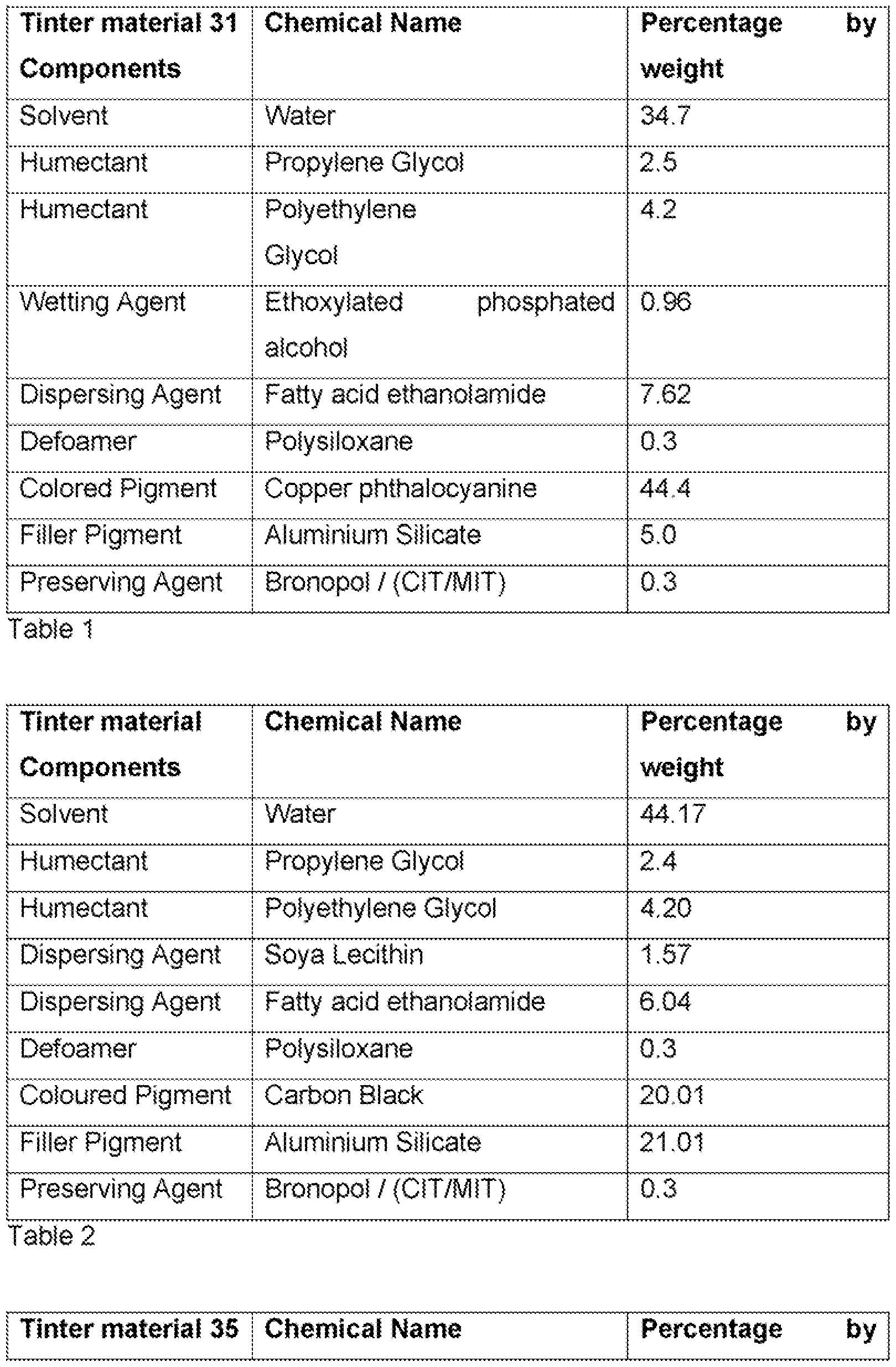
  • the component breakdown of each of the tint ⁇ rs 31 ,33.35 is given in Tables 1 to 3 below.
  • each of the tinter materials primarily includes the pigment and a solvent, in this case water, and further additives 27.
  • the further additives 27 include a wetting agent, dispersing agents, preserving agents, a defoamer, a humectant, and a filler pigment.
  • the function of these further additives is well known, and furthermore it is understood that the specific chemical examples, quantities and necessity of some of the additives will vary. For example, certain coloured pigments require less quantities of filier pigment. Typical ranges for further additives are given beiow in Table 4.
  • the pigments 20,22.24 are provided in the form of tinters, i.e. the form in which they would be supplied for use in in-store or in-facfory tinting machines where the tinters are added in liquid form directly to a base paint.
  • tinters i.e. the form in which they would be supplied for use in in-store or in-facfory tinting machines where the tinters are added in liquid form directly to a base paint.
  • the pigments have already been dispersed within the pigment carrier to form the tinier, and therefore require less mixing to produce a homogenous mixture than if the pigments were supplied in dry form.
  • the pigment carrier need not contain ali of the components iisted in TabSe 1.
  • pigment/solvent combinations do not require the use of wetting agents/dispersing agents to sufficiently wet and disperse the pigment, and therefore in alternative embodiments it is envisaged that the pigment carrier need not contain such additions.
  • the pigment carrier need not contain such additions.
  • the pigment carrier me ⁇ only contain a solvent, be that aqueous or non-aqueous which acts to carry the pigment in the iiquid state, [0079]
  • a suitable wetting agent would be an anionic surfactant, and a suitable dispersing agent would be a non-ionic surfactant.
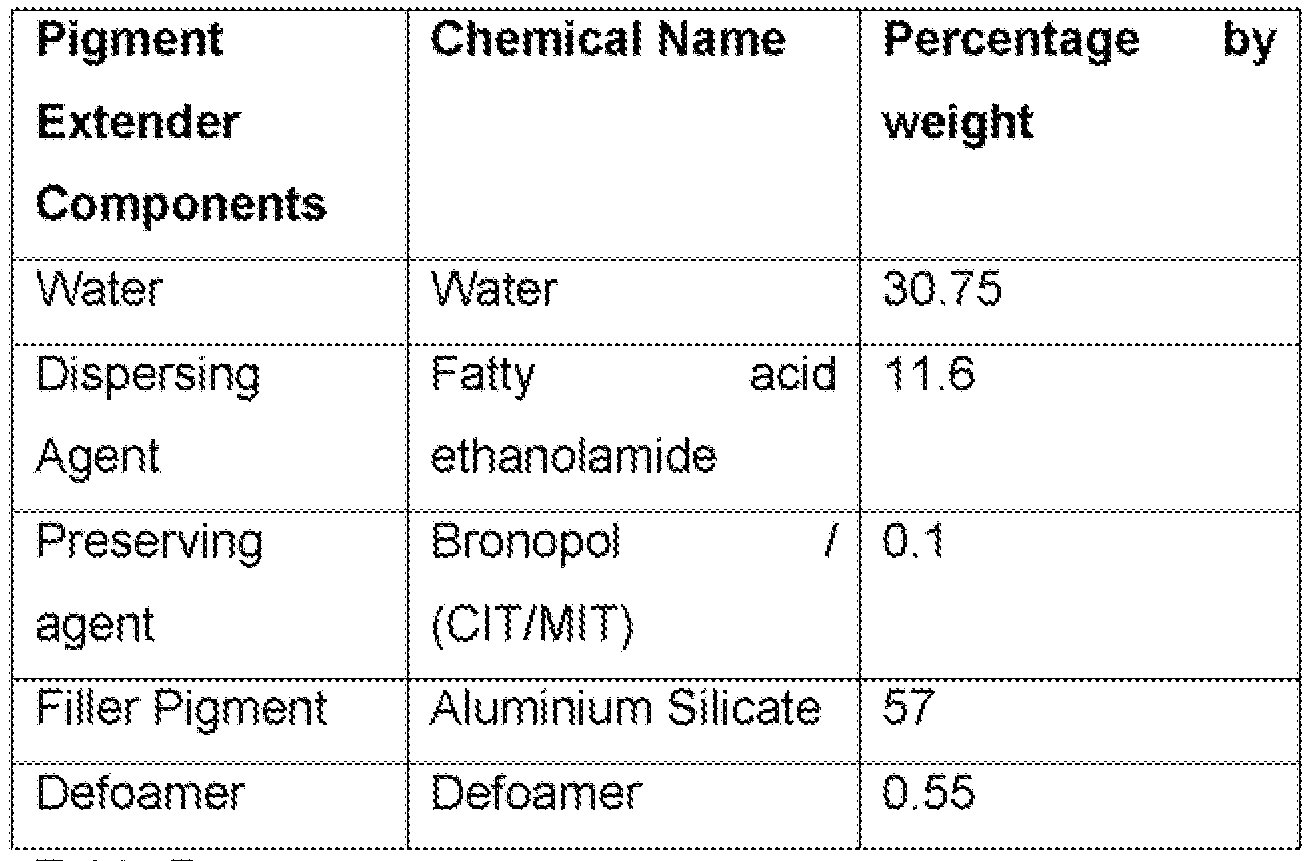
  • the three tinters 31 ,33,35 i.e. the pigment carriers 21 « 23,25 with the pigments dispersed therein, are then mixed together with a pigment extender 40 « the components of which are given beiow in Table 5, to produce a liquid pigment mixture 28 comprising the three tinters 31,33,35 and the pigment extender 40.
  • Table 5 [0081] The percentage breakdown of the timers 31 ,33,5 is given in Table 8 below which shows the combined total is 15% of the total weight of the iiquid pigment mixture 28 « the remaining 85% consisting of the pigment extender 40. It wili be appreciated that the totai weight of the liquid pigment mixture need not be limited to 15%, with typicai quantities of up to 30% being used depending on the final colour required.
  • the pigment extender need not contain ethoxylated phosphated aicohoi (anionic surfactant) with the non-ionic surfactant having a volume of 11.6% as shown below in Table ?.
  • the pigment carriers include those additives listed in Tables 1 to 3, Sn an alternative embodiment, those additives can be partially or wholly included in the pigment extender, i.e. the pigment extender may include ail those additives listed in Tables 1 to 3, or the pigment extender may include some of the additives with the remainder in the pigment carrier, or the pigment extender may include a specific quantity of some or all of the additives, with the remaining quantity required of some or all of the additives in the pigment carrier. [0085] in this embodiment, the tinters and the pigment extender are mixed in a high speed disperser 26 for twenty minutes.
  • any form and time of mixing is envisaged, providing the end result is a homogenous dispersion of pigments in the iiquid carrier.
  • the individual pigments are provided in a liquid pigment carrier, and more specifically in the form the pigments would be supplied for use in in-store and in-factory tinting machines.
  • the liquid carrier can be provided in the form of a pigment extender alone such that the dry pigments are added to and mixed with the pigment extender only.
  • the liquid carrier can be provided in the form of a pigment carrier such that the dry pigments are mixed with the pigment carrier only.
  • the liquid carrier is formulated, the principle requirement is that it enables the dry pigments to be mixed in the liquid state such that a homogenous mix of pigments is produced, and therefore in its simplest form, the dry pigment biend of the present invention can be achieved by mixing the dry pigments in a liquid, providing the dry pigments are readily dispersible in the iiquid, be that through the use of a surfactant or dispersing agent and/or through careful selection of the pigment/liquid combination, and/or through the energy inputted during the dispersion of the pigments in the liquid carrier.
  • Certain dry pigments can be supplied already modified by surface treatments, which enable to the pigment to be more easily dispersible and stable in a liquid carrier and thus the liquid carrier need not require any additives to enable dispersion of the modified pigments in the liquid carrier.
  • individual dry pigments are provided, as opposed to pigments already dispersed in a liquid carrier a greater intensity of mixing may be required to produce a homogenous dispersion of the pigments in the liquid pigment mixture.
  • the liquid pigment mixture can be dried using conventional drying techniques, for example, drying in an oven so as to produce a dry pigment blend, i.e. a mixture of the pigments in dry particle form, in this embodiment the dried mixture includes the other additives described above, although in the case where no additives are required, i.e. the pigments are carried in water only, the dried mixture will only contain the dry pigments themselves.
  • the liquid pigment mixture is dried for six to eight hours at seventy degrees centigrade, although it w ⁇ l be appreciated that the drying time and temperature can be varied,
  • dry pigment blend it is also possible to subject the dry pigment blend to additional process steps such as grinding if it is considered necessary, or filtering the blend to remove any unwanted particles and/or particles above or below a certain size.
  • additional process steps such as grinding if it is considered necessary, or filtering the blend to remove any unwanted particles and/or particles above or below a certain size.
  • spray drying Another suitable technique for drying the iiquid pigment mix is spray drying. This is particularly advantageous since the spray drying process can be controlled to aiter the particle size and shape. It will be appreciated that any filtering required can take piace after the blend has dried, and/or during the spray drying process itself.
  • the drying process can be controlled to aiter the particle size of the dry pigment blend
  • one of the significant advantages of the present invention is the fact that by mixing the pigments in the liquid state, a more homogenous mix of the individual pigments is created which gives the dry pigment blend the appearance of being uniform in colour hue, regardless of the particle size of the individual pigment particles. This contrasts to the dry grinding of pigments which results in a uniform colour blend, but with particles below 10 microns in size.
  • the issue of particle size is of particular concern since the mixing of the dry pigment blend with the base coating composition process takes place at the home of the consumer.
  • St will be appreciated that by careful selection of different coiored individual pigments, and their quantities, a significant color range of different dry pigment blends can be produced.
  • Another suitable pigment for use in tinting materials for use in the present invention can inciude coloring agents characterized in that they are present in a solid form mixed with an effervescent agent in a binder which is principally composed of polyethylene glycol wherein they are previously diluted at a temperature which is higher than the fusion temperature of said binder.
  • the method for the production of said coloring agents involves a dry mixture of two constituents introduced in a powdery form prior to the heating of said mixture, resulting in the fusion of the binder.
  • colorant utilize the fact that polyethylene glycol in molten state is able to easily dissolve large amounts of the chemicals constituting organic coloring matters, and in addition, for an equal weight of dye compound, the solid compound containing them in intimate mixture with the binder, as it is obtained after cooling, has a better solubility or at least is more quickly soluble in water and aqueous media, compared to the original micronic powder.
  • an effervescent agent can be adjusted in order to get the best ability of the final product, i.e. the mixture in solid state, to quickly dissolve in water, and its nature is selected to ensure its solubility in efficient proportions in the binder.
  • Such an effervescent agent can advantageously be selected from combinations able to generate carbonic acid that are non toxic and acceptable in the food industry.
  • a typical example for such a combination is a mixture in approximately stoichiometric proportions of citric acid and sodium carbonate, both these products being easy to dissolve in the binder with no effervescent reaction as long as the mixture is not in contact with water.
  • the initial coloring matter is preferably a powder of micronic grain size
  • the polyethylene glycol is also preferably in powder form
  • the two powder components are advantageously mixed in the dry state before being heated at a temperature high enough to ensure melting of the binder.
  • the polyethylene giycol is a poSyolefin class polymer which is used in a quality corresponding to a relatively low polymerisation rate, so that it is not only highly soiuble but it is further fusible at a temperature beiow 12O.degree. C.
  • the preferred quality of poiyethylene giycol or homologous or equivalent compounds are those with which melting can be performed at temperatures between 40 and 80, degree. C. Shouid it be only for economical reasons, it is aiways worth it that heating at a gentle temperature be sufficient, and in addition one has to avoid effects that could damage the coloring matter. But further it is desirable to obtain a product in soiid form at ambient temperature that can aiso stand to temperature variations in user's plants.
  • the mixture of a micronized powder of dye compound with the binder in the final solid product be sufficiently intimate to avoid any production of spoiling micronic dust, it is preferable to ensure complete true dissolution of the dye compound during its dilution in the binder.
  • the invention inciudes cases where dissolution is only apparent, each micronic sized particle being individually embedded, in the binder.
  • the invention provides for starting preferably with a powder dye of particie size low than 100 microns and advantageously between 10 and 50 microns,
  • the proportions of the components can be highly variable, depending in particular upon their respective physico-chemical properties. They can also vary according to the dimensions desired for the final product. The latter will aiso be highly variable according to the particular application the product is designed for. For example, for a product in a solid and highly divided form, namely for making a po ⁇ rable product, made of grains or similar elements and delivered in bulk, it is advantageous to prefer a composition with a lower polyethylene glycol content than for a product finally in brick or Sump form requesting shaping by moulding or possibly by extrusion.
  • the tinting material can be prepared by mixing the ingredients of the particulate or pulverulent phase (organosiSicone particles, fillers and pigments) and by then adding a fatty phase with stirring, the mixture subsequently being milled, sieved, then poured into a dish and compacted.
  • the milled and sieved mixture of the pulverulent phase and of the fatty phase is compacted using a press, such as by applying a pressure ranging from 0,5 MPa to 10 MPa.
  • the milled and sieved mixture of the pulverulent phase and of the fatty phase is compacted by applying a pressure ranging from 1 MPa to 5 IVfPa.
  • the composition thus obtained is provided in the form of a compact powder.
  • Suitable tinting materials will allow for the safe and easily attained reproducibility of colors and shades, and the wide range of shades. As a whole, for each workshop using a coloring matter designed according to the invention, the correct dosage of coloring matter is easy to secure, since the concentration is constant in the delivered product and the latter can possibly be supplied in unidose amount corresponding to any appropriate weight. Moreover, the tinting material can contain a mixture of various organic dye compounds, in order to obtain any color at will. With control of the appropriate composition preservation of the desired shade for a given dosage can be obtained. The user has no ionger to fear consequences of mistakes or lacks of care in the weighing of each dose of the individual dye compound with the pre-dosed amount in the pouch. [00106] A suitable tinting materia!
  • the composition can have a composition including 10 to 80%, preferably 15 to 80% of polyethylene glycol (PEG) with respect to the total weight of the composition.
  • the dye proportion is advantageously between 10 and 70%, preferably between 30 and 50% t with respect to the composition total weight.
  • the effervescent agent in ternary mixtures, it is advantageously present at a level of 10 to 60%, preferably 15 to 50%, with respect to the composition total weight in any case, whether the tota! composition include an effervescent agent or not, the best results seem to be obtained when the binary mixture with polyethylene glycol contains 0.5 to 1.5 part in weight of polyethylene glycol for one part of the initial coloring compound.
  • the final product as it is presented in solid state, it must be noted that it can be under the shape of grains or granules in bulk, the dimensions of which are between 0.2 and 10 millimeters, thus roughly of the order of a millimeter.
  • Such granules can be obtained by direct precipitation from the molten mixture of the components.
  • One can also obtain dimensionally non isotropic elements, similar to vermicelli, cut out from a yarn having also a diameter of the orders of a millimeter, obtained by extrusion of the viscous paste of the molten mixture while it is being cooled down.
  • Blocks can also be obtained by moulding in a great variety of moulds of various shapes and dimensions, from pellets to bricks.
  • the filling of the tinting materia! into the pouch or encapsulant layer can be in a horizontal form/fill/seal apparatus, individual pouches can be formed by folding the polymeric film in haif followed by providing vertical seals along the length of the folded sheet and separating the pouches along the seals formed by vertical sealing.
  • the bottoms of the pouches can also be sealed.
  • the top of the pouch is sealed.
  • the continuous sheet can be formed around a tube and the sheet is immediately Joined together by a longitudinal sealing jaw as either a lap seal or a fin seal.
  • a second sealing function is present in a vertical form/fill/seal configuration which consists of a combination top and bottom sealing section (with a bag cut-off device in between).
  • the top-sealing portion seals the bottom of an empty bag suspended from the bag forming tube white the bottom portion seals the top of a filled bag.
  • the package is formed and filied by creating a heat sea! between two opposed sheets of poiymeric film to form a pouch and almost simultaneously sliding or dropping the tinting material into the pouch.
  • a continuous flat sheet of polymeric film is fed around a form which shapes it into a tube, the tube is slipped over a hollow form and the free edges of the tube are sealed together.
  • the tube so formed is then passed between a pair of hot sealing jaws which create a series of discrete pouches by collapsing the film onto itself and forming a seai by the application of heat and pressure.
  • the product is introduced into each pouch through the hollow form in the interval between the heat seais.
  • the tinting material can be dropped into the pouch while the sealing jaws : which form the sea!, are closed.
  • the heat seal should be strong enough to support and retain the substance after the sealing jaws open to release the film. It is often desirable to release the sealing jaws soon after the seal is formed so a film which accomplishes this by exhibiting a high "hot tack" is very useful.
  • Hot tack refers to the strength of the heat seai immediately following the sealing operation.
  • one or more of the pouches can be filled into a moisture resistant pack that reduces the risk of premature dissolving of the pouch in humid environment prior to use in tinting coating compositions.
  • Suitable moisture resistant containers include glass jars with lids and film packages such as those of ⁇ ⁇ S ⁇ Paliio ⁇ SAlt.MQ which discloses a film with a low temperature sealable coating.
  • the coating contains a copolymer of ethylene and acrylic or methacryl ⁇ c acid, U.S. Pat.
  • Nos, 6,077,602 and 5,848,582 disclose heat seaiable film coatings containing a t ⁇ rpoiymer produced from a nitrile monomer, an acrylate or 1,3 butadiene monomer, and an unsaturated carboxylic acid or sulfoethyi methacrylate.
  • U ,S Pat. Nos. ⁇ ,01.3,35.3. and 5, ⁇ 27 t 615 disclose metailized films with heat seaiabie coatings, on the surface of the rn ⁇ tai, containing a copolymer of a carboxylic acid and an acryiate, or acryionitriie or mixtures thereof.
  • Acrylic-containing coating formulations provide the film with a good coefficient of friction, which contributes to good machinability characteristics. These acrylic- based coatings also provide films with good barrier characteristics, which improve flavor and aroma protection. Such coatings are described in UjS J?ji ; jNlos ; 4,058,649 and 4,Q58 ; ⁇ 45.
  • the PVDC coating or other type of acrylic coating is usually on the inside of the Him and provides high seal strength, good hot tack characteristics and barrier properties.
  • These heat seaiable coatings have glass transition ("Tg") temperatures which are higher than room temperature.
  • Tg glass transition
  • Such a coated film is disclosed in M ; S. ; .£aLNo ; ...iJfi34 ⁇ .4 ; .
  • UJLJMJ ⁇ A45 ⁇ Z4i discloses heat seaiable terpolymer compositions useful as pressure-sensitive adhesives for use with a backing materia! such as paper, polyester film or, foamed polymers.
  • the terpolymer heat seaiable pressure-sensitive adhesive composition comprises butyl acrylate, N-vinyl-2-pyrroiidinone and styrene.
  • Other heat seaiable coatings are disclosed in lLS u PjLM3--A ⁇ -i ⁇ iQ82 and East German Patent DD- 146,604. The coating may be applied to polymeric substrates having other coatings or overlayers such as a metailized layer. The films with the metallic layer can be fiiled with the one or more pouches and then heat sealed.
  • the packing film In such applications, generally speaking, the faster a package is routed through the filling and sealing process, the more economic the packaging process. Therefore, it is advantageous for the packing film to have a low minimum seal temperature to reduce the process residence time necessary to reach the minimum seai temperature.
  • the minimum sea! temperature must not be too low so as to avoid activation of the seaiing properties during storage or transit at high atmospheric temperatures.
  • the higher the sea! strength of the heat seal immediately foilowing the seaiing operation the faster the package may be processed thereafter without risking an unacceptabiy high seal failure rate.
  • This characteristic known as "hot tack" is a measure of the cohesive strength of the heat seai during the cooling stage before soiidification of a heat seai.
  • Hot tack is determined by tearing a seal apart to measure the seai strength immediately after the seal is formed and before it cools down. Hot tack is measured in force per unit of seai width, Generally, the higher the hot tack the better since this will promote faster processing and handling of the seaied package.
  • Suitable iaminate iayers for the package includes metaiized foii paper iayer laminated to a cast polypropylene layer and another iayer of PET, polyethyiene or EVOM.
  • a fourth layer which can be from the cast polypropylene laminate material retains its filled shape even as the product is removed from the pouch so that the pouch can even be shaped like a traditional cylindrical can but more suitably stored in a moisture-proof package including, e.g., sealed metal foil pouches.
  • a moisture-proof package including, e.g., sealed metal foil pouches.
  • These are for example of a flexible nature, such as of flexible plastics materia! or metal foil or laminates of these materials, but they can also be for example be rigid in nature, such as of rigid plastics material or metal or glass,
  • the pouches of the present invention provide a system that can deliver not only deeper shades of a monochromatic color, but also can deliver within one pouch, blended finters to deliver one color. Also, pouches with two different coior tinters in each one of them can be used to deliver another coior.. i.e. blue and a yellow at different amounts to achieve a shade of green.
  • the pouches of the present invention can have tinting materials formulated for additions to such compositions as tint bases.
  • Examples include bases which are--any one of a predetermined number of liquid coating compositions comprising the vehicle, binder, various additives and, optionally, titanium dioxide, to which the pouch is added.
  • the base can be of the water borne type (e.g., latex) or the even a sumble borne type (e.g., alkyd with a solvent dissolvable encapsuSant).
  • the paint retailer can maintain a minimum of tint bases in inventory of each of the different types of bases required to custom-mix with the colorants to obtain the colors displayed on the take-home cards, color selection and identification panels, color chips and other merchandising or sales aids provided for the system.
  • Suitable bases inciude one or more of Pastel Base-a base containing from 1.7 to 2.5 pounds, but preferably from 2.0 pounds to 2.2 pounds of titanium dioxide and comprising 124-128 fluid ounces; up to 2 ounces of colorant can be added to provide about a gallon (128 ounces) of paint,
  • a pastei base without colorant contains sufficient hiding power to be used as a paint due to its titanium dioxide content.
  • Deep Base-a base containing from 0,5 to 1 ,0 pounds, but preferably from 0.50 pounds to 0.68 pounds of titanium dioxide in 118-124 fluid ounces; up to eight ounces of colorant can be added to provide about a gallon of paint.
  • Accent Base ⁇ -a clear or transparent base consisting of 112-118 fluid ounces containing no titanium dioxide; up to twelve ounces of colorant can be added to provide about a gallon of paint ASkyd Paint-paints using aikyd resins as vehicles; these paints am thinned with solvent, such as mineral spirits,
  • FIG. 1 shows a moisture resistant package 14 is skematically depicted as surrounding pouch 10.
  • Pouch 10 is shown in a cut away view having the water soluble polymeric layer, 1 1 and cut away section 12 showing the particulate tinting material.
  • Figure 2 of the drawings shows cross-sectional view of a moisture resistant package having a plurality of pouches within package 18 in which 10 and pouch 18 can provide different shades or colors for a containing having the coating composition and effective headspace for agitation.
  • Figure 3 shows a kit 20 having a plurality of moisture resistant packages 14 or 16. Th ⁇ kit shows that the packages can be arranged such that one pouch can be present in the ackage or a plurality of pouches can be present in a package.
  • a moisture resistant package with a plurality of pouches such as that of figure 2 can be used to produce the range of shades of coior depicted in Figure 4.
  • a plurality of three pouches could be present in one moisture resistant package or in three separate moisture resistant packages to produce a light shade 22, a medium shade 24 or a deeper shade 26.
  • the pouch for shade 22 can be added first, if the user wants a deeper shade, the pouch for shade 24 can also be added to the same tint base, if still a deeper shade is desired, the third pouch can be added to the same tint base to produce shade 26.
  • Figure 5 shows the range of coior in a system of pouches, ranging from colors of column 32 to column 33 and row 32 to row 34.
  • Each pouch would have tinting materia! to produce the shade as depicted for instance at reference 29.
  • There three pouches would be used in a manner similar to that described for figure 4.
  • Reference 28 shows the three shades of Figure 4. So with a system of pouches for addition to a minimum of tint bases, a retailer can provide to the user various color schemes for matching colors in other decorating materials such as furniture, draperies, linens and the like.
  • a 20, 40, and 60ml pouch of ti ⁇ ter was added to paint in sequence and stirred in to achieve a specific color. After each pouch was added it was then painted on a card, and judged to be the color desired, or whether you wanted to go darker to the next shade on the card. If so, add the 40ml to that and achieve the mid shade color and repeat brush out on a card. Repeat the process with the 60ml pouch to achieve the darkest shade. When developed, the colors were tinted using the stir in method, drawn down on Seneta cards, dried and measured against a known color standard both spectrophotornetricaliy and visually.
  • Pouch Composition The actual size of the pouch was based on the volume of tinter being contained. For example, If I had a tinter load of 20 mi. my pouch size would be relative in proportion to the tinter.
  • the color is formulated using the method of blending pigments together. Based on the prescribed dose, the colors are then pouched inside the polymeric film. The pouches are then dropped into a gallon of paint and stirred in to achieve the prescribed color.

Landscapes

  • Chemical & Material Sciences (AREA)
  • Organic Chemistry (AREA)
  • Chemical Kinetics & Catalysis (AREA)
  • Life Sciences & Earth Sciences (AREA)
  • Engineering & Computer Science (AREA)
  • Materials Engineering (AREA)
  • Wood Science & Technology (AREA)
  • Health & Medical Sciences (AREA)
  • Medicinal Chemistry (AREA)
  • Polymers & Plastics (AREA)
  • Paints Or Removers (AREA)

Abstract

Encapsulated colorants for waterborne coating compositions are provided as a system and kit with a method for tinting the water borne coating compositions. The encapsulated colorant comprises at least one water dispersible tinting material to be released into the based coating composition upon dissolution of the encapsulating layer to give the coating composition color. The encapsulating layer surrounding the colorant has at least one polymer that is soluble in aqueous medium surrounding the tinting material wherein the layer has a thickness from about 0.5 to about 5 mils and can dissolve to release the dispersible tinting material in an aqueous coating composition having about 25 to about 45 volume percent solids and about 55 to about 75 volume percent water in less than 15 minutes with agitation at a temperature in the range of about 50 to about 110 °F. One or more of the encapsulated colorants as a pouch or pouches are contained in a moisture resistant package until ready for dissolution in the coating composition. A plurality of the encapsulating colorants as pouches in moisture resistant packaging comprise a system which along with one or more clear or tint base water borne coating compositions comprise a kit. A method involves placing one or more pouches in a volume of coating composition with stirring or shaking to provide a color to the composition.

Description

Encapsulated Colorants for Waterborne Coaling Compositions System and Kit and Method
This application claims the benefit including that of priority under 35 U. S. C. 119(e) of U.S. Provisional Patent Applications Serial Number 60/790,265, filed April 8, 2006. entitled "Encapsulated Colorants for Waterborne Coating Compositions, System, Kit and Method"; and Serial Number 60/790,966, filed April 11 , 2006, also entitled "Encapsulated Colorants for Waterborne Coating Compositions, System, Kit and Method", the complete disclosures of both of which are hereby incorporated by reference.
BRIEF DESCRIPTION OF THE DISCLOSURE [0013 The present disclosure relates to encapsulated colorants soluble in waterbome coating compositions for providing color or pigmentation to the coating composition, a system of a plurality of water-soluble packets or pouches of colorants for providing a variety of colors for water-based coating compositions, and methods for pigmenting water-based coating compositions. In particular, various exemplary embodiments of the present invention, relate to water-soluble colorant packets for pigmenting latex paints.
TECHNiCAL CONSIDERATIONS FOR THE DISCLOSURE [002] Users of water-based or water borne coating compositions such as paint customers can choose from thousands of colors as they plan to coat various substrates. Usually these colors are made avaiiable by providing three or four "tint bases" that contain different amounts of titanium dioxide, white pigment, usually between zero and 30% by weight of the total coating formula. In retail establishments, combinations of liquid coiorant concentrates are added to achieve this diversity of colors and intensities. Typically, about eight to 12 colorants are dispensed through manualiy or computer-controlled dosing machines, which dose the coating composition such as a can of paint with the requisite combinations of one or more of the colorants. For example, a light paste! color for a latex paint might require 1 ounce per gallon of a combination of red and yellow colorants in a tint base containing a high level of titanium dioxide, while an intense, bright coSor might require 10 or more ounces of bright red or blue colorants in a tint base with little or no titanium dioxide. The tinting machines at the retaii or point of sale establishment are elaborate and expensive pieces of equipment for volumetricalSy dispensing the pigment concentrates. The dispensing equipment can be either automatic or manual; for example, a manual dispensing machines is known as the Harbil machine. These machines consist of a canister and a tri-valve pump where material is pulled into the piston from the canister and then dispensed through a 3 mm orifice. The shear rate of the dispensed pigment concentrate has been calculated to be 300 sec*1 based on the diameter of the nozzle orifice (3 mm) and the rate of the dispensing of the concentrate. This type of elaborate equipment makes tinting coating compositions at the point of saie in a store an involved effort over the supply of ready mixed coating compositions. However the consumer does not have the wide variety of choice of colors with the ready mix formulae. Also the consumer relies on the store tinting operation to reproduce a desired color selected from available color swatches depicting dried films of the coating composition with a particular color. At times the consumer may feel the tinted color of the coating appears lighter than the color of the swatch and want more tinter added. However the tinting operation of the store probably treats this as a return of a product and tints another can of coating to a darker shade of the color. Such an approach is cumbersome for the consumer to return the product and get another tinted product. Also the involved tinting operation itself limits the selling of coating compositions tinted at the point of sale to stores willing to invest not only in the tinting equipment and tinter concentrates but also the shakers to provide a uniformly tinted product. [003] While this is the norm in many parts of the world, there are exceptions. For example in Germany and parts of Latin America, many customers prefer to create their own colors for coating compositions such as paints for home use. In those cases, the tint base is sold along with bottles of colorants needed to achieve a general color range. The painters add the necessary amounts of color to achieve the color and intensity of color that they like. In some cases, the colorants are pre- measured to give specific colors; in other cases, larger bottles are sold as some customers prefer to be free to develop their own personaiized colors without being restricted by pre-measured closes. In any case, the liquid colorant is added and the paint is stirred, typically by hand with a wooden stick or with a stirrer attachment for an electric hand drill for about two minutes to achieve coior uniformity. [004] Dealing with botties of liquid colorant for paint can be a challenge in its use, and in its reproducibiiity of the desired color. For instance, a rather sophisticated and neat approach to the use of the liquid coiorant and/or rather tedious preparation steps of covering floors and furniture may avoid messes from spiliing such coiorants. This assists in avoiding a difficult cleaning dilemma if a spill occurs. Of course, if the amount of colorant is not pre-dosed the possibility of obtaining another container of coating composition of the same coior is reduced.
[005] Recently readily dispersible pigment granules, such as those available from BASF and available as "Xfast stirred-in pigments allow for addition to waterborne paints without dispersion of the pigments in a bead mill. Such pigments reportedly are quickly, evenly, and immediately dispersed to develop full tinting strength simpiy by stirring into or shaking into the white paint. These free-flowing, low-dusting, easily-handled and rapidly dispersing micro-granuies are made by using an additive system to coat pre-dispersed pigment particles. When added to water based paints these pigment particles disperse without forming iarge pigment aggregates thus enabiing direct coloration with stir-in pigments. These pigments can be added in manufacturing plant operations or at the point-of-use. Such pigment granules are typically used as dry single pigment tinters. For instance, a range of 20 pigments covering 17 different color types covers the color space needed for use in decorative paints and wood stains, This range of colors can be produced by mixing together several single pigment tinters into the coating composition. [006] However, there still exists a need for further improving the performance of dry tinters since these can spil! just like liquid tinters when they are poured from a container or sachet. Even though the dry tinters allow for easier removal of all of the tinter from the container compared to liquid tinters, spilled dry tinters can be difficult to clean or remove since they can spread when wiped with a damp doth. Sn particular, there is a need for further improving the performance of the addition of dry tinters to water based or borne coating compositions to minimize the risk of spilling the tinter in a location other that in the coating composition. Such spiiling not oniy results in cleaning difficulties but affects the reproduction of the exact color that could have been obtained if al! of the dry tinter was added to the coating composition.
[007] Also there is a need for expanding the range of colors available for a ready mix type of coating product without the necessity of occupying a lot of shelf space at a retail outlet to accommodate the number of containers of coating compositions for the expanded range of coiors. Consolidating the shelf space required while expanding the range of colors that are easily or readily rnixabie expands the possibie coiors available for use by the purchaser. Such a readiiy mixable product can be seiected by the consumer for use without much attention by the personnel of the retail establishment.
[008] Although the present invention may obviate one or more of the above- mentioned problems, it should be understood that some aspects of the invention might not necessarily obviate one or more of those problems or fulfill one or more of the afore-mentioned needs,
[009] In the following description, certain aspects and embodiments will become evident. It should be understood that the invention, in its broadest sense, could be practiced without having one or more features of these aspects and embodiments. It should be understood that these aspects and embodiments are mereiy exemplary.
SUMMARY OF THE DISCLOSURE
[0010] In one aspect, as embodied and broadly described herein, the present invention may include an article of manufacture comprising at least one water dispersible tinting material encapsulated in a polymeric layer that has solubility in water. The tinting material is releasable into a water based coating composition to give the coating composition color. The polymeric layer can have one or more polymeric films where the at least one polymer has solubility in an aqueous containing medium, when the layer has a thickness about 0.5 to about 5 mils to dissolve in order to release the dispersible tinting material into an aqueous containing coating composition. Such a coating composition can have about at least 20 volume percent solids, and at least about 45 volume percent water into which the tinting material disperses and the polymeric encapsulating dissolves or disintegrates in less than 20 minutes with at least continuous hand agitation at a temperature in the range of about 50 to about 110° F. The dissolution of the at least one polymer of the layer also allows for disintegration and dissolution into the aqueous medium. [0011] According to another aspect of the invention, the encapsulating layer is in the form of a sealed pouch that contains the tinting material. At least one of the sealed pouches can be present in a moisture resistant package or container. The moisture resistant package or container can reduce the moisture encountered by the at least one pouch prior to adding a pouch to the water based coating composition for dissolving of the pouch encapsulating layer and for providing of tinting material to color the composition.
[0012] It is aiso another aspect of the present invention to provide a piuraiity of the pouches as a kit or system, where different pouches have different tinting materials; for example different in kind and/or concentration, to provide a variety of color choices for addition to the water-based or water borne coating compositions. In one aspect of the invention, there can be enough pouches to provide a coior range of even up to about 150 different colors and/or shades.
[0013] In another aspect of the present invention a kit or system can inciude one or more of the moisture resistant packages having a plurality of pouches to provide a range of shades for a particular coior hue. In such an aspect the range of monochromatic shades can range from a light shade and/or to a medium and/or to a darker shade. A nonexclusive instance would be to have three pouches in the moisture resistant package, where the pouches provide a range of monochromatic shades from a Sight to a medium and to a deeper shade. Such an example would be a first pouch having an effective amount of tinting material for a light shade of pink, a second pouch, which can have an effective amount of tinting material for a medium shade of pink, and a third pouch having an effective amount of tinting material for a deeper shade of pink.
[0014] In another aspect of the present disclosure a method is provided for tinting a water-based coating composition without the need for elaborate tinting equipment, and even where the tinting can be performed conveniently close to the location of use of the coating composition. Such a method can involve having a kit with a specific volume of water-based coating composition in a container having sufficient headspace to allow for hand agitation with a stirrer along with one or more moisture resistant packages, which can comprise one or more water-soluble pouches of tinting materia!. The at least one water resistant pack is opened, and at least one pouch is selected. If a plurality of pouches is present then a pouch having an effective amount of tinting materia! to provide a lighter shade of color to the coating composition can be selected. The pouch can be deposited in the container having unpigmented or tint base coating composition where the container has headspace to allow for some splashing of the coating when hand stirring is performed with a wooden stirrer. The coating composition with the deposited pouch at room temperature or even an outdoor temperature in the range of about 50 to about 1000F or more allows for the polymeric layer of the pouch to begin to dissolve and release the dispersible tinting material. On continuation of stirring or agitation by hand, or with an electric drill with an attached rotatable stirrer or even a conventional retail paint shaker device a majority if not all of the pre-dosed tinting material is released into the coating composition. With continuous stirring or shaking this tinting material is distributed into the coating composition to give the composition a color or a different color. A non-exclusive suitable container of coating composition may be a 1 gallon volume or slightly less than one gallon up to even 5 gallon amount of coating composition in a slightly larger container. For slightly less than one gallon of paint the container can have sufficient headspace to provide for the hand agitation to distribute the tinting materia! in the composition at 1.4 or 1.5 gallon size container. [0015] The above summary of the present invention is not intended to describe each disclosed embodiment or every implementation of the present invention. The description that follows more particularly exemplifies illustrative embodiments. In several places throughout the application, guidance is provided through lists of examples, which examples can be used in various combinations, In each instance, the recited list serves only as a representative group and should not be interpreted as an exclusive list.
BRIEF DESCRIPTION OF THE DRAWINGS
[0016] The accompanying drawings, which are incorporated in and constitute a part of this specification, illustrate a number of non-limiting embodiments of the invention and together with the description, serve to explain the principles of the invention. [0017] FSG. 1 is a front elevational view of a moisture resistant package shown diagrammaticaiSy comprising a pouch with a bottom cut away view to depict the tinting material in the pouch according to one embodiment of the invention, [0018] FiG. 2 is a cross-sectionai view from the enύ of a moisture resistant package to show the contents of a pSuraSity of pouches.
[0019] FiG. 3 is a perspective view of plurality of moisture resistant packages which may have the pouches of Fig 1 and/or 2 vertical !y disposed in a tray as a kit, [0020] FiG, 4 is a pian view of a sheet showing the light, medium and deep shades of coior that can be pre-dosed into the f inter material where each shade dosage wouSd be a separate pouch and three pouches could be packaged in one moisture resistant pack.
[0021] Fig 5 is a pian view of the wide array of colors possibie with a system of pouches where a range of three progressively deeper shades are provided one shade per pouch,
[0022] Reference wili now be made in detail to exempiary embodiments of the invention, examples of which are iilustrated in the accompanying drawings. Wherever possible, the same reference numbers wili be used throughout the drawings and the description to refer to the same or like parts. It is to be understood that both the foregoing general description and the foliowing detailed description are exemplary and expianatory only and are not restrictive of the invention, as cSaimed.
DETAILED DESCRIPTiON OF EMBODiMENTS OF THE PRESENT !NVENTiON [0023] As used in the afore-discussed embodiments and other embodiments of the invention described herein the foilowing terms generaiiy have the meaning as indicated but these meaning are not meant to limit the scope of the invention if the benefit of the invention is achieved by inferring a broader meaning to the foilowing terms,
[0024] The term "wafer-dispersibie" when applied to the one or more polymers in the encapsulating layer generally refers to a polymeric fiSm that is itself capable of being dispersed into available water of water based or water borne coating composition (i.e., without requiring the use of a separate surfactant) so that the fiSm is undetectable to the unaided human eye when the coating is applied as a wet fiim to a substrate. [0025] The term "waterborne coating composition" " is understood to mean conventional water-borne coating compositions, materials, and formulations that have no compressed fluid admixed therewith. Such coating compositions are generally comprised of a nonvolatile materials fraction comprising at ieast one polymer component that is capabie of forming a coating film on a substrate, whether such component is a paint, enamel, lacquer, varnish, adhesive, chemical agent, release agent, lubricant, protective oil, caulk, an agricultural coating, or the like. The water-borne coating compositions, in addition to the nonvolatile materials fraction, also contain a carrier or solvent fraction which is typically at least partially miscible with the nonvolatile materials fraction. As used herein, the phrase "nonvolatile materials" is understood to mean solid materials and liquid materials such as solid polymers, liquid polymers, and other compounds that are nonvolatile at a temperature of about 25° Celsius. In general, the nonvolatile materials fraction is the portion of the water-borne coating composition that remains after the carrier or solvent fraction has been removed usually through evaporation. As used herein, it will be understood that the term "water- borne coating composition" includes not only coating compositions used to form protective or decorative coatings but can also include adhesives, caulks, release agents, lubricants, agricultural materials, and the like, which are capable of being sprayed to deposit a coating on a substrate. In other words these can be coating compositions in which the polymeric binder is a dispersion of insoluble polymer in water. Waterborne paints can be referred to as 'emulsion paints' and these represent the most common type of wall and ceiling paints now in use. Emulsion paints first were developed in the 1950's. Also waterborne coatings can be predominantly liquid and generally can be prepared from liquid blended raw materials, such as titanium dioxide slurries, extender pigment slurries, thickener slurries, glycol slurries, and latex binders. The liquid blends have substantially the same viscosity characteristics as the final waterborne coating composition, in the range of about 70 to about 125 Krebs units. Emulsion paints comprise a film-forming polymer which is insoluble in water and which is in the form of a colloidal dispersion (sometimes called an "emulsion" or a "latex"). They aiso compose one or more particulate non-film forming solids which can be pigments, such as titanium dioxide, or extenders such as powdered chalk. The paints usually also comprise a thickener. [0028] The term "latex" for a coating composition means the primary film forming polymeric components of the composition or paint are those that are capable of being dispersed in water by themselves or through the use of one or more secondary emulsifying agents (e.g., at least one surfactant) for creating an emulsion of polymer particles in water,
[0027] The terms "substance", "coloring materials" and the term "tinting material" are used interchangeably herein to refer to the ingredient intended for delivery , i.e., the film or layered pouch serves as the vehicle for delivery of the tinting material into the coating composition like the water borne coating composition. [0028] The term "substantially aqueous medium" means the environment wherein the polymeric film or layer or pouch dissolves, releasing the substance. Typicaily, the substantially aqueous medium will be within a water based or water borne coating composition, a non-exclusive example of which is a latex paint or stain. It is to be understood that both the fiim and tinting material may disperse in the aqueous environment, or the film, encapsulating materia! may dissolve and tinting material or at least the one or more pigments in the tinting material may disperse or dissolve into the aqueous environment.
[0029] The word "pigment" is of Latin origin (pigmentum) and originally denoted a color in the sense of a coloring matter, but was later extended to indicate colored decoration (e.g., makeup). The modern meaning associated with the word pigment means a substance composed of small particles that is practically insoluble in the applied medium and is used on account of its coloring, protective, or magnetic properties. Both pigments and dyes are included in the general term "coloring materials" or "tinting materials", which denote all materials used for their coloring properties. The characteristic that distinguishes pigments from soluble organic dyes is their low solubility in solvents and binders. Pigments can be characterized by their chemical composition, and by their optical or technical properties. In the Color Index (Cl.) pigments are usually named "C.I. Pigment XY xy". Some compounds may be named "C.I. Solvent XY xy" due to their migration tendency in polymer application, although in water or organic solvents these compounds may fulfill the insolubility criteria for pigments. Pigments can be classified into two general categories of. (i) inorganic pigments, and (ii) organic pigments. [0030] The terms, "climatic water conditions" are intended to refer to an environment where there is sufficient water to dissolve the film, i.e. the concentration of film polymer does not exceed its solubility limit in avaiiabie water of a composition where the temperature of the water can be at a temperature of applying a coating composition to a substrate whether inside a structure or in the externa! ciimatic environment and more suitably at a temperature in the range of about 35° F to about 105° F. it is anticipated that the improvements in dissolution achieved with the films and articles of the present invention will iikeiy be seen under warm and hot water conditions as we!!.
[0031] The terms, "rapidly dissolving" are intended to refer to the disintegration and subsequent dissoiution of the polymer fiim in less than about 15 minutes, more suitably less than about 7 minutes and even more suitably less than about 3 minutes after the film or an article made therefrom is placed in water at a temperature in the range of about 35° F to 105° F conditions.
[0032] Other than in the operating examples, or where otherwise indicated, all numbers expressing quantities of ingredients, reaction conditions, and so forth used in the specification and claims are to be understood as being modified in ail instances by the term "about." Accordingly, unless indicated to the contrary, the numerical parameters set forth in the following specification and attached claims are approximations that may vary depending upon the desired properties sought to be obtained by the present invention. At the very least, and not as an attempt to limit the appiication of the doctrine of equivalents to the scope of the claims, each numerical parameter should be constaied in light of the number of significant digits and ordinary rounding approaches. Notwithstanding that the numerical ranges and parameters setting forth the broad scope of the invention are approximations, the numerical values set forth in the specific example are reported as precisely as possible. Any numerical value, however inherently contains certain errors necessarily resulting from the standard deviation found in their respective testing measurements. Unless stated otherwise, all percentages, ratios and proportions herein are by weight and particularly uniess otherwise specified stated, the proportions of the components in the compositions described are given in percentage pertaining to the total mass of the mixture of these components.
IO [0033] Also herein, the recitations of numerical ranges by endpoints include all numbers subsumed within that range (e.g., 1 to 5 inciυdes 1 , 1.5, 2, 2.75r 3, 3.80, 4, 5, etc.).
[0034] Also herein, "a," "an," "the", "at least one," and "one or more" are used interchangeably.
[0035] Also herein, the terms "comprises" and variations thereof do not have a limiting meaning where these terms appear in the description and claims. [0036] ASI temperatures are in degrees Fahrenheit (° F.) unless otherwise specified. [0037] All documents cited are incorporated herein by reference in their entireties. Citation of any reference is not an admission regarding any determination as to its availability as prior art to the claimed invention.
[0038] Suitable water soluble films at climatic conditions of use of waterborne coating compositions include those like the water-soluble films described in U. S Patent No, 3,322,674 that are internally coated with a wax or other material to prevent the contents of the package from interacting with the film material and degrading its solubility characteristics; and films made of plasticized polyvinyl alcohol compositions as shown in U.S Patent No. 3,413,229, and/or cold water soluble films that comprises a combination of polymers having different molecular weights with the lowest molecular weight polymer of about 21 ,000 as described in U S Patent No J3J192J905; and/or films of low molecular weight polyvinyl alcohol compositions and a medium molecular weight PVA, where the "low" and "medium" molecular weights are in terms of the viscosity of a solution containing the polymer as shown in U. S Patent No,j4Jjjy$04; water-soluble films of polyvinyl alcohol and polyvinyl pyrrolidone that are cold water soluble for packaging various products as shown in U. S Patent No. 4,481.328, where the film comprises hydrolyzed polyvinySacetate alcohol and polyvinyl pyrrolidone; water-soluble film composed of polyvinyl alcohol, polyvinyl pyrrolidone, ethoxylated alkyphenoS, and poSyhydric alcohol that reportedly dissolves in water as cold as 5° C. in U.S Patent No. 4,6.44593; water-soluble films of polyvinyl alcohol blended with polyacrylic acid for a cold water soluble film as shown in U.S Patent No._4iδ92J494; water-soluble laminate film that comprises at least one methylcellulose layer of hydroxybutyl methy (cellulose (HBMC) blended with hydroxypropyl methylcellulose (HPMC) and at least one layer of polyvinyl alcohol
I l incorporating a cross-Sinking agent, where the solubility of the laminate is pH rather than temperature dependent as shown in U. S Patent No. 4, 785,9.18. [0039] Other suitable film-forming compositions for use in preparing water-soluble polymer-containing films that are rapidly dissolving under ciimatic water conditions can include one or more water sαSubSe polymer materials such as polyvinyl alcohoi With a principal solvent, typically diol(s) or derivative of a diol. Any water-soluble, film-forming polymer, or mixtures of polymers, may be used in such film-forming compositions. The polymers usually are vinyl polymers, including homopoiymers and copolymers, having functionality rendering the polymers water-soluble, such as hydroxyl and carboxyl groups. Typical water-soluble polymers include at least one of polyvinyl alcohol, partially hydrolyzed polyvinyl acetate, polyvinyl pyrrolidone, alky! celluloses such as methyScellulose, ethySceliulose, propylcellulose and derivatives thereof, such as the ethers and esters of alkyl celluloses, and acrylic polymers such as water-soluble polyacrylates, polyacrylamides, and acrylic roaieic anhydride copolymers. Suitable water-soluble polymers further include copolymers of hydrolyzed vinyl alcohol and a nonhydrolyzable anionic comonomer, such as described in U.S Patent No. AZiZiSl to Yang et al. [0040] It will be evident that a wide variety of film-forming water-soluble polymer materials, including synthetic and natural polymers, and mixtures thereof, as described in standard textbooks on the subject and in the patent literature may be used to advantage. For example, in addition to the U.S. patents cited above, Japanese unexamined patent applications JP 01317506A published Dec. 22, 1989, and JP 60061504A published Apr. 9, 1985, describe water-soluble films of polyvinyl alcohol, polyvinyl pyrrolidone, methyl cei I uiose, cellulose acetate, polyethylene oxide, gelatin, partially saponified polyvinyl alcohol, CMC, dextrin, starch, hydroxyethyl ceSluiose, agar, pectin, and others for the packaging of process chemicals such as sodium sulfate and solid agriculturai chemicals. Similarly, British Patent 2,191,379 granted Dec. 16, 1987. describes the packaging of animal feed supplements in a pSastic film of polyvinyl alcohol, polyvinyl acetate, ethySene/viny! acetate copolymer or an alkyScellulose ester The disclosures of al! of the above cited patents and patent applications are incorporated herein by reference,
[0041] Particularly suitable fϋm-forming polymers are polyvinyl alcohol, vinyl alcohol/vinyl acetate copolymers, polyvinyl pyrrolidone, gelatin, and mixtures of any of the foregoing. Polymer films comprising polyvinyl aScohoi can be prepared that are rapidly dissolvable even at colder temperatures i.e. less than about 50° F. or iess than about 40° F. can be used. Further, poiyvinyl alcohols having varying average molecular weights (i.e. mean weights of the molar masses) such as from about 6,000 to about 78,000 or higher may be used. Likewise, polyvinyl alcohoi having varying degrees of hydroiysis may also be used to advantage. Suitably, such polymers can be iess than about 90%, more suitably less than about 85%, and stiii more suitabiy iess than about 80% hydroiyzed, but wiii be more than about 60% and more suitabiy at least about 70% hydroiyzed. Biends of water-soluble polymers having different degrees of hydrolysis may aiso be used to advantage. Other suitable film-forming polymers inciude polyethyiene oxide, polyviny! pyrrolidone, hydroxypropyl methylcellulose and hydroxyethylceiluiose. [0042] Blends of water-soluble fiim-forming polymers may also be used to advantage. Biends offer additional advantages in that rapidiy dissolving films can be produced with good mechanical properties for subsequent handling and converting into manufactured articles. For instance, a blend containing at least two types of water-soluble polymers that have disparate moiecuiar weights, can be used to prepare film that is rapidly dissolving even under cold water conditions. For instance, such blends can contain at least one type of polymer that has a moiecuiar weight greater than about 50,000, suitably greater than about 60,000 and even more suitabiy greater than about 70,OQQ1 and a second polymer or mixture of polymers having an average molecular weight of iess than about 30,000, more suitably less than about 15,000, and even more suitably less than about 10,000. [0043] in addition, biends of different types of polymer materials can aiso be formulated and prepared to produce the films for the present invention. For instance, ratios such as 80/20, 60/40 and 50/50 with mixes of polyvinyl alcohol and polyvinyl pyrroiidone, polyvinyl aicohoi and polyethylene oxide, polyvinyl aicohoi and hydroxyethy! cellulose, polyvinyl pyrrolidone and hydroxyethyl cellulose, polyvinyl pyrrolidone and polyethylene oxide, and polyethylene oxide and hydroxyethyi ceiluiose, hydroxypropyi methylcβiiuiosβ and polyvinyl alcohol, can be used to advantage,
[0044] A blend can be used of at least one polyvinyl alcohol having a moiecuiar weight of about 78,000 and higher and a second polyviny! alcohol about 6,000 or Sower to achieve a rapidly dissolving film under cold water conditions. Adequate strength of the film for encapsulating at least one pigment can be from a low percentage of a higher molecular weight polyvinyl alcohol, around, less than about 50% more suitably less than about 40%, and even more suitably less than about 30%. A higher percentage of higher molecular weight polyvinyl aicohoi, namely, greater than about 50%, suitably greater than about 60% and more suitably greater than about 70%, can provide the improved strength and elasticity that is desired for vacuum forming operations, but it shouid be noted that such higher percentages of high MW polymers are typically accompanied by increasingly higher dissoiution times. Blends of high and low molecular weight polymers at ratios of 80/20, 60/40, and 50/50 mixtures of low to high molecular weight polyvinyl alcohol can be evaluated for specific applications.
[0045] Also a rapidly dissolving film can be prepared from a blend of polyvinyl alcohol that comprises from about 60% to about 95% of polyvinyl alcohol of an average molecular weight from about 3,000 to about 30,000 and from about 5% to about 40% of polyvinyl alcohol of an average molecular weight from about 30,000 to about 200,000. The degree of hydrolysis in the polyvinyl alcohol biend is iess than about 90 mo! %, more suitably less than about 85% mol %, and stili more suitably iess than about 80 mol %. The film formed from aforementioned compositions can be used with or without a major solvent,
[0046] The film-forming compositions can also comprise iess than about 50%, such as from about 5% to about 35%, more suitably from about 8% to about 25%, and even more suitably from about 10% to about 20%, of a predominant solvent by weight of the composition. Said principal solvent can be selected to minimize the time required for the water-soluble film to disintegrate and dissolve under cold water conditions. Dissolution data on fiims with and without a principal solvent can be obtained from standard "Solubility Test Methods." Non-exciusive examples of suitable principal solvents include alcohois, and in particular poiyols such as diols. Specific non-limiting examples of suitable principal solvents include 1 ,4-butanedioS, 1,3 butanediol and 1 ,2-hexanediol, 2,2,4-trimethyipentanediol, ethoxylates of 2,2,4- trimethyipentanediol 2-ethyi 1,3 hexanediol, and 1,4 cyclohexanedimethanol, and 1,2 cyclohexanedimethanol. For molecules exhibiting isomerism, both the trans and cis forms can function as principal solvents. Additional non-exciusive examples of
H suitable solvents can also include low molecular weight alcohols, polyols, alcohol θthoxylatas and the like, In addition, hydrαtrαpβs such as sodium toluene sulfonate, sodium butyratβ, sodium cumene sulfonate, sodium xylene sulfonate, and other hydrotropic materials can also be used to improve the cold water solubility of the film composition.
[0047] Optionally, the film-forming compositions may contain a variety of adjunct ingredients that are well known to those in the film-forming art. Each of these components can be varied according to the levels desired in a given cold water soluble film.
[0048] Another non-exclusive example of a suitable water soluble polymeric materia! are pyrodextrins which are substantially 100% soluble in water, and substantially hydratable in a solution which has low free water, at ambient temperature, have high viscosities relative to a canary dexrin and are solution stable. These dextrins are prepared by preferably acidifying the starch, and dextrinizing under substantially anhydrous conditions for a time and at a temperature sufficient to result in the desired end product as described in U.S. Patent 6,191 ,116 hereby incorporated in its entirety by reference,
[0049] Other suitable water soluble polymers include, but are not limited to puSlulan, hydroxypropylmethy! cellulose, hydroxyethyl cellulose, hydroxypropyl cellulose, polyvinyl pyrrolidone, carboxymethy! cellulose, polyvinyl alcohol, sodium alginate, polyethylene glycol, tragacanth gum, guar gum, acacia gum, arabic gum, poiyacrylic acid, methylmethacrylate copolymer, carboxyvinyl polymer, amylose, high amylose starch, hydroxypropylated high amylose starch, dextrin, pectin, chstsn, chitosan, Sevan, elsinan, collagen, gelatin, zein, gluten, soy protein isolate, whey protein isolate, casein and various mixtures thereof.
[0050] The film may be made by a variety of processes known in the art. For example, the starch may be dispersed with the other film components in water or other solvent and dried into film form. In the alternative, the starch and other dry components may be blended and then dispersed with any additional film components in water or other solvent and dried into film form. Films may be formed from such dispersions or solutions by shaping it into a solidified form of a suitable thickness by any technique known in the art including, but not limited to, wet casting, freeze-drying, and extrusion molding. [0051] A particularly suitable process for preparing the films is by preparing a coating formulation by making a soSution or dispersion of the fiim components, appiying the mixture to a substrate, using knife, bar or extrusion die coating methods, drying the coated substrate to remove the majority of the solvent, and removing the fiim from the substrate. Suitable substrates include, but are not limited to, silicone elastomers, metal foils and metalized polyfoils, composite foiis or films containing polyetrafluoroethylene materials or equivalents thereof, polyether block amide copolymers, poiyurethanes, poiyvinylidene chloride, nylon, poiyethylene, polyester, and other such materials useful in the art as reSeasable substrates. [0052] The film is not completely dried in that some degree of water or other solvent remains. The amount of water may be controlled to obtain desired functionality. For example, more wafer typically results in a more flexible film, while too much water results in a film that will block and be tacky, [0053] The film thickness may typically be in the range of about 0,5 to about 5 mils or 1 to 500 microns, particularly 25 to 100 microns especially if the film has an embossed pattern on imprinted on it giving areas of decreased thickness. For a suitable film thickness to form a layer of a pouch for hand agitation into latex paint for quick dissolution without visual appearance of any undissoived remnants, the film thickness is more preferably from about 25 to 50 microns. Thicker films may be use in higher viscosity coating compositions or the like.
[0054] The films can be wetted when exposed to water, such as when placed in a water borne coating composition or other substrate surface, followed by rapid dissolution and/or disintegration. The wettability and dissolution rates of the starches may be modified by one skilled in the art to target a specific delivery profile. [0055] Suitable aqueous soluble polymeric films include those specialty water soluble polyvinyl alcohol (PVOH) based films like M-3030, available from MonoSo! LLC, of Indiana which can be used even with slightly alkaline coating compositions. Such a fiim at a thickness in the range of 0.5 to 3 mils can handle premeasured unit doses of powered water dispersible pigments. If one or both major opposing surfaces of the film are embossed to give the film thinner portions the general average thickness of the film can be slightly thicker to even 5 mils. Such films encapsulating the pigment powders offer a multitude of benefits in providing the end- user with pre-packaged, pre-measured unit doses for coloring coating compositions where the risk of direct contact with the pigments has been reduced. The M-3030 film is available from MonoSol in thicknesses ranging from 1 to 2,0 mi! and in widths up to 54 inches.
[0056] Water soluble films from the poiymers and materials listed above can be formed into pouches or packets by having two sheets of the films placed opposite each other and heat sealed around the perimeter of at least three sides to form a pocket or pouch into which the dispersible pigment materials can be placed. Films made from the aforelisted fiim-fomiing compositions when formed into packets or pouches or the like may have a seam where the two or more layers or pieces of film are joined. If the seam, which would be around double the thickness of the thickness of the film, is outside the range of thickness for the film the seam can be embossed to reduce portions of its thickness to assist in dissolving the pouch. Such pouches can be filled in any way known to those skilled in the art of filling pouches with granular or liquid material so that the pouch can encapsulate colorant materials like one or more pigments that are dispersible in aqueous medium such as water based or water borne coating compositions.
[0057] Suitable water dispersible colorant materials or tinting materials can include: liquid or particulate or granular pigments which can be combined with other materials such as a nonionic surface-active additive. The colorant materials can be free of thickeners, such as cellulose ethers, and film formers, such as polyvinyl acetates and alcohols. The average particle size of the pigment granules can be in the range from 50 to 5000 .mu.m, and especially in the range from 100 to 1000 .mu m. The BET surface area of the pigment granules can be jtoreq.15 m.sup.2/gs and preferably .ltoreq.10 m.sup.2/g.
[0058] Suitable pigment granules may be an organic pigment or an inorganic pigment. It will be appreciated that the pigment granules may also include mixtures of various organic or various inorganic pigments or mixtures of organic and inorganic pigments. The pigments can be present in finely divided form. Accordingly the pigments typically have average particle sizes from 0.1 to 5 .mu.m. The organic pigments are typically organic chromatic, white and black pigments (color pigments). Inorganic pigments can likewise be color pigments and also luster pigments and the inorganic pigments typically used as fillers. The term "pigments" should be understood as meaning white or colored, inorganic or organic particles of any shape which are insoluble in the physiological medium and which are intended to color the composition. The pigments can be white or colored and inorganic and/or organic. Among organic pigments that may be used according to the present disclosure, πon- Sirniting mention may be made of titanium dioxide, optionally surface treated, zirconium or cerium oxides, as weil as zinc, (black, yeiiow or red) iron or chromium oxides, manganese violet, ultramarine blue, chromium hydrate and feme biue, or rnetai powders, such as aluminium powder or copper powder. Among organic pigments that may be used according to the present disclosure, further non~iimiting mention may be made of carbon black, pigments of D & C type and lakes based on cochineal carmine and on barium, strontium, calcium or aluminium. [0059] Suitable non-exclusive examples of suitable organic color pigments include; monoazo pigments: CJ. Pigment Brown 25; C.I. Pigment Orange 5, 13, 36, 38, 64 and 67; [0024] CJ. Pigment Red 1 , 2. 3, 4, 5, 8, 9, 12, 17, 22, 23, 31 , 48:1. 48:2, 48:3, 48:4, 49, 49:1 , 51 :1 , 52:1 , 52:2« 53« 53:1« 53:3« 57:1« 58:2, 58:4, 63, 112, 146, 148, 17O1 175, 184, 185, 187, 191:1 , 208, 210, 245, 247 and 251; Cl. Pigment Yellow 1 , 3, 62, 65, 73, 74, 97, 120, 151 , 154, 168, 181 , 183 and 191 ; C.I. Pigment Violet 32; disazo pigments; C.I. Pigment Orange 16, 34, 44 and 72: CL Pigment Yellow 12, 13, 14, 16, 17, 81, 83, 106, 113, 126, 127, 155, 174, 175 and 188; disazo condensation C.I. Pigment Yellow 93, 95 and 128; pigments: C.I. Pigment Red 144, 166, 214, 220, 221, 242 and 262; C.I. Pigment Brown 23 and 41 ; anthanthrone pigments: CJ. Pigment Red 168; anthraquinone pigments: Ci. Pigment Yellow 147, 177 and 199; C.I. Pigment Violet 31: anthrapyrimidine; pigments: C.I. Pigment Yellow 108; quinacridone pigments: Cl. Pigment Orange 48 and 49; C.I. Pigment Red 122, 202, 206 and 209; C.I. Pigment Violet 19; quinophthaione pigments: C.I. Pigment Yellow 138; diketopyrroiopyrrole pigments: C.I. Pigment Orange 71, 73 and 81 ; CL Pigment Red 254, 255, 264, 270 and 272; dioxazine pigments; CL Pigment Violet 23 and 37; CL Pigment Biue 80; fiavanthrone pigments: C.I. Pigment Yellow 24; indanthrone pigments: C.I. Pigment Blue 60 and 64; isoindoline pigments: CJ. Pigments Orange 61 and 69; CJ. Pigment Red 260; CL Pigment Yellow 139 and 185; isoindolinone pigments: C.I. Pigment Yellow 109, 110 and 173; isoviolanthrone pigments; CL Pigment Violet 31 : metal complex pigments; CL Pigment Red 257; I.C.I. Pigment Yellow 117, 129, 150, 153 and 177; CJ. Pigment Green 8; perinone pigments: Cl. Pigment Orange 43; CL Pigment Red 194; perylene pigments; CL
! 8 Pigment Black 31 and 32; I CJ. Pigment Red 123, 149, 178, 179, 190 and 224; C.I. Pigment Violet 29; phthalocyanine pigments: CJ. Pigment Blue 15, 15:1 , 15:2, 15:3, 15:4, 15:6 and 16; C.I. Pigment Green 7 and 36; pyranthrone pigments: CJ, Pigment Orange 51; C.I. Pigment Red 216; pyrazoloquinazoione : pigments: C.I. Pigment Orange 67; Ci, Pigment Red 251 ; thioindigo pigments: Ci, Pigment Red 88 and 181; CL Pigment Vioiet 38; triarylcarbαnium pigments: CJ. Pigment Blue 1, 61 and 62; CL Pigment Green 1; CJ. Pigment Red 81 , 81 :1 and 169; CL Pigment Violet 1 2, 3 and 27; C.I. Pigment Black 1 (aniline biack); CJ. Pigment Yeilow 101 (aSdazine yellow); CJ. Pigment Brown 22. Examples of suitable inorganic color pigments are: white pigments: titanium dioxide (CJ. Pigment White 6), zinc white, pigment grade zinc oxide; zinc sulfide, iithopone; biack pigments: iron oxide biack (CJ. Pigment Black 11), iron manganese black, spinei black (CJ, Pigment Black 27); cartoon black (CL Pigment Black 7); chromatic pigments: chromium oxide, chromium oxide hydrate green; chrome green (CL Pigment Green 48); cobalt green (CL Pigment Green 50); ultramarine green; cobalt blue (CL Pigment Blue 28 and 36; C.I. Pigment Blue 72); ultramarine blue; manganese blue; uitramarine vioiet: cobalt violet: manganese violet; red iron oxide (CJ. Pigment Red 101); cadmium sulfoselenide (Cl. Pigment Red 108); cerium sulfide (CJ. Pigment Red 265); rnoiybdate red (Cl. Pigment Red 104); ultramarine red; brown iron oxide (Cl. Pigment Brown 6 and 7), mixed brown, spine! phases and corundum phases (CL Pigment Brown 29t 31 33t 34, 35, 37, 39 and 40), chromium titanium yellow (CJ. Pigment Brown 24), chrome orange; cerium sulfide (Ci. Pigment Orange 75); yeliow iron oxide (CJ. Pigment Yeilow 42); nickel titanium yellow (CJ, Pigment Yeliow 53; CL Pigment Yellow 157t 158, 159, 160, 161 , 162, 163, 164 and 189); chromium titanium yeliow; spinel phases (C I. Pigment Yeliow 119); cadmium suifide and cadmium zinc suifide (CJ. Pigment Yellow 37 and 35); chrome yellow (CJ. Pigment Yellow 34); bismuth vanadate (CJ. Pigment Yeilow 184). Examples of inorganic pigments typically used as fillers are transparent silicon dioxide, ground quartz, aluminum oxide, aiurninurn hydroxide, zinc sulfide, natural micas, natural and precipitated chalk and barium sulfate. Luster pigments are platelet-shaped pigments having a monophasic or polyphasic construction whose color piay is marked by the interplay of interference, reflection and absorption phenomena. Examples are
!9 aluminum platelets and aluminum, iron oxide and mica platelets bearing one or more coats, especially of metaS oxides.
[0060] In addition the tinting material granules can have at least one nonionic surface-active additive based on polyethers such as unmixed polyalkylene oxides, like polyethylene oxides and polypropylene oxides, or alkylene oxide block copoiymers. Also copolymers comprising polypropylene oxide and polyethylene oxide blocks are suitable. They, like the unmixed polyalkylene oxides, can be obtained by polyaddition of these aSkylene oxides to saturated or unsaturated aliphatic and aromatic alcohols and aliphatic amines, in which case these starter compounds are reacted with ethylene oxide first and then with propylene oxide or preferably with propylene oxide first and then with ethylene oxide as is well known in the art.
[0061] Suitable aliphatic aicohols generally contain from 6 to 26 carbon atoms, preferably from 8 to 18 carbon atoms. Examples are octanoL nonanol, decanol, isodecanol, υndecanol, dodecanol, 2-butyloctanol, tridecanoS, isotriclecanol, tetradecanol, pentaclecanol, hexadecanoL 2-hexyldecanol, heptadecanol, octadecanol, 2-heptylundecanol, 2-octy I decanol, 2-nonyitridecanoi, 2- decyltetradecanol, oSeyl alcohol and 9-octadeceno! and also mixtures of these alcohols such as C.sub.13/C.sub.15 and C.sub.16/C.sub.18 alcohols. Of particular interest are the fatty alcohols obtained from natural raw materials by fat hydrolysis and reduction and the synthetic fatty alcohols from the oxo process. The alkylene oxide adducts with these alcohols typically have average molecular weights Mn {number average molecular weight) from 400 to 2000.
[0062] Useful aromatic alcohols, besides .alpha. ~ and .beta.-naphthol and C1-C4- alkyl (having one to four carboRS) derivatives thereof, include in particular phenol and its C1-C12-a!kyl derivatives, such as hexylphenol, heptylphenol, octylphenol, nonylpheπol, isononylphenol, undecylphenoS, dodecy S phenol, di- and tributylphenoi and dinonyiphenoi. Useful aliphatic amines correspond to the above-recited aliphatic alcohols and the alkylene oxide adducts with these monofunctionaS amines and alcohols and the alkySene oxide adducts with at least bifunctional amines and alcohols. The at least bifunctional amines preferably have from two to five amine groups and conform in particular to the formula H2N-(R-NRt)n-H (R: C2-C6- alkylene; R1: hydrogen or Ci-C6-alky1; n: 1 to 5). Specific examples are: ethylenediarnine, diethylenetriamine, triethylenetetramine, tetraethylenepentamine, 1 ,3-propylenediamine, dipropylenetriamine, 3-amiπo-1 -ethyl eneaminopropane, hexamethylenediamine, dihexamethylenetriamine, 1 ,6-bis(3- amiπopropy!amiπo)hexaπe and N-methyldipropylenetriamine, of which hexamethyienediamine and diethyienetriamine are more preferable and ethyienediamine is suitable. These amines can be reacted first with propylene oxide and then with ethylene oxide. The ethylene oxide content of the block copolymers is typically about 10-90% by weight. The block copolymers based on polyamines generally have average molecular weights Mn from 1000 to 40000 and preferably from 1500 to 30000,
[0063] The at least bifunctional alcohois can have from two to five hydroxyl groups. Examples are C2-C6~alkylene glycoSs and the corresponding di- and polyaikySenβ glycols, such as ethylene glycol, 1 ,2-propylene glycol, 1 ,3-propylene glycol, 1,2- butylene glycol, 1 ,4-butyiene glycol, 16-hexylene glycol dipropylene glycol and polyethylene glycol, glycerol and pentaerythritol, of which ethylene glycol and polyethylene glycol are suitable and propylene glycol and dipropylene glycol are more suitable.
[0064] Particularly suitable alkylene oxide adducts with at least bifunctionaS alcohols have a central polypropyiene oxide block, ie are based on a propylene glycol or polypropylene glycol which is initially reacted with further propylene oxide and then with ethylene oxide. The ethylene oxide content of the block copolymers is typically in the range from 10 to 90% by weight,
[0065] The block copolymers based on polyhydric alcohols generally can have average molecular weights Mn from 1000 to 20000 and preferably from 1000 to 15000. Such alkylene oxide block copolymers are known and commercially available, for example under the names Tetronic" and PluroniC" (BASF), Alkylene oxide block copolymers (B) are selected with different hydrophilic-lipophilic balance (HLB) values, depending on the application medium in which the pigment granules of the present invention are to be used. For use in aqueous, aqueous/alcoholic and alcoholic systems, preference is given to alkylene oxide block copolymers (B) having HLB values of about a .gtoreq.10« which corresponds to an ethylene oxide content of the copolymers of generally .gtoreq.2 25% by weight. [0066] For use of the pigment granules of the present invention in hydrocarbonaceous, eg mineral oil containing or xyienic systems or systems based on nitroceiluiose, alkylene oxide block copolymers (B) having HLB vaiues of about <10 are particularSy suitable, this HLB value corresponding to an ethySene oxide content of the copolymers of generally <25% by weight. The pigment granules of the present invention can include from 60 to 90% by weight and preferably from 70 to 85% by weight of component (A) and from 10 to 40% by weight and preferably from 10 to 30% by weight of component (8), They are advantageously obtainable by the process of the invention by wet-comminuting the pigment (A) in aqueous suspension in the presence of some or all of the nonionic additive (B) and then spray granulating the suspension, if applicabie after the rest of additive (B) has beBn added. Pigment (A) can be used in the process of the present invention as a dry powder or in the form of a presscake. Pigment (A) as used is a finished product, ie the primary particle size of the pigment has already been adjusted to the desired application value. This finish is necessary in the case 5 of organic pigments especially, since the as-synthesized crude material is not suitable for use. In the case of inorganic pigments, for example in the case of oxide and bismuth vanadate pigments, the primary particle size may also be adjusted in the course of the synthesis of the pigment, so that the as-synthesized pigment suspensions can be used direct in the process of the present invention. Since the finished pigment (A) typically reagglomerates in the course of drying or on the filter assembly, it is subjected to wet comminution, for example grinding in a stirred media mill, in aqueous suspension. The wet comminution can be performed in the presence of at least a portion of the additive (B) for the ready-produced pigment granules, and it is preferable to add the entire amount of additive (B) prior to the wet comminution. Spray granulation is suitably performed in a spray tower using a one-material nozzle. Here, the suspension is sprayed in the form of reiativeiy large drops, and the water evaporates. Additive (B) melts at the drying temperatures and so leads to the formation of a substantially spherical granule having a particularly smooth surface. The gas inlet temperature in the spray tower is generally in the range from 180 to SQO.degreβ. C. and preferably in the range from 150 to 300. degree. C. The gas outlet temperature is generally in the range from 70 to 150. degree. C. and preferably in the range from 70 to 13O.degree. C. The residual moisture content of the granular pigment obtained is generally <2% by weight.
[0067] The pigment granules for use in the tinting material useful in the present invention are notable in use for their color properties which are comparable to those of liquid pigment formulations, especially with regard to color strength, brilliance, hue and hiding power and especially for their stir-in characteristics, ie they can be dispersed in application media with a minimal input of energy, simply by stirring or shaking.
[0068] Compared with liquid pigment formulations, which can also be used with the appropriate polymeric film layer of the encapsulate, the pigment granules have a higher pigment content. The liquid formulations tend to change viscosity in the course of storage, and have to be admixed with preservatives and agents for enhancing the resistance to freezing and/or drying out, the pigment granules useful in the present invention exhibit very good stability in storage. [0069] The pigment granules useful with the present invention can have good attrition resistance, a minima! tendency to compact or clump, uniform particle size distribution, good pourability, flowability and meterability, and also dustlessness in handling and application.
[0070] When the HLB value of the additive (B) included in the pigment granules of the present invention has not been adapted to the character of the application medium, as described above, the granules can initially be stirred into a solvent which is compatible with the particular application medium, and this stirring into the solvent is again possible with minima! input of energy, and then be introduced into this application medium. For instance, slurries of pigment granules having high HLB values in glycols or other solvents customary in the paint and coatings industry, such as methoxypropy! acetate, can be used to render the pigment granules compatible with hydrocarbonaceous systems or systems based on nitrocellulose, [0071] Another example of a suitable pigment for the tinter materia! includes a dry pigment blend, comprising the steps of providing at least two pigments, providing a liquid carrier, mixing the two pigments and the liquid carrier to form a liquid pigment mixture, and drying the liquid pigment mixture to form a dry pigment blend. By mixing the pigments in the liquid state, and then drying them, it is possible to produce a dry pigment blend which can be added to a base paint to produce a coloured coating composition. By appropriate selection of a mixture of single pigments, it is possible to create a wider range of colors than if only single pigment was used.
[0072] Suitable single pigments for the tinting materials are those available from S. A. Color of or those available from Clarient under the trade designation of38 Old Road of Duciair LP 116, 76380 Canteleu, France under the trade designation of Efferco! for a dustfree and autosoiubie dye. Another non-exclusive example is the pigment dyes for dispersion dyeing from aqueous media such as Cosmenyl dyes available from Clariant, 500 Washington Street, Coventry, Ri, USA as well as pigments available from Elementis, Dugussa or Merck GmbH and combinations of any of these.
[0073] By mixing the pigments in the liquid state, a homogenous mix of the individual pigments is established which gives the dry pigment blend the appearance of being both uniform in color, and indicative of the color hue of the colored coating composition. Furthermore, the fact that a homogenous mix of the pigments is established means that the size of the dry pigment blend particles is not critical in giving the appearance of being uniform in color, and thus it is possible avoid the hazards associated with fine particles. This contrasts to the dry grinding of individual pigments where the particles need to be ground below a certain size to give a uniform color appearance. The issue of particle si2e is of particular concern since the mixing of the dry pigment blends with the base coating composition process takes place at the home of the consumer.
[0074] The method of producing a dry pigment blend for use in the present invention involves firstly selecting an appropriate number, and quantity of pigments required to produce a coating composition 38 of the desired color. Typically, about eight to sixteen pigments are required to produce a significant color range of coating compositions, although frequently three or four are required for a particular color. In this embodiment, the desired colour requires three coloured pigments, pigment 20 in the form of Copper phthaio Cyanine 15:3 (blue), pigment 22 in the form of Carbon Biack, and pigment 24 in the form of Quinacridone (magenta), [0075] Each of the pigments 20,22,24 is provided in a respective pigment carrier 21 ,23,25 with the combination of each pigment dispersed in the pigment carrier being referred to as tinters 31 ,33,35. The component breakdown of each of the tintβrs 31 ,33.35 is given in Tables 1 to 3 below.
Figure imgf000026_0001
Figure imgf000027_0001
Table 3
[0076] it can be seen from Tables 1 to 3 that each of the tinter materials primarily includes the pigment and a solvent, in this case water, and further additives 27. In this embodiment, the further additives 27 include a wetting agent, dispersing agents, preserving agents, a defoamer, a humectant, and a filler pigment. The function of these further additives is well known, and furthermore it is understood that the specific chemical examples, quantities and necessity of some of the additives will vary. For example, certain coloured pigments require less quantities of filier pigment. Typical ranges for further additives are given beiow in Table 4.
Figure imgf000027_0002
Tabie 4
[0077] in this embodiment the pigments 20,22.24 are provided in the form of tinters, i.e. the form in which they would be supplied for use in in-store or in-facfory tinting machines where the tinters are added in liquid form directly to a base paint. This is advantageous since the pigments have already been dispersed within the pigment carrier to form the tinier, and therefore require less mixing to produce a homogenous mixture than if the pigments were supplied in dry form. [0078] It wili be appreciated that the pigment carrier need not contain ali of the components iisted in TabSe 1. For example, some pigment/solvent combinations do not require the use of wetting agents/dispersing agents to sufficiently wet and disperse the pigment, and therefore in alternative embodiments it is envisaged that the pigment carrier need not contain such additions. This highlights another advantage of using a pigment carrier formulation prepared for use with in-store and factory tinting machines, since those pigments requiring these additions to enable dispersion in the solvent will already include the correct addition, Similariy, any other additives deemed essential for a particular pigment, will also be present in the pigment carrier. The pigment carrier meά only contain a solvent, be that aqueous or non-aqueous which acts to carry the pigment in the iiquid state, [0079] A suitable wetting agent would be an anionic surfactant, and a suitable dispersing agent would be a non-ionic surfactant.
[0080] The three tinters 31 ,33,35, i.e. the pigment carriers 21 «23,25 with the pigments dispersed therein, are then mixed together with a pigment extender 40« the components of which are given beiow in Table 5, to produce a liquid pigment mixture 28 comprising the three tinters 31,33,35 and the pigment extender 40.
Figure imgf000028_0001
Table 5 [0081] The percentage breakdown of the timers 31 ,33,5 is given in Table 8 below which shows the combined total is 15% of the total weight of the iiquid pigment mixture 28« the remaining 85% consisting of the pigment extender 40. It wili be appreciated that the totai weight of the liquid pigment mixture need not be limited to 15%, with typicai quantities of up to 30% being used depending on the final colour required.
Figure imgf000029_0001
Table 6
[0082] in an alternative embodiment, the pigment extender need not contain ethoxylated phosphated aicohoi (anionic surfactant) with the non-ionic surfactant having a volume of 11.6% as shown below in Table ?.
Figure imgf000029_0002
Table i [0083] For the avoidance of doubt the combination of the pigment carriers 21 ,2325 and the pigment extender 40 form a liquid carrier which enables the pigments 20,22,24 to be mixed in the liquid state.
[0084] St can be seen that the pigment carriers include those additives listed in Tables 1 to 3, Sn an alternative embodiment, those additives can be partially or wholly included in the pigment extender, i.e. the pigment extender may include ail those additives listed in Tables 1 to 3, or the pigment extender may include some of the additives with the remainder in the pigment carrier, or the pigment extender may include a specific quantity of some or all of the additives, with the remaining quantity required of some or all of the additives in the pigment carrier. [0085] in this embodiment, the tinters and the pigment extender are mixed in a high speed disperser 26 for twenty minutes. Any form and time of mixing is envisaged, providing the end result is a homogenous dispersion of pigments in the iiquid carrier. It can be seen that in this embodiment the individual pigments are provided in a liquid pigment carrier, and more specifically in the form the pigments would be supplied for use in in-store and in-factory tinting machines. [0086] In an alternative embodiment it is possible to supply the individual pigments in dry powder form, and then mix the dry powders with a liquid carrier to produce the liquid pigment mixture. The liquid carrier can be provided in the form of a pigment extender alone such that the dry pigments are added to and mixed with the pigment extender only. Alternatively, the liquid carrier can be provided in the form of a pigment carrier such that the dry pigments are mixed with the pigment carrier only. [0087] However the liquid carrier is formulated, the principle requirement is that it enables the dry pigments to be mixed in the liquid state such that a homogenous mix of pigments is produced, and therefore in its simplest form, the dry pigment biend of the present invention can be achieved by mixing the dry pigments in a liquid, providing the dry pigments are readily dispersible in the iiquid, be that through the use of a surfactant or dispersing agent and/or through careful selection of the pigment/liquid combination, and/or through the energy inputted during the dispersion of the pigments in the liquid carrier.
[0088] Certain dry pigments can be supplied already modified by surface treatments, which enable to the pigment to be more easily dispersible and stable in a liquid carrier and thus the liquid carrier need not require any additives to enable dispersion of the modified pigments in the liquid carrier. [0089] if individual dry pigments are provided, as opposed to pigments already dispersed in a liquid carrier a greater intensity of mixing may be required to produce a homogenous dispersion of the pigments in the liquid pigment mixture. [0090] The liquid pigment mixture can be dried using conventional drying techniques, for example, drying in an oven so as to produce a dry pigment blend, i.e. a mixture of the pigments in dry particle form, in this embodiment the dried mixture includes the other additives described above, although in the case where no additives are required, i.e. the pigments are carried in water only, the dried mixture will only contain the dry pigments themselves.
[0091] In the case of oven drying, the liquid pigment mixture is dried for six to eight hours at seventy degrees centigrade, although it wϋl be appreciated that the drying time and temperature can be varied,
[0092] It is also possible to subject the dry pigment blend to additional process steps such as grinding if it is considered necessary, or filtering the blend to remove any unwanted particles and/or particles above or below a certain size. [0093] Another suitable technique for drying the iiquid pigment mix is spray drying. This is particularly advantageous since the spray drying process can be controlled to aiter the particle size and shape. It will be appreciated that any filtering required can take piace after the blend has dried, and/or during the spray drying process itself. [0094] Whilst it will be appreciated that the drying process can be controlled to aiter the particle size of the dry pigment blend, it should be noted that one of the significant advantages of the present invention is the fact that by mixing the pigments in the liquid state, a more homogenous mix of the individual pigments is created which gives the dry pigment blend the appearance of being uniform in colour hue, regardless of the particle size of the individual pigment particles. This contrasts to the dry grinding of pigments which results in a uniform colour blend, but with particles below 10 microns in size. The issue of particle size is of particular concern since the mixing of the dry pigment blend with the base coating composition process takes place at the home of the consumer. [0095] St will be appreciated that by careful selection of different coiored individual pigments, and their quantities, a significant color range of different dry pigment blends can be produced.
[0096] Another suitable pigment for use in tinting materials for use in the present invention can inciude coloring agents characterized in that they are present in a solid form mixed with an effervescent agent in a binder which is principally composed of polyethylene glycol wherein they are previously diluted at a temperature which is higher than the fusion temperature of said binder. Suitably, the method for the production of said coloring agents involves a dry mixture of two constituents introduced in a powdery form prior to the heating of said mixture, resulting in the fusion of the binder. These colorant utilize the fact that polyethylene glycol in molten state is able to easily dissolve large amounts of the chemicals constituting organic coloring matters, and in addition, for an equal weight of dye compound, the solid compound containing them in intimate mixture with the binder, as it is obtained after cooling, has a better solubility or at least is more quickly soluble in water and aqueous media, compared to the original micronic powder. [0097] According to the addition of an effervescent agent can be adjusted in order to get the best ability of the final product, i.e. the mixture in solid state, to quickly dissolve in water, and its nature is selected to ensure its solubility in efficient proportions in the binder. Such an effervescent agent can advantageously be selected from combinations able to generate carbonic acid that are non toxic and acceptable in the food industry. A typical example for such a combination is a mixture in approximately stoichiometric proportions of citric acid and sodium carbonate, both these products being easy to dissolve in the binder with no effervescent reaction as long as the mixture is not in contact with water. In this method for manufacturing coloring matters or dyestuffs, chiefly comprising diluting an organic dye compound in powder form in a molten binder, the latter being principally made of polyethylene glycol advantageously admixed with an effervescent agent, and cooling the resulting mixture in order to obtain a coloring matter in soiid form in which the coloring matter is intimately mixed with the binder. [0098] In particular, as regards the manufacturing process, the initial coloring matter is preferably a powder of micronic grain size, the polyethylene glycol is also preferably in powder form, and the two powder components are advantageously mixed in the dry state before being heated at a temperature high enough to ensure melting of the binder. As far as suitable components of the products are concerned, it should be noted that the polyethylene giycol is a poSyolefin class polymer which is used in a quality corresponding to a relatively low polymerisation rate, so that it is not only highly soiuble but it is further fusible at a temperature beiow 12O.degree. C. Practically, the preferred quality of poiyethylene giycol or homologous or equivalent compounds are those with which melting can be performed at temperatures between 40 and 80, degree. C. Shouid it be only for economical reasons, it is aiways worth it that heating at a gentle temperature be sufficient, and in addition one has to avoid effects that could damage the coloring matter. But further it is desirable to obtain a product in soiid form at ambient temperature that can aiso stand to temperature variations in user's plants.
[0099] On the other hand, although it can be contemplated that the mixture of a micronized powder of dye compound with the binder in the final solid product be sufficiently intimate to avoid any production of spoiling micronic dust, it is preferable to ensure complete true dissolution of the dye compound during its dilution in the binder. It should however be understood that the invention inciudes cases where dissolution is only apparent, each micronic sized particle being individually embedded, in the binder. In a similar way it is usual in industrial practice to give the name of dyes to mineral pigments when, because of their ultra, small, grain size, their behaviour is such that their diluted form can be considered as a true solution. In connection therewith the invention provides for starting preferably with a powder dye of particie size low than 100 microns and advantageously between 10 and 50 microns,
[00100] Similar fine grain size conditions are recommended when it is intended to directiy introduce the compound into the separately already moSten binder which is then a viscous liquid, In the case when, according to preferred embodiments of the invention, the mixture is first prepared in the dry state, the introduction of polyethylene glycol in divided form is preferably performed using particle sizes of the order of a millimeter, since economical reasons (mainly considering the costs for the starting matters) lead to prefer a particle size above 500 microns. [00101] Similar conditions aiso can apply to the effervescent agent components completing the composition. In particular, the latter are preferably also in solid powder form and they are blended dry with polyethylene glycol, before or during its admixture with the dye compound.
[00102] The proportions of the components can be highly variable, depending in particular upon their respective physico-chemical properties. They can also vary according to the dimensions desired for the final product. The latter will aiso be highly variable according to the particular application the product is designed for. For example, for a product in a solid and highly divided form, namely for making a poυrable product, made of grains or similar elements and delivered in bulk, it is advantageous to prefer a composition with a lower polyethylene glycol content than for a product finally in brick or Sump form requesting shaping by moulding or possibly by extrusion.
[00103] Sn an alternative approach the tinting material can be prepared by mixing the ingredients of the particulate or pulverulent phase (organosiSicone particles, fillers and pigments) and by then adding a fatty phase with stirring, the mixture subsequently being milled, sieved, then poured into a dish and compacted. The milled and sieved mixture of the pulverulent phase and of the fatty phase is compacted using a press, such as by applying a pressure ranging from 0,5 MPa to 10 MPa. In one embodiment of the present disclosure, the milled and sieved mixture of the pulverulent phase and of the fatty phase is compacted by applying a pressure ranging from 1 MPa to 5 IVfPa. The composition thus obtained is provided in the form of a compact powder.
[00104] Suitable tinting materials will allow for the safe and easily attained reproducibility of colors and shades, and the wide range of shades. As a whole, for each workshop using a coloring matter designed according to the invention, the correct dosage of coloring matter is easy to secure, since the concentration is constant in the delivered product and the latter can possibly be supplied in unidose amount corresponding to any appropriate weight. Moreover, the tinting material can contain a mixture of various organic dye compounds, in order to obtain any color at will. With control of the appropriate composition preservation of the desired shade for a given dosage can be obtained. The user has no ionger to fear consequences of mistakes or lacks of care in the weighing of each dose of the individual dye compound with the pre-dosed amount in the pouch. [00106] A suitable tinting materia! can have a composition including 10 to 80%, preferably 15 to 80% of polyethylene glycol (PEG) with respect to the total weight of the composition. The dye proportion is advantageously between 10 and 70%, preferably between 30 and 50%t with respect to the composition total weight. As far as the effervescent agent is concerned, in ternary mixtures, it is advantageously present at a level of 10 to 60%, preferably 15 to 50%, with respect to the composition total weight in any case, whether the tota! composition include an effervescent agent or not, the best results seem to be obtained when the binary mixture with polyethylene glycol contains 0.5 to 1.5 part in weight of polyethylene glycol for one part of the initial coloring compound.
[00108] As regards the final product as it is presented in solid state, it must be noted that it can be under the shape of grains or granules in bulk, the dimensions of which are between 0.2 and 10 millimeters, thus roughly of the order of a millimeter. Such granules can be obtained by direct precipitation from the molten mixture of the components. One can also obtain dimensionally non isotropic elements, similar to vermicelli, cut out from a yarn having also a diameter of the orders of a millimeter, obtained by extrusion of the viscous paste of the molten mixture while it is being cooled down. Blocks can also be obtained by moulding in a great variety of moulds of various shapes and dimensions, from pellets to bricks. [00107] The filling of the tinting materia! into the pouch or encapsulant layer can be in a horizontal form/fill/seal apparatus, individual pouches can be formed by folding the polymeric film in haif followed by providing vertical seals along the length of the folded sheet and separating the pouches along the seals formed by vertical sealing. Optionally, the bottoms of the pouches can also be sealed. After the pouch is formed and filled, the top of the pouch is sealed. Similarly, in vertical form/fill/seal apparatus, the continuous sheet can be formed around a tube and the sheet is immediately Joined together by a longitudinal sealing jaw as either a lap seal or a fin seal. For additional information regarding such packaging systems, see U..S,. Pat. RQl^A§Ii£i7;A§0I;42S;AQ90;344; and 4,937,112 all of which are hereby incorporated by reference.
[00108] A second sealing function is present in a vertical form/fill/seal configuration which consists of a combination top and bottom sealing section (with a bag cut-off device in between). The top-sealing portion seals the bottom of an empty bag suspended from the bag forming tube white the bottom portion seals the top of a filled bag.
[00109] In most processes for packaging products, the package is formed and filied by creating a heat sea! between two opposed sheets of poiymeric film to form a pouch and almost simultaneously sliding or dropping the tinting material into the pouch. In these form and fill packaging techniques a continuous flat sheet of polymeric film is fed around a form which shapes it into a tube, the tube is slipped over a hollow form and the free edges of the tube are sealed together. The tube so formed is then passed between a pair of hot sealing jaws which create a series of discrete pouches by collapsing the film onto itself and forming a seai by the application of heat and pressure. The product is introduced into each pouch through the hollow form in the interval between the heat seais. During high operating speeds, the tinting material can be dropped into the pouch while the sealing jaws: which form the sea!, are closed. With both vertical and horizontal form and fill sealing applications the heat seal should be strong enough to support and retain the substance after the sealing jaws open to release the film. It is often desirable to release the sealing jaws soon after the seal is formed so a film which accomplishes this by exhibiting a high "hot tack" is very useful. Hot tack refers to the strength of the heat seai immediately following the sealing operation.
[00110] Additionally, in packaging applications there is a great demand for heat sealable films which can be subjected to temperatures high enough to seai the films without causing the substrate to cockle or pucker. One approach for achieving this is by coating a film substrate with a layer of heat sealable material which adheres strongly to the substrate and which can be melted at a temperature below the softening temperature of the substrate. Heat-seaiable coatings with low melting temperatures are often preferred because the substrate is less likely to be damaged during heat sealing.
[00111] After the pouch is formed, filled and sealed one or more of the pouches can be filled into a moisture resistant pack that reduces the risk of premature dissolving of the pouch in humid environment prior to use in tinting coating compositions. Suitable moisture resistant containers include glass jars with lids and film packages such as those of ϋ^S^Paliio^SAlt.MQ which discloses a film with a low temperature sealable coating. The coating contains a copolymer of ethylene and acrylic or methacrylϊc acid, U.S. Pat. Nos, 6,077,602 and 5,848,582 disclose heat seaiable film coatings containing a tβrpoiymer produced from a nitrile monomer, an acrylate or 1,3 butadiene monomer, and an unsaturated carboxylic acid or sulfoethyi methacrylate. U ,S Pat. Nos. β,01.3,35.3. and 5,β27t615 disclose metailized films with heat seaiabie coatings, on the surface of the rnβtai, containing a copolymer of a carboxylic acid and an acryiate, or acryionitriie or mixtures thereof. [00112] in the preparation of films useful for packaging purposes having moisture resistant properties, the outside of the film or the side of the film which comes in direct contact with the hot sealer surfaces shouid have good hot slip and jaw release characteristics. Additionally, the film should have good machinability so that the wrapped product can be conveyed easily through the overwrapping machine without sticking to adjacent packages or the parts of the machine with which it comes into contact, which can cause production delays. Acrylic-containing coatings which offer these properties are known. The acrylic-containing coating is applied to one side of the film substrate and another heat seaiable coating, such as polyvinylidene chSαride (PVdC)1 or another acrylic coating, is coated on the other side. Acrylic-containing coating formulations provide the film with a good coefficient of friction, which contributes to good machinability characteristics. These acrylic- based coatings also provide films with good barrier characteristics, which improve flavor and aroma protection. Such coatings are described in UjS J?ji;jNlos; 4,058,649 and 4,Q58;β45. The PVDC coating or other type of acrylic coating is usually on the inside of the Him and provides high seal strength, good hot tack characteristics and barrier properties. These heat seaiable coatings have glass transition ("Tg") temperatures which are higher than room temperature. Such a coated film is disclosed in M;S.;.£aLNo;...iJfi34§.4;. Also UJLJMJ^A45§Z4i discloses heat seaiable terpolymer compositions useful as pressure-sensitive adhesives for use with a backing materia! such as paper, polyester film or, foamed polymers. The terpolymer heat seaiable pressure-sensitive adhesive composition comprises butyl acrylate, N-vinyl-2-pyrroiidinone and styrene. Other heat seaiable coatings are disclosed in lLSuPjLM3--A§-i§iQ82 and East German Patent DD- 146,604. The coating may be applied to polymeric substrates having other coatings or overlayers such as a metailized layer. The films with the metallic layer can be fiiled with the one or more pouches and then heat sealed. In such applications, generally speaking, the faster a package is routed through the filling and sealing process, the more economic the packaging process. Therefore, it is advantageous for the packing film to have a low minimum seal temperature to reduce the process residence time necessary to reach the minimum seai temperature. Of course, it is understood that the minimum sea! temperature must not be too low so as to avoid activation of the seaiing properties during storage or transit at high atmospheric temperatures. Moreover the higher the sea! strength of the heat seal immediately foilowing the seaiing operation, the faster the package may be processed thereafter without risking an unacceptabiy high seal failure rate. This characteristic, known as "hot tack", is a measure of the cohesive strength of the heat seai during the cooling stage before soiidification of a heat seai. Hot tack is determined by tearing a seal apart to measure the seai strength immediately after the seal is formed and before it cools down. Hot tack is measured in force per unit of seai width, Generally, the higher the hot tack the better since this will promote faster processing and handling of the seaied package. Suitable iaminate iayers for the package includes metaiized foii paper iayer laminated to a cast polypropylene layer and another iayer of PET, polyethyiene or EVOM. There may be a fourth layer which can be from the cast polypropylene laminate material retains its filled shape even as the product is removed from the pouch so that the pouch can even be shaped like a traditional cylindrical can but more suitably stored in a moisture-proof package including, e.g., sealed metal foil pouches. These are for example of a flexible nature, such as of flexible plastics materia! or metal foil or laminates of these materials, but they can also be for example be rigid in nature, such as of rigid plastics material or metal or glass,
[00113] The pouches of the present invention provide a system that can deliver not only deeper shades of a monochromatic color, but also can deliver within one pouch, blended finters to deliver one color. Also, pouches with two different coior tinters in each one of them can be used to deliver another coior.. i.e. blue and a yellow at different amounts to achieve a shade of green. In fh method of adding one or more pouches to fluid unpigmented or tint base waterbome coating compositions even greater flexibility is achieved in making and marketing compositions with a variety of colors by paint manufacturers and retailers, who can decide on the size of the system, or the number of colors to be offered, since the system is easy to customize, including by having fewer or greater numbers of bases, to expand or reduce the number of colors offered to account for market size as well as regional preferences, to provide greater versatility in the layout or organization of the coiors in the rack and as a result of one or more of the above objectives to provide a cost savings, as compared to previous equipment Sadened systems. The pouches of the present invention can have tinting materials formulated for additions to such compositions as tint bases. Examples include bases which are--any one of a predetermined number of liquid coating compositions comprising the vehicle, binder, various additives and, optionally, titanium dioxide, to which the pouch is added. The base can be of the water borne type (e.g., latex) or the even a soivent borne type (e.g., alkyd with a solvent dissolvable encapsuSant). The paint retailer can maintain a minimum of tint bases in inventory of each of the different types of bases required to custom-mix with the colorants to obtain the colors displayed on the take-home cards, color selection and identification panels, color chips and other merchandising or sales aids provided for the system. Suitable bases inciude one or more of Pastel Base-a base containing from 1.7 to 2.5 pounds, but preferably from 2.0 pounds to 2.2 pounds of titanium dioxide and comprising 124-128 fluid ounces; up to 2 ounces of colorant can be added to provide about a gallon (128 ounces) of paint, A pastei base without colorant contains sufficient hiding power to be used as a paint due to its titanium dioxide content. Tint Base-a base containing from 1.5 to 2.0 pounds, but preferably from about 1.5 pounds to 1.68 pounds of titanium dioxide in 122-126 fluid ounces; from two ounces to four ounces of colorant can be added to provide about a gallon of paint. Deep Base-a base containing from 0,5 to 1 ,0 pounds, but preferably from 0.50 pounds to 0.68 pounds of titanium dioxide in 118-124 fluid ounces; up to eight ounces of colorant can be added to provide about a gallon of paint. Accent Base~-a clear or transparent base consisting of 112-118 fluid ounces containing no titanium dioxide; up to twelve ounces of colorant can be added to provide about a gallon of paint ASkyd Paint-paints using aikyd resins as vehicles; these paints am thinned with solvent, such as mineral spirits,
[001 14] in the drawings Figure 1 shows a moisture resistant package 14 is skematically depicted as surrounding pouch 10. Pouch 10 is shown in a cut away view having the water soluble polymeric layer, 1 1 and cut away section 12 showing the particulate tinting material. Figure 2 of the drawings shows cross-sectional view of a moisture resistant package having a plurality of pouches within package 18 in which 10 and pouch 18 can provide different shades or colors for a containing having the coating composition and effective headspace for agitation. Figure 3 shows a kit 20 having a plurality of moisture resistant packages 14 or 16. Thθ kit shows that the packages can be arranged such that one pouch can be present in the ackage or a plurality of pouches can be present in a package. A moisture resistant package with a plurality of pouches, such as that of figure 2 can be used to produce the range of shades of coior depicted in Figure 4. A plurality of three pouches, could be present in one moisture resistant package or in three separate moisture resistant packages to produce a light shade 22, a medium shade 24 or a deeper shade 26. In the method of adding the pouches to any tint base paint, the pouch for shade 22 can be added first, if the user wants a deeper shade, the pouch for shade 24 can also be added to the same tint base, if still a deeper shade is desired, the third pouch can be added to the same tint base to produce shade 26. Figure 5 shows the range of coior in a system of pouches, ranging from colors of column 32 to column 33 and row 32 to row 34. Each pouch would have tinting materia! to produce the shade as depicted for instance at reference 29. There three pouches would be used in a manner similar to that described for figure 4. Reference 28 shows the three shades of Figure 4. So with a system of pouches for addition to a minimum of tint bases, a retailer can provide to the user various color schemes for matching colors in other decorating materials such as furniture, draperies, linens and the like.
EXAMPLES
[00115] The examples of three random colors were created by a cumulative addition. A 20 ml pouch, with tinting material was stirred in and that achieved color number 1 , or the lightest coior. The other two were additions to this color to produce two darker shades. The formula was:
20ml - Color 1
20 + 4OmI - Coior 2
20+ 40 + 60ml - Coior 3
[00116] The concept is around the customer tinting the lightest (20ml) coior painting a f X 1* square on the wall, and judge whether or not you wanted to go darker to the next shade on the box. if so, add the 40ml to that and achieve the mid shade coior and repeat painting a square on the wall. Repeat the process with the δOml pouch to achieve the darkest shade. Hopefully this explanation helps as it is really not that complex at this point.
[00117] Example 1 Color Control:
[00118] A 20, 40, and 60ml pouch of tiπter was added to paint in sequence and stirred in to achieve a specific color. After each pouch was added it was then painted on a card, and judged to be the color desired, or whether you wanted to go darker to the next shade on the card. If so, add the 40ml to that and achieve the mid shade color and repeat brush out on a card. Repeat the process with the 60ml pouch to achieve the darkest shade. When developed, the colors were tinted using the stir in method, drawn down on Seneta cards, dried and measured against a known color standard both spectrophotornetricaliy and visually.
[00119] Pouch Filling Process:
[00120] After determining the colors, the tinter was weighed into paper cups,
PVA films were then cut to size, again based on tinter volume, and sealed on three sides using a "Clamco Mode! 250" therma! sealer Mfg. by Clamco: 12900 Plaza Dr.
Cleveland, Oh. The tinter was then poured through a funnel attached to a ring stand into the PVA pouch. The fourth side of the pouch was then sealed as above and the excess PVA was trimmed from the pouched color.
[00121] Pouch Composition: The actual size of the pouch was based on the volume of tinter being contained. For example, If I had a tinter load of 20 mi. my pouch size would be relative in proportion to the tinter.
Component 1
PVA Film - Manufactured by Svionosol LLC 1701 County Line Rd. Portage IN, 46368 under the trade name PXP6160.
Tinter Composition:
Pigment Red 112 SVlonoazo 5%
Pigment Yellow 42 .4%
Pigment Violet 23 Dioxazine .4%
Dispersanf: - 10%
(Cocomonoethanolamide surfactant/ Phosphated ethoxylated fatty aicohoi/ Phospholipid surfactant)
Aluminum silicate type extender - 80% Total ϊ%
[00122] Example 2 Color Works;
[00123] Selecting a known color from an existing palette, the color is formulated using the method of blending pigments together. Based on the prescribed dose, the colors are then pouched inside the polymeric film. The pouches are then dropped into a gallon of paint and stirred in to achieve the prescribed color.
[00124] Pouch Composition:
PVA Film - 6 ml or Dependant on the tinier dose as described above
Pigment Green 7 - 2.5%
Pigment Yellow 74 - 2%
Carbon Black - 1%
Dispersant - 10%
(Cocomonoethanolamide surfactant/ Phosphated ethoxylated fatty alcohol/ Phospholipid surfactant)
Clay extender - 84.5%
Total 100 %

Claims

We Claim;
1. An article of manufacture comprising: at leas! one water dispersible tinting materia! to be released into an water based coating composition to give the coating composition color; encapsulating layer of at least one polymeric material that is dispersible in aqueous containing medium surrounding the tinting materia! wherein the layer has a thickness from about 0,5 to about 5 mils and can dissolve to release the dispersibie tinting material in an aqueous coating composition having about 25 to about 45 volume percent solids and about 55 to about 75 volume percent water in less than 20 minutes with agitation at a temperature in the range of about 50 to about 110 0F.
2. The article of claim 1 , wherein said polymeric composition soluble in aqueous medium comprises from about 50% to about 99.9% of at least one water-soluble polymer; and from about 0.1% to about 50% of at least one principal solvent wherein the polymeric film forming composition, when formed into a film comprising a thickness of from about 20 microns to about 100 microns, and wili dissolve in a beaker of water at a temperature below about 68° F. in less than about 5 minutes with hand agitation.
3. The article of claim 1, wherein the water-soluble polymer is selected from at least one polyvinyl alcohol, pullulan, starch and/or hydroxyalkylatθd starch.
4. The article of claim 1 , wherein the at least one film layer formed from the polymeric composition will dissolve in latex paint having a volume percent of solids in the range from 35 to 40% at a temperature in the range of about 50° F. to about 100 0 F in less than about 2 minutes with hand agitation.
5. The article of claim 1, wherein the water-soiubie polymer comprises a mixture of two water-soluble polymers having disparate molecular weights.
8. The article of claim 5, wherein the water-soiubie polymer comprises a first polymer having a molecular weight greater than about 50:000,
4:
7. The article of claim 5r wherein the ratio of high to low molecular weight polymers is greater than about 50/50.
8. The article of claim 2, wherein the polyvinyl alcohol is at Seast partially hydrolyzed.
9. The article of claim 8, wherein the polyvinyl alcohol is less than about 90% hydroiyzed.
10. The article of claim 8, wherein the polyvinyl alcohol is a mixture of at least two polyvinyl alcohol materials, the two polyvinyl alcohol materials having different levels of hydrolysis.
11. The article of claim 2, wherein the principal solvent is an alcohol.
12. The article of claim 1 , additionally containing a surfactant.
13. The article of claim 2, wherein the principal solvent is a did,
14. The article of claim 13, wherein the principal solvent is a cyclohexanedimethanol,
15. The article of Claim 1 , wherein the tinting material is a particulate product produced by the steps of:
providing a mixture of at least one water-soluble pigment, dye, or optica! brightener, with an extender, and optionally, at least one member selected from the group consisting of: at least one hydrophilic surfactant, further additives, to produce a mixture;
dry-compacting said mixture to obtain a dry-compact;
granulating said dry-compact to obtain a granulated dry-compact; and treating said granulated dry-compact with a dust-binding oi! to produce a compacted granular product.
16. The article of Claim 1 , wherein the tinting materia! is a particulate product produced by the steps of:
providing a mixture of at least one pigment dispersed in water, with or without an extender, and at least one member selected form the group consisting of: at leas! one hydrophiSic surfactant or pigment dispersant, plus further additives to produce a mixture capable of adding color to a latex paint,
rendering the mixture particulate and dry through the steps of compacting and dry grinding, or the step of spray drying.
17. The article of Claim 1 , wherein the tinting material is a particulate product produced by the steps of:
providing a mixture of at least one pigment dispersed in water or solvent, with or without an extender, and at least one member selected form the group consisting of: at least one hydrophobic stabilizer or pigment dispersant, plus further additives to produce a mixture capable of adding color to a solvent borne paint,
rendering the mixture particulate and dry through the steps of compacting and dry grinding, or the step of spray drying.
18. The colored paint derived from adding the article of Claim 17 to a water-borne paint, which includes but is not limited to alkyds oils, and non-aqueous dispersions.
19. Article according to claim 15, wherein the compacted granular product further comprising at least one hydrophiiic surfactant, and having a particle size in the range from 0.1 to 3 mm. 20 Article according to cSaim 16. wherein the compacted granular product has a particle size in the range of 0.3-1 mm,
21 Article according to cSaim 1 wherein the encapsulating layer of the poiymeric material is a pouch with seaSed edges to contain the granular tinting material.
22 The pouch of ciaim 21 , wherein the pouch body comprises a fold made of the polymeric material folded on itself to form a folded side of the pouch, the layer being being sealed to itself to form at least two further sides of the pouch.
23. The pouch of claim 22 wherein the solid phase rests on the folded side of the pouch,
24. The pouch of claim 22 wherein the sides of the pouch are inclined toward each other.
25. The pouch of claim 22 wherein the pouch has a shape selected from a tetrahedron square, or rectangular pianar.
26 At ieast one pouch of ciaim 22 in a moisture resistant enclosure,
27. A process of making the pouch of claim 1, wherein the process comprises filling the pouch with a particulate tinting material.
28. A process of making the pouch of claim 27, wherein the process comprises filling the pouch with a liquid and, subsequently, structuring the liquid, to form the solid phase.
29 A system for tinting coating compositions, comprising: an encapsulant of at least one water-soluble polymeric film; and at least one tinier or colorant disposed within the encapsulate where the tinter is dispersiblθ in the coating composition in an effective amount to provide a coior to the coating composition,
30. The system of claim 29 wherein the tinter has one or more pigments and additives and is water dispersible.
31. The system of claim 30 wherein the coating composition is a non-pigmented or white tint base latex paint or stain.
32. The system of ciaim 30 wherein the water-soiubie polymeric fiim is seiected from the group consisting of collagen derivatives, ceSiuSose derivatives, puliulan, homo- and copolymers of vinyi pyrrolidone, homo- or copolymers of vinyl alcohol, homo- and copolymers of acrylic and methacryiic acids, and salts and esters thereof, starch derivatives, gums, alginates, vegetable proteins, heSlac, crotonic acid polymers, adipic acid polymers, carageenans, and mixtures thereof.
33. The system of Ciaim 30, wherein the water-soiuble polymer film is water soluble at temperature in the range of about 40 to 110 0F.
34. A kit for delivering a tint to a coating composition, comprising a unit package containing the system of claim 29.
35. The kit of claim 34, having a plurality of systems of Claim 1 so that different tinters are available in separate encapsulants to color the coating composition.
36. The kit of claim 35 having a piuraiity of systems of Ciaim 1 so that different tinters are available in separate encapsulants to provide a variety of colors for tinting the coating composition.
37, The kit of claim 35 wherein the tinting material is selected from i) a dry pigment blend comprising at least two pigments, in which the dry pigment blend has an average particle size between fen and twenty five microns and appears uniform in color hue; and ii) a dry pigment bSend comprising at least two pigments, the dry pigment blend being suitable for mixing with a base coating composition so as to form a coiored coating composition, in which the dry pigment biend has a color hue which is indicative of the color of the coiored coating composition.
38. The kit of claim 29 wherein the water-soluble polymeric film is selected from the group consisting of coiiagen derivatives, ceiluiose derivatives, puiiulan, homo- and copolymers of vinyl pyrroiidone, homo- or copolymers of vinyl aScohoi, horno- and copolymers of acryiic and methacrylic acids, and salts and esters thereof, starch derivatives, gums, alginates, vegetabie proteins, heilac, crotonic acid poiymers. adipic acid polymers, carageenans, and mixtures thereof.
39. The kit of claim 29 wherein at ieast one system is contained in a moisture resistant layer.
40. The kit of claim 39 wherein the moisture resistant layer is a metallic foi! iayer in the form of a sealed pouch.
41. The kit of claim 39 wherein a plurality of systems of Claim 1 are present in a moisture resistant layer where each system has has a different tinter to provide the coating composition a range of different colors ranging from different shades of the same monochromatic color to give a deeper coior to pigments blended together to obtain additive colors. .
42. A method of tinting a water based coating composition, comprising; adding at least one system from the kit a labile active agent which comprises incorporating the labile active agent into a composition comprising a water-soluble polymeric film and drying the composition to form a film.
43. The method of claim 42 wherein the water-soluble polymeric film is selected from the group consisting of coiiagen derivatives, cellulose derivatives, puiiulan, horno- and copolymers of vinyl pyrroiidone, homo- or copolymers of vinyl alcohol, homo- and copolymers of aortic and methacrylic acids, and salts and esters thereof, starch derivatives, gums, alginates, vegetable proteins, heSlac, crotonic acid polymers, adipic acid polymers, carageenans, and mixtures thereof.
PCT/US2007/066066 2006-04-06 2007-04-05 Encapsulated colorants for waterborne coating compositions system kit and method Ceased WO2007115335A2 (en)

Priority Applications (4)

Application Number Priority Date Filing Date Title
CN200780017907A CN101688066A (en) 2006-04-06 2007-04-05 Encapsulated colorants for aqueous coating compositions, systems, kits and methods
EP07797201A EP2102289A2 (en) 2006-04-06 2007-04-05 Encapsulated colorants for waterborne coating compositions system kit and method
CA002659177A CA2659177A1 (en) 2006-04-06 2007-04-05 Encapsulated colorants for waterborne coating compositions system kit and method
BRPI0709996-7A BRPI0709996A2 (en) 2006-04-06 2007-04-05 encapsulated dyes for water loaded coating composition system, kit and method

Applications Claiming Priority (4)

Application Number Priority Date Filing Date Title
US79026506P 2006-04-06 2006-04-06
US60/790,265 2006-04-06
US79096606P 2006-04-11 2006-04-11
US60/790,966 2006-04-11

Publications (2)

Publication Number Publication Date
WO2007115335A2 true WO2007115335A2 (en) 2007-10-11
WO2007115335A3 WO2007115335A3 (en) 2008-03-27

Family

ID=38564325

Family Applications (1)

Application Number Title Priority Date Filing Date
PCT/US2007/066066 Ceased WO2007115335A2 (en) 2006-04-06 2007-04-05 Encapsulated colorants for waterborne coating compositions system kit and method

Country Status (6)

Country Link
US (1) US20070266901A1 (en)
EP (1) EP2102289A2 (en)
CN (1) CN101688066A (en)
BR (1) BRPI0709996A2 (en)
CA (1) CA2659177A1 (en)
WO (1) WO2007115335A2 (en)

Cited By (6)

* Cited by examiner, † Cited by third party
Publication number Priority date Publication date Assignee Title
GB2458939A (en) * 2008-04-04 2009-10-07 Ici Plc Encapsulated tinters
WO2009121900A1 (en) * 2008-04-04 2009-10-08 Akzo Nobel Coatings International B.V. Encapsulated tinters
GB2460057A (en) * 2008-05-14 2009-11-18 Ici Plc Encapsulated tinters
WO2014137226A3 (en) * 2013-03-05 2014-12-31 D'arcy Polychrome Limited Dry colour systems and methods
US10544323B2 (en) 2013-03-05 2020-01-28 Drikolor Inc Dry colour systems and methods and easily dispersible formulations for use in such systems and methods
IT202300023520A1 (en) * 2023-11-08 2025-05-08 Ferbas Color S R L WATER-BASED PIGMENT DISSOLVABLE DOSING CAPSULE AND ASSOCIATED STORAGE AND DISTRIBUTION SYSTEM

Families Citing this family (23)

* Cited by examiner, † Cited by third party
Publication number Priority date Publication date Assignee Title
US20070221531A1 (en) * 2006-03-27 2007-09-27 Patrick Raymond Coughlin Packetized Colorization of Coatings
US8752730B2 (en) * 2006-12-20 2014-06-17 Momentive Performance Materials Inc. Viscous material selective packet method
US8418883B2 (en) 2006-12-20 2013-04-16 Momentive Performance Materials Packet for viscous material and kit
US8640920B2 (en) 2006-12-20 2014-02-04 Momentive Performance Materials Inc. Method of forming and filling a pouch
US20120102885A1 (en) 2008-08-28 2012-05-03 Phillip Neal Sharp Method for forming a pouch
US20100312723A1 (en) * 2009-06-09 2010-12-09 Akzo Nobel Coatings International B.V. Paint hardening compositions and environmentally conscious methods for recycling paint and paint containers
US9131683B2 (en) * 2011-09-30 2015-09-15 The Sherwin-Williams Company High quality antimicrobial paint composition
US20140364512A9 (en) * 2012-04-19 2014-12-11 Epc (Beijing) Natural Products Co., Ltd. Compositions comprising a combination of at least one colorant and at least one polysaccharide
US9393823B2 (en) * 2012-08-08 2016-07-19 Color Communications, Inc. Color fan deck with paper blades painted on both sides
CN105377965B (en) 2013-06-04 2019-05-10 蒙诺苏尔有限公司 Water-soluble film sealing solution, related methods and related articles
US20150093509A1 (en) * 2013-10-01 2015-04-02 PureColor, Inc. Substrate stain compositions and methods of application
US10144837B2 (en) * 2014-05-06 2018-12-04 Basf Coatings Gmbh Method for delivering aluminum into waterborne tint base or paint and refinish mixer system
CN104713669B (en) * 2015-04-08 2018-01-23 京东方科技集团股份有限公司 A kind of pressure sensitive film and preparation method thereof
DE102015219309B4 (en) * 2015-10-06 2018-01-18 Henkel Ag & Co. Kgaa Dimensionally stable, abradable preparation containing platelet-shaped particles
US10934151B2 (en) 2017-07-28 2021-03-02 Swimc Llc Tinting water-borne and solvent-borne paints and stains with water-only colorants
US10933389B2 (en) * 2017-07-28 2021-03-02 Swimc Llc Tinting water-borne and solvent-borne paints and stains with powdered colorants
CN109370319B (en) * 2018-10-12 2021-03-19 重庆医科大学附属口腔医院 Coating for simulating dental plaque, preparation method, using method and application thereof, and product for detecting performance of oral cleaning product and application thereof
CN109370317A (en) * 2018-10-24 2019-02-22 临泉县福隆木制品有限公司 A kind of engraving ashtray colouring dyestuff of resistance to sintering and preparation method thereof
CA3131578A1 (en) * 2019-02-06 2020-08-13 Monosol, Llc Water-soluble coatings for substrate surfaces
US12473439B2 (en) 2020-07-08 2025-11-18 Swimc Llc Paint tinting adjuvant with siccative for liquid colorant system
CN113155822B (en) * 2021-04-26 2023-12-26 江西矽贝克新材料有限公司 Method for testing anti-fogging performance of organosilicon release agent
CN118359944B (en) * 2024-03-29 2025-10-21 瑞安宝源化工有限公司 A water-based permanent yellow pigment with high tinting strength, a coating and a preparation method thereof
EP4725988A1 (en) * 2026-02-18 2026-04-15 Inchem Polonia Pigment paste in a capsule

Family Cites Families (29)

* Cited by examiner, † Cited by third party
Publication number Priority date Publication date Assignee Title
US2528530A (en) * 1945-04-16 1950-11-07 Paul Stiller Paint container means and mixing preselected colored paints
US3294224A (en) * 1964-11-04 1966-12-27 Horwitz Harold Package of powdered ingredients for water-base paint
US3298671A (en) * 1965-07-16 1967-01-17 Popma Jewett Eugene Coloring and mixing paddle
US3424300A (en) * 1966-03-08 1969-01-28 Penniman Chem Inc Coloring system for leather finishing
US3580390A (en) * 1968-02-20 1971-05-25 Nat Gypsum Co Plaster colorant system
US4046507A (en) * 1970-02-06 1977-09-06 Ciba-Geigy Ag Commercial packages containing dyestuffs
CH563437A5 (en) * 1970-02-06 1975-06-30 Ciba Geigy Ag
US4088808A (en) * 1976-01-16 1978-05-09 Cornwell Charles E Shaped articles of hydraulic cement compositions with a glossy reflective surface and reinforced with fiber glass
US4544693A (en) * 1984-01-03 1985-10-01 Monsanto Company Water-soluble film
GB2200888B (en) * 1987-02-12 1991-05-29 Ici Plc A closed container into which additive can be introduced
US4961755A (en) * 1987-12-29 1990-10-09 Ciba-Geigy Corporation Coated active substances: dye coated with polyethylene oxide-propylene oxide or with ethoxylated stearyldi phenyloxyethyl diethylenetriamine
US4961790A (en) * 1989-05-19 1990-10-09 Fritz Chemical Company Concrete admixture device and method of using same
US5120367A (en) * 1989-05-19 1992-06-09 Fritz Chemical Company Concrete admixture device and method of using same
US5099997A (en) * 1989-10-27 1992-03-31 Porelon, Inc. Package for dispensing a fluid containing an ink
EP0457715A2 (en) * 1990-04-03 1991-11-21 Ciba-Geigy Ag Reactive dyes packed in polyvinylalcohol envelopes
JPH072272A (en) * 1993-06-15 1995-01-06 Nippon Chibagaigii Kk Pharmaceutical packaging material and packaging container using water-soluble film
US5468068A (en) * 1994-10-17 1995-11-21 Hotchkiss, Iii; Wesley E. Method of tint mixing and delivery
US5962580A (en) * 1995-06-07 1999-10-05 Rohm And Haas Company Method for providing a waterborne coating composition with improved color acceptance
DE19523204A1 (en) * 1995-06-27 1997-01-02 Hoechst Ag Powdered pigment preparation
US6887937B1 (en) * 1997-05-21 2005-05-03 Akzo Nobel Nv Coating composition based on a hydroxy group-containing film forming polymer, a polyisocyanate compound, and a diol
CN1120863C (en) * 1997-07-21 2003-09-10 克拉瑞特金融(Bvi)有限公司 Granular compacts, their production and use
US6117438A (en) * 1997-12-31 2000-09-12 Kimberly-Clark Worldwide, Inc. Water degradable microlayer polymer film and articles including same
GB0222964D0 (en) * 2002-10-03 2002-11-13 Unilever Plc Polymeric film for water soluble package
US20040144682A1 (en) * 2003-01-27 2004-07-29 Altmayer Scott Anthony Waste material solidification pouch
US7086776B2 (en) * 2003-05-20 2006-08-08 Adams Roger W Paint container and colorant injector apparatus and method
US7172073B2 (en) * 2003-12-05 2007-02-06 Kimberly-Clark Worldwide, Inc. System and method to communicate absorbent product features to consumers
US7208457B2 (en) * 2003-12-16 2007-04-24 Solucorp Industries, Ltd. Heavy metal-remediating paint stripper
US8728449B2 (en) * 2005-01-22 2014-05-20 Monosol Llc Water-soluble film article having salt layer, and method of making the same
WO2008085568A2 (en) * 2006-11-30 2008-07-17 Akzo Nobel Paints Llc Tinting scheme

Non-Patent Citations (1)

* Cited by examiner, † Cited by third party
Title
None

Cited By (6)

* Cited by examiner, † Cited by third party
Publication number Priority date Publication date Assignee Title
GB2458939A (en) * 2008-04-04 2009-10-07 Ici Plc Encapsulated tinters
WO2009121900A1 (en) * 2008-04-04 2009-10-08 Akzo Nobel Coatings International B.V. Encapsulated tinters
GB2460057A (en) * 2008-05-14 2009-11-18 Ici Plc Encapsulated tinters
WO2014137226A3 (en) * 2013-03-05 2014-12-31 D'arcy Polychrome Limited Dry colour systems and methods
US10544323B2 (en) 2013-03-05 2020-01-28 Drikolor Inc Dry colour systems and methods and easily dispersible formulations for use in such systems and methods
IT202300023520A1 (en) * 2023-11-08 2025-05-08 Ferbas Color S R L WATER-BASED PIGMENT DISSOLVABLE DOSING CAPSULE AND ASSOCIATED STORAGE AND DISTRIBUTION SYSTEM

Also Published As

Publication number Publication date
EP2102289A2 (en) 2009-09-23
WO2007115335A3 (en) 2008-03-27
CN101688066A (en) 2010-03-31
CA2659177A1 (en) 2007-10-11
US20070266901A1 (en) 2007-11-22
BRPI0709996A2 (en) 2011-08-02

Similar Documents

Publication Publication Date Title
WO2007115335A2 (en) Encapsulated colorants for waterborne coating compositions system kit and method
US20080148995A1 (en) Tinting scheme
CA2083829C (en) Powder coating compositions
CN109306213A (en) It is mixed colours using powdered colorant aqueous and solvent type paint vehicle and colorant
CA2720386A1 (en) Encapsulated tinters
US20060000392A1 (en) Solid pigment preparations containing water-soluble anionic surface-active additives that comprise carboxylate groups
KR101358772B1 (en) Pigment preparation
MXPA98007249A (en) Compositions of mix pigment
KR100516563B1 (en) Non-settling, universal machine dispensable pearlescent pigment dispersions
JP2002003745A (en) Pigment preparations containing modified colophony resins
CN104583296A (en) Modified filler particle
FI3956403T3 (en) Granular material and coating material produced therefrom
JP7317262B2 (en) Laminate and wrapping paper or container using the laminate
CN109306214A (en) Tinting waterborne and solventborne paints and stains with waterborne colorants
JP5363812B2 (en) Solid pigment concentrate
CN104718257A (en) Process for manufacturing coated filler particles
WO2022011028A1 (en) Paint tinting adjuvant with siccative for powder colorant system
JP2023085741A (en) Paper varnish, coated paper coated with said paper varnish, and package
HK1142352A (en) Encapsulated colorants for waterborne coating compositions system kit and method
CH616177A5 (en)
CN118765311A (en) Aqueous colorant compositions only
CN101243144B (en) A particulate dry tinter comprising at least two pigments process for its preparing and use in a coating composition
ITMI981190A1 (en) UNIVERSAL WATERPROOF PIGMENTARY PASTES ZERO V.O.C.
CN119421933A (en) Low volatile organic compound universal colorant composition

Legal Events

Date Code Title Description
WWE Wipo information: entry into national phase

Ref document number: 200780017907.7

Country of ref document: CN

ENP Entry into the national phase

Ref document number: 2659177

Country of ref document: CA

WWE Wipo information: entry into national phase

Ref document number: 8385/DELNP/2008

Country of ref document: IN

Ref document number: 2007797201

Country of ref document: EP

NENP Non-entry into the national phase

Ref country code: DE

121 Ep: the epo has been informed by wipo that ep was designated in this application

Ref document number: 07797201

Country of ref document: EP

Kind code of ref document: A2

ENP Entry into the national phase

Ref document number: PI0709996

Country of ref document: BR

Kind code of ref document: A2

Effective date: 20081006