WO2007118863A1 - Chromium-based catalysts - Google Patents
Chromium-based catalysts Download PDFInfo
- Publication number
- WO2007118863A1 WO2007118863A1 PCT/EP2007/053649 EP2007053649W WO2007118863A1 WO 2007118863 A1 WO2007118863 A1 WO 2007118863A1 EP 2007053649 W EP2007053649 W EP 2007053649W WO 2007118863 A1 WO2007118863 A1 WO 2007118863A1
- Authority
- WO
- WIPO (PCT)
- Prior art keywords
- catalyst
- chromium
- surface area
- specific surface
- support
- Prior art date
- Legal status (The legal status is an assumption and is not a legal conclusion. Google has not performed a legal analysis and makes no representation as to the accuracy of the status listed.)
- Ceased
Links
Classifications
-
- C—CHEMISTRY; METALLURGY
- C08—ORGANIC MACROMOLECULAR COMPOUNDS; THEIR PREPARATION OR CHEMICAL WORKING-UP; COMPOSITIONS BASED THEREON
- C08F—MACROMOLECULAR COMPOUNDS OBTAINED BY REACTIONS ONLY INVOLVING CARBON-TO-CARBON UNSATURATED BONDS
- C08F4/00—Polymerisation catalysts
- C08F4/06—Metallic compounds other than hydrides and other than metallo-organic compounds; Boron halide or aluminium halide complexes with organic compounds containing oxygen
- C08F4/22—Metallic compounds other than hydrides and other than metallo-organic compounds; Boron halide or aluminium halide complexes with organic compounds containing oxygen of chromium, molybdenum or tungsten
-
- C—CHEMISTRY; METALLURGY
- C08—ORGANIC MACROMOLECULAR COMPOUNDS; THEIR PREPARATION OR CHEMICAL WORKING-UP; COMPOSITIONS BASED THEREON
- C08F—MACROMOLECULAR COMPOUNDS OBTAINED BY REACTIONS ONLY INVOLVING CARBON-TO-CARBON UNSATURATED BONDS
- C08F10/00—Homopolymers and copolymers of unsaturated aliphatic hydrocarbons having only one carbon-to-carbon double bond
-
- C—CHEMISTRY; METALLURGY
- C08—ORGANIC MACROMOLECULAR COMPOUNDS; THEIR PREPARATION OR CHEMICAL WORKING-UP; COMPOSITIONS BASED THEREON
- C08F—MACROMOLECULAR COMPOUNDS OBTAINED BY REACTIONS ONLY INVOLVING CARBON-TO-CARBON UNSATURATED BONDS
- C08F10/00—Homopolymers and copolymers of unsaturated aliphatic hydrocarbons having only one carbon-to-carbon double bond
- C08F10/02—Ethene
-
- C—CHEMISTRY; METALLURGY
- C08—ORGANIC MACROMOLECULAR COMPOUNDS; THEIR PREPARATION OR CHEMICAL WORKING-UP; COMPOSITIONS BASED THEREON
- C08F—MACROMOLECULAR COMPOUNDS OBTAINED BY REACTIONS ONLY INVOLVING CARBON-TO-CARBON UNSATURATED BONDS
- C08F4/00—Polymerisation catalysts
- C08F4/06—Metallic compounds other than hydrides and other than metallo-organic compounds; Boron halide or aluminium halide complexes with organic compounds containing oxygen
- C08F4/16—Metallic compounds other than hydrides and other than metallo-organic compounds; Boron halide or aluminium halide complexes with organic compounds containing oxygen of silicon, germanium, tin, lead, titanium, zirconium or hafnium
-
- C—CHEMISTRY; METALLURGY
- C08—ORGANIC MACROMOLECULAR COMPOUNDS; THEIR PREPARATION OR CHEMICAL WORKING-UP; COMPOSITIONS BASED THEREON
- C08F—MACROMOLECULAR COMPOUNDS OBTAINED BY REACTIONS ONLY INVOLVING CARBON-TO-CARBON UNSATURATED BONDS
- C08F4/00—Polymerisation catalysts
- C08F4/42—Metals; Metal hydrides; Metallo-organic compounds; Use thereof as catalyst precursors
- C08F4/44—Metals; Metal hydrides; Metallo-organic compounds; Use thereof as catalyst precursors selected from light metals, zinc, cadmium, mercury, copper, silver, gold, boron, gallium, indium, thallium, rare earths or actinides
- C08F4/60—Metals; Metal hydrides; Metallo-organic compounds; Use thereof as catalyst precursors selected from light metals, zinc, cadmium, mercury, copper, silver, gold, boron, gallium, indium, thallium, rare earths or actinides together with refractory metals, iron group metals, platinum group metals, manganese, rhenium technetium or compounds thereof
- C08F4/62—Refractory metals or compounds thereof
- C08F4/64—Titanium, zirconium, hafnium or compounds thereof
- C08F4/646—Catalysts comprising at least two different metals, in metallic form or as compounds thereof, in addition to the component covered by group C08F4/64
-
- C—CHEMISTRY; METALLURGY
- C08—ORGANIC MACROMOLECULAR COMPOUNDS; THEIR PREPARATION OR CHEMICAL WORKING-UP; COMPOSITIONS BASED THEREON
- C08F—MACROMOLECULAR COMPOUNDS OBTAINED BY REACTIONS ONLY INVOLVING CARBON-TO-CARBON UNSATURATED BONDS
- C08F210/00—Copolymers of unsaturated aliphatic hydrocarbons having only one carbon-to-carbon double bond
- C08F210/16—Copolymers of ethene with alpha-alkenes, e.g. EP rubbers
-
- Y—GENERAL TAGGING OF NEW TECHNOLOGICAL DEVELOPMENTS; GENERAL TAGGING OF CROSS-SECTIONAL TECHNOLOGIES SPANNING OVER SEVERAL SECTIONS OF THE IPC; TECHNICAL SUBJECTS COVERED BY FORMER USPC CROSS-REFERENCE ART COLLECTIONS [XRACs] AND DIGESTS
- Y02—TECHNOLOGIES OR APPLICATIONS FOR MITIGATION OR ADAPTATION AGAINST CLIMATE CHANGE
- Y02P—CLIMATE CHANGE MITIGATION TECHNOLOGIES IN THE PRODUCTION OR PROCESSING OF GOODS
- Y02P20/00—Technologies relating to chemical industry
- Y02P20/50—Improvements relating to the production of bulk chemicals
- Y02P20/52—Improvements relating to the production of bulk chemicals using catalysts, e.g. selective catalysts
Definitions
- the present invention relates to a chromium-based catalyst for producing polyethylene and to a method for preparing polyethylene using a chromium- based catalyst.
- the present invention further relates to a product obtained with said catalyst.
- the molecular weight distribution is a fundamental property that partially determines the properties of the polymer, and thus its applications. It is generally recognised in the art that the molecular weight distribution of a polyethylene resin can determine the mechanical properties of the resin and that the provision of different molecular weight polyethylene molecules can significantly affect the rheological properties of the polyethylene as a whole.
- the molecular weight distribution can be defined by means of a curve obtained by gel permeation chromatography.
- the molecular weight distribution is more simply defined by a parameter, known as the dispersion index D, which is the ratio between the average molecular weight by weight (Mw) and the average molecular weight by number (Mn).
- the dispersion index constitutes a measure of the width of the molecular weight distribution. Since an increase in the molecular weight normally improves some of the physical properties of polyethylene resins, there is a trend towards polyethylene having high molecular weight. High molecular weight molecules however render the polymer more difficult to process.
- a polyethylene having a high density tends to have a high degree of stiffness.
- the environmental stress crack resistance (ESCR) of polyethylene has an inverse relationship with stiffness. In other words, as the stiffness of polyethylene is increased, the environmental stress crack resistance is decreased, and vice versa. This inverse relationship is known in the art as the ESCR-rigidity balance. It is required, for certain applications, to achieve a compromise between the environmental stress crack resistance and the rigidity of the polyethylene.
- Polyethylene is well known in the art for use in making various finished goods, especially moulded products, such as bottles or containers.
- the present invention also provides a polymerisation process for preparing polyethylene by polymerising ethylene, or copolymerising ethylene and an alpha-olefinic comonomer comprising 3 to 10 carbon atoms, in the presence of the chromium-based catalyst obtainable according to the process of the invention.
- the present invention also provides a polyethylene homopolymer or a copolymer of ethylene and an alpha-olefinic comonomer comprising 3 to 10 carbon atoms, obtainable according to the polymerisation process of the present invention.
- the present invention still further provides a use of a polyethylene homopolymer or a copolymer of ethylene and an alpha-olefinic comonomer comprising 3 to 10 carbon atoms, obtainable from the polymerisation process of the present invention for manufacturing moulded articles. These moulded articles have an increased impact resistance.
- the manufacturing process according to the present invention allows the preparation of a catalyst, which, when used in the polymerisation of ethylene, leads to a polyethylene having an unexpected combination of good properties, especially for blow moulding applications.
- a particular chromium-based catalyst having a moderate specific surface area support which has been dehydrated and the surface titanated prior to the activation of the catalyst at elevated temperatures, can unexpectedly yield polyethylene having high impact and/or environmental stress crack resistance.
- Suitable supports used in this invention are silica-based and comprise amorphous silica having a surface area of at least 250 m ⁇ /g, preferably of at least 280 m ⁇ /g, and less than 400 m ⁇ /g, preferably less than 380 m ⁇ /g and more preferably less than 350 m ⁇ /g, including said values.
- the specific surface area is measured by N 2 adsorption using the well-known BET technique.
- EP 882 743 it had been assumed that a high surface area of at least 400 m ⁇ /g was a prerequisite for obtaining polyethylene with good properties.
- Silica-based supports comprise at least 50% by weight of amorphous silica.
- the support is a silica support or a silica alumina support.
- the support comprises at most 15% by weight of alumina.
- the support can have a pore volume of 1 cm ⁇ /g to 3 cm ⁇ /g. Supports with a pore volume of 1.3 - 2.0 cm ⁇ /g are preferred. Pore volume is measured by INb desorption using the BJH method for pores with a diameter of less than 1000A. Supports with too small a porosity result in a loss of melt index potential and in lower activity.
- D90 is defined as a particle diameter, with 90 wt-% of particles having a smaller diameter and 10 wt-% of particles having a larger diameter.
- Particle size D10 is at least 5 ⁇ m, preferably at least 10 ⁇ m.
- D10 is defined as a particle diameter, with 10 wt-% of particles having a smaller diameter and 90 wt-% of particles having a larger diameter.
- Particle size distribution is determined using light diffraction granulometry, for example, using the Malvern Mastersizer 2000.
- the particle morphology is preferably microspheroidal to favour fluidisation and to reduce attrition.
- the support Prior to use for catalyst synthesis, the support is dried by heating or pre- drying under an inert gas, in a manner known to those skilled in the art, e.g. at about 200 0 C for from 8 to 16 hours under nitrogen or other suitable gases.
- Known chromium-containing compounds capable of reacting with the surface hydroxyl groups of the silica-based supports can be used for deposition of chromium on said support. Examples of such compounds include chromium nitrate, chromium(lll)acetate, chromium(lll)acetylacetonate, chromium trioxide, chromate esters such as t-butyl chromate, silyl chromate esters and phosphorous-containing esters, and mixtures thereof.
- chromium acetate, chromium acetylacetonate or chromium trioxide is used.
- the chromium content of the chromium-based catalyst is chosen to get a ratio of the specific surface area of the support to chromium content of at least 50000 m 2 /g chromium, preferably from 50000 or 55000 m 2 /g chromium, up to 75000, 100000 or 200000 m 2 /g chromium. Thus, there is at most 1 g of chromium per 50000 m 2 of specific surface area of the support.
- the supported chromium-based catalyst is subjected to a pre-treatment in order to dehydrate it and drive off physically adsorbed water from the silica or silica-based support.
- the removal of physically adsorbed water can help to avoid the formation of crystalline Ti ⁇ 2 as a product from the reaction of water with the titanium compound subsequently introduced during the titanation procedure, as described below.
- the dehydration step is preferably carried out by heating the catalyst to a temperature of at least 220 0 C, more preferably of at least 250 0 C and most preferably of at least 270°C, in a fluidised bed and in a dry inert atmosphere of, for example, nitrogen.
- the dehydration step is usually carried out for 0.5 to 2 hours.
- the supported chromium-based catalyst is loaded with one or more titanium compounds.
- the titanium compounds may be of the formula RnTi(OR') m , (RO) n Ti(OR') m and mixtures thereof, wherein R and R' are the same or different hydrocarbyl groups containing 1 to 12 carbon atoms, and wherein m is 1 , 2, 3 or 4 and m+n equals 4.
- the titanium compounds are titanium tetraalkoxides Ti(OR')4 wherein each R' is the same or different and can be an alkyl or cycloalkyl group each having from 3 to 5 carbon atoms. Mixtures of these compounds can also be used.
- the titanation is preferably performed by progressively introducing the titanium compound into a stream of a dry and inert non-oxidizing atmosphere, for example, nitrogen.
- the titanation step is carried out at a temperature so that titanium compound is present in its vaporised form.
- the temperature is maintained preferably at at least 220 0 C, more preferably at at least 250 0 C and most preferably at at least 270°C.
- the titanium compound can be pumped as a liquid into the reaction zone where it vaporizes.
- This titanation step is controlled so that the ratio of the specific surface area of the support to titanium content of the resultant catalyst is from 5000 to
- the support has a specific surface area of from at least 250 m 2 /g and of less than 380 m 2 /g, the ratio of specific surface area of the support to titanium content of the titanated catalyst ranges from 5000 to 20000 m 2 /g Ti, and if the support has specific surface area of from at least 380 and of less than 400 m 2 /g, the ratio of specific surface area of the support to titanium content of the titanated catalyst ranges from 5000 to 8000 m 2 /g Ti.
- the total amount of titanium compound introduced into the gas stream is calculated in order to obtain the required titanium content in the resultant catalyst and the progressive flow rate of the titanium compound is adjusted in order to provide a titanation reaction period of 0.5 to 2 hours.
- the catalyst can be flushed under a gas stream for a period of typically 0.75 to 2 hours.
- the dehydration and titanation steps are preferably performed in the vapour phase in a fluidised bed.
- the process further comprises a step d) consisting of activating the titanated product of step c).
- a step d) consisting of activating the titanated product of step c).
- the activation temperature can range from 500 0 C or 525 0 C, up to 600 0 C, 650°C, 700 0 C, 750°C, 800°C or 850 0 C.
- the atmosphere is changed from the dry and inert atmosphere, such as nitrogen, to dry air, either progressively or instantly. If after the titanation step, the catalyst is not intended for storage, the temperature can be progressively increased from the titanation temperature to the activation temperature without intermediate cooling.
- the present invention also relates to an activated chromium-based catalyst for the production of polyethylene, comprising a silica-based support having a specific surface area of at least 250 m ⁇ /g and of less than 400 m ⁇ /g, a chromium compound deposited on the support, a ratio of the specific surface area of the support to chromium content of the catalyst of at least 50000 m ⁇ /g, and a titanium compound deposited on the support to obtain a ratio of the specific surface area of the support to titanium content of the catalyst of 5000 to 20000 m2/g Ti.
- Said activated catalyst is obtainable according to a process of the present invention.
- the invention yet further relates to a method for preparing polyethylene by polymerising ethylene, or copolymerising ethylene and an alpha-olefinic comonomer comprising 3 to 10 carbon atoms, in the presence of an activated chromium-based catalyst comprising a silica-based support having a specific surface area of at least 250 m ⁇ /g and lower than 400 m ⁇ /g, a chromium compound deposited on the support, a ratio of the specific surface area of the support to chromium content of the catalyst of at least 50000 m ⁇ /g, and a titanium compound deposited on the support to obtain a ratio of the specific surface area of the support to the titanium content of the titanated catalyst of 5000 to 20000 m2/g Ti, said activated catalyst being obtainable according to a process of the present invention.
- the activated catalyst according to the present invention has an improved melt index potential for the resulting resin although the catalyst's activation temperature is kept below 700 0 C while at the same time retaining sufficient activity. This broadens the polymerisation conditions thus reducing constraints in the production process of polyethylene and keeping an acceptable melt index for processability.
- the ethylene polymerisation or copolymerisation method of the present invention is preferably carried out in the liquid phase (slurry process) or in the gas phase.
- the liquid comprises ethylene, and where required one or more alpha-olefinic comonomers comprising from 3 to 10 carbon atoms, in an inert diluent.
- the comonomer may be selected from 1-butene, 1- hexene, 4-methyl 1-pentene, 1-heptene and 1-octene.
- the inert diluent is preferably isobutane.
- the polymerisation process is typically carried out at a polymerisation temperature of from 85 to 110 0 C and at a pressure of at least 20 bars.
- Gas phase polymerisations can be performed in one or more fluidised bed or agitated bed reactors.
- the gas phase comprises ethylene, if required an alpha-olefinic comonomer comprising 3 to 10 carbon atoms, such as 1-butene, 1-hexene, 4-methyl-1-pentene, 1-octene or mixtures thereof and an inert gas such as nitrogen.
- a metal alkyl can also be injected in the polymerisation medium as well as one or more other reaction-controlling agents, for example, hydrogen.
- Reactor temperature can be adjusted to a temperature of from 80, 85, 90 or 95°C up to 100, 110, 112 or 115°C ⁇ Report 1: Technology and Economic Evaluation, Chem Systems, January 1998).
- the activated and titanated chromium-based catalyst is introduced into the polymerisation reactor.
- the ethylene monomers, and comonomer if present, are fed into the polymerisation reactor.
- the polyethylene obtained with the catalyst of this invention has a broad molecular weight distribution (MWD) that is represented by the dispersion index D of typically from 12 to 23, more typically of 14 to 22 and a density typically from 0.930 or from 0.934 g/cm 3 , up to 0.960 g/crr ⁇ .
- the polyethylene is a medium or low density resin obtained by polymerising ethylene in the presence of the activated catalyst of the invention in the gas phase.
- Catalyst A was obtained by deposition of about 0.51 wt-% chromium (Cr) on a microspheroidal silica support.
- the chromium source was Cr(lll)acetate.
- Impregnation with Cr-acetate was performed by incipient wetness impregnation, using an aqueous solution of the Cr-salt. This is typical of all the catalysts below.
- Catalyst H was similar to catalyst A, but from another batch.
- the ratio surface area/Cr 53750 m 2 /g Cr.
- Fines content (d ⁇ 31 ⁇ m) was about 25 wt%.
- Ti-Cr-Si-catalyst titanated chromium-silica catalysts
- 1-hexene (C6) comonomer could be used to change the density of the polymer.
- One shot of 1-hexene was introduced at the start of the reaction. All the polymerisations were carried out under stirring to get a homogeneous mixing. After polymerisation was complete, the reactor was vented off and cooled down to room temperature. The powder was then dried in a vacuum oven to eliminate the residual monomers and isobutane prior to further processing (stabilization, extrusion, characterisation).
- the melt index of the polymers was measured according to the standard ASTM D 1238.
- MI2 corresponds to a measure at 190°C under a load of 2.16 kg.
- HLMI corresponds to a measure at 190°C under a load of 21.6 kg and the results are given in g/10 minutes.
- Shear ratio SR2 was calculated as HLMI/MI2.
- the density was measured according to the standard ASTM D1505-85 and given in g/cn ⁇
- the number average molecular weight Mn, the weight average molecular weight Mw and the z-average molecular weight Mz were measured by gel permeation chromatography Waters S.A. GPC2000 gel permeation chromatograph. The chromatograph had been calibrated on a broad standard. Three columns were used, two Shodex AT-806MS columns from Showa Denko and one Styrogel HT6E column from Waters.
- the injection temperature was 145 0 C, the injection volume comprised about 1000 ppm of stabiliser butylhydroxytoluene (BHT).
- BHT stabiliser butylhydroxytoluene
- the sample was prepared by mixing 10-15 g of polyethylene with 10-15 ml of 1 ,2,4-trichlorobenzene (TCB) comprising BHT during 1 hour at 155 0 C. The mixture was filtered on a membrane of 0.50 ⁇ m and the concentration of the solution was 0.1 % in room temperature.
- the detector used was refractory indexer and the results were treated with the program Empower of Waters S.A. The results are given in kDa.
- the molecular weight distribution MWD or more simply defined by a parameter known as the dispersion index D, was calculated as the ratio of Mw and Mn.
- a value of SR2/MWD is also given and it gives an estimation of the long chain branching (LCB), that is, a higher SR2/MWD corresponds to a higher long chain branching content.
- Environmental stress cracking resistance ESCR was measured according to the conditions described in the standard ASTM D 1693, conditions "B", as recommended for PE with densities higher than 0.925g/cm 3 .
- the ESCR tests are tests that are currently carried out in order to check the resistance of polyethylene to crack propagation when in contact with various chemical products.
- the conditions of test were chosen in order to accelerate the mechanism of crack propagation: the test was carried out at 50 0 C, the surfactant was lgepal CO 630, also named "Antarox", and the surfactant was used in pure form (100 %).
- the material to be tested was compression moulded into plates, out of which 10 specimens were punched out. The specimens were notched, bent and placed in contact with a surfactant at the test temperature. The test was therefore carried out at constant strain. The samples were visually checked twice a day to detect the appearance of any cracks on the specimens. When cracks had been detected on all specimens, the F50 time was calculated (time after which 50 % of the specimens are considered as "broken"). The results are thus given in hours.
- melt fracture is a flow instability phenomenon occurring during extrusion of thermoplastic polymers at the fabrication surface/polymer melt boundary.
- the occurrence of melt fracture produces severe surface irregularities in the extrudate as it emerges from the orifice.
- the naked eye detects this surface roughness in the melt-fractured sample as a frosty appearance or matte finish as opposed to an extrudate without melt fracture that appears clear.
- melt fracture was estimated from Gottfert measurement of shear viscosity over a range of shear rates typical of those found in the process die.
- the test specimens were notched on Notchvis and with a razor blade a slight pressure was applied at the bottom of the notch in order to create the beginning of a fracture.
- the Charpy impact resistance was measured at two different temperatures, namely +23°C and -30 0 C. The results are given in average resilience (kJ/m ⁇ ). The standard deviation (StdDev) of the resilience is also given.
- Catalyst A was used for polymerisation of ethylene in bench scale. Titanation was performed in small scale as stated above (1 kg catalyst powder). Ti concentration was 2.8 wt-%. Final activation step was carried out at a temperature of 550 0 C. The activated catalyst was tested in a bench scale reactor as described above.
- Example 4 was carried out using catalyst B as the starting material.
- Catalyst B was activated in a small scale activator (50 mg catalyst powder), following the above general labscale procedure.
- Example 5 was carried out in a similar manner to Example 4, except that the activation temperature was set at 650 0 C.
- the data is presented in Table 2.
- Comparative example 7 was carried out using catalyst D (nominal Cr-content: 1 wt-%).
- Catalyst D was titanated (4 wt-% Ti) and further activated at 650°C in a small scale activator (50 mg catalyst). It was used for copolymerisation of ethylene with 1-hexene. The results are displayed in Table 3.
- Catalyst D was activated in a small scale activator at 870 0 C without the titanation step. As such it was used for polymerisation of ethylene in a bench autoclave reactor. The data is presented in Table 3.
- Table 3 compares the results obtained with different chromium loadings, including the results with 0.5 wt-% chromium (example 5B). The results show that increasing the chromium concentration to 1 wt-% results in lower mechanical properties. Indeed, although MWD is similar, final ESCR is lower (24 hours vs. 44 and 54 hours). In addition, the shear ratio is higher for a similar MWD.
- Ti-free catalyst at a very high temperature is required to get a sufficient melt index potential that results in high shear response and a quite narrow MWD. This shows that the density of chromium sites on the surface is an important parameter and hence a higher surface area/g Cr is more favourable.
- the titanated and activated catalyst was used in a gas phase fluidised bed reactor for co-polymerisation of ethylene and 1-hexene to produce HDPE.
- the throughput of the gas phase reactor was 25-30 t/hour PE.
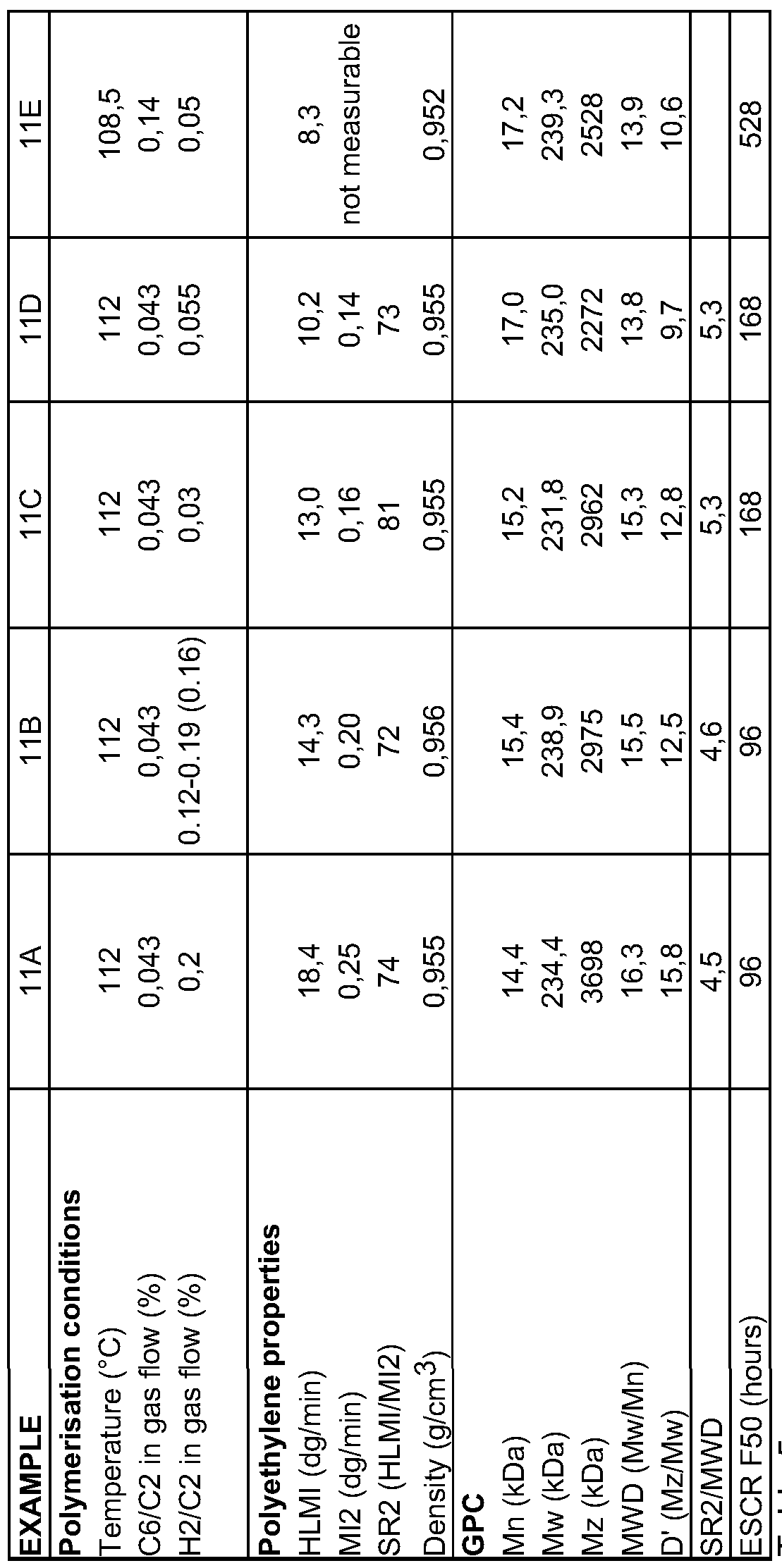
- Polymerisation was carried out at a temperature of from 108 to 112°C. Ethylene partial pressure was about 16 bars. Hydrogen H 2 (3 and 25 mol-%) was used to control the melt index of the final polyethylene. 1-hexene feed ratio of 0.038 to 0.500 wt-% was used.
- First generation HDPE resins are known for very easy processability but limited mechanical properties. Representative materials are for instance former Finathene® 5502 and 47100 grades or 5502 grade presently sold by TOTAL Petrochemicals. Second generation HDPE resins are known for improved mechanical properties (i.e. a better density/rigidity - ESCR compromise). Typical resins include e.g. HDPE materials sold under the names 53140, 53080 and 49080 (sold by TOTAL Petrochemicals), or sold under the names Stamylan (D8621 (SABIC) or Polimeri® BC86 (Polimeri Europa).
- Catalyst H was activated following the large scale activation procedure.
- the activated catalyst was used for the production of a medium density film grade polyethylene.
- the polymerisation conditions are presented in Table 7.
- Catalyst I was titanated according to the industrial scale titanation procedure.
- the target titanium content was set to a target ratio of surface area/titanium of 5942 m ⁇ /g Ti.
- the catalyst was activated at 620 0 C.
- the activated catalyst was used to polymerise ethylene on a large scale at conditions necessary to obtain a density of 0.954 g/cm3 and an HLMI of 20 dg/min.
- the conditions and results are provided in Table 8.
- the catalyst according to the invention provides a polyethylene with an environmental stress crack resistance almost 4 times as long the catalyst according to the prior art.
- Catalyst J was titanated according to the industrial scale titanation procedure.
- the target titanium content was set to a target ratio of surface area/titanium of 10200 m ⁇ /g Ti.
- the catalyst was activated at 675 0 C.
- the activated catalyst was used to polymerise ethylene on a large scale at conditions necessary to obtain a density of 0.936 g/cm3 and an HLMI of 15 dg/min.
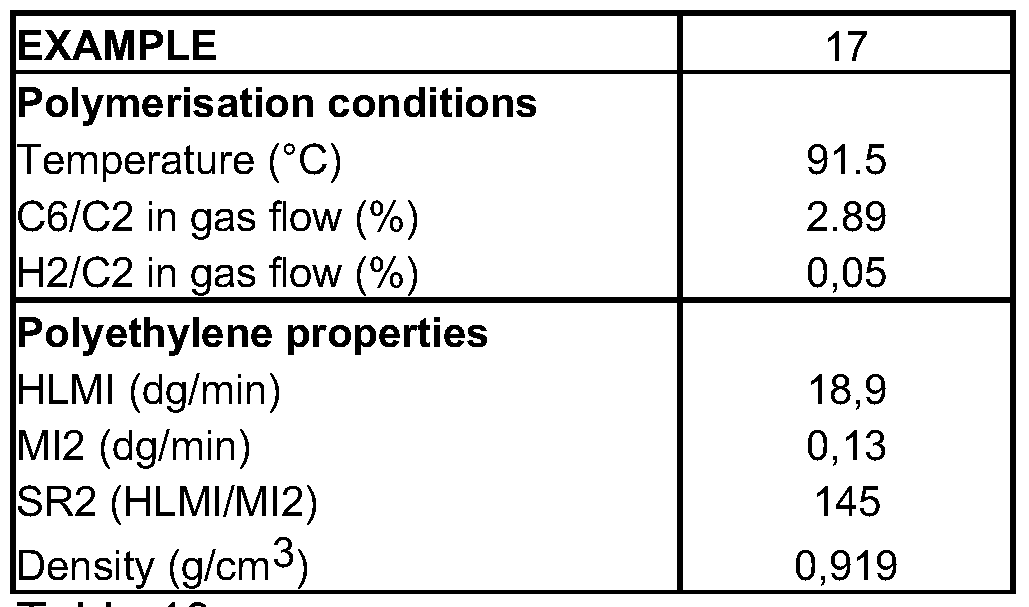
- the same activated catalyst J was used to polymerise ethylene on a large scale at conditions necessary to obtain a density of 0.928 g/crr ⁇ and an HLMI of 14 dg/min.
- the conditions and results are provided in Table 9.
Landscapes
- Chemical & Material Sciences (AREA)
- Health & Medical Sciences (AREA)
- Chemical Kinetics & Catalysis (AREA)
- Medicinal Chemistry (AREA)
- Polymers & Plastics (AREA)
- Organic Chemistry (AREA)
- Engineering & Computer Science (AREA)
- Materials Engineering (AREA)
- Transition And Organic Metals Composition Catalysts For Addition Polymerization (AREA)
- Addition Polymer Or Copolymer, Post-Treatments, Or Chemical Modifications (AREA)
- Catalysts (AREA)
- Polymerization Catalysts (AREA)
- Organic Low-Molecular-Weight Compounds And Preparation Thereof (AREA)
Abstract
Description




Claims
Priority Applications (7)
| Application Number | Priority Date | Filing Date | Title |
|---|---|---|---|
| CN200780013311XA CN101421314B (en) | 2006-04-13 | 2007-04-13 | Catalyst based on chrome |
| AT07728114T ATE491730T1 (en) | 2006-04-13 | 2007-04-13 | CHROME CATALYSTS |
| JP2009504762A JP5283129B2 (en) | 2006-04-13 | 2007-04-13 | Chromium-based catalyst |
| US12/296,977 US20100069585A1 (en) | 2006-04-13 | 2007-04-13 | Chromium-Based Catalysts |
| EA200802145A EA015825B1 (en) | 2006-04-13 | 2007-04-13 | Chromium-based catalysts |
| EP07728114.5A EP2004704B2 (en) | 2006-04-13 | 2007-04-13 | Chromium-based catalysts |
| DE602007011236T DE602007011236D1 (en) | 2006-04-13 | 2007-04-13 | CHROME CATALYSTS |
Applications Claiming Priority (2)
| Application Number | Priority Date | Filing Date | Title |
|---|---|---|---|
| EP06112660.3 | 2006-04-13 | ||
| EP06112660A EP1845110A1 (en) | 2006-04-13 | 2006-04-13 | Chromium-based catalysts |
Publications (1)
| Publication Number | Publication Date |
|---|---|
| WO2007118863A1 true WO2007118863A1 (en) | 2007-10-25 |
Family
ID=37022881
Family Applications (1)
| Application Number | Title | Priority Date | Filing Date |
|---|---|---|---|
| PCT/EP2007/053649 Ceased WO2007118863A1 (en) | 2006-04-13 | 2007-04-13 | Chromium-based catalysts |
Country Status (10)
| Country | Link |
|---|---|
| US (1) | US20100069585A1 (en) |
| EP (2) | EP1845110A1 (en) |
| JP (1) | JP5283129B2 (en) |
| KR (1) | KR20080112295A (en) |
| CN (2) | CN101421314B (en) |
| AT (1) | ATE491730T1 (en) |
| DE (1) | DE602007011236D1 (en) |
| EA (1) | EA015825B1 (en) |
| ES (1) | ES2355304T3 (en) |
| WO (1) | WO2007118863A1 (en) |
Cited By (2)
| Publication number | Priority date | Publication date | Assignee | Title |
|---|---|---|---|---|
| CN101608004B (en) * | 2008-06-19 | 2010-09-29 | 中国石油天然气股份有限公司 | Preparation method of linear low-density polyethylene |
| US20120238714A1 (en) * | 2009-11-10 | 2012-09-20 | Ineos Commercial Services Uk Limited | Process for the polymerisation of olefins |
Families Citing this family (40)
| Publication number | Priority date | Publication date | Assignee | Title |
|---|---|---|---|---|
| EA016790B1 (en) † | 2006-04-13 | 2012-07-30 | Тотал Петрокемикалс Рисерч Фелюй | Branched low and medium density polyethylene, a process for obtaining and use thereof |
| JP5153312B2 (en) * | 2007-12-19 | 2013-02-27 | 日本ポリエチレン株式会社 | Olefin polymerization catalyst and process for producing olefin polymer using the same |
| KR20130005270A (en) | 2010-01-28 | 2013-01-15 | 토탈 리서치 앤드 테크놀로지 펠루이 | Injection stretch blow moulding containers prepared with polyethylene |
| EP2351781A1 (en) | 2010-01-28 | 2011-08-03 | Total Petrochemicals Research Feluy | Injection stretch blow moulding containers prepared with polyethylene |
| EP2447290A1 (en) | 2010-11-01 | 2012-05-02 | Ineos Commercial Services UK Limited | Chromium catalysed ethylene copolymer powder |
| JP5358556B2 (en) * | 2010-12-24 | 2013-12-04 | 日本ポリエチレン株式会社 | Catalyst for ethylene polymerization and method for producing ethylene polymer using the same |
| EP2692746B1 (en) | 2011-03-30 | 2016-11-30 | Japan Polyethylene Corporation | Ethylene polymer, process for producing ethylene polymer, process for producing polymerization catalyst, and hollow plastic molding comprising ethylene polymer and use thereof |
| US8318883B1 (en) | 2011-06-08 | 2012-11-27 | Chevron Phillips Chemical Company Lp | Polymer compositions for blow molding applications |
| US9023967B2 (en) * | 2011-11-30 | 2015-05-05 | Chevron Phillips Chemical Company Lp | Long chain branched polymers and methods of making same |
| US9096699B2 (en) | 2011-12-02 | 2015-08-04 | Chevron Phillips Chemical Company Lp | Methods of preparing a catalyst |
| KR101483248B1 (en) | 2012-11-15 | 2015-01-16 | 주식회사 엘지화학 | Ligand compound, organic chromium compound, catalyst system for ethylene oligomerization, method for preparign the same, and method for ethylene oligomerization using the same |
| US8815357B1 (en) † | 2013-02-27 | 2014-08-26 | Chevron Phillips Chemical Company Lp | Polymer resins with improved processability and melt fracture characteristics |
| BR112015026892A2 (en) * | 2013-05-01 | 2017-07-25 | Dow Global Technologies Llc | low density ethylene based polymer compositions with good melt resistance and high density |
| JP6405366B2 (en) * | 2013-05-02 | 2018-10-17 | ダウ グローバル テクノロジーズ エルエルシー | Polyethylene composition and articles made therefrom |
| EP3013870B1 (en) * | 2013-06-24 | 2023-10-25 | Saudi Basic Industries Corporation | Process for making a blow molded article based on high density polyethylene prepared with titanated chromium-based catalysts |
| MY175467A (en) * | 2013-11-21 | 2020-06-29 | Univation Tech Llc | Method for controlling polyolefin properties during polymerisation |
| US10246528B2 (en) * | 2014-01-09 | 2019-04-02 | Chevron Phillips Chemical Company Lp | Chromium (III) catalyst systems with activator-supports |
| SG11201701436RA (en) | 2014-09-02 | 2017-03-30 | Univation Tech Llc | Polyolefin production with chromium-based catalysts |
| KR101830040B1 (en) | 2014-11-18 | 2018-02-19 | 바젤 폴리올레핀 게엠베하 | Polyethylene composition having high stress cracking resistance |
| CN107428863B (en) * | 2015-03-31 | 2020-03-06 | 日本聚乙烯株式会社 | Polyethylene for pipe and joint, and molded body thereof |
| US9587048B2 (en) | 2015-04-29 | 2017-03-07 | Chevron Phillips Chemical Company Lp | Methods of preparing a catalyst |
| JP6846354B2 (en) * | 2015-04-30 | 2021-03-24 | サビック グローバル テクノロジーズ ベスローテン フェンノートシャップ | High density polyethylene |
| CN104877052B (en) * | 2015-05-06 | 2018-04-13 | 无锡耀汇科技有限公司 | A kind of polyvinyl resin |
| US10213766B2 (en) | 2015-09-18 | 2019-02-26 | Chevron Phillips Chemical Company Lp | Methods of preparing a catalyst |
| WO2017121506A1 (en) * | 2016-01-12 | 2017-07-20 | Sabic Global Technologies B.V. | Foamed injection moulded article |
| US9988468B2 (en) * | 2016-09-30 | 2018-06-05 | Chevron Phillips Chemical Company Lp | Methods of preparing a catalyst |
| US10654953B2 (en) | 2016-12-29 | 2020-05-19 | Chevron Phillips Chemical Company Lp | Methods of preparing a catalyst |
| US20200369803A1 (en) | 2016-12-29 | 2020-11-26 | Chevron Phillips Chemical Company Lp | Methods of Preparing a Catalyst |
| US11267914B2 (en) | 2016-12-29 | 2022-03-08 | Chevron Phillips Chemical Company Lp | Methods of preparing a catalyst |
| US10287369B2 (en) | 2017-04-24 | 2019-05-14 | Chevron Phillips Chemical Company Lp | Methods of preparing a catalyst |
| ES2830427T3 (en) | 2017-09-22 | 2021-06-03 | Total Res & Technology Feluy | Procedure to improve the quality of non-homogeneous recycled polyethylene by mixing it with virgin polyethylene and an article made from these mixtures |
| US10513570B2 (en) | 2017-11-17 | 2019-12-24 | Chevron Phillips Chemical Company Lp | Methods of preparing a catalyst |
| US10323109B2 (en) | 2017-11-17 | 2019-06-18 | Chevron Phillips Chemical Company Lp | Methods of preparing a catalyst utilizing hydrated reagents |
| US10722874B2 (en) | 2018-04-16 | 2020-07-28 | Chevron Phillips Chemical Company Lp | Methods of preparing a catalyst utilizing hydrated reagents |
| US10543480B2 (en) | 2018-04-16 | 2020-01-28 | Chevron Phillips Chemical Company Lp | Methods of preparing a catalyst utilizing hydrated reagents |
| US11266976B2 (en) | 2018-04-16 | 2022-03-08 | Chevron Phillips Chemical Company Lp | Methods of preparing a catalyst with low HRVOC emissions |
| CN110862598B (en) * | 2019-11-26 | 2022-06-14 | 江苏上上电缆集团新材料有限公司 | 90-DEG C low-shrinkage ultraviolet-proof medium-density polyethylene sheath material and preparation method thereof |
| WO2025017117A1 (en) | 2023-07-18 | 2025-01-23 | Totalenergies Onetech | Process to produce food-contact multilayered hollow articles from recycled polyethylene resin and articles thereof |
| WO2025149673A1 (en) | 2024-01-11 | 2025-07-17 | Totalenergies Onetech | Pfas-free polymer composition |
| CN120349442B (en) * | 2025-06-25 | 2025-08-29 | 上海化工研究院有限公司 | High-activity chromium-based polyethylene catalyst and preparation method thereof |
Citations (3)
| Publication number | Priority date | Publication date | Assignee | Title |
|---|---|---|---|---|
| EP0882743A1 (en) * | 1997-06-06 | 1998-12-09 | Fina Research S.A. | Titanated chromium-based catalysts to produce polyethylene |
| EP0962469A1 (en) * | 1998-06-05 | 1999-12-08 | Fina Research S.A. | Titanated chromium catalyst supported on silica-aluminophosphate |
| WO2000035964A1 (en) * | 1998-12-17 | 2000-06-22 | Phillips Petroleum Company | Polymerization process |
Family Cites Families (10)
| Publication number | Priority date | Publication date | Assignee | Title |
|---|---|---|---|---|
| AR206852A1 (en) * | 1975-03-10 | 1976-08-23 | Union Carbide Corp | PROCEDURE FOR PREPARING LOW AND MEDIUM DENSITY ETHYLENE POLYMERS IN A FLUID BED REACTOR |
| US4011382A (en) † | 1975-03-10 | 1977-03-08 | Union Carbide Corporation | Preparation of low and medium density ethylene polymer in fluid bed reactor |
| GB1553674A (en) * | 1975-08-14 | 1979-09-26 | British Petroleum Co | Polymersation catalyst |
| US4284527A (en) * | 1978-06-19 | 1981-08-18 | Chemplex Company | Polymerization catalyst |
| JPH01311108A (en) * | 1988-04-12 | 1989-12-15 | Union Carbide Corp | Method for reducing swelling of α-olefins |
| EP0882740A1 (en) * | 1997-06-06 | 1998-12-09 | Fina Research S.A. | Titanated chromium-based catalysts to produce polyethylene exhibiting better environmental stress crack resistance |
| GB9800245D0 (en) * | 1998-01-07 | 1998-03-04 | Bp Chem Int Ltd | Novel polymers |
| ES2297048T3 (en) † | 2001-10-17 | 2008-05-01 | Ineos Europe Limited | OLEFIN COPOLYMERIZATION CONTROL PROCESS. |
| US20070027276A1 (en) † | 2005-07-27 | 2007-02-01 | Cann Kevin J | Blow molding polyethylene resins |
| EA016790B1 (en) * | 2006-04-13 | 2012-07-30 | Тотал Петрокемикалс Рисерч Фелюй | Branched low and medium density polyethylene, a process for obtaining and use thereof |
-
2006
- 2006-04-13 EP EP06112660A patent/EP1845110A1/en not_active Withdrawn
-
2007
- 2007-04-13 ES ES07728114T patent/ES2355304T3/en active Active
- 2007-04-13 CN CN200780013311XA patent/CN101421314B/en not_active Expired - Fee Related
- 2007-04-13 EA EA200802145A patent/EA015825B1/en not_active IP Right Cessation
- 2007-04-13 AT AT07728114T patent/ATE491730T1/en active
- 2007-04-13 DE DE602007011236T patent/DE602007011236D1/en active Active
- 2007-04-13 US US12/296,977 patent/US20100069585A1/en not_active Abandoned
- 2007-04-13 JP JP2009504762A patent/JP5283129B2/en not_active Expired - Fee Related
- 2007-04-13 KR KR1020087025005A patent/KR20080112295A/en not_active Ceased
- 2007-04-13 WO PCT/EP2007/053649 patent/WO2007118863A1/en not_active Ceased
- 2007-04-13 EP EP07728114.5A patent/EP2004704B2/en not_active Not-in-force
- 2007-04-13 CN CN2007800133618A patent/CN101421315B/en not_active Expired - Fee Related
Patent Citations (3)
| Publication number | Priority date | Publication date | Assignee | Title |
|---|---|---|---|---|
| EP0882743A1 (en) * | 1997-06-06 | 1998-12-09 | Fina Research S.A. | Titanated chromium-based catalysts to produce polyethylene |
| EP0962469A1 (en) * | 1998-06-05 | 1999-12-08 | Fina Research S.A. | Titanated chromium catalyst supported on silica-aluminophosphate |
| WO2000035964A1 (en) * | 1998-12-17 | 2000-06-22 | Phillips Petroleum Company | Polymerization process |
Cited By (3)
| Publication number | Priority date | Publication date | Assignee | Title |
|---|---|---|---|---|
| CN101608004B (en) * | 2008-06-19 | 2010-09-29 | 中国石油天然气股份有限公司 | Preparation method of linear low-density polyethylene |
| US20120238714A1 (en) * | 2009-11-10 | 2012-09-20 | Ineos Commercial Services Uk Limited | Process for the polymerisation of olefins |
| US10358514B2 (en) | 2009-11-10 | 2019-07-23 | Ineos Sales (Uk) Limited | Process for the polymerisation of olefins |
Also Published As
| Publication number | Publication date |
|---|---|
| EP2004704B1 (en) | 2010-12-15 |
| EP1845110A1 (en) | 2007-10-17 |
| JP2009533511A (en) | 2009-09-17 |
| CN101421315B (en) | 2012-07-04 |
| KR20080112295A (en) | 2008-12-24 |
| CN101421315A (en) | 2009-04-29 |
| ES2355304T3 (en) | 2011-03-24 |
| ATE491730T1 (en) | 2011-01-15 |
| EP2004704B2 (en) | 2019-02-27 |
| EP2004704A1 (en) | 2008-12-24 |
| CN101421314B (en) | 2011-09-28 |
| EA200802145A1 (en) | 2009-04-28 |
| DE602007011236D1 (en) | 2011-01-27 |
| JP5283129B2 (en) | 2013-09-04 |
| US20100069585A1 (en) | 2010-03-18 |
| EA015825B1 (en) | 2011-12-30 |
| CN101421314A (en) | 2009-04-29 |
Similar Documents
| Publication | Publication Date | Title |
|---|---|---|
| EP2004704B2 (en) | Chromium-based catalysts | |
| US6489428B1 (en) | Titanated chromium-based catalysts to produce polyethylene | |
| EP2635613B1 (en) | Chromium catalysed ethylene copolymer powder | |
| EP0882743B1 (en) | Titanated chromium-based catalysts to produce polyethylene | |
| EP2463315B1 (en) | Process for preparing a multimodal polyolefin employing a Ziegler-Natta catalyst | |
| US9975974B2 (en) | Methods for making catalyst compositions and polymer products produced therefrom | |
| EP3041888B1 (en) | Polyethylenes with increased molecular weight distribution | |
| WO2007118866A1 (en) | Branched low and medium density polyethylene | |
| CA2909935A1 (en) | A polyethylene composition and articles made therefrom | |
| EP2635612B1 (en) | Process for the activation of a supported chromium oxide based catalyst | |
| EP2588506B1 (en) | Self limiting catalyst composition for ethylene polymerization | |
| US10358514B2 (en) | Process for the polymerisation of olefins | |
| MXPA06012155A (en) | Catalyst systems for producing polymers having broad molecular weight distributions and methods of making the same. | |
| EP2322564A1 (en) | Process for the polymerisation of olefins | |
| Pullukat et al. | Porous silica in transition metal polymerization catalysts | |
| EP2322567A1 (en) | Process for the polymerisation of olefins | |
| EP0882741A1 (en) | Production of polyethylene | |
| US20030054944A1 (en) | Catalyst for polyethylene giving an improved short chain branching distribution |
Legal Events
| Date | Code | Title | Description |
|---|---|---|---|
| 121 | Ep: the epo has been informed by wipo that ep was designated in this application |
Ref document number: 07728114 Country of ref document: EP Kind code of ref document: A1 |
|
| WWE | Wipo information: entry into national phase |
Ref document number: 200780013311.X Country of ref document: CN Ref document number: 1020087025005 Country of ref document: KR |
|
| NENP | Non-entry into the national phase |
Ref country code: DE |
|
| WWE | Wipo information: entry into national phase |
Ref document number: 2009504762 Country of ref document: JP Ref document number: 2007728114 Country of ref document: EP |
|
| WWE | Wipo information: entry into national phase |
Ref document number: 4597/KOLNP/2008 Country of ref document: IN |
|
| WWE | Wipo information: entry into national phase |
Ref document number: 200802145 Country of ref document: EA |
|
| WWE | Wipo information: entry into national phase |
Ref document number: 12296977 Country of ref document: US |