WO2007119585A1 - 3,3,3-トリフルオロプロピオン酸クロリドの製造方法 - Google Patents

3,3,3-トリフルオロプロピオン酸クロリドの製造方法 Download PDF

Info

Publication number
WO2007119585A1
WO2007119585A1 PCT/JP2007/056824 JP2007056824W WO2007119585A1 WO 2007119585 A1 WO2007119585 A1 WO 2007119585A1 JP 2007056824 W JP2007056824 W JP 2007056824W WO 2007119585 A1 WO2007119585 A1 WO 2007119585A1
Authority
WO
WIPO (PCT)
Prior art keywords
formula
represented
acid chloride
chloride
trifluoropropionic acid
Prior art date
Legal status (The legal status is an assumption and is not a legal conclusion. Google has not performed a legal analysis and makes no representation as to the accuracy of the status listed.)
Ceased
Application number
PCT/JP2007/056824
Other languages
English (en)
French (fr)
Inventor
Takeo Komata
Kenji Hosoi
Shinya Akiba
Current Assignee (The listed assignees may be inaccurate. Google has not performed a legal analysis and makes no representation or warranty as to the accuracy of the list.)
Central Glass Co Ltd
Original Assignee
Central Glass Co Ltd
Priority date (The priority date is an assumption and is not a legal conclusion. Google has not performed a legal analysis and makes no representation as to the accuracy of the date listed.)
Filing date
Publication date
Application filed by Central Glass Co Ltd filed Critical Central Glass Co Ltd
Priority to EP07740262.6A priority Critical patent/EP2006274B1/en
Priority to CN200780013322.8A priority patent/CN101421221B/zh
Priority to US12/296,838 priority patent/US7754927B2/en
Publication of WO2007119585A1 publication Critical patent/WO2007119585A1/ja
Anticipated expiration legal-status Critical
Ceased legal-status Critical Current

Links

Classifications

    • CCHEMISTRY; METALLURGY
    • C07ORGANIC CHEMISTRY
    • C07CACYCLIC OR CARBOCYCLIC COMPOUNDS
    • C07C51/00Preparation of carboxylic acids or their salts, halides or anhydrides
    • C07C51/58Preparation of carboxylic acid halides
    • C07C51/60Preparation of carboxylic acid halides by conversion of carboxylic acids or their anhydrides or esters, lactones, salts into halides with the same carboxylic acid part

Definitions

  • the present invention relates to the production of 3,3,3-trifluoropropionic acid chloride useful as an intermediate for pharmaceuticals' agricultural chemicals and as a raw material for producing functional materials such as fluoropolymers or as a synthetic intermediate. Regarding the method.
  • 3-Trifluoropropionic acid chloride is an extremely important compound as an intermediate for pharmaceuticals' agricultural chemicals and as a raw material for producing functional materials such as fluorine-containing polymers or as a synthetic intermediate. Conventionally, the following production methods have been reported.
  • Non-patent document 1 describes CF as a method for producing 3, 3, 3-trifluoropropionic acid chloride.
  • (CH) C1 is converted into a Grignard compound and then oxidized to obtain CF (CH) OH, which is converted to chromium.
  • Non-Patent Document 2 describes a method of obtaining 3, 3, 3-trifluoropropionic acid chloride by chlorinating 3,3,3-trifluoropropionic acid with a lid-mouthed-oil lid. Yes.
  • Non-patent literature 3-6 compounds that do not have hydrogen at the ⁇ -position of the carbon carbon (here, the ⁇ -position refers to the carbon moiety next to the carbonyl carbon), such as aromatic aldehydes, are chlorinated with chlorine, It is known to give the corresponding carboxylic acid chloride (Non-patent Document 7).
  • Non-Patent Document 1 Journal of the American Chemical Society, 77, 1901-1902, 1955
  • Non-patent document 2 Journal of Fluorine Chemistry, 86, 99-104, 1997
  • Non-patent document 3 Journal of the Chemical Society of Japan, 77-59, 594-594, 1956
  • Non-Patent Document 4 Journal of Chemical Society of Japan, 79th, 487-490, 1958
  • Non-Patent Document 5 Tetrahedron Letters, No. 20, pages 3809 to 3810, 1979
  • Non-Patent Document 6 Tetrahedron Letters, No. 31, pages 7237 to 7240, 1990
  • Non-Patent Document 7 Organic Syntheses, Coll. Vol. 1, 155, 1941
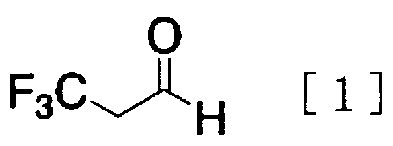
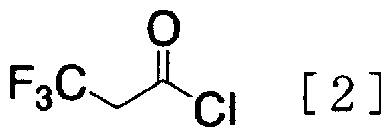
  • F 3 C ⁇ A U [1] from the group consisting only of chlorine (C1), sulfuryl chloride (SO C1) and organic N-black mouth compounds.
  • the aldehyde compound having no fluorine atom and having a hydrogen atom at the ⁇ -position carbon site is chlorinated by reacting with a chlorinating agent.
  • the technology for producing carboxylic acid chlorides has not been known. For example, when propionaldehyde reacts with chlorine or sulfuryl chloride, the corresponding propionic acid chloride is not obtained at all, and a product in which the carbon position at the ⁇ -position is chlorinated and many other products are obtained (reference) (See Example 1-5).
  • the 3, 3, 3-trifluoropropionaldehyde represented by the formula [1], which is the raw material of the present invention, has a trifluoromethyl group (CF group) at the ⁇ -position carbon atom. To do. This trifle
  • Non-patent Documents 3-7 examples of bromination of hydrocarbon-based aldehydes that do not contain fluorine atoms and chlorination of aromatic aldehydes that do not contain fluorine atoms have been known (Non-patent Documents 3-7). As in this process, an example in which a hydrocarbon-based aldehyde having a fluorine atom efficiently reacts with the above-described chlorinating agent has not been known so far.
  • the present inventors combined 3,3,3-trifluoropropion represented by the formula [2] while combining "radical initiator” and "low polarity solvent” together with the chlorinating agent described above.
  • the compounds represented by the above formulas [4] to [6] can be dramatically suppressed, and the target 3 can be obtained with higher selectivity.
  • 3, 3-Trifluoropropionic acid chloride was also obtained (see Examples 6 and 16).
  • the chlorinating agent is radical-initiated by bringing the chlorinating agent into a larger amount in the reaction system (for example, at the start of the reaction).
  • chlorine radicals (Cl,) which are reactive species, are generated.
  • 3, 3, 3-trifluoropropionaldehyde represented by the formula [1] reacts with chlorine radicals to obtain the target product with high selectivity.
  • the above-described chlorinating agent is used, the conditions for appropriately combining a radical initiator and a low-polarity solvent, and 3, 3, 3-trifluoro represented by the formula [1]
  • 3, 3, 3-trifluoropropionic acid chloride represented by the formula [2] By changing the order of addition of chloropropionaldehyde and chlorinating agent into the reaction system, it is possible to obtain 3, 3, 3-trifluoropropionic acid chloride represented by the formula [2] by following the ⁇ ⁇ conditions. It can be produced with a high selectivity and is an excellent method for producing on an industrial scale.
  • the present invention relates to 3, 3, 3-trifluoropropionaldehyde represented by the formula [1], which is composed of only chlorine (C1), sulfuryl chloride (SO C1), and an organic N-black mouth compound. Power selection
  • the present invention provides a method for producing 3, 3, 3-trifluoropropionic acid chloride represented by the formula [2], including chlorination with a chlorinated glaze agent.
  • the obtained 3, 3, 3-trifluoropropionic acid chloride represented by the formula [2] is hydrolyzed 3, 3, 3 -trifluoro represented by the formula [3]
  • a method for producing propionic acid is also provided.
  • FIG. 1 compares the selectivity of the obtained product in Examples 1-6.
  • FIG. 2 compares the selectivity of the obtained product in Examples 7-16.
  • FIG. 3 is a comparison of the selectivity of the obtained product in Reference Example 15
  • 3,3,3-trifluoropropionic acid chloride useful as an intermediate for pharmaceuticals' agricultural chemicals, as a raw material for producing functional materials such as fluoropolymers, or as a synthetic intermediate.
  • Lido can be produced from 3,3,3-trifluoropropionaldehyde at low cost, simply and efficiently on an industrial scale.
  • a radical initiator and a low-polarity solvent are used in appropriate combination, there is an effect that it can be produced with higher selectivity.
  • the process for producing 3, 3, 3 trifluoropropionic acid chloride represented by 2] is also called the first process
  • the 3, 3, 3 trifluoropropion aldehyde represented by the formula [1] which is a starting material of this step can be produced by a conventionally known method.
  • Chlorine, a sulfuryl chloride, and an organic nitrogen compound are used as the chlorinant used in this step.
  • An organic N-clog compound is N-chlorosuccinimide.
  • Trichloroisocyanuric acid dichlorodimethylhydantoin. These are all useful as chlorinated agents. Among these, chlorine, sulfuryl chloride, and trichloro-isocyanuric acid are particularly preferably used.
  • the amount of chlorinating agent used is 3, 3, 3 trifluoropropionaldehyde represented by the formula [1]
  • the amount is usually 0.8 mol to 3 mol, preferably 0.9 mol to 2.5 mol, and more preferably 1 mol to 2 mol with respect to 1 mol.
  • the reaction temperature is usually about 0 ° C to 150 ° C, preferably 15 to 100 ° C, more preferably 30 to 70 ° C. If the reaction temperature is lower than 0 ° C, the reaction will be slow.
  • a gas state or a solid state can be appropriately selected by those skilled in the art without particular limitation.
  • the method of chlorination is not particularly limited, and the chlorination method can be carried out by a flow system, batch system or semi-batch system.
  • reaction pressure is not particularly limited, but the reaction can be carried out at normal pressure (atmospheric pressure) or under pressure.
  • the chlorinating agent when the chlorinating agent is a gas, the chlorinating agent is introduced at atmospheric pressure (atmospheric pressure) with one of the reactors open, or a pressure-resistant reaction vessel is used and the vessel is sealed. The reaction can also be carried out under pressure conditions. However, at normal pressure (atmospheric pressure), one of the reactors is opened and the salt is It is preferable to introduce an elementalizing agent because chlorination proceeds sufficiently even under mild conditions.
  • the chlorinating agent is a gas
  • a conventional means for increasing the contact efficiency for example, a method of adjusting the gas introduction speed, a stirring device, a gas blowing device, a sparger (porous dispersion tube) or the like is used as appropriate. It is effective to use.
  • the reactor used in this step is not particularly limited in material as long as it can withstand the pressure when the reaction is performed at normal pressure or under pressure, and the tetrafluorinated styrene resin, the black trifluoroethylene resin, A reactor or glass container lined with vinylidene fluoride resin, PFA resin, glass, or the like can be used.
  • a reaction vessel with stainless steel, iron, etc. as the inner wall the reaction itself proceeds, but it is preferable to use the aforementioned reaction vessel because the metal may cause corrosion by the chlorinating agent. .
  • a radical initiator can coexist in order to further improve the selectivity of the chlorination reaction with respect to carbocarbon.
  • organic peroxides, azo radical initiators, and light can be suitably used.
  • organic peroxides examples include benzoyl peroxide (benzoyl peroxide, abbreviated as "BPO"), ketone peroxide, peroxyketal, hyde-peroxide, dialkyl peroxide, diacyl.
  • BPO benzoyl peroxide
  • ketone peroxide peroxyketal
  • hyde-peroxide dialkyl peroxide
  • diacyl diacyl.
  • peroxides peroxyesters, and peroxydicarbonates.
  • azo radical initiators examples include 2,2'-azobis (2-methylpropio-tolyl) (azobisisobuty-tolyl, abbreviated as "AIBN"), 2, 2, monoazobis (4-methoxy). 1,2,4dimethylvale-tolyl), 2,2'-azobis (2,4 dimethylvale-tolyl), dimethyl 2,2, -azobis (2-methylpropionate), 2,2, -azobis ( 2-Methylbuty-tolyl), 2, 2, -azobis (2- (2-imidazoline 2-yl) propane) dihydrochloride, 2, 2, Examples thereof include zobis (2- (2-imidazoline-2-yl) propane) disulfate and 2,2, -azobis (2-methylpropionamidine) dihydrochloride.
  • AIBN azobisisobuty-tolyl
  • the light source is at least one selected from the group consisting of a high-pressure mercury lamp, a low-pressure mercury lamp, a halogen lamp, a UV lamp, a tungsten lamp, and a light-emitting diode.
  • a high-pressure mercury lamp a low-pressure mercury lamp
  • a halogen lamp a UV lamp
  • a tungsten lamp a tungsten lamp
  • a light-emitting diode is preferred.
  • the amount of the radical initiator, 3 represented by the formula [1], 3, 3 triflumizole Ruo Ropuro propionaldehyde 1 usually 0.01 to 20 mol per mol 0 / 0 , preferably 0.1 to 10 mol%, more preferably 0.5 to 5 mol%.
  • the radical initiator can be added as appropriate by observing the progress of the reaction. If the amount of the radical initiator is less than 0.01 mol% with respect to 1 mol of the raw material, the reaction may be stopped in the middle or the yield may be reduced. Absent. Further, a radical initiator can be added during the reaction, if necessary.
  • the reaction in the present invention may be performed without solvent! It is also possible to use a solvent. Specifically, the power of 3, 3, 3 trifluoropropionaldehyde represented by the formula [1] is used to further improve the selectivity of the chlorination reaction with respect to ruponyl carbon.
  • a solvent within the range is preferably used as the “low polarity solvent”. Among low-polarity solvents, organic solvents having a relative dielectric constant in the range of 1.0 to 12.0 are preferred, and organic solvents having a relative dielectric constant in the range of 1.8 to 10.0 are particularly used. preferable.
  • Low polar solvents having a relative dielectric constant of 15.0 or less include benzene (2.27), toluene (2.38), ethylbenzene (2.40), mesitylene (2.27). , 1,4 Dioxane (2.21), o-Xylene (2.57), m-xylene (2.37), p-xylene (2.27), pentyl etherol (2.77), naphthalene (2.54) , P Dichroic benzene (2.41), m-Dichroic benzene (5.04), o Dichlorobenzene (9.93), 2, 4 Dichlorobenzotrifluoride (2.0 to 15.0), 2,5 dichlorobenzoyl fluoride (2.0-15.0), 2,2 dimethylpropane (1.80), 2-methylbutane (1.83), n-pentane (1.84), 2,2 dimethyl Butane (1.87), n-hexane (1.88), 2-methylpent
  • p-dichlorobenzene p-dichlorobenzene, m-dichlorobenzene, o-dichlorobenzene, 2,4-dichlorobenzotrifluoride, 2,5-dichlorobenzotrifluoride, and carbon tetrachloride are preferred.
  • p-dichlorobenzene and 2,4-dichlorobenzotrifluoride are extremely stable as a compound, so they are difficult to be chlorinated. It is particularly preferably used because it can be easily removed from the represented 3, 3, 3-trifluoropropionic acid chloride.
  • a solvent having a relative dielectric constant exceeding 15.0 (referred to herein as a "polar solvent"), such as acetonitrile (37.5), ⁇ , ⁇ -dimethylformamide (DMF) (36.7) Although this reaction proceeds even with aprotic polar solvents such as dimethyl sulfoxide (DMSO) (46.7) and hexamethylphosphoric triamide ( ⁇ ) (30.0) (see Examples 7 and 8), By using a polar solvent, the selectivity can be further improved (the relative dielectric constant in parentheses).
  • a polar solvent such as acetonitrile (37.5), ⁇ , ⁇ -dimethylformamide (DMF) (36.7
  • aprotic polar solvents such as dimethyl sulfoxide (DMSO) (46.7) and hexamethylphosphoric triamide ( ⁇ ) (30.0)
  • the amount of the solvent used, 3, 3 of the formula [1], and against the 3-triflate Ruo Ropuro propionaldehyde usually 40 to: looo a weight 0/0, preferably from 60 to 700 weight 0/0, more preferably 8 0 to 400 wt.%.
  • the solvent may be used alone, or two or more solvents may be used as a mixed solvent. If a mixed solvent is used, even if a solvent with a relative dielectric constant of more than 15.0 is included as a part of the component, if the relative dielectric constant of the entire “mixed solvent” is 15.0 or less It can be preferably used. However, it is most convenient to use a solvent that satisfies the above conditions alone.
  • the target product when an organic N-clog compound is reacted as a chlorinating agent, the target product can be obtained using a solvent other than a low polarity solvent (Example 17), but a low polarity solvent can be used.
  • a solvent other than a low polarity solvent Example 17
  • a low polarity solvent can be used.
  • the target 3, 3, 3 trifluoropropionic acid chloride represented by the formula [2] can be obtained with higher selectivity (see Example 18).
  • the reaction form in this step is not particularly limited, but the present inventors have changed 3, 3, 3 trifluoropropionaldehyde represented by the formula [1] as a raw material to chlorine, sulfur chloride. Furyl, organic N Chlorophilic compound power Chlorinated fluorinating agent and formula [1] used to obtain 3, 3, 3 trifluoropropionic acid chloride represented by formula [2] by chlorination with selected chlorinating agent
  • 3 3 trifluoropropionic acid chloride represented by formula [2] by chlorination with selected chlorinating agent
  • the desired product can also be obtained by sequentially or continuously supplying the chlorinating agent, but here, in the reaction, particularly in the initial stage of the reaction, the above-mentioned chlorine salt is obtained.
  • 3-trifluoropropionaldehyde represented by the formula [1] the agent is present in the reaction system, that is, after the chlorinating agent is first introduced, the formula [1] 1], 3, 3, 3--Trifluoropropionaldehyde can be continuously or sequentially calcined, while the chlorinating agent is first introduced into the reactor, and the formula [1] As shown in Scheme 1, the 3, 3, 3-trifluoropropionaldehyde is continuously or sequentially added, and as shown in Scheme 1, the formula [4] to [6] ] Can be drastically reduced.
  • Example 6 For example, in Example 6,! /, 2,2,2′-azobis (2-methylpropio-tolyl) was charged, and then chlorine was first introduced and then represented by the formula [1] 3, 3, 3—The power to add trifluoropropionaldehyde, in Example 8 and Example 16, after charging 2, 2, 1-azobis (2-methylpropio-tolyl), 3, 3, 3 -Trifluoropropionaldehyde and sulfuryl chloride are simultaneously added dropwise, and are particularly preferred in the present invention and are one of the embodiments.
  • reaction time it is preferable to confirm the progress of the reaction by gas chromatography or the like, which is not particularly limited, and to terminate the reaction step after confirming that the reaction has approached the end point.
  • the treatment after the reaction is not particularly limited, and the treatment of the reaction product after completion of the reaction may be performed based on a usual organic synthesis treatment method.
  • a usual organic synthesis treatment method By subjecting the reaction solution to usual means such as distillation, 3, 3, 3-trifluoropropionic acid chloride represented by the formula [2] can be obtained.
  • the target product of the second step described later is represented by the formula [3].
  • the 3,3,3-trifluoropropionic acid shown may be produced, but it can be used as a raw material for the second step described later.
  • 3, 3, 3-trifluoropropionic acid represented by the formula [3] or the formula [4] to [4] to after the reaction solution is subjected to usual means such as distillation.
  • the compound represented by the formula [6] may remain (see Example 6 and Examples 16-18), a mixture containing them can be used as a starting material in the second step described later ( See Examples 19-21).
  • the amount of water used in this step is not particularly limited as long as it is 1 mol or more with respect to 1 mol of 3, 3, 3-trifluoropropionic acid chloride represented by the formula [2] as a substrate. However, it is preferably 1-1000 mol, more preferably 1-: LOO mol. Although it may be used more than that, it is not preferable because the yield per volume in the reactor is reduced.
  • the reaction temperature is usually from -30 ° C to + 150 ° C, preferably from -10 ° C to + 120 ° C, more preferably from 0 ° C to + 100 ° C.
  • the reaction temperature is lower than 30 ° C, the reaction is slow.
  • 3, 3, 3-trifluoropropionic acid chloride represented by formula [2] is gradually added while the reaction proceeds. This is also not preferable because 3,3,3-trifluoropropionic acid represented by the formula [3], which is the target product, and water used for hydrolysis are vaporized.
  • hydrolysis may be performed in the presence of an acid.
  • an acid is not particularly limited as long as it is a Bronsted acid, but hydrochloric acid, sulfuric acid, nitric acid Inorganic acids such as phosphoric acid, silicic acid, hydrobromic acid, boric acid, formic acid, acetic acid, propionic acid, butyric acid, valeric acid, pivalic acid, oxalic acid, succinic acid, adipic acid, crotonic acid, methanesulfonic acid, An organic acid such as rifluoromethanesulfonic acid can be exemplified.
  • the amount used varies depending on the valence of the acid used.
  • the usage-amount of an acid is 1 mol or more, Preferably, it is 1-5 mol.
  • the amount of the acid used is 0.5 mol or more with respect to 1 mol of 3, 3, 3 trifluoropropionic acid chloride represented by the formula [2], preferably Is 0.5 to 2.5 moles.
  • the acid concentration is not particularly limited, but is preferably 10% to 90%.
  • the amount of water used in the hydrolysis in the presence of an acid is 1 mol per 1 mol of 3, 3, 3 trifluoropropionic acid chloride represented by the formula [2] as a substrate.
  • the above is not particularly limited, but is preferably 1 to: L000 mol, and more preferably 1 to: L00 mol.
  • the water may be used.
  • the treatment after the reaction is not particularly limited! However, the reaction solution is brought into contact with an organic solvent, the target product is extracted into an organic phase, and then subjected to usual means such as distillation to obtain the formula [3 3, 3, 3-trifluoropropionic acid represented by the following formula can be obtained.
  • a formula other than the 3, 3, 3 trifluoropropionic acid chloride represented by the formula [2] obtained in the first step may be generated.
  • 3,3,3-trifluoropropionic acid represented by [3] or a compound represented by formula [4] to [6] as a starting material in this step (
  • 3, 3, 3-trifluoropropionic acid represented by the formula [3] which is the target product compounds represented by the formula [4] to the formula [6]
  • a product obtained by hydrolyzing a part of the compound represented by the formula [4] to the formula [6] may be obtained.
  • a glass 50 ml three-necked flask equipped with a magnetic stirrer, flow meter, thermometer, condenser, and chlorine exclusion equipment was charged with 3, 3, 3-trifluoropropionaldehyde 100 g (0.892 mol), and stirred. Heated to 50 ° C. To this, chlorine (2.18 mol) was introduced for 4 hours at around 50 ° C and at a flow rate of 200 mlZmin. Thereafter, the reaction solution was measured by gas chromatography.
  • the raw material was 3, 3, 3-trifluoropionaldehyde 9.0%, 3, 3, 3 trifluoropropionic acid chloride 51.2%, 3, 3, 3 Trifluoropropionic acid 0.8%, 3, 3, 3 Trifluoro-2 black mouth propionate 23.4%, 3, 3, 3 Trifunole low 2, 2 Dict mouth propionate nanorede 3. 6%, 3, 3, 3-trifluoro-2-chloropropionic acid chloride 11.5%, other impurities 0.5%.
  • the raw material 3 3, 3- Rifluoropropionaldehyde 26.0%, 3, 3, 3—trifluoropropionic acid chloride 5 8.2%, 3, 3, 3—trifluoropropionic acid 0.3%, 3, 3, 3—trifluoro-2-chloro mouth Propionaldehyde was 3.0% and other impurities were 12.5%.
  • a glass 50m 1-necked flask equipped with a magnetic stirrer, dropping funnel, thermometer and condenser (open system) was charged with 5.0 g (0.0446 mol) of 3, 3, 3-trifnore and ropropi. Caro heated to 50 ° C. To this, 9.0 g (0.0670 mol) of salty sulfuryl was added dropwise over 5 minutes. Subsequently, the mixture was heated and stirred at around 50 ° C for 4 hours, and the reaction mixture was measured by gas chromatography.
  • the raw material 3 3, 3-trifluoropropionaldehyde 13.0%, 3, 3, 3--trifluoropropionic acid chloride 79.3%, 3, 3, 3 —Trifluoro-2-chloropropionaldehyde 3.1%, 3,3,3-trifluoro-2-chloropropionic acid chloride 0.7%, and other impurities 3.9%.
  • the raw material 3, 3, 3-trifluoropropionaldehyde 6.0%, 3, 3, 3-trifluoropropionic acid chloride 83.8% 3, 3, 3-trifluoropropionic acid 1.9%, 3, 3, 3-trifluoro 2-cyclopropionaldehyde 2.8% 3, 3, 3-trifluoro-1,2-dichloropropionaldehyde 0.2%, 3, 3,3-Trifluoro-2-chloropropionic acid chloride 1.2% and other impurities 4.1%.
  • a glass 50-m 1-neck flask equipped with a magnetic stirrer, dropping funnel, thermometer, and condenser (open system) was charged with 4.5 g (0.0193 mol) of triclo-necked isocyanuric acid and 10 g of acetonitrile with stirring at 50 ° Heated to C. Then, 5.0 g (0.0446 mol) of 3,3,3-trifluoropropionaldehyde was added dropwise over 5 minutes. Thereafter, the mixture was heated and stirred at around 50 ° C for 4 hours, and the reaction mixture was measured by gas chromatography.
  • Example 2 The procedure and conditions were the same as in Example 1, except that propionaldehyde was used instead of 3, 3, 3-trifluoropropionaldehyde.
  • the reaction solution was measured by gas chromatography, and it was found that 2-chloropropionaldehyde 3.5%, 2,2-dichloropropionaldehyde 0.1%, 2-chloropropionic chloride 0.1%, propionic acid 0.3%, other 96.0 %, And the desired product, propionic acid chloride, was not obtained at all.
  • Example 10 The procedure and conditions were the same as in Example 10, except that propionaldehyde was used in place of 3, 3, 3-trifluoropropionaldehyde.
  • the reaction mixture was measured by gas chromatography. As a result, it was found that the amount of propionic acid chloride was 87.6%, 2,2 diclonal propionaldehyde 4.1%, and other 8.3%, and no propionic acid chloride was obtained. .
  • reaction solution obtained was distilled at atmospheric pressure (boiling point: 136 ° C) to obtain the desired 3, 3, 3 trifluoropropionic acid (yield 18.7 g, yield). Yield 84.5%, purity 99.9%).

Landscapes

  • Chemical & Material Sciences (AREA)
  • Organic Chemistry (AREA)
  • Engineering & Computer Science (AREA)
  • Oil, Petroleum & Natural Gas (AREA)
  • Organic Low-Molecular-Weight Compounds And Preparation Thereof (AREA)

Abstract

 3,3,3-トリフルオロプロピオンアルデヒドを塩素(Cl2)、塩化スルフリル(SO2Cl2)、有機N-クロロ化合物のみから成る群から選ばれる塩素化剤により塩素化することを特徴とする、3,3,3-トリフルオロプロピオン酸クロリドの製造方法が提供される。

Description

明 細 書
3, 3, 3_トリフルォロプロピオン酸クロリドの製造方法
技術分野
[0001] 本発明は、医薬'農薬の中間体として、また含フッ素重合体等の機能性材料の製 造原料または合成中間体として有用な 3, 3, 3—トリフルォロプロピオン酸クロリドの 製造方法に関する。
発明の背景
[0002] 3, 3, 3—トリフルォロプロピオン酸クロリドは、医薬'農薬の中間体として、また含フ ッ素重合体等の機能性材料の製造原料または合成中間体として極めて重要な化合 物であり、従来、以下に示す製造方法が報告されている。
[0003] 一般にカルボン酸クロリドを製造する方法として、相当するカルボン酸を塩ィ匕チォ- ル、ォキシ塩化リン、五塩化リン等の塩素化剤により、カルボン酸クロリドとする方法が 知られている。
[0004] 3, 3, 3—トリフルォロプロピオン酸クロリドの製造法としては、非特許文献 1には CF
(CH ) C1をグリニャール化合物とした後、酸化して CF (CH ) OHを得、これをクロム
3 2 2 3 2 2
酸で酸化し、 3, 3, 3—トリフルォロプロピオン酸とした後、五塩化リンで塩素化して 3 , 3, 3—トリフルォロプロピオン酸クロリドを得る方法が記載されている。
[0005] 非特許文献 2には 3, 3, 3—トリフルォロプロピオン酸をフタ口イルク口リドで塩素化 し、 3, 3, 3—トリフルォロプロピオン酸クロリドを得る方法が記載されている。
[0006] また、フッ素原子を含まな!/、芳香族アルデヒドや、炭化水素系アルデヒドは、 N-ブ 口モスクシンイミドの様な N-ブロモ化合物により、カルボン酸ブロミドとする方法が知ら れている(非特許文献 3— 6)。中でも、芳香族アルデヒドの様に、カルボ-ル炭素の α位 (ここでいう α位とは、カルボニル炭素の隣の炭素部位を指す)に水素を持たな い化合物は、塩素により塩素化され、相当するカルボン酸クロリドを与えることが知ら れている (非特許文献 7)。
非特許文献 1 : Journal of the American Chemical Societyゝ第 77卷、 1901頁〜 1902 頁、 1955年 非特許文献 2 : Journal of Fluorine Chemistry,第 86卷、 99頁〜 104頁、 1997年 非特許文献 3 :日本化学会誌、第 77卷、 591頁〜 594頁、 1956年
非特許文献 4 :日本化学会誌、第 79卷、 487頁〜 490頁、 1958年
非特許文献 5 : Tetrahedron Letters,第 20卷、 3809頁〜 3810頁、 1979年 非特許文献 6 : Tetrahedron Letters,第 31卷、 7237頁〜 7240頁、 1990年 非特許文献 7 : Organic Syntheses, Coll. Vol. 1、 155頁、 1941年
発明の概要
[0007] 3, 3, 3—トリフルォロプロピオン酸クロリドを製造する方法は公知である。しかしな がら、非特許文献 1及び非特許文献 2に記載されている、 3, 3, 3—トリフルォロプロ ピオン酸を五塩化リンゃフタル酸クロリドにより塩素化する方法は、原料として用いら れる 3, 3, 3—トリフルォロプロピオン酸の工業的な製造方法としてはいくつか問題が あった。すなわち、従来 3, 3, 3—トリフルォロプロピオン酸クロリドの製造方法は、前 述に示すように、多段階工程である上、非特許文献 1に関しては大量の取扱いが難 しいクロム酸を用いる必要があった。さらに、上述の塩素ィ匕剤が取扱いには必ずしも 容易ではなぐさらに 3, 3, 3—トリフルォロプロピオン酸自身、腐食性が高いことから 、工業的な製造にはいくぶん難があった。
[0008] このように、 3, 3, 3—トリフルォロプロピオン酸クロリドの、安価で工業的生産に適 する製造方法を確立することが課題であった。
[0009] 本発明者らは、上記の問題点に鑑み、 3, 3, 3—トリフルォロプロピオン酸クロリドの 工業的製造に適した方法を見出すベぐ鋭意検討を行った。その結果、式 [1]で表さ れる 3, 3, 3—トリフルォロプロピオンアルデヒド
[化 1]
0
F3C^AU [ 1 ] を、塩素(C1 )、塩化スルフリル(SO C1 )、有機 N—クロ口化合物のみ力も成る群から
2 2 2
選ばれる塩素化剤と反応させることで、式 [2]で表される 3, 3, 3—トリフルォロプロピ オン酸クロリド [化 2]
O
F3C^AC| [ 2 ] を得る(以下、この塩素化剤を反応させる工程を「第 1工程」ともいう。)ことを見出した
[0010] この第 1工程においては、これまでに、フッ素原子を持たない、 α位の炭素部位に 水素原子を持つアルデヒド化合物に対して、塩素化剤を反応させて塩素化させて、 対応するカルボン酸クロリドを製造する技術は知られていな力つた。例えば、プロピオ ンアルデヒドに塩素や塩化スルフリルを反応させても、対応するプロピオン酸クロリド は全く得られず、 α位の炭素部位が塩素化された生成物、その他多くの生成物が得 られる (参考例 1—5を参照)。
[0011] さらに、本発明の原料である式 [1]で表される 3, 3, 3—トリフルォロプロピオンアル デヒドは、 α位の炭素原子にトリフルォロメチル基 (CF基)が存在する。このトリフル
3
ォロメチル基の強 、電子求引性のため、 a位の炭素原子に結合して 、る水素原子 の反応性は、トリフルォロメチル基を持たないそれと比べて、さらにエネルギー的に不 安定となり、従来、非特許文献 3— 7に開示されている基質とは異なり、副反応を誘発 する傾向も大きぐ式 [2]で表される 3, 3, 3—トリフルォロプロピオン酸クロリドを製造 するのは極めて困難であると予想された。
[0012] ところが発明者らは、このようなフッ素原子を持つ反応基質に塩素化剤を反応させ たところ、目的とする式 [2]で表される 3, 3, 3—トリフルォロプロピオン酸クロリドを容 易に製造できると!、う知見を得た。
[0013] これまでに、フッ素原子を含まない炭化水素系アルデヒドの臭素化や、フッ素原子 を含まな 、芳香族アルデヒドの塩素化の例は知られて ヽたが (非特許文献 3— 7)、 本工程のように、フッ素原子を持つ炭化水素系のアルデヒドが、上述の塩素化剤と効 率よく反応を起こす例はこれまで知られていな力つた。
[0014] また、本発明者は、上述の反応がある特定条件下、特に有利に進行することを見出 した。本工程では、式 [1]で表される 3, 3, 3—トリフルォロプロピオンアルデヒドを塩 素化することで、目的物である、式 [2]で表される 3, 3, 3—トリフルォロプロピオン酸 クロリドを得ることができるが、詳細は後述するが、該目的物と共に、それ以外の生成 物、すなわち、式 [3]で表される 3, 3, 3—トリフルォロプロピオン酸ゃ α位の炭素原 子に塩素が導入された式 [4]〜式 [6]で表される化合物、そしてその他不純物が生 成すると 、つた、副反応を誘発することがあった (スキーム 1参照)。
[化 3]
(スキーム : L )
, ,
Figure imgf000006_0001
[ 5 ] [ 6 ]
[0015] しかし、発明者らはこのような反応基質に対して特定の条件、すなわち有機過酸ィ匕 物、ァゾ系ラジカル開始剤等の「ラジカル開始剤」や「低極性溶媒」(本明細書では、 比誘電率 15. 0以下の溶媒を「低極性溶媒」という。なお、低極性溶媒は「非極性溶 媒」とも言う。)を、前述した塩素化剤と共に組み合わせて使用することにより、式 [4] 〜式 [6]で表される化合物の生成を抑制し、さらに該目的物である式 [2]で表される 3, 3, 3—トリフルォロプロピオン酸クロリドの選択性が向上するという知見を得た。
[0016] さらに、本発明者らは、前述した塩素化剤と共に「ラジカル開始剤」や「低極性溶媒 」を組み合わせながら、式 [2]で表される 3, 3, 3—トリフルォロプロピオン酸クロリドを 得る際、反応系内に加える順序を変更して行うことにより、前述の式 [4]〜式 [6]で表 される化合物を劇的に抑え、更に高い選択率で目的の 3, 3, 3—トリフルォロプロピ オン酸クロリドを得ることができる、驚くべき知見も得た (実施例 6、 16参照)。
[0017] ここでは、ラジカル開始剤及び低極性溶媒を組み合わせた場合、塩素化剤が反応 系内により多く存在している状態 (例えば反応開始時など)にすることで、塩素化剤が ラジカル開始剤と反応して、反応活性種である塩素ラジカル (Cl,)が発生しやすぐ 式 [1]で表される 3, 3, 3—トリフルォロプロピオンアルデヒドと塩素ラジカルが反応し て該目的物が高選択的に得られるものと推測される。
[0018] このように、本発明にお 、て、上述した塩素化剤を用い、ラジカル開始剤や低極性 溶媒を適宜組み合わせる条件、そして式 [1]で表される 3, 3, 3—トリフルォロプロピ オンアルデヒド及び塩素化剤に対し、反応系内へ加える順序を変更すると ヽぅ条件 に従うことで、式 [2]で表される 3, 3, 3—トリフルォロプロピオン酸クロリドを、高選択 率にて製造することが可能であり、工業的規模で製造する上で非常に優れた方法で ある。
[0019] 発明者らはさらに、第 1工程で得られた式 [2]で表される 3, 3, 3—トリフルォロプロ ピオン酸クロリドを、加水分解することで、式 [3]で表される 3, 3, 3—トリフルォロプロ ピオン酸
[化 4]
0
3〇\/^0|_| [ 3 ] が得られる(以下、この加水分解する工程を「第 2工程」ともいう。)ことも見出した。
[0020] 第 1工程における目的物以外に生成することがあった前述の式 [3]〜式 [6]で表さ れる化合物についても、第 2工程終了後に通常の精製操作により、式 [3]で表される 3, 3, 3—トリフルォロプロピオン酸以外の化合物を容易に取り除くこともできることと なった。
[0021] すなわち本発明は、式 [1]で表される 3, 3, 3—トリフルォロプロピオンアルデヒドを 塩素(C1 )、塩化スルフリル (SO C1 )、有機 N—クロ口化合物のみ力 成る群力 選
2 2 2
ばれる塩素ィ匕剤により塩素化することを含む、式 [2]で表される 3, 3, 3—トリフルォロ プロピオン酸クロリドの製造法を提供する。また、得られた式 [2]で表される 3, 3, 3- トリフルォロプロピオン酸クロリドを加水分解することを含む、式 [3]で表される 3, 3, 3 —トリフルォロプロピオン酸を製造する方法も併せて提供する。
図面の簡単な説明
[0022] [図 1]図 1は、実施例 1—6における、得られた生成物の選択率を比較したものである [図 2]図 2は、実施例 7— 16における、得られた生成物の選択率を比較したものであ る。
[図 3]図 3は、参考例 1 5における、得られた生成物の選択率を比較したものである 詳細な説明
[0023] 本発明によれば、医薬'農薬の中間体として、また含フッ素重合体等の機能性材料 の製造原料または合成中間体として有用な、 3, 3, 3—トリフルォロプロピオン酸クロ リドを、 3, 3 , 3—トリフルォロプロピオンアルデヒドから、安価かつ簡便に、工業的規 模で効率よく製造できる。また、ラジカル開始剤、低極性溶媒を適宜組み合わせて使 用することにより、更に高い選択率で製造できるという効果を奏する。
[0024] 以下、本発明につき、さらに詳細に説明する。本発明は、式 [ 1 ]で表される 3, 3 , 3 —トリフルォロプロピオンアルデヒドを、塩素(C1 )、塩化スルフリル(SO C1 )、有機 N
2 2 2 クロ口化合物から選ばれる塩素化剤により塩素化することを特徴とする、式 [2]で 表される 3, 3, 3 トリフルォロプロピオン酸クロリドの製造方法である(この式 [2]で 表される 3, 3, 3 トリフルォロプロピオン酸クロリドを製造する工程を第 1工程とも言う
) o
[0025] 続いて、得られた式 [2]で表される 3, 3, 3 トリフルォロプロピオン酸クロリドを、加 水分解することで、式 [3]で表される 3, 3, 3—トリフルォロプロピオン酸を製造するェ 程 (第 2工程とも言う)を含め、以下に、スキーム 2としてまとめる。
[化 5]
(スキーム 2 )
Figure imgf000008_0001
[ 1 ] [ 2 ] [ 3 ]
[0026] まず、本発明の第 1工程について説明する。第 1工程では、式 [ 1 ]で表される 3, 3, 3 トリフルォロプロピオンアルデヒドを塩素(C1 )、塩化スルフリル(SO C1 )、有機 N クロ口化合物から選ばれる塩素ィ匕剤により塩素化し、式 [2]で表される 3, 3, 3 ト リフルォロプロピオン酸クロリドを得る工程である。
[0027] 本工程の出発原料である式 [1]で表される 3, 3, 3 トリフルォロプロピオンアルデ ヒドは、従来の公知の方法にて製造できる。
[0028] 本工程で用いられる塩素ィ匕剤は、塩素、塩化スルフリル、有機 N クロ口化合物が 用いられる。有機 N クロ口化合物の、具体的な例としては、 N—クロロスクシンイミド
、トリクロロイソシァヌール酸、ジクロロジメチルヒダントインである。これらはいずれも塩 素ィ匕剤として有用である力 この中でも、塩素、塩化スルフリル、トリクロ口イソシァヌ一 ル酸が特に好ましく用いられる。
[0029] 塩素化剤の使用量は、式 [1]で表される 3, 3, 3 トリフルォロプロピオンアルデヒド
1モルに対して、通常 0. 8モル〜 3モルであり、好ましくは 0. 9モル〜 2. 5モル、更に 好ましくは、 1モル〜 2モルである。
[0030] ただし、塩素化剤の中でも、有機 N クロ口化合物の場合は、式 [1]で表される 3,
3, 3 トリフルォロプロピオンアルデヒド 1モルに対して、通常塩素原子換算で、前述 と同じ範囲にて使用することができる。
[0031] 反応温度は通常、 0°C〜150°C程度で行い、 15〜100°Cが好ましぐ 30〜70°Cが より好ましい。反応温度が 0°Cより低いと反応が遅ぐ 150°Cよりも高い温度では式 [1
]で表される 3, 3, 3—トリフルォロプロピオンアルデヒドの他に、別の部位に塩素原 子が置換した異性体の副生が多くなり、選択率が低下することがあるので好ましくな い。
[0032] 本発明で用いられる塩素化剤の常温、常圧での状態に関し、それぞれ気体状態又 は固体状態、特に制限はなぐ当業者が適宜選択することができる。塩素化の方法 は特に限定されず、流通系またはバッチ式あるいは半バッチ式で行うことができる。
[0033] また、反応圧力については特に制限はないが、常圧(大気圧)、もしくは加圧下にて 反応をすることができる。
[0034] 例えば、塩素化剤が気体の場合、常圧 (大気圧)で、反応器の一方を開放系にして 塩素化剤を導入するか、耐圧反応容器を用い、容器を密閉して加圧条件にて反応 を行うこともできる。しかしながら、常圧 (大気圧)で、反応器の一方を開放系にし、塩 素化剤を導入するほうが、穏和な条件でも塩素化が充分に進行することからも、好ま しい。
[0035] また、塩素化剤が気体の場合、接触効率を高めるための慣用の手段、例えば、ガス の導入速度の調節、撹拌装置、ガス吹き込み装置、スパージヤー (多孔分散管)など による方法を適宜用いることは有効である。
[0036] 加圧下で反応を行う場合は、通常 0. 1〜: LOMPa (絶対圧。以下、本明細書に同じ )であり、は 0. l〜5MPa、さらに好ましくは 0. 3〜2MPaとするのが好ましい。
[0037] 本工程に用いられる反応器は、常圧もしくは加圧下で反応を行う際、圧力に耐える ものであれば材質に特に制限はなぐ四フッ化工チレン榭脂、クロ口トリフルォロェチ レン榭脂、フッ化ビ-リデン榭脂、 PFA榭脂、ガラスなどを内部にライニングした反応 器、もしくはガラス容器を使用することができる。ステンレス鋼、鉄などが内壁となって いる反応容器の場合も反応自体は進行するが、金属が塩素化剤により腐食を引き起 こしたりことがあるので、前述の反応容器を用いることが好ま 、。
[0038] 一方、塩素化剤の種類に問わず、反応が進行するのに伴い、塩ィ匕水素ガスが発生 するが、反応領域力 排出させ、水、アルカリ性水溶液などでトラップすることができ る。
[0039] 本工程は、カルボ-ル炭素に対する塩素化反応の選択性をより向上させるために、 ラジカル開始剤を共存させることができる。具体的には、有機過酸化物、ァゾ系ラジ カル開始剤、光が好適に用いることができる。
[0040] 有機過酸化物としては、過酸化ベンゾィル(ベンゾィルペルォキシド、略名 "BPO")、 ケトンペルォキシド、ペルォキシケタール、ハイド口ペルォキシド、ジアルキルペルォ キシド、ジァシルペルォキシド、ペルォキシエステル、ペルォキシジカーボネートを例 示できる。
[0041] ァゾ系ラジカル開始剤としては、 2, 2'—ァゾビス(2-メチルプロピオ-トリル)(ァゾ ビスイソブチ口-トリル、略名" AIBN")、 2, 2, 一ァゾビス(4—メトキシ一 2, 4 ジメ チルバレ口-トリル)、 2, 2'—ァゾビス(2, 4 ジメチルバレ口-トリル)、ジメチル 2, 2,—ァゾビス(2—メチルプロピオネート)、 2, 2,—ァゾビス(2—メチルブチ口-トリル ) , 2, 2,ーァゾビス(2— (2—イミダゾリン 2—ィル)プロパン)二塩酸塩、 2, 2,ーァ ゾビス(2—(2—イミダゾリン 2—ィル)プロパン)二硫酸塩、 2, 2,ーァゾビス(2—メ チルプロピオンアミジン)二塩酸塩を例示できる。
[0042] また、本塩素化反応の実施に際して光を触媒とする場合、光源は高圧水銀ランプ、 低圧水銀ランプ、ハロゲンランプ、 UVランプ、タングステンランプ、発光ダイオード等 力 なる群より選ばれる少なくとも一種である力 これらのうちハロゲンランプ、 UVラン プが好ましい。
[0043] ラジカル開始剤を用いる場合、ラジカル開始剤の使用量は、式 [1]で表される 3, 3 , 3 トリフルォロプロピオンアルデヒド 1モルに対して通常 0. 01〜20モル0 /0であり、 好ましくは 0. 1〜10モル%、更に好ましくは 0. 5〜5モル%である。ラジカル開始剤 は反応の進行状況を観察して、適宜追加することもできる。ラジカル開始剤の量が原 料 1モルに対して 0. 01モル%未満では反応が途中で停止しやすぐ収率が低下す る恐れがあるため好ましくなぐ 20モル%を超えると経済的に好ましくない。また、ラジ カル開始剤は必要に応じて、反応の途中で追加することもできる。
[0044] 本発明における反応は、無溶媒で反応を行ってもよ!ヽが、溶媒を使用することもで きる。具体的には、式 [1]で表される 3, 3, 3 トリフルォロプロピオンアルデヒドの力 ルポニル炭素に対する塩素化反応の選択性をさらに向上させるため、比誘電率が 1 5. 0以下の範囲内にある溶媒を、「低極性溶媒」として用いることが好ましい。低極性 溶媒のうち、比誘電率が 1. 0〜12. 0の範囲にある有機溶媒が好ましぐ比誘電率が 1. 8〜10. 0の範囲内にある有機溶媒を用いるのが特に好ましい。
[0045] 比誘電率が 15. 0以下の範囲内にある低極性溶媒としては、ベンゼン(2. 27)、ト ルェン(2. 38)、ェチルベンゼン(2. 40)、メシチレン(2. 27)、 1, 4 ジォキサン(2 . 21)、 o キシレン(2. 57)、 m—キシレン(2. 37)、 p キシレン(2. 27)、ペンチル エーテノレ(2. 77)、ナフタレン(2. 54)、 p ジクロ口ベンゼン(2. 41)、 m—ジクロ口 ベンゼン(5. 04)、 o ジクロロベンゼン(9. 93)、 2, 4 ジクロロべンゾトリフルオリド (2. 0〜15. 0)、 2, 5 ジクロロベンゾ卜リフルオリド(2. 0〜15. 0)、 2, 2 ジメチル プロパン(1. 80)、 2—メチルブタン(1. 83)、 n—ペンタン(1. 84)、 2, 2 ジメチル ブタン(1. 87)、 n—へキサン(1. 88)、 2—メチルペンタン(1. 88)、 2, 3 ジメチル ブタン(1. 89)、 3—メチルペンタン(1. 90)、 2, 4 ジメチルペンタン(1. 91)、 2— メチルへキサン(1. 92)、 n—ヘプタン(1. 92)、 3—メチルへキサン(1. 93)、 2, 3— ジメチルペンタン(1. 94)、 2, 2, 4—トリメチルペンタン(1. 94)、 n—オクタン(1. 95 )、 2, 2, 3—卜!;メチルペンタン(1. 96)、シクロペンタン(1. 97)、n—ノナン(1. 97) 、 n—デカン(1. 99)、 n—ドデカン(2. 00)、メチルシクロへキサン(2. 02)、シクロへ キサン(2. 02)、ジブチルエーテル(3. 08)、四塩化炭素(2. 24)、塩化メチレン(8 . 93)等が挙げられる (括弧内は比誘電率)。
[0046] これらのうち、 p—ジクロロベンゼン、 m—ジクロロベンゼン、 o—ジクロロベンゼン、 2 , 4—ジクロロべンゾトリフルオリド、 2, 5—ジクロロべンゾトリフルオリド、四塩化炭素が 好ましぐ中でも、 p—ジクロロベンゼン、 2, 4—ジクロロべンゾトリフルオリドは、化合 物としての安定性も格段に高いために、塩素化され難ぐまた、後処理段階にて式 [2 ]で表される 3, 3, 3—トリフルォロプロピオン酸クロリドから容易に除去できることから 、特に好ましく用いられる。
[0047] なお、比誘電率が 15. 0を超える溶媒 (本明細書では「極性溶媒」と呼ぶ)、例えば ァセトニトリル(37. 5)、 Ν,Ν—ジメチルホルムアミド(DMF) (36. 7)、ジメチルスル ホキシド(DMSO) (46. 7)、へキサメチルリン酸トリアミド(ΗΜΡΑ) (30. 0)等の非 プロトン性極性溶媒でも本反応は進行するが(実施例 7、 8参照)、前述の低極性溶 媒を用いることで、更に選択性を向上させることができる (括弧内は比誘電率)。
[0048] 溶媒の使用量は、式 [1]で表される 3, 3, 3—トリフルォロプロピオンアルデヒドに対 して、通常 40〜: LOOO重量0 /0であり、好ましくは 60〜700重量0 /0、更に好ましくは、 8 0〜400重量%である。
[0049] 溶媒は、単独で使用してもよいし、 2種類以上のものを混合溶媒として使用してもよ い。なお、混合溶媒を使用する場合、成分の一部として、比誘電率が 15. 0を上回る 溶媒が含まれていても、「混合溶媒」全体の比誘電率が 15. 0以下であるならば好適 に使用できる。しかし、上記の条件を満たす溶媒を単独で使用するのが最も簡便で ある。
[0050] 本工程では、式 [1]で表される 3, 3, 3—トリフルォロプロピオンアルデヒドを塩素化 する際、塩素化剤と共に、前述したラジカル開始剤および非極性溶媒を組み合わせ て使用することにより、式 [4]〜式 [6]で表される化合物の生成を抑制することができ る。
[0051] 例えば、塩素化剤として塩素や塩化スルフリルを用いた際(実施例 1— 16参照)、
(1)塩素のみや、塩化スルフリルのみ反応させた場合 (ラジカル開始剤及び低極性 溶媒を共存させない条件)
(1)の条件でも該目的物である式 [2]で表される 3, 3, 3 トリフルォロプロピオン酸 クロリドを得ることが可能であるが(実施例 1、 10参照)、以下の条件、
(2)ラジカル開始剤非存在下、低極性溶媒存在下にて反応させた場合 (実施例 3、 1 1参照)
(3)ラジカル開始剤存在下、低極性溶媒非存在下にて反応させた場合 (実施例 2、 1 2参照)
(4)ラジカル開始剤及び低極性溶媒存在下で反応させた場合 (実施例 4 6、 9、 13 16参照)
以上、(2)〜 (4)の条件で反応を行った場合には、(1)の条件で反応を行ったとき よりも、高選択的に式 [2]で表される 3, 3, 3 トリフルォロプロピオン酸クロリドを得る ことができる。
[0052] 一方、塩素化剤として有機 N クロ口化合物を反応させた場合は、低極性溶媒以 外の溶媒でも該目的物を得ることができる(実施例 17)が、低極性溶媒を用いること で、該目的物である式 [2]で表される 3, 3, 3 トリフルォロプロピオン酸クロリドを、 更に高選択率で得ることができる(実施例 18参照)。
[0053] 本工程における反応形態については、特に制限はないが、本発明者らは、原料で ある式 [1]で表される 3, 3, 3 トリフルォロプロピオンアルデヒドを、塩素、塩化スル フリル、有機 N クロ口化合物力 選ばれる塩素化剤により塩素化し、式 [2]で表され る 3, 3, 3 トリフルォロプロピオン酸クロリドを得る際、用いる塩素ィ匕剤および式 [1] で表される 3, 3, 3—トリフルォロプロピオンアルデヒドを、反応系内へカ卩える順序を 変更して行うことにより、前述のスキーム 1に示す式 [2]で表される 3, 3, 3 トリフル ォロプロピオン酸クロリド以外の生成物を劇的に抑え、更に高選択的に該目的物を 得ることができる。
[0054] 具体的には、 [1]で表される 3, 3, 3 トリフルォロプロピオンアルデヒドを先に仕込 み、その後に塩素化剤を逐次的に、もしくは連続的に供給したりすることでも、該目 的物が得られるが、ここでは、反応の際、特に反応初期段階において、前述した塩素 ィ匕剤が式 [1]で表される 3, 3, 3—トリフルォロプロピオンアルデヒドよりも多く反応系 内に存在している状態、すなわち、最初に塩素化剤を導入した後に、続いて式 [1] で表される 3, 3, 3—トリフルォロプロピオンアルデヒドを連続的もしくは逐次的にカロえ る力、反応器に最初に塩素化剤を導入しながら、式 [1]で表される 3, 3, 3—トリフル ォロプロピオンアルデヒドを連続的もしくは逐次的にカ卩えることで、スキーム 1に示す ように、 α位の炭素原子に塩素が導入された式 [4]〜式 [6]で表される化合物を劇 的に抑えることができる。
[0055] また、塩素化剤を、式 [1]で表される 3, 3, 3—トリフルォロプロピオンアルデヒドと反 応開始時において同時に等量ずつ加えることでも同様に式 [4]〜式 [6]で表される 化合物を劇的に抑えることができる。
[0056] 例えば、本実施例 6にお!/、て、 2, 2'ーァゾビス(2-メチルプロピオ-トリル)を仕込 んだ後、最初に塩素を導入しながら、式 [1]で表される 3, 3, 3—トリフルォロプロピ オンアルデヒドを添加する力、実施例 8や実施例 16において、 2, 2,一ァゾビス(2-メ チルプロピオ-トリル)を仕込んだ後、 3, 3, 3-トリフルォロプロピオンアルデヒド及び 塩化スルフリルをそれぞれ同時に滴下することは、本発明にお 、て特に好ま 、実 施態様の一つである。
[0057] 反応時間については、特に制限はなぐガスクロマトグラフィー等で反応の進行状 況を確認し、終点に近づいたことを確認した後、反応工程を終了することが好ましい
[0058] 反応後の処理は特に限定されず、反応終了後の反応物の処理は、通常の有機合 成の処理法に基づいて行えばよい。反応液を蒸留等の通常の手段に付して、式 [2] で表される 3, 3, 3—トリフルォロプロピオン酸クロリドを得ることができる。
[0059] なお、本工程では、式 [2]で表される 3, 3, 3—トリフルォロプロピオン酸クロリド以 外に、後述する第 2工程の該目的物である、式 [3]で表される 3, 3, 3—トリフルォロ プロピオン酸が生成することがあるが、このまま、後述する第 2工程の原料として使用 することは差し支えない。 [0060] また、本工程では、反応液を蒸留等の通常の手段を用いた後も、式 [3]で表される 3, 3, 3—トリフルォロプロピオン酸や、式 [4]〜式 [6]で表される化合物が残存する ことがあるが(実施例 6、実施例 16— 18参照)、これらを含む混合物を、後に述べる 第 2工程における出発原料として使用することもできる(実施例 19— 21参照)。
[0061] また、詳細は後述する力 本発明で得られた式 [2]で表される 3, 3, 3—トリフルォ 口プロピオン酸クロリドを加水分解することで、式 [3]で表される 3, 3, 3—トリフルォロ プロピオン酸
[化 6]
0
3し\/^。|_| [ 3」 を得ることができる。
[0062] 次に、第 2工程について説明する。第 2工程は、第 1工程で得られた式 [2]で表され る 3, 3, 3—トリフルォロプロピオン酸クロリドを、加水分解して、式 [3]で表される 3, 3 , 3—トリフルォロプロピオン酸を得る工程である。ここで言う加水分解とは、水が作用 して起こる分解反応のことを言う。
[0063] 本工程に用いる水の使用量は、基質である式 [2]で表される 3, 3, 3—トリフルォロ プロピオン酸クロリド 1モルに対して、 1モル以上であれば特に制限はないが、好まし くは 1〜1000モルであり、更に好ましくは 1〜: LOOモルである。それ以上用いても良 いが、反応器内の容積あたりの収量が減るので好ましくない。
[0064] 反応温度は通常、— 30°C〜 + 150°C、好ましくは— 10°C〜 + 120°Cで、さらに好 ましくは 0°C〜 + 100°Cの範囲である。反応温度が— 30°Cより低いと反応が遅ぐ 15 0°Cよりも高い温度では式 [2]で表される 3, 3, 3—トリフルォロプロピオン酸クロリドゃ 、反応進行中に徐々に生成する、該目的物である式 [3]で表される 3, 3, 3—トリフル ォロプロピオン酸、そして加水分解に用いる水等が気化してしまうことからも、好ましく ない。
[0065] 本工程では、酸の存在下にて加水分解を行っても良い。例えば酸を使用する場合 、用いられる酸は、ブレンステッド酸であれば特に限定されないが、塩酸、硫酸、硝酸 、燐酸、珪酸、臭化水素酸、ホウ酸等の無機酸や、ギ酸、酢酸、プロピオン酸、酪酸、 吉草酸、ピバル酸、シユウ酸、コハク酸、アジピン酸、クロトン酸、メタンスルホン酸、ト リフルォロメタンスルホン酸等の有機酸を例示することができる。その使用量は、使用 する酸の価数により変化するが、例えば 1価の酸の場合、式 [2]で表される 3, 3, 3— トリフルォロプロピオン酸クロリド 1モルに対して、酸の使用量は、 1モル以上であり、 好ましくは、 1〜5モルである。また、 2価の酸の場合、式 [2]で表される 3, 3, 3 トリ フルォロプロピオン酸クロリド 1モルに対して、酸の使用量は、 0. 5モル以上であり、 好ましくは、 0. 5〜2. 5モルである。また、酸の濃度に関して特に限定は無いが、 10 %〜90%が好ましい。酸の存在下にて加水分解を行う場合の、用いる水の使用量は 、基質である式 [2]で表される 3, 3, 3 トリフルォロプロピオン酸クロリド 1モルに対し て、 1モル以上であれば特に制限はないが、好ましくは 1〜: L000モルであり、更に好 ましくは 1〜: L00モルである。また、上述した酸の中に水が含まれている場合はその 水を使用しても良い。
[0066] し力しながら、本工程では、水のみを用いることでも、充分に加水分解が進行し、該 目的物である、式 [3]で表される 3, 3, 3—トリフルォロプロピオン酸を得ることができ る。
[0067] 反応後の処理は特に限定されな!、が、反応液を有機溶媒と接触させ、 目的物を有 機相に抽出した後、蒸留等の通常の手段に付して、式 [3]で表される 3, 3, 3—トリフ ルォロプロピオン酸を得ることができる。
[0068] 本工程では、先の第 1工程において、第 1工程で得られた式 [2]で表される 3, 3, 3 トリフルォロプロピオン酸クロリド以外に生成することがあった、式 [3]で表される 3, 3, 3—トリフルォロプロピオン酸や、式 [4]〜式 [6]で表される化合物を含んだものを 、本工程における出発原料として使用した場合 (実施例 19— 21参照)、該目的物で ある式 [3]で表される 3, 3, 3—トリフルォロプロピオン酸以外に、式 [4]〜式 [6]で表 される化合物、または式 [4]〜式 [6]で表される化合物の一部が加水分解したものが 得られることがある。しカゝしながら、本工程終了後に通常の精製操作により、式 [3]で 表される 3, 3, 3—トリフルォロプロピオン酸以外の化合物を容易に取り除くことがで き、高収率で該目的物を得ることが可能である。 [0069] 以下、実施例により本発明を詳細に説明するが、これらの実施態様に限られない。 ここで、組成分析値の「%」とは、反応混合物を直接ガスクロマトグラフィー(特に記述 のない場合、検出器は FID)によって測定して得られた組成の「面積%」を表す。 実施例 1
[0070] (3, 3, 3—トリフルォロプロピオン酸クロリドの製造;塩素)
マグネチックスターラー、流量計、温度計、冷却管、塩素の除外設備を備えたガラス 製 50ml三口フラスコに、 3, 3, 3-トリフルォロプロピオンアルデヒド 100g (0.892mol )、を仕込み、攪拌下、 50°Cに加熱した。これに、 50°C付近、流量 200mlZminで塩 素(2.18mol)を 4時間導入した。その後、反応液をガスクロマトグラフィーにより測定 したところ、 3, 3, 3—トリフルォロプロピオン酸クロリド 41. 3%、 3, 3, 3—トリフルォロ プロピオン酸 0. 1%、 3, 3, 3—トリフルオロー 2—クロ口プロピオンアルデヒド 39. 0% 、 3, 3, 3—トリフルォロ— 2, 2—ジクロロプロピオンアルデヒド 5. 4%、 3, 3, 3—トリ フルオロー 2—クロ口プロピオン酸クロリド 9. 2%、その他不純物 5. 0%であった。 スペクトルデータ
3, 3, 3—トリフルォロプロピオン酸クロリド;
NMR ^ベクトル (400MHz,CDCl ) δ (ppm):3.75 (2H,q,J = 9.2Hz)
3
19F— NMR ^ベクトル (400MHz,CDCl ) δ (ppm): - 64.85(3F,t J = 9.2Hz)
3
Massスペクトル(Obsd m/z) ; 146(M+),111(CF CH CO), 83(CF CH ),69(CF
3 2 3 2
)
3
3, 3, 3—トリフルオロー 2—クロ口プロピオンアルデヒド;
iH— NMR ^ベクトル (400MHz, CDC1 ) δ (ppm):4.58(lH,qJ = 6.1Hz),9.49(lH
3
,s)
19F— NMR ^ベクトル (400MHz,CDCl ) δ (ppm): - 70.45(3F,d,J = 6.1Hz)
3
Massスペクトル(Obsd m/z); 146(M+),117(CF CHC1), 82(CF CH),69(CF )
3 3 3
3, 3, 3—トリフノレ才ロ一 2, 2—ジクロ口プロピ才ンァノレデヒド;
NMR ^ベクトル (400MHz,CDCl ) δ (ppm):9.29(lH,s)
3
19F— NMR ^ベクトル (400MHz,CDCl ) δ (ppm):— 74.99(3F,s)
3
Massスペクトル(Obsd m/z) ; 181(M++ 1),151(CF CC1 ),132(CF CC1 ),116( CF CC1),97(CF CC1),69(CF )
3 2 3
3, 3, 3 トリフノレオロー 2 クロ口プロピオン酸クロリド;
— NMR ^ベクトル (400MHz,CDCl ) δ (ppm):5.01(lH,qJ = 5.6Hz)
3
19F— NMR ^ベクトル (400MHz,CDCl ) δ (ppm):— 71.26(3F,d,J = 5.6Hz)
3
Massスペクトル(Obsd m/z); 180(M+),145(CF CHClCO),117(CF CHC1),82
3 3
(CF CH),69(CF )
3 3
実施例 2
[0071] (3, 3, 3 トリフルォロプロピオン酸クロリドの製造;塩素、 AIBN)
マグネチックスターラー、流量計、温度計、冷却管、塩素の除外設備を備えたガラス 製 50ml三口フラスコ【こ、 3, 3, 3-トリフノレ才ロプロピ才ンァノレデヒド 30. 0g (0. 268m ol)、 2, 2,―ァゾビス(2-メチルプロピオ-トリル) 0. 870g (0.0053mol)を仕込み、 攪拌下、 50°Cにカロ熱した。これに、 50°C付近、流量 20mlZminで塩素(0.218mol )を 4時間導入した。その後、反応液をガスクロマトグラフィーにより測定したところ、 3 , 3, 3 トリフルォロプロピオン酸クロリド 52. 2%、 3, 3, 3 トリフルォロプロピオン 酸 1. 8%、 3, 3, 3 卜リフルォロ 2 クロ口プロピオンアルデヒド 2. 9%、 3, 3, 3— トリフルォロ 2, 2 ジクロロプロピオンアルデヒド 3. 1%、 3, 3, 3 トリフルォロ 2 クロ口プロピオン酸クロリド 34. 0%、その他不純物 6. 0%であった。
実施例 3
[0072] (3, 3, 3 トリフルォロプロピオン酸クロリドの製造;塩素、 2, 4 ジクロロべンゾトリフ ルオリド)
マグネチックスターラー、流量計、温度計、冷却管、塩素の除外設備を備えたガラス 製 50ml三口フラスコ【こ、 3, 3, 3-トリフノレ才ロプロピ才ンァノレデヒド 30. 0g (0. 268m ol)、 2, 4 ジクロロべンゾトリフルオリド 30. Ogを仕込み、攪拌下、 50°Cに加熱した。 これに、 50°C付近、流量 20mlZminで塩素(0.218mol)を 4時間導入した。その後 、反応液をガスクロマトグラフィーにより測定したところ、原料の 3, 3, 3-トリフルォロプ 口ピオンアルデヒド 9. 0%、 3, 3, 3 トリフルォロプロピオン酸クロリド 51. 2%、 3, 3 , 3 トリフルォロプロピオン酸 0. 8%、 3, 3, 3 トリフルオロー 2 クロ口プロピオン ァノレデヒド 23. 4%, 3, 3, 3 トリフノレ才ロー 2, 2 ジク口口プロピ才ンァノレデヒド 3. 6%、 3, 3, 3—トリフルオロー 2—クロ口プロピオン酸クロリド 11. 5%、その他不純物 0. 5%であった。
実施例 4
[0073] (3, 3, 3—トリフルォロプロピオン酸クロリドの製造;塩素、 2, 4—ジクロロべンゾトリフ ノレオリド、 AIBN)
マグネチックスターラー、流量計、温度計、冷却管、塩素の除外設備を備えたガラス 製 50ml三口フラスコ【こ、 3, 3, 3-トリフノレ才ロプロピ才ンァノレデヒド 30. Og (0. 268m ol)。 2, 4—ジクロ口べンゾトリフルオリド 30. Og、 2, 2, 一ァゾビス(2-メチルプロピオ 二トリノレ) 0. 870g (0.0053mol)を仕込み、 枠下、 50oCにカロ熱した。これに、 50oC 付近、流量 20mlZminで塩素(O.163mol)を 3時間導入した。その後、反応液をガ スクロマトグラフィーにより測定したところ、溶媒の 2, 4—ジクロロべンゾトリフルオリド を除くと、 3, 3, 3—トリフルォロプロピオン酸クロリド 65. 7%、 3, 3, 3—トリフルォロ プロピオン酸 1. 6%、 3, 3, 3—トリフルオロー 2—クロ口プロピオンアルデヒド 3. 0% 、 3, 3, 3—トリフルォロ— 2, 2—ジクロロプロピオンアルデヒド 2. 0%、 3, 3, 3—トリ フルオロー 2—クロ口プロピオン酸クロリド 24. 6%、その他不純物 3. 1%であった。 実施例 5
[0074] (3, 3, 3—トリフルォロプロピオン酸クロリドの製造;塩素、 1, 2-ジクロロベンゼン、 A IBN)
マグネチックスターラー、流量計、温度計、冷却管、塩素の除外設備を備えたガラス 製 50ml三口フラスコ【こ、 3, 3, 3-トリフノレ才ロプロピ才ンァノレデヒド 30. Og (0. 268m ol)、 1, 2-ジクロロベンゼン 30. Og、 2, 2,―ァゾビス(2-メチルプロピオ-トリル) 0. 870g (0.0053mol)を仕込み、 枠下、 50oCにカロ熱した。これに、 50oC付近、流量 20mlZminで塩素(O.163mol)を 3時間導入した。その後、反応液をガスクロマトグ ラフィーにより測定したところ、溶媒の 1, 2-ジクロロベンゼンを除くと、 3, 3, 3—トリフ ルォロプロピオンアルデヒド 1. 0%、 3, 3, 3—トリフルォロプロピオン酸クロリド 66. 0 %、 3, 3, 3—トリフルォロプロピオン酸 1. 4%、 3, 3, 3—トリフルォロ— 2—クロロプ ロピオンアルデヒド 0. 2%、 3, 3, 3—トリフルオロー 2, 2—ジクロ口プロピオンアルデ ヒド 0. 7%、 3, 3, 3—トリフルォロ一 2—クロ口プロピオン酸クロリド 26. 2%、 3, 3, 3 トリフルォロプロピオン酸 1. 4%、その他不純物 4. 5%であった。
実施例 6
[0075] (3, 3, 3 トリフルォロプロピオン酸クロリドの製造;塩素、 2, 4 ジクロロべンゾトリフ ノレオリド、 AIBN)
マグネチックスターラー、流量計、温度計、冷却管、塩素の除外設備を備えたガラス 製 50ml三口フラスコに、 2, 4 ジクロロべンゾトリフルオリド 30. Og、 2, 2,—ァゾビス (2-メチルプロピオ-トリル) 0. 870g (0.0053mol)を仕込み、攪拌下、 50°Cに加熱 した。これに、 50°C付近、流量 50mlZminで塩素(0.340mol)を導入しながら、シリ ンジにて、 3, 3, 3-トリフノレ才ロプロピ才ンァノレデヒド 30. Og (0. 268mol)を 30分力、 けて添加した。その後 50°C付近で 2時間加熱撹拌して、反応液をガスクロマトグラフ ィ一により測定したところ、溶媒の 2, 4 ジクロロべンゾトリフルオリドを除くと、 3, 3, 3 —トリフルォロプロピオン酸クロリド 96. 2%、 3, 3, 3 トリフルォロプロピオン酸 0. 7 %、 3, 3, 3 トリフルオロー 2 クロ口プロピオン酸クロリド 0. 3%、その他不純物 2. 8%であった (このとき得られた反応液における、それぞれの化合物の選択率を図 1 に示す)。
[0076] また、溶媒として使用した 2, 4 ジクロ口べンゾトリフルオリドと生成物を分離する目 的で、得られた反応液を常圧にて単蒸留し、 40〜70°Cの留分魏め、 目的の 3, 3, 3—トリフルォロプロピオン酸クロリド 25. 2g (純度 97. 4%、収率 62. 5%)を得た(こ の留分のその他としては、 3, 3, 3 トリフルォロ一 2 クロ口プロピオン酸クロリド(GC 純度 0.3%)、 3, 3, 3 トリフルォロプロピオン酸 (GC純度 0.1%)、その他不純物( 0じ純度2.2%) )。
実施例 7
[0077] (3, 3, 3 トリフルォロプロピオン酸クロリドの製造;塩化スルフリル、 AIBN、ァセトニ トリル)
マグネチックスターラー、滴下ロート、温度計、冷却管 (開放系)を備えたガラス製 50m 1三口フラスコ【こ、 3, 3, 3-トリフノレ才ロプロピ才ンァノレデヒド 5. Og (0. 0446mol)、ァ セトニトリル 5.0gを仕込み、攪拌下、 50°Cに加熱した。これに 2, 2'—ァゾビス(2-メ チルプロピオ-トリル) 0.15g (0. O009mol)を速やかに投入後、塩化スルフリル 9.0 g (0. 0670mol)を 5分間かけて滴下した。その後、 50°C付近で 4時間加熱攪拌し、 反応液をガスクロマトグラフィーにより測定した。溶媒のァセトニトリルを除くと、原料の 3, 3, 3-トリフルォロプロピオンアルデヒド 1.0%、 3, 3, 3—トリフルォロプロピオン酸 クロリド 16.9%、 3, 3, 3—トリフルォロ一 2—クロ口プロピオンアルデヒド 14.9%、 3, 3 , 3—トリフルオロー 2, 2—ジクロ口プロピオンアルデヒド 41.1%、その他不純物 26.1 %であった。
実施例 8
[0078] (3, 3, 3—トリフルォロプロピオン酸クロリドの製造;塩化スルフリル、 AIBN、ァセトニ トリル)
マグネチックスターラー、滴下ロート、温度計、冷却管 (開放系)を備えたガラス製 50m 1三口フラスコに、ァセトニトリル 5.0gを仕込み、攪拌下、 50°Cに加熱した。これに 2, 2,—ァゾビス(2-メチルプロピオ-トリル) 0.15g (0. O009mol)を速やかに投入後、 それぞれの滴下ロートより 3, 3, 3-トリフルォロプロピオンアルデヒド 5. Og (0. 0446 mol)及び塩化スルフリル 9.0g (0. 0670mol)を同時に 5分間かけて滴下した。その 後、 50°C付近で 4時間加熱攪拌し、反応液をガスクロマトグラフィーにより測定した。 溶媒のァセトニトリルを除くと、 3, 3, 3—トリフルォロプロピオン酸クロリド 34. 0%、 3, 3, 3—トリフルォロプロピオン酸 0. 5%、 3, 3, 3—トリフルオロー 2—クロ口プロピオン ァノレデヒド 17. 5%, 3, 3, 3—トリフノレ才ロー 2, 2—ジク口口プロピ才ンァノレデヒド 6. 7%、その他不純物 41. 3%であった。
実施例 9
[0079] (3, 3, 3—トリフルォロプロピオン酸クロリドの製造;塩化スルフリル、トルエン、 AIBN )
マグネチックスターラー、滴下ロート、温度計、冷却管 (開放系)を備えたガラス製 50m 1三口フラスコ【こ、 3, 3, 3-トリフノレ才ロプロピ才ンァノレデヒド 5. Og (0. 0446mol)、ト ルェン 5.0gを仕込み、攪拌下、 50°Cに加熱した。これに 2, 2,ーァゾビス(2-メチル プロピオ-トリル) 0.15g (0. O009mol)を速やかに投入後、塩ィ匕スルフリル 9.0g (0. 0670mol)を 5分間かけて滴下した。その後、 50°C付近で 2時間加熱攪拌し、反応 液をガスクロマトグラフィーにより測定した。溶媒のトルエンを除くと、原料の 3, 3, 3-ト リフルォロプロピオンアルデヒド 26.0%、 3, 3, 3—トリフルォロプロピオン酸クロリド 5 8.2%、 3, 3, 3—トリフルォロプロピオン酸 0.3%、 3, 3, 3—トリフルォロ— 2—クロ口 プロピオンアルデヒド 3.0%、その他不純物 12.5%であった。
実施例 10
[0080] (3, 3, 3—トリフルォロプロピオン酸クロリドの製造;塩化スルフリル)
マグネチックスターラー、滴下ロート、温度計、冷却管 (開放系)を備えたガラス製 50m 1三口フラスコ【こ、 3, 3, 3-トリフノレ才ロプロピ才ンァノレデヒド 5.0g (0. 0446mol)を仕 込み、 50°Cにカロ熱した。これに塩ィ匕スルフリル 9.0g (0. 0670mol)を 5分間かけて 滴下した。その後、 50°C付近で 4時間加熱攪拌し、反応液をガスクロマトグラフィーに より測定したところ、原料の 3, 3, 3-トリフルォロプロピオンアルデヒド 18.0%、 3, 3, 3—トリフルォロプロピオン酸クロリド 68.5%、 3, 3, 3—トリフルォロプロピオン酸 1.7 %、 3, 3, 3—卜!;フルォロ— 2—ク
ロロプロピオンアルデヒド 9.1%、 3, 3, 3—トリフルオロー 2, 2—ジクロロプロピオンァ ルデヒド 0. 5%、3, 3, 3—トリフルォロ一 2—クロ口プロピオン酸クロリド 1.2%、その 他不純物 1.0%であった。
実施例 11
[0081] (3, 3, 3—トリフルォロプロピオン酸クロリドの製造;塩化スルフリル、 2, 4—ジクロロ ベンゾトリフルオリド)
マグネチックスターラー、滴下ロート、温度計、冷却管 (開放系)を備えたガラス製 50m 1三口フラスコ【こ、 3, 3, 3-トリフノレ才ロプロピ才ンァノレデヒド 5. Og (0. 0446mol)、 2 , 4—ジクロロべンゾトリフルオリド 5.0gを仕込み、攪拌下、 50°Cに加熱した。これに 塩化スルフリル 9.0g (0. 0670mol)を 5分間かけて滴下した。その後、 50°C付近で 4 時間加熱攪拌し、反応液をガスクロマトグラフィーにより測定した。溶媒の 2, 4—ジク ロロべンゾトリフルオリドを除くと、原料の 3, 3, 3-トリフルォロプロピオンアルデヒド 17 . 7%、 3, 3, 3—トリフルォロプロピオン酸クロリド 70. 0%、 3, 3, 3—トリフルォロプ ロピオン酸 1. 4%、 3, 3, 3—トリフルオロー 2—クロ口プロピオンアルデヒド 6.2%、 3 , 3, 3—トリフルォロ— 2, 2—ジクロロプロピオンアルデヒド 0. 3%、 3, 3, 3—トリフル オロー 2—クロ口プロピオン酸クロリド 0. 7%、その他不純物 3. 7%であった。 実施例 12
[0082] (3, 3, 3—トリフルォロプロピオン酸クロリドの製造;塩化スルフリル、 BPO)
マグネチックスターラー、滴下ロート、温度計、冷却管 (開放系)を備えたガラス製 50m 1三口フラスコ【こ、 3, 3, 3-トリフノレ才ロプロピ才ンァノレデヒド 5. Og (0. 0446mol)を 仕込み、攪拌下、 50°Cに加熱した。これに 75%過酸化ベンゾィル 0.29g (0. 0009 mol)を速やかに投入後、塩ィ匕スルフリル 9.0g (0. 0670mol)を 5分間かけて滴下し た。その後、 50°C付近で 2時間加熱攪拌し、反応液をガスクロマトグラフィーにより測 定したところ、原料の 3, 3, 3-トリフノレ才ロプロピ才ンァノレデヒド 11.0%、 3, 3, 3—トリ フルォロプロピオン酸クロリド 72.5%、 3, 3, 3—トリフルォロプロピオン酸 0.4%、 3, 3, 3—トリフルォロ一 2—クロ口プロピオンアルデヒド 5.3%、 3, 3, 3—トリフルォロ一 2, 2—ジクロロプロピオンアルデヒド 0.4%、 3, 3, 3—トリフルォロ一 2—クロ口プロピ オン酸クロリド 2.7%、その他不純物 7.7%であった。
実施例 13
[0083] (3, 3, 3—トリフルォロプロピオン酸クロリドの製造;塩化スルフリル、 BPO、 2, 4—ジ クロ口べンゾトリフルオリド)
マグネチックスターラー、滴下ロート、温度計、冷却管 (開放系)を備えたガラス製 50m 1三口フラスコ【こ、 3, 3, 3-トリフノレ才ロプロピ才ンァノレデヒド 5. Og (0. 0446mol)、 2 , 4—ジクロロべンゾトリフルオリド 5.0gを仕込み、攪拌下、 50°Cに加熱した。これに 7 5%過酸化ベンゾィル (含水品) 0.29g (0. O009mol)を速や力に投入後、塩化スル フリノレ 9.0g (0. 0670mol)を 5分間力けて滴下した。その後、 50°C付近で 2時間カロ 熱攪拌し、反応液をガスクロマトグラフィーにより測定した。溶媒の 2, 4—ジクロ口ベン ゾトリフノレ才リドを除くと、原料の 3, 3, 3-トリフノレ才ロプロピ才ンァノレデヒド 15.0%、 3 , 3, 3—トリフルォロプロピ
オン酸クロリド 76.4%、 3, 3, 3—トリフルォロプロピオン酸 0.3%、 3, 3, 3—トリフル オロー 2—クロ口プロピオンアルデヒド 2.6%、 3, 3, 3—トリフルオロー 2—クロ口プロピ オン酸クロリド 0.4%、その他不純物 5.3%であった。
実施例 14
[0084] (3, 3, 3—トリフルォロプロピオン酸クロリドの製造;塩化スルフリル、 BPO、 1,2-ジク ロロベンゼン)
マグネチックスターラー、滴下ロート、温度計、冷却管 (開放系)を備えたガラス製 50m 1三口フラスコ【こ、 3, 3, 3-トリフノレ才ロプロピ才ンァノレデヒド 5. Og (0. 0446mol)、 1, 2-ジクロロベンゼン 5.0gを仕込み、攪拌下、 50°Cに加熱した。これに 75%過酸ィ匕べ ンゾィル(含水品) 0.29g (0. O009mol)を速やかに投入後、塩ィ匕スルフリル 9.0g (0 . 0670mol)を 5分間かけて滴下した。その後、 50°C付近で 2時間加熱攪拌し、反応 液をガスクロマトグラフィーにより測定した。溶媒の 1,2-ジクロロベンゼンを除くと、原 料の 3, 3, 3-トリフルォロプロピオンアルデヒド 13.0%、 3, 3, 3—トリフルォロプロピ オン酸クロリド 79.3%、 3, 3, 3—トリフルォロ一 2—クロ口プロピオンアルデヒド 3.1% 、 3, 3, 3—トリフルオロー 2—クロ口プロピオン酸クロリド 0.7%、その他不純物 3.9% であった。
実施例 15
[0085] (3, 3, 3—トリフルォロプロピオン酸クロリドの製造;塩化スルフリル、 AIBN、 2, 4— ジクロロべンゾトリフルオリド)
マグネチックスターラー、滴下ロート、温度計、冷却管 (開放系)を備えたガラス製 50m 1三口フラスコ【こ、 3, 3, 3-トリフノレ才ロプロピ才ンァノレデヒド 5. Og (0. 0446mol)、 2 , 4—ジクロロべンゾトリフルオリド 5.0gを仕込み、攪拌下、 50°Cに加熱した。これに 2 , 2,—ァゾビス(2-メチルプロピオ-トリル) 0.15g (0. O009mol)を速やかに投入後 、塩ィ匕スルフリル 9.0g (0. 0670mol)を 5分間かけて滴下した。その後、 50°C付近で 2時間加熱攪拌し、反応液をガスクロマトグラフィーにより測定した。溶媒の 2, 4—ジ クロ口べンゾトリフルオリドを除くと、原料の 3, 3, 3-トリフルォロプロピオンアルデヒド 6 .0%、 3, 3, 3—トリフルォロプロピオン酸クロリド 83.8%、 3, 3, 3—トリフルォロプロ ピオン酸 1.9%、 3, 3, 3—トリフルォロ一 2—クロ口プロピオンアルデヒド 2.8%、 3, 3 , 3—トリフルォロ一 2,2—ジクロロプロピオンアルデヒド 0.2%、 3, 3, 3—トリフルォロ —2—クロ口プロピオン酸クロリド 1.2%、その他不純物 4.1%であった。
実施例 16
[0086] (3, 3, 3—トリフルォロプロピオン酸クロリドの製造;塩化スルフリル、 AIBN、 2, 4— ジクロロべンゾトリフルオリド) マグネチックスターラー、滴下ロート 2本、温度計、冷却管 (開放系)を備えたガラス製 5 OOml四口フラスコに、 2, 4—ジクロロべンゾトリフルオリド 100. Ogを仕込み、攪拌下 、 50。Cにカロ熱した。これに 2, 2, 一ァゾビス(2-メチルプロピオ-トリル) 2. 9g (0. 01 77mol)を速やかに投入後、それぞれの滴下ロートより 3, 3, 3-トリフルォロプロピオ ンァノレデヒド 100. 0g (0. 892mol)及び塩ィ匕スノレフリノレ 132. 4g (0. 981mol)を同 時に 1時間かけて滴下した。滴下終了後、 55〜65°Cで 1時間加熱攪拌し、反応液を ガスクロマトグラフィーにより測定した。溶媒の 2, 4—ジクロロべンゾトリフルオリドを除 くと、原料の 3, 3, 3-トリフノレ才口プロピ才ンァノレデヒド 0. 4%、 3, 3, 3—トリフノレ才口 プロピオン酸クロリド 94. 5%、 3, 3, 3—トリフルォロプロピオン酸 1. 2%、 3, 3, 3— トリフルオロー 2—クロ口プロピオンアルデヒド 0. 2%、 3, 3, 3—トリフルオロー 2—クロ 口プロピオン酸クロリド 0. 2%、その他不純物 3. 5%であった(このとき得られた反応 液における、それぞれの化合物の選択率を図 2に示す)。
[0087] また、溶媒として使用した 2, 4—ジクロ口べンゾトリフルオリドと生成物を分離する目 的で、得られた反応液を常圧にて単蒸留し、 40〜70°Cの留分 145gを得た。この留 分をガスクロマトグラフィー (検出器: TCD)により測定すると、 目的の 3, 3, 3—トリフ ルォロプロピオン酸クロリド 89. 3%、塩化スルフリル 9. 9%、その他 0. 8%であった。 実施例 17
[0088] (3, 3, 3—トリフルォロプロピオン酸クロリドの製造;トリクロロイソシァヌール酸、ァセト 二トリル)
マグネチックスターラー、滴下ロート、温度計、冷却管 (開放系)を備えたガラス製 50m 1三口フラスコに、トリクロ口イソシァヌール酸 4. 5g (0. 0193mol)、ァセトニトリル 10g を仕込み、攪拌下、 50°Cに加熱した。これ〖こ 3, 3, 3-トリフルォロプロピオンアルデヒ ド 5. 0g (0.0446mol)を 5分かけて滴下した。その後、 50°C付近で 4時間加熱攪拌 し、反応液をガスクロマトグラフィーにより測定したところ、溶媒のァセトニトリルを除くと 、 3, 3, 3—トリフルォロプロピオン酸クロリド 68. 5%、 3, 3, 3—トリフルォロプロピオ ン酸 0. 8%、 3, 3, 3—トリフルォロ— 2—クロ口プロピオンアルデヒド 13. 2%、 3, 3, 3—トリフルオロー 2—クロ口プロピオン酸クロリド 0. 5%、その他不純物 17. 0%であ つた o 実施例 18
[0089] (3, 3, 3—トリフルォロプロピオン酸クロリドの製造;トリクロロイソシァヌール酸、 2, 4 ージクロ口べンゾトリフルオリド)
メカ-カルスターラー、滴下ロート、温度計、冷却管 (開放系)を備えたガラス製 500ml 三口フラスコに、トリクロ口イソシァヌール酸 89. 9g (0. 387mol)、 2, 4—ジクロロべ ンゾトリフルオリド 200.0gを仕込み、攪拌下、 50°Cに加熱した。これに 3, 3, 3-トリフ ルォロプロピオンアルデヒド 100g (0.893mol)を 15分かけて滴下した。その後、 50 °C付近で 2時間加熱攪拌し、反応液をガスクロマトグラフィーにより測定したところ、溶 媒の 2, 4—ジクロ口べンゾトリフルオリドを除くと、原料の 3, 3, 3-トリフルォロプロピオ ンアルデヒド 1. 0%、 3, 3, 3—トリフルォロプロピオン酸クロリド 90. 0%、 3, 3, 3—ト リフルオロー 2—クロ口プロピオンアルデヒド 0. 2%、その他 8. 8%であった。
[0090] また、析出した固体を濾別後、濾液をガラス製不規則充填物を充填した蒸留塔を 用い単蒸留し、 69°C〜70°Cの留分を集め、 目的の 3, 3, 3—トリフルォロプロピオン 酸クロリド 51. Og (純度 98. 5%、収率 51. 0%)を得た (この留分のその他としては、 3, 3, 3—トリフルオロー 2—クロ口プロピオンアルデヒド(GC純度 0.4%)、その他不 純物(GC純度 1.1%) )。
[参考例 1] (塩素)
3, 3, 3-トリフルォロプロピオンアルデヒドの代わりにプロピオンアルデヒドを用いた他 は、実施例 1と操作、条件共に同様に行った。反応液をガスクロマトグラフィーにより 測定したところ、 2—クロ口プロピオンアルデヒド 3.5%、 2, 2—ジクロロプロピオンアル デヒド 0.1%、 2—クロ口プロピオン酸クロリド 0.1%、プロピオン酸 0. 3%、その他 96.0 %であり、 目的物であるプロピオン酸クロリドは全く得られな力つた。
[参考例 2] (塩素、 2, 4—ジクロロべンゾトリフルオリド、 AIBN)
3, 3, 3-トリフルォロプロピオンアルデヒドの代わりにプロピオンアルデヒドを用いた他 は、実施例 6と操作、条件共に同様に行った。反応液をガスクロマトグラフィーにより 測定したところ、 2—クロ口プロピオンアルデヒド 20. 3%、 2, 2—ジクロ口プロピオンァ ルデヒド 3. 2%、 2—クロ口プロピオン酸クロライド 36. 6%、プロピオン酸 0. 1%、そ の他 39. 8%であり、 目的物であるプロピオン酸クロリドは全く得られな力つた。 [参考例 3] (塩化スルフリル)
3, 3, 3-トリフルォロプロピオンアルデヒドの代わりにプロピオンアルデヒドを用いた他 は、実施例 10と操作、条件共に同様に行った。反応液をガスクロマトグラフィーにより 測定したところ、 2 クロ口プロピオンアルデヒド 87. 6%、 2, 2 ジクロ口プロピオンァ ルデヒド 4. 1%、その他 8. 3%であり、プロピオン酸クロリドは全く得られなかった。
[参考例 4] (塩化スルフリル、 2, 4 ジクロ口べンゾトリフルオリド)
3, 3, 3-トリフルォロプロピオンアルデヒドの代わりにプロピオンアルデヒドを用いた他 は、実施例 11と操作、条件共に同様に行った。反応液をガスクロマトグラフィーにより 測定したところ、 2 クロ口プロピオンアルデヒド 85. 4%、 2, 2 ジクロ口プロピオンァ ルデヒド 1. 6%、その他 13. 0%であり、プロピオン酸クロリドは全く得られなかった。
[参考例 5] (塩化スルフリル、 2, 4 ジクロ口べンゾトリフルオリド、 AIBN)
3, 3, 3-トリフルォロプロピオンアルデヒドの代わりにプロピオンアルデヒドを用いた他 は、実施例 16と操作、条件共に同様に行った。反応液をガスクロマトグラフィーにより 測定したところ、 2 クロ口プロピオンアルデヒド 73. 8%、 2, 2 ジクロ口プロピオンァ ルデヒド 6. 0%、 2 クロ口プロピオン酸クロライド 3. 2%、プロピオン酸 0. 5%、その 他 16. 5%であり、プロピオン酸クロリドは全く得られな力つた。
実施例 19
(3, 3, 3 トリフルォロプロピオン酸の製造)
マグネチックスターラー、冷却管 (開放系)を備えた 50mlの三口フラスコに、実施例 6 で得られた 3, 3, 3—トリフルォロプロピオン酸クロリド(GC純度 97.4%)、 3, 3, 3—ト リフルォロ 2 クロ口プロピオン酸クロリド(GC純度 0.3%)、 3, 3, 3 トリフルォロ プロピオン酸 (GC純度 0.1%)、その他不純物(0じ純度2.2%)が含有している混合 物 25.2g (173mmol)を仕込み、攪拌下、 50°Cに加熱した。その後、これに水 3.4g ( 190mmol、 1. 05当量)をカ卩え、 4時間加熱攪拌した反応液をガスクロマトグラフィー により ¾J定したところ、 3, 3, 3 トリフノレ才ロプロピ才ン酸 97.2%、 3, 3, 3 トリフノレ 才ロ 2—クロ口プロピ才ン酸
0.3%、その他の不純物 2.5%であった。反応終了後、得られた反応液をそのまま常 圧蒸留し(沸点 136°C)、 目的の 3, 3, 3 トリフルォロプロピオン酸(収量 18.7g、収 率 84. 5%、純度 99. 9%)を得た。
実施例 20
[0092] (3, 3, 3 トリフルォロプロピオン酸の製造)
マグネチックスターラー、冷却管 (開放系)を備えた 100mlの三口フラスコに、実施例 1 6で得られた 3, 3, 3 トリフルォロプロピオン酸クロリド(GC純度 89.3%、検出器; T CD)、塩化スルフリル (GC純度 9.9 %、検出器; TCD)、その他不純物(GC純度 0.8 %)が含有している混合物 100g (685mmol)を仕込み、攪拌下、 50°Cに加熱した。 その後、これに水 12.9g (719mmol、 1. 05当量)をカ卩え、 5時間加熱攪拌した反応 液をガスクロマトグラフィー (検出器; TCD)により測定したところ、 3, 3, 3—トリフルォ 口プロピオン酸 88.3%、塩化スルフリル 10.0%、その他の不純物 1.7%であった。反 応終了後、得られた反応液をそのまま常圧蒸留し (沸点 136°C)、 目的の 3, 3, 3 ト リフルォロプロピオン酸 [収量 61.4g、収率 70.5%、純度 99. 9% (検出器; TCD) ]を 得た。
実施例 21
[0093] (3, 3, 3 トリフルォロプロピオン酸の製造)
マグネチックスターラー、冷却管 (開放系)を備えた 50mlの三口フラスコに、実施例 1 8で得られた 3, 3, 3 HJフノレ才 Pプ Pピ才ン酸ク PU (GC純度 98.5%)、 3, 3, 3 トリフルォロ - 2 -クロ口プロピオンアルデヒド(GC純度 0.4%)、その他不純物(G C純度 1.1%)が含有している混合物 50.0g (342mmol)を仕込み、攪拌下、 50°Cに 加熱した。その後、これに水 6.4g (360mmol、 1. 05当量)を加え、 5時間加熱攪拌 した反応液をガスクロマトグラフィーにより測定したところ、 3, 3, 3—トリフルォロプロ ピオン酸 98.2%、 3, 3, 3 トリフルオロー 2 クロ口プロピオンアルデヒド 0.4%、そ の他の不純物 1.4%であった。反応終了後、得られた反応液をそのまま常圧蒸留し( 沸点 136°C)、 目的の 3, 3, 3 トリフルォロプロピオン酸(収量 35.2g、収率 80.5% 、純度 99. 9%)を得た。

Claims

請求の範囲
[1] 式 [1]で表される 3, 3, 3—トリフルォロプロピオンアルデヒド
[化 7]
Figure imgf000029_0001
を塩素(C1 )、塩化スルフリル(SO C1 )、有機 N—クロ口化合物のみ力 成る群から
2 2 2
選ばれる塩素化剤により塩素化することを含む、式 [2]で表される 3, 3, 3—トリフル ォ口プロピオン酸クロリド、
[化 8]
Figure imgf000029_0002
の製造方法。
[2] 有機 N—クロ口化合物が N—クロロスクシンイミド、トリクロロイソシァヌール酸、ジクロロ ジメチルヒダントインである、請求項 1に記載の方法。
[3] 塩素化する際、ラジカル開始剤を添加する、請求項 1又は 2に記載の方法。
[4] 塩素化する際、比誘電率が 15. 0以下である低極性溶媒を共存させる、請求項 1乃 至 3の何れかに記載の方法。
[5] 式 [1]で表される 3, 3, 3—トリフルォロプロピオンアルデヒド
[化 9]
Figure imgf000029_0003
を、ラジカル開始剤及び比誘電率が 15. 0以下である低極性溶媒存在下、塩素 (C1
2
)又は塩化スルフリル(SO C1 )により塩素化することを含む、式 [2]で表される 3, 3,
2 2
3—トリフルォロプロピオン酸クロリド [化 10]
Figure imgf000030_0001
の製造方法。
[6] 比誘電率が 15. 0以下である低極性溶媒力 ジクロロベンゼン、ジクロロべンゾトリフ ルオリド、塩化メチレン、四塩ィ匕炭素のみ力も成る群力も選ばれた少なくとも 1つの溶 媒である、請求項 5に記載の方法。
[7] ラジカル開始剤が、有機過酸化物、ァゾ系ラジカル開始剤、ハロゲン光、 UV光のみ 力も成る群力も選ばれた少なくとも一種である、請求項 5又は 6に記載の方法。
[8] 有機過酸化物が、過酸化べンゾィル、ケトンペルォキシド、ペルォキシケタール、ハイ ドロペルォキシド、ジアルキルペルォキシド、ジァシルペルォキシド、ペルォキシエス テル、ペルォキシジカーボネートのみ力も成る群力も選ばれた少なくとも一種である、 請求項 7に記載の方法。
[9] ァゾ系ラジカル開始剤力 2, 2'—ァゾビス(2—メチルプロピオ-トリル)、 2, 2' ァ ゾビス(4—メトキシ一 2, 4 ジメチルバレ口-トリル)、 2, 2'—ァゾビス(2, 4 ジメチ ルバレロ-トリル)、ジメチル 2, 2,—ァゾビス(2—メチルプロピオネート)、 2, 2,—ァ ゾビス(2—メチルブチ口-トリル)、 2, 2,ーァゾビス(2— (2—イミダゾリンー2—ィル) プロパン)二塩酸塩、 2, 2,ーァゾビス(2—(2—イミダゾリン 2—ィル)プロパン)二 硫酸塩、 2, 2'—ァゾビス(2—メチルプロピオンアミジン)二塩酸塩のみ力 成る群か ら選ばれる、少なくとも一種である、請求項 7に記載の方法。
[10] 式 [1]で表される 3, 3, 3 トリフルォロプロピオンアルデヒド
[化 11]
0
F3C^AH [ 1 ]
を、 2, 2,—ァゾビス(2—メチルプロピオ-トリル)及びジクロロべンゾトリフルオリド存 在下、塩素(CI )または塩化スルフリル (SO C1 )により塩素化することを含む、式 [2]
2 2 2
で表される 3, 3, 3—トリフルォロプロピオン酸クロリド
[化 12]
Figure imgf000031_0001
の製造方法。
請求項 1乃至 10の何れかに記載の方法で得られた、式 [2]で表される 3, 3, 3 トリ フルォロプロピオン酸クロリドを、加水分解させることを含む、式 [3]で表される 3, 3, 3 トリフルォロプロピオン酸
[化 13]
[
Figure imgf000031_0002
3」 の製造方法,
PCT/JP2007/056824 2006-04-13 2007-03-29 3,3,3-トリフルオロプロピオン酸クロリドの製造方法 Ceased WO2007119585A1 (ja)

Priority Applications (3)

Application Number Priority Date Filing Date Title
EP07740262.6A EP2006274B1 (en) 2006-04-13 2007-03-29 Method for producing 3,3,3-trifluoropropionic acid chloride
CN200780013322.8A CN101421221B (zh) 2006-04-13 2007-03-29 用于生产3,3,3-三氟丙酰氯的方法
US12/296,838 US7754927B2 (en) 2006-04-13 2007-03-29 Method for producing 3,3,3-trifluoropropionyl chloride

Applications Claiming Priority (4)

Application Number Priority Date Filing Date Title
JP2006110451 2006-04-13
JP2006-110451 2006-04-13
JP2006-205206 2006-07-27
JP2006205206A JP4940810B2 (ja) 2006-04-13 2006-07-27 3,3,3−トリフルオロプロピオン酸クロリドの製造方法

Publications (1)

Publication Number Publication Date
WO2007119585A1 true WO2007119585A1 (ja) 2007-10-25

Family

ID=38609357

Family Applications (1)

Application Number Title Priority Date Filing Date
PCT/JP2007/056824 Ceased WO2007119585A1 (ja) 2006-04-13 2007-03-29 3,3,3-トリフルオロプロピオン酸クロリドの製造方法

Country Status (5)

Country Link
US (1) US7754927B2 (ja)
EP (1) EP2006274B1 (ja)
JP (1) JP4940810B2 (ja)
CN (1) CN101421221B (ja)
WO (1) WO2007119585A1 (ja)

Cited By (4)

* Cited by examiner, † Cited by third party
Publication number Priority date Publication date Assignee Title
CN103508879A (zh) * 2013-09-22 2014-01-15 江苏德峰药业有限公司 一种卤代烷氧基乙酸的合成方法
CN103694103A (zh) * 2013-12-26 2014-04-02 中昊晨光化工研究院有限公司 一种四氟丙酸钠的合成方法
WO2015068487A1 (ja) * 2013-11-07 2015-05-14 関東電化工業株式会社 3,3,3-トリフルオロプロピオネート基を有するエステルとその製造方法
CN115353451A (zh) * 2022-10-20 2022-11-18 新华制药(寿光)有限公司 一种2-氯代丙酰氯的制备方法

Families Citing this family (5)

* Cited by examiner, † Cited by third party
Publication number Priority date Publication date Assignee Title
JP6041643B2 (ja) * 2012-11-30 2016-12-14 関東電化工業株式会社 3,3,3−トリフルオロプロピオニル化合物の製造方法
EP2987782A1 (en) * 2014-08-22 2016-02-24 Solvay SA Distillation process comprising at least two distillation steps to obtain purified halogenated carboxylic acid halide, and use of the purified halogenated carboxylic acid halide
JP2017533941A (ja) 2014-11-17 2017-11-16 ソルヴェイ(ソシエテ アノニム) 精製ハロゲン化カルボン酸ハロゲン化物を得るための少なくとも2つの蒸留ステップを含む蒸留プロセス、および精製ハロゲン化カルボン酸ハロゲン化物の使用
CN105116084B (zh) * 2015-07-31 2017-10-20 巨化集团技术中心 一种工艺废液中3,3,3‑三氟丙酸的气相色谱分析方法
CN105646315A (zh) * 2015-10-30 2016-06-08 乌鲁木齐市华泰隆化学助剂有限公司 溶剂型过氧化新癸酸-1,1,3,3-四甲基丁酯的制备方法

Citations (3)

* Cited by examiner, † Cited by third party
Publication number Priority date Publication date Assignee Title
JPS5998031A (ja) * 1982-11-05 1984-06-06 ペ・セ・ユ−・カ・プロデユイ・シミク・ユ−ジヌ・ク−ルマン トリフルオロアセチルクロライドの製造方法
JPH08104660A (ja) * 1994-08-02 1996-04-23 Hoechst Ag 塩化トリクロロアセチルの製造方法
JPH11302217A (ja) * 1997-11-07 1999-11-02 Occidental Chem Corp 酸塩化物の製造方法

Family Cites Families (6)

* Cited by examiner, † Cited by third party
Publication number Priority date Publication date Assignee Title
NL7614028A (nl) * 1975-12-24 1977-06-28 Hoechst Ag Perfluoralkylacetylchloriden en hun bereiding.
JP3918883B2 (ja) * 1996-12-20 2007-05-23 三菱瓦斯化学株式会社 ベンゾイルクロライド類の製造方法
DE19755298A1 (de) * 1997-12-12 1999-06-17 Clariant Gmbh Verfahren zur Herstellung von 3-Chlor-4-fluorbenzoylchlorid
US7134192B1 (en) * 1999-06-10 2006-11-14 The Glad Products Company Closure device
DE10036653A1 (de) * 2000-07-26 2002-02-07 Clariant Gmbh Verfahren zur Herstellung von substituierten Benzoylchloriden
US6450686B1 (en) * 2000-11-29 2002-09-17 Reynolds Consumer Products, Inc. Resealable package having a reinforced slider device

Patent Citations (3)

* Cited by examiner, † Cited by third party
Publication number Priority date Publication date Assignee Title
JPS5998031A (ja) * 1982-11-05 1984-06-06 ペ・セ・ユ−・カ・プロデユイ・シミク・ユ−ジヌ・ク−ルマン トリフルオロアセチルクロライドの製造方法
JPH08104660A (ja) * 1994-08-02 1996-04-23 Hoechst Ag 塩化トリクロロアセチルの製造方法
JPH11302217A (ja) * 1997-11-07 1999-11-02 Occidental Chem Corp 酸塩化物の製造方法

Non-Patent Citations (8)

* Cited by examiner, † Cited by third party
Title
JOURNAL OF FLUORINE CHEMISTRY, vol. 86, 1997, pages 99 - 104
JOURNAL OF THE AMERICAN CHEMICAL SOCIETY, vol. 77, 1955, pages 1901 - 1902
JOURNAL OF THE CHEMICAL SOCIETY OF JAPAN, vol. 77, 1956, pages 591 - 594
JOURNAL OF THE CHEMICAL SOCIETY OF JAPAN, vol. 79, 1958, pages 487 - 490
ORGANIC SYNTHESES, vol. 1, 1941, pages 155
See also references of EP2006274A4
TETRAHEDRON LETTERS, vol. 20, 1979, pages 3809 - 3810
TETRAHEDRON LETTERS, vol. 31, 1990, pages 7237 - 7240

Cited By (5)

* Cited by examiner, † Cited by third party
Publication number Priority date Publication date Assignee Title
CN103508879A (zh) * 2013-09-22 2014-01-15 江苏德峰药业有限公司 一种卤代烷氧基乙酸的合成方法
WO2015068487A1 (ja) * 2013-11-07 2015-05-14 関東電化工業株式会社 3,3,3-トリフルオロプロピオネート基を有するエステルとその製造方法
CN103694103A (zh) * 2013-12-26 2014-04-02 中昊晨光化工研究院有限公司 一种四氟丙酸钠的合成方法
CN115353451A (zh) * 2022-10-20 2022-11-18 新华制药(寿光)有限公司 一种2-氯代丙酰氯的制备方法
CN115353451B (zh) * 2022-10-20 2022-12-27 新华制药(寿光)有限公司 一种2-氯代丙酰氯的制备方法

Also Published As

Publication number Publication date
US20100113834A1 (en) 2010-05-06
JP4940810B2 (ja) 2012-05-30
US7754927B2 (en) 2010-07-13
EP2006274A1 (en) 2008-12-24
EP2006274A4 (en) 2014-04-02
EP2006274B1 (en) 2016-12-21
JP2007302648A (ja) 2007-11-22
CN101421221A (zh) 2009-04-29
CN101421221B (zh) 2013-08-28

Similar Documents

Publication Publication Date Title
WO2007119585A1 (ja) 3,3,3-トリフルオロプロピオン酸クロリドの製造方法
JP4896965B2 (ja) 1,2,3,4−テトラクロロヘキサフルオロブタンの製造方法
US9567274B2 (en) Process for the manufacture of 2-chloro-1,1,1,2-tetrafluoropropane by liquid phase fluorination of 2-chloro-3,3,3-trifluoropropene
JP2006342059A (ja) クロロフルオロブタンの製造方法
JP6879312B2 (ja) 四フッ化硫黄の製造方法
JP2004067693A (ja) フルオロハロゲンエーテル類の製造法
JPWO2008120642A1 (ja) 1,2,3,4−テトラクロロヘキサフルオロブタンの製造方法および精製方法
CN1119324C (zh) 3-氰基-2,4,5-三氟苯甲酰氟及其制备的中间体
CN101663257B (zh) 含氟化合物的制造方法
JP2010013388A (ja) 3−クロロ−4−フルオロベンゾトリフルオリドの製造方法
JP6974718B2 (ja) 1,2,2,2−テトラフルオロエチルジフルオロメチルエーテル(デスフルラン)の製造方法
JP2025103013A (ja) 精製された含フッ素エーテル化合物を含む組成物の製造方法
US20190345086A1 (en) Production Method for 1,2,2,2-Tetrafluoroethyl Difluoromethyl Ether (Desflurane)
JP2012131731A (ja) フッ素化アルケンの製造法
JP4287814B2 (ja) 2−トリフルオロメチル−5−フルオロベンズアルデヒドおよびその誘導体の製造方法
JP2006124282A (ja) 3,3,3−トリフルオロプロピオン酸の製造方法
JP4255446B2 (ja) 2−トリフルオロメチル−6−フルオロベンズアルデヒドおよびその誘導体の製造方法
JP5858830B2 (ja) ポリクロロプロパンの製造方法
JP6074670B2 (ja) ペルフルオロアルケニルオキシ基含有アレーン化合物の製造法
JP2001240568A (ja) 1−クロロヘプタフルオロシクロペンテンの製造方法
JP4283174B2 (ja) 含フッ素ベンザルクロリド類およびその製造方法
JP4260133B2 (ja) 2−トリフルオロメチル−6−フルオロベンザルクロリドおよびその誘導体の製造方法
JP4283173B2 (ja) 4−トリフルオロメチル−3−メチルフルオロベンゼンの製造方法
RU2815788C1 (ru) Способ получения гексафтор-1,3-бутадиена и его промежуточного соединения
JP2006265133A (ja) 4−メチル−3−トリフルオロメチル安息香酸の製造方法

Legal Events

Date Code Title Description
121 Ep: the epo has been informed by wipo that ep was designated in this application

Ref document number: 07740262

Country of ref document: EP

Kind code of ref document: A1

WWE Wipo information: entry into national phase

Ref document number: 12296838

Country of ref document: US

WWE Wipo information: entry into national phase

Ref document number: 200780013322.8

Country of ref document: CN

NENP Non-entry into the national phase

Ref country code: DE

REEP Request for entry into the european phase

Ref document number: 2007740262

Country of ref document: EP

WWE Wipo information: entry into national phase

Ref document number: 2007740262

Country of ref document: EP