WO2007123336A2 - Method for receiving signals in multiple user system - Google Patents
Method for receiving signals in multiple user system Download PDFInfo
- Publication number
- WO2007123336A2 WO2007123336A2 PCT/KR2007/001934 KR2007001934W WO2007123336A2 WO 2007123336 A2 WO2007123336 A2 WO 2007123336A2 KR 2007001934 W KR2007001934 W KR 2007001934W WO 2007123336 A2 WO2007123336 A2 WO 2007123336A2
- Authority
- WO
- WIPO (PCT)
- Prior art keywords
- signals
- orthogonality
- mobile stations
- receiving signals
- mss
- Prior art date
- Legal status (The legal status is an assumption and is not a legal conclusion. Google has not performed a legal analysis and makes no representation as to the accuracy of the status listed.)
- Ceased
Links
Classifications
-
- H—ELECTRICITY
- H04—ELECTRIC COMMUNICATION TECHNIQUE
- H04B—TRANSMISSION
- H04B7/00—Radio transmission systems, i.e. using radiation field
- H04B7/02—Diversity systems; Multi-antenna system, i.e. transmission or reception using multiple antennas
- H04B7/04—Diversity systems; Multi-antenna system, i.e. transmission or reception using multiple antennas using two or more spaced independent antennas
- H04B7/08—Diversity systems; Multi-antenna system, i.e. transmission or reception using multiple antennas using two or more spaced independent antennas at the receiving station
-
- H—ELECTRICITY
- H04—ELECTRIC COMMUNICATION TECHNIQUE
- H04B—TRANSMISSION
- H04B7/00—Radio transmission systems, i.e. using radiation field
- H04B7/02—Diversity systems; Multi-antenna system, i.e. transmission or reception using multiple antennas
- H04B7/04—Diversity systems; Multi-antenna system, i.e. transmission or reception using multiple antennas using two or more spaced independent antennas
- H04B7/06—Diversity systems; Multi-antenna system, i.e. transmission or reception using multiple antennas using two or more spaced independent antennas at the transmitting station
- H04B7/0613—Diversity systems; Multi-antenna system, i.e. transmission or reception using multiple antennas using two or more spaced independent antennas at the transmitting station using simultaneous transmission
- H04B7/0615—Diversity systems; Multi-antenna system, i.e. transmission or reception using multiple antennas using two or more spaced independent antennas at the transmitting station using simultaneous transmission of weighted versions of same signal
- H04B7/0619—Diversity systems; Multi-antenna system, i.e. transmission or reception using multiple antennas using two or more spaced independent antennas at the transmitting station using simultaneous transmission of weighted versions of same signal using feedback from receiving side
- H04B7/0621—Feedback content
- H04B7/0634—Antenna weights or vector/matrix coefficients
-
- H—ELECTRICITY
- H04—ELECTRIC COMMUNICATION TECHNIQUE
- H04B—TRANSMISSION
- H04B7/00—Radio transmission systems, i.e. using radiation field
- H04B7/02—Diversity systems; Multi-antenna system, i.e. transmission or reception using multiple antennas
- H04B7/028—Spatial transmit diversity using a single antenna at the transmitter
-
- H—ELECTRICITY
- H04—ELECTRIC COMMUNICATION TECHNIQUE
- H04B—TRANSMISSION
- H04B7/00—Radio transmission systems, i.e. using radiation field
- H04B7/02—Diversity systems; Multi-antenna system, i.e. transmission or reception using multiple antennas
- H04B7/04—Diversity systems; Multi-antenna system, i.e. transmission or reception using multiple antennas using two or more spaced independent antennas
- H04B7/0413—MIMO systems
- H04B7/0426—Power distribution
- H04B7/0434—Power distribution using multiple eigenmodes
-
- H—ELECTRICITY
- H04—ELECTRIC COMMUNICATION TECHNIQUE
- H04B—TRANSMISSION
- H04B7/00—Radio transmission systems, i.e. using radiation field
- H04B7/02—Diversity systems; Multi-antenna system, i.e. transmission or reception using multiple antennas
- H04B7/04—Diversity systems; Multi-antenna system, i.e. transmission or reception using multiple antennas using two or more spaced independent antennas
- H04B7/0413—MIMO systems
- H04B7/0452—Multi-user MIMO systems
-
- H—ELECTRICITY
- H04—ELECTRIC COMMUNICATION TECHNIQUE
- H04B—TRANSMISSION
- H04B7/00—Radio transmission systems, i.e. using radiation field
- H04B7/02—Diversity systems; Multi-antenna system, i.e. transmission or reception using multiple antennas
- H04B7/12—Frequency diversity
Definitions
- This document relates to a method for receiving signals in multi-user system, and more particularly to a method for increasing transmission efficiency by making the signals transmitted from 2 or more mobile terminals have orthogonality from each other.
- a mobile station in an uplink transmission, a mobile station (hereinafter "MS") use the radio resources allocated by the base station (hereinafter "BS") as designated.
- BS base station
- This system can be caled as a single-user system.
- TDMA Time Division Multiple access
- CDMA Code Division Multiple Access
- different codes are allocated to each of the MSs, and each of the MSs use the allocated code as designated. In this case, one code that can be called as one radio resource can be used only one user.
- FIG. 1 is an illustrative figure that shows an example of the radio resource allocated to MSs in multi-carrier system.
- radio resources in the map consisting of a time axis and a frequency axis can be allocated to each of the MSs, and each of the MSs can use the allocated radio resource as designated.
- FIG. 2 is an illustrative figure that shows another example of the radio resource allocated to MSs in multi-carrier system. As shown in the figure 2, the same radio resource in the map consisting of a time axis and a frequency axis can be allocated to and shared by 2 or more MSs, and this system is called as multi-user system.
- Table 1 is an example that represents a method for transmitting signals by each of the MSs in the multi-user system.
- each of the MSs transmits the same signal repeated twice, so the data rate becomes 1 as in the single-user system.
- the signals of the two MSs, that is repeated twice is configured to have an orthogonality to each other, so they don't give interference to each other MS.
- the data rate is reduced in half for transmitting the signal repeated twice, it can make up for the low performance in the low Signal to Noise Ratio (SNR) environment.
- SNR Signal to Noise Ratio
- the present invention is directed to increase transmission efficiency by making each of the signals transmitted by 2 or more MSs have orthogonality to each other, in the multi-user system.
- a method for receiving signals in multi-user system comprising: receiving signals form 2 or more mobile stations using 'k'-th radio resource and 'k+m'-th radio resource; estimating a channel matrix using the received signals; calculating a weight matrix so that the channel matrix have orthogonality to the signals from each of the mobile stations; transmitting the weight matrix to each of the mobile stations; and receiving signals that the weight matrix is applied by each of the mobile stations.
- FIG. 1 is an illustrative figure that shows an example of the radio resource allocated to MSs in multi-carrier system
- FIG. 2 is an illustrative figure that shows an another example of the radio resource allocated to MSs in multi-carrier system; and [18] FIG. 3 is a flow chart that shows an example of a method for transmitting signals using weight value. Best Mode for Carrying Out the Invention
- a method is directed to transmit the repeated signals separated in a certain distance on the time axis or the frequency axis for obtaining diversity gain, and multiply the weight values to the signals to be transmitted by receiving feedback information regarding channel value for obtaining orthogonality.
- h the channel value
- n represents an Additive White Gaussian Noise (hereinafter "AWGN”).
- AWGN Additive White Gaussian Noise
- k represents an index on the time axis or frequency axis.
- H H H is calculated and the other terms except the diagonal terms are 0. And, when H has orthogonality, the two signals don't work as an interference signal, and each signals can be easily detected by decoupling.
- the matrix that has 0 value in the other terms except diagonal terms can be obtained as in the Math Figure 2. Accordingly, it can be understood the channel matrix has the orthogonality.
- the transmitting side transmits data through the other channels excepting channels that is neighboring on the time axis or frequency axis (that is,
- the present embodiment proposes to calculate weight value form the previously estimated channel value, and apply it to the transmitting signals.
- FIG. 3 is a flow chart that shows an example of a method for transmitting signals using weight value.
- base station receives signals from the MS, and performs channel estimation (S31). And, the base station calculates weight value using previously estimated channel value (S32), feedbacks the calculated weight value to each of the MSs (S33), and make each of the MSs transmit signals using the feedback information.
- the received signals applied the weight value can be represented as Math Figure 3.
- the MS transmits
- the weight value can have the value as in Math Figure 4.
- each signals experience different channel, so the diversity gain can be obtained, and the orthogonality can be obtained by using the feedback information.
- the present invention can increase the transmission efficiency through obtaining both orthogonality and diversity gain in the multi-user MIMO system.
Landscapes
- Engineering & Computer Science (AREA)
- Computer Networks & Wireless Communication (AREA)
- Signal Processing (AREA)
- Power Engineering (AREA)
- Physics & Mathematics (AREA)
- Mathematical Physics (AREA)
- Mobile Radio Communication Systems (AREA)
- Radio Transmission System (AREA)
Abstract
This document is related to a method for receiving signals in multi-user system, the method comprising: receiving signals form 2 or more mobile stations using 'k'-th radio resource and 'k+m'-th radio resource; estimating a channel matrix using the received signals; calculating a weight matrix so that the channel matrix have an orthogonality to the signals from each of the mobile stations; transmitting the weight matrix to each of the mobile stations; and receiving signals that the weight matrix is applied by each of the mobile stations. By doing so, we can increase the transmission efficiency through obtaining both orthogonality and diversity gain in the multi-user MIMO system.
Description
Description
METHOD FOR RECEIVING SIGNALS IN MULTIPLE
USER SYSTEM
Technical Field
[1] This document relates to a method for receiving signals in multi-user system, and more particularly to a method for increasing transmission efficiency by making the signals transmitted from 2 or more mobile terminals have orthogonality from each other. Background Art
[2] General^, in an uplink transmission, a mobile station (hereinafter "MS") use the radio resources allocated by the base station (hereinafter "BS") as designated. This system can be caled as a single-user system. For example, in the Time Division Multiple access (TDMA) system, certain time interval is allocated to each of the MSs, and the allocated time interval can be used by the allocated MS as designated. On the other hand, in the Code Division Multiple Access (CDMA) system, different codes are allocated to each of the MSs, and each of the MSs use the allocated code as designated. In this case, one code that can be called as one radio resource can be used only one user.
[3] Figure 1 is an illustrative figure that shows an example of the radio resource allocated to MSs in multi-carrier system. As shown in the figure 1, in the multi-carrier system, radio resources in the map consisting of a time axis and a frequency axis can be allocated to each of the MSs, and each of the MSs can use the allocated radio resource as designated.
[4] Figure 2 is an illustrative figure that shows another example of the radio resource allocated to MSs in multi-carrier system. As shown in the figure 2, the same radio resource in the map consisting of a time axis and a frequency axis can be allocated to and shared by 2 or more MSs, and this system is called as multi-user system.
[5] Table 1 is an example that represents a method for transmitting signals by each of the MSs in the multi-user system.
[6] Table 1

[7] As in the table 1, when each of the MSs transmits signals as in the single user-
system, and base station receives two signals at once, the data rate becomes doubled, and theoretical transmission rate also becomes doubled. But, there is a problem of increasing error rate in the receiving side. [8] Table 2 is another example that represents a method for transmitting signals by each of the MSs in the multi-user system. [9] Table 2

[10] When transmitting as in the table 2, each of the MSs repeats same signal twice and
! transmits on the time axis or on the frequency axis. Instead of sharing the same radio resource, each of the MSs transmits the same signal repeated twice, so the data rate becomes 1 as in the single-user system. Here, the signals of the two MSs, that is repeated twice, is configured to have an orthogonality to each other, so they don't give interference to each other MS. According to this transmission method, although the data rate is reduced in half for transmitting the signal repeated twice, it can make up for the low performance in the low Signal to Noise Ratio (SNR) environment. Moreover, because orthogonality can be maintained for each of the data, the signals can be easily decoupled.
[11] In the prior multi-user multi-input multi-output system, orthogonality can be obtained by the method as in the table 2, but there is a problem that it can't obtain the diversity gain because transmitting signals repeated on the neighboring time axis or frequency axis.
Disclosure of Invention
Technical Problem
[12] Accordingly, the present invention is directed to increase transmission efficiency by making each of the signals transmitted by 2 or more MSs have orthogonality to each other, in the multi-user system. Technical Solution
[13] To achieve these objects and other advantages of the present invention, a method for receiving signals in multi-user system, the method comprising: receiving signals form 2 or more mobile stations using 'k'-th radio resource and 'k+m'-th radio resource; estimating a channel matrix using the received signals; calculating a weight matrix so that the channel matrix have orthogonality to the signals from each of the mobile
stations; transmitting the weight matrix to each of the mobile stations; and receiving signals that the weight matrix is applied by each of the mobile stations. Brief Description of the Drawings
[14] The accompanying drawings, which are included to provide a further understanding of the invention, illustrate embodiments of the invention and together with the description serve to explain the principle of the invention.
[15] In the drawings: [16] FIG. 1 is an illustrative figure that shows an example of the radio resource allocated to MSs in multi-carrier system;
[17] FIG. 2 is an illustrative figure that shows an another example of the radio resource allocated to MSs in multi-carrier system; and [18] FIG. 3 is a flow chart that shows an example of a method for transmitting signals using weight value. Best Mode for Carrying Out the Invention
[19] Reference will now be made in detail to the preferred embodiments of the present invention, examples of which are illustrated in the accompanying drawings. [20] According to one embodiment of the present invention, to obtain both orthogonality and diversity gain, a method is directed to transmit the repeated signals separated in a certain distance on the time axis or the frequency axis for obtaining diversity gain, and multiply the weight values to the signals to be transmitted by receiving feedback information regarding channel value for obtaining orthogonality.
[21] An example of the case that two MSs having one antena are allocated the same radio resource, and a base station having one antena transmits signals is as folows. First, the signals received at base station can be represented as folows.
[22] MathFigure 1

[23] In the Math Figure ,
represents the received signal, h represents the channel value,
1 I
represent transmitted signals form each of the MSs, n represents an Additive White Gaussian Noise (hereinafter "AWGN"). And "k", "k+1" represent an index on the time axis or frequency axis.
[24] When the signals are transmitted as in the Math Figure 1, because the signals are transmitted using neighboring time or frequency, the channel value is almost the same, so they can have orthogonality. But, two signals transmitted from the same MS experience almost the same channel, so diversity gain can't be obtained.
[25] That is, for channel matrix H, it can have orthogonality when
HHH is calculated and the other terms except the diagonal terms are 0. And, when H has orthogonality, the two signals don't work as an interference signal, and each signals can be easily detected by decoupling.
[26] FoIo wing Math Figure 2 is for showing orthogonali ty for the the Math Figure 1.
[27] MathFigure 2

, the matrix that has 0 value in the other terms except diagonal terms can be obtained as in the Math Figure 2. Accordingly, it can be understood the channel matrix has the orthogonality.
[29] To obtain the diversity gain, it is preferable that the transmitting side transmits data through the other channels excepting channels that is neighboring on the time axis or frequency axis (that is,
is not applied). But, if the data does not transmitted through the neighboring channels, the assumption that the channel environment is almost the same, that is, the assumption that

[31] Figure 3 is a flow chart that shows an example of a method for transmitting signals using weight value. Referring to the figure 3, base station receives signals from the MS, and performs channel estimation (S31). And, the base station calculates weight value using previously estimated channel value (S32), feedbacks the calculated weight value to each of the MSs (S33), and make each of the MSs transmit signals using the feedback information. The received signals applied the weight value can be represented as Math Figure 3.
[32] MathFigure 3
_


[33] When the base station calculates the
that make the channel matrix have the orthogonality and feedbacks the
W
, the MS transmits
WS that the weight value is applied. For example, the weight value can have the value as in Math Figure 4.
[34] MathFigure 4

[35] In case of the Math Figure 4, the first MS transmits
on 'k'-th time or 'k'-th frequency regardless of the feedback information, and transmits
on 'k+m'-th time or 'k+m'-th frequency. And, the second MS transmits
on 'k'-th time or 'k'-th frequency according to the feedback information, transmits
W22 ■ ^2 on 'k+m'-th time or 'k+m'-th frequency. According, each signals experience different channel, so the diversity gain can be obtained, and the orthogonality can be obtained by using the feedback information.
[36] It wil be apparent to those skilled in the art that various modifications and variations can be made in the present invention without departing from the spirit or scope of the invention. Thus, it is intended that the present invention cover the modifications and variations of this invention provided they come within the scope of the appended claims and their equivalents. Industrial Applicability
[37] The present invention can increase the transmission efficiency through obtaining both orthogonality and diversity gain in the multi-user MIMO system.
Claims
Claims
[1] A method for receiving signals in multi-user system, the method comprising: receiving signals form 2 or more mobile stations using 'k'-th radio resource and
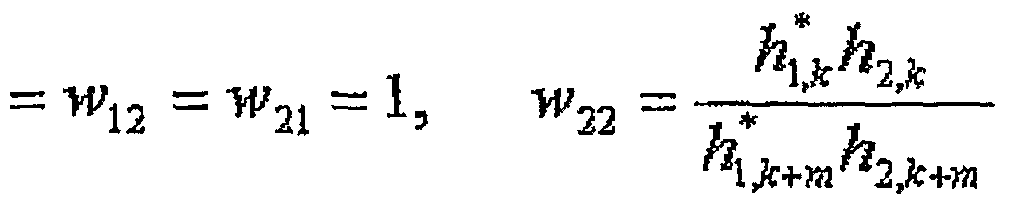
'k+m'-th radio resource; estimating a channel matrix using the received signals; calculating a weight matrix so that the channel matrix have orthogonality to the signals from each of the mobile stations; transmitting the weight matrix to each of the mobile stations; and receiving signals that the weight matrix is applied by each of the mobile stations. [2] The method according to claim 1, wherein the radio resources are channels on a time axis. [3] The method according to claim 1, wherein the radio resources are channels on a frequency axis. [4] The method according to claim 1, wherein when the weight matrix is

, and the channel matrix is

Wn
Priority Applications (2)
| Application Number | Priority Date | Filing Date | Title |
|---|---|---|---|
| EP07746096.2A EP2011363B1 (en) | 2006-04-24 | 2007-04-20 | Method for receiving signals in multiple user system |
| US12/298,219 US7835260B2 (en) | 2006-04-24 | 2007-04-20 | Method for receiving signals in multiple user system |
Applications Claiming Priority (2)
| Application Number | Priority Date | Filing Date | Title |
|---|---|---|---|
| KR1020060036722A KR101154992B1 (en) | 2006-04-24 | 2006-04-24 | Method for receiving signals in multiple user system |
| KR10-2006-0036722 | 2006-04-24 |
Publications (2)
| Publication Number | Publication Date |
|---|---|
| WO2007123336A2 true WO2007123336A2 (en) | 2007-11-01 |
| WO2007123336A3 WO2007123336A3 (en) | 2011-03-03 |
Family
ID=38625428
Family Applications (1)
| Application Number | Title | Priority Date | Filing Date |
|---|---|---|---|
| PCT/KR2007/001934 Ceased WO2007123336A2 (en) | 2006-04-24 | 2007-04-20 | Method for receiving signals in multiple user system |
Country Status (5)
| Country | Link |
|---|---|
| US (1) | US7835260B2 (en) |
| EP (1) | EP2011363B1 (en) |
| KR (1) | KR101154992B1 (en) |
| TW (1) | TWI389486B (en) |
| WO (1) | WO2007123336A2 (en) |
Families Citing this family (2)
| Publication number | Priority date | Publication date | Assignee | Title |
|---|---|---|---|---|
| KR101022120B1 (en) * | 2008-12-23 | 2011-03-17 | 주식회사 세아네트웍스 | Method and apparatus for determining weight matrix for beamforming |
| JP5923786B2 (en) * | 2012-03-16 | 2016-05-25 | シャープ株式会社 | Base station apparatus and communication method |
Family Cites Families (6)
| Publication number | Priority date | Publication date | Assignee | Title |
|---|---|---|---|---|
| CA1293999C (en) | 1987-08-24 | 1992-01-07 | Osamu Ichiyoshi | Earth station capable of effectively using a frequency band of asatellite |
| KR100493150B1 (en) | 2000-04-10 | 2005-06-02 | 삼성전자주식회사 | Method and apparatus of the optimum weight estimator of the closed loop transmit diversity for mobile communications |
| US6987819B2 (en) | 2000-12-29 | 2006-01-17 | Motorola, Inc. | Method and device for multiple input/multiple output transmit and receive weights for equal-rate data streams |
| KR100571862B1 (en) * | 2003-02-17 | 2006-04-17 | 삼성전자주식회사 | Mobile communication system including multiple antennas and method thereof |
| JP2005184730A (en) * | 2003-12-24 | 2005-07-07 | Sony Corp | Wireless communication system, wireless communication apparatus, wireless communication method, and computer program |
| KR100895992B1 (en) * | 2005-09-16 | 2009-05-07 | 삼성전자주식회사 | Apparatus and method for extending the number of antennas in a wireless communication system using multiple antennas |
-
2006
- 2006-04-24 KR KR1020060036722A patent/KR101154992B1/en not_active Expired - Fee Related
-
2007
- 2007-04-20 WO PCT/KR2007/001934 patent/WO2007123336A2/en not_active Ceased
- 2007-04-20 EP EP07746096.2A patent/EP2011363B1/en not_active Not-in-force
- 2007-04-20 US US12/298,219 patent/US7835260B2/en not_active Expired - Fee Related
- 2007-04-23 TW TW096114290A patent/TWI389486B/en not_active IP Right Cessation
Non-Patent Citations (3)
| Title |
|---|
| COSOVIC ET AL.: "Combined Equalization for Uplink MC-CDMA in Rayleigh Fading Channels", IEEE TRANSACTIONS ON COMMUNICATIONS, vol. 53, no. 10, 1 October 2005 (2005-10-01), pages 1609 - 1614, XP011140318, DOI: doi:10.1109/TCOMM.2005.857143 |
| See also references of EP2011363A4 |
| SERBETLI ET AL.: "Transceiver Optimization for Multisuer MIMO Systems", IEEE TRANSACTIONS ON SIGNAL PROCESSING, vol. 52, no. 1, 1 January 2004 (2004-01-01), pages 214 - 226 |
Also Published As
| Publication number | Publication date |
|---|---|
| EP2011363A4 (en) | 2015-04-08 |
| TWI389486B (en) | 2013-03-11 |
| KR101154992B1 (en) | 2012-06-14 |
| EP2011363A2 (en) | 2009-01-07 |
| US7835260B2 (en) | 2010-11-16 |
| KR20070105015A (en) | 2007-10-30 |
| EP2011363B1 (en) | 2017-10-04 |
| WO2007123336A3 (en) | 2011-03-03 |
| TW200803245A (en) | 2008-01-01 |
| US20100061222A1 (en) | 2010-03-11 |
Similar Documents
| Publication | Publication Date | Title |
|---|---|---|
| KR101109827B1 (en) | Utilization of air link resources in a multi-antenna base station | |
| US8891648B2 (en) | System for transmitting and receiving channel state information | |
| CN102804630B (en) | Method and apparatus for transmitting reference signals in uplink multiple-input multiple-output (MIMO) transmission | |
| JP5340159B2 (en) | MIMO communication system having variable slot structure | |
| US10250371B2 (en) | DMRS signal transmission method and apparatus | |
| Iswarya et al. | A survey on successive interference cancellation schemes in non-orthogonal multiple access for future radio access | |
| EP3528418A1 (en) | Resource indication method, and related device and system | |
| US8811523B1 (en) | Feedback and user scheduling for multi-user multiple input multiple output (MU-MIMO) system | |
| US10547360B2 (en) | MIMO communication method, and base station apparatus and terminal | |
| CN101895486A (en) | Method and device for shaping LTE downlink wave beams, base station and user terminal | |
| CN109217992B (en) | A transmission method, communication device and storage medium of a phase tracking reference signal | |
| KR101231912B1 (en) | method and transmitter for modifying beamforming vector iteratively | |
| US20110164578A1 (en) | Method and system for multiband user scheduling in a multiple user multiple input multiple output (mu-mimo) communication system | |
| Haci | Non-orthogonal multiple access (NOMA) with asynchronous interference cancellation | |
| CN102882632B (en) | Cooperative base station transmission method of hierarchical optimization transmission parameters | |
| WO2007123336A2 (en) | Method for receiving signals in multiple user system | |
| Rost | Robust and efficient multi-cell cooperation under imperfect CSI and limited backhaul | |
| US20100189200A1 (en) | Decoding device and method for mimo system | |
| US8824398B2 (en) | Radio communication system, radio communication device, and radio communication method | |
| US10111234B2 (en) | Frequency assignment method and transmission apparatus therefor | |
| CN119968906A (en) | A communication method and device | |
| Zemen et al. | Combating massive MIMO channel aging by orthogonal precoding | |
| KR101430611B1 (en) | METHOD AND APPARATUS FOR DATA TRANSMISSION IN MULTIPOINTS | |
| US8953660B2 (en) | Pilot structure to support a virtual diversity receiver scheme | |
| KR101449875B1 (en) | Cooperative communication method based on OFDMA system and system thereof |
Legal Events
| Date | Code | Title | Description |
|---|---|---|---|
| 121 | Ep: the epo has been informed by wipo that ep was designated in this application |
Ref document number: 07746096 Country of ref document: EP Kind code of ref document: A2 |
|
| NENP | Non-entry into the national phase |
Ref country code: DE |
|
| REEP | Request for entry into the european phase |
Ref document number: 2007746096 Country of ref document: EP |
|
| WWE | Wipo information: entry into national phase |
Ref document number: 2007746096 Country of ref document: EP |
|
| WWE | Wipo information: entry into national phase |
Ref document number: 12298219 Country of ref document: US |